To catch her criminals, Galactic Guardian Detective Rhea Hawke travels far and wide through the Galaxy and beyond in her Ray Class sentient ship Benny. From the oozing Weeping Mountains of Horus to the debauched crime-ridden glassy Splendid City of Ogium 9, here are just some of the worlds Rhea must navigate in The Splintered Universe Trilogy…

Acid rain of Mar Delena (photo by Nina Munteanu)
The Acid Rains of Mar Delena (Book 1)
The trilogy begins on Mar Delena, a water planet in the Fomalhaut system, where Rhea has chased the Dust smuggler V’mer to the AI-run Del City. Unfortunately, she encounters more than the smuggler there, experiencing first-hand what Dust can do…
I found myself absently curling a lock of my hair around one finger and resting my leg on the console as Benny eased into a large circle of Del City. I peered down into the darkness and barely made out the AI city sprawled on a large island surrounded by a rough sea. The dark sea occupied 98 percent of this bleak water planet.
“Mar Delena’s ocean is toxic with a pH of less than two,” Benny informed me. My ship’s voice was a calm tenor. I dropped my leg to lean forward and gazed down at the lights of the city. I made adjustments to the primary controls as Benny descended. Sheets of rain veiled the sentient city in shifting curtains of a shimmering skyscape. “That’s because the sulphurous rain has a pH of three,” Benny went on. “The caustic rain is a maintenance chore for the AIs that run the city’s infrastructure. They’re always repairing. That’s why all the streets are just left as dirt. The dirt lets the acid rain percolate into the ground. Of course it makes for a muddy place, but the Delenians don’t seem to mind.”
“Wonderful,” I muttered, gazing at the towering buildings, whose rounded roofs encouraged the corrosive rain to sheer off harmlessly to the ground. “Remind me to come here for my summer vacation …”
“There it is, Rhea,” Benny said.
“I see it.” I peered out my portside window through the rain and recognized V’mer’s small scythe-wing below. The ship resembled a bird of prey with a head-like cockpit flanked by crescent-shaped wings that flared out to the bow in a point. By analyzing its heat signature, Benny confirmed that the scythe-wing had only set down moments ago.
We’d just jacked the particle-wave stream thousands of light-years to this ancient dusty solar system. I chased V’mer here from a mining colony on Nexus, where the Badowin ran the largest illicit manufacture of Dust in the galaxy for Dark Sun—all cleverly under cover of a mining operation for Spice, a less dangerous narcotic. A little Dust showed you ‘God’; but in larger quantities it threw you convulsing over the precipice straight to chaos.
The Volcanoes of Gliese-876b (Book 1)
Rhea swiftly goes from detective on the hunt to hunted fugitive, wanted by her own Galactic Guardians and local PD for theft and other misdeeds. Disguised, Rhea sneaks into Phoenix City on the moon Gleise-12—home of a major Guardian precinct—in search of her truant and estranged mother to ensure she hasn’t been hurt by Vos terrorists. It doesn’t turn out well…
Gliese-12’s ecosystem wasn’t as friendly to its inhabitants as Iota Hor-2, I thought, gazing with a yawn down at the rich yellow-ochre tones that veiled the hazy moon of Gliese 876-b. Bathed in warm shades of a constant sunset, Phoenix City had been built under a giant energy-shield dome to protect its inhabitants from the incessant incoming stellar debris. As a result, we required special clearance to make port. Playing it safe, Benny had provided us both with an alias, in case the Iota Hor-2 Guardian precinct’s APB on my theft had already reached the Gliese precinct through the Galactic Net…
I strode with forced casual steps out of the Phoenix Sky Port and pulled out a stick of gum. I glanced at the security men and women as I passed the RADs unnoticed, chewing slowly to the rhythm of my steps, then emerged with a smug smile under a permanently blushing sky into the heat and sweet mesquite smell of Phoenix City.
Generally hotter, redder and louder than Neon City, the town was densely populated with towering buildings that rippled in the heat and glowed like burning embers under the fire of Gliese 876. Many of the tallest buildings were capped with glass-domed promenades, gardens, restaurants, and landing platforms. Their orange reflections glinted like exotic lanky mushrooms.
The city bustled with the thrum of commerce; air vehicles of all sizes zinged overhead in a constant rush. Phoenix City was a major banking centre. Even the Galactic Bank, my bank, had their head office here. All of the tallest towers were banking facilities. Save one, the Guardian precinct.

Inside a building in Splendid City (photo by Nina Munteanu)
Dangerous Glitter of Ogium 9’s Splendid City (Book 1)
I’d set a course for Ogium 9, a small terrestrial planet orbiting HD70642, a bright star ninety light-years from Earth. I hoped to get information on the whereabouts of the itinerant Ulysses space station from Zec in Splendid City. The very thought of returning to that nest of crime made me uneasy. I’d spent a significant portion of my youth there, surviving by using my brain and keeping my emotions in check. The last time I’d seen Zec, he’d sworn to kill me for jagging him—he nearly did.
Splendid City was, on the surface, quite splendid. I strode along one of the pedestrian air tubes that swayed over a thousand meters above the ground and gazed past my gravity boots through the transparent floor to the city, glowing in the warm blaze of the setting sun. Splendid City sprawled beneath me in a complex thrum and filigree of multi-shaped, rounded, and peaked rooftops. Translucent walkways snaked in and out of them. Catching the sun’s fire, they formed golden streaks across the sky. Air vehicles buzzed around the towers and walkways in swarms of synchronous order.
For some reason, Splendid City had become a Mecca for architects, and each building was a celebration of unique design. Several were modeled on biological creatures: tentacled jellyfish, or arachnids, spiked echinoids, or giant pollen shapes. The poet Goethe had described architecture as frozen art. I thought it no more apt than here, in Splendid City, where practical design and imagination conspired in the myriad shapes, textures and colors that rose up boldly towards the heavens.
The buildings sparkled like jewels. But the glitter of the throbbing city lay just on the surface, I thought solemnly. Beneath those resplendent spires and glass towers lay a filthy dark underworld devoted to crime. Splendid City was built by crime lords from all across the galaxy. It had been a good place for me when I sold my weapons designs; the place was ripe with young scoundrels, eager to build their little empires by trading one illicit merchandise for another. I’d had no problem finding customers. My challenge had been to keep from getting swallowed up by them…
When the door slid open, I saw Zec right away, feet up on his giant gadpie desk, eyeing me critically with scorn. He was handsome as always with dark, slick hair drawn back in a loose ponytail, with beautiful large heavy-lidded eyes the color of Earth’s ocean, and the lashes of a girl. He wore an expensive silk jacket imported from Earth over a charcoal gray T-shirt and tacky lumi-trousers. Behind him the large windows provided a spectacular view of the city lights in the deepening lavender of dusk. A lecherous smile slid over his face as he looked me up and down approvingly. He’d fancied me as his girlfriend when we’d slummed together in the lower levels. Even tried to kiss me once. He had the scar to prove it.
I met his gaze head on, then glanced down with a smirk to where his tight pants bulged and decided to make the first move. Tongue brushing my upper lip in mock seductiveness, I sneered: “Is that a Q-gun in your pocket or are you just happy to see me?”

Uma 1 (photo by Nina Munteanu)
The Treacherous Cold of Uma 1 (Book 2)
Rhea travels to the frigid moon Uma 1, to warn the Schiss leader Rashomon of a plan to assassinate him—only to inadvertently cause his gruesome murder and receive her own injuries. She then spots Serge. He bolts and she chases his fleeing figure into the frigid snow and ice sheet of Uma 1…
I pounded after him, ignoring my burning lungs and the pain that flamed up my leg. “Stop!”
He didn’t. An insane rage boiled inside me. It balled my fists and fired my legs into a galloping run. I was gaining on him.
He darted to the skipboats that lined the dock and untied one. He tripped the canopy open and slid into the boat with a sharp glance backward at me.
Just as I reached the skipboat, chest heaving with exertion, Serge started up the engine, and the boat leapt out into the water, accelerating with a high-pitched whine. It threw a pair of five-meter rooster tails behind, splashing the dock and soaking me with a slam of cold water. It almost knocked me off the wharf.
I recovered and scrambled, slipping off balance for a careless moment on the wet wharf, to the next skipboat and found the button to open the canopy. I untied the boat, dropped into the seat with a grunt of pain, closed the canopy, and started up the engine. It sputtered into a vibrating whine. Pressing my lips into a snarl of determination, I slammed on the foot pedal and was thrown back with sudden acceleration. Within seconds I’d reached his wake, skipboat screaming at top speed.
I could make out the end of the thermal shield, where the water abruptly ended in a vast sheet of crusted ice. Serge plunged into the cold, skipboat hitting the lip of ice at full speed and bouncing high. Hot on his heels, I kept my vehicle in full tilt and flinched when it crashed through the icy lip, soaring then landing with a painful jolt on the ice sheet. The vehicle’s thin pontoons allowed the skipboat to skate effortlessly at breakneck speed along the creaking ice sheet that covered the giant underwater city. My lip curled in a wicked smile as I noticed that I was catching up to him.
“Rhea!” the com spattered on with Serge’s voice. “Is that you?”
After a long pause I stabbed the com button and responded savagely, “Yes it’s me. Stand down, Serge.”
He didn’t respond.
“I repeat, STAND DOWN!”
“Listen, Rhea, I didn’t kill Rashomon,” he said in an almost pleading voice.
“No,” I retorted with scornful mockery. “I did.”
“I mean, I wasn’t involved in setting you up.”
“No, your sister did that,” I bit out. You were the bait. “You were probably just back up, in case I jagged up.”
“It wasn’t like that,” Serge protested, betraying some frustration. Why was he even trying to convince me of his innocence? Why did he jagging care what I thought?
“If it wasn’t like that, then what are you doing here, Serge?” I scoffed, forcing out words through shallow painful breaths. The windswept icy surface grew rippled and pitted with blocks of frozen ridges and pockets of water.
“The same as you. Trying to prevent his assassination. You have to believe me, Rhea.”
Serge skirted around several large ice buttresses and domes in quick succession, his vehicle pounding over frozen waves and curtained layers of debris and ice. I kept up, turning each time with grunts of painful effort and feeling each jar like a hard kick in my chest.
“Now, why is it that I don’t?” I snarled. “Maybe it’s because you’ve lied to me ever since we met … V’ser.” I realized that I was panting. “Everything you’ve ever said to me was a lie.”
The com went silent. The scene began to feel painfully surreal. A few times, I saw spots in front of my eyes and realized I was fighting from blacking out.
Serge continued to maneuver through what resembled a giant storm that had been flash-frozen. Where the chaos was he taking us? The turbulent wind blew the snow into eddies of swirling sleet, and it became harder to keep on Serge’s tail. I pounded in and out of dips and waves, painfully chasing the shadow of Serge’s yellow skipboat. Serge led us through a series of looming ice columns toward a rise in the topography. It looked like a giant frozen wave twenty meters tall. Maybe it was …
In a rush of new determination, I pushed out my jaw and felt my teeth gnash.
“Stand down, Serge!” I snorted out the words through panting breaths. “Give yourself up. It’ll end up better for you with the Guardians if you do.” God! Even I didn’t believe that.
He obviously didn’t either. I winced at his sharp laugh of derision.
“My dear Rhea. Always the Enforcer, even when you aren’t. And always in control—even when you obviously aren’t.”
“Jag you, Serge. And I’m not your dear!”
“Well, in that case you’ll have to catch me and stop me first!”
“If you insist.”
I slammed on the accelerator. We reached the rise and were climbing. It was steeper than I had initially thought, and I had to fight the wheel to keep from tipping over on my side as Serge led me on a diagonal vector up the ice and snow slope. Face puckered in a tight snarl, I forced my skipboat to skirt around Serge’s, flanking him on the high side. I caught sight of his tense face through the canopy as he threw alarmed glances at me.
“Rhea, you don’t have any weapons and you’re hurt. I hear it in your voice. How are you going to stop me? With your bare hands?”
“If I have to.”
I came up beside him, nosing toward him to force him down.
We crested the hill at the same time with my vehicle on the outside and—Oh, God! My pulse raced. I knew what lay on the other side before I saw it.
A sheer cliff! More than that, it turned into an inverted cliff at the bottom. I realized that this was just another dome and we’d climbed the windward side where snow and ice had piled to form an incline. I felt myself slide uncontrollably into that awful dreamstate and watched in horror as it played out like I knew it would:
In a panic, Serge overcompensated. I was too close! His tail skidded in counterpoint and collided hard against mine, forcing me over the cliff. Heart surging in a spike of alarm, I fought the wheel as my skipboat slid straight down the dome then hurtled into freefall …
“Rhea! NO!—”
I saw the icy ground rushing toward me then smashed into darkness.

Boiling Sea of Horus (photo by Nina Munteanu)
The Boiling Sea of Horus (Book 2)
In search of answers to her past from her elusive grandmother—who has transformed into a giant snake-like Apophus—Rhea returns to the misty narcotic Boiling Sea within the Oily Range (Weeping Mountains) whose oily residue settles over everything like a clammy soporific slime:
I pulled out a second wad of soyka gum and chewed nervously then resumed paddling, eyes sharp for any boiling masses of water snakes. With each stroke of the paddle I disturbed the surface scum and left a wake of swirling colour. It released a foul stench of rotting compost. The brown mist hovered like a cobweb over the oily film. I searched for any sign of agitation and listened over the gentle chortling of the water between each paddle stroke…
I swept the hair back from my face and squinted, trying to see beyond the ten meters of visibility the dank mist allowed. Following my internal compass, I negotiated the towering islands with unease. The only warning that I was approaching one of their vertical cliffs came in the sudden slap, slosh and gurgle of the waves against the sheer rock face. Then within a heartbeat the slimy dark rock would thrust up like an apparition through the oily mist and I’d steer clear with a sharp intake of air. I must have passed at least a dozen islands as I continued toward my destination, a place in my mind, perhaps planted there by those beasts that had taken brief residence inside me. Ever watchful for the apophus, the giant snake that had previously batted my ship out of the sky then set its babies to consume me, I was acutely aware of my vulnerability in this small canoe. If the apophus was hungry it could easily overturn my boat and spill me into the churning water to either consume me directly or feed me in slow agonizing ecstasy to those nasty babies of hers.
My head began to spin and I felt slightly nauseous…the cloying smell was overpowering. Was I going the right way? Some compass in my head had compelled me to bear toward a northern point on the convoluted shoreline. I’d been paddling for hours, but I could make out nothing in the thick fog. I shook my head to clear my mind and pulled out another soyka gum wad then joined it to the mass already in my mouth. My gaze settled on the iridescent swirling patterns of the whirlpools left in the wake of the draw of my paddle…
…Why did all the women in my family do atrocious things? If Shlsh was telling the truth, my grandmother had been the worst. She’d betrayed all of humanity by letting the Vos into my world. It was inconceivable. How could someone, a single person, have that kind of power?
>I didn’t…It wasn’t just me…I had help, Vos help…
“What—” I inhaled my gum and my hand slipped on the paddle. It fell into the oily water and drifted away from the canoe. I flung out my arms to retrieve it, throwing the boat into a violent rock. Warm water flooded into the boat with a burst of rank fumes and I jerked back, pitching the boat into a counter rock and nearly fell out. I threw myself onto my stomach and groped for the slippery handle floating in the iridescent scum. Hands scrabbling, I found purchase, bringing more water in. As I pulled the oil-covered paddle into the boat and kneeled to wipe the slime off my arms with shaky hands, the voice returned:
>I was in love and I fell. Love tricks you. Love blinds you. I think you know about that, Rhea…
“Shut up!” I shouted, clamping slime-covered hands over my ears. But the voice was inside my head. I raked back the hair off my face in a brisk sweep and in a more subdued tone I asked, “Who are you?”
>Come this way. You will have your answers soon enough. Are you brave enough to handle them? You are almost there…

Migratory trees of Horus swamp (photo by Nina Munteanu)
The Migratory Trees of Horus (Book 2)
Once the apophus captures Rhea, it takes her across the Boiling Sea to a swamp where Rhea encounters the legendary migrating trees and—when she escapes the apophus—she collides with something worse—carnivorous ammuts:
The pungent smell of anaerobic mud and crushed vegetation stirred my nostrils and I looked up. I saw that the serpent was lumbering into a narrow canyon toward a ghostly grove of lanky trees. They resembled mangroves in the swirling mist. Within moments the snake began to make those same lyrical sounds that had intoxicated me the first time I’d come here. At the time I didn’t know who or what had made the eerie but beautiful sounds. Within moments an equally beautiful and more eerie multi-timbral chorus of feral ‘voices’ echoed off the canyon walls as if riding on the moving mist. I concluded against my own logic that this was some sort of communication between the apophus and…what? Surely not the trees? I narrowed my eyes with sudden amazement. Was I seeing clearly? Were the trees moving?…
I pulled myself out of the brown-stained pond and waded in a hobble through the warm swamp, Great Coat trailing like floating sails on the water. The canyon eventually opened to a wide valley, surrounded by towering oil-covered cliffs.
A loud pop and crackle ahead made me skid to a halt. I watched with amazement as a ten-foot oval structure made of earth and debris emerged from the muck, creating a small wake in the black water just meters in front of me. I flinched as it snapped open at the top, releasing a sharp odour of clove and burning matches. I considered backing away slowly and took a step back then stopped dead in my tracks and held my breath as two long deep crimson ‘tails’ slowly whipped out. They looked suspiciously like motion-sensing antennae.
When a vicious insect-like head emerged, attached to the ‘tails’ and dripping slime from a long proboscis, I abandoned stealth and bolted through the knee-deep swamp, not waiting to see the rest of the creature. Oh, God! These were the carnivorous larval stage of the ammut that Ka had told me about. I’d picked a great time to return to Horus: the beginning of the ‘season of the dead’ when the ferocious ammut hatched and swarmed.
Within moments, I heard an ominous loud clap and buzz behind me. I forced myself to turn and dared a glance. I clamped terrified eyes on a creature rising in the air, then lost my balance and fell backward into the swamp. A twelve-foot long insect-like creature had unfurled four narrow dragon-fly wings that flapped furiously. Twelve jointed legs dangled below its thick body. Huge multi-faceted amber eyes roamed below its crimson antennae and its long proboscis twitched, hungry for its first meal. Catching my breath, I scrambled under a drowned shrub and the ammut flew past me, the machine-gun flutter of its huge wings reverberating in my gut. I swallowed down my terror and wondered what an adult looked like if this thing was its larval stage.
I backed further into the bush and heard the sounds that I dreaded—more popping and crackling. I stared at the emerging swarm of eggs in the wide valley. Like popcorn, they started with a few snaps here and there. Within moments a cacophony of eruptions and the heady odour of clove and burning matches pervaded. According to Ka these carnivorous larvae left a swath of destruction in the wake of their swarm. No wonder the migrating trees were heading out of the valley!
…Ankle throbbing, I sat in murky marsh water to my waist, Great Coat billowing up around me, and back pressed against a bush. I listened to the chaotic clamber of ammuts emerging and flying. It grew dark overhead as their swarming bodies veiled the orange sky with black. The deafening machine-gun stutter of their wings filled my head and throbbed in my gut. Any moment a stray would find me, sniff me out with its long blood-red antennae, and I’d have to run…and die. In a sudden flash of regret, I wished I’d kissed Serge one final time….
Heart pumping, I dashed out from my temporary cover and fell with a loud splash as my leg gave out painfully under me. Alerted, several ammuts veered down straight for me. Heart slamming, I scrambled into a painful run as the first ammut’s antennae whipped out. It lashed my face and leg with a crackling snap and drew blood. I cried out with the agonizing sting and smelled burning flesh and cloves. I immediately felt a weak numbness spread through my body. Suddenly losing all strength, I stumbled and fell backward into the knee-deep swamp with a gasp. My face plunged into the stained water. I managed to right myself, coughing out black water, and thrashed to keep from sinking in the soft mud. By then more ammuts had buzzed in. Seizing in sobbing breaths, I backed away by scrabbling on my rump, too weak to rise to my feet. The soft bottom kept giving way underneath my hands. They sunk into soft mud and debris.
I watched in terrified revulsion as the nearest ammut descended upon me then I gasped as its chitinous legs poked my breast, as if testing its texture. To my horror, the giant invertebrate then settled partly on top of me and slowly pumped its body up and down, as if excited, effectively pushing me further down into the murky swamp until my head was barely out of the water… I gazed up at the creature’s head, chittering directly above mine, and fought down a moan of terror. Slobber from the creature’s proboscis dripped over my head then plopped, reeking of cloves and sulfur, on my face. I jerked my hand to wipe off the slime, then seized my MEC from its holster in blind panic. I aimed it at the ammut’s head and, pressing the trigger, dialed through every setting I could think of with my other fingers. Nothing worked.
Dear God, I prayed, releasing an involuntary moan, make it quick—
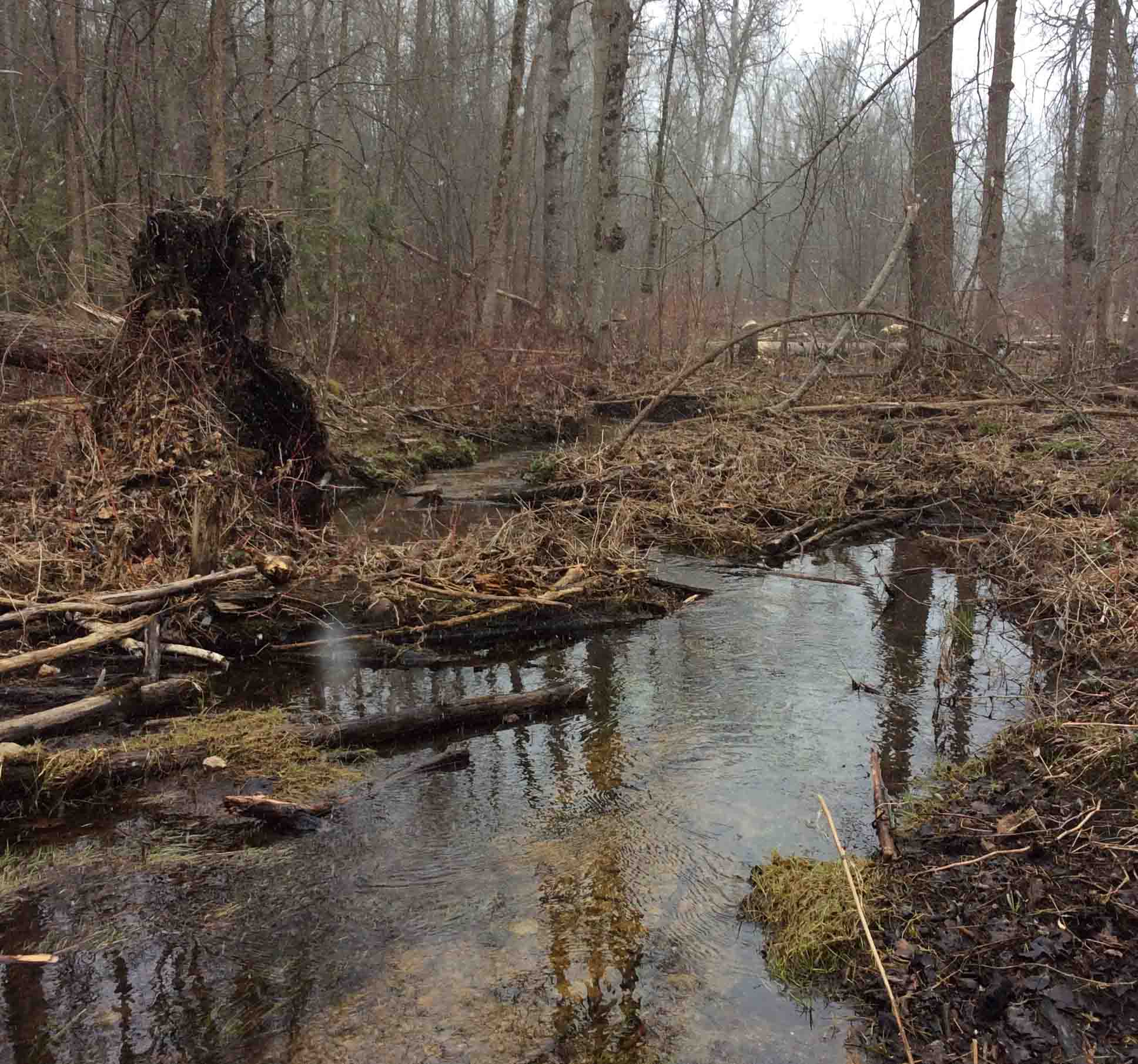
Swamp and marshland of Sekmet (photo by Nina Munteanu)
The Blanket Bogs of Sekmet (Book 2)
When Rhea is captured for several murders she didn’t commit, she is sent to the penal planet Sekmet to serve her life-sentence in Hades, a 2-kilometre mining barge floating on the peat bog.
I gazed out my porthole at the barren patchwork of the small wetland-dominated planet, whose surface resembled an early impressionist’s painting. Dominated by sombre russet and indigo tones, the raised bog was dotted by a hasty spray of cobalt lakes and pools.
Although it was mid-morning on the planet, the mostly grey sky was saturated in low cloud and it was drizzling outside. Spates of wind drove sheets of rain hailing sporadically against my porthole. It was a wet desolate place. But then again, “A drowning man is not troubled by rain—Persian Proverb, Rhea,” I said quietly to myself. The weather was the least of my concerns.
As the ship descended, I could make out the individual pool system of the blanket bog with its inhospitable tapestry of dark and wet shapes. I dispassionately reviewed what I knew of the planet. Its cool wet climate and rich iron deposits promoted the development of muskeg, string bogs, darkly forested swamps and wildflower-filled fens. This was Sekmet, an Earth-sized planet that orbited the KO star, HD177830 in the constellation Vulpecula. My new home. Where I was going to die.
Within moments the ship landed with a sharp jolt in the open landing bay of the floating colony. Then the exit hatch door opened and the AI droned, “This is your destination, Rhea Hawke. Please disembark.”
My chest clenched. I swallowed down my fear and stepped out onto the platform of Sekmet’s landing bay, catching the faint sulphurous smell of the bog. The doors of the ship abruptly closed behind me, making me involuntarily flinch. Annoyed at my reaction, I gathered my composure and swiftly assessed the empty platform, hearing only the hum of the ship’s engine. My gaze rested on the endless hummocks and large meandering ponds of tea-stained water outside.
As the ship made ready to leave, I felt my heart pounding with the sudden urge to bolt. I had a panicked notion to leap off the platform into the murky bog. Swim, wade, scrabble to eventual safety in the wilderness of Sekmet in those distant hills. The ship lifted off the ground in a turmoil of dust and thunder. My face twisted with indecision as I tensed, poised to flee—
A male Azorian burst in from the adjoining chamber and I braced for an attack. He pelted right past me then leapt into the murky water. I watched him thrash through the undulating bog, stumbling, submerging and trying to swim—his left arm was amputated at the elbow. I was about to follow when laser shots peppered the water around him for several heartbeats. As suddenly as the shots began, they ended and the Azorian slowly sank until only his head remained above the water. I stood stiff, trembling hands over my mouth, and breathing hard. I stared at the head bobbing slowly in the water.

Dunes of Upsilon-3 (photo by Nina Munteanu)
The Barkhan Deserts of Upsilon-3 (Book 2)
In a desperate attempt to find the Ancient One—the key to the mystery killings—Rhea steals a Vos ship and the Vos Commander. She forces the terrorist A’ler at gunpoint to take them to Upsilon-3, the inhospitable desert planet where the Ancient One has settled in an enclave created by an ancient civilization. It is also where Rhea was almost killed once in a rabid blenoid attack. She will meet these vicious predators again…
Bleary-eyed and very cross, A’ler took us down to the arid planet, piercing the cerulean atmosphere with a view of mostly ruddy sand dotted with grey-green scrub below. We then crossed a vast expanse of open desert. I gazed down at the waved pattern of cresent-shaped dunes, obviously formed by a constant wind. It was a harsh and miserable environment, I thought.
“Barkhans,” A’ler offered, pointing to the dunes and breaking her taciturn silence. “That’s the West Ghouroud. No one’s ever crossed it and lived.” She eyed me with a dismissive look of disgust as much as to imply, especially a puny like you.
I didn’t respond and let my gaze stray back to the dune sea. The dunes looked like the capped waves of a red ocean, the deep ochre of their shaded slipfaces contrasting with the harsh bright windward sides, still baking in the sun. The dunes looked small, but I guessed that some were at least three hundred meters high.
I’d been there before. I’d tracked and dispatched an Azorian assassin to the small ephemeral town there once—but at the cost of a blenoid attack. In his desperation, the Azorian had fled the ghost town into the arid wilderness, and if I hadn’t shot him, the blenoids would have torn him apart. If they hadn’t, he would have died a horrible death of severe hypothermia. As it turned out, my shot infuriated a pack of sleeping blenoids and I became the subject of their fury instead.

Clear toxic water of the Beleus Sea (photo by Nina Munteanu)
The Toxic sea of Beleus (Book 3)
Rhea makes a daring rescue of the bookseller Serge Bastion (Serge’s outer diverse twin), injured in a med-centre in Beleus City on Beleus. When Bastion refused to jump out the window to safety, Rhea belts him then gets him own by unconventional means to a nearby park.
I spotted it; a small peewee, parked a block away on the side of the road. The small two-seater resembled an ancient Earth motorcycle, except that it could fly. I pelted toward it and, after a brisk glance over my shoulder, straddled the vehicle and jimmied the starter lock then kick-started the engine. The vehicle stuttered on and I drove it to the bush where I’d stowed Bastion. I leapt off and pulled Bastion out from under the bush. After struggling with his dead weight, I finally got him, still in his pajamas, in the back-supported passenger seat and seat-belted his slumped form in. I jumped in the pilot’s seat, grabbed his limp arms so he was leaning against me and secured his arms around my waist by lashing them together with chord from my pocket. Then we were soaring up just as several Eosian guards ran up to us, waving nokerig pistols and shooting.
Nihilists had perched themselves on the roof and caught my peewee in a salvo of torpedoes. I veered us out to sea but not before one grazed the vehicle. I felt the hard jerk to the right and craned to look over my shoulder. I noticed to my dismay that a green cloud of hesium fuel was spraying out of the fuselage. But we’d at least cleared the distance they could shoot. I had no idea where I was going, except that it was far from the Med-Facility and the city.
For now I spotted no pursuit. That would change quickly, I thought, glancing down at my options. We were heading out to sea toward a long string of islands. The Beleus Sea shimmered in the sunlight with mercurial hues of lavender, deep purple, aqua green and blue. So different from the oily seas of Horus, the Beleus Ocean was extremely clear, reflecting the shifting light of the planet’s atmosphere in an exotic glitter.
Bastion stirred, head still lolling against my shoulder, and I reached behind me to jab him awake.
“Where are we?” I said gruffly. “We’re low on fuel.” I didn’t tell him we were losing fuel. “And we need to land somewhere fast…and safe!”
I had to give him credit; he sobered fast and unfastened his hands then leaned forward to point to our left, toward a cluster of extremely tall islands. “There. Go there, to the Broken Islands. They won’t find us there.”
That was what I needed to hear. I veered hard to port and heard Bastion grab my waist again and moan out some expletive at me. I glanced over my shoulder and found him glaring at me and rubbing one hand over his sore jaw.
“Sorry,” I muttered. “You weren’t going to jump.”
“What’d you do? Throw me over?” he asked in a sarcastic voice and felt himself gingerly.
“No, I just changed into a bird and flew you down to this vehicle that was waiting for us,” I said, meeting his sarcastic tone.
He remained silent. The truth is always more bizarre than any made up story, I thought dismally.
We were fast approaching the tall island spires. Hundreds of them dotted the iridescent sea. It was obvious to me that we’d reached the Broken Islands. And good thing too, because the engine began to stutter. It spluttered and whined as if in objection as I gunned it. Then I hiked in my breath as we went into a silent glide.
“Are we—” Bastion stopped himself.
He decided that he didn’t want to know; unfortunately I didn’t have that luxury. It’s not enough to know to ride; you must also know how to fall—Mexican proverb. Ok…here we go…

Original seminary in Granby, Quebec on Earth
The Re-Imagined Earth (Book 3)
Rhea returns to Earth—now transformed by the Eosians who have settled there—She goes there with her inner diverse twin and Serge to warn the eccentric Gnostic Rafael Martinez of plans to assassinate him and also to borrow some of his elite guard to find the hidden Vos weapons facilities and destroy them. But Martinez turns out to be far more than an eccentric priest, challenging Rhea existentially a key to her past and her future…
Martinez had taken up residence in an old Catholic seminary just outside a derelict town in what used to be the rural Eastern Townships of Québec. I thought it apt that he chose a theological school for his Gnostic teachings.
As Benny entered atmosphere and circled down, I gazed through my starboard porthole at the familiar landforms and water masses of Earth. It was a lot greener than the last time I’d seen Earth through my view port aboard the shuttle that had taken me away from my home. Since the Eosians had colonized the planet thirty years ago, Earth had reverted mostly back to wilderness. Eosians were master ecologists who had honed their healthy symbiotic skills with nature into an art.
The planet, Gaia, was certainly healthier and happier now that her ancient prodigal civilization had returned. These former Atlanteans had brought back the wisdom of millennia about living in concert with and through nature’s arcane powers. They’d torn down humanity’s great cities and replaced concrete and glass with natural organic, living materials. They’d uprooted the roads and bridges and introduced their native scree, an intelligent giant raptor, as transportation. They’d let nature absorb the massive agricultural fields and clear-cuts, to harvest and recycle her bounty in beneficial ways. They planted their native tree, the vishna, everywhere. They’d restored the natural environment from the ravages of strip mines, oil fields and gas plants and replaced them with their non-intrusive crystal technology.
I gazed at the endless rolling hills covered in a lush purple and green carpet of young vishna and native trees. It was a monument to a simple and gentle life, a respectful pantheistic life. I could have wept; it was so beautiful. But it wasn’t Earth anymore….
V’rae wept for me. She and Serge had come beside me to watch once we’d entered atmosphere over North America. She said in a wavering voice, “It’s so beautiful…but it isn’t Earth anymore.” Then she burst into tears.
Martinez’s estate, the Solstice, was an island of lavish order in a green frothy sea of mixed wild forest. The derelict farming town of Granby had been demolished and absorbed back into nature since the Eosians had taken over as Earth’s new custodians. I could barely make out a criss-cross pattern of lighter greens in the forest mosaic that betrayed where old foundations and roads had previously lain not far from the current estate. Martinez’s estate was one of the few human-built structures that the Eosians hadn’t torn down and replaced with their symbiotic organic structures or left to natural and enhanced regeneration.
Martinez’s estate, the Solstice, was an island of lavish order in a green frothy sea of mixed wild forest. The derelict farming town of Granby had been demolished and absorbed back into nature since the Eosians had taken over as Earth’s new custodians. I could barely make out a criss-cross pattern of lighter greens in the forest mosaic that betrayed where old foundations and roads had previously lain not far from the current estate. Martinez’s estate was one of the few human-built structures that the Eosians hadn’t torn down and replaced with their symbiotic organic structures or left to natural and enhanced regeneration.
I frowned at him and saw V’rae look puzzled and clutch his arm. “Well, be that as it may,” I returned coolly, “he’s on the hit list and we still have to warn him. Plus he does have the largest and most capable independent Eosian guard in the galaxy.”
His brows came together. Then he bolted forward, bumping past my shoulder with his face so close to mine I could feel the heat coming off him. His arm brushed mine to touch the navigation screen. “I really think we should reconsider and—”
V’rae seized his other hand and pulled him back. “Let her land the ship, V’ser,” she commanded quietly. “We’re here now.” She was right and Serge knew it. He straightened with a sigh and I started to breathe again.
 Then we were being hailed and I got on with the task at hand. “Strap yourselves in,” I instructed once I’d been given the go ahead to take port in Hanger B, below the seminary. After a long intake of air, I took us down.
In Metaverse, the third and last book of The Splintered Universe Trilogy, Detective Rhea Hawke travels back to Earth, hoping to convince an eccentric mystic to help her defend humanity from an impending Vos attack—only to find herself trapped in a deception that promises to change her and her two worlds forever.
You can listen to a sample recording of Outer Diverse, Inner Diverse, and Metaverse through Audible. Get the complete Splintered Universe Trilogy Audiobooks on Audible or any other format you prefer from quality bookstores. Find Splintered Universe Trilogy reviews on Goodreads.



Nina Munteanu is a Canadian ecologist / limnologist and novelist. She is co-editor of Europa SF and currently teaches writing courses at George Brown College and the University of Toronto. Visit www.ninamunteanu.ca for the latest on her books. Nina’s bilingual “La natura dell’acqua / The Way of Water” was published by Mincione Edizioni in Rome. Her non-fiction book “Water Is…” by Pixl Press (Vancouver) was selected by Margaret Atwood in the New York Times ‘Year in Reading’ and was chosen as the 2017 Summer Read by Water Canada. Her novel “A Diary in the Age of Water” will be released by Inanna Publications (Toronto) in 2020.






 Nina Munteanu Writing Coach