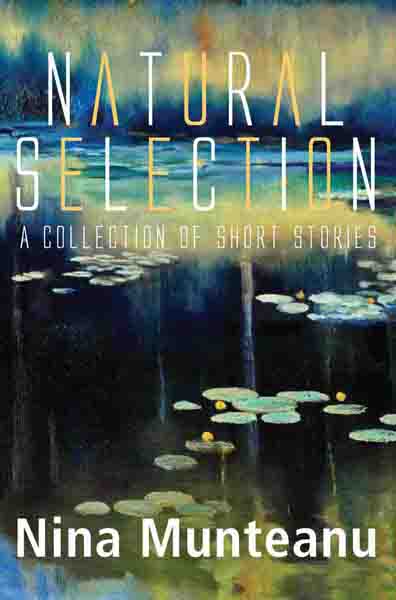
 “I write SF about a near future ‘Gaian’ world too, and at times felt I was reading a prequel to my own novels, but that’s not why I rated this collection so highly. I did so for two reasons. First, because the science was so interesting, combining visionary metaphysical speculation with AI corporate tech in scenarios that often seemed chillingly possible. Second, because of the author’s focus on the effects of these developments on human beings with complex pasts and desires. Jealousy, lust, loneliness, grief and love are all drivers of these taut and fascinating narratives…”–Amazon Review
Author’s Introduction to Natural Selection
 Evolution is the language of destiny. What is destiny, after all, but self-actualization and synchronicity? If evolution is the language of destiny, then choice and selection are the words of evolution and “fractal ecology” is its plot.
How do we define today a concept that Darwin originated 200 years ago in a time without bio-engineering, nano-technology, chaos theory, quantum mechanics and the Internet? We live in an exciting era of complicated change, where science based on the limitation of traditional biology is being challenged and stretched by pioneers into areas some scientists might call heretical. Endosymbiosis, synchronicity, autopoiesis & self-organization, morphic resonance, Gaia Hypothesis and planetary intelligence. Some of these might more aptly be described through the language of meta-physics. But should they be so confined? It comes down to language and how we communicate.
Is it possible for an individual to evolve in one’s own lifetime? To become more than oneself? And then pass on one’s personal experience irrevocably to others—laterally and vertically?
 On the vertical argument, the French naturalist Jean-Baptiste Lamark developed a theory of biological evolution in the early 19th century considered so ridiculous that it spawned a name: Lamarkism. His notion—that acquired traits could be passed along to offspring—was ridiculed for over two hundred years. Until he was proven right. Evolutionary biologists at Tel Aviv University in Israel showed that all sorts of cellular machinery—an intelligence of sorts—played a vital role in how DNA sequences were inherited. When researchers inserted foreign genes into the DNA of lab animals and plants, something strange happened. The genes worked at first; then they were “silenced”. Generation after generation. The host cells had tagged the foreign genes with an “off switch” that made the gene inoperable. And although the new gene was passed onto offspring, so was the off switch. It was Larmarkism in action: the parent’s experience had influenced its offspring’s inheritance. Evolutionists gave it a new name. They called it soft inheritance.
As for passing on one’s experience and acquisitions to others laterally, education in all its facets surely provides a mechanism. This may run the gamut from wise mentors, spiritual leaders, storytellers, courageous heroes to our kindergarten teacher. Who’s to say that these too are not irrevocable? This relies, after all, on how we learn, and how we “remember”.
Evolution is choice. It is a choice made on many levels, from the intuitive mind to the intelligent cell. The controversial British botanist Rupert Sheldrake proposed that the physical forms we take on are not necessarily contained inside our genes, which he suggested may be more analogous to transistors tuned in to the proper frequencies for translating invisible information into visible form. According to Sheldrake’s morphic resonance, any form always looks alike because it ‘remembers’ its form through repetition and that any new form having similar characteristics will use the pattern of already existing forms as a guide for its appearance. This notion is conveyed through other phenomena, which truly lie in the realm of metaphysics and lateral evolution; concepts like bilocation, psychic telegraphing, telekinesis and manifestation. Critics condemn these as crazy notions. Or is it just limited vision again? Our future cannot be foretold in our present language; that has yet to be written. Shakespeare knew this…
There are more things in heaven and earth, Horatio, than are dreamt of in your philosophy—Shakespeare
The nine stories contained herein touch on many of these concepts, spanning a 20-year writing period starting in the 1980s from “Arc of Time”, first published by The Armchair Aesthete in 2002, to “Julia’s Gift”, written in 2007, a year that marks a significant nexus in my personal evolution. That’s when I met someone who changed my life and defined my life path, my evolution, and ultimately, I suspect, my destiny.
Each story reflects a perspective on what it means to be human and evolve in a world that is rapidly changing technologically and environmentally. How we relate to our rapidly changing fractal environments—from our cells to our ecosystems, our planet and ultimately our universe—will determine our path and our destiny and those we touch in some way. My friend Heidi Lampietti, publisher of Redjack Books, expressed it eloquently, “For me, one of the most important themes that came through in the collection is the incredible difficulty, complexity, and importance of making conscious choices—and how these choices, large and small, impact our survival, either as individual humans, as a community, a species, or a world.”
Each story touches on a focal point, a nexus in someone’s personal evolution, where a decision—or an indecision—will define one’s entire later path in life. Several stories (e.g., “Butterfly in Peking”, “Frames” and “Julia’s Gift” all set in the same universe as my “Darwin’s Paradox” duology) explore this through war: a paradoxical struggle between those who follow the technological path and those who embrace nature’s intelligence. War is itself a paradox. It is both tragedy and opportunity. The very action of being at war seems to galvanize us and polarize us. War heightens contrast, increases pitch, and resonates through us in ways we have no inkling. It brings out the very worst but also the very best in us; for, as some of us sink into despair and self-serving debauchery, others heroically rise in altruistic service and humble sacrifice to help others. War defines us, perhaps like no other phenomenon.
Several stories are quirky adapted excerpts from my two books, “Darwin’s Paradox” (2007 by Dragon Moon Press) and its prequel “Angel of Chaos” (2010 by Dragon Moon Press). You will find some of the same characters there, though names have been changed to protect the innocent. You will also find the sprawling semi-underground AI-run city of Icaria (a post-industrial plague Toronto) and a character itself. Several of the characters portray “gifted” and troubled misfits—outcasts, anti-heroes, artists not in sync with the rest of the population. Yet how that person’s choices—and how s/he is treated by their community—would influence an entire species or world (“Mark of a Genius”, “Neither Here Nor There”, “Angel’s Promises”, and “Natural Selection”).
Lastly, I explore how humanity evolves, communicates and relates through forces larger than itself, either produced through its own making via technology (in “Virtually Yours”) or through timeless universal intervention (in “Arc of Time”). The last story (in fact the first written) provides a very different interpretation of an old biblical myth about new beginnings and our cyclical destiny of “creative destruction”.
I hope you enjoy reading them all. I enjoyed writing them.
“The Arc of Time” was first published in the Summer/Fall 2002 issue of The Armchair Aesthete. It was reprinted in Imagikon (2003) then scheduled for the premiere issue of Ultra! A charity issue dedicated to cystic fibrosis (Aardwolf Publications), Fall/Winter, 2004. Sadly, Lari Davidson, the editor and visionary behind the project passed away suddenly and the issue never came to fruition.
“Virtually Yours” first appeared in Issue 15 (December 2002) of Hadrosaur Tales. It was reprinted in Neo-Opsis Science Fiction Magazine (Issue 3, Spring 2004) then translated into Polish and reprinted in the January 2006 issue of Nowa Fantastika (Poland). It was translated into Hebrew and reprinted in Bli-Panika (Israel) in 2006. “Virtually Yours” was selected for the 2006 “The Best of Neo-Opsis Science Fiction Magazine” anthology (Bundoran Press) and was nominated for the Canadian Aurora Prix and the Speculative Literature Foundation Fountain Award.
“Angel’s Promises” was published in Issue #30 (March, 2003) of Dreams & Visions then selected for the anthology “Skysongs II: Spiritual SF” (2005). It was nominated for the SLF Fountain Award.
“A Butterfly in Peking” was first published in Issue #17 (2003) of Chiaroscuro. It was translated into Polish and reprinted in the Summer 2005 issue of Nowa Fantastika (Poland) then translated and reprinted in The Dramaturges of Yann (Greece) in 2006.
“Mark of a Genius” first appeared in Scifidimensions (August 2004 issue) and “Neither Here Nor There” first appeared in Another Realm (September 2005). “Frames”, “Julia’s Gift” and “Natural Selection” make their first appearance here.
Amazon description of Natural Selection
A man uses cyber-eavedropping to make love. A technocratic government uses gifted people as tools to recast humanity. The ruins of a city serve as battleground between pro-technologists and pro-naturalists. From time-space guardians to cybersex, GMO, and biotech implants, this short story collection by science fiction novelist Nina Munteanu promises a journey of great scope, imagination and vision.

Nina Munteanu is an ecologist, limnologist and internationally published author of award-nominated speculative novels, short stories and non-fiction. She is co-editor of Europa SF and currently teaches writing courses at George Brown College and the University of Toronto. Visit www.ninamunteanu.ca for the latest on her books.









 Nina Munteanu Writing Coach