Nina Teaching SF Writing Course at George Brown College FALL 2015

 nina-workshop 2

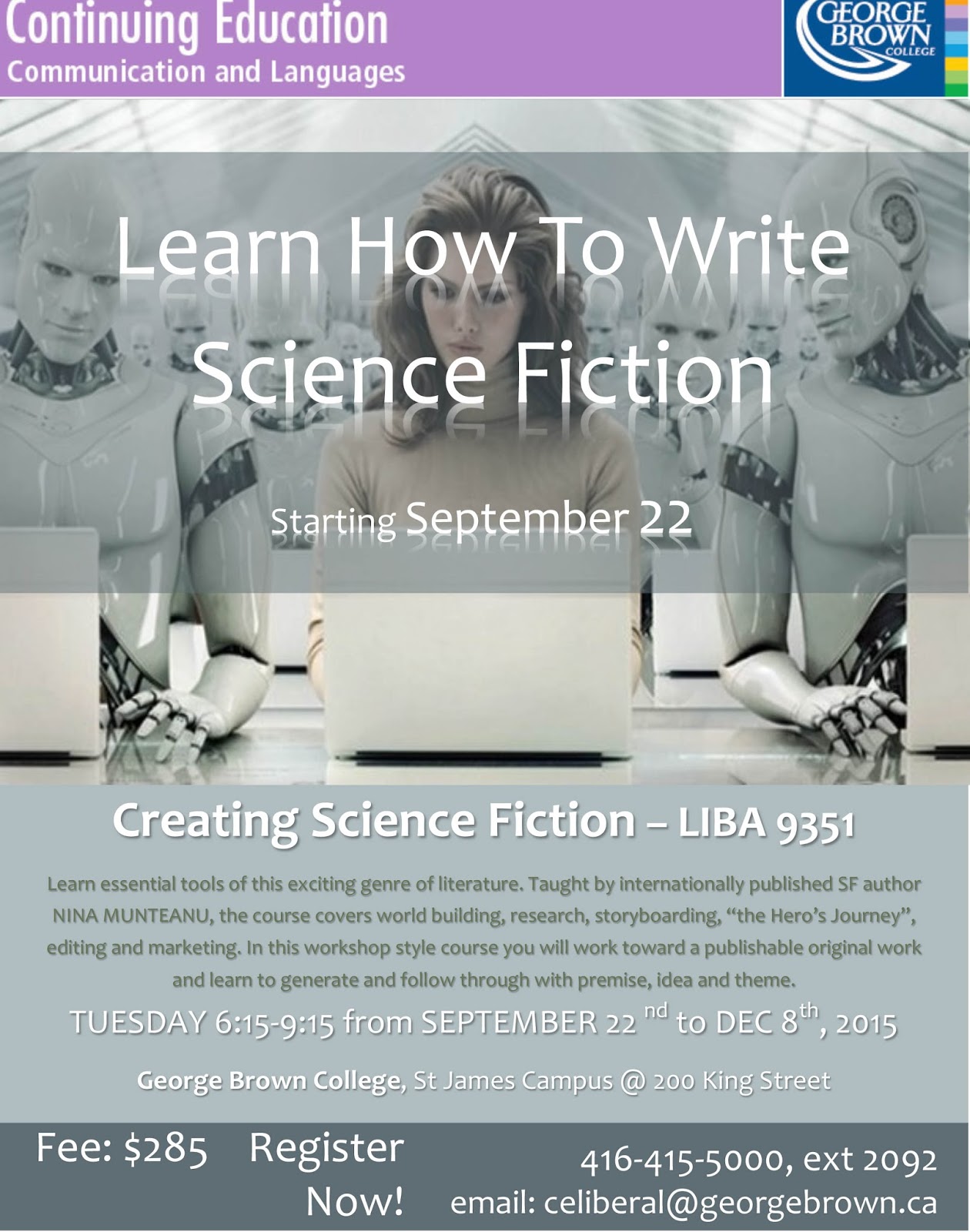
I’m back at George Brown College in Toronto, teaching my 12-week long writing course on how to write science fiction. “Creating Science Fiction” is now part of George Brown’s Creative Writing Certificate.

The 12-week course starts SEPTEMBER 22 (TUESDAY)  and runs until DECEMBER 8th. See the description below:

The course “Creating Science Fiction” runs TUESDAY nights from 6:15 to 9:15 starting September 22nd through to December 8th and costs $285.
.
Meant for both beginning writers and those already published, the 12-week course is run like a workshop with student input and feedback on student’s WIPs.
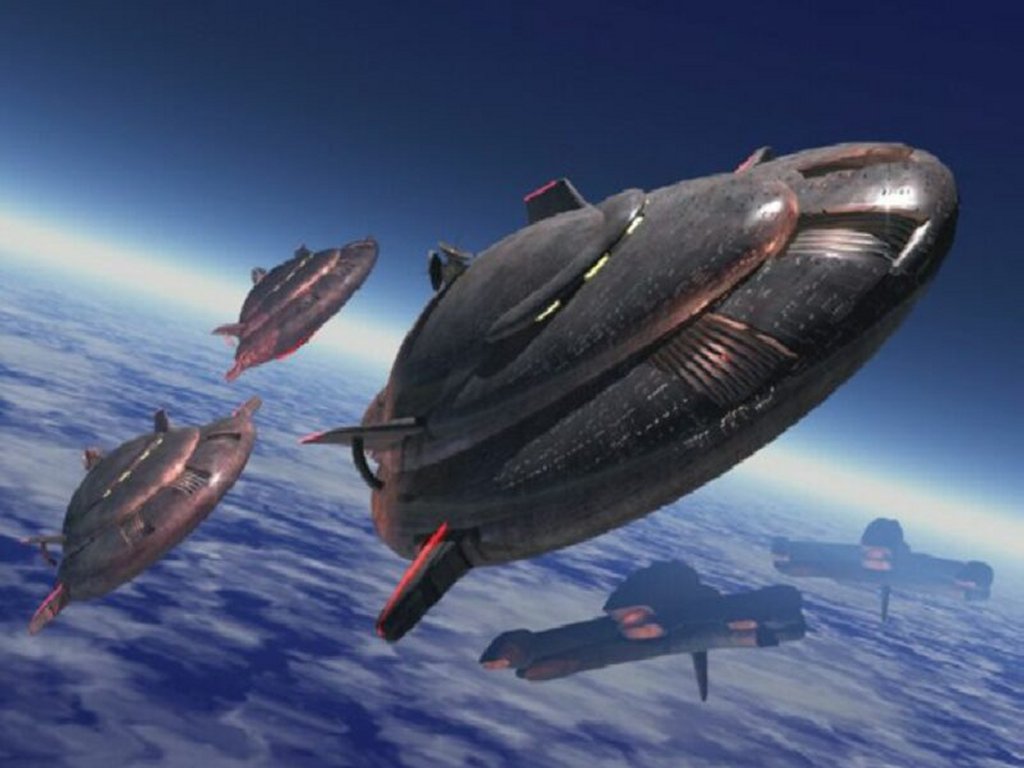
.spaceship02
Munteanu explores with students the essential tools used in the SF genre (including world building, research and plot approaches). “Students will work toward a publishable original piece by learning to generate and follow through with premise, idea and theme,” says Munteanu.
.
You can register for the course here: 
George Brown College is located on 200 King Street, Toronto, Canada.
nina-2014aaNina Munteanu is an ecologist and internationally published author of award-nominated speculative novels, short stories and non-fiction. She is co-editor of Europa SF and currently teaches writing courses at George Brown College and the University of Toronto. Visit www.ninamunteanu.ca for the latest on her books.

Playing the Short Game & Other Short Stories

The seventh class of my 12-week Creating Science Fiction course that I teach at George Brown College is all about short story writing. I’m by nature a progressive—and an itinerant explorer; so, I am updating materials for my students and sharing them with you. Embedded in this “sharing” I promise a very cool deal too; just keep reading

One resource I’m eager to introduce to my students is Canadian SF short story writer Douglas Smith’s recent guidebook, Playing the Short Game: How to Market & Sell Short Fiction. Smith’s guidebook is a Tardis-style smallish yet comprehensive guide on what it takes to be a successful short story writer from starting & finishing to marketing & publishing to leveraging & promotion.

Smith is an accomplished short story writer and marketer, who has alwaysPlayingtheShortGame openly shared his treasures of acquired wisdom with others. His stories have appeared in thirty countries and 25 languages. He’s won three awards and has three acclaimed collections—so far. For years, his Foreign Market List has helped writers—including me—sell their work all over the world. To date, I have sold short stories (mostly reprints) to markets in Greece, Poland, Romania, Israel, and Italy—thanks to his list.

Why Short Fiction?

Smith gives seven excellent reasons for writing short fiction, even if you are ultimately a novel writer, like me. Writing short stories:

  1. Helps you learn your craft in easy, short-term, bite-sized amounts and over a reasonable time for you to learn, apply, and relearn
  2. Helps you test the waters of literature, to discover what excites you, provokes you and what ultimately you NEED to express
  3. Builds your resume, again more easily and quickly than a novel, toward that ultimate novel; publishers of magazines and publishing houses are more likely to take your work seriously if you have a publishing history
  4. Helps you explore ideas for your novel, by “pinging” certain premises you may wish to explore in further detail or take elsewhere in a novel
  5. Helps you build a backlist of published stories, which you own, once rights have reverted back to you
  6. Helps you build a network in your writing community of publishing houses, editors, other writers and so forth as you submit and exchange through your works and letters (including all those rejections!). Eventually, a pleased editor/publisher may invite you to submit to a “Best of” anthology or provide a collection. This has happened to me several times.
  7. Helps you learn the publishing business (well, sort of, says Smith…). Through exposure to the business side of publishing, you will gain an appreciation of how the publishing world works.

Know What You’re Writing

A short story only has 7,000 or less words to get your tale across while a novel has over ten times that many words to do the same. It follows then that the short story format is a simpler one. This does not necessarily mean easier.

Novels provide a sense of change, growth and solutions to problems and conflicts. “The short story doesn’t have the luxury of depicting change; the closest it can come is awareness,” writes Shelley Lowenkopf in her 2007 article “Telling Tales” in The Portable Writer’s Conference: Your Guide to Getting Published by Quill Driver Books.

She goes on to describe the short story as a close-up to a novel’s landscape. The short story is, therefore, often more intense and powerful. A short story, more than a novel, has the power to transport, disturb and enlighten.

Renowned short story authors like Edgar Allen Poe, Nathanial Hawthorne, and Somerset Maugham, emphasize the importance of striving for one effect when writing a short story: the single effect you wish to leave with the reader at the end. This is accomplished by selecting events or situations that build quickly into a combustible response. Even Alice Munro, who is known for cramming long timeframes into her short stories, focuses framing time through a single event: a meal, family gathering, wedding or funeral, for instance.

Jack Bickham, in his book, Elements of Fiction Writing: Scene and Structure by Writer’s Digest Books (1993) writes that, “story length, author intention, traditional expectations of the audience, and all sorts of things may affect the form a story may take.” Choosing the appropriate length to tell your story relies on the complexity of your premise and theme.

Understanding the Short Story Format

Here are seven tips toward writing a compelling and memorable short story:

  1. Open in the middle of something happening (e.g., action/in a “scene”)
  2. Make your opening provocative (raise the stakes as high as you can)
  3. Write scenes and write sparingly (avoid describing the obvious—use description to show something odd, memorable, exotic)
  4. Have characters define themselves and their goals through what they do and observe (e.g., show more than tell)
  5. Define characters with dialogue (a great way to reveal while keeping a high pace)
  6. Withhold vital information for as long as possible
  7. Don’t explain the ending (cut down on the denouement; let the reader make those conclusions—a key in the short story format)

Selling Your Short Story

Smith’s guidebook provides several chapters of excellent advice in logical steps toward a successful career.

Here are just a few gems that I will be sharing with my students.

First of all, remember that you are not selling your story; you’re licensing a particular set of rights for someone to do something with that story. Before you do anything else, do your homework: know the rights you’re selling; and which ones to keep. Smith describes five major types of rights: media; language; geography (less and less relevant); occurrence; and time.

Media rights include print rights, electronic rights and audio rights. Markets include magazines, anthologies and collections for short stories. Language and geography rights are pretty self-explanatory. Occurrence rights relate to whether the publisher is buying first or second and onward rights (otherwise known as reprints). Most publishers prefer to pay for the right to publish your work for the first time in that particular format (e.g., in print and in English, for instance). Having said that, I’ve had a lucrative history of selling reprints to some of my more popular short stories. I’ve furthered gone on to selling other rights, such as foreign language rights and audiobook and e-book rights. I’ve also sold two short story collections, one to an Italian publisher (coming out this year) and shorts in several anthologies. No movies yet… But I did have a serious discussion with a writer/producer on one of my shorts. Recall how many Philip K. Dick short stories have been adapted to movies (e.g., Total Recall, The Adjustment Bureau, Paycheck, Minority Report, and Blade Runner).

Heinlein’s Five Rules of Writing

Smith invokes SF writer Robert J Heinlein’s 5 rules of writing to succeed as a short story writer (as any kind of writer, actually). These are:

  1. You must write
  2. You must finish what you write
  3. You must refrain from rewriting, except to editorial order
  4. You must put the work on the market
  5. You must keep the work on the market until sold

I know… Number 3 sounds pretty suspicious, or arrogant at the very least. As Robert J. Sawyer concludes on his site in reference to the five rules, number 3 is open to reasonable interpretation. Of course, it must mean AFTER you’ve finished and edited the story with some level of confidence that you’re happy with it—never mind what other people think of it.

Nina’s Bus-Terminal Model

In my writing guide The Fiction Writer, Chapter L (for “Long or Short?”), I talk about how I launched my own successful short story writing career. I’d been writing short stories for a few years without much success (I was getting interesting rejection letters, so I knew I was getting close); then I settled into a kind of model/routine. I call it The Bus Terminal Approach. As Smith attests—several times—it’s a numbers game. That’s how I played it. It starts with one story and relies on you not waiting until you write the next, and the next and the next. Here’s how it works:

  1. You list at least 3 markets that you’ve researched for Story A and send it to the first of the three
  2. You start right away writing Story B, send it to the first of 3 markets you’ve researched and listed for it
  3. When Story A rejection arrives, you do not revise but send it right away to the second market
  4. Same thing for Story B
  5. Write Story C and treat similarly

FictionWriter-front cover-2nd ed-webRemember to keep track of what you send where and when and what happens to it. It can become a very confusing bus terminal otherwise, with someone ending up in Seattle when they are headed to Toronto! What happens with this approach is several things: you begin to treat the whole marketing/publishing process as a business (which it is) and because you have so many “buses” out there coming and going, the rejections don’t hurt quite as much and instead become part of the learning process, which they should be. You adopt a more business-like approach, which translates into your relationship with editors and publishers. A win-win situation results. Believe me; this works. Once I fell into this method, my sales increased by over 70%.

I mentioned a cool deal in the beginning. Here it is: you can purchase Smith’s e-guidebook, along with several other excellent writing guides on the Write Stuff StoryBundle as a promotional bundle. Here’s the Write Stuff StoryBundle Site. The offer runs until June 4th 2015.

My own guidebook, The Fiction Writer, can be purchased in various online and onsite bookstores, including Amazon, Kobo, Chapters Online, Barnes & Noble, and several others even I don’t know about.

Natural Selection, my short story collection published by Pixl Press in 2013 is also available at several bookstores.NaturalSelection-frontHR

Written with flare and a conscience…Munteanu shines a light on human evolution and how the choices we do or don’t make today, may impact our planet and future generations.”—J.P. McLean, author of The Gift Legacy

“Nina Munteanu is a gifted writer. Each story surprises and delights.”—Allan Stanleigh, co-author of USNA and The Caretakers

nina-2014aaNina Munteanu is an ecologist and internationally published author of award-nominated speculative novels, short stories and non-fiction. She is co-editor of Europa SF and currently teaches writing courses at George Brown College and the University of Toronto. Visit www.ninamunteanu.ca for the latest on her books.

Know What You’re Writing: Short Story or Long Story?

freighter-rowers-sailboat-web

Freighter off Toronto Harbour, Lake Ontario (photo by Nina Munteanu)

How to Decide on the Length of Your Story 

Figuring out what you are writing isn’t always as easy as you think. Many writers, when they begin, may think they are writing a short story when they are actually writing a novel; or vice versa. When I first started, in fact this is what occurred.

Some time ago, when I was a budding novelist working on my second unpublished novel, I decided to write short stories. I’d been told time and again that it was easier to publish short stories (the market is far more diverse) and they provided excellent qualifications for when it came time to market my novel. It wasn’t as easy as I thought. I kept getting rejections with comments that my short story ought to be a novel! It took some time to master the art of short story telling. But when I did, I realized that I’d learned a lot about storytelling that I could apply to my novel. And by the time I was ready to publish my novel, I had several short story publications behind me to prove the salability of my work.

So, what are you really writing? Or, more to the point, what should you be writing?

A short story only has 7,500 words or less to get your tale across while a novel has over ten times that many words to do the same. It follows then that the short story format is a simpler one. This does not necessarily mean easier.

Short Vs. Long—What’s Your Focus?

Novels provide a sense of change, growth and solutions to problems and conflicts. Short stories must be more succinct, contain fewer characters and subplots, have less complicated story arcs and a single theme. You could say that a short story is a poem to a novel’s prose. “The short story doesn’t have the luxury of depicting change; the closest it can come is awareness,” writes Shelley Lowenkopf in her 2007 article “Telling Tales” in The Portable Writer’s Conference: Your Guide to Getting Published by Quill Driver Books. She goes on to describe the short story as a close-up to a novel’s landscape. The short story is, therefore, often more intense and powerful. A short story, more than a novel, has the power to transport, disturb and enlighten.

Renowned short story authors like Edgar Allen Poe, Nathanial Hawthorne, and Somerset Maugham emphasize the importance of striving for one effect when writing a short story: the single effect you wish to leave with the reader at the end. This is accomplished by selecting events or situations that build quickly into a combustible response.

Jack Bickham, in his book, Elements of Fiction Writing: Scene and Structure by Writer’s Digest Books (1993) writes that, “story length, author intention, traditional expectations of the audience, and all sorts of things may affect the form a story may take.” Choosing the appropriate length to tell your story relies on the complexity of your premise and theme.

Pick Your Length Checklist

The following short checklist will help you determine whether you should be writing a short story or something longer like a novel:

  • does your story have several main characters and minor characters?
  • is your story full of subplots?
  • does your story contain multilayered themes and story arcs?
  • do your characters learn and change notably?
  • is there significant change in your story?
  • does your story contain several settings and sub-stories?
  • does your story explore several ideas as opposed to one main idea?
  • does your story investigate several issues rather than making a single point?

If you answered “yes” to most of the above, then you should be writing a novel.

Defining Story Length

The Science Fiction & Fantasy Writers of America defined story length forms in the table below. Definitions vary among other sources but remain close to these.

Table 1: Terminology of Story Lengths
Name Description
Drabble (Flash Fiction) Exactly 100 words
Flash Fiction Less than 500 words
Short short Fiction 500-1,000 words
Short Story Less than 7,500 words
Novelette 7,500 to 17,500 words
Novella 17,500 to 40,000 words
Novel More than 40,000 words


Creative Options & Market Tips

During my early “salad” writing years as a short story writer, I discovered a system that helped me send out material and publish with more ease and efficiency. It helped that I was rather prolific with short story telling and that I was simultaneously working on a few novels. Here are some creative things you can do with both your short stories and novels (in the works or already published) to increase your productivity and publishing opportunities:

  • Use Novel Excerpts: Here’s something I did to save time, hone my craft, and receive early recognition: I took “aha” excerpts from my ongoing novel and adapted them into stand alone short stories—altering at least 20% of the content and other elements like setting, names, etc. In each case, I ensured a powerful story by focusing on the single thematic element. I sold at least five short stories to good magazines this way. The short stories went on to receive recognition, awards and a place in some “Best of” anthologies, long before my novels received similar recognition. In each case, the short story became an equally—if not more—powerful version of its sister work in my novel, much like a poem is to a piece of prose. Try it; you might really like it.
  • Adapt A Short Story into a Novel or Novella: you may find that a powerful thought expressed in your short story engenders interest in a larger plot with more depth, such as a novel. Nancy Kress and Ray Bradbury are two short story/Novella writers who adapted some of their works into longer forms to create something both new and compelling.
  • FictionWriter-front cover-2nd ed-webRun Your Novel and Short Story Submissions Like a Bus Depot: When I was writing a lot of short stories, I kept a list of what and where I submitted, along with the most important item: where to submit NEXT. At any given time, I made sure that I had at least x-number of submissions out there and each story had a designated place to go if it returned. As soon as a story came back from magazine A, I simply re-packaged it and sent it to magazine B. The critical part of the list was to have a contingency for each story: the next place where I would send the story once it returned. I was planning on the story being rejected with the hope that it would be accepted; that way, a rejection became part of a story’s journey rather than a final comment. I ran my submissions like a bus terminal. A story was in and out so fast it never had a chance to cool off. And, since I had five other pieces out there, I could do this with little emotion. I was running a fast-paced “story depot”, after all. All my stories had to be out there as soon as possible; if they were sitting in the terminal, they were doing nothing for me.
  • Reprint Your Published Short Stories: You can only do this if you ensure that you initially only sell First Rights with your story’s first publication. My short story “Virtually Yours” has been reprinted five times and is continuing its journey still. It has appeared in “Best of” anthologies, several collections (e.g., Natural Selection); it has been translated into several languages and published all over the planet. Don’t let your story languish on its first success. See where else it can go. Foreign markets are a largely untapped area.
  • Do Foreign Translations and Reprints: Thankfully, Douglas Smith, a colleague of mine and celebrated short story writer has compiled a list for short story foreign markets. He also recently put out a book on marketing your short story, called “Playing the Short Game”.


References:

Smith, Douglas. 2014. “Playing the Short Game: How to Market and Sell Short Fiction”. Lucky Bat Books. 230pp

Munteanu, Nina. 2009. The Fiction Writer: Get Published, Write Now! Starfire World Syndicate. 266pp.

NaturalSelection-frontHRMunteanu, Nina. 2013. “Virtually Yours” in Natural Selection: a Collection of Short Stories. Pixl Press. 120pp.


This article is an excerpt from Chapter R of The Fiction Writer: Get Published, Write Now! (Starfire, 2009).


nina-2014aaNina Munteanu is an ecologist and internationally published author of award-nominated speculative novels, short stories and non-fiction. She is co-editor of Europa SF and currently teaches writing courses at George Brown College and the University of Toronto. Visit www.ninamunteanu.ca for the latest on her books.
Clockwork Canada (Anthology)–Call for Submissions

For those of you writing short stories in the steampunk genre, “Clockwork Canada” Anthology is calling for submissions:

“Just a reminder that I’m open to submissions for my steampunk anthology, Clockwork Canada, until April 30th. I pay 5c/word and the book will be published by Exile Editions.”–Dominik Parisien

Clockwork Canada (Anthology)

Dominik Parisien will be editing Clockwork Canada for Exile Editions. The editor is interested in stories from 2,000 to 8,000 words. (Under 5,000 words is preferred.)

Stories must be set in Canada and written by Canadian authors. Canadians living abroad must indicate their status in their cover letter. Please indicate if you consider yourself any of the following in the cover letter: Aboriginal writer, culturally diverse writer, Francophone writer, new generation writer (definitions below). You are welcome to indicate your gender and if you self-identify as LGBTQIA (otherwise called QUILTBAG).

What is Steampunk?

Coined as a term by K.W. Jeter in 1987, Steampunk is variously described as retrofurism, technofantasy, and alternate history; at its core, Steampunk is a hybrid genre that makes varying uses of anachronistic technologies, social criticism, DIY and maker culture, and a sense of adventure and play. Proto-Steampunk works such as the novels and stories of Jules Verne, H.G. Wells, and Edgar Allan Poe have influenced the genre, along with scientific romances and the dime novels of 19th. One of the earliest examples of modern Steampunk, which had a greater emphasis on the problematic nature of technology and imperialistic culture, is Michael Moorcock’s Nomads of the Time Streams trilogy. Frequently associated with Victorian culture, Steampunk has in the last decade reached beyond that historical period and been explored in other cultures and time periods.

There are more rigid interpretations of Steampunk available but I am not interested in them. Adaptation and reconfiguration are a major component of Steampunk, and definitions of a genre must be fluid if they are to remain relevant.

Some examples of Steampunk books include Michael Moorcock’s The Warlord of the Air, William Gibson and Bruce Sterling’s The Difference Engine, Cherie Priest’s Clockwork Century books (such as Boneshaker), Mike Mignola’s Hellboy, Gail Carriger’s Parasol Protectorate Books (such as Soulless), Genevieve Valentine’s Mechanique, Scott Westerfield’s Leviathan series, and Karin Lowachee’s Gaslight Dogs.

Steampunk’s highly visual component has, unsurprisingly, translated well into movies. Some examples include The Prestige, Howl’s Moving Castle, The League of Extraordinary Gentlemen, Wild Wild West, 9, and Sherlock Holmes.

For more basic information on Steampunk, see the wikiSteampunk Magazine, or Beyond Victoriana.

 What I’m Looking For

I am interested in all permutations of Steampunk, including Boilerpunk, Clockpunk, Gaslight Romance, Raygun Gothic, Stitchpunk, and other variations.

Stories must be set in Canada. There are no restrictions on the time period, though technology should be limited to pre-twentieth century. I want to see Canadian takes on classic Steampunk elements, but I would also like to see more than just steam technology. I highly recommend reading Amal El-Mohtar’s excellent article, Towards a Steampunk Without Steam, for inspiration in this respect: http://www.tor.com/blogs/2010/10/towards-a-steampunk-without-steam.

Many great Steampunk stories interrogate and engage with historical and cultural elements in their setting. In particular, we often see the exploration of characters and stories that were ignored by dominant historical narratives. Although alternate history is a large component of Steampunk, be aware of Canadian history and utilize it or rework it in original ways. For example, how would the proliferation of more capable steamships and airships have altered immigration in Canada? How would the western expansion, the Trans-Canada Railway, and the Underground Railroad have been affected by alternate forms of transportation?

I am looking for stories that explore diverse settings with all manner of characters: Aboriginals, Francophones, senior citizens, LGBTQIAs, PoC, etc.

Submission Details

Length: 2,000 to 8,000 words. Under 5,000 words is preferred.

Payment: 5 cents/word for original fiction and a contributor’s copy.

Reprints: will be considered if the story has appeared in journals and magazines, but NOT in book form (collections, anthologies, etc.). Payment for reprints is 2 cents per word. Indicate where the story was first published and when in the cover letter. Reprint stories must also be set in Canada.

No poetry, plays, or novel excerpts. Only short fiction will be considered.

No simultaneous submissions. The only exception is for stories submitted for the $15,000 Vanderbilt / Exile Short Story Competition sponsored by Exile Quarterly / Exile Editions (seehttp://www.theexilewriters.com/poetry-and-fiction-competitions/).

No multiple submissions. If you received a rejection before the deadline you may submit again.

Submit stories in standard manuscript format as .doc, .docx., or RTF with indented paragraphs, italics in italics and bold in bold. Include full contact information and word count on the first page. Include a cover letter (name, story title and word count, contact information, previous publications) in the body of the email. Include a brief biography and indicate if you are an Aboriginal writer, culturally diverse writer, Francophone writer, or new generation writer. Submissions in English only, although stories translated into English are acceptable.

Send submission to dominik [dot] parisien [at] gmail [dot] com

Indicate in the subject line: Submission: Story Title, Last Name.

Reading period: December 1, 2014 to April 30, 2015. Do not submit stories before this date.

All acceptances or rejections will be sent before June 31. Please do not query before this date.

Rights purchased: First English-Language Rights & Non-exclusive Anthology Rights (Print and eBook).

The book will be published in Spring 2016.


Definitions

Canadian: Canadian permanent residents, Canadian citizens, Canadians living abroad. Canadians living abroad must indicate their status in their cover letter.

Aboriginal: Means status, non-status, Métis and Inuit people.

Francophone: Someone whose mother tongue is French and still speaks it.Steampunk-vehicle

Culturally diverse: People of colour. The term is defined by the Government of Canada as “persons, other than Aboriginal peoples, who are non-Caucasian in race or non-white in colour.”

New generation: Between the ages of 18 and 30.

Ten Questions You Need to Ask Your Characters Before They Can Stay In Your Story

zermatt-matterhorn02

The Matterhorn, Zermatt, Switzerland (photo by Nina Munteanu)

Your story lives and breathes through your characters. Through them your premise, idea and your plot come alive. Characters give your story meaning; they draw in the reader who lives the journey through them. Without them you wouldn’t have a story—you’d have a treatise.

Here are some questions you need to ask each of your characters:

  1. Will the story fall apart or be significantly diminished if you disappear? If not, you don’t need to be there; you aren’t fulfilling a role in the book. Hugo award winning author Robert J. Sawyer reminds us that “story-people are made-to-order to do a specific job”: they tell a story. In real life, people may act through no apparent motivation, be confusing, incoherent and make pointless statements or actions. Story characters show more clear motivations, coherence, and consistency. They don’t clutter your story with muddle and confusion like real people do. They fit into your story like a major puzzle piece.
  2. What is your role? (e.g., protagonist, antagonist, mentor, catalyst, etc.). Each character fulfills a dramatic function in your story. You can’t just be there because you’re cute. Well, ok, maybe. But even being cute can and should provide a dramatic function in the story by exploring how that quality is viewed and treated by others. As with setting, which serves a similar purpose as character in story, every aspect of both minor and major characters interact with and illuminate story theme, premise and plot.
  3. What archetype do you fulfill? In the “hero’s journey” plot approach, each character fulfills one to several archetypes, which help define how they service the plot and theme of the story. The mentor archetype, for instance, generally believes in and enables the hero on his journey. The threshold guardian, on the other hand does not have faith in the hero and obstructs him on his journey. The hero archetype, usually on a quest (for truth, forgiveness, home, victory, faith, etc.), must negotiate her world of archetypes to reach her destination.
  4. How do you contribute to the major or minor theme of the book? This is particularly relevant for all major characters and their associated sub-plots. Sawyer stresses that “your main character should illuminate the fundamental conflict suggested by your premise.” All other characters, in turn, either help reflect the main character’s journey or the overall story premise and theme. If your book is about forgiveness, each character helps illuminate your exploration of this theme.
  5. Are you unique? If the reader can’t distinguish you from other characters, chances are you need to be eliminated because of point number 1 anyway. In order to contribute to story, characters must provide a sufficiently distinguishable feature, complete with sub-plot, on the story landscape. The more varied and rich the landscape is, the more interesting it will be. Fictional characters achieve distinction through individual traits that readers recognize and empathize with. Authors use vernacular and body language to achieve colorful fictional characters.
  6. Are you interesting? If you aren’t interesting to the reader, you won’t do your job. Readers need to notice you, distinguish you and find something about you that will keep their interest—even if it’s something annoying. Just remember to be consistent—unless inconsistency is part of your character.
  7. What is your story arc? Do you develop, change, and learn something by the end? If not, you will be two-dimensional and less interesting. This is just as true for minor characters as for main characters. The more characters the author imbues with the depth to develop, the more multi-layered the story will become. This is because each character and her associated arc provides her own perspective to the theme. This is what is truly meant by “richness” — not the richness of infinite detail, like a baroque painting, but of infinite meaning like an impressionist work. Choose your minor characters as you choose your major characters.
  8. What major obstacle(s) must you overcome? You need these to struggle and “grow” and change; otherwise there is no tension in the story, no development and movement and no story arc. Your character will be like a still-life with no movement, no direction and no interest. The more your character changes over a story, the more she will be noticed and remembered.
  9. What’s at stake for you (theme), and for the world (plot), and how do these tie together? If a writer is unable to tie these together in story, the story will fail to evoke emotional involvement and empathy. It will lack cohesiveness and will not give the reader a fulfilling conclusion with ultimate satisfaction through the character’s journey related to theme (the hero’s journey, essentially).
  10. Do you change from beginning to end? If you don’t develop throughout the story, then you aren’t growing as a result of the thematic elements and plot issues presented in the story. In other words, you haven’t learned your lesson. While it’s ok for some characters not to develop (e.g., to be one note or flat or plain old stubbornly the same) this is disastrous for any of your main characters. Just ensure that the changes you make your character go through are warranted and relevant to the theme.

JournalWritert FrontCover copy 2Characters help the writer achieve empathy and commitment from the reader. Characters are really why readers keep reading. If the reader doesn’t invest in the characters, she won’t really care what happens next. It is important to be mindful of the emotional and narrative weight of a character and achieve balance between characters. For instance, the foil of the protagonist should carry equal weight; otherwise the reader won’t believe the match-up. Equally, a large cast—often used in epic fantasies or historical pieces—can be used successfully, but only if each character is given a clearly distinguishable personality and role.

References:


Nina Munteanu is an ecologist and internationally published author of award-nominated speculative novels, short stories and non-fiction. She is co-editor of Europa SF and currently teaches writing courses at George Brown College and the University of Toronto. Visit www.ninamunteanu.ca for the latest on her books.