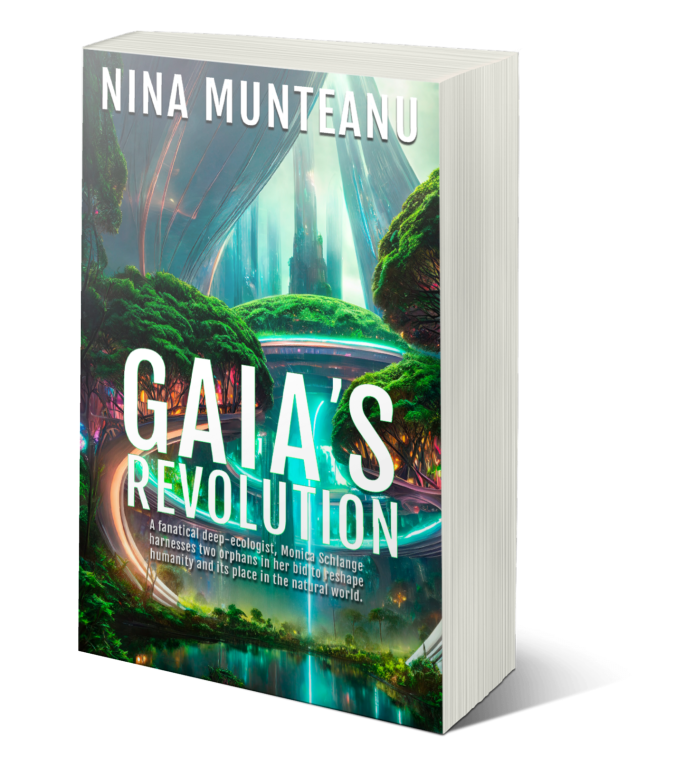
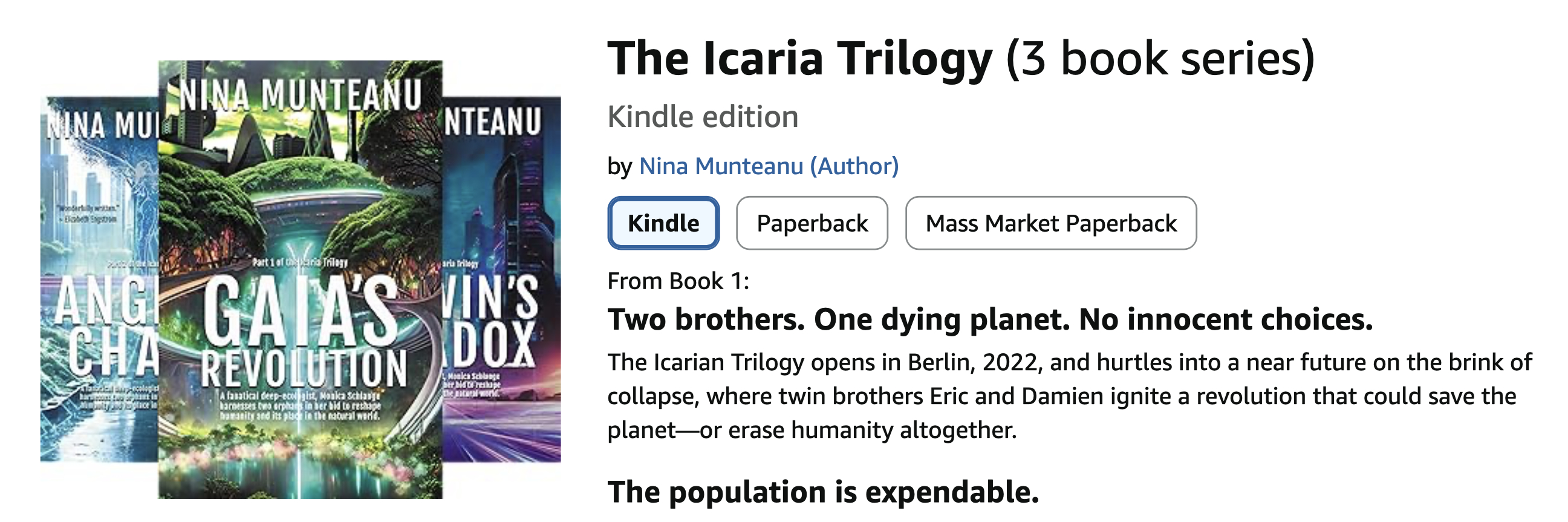
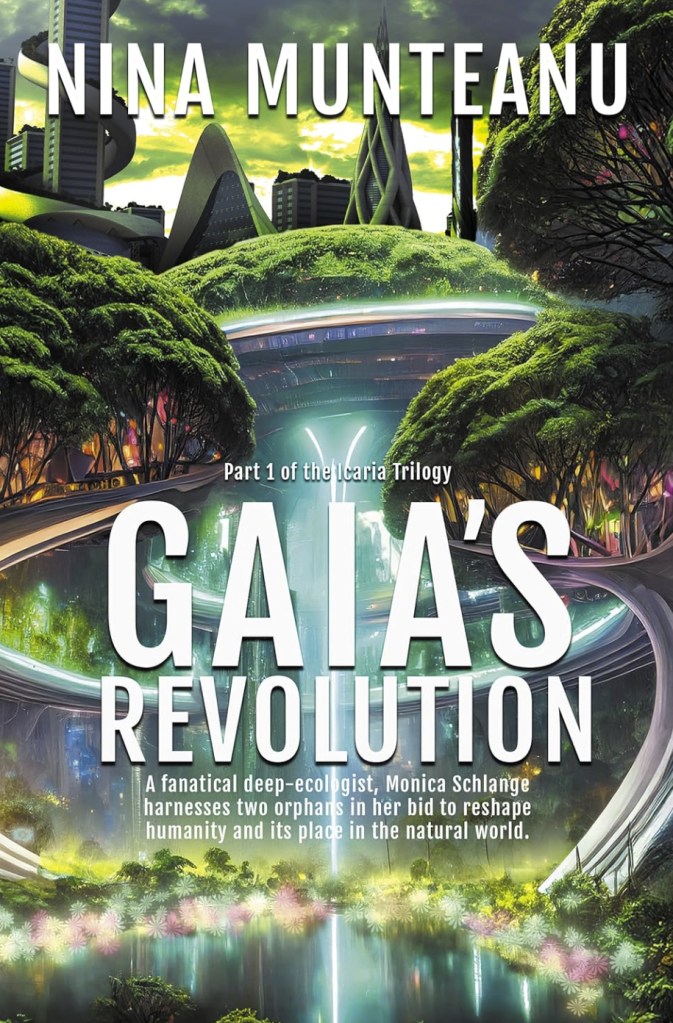
Today my eco-fiction novel Gaia’s Revolution (Book 1 of The Icaria Trilogy) releases through Dragon Moon Press in paperback and ebook form on Amazon (and other book retailers).
Gaia’s Revolution explores a collapsing capitalist society in Canada through ravages of climate change and a failing technology. The story is told through the lives of ambitious twin brothers Eric and Damien Vogel, and the woman who plays them like chess pieces in her gambit to ‘rule the world.’ The novel starts out in Berlin—with a scuffle between police and climate activists of Letzte Generation-then moves to Toronto Canada, where an unlikely revolution is brewing…
This day is special for me in a number of ways. Today is also my dad’s birthday. He passed away a while ago, but I know he is here with me as this is happening. You see, when I was just 15, I’d written my first book, an early version of Angel of Chaos. My dad, who had met and befriended an editor at Doubleday, and proud of my accomplishment, arranged a meeting with me and the editor to look at my book. I put on my highest pumps—I could barely walk in them!—and best outfit and met with the gentleman. He did not take my book for publication but praised my work and gave me some wonderful advice. “Keep writing!” he said. I have carried that meeting and advice to this day and thank my dad for his belief in me as a writer—particularly given that he had been pushing for me to become a teacher or nurse. Four decades later, a more polished version of that same book was published in 2010 by Dragon Moon Press (as Angel of Chaos, the prequel to Darwin’s Paradox, which was published in 2007).
.
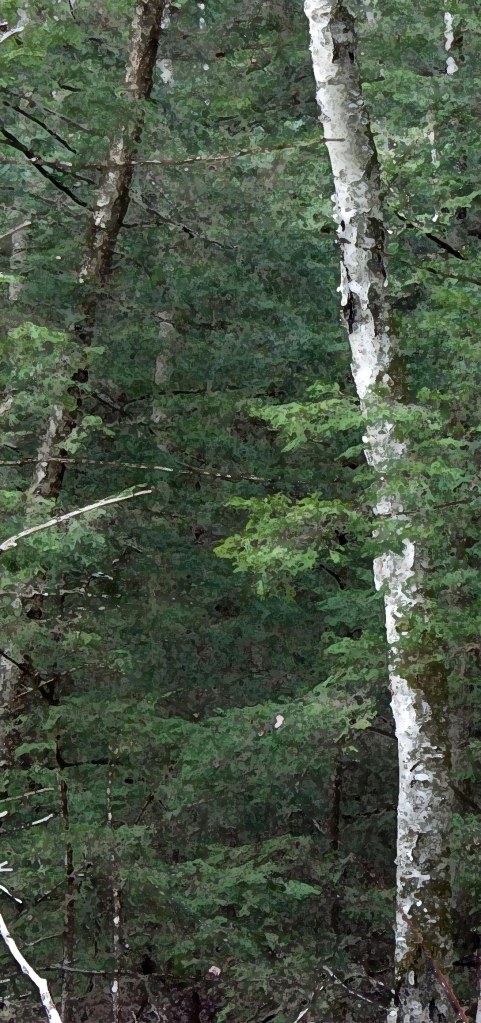
Birch forest in Ontario (photo and rendition by Nina Munteanu)
.
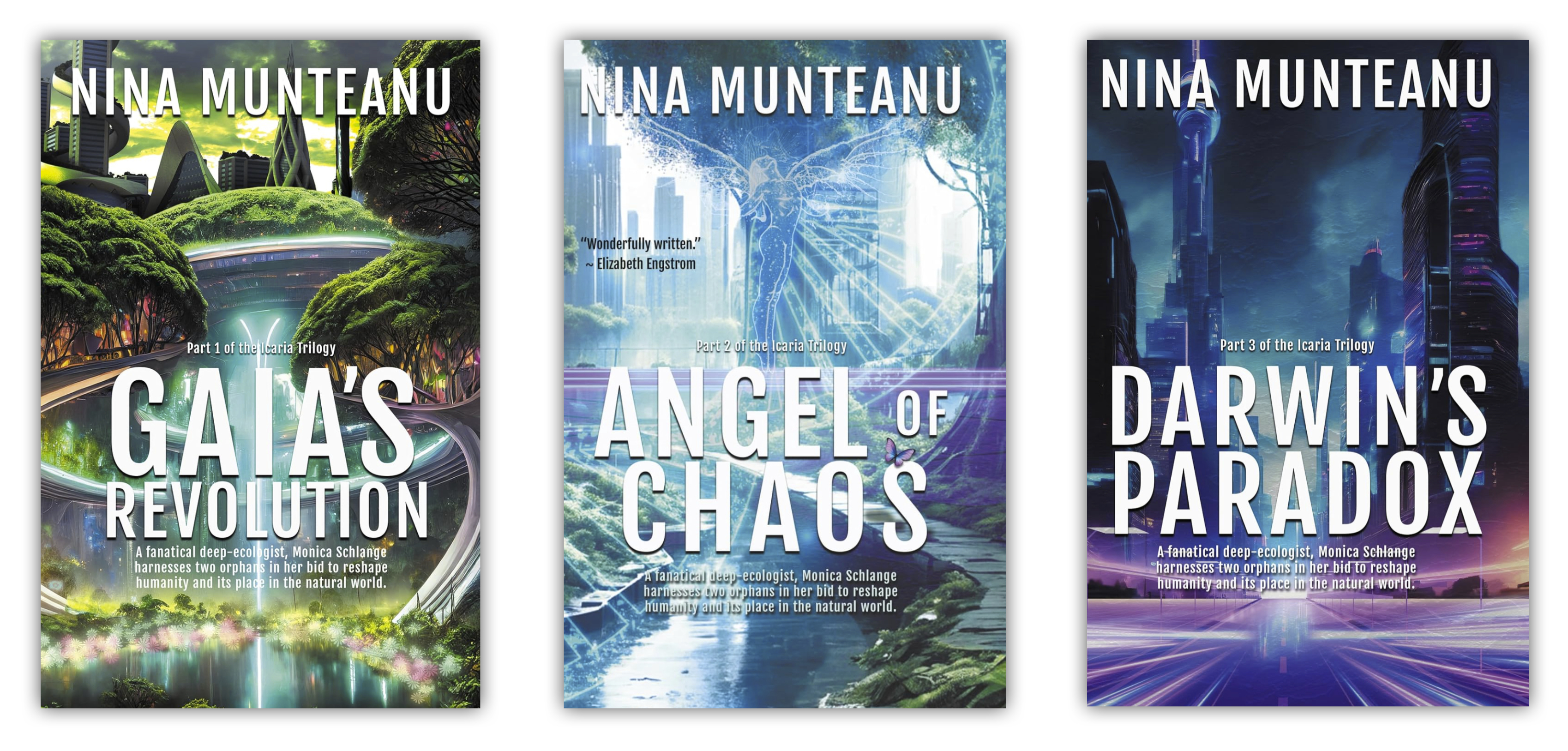
The Icaria Trilogy by Dragon Moon Press
.
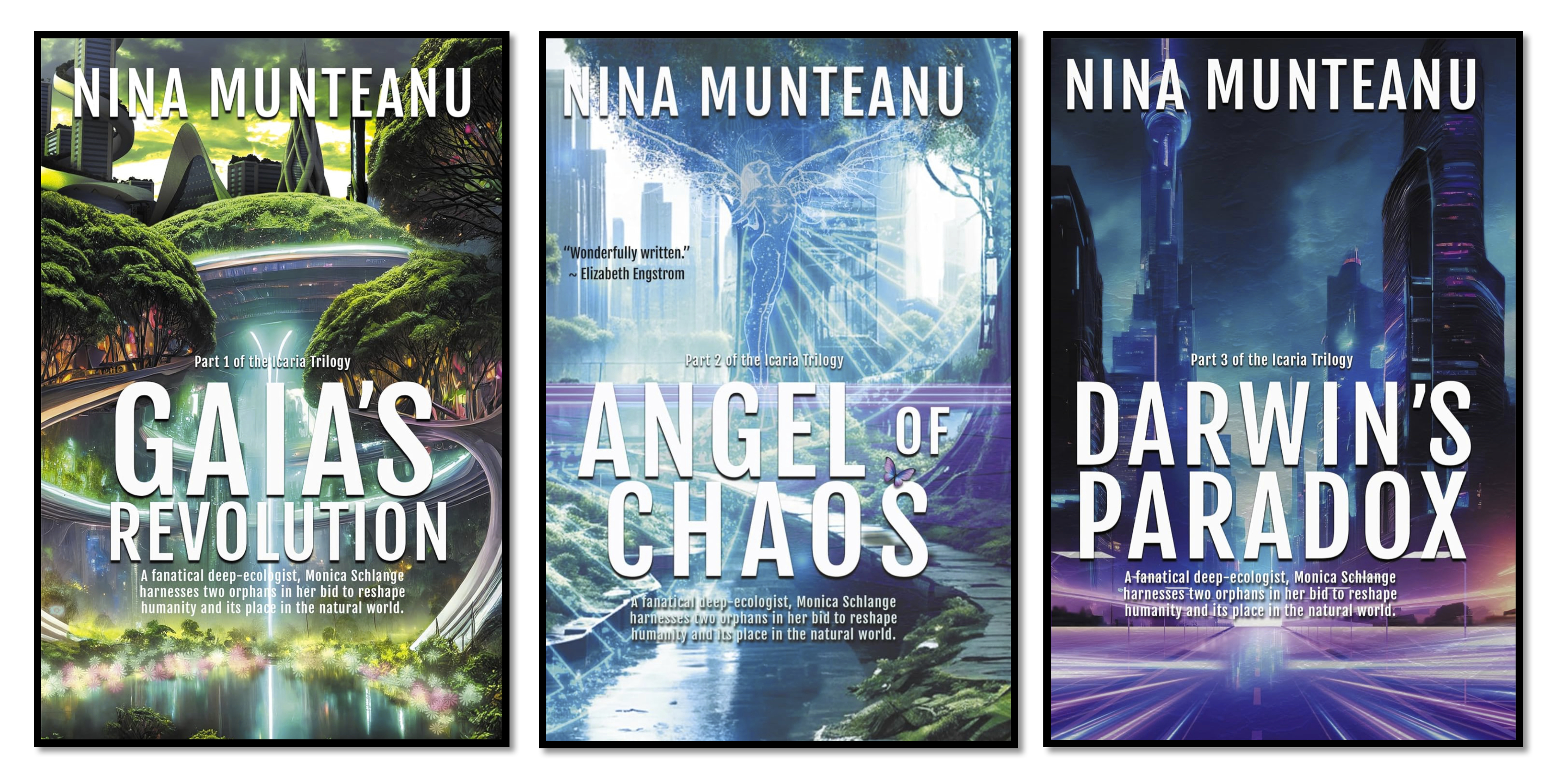
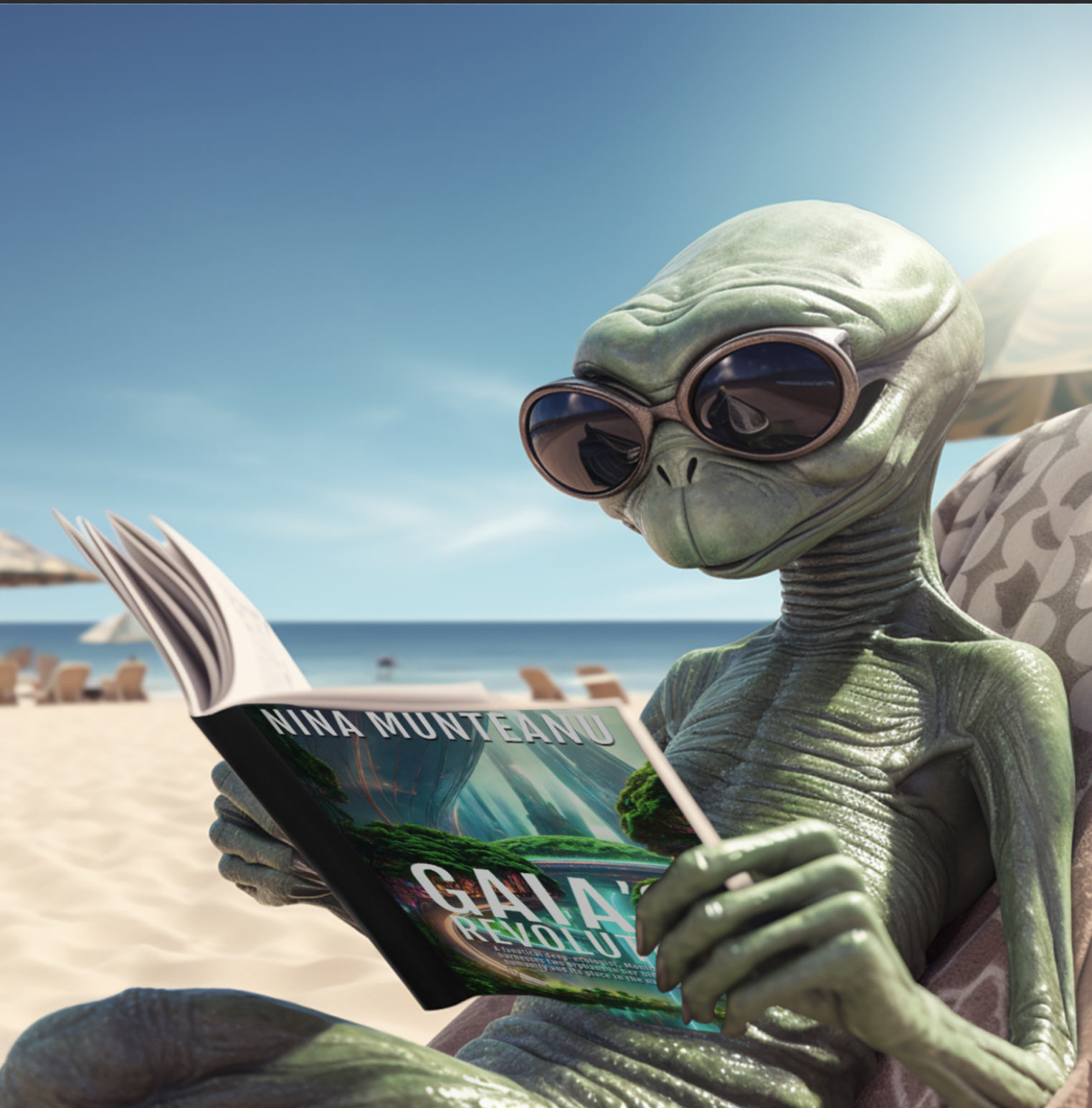
Now, with newly written Gaia’s Revolution (the prequel to the prequel) released, Dragon Moon has reissued new covers for the entire trilogy. Here they are! Oh! And look who’s already reading Gaia’s Revolution!
.
Aliens get to read everything before we do…
.
Nina Munteanu is an award-winning novelist and short story writer of eco-fiction, science fiction and fantasy. She also has three writing guides out: The Fiction Writer; The Journal Writer; and The Ecology of Writing and teaches fiction writing and technical writing at university and online. Check the Publications page on this site for a summary of what she has out there. Nina teaches writing at the University of Toronto and has been coaching fiction and non-fiction authors for over 20 years. You can find Nina’s short podcasts on writing on YouTube. Check out this site for more author advice from how to write a synopsis to finding your muse and the art and science of writing.
Twin brothers—a brilliant scientist and a gifted engineer—escape the growing racial violence of Berlin, to ‘peaceful’ Canada in a rivalry to control the evolution of the human race.
.
My novel Gaia’s Revolution, the first of The Icaria Trilogy—releasing March 10, 2026, by Dragon Moon Press—explores a collapsing capitalist society in Canada through ravages of climate change, water shortages, plague, and a failing technology. The story is told through the lives of ambitious twin brothers Eric and Damien Vogel, and the woman who plays them like chess pieces in her gambit to rule the world.
.
The novel starts on December 13th, 2022, in Berlin, the day several members of the climate activist group Letzte Generation* to which Damien belongs, are raided by police who seize their computers and phones. Damien is a quiet scholar, an introvert and deep ecologist*, devoted to the teachings of Arne Næss and George Sessions, who promoted an environmental philosophy of eight basic principles of deep ecology. Næss and Sessions advocated that all living beings have intrinsic value, independent of their utility to human needs. Their philosophy has become a movement that promotes a holistic, eco-centric worldview demanding radical, structural changes to human society to prioritize nature’s flourishing.
.
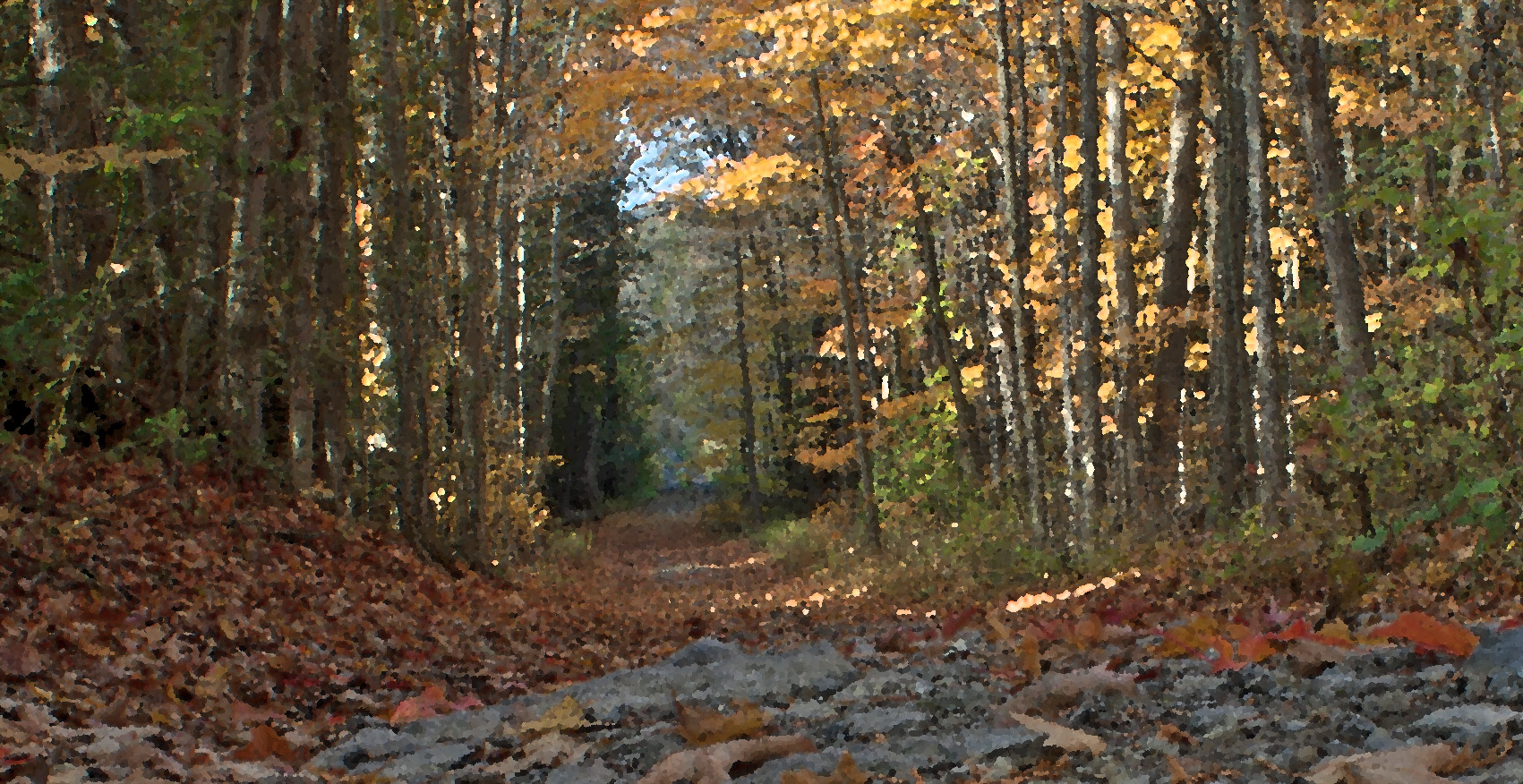
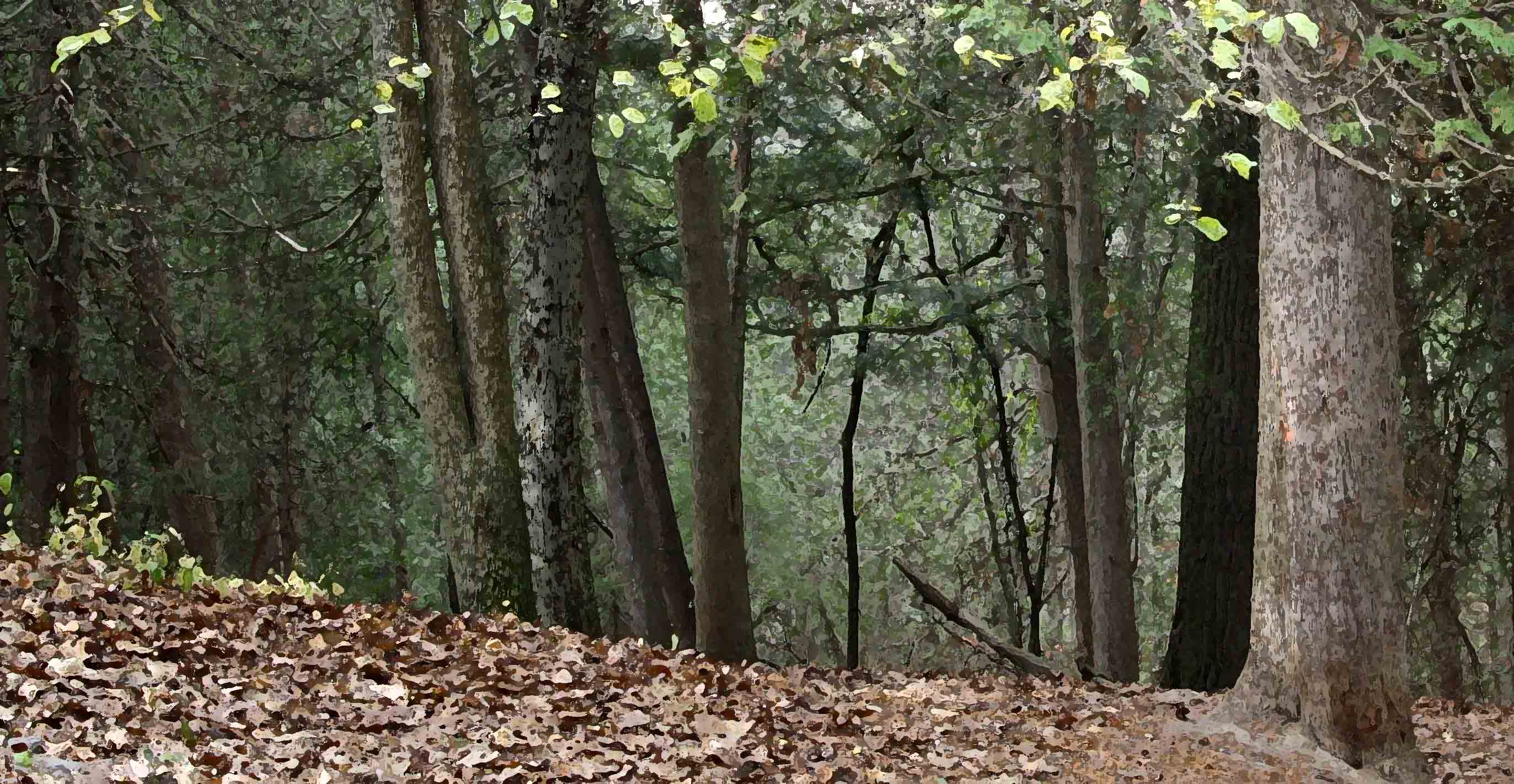
Road through a beech tree forest, ON (photo and rendition by Nina Munteanu)
.
Damien later meets with his extrovert anarchist brother in Treffpunkt, near the university campus, and they argue ideology and revolution. Eric contends that the only way humanity will survive is to adapt to climate change by somehow overthrowing the bourgeois plutocrats through violent revolution: preventing the small ruling class carving out a comfortable life for itself while the rest of the world suffers terrible deprivation. Eric pulls out the worn copy of B.F. Skinner’s Walden Two from his jacket pocket, slaps it on the table and pushes it toward Damien. “That’s the answer, Dame.”
Each brother plans to create a new humanity: Eric’s plan is to control humanity through gene manipulation and behaviour engineering (aka Walden Two); Damien’s plan is to draw on deep ecology and use environmental triggers with biotechnologies to empower humanity with physical/chemical abilities to adapt to climate and its changing environment via transhumanist AI.
Neither addresses the elephant in the room: population. Only a much-reduced population will ensure success for either plan.
To this point, Eric, who is far more cynical and ruthless, thinks Damien naïve and feckless in his deep ecological view:
Damien too easily prescribes to the old leftist shibboleth of Nature being the answer to everything and Market being evil. His deep ecology utopia would spring from an atavistic rejection of modern life, a return to ‘the ancient farm.’ But how that fantasy could be achieved without a drastic population reduction is beyond his brother’s imagination. Damien fetishizes the natural world. Just like he does their mother. The naïve fool is a blind romantic, refusing to see reality right in front of him: that Nature is ultimately cruel, cold, and preoccupied with its own survival. Just like their mother.–Eric Vogel, Gaia’s Revolution
.
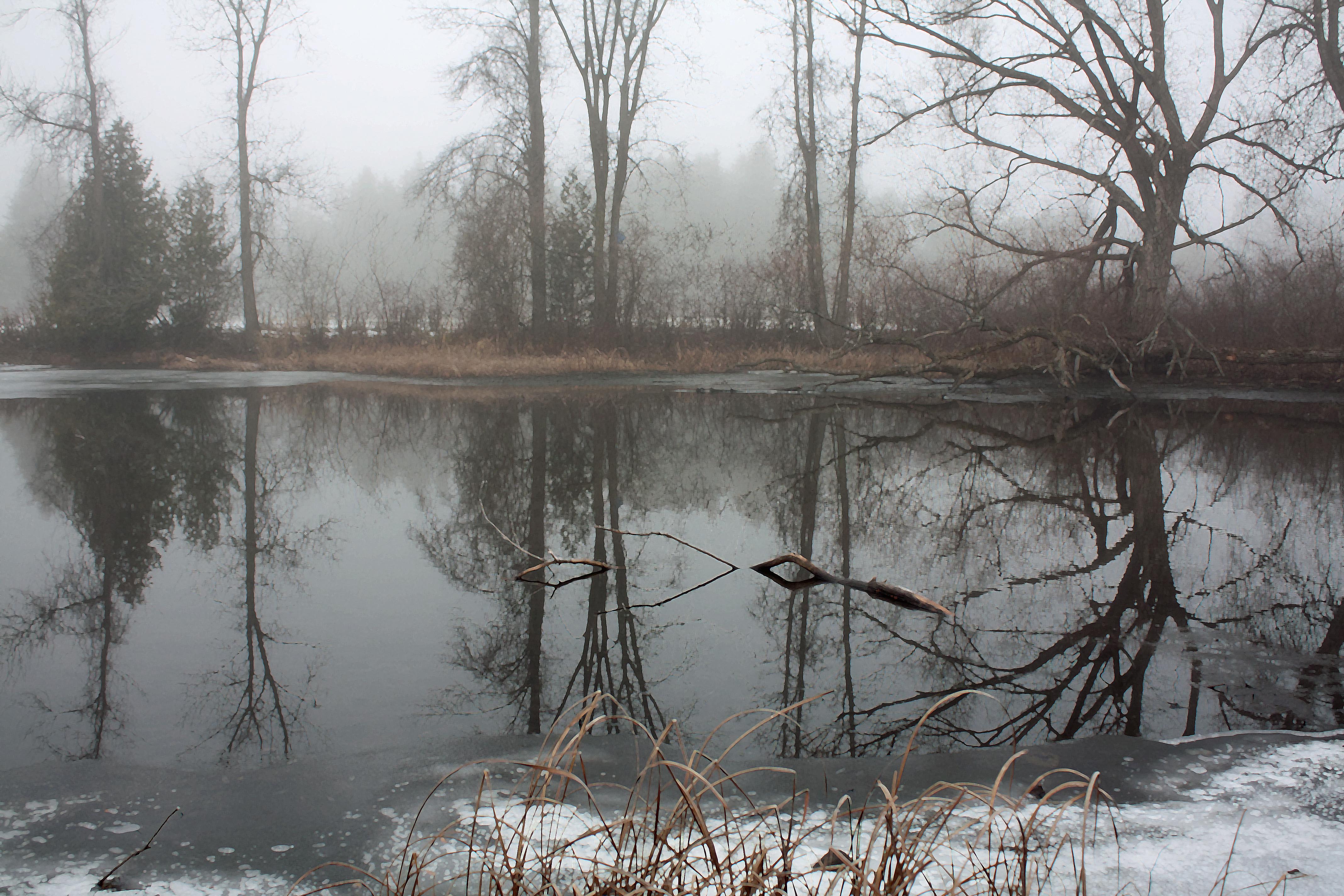
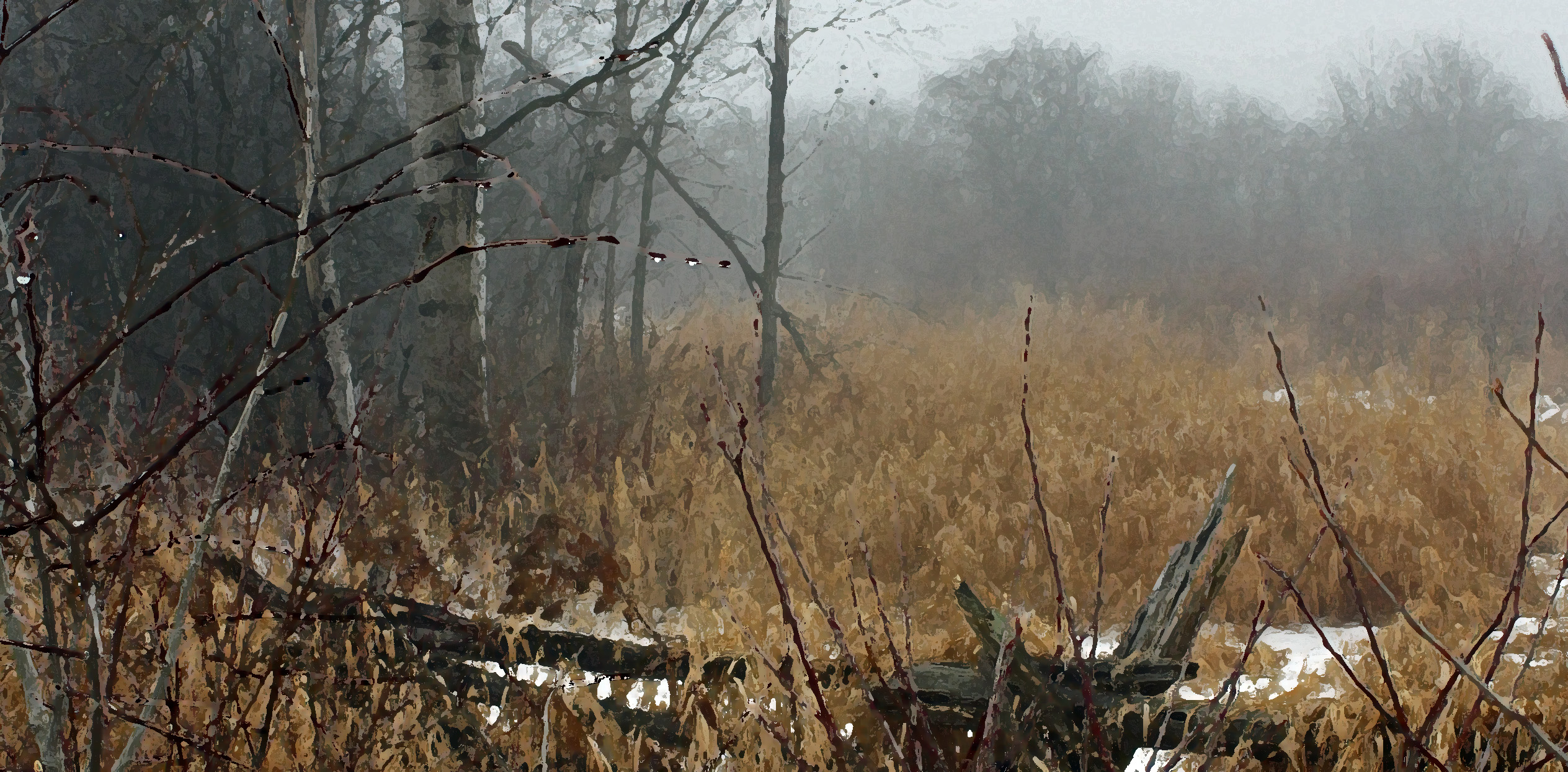
Foggy morning on an Ontario marsh in winter (photo and rendition by Nina Munteanu)
The well-being and flourishing of human and nonhuman Life on Earth have value in themselves (synonyms: intrinsic value, inherent value). These values are independent of the usefulness of the non-human world for human purposes.
Richness and diversity of life forms contribute to the realization of these values and are also values in themselves.
Humans have no right to reduce this richness and diversity except to satisfy vital needs.
The flourishing of human life and cultures is compatible with a substantial decrease of the human population. The flourishing of nonhuman life requires such a decrease.
Present human interference with the nonhuman world is excessive, and the situation is rapidly worsening.
Policies must therefore be changed. These policies affect basic economic, technological, and ideological structures. The resulting state of affairs will be deeply different from the present.
The ideological change is mainly that of appreciating life quality (dwelling in situations of inherent value) rather than adhering to an increasingly higher standard of living. There will be a profound awareness of the difference between big and great.
Those who subscribe to the foregoing points have an obligation directly or indirectly to try to implement the necessary changes.
.
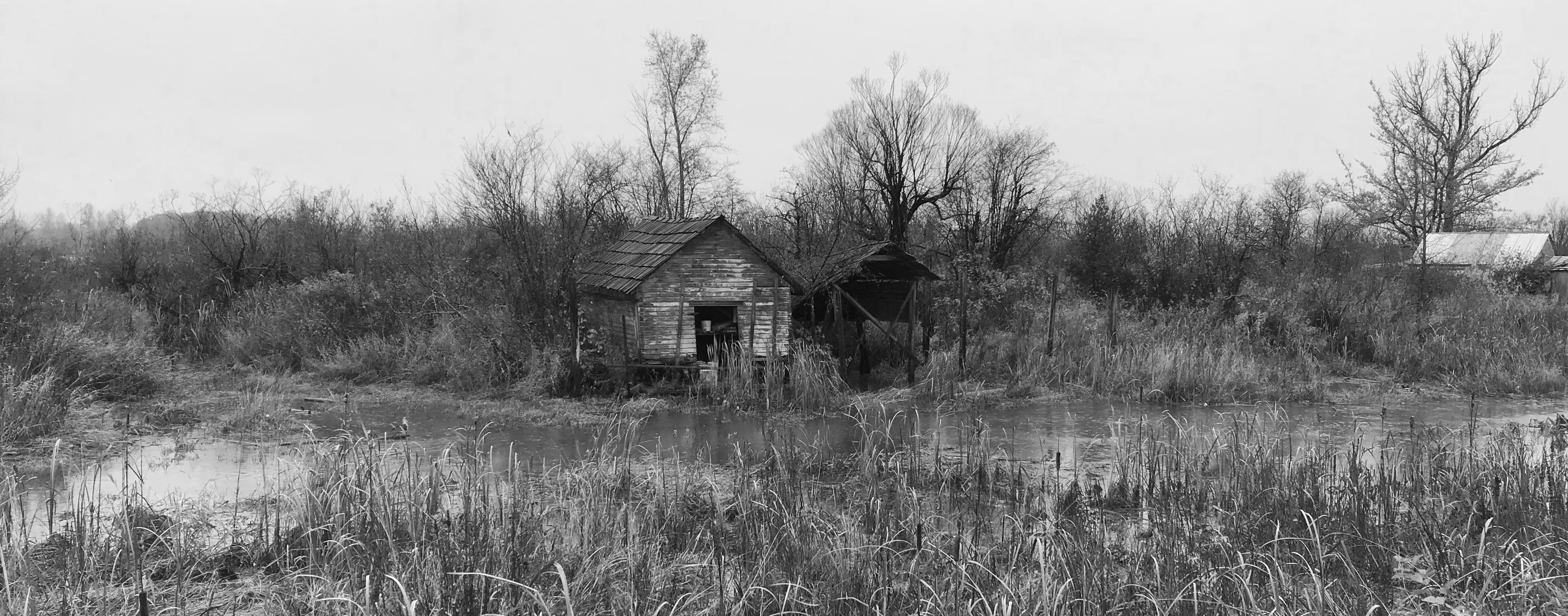
Finn Slough old shed, BC (photo by Nina Munteanu)
.
Eric plans to address the 5th Basic Principle of Deep Ecology—present human interference with the nonhuman world is excessive and the situation is rapidly worsening— by using nefarious means to meet the 4th Basic Principle of Deep Ecology: the flourishing of human life and cultures is compatible with a substantial decrease of the human population and the flourishing of nonhuman life requires such a decrease. With a reduced population, he plans to make the remaining principles (e.g. 6th and 7th) realizable through his behaviour engineering.
But Eric hasn’t accounted for fanatical deep ecologist / eco-terrorist Monica Schlange in his plan… (More on this shapeshifting character in Part 2).
.
The Icaria Trilogy by Dragon Moon Press
.
You can pre-order the ebook of Gaia’s Revolution by Dragon Moon Press on Amazon. Release date is March 10, 2026. The print version will release soon after. Book 2 (Angel of Chaos) and Book 3 (Darwin’s Paradox) of theThe Icaria Trilogy are already available in both ebook and print form.
.
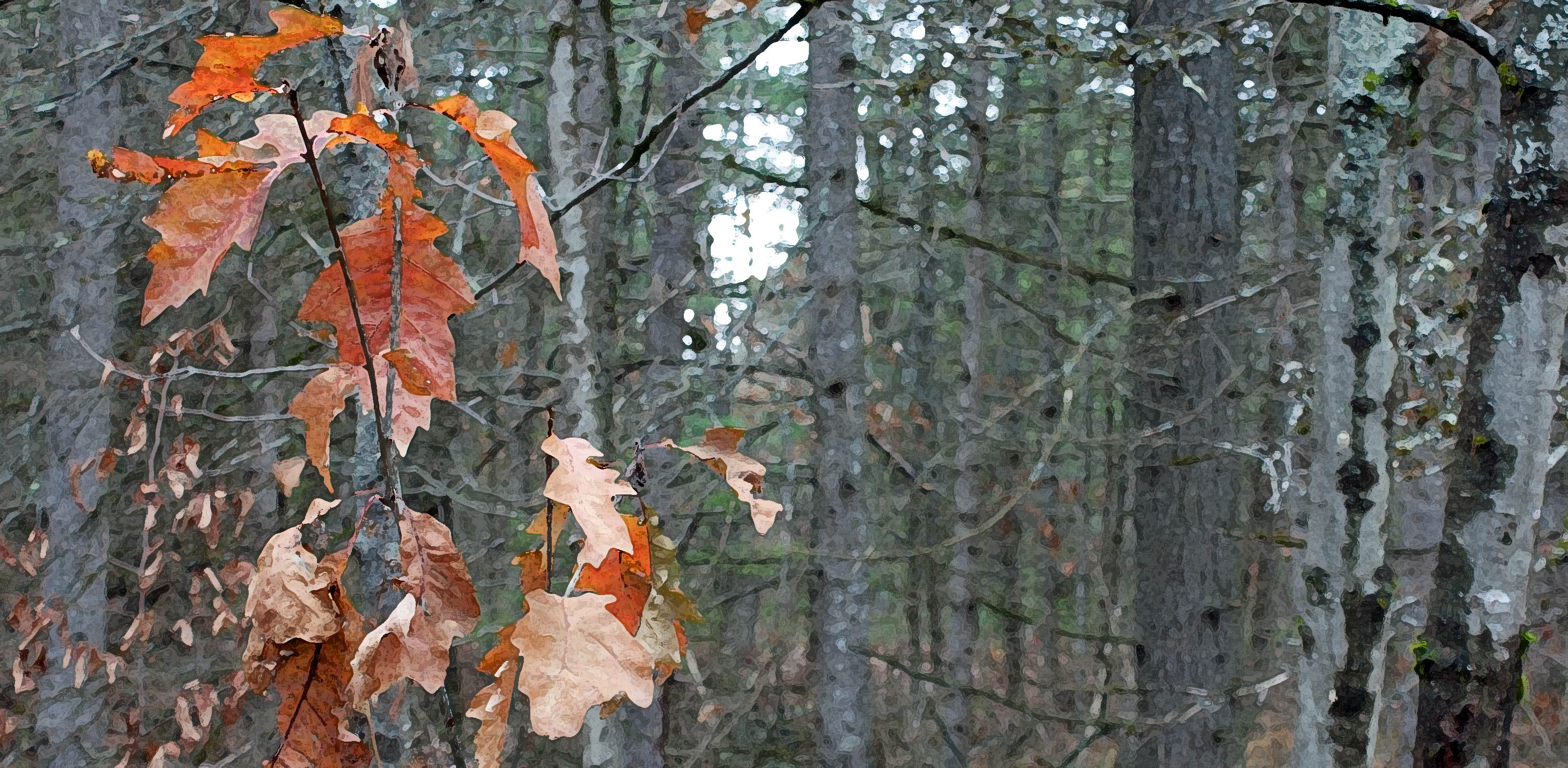
Oak leaves light up a dark pine forest in fall, ON (photo by Nina Munteanu)
.
References:
Munteanu, Nina. 2026. “Gaia’s Revolution, Part 1 of Icaria Trilogy.” Dragon Moon Press, Calgary, AB. 369 pp.
Munteanu, Nina. 2010. “Angel of Chaos, Part 2 of Icaria Trilogy.” Dragon Moon Press, Calgary, AB. 518 pp.
Munteanu, Nina. 2007. “Darwin’s Paradox, Part 3 of Icaria Trilogy.” Dragon Moon Press, Calgary, AB. 294 pp.
Sessions, George, Bill Devall. 2000. “Deep Ecology: Living as if Nature Mattered.” Gibbs Smith. 267pp.
Skinner, B.F. 1948. “Walden Two” The Macmillan Company, New York. 301pp.
.
Terminology:
*Deep Ecology: An environmental philosophy and social movement advocating that all living beings have intrinsic value, independent of their utility to human needs. Coined by Arne Næss in 1972, it promotes a holistic, ecocentric worldview—often termed “ecosophy”—that demands radical, structural changes to human society to prioritize nature’s flourishing.
*Letzte Generation: a prominent European climate activist group, founded in 2021, known for its acts of civil disobedience—such as roadblocks, defacing art, and vandalizing structures—to pressure governments on climate action. The term was chosen because they considered themselves to be the last generation before tipping points in the earth’s climate system would be reached. They are mostly active in Germany, Italy, Poland and Canada. In Germany, they have faced accusations of forming a criminal organization, leading to police raids.
.
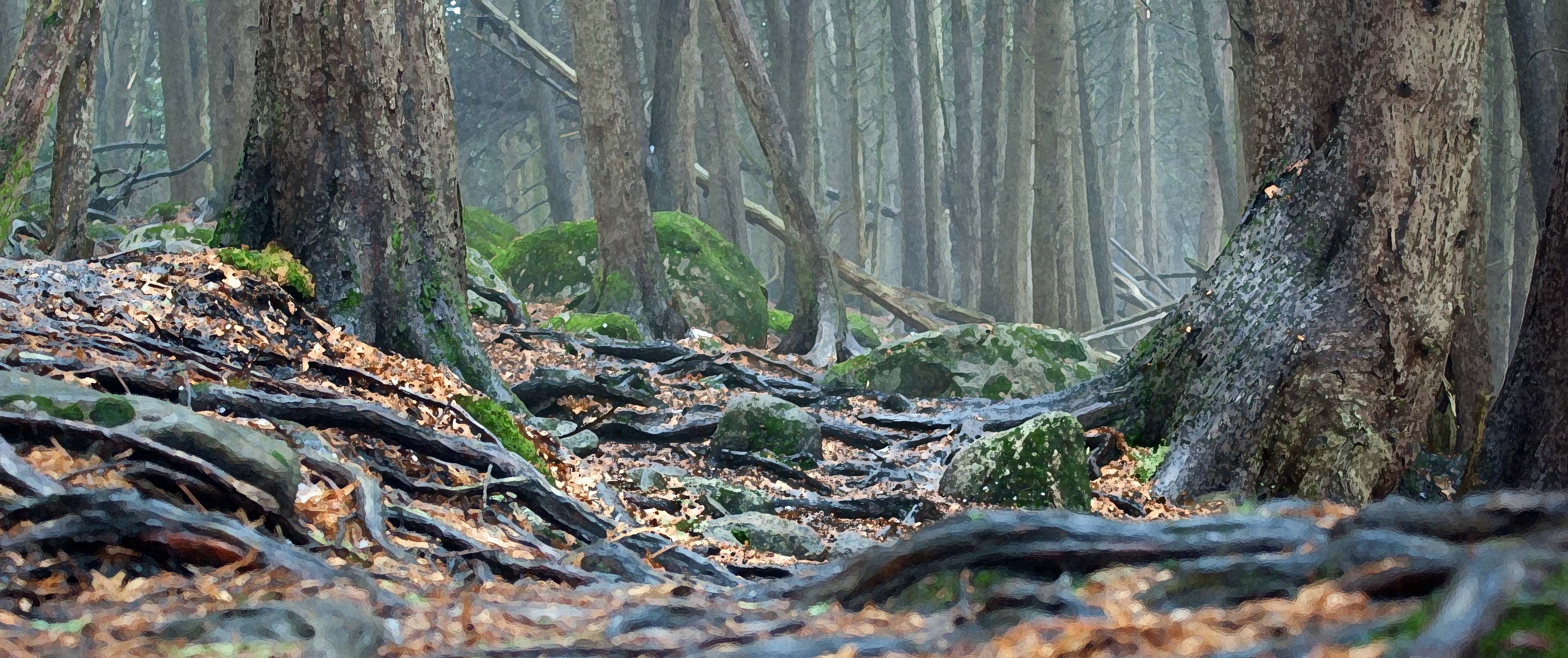
Root-covered cedar-pine forest in early winter, ON (photo and rendition by Nina Munteanu)
.
Nina Munteanu is a Canadian ecologist / limnologist and novelist. She is co-editor of Europa SF and currently teaches writing courses at George Brown College and the University of Toronto. For the latest on her books, visit www.ninamunteanu.ca. Nina’s bilingual “La natura dell’acqua / The Way of Water” was published by Mincione Edizioni in Rome. Her non-fiction book “Water Is…” by Pixl Press (Vancouver) was selected by Margaret Atwood in the New York Times ‘Year in Reading’ and was chosen as the 2017 Summer Read by Water Canada. Her novel “A Diary in the Age of Water” was released by Inanna Publications (Toronto) in June 2020.
A fanatical deep-ecologist, Monica Schlange, harnesses two orphans in her bid to reshape humanity and its place in the natural world.
.
My upcoming book Gaia’s Revolution(Book 1 of The Icaria Trilogy by Dragon Moon Press) explores a collapsing capitalist society in Canada through ravages of climate change and a failing technology. The story is told through the lives of ambitious twin brothers Eric—a gifted engineer—and Damien Vogel—a brilliant scientist and deep ecologist*—and the woman who plays them like chess pieces in her gambit to ‘rule the world.’
.
The brothers meet at Treffpunkt, a café near Humboldt University in Berlin, nursing Kellerbiers over a late lunch of Einsbeinmit Sauerkraut. They argue ideology and reform. Canada represents an ideal canvas for revolution, argues Eric. Damien is puzzled by this. To him Canada represents a quietly reposed nation of polite intellectuals who accept a healthy multicultural society and whose practical leaders are connected with their people. Not a restive rabble ripe for change.
As if reading his brother’s mind, Eric replies:
“Because it’s a huge nation with a lot of space and few people,” Eric argues. “Did you know that Canada holds on average only 4 people per square kilometer? Germany stuffs 240 people in the same area. And China, which is virtually the same size as Canada, holds 153 people per square kilometer.” He picks up Walden Two and waves it at Damien. “Canada is a perfect place to start these [Walden Two colonies called Icarias*]. And, with global warming, we could settle in the boreal.” He then slides the book back in his pocket and leans back, eyes sparkling with purpose. “But the real reason to start a revolution there is because, like you, Canadians are naïve. Even their leaders. And this is because, unlike the rest of the world, they are still asleep…
“Climate is not our enemy, Dame; it’s our friend. Climate is our fierce archangel of change. And let’s not forget that ‘crisis is opportunity…” … He grins, self-pleased, like a wolf in a hen house. Then he practically snarls out, “We must first destroy before we can create. We must be unruly like climate. We must be relentless like climate. We must ride that wave before we can become the wave, Bruder. And then by being that wave, we change the world.”
.
Pine cedar forest in Ontario (photo and rendition by Nina Munteanu)
.
The brothers escape the growing racial violence of Berlin, to ‘peaceful’ Canada in a rivalry to control the evolution of the human race. Years later, Eric Vogel, who has created a niche for himself in the technocratic government*, sits in the Canadian prime minister’s office and imagines what a post-capitalist world will look like and how his twin brother Damien—left behind in Germany—would disagree with his vision:
Damien too easily prescribes to the old leftist shibboleth of Nature being the answer to everything and Market being evil. His deep ecology utopia would spring from an atavistic rejection of modern life, a return to ‘the ancient farm.’ But how that fantasy could be achieved without a drastic population reduction is beyond his brother’s imagination. Damien fetishizes the natural world. Just like he does their mother. The naïve fool is a blind romantic, refusing to see reality right in front of him: that Nature is ultimately cruel, cold, and preoccupied with its own survival. Just like their mother.
.
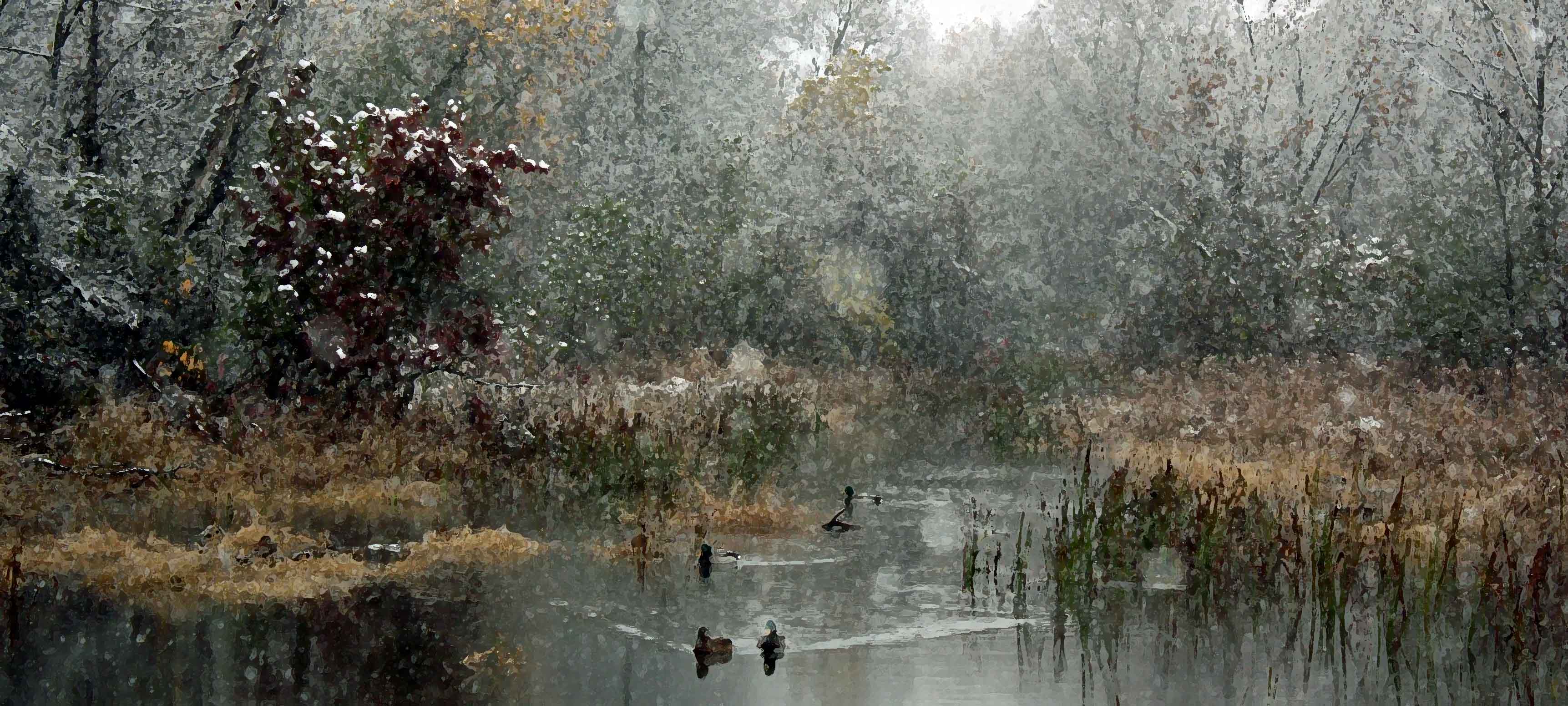
First snow in an Ontario marsh (photo and rendition by Nina Munteanu)
.
Each brother plans to create a new humanity: one to control through gene manipulation and behaviour engineering; the other to empower through biotechnology and transhumanist AI. The warring brothers end up in Canada and set off a violent revolution that destroys the Canadian technocratic government and whose weapons ultimately risk the survival of humanity. Deep ecologist Monica Schlange snares the brothers in her gambit to reshape humanity and its place in the natural world. Three orphaned children, caught in the web of intrigue and violence, will ultimately determine the direction of humanity by introducing the first veemelds (people who can communicate with machines), a new environmental disease (Darwin), and a new set of rules neither brother envisioned.
Birch trees in a winter marsh, ON (photo and rendition by Nina Munteanu)
.
References:
Munteanu, Nina. 2026. “Gaia’s Revolution, Part 1 of Icaria Trilogy.” Dragon Moon Press, Calgary, AB. 369 pp.
Munteanu, Nina. 2010. “Angel of Chaos, Part 2 of Icaria Trilogy.” Dragon Moon Press, Calgary, AB. 518 pp.
Munteanu, Nina. 2007. “Darwin’s Paradox, Part 3 of Icaria Trilogy.” Dragon Moon Press, Calgary, AB. 294 pp.
Sessions, George, Bill Devall. 2000. “Deep Ecology: Living as if Nature Mattered.” Gibbs Smith. 267pp.
Skinner, B.F. 1948. “Walden Two” The Macmillan Company, New York. 301pp.
.
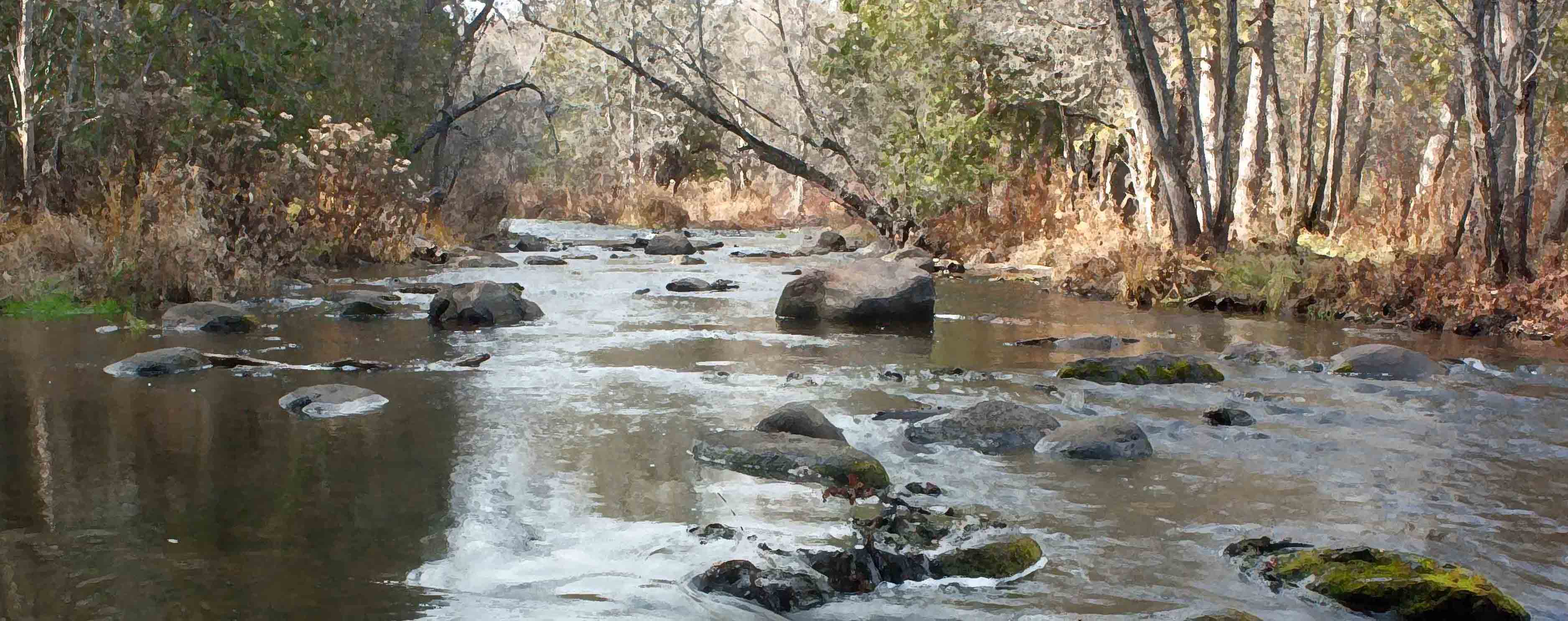
Jackson Creek in the fall, ON (photo and rendition by Nina Munteanu)
.
Terminology:
*Deep Ecology: An environmental philosophy and social movement advocating that all living beings have intrinsic value, independent of their utility to human needs. Coined by Arne Naess in 1972, it promotes a holistic, ecocentric worldview—often termed “ecosophy”—that demands radical, structural changes to human society to prioritize nature’s flourishing.
*Icaria: the name of Étienne Cabet’s utopia. Cabet was a French lawyer in Dijon, who published his novel Voyage en Icarie in 1839. The novel was a sort of manifesto-blueprint of utopian socialism, with elements of communism (abolished private property and individual enterprise), influenced by Fourierist and Owenite thinking. Key elements, such as the four-hour work day, are reflected in B.F. Skinner’s Walden Two. The novel explores a society in which capitalist production is replaced by workers’ cooperatives with a focus on small communities.
*Technocracy: A form of government in which the decision-maker(s) are selected based on their expertise in a given area; any portion of a bureaucracy run by technologists. Technocracies control society or industry through an elite of technical experts. The term was initially used to signify the application of the scientific method to solving social problems.
.
Nina Munteanu is an award-winning novelist and short story writer of eco-fiction, science fiction and fantasy. She also has three writing guides out: The Fiction Writer; The Journal Writer; and The Ecology of Writing and teaches fiction writing and technical writing at university and online. Check the Publications page on this site for a summary of what she has out there. Nina teaches writing at the University of Toronto and has been coaching fiction and non-fiction authors for over 20 years. You can find Nina’s short podcasts on writing on YouTube. Check out this site for more author advice from how to write a synopsis to finding your muse and the art and science of writing.
“Bourgeois society stands at the crossroads, either transition to socialism or regression into barbarism.”—Rosa Luxemburg, 1915
.
I wrote my first novel in 1969 when I was fifteen. Caged in World was a hundred-page speculative story about a world that had moved “inside” to escape the ravages of a post climate-change environment. It would later become Book 2 of The Icaria Trilogy. I was already disillusioned with my world. I saw how corporations and governments and society in general—individuals around me—‘othered’ the environment by either treating it with disrespect and apathy or outright ignoring it in a kind of torpor of obliviousness. As though it didn’t exist.
.
I remember being chastised by a school teacher for thinking globally about what was happening to the planet at our hands: worldwide deforestation (e.g., clearcutting the old-growth forests of Canada), infilling saltwater and freshwater marshes, massive use of pesticides and fertilizers, contamination of lakes, unregulated mining and toxic pollution, and ultimately climate change. Stick to local concerns, he advised me; recycling and such.
I remember wondering if I was just being weird. That my odd sensibility for the planet-entire was just a nina-thing. I prayed that I was not alone and it wasn’t just a nina-thing.
.
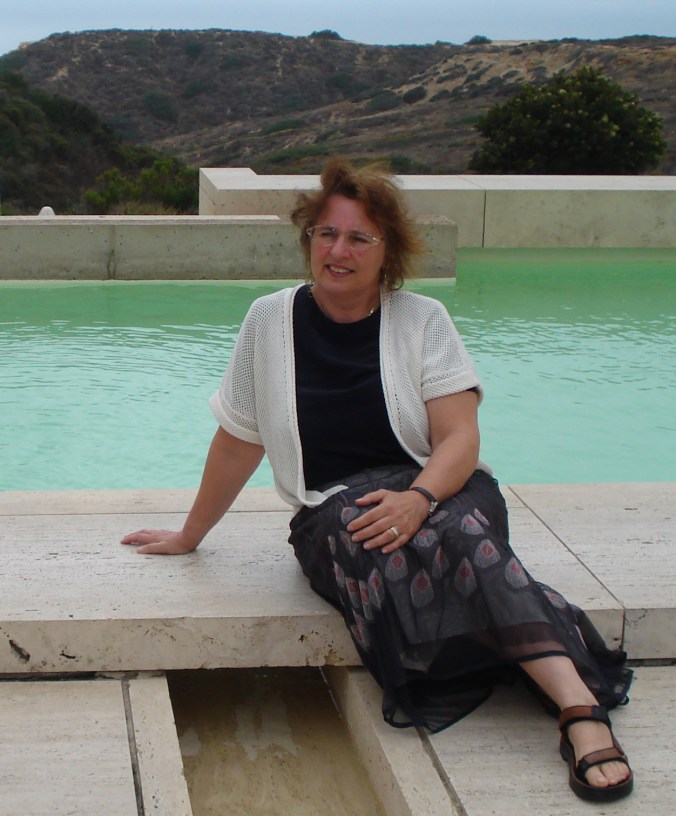
(Photo: Nina Munteanu, Salk Institute, California)
Throughout high school and university, I read scientific papers, news articles and books on revolution. I became a student of climate change long before the term entered the zeitgeist. I studied industrial capitalism and its roots in neoliberalism and colonialism. I noted how the post-war expansion of capitalism shifted from Fordist mass production to flexible automation, technology and AI. I saw the rise of multinational corporations, income inequality, and the commodification of everything—from water to human beings (Foucault’s homo economicus).
.
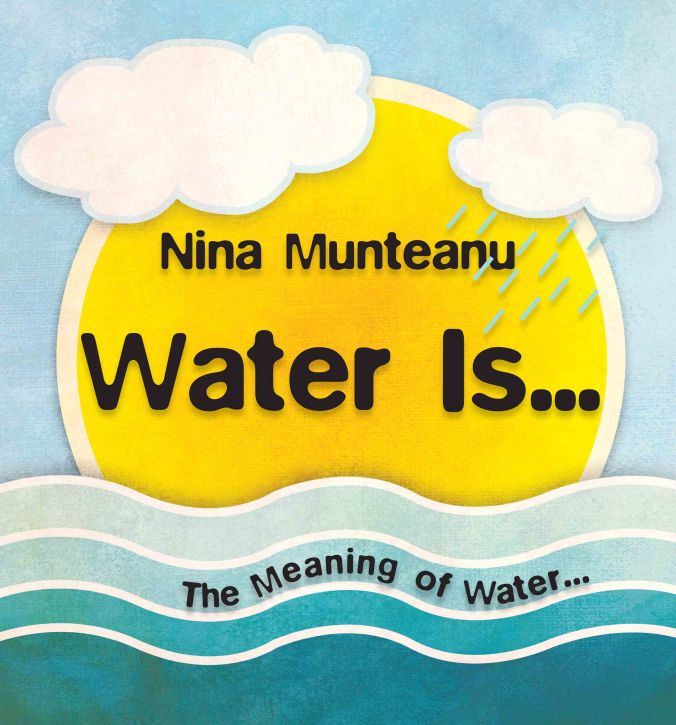
I pursued a university degree in ecology and limnology to study and help protect the environment and educate industry and their governments in the process. I became an expert on water. See my book Water Is…The Meaning of Water, which celebrates water from twelve perspectives (and got a shout out from Margaret Atwood!).
.
I soon concluded that a hegemony that follows the economic system of late capitalism inevitably commodifies and ‘others’ with ruthless purpose. Once something (or someone) is commodified, they are given a finite value and purpose outside their own existence. They become an object, a symbol to use and trade. They become a resource to manipulate, exchange, and dispose of with impunity. And through this surrender to utility, they become ‘othered.’ The consumer. The trees of the forest. Water. Homo sacer*. Each has a role to play in the late capitalist narrative of digital abundance and physical scarcity.
Capitalism hasn’t been kind to the environment. Economic pundits and sociologists insist that Capitalism is devolving. But what will replace it? Cloud capital? Technofeudalism? Something else?
.
Deep Ecology* & Gaia’s Revolution
The Icaria Trilogy (Dragon Moon Press)
.
My three Icaria novels—starting with Gaia’s Revolution, (the first of The Icaria Trilogy, releasing March 10, 2026, by Dragon Moon Press)—chronicle the collapse of a capitalist society in Canada as climate change, water shortages, habitat destruction, plague and a failing technology devastate the Canadian population.
.
Gaia’s Revolution (Book 1 of The Icaria Trilogy) explores a transition in Canada from semi-socialized capitalist system to a technocratic* meritocracy of technologists and scientists. Triggered by catastrophic environmental and sociological tipping points and following violent revolution, a dictatorship of deep ecologists* called Gaians seize power. By the end of the book, enclosed cities called Icarias* now populate North America. Separated from their environment, humans now live inside domes protecting them from a hostile and toxic environment.
.
In truth, the deep ecologists are keeping people “inside” not to protect humanity from a toxic wasteland but to protect the environment from a toxic humanity.
.
How realistic is this vision? Well, it is science fiction, after all, and though it takes liberties with its narrative, it is science-based and ultimately draws on precedent. As Margaret Atwood so astutely attested of her cautionary SF book The Handmaid’s Tale: “I didn’t put in anything that we haven’t already done, we’re not already doing, we’re seriously trying to do, coupled with trends that are already in progress.”
Science fiction is itself powerful metaphor; it is the fiction of political and social allegory or satire and makes astute social commentary about a world and civilization: how it has come to be, how it works—or doesn’t—and how it may evolve.
So, it is visionary and predictive? I prefer to think as Ray Bradbury:
.
“The function of science fiction is not only to predict the future, but to prevent it.”–Ray Bradbury
.
Jackson Creek in winter, ON (photo and rendition by Nina Munteanu)
.
References:
Angus, Ian. 1012. “The Spectre of 21st Century Barbarism.” Climate & Capitalism, August 20, 2012.
Atwood, Margaret. 2004. “The Handmaid’s Tale and Oryx and Crake ‘In Context'”. PMLA. 119 (3): 513–517.
Bradbury, Ray. 1991. “Yestermorrow: Obvious Answers to Impossible Futures” and “Beyond 1984: The People Machines” by Ray Bradbury, dated 1982, Page 155, Joshua Odell Editions: Capra Press, Santa Barbara, California.
Foucault, Michel. 2010. “The Birth of Biopolitics (Naissance de la biopolitique): Lectures at the Collège de France, 1978-1979.” Picador. 368pp.
Luxemburg, Rosa. 1915. “The Junius Pamphlet: The Crisis in the German Democracy”, Marxist.org.
Munteanu, Nina. 2026. “Gaia’s Revolution, Part 1 of Icaria Trilogy.” Dragon Moon Press, Calgary, AB. 369 pp.
Munteanu, Nina. 2010. “Angel of Chaos, Part 2 of Icaria Trilogy.” Dragon Moon Press, Calgary, AB. 518 pp.
Munteanu, Nina. 2007. “Darwin’s Paradox, Part 3 of Icaria Trilogy.” Dragon Moon Press, Calgary, AB. 294 pp.
Neuman, Sally. 2006. “‘Just a Backlash’: Margaret Atwood, Feminism, and The Handmaid’s Tale“. University of Toronto Quarterly. 75 (3): 857–868.
Sessions, George, Bill Devall. 2000. “Deep Ecology: Living as if Nature Mattered.” Gibbs Smith. 267pp.
Skinner, B.F. 1948. “Walden Two” The Macmillan Company, New York. 301pp.
Streeck, Wolfgang. 2014. “How Will Capitalism End?” New Left Review 2 (87): 47p.
.
Terminology:
*Deep Ecology: An environmental philosophy and social movement advocating that all living beings have intrinsic value, independent of their utility to human needs. Coined by Arne Næss in 1972, it promotes a holistic, ecocentric worldview—often termed “ecosophy”—that demands radical, structural changes to human society to prioritize nature’s flourishing.
*Homo sacer: a figure from Roman law denoting a person excluded from society who is outside human law (can be killed) and divine law (cannot be sacrificed). The term represents “bare life”: stripped of political rights, legal protection, and social value. Philosopher Giorgo Agamben popularized the term to describe individuals excluded from the political community, such as refugees, stateless persons, or camp detainees. The term illustrates the power of a sovereign in deciding which lives are worthy of protection and which are not.
*Icaria: the name of Étienne Cabet’s utopia. Cabet was a French lawyer in Dijon, who published his novel Voyage en Icarie in 1839. The novel was a sort of manifesto-blueprint of utopian socialism, with elements of communism (abolished private property and individual enterprise), influenced by Fourierist and Owenite thinking. Key elements, such as the four-hour work day, are reflected in B.F. Skinner’s Walden Two. Cabet’s novel explores a society in which capitalist production is replaced by workers’ cooperatives with a focus on small communities.
*Letzte Generation: a prominent European climate activist group, founded in 2021, known for its acts of civil disobedience—such as roadblocks, defacing art, and vandalizing structures—to pressure governments on climate action. The term was chosen because they considered themselves to be the last generation before tipping points in the earth’s climate system would be reached. They are mostly active in Germany, Italy, Poland and Canada. In Germany, they have faced accusations of forming a criminal organization, leading to police raids.
*Technocracy: A form of government in which the decision-maker(s) are selected based on their expertise in a given area; any portion of a bureaucracy run by technologists. Technocracies control society or industry through an elite of technical experts. The term was initially used to signify the application of the scientific method to solving social problems.
.
Nina Munteanu is an award-winning novelist and short story writer of eco-fiction, science fiction and fantasy. She also has three writing guides out: The Fiction Writer; The Journal Writer; and The Ecology of Writing and teaches fiction writing and technical writing at university and online. Check the Publications page on this site for a summary of what she has out there. Nina teaches writing at the University of Toronto and has been coaching fiction and non-fiction authors for over 20 years. You can find Nina’s short podcasts on writing on YouTube. Check out this site for more author advice from how to write a synopsis to finding your muse and the art and science of writing.
What’s left of humanity—after we broke the world—is crammed in a speeding train that circles a frozen Earth … forever.
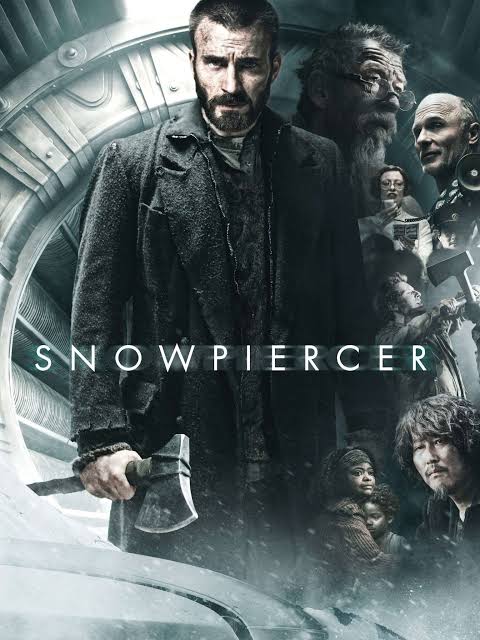
Bong Joon-Ho’s 2013 motion picture Snowpiercer is a stylish post-climate change apocalypse allegory. A dark pastiche of surrealistic insanity, welded together with moments of poetic pondering and steam-punk slick in a frenzied frisson you can almost smell. Joon-Ho casts each scene in metallic grays and blues that make the living already look half-dead. The entire film plays like a twisted steampunkish baroque symphony. Violence personified in a garish ballet.
One of the many excessive fight scenes
The train’s self-contained closed ecosystem is maintained by an ordered social system, imposed by a stony militia. Those at the front enjoy privileges and luxurious living conditions, though most drown in a debauched drug stupor; those at the back live on next to nothing and must resort to savage means to survive. This film isn’t about climate change—that’s just a plot point to serve the premise of a study on how society functions—or rather copes—within a decadent capitalist system, based on an edict of productivity: serve the machine of “life”. Satisfy the sacred machine at all costs; complete with subterfuge, oppression and references to cannibalism. Beneath the film’s blatant statement on the emptiness of the pursuit of capital at any cost lies a deeper more subtle exploration on the nature of humanity. Die to live or live to die?
In a recent interview with io9, Joon-Ho said, “the science fiction genre lends itself perfectly to questions about class struggle, and different types of revolution.”
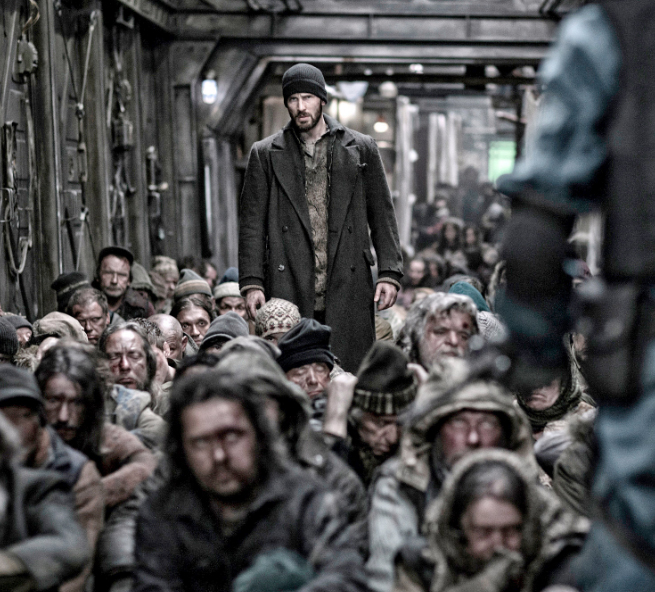
Curtis singled out by militia
Revolution brews from the back, led by Curtis Everett (Chris Evans), who confesses to a forced recruit, along the way, “A thousand people in an iron box. No food, no water. After a month we ate the weak. You know what I hate about myself? I know what people tastes like….I know that babies taste best.”
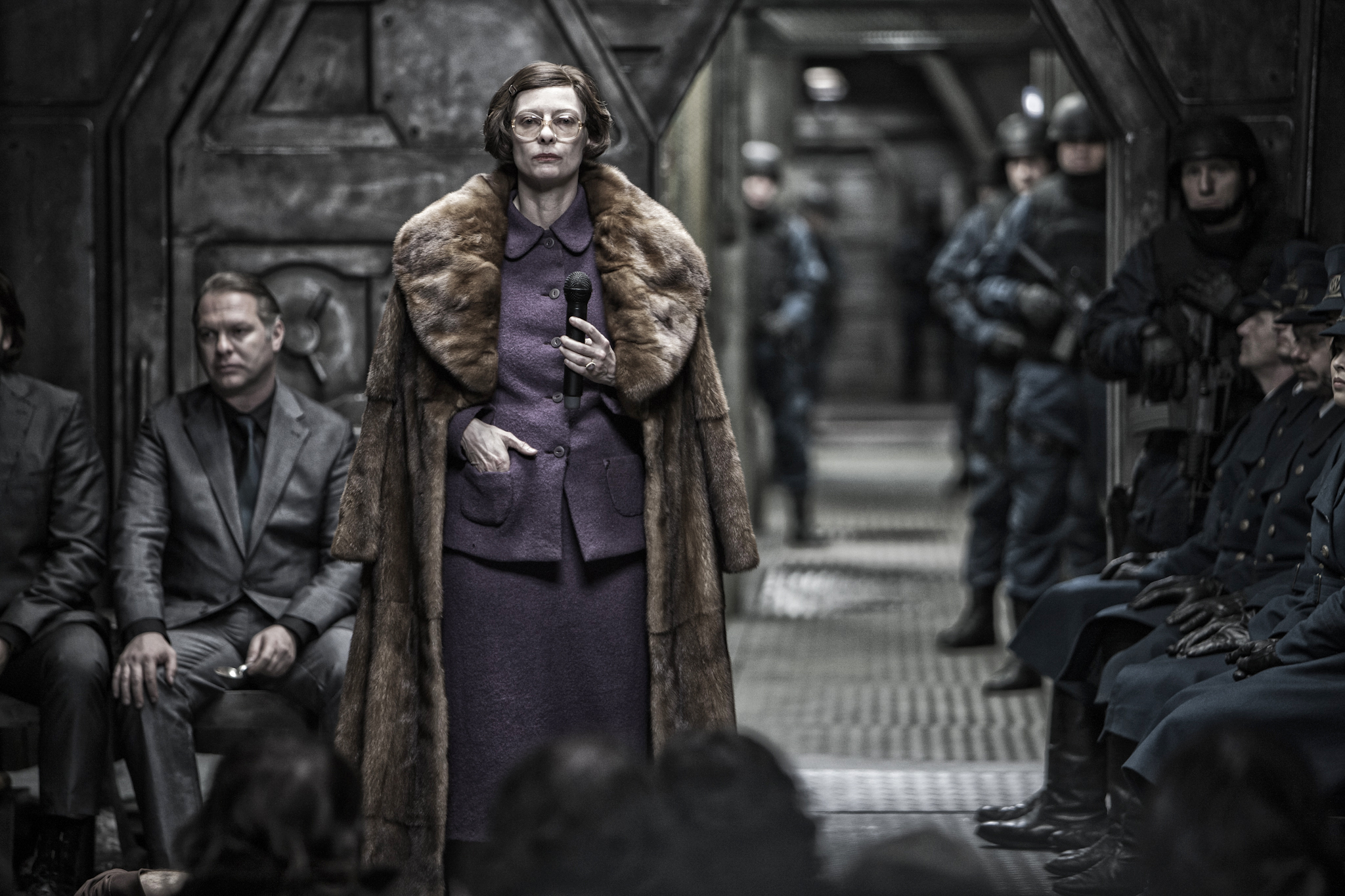
Minister Mason (Tilda Swinton), an imperious yet simpering figure who serves the ruling class without quite being part of it, reminds the lower class that, “Eternal order flows from the sacred engine. We must occupy our preordained position. I belong to the front, you belong to the tail. Know your place!”
Minister Mason dispenses the law to the tail
It’s all about the engine for both front and tail. It saved humanity, after all. It is their future. Curtis tells his colleagues that they will move forward: “We take the engine and we control the world. It’s time we take the engine.”
Revolution brews in the tail
“Reform and revolution are shibboleths that distinguish liberals from radicals,” explains Aaron Bady of The New Inquiry. “While liberals want to reform capitalism, without fundamentally transforming it, radicals want to tear it up from the roots (the root word of “radical” is root!) and replace capitalism with something that isn’t capitalism…If you’re the kind of leftist who thinks that the means of production just need to be in better hands—Obama, for example, instead of George W. Bush, or Elizabeth Warren instead of Obama, or Bernie Sanders instead of Elizabeth Warren, and so on—then this movie buries a poison pill inside its protein bar: soylent green is people.”
The tail faces the goons of the front
The train “eats” the children of the poor; using them to replace the sacred engine parts that have worn out in a kind of retro-transhumanist collaboration of human and machine and creating a perverse immortal cyborg entity. Only, the individual children die in the process and need to be constantly replaced to maintain the eternal whole. They have literally become cogs in a giant wheel of eternity.
Curtis’s revolution is doomed from the start; once he reaches the front, it is revealed to him that the entire conflict and resulting deaths were orchestrated all along to help maintain population balance. Wilford (Ed Harris), the genius who created the train with a perpetual motion engine, tells Curtis once they meet that, “this is the world…The engine lasts forever. The population must always be kept in balance.” Which begs the obvious question: why not just get rid of all of the lower class “scum” (as Mason calls them)? That would make room for the privileged. What purpose do these lower class serve? The answer is both obvious and simple: aside from providing their children as parts to the sacred engine, they are there to be hated, feared and despised by the elite. When the soul is empty and needs “filling” but can’t be filled, then it finds a substitute.
Wilford lectures Curtis on the train’s functional ecosystem
Aaron Bady of The New Inquirer shares that, “Instead of giving Texans a health care system, for example, late capitalism gives them the illegal immigrant, to hate, to fear, and to dis-identify with. Prisons do more and more of the system-maintaining work that was once done by schools and hospitals: instead of giving us something to want, they give us something to fear, hate, and kill. And so, we eat ourselves.” We die to live.
Wilford grooms Curtis as the new engineer and reveals to him the true nature of the engine. “You’ve seen what people do without leadership,” says Wilford to Curtis. “They devour one another.” This is dark irony considering what the train is doing. And it is when Curtis discovers this awful truth that his reformist revolution comes to a dead halt and he makes a decision that takes him into the realm beyond the train.
Snowpiercer is about hard choices and transcendence. … Save humanity, but at the consequence of our souls? Or transcend a machine that has robbed us of our souls at the expense of our mortality? The film continually questions our definition of what life is and what makes life worth living.
Snowpiercer crosses one of many treacherous bridges
The film, whose script by Joon-Ho and Kelly Masterson is based loosely on the French graphic novel Le Transperceneige by Jacques Lob, graphically portrays the fecklessness of a reformist/revolutionary movement to transcend the decadent capitalist machine (the train). It begins with the adoption of a failing system from a previously failed system. Perhaps it is a truism that most reformist movements fail to challenge the true hegemony of the system they intend to overtake, given their origin. What we get is little genuine change; just a shuffle in protocol.
Peter Frase of Jacobin Magazine shares that, “it’s all the more effective because the heart of that critique comes as a late surprise, from a character we might not expect.”
Namgoong languishes in a drugged state on the train after he is liberated from a drawer
Namgoong Minsoo (Song Kang-Ho) is a spaced-out drug addict that Curtis ‘liberates’ from a drawer to help them open the gates to the forward sections. Like everyone on the train, Nam is a little crazy. But he differs in one important way: he believes there is hope outside the train. Unlike his reformist brothers, he looked outside the construct and studied the realm beyond the train. Perhaps it is drug-induced fantasy. Perhaps he’s simply had enough of a lifetime of “non-life” onboard the train and would rather die outside to truly live, even if for a brief moment. When the chance for this moment materializes, we, like Nam and his daughter Yona (Ko Ah-sung), are more than ready to jump the train. In fact, we’re desperate to get off this shadow game of bread and circuses. Even if it means freezing to death in moments.
Only Yona and one of the rescued children from the engine, survive the ensuing train crash, thanks to Curtis’s truly revolutionary decision.
“Is it more revolutionary to want to take control of the society that’s oppressed you, or to try and escape from that system altogether?” asks Joon-Ho.
Yona and Curtis on the train
I felt a cathartic surge of relief when the train came to a violent crashing stop; even though it effectively meant the end of humanity. My visceral response was incredible relief. The scene following the train crash was —despite the inhospitable and cold environment—surrealistically fresh, invigorating and serene. Along with Yona and one of the children Curtis rescued, we’ve escaped the rushing perversity: the obsession to survive at any cost. We’ve chosen to live to die. That Curtis (had to) die with the train to ensure the safe escape of Yona and the child, made sense to me. Curtis remained trapped in the old paradigm; but he possessed enough vision to understand the need for change beyond his sight. His was a sacrifice for true change.
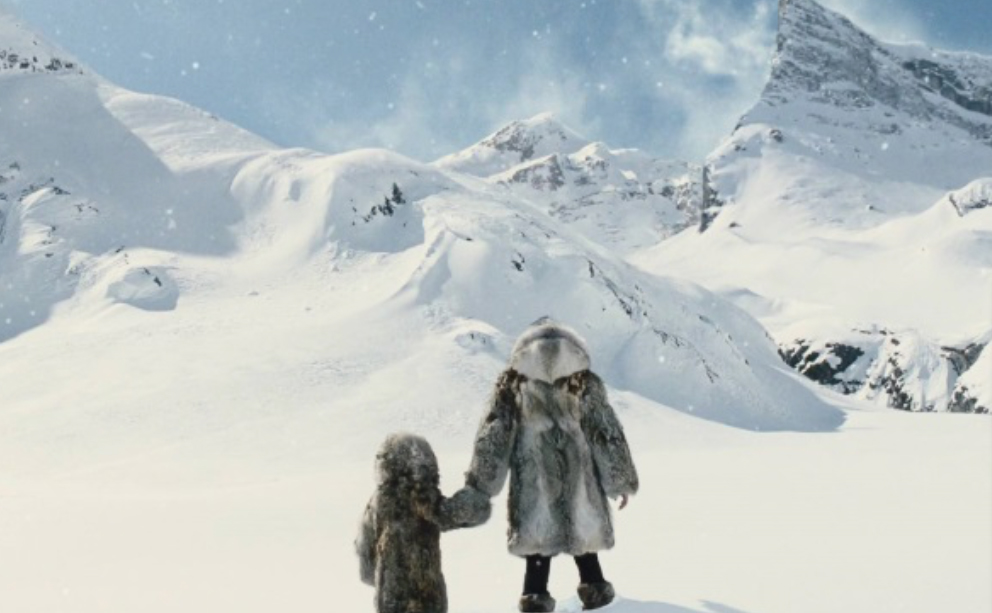
As Yona and the child crunch through the snow in the quiet depth of coldness, they glimpse a polar bear. There is life! Perhaps not humanity. But life on Earth.
And in that connection, we live. Even if just for a moment.
Yona and the child face a bleak but hopeful future after escaping the Snowpiercer
Postscript on the ending of the movie: In an interview with Vulture, Bong Jung-Ho shared his thoughts on Snowpiercer’s ending: “For me, it’s a very hopeful ending … The engine is itself on its way to extinction along with cigarettes, and other goods. Extinction is a repeated word throughout the film. But outside the train, life is actually returning. It’s nature that’s eternal, and not the train or the engine, as you see with the polar bear at the end.”
Ultimately, Bong Jung-Ho’s message with the ending of this baroque political allegory is the vindication of a choice against reform capitalism for something new, that there is indeed “Life after Capitalism”, not easy but worth living…
Nina Munteanu is a Canadian ecologist / limnologist and novelist. She is co-editor of Europa SF and currently teaches writing courses at George Brown College and the University of Toronto. Visit www.ninamunteanu.ca for the latest on her books. Nina’s bilingual “La natura dell’acqua / The Way of Water” was published by Mincione Edizioni in Rome. Her non-fiction book “Water Is…” by Pixl Press (Vancouver) was selected by Margaret Atwood in the New York Times ‘Year in Reading’ and was chosen as the 2017 Summer Read by Water Canada. Her novel “A Diary in the Age of Water” was released by Inanna Publications (Toronto) in June 2020.











 Nina Munteanu Writing Coach