Ten Significant Science Fiction TV Series—Part 2: Shows that Touch on Climate Change, Resource Allocation and Environmental Justice: #8—SNOWPIERCER

I’ve selected ten TV series that have intrigued me, moved me, and stayed with me for various reasons that touch on: abuse of justice, including eco-justice and environmental abuse; technology use and abuse; and the effects and horrors of climate change.

Some are well known; others not so well known. All approach storytelling with a serious dedication to depth of character, important themes, realistic world building, and excellent portrayal by actors. The world-building is extremely well done—in some cases rivalling Ridley Scott’s best—with convincing portrayals of worlds that are at times uncanny in their realism. Worlds that reflect story from an expansive landscape to the mundane minutiae of daily life: like the cracked phone device of Detective Miller in The Expanse or the dirty fingernails of engineer Juliette Nichols in the Down Deep of Silo. Stories vary in their treatment of important themes from whimsical and often humorous ironies to dark and moody treatises on existential questions. In my opinion, these TV series rival the best movies out there, often reflecting large budgets (but not always) and a huge commitment by producers. The ten TV series I’ve selected in this series come from around the world: Brazil, Germany, France, Norway, Canada and the United States.

In Part 2, I focus on five TV series that explore issues to do with resource allocation, adaptations to climate change and corporate / government biopolitics.  


SNOWPIERCER: Capitalism is a Perpetual Motion Train in a Frozen World

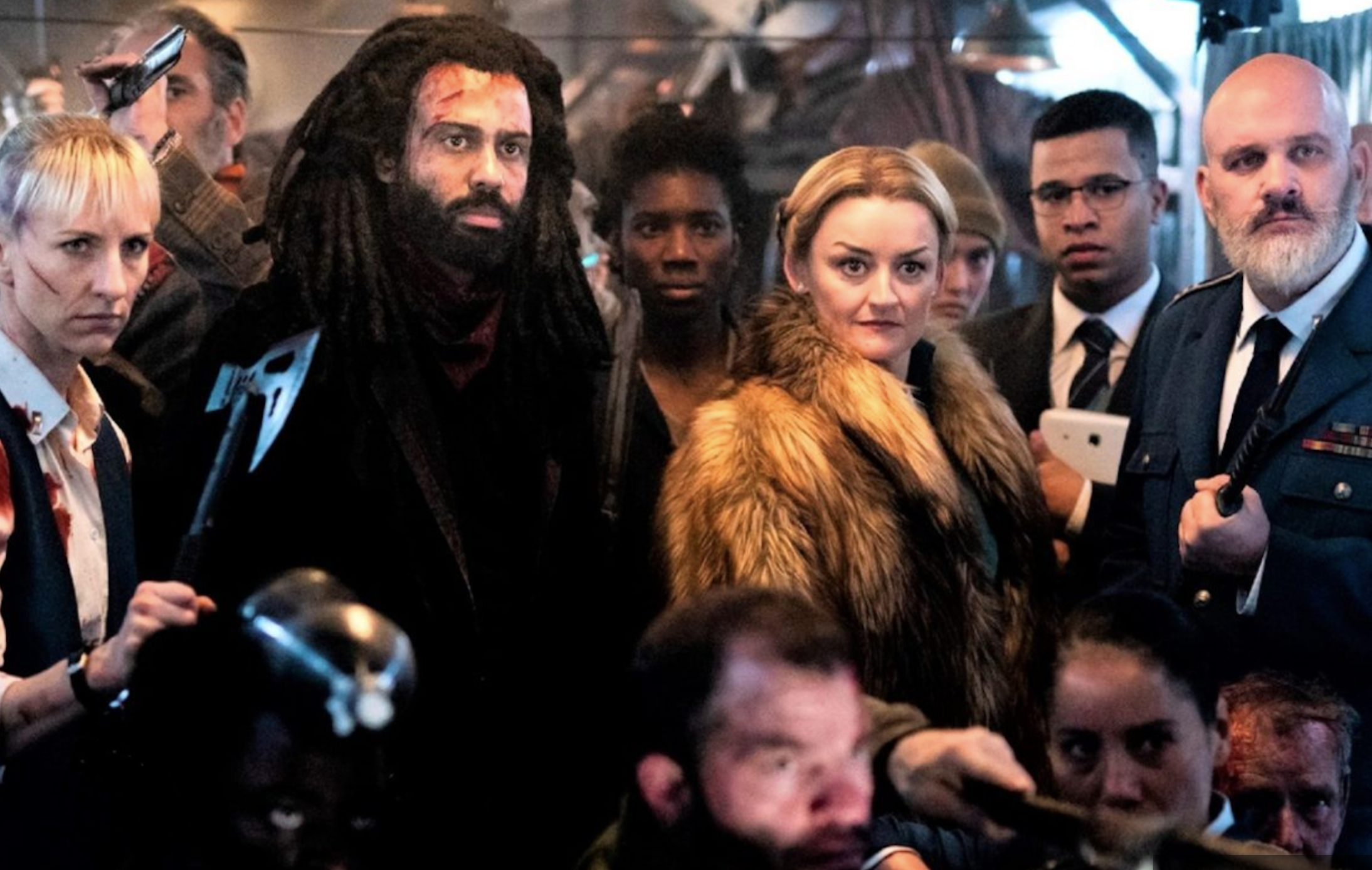
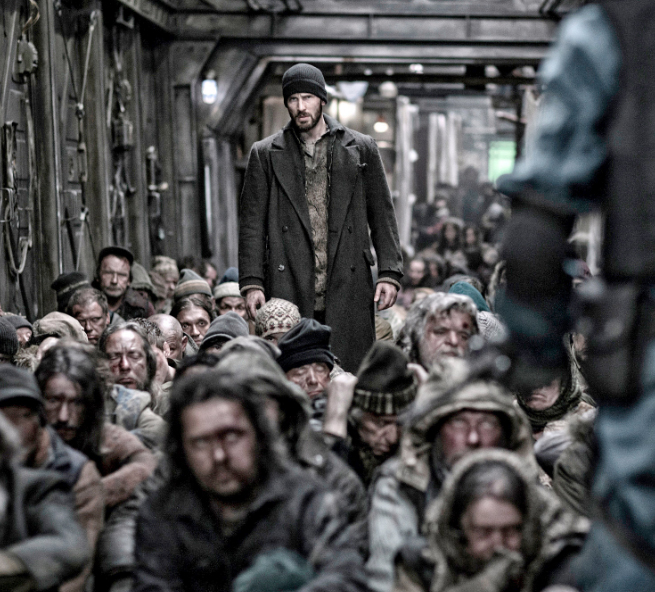
Snowpiercer is an American post-apocalyptic dystopian thriller that reboots the 2013 film Snowpiercer by Bong Jooh-ho. Snowpiercer is a perpetually moving train that circles the globe carrying the remnants of humanity seven years after the world has become a frozen wasteland, thanks to a botched climate fix. The train is divided up by class – first class, where all the wealthy people live; second and third class where the workers reside, and the tail – the end of the train, where the poor starve, live in total darkness, and are exploited for sex and labor. 

Passengers in the tail of the train

The train, of course, serves as a metaphor for class struggle, elitism and social injustices. The train’s self-contained closed ecosystem is maintained by an ordered social system, imposed by a stony militia. Those at the front enjoy privileges and luxurious living conditions, though most drown in a debauched drug stupor; those at the back live on next to nothing and must resort to savage means to survive. The TV show, as with the film, isn’t so much about climate change—as a study on how society functions—or rather copes—within a decadent capitalist system, based on an edict of productivity: serve the machine of “life” and keep the order at all cost. Chief of Hospitality Melanie Cavill (secretly chief engineer of the train) as much as tells this to homicide detective Andre Layton (from the back of the train) when she enlists him to solve the first murder in the elite section of the train.

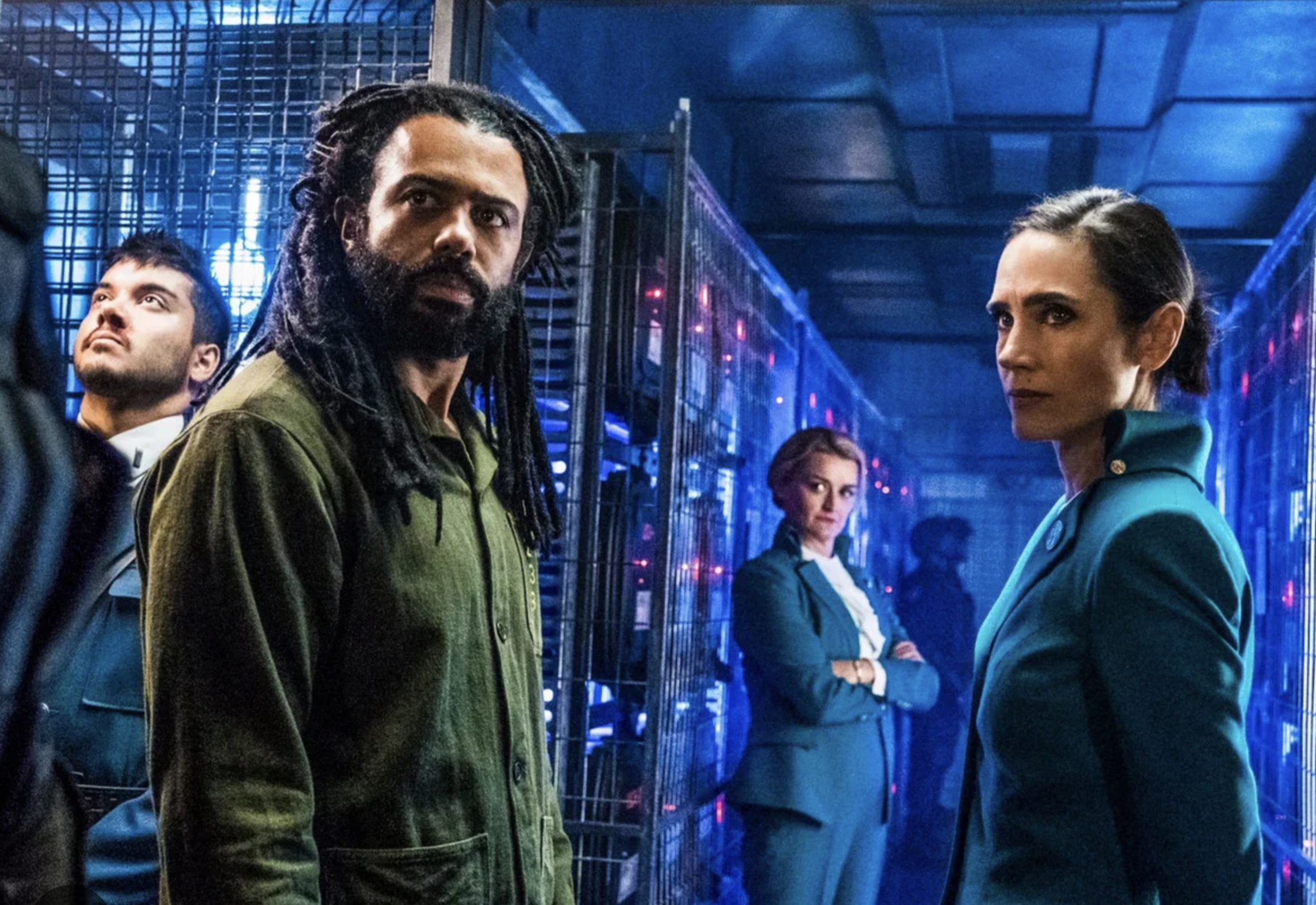
Melanie Cavill, head of Hospitality, enlists Andre Layton as detective to investigate a murder on the train

The TV show diverges from the film in several important ways.

My original review of the movie touched on style and political agenda:

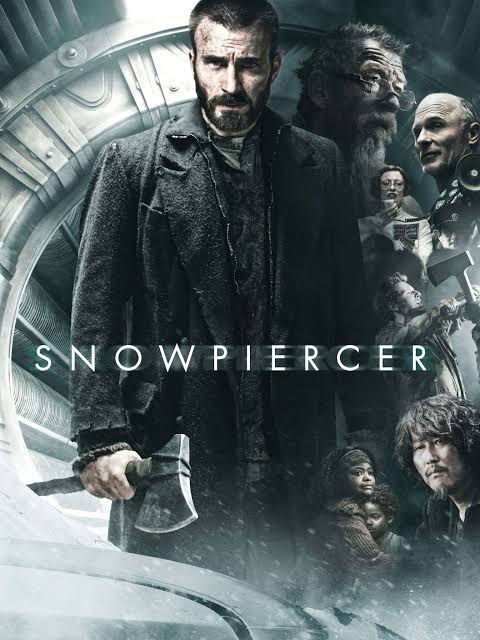
Bong Joon-Ho’s 2013 motion picture Snowpiercer is a stylish post-climate change apocalypse allegory. A dark pastiche of surrealistic insanity, welded together with moments of poetic pondering and steam-punk slick in a frenzied frisson you can almost smell. Joon-Ho casts each scene in metallic grays and blues that make the living already look half-dead. The entire film plays like a twisted steampunkish baroque symphony. Violence personified in a garish ballet.

Poster for the movie version of Snowpiercer

I drew on Aaron Bady’s commentary on the film in The New Inquiry which discussed reform capitalism* to conclude that the movie “Snowpiercer is about hard choices and transcendence. Save humanity but at the consequence of our souls? Or transcend the machine that has robbed us of our souls at the expense of our mortality? The film continually questions our definition of what life is and what makes life worth living … Ultimately, Bong Jung-Ho’s message with the ending of this baroque political allegory is the vindication of a choice against reform capitalism for something new, that there is indeed “Life after Capitalism”, not easy but worth living…”

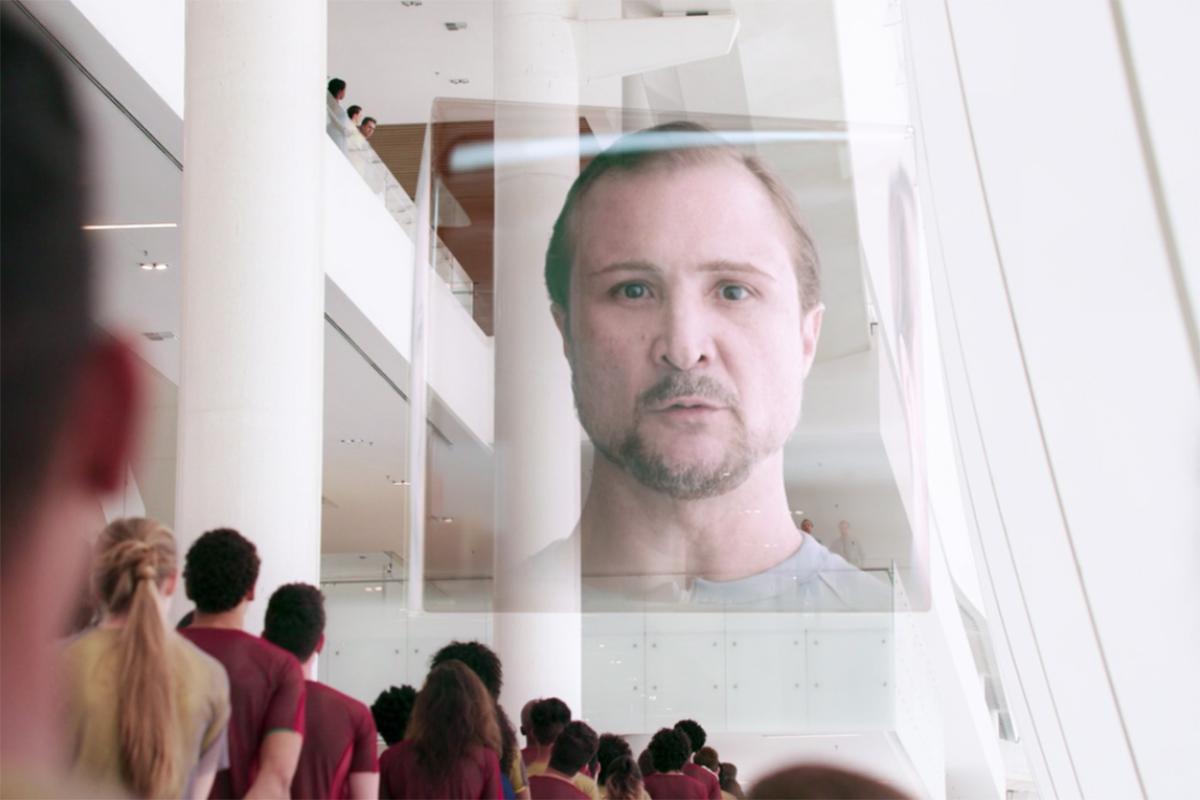
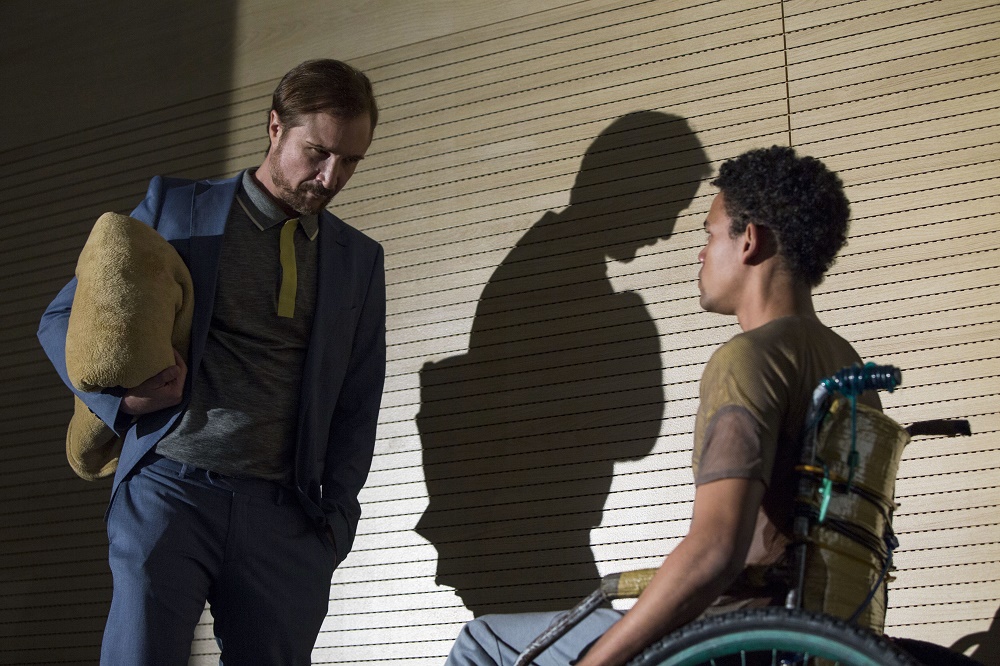
The Snowpiercer TV series takes a different approach to the end of the world and capitalism metaphor, weaving in more intrigue in its plot (a murder) with elements of detecting by the only homicide detective left on the train and in the world—a self-styled revolutionary from the back of the train. Much of the entertaining tensions arise from the interactions of Detective Andre Layton (Daveed Diggs) and Hospitality head Melanie Cavill (Jennifer Connelly) and second in command Ruth Wardell (Alison Wright); there are also strong performances by the train’s Breakman, Bess Till (Mickey Sumner) and later Mr. Wilford (Sean Bean) who was supposedly running the train but had been secretly thrown off the train by head engineer Cavill.

Snowpiercer crew prepare to encounter another train in the freeze

The focus of the TV show has been more on the potential survival of a handful of what’s left of humanity with competing agendas on how this is best achieved, whether the freeze is indeed unfreezing and some part of the world has become hospitable or at least livable. Trading the film’s baroque metaphors to capitalism for a more literal approach to climate change and living in a post climate change world, the TV series focuses more on real questions facing this ragtag of humanity. How to keep it together when rifts naturally form based on unequal resource allocation and space in the limited ecosystem of the train. Given that the show plays out in several seasons, there is room to expand and further explore socialism, democracy, fascist rule and environmental activism. Class divisions are explored through a large cast of morally ambiguous characters, each with a plot arc, and more opportunities to explore not just first class but second and third class, showcasing more nuanced and varied elements to the class struggle and ambitions of people.  

*Reform Capitalism: “Reform and revolution are shibboleths that distinguish liberals from radicals,” explains Aaron Bady of The New Inquiry. “While liberals want to reform capitalism, without fundamentally transforming it, radicals want to tear it up from the roots (the root word of “radical” is root!) and replace capitalism with something that isn’t capitalism…If you’re the kind of leftist who thinks that the means of production just need to be in better hands—Obama, for example, instead of George W. Bush, or Elizabeth Warren instead of Obama, or Bernie Sanders instead of Elizabeth Warren, and so on—then this movie buries a poison pill inside its protein bar: soylent green is people.”  

Ten Significant Science Fiction TV Series:

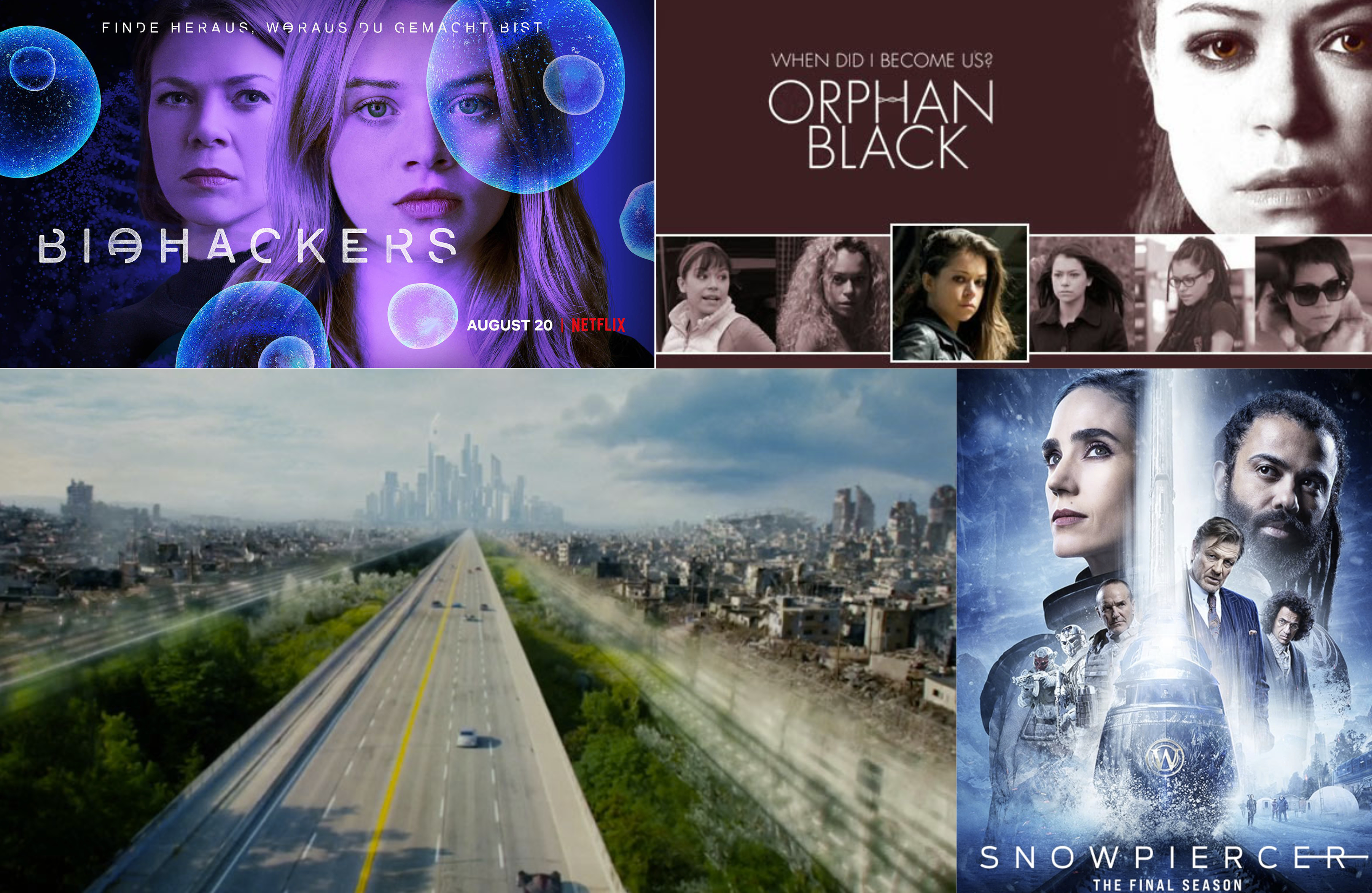
Biohackers (Germany)
Orphan Black (Canada)
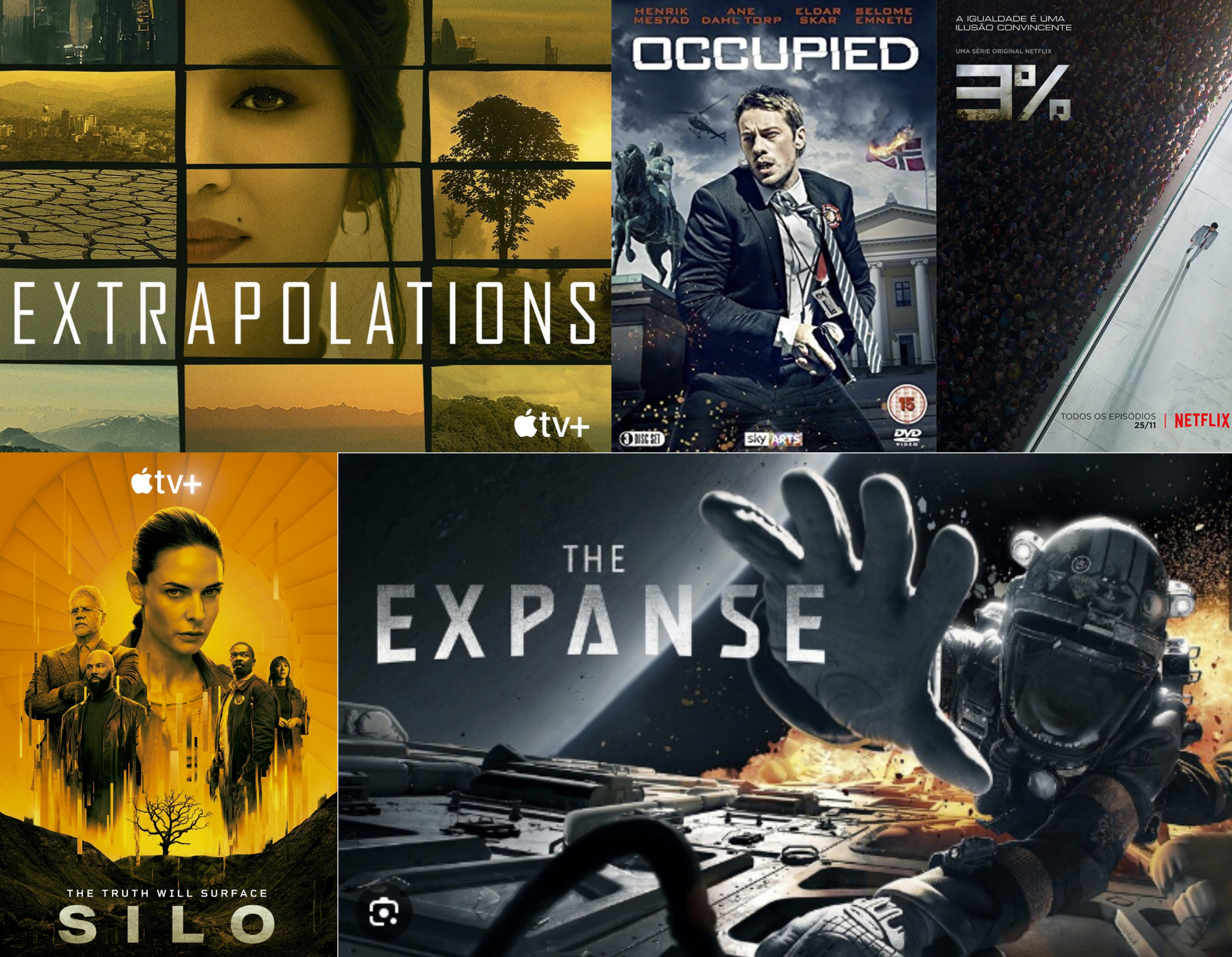
Occupied (Norway)
Missions (France)
Expanse (USA)
Incorporated (USA)
3% (Brazil)
Snowpiercer (USA)
Silo (USA)
Extrapolations (USA)

Nina Munteanu is a Canadian ecologist / limnologist and novelist. She is co-editor of Europa SF and currently teaches writing courses at George Brown College and the University of Toronto. Visit www.ninamunteanu.ca for the latest on her books. Nina’s bilingual “La natura dell’acqua / The Way of Water” was published by Mincione Edizioni in Rome. Her non-fiction book “Water Is…” by Pixl Press (Vancouver) was selected by Margaret Atwood in the New York Times ‘Year in Reading’ and was chosen as the 2017 Summer Read by Water Canada. Her novel “A Diary in the Age of Water” was released by Inanna Publications (Toronto) in June 2020.

Movie Review: Snowpiercer and the Machine of Life


What’s left of humanity—after we broke the world—is crammed in a speeding train that circles a frozen Earth … forever.

Bong Joon-Ho’s 2013 motion picture Snowpiercer is a stylish post-climate change apocalypse allegory. A dark pastiche of surrealistic insanity, welded together with moments of poetic pondering and steam-punk slick in a frenzied frisson you can almost smell.  Joon-Ho casts each scene in metallic grays and blues that make the living already look half-dead. The entire film plays like a twisted steampunkish baroque symphony. Violence personified in a garish ballet.  

One of the many excessive fight scenes

The train’s self-contained closed ecosystem is maintained by an ordered social system, imposed by a stony militia. Those at the front enjoy privileges and luxurious living conditions, though most drown in a debauched drug stupor; those at the back live on next to nothing and must resort to savage means to survive. This film isn’t about climate change—that’s just a plot point to serve the premise of a study on how society functions—or rather copes—within a decadent capitalist system, based on an edict of productivity: serve the machine of “life”. Satisfy the sacred machine at all costs; complete with subterfuge, oppression and references to cannibalism. Beneath the film’s blatant statement on the emptiness of the pursuit of capital at any cost lies a deeper more subtle exploration on the nature of humanity. Die to live or live to die?

In a recent interview with io9, Joon-Ho said, “the science fiction genre lends itself perfectly to questions about class struggle, and different types of revolution.”

Curtis singled out by militia

Revolution brews from the back, led by Curtis Everett (Chris Evans), who confesses to a forced recruit, along the way, “A thousand people in an iron box. No food, no water. After a month we ate the weak. You know what I hate about myself? I know what people tastes like….I know that babies taste best.”

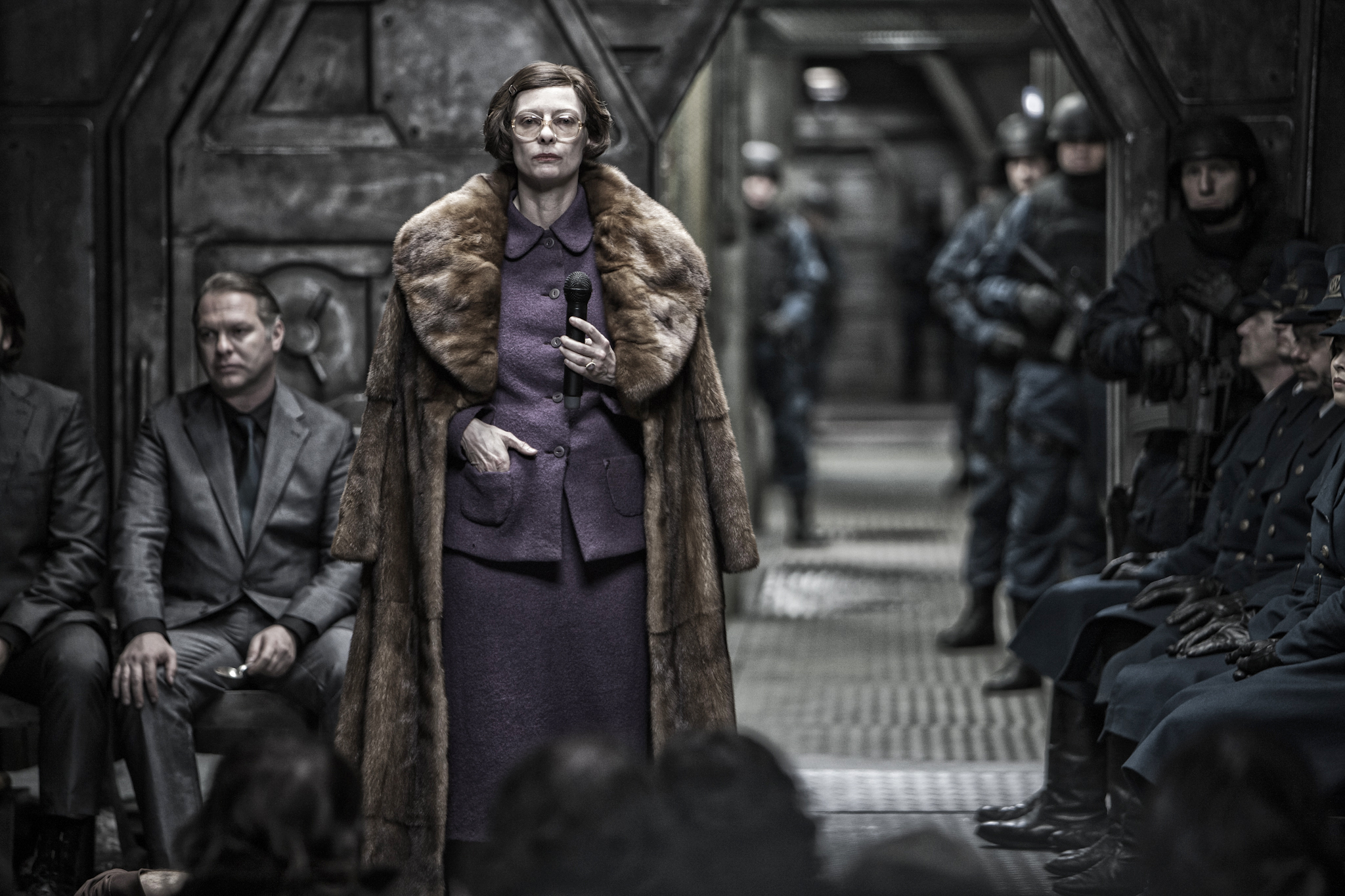
Minister Mason (Tilda Swinton), an imperious yet simpering figure who serves the ruling class without quite being part of it, reminds the lower class that, “Eternal order flows from the sacred engine. We must occupy our preordained position. I belong to the front, you belong to the tail. Know your place!”

Minister Mason dispenses the law to the tail

It’s all about the engine for both front and tail. It saved humanity, after all. It is their future. Curtis tells his colleagues that they will move forward: “We take the engine and we control the world. It’s time we take the engine.”

Revolution brews in the tail

“Reform and revolution are shibboleths that distinguish liberals from radicals,” explains Aaron Bady of The New Inquiry. “While liberals want to reform capitalism, without fundamentally transforming it, radicals want to tear it up from the roots (the root word of “radical” is root!) and replace capitalism with something that isn’t capitalism…If you’re the kind of leftist who thinks that the means of production just need to be in better hands—Obama, for example, instead of George W. Bush, or Elizabeth Warren instead of Obama, or Bernie Sanders instead of Elizabeth Warren, and so on—then this movie buries a poison pill inside its protein bar: soylent green is people.”

The tail faces the goons of the front

The train “eats” the children of the poor; using them to replace the sacred engine parts that have worn out in a kind of retro-transhumanist collaboration of human and machine and creating a perverse immortal cyborg entity. Only, the individual children die in the process and need to be constantly replaced to maintain the eternal whole. They have literally become cogs in a giant wheel of eternity.

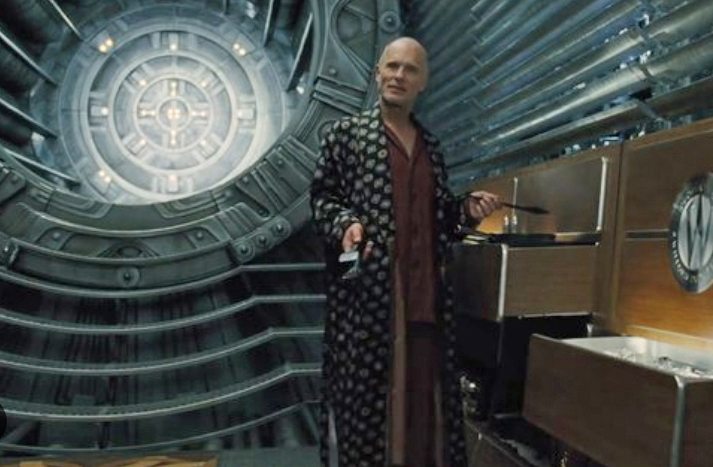
Curtis’s revolution is doomed from the start; once he reaches the front, it is revealed to him that the entire conflict and resulting deaths were orchestrated all along to help maintain population balance. Wilford (Ed Harris), the genius who created the train with a perpetual motion engine, tells Curtis once they meet that, “this is the world…The engine lasts forever. The population must always be kept in balance.” Which begs the obvious question: why not just get rid of all of the lower class “scum” (as Mason calls them)? That would make room for the privileged. What purpose do these lower class serve? The answer is both obvious and simple: aside from providing their children as parts to the sacred engine, they are there to be hated, feared and despised by the elite. When the soul is empty and needs “filling” but can’t be filled, then it finds a substitute.

Wilford lectures Curtis on the train’s functional ecosystem

Aaron Bady of The New Inquirer shares that, “Instead of giving Texans a health care system, for example, late capitalism gives them the illegal immigrant, to hate, to fear, and to dis-identify with. Prisons do more and more of the system-maintaining work that was once done by schools and hospitals: instead of giving us something to want, they give us something to fear, hate, and kill. And so, we eat ourselves.” We die to live.

Wilford grooms Curtis as the new engineer and reveals to him the true nature of the engine. “You’ve seen what people do without leadership,” says Wilford to Curtis. “They devour one another.” This is dark irony considering what the train is doing. And it is when Curtis discovers this awful truth that his reformist revolution comes to a dead halt and he makes a decision that takes him into the realm beyond the train.

Snowpiercer is about hard choices and transcendence. … Save humanity, but at the consequence of our souls? Or transcend a machine that has robbed us of our souls at the expense of our mortality? The film continually questions our definition of what life is and what makes life worth living.

Snowpiercer crosses one of many treacherous bridges

The film, whose script by Joon-Ho and Kelly Masterson is based loosely on the French graphic novel Le Transperceneige by Jacques Lob, graphically portrays the fecklessness of a reformist/revolutionary movement to transcend the decadent capitalist machine (the train). It begins with the adoption of a failing system from a previously failed system. Perhaps it is a truism that most reformist movements fail to challenge the true hegemony of the system they intend to overtake, given their origin. What we get is little genuine change; just a shuffle in protocol.

Peter Frase of Jacobin Magazine shares that, “it’s all the more effective because the heart of that critique comes as a late surprise, from a character we might not expect.”

Namgoong languishes in a drugged state on the train after he is liberated from a drawer

Namgoong Minsoo (Song Kang-Ho) is a spaced-out drug addict that Curtis ‘liberates’ from a drawer to help them open the gates to the forward sections. Like everyone on the train, Nam is a little crazy. But he differs in one important way: he believes there is hope outside the train. Unlike his reformist brothers, he looked outside the construct and studied the realm beyond the train. Perhaps it is drug-induced fantasy. Perhaps he’s simply had enough of a lifetime of “non-life” onboard the train and would rather die outside to truly live, even if for a brief moment. When the chance for this moment materializes, we, like Nam and his daughter Yona (Ko Ah-sung), are more than ready to jump the train. In fact, we’re desperate to get off this shadow game of bread and circuses. Even if it means freezing to death in moments.

Only Yona and one of the rescued children from the engine, survive the ensuing train crash, thanks to Curtis’s truly revolutionary decision.

“Is it more revolutionary to want to take control of the society that’s oppressed you, or to try and escape from that system altogether?” asks Joon-Ho.

Yona and Curtis on the train

I felt a cathartic surge of relief when the train came to a violent crashing stop; even though it effectively meant the end of humanity. My visceral response was incredible relief. The scene following the train crash was —despite the inhospitable and cold environment—surrealistically fresh, invigorating and serene.  Along with Yona and one of the children Curtis rescued, we’ve escaped the rushing perversity: the obsession to survive at any cost. We’ve chosen to live to die. That Curtis (had to) die with the train to ensure the safe escape of Yona and the child, made sense to me. Curtis remained trapped in the old paradigm; but he possessed enough vision to understand the need for change beyond his sight. His was a sacrifice for true change.

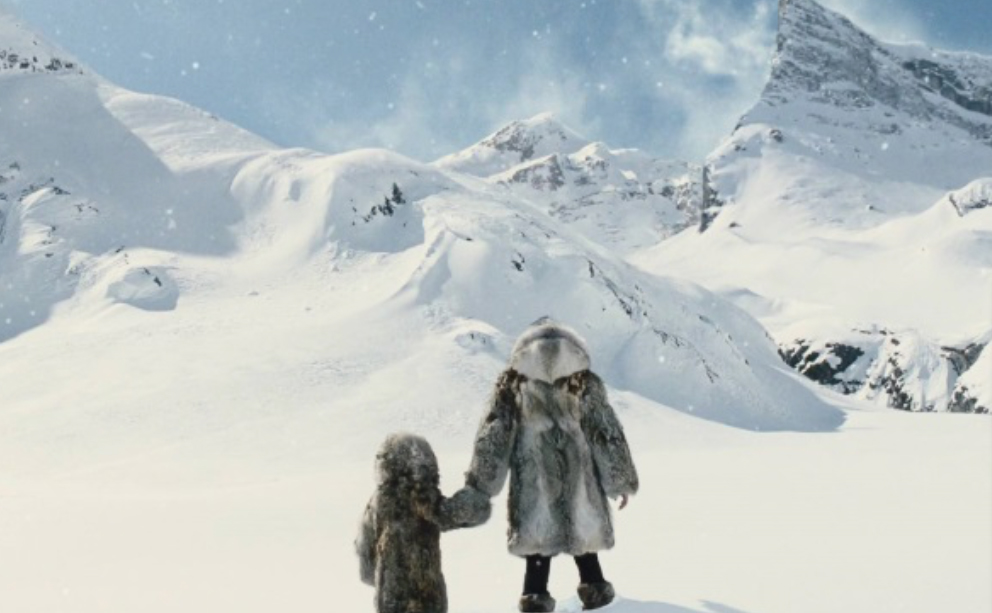
As Yona and the child crunch through the snow in the quiet depth of coldness, they glimpse a polar bear. There is life! Perhaps not humanity. But life on Earth.

And in that connection, we live. Even if just for a moment.

Yona and the child face a bleak but hopeful future after escaping the Snowpiercer

Postscript on the ending of the movie: In an interview with Vulture, Bong Jung-Ho shared his thoughts on Snowpiercer’s ending: “For me, it’s a very hopeful ending … The engine is itself on its way to extinction along with cigarettes, and other goods. Extinction is a repeated word throughout the film. But outside the train, life is actually returning. It’s nature that’s eternal, and not the train or the engine, as you see with the polar bear at the end.”

Ultimately, Bong Jung-Ho’s message with the ending of this baroque political allegory is the vindication of a choice against reform capitalism for something new, that there is indeed “Life after Capitalism”, not easy but worth living…

Nina Munteanu is a Canadian ecologist / limnologist and novelist. She is co-editor of Europa SF and currently teaches writing courses at George Brown College and the University of Toronto. Visit www.ninamunteanu.ca for the latest on her books. Nina’s bilingual “La natura dell’acqua / The Way of Water” was published by Mincione Edizioni in Rome. Her non-fiction book “Water Is…” by Pixl Press (Vancouver) was selected by Margaret Atwood in the New York Times ‘Year in Reading’ and was chosen as the 2017 Summer Read by Water Canada. Her novel “A Diary in the Age of Water” was released by Inanna Publications (Toronto) in June 2020.

Gaia’s Revolution:  A View of a Post-Capitalist Future

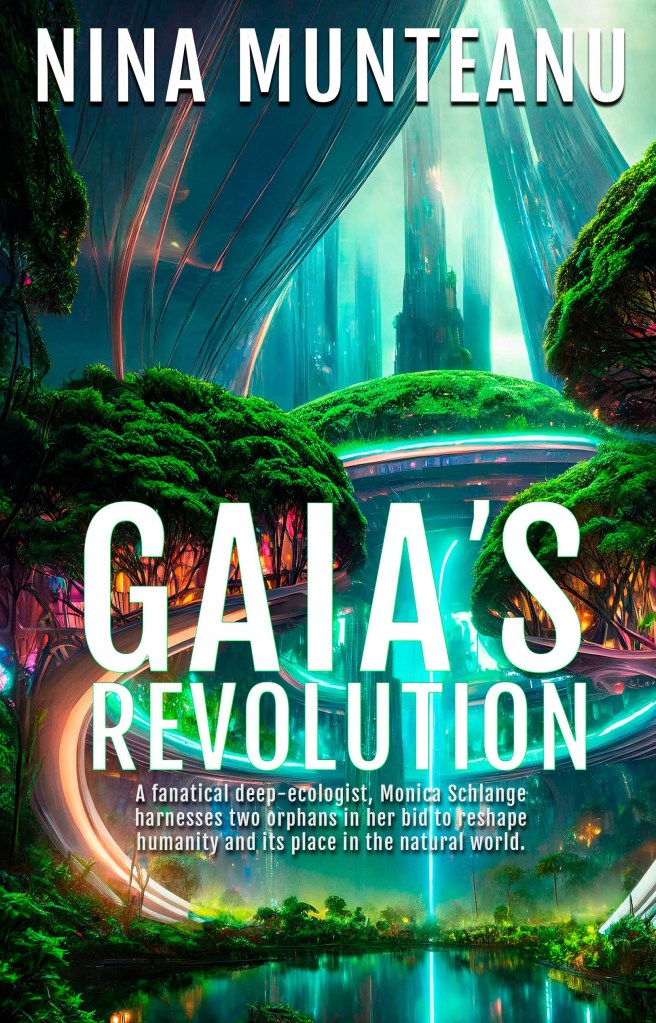
My upcoming book Gaia’s Revolution (Book 1 of The Icaria Trilogy by Dragon Moon Press) explores a collapsing capitalist society in Canada through ravages of climate change and a failing technology. The story is told through the lives of ambitious twin brothers Eric and Damien Vogel, and the woman who plays them like chess pieces in her gambit to ‘rule the world.’

It is 2032 and Eric Vogel sits in the Canadian prime minister’s office, ruminating on the changes coming. He imagines what a post-capitalist world will look like and how his twin brother Damien—left behind in Germany—would disagree with his vision:

Over a hundred years ago, Spartacist Rosa Luxemburg—who was shot by the right-wing Freikorps—argued that the “Bourgeois stands at the crossroads, either transition to socialism or regress into barbarism.” Both he and Damien agree with sociologist Wolfgang Streeck who argues that the end of capitalism—of a reigning bourgeois, in love with the objects that define them—is already underway. The signs are neon loud: a ruthless downward trend in economic growth, social equality, and financial stability. All reinforced by climate change and the ongoing collapse of the planet’s sustaining environment. Any system and dialectic based on a concept of infinite resources in a finite world is bound to fail eventually. That collapse has already begun and its catastrophic end is imminent. Already, climate refugees and refugees of resource war (which amounts to the same thing) have flooded northern nations, like Canada, and caused tension and strife. Germany is just one example where left and right have torn the country apart as an influx of foreigners challenged the already tenuous German identity. When Canada granted asylum to over two million climate-refugees in ‘28, with no viable plan for the new residents during a time when unemployment was higher than it had been in decades and housing prices were skyrocketing due to environmental uncertainty, this sparked renewed tensions between ultra-right and ultra-left and opened the gap for a new party based on science and reason. The party now in power: the Technocratic Party of Canada.

But what will life after capitalism look like?

It’s no surprise that he and his brother disagree on what a post-capitalist world should look like and how to best achieve that world. Damien too easily prescribes to the old leftist shibboleth of Nature being the answer to everything and Market being evil. His deep ecology utopia would spring from an atavistic rejection of modern life, a return to ‘the ancient farm.’ But how that fantasy could be achieved without a drastic population reduction is beyond his brother’s imagination. Damien fetishizes the natural world. Just like he does their mother. The naïve fool is a blind romantic, refusing to see reality right in front of him: that Nature is ultimately cruel, cold, and preoccupied with its own survival. Just like their mother.

Brother Damien recalls an earlier argument the two brothers had in Berlin that ultimately motivated him to follow his twin to Canada. They’d been debating about the effect of climate change on the human population:

Pulled down by a truculent mood, Damien responds to Eric’s usual glib solutions by painting a dark vision of a humanity descending into some pre-technological ‘dark age’ apocalypse.

Eric just laughs. He pokes his fork into the sauerkraut as if to make a point in his argument and scoops up a pile that he shoves into his mouth. He leans forward and argues with a full mouth, “The real question is not whether humanity will survive an ecological collapse, but what part of humanity will survive. You can be sure that the stinking boujee plutocrats will find a way to survive at the expense of everyone else.” He chews down the sauerkraut followed by a gulp of beer and a loud burp. “The stinking rich are already doing it, Dame. They’re already creating their Elysium right here, right now.” Fork now swings like a conductor’s baton. “The future is already here; it’s just unevenly distributed.”

Using his fingers, Damien pulls apart some crisp skin off the pork knuckle—his favourite part—and feeds his mouth. Arguing with Eric always makes him hungry despite his surly temper. He crunches down, enjoying the tasty juices of brazed salty pork skin, and retorts, “You politicize everything and resort to cheap references in pop culture. You always do that: over-simplify the crisis and Nature’s existential power to sustain life. Trophic cascades caused by ecosystem simplification would irreparably devastate the planet and all adapted life. With the Sixth Extinction Event there won’t be any boujee plutocrats because there won’t be anything left to monetize—”

“You’re such a doom-gloom lefty, Dame!” Eric grabs the last of the pork skin—also his favourite— and shoves it into his mouth. He smacks his lips and counters, “The stinking rich will always have technology at their disposal. I’m talking about genetic engineering, nano-technology, gene modification, cybernetics, and even environmental control. For instance, look at Harvard’s RoboBee: tiny robots that mimic flying insects that can fill in as pollinators for the crashing bee populations.”

“You over-estimate technology’s ability to save the planet—and us by extension.”

Eric finishes the pork skin and wipes his mouth on his sleeve with a sniff. “I’m not talking about saving the entire planet—just enough of it. You underestimate what we’re willing to do to survive.”

That is when he brings up E.P. Thompson’s paper on stages of a neoliberal capitalist civilization and the ‘extermination endgame.’ “You’re the population ecologist, Dame, but it’s obvious that when a neoliberal capitalist society exceeds its carrying capacity— when technology makes the masses surplus—there’s no alternative in the scramble for resources and ecological support. Get rid of the surplus. That simple. Thompson tells us that under military capitalism—and you have to accept that all countries are militarizing—the ‘outcome must be the  extermination of multitudes.’”

“For God’s sake, Eric!”

“Technology will save humanity, Dame,” Eric insists. He leans back and stretches his legs under the laminate table in self-pleased satisfaction. “One way or another.”

Damien shakes his head and gulps down the last of his beer. “Whatever is left of humanity, you mean. And you accuse me of giving up on humanity. So, the greedy capitalist wins?”

“That’s why the world needs us, Dame. To keep humanity from going down the wrong road.”

And what is that for Eric, Damien wonders. Increasingly, he feels discomfort at what that might be. Eric leans forward, eyes bright with inspiration. He resembles a great bird of prey, long hawk-like nose—the iconic Vogel nose—and copious dark hair cresting back from a high forehead. It’s like looking at a more confident version of himself in the mirror, thinks Damien. And sometimes disconcerting, particularly when it reminds him of what he is not.

“You and I know that humanity won’t stop climate change,” Eric goes on animatedly. “Too many tipping points are already upon us and the direction we’re all going in now…” He swings his fork around the room to indicate this place, Germany, the world. “… isn’t promising to check that. Change is inevitable.” He points the fork at Damien. “But, if we can direct how humanity adapts to our changing environment, we can still win…” Before Damien can charge in with a rebuttal, Eric pushes his face forward, raptor eyes scintillating like sapphires on fire. “So, how do we de-thrown the ultra-rich elite—who are mostly a rabble of materialist self-serving hedonists with no vision or care for the future—and ensure a meritocracy of responsible citizens who can take humanity through the changes to come? … Like establishing a universal basic income toward an egalitarian society. Putting a full stop to fossil fuel mining and adopting clean energy. Re-wilding key ecosystems. Engaging reforestation and dedicating large areas to Nature.”

Damien shakes his head, lost for words. Where is his brother going with this? Will he suggest violent revolution to establish a dictatorship? How else would the rich give up their riches? And how is that any different from the Bolsheviks of 1917 or the Nazis of 1933 or the Stasi-run DDR? Those fascist Reichsbürgers would happily reinstate a society of surveillance, repression, and incarceration that would threaten to slide into the final solution of genocide of an unwanted ‘surplus’. A society of disposable bodies, a biopolitical world of exterminism. Damien thinks of Nietzsche’s aphorism: Beware that, when fighting monsters, you yourself do not become a monster … for when you gaze long into the abyss, the abyss gazes also into you. Violent revolution is not the answer, he decides.

Eric pulls out the worn copy of Walden Two from his jacket pocket. He slaps it on the table and pushes it toward Damien. “That’s the answer, Dame.”

Models of a Post-Capitalist Future Society

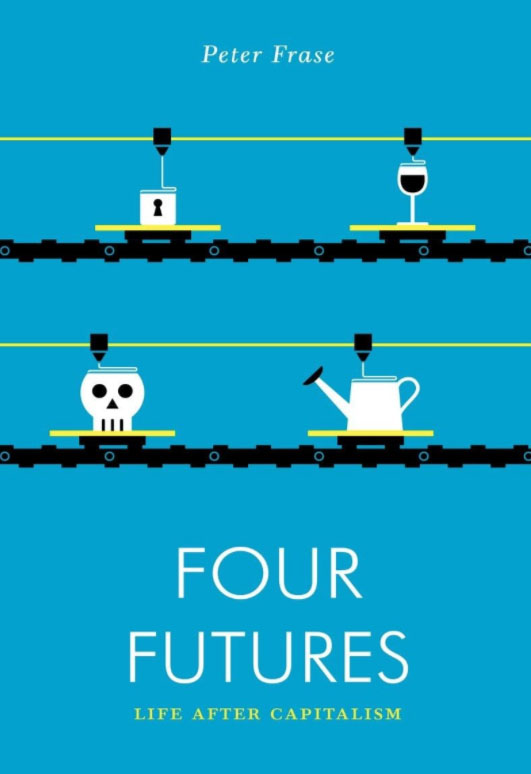
In his book Four Futures: Life After Capitalism , sociologist Peter Frase considers effects of climate change and automation in possible outcomes of a post-Trump election America. Frase envisions four scenarios based on abundance and scarcity and whether a society operates by equality (e.g., communism under abundance / socialism under scarcity) or hierarchy (rentism under abundance / exterminism under scarcity).

With scarce resources, the following scenarios are possible:

Socialism (aka Ecotopia) may arise within an egalitarian society if driven by altruistic notions of self-limitation. Ecologists describe such a self-limiting system as K-selected (see my discussion of K-selection and r-selection in “Water Is…”). A K-selected population is at or near the carrying capacity of the environment, which is usually stable and favors individuals that creatively compete, through cooperation, for resources and produce few young. The K-selected strategy runs on a successive gradient of maturity, from initially competitive to ultimately cooperative. Competition is a natural adaptive remnant of uncertainty and insecurity and forms the basis of a capitalist economy that encourages monopolization and hostile takeovers. Competition results from an initial antagonistic reaction to a perception of limited resources. It is a natural reaction based on distrust—of both the environment and of the “other”—both aspects of “self” separated from “self.” The greed for more than is sustainable reflects a fear of failure and a sense of being separate, which ultimately perpetuates actions dominated by self-interest in a phenomenon known as “the Tragedy of the Commons.” Competition naturally gives way to creative cooperation as trust in both “self” and the “other” develops and is encouraged through continued interaction.

Exterminism (aka Mad Max) may arise under a hierarchical model, driven by greed and exacerbated by uncertainty in the environment—not unlike what we are currently experiencing with the planet’s system and cyclical changes. In this scenario, in which resources are both limited and uncertain, those with access to them would guard or hide them away with desperate fervor.

“When mass labor has been rendered superfluous [through automation], a final solution* lurks: the genocidal war of the rich against the poor.”—Peter Frase

References:

Frase, Peter. 2016. “Four Futures: Life After Capitalism.” Verso Press, London. 150pp.

Luxemberg, Rosa. 1915. “The Junius Pamphlet: The Crisis in the German Democracy.” Marxists.org.

Munteanu, Nina “Gaia’s Revolution.” Book 1 of the Icaria Trilogy, Dragon Moon Press, upcoming.

Munteanu, Nina. 2016. “Water Is…The Meaning of Water.” Pixl Press, Vancouver. 586pp.

Streeck, Wolfgang. 2014. “How Will Capitalism End?” New Left Review 2 (87): 47p.

Thompson, E.P. 1980. “Notes on Exterminism: the Last Stage of Civilisation, Exterminism, and the Cold War.” New Left Review 1(121).

*the Final Solution was originally used by Nazi Germany as “the Final Solution to the Jewish Question”: the Nazi plan to exterminate the Jews during World War II, formulated in 1942 by Nazi leadership at the Wannsee Conference near Berlin, culminated in the Holocaust, which murdered 90 percent of Polish Jews.

Nina Munteanu is a Canadian ecologist / limnologist and novelist. She is co-editor of Europa SF and currently teaches writing courses at George Brown College and the University of Toronto. Visit www.ninamunteanu.ca for the latest on her books. Nina’s bilingual “La natura dell’acqua / The Way of Water” was published by Mincione Edizioni in Rome. Her non-fiction book “Water Is…” by Pixl Press (Vancouver) was selected by Margaret Atwood in the New York Times ‘Year in Reading’ and was chosen as the 2017 Summer Read by Water Canada. Her novel “A Diary in the Age of Water” was released by Inanna Publications (Toronto) in June 2020.

TV Series Review: Living With Scarcity & Uncertainty: The Merits of “3%”

Michele and Fernando collaborate in the cube test

Candidates have three minutes to make nine cubes out of a pile of blocks in the centre. Those who complete the puzzle in time will move on to the next test; those who don’t are eliminated and must return to the slums—their one chance at a better life dashed. Among the nine candidates in the room are Rafael (Rodolfo Valente), who steals a cube from another candidate to get his nine. Michele (Bianca Comparato), who initially out of kindness helps Fernando (Michel Gomes), who’s reach to the pile is limited, is in turn helped by him when she is shy one cube: at time-end, he cleverly piles her eight cubes into one large cube—the ninth—and she passes the test.

So begins Netflix’s 3%, a Brazilian dystopian thriller series created by Pedro Aguilera and directed by Cesar Charlone. In a kind of Hunger Games contest, candidates cheat in self-service; others violently impose Darwinian entitlement and survival of the fittest; yet others rely on reciprocal altruism.

3% is set in the near future after the planet has fallen into a divided haves and have-nots through some calamity. Three percent of the population live well on an island in the Atlantic Ocean, called Offshore (Mar Alto). The remaining 97% struggle Inland with poverty and scarcity. A selection process lies between them.

Every year the 97% send their 20-year olds to undergo The Process, a grueling Hunger Games-style contest run by the Offshore elite to replenish their numbers. Only 3% of the candidates will be considered worthy. They must pass psychological, emotional and physical tests to earn a place in Mar Alto.

3% test

By the time Season 1 is over, candidates will have committed a full range of desperate and unsavory acts to make the cut—the stakes are high, after all: secure a position in the 3% elite or die in squalor and poverty. After being eliminated during the interview process, one youth throws himself off a balcony of the testing centre.

Major players in Season 1 of 3%

“It’s not so far from our own world, where the competition to get into a good school and land a good job drives many to self harm,” writes Matthew Gault on Motherboard. “In the 3%, as in our own world, society looks down on those who don’t achieve and there’s a certain kind of person who believes that life’s losers earned their place at the bottom.”

Ezekial, who runs “the Process” speaks to the new contestants

Inland is valued by the elite only for its reserve of youth to recruit Offshore’s strictly controlled population (you only find out how in the last show of Season 1). As for what personality and fitness The Process tests for is also uncertain. “You each create your own merit,” says Ezequiel, who runs The Process, to the candidates. “No matter what happens … you deserve this.” The corollary is that if they don’t have merit—value, as determined by Ezequiel’s Process—they don’t deserve to move Offshore. There is, of course, a resistance to The Process, called The Cause. They cause stirrings of unrest and may even be responsible for the first murder in Offshore in over 100 years—which puts Ezequiel’s Process under question. Ezequiel dismisses The Cause by suggesting that it operates “in the name of a false or hypocritical equality.”

There is no inherent equality or fair entitlement in a land of scarcity; there is only proof of merit to a limited resource. This meritocratic notion—and the need to prove one’s worth to be accepted—is so ingrained in society that not even the poor question it. It was American writer John Steinbeck who argued that socialism would never take off in America because the poor see themselves as “temporarily embarrassed capitalists.”

Michele and Joana in the poor section of town

We find out in the first show that the first murder in 100 years has occurred Offshore—which puts Ezequiel’s Process under question. And there are stirrings of unrest—some likely instigated by The Cause.

3% is a brutal commentary on the world’s rising income inequality and the lengths we’re all willing to go to improve our lot,” writes Gault. “It’s a world of extreme income inequality where techno-fascists rule with an iron fist…Brazil has some of the highest income disparity on the planet,” writes Gault. “São Paulo is a megacity where the ultra-rich travel the skies in rented helicopters and cruise the streets in bulletproof cars. It’s a city where the poor live in makeshift favelas that resemble something from William Gibson’s nightmares. It’s a city where plastic surgeons do a brisk trade in reconstructive ear surgery because kidnapping is common and the easiest way to prove you’ve got a mark is to send their ear.”

Ezekial confronts Fernando in 3%

With each episode, 3% examines the motivations and paradoxes of heroism and villainy, sometimes turning them on their sides until they touch with such intimacy you can’t tell them apart. At its deepest, 3% explores the nature of humanity—from its most glorious to its most heinous—under the stress of scarcity and uncertainty. How we behave under these polarizing challenges ultimately determines who we are.

3% joins the ranks of several other films and shows about near-future scarcity-driven societies, with two examples below:

  • Snowpiercer—a stylish post-climate change apocalypse allegory. The train’s self-contained closed ecosystem of scarcity is maintained by an ordered social system, imposed by a stony militia. Those at the front enjoy privileges and luxurious living conditions, though most drown in a debauched drug stupor; those at the back live on next to nothing and must resort to savage means to survive. Minister Mason, an imperious yet simpering figure who serves the ruling class without quite being part of it, reminds the lower class that: “We must each of us occupy our preordained particular position. Would you wear a shoe on your head? Of course you wouldn’t wear a shoe on your head. A shoe doesn’t belong on your head. A shoe belongs on your foot. A hat belongs on your head. I am a hat. You are a shoe. I belong on the head. You belong on the foot. Yes? So it is. In the beginning, order was prescribed by your ticket: First Class, Economy, and freeloaders like you…Now, as in the beginning, I belong to the front. You belong to the tail. When the foot seeks the place of the head, the sacred line is crossed. Know your place. Keep your place. Be a shoe.”

  • Advantageous—Jennifer Phang’s “pre-dystopia”, where jobs have become heavily automated and opportunities for education are cutthroat. Women have been generally forced out of the workplace and onto the streets: the logic being that they will be less violent while living on the street than men. Artificial intelligence has supplanted most people in middle management. “The people you do see are either impoverished and disenfranchised or are hidden in the upper floors, the protected places,” says director Jennifer Phang. Unemployment is close to 50% and there are no public schools. The only options for a young girl—if she is not to end up on the streets, either as a beggar or prostitute—is to attend a highly selective free magnet school or a very expensive private school.

In his book Four Futures: Life After Capitalism, author Peter Frase considered effects of climate change and automation in possible outcomes of a post-Trump election America. Frase envisioned four scenarios based on abundance and scarcity and whether a society operated by equality (e.g., communism or socialism) or hierarchy (rentism, exterminism).

With scarce resources, socialism (aka Ecotopia) may arise within an egalitarian society if driven by altruistic notions of self-limitation. Ecologists describe such a self-limiting system as K-selected (see my discussion of K-selection and r-selection in “Water Is…”). A K-selected population is at or near the carrying capacity of the environment, which is usually stable and favors individuals that successfully compete for resources and produce few young. The K-selected strategy runs on a successive gradient of maturity, from initially competitive to ultimately cooperative. Competition is a natural adaptive remnant of uncertainty and insecurity and forms the basis of a capitalist economy that encourages monopolization and hostile takeovers. Competition results from an initial antagonistic reaction to a perception of limited resources. It is a natural reaction based on distrust—of both the environment and of the “other”—both aspects of “self ” separated from “self.” The greed for more than is sustainable reflects a fear of failure and a sense of being separate, which ultimately perpetuates actions dominated by self-interest in a phenomenon known as “the Tragedy of the Commons.” Competition naturally gives way to creative cooperation as trust in both “self ” and the “other” develops and is encouraged through continued interaction.

Exterminism (aka Mad Max) may arise under a hierarchical model, driven by greed and exacerbated by uncertainty in the environment—not unlike what we are currently experiencing with the planet’s system and cyclical changes. In this scenario, in which resources are both limited and uncertain, those with access to them would guard or hide them away with desperate fervor. Frase writes:

“When mass labor has been rendered superfluous [through automation], a final solution* lurks: the genocidal war of the rich against the poor.”

Gault says it best: “3% hits so hard because it seems bizarre and distant, but as the show unwinds and reveals its mysteries, audiences will come to realize that we’re already part of The Process.”

*the Final Solution was originally used by Nazi Germany as “the Final Solution to the Jewish Question”; the Nazi plan to exterminate the Jews during World War II, formulated in 1942 by Nazi leadership at the Wannsee Conference near Berlin, culminated in the Holocaust, which murdered 90 percent of Polish Jews.

References:

Fisher, Mark. 2009. “Capitalist Realism: Is There No Alternative?” Zero Books. 92pp.

Frase, Peter. 2016. Four Futures: Life After Capitalism.” Verso. 160pp.

Gault, Matthew. 2016. “Netflix’s ‘3%’ Turns the Google Job Interview into a Dystopian Nightmare.” Motherboard, November 27: https://motherboard.vice.com/en_ca/read/netflix-3-percent-review

Munteanu, Nina. 2016. “Water Is…The Meaning of Water.” Pixl Press. 584pp.

Nina Munteanu is a Canadian ecologist / limnologist and novelist. She is co-editor of Europa SF and currently teaches writing courses at George Brown College and the University of Toronto. Visit www.ninamunteanu.ca for the latest on her books. Nina’s bilingual “La natura dell’acqua / The Way of Water” was published by Mincione Edizioni in Rome. Her non-fiction book “Water Is…” by Pixl Press (Vancouver) was selected by Margaret Atwood in the New York Times ‘Year in Reading’ and was chosen as the 2017 Summer Read by Water Canada. Her novel “A Diary in the Age of Water” was released by Inanna Publications (Toronto) in June 2020.

Book Review: A Discussion on Costi Gurgu’s Political Thriller Servitude

In Costi Gurgu’s near-future political thriller Servitude (Kult Books, 2022), what is real and what is fiction blurs with terrible prescience and possibility. Gurgu has created a scenario based on a premise that stirs dangerously in the reality of today’s capitalist western world: what if corporations were allowed to take back with impunity what their debtors owed them—in whatever way they pleased?

In Gurgu’s near-future America, the fourth Republican president in a row will be elected with virtually 100% Republican representation in Congress and the Senate—ensuring a monopoly government and creating a potential dictatorship (something a certain Republican president was trying to achieve not too long ago—and came dangerously close).

The story begins in the UK, which has recently made corporate slavery law. Under the Freedom Act, corporations under the British Servitude Exchange (BSX) can lawfully capture and detain persons with significant debt to sell them and their services in exchange for what is owed.

Wishing to do the same, the American corpocracy pushes the Freedom Act bill through Congress, potentially making corporate slavery a lawful pursuit using the concept of servitude. The concept of unconditional restitution in a country of people living largely on credit becomes popular among wealthy corporations; (consider that over two thirds of Americans are currently in debt with an average of $96,000 owed by each American, which includes mortgage, student loans, auto and credit card, personal loans and home equity1).

Neoliberal idealogues and proponents of the Freedom Act suggest that citizens should learn to be responsible for their lifestyles and should not expect the government to bail them out of bankruptcy every time they overspend (ignoring the fact that the U.S. government’s current national debt is some 30 trillion dollars—to corporate investors, China, Japan, and intra-government agencies.2 However, given that corporate investors currently hold over a third of the national debt2, dominant corporate influence on government to create a slavery act as demonstrated in Servitude is not outlandish).

A fifth of the way into the book, a Texas governor proclaims: “Servitude is merely a form of adult education. If you have graduated from the American education system and proceeded to live your life as though there is no tomorrow and spent more money than you have earned, well beyond your fair share, then you must be re-educated with America’s modernized value system. Servitude is an educational tool for the people.”

Gurgu hints at key events that brought us to this point: from the shenanigans of Donald Trump to starving children in New York City and Chinese troops taking down the American flag at the Hawaii State Legislature. The European Union has been dismantled and the Eastern Block reborn. Climate change related resource wars were waged by the Second Ottoman Empire and others, leading to the collapse of the global market. All have led to the reintroduction of slavery and homo sacer, the disposable human. Foucault would attest that the biopolitical hegemony of Capitalism already enslaves human beings as disposable ‘human capital.’  

In my upcoming eco-thriller Thalweg, character Daniel considers his 2050s world in which humanity is largely commodified, a world similar to Gurgu’s Servitude world:

It’s the end of the world…The beginning of the end of the world really came with the steam engine back in 1784 and the enslavement of water, when James Watt’s ‘universal machine’ coerced water to help usher in the industrial age of carbon extraction and the disposable human, homo sacer. By 1920, 97% of electricity in Canada came from hydropower. We were sure eager beavers. Enslaved water germinated a culture obsessed with defining itself through a ‘precession of simulacra’—the truth which conceals that there is none. Social media. Facebook. Twitter. Echo-chambers of denatured reality, signs reflecting other signs, saturated with ‘likes’ and emojis, where meaning becomes infinitely mutable to the point of being meaningless.

What’s left is a ‘desert of the real,’ a Kafkaesque menagerie of interminable, unresponsive fragments of experience in a fiction that no longer knows it’s fiction. One in which Huxley’s Soma rules in a kind of warped Foucauldian governmentality, where corporations like CanadaCorp use facial recognition and Pegasis spyware to manage plebian behaviour through quiet authoritarianism. Like bioelectricity subverting the neural pathway, it infects our fragile brains with subliminal notions of freedom when we’ve already surrendered our sovereignty to the omnioptic gaze of capitalism …

Why is it easier to imagine the end of the world than the end of capitalism? Half a century ago, Mark Fisher took up that concept first introduced by Fredric Jameson and Slavoj Žižek in his book Capitalist Realism3… Several things Fisher pointed out resonate, such as, “Capitalism is what is left when beliefs have collapsed at the level of ritual or symbolic elaboration, and all that is left is the consumer-spectator, trudging through the ruins and the relics.”3 This sad construct leaves us with a kind of ‘post-literate’ world in which the ruling ideology is cynicism or what Fisher calls ‘reflexive impotence.’4

Daniel Schindler in “Thalweg” by Nina Munteanu

How realizable is Gurgu’s Servitude?…

Since 1989, neoliberal ideologues have fed us the narrative that capitalism is the only realistic political-economic system. We cheerfully engage in this confabulation to feed our rapacious desires; and like an insatiable amoeba, capitalist realism consumes and digests our dreams and desires then feeds it back to us at a price. At what cost? Fisher astutely tells us that in our current world, “ultra-authoritarianism and Capital are by no means incompatible: internment camps and franchise coffee bars co-exist.”3 Gilles Deleuze tells us that “Control societies are based on debt rather than enclosure.”5

In Gurgu’s story, Detective Blake Frye—himself burdened with heavy debt—becomes ensnared in an inter-agency investigation into the for-now-still illegal slave trade in America that has already created secret slave camps and is actively kidnapping ‘nobodies’ off the streets. Connected somehow to UK’s BSX and several billionaire tycoons, the slave trade has become highly lucrative. Earlier, Frye’s wife, Isa—who is an investigative journalist and TV producer—embarks on an exposé of the illegal slave trade. Just before her show “Debt Hunters” is about to air, the material is confiscated by the NSA who consider it a breach of national security; her entire crew is detained and the NSA investigate her on suspicion of treason. Later, when slavers kidnap Isa and put her on the market, Frye must navigate through corrupt government officials and rogue agency operatives to find her before she’s sold and disappears forever.

Near the end of the book, Gurgu’s not-so-hidden message resonates loudly through Detective Frye’s lamentations:

“Hard-hitting investigative journalism appealed to an increasingly smaller pool of customers. People were always working, always checking their phones and other electronic devices, and they wanted their news to be just as easy to digest. Well documented and researched reportages took too many minutes to watch, and didn’t often line up with their social or political viewpoints. Truth had become debatable. Everyone had their own, personalized version of the facts, easy to access on targeted media outlets. They no longer questioned the facts they consumed. Doubt took too much effort. Everyone was entitled to their own opinions, and considered them the definition of a political truth. That philosophy had been in effect since 2017, the year that practically everything that mattered in the world deteriorated.”

Detective Frye’s analysis is relevant to today’s sybaritic North American society. Gurgu’s fiction is not about the future; it is about today. And his message is clear: we have become lazy and apathetic, seduced by a craving for comfort and pleasure at the expense of integrity and freedom. Freedom is not given; it is earned. Only through active responsible vigilance will we keep it.

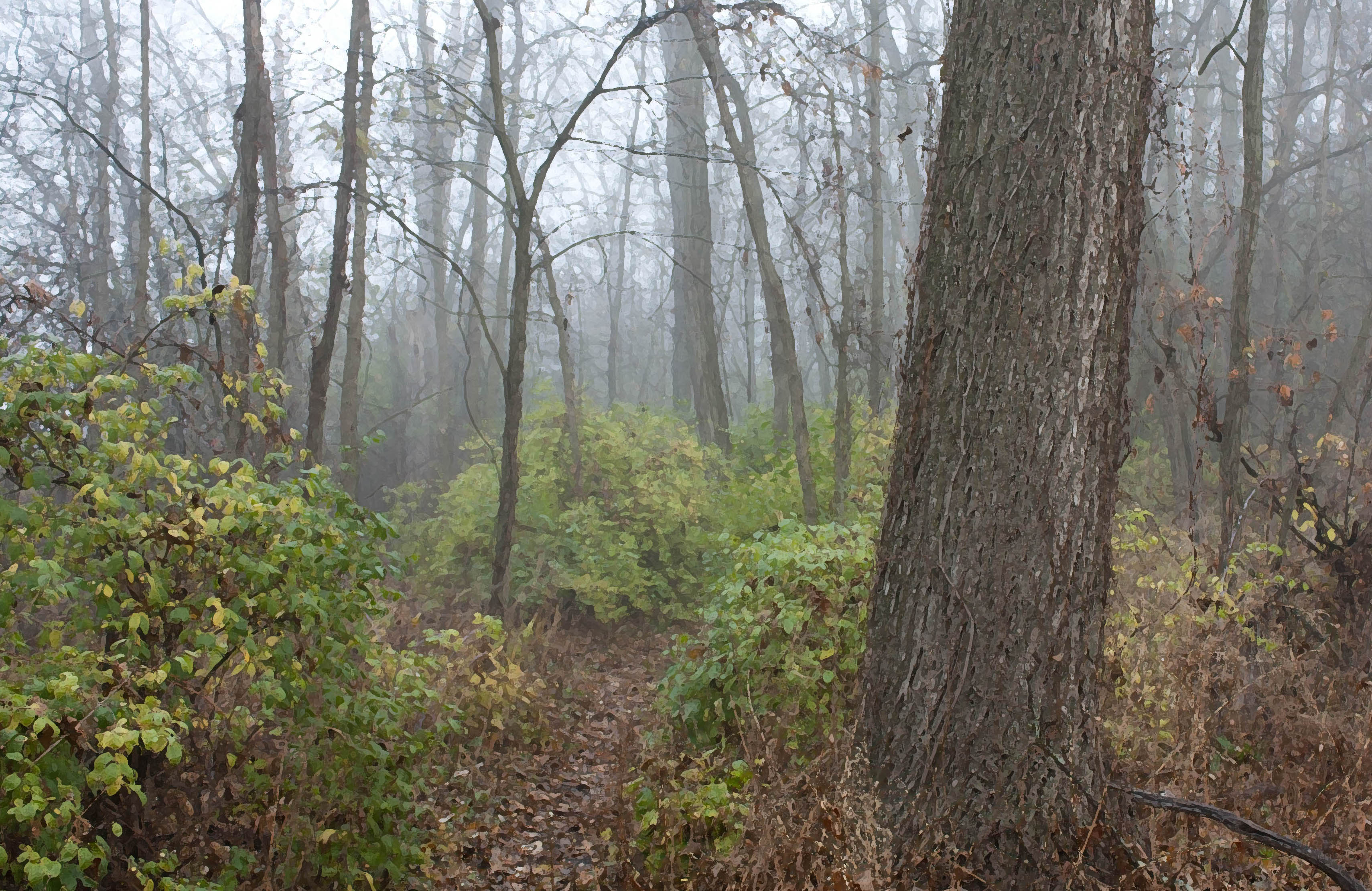
Path meanders through a black walnut forest in an early winter fog, ON (photo and rendition by Nina Munteanu)

References:

  1. First Republic. 2022 “Average American Dept.” September 13, 2022. FirstRepublic.com
  2. Porter, TJ. 2022. “Who Owns the US National Debt?” September 3, 2022. Finmasters
  3. Fisher, Mark. 2009. “Capitalist Realism: Is There No Alternative?” Zero Books. 92pp.
  4. Munteanu, Nina. “Thalweg.” Upcoming novel.
  5. Deleuze, Gilles. 1990. “Postscript on Societies of Control.” L’Autre journal, no. 1 (May)