Language, the connective tissue of the body politic—that space where the collective “we” matters so much—is losing its ability to fulfill its most basic duty: to communicate. To correlate. To connect us to the world, and to one another
Megan Garber, The Atlantic
Scene of Winston Smith (John Hurt) in Nineteen Eighty-Four filmed in 1984 shown here with addition for currency
.
In his dystopian 1949 novel Nineteen Eighty-Four, George Orwell featured Newspeak, a fictional language of the totalitarian superstate Oceania. Created by the Party to meet requirements of Ingsoc (Englilsh Socialism), the Newspeak consisted of simplified grammar and limited vocabulary designed to limit a person’s ability to critically think. If you can’t find a word to articulate something, then it can’t be expressed and in some way no longer exists. Personal identity, self-expression and free speech become casualties of a simpler world.
Science fiction? Think again.
Today, Inside Climate News reported that the U.S. Coast Guard has eliminated the term “climate change” and related terminology from the curriculum of its training academy to conform to President Trump’s polices.
U.S. Coast Guard cutter Healy assists a NASA shipborne investigation into climate change in the Chukchi Sea in the Arctic Ocean (photo Kathryn Hansen NASA)
.
This comes at a time when scientists report that the effects of climate change and global warming are weakening the world’s most powerful ocean current, the ACC, with projected slowing by a third within decades. A study by international scientists published today in the journal Environmental Research Letters projects that the fresh water from melting Antarctic ice will weaken the Antarctic Circumpolar Currrent (ACC) by 20 percent in the next 30 years. The ACC is the only ocean current to flow around the entire planet unimpeded, carrying more than 100 times more water than all the world’s rivers combined. A paper in the journal Nature Climate Change recently documented how freshwater from melting ice has already weakened the overturning, or vertical circulation, of Antarctic shelf waters, which reduces oxygen in the deep ocean. Effects of the ACC slow down are projected to include more climate variability, with greater extremes in certain regions, and accelerated global warming.
Global warming is a fact.
Anyone negating its existence, let alone its existential threat, is quite simply a fool. But when a fool is in power and negates the bald truth of science—successfully eliminating the most important word to our existence on this planet—then who’s really the fool?
.
(image from The Atlantic)
.
In the 1940s, shortly after the end of World War Two, Orwell wrote an essay “Why I Write”; in it he lamented the growing decrepitude of the English language. Orwell argued that the decline of English went hand-in-hand with the decline of intellectualism in society and facilitated the manipulation of listeners, speakers and writers. Richard Weintraubnoted in his 2021 article that Trump used ‘Newspeak’ to dismiss the Covid 19 virus, putting Americans at great risk.
Orwell created the term doublethink—a jargon of purposeful obfuscation—which is ability to simultaneously accept two mutually contradictory beliefs as right at the same time: “war is peace”; “freedom is slavery”; “ignorance is strength”. This oxymoron isn’t some wild gesture to the simultaneous wave / particle existence of particle physics or gestalt dualism of Schrödinger’s cat. Orwell’s brilliant fictional concept was predicated on the historical precedent of fascists around the world: the embodiment of “Big Brother”, who uses “doublethink” to confound, sway and control the minds of all people. The term “fake news” has settled in like a damp fog, a casual rejoinder to any truth one wishes to negate and ultimately erase.
On the weaponizing of language, Megan Garber in The Atlantic writes:
“Language, in 1984, is violence by another means, an adjunct of the totalitarian strategies inflicted by the regime. Orwell’s most famous novel, in that sense, is the fictionalized version of his most famous essay. “Politics and the English Language,” published in 1946, is a writing manual, primarily—a guide to making language that says what it means, and means what it says. It is also an argument. Clear language, Orwell suggests, is a semantic necessity as well as a moral one. Newspeak, in 1984, destroys with the same ferocious efficiency that tanks and bombs do. It is born of the essay’s most elemental insight: If thought corrupts language, language can also corrupt thought.”
.
The hard truths of science are at risk in a world gazing through the lens of confabulation… When the inveigling bits and bites of social media time and again trump scientific fact…
“Orwell published “Politics” at the end of a conflict that had, in its widespread use of propaganda, also been a war of words. In the essay, he wrestles with the fact that language—as a bomb with a near-limitless blast radius—could double as a weapon of mass destruction. This is why clarity matters. This is why words are ethical tools as well as semantic ones. The defense of language that Orwell offered in “Politics” was derived from his love of hard facts. “So long as I remain alive and well I shall continue to feel strongly about prose style, to love the surface of the earth, and to take a pleasure in solid objects and scraps of useless information,” he confessed in his 1946 essay “Why I Write.” His was an elegant dogma. Words matter because facts matter—because truth matters. Freedom, in 1984, is many things, but they all spring from the same source: the ability to say that 2 + 2 = 4.”
.
Nina Munteanu is a Canadian ecologist / limnologist and novelist. She is co-editor of Europa SF and currently teaches writing courses at George Brown College and the University of Toronto. Visit www.ninamunteanu.ca for the latest on her books. Nina’s bilingual “La natura dell’acqua / The Way of Water” was published by Mincione Edizioni in Rome. Her non-fiction book “Water Is…” by Pixl Press (Vancouver) was selected by Margaret Atwood in the New York Times ‘Year in Reading’ and was chosen as the 2017 Summer Read by Water Canada. Her novel “A Diary in the Age of Water” was released by Inanna Publications (Toronto) in June 2020.
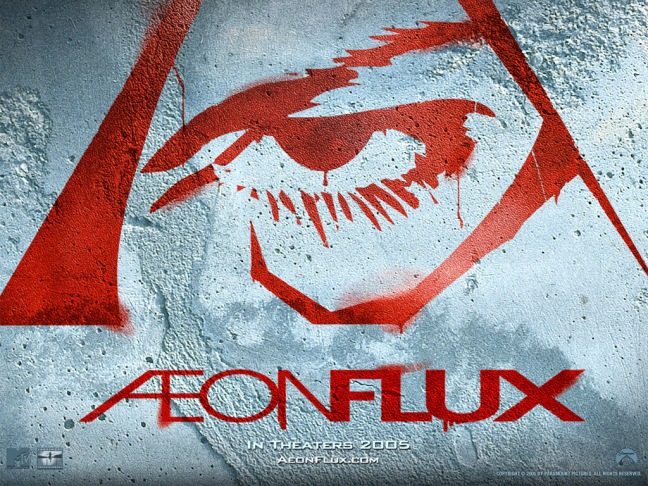
When I was first tantalized by the high-speed head-smashing trailor for the Paramount motion picture, Aeon Flux, directed by Karyn Kusama (Girlfight) and released in late 2005 (now on DVD), I was blissfully unaware of its history: that it was based on the darkly irreverant and raunchy 1995 MTV Liquid Television animated SF series created by Korean American animator, Peter Chung. The series achieved cult status among a select audience of imsoniacs (it played at midnight on MTV, if that tells you anything). This may have worked in my favour. I had no expectations or preconceptions, except for a hair-flying ride. As a result, when the content (written by Matt Manfredi and Phil Hay) had merit as social commentary, I counted it as a bonus. But, then there was the matter of the reviews that emerged between the trailors airing and my seeing the film.
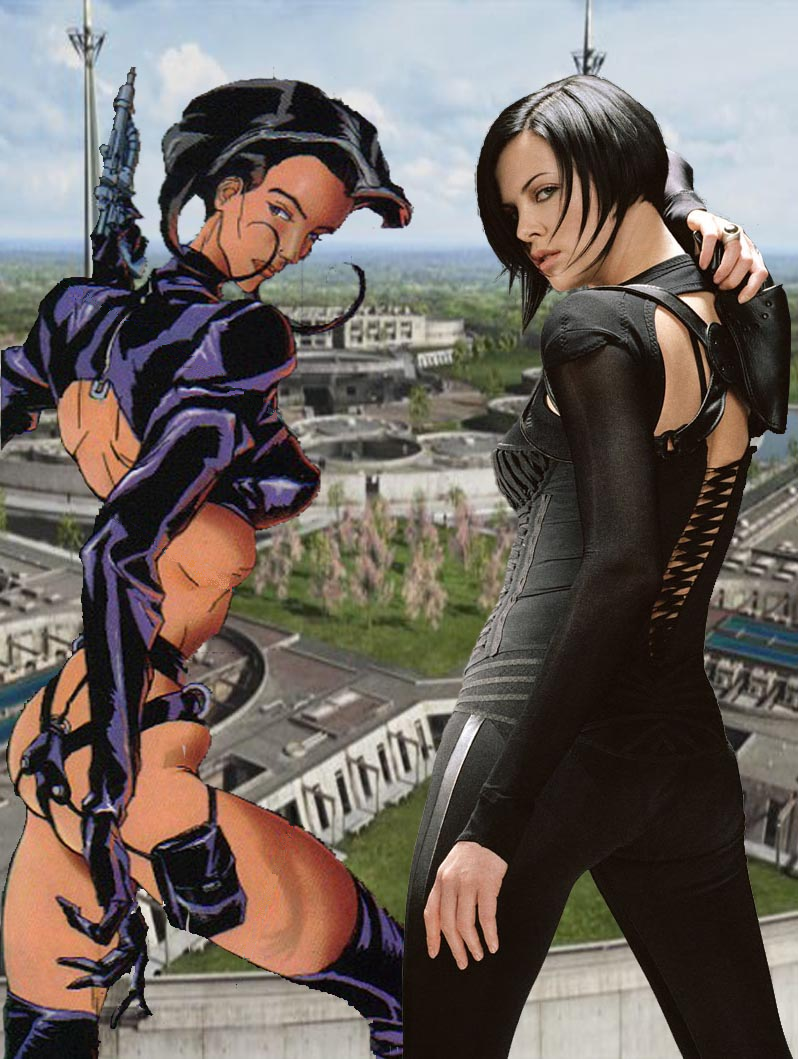
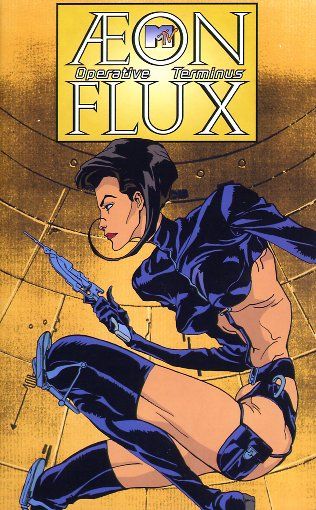
Aeon Flux, animated and movie character
Unfortunately for the motion picture, Paramount’s lack of press-screenings (and subsequent press reaction because of those lack of screenings) may have predisposed critics to dislike it. And many provided negative, though conflicting, reviews; as if they couldn’t all agree on why they didn’t like the film. Kieth Breese (Filmcritic.com) found the film “gorgeously surreal and vacuously arty.” According to Jami Bernard (New York Daily News), “in the dystopian future [of Aeon Flux], apparently, women will be bendable Barbies in leather scanties, and everyone will speak like brain-dead robots…a silly live-action movie.” Justin Chung (Variety.com) decided that AeonFlux portrayed “the future [as] alternatively grim and hysterical…a spectacularly silly sci-fier.” A.O. Scott of the New York Times said that Aeon Flux was “flooded with colors and chilly effects [but was] drained of emotional interest, to say nothing of narrative coherence.” And, finally, William Arnold of the Seattle Post-Intelligencer called it “too somber and cerebral for the young action crowd.” Silly or too cerebral? In truth, this disappointment is because the Aeon Flux movie was wrongly perceived (and wrongly marketed) as an action thriller; it is more aptly described as a dystopian political thriller—not the brazen cry of V for Vendetta—but a subtle cautionary tale of the consequences of complacency, greed and living in absence of—and trying to cheat—nature.
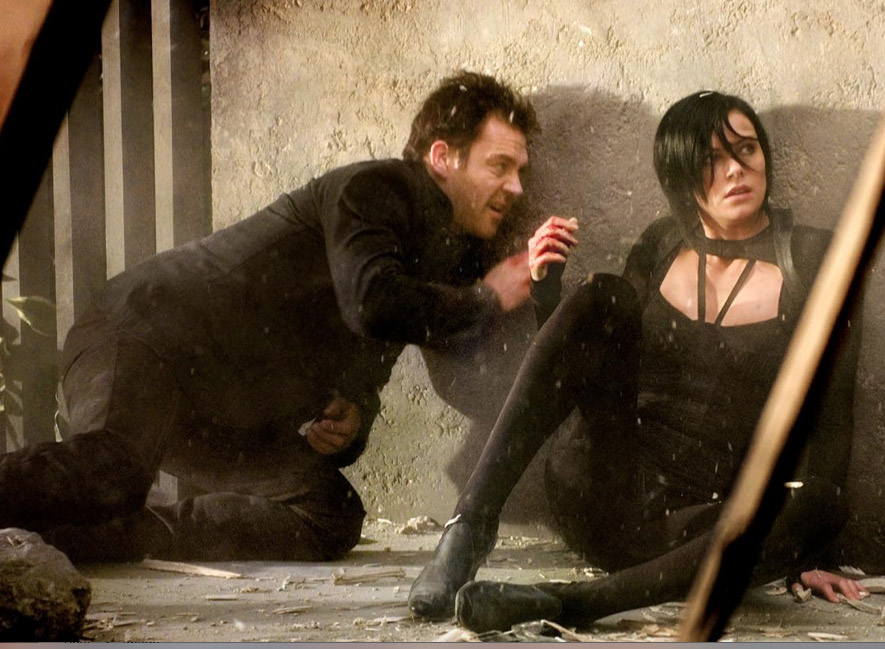
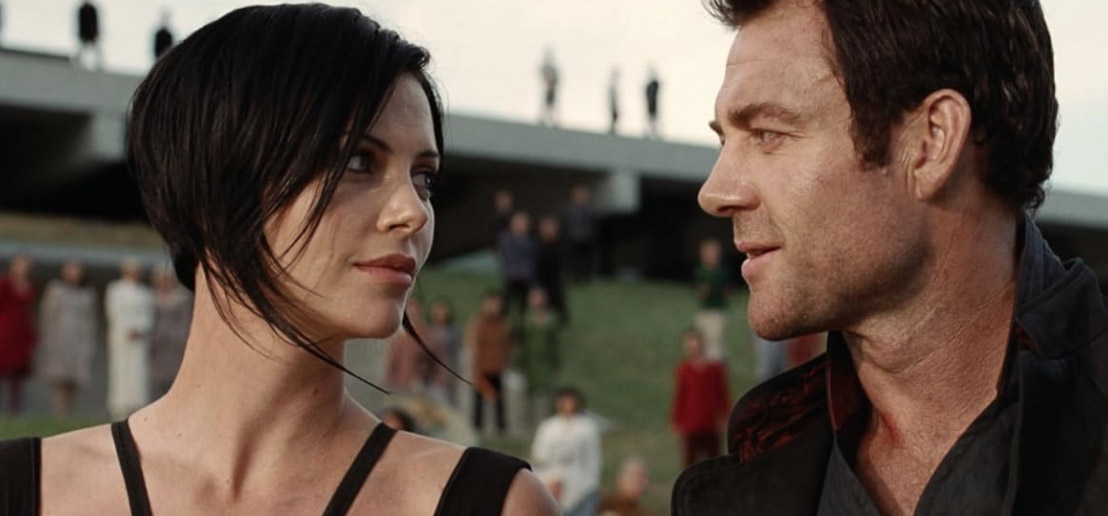
Trevor Goodchild played by Marton Csokas)
In typical dystopian fashion, we join the Aeon Flux story roughly four hundred years after an industrial-related virus has killed 99% of the world’s population. Scientist, Trevor Goodchild (Marton Csokas) has developed a cure and the Goodchild dynasty secures a home for the five million survivors in the last city on Earth, Bregna, a paradise walled off from the unrestrained wilderness that ever-threatens them. Dystopias, like Bregna, often appear utopian on the surface, exhibiting a world free of poverty, hardship and conflict, but with some fatal flaw at their core. A dystopia (“dys”=bad; “topos”=place) is a fictional society that is the antithesis of utopia. It is usually characterized by an authoritarian or totalitarian form of government or some kind of oppressive, often insiduous, social control. Other examples that depict a range of distopian societies in literature and film include: 1984, Brave New World, Fahrenheit 451, TheHandmaid’s Tale, Metropolis, THX-1138, Blade Runner, and V for Vendetta. Built from scientific premise and intended only as a temporary measure, the technocratic society of Bregna continues long after its intended span as the Goodchilds attempt to deal with an internal and enduring glitch (infertility) of the “cure”. Like most imposed provisional governments, this solution to a problem (cloning) has created yet another problem (fugitive memories from the previous clone’s life).
It is now 2415 and the walled society of Bregna appears utopian—clean and organized, beautiful, rich and spacious; but beneath the laughter and contentment, stirs an uneasy disquiet. Bregnans are losing sleep, having bad dreams, and are plagued by memories that don’t belong to them. Rebels who call themselves the Monicans challenge the Goodchild regime, run by Trevor and his brother Oren, and among the rebels is a highly competent and ruthless assassin, Aeon Flux (Charlize Theron), whose tools include whistle-controlled ball-bearing bombs, drugs that allow her to meet people on higher planes of existence, and interchangeable eyeballs. She is aptly named, as she serves a true agent of discord to Goodchild, the guardian of order and all that he naïvely believes is good.
“Some call Bregna the perfect society,” Aeon tells us in the opening scenes of the motion picture, “Some call it the height of human civilization…but others know better…We are haunted by sorrows we cannot name. People disappear and our government denies these crimes…But there are rebels who…fight for the disappeared. They call themselves the Monicans. I am one of them.” Several critics disliked the narrative introduction. I found that it particularly worked, by adding a reflective literary quality to the motion picture. It is noteworthy that in the original animated series, Trevor Goodchild often frames each episode with his reflections; only fitting that Aeon gets her chance in the film version. The reflective narrative of the motion picture is meant to enlighten its audience that this is not your ordinary action thriller. What follows is a fast-paced yet thoughtful story, with elements of romance, that explores notions of longevity, social structure and connection, faith and greed.
Aeon fights an opponent inside Goodchild’s fortress
Twitchfilm.net aptly called the motion picture “biological science fiction”. Trevor’s treacherous brother Oren says: “We’ve beaten death. We’ve beaten nature.” The film’s clean organic high-tech look faithfully captures the “sense of biotech gone wild” of the TV series by exploring several paradigms inherent in a society that lives deliberately in the absence of nature’s chaos. Indeed, the lack of connectivity resonates throughout the motion picture in its exploration of friendship, family, loyalty, and purpose. When her sister is murdered in the beginning of the film supposedly by Trevor’s men (but in actuality by his scheming brother, Oren), Aeon’s mission becomes personal: “I had a family once. I had a life; now all I have is a mission.” We never learn what the animated Aeon’s motives are.
Various scenes of Aeon Flux motion picture
The film truly launches into stylish action and intrigue when Aeon gladly accepts a mission to assassinate Trevor, thinking that this violent act will make it all better. Instead, it unravels her, beginning with when she confronts him; finding him uncomfortably familiar and alluring, she hesitates and decides not to kill him. “What do you want?” Trevor asks her. “I want my sister back. I want to remember what it’s like to be a person.” It is indeed he—or rather what he knows—that holds the key to who she is. The key is that she, like he and all those in Bregna, is a 400 year-old copy of someone before the virus. Four hundred years ago she was the original Trevor’s wife.
Trevor and Aeon on the run
Filmed in Berlin, the movie is visually stunning, from the opening shot on the steps of Sans Souci to the labrinthine wind canal used by the Nazis. Displaying an eclectic mixture of spareness and mid-century design the film is acted out in a fluid dance to Graeme Revell’s (Sin City) haunting score. The action is rivetting and seamless with both plot and underlying theme of bio-tech gone awry. Early on we are treated to a thrilling sequence of Aeon and her biotech-altered rebel colleague negotiating the security of Goodchild’s sanctuary that consists of a beautiful but deadly garden, guarded by patches of knife-sharp blades of grass and poison dart-spitting fruit trees.
Wind canal in Berlin serves as entrance to Goodchild’s fortress
Aeon champions moral ethics and single-handedly destroys the relicor, the supposetory of the clone DNA, pursuing honour at the expense of loyalty (to Goodchild) and heralding in a new age of “mortality”. The movie ends as it begins, with Aeon’s narrative: “Now we can move forward. To live once for real and then give way to people who might do it better…to live only once but with hope.” This is truly what Aeon Flux represents and what her very name embodies.
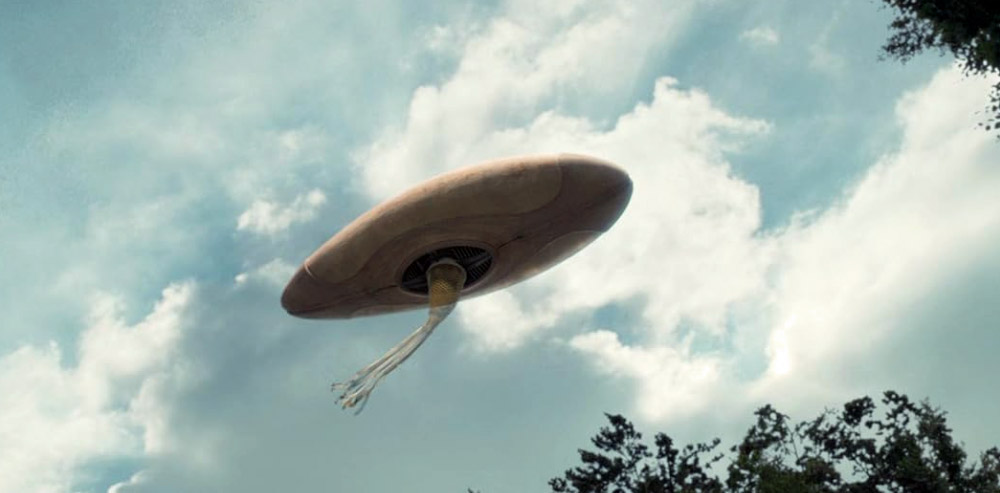
The relicor, repository of Bregna’s clone DNA flies overhead
Keeper of the precious DNA storage in the relicor
The term Aeon comes from the Gnostic notion of “Aeons” as emanations of God. Aeon also means an immeasurably long period of time; the Suntelia Aeon in Greek mythos symbolizes the catastrophic end of one age and the beginning of a new one. This is apt for our heroine, who, at least in the movie version, pretty well single-handedly destroys an old corrupt world, and heralds in a new age. Aeon was “emanated” after four hundred years by the gentle oracular Keeper of the relicor, whose original version saved her DNA and kept it hidden and safe until the right moment.
Aeon Flux captures a fly in her eyelashes
Fans of Peter Chung’s baroquely violent animated Aeon Flux will recognize some similarities between Kusama’s 2005 film adaptation and the original MTV cartoon. While admitting that the motion picture version was only based on Peter Chung’s characters (check the credits), Karyn Kusama intended to “honor [the cartoon version’s] wierdness in spirit and…pay homage to its esoteric boldness and…strange energy.” Homages to the animated series include: Aeon’s signature fly-catching with her eyelashes, demonstrating a woman extremely in tune with her body; Monican anarchists (though in the film they are subversives within Bregna rather than from an adjacent society); a virus that kills off most of the population and assassination attempt on Goodchild (Pilot); the harness worn on the torso that transports the wearer to another dimension (Utopia or Deuteranopia?); passing secret messages through a french kiss (Gravity); issues of cloning and two colleagues crossing a weaponized no-man’s land together (A Last Time for Everything). Original and movie adaptation also share at their core the exploration of the consequences and ambiguities of choices in life and the role that nature plays, subversive or otherwise.
Aeon Flux stands at the wall into Bregna, ready to scale it
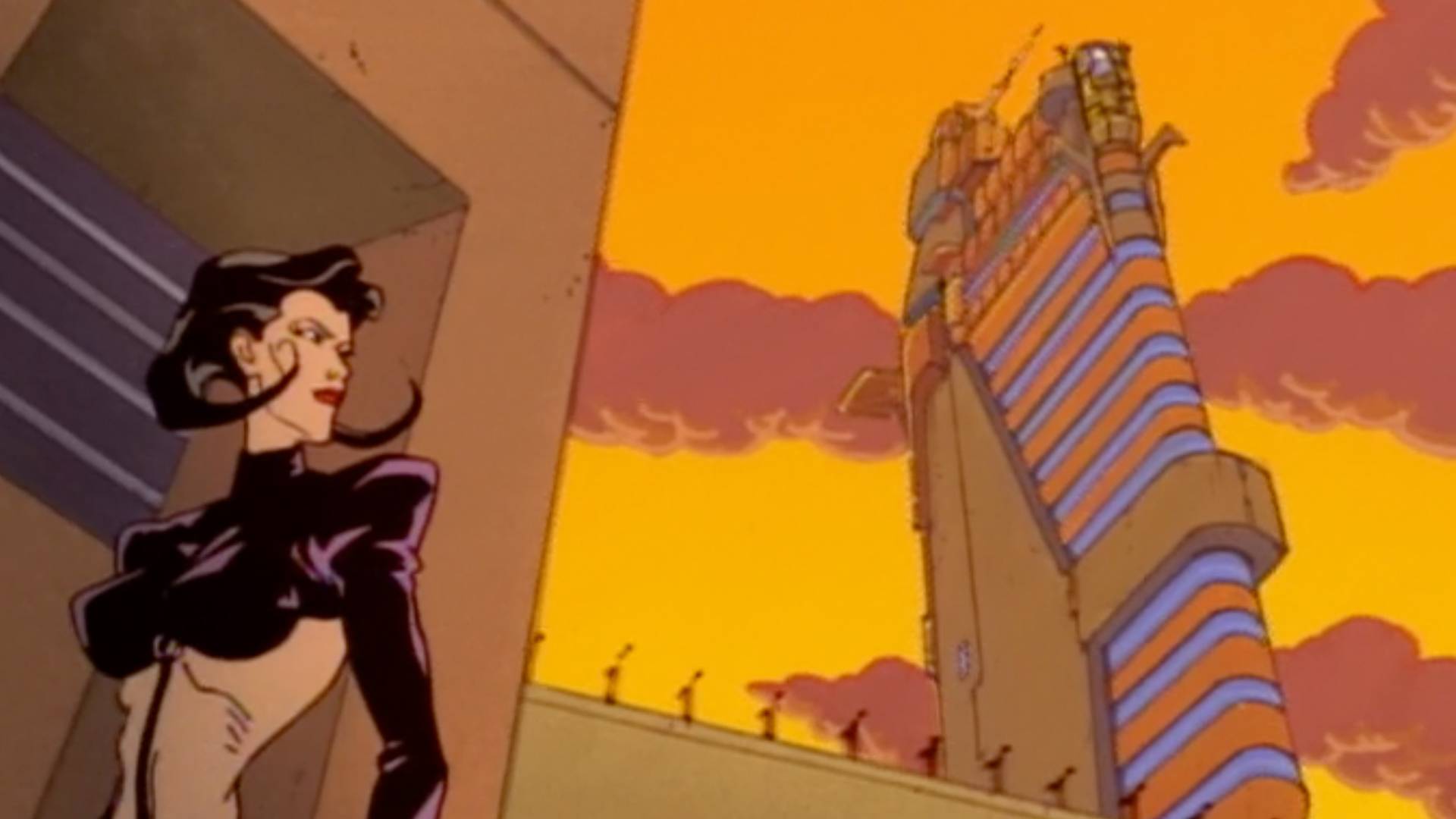
Although they share recognizable motifs and characters, the 2005 movie adaptation contrasts in some important ways from the six 5-minute shorts of 1991 and 10 half-hour episode TV series that aired in 1995. Chung’s avante garde series is set mostly in a surrealistic dark future Earth (presumably) where two communities, Bregna and Monica, are juxtaposed but separated by a wall (not unlike East and West Berlin). Bregna is a centralized scientific-planned society and Monica is Bregna’s ‘evil twin’, an anarchistic society. Chung’s innovative use of “camera angles” reminiscient of cinematography, together with a spare, graphic choreography, portrays a sprawling Orwellian industrial world. Peopled with mutant creatures, clones, and robots, it features disturbing images of dismemberment, mutilation, violent deaths and human experimentation as Chung explores post-modern notions of cloning, mind and body manipulation, and evolution through a series of subversive aggressively non-narrative pieces. On the subject of his cloning experiments (A Last Time for Everything) Goodchild says to Aeon: “My work offends you. Why? Human beings aren’t so unique, just a random arrangement of amino acids.” To which Aeon retorts, “These people you’re copying are already superfluous. You’re trafficking in excess.”
The title character in the animated version is a tall, scantily-clad anarchist (featuring the sultry voice of Denise Poirier) skilled in assassination and acrobatics, who infiltrates technocratic Bregna from the neighbouring revolutionary society of Monica. As with the movie character (elegantly portrayed by Theron), the animated Aeon is a stylish dance; completely in tune with her body. Says Chung of his creation: “The way she’s dressed, the way she looks, the way she moves was tailored to seduce the viewer to watch more, even though they may not understand at every moment what was happening.”
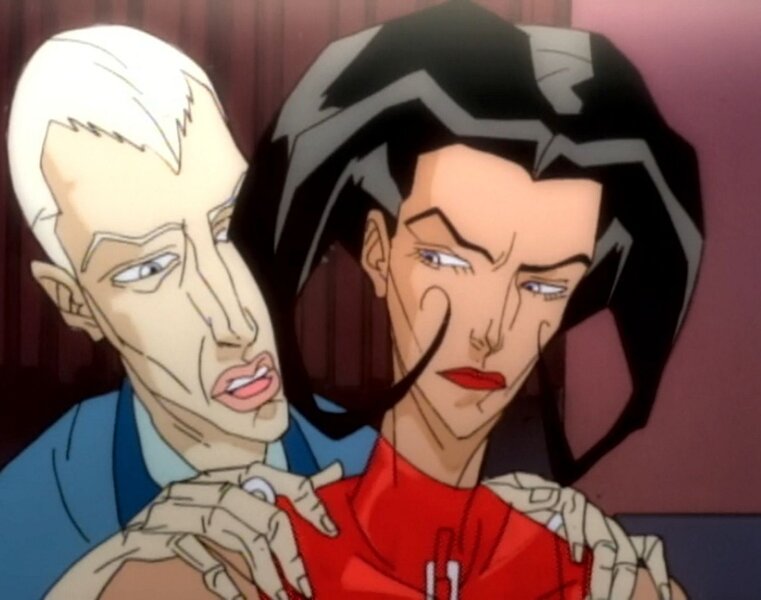
Despite their similar intelligence, physicality and drive, the two Aeons depart as characters. For instance, one of the major differences between original animation and adapted film is the ongoing relationship between Aeon and her nemesis/lover, Trevor Goodchild (John Rafter Lee). The sexual and intellectual tension between Flux and Goodchild is far more palpable in the TV series and does not explain itself or resolve itself like it does in the movie. The opening of the animated series describes their odd relationship, which suggests that their destinies are bound together: Aeon: “You’re out of control.” Trevor: “I take control. Who’s side are you on?” Aeon: “I take no side.” Trevor: “You’re skating the edge.” Aeon: “I am the edge.” Trevor: “What you truly want only I can give.” Aeon: “You can’t give it, you can’t even buy it and you just don’t get it.”
Goodchild and Aeon interacting
The Gnostic “Aeons”, emanations of God, come in male/female pairs (aptly represented by Flux and Goodchild). As with the Gnostic “Aeon pairs”, Flux and Goodchild make up inseperable parts, the yin/yang (complementary opposites) of a whole, and represent the paraxical oxymoron of chaos in order. Long-limbed and continually in fluid motion, Flux dances through Goodchild’s rigid scientific world of order with an ease that stirs both his fascination and his fury. He, in turn, enthralls her and ensnares her with his intellectual hubris. The Gnostic “Aeon” male/female pair (called syzygies) of Caen (Power) and Akhana (e.g., Love) closely parallel Goodchild and Flux as they flirt with each other in a complex dance of power and love. Their attraction/antagonism mimics the characterizations of Eris (Greek goddess of discord) and Greyface (a man who taught that life is serious and play is a sin) in the Discordian mythos. Like Eris and her golden apple, Aeon Flux stirs up trouble for Goodchild’s complacent technocratic regime, constantly challenging his hubristic notions of human evolution, perfection and even love.
Aeon and fellow Monican discuss tactics
The cartoon Aeon Flux—and Trevor Goodchild, for that matter—are also far more compelling than those depicted in the movie. Headstrong, foolish and selfish but also dedicated and deeply compassionate and honourable, Chung’s Aeon Flux is a paradox. She scintilates with passionate self-defined notions against an industrial tyranny, while nurturing a naïve desire for personal love; the target of both being found in one man, Trevor Goodchild. Often cruel at times, she shows moments of selfless consideration, compassion and humour. Despite her violence, perverted fetishes and lustful obsessions, she is as appealing as she is strange; a discordant rock tune, which often enough hits a resonating note that draws out one’s interest and captures one’s empathy.
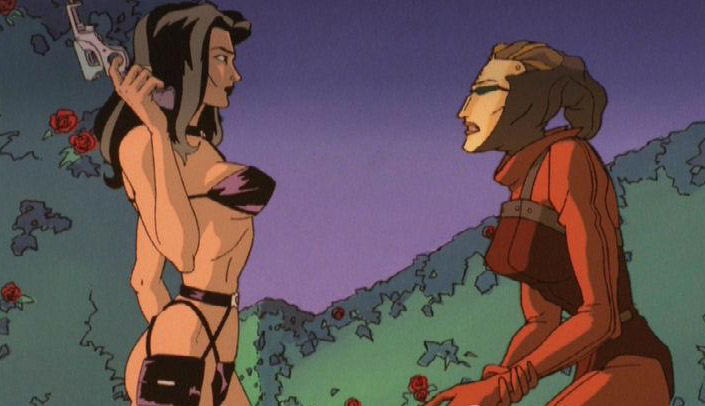
Chung’s Aeon Flux on a mission
Kusama’s Aeon Flux being targeted by another Monican
In contrast to the super-hero competence and aloofness of the movie Aeon, the animated Aeon is wonderfully flawed; she is a complex paradoxical character, who makes mistakes, blundering often due to over-confidence and poor decisions (usually connected with her feelings for Trevor). Chung’s Goodchild is equally complex, and is, unlike the naïve and rather feckless scientist of the movie, a true equal to Flux’s energetic and often misplaced heroics. Kusama’s Goodchild is neither menacing nor diabolical; rather, he is a well-intentioned and watered-down version of the Machiavelian scientist that Chung created. And, though quite appealing, he is also less compelling as a result. Chung’s Goodchild is a visionary pedant, who often spouts twisted Orwellian diatribe: “That which does not kill us makes us stranger.” “The unobserved state is a fog of probabilities…” “There can be no justice without truth. But what is truth? Tell me, if you know, and I will not believe you.” Flux cuts through Goodchild’s dogma with her own one-liners—“Trevor, don’t trouble me with your thin smile”—and usually shuts him up with either a smack or a kiss.
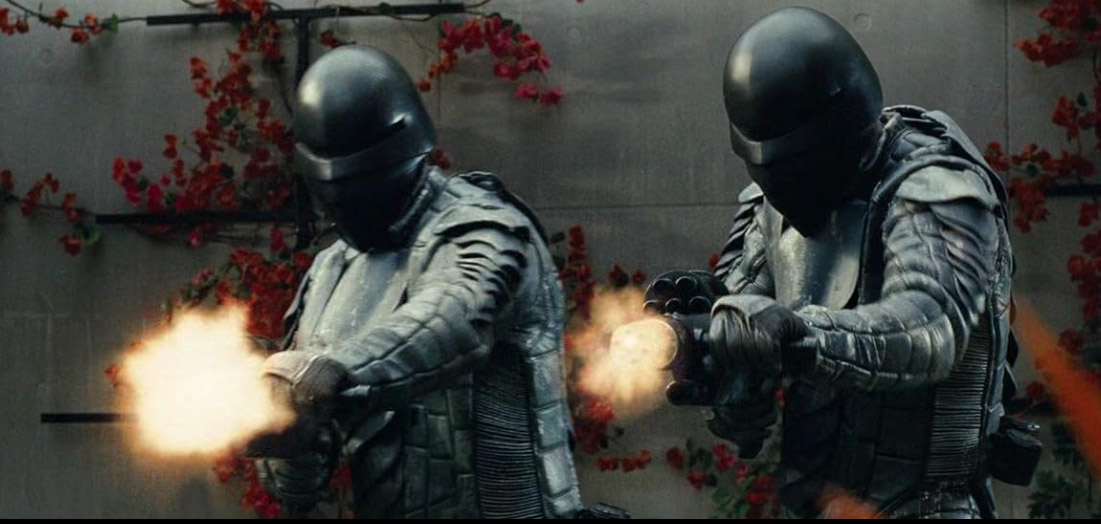
Aeon dispatches masked baddies
The animated series is far more gritty and edgy than the movie version, featuring twisted eroticism and dark humor amid scenes of graphic violence. It oozes with a delicious perversity that the movie version abandoned in favour of cohesive narrative (and a PG-13 rating). Showing a healthy and irreverent disregard for that very narrative continuity, Chung’s animated series successfully makes commentary on various societal notions and behaviours through his uniquely disjointed and liberating form. Chung asserts that this plot ambiguity and disregard for continuity were meant to satirize mainstream film narratives. I think it does far more than this as art form, by providing a journalistic style of reporting the nuances and filigrees of life that gives it an immediacy hard to overlook. Chung’s apparent intention was to emphasize the futility of violence and the ambiguity of personal morality. This is best shown in his six 5-minute shorts and pilot, created in 1991. The shorts commonly featured a violent death for the title character, sometimes caused by fate, but more often due to her own incompetence.
Chung’s Aeon Flux
The TV Aeon Flux flows like a subversive movement; punctuated by a series of abstract, often garish, statements on various themes of soulless biotechnology. Each episode is a vignette that explores singular questions of integrity, honour, loyalty, belief and love using the clever platform of the kiss/kill dynamic of Aeon and Trevor.
Their interactions scintillate with clever wordplay, often amid physical-play that usually involves a pointed weapon: Aeon: “You’re psychotic. You no longer have a common conscience with your fellow man.” Trevor: “I understand the will of evil…[it] is like an iron in a forge…conscience is the fire.” Aeon: “you’ve lost the substance by grasping at the shadow.” The underlying question of connectivity and what it is to be human filter through his discordant series primarily through the twining of his two main characters, both loners with little connection to anything except to one another (which they both seek and abhor). The motion picture version pursues through a more structured and lengthy narrative, the same theme of connectivity (with nature, with others of our society, with family, and our beliefs) and the consequence of living a life with out meaning, though on a far more simple level. At the end of Kusama’s movie, Aeon challenges Trevor’s assertion that cloning is their only answer for survival: “We’re meant to die. That’s what makes anything about us matter…[otherwise] we’re ghosts.” In contrast, at the end of Chung’s episode, Reraizure, Trevor closes with these words of reflection: “We are not what we remember of ourselves. We can undo only what others have already forgotten. Learn from your mistakes so that one day you can repeat them precisely.”
Aeon and Trevor come to terms
Kusama’s film version chose narrative coherence to make its statements by sacrificing character for story and challenging its audience cerebrally. Chung’s cartoon version challenges us more deeply, at a visceral level, through the interplay of his characters where cohesive narrative doesn’t matter. In the final analysis, the motion picture version pursues the same questions posed by Chung’s original animated version. Only, Chung isn’t so eager to provide answers, leaving both interpretation and conclusions to the individual. Both versions are mind-provoking and a celebration of excellent art. While the film’s moralistic tale resonated and lingered like a muse’s long forgotten poem, the subversive kick of the comic series (which I thankfully saw later) struck deep chords and left me breathless with questions.
Enforcers attack Monicans
Nina Munteanu is a Canadian ecologist / limnologist and novelist. She is co-editor of Europa SF and currently teaches writing courses at George Brown College and the University of Toronto. Visit www.ninamunteanu.ca for the latest on her books. Nina’s bilingual “La natura dell’acqua / The Way of Water” was published by Mincione Edizioni in Rome. Her non-fiction book “Water Is…” by Pixl Press (Vancouver) was selected by Margaret Atwood in the New York Times ‘Year in Reading’ and was chosen as the 2017 Summer Read by Water Canada. Her novel “A Diary in the Age of Water” was released by Inanna Publications (Toronto) in June 2020.
“We shall break down all walls—to let the green wind blow free from end to end—across the earth.”
I-330 in ‘We’
Just last week, I read for the first time Yevgeny Zamyatin’s masterpiece We. My first thought upon finishing it was: why have I waited until now to read it? I’m rather embarrassed to say that I’d only heard of its existence recently during some research I’d conducted on another article. The novel, written in 1920, decades before Brave New World and 1984 (two novels it is often compared to and which I read when I was a budding writer, long ago), was suppressed in Russia. It has remained in the shadows of these two works since. Mesmerized by Zamyatin’s fluid metaphoric prose, I read it in a few days.
I usually savour a good novel, but this one compelled me to take it in like an infusion.
The book jacket of the Harper Voyager edition provides the following tagline and description:
“Before Brave New World…before 1984…there was…We. In the One State of the great Benefactor, there are no individuals, only numbers. Life is an ongoing process of mathematical precision, a perfectly balanced equation. Primitive passions and instincts have been subdued. Even nature has been defeated, banished behind the Green Wall…”
Illustration of “We”masses marching during their personal hour
.
We is told through a series of entries by the main protagonist D-503, mathematician and chief engineer of the Integral (the ship that will take humanity to space). The novel takes place in a glass-enclosed Panopticon-like city of straight lines, and scientifically managed using Taylor’s principles of scientific management. No one knows or cares about the outside environment from which they have been separated. Citizens in the totalitarian society of One State are regulated hourly by the Table of Hours, and ruled by the ‘Benefactor’ who dispenses order through arcane methods such as The Machine (a modern ‘guillotine’ of sorts that literally liquidates its victim, reducing them to a puff of smoke and a pool of water), The Cube, The Gas Bell, and the ruthless precision and vigilance of the Bureau of Guardians. All this is “sublime, magnificent, noble, elevated, crystally pure,” writes D-503, because “it protects our unfreedom—that is, our happiness.” In the foreword to the Penguin edition of We, New Yorker journalist Masha Gessen reminds us that, “Zamyatin imagined [We] twenty years before Nazi Germany began sanitized, industrial mass murder of people who had been reduced to numbers.”
Citizens subsist on synthetic food and march in step in fours to the anthem of the One State played through loudspeakers. There is no marriage, and every week citizens are given a “sex hour” and provided a pink slip to let them draw down the shades of their glass apartment. Every year, on Unanimity Day, the Benefactor is re-elected by the entire population, through an open (not secret) vote that is naturally unanimous—given the singular “we” nature of the population.
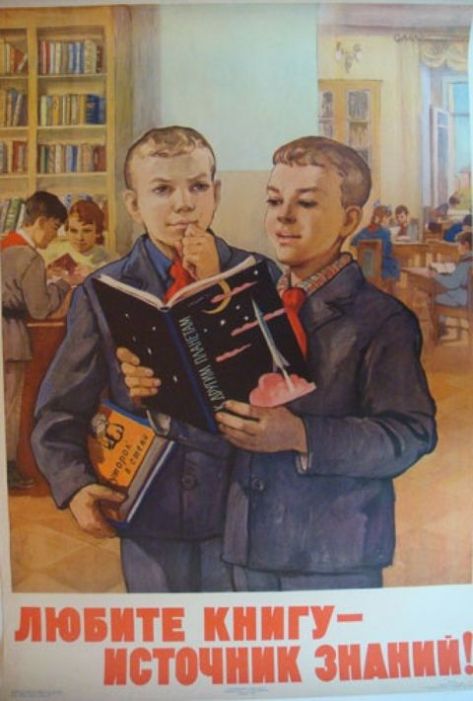
Kids in uniform from Russian poster
.
On Zamyatin’s novel, Michael Brendan Dougherty writes that, “Equality is enforced, to the point of disfiguring the physically beautiful. Beauty–as well as its companion, art–are a kind of heresy in the One State, because ‘to be original means to distinguish yourself from others. It follows that to be original is to violate the principle of equality.”
According to Mirra Ginsburg, who translated the book into English in 1972, Zamyatin and his book explores the oppression of two principles of human existence: eternal change and the individual’s freedom to choose, to want, to create according to his own need and his own will.
Quiet bay of the Otonabee River, ON (photo and rendition by Nina Munteanu)
In some ways, Zamyatin’s satire is as much about our separation from the chaos, ever-evolving and functional diversity of nature as it is about our separation from the unruly thoughts and emotions of the individual. Both are feared and must be defeated, controlled and commodified (I refer to Foucault’s concept of biopolitics).
D-503 writes in his journal: “we have extracted electricity from the amorous whisper of the waves; we have transformed the savage, foam-spitting beast into a domestic animal; and in the same way we have tamed and harnessed the once wild element of poetry. Today poetry is no longer the idle, impudent whistling of a nightingale; poetry is civic service, poetry is useful.”
D-503’s thirteenth entry takes place on a particularly foggy day. When new friend I-330 ‘innocently’ asks him if he likes the fog, he responds, “I hate the fog. I’m afraid of it.” To this, I-330 says, “That means you love it. You are afraid of it because it is stronger than you; you hate it because you are afraid of it; you love it because you cannot subdue it to your will. Only the unsubduable can be loved.”
Cedar swamp forest, Trent Nature Sanctuary, ON (photo and rendition by Nina Munteanu)
.
D-503 appears content as a ‘number’ within a larger unity of regimentation and draws comfort from a universe of logic and rationality, represented by the predictive precision of mathematics. For example, he is disturbed by the concept of the square root of -1, the basis for imaginary numbers (imagination being reviled by the One State and which will eventually be lobotomized out of citizens through the mandatory Great Operation). The spaceship’s name Integral represents the integration of the grandiose cosmic equation following the Newtonian hegemony of a machine universe.
The human-machine working the great clock in Metropolis
.
In the following scene in which D-503 watches men work on the spacecraft Integral—itself likened to a giant slumbering machine-human—I am reminded of an iconic scene from Fritz Lang’s 1927 Metropolis:
“I watched the men below move in regular, rapid rhythm…bending, unbending, turning like the levers of a single huge machine. Tubes glittered in their hands; with fire they sliced the glass walls, angles, ribs, brackets. I saw transparent glass monster cranes rolling slowly along glass rails, turning and bending as obediently as the men, delivering their loads into the bowels of the Integral. And all of this was one: humanized machines, perfect men…Measured movements; firmly round, ruddy cheeks; mirror-smooth brows, untroubled by the madness of thought.”
Machine of Metropolis
.
All is indeed sublime … Until he meets I-330, Zamyatin’s unruly heroine who is determined to change D-503’s perspective—and his vacuous state of dutiful ‘happiness.’ She is, of course, a member of an underground resistance, Mephi, bent on overthrowing the One State. I-330 is the herald of change and wishes to use D-503’s connection to the Integral to incite a revolution. In a particularly pithy scene, I-330 challenges D-503’s complacent logic with mathematics to make her point:
“Do you realise that what you are suggesting is revolution?” [says D-503]
“Of course, it’s revolution. Why not?”
“Because there can’t be a revolution. Our revolution was the last and there can never be another. Everybody knows that.”
“My dear, you’re a mathematician: tell me, which is the last number?”
“But that’s absurd. Numbers are infinite. There can’t be a last one.”
“Then why do you talk about the last revolution? There is no final revolution. Revolutions are infinite.”
Confident, powerful and heroic, the liberated I-330 is clearly the driving force of change and the philosophical voice of Zamyatin’s central theme. Her competent manipulations within the system successfully orchestrates a revolution which includes interfering with the unanimous vote, breaching the Green Wall, and braving torture to the end–all the kind of feats usually relegated to a male protagonist in novels of that era. It all starts with a tiny crime and escalates from there. Early in the novel, I-330 lures D-503 to the Medical Office, where the Mephi doctor gives them a sick card so they can play hooky from work. D-503 doesn’t even realize how I-330 has so completely caught him. His description of the facility and the officer is telling:
“A glass room filled with golden fog. Glass ceilings, colored bottles, jars. Wires. Bluish sparks in tubes. And a tiny man, the thinnest I had ever seen. All of him seemed cut out of paper, and no matter which way he turned, there was nothing but a profile, sharply honed: the nose a sharp blade, lips like scissors.”
Biblical references appear throughout We, the One State likened to ‘Paradise’, D-503 to the naïve ‘Adam’, I-330 to the herald temptress ‘Eve’, and S-4711 to the clever snake, with his ‘double-curved body,’ who turns out to be a double-agent. The revolutionary organization named Mephi appears to be after Mephistopheles, who rebelled against Heaven and ‘paradise.’ While these similarities suggest a criticism of organized religion, the novel clearly embodies so much more. It is also so much more than a political statement. Journalist and translator Mirra Ginsburg calls We “a complex philosophical novel of endless subtlety and nuance, allusion and reflections. It is also a profoundly moving human tragedy and a study in the variety of human loves … And, though the people are nameless ‘numbers,’ they are never schematic figures; each is an individual, convincingly and movingly alive.”
Zamyatin wrote We years before the word “totalitarianism” appeared in political speech and he predicted its defining condition: the destruction of the individual. In TheOrigins of Totalitarianism, Hannah Arendt argued that totalitarianism was a novel oppression: previous tyrants demanded obedience; but obedience was not enough for the totalitarian regime, which sought to occupy the entire person and obliterate their very core. As the self disintegrates, humans—like worker bees—fuse into what Arendt called “one man of gigantic dimensions.” Zamyatin’s word for it was: “we.”
“In a world without personal boundaries, a world without deviation, serendipity, difference, a world without ‘I,’ there can be no ‘us.’ The ‘we’ of We is a mass rather than a community of people. Arendt wrote about loneliness as the defining condition of totalitarianism. She drew a distinction between loneliness—a sense of isolation—and solitude, a condition necessary for thinking. One could be lonely in a crowd. But in Zamyatin’s world of transparent houses and uniform lives, one could not have solitude.”
Masha Gessen on the ‘we’ of We
Winston Smith writing his diary out of the view of the ‘Big Brother’ screen
.
Comparison of We with Brave New World and 1984
As I was reading We, I could not help comparing it to George Orwell’s 1984, written over twenty-five years later. Similarities in plot and theme abound, right down to the inverted language of the government: the tyrant is the ‘Benefactor’ just as Orwell’s Ministry of Love is where dissidents are tortured or Oceana’s paradoxical ministry slogans–Freedom is Slavery … Ignorance is Strength … War is Peace. Three years before the publication of Nineteen Eighty-Four in 1949, Orwell reviewed We and compared it with Huxley’s Brave New World, published in 1932:
“The first thing anyone would notice about We is the fact—never pointed out, I believe—that Aldous Huxley’s Brave New World must be partly derived from it. Both books deal with the rebellion of the primitive human spirit against a rationalised, mechanised, painless world, and both stories are supposed to take place about six hundred years hence. The atmosphere of the two books is similar, and it is roughly speaking the same kind of society that is being described though Huxley’s book shows less political awareness and is more influenced by recent biological and psychological theories.”
George Orwell, 1946 review of “We”
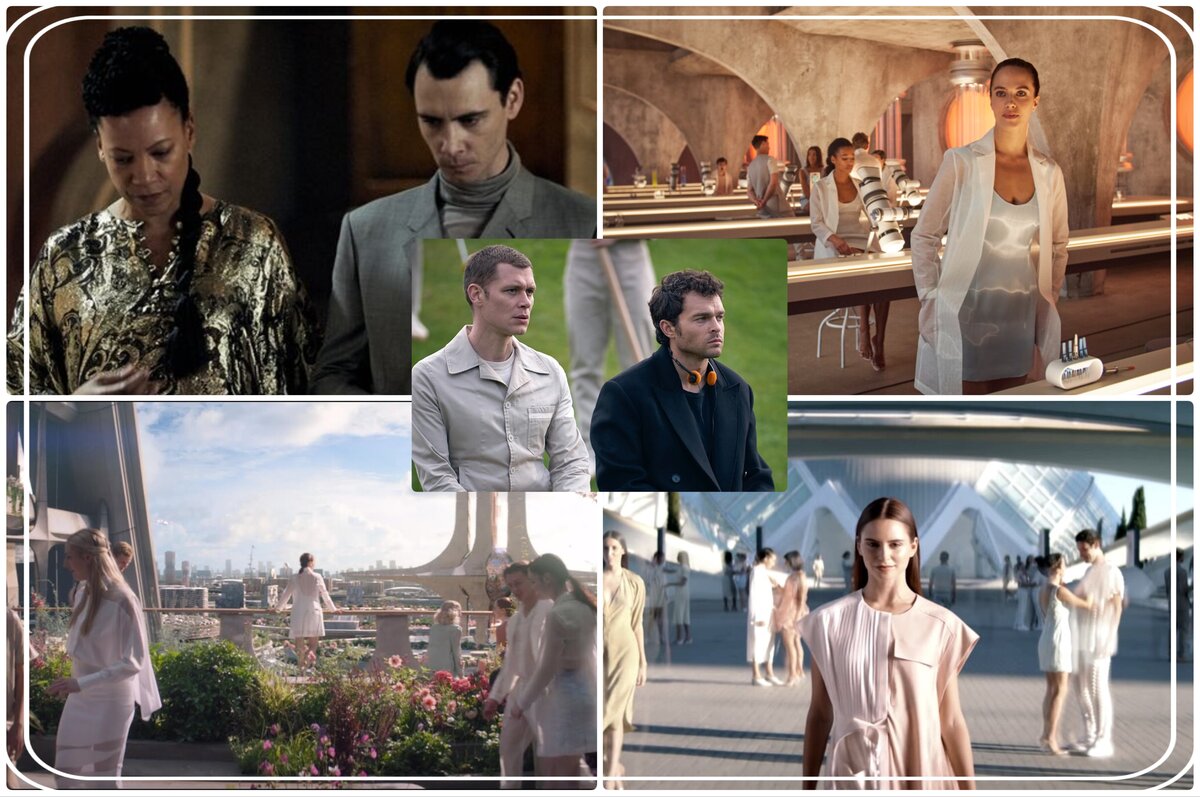
Montage of images from 2020 film of ‘Brave New World’
.
While Orwell criticizes Zamyatin’s book as being “less well put together—it has a rather weak and episodic plot which is too complex to summarize,” he praises it for making a political point that according to him Huxley’s book lacks (for the record, I disagree with Orwell on this; Huxley’s political point is just more subtle, just as his characters are). Orwell found Zamyatin’s We more convincing and relevant than Huxley’s Brave New World given that in the technocratic totalitarian state of We “many of the ancient human instincts are still there,” not eradicated by eugenics and medication (such as soma). Citing the many executions in Zamyatin’s Utopia, all taking place publicly in the presence of the Benefactor and accompanied by “triumphal odes recited by the official poets”, Orwell suggested that, “It is this intuitive grasp of the irrational side of totalitarianism—human sacrifice, cruelty as an end in itself, the worship of a Leader who is credited with divine attributes—that makes Zamyatin’s book superior to Huxley’s.”
1976 Penguin cover of ‘Brave New World’ cover; ‘1953 Signet cover of Nineteen Eighty Four’
.
Noam Chomsky considered We more perceptive than Brave New World or 1984, the latter which he called “wooden and obvious” despite clever and original nuances such as “newspeak,” which provided a medium for the world view and principles of Ingsoc and to make other forms of thought impossible (“it’s a beautiful thing, the destruction of words…” says Syme in 1984). I agree with Chomsky. Next to the bleak and hopeless polemic of Nineteen Eighty-Four, We is less dialectic, more visceral, it is full-bodied, ribald, tender, emotional and immediate. But above all, it is hopeful. Again, Mirra Ginsburg says it best:
“We is more multifaceted, less hopeless than Orwell’s 1984, written more than twenty-five years later and directly influenced by Zamyatin’s novel. Despite its tragic ending, We still carries a note of hope. Despite the rout of the rebellion, ‘there is still fighting in the western parts of the city.’ Many ‘numbers’ have escaped beyond the Wall. Those who died were not destroyed as human beings—they died fighting and unsubmissive. And though the hero is reduced to an obedient automaton, certain that “Reason” and static order will prevail, though the woman he loved briefly and was forced into betraying dies (as do the poets and rebels she led), the woman who loves him, who is gentle and tender, is safe beyond the Wall. She will bear his child in freedom. And the Wall has been proved vulnerable after all. It has been breached—and surely will be breached again.”
Mirra Ginsburg, on ‘We’
Image by Amazon media
.
It may seem like a tragic end, particularly for the two main protagonists: D-503 is lobotomized into an obedient drone of the sterile system and betrays his lover; I-330 is no doubt liquidated under The Machine, after refusing to submit and betray her comrades. To the end, she is the messenger of hope and resilience and the force for removal of barriers. The wall does come down–even if for just a moment towards the end of the book–and the Green Wind blows furiously through the land, bringing with it birds and other creatures previously unseen along with the scent of change.
Zamyatin’s We is ultimately a cautionary tale on the folly of logic without love and a profound call to connect to our natural world to nurture our souls. Before he is rendered inert by the Great Operation, D-503 gives O-90 a child. It is no mistake that O-90, who tenderly and selflessly loved and refused to surrender her child to the One State, makes it outside (with the help of I-330) into the natural world. Driven by love (not rationality), she represents the future.
Cedar swamp forest, Trent Nature Sanctuary, ON (photo and rendition by Nina Munteanu)
.
About the Author and His Work
Yevgeny Zamyatin was born in 1884 in Lebedyan, Russia, which according to Mirra Ginsburg was “one of the most colourful towns in the heart of the Russian black-earth belt, some two hundred miles southeast of Moscow—a region of fertile fields, of ancient churches and monasteries, of country fairs, gypsies and swindlers, nuns and innkeepers, buxom Russian beauties, and merchants who made and lost millions overnight.”
Showing influences by Jerome K. Jerome’s 1891 short story The New Utopia and H.G. Wells’ 1899 novel When the Sleeper Wakes and the Expressionist works of Kandinsky, Yevgeny Zamyatin created We in 1920. His political satire was denied publication in Russia but Zamyatin managed to smuggle the manuscript to New York, where it was published in English in 1924 by Dutton. Mirra Ginsburg writes of Zamyatin’s death in 1937: “[it] went unmentioned in the Soviet press. Like the rebellious poet in We, and like so many of the greatest Russian poets and writers of the twentieth century, he was literally ‘liquidated’—reduced to nonbeing. His name was deleted from literary histories and for decades he has been unknown in his homeland.” The first publication of We in Russia had to wait until 1988—after more than sixty years of suppression—when glasnost resulted in it appearing alongside Orwell’s 1984.
Zamyatin called We “my most jesting and most serious work.” His credo, written in 1921 in I am Afraid, proclaimed that “true literature can exist only where it is created, not by diligent and trustworthy officials, but by madmen, hermits, heretics, dreamers, rebels, and skeptics.”
We directly inspired the following literary works: Brave New World by Aldous Huxley, Invitation to a Beheading by Vladimir Nabokov, Anthem by Ayn Rand, Nineteen Eighty-Four by George Orwell, Player Piano by Kurt Vonnegut, Logan’s Run by William F. Nolan and George Clayton, This Perfect Day by Ira Levin, and The Dispossessed by Ursula K. Le Guin.
The Penguin classics edition describes We as “the archetype of the modern dystopia, or anti-Utopia: a great prose poem detailing the fate that might befall us all if we surrender our individual selves to some collective dream of technology and fail in the vigilance that is the price of freedom.”
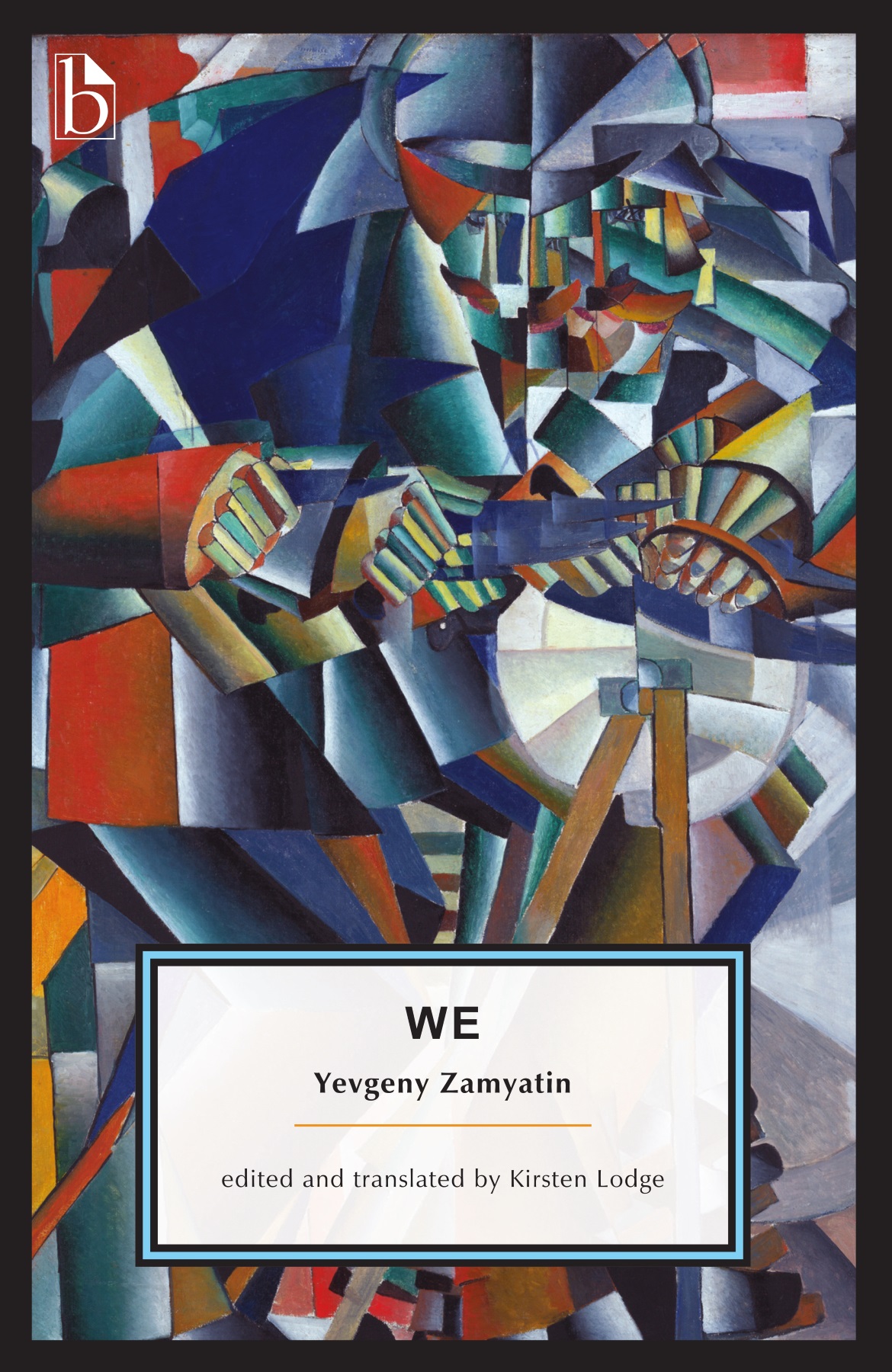
“We,” Broadview Press edition
Nina Munteanu is a Canadian ecologist / limnologist and novelist. She is co-editor of Europa SF and currently teaches writing courses at George Brown College and the University of Toronto. Visit www.ninamunteanu.ca for the latest on her books. Nina’s bilingual “La natura dell’acqua / The Way of Water” was published by Mincione Edizioni in Rome. Her non-fiction book “Water Is…” by Pixl Press (Vancouver) was selected by Margaret Atwood in the New York Times ‘Year in Reading’ and was chosen as the 2017 Summer Read by Water Canada. Her novel “A Diary in the Age of Water” was released by Inanna Publications (Toronto) in June 2020.





















 Nina Munteanu Writing Coach