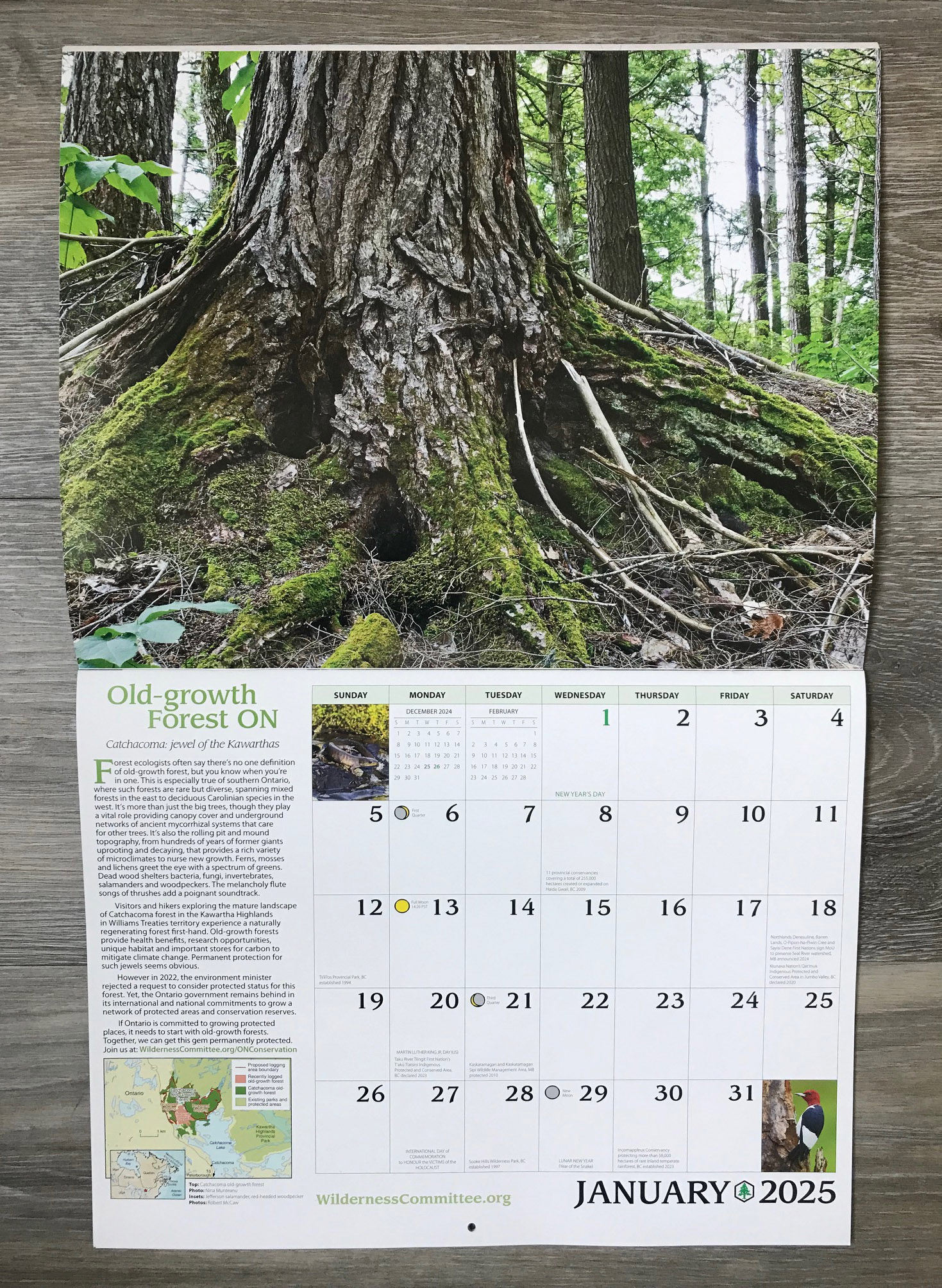
I recently received my copies of the 2025 Wild Canada calendar put out by WildernessCommittee.ca. The calendar has 12 months of gorgeous images of wild and sacred places throughout Canada; heartfelt and informative stories accompany each image.
2025 Wild Canada calendar featuring January spread
My own photo of an old-growth hemlock in Catchacoma Forest, Ontario, is featured for January! Go check out the Wilderness Committee site then go to their store to see the whole calendar. It’s worth buying for its beauty and its meaningful narratives. And it is an excellent way to support a worthwhile cause.
Nina Munteanu is a Canadian ecologist / limnologist and novelist. She is co-editor of Europa SF and currently teaches writing courses at George Brown College and the University of Toronto. Visit www.ninamunteanu.ca for the latest on her books. Nina’s bilingual “La natura dell’acqua / The Way of Water” was published by Mincione Edizioni in Rome. Her non-fiction book “Water Is…” by Pixl Press (Vancouver) was selected by Margaret Atwood in the New York Times ‘Year in Reading’ and was chosen as the 2017 Summer Read by Water Canada. Her novel “A Diary in the Age of Water” was released by Inanna Publications (Toronto) in June 2020.
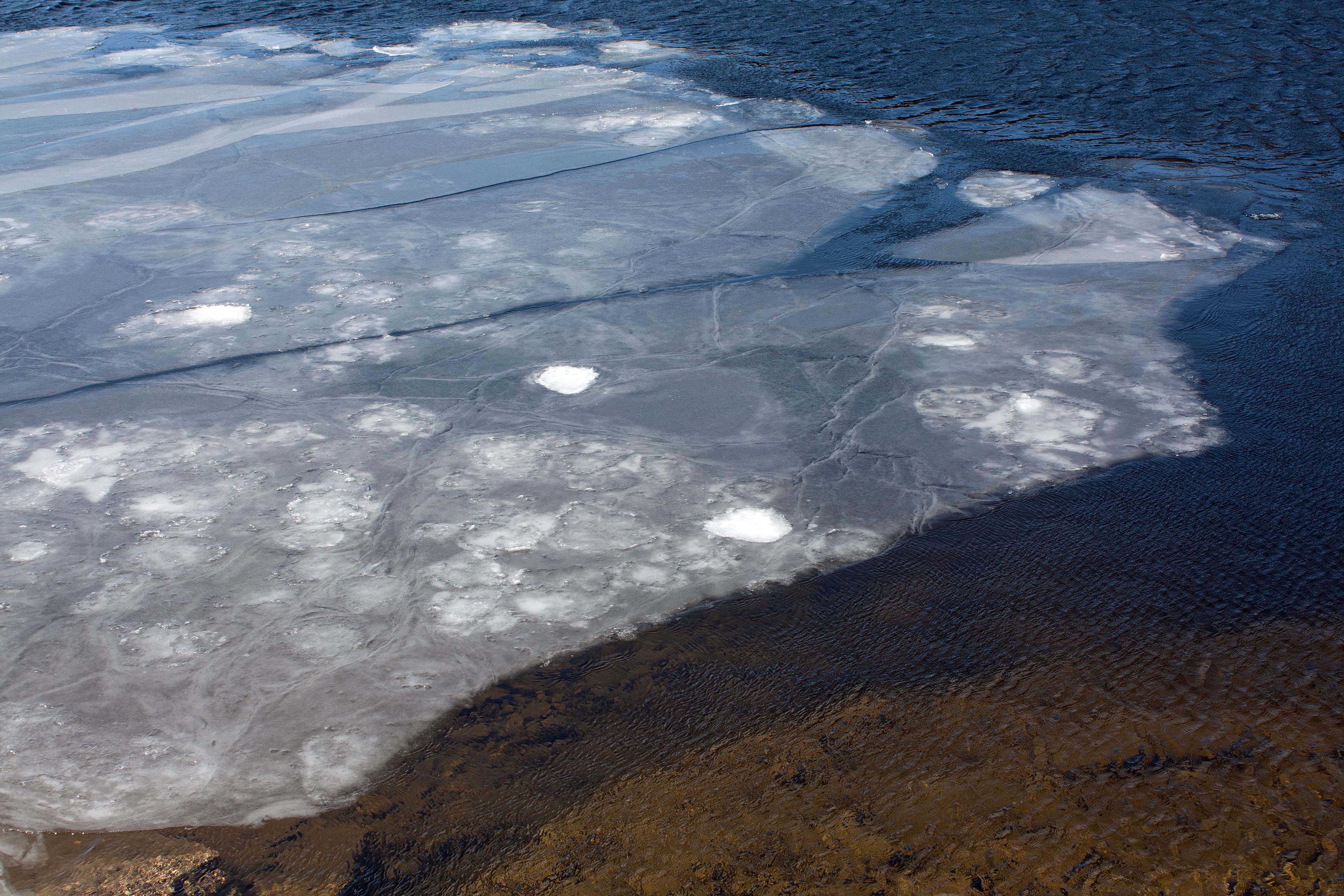
Ice sheet with embedded pancake ice breaking into fragments on the Otonabee River, ON (photo by Nina Munteanu)
It’s spring and every day on the river is different. One day the ice thaws. The next day it reforms only to thaw again.
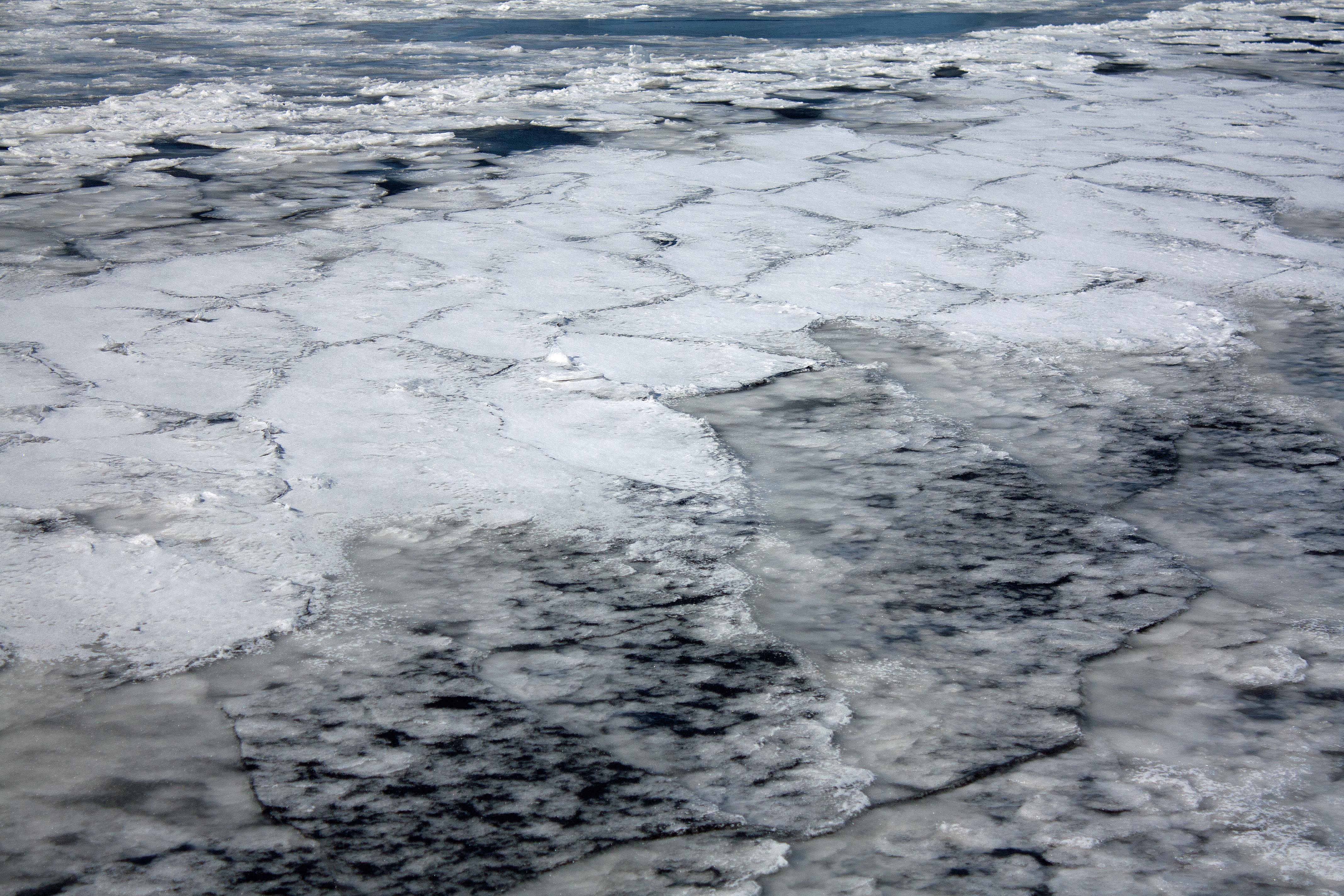
Ice sheet stitched together by ice pancakes and fragments, ON (photo by Nina Munteanu)
I love watching the process of ice pancake formation and reformation on the Otonabee River. It starts with primordial ice-froth, which then coagulates into ice sheets. These sometimes look like fabric or white felt.
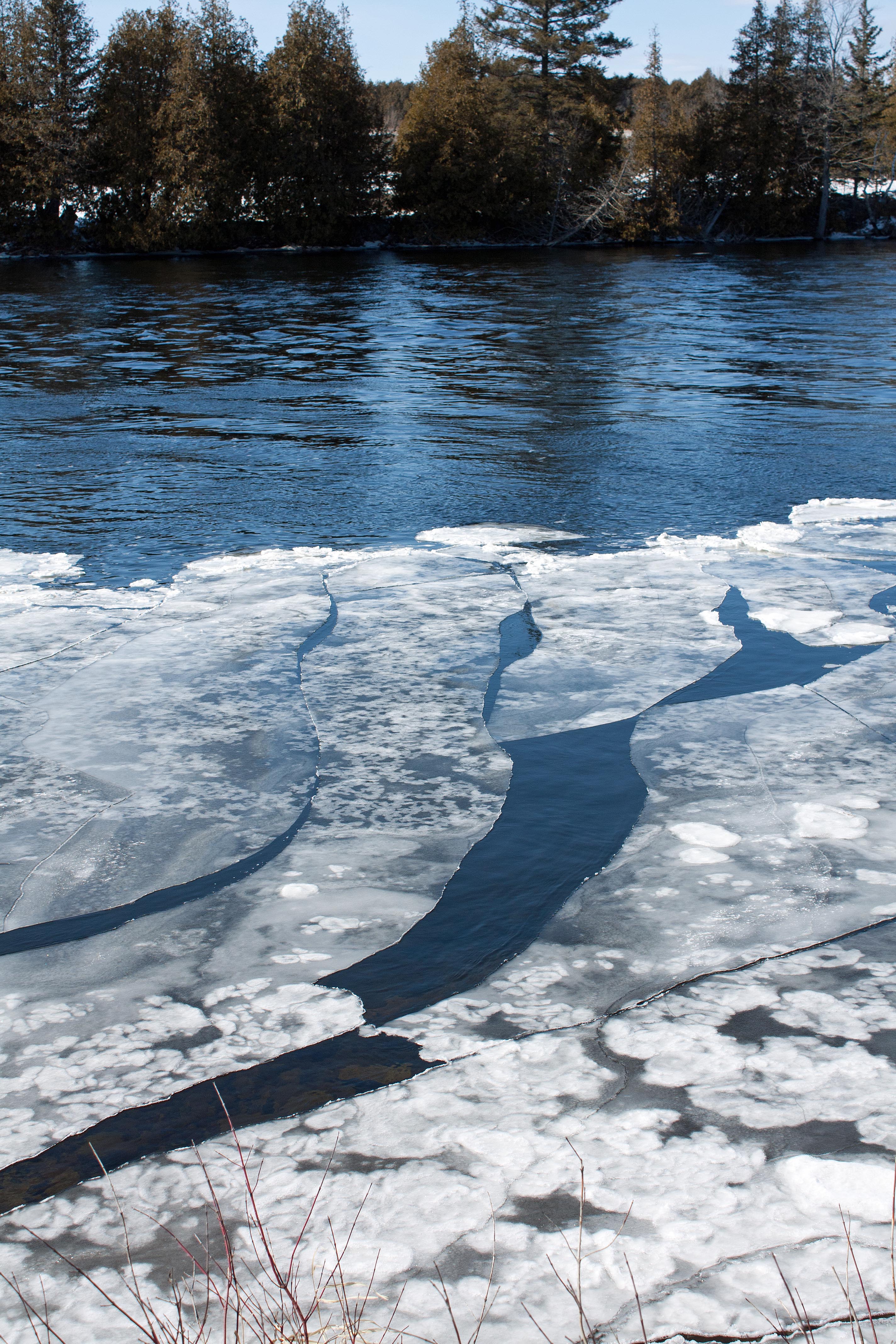
Giant ice fragments with embedded pancake ice break off ice sheets in spring on the river, ON (photo by Nina Munteanu)
Then entire sheets break up into long fragments like giant pieces of glass shards, all floating down the river, little opaque pancakes embedded in clear glassy sheets. And the water beneath is the darkest blue.
Ice pancakes glued into an ice sheet by clear ice formed around them (photo by Nina Munteanu)
Ice sculptures form as wave-induced ice shuga collide and form strange shapes, Otonabee River, ON (photo by Nina Munteanu)
Nina Munteanu is a Canadian ecologist / limnologist and novelist. She is co-editor of Europa SF and currently teaches writing courses at George Brown College and the University of Toronto. Visit www.ninamunteanu.ca for the latest on her books. Nina’s bilingual “La natura dell’acqua / The Way of Water” was published by Mincione Edizioni in Rome. Her non-fiction book “Water Is…” by Pixl Press(Vancouver) was selected by Margaret Atwood in the New York Times‘Year in Reading’ and was chosen as the 2017 Summer Read by Water Canada. Her novel “A Diary in the Age of Water” was released by Inanna Publications (Toronto) in June 2020.
Rotary Trail in Peterborough during a foggy day, ON (photo and rendition by Nina Munteanu)
A few days ago, I woke up in the morning to a dense fog outside. I hastily dressed, grabbed a clementine, put on my boots and coat and raced outside into the gentle morning. The air was fresh. A calm stillness had settled over everything, from ghostly forest to dripping branches by the path to people who appeared and disappeared in the mist.
Rotary Trail path to the bridge across the Otonabee River, ON (photo by Nina Munteanu)
As I strolled along the trail and forest paths, camera in hand, I realized that I needn’t have rushed; the fog didn’t burn away and dissipate beneath a strong sun. It remained foggy the entire day.
Path through winter forest on a foggy morning, ON (photo by Nina Munteanu)
Thompson Creek marsh in the fog, ON (photo by Nina Munteanu)
Otonabee marsh in the fog, ON (photo and rendition by Nina Munteanu)
Dogwood shrubs add colour to the marsh as ice forms, ON (photo and rendition by Nina Munteanu)
At Thompson Creek marsh, crimson dogwood shrubs and gnarly trees greeted me with arms stretched through the fog. The damp air, fragrant with the stirring of Winter, caressed my cheeks. I felt like I’d entered a Camille Pissarro painting…
Alders, willows and other trees, amid ruddy dogwoods, line Thompson Creek marsh behind, ON (photo and rendition by Nina Munteanu)
Road to Lakefield along Otonabee River in the fog, ON (photo and rendition by Nina Munteanu)
During my drive along the river, the calm stillness of the day settled over me with muted beauty. Nature’s shapes peered through the mist like quantum entangled apparitions, coalescing to the nearness of my gaze then vanishing again on my parting.
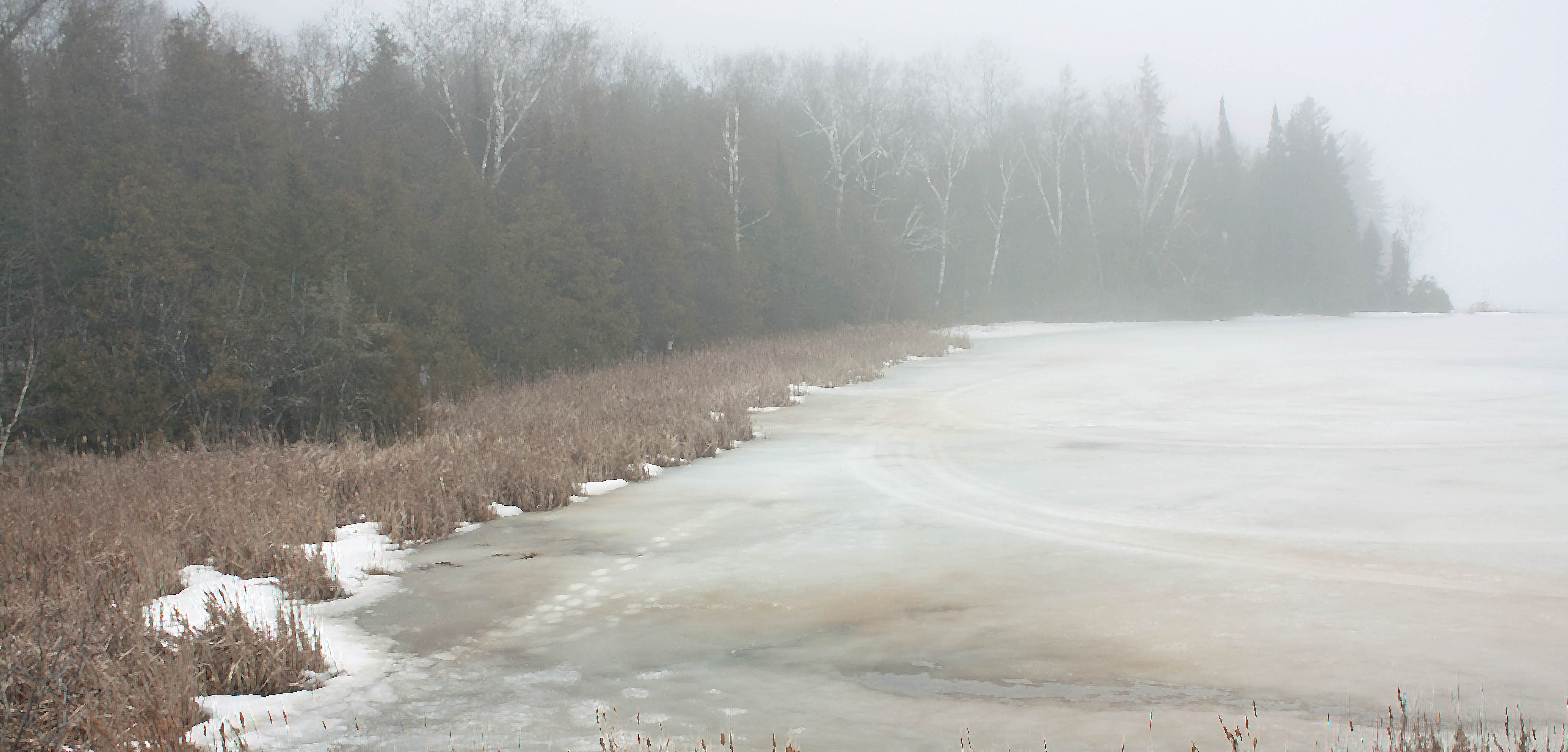
Shore of ice-strewn Otonabee River off Lakefield Road, ON (photo and rendition by Nina Munteanu)
1906 building on shore of Otonabee River during a foggy day, ON (photo and rendition by Nina Munteanu)
Small island in Otonabee River on road to Lakefield, ON (photo and rendition by Nina Munteanu)
I drove along country roads that vanished in the mist. As I plied through the fog, phantom trees loomed, quietly announcing themselves on the side of the road as their shapes assembled into something solid.
I imagined I was catching the breath of heaven…
Country dirt road in the Kawarthas on a foggy day, ON (photo by Nina Munteanu)
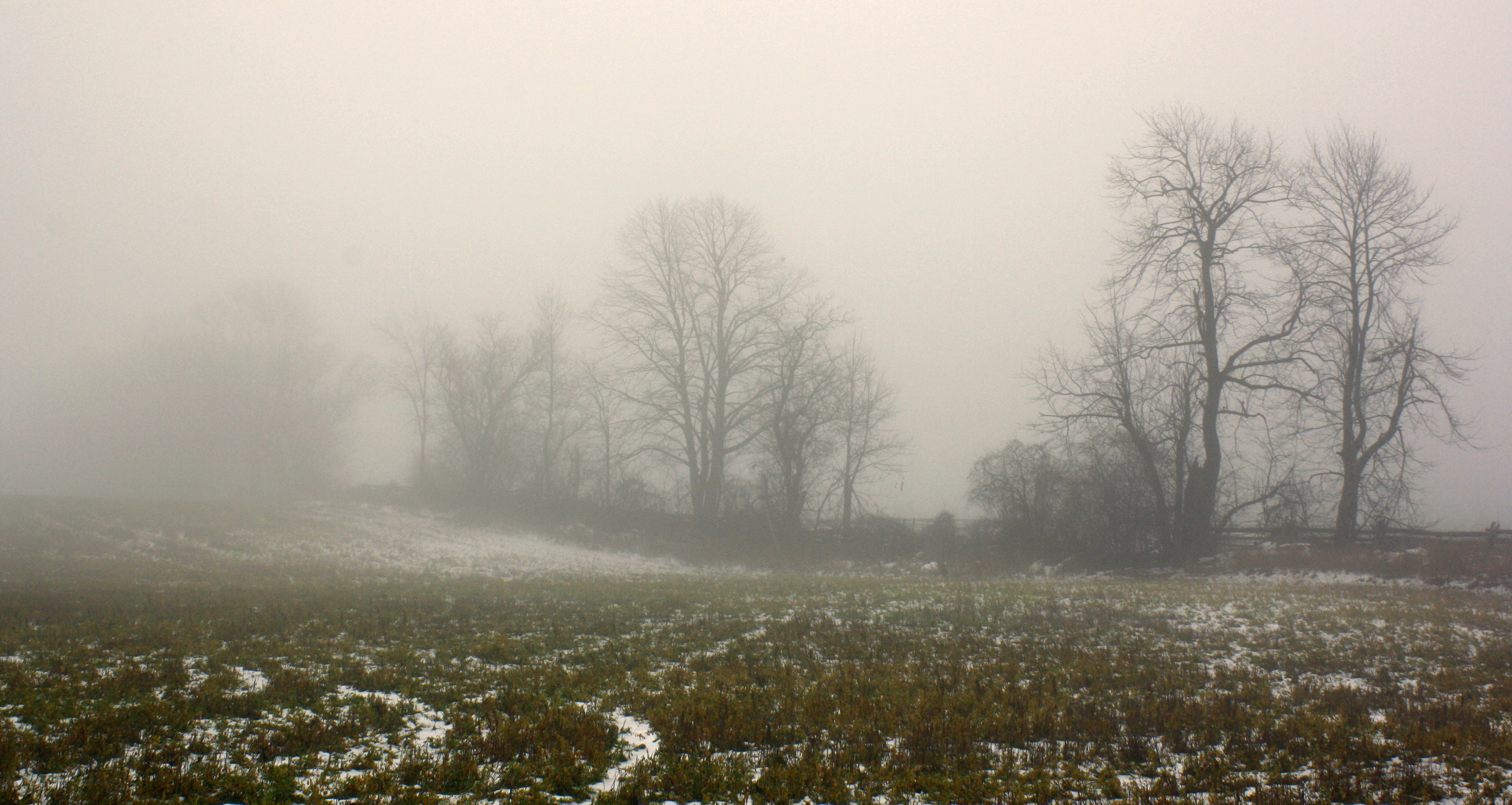
Tree ghosts in a farmer’s field in Kawartha country, ON (photo by Nina Munteanu)
Snow melt stream and marsh on the side of a country road on a foggy day, ON (photo and rendition by Nina Munteanu)
The fog is a shape-shifter. Sometimes a brooding beast, obscuring all in its indiscriminate path. Other times an impish rogue, a pale coquette, winking and teasing as it both reveals and hides, like a good mystery novel…
Fog over the Otonabee River, ON (photo and rendition by Nina Munteanu)
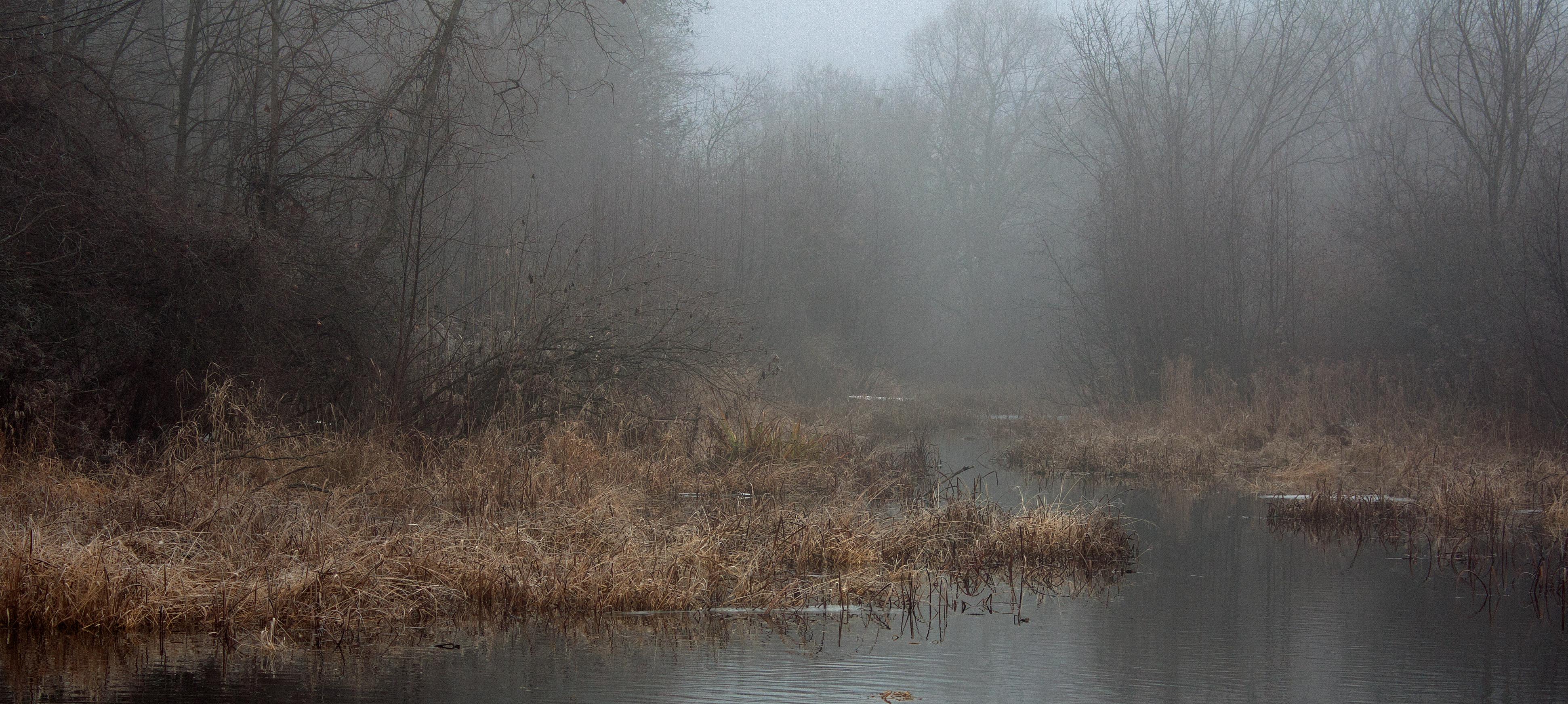
Thompson Creek marsh in a winter mist, ON (photo by Nina Munteanu)
Nina Munteanu is a Canadian ecologist / limnologist and novelist. She is co-editor of Europa SF and currently teaches writing courses at George Brown College and the University of Toronto. Visit www.ninamunteanu.ca for the latest on her books. Nina’s bilingual “La natura dell’acqua / The Way of Water” was published by Mincione Edizioni in Rome. Her non-fiction book “Water Is…” by Pixl Press(Vancouver) was selected by Margaret Atwood in the New York Times‘Year in Reading’ and was chosen as the 2017 Summer Read by Water Canada. Her novel “A Diary in the Age of Water” was released by Inanna Publications (Toronto) in June 2020.
Nina scoping her shot with her iPhone (photo by Merridy Cox)
You see something breathtaking and say to yourself: I have to take a picture of that! You snap it with your camera or phone, happy that you’ve captured the moment. When you return home and review your shots on the computer to share, you get to that breathtaking scene and your first thought is: why on Earth did I take a picture of that?!
The shot is nothing like what you remembered. That dull and lifeless scene is the farthest thing from breathtaking. What happened?
Nina checks her photo on her iPhone (photo by Merridy Cox)
When Your Mind and Your Camera Don’t Agree
We see with our eyes, but we feel and process meaning with our brain. And it’s the brain that determines what we finally see. What we see is our brain’s interpretation of the scene. We adjust what we see with meaning.
The camera doesn’t interpret. It is a tool that works based on principles of light, focus, depth of field, breadth of field, and resolution & detail. What a DSLR camera set on automatic, a compact camera and a smartphone have in common is that they are all set to capture the best shot, given the right conditions of light, contrast and motion. If you shoot with a camera set on automatic, it is acting as your brain, but without the interpretation of meaning. You’ve given away that power. Like a benevolent dictator, the camera/phone is boss of your shots, dictating what it was designed to do to get the best shot in those particular conditions. The trouble with that is the camera doesn’t see with your brain. Its idea of the ‘best shot’ is based on a set of criteria created by a manufacturer. It works great only in certain conditions—those best anticipated by the manufacturer (e.g. optimum light and distance). But, make no mistake: you will not get what your brain sees. You might think so, but you won’t.
A short while ago, when I was visiting a good friend in British Columbia, we got into talking about photography and I mentioned how I had returned from using a tablet and phone (for convenience) to my Canon DSLR camera (for quality); I had earlier ditched the camera in favour of the light convenient iPhone, which I found easy, particularly when travelling. But I soon became frustrated and disappointed at not achieving what my brain saw. Returning to the DSLR camera allowed me to significantly improve my shots. My friend’s daughter—an avid picture taker with her mobile phone—challenged me: “Are you sure your camera takes better pictures?” I wanted to laugh, but then I realized that she was serious, born from the confidence of her own pictures—which I’d seen and must acknowledge are very good for composition and sharpness. Closer inspection reveals that these were all achieved within a boundary of conditions. The lighting was optimal, the distance was good, the composition sufficiently simple to accommodate the camera’s limitations; so what her brain saw, the camera reflected, at least fairly well.
Nina (decades ago) with her Minolta SLR and long lens (photo by H. Klassen)
But it is impossible for a smartphone or any automatic camera to achieve certain effects that only my DSLR camera set on manual or semi-manual can provide (e.g. setting my depth of field, adjusting for that right bokeh, playing with exposure, achieving natural light and a high resolution image in a low-light situation, getting very close or zooming far away with a dedicated lens). In addition, DSLR cameras outperform smartphone cameras because their sensors are much larger, let in more light, and produce more dynamic range in low-light scenarios. This allows them to capture greater detail than smartphone cameras or compact cameras. Ultimately, as Smartframe acknowledges, “the gap between what’s possible on the smartphones and dedicated cameras remains significant.” The argument is similar for a regular camera set on automatic vs one set on manual or semi-manual.
I’ve been there. Automatic settings on a camera and smartphone (which is basically like a camera on automatic) can only do so much to match what your brain sees. And they can be mighty annoying—particularly when the camera’s brain prefers to focus on the wrong thing.
Above: automatic setting went for background focus; below, setting corrected for foreground focus(photos of Earthstars in a cedar forest by Nina Munteanu)
If you truly want to get what your brain sees, you have to take over the brainpower of the camera. That means either tricking the automatic setting or going off automatic to manual or semi-manual on a camera (no smartphones currently come with manual settings, nor will they; although they may have some correcting software, which isn’t the same thing.) For the past decade the market is changing for phone cameras and compact cameras—there is Nikon’s Coolpix S800c, which combines an Android OS with a long zoom lens and touchscreen-based interface and Panasonic’s Lumix CM1 blends a traditional smartphone with a 1-inch sensor. Samsung’s Galaxy Camera 2 integrates an Android OS with 3G capabilities and a 21x optical zoom. They all remain limited with respect to matching what your brain sees to what your camera takes.
Getting Your Camera To Agree with Your Brain
Successfully getting your camera (or smartphone) to match your brain-sight starts with recognizing the various aspects of a captured image. These include:
focus (sharp or soft): what’s in focus and what isn’t in focus
depth of field: how deep the focused region is
lighting: colour saturation and contrast
resolution (sharpness)
motion (or lack of it)
composition (what is in focus and what isn’t and where everything sits)
bokeh (the look of the unfocused part)
All of these, once recognized, can be manipulated on your camera. On a smartphone or auto-camera, most of these factors must be addressed as best as you can by shifting your position or aim, changing the time of day or lighting when you take your picture, or changing your subject and surroundings. In other words, by manipulating what your brain sees.
I won’t lie; it’s not easy to manipulate what the camera takes to match what your brain sees. It takes dedication and time. But it starts with recognizing what needs manipulating: training your eyes and brain to really see what you’re taking a photo of and understanding what your camera has to do to achieve it.
Nina photographing a tributary of the Otonabee River, ON, with her Canon DSLR (photo by Matthew P. Barker, Peterborough Examiner)
How Our Eyes and Brains See
It helps to understand how our eyes see and how our brains process what we see, particularly what is different from what a camera does. This includes angle of view; resolution and detail; and sensitivity and dynamic range.
Angle of View: Our angle of view isn’t straightforward like a camera with a particular lens with set focal length (e.g. wide angle vs. telephoto lens). Cambridge in Colour tells us that “even though our eyes capture a distorted wide angle image, we reconstruct this to form a 3D mental image that is seemingly distortion-free.” Our central angle of view—around 40-60º—is what most impacts our perception. “Subjectively, this would correspond with the angle over which you could recall objects without moving your eyes,” says Cambridge in Colour.
Rendition of what eye / brain focuses on (image from Cambridge in Colour)
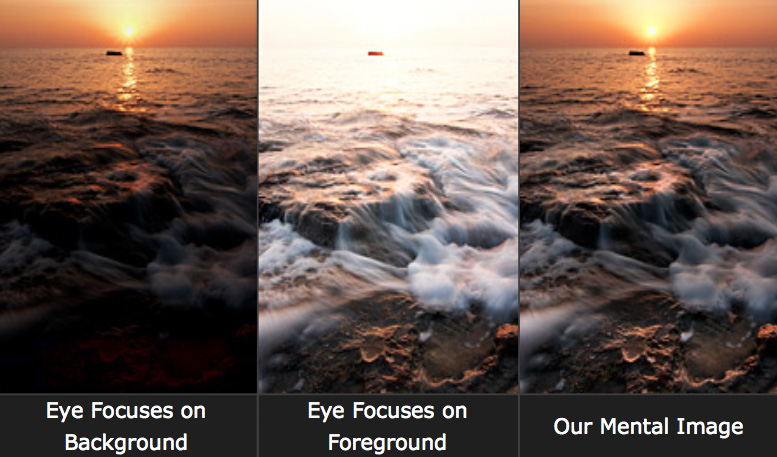
Resolution and Detail:Cambridge in Colour tells us that 20/20 vision is mostly restricted to our central vision; we never actually resolve that much detail in a single glance. Away from the centre, our visual ability decreases and at the periphery we only detect large-scale contrast and minimal colour. A single glance, therefore, mostly perceives the centre in resolution. Because our brain remembers memorable textures, colour and contrast (not pixel by pixel), our eyes focus on several regions of interest in rapid succession, which paints our perception. “The end result is a mental image whose detail has been prioritized based on interest.” It is our interest that dictates what we see and ultimately informs our memory of that image.
How our eye / brain integrates depth of field and exposure for background and foreground (image by Cambridge in Colour)
Sensitivity & Dynamic Range: According to Cambridge in Colour, our eyes have the equivalent of over 24 f-stops. This is because our brains integrate background and foreground to create a mental image that integrates these.
Matching the Camera to Our Brain
The next step is to learn how to manipulate the camera to achieve these. This means learning how to use the f-stop, how to manipulate the shutter speed, how to change the ISO setting, and what all these, in turn, produce in terms of focus, depth of field, lighting, exposure, saturation, resolution, bokeh and more. Taking a course in photography is a good way to start. Experiment with settings. Learn about the equipment. Lenses. Filters. Tripods. Go on a camera shoot with a photographer who knows about these. It promises to be ultimately rewarding and fulfilling.
I wanted the entire foreground group of Shaggy Main mushrooms to be in focus and the background less focused but recognizable; I therefore set my f-stop at 18, which gave me a slower shutter speed (and I had to stabilize my camera) with sufficient depth of field (photo by Nina Munteanu)
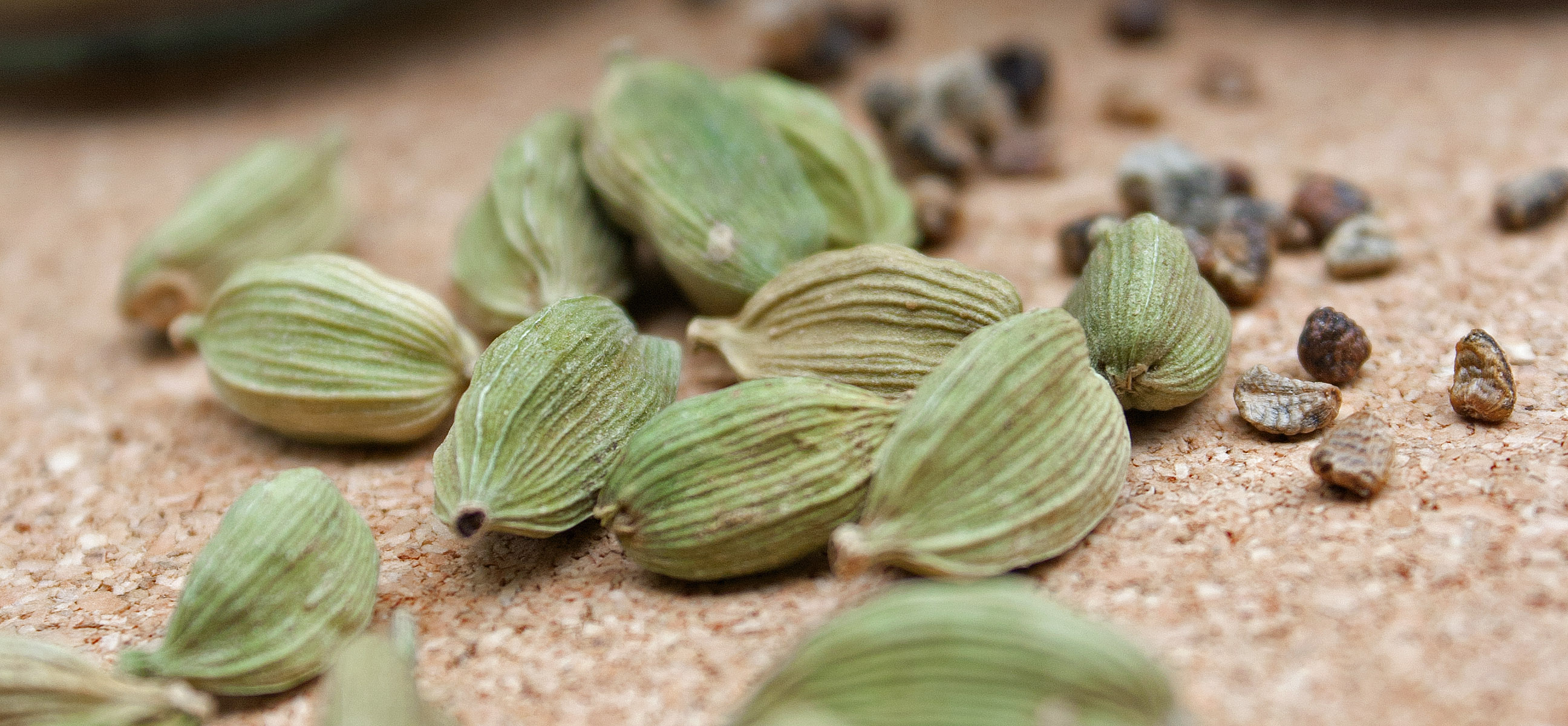
I used a higher speed and smaller f-stop of these cardamom pods and seeds to create a more shallow depth of field that focuses attention on a particular aspect of interest and keeps the image from looking flat (photo by Nina Munteanu)
A medium f-stop allowed me to freehold my camera and capture a crisp shot of the person and sled but a motion-blurred shot of the dog–achieving a sense of motion in the shot (photo by Nina Munteanu)
I oriented my camera for a portrait (vs landscape) shot to showcase the height and gigantic size of these red cedars in Lighthouse Park, Vancouver, and ensured a person was in the shot for perspective (photo by Nina Munteanu)
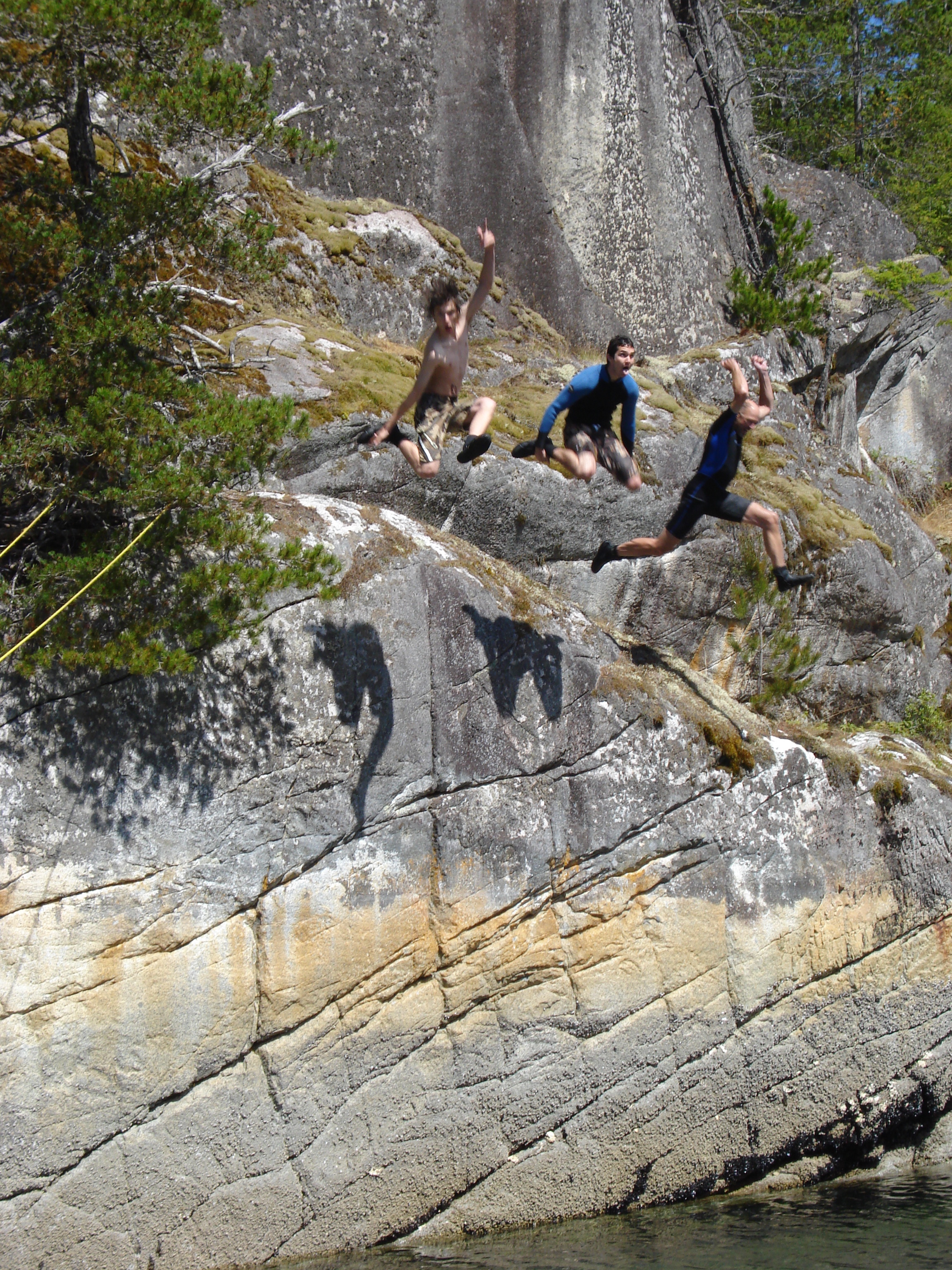
I used a low f-stop (which in good light does not appreciably reduce depth of field) to achieve high speed in capturing the three divers off the cliff (photo of ocean cliff in BC by Nina Munteanu)
I used a high f-stop and stabilized camera to achieve a softer look to the moving water and also get higher depth of field to see both stationary foreground and background (photo by Nina Munteanu)
I’ve been on my journey for over a decade and I’m still learning. From my son, from others, from my own experiences. That’s the fun part, after all. It’s an adventure of discovery…
My Canon camera on its tripod (photo taken with tablet by Nina Munteanu)
NINA MUNTEANU is a Canadian ecologist / limnologist and novelist. She is co-editor of Europa SF and currently teaches writing courses at George Brown College and the University of Toronto. Visit www.ninamunteanu.ca for the latest on her books. Nina’s bilingual “La natura dell’acqua / The Way of Water” was published by Mincione Edizioni in Rome. Her non-fiction book “Water Is…” by Pixl Press(Vancouver) was selected by Margaret Atwood in the New York Times ‘Year in Reading’ and was chosen as the 2017 Summer Read by Water Canada. Her novel “A Diary in the Age of Water” was released by Inanna Publications (Toronto) in June 2020.
Sugar maple tree with fallen leaves in autumn, ON (photo and rendition by Nina Munteanu)
My world: most wondrous, mystic shelter, Holy meridian of a life’s overwhelming mystery, Magic center of hope Haunting universe of a deepest longing…
Reflections of trees on outlet of creek into Otonabee River, ON (photo and rendition by Nina Munteanu)
My autumn world, tormented season And still time of the calm pastoral moon: Skies overhead, windtossed wildernesses, Seasons of joy, seasons of a bittersweet discontent Time’s last flowering before a fierce winter of silences
Snowing in treed meadow, ON (photo and rendition by Nina Munteanu)
Autumn ‘s last reflections midst storm ravaged skies… Last songs, the changing lights, Amber and golden hours Windswept calls, wild cry, surge, a windswept rage Rising lights, moving shadow across far spread field, Across wide spread glade…
Creek flowing into Otonabee River, ON in early winter (photo and rendition by Nina Munteanu)
A sacred bend and flow this existential time, Rhapsodies across a dying land Rain and storm riven sky songs, Windsong days, wild blasts to ravage and torment
Horizontal snow in a strong snow storm, ON (photo and rendition by Nina Munteanu)
The high windstorm prophesies: Promises of a fierce unmanning; Storm and lost days, winter and last days’ Their return too soon presage…. Haunted universes of a deepest longing.
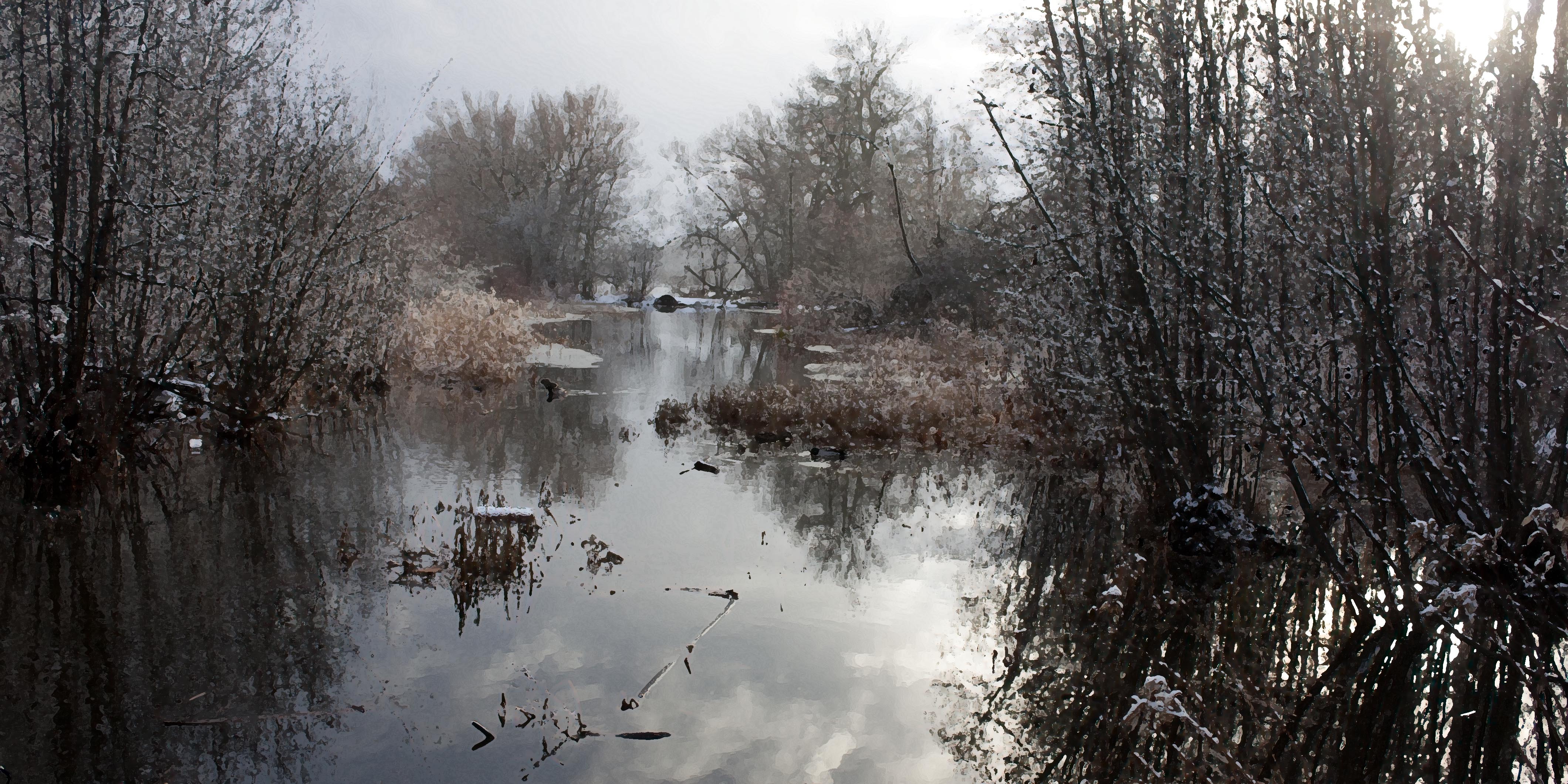
Marsh at lagoon of Otonabee River in winter fog, ON (photo and rendition by Nina Munteanu)
Bev Gorbet is a Toronto poet. She has published several poems with the Retired Teachers Organization and most recently in “Literary Connection IV: Then and Now” (In Our Words Inc., 2019), edited by Cheryl Antao Xavier.
Moss-covered rocks and leaf fall in Jackson Creek, ON (photo and rendition by Nina Munteanu)
NINA MUNTEANU is a Canadian ecologist / limnologist and novelist. She is co-editor of Europa SF and currently teaches writing courses at George Brown College and the University of Toronto. Visit www.ninamunteanu.ca for the latest on her books. Nina’s bilingual “La natura dell’acqua / The Way of Water” was published by Mincione Edizioni in Rome. Her non-fiction book “Water Is…” by Pixl Press(Vancouver) was selected by Margaret Atwood in the New York Times ‘Year in Reading’ and was chosen as the 2017 Summer Read by Water Canada. Her novel “A Diary in the Age of Water” was released by Inanna Publications (Toronto) in June 2020.
Jackson Creek just before sunset, ON (photo by Nina Munteanu)
It was early evening in late summer, when the sunlight was gentle and rich with the promise of golden light. I was walking in one of my favourite forests—the pine-cedar woodland that smelled of needles, bark and loam. This was Jackson Creek forest. Where some time ago I’d glimpsed a blue forest sprite…
The water in the creek was low, in places exposing its bones—boulders and cobbles that emerged out of the stream into the dry light. I walked along the creek bank, beside tranquil glades and chortling riffles. The creek trickled with the most delicious sounds, like chatty water sprites having tea, watercress sandwiches and fresh scones with jam …
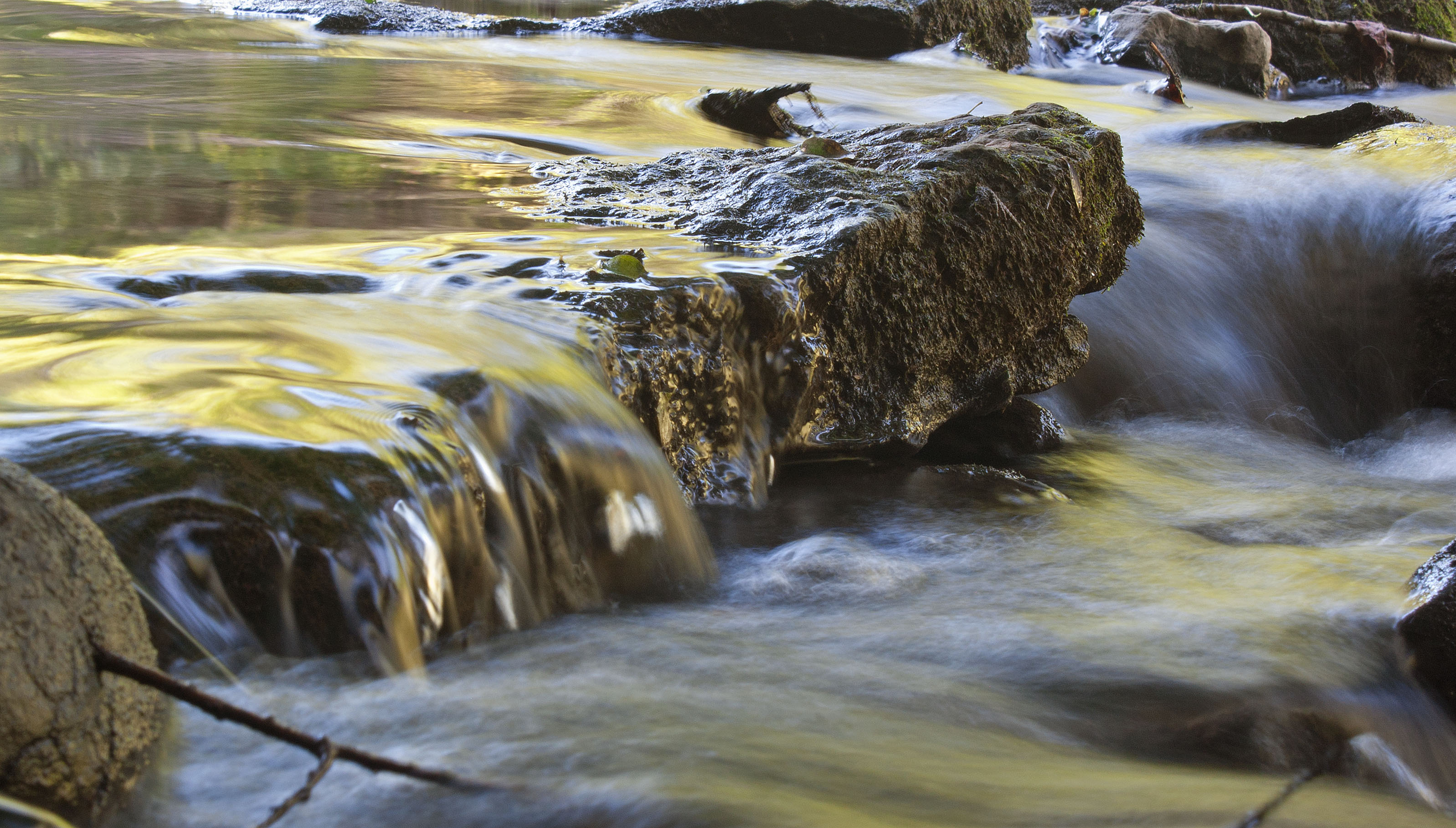
Sunlit water cascades over rocks of Jackson Creek, ON (photo by Nina Munteanu)
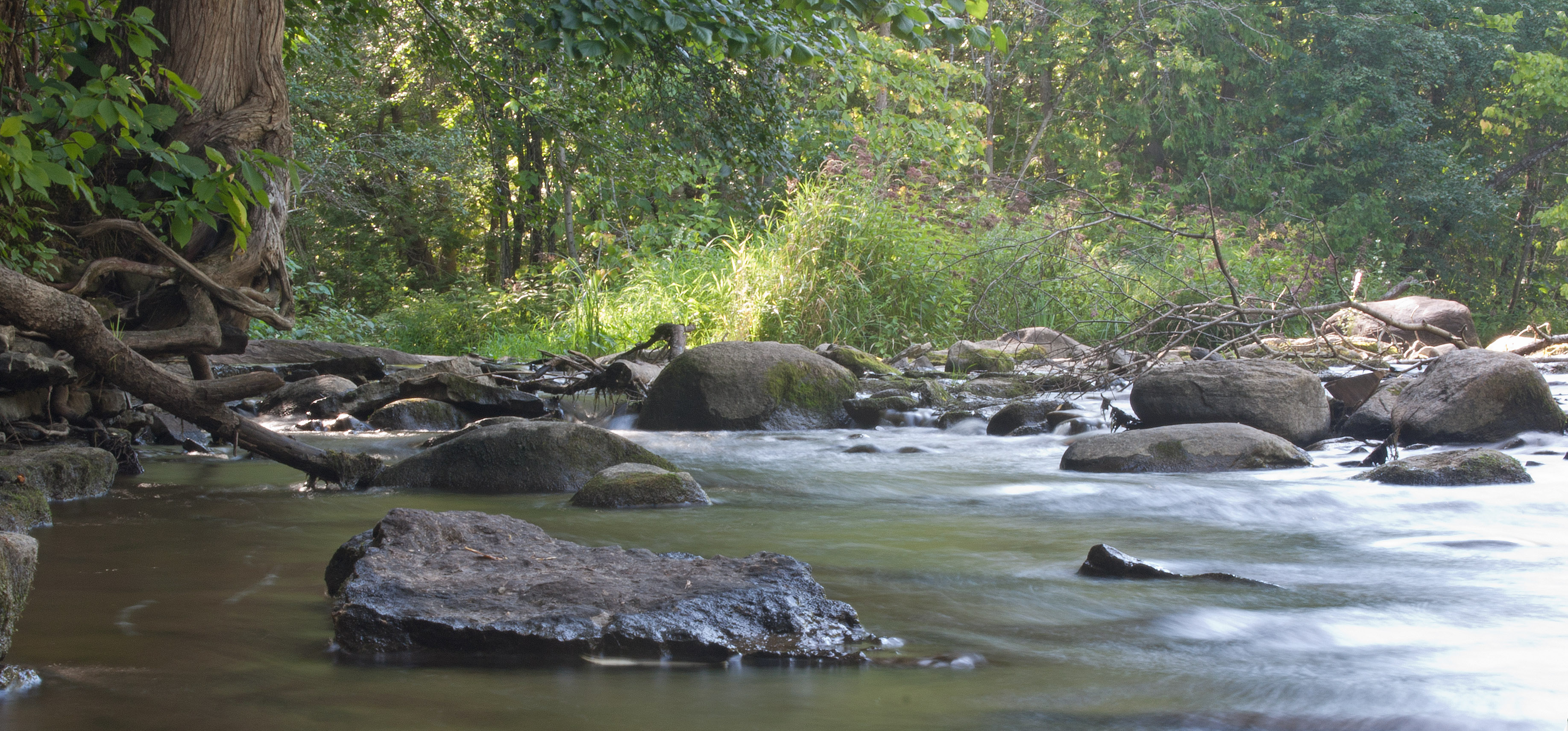
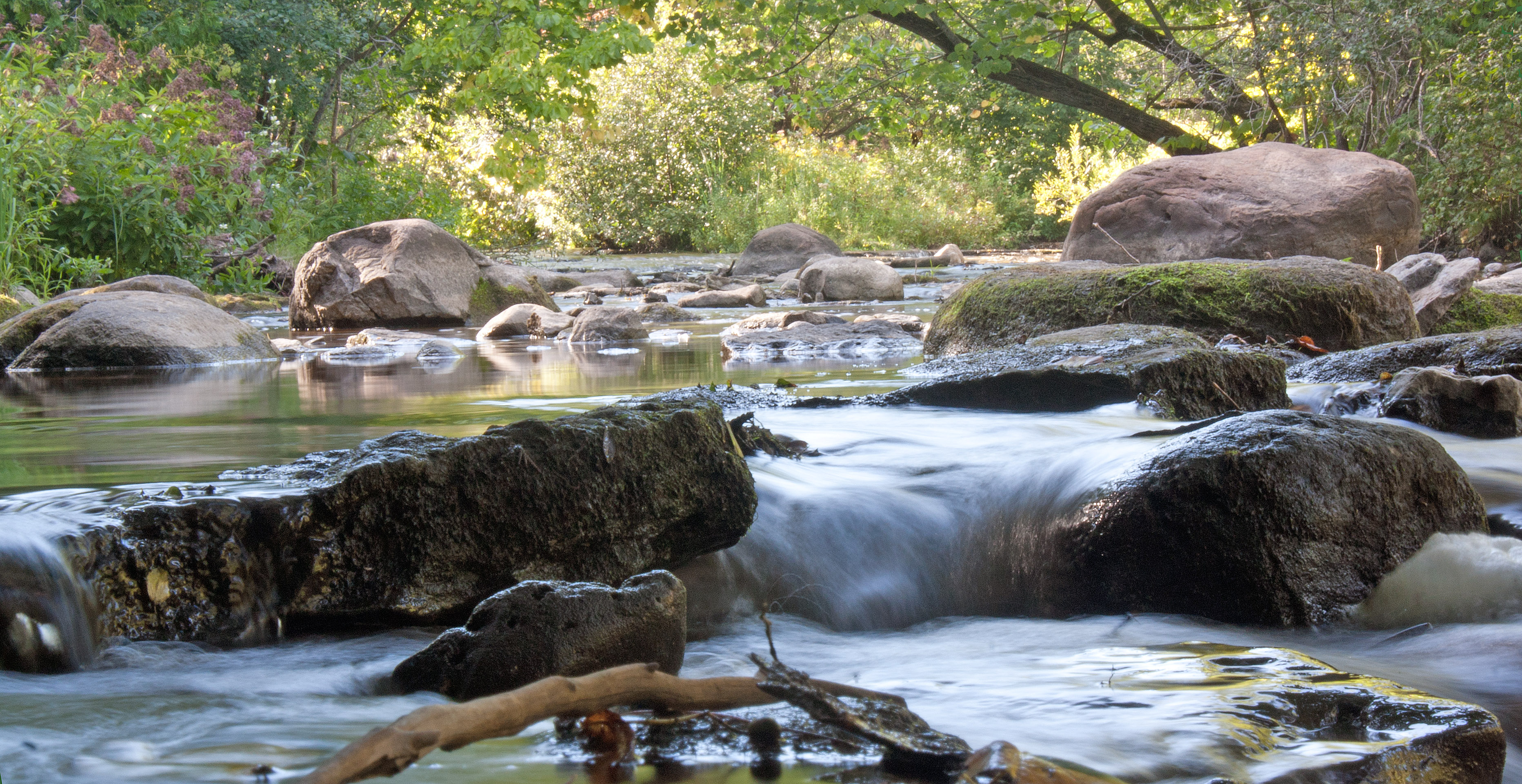
I set up my camera on the rocks to capture the silky green and gold reflections of the overhanging trees in the water. Oak, beech, and ironwood along with shrubs and grasses crowded the banks of the creek in a parade of leaves and flowers. Long arms of the cedar tree bent low over the creek as if reaching out to touch water’s skin.
Cedar tree overhangs Jackson Creek, ON (photo by Nina Munteanu)
In the gladed pools, the water swirled as if in slow motion in a fluid mosaic that mirrored the riparian forest. Each tree gave the water its unique shade in a diurnal dance that heralded the coming dusk and nightfall.
I walked the ythlaf, that remnant stretch of half-dried river bed, revealed by ebbing water. A place in-between land and water. I teetered on rocks and cobbles covered in dried periphyton, and angled the camera for long exposures up to f32. I crouched, squatted, crawled and kneeled on the cobbles, boulders and snags to position the camera just right. At times I danced to keep from falling in knee-deep water and laughed with thoughts of how the sprites were watching from below and taking bets on my possible spill into the water. I imagined their chortling giggles of anticipation.
Water cascading over rocks in Jackson Creek, ON (photo by Nina Munteanu)
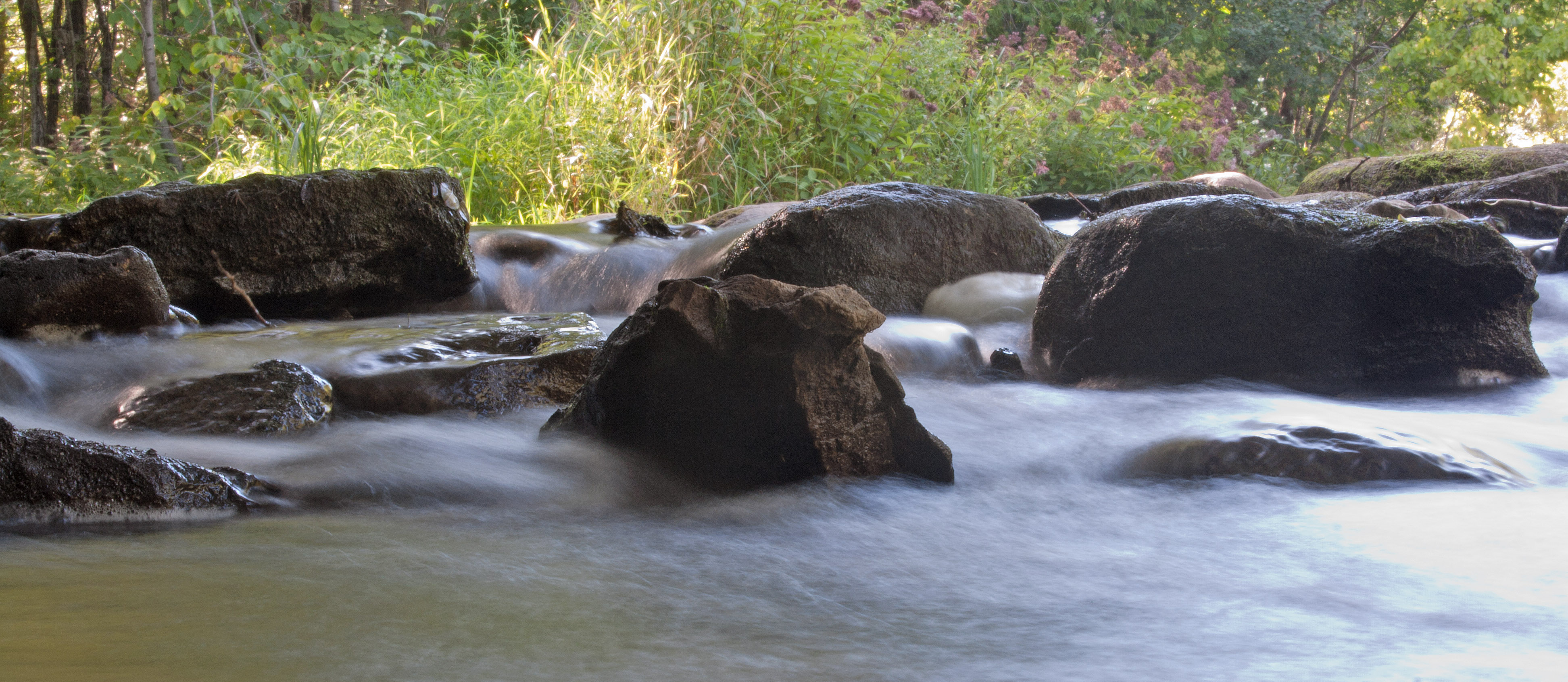
Then, with the patience of a heron, I captured the various faces of the creek during its golden hours. The water’s silken threads sparkled in the raking sunlight and hugged the rocks in swirling clouds.
Water swirls around rocks of Jackson Creek, ON (photo by Nina Munteanu)
We were nearing that in-between time, when all nature hushes for a life-breath as time descends for the briefest moment into a deep stillness. We lurked like thieves in that intermediate place of becoming, a diurnal ecotone poised on the threshold between night and day. The gloaming verge of a forest where dark and light danced with uncertain intent.
Glade of Jackson Creek, ON (photo by Nina Munteanu)
Immersed in the cheerful melody of the creek, I imagined the water sprites again, playing in the watercress forest, among the spinners, caddises and stonefly nymphs. I imagined them, plump gilled water-babies or slender creatures with winking faces, diaphanous wings sparkling in the slanting sunlight as they stirred up algae and organic detritus.
Were they dancing?
NINA MUNTEANU is a Canadian ecologist / limnologist and novelist. She is co-editor of Europa SF and currently teaches writing courses at George Brown College and the University of Toronto. Visit www.ninamunteanu.ca for the latest on her books. Nina’s bilingual “La natura dell’acqua / The Way of Water” was published by Mincione Edizioni in Rome. Her non-fiction book “Water Is…” by Pixl Press(Vancouver) was selected by Margaret Atwood in the New York Times ‘Year in Reading’ and was chosen as the 2017 Summer Read by Water Canada. Her novel “A Diary in the Age of Water” was released by Inanna Publications (Toronto) in June 2020.
Flooding creek in Trent Nature Sanctuary during a rain, ON (photo and rendition by Nina Munteanu)
One morning, in late spring, I went walking in the rain through the Trent Nature Sanctuary forest. Looking for magic… Moisture covered everything. It coaxed out vivid colours and textures in a tangle of stable chaos. I felt like I’d entered a Tom Thomson painting…
Moss-covered cedar trees after a soft rain in Trent Nature Sanctuary, ON (photo by Nina Munteanu)
The rain intensified the forest’s mosaic of unique scents from pungent, heavy and sharp to floral, fresh and sweet. The gossamer morning light favoured photography with a gentleness that softened and deepened everything, and invited intimacy. Mist hung low and rose like steam from the damp earth, slowing time. It felt as though I was walking through a cloud. The forest emerged ghost-like in glimpses of tree, shrub and grass. The brilliant red of the osier dogwood. The vivid greens of mosses and leaves. A tangle of blue-green lichens and bright red cedar roots. I was witness to a chaotic tapestry of Nature’s art. Infinite shades of green, brown, grey and yellow created a fluid landscape that water painted into a vibrant watercolour scene.
I moved through it, boots squelching along the spongy loam path, as though wrapped in a moving artwork.
Dew drops on hawksweed, lichen fruiting bodies in background, ON (photo by Nina Munteanu)
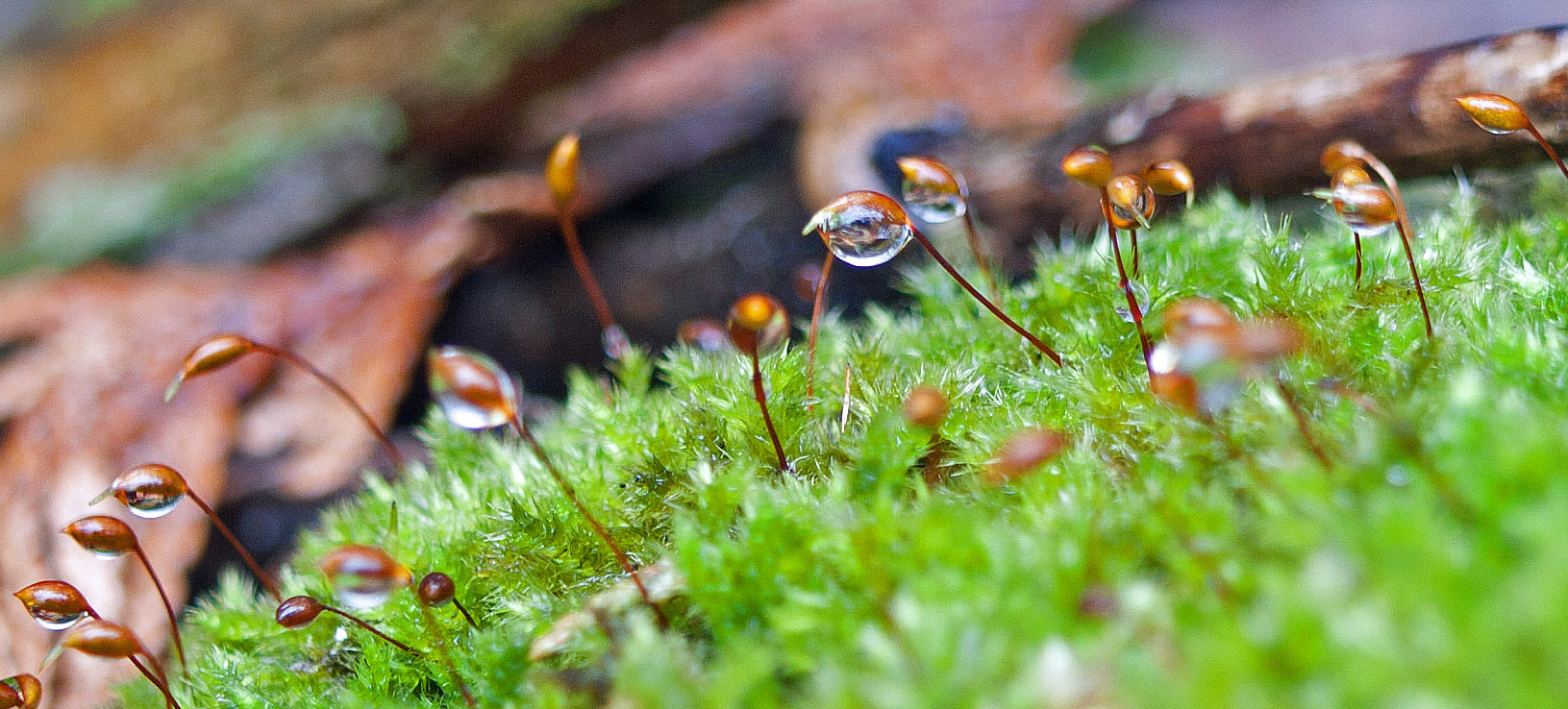
Moss with spore capsules in the rain, Trent Nature Sanctuary, ON (photo by Nina Munteanu)
Cedar roots and ferns in the heavy mist of a morning rain, Trent Nature Sanctuary, ON (photo by Nina Munteanu)
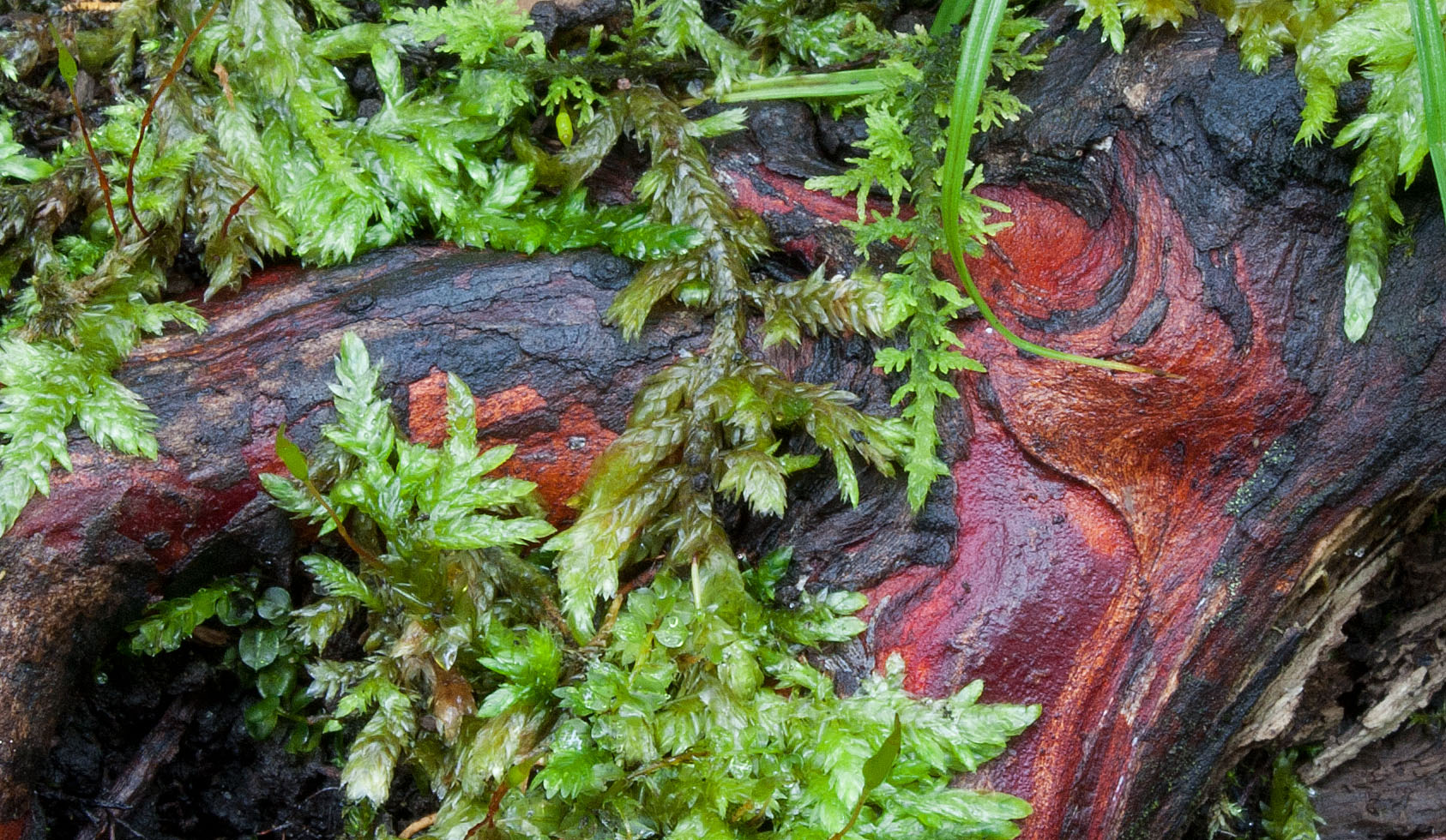
Cedar root and moss during a mild rain, Trent Nature Sanctuary, ON (photo by Nina Munteanu)
Cedar root and moss shortly after a rain, Trent Nature Sanctuary, ON (photo by Nina Munteanu)
The moisture carried the warbles and fluting chirps of lively bird song amid the hush of raindrops on vegetation. Each surface had a unique voice. And the rainfall—from light drizzle to hard pour—carried its own tune, rhythm and percussion. A symphony of diverse frequency from rich infrasound to beyond.
Nina’s Canon EOS Rebel camera on its tripod, ready to take photos, Trent Nature Sanctuary, ON (photo by Nina Munteanu)
I kept my camera, attached to its tripod, tucked under several water-proof bags and walked with deliberate steps through wet duff, decayed leaves and mud. I had a hood but couldn’t stand to keep it up—I needed to hear and feel all of it: the rain sizzling through the vegetation, the red-winged blackbird’s conk-a-lee! The robin’s cheerily-cheer-up-cheerily-cheer up! The crow’s caw and rattle. The primordial shriek of a blue jay or kingbird. All were out, though not visible, as I navigated the huge puddles and slippery mud-leaf mix. Hair dripping, face in a grin.
Rain falling on the marsh to the Otonabee River, ON (photo by Nina Munteanu)
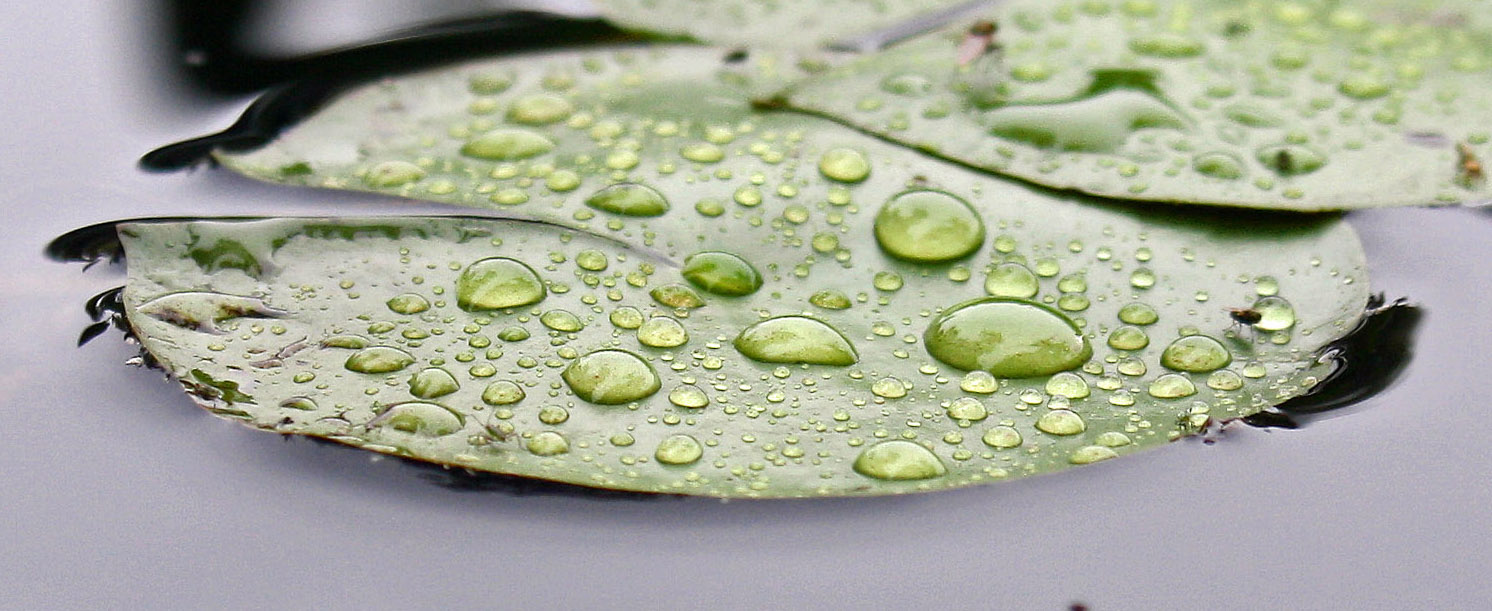
Pond lilies in the rain, ON (photo by Nina Munteanu)
Rain falls on the Otonabee River, ON (photo by Nina Munteanu)
I felt elation in Nature’s celebration of life. I was the only person in the park and thoroughly basked in that feeling of humbleness that comes with a kind of knowing: of being part of something far greater than oneself and yet in some way being that greater ‘self.’ Like I belonged there. Hard to explain. But it felt truly awesome and eternal.
Nina Munteanu
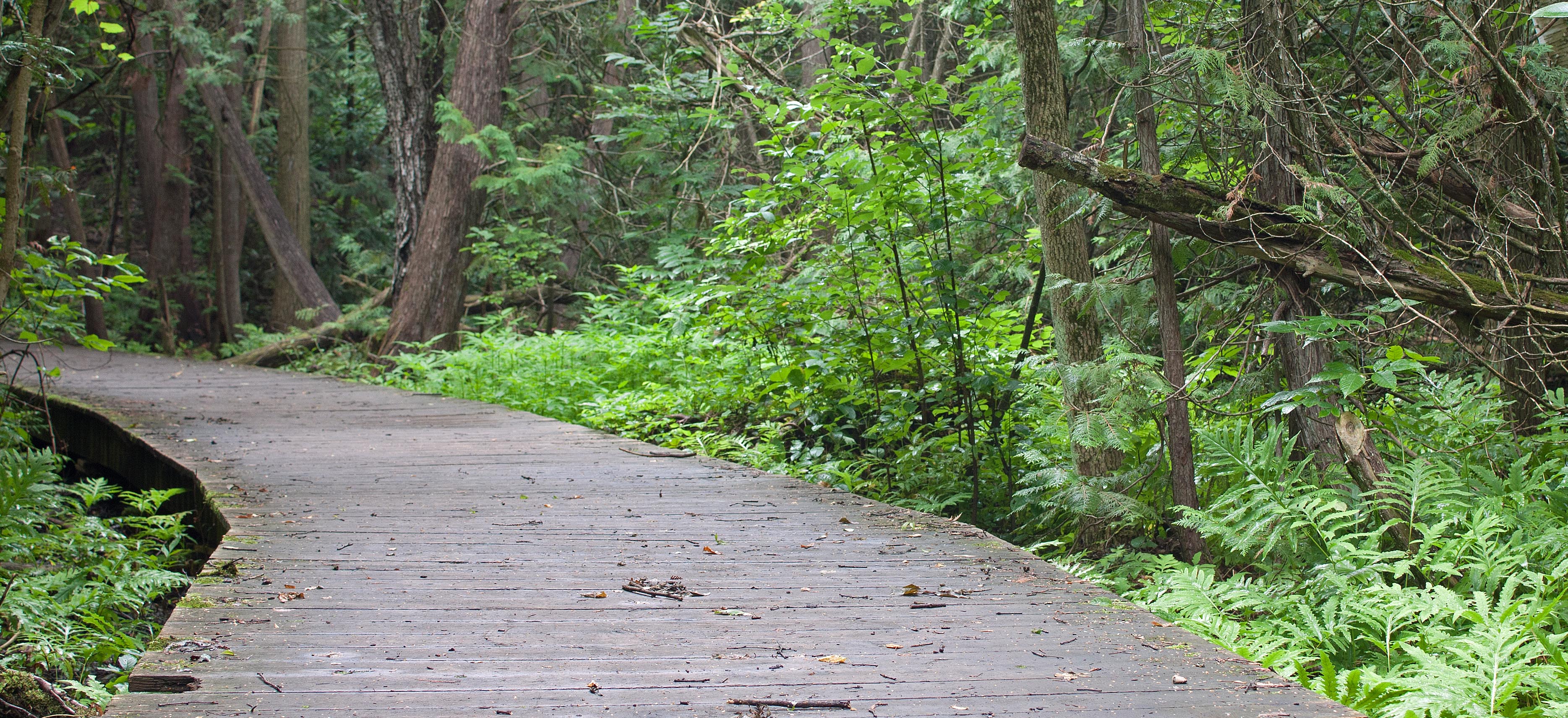
Boardwalk over the forest swamp, Trent Nature Sanctuary, ON (photo by Nina Munteanu)
Fence post with marsh in the background during a steady rainfall, ON (photo by Nina Munteanu)
Country road in the rain, ON (photo and rendition by Nina Munteanu)
I could have stayed there, wet in the rain, for hours. But I felt sorry for my camera and headed home, thinking of a warm cup of tea…
NINA MUNTEANU is a Canadian ecologist / limnologist and novelist. She is co-editor of Europa SF and currently teaches writing courses at George Brown College and the University of Toronto. Visit www.ninamunteanu.ca for the latest on her books. Nina’s bilingual “La natura dell’acqua / The Way of Water” was published by Mincione Edizioni in Rome. Her non-fiction book “Water Is…” by Pixl Press(Vancouver) was selected by Margaret Atwood in the New York Times ‘Year in Reading’ and was chosen as the 2017 Summer Read by Water Canada. Her novel “A Diary in the Age of Water” was released by Inanna Publications (Toronto) in June 2020.
Otonabee River glints in the sun as it snows, ON (photo and rendition by Nina Munteanu)
An autumn’s last days, fierce snowfalls, fall lights and storm The autumn landscape now full of wild moods, Hints of a magic wilderness and an encircling cold, The bitter winds, the fast falling hail: Landscape echo and retreat
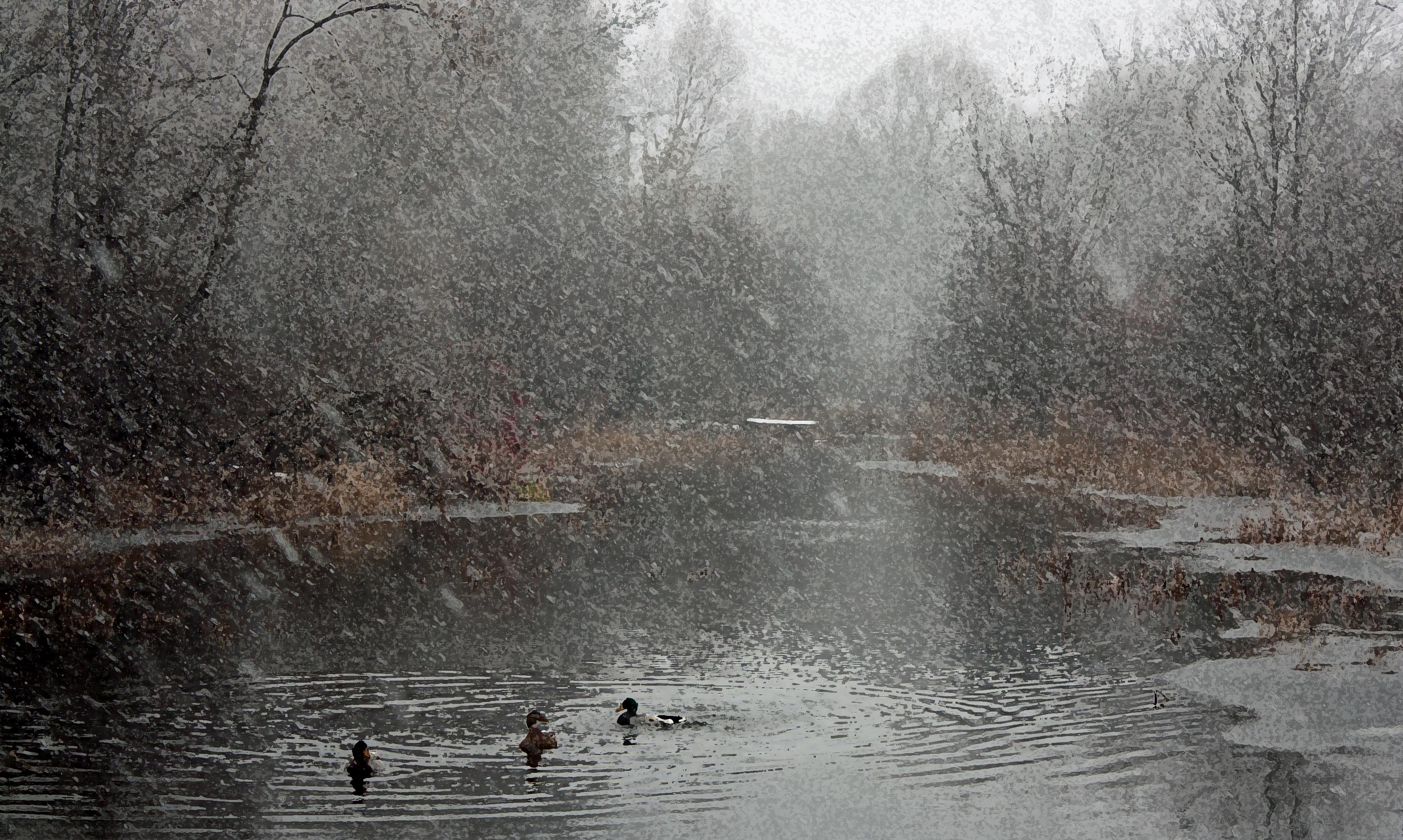
Mallards contently swim the marsh under a heavy snow, ON (photo and rendition by Nina Munteanu)
Snow veil mists over the receiving marsh lands: Somber cloud grays, shades of amber glow… Mallard ducks unconcernedly paddling On the smooth black marsh waters The snows above falling in majestic blizzards: Powerful bursts of snow over treetop And bended bough, Moody haze lit skies high falling away In blasts of snow and wind
Heavy snow falls in the riparian forest, ON (photo and rendition by Nina Munteanu)
Snowy reflections over high treetop above… Snowy days and last messages of a fading autumn’s glory: Detritus of bronze leaf, the withered beauty of a fading goldenrod A final sadness, autumn’s last messages, Haunted promises of a brilliant winter sunshine On snowy fields, velvet days and gold
Snow flies horizontally in a fierce wind, ON (photo and rendition by Nina Munteanu)
Now the forests bend, overwhelmed by the flying snow Thick tumbling down, shards of ice and rain Clouds of snow falling everywhere Forest pathways now covered in a lucent white glow, The shaded greens of cedar and fir picked out in a forest landscape; The continuing deluge, wild nature’s primordial powers: Mad windstorm and snow drift
Sun emerges over Thompson Creek marsh after the snowstorm, ON (photo and rendition by Nina Munteanu)
The still marsh waters now reflect the gray cloud, the sky high above All the windstorm madness, the bog detritus on the still marsh Now snow covered and silent, the snowfall ended The marsh now a sacred retreat: worlds of a glorious and gentle reflection, A tender, and radiant peace overall.
Bev Gorbet is a Toronto poet and retired school teacher. She has published several poems with the Retired Teachers Organization and most recently in “Literary Connection IV: Then and Now” (In Our Words Inc., 2019), edited by Cheryl Antao Xavier.
Thompson Creek marsh after a first snow in late autumn, ON (photo and rendition by Nina Munteanu)
Nina Munteanu revels in a snowstorm in Ontario (photo by Merridy Cox)
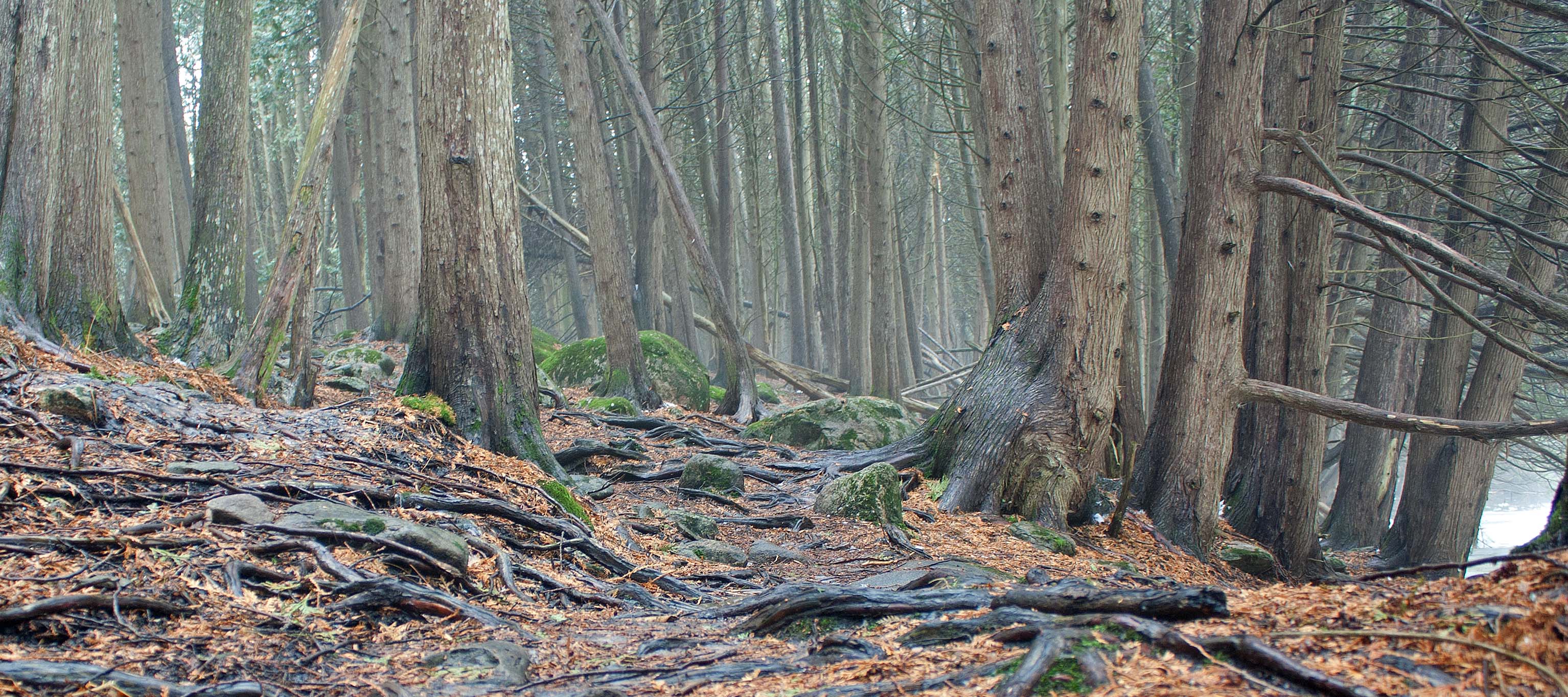
Cedar forest and extensive roots amid glacial erratics flank Jackson Creek on the right, ON (photo by Nina Munteanu)
.
It was a cold November day, after a light snow, as I wandered the Jackson Creek old-growth forest. Centuries-old cedar, pine and hemlock towered above me, giving off the fresh scent of forest. The trees creaked and cracked, swaying in a mischievous wind. I left the main path and descended the leaf-strewn slope toward the river. My boots pressed through a frosty crust into the spongy ground of dead leaves and organic soil. I stopped and breathed in the fresh coolness of the air. A damp mist huddled among the trees, adding wisps of mystery to the ancient forest. It was as though I’d entered an enchanted forest in some fanciful fairy tale.
Cedar forest on slope of Jackson Creek Park in early winter, ON (photo by Nina Munteanu)
.
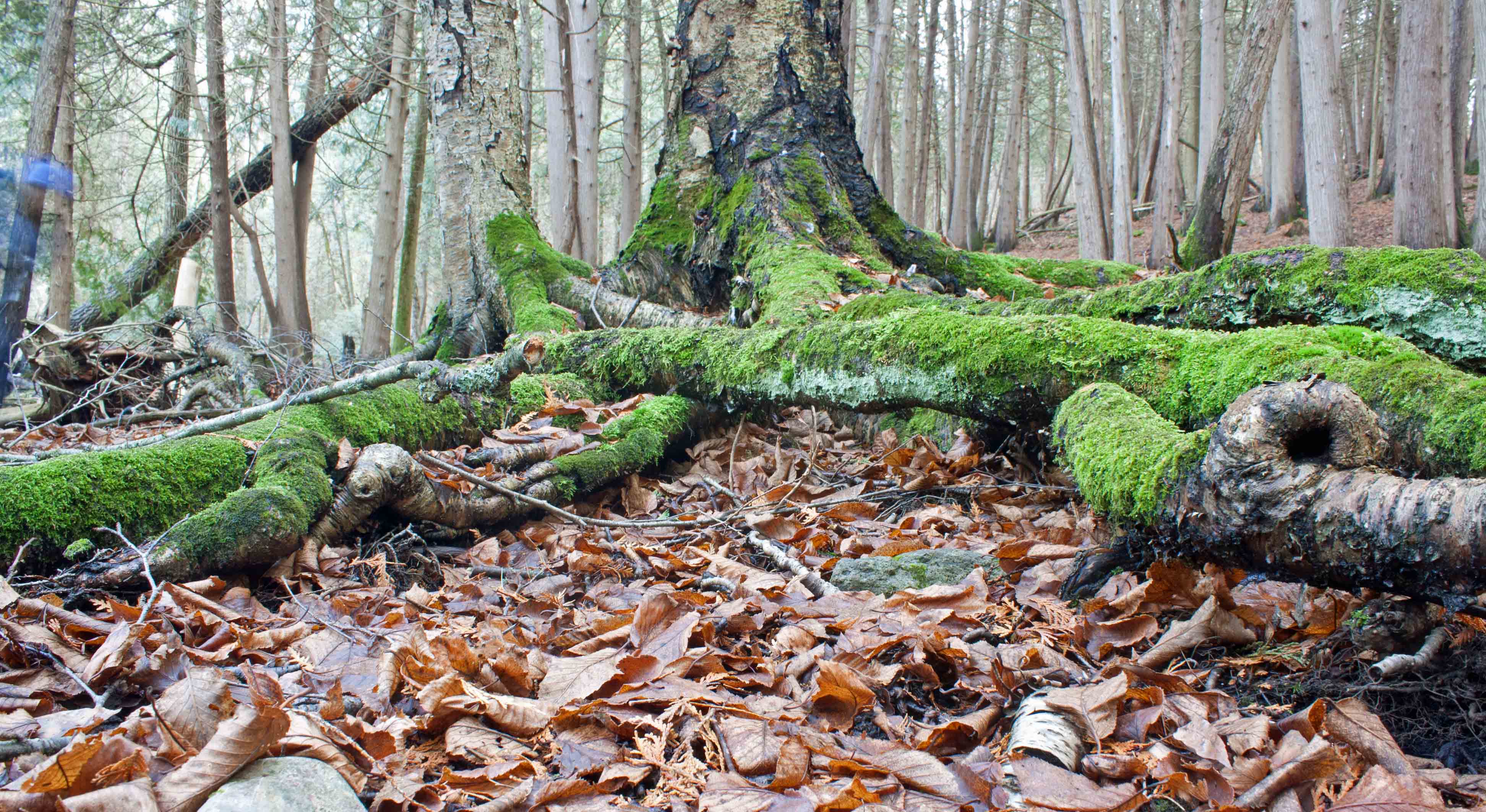
Not far from the river, I approached an old yellow birch tree, large trunk rising as tall as some of the cedars and pines around it. Golden flakes of bark curled and formed craggy patterns around the girth of the old tree. Radiating out from the tree, moss-covered roots snaked out like tangled ropes in a profusion of brilliant green. This was fairy country, I suddenly thought.
I dropped to my knees, crouching down, and set up my tripod and camera to capture this magical tree from the perspective of the forest floor. Head almost touching the ground, I inhaled the scent of loam and decaying leaves. The fresh pungency of cedar, pine, and humid moss hung in the air. Nearby, the river chortled and bubbled in a content symphony of motion. A curious red squirrel parked itself on a log nearby to watch me. It didn’t scold me like they normally did when I entered the forest; like it understood… It then occurred to me, as I set up my equipment under the squirrel’s careful stare, that I was in the presence of an enchantment. Like I was peering into a secret dance of feral celebration. But being there and appreciating it, I had now become part of it; I was Alice going down the rabbit hole into a true wonderland…
It was then that I glimpsed it as I carefully took my timed pictures. A blur of blue. What had I witnessed? A motion? A colour? Then it was gone. But in that moment, I’d felt the spark of an elation that comes with a glimpse into a secret world.
Old yellow birch tree and moss-covered roots with approaching blue sprite from left (photo by Nina Munteanu)
.
When I returned home to look at the images I saw that my camera had captured a wispy blue entity that flowed into its view and peered around the old birch at me with a kind of curious though mischievous grin.
Had I just captured a blue sprite? Something was unmistakably there!
Forest sprite peers around a yellow birch tree, Jackson Creek Park, ON (photo by Nina Munteanu)
.
I read up on sprites. According to European lore, a sprite is a supernatural entity. They are often depicted as fairy-like creatures or as an ethereal entity. The word sprite comes from the Latin spiritus (“spirit”), via the French esprit.
Given that the sprite I’d observed was blue and we were close to the river, I wondered if it was not a forest or wood sprite, but a water sprite. According to alchemist Paracelsus, the term ‘water sprite’ is used for any elemental spirit associated with water. They can breathe water or air and sometimes can fly. They also possess the power of hydrokinesis, which is the ability to create and manipulate water at will. Also known as ‘water nymphs’ and naiads (or nyads), these divine entities tend to be fixed in one place. Slavic mythology calls them vilas. Sprites are not corporeal beings (like selkies, mermaids and sirens) given that they are not purely physical; they are more like local deities than animals. This explained the wispy nature of the being I’d seen peering at me from the tree.
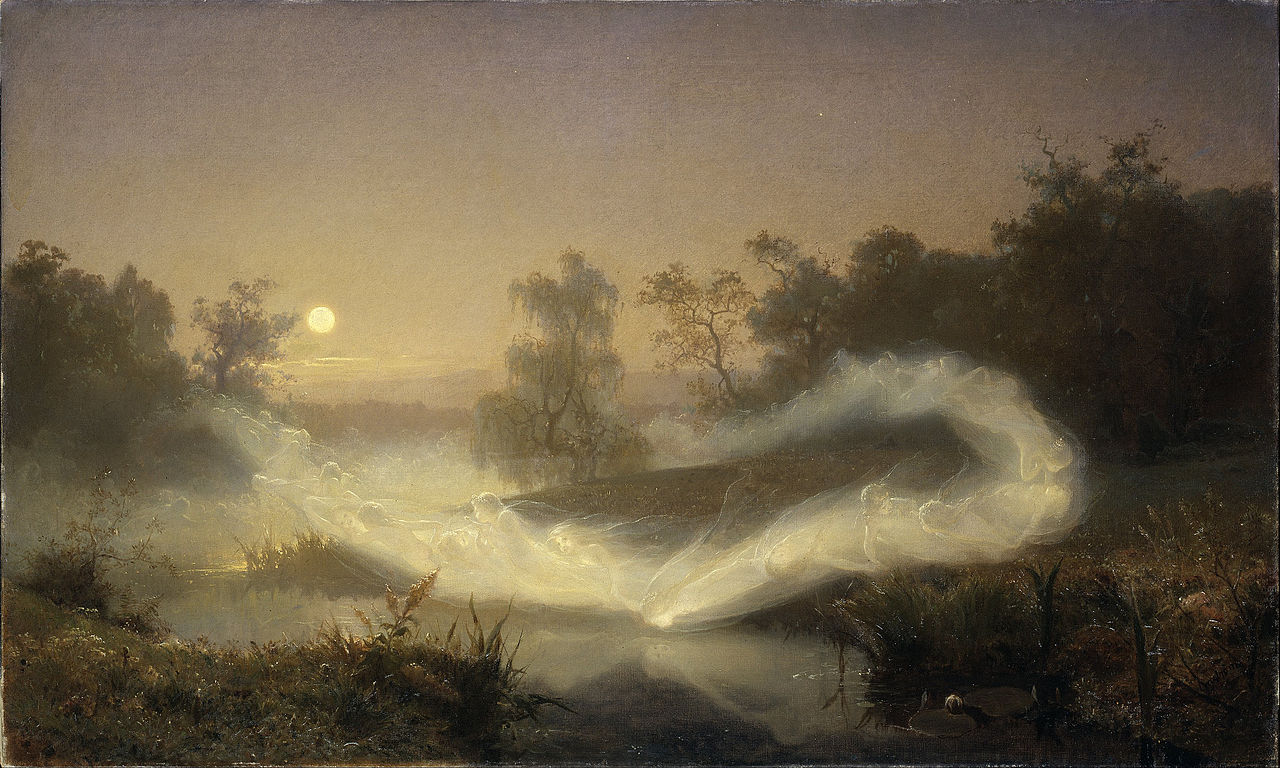
“Dancing Fairies” by August Malmström
.
After consulting with several friends—some who purported to know much more about sprites than I did—I concluded that this sprite was, in fact, a forest sprite and it was blue because it was near the water. Friend Merridy suggested that “forest sprites, normally green, may turn blue if a nearby brook calls to them.” She added that “water sprites can be distinguished by their chatty nature. They rarely go beyond the banks of a river or brook. Forest sprites are mostly silent.” Which this one certainly was. Friend Craig then pondered, “Are digital sprites in our world or in an electro-magnetic world? Or something else?” He was referring to them showing up on my camera without me even noticing they were there. When I told him I would return in search of them he observed, “if you’re looking for them that might be when they hide. Or maybe not. Any type of sprite is probably good, mischievous or friendly.” Thanks, Craig! That was helpful…
Glacial erratic boulders in Jackson Creek, ON (photo by Nina Munteanu)
Century-old beech tree, decaying and moss-covered in early winter, Jackson Creek Park, ON (photo by Nina Munteanu)
Ancient cedar tree stands next to an ice sheet on the path beside Jackson Creek, ON (photo by Nina Munteanu)
.
I visited the forest many times after but saw no sign of any sprites. Perhaps Craig was right; they were hiding from me.
Then, on a foggy late December day, after a light dusting of snow, I returned to document the ice forming in the river. Islands and columns of ice had created a new topography for the flowing waters of Jackson Creek. Ice sheets also covered the forest path in places—making the walk somewhat treacherous. At times, I had to scramble and seize hold of branches to haul my way up precipitous banks from where I’d captured sculptures of ice ‘pearls,’ ‘platforms,’ and ‘columns’ on the river.
Ice forming on Jackson Creek in early winter, ON (photo by Nina Munteanu)
Ice ‘pearls’ forming on shore by rushing river, Jackson Creek, ON (photo by Nina Munteanu)
.
The fog grew thick as my walk eventually led me into an area of eccentric lopsided cedars in a ‘drunken’ stand by the river bank. The cedars sent out a tangled tapestry of gnarly roots I had to negotiate. I could feel the earth-magic. I dropped to my knees again and set my camera and tripod to the level of the roots. That is when I saw the blue sprite again! This time the sprite wasn’t playful; it appeared startled and disoriented. But, I managed to capture it as it fled the scene in wisps of blue smoke. As I left the forest, my thoughts returned to this serendipitous moment. Had I interrupted the wood /earth sprite in its work in the forest? These sprites are known to have the power of chlorokinesis, the ability to grow and control plants at will. When I checked my images at home, the sprite appeared to float near one of the cedars.
Blue forest sprite floats by cedar tree, Jackson Creek Park, ON (photo by Nina Munteanu)
.
When she saw the image, friend Merridy asked, “was the sprite entering the tree?” Thinking of incantations, friend Dyana asked if I’d had my recording feature on, which I’d never thought to do. On second thought, she decided that it might be dangerous. Not a good idea to anger a sprite. Friend Gabriela then challenged me: “did you ask what message they have for you, Nina? They keep showing up in your way, they might have a message for you or to be delivered through you to…” whoever… I hadn’t thought of that either. How would I hear their message when they were silent and so fleeting, I challenged back. She wisely responded, “Just ask yourself the question; you might be surprised when your next thought brings the answer. Since everything is energy, and you saw them at least twice, you’re probably connected with them.”
Sprite vaporizes behind tree, Jackson Creek Park, ON (photo by Nina Munteanu)
.
I didn’t tell her that the question that came to mind after seeing the sprite was: I wonder what’s for dinner!
I must ponder this more, however.
Cedar forest on a misty winter day, Jackson Creek Park, ON (photo by Nina Munteanu)
Thinking of Gabriela’s interesting remark, I am reminded of a rather sad but evocative tale by Vladimir Nabokov entitled “The Wood Sprite.” Told in the first person, it recounts the narrator’s experience when he was visited at his desk by an old wood sprite, “powdered with the pollen of the frosty, starry night.” The creature tells of his exile from a country wood in Russia, all cut down and burned amid the treachery of war.
Now that I think of it, I know the blue sprite’s message. And now you know it too.
Cedar forest and roots amid glacial erratics in Jackson Creek Park, ON (photo by Nina Munteanu)
Nina Munteanu is a Canadian ecologist / limnologist and novelist. She is co-editor of Europa SF and currently teaches writing courses at George Brown College and the University of Toronto. Visit www.ninamunteanu.ca for the latest on her books. Nina’s bilingual “La natura dell’acqua / The Way of Water” was published by Mincione Edizioni in Rome. Her non-fiction book “Water Is…” by Pixl Press(Vancouver) was selected by Margaret Atwood in the New York Times‘Year in Reading’ and was chosen as the 2017 Summer Read by Water Canada. Her novel “A Diary in the Age of Water” was released by Inanna Publications (Toronto) in June 2020.
Undulating hills of a farmer’s field in Kawartha countryside, ON (photo and dry brush rendition by Nina Munteanu)
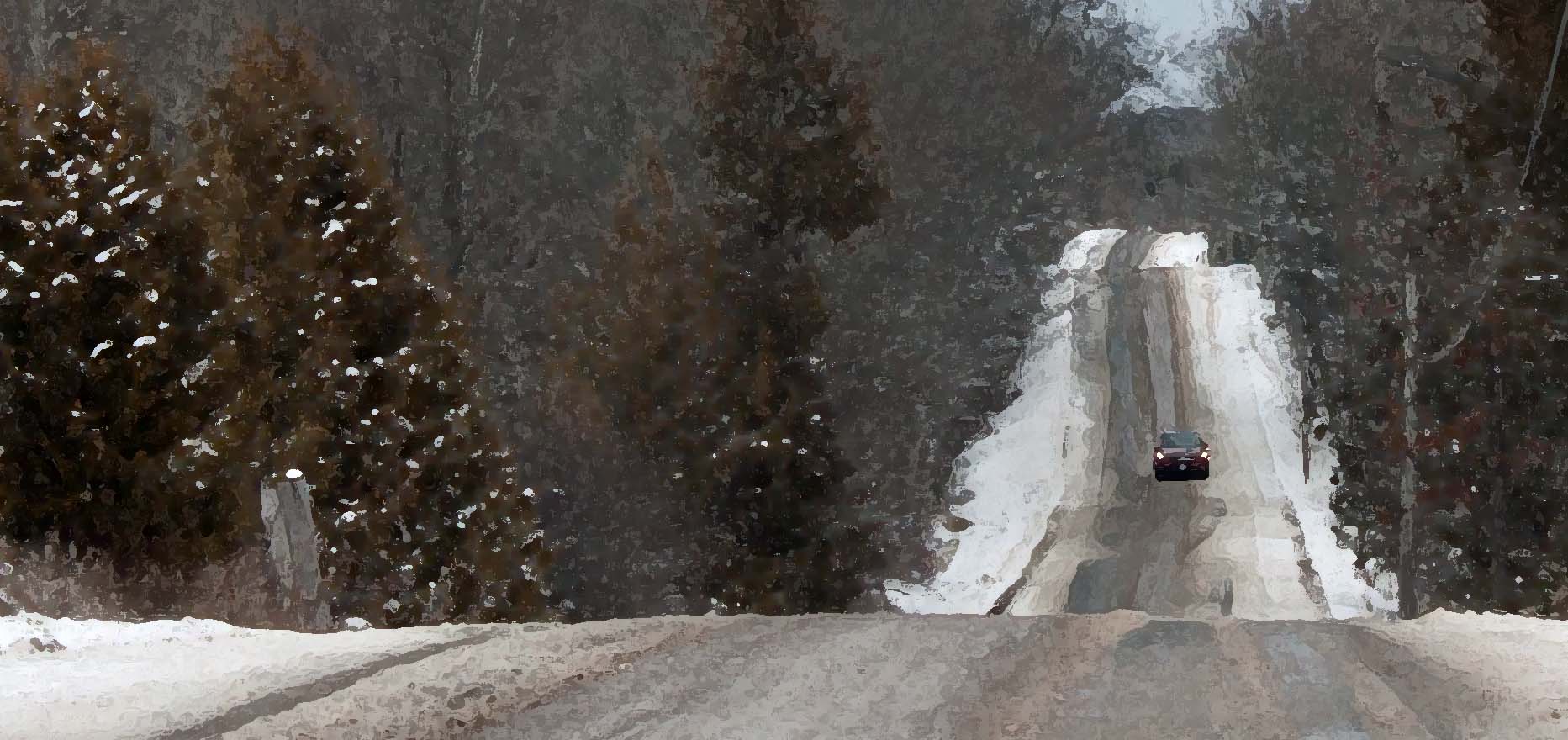
Country road in Kawarthas during snowfall early winter, ON (photo and dry brush rendition by Nina Munteanu)
Farmer’s field by country road in early winter, ON (photo and dry brush rendition by Nina Munteanu)
Country road viewed from Kawartha drumlin during snowfall, ON (photo and dry brush rendition by Nina Munteanu)
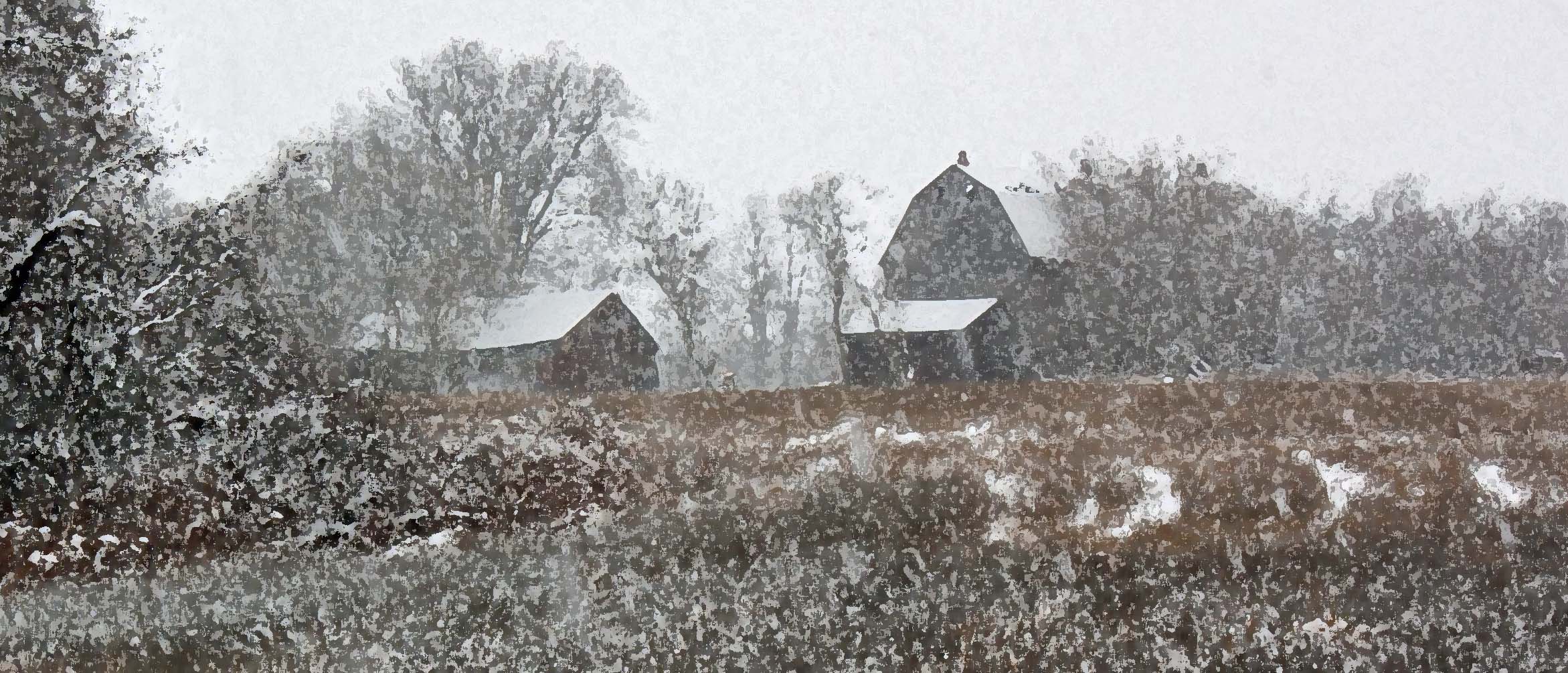
Small farm in Kawartha countryside in winter, ON (photo and dry brush rendition by Nina Munteanu)
Country road in winter on a sunny day, ON (photo and dry brush rendition by Nina Munteanu)
Farmer’s field during snow fog of winter, ON (photo and dry brush rendition by Nina Munteanu)
Country road during snowfall, ON (photo and dry brush rendition by Nina Munteanu)
Farm and field during heavy snowfall, ON (photo and dry brush rendition by Nina Munteanu)
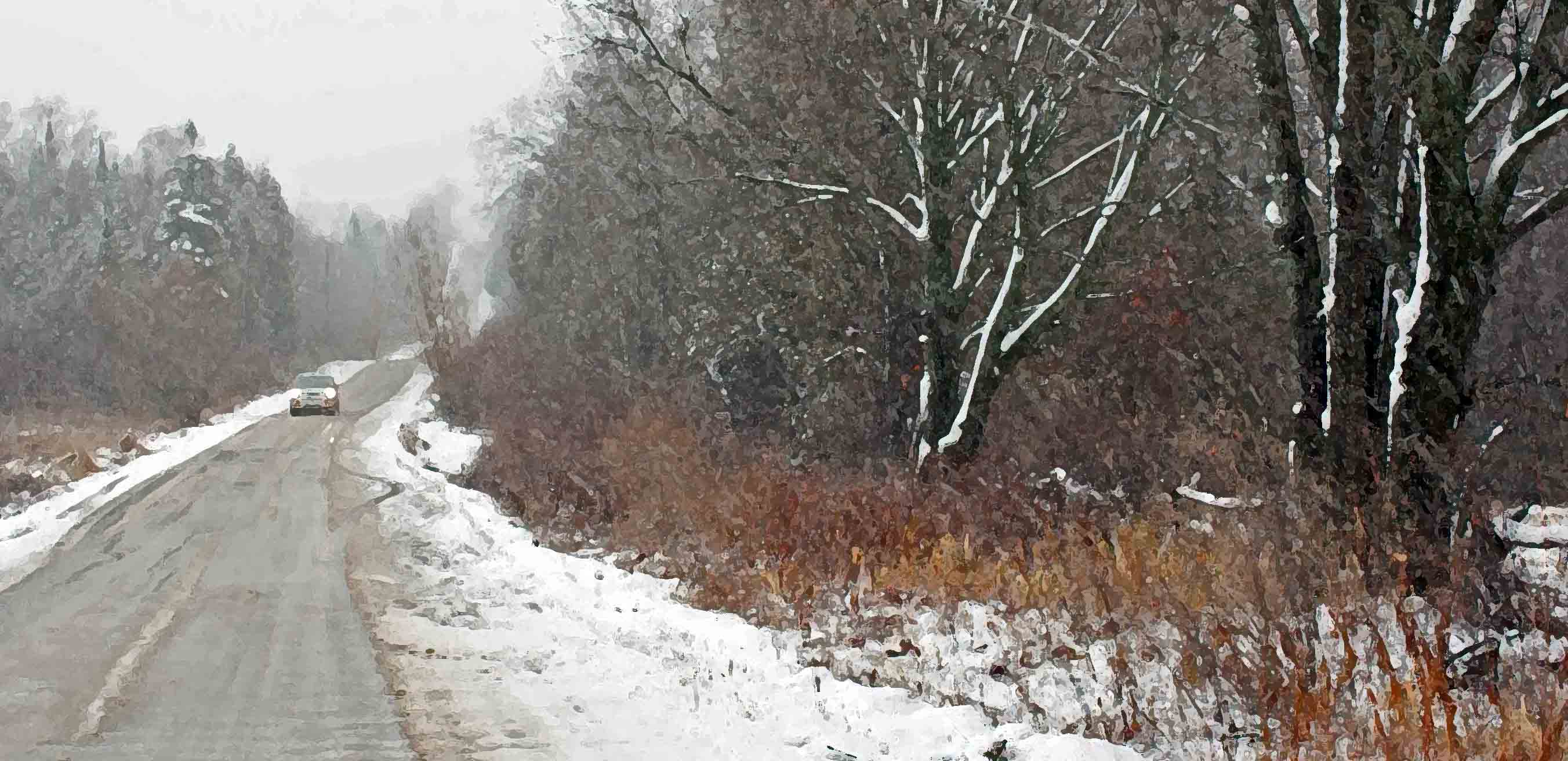
Country road in Kawarthas in winter, ON (photo and dry brush rendition by Nina Munteanu)
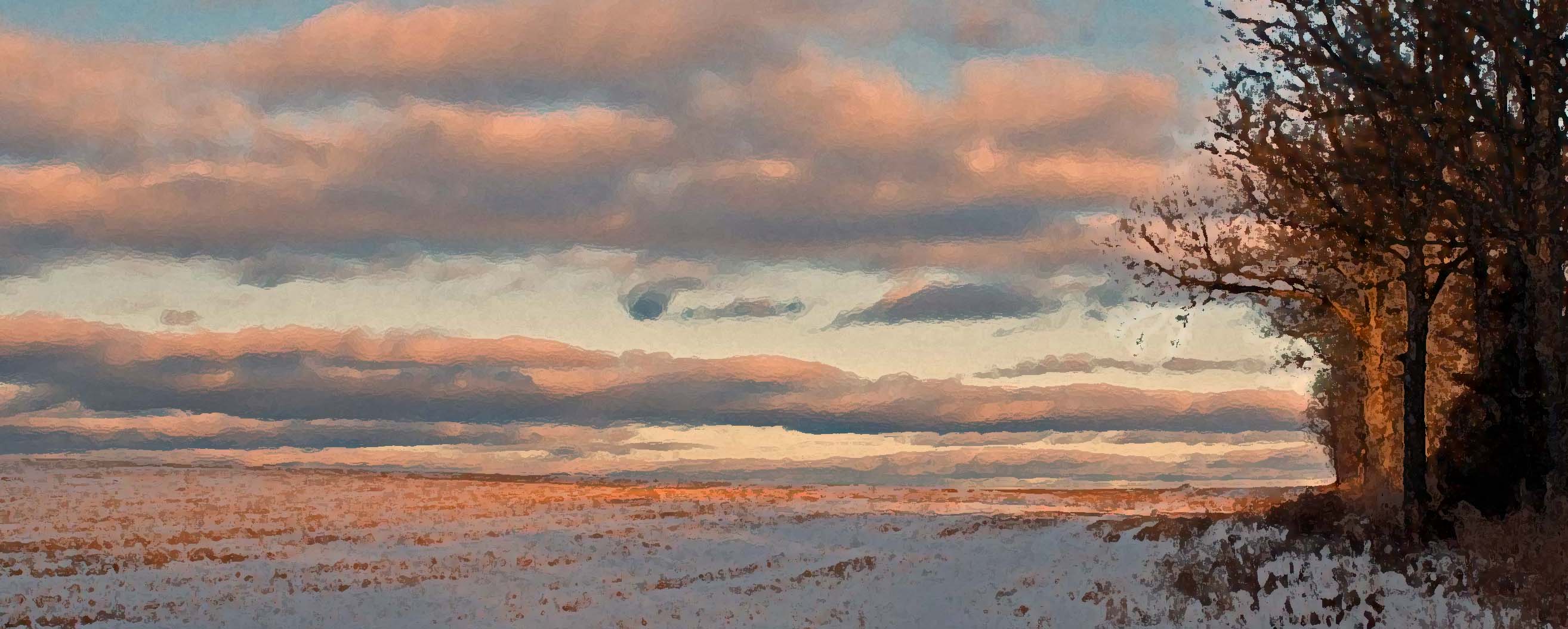
Farmer’s field aglow at sunset in winter, ON (photo and dry brush rendition by Nina Munteanu)
Nina Munteanu is a Canadian ecologist / limnologist and novelist. She is co-editor of Europa SF and currently teaches writing courses at George Brown College and the University of Toronto. Visit www.ninamunteanu.ca for the latest on her books. Nina’s bilingual “La natura dell’acqua / The Way of Water” was published by Mincione Edizioni in Rome. Her non-fiction book “Water Is…” by Pixl Press(Vancouver) was selected by Margaret Atwood in the New York Times‘Year in Reading’ and was chosen as the 2017 Summer Read by Water Canada. Her novel “A Diary in the Age of Water” was released by Inanna Publications (Toronto) in June 2020.










































 Nina Munteanu Writing Coach