My Short Story “The Polywater Equation” (Die Polywasser-Gleichung) in “Tales of Science II” Anthology

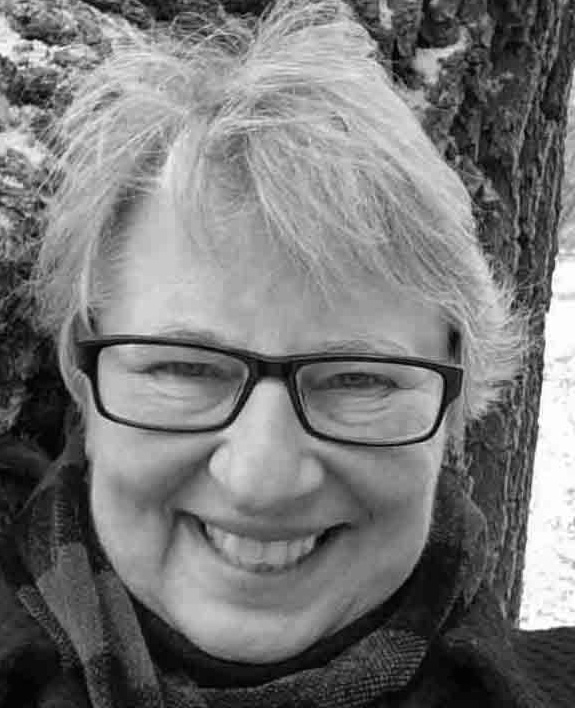
Author Nina Munteanu holding copy of Tales of Science II (photo by Jane Raptor)

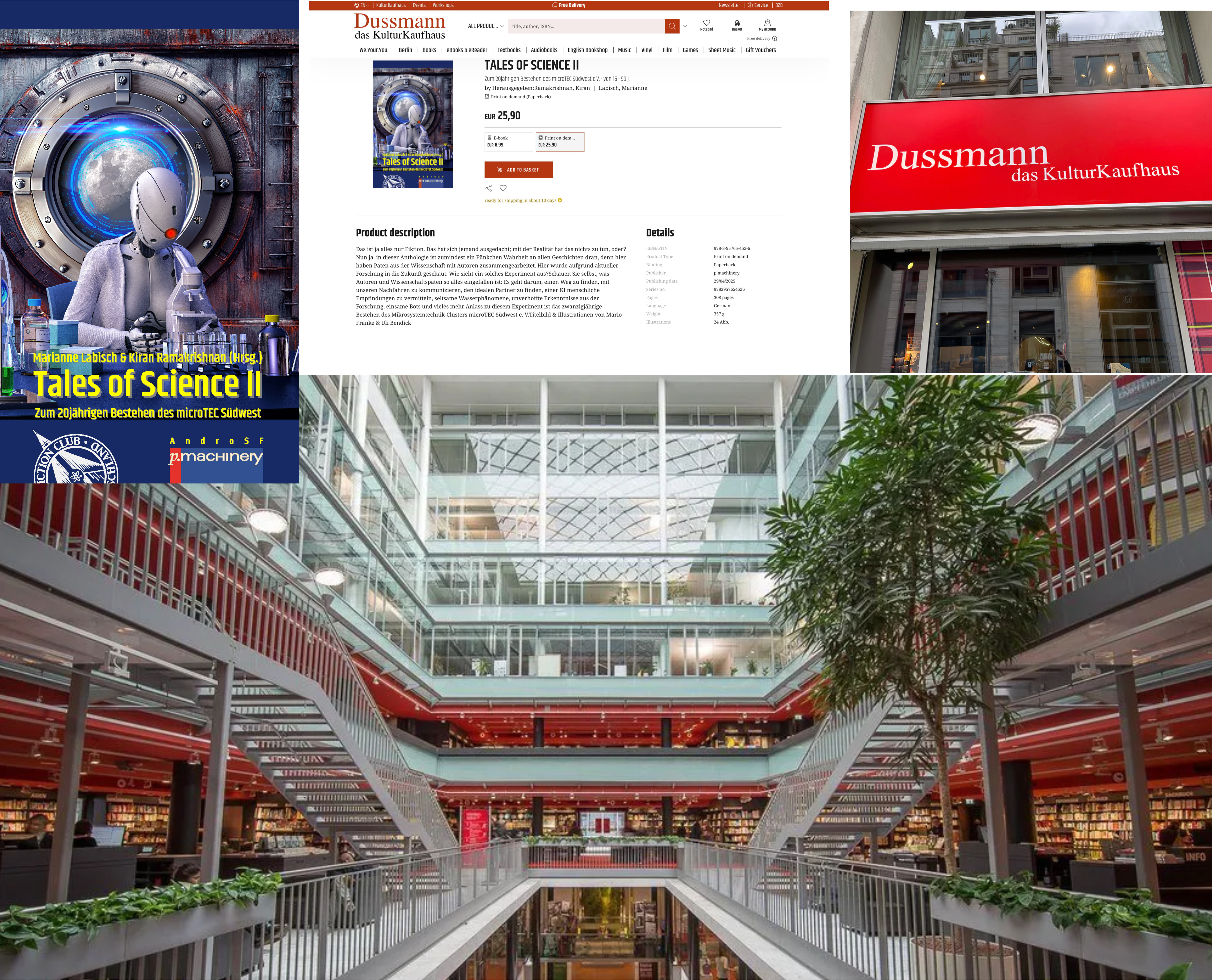
A few weeks ago, I looked into my mail box and found my contributor’s copy of “Tales of Science II” Anthology (edited by Marianne Labisch & Kiran Ramakrishnan) with my short story Die Polywasser-Gleichung (“The Polywater Equation”) inside. Beaming, I did a little dance because the anthology was marvelous looking! And it was all in German! (My mother is German, so I could actually read it; bonus!).

This science-fiction anthology, for which I was invited to contribute, collected seventeen short stories, all based on sound science. Here’s how the book jacket blurb (translated from German) describes the anthology:

It’s all just fiction. Someone made it up; it has nothing to do with reality, right? Well, in this anthology, there’s at least a grain of truth in all the stories, because scientific sponsors collaborated with authors. Here, they looked into the future based on current research What does such an experiment look like? See for yourself what the authors and scientific sponsors have come up with: about finding a way to communicate with out descendants, finding the ideal partner, conveying human emotions to an AI, strange water phenomena [that’s my story], unexpected research findings, lonely bots, and much more. The occasion for this experiment is the 20th anniversary of the microsystems technology cluster microTEC Südwest e. V.

(cover image and illustrations by Mario Franke and Uli Benkick)

In our initial correspondence, editor Marianne Labisch mentioned that they were “looking for short stories by scientists based on their research but ‘spun on’ to create a science fiction story;” she knew I was a limnologist and was hoping I would contribute something about water. I was glad to oblige her, having some ideas whirling in my head already. That is how “The Polywater Equation” (Die Polywasser-Gleichung) was born.

I’d been thinking of writing something that drew on my earlier research on patterns of colonization by periphyton (attached algae, mostly diatoms) in streams using concepts of fluid mechanics. Elements that worked themselves into the story and the main character, herself a limnologist, reflected some aspects of my own conflicts as a scientist interpreting algal and water data (you have to read the story to figure that out).

My Work with Periphyton

As I mentioned, the short story drew on my scientific work, which you can read about in the scientific journal Hydrobiologia. I was studying the community structure of periphyton (attached algae) that settled on surfaces in freshwater streams. My study involved placing glass slides in various locations in my control and experimental streams and in various orientations (parallel or facing the current), exposing them to colonizing algae. What I didn’t expect to see was that the community colonized the slides in a non-random way. What resulted was a scientific paper entitled “the effect of current on the distribution of diatoms settling on submerged glass slides.”

A. Distribution of diatoms on a submerged glass slide parallel to the current; treated diatom frustules are white on a dark background. B. diagram of water movement around a submerged glass slide showing laminar flow on the inner face and turbulent flow on the edges (micrograph photo and illustration by Nina Munteanu)

For more details of my work with periphyton, you can go to my article called Championing Change. How all this connects to the concept of polywater is something you need to read in the story itself.

The Phenomenon of Polywater

The phenomenon started well before the 1960s, with a 19th century theory by Lord Kelvin (for a detailed account see The Rise and Fall of Polywater in Distillations Magazine). Kelvin had found that individual water droplets evaporated faster than water in a bowl. He also noticed that water in a glass tube evaporated even more slowly. This suggested to Kelvin that the curvature of the water’s surface affected how quickly it evaporated.

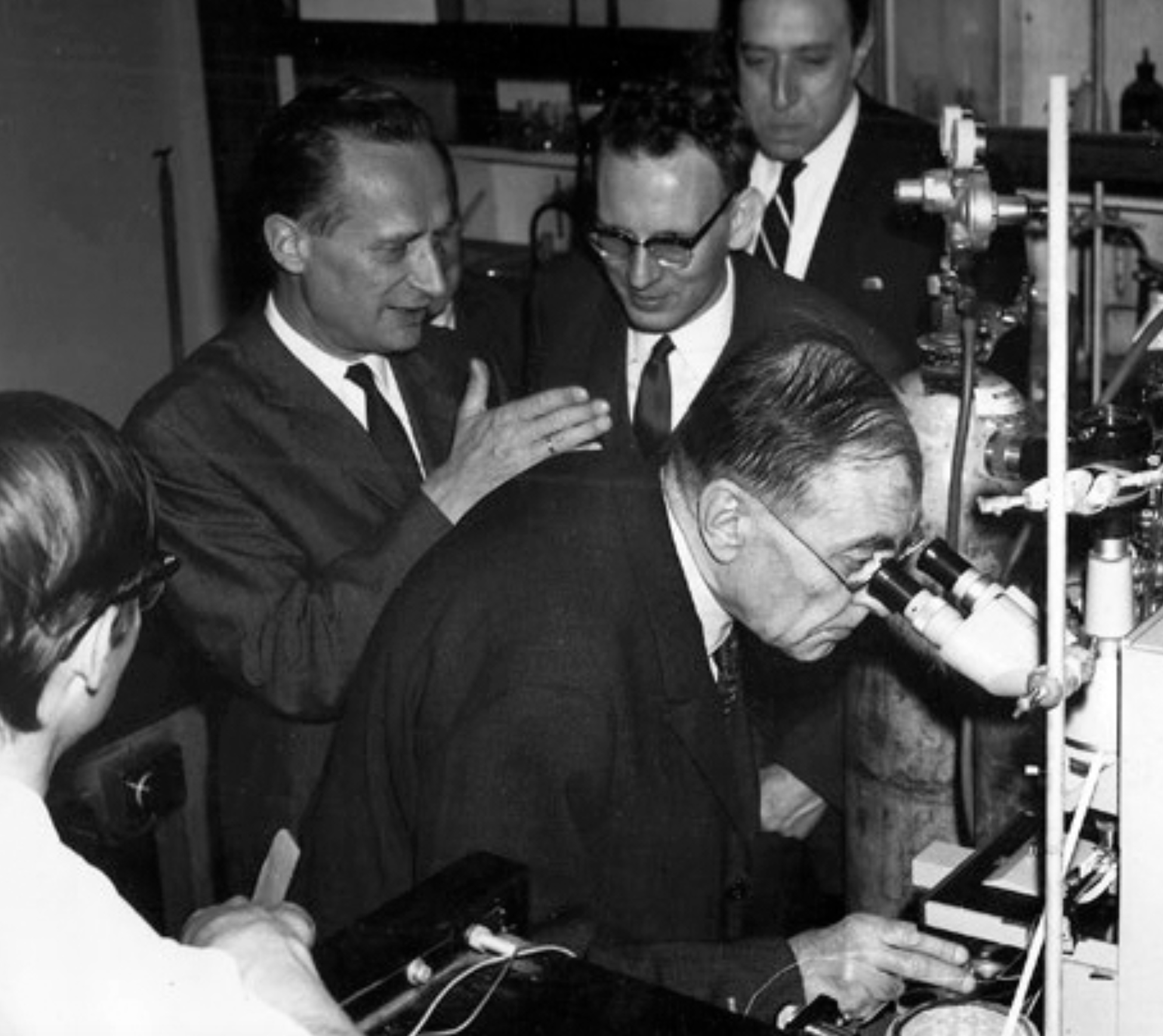
Soviet chemist Boris Deryagin peers through a microscope in his lab

In the 1960s, Nikolai Fedyakin picked up on Lord Kelvin’s work at the Kostroma Technological Institute and through careful experimentation, concluded that the liquid at the bottom of the glass tube was denser than ordinary water and published his findings. Boris Deryagin, director of the Institute of Physical Chemistry in Moscow, was intrigued and his team confirmed that the substance at the bottom of the glass tube was denser and thicker than ordinary water and had additional anomalous properties. This phase of water had a thick, gel-like consistency; it also had a higher stability, like a polymer, over bulk water. It demonstrated a lower freezing point, a higher boiling point, and much higher density and viscosity than ordinary water. It expanded more than ordinary water when heated and bent light differently. Deryagin became convinced that this “modified water” was the most thermodynamically stable form of water and that any water that came into contact with it would become modified as well. In 1966, Deryagin shared his work in a paper entitled “Effects of Lyophile Surfaces on the Properties of Boundary Liquid Films.” British scientist Brian Pethica confirmed Deryagin’s findings with his own experiments—calling the odd liquid “anomalous water”—and published in Nature. In 1969, Ellis Lippincott and colleagues published their work using spectroscopic evidence of this anomalous water, showing that it was arranged in a honeycomb-shaped network, making a polymer of water—and dubbed it “polywater.” Scientists proposed that instead of the weak Van der Waals forces that normally draw water molecules together, the molecules of ‘polywater’ were locked in place by stronger bonds, catalyzed somehow by the nature of the surface they were adjacent to.

Molecular structure of polywater

This sparked both excitement and fear in the scientific community, press and the public. Industrialists soon came up with ways to exploit this strange state of water such as an industrial lubricant or a way to desalinate seawater. Scientists further argued for the natural existence of ‘polywater’ in small quantities by suggesting that this form of water was responsible for the ability of winter wheat seeds to survive in frozen ground and how animals can lower their body temperature below zero degrees Celsius without freezing.

When one scientist discounted the phenomenon and blamed it on contamination by the experimenters’ own sweat, the significance of the results was abandoned in the Kuddelmuddel of scientific embarrassment. By 1973 ‘polywater’ was considered a joke and an example of ‘pathological science.’ This, despite earlier work by Henniker and Szent-Györgyi, which showed that water organized itself close to surfaces such as cell membranes. Forty years later Gerald Pollack at the University of Washington identified a fourth phase of water, an interfacial water zone that was more stable, more viscous and more ordered, and, according to biochemist Martin Chaplin of South Bank University, also hydrophobic, stiffer, more slippery and thermally more stable. How was this not polywater?

The Polywater Equation

In my story, which takes place in Berlin, 2045, retired limnologist Professor Engel grapples with a new catastrophic water phenomenon that looks suspiciously like the original 1960s polywater incident:

The first known case of polywater occurred on June 19, 2044 in Newark, United States. Housewife Doris Buchanan charged into the local Water Department office on Broad Street with a complaint that her faucet had clogged up with some kind of pollutant. She claimed that the faucet just coughed up a blob of gel that dangled like clear snot out of the spout and refused to drop. Where was her water? she demanded. She’d paid her bill. But when she showed them her small gel sample, there was only plain liquid water in her sample jar. They sent her home and logged the incident as a prank. But then over fifty turbines of the combined Niagara power plants in New York and Ontario ground to a halt as everything went to gel; a third of the state and province went dark. That was soon followed by a near disaster at the Pickering Nuclear Generating Station in Ajax, Ontario when the cooling water inside a reactor vessel gummed up, and the fuel rods—immersed in gel instead of cooling water—came dangerously close to overheating, with potentially catastrophic results. Luckily, the gel state didn’t last and all went back to normal again.

If you read German, you can pick up a copy of the anthology in Dussmann das KulturKaufhaus or Thalia, both located in Berlin but also available through their online outlets. You’ll have to wait to read the English version; like polywater, it’s not out yet.

References:

Chaplin, Martin. 2015. “Interfacial water and water-gas interfaces.” Online: “Water Structure and Science”: http://www1.lsbu.ac.uk/water/interfacial_water.html  

Chaplin, Martin. 2015. “Anomalous properties of water.” Online: “Water Structure and Science: http://www1.lsbu.ac.uk/water/water_anomalies.html  

Henniker, J.C. 1949. “The depth of the surface zone of a liquid”. Rev. Mod. Phys. 21(2): 322–341.

Kelderman, Keene, et. al. 2022. “The Clean Water Act at 50: Promises Half Kept at the Half-Century Mark.” Environmental Integrity Project (EIP). March 17. 75pp.

Munteanu, N. & E. J. Maly, 1981. The effect of current on the distribution of diatoms settling on submerged glass slides. Hydrobiologia 78: 273–282.

Munteanu, Nina. 2016. “Water Is…The Meaning of Water.” Pixl Press, Delta, BC. 584 pp.

Pollack, Gerald. 2013. “The Fourth Phase of Water: Beyond Solid, Liquid and Vapor.” Ebner & Sons Publishers, Seattle WA. 357 pp. 

Ramirez, Ainissa. 2020. “The Rise and Fall of Polywater.” Distillations Magazine, February 25, 2020.

Szent-Györgyi, A. 1960. “Introduction to a Supramolecular Biology.” Academic Press, New York. 135 pp. 

Roemer, Stephen C., Kyle D. Hoagland, and James R. Rosowski. 1984. “Development of a freshwater periphyton community as influenced by diatom mucilages.” Can. J. Bot. 62: 1799-1813.

Schwenk, Theodor. 1996. “Sensitive Chaos.” Rudolf Steiner Press, London. 232 pp.

Szent-Györgyi, A. 1960. “Introduction to a Supramolecular Biology.” Academic Press, New York. 135 pp. 

Wilkens, Andreas, Michael Jacobi, Wolfram Schwenk. 2005. “Understanding Water”. Floris Books, Edinburgh. 107 pp.

Nina Munteanu is a Canadian ecologist / limnologist and novelist. She is co-editor of Europa SF and currently teaches writing courses at George Brown College and the University of Toronto. Visit www.ninamunteanu.ca for the latest on her books. Nina’s bilingual “La natura dell’acqua / The Way of Water” was published by Mincione Edizioni in Rome. Her non-fiction book “Water Is…” by Pixl Press (Vancouver) was selected by Margaret Atwood in the New York Times ‘Year in Reading’ and was chosen as the 2017 Summer Read by Water Canada. Her novel “A Diary in the Age of Water” was released by Inanna Publications (Toronto) in June 2020.

H2O Publishes my Illustration of the Diatom Forest

My original Diatom Forest illustration in my article “Diatom Spring” in The Meaning of Water

This past spring, Dutch scientist Herman van Dam (Consultancy for Water and Nature) approached me for permission to use my illustration of the diatom forest in a paper he and co-authors were preparing for the Dutch journal H2O. He explained that they wanted to help familiarize water managers who read the journal with the underwater biodiversity for which my illustration would be helpful.

The Illustration

He’d seen my illustration in my article “A Diatom Spring” in The Meaning of Water. Below is a summary of my article about the diatom forest:

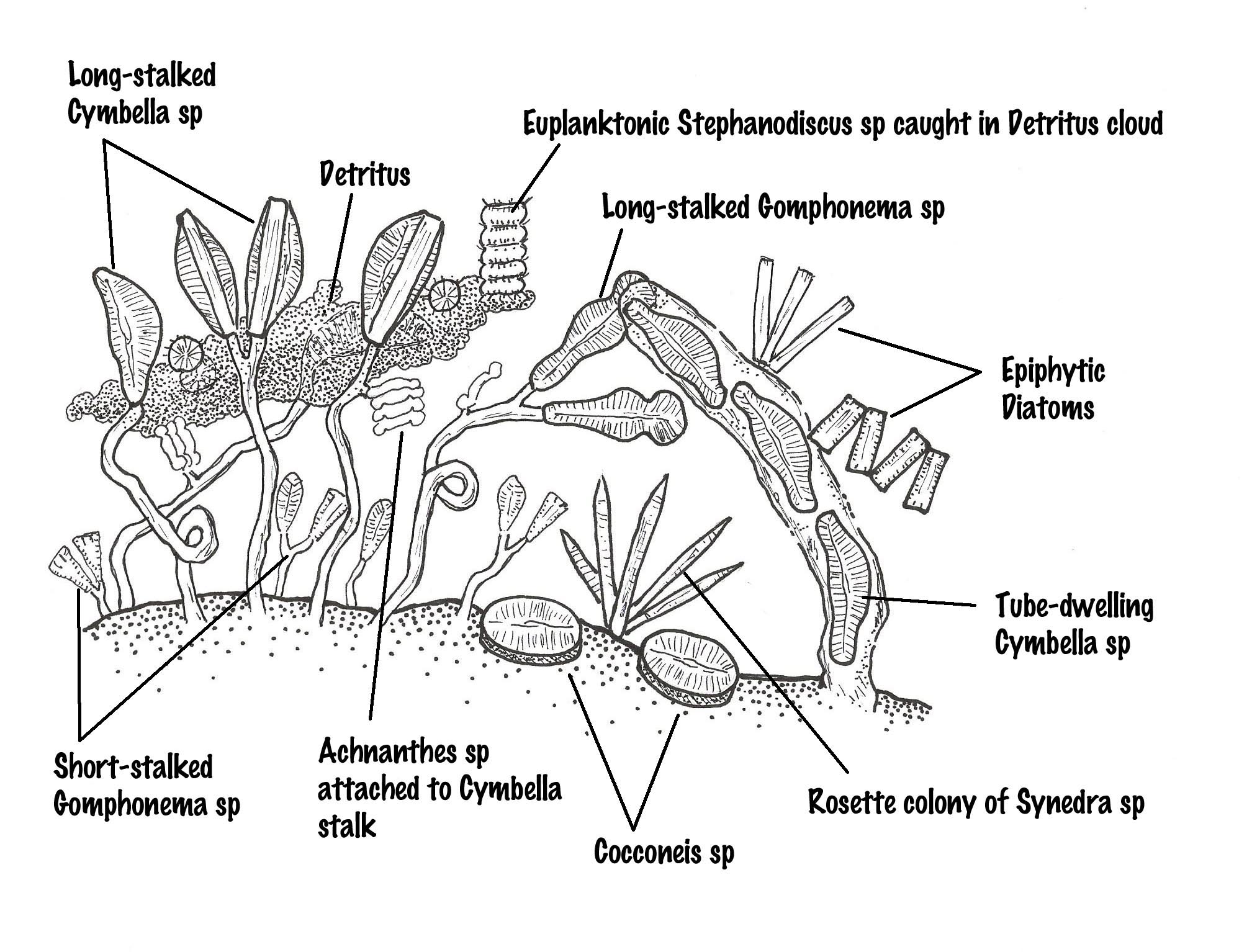
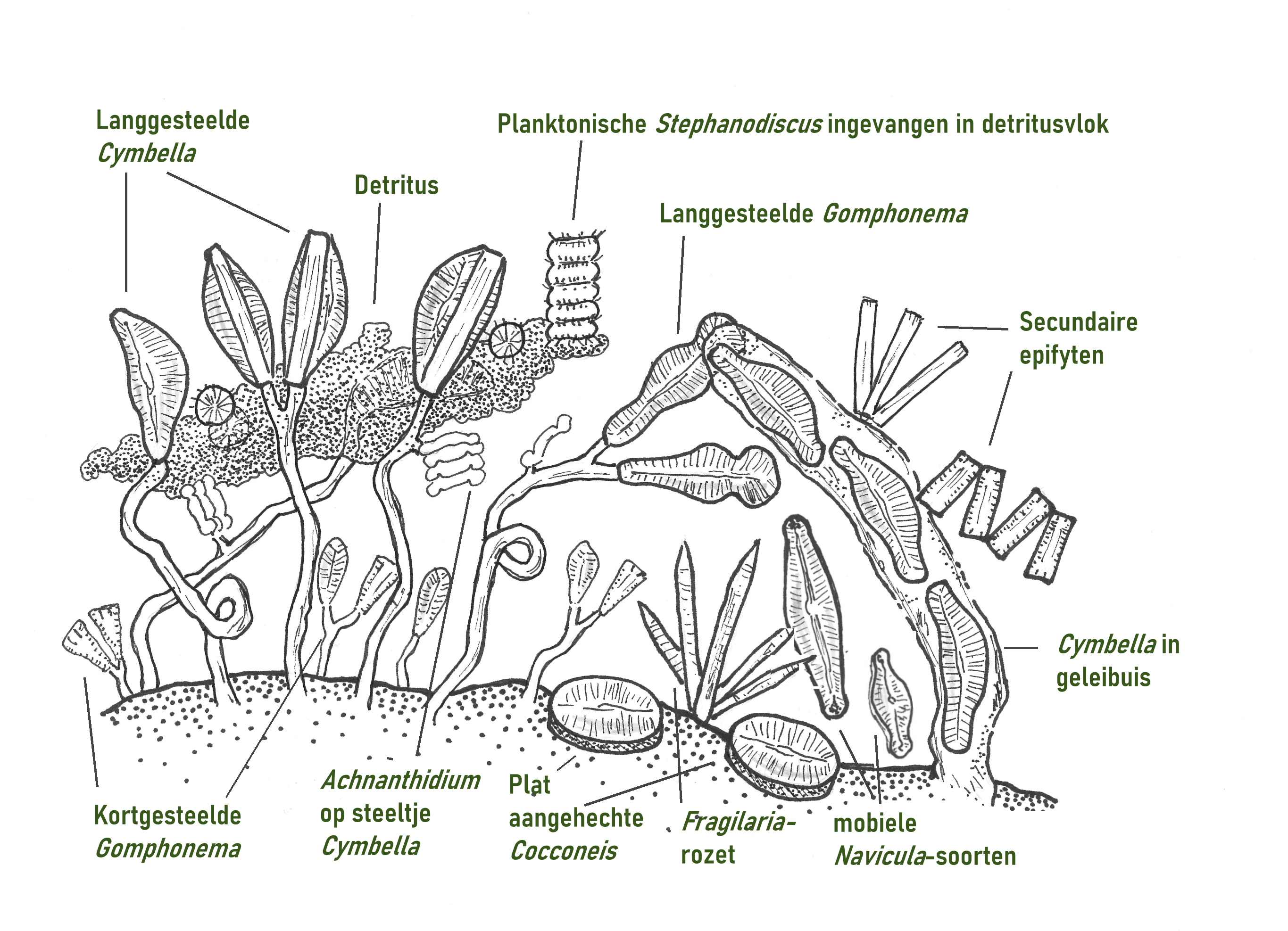
Attachment and colonization starts with a ‘clean’ unpopulated surface (usually scoured by turbulence in a storm or some other event or a new surface tumbled into the water). Several stages of succession take place, starting with early colonizers. The adnate Cocconeis placentula, whose frustules attach directly to the substrate, is an example of an early colonizer. When they attach to a substrate they form a biofilm (think moss in a terrestrial forest). Adnate species are eventually overgrown by taxa that produce a mucilaginous pad (e.g. Synedra) or stalk (e.g. Gomphonema). The understory layer is typically occupied by diatoms such as Fragilaria vaucheriae and Synedra radians that attach to the surface at one end (apical) of their rod-shaped frustules using a mucilaginous pad to form “rosettes” that resemble spiky understory shrubs. This allows them to protrude above the adnate taxa and take advantage of more light.

SEM of Synedra radians and Fragilaria vaucheriae that form rosettes as they apically attach to substrate (image by Roemer et al., 1984)

The diatoms Cymbella and Gomphonema produce long stalks that attach directly to the surface, allowing them to form a swaying canopy over the lower tier of cells of Fragilaria vaucheriaeSynedra radians and early colonizer Cocconeis placentula whose frustules attach directly to the substrate (think overstory and understory of a terrestrial forest or a marine kelp forest).

The Diatom Forest Structure

Just like trees, the canopy-forming stalked diatoms effectively compete for available light and nutrients in the water with their vertical reach. They provide the ‘overstory’ of the diatom forest’s vertical stratification. These tree-like diatoms also provide an additional surface for other diatoms to colonize (e.g. tiny epiphytic Achnanthes settle on the long stalks of Cymbella, just as lichen does on a tree trunk).

SEM of three-week colony of Cymbella affinis (larger diatoms on left) and Gomphonema olivaceum attached via stalks (image from Roemer et al., 1984)

The stalked diatom forest acts like a net, trapping drifting-in euplankton, such as Pediastrum sp. andFragilaria spp., which then decide to stay and settle in with the periphyton community. The mucilage captures and binds detrital particles in both lower and upper stories of the diatom forest; these, in turn, provide nutrients for the diatom forest and additional surfaces for colonization. In their work with periphyton communities, Roemer et al. (1984) found several diatoms (e.g. Diatoma vulgareFragilaria spp. Stephanodiscus minutula) entangled in the complex network of cells, stalks, and detritus of the diatom forest’s upper story. They also found rosettes of Synedra radians—like jungle orchids—attached to large clumps of sediment caught by the net of mucilage.

Eventually, ‘overgrowth’ occurs as the periphyton colony matures and grows ‘top-heavy’ with all this networking. The upper story of the community simply sloughs off—usually triggered by turbulence in a river from rains, storms, or dam release. This is similar to a forest fire in the Boreal forest, which creates space and light for new colonization and growth. The dislodged periphyton ride the turbulent flow, temporarily becoming plankton, and those that survive the crashing waters provide “seed” to colonize substrates downstream. Others may get damaged and form the ‘dish soap’ like suds or foam you often see in turbulent water. The proteins, lignins and lipids of the diatoms (and other associated algae) act as surfactants or foaming agents that trap air and form bubbles that stick to each other through surface tension.

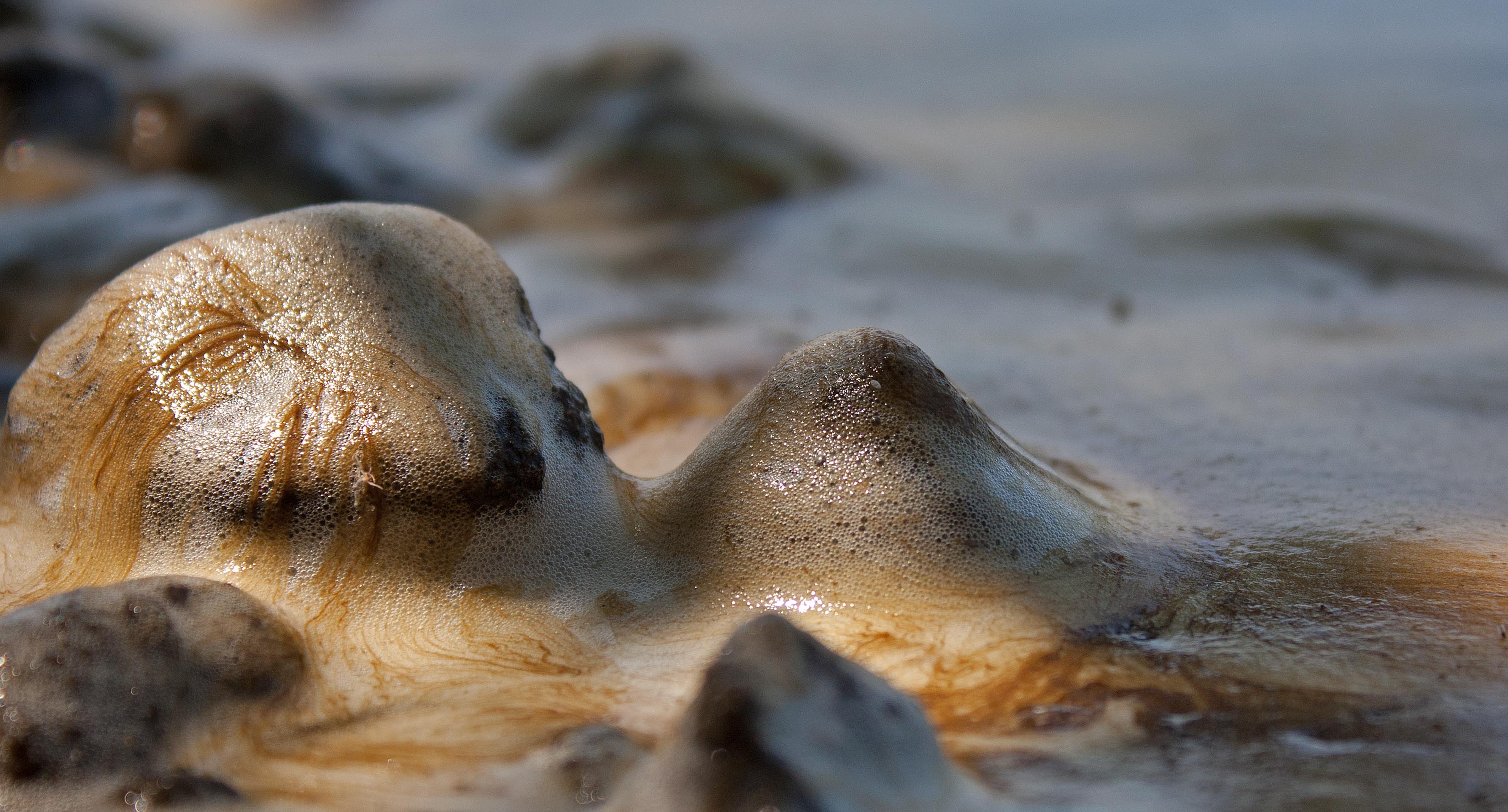
Diatoms, organics and associated detritus forms foamy ‘crema’ on the river (photo by Nina Munteanu)
Fragmented diatoms and organic material create a surface foam on the river (photo by Nina Munteanu)

The Paper

The paper was published June 13, 2024, in H2O, written by Jako van der Wal, Joep de Koning and Herman van Dam, and entitled “Snel inzicht in de ecologische waterkwaliteit met diatomeeën” (Quick insight into ecological water quality with diatoms). This paper was right up my alley! As a diatom specialist and limnologist who studied them in relation to environmental conditions and perturbations, I was intrigued by the paper and gained some additional insight on diatom ecology.

Van der Wal et al. cited recent advances in DNA-based identification methods that provide fast and cheap diatom identification over the traditional method of using an optical compound microscope to observe morphological characteristics such as size, shape and ornamentations of the silicified cell wall. I can attest that this is a labour-intensive process in which I spent many hours and days hunched over a microscope during my masters research at Concordia University. This efficient DNA-identification has seen a resurgence of using diatoms as a valuable tool for water quality managers, with applications providing insight into both current and historical water conditions. The authors argue that benthic diatoms or periphyton (living on substrates such as plants, rock, sand and artificial surfaces) have been since the 1980s used as indicators of saproby, trophy, acid and salt character in, among other things, ditches and canals. For every type of water and water quality, there are diatoms that have their habitat there, write the authors. They argue that, unlike phytoplankton, fish and macrofauna, periphyton attach to a surface and hardly move; this means that effects of water quality can be demonstrated locally. Because many diatom species tolerances and intolerances are known and they reproduce quickly (over days), diatoms respond quickly to changes in the environment—much faster (often within weeks) than other ecological indicators.

Scientists and water technicians can use diatom species composition to measure perturbations by organic material, low oxygen content, eutrophication, and toxicity. Given that diatoms colonize and develop quickly, this includes unstable and damaged habitats where other indicators cannot develop, such as shipping traffic, waves or where cleaning or dredging is carried out regularly. Historical insight can be provided by diatoms, given that their silica frustules are naturally preserved in sediment.

My Own Work with Turbulence

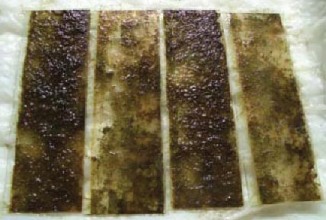
Periphyton biofilm (of mostly diatoms) on microscope slides left in a stream

During my masters research in several streams in the Eastern Townships, I examined how diatoms colonized artificial substrates; how they formed productive biofilms that sustained an entire periphyton community of attached aquatic life and discovered that their pattern of colonization related to current speed and direction. I submerged glass slides (the kind people use to look at critters under the microscope) in a device in the stream and oriented them parallel or perpendicular to the current.

There are two ways an algal community grows in a new area: (1) by initial colonization and settling; and (2) by reproduction and growth. I studied both by collecting slides exposed for differing lengths of time (collecting young and mature communities) in different seasons.

I discovered that the diatoms colonized these surfaces in weird ways based on micro-turbulence. Early colonizers, like Achnanthes and adnate Cocconeis preferred to settle on the edges of the slides, where the chaos of turbulence ruled over the sheer of laminar flow. They colonized by directly appressing to the substrate, making them the first photosynthetic taxa to establish a biofilm on a clean substrate. Vadeboncoeur and Katona (2022) write that “in waved-washed surfaces, these taxa may be the only algae that persist.” I postulated that the drift velocity was reduced on the slide’s edge, where turbulence was greatest, giving drifting algae a greater chance to collide and settle on the slide over the more shear laminar flow along the slide’s central face.

Once settled, the community was more likely to grow with turbulence. Greater turbulence decreases the diffusion gradient of materials around algal cells, with a higher rate of nutrient uptake and respiration. Turbulence provides greater opportunity to an existing colony by increasing “chaotic” flow, potential collision and exchange. Turbulence is a kind of “stable chaos” that enhances vigor, robustness and communication.

Using Diatoms in Water Quality Assessments

In their paper Van der Wal et al. argued that in environmental assessment the DNA-identification is just one step in a process that looks a population structure and health. Diatoms are already used in 21 of the 27 EU countries as part of a Water Framework Directive (WFD) quality index for flowing waters and in nine EU countries for standing water. Example conditions and associated perturbations where diatoms are a particularly useful indicator include: salinity, acidity, oxygen saturation, organic load (saproby), nutrient richness (trophy), temperature, and toxicity.

Diatom Growth Forms & Deformities

Van der Wal et al. argued that in addition to the different species compositions and the related ecological indices, growth forms and deformations of diatoms are useful indicators of water quality, particularly in relation to specific toxins.

My illustration adapted for the van der Wal et al. paper in H2O

Growth forms of diatoms can be described as attached, short-stalked, long-stalked, mobile and living in mucous tubes (Figure 3, van der Wal et al., 2024). Each growth form has advantages and disadvantages. For example, short-stalked diatoms are more difficult to graze and long-stalked diatoms come into contact with more water, from which they can then absorb substances. Long-stalked diatoms can also absorb more light if there is a lot of competition. Mobile diatoms can adapt to changing conditions by, for example, migrating from surface to subsurface and vice versa. Diatoms in slime tubes are more difficult to prey on and respond more slowly to environmental changes.

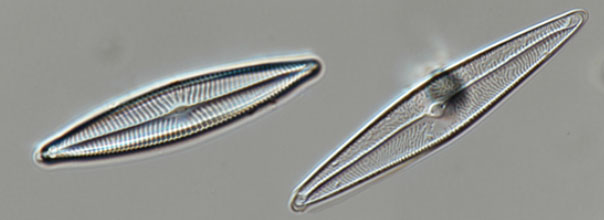
Two frustules of Navicula sp; the one on the right shows obvious deformities in the striations of its silica frustule (photo by van der Wal, H2O, June 13, 2024)

According to Van der Wal et al., scientistis (Rimet & Bouchez) noted that long-stalked diatoms declined in waterbodies subjected to various pesticides. Falasco et al. observed diatom deformities when exposed to various toxic substances. Heavy metals were observed to cause deformities in Navicula. Nitrogen toxicity was also implicated in diatom deformities.

Froth from diatoms and organics on the Otonabee river, ON (photo by Nina Munteanu)

References:

Falasco, E., Ector, L., Wetzel, C.E., Badino, G. & Bona, F. (2021). “Looking back, looking forward: a review of the new literature on diatom teratological forms (2010-2020).” Hydrobiologia 848: 1675-1753.

Munteanu, N. 2022. “When Diatoms Create a Forest.” https://themeaningofwater.com. December 18, 2022.

Munteanu, N. 2023. “When Diatoms Bloom in Spring.” https://themeaningofwater.com. May 14, 2023.

Munteanu, N. 2023. “A Diatom Spring.” https://themeaningofwater.com. April 16, 2023.

Munteanu, N. & E. J. Maly, 1981. The effect of current on the distribution of diatoms settling on submerged glass slides. Hydrobiologia 78: 273–282.

Munteanu, Nina. 2016. “Water Is…The Meaning of Water.” Pixl Press, Delta, BC. 584 pp.

Poikane, S., Kelly, M., & Cantonati, M. (2016). ‘Benthic algal assessment of ecological status in European lakes and rivers: challenges and opportunities’. Science of the Total Environment 568: 603-613. 

Rimet, F. & Bouchez, A. (2011). ‘Use of diatom life-forms and ecological guilds to assess pesticide contamination in rivers: Lotic mesocosm approaches’. Ecological Indicators 11: 489-499.

Roemer, Stephen C., Kyle D. Hoagland, and James R. Rosowski. 1984. “Development of a freshwater periphyton community as influenced by diatom mucilages.” Can. J. Bot. 62: 1799-1813. 

Serôdio, J. & Lavaud, J. (2020). “Diatoms and their ecological importance”. In: Leal Filho, W. et al. (eds). Life below water. Encyclopedia of the UN Sustainable Development Goals (pp.1-9). Springer Nature.

Smolar-Zvanut, Natasa and Matjaz Mikos. “The impact of flow regulation by hydropower dams on the periphyton community in the Soca River, Slovenia. Hydrological Sciences Journal 59 (5): 1032-1045.

Wal, J. van der, Joep de Koning and Herman van Dam. 2024. “Snel inzicht in de ecologische waterkwaliteit met diatomeeën”  H2O, 13 June, 2024.


Wood, Allison R. 2016. “Attached Algae as an Indicator of Water Quality: A Study of the Viability of Genomic Taxanomic Methods.” Honors Theses and Capstones. 306. University of New Hampshire Scholars’ Repository.

Zuilichem, H. van, Peeters, E. & Wal, J. van der (2016). “Diatomeeën als indicator voor waterkwaliteit nabij rwzi’s”. H2O-Online, 9 december 2016. https://edepot.wur.nl/401202 

Nina Munteanu is a Canadian ecologist / limnologist and novelist. She is co-editor of Europa SF and currently teaches writing courses at George Brown College and the University of Toronto. Visit www.ninamunteanu.ca for the latest on her books. Nina’s bilingual “La natura dell’acqua / The Way of Water” was published by Mincione Edizioni in Rome. Her non-fiction book “Water Is…” by Pixl Press(Vancouver) was selected by Margaret Atwood in the New York Times ‘Year in Reading’ and was chosen as the 2017 Summer Read by Water Canada. Her novel “A Diary in the Age of Water” was released by Inanna Publications (Toronto) in June 2020.

How the Bdelloid Rotifer Lived for Millennia — Without Sex

As a child, I always wanted a microscope.

I would have collected slimy waters from the scum ponds and murky puddles near my house. I would have brought them home and exposed them to the light of my microscope. I would then have peered deep into a secret world, where shady characters and alien forms lurked and traded.

It would be many years, when I was in college, before I finally witnessed this world—so alien, it might have inspired the science fiction books I wrote later as an adult. As it turned out, I was led to pursue a Masters of Science degree, studying periphyton (microscopic aquatic communities attached and associated with surfaces like rocks and plants) in local streams in the Eastern Townships of Quebec.

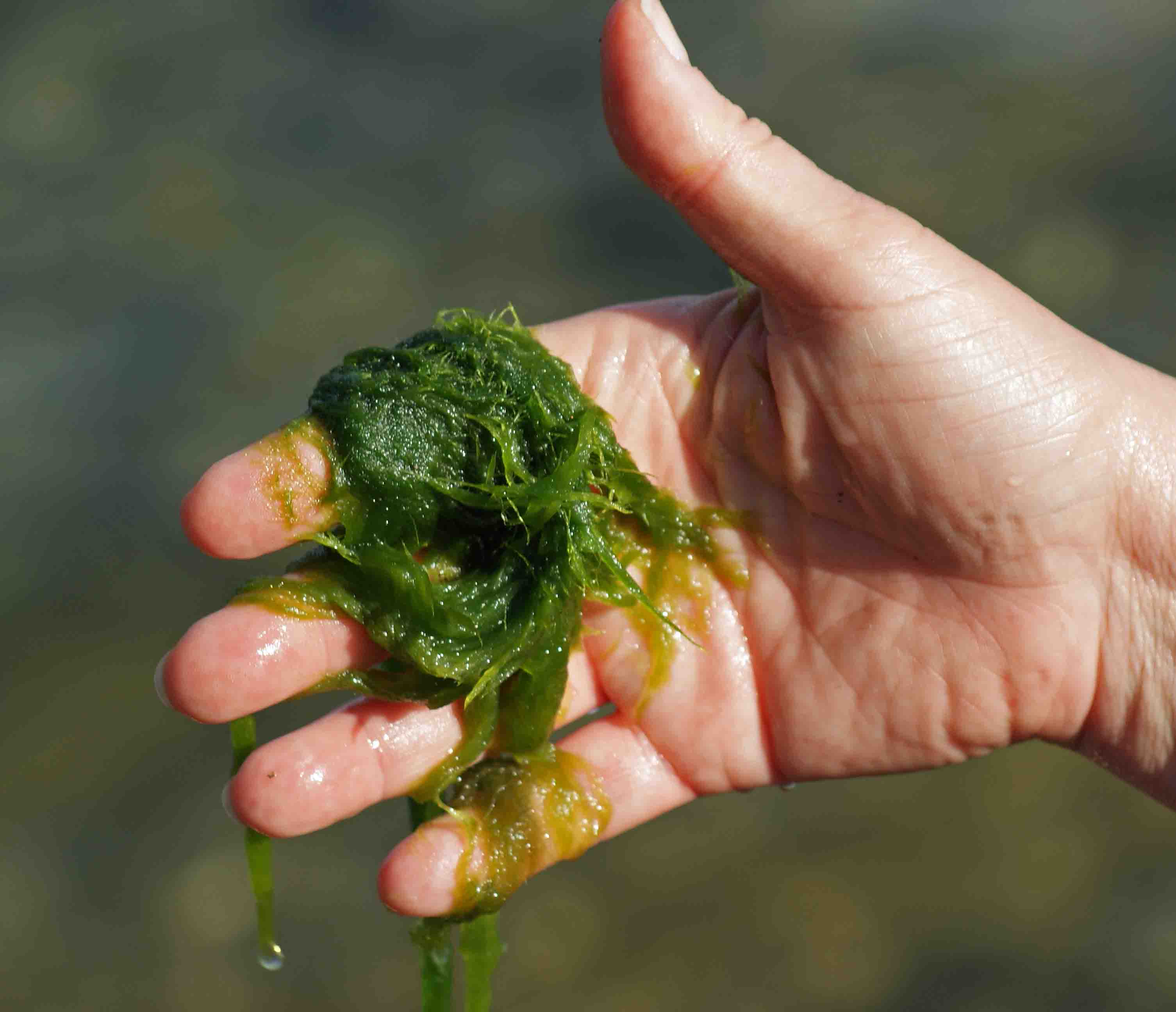
Filamentous algae collected in Lake Ontario, ON (photo by Nina Munteanu)

While my work focused on how diatoms (glass-walled algae) colonized surfaces, micro-invertebrates kept vying for my attention. Water fleas (cladocerans), copepods, rotifers, seed shrimps (ostracods) and water bears sang across my field of vision. They flitted, lumbered, wheeled and meandered their way like tourists lost in Paris. But this wasn’t Paris; I’d taken the blue pill and entered the rabbit hole into another world…

Sketch of common zooplankton and phytoplankton (illustration by Nina Munteanu)

The Secret—and Dangerous—World of Micro-Organisms

Small Freshwater habitats are home to a highly productive and diverse collection of micro-invertebrates—multicellular animals that can barely be seen with the naked eye. Many average from 0.5 to 1 mm in size and resemble little white blobs; however, a scholar can distinguish each invertebrate by its unique movement. For instance, when presented with a jar of pond water, I can usually distinguish among the wheel-like wandering of a gastrotrich, dirigible-like gliding of an ostracod (seed shrimp), the vertical goldfinch-style “hopping” of the cladoceran (water flea) as it beats its antennae, or the halting-jerking movements of copepods (oar-feet) as their antennae drive them along like a dingy propelled by an amateur oarsman.

Alas, puddles, ephemeral ponds and vernal pools pose sketchy habitats, given their tendency to appear and disappear in a wink. And like the thief in the night, they pose a harsh and uncertain home to many small organisms. These environments are ever-changing, unstable, chaotic and unpredictable. Yet, anyone who has studied these variable ecosystems understands that they team with life. 

When a puddle or ephemeral pond dries up then reappears with rain, how can these communities thrive? Or do they all die off and then somehow recruit when the pond reappears? Many of these invertebrates have evolved creative ways to survive in very unstable environments. Some form a resting stage—a spore, resting egg or ‘tun’—that goes dormant and rides out the bad weather.

Philodina, a bdelloid rotifer (microscope photo by Bob Blaylock)

Animalcules & the Bdelloid Rotifer

In 1701, Antonie van Leeuwenhoek observed that “animalcules” (likely the bdelloid rotifer Philodina roseaola) survived desiccation and were “resurrected” when water was added to them. He’d discovered a highly resistant dormant state of an aquatic invertebrate to desiccation.

Dormancy is a common strategy of organisms that live in harsh and unstable environments and has been documented in crustaceans, rotifers, tardigrades, phytoplankton and ciliates. “Dormant forms of some planktonic invertebrates are among the most highly resistant … stages in the whole animal kingdom,” writes Jacek Radzikowski in a 2013 review in the Journal of Plankton Research. Radzikowski describes two states of dormancy: diapause and quiescence. (on right: sketch of bdelloid rotifer by Nina Munteanu

Bdelloid rotifers can go into quiescent dormancy at practically any stage in their life cycle in response to unfavorable conditions. Early research noted that dormant animals could withstand freezing and thawing from −40°C to 100°C and storage under vacuum. They also tolerated high doses of UV and X radiation. Later work reported that some rotifers could survive extreme abiotic conditions, such as exposure to liquid nitrogen (−196°C) for several weeks or liquid helium (−269°C) for several hours. Desiccated adult bdelloid rotifers apparently survived minus 80°C conditions for more than 6 years. The dormant eggs of cladocerans and ostracods also survived below freezing temperatures for years.

Rotifers are cosmopolitan detrivores (they eat detritus) and contribute to the decomposition of organic matter. Rotifers create a vortex with ciliated tufts on their heads that resemble spinning wheels, sweeping food into their mouths. They often anchor to larger debris while they feed or inch, worm-like, along substrates. Some are sessile, living inside tubes or gelatinous holdfasts and may even be colonial. Rotifers reproduce by parthenogenesis (in the absence of mates), producing clones (like cladocerans). Resting eggs (sometimes called zygotes) survive when a pond dries up. Bdelloid rotifers don’t produce resting eggs; they survive desiccation through a process called anhydrobiosis, contracting into an inert form and losing most of their body water. Embryos, juveniles and adults can undergo this process. The bdelloid withdraws its head and foot and contracts its body into a compact shape called a tun; a generally unprotected dormant state that remains permeable to gases and liquids. Like Tardigrades, Bdelloid rotifers can resist ionizing radiation because they can repair DNA double-strand breaks.

The long-term survival and evolutionary success of bdelloid rotifers in the absence of sex arises from horizontal gene transfer via DNA repair.

In my eco-novel A Diary in the Age of Water the limnologist Lynna visits her technician Daniel as he peers through a microscope and makes the observation of why the bdelloid rotifer is well-suited to climate change:

I bent to peer through the eyepiece at what turned out to be a pond sample in a Petri dish. Attached to a pile of detritus shivering in the current, several microscopic metazoans—rotifers—swung like trees in a gale; they were feeding. Their ciliated disk-like mouths twirled madly, capturing plankton to eat. Watching them reminded me of my early research days as an honours undergrad at Concordia University in Montreal. Probably Philodina, I thought; I had seen many during my stream research in Quebec.

“They’re the future,” Daniel said, looking up at me with a smirk as I straightened.

I raised my eyebrows, inviting him to elaborate, which he cheerfully did.

“They’re the future because of their incredible evolutionary success and their ecological attraction to environmental disaster.” He knew he’d piqued my interest. “These little creatures have existed for over forty million years, Lynna. Without sex! And they’re everywhere. In temporary ponds, moss, even tree bark. Bdelloid mothers that go through desiccation produce daughters with increased fitness and longevity. In fact, if desiccation doesn’t occur over several generations, the rotifers lose their fitness. They need the unpredictable environment to keep robust.” They incorporate genes from their environment: they acquire DNA transposons—mobile DNA—through HGT.”

—A DIARY IN THE AGE OF WATER

The bdelloid all-female populations have thrived for millions of years by maintaining a robust and diverse population through epigenetics and DNA repair during dormancy…The dormancy of all-female bdelloids is an elegant technique to ride out harsh conditions. The bdelloids can go dormant quickly in any stage of their life cycle, and they’re capable of remaining dormant for decades. They can recover from their dormancy state within hours when the right conditions return and go on reproducing without the need to find a mate.

Highly variable environments tend to support rare species: organisms that are uniquely equipped for change. These are the explorers, misfits, and revolutionaries who do their work to usher in a new paradigm. They carry change inside them, through phenotypic plasticity, physiological stress response mechanisms, or life history adaptations. Like bdelloid rotifers going dormant through anhydrobiosis. Or blue-green algae forming dormant akinete spores. In tune with the vacillations of Nature, epigenetics-induced adaptation is the only option for keeping up with rapid and catastrophic environmental change, not to mention something as gigantic as climate change. That’s why the bdelloid rotifers survived for millennia and will continue for many more. They adapt by counting on change.

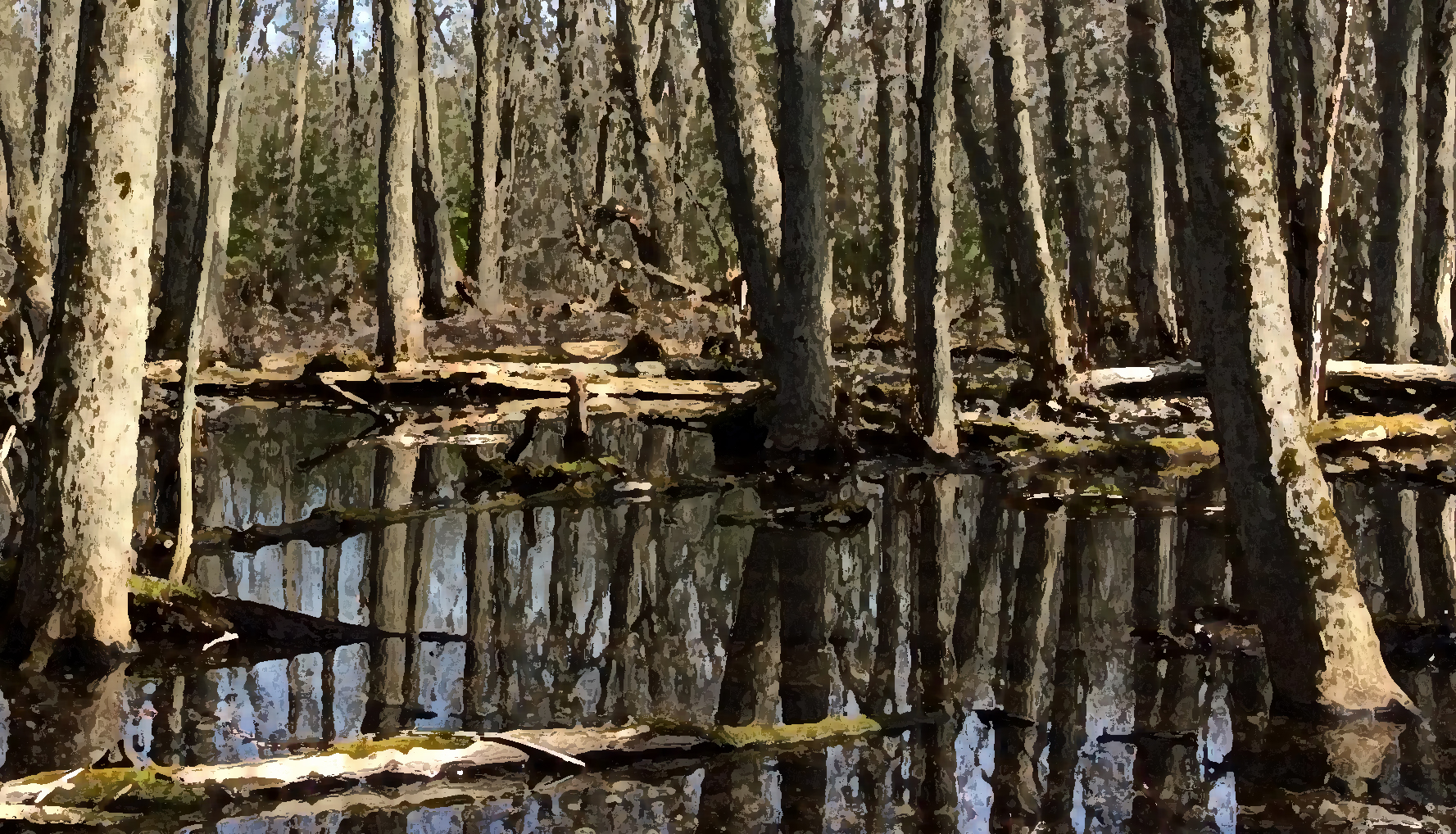
Maple swamp forest in Trent Nature Sanctuary, ON (photo and rendition by Nina Munteanu)

References:

Munteanu, Nina. 2020. “A Diary in the Age of Water.” Inanna Publications, Toronto. 300pp.

Munteanu, Nina. 2016. “Water Is…The Meaning of Water.” Pixl Press, Vancouver. 586pp.

O’Leary, Denise. 2015. “Horizontal gene transfer: Sorry, Darwin, it’s not your evolution anymore.” Evolution News, August 13, 2015. Online: https://www.evolutionnews.org/201508/horizontal_gene/

Ricci, C. And D. Fontaneto. 2017. “The importance of being a bdelloid: Ecological and evolutionary consequences of dormancy.” Italian Journal ofZoology, 76:3, 240-249.

Robinson, Kelly and Julie Dunning. 2016. “Bacteria and humans have been swapping DNA for millennia”. The Scientist Magazine, October 1, 2016. Online: https://www.the-scientist.com/?articles.view/articleNo/47125/title/Bacteria-and-Humans-Have-Been-Swapping-DNA-for-Millennia/

Weinhold, Bob. 2006. “Epigenetics: the science of change.” Environmental Health Perspectives, 114(3): A160-A167.

Williams, Sarah. 2015. “Humans may harbour more than 100 genes from other organisms”. Science, March 12, 2015. Online: http://www.sciencemag.org/news/2015/03/humans-may-harbor-more-100-genes-other-organisms

Nina Munteanu is a Canadian ecologist / limnologist and novelist. She is co-editor of Europa SF and currently teaches writing courses at George Brown College and the University of Toronto. Visit www.ninamunteanu.ca for the latest on her books. Nina’s bilingual “La natura dell’acqua / The Way of Water” was published by Mincione Edizioni in Rome. Her non-fiction book “Water Is…” by Pixl Press (Vancouver) was selected by Margaret Atwood in the New York Times ‘Year in Reading’ and was chosen as the 2017 Summer Read by Water Canada. Her novel “A Diary in the Age of Water” was released by Inanna Publications (Toronto) in June 2020.

Darwin’s Paradox Revisited: Compassion and Evolution

In 2007, when I started my first blog, The Alien Next Door, I wrote an article that explored the term “Darwin’s Paradox”—it’s not just the title of my science fiction thriller Darwin’s Paradox released that year by Dragon Moon Press—but  a term coined by scientists to describe the paradoxical phenomenon exhibited by coral reefs.

Defying The Laws of Thermodynamics

Darwin described coral reefs as oases in the desert of the ocean. Coral reefs comprise one of the richest ecosystems on Earth, in apparent violation of the laws of thermodynamics (high productivity in a low-productivity environment). Productivity ranges from 50 to 250 times more than the surrounding ocean. How do they thrive in crystal-clear water, largely devoid of nutrients? Part of the answer lies in the coral’s efficiency in recycling nutrients like nitrate and phosphate.

First, the rough coral surface amplifies water turbulence at a microscopic level, disrupting the boundary layer that usually settles on objects under water and lets the coral “hoover” up the sparse nutrients. I stumbled upon a similar phenomenon during my grad work on temperate streams and published my serendipitous discovery in the journal Hydrobiologia. I was researching how periphyton (attached “algae”) colonized submerged glass slides and observed that the community preferred the edges of the slides because the micro-turbulence there provided more opportunity for attachment and nutrition.

Second, lots of corals also function symbiotically with specialized algae (called zooxanthelae), which provide the coral with food (through photosynthesis) and, in turn, get food from the wastes created by the coral.  

Can the science of symbiosis teach us something about another Darwin’s Paradox?

The Evolution of Compassion

In a September 2013 article in the Jewish World Review, Boston Globe reporter Jeff Jacobywrote:

“Charles Darwin struggled with a paradox: If evolution is a struggle for survival, how could generosity, compassion, and other altruistic virtues have spread through natural selection? Darwin could see the clear evolutionary benefit to groups that inculcated ethical values in their members. Imagine two competing primitive tribes, equally matched — except that ‘one tribe included a great number of courageous, sympathetic, and faithful members, who were always ready to warn each other of danger, [and] to aid and defend each other.’ (Darwin, “The Descent of Man”). There was little doubt that tribes highly endowed with such virtues ‘would spread and be victorious over other tribes.’”

“How did any tribe evolve such ethical qualities in the first place?” asks Jacoby. Brave individuals who risked their lives for others “would on average perish in larger numbers than other men.” It hardly seemed possible, Darwin conceded, that, “such virtues … could be increased through natural selection, that is, by the survival of the fittest.” So, how did it and why?

Jacoby quotes Sir Jonathan Sacks, Britain’s Orthodox chief rabbi, who pointed to “the central drama of civilization: Biological evolution favors individuals,” says Sacks. “But cultural evolution favors groups.… Selfishness benefits individuals [only in the short-term and only in a limited way—my comment], but it is [ultimately] disastrous to groups, and it is only as members of a group that individuals can survive at all.”

Jacoby describes the vast literature in evolutionary psychology and sociobiology that have demonstrated humanity’s hard-wired moral capacity. “We are born with an aptitude for empathy and fairness,” said Jacoby, citing recent neurological experiments that have demonstrated that an act of generosity triggers a pleasurable response in the brain.

Abraham Lincoln summarized it in seven words: “When I do good, I feel good.”  Psychologists call it the “helper’s high”. Neuroscientists and behavioral scientists are demonstrating unequivocally the benefits of altruism to our health and happiness. Scientists have designed experiments that actually trace altruism—and the pleasure we gain from it—to specific regions and systems in the brain. Key studies now provide striking evidence that our brains are wired for altruism. 

The Social Brain and the Seat of Compassion  

In a study published in the Proceedings of the National Academy of Sciences (Moll et al, 2006), a team of neuroscientists lead by Dr. Jordan Grafman, reported that, “when people made the decision to donate to what they felt was a worthy organization, parts of the midbrain lit up—the same region that controls cravings for food and sex.” The brain experiences a pleasurable response when we engage in good deeds that benefit others. 

Dr. Grafman found that the subgenual area in the frontal lobe near the midpoint of the brain was also strongly active when his study subjects made the decision to give to charity. The area houses many receptors for oxytocin, a hormone that promotes social bonding. “The finding suggests that altruism and social relationships are intimately connected—in part, it may be our reliance on the benefits of strong interpersonal connections that motivates us to behave unselfishly,” reports Elizabeth Svoboda in the WallStreet Journal. The team also found that the nucleus accumbens, which contains neurons that release the pleasure chemical dopamine, was triggered when a person chose to help another.

A 2007 study headed by neuroscientist Scott Huettel and reported in Nature Neuroscience(Tankersley, et al., 2007) connects altruism to the posterior superior temporal cortex (pSTC), an area in the upper rear of the brain that lets us perceive goal-directed actions by someone or something else. Results suggest that altruism depends on, and may have evolved from, the brain’s ability to perform the low-level perceptual task of attributing meaning and motive in the actions of others.

“Our findings are consistent with a theory that some aspects of altruism arose out of a system for perceiving the intentions and goals of others,” said Dr. Huettel. “To be altruistic, you need to see that the people you’re helping have goals, and that your actions will have consequences for them.” 

Research led by Michael Platt reported in Nature Neurosciencein 2012, showed that the anterior cingulate gyrus(ACCg) is an important nexus for the computation of shared experience and social reward. That same year researchers at Mount Sinai School of Medicine in New York published research in the journal Brainthat suggested that the anterior insular cortexis the activity centre of human empathy.

I find it both interesting and exciting that these studies link different brain regions to altruistic and compassionate behavior. “There are certain to be multiple mechanism that contribute to altruism, both in individuals and over evolutionary time,” added Huettel. This is the nature of the brain, whether we look at intelligence, motivation or physical characteristics. And I am convinced that we will someday find that many other areas—if not the entire area—of the brain are involved. Moreover, researchers have shown that engaging—or even witnessing—generous acts can reduce stress, increase immunity (e.g., increased antibody levels), and longevity.

Emiliana Simon-Thomas, science director for the Greater Good Science Center at the University of California, Berkeley, explains the chemical activity that happens in our heads when we commit acts of altruism. “There are multiple reward systems that have been tied to pleasurable feelings when people help others or contribute to the well being of the people around them,” she notes. These reward systems are comprised of three main chemicals that are released when we commit an act of kindness and feel pleasure: Dopamine, Oxytocin and Serotonin. According to Simon-Thomas, Dopamine is most closely related to hedonic pleasure — or pleasure derived from self; oxytocin is tied to more social pleasure — especially with regard to physical contact; and serotonin is implicated in a more broad mood state. “All three of these, again, are sort of intersecting and interacting, and depending on the context that you’re in, represent feelings of pleasure in different context,” she explains. “All these systems are activating and parallel, and sort of influencing one another as you go through life.” So when I do a good deed, I am rewarding myself with a cocktail of wonder drugs that please me and make me smile.

So, what I’ve known since I was a child is now proven: doing good deeds is mutually beneficial to the giver and the receiver.

Path through winter forest in the fog, ON (photo by Nina Munteanu)

Altruism in All Beings

The notion that all aspects of life on this planet—not just humanity—have the capacity to act altruistically remains controversial—even among professional scientists and researchers. We are not unique in experiencing or practicing altruism, in acting altruistically and benefiting from our own altruistic acts. It is however a matter of perspective, bias and open-mindedness. Many examples of altruistic behavior and empathy exist in the rest of the living world on our planet.

Nature’s Heroes

Scientists have been demonstrating for years that cooperation among organisms and communities and the act of pure altruism (not reciprocal altruism or kin/group selection) is, in fact, more common in Nature than most of us realize. Valid examples of true altruism in the wild in many species exist. The key here is “in the wild”—not in captivity, where inherent behavior is often modified (see my Alien Next Door article “The SamaritanParadox Revisited: The Karma Ran Over the Dogma”).

Despite the overwhelming evidence for altruism in every aspect of our world, some researchers continue to design experiments and then draw sweeping conclusions based on animals in captivity to suggest that only humanity possesses the ability to behave altruistically—and then again only by social-instruction (aka “the Selfish Gene” of Richard Dawkins vs. the “Social Gene” of Lynn Margulis).

Examples of altruism abound and range among mammals, birds, invertebrates and even Protista. Some examples include: dogs, cats, ducks, squirrels, wolves, mongooses, Meer cats, baboons, chimpanzees, vampire bats, dolphins, walruses, lemurs, African buffalo—to name a few.

de Waal explained that “evolution favors animals that assist each other if by doing so they achieve long-term benefits of greater value than the benefits derived from going it alone and competing with others” (de Waal 2006). The prevalent phenomenon of altruism is Nature’s answer to the Prisoner’s Dilemma. “Empathy evolved in animals as the main … mechanism for [individually] directed altruism,” said deWaal. And it is empathy—not self-interest—that “causes altruism to be dispensed in accordance with predictions from kin selection and reciprocal altruism theory.” deWaal further proposed that the scientific community has become polarized between evolutionary biologists on the one side, and, on the other, a discrete group of economists and anthropologists that “has invested heavily in the idea of strong reciprocity,” which demands discontinuity between humans and all other animals.

“One of the most striking consequences of the study of animal behavior,” says anthropologist Robert Sapolsky, “is the rethinking … of what it is to be human.” He notes that, “a number of realms, traditionally thought to define our humanity, have now been shown to be shared, at least partially, with nonhuman species.” (Sapolsky 2006). This makes some of us uncomfortable. To some, it threatens to make us less special. The corollary is that this demonstrates that we possess intrinsic virtue, not something “painted” on through cultural teaching or diligent personal effort. Of course, it also means that all other beings possess intrinsic value too. In the final analysis, what we generally “know” is colored by what we believe and want to continue believing.

First big snow in Thompson Creek marsh, ON (photo and dry brush rendition by Nina Munteanu)

Universal Altruism and Gaia

What does all this mean? Does the very existence of altruism demonstrate the connectivity of all life on Earth? Let’s not stop there. Does the grace of altruism reflect a fractal cosmos imbued with meaning and intent? Was it the grace of altruism that allowed it all to happen in the first place? Don’t we all come from grace?

Despite struggles with acceptance for some of us, we are emerging enlightened to the fractal existence of grace and altruism embedded in the very nature and intentions of our universe.

I come full circle to my book Darwin’s Paradox, a tale of fractal intelligence and universal cooperation. A tale of emerging awareness of Self and Other as One…Evolution through cooperation… Creative DNA…Manifestation through thought and intent…Self-organization and synchronicity…A hero’s journey…and coming Home…

In this season of gratitude, we celebrate altruism in giving and in receiving graciously.

Merry Christmas!

First snow over Thompson Creek outlet, ON (photo by Nina Munteanu)

Links / Books of Interest:

Altruhelp.com. 2011. “Altruism: the Helper’s High”. Altruhelp.com. http://blog.altruhelp.com/2011/04/01/altruism-the-new-high/

Atwood, Margaret. 2009. “Dept: Not Just A Four Letter Word”. Zoomer. March, 2009 (www.zoomermag.com)

Centre for Compassion and Altruism Research and Education, Stanford School of Medicine: http://ccare.stanford.edu

Jacoby, Jeff. 2013. “Darwin’s conundrum: Where does compassion come from?” http://www.jeffjacoby.com/13700/darwin-conundrum-where-does-compassion-come-from

Ridley, Matt. 1998. The Origins of Virtue: Human Instincts and the Evolution of Cooperation. Penguin Books, 304pp.

Svoboda, Elizabeth. August 31, 2013. “Hard-Wired for Giving” in The Wall Street Journal;http://online.wsj.com/news/articles/SB10001424127887324009304579041231971683854

Svoboda, Elizabeth. 2013. “What Makes a Hero? The Surprising Science of Selflessness” Current. 240 pp.

Munteanu, Nina. Aug, 2010. “The Samaritan Paradox Revisited: The Karma Ran Over the Dogma” in The Alien Next Door; http://sfgirl-thealiennextdoor.blogspot.ca/2010/08/samaritan-paradox-revisited-karma-is.html

Munteanu, Nina. June, 2010. “What Altruism in Animals can Teach Us About Ourselves” in The Alien Next Door; http://sfgirl-thealiennextdoor.blogspot.ca/2010/06/what-altruism-in-animals-can-teach-us.html 

Munteanu, Nina. March, 2010. “Gaia versus Medea: A Case for Altruism” in The Alien Next Door; http://sfgirl-thealiennextdoor.blogspot.ca/2010/03/gaia-versus-medea-case-for-altruism.html

Munteanu, Nina. Feb, 2009. “Margaret Atwood’s Wise Words About Dept & Altruism…A Portrait of the Artist as a Real Hero” in The Alien Next Door; http://sfgirl-thealiennextdoor.blogspot.ca/2009/02/margaret-atwoods-wise-words-about-debt.html

Munteanu, Nina. August, 2007. “Is James Bond an Altruist?—Part 2” in The Alien Next Door; http://sfgirl-thealiennextdoor.blogspot.ca/2007/08/is-james-bond-altruist-part-2.html

Nina Munteanu. August, 2007. “Co-evolution: Cooperation & Agressive Symbiosis” in The Alien Next Door; http://sfgirl-thealiennextdoor.blogspot.ca/2007/08/co-evolution-cooperation-agressive.html

Nina Munteanu. July, 2007. “Altruism at the Heart of True Happiness” in The Alien Next Door; http://sfgirl-thealiennextdoor.blogspot.ca/2007/07/altruism-at-heart-of-true-happiness.html

Ridley, Matt. 1998. “The Origins of Virtue: Human Instincts and the Evolution of Cooperation.” Penguin Books. 304 pp. http://www.amazon.com/Origins-Virtue-Instincts-Evolution-Cooperation/dp/0140264450

References for Altruism in All Animals:

Bradley, Brenda. 1999. “Levels of Selection, Altruism, and Primate Behavior.” The Quarterly Review of Biology, 74(2):171-194.

De Waal, Frans, with Robert Wright, Christine Korsgaard, Philip Kitcher, and Peter Singer. 2006. “Primates and Philosophers: How Morality Evolved”. Princeton: Princeton University Press.

Goodall, Jane. 1990 Through A Window: My Thirty Years with the Chimpanzees of Gombe. Boston: Houghton Mifflin.

Moll, Jorge, Frank Krueger, Roland Zahn, Matteo Pardini, Ricardo de Oliveira-Souza, and Jordan Grafman. 2006. “Human fronto-mesolimbic networks guide decisions about charitable donation.” In: Proc. Natl. Acad. Sci., USA, 103(42): 15623-15628. http://www.pnas.org/content/103/42/15623.full

Sapolsky, Robert M. 2006. “Social Cultures Among Nonhuman Primates.” Current Anthropology, 47(4):641-656.

Svoboda, Elizabeth. 2013. “What Makes a Hero? The Surprising Science of Selfishness.” Current.

Tankersley D et al.  2007. “Altruism is Associated with an Increased Response to Agency.”  Nature Neuroscience, February 2007, Vol. 10(2), pp. 150-151.

Warneken, F. & Tomasello, M. 2006. “Altruistic Helping In Human Infants and Young Chimpanzees.” Science, 311, 1301–1303.

Warneken, F., Hare, B., Melis, A. P., Hanus, D. & Tomasello, M. 2007. “Spontaneous Altruism By Chimpanzees and Young Children.” PloS Biology, 5(7), e184.

de Waal, F. B. M. 2008. “Putting the Altruism Back Into Altruism: The Evolution of Empathy.” Annu. Rev. Psychol., 59, 279–300.

de Waal, F. B. M., Leimgruber, K. & Greenberg, A. R. 2008. “Giving Is Self-rewarding for Monkeys.” Proc. Natl. Acad. Sci., USA, 105, 13685–13689.

Nina Munteanu is a Canadian ecologist / limnologist and novelist. She is co-editor of Europa SF and currently teaches writing courses at George Brown College and the University of Toronto. Visit www.ninamunteanu.ca for the latest on her books. Nina’s bilingual “La natura dell’acqua / The Way of Water” was published by Mincione Edizioni in Rome. Her non-fiction book “Water Is…” by Pixl Press(Vancouver) was selected by Margaret Atwood in the New York Times ‘Year in Reading’ and was chosen as the 2017 Summer Read by Water Canada. Her novel “A Diary in the Age of Water” was released by Inanna Publications (Toronto) in June 2020.