From Pocketbook to Tablet … What’s Next?

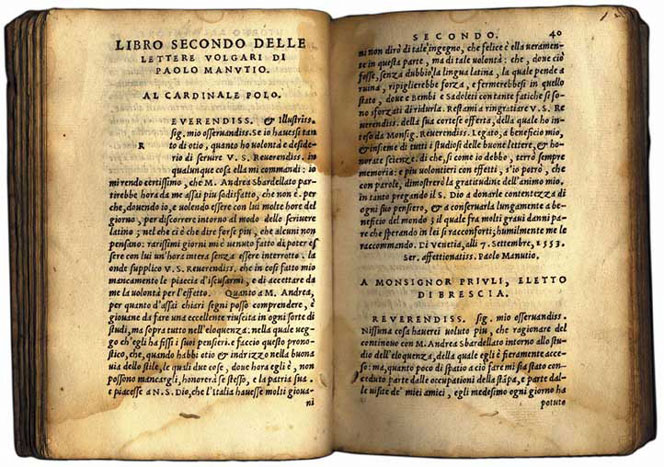
aldus manutius bookThe recent exhibition at the Grolier Club in Manhattan, “Aldus Manutius: A Legacy More Lasting Than Bronze” reminded me that the pocket-sized book was invented some five hundred years ago.

The pocket book revolutionized not only how we read but who and what we read.

In a recent talk I gave to the Editors Association of Canada about the changing face of publishing, I defined two milestones in the publishing industry.

First Milestone…

The first milestone came in two stages, beginning with the invention of the printing press by Johannes Guttenburg in 1452. Up to then,

…Books were a work of art… And part of an elite. Delicate, large and beautiful, they were created in the language of the church—Latin—and in turn copied entirely by hand by the monks. With the dimensions of a current newspaper, but much thicker, these large illuminated manuscripts sometimes weighed more than 50 pounds.

Readers were mostly scholars and the religious elite. In fact, reading was an elite occupation. The majority of people at the time couldn’t read and had no interest in books. Besides, books were not written in the commonly spoken language of the countryside such as English, French, German or Spanish.

In fact, the presses formed the very basis of the artistic Renaissance, the religious reformations and the scientific revolution, wrote Elizabeth Eisenstein in The Printing Press as an Agent of Change. “The printing press allowed the spread of information that couldn’t be controlled by the clergy, kings, politicians, or the religious elite,” adds New York Times technology reporter Nick Bilton in I Live in the Future and Here’s How It Works. Storytelling was no longer confined to an elite clergy; books could be created by anyone and shared in the spoken languages of the people.

The printing press had opened a gate of opportunity for secular expression to a greater audience. Whenever an opportunity is created, a corresponding need is identified. The need to connect a literate lay public with scholars and storytellers was resolved fifty years later by Aldus Manutius.

Until then, books, albeit printed in the language of the people, remained large, heavy and cumbersome. In 1502, Aldus Manutius invented the portable pocketsize book—the small format libelli portatiles (portable little books)—effectively creating “the mobile phone of his day,” according to Bilton.

Bound in vellum, these long, narrow libelli portatiles, easily transported in a pocket or a satchel, “could be held in the hand and learned by heart by everyone,” wrote Manutius. aldine press book

Manutius founded The Aldine Press in 1495 in Venice. His printing company proudly bore the logo of dolphin entwining an anchor—taken from the term festina lente (hasten slowly), a motto Manutius took from a Roman coin—and Aldine books quickly gained a reputation for their clean design, excellence in typography and inexpensive and accessible price. The Aldine press emphasized Greek and Latin lexicons and grammar manuals, with the first printed edition of Aristotle in 1495. Manutius was also the first to print Thucydides, Herodotus, Sophocles and other Greek philosophers. “He was possibly the first printer to compare manuscripts to arrive at the most reliable text,” adds Jennifer Schuessler of the New York Times (February 27, 2015).

Manutius was the first to use italic type, mimicking the handwriting of that time, and the first to use the semicolon in its modern sense. In 1501, Manutius released Virgil’s Opera as the first of his octavo editions of the classics and the first book to use italic print. It was produced in higher-than-normal print runs (1,000 rather than the usual 200 to 500 copies).

The octavo format book is created from one or more full sheets of paper on which 16 pages of text are printed; the sheet is folded three times to produce eight leaves. Each leaf of an octavo book represents one-eighth the size of the original sheet. The actual size of the book depends on the original size of the full sheet of paper on which it is printed. These varied according to place and time. A sixteenth century octavo printed in France or Italy was about the size of a modern paperback; an eighteenth-century octavo printed in England was larger, about the size of a modern hardcover novel.

Second Milestone…

The second milestone I talked about is, of course, the worldwide use of the Internet. Like the Guttenberg printing press, the Internet and associated World Wide Web has created a gate of opportunity that has identified a need. That need is currently being satisfied by ebook publishing, mobile phone communication and the Indie/self-publishing model.

In my September 6, 2014 article “How We Will Tell Stories in the Future” I describe the effect of the Internet and use of digital devices as agents of change and empowerment in storytelling and publishing.

The first email was delivered in 1971 and in 1989 Cern gave us the WorldWide Web. The Internet wasn’t commercialized until 1995. The first web log (blog) was published in the late 1990s and Facebook was launched in 2004. A few years later smart communication devices were created and mass marketed with multi-touch interface (e.g., the iPhone). By 2013, over 2 billion people were using the Internet and social media via computer, smartphones, tablets, game consoles, e-readers and music players. Over 156 million blogs were identified and over 1 billion files were uploaded daily to Dropbox.

While many people still read books and go to the cinema, watch pre-programmed TV or rent DVDs, many more enjoy their stories through other devices: computers, downloads, mobile phones and e-readers that provide material through other media and venues such as Indie and self-publishing, amateur YouTube videos, interactive games and social networks. We stand poised on the edge of a wonderful cliff that celebrates the expression — and consumer choice — of the individual. The music industry shows this the best, where people dismissed the prepackaged albums and CDs and opted to create their own unique playlists through individual song downloads. The publishing industry is currently struggling with its own painful yet thrilling metamorphosis as is the visual arts industry. In fact, they are all blurring into one large integrated amalgam of artistic expression.

The information you get today is coming “more and more through your friends and through your social network. It’s being distributed through channels of trust and the trust isn’t necessarily the BBCor The New York Times. It’s people,” says B.J. Fogg founder of the Persuasive Technology Lab at Stanford University.

WardIsland wall in forest

Ward Island, Ontario (photo by Nina Munteanu)

During the days of packaged content, leading storytellers were published authors, journalists and writers of newspapers and magazines. “Now distribution channels matter less and anyone with an appropriate device can be a storyteller,” says Bilton, who shares that on the Internet we tend to follow individuals we trust (e.g., Clive Thompson or David Carr) as much if not more than established organizations (like Wired Magazine or The New York Times). Accessible technology, platforms, free applications and software has totally enabled the individual.  No longer confined to the written word via paper books or visual expression through movies or TV shows, storytelling has embraced many forms. Amateur and professional have equally blurred.

From paperbacks to digital phones and tablets, we are embracing the shifting zeitgeist of an entire world. The future belongs to the storyteller, from pocketbook to tablet. What’s next?


nina-2014aaNina Munteanu is an ecologist and internationally published author of award-nominated speculative novels, short stories and non-fiction. She is co-editor of Europa SF and currently teaches writing courses at George Brown College and the University of Toronto. Visit www.ninamunteanu.ca for the latest on her books.

How to Hook Your Reader and Deliver

Beaches-snow03

Winter in The Beach (photo by Nina Munteanu)

A great story opening arouses, delays and rewards. Constructing a compelling beginning—often called a hook—is a common challenge for even established writers, and one of the most important parts of a story.

The opening should sweep the reader into the story like a tidal wave. It doesn’t need to be wild action. It just needs to compel the reader to want to know more. This is accomplished by engaging the reader with “intrigue”. In his article “Three Ways to Keep Your Readers Hooked” in the April 2001 issue of Writer’s Digest, Joe Cardillo suggested that the three elements of hooking a reader resemble the steps he uses to train his Samoyed puppy: 1) arouse interest; 2) delay, then 3) reward.

The writer arouses interest in the reader by providing enough detail to get the reader to ask questions. Now they want something. You tease them with the delay; that keeps them reading and turning the pages. It also gives them the chance to try to come up with the answers themselves. The reward comes in stages. Don’t answer all their questions at once. That’s what the book—the story—is for. The reward, parceled out in stages, lets the reader know that you can deliver and will ultimately provide them with a fulfilling story at the end. The beginning of your book sets up a covenant between you and the reader, a covenant for a journey you will take together toward resolution.

There is no beginning without an end. In her book The Sell Your Novel Tool Kit (Revised Edition, Perigee Trade, 2002) Elizabeth Lyon suggested that the beginning of a novel should “reflect the entire book. There should be a tie-in [between] the beginning and the end”. This is sometimes called “framing” a story, where the principal thematic problem is given in the beginning and then resolved in the end. In his book, A Story is a Promise (Blue Heron Publishing, 2000) Bill Johnson describes it as a promise to the reader.

Beaches-snow02

Toronto streetcar (photo by Nina Munteanu)

“Dramatic story-issues revolve around issues of human need,” says Johnson. “The need to be loved. To have control of one’s fate. To feel a sense of purpose. To be able to overcome obstacles. To be able to grow and heal from life’s wounds. To understand and make sense of the events of life.” He warns that “if you can’t name the issue at the heart of your story [the theme], it risks being unclear to your audience.” And this needs to be identified, at least intuitively for the reader, at the beginning of the story. You do this through intrigue in the beginning and pointing out through scene what is at stake or at issue in your story.

Additional things to consider in openings include:

  • Avoid starting your story at “the beginning”: instead, start mid-way, when something is already happening—preferably to someone important in your story and at the pivotal point when you provide the “story promise” pertinent to the theme.
  • Quell the urge to put in a lot of information about setting, character and situation: get things in motion first, then reveal here and there. Let the details unfold with the story like a flowing piece of artwork.
  • Trust your reader: novice writers have not yet gained the confidence to trust that they won’t lose the reader in the beginning if they don’t tell them everything right away. The key is to choose just enough to whet their appetite for more. And, yes, it is critical what you choose. What you choose should relate to your story’s theme and its story promise: the problem.

A great opening is a seductive tease, deliciously delivered; it promises an exotic ride that only you can fulfill.

This article is an excerpt from The Fiction Writer: Get Published, Write Now!

Recommended Reading:Beaches-snow01

  • Cardillo, Joe. 2001. “Three Ways to Keep Your Readers Hooked”. Writer’s Digest, April, 2001, volume 81, no. 4.
  • Johnson, Bill. 2000. A Story Is a Promise. Blue Heron Publishing. Portland, Oregon. 187pp.
  • Lyon, Elizabeth. 2002. The Sell Your Novel Took Kit. Revised Edition. Perigee Trade. 320pp.
  • Munteanu, Nina. 2009. The Fiction Writer: Get Published, Write Now! Starfire World Syndicate, Louisville, KY. 264pp.


Nina Munteanu is an ecologist and internationally published author of award-nominated speculative novels, short stories and non-fiction. She is co-editor of Europa SF and currently teaches writing courses at George Brown College and the University of Toronto. Visit www.ninamunteanu.ca for the latest on her books.

Ten Questions You Need to Ask Your Characters Before They Can Stay In Your Story

zermatt-matterhorn02

The Matterhorn, Zermatt, Switzerland (photo by Nina Munteanu)

Your story lives and breathes through your characters. Through them your premise, idea and your plot come alive. Characters give your story meaning; they draw in the reader who lives the journey through them. Without them you wouldn’t have a story—you’d have a treatise.

Here are some questions you need to ask each of your characters:

  1. Will the story fall apart or be significantly diminished if you disappear? If not, you don’t need to be there; you aren’t fulfilling a role in the book. Hugo award winning author Robert J. Sawyer reminds us that “story-people are made-to-order to do a specific job”: they tell a story. In real life, people may act through no apparent motivation, be confusing, incoherent and make pointless statements or actions. Story characters show more clear motivations, coherence, and consistency. They don’t clutter your story with muddle and confusion like real people do. They fit into your story like a major puzzle piece.
  2. What is your role? (e.g., protagonist, antagonist, mentor, catalyst, etc.). Each character fulfills a dramatic function in your story. You can’t just be there because you’re cute. Well, ok, maybe. But even being cute can and should provide a dramatic function in the story by exploring how that quality is viewed and treated by others. As with setting, which serves a similar purpose as character in story, every aspect of both minor and major characters interact with and illuminate story theme, premise and plot.
  3. What archetype do you fulfill? In the “hero’s journey” plot approach, each character fulfills one to several archetypes, which help define how they service the plot and theme of the story. The mentor archetype, for instance, generally believes in and enables the hero on his journey. The threshold guardian, on the other hand does not have faith in the hero and obstructs him on his journey. The hero archetype, usually on a quest (for truth, forgiveness, home, victory, faith, etc.), must negotiate her world of archetypes to reach her destination.
  4. How do you contribute to the major or minor theme of the book? This is particularly relevant for all major characters and their associated sub-plots. Sawyer stresses that “your main character should illuminate the fundamental conflict suggested by your premise.” All other characters, in turn, either help reflect the main character’s journey or the overall story premise and theme. If your book is about forgiveness, each character helps illuminate your exploration of this theme.
  5. Are you unique? If the reader can’t distinguish you from other characters, chances are you need to be eliminated because of point number 1 anyway. In order to contribute to story, characters must provide a sufficiently distinguishable feature, complete with sub-plot, on the story landscape. The more varied and rich the landscape is, the more interesting it will be. Fictional characters achieve distinction through individual traits that readers recognize and empathize with. Authors use vernacular and body language to achieve colorful fictional characters.
  6. Are you interesting? If you aren’t interesting to the reader, you won’t do your job. Readers need to notice you, distinguish you and find something about you that will keep their interest—even if it’s something annoying. Just remember to be consistent—unless inconsistency is part of your character.
  7. What is your story arc? Do you develop, change, and learn something by the end? If not, you will be two-dimensional and less interesting. This is just as true for minor characters as for main characters. The more characters the author imbues with the depth to develop, the more multi-layered the story will become. This is because each character and her associated arc provides her own perspective to the theme. This is what is truly meant by “richness” — not the richness of infinite detail, like a baroque painting, but of infinite meaning like an impressionist work. Choose your minor characters as you choose your major characters.
  8. What major obstacle(s) must you overcome? You need these to struggle and “grow” and change; otherwise there is no tension in the story, no development and movement and no story arc. Your character will be like a still-life with no movement, no direction and no interest. The more your character changes over a story, the more she will be noticed and remembered.
  9. What’s at stake for you (theme), and for the world (plot), and how do these tie together? If a writer is unable to tie these together in story, the story will fail to evoke emotional involvement and empathy. It will lack cohesiveness and will not give the reader a fulfilling conclusion with ultimate satisfaction through the character’s journey related to theme (the hero’s journey, essentially).
  10. Do you change from beginning to end? If you don’t develop throughout the story, then you aren’t growing as a result of the thematic elements and plot issues presented in the story. In other words, you haven’t learned your lesson. While it’s ok for some characters not to develop (e.g., to be one note or flat or plain old stubbornly the same) this is disastrous for any of your main characters. Just ensure that the changes you make your character go through are warranted and relevant to the theme.

JournalWritert FrontCover copy 2Characters help the writer achieve empathy and commitment from the reader. Characters are really why readers keep reading. If the reader doesn’t invest in the characters, she won’t really care what happens next. It is important to be mindful of the emotional and narrative weight of a character and achieve balance between characters. For instance, the foil of the protagonist should carry equal weight; otherwise the reader won’t believe the match-up. Equally, a large cast—often used in epic fantasies or historical pieces—can be used successfully, but only if each character is given a clearly distinguishable personality and role.

References:


Nina Munteanu is an ecologist and internationally published author of award-nominated speculative novels, short stories and non-fiction. She is co-editor of Europa SF and currently teaches writing courses at George Brown College and the University of Toronto. Visit www.ninamunteanu.ca for the latest on her books.



Using the Subtext of Body Language in Storytelling

Maple-sugar spring-LR

Sugar maple leans over the Little Rouge River, Ontario (photo by Nina Munteanu)

Kinesics is the study of “body language”, which explores how movements and gestures project a person’s hidden thoughts. Blushing is an obvious reaction. But more subtle ones can be used. When body language contradicts verbal expression, tension, conflict and interesting scenarios increase. This is a great opportunity for writers.

According to Janet Lee Carey, author of Dragon’s Keep, body language:

  • Shows the subtle undercurrent of communications between characters (of which either may not be consciously aware).
  • Shows the comic or tragic elements behind the dialogue.
  • Reveals the character’s true feelings (regardless of what he or she is saying).

In order to accomplish this, the writer must learn to accurately interpret the subtle signals of body language and translate them into the written form. One way is to look at yourself. Ask yourself: what do you do when you’re nervous? Excited? Thrilled? Sad? Angry? How do you do housework when you’re angry? When you’re happy? It helps to look at the same action under different moods to distill out the finer nuances of gesture and movement.

Pay attention to your own body, suggests Carey. “How do you sit? How do you move? How do you breathe?” Pay attention to your moods and what your body does then. For instance, what do you do with your hands when you’re nervous? How do you speak when you’re impatient? How do you cook when you’re happy? How about when you’re mad?

Carey lists the areas of the body where emotions can be detected by other characters. These include: skin, breathing (swallowing), eyes, eyebrows, ears, lips, jaw, neck, shoulders, arms, hands, back, sexual organs, legs and feet. On the other hand, physical areas where a character may feel an emotion but not show it is: pain in the body, skin, tongue, throat, heart, stomach, sexual organs, and pulse.

You can use body language imaginatively in several ways. Here are a few:

  • Amplification and contradiction: use body movements and facial expressions to either enhance or contradict the verbal expression
  • Reactions to invasion of personal space: show signs of restlessness, such as hunching of the shoulders, tucking in of the chin, backing up
  • Masking: this is when a character defends personal spac by showing indifference or confidence while masking their true feelings (e.g., remember when Like faced the Emperor in that last battle aboard the Deathstar? Despite his quiet show of confidence, he swallowed [his fear]).

Body language can either amplify or contradict what is said between two characters. The latter, of course, is usually more interesting, because it sets up tension and underlying conflict.

The following is an example of amplification:

“So, what happened?” Jenny asked, leaning forward and gazing directly at Mark.

Jenny’s body language matches her dialogue, amplifying her genuine concern. Here’s an example of contradiction:

“Hey, great to see you,” Dave said, crossing his arms and edging back to slouch against the wall.

Tom wandered to the fridge and opened it to look inside. “Can I have a beer?”

Dave fixed a hard smile at Tom. “Sure.”

FictionWriter-front cover-2nd ed-webIt’s obvious that Dave isn’t happy to see Tom, and his body language contradicts what he said. This makes for compelling reading. Subtext (beneath the surface of dialogue) adds interest and intrigue, particularly when it contradicts or complicates the verbal message.


References

Munteanu, Nina. 2009. The Fiction Writer: Get Published, Write Now! Starfire World Syndicate. Louisville, KY. 266pp.


Nina Munteanu is an ecologist and internationally published author of award-nominated speculative novels, short stories and non-fiction. She is co-editor of Europa SF and currently teaches writing courses at George Brown College and the University of Toronto. Visit www.ninamunteanu.ca for the latest on her books.