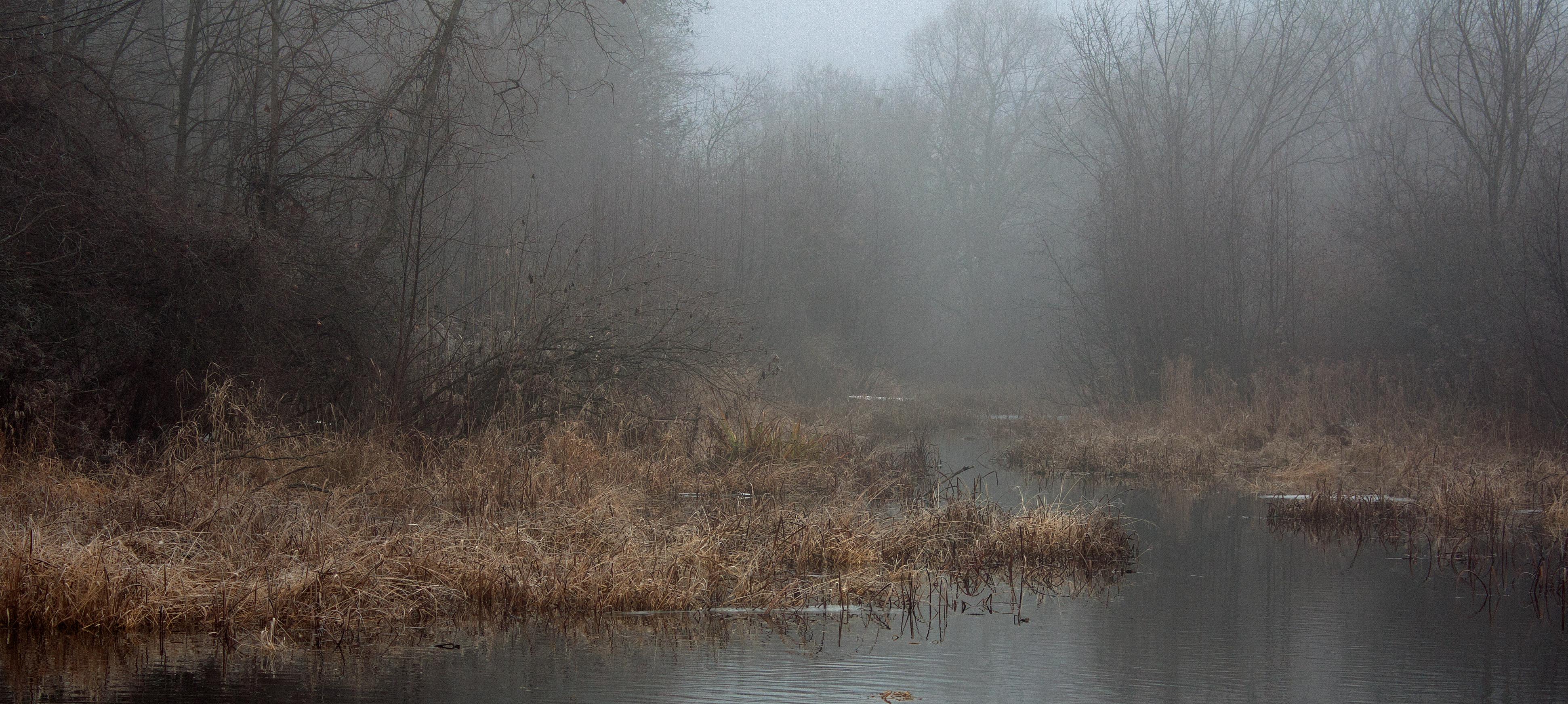
A November mist settles on Thompson Creek marsh, ON (photo by Nina Munteanu)
In January of this year, I posted a shot I’d taken in early winter of a marsh I often visit. That morning was cool and a thick mist lurked in the marsh like a shadow, giving it a mysterious timeless quality. A quiet stillness had settled like dew on everything, muting both colour and sound into a hush of anticipation. The stillness made me feel as though I’d entered a John Atkinson Grimshaw painting. A moody darkness pervaded the bare braided trees and the marsh oozed the scent of humus and wet vegetation. I inhaled it all deeply.
The image I posted caught the attention of colleague writer and publisher Lorina Stephens, who is also a superlative artist and painter. Inspired, she responded to my image with a painting.
The Painting:
Lorina Stephen’s ekphrastic painting entitled “Fog on West Grey Pond”
“I very much wanted to create that feeling of dreamscape that often happens in still waters, of there being something out there in the mist, of that sense of wonder and mystery. So, for this painting, it meant employing a gentle hand, allowing pigment to flow and pool, waiting until water had evaporated slightly, and then using a small, natural sponge to dab out areas to allow the white of the paper to shine through, then as the paper dried in an hour or so, or in some cases the next day, brushing in details little by little, from soft washes to hard lines, in order to create depth and definition.
It always amazes me when depth of field happens on the two dimensions of paper, that in this flat, thin sheet of paper I can take my viewer out and away into the distance, through a portal to another place, and in this case perhaps create that sense of the dampness and chill of a foggy day.”
Biography of Lorina Stephens
Lorina Stephens has been painting since the age of 14 when she studied under well-known, award-winning Ontario landscape artist, Dorothy Milne-Eplett. In those days it was oils and mostly copy-painting, although there were originals. Most of those paintings ended up in a collection under patreon, Oscar LaBerge, who was a construction worker in Newmarket, Ontario.
In the 1980s, Lorina rediscovered watercolours during an intensive 12 week Georgian College course, during which time the Tottenham Art Association was formed, and juried shows ensued, as well as solo exhibitions in galleries in Central Ontario.
.
Then the recession of the 1990s happened, and art became a way to stretch the family budget by way of hawking wares at the Orangeville Farmers Market, what Lorina came to call “painting pretty pictures for tourists”. These days Lorina paints simply as a way of expressing her love of the land, the ineffable communication that exists in the vast expanse of Canadian geography.
Lorina inherited from her mother a lifetime supply of watercolour paper. Among all those papers is a block of 7″ x 10″ Arches 140 lb hot pressed paper. That began a journey of studies.
Hot pressed paper has its own set of demands, having a very smooth finish and thus doesn’t absorb water the way of cold pressed, and the weight also means it tends to buckle and warp easily in larger sizes. Lorina addresses that by using a tempered glass painting desk, and creating a suction seal with water between the glass and paper, rather than the frustration of stretching paper onto a surface with masking tape. Using hot pressed paper also allows for some pretty interesting results by way of sponging and wiping out areas, and accepting precise detail work when the paper is dry. Her palette of colours is mostly transparent, with the addition of some pretty aggressively staining bullies added in.
Thompson Creek marsh on a foggy November morning, ON (photo by Nina Munteanu)
.
Nina Munteanu is a Canadian ecologist / limnologist and novelist. She is co-editor of Europa SF and currently teaches writing courses at George Brown College and the University of Toronto. Visit www.ninamunteanu.ca for the latest on her books. Nina’s bilingual “La natura dell’acqua / The Way of Water” was published by Mincione Edizioni in Rome. Her non-fiction book “Water Is…” by Pixl Press (Vancouver) was selected by Margaret Atwood in the New York Times ‘Year in Reading’ and was chosen as the 2017 Summer Read by Water Canada. Her novel “A Diary in the Age of Water” was released by Inanna Publications (Toronto) in June 2020.
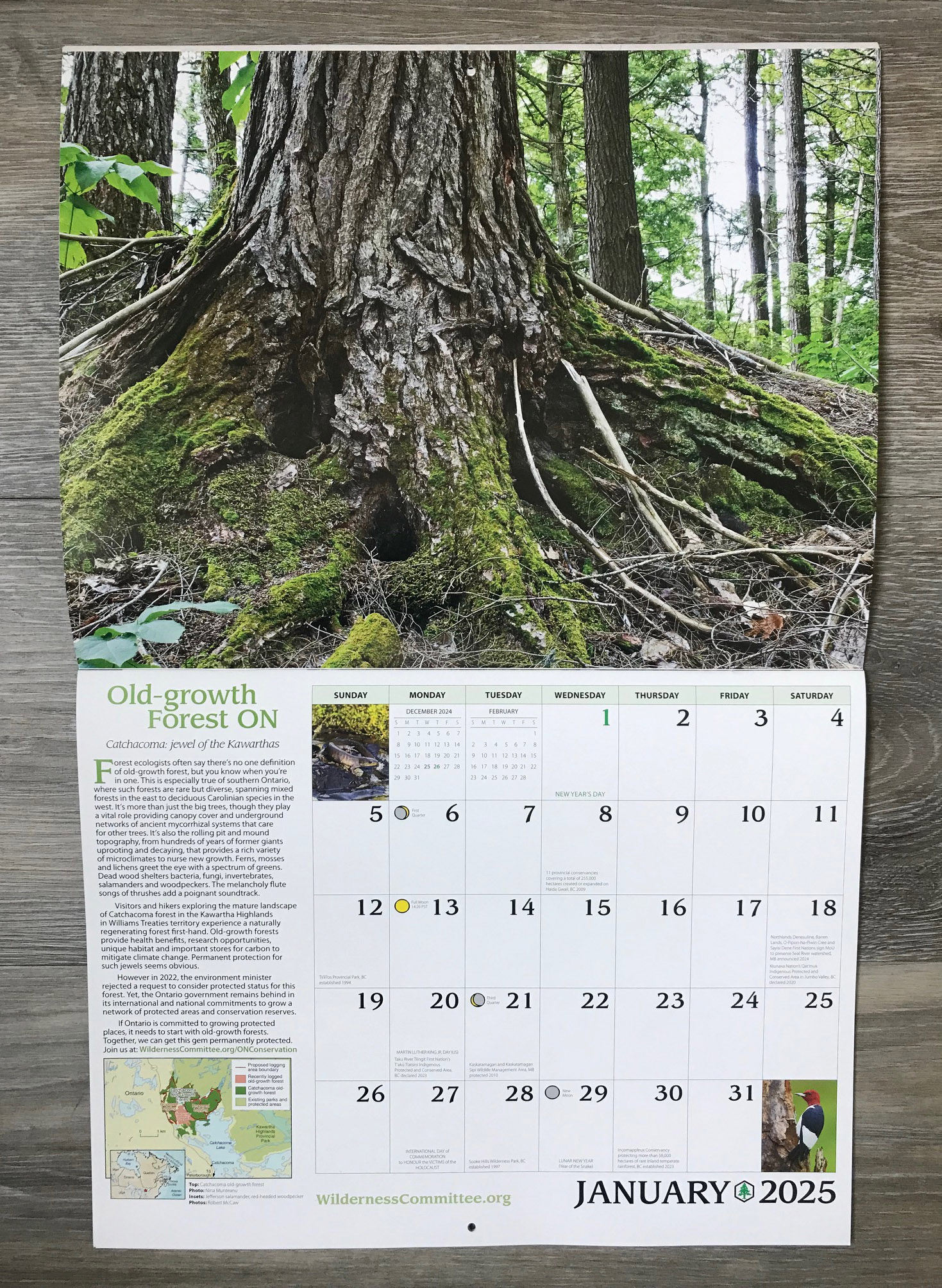
I recently received my copies of the 2025 Wild Canada calendar put out by WildernessCommittee.ca. The calendar has 12 months of gorgeous images of wild and sacred places throughout Canada; heartfelt and informative stories accompany each image.
2025 Wild Canada calendar featuring January spread
My own photo of an old-growth hemlock in Catchacoma Forest, Ontario, is featured for January! Go check out the Wilderness Committee site then go to their store to see the whole calendar. It’s worth buying for its beauty and its meaningful narratives. And it is an excellent way to support a worthwhile cause.
Nina Munteanu is a Canadian ecologist / limnologist and novelist. She is co-editor of Europa SF and currently teaches writing courses at George Brown College and the University of Toronto. Visit www.ninamunteanu.ca for the latest on her books. Nina’s bilingual “La natura dell’acqua / The Way of Water” was published by Mincione Edizioni in Rome. Her non-fiction book “Water Is…” by Pixl Press (Vancouver) was selected by Margaret Atwood in the New York Times ‘Year in Reading’ and was chosen as the 2017 Summer Read by Water Canada. Her novel “A Diary in the Age of Water” was released by Inanna Publications (Toronto) in June 2020.
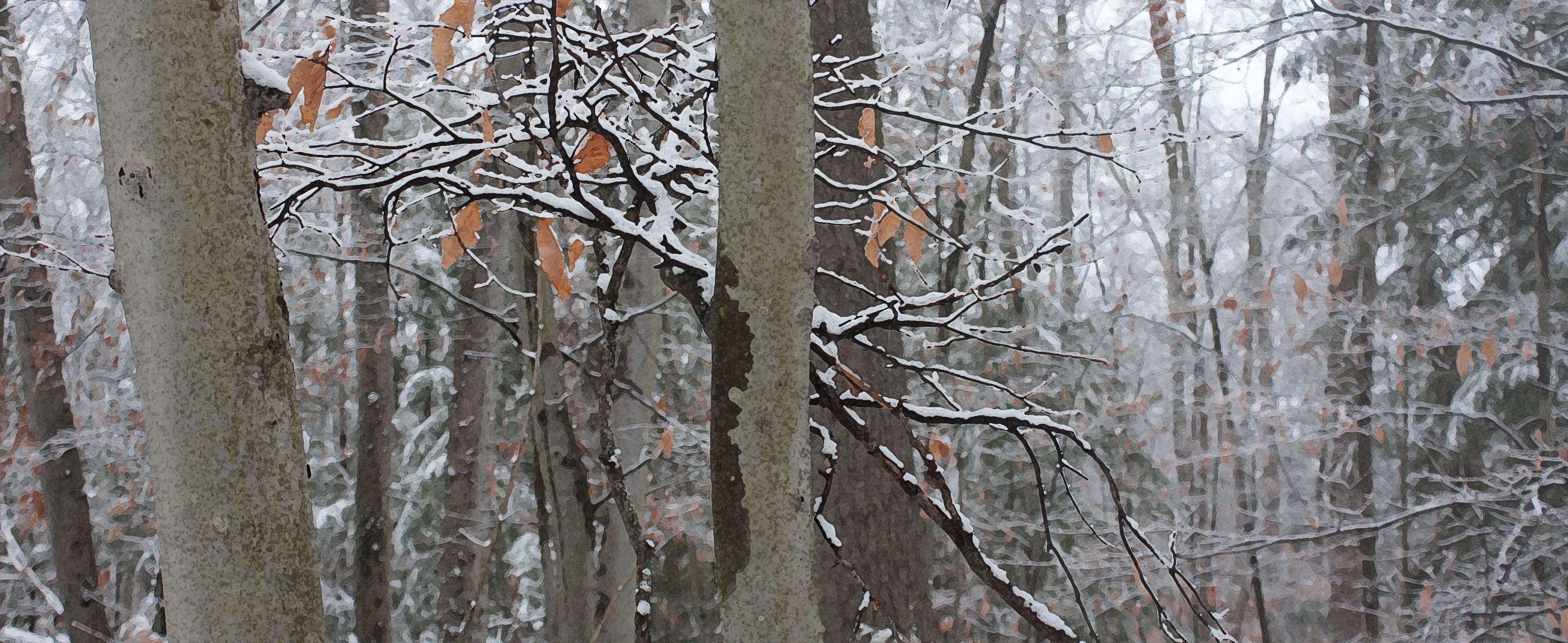
Beech trees stand with bronzed leaves as the snow falls in the mixed forest of South Drumlin park, ON (photo and rendition by Nina Munteanu)
Yesterday, it started snowing near the end of my work shift, and I kept glancing out the window as it turned into a heavy thick snow, the kind I just adore. Whenever this happens, I long for werifesteria…
A pair of beech trees stand pale among hemlocks and poplar trees, South Drumlin park, ON (photo and rendition by Nina Munteanu)
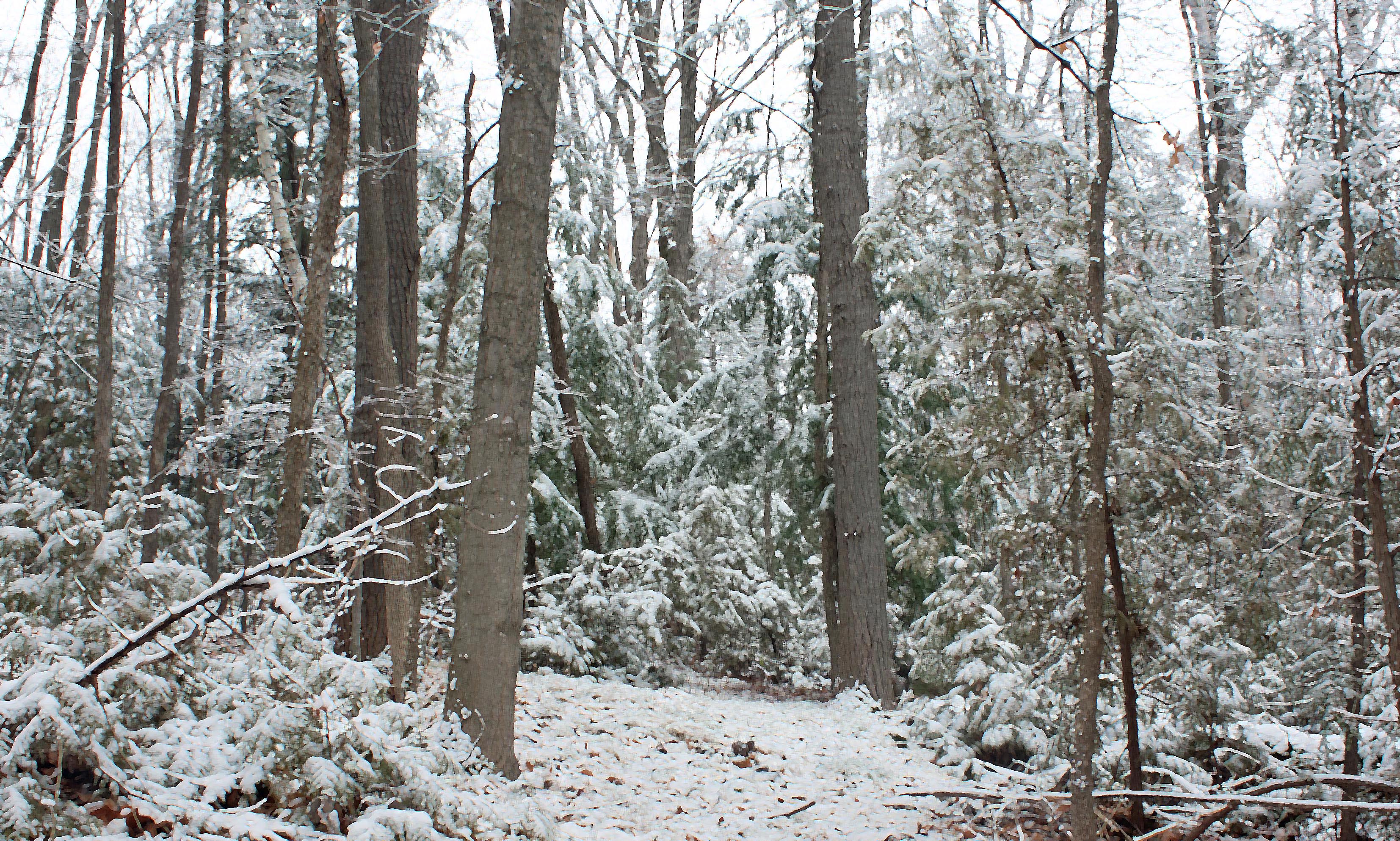
Beech-hemlock forest after a light snow in South Drumlin park, ON (photo and rendition by Nina Munteanu)
As soon as the shift was over, I snatched my gear and rushed off with my camera and tripod and a pack of blueberries to the beech-maple-hemlock forest nearby. The place is called South Drumlin Park, because the forest runs up and down a hogsback with wonderful trails throughout.
Marcescent beech trees greet me along a trail in South Drumlin park, ON (photo and rendition by Nina Munteanu)
I was the only person there. I walked and crunched through snow and frost-hardened leaf litter and I let myself get lost in the labyrinth of trails through the open winter forest. The pale beech trees, because they keep their now copper-coloured marcescent leaves, stood out amid the bare maples, oaks, poplars and birch trees.
Pale bronze beech leaves light up the dark hemlock forest, South Drumlin park (photo and rendition by Nina Munteanu)
I wandered there for hours, inhaling the peaceful freshness and the quiet hush of gentle snowing in the forest.
There were just a few rowdy red squirrels and one persistent bluejay, but all else lay quiet in the deep of the forest. I had found my magic and mystery … It felt sublime and my heart sang…
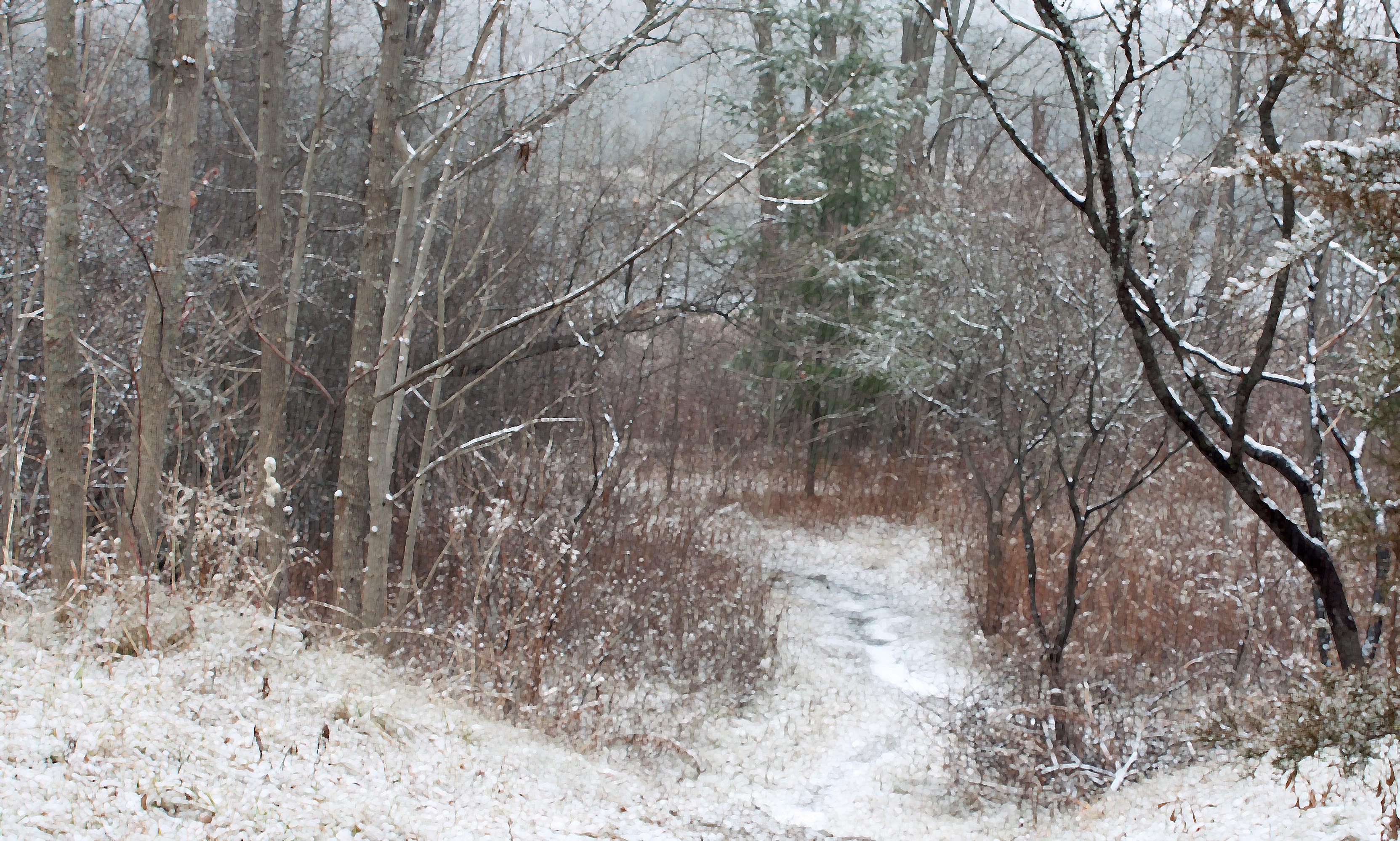
Trail through poplars, cedars and hemlocks toward the river, South Drumlin park, ON (photo and rendition by Nina Munteanu)
Nina Munteanu is a Canadian ecologist / limnologist and novelist. She is co-editor of Europa SF and currently teaches writing courses at George Brown College and the University of Toronto. Visit www.ninamunteanu.ca for the latest on her books. Nina’s bilingual “La natura dell’acqua / The Way of Water” was published by Mincione Edizioni in Rome. Her non-fiction book “Water Is…” by Pixl Press (Vancouver) was selected by Margaret Atwood in the New York Times ‘Year in Reading’ and was chosen as the 2017 Summer Read by Water Canada. Her novel “A Diary in the Age of Water” was released by Inanna Publications (Toronto) in June 2020.
Ice sheet with embedded pancake ice breaking into fragments on the Otonabee River, ON (photo by Nina Munteanu)
It’s spring and every day on the river is different. One day the ice thaws. The next day it reforms only to thaw again.
Ice sheet stitched together by ice pancakes and fragments, ON (photo by Nina Munteanu)
I love watching the process of ice pancake formation and reformation on the Otonabee River. It starts with primordial ice-froth, which then coagulates into ice sheets. These sometimes look like fabric or white felt.
Giant ice fragments with embedded pancake ice break off ice sheets in spring on the river, ON (photo by Nina Munteanu)
Then entire sheets break up into long fragments like giant pieces of glass shards, all floating down the river, little opaque pancakes embedded in clear glassy sheets. And the water beneath is the darkest blue.
Ice pancakes glued into an ice sheet by clear ice formed around them (photo by Nina Munteanu)
Ice sculptures form as wave-induced ice shuga collide and form strange shapes, Otonabee River, ON (photo by Nina Munteanu)
Nina Munteanu is a Canadian ecologist / limnologist and novelist. She is co-editor of Europa SF and currently teaches writing courses at George Brown College and the University of Toronto. Visit www.ninamunteanu.ca for the latest on her books. Nina’s bilingual “La natura dell’acqua / The Way of Water” was published by Mincione Edizioni in Rome. Her non-fiction book “Water Is…” by Pixl Press(Vancouver) was selected by Margaret Atwood in the New York Times‘Year in Reading’ and was chosen as the 2017 Summer Read by Water Canada. Her novel “A Diary in the Age of Water” was released by Inanna Publications (Toronto) in June 2020.
Snow covered farmer’s field at sunset, ON (photo and rendition by Nina Munteanu)
Ice clad prisms, snow covered fields of glittering fire… Winter days, the wondrous glow: ultramarine lights and turning shades The magic song: ice and gently underflow of meandering streams Singing waters on the tortuous pathway below… Clangor, bell sounds: the moving harmonies on icy slopes…
Jackson Creek in winter, ON (photo and rendition by Nina Munteanu)
Ice ‘islands’ touched by sunset light in Jackson Creek, ON (photo and rendition by Nina Munteanu)
Ice block in Jackson Creek, ON (photo and rendition by Nina Munteanu)
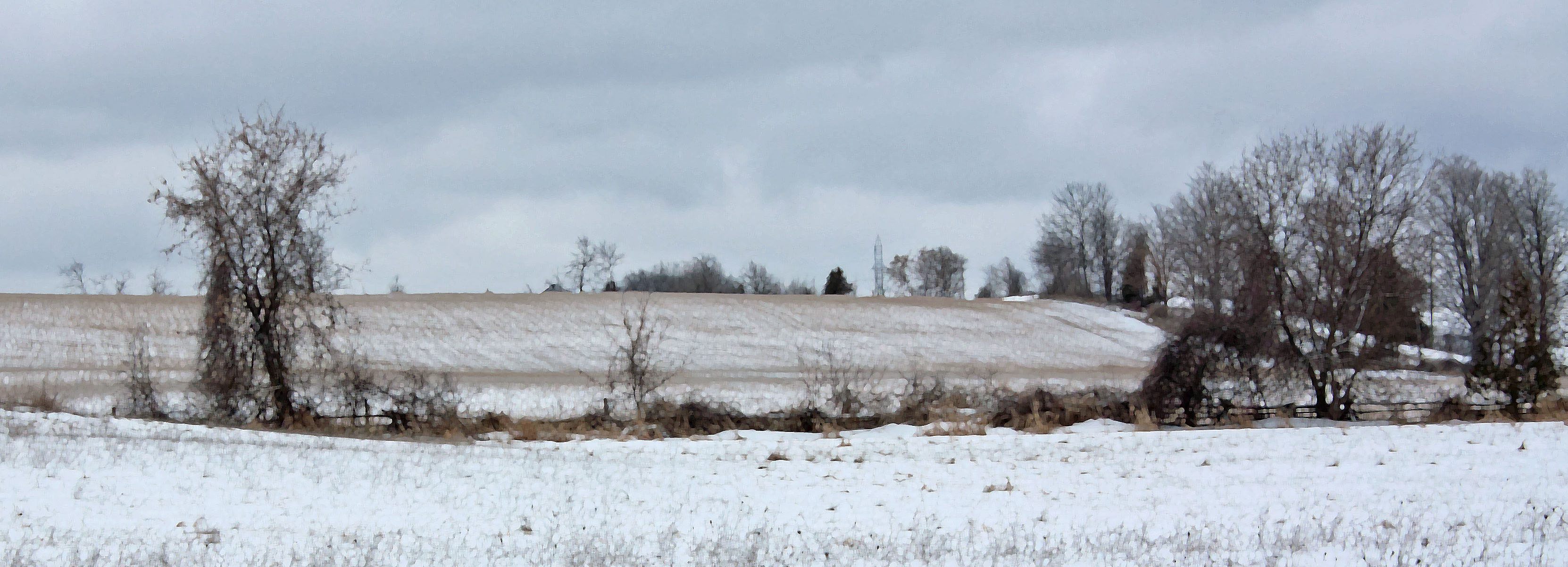
Farmer’s field in Kawarthas, ON (photo and rendition by Nina Munteanu)
A bronze feathered hawk sails high above Into the bright sunlit skies, Hawk, swiftly carried in its flight above bended fir and aspen forests, A wild, fierce, freewheeling majesty…
Icy bay and shed in the trees, ON (photo and rendition by Nina Munteanu)
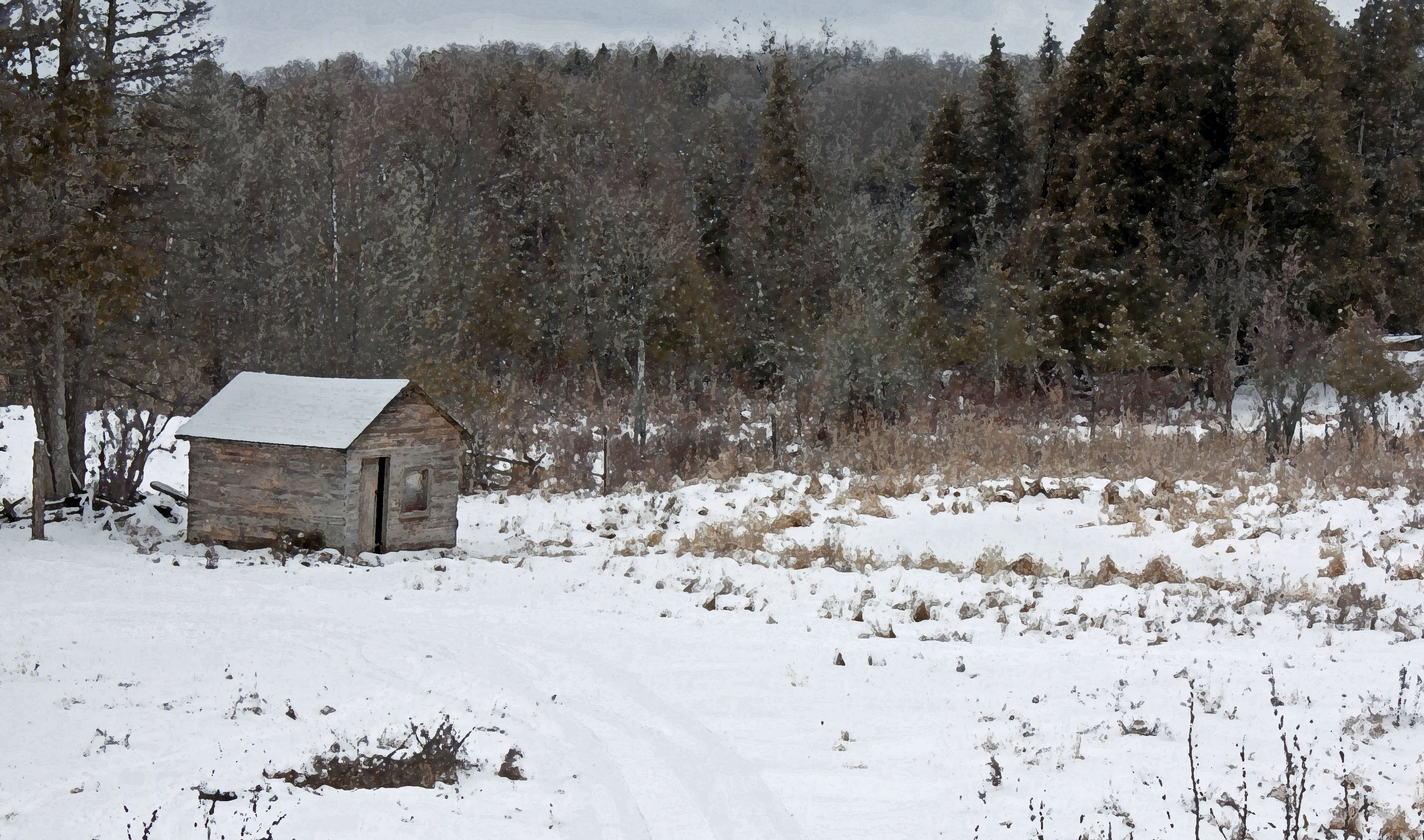
Small cabin in a meadow, ON (photo and rendition by Nina Munteanu)
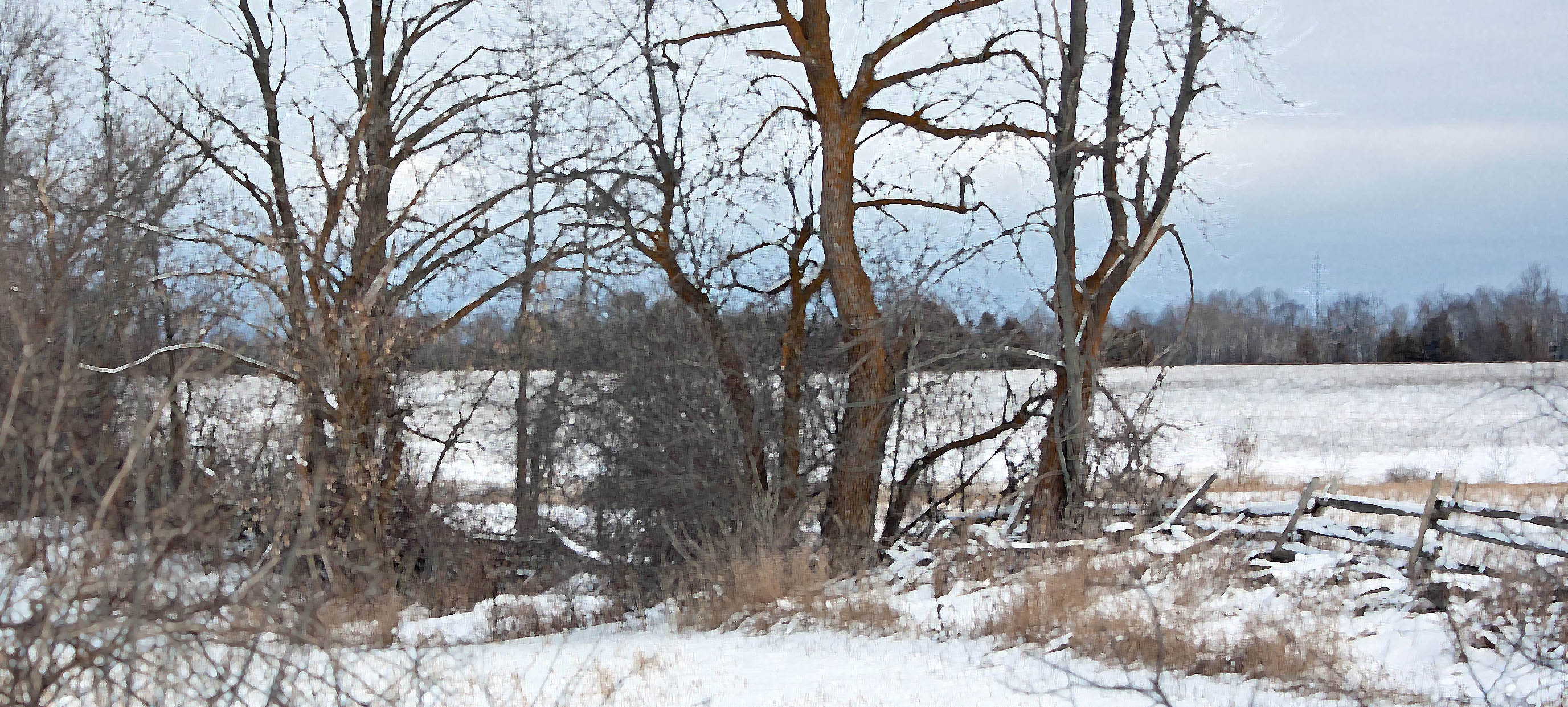
Trees by fence in farmer’s field, ON (photo and rendition by Nina Munteanu)
Snow from a cedar tree showers down glitter-dust in a light breeze in Jackson Creek Park, ON (photo by Nina Munteanu)
The many pristine snow reflected lights, glittering fires Above a snow clad world in a time of darkness: Nature’s magic universe everywhere extant: We are overwhelmed, confounded by the wonder of it all.
Skier checks his path on a slope at sunset, BC (photo by Lindsay)
Snow glistening in the sunset on a very cold day, ON (photo and rendition by Nina Munteanu)
Reflections in Thompson Creek outlet after a new snowfall, ON (photo and rendition by Nina Munteanu)
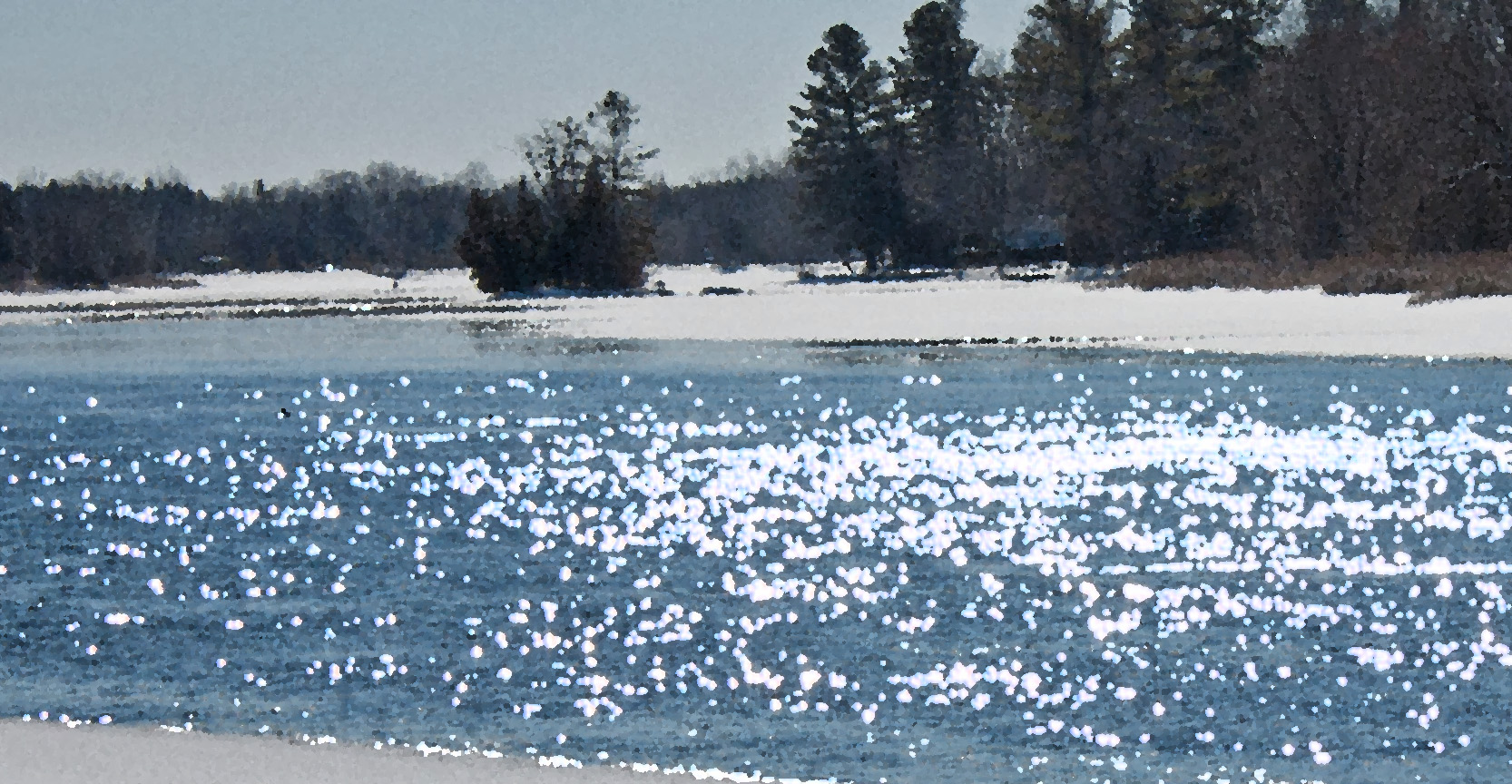
Otonabee River glittering in the sun, ON (photo and rendition by Nina Munteanu)
Bev Gorbet is a Toronto poet. She has published several poems with the Retired Teachers Organization and most recently in “Literary Connection IV: Then and Now” (In Our Words Inc., 2019), edited by Cheryl Antao Xavier.
Nina Munteanu is a Canadian ecologist / limnologist and novelist. She is co-editor of Europa SF and currently teaches writing courses at George Brown College and the University of Toronto. Visit www.ninamunteanu.ca for the latest on her books. Nina’s bilingual “La natura dell’acqua / The Way of Water” was published by Mincione Edizioni in Rome. Her non-fiction book “Water Is…” by Pixl Press(Vancouver) was selected by Margaret Atwood in the New York Times‘Year in Reading’ and was chosen as the 2017 Summer Read by Water Canada. Her novel “A Diary in the Age of Water” was released by Inanna Publications (Toronto) in June 2020.
Rotary Trail in Peterborough during a foggy day, ON (photo and rendition by Nina Munteanu)
A few days ago, I woke up in the morning to a dense fog outside. I hastily dressed, grabbed a clementine, put on my boots and coat and raced outside into the gentle morning. The air was fresh. A calm stillness had settled over everything, from ghostly forest to dripping branches by the path to people who appeared and disappeared in the mist.
Rotary Trail path to the bridge across the Otonabee River, ON (photo by Nina Munteanu)
As I strolled along the trail and forest paths, camera in hand, I realized that I needn’t have rushed; the fog didn’t burn away and dissipate beneath a strong sun. It remained foggy the entire day.
Path through winter forest on a foggy morning, ON (photo by Nina Munteanu)
Thompson Creek marsh in the fog, ON (photo by Nina Munteanu)
Otonabee marsh in the fog, ON (photo and rendition by Nina Munteanu)
Dogwood shrubs add colour to the marsh as ice forms, ON (photo and rendition by Nina Munteanu)
At Thompson Creek marsh, crimson dogwood shrubs and gnarly trees greeted me with arms stretched through the fog. The damp air, fragrant with the stirring of Winter, caressed my cheeks. I felt like I’d entered a Camille Pissarro painting…
Alders, willows and other trees, amid ruddy dogwoods, line Thompson Creek marsh behind, ON (photo and rendition by Nina Munteanu)
Road to Lakefield along Otonabee River in the fog, ON (photo and rendition by Nina Munteanu)
During my drive along the river, the calm stillness of the day settled over me with muted beauty. Nature’s shapes peered through the mist like quantum entangled apparitions, coalescing to the nearness of my gaze then vanishing again on my parting.
Shore of ice-strewn Otonabee River off Lakefield Road, ON (photo and rendition by Nina Munteanu)
1906 building on shore of Otonabee River during a foggy day, ON (photo and rendition by Nina Munteanu)
Small island in Otonabee River on road to Lakefield, ON (photo and rendition by Nina Munteanu)
I drove along country roads that vanished in the mist. As I plied through the fog, phantom trees loomed, quietly announcing themselves on the side of the road as their shapes assembled into something solid.
I imagined I was catching the breath of heaven…
Country dirt road in the Kawarthas on a foggy day, ON (photo by Nina Munteanu)
Tree ghosts in a farmer’s field in Kawartha country, ON (photo by Nina Munteanu)
Snow melt stream and marsh on the side of a country road on a foggy day, ON (photo and rendition by Nina Munteanu)
The fog is a shape-shifter. Sometimes a brooding beast, obscuring all in its indiscriminate path. Other times an impish rogue, a pale coquette, winking and teasing as it both reveals and hides, like a good mystery novel…
Fog over the Otonabee River, ON (photo and rendition by Nina Munteanu)
Thompson Creek marsh in a winter mist, ON (photo by Nina Munteanu)
Nina Munteanu is a Canadian ecologist / limnologist and novelist. She is co-editor of Europa SF and currently teaches writing courses at George Brown College and the University of Toronto. Visit www.ninamunteanu.ca for the latest on her books. Nina’s bilingual “La natura dell’acqua / The Way of Water” was published by Mincione Edizioni in Rome. Her non-fiction book “Water Is…” by Pixl Press(Vancouver) was selected by Margaret Atwood in the New York Times‘Year in Reading’ and was chosen as the 2017 Summer Read by Water Canada. Her novel “A Diary in the Age of Water” was released by Inanna Publications (Toronto) in June 2020.
Path to bridge over Otonabee River on a foggy morning, ON (photo by Nina Munteanu)
The strange merry-go- round will turn and turn; Season to season in sacred passage, Time’s gentle silences softly unwinding…
Marcescent Beech trees in a Kawartha forest during fog, ON (photo and rendition by Nina Munteanu)
Days of a savage beauty: The world’s innate beauty, The world’s inevitable pain…
Snowmelt along country road in Kawarthas on a foggy morning, ON (photo and rendition by Nina Munteanu)
We, both predator and prey: Wild song, wild nature’s order… Moments of perplexity and loss, The many daunting questions: Unanswerable visions beyond the abyss.
Mallards feeding in Thompson Creek, ON (photo and rendition by Nina Munteanu)
Too often the inaction, The inscrutable silences In a time of fear…
Tree reflected in Thompson Creek, ON (photo and rendition by Nina Munteanu)
The cruel histories: these misbegotten tales? Where has love gone this solemn time? Sacred memory and hope?
The Otonabee River during a snowstorm, ON (photo and rendition by Nina Munteanu)
Generations have trod on unending journey Neither question nor answer to guide The lost ever lost, the perplexed ever perplexed… Love is all, time’s vast unwinding.
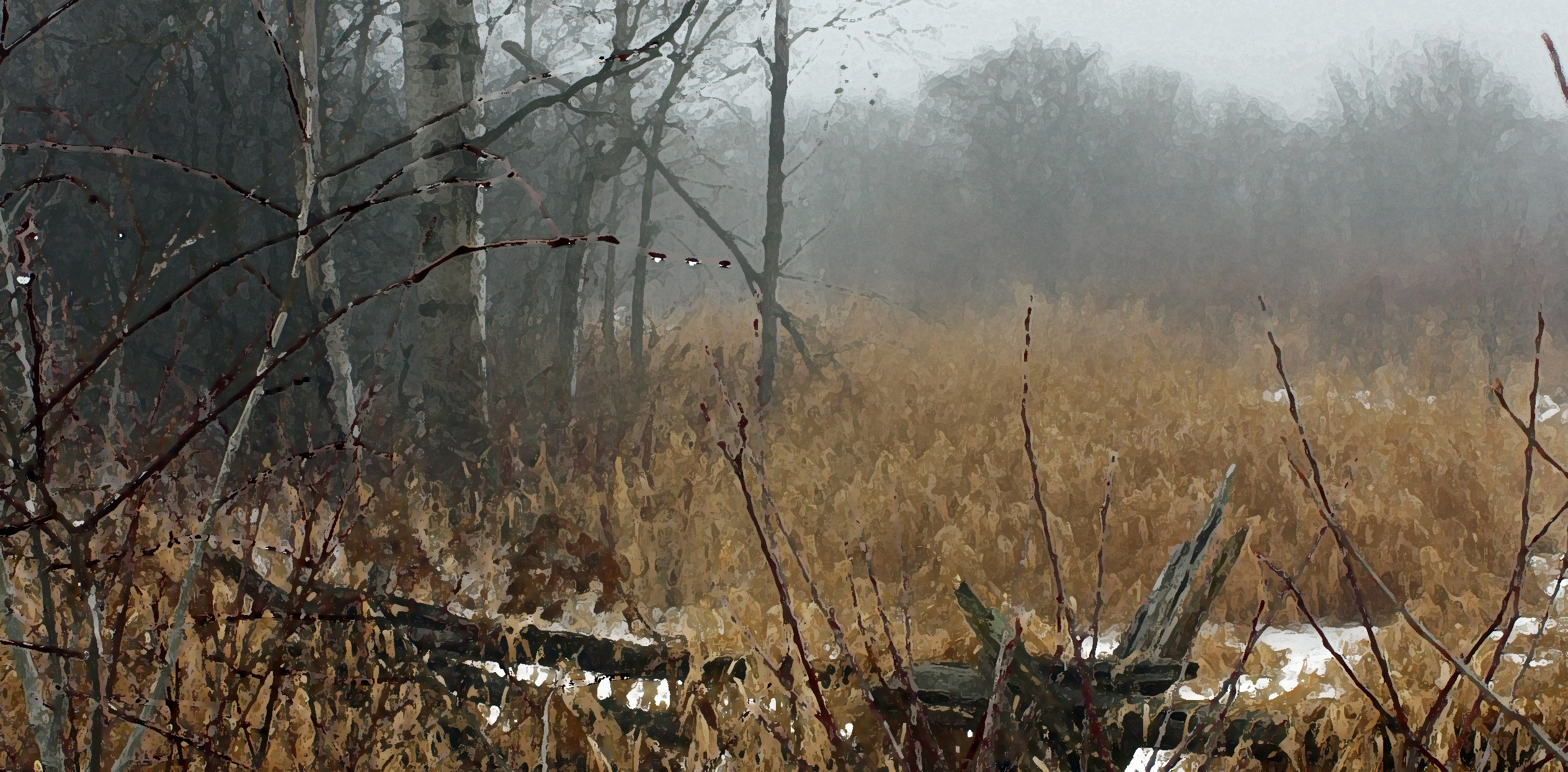
Thompson Creek marsh, ON (photo and rendition by Nina Munteanu)
Bev Gorbet is a Toronto poet. She has published several poems with the Retired Teachers Organization and most recently in “Literary Connection IV: Then and Now” (In Our Words Inc., 2019), edited by Cheryl Antao Xavier.
Nina Munteanu is a Canadian ecologist / limnologist and novelist. She is co-editor of Europa SF and currently teaches writing courses at George Brown College and the University of Toronto. Visit www.ninamunteanu.ca for the latest on her books. Nina’s bilingual “La natura dell’acqua / The Way of Water” was published by Mincione Edizioni in Rome. Her non-fiction book “Water Is…” by Pixl Press(Vancouver) was selected by Margaret Atwood in the New York Times‘Year in Reading’ and was chosen as the 2017 Summer Read by Water Canada. Her novel “A Diary in the Age of Water” was released by Inanna Publications (Toronto) in June 2020.
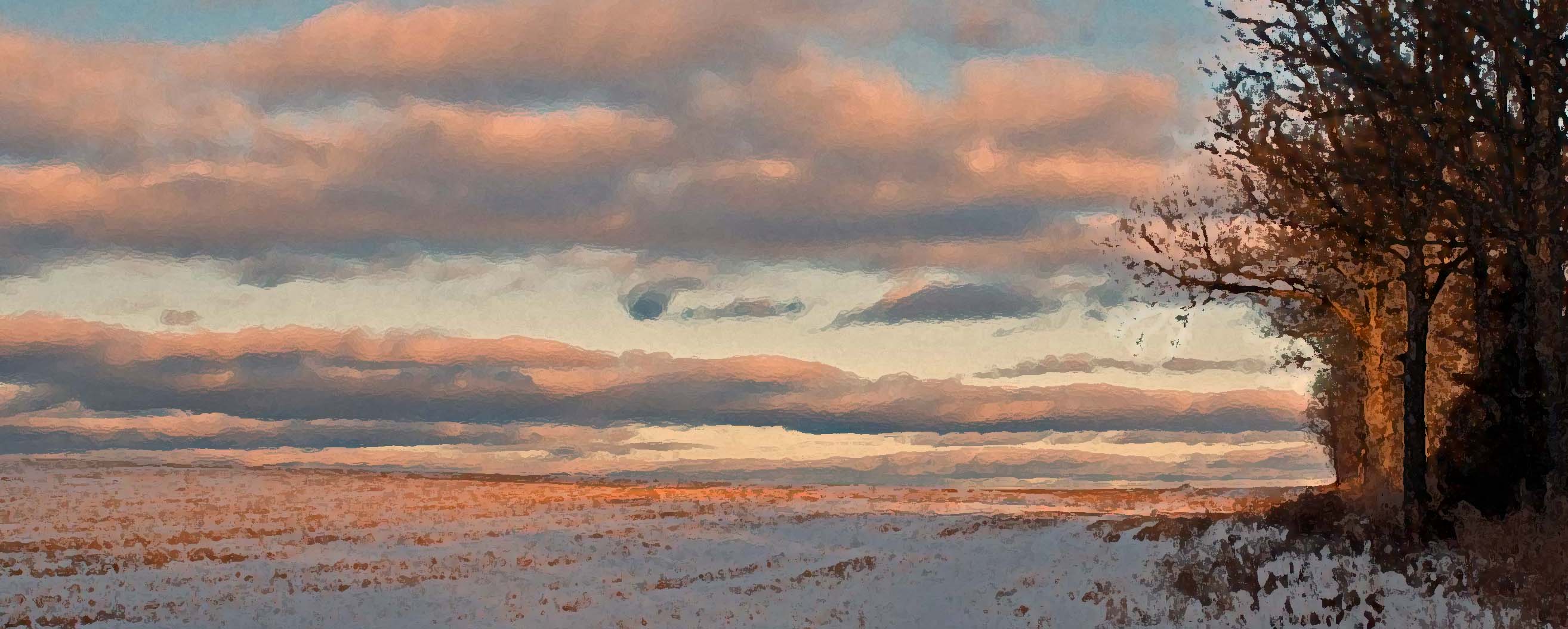
Farmer’s field at sunset in early winter, ON (photo and rendition by Nina Munteanu)
Oh! to wander the fields wild and free, To commune with wild nature, Her beauty everywhere extant.
Small country road in Ontario (photo and rendition by Nina Munteanu)
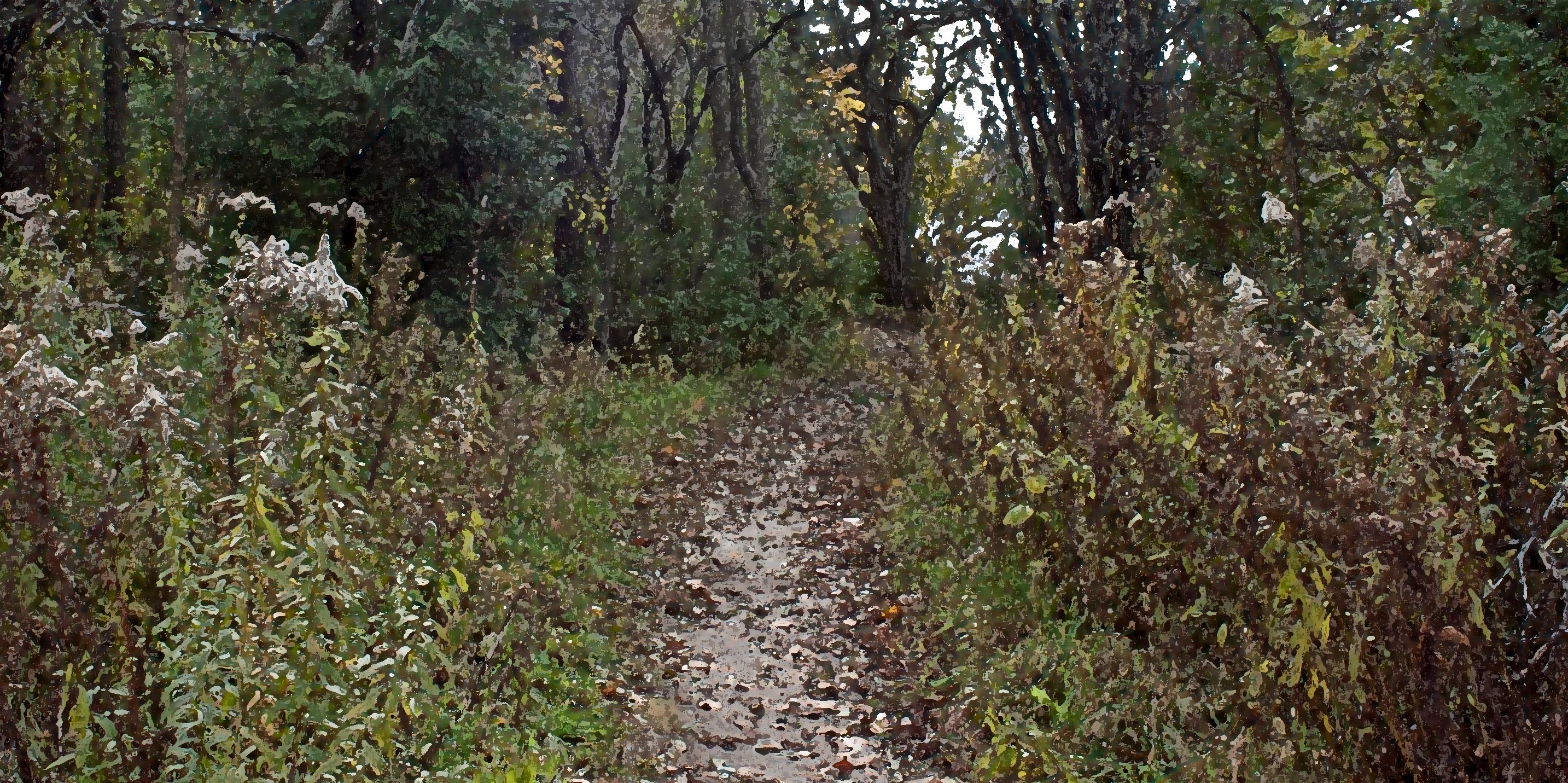
Path through meadow of goldenrod in fall, ON (photo and rendition by Nina Munteanu)
Tender lullabye and song in forested glade, A still peace this sacred moment: The profound silence: holy echo of dream, every hope; Melodies of heart and soul; Rhythms, memory and wonder in a windrift calm, Tree and bough, moment of a joyous uplift
Field in early spring fog in Ontario (photo and rendition by Nina Munteanu)
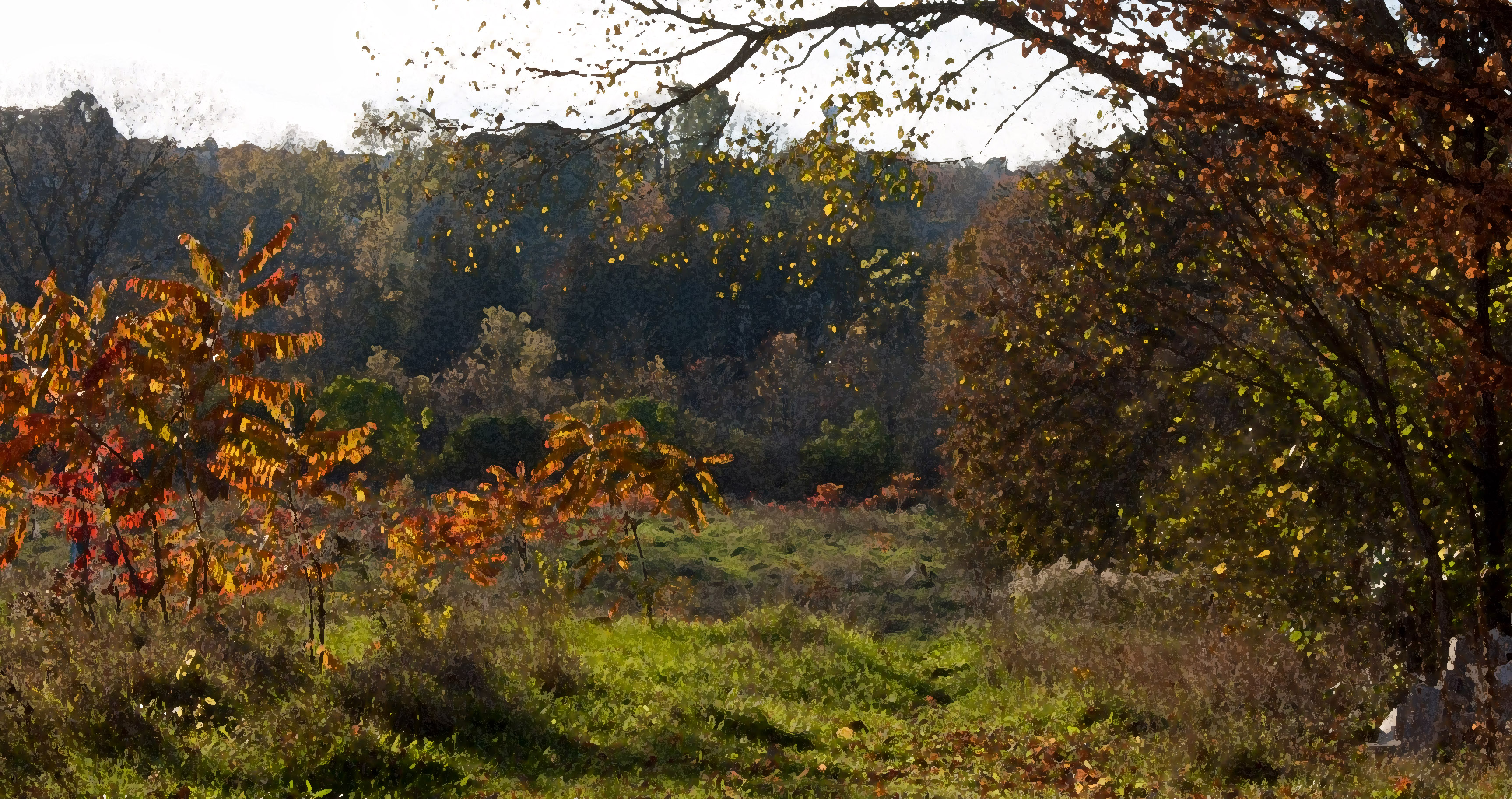
Meadow in fall in Peterborough, ON (photo and rendition by Nina Munteanu)
Forested cathedrals, great songs of heart and mind, All the majesty: a windstorm day in fierce call and cry Whisper and sigh midst far tossed leaf and bough… Promise and a grace filled endurance All the beauty flame interior universes: A captive soul set free.
Path through meadow alvar, ON (photo and rendition by Nina Munteanu)
Path through farm country, ON (photo and rendition by Nina Munteanu)
Fields in the Kawarthas, ON (photo and rendition by Nina Munteanu)
NINA MUNTEANU is a Canadian ecologist / limnologist and novelist. She is co-editor of Europa SF and currently teaches writing courses at George Brown College and the University of Toronto. Visit www.ninamunteanu.ca for the latest on her books. Nina’s bilingual “La natura dell’acqua / The Way of Water” was published by Mincione Edizioni in Rome. Her non-fiction book “Water Is…” by Pixl Press(Vancouver) was selected by Margaret Atwood in the New York Times ‘Year in Reading’ and was chosen as the 2017 Summer Read by Water Canada. Her novel “A Diary in the Age of Water” was released by Inanna Publications (Toronto) in June 2020.
Nina scoping her shot with her iPhone (photo by Merridy Cox)
You see something breathtaking and say to yourself: I have to take a picture of that! You snap it with your camera or phone, happy that you’ve captured the moment. When you return home and review your shots on the computer to share, you get to that breathtaking scene and your first thought is: why on Earth did I take a picture of that?!
The shot is nothing like what you remembered. That dull and lifeless scene is the farthest thing from breathtaking. What happened?
Nina checks her photo on her iPhone (photo by Merridy Cox)
When Your Mind and Your Camera Don’t Agree
We see with our eyes, but we feel and process meaning with our brain. And it’s the brain that determines what we finally see. What we see is our brain’s interpretation of the scene. We adjust what we see with meaning.
The camera doesn’t interpret. It is a tool that works based on principles of light, focus, depth of field, breadth of field, and resolution & detail. What a DSLR camera set on automatic, a compact camera and a smartphone have in common is that they are all set to capture the best shot, given the right conditions of light, contrast and motion. If you shoot with a camera set on automatic, it is acting as your brain, but without the interpretation of meaning. You’ve given away that power. Like a benevolent dictator, the camera/phone is boss of your shots, dictating what it was designed to do to get the best shot in those particular conditions. The trouble with that is the camera doesn’t see with your brain. Its idea of the ‘best shot’ is based on a set of criteria created by a manufacturer. It works great only in certain conditions—those best anticipated by the manufacturer (e.g. optimum light and distance). But, make no mistake: you will not get what your brain sees. You might think so, but you won’t.
A short while ago, when I was visiting a good friend in British Columbia, we got into talking about photography and I mentioned how I had returned from using a tablet and phone (for convenience) to my Canon DSLR camera (for quality); I had earlier ditched the camera in favour of the light convenient iPhone, which I found easy, particularly when travelling. But I soon became frustrated and disappointed at not achieving what my brain saw. Returning to the DSLR camera allowed me to significantly improve my shots. My friend’s daughter—an avid picture taker with her mobile phone—challenged me: “Are you sure your camera takes better pictures?” I wanted to laugh, but then I realized that she was serious, born from the confidence of her own pictures—which I’d seen and must acknowledge are very good for composition and sharpness. Closer inspection reveals that these were all achieved within a boundary of conditions. The lighting was optimal, the distance was good, the composition sufficiently simple to accommodate the camera’s limitations; so what her brain saw, the camera reflected, at least fairly well.
Nina (decades ago) with her Minolta SLR and long lens (photo by H. Klassen)
But it is impossible for a smartphone or any automatic camera to achieve certain effects that only my DSLR camera set on manual or semi-manual can provide (e.g. setting my depth of field, adjusting for that right bokeh, playing with exposure, achieving natural light and a high resolution image in a low-light situation, getting very close or zooming far away with a dedicated lens). In addition, DSLR cameras outperform smartphone cameras because their sensors are much larger, let in more light, and produce more dynamic range in low-light scenarios. This allows them to capture greater detail than smartphone cameras or compact cameras. Ultimately, as Smartframe acknowledges, “the gap between what’s possible on the smartphones and dedicated cameras remains significant.” The argument is similar for a regular camera set on automatic vs one set on manual or semi-manual.
I’ve been there. Automatic settings on a camera and smartphone (which is basically like a camera on automatic) can only do so much to match what your brain sees. And they can be mighty annoying—particularly when the camera’s brain prefers to focus on the wrong thing.
Above: automatic setting went for background focus; below, setting corrected for foreground focus(photos of Earthstars in a cedar forest by Nina Munteanu)
If you truly want to get what your brain sees, you have to take over the brainpower of the camera. That means either tricking the automatic setting or going off automatic to manual or semi-manual on a camera (no smartphones currently come with manual settings, nor will they; although they may have some correcting software, which isn’t the same thing.) For the past decade the market is changing for phone cameras and compact cameras—there is Nikon’s Coolpix S800c, which combines an Android OS with a long zoom lens and touchscreen-based interface and Panasonic’s Lumix CM1 blends a traditional smartphone with a 1-inch sensor. Samsung’s Galaxy Camera 2 integrates an Android OS with 3G capabilities and a 21x optical zoom. They all remain limited with respect to matching what your brain sees to what your camera takes.
Getting Your Camera To Agree with Your Brain
Successfully getting your camera (or smartphone) to match your brain-sight starts with recognizing the various aspects of a captured image. These include:
focus (sharp or soft): what’s in focus and what isn’t in focus
depth of field: how deep the focused region is
lighting: colour saturation and contrast
resolution (sharpness)
motion (or lack of it)
composition (what is in focus and what isn’t and where everything sits)
bokeh (the look of the unfocused part)
All of these, once recognized, can be manipulated on your camera. On a smartphone or auto-camera, most of these factors must be addressed as best as you can by shifting your position or aim, changing the time of day or lighting when you take your picture, or changing your subject and surroundings. In other words, by manipulating what your brain sees.
I won’t lie; it’s not easy to manipulate what the camera takes to match what your brain sees. It takes dedication and time. But it starts with recognizing what needs manipulating: training your eyes and brain to really see what you’re taking a photo of and understanding what your camera has to do to achieve it.
Nina photographing a tributary of the Otonabee River, ON, with her Canon DSLR (photo by Matthew P. Barker, Peterborough Examiner)
How Our Eyes and Brains See
It helps to understand how our eyes see and how our brains process what we see, particularly what is different from what a camera does. This includes angle of view; resolution and detail; and sensitivity and dynamic range.
Angle of View: Our angle of view isn’t straightforward like a camera with a particular lens with set focal length (e.g. wide angle vs. telephoto lens). Cambridge in Colour tells us that “even though our eyes capture a distorted wide angle image, we reconstruct this to form a 3D mental image that is seemingly distortion-free.” Our central angle of view—around 40-60º—is what most impacts our perception. “Subjectively, this would correspond with the angle over which you could recall objects without moving your eyes,” says Cambridge in Colour.
Rendition of what eye / brain focuses on (image from Cambridge in Colour)
Resolution and Detail:Cambridge in Colour tells us that 20/20 vision is mostly restricted to our central vision; we never actually resolve that much detail in a single glance. Away from the centre, our visual ability decreases and at the periphery we only detect large-scale contrast and minimal colour. A single glance, therefore, mostly perceives the centre in resolution. Because our brain remembers memorable textures, colour and contrast (not pixel by pixel), our eyes focus on several regions of interest in rapid succession, which paints our perception. “The end result is a mental image whose detail has been prioritized based on interest.” It is our interest that dictates what we see and ultimately informs our memory of that image.
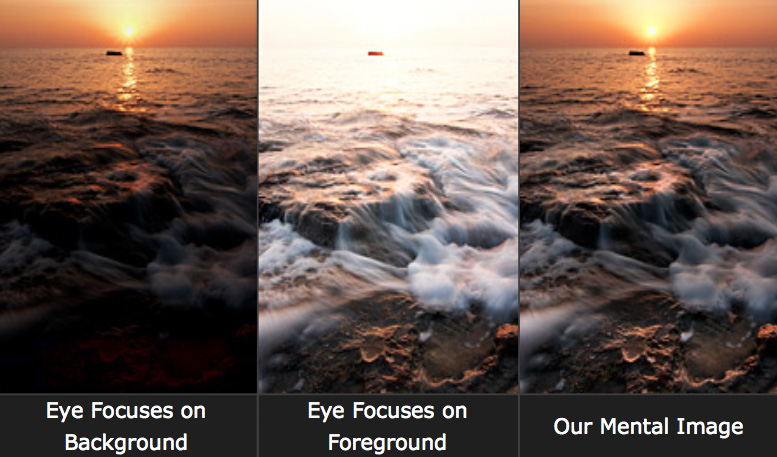
How our eye / brain integrates depth of field and exposure for background and foreground (image by Cambridge in Colour)
Sensitivity & Dynamic Range: According to Cambridge in Colour, our eyes have the equivalent of over 24 f-stops. This is because our brains integrate background and foreground to create a mental image that integrates these.
Matching the Camera to Our Brain
The next step is to learn how to manipulate the camera to achieve these. This means learning how to use the f-stop, how to manipulate the shutter speed, how to change the ISO setting, and what all these, in turn, produce in terms of focus, depth of field, lighting, exposure, saturation, resolution, bokeh and more. Taking a course in photography is a good way to start. Experiment with settings. Learn about the equipment. Lenses. Filters. Tripods. Go on a camera shoot with a photographer who knows about these. It promises to be ultimately rewarding and fulfilling.
I wanted the entire foreground group of Shaggy Main mushrooms to be in focus and the background less focused but recognizable; I therefore set my f-stop at 18, which gave me a slower shutter speed (and I had to stabilize my camera) with sufficient depth of field (photo by Nina Munteanu)
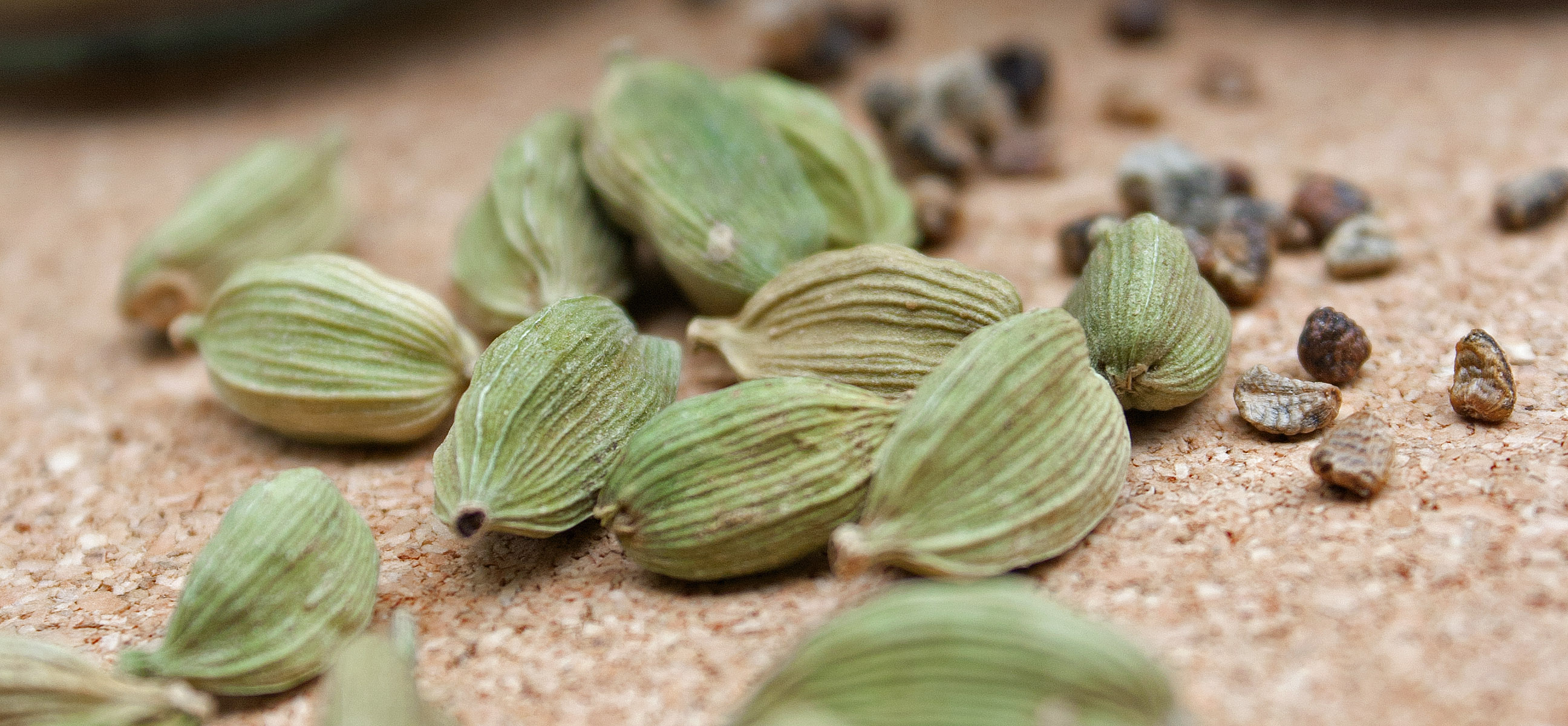
I used a higher speed and smaller f-stop of these cardamom pods and seeds to create a more shallow depth of field that focuses attention on a particular aspect of interest and keeps the image from looking flat (photo by Nina Munteanu)
A medium f-stop allowed me to freehold my camera and capture a crisp shot of the person and sled but a motion-blurred shot of the dog–achieving a sense of motion in the shot (photo by Nina Munteanu)
I oriented my camera for a portrait (vs landscape) shot to showcase the height and gigantic size of these red cedars in Lighthouse Park, Vancouver, and ensured a person was in the shot for perspective (photo by Nina Munteanu)
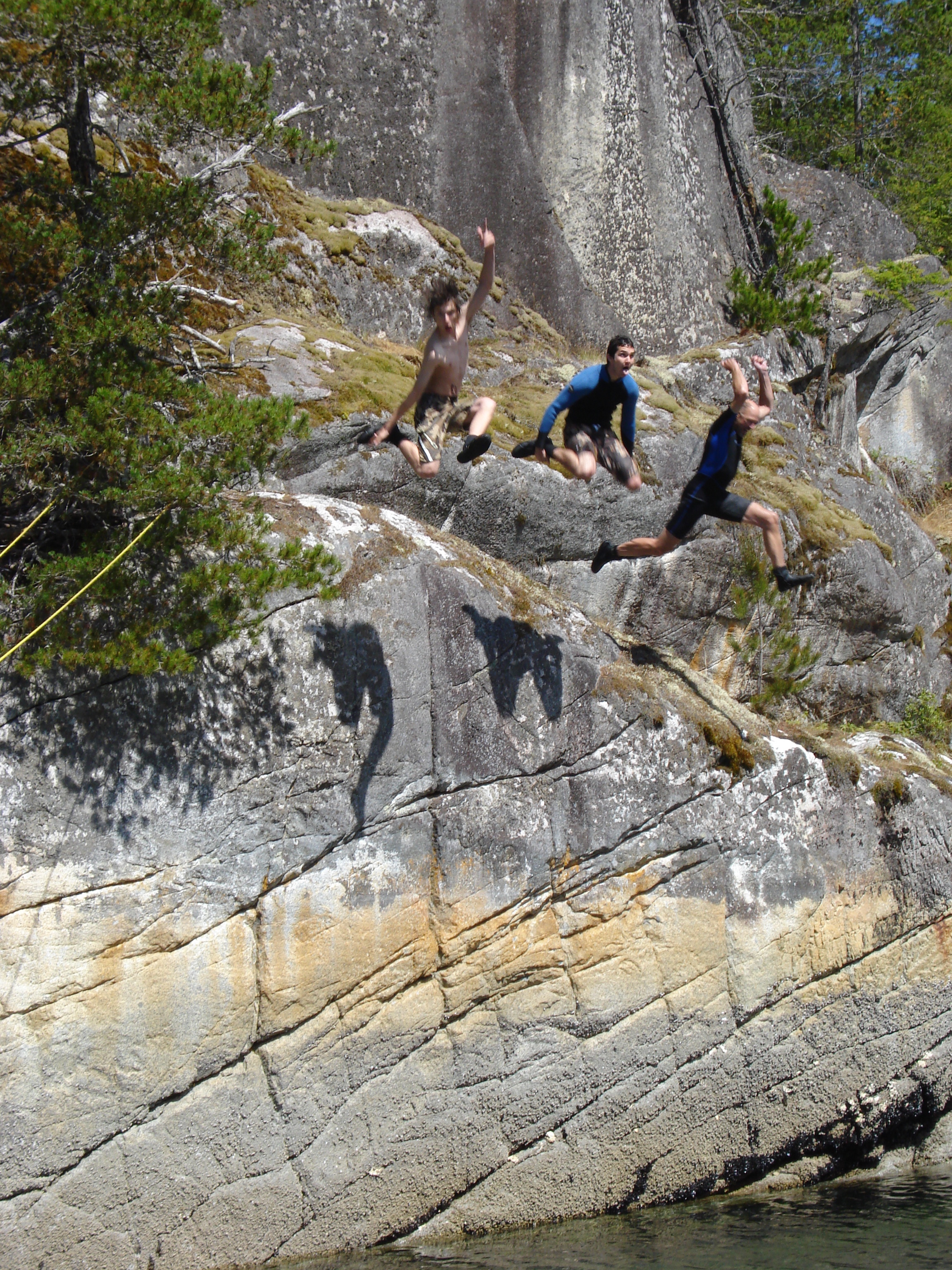
I used a low f-stop (which in good light does not appreciably reduce depth of field) to achieve high speed in capturing the three divers off the cliff (photo of ocean cliff in BC by Nina Munteanu)
I used a high f-stop and stabilized camera to achieve a softer look to the moving water and also get higher depth of field to see both stationary foreground and background (photo by Nina Munteanu)
I’ve been on my journey for over a decade and I’m still learning. From my son, from others, from my own experiences. That’s the fun part, after all. It’s an adventure of discovery…
My Canon camera on its tripod (photo taken with tablet by Nina Munteanu)
NINA MUNTEANU is a Canadian ecologist / limnologist and novelist. She is co-editor of Europa SF and currently teaches writing courses at George Brown College and the University of Toronto. Visit www.ninamunteanu.ca for the latest on her books. Nina’s bilingual “La natura dell’acqua / The Way of Water” was published by Mincione Edizioni in Rome. Her non-fiction book “Water Is…” by Pixl Press(Vancouver) was selected by Margaret Atwood in the New York Times ‘Year in Reading’ and was chosen as the 2017 Summer Read by Water Canada. Her novel “A Diary in the Age of Water” was released by Inanna Publications (Toronto) in June 2020.
Sugar maple tree with fallen leaves in autumn, ON (photo and rendition by Nina Munteanu)
My world: most wondrous, mystic shelter, Holy meridian of a life’s overwhelming mystery, Magic center of hope Haunting universe of a deepest longing…
Reflections of trees on outlet of creek into Otonabee River, ON (photo and rendition by Nina Munteanu)
My autumn world, tormented season And still time of the calm pastoral moon: Skies overhead, windtossed wildernesses, Seasons of joy, seasons of a bittersweet discontent Time’s last flowering before a fierce winter of silences
Snowing in treed meadow, ON (photo and rendition by Nina Munteanu)
Autumn ‘s last reflections midst storm ravaged skies… Last songs, the changing lights, Amber and golden hours Windswept calls, wild cry, surge, a windswept rage Rising lights, moving shadow across far spread field, Across wide spread glade…
Creek flowing into Otonabee River, ON in early winter (photo and rendition by Nina Munteanu)
A sacred bend and flow this existential time, Rhapsodies across a dying land Rain and storm riven sky songs, Windsong days, wild blasts to ravage and torment
Horizontal snow in a strong snow storm, ON (photo and rendition by Nina Munteanu)
The high windstorm prophesies: Promises of a fierce unmanning; Storm and lost days, winter and last days’ Their return too soon presage…. Haunted universes of a deepest longing.
Marsh at lagoon of Otonabee River in winter fog, ON (photo and rendition by Nina Munteanu)
Bev Gorbet is a Toronto poet. She has published several poems with the Retired Teachers Organization and most recently in “Literary Connection IV: Then and Now” (In Our Words Inc., 2019), edited by Cheryl Antao Xavier.
Moss-covered rocks and leaf fall in Jackson Creek, ON (photo and rendition by Nina Munteanu)
NINA MUNTEANU is a Canadian ecologist / limnologist and novelist. She is co-editor of Europa SF and currently teaches writing courses at George Brown College and the University of Toronto. Visit www.ninamunteanu.ca for the latest on her books. Nina’s bilingual “La natura dell’acqua / The Way of Water” was published by Mincione Edizioni in Rome. Her non-fiction book “Water Is…” by Pixl Press(Vancouver) was selected by Margaret Atwood in the New York Times ‘Year in Reading’ and was chosen as the 2017 Summer Read by Water Canada. Her novel “A Diary in the Age of Water” was released by Inanna Publications (Toronto) in June 2020.





























 Nina Munteanu Writing Coach