I’m an ecologist; I study environmental relationships. Something you’d think is easy to learn and very accessible; we’re surrounded by it, after all. We live, work and play in it. While I learned about environmental relationships with my eco-minded parents, I didn’t learn it or experience it in my school growing up. With the exception of some indigenous schools (which teach respect for the spirit of wildness), most of us certainly didn’t learn about environmental relationships in our schools.
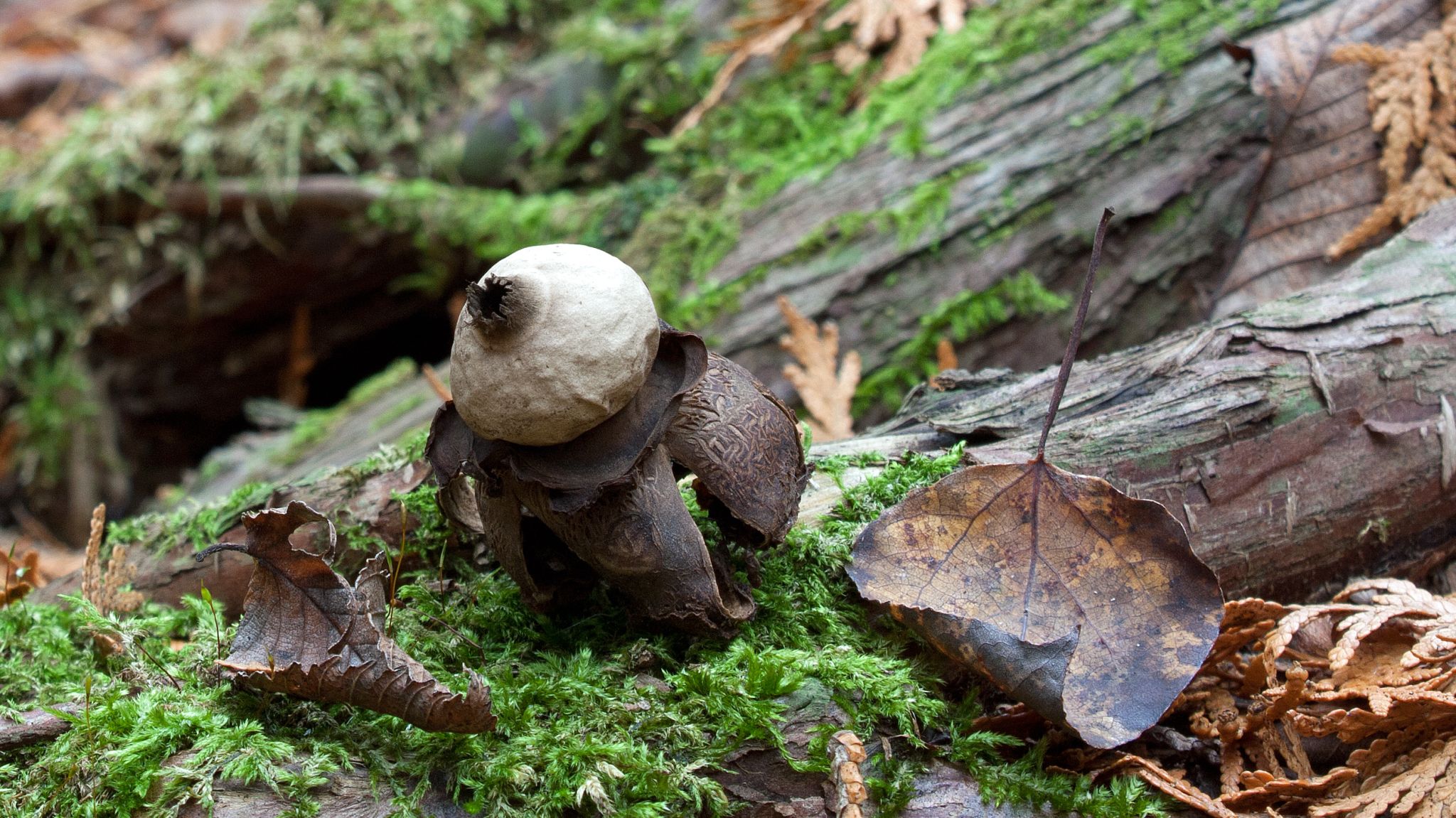
Earthstar sits on moss-covered rotting cedar log as new cedar roots take hold, ON (photo by Nina Munteanu)
Most Canadians live in a city; we don’t really understand what the natural environment is. Many of us have learned to ignore it, stop recognizing it, pocket it away as we go about our busy lives in the city. A park is a bit of greenery. A tree is a decoration that provides shade. Shrubs border a mall.
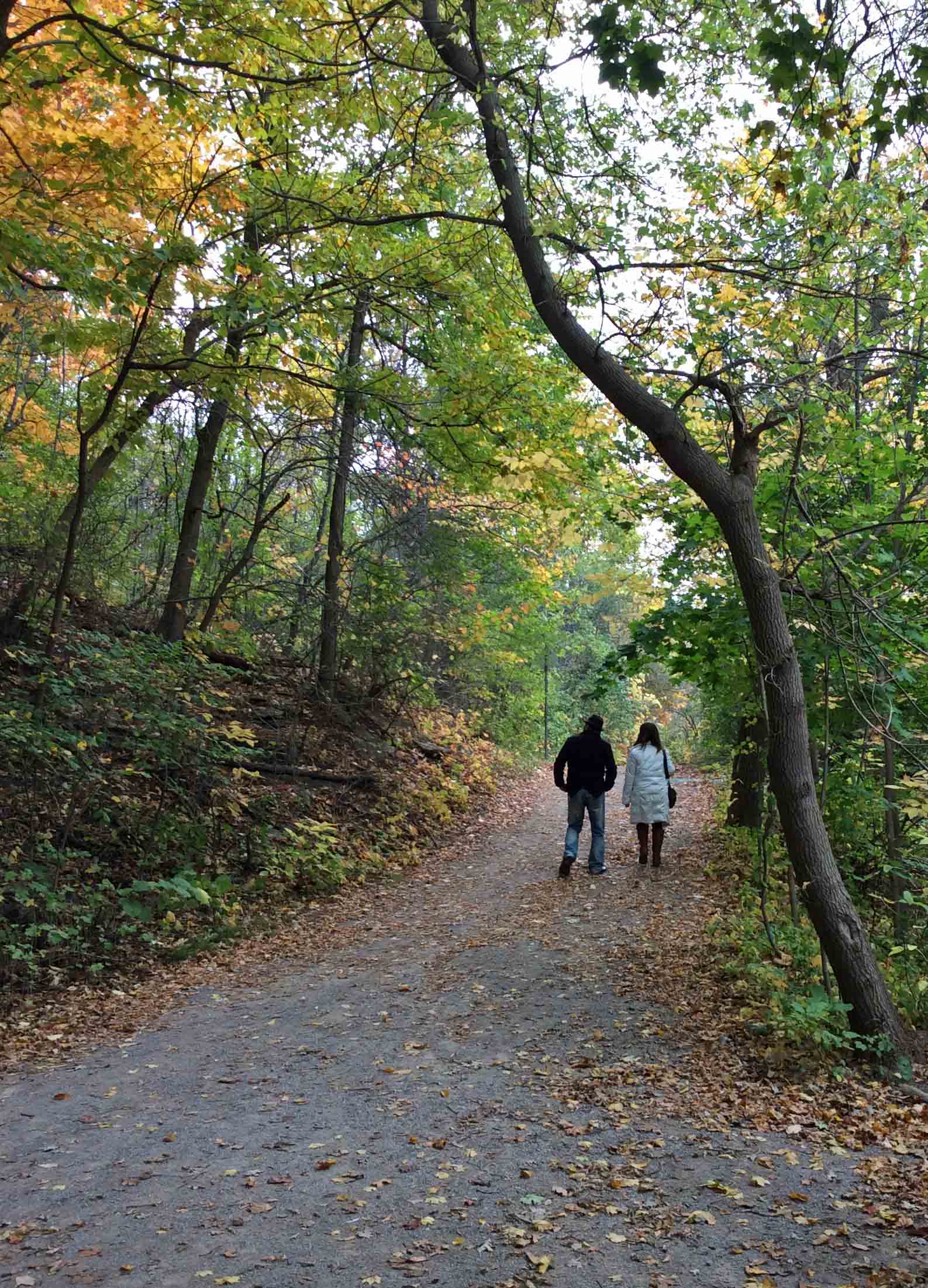
Walk through urban forest along the Credit River, ON (photo by Nina Munteanu)
But if we can’t even recognize the natural environment, how can we understand its functional role in the intricate well-being of this entire precious planet and ultimately ourselves?
It is no wonder then that most Canadians—though we may intellectually accept climate change and its effects on this planet (because we’re smarter than some)—likely do not viscerally understand or appreciate why and how it will drastically change our lives. For most of us, climate change—as with Nature—is something that is happening to someone else, somewhere else. From those far away calamities to the quiet struggles no one talks about. We hear and lament over the flooding in Bangladesh or the Maldives. Or the wildfires in northern British Columbia. Or the bomb cyclones of the eastern seaboard.
Meanwhile, the polar bear struggles quietly with disappearing sea ice in the Canadian arctic. The koala copes quietly with the disappearing eucalyptus. Coral reefs quietly disappear in an acidifying ocean. Antarctic penguins silently starve with disappearing krill due to ice retreat. And while jellyfish invade the Mediterranean, UK seas and northeast Atlantic, the humble Bramble Cay melomys slips quietly into extinction—the first mammal casualty of climate change.
Yellow Creek flows through an urban forest in the heart of Toronto, ON (photo by Nina Munteanu)
So, those of us who are enlightened speak of climate resilience and adaptation. We talk of arming our cities with words like green infrastructure, stormwater management, urban runoff control, flood mitigation. Ecological literacy. But what are these things to us? They are tools, yes. Good tools to combat and adapt to the effects of climate change. But will they create resilience? I think not.
I’m a limnologist and I’ve consulted for years as a scientist and an environmental consultant. I played a role in educating industry, in the use of mitigating tools, in changing the narrative even.
Trail through urban forest on a foggy winter day in Peterborough, ON (photo by Nina Munteanu)
But I’ve come to realize that resilience comes only from within and through a genuine connection with our environment. Tools, no matter how proficient, are only as good as how they are used based on intention from a deep understanding. It isn’t enough to achieve the HOW of things; we must embrace the WHY of things. And that comes from the heart. We must feel it in our hearts. Or it won’t work. And we quite simply won’t survive.
Various flowers and trees of Ontario (photos by Nina Munteanu)
Canadians celebrate our multi-cultural heritage. We pride ourselves in our tolerance and welcoming nature. Our national anthem speaks of our land. Our national symbols embrace nature with the maple, beaver, caribou and loon. Yet who of us knows the habitat of the loon—now at risk, by the way (climate change will impact much of its breeding grounds). Who knows what the boreal forest—which makes up over half of our country—is? How it functions to keep this entire planet healthy, and what that ecosystem needs, in turn, to keep doing it? How to help it from literally burning up?
Ecology isn’t rocket science. Ecology is mostly common sense. Ecology is about relationship and discovery. Ecology is a lifestyle choice, based on respect for all things on this planet and a willingness to understand how all things work together.
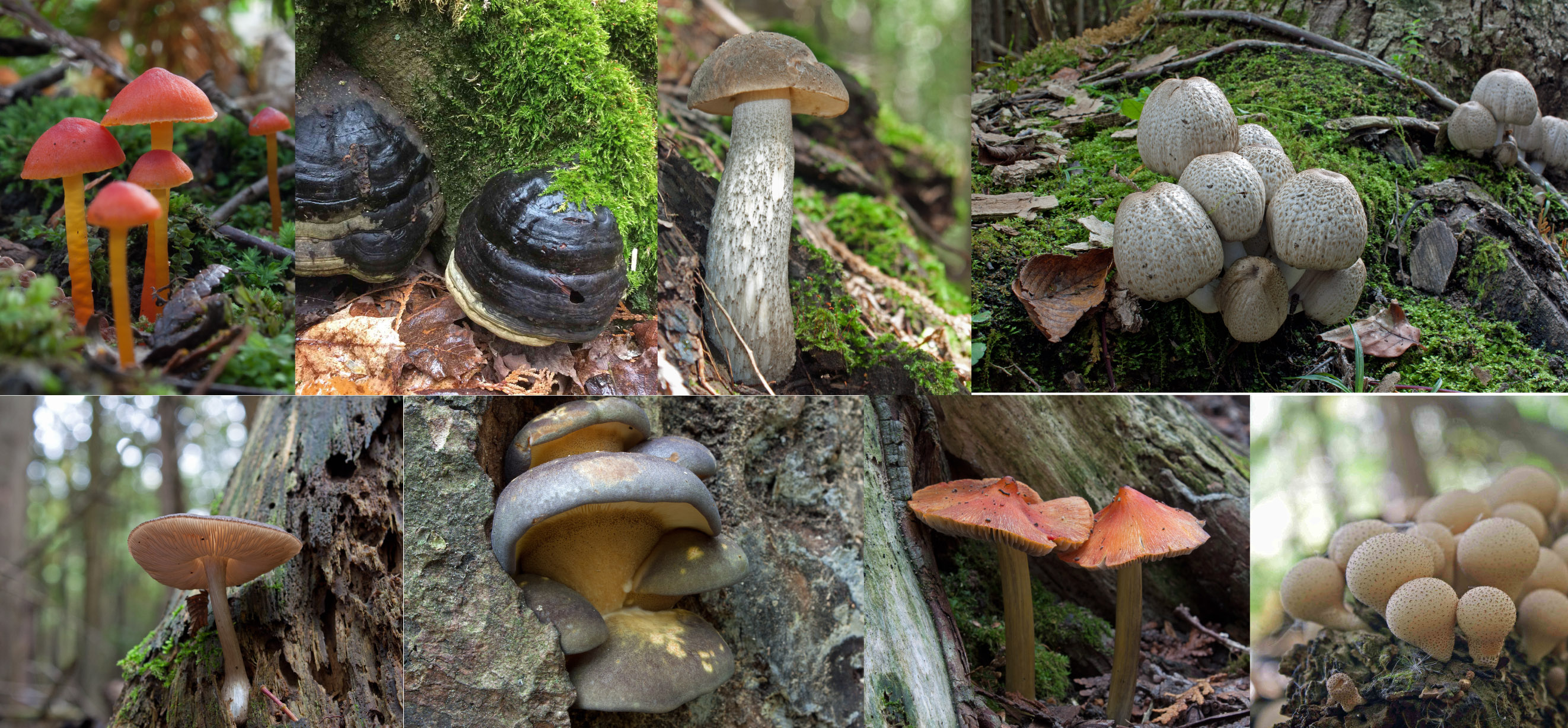
Various mushrooms in Ontario forests (photos by Nina Munteanu)
Here’s what I’ve learned to keep me caring and remain positive and not become apathetic or fall into despair:
I’ve learned to open myself to discovery. To find Nature, even if it is in the city. To connect with something natural and wild and to find and savour the wonder of it. All that matters will naturally come from that.
Become curious and find something to love.
When you do, you will find yourself. And that is where you will find resilience. What colour is it? It doesn’t need to be green…
Throughout this article I’ve shown you some of my colours…
Red fox skull emerges on a leaf-strewn icy bank of Jackson Creek, ON (photo by Nina Munteanu)
Here are the steps I taught myself toward healthy resilience (the first two steps are both the hardest and the easiest):
Step 1:Slow down, pay attention. Give yourself the time to relax and look around your local surroundings. Until you slow down to actually look, you will not really take in your surroundings. You need to be in the moment. Only then can you take the time to use all your senses to take in your environment. Try to look at it from a different perspective. Notice the light, the smells and sounds. What is different? What is the same?
Step 2:Lower your guard, open yourself to curiosity. Rely on as many senses as you can (sight, hearing, smell, texture, taste) to sample your environment and show some humility to ask questions. Whenever I go out, particularly in Nature, I make a point of coming home with three gifts, discoveries that make me smile or think and wonder. I’m hardly ever disappointed.
Step 3: Process what you’ve seen and discovered. Do some follow-up research to questions that may arise. Look at consequences. Share with others, discuss. From there it will be easy to ‘take responsibility’ for some section of nature that you really like; perhaps a particular tree in a park or a short path through an urban forest or stretch of urban stream. This can easily lead to good stewardship.
Step 4: Take responsibility for your chosen part of Nature. Get to know it well, how it works, what it needs, what’s right and what’s wrong. Do something about it and share with others.
Step 5: You’re there. You are resilient.
Barred owl hiding in plain sight in an urban forest near Peterborough, ON (photo by Nina Munteanu)
Nina Munteanu is a Canadian ecologist / limnologist and novelist. She is co-editor of Europa SF and currently teaches writing courses at George Brown College and the University of Toronto. Visit www.ninamunteanu.ca for the latest on her books. Nina’s bilingual “La natura dell’acqua / The Way of Water” was published by Mincione Edizioni in Rome. Her non-fiction book “Water Is…” by Pixl Press (Vancouver) was selected by Margaret Atwood in the New York Times ‘Year in Reading’ and was chosen as the 2017 Summer Read by Water Canada. Her novel “A Diary in the Age of Water” was released by Inanna Publications (Toronto) in June 2020.
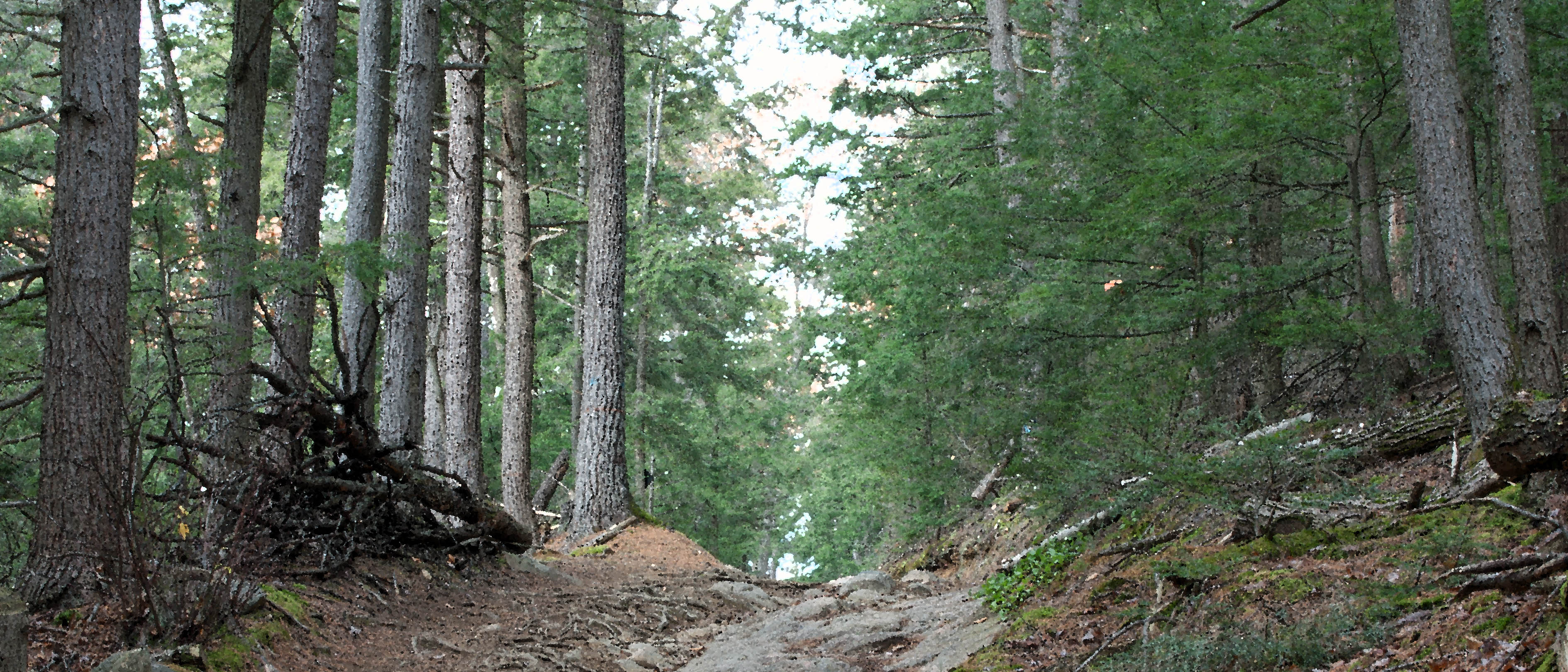
Rocky trail through ancient eastern hemlock forest, Catchacoma Park, ON (photo and rendition by Nina Munteanu)
I look forward to my daily walks. I find that walking helps me centre myself. Depending on the time I have, some walks last half an hour to an hour. Others walks will stretch from three hours to a day long. These aren’t city-walks.
Stream swells in a spring rain in Trent Nature Sanctuary, ON (photo and rendition by Nina Munteanu)
My favourite place to walk is in the forest, by a river.
Perhaps it is the solitude… or the negative ions, the fresh pungent scents of damp loam, moss and trees. The humbling magnificence of these stately trees. The fishy bog smell of algae. Or the unknown treasures hiding in plain sight for me to discover… Whatever the combination, I find it most pleasing. And freeing.
It is also here, wandering in the forest, that my creativity flourishes as I find expression through the joy of discovery.
Old-growth forest surrounding Pierce Lake, BC (photo by Kevin Klassen)
The first step is to lose myself…
That’s the fun part: not knowing what’s beyond that hillside or down that ravine on the shores of the creek I barely see or around that bend in the root-gnarled trail among the swamp cedars. Like a moth to light, I’m drawn to the unknown. Ever the explorer.
Old-growth cedar forest in Jackson Creek forest, ON (photo and rendition by Nina Munteanu)
Gnarly cedar roots cross a path through morning fog in a swamp cedar forest, ON (photo by Nina Munteanu)
It is often here, as I walk along uneven trails or maneuver through undergrowth, up hills or down stream banks to explore and record with my camera, that I do my best thinking… Well, best in that it does not feel like thinking; more like simply ‘being.’ As my body responds to Nature’s sensual treasures, my ingenuous mind ‘walks away’ from restrictions of consciousness and roams in a kind of euphoric state of simple joy. Freed from thinking to feel and sense.
No need for a destination. The journey is my destination…
Gnarly roots of an old yellow birch snake across the old-growth cedar forest, ON (photo by Nina Munteanu)
Moss-covered boulder erratic (Nina’s Boulder) in old-growth cedar forest of Jackson Creek park, ON (photo by Nina Munteanu)
Walking in a forest unclutters my mind. The forest is simple in its natural complexity. Its beauty combs out the tangles of human encumbrance and grounds me in the simplicity of natural life.
Cookout in old-growth rainforest at Mamquam River near Squamish, BC (photo by Kevin Klassen)
I go prepared. Depending on the kind of walk, I’ll bring my clementine to snack on or a hearty lunch and fruit snacks that I carry in my backpack, along with a notebook and first aid kit. And, of course, I bring my camera. When I stop for lunch or snack, I choose my location thoughtfully, sometimes a place to sit, but mostly with a view of something worth studying. Lunch or snack stops are particularly alluring with unexpected experience.
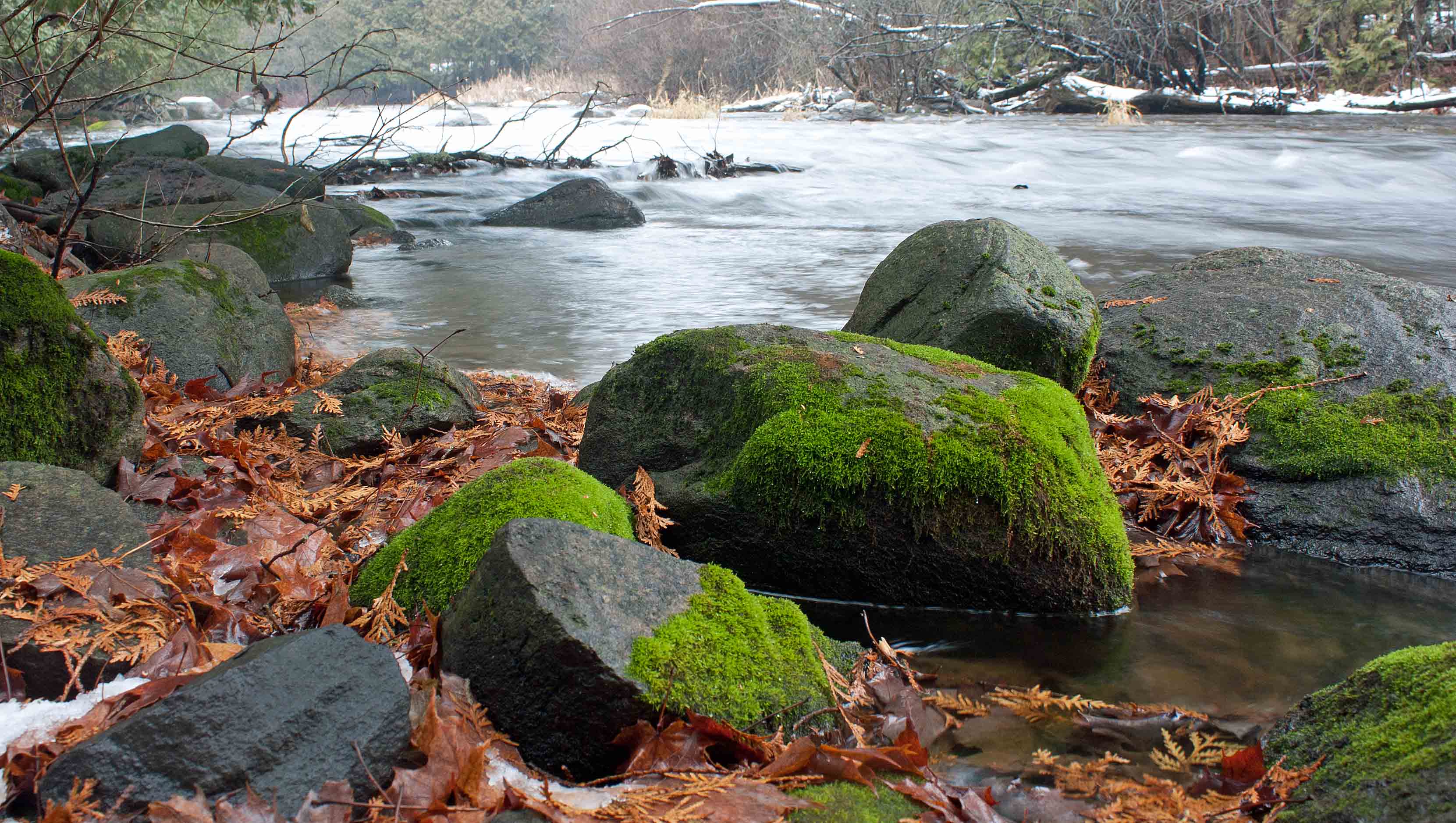
Moss-covered rocks scatter along the banks of Jackson Creek, ON (photo by Nina Munteanu)
It is then, when I’ve stopped walking and have become quiet, when nature closes around me like a soft blanket and often gifts me with a precious sight or sound. A nearby red squirrel eating a nut. A bird flitting from berry to berry in a viburnum shrub. Oft times, I will be rewarded with the sight of a mushroom right at my feet or next to where I sit. That is often followed by the sight of many more.
As though the one had to be first seen to reveal the many.
Various mushrooms in Ontario forests (photos by Nina Munteanu)
Now lost, I open myself to possibility…
Like the propagules of Virginia creeper, my senses reach out to find the unexpected. I’m looking to be surprised. To discover something new that will draw me outside myself.
Various flowers and trees in southern Ontario (photos by Nina Munteanu)
The river trickles in the background as I step through dappled light and inhale the organic scents of the forest. The forest and the river help me re-align and focus—without trying. That’s the magic of it. It’s in the not trying.
Marcescent beech leaves drape over old road through swamp forest, ON (photo and rendition by Nina Munteanu)
I take my camera (and tripod) with me on most walks for those moments that I can never anticipate: like the time a deer stepped gracefully out from behind a tree not three metres from me in a moss-covered red pine forest. I was in the process of setting up my camera on its tripod to capture the trail through the pines when the deer moved gracefully into my sight. Startled, we both froze and stared at one another for a moment made eternity. The deer then sprang away and loped through the trees, disappearing within seconds. I stood, hands fixed on my camera shutter button, and smiled. I had not taken a picture. But I now basked in that frozen moment of fascination between two curious animals, a deer and a human.
I didn’t need a picture; I already had my prize, the enduring memory of that moment.
Pine trees loom tall at the location where I met the deer in Petroglyph National Park, ON (photo and rendition by Nina Munteanu)
In the April 2014 issue of the Journal of Experimental Pshychology: Learning, Memory and Cognition, Stanford researchers Marily Oppezzo and Daniel L. Schwartz demonstrated that walking boosts creative inspiration. Using the Guildford’s Alternative Uses Test they showed that the act of walking significantly increased creativity for 81% of the participants. Oppezzo and Schwartz were able to demonstrate that the creative ideas generated while walking were not irrelevant or far-fetched, but innovative and practical.
Moss-covered ancient hemlock in the Catchacoma old-growth forest, ON (photo by Nina Munteanu)
It begins with changes to our chemistry. In the September 3 2014 issue of TheNew Yorker, journalist Ferris Jabr describes why walking opens the mind to creativity:
“When we go for a walk, the heart pumps faster, circulating more blood and oxygen not just to the muscles but to all the organs—including the brain. Many experiments have shown that after or during exercise, even very mild exertion, people perform better on tests of memory and attention. Walking on a regular basis also promotes new connections between brain cells, staves off the usual withering of brain tissue that comes with age, increases the volume of the hippocampus [a brain region crucial to relational memory and contextual learning], and elevates levels of molecules that both stimulate the growth of new neurons and transmit messages between them.”
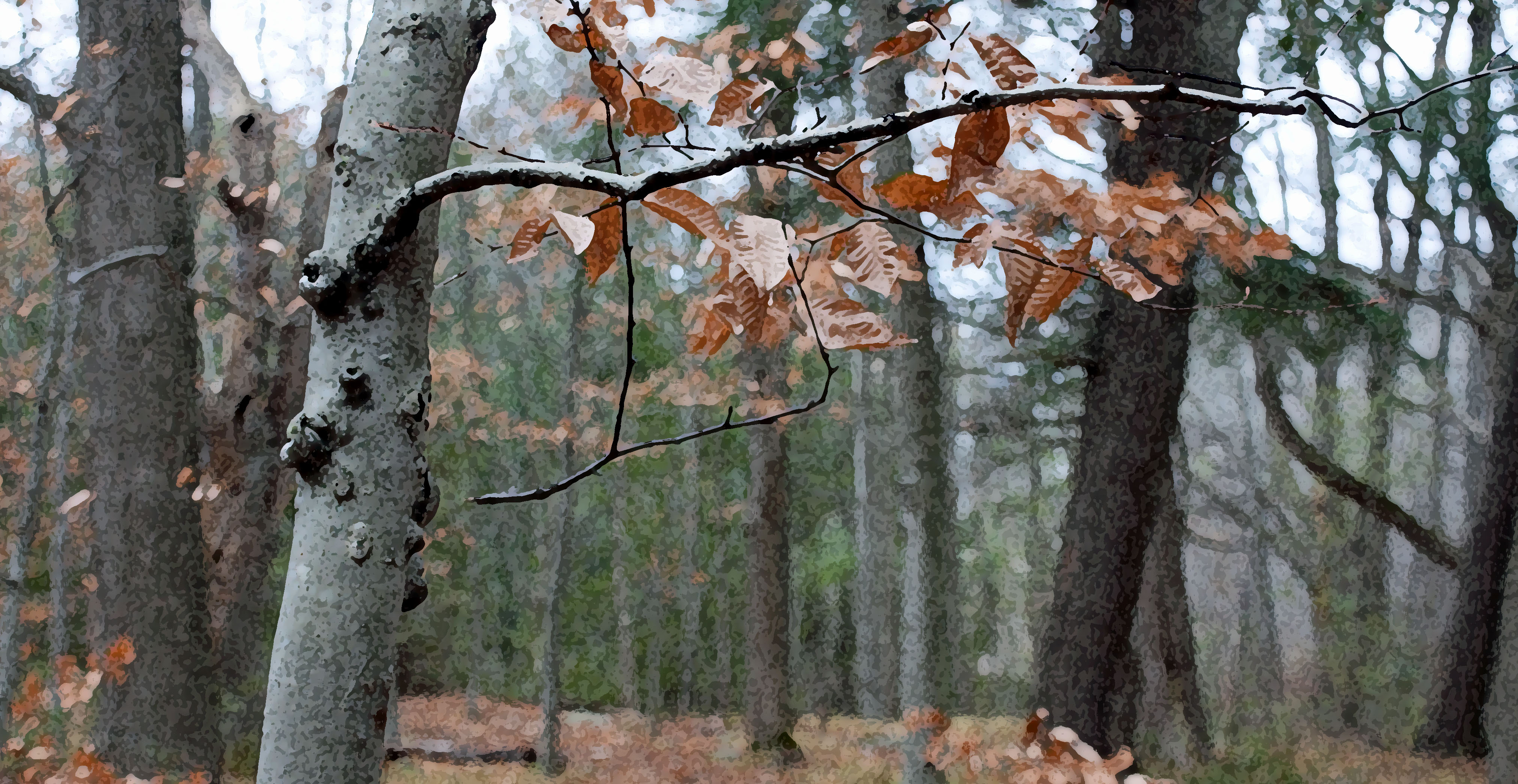
Beech tree with marcescent leaves in a mixed forest, ON (photo by Nina Munteanu)
So, I walk and I create in my mind and my heart as I prepare to write my next novel…
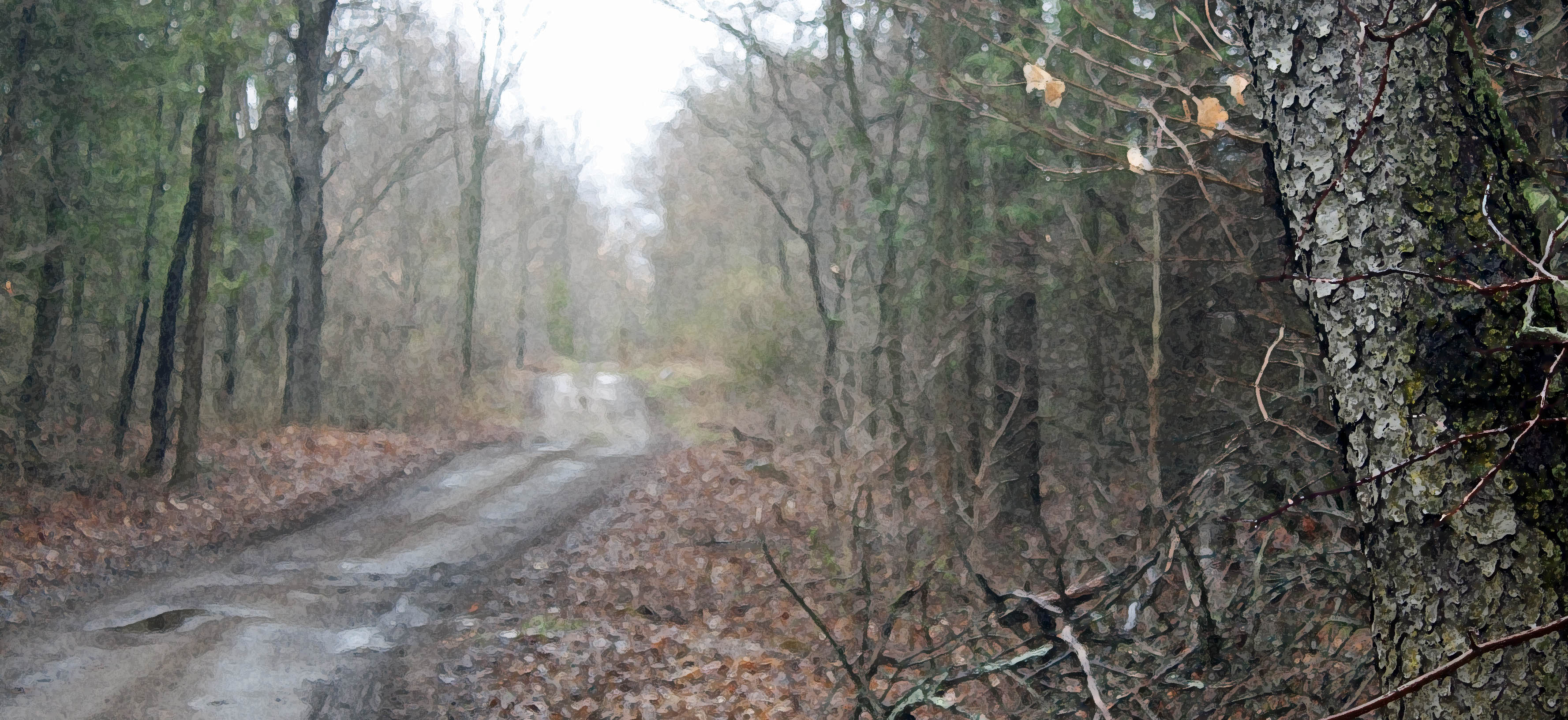
Payne Line road in the mists of an early morning rain, ON (photo and rendition by Nina Munteanu)
Nina Munteanu is a Canadian ecologist / limnologist and novelist. She is co-editor of Europa SF and currently teaches writing courses at George Brown College and the University of Toronto. Visit www.ninamunteanu.ca for the latest on her books. Nina’s bilingual “La natura dell’acqua / The Way of Water” was published by Mincione Edizioni in Rome. Her non-fiction book “Water Is…” by Pixl Press (Vancouver) was selected by Margaret Atwood in the New York Times ‘Year in Reading’ and was chosen as the 2017 Summer Read by Water Canada. Her novel “A Diary in the Age of Water” was released by Inanna Publications (Toronto) in June 2020.
Beech trees stand with bronzed leaves as the snow falls in the mixed forest of South Drumlin park, ON (photo and rendition by Nina Munteanu)
Yesterday, it started snowing near the end of my work shift, and I kept glancing out the window as it turned into a heavy thick snow, the kind I just adore. Whenever this happens, I long for werifesteria…
A pair of beech trees stand pale among hemlocks and poplar trees, South Drumlin park, ON (photo and rendition by Nina Munteanu)
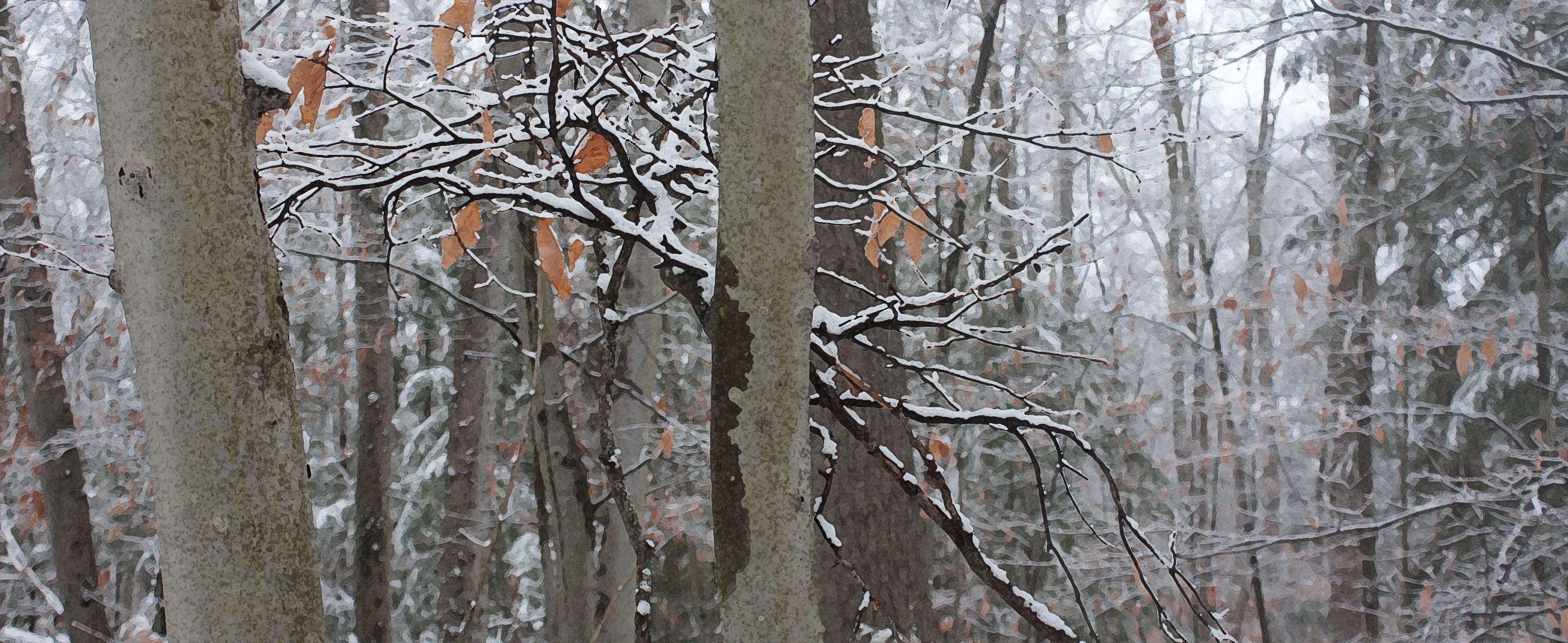
Beech-hemlock forest after a light snow in South Drumlin park, ON (photo and rendition by Nina Munteanu)
As soon as the shift was over, I snatched my gear and rushed off with my camera and tripod and a pack of blueberries to the beech-maple-hemlock forest nearby. The place is called South Drumlin Park, because the forest runs up and down a hogsback with wonderful trails throughout.
Marcescent beech trees greet me along a trail in South Drumlin park, ON (photo and rendition by Nina Munteanu)
I was the only person there. I walked and crunched through snow and frost-hardened leaf litter and I let myself get lost in the labyrinth of trails through the open winter forest. The pale beech trees, because they keep their now copper-coloured marcescent leaves, stood out amid the bare maples, oaks, poplars and birch trees.
Pale bronze beech leaves light up the dark hemlock forest, South Drumlin park (photo and rendition by Nina Munteanu)
I wandered there for hours, inhaling the peaceful freshness and the quiet hush of gentle snowing in the forest.
There were just a few rowdy red squirrels and one persistent bluejay, but all else lay quiet in the deep of the forest. I had found my magic and mystery … It felt sublime and my heart sang…
Trail through poplars, cedars and hemlocks toward the river, South Drumlin park, ON (photo and rendition by Nina Munteanu)
Nina Munteanu is a Canadian ecologist / limnologist and novelist. She is co-editor of Europa SF and currently teaches writing courses at George Brown College and the University of Toronto. Visit www.ninamunteanu.ca for the latest on her books. Nina’s bilingual “La natura dell’acqua / The Way of Water” was published by Mincione Edizioni in Rome. Her non-fiction book “Water Is…” by Pixl Press (Vancouver) was selected by Margaret Atwood in the New York Times ‘Year in Reading’ and was chosen as the 2017 Summer Read by Water Canada. Her novel “A Diary in the Age of Water” was released by Inanna Publications (Toronto) in June 2020.
Stream runs through cedar poplar forest in the rain, Trent Nature Sanctuary, ON (photo and dry brush rendition by Nina Munteanu)
Oh! great mysterium: Great forested sanctuary into the heart of being Oh! to walk pensive, in solitude into the center Of a cedar forest, worlds all russet and green, Branch and bough, rain swept landscapes The high treetops, far whisper and echo… The great winds in high flight high above… Songs to pierce the sullen skies, Melodies of joy and of a deepest longing…
Cedars and poplars in a morning mist, Trent Nature Sanctuary, ON (photo by Nina Munteanu)
Songs of immortality, worlds full aflame, Mystic cathedrals and dawn memory, Haze and gray day, silver sky, silver cloud Rain downfall and mist… Leaf, branch and bough, the wind and the rain The bending and wind tossed land
Mist hangs over Trent Canal, Trent Forest Sanctuary, ON (photo by Nina Munteanu)
The spring scents, spring grasses and nearby stream; Rivulet and rhapsodic song, The holy silences, the rain, fall, hiss and far echo… Cedar forest cathedrals, branches overspread, Red winged blackbird, soaring alone high above, High into the receiving dome of haze and sky Free swoop and whispering forest airs
White birch in Trent Nature Sanctuary, ON (photo and dry brush rendition by Nina Munteanu)
The far meditation: Sacred journey into a holy wilderness: Forested worlds beyond time…
Cedar root among ferns and moss in a light mist, Trent Nature Sanctuary (photo by Nina Munteanu)
Forested worlds of an existential beauty, Great moss silences, tree root and bough… Great worlds of hope and the tenebrous shadow Of a rain swept day… Holy encounters: the great mysterium Sacred worlds beyond still time…
BEV GORBET
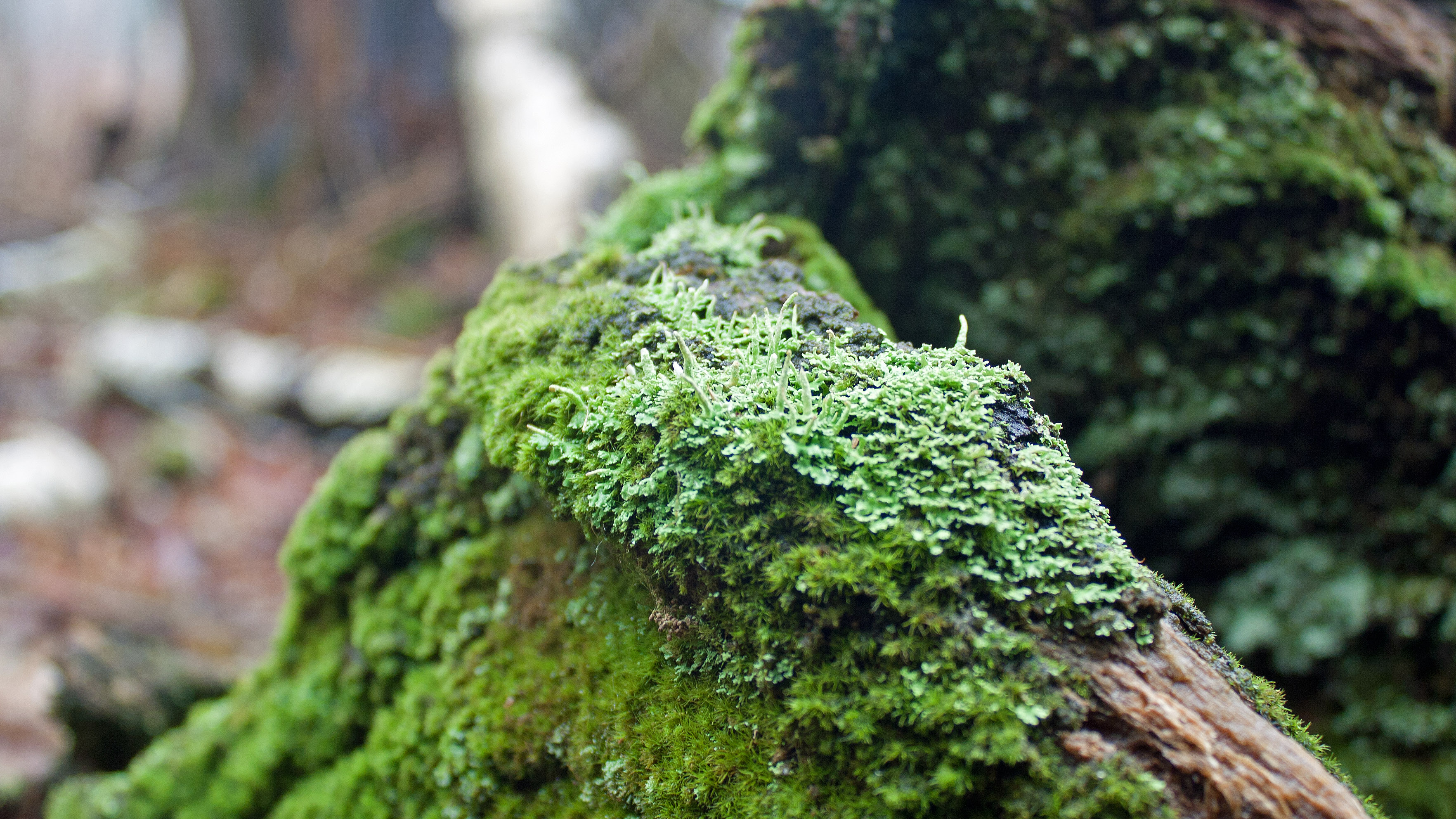
Moss and lichen cover an old cedar log, Trent Nature Sanctuary, ON (photo by Nina Munteanu)
Tinder polypore fungus on white birch, Trent Nature Sanctuary, ON (photo and dry brush rendition by Nina Munteanu)
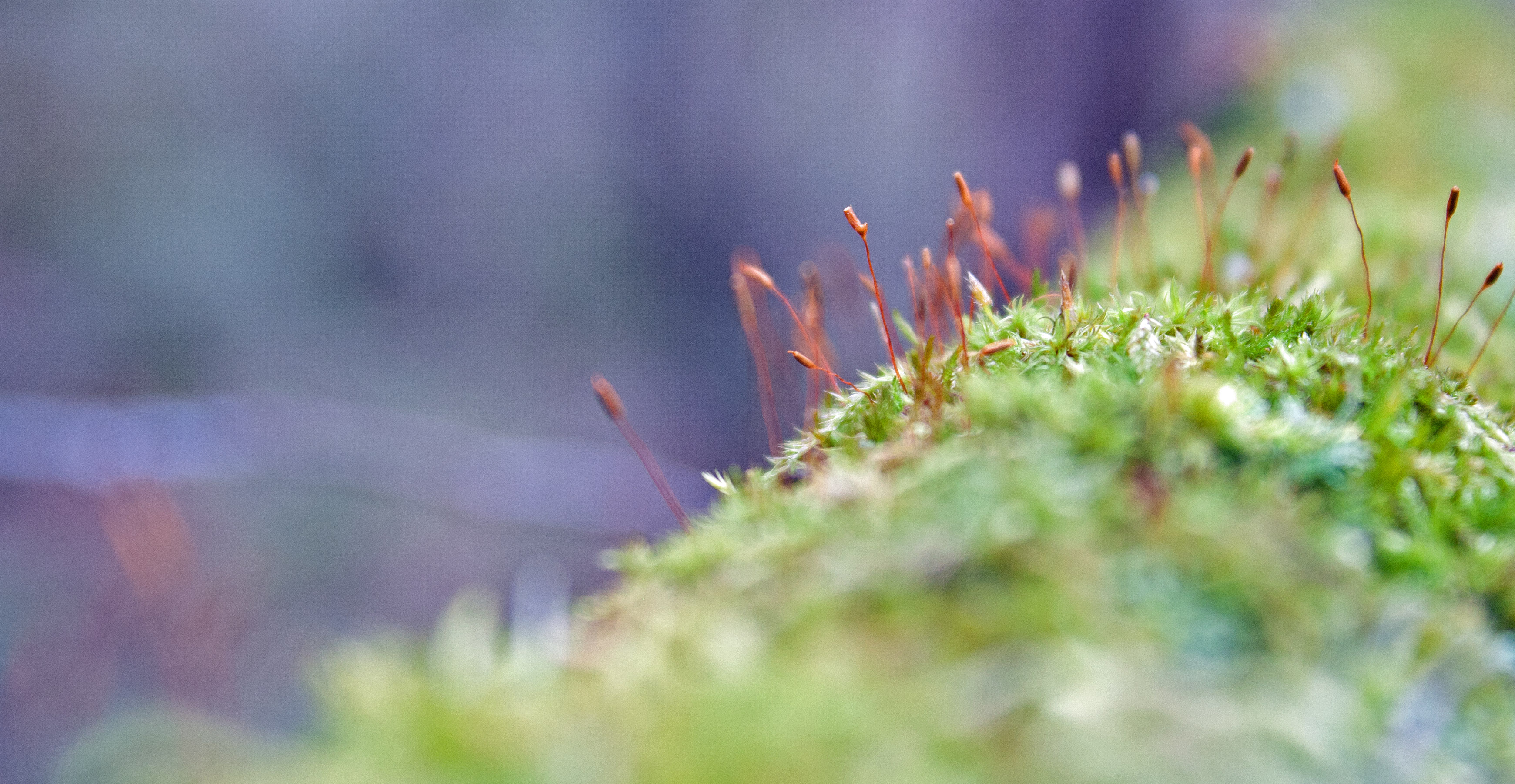
Moss on a log in Trent Nature Sanctuary, ON (photo by Nina Munteanu)
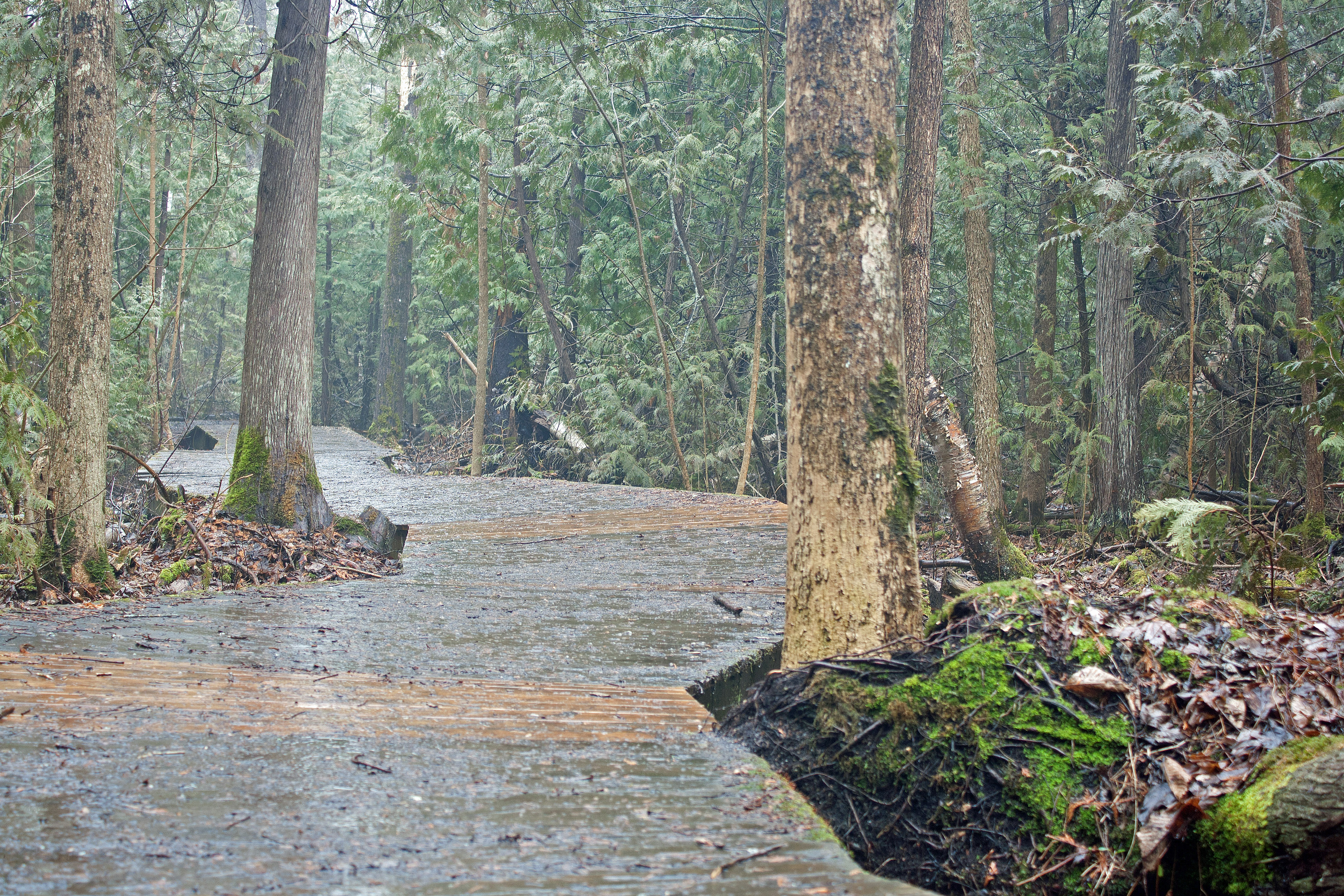
Cedar boardwalk in a misty rain, Trent Nature Sanctuary, ON (photo by Nina Munteanu)
Nina Munteanu is a Canadian ecologist / limnologist and novelist. She is co-editor of Europa SF and currently teaches writing courses at George Brown College and the University of Toronto. Visit www.ninamunteanu.ca for the latest on her books. Nina’s bilingual “La natura dell’acqua / The Way of Water” was published by Mincione Edizioni in Rome. Her non-fiction book “Water Is…” by Pixl Press(Vancouver) was selected by Margaret Atwood in the New York Times‘Year in Reading’ and was chosen as the 2017 Summer Read by Water Canada. Her novel “A Diary in the Age of Water” was released by Inanna Publications (Toronto) in June 2020.

















 Nina Munteanu Writing Coach