Movie Review: Reaching for “Elysium”–Why the movie could have been great but wasn’t

In the “Hero’s Journey” myth, Elysium (or the Elysium Fields in Greek mythology) is the paradise that true heroes go to when they die (think of Frodo in Lord of the Rings and the hero in The Gladiator). To the ancient Greeks, Elysium was a place at the ends of the earth where heroes, favoured by the gods for their altruism, went. It is a state or place of perfect happiness; the equivalent of Heaven.

Elysium is also the name given to the Earth-orbiting space station of Neill Blomkamp’s (District 9) new science fiction political allegory of the same name. Elysium is where the privileged live in luxury and perfect health (thanks to health-pods) — after they abandoned Earth to the squalor they no doubt helped create. This is not made clear enough for me and is one of the film’s major weaknesses, in my opinion (more on that below).

Earth seen from Elysium

The year is 2154 in a Los Angeles that strangely resembles the slum shanties of Johannesburg, South Africa (where Blomkamp filmed District 9).  We soon learn that Earth struggles in the mire of humanity’s waste in a state of general social strife. Abandoned by the wealthy elite (who have moved to Elysium), the rest of an overpopulated humanity lives in the squalor of abject poverty without food, healthcare, or the motivation to live. I, for one, would have liked to know a little of how humanity devolved so dramatically on a planetary scale.

A Different Hero’s Journey

From the time he was a young orphan, Max Da Costa (Matt Damon; Maxwell Perry Cotton) dreamed of going to Elysium, its impressive phantom form visible in the daytime sky. He promised his childhood love Frey (sympathetically played by Alice Braga and Valentina Giros) that he would take her there, to paradise. His mentor, a kind mother-figure nun at the orphanage, gives him the hero’s talisman (a locket with a picture of Earth inside), and prophesizes, “Es su destino hacer algo maravilla cuando tu es hombre” (“It is your destiny to do something great when you are a man”). She reminds him that when he gets to Elysium, he will see the most beautiful thing: planet Earth. “You see how beautiful it is,” she says to him as he gazes out at the ghost of Elysium in the sky. Then, as she hands him the locket with Earth inside, she adds, “look how beautiful we are from there. Never forget where you come from.”  Seen from this perspective, the planet Earth is a beautiful thing to behold.

Max and Spider share a heated conversation

Max is a reformed criminal who, like Blomkamp’s “workaday” anti-hero in District 9 (Sharlto Copley), is not very hero-like until the last five minutes of the film, when he has his personal epiphany and decides to act altruistically rather than self-servingly. This is a pattern that Blomkamp has used before; the reluctant-hero (Wikus Van De Merwe) of District 9 was an unimpressive man with many obvious blemishes. A rather unlikeable man until he makes his heroic decision in the end. This is where Blomkamp’s heroes differ from most action movie heroes, who generally start their journey from higher positions on the evolutionary scale. Blomkamp’s heroes must journey farther to gain their hero-status; they are perhaps more realistic portrayals of ordinary men who finally shine under extra-ordinary circumstances. Men who we start out disliking—hating, even—but find ourselves cheering for, perhaps even crying for. Max’s behaviour defines that true hero: rising from his need to save himself to his quest to save humanity—at the cost of his own life. But, as with the ordinary man, it is only when he connects a personal quest to save the daughter of his first love to his global quest to save Earth that Max transforms into the altruistic mythic hero he is destined to become. Everything came together at the film’s end, in a montage of scenes that depict the locket of the planet Earth in his dying hand (Earth is Home; save the planet), the demise of a police state, the saviour of his love’s daughter, and med-pods landing on Earth to dispense aid to the dying masses.

Elysium orbiting the Earth

A Story About the Planet Earth

Ironically, it is to do with our beloved planet Earth that I felt in Elysium the most discord in plot/thematic story treatment and lack of resonance. Blomkamp begins with the planet and he ends his film with the planet. The symbolism is clear: in the stylish shots of Earth seen from Elysium (and vice versa); in the strategic scenes of Max and the image in his precious locket of not his childhood love Frey but of planet Earth; and his mentor’s advice to Max, delivered in one of the most powerful scenes of the movie. Yet, Blomkamp fails to follow through to give us that visceral connection. Why is the planet so important? How is Max connected to it or anyone else, for that matter. What is Spider’s story (Wagner Moura), a latter-day Che-Guevara, who fervently leads the proletarian rebellion of Earth? Who, why and how did the planet come to be so destroyed? There is not one ounce of suggestion, backstory or context. This is an important consideration; because without it, instead of feeling total resolution and redemption in the end, I felt a disconnect to those masses being helped and even some distrust in their fate and direction. Instead of feeling true victory, I felt ambivalence.  

Called a “sci-fi socialist film” by P.J. Gladnick of Newsbusters.org, Elysium is clearly an attempt at examining and dramatizing the social segregation of humanity and economic fascism: a dystopia that promises commentary on social and economic issues in society today. However, I felt that its delivery was compromised by Blomkamp’s choice to focus more on action tech at the expense of good backstory, context and empathic character development. I’m not saying that it’s a bad story. It is a very good story; it’s just that it could have been a great story. The heart of the story—delivered through the main protagonist—lacks the global connection it could have had. This is not, as some reviewers suggest, due to any infirmity of the hero, his antagonists, or lack of symbolism (of which there is much), but the lack of context, backstory and richness of setting (I’m not talking about the visible setting, which was spectacular, elegant and stylish). It comes back to how each character relates to “home”, the planet, and to each other.

Matt Goldberg of Collider.com says that, “Elysium‘s message about economic inequality is couched in a finely-drawn sci-fi world, but the power of that message becomes diminished when we cease to care about the messenger.” Detroit News Tom Long added that, “Elysium is the sort of big, noisy sci-fi film that seems to want to say something but opts instead to concentrate on fight scenes involving gimmickry.” While I appreciated the depth and breadth of Blomkamp’s references to pop culture from an Armani-clad female Darth Vader to the Judeo-Christian references and symbolism, it just didn’t hold its promise.

Jodi Foster plays Defence Secretary Delacourt, the threshold guardian of Elysium

What began as a promising exploration about an important social issue, devolved into a sequence of ever-escalating gratuitous gore and violence—clearly aimed for a different audience.

Elysium

Nina Munteanu is a Canadian ecologist / limnologist and novelist. She is co-editor of Europa SF and currently teaches writing courses at George Brown College and the University of Toronto. Visit www.ninamunteanu.ca for the latest on her books. Nina’s bilingual “La natura dell’acqua / The Way of Water” was published by Mincione Edizioni in Rome. Her non-fiction book “Water Is…” by Pixl Press (Vancouver) was selected by Margaret Atwood in the New York Times ‘Year in Reading’ and was chosen as the 2017 Summer Read by Water Canada. Her novel “A Diary in the Age of Water” was released by Inanna Publications (Toronto) in June 2020.

Book and Movie Review: Solaris by Stanislaw Lem and Steven Soderbergh

Steven Soderbergh’s stylish psychological thriller, released November 2002 in the United States by 20th Century Fox, eloquently captures the theme of Stanislaw Lem’s 1961 book. Written almost fifty years ago, Solaris is an intelligent, introspective drama of great depth and imagination that meditates on humanity’s place in the universe and the mystery of God. Soderbergh’s Solaris is a poem to Lem’s prose. Both explore the universe around us and the universe within. Not particularly palatable to North America’s multiplex crowd, eager for easily accessed answers, Solaris will appeal more to those with a more esoteric appreciation for art.

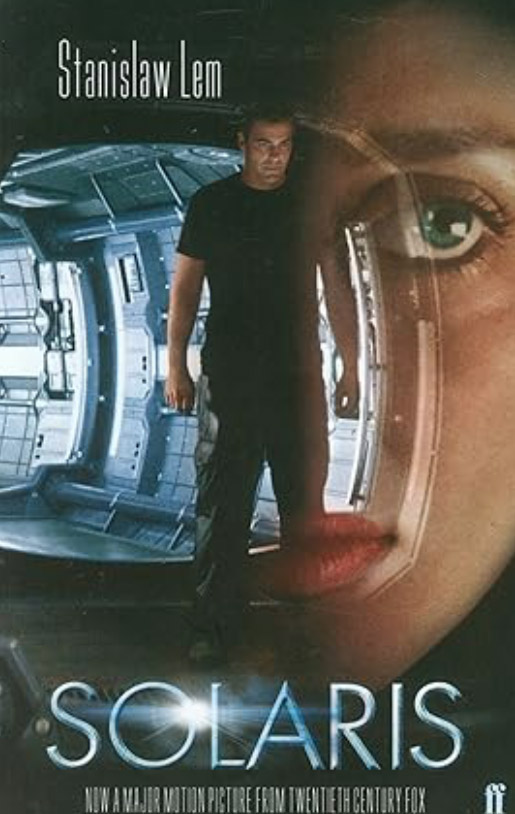
When I recently saw the 2002 20th Century Fox remake of Solaris, I was blissfully unaware of its legendary history. I say blissfully because I harbored no pre-conceived notions or expectations and therefore I was struck like a child viewing the Northern Lights for the first time. The stylish, evocative and dream-like imagery flowed to a surrealistic soundtrack by Cliff Martinez like the colors of a Salvador Dali painting. It was only later that I discovered that Russian experimental director, Andrei Tarkovsky, had previously filmed Solaris in 1972 based on Lem’s masterful 1961 book of the same name. Reprinted by Harcourt, Inc. with a new cover featuring a sensual image from the 2002 film, the original book was translated in 1970 from the French version by Joanna Kilmartin and Steve Cox for Faber and Faber Ltd.

Written almost fifty years ago, Solaris is a dark psychological drama. Soderbergh faithfully captures the intellectual yet sensual essence of Lem’s book by tempering the language and movements. Featuring a fluid and haunting soundtrack, his film flows like a choreographed ballet. There is a dream-like quality to it that is enhanced by creative use of camera angles, unusual lighting, tones and contrast, and sparse language. Solarisis not an action film (no one gets shot, at least not on stage), yet the tension surges and builds to its irrevocable conclusion from frame to frame like a slow motion Tai Chi form.

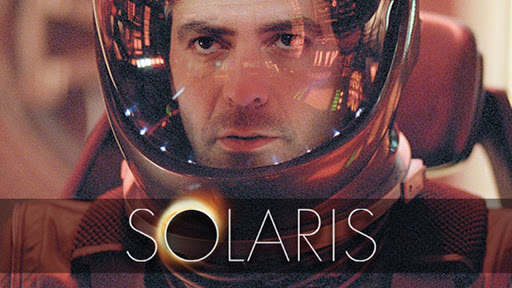
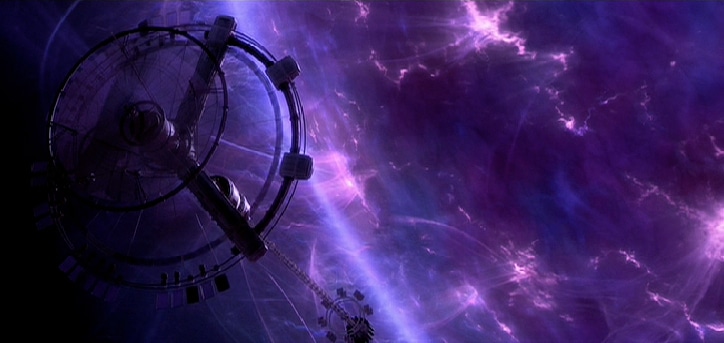
In response to his friend’s plea, a depressed psychologist with the ironic name of Kris Kelvin (played with quiet depth by George Clooney), sets out on a mission to bring home the dysfunctional crew of a research space station orbiting the distant planet, Solaris. Kelvin arrives at the space station, Prometheus, to find his friend, Gibarian, dead by suicide and a paranoid and disturbed crew obviously withholding a terrible secret from him. It is not long before he learns the secret first-hand: some unknown power (apparently the planet itself) taps into his mind and produces a solid corporeal version of his tortured longing: his beloved wife, Rheya (played sensitively by Natascha McElhone) who years ago had committed suicide herself. Faced with a solid reminder, Kelvin yearns to reconcile with his guilt in his wife’s death and struggles to understand the alien force manifested in the form of his wife. He learns that the other crew are equally influenced by Solaris and have been grappling, each in their own way, with their “demons,” psychologically trapping them there.

Ironically, our hero’s epic journey of great distance has only led him back to himself. The alien force defies Kelvin’s efforts to understand its motives; whether it is benign, hostile, or even sentient. Kelvin has no common frame of reference to judge and therefore to react. This leaves him with what he thinks he does understand: that Rheya is a product of his own mind, his memories of her, and therefore a mirror of his deepest guilt—but perhaps also an opportunity to redeem himself.

Lem packs each page of his slim 204 page book with a wealth of intellectual introspection. Through first person narrative, he intimately unveils the complicated influence of this arcane force on Kelvin. Lem explains it this way: “I wanted to create a vision of a human encounter with something that certainly exists, in a mighty manner perhaps, but cannot be reduced to human concepts, ideas or images.” (Author’s Website.) Such an incomprehensible entity would serve as a giant mirror for our own motives, yearnings and versions of reality. For me the contrast presented by such an arcane alien force emphatically—but also ironically—defines what it is to be human. It is only when faced with what we are not that we discover what we are. Later in the book, Kelvin cynically observes: “Man has gone out to explore other worlds and other civilizations without having explored his own labyrinth of dark passages and secret chambers, and without finding what lies behind doorways that he himself has sealed.” In the film Gibarian sadly proclaims of the Solaris mission: “We don’t want other worlds—we want mirrors.” In the book, Lem has Snow deliver a similar message, but neither Gibarian or Snow realize that these two desires may be one and the same.

Lem’s existentialist leaning is provided throughout the book and even alluded to in the name he chose for the space station: Prometheus. In Greek mythology, Prometheus stole fire from the gods and gave it to humankind for which Zeus chained him to a rock and sent an eagle to eat his liver (which grew back daily). It is interesting that Soderbergh chose to send Prometheus to a fiery crash and named Kelvin’s dead wife, Rheya, after the Greek goddess, mother of Zeus and all Olympian gods. In a late passage of Lem’s book, a devastated and sorrowful Kelvin formulates a personal theory of an imperfect god, “a god who has created clocks, but not the time they measure … a god whose passion is not a redemption, who saves nothing, fulfills no purpose—a god who simply is.”

Soderbergh addresses Lem’s existential vision with several brief but pivotal scenes. One occurs when Kelvin’s dead friend, Gibarian, returns to him in a dream on Prometheus and responds to Kelvin’s question, “What does Solaris want?” with: “Why do you think it has to want something?” Another scene occurs as a flashback to a dinner on Earth, when the real Rheya, prior to her suicide, argues with both Gibarian and her own husband about the existence of an all-knowing purposeful God, which both men argue is a myth made up by humankind: to Kelvin’s suggestion that “the whole idea of God was dreamed up by man,” Rheya insists that she’s “talking about a higher form of intelligence,” to which Gibarian cuts in with: “No, you’re talking about a man in a white beard again. You are ascribing human characteristics to something that isn’t.” Kelvin fuels it with: “We’re a mathematical probability,” which prompts Rheya’s challenge: “How do you explain that out of the billions of creatures on this planet we’re the only ones conscious of our immortality?” Neither man has an answer. Gibarian later commits suicide on Solaris rather than deal with the manifestation of his conscience. And I can’t help but wonder if the underlying reason for his inability to reconcile with his “demon” is because he was unequipped to, given his nihilistic beliefs.

Gibarian also tells Kelvin (and we must remember that all this is Kelvin really saying this to himself through his memory of the character): “There are no answers, only choices.” It is interesting then that the first pivotal choice in the story is made by the Doppelganger Rheya (also a manifestation of Solaris but a mirror of Kelvin’s own mind) and it is a choice made out of love: to be annihilated, rather then serve as an instrument of this unknown alien power to study the man she loves.

Some critics have called Soderbergh’s Solaris pretentious, boring and devoid of action and intimacy. I strongly disagree. It is simply that, as with Lem’s original story, Soderbergh’s Solaris does not surrender its messages easily. The viewer, as with the reader, must intuitively feel his or her way through the fluid poetry, free to interpret and ponder the questions. This is what I think good art should do. And I feel both the original book and Soderbergh’s movie do this with enthralling brilliance.

Where Soderbergh and Lem depart lies more in each artist’s personal vision and belief. Soderbergh seems to view the forces that drive our universe as the manifestation of an arcane motive more readily known through spirituality, perceived by the heart, and existing as a matter of belief. Lem, however, suggests that these forces are random and without purpose, defined by science, and perceived by the mind. Still, Lem is not proclaiming a nihilism of his own: he believes we are defined by the questions we ask and Lem asks a great deal of questions—leaving the reader to do the answering.

Reviewer Rick Kisonak asserted that Lem’s “novel is an icy meditation on man’s place in the universe and the mystery of God. It poses countless metaphysical questions and makes a point of answering none of them. In Soderbergh’s hands, however, Solaris becomes a celebration of romantic love, which culminates in the revelation of a caring, forgiving creator. At the end of his book, Lem writes [Kelvin ponders]: ‘the age-old faith of lovers and poets in the power of love, stronger than death, that finis vitae sed non amoris [life ends but not love] is a lie, useless and not even funny.’ The director ignores the author in favor of just such a poet” (Film Threat, [Online]). Kisonak is referring here to Rheya’s interest in Dylan Thomas and its reference throughout the movie. Another reviewer, Dennis Morton, goes so far as to suggest that the screenplay of Solaris is the first stanza of the poem, which ends with: “…though lovers be lost love shall not; And death shall have no dominion” (Santa Cruise Sentinel, [Archived online])

While I agree with some of Kisonak’s reasoning, I think he has missed the point of Lem’s book. If one continues to read from the passage Kisonak quoted above—as Kris Kelvin transcends from what he “thinks” in his intellect to what he feels and “knows” in his heart, to accept his (and humanity’s) destiny with humble fatalism—we learn that Lem ends his book in much the same way as Soderbergh’s movie: life ends but not love. The endings are physically different, in keeping with some radical alterations from the book in the movie’s setting (e.g., the original Solaris station is located on the planet and Lem assiduously describes Kelvin’s observations and interactions with the alien ocean; whereas Soderbergh’s crew virtually never leave orbit and the planet remains aloof in the background, reflecting Soderbergh’s focus). Yet, Kris makes the same choice in faith and love in both book and movie (although the choices play out differently). In matters of faith and love, here is what Kris has to say in the book: “Must I go on living here then, among the objects we both had touched, in the air she had breathed? … In the hope of her return? I hoped for nothing. And yet I lived in expectation … I did not know what achievements, what mockery, even what tortures still awaited me. I knew nothing, and I persisted in the faith that the time of cruel miracles was not past.” In the end of both movie and book, Kris Kelvin lets go of his fears and lets his spirit rise in wonder at what astonishing things Solaris (and the universe) will offer next.

In the final analysis, both book and movie are incredibly valuable but for different reasons. Soderbergh paints an impressionistic poem, using Kafkaesque brushstrokes on a simpler canvas, to Lem’s complex tapestry of multi-level prose. Lem challenges us far more by refusing to impose his personal views, where Soderbergh lets us glimpse his hopeful vision. I think that both, though, come to the same conclusion about the ethereal, mysterious and eternal nature of love. On the one hand, love may connect us within a fractal autopoietic network to the infinity of the inner and outer universe, uniting us with God and His purpose in a collaboration of faith. On the other hand, love may empower us to accept our place in a vast unknowable and amoral universe to form an island of hope in a purposeless sea of indifference. Whether love mends our souls to the fabric of our destiny; enslaves us on an impossible journey of desperate yearning; or seizes us in a strangling embrace of unspeakable terror at what lurks within—surely, then, love is God, in all its possible manifestations. This is unquestionably the message that unifies book and movie. And it is one worth proclaiming.

Indian River, ON (photo and dry brush rendition by Nina Munteanu)

Nina Munteanu is a Canadian ecologist / limnologist and novelist. She is co-editor of Europa SF and currently teaches writing courses at George Brown College and the University of Toronto. Visit www.ninamunteanu.ca for the latest on her books. Nina’s bilingual “La natura dell’acqua / The Way of Water” was published by Mincione Edizioni in Rome. Her non-fiction book “Water Is…” by Pixl Press(Vancouver) was selected by Margaret Atwood in the New York Times‘Year in Reading’ and was chosen as the 2017 Summer Read by Water Canada. Her novel “A Diary in the Age of Water” was released by Inanna Publications (Toronto) in June 2020.

Movie Review: Pan’s Labyrinth–Innocence Has a Power Evil Cannot Resist

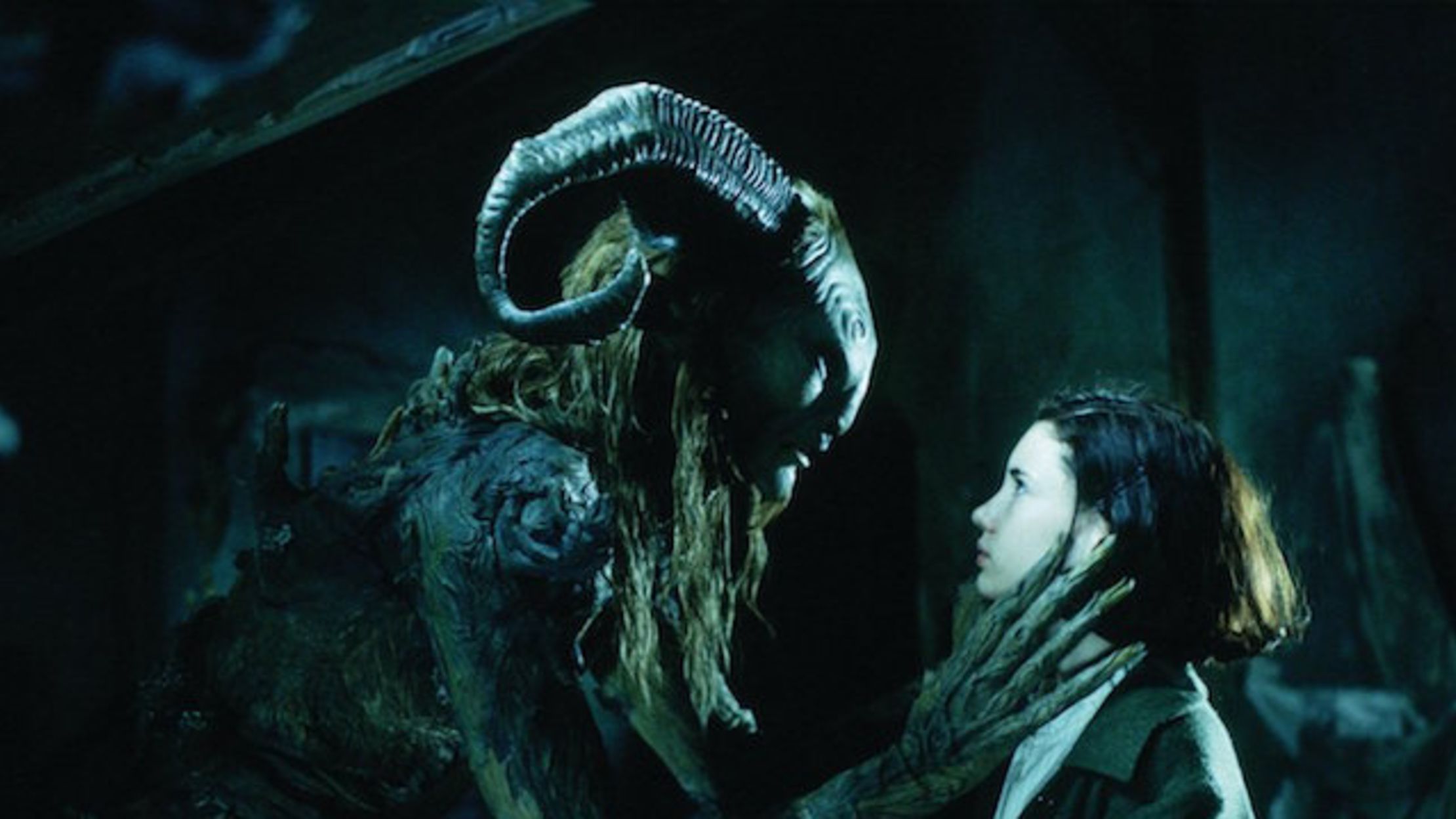
“Pan’s Labyrinth” is a dark and disturbing allegorical adult fairy tale by writer-director Guilermo del Toro. Set in 1944 Spain (the aftermath of the Spanish Civil War) 12-year old Ofelia (Ivana Baquero) travels with her frail and pregnant mother, Carmen (Ariadna Gil) to a remote village to meet her new stepfather, a sadistic Fascist captain named Vidal (Sergi Lopez), who is bent on exterminating the last Republican resistance to Franco scattered in the nearby hills. Clutching her books of myths and fantasy, which her mother suggests she cast aside to face the real world, Ofelia refuses to call Vidal “Father.” From the start, she pegs him rightly as a ruthless monster, and her unruly behavior only invites wrath from this psychopath who tortures and kills innocent victims without remorse. Ofelia retreats into the dark labyrinth and down a William Blake-like spiral staircase where she encounters an untrustworthy faun (Doug Jones). This encounter sparks a braided narrative that seamlessly weaves from tragic reality to magical mystery as Ofelia struggles to keep them apart. Alas, collision is imminent. The faun tells Ofelia that she is really a princess, but to prove it and gain entrance into the underworld kingdom of immortality, she must complete three dangerous tasks. Each task is progressively more daunting, from scolding a giant toad in a bug-infested cave to fleeing a Goya-like child-devouring ‘Satan’ with eyes in his hands. And each adventure draws her closer on a terrifying collision with the real world.

The faun with Ofelia

The horrors of both the realistic and surrealistic worlds are woven into the beautifully aligned narrative structure of del Toro’s story,” said Gene Seymour of Newsday. Glenn Whipp of U-Entertainment, calls Pan’s Labyrinth “dark poetry set to startling images, a one-of-a-kind nightmare that has a soaring, spiritual center.” Gene Seymour further suggests that “as hard as it may be to watch Guillermo del Toro’s dark fairy tale unravel, one comes away from this magical-realist masterwork oddly invigorated by the way the movie and its principal character triumph over the banality of evil through the autonomy of imagination. The movie may give you nightmares, but it may also give you a few more good reasons to get out of bed the next morning.”

“Pan’s Labyrinth” can be interpreted on many levels from literal to metaphorical allegory to psychological and mythic journey. Every aspect of the film, from tiny visual to people’s names (think of Ofelia’s name, for instance) has metaphoric meaning. Several excellent reviews by Harry Tuttle (Screenville) and Julian Walker (Julian’s Blog) tease out both mythic and Jungian elements of this dark poetic fantasy and I urge you to check these sites for their excellent commentary. From describing the classic Hero’s Journey (described by Joseph Campbell) to making references to the mythic Psyche, these two reviewers insightfully unveil the nuance and filigree that weave the complicated tapestry of “Pan’s Labyrinth”. For me, the allegorical symbol represented by Ofelia’s last task brought out the metaphor that struck me the most: the death of innocence required to protect the birth of freedom. Ofelia is the embodiment of the nation’s innocence. Refusing to obediently accept the deviant orders of the didactic father figure of Fascism (embodied by both Vidal and the faun), Ofelia (innocence) defies authority and sacrifices her life to “die” to protect her baby brother (freedom). Her sacrifice is rewarded by her immortal ‘re-birth’ (hope and faith).

The cruel beauty of “Pan’s Labyrinth” shows the power of innocence over evil and the triumph of imagination over prosaic servitude.

Indian River, ON (photo and dry brush rendition by Nina Munteanu)

Nina Munteanu is a Canadian ecologist / limnologist and novelist. She is co-editor of Europa SF and currently teaches writing courses at George Brown College and the University of Toronto. Visit www.ninamunteanu.ca for the latest on her books. Nina’s bilingual “La natura dell’acqua / The Way of Water” was published by Mincione Edizioni in Rome. Her non-fiction book “Water Is…” by Pixl Press(Vancouver) was selected by Margaret Atwood in the New York Times‘Year in Reading’ and was chosen as the 2017 Summer Read by Water Canada. Her novel “A Diary in the Age of Water” was released by Inanna Publications (Toronto) in June 2020.