My Drive Across Canada: Part 1—Lake Superior

It was time to go back out west for me. So, I packed up my car Benny with my precious treasures—including all my plants—and drove west from Peterborough, Ontario (where I’d been living for a decade). My destination was Vancouver, BC, where my son and sister and good friends live.

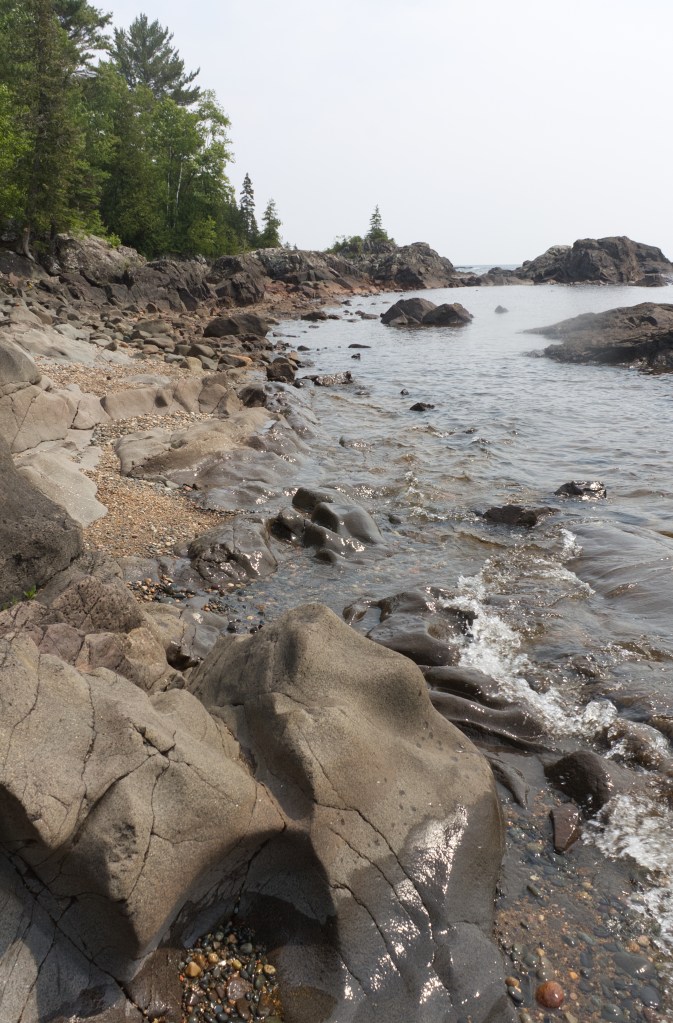
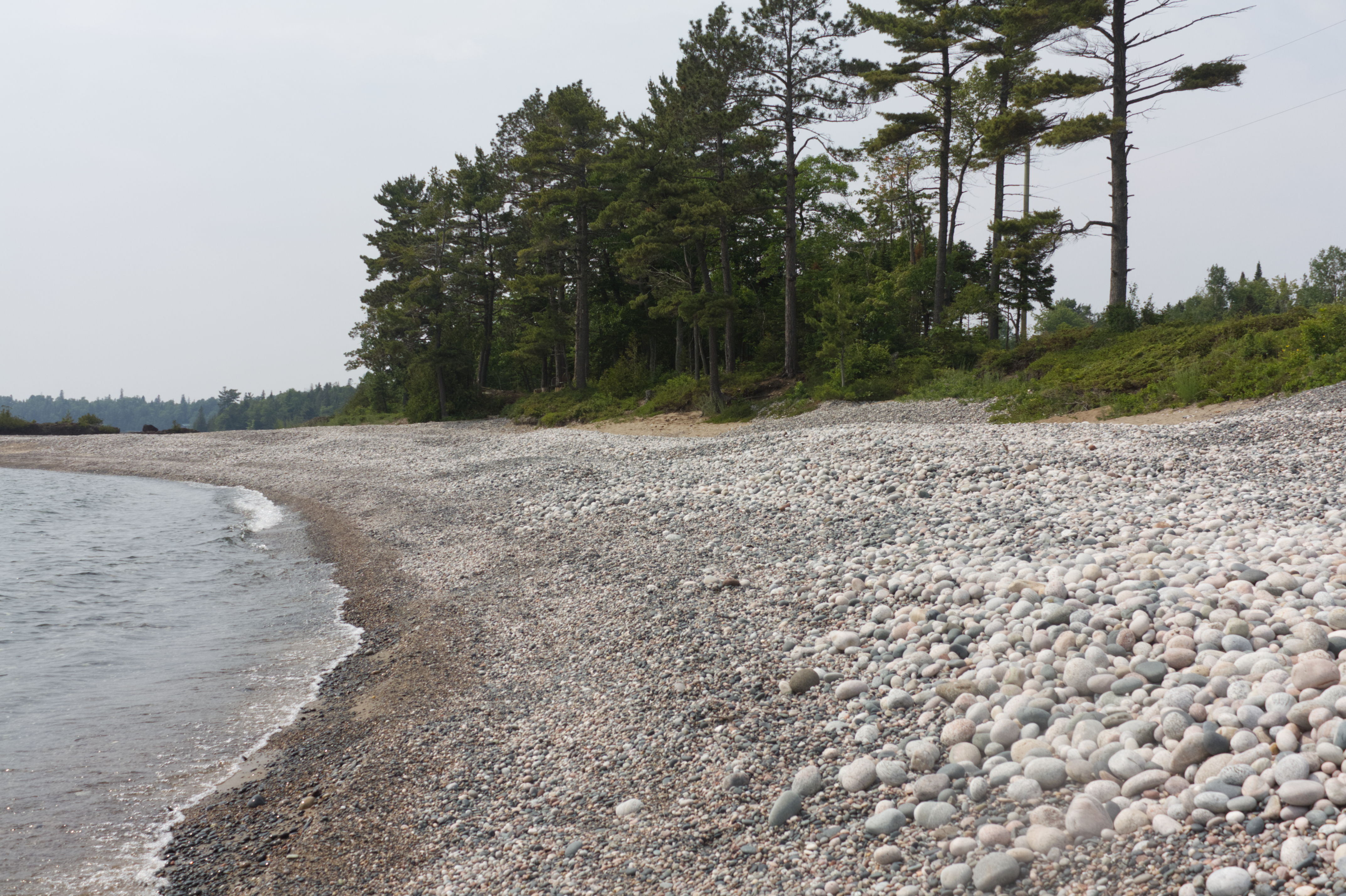
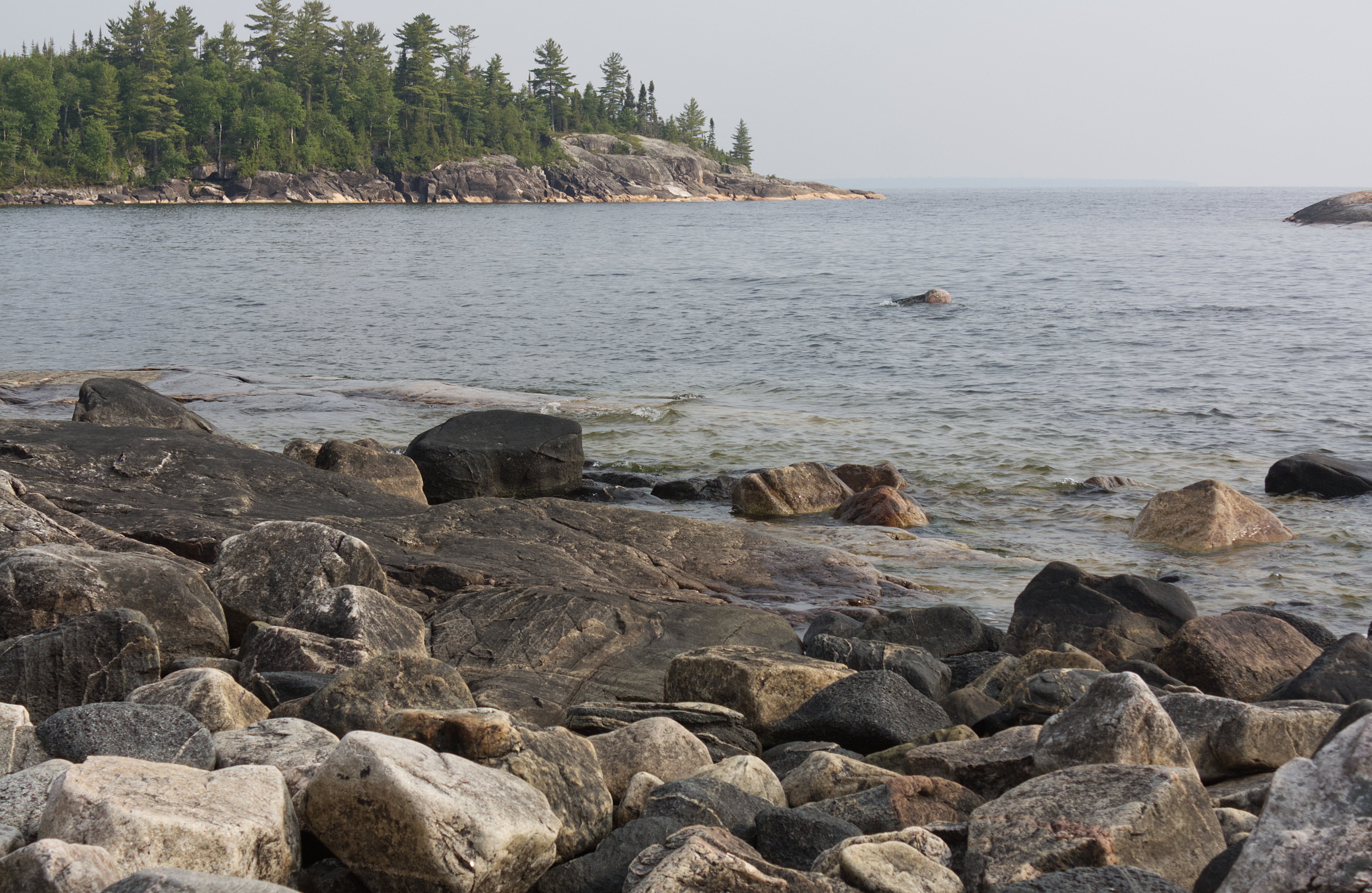
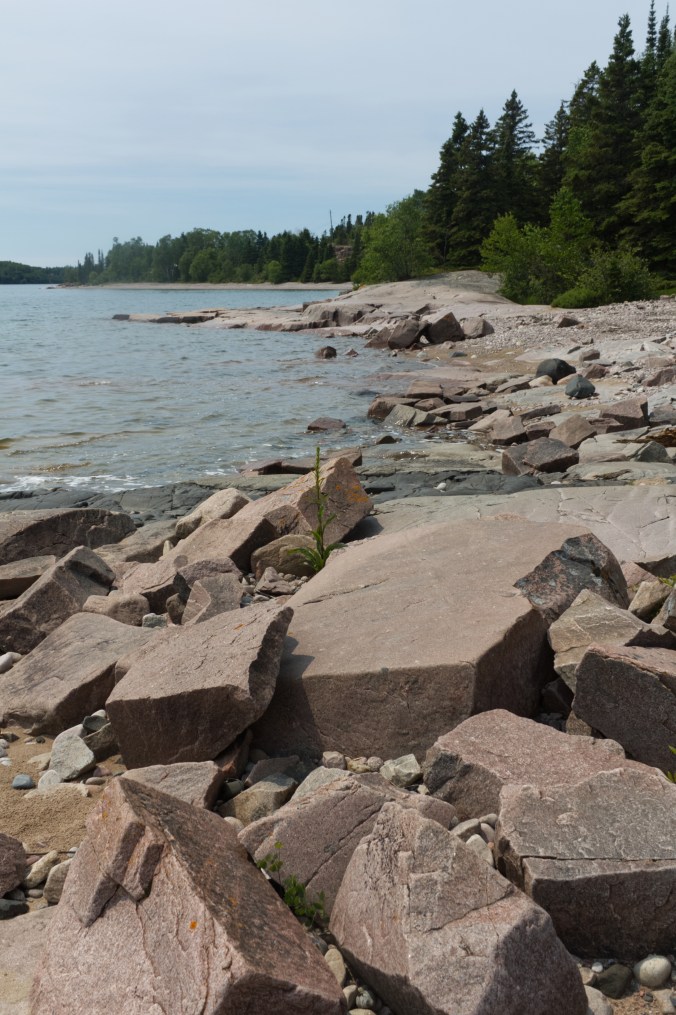
Stone Beach, Lake Superior, ON (photo by Nina Munteanu)

I looked forward to the drive through the boreal forest of the Canadian Shield—spectacular country of mostly black spruce forest, rugged billion-year old rocks and ancient inland seas. Because I’m a limnologist and ecologist, I particularly looked forward to driving along the northern shores of Lake Superior. Distinguished by iconic terraced cobble shores, vast sand beaches, steep gnarly cliffs and brooding headlands, Lake Superior was certain to be a highlight of my trip. I anticipated experiencing this Great Lake with the giddy excitement of a child.

Water-carved sandstone and granite / rhyolite boulders form shore of Stone Beach, ON (photo by Nina Munteanu)

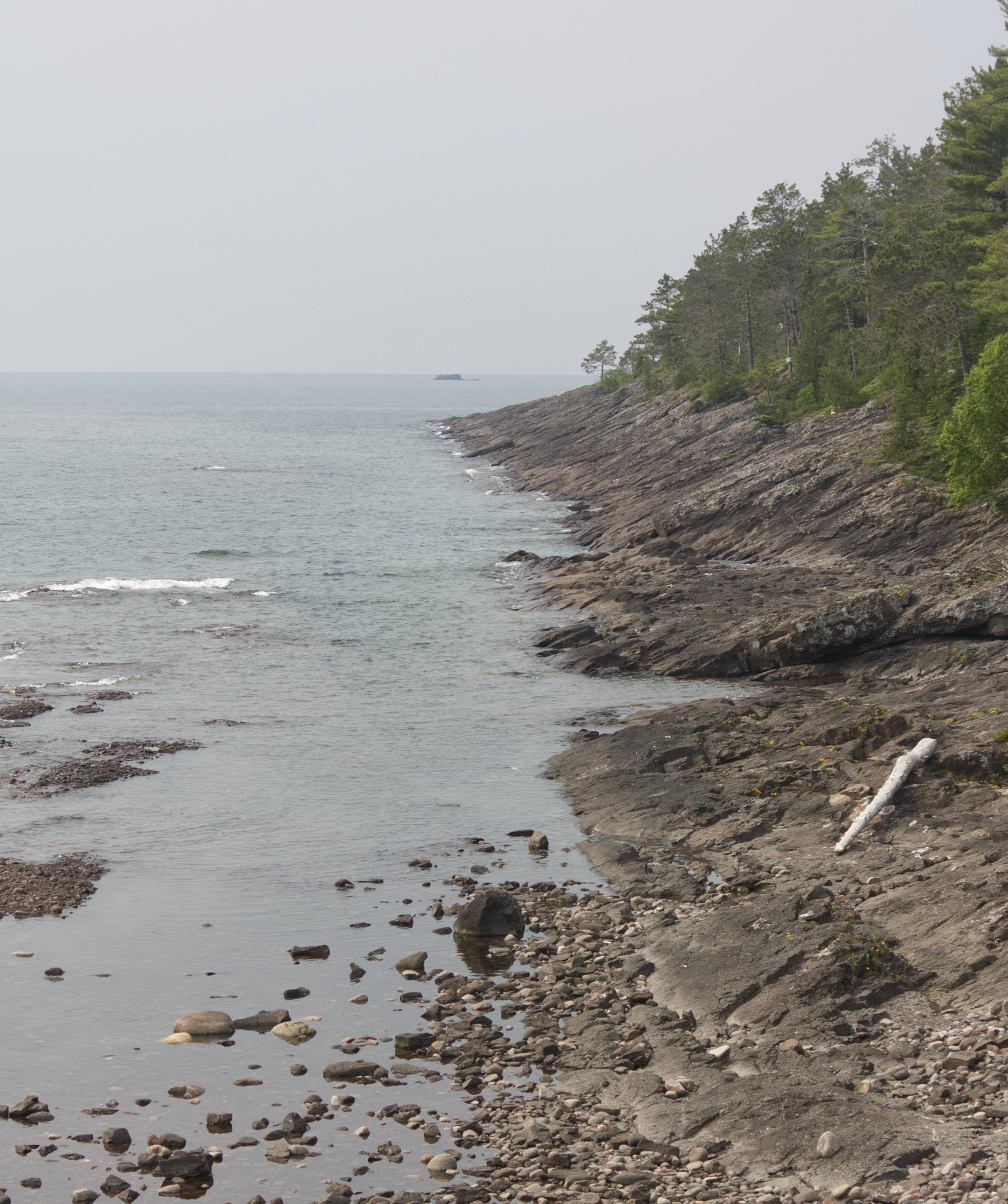
Sandy Katherine Bay, Lake Superior, ON (photo by Nina Munteanu)
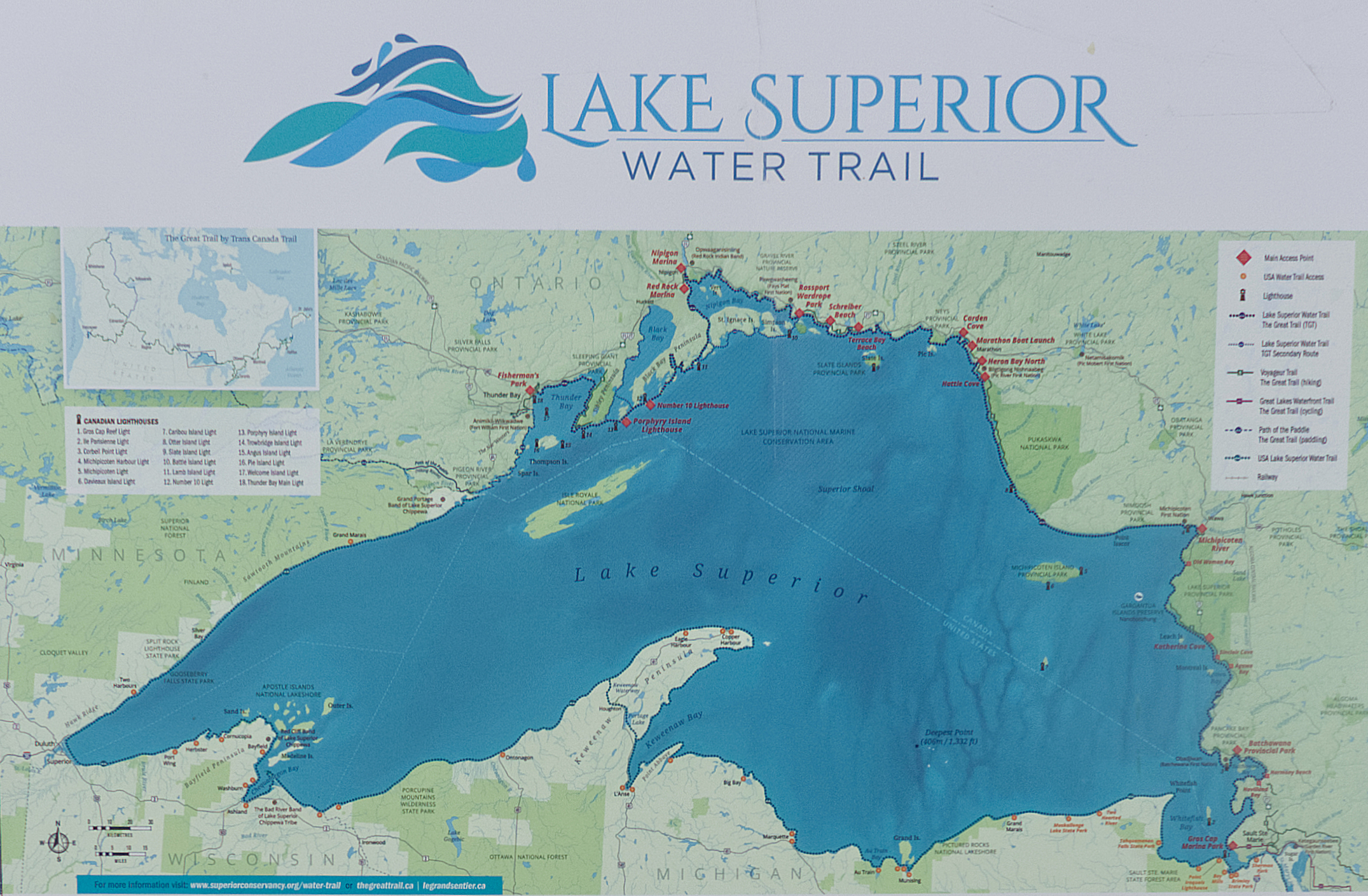
Contour and trail map of Lake Superior

I got my first glimpses of this massive lake at Sault Saint Marie, a charming town on the southeastern shore of Lake Superior and the location of the lake’s outlet, St. Marys River. My first stop for a more immersive experience of the lake was Batchawana Bay, part of Pancake Bay Provincial Park, where I explored the mostly sand coast and shore forest. I’m told that the name Batchawana comes from the Ojibwe word Badjiwanung that means “water that bubbles up”, referring to the bubbling current at Sand Point.

Benny, laden with my plants, parks beside Batchawana Beach of Lake Superior, ON (photo by Nina Munteanu)

Batchewana Bay is not only a main access point to several trails of the Lake Superior Water Trail; it also serves as a popular place for boaters and kayak paddlers to launch their craft for water adventure. The cold water and high wind fetch often make for treacherous boating. The Lake Superior Watershed Conservancy put up a sign at Batchewana Bay warning paddlers about dangerous and wily currents, including rip currents and channel currents and effects of offshore winds, accompanied by sudden surges.

Chippewa Falls, ON (photo by Nina Munteanu)

From Batchawana Bay, I continued north along the lake’s eastern shore, past Chippewa Falls, formed on 2.7 billion year old pink granite bedrock, covered by a later basalt flow; here, the Harmony River tumbles some 6 metres before emptying into Lake Superior.

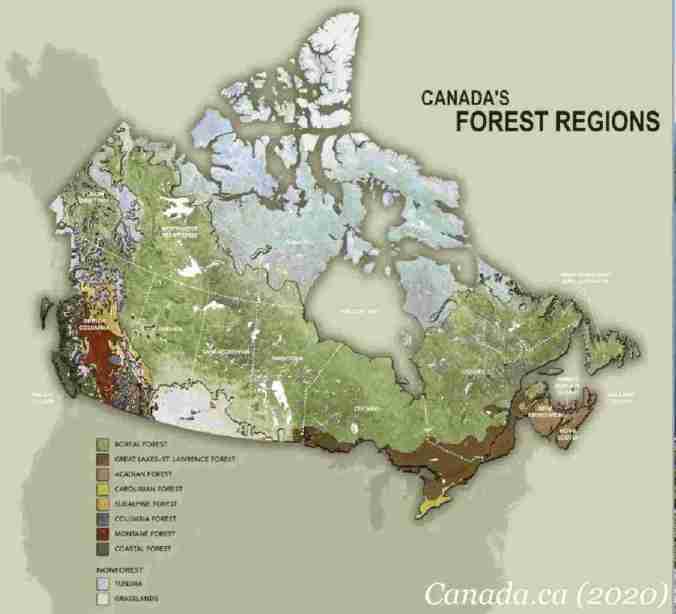
I found access points including Stone Beach, Alona Bay, Agawa Bay, and Katherine Bay, variously dominated by pebbled shores with rocky granite outcrops and finely sculpted sandstone—all overseen by windswept pine, cedar and spruce. This part of the lake lies in the Great Lakes-St. Lawrence Forest area, dominated by mixed forest of fir, spruce, cedar and paper birch.

Sorted cobble shore with scupted rocky bluffs of granite / rhyolite and black spruce, Alona Bay, Lake Superior, ON (photo by Nina Munteanu)
Rugged coastline of Alona Bay showing terraces of water-worn cobbles and granite / rhyolite bluffs, Lake Superior, ON (photo by Nina Munteanu)

Along the cobble shores of Alona Bay, I met a trio of rock hounds, looking for distinct Lake Superior agate, quite fetchy with its rich red, orange and yellow colours. I was told that the colours are caused by the oxidation of iron that leached from rocks. Fascinated by their varied colours and rounded shapes, I fell into a hypnotic meditation, picking up pebbles, rubbing them wet to reveal their bright colours and examining them close up.

Local rock hounds collecting choice pebbles at Alona Bay, Lake Superior (photo by Nina Munteanu)

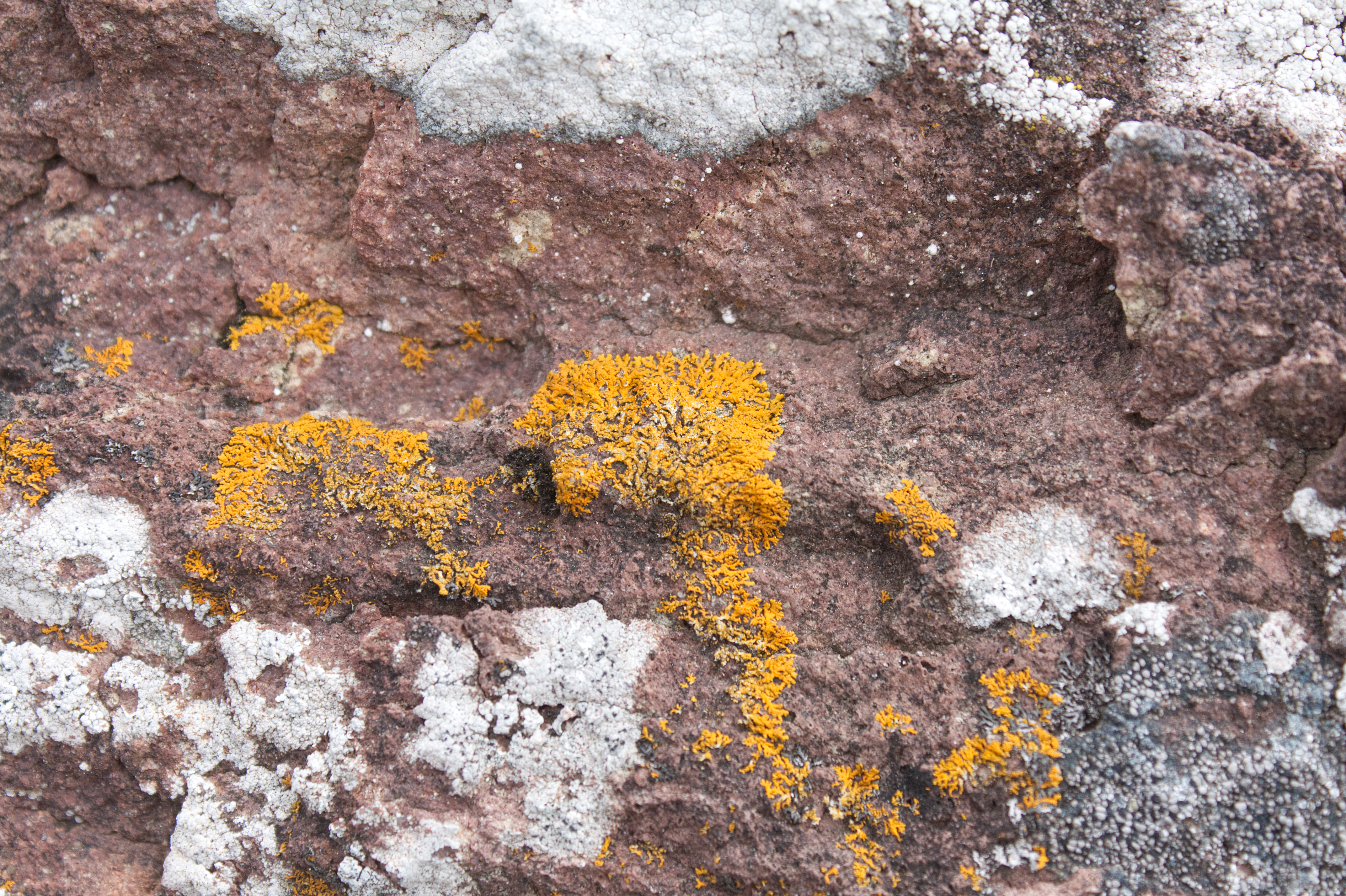
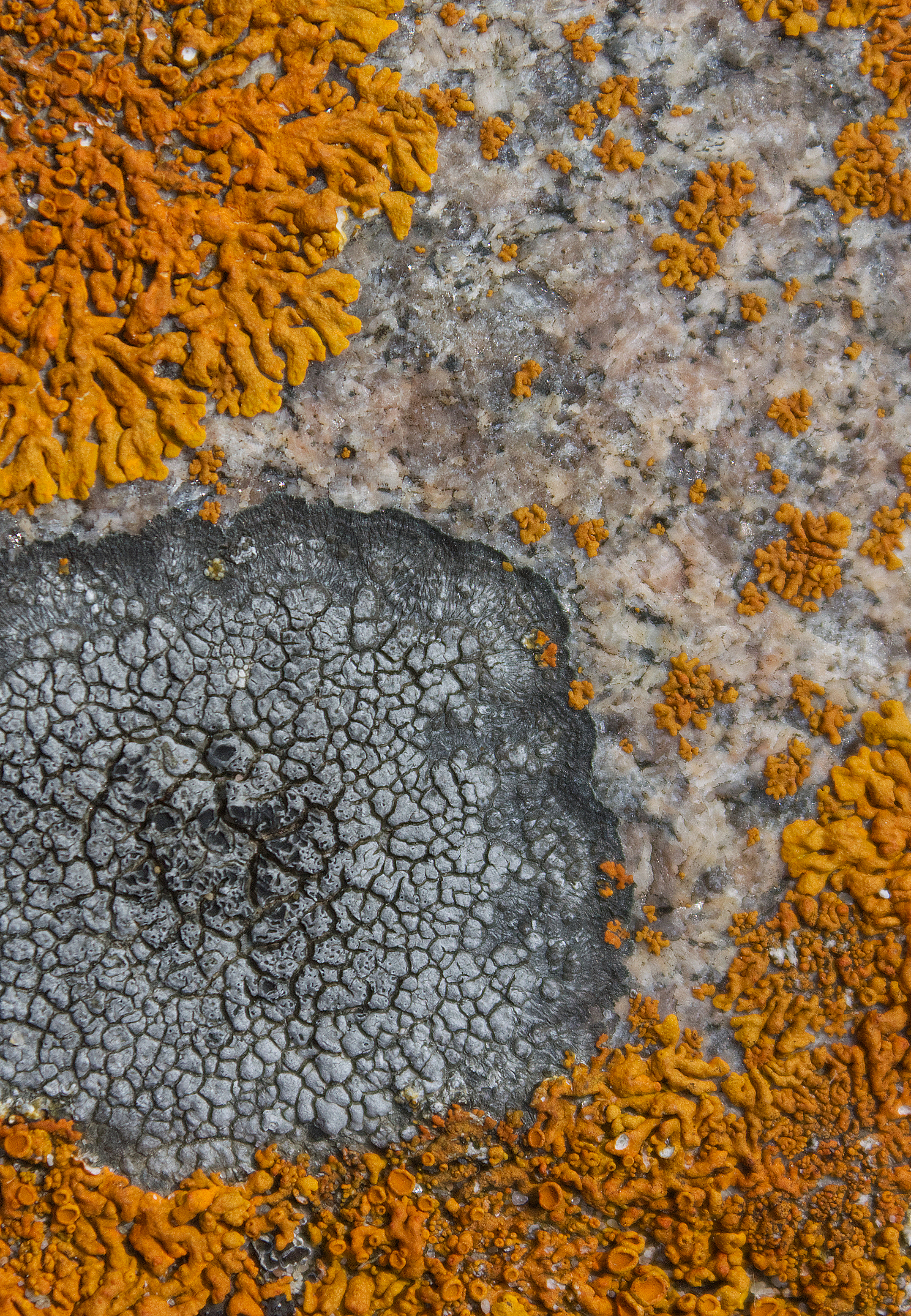
Rusavskia elegans along with Aspicillia cinerea and Lecidea sp. cover granite boulder, Alona Bay, Lake Superior, ON (photo by Nina Munteanu)

On the pink granite in Alona Bay, I found some brilliant lichen, which I confirmed was Elegant Starburst Lichen (Rusavskia elegans formerly Xanthoria elagans)—documented by other lichenologists as common on Lake Superior’s granite shores. I also saw patches of Rock Disk Lichen (Lecidella stigmatea).

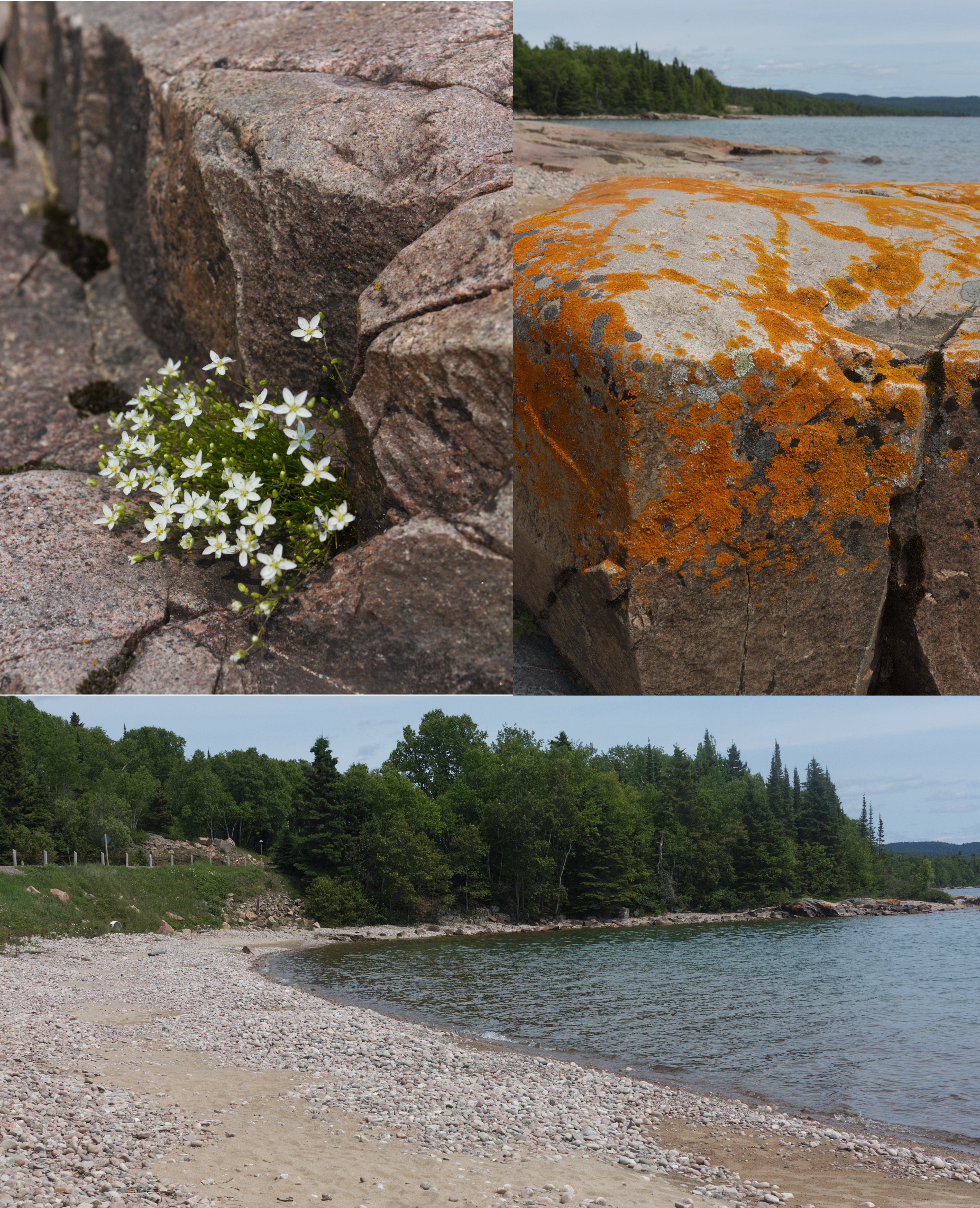
Lake Superior northern shore near Rossport; top left: Encrusted Saxifrage tucked into granite crack; top right: Sunburst Lichen carpets granite boulder; bottom cobbled beach (photos by Nina Munteanu)
Shoreline of terraced cobbles in Alona Bay, Lake Superior, ON (photo by Nina Munteanu)
Boulder-strewn shore of Lake Superior at Agawa Bay, ON (photo by Nina Munteanu)

Agawa Bay and surrounding high points provide magnificent views of the Lake Superior shoreline and surrounding country. The high rising hills are easily one of the most rugged and beautiful in Ontario. The area is underlain mostly by over two billion year old granitic rocks of igneous origin that form part of a large batholitic mass formed in the Algoman period of Precambrian time.

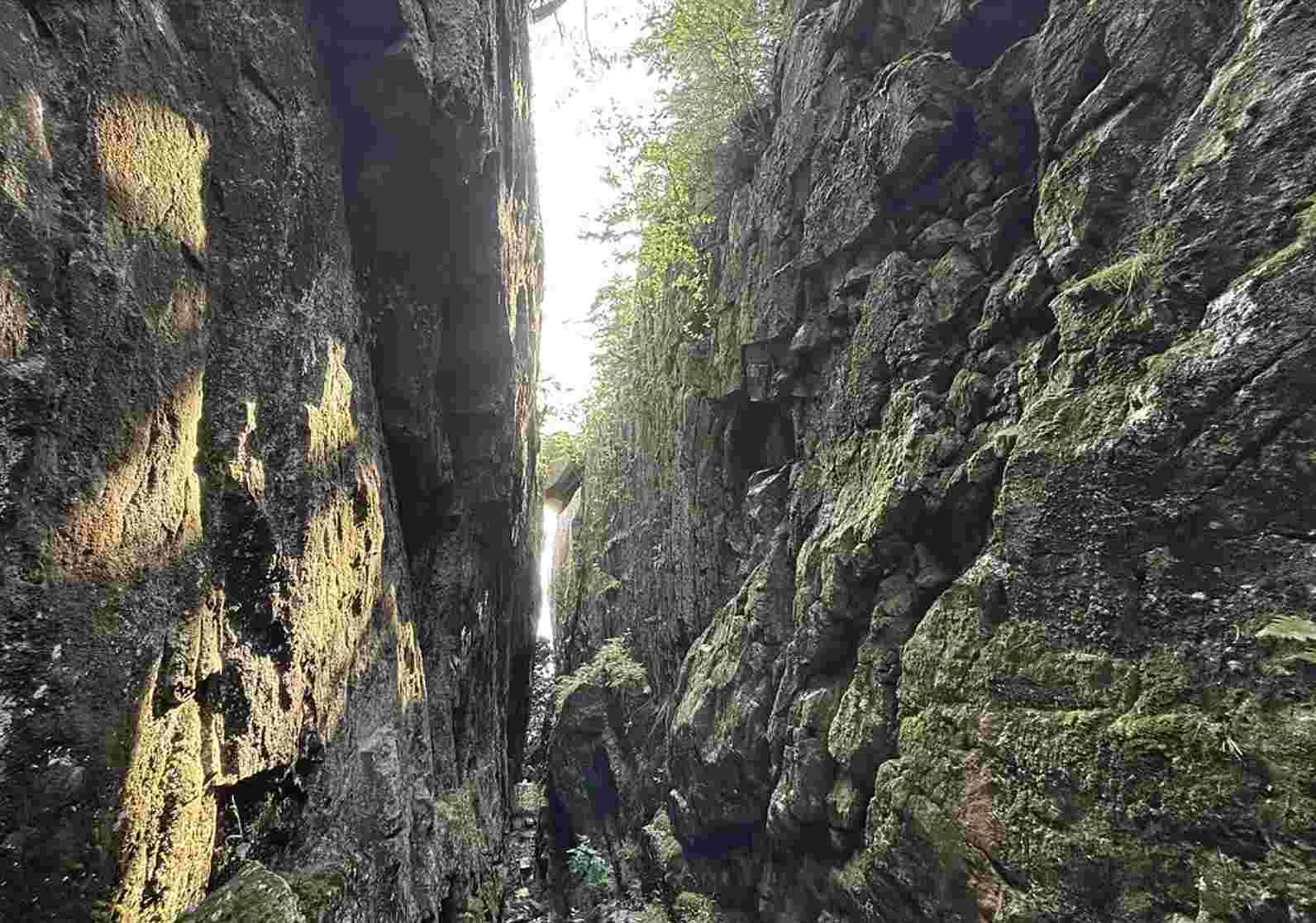
Trail to Agawa Rock, Lake Superior, ON

It’s a short hike (0.8 km) through the woods on a trail that leads to the Agawa Rock Pictographs, an amazing collection of Aboriginal pictographs that sends one’s senses soaring with imagination. Beautiful representations of real and mythical animals fill the granite canvas;, one is Mishipeshu, the Great Lynx. This mythical creature is a water dwelling dragon-like animal that also resembles a lynx with horns and a back tail covered in scales. Mishipeshu is believed to cause rough and dangerous water conditions claiming numerous victims.

Great Lynx pictograph, Agawa Rock, Lake Superior

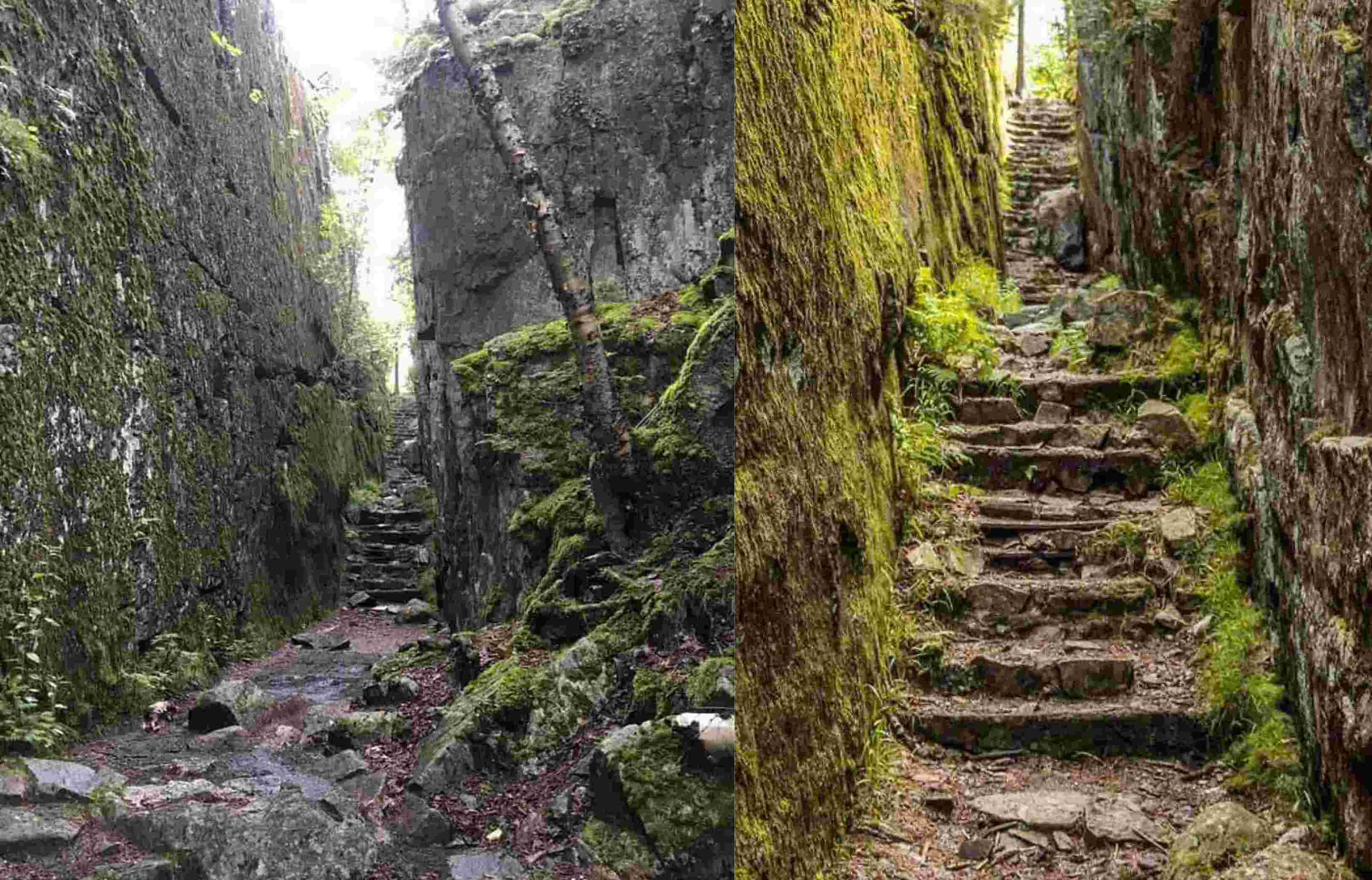
The trail it itself a highlight, takes you up a steep rock-hewn staircase, with steep cliff faces looming overhead, and along rocky pathways. The pictographs are viewed from a rock ledge below the 15-story high cliff that faces Lake Superior.

Two views of the rock-hewn staircase of the Agawa Rock trail, Lake Superior, ON
Rugged shoreline of Agawa Bay with birchleaf spirea in foreground, Lake Superior, ON (photo by Nina Munteanu)

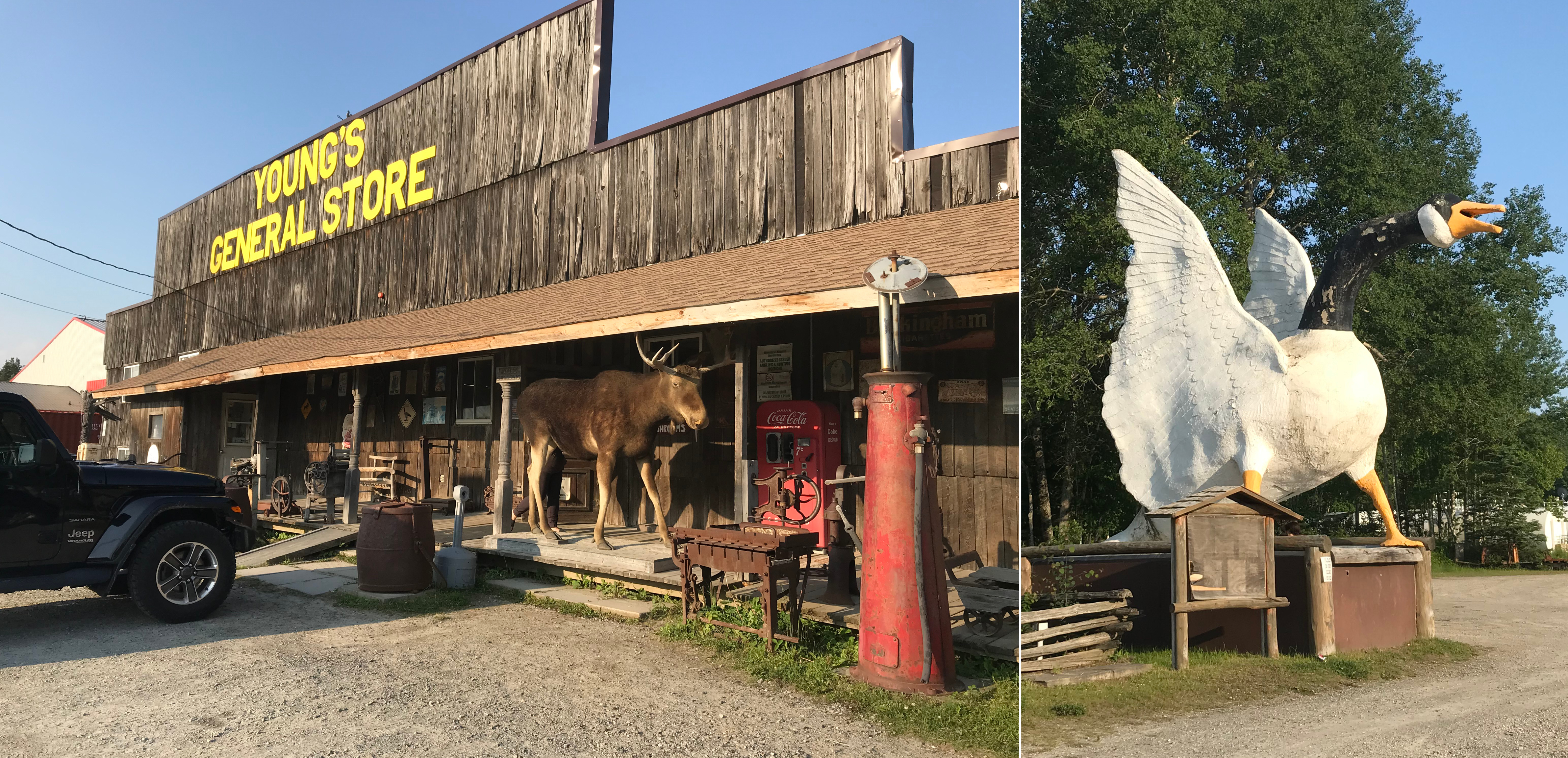
My second night stop was Wawa, on the edge of the boreal forest of the Canadian Shield, known for its giant ugly goose sculptures. The name Wawa comes from the Ojibwe word wewe for “wild goose.” The town, which resembles a modern-day version of an old pioneer town included the colourful Young’s General Store, where you could purchase anything from moccasins and fishing tackle to homemade fudge and ice cream.

Left: Young’s General Store in Wawa; Right: (in)famous goose statue (photos by Nina Munteanu)

From Wawa, I drove west along the most northerly shores of Lake Superior, stopping at access points including Schreiber Beach, Cavers and Rossport. I found this stretch of Lake Superior’s northern coast from Terrace Bay to Nipigon particularly enchanting. Here I found several access points off the road that drew me like Alice into wondrous boreal landscapes, offering windows to an ancient time before humans walked the earth.

Near Schreiber, I stopped on the road to explore deep pink smooth granite outcrops covered in foliose Cumberland Rock Shield Lichen (Xanthoparmelia cumberlandia) and cushions of fruticose Reindeer Lichen (Cladonia spp.) where shallow soil pockets had grown. 

Granite outcrop with Xanthoparmelia cumberlandia and Cladonia spp. off Trans Canada Highway on shore of Lake Superior, near Schreiber, ON. (photo by Nina Munteanu)

The Lake Superior shoreline at Rossport consists mostly of exposed primordial granite, worn smooth by wave action. The granite here is mostly pink feldspar, quartz, and black mica. According to E.G. Pye, this rock is called porphyritic granite, an igneous rock that crystalized from a natural melt, or magma.

Though it lies in the boreal forest (typified by black spruce), the northern shoreline of Lake Superior in fact also supports species more characteristic of the Great Lakes-St. Lawrence Forest (e.g. white spruce, white cedar, red maple, paper birch). The northern shoreline of Lake Superior is therefore considered a transition zone between these two types of forest ecosystems.

Saxifrage flowers bloom in the cracks and corners of granite / gneiss rock, Lake Superior near Rossport, ON (photo by Nina Munteanu)

Nestled in the rocky cracks and crevices of Lake Superior’s wild rocky shores, I discovered several cold-loving plants that normally grow in high alpine areas of the Arctic. Botanists refer to them as “Arctic-alpine disjunct plants,” separated from their usual arctic-alpine habitat and regarded as possible relicts of the last glaciation. Typically, such plants grow much farther north; but these plants have adapted to the unique cold micro-environment of Lake Superior’s northern shores. Examples include encrusted saxifrage (Saxifraga paniculata), black crowberry (Empetrum nigrum), bilberry (Vaccinium uliginosum), arctic fir clubmoss (Huperzia selago), elegant groundsel (Packera indecora), and the carnivorous English sundew (Drosera anglica).

Rhizocarpon geographicum and Lecidea sp. on granite rocks at Katherine Bay, Lake Superior, ON (photo by Nina Munteanu)
Lecidella stigmata on granite rock, Lake Superior, ON (photo by Nina Munteanu)

I met old friends on the lake’s wild shores, lichens that made their homes on the water-smoothed rock surfaces and gnarly rock cliffs and boulders. Random patches of the crustose Yellow Map Lichen (Rhizocarpon geographicum), rosettes of the foliose Cumberland Rock Shield Lichen (Xanthoparmelia cumberlandia) and Tile Lichen (Lecidea sp.)—all lichens I’d encountered on my studied Catch Rock, a granite outcrop in the Catchacoma old-growth hemlock forest near Gooderham.

Rhizocarpon geographicum and Xanthoparmelia cumberlandia on granite outcrop, near Schrieber off Lake Superior, ON (photo by Nina Munteanu)

Circular patches of bright tangerine-orange Elegant Starburst Lichen (Rusavskia elegans formerly Xanthoria elegans) graced many of the rocky surfaces. I particularly noted them on the exposed granite slabs of Schreiber Beach and Rossport, often accompanied by Peppered Rock-Shield Lichen (Xanthoparmelia conspersa) and grey Cinder Lichen (Aspicillia cinerea).

Rusavskia elegans and Aspicillia cinerea, Lichen colonizing granite near Rossport on Lake Superior, ON (photo by Nina Munteanu)
Rusavskia elegans colonizes granite boulders on shore of Lake Superior near Rossport, ON (photo by Nina Munteanu)

William Purvis writes that R. elegans is a nitrophile (nitrogen lover) and is common at sites that are regularly fertilized by birds. In other words, they like bird poop. Inuit hunters knew that orange lichen meant small mammals like marmots probably lived nearby (the poop connection again). The orange colour comes from the carotenoid pigment, which acts like sunscreen to protect the lichen from UV radiation. This was the lichen that made it into space in 2005, exposed to the extremes of space (e.g. temperature, radiation and vacuum) for 1.5 years. Most of the samples continued to photosynthesize when they returned to Earth. 

Lichen colonizing granite near Rossport on Lake Superior, ON. A. Rusavskia elegans and Xanthoparmelia conspersa; B. Rusavskia elegans and Aspicillia cinerea (photo by Nina Munteanu)

Limnology & Geology of Lake Superior & Watershed

Morphometric map of Lake Superior (image by World Lake Database)

Lake Superior was formed 10,000 years ago when glacial melt-water filled a billion-year-old volcanic basin. The lake is the size of Austria, covering an area of about 82,100 km3 and making it the largest lake in the world by surface area. Lake Superior holds 10% of the Earth’s surface freshwater—enough to fill the other Great Lakes plus three more Lake Eries, making it the third largest lake in the world by volume. The Ojibwe call the lake gichi-gami (great sea), which so aptly describes this inland sea.

Slabs of granite rocks scatter along the shore of Lake Superior near Rossport, ON (photo by Nina Munteanu)

For a comprehensive summary of Lake Superior’s geologic history and rock formations see E.G. Pye’s 1969 guidebook “Geology and Scenery: North Shore of Lake Superior.”

Lake Superior is considered an oligotrophic lake of low productivity, characterized by cold, deep, nutrient-poor nutrients (particularly phosphorus and nitrogen). Its mean depth is 147 meters with a maximum depth of 406 meters. Fed by 200 rivers, Lake Superior holds 12,100 km3 of freshwater—enough to cover the entire North and South American continents with 30 cm of water. The lake’s volume is sufficiently large that it takes almost two centuries for a drop of water to circulate the lake before leaving through St. Marys River—its only natural outflow at Sault Ste. Marie—which flows into Lake Huron. Lake Superior also experiences seasonal circulation; the lake stratifies into two major temperature layers in summer and winter and undergoes mixing (turnover) twice in spring and fall, making it a dimictic lake.

Because of lack of plankton and turbidity from silt (due to cold waters low in nutrients), the lake is super clear with Secchi disk depths of 20-23 meters observed. Samuel Eddy at the University of Minnesota provided a summary of zooplankton and phytoplankton in the lake.

Macrophytes appeared nonexistent on the wave-washed shallows, though some boulders were covered in periphyton (e.g. attached algae, mostly diatoms). I also noticed some filamentous algae on the shore rocks near Rossport, likely Cladophora and Spirogyra, known to occur in the sheltered waters of the lake.

Granite shore near Rossport with green filamentous algae (photo by Nina Munteanu)

Seiches in lakes (image from University of Michigan)

Because of its size, Lake Superior provides long distances for wind to push water from one end to the other; these distances, called fetches, can exceed 500 km on Lake Superior. As a result, the lake experiences ‘tides’ called seiches—essentially oscillations in water level caused by strong winds and changes in atmospheric pressure. This causes a sloshing effect across the lake (of about a metre), much like a cup of coffee as it’s being carried, and exposes shorelines to dramatic fluctuations in shoreline levels with large waves, which can be as high as 6 m during storms.

Rocky shore off Agawa Bay, Lake Superior, ON (photo by Nina Munteanu)

The rocks of the lake’s northern shore date back to the early history of the earth, during the Precambrian Era (4.5 billion to 540 million years ago) when magma forcing its way to the surface created the intrusive granites of the Canadian Shield. With a watershed rich in minerals such as copper, iron, silver, gold and nickel, the lake lies in long-extinct Mesoproterozoic rift valley (Midcontinent Rift). Over time eroding mountains deposited layers of sediments that compacted to become limestone, dolomite, taconite and shale. As magma injected between layers of sedimentary rock, forming diabase sills, flat-topped mesa formed (particularly in the Thunder Bay area), where amethyst formed in some cavities of the rift. Lava eruptions also formed black basalt, near Michipichoten Island.

During the Wisconsin glaciation 10,000 years ago, ice as high as 2 km covered the region; the ice sheet advance and retreat left gravel, sand, clay and boulder deposits as glacial meltwater gathered in the Superior basin

Although the lake currently freezes over completely every two decades, scientists speculate that by 2040 Lake Superior may remain ice-free due to climate change. Warmer temperatures may also lead to more snow along the shores of the lake.

Rock-strewn Katherine Bay, Lake Superior, ON (photo by Nina Munteanu)

Lake Superior & Watershed Characteristics
ParameterValue
Age10,000 years
Trophic StatusOligotrophic
Visibility (Secchi Depth)8-30 m
Thermal Stratificationdimictic
Length563 km
Breadth257 km
Mean Depth147 m
Maximum Depth406 m
Volume12,100 km3
Lake Surface Area82,100 km2
Watershed Area127,700 km2
Shoreline Length4,385 km
Water Residence / Flushing Rate191 years
Fetch500 km
OutletSt Marys River
Viking cruise ship from Minnesota off sandy shore of Terrace Bay, Lake Superior, ON (photo by Nina Munteanu)

References:

Brandt et. al. 2015. “Viability of the lichen Xanthoria elegans and its symbionts after 18 months of space exposure and simulated Mars conditions on the ISS.” International Journal of Astrobiology.

Purvis, William. 2000. “Lichens.” Smithsonian Institution Press, Washington, D.C. 112pp.

Stone Beach, Lake Superior, ON (photo by Nina Munteanu)

Nina Munteanu is a Canadian ecologist / limnologist and novelist. She is co-editor of Europa SF and currently teaches writing courses at George Brown College and the University of Toronto. Visit www.ninamunteanu.ca for the latest on her books. Nina’s bilingual “La natura dell’acqua / The Way of Water” was published by Mincione Edizioni in Rome. Her non-fiction book “Water Is…” by Pixl Press (Vancouver) was selected by Margaret Atwood in the New York Times ‘Year in Reading’ and was chosen as the 2017 Summer Read by Water Canada. Her novel “A Diary in the Age of Water” was released by Inanna Publications (Toronto) in June 2020.

My Journey with Water: Nina Munteanu Talks to the Toronto Probus Group

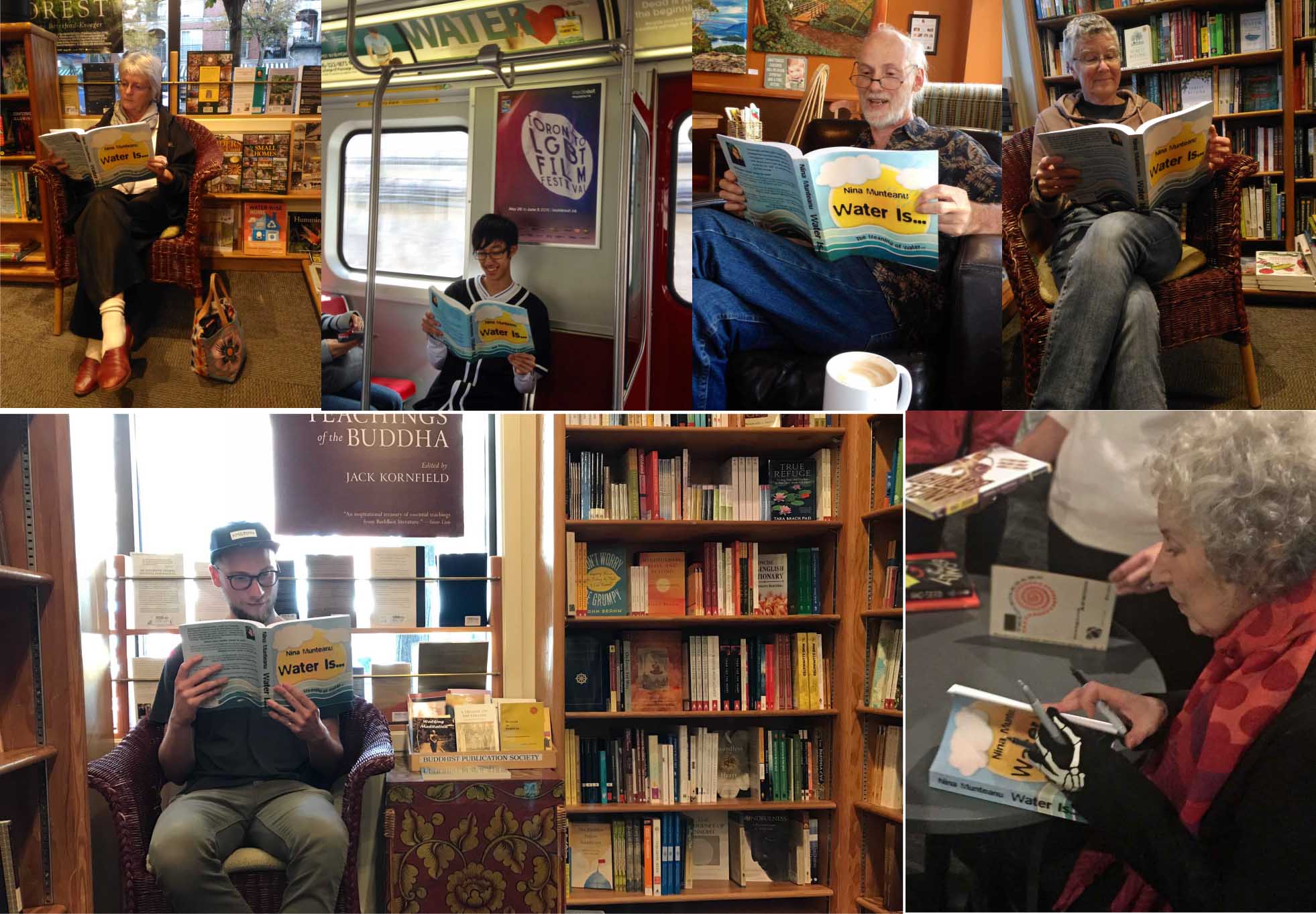
People reading “Water Is…” in Vancouver and Toronto

Margaret McCaffery, chair of the PROBUS Toronto Speakers Committee invited me some time ago to speak to their club in June of 2024 on my experience with water: as scientist, mother, and environmentalist. The audience was mostly retired professional and business people with enquiring minds. I gave my Powerpoint talk in the Holy Rosary Parish Hall on St. Clair West and then enjoyed a vigorous session of challenging and interesting questions to which I responded with equal vigour.

Here is the blurb for the presentation:

Canadian limnologist Nina Munteanu explores the many dimensions of water through her journey with water as mother, educator, and scientist. She describes an emotional connection with nature that compels us to take care of our environment with love versus a sense of duty. 

Nina’s talk draws on her book Water Is… The Meaning of Water, part history, part science and part philosophy and spirituality. The book examines water’s many anomalous properties and what these meant to us. In sharing her personal journey with this mysterious elixir, Nina explores water’s many ‘identities’ and, ultimately, our own. Water Is… was Margaret Atwood’s first choice in the 2016 New York Times ‘Year in Reading.’ Water is… will be available for sale at the talk.

I started with my story as a child, growing up in the Eastern Townships of Canada
I defined “limnology” and talked about my career as a limnologist and environmental consultant
I discussed some of water’s anomalous properties, all life-giving
I brought in some interesting things about water…
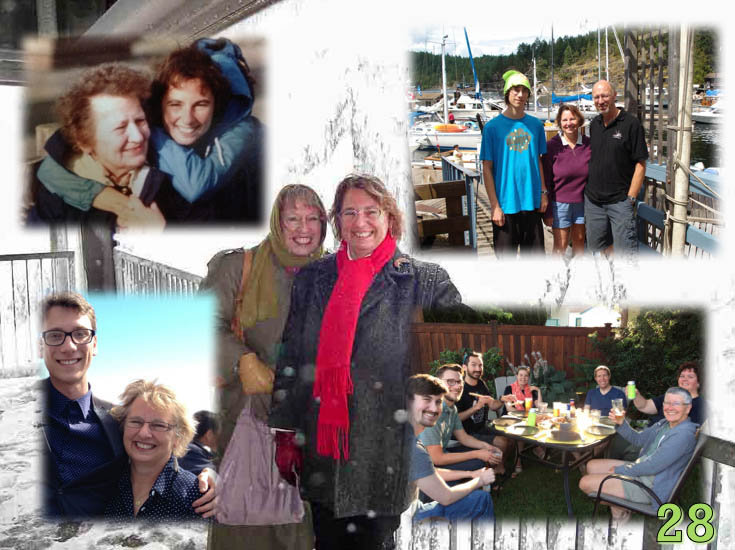
I tied my journey with water to family and friends and my watershed
I ended my talk with a discussion of the Watermark Project to catalogue significant stories to water bodies all over the world

I also brought my latest eco-clifi novel A Diary in the Age of Water for sale. It interested quite a few people and generated several wonderful discussions.

Nina Munteanu and her latest eco-novel

Nina Munteanu is a Canadian ecologist / limnologist and novelist. She is co-editor of Europa SF and currently teaches writing courses at George Brown College and the University of Toronto. Visit www.ninamunteanu.ca for the latest on her books. Nina’s bilingual “La natura dell’acqua / The Way of Water” was published by Mincione Edizioni in Rome. Her non-fiction book “Water Is…” by Pixl Press (Vancouver) was selected by Margaret Atwood in the New York Times ‘Year in Reading’ and was chosen as the 2017 Summer Read by Water Canada. Her novel “A Diary in the Age of Water” was released by Inanna Publications (Toronto) in June 2020.

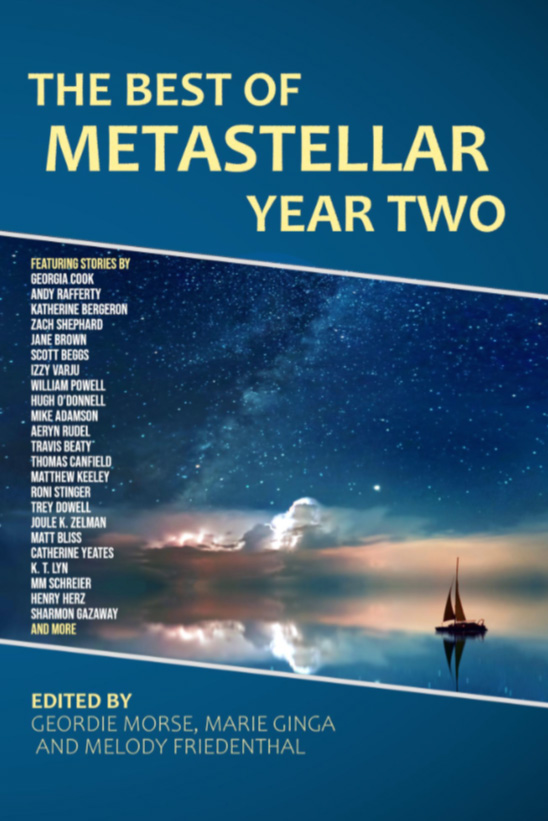
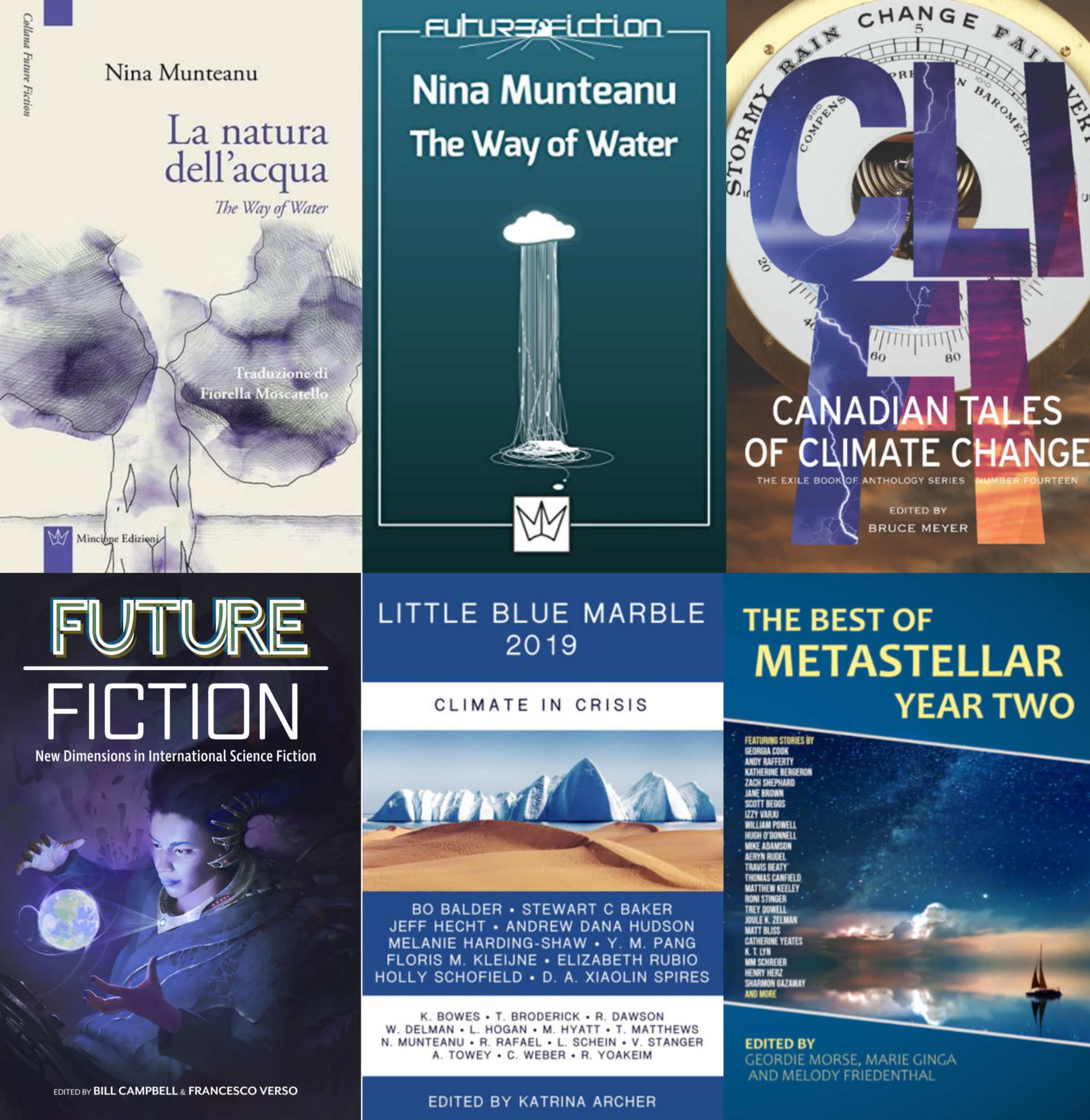
Nina Munteanu’s “The Way of Water” now in Best of Metastellar Year Two Anthology

She imagines its coolness gliding down her throat. Wet with a lingering aftertaste of fish and mud. She imagines its deep voice resonating through her in primal notes; echoes from when the dinosaurs quenched their throats in the Triassic swamps.

Water is a shape shifter.

It changes yet stays the same, shifting its face with the climate. It wanders the earth like a gypsy, stealing from where it is needed and giving whimsically where it isn’t wanted.

Dizzy and shivering in the blistering heat, Hilda shuffles forward with the snaking line of people in the dusty square in front of University College where her mother used to teach. The sun beats down, crawling on her skin like an insect. She’s been standing for an hour in the queue for the public water tap.

The Way of Water

My short story, The Way of Water, which was recently reprinted in Metastellar Speculative Fiction and Beyond (rated the second most popular online sci-fi magazine), is now in The Best of Metastellar Year Two, an anthology of forty-eight stellar short stories previously published with Metastellar.

The Way of Water was first published as a bilingual print book by Mincione Edizioni (Rome) in Italian (La natura dell’acqua, translated by Fiorella Moscatello), and English along with a recounting of what inspired it: The Story of Water (La storia dell’acqua) in 2016. The Way of Water has been reprinted several times, in magazines and anthologies, since its first appearance in 2016.

It all started with an invitation by my publisher in Rome in 2015 to write about water and politics in Canada. I had long been thinking of potential ironies in Canada’s water-rich heritage. The premise I wanted to explore was the irony of people in a water-rich nation experiencing water scarcity: living under a government-imposed daily water quota of 5 litres as water bottling and utility companies took it all.

I named the story The Way of Water” (“La natura dell’acqua), about a young woman (Hilda) in near-future Toronto who has run out of water credits for the public wTap; by this time houses no longer have potable water and their water taps have been cemented shut (as was done in Detroit in 2014); the only way to get water is through the public wTaps—at great cost. She’s standing two metres from water—in a line of people waiting to use the tap—and dying of thirst.

The Way of Water” captures a vision that explores the nuances of corporate and government corruption and deceit together with global resource warfare. In this near-future, Canada is mined of all its water by thirsty Chinese and US multinationals—leaving nothing for the Canadians. Rain has not fallen on Canadian soil in years due to advances in geoengineering and weather manipulation that prevent rain clouds from going anywhere north of the Canada-US border. If you’re wondering if this is possible, it’s already happening in China and surrounding countries.

The Way of Water, in turn, inspired my recent dystopian novel A Diary in the Age of Water, which explores the lives of four generations of women and their relationship to water during a time of severe water restriction and calamitous climate change.

Publications (excluding online pubs) that featured The Way of Water

The Way of Water evokes a sense of awareness about issues of access to water and about the dangers of imbalances in that access.”

Derek Newman-Stille, Speculating Canada

“In a short story in which every word has its weight, Nina Munteanu manages to describe a dystopia with ecological, political, social and economic elements and Hilda’s reactions to her situation with a great emotional intensituy. To avoid thirst, Hilda ends up embracing an extreme idea, a last hope linked to water. The Way of Water is a story of the kind you hope is science fiction but you fear is not.”

Massimo Luciani

Nina Munteanu is a Canadian ecologist / limnologist and novelist. She is co-editor of Europa SF and currently teaches writing courses at George Brown College and the University of Toronto. Visit www.ninamunteanu.ca for the latest on her books. Nina’s bilingual “La natura dell’acqua / The Way of Water” was published by Mincione Edizioni in Rome. Her non-fiction book “Water Is…” by Pixl Press (Vancouver) was selected by Margaret Atwood in the New York Times ‘Year in Reading’ and was chosen as the 2017 Summer Read by Water Canada. Her novel “A Diary in the Age of Water” was released by Inanna Publications (Toronto) in June 2020.

Nina Munteanu’s “Water Is…” Discussed in Book Club

This month of September (September 8 and 22 at 2 pm) the Unitarian Fellowship of Peterborough Non-Fiction Book Club will discuss my book “Water Is…”

NINA MUNTEANU is a Canadian ecologist / limnologist and novelist. She is co-editor of Europa SF and currently teaches writing courses at George Brown College and the University of Toronto. Visit  www.ninamunteanu.ca for the latest on her books. Nina’s bilingual “La natura dell’acqua / The Way of Water” was published by Mincione Edizioni in Rome. Her non-fiction book “Water Is…” by Pixl Press(Vancouver) was selected by Margaret Atwood in the New York Times ‘Year in Reading’ and was chosen as the 2017 Summer Read by Water Canada. Her novel “A Diary in the Age of Water” was released by Inanna Publications (Toronto) in June 2020.

Ryan Reynolds and Blake Lively Donate to Indigenous Education on Water Science

Blake Lively and Ryan Reynolds

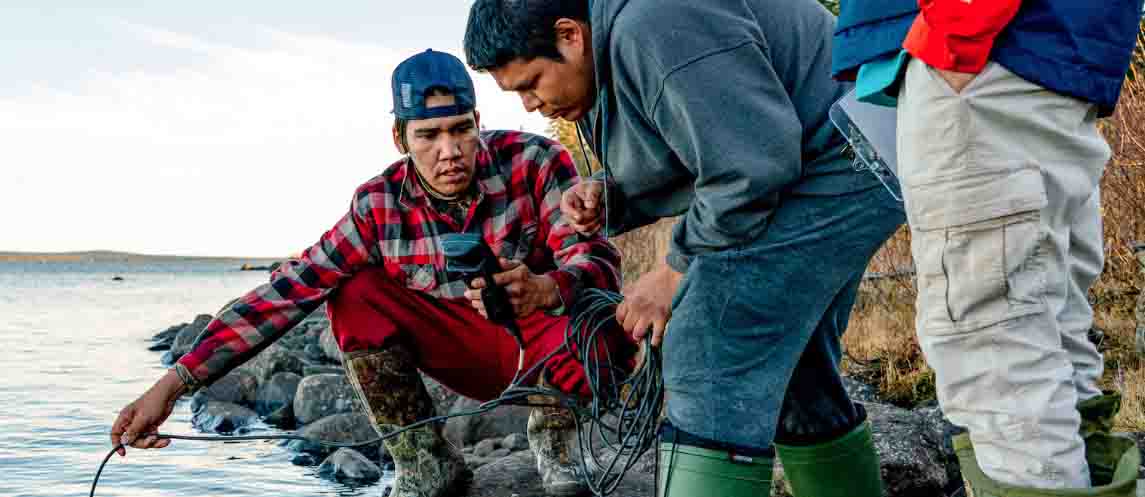
Global Newswire announced yesterday that Ryan Reynolds and Blake Lively donated half a million dollars to the Canadian charity Water First Education & Training Inc. to support the locally-based hands-on skills training and education programs with indigenous communities. The program focuses on young indigenous adults in learning water science and becoming certified water operators and environmental technicians.

“One of the most fundamental challenges in Canada today is the lack of sustainable access to safe, clean water in many Indigenous communities,” writes Global Newswire. “Successive federal governments have failed to address the issue, with the likelihood of having no access to safe, clean water still far more prevalent in the lives of Indigenous Peoples, compared to non-Indigenous populations in Canada.”

At least 15%, or approximately one in six First Nations communities in Canada, are still under a drinking water advisory. Everyone has a right to safe, clean water. The water crisis in Indigenous communities is unacceptable.”

Water First
Two Indigenous students test water

“Access to clean drinking water is a basic human right. Canada is home to over 20% of the planet’s freshwater — an abundance that’s envied around the world. There’s absolutely no reason Indigenous communities should not have access to safe, clean water. All the individuals involved, whether they are operating water systems or monitoring their local water bodies, are critical. We appreciate Water First’s focus on supporting young, Indigenous adults to become certified water operators and environmental technicians. These folks are helping to ensure sustainable access to safe, clean water locally, now and for the future. Blake and I are thrilled to support this important work.”

Ryan Reynolds
Using a Van Dorn sampler to collect water at depth

“Nobody understands the evolving challenges and needs more than the people who live there,” says Water First. “Drinking water challenges are complex: in some communities, local concerns may be around infrastructure, for others, source water contamination. And numerous communities have challenges recruiting and training young Indigenous adults to join the drinking water field.”

“Safe water needs skilled people”

Water First

Water First shares that Indigenous communities have identified the need for more young, qualified and local personnel to support solving water challenges. In partnership with indigenous community leaders, Water First customizes local water-focused education and training programs to align with community goals and needs. These partnerships are built on trust, meaningful collaboration and reciprocal learning.

In-situ water testing

Spencer Welling, Water First intern from Wasauksing First Nation shares, “I am doing this for myself, my family and community. It’s important to know how things are done and gives you a better appreciation for it. It’s a good career to have, which I’m sure would ease my parents’ minds knowing that. It also feels good knowing that my community will have a local water treatment operator at the plant for at least a couple decades.”

Water technician learns her skills

In 2018, CBC ran a story on a pilot training project that Water First ran with Indigenous youth to help tackle water challenges in their communities. The program ran as a 15-month paid internship toward ensuring communities have quality drinking water. Ten youth were involved. The training, which included week-long workshops (including mapping, traditional knowledge, and environmental science) and hands-on training at their local water treatment plants, focused towards a provincially recognized certification as a Water Quality Analyst. Certification through an exam at the Ministry of the Environment, Conservation and Parks permits them to do drinking water testing. They can receive further certification as operators through another exam.

Water technician learning his skills

Anyone interested in learning about Water First and its education and training programs can find out more at www.waterfirst.ngo.

Water First Education & Training Inc. (Water First) is a registered Canadian charity that works in partnership with Indigenous communities to address water challenges through education, training and meaningful collaboration. Since 2009, Water First has collaborated with 56 Indigenous communities located in the lands now known as Canada while supporting Indigenous youth and young adults to pursue careers in water science.

For more information, you can contact: 

Ami Gopal
Director of Development and Communications
Water First
1-905-805-0854
ami.gopal@waterfirst.ngo 

Collecting sediment samples for testing

Nina Munteanu is a Canadian ecologist / limnologist and novelist. She is co-editor of Europa SF and currently teaches writing courses at George Brown College and the University of Toronto. Visit www.ninamunteanu.ca for the latest on her books. Nina’s bilingual “La natura dell’acqua / The Way of Water” was published by Mincione Edizioni in Rome. Her non-fiction book “Water Is…” by Pixl Press(Vancouver) was selected by Margaret Atwood in the New York Times ‘Year in Reading’ and was chosen as the 2017 Summer Read by Water Canada. Her novel “A Diary in the Age of Water” was released by Inanna Publications (Toronto) in June 2020.

On Writing Hopeful Dystopias and the Blur of Fiction with Non-Fiction

‘Hopeful dystopias’ are much more than an apparent oxymoron; they are in some fundamental way, the spearhead of the future—and ironically often a celebration of human spirit by shining a light through the darkness of disaster. I discussed this in a recent interview on Solarpunk Futures Podcast.

In a recent interview on the CBC Radio show Ideas “Beyond Dystopia”, Canadian author Margaret Atwood (who penned the dystopic The Handmaid’s Tale and Maddaddam trilogy) said much the same thing. Atwood argued that dystopias and cautionary tales ultimately embrace an element of hope, through a character’s experience. Dystopias can serve as a road map for individual endurance, resilience, and triumph through disaster.

I talked with Solarpunk Futures about how the purposeful blur of fiction with non-fiction in my latest eco-novel A Diary in the Age of Water produced a heightened relevance to the dystopic journey for the reader.

Solarpunk: Your latest book is an eco-novel, or rather something of a fiction-nonfiction hybrid perhaps, called A Diary in the Age of Water. Tell us a bit about that novel and the role that water plays in the story.

Nina: A Diary in the Age of Water follows the climate-induced journey of Earth and humanity through four generations of women and their battles against a global giant that controls and manipulates Earth’s water. The book spans over forty years (from the 2020s to the 2060s) and into the far future, mostly through the diary of a limnologist, which is found by a future water-being. While A Diary in the Age of Water is a work of fiction, its premise and much of its story are firmly based on real events, people and phenomena. The dramatization of these through four main characters carry the reader into consequence and accountability. Water’s relationship with each character provides four different perspectives on the value of water to humanity—from the personal and practical to the spiritual and existential. For readers with an evidence-based approach to learning about water’s importance, the diarist provides interesting facts on water in each of her entries in the form of epigraphs (mostly from Robert Wetzel’s Limnology). Things like: watershed, hypolimnion, aquifer, thalweg, clapotis gaufre, and petrichor, to name a few…

I chose a diary format to purposely blur the fiction with non-fiction. I was writing about both the far and the near future and much of it was based—like Margaret Atwood and her books—on real events and real people. I wanted personal relevance to what was going on, particularly with climate change. I also wanted to achieve a gritty realism of “the mundane” and a diary felt right. Lynna—the diarist—is a reclusive inexpressive character, so I thought a personal diary would help bring out her thoughts and feelings. There’s nothing like eves-dropping to make the mundane exciting. The diary-aspect of the book characterizes it as “mundane science fiction” by presenting an “ordinary” setting for characters to play out. The tension arises from insidious cumulative events and circumstances that slowly grow into something incendiary. The real events are the fuel that incite a slow-burn fictional drama that blurs the reader’s perception of reality and heightens its relevance.

Solarpunk: Can you give us an example of an event in your book where the lines between fiction and nonfiction get blurred?

Nina: In the diary entry entitled “Watershed,”, for July 14, 2049, Lynna writes:

Today, CanadaCorp announced that the collection of rainwater was illegal. As of today, I could be arrested for using my rain catcher and cistern. I’ve decided to continue using the cistern, and I’ve warned Hildegard not to breathe a word to anyone at school about what we’re doing with the water. Thankfully, I have time to train her in the art of subterfuge before she starts Grade Two in the fall.

What follows in the story is a series of greater water restrictions that mimic some of the currenet ongoing scenarios in other parts of the world (e.g. illegal rainwater collection in parts of the USA; shutting down of home water taps in Detroit; required and restricted water collection at public water taps in parts of the world).

Lynna’s August 13, 2051 diary entry in my 2020 novel seemed to predict the atmospheric river disaster that befell British Columbia in November 2021:

In the mid- to late-twenties the west coast succumbed to massive atmospheric river storms. San Francisco. Los Angeles. Seattle. Even earthquakes seemed to follow climate change’s lead. The earthquake / tsunami that hit Vancouver Island in 2029 shifted the Earth’s axis by three inches, Daniel informed me. The American military stormed over the border with swift aid. “Did you know that they never left?” Daniel asked me. I hadn’t known that. But I wasn’t surprised either.

Of course, these “predictions” were really just good research into the current scientific knowledge and what current circumstances may naturally generate in the future. I was just doing a good job at reading water.

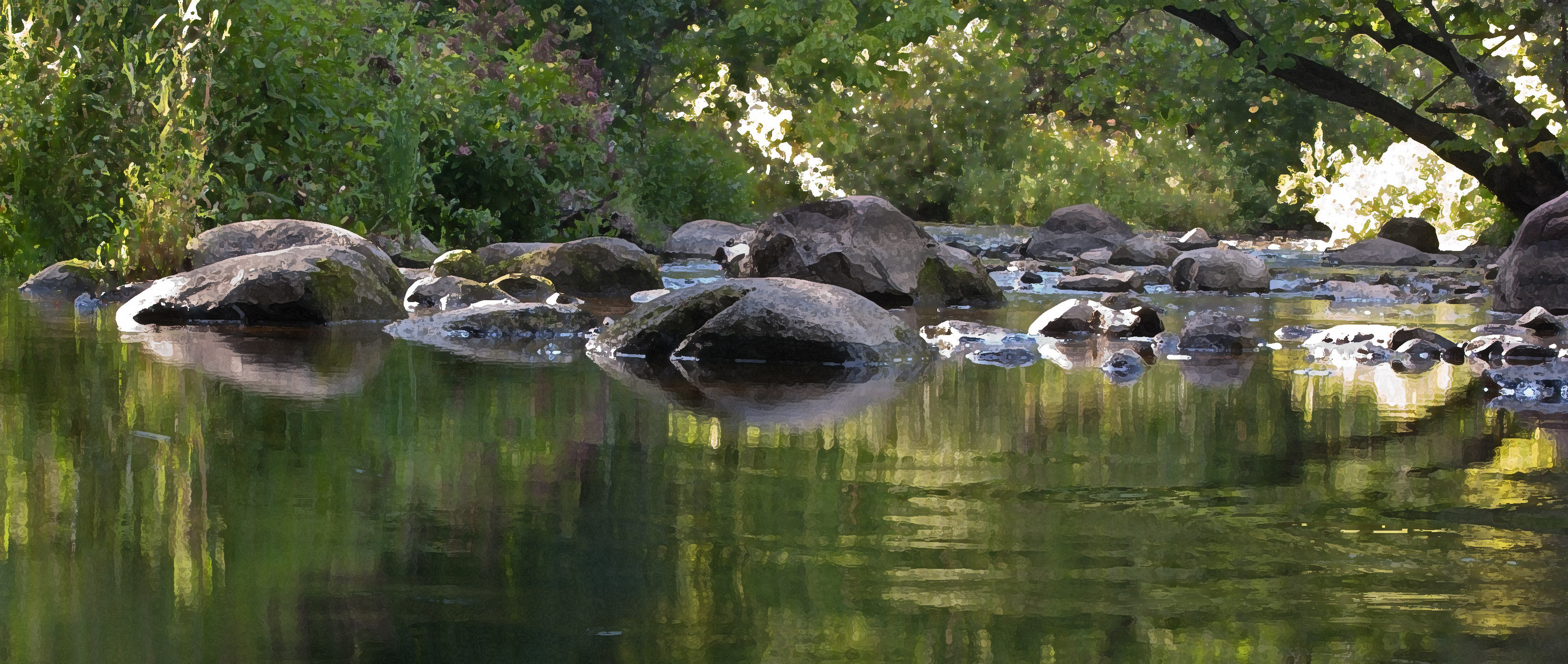
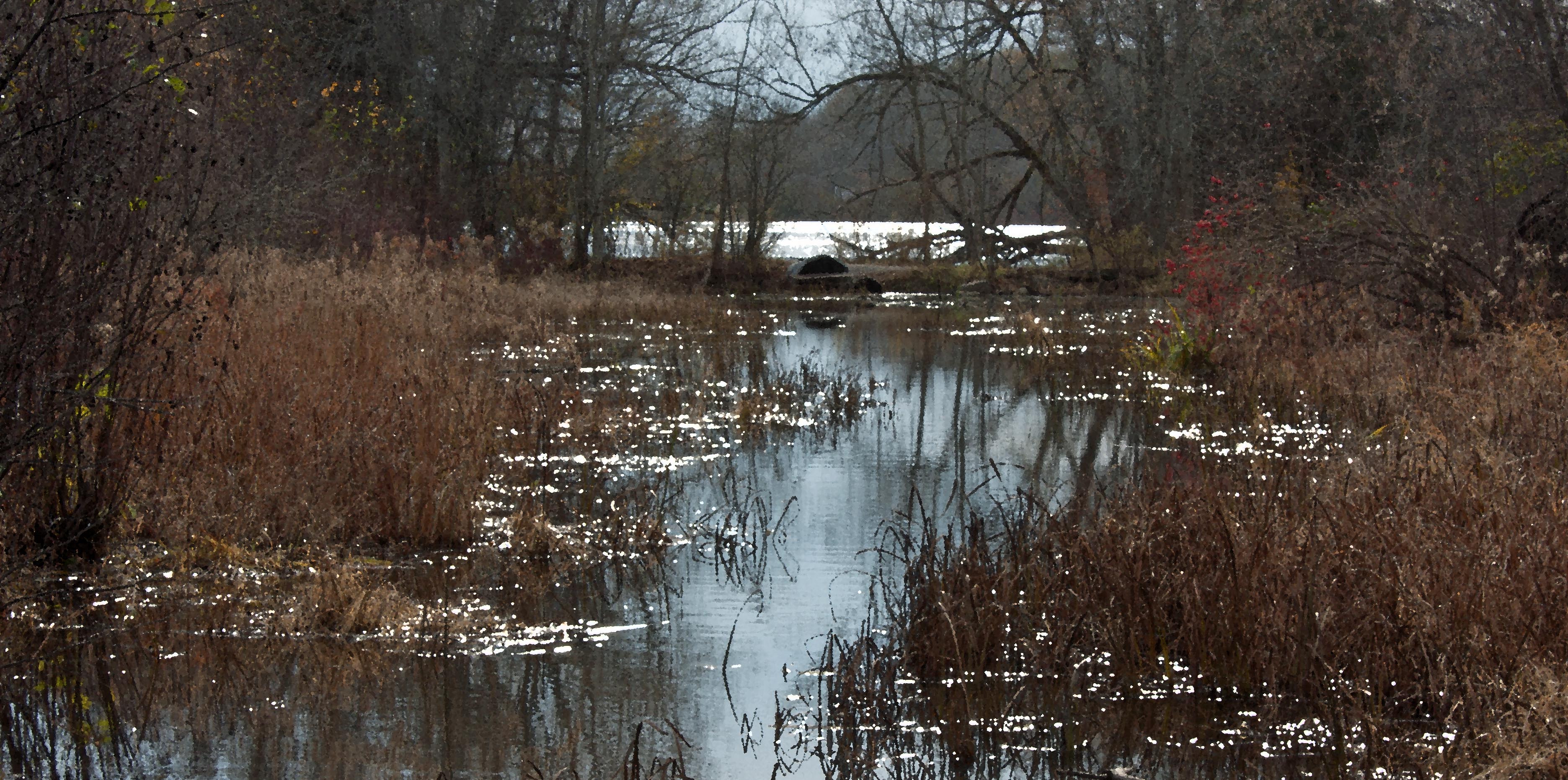
Thompson Creek marsh in early winter, ON (photo and rendition by Nina Munteanu)

Given that cli-fi features climate change, environmental destruction, and species extinction, you must think ‘how can it not be all doom and gloom?’ But dystopias often do reflect—in their depiction of terrible circumstance—an element of triumph, of overcoming adversity, and ultimately of hope. In fact, dystopias generally draw on a writer’s optimism; else, why would we write these cautionary tales? A strong belief in humanity underlies much of eco-fiction. Solarpunk is a rising light of eco-fiction that has emerged recently in response to the denial-despair dilemma many of us face when we think of climate change. This kind of eco-fiction features ingenuity, generativity, independence, and community. And it ultimately leads us through it all toward the light. A Diary in the Age of Water is in fact a dystopia with elements of solarpunk.

You can listen to the entire podcast interview on Solarpunk Futures: Imagining a New World here.

Thompson Creek Marsh in early winter, ON (photo and rendition by Nina Munteanu)

Nina Munteanu is a Canadian ecologist / limnologist and novelist. She is co-editor of Europa SF and currently teaches writing courses at George Brown College and the University of Toronto. Visit www.ninamunteanu.ca for the latest on her books. Nina’s bilingual “La natura dell’acqua / The Way of Water” was published by Mincione Edizioni in Rome. Her non-fiction book “Water Is…” by Pixl Press(Vancouver) was selected by Margaret Atwood in the New York Times ‘Year in Reading’ and was chosen as the 2017 Summer Read by Water Canada. Her novel “A Diary in the Age of Water” was released by Inanna Publications (Toronto) in June 2020.

Overcoming Climate Change, One Story at a Time: “Stories for Earth” Interviews Nina Munteanu

I was recently interviewed by Forrest Brown on his podcast Stories for Earth, a site in Georgia devoted to entertaining and informing its audience on matters to do with climate change and environment and how literature represents and influences our understanding and behaviour in the current and future issues of planet Earth. The site’s mission statement reads: “Stories for Earth seeks to foster hope and emotional resilience by discussing cultural narratives that contain parallels and takeaways to our current predicament. Cultural narratives provide stories for our past, present, and future, and Stories for Earthcritically engages with these narratives through all mediums.”

This is what Forrest says about how and why he started his podcast:

I founded Stories for Earth in the summer of 2019. As a writer and lifelong lover of stories, I never suspected my two biggest interests might have something to do with fighting climate change. That is, until one day when I came across an article about an interesting class at the University of Washington Bothell.

This class, taught by senior lecturer Dr. Jennifer W. Atkinson, sought to help students struggling with the emotional effects of climate change, specifically with the feelings of hopelessness and despair associated with climate grief. Atkinson is a professor of environmental humanities and American literature, so naturally she chose to do this by examining climate change through what she knows best: literature.

After I read this, something clicked. Of course literature can help us face climate change, I thought. Literature and stories in general have helped humanity overcome countless struggles throughout the course of our history—why can’t they help us overcome climate change too?

Stories for Earth is my personal realization of that idea. I want to read books, watch movies, and engage with stories through any other medium out there that can better prepare me to fight climate change in my own way without losing my mind. This podcast is my way of sharing what I learn with you, the listener, and I hope you’ll follow along. If anything you hear sticks or helps you in some way, consider sharing it with a friend who might also benefit from it. We must take care of each other.

Here’s the blurb on the site for our interview

Nina Munteanu is a prolific and insightful Canadian science fiction writer who has published nine novels, including her most recent novel A Diary in the Age of Water. This novel imagines a Canada in the not-so-distant-future where water is becoming increasingly scarce, partially because water sources are drying up and partially because the US and China are buying up water from all the recently privatized Canadian utilities. As a limnologist–literally a fresh water scientist–it makes sense for Nina to be the one telling this story, and our conversation ranges from water shortages in the present day to Ray Bradbury to the need for a new paradigm for living.

We also discuss the connection between exploitive capitalism/colonialism and climate change, then move onto the new paradigm for living by looking at regenerative cultures, the gift economy used by many indigenous peoples, and the creation of an ecological civilization. 

Here’s the interview:

Here’s part of our interview:

  1. Tell me about yourself. How did you become a writer? Why do you think stories are important in the climate action movement?

I wasn’t much of a reader as a kid. While my older brother and sister devoured The Hardy Boys and Nancy Drew series, I hid myself in the back corner of Williams General store and read comics: Superman, Supergirl, Magnus Robot Fighter. I was obviously enamoured with the fantastic. When I earnestly started to read things other than comics, I came across the SF classics: Huxley, Orwell, LeGuin and Asimov to name a few. Ray Bradbury moved me and his “Martian Chronicles” made me cry. I wanted to write science fiction like him and move readers like he’d done with me. But I’d also discovered the sensual classics like Thomas Hardy. So, like most beginner writers, I started by imitating my favourites. Imagine the genre-confused chimeric stuff I was writing: Thomas Hardy crossed with Ray Bradbury? It wasn’t until I found my unique voice, which blended these with my passion for the environment, that my own voice emerged. The environment and how we treat it (and ourselves by extension) has always been something important to me since I was a kid when littering was a pet peeve—it still is… I think that the stories we tell help us define ourselves and our role on this planet. Climate fiction and eco-literature and solarpunk provide us with important narratives that both entertain and educate: from cautionary tales to constructive visualizations of a potential future.  

  • Your new novel A Diary in the Age of Water is the story of a young girl in the future who discovers a diary from a Canadian woman who wrote about her experiences living in an increasingly water-scarce Canada in the 2040s. What inspired you to write this story?

It started with a short story I was invited to write in 2015 about water and politics in Canada.  I had long been thinking of potential ironies in Canada’s water-rich heritage. The premise I wanted to explore was the irony of people in a water-rich nation experiencing water scarcity: living under a government-imposed daily water quota of 5 litres as water bottling and utility companies took it all. I named the story “The Way of Water.” It was about a young woman (Hilda) in near-future Toronto who has run out of water credits for the public wTap; by this time houses no longer have potable water and their water taps have been cemented shut; the only way to get water is through the public wTaps—at great cost. She’s standing two metres from water—in a line of people waiting to use the tap—and dying of thirst. The short story begged for more and that inspiration came when I attended a talk by Maude Barlow on her book Boiling Pointabout the water crisis in Canada. We were in a church and I noticed a young mother and her little six-year old daughter in the balcony; I wondered what kind of mother would bring her little girl to a political talk about water in Canada? The diarist character, Lynna, and her mother, Una, were born. It went from there with Lynna—the diarist—writing about not just water shortage but water related phenomena such as climate change, habitat destruction, hormone disruption and the alarming increased infertility in humans.

  • Coincidentally, I just interviewed another author, C.C. Berke, about his novel Man, Kind, in which people also become infertile in the future. I’ll be honest, this isn’t a problem I was really aware of until recently, but humans are indeed becoming less fertile with every new generation. Is this something you hoped to raise awareness about with your novel?

The short answer is yes! I hope it helps spark the much needed discussion. Rising infertility is an issue that seems to embarrass us … something we feel we must hide under the rug, so to speak. Like our misbehaving Uncle Zeek. But if we don’t talk about it, we can’t understand the underlying reasons for it, many of which are environmentally induced—things we should be addressing. 

  • Politics and big business play huge roles in your novel, as they do in real life as well. Canada has privatized its water utilities after the Conservative Party comes into power, and a giant company called CanadaCorp removes municipal water connections from people’s homes and imposes strict water rations, all while selling off Canada’s precious water to US states like California that would otherwise be uninhabitable. Given that Canada is home to a huge portion of the world’s freshwater, what role do you see Canada playing in the coming years when many prominent people—including the Vice President of the United States—have predicted that wars will one day be fought over water?

She’s right. But this isn’t just in the future; water wars are occurring right now and have for some time. Perhaps not between our two countries. Certainly in the middle east and Asia. There are tensions between Egypt, and nine upstream countries for control of water in the Nile watershed; the Sudanese and Ethiopians are building dams and Egypt plans to pump water from Lake Nassar into the Sahara. India, Pakistan, Bangladesh, and China are in conflict over control of rivers such as the Indus, Ganges, and particularly the Brahmaputra. India’s River Link Plan impacts Bangladesh. Meantime Pakistan, Kashmir and India fight over more and more water, as the Indus dries up and no longer flows into the ocean.

But let’s move closer to home, to North America and the premise of water conflicts here… Considering what you mentioned about Canada’s huge water storage of freshwater, water conflicts are inevitable. Canada and America border some significant water bodies such as the Great Lakes and various rivers like the Columbia River in the west. We’ve formed joint commissions along with treaties to manage these trans-boundary water bodies. They’ve often been highly electrified politically. The book by Eileen Delhanty Pearkes—“A River Captured”—explores the controversial history of the Columbia River Treaty and the huge dams built on that system that impacted ecosystems, indigenous peoples and local cultures in the Pacific Northwest. That didn’t go very well for Canada and particularly not for some of its indigenous peoples.  Another example that my book features is from the 1960s: the NAWAPA project, a plan by Ralph Parsons Company and the Army Corps of Engineers to make the entire Rocky Mountain Trench into a giant 800-km long reservoir to hydrate the US by inundating a fifth of British Columbia’s prime habitat, several towns and indigenous communities and literally destroy a fishery. But guess what? Congress was seriously looking at it and the plan keeps resurfacing among corporate entrepreneurs, engineers and politicians.

  • Going back to big business, do you think industry and sustainability are compatible? I know some cultural movements like solarpunk emphasize DIY and more small businesses over mass production and giant corporations. Do you have any thoughts on this? This is one of the defining questions of our time, but can we have both capitalism and a livable planet?

Some people—mostly economists—would say definitely yes; we just need to be conservationist in our approach to doing business. But the very basis of capitalism is exploitation, not conservation. The driving force behind capitalism is fear and uncertainty and its main process is exploitation. From an ecologist’s perspective, this makes sense for a community during its early succession and growth stage… when it first colonizes a new area. Ecologists call this approach r-selected (for rate), based on profligate and fast growth. But as we reach a climax community and our carrying capacity—where we are now—this r-selected approach no longer works. We need an economic model that better matches this new paradigm. NOT based on continued growth! A climax global economy, one based on cooperation not competition. Elisabet Sahtouris calls this ecological economy ecosophy. In his book “Designing Regenerative Cultures” Daniel Christian Wahl talks about changing our evolutionary narrative from one based on fear defined by a perception of scarcity, competition, and separation to one based on love defined by a perception of abundance, a sense of belonging, collaboration and inclusion. 

And moving forward we can take a lesson from Robin Wall Kimmerer who talks about a gift economy—an economy of abundance—whose basis lies in recognizing the value of kindness, sharing, and gratitude in an impermanent world. This is what she says: “Climate change is a product of this extractive economy and is forcing us to confront the inevitable outcome of our consumptive lifestyle, genuine scarcity for which the market has no remedy. Indigenous story traditions are full of these cautionary teachings. When the gift is dishonored, the outcome is always material as well as spiritual. Disrespect the water and the springs dry up. Waste the corn and the garden grows barren. Regenerative economies which cherish and reciprocate the gift are the only path forward. To replenish the possibility of mutual flourishing, for birds and berries and people, we need an economy that shares the gifts of the Earth, following the lead of our oldest teachers, the plants.”

  • The diary entries in your novel make frequent reference to the post-truth era we seem to be living in. I feel like we’ve been heading in this direction for a while (it seems as though books like Manufacturing Consentby Noam Chomsky and Edward S. Herman and 1984by George Orwell have documented this), but I think many people feel as though we officially entered the post-truth era when Kellyanne Conway used the term “alternative facts” in a Meet The Pressinterview in 2017. Again, this is another huge question of our time, but how do those of us pushing for climate action make progress when entire political parties like the Republican Party in the US and the Conservative Party of Canada are in blatant denial of reality? (Actually, it seems worse than denial of reality—they use the fascist tactic of disregarding reality and replacing it with their own reality, even though they know what they’re doing.)

I have absolutely no answer for that! LAUGH! ARGH! But seriously, how do you convince someone about an evidence-based truth when they are living by a faith-based or agenda-based truth? As a scientist who has lived most of her life doing research and learning to accept the truth of evidence, I find this belief or stance incomprehensible. So you weren’t asking me a question, were you? Well, I’ve heard some great advice on this actually and that is to appeal to a person’s compassion, their kindness, their links to family and friends and find some common ground through their humanity in the phenomenon—say a local manifestation of climate change—then work from there. Keep it local and practical and nonthreatening. In other words, take the science out of it and the belief out of it and appeal on humane grounds. You can’t convince someone to change their belief, but you might be able to persuade them to accept an aspect of something if it doesn’t threaten their belief. 

  • I’d like to talk about the persistence of colonialism and how it’s tied to the climate crisis. In your novel, enormous swaths of British Columbia have been turned into reservoirs to store water to sell to Americans. Doing this displaces lots of people, especially indigenous and First Nations people. But things like this are happening even now. In Minnesota, the Canadian energy company Enbridge has spent hundreds of thousands of dollars paying local police departments to stop Water Protectors from blocking construction of Line 3, which would desecrate indigenous land and transport tar sands oil to US refineries. Could you talk a little about the importance of protecting indigenous and First Nations people’s rights, especially in the climate action movement?

You cite a great example of capitalist exploitation in the fossil fuel industry, which is occurring everywhere on the globe. As I mentioned already, Local and Traditional Ecological Knowledge lies at the heart of preserving this planet’s health and balanced climate. And Indigenous people around the world are regaining control of their territorial environments to reinvigorate food security, governance, social relations and economies. To quote Steven Nitah of the Dene First Nation, “because of their attachment to, and dependence on the land, Indigenous Peoples have been establishing their own protected areas for millennia.”

Luckily, we’re getting on board with this on a grass roots level and even government level—where it needs to be. An example of this are the Indigenous-led conservation movements like the Indigenous Guardians and the IPCAs (the Indigenous Protected and Conserved Areas) where indigenous governments have the primary role in protecting and conserving ecosystems through indigenous laws, governance and knowledge systems. This is linked to the United Nations Declaration of the Rights of Indigenous Peoples (UNDRIP)—specifically Articles 29 and 32—to govern themselves and their territories and to conserve and protect them. British Columbia in Canada sees many examples of Indigenous-led conservation leadership such with the Tla-o-qui-aht and Haida. 

An example I’m following is the Heiltsuk Nation on the Great Bear Sea who have enacted an Oceans Act to protect their ocean relatives and particularly the Pacific herring—a keystone species. The Heiltsuk-herring relationship have thrived over millennia through a system of traditional ecological knowledge, gwee-ee-las, and sustainable harvesting practices. Under current legislation overseen by DFO, commercial fisheries have pretty much destroyed the herring fishery through unsustainable practices. While the Heiltsuk’s stewardship and governance of this area was recently recognized by Canada’s provincial and federal governments, DFO continued to operate separately through settler law, opening herring seine fishery in violation of Heiltsuk constitutional rights. Then they finally collaborated. We’re working it out. It’s an ongoing conversation. 

  • We live in a time where it is so hard to decipher what is true, what is propaganda, and what is conspiracy theory. Your novel deals with this theme a lot through the character Daniel and his obsession with a social media-like platform called Oracle. Could you talk about writing this character and what inspired his creation?

Daniel is a kind of twisted hipster version of an oracle. Young. Wise. Naïve all at the same time.  I brought him in as a trickster archetype, and a kind of foil to Lynna, the main character in the diary part of the book. He’s her technician and work mate and ends up being her link to the world of gossip and dark truths repressed by the corporations via the traditional internet. He finds these gems in the quagmire of the net to share with her over coffee. He’s really a very bright and astute technologist, but he also seems naïve in some ways. For instance, he’s a researcher who dabbles in conspiracy theory. He’s all about health but he smokes. So, a man of contradictions. So, even though he is Lynna’s coffee companion and amuses her, he also unsettles her. In true trickster fashion, he finds out her secret and pays for it. His character allows me to explore the best and worst of the diarist character Lynna. 

  • I hope I’m not giving too much away with this question (we can skip it if you don’t want spoilers), but I want to talk about one of the central themes of the book: is it possible to save the Earth while saving humanity? The author of the diary, Lynna, writes about her water activist daughter, Hilde, a little over halfway through the book: “Does Hilde realize that she’s an oxymoron? To fight for water and the environment is to fight against humanity. Because at the root of Daniel’s question—would you save the planet at the expense of humanity?—lies the deeper question: can humanity exist without destroying the environment? And has Hilde made her prognosis? I know Una still believed in her heart that we could. I always thought her optimism was naïve.” For a long time, it seems like a narrative of the environmental movement was that humans are a virus. But now, there’s a big pushback against this narrative, with activists pointing to the systemic players who bear the most responsibility for the climate crisis. What do you think? Are humans the root problem?

On the surface, I’d say yes. Of course we are. But that is a far too simple and easy answer. It’s the easy way out. It isn’t so much that we’re human that created the climate crisis. It is that we— most of us—live and subscribe to a worldview and belief system that came from a place of great uncertainty with a perception of scarcity and an existential model based on fear and separation. Ancient peoples and most indigenous people today do not hold themselves as separate from the land; they already live in ecological civilizations. An ecological civilization is both a new and ancient idea. Buddhist, Taoist, and other traditions base their spiritual wisdom on the deep interconnectedness of all things. According to Robin Wall Kimmerer “In indigenous ways of knowing, it is understood that each living being has a particular role to play. Every being is endowed with certain gifts, its own intelligence, its own spirit, its own story…The foundation of education is to discover that gift within us and learn to use it well.” I think we’re starting to do this. Partly through listening to the Traditional Ecological Knowledge of our indigenous peoples.

I do believe that human nature is basically empathic and cooperative over selfish and competitive; I think we are born the former and taught to be the latter. That is what needs to change. How we are taught. 

  1. On a related note, the issue of overpopulation is a highly controversial topic in the environmental movement. This has led to some fear-mongering from Conservative politicians who tell their constituents that climate activists want to make a “one child” law like the draconian one-child policy in China that began in the late 70s as part of a government program to curb population growth. Yet, overpopulation is an enormous problem, with Project Drawdown saying, “Education lays a foundation for vibrant lives for girls and women, their families, and their communities. It also is one of the most powerful levers available for avoiding emissions by curbing population growth. Women with more years of education have fewer and healthier children, and actively manage their reproductive health.” Do you think overpopulation needs to be part of the conversation in the environmental movement? Do you think there are times when pointing to this issue as it relates to climate change is problematic?

It certainly can polarize and spark conflict. Reproduction and the right to reproduce is an innate impulse of all life: to make more of itself. So, we’re in conflict with ourselves already. I agree with Project Drawdown. But how to enter into a rationale and productive discussion on this issue relies on the players, their rationale, perspective, and their personal feelings on the matter. We kind of know there should be fewer of us but how to achieve that is another matter. It comes down to ecological footprints and living lightly on the earth and other philosophical considerations. You and I talked earlier about infertility. It seems a macabre kind of irony going on with habitat degradation caused partially by over-population sparking infertility in humans through endocrine disrupting chemicals in our drinking water…

  1. Change is another big theme in your novel, reminding me of Octavia E. Butler’s masterpiece Parable of the Sower, in which she writes, “God is change.” In your novel, Lynna writes, “Trapped by our preordained notion of change, we no longer see what we’re not prepared to see. And that’s the change that kills us.” The problem with climate change is that everything is happening too fast for biological evolution to keep pace. There’s a lot of buzz about transhumanism right now—do you think we’re approaching a point where humans will have to take evolution into our own hands, so to speak, if we want to survive?

It isn’t our intelligence—our cleverness—that will save us; it is our kindness and compassion that will do that. We don’t need to invent some techy thing or reinvent ourselves or implant some intelligent virus into us. What we simply need to do is accept ourselves with humility, find and express joy. Give in to the beauty of our world and our own part in it. Become a participant. Embrace the feminine. Respect Nature and all that lies in it. Find something there to love, cherish it and protect it. The rest will follow. 

Nina Munteanu and Forrest Brown on “Stories for Earth” Podcast

Nina Munteanu is a Canadian ecologist / limnologist and novelist. She is co-editor of Europa SF and currently teaches writing courses at George Brown College and the University of Toronto. Visit www.ninamunteanu.ca for the latest on her books. Nina’s bilingual “La natura dell’acqua / The Way of Water” was published by Mincione Edizioni in Rome. Her non-fiction book “Water Is…” by Pixl Press(Vancouver) was selected by Margaret Atwood in the New York Times‘Year in Reading’ and was chosen as the 2017 Summer Read by Water Canada. Her novel “A Diary in the Age of Water” was released by Inanna Publications (Toronto) in June 2020.

Nina Munteanu Talks About ‘Water Is…’ and ‘A Diary in the Age of Water’ with Dr. Steven Miletto

Nina Munteanu appears on “Teaching, Learning, Leading, K-12” Podcast with Dr. Steven Miletto

I was recently interviewed by Dr. Steven Miletto in Georgia on his podcast “Teaching Learning Leading K12”—Episode 401. We talked about my two recent books on water,Water Is…and A Diary in the Age of Water. The 1-hour interview covered a range of topics from why water makes us feel so good, to the study of limnology, and writing both non-fiction and fiction about water. In the latter, I talked about water as a character in story. We also talked about how characters form in a story and how to keep going when the muse or the joy buries itself.

Jackson Creek, ON (photo and dry-brush rendition by Nina Munteanu)

Nina Munteanu is a Canadian ecologist / limnologist and novelist. She is co-editor of Europa SF and currently teaches writing courses at George Brown College and the University of Toronto. Visit www.ninamunteanu.ca for the latest on her books. Nina’s bilingual “La natura dell’acqua / The Way of Water” was published by Mincione Edizioni in Rome. Her non-fiction book “Water Is…” by Pixl Press(Vancouver) was selected by Margaret Atwood in the New York Times ‘Year in Reading’ and was chosen as the 2017 Summer Read by Water Canada. Her novel “A Diary in the Age of Water” was released by Inanna Publications (Toronto) in June 2020.

Nina Munteanu On The Age of Water: Interview on “Mysterious Goings On Podcast”

Alex Greenwood, host of The Mysterious Goings On Podcast recently interviewed me about my latest novel and work of climate fiction, the dystopia “A Diary in the Age of Water.”

Alex and I discussed water scarcity and climate change as a water phenomenon. I also shared my thoughts on water as a character in the novel, water’s many anomalous properties–all of which promote life and wellness, and why writing a dystopian cautionary tale is an act of optimism.

Listen to the podcast on: Anchor; Spotify; Stitcher; Apple Podcasts; iHeartRadio; YouTube; Podchaser; Listennotes; Audible

Boys exploring by the Otonabee River, ON (photo and dry brush rendition by Nina Munteanu)

Nina Munteanu is a Canadian ecologist / limnologist and novelist. She is co-editor of Europa SF and currently teaches writing courses at George Brown College and the University of Toronto. Visit www.ninamunteanu.ca for the latest on her books. Nina’s bilingual “La natura dell’acqua / The Way of Water” was published by Mincione Edizioni in Rome. Her non-fiction book “Water Is…” by Pixl Press(Vancouver) was selected by Margaret Atwood in the New York Times ‘Year in Reading’ and was chosen as the 2017 Summer Read by Water Canada. Her novel “A Diary in the Age of Water” was released by Inanna Publications (Toronto) in June 2020.