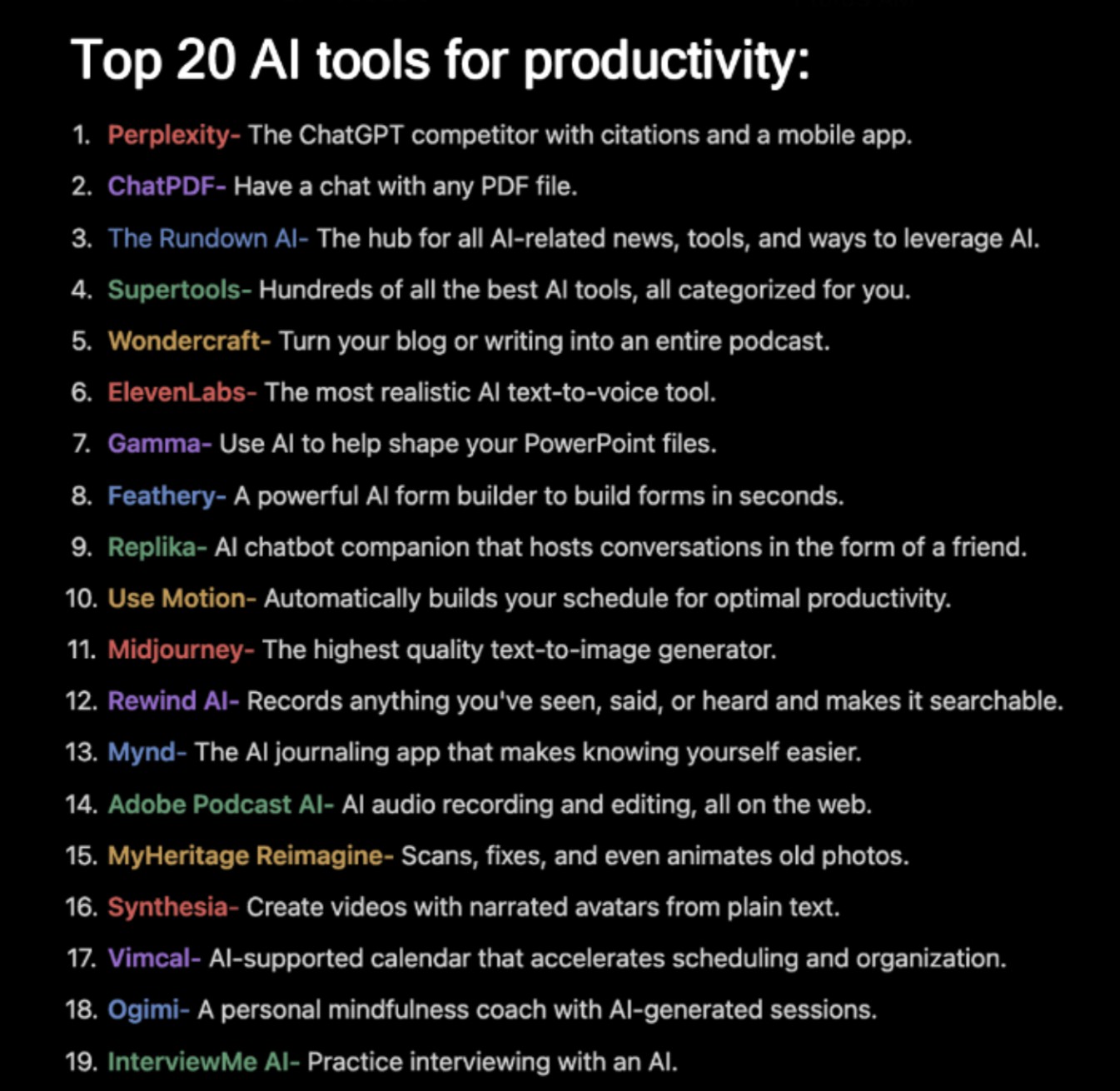
I recently ran across a list posted on social media of the 20 most popular AI tools for productivity in writing. I only knew two of them. This heightened my anxiety about what I know and am prepared for in the use of genAI, particularly in academic settings, where I teach writing at university. And it got me thinking why I was so anxious…
.
I shared the list with my colleagues at the university writing centre and one instructor who was actively following AI tools admitted that they knew only a few of the listed tools as well. They further shared that they were feeling increasingly apprehensive about genAI’s impact on higher education. “It’s hard not to feel overwhelmed,” they ended.
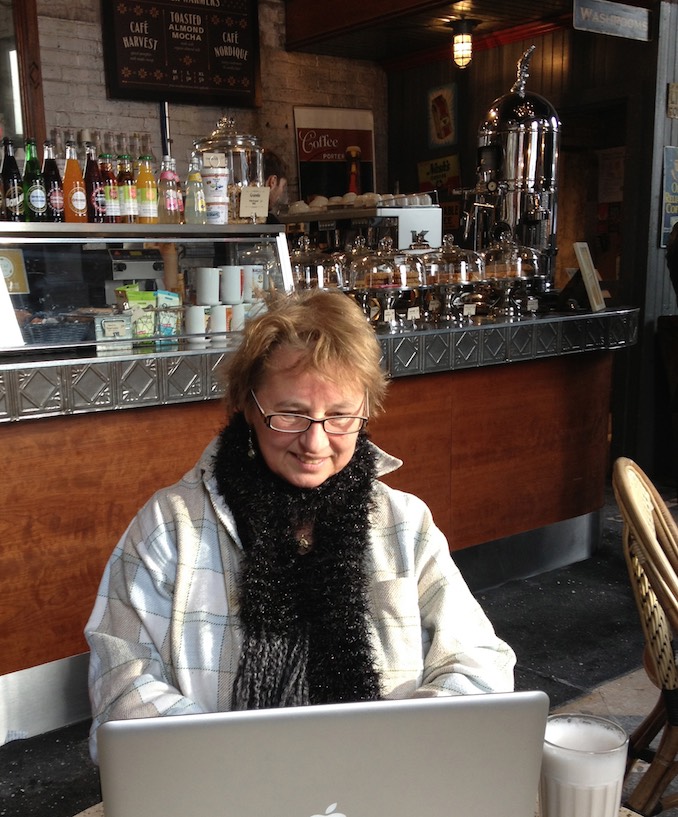
(Photo: Nina writing her novel at a cafe)
.
This was my exact sentiment: a kind of apprehensive excitement. An understanding that all communicators stand at the precipice of a major paradigm shift in tool use. The ramifications this will have on all aspects of effective and efficient communication will span from redefining plagiarism to reinventing creativity. As with all powerful tools—aside from the obvious threat of misuse—there is always something lost with the gain and I wonder what we are losing with all this. I have some ideas, and they do bother me from time to time.
.
Applications of Generative AI (image by Neebel Technologies)
I do think it important for me as a communicator and writing instructor to understand the trade offs and to work with them.
When the world adopted the portable calculator, rote knowledge of basic math suffered. I know; I tested it during a lab exam when I was teaching college biology many years back. I forbid the use of calculators in the test and many students, who had lost the ability to do long division or multiplication by hand, lost marks. For some reason, I’m still not sure of, it was important for me to insist on students doing math longhand (a basic skill fast becoming obsolete like cursive writing) and punish those who had lost the art. Perhaps I was drawing on Isaac Asimov’s possibly prescient 1957 short story satire The Feeling of Power, which explored the limitations of a future world that lost its basic skills to machines. The corollary, I suppose, is that more complex and conceptual math gained some ground through this handy and efficient tool. Machines have their advantages, certainly. And generative AI is just one sophisticated aspect of machine use.
.
.
Consequences to Creative Writing
In my world of professional fiction authors, there is a palpable fear of being replaced by AI as story creators: a version of the ultimate science fiction horror plot of being taken over by the machine world (I’ve even exploited that in my SF thrillers Angel of Chaos and Darwin’s Paradox).
Given our unique powers of imagination, I don’t think that will happen (very soon, if ever successfully). Though, as we dummy-down and simplify complex stories for fast-paced multiplex audiences addicted to fast-paced bite-sized and easy to digest entertainment, AI-generated narratives could get by. How is all this affecting the publishing industry now? I recently learned that one of the top five online science fiction magazines, Metastellar, accepts AI-assisted stories with the proviso that “they better be good.” And Metastellar provides some convincing reasons. This has become a hot topic among my fellow professional writers at SF Canada. One colleague informed me that a “new publisher Spines plans todisrupt industry by publishing 8000 AI books in 2025 alone.” On checking the news release, I discovered that Spines is, in fact, a tech firm trying to make its mark on publishing, primarily through the use of AI. The company offers the use of AI to proofread, produce, publish, and distribute books. They are, in fact, a vanity publishing platform (essentially a service for self-publishing), charging up to $5000 a book and often taking just three weeks to go from manuscript to a published title. The quality of what they will produce is unclear—and questionable.
All to serve as metaphor for what I and my colleagues at university are striving to achieve with students in their academic writing: excellence in communication, particularly in conveying complex scenarios that require creative solutions where clear, concise, and convincing writing is requisite.
.
I still find myself reluctant to use AI in my writing and communication, though I’ve at times slid into using AI for research and initial summaries to save time. I do this rarely because I absolutely enjoy doing research. I enjoy challenging my brain to summarize key points and write a good line. I enjoy the thrill of unanticipated discoveries, which always happen on these forays. I also recognize that many people do not share my enthusiasm for these brain exercises.
(Photo: Nina writing in another cafe)
.
I think that AI alone will not replace human mind for unique creativity. I didn’t say “can not.” It could; but it won’t. This is because even as genAI becomes infused in many aspects of life pursuit, there will remain those like that rare mathematician capable of doing math by hand in The Feeling of Power, valued not just because they are rare, but because in that rarity, they fulfill a critical role. When the machines stalled in their ability to move society forward in The Feeling of Power and all seemed lost, this archaic mathematician presented new innovation with basic math. I’m not suggesting that the technology will all break down, plunging the world into darkness (though this remains a possibility and is still a great plot for science fiction); but I submit that diversity rules over monopoly when it comes to survival.
.
Five Mass Extinctions
.
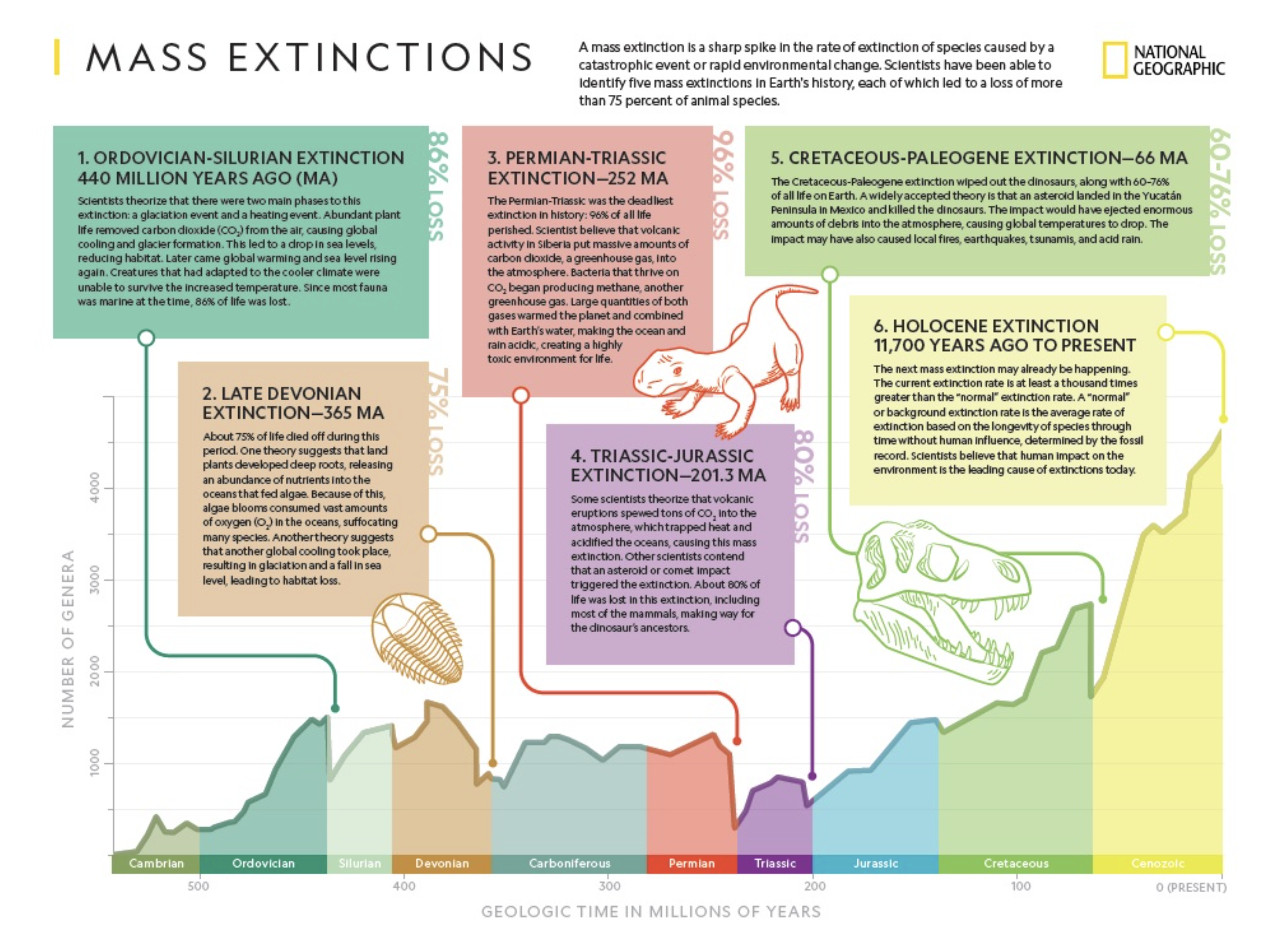
This may seem a rather dark projection of the future, but consider that over the millennia, after five mass extinctions and with the sixth mass extinction underway, diversity has always saved the world. Within that necessary diversity, it is the nurtured rarities, the outliers, the misfits and nonconformists that survived the destruction of the previous world. Each time, diversity made that possible. As though engrained in Nature’s world building.
.
Mass Extinctions (image by National Geographic)
.
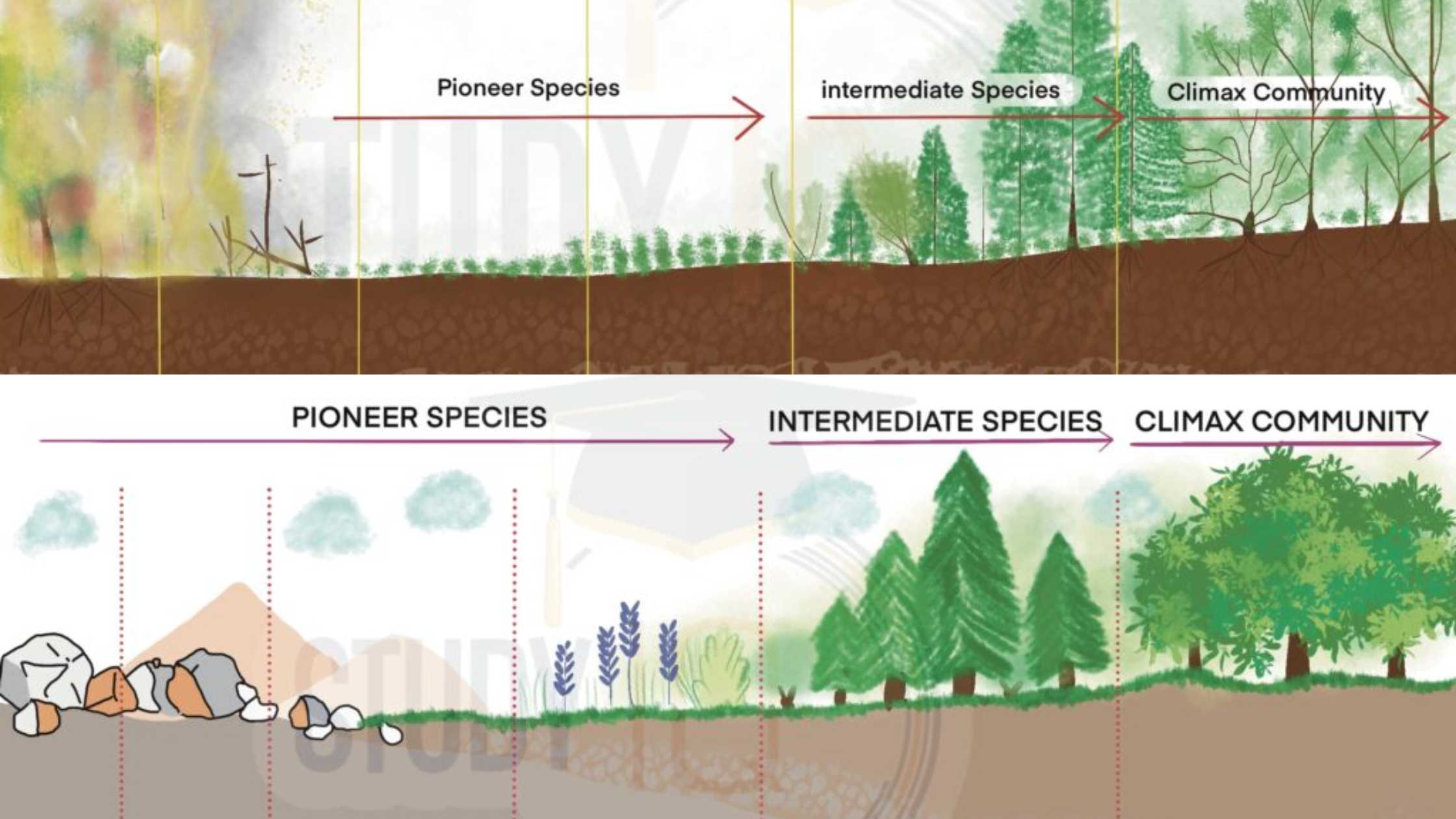
Ecologists call it ecological succession, others use the term “creative-destruction” to describe the recursive pattern of living and non-living things of the planet. Both describe how the oligarchs of an established climax ecosystem fail due to change or disturbance and are replaced by a previous rare misfit or immigrant better suited to the new environment.
.
Primary and secondary succession in two different ecosystems
.
I think AI is part of our succession. Our use of AI in all its forms will represent a diversity of reaction and action that represent our own diversity and potential to survive in a changing world. All to say: relax and embrace the outliers.
.
Writing in nature (photo by Nina Munteanu)
As William Gibson so famously said in 1993: The Future is already here; it’s just not evenly distributed. And maybe that’s a good thing…
.
So…
…To AI, or not to AI, that is the question: Whether ’tis nobler in the mind to suffer The slings and arrows of terrible writing, Or to take arms against a sea of scribbles And by opposing end them. To think—to write, No more; and by writing to say we end The heart-ache and the thousand natural shocks That tech is heir to: ’tis a consummation Devoutly to be wish’d. To think, to write; To write, perchance to create—ay, there’s the rub: For in that creation of unique thoughts what others may come, When we have shuffled off this genAI…
.
Writing in Nature (photo by Nina Munteanu)
.
Nina Munteanu is a Canadian ecologist / limnologist and novelist. She is co-editor of Europa SF and currently teaches writing courses at George Brown College and the University of Toronto. Visit www.ninamunteanu.ca for the latest on her books. Nina’s bilingual “La natura dell’acqua / The Way of Water” was published by Mincione Edizioni in Rome. Her non-fiction book “Water Is…” by Pixl Press (Vancouver) was selected by Margaret Atwood in the New York Times ‘Year in Reading’ and was chosen as the 2017 Summer Read by Water Canada. Her novel “A Diary in the Age of Water” was released by Inanna Publications (Toronto) in June 2020.
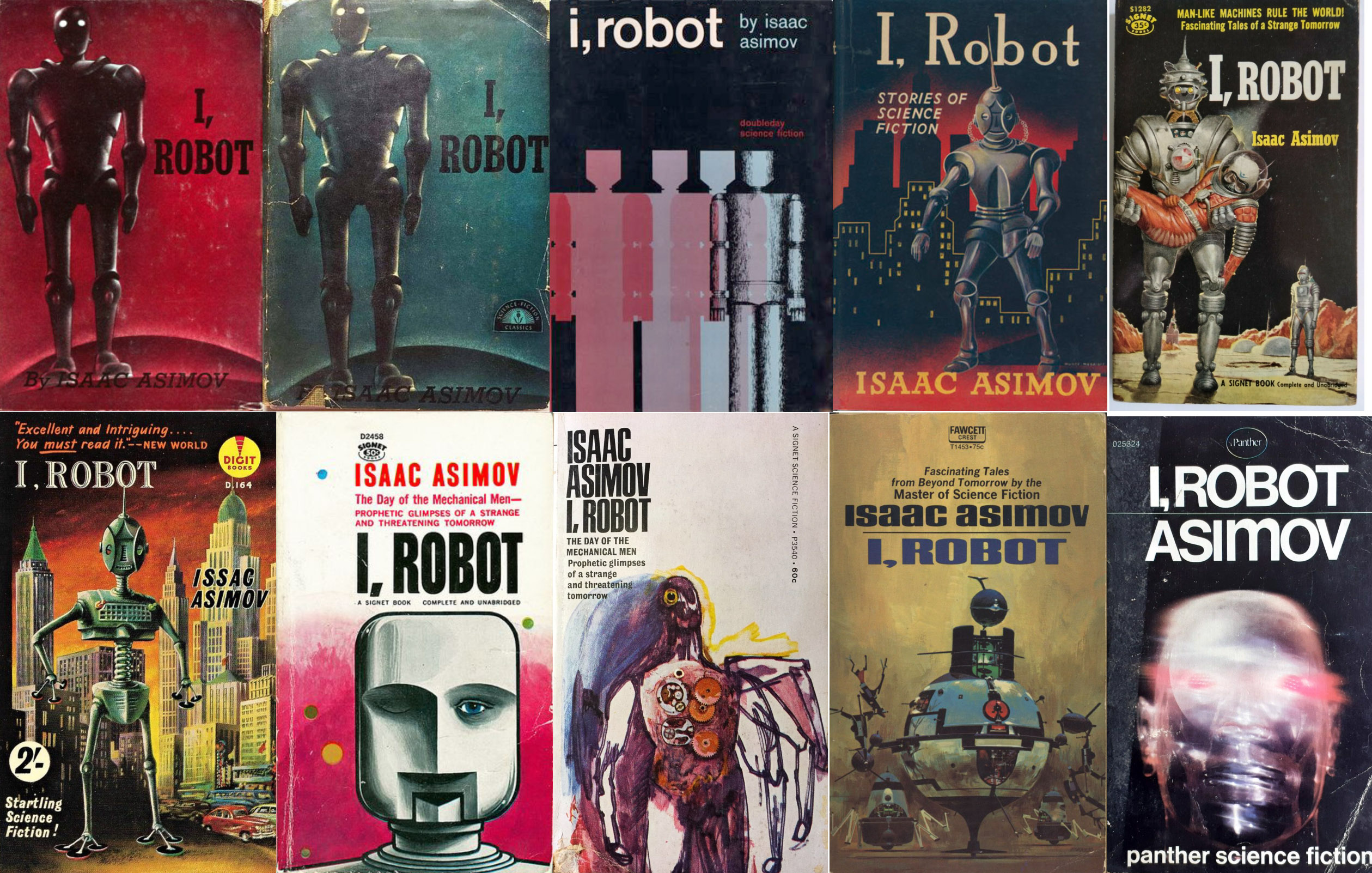
Early editions of “I, Robot”: 1950 1st edition hardcover by Gnome Press; 1950 dust jacket of 1st edition hardcover by Grosset & Dunlap; 1950 1st book club edition by Doubleday; 1952 1st UK edition by Grayson & Grayson; 1956 Signet cover; 1958 Digit Books UK; 1961 Signet 3rd printing; 1968 Signet 6th printing; 1970 Fawcett Crest; 1968 Panther Science Fiction
I reread Dr. Isaac Asimov’s 74-year-old masterpiece, I, Robot, in preparation for the 2004 Twentieth Century Fox motion picture of the same name, knowing fully well that to appeal to today’s action-thriller rollercoaster-addicted audience there was no way the movie and the book could even come close. I was right. But not the way I thought I would be.
The movie, directed by Alex Proyas, begins with the three laws of robotics:
First Law: that robots must not harm a human being;
Second Law: they must obey human orders, so long as this does not violate the first law; and
Third Law: they must protect their own existence, so long as that doesn’t violate laws one and two.
Apart from these three laws and the use of the same title and some of the character names, the motion picture appears to radically depart from Asimov’s book, first published by Gnome Press in 1950. To give Twentieth Century Fox credit, the film does not pretend to be the same as the book; I noticed that in the credits the movie was “suggested by,” rather than “based on” Asimov’s work. But how different was it, really? I submit that the two are much more similar than they first appear.
The robot Sonny causes a great ruckus when he ignores the three laws
Surficial differences between book and motion picture are nevertheless glaring. First off, Asimov’s, I, Robot, is essentially a string of short stories that evolve along a theme; much in the vein of Martian Chronicles by Ray Bradbury. The book is told largely from the point of view of Dr. Susan Calvin, a plain and stern robo-psychologist, who gets along better with robots than with humans. Dr. Asimov uses this cold and colourless character as a vehicle to stir undercurrents of poignant thought on the human condition through a series of deceptively mundane tales. I, Robot offers a treatise both of humanity’s ingenuity and its foibles and how these two are inexorably intertwined in paradoxes that speak to the ultimate truth of what it is to be human. Each of his nine stories discloses a metaphoric piece of his clever puzzle. The puzzle pieces successively tease us through the three laws of robotics, as ever more sophisticated robots toil with their conflicts when dealing with perceived logical contradictions of the laws. For instance, there is “Robbie,” the endearing nursemaid robot. Cutie (QT-1) is a robot Descartes in “Reason.” In “Liar,” Herbie has problems coping with the three laws as a mind-reading robot. And in “Little Lost Robot,” Susan Calvin must out-smart Nestors — or the NS-2 — model robots, whose positronic brains were not impressioned with the entire First Law of Robotics. The larger question and ultimate paradox posed by the three laws culminate in Asimov’s final story, “The Evitable Conflict,” which subtly explores the role of “free will” and “faith” in our definition of what it means to be human.
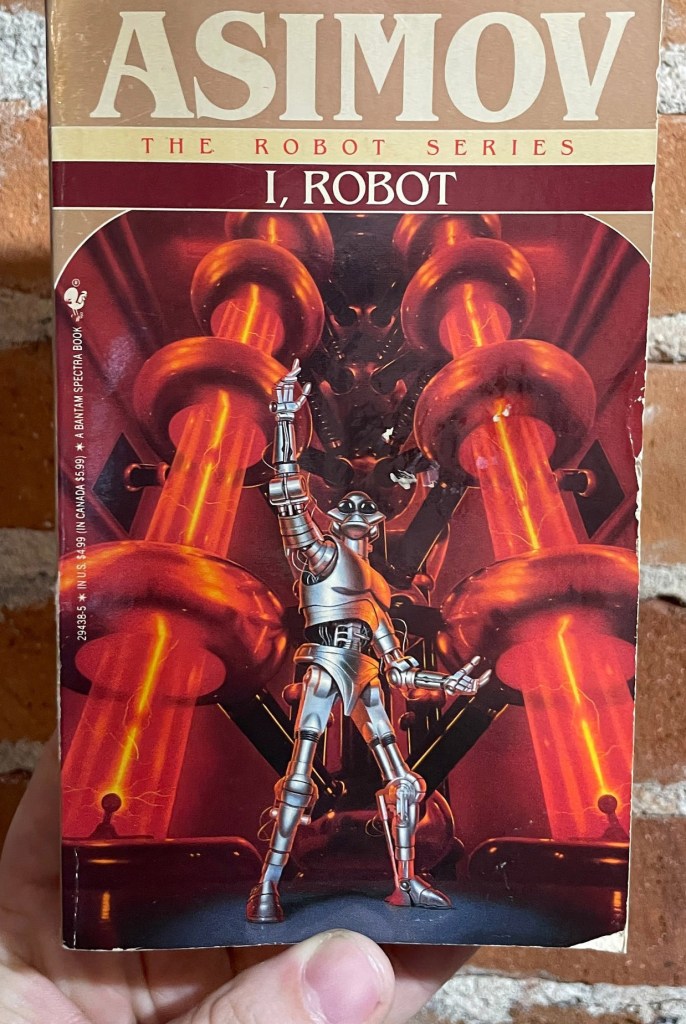
The book jacket of the mass market 1991 Bantam book aptly describes I, Robot this way: “…humans and robots struggle to survive together — and sometimes against each other … and both are asking the same questions: what is human? And is humanity obsolete?” Interestingly, the latter part of the book jacket quote, which accompanied the 1991 Bantam mass-market edition, can be interpreted in several ways.
Asimov’s stories span fifty years of robot evolution, which play out mostly in space from Mercury to beyond our own galaxy. Proyas’s movie is set in Chicago in 2035 and condenses the time frame into a short few weeks with some flashbacks from several years prior. This serves the film well but at some cost. What is gained in tension and focus is lost in scope and erudition, two qualities often best left to the literary field. Asimov’s tales are quirky, contemplative, and thoughtful. The film version is more direct, trading these for a faster pace, pretty much a prerequisite in the film industry today.
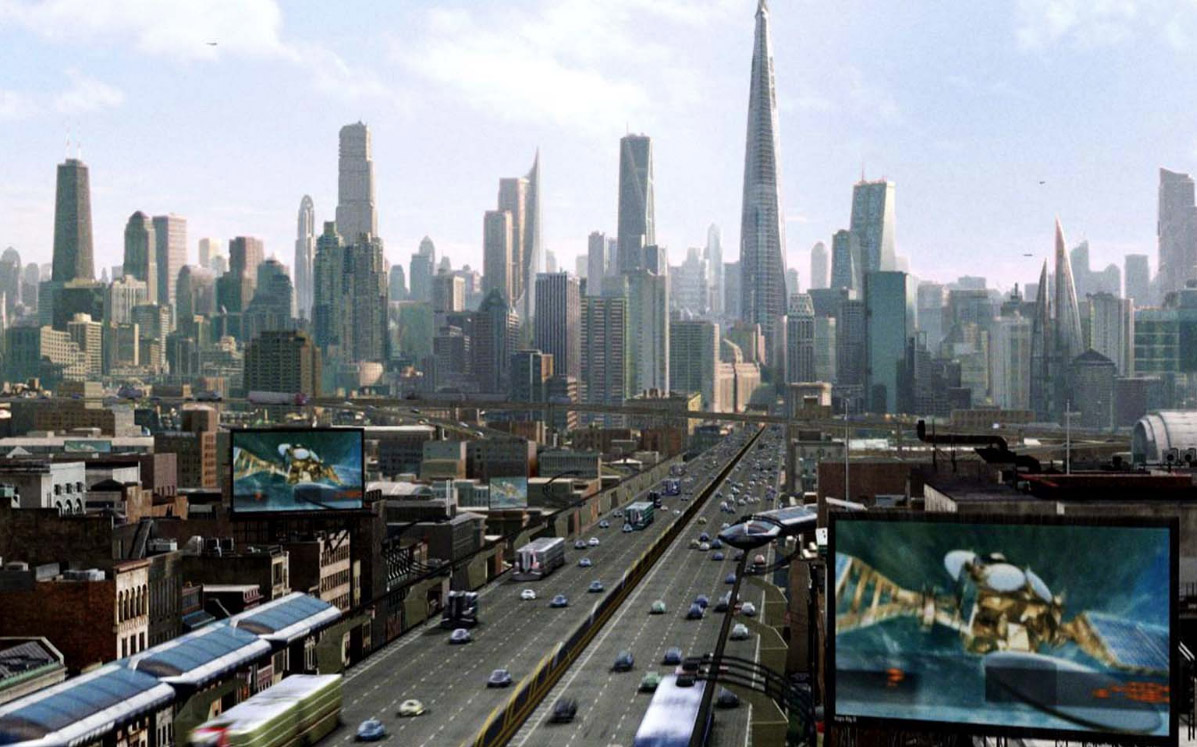
Chicago of “I, Robot” in 2035
The original screenplay, entitled “Hardwired” by Jeff Vinter, was reworked by Akiva Goldsman into a techno-thriller/murder mystery directed by Alex Proyas (Dark City) with its requisite hard-boiled detective cop (Will Smith) and a ‘suicide’ that looks suspiciously like murder. Smith’s character (a Hollywood invention, so don’t go looking for him in the book) is a 20th century anachronism: a Luddite who wears retro clothes and sets his computer car on manual. The story centers on Spooner’s investigation of a so-called suicide by Dr. Alfred Lanning, robot pioneer and the originator of the three laws of robotics. Lanning was an employee of U.S. Robotics, a mega-corporation run by Lawrence Robertson (Bruce Greenwood). Robertson relies on the real brains, V.I.K.I, the corporation’s super-intelligent virtual computer.
the NS-5 robot Sonny with VIKI in the background
NS-5 robot assisting in the home
By this time, technology and robots are a trusted part of everyday life; except for robo-phobic police detective Spooner, who nurses a guilty secret for his prejudice.
With a “simple-minded” plot (according to Roger Ebert, Chicago Sun-Times) and a lead character who is little more than a “wisecracking … guns-a-blazin’… action-hero cliché” (Rob Blackwelder, Splicedwire), the motion picture rendition of Asimov’s ground-breaking book seems to promise little but disappointment for the literate science fiction fan according to many critics.
I disagree.
I was not disappointed. This is both despite and because of director Alex Proyas’s interpretation of Asimov’s book and his three laws. Several critics focused on the surficial plot at the expense of the subtle multi-layered thematic sub-plots contrived by a director not known for creating superficial action-figure fluff. I think this critical myopia was generated from critics admittedly not having read Asimov’s masterpiece. Familiarity with Asimov’s I, Robot is a prerequisite to recognizing the subtle intelligence Proyas wove into his otherwise playful and glitzy Hollywood techno-thriller.
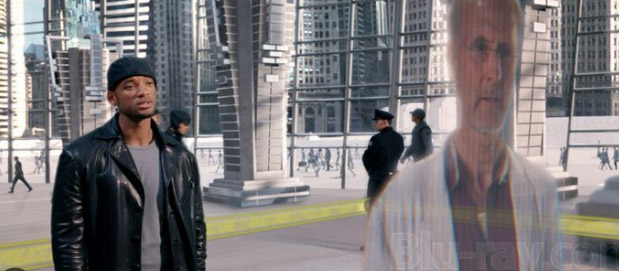
Detective Spooner talks to Dr. Lanning’s holo at USR after his apparent suicide
While literate science fiction fans will certainly recognize the names of Lanning, Calvin and Robertson, these movie characters in no way resemble their book counterparts. Dr. Calvin (Bridget Moynahan) is a robo-psychologist, but in the movie she is far from plain and fails to disguise that she is clearly ruled by her feelings, unlike the coldly logical book character. The lead character in the film, Detective Del Spooner (Will Smith) is, of course, a Hollywood fabrication, along with an entourage of requisite techno-thriller components: spectacular chase and battle scenes, explosions, lots of shooting, and some romantic tension. The film is also fraught with Hollywood clichés: for instance, repressed psychologist (Moynahan), who typically speaks in three-syllabic words, encounters cynical anti-hero beefy cop (Smith) whose rude attentions help transform her into a gun-slinging kick-ass warrior.
Megalithic USR vehicles housing killer robots close in on Spooner’s car in a rousing car-chase scene
Of course, there is also the ‘evil’ machine that turns against its masters to rule the world. But Proyas also treats us to some of the most convincing portrayals of a futuristic metropolis, complete with seamlessly incorporated CGI-generated robots and an evocative score by Peter Anthony. Dr. Asimov fans will, of course, also recognize certain aspects of the book in the movie, such as a scene and concepts borrowed from “Little Lost Robot.”
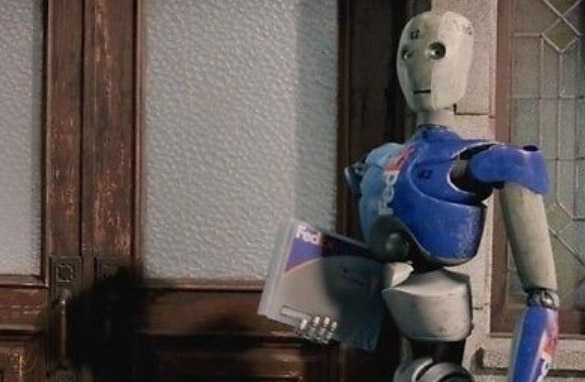
NS-4 Fedex courier in future Chicago
Despite the clichés and comic-action razzle-dazzle, Proyas manages to preserve the soul and spirit of Dr. Asimov’s great creation. He does this by allowing us to glimpse some of Asimov’s elevated theme, if not his more complex questions.
The most poignant scenes in the movie are those which involve the ‘humanity’ of the robot called Sonny (Alan Tudyk). A unique NS-5 model with a secondary processing system that clashes with his positronic brain, Sonny is capable of rejecting any of the three laws and hence provides us ironically with the most complex (and interesting) character in the movie. Sonny is both humble and feisty, a robot who dreams and questions. For me, this was not unlike the several stirring scenes in Asimov’s “Liar,” where the mind-reading robot, Herbie, when dealing with the complex nature of humans, unintentionally caused its own destruction (with the help of a bitter Dr. Calvin) by trying to please everyone by telling them what he thought they wanted to hear. Sonny’s complex character (like any character with depth) keeps you guessing. Sonny asks the right questions and at the end of the film we are left wondering about his destiny and what he will make of it. This parallels Asimov’s equally ambiguous ending in “The Evitable Conflict.”
As Spooner searches for him, Sonny hides among his own
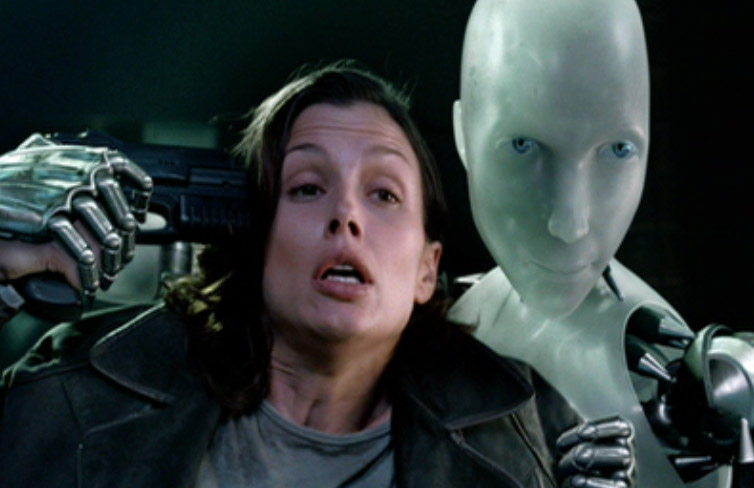
Sonny holds a gun to Dr. Calvin’s head
Which brings me back to the foundation shared by both book and movie: the three laws of robotics, the infinite ways that they can be interpreted, and how they may be equally applied to robot or human. The laws may apply physically or emotionally; individually or toward the whole of humanity; long-term or short-term … the list is potentially endless. Asimov’s collection of stories centers on these questions by showing how robots deal with the conflicts the perceived contradictions present by the laws. Asimov’s last story describes a world run by a network of powerful but benevolent machines, who guide humankind through strict adherence to the three laws (their interpretation, of course!).
USR vehicles dominate the streets of Chicago
Taking his cue from this, Proyas cleverly takes an old cliché—that of ‘evil’ machine with designs to rule the world—and turns it upside down according to the first law of robotics. His ‘evil’ machine turns out not to be evil, but misguided. V.I.K.Y acts not out of its own interests, like the self-preserving HAL in 2001: A Space Odyssey, but in the best interests of humankind (at least according to the machine). Citing humanity’s self-destructive proclivity to pollute and make war, V.I.K.Y decides to treat us as children and pull the plug on free-will. Viewed from the perspective of the first law, this is simply a logical, though erroneous, extrapolation of ‘good will’; and far more interesting than the workings of simple ‘evil,’ which I feel is much overdone and overrated in films these days. The well-meaning dictator possessed of the hubristic notion that he holds all the keys to the happiness and well-being of others smacks of a reality and a humanity all too prevalent in well-meaning governments today. It is when the line between ‘good-intentions’ and ‘wrong-doing’ blur that things get really interesting.
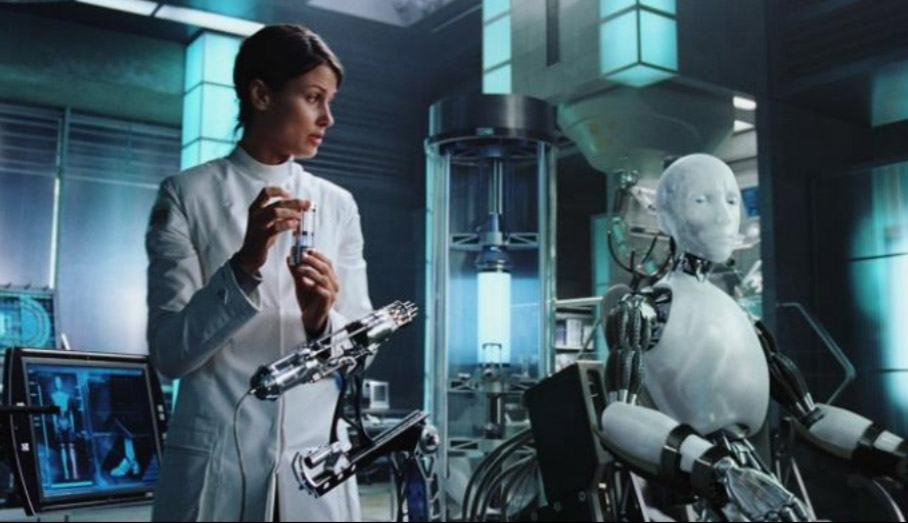
Doctor Calvin prepares to terminate Sonny
Both Asimov and Proyas explore this chiaroscuro in I, Robot, though in different ways. The challenge is still the same: If given the choice of ending war and all conflict at the expense of ‘free will,’ would we permit benevolent machines to run our world? Or is it our destiny—and requirement for the transcendence of our souls—to continue to make those mistakes at the expense of a life free of self-destruction and violence?
On the surface, Proyas offers the obvious answer. He likens the benevolent machine to an overprotective parent, who in the interests of a child’s safety, prevents the enrichment of that child’s heart, soul, and spirit otherwise provided by that very conflict. Asimov is far more subtle in “The Evitable Conflict” and while these questions are discussed at length, they remain largely unanswered.
In one of his most clever stories, “Evidence,” near the end of his book, Dr. Asimov expounds on the three laws to describe the ultimate dilemma: of defining and differentiating a human-looking robot with common sense from a genuine human on the basis of psychology. Asimov’s Dr. Calvin says: “The three Rules of Robotics are the essential guiding principles of a good many of the world’s ethical systems. Every human being is supposed to have the instinct of self-preservation. That’s Rule Three to a robot. Also every ‘good’ human being, with a social conscience and a sense of responsibility, is supposed to defer to proper authority. That’s Rule Two to a robot. Also, every ‘good’ human being is supposed to love others as himself, protect his fellow man, risk his life to save another. That’s Rule One to a robot. To put it simply, if [an individual] follows all the Rules of Robotics, he may be a robot, and may simply be a very good man.” Proyas metaphorically (if not literally) explores the question of “what is human” with his robotic character, Sonny.
Spooner discovers older robot models, grouped together in a storage container
In a stirring scene of the motion picture where Sonny is prepared for permanent shut down, Dr. Lanning expounds on his belief that robots could evolve naturally: “There have always been ghosts in the machine… random segments of code that have grouped together to form unexpected protocols. Unanticipated, these free radicals engender questions of free will, creativity, and even the nature of what we might call the soul… Why is it that when some robots are left in the dark they will seek the light? Why is it that when robots are stored in an empty space they will group together rather than stand alone? How do we explain this behaviour? Random segments of code? Or is it something more? When does a perceptual schematic become consciousness? When does a difference engine become the search for truth? When does a personality simulation become the bitter moat of the soul?”
Where abandoned robots congregate
I found myself following a less dazzling but deeper thread in the movie version of I, Robot. One steeped in metaphor that pulled at my emotions. Throughout the film, we were given subtle and brief glimpses of old robot models discarded as new ones were designed and launched. I remember one scene in particular that saddened me; alongside the cheerful rollout of the NS-5s, the NS-4s were unceremoniously removed and stored offsite to spend their remaining days in the darkness of storage.
In a later scene in the movie, these older models are hunted down by newer models and violently destroyed. It’s a slaughter. When Spooner stumbles on this robot-carnage, one injured NS-4, fearing for Spooner’s welfare, urges him to run.
Injured NS-4 exhorts Spooner to run away to save himself
Why did I find these scenes so sad? Was it the curiously disarming design of the ND-4? They did not fight back; designed to be kind, they simply let themselves be destroyed.
Perhaps I was reminded of how we can so easily abandon an old thing once loved for a new and shiny toy. No longer useful they are carelessly cast aside as somehow less than they might have once been. We’ve seen what becomes of anything we deem inferior or unworthy of our compassion. How we treat a perceived lesser being can often be cruel and careless. One need only look to our long history of human slavery, of animal abuse, of environmental exploitation, and even of material destruction. Our capitalist world lies replete with examples of neoliberal consumerism that favours a throwaway ethic. We have become a user society, addicted to the next big thing; the next i-phone, the next shiny car, the next new friend… Toss the old away without a care while we embrace the new…
Abandoned NS-4s left in storage with no purpose
Near the end of the film, Sonny, having fulfilled his initial purpose (i.e., stopping V.I.K.Y. to save humanity from oppressive subjugation), asks Spooner, “What about the others [the NS-4s and the NS-5s, recalled for servicing and storage]? Can I help them? Now that I have fulfilled my purpose I don’t know what to do.” To this, an enlightened Spooner answers: “I guess you’ll have to find your way like the rest of us, Sonny… That’s what it means to be free.”
Sonny finds a following
Proyas gives us a strong indication of what his film was really about by ending not with Spooner—his lead action-figure character who has just saved humanity from the misguided robot army—but with Sonny, the enigmatic robot just embarking on his uncertain journey. The motion picture closes with a final scene of Sonny, resembling a messianic figure on the precipice of a bluff, overlooking row upon row of his robotic counterparts.
We are left with an ambiguous ending of hope and mystery. What will Sonny do with his abilities, his dreams, and his potential “following”? Will his actions be for the betterment of humankind and/or robots? Will society trust him and let him seek and find his destiny or, like Asimov’s fearful “Society for Humanity,” will we squash them all before they get so complex and powerful that not only do we fail to understand them but we have no hope of controlling them? This parallels Asimov’s equally ambiguous ending in his book. In it, Stephen Byers (a humanoid AI), and robo-psychologist, Susan Calvin, discuss the fate of robots and humanity. Ironically, it is through her interaction with robots that Susan discovers a human trait that may be more valuable to humanity than exercising “free will”: that of faith. It is she who confronts the coordinator with these words: “…How do we know what the ultimate good of Humanity will entail? We haven’t at our disposal the infinite factors that the Machine has at its.” Then to his challenge that human kind has lost its own say in its future, she further responds with: “It never had any, really. It was always at the mercy of economic and sociological forces it did not understand … at the whims of climate, and the fortunes of war…Now the Machines understand them…for all time, all conflicts are finally evitable. Only the Machines, from now on, are inevitable.” This quote in Asimov’s final story may horrify or anger some, even as it may inspire and reassure others. But, if true “free will” is largely a self-perpetuated myth of the Western pioneer movement, then we are effectively left with respect and faith in oneself and in others. Perhaps, ultimately, that is what both Asimov and Proyas had in mind.
It is interesting to note that Harlan Ellison and Asimov collaborated on a screenplay of I, Robot in the 1970s, which Asimov said would provide “the first really adult, complex worthwhile science fiction movie ever made.” Am I disappointed that this earlier rendition, most likely truer to the original book, did not come to fruition? No. That is because we already have that story. You can still read the book (and I strongly urge you to, if you have not). Proyas’s film I, Robot is a different story, with a different interpretation. And like the robot’s own varying interpretation of the three laws, it is refreshing to see a different human’s interpretation expressed.
“I, Robot” movie poster
Nina Munteanu is a Canadian ecologist / limnologist and novelist. She is co-editor of Europa SF and currently teaches writing courses at George Brown College and the University of Toronto. Visit www.ninamunteanu.ca for the latest on her books. Nina’s bilingual “La natura dell’acqua / The Way of Water” was published by Mincione Edizioni in Rome. Her non-fiction book “Water Is…” by Pixl Press (Vancouver) was selected by Margaret Atwood in the New York Times ‘Year in Reading’ and was chosen as the 2017 Summer Read by Water Canada. Her novel “A Diary in the Age of Water” was released by Inanna Publications (Toronto) in June 2020.
Let the world burn through you. Throw the prism light, white hot, on paper —Ray Bradbury
Birch trees (photo by Merridy Cox)
How many of you have, once you’ve told someone that you are a writer, received the blithe response, “Oh, yes, I’ll be a writer too someday. I’ll write that great Canadian bestseller—once I have time…” Implying that writing was a hobby and that time—not talent or discipline or vision or artistic spirit—was the only required ingredient.
When I was five years old I already knew that I wanted to be a writer. My sister and I didn’t just play dolls; we created worlds and spun epic tales of great scope, with a diverse cast of characters that spanned the far reaches of the universe. Stories of thrilling adventure, crazy irony, great intrigue and mystery. Stories of betrayal, love, loss, redemption and victory. I knew in my heart that I was always a writer—even when I wasn’t (writing, that is). As a child I knew that writing was in my soul and that I would write for the rest of my life. Still…it took me a while to admit it to the world. It took me longer still to publish. Make no mistake: writing and publishing is hard work. But NOT a chore, which I think many who don’t write fail to make a distinction, including my ex-husband.
Films often portray the writer as self-loathing and self-destructive, moody, unstable, and narcissistic. Think of the following films and how they portray the writer: Sunset Boulevard. The Shining. Misery. Sliding Doors. Secret Window. Sideways. My Brilliant Career. Stranger than Fiction. The Royal Tenenbaums. As Good As It Gets. Adaptation. Deconstructing Harry. Wonder Boys. Midnight in Paris. Barton Fink. Limitless. Ruby Sparks. The Words.
“Deplorable actions are almost expected from fictional writers in films,” says a recent Huffington Post article. “Novelists and poets are consistently portrayed as snobby, outlandish, mawkish, or untrustworthy. They lie, cry, brag and steal their way to fame.”
Joe Muscolino of Word & Film shares that:
“It’s become a visual cliché: The writer slouched in his chair, conflicted, chain-smoking, achingly alone, and oblivious to anything outside his cave of thoughts. He’s desperately waiting for that one savior of a sentence to rescue him from the shackles of banality. Opposite him sits a blank page. Watching him. Haunting him. It’s ideally nestled in a typewriter, despite the nearby objects suggesting that it’s most definitely the twenty-first century. The clock ticks. Nothing… Obviously, if you scratch the surface of any stereotype you’ll find a more nuanced layer of reality. Writers can just as easily be shining examples of happiness and sobriety. But nuanced realities don’t sound as fun as drug-addled depressives, and they don’t make for good stories.”
That’s the stereotype. What about the reality? For that I, of course, must take you to fiction (faint knowing smile):
Walking the trail beside Credit River, ON (photo by Nina Munteanu)
In Dorothy L. Sayers’ 1939 mystery novel The Nine Tailors, the iconic dilettante and gentleman detective Lord Peter Wimsey has a most interesting exchange about writers and our perception of them with the young Miss Hilary Thorpe—herself an aspiring writer. It’s worth recounting here as it reflects one author’s thoughts, even if through a fictional character. In the scene, following her father’s death, Miss Thorpe shares how the act of “wondering” helps her through her grief:
“…it really makes things easier to do a little wondering, I mean, if you’re once interested in a thing it makes it seem leas real. That’s not the right word, though.”
“Less personal?”
‘Yes, that’s what I mean. You begin to imagine how it all happened, and gradually it gets to feel more like something you’ve made up.”
“Hmm!” said Wimsey. “If that’s the way your mind works, you’ll be a writer one day.”
“Do you think so? How funny! That’s what I want to be. But why?”
“Because you have creative imagination, which works outwards, till finally you will be able to stand outside your own experience and see it as something you have made, existing independently or yourself. You’re lucky.”
“Do you really think so?” Hilary looked excited.
“Yes—but your luck will come more at the end of life than at the beginning, because the other sort of people start by thinking you dreamy and romantic, and then they’ll be surprised to discover that you are really hard and heartless. They’ll be quite wrong both times—but they won’t ever know it, and you won’t know it at first, and it’ll worry you.”
“But that’s just what the girls say at school. How did you know?…Though they’re all idiots—mostly, that is.”
“Most people are,” said Wimsey, gravely, ‘but it isn’t kind to tell them so. I expect you do tell them so. Have a heart; they can’t help it…”
Thank you, Lord Peter. While we’re at it, another of Sayer’s fictional characters, Mr Edward Thorpe, shares that, “authorship is a good stick, but a bad crutch.”
Pat and Joan, writers writing (photo by Nina Munteanu)
So, what is it to be a writer? Are we all in the end a bit crazy like the stereotype suggests? All I know is that I if I didn’t write, my soul would suffer. Isaac Asimov said, “I write for the same reason as I breathe—because if I didn’t, I would die.”
I write to live and live to write. I’ve known this all my life, from the tales I shared with my sister at age 7 to the novels I currently write and will continue to until I journey beyond the physical. There is, quite simply, nothing that matches the experience of capturing the beating heart of a story, resonating with its core emotional song, and embracing the thrill of sharing it with the world. Just as director Christopher Nolan said of musical genius Hans Zimmer, I embrace “the thrill and mess of reality’s disregard for abstract intentions—the making of the thing is the thing itself.”
Writers on Writing…
“Who wants to become a writer? And why? Because it’s the answer to everything. … It’s the streaming reason for living. To note, to pin down, to build up, to create, to be astonished at nothing, to cherish the oddities, to let nothing go down the drain, to make something, to make a great flower out of life, even if it’s a cactus.” —Enid Bagnold
“If you really want to hurt your parents, and you don’t have the nerve to be a homosexual, the least you can do is go into the arts. But do not use semicolons. They are transvestite hermaphrodites, standing for absolutely nothing. All they do is show you’ve been to college.” ― Kurk Vonnegut
“Writing is not necessarily something to be ashamed of, but do it in private and wash your hands afterwards.” —Robert A. Heinlein
“…Writers are a savage breed, Mr. Strike. If you want life-long friendship and selfless camaraderie, join the army and learn to kill. If you want a lifetime of temporary alliances with peers who will glory in your every failure, write novels.” ― Robert Galbraith,The Silkworm
“Do not hoard what seems good for a later place in the book, or for another book; give it, give it all, give it now.” —Annie Dillard
“Making people believe the unbelievable is no trick; it’s work. … Belief and reader absorption come in the details: An overturned tricycle in the gutter of an abandoned neighborhood can stand for everything.” —Stephen King
“Writing a book is a horrible, exhausting struggle, like a long bout of some painful illness. One would never undertake such a thing if one were not driven on by some demon whom one can neither resist nor understand.” —George Orwell
“If you can tell stories, create characters, devise incidents, and have sincerity and passion, it doesn’t matter a damn how you write.”—Somerset Maugham
“When I sit down to write a book, I do not say to myself, ‘I am going to produce a work of art.’ I write it because there is some lie that I want to expose, some fact to which I want to draw attention, and my initial concern is to get a hearing.” —George Orwell
“To produce a mighty book, you must choose a mighty theme.”—Herman Melville
“It is perfectly okay to write garbage–as long as you edit brilliantly.”—C. J. Cherryh
“Every secret of a writer’s soul, every experience of his life, every quality of his mind, is written large in his works.” —Virginia Woolf
“I went for years not finishing anything. Because, of course, when you finish something you can be judged.”—Erica Jong
“There’s no such thing as writer’s block. That was invented by people in California who couldn’t write.”—Terry Pratchett
“Everybody walks past a thousand story ideas every day. The good writers are the ones who see five or six of them. Most people don’t see any.”—Orson Scott Card
“A wounded deer leaps the highest.”—Emily Dickinson
“Writing is its own reward.”—Henry Miller
“Writing a novel is like driving a car at night. You can only see as far as your headlights, but you can make the whole trip that way.”—E. L. Doctorow
“Don’t try to figure out what other people want to hear from you; figure out what you have to say. It’s the one and only thing you have to offer.”—Barbara Kingsolver
“I write for the same reason as I breathe—because if I didn’t, I would die.”—Isaac Asimov
Nina Munteanu is an ecologist and internationally published author of award-nominated speculative novels, short stories and non-fiction. She is co-editor of Europa SF and currently teaches writing courses at George Brown College and the University of Toronto. Visit www.ninamunteanu.ca for the latest on her books.














 Nina Munteanu Writing Coach