In her book The Art of Slow Writing, Louise DeSalvo tells the story of how Ian McEwan composed his book Atonement.
McEwan had shared that the novel “grew out of many months of sketches and doodling.” Then one morning, he wrote “six hundred words or so describing a young woman entering a drawing room with some wild flowers in her hand, searching for a vase,” and “aware of a young man outside gardening whom she wishes both to see and avoid.”
He knew he had at last started a novel, says DeSalvo. But beyond that, he knew nothing. Slowly, McEwan pieced together a chapter, the one in which “Cecilia and Robbie go to the fountain, the vase breaks, she strips off and plunges into the water to retrieve the pieces, she walks away from him without a word.”
McEwan then languished for six weeks with questions: who was the woman? Who was the young man? What was their relationship? When and where did this event take place? And what was its significance to the story? What was the story about?
McEwan went on to write the chapter in which Briony attempts to put on a play with her cousins. Upon completing that chapter, he finally realized what the story was about. He realized that he would write about Dunkirk and St. Thomas’s hospital. He also knew that Briony was the main protagonist and POV character; that “she was going to commit a terrible error, and that writing…throughout her life would be her form of atonement.” Briony is in fact, what we call a displaced narrator. While the focus of the story is on the tragic journeys of Ceclia and Robbie—resulting largely from Briony’s eventful action—the deeper tragedy is Briony’s who must live the remainder of her life with what she has done.
“McEwan’s remarks illustrate how a successful writer sometimes begins without knowing the work’s subject,” writes DeSalvo. This process of creative problem solving can take on many forms. McEwan sketched and wrote what Diana Gabaldon calls “kernel scenes”, muse-inspired scenes—usually character-based—that represent major emotional turning points or events: important moments in forming a larger set piece toward a larger story. McEwan wrote a scene that required for him to solve some creative problems. Each solution provided him with another piece to the creative puzzle and the blurry meaning of the story slowly came into focus.
According to DeSalvo, McEwan swapped his first two chapters and rewrote them several times before he realized that the novel should begin with Briony. Once that watershed moment came to him, the rest of the process fell into place and practically wrote itself.
This type of “organic” writing can be very exciting and revealing to an author; it can also be chaotic and time-consuming. That’s OK. You need the time for the story to reveal itself to you. As DeSalvo says, “we can’t force a resolution too quickly.” She adds that “creative solutions often take us into unexpected territory—the introduction of Briony’s narrative, for example—and often these swerves take us into exciting solutions we hadn’t anticipated—Briony as narrator, for example—and push our work in an altogether different direction.”
If McEwan had kept the first narrative that emerged—Cecilia and Robbie at the fountain—and if he hadn’t been open to the potential in Briony’s narrative, he would no doubt have written a less complex but still successful novel about love, class, and war. But in deciding to give Briony a voice and combine both narratives, McEwan introduced another more metaphoric layer of meaning to the more literal one—that of personal betrayal and the impact of knowing you have destroyed two people’s lives.
The Last Summoner … Summoned
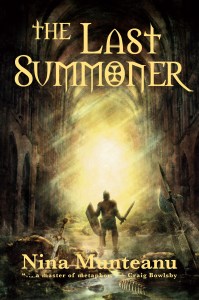
cover art by Tomislav Tikulin
My historical fantasy The Last Summoner came to me in a single image. I’d run across a spectacular image by Croation artist Tomislav Tikulin (he’d done the cover art for Darwin’s Paradox, my previous book published by Dragon Moon Press). When I checked his website, there it was: this incredibly evocative image of a knight, standing in the war-littered mire of a drowned cathedral. The knight gazed up, questioning, at the vaulted ceiling from which shone streams of white gold. It sent my imagination soaring with thoughts of chivalry, adventure and intrigue.
Who was this knight? Where was he and why? What were the circumstances?
At that point I only had an image and many questions. I knew I wanted to write about this knight and this setting. Since I can remember, I’ve been fascinated by Europe during the medieval ages and I had been thinking of writing outside the science fiction genre for a while.
The image remained imprinted inside me for weeks, months, until the next nexus moment came. I stumbled across a significant but little-known battle in the medieval Baltic, the Battle of Grunwald. It would turn out to be the defining battle for what are now the countries of Poland and Lithuania. On June 14th 1410, they were still part of Prussia and tyrannized by the Teutonic Order, who were Christianizing the pagan Baltic on behalf of the Pope. In truth, the Order had been for centuries gathering wealth and land for colonizing Germans in their drang nach osten; they built sturdy castles (many of which still stand today) and a force of monk warriors, feared for their cunning strategy and treacherous combat abilities.
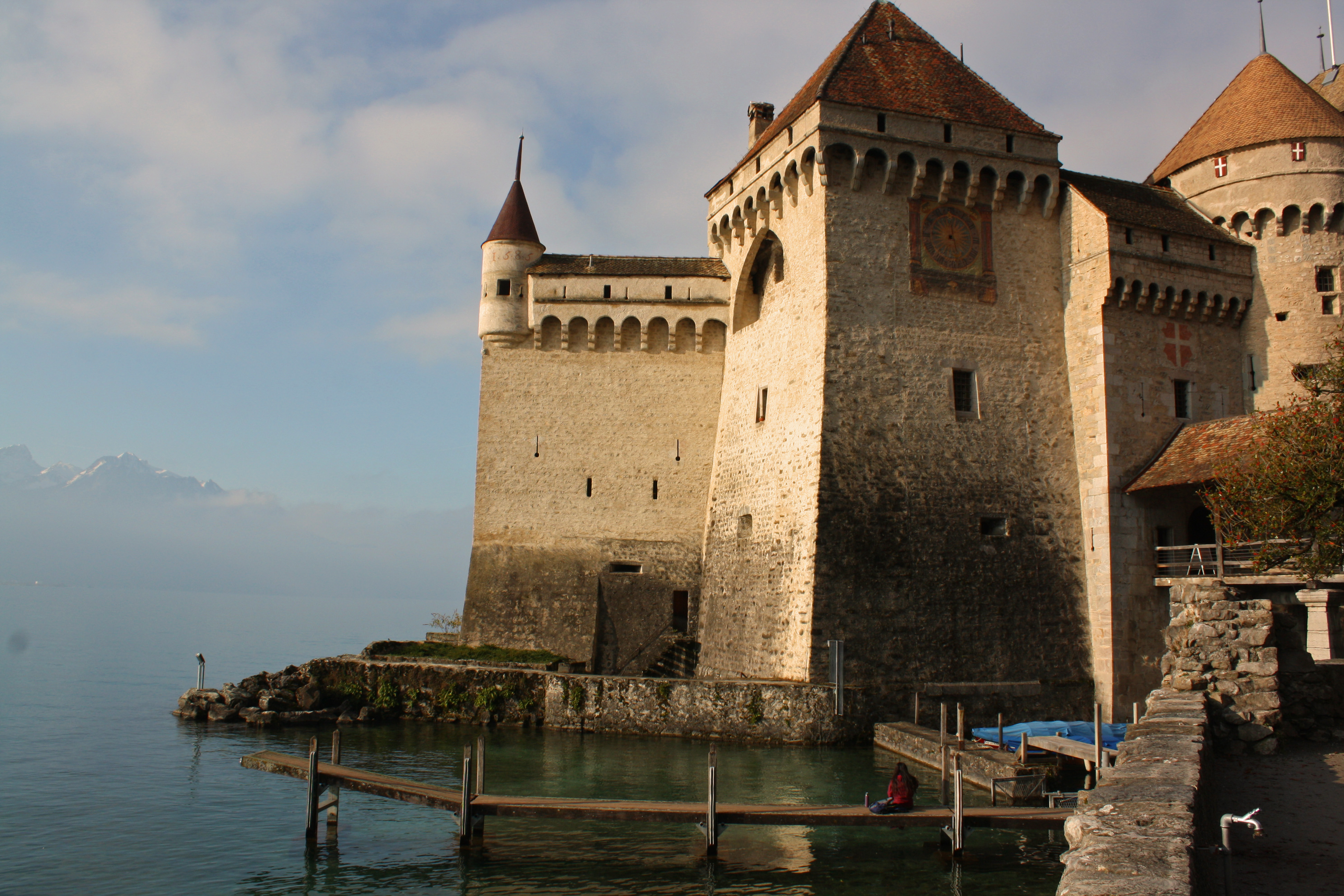
Chilean castle, Switzerland (photo by Nina Munteanu)
The Battle of Grunwald was, in fact, an upset in history. The Teutonic Order was powerful, intimidating and extremely capable. They should have won; but the peasant armies of Prussia slaughtered the Order, killing most of its knights. Historians debate that the hochmeister’s arrogance—indeed, the arrogance of the entire Order—precipitated their downfall. They underestimated their adversaries and got sloppy. After the Polish and Lithuanian armies outsmarted the Order and slayed their hochmeister, along with most of their knights, the Order’s own peasant slaves finished the job using clubs, pitchforks and stones.
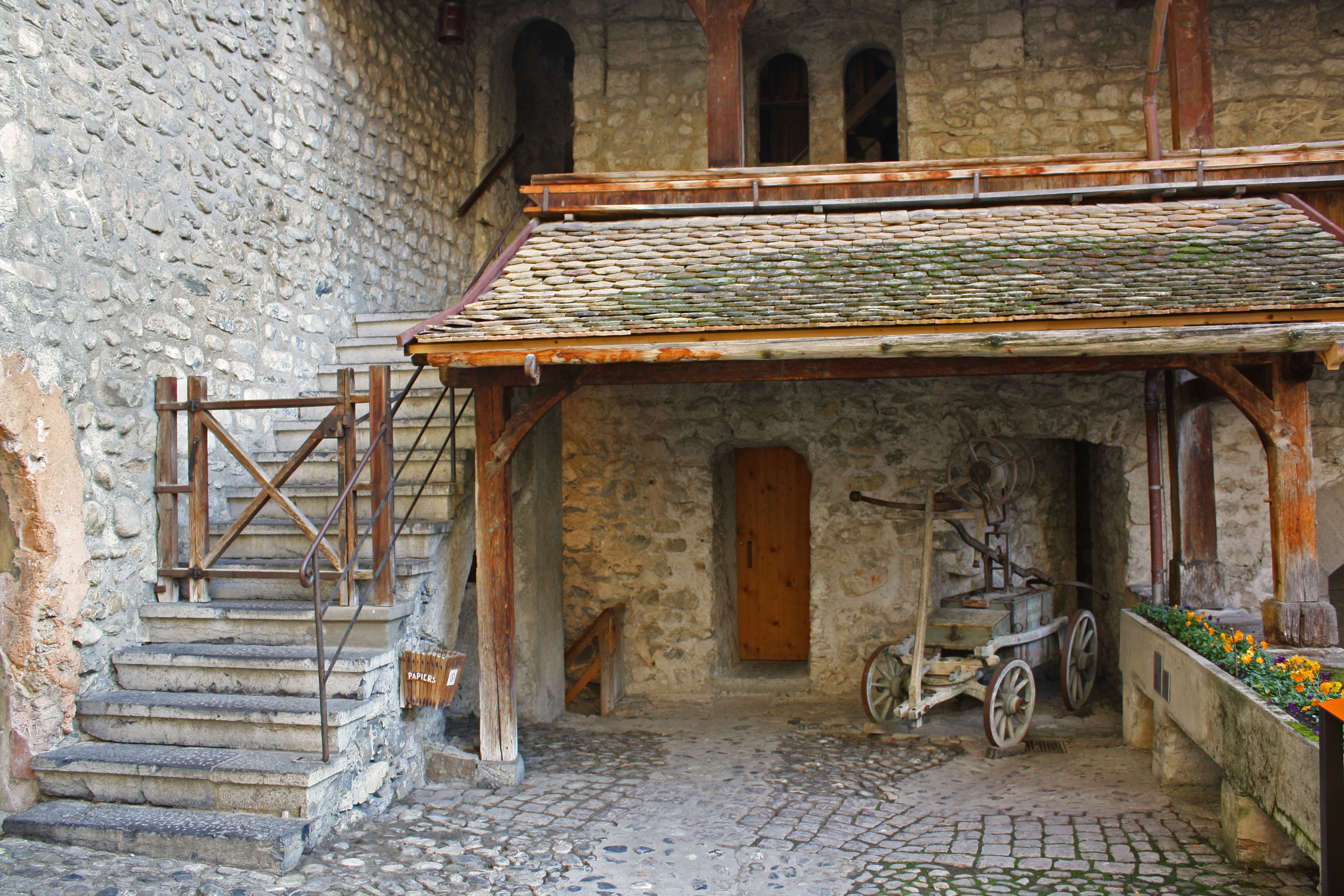
Courtyard at Chillon Castle, Switzerland (photo by Nina Munteanu)
Intrigued by this lessor known order of religious crusaders, I pursued the premise of an alternative consequence: what if the Teutonic Knights had NOT underestimated their enemy and won the Battle of Grunwald? Would they have continued their catastrophic sweep of Northeast Europe into Russia and beyond? Would they have claimed the whole for Germany’s expansionist lebensraum movement, fueled by its sonderweg, a dialectic that would ultimately lead to the killing fields of the Holocaust? What if the success of the Teutonic Order helped consolidate a united fascist elite, ambitious to conquer the world?
And what if, as a result, Nazism sprang up 100 years earlier? The Last Summoner, arose from this premise.
I’d already conceived a heroine: a self-centered romantic noblewoman who has a vision of a knight in a drowned cathedral. Fourteen-year old Vivianne Schoen, Baroness von Grunwald, dreams that her ritter will rescue her from the drudgeries of her duties and an arranged marriage to some foreign warrior. When she discovers that her intended is a cruel and abusive mercenary, Vivianne makes a bold and impetuous choice that results in a startling discovery that she can alter history—but not before she’s branded a witch and must flee through a time-space tear into a alternate present-day Paris, now ruled by fascists. There, in present-day Paris she learns that every choice has its price. She meets François, a self-serving street kid who tries to monetize her and her gear but then falls for her anachronistic charm.
 I originally wrote the Paris section in Vivianne’s point of view, but it seemed flat with too obvious fish-out-of-water observations. I let the book sit, while I conducted more research on Paris, and then it came to me: give the narrative to François. This part of the book was his story. By giving François the only POV, I also gave his character agency to react and change to Vivianne’s role as “catalyst hero.” I rewrote this section, starting with François fleeing from a street crime he’d committed, when Vivianne literally appears and knocks him down. She then sweeps him up in a high-stakes chase that will change his worldview. When Vivianne returns to 1410 Poland in the last section of the book, her great journey of self-discovery and atonement begins.
Spanning from medieval Poland to present day Paris, France, The Last Summoner explores the sweeping consequences of our “subtle” choices. From the smallest grab to the most sweeping gesture, we are accountable for the world we’ve made. During her 600-year journey to save the world and undo the history she authored, Vivianne learns wisdom and humility. Through the paradox of history, she learns that what might have seemed the right choice for an immediate future, turns out to be disastrous for a distant future. To win is also to lose; to save oneself one must surrender oneself; and to save the world one need only save a single soul.
The knight standing in the drowned cathedral is Vivianne.
The Last Summoner, published by Starfire World Syndicate, was released in 2012 and remained a Canadian bestseller on Amazon for several months. It represents my first historical fantasy in an otherwise repertoire of hard science fiction. The cover of the book is indeed the original image that had inspired the book in the first place; and was kindly acquired by my publisher. The Polish and Lithuanians celebrate June 14th with pride, erecting mock-ups of the battle annually. Some day I hope to participate.
References:
DeSalvo, Louise. 2014.”The Art of Slow Writing”. St. Martin’s Griffin. New York, NY. 306pp.
Munteanu, Nina. 2012. “The Last Summoner”. Starfire World Syndicate.
 Nina Munteanu is a Canadian ecologist and internationally published author of award-nominated speculative novels, short stories and non-fiction. She is co-editor of Europa SF and currently teaches writing courses at George Brown College and the University of Toronto. Visit www.ninamunteanu.ca for the latest on her books.



 How many of you are still running around preparing for the Christmas celebration or secular family festivity? Buying that last minute gift you’d forgotten or were chasing down since a bazillion days ago? Or making last minute changes to your travel plans, house-cleaning for guests, mailing of cards or parcels or meal preparations?
 My male cat, smelling fresh from outside, found his rightful place on my lap and settled there, pinning me down with love. And there, as I breathed in the scent of wax and fir and cat I found myself again.
 At Calgary’s When Words Collide this past August, I moderated a panel on Eco-Fiction with publisher/writer Hayden Trenholm, and writers Michael J. Martineck, Sarah Kades, and Susan Forest. The panel was well attended; panelists and audience discussed and argued what eco-fiction was, its role in literature and storytelling generally, and even some of the risks of identifying a work as eco-fiction.
 I submit that if we are noticing it more, we are also writing it more. Artists are cultural leaders and reporters, after all. My own experience in the science fiction classes I teach at UofT and George Brown College, is that I have noted a trend of increasing “eco-fiction” in the works in progress that students are bringing in to workshop in class. Students were not aware that they were writing eco-fiction, but they were indeed writing it.
 Just as Bong Joon-Ho’s 2014 science fiction movie Snowpiercer wasn’t so much about climate change as it was about exploring class struggle, the capitalist decadence of entitlement, disrespect and prejudice through the premise of climate catastrophe. Though, one could argue that these form a closed loop of cause and effect (and responsibility).
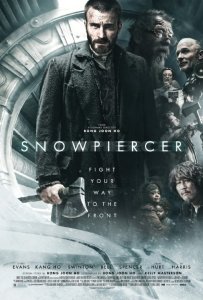 The self-contained closed ecosystem of the Snowpiercer train is maintained by an ordered social system, imposed by a stony militia. Those at the front of the train enjoy privileges and luxurious living conditions, though most drown in a debauched drug stupor; those at the back live on next to nothing and must resort to savage means to survive. Revolution brews from the back, lead by Curtis Everett (Chris Evans), a man whose two intact arms suggest he hasn’t done his part to serve the community yet.
 In my latest book Water Is… I define an ecotone as the transition zone between two overlapping systems. It is essentially where two communities exchange information and integrate. Ecotones typically support varied and rich communities, representing a boiling pot of two colliding worlds. An estuary—where fresh water meets salt water. The edge of a forest with a meadow. The shoreline of a lake or pond.
 Nina Munteanu is an ecologist and internationally published author of award-nominated speculative novels, short stories and non-fiction. She is co-editor of Europa SF and currently teaches writing courses at George Brown College and the University of Toronto. Visit
 Flight Behavior
 The Three Body Problem
 Boiling Point
 Memory of Water
 Quantum Night
 The Year of the Flood
 Freenet
 Silent Spring
 Far from the Madding Crowd
 Martian Chronicles
 Fahrenheit 451
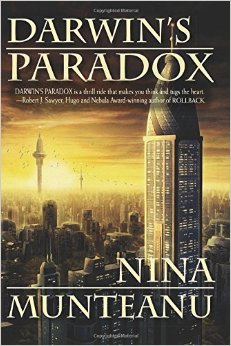
 Darwin’s Paradox
 Night Country
 Pilgrim at Tinker Creek
 2017 Novel & Short Story Writer’s Market



 I mentioned that the majority of my stories are science fiction (SF). SF is a literature of allegory and metaphor and deeply embedded in culture. It draws me because it is the literature of consequence exploring large issues faced by humankind. In a February 2013 interview in The Globe and Mail I described how by its very nature SF is a symbolic meditation on history itself and ultimately a literature of great vision: “Speaking for myself, and for the other women I know who read science fiction, the need is for good stories featuring intelligent women who are directed in some way to make a difference in the world…The heroism [of women] may manifest itself through co-operation and leadership in community, which is [often] different from their die-hard male counterparts who want to tackle the world on their own. Science fiction provides a new paradigm for heroism and a new definition of hero as it balances technology and science with human issues and needs.”
 We’ve progressed from the biological to the mechanical to the purely mental, from the natural world to a manufactured world to a virtual world, writes philosopher and writer Charles Eisenstein. According to Carolyn Merchant, professor at UC Berkley, early scientists of the 1600s used metaphor, rhetoric, and myth to develop a new method of interrogating nature as “part of a larger project to create a new method that would allow humanity to control and dominate the natural world.”
 Competition is a natural reaction based on distrust—of both the environment and of the “other”—both aspects of “self” (as part) separated from “self” (as whole). The greed for more than is sustainable reflects an urgent fear of failure and a sense of being separate. It ultimately perpetuates actions dominated by self-interest and is the harbinger of “the Tragedy of the Commons”.
 Examples of creative cooperatives exist throughout the world, offering an alternative to the traditional model of competition. Cultural creatives are changing the world, Ruche tells us. These creatives, while being community-oriented with an awareness of planet-wide issues, honor and embody feminine values, such as empathy, solidarity, spiritual and personal development, and relationships. Mechanisms include reciprocity, trust, communication, fairness, and a group-sense of belonging. I give examples in my upcoming book “Water Is…” by Pixl Press, due in Spring 2016.