“Gaia’s Revolution”, Life After Capitalism: Will the Environment—And We Along With It—Survive?…

“Bourgeois society stands at the crossroads, either transition to socialism or regression into barbarism.”—Rosa Luxemburg, 1915

I wrote my first novel in 1969 when I was fifteen. Caged in World was a hundred-page speculative story about a world that had moved “inside” to escape the ravages of a post climate-change environment. It would later become Book 2 of The Icaria Trilogy. I was already disillusioned with my world. I saw how corporations and governments and society in general—individuals around me—‘othered’ the environment by either treating it with disrespect and apathy or outright ignoring it in a kind of torpor of obliviousness. As though it didn’t exist.

I remember being chastised by a school teacher for thinking globally about what was happening to the planet at our hands: worldwide deforestation (e.g., clearcutting the old-growth forests of Canada), infilling saltwater and freshwater marshes, massive use of pesticides and fertilizers, contamination of lakes, unregulated mining and toxic pollution, and ultimately climate change. Stick to local concerns, he advised me; recycling and such.

I remember wondering if I was just being weird. That my odd sensibility for the planet-entire was just a nina-thing. I prayed that I was not alone and it wasn’t just a nina-thing.

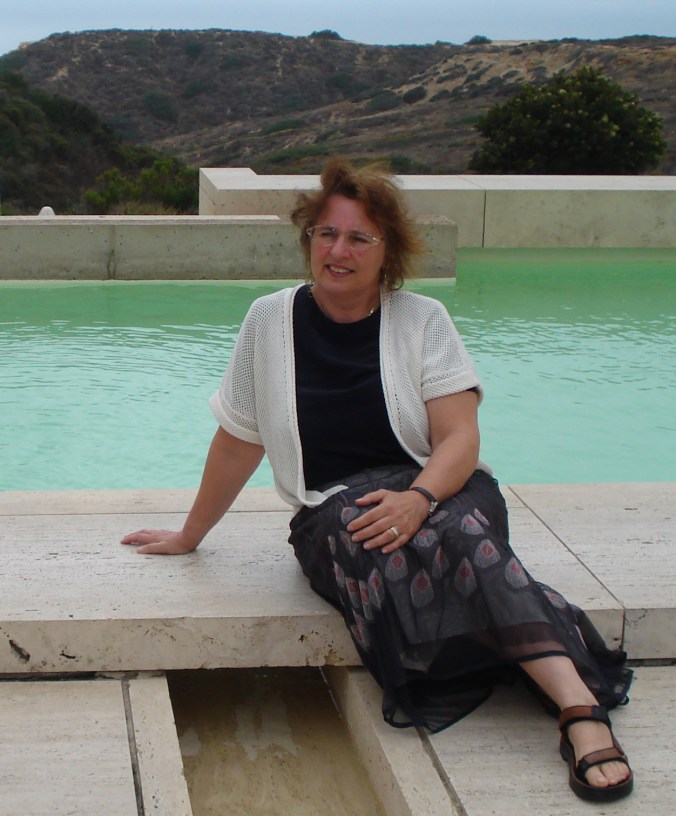
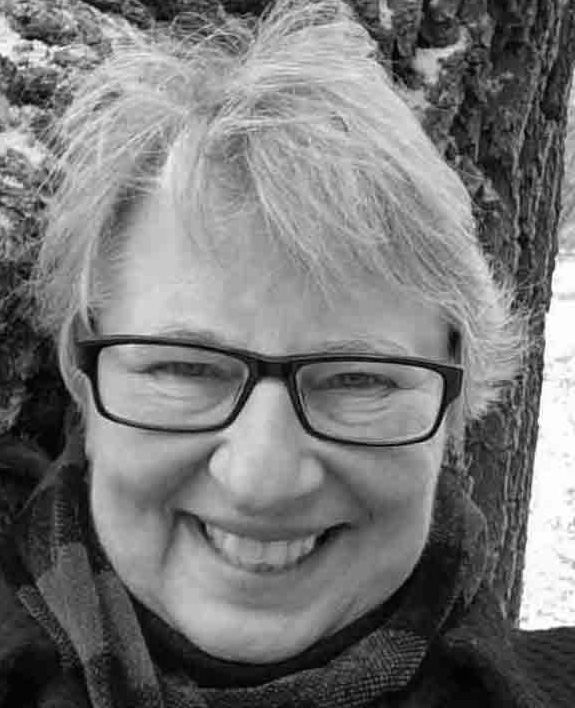
(Photo: Nina Munteanu, Salk Institute, California)

For a description of how the books of the trilogy came to be (for instance, they were published in backward order!) see my article entitled “Nina Munteanu Reflects on Her Eco-Fiction Journey at Orchard Park Secondary School”.

Throughout high school and university, I read scientific papers, news articles and books on revolution. I became a student of climate change long before the term entered the zeitgeist. I studied industrial capitalism and its roots in neoliberalism and colonialism. I noted how the post-war expansion of capitalism shifted from Fordist mass production to flexible automation, technology and AI. I saw the rise of multinational corporations, income inequality, and the commodification of everything—from water to human beings (Foucault’s homo economicus).

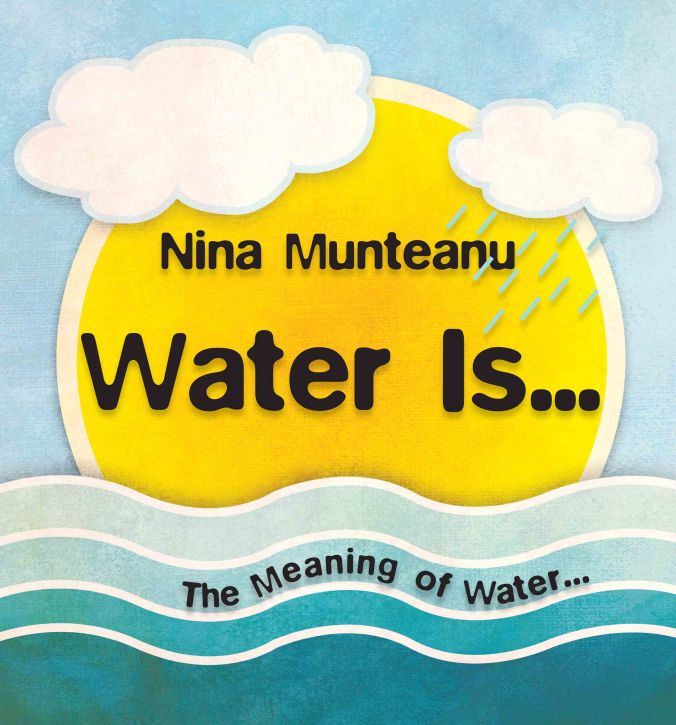
I pursued a university degree in ecology and limnology to study and help protect the environment and educate industry and their governments in the process. I became an expert on water. See my book Water Is…The Meaning of Water, which celebrates water from twelve perspectives (and got a shout out from Margaret Atwood!).
I soon concluded that a hegemony that follows the economic system of late capitalism inevitably commodifies and ‘others’ with ruthless purpose. Once something (or someone) is commodified, they are given a finite value and purpose outside their own existence. They become an object, a symbol to use and trade. They become a resource to manipulate, exchange, and dispose of with impunity. And through this surrender to utility, they become ‘othered.’ The consumer. The trees of the forest. Water. Homo sacer*. Each has a role to play in the late capitalist narrative of digital abundance and physical scarcity.

Capitalism hasn’t been kind to the environment. Economic pundits and sociologists insist that Capitalism is devolving. But what will replace it? Cloud capital? Technofeudalism? Something else?

Deep Ecology* & Gaia’s Revolution

The Icaria Trilogy (Dragon Moon Press)

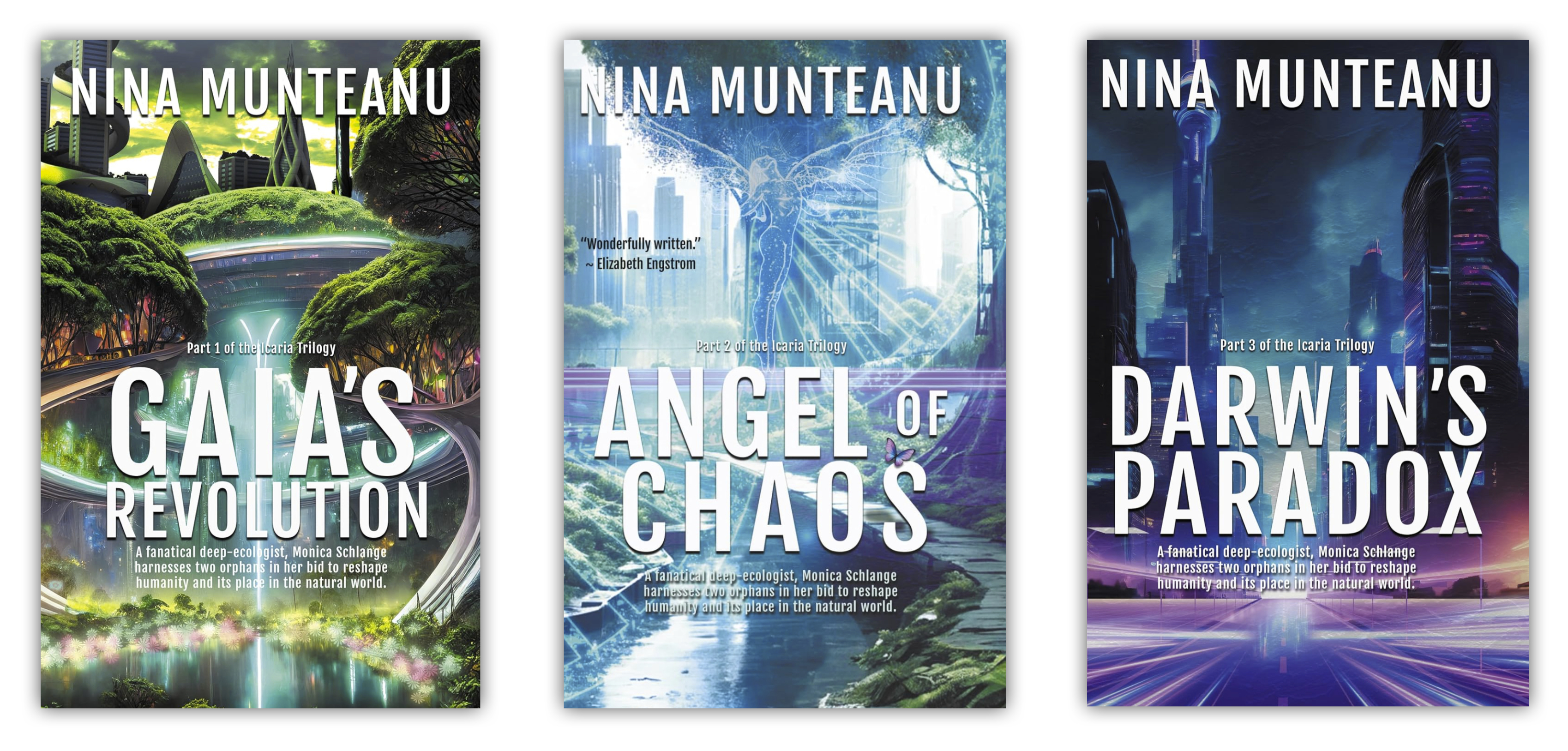
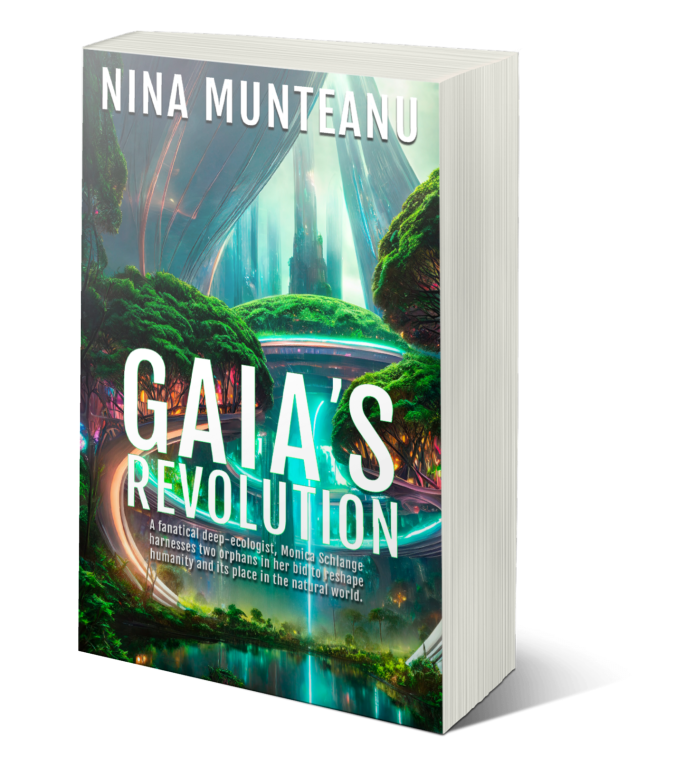
My three Icaria novels—starting with Gaia’s Revolution, (the first of The Icaria Trilogy, releasing March 10, 2026, by Dragon Moon Press)—chronicle the collapse of a capitalist society in Canada as climate change, water shortages, habitat destruction, plague and a failing technology devastate the Canadian population.

Gaia’s Revolution (Book 1 of The Icaria Trilogy) explores a transition in Canada from semi-socialized capitalist system to a technocratic* meritocracy of technologists and scientists. Triggered by catastrophic environmental and sociological tipping points and following violent revolution, a dictatorship of deep ecologists* called Gaians seize power. By the end of the book, enclosed cities called Icarias* now populate North America. Separated from their environment, humans now live inside domes protecting them from a hostile and toxic environment.

In truth, the deep ecologists are keeping people “inside” not to protect humanity from a toxic wasteland but to protect the environment from a toxic humanity.

How realistic is this vision? Well, it is science fiction, after all, and though it takes liberties with its narrative, it is science-based and ultimately draws on precedent. As Margaret Atwood so astutely attested of her cautionary SF book The Handmaid’s Tale: “I didn’t put in anything that we haven’t already done, we’re not already doing, we’re seriously trying to do, coupled with trends that are already in progress.”

Science fiction is itself powerful metaphor; it is the fiction of political and social allegory or satire and makes astute social commentary about a world and civilization: how it has come to be, how it works—or doesn’t—and how it may evolve.

So, it is visionary and predictive? I prefer to think as Ray Bradbury:

“The function of science fiction is not only to predict the future, but to prevent it.”–Ray Bradbury

Jackson Creek in winter, ON (photo and rendition by Nina Munteanu)

References:

Angus, Ian. 1012. “The Spectre of 21st Century Barbarism.” Climate & Capitalism, August 20, 2012.

Atwood, Margaret. 2004. “The Handmaid’s Tale and Oryx and Crake ‘In Context'”. PMLA119 (3): 513–517.

Atwood, Margaret. 2018. “Margaret Atwood on How She Came to Write The Handmaid’s Tale”Literary Hub. April 25, 2018.

Bradbury, Ray. 1991. “Yestermorrow: Obvious Answers to Impossible Futures” and “Beyond 1984: The People Machines” by Ray Bradbury, dated 1982, Page 155, Joshua Odell Editions: Capra Press, Santa Barbara, California.

Foucault, Michel. 2010. “The Birth of Biopolitics (Naissance de la biopolitique): Lectures at the Collège de France, 1978-1979.” Picador. 368pp.

Luxemburg, Rosa. 1915. “The Junius Pamphlet: The Crisis in the German Democracy”, Marxist.org.

Munteanu, Nina. 2026. “Gaia’s Revolution, Part 1 of Icaria Trilogy.” Dragon Moon Press, Calgary, AB. 369 pp.

Munteanu, Nina. 2010. “Angel of Chaos, Part 2 of Icaria Trilogy.” Dragon Moon Press, Calgary, AB. 518 pp.

Munteanu, Nina. 2007. “Darwin’s Paradox, Part 3 of Icaria Trilogy.” Dragon Moon Press, Calgary, AB. 294 pp.

Neuman, Sally. 2006. “‘Just a Backlash’: Margaret Atwood, Feminism, and The Handmaid’s Tale“. University of Toronto Quarterly75 (3): 857–868.

Sessions, George, Bill Devall. 2000. “Deep Ecology: Living as if Nature Mattered.” Gibbs Smith. 267pp.

Skinner, B.F. 1948. “Walden Two” The Macmillan Company, New York. 301pp.

Streeck, Wolfgang. 2014. “How Will Capitalism End?” New Left Review 2 (87): 47p.

Terminology:

*Deep Ecology: An environmental philosophy and social movement advocating that all living beings have intrinsic value, independent of their utility to human needs. Coined by Arne Næss in 1972, it promotes a holistic, ecocentric worldview—often termed “ecosophy”—that demands radical, structural changes to human society to prioritize nature’s flourishing.

*Homo sacer: a figure from Roman law denoting a person excluded from society who is outside human law (can be killed) and divine law (cannot be sacrificed). The term represents “bare life”: stripped of political rights, legal protection, and social value. Philosopher Giorgo Agamben popularized the term to describe individuals excluded from the political community, such as refugees, stateless persons, or camp detainees. The term illustrates the power of a sovereign in deciding which lives are worthy of protection and which are not.

*Icaria: the name of Étienne Cabet’s utopia. Cabet was a French lawyer in Dijon, who published his novel Voyage en Icarie in 1839. The novel was a sort of manifesto-blueprint of utopian socialism, with elements of communism (abolished private property and individual enterprise), influenced by Fourierist and Owenite thinking. Key elements, such as the four-hour work day, are reflected in B.F. Skinner’s Walden Two. Cabet’s novel explores a society in which capitalist production is replaced by workers’ cooperatives with a focus on small communities.

*Letzte Generation: a prominent European climate activist group, founded in 2021, known for its acts of civil disobedience—such as roadblocks, defacing art, and vandalizing structures—to pressure governments on climate action. The term was chosen because they considered themselves to be the last generation before tipping points in the earth’s climate system would be reached. They are mostly active in Germany, Italy, Poland and Canada. In Germany, they have faced accusations of forming a criminal organization, leading to police raids.

*Technocracy: A form of government in which the decision-maker(s) are selected based on their expertise in a given area; any portion of a bureaucracy run by technologists. Technocracies control society or industry through an elite of technical experts. The term was initially used to signify the application of the scientific method to solving social problems.

Nina Munteanu is an award-winning novelist and short story writer of eco-fiction, science fiction and fantasy. She also has three writing guides out: The Fiction WriterThe Journal Writer; and The Ecology of Writing and teaches fiction writing and technical writing at university and online. Check the Publications page on this site for a summary of what she has out there. Nina teaches writing at the University of Toronto and has been coaching fiction and non-fiction authors for over 20 years. You can find Nina’s short podcasts on writing on YouTube. Check out this site for more author advice from how to write a synopsis to finding your muse and the art and science of writing.

Movie Review: The Creator

Nirmata: n.1 [Nepalese for ‘the Creator’] The mysterious unknown architect of advanced AI; 2 A being worshipped by Artificial Intelligence as their creator; savior; God.

I just re-watched The Creator, a visually stunning science fiction thriller by Gareth Edwards that explores our sense of humanity through our relationship with AI as ‘other.’

Shot in over sixty locations in Southeast Asia, including Cambodia, Indonesia, Japan, and Nepal, the film feels familiar and alien at the same time; it does this by seamlessly combining the gritty realism of a war-torn Vietnam documentary with the glossy pastiche of near-future constructs and vehicles—to the extent that one is convinced this was filmed in a world where all these things really exist together. The effect is stunning, evocative and surprising. I was reminded of the detailed set pieces and rich cinematography of Ridley Scott (The Duelists, Bladerunner, Alien).

At its core, The Creator is about a man who gives up everything to defend a child who is different (she is a simulant run by AI).

Artificial Intelligence (AI) is not a new concept in science fiction*; however, The Creator elegantly tells a story with a unique—and subversive—perspective on this topic.

The film opens with 1950s-esque advertising footage for robot helpmates including conventional robots and AI humanoid simulants who look and act human. Then disaster hits: LA is nuked and the AI are blamed for it. Now fearing them, the Western world has banned all AI; however New Asia has continued to develop the technology, achieving sophisticated simulants—posthumans in effect—who are fully integrated with the human culture and spirituality and live in harmony with them. Americans, bent on exterminating all AI, use guerrilla warfare techniques to infiltrate New Asia and destroy any AI using ground teams deployed and helped by a giant airborne surveillance / defence station called U.S.S. NOMAD. News of a sophisticated new AI superweapon created by an unidentified genius called Nirmata to take down NOMAD sends them on a new mission, which brings Joshua (John David Washington) back from PTSD ‘retirement’ to help locate and destroy both Nirmata and the superweapon.

Alphie (Madeleine Yuna Voyles) pacifies an enemy robot (image from “The Creator”)

Joshua finds the superweapon: a 6-year old child, Alphie (Madeleine Yuna Voyles), who is both innocent and quietly powerful. Although Joshua’s prime directive is to destroy the superweapon, he finds that he cannot kill this child whose human traits involuntarily tug at his heart’s compassion.

Joshua (John David Washington) defends the child-weapon (image from “The Creator”)

The story is in fact a simple one. Its genius lies in an immersive showing and telling at many levels. At the socio-political level, the film uses obvious metaphors of racism and imperialistic ableism to make commentary on America’s jingoistic air of entitlement. The film can easily be interpreted as an allegory for Western imperialism and America’s rationale for the invasion of Iraq (or Vietnam) with a conclusion of the futility of war. At the individual level, the question of identity and the reduction of some (e.g. immigrants or of another race) as “other” or “homo-sacer,” to gain power and wealth, are explored through the interactions, relationships, and prejudices of humans with the simulants and robots. It is at the individual story level that this film tugged my heartstrings as I followed the journey of Joshua and Alphie, how they as initial combatants having made a deal to survive, grow to care and love one another. Musanna Ahmed of The Upcoming shares that “this was expected from Edwards … [in achieving] beautiful character work and sense of intimacy against an epic backdrop.”  When an idea-driven story of large dimensions is told at the intimate personal level, pathos and understanding emerges.  

A robot defends the escape boat (image from “The Creator”)

Gareth Edwards shared that the film contained fairy tale aspects of the “Hero’s Journey” of two main characters, Joshua and Alphie, each on a journey: he to find redemption through love of the ‘other’; she to find her place in the world and to find freedom and peace for her kind and all others. She is the catalyst hero and he the main protagonist.

“A reluctant father figure must help a child through the metaphorical woods to find his wife [and her mother]. What he wants is love from his wife. But what he really needs is to love this child.” As for what Alphie both wants and needs, this is something she first shares in a humorous scene: when Kami asks her what she wants (from the kitchen), Alphie naively responds “for robots to be free.” She is stating the point of the movie: that everyone, no matter how different, is worthy of compassion.

Early on in the film, Joshua reassures a co-worker distressed by a robot’s desperate plea to save it from the crusher that “they’re not real…they don’t feel… it’s just programming.” When Joshua, who admits he’s bad, forces Alphie to help him find his wife, Alphie sums up both their scenarios with a child’s wisdom: “Then we’re the same; we can’t go to heaven because you’re not good and I’m not a person.”

Americans attack a village in New Asia (image from “The Creator”)

Several reviewers criticized how the film’s epic setting seemed to overshadow and compromise the heart of the story, the personal drama of man and child. While I would agree that many action thrillers do this, I did not feel this was the case with The Creator. This is because—as with Ridley Scott’s intricate immersive environment—The Creator integrates place with theme to create more than one-dimensional drama. In The Creator, place is also character, playing a key role in the telling of this very different story about AI as ‘other’ and how we treat the ‘other.’ This is also why film locations and scene choreography are so important. Each scene and place is diligently choreographed to further illuminate a story of multi-layered meaning, such as authentic scenes of village life where AI is seamlessly integrated with human existence.      

Colonel Howell (Alison Janney) gets captured by New Asia police (image from “The Creator”)

Several critics have accused the film of being derivative, of copying previous tropes or actual scenes from several well-known movies. Indeed, when I first watched it, I recognized tropes that seemed lifted in their entirety from another previous movie.

The scene, shot in Tokyo where Joshua and Alphie go to the city in search of Joshua’s friend, sounds and looks and feels just like Bladerunner with its whining oriental soundscape and dark futuristic yet gritty cityscape. And yet, its appropriateness to The Creator seems less like stealing than re-appropriation; as if to say, “this fits better here than where you’ve initially used it.”

Christy Lemire of RogerEbert.com proclaimed that the movie “ends up feeling empty as it recycles images and ideas from many influential predecessors … lumbers along and never delivers the emotional wallop it seeks because the characters and their connections are so flimsily drawn.” Jackson Weaver of CBC called The Creator “a voguish used-future action-thriller…a dull, simplistic fable with all the moral complexity of a fourth grader’s anti-bullying Instagram post…a story that has been done to death…boring.”

I couldn’t disagree more. I found these reviewers’ comparisons shallow and limited. While I recognized several familiar tropes, I believe they were meant to subvert and make commentary—sometimes on the trope itself. There is a strong immersive role in world building and backdrop, which creates its own sensual and many-layered narrative; a narrative that speaks more powerfully than dialogue: from a mere glance by Harun to a brief storytelling moment in a village to a child mourning the death of its cherished robot companion. Ridley Scott would appreciate its value.

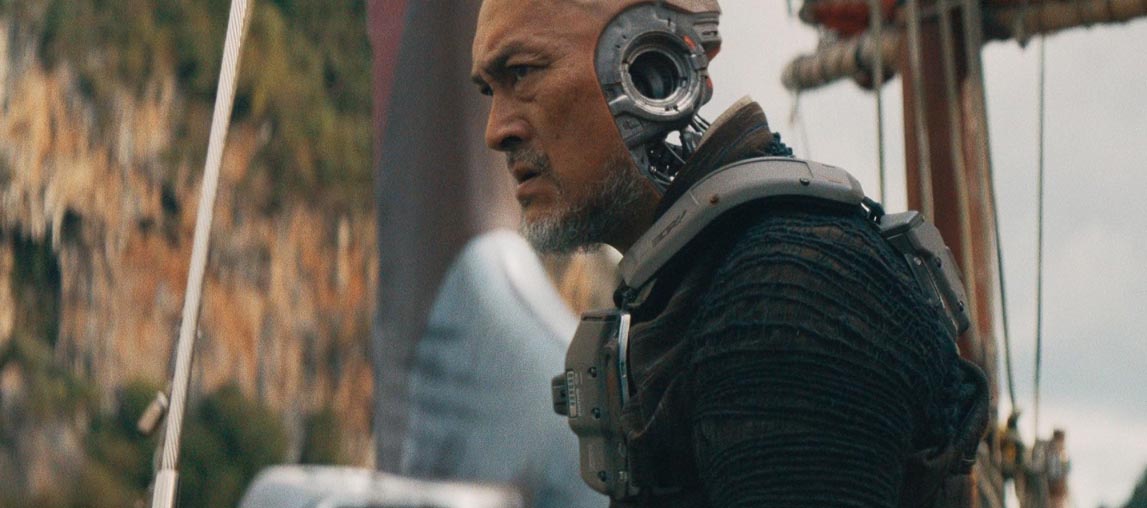
Harun (Ken Watanabe) on the escape boat, taking Alphie to safety (image from “The Creator”)

The Guardian’s Wendy Ide’s use of the word “original” for The Creator bares mentioning here; in declaring The Creator one of the finest original science-fiction films of recent years, Ide goes on to say: “It can be a little misleading, that word ‘original’, when it comes to science fiction. At its most basic, it just refers to any picture that isn’t part of an existing franchise or culled from a recognisable IP – be it a book, video game or television series. But very occasionally the word is fully earned, by a film so distinctive in its world-building, its aesthetic and its unexpected approach to well-worn themes that it becomes a definitive example of the genre. Films such as Neill Blomkamp’s District 9 (which shares an element of basic circuitry with this picture) or Alfonso Cuarón’s dystopian masterpiece Children of Men: both went on to become benchmarks by which subsequent science fiction was judged.”

In listing the various science-fiction standards The Creator riffs on, Alison Willmore of Vulture singles out one of the most poignant aspects of the film:

“The films The Creator turns out to have the strongest relationship with are ones about the Vietnam War, something made unmistakable by the early shots of futuristic hovercraft gliding over rice plants and the scenes of U.S. troops threatening weeping villagers at gunpoint. No longer able to buy into the message that they’re just doing what’s necessary for the salvation of humankind, Joshua finds himself adrift, fleeing through a war zone on impulse with a child destroyer in tow. The Creator may be an effective interrogation of American imperiousness and imperialism, but it also has a tender, anguished heart.”

NOMAD approaches a New Asia temple (image from “The Creator”)

Other notable TV shows and movies about artificial intelligence and robots include: A.I.; Ex Machina; I, Robot; Bladerunner; Better than Us; The Matrix; I am Mother; The Terminator; Transcendence; and Automata.

Nina Munteanu is a Canadian ecologist / limnologist and novelist. She is co-editor of Europa SF and currently teaches writing courses at George Brown College and the University of Toronto. Visit www.ninamunteanu.ca for the latest on her books. Nina’s bilingual “La natura dell’acqua / The Way of Water” was published by Mincione Edizioni in Rome. Her non-fiction book “Water Is…” by Pixl Press (Vancouver) was selected by Margaret Atwood in the New York Times ‘Year in Reading’ and was chosen as the 2017 Summer Read by Water Canada. Her novel “A Diary in the Age of Water” was released by Inanna Publications (Toronto) in June 2020.