.
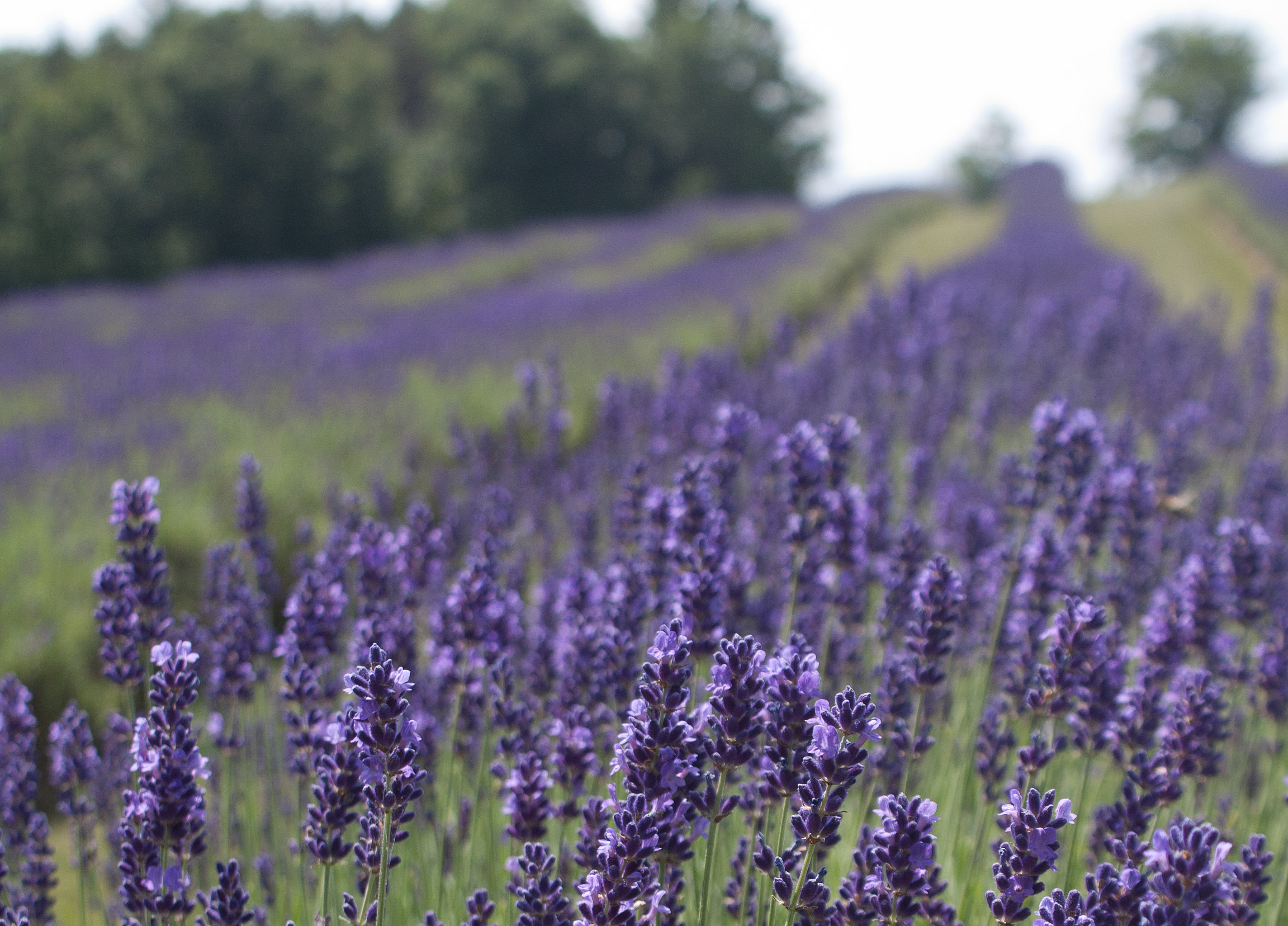
Two years ago on this day, I tracked down Laveanne the lavender farm I’d heard about near Campbellcroft, Ontario. I’d seen the sign somewhere and just had to remind myself where that was. It was a sunny hot day in July and I was ready for adventure. My memory served me well and in no time I was driving east on Country Road 9 (Ganaraska Rd.) from Highway 28. The turn off to Gilmour Rd. came soon, well signed, and I was eventually driving a road that more resembled a lane until I arrived at the purple fields of the farm.
The 1.6 hectare family-run farm was started by partners Sabena and Gary in 2013 and now includes a lovely outdoor café and gift shop offering a wide diversity of lavender-related products. You can also buy a lavender plant from their nursery. When I asked her about the name they chose—Laveanne—for their enterprise, she explained: “lkjlkjlkjl”
I came to experience the lavender fields; so, relegating the café and gift shop for later, I set out into the undulating aromatic fields. As I inhaled a complex mixture of alluring mystery, I felt like I was entering some paysage Provençal painted by Annie Rivière, embraced by an arcane beauty of colour and scent and sound that conspired into an abiding sense of calm and joy.

.
The Smell of Lavender
The aroma was subtle yet lingered as I walked the four acres of lavender, along stubby rows of deep purple that snaked up and into a rolling horizon. It was early enough for many of the flowers to still be in bud, displaying an intensely deep purple. This colour grows brighter as more flowers burst into bloom later in the month, attracting more and more honeybees. I was in a kind of aromatic heaven, accompanied by the constant hum of honeybees buzzing from flower to flower and the occasional flutter of a Red Admiral butterfly, flashing its bright blue-orange wings as it stopped briefly to gorge on the lavender’s nectar. The scent was an airy symphony of sweet floral with herbal, camphor-like woodsy undertones. I detected the mildest hint of rosemary and coriander.
.

.
I’m told that lavender’s aroma comes mainly from linalool and linalyl acetate, both part of the terpene family. Linalool, which helps repel mosquitos, is widely used in fragrances as well as many personal care products and aromatherapies. This terpene also found in mint, cinnamon, coriander, and citrus fruits; it is the chief chemical responsible for the recognizable spicy floral smell of marijuana (the skunky smell of cannabis is from another terpene, myrcene). Linalool is of course known for its calming and soothing effects. It reduces stress and anxiety, helps relax the body and enhance sleep quality, and helps provide relief from pain and inflammation. Two other terpenes, 1,8-cineole and camphor add some hint of scent as well as having insecticidal and repellent properities (such as repelling moths). These terpenes are also found in rosemary, hence the hint of rosemary scent in lavender. I’m told that over 300 compounds exist in lavender’s essential oil, though not all contribute to aroma. Two enantiomers of linalool include the enantiomer licareol, responsible for the scent of lavender, and the enantiomer coriandrol, also found in coriander seed oils and sweet orange flowers.
.
Lavender Labyrinth

.
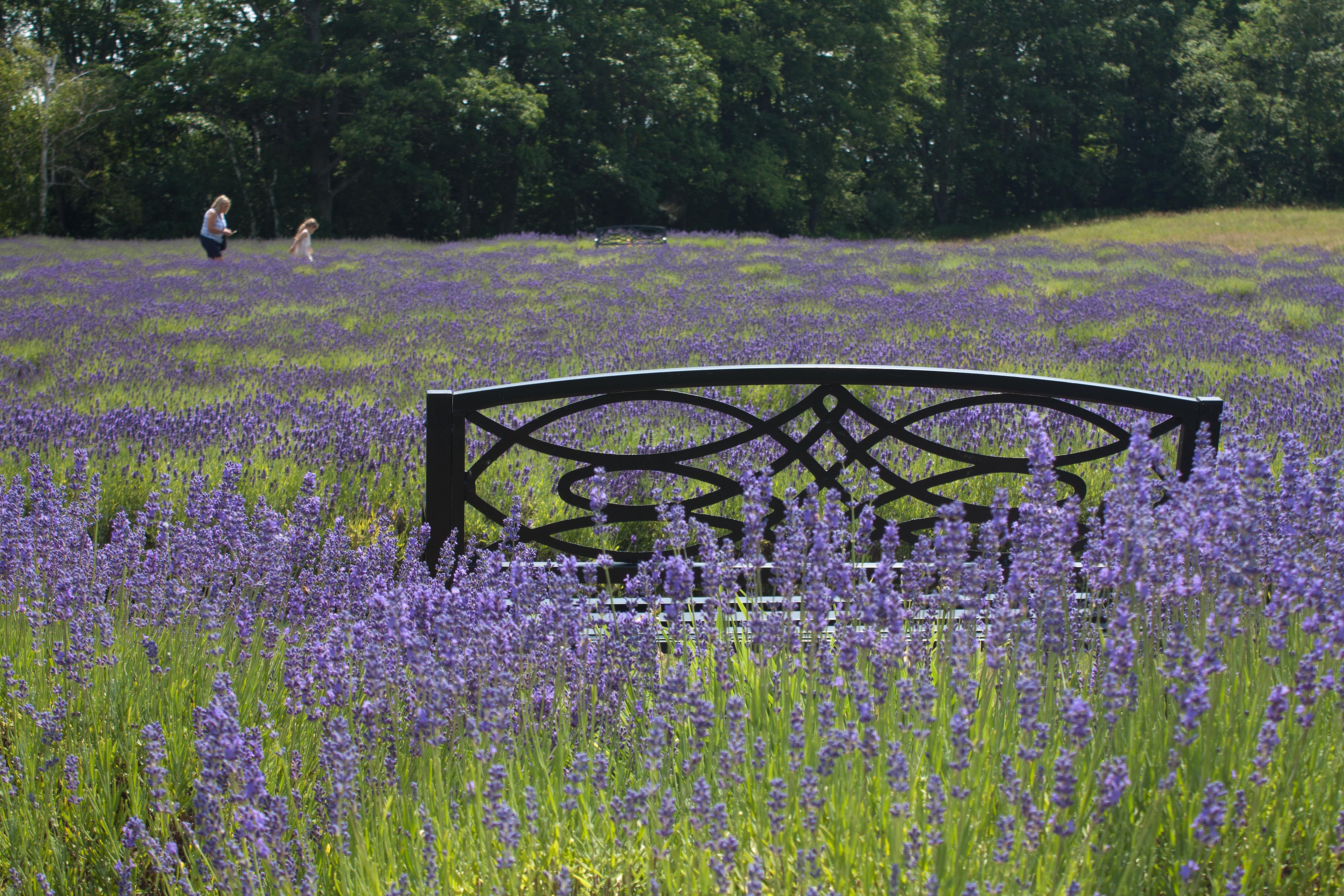
In the middle of the field I even found an over 30 metre diameter nine circuit modified Neo-Medieval labyrinth. Laveanne tells us that labyrinths are designed following sacred geometry and, unlike mazes that are built to challenge and confuse, are designed for meditation and relaxation. I walked the Reflection Labyrinth, among aromatic lavender and buzzing bees, feeling very content and relaxed.
I asked Sabena about what got them started farming lavender and she related the story of her son’s herb business “Grow Tasty”, which started a lavender collection. It went from a private collection to a larger enterprise after they saw a brochure from a lavender farm in Quebec and, after visiting the farm, were inspired to start their own lavender farm.
.
.
Growing Lavender
Lavender is indigenous to the mountains of the Mediterranean region of western Europe. The plant spread rapidly to other parts of the world with travelers and by the sixteenth century, lavender was gracing English gardens. The first lavender plants made it to America with the European settlers. Lavender has been used medicinally for several millennia. It was used in ancient Egypt for mummification and Romans scented their public bathhouses with lavender. The name lavender comes from the Latin verb lavare—to wash.
High Country Gardens tells us that lavender “is known for its soothing, relaxing qualities and has been used to treat hyperactivity, insomnia, headaches, toothaches, sore joints, and rumbling digestive systems.” They add about early cleansing uses of lavender that “Early household use started with lavender strewn on the floors of castles and sick rooms as a disinfectant and deodorant. It was sold in bunches by street vendors and placed in linen closets as an insecticide to protect linens from moths.”
Sabena tells me that growing lavender successfully can be a challenge in Ontario. Given that lavender is not native to Ontario, it’s important to make it comfortable here. All species of lavender are sun lovers. These semi-woody and semi-evergreen perennials thrive in well-drained soil. They are drought tolerant and pest and disease resistant, but unless they are happy, they won’t do well. Summer pruning, after they have flowered, keeps them vigorous. They also need wind protection; being semi-evergreen makes them susceptible to windburn or drying out.
.
The Lavender Experience
At the outdoor café, which faces the fields, I treated myself to some lavender shortbread cookies with a refreshing lavender iced tea and sat to enjoy the glorious view.
Their shop offers a wonderful selection of lavender-infused products (from soaps to moisturizers, bath products to mists and essential oils), culinary goods such as spices and teas, as well as local jewelry and lavender treats. In the shop, I had to restrain myself, but managed to come away with a few prizes: homemade lavender shortbread cookies; lavender soap, and lavender essential oil.
.

.
Lavender Essential Oil
Leveanne’s essential oil is steam distilled from English lavender (Lavandula angustifolia), the preferred species for the oil’s healing properties and consists of a complex mixture of phytochemicals. Sebena mentions being inspired by René-Maurice Gattefossé, the father of modern aromatherapy, who widely experimented with English lavender oil in 1910 after he suffered severe burns in a laboratory experiment fire. Gattefossé found that the oil helped with so many body functions, the brain, nerves, paralysis, lethargy and rheumatism. He found it also effective in helping against stress, insomnia, headaches, acne, infections, and calming to skin irritations (burns, eczema). The oil also promotes healing and prevents scarring by stimulating the cells of a wound to regenerate more quickly. I keep my bottle handy and apply on wounds with good effect. Lavender essential oil is antibacterial, antifungal, antiseptic analgesic, anti-anxiety, antidepressant, calming, anti-inflammatory and an immune stimulant.
.

.

Nina Munteanu is a Canadian ecologist / limnologist and novelist. She is co-editor of Europa SF and currently teaches writing courses at George Brown College and the University of Toronto. Visit www.ninamunteanu.ca for the latest on her books. Nina’s bilingual “La natura dell’acqua / The Way of Water” was published by Mincione Edizioni in Rome. Her non-fiction book “Water Is…” by Pixl Press (Vancouver) was selected by Margaret Atwood in the New York Times ‘Year in Reading’ and was chosen as the 2017 Summer Read by Water Canada. Her novel “A Diary in the Age of Water” was released by Inanna Publications (Toronto) in June 2020.
 Nina Munteanu Writing Coach