Biohacking is an umbrella term comprising synthetic biology, DIY science, bodyhacking, and health optimization
Elsa Sotiriadis, synthetic biologist
Biohackers, currently streaming on Netflix, is a fast-paced techno-thriller created by Christian Ditter with synthetic biology at the very center of its intrigue. In the journal Science Dov Greenbaum describes the German show as “a fictional tale centred around the sociotechnological movement known as do-it-yourself (DIY) biology, in which amateurs, professionals, anarchists, and civic-minded citizens push the boundaries of mainstream biology.” Greenbaum describes the show’s main characters as “a wealthy biopharmaceutical executive, a group of medical students, a number of stereotypical biohackers, and a community of transhumanists intent on modifying their bodies for seemingly impractical endeavors.” The show stars Luna Wedler as Mia Akerlund and Jessica Schwarz as Professor Tanja Lorenz; but the real star of the show is biohacking: human enhancement or augmentation to improve health, performance, or well-being. Biohacking ranges from efforts to improve brain function to faster weight loss. Some are relatively safe to try at home; others may pose health risks. Among others, the show features glow-in-the-dark mice, gene-modded weed, underwater pills that extend your ability to hold your breath, and payment microchips in your hand.
Scientist in hazmat suit confronts Mia, the soul survivor of bioterrorism on a train to Berlin
Biohackers opens with a disturbing scene of bioterrorism on a train headed to Berlin. All passengers suddenly choke and fall unconscious—except for young med student Mia Akerlund, who tries to help and fails.*
From that explosive flash-forward scene, the show jumps back to two weeks prior, as college freshman Mia settles into Freiburg University’s prestigious medical school, and betrays a particular interest in synthetic biology, biohacking and genome editing. We soon learn that she is obsessed by celebrated professor and geneticist/entrepreneur Tanja Lorenz (who runs a biopharmaceutical company and has an entire building dedicated to her research with huge neon logo of her name). Both women are connected by a dark secret to do with Mia’s twin brother who mysteriously died when still a boy. Mia quickly gains a position working for Lorenz, which plunges her into the dangerous intrigue of illegal genetic experiences.
“The truth will set you free” inscribed on the collegiate building of Freiburg University
A touching reflection of Mia’s quest sits emblazoned on the front façade of the collegiate building, where she has her first class: in gold letters, is the inscription “Die Wahrheit wird euch frei Machen” (The truth will set you free) from the Gospel of John. Ironically, we soon realize that she is a purveyor of many secrets, including her own name.
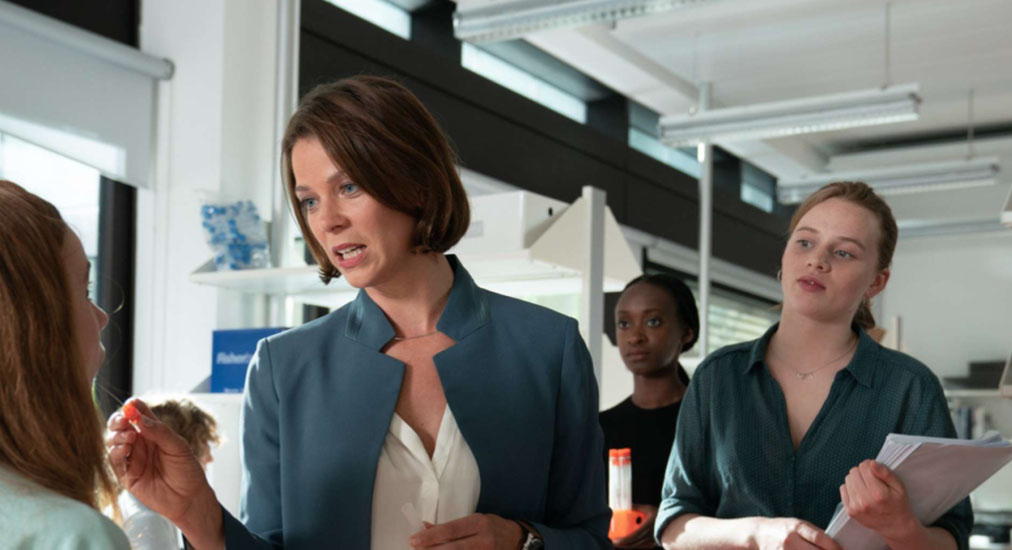
Lorenz lectures students
An early, rather enlightening, scene of the first episode is of Mia’s first introductory biology class given by celebrated gene therapy tycoon Professor Lorenz. Not only does the scene introduce the controversial subject of synthetic biology; it reveals a disturbing sense of what’s at stake and the danger of scientific hubris. Tall, svelte and confident in a smart haircut and tailored suit, Lorenz struts like a self-proclaimed goddess in front of a student-crowded lecture hall and preaches the benefits of synthetic biology. When she asks the class “What is synthetic biology?” and a student replies “with the help of synthetic biology, we can alter existing life forms or create new ones,” Lorenz prickles beyond her already frosty demeanor and impatiently berates the students for their lack of vision. She challenges them to think bigger: “Synthetic biology transforms us from creatures into creators. It’s not just the future of medicine, but of humankind. We can cease entire infections before the outbreak … We eliminate genetic disorders. But if we don’t do our work exceedingly well, it could end our species. It is on us to find a way; this is your future. Your responsibility. You are the creators of tomorrow. We make God obsolete…”
Lorenz obtains throat swab for DNA sequencing from a patient in a fertility clinical trial as Mia looks on
Mia uses Jasper (Adrian Julius Tillmann) one of Lorenz’s teaching assistants to get herself noticed and hired by Lorenz and we are soon introduced to the glossy Lorenz Excellence Centre, a prestigious biopharmaceutical firm. Mia also discovers that Lorenz keeps her illegally obtained DNA database and does illicit gene therapy work in a secret well-equipped lab in her home. Mia is after that database to prove what she fears is true.
Mia helps Jasper capture his glow-in-the-dark mouse, that had escaped in the library
The first season (of two) unravels an unconventional conspiracy plot delivered through slow-building suspense, using flashbacks and flash-forwards, until its cliffhanger ending. Science, academia and intrigue are skillfully woven in an intelligent mystery-thriller that not only represents science accurately but delivers commentary on the ethical and moral questions of this highly dynamic and rapidly evolving field of science.
Speaking of rapidly evolving field, I found it interesting that Dr. Lorenz makes note of this in one of her lectures in the show; after singling out Mia for relying on sources other than the textbook to solve a problem, Lorenz literally trashes the textbook in front of the class with a pithy comment on its being already out of date due to the dynamic nature of the field. I ran across this in my own experience as a university student in the field of cell physiology; my prof negated using a textbook, and instead suggested a huge list of journals for our edification.
Biohackers touches on several ethical and moral questions, such as genetic modification of stem cells, access to advanced gene therapies, and privacy and consent surrounding genomic data. Synthetic biologist Elsa Sotiriadis warns that, “this topic will likely become an ethical minefield in the coming years. On the one hand, we need large and diverse datasets to train medical AI and develop therapies. But on the other, there’s nothing as personal as your literal blueprint. Unlike stolen credit cards, you can’t change your genomic data. I like that Biohackers brings this up.”
Mia’s roomates enjoy a biohacker’s party
Dov Grenbaum’s article in the journal Scienceentitled “Biology’s brave new world” celebrates the show for its accurate representation of complex laboratory equipment and procedures and how it accurately represents the intricacies, motivations and ethical issues of biohacking from sophisticated big-business gene therapies to DIY homespun biology. Jasper, Lorenz’s teaching assistant, has his own biohackspace where he develops the gene therapy for his rare genetic disease. It’s housed off-campus in a makeshift van on some scrubby property in the woods. With professional lab machines being extremely expensive, Jasper relies on DIY lab equipment.
Jasper in his off-campus biohackspace
Smartlab Architects helped make Biohackers as technologically accurate as possible and connected the directors with lab industry experts to create the modern labs and DIY biohacker space featured in the Netflix series. They also take you on a brief tour of Jasper’s biohackspace set up and equipment.
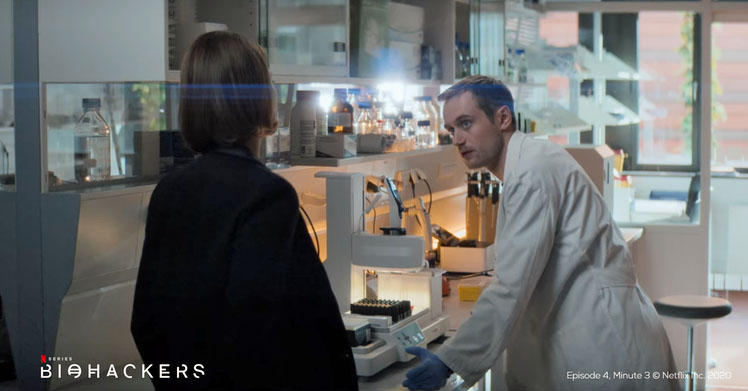
Professor Lorenz’s university lab in the Lorenz Excellence Centre, where she runs her official studies and where Jasper and Mia work, was actually located in LMU Biocampus Martinsried and used by students and professors for their regular research.
Lorenz interrogates Jasper in the lab of her Excellence Center
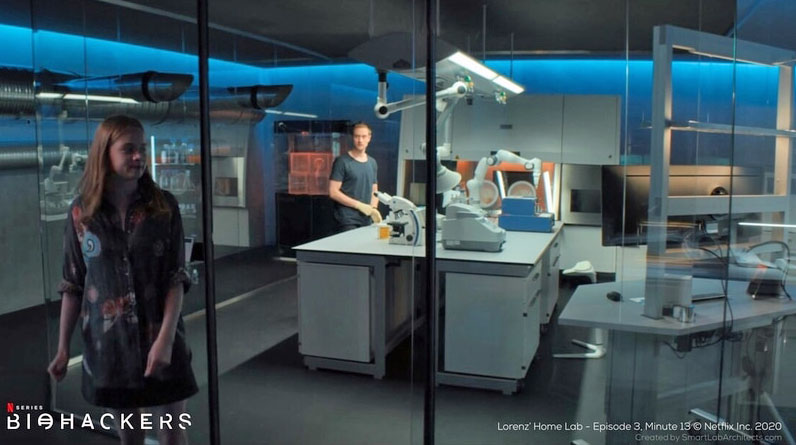
Smartlab Architects also designed Professor Lorenz’s secret private lab located in the basement of her mansion: “We designed this lab with the goal to build he most futuristic automated and sexy laboratory one could imagine.”
Jasper and Mia in Lorenz’s secret lab in her house
Thanks to the emergence of the open-source movement, greater access to reagents and devices, lowered costs of sequencing costs, and increased access of tools and methodologies for non-experts, expensive genetic engineering experiments that could previously only be carried out behind the walls of big institutions can now be done on a kitchen table with ingredients bought on eBay. For instance, there is Chen-Lu (Jing Xiang), the “introverted nerd,” a DIY biologist who genetically modifies fungi and plants (to make beef-tasting mushrooms or to create a bio-piano); Ole (Sebastian Jakob Doppelbauer) does various bodyhacking self-experiments and uses an NFC microchip in his hand to pay in shops. It’s worth noting here that biohacking is illegal in Germany.
Sotiriadis notes that, “the cut-throat Machiavellian culture of Lorenz’s secretive big-budget lab clashes with the free-spirited biohackers who are engineering mushrooms with new flavours to make livestock farming obsolete and “CRISPR together” in a camper van lab in the woods and at home. It’s a nicely captured contrast.”
Sotiriadis adds that, “the series shows experiments as multi-step scientific protocols that sometimes go wrong, which is refreshing.” Sotiriadis further describes the show as: “Part revenge plot, part young adult love drama, part dismantling a large-scale conspiracy; the unconventional pieces sometimes move smoothly together and sometimes clash, but the plot is glued together with lots of visually appealing synthetic biology experiments and bioluminescent matter of diverse natures.”
Greenbaum has the last words: Biohackers “serves as a pedagogical vehicle to raise many timely and interesting ethical, legal, and social concerns. From bioluminescent mammals to the collection of genetic material for clinical trials, the series’ storyline highlights how cavalierly we sometimes approach genomic data and genetic engineering.” Greenbaum cites one of the characters who suggests that the ends of her research justify the experimental means, even though her methods demonstrate a gross disregard for test subjects who may suffer as a result. The show also offers insight into the motivation for DIY biology: a friend confides to Akerlund on how Lorenz is willing to sell a cheaply acquired drug to desperate patients for inflated prices. “Such frustrations are what drive many citizens operating outside traditional institutions to develop their own pharmaceutical solutions.”
“It is ironic that Biohackers is set in Germany,” says Greenbaum, “one of the few places where genetic engineering experimentation outside of licensed facilities is illegal and can result in a fine or even imprisonment.”
*An interesting note here; the show was initially slated to first air in April 2020; however, given the highly disturbing opening scene and its likeness to COVID-19 currently raging at the time, the show’s premiere was pushed to August. While Biohackers isn’t about a pandemic, its chilling first scene was thought to stir up too many fears from an already disease-stricken public. Another science thriller that covers similar themes and issues of synthetic biology is Regenesis, a Canadian TV show currently airing.
Nina Munteanu is a Canadian ecologist / limnologist and novelist. She is co-editor of Europa SF and currently teaches writing courses at George Brown College and the University of Toronto. Visit www.ninamunteanu.ca for the latest on her books. Nina’s bilingual “La natura dell’acqua / The Way of Water” was published by Mincione Edizioni in Rome. Her non-fiction book “Water Is…” by Pixl Press (Vancouver) was selected by Margaret Atwood in the New York Times ‘Year in Reading’ and was chosen as the 2017 Summer Read by Water Canada. Her novel “A Diary in the Age of Water” was released by Inanna Publications (Toronto) in June 2020.
I rock on the cedar swing on my veranda and hear the wind rustling through the gaunt forest. An abandoned nest, the forest sighs in low ponderous notes. It sighs of a gentler time. A time when birds filled it with song. A time when large and small creatures — unconcerned with the distant thrum and roar of diggers and logging trucks — roamed the thick second-growth forest. The discord was still too far away to bother the wildlife. But their killer lurked far closer in deadly silence. And it caught the birds in the bliss of ignorance. The human-made scourge came like a thief in the night and quietly strangled all the birds in the name of progress.
excerpt from “Robin’s Last Song” by Nina Munteanu
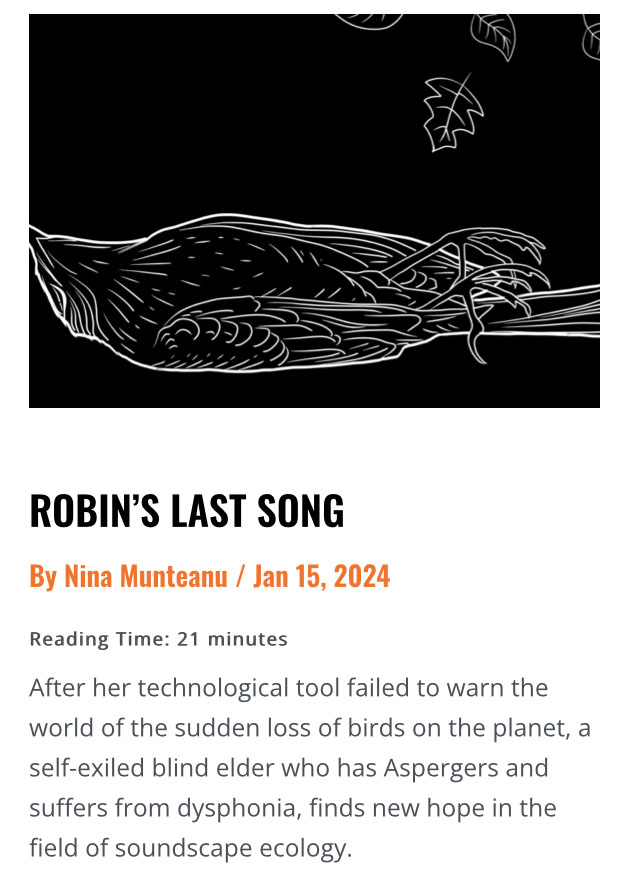
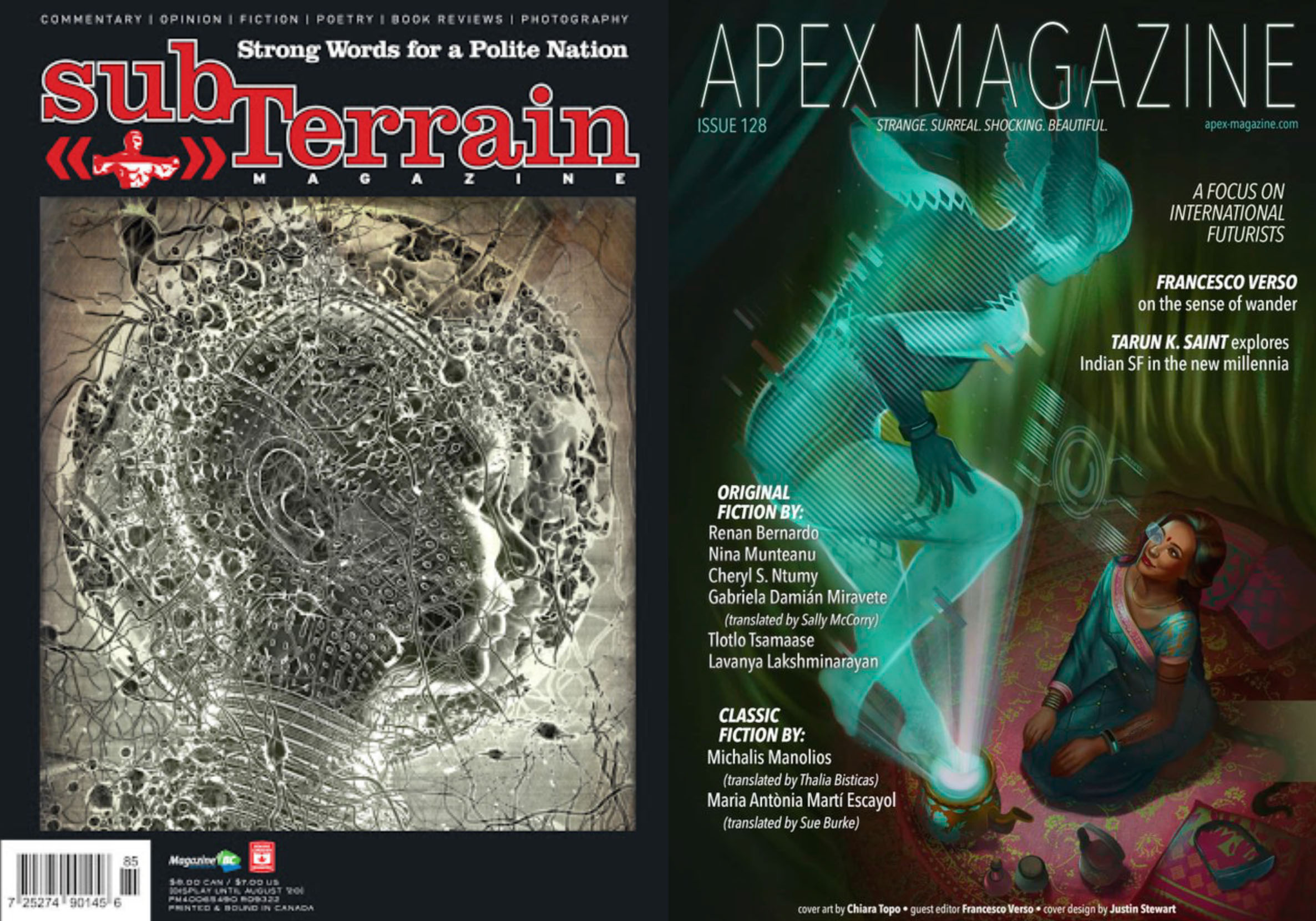
My short story Robin’s Last Song was republished recently in the superlative online magazine Metastellar. The story was first published in 2021 in Issue 128 of Apex Magazine and an earlier version of the story called Out of the Silence appeared in the literary magazine subTerrain Magazine Issue 85 in 2020.
Left, “subTerrain” Issue 85 carries “Out of the Silence”; right, “Apex Magazine” issue 128 carries “Robin’s Last Song”
I raced up the stairs to the auditorium then quieted my breath and listened at the door, heart thumping like a bird trying to escape. Professor Gopnik was ten minutes into his lecture; I could hear his commanding voice: “… estimates that the entire number of birds have been reduced by a third in five decades—I mean common birds like the robins, sparrows, warblers, and even starlings…”
He was talking about Rosenberg’s paper in Science. The study shocked the scientific community; but I had already observed the decline of the house sparrow around my aunt and uncle’s house near the Old Mill. And the robin—my namesake, whose song heralded spring for me—had grown quiet.
I imagined Gopnik waving the journal at the class in his typical showman style. He had a habit of wandering the stage like an evangelist, fixing each student with intense blue eyes as if challenging them to believe. I thought him an over-confident condescending prig. But for someone who looked as young as the students he was teaching, Gopnik was brilliant. And what he was doing was so important. I wanted so badly to work under him as a grad student. But he terrified me.
Excerpt from “Robin’s Last Song” by Nina Munteanu
The Story Behind the Story
It all began with my discovery of an emerging bioacoustic tool, soundscape ecology, that measures biodiversity and ecosystem functionality. I’d just read the disturbing 2019 Science article by Rosenberg and team who determined that our slow violence of habitat degradation and toxic pollution has reduced the world’s bird population by a third in just five decades. I was devastated; I could not imagine a world without the comforting sound of birds. What would it be like if all the birds disappeared?
Map and chart of bird decline since 1970
Already primed with research into genetic engineering for the sequel to my 2020 eco-novel,A Diary in the Age of Water, my muse (often delightfully unruly) played with notions of the potential implication of gene hacking in ecological calamity and how this might touch on our precious birds: when nature “is forced out of her natural state and squeezed and moulded;” her secrets “reveal themselves more readily under the vexations of art than when they go their own way.”
Robin’s Last Song is a realizable work of fiction in which science and technology are both instigators of disaster and purveyors of salvation. Today, gene-editing, proteomics, and DNA origami—to name just a few—promise many things from increased longevity in humans to giant disease-resistant crops. Will synthetic biology control and redesign Nature to suit hubris or serve evolution? What is our moral imperative and who are the casualties? As Francis Bacon expressed in Novum Organum, science does not make that decision. We do.
I also recently sat down with Rebecca E. Treasure of Apex Magazine for a conversation about story, ecology, and the future. Here’s how it begins:
Apex Magazine: The Way of Water in Little Blue Marble is such a powerful piece touching on water scarcity and friendship, a dry future and the potential for technology to overtake natural ecology. Robin’s Last Song explores extinction, human fallibility, friendship, and again, that conflict between technology and nature. Do you think we’re heading toward the kind of dystopia shown in these stories?…
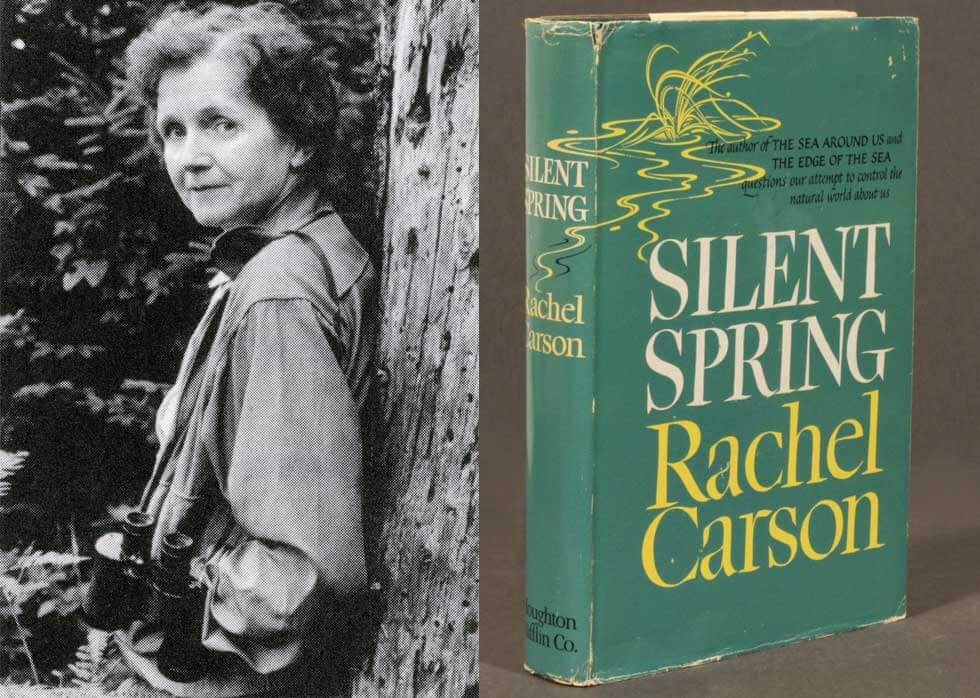
“Over increasingly large areas of the United States, spring now comes unheralded by the return of the birds. The early mornings are strangely silent where once they were filled with the beauty of bird song”
Rachel Carson, Silent Spring
Discarded robin’s egg in the forest in spring, ON (photo by Nina Munteanu)
p.s. May9: I just learned that Robin’s Last Song was selected by the NYC Climate Writers Collective as part of an exhibition in the Climate Imaginarium on Governors island. The exhibition, starting May 18, will run throughout the summer of 2024.
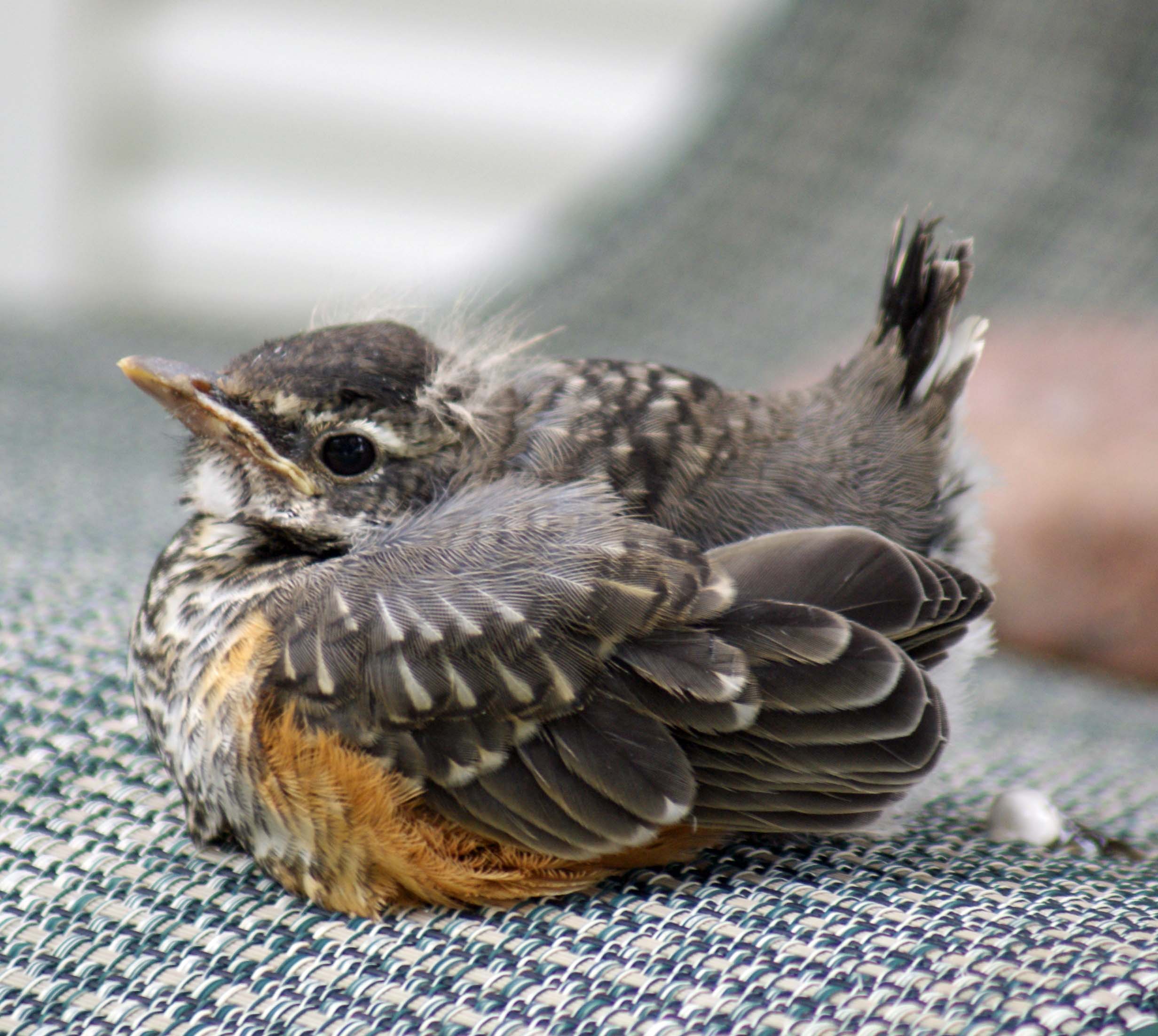
Fledgling robin rests on a patio chair in spring, ON (photo by Merridy Cox)
Nina Munteanu is a Canadian ecologist / limnologist and novelist. She is co-editor of Europa SF and currently teaches writing courses at George Brown College and the University of Toronto. Visit www.ninamunteanu.ca for the latest on her books. Nina’s bilingual “La natura dell’acqua / The Way of Water” was published by Mincione Edizioni in Rome. Her non-fiction book “Water Is…” by Pixl Press (Vancouver) was selected by Margaret Atwood in the New York Times ‘Year in Reading’ and was chosen as the 2017 Summer Read by Water Canada. Her novel “A Diary in the Age of Water” was released by Inanna Publications (Toronto) in June 2020.











 Nina Munteanu Writing Coach