The Diverse Impact of Gaia’s Revolution

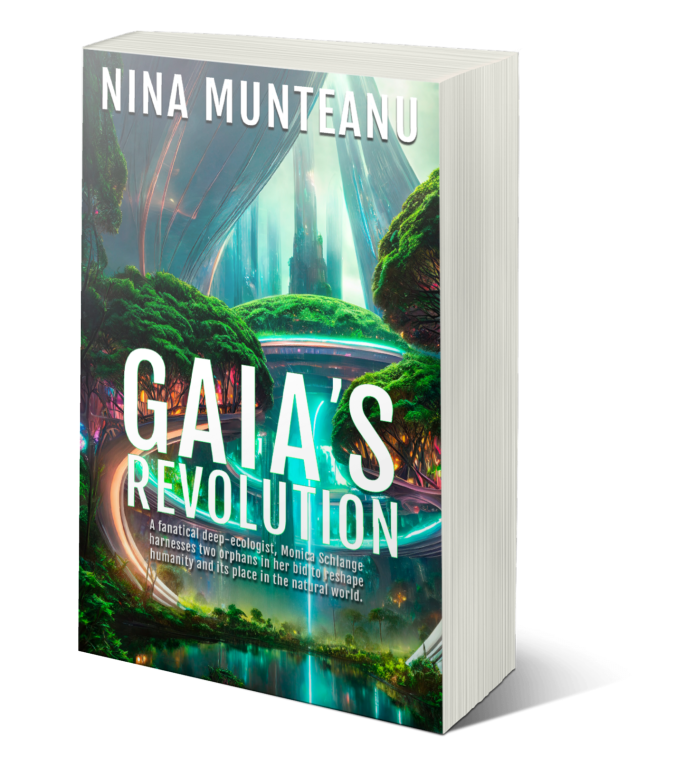
“Gaia’s Revolution is a chlorophyll-stained argument about power, survival, and the peril of holy certainty.”

Literary Titan
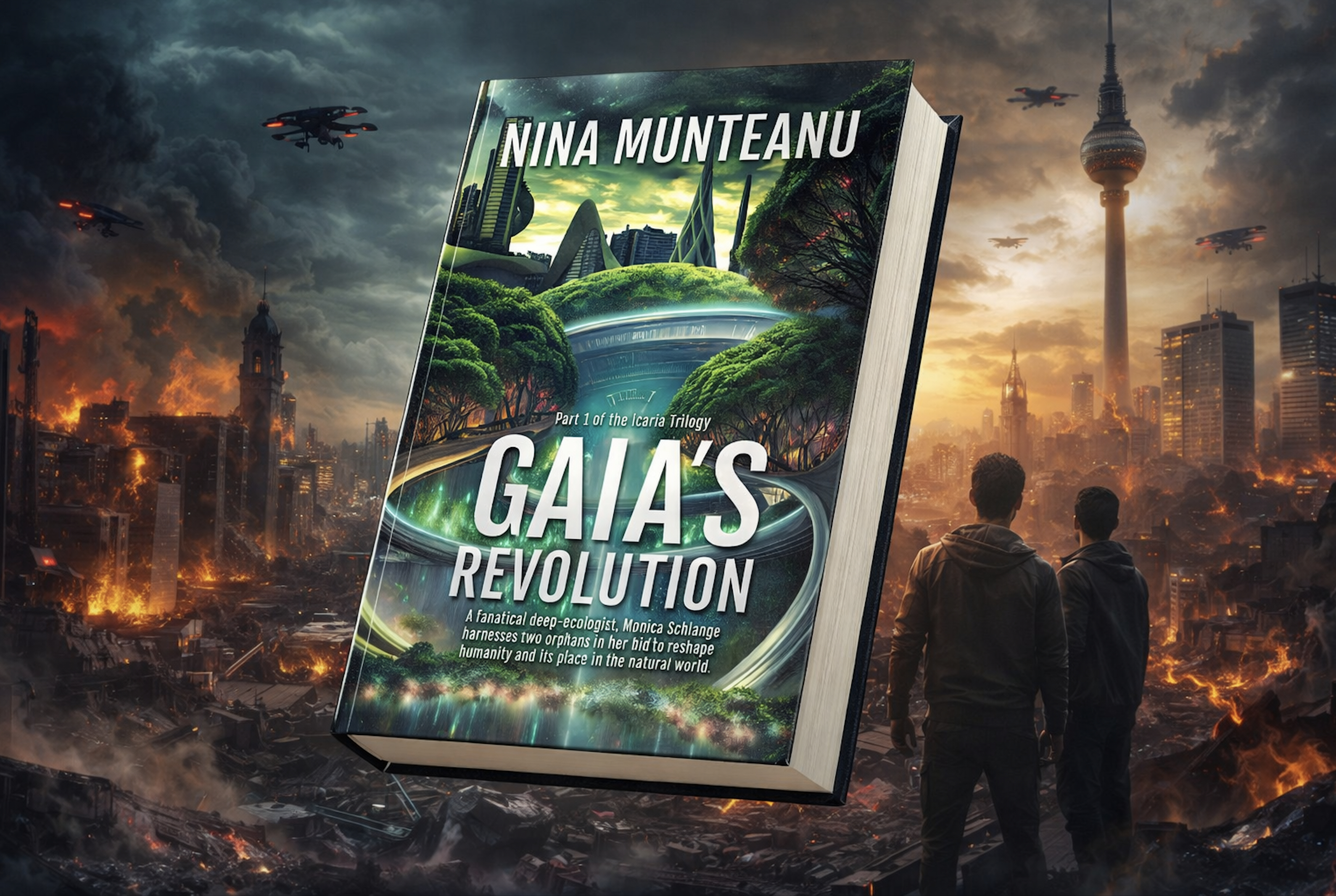
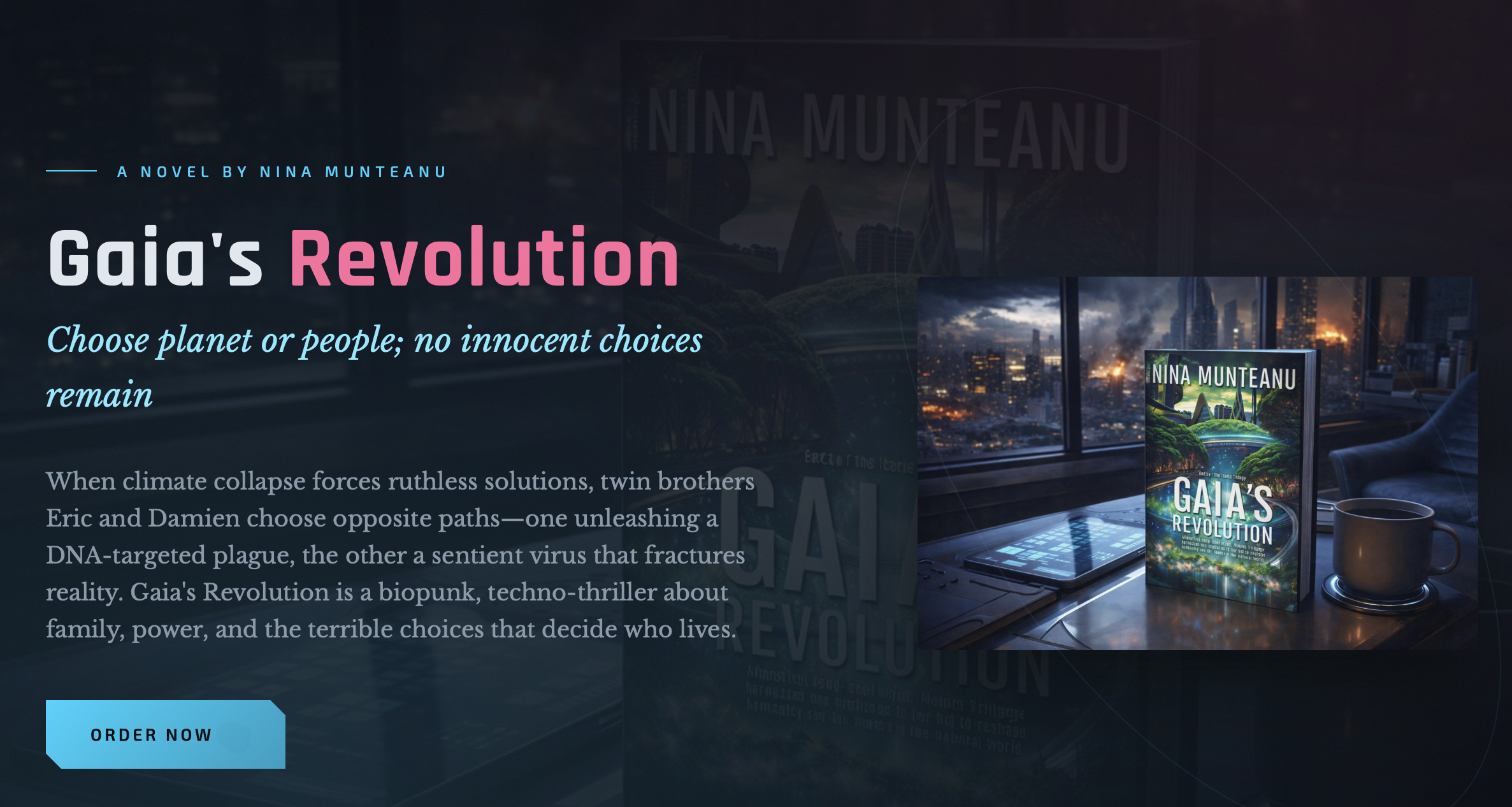
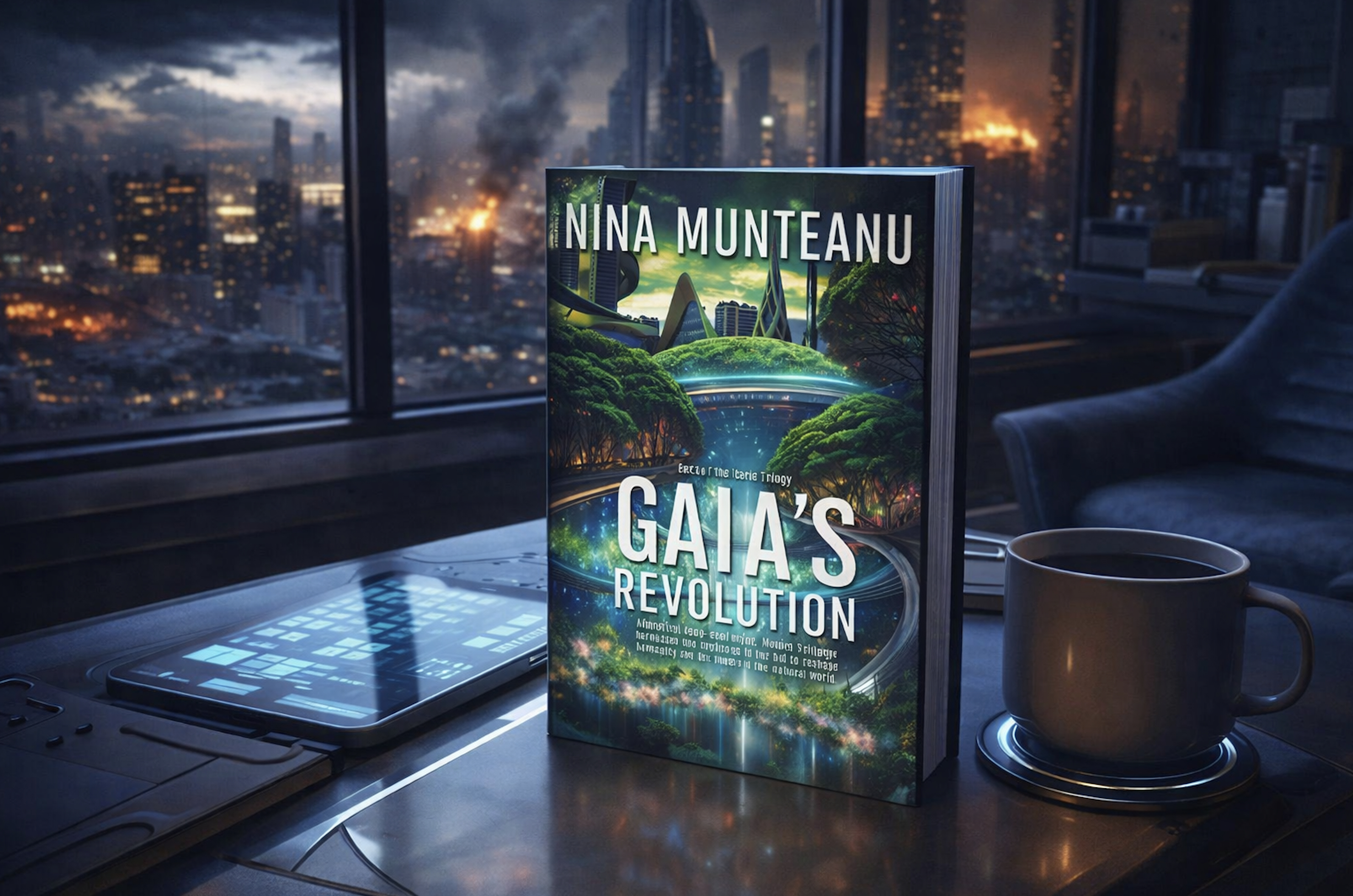
My eco-fiction political thriller Gaia’s Revolution—released March 10 of this year—has already made quite an impact on readers and reviewers: from amazing accolades to outright pans.

I love the controversy!

The book that follows ambitious twin brothers and the woman who plays them has rightly caused a ruckus from its questionable and controversial main characters to a thrilling though notorious plot. Understandably, some readers hated the book, even as others thoroughly enjoyed it. Either way, the book can’t be accused of being mediocre or mundane (something I would detest in my writing).

The Prairies Book Review accurately describes the novel:

Gaia’s Revolution “is a politically incendiary portrait of a civilization unraveling under climate collapse, historical trauma, and ideological extremism. Berlin, 2022. In a country destabilized by climate catastrophe and political extremism, activist Damien Vogel becomes the target of a violent state crackdown after protesting with Letzte Generation. As he uncovers long-buried truths about his family, he is drawn into conflict with his estranged twin Eric, whose ruthless plan for humanity’s survival threatens to sacrifice freedom itself.”

Literary Titan adds that the story “widens into a future history of revolution, ideology, biotech, enclosed cities, and ecological control…The novel is Part 1 of The Icaria Trilogy, and it reads like both an origin story and a warning flare.”

The Prairies Book Review calls Gaia’s Revolution:

“Dense, unsettling, and intellectually ambitious.” They describe the novel as “bleak, intelligent, and emotionally explosive.” They add that, “Munteanu crafts the novel as both climate thriller and philosophical inquiry, weaving ecological science, German history, and political paranoia into a narrative charged with dread and moral instability…Munteanu refuses simplistic moral binaries, presenting climate collapse as a force that destabilizes not only ecosystems, but democracy, ethics, and identity itself.” 

Reader Neha Shukla writes on Goodreads that Gaia’s Revolution has a “strong message with emotional depth.” Shukla noted that “the emotional side of the story is very well handled.” Lily Thomass wrote on Goodreads that “what stood out to me was the emotional honesty of the story.”

Costi Gurgu, author of Recipearium and The Cursed writes: “Gaia’s Revolution may be the most extensively researched SF novel I’ve ever read…[the book is] so close to reality that it’s frightening.” Claudiu Murgan, author of Water Entanglement, enjoyed the “dynamic plot and interesting, well-defined characters.”

Steve Stanton, Canadian speculative fiction author of Freenet writes: “I love it when novelists tackle the big issues and take on big opponents, and in these perilous times there is no bigger issue than global climate change, and no bigger opponent than patriarchal capitalism. Gaia’s Revolution by Nina Munteanu begins in present-day Germany, where ecological activists are setting the stage even now. In Munteanu’s inspired vision, radical racism, anti-immigration activism, and ultra right-wing security forces will be a crucible fomenting world catastrophe.”

Stanton adds, “The author uses some subtle stylistic variations for those readers who pay attention to details. The pace is varied, and the plot twists drive the narrative forward. I felt the beginning was a bit wordy with backstory and political philosophy, but Munteanu masterfully dovetails current political unrest and eco-activism into the worldwide dystopia of The Icaria Trilogy. As a prequel, this novel is an embellishment of sci-fi concepts developed very early in Munteanu’s career, but it is also the culmination of a body of work. For me, Gaia’s Revolution has been a delightful rediscovery of a talented Canadian voice.”

Reviews weren’t all positive; some oozed acid in their negative wrath. Why is Gaia’s Revolution eliciting this diversity of polarized reactions?

Sophia Wasylinko of The British Columbia Review in part suggests why in her negative review: “The book hooked me at first with its look at a world hostile to environmentalists and deep ecological concepts. Unfortunately, once the brothers cross paths with deep ecologist Monica Schlange, things get messy. Both for them and for the book.” Wasylinko particularly took exception to Monica’s character.

Literary Titan describes Monica’s mercurial shapeshifting character as “a zealous deep ecologist, [who] becomes one of the book’s most dangerous engines: part savior, part tyrant, using damaged people…as instruments in her plan to remake humanity’s relationship with the natural world.” Wasylinko emphatically disliked Monica, which impeded her enjoyment of the book. The reviewer found that, “…as the story progressed, the more irritated I became with [Monica’s] sexual antics and ‘Tears for Fears’ references. While I probably wasn’t supposed to like her, I didn’t care for her at all.” She ended with: “I won’t be continuing with the trilogy…I cannot cope with any more of Monica’s crooning Tears for Fears’ big hit of 1985, ‘Everybody Wants to Rule the World.’”

Literary Titan provides another possible reason for the polarized reactions: “the book refuses to make climate politics tidy. It doesn’t give us a simple contest between virtuous activists and corrupt institutions; instead, it shows how righteousness can calcify into doctrine, how grief can become governance, and how ecological thinking can be twisted into a new authoritarian grammar.” The reviewer found that what unsettled them the most, “was the book’s interest in compromised people [who are not] arranged into neat moral bins. They are products of abuse, ideology, scientific ambition, terror, tenderness, cowardice, and survival.”

In describing the diametrically opposed trajectories of twin brothers Eric and Damien, Prairies Book Review adds that, “Eric’s eco-authoritarian worldview is chilling precisely because it emerges logically from the same environmental realities driving Damien’s activism.”

The book follows six key characters and a handful of minor characters—all with associated archetypes—and their journeys during this catastrophic time are complex and messy; a function of the chaotic time itself. I make no apology to Wasylinko for the messiness. Revolution is messy. In a time of hard choices, innocence is the main casualty. This becomes evident for all the characters in the novel—particularly the children—as fiction reflects non-fiction. In the end, no one is innocent and all are changed.

Gaia’s Revolution is best described as an exploration of violent change and its associated impact and paradoxes. This is something we will face or already are facing with the growing unruliness of global warming, environmental destruction, and planetary change. Gaia’s Revolution ultimately explores the diverse impact of revolution in an unsustainable world; perhaps it is only apt that its reception by readers is equally diverse.

Paradox and irony drive Gaia’s Revolution. Says Wasylinko: “Gaia’s Revolution shows how quickly utopia becomes a dystopia. Nowhere is this more evident than the [revolutionary] Gaian Army adopting the Technocratic government’s weapons, including terrifying clones, and … book burning.”

According to Literary Titan, Gaia’s Revolution “has the grain of a manifesto smuggled inside a thriller, a story with roots sunk deep into Rachel Carson, chaos theory, surveillance states, and the bad old habit of deciding that humanity must be saved from itself.”

Literary Titan recommends Gaia’s Revolution “to readers of climate fiction, eco-dystopian fiction, biopunk, political fiction, and science fiction readers who like their futures thorny rather than sleek. Readers who enjoy Margaret Atwood’s MaddAddam books or Kim Stanley Robinson’s climate-minded fiction may find familiar pleasures here, though Munteanu’s novel is darker, more doctrinal, and more intimate in its wounds.” 

Gaia’s Revolution is Book 1 of The Icaria Trilogy, available in quality bookstores near you and, of course, on Amazon. Check out readers’ reaction to Gaia’s Revolution on Goodreads.

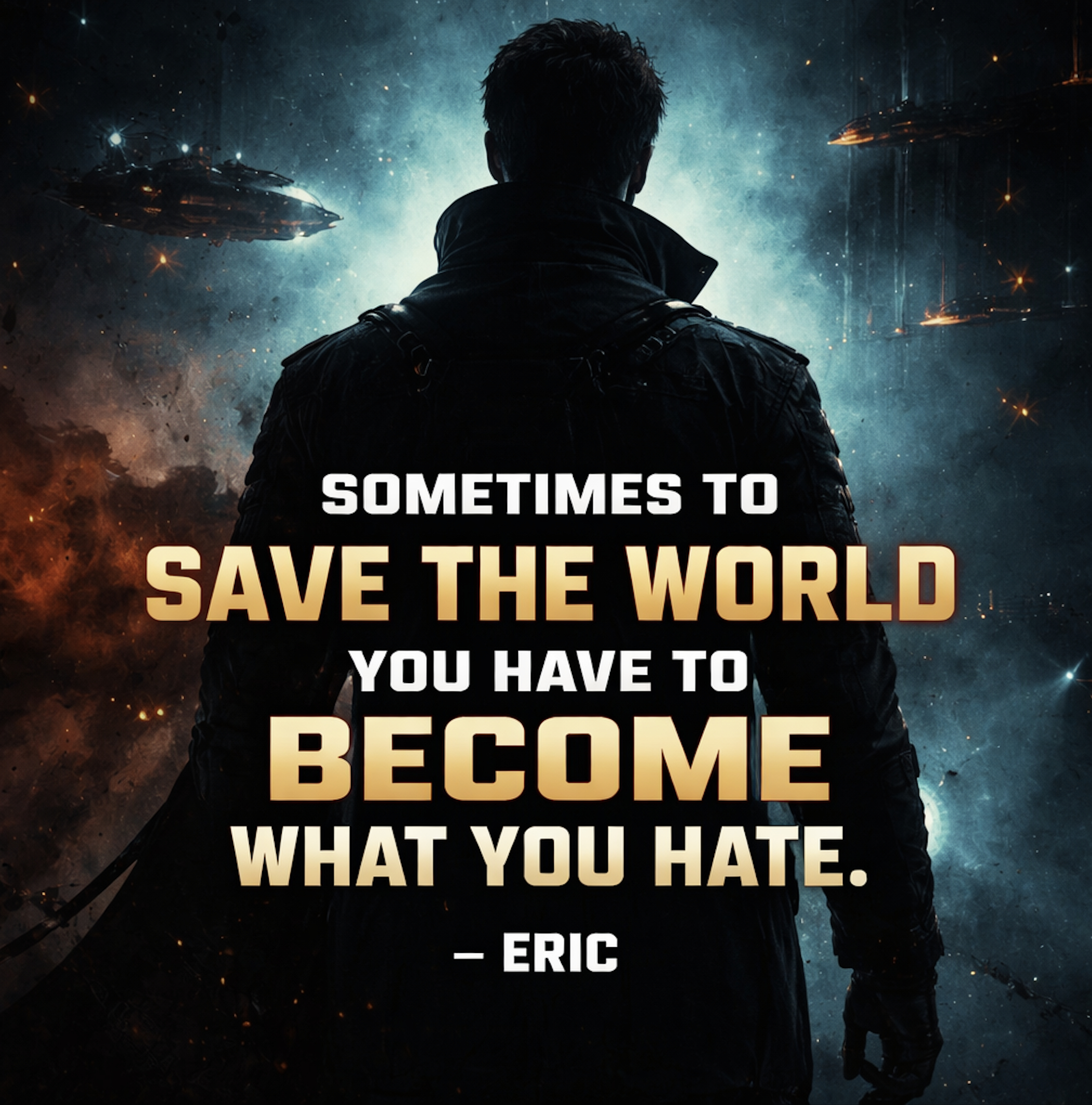
“We must first destroy before we can create. We must be unruly like climate. We must be relentless like climate. We must ride that wave before we can become the wave.”—Eric Vogel, Gaia’s Revolution

Nina Munteanu is a Canadian ecologist / limnologist and novelist. She is co-editor of Europa SF and currently teaches writing courses at George Brown College and the University of Toronto. For the lates on her books, visit www.ninamunteanu.ca. Nina’s bilingual “La natura dell’acqua / The Way of Water” was published by Mincione Edizioni in Rome. Her non-fiction book “Water Is…” by Pixl Press (Vancouver) was selected by Margaret Atwood in the New York Times ‘Year in Reading’ and was chosen as the 2017 Summer Read by Water Canada. Her novel “A Diary in the Age of Water” was released by Inanna Publications (Toronto) in June 2020. Her latest eco-fiction novel Gaia’s Revolution was released March 2026 by Dragon Moon Press.

Gaia’s Revolution: Life After Capitalism—Will We Survive?

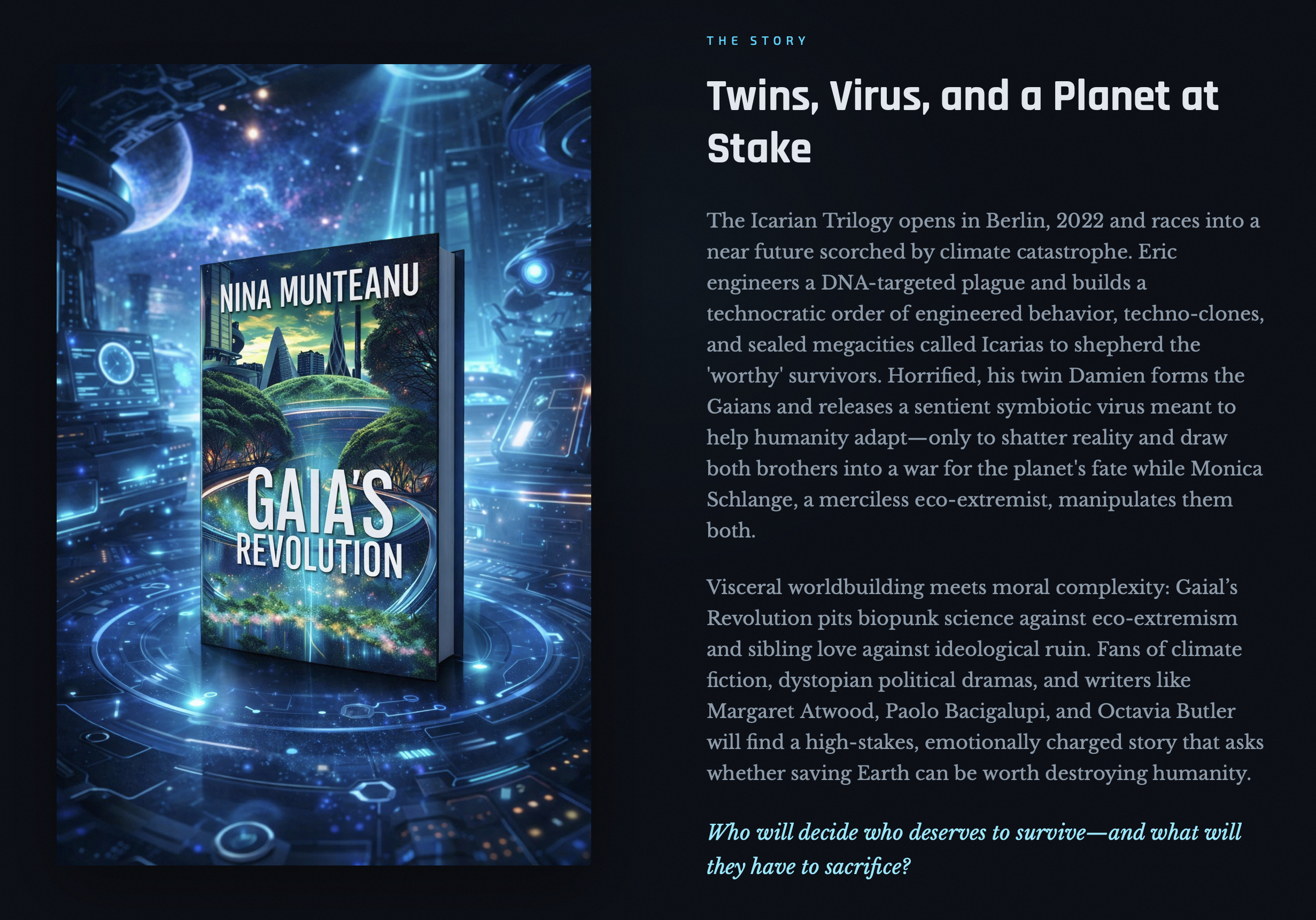
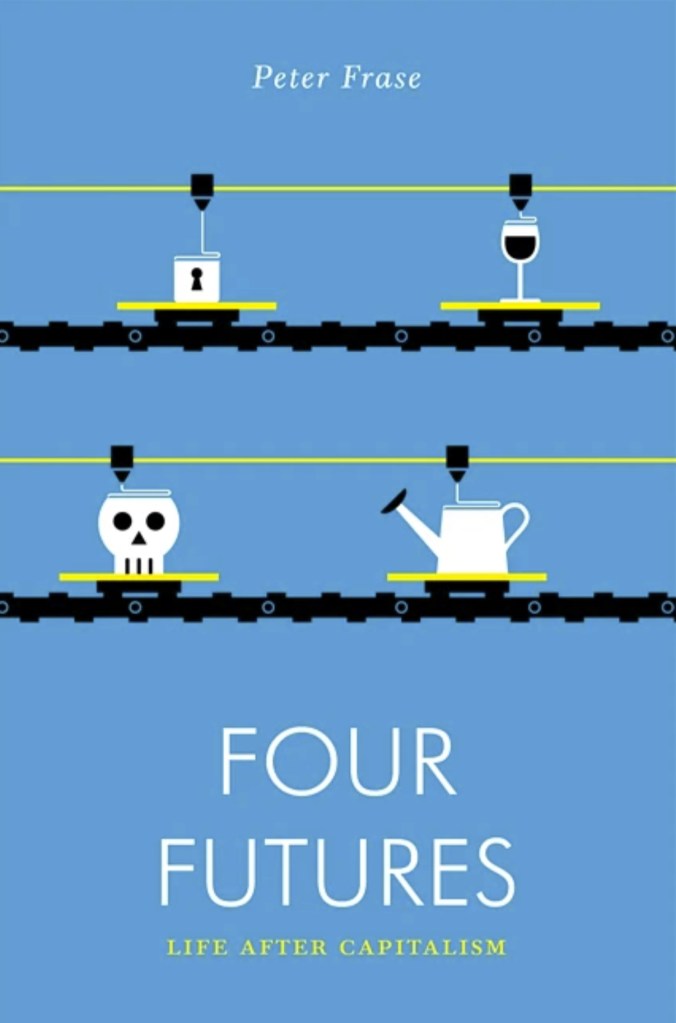
Gaia’s Revolution is Book 1 of The Icaria Trilogy, an environmental thriller released March 10, 2026 by Dragon Moon Press. This book wrote itself quickly and furiously over a few months. I wrote it in the back yard of a good friend one summer under a kind sun as I contemplated what life after capitalism would look like in Canada. I’d read Peter Frase’s book and considered his four options for the future. What I read chilled me. In some ways Gaia’s Revolution is my response.

The Icaria Trilogy—A Brief Description

The Icaria Trilogy by Dragon Moon Press

Gaia’s Revolution, Book 1 of the saga, starts in Berlin in 2022 as ambitious twin brothers Eric, a gifted engineer, and Damien Vogel, a brilliant scientist, escape the growing racial violence of Berlin, to ‘peaceful’ Canada in a rivalry to control the evolution of the human race (Books 2 and 3).  

The warring brothers trigger a violent revolution that destroys the Canadian technocratic government with an eventual migration of humanity into the enclosed worlds of Icaria. While Damien is an intellectual and scholar, believing in Naess & Sessions’s eight basic principles of deep ecology, Eric uses the principles to enact merciless ‘solutions’ through brutal acts of eco-terrorism—ultimately risking humanity’s very survival. Fanatical deep ecologist Monica Schlange insinuates herself into both brother’s plans to orchestrate her own unique vision of the world. Three orphaned children, caught in the web of intrigue and violence, will ultimately determine the direction of humanity by introducing the first veemelds (people who can communicate with machines), a new environmental disease, and a new set of rules neither brother envisioned.

By 2095, after a dictatorship of deep ecologists called Gaians seize power, humanity has escaped an unruly environment by fleeing inside enclosed cities called Icarias, where they struggle with Darwin’s Disease—a mysterious neurological environmental pandemic. In truth, the deep ecologists are keeping people “inside” not to protect humanity from a toxic wasteland but to protect the environment from a toxic humanity.

Ontology of a Revolution To Survive

Drawing on the unruly global environmental disturbances and poor leadership response, The Icaria Trilogy explores a collapsing late-capitalist society in Canada through ravages of climate change and a failing technology. Capitalism hasn’t been kind to the environment. Economic pundits and sociologists insist that Capitalism is devolving. But what will replace it? Cloud capital? Technofeudalism? Something else? For The Icaria Trilogy, I came up with technocracy in Canada, a social-capitalist meritocracy of technologists and social scientists who claimed they could take humanity through the changes to come. That system was, in turn, violently replaced by a revolutionary movement of radical deep ecologists called the Gaians, empowered by the growing toxic environment that eventually forced populations inside.

A hegemony that follows the hierarchal economic system of late capitalism inevitably commodifies and ‘others’ with ruthless purpose. Once something (or someone) is commodified, they are given a finite value and purpose outside their own existence. They become an object, a symbol to use and trade. They become a resource to manipulate, exchange, and dispose of with impunity. And through this surrender to utility, they become ‘othered.’ The consumer to manipulate. The trees of the forest to cut down. Water to squander and pollute. Homo sacer to hate and fear. Each has a role to play in the late capitalist narrative of digital abundance and physical scarcity.

This world of late capitalism intensifies bilateral polarization—politically, socially, and environmentally. Wealthy vs. poor. Privileged vs. indentured. Right vs. Left. Educated vs. illiterate. And so on. By its very nature, Capitalism invites separation, segregation, and ‘othering’. This is the opposite of what we need—particularly to deal with the hyperobjects of climate change and environmental sustainability, which require a united global effort to address and overcome. Polarization tears the fabric of society apart. Polarization leads to lack of consensus, greater misunderstanding, rage and violence. And fanaticism. Borne of deep frustration and fueled by relentless passion, fanaticism sparks violent change—not always good or effective, but definitely subversive. This is what we are seeing today throughout the world: unhinged fanaticism, fed by a growing polarization and exclusion. In Germany, the far-right fascist Reichsbürgers movement violently rejects the legitimacy of the modern German state. In the USA, far-right white supremacists and Christian fundamentalists enact domestic terrorist violence fed by nativism, populism, anti-communism, and ultranationalism.

In the near-future Canada of The Icaria Trilogy, radical Gaians (deep ecology fanatics) destroy the technocratic government, take autocratic control and enclose and segregate the human population from the sacred environment, permitting it to heal.

Is Revolution Enough?

In his book Four Futures: Life After Capitalism sociologist Peter Frase considers effects of climate change and automation in possible outcomes of a post-Trump election America. Frase envisions four scenarios based on abundance and scarcity and whether a society operates by equality and inclusion (e.g., communism under abundance / socialism under scarcity) or hierarchy and exclusion (rentism under abundance/ exterminism under scarcity).

Versions of all four of these systems are or have been either already in existence of are currently developing in the world. This evokes author William Gibson’s famous statement: the future is already here; it’s just unevenly distributed. An early example of rentism began during medieval times under early English capitalism when gentry enclosed land in what has been misidentified as “The Tragedy of the Commons.” The tragedy wasn’t in the commons, but in the loss of them as land reverted from being a common right of peasant farmers to private property under the restricting control of large landowners. It was the beginning of the concept of ownership and exclusion.

Given the currently growing scarcity of resources—lack of sufficient clean freshwater and rampant habitat destruction—the following scenarios are more likely to prevail: Socialism (if a society operates by equality) or Exterminism (if a society operates by hierarchy). 

Socialism may arise within an egalitarian society if driven by altruistic notions of self-limitation. Ecologists describe such a self-limiting system as K-selected (see my discussion of K-selection and r-selection in my book Water Is…). A K-selected population operates at or near the carrying capacity of the environment and favours individuals that successfully and respectfully compete for resources and produce few young.

Exclusion within a hierarchical system lies at the heart of exterminism. The Western World’s current hierarchical model of elitist wealth inequality (driven by greed and resource scarcity) favours its elite oligarchs by ‘othering’ and repressing its labour/worker population. Within a late capitalist model, the hierarchy of capitalist/owner and labourer/worker is based on mutual dependence; however, as automation, various technologies and AI supplant human labor needs, the mutuality crumbles. In his Exterminism scenario of hierarchy and scarcity, Frase proposes that: “When mass labor has been rendered superfluous, a final solution lurks…”

The Question of Survival …

Frase provides the final answer to my question in the title: “The real question,” writes Frase, “is not whether human civilization can survive ecological crises [such as climate change and habitat destruction] but whether all of us can survive it together, in some reasonably egalitarian way.”  

References:

Atwood, Margaret. 2004. “The Handmaid’s Tale and Oryx and Crake ‘In Context'”. PMLA119 (3): 513–517.

Atwood, Margaret. 2018. “Margaret Atwood on How She Came to Write The Handmaid’s Tale”Literary Hub. April 25, 2018.

Frase, Peter. 2016. “Four Futures: Life After Capitalism.” Verso Press, London. 150pp.

Gibson, William. 1999. “The Science of Science Fiction.” Talk of the Nation, Washington, D.C.: National Public Radio, November 30, 1999.

Munteanu, Nina. 2026. “Gaia’s Revolution, Part 1 of Icaria Trilogy.” Dragon Moon Press, Calgary, AB. 369 pp.

Munteanu, Nina. 2010. “Angel of Chaos, Part 2 of Icaria Trilogy.” Dragon Moon Press, Calgary, AB. 518 pp.

Munteanu, Nina. 2007. “Darwin’s Paradox, Part 3 of Icaria Trilogy.” Dragon Moon Press, Calgary, AB. 294 pp.

Sessions, George, Bill Devall. 2000. “Deep Ecology: Living as if Nature Mattered.” Gibbs Smith. 267pp.

Thompson, E.P. 1980. “Notes on Exterminism: the Last Stage of Civilization, Exterminism, and the Cold War.” New Left Review 1(121).

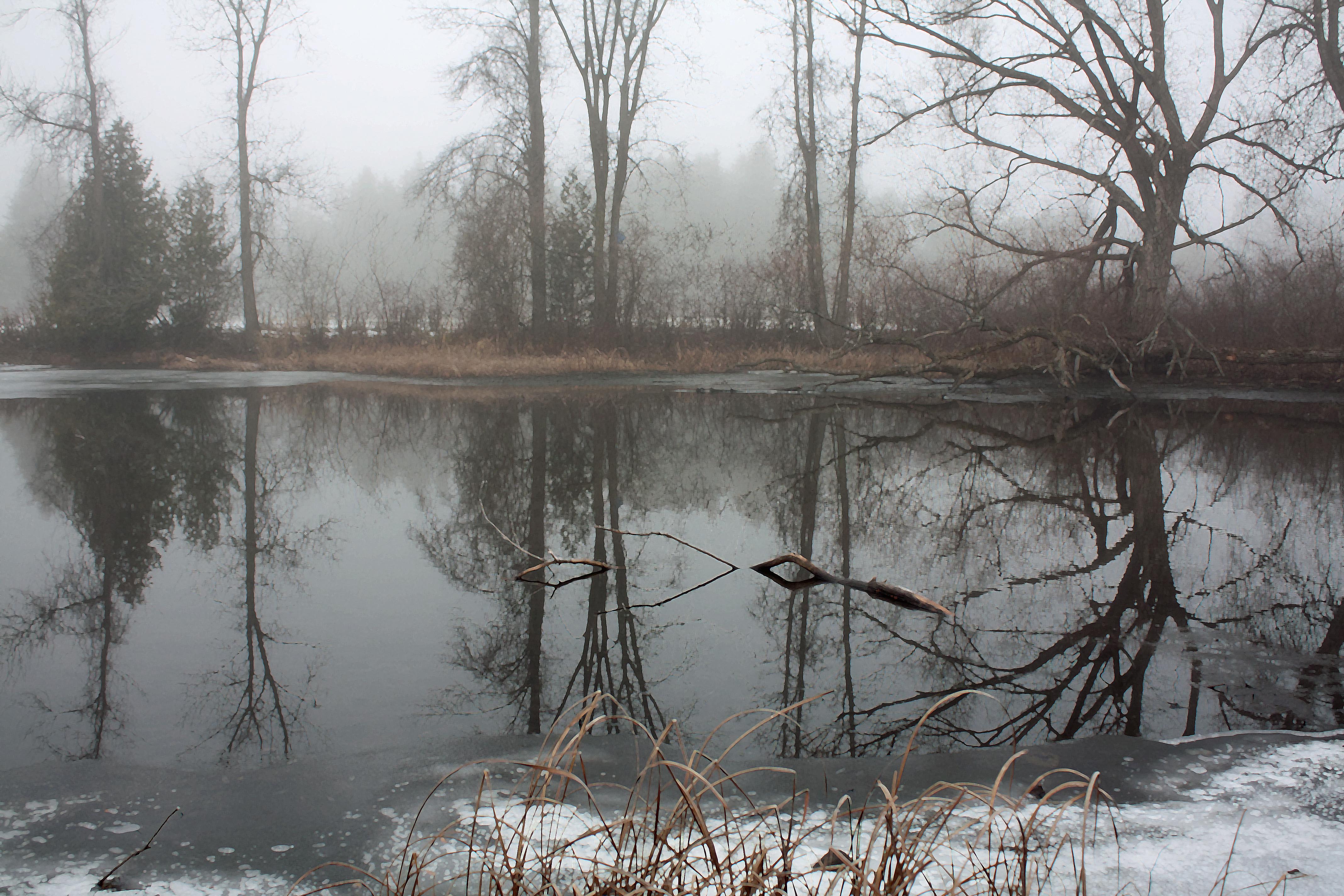
A small creek marsh reflects trees in a foggy spring morning, ON (photo and rendition by Nina Munteanu)

Nina Munteanu is a Canadian ecologist / limnologist and novelist. She is co-editor of Europa SF and currently teaches writing courses at George Brown College and the University of Toronto. Visit  www.ninamunteanu.ca for the latest on her books. Nina’s bilingual “La natura dell’acqua / The Way of Water” was published by Mincione Edizioni in Rome. Her non-fiction book “Water Is…” by Pixl Press (Vancouver) was selected by Margaret Atwood in the New York Times ‘Year in Reading’ and was chosen as the 2017 Summer Read by Water Canada. Her novel “A Diary in the Age of Water” was released by Inanna Publications (Toronto) in June 2020.

The Icaria Trilogy: The Story Behind the Prequel to the Prequel…


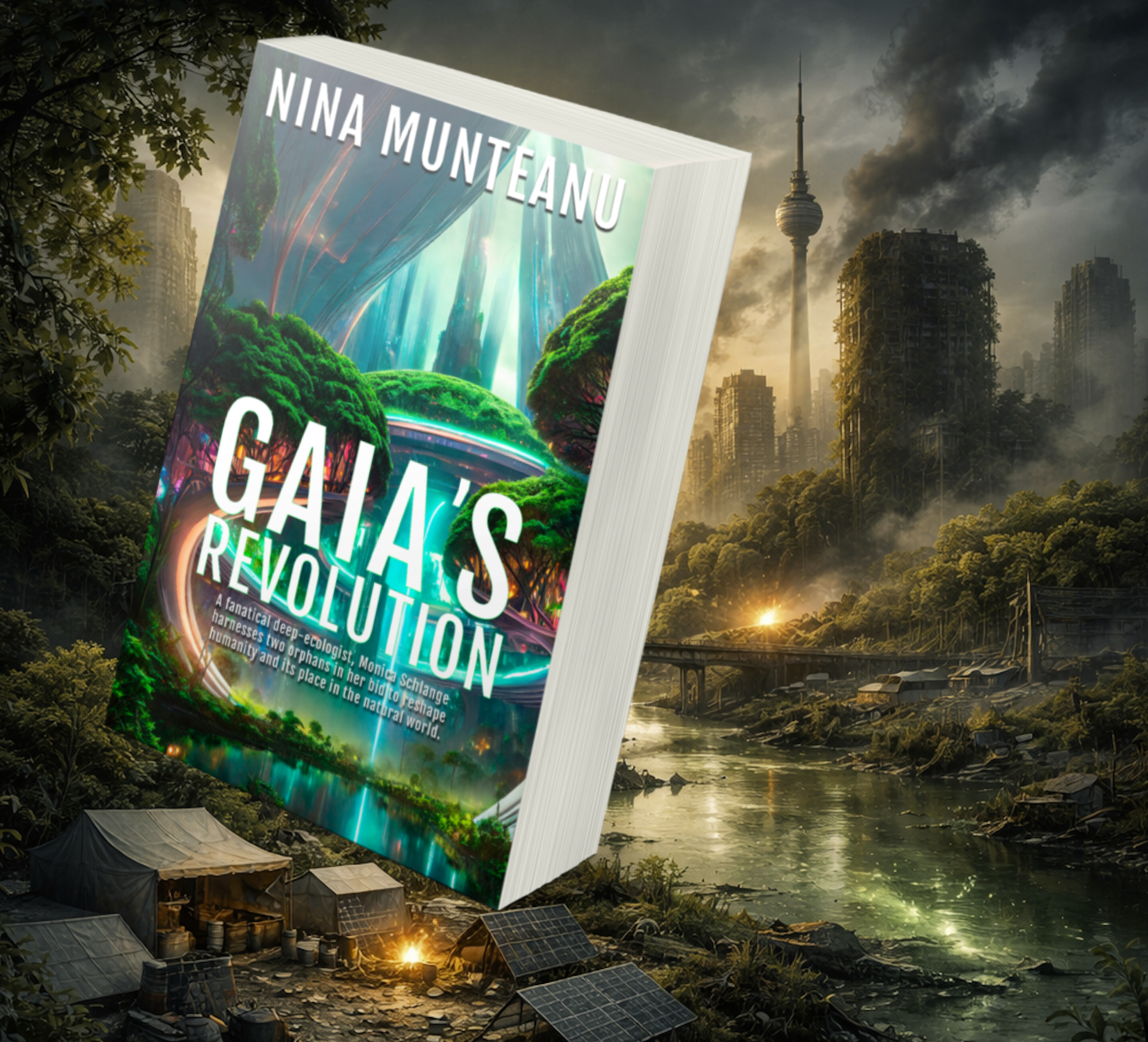
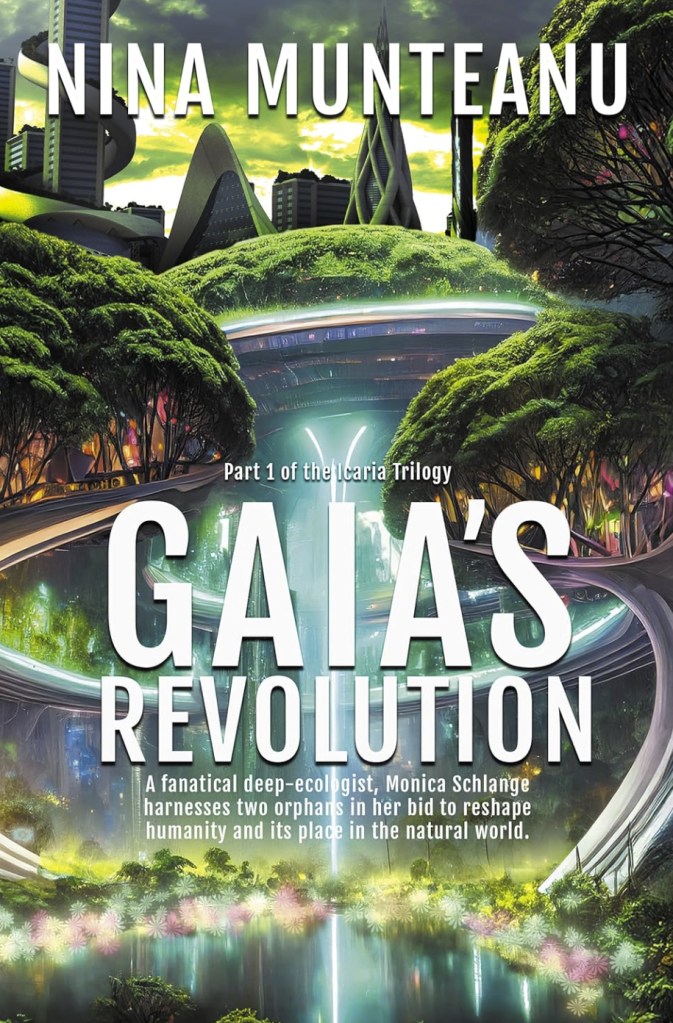
Today my eco-fiction novel Gaia’s Revolution (Book 1 of The Icaria Trilogy) releases through Dragon Moon Press in paperback and ebook form on Amazon (and other book retailers).

Gaia’s Revolution explores a collapsing capitalist society in Canada through ravages of climate change and a failing technology. The story is told through the lives of ambitious twin brothers Eric and Damien Vogel, and the woman who plays them like chess pieces in her gambit to ‘rule the world.’ The novel starts out in Berlin—with a scuffle between police and climate activists of Letzte Generation-then moves to Toronto Canada, where an unlikely revolution is brewing… 

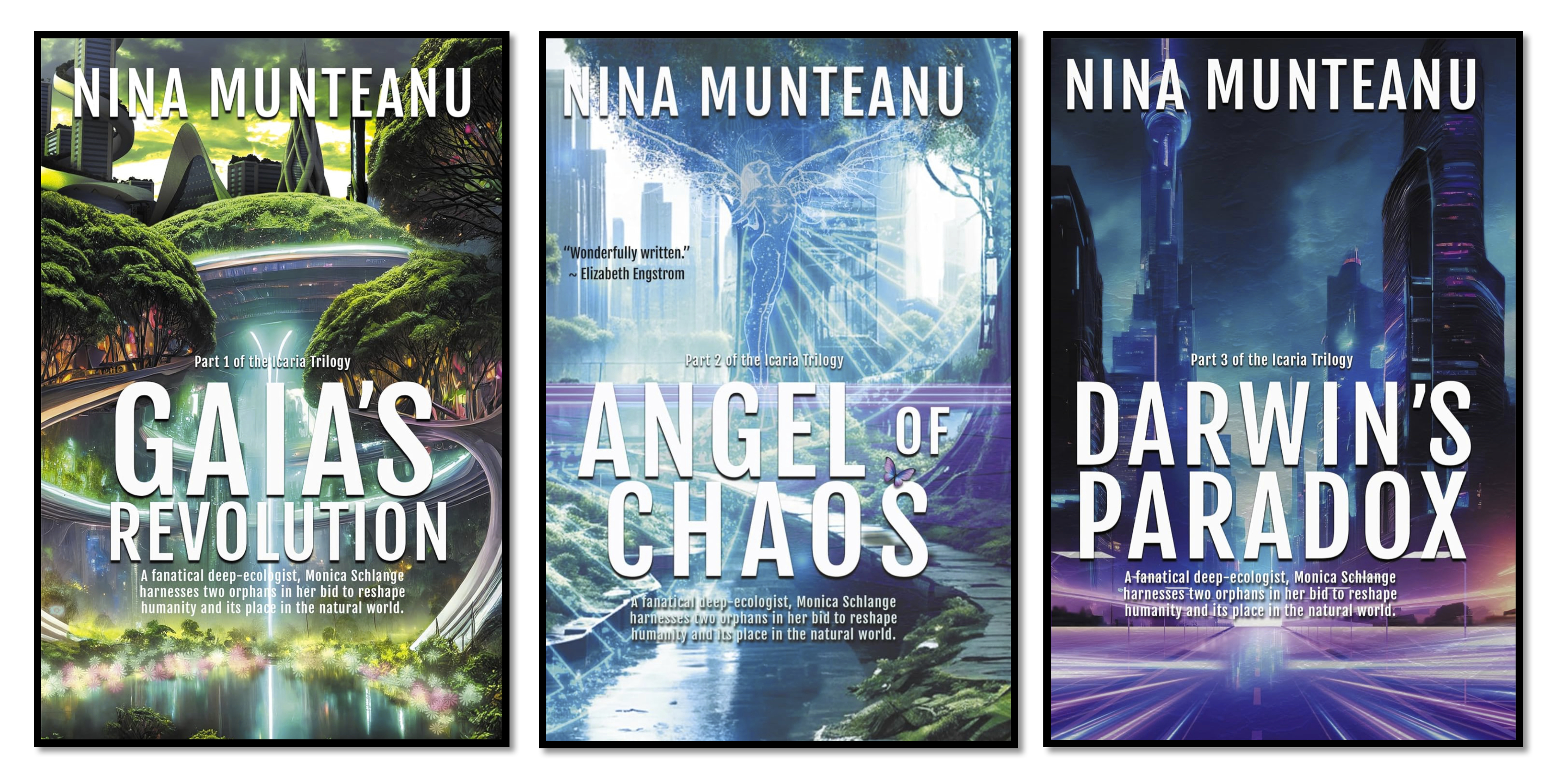
Book 2 (Angel of Chaos) and Book 3 (Darwin’s Paradox of The Icaria Trilogy are already available in bookstores worldwide in both ebook and print form.

The Icaria Trilogy by Dragon Moon Press

This day is special for me in a number of ways. Today is also my dad’s birthday. He passed away a while ago, but I know he is here with me as this is happening. You see, when I was just 15, I’d written my first book, an early version of Angel of Chaos. My dad, who had met and befriended an editor at Doubleday, and proud of my accomplishment, arranged a meeting with me and the editor to look at my book. I put on my highest pumps—I could barely walk in them!—and best outfit and met with the gentleman. He did not take my book for publication but praised my work and gave me some wonderful advice. “Keep writing!” he said. I have carried that meeting and advice to this day and thank my dad for his belief in me as a writer—particularly given that he had been pushing for me to become a teacher or nurse. Four decades later, a more polished version of that same book was published in 2010 by Dragon Moon Press (as Angel of Chaos, the prequel to Darwin’s Paradox, which was published in 2007). 

Birch forest in Ontario (photo and rendition by Nina Munteanu)

The Icaria Trilogy by Dragon Moon Press

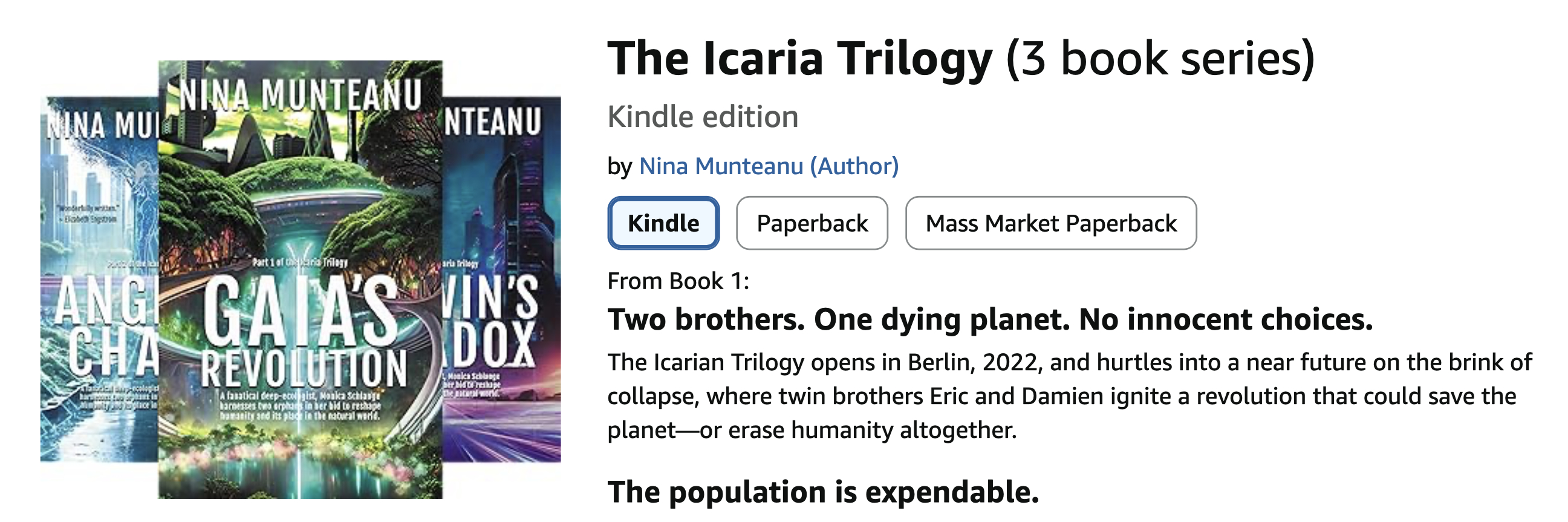
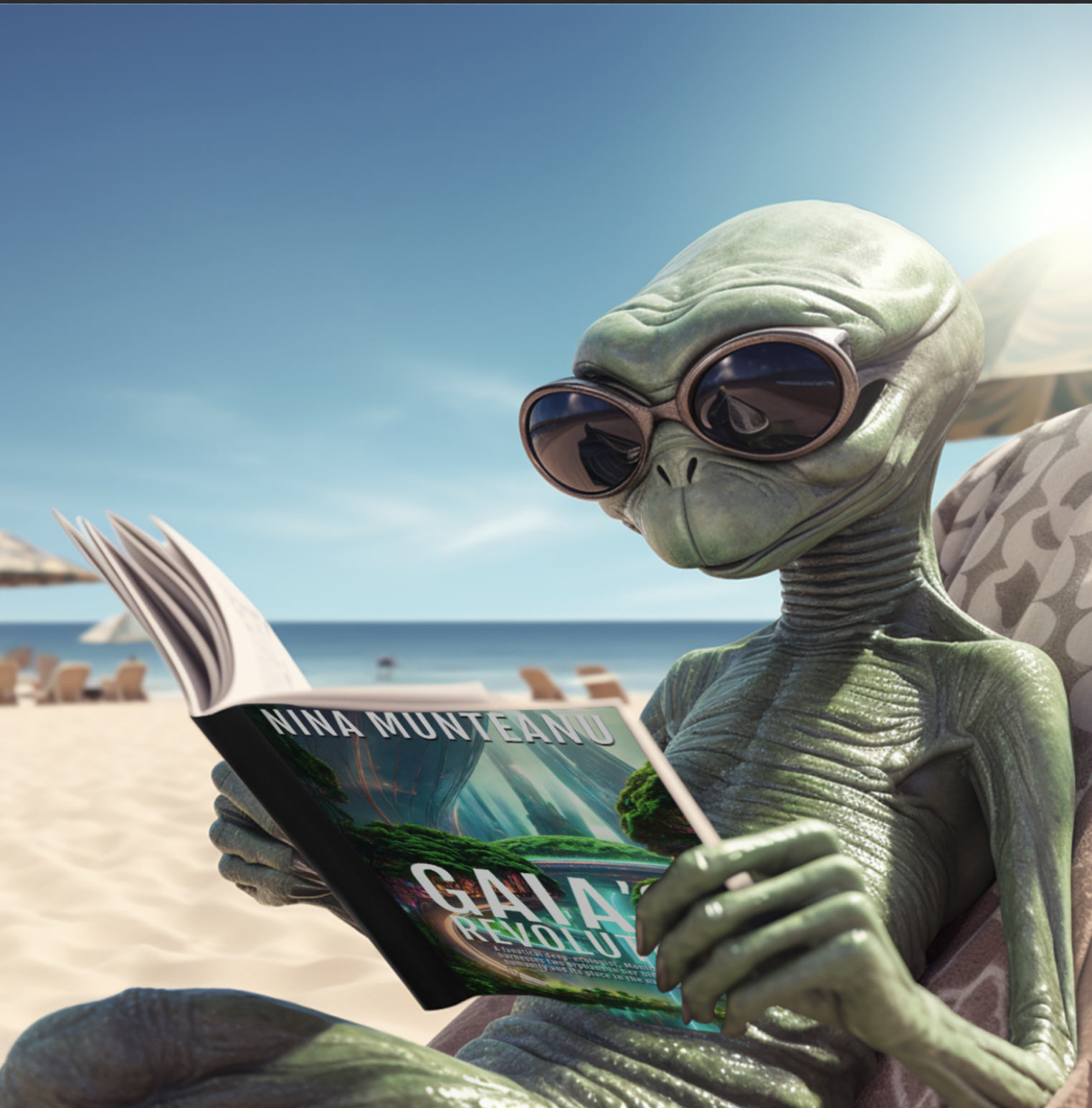
Now, with newly written Gaia’s Revolution (the prequel to the prequel) released, Dragon Moon has reissued new covers for the entire trilogy. Here they are! Oh! And look who’s already reading Gaia’s Revolution!

Aliens get to read everything before we do…

Nina Munteanu is an award-winning novelist and short story writer of eco-fiction, science fiction and fantasy. She also has three writing guides out: The Fiction WriterThe Journal Writer; and The Ecology of Writing and teaches fiction writing and technical writing at university and online. Check the Publications page on this site for a summary of what she has out there. Nina teaches writing at the University of Toronto and has been coaching fiction and non-fiction authors for over 20 years. You can find Nina’s short podcasts on writing on YouTube. Check out this site for more author advice from how to write a synopsis to finding your muse and the art and science of writing.