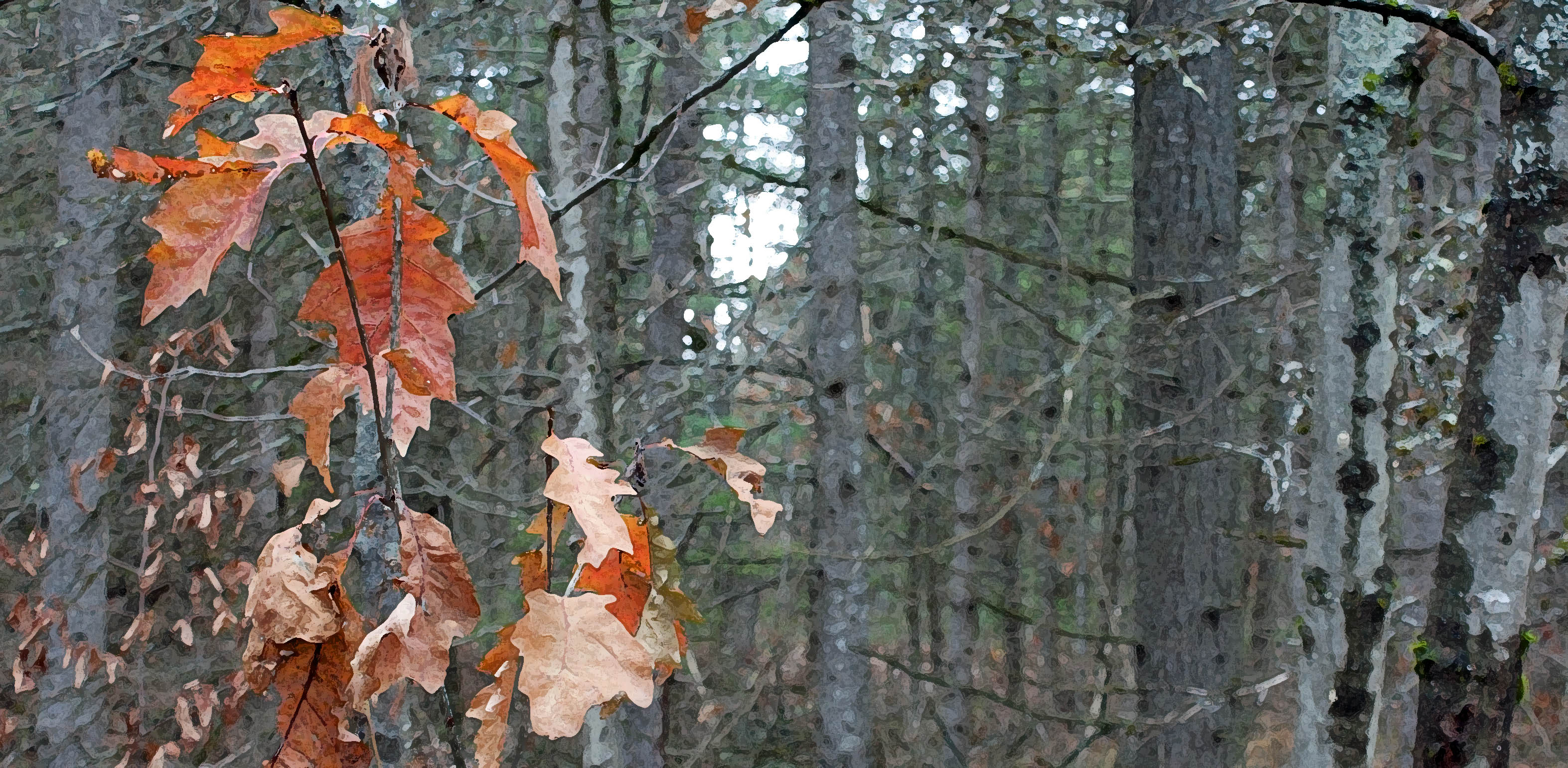
Marcescent oak leaves tremble in the cold wind of November, Petroglyph Park, ON (photo and rendition by Nina Munteanu)
I parked my car by the closed gate and walked inside along the road. The park was closed but not for me, I thought. The walk through this magnificent pine forest with its fresh pungent aromas of coming winter, invigorated me with thoughts of hope and wonder. I felt at home in this unviolated forest. It felt natural and I realized that I was desperately seeking “natural”…
Oak leaves blaze in the grey-green hemlock-pine forest, Petroglyph Park, ON (photo and rendition by Nina Munteanu)
I live close to a riparian forest and a large river. But there is little natural about it. Despite supporting an abundance of wildlife (e.g., squirrels, chipmunks, muskrat, skunk, groundhog, mink, ermine, voles, and red fox), the forest is disturbed and infested with invasive species. When I walk through this forest, the sounds of traffic are never far away, and I yearn for the sounds and smells of Nature inviolate.
Small trail through pine and aspen to the meromictic lake in Petroglyph Park, ON (photo and rendition by Nina Munteanu)
Petroglyph Park lies in the Kawartha Region of Ontario and is an hour’s drive north of where I live. Here, the sounds of Nature prevail: the wind raking through pines, the shrill haunting cry of a bluejay or aggressive chittering of a red squirrel. Nothing else. It was gloriously silent; except for the sound of my boots crunching along the trail or when I scared up a deer that scampered with the rush and rattle of leaves through the anonymity of the brush into a deep silence.
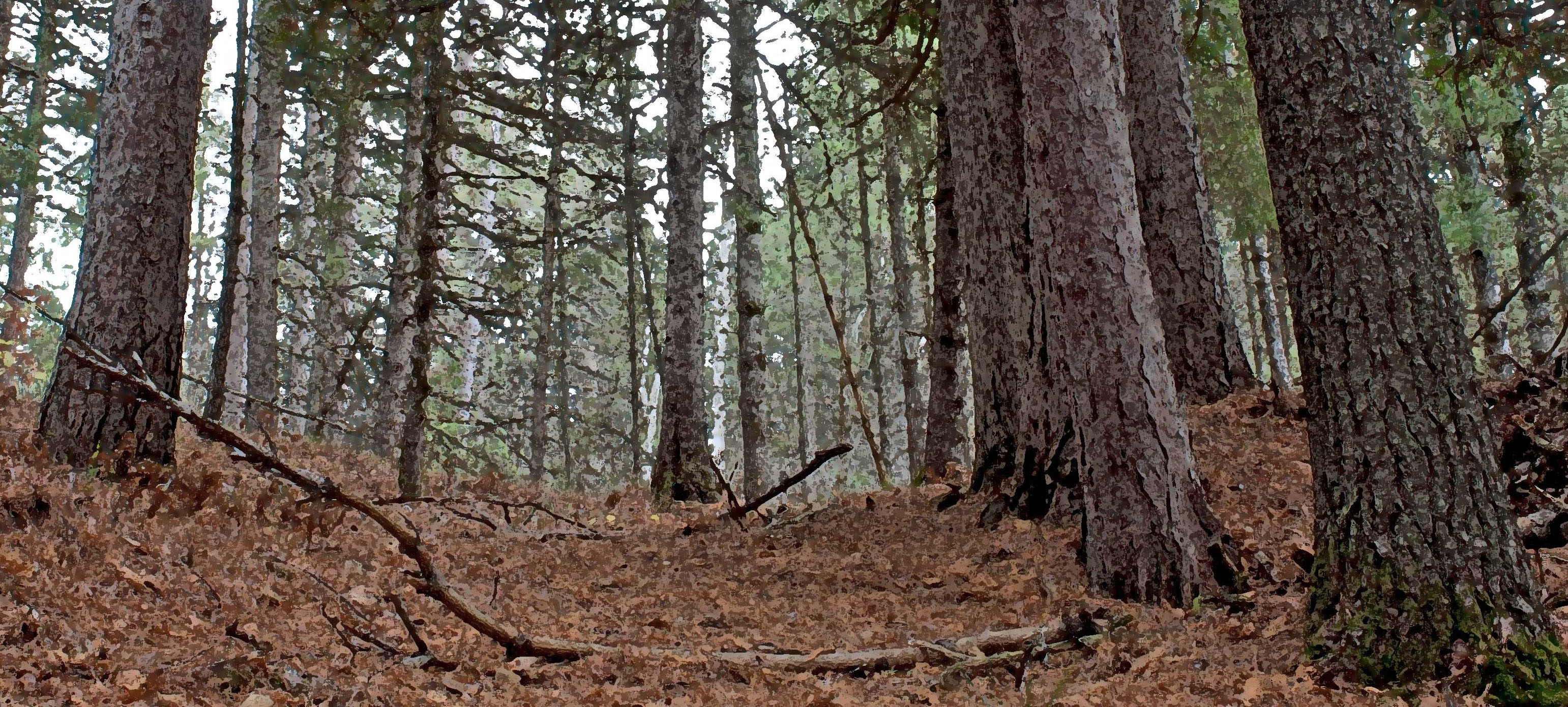
Road through tall red pine forest, Petroglyph Park, ON (photo and rendition by Nina Munteanu)
It was a crisp and fresh November day. I’d packed a lunch and my camera and set off down the road and along various trails to explore the park, not worried about getting lost.
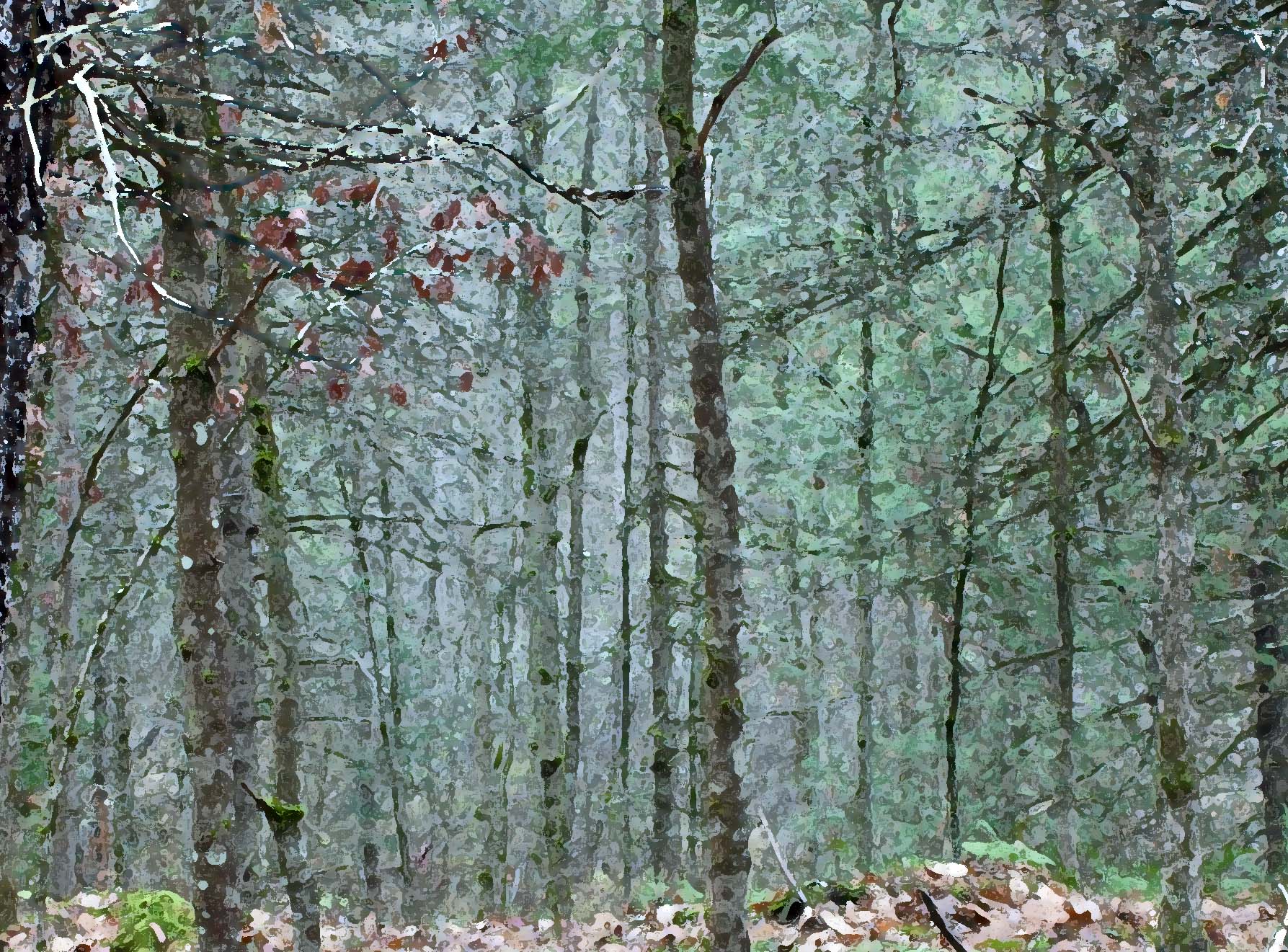
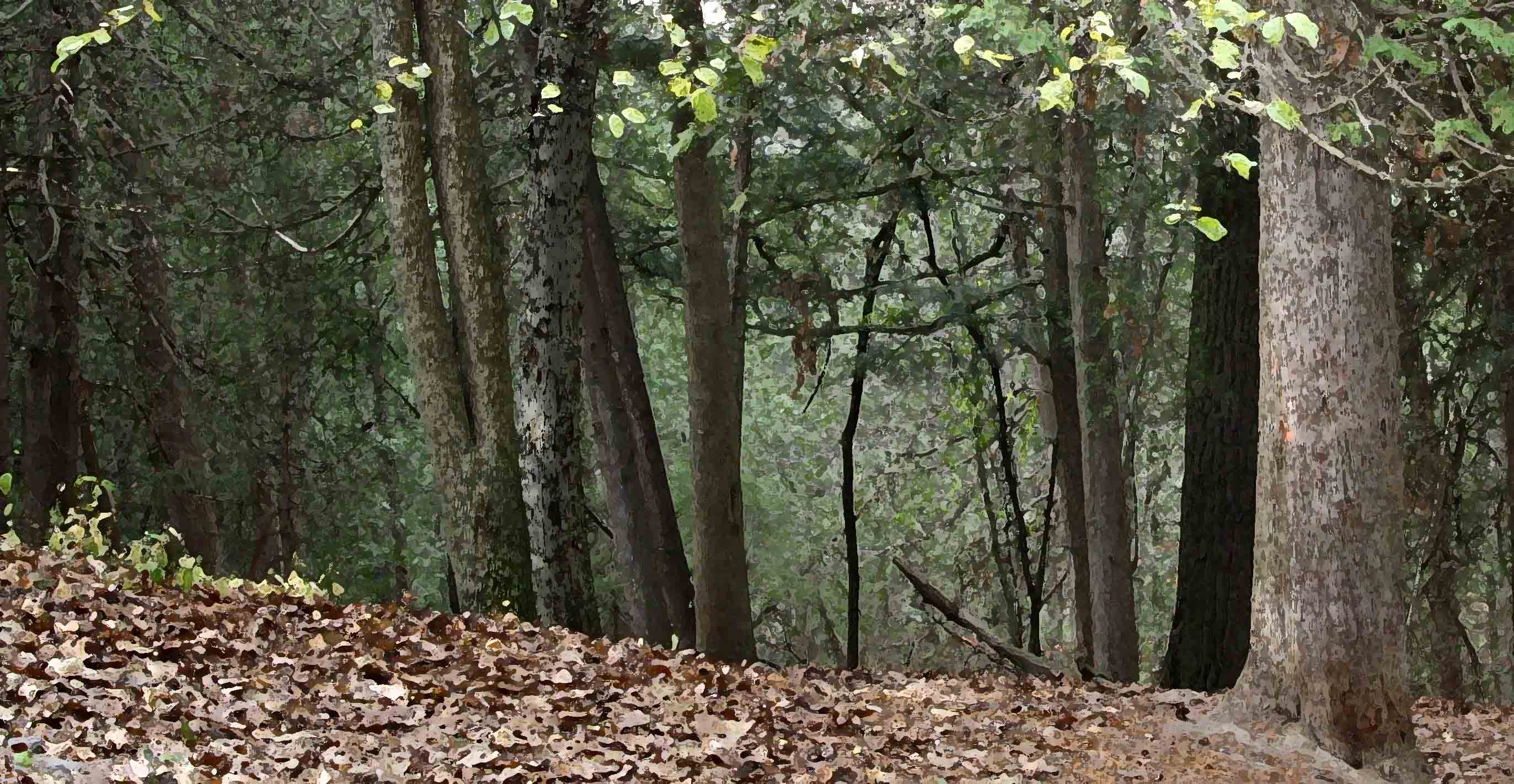
Forest fades from single oak tree into a fog of grey-green pine and hemlock, Petroglyph Park (photo and rendition by Nina Munteanu)
And I did get wonderfully lost, particularly when I ventured off the main trail, seeking adventure. I didn’t mind being lost; when you lose yourself you find another part of you through adventure…
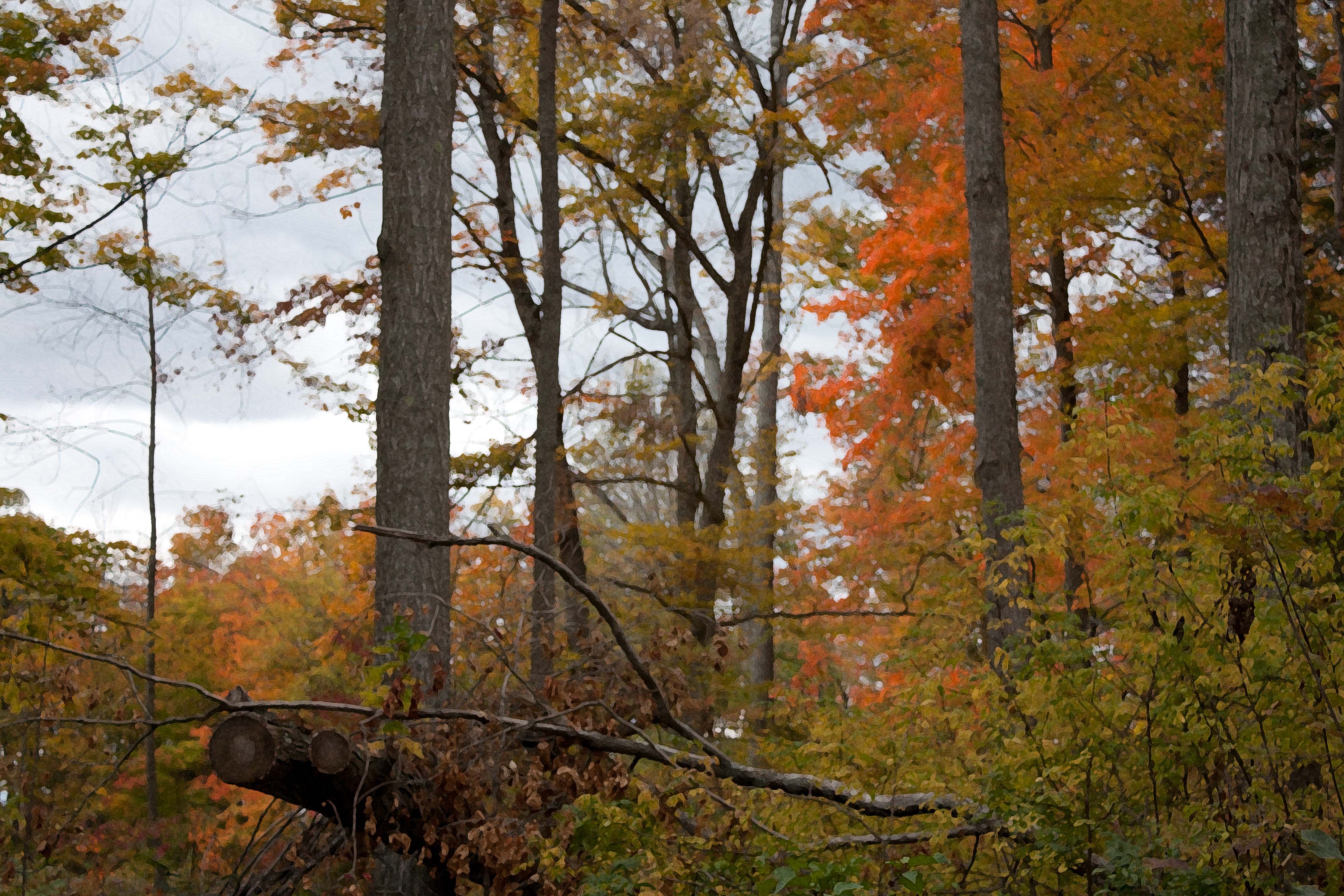
Marcescent beech and oak trees add bronze colour to the grey-green of the pine forest, Petroglyph Park, ON (Photo and rendition by Nina Munteanu)
It’s early winter, when the chill winds carve through mixed forests in a restless howl, snatching leaves of deciduous trees and sending them flying. But in this primeval ancient forest of evergreens, the few deciduous trees mimic their conifer cousins by stubbornly clutching their leaves. In winter, the leaves of oak and beech trees cling to their branches, marcescent. To the silver greens of pine and hemlock, they add flames of copper and gold
Red pine trees tower over a deer trail near the lake, Petroglyph Park, ON (photo and rendition by Nina Munteanu)
I found myself walking on the spongy ground, a carpet of leaves, needles and debris, not far from Gilford Lake, among a tall stand of red pines, whose thick canopy created a green ceiling overhead. Breathing in the strong scent of pine and loam, I set up my camera and tripod to capture the mood of a natural path through the forest. I’d just set up the camera, hand poised on the shutter, when a deer wandered in front of me—just three metres away! It saw me and stopped mid-step. We stared at one another in a halting pause, a moment made eternity. Then the deer leapt gracefully away, disappearing within seconds into the dark forest and leaving me in the silence of rapture. I felt laughter tease up my throat; I hadn’t taken a picture.
Road winds through the mixed forest in Petroglyph Park, ON (photo and rendition by Nina Munteanu)
Winding road through mixed forest in Petroglyph Park, ON (photo and rendition by Nina Munteanu)
My walk through this natural forest is both thrilling and comforting, uplifting and restful. I am living outside myself, sensing the textures, sounds and tastes of the forest—in sublime discovery. It is here, where the sounds and smells of the natural world abide, without regard to me, that I feel most at home.
I am simply being…
Mixture of oak, beech, pine and hemlock conspire in a wash of colour and texture, Petroglyph Park, ON (photo and rendition by Nina Munteanu)
Nina Munteanu is a Canadian ecologist / limnologist and novelist. She is co-editor of Europa SF and currently teaches writing courses at George Brown College and the University of Toronto. Visit www.ninamunteanu.ca for the latest on her books. Nina’s bilingual “La natura dell’acqua / The Way of Water” was published by Mincione Edizioni in Rome. Her non-fiction book “Water Is…” by Pixl Press (Vancouver) was selected by Margaret Atwood in the New York Times ‘Year in Reading’ and was chosen as the 2017 Summer Read by Water Canada. Her novel “A Diary in the Age of Water” was released by Inanna Publications (Toronto) in June 2020.
Fall colours of maple trees in the Mark S. Burnham Park, ON (photo and rendition by Nina Munteanu)
For the past few days, I’ve been wandering, entranced, in the various forests, swamps and marshes of the Kawarthas. I found myself inspired by the autumnal light and organic scent in the air.
They pulled me into the verge…
Poplar trees in the fall, ON (photo and rendition by Nina Munteanu)
It’s the time of “the verge,” when the seasons collide in the wake of the equinox and anticipate the unruly winds of change. A moment of stillness before the Earth shifts, relinquishes, and embraces.
In the hush of a great threshold, Nature holds its breath and a leaf settles in the arms of a cedar root…
Largetooth aspen sits on a cedar root in the pine forest of Warsaw Cave Park, ON (photo by Nina Munteanu)
Ancient pine, cedar and hemlocks in Jackson Creek forest, ON (photo and rendition by Nina Munteanu)
There I was, eyes and ears–all senses–wide, taking in Nature’s gifts of the verge. The rustling leaves in a cool wind. The musky smell of swamp water and the sweet rot of vegetation. The lazy gurgle of shallow creeks around smooth rocks. The halting shrill of a Blue Jay.
Jackson Creek in October, ON (photo and rendition by Nina Munteanu)
On one walk, a giant toad—the biggest I’d ever seen!—waddled across my path. I think it was an American toad, mottled and rough with warts. He looked rather grumpy and took his time, somehow confident—or not caring—that I could step on him and squish him easily. He was rather jiggly as he lumbered on. I did not take his picture; I don’t think he wanted me to, so I didn’t.
Fallen hemlock tree in Mark S. Burnham Park, ON (photo and rendition by Nina Munteanu)
Soon after, a small garter snake slithered across my path, less confident of my steps. It froze once it was safely out of my way. Good snake…
The forest was alive with the domestic chaos of wildlife busy with itself. Chipmunks chugged and squirrels scolded from the tree tops. Surely not at me! I climbed out of the lowland of old-growth hemlock-beech swamp forest to the top of a drumlin of maple-hop hornbeam-ash forest and then descended again into the dark hemlocks and pines.
Maple tree showing deep colour in the fall, ON (photo and rendition by Nina Munteanu)
Red and sugar maples and aspens flame in the fall by the Otonabee River near Trent University, ON (photo and rendition by Nina Munteanu)
The colours of sugar and red maple blazed in the canopy above, frothy clouds of bright orange, red, yellow and everything in-between under a deep blue sky. I wandered, camera in hand, and found treasures everywhere—from blue fungi to tiny bright red maple leaves freshly fallen.
Various mushrooms in the forests of Ontario (photos by Nina Munteanu)
I have a silly habit of picking up leaves and pressing them when I get home; my books are repositories of colourful prizes from years past.
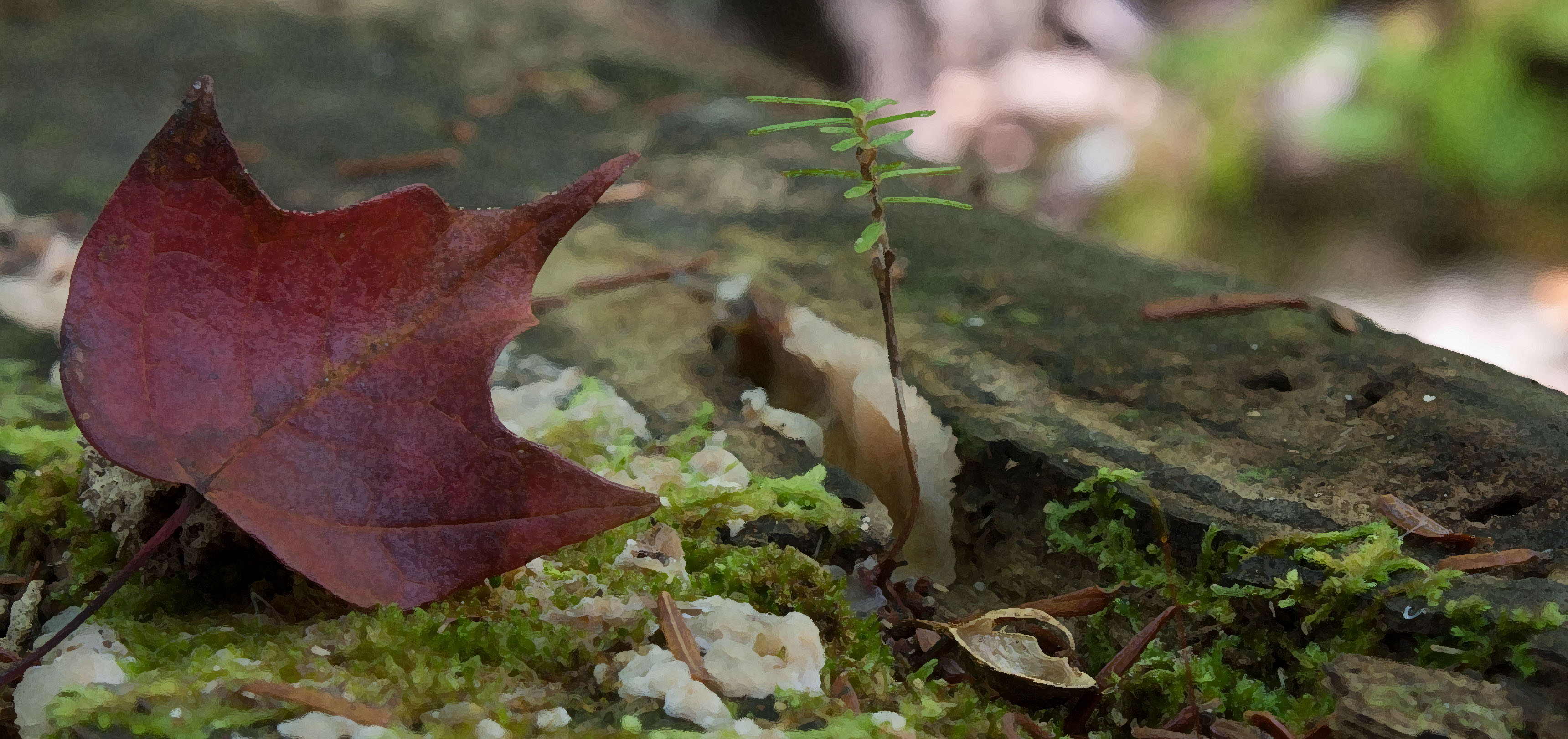
Small red maple leaf sits beside a hemlock sapling amid white fungi and moss on a nurse log in Mark S. Burnham forest, ON (photo and rendition by Nina Munteanu)
Marsh in Ontario in the fall (photo and rendition by Nina Munteanu)
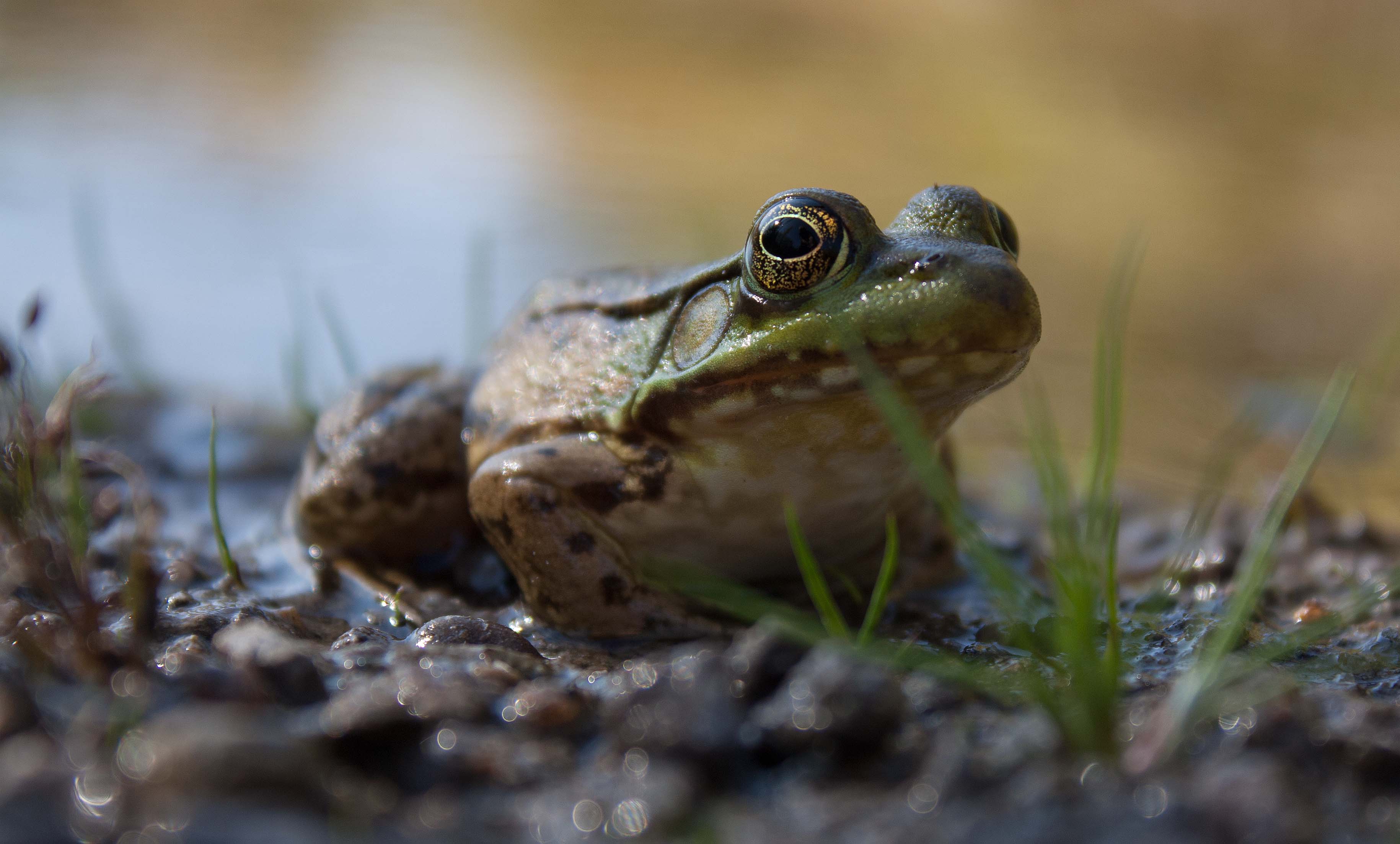
In the marsh, I encountered a green frog, sitting in the mud. It decided to pose for my camera. And I obligingly took its picture. My new best friend.
No, I did not take him home. I left him there, lollying in the mud, looking very content.
Green frog poses for the author’s camera
For all I know he’s still there, presiding over the autumn verge…
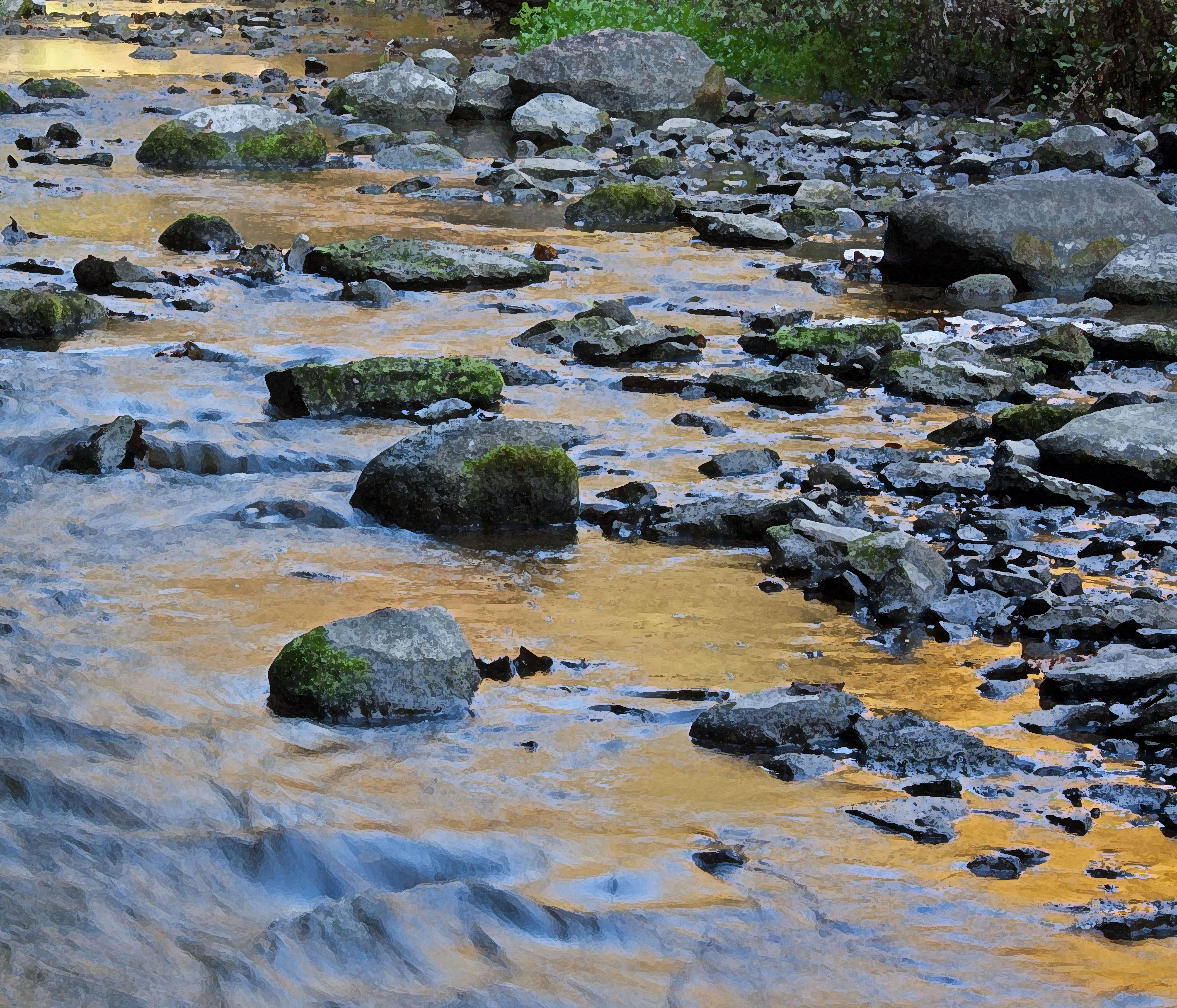
Jackson Creek reflects the gold hue of largetooth aspen in October, ON (photo by Nina Munteanu)
Nina Munteanu is a Canadian ecologist / limnologist and novelist. She is co-editor of Europa SF and currently teaches writing courses at George Brown College and the University of Toronto. Visit www.ninamunteanu.ca for the latest on her books. Nina’s bilingual “La natura dell’acqua / The Way of Water” was published by Mincione Edizioni in Rome. Her non-fiction book “Water Is…” by Pixl Press (Vancouver) was selected by Margaret Atwood in the New York Times ‘Year in Reading’ and was chosen as the 2017 Summer Read by Water Canada. Her novel “A Diary in the Age of Water” was released by Inanna Publications (Toronto) in June 2020.
Poplar trees in fall, ON (photo and rendition by Nina Munteanu)
I just finished reading Ben Rawlence’s 2022 book The Treeline. It is a book that made me think. It made me cry. It made me despair. It also gave me hope.
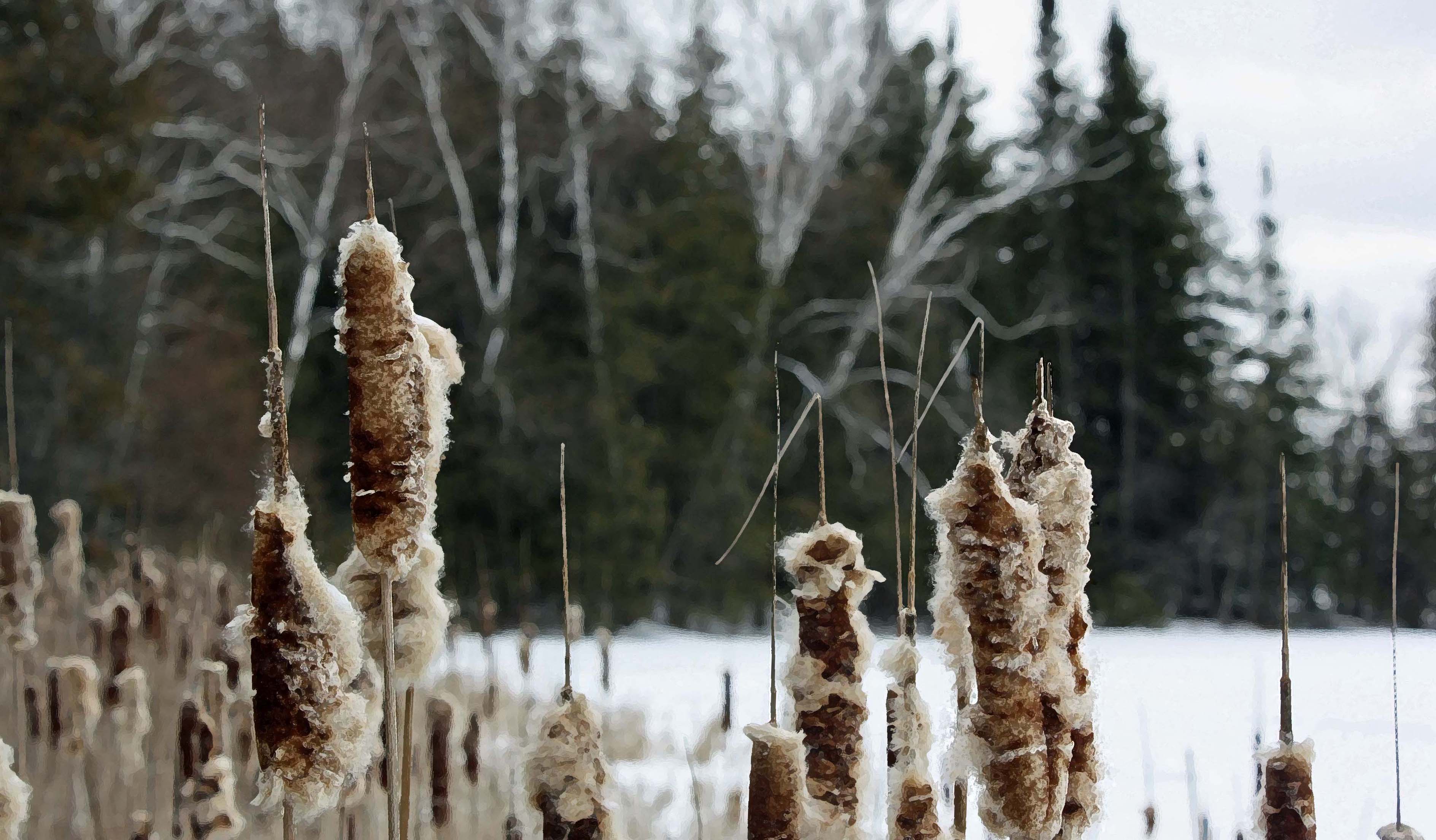
Cattails line a snow-covered marsh with spruce and fir behind, ON (photo and rendition by Nina Munteanu)
I was gripped by this honest and unflinching exploration on the moving treeline with climate change and what it will mean for humanity. Beautifully written and rigorously reported, Rawlence invited me on a journey of all major treelines over the globe from Scotland, Norway and Russia, to Alaska, Canada and Greenland. Throughout his description of a warming world and a vanishing way of life, Rawlence meditates on the many repercussions on how humans live.
Pine-cedar forest in Ontario (photo and rendition by Nina Munteanu)
He aptly describes the forests of the world as the ‘heartbeat of the planet,’ the cycles of breathing and the pulses of life from the spike of oxygen in the spring when trees put out their leaves to the peaks and troughs over day and night that regulate plant photosynthesis and respiration. The peaks and troughs are getting shallower, he writes. With more carbon dioxide in the air the trees work less; they inhale less and exhale less oxygen.
“The planet is a finely tuned system. A few degrees of change in its orbit can usher in an ice age; a few degrees of temperature change can transform the distribution of species, can melt glaciers and create oceans. In the future, when the ice is gone, there may be no such thing as a treeline at all. As the stable currents of air and water associated with the Gulf Stream, the polar front, polar vortex and Beaufort Gyre dissipate or fluctuate, the Arctic Ocean melts completely, and the Rossby waves in the upper atmosphere go haywire, the fine gradations of temperature, altitude and latitude first observed by Alexander von Humboldt will become decoupled and ecological transition zones scrambled. Instead of a majestic sweeping zone of forest around the planet, we might find discontinuous pockets of trees in odd places, refugees from soil and temperatures long gone, and crocodiles once again at the North Pole.”
Ben Rawlence, The Treeline
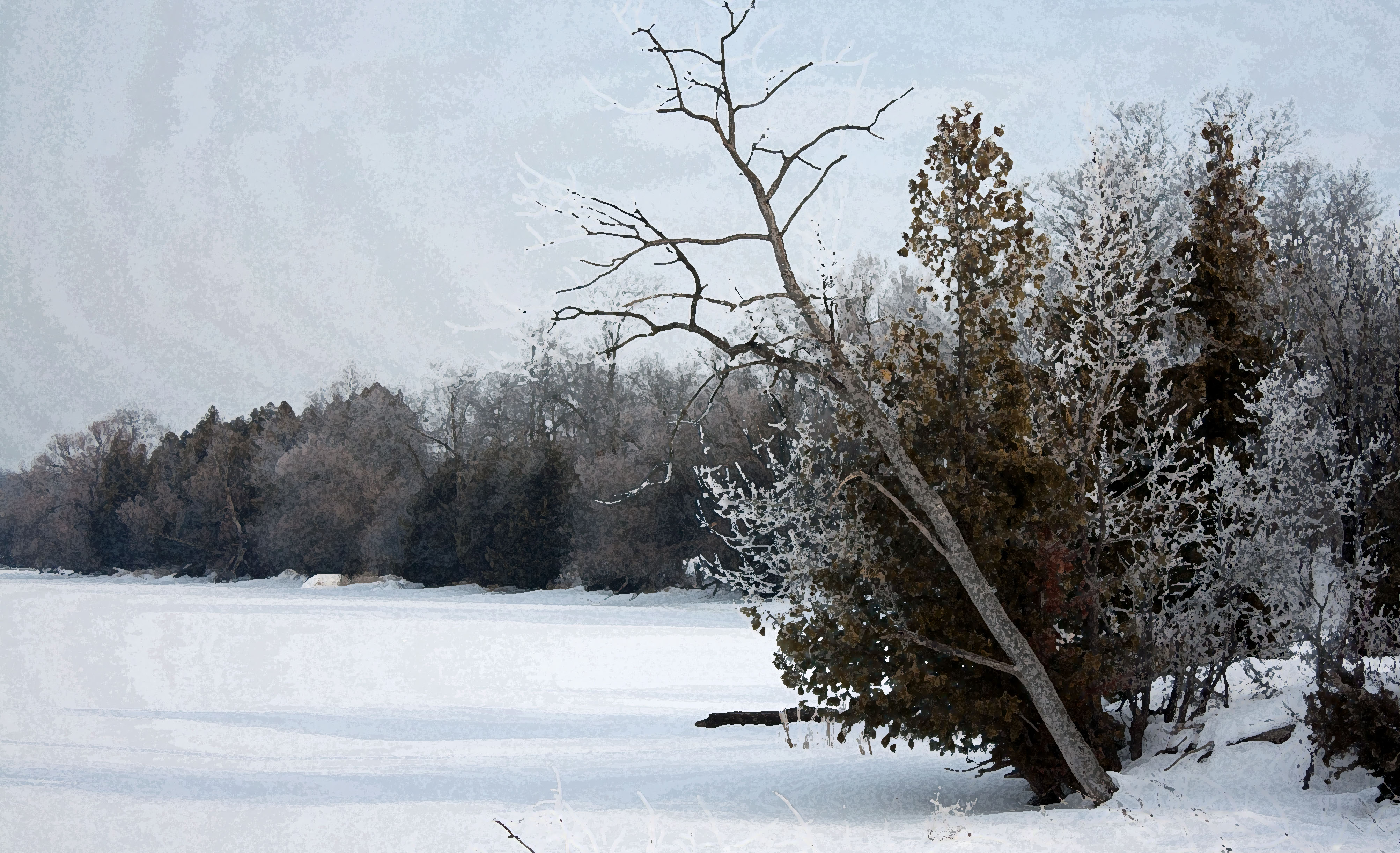
Snow-covered river shoreline with mixed forest, ON (photo and rendition by Nina Munteanu)
Rawlence brings this all into perspective to our present situation and the role science has played in our hubristic illusion of control:
“An unfortunate side effect of science is the illusion of human mastery: the idea that if we know what is happening then we can control. The irony is that we might have been able to. The tragedy is that it is too late. The chain reaction is under way. The curve only gets steeper from here…five metres of sea level rise is locked in; it’s just a question of how fast the ice melts. Once again, the models seem to underestimate the speed…”
Ben Rawlence, The Treeline
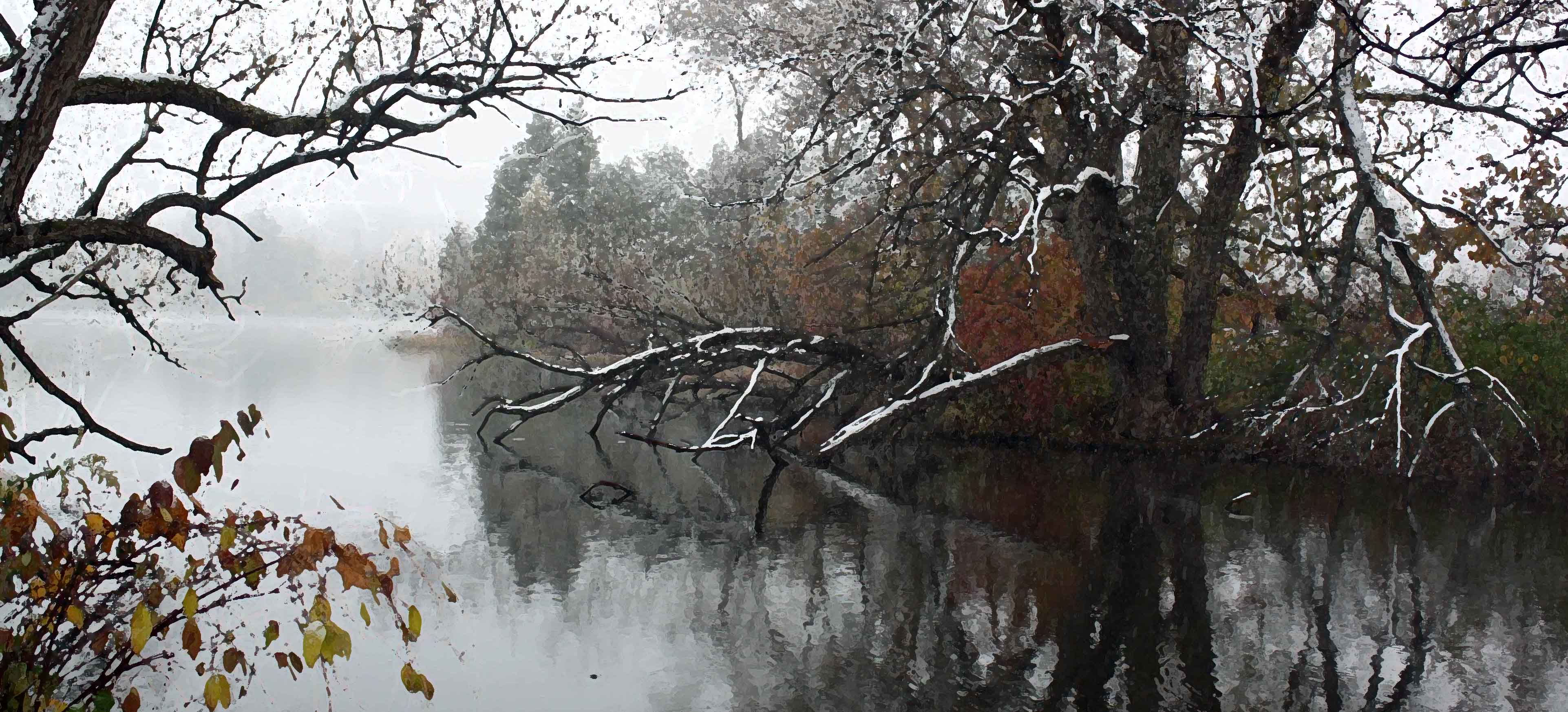
Willow by a river at first snow, ON (photo and rendition by Nina Munteanu)
What is most unfortunate for us, for humanity, is that we have known all this for some time. But we’ve done little. “Industrialist capitalism and its export colonialism” with its exploitive gaze that drives our needs and wants and actions has chosen to ignore the signs. That exploitive gaze ignored that we are not only embedded in but dependent upon the natural world and all the forests to live and flourish.
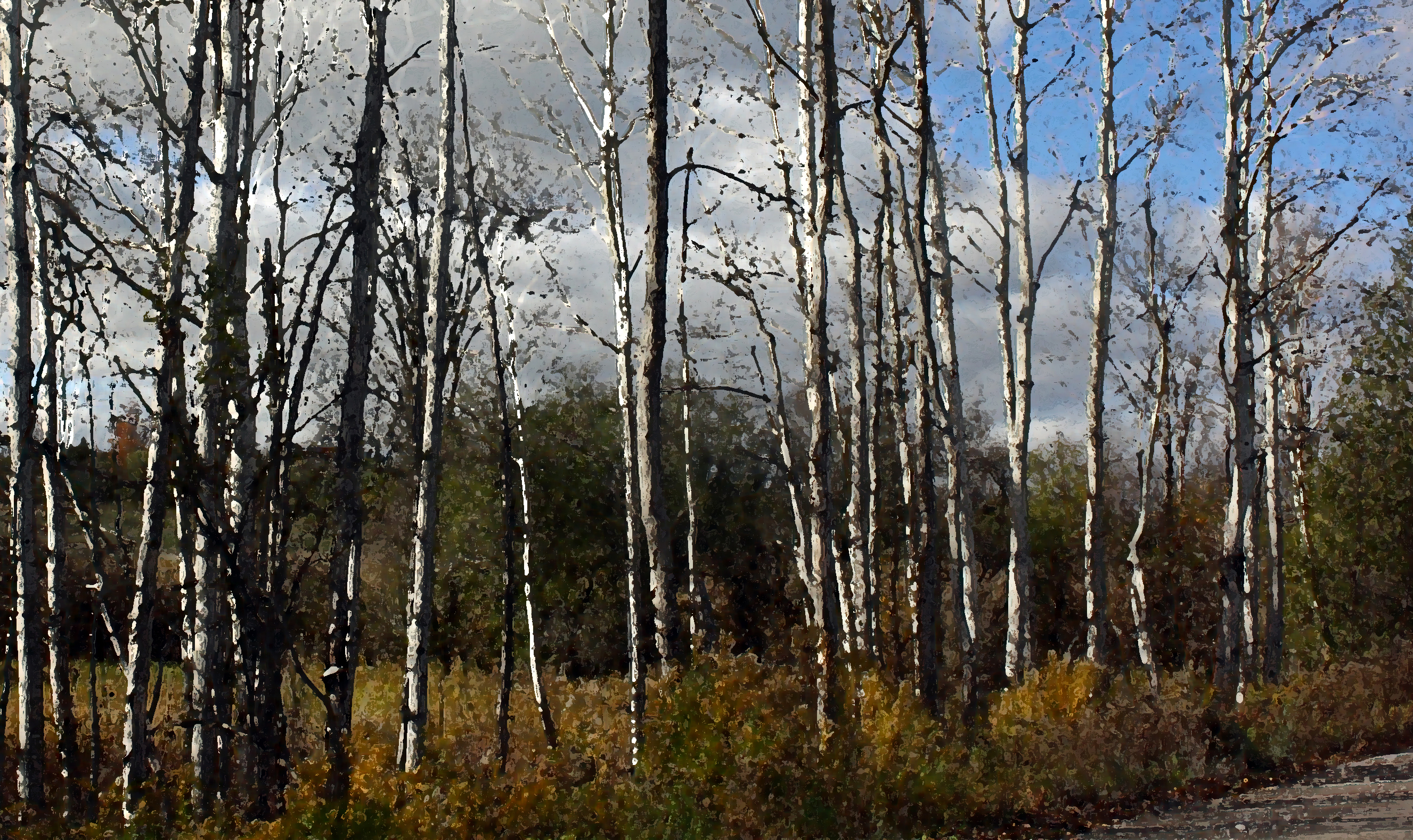
Tamarack and birch trees in the fall, ON (photo and rendition by Nina Munteanu)
What Rawlence does acknowledge is a way out of our self-created doom and accompanying solastalgia:
“Our present emergency is forcing us to remember what, until recently, we have always known: that there is a web of communication, meaning and significance beyond us, a world of life forms constantly chattering, shouting and flirting and hunting each other, indifferent to human affairs. And there is solace in such a vision. The way out of the depression and grief and guilt of the carbon cul-de-sac we have driven down is to contemplate the world without us. To know the earth, that life, will continue its evolutionary journey in all its mystery and wonder. To widen our idea of time, and of ourselves. If we see ourselves as part of a larger whole, then it is the complete picture that is beautiful, worthy of meaning and respect, worth perhaps dying for, safe in the knowledge that life is not the opposite of death but a circle, as the forest teaches us, a continuum.”
Ben Rawlence, The Treeline
Poplar trees line a road in the Ontario country (photo and rendition by Nina Munteanu)
The planet will be alright. Species will go and others will come. Earth has experienced five extinction events (we are currently experiencing the sixth extinction event now) and after each, life flourished again, albeit different life.
Is there still hope for humanity? Perhaps—if we set our hubris aside and embrace humility and kindness. And, if in that humility, we can adapt our way through the succession we’ve triggered. There might be hope for us still…
Rawlence devotes his epilogue called “Thinking Like a Forest” to the wisdom of the indigenous people who have for millennia co-existed sustainably with the natural ecosystems of the Earth. “The Koyukon, the Sámi, the Nganasan, the Anishinaabe are just a few of the countless indigenous peoples whose world view attests to our foundational reliance on the forest.”
Time to learn from them.
Trees at sunset in winter, ON (photo and rendition by Nina Munteanu)
Nina Munteanu is an ecologist and internationally published author of award-nominated speculative novels, short stories and non-fiction. She is co-editor of Europa SF and currently teaches writing courses at George Brown College and the University of Toronto. Visit www.ninamunteanu.ca for the latest on her books. Nina’s recent book is the bilingual “La natura dell’acqua / The Way of Water” (Mincione Edizioni, Rome). Her latest “Water Is…” is currently an Amazon Bestseller and NY Times ‘year in reading’ choice of Margaret Atwood.
Flooding creek in Trent Nature Sanctuary during a rain, ON (photo and rendition by Nina Munteanu)
One morning, in late spring, I went walking in the rain through the Trent Nature Sanctuary forest. Looking for magic… Moisture covered everything. It coaxed out vivid colours and textures in a tangle of stable chaos. I felt like I’d entered a Tom Thomson painting…
Moss-covered cedar trees after a soft rain in Trent Nature Sanctuary, ON (photo by Nina Munteanu)
The rain intensified the forest’s mosaic of unique scents from pungent, heavy and sharp to floral, fresh and sweet. The gossamer morning light favoured photography with a gentleness that softened and deepened everything, and invited intimacy. Mist hung low and rose like steam from the damp earth, slowing time. It felt as though I was walking through a cloud. The forest emerged ghost-like in glimpses of tree, shrub and grass. The brilliant red of the osier dogwood. The vivid greens of mosses and leaves. A tangle of blue-green lichens and bright red cedar roots. I was witness to a chaotic tapestry of Nature’s art. Infinite shades of green, brown, grey and yellow created a fluid landscape that water painted into a vibrant watercolour scene.
I moved through it, boots squelching along the spongy loam path, as though wrapped in a moving artwork.
Dew drops on hawksweed, lichen fruiting bodies in background, ON (photo by Nina Munteanu)
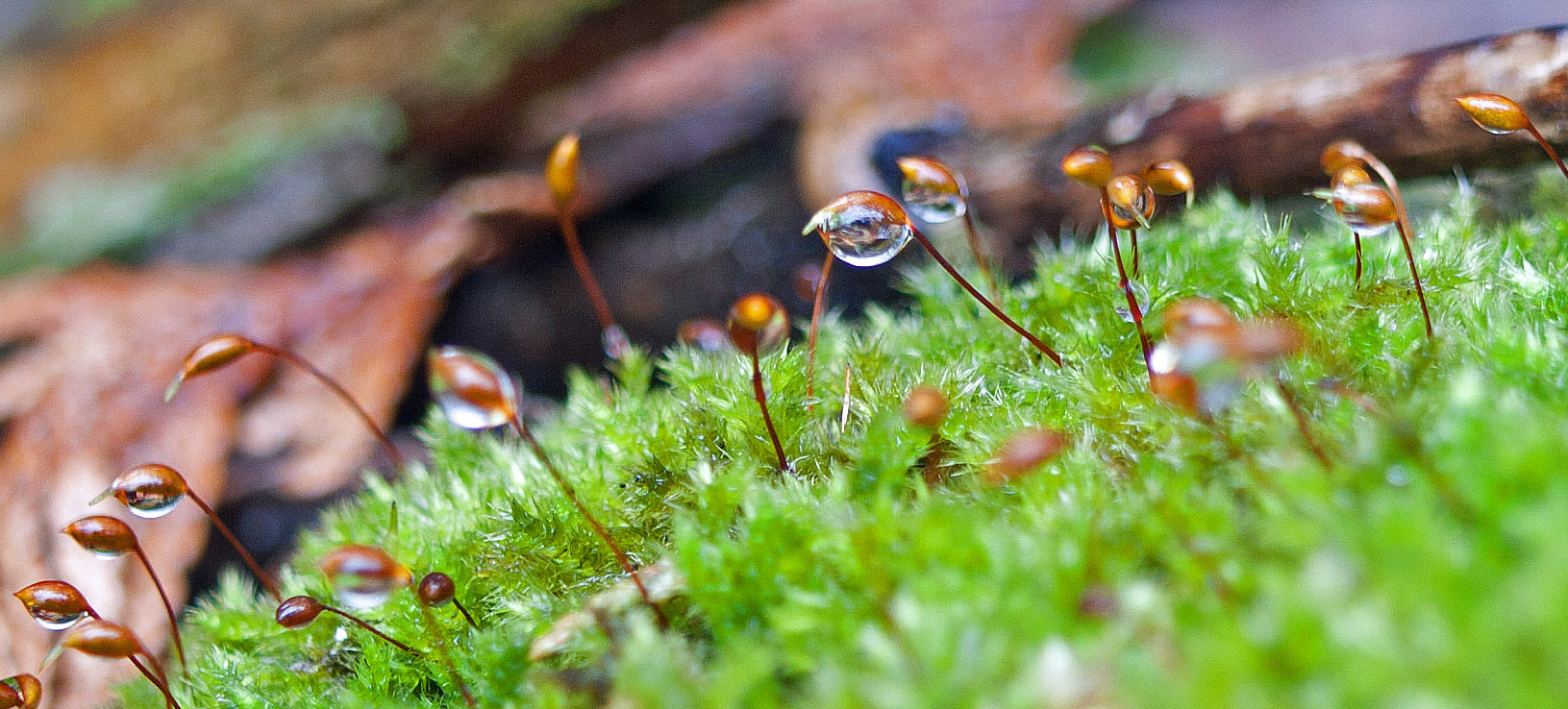
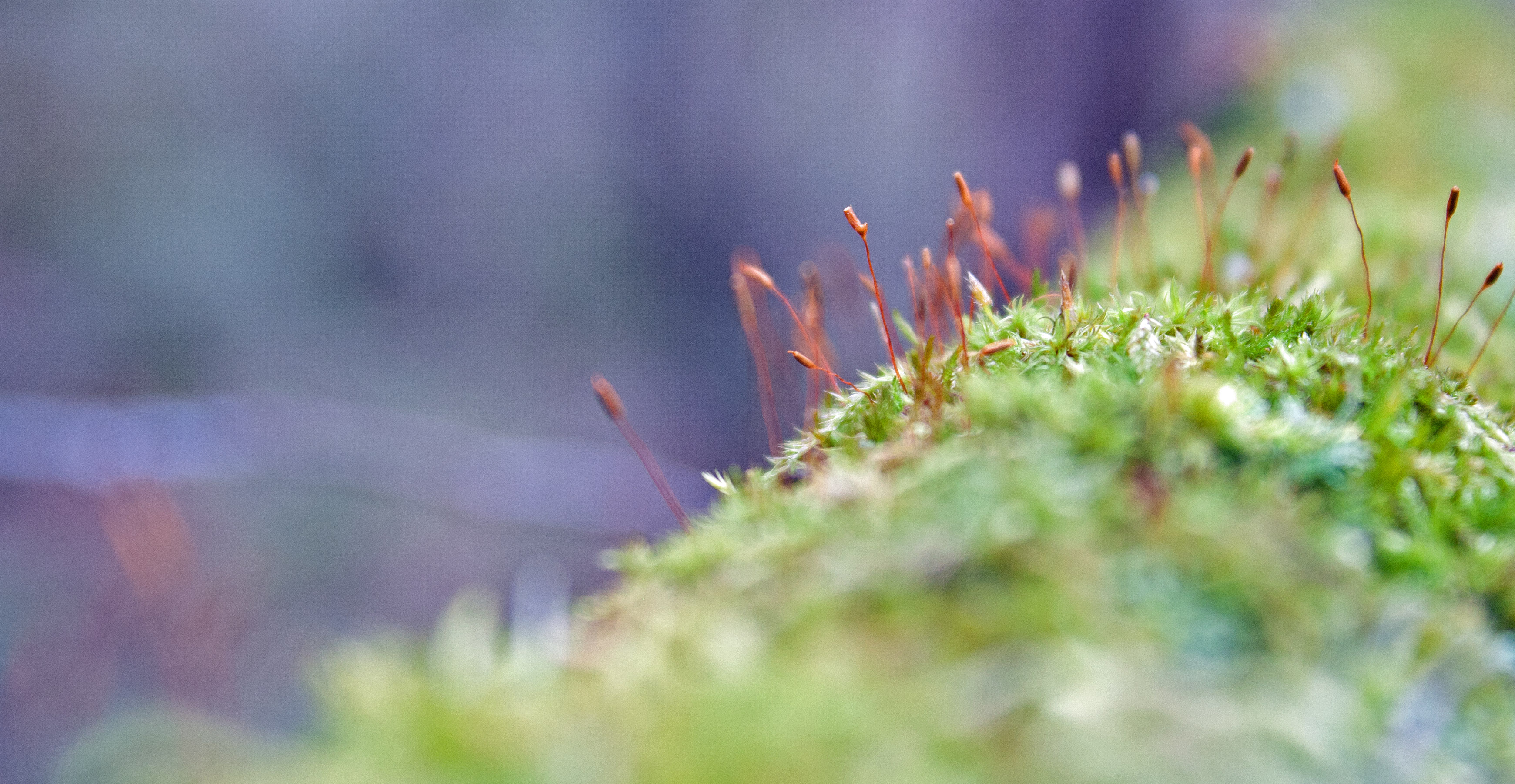
Moss with spore capsules in the rain, Trent Nature Sanctuary, ON (photo by Nina Munteanu)
Cedar roots and ferns in the heavy mist of a morning rain, Trent Nature Sanctuary, ON (photo by Nina Munteanu)
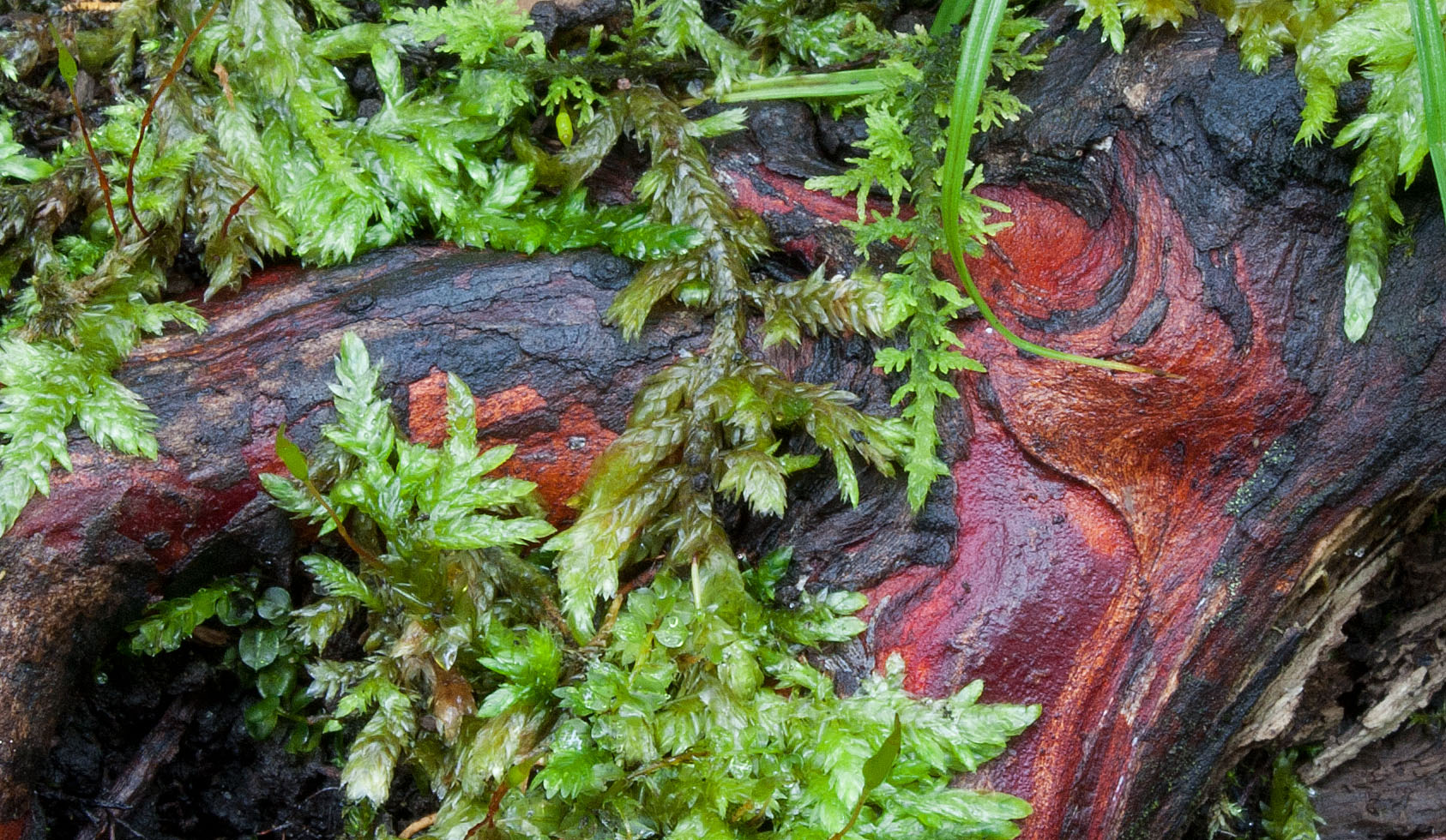
Cedar root and moss during a mild rain, Trent Nature Sanctuary, ON (photo by Nina Munteanu)
Cedar root and moss shortly after a rain, Trent Nature Sanctuary, ON (photo by Nina Munteanu)
The moisture carried the warbles and fluting chirps of lively bird song amid the hush of raindrops on vegetation. Each surface had a unique voice. And the rainfall—from light drizzle to hard pour—carried its own tune, rhythm and percussion. A symphony of diverse frequency from rich infrasound to beyond.
Nina’s Canon EOS Rebel camera on its tripod, ready to take photos, Trent Nature Sanctuary, ON (photo by Nina Munteanu)
I kept my camera, attached to its tripod, tucked under several water-proof bags and walked with deliberate steps through wet duff, decayed leaves and mud. I had a hood but couldn’t stand to keep it up—I needed to hear and feel all of it: the rain sizzling through the vegetation, the red-winged blackbird’s conk-a-lee! The robin’s cheerily-cheer-up-cheerily-cheer up! The crow’s caw and rattle. The primordial shriek of a blue jay or kingbird. All were out, though not visible, as I navigated the huge puddles and slippery mud-leaf mix. Hair dripping, face in a grin.
Rain falling on the marsh to the Otonabee River, ON (photo by Nina Munteanu)
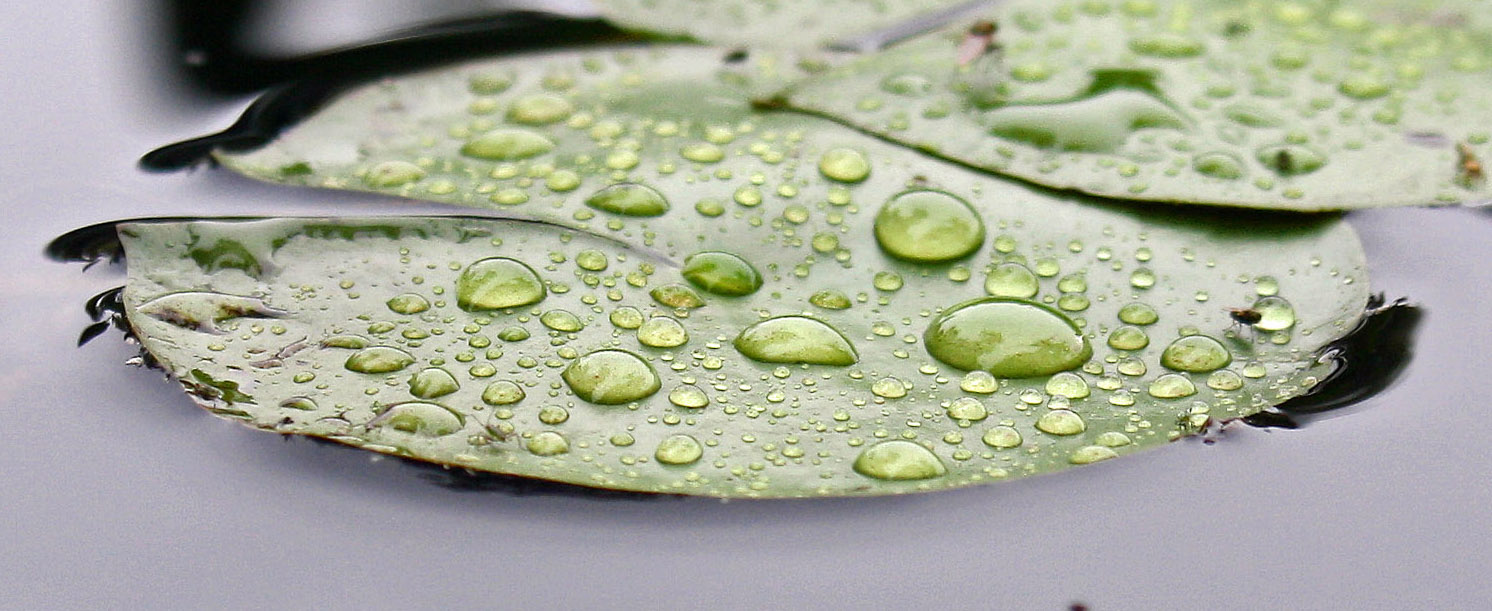
Pond lilies in the rain, ON (photo by Nina Munteanu)
Rain falls on the Otonabee River, ON (photo by Nina Munteanu)
I felt elation in Nature’s celebration of life. I was the only person in the park and thoroughly basked in that feeling of humbleness that comes with a kind of knowing: of being part of something far greater than oneself and yet in some way being that greater ‘self.’ Like I belonged there. Hard to explain. But it felt truly awesome and eternal.
Nina Munteanu
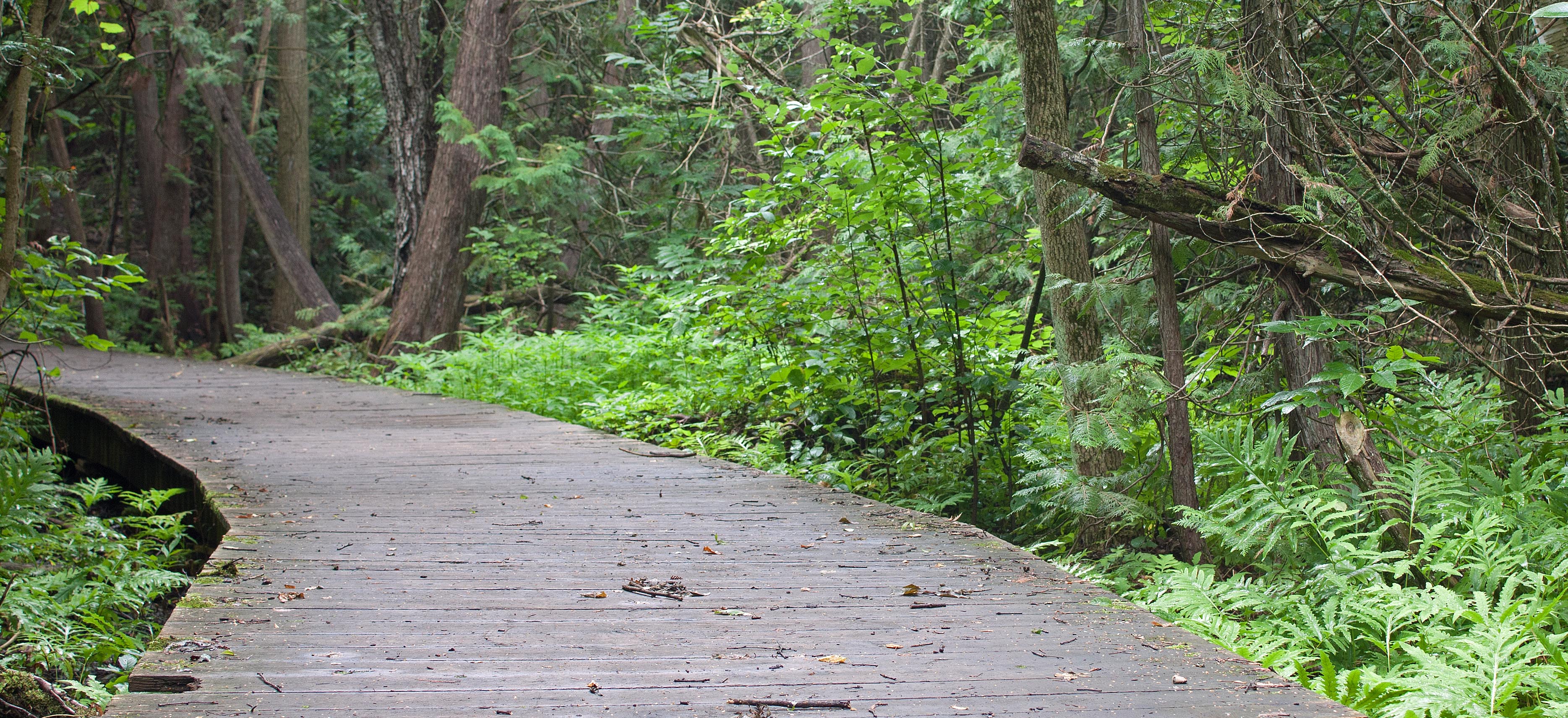
Boardwalk over the forest swamp, Trent Nature Sanctuary, ON (photo by Nina Munteanu)
Fence post with marsh in the background during a steady rainfall, ON (photo by Nina Munteanu)
Country road in the rain, ON (photo and rendition by Nina Munteanu)
I could have stayed there, wet in the rain, for hours. But I felt sorry for my camera and headed home, thinking of a warm cup of tea…
NINA MUNTEANU is a Canadian ecologist / limnologist and novelist. She is co-editor of Europa SF and currently teaches writing courses at George Brown College and the University of Toronto. Visit www.ninamunteanu.ca for the latest on her books. Nina’s bilingual “La natura dell’acqua / The Way of Water” was published by Mincione Edizioni in Rome. Her non-fiction book “Water Is…” by Pixl Press(Vancouver) was selected by Margaret Atwood in the New York Times ‘Year in Reading’ and was chosen as the 2017 Summer Read by Water Canada. Her novel “A Diary in the Age of Water” was released by Inanna Publications (Toronto) in June 2020.
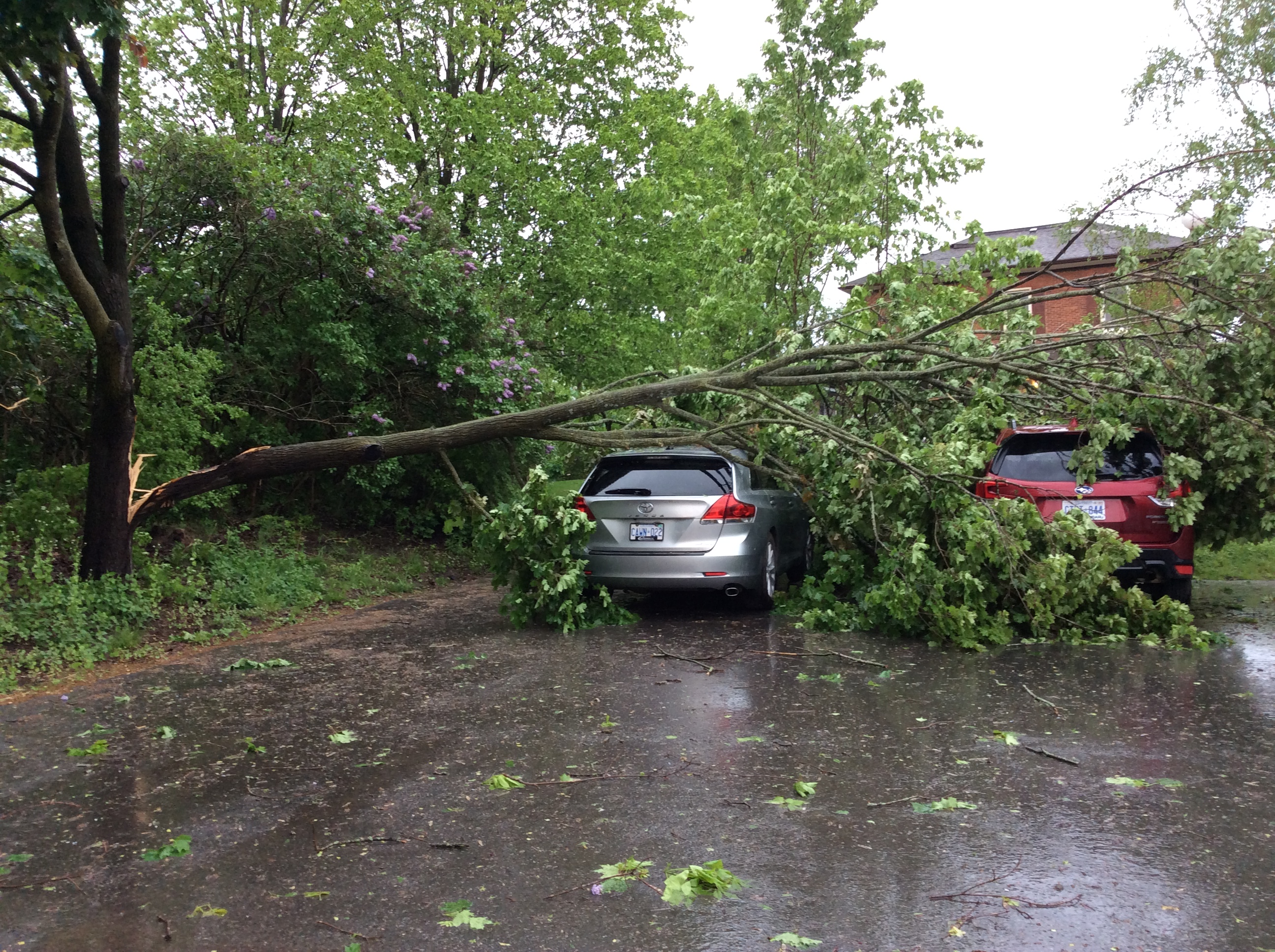
Cars trapped when a sugar maple snaps and falls on them in Saturday’s Derecho, Peterborough, ON (photo by Nina Munteanu)
It’s Wednesday and parts of the city still have no power since Saturday’s storm swept through like a ferocious lion. We got our power yesterday. We’d relied on our kind neighbours, who had a barbecue, to cook up some suppers. The power has come back in stages depending on where lines were brought down by trees or the violent wind microbursts.
A string of power poles and lines downed by the violent winds of the derecho along Highway 29 near Lakefield, ON (photos by Nina Munteanu)
Environment Canada calls Saturday’s storm a derecho: a long line of very active and violent thunderstorms or microbursts that include winds of at least 93 km/h with focused gusts of 121 km/h or greater. According to Environment Canada Senior Climatologist David Phillips, the storm spanned about 1,000 kilometers from Michigan to Maine as it went across Ontario and Quebec. Derechos typically contain numerous downburst clusters (families of downburst clusters) that, in turn, have smaller downbursts, and smaller microbursts. These tight, often cyclic tornado-like bursts within larger linear downbursts are what likely created the random devastation seen in Peterborough, where one tree was entirely uprooted and the tree beside it left untouched.
Birch uprooted on Auburn Street, Peterborough (photo by Nina Munteanu)
A true ‘herald archetype’, environmental disasters incite change, often through disorder. In doing so, they can bring out the best in us. The true mettle of a person is often revealed during such times, through the emergence of compassion and kindness.
I live just off the Rotary Trail in Peterborough, facing a mixed riparian forest of mostly black walnut and locust trees, with some silver maple, willow, Manitoba maple, oak and ash. The trail is well used every day by cyclists and walkers. The tornado-force winds and deluge rains singled out a few trees on the forest edge and flung them across the trail. A quick inspection shortly after the storm revealed that several trees formed obstacles to those using the trail: a silver maple just in front of my good friend Merridy’s place; an old half-dead elm; and a large Manitoba maple whose upper canopy had gotten tangled in the telephone wires.
Various damaged and uprooted trees in Peterborough, ON (photos by Nina Munteanu)
When Merridy and I decided to attempt clearing the Rotary Trail of strewn maple limbs and branches, we weren’t there more than five minutes when a cyclist stopped and without a word helped us; he grabbed large tree limbs and hoisted them aside like Superman then got on his bike and took off without a word—like Spiderman. After more dragging of tree limbs and my deft hand at the tree clippers and the broom, we cleared the trail for walkers and cyclists.
Before (left) and after (right) we cleared the Rotary Trail of downed silver maple from the derecho (photos by Nina Munteanu)
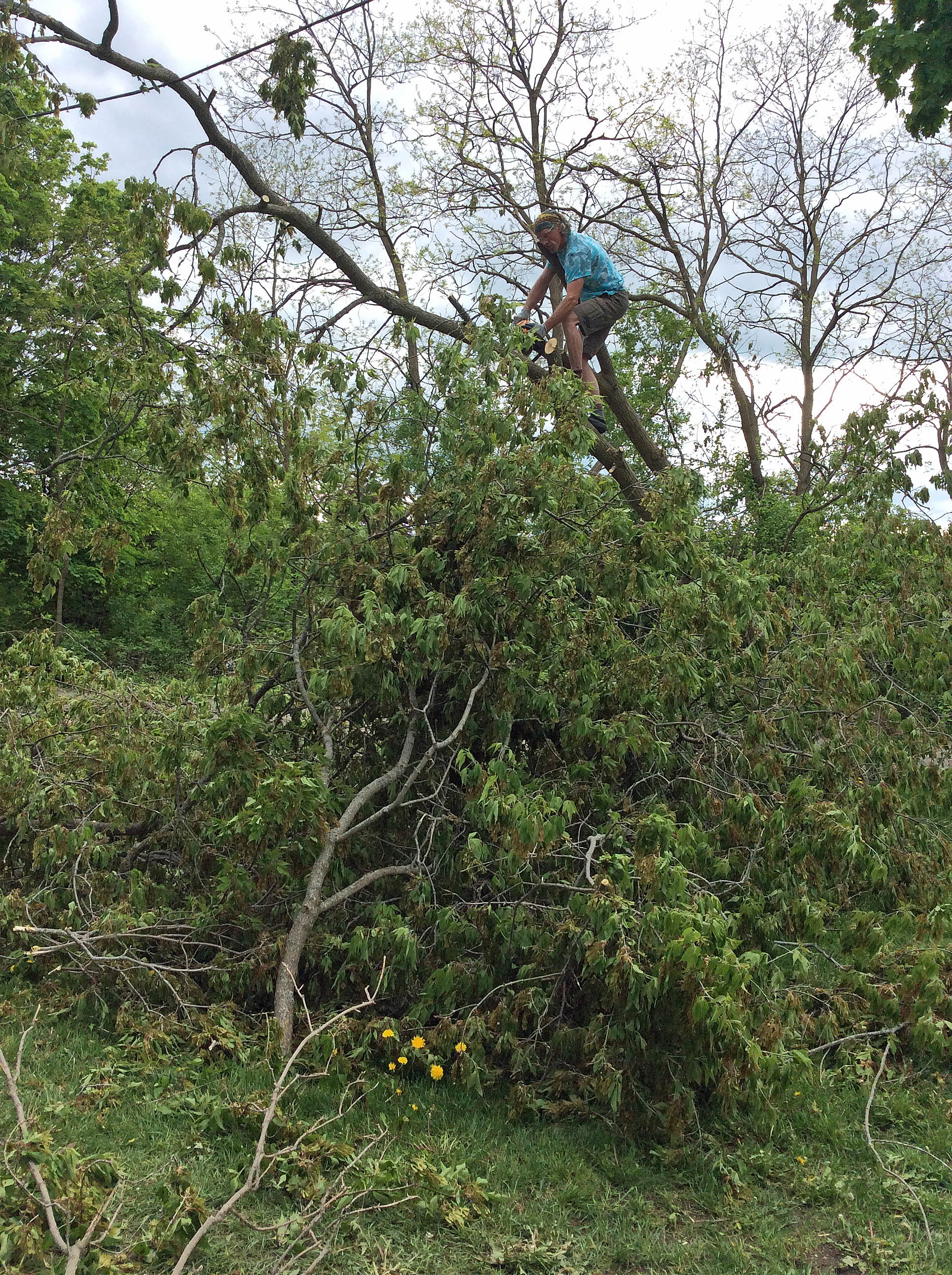
And then there was Charlie … a fashion-savvy quasi hipster-hippy who came cycling in with his chainsaw and hand saw on his back; he’d been all over the trail clearing tree debris just because he could. Charlie set to work on the huge Manitoba maple that had fallen across the trail and was leaning heavily on the telephone wire. Charlie proceeded to climb the tree and saw branches here and there to lighten the limb on the wire before cutting it. Two of us ladies became his cleanup crew, hauling big tree sections off the path as he downed them. By the time he got to the main tree limb on the wire, a group of cheerleaders had formed to watch. We all clapped when the big branch came off the line. One elder lady on two walking canes hobbled out from her home and handed Charlie a Bobcaygeon Petes Lager as thanks.
Charlie sawing off branches from Manitoba maple tangled on telephone wire (photo by Nina Munteanu)
Charlie saws the remaining tree trunk to clear the trail (photo by Nina Munteanu)
At first it was just me and Charlie. Watching him set up, I’d asked him if he was from the city and in the same breath knew he wasn’t—we both knew they were very busy getting the city’s power back on and freeing streets and getting trees off the roofs of houses; it would be a long time before they came to the Rotary Trail and other parks to clear. He responded, “well, that depends… are you a lawyer?” I laughed. We both recognized that Charlie was a rogue Good Samaritan, using less than regular protocol (no safety harness or equipment [except for goggles] and climbing shoes). When I said no, he relaxed and we introduced ourselves and exchanged stories about the storm, then got to work. I was soon joined by Susan, and together we became Charlie’s support team, hauling limbs and branches out of the tangle then rolling large tree bole sections to the side. Eventually several more walkers and nearby residents came to support the work and watch. Within an hour, the entire tree was off the path and off the wire. I felt a wonderful sense of community as people gathered exchanged names and stories about the storm. And it all started with one person’s kindness. Thanks, Charlie!
Before (left) and after (right) Charlie and his gang cleared the way (photo by Nina Munteanu)
I find that we really find our humanity and sense of kindness when a disaster strikes… one of the ‘good’ things about them.
Derecho damage to trees in the forest in Peterborough area, ON (photos by Nina Munteanu)
Nina Munteanu is a Canadian ecologist / limnologist and novelist. She is co-editor of Europa SF and currently teaches writing courses at George Brown College and the University of Toronto. Visit www.ninamunteanu.ca for the latest on her books. Nina’s bilingual “La natura dell’acqua / The Way of Water” was published by Mincione Edizioni in Rome. Her non-fiction book “Water Is…” by Pixl Press(Vancouver) was selected by Margaret Atwood in the New York Times ‘Year in Reading’ and was chosen as the 2017 Summer Read by Water Canada. Her novel “A Diary in the Age of Water” was released by Inanna Publications (Toronto) in June 2020.
The TVO and National Film Board of Canada film Borealis by Kevin McMahon opens with ‘tree song’ and Diana Beresford Kroeger’s voice: “The design of Nature is music. If you listen to the trees, you will hear their song. And some people actually hear an individual song for certain species.”
Early in the film, you see Edmund Metatawabin, a Fort Albany First Nation writer, walking ghost-like in the forest. His voice tells us that when the trees look at us, we would just be like “these little things flitting by.” This simple comment underscores the difference that time plays to a tree that may live to a thousand years in contrast to a human who—if they are lucky—may live to a hundred. Says Metatawabin:
“We have a certain relationship with the trees, their living essence. The tree has been here for a long time, standing in the same spot but watching…They’re our older relations. We’re very happy and secure that they’re there, still standing watching over us. Some of us have heard them sing.”
Edmund Metatawabin
Boreal forest after a natural fire (Borealis)
In a frank interview with Madeline Lines of POV Magazine about the making of Borealis, filmmaker Kevin McMahon talked about how the rugged beauty of the boreal forest belies a fragility poised on a precarious balance with humanity.
The film discusses some of the major relationships and mechanisms of this complex and unique ecosystem through the voices of scientists and naturalists who study and know the forest: botanists, population and aquatic ecologists, atmospheric scientists, forest entomologists and researchers and guides.
“The story of the boreal forest [is that] basically … it goes up, burns itself down and like a phoenix, goes up again,” says McMahon. “There’s a complexity—the trees influence the animals, the animals influence the trees, so a community grows up over at least two centuries, usually, and sometimes three, or four.”
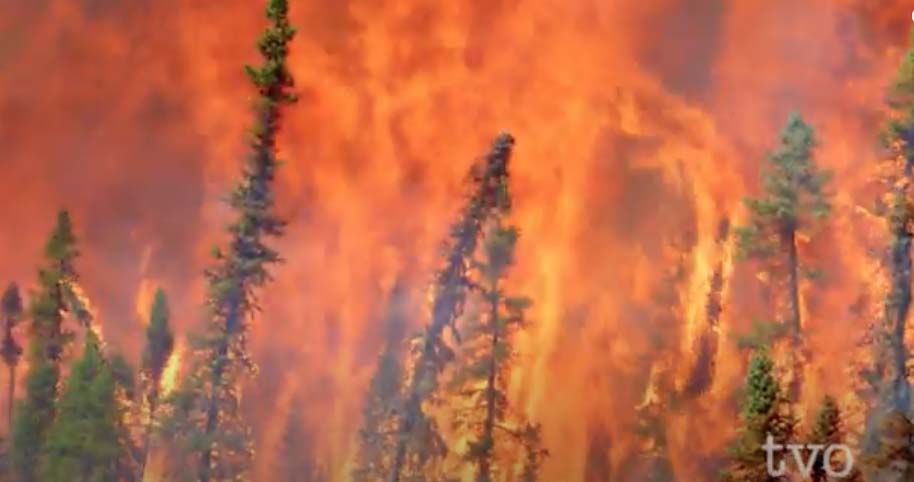
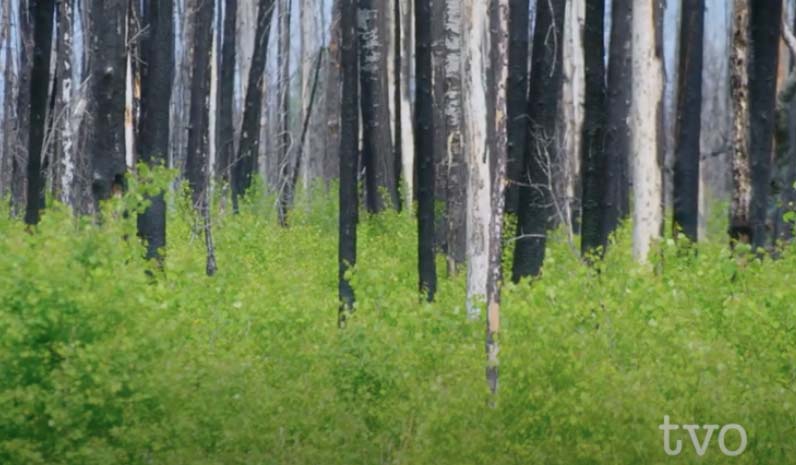
Natural fire cycles through the boreal forest every hundred years to renew it (Borealis)
One of the narrators tells us that the boreal forest has “survived and thrived in this regime of semi-regular stand-renewing fire.” This natural cycle of creative destruction is common in most ecosystems where destruction engenders rebirth and renewal by a community of species well-adapted to these cyclical changes. Botanist Diana Beresford-Kroeger adds, “the jack pine cones will only open on fire. The resin needs to be melted off the cone and then they shed their seeds.” The cones of tall spruce trees aggregate at the top of the tree, where the fire provides enough heat to open them but not burn them. White birch saplings sprout—phoenix-like—from the burnt tree base and roots. Aspen roots also send up thousands of suckers to become new clone trees of a renewed forest. The dead trees provide substrate for mosses, lichens and fungi that bring in moisture and decompose the logs into nutrients used by the living forest.
Aspen clone saplings cover the forest floor after a fire (Borealis)
The movie showcases some of the most vivid details of tree function, including the microscopic view of opening and closing stomata (pores on a leaf). Stomata take in CO2 and release oxygen during photosynthesis. They also release water vapour as part of transpiration and other chemicals such as metabolic aerosols.
Stomata on the underside of leaf release aerosols, carbon dioxide and water (Borealis)
The devastation of climate change strongly features in the film as does our own mismanagement of the forests. A particularly telling scene was shot in the Yukon by Joshua See where squirrels have co-evolved with spruce trees in a relationship they’ve developed over 1000 years. The squirrels have timed their reproduction with the spruce production of cones and release of seeds; but climate change has knocked the trees out of sync with the squirrels, which is threatening the survival of the squirrel.
Red squirrel eating spruce seeds from cone (Borealis)
“I think that’s probably the first time any human being has seen such a vivid example of the rhythms of nature being thrown out of sync by climate change. And the funny thing is, if you listen to the climate change debate, as I obviously do fairly closely, that is something that has not really sunk in with the general public,” said McMahon. “People know about storms, and because of Australia and California they’re starting to learn about the impact it has on fires. But the reality that the rhythms of the world are all screwed up has not really sunk in, and Borealis has two really powerful examples of this. One is what happens to the squirrels, and the other is what’s happening to the trees, with what’s happening with the pine beetles.”
Aerial shot of river and boreal forest (Borealis)
Fern fiddleheads in boreal forest (Borealis)
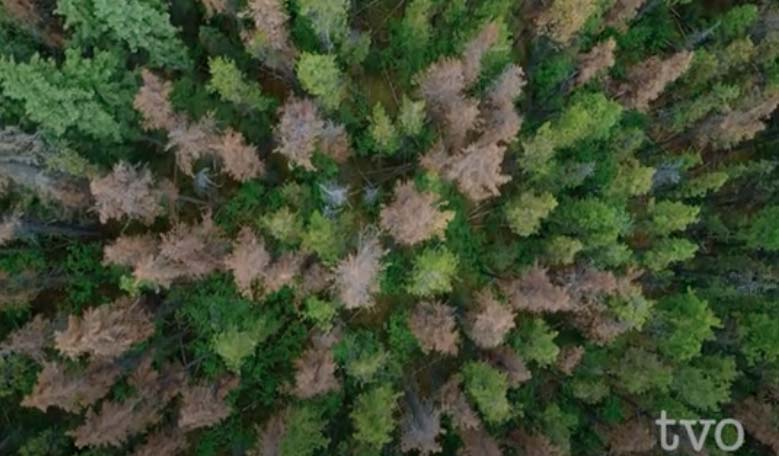
McMahon then adds soberly, “That last big dramatic drone shot [in the film] where you see that, basically, the boreal forest is dying – that’s Jasper National Park. This iconic forest that Canadians have sort of hung their identity on – you know, the snow-capped pine trees, and whatever – that forest is dying. It’s in a death spiral.”
McMahon admits: “I didn’t know when I started this project 10 years ago about the state of the forest. I was intending to make a film about how the forest worked. I did not realize until I started really talking to scientists that it is dying…The boreal forest is dying, and we are doing a super shitty job of taking care of it.”
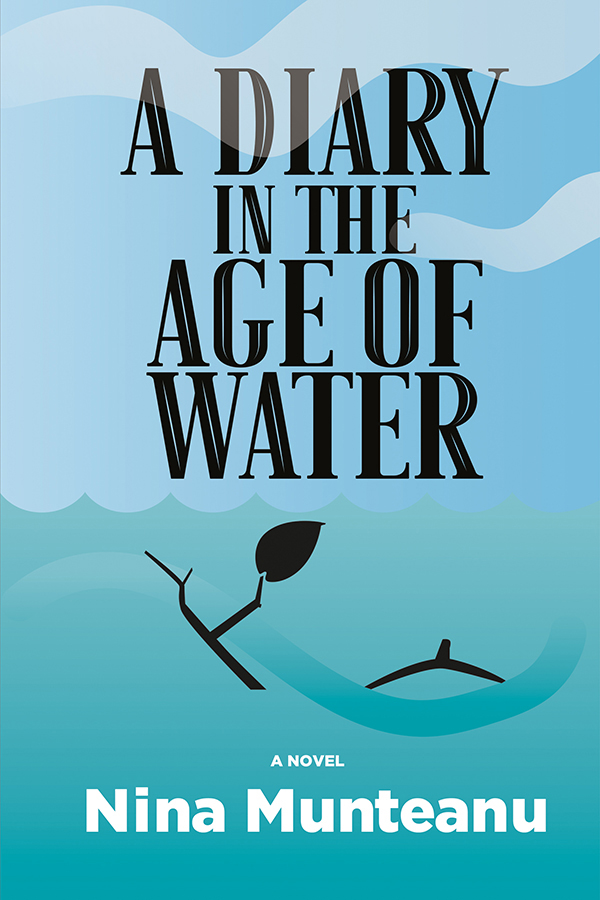
This resonated particularly with me; I’d just published my latest eco-novel A Diary in the Age of Water with Inanna Publications. The novel—about four generations of women and their unique relationship with water—begins with a blue being in the unknown future as she runs through a dying forest of the north, the last boreal forest in the world…
Clearcut logging the boreal forest (Borealis)
Pest-ridden boreal forest (Borealis)
McMahon adds a sober note about Canadian awareness:
“I think that in Canada – and this has been a theme of mine for decades – we pat ourselves on the back for being fresh faced boy scout-types, and we have this sense of ourselves as being green because we have so much green. The best thing about my career is I’ve been able to travel so much around this country. And it is a huge, huge country, and we do have just incredible, astonishing wilderness here–and we are wrecking it. We’re wrecking it in an extremely heedless, pointless, stupid kind of way. So I want that to sink in with people.
All those people at the end of the film that talk about the fact that the forest is collapsing, and we’re going to end up with a shrubland, and the forest emits more carbon than it sequesters–those are all Canadian government scientists. They’re not environmentalists. There’s no environmentalist voice in this film, in fact. I didn’t go to Greenpeace or any of those kinds of people, I went only to people who have a direct, material day-to-day interaction with the forest. Those people at the end of the film are on your payroll, and their job is to figure out what’s going. That’s what they’ve figured out, and I don’t think hardly anybody in this country knows that.”
Kevin McMahon
But McMahon remains hopeful. He cites Ursula Franklin, a scientist and peace activist who said, “Despair is a luxury we cannot afford.” McMahon responds with, “That’s the model that I live by really, because if I didn’t have hope I wouldn’t bother making these films, I’d just retire.”
Tree planter Isabella plants spruce and pine in a clearcut (Borealis)
Near the end of the film, tree planter Isabella reminds us that, “We have the ability to make whatever it is that we imagine, so let’s just start imagining a new path, let’s start imagining a new way. We are so tied to this experience and whatever happens to that forest is going to be a reflection of what happens to us.”
The film ends with the powerful wisdom of indigenous writer Edmund Metatawabin:
“We are here to make sure that the world, that the species, that humanity continues. The trees are the support, guidance, encouragement, and faith that things are just the way they’re supposed to be. That’s support from something that’s inanimate it looks like; but you’re getting it because it’s connected to the ground and its aiming for the sky. It’s a conduit between the earth and the sun. To see the tree as a living light … When you see that light you’ve gotten a gift; you’re going to be very humbled.”
Edmund Metatawabin
Nina Munteanu is a Canadian ecologist / limnologist and novelist. She is co-editor of Europa SF and currently teaches writing courses at George Brown College and the University of Toronto. Visit www.ninamunteanu.ca for the latest on her books. Nina’s bilingual “La natura dell’acqua / The Way of Water” was published by Mincione Edizioni in Rome. Her non-fiction book “Water Is…” by Pixl Press(Vancouver) was selected by Margaret Atwood in the New York Times ‘Year in Reading’ and was chosen as the 2017 Summer Read by Water Canada. Her novel “A Diary in the Age of Water” was released by Inanna Publications (Toronto) in June 2020.
Stream runs through cedar poplar forest in the rain, Trent Nature Sanctuary, ON (photo and dry brush rendition by Nina Munteanu)
Oh! great mysterium: Great forested sanctuary into the heart of being Oh! to walk pensive, in solitude into the center Of a cedar forest, worlds all russet and green, Branch and bough, rain swept landscapes The high treetops, far whisper and echo… The great winds in high flight high above… Songs to pierce the sullen skies, Melodies of joy and of a deepest longing…
Cedars and poplars in a morning mist, Trent Nature Sanctuary, ON (photo by Nina Munteanu)
Songs of immortality, worlds full aflame, Mystic cathedrals and dawn memory, Haze and gray day, silver sky, silver cloud Rain downfall and mist… Leaf, branch and bough, the wind and the rain The bending and wind tossed land
Mist hangs over Trent Canal, Trent Forest Sanctuary, ON (photo by Nina Munteanu)
The spring scents, spring grasses and nearby stream; Rivulet and rhapsodic song, The holy silences, the rain, fall, hiss and far echo… Cedar forest cathedrals, branches overspread, Red winged blackbird, soaring alone high above, High into the receiving dome of haze and sky Free swoop and whispering forest airs
White birch in Trent Nature Sanctuary, ON (photo and dry brush rendition by Nina Munteanu)
The far meditation: Sacred journey into a holy wilderness: Forested worlds beyond time…
Cedar root among ferns and moss in a light mist, Trent Nature Sanctuary (photo by Nina Munteanu)
Forested worlds of an existential beauty, Great moss silences, tree root and bough… Great worlds of hope and the tenebrous shadow Of a rain swept day… Holy encounters: the great mysterium Sacred worlds beyond still time…
BEV GORBET
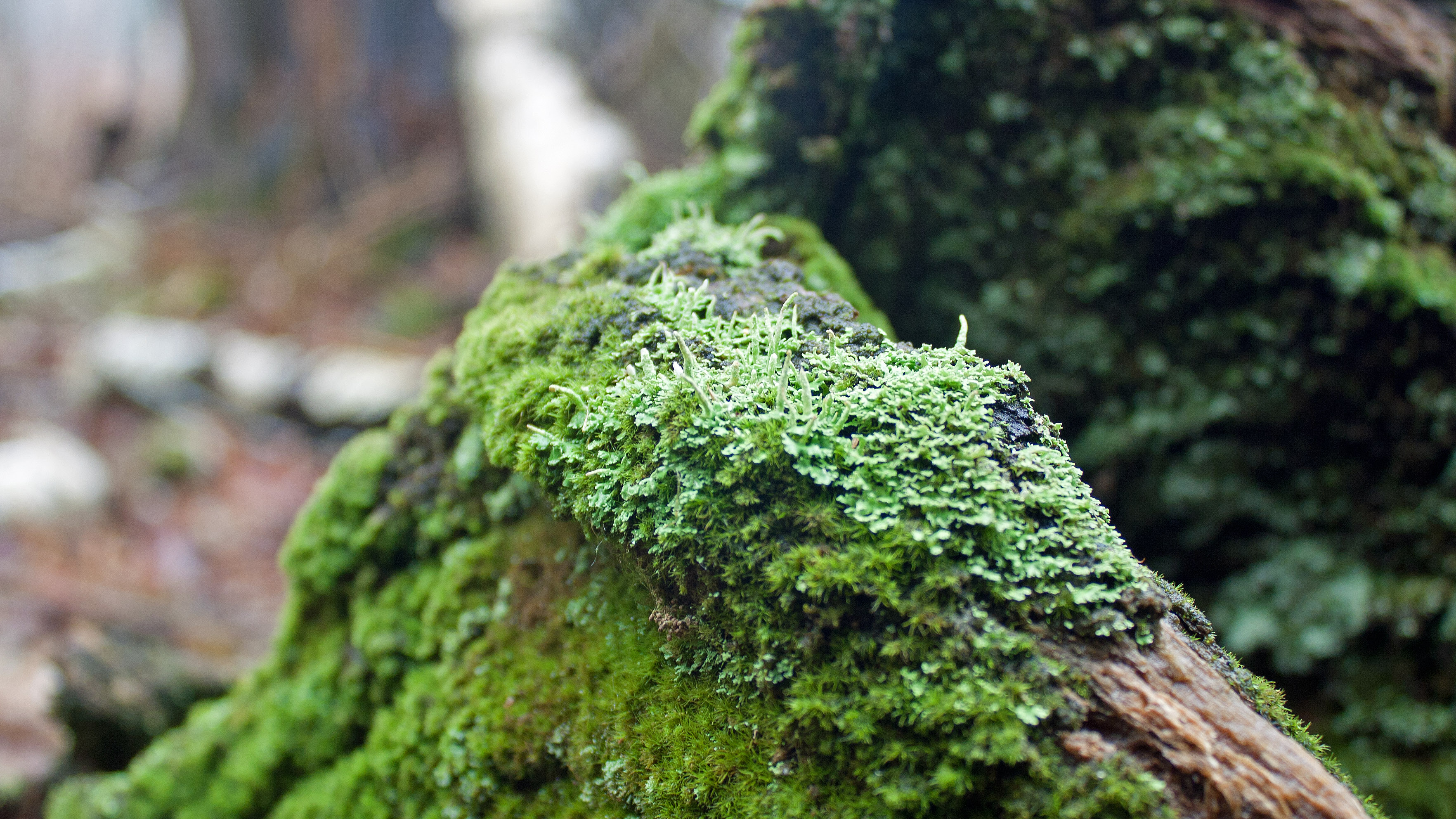
Moss and lichen cover an old cedar log, Trent Nature Sanctuary, ON (photo by Nina Munteanu)
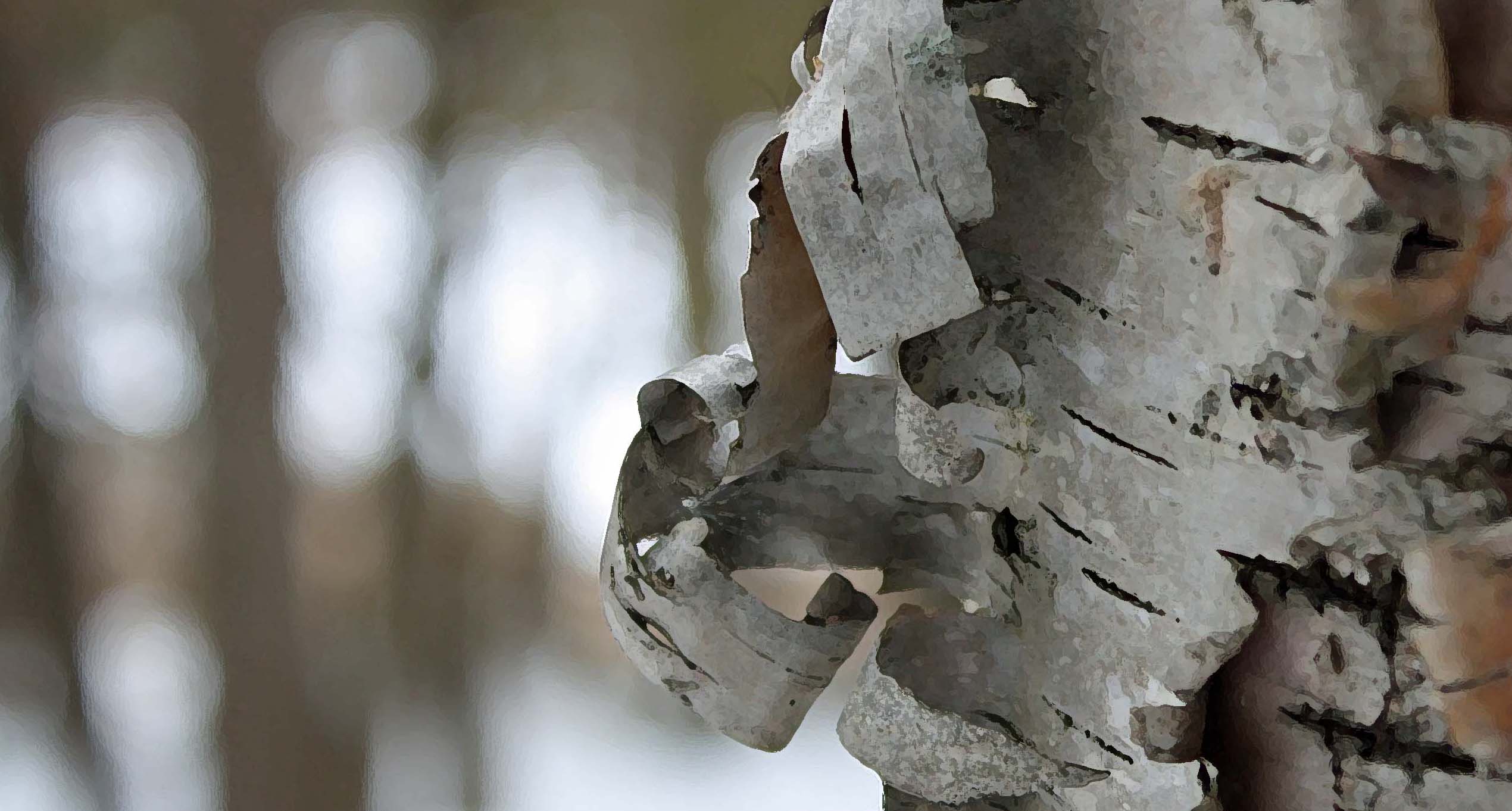
Tinder polypore fungus on white birch, Trent Nature Sanctuary, ON (photo and dry brush rendition by Nina Munteanu)
Moss on a log in Trent Nature Sanctuary, ON (photo by Nina Munteanu)
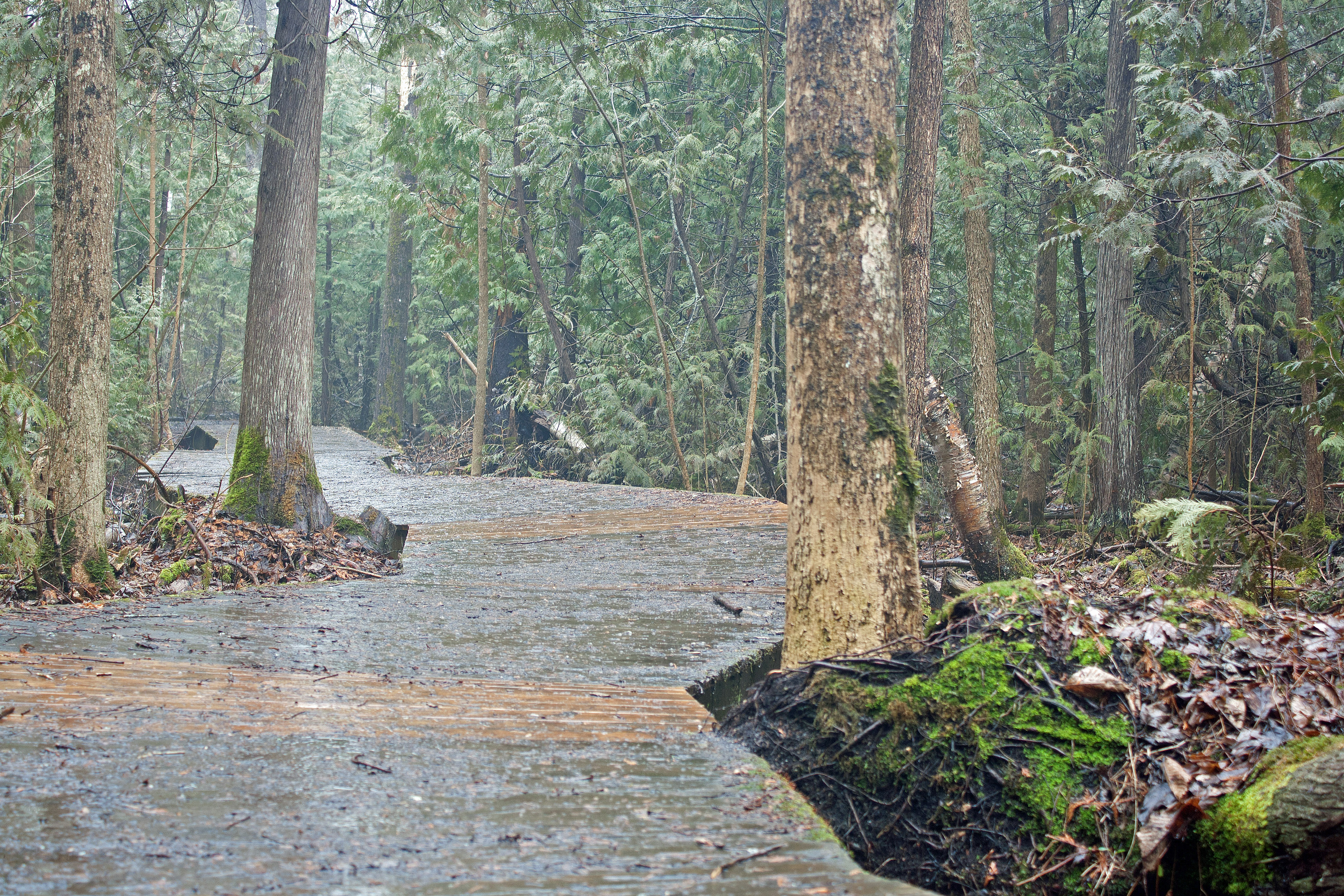
Cedar boardwalk in a misty rain, Trent Nature Sanctuary, ON (photo by Nina Munteanu)
Nina Munteanu is a Canadian ecologist / limnologist and novelist. She is co-editor of Europa SF and currently teaches writing courses at George Brown College and the University of Toronto. Visit www.ninamunteanu.ca for the latest on her books. Nina’s bilingual “La natura dell’acqua / The Way of Water” was published by Mincione Edizioni in Rome. Her non-fiction book “Water Is…” by Pixl Press(Vancouver) was selected by Margaret Atwood in the New York Times‘Year in Reading’ and was chosen as the 2017 Summer Read by Water Canada. Her novel “A Diary in the Age of Water” was released by Inanna Publications (Toronto) in June 2020.
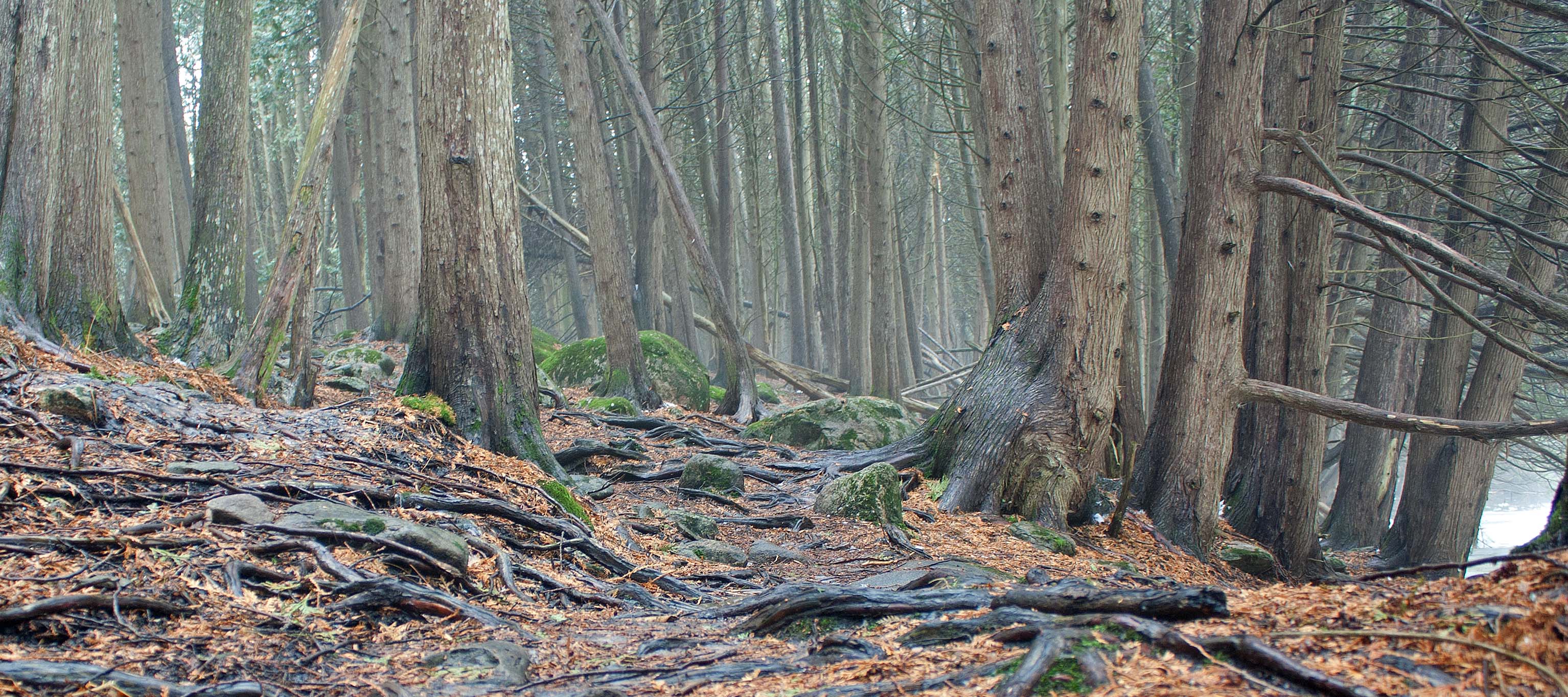
Cedar forest and extensive roots amid glacial erratics flank Jackson Creek on the right, ON (photo by Nina Munteanu)
.
It was a cold November day, after a light snow, as I wandered the Jackson Creek old-growth forest. Centuries-old cedar, pine and hemlock towered above me, giving off the fresh scent of forest. The trees creaked and cracked, swaying in a mischievous wind. I left the main path and descended the leaf-strewn slope toward the river. My boots pressed through a frosty crust into the spongy ground of dead leaves and organic soil. I stopped and breathed in the fresh coolness of the air. A damp mist huddled among the trees, adding wisps of mystery to the ancient forest. It was as though I’d entered an enchanted forest in some fanciful fairy tale.
Cedar forest on slope of Jackson Creek Park in early winter, ON (photo by Nina Munteanu)
.
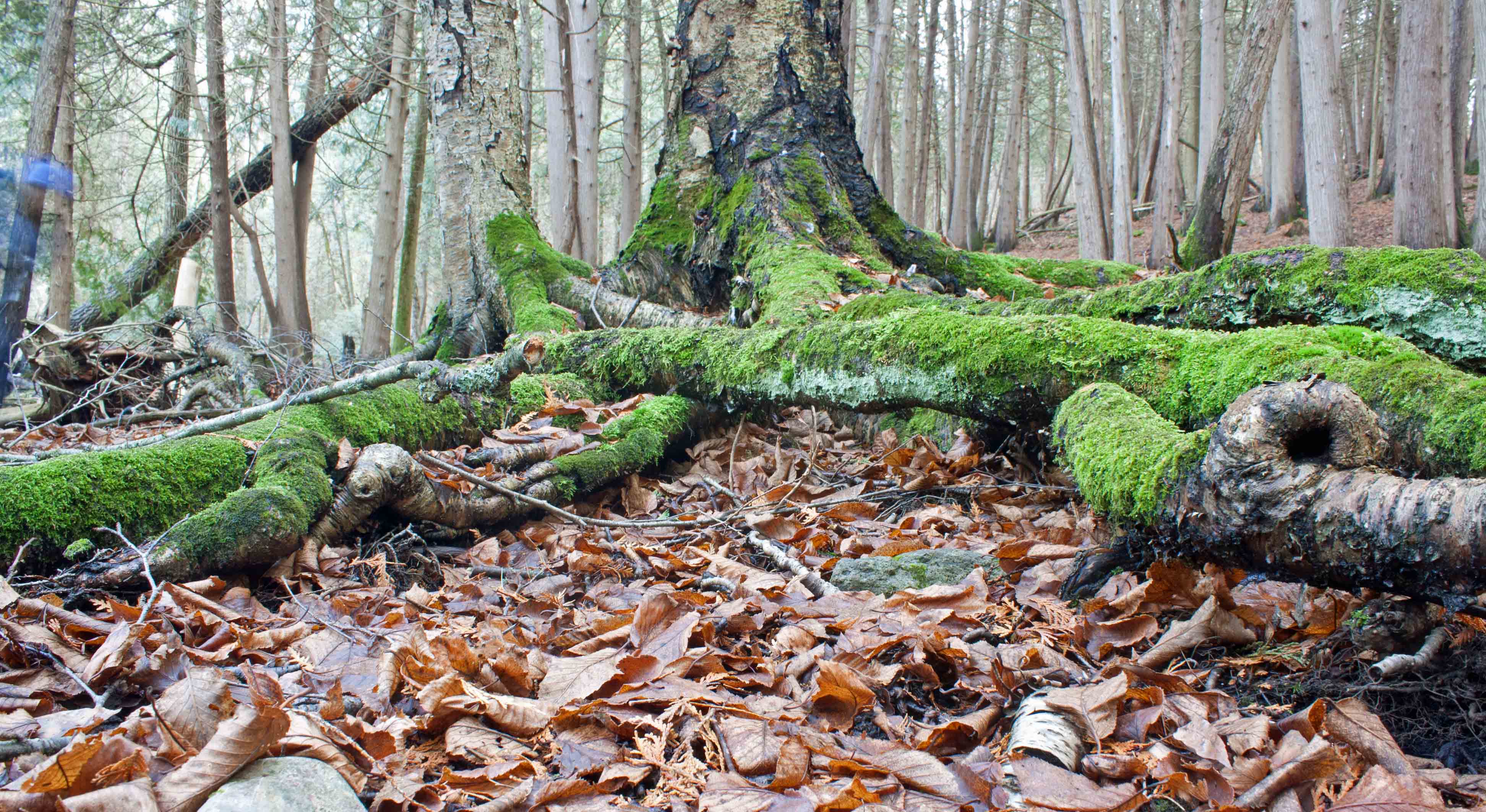
Not far from the river, I approached an old yellow birch tree, large trunk rising as tall as some of the cedars and pines around it. Golden flakes of bark curled and formed craggy patterns around the girth of the old tree. Radiating out from the tree, moss-covered roots snaked out like tangled ropes in a profusion of brilliant green. This was fairy country, I suddenly thought.
I dropped to my knees, crouching down, and set up my tripod and camera to capture this magical tree from the perspective of the forest floor. Head almost touching the ground, I inhaled the scent of loam and decaying leaves. The fresh pungency of cedar, pine, and humid moss hung in the air. Nearby, the river chortled and bubbled in a content symphony of motion. A curious red squirrel parked itself on a log nearby to watch me. It didn’t scold me like they normally did when I entered the forest; like it understood… It then occurred to me, as I set up my equipment under the squirrel’s careful stare, that I was in the presence of an enchantment. Like I was peering into a secret dance of feral celebration. But being there and appreciating it, I had now become part of it; I was Alice going down the rabbit hole into a true wonderland…
It was then that I glimpsed it as I carefully took my timed pictures. A blur of blue. What had I witnessed? A motion? A colour? Then it was gone. But in that moment, I’d felt the spark of an elation that comes with a glimpse into a secret world.
Old yellow birch tree and moss-covered roots with approaching blue sprite from left (photo by Nina Munteanu)
.
When I returned home to look at the images I saw that my camera had captured a wispy blue entity that flowed into its view and peered around the old birch at me with a kind of curious though mischievous grin.
Had I just captured a blue sprite? Something was unmistakably there!
Forest sprite peers around a yellow birch tree, Jackson Creek Park, ON (photo by Nina Munteanu)
.
I read up on sprites. According to European lore, a sprite is a supernatural entity. They are often depicted as fairy-like creatures or as an ethereal entity. The word sprite comes from the Latin spiritus (“spirit”), via the French esprit.
Given that the sprite I’d observed was blue and we were close to the river, I wondered if it was not a forest or wood sprite, but a water sprite. According to alchemist Paracelsus, the term ‘water sprite’ is used for any elemental spirit associated with water. They can breathe water or air and sometimes can fly. They also possess the power of hydrokinesis, which is the ability to create and manipulate water at will. Also known as ‘water nymphs’ and naiads (or nyads), these divine entities tend to be fixed in one place. Slavic mythology calls them vilas. Sprites are not corporeal beings (like selkies, mermaids and sirens) given that they are not purely physical; they are more like local deities than animals. This explained the wispy nature of the being I’d seen peering at me from the tree.
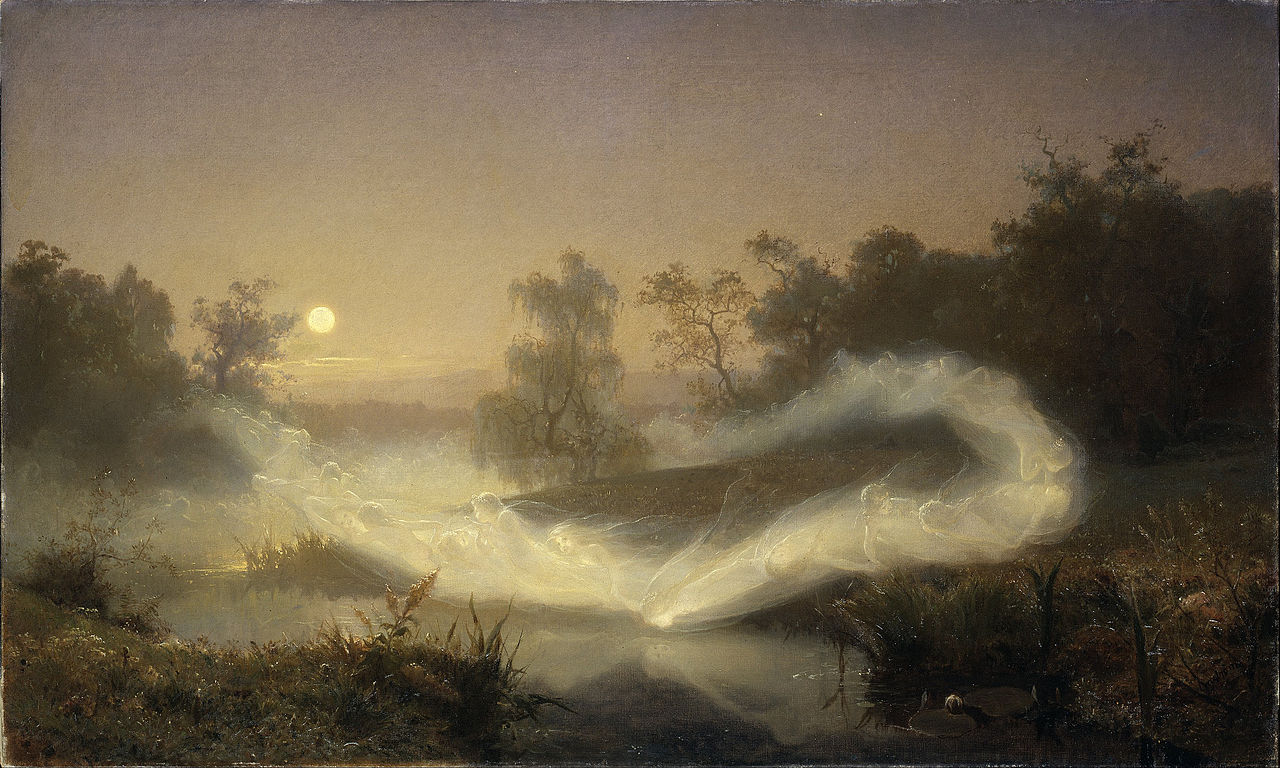
“Dancing Fairies” by August Malmström
.
After consulting with several friends—some who purported to know much more about sprites than I did—I concluded that this sprite was, in fact, a forest sprite and it was blue because it was near the water. Friend Merridy suggested that “forest sprites, normally green, may turn blue if a nearby brook calls to them.” She added that “water sprites can be distinguished by their chatty nature. They rarely go beyond the banks of a river or brook. Forest sprites are mostly silent.” Which this one certainly was. Friend Craig then pondered, “Are digital sprites in our world or in an electro-magnetic world? Or something else?” He was referring to them showing up on my camera without me even noticing they were there. When I told him I would return in search of them he observed, “if you’re looking for them that might be when they hide. Or maybe not. Any type of sprite is probably good, mischievous or friendly.” Thanks, Craig! That was helpful…
Glacial erratic boulders in Jackson Creek, ON (photo by Nina Munteanu)
Century-old beech tree, decaying and moss-covered in early winter, Jackson Creek Park, ON (photo by Nina Munteanu)
Ancient cedar tree stands next to an ice sheet on the path beside Jackson Creek, ON (photo by Nina Munteanu)
.
I visited the forest many times after but saw no sign of any sprites. Perhaps Craig was right; they were hiding from me.
Then, on a foggy late December day, after a light dusting of snow, I returned to document the ice forming in the river. Islands and columns of ice had created a new topography for the flowing waters of Jackson Creek. Ice sheets also covered the forest path in places—making the walk somewhat treacherous. At times, I had to scramble and seize hold of branches to haul my way up precipitous banks from where I’d captured sculptures of ice ‘pearls,’ ‘platforms,’ and ‘columns’ on the river.
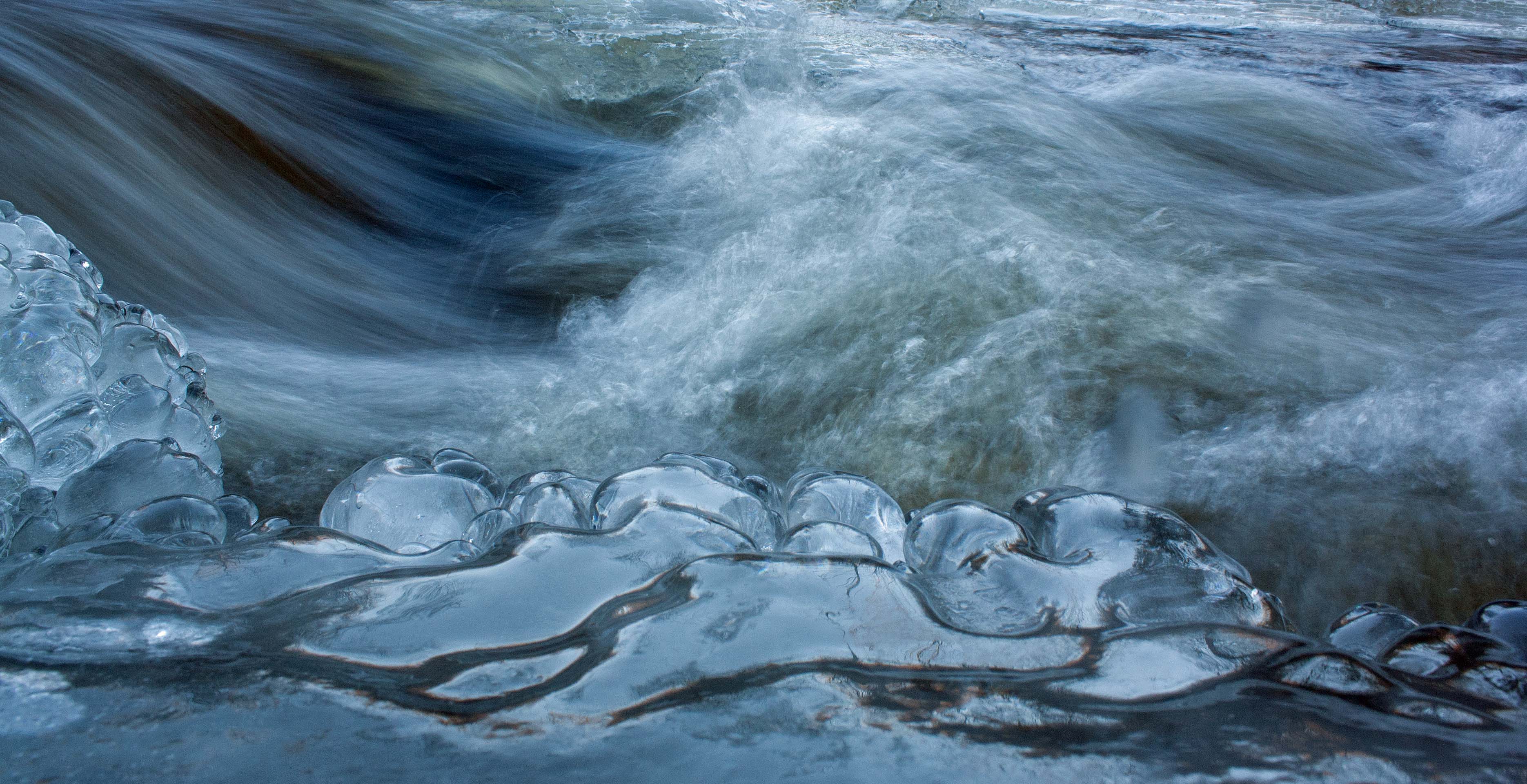
Ice forming on Jackson Creek in early winter, ON (photo by Nina Munteanu)
Ice ‘pearls’ forming on shore by rushing river, Jackson Creek, ON (photo by Nina Munteanu)
.
The fog grew thick as my walk eventually led me into an area of eccentric lopsided cedars in a ‘drunken’ stand by the river bank. The cedars sent out a tangled tapestry of gnarly roots I had to negotiate. I could feel the earth-magic. I dropped to my knees again and set my camera and tripod to the level of the roots. That is when I saw the blue sprite again! This time the sprite wasn’t playful; it appeared startled and disoriented. But, I managed to capture it as it fled the scene in wisps of blue smoke. As I left the forest, my thoughts returned to this serendipitous moment. Had I interrupted the wood /earth sprite in its work in the forest? These sprites are known to have the power of chlorokinesis, the ability to grow and control plants at will. When I checked my images at home, the sprite appeared to float near one of the cedars.
Blue forest sprite floats by cedar tree, Jackson Creek Park, ON (photo by Nina Munteanu)
.
When she saw the image, friend Merridy asked, “was the sprite entering the tree?” Thinking of incantations, friend Dyana asked if I’d had my recording feature on, which I’d never thought to do. On second thought, she decided that it might be dangerous. Not a good idea to anger a sprite. Friend Gabriela then challenged me: “did you ask what message they have for you, Nina? They keep showing up in your way, they might have a message for you or to be delivered through you to…” whoever… I hadn’t thought of that either. How would I hear their message when they were silent and so fleeting, I challenged back. She wisely responded, “Just ask yourself the question; you might be surprised when your next thought brings the answer. Since everything is energy, and you saw them at least twice, you’re probably connected with them.”
Sprite vaporizes behind tree, Jackson Creek Park, ON (photo by Nina Munteanu)
.
I didn’t tell her that the question that came to mind after seeing the sprite was: I wonder what’s for dinner!
I must ponder this more, however.
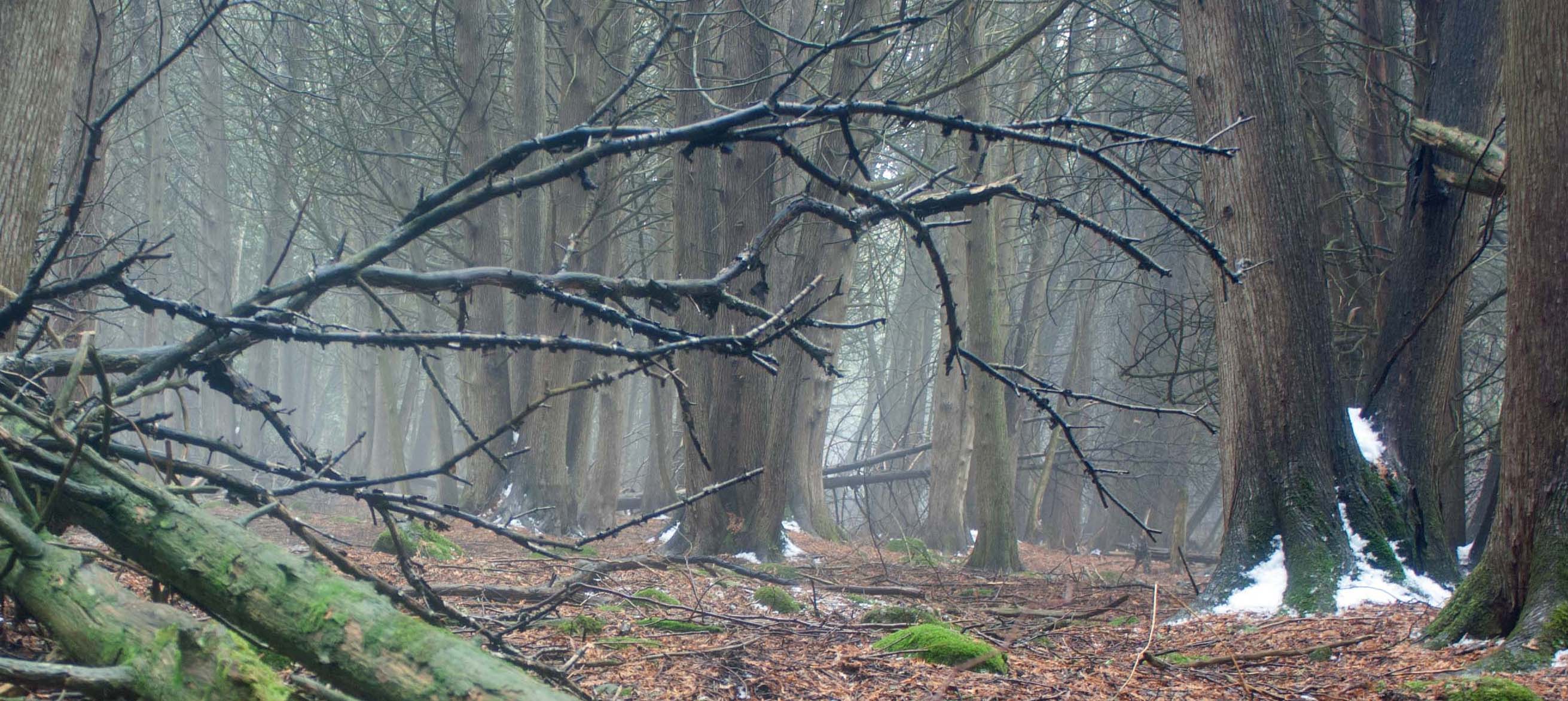
Cedar forest on a misty winter day, Jackson Creek Park, ON (photo by Nina Munteanu)
Thinking of Gabriela’s interesting remark, I am reminded of a rather sad but evocative tale by Vladimir Nabokov entitled “The Wood Sprite.” Told in the first person, it recounts the narrator’s experience when he was visited at his desk by an old wood sprite, “powdered with the pollen of the frosty, starry night.” The creature tells of his exile from a country wood in Russia, all cut down and burned amid the treachery of war.
Now that I think of it, I know the blue sprite’s message. And now you know it too.
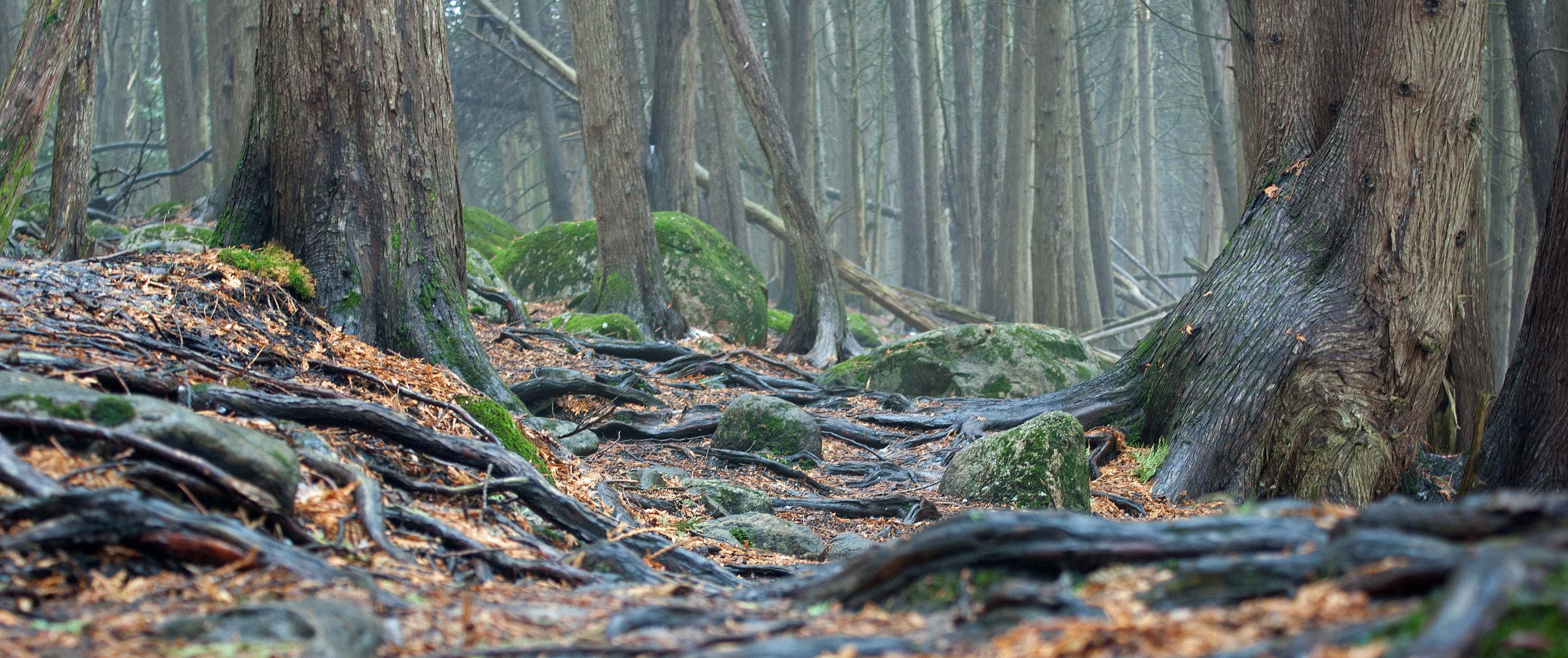
Cedar forest and roots amid glacial erratics in Jackson Creek Park, ON (photo by Nina Munteanu)
Nina Munteanu is a Canadian ecologist / limnologist and novelist. She is co-editor of Europa SF and currently teaches writing courses at George Brown College and the University of Toronto. Visit www.ninamunteanu.ca for the latest on her books. Nina’s bilingual “La natura dell’acqua / The Way of Water” was published by Mincione Edizioni in Rome. Her non-fiction book “Water Is…” by Pixl Press(Vancouver) was selected by Margaret Atwood in the New York Times‘Year in Reading’ and was chosen as the 2017 Summer Read by Water Canada. Her novel “A Diary in the Age of Water” was released by Inanna Publications (Toronto) in June 2020.
Woman and her dog walk the cedar swamp forest, Trent Nature Sanctuary, ON (photo and dry brush rendition by Nina Munteanu
Trail through cedar forest in first snow, Trent Nature Sanctuary, ON (photo and dry brush rendition by Nina Munteanu)
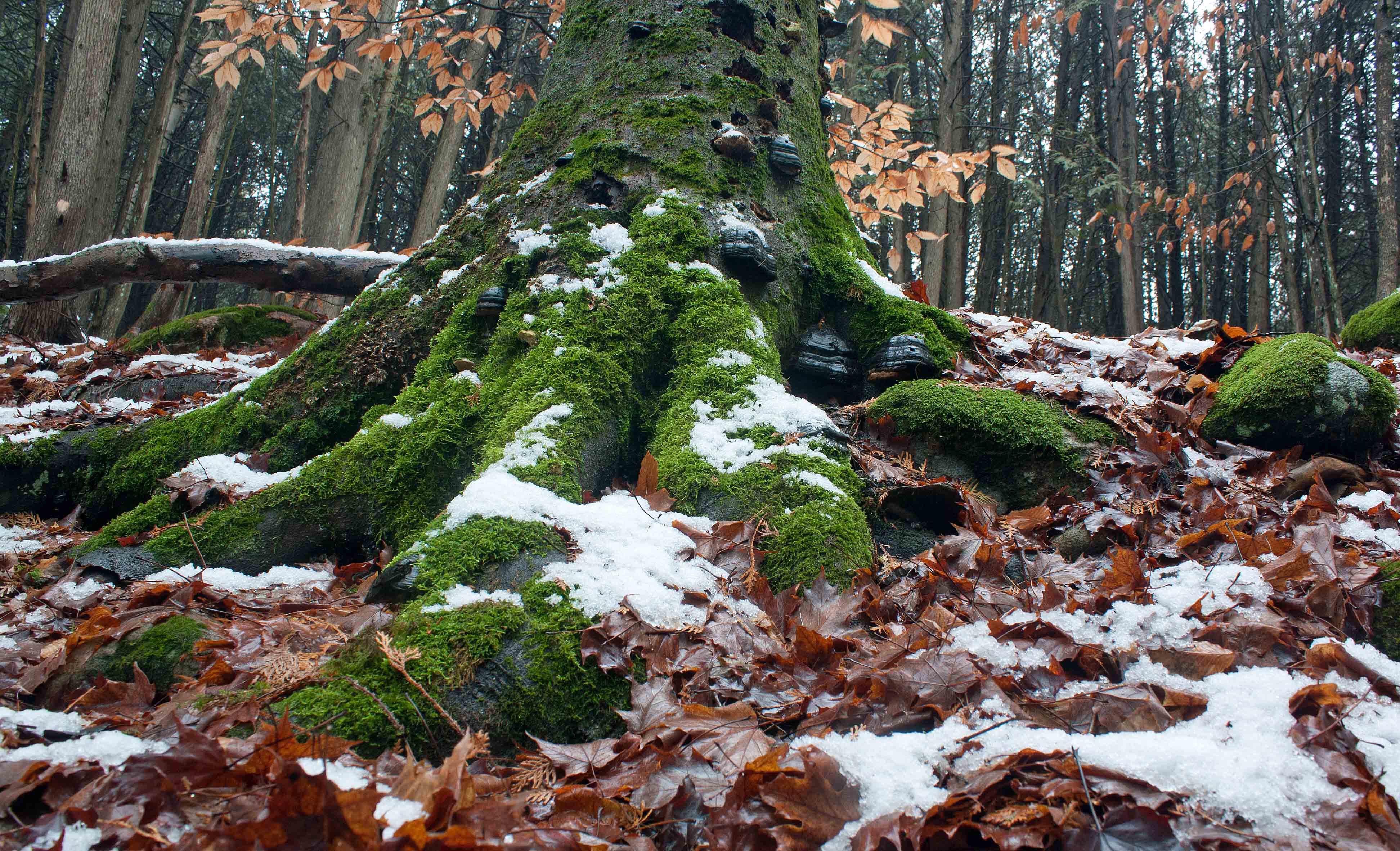
Moss covered roots and trunk of yellow birch after snowfall, Jackson Creek Park, ON (photo and dry brush rendition by Nina Munteanu)
Young marcescent beech tree among moss covered glacial erratics in Jackson Creek Park, ON (photo and dry brush rendition by Nina Munteanu)
Snow-covered marcescent beech leaves in Jackson Creek Park, ON (photo and dry brush rendition by Nina Munteanu)
Heavy snowfall at bridge in Trent Nature Sanctuary, ON (photo and rendition by Nina Munteanu)
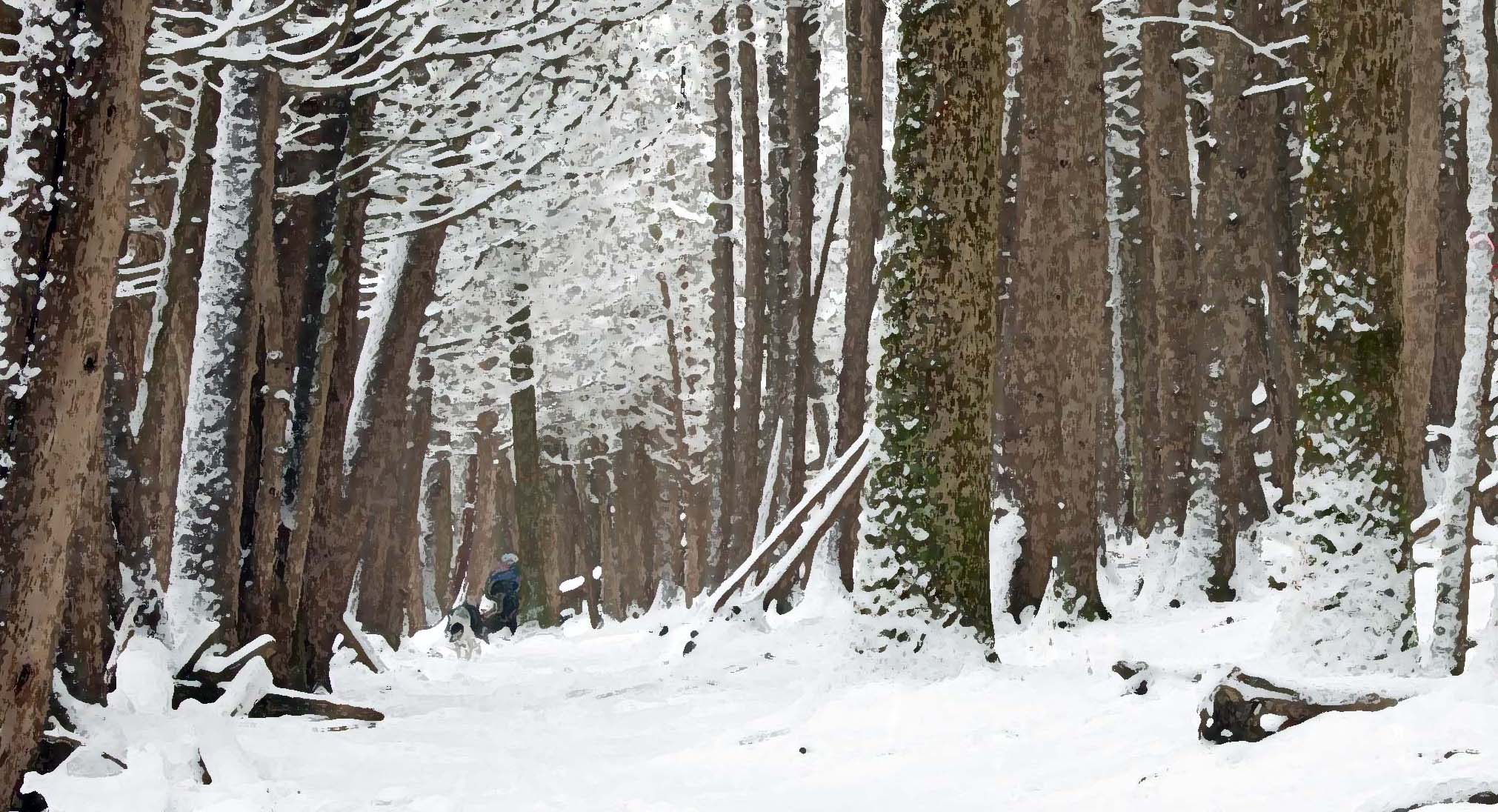
Cedar pine forest after first snow, Jackson Creek Park, ON (photo and dry brush rendition by Nina Munteanu)
Nina Munteanu is a Canadian ecologist / limnologist and novelist. She is co-editor of Europa SF and currently teaches writing courses at George Brown College and the University of Toronto. Visit www.ninamunteanu.ca for the latest on her books. Nina’s bilingual “La natura dell’acqua / The Way of Water” was published by Mincione Edizioni in Rome. Her non-fiction book “Water Is…” by Pixl Press(Vancouver) was selected by Margaret Atwood in the New York Times ‘Year in Reading’ and was chosen as the 2017 Summer Read by Water Canada. Her novel “A Diary in the Age of Water” was released by Inanna Publications (Toronto) in June 2020.
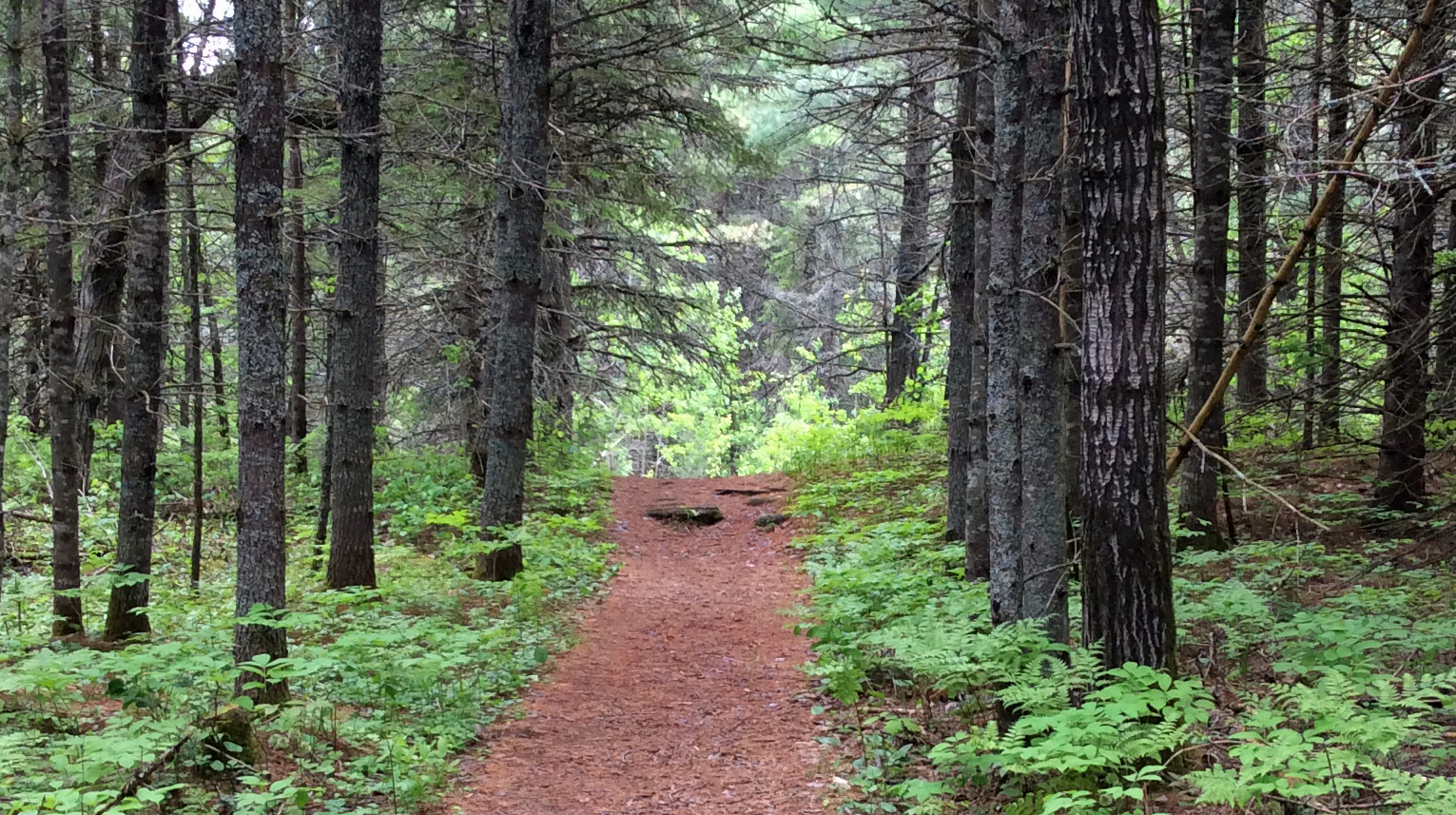
Trail through mixed birch-pine forest at Petroglyph Park, ON (photo by Nina Munteanu)
Since moving temporarily to Peterborough during COVID-19, I have been on an adventure with Nature in the Kawartha region, north of Toronto. The region contains a chain of lakes that form the upper watershed of the Trent River; the lakes are situated on the boundary between the Paleozoic limestone region of the Golden Horseshoe and the Precambrian granite Canadian Shield of northern and central Ontario.
I’ve explored several local parks and lakes with wonderful swamp cedar on the Otonabee River and Jackson Creek and uphill beech-maple forest in the Trent Nature Sanctuary.
Farther afield, I wandered through the pine forests of Petroglyph Park, north of Peterborough, with its intriguing meromictic McGinnis Lake.
When I shared some of my Petroglyph Park photos with Toronto poet and friend Bev Gorbet, she was inspired to write this poem. I am overjoyed to share her ekphrastic poem with you here:
Trail through pine forest, Petroglyph Park, ON (photo by Nina Munteanu)
To the Mystic Forest: Reflections on Natural Beauty
Forests of the mind, wild forests of the heart…
The ethereal sounds: windstorm and echo
On a spring day…
The wind’s fierce flight through bended bough,
Through swaying treetop
High high above, the windswept call, the cry,
All the beauty in a wilderness forest…
The whispering grasses, below,
Song all bend, all flow in a cathedral clearing…
Aging white trillium, Petroglyph Park, ON (photo by Nina Munteanu)
Radiant beams, sunlight and shadow peppering
The moving boughs overhead…
Azure and lavender, sky-swept cloud
And mystic glow…
Oh! great forests of the mind,
Great forest of the heart…
A deepest beauty along an existential meridian:
The heart passionately centred, deeply into reflection:
Haunted days and alone
Wind call and cry, whisper and sigh
Great wilderness lands, wide forested plains
All the wondrous beauty, all the holy mystery:
Windswept, wind-tossed skies, the great forests
Mystery glorious, mystic days beyond time.
Bev Gorbet, June 2020
Bev Gorbet is a Toronto poet and retired school teacher. She has published several poems with the Retired Teachers Organization and most recently in “Literary Connection IV: Then and Now” (In Our Words Inc., 2019), edited by Cheryl Antao Xavier.
Petroglyph Park pine forest trail (artwork by Nina Munteanu)
Nina Munteanu is a Canadian ecologist / limnologist and novelist. She is co-editor of Europa SF and currently teaches writing courses at George Brown College and the University of Toronto. Visit www.ninamunteanu.ca for the latest on her books. Nina’s bilingual “La natura dell’acqua / The Way of Water” was published by Mincione Edizioni in Rome. Her non-fiction book “Water Is…” by Pixl Press (Vancouver) was selected by Margaret Atwood in the New York Times ‘Year in Reading’ and was chosen as the 2017 Summer Read by Water Canada. Her novel “A Diary in the Age of Water” was released by Inanna Publications (Toronto) in June 2020.















































 Bev Gorbet is a Toronto poet and retired school teacher. She has published several poems with the Retired Teachers Organization and most recently in “Literary Connection IV: Then and Now” (In Our Words Inc., 2019), edited by Cheryl Antao Xavier.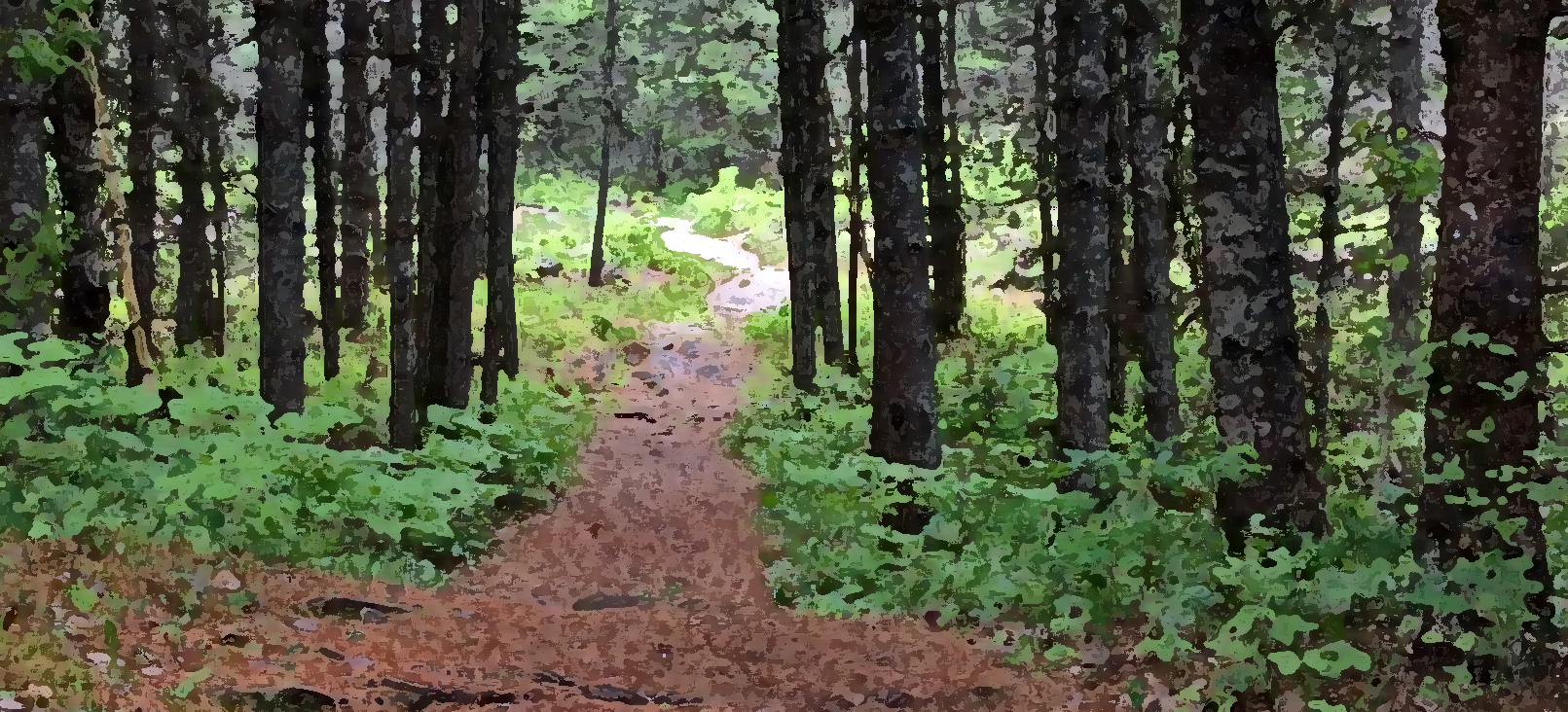

 Nina Munteanu Writing Coach