Poplar trees in fall, ON (photo and rendition by Nina Munteanu)
I just finished reading Ben Rawlence’s 2022 book The Treeline. It is a book that made me think. It made me cry. It made me despair. It also gave me hope.
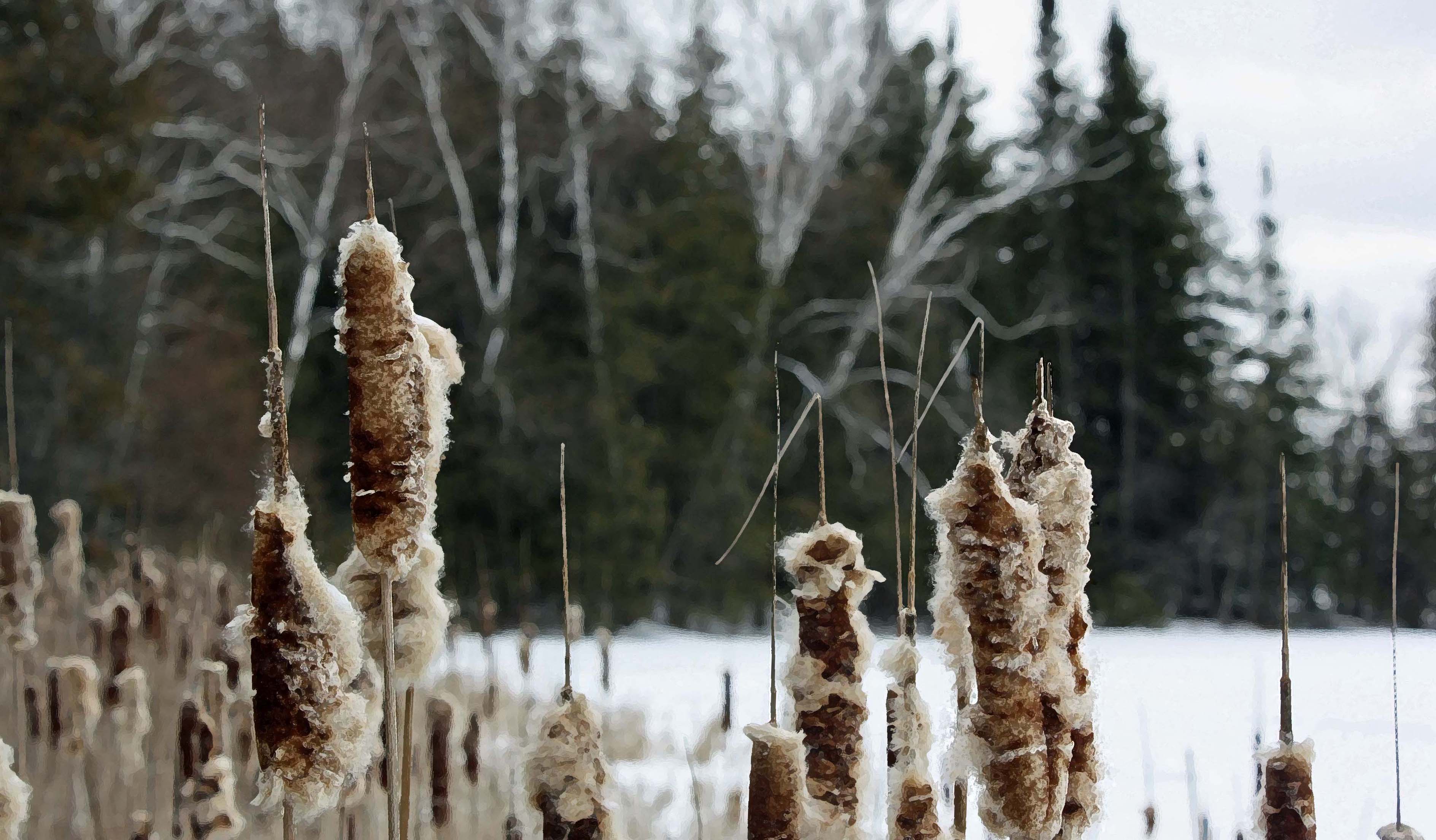
Cattails line a snow-covered marsh with spruce and fir behind, ON (photo and rendition by Nina Munteanu)
I was gripped by this honest and unflinching exploration on the moving treeline with climate change and what it will mean for humanity. Beautifully written and rigorously reported, Rawlence invited me on a journey of all major treelines over the globe from Scotland, Norway and Russia, to Alaska, Canada and Greenland. Throughout his description of a warming world and a vanishing way of life, Rawlence meditates on the many repercussions on how humans live.
Pine-cedar forest in Ontario (photo and rendition by Nina Munteanu)
He aptly describes the forests of the world as the ‘heartbeat of the planet,’ the cycles of breathing and the pulses of life from the spike of oxygen in the spring when trees put out their leaves to the peaks and troughs over day and night that regulate plant photosynthesis and respiration. The peaks and troughs are getting shallower, he writes. With more carbon dioxide in the air the trees work less; they inhale less and exhale less oxygen.
“The planet is a finely tuned system. A few degrees of change in its orbit can usher in an ice age; a few degrees of temperature change can transform the distribution of species, can melt glaciers and create oceans. In the future, when the ice is gone, there may be no such thing as a treeline at all. As the stable currents of air and water associated with the Gulf Stream, the polar front, polar vortex and Beaufort Gyre dissipate or fluctuate, the Arctic Ocean melts completely, and the Rossby waves in the upper atmosphere go haywire, the fine gradations of temperature, altitude and latitude first observed by Alexander von Humboldt will become decoupled and ecological transition zones scrambled. Instead of a majestic sweeping zone of forest around the planet, we might find discontinuous pockets of trees in odd places, refugees from soil and temperatures long gone, and crocodiles once again at the North Pole.”
Ben Rawlence, The Treeline
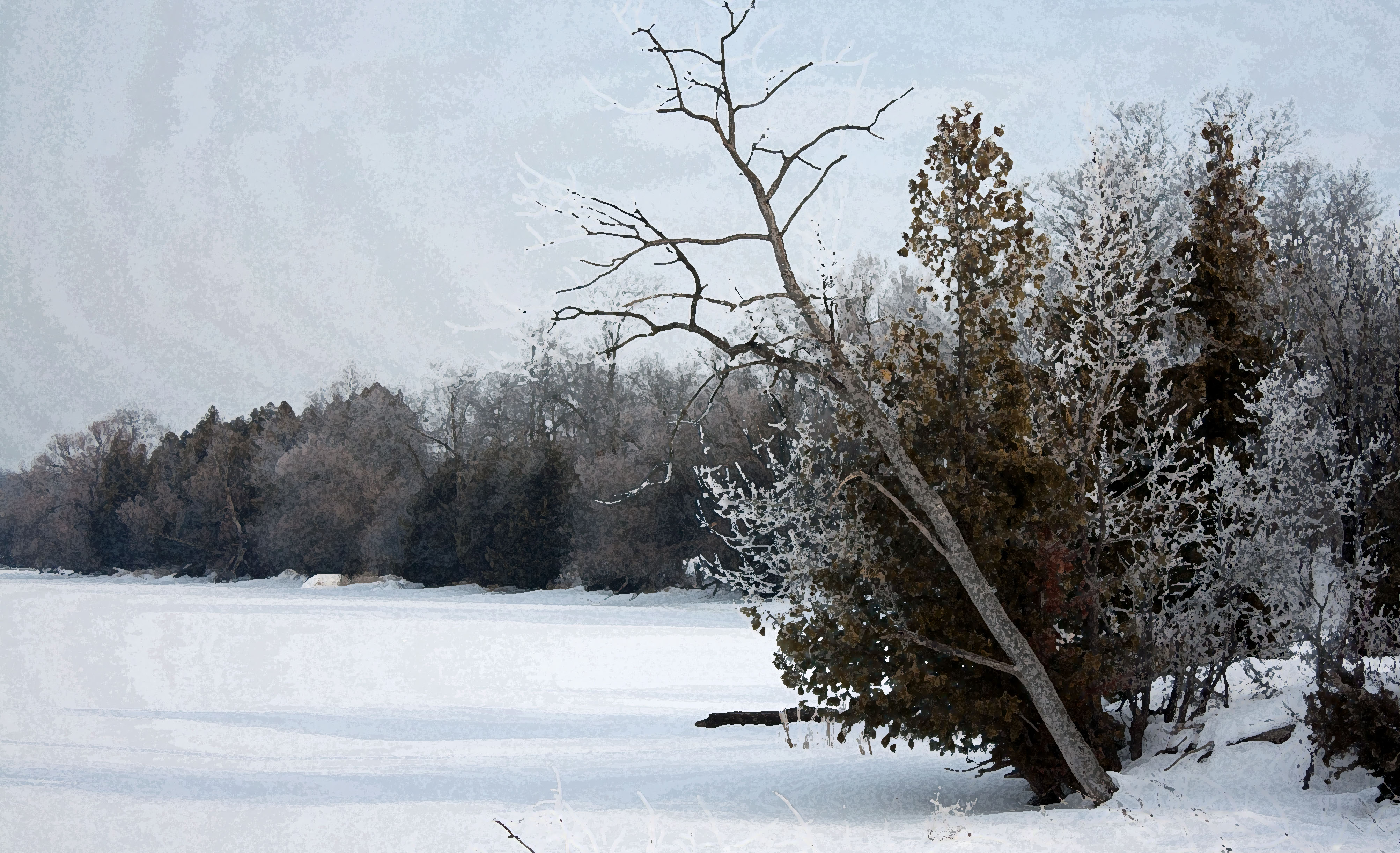
Snow-covered river shoreline with mixed forest, ON (photo and rendition by Nina Munteanu)
Rawlence brings this all into perspective to our present situation and the role science has played in our hubristic illusion of control:
“An unfortunate side effect of science is the illusion of human mastery: the idea that if we know what is happening then we can control. The irony is that we might have been able to. The tragedy is that it is too late. The chain reaction is under way. The curve only gets steeper from here…five metres of sea level rise is locked in; it’s just a question of how fast the ice melts. Once again, the models seem to underestimate the speed…”
Ben Rawlence, The Treeline
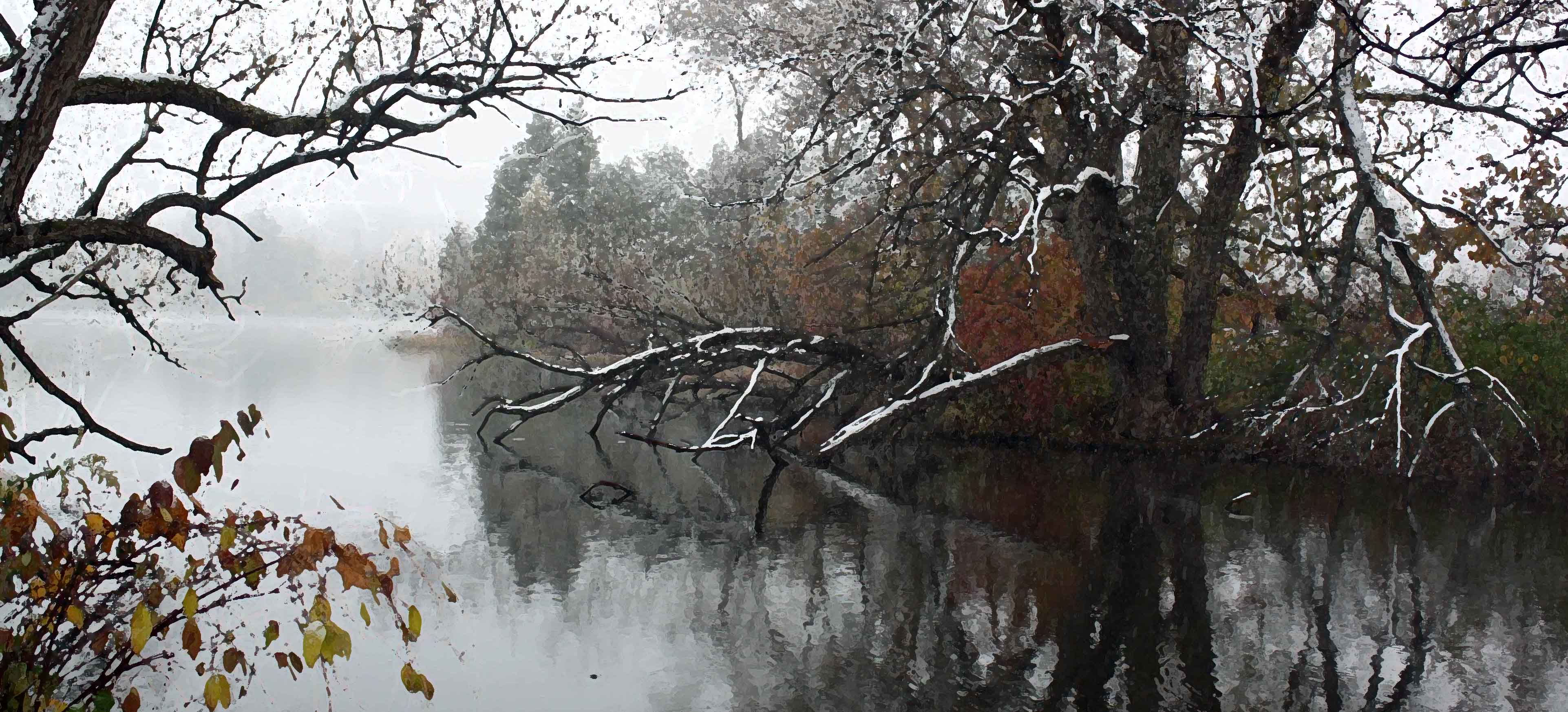
Willow by a river at first snow, ON (photo and rendition by Nina Munteanu)
What is most unfortunate for us, for humanity, is that we have known all this for some time. But we’ve done little. “Industrialist capitalism and its export colonialism” with its exploitive gaze that drives our needs and wants and actions has chosen to ignore the signs. That exploitive gaze ignored that we are not only embedded in but dependent upon the natural world and all the forests to live and flourish.
Tamarack and birch trees in the fall, ON (photo and rendition by Nina Munteanu)
What Rawlence does acknowledge is a way out of our self-created doom and accompanying solastalgia:
“Our present emergency is forcing us to remember what, until recently, we have always known: that there is a web of communication, meaning and significance beyond us, a world of life forms constantly chattering, shouting and flirting and hunting each other, indifferent to human affairs. And there is solace in such a vision. The way out of the depression and grief and guilt of the carbon cul-de-sac we have driven down is to contemplate the world without us. To know the earth, that life, will continue its evolutionary journey in all its mystery and wonder. To widen our idea of time, and of ourselves. If we see ourselves as part of a larger whole, then it is the complete picture that is beautiful, worthy of meaning and respect, worth perhaps dying for, safe in the knowledge that life is not the opposite of death but a circle, as the forest teaches us, a continuum.”
Ben Rawlence, The Treeline
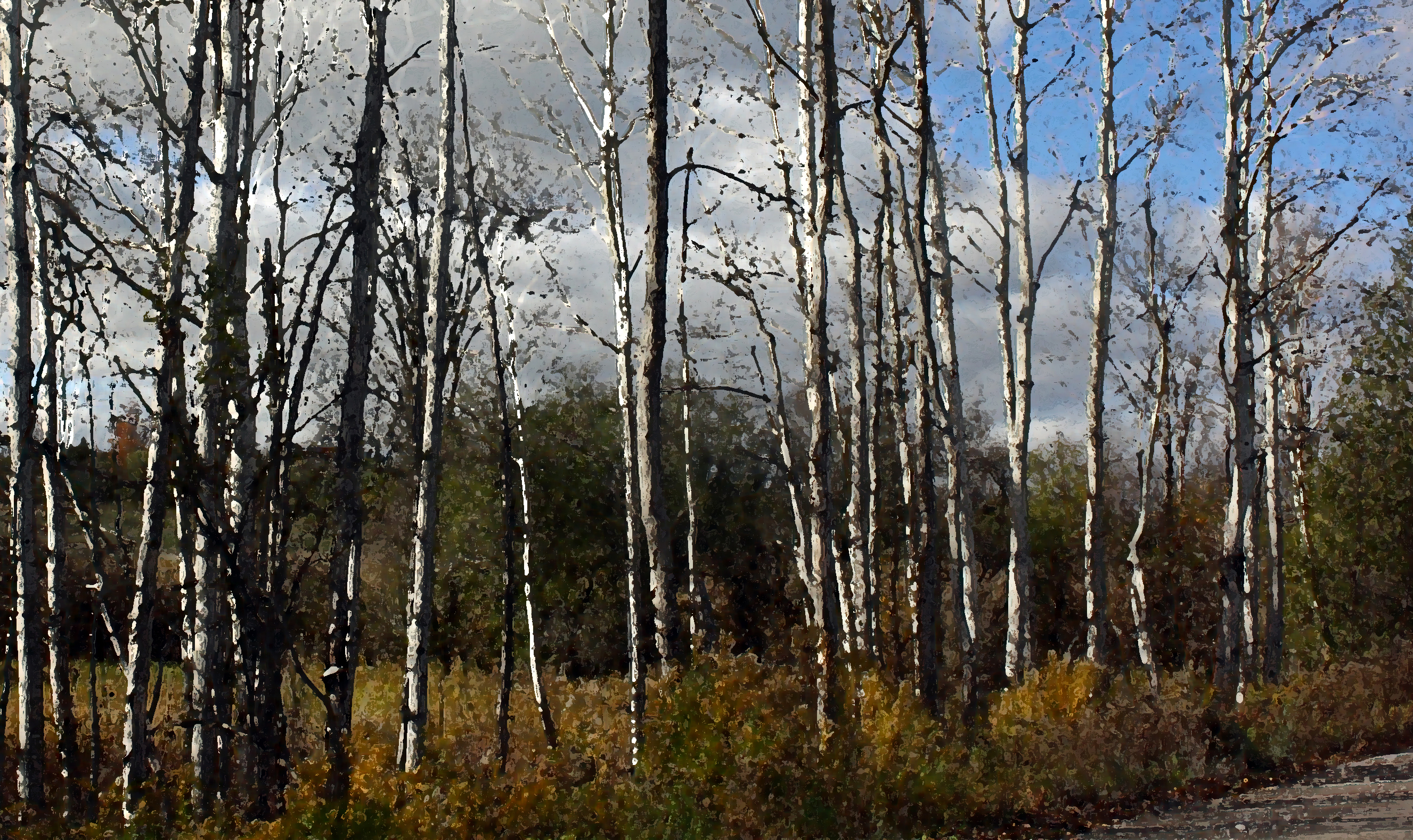
Poplar trees line a road in the Ontario country (photo and rendition by Nina Munteanu)
The planet will be alright. Species will go and others will come. Earth has experienced five extinction events (we are currently experiencing the sixth extinction event now) and after each, life flourished again, albeit different life.
Is there still hope for humanity? Perhaps—if we set our hubris aside and embrace humility and kindness. And, if in that humility, we can adapt our way through the succession we’ve triggered. There might be hope for us still…
Rawlence devotes his epilogue called “Thinking Like a Forest” to the wisdom of the indigenous people who have for millennia co-existed sustainably with the natural ecosystems of the Earth. “The Koyukon, the Sámi, the Nganasan, the Anishinaabe are just a few of the countless indigenous peoples whose world view attests to our foundational reliance on the forest.”
Time to learn from them.
Trees at sunset in winter, ON (photo and rendition by Nina Munteanu)
Nina Munteanu is an ecologist and internationally published author of award-nominated speculative novels, short stories and non-fiction. She is co-editor of Europa SF and currently teaches writing courses at George Brown College and the University of Toronto. Visit www.ninamunteanu.ca for the latest on her books. Nina’s recent book is the bilingual “La natura dell’acqua / The Way of Water” (Mincione Edizioni, Rome). Her latest “Water Is…” is currently an Amazon Bestseller and NY Times ‘year in reading’ choice of Margaret Atwood.
The TVO and National Film Board of Canada film Borealis by Kevin McMahon opens with ‘tree song’ and Diana Beresford Kroeger’s voice: “The design of Nature is music. If you listen to the trees, you will hear their song. And some people actually hear an individual song for certain species.”
Early in the film, you see Edmund Metatawabin, a Fort Albany First Nation writer, walking ghost-like in the forest. His voice tells us that when the trees look at us, we would just be like “these little things flitting by.” This simple comment underscores the difference that time plays to a tree that may live to a thousand years in contrast to a human who—if they are lucky—may live to a hundred. Says Metatawabin:
“We have a certain relationship with the trees, their living essence. The tree has been here for a long time, standing in the same spot but watching…They’re our older relations. We’re very happy and secure that they’re there, still standing watching over us. Some of us have heard them sing.”
Edmund Metatawabin
Boreal forest after a natural fire (Borealis)
In a frank interview with Madeline Lines of POV Magazine about the making of Borealis, filmmaker Kevin McMahon talked about how the rugged beauty of the boreal forest belies a fragility poised on a precarious balance with humanity.
The film discusses some of the major relationships and mechanisms of this complex and unique ecosystem through the voices of scientists and naturalists who study and know the forest: botanists, population and aquatic ecologists, atmospheric scientists, forest entomologists and researchers and guides.
“The story of the boreal forest [is that] basically … it goes up, burns itself down and like a phoenix, goes up again,” says McMahon. “There’s a complexity—the trees influence the animals, the animals influence the trees, so a community grows up over at least two centuries, usually, and sometimes three, or four.”
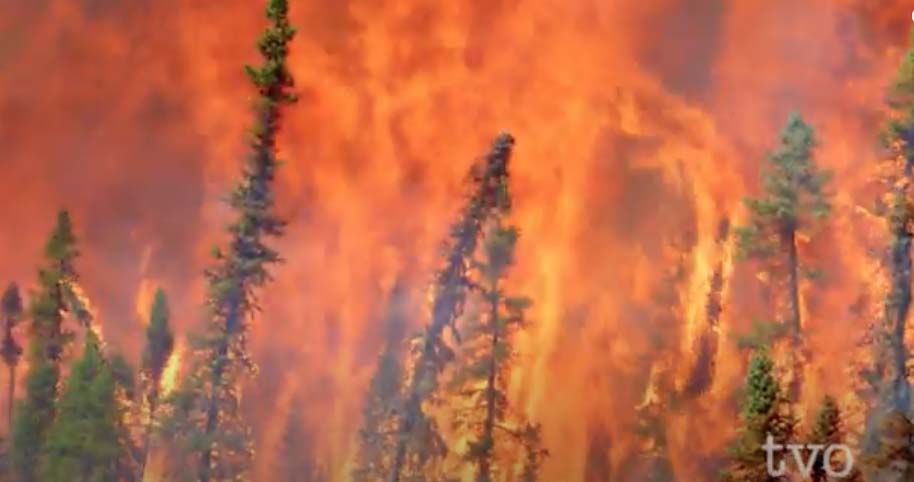
Natural fire cycles through the boreal forest every hundred years to renew it (Borealis)
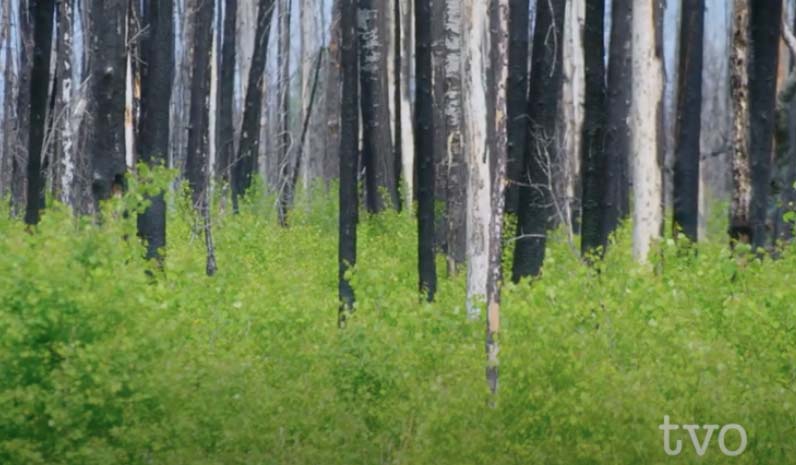
One of the narrators tells us that the boreal forest has “survived and thrived in this regime of semi-regular stand-renewing fire.” This natural cycle of creative destruction is common in most ecosystems where destruction engenders rebirth and renewal by a community of species well-adapted to these cyclical changes. Botanist Diana Beresford-Kroeger adds, “the jack pine cones will only open on fire. The resin needs to be melted off the cone and then they shed their seeds.” The cones of tall spruce trees aggregate at the top of the tree, where the fire provides enough heat to open them but not burn them. White birch saplings sprout—phoenix-like—from the burnt tree base and roots. Aspen roots also send up thousands of suckers to become new clone trees of a renewed forest. The dead trees provide substrate for mosses, lichens and fungi that bring in moisture and decompose the logs into nutrients used by the living forest.
Aspen clone saplings cover the forest floor after a fire (Borealis)
The movie showcases some of the most vivid details of tree function, including the microscopic view of opening and closing stomata (pores on a leaf). Stomata take in CO2 and release oxygen during photosynthesis. They also release water vapour as part of transpiration and other chemicals such as metabolic aerosols.
Stomata on the underside of leaf release aerosols, carbon dioxide and water (Borealis)
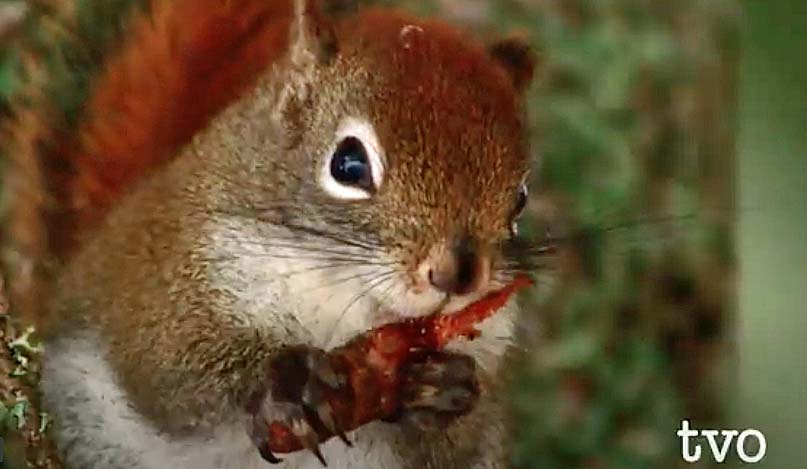
The devastation of climate change strongly features in the film as does our own mismanagement of the forests. A particularly telling scene was shot in the Yukon by Joshua See where squirrels have co-evolved with spruce trees in a relationship they’ve developed over 1000 years. The squirrels have timed their reproduction with the spruce production of cones and release of seeds; but climate change has knocked the trees out of sync with the squirrels, which is threatening the survival of the squirrel.
Red squirrel eating spruce seeds from cone (Borealis)
“I think that’s probably the first time any human being has seen such a vivid example of the rhythms of nature being thrown out of sync by climate change. And the funny thing is, if you listen to the climate change debate, as I obviously do fairly closely, that is something that has not really sunk in with the general public,” said McMahon. “People know about storms, and because of Australia and California they’re starting to learn about the impact it has on fires. But the reality that the rhythms of the world are all screwed up has not really sunk in, and Borealis has two really powerful examples of this. One is what happens to the squirrels, and the other is what’s happening to the trees, with what’s happening with the pine beetles.”
Aerial shot of river and boreal forest (Borealis)
Fern fiddleheads in boreal forest (Borealis)
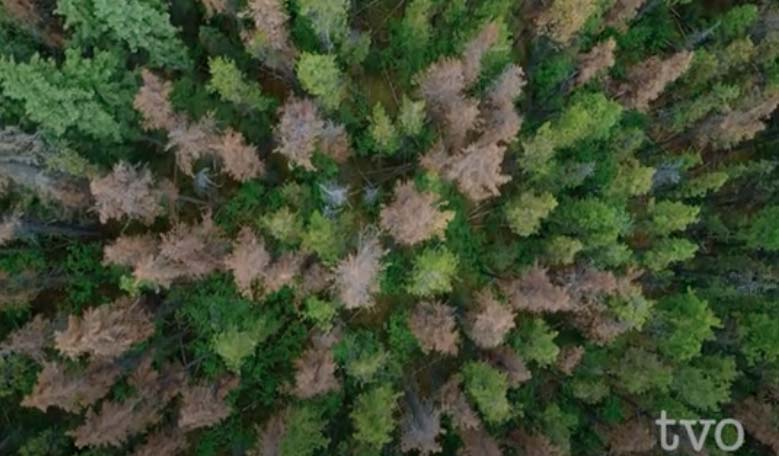
McMahon then adds soberly, “That last big dramatic drone shot [in the film] where you see that, basically, the boreal forest is dying – that’s Jasper National Park. This iconic forest that Canadians have sort of hung their identity on – you know, the snow-capped pine trees, and whatever – that forest is dying. It’s in a death spiral.”
McMahon admits: “I didn’t know when I started this project 10 years ago about the state of the forest. I was intending to make a film about how the forest worked. I did not realize until I started really talking to scientists that it is dying…The boreal forest is dying, and we are doing a super shitty job of taking care of it.”
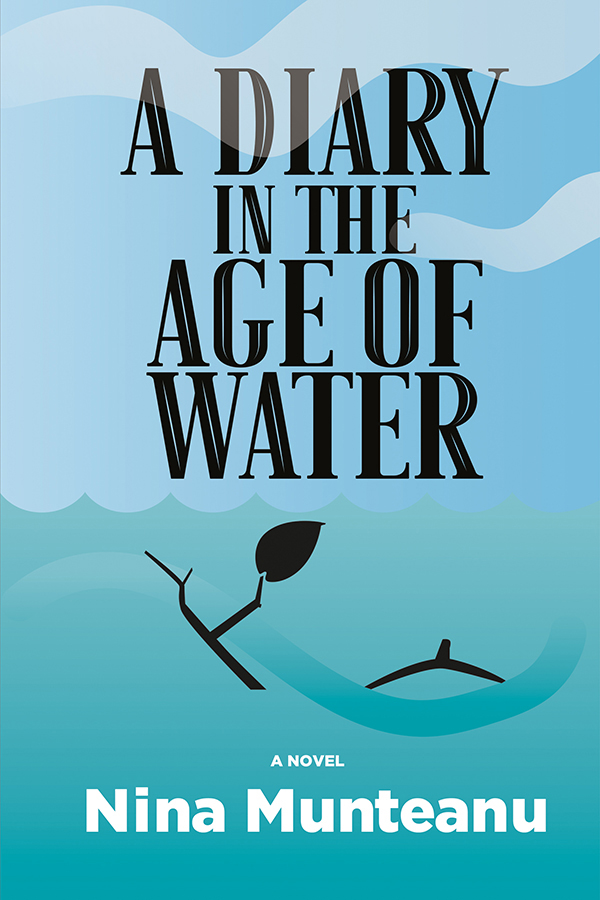
This resonated particularly with me; I’d just published my latest eco-novel A Diary in the Age of Water with Inanna Publications. The novel—about four generations of women and their unique relationship with water—begins with a blue being in the unknown future as she runs through a dying forest of the north, the last boreal forest in the world…
Clearcut logging the boreal forest (Borealis)
Pest-ridden boreal forest (Borealis)
McMahon adds a sober note about Canadian awareness:
“I think that in Canada – and this has been a theme of mine for decades – we pat ourselves on the back for being fresh faced boy scout-types, and we have this sense of ourselves as being green because we have so much green. The best thing about my career is I’ve been able to travel so much around this country. And it is a huge, huge country, and we do have just incredible, astonishing wilderness here–and we are wrecking it. We’re wrecking it in an extremely heedless, pointless, stupid kind of way. So I want that to sink in with people.
All those people at the end of the film that talk about the fact that the forest is collapsing, and we’re going to end up with a shrubland, and the forest emits more carbon than it sequesters–those are all Canadian government scientists. They’re not environmentalists. There’s no environmentalist voice in this film, in fact. I didn’t go to Greenpeace or any of those kinds of people, I went only to people who have a direct, material day-to-day interaction with the forest. Those people at the end of the film are on your payroll, and their job is to figure out what’s going. That’s what they’ve figured out, and I don’t think hardly anybody in this country knows that.”
Kevin McMahon
But McMahon remains hopeful. He cites Ursula Franklin, a scientist and peace activist who said, “Despair is a luxury we cannot afford.” McMahon responds with, “That’s the model that I live by really, because if I didn’t have hope I wouldn’t bother making these films, I’d just retire.”
Tree planter Isabella plants spruce and pine in a clearcut (Borealis)
Near the end of the film, tree planter Isabella reminds us that, “We have the ability to make whatever it is that we imagine, so let’s just start imagining a new path, let’s start imagining a new way. We are so tied to this experience and whatever happens to that forest is going to be a reflection of what happens to us.”
The film ends with the powerful wisdom of indigenous writer Edmund Metatawabin:
“We are here to make sure that the world, that the species, that humanity continues. The trees are the support, guidance, encouragement, and faith that things are just the way they’re supposed to be. That’s support from something that’s inanimate it looks like; but you’re getting it because it’s connected to the ground and its aiming for the sky. It’s a conduit between the earth and the sun. To see the tree as a living light … When you see that light you’ve gotten a gift; you’re going to be very humbled.”
Edmund Metatawabin
Nina Munteanu is a Canadian ecologist / limnologist and novelist. She is co-editor of Europa SF and currently teaches writing courses at George Brown College and the University of Toronto. Visit www.ninamunteanu.ca for the latest on her books. Nina’s bilingual “La natura dell’acqua / The Way of Water” was published by Mincione Edizioni in Rome. Her non-fiction book “Water Is…” by Pixl Press(Vancouver) was selected by Margaret Atwood in the New York Times ‘Year in Reading’ and was chosen as the 2017 Summer Read by Water Canada. Her novel “A Diary in the Age of Water” was released by Inanna Publications (Toronto) in June 2020.












 Nina Munteanu Writing Coach