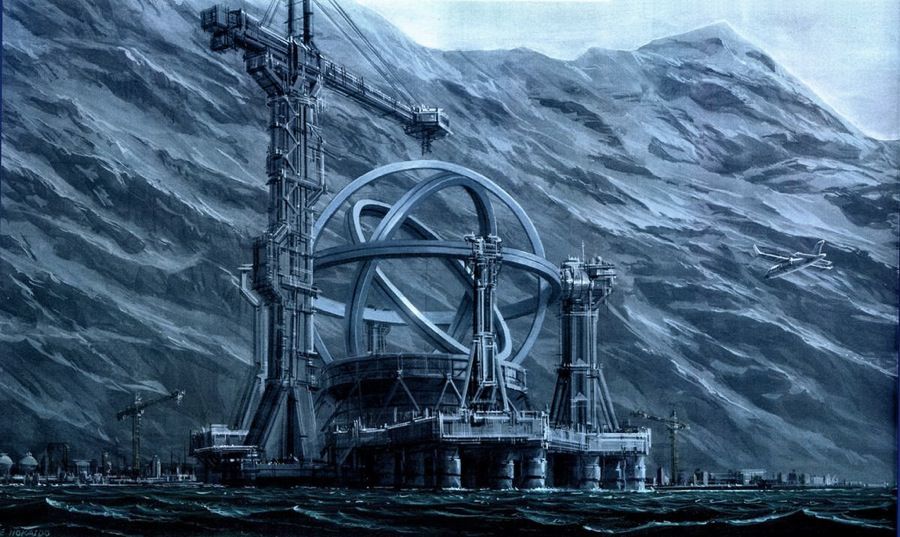
Movie Review: Venture to “The Beyond”

The Beyond is a 2018 science fiction thriller, set in the near-future, that explores the evolution of our humanity through “first contact.”
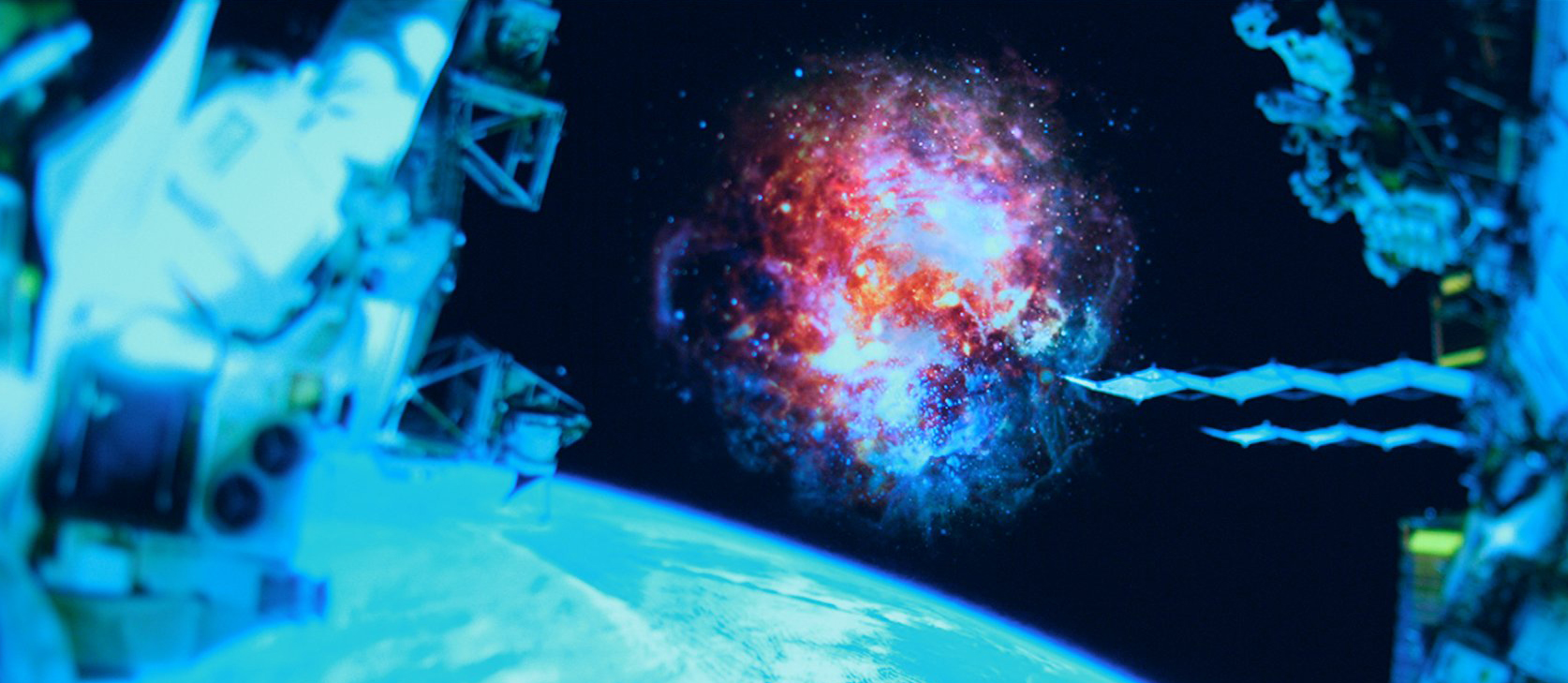
Wormhole suddenly appears

The sudden appearance of a wormhole causes the disappearance of astronaut Jim Marcell during EVA on the space station, followed by associated calamitous phenomena on Earth. Giant dark spherical clouds then appear and settle all over the Earth, disrupting the world’s population, and setting in motion a series of fearful and aggressive reactions by various sectors of humanity; as expected, the military of each nation mobilize, ready to attack. Some do attack, with no consequence.

Alien spheres appear over several cities

With the help of the military’s groundbreaking transhumanism technology, the international space agency sends two transhuman (Human 2.0) astronauts into the wormhole (called the Void) on an information-seeking (and peace-seeking) mission. The astronauts have been modified by advanced robotics to withstand the pressures of the “throat” of the wormhole as they embark on humanity’s first interstellar—possibly inter-dimensional—journey in search of extra-terrestrial sentient life and its intent. One of the astronauts is a soldier, armed with additional weapons built into his physiology. The other is the Space Agency’s chief cosmologist, Jessica Johnson (played by Kosha Engler). When the mission returns unexpectedly, and without the soldier, the space agency races to discover what happened on the “other side.” Of particular interest is evidence indicating that the ship had been away much longer than the days it was actually gone. Johnson later reveals that the soldier had suddenly disappeared from the cockpit and reappeared outside. She saw him stare at his arm, which then detonated like a nuclear bomb—no doubt because his arm was indeed something of that nature.

Jessica transformed into Human 2.0 for space travel

The tag line of the movie says: “to find our place in the universe, we must venture beyond our boundaries.” This imaginative indie film by Hasraf Dulull is all about breaking boundaries and transcending beliefs: such as mission director Gilian’s first lie to her daughter (to contain a bigger lie by the space agency); and chief cosmologist Jessica conquering ethical barriers to embark on a journey that will irrevocably change her.
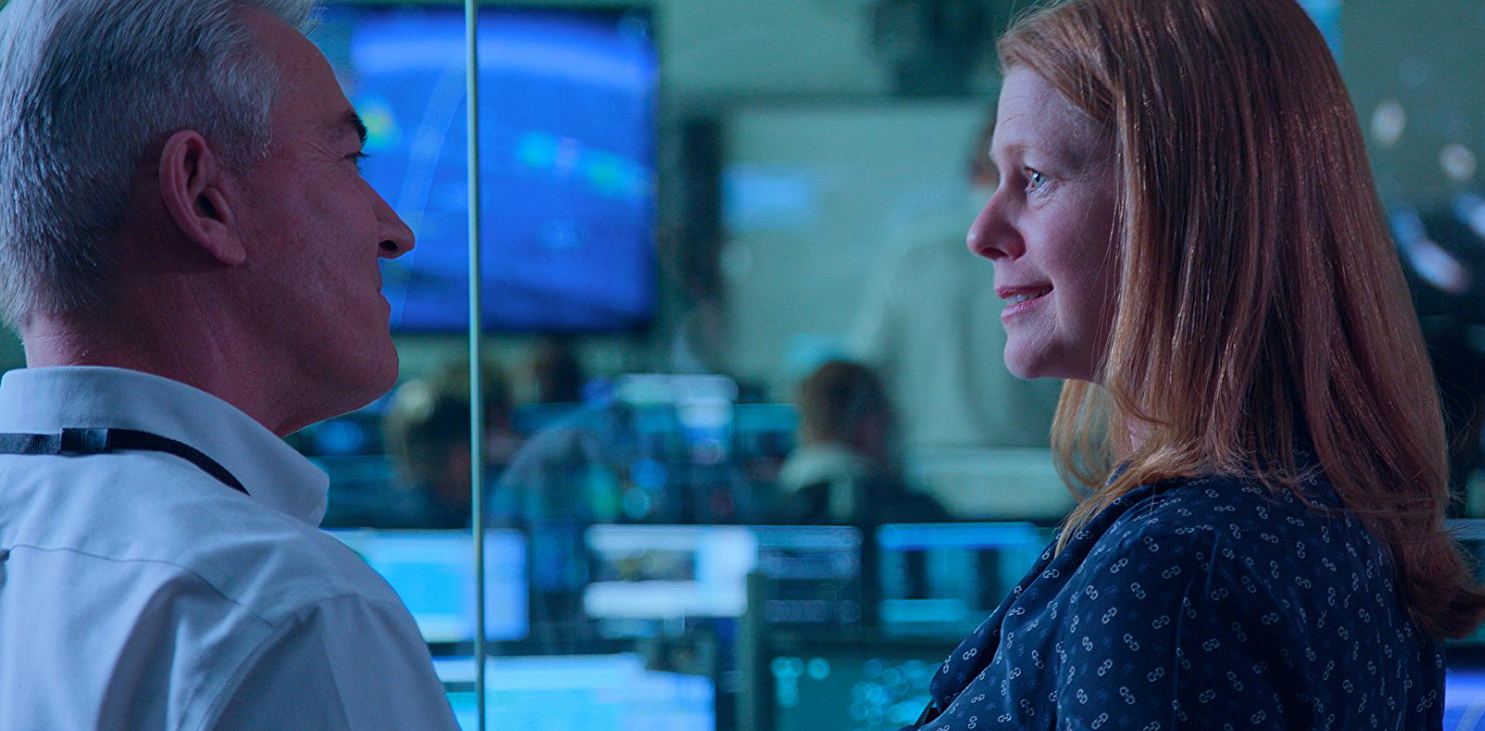
Canadian Gillian Laroux is mission commander

The story unfolds like a docu-drama, making use of interviews with key people and retrieved footage amidst dramatic narrative (similar to Blomkamp’s District 9). The mixed narrative creates an immediacy that grips us emotionally and deeply connects us to the characters in a real-life way. Characters are portrayed as ordinary people who find themselves in extra-ordinary circumstances and performed with genuine candor, particularly the mission commander Gillian Laroux (Jane Perry) who plays a Canadian.

The Beyond appeals to our senses and sensibilities, challenging our assumptions and definitions of what it is to be human through our values, hopes and fears. Told with an unassuming realism, The Beyond is really a simple, yet deeply meaningful story that asks the big questions—and leaves it for us to answer them.

The climax, discovery and resolution is really more of a question. I was somehow unprepared for the discovery and emotionally struck by its trajectory into the denouement. Some reviewers on the Internet were off-put by the shift following “the discovery” that preceded the denouement at the end. I found closure for the chief cosmologist, who had sacrificed her life to seek answers and find a solution for humanity; however, the question remained: what is that solution for humanity? What does that solution look like and how does it encompass more than us? The movie doesn’t have a tidy end; its solution is veiled with more questions.

The film ends with a cautious hope, implicitly asking that big question: are we (humanity) worth saving? When Jessica asks why humanity was offered a second chance by benevolent beings way beyond our comprehension, the returned Jim Marcell (currently a spokesman for the aliens) shows her the GAD (Golden Archive Drive with video images of Earth and humanity—basically our “hello” message to extra-solar life like the one placed onboard NASA’s Pioneer missions) that had accompanied the ship into the wormhole. The message displayed scenes of mothers and their children, people laughing in joy; it also showed scenes of other aspects of this beautiful planet worth saving: the ocean surf, the forests and wildlife. In our hubris, we have lost our perspective about this planet. Perhaps, it wasn’t so much humanity the alien beings intended to save but the Earth itself; we just come along with it. The Earth is, after all, a beautiful, vital and unique world, rich with life-giving water, trees, animals, creatures of all kinds in a diverse network of flowing and evolving beauty. A planet worth saving and that, frankly, functions better without us.

Jessica 2

So, the question remains: is humanity worth saving? For centuries we have hubristically and disrespectfully used, discarded and destroyed just about everything on this beautiful planet. According to the World Wildlife Federation, 10,000 species go extinct every year. That’s mostly on us. They are the casualty of our selfish actions. We’ve become estranged from our environment, lacking connection and compassion. That has translated into a lack of consideration—even for each other. In response to mass shootings of children in schools, the U.S. government does nothing to curb gun-related violence through gun-control measures; instead they suggest arming teachers. We light up our cigarettes in front of people who don’t smoke and blow deleterious second-hand smoke in each other’s faces. We litter our streets and we refuse to pick up after others even if it helps the environment. The garbage we thoughtlessly discard pollutes our oceans with plastic and junk, hurting sea creatures in unimaginable ways. We do not live lightly on this planet. We tread with incredibly heavy feet. We behave like bullies and, as The Beyond points out, our inclination to self-interest makes us far too prone to suspicion and distrust: when met with the unknown, we respond with fear and aggression rather than curiosity and hope. Something we need to work on if we are going to survive–and find our place in the universe.

The Beyond is a simple film made well; something not easy to accomplish. The film delved into existential questions with an emotional intelligence that was both sensitive and insightful. As Gillian Laroux says in the end: “I hope we won’t make the same mistakes of the past and prove that we are in fact worth saving.” Ultimately, I found The Beyond a refreshing change from the senseless soul-gutting violence, and sordid aimless or overly-complicated plots that currently populate most of our current science fiction TV and movies.

The Beyond marks the directorial debut of Dulull, a VFX wiz who spent a year shooting and working on this project (previously titled The Void). Changing the title from The Void to The Beyond is itself an interesting shift in what the film represents and suggests.

Let us tread more lightly on this planet, then…And perhaps we too will be worth saving. Perhaps our destiny won’t be a void but a transcendence beyond…

Nina Munteanu is a Canadian ecologist / limnologist and novelist. She is co-editor of Europa SF and currently teaches writing courses at George Brown College and the University of Toronto. Visit www.ninamunteanu.ca for the latest on her books. Nina’s bilingual “La natura dell’acqua / The Way of Water” was published by Mincione Edizioni in Rome. Her non-fiction book “Water Is…” by Pixl Press (Vancouver) was selected by Margaret Atwood in the New York Times ‘Year in Reading’ and was chosen as the 2017 Summer Read by Water Canada. Her novel “A Diary in the Age of Water” was released by Inanna Publications (Toronto) in June 2020.
Movie Review: “Contact”, a Journey to the Heart of the Universe

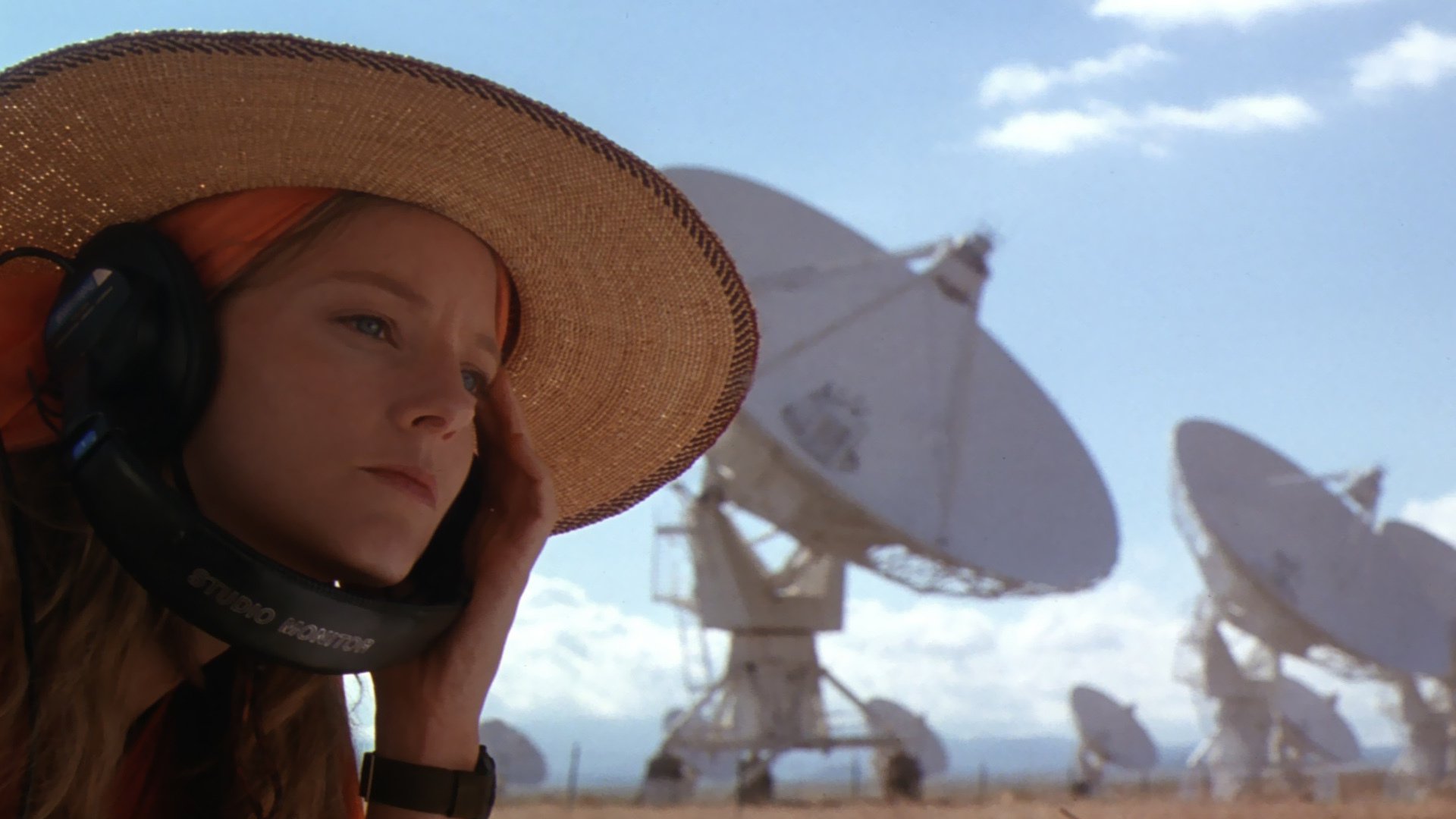
Ellie (Jodie Foster) listens for aliens at the array in “Contact”

The opening sequence tells the entire story… It is both spectacular and humbling at the same time as we begin with a view of Earth gleaming in a sunrise. An almost frantic jumble of broadcasts— news, TV shows, music—assail our ears. As we pull back from Earth and pass the outer planets, we hear older broadcasts… disco…Kennedy… the Beatles… Hitler…then ultimately the unintelligible static of all the radio stations on Earth. Then, as we leave the solar system, passing breathtaking nebulae, the sounds give way to silence. A dead silence, as we continue to pull back out of the galaxy and out of the local group of galaxies into the quiet depth of our vast universe. “It’s enough to make you feel tiny and insignificant and alone,” says Maryann Johanson of FlickFilosopher.com. “Which is precisely the feeling it’s meant to evoke.”  From that arcane vastness, we are brought back to our own “intimate” existence within it as the universe transforms into a dark reflection in a young girl’s eye.

With a powerful entrance like that, it is hard to imagine that this 1997 movie directed by Robert Zemeckis (Forrest Gump) and based on the novel by Carl Sagan, received very mixed reviews by critics.

Cindy Fuchs of the Philadelphia City Paper called it “far more mundane than its aspirations to cosmic insights might have produced.”  Kevin N. Laforest with the Montreal Film Journal said, “Contact is not a bad film, but I can’t say it’s all that good either.” Even TVGuide.com rated it a two out of four: “It’s really about [Jodie] Foster, and with her lips pressed tightly together and her hair carelessly shoved behind her ears, she’s utterly convincing as a researcher who’s subverted everything to a life of the mind. Unfortunately that adds up to a rather remote protagonist and Ellie is surrounded by a supporting cast of one-dimensional types…far too cold-blooded for summer audiences.” This is ironic, considering that the advertizing pitch calls Contact “a journey to the heart of the universe.” Finally, Christopher Null (Filmcritic.com) recommended it for its looks but not highly. Said Null: “Carl Sagan’s ode to the superior intelligence of aliens (and how us darned humans mess everything up) is consistently beautiful and interesting, but it never makes a point (except for that bit about the darned humans).

I think these critics have missed the point. Contact—and its somewhat tortured protagonist—demonstrates much in the way of “heart” and in doing so, makes a compelling story. Hearts beat deeply inside us, and this movie is no different; its “heart” runs deep, deep beneath the surface rhetoric that seems to have distracted several critics who likely prefer to take a shallow sip of their coffee steaming hot than wait and savor the rich flavor of a dark blend in a deep swallow.

Contact examines the moral, social and religious implications of our first contact with extraterrestrial intelligence through the personal journey of astronomer, Eleanor (Ellie) Arroway (played impeccably and sensitively by Jodie Foster). Never knowing her mother (who died at child birth) and having lost her father when she was ten, Ellie grows into a strong-willed scientist who dedicates her life to finding alien life in the universe by foregoing a career at Harvard to join a SETI Observatory in the Puerto Rico jungle. In an earlier scene with her father, she asks the question we have all pondered at least once: “Do you think there are people on other planets?” to which her father blithely answers, “if it’s just us, seems like an awful lot of wasted space,” a simple argument that appeals to the young logically-minded Ellie and one that will dominate the perseverance of her adult life in her resolute search for life in the universe.

And persevere Ellie must, because nothing comes easy for her. Shortly after she settles at the SETI Observatory her teacher (and nemesis) David Drumlin (Tom Skerritt) pays her a visit with implied threats of shutting the place down. Ellie also meets Palmer Joss (Mathew McConaughey), a man of faith, who is writing a book about the effects of science and technology on the third world. Although she is attracted to him, alarm bells go off in Ellie, who feels threatened by his faith (something she does not outwardly understand yet clings to in another form). Wanting to see him again, she introduces him to the man he wants to interview: Drumlin. And one of the most poignant conversations follows:

When Ellie challenges Drumlin’s apparent wish to do away with all pure research, he responds with, “What’s wrong with science being practical, even profitable? Nothing—”

Palmer cuts in, “—As long as your motive is the search for truth, which is exactly what the pursuit of science is.”

Drumlin counters peevishly, “Well, that’s an interesting position coming from a man who crusades against the evils of technology.”

To which Palmer responds, “I’m not against technology; I’m against the men who deify it at the expense of human truth.”

Palmer and Ellie collide from two different worlds and despite their differences, they are profoundly attracted to one another. But as quickly as she falls for Palmer, she recoils from him.

Nothing comes easy for Ellie: “small moves, Ellie,” her father is accustomed to telling her, “small moves…” Shortly after she and her colleagues have been shut down by Drumlin and have set up anew (thanks to eccentric billionaire entrepreneur, S.R. Hadden, played by John Hurt), Drumlin and others shut them down yet again. But, as though a greater force intervenes, this is when Ellie makes her momentous discovery and intercepts an alien message from Vega, a young star still surrounded by a proto-planetary cloud of debris about 27 light years away from us. The scene is scientifically plausible and elegantly powerful—as we witness the drama of this phenomenal discovery unfold in a frisson of action.

Zemeckis wisely shows us exactly how such an event would really play out. And Sagan didn’t pick Vega out of whimsy: a sphere sixty light years thick of radio communication radiates from Earth from our radio and TV broadcasts. These signals may be captured by alien technology and sent back as a “message”. In theory, such a signal could be received on Earth anytime after 1990, the round trip time for a light or radio signal to travel to Vega and back from the first global signal, which in itself is momentous and telling. In another spine-tingling scene, the scientists who have descended upon Ellie decipher the arcane harmonics of the “message” as the broadcast of the opening ceremony of the Berlin Olympics in 1936 (the first truly global TV broadcast made) over which Hitler presided. In fact, in another stroke of irony, the now infamous swastika is the first icon they decipher. Later still, they discover embedded instructions to build a machine that appears made to take a human on an extra-galactic trip.

Ellie (Jodie Foster) listens for aliens at the giant array in “Contact”

At the same time that Ellie intercepts this message, Palmer Joss experiences a meteoric rise to stardom with his bestselling book, Losing Faith: the Search for Meaning in the Age of Reason (which could well have been the alternate title for the film; it certainly describes the subtext of the story and the major thematic element: Faith & Meaning). In an interview with a prominent news show host, Palmer asks the question that most of us have avoided:  “The question that I’m asking is this: are we happier? Is the world fundamentally a better place because of science and technology?…We shop at home, we search the web—at the same time we feel emptier, lonelier, and more cut off from each other than any other time in human history…We have meaningless jobs, we take frantic vacations [and] trips to the mall to buy more things to fill these holes in our lives.” Ironically, Palmer touches a similar nerve in Ellie when he brings up her dead parents: “It must have been hard… being alone…” insinuating that her fanatical search for intelligent alien life may simply be filling a hole in her heart. She flees Palmer shortly after, fearing his revealing intimacy. When they next meet, years later, they fall naturally into their familiar banter and she turns the table to challenge his faith in the same way: “What if science simply revealed that [God] never existed in the first place?” She then evokes Occam’s Razor, which says that “…all things being equal, the simplest explanation tends to be the right one…what’s more likely? An all powerful mysterious God [who] created the universe then decided not to give us proof of his existence or that he simply doesn’t exist at all and we created him so we wouldn’t have to feel so small and alone?” Both of them are saved from an answer by the intrusive rings of their cell phones.

Space-time vehicle in the film Contact

Ironically again, it is Ellie’s lack of belief in God that causes her to be overlooked for the momentous journey in the alien craft, in favor of the crafty Drumlin with the oily smile. Unfortunately, a religious zealot sabotages the mission and Drumlin, along with the whole alien craft and construct, are blown up in a spectacular explosion at NASA’s Cape Canaveral. Ellie gets her chance after all when they build a second one. Her journey in the alien space craft, which we are later told takes up eighteen hours of her time but passes instantaneously on Earth (to the point where they all think nothing actually happened), is truly epic and elegantly portrayed. Her encounter with the aliens is also in keeping with the plot and imagery of the story. One of the most poignant scenes in the movie is the one where Ellie is introduced to the incredible and indescribable beauty of the vast Universe. It is at this point that she experiences her epiphany: science is not the sole purveyor of truth in the Universe. As she gazes at the splendor revealed before her, she acknowledges that the language of science is unable to express the sheer magnitude of the breathtaking scene. Grasping at something to say, she blubbers with a scientific term then finally gasps, “No words…to describe it…they should have sent a poet…”

Upon her return, Ellie is challenged by skeptics who think she suffered a giant delusion (remember that on Earth, no time had passed during her supposed eighteen-hour voyage). Ellie offers up a strained scientific explanation (e.g., wormhole travel through space-time also called Einstein-Rosen bridges) which is challenged by National Security Advisor, Michael Kitz (James Woods) as only theory, and must finally resort to her faith; one she selflessly offers to the world: “I… had an experience. I can’t prove it, I can’t even explain it, but everything that I know as a human being, everything that I am tells me that it was real. I was given something wonderful, something that changed me forever. A vision of the universe, that tells us undeniably, how tiny, and insignificant and how… rare, and precious we all are. A vision that tells us that we belong to something that is greater than ourselves, that none of us are alone.”

Frederic and Mary Ann Brussat of Spirituality Practice said it best: “Robert Zemeckis has fashioned a truly awesome movie that celebrates the spiritual practices of listening, wonder, love, and zeal. It affirms that there are times and places where reason must yield to mystery.”

The SETI Institute, who currently conduct the search for alien life, have a website dedicated to the movie.

Very large array in New Mexico (photo Wikipedia)

Nina Munteanu is a Canadian ecologist / limnologist and novelist. She is co-editor of Europa SF and currently teaches writing courses at George Brown College and the University of Toronto. Visit www.ninamunteanu.ca for the latest on her books. Nina’s bilingual “La natura dell’acqua / The Way of Water” was published by Mincione Edizioni in Rome. Her non-fiction book “Water Is…” by Pixl Press(Vancouver) was selected by Margaret Atwood in the New York Times‘Year in Reading’ and was chosen as the 2017 Summer Read by Water Canada. Her novel “A Diary in the Age of Water” was released by Inanna Publications (Toronto) in June 2020.