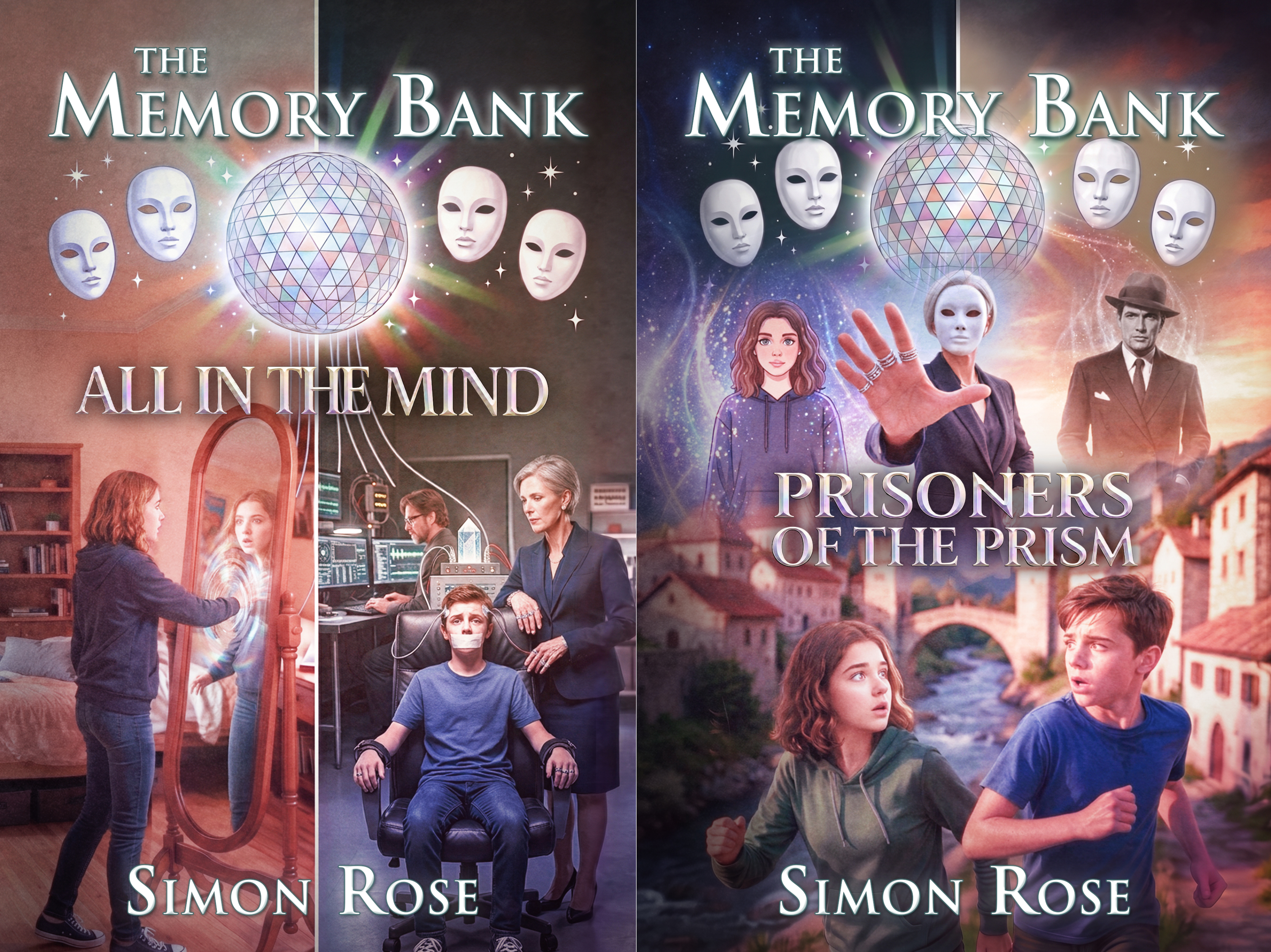
My guest today is author Simon Rose, who has published twenty-one novels for children and young adults, eight guides for writers, more than a hundred nonfiction books, and many articles on a wide variety of topics. Today he’s here to tell us more about his two latest novels, The Memory Bank – All in the Mind and The Memory Bank – Prisoners of the Prism.
Nina:Welcome, Simon!
Simon: Thank you, it’s a pleasure to be here.
.
Nina:Where did you get the idea from to create The Memory Bank novels?
Simon: For these books, I was first inspired by how people often have casts made of a beloved pet’s paw made when their faithful friend passes away. It’s certainly something I’ve done over the years. I then remembered how death masks have been created of notable people throughout history, well before the invention of photography, so that we know what some of these people actually looked like and in some cases the mask closely resembles the person’s face as portrayed in a painting. The ideas began to converge.
.
Nina:There are some quite well known people of which death masks were made, aren’t there?
Simon: Yes, there are masks that were made of the faces of Martin Luther, Oliver Cromwell, Mary Queen of Scots, Marie Antoinette, Isaac Newton, Horatio Nelson, John Keats, Ludwig van Beethoven, and a number of others. Perhaps the most notable one for me is Napoleon Bonaparte. Some people dispute whether it’s really him, but the mask does bear an uncanny resemblance to his many portraits. There are links included in both books and here on my website in the Sources of Inspiration page if you’re interested in learning more about this topic.
.
Nina:I know that you’ve always been fascinated with different historical eras. We can see that from many of your previous novels. Were the masks something that you’ve always been interested in?
Simon: Yes, I’ve always wondered about them, but I wasn’t sure how I’d ever be able to include them in a story. I was also aware of masks worn at carnivals in Venice, which seemed to be a natural fit as I was putting the story idea together for The Memory Bank.
.
Nina:How did the pet souvenirs serve as inspiration for the story?
Simon: Without giving away too much of the story, for the two novels I speculated how in the modern era masks could be made of a person’s face. This would then preserve their memories, as seen through their eyes, for their family members to see on a screen after the person’s death. This would be just like viewing photographs or watching home movies.
.
Nina:Sounds incredible. You certainly have a wonderful imagination.Tell me a little bit about your next project.
Simon: I currently have a couple of fantasy projects that I’m working on, so they’ll probably be taking up most of my creative time for the next little while. I’ll also be out there promoting The Memory Bank novels whenever I can. For regular updates, people can subscribe to my newsletter, which goes out on the first day of the month. They can do that on my website at www.simon-rose.com where they can also learn all about my other books.
.
Nina Munteanu is a Canadian ecologist / limnologist and novelist. She is co-editor of Europa SF and currently teaches writing courses at George Brown College and the University of Toronto. For the lates on her books, visit www.ninamunteanu.ca. Nina’s bilingual “La natura dell’acqua / The Way of Water” was published by Mincione Edizioni in Rome. Her non-fiction book “Water Is…” by Pixl Press (Vancouver) was selected by Margaret Atwood in the New York Times ‘Year in Reading’ and was chosen as the 2017 Summer Read by Water Canada. Her novel “A Diary in the Age of Water” was released by Inanna Publications (Toronto) in June 2020.You can read her just released eco-fiction thriller Gaia’s Revolution by Dragon Moon Press.
I’m an ecologist. So, when I read books, particularly eco-fiction, I enjoy various authors’ representation of ecologists in literature. Portrayals have ranged quite a bit too. I’ve encountered ecologists, deep ecologists and eco-terrorists. Like real ecologists, these characters are often misunderstood, disrespected or even oppressed for their message of science. This is often by governments, organizations and individuals ruled by agendas of personal or institutional greed. These characters may become morally compromised, driven by righteous anger, on a terrible mission…
Below are six examples. Some have explored political representations such as environmental technocracy (aka: Rogue Harvest, Gaia’s Revolution). Others have featured radical environmentalists and eco-terrorists (e.g. The Overstory, A Diary in the Age of Water), and even anti-humanists (e.g.: Three Body Problem).
.
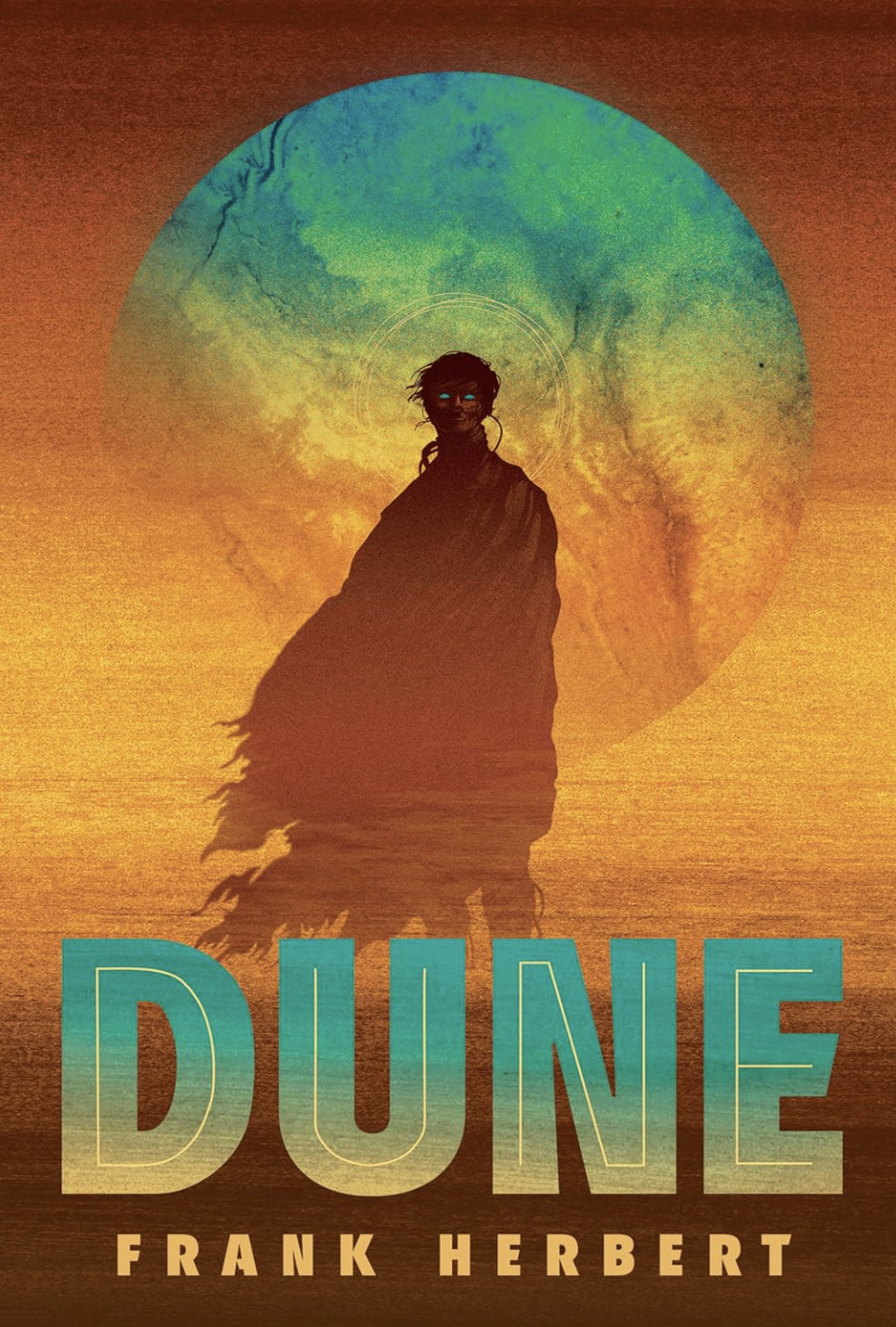
Dune (Chilton Books, 1965)by Frank Herbert:
Dune chronicles the journey of young Paul Atreides, who according to the indigenous Fremen prophesy will eventually bring them freedom from their enslavement by the colonialists—The Harkonens—and allow them to live in ecological harmony with the planet Arrakis, known as Dune. As the title of the book clearly reveals, this story is about place—a harsh desert planet whose 800 kph sandblasting winds could flay your flesh—and the power struggle between those who covet its arcane treasures and those who wish only to live free from slavery. Place—and its powerful symbols of desert, water and spice—lies at the heart of this epic story about taking, giving and sharing. This is nowhere more apparent than in the fate of the immense sandworms, strong archetypes of Nature—large and graceful creatures whose movements in the vast desert sands resemble the elegant whales of our oceans.
.
The subtle connections of the desert planet with the drama of Dune is most apparent in the actions, language and thoughts of the Imperial ecologist-planetologist, Kynes—who rejects his Imperial duties to “go native.” He is the voice of the desert and, by extension, the voice of its native people, the Fremen.
Quotes: (Kynes thinks to himself as he is dying in the desert, abandoned there without water or protection): The highest function of ecology is understanding consequences.
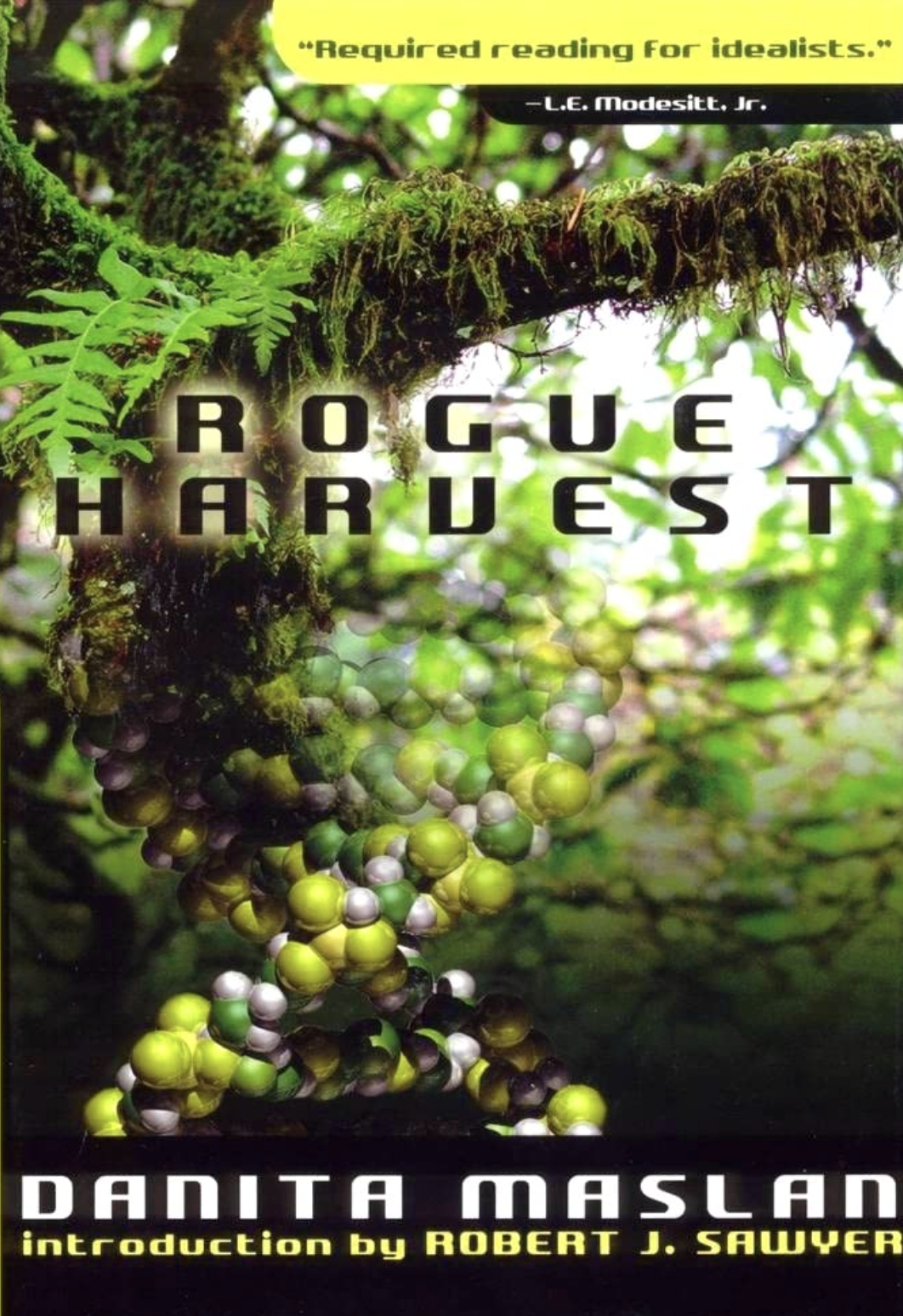
Sometime in the future, Earth is recovering from a devastating 50-year plague that has destroyed most of its natural forests and grasslands and killed two out of every three people. Environmental technocrats now run the world under strict rule: while virgin ecosystems are re-created from original templates through genetic engineering, no human is permitted to set foot in these sanctuaries. As sanctuaries grow ever larger, humanity is pressed into over-crowded cities where boredom and strife dominate.
.
The preservationist organization Emerald Coalition is run by (deep) ecologists who hire reclamation company EcoTech to “recreate the world their great, great grandparents lost.” Main characters wish to open-up the protected nature preserves to regular folk—creating a long-standing conflict between preservation (wilderness not accessed by humans) and conservation (areas where humans extract resources with some environmental risk): demonstrating that, given responsibility for actions within an ecosystem, not all humans behave as they should.
.
The Overstory (Vintage Canada, 2021)by Richard Powers:
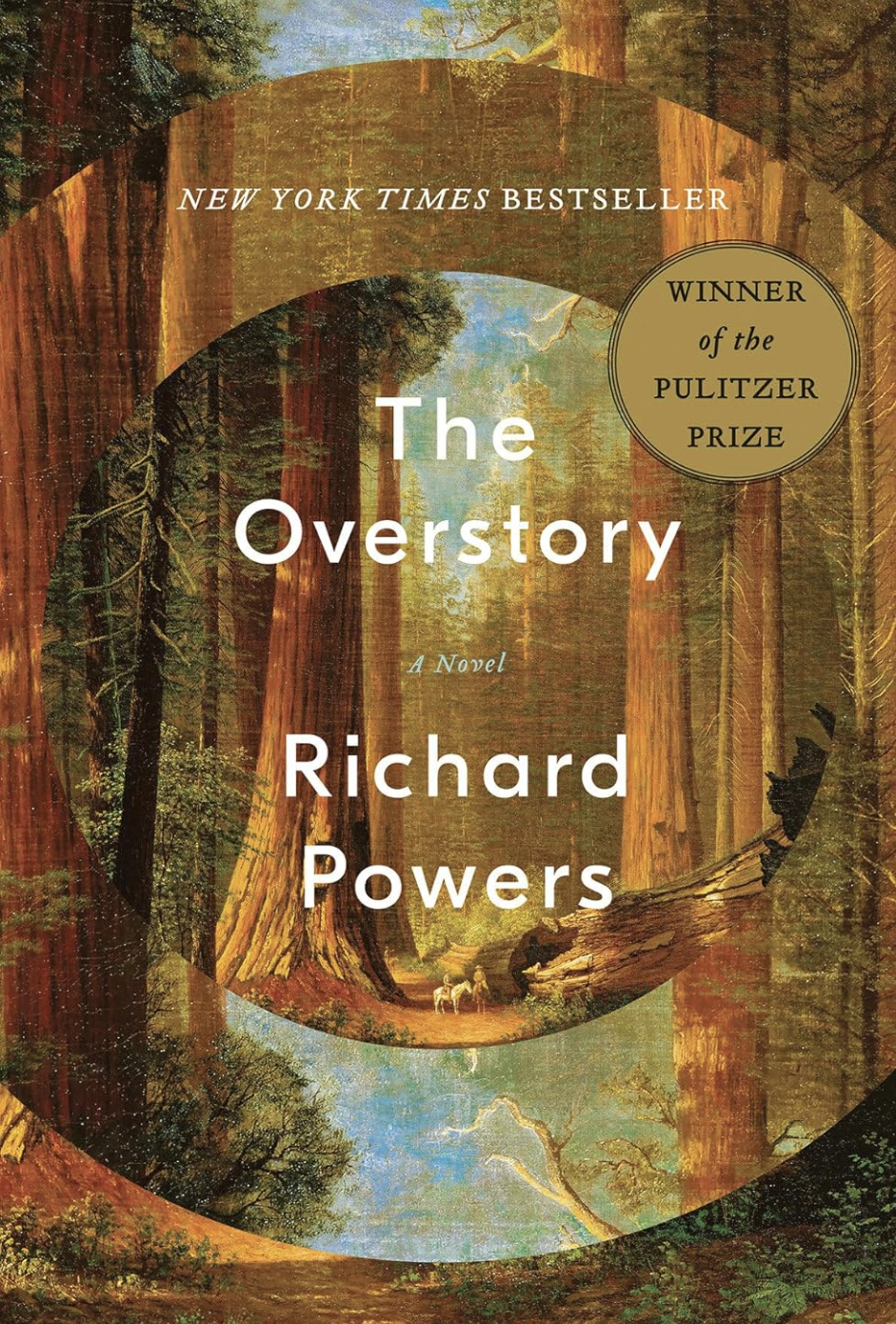
The Overstory is a Pulitzer Prize winning work of literary fiction that follows the life-stories of nine characters and their journey with trees—and ultimately their shared conflict with corporate capitalist America. Like all functional ecosystems, these disparate characters—and their trees—weave into each other’s journey toward a terrible irony. Each in their own way battles humanity’s canon of self-serving utility—from shape-shifting Acer saccharum to selfless sacrificing Tachigali versicolor—toward a kind of creative destruction.
.
At the heart of The Overstory is the pivotal life of botanist/ecologist Patricia Westerford, who inspires a movement. Westerford—whose work resembles that of Diana Beresford-Kroeger (author of The Global Forest) and UBC’s Suzanne Simard— is a shy introvert who discovers that trees communicate, learn, trade goods and services—and have intelligence. When she shares her discovery, she is ridiculed by her peers and loses her position at the university. But, just as with Lynn Margulis and her theory of endosymbiosis, Westerford is finally validated. She is the archetypal ‘mother tree’, the metaphoric Tachigali versicolor, who ultimately brings the tangle of narratives together through meaning. What follows is a fractal story of trees with spirit, soul, and timeless societies—and their human avatars.
Quotes (Westerford writes in her book The Sacred Forest): There are no individuals in the forest, no separable events. The bird and the branch it sits on are a joint thing. A third or more of the food a big tree makes may go to feed other organisms. Even different kinds of trees form partnerships. Cut down a birch, and a nearby Douglas fir may suffer…Fungi mine stone to supply their trees with minerals. They hunt springtails, which they feed to their hosts. Trees, for their part, store extra sugar in their fungi’s synapses, to dole out to the sick and shaded and wounded. A forest takes care of itself, even as it builds the local climate it needs to survive…A tree is a wondrous thing that shelters, feeds, and protects all living things. It even offers shade to the axmen who destroy it.
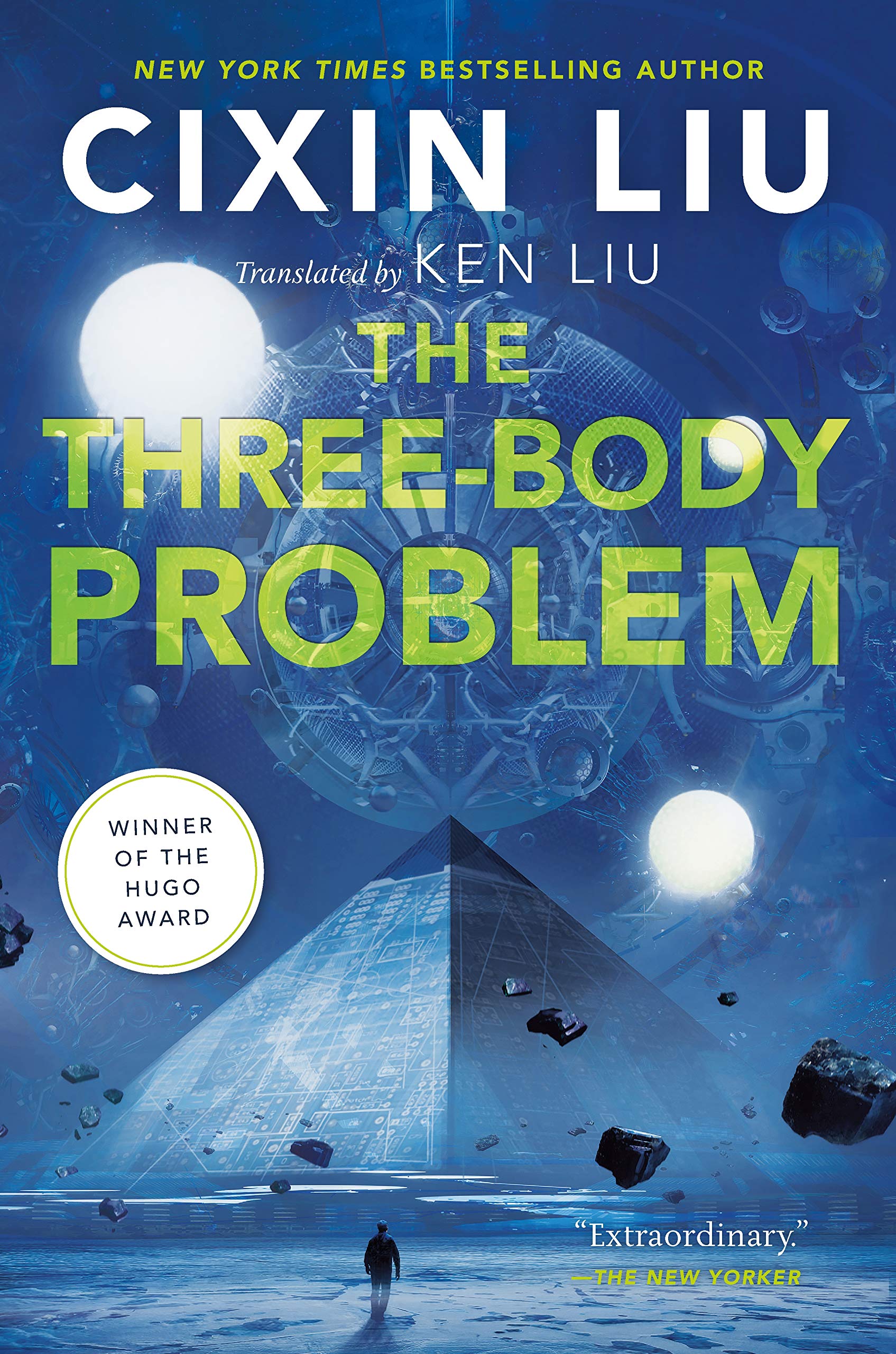
Cixin Liu’s The Three Body Problem—set against the backdrop of China’s Cultural Revolution—follows astrophysicist Ye Wenji, disillusioned by the massive environmental deforestation in the labour camps she is initially sent to work after witnessing the execution of her scientist father in a brutal cleansing at the height of the Cultural Revolution. Already cynical about humanity’s failed culture and science—Wenjie acquires a contraband copy of Rachel Carson’s Silent Spring. The book and revelation she experiences from it sets in motion a frightening notion linking the mindset behind the Cultural Revolution and destruction of the environment. Looking from Nature’s perspective, these were indistinguishable: Is it possible that the relationship between humanity and evil is similar to the relationship between the ocean and an iceberg floating on its surface? Both the ocean and the iceberg are made of the same material. That the iceberg seems separate is only because it is in a different form. In reality, it is but a part of the vast ocean.…It was impossible to expect a moral awakening from humankind itself, just like it was impossible to expect humans to lift off the earth by pulling up on their own hair. To achieve moral awakening required a force outside the human race.
.
Wenjie is sent to the Chinese version of SETI where a secret military project sends signals into space to establish contact with aliens. Wenjie succeeds in amplifying their message to aliens on the dying planet Trisolaris. Despite a warning that the Trisolarians mean only to invade, Wenjie invites them to Earth. To ensure the arrival of the Trisolaris aliens, she collaborates with radical environmentalist Michael Evans—an oil billionaire’s son who is disgusted with humanity’s destruction of Nature. Wenjie believes the aliens will somehow ensure humanity’s transcendence; Evans, however, applauds the coming invasion as the best route to achieve the eradication of humanity and the survival of the rest of the planet and finances the ETO (Earth-Trisolaris Organization) in eco-terrorist activities to protect non-human life—by essentially annihilating humanity.
Quotes: (Wenjie observes the deforestation of an Inner Mongolian labour camp where she was sent to work): Ye Wenjie could only describe the deforestation that she witnessed as madness… Whatever they laid eyes on, they cut down. Her company wielded hundreds of chain saws like a swarm of steel locusts, and after they passed, only stumps were left. The fallen Dahurian larch, now bereft of branches, was ready to be taken away by tractor. Ye gently caressed the freshly exposed cross section of the felled trunk. She did this often, as though such surfaces were giant wounds, as though she could feel the tree’s pain… The trunk was dragged away. Rocks and stumps in the ground broke the bark in more places, wounding the giant body further. In the spot where it once stood, the weight of the fallen tree being dragged left a deep channel in the layers of decomposing leaves that had accumulated over the years. Water quickly filled the ditch. The rotting leaves made the water appear crimson, like blood.
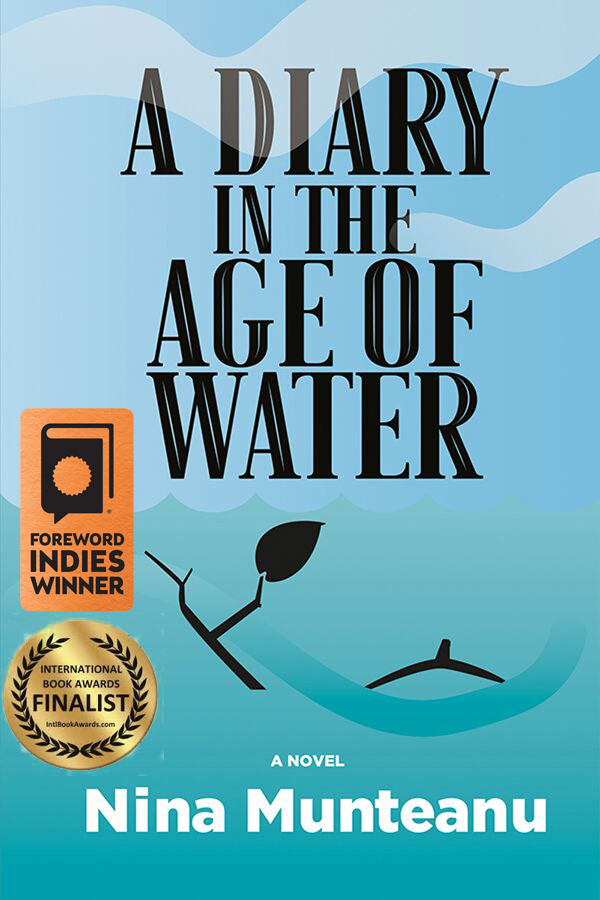
A Diary in the Age of Water follows the climate-induced journey of Earth and humanity through four generations of women, each with a unique relationship to water.
Centuries from now, in a dying boreal forest in what used to be northern Canada, Kyo, a young acolyte called to service in the Exodus, yearns for Earth’s past—the Age of Water, before the “Water Twins” destroyed humanity. Looking for answers and plagued by vivid dreams of this holocaust, Kyo discovers the diary of Lynna, a limnologist from a time just prior to the destruction. The diary spans a 40-year period in the mid-21st century and describes a planet in the grip of severe water scarcity. Lynna, in her work for an international utility that controls everything to do with water, witnesses and records the disturbing events that will soon lead to humanity’s demise.
.
Lynna Dresden is an aquatic ecologist (specifically a limnologist), who’s personal philosophy and world view overlaps with deep ecology. However, she demurs from activism through a fear for reprisals on her and her young daughter. This backfires for her as her daughter later embraces eco-terrorism in her radical behaviour.
Quotes: Lynna Dresden: “The slow violence of free-market capitalism isn’t so much the deliberate and focused actions of a few evil men as the accumulated negligence of an undiscriminating collective of unimaginative humans.” “When you look at a quiet deep pond, you don’t see the bottom, you see yourself reflected there. The calmer the pond the more you see of you; the less of the pond.” “Water—Nature’s herald—is talking loudly to us in the language of irony.”
.
Gaia’s Revolution, Book 1 of The Icaria Trilogy (Dragon Moon Press, 2026)by Nina Munteanu:
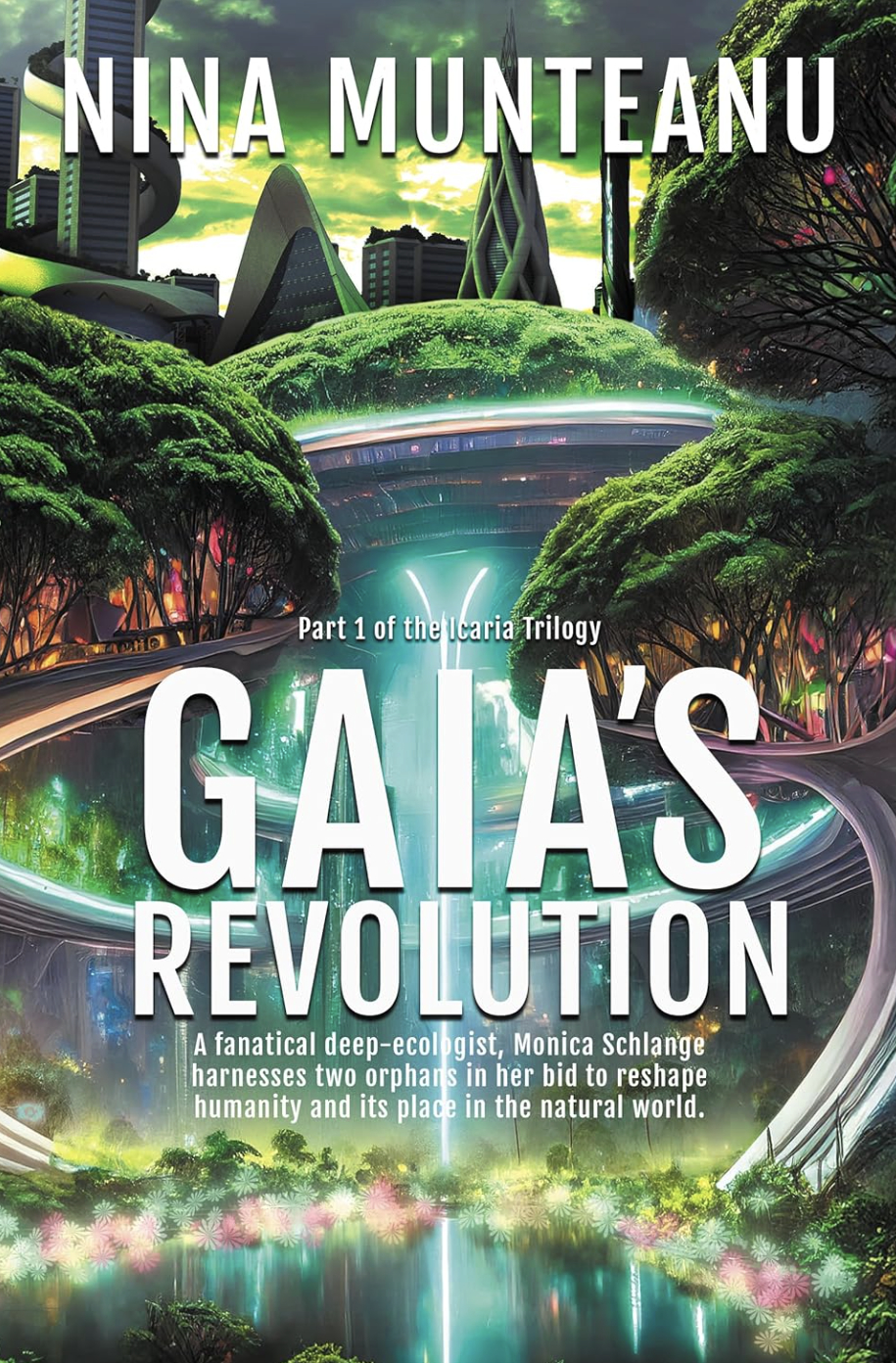
Monica Schlange is orphaned by the technocratic corporation, and with a vengeful heart turns to deep ecology and eco-terrorism. A remaining relative helps put her through the University of Toronto, where she studies environmental ethics under Aisha Habib, herself a deep ecologist but also a powerful member of the Technocratic Party in Canada. Schlange’s thesis topic is entitled Ethical Considerations on the Ecological Impact of Corporation Farm Anthropocentrism on the Stability of Gaia Through Ten Metrics. A techno-wiz, Schlange orchestrates a viral social media fiasco that reveals very compromising intel on the Canadian prime minister. She also exposes the environmental minister’s role in a terrible fishing scandal on the central coast of British Columbia that causes the deaths of two Heiltsuk women. Intending covert mischief, Schlange shacks up with a corporate oligarch, looking to bring him and his biotechnology firm down. After the revolution, she garners a position in the governing triad in which she fanatically promotes a ruthless deep ecology agenda.
.
Quotes (After dispatching a fearsome techno-clone—cloned weaponized hybrid-human): Monica straightens, panting out sobbing breaths, and manages a predatory smile. Ambitious men are always underestimating her. Even Techno-clones … Especially Techno-clones.
(after putting down her oligarch-lover in a late-night skirmish when he catches her stealing documents): “Don’t get up…Next time I see you, I will kill you.”
.
Nina Munteanu is a Canadian ecologist / limnologist and novelist. She is co-editor of Europa SF and currently teaches writing courses at George Brown College and the University of Toronto. For the lates on her books, visit www.ninamunteanu.ca. Nina’s bilingual “La natura dell’acqua / The Way of Water” was published by Mincione Edizioni in Rome. Her non-fiction book “Water Is…” by Pixl Press (Vancouver) was selected by Margaret Atwood in the New York Times ‘Year in Reading’ and was chosen as the 2017 Summer Read by Water Canada. Her novel “A Diary in the Age of Water” was released by Inanna Publications (Toronto) in June 2020.Her most recent eco-fiction thriller Gaia’s Revolution (Dragon Moon Press) released March 2026.
My eco-fiction book A Diary in the Age of Water was recently cited along with Paolo Bacigalupi’s book The Water Knife, in an article on conflict risk in international transboundary water bodies.
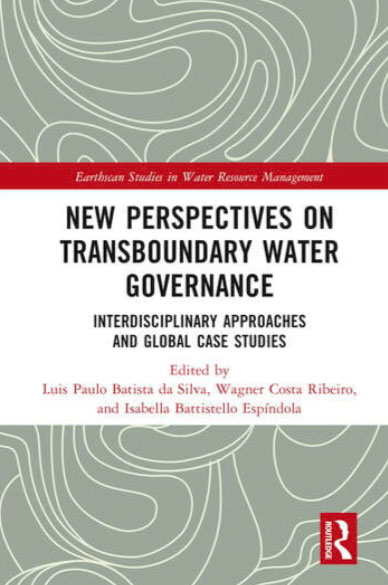
The citation was made in Ken Conca’s article (Chapter 1: “Climate change, adaptation, and the risk of conflict in international river basins: Beyond the conventional wisdom”) of the 2024 Routledge book “New Perspectives on Transboundary Water Governance:Interdisciplinary Approaches and Global Case Studies” (edited by Luis Paulo Batista da Silva, Wagner Costa Ribeiro, and Isabela Battistello Espíndola).
Conca begins his chapter with a statistic—an estimated 310 rivers in the world cross national borders, form borders, or both—and goes on to discuss the risk of conflict that naturally arises in such situations. Conca traces a rich history of disputes, with one of the oldest occurring between Lagash and Umma (present-day southern Iraq) in 2500 BCE. Conca explores the early warning indicators explored by the World Resources Institute that imply “a future in which our bordered politics, combined with hydrologic interdependencies, could yield a combustible mix of tension and grievances” and adds that several rivers flagged in the WRI study lie in regions of crhonic tension and political instability. He then includes a 2013 quote by former UN Secretary-General Ban Ki-moon:
“Our experiences tell us that environmental stress, due to lack of water, may lead to conflict, and would be greater in poor nations … population growth will make the problem worse. So will climate change. As the global economy grows, so will its thirst. Many more conflicts lie just over the horizon.” Ban also stated that climate change promised “an unholy brew that can create dangerous security vacuums” in which “mega-crises may well become the new normal.”
Conca makes his point by quoting the U.S. Center for Strategic and International Studies: “the real wild card for political and social unrest in the Middle East over the next 20 years is not war, terrorism, or revolution—it is water.”
Conca makes the connection with narratives of fiction:
“This framing of scarcity-induced conflict risk has even crept into the world of fiction. Paulo Bacigalupi’s dystopian novel The Water Knife (2016) portrays a parched southwestern United States of the near future. He foresees American states militarizing both their water relations (with corporate militias destroying infrastructure meant to divert water) and their borders (with the water-rich states seeking to keep thirsty migrant out, and the water poor states seeking to keep them in). Nina Munteanu’s A Diary in the Age of Water (2020) envisions Canada as a wholly-owned colony of the United States (itself owned by China). She describes a world in which Niagara Falls has been turned off and pet ownership is outlawed as an unacceptable water burden.”
Conca unpacks various misconceptions on sources of conflict and conflict resolution to do with transboundary water bodies. The chapter is very enlightening, as is the entire book!
The 2024 Routledge book “New Perspectives on Transboundary Water Governance:Interdisciplinary Approaches and Global Case Studies” (edited by Luis Paulo Batista da Silva, Wagner Costa Ribeiro, and Isabela Battistello Espíndola) is described by the publisher below:
This book presents a novel examination of transboundary water governance, drawing on global case studies and applying new theoretical approaches.
Excessive consumption and degradation of natural resources can either heighten the risks of conflicts or encourage cooperation within and among countries, and this is particularly pertinent to the governance of water. This book fills a lacuna by providing an interdisciplinary examination of transboundary water governance, presenting a range of novel and emerging theoretical approaches. Acknowledging that issues vary across different regions, the book provides a global view from South and Central America, Africa, Asia, and the Middle East, with the case studies offering civil society and public managers concrete situations that indicate difficulties and successes in water sharing between bordering countries. The volume highlights the links between natural resources, political geography, international politics, and development, with chapters delving into the role of paradiplomacy, the challenges of climate change adaptation, and the interconnections between aquifers and international development. With rising demand for water in the face of climate change, this book aims to stimulate further theoretical, conceptual, and methodological debate in the field of transboundary water governance to ensure peaceful and fair access to shared water resources.
This book will be of interest to students and scholars of water resource governance from a wide variety of disciplines, including geography, international relations, global development, and law. It will also be of interest to professionals and policymakers working on natural resource governance and international cooperation.
Nina Munteanu is a Canadian ecologist / limnologist and novelist. She is co-editor of Europa SF and currently teaches writing courses at George Brown College and the University of Toronto. Visit www.ninamunteanu.ca for the latest on her books. Nina’s bilingual “La natura dell’acqua / The Way of Water” was published by Mincione Edizioni in Rome. Her non-fiction book “Water Is…” by Pixl Press (Vancouver) was selected by Margaret Atwood in the New York Times ‘Year in Reading’ and was chosen as the 2017 Summer Read by Water Canada. Her novel “A Diary in the Age of Water” was released by Inanna Publications (Toronto) in June 2020.
On Writing My First Speculative Fiction Novel: The Darwin-Angel Duology
The first novel I wrote at the tender age of fifteen was Caged in World, a hundred-page speculative story about a world that had moved “inside” to escape the ravages of a harsh post climate-change environment.
It was 1969, the year that humans first stepped on the moon and the first Concorde test flight was conducted in France. But I was concerned by the environment and what was happening on our planet. It was seven years since Rachel Carson had published Silent Spring, which warned of our declining bird and bee populations and impacts to human health from unregulated pesticide/herbicide use (such as carcinogens and hormone disruptors). It was just a year after Paul Erlich’s Population Bomb warned that attempts to stretch the Earth’s resources to support the ever-growing population would result in mass starvation, epidemics, and, ultimately, the breakdown of social order.
In the 1960s it was already apparent that environmental imbalance and destruction were global concerns and we were on the brink of an environmental crisis. Unchecked deforestation was destroying forests around the world, including the boreal and old-growth forests of my own country Canada. Brazil had already begun cutting down trees and burning forest at an alarming rate. Unregulated use of pesticides, herbicides and growth hormones created toxic contamination of our natural world and our food and water supply—despite Carson’s dire warning with Silent Spring. Our waterways were being contaminated by mining wastes and industrial effluents. Killer smog. Noxious algal blooms. Oil spills. Dead zones. The list was growing.
Bamboo Forest, Kyoto, Japan (photo by Nina Munteanu)
I joined S.T.O.P. (Society To Overcome Pollution) and marched in protests to call for responsible behaviour by governments and large corporations. I tried to raise awareness at my school about our deteriorating environment and likely consequences to human survival; my own teachers tried to silence me. I wrote my first dystopia, Caged in World. The eco-novel was about a subway train driver and a data analyst caught in the trap of a huge lie. The story later morphed into Escape from Utopia. My dad, who was impressed with my dedication and what I’d done, became my first agent; he brokered a meeting with a Doubleday editor he’d met and impressed (my dad was a character and very charming); I did my first book pitch at age sixteen. The editor read my book and, while he didn’t pick the book for Doubleday, he told me that the story was original and imaginative and that I should keep writing.
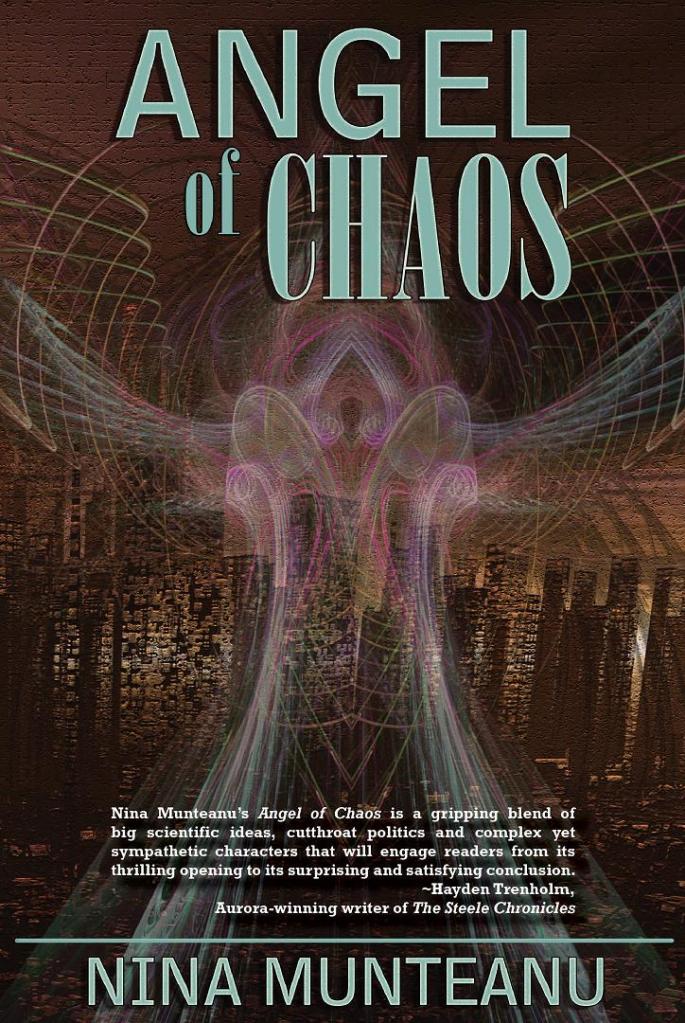
Several drafts—and years later—the novel became the eco-medical thriller Angel of Chaos, set in 2095 as humanity struggles with Darwin’s Disease—a mysterious neurological environmental pandemic. Icaria 5 is one of many enclosed cities within the slowly recoving toxic wasteland of North America, and where the protagonist Julie Crane works and lives. The city is run by technocrats, deep ecologists who call themselves Gaians, and consider themselves guardians of the planet.
The Gaians’ secret is that they are keeping humanity “inside” not to protect humanity from a toxic wasteland but to protect the environment from a toxic humanity.
Since she was a young child, Julie has been hearing voices in her head. She’s not a schizophrenic, but a gifted veemeld (someone who can tap into machine intelligence wavebands). Feeling an inexplicable “karmic” guilt and intent on making a contribution to her society, Julie searches for a cure to Darwin Disease; instead, she makes a horrifying discovery that incriminates her in a heinous conspiracy to recast humankind.
“This is a story with great scope … As Julie finds out the truth about her father, she discovers a truth that will tear her world apart.“
Bill Johnson, author of “a story is a promise”
By virtue of their gifted powers in communicating with the machine world, veemelds are considered a commodity, to be used, traded, hoarded and discarded by ruling technocrats all over North America.
I spent several years shopping the book to agents and publishing houses. Although I received many bites, all finally let go. In the meantime, I did several things: 1) I started writing short stories, some of which were cannibalized from the book, and several were published; 2) I wrote Angel’s prequel, The Great Revolution (never published, it sits in a drawer hibernating) and Angel’s sequel Darwin’s Paradox, (which was published). In fact, in 2007, Dragon Moon Press in Calgary made an offer to publish Darwin’s Paradox; the sequel became my debut novel. Dragon Moon Press later picked up Angel of Chaos and published it in 2010 as a prequel.
“Angel of Chaos is a gripping blend of big scientific ideas, cutthroat politics and complex yet sympathetic characters that will engage readers from its thrilling opening to its surprising and satisfying conclusion.”
Hayden Trenholm, Aurora-winning author of The Steele Chronicles
Darwin’s Paradox follows humanity in its cloistered indoor world as it deteriorates with the disease. Darwin’s Disease—related to indoor living—sweeps across humanity with debilitating genetic deterioration, violent death and the promise of extinction. This is something the self-professed deep ecology Gaians are content to see in—if it means preserving the natural world. Of course, the Gaians—being self-serving humans after all—have an exit plan.
In 2012, Derek Newman-Stille of Speculating Canada wrote an essay on Darwin’s Paradox entitled “Patient Zero and the Post Human”; the article provides an insightful description of the eco-novel and interesting historical context and irony to our current situation with the COVID-19 pandemic:
“In Darwin’s Paradox Nina Munteanu displays her awareness of scientific discourse: focussing on areas like chaos theory, biological theories of co-evolution, symbiosis and virology, and ecological theories. Her protagonist, Julie, is patient zero in a spreading epidemic that has infected most of modern civilisation. Munteanu creates a civilisation where human society is centred around a few urban locales, leaving large parts of the world unoccupied by human beings, and allowing for ecological development uninterrupted by human interference. Technology in this future world has fused with the viral epidemic, questioning the barriers of the human and the nature of human existence. The nature of humanity has changed with this introduction of other elements into the human biosystem, creating a post-human world in which the possibilities of the future of human existence are called into question, and in which several powers are vying for control of the next stage of humanity and the future of the human race.
Munteanu’s Darwin’s Paradox illustrates a collision of past and future as Julie is haunted by her past and ideas of home, while simultaneously representing a next stage in human evolution. The city Icaria 5 itself is a representation of past and present intersecting: buried under the city of Toronto and rising from the structures of the past. Munteanu’s plot is full of family secrets, the hidden past, and the resurfacing of guilt (particularly Julie’s guilt about being patient zero in the spreading viral apocalypse). She explores the draw of the past and home and the continual pull the past has upon one’s existence. Munteanu explores Julie’s simultaneous desire to return home and her realisation that home has forever changed – becoming a foreign place.
Munteanu explores society’s fear of epidemic and the role of medical technology as a mechanism for solving all of the world’s problems. She illustrates that medical technology has its limits and complicates the nature of technological methods of solving problems by allowing virus and technology to meld. Simultaneously Munteanu explores the continuation of society’s obsession with beauty and perfection by creating a society where one can restore one’s beauty through instant medical treatments: Nuyu and Nuergery, using nanites to restore one’s youth and change undesirable aspects of one’s form. Political groups fearing the over-use of technology and the complications to the idea of the human that these surgeries may cause begin using scarring to assert their difference and reluctance to submit to social controls.
Media plays an important role in Munteanu’s vision of the future, illustrating the continuance of the media hegemony for defining the nature of “truth” as media messages replace facts and political leaders manipulate the media system to enforce their own controls over society and further embed their interests into the developing social system. She illustrates the danger of the current system of using the politics of fear as a mechanism for controlling voters (particularly focussing on the use of fear by political groups to shift cultural ideas, sympathies, and ultimately gain control of the developing social system). In Munteanu’s vision of the future, it is impossible to trust anyone completely and layers within layers of plot are illustrated, leaving the reader distrusting of every message he or she receives.
Munteanu raises questions and challenges the development of society’s current systems, asking her readers to think critically about messages they are given and to question everything. She illustrates that the truth is socially constructed and that ideas of the truth serve social purposes and can be used to support hidden agendas.”—Derek Newman-Stille, Patient Zero and the Post-Human
In some ways, the Darwin duology shares a special place in my heart—not just because the duology became my first and second traditionally published novels, but because through them I found my writing voice. Since first writing Caged In World, I spent close to four decades honing my craft; I published short stories and two novellas (Collision with Paradise in 2005 andThe Cypol in 2006), and attended writing workshops and conventions, before publishing my first novel with a traditional publisher. It was a fulfilling heuristic path that taught me writing craft in all its facets.
Since publishing my first novel in 2007, I have published on average a book every year (alternating each year between fiction and non-fiction). I now have fourteen books published with various publishing houses. Most are in keeping with an environmental theme. My latest non-fiction book Water Is… was picked by Margaret Atwood in New York Time’s ‘Year in Reading’ in 2016. My latest eco-novel A Diary in the Age of Water was published by Inanna Publications in 2020 in the midst of the COVID-19 pandemic.
My journey as writer has been rich and varied. I’ve moved and lived from one end of Canada to the other. I raised a family and travelled the world. I worked as a field researcher and environmental consultant, investigating many water bodies in Canada and helping communities in watersheds. I taught limnology and phycology at the University of Victoria and currently teach writing at the University of Toronto. I continue my personal research in the natural world to satisfy my unending curiosity. I’ve changed. My writing has changed. But one thing will never change: my passion for the written word and the worlds of the imagination. That journey will never end (until the end, that is).
Readers have asked for a sequel to Darwin’s Paradox. I’ve also been approached by several writers to collaborate on a sequel. While many of their ideas were wonderfully original, I’ve not taken any of them on their offer. Others have said that both novels would make a great series or movie. I’m inclined to agree. If that were to come to pass, I might be persuaded to create a Darwin’s Paradox series and continue the story of Julie, Daniel, and Angel.
Bamboo Forest in Kyoto, Japan (photo by Nina Munteanu)
Nina Munteanu is a Canadian ecologist / limnologist and novelist. She is co-editor of Europa SF and currently teaches writing courses at George Brown College and the University of Toronto. Visit www.ninamunteanu.ca for the latest on her books. Nina’s bilingual “La natura dell’acqua / The Way of Water” was published by Mincione Edizioni in Rome. Her non-fiction book “Water Is…” by Pixl Press(Vancouver) was selected by Margaret Atwood in the New York Times‘Year in Reading’ and was chosen as the 2017 Summer Read by Water Canada. Her novel “A Diary in the Age of Water” was released by Inanna Publications (Toronto) in June 2020.