Movie Review & TV Series Review: The Paradoxes of Aeon Flux

When I was first tantalized by the high-speed head-smashing trailor for the Paramount motion picture, Aeon Flux, directed by Karyn Kusama (Girlfight) and released in late 2005 (now on DVD), I was blissfully unaware of its history: that it was based on the darkly irreverant and raunchy 1995 MTV Liquid Television animated SF series created by Korean American animator, Peter Chung. The series achieved cult status among a select audience of imsoniacs (it played at midnight on MTV, if that tells you anything). This may have worked in my favour. I had no expectations or preconceptions, except for a hair-flying ride. As a result, when the content (written by Matt Manfredi and Phil Hay) had merit as social commentary, I counted it as a bonus. But, then there was the matter of the reviews that emerged between the trailors airing and my seeing the film.
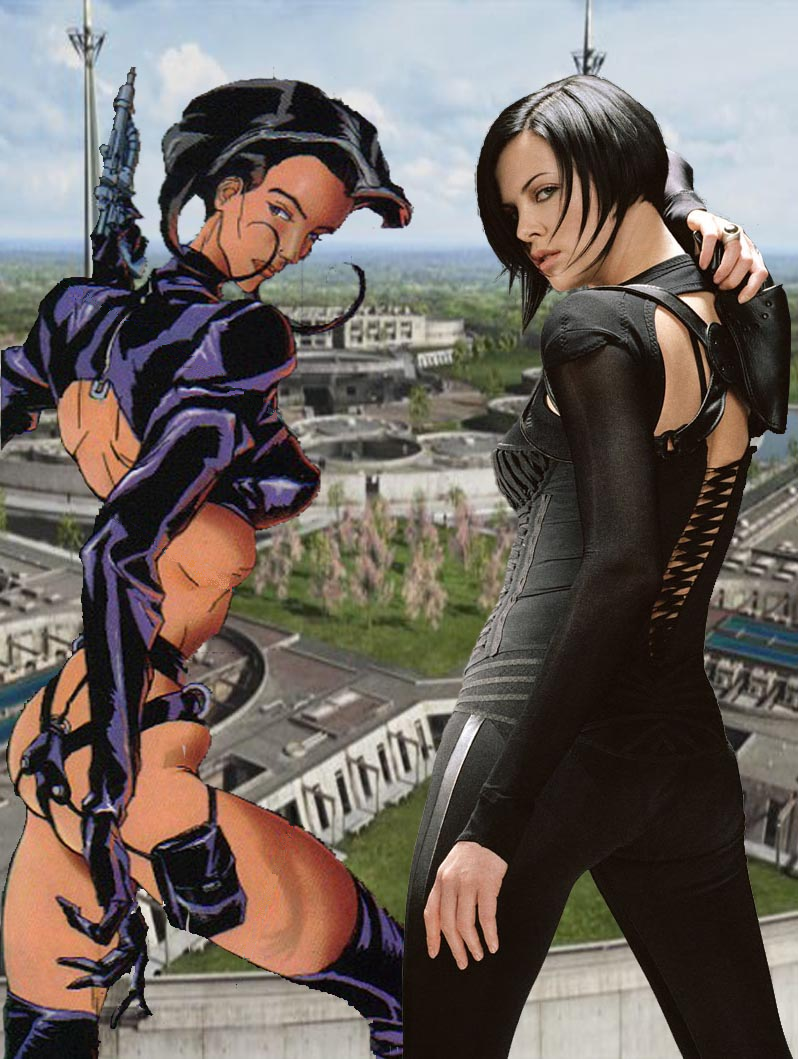
Aeon Flux, animated and movie character

Unfortunately for the motion picture, Paramount’s lack of press-screenings (and subsequent press reaction because of those lack of screenings) may have predisposed critics to dislike it. And many provided negative, though conflicting, reviews; as if they couldn’t all agree on why they didn’t like the film. Kieth Breese (Filmcritic.com) found the film “gorgeously surreal and vacuously arty.” According to Jami Bernard (New York Daily News), “in the dystopian future [of Aeon Flux], apparently, women will be bendable Barbies in leather scanties, and everyone will speak like brain-dead robots…a silly live-action movie.” Justin Chung (Variety.com) decided that Aeon Flux portrayed “the future [as] alternatively grim and hysterical…a spectacularly silly sci-fier.” A.O. Scott of the New York Times said that Aeon Flux was “flooded with colors and chilly effects [but was] drained of emotional interest, to say nothing of narrative coherence.” And, finally, William Arnold of the Seattle Post-Intelligencer called it “too somber and cerebral for the young action crowd.” Silly or too cerebral? In truth, this disappointment is because the Aeon Flux movie was wrongly perceived (and wrongly marketed) as an action thriller; it is more aptly described as a dystopian political thriller—not the brazen cry of V for Vendetta—but a subtle cautionary tale of the consequences of complacency, greed and living in absence of—and trying to cheat—nature.

Trevor Goodchild played by Marton Csokas)

In typical dystopian fashion, we join the Aeon Flux story roughly four hundred years after an industrial-related virus has killed 99% of the world’s population. Scientist, Trevor Goodchild (Marton Csokas) has developed a cure and the Goodchild dynasty secures a home for the five million survivors in the last city on Earth, Bregna, a paradise walled off from the unrestrained wilderness that ever-threatens them. Dystopias, like Bregna, often appear utopian on the surface, exhibiting a world free of poverty, hardship and conflict, but with some fatal flaw at their core. A dystopia (“dys”=bad; “topos”=place) is a fictional society that is the antithesis of utopia. It is usually characterized by an authoritarian or totalitarian form of government or some kind of oppressive, often insiduous, social control. Other examples that depict a range of distopian societies in literature and film include: 1984, Brave New World, Fahrenheit 451, The Handmaid’s Tale, Metropolis, THX-1138, Blade Runner, and V for Vendetta. Built from scientific premise and intended only as a temporary measure, the technocratic society of Bregna continues long after its intended span as the Goodchilds attempt to deal with an internal and enduring glitch (infertility) of the “cure”. Like most imposed provisional governments, this solution to a problem (cloning) has created yet another problem (fugitive memories from the previous clone’s life).

It is now 2415 and the walled society of Bregna appears utopian—clean and organized, beautiful, rich and spacious; but beneath the laughter and contentment, stirs an uneasy disquiet. Bregnans are losing sleep, having bad dreams, and are plagued by memories that don’t belong to them. Rebels who call themselves the Monicans challenge the Goodchild regime, run by Trevor and his brother Oren, and among the rebels is a highly competent and ruthless assassin, Aeon Flux (Charlize Theron), whose tools include whistle-controlled ball-bearing bombs, drugs that allow her to meet people on higher planes of existence, and interchangeable eyeballs. She is aptly named, as she serves a true agent of discord to Goodchild, the guardian of order and all that he naïvely believes is good.

“Some call Bregna the perfect society,” Aeon tells us in the opening scenes of the motion picture, “Some call it the height of human civilization…but others know better…We are haunted by sorrows we cannot name. People disappear and our government denies these crimes…But there are rebels who…fight for the disappeared. They call themselves the Monicans. I am one of them.” Several critics disliked the narrative introduction. I found that it particularly worked, by adding a reflective literary quality to the motion picture. It is noteworthy that in the original animated series, Trevor Goodchild often frames each episode with his reflections; only fitting that Aeon gets her chance in the film version. The reflective narrative of the motion picture is meant to enlighten its audience that this is not your ordinary action thriller. What follows is a fast-paced yet thoughtful story, with elements of romance, that explores notions of longevity, social structure and connection, faith and greed.

Aeon fights an opponent inside Goodchild’s fortress

Twitchfilm.net aptly called the motion picture “biological science fiction”. Trevor’s treacherous brother Oren says: “We’ve beaten death. We’ve beaten nature.” The film’s clean organic high-tech look faithfully captures the “sense of biotech gone wild” of the TV series by exploring several paradigms inherent in a society that lives deliberately in the absence of nature’s chaos. Indeed, the lack of connectivity resonates throughout the motion picture in its exploration of friendship, family, loyalty, and purpose. When her sister is murdered in the beginning of the film supposedly by Trevor’s men (but in actuality by his scheming brother, Oren), Aeon’s mission becomes personal: “I had a family once. I had a life; now all I have is a mission.” We never learn what the animated Aeon’s motives are.
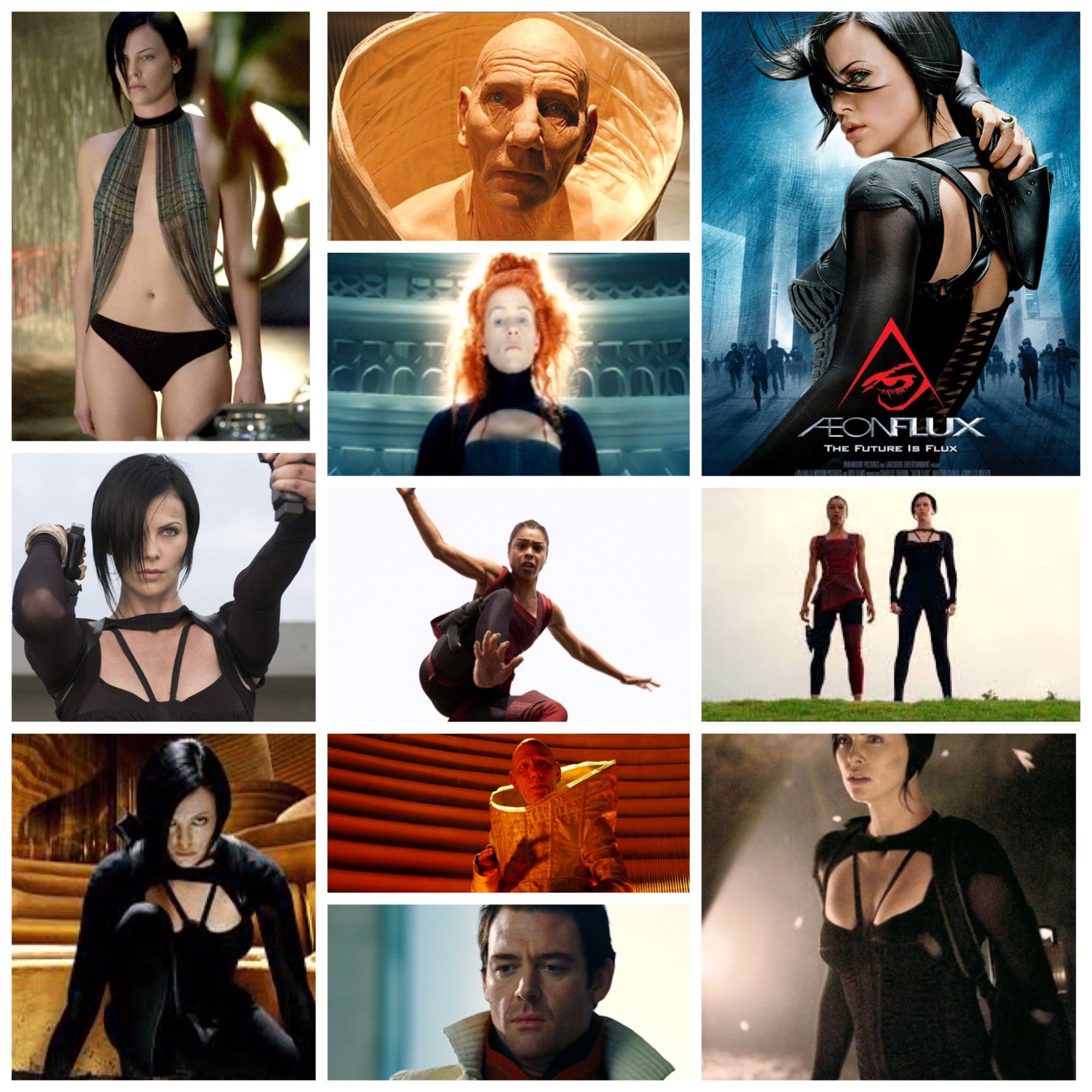
Various scenes of Aeon Flux motion picture

The film truly launches into stylish action and intrigue when Aeon gladly accepts a mission to assassinate Trevor, thinking that this violent act will make it all better. Instead, it unravels her, beginning with when she confronts him; finding him uncomfortably familiar and alluring, she hesitates and decides not to kill him. “What do you want?” Trevor asks her. “I want my sister back. I want to remember what it’s like to be a person.” It is indeed he—or rather what he knows—that holds the key to who she is. The key is that she, like he and all those in Bregna, is a 400 year-old copy of someone before the virus. Four hundred years ago she was the original Trevor’s wife.
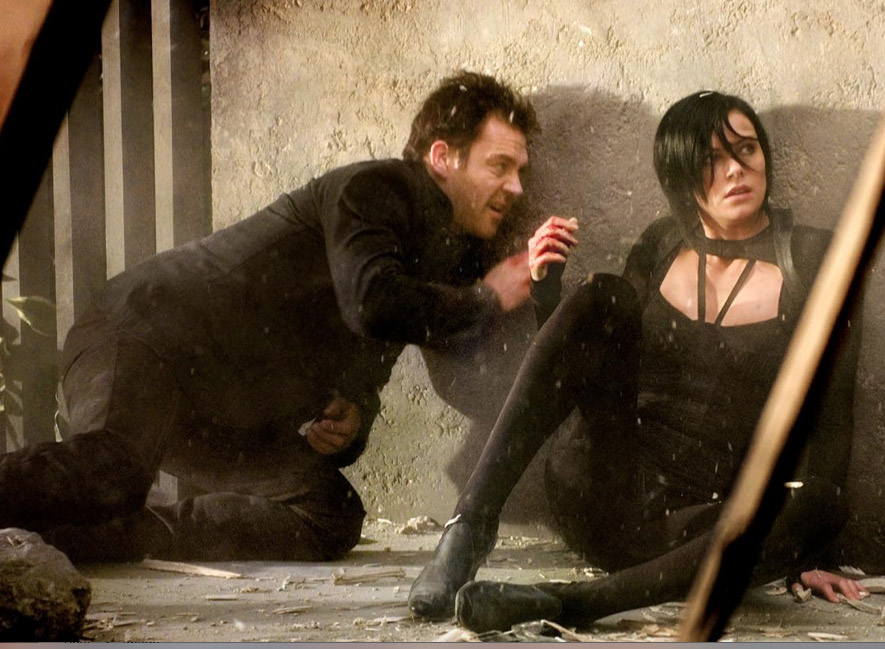
Trevor and Aeon on the run

Filmed in Berlin, the movie is visually stunning, from the opening shot on the steps of Sans Souci to the labrinthine wind canal used by the Nazis. Displaying an eclectic mixture of spareness and mid-century design the film is acted out in a fluid dance to Graeme Revell’s (Sin City) haunting score. The action is rivetting and seamless with both plot and underlying theme of bio-tech gone awry. Early on we are treated to a thrilling sequence of Aeon and her biotech-altered rebel colleague negotiating the security of Goodchild’s sanctuary that consists of a beautiful but deadly garden, guarded by patches of knife-sharp blades of grass and poison dart-spitting fruit trees.
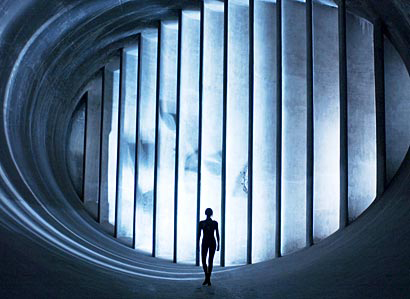
Wind canal in Berlin serves as entrance to Goodchild’s fortress

Aeon champions moral ethics and single-handedly destroys the relicor, the supposetory of the clone DNA, pursuing honour at the expense of loyalty (to Goodchild) and heralding in a new age of “mortality”. The movie ends as it begins, with Aeon’s narrative: “Now we can move forward. To live once for real and then give way to people who might do it better…to live only once but with hope.” This is truly what Aeon Flux represents and what her very name embodies.
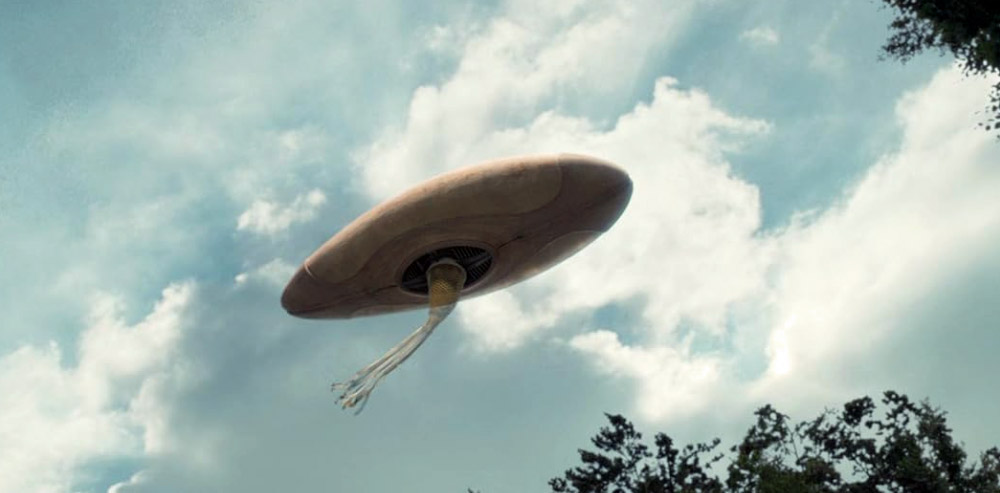
The relicor, repository of Bregna’s clone DNA flies overhead
Keeper of the precious DNA storage in the relicor

The term Aeon comes from the Gnostic notion of “Aeons” as emanations of God. Aeon also means an immeasurably long period of time; the Suntelia Aeon in Greek mythos symbolizes the catastrophic end of one age and the beginning of a new one. This is apt for our heroine, who, at least in the movie version, pretty well single-handedly destroys an old corrupt world, and heralds in a new age. Aeon was “emanated” after four hundred years by the gentle oracular Keeper of the relicor, whose original version saved her DNA and kept it hidden and safe until the right moment.

Aeon Flux captures a fly in her eyelashes

Fans of Peter Chung’s baroquely violent animated Aeon Flux will recognize some similarities between Kusama’s 2005 film adaptation and the original MTV cartoon. While admitting that the motion picture version was only based on Peter Chung’s characters (check the credits), Karyn Kusama intended to “honor [the cartoon version’s] wierdness in spirit and…pay homage to its esoteric boldness and…strange energy.” Homages to the animated series include: Aeon’s signature fly-catching with her eyelashes, demonstrating a woman extremely in tune with her body; Monican anarchists (though in the film they are subversives within Bregna rather than from an adjacent society); a virus that kills off most of the population and assassination attempt on Goodchild (Pilot); the harness worn on the torso that transports the wearer to another dimension (Utopia or Deuteranopia?); passing secret messages through a french kiss (Gravity); issues of cloning and two colleagues crossing a weaponized no-man’s land together (A Last Time for Everything). Original and movie adaptation also share at their core the exploration of the consequences and ambiguities of choices in life and the role that nature plays, subversive or otherwise.
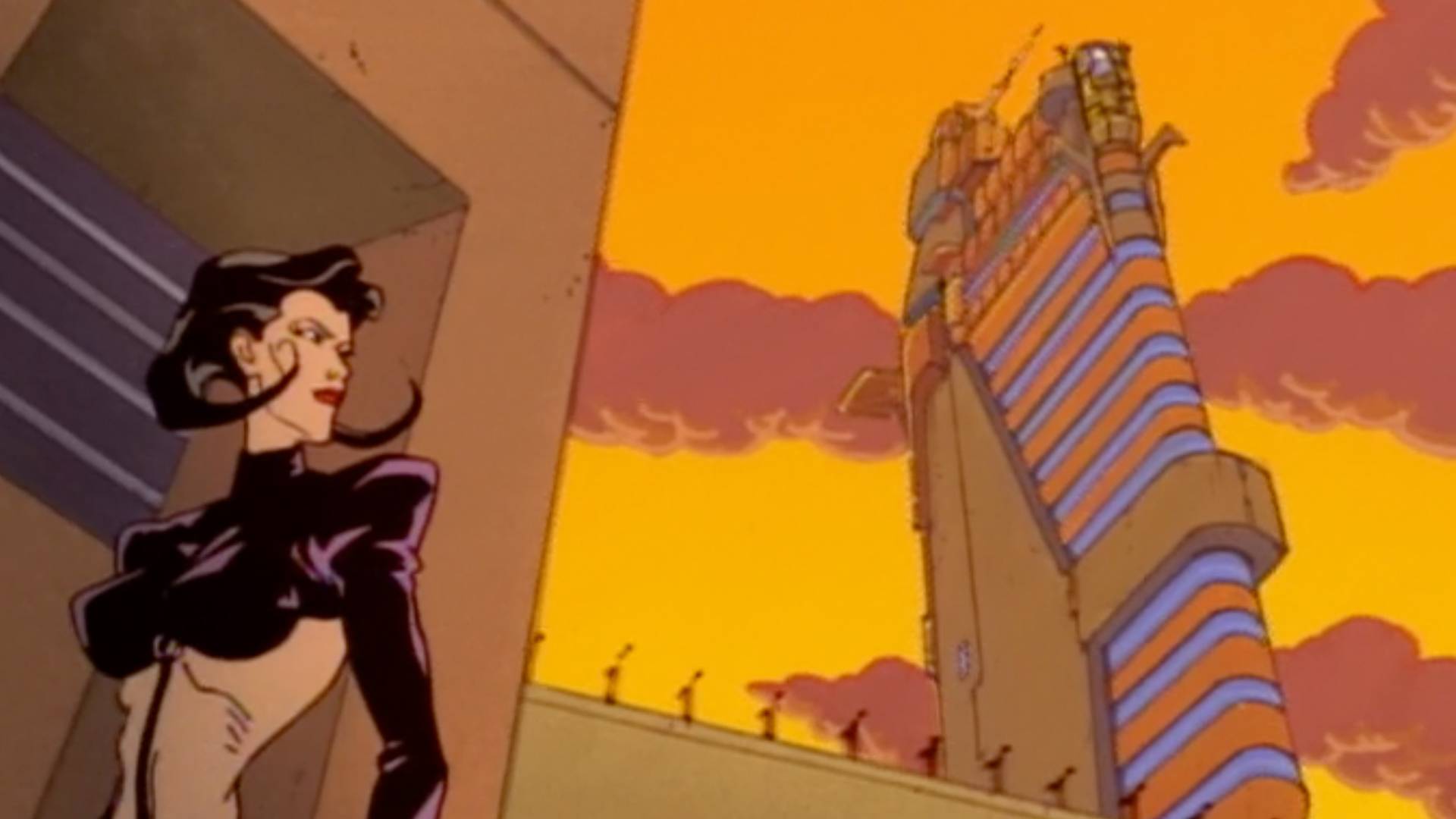
Aeon Flux stands at the wall into Bregna, ready to scale it

Although they share recognizable motifs and characters, the 2005 movie adaptation contrasts in some important ways from the six 5-minute shorts of 1991 and 10 half-hour episode TV series that aired in 1995. Chung’s avante garde series is set mostly in a surrealistic dark future Earth (presumably) where two communities, Bregna and Monica, are juxtaposed but separated by a wall (not unlike East and West Berlin). Bregna is a centralized scientific-planned society and Monica is Bregna’s ‘evil twin’, an anarchistic society. Chung’s innovative use of “camera angles” reminiscient of cinematography, together with a spare, graphic choreography, portrays a sprawling Orwellian industrial world. Peopled with mutant creatures, clones, and robots, it features disturbing images of dismemberment, mutilation, violent deaths and human experimentation as Chung explores post-modern notions of cloning, mind and body manipulation, and evolution through a series of subversive aggressively non-narrative pieces. On the subject of his cloning experiments (A Last Time for Everything) Goodchild says to Aeon: “My work offends you. Why? Human beings aren’t so unique, just a random arrangement of amino acids.” To which Aeon retorts, “These people you’re copying are already superfluous. You’re trafficking in excess.”
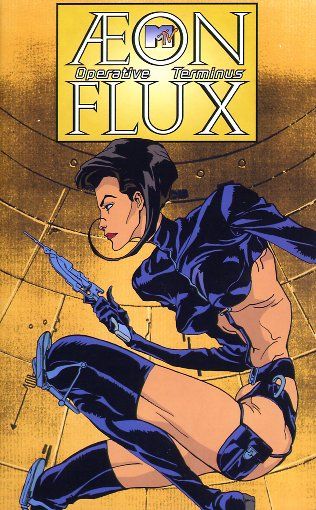
The title character in the animated version is a tall, scantily-clad anarchist (featuring the sultry voice of Denise Poirier) skilled in assassination and acrobatics, who infiltrates technocratic Bregna from the neighbouring revolutionary society of Monica. As with the movie character (elegantly portrayed by Theron), the animated Aeon is a stylish dance; completely in tune with her body. Says Chung of his creation: “The way she’s dressed, the way she looks, the way she moves was tailored to seduce the viewer to watch more, even though they may not understand at every moment what was happening.”

Despite their similar intelligence, physicality and drive, the two Aeons depart as characters. For instance, one of the major differences between original animation and adapted film is the ongoing relationship between Aeon and her nemesis/lover, Trevor Goodchild (John Rafter Lee). The sexual and intellectual tension between Flux and Goodchild is far more palpable in the TV series and does not explain itself or resolve itself like it does in the movie. The opening of the animated series describes their odd relationship, which suggests that their destinies are bound together: Aeon: “You’re out of control.” Trevor: “I take control. Who’s side are you on?” Aeon: “I take no side.” Trevor: “You’re skating the edge.” Aeon: “I am the edge.” Trevor: “What you truly want only I can give.” Aeon: “You can’t give it, you can’t even buy it and you just don’t get it.”
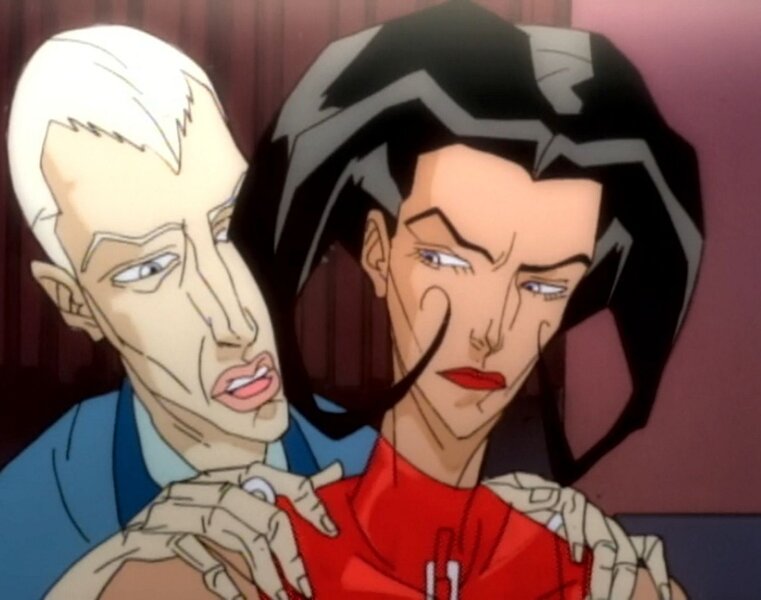
Goodchild and Aeon interacting

The Gnostic “Aeons”, emanations of God, come in male/female pairs (aptly represented by Flux and Goodchild). As with the Gnostic “Aeon pairs”, Flux and Goodchild make up inseperable parts, the yin/yang (complementary opposites) of a whole, and represent the paraxical oxymoron of chaos in order. Long-limbed and continually in fluid motion, Flux dances through Goodchild’s rigid scientific world of order with an ease that stirs both his fascination and his fury. He, in turn, enthralls her and ensnares her with his intellectual hubris. The Gnostic “Aeon” male/female pair (called syzygies) of Caen (Power) and Akhana (e.g., Love) closely parallel Goodchild and Flux as they flirt with each other in a complex dance of power and love. Their attraction/antagonism mimics the characterizations of Eris (Greek goddess of discord) and Greyface (a man who taught that life is serious and play is a sin) in the Discordian mythos. Like Eris and her golden apple, Aeon Flux stirs up trouble for Goodchild’s complacent technocratic regime, constantly challenging his hubristic notions of human evolution, perfection and even love.
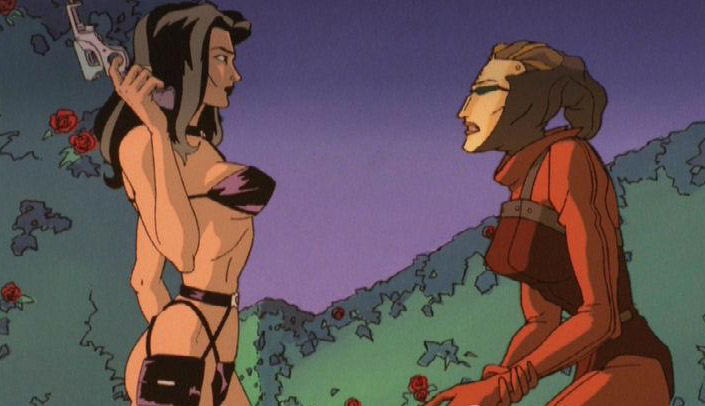
Aeon and fellow Monican discuss tactics

The cartoon Aeon Flux—and Trevor Goodchild, for that matter—are also far more compelling than those depicted in the movie. Headstrong, foolish and selfish but also dedicated and deeply compassionate and honourable, Chung’s Aeon Flux is a paradox. She scintilates with passionate self-defined notions against an industrial tyranny, while nurturing a naïve desire for personal love; the target of both being found in one man, Trevor Goodchild. Often cruel at times, she shows moments of selfless consideration, compassion and humour. Despite her violence, perverted fetishes and lustful obsessions, she is as appealing as she is strange; a discordant rock tune, which often enough hits a resonating note that draws out one’s interest and captures one’s empathy.
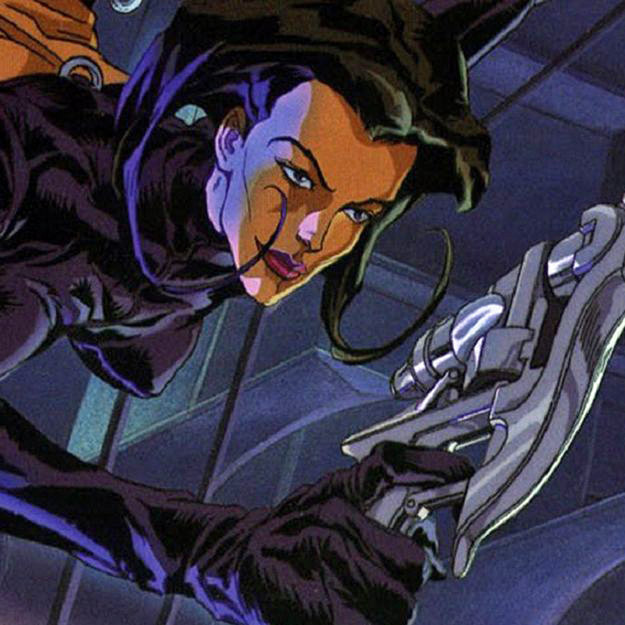
Chung’s Aeon Flux on a mission
Kusama’s Aeon Flux being targeted by another Monican

In contrast to the super-hero competence and aloofness of the movie Aeon, the animated Aeon is wonderfully flawed; she is a complex paradoxical character, who makes mistakes, blundering often due to over-confidence and poor decisions (usually connected with her feelings for Trevor). Chung’s Goodchild is equally complex, and is, unlike the naïve and rather feckless scientist of the movie, a true equal to Flux’s energetic and often misplaced heroics. Kusama’s Goodchild is neither menacing nor diabolical; rather, he is a well-intentioned and watered-down version of the Machiavelian scientist that Chung created. And, though quite appealing, he is also less compelling as a result. Chung’s Goodchild is a visionary pedant, who often spouts twisted Orwellian diatribe: “That which does not kill us makes us stranger.” “The unobserved state is a fog of probabilities…” “There can be no justice without truth. But what is truth? Tell me, if you know, and I will not believe you.” Flux cuts through Goodchild’s dogma with her own one-liners—“Trevor, don’t trouble me with your thin smile”—and usually shuts him up with either a smack or a kiss.

Aeon dispatches masked baddies

The animated series is far more gritty and edgy than the movie version, featuring twisted eroticism and dark humor amid scenes of graphic violence. It oozes with a delicious perversity that the movie version abandoned in favour of cohesive narrative (and a PG-13 rating). Showing a healthy and irreverent disregard for that very narrative continuity, Chung’s animated series successfully makes commentary on various societal notions and behaviours through his uniquely disjointed and liberating form. Chung asserts that this plot ambiguity and disregard for continuity were meant to satirize mainstream film narratives. I think it does far more than this as art form, by providing a journalistic style of reporting the nuances and filigrees of life that gives it an immediacy hard to overlook. Chung’s apparent intention was to emphasize the futility of violence and the ambiguity of personal morality. This is best shown in his six 5-minute shorts and pilot, created in 1991. The shorts commonly featured a violent death for the title character, sometimes caused by fate, but more often due to her own incompetence.
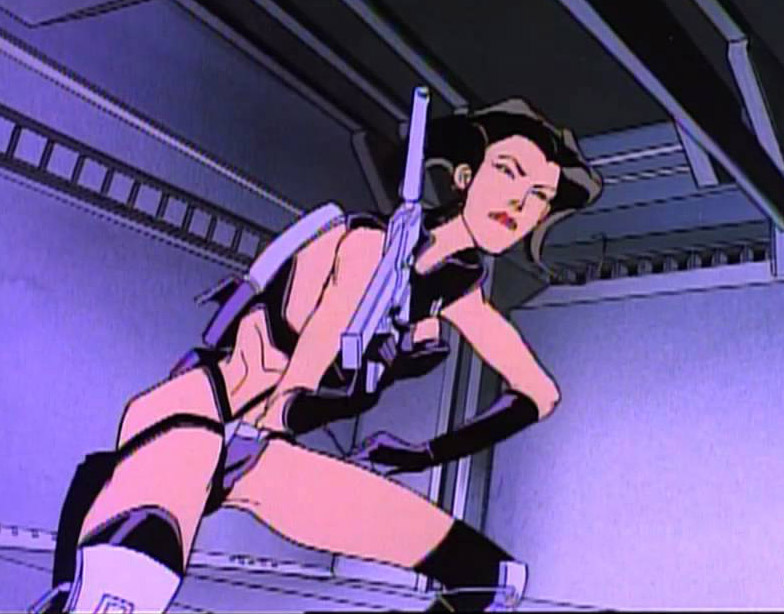
Chung’s Aeon Flux

The TV Aeon Flux flows like a subversive movement; punctuated by a series of abstract, often garish, statements on various themes of soulless biotechnology. Each episode is a vignette that explores singular questions of integrity, honour, loyalty, belief and love using the clever platform of the kiss/kill dynamic of Aeon and Trevor.

Their interactions scintillate with clever wordplay, often amid physical-play that usually involves a pointed weapon: Aeon: “You’re psychotic. You no longer have a common conscience with your fellow man.” Trevor: “I understand the will of evil…[it] is like an iron in a forge…conscience is the fire.” Aeon: “you’ve lost the substance by grasping at the shadow.” The underlying question of connectivity and what it is to be human filter through his discordant series primarily through the twining of his two main characters, both loners with little connection to anything except to one another (which they both seek and abhor). The motion picture version pursues through a more structured and lengthy narrative, the same theme of connectivity (with nature, with others of our society, with family, and our beliefs) and the consequence of living a life with out meaning, though on a far more simple level. At the end of Kusama’s movie, Aeon challenges Trevor’s assertion that cloning is their only answer for survival: “We’re meant to die. That’s what makes anything about us matter…[otherwise] we’re ghosts.” In contrast, at the end of Chung’s episode, Reraizure, Trevor closes with these words of reflection: “We are not what we remember of ourselves. We can undo only what others have already forgotten. Learn from your mistakes so that one day you can repeat them precisely.”
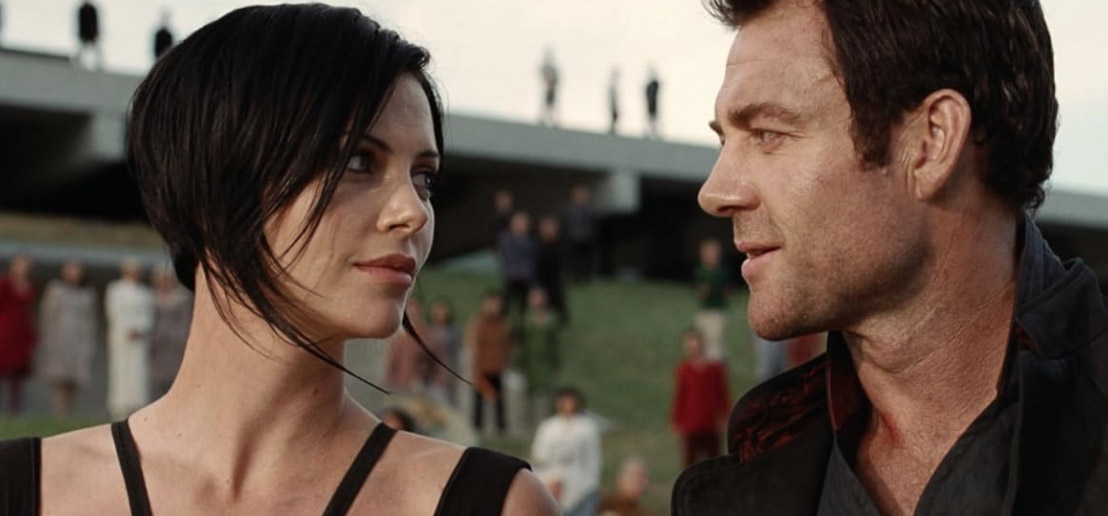
Aeon and Trevor come to terms

Kusama’s film version chose narrative coherence to make its statements by sacrificing character for story and challenging its audience cerebrally. Chung’s cartoon version challenges us more deeply, at a visceral level, through the interplay of his characters where cohesive narrative doesn’t matter. In the final analysis, the motion picture version pursues the same questions posed by Chung’s original animated version. Only, Chung isn’t so eager to provide answers, leaving both interpretation and conclusions to the individual. Both versions are mind-provoking and a celebration of excellent art. While the film’s moralistic tale resonated and lingered like a muse’s long forgotten poem, the subversive kick of the comic series (which I thankfully saw later) struck deep chords and left me breathless with questions.
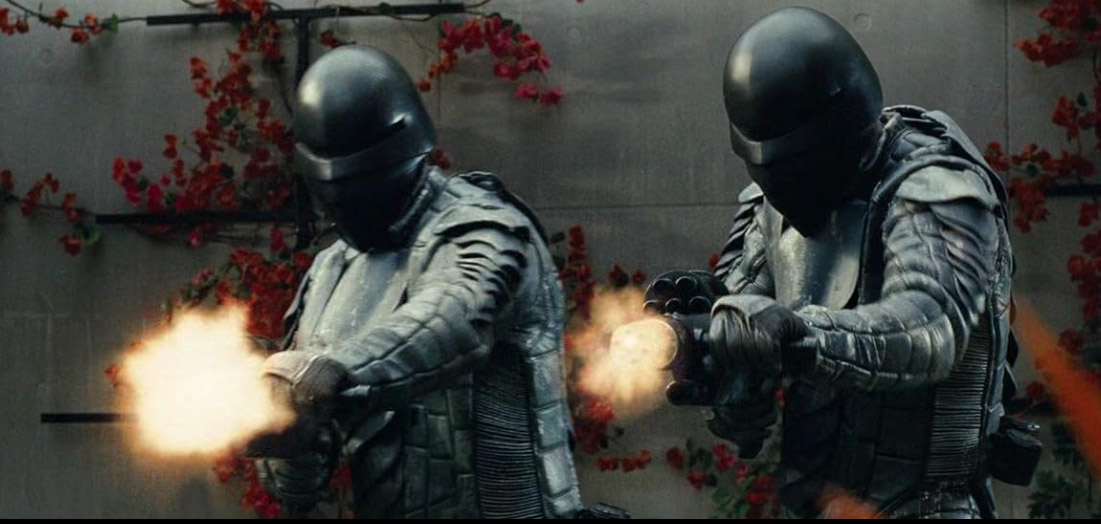
Enforcers attack Monicans

Nina Munteanu is a Canadian ecologist / limnologist and novelist. She is co-editor of Europa SF and currently teaches writing courses at George Brown College and the University of Toronto. Visit www.ninamunteanu.ca for the latest on her books. Nina’s bilingual “La natura dell’acqua / The Way of Water” was published by Mincione Edizioni in Rome. Her non-fiction book “Water Is…” by Pixl Press (Vancouver) was selected by Margaret Atwood in the New York Times ‘Year in Reading’ and was chosen as the 2017 Summer Read by Water Canada. Her novel “A Diary in the Age of Water” was released by Inanna Publications (Toronto) in June 2020.
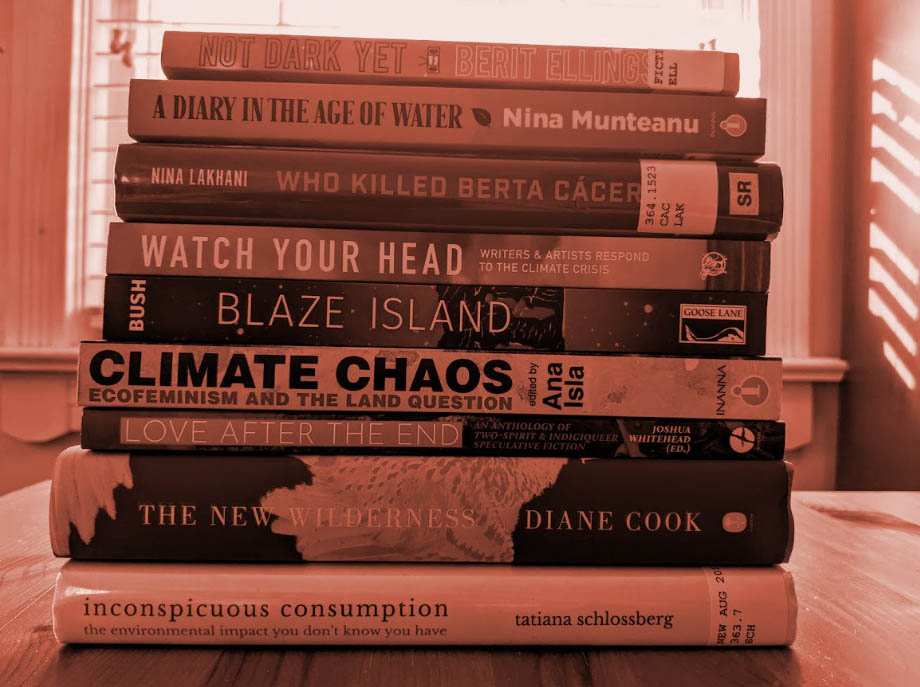
‘Buried in Print’ Reviews “A Diary in the Age of Water”

Nina Munteanu’s novel A Diary in the Age of Water (2020) will not suit every reader.” 

“It’s hard to resist identifying the author with Lynna, the most prominent character, who also works as a limnologist, although her employment is increasingly precarious, as her timeline hastens toward ecological devastation.

A predominantly female cast, a mythic forming narrative and, most saliently, the focus on water, all made this an interesting read for me.

The book’s epigraphs are from Maude Barlow and the chapter’s epigraphs from textbook definitions (sometimes excerpts from limnology tests), and there are even cutaway diagrams that you’d expect in lecture hall.

Ultimately it exists in an in-between place, some mystical elements of the generational tale possibly alienating the dedicated science-y readers and the instructional elements possibly alienating fiction devotees. And, yet, I read on: strangely compelling.”

Buried in Print

Forest swamp in Kawarthas in spring, ON (photo and dry brush rendition by Nina Munteanu)

Nina Munteanu is a Canadian ecologist / limnologist and novelist. She is co-editor of Europa SF and currently teaches writing courses at George Brown College and the University of Toronto. Visit www.ninamunteanu.ca for the latest on her books. Nina’s bilingual “La natura dell’acqua / The Way of Water” was published by Mincione Edizioni in Rome. Her non-fiction book “Water Is…” by Pixl Press(Vancouver) was selected by Margaret Atwood in the New York Times ‘Year in Reading’ and was chosen as the 2017 Summer Read by Water Canada. Her novel “A Diary in the Age of Water” was released by Inanna Publications (Toronto) in June 2020.

How the Women of “The Expanse” Are Expanding Our Worldview

Expanse-5 Badass women

Something is changing for women—and for men too. I’m talking about storytelling, both in literature and in film. Only a few years ago, no one would have predicted the success of Wonder Woman, which portrays a well-rounded (gylanic) female hero as both “badass” warrior (strong, determined and violent) and kind (compassionate, nurturing, empathetic and inclusive). Sadly, its release in 2017 stirred a backlash of mysogynist censure from some males who support—like strident insecure Trump-ets—a male-dominated androcratic world where a submissive demure woman is admired as “feminine” and a determined mindful woman considered as betraying her gender. The film was a box office hit. Wonder Woman grossed $822 million (highest-grossing superhero origin film of all time). And a significant number of viewers were women.

The Androcratic Hero

The male hero stereotype in literature and films of western neoliberal-corporate culture—and science fiction particularly—has often been characterized by strength, courage, integrity & honor, intelligence, assertiveness, single-mindedness, faith in his quest, and boundless determination: he is the altruist warrior, often acting alone against an unfair society through his conscience: all traits honored, respected and esteemed in men. In a woman, these Boadicean qualities often taint her as “bitch” “bossy” or “cold”. She may be considered unwomanly, unlady-like, intimidating, and untouchable (as in lesbian).

MATRIXIn the androcratic model, a woman “hero” often presupposes she shed her feminine nurturing qualities of compassion, kindness, tenderness, and inclusion, to express those hero-defining qualities that are typically considered “male”. I have seen too many 2-dimensional female characters limited by their own stereotype in the science fiction genre—particularly in the adventure/thriller sub-genre. If they aren’t untouchable goddesses or “witches” in a gynocratic paradigm, they are often delegated to the role of enabling the “real hero” on his journey through their belief in him: as Trinity enables Neo; Hermione enables Harry; Mary Jane enables Spiderman; Lois enables Superman; etc. etc. etc.

In so many androcratic storylines, the female—no matter how complex, interesting and tough she starts out being—demures to the male lead. This returns us to the clichéd role of the woman supporting the leading man to complete his hero’s journey—without considering her own. And this often means serving as the prize for his chivalry. We see this in so many action thrillers and action adventures today that promote the “hero’s journey” story trope. There’s even a name for it: the Trinity Syndrome.

Just four years ago, in a post on women heroes in literature, movies and pop culture, I quoted Gitesh Pandya, editor of a box office analyst site, who argued that this is because female-driven action movies have a hard time selling. “Most of the action films that have become huge hits are either male-driven or ensemble.” According to Pandy, “The (SF action) film industry has been male-dominated for so long, the people who are creating and financing these films typically put men in there as heroes.”

The Expanse Challenges the Androcratic Trope

miller-expanse

Miller and Octavia Muss

In 2015, Syfy released Season 1 of The Expanse, a stylish and intelligent science fiction (SF) TV series set 200 years in the future when humanity has colonized the moon, Mars and the Asteroid Belt to mine minerals and water. The series is based on the novel series by James S.A. Corey with first novel in 2011 being “Leviathan Wakes”. Humanity has split three ways culturally, ethnically and even biologically: Earth is currently run by the United Nations; Mars is an independent state, devoted to terraforming with high technology; and the Belt contains a diverse mix of mining colonies, settlers, workers and entrepreneurs. Belters’ physiology differ from their Earth or Mars cousins, given their existence in low gravity.

The Expanse is a sophisticated SF film noir thriller that elevates the space opera sub-genre with a meaningful metaphoric exploration of issues relevant in today’s world—issues of resource allocation, domination & power struggle, values, prejudice, and racism. Critic Maureen Ryan of Variety says, “It’s to the show’s credit that it is openly political, and takes on issues of class, representation and exploitation.”

Women of “The Expanse” as Heroic Agents of Change

These issues are explored well through its female protagonists with subtle nuances of multi-layered social commentary sewn into virtually every interaction.

Julie Mao the expanse

Julie Mao (Florence Faivre)

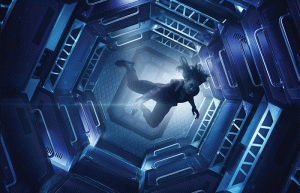
Julie Mao (Florence Faivre) is an Earther and “the richest bachelorette in the system” according to Detective Miller, who is contracted by his boss to “kidnap” the “spoiled” wayward daughter of corporate magnate Jules Pierre Mao and return her home before she embarrasses him further. Julie joined the hard core faction of the OPA (Outer Planet Association, led by Anderson Dawes as an activist organization that sells itself as a Julie in vacuum the expanseliberator for Belters but is really a terrorist revolutionary group, looking to shift the balance of power); she naively joined to help the lowly belters achieve justice and a voice in the oppressive squeeze by Martian and Earth corporate interests. In “Back to the Butcher”, a colleague of Julie’s relates how she selflessly helped injured minors on Calisto in a tunnel collapse with cadmium poisoning: “I never saw her shed a tear over the fact that she’d have to take anti-cancer meds for the rest of her life.” The only time she cried, he shares, was when she was acknowledged as being a true “beltalowda.”
 

ChrisjenAvasarala-TheExpanse

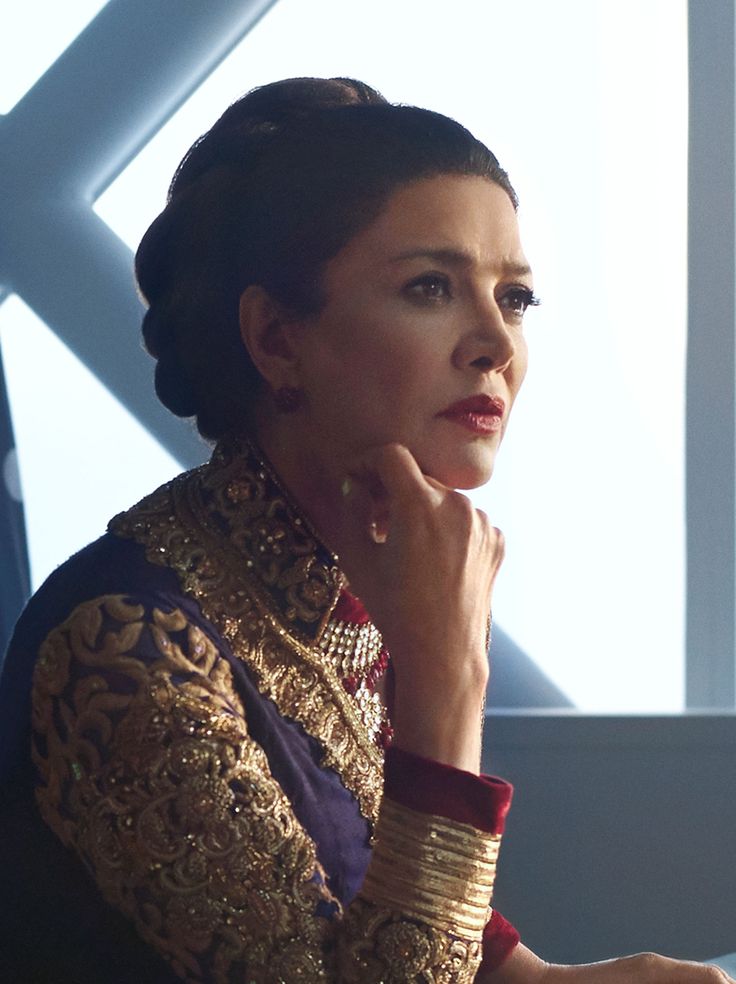
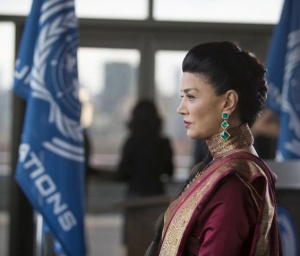
Chrisjen Avasarala (Shohreh Aghdashloo)

Chrisjen Avasarala (Shohreh Aghdashloo) is the U.N. Deputy Undersecretary on Earth and a brilliant 23rd-century Machiavelli. She will stop at nothing in her search for the truth, including gravity torturing a Belter or playing her friends and contacts like chess pieces to find answers. What makes Chrisjen far more interesting than, say a Circe or Claire Underwood, is that her scheming—as reprehensible as it may be at times—comes expanse-chrisjen3from a higher calling, not from lust for power or self-serving greed. She’s seeks the truth. And, like Miller, she struggles with a conscience. Chrisjen is a complex and paradoxical character. Her passionate and unrelenting search for the truth together with unscrupulous methods, make her one of the most interesting characters in the growing intrigue of The Expanse. Avasarala is a powerful character on many levels—none the least in her potent presence (thanks to Shohreh Aghdashloo’s powerful performance); when Avasarala walks into a scene, all eyes turn to her.
 

Naomi Nagata

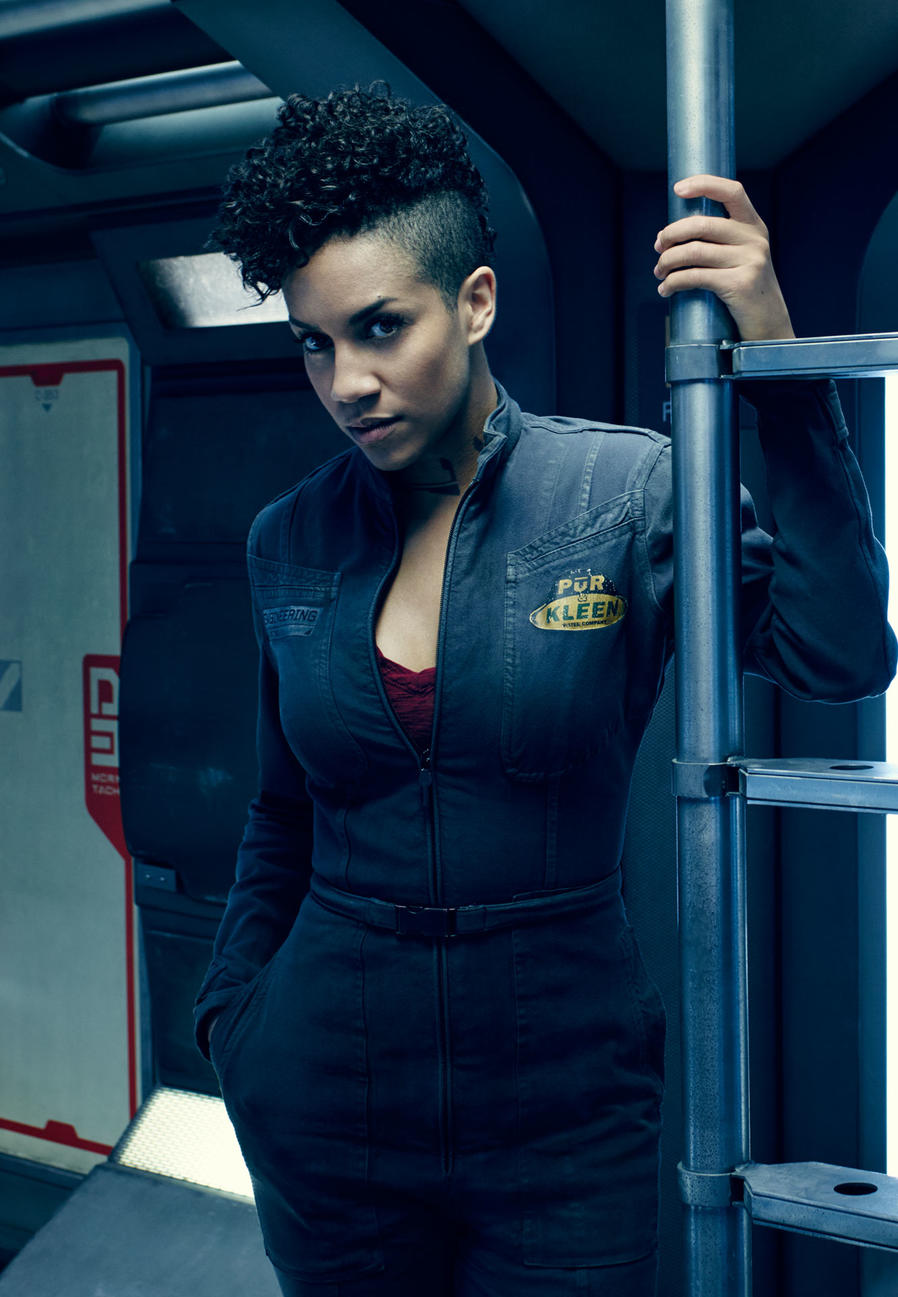
Naomi Nagata (Dominique Tipper)

Naomi Nagata (Dominique Tipper) is a Belter who grew up on prospecting ships in the Belt and Outer Planets. An extremely talented engineer with a mysterious past of regret and secret pain, Naomi uses arcane abilities to save the ship and her crew. “I have no resentments,” she tells her Martian interrogator. “I don’t believe in causes.” While she makes a point of expressing no allegiances, the Martians accuse her of being an OPA Naomi the expanseoperative and she finds herself ironically defending the Belt and Belters in the struggle between Earth and Mars. “We need to stick together,” she tells fellow Belter Miller and helps Fred Johnson’s team. Driven to help those in need, Naomi selflessly puts herself in harm’s way to save Belters used as lab rats on Eros or those left to die on Ganymede after a Mars and Earth skirmish. In an intimate moment with Holden after the atrocity on Eros with the proto-molecule experiment, Naomi reminds him: “We did not choose this but this is our fight now. We’re the only ones who know what’s going on down there; we’re the only ones with a chance to stop it.”
 

Drummer

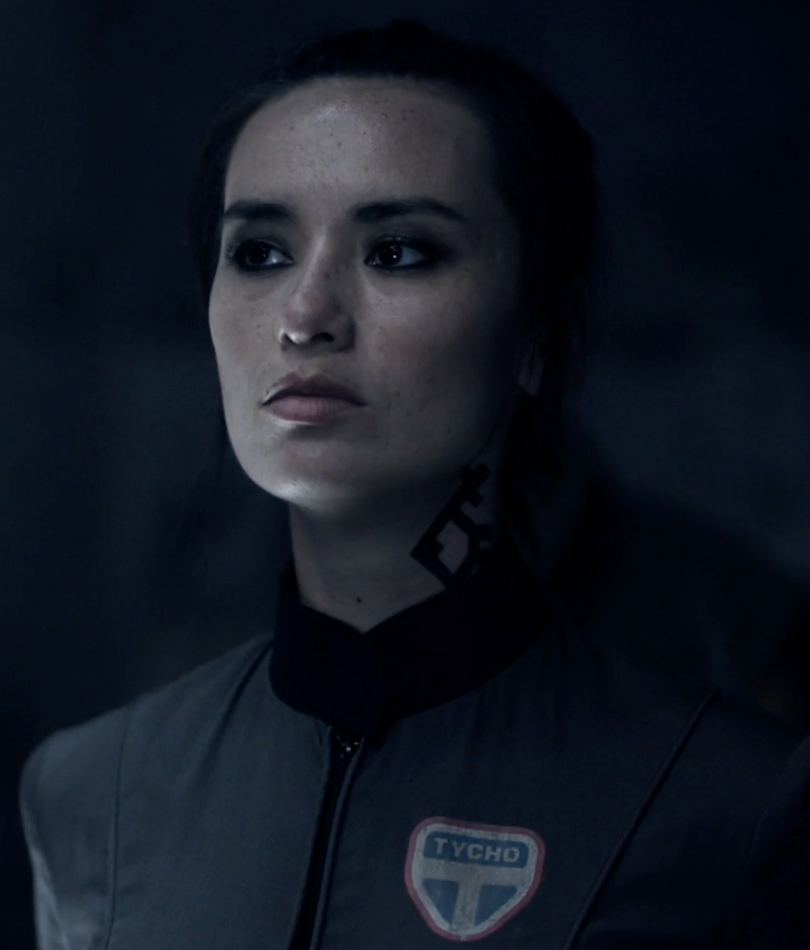
Camina Drummer (Cara Gee)

Camina Drummer (Cara Gee) is a hard-calculating Belter who used to work for Anderson Dawes and is currently second in command for Fred Johnson (a previous U.N. officer and ‘the butcher of Anderson Station’ currently helping the OPA) on Tycho drummer-with-gunStation. A complex character with mysterious connections and intuitive skills for people, Drummer gives one the impression that she can nimbly navigate between hard-line OPA and Fred’s Earther-version of OPA justice for Belters. In “Pyre”, she shows her mettle when—after being shot and held hostage by a militant faction on Tycho—she finds the strength to summarily execute them.
 

bobbie-draper-the-expanse

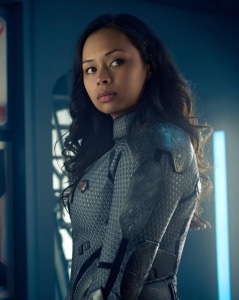
Bobbie Draper (Frankie Adams)

Bobbie-DraperBobbie Draper (Frankie Adams) is a staunch hard-fighting Martian marine who dreams of a terraformed Mars with lakes and vegetation and breathable atmosphere. Because of Earth’s Vesta blockade, Draper realizes that she will not realize her childhood dream of seeing Mars “turned from a lifeless rock into a garden.” The blockade forced Mars to ramp up its military at the expense of terraforming. Draper laments that, “with all those resources moved to the military, none of us will live to see an atmosphere over Mars” and bears a strong resentment against Earth. However, when Bobbie discovers her own government’s culpability with an Earth weapons manufacturer that used her own marines as guinea pigs, she chooses honour over loyalty and defects to seek justice.


The Expanse - Season 3

Anna Volovodov (Elizabeth Mitchell)

Reverend Doctor Annushka (Anna) Volovodov (Elizabeth Mitchell) is a gay Methodist doctor (married to a woman and with a daughter) who is introduced in Season 3 as she struggles through a mob of anti-war protestors to enter the United Nations building on Earth. When a young man collapses through the barricade and breaks his wrist, Anna asks him, “Is this your first protest?” then calmly and firmly directs a surly guard to help him, handling the situation with firm grace–even after being injured in the confrontation.

The Expanse - Season 3The Secretary General (who she had a previous friendship that soured over some dubious event) has called Anna in to write a stirring speech to unite Earth behind the war erupting between Earth and Mars. Anna enters the political intrigue with naive hope and is badly used; but her inner strength, keen intelligence and courage propels her on an amazing trajectory of influence to the outer reaches of the solar system where first contact is imminent. Like a quiet summer rainstorm, Anna brings a fresh perspective on heroism through faith, hope and inclusion.
Women as Gylanic Heroes

The gylanic hero is gaining momentum in science fiction and action-thrillers; the gylanic hero—embraced mostly by women—teaches us what humanity needs now more than ever: the heroic gifts of altruism, compassion, faith, courage, passion, and endurance. She is already there, in movies and TV shows like Lucy, Edge of Tomorrow, Hunger Games, Divergence, Orphan Black, FarscapeBattlestar Galactica and The Expanse: fighting the dragons of prejudice, ignorance, cruelty, greed and intolerance–in partnership with her male counterpart.

expanse-cast

When we dispense with gender-bias in defining heroism in story, we display maturity as a species. I think of my favorite stories in literature, peopled by men and women; all heroes: Tess of the d’UrbervillesFahrenheit 451King LearSolarisThe Grapes of Wrath1984Doctor ZhivagoBrave New WorldMartian Chronicles, and To Kill a Mockingbird — miller shows octavia mussto name just a few. The gender of the hero I empathized with was irrelevant. What remained important was their sensibilities and their actions of respect and integrity on behalf of humanity, all life and the planet.

Gylany: a social system based on equality of men and women
Androcracy: a form of governing system in which rulers are male (patriarchal rule)
Gynocracy: as with androcracy, an authoritarian rule by women over men (matriarchal rule)

A list of SF books and films with whole and relevant female heroes–gylanic heroes– follows below. There are many more. I’ve listed these because they are ones I enjoyed and know, several being my own. Please add yours:

GYLANIC HEROES (portraying women as agents of change equal with men)

  • Contact by Carl Sagan (Simon and Schuster) 1985. A woman’s quest into the unknown for benevolent intelligence in the universe.
  • Beggars in Spain by Nancy Kress (Harper Collins). 1993. A story that examines social consequences to transhumanist generic engineering.
  • A Handmaid’s Tale by Margaret Atwood (Anchor). 1998. A chilling fable of the near future, about a monotheocratic government where women are strictly controlled and assigned roles.
  • Cordelia’s Honor by Lois McMaster Bujold (Baen). 1999. A woman’s journey through deception and betrayal to find honour.
  • His Dark Materials Trilogy by Philip Pullman (Laurel Leaf). 2003. A fantasy alternate world adventure about a young girl who discovers that the fate of the universe lies in her hands.
  • Battlestar Galactica TV series by Ronald D. Moore. 2004. This second iteration of space “noah’s arc” is largely steered by key female agents of change in a gender-blind universe from complex pugilistic fighter jock and sly but intuitive politician, to love-seeking humanistic robot—all on a significant hero’s journey.
  • Darwin’s Paradox by Nina Munteanu (Dragon Moon Press). 2007. An eco-thriller about a woman unjustly exiled for murder and her quest for justice in a world ruled by technology and scientists.
  • The Hunger Games by Suzanne Collins (Scholastic Press). 2008. A series of books about teens forced to fight to the death on television.
  • The Year of the Flood by Margaret Atwood (McClelland and Stewart). 2009. Toby and Ren must survive the apocalypse described in the previous novel, each reminiscing about their time in the God’s Gardeners religious movement and the events that led to their current situations.
  • The Steel Seraglio by Mike Carey, Linda Carey, Louise Carey and Nimit Malavia (Chizine Publications). 2012. A novel about the women of a harem in an ancient Middle Eastern kingdom, who forge themselves into an army after they’re exiled from the city of their birth — and then return to claim the city for themselves.
  • The Splintered Universe Trilogy by Nina Munteanu (Starfire). 2011-2014. This trilogy, starting with Outer Diverse, follows the quest of Galactic Guardian Rhea Hawke, who must solve the massacre of a spiritual sect that takes her on her own metaphoric journey of self-discovery to realize power in compassion and forgiveness.
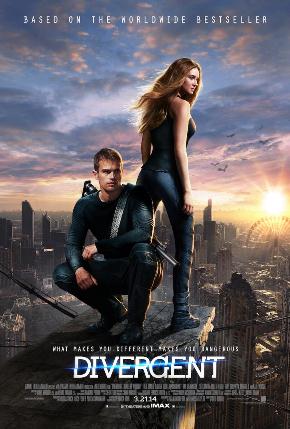
  • Divergent by Veronica Roth (Katherine Tegen Books). 2012. a young girl overcomes her assigned caste in a dystopian Chicago to realize her true self-identity, revealed to be dangerous to the very existence of her ordered society
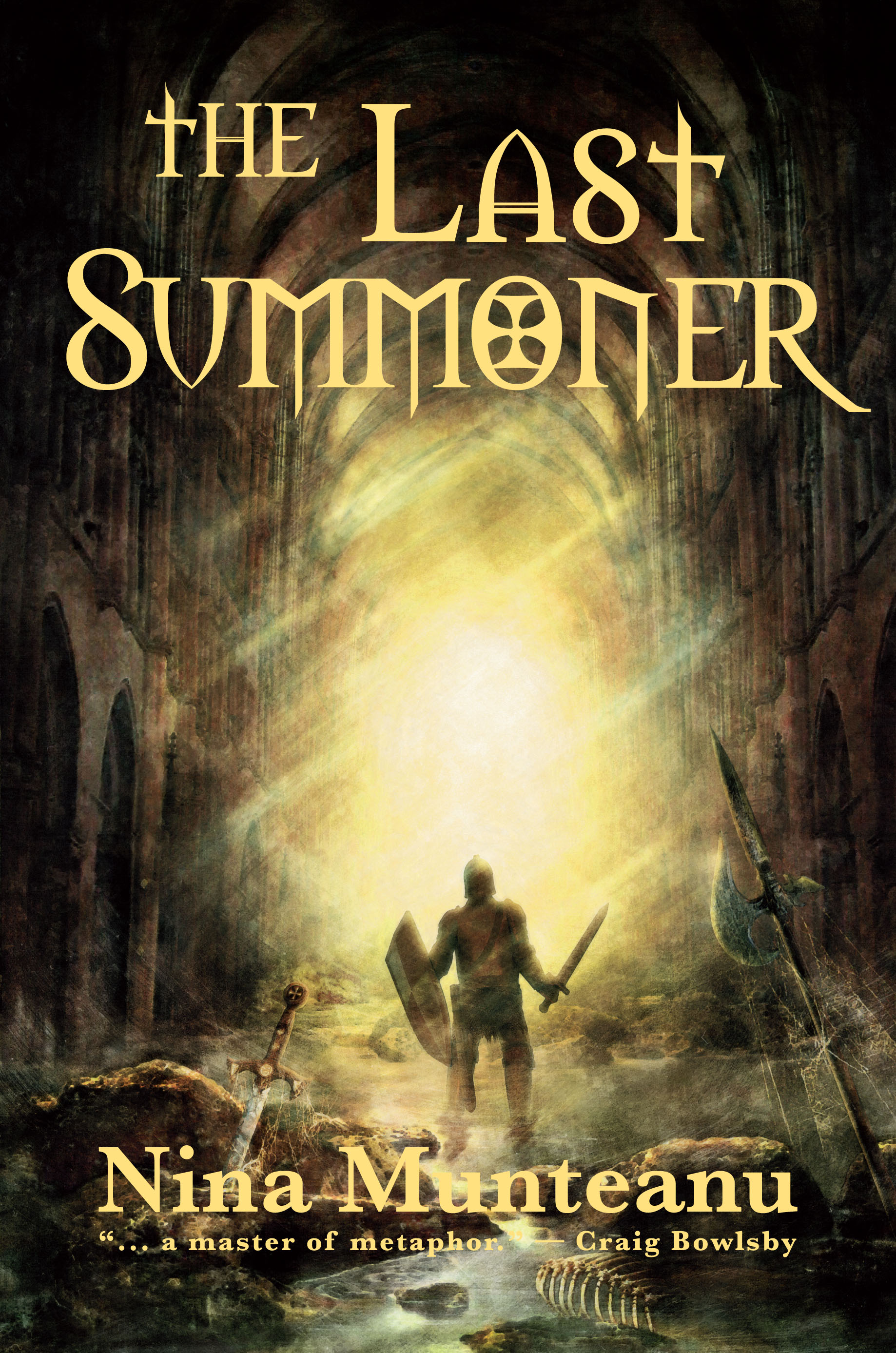
  • The Last Summoner by Nina Munteanu (Starfire). 2012. A young baroness discovers that her strange powers enable her to change history—but at a cost. Vivianne begins her journey in the year 1410, on the eve of a great battle. She dreams of her Ritter (knight), who will save her from her ill-fated marriage and the strange events that follow. But early on, she realizes that she is the Ritter she dreams about.
  • Leviathan Wakes & series by James S.A. Corey (Orbit Books). 2011. A high-stakes near-future space-colonizing conflict that brings strong female protagonists of varying cultural, ethnic and political influence into key roles as agents of change.
  • The 100 TV series by Jason Tothenberg. 2014. In this post-apocalyptic Earth adventure, several women protagonists share key roles in determining the fate of humanity in violent change.
  • The Expanse TV series by Mark Fergus and Hawk Ostby, Syfy. 2015. The exemplary TV series based on the James S.A. Corey 7-book series.
  • Missions TV series by Julien Lacombe, Ami Cohen, and Henri Debeurme. 2017. The protagonist of this space race to Mars is a psychologist, who discovers her bizarre and personal connection to Mars, which promises to affect humanity’s destiny.
  • The Beyond film by Hasraf Dulull. 2018. This near-future thriller about first contact, features several women in key positions as scientists and mission administrators who must solve a key mystery that explores the consequences of humanity’s fearful tendencies.

Other Relevant Articles of Interest from The Alien Next Door:


Riane Eisler (in The Chalice and the Blade) provides examples of sociobiologists who draw on nineteenth-century Darwinism by citing insect societies to support their androcratic (social and political rule by men) theories. If humanity is to truly rise victorious over the scourge of climate change—a function of our current lifestyle and paradigms—we will need to adopt a cultural evolution that embraces a partnership society heralded by new and renewed symbology, language and “myth”: It starts with embracing gylanic heroes in literature and movies. Watching them, reading about them, writing and sharing these stories for the future they speak to.


JamesSACorey-tweetToMyExpanse

nina-2014aaaNina Munteanu is an ecologist and internationally published author of award-nominated speculative novels, short stories and non-fiction. She is co-editor of Europa SF and currently teaches writing courses at George Brown College and the University of Toronto. Visit www.ninamunteanu.ca for the latest on her books. Nina’s recent book is the bilingual “La natura dell’acqua / The Way of Water” (Mincione Edizioni, Rome). Her latest “Water Is…” is currently an Amazon Bestseller and NY Times ‘year in reading’ choice of Margaret Atwood.
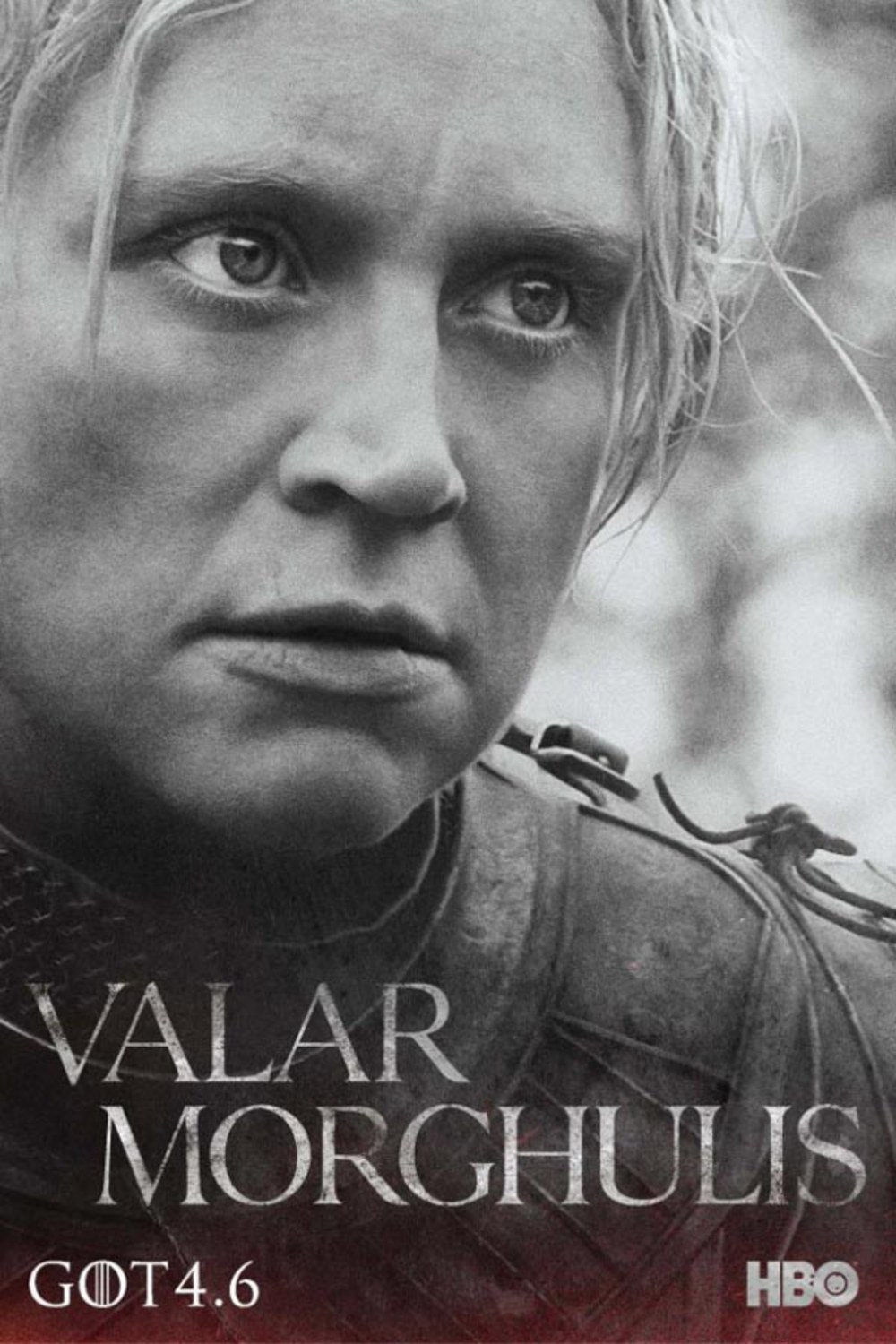
Women Heroes, Part 2: How Brienne of Tarth Saved “Game of Thrones”

brienne of tarth-valar morghulisI’ve been following the insanely popular—yet excruciatingly brutal—Game of Thrones for several seasons now. I must confess, partly because I don’t own or watch TV, that I am a little behind. I’m currently watching Season Four, while still metaphorically shaking in the violent wake of the shocking and brutal Red Wedding episode of Season Three. As the Internet buzz revealed, this was an extremely difficult show to watch for everyone. What was the purpose of its graphical brutality? Who needs to see that level of violence? I am reminded of an introductory scene in the show in which character John Snow counsels his little brother Bran to not avert his eyes when his father executes a deserter, by chopping off his head—an act that foreshadows his own decapitation later in the series. It is as though the producers of the show are counselling us in the same way as they subject us to grisly scene after grisly scene. Many cheap and gratuitous, as far as I am concerned.

The Red Wedding scene, in which several beloved characters are brutally slaughtered set into play a new set of rules for audience engagement: that of total distrust. Distrust in the storytellers (primarily in the producers of the show, whose scripts, I’m told, have deviated from the novels in some important ways). Distrust that creates an uneasy tension. Distrust that precipitates a panicked wish for clairvoyance. This is because we have no concept of fairness in the story; yet we’ve so invested in the characters. That is the storyteller’s worst act of cruelty: to hold us hostage to the characters. The rules of fair play in story have been broken. We’re stuck in a kind of free fall, desperately hoping that our beloved characters will make it through the night intact, if not unscathed. And when they don’t, its like watching our children die, as we stand powerless by.

Good fiction—as opposed to reality—tells a purposeful story. A story with fictional characters, who play a purposeful role. All good stories make a promise in the beginning; a promise they keep in the end. They create a covenant with their audience to participate in a fulfilling journey. This doesn’t have to mean a happy ending, but it does include meaning and fulfillment—even if only for its audience. And that must involve victory of sorts—and hope—whether it is through redemption, acceptance, enlightenment, or some change that gives us “more”—not less; something that allows us to prevail alongside.

If I feel that I am simply witnessing a cesspool of meaningless chaos and brutality, dominated by ruthless and insane people, in which heroes are equally powerless victims as they are true agents of change—with no rhyme or reason to tell the difference—then I must ask myself the question: why am I watching this? What does this story mean to me? I start to feel like a misanthropic voyeur, as perverse as Joffrey or Littlefinger as I watch people get tortured, flayed alive, dismembered, and worse… with no recourse. This is NOT entertainment and it certainly isn’t of any value to me. For such an offence to the senses to have value, there must be an element of—or at least a grain of hope of—prevailing and movement.

By Season Three end, both the series and I are feeling a little tired. And for good reason; most of the characters—the women particularly—are trapped in an incessant pattern of simple endurance. That seems to be all they are able to do: endure. Certainly they manage to act and create within their limited sphere of influence; but mostly to colour their position, not change it. So, we endure alongside; and we can endure only so much.

Then enter Brienne of Tarth. Also known as Maid of Truth.

And with her, a breath of much needed fresh air.brienne of tarth-close

When Brienne was first introduced in “What is Dead May Never Die” in Season Two, she brought with her the anachronistic romanticism of a true knight. We first see her besting favored champion Ser Loras Tyrell (Knight of Flowers) in a tournament. When she presents herself to King Renly Baratheon and removes her helm, the crowd hushes in surprise. To his offer of prize, Brienne requests a place in his Kingsguard, which he gladly grants, despite her gender and lack of formal stature as a knight.

Brienne is the iconic knight of the chivalric sagas: noble, virtuous, compassionate and brave. Singularly honest and loyal. So much so that her contemporaries deride her as simple, naïve and stupid. As though embracing such virtues is outmoded, foolish and weak. That she is a woman—albeit tall, ungainly and considered unfeminine—makes her virtues all the more powerful and refreshing.

BrienneoftarthWhen King Renly is assassinated, Brienne swears fealty to Catelyn Stark and becomes her sworn sword. Catelyn charges Brienne to return her captive Jaime Lannister to King’s Landing to exchange him for her two daughters held hostage there. Their journey provides some of the best scenes of the TV series and some of the most fulfilling interactions. Throughout Jaime’s insufferable taunts about her appearance and likely dismal history with the opposite sex, Brienne remains stoically silent. Except when she speaks:

“All my life men like you’ve sneered at me, and all my life I’ve been knocking men like you into the dust.”—Brienne to Jaime Lannister, Game of Thrones

Essayist Brent Hartinger suggests that Brienne’s character is a well-written departure from fantasy novels where the main characters are commonly “the slender… average-heighted, the conventionally abled and traditionally gendered.”

Essayist Caroline Spector describes Brienne as a “study in heartbreaking contradictions. She embraces the romantic ideals of her culture, both emotionally and through her actions, but is continually betrayed by the real world simply because she cannot turn herself into the woman the Westerosi legends tell her she should be.”

By upholding her ideals of integrity, Brienne refuses to conform to the established cultural expectations. Her very nature—from physique to comportment to idealism—defies the notion in Westeros that women are to be taken or coerced, and meant to endure their lot; not be agents of their own change. Spector describes Brienne as a woman who has “taken for herself most of the attributes of male power.” She embodies “how women who dare to take male power for their own are judged and treated not only in Westeros but in all conventionally patriarchal societies.”brienne-jaime-GoT

The journey of Brienne and Jaime is a fine tale of initial antagonism, discovery, surprising tenderness and ultimate friendship, based on honour and mutual respect. Throughout, Brienne defends and encourages a flagging Jaime and he, in turn, saves her on several occasions, culminating in his return to rescue her from a brutal death in the bearpit.

What makes “The Bear and the Maiden Fair”—or any other scene in which Brienne and Jaime appear—so pleasing? We witness in the interactions between them an evolution in character, great opportunities for learning and redemption, and finally the development of an iconic friendship based on respect and equality—something normally reserved for individuals of the same sex—that neither had previously enjoyed. Like two souls missing something, each is a gift to the other. And though delivered differently, it is the same for both: honour, self-respect and faith in humanity. And neither is the same for their interaction.

brienne-jaime-swords“The bathhouse had been thick with the steam rising off the water, and Jaime had come walking through that mist naked as his name day, looking half a corpse and half a god.”—George R.R. Martin, A Feast for Crows

Brienne is the catalyst hero. She gives us hope. She gives us hope to save the world. She does this through her influence on others. By shear strength of her genuine goodness, Brienne transforms, challenges, and supports. She is über-strong, yet vulnerable; which Jaime recognizes and appreciates as something truly beautiful. The reason he returns to save her in the bear pit.

“I am grateful, but… you were well away. Why come back?”

A dozen quips came to mind, each crueler than the one before, but Jaime only shrugged. “I dreamed of you,” he said.—George R.R. Martin, A Storm of Swords

Jaime slides back to his scoundrel-self once returned safely to King’s Landing and out of Brienne’s sphere of influence—and beneath the shadow of his overbearing father. He is a chameleon, a shape shifter, who struggles to lift himself out from the shadow of his soulless father. Despite some continued reprehensible behavior (particularly to do with his sister, with whom he had formed a perverse relationship), Brienne’s light of honour appears to burn inside him in some form. His actions—tasking her to find and secure Sansa’s safety and giving her his own sword—maintains their honour-bond. When he gives her his longsword, forged of Valyrian steel, he asks her to name it; showing the cooperative respect between the two. She chooses the name Oathkeeper, fulfilling again her role in their story.

In fact, Brienne’s story follows a more traditionally male narrative. Her quest is to save the beautiful maiden (Sansa), but not to marry her or benefit from the quest; it is simply to secure her safety. Feminist writer Rihannon tells us that this is a storyline that “the mother, the young girl and the shieldmaiden are all given equal weight and worth…She uses her strength and her skill to respect and help other women in ways that most men in Westeros would never even think to attempt, because she understands, more than any other knight, that women are truly worth something as individuals.”

Are other women of Westeros poised to rise as true agents of change and takebrienne-of-tarth command not only of their lives but to save the world? Daenerys Targaryen, the dragon mother, liberates slaves; courage and a sense of justice animates the independent Arya. And we’ll see what becomes of Brienne…and Jaime.

I will continue to watch this series with uneasy anticipation.


nina-2014aaNina Munteanu is an ecologist and internationally published author of award-nominated speculative novels, short stories and non-fiction. She is co-editor of Europa SF and currently teaches writing courses at George Brown College and the University of Toronto. Visit www.ninamunteanu.ca for the latest on her books.

Women Heroes in Literature, Movies and Pop Culture

rita vrataski-3

Rita Vrataski (Emily Blunt) fights a war against aliens

Some time ago on my birthday, I watched the popular — and somewhat controversial — Hunger Games. Well, controversial among some critics and followers of critics, anyway. I came across a particularly juicy article by critic Jeffrey Wells on Hollywood Elsewhere, in which he attributed the movie’s success to “reviews by certain female critics” who are “susceptible to the lore of this young-female-adult-propelled franchise.”

Whether this was true or not — and I highly doubt this — it brings up another stirring question: that of gender-bias. Is it truly still hard for a man like Wells to accept and enjoy a story which feature’s a female heroine?  Is it so hard to see a woman as a person first: championing a cause, delivering a world from evil and injustice, overcoming a great obstacle to become enlightened?

I think of my favorite stories in literature, peopled by men and women; all heroes: Tess of the d’Urbervilles, Fahrenheit 451, King Lear, Solaris, The Grapes of Wrath, 1984, Doctor Zhivago, Brave New World, Martian Chronicles, and To Kill a Mockingbird — to name just a few. The gender of the hero I empathized with was irrelevant. What remained important was their sensibilities and their actions.

Katniss fights the system in Hunger Games

Katniss fights the system in Hunger Games

It got me thinking … What does it take to be a hero—a female hero— particularly? And does there need to be a difference? The tweets and FB-talk and Internet buzz imply that male heroes differ from female heroes; they embrace differing quests and archetypal roles and reflect different qualities. In his 2013 web-article “Saving Science Fiction From Strong Female Characters” SF author John C. Wright attempted to elucidate a more realistic portrayal of women heroes in science fiction. Unfortunately, the article relied heavily on well-established androcratic stereotypes.

The male hero stereotype in literature and films of western culture—and science fiction particularly—is often characterized by strength, courage, integrity & honor, intelligence, assertiveness, single-mindedness, faith in his quest, and boundless determination: he is the altruist warrior, often acting alone against an unfair society through his conscience. All traits honored, respected and esteemed in men. In a woman, these Boadicean qualities often qualify her as “a bitch” or a “tomboy”. She may be considered unwomanly, unlady-like, intimidating, and with lesbian tendencies. Not the sort of girl you would take home to Mummy. The exciting Becky Sharp to the prosaic but sweet Amelia. And God forbid that she is more intelligent than her male counterpart!

Kara Thrace (Starbuck) fights Cylons in Battlestar Galactica

Kara Thrace (Starbuck) fights Cylons in Battlestar Galactica

For a woman to qualify as “hero” then, must she shed her feminine qualities of compassion, kindness, tenderness, and nurturing, to express those hero-defining qualities that are typically considered “male” to become less than either? Goddess untouchable? Women deserve better than that in literature and other story media.  I have seen too many 2-dimensional female characters limited by their own stereotype in the science fiction genre—particularly in the adventure/thriller sub-genre. If they aren’t untouchable goddesses or “witches” in a gynocratic paradigm (woman-dominating), they are often delegated to the role of enabling the “real hero” on his journey through their belief in him: as Trinity enables Neo; Hermione enables Harry; Mary Jane enables Spiderman; Lois enables Superman; etc. etc. etc.

aeryn sun gun

Aeryn Sun (Claudia Black) fights “humans” in Farscape

In an opinion piece in The Detroit News, Tom Long tells us that the women in top hero-style movies have usually been and still are portrayed in “romantic, sidekick or comedic roles. Often they’re waiting to be rescued (think Princess Leia). And some of them are part of action ensembles [think X-men].” Token figures to provide added “spice”, edge and diversity. This is, according to Gitesh Pandya, editor of a box office analyst site, because female-driven action movies have a hard time selling. “Most of the action films that have become huge hits are either male-driven or ensemble.” Pandya goes on to suggest that this is because more tickets are purchased by men than by women. “The film industry has been male-dominated for so long, the people who are creating and financing these films typically put men in there as heroes.” And yet women read far more fiction than men (by a 4:1 ratio according to some sources). We are in dire need of balance and we hunger for a female hero.

Lucy: victim, predator or neither?

Lucy: victim, predator or neither?

“What does it mean for our nation or our world if we treat [women] by a different script? What are we clinging to when we cling to that script that women need men’s protection?” said Ann Folino White, assistant professor at Michigan State University. She does well to call it a script when the storytellers of a culture define our humanity: who and what we are, our values and what we strive to be. Storytellers are the shamans of our culture and our time. We are the visionaries of our future.

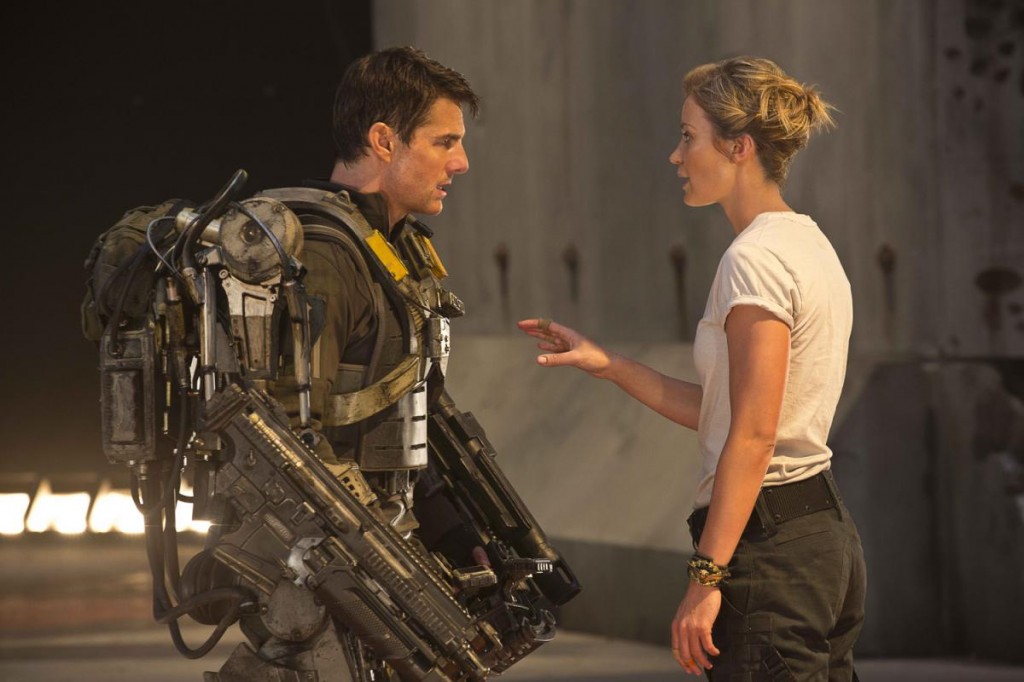
The recent SF action film Edge of Tomorrow provided a refreshing kind of woman hero; Rita Vrataski (Emily Blunt) is equal—in fact superior—to her male protagonist, William Cage (played by Tom Cruise) in skill, intelligence and heroic stature. What I mean by heroic stature is that her heroic journey of transformation does not play subservient to her male counterpart’s journey.

trinity-syndromeIn so many androcratic storylines, the female—no matter how complex, interesting and tough she starts out being—must demure to the male lead; as if only by bowing down to his superior abilities can she help ensure his heroic stature. Returning us right back to the cliché role of the woman supporting the leading man to complete his hero’s journey. And this often means serving as the prize for his chivalry. We see this in so many action thrillers and action adventures today: Valka in How to Train Your Dragon, Wyldstyle in The Lego Movie, Neytiri in Avatar, Trinity in The Matrix, and so many more. There’s even a name for it: the Trinity Syndrome.

Tasha Robinson writes in her excellent article entitled, We’re losing all our Strong Female Characters to Trinity Syndrome: “The idea of the Strong Female Character—someone with her own identity, agenda, and story purpose—has thoroughly pervaded the conversation about what’s wrong with the way women are often perceived and portrayed today, in comics, video-games, and film especially…it’s still rare to see films in the mainstream action/horror/science-fiction/fantasy realm introduce women with any kind of meaningful strength, or women who go past a few simple stereotypes.”

edge-of-tomorrow-emily-blunt-victory

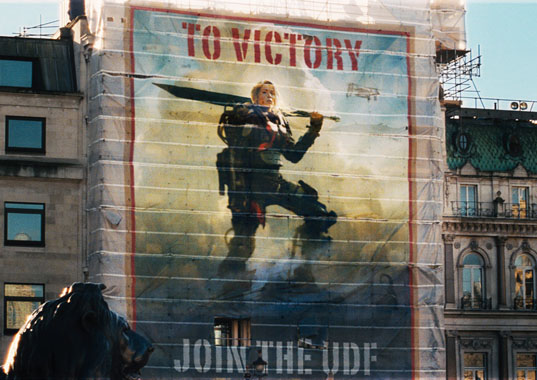
Rita Vrataski poster girl for the war

I give Edge of Tomorrow full marks for not doing this. For example, after Cage makes his case to his Squadron to go on a mission, they remain reluctant until Vrataski emerges. “I don’t expect you to follow me,” says Cage. “I do expect you to follow her.” The Angel of Verdun—or better yet, the badass Full Metal Bitch.

When a female lead is stronger than the male protagonist, some reviewers (OK—male reviewers) categorize that movie as a “woman’s story”. I’ve been told by some of my male friends that they couldn’t possibly empathize with such a character—mainly because she is a woman and she is stronger than the male lead that “they want to be”.  It would appear that men are less willing to empathize with a woman character than a woman is willing to empathize with a male character; something in itself interesting. Invariably, in many of these “goddess” stories, the male counterpart is so much “milk-toast” compared to that awesome female-warrior. And have you ever noticed that, while the male hero gets the girl, the female hero usually ends up alone? Great examples include: Buffy the Vampire Slayer; Xena: Warrior Princess; Sarah in The Terminator and of course Vasquez in Aliens. These women are amazons; they stand apart, goddess-like, unrelenting, unflinching—untouchable. It’s actually no wonder that my ex-husband dislikes Sigourney Weaver to this day—she could crush him underfoot and eat him for breakfast at a moment’s notice. And probably would!

In a superb article in NewStatesman entitled I hate Strong Female Characters, Sophia McDougall says:Divergent

“…I want to point out two things that Richard II has, that Bond and Captain America and Batman also have, that Peggy (Carter of Captain America), however strong she is, cannot attain. They are very simple things, even more fundamental than “agency”

  • Richard has the spotlight. However weak or distressed or passive he may be, he’s the main goddamn character

  • Richard has a huge range of other characters of his own gender around him, so that he never has to act as any kind of ambassador or representative for maleness. Even dethroned and imprisoned, he is free to be uniquely himself. On the posters [women are] posed way in the back of the shot behind the men, in the trailers they may pout or smile or kick things, but they remain silent. Their strength lets them, briefly, dominate bystanders but never dominate the plot. It’s an anodyne, a sop, a Trojan Horse – it’s there to distract and confuse you, so you forget to ask for more.”

There is another type of female hero. She is equal to her male counterpart. Her story is not secondary to his story; her heroic status and hero’s journey is equal to his and not because he’s been reduced to a lesser character, diminished by her or overshadowed by her; in fact they may share the same journey. Examples include: Bonnie and Clyde; Peter Chang’s Aeon Flux; Aeryn Sun and John Crichton in Farscape; Starbuck and Apollo in Battlestar Galactica…And now Vrataski and Cage in Edge of Tomorrow.

rita vrataski-cage

Cage and Vrataski discuss strategy

As with the above examples, Vrataski and Cage in Edge of Tomorrow form a team, in which together they are more than the sum of their parts. A marriage of independent autopoiesis, combining skills, abilities and vision. This is also why, in my opinion, the ending of Edge of Tomorrow is totally appropriate: not because it’s “the happy ending”; but because it carries the message of enduring collaboration of equals in a gylanic society.

So, in the end, I do agree with John C. Wright that science fiction requires whole female characters, but not for the reasons he gives.

The gylanic hero is emerging in science fiction and action-thrillers, one who will teach us more about what humanity needs now more than ever: the heroic gifts of altruism, compassion, faith, courage, passion, and endurance. She is already there, in movies and TV shows like Lucy, Edge of Tomorrow, Hunger Games, Divergence, Orphan Black, FarscapeBattlestar Galactica: fighting the dragons of prejudice, ignorance, cruelty, greed and intolerance–in partnership with her male counterpart.

image15

Aeryn Sun and John Crichton collaborate in Farscape

A list of SF books with whole and relevant female heroes–gylanic heroes– follows below. There are many more. I’ve listed these because they are ones I enjoyed and know, several being my own. Please add yours:

GYLANIC HEROES

  • The Hunger Games by Suzanne Collins (Scholastic Press). 2008. A series of books about teens forced to fight to the death on television.
  • The Steel Seraglio by Mike Carey, Linda Carey, Louise Carey and Nimit Malavia (Chizine Publications). 2012. A novel about the women of a harem in an ancient Middle Eastern kingdom, who forge themselves into an army after they’re exiled from the city of their birth — and then return to claim the city for themselves.
  • Front Cover ONLY-webThe Splintered Universe Trilogy by Nina Munteanu (Starfire). 2011-2014. This trilogy, starting with Outer Diverse, follows the quest of Galactic Guardian Rhea Hawke, a wounded hero who must solve the massacre of a spiritual sect that takes her on her own metaphoric journey of self-discovery to realize power in compassion and forgiveness.
  • Divergent by Veronica Roth (Katherine Tegen Books) 2012. a young girl overcomes her assigned caste in a dystopian Chicago to realize her true self-identity, revealed to be dangerous to the very existence of her ordered society
  • Cordelia’s Honor by Lois McMaster Bujold (Baen). 1999. A woman’s journey through deception and betrayal to find honour.
  • Contact by Carl Sagan (Simon and Schuster) 1985. A woman’s quest into the unknown for benevolent intelligence in the universe.
  • Darwins Paradox-2nd coverDarwin’s Paradox by Nina Munteanu (Dragon Moon Press). 2007. An eco-thriller about a woman unjustly exiled for murder and her quest for justice in a world ruled by technology and scientists.
  • Beggars in Spain by Nancy Kress (Harper Collins). 1993. A story that examines social consequences to transhumanist generic engineering.
  • His Dark Materials Trilogy by Philip Pullman (Laurel Leaf). 2003. A fantasy alternate world adventure about a young girl who discovers that the fate of the universe lies in her hands.
  • A Handmaid’s Tale by Margaret Atwood (Anchor). 1998. A chilling fable of the near future, about a monotheocratic government where women are strictly controlled and assigned roles.
  • Cover1_LastSummoner-frontcoverThe Last Summoner by Nina Munteanu (Starfire). 2012. A young baroness discovers that her strange powers enable her to change history … but at a cost. Vivianne begins her journey in the year 1410, on the eve of a great battle. She dreams of her Ritter (knight), who will save her from her ill-fated marriage and the strange events that follow. But early on, she realizes that she is the Ritter she keeps dreaming about. She must save herself and her world.

Other Relevant Articles of Interest from The Alien Next Door:

Gylany: a social system based on equality of men and women

Androcracy: a form of governing system in which rulers are male

Riane Eisler (in The Chalice and the Blade) provides examples of sociobiologists who draw on nineteenth-century Darwinism by citing Edge-of-Tomorrow-emily bluntinsect societies to support their androcratic (social and political rule by men) theories. If humanity is to truly rise victorious over the scourge of climate change—a function of our current lifestyle and paradigms—we will need to adopt a cultural evolution that embraces a partnership society heralded by new and renewed symbology, language and “myth”: It starts with embracing gylanic heroes in literature and movies. Watching them, reading about them, writing and sharing these stories for the future they speak to.

Nina Munteanu is an ecologist and internationally published author of award-nominated speculative novels, short stories and non-fiction. She is co-editor of Europa SF and currently teaches writing courses at George Brown College and the University of Toronto. Visit www.ninamunteanu.ca for the latest on her books.