Weaponizing Language: The U.S. Coast Guard Succumbs to TrumpSpeak by Censoring ‘Climate Change’ from its Curriculum

Language, the connective tissue of the body politic—that space where the collective “we” matters so much—is losing its ability to fulfill its most basic duty: to communicate. To correlate. To connect us to the world, and to one another

Megan Garber, The Atlantic
Scene of Winston Smith (John Hurt) in Nineteen Eighty-Four filmed in 1984 shown here with addition for currency

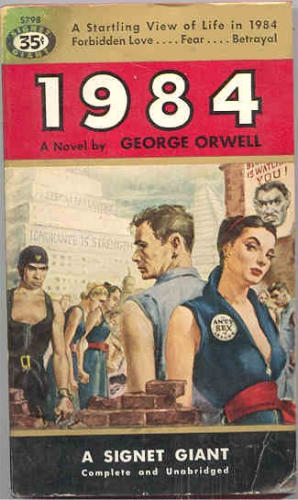
In his dystopian 1949 novel Nineteen Eighty-Four, George Orwell featured Newspeak, a fictional language of the totalitarian superstate Oceania. Created by the Party to meet requirements of Ingsoc (Englilsh Socialism), the Newspeak consisted of simplified grammar and limited vocabulary designed to limit a person’s ability to critically think. If you can’t find a word to articulate something, then it can’t be expressed and in some way no longer exists. Personal identity, self-expression and free speech become casualties of a simpler world.

Science fiction? Think again.

Today, Inside Climate News reported that the U.S. Coast Guard has eliminated the term “climate change” and related terminology from the curriculum of its training academy to conform to President Trump’s polices.

U.S. Coast Guard cutter Healy assists a NASA shipborne investigation into climate change in the Chukchi Sea in the Arctic Ocean (photo Kathryn Hansen NASA)

This comes at a time when scientists report that the effects of climate change and global warming are weakening the world’s most powerful ocean current, the ACC, with projected slowing by a third within decades. A study by international scientists published today in the journal Environmental Research Letters projects that the fresh water from melting Antarctic ice will weaken the Antarctic Circumpolar Currrent (ACC) by 20 percent in the next 30 years. The ACC is the only ocean current to flow around the entire planet unimpeded, carrying more than 100 times more water than all the world’s rivers combined. A paper in the journal Nature Climate Change recently documented how freshwater from melting ice has already weakened the overturning, or vertical circulation, of Antarctic shelf waters, which reduces oxygen in the deep ocean. Effects of the ACC slow down are projected to include more climate variability, with greater extremes in certain regions, and accelerated global warming.

Global warming is a fact.

Anyone negating its existence, let alone its existential threat, is quite simply a fool. But when a fool is in power and negates the bald truth of science—successfully eliminating the most important word to our existence on this planet—then who’s really the fool?

(image from The Atlantic)

In the 1940s, shortly after the end of World War Two, Orwell wrote an essay “Why I Write”; in it he lamented the growing decrepitude of the English language. Orwell argued that the decline of English went hand-in-hand with the decline of intellectualism in society and facilitated the manipulation of listeners, speakers and writers. Richard Weintraub noted in his 2021 article that Trump used ‘Newspeak’ to dismiss the Covid 19 virus, putting Americans at great risk.

Orwell created the term doublethink—a jargon of purposeful obfuscation—which is ability to simultaneously accept two mutually contradictory beliefs as right at the same time: “war is peace”; “freedom is slavery”; “ignorance is strength”. This oxymoron isn’t some wild gesture to the simultaneous wave / particle existence of particle physics or gestalt dualism of Schrödinger’s cat. Orwell’s brilliant fictional concept was predicated on the historical precedent of fascists around the world: the embodiment of “Big Brother”, who uses “doublethink” to confound, sway and control the minds of all people. The term “fake news” has settled in like a damp fog, a casual rejoinder to any truth one wishes to negate and ultimately erase.

On the weaponizing of language, Megan Garber in The Atlantic writes:

“Language, in 1984, is violence by another means, an adjunct of the totalitarian strategies inflicted by the regime. Orwell’s most famous novel, in that sense, is the fictionalized version of his most famous essay. “Politics and the English Language,” published in 1946, is a writing manual, primarily—a guide to making language that says what it means, and means what it says. It is also an argument. Clear language, Orwell suggests, is a semantic necessity as well as a moral one. Newspeak, in 1984, destroys with the same ferocious efficiency that tanks and bombs do. It is born of the essay’s most elemental insight: If thought corrupts language, language can also corrupt thought.”

The hard truths of science are at risk in a world gazing through the lens of confabulation… When the inveigling bits and bites of social media time and again trump scientific fact…

I end with Garber’s solemn call to awareness:

“Orwell published “Politics” at the end of a conflict that had, in its widespread use of propaganda, also been a war of words. In the essay, he wrestles with the fact that language—as a bomb with a near-limitless blast radius—could double as a weapon of mass destruction. This is why clarity matters. This is why words are ethical tools as well as semantic ones. The defense of language that Orwell offered in “Politics” was derived from his love of hard facts. “So long as I remain alive and well I shall continue to feel strongly about prose style, to love the surface of the earth, and to take a pleasure in solid objects and scraps of useless information,” he confessed in his 1946 essay “Why I Write.” His was an elegant dogma. Words matter because facts matter—because truth matters. Freedom, in 1984, is many things, but they all spring from the same source: the ability to say that 2 + 2 = 4.”

Nina Munteanu is a Canadian ecologist / limnologist and novelist. She is co-editor of Europa SF and currently teaches writing courses at George Brown College and the University of Toronto. Visit www.ninamunteanu.ca for the latest on her books. Nina’s bilingual “La natura dell’acqua / The Way of Water” was published by Mincione Edizioni in Rome. Her non-fiction book “Water Is…” by Pixl Press (Vancouver) was selected by Margaret Atwood in the New York Times ‘Year in Reading’ and was chosen as the 2017 Summer Read by Water Canada. Her novel “A Diary in the Age of Water” was released by Inanna Publications (Toronto) in June 2020.

Writing About the Truth…and Other Lies: Monsanto’s Big Cheat

The June 2019 issue of Walrus Magazine addresses a current publishing crisis in academia. In his article “Fake Science Is the New Fake News,” reporter Alex Gillis reveals the alarming rise of fake and bogus professional journals and how scientists are both duped and drawn to publish with them.

The lure came from frustrations of scientists with the very gate-keeping devices that ensure good science is being conducted and accurately reported: high standards for acceptance; long wait times for peer review and publication; and high expense to the scientist. With the advent of online journals and the open-access model (that allowed free access), many scientists flocked to them, claiming more timely and less expensive publication. Unfortunately, the open-access model that made reporting of and access to science more easy, also permitted its exploitation by unscrupulous entrepreneurs who set up predatory (fake) journals. This allowed scientists with less integrity to publish material of lower standard. Even more insidious, the model and its fake journals also supports fake science with an agenda. Essentially, science as propaganda.

1984Nineteen Eighty-Four kind of science.

An example of the publication of Nineteen Eighty-Four kind of science with corporate motive was revealed in 2018 with the lawsuit against Monsanto (now part of Bayer) in which evidence showed that Monsanto had been funding junk studies to discredit legitimate research about its cancer-causing herbicide, Roundup. A terrible example in 2015 is the fake studies that underplayed risks to children exposed to lead from improperly maintained pipes in the drinking water service lines in Flint, Michigan.

So, what is it to write about the truth?

Here’s a bit of truth from seven years ago: New York Times reporter Stephanie Strom in an article on September 19th, 2012, entitled Uneasy Allies in the Grocery Aisle: “Giant bioengineering companies like Monsanto and DuPont are spending millions of dollars to fight a California ballot initiative aimed at requiring the labeling of genetically modified foods. That surprises no one, least of all the proponents of the law, which if approved by voters would become the first of its kind in the nation.”

Let’s dig a bit deeper into this truth: “companies behind some of the biggest organic brands in the country—Kashi, Cascadian Farm, Horizon Organic—also joined the anti-labeling effort, adding millions of dollars to defeat the initiative, known as Proposition 37.”

Strom revealed even deeper truths when she disclosed that these well-known “organic” companies are owned by larger conglomerates like Kellogg, General Mills, Dean Foods, Smucker’s and Coca-Cola. Other food companies who had thrown in funds to help defeat the bill for transparency include PepsiCo., Neslé, and ConAgra Foods.

Strom reported that those who support the bill to label GMO products include Whole Foods, Nature’s Path (a Canadian company) Organic Valley, Cliff Bar and Amy’s Kitchen.

Whenever an issue of importance arises, the truth reveals itself. And sometimes in the oddest way. It often slides in through a back door. I’m not just talking about factual truth; I’m talking about resonating hair-standing gut-grabbing truth.

The kind of truth that resonates through you in a scintillating frisson. The kind of truth that stops you mid-stride, like someone shouting your name. Subversive truth. The kind of truth that vibrates deep inside and radiates out in a flood of epiphany.  The kind of truth that stirs your heart in a relentless wave of flaming light.

The kind of truth that “changes” you.

At first glance it’s rather obvious why those fighting the bill were against it: they had something to lose in transparency. The question is, why do they think that way? These giant biotech food companies are feeding the entire world, after all, with revolutionary strains of super-plants. They are doing a great good, surely. Could it simply be a concern that they may lose some customers who do not wish to consume GE products but who are unwittingly doing so now? That is being dishonestly self-serving as well as short-sighted (the European Union has required biotech labeling since 1997—it’s just a matter of time).

Could it be the bad publicity from findings of the long-term effects of GMO products and Roundup on test animals? (See the incendiary paper by French and Italian scientists in Food Chem. Toxicol., referenced below, that started it all).  Despite the barrage of bad press, the paper’s results could not be refuted entirely or ignored (if only from the basis of scientific inquiry and professional due diligence to do with Type II Error).

Or is it more insidious?

Far more insidious than a lie is to dissemble with a half-lie—or half-truth—a truth that veils a festering lie beneath its candy-coated mantle of equivocation. A “truth” so delicious that we want to believe it, even when we see the lie lurking beneath. Little lies always hide bigger lies.

For more than a decade, consumers in North America have purchased cereals, snack foods, and salad dressings, among other products, blithely unaware that these products contained ingredients from plants whose DNA was manipulated in a laboratory.

Here’s my witnessed truth: The aggressive multi-million dollar campaign waged by multi-national corporations against transparency in food labeling in the USA is the culmination of self-serving protectionism in a most heinous way. Their decade-long silence and current reluctance to label their products (and all this before the Seralini et al. study) points to a far greater lie.

Since the long-term toxicity study by Seralini et al. was released in Food & Chemical Toxicology, a massive campaign to discredit the study was waged on the Internet. This despite the soundness of the 2-year study, its glaringly obvious results (e.g. test animals died 2-3 times more quickly than controls among many other findings) and the fact that it sets precedent by being the longest and most detailed study ever conducted on a herbicide and a GMO to date; all previous studies by Monsanto labs and others were only 90-day trials (and we now know that these studies were fake studies).

So, what is it to write about the truth?

I’ve been a practicing scientist for over twenty years. I did research and wrote papers that were published in scientific peer-reviewed journals. I diligently used the scientific method, hypothesis-testing, objective observation and appropriate statistics to back up my work. I also write articles for magazines, blogs and places like this site. I write short stories and novels. I write how-to books and guidebooks. And I write letters. Lots of letters. In all this, I have made a point to do my research. I try always to go to the source and verify my information through cross-checking, and various other quality assurance procedures I learned over the years to best represent and communicate the truth.

For instance, in writing this article, I perused many articles that presented both sides of the several issues I covered, including the source paper by Seralini et al.

Science is the rational tool for the pursuit of truth. This is why scientists are burdened to proceed under an objective protocol in their premise presentation, experimental design, methodology and interpretation and conclusions drawn. Because the introduction of error and bias is possible in each of these areas, researchers with integrity ensure through design and quality assurance protocol that these errors and biases are minimized. This includes the use of contols, sufficient sample size and statistical power, blind or even double-blind experiments and more. Experiments are reported with sufficient transparency to be replicated (an icon of good science).

Once they are reported in a paper, results transform from science into politics. Objectivity gives way to agenda. That is inevitable. However, what has changed in the last decade is that science itself has become seconded for agenda. Science by agenda to fulfill a propaganda is flooding in as assuredly as the rising seas of climate change.

Gillis writes: “Fake and flawed studies are so pervasive that the presumed authority of an expert or researcher in a scholarly journal is no longer what it used to be…the traditional knowledge-sharing process has been corrupted.”

america-missouri02

Sunflowers in Missouri (photo by Nina Munteanu)

Who are the politicians behind the “soldiers” of science and what are their motives? That is where the truth lies.

In the end, I have found that listening to the conviction of my heart, to my inner “soul wisdom”, best serves the truth. Then again I prefer the resonating hair-standing gut-grabbing truth.

Reference:

Gillis, Alex. 2019. “The Rise of Junk Science.” Walrus Magazine, Toronto, ON. June 2019.

Seralini, G.-E., et al. 2012. “Long term toxicity of a Roundup herbicide and a Roundup-tolerant genetically modified maize.” Food Chem. Toxicolhttp://www.sciencedirect.com/science/article/pii/S0278691512005637

Strom, Stephanie. 2012. “Uneasy Allies in the Grocery Aisle.” New York Times, New York, September 19, 2012.

nina-2014aaa

Nina Munteanu is a Canadian ecologist / limnologist and novelist. She is co-editor of Europa SF and currently teaches writing courses at George Brown College and the University of Toronto. Visit www.ninamunteanu.ca for the latest on her books. Nina’s bilingual “La natura dell’acqua / The Way of Water” was published by Mincione Edizioni in Rome. Her non-fiction book “Water Is…” by Pixl Press (Vancouver) was selected by Margaret Atwood in the New York Times ‘Year in Reading’ and was chosen as the 2017 Summer Read by Water Canada. Her novel “A Diary in the Age of Water” will be released by Inanna Publications (Toronto) in 2020.