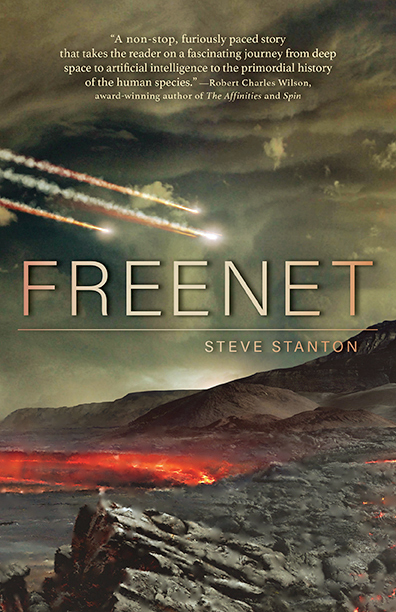
Steve Stanton’s 2016 science fiction book Freenet explores humanity in the far future after we have created the “Macpherson Doorway” through folded space-time, and vaulted ourselves with the blink of an eye into a galaxy far far away and 12 million years into the future. No traffic back through the doorway is permitted since a quarantine was placed some dozen years ago to prevent any unwanted DNA from sneaking through from Earth to “New Jerusalem”.
As the Canadian back book jacket reveals, Freenet is a novel about the “power of [free] information…in a post-digital age.” The book explores what digital immortality means, when “consciousness has been digitized and cybersouls uploaded to a near-omniscient data-matrix.” This is a world where information “is currency and the truth belongs to whoever has the greatest bandwidth.”
Stanton shared with me that he was inspired to write the novel “from the simple observation of watching a woman lose her cellphone. Young people today are so tied to technology that they freak out when the strings are cut. In the future when life experience is delivered directly to the brain by wi-fi, the personal loss will be catastrophic.”
Nina Munteanu reading her advanced copy of Freenet
Told in three parts, the book begins with Simara Ying—a plugged-in V-net jockey and spacer—about to crash-land on the desert planet Bali. Her rescuer, a naïve—almost too nice to be true—native, Zen Valda, introduces her to his cave-dwelling culture with no social network support. The persistent electromagnetic storms of Bali interfere with digital communication and wipe all data. Like a baby removed from her comfortable womb, Simara survives panic attacks and heavy withdrawal chiefly because she is bombarded so heavily with Bali experiences that demand her attention. Lost without the support of her V-net—a comforting web of infinite communication and information—Simara struggles with Bali’s foreign ways. At every turn, she stumbles across some custom or taboo, forced to rely on her own wits; making the kind of mistakes she’s not used to making. More than a simple communication/information tool, the V-net embraces Simara with confidence. Without it, she fears she may go insane.
Intrigue arrives on Bali and chases Simara with a bounty on her head for murder. Zen demonstrates a simple faith in her innocence and helps her escape. Zen accepts a cochlear installation to connect him to the V-net, thinking it will help him better communicate with Simara, who—already somewhat distant—is even more so now that she has reunited with the V-net. The V-net instead overwhelms him with a surging sea of irrelevant chatter and information, which threatens to drive him insane. Struggling with chaotic information overload, he remains with Simara, even after she estranges herself from him and is captured for murder. They escape and survive an arranged “accident” by literally jumping into space from an abandoned troopship about to crash.
Canadian book cover for Freenet
The story deepens into nuanced commentary in the last third of the book when Roni Hendrik, an energetic V-net anchorman of the Daily Buzz, pokes into the intrigue surrounding Simara Ying. He discovers that she is biogenic, an omnidroid—bioengineered from human DNA—and likely smuggled from Earth.
Omnidroids share a major cerebral augmentation that includes unlimited access to the V-net, higher intelligence and an unknown possibility of enhancements, including pre-cognition and telepathy across vast distances. Created as effective firewalls and filters, omnidroids streamline all V-net data for users across the galaxy. “Omnidroids [are] born into zero-day digital space and live in a fantasyland far beyond the mortal sphere of intelligence,” Henrik reflects, sensing a deeper story than a simple murder conspiracy. “Physical experience and bodily sensation [are] only tiny fragments of their transcendent existence, mundane accessories to digital infinity. In time,” Henrik concludes, “life itself might become a vestigial appendage.”
Hendrik, a humanist and closet idealist, pieces together connections with Neurozonics a New Jerusalem private corporation, responsible for the creation of biogenic humans. With holdings in a vast range of areas and an streaming amoeba of interests, Neurozonics is “a grinning spider on a translucent web of intrigue.” One discovery leads Henrik to more. He learns that the omnidroid community, to which Simara belongs, acts and communicates like a hive-mind, guided by a collective voice called “Mothership”. Other omnidroids have been targeted for elimination—and killed. Hell-bent on getting answers, Henrik confronts the owner of Neurozonics, Colin Macpherson—the same Macpherson who created the wormhole. Macpherson was uploaded earlier and runs his empire from digital space, part of the consortium of eternal intellect. Henrik’s meeting with Colin8 (the seventh clone of the original Colin Macpherson) runs like a “Neo-Architect” lecture in which the truth behind the omnidroids deaths is revealed. It’s not what you might think. Macpherson divulges his vision, which includes the reason for omnidroids’ communication abilities and the role of the Neurozonic brain. The ultimate meaning and use of the omnidroid freenet ties to a greater destiny that redefines what it is to be human and subverts the history of our primordial origins.
The story flows seamlessly from one perspective to another with crisp page-turning narrative, action and intrigue. Stanton trades some richness of character for a page-turning plot and clever dialogue. If there is a weakness in the narrative for me, it lies with Simara, the arcane omnidroid, who remains mysterious—from her introduction aboard her ship about to crash land, to the limited revelations of her character during her interactions with Zen, both in her POV and in his. Considering her unique characteristics and experiences as an omnidroid, I would have enjoyed more insight to her unique outlook and perspective, especially when faced with no social network—perhaps the most frightening experience for an omnidroid: to be disconnected from the hive. On the other hand, Zen Valda as the simple Bali boy on an insane rollercoaster ride is painted with a sensitive and graceful hand. Stanton also skillfully portrays his news team, Roni and Gladyz, with finesse and subtly clever notes. The dialogue and overall interactions between them is some of the most enjoyable of the novel.
Ultimately, Stanton’s Freenet flows like a fresh turbulent river, scouring and building up sediment then meandering like an oxbow into areas that surprise. He lulls you into expectation, based on your own vision of the digital world, then—like a bubble bursting—releases a quantum paradox of wormhole possibility.
“Ma, can you read the part where the cat omnidroid takes over the world?”
Nina Munteanu is a Canadian ecologist / limnologist and novelist. She is co-editor of Europa SF and currently teaches writing courses at George Brown College and the University of Toronto. Visit www.ninamunteanu.ca for the latest on her books. Nina’s bilingual “La natura dell’acqua / The Way of Water” was published by Mincione Edizioni in Rome. Her non-fiction book “Water Is…” by Pixl Press (Vancouver) was selected by Margaret Atwood in the New York Times ‘Year in Reading’ and was chosen as the 2017 Summer Read by Water Canada. Her novel “A Diary in the Age of Water” was released by Inanna Publications (Toronto) in June 2020.
In 2007, when I started my first blog, The Alien Next Door, I wrote an article that explored the term “Darwin’s Paradox”—it’s not just the title of my science fiction thriller Darwin’s Paradox released that year by Dragon Moon Press—but a term coined by scientists to describe the paradoxical phenomenon exhibited by coral reefs.
Defying The Laws of Thermodynamics
Darwin described coral reefs as oases in the desert of the ocean. Coral reefs comprise one of the richest ecosystems on Earth, in apparent violation of the laws of thermodynamics (high productivity in a low-productivity environment). Productivity ranges from 50 to 250 times more than the surrounding ocean. How do they thrive in crystal-clear water, largely devoid of nutrients? Part of the answer lies in the coral’s efficiency in recycling nutrients like nitrate and phosphate.
First, the rough coral surface amplifies water turbulence at a microscopic level, disrupting the boundary layer that usually settles on objects under water and lets the coral “hoover” up the sparse nutrients. I stumbled upon a similar phenomenon during my grad work on temperate streams and published my serendipitous discovery in the journal Hydrobiologia. I was researching how periphyton (attached “algae”) colonized submerged glass slides and observed that the community preferred the edges of the slides because the micro-turbulence there provided more opportunity for attachment and nutrition.
Second, lots of corals also function symbiotically with specialized algae (called zooxanthelae), which provide the coral with food (through photosynthesis) and, in turn, get food from the wastes created by the coral.
Can the science of symbiosis teach us something about another Darwin’s Paradox?
The Evolution of Compassion
In a September 2013 article in the Jewish World Review, Boston Globe reporter Jeff Jacobywrote:
“Charles Darwin struggled with a paradox: If evolution is a struggle for survival, how could generosity, compassion, and other altruistic virtues have spread through natural selection? Darwin could see the clear evolutionary benefit to groups that inculcated ethical values in their members. Imagine two competing primitive tribes, equally matched — except that ‘one tribe included a great number of courageous, sympathetic, and faithful members, who were always ready to warn each other of danger, [and] to aid and defend each other.’ (Darwin, “The Descent of Man”). There was little doubt that tribes highly endowed with such virtues ‘would spread and be victorious over other tribes.’”
“How did any tribe evolve such ethical qualities in the first place?” asks Jacoby. Brave individuals who risked their lives for others “would on average perish in larger numbers than other men.” It hardly seemed possible, Darwin conceded, that, “such virtues … could be increased through natural selection, that is, by the survival of the fittest.” So, how did it and why?
Jacoby quotes Sir Jonathan Sacks, Britain’s Orthodox chief rabbi, who pointed to “the central drama of civilization: Biological evolution favors individuals,” says Sacks. “But cultural evolution favors groups.… Selfishness benefits individuals [only in the short-term and only in a limited way—my comment], but it is [ultimately] disastrous to groups, and it is only as members of a group that individuals can survive at all.”
Jacoby describes the vast literature in evolutionary psychology and sociobiology that have demonstrated humanity’s hard-wired moral capacity. “We are born with an aptitude for empathy and fairness,” said Jacoby, citing recent neurological experiments that have demonstrated that an act of generosity triggers a pleasurable response in the brain.
Abraham Lincoln summarized it in seven words: “When I do good, I feel good.” Psychologists call it the “helper’s high”. Neuroscientists and behavioral scientists are demonstrating unequivocally the benefits of altruism to our health and happiness. Scientists have designed experiments that actually trace altruism—and the pleasure we gain from it—to specific regions and systems in the brain. Key studies now provide striking evidence that our brains are wired for altruism.
The Social Brain and the Seat of Compassion
In a study published in the Proceedings of the National Academy of Sciences (Moll et al, 2006), a team of neuroscientists lead by Dr. Jordan Grafman, reported that, “when people made the decision to donate to what they felt was a worthy organization, parts of the midbrain lit up—the same region that controls cravings for food and sex.” The brain experiences a pleasurable response when we engage in good deeds that benefit others.
Dr. Grafman found that the subgenual area in the frontal lobe near the midpoint of the brain was also strongly active when his study subjects made the decision to give to charity. The area houses many receptors for oxytocin, a hormone that promotes social bonding. “The finding suggests that altruism and social relationships are intimately connected—in part, it may be our reliance on the benefits of strong interpersonal connections that motivates us to behave unselfishly,” reports Elizabeth Svoboda in the WallStreet Journal. The team also found that the nucleus accumbens, which contains neurons that release the pleasure chemical dopamine, was triggered when a person chose to help another.
A 2007 study headed by neuroscientist Scott Huettel and reported in Nature Neuroscience(Tankersley, et al., 2007) connects altruism to the posterior superior temporal cortex (pSTC), an area in the upper rear of the brain that lets us perceive goal-directed actions by someone or something else. Results suggest that altruism depends on, and may have evolved from, the brain’s ability to perform the low-level perceptual task of attributing meaning and motive in the actions of others.
“Our findings are consistent with a theory that some aspects of altruism arose out of a system for perceiving the intentions and goals of others,” said Dr. Huettel. “To be altruistic, you need to see that the people you’re helping have goals, and that your actions will have consequences for them.”
Research led by Michael Platt reported in Nature Neurosciencein 2012, showed that the anterior cingulate gyrus(ACCg) is an important nexus for the computation of shared experience and social reward. That same year researchers at Mount Sinai School of Medicine in New York published research in the journal Brainthat suggested that the anterior insular cortexis the activity centre of human empathy.
I find it both interesting and exciting that these studies link different brain regions to altruistic and compassionate behavior. “There are certain to be multiple mechanism that contribute to altruism, both in individuals and over evolutionary time,” added Huettel. This is the nature of the brain, whether we look at intelligence, motivation or physical characteristics. And I am convinced that we will someday find that many other areas—if not the entire area—of the brain are involved. Moreover, researchers have shown that engaging—or even witnessing—generous acts can reduce stress, increase immunity (e.g., increased antibody levels), and longevity.
Emiliana Simon-Thomas, science director for the Greater Good Science Center at the University of California, Berkeley, explains the chemical activity that happens in our heads when we commit acts of altruism. “There are multiple reward systems that have been tied to pleasurable feelings when people help others or contribute to the well being of the people around them,” she notes. These reward systems are comprised of three main chemicals that are released when we commit an act of kindness and feel pleasure: Dopamine, Oxytocin and Serotonin. According to Simon-Thomas, Dopamine is most closely related to hedonic pleasure — or pleasure derived from self; oxytocin is tied to more social pleasure — especially with regard to physical contact; and serotonin is implicated in a more broad mood state. “All three of these, again, are sort of intersecting and interacting, and depending on the context that you’re in, represent feelings of pleasure in different context,” she explains. “All these systems are activating and parallel, and sort of influencing one another as you go through life.” So when I do a good deed, I am rewarding myself with a cocktail of wonder drugs that please me and make me smile.
So, what I’ve known since I was a child is now proven: doing good deeds is mutually beneficial to the giver and the receiver.
Path through winter forest in the fog, ON (photo by Nina Munteanu)
Altruism in All Beings
The notion that all aspects of life on this planet—not just humanity—have the capacity to act altruistically remains controversial—even among professional scientists and researchers. We are not unique in experiencing or practicing altruism, in acting altruistically and benefiting from our own altruistic acts. It is however a matter of perspective, bias and open-mindedness. Many examples of altruistic behavior and empathy exist in the rest of the living world on our planet.
Nature’s Heroes
Scientists have been demonstrating for years that cooperation among organisms and communities and the act of pure altruism (not reciprocal altruism or kin/group selection) is, in fact, more common in Nature than most of us realize. Valid examples of true altruism in the wild in many species exist. The key here is “in the wild”—not in captivity, where inherent behavior is often modified (see my Alien Next Door article “The SamaritanParadox Revisited: The Karma Ran Over the Dogma”).
Despite the overwhelming evidence for altruism in every aspect of our world, some researchers continue to design experiments and then draw sweeping conclusions based on animals in captivity to suggest that only humanity possesses the ability to behave altruistically—and then again only by social-instruction (aka “the Selfish Gene” of Richard Dawkins vs. the “Social Gene” of Lynn Margulis).
Examples of altruism abound and range among mammals, birds, invertebrates and even Protista. Some examples include: dogs, cats, ducks, squirrels, wolves, mongooses, Meer cats, baboons, chimpanzees, vampire bats, dolphins, walruses, lemurs, African buffalo—to name a few.
de Waal explained that “evolution favors animals that assist each other if by doing so they achieve long-term benefits of greater value than the benefits derived from going it alone and competing with others” (de Waal 2006). The prevalent phenomenon of altruism is Nature’s answer to the Prisoner’s Dilemma. “Empathy evolved in animals as the main … mechanism for [individually] directed altruism,” said deWaal. And it is empathy—not self-interest—that “causes altruism to be dispensed in accordance with predictions from kin selection and reciprocal altruism theory.” deWaal further proposed that the scientific community has become polarized between evolutionary biologists on the one side, and, on the other, a discrete group of economists and anthropologists that “has invested heavily in the idea of strong reciprocity,” which demands discontinuity between humans and all other animals.
“One of the most striking consequences of the study of animal behavior,” says anthropologist Robert Sapolsky, “is the rethinking … of what it is to be human.” He notes that, “a number of realms, traditionally thought to define our humanity, have now been shown to be shared, at least partially, with nonhuman species.” (Sapolsky 2006). This makes some of us uncomfortable. To some, it threatens to make us less special. The corollary is that this demonstrates that we possess intrinsic virtue, not something “painted” on through cultural teaching or diligent personal effort. Of course, it also means that all other beings possess intrinsic value too. In the final analysis, what we generally “know” is colored by what we believe and want to continue believing.
First big snow in Thompson Creek marsh, ON (photo and dry brush rendition by Nina Munteanu)
Universal Altruism and Gaia
What does all this mean? Does the very existence of altruism demonstrate the connectivity of all life on Earth? Let’s not stop there. Does the grace of altruism reflect a fractal cosmos imbued with meaning and intent? Was it the grace of altruism that allowed it all to happen in the first place? Don’t we all come from grace?
Despite struggles with acceptance for some of us, we are emerging enlightened to the fractal existence of grace and altruism embedded in the very nature and intentions of our universe.
I come full circle to my book Darwin’s Paradox, a tale of fractal intelligence and universal cooperation. A tale of emerging awareness of Self and Other as One…Evolution through cooperation… Creative DNA…Manifestation through thought and intent…Self-organization and synchronicity…A hero’s journey…and coming Home…
In this season of gratitude, we celebrate altruism in giving and in receiving graciously.
Merry Christmas!
First snow over Thompson Creek outlet, ON (photo by Nina Munteanu)
Bradley, Brenda. 1999. “Levels of Selection, Altruism, and Primate Behavior.” The Quarterly Review of Biology, 74(2):171-194.
De Waal, Frans, with Robert Wright, Christine Korsgaard, Philip Kitcher, and Peter Singer. 2006. “Primates and Philosophers: How Morality Evolved”. Princeton: Princeton University Press.
Goodall, Jane. 1990 Through A Window: My Thirty Years with the Chimpanzees of Gombe. Boston: Houghton Mifflin.
Moll, Jorge, Frank Krueger, Roland Zahn, Matteo Pardini, Ricardo de Oliveira-Souza, and Jordan Grafman. 2006. “Human fronto-mesolimbic networks guide decisions about charitable donation.” In: Proc. Natl. Acad. Sci., USA, 103(42): 15623-15628. http://www.pnas.org/content/103/42/15623.full
Sapolsky, Robert M. 2006. “Social Cultures Among Nonhuman Primates.” Current Anthropology, 47(4):641-656.
Svoboda, Elizabeth. 2013. “What Makes a Hero? The Surprising Science of Selfishness.” Current.
Tankersley D et al. 2007. “Altruism is Associated with an Increased Response to Agency.” Nature Neuroscience, February 2007, Vol. 10(2), pp. 150-151.
Warneken, F. & Tomasello, M. 2006. “Altruistic Helping In Human Infants and Young Chimpanzees.” Science, 311, 1301–1303.
Warneken, F., Hare, B., Melis, A. P., Hanus, D. & Tomasello, M. 2007. “Spontaneous Altruism By Chimpanzees and Young Children.” PloS Biology, 5(7), e184.
de Waal, F. B. M. 2008. “Putting the Altruism Back Into Altruism: The Evolution of Empathy.” Annu. Rev. Psychol., 59, 279–300.
de Waal, F. B. M., Leimgruber, K. & Greenberg, A. R. 2008. “Giving Is Self-rewarding for Monkeys.” Proc. Natl. Acad. Sci., USA, 105, 13685–13689.
Nina Munteanu is a Canadian ecologist / limnologist and novelist. She is co-editor of Europa SF and currently teaches writing courses at George Brown College and the University of Toronto. Visit www.ninamunteanu.ca for the latest on her books. Nina’s bilingual “La natura dell’acqua / The Way of Water” was published by Mincione Edizioni in Rome. Her non-fiction book “Water Is…” by Pixl Press(Vancouver) was selected by Margaret Atwood in the New York Times ‘Year in Reading’ and was chosen as the 2017 Summer Read by Water Canada. Her novel “A Diary in the Age of Water” was released by Inanna Publications (Toronto) in June 2020.
In the following scene of my upcoming speculative novel “Thalweg” (set in 2053 Toronto) one of my characters, Daniel–who is a bit of a conspiracy theorist–is trapped in an old abandoned garage, about to fight off a pack of stray dogs. His feverish mind thinks back to the COVID-19 pandemic:
“The official story was that SARS-CoV-2, which caused the COVID-19 pandemic of the early ‘20s resulted from the recombination of two previous viruses in some host—supposedly a bat or pangolin—which then ended up in a Wuhun wet market; there, the recombined virus gleefully jumped species to humans, who, in turn, gleefully spread it worldwide. But, according to the study at the Wuhun hospital, patient zero hadn’t been anywhere near the wet market. So, where did the virus really come from?…”
Daniel then recalls a conversation he had–when he still had a job–with colleague Lynna in which he suggested that the chimera virus–and the others that followed–were developed as a bioweapon through Gain-of-Function research and they somehow leaked into the public. To her scoff, he reminded her that the aim of GOF research is to induce an increase in the transmissibility and/or virulence of pathogens. He then provided numerous examples involving Influenza, SARS, and MERS.
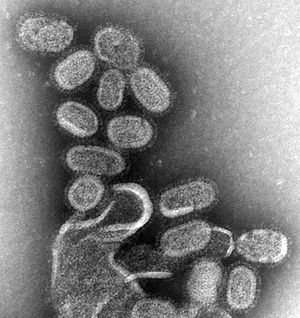
Influenza virus
Did she know, for instance, that in 2014 Obama put a funding moratorium on all GOFR experiments that might enhance virus pathogenicity or transmissibility in mammals via the respiratory route. Then in 2017, under the Trump administration, the NIH turned it all back on.
Squirrel monkey
Lynna responded calmly with a convincing argument, based on science and ecology. “Sure, they could be that,” she acknowledged thoughtfully. “Or they could simply be more cases of co-evolution and aggressive symbiosis…” Then she informed Daniel that viruses commonly form aggressive relationships with their hosts. Every monkey, baboon, chimpanzee and gorilla is carrying at least ten different species of symbiotic viruses, she said. The herpes-B virus that chums with the squirrel monkey is one example. The virus and an immunity to it passes harmlessly from mother to baby monkey. If a rival species like the marmoset monkey invades their territory, the virus jumps species and wipes out the challenger by inducing cancer in the competing marmoset monkey. Ebola and hantavirus outbreaks follow a similar pattern of “aggressive symbiosis.”
This community-symbiosis functions like an ecosystem’s “immune system” that protects its own from the encroachment of invading species—even when that invading species is us.
—excerpt from Nina Munteanu’s “Thalweg” (upcoming)
Aggressive Symbiosis & Virus X
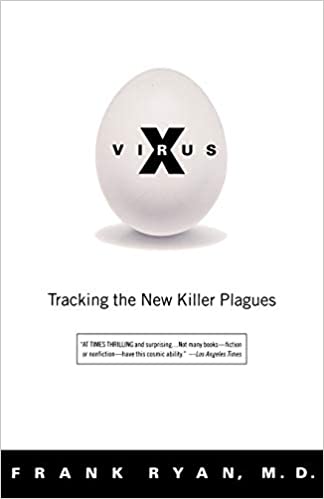
In his book Virus X, Dr. Frank Ryan coined the term aggressive symbiosis to explain a common form of symbiosis where one or both symbiotic partners demonstrates an aggressive and potentially harmful effect on the other’s competitor or potential predator. Examples abound, but a few are worth mentioning. In South American forests, a species of acacia tree produces a waxy berry of protein at the ends of its leaves that provides nourishment for the growing infants of the ant colony residing in the tree. The ants, in turn, not only keep the foliage clear of herbivores and preying insects through a stinging assault, but they make hunting forays into the wilderness of the tree, destroying the growing shoots of potential rivals to the acacia.
Bamboo forest near Kyoto, Japan (photo by Nina Munteanu)
In Borneo, a species of rattan cane has developed a symbiotic relationship with a species of ants. The ants make a nest around the cane and drink its sweet sap. The ants, in turn, protect the cane. When a herbivore approaches to feed on the leaves, the ants attack.
Ryan draws an analogy between this aggressive symbiotic partnership and that of new zoonotic agents of disease. He argues that when it comes to emerging viruses, animals are the cane and ants are the virus.
Viruses & Zoonotic Agents of Disease
Ryan suggests that Ebola and hantavirus outbreaks follow a pattern of aggressive symbiosis. This may explain why Ebola is so virulent. The Ebola virus is so fierce that victims don’t make it very far to infect others, suggesting that the virus is an evolutionary failure. However, if the virus is acting as an aggressive symbiont, it may be fulfilling its evolutionary purpose by protecting a host species we haven’t yet identified.
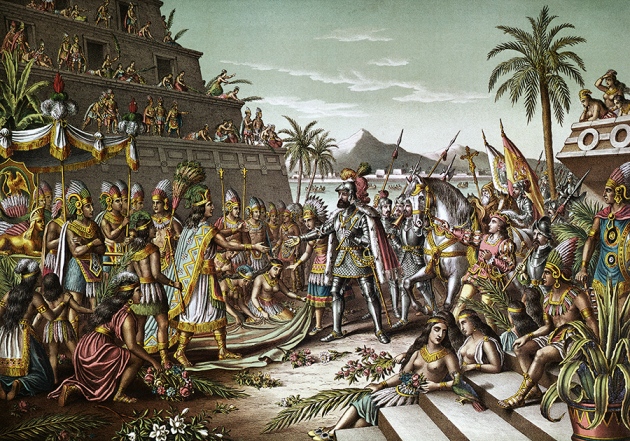
Azteks meet Spaniards who bring smallpox
Historian William H. McNeill suggested that a form of aggressive symbiosis played a key role in the history of human civilization. “At every level of organization—molecular, cellular, organismic, and social—one confronts equilibrium [symbiotic] patterns. Within such equilibria, any alteration from ‘outside’ tends to provoke compensatory changes [aggressive symbiosis] throughout the system to minimize overall upheaval.”
One of a legacy of examples of aggressive symbiosis in history includes smallpox: the Europeans introduced smallpox (symbiotically co-evolved with them) to the Aztecs with devastating results. Other examples of aggressive symbiosis include measles, malaria, and yellow fever.
Inhumane and unsafe treatment of animals in wet market in China
The National Observer gives a vivid description of the potential for zoonotic viral spread in the world’s wet markets, particularly in Wuhun:
“Dozens of species that rarely, if ever, come in contact with one another in the wild ― fish, turtles, snakes, bamboo rats, bats, even foxes and wolf cubs ― are confined in close quarters, waiting to be butchered and sold. The animals are often stressed, dehydrated and shedding live viruses; the floors, stalls and tables are covered in blood, feces and other bodily fluids.
This is the scene at many of China’s so-called “wet markets,” where a poorly regulated wildlife trade thrives and creates conditions that experts say are ideal for spawning new diseases.
“You could not design a better way of creating pandemics,” said Joe Walston, head of global conservation at the nonprofit Wildlife Conservation Society. “It’s really the perfect mechanism, not just for the Wuhan coronavirus but for the next ones that will undoubtedly emerge sooner rather than later.”
Zoonotic diseases, or diseases that can leap from animals to humans, are not uncommon and they don’t always come from exotic animals, writes Ari Solomon of Veganista. “Many come from the animals we regularly farm and eat. The 1918 influenza pandemic, or the Spanish flu, infected more than 500 million people and killed between 40-50 million worldwide. It is now commonly believed that the disease originated in birds. When the H1N1 virus, the same strain that caused the Spanish flu, showed up again in 2009, it first emerged in pigs. Tuberculosis, mad cow disease, and pig MRSA also came from animals exploited for food.”
Happy cows in Seelisberg, Switzerland (photo by Nina Munteanu)
In 2004, Linda Saif, with the Department of Food Animal Health Research Program at the Ohio Agricultural Research and Development Center summarizes a number of farm and domestic animal reservoirs of zoonotic corona viruses that have caused human diseases historically and many that may still do so through recombinations. Animals have included cows (BCoV), pigs (PEDV and PRCV), chickens (IBV, turkeys, cats (FCoV and FIPV), ferrets and macaques. Saif cautions that, given an estimated 75% of newly emerging human diseases arise as zoonoses (from wild or farm animals), interspecies transmission poses a continued threat to human health.
Wet markets aren’t the only places where animals are kept under and treated with cruelty and lack of any compassion or kindness:
“Thanks to the advent of factory farming, billions of animals are routinely kept in crammed, filthy conditions that cause them extreme stress. This abhorrent practice creates the perfect breeding ground for new diseases to thrive. Add to that the fact that we regularly feed factory farmed animals low-doses of antibiotics and we really have a recipe for disaster.”—Ari Solomon, Veganista
It comes down to balance. Something about which the human species has much to learn.
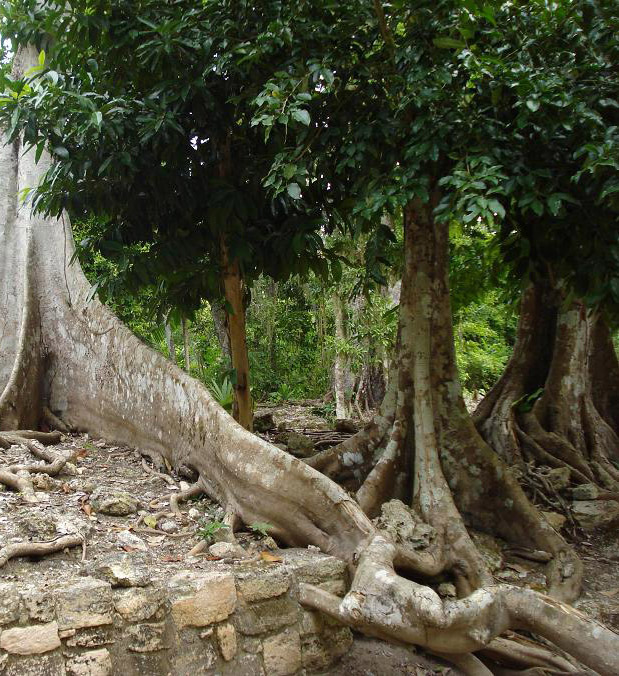
Buttressed fig tree in Costa Maya (photo by Nina Munteanu)
It is clear to me that these pandemics are exacerbated—if not outright caused by—our dense over-population and an exploitation mentality: our encroachment and defilement of natural habitats and the life that inhabits them. Gaia is suggesting that we live more lightly on this planet. Her ecosystems are responding to our aggression with equal aggression. And, make no mistake, we won’t win that battle. Just as we won’t win the battle with changing climate. It’s time to learn humility as a species in a diverse world. Time to cultivate respect for our life-giving environment. Time to learn the power of kindness.
The National Observer recently ran an article stating that: “COVID-19 and other health endemics are directly connected to climate change and deforestation, according to Indigenous leaders from around the world who gathered on March 13, in New York City, for a panel on Indigenous rights, deforestation and related health endemics.” The virus is telling the world what Indigenous Peoples have been saying for thousands of years: that “if we do not help protect biodiversity and nature, we will face this and even worse threats,” said Levi Sucre Romero, a BriBri Indigenous person from Costa Rica and co-ordinator of the Mesoamerican Alliance of Peoples and Forests (AMPB).
Many environmental experts agree that the novel coronavirus will only be the first in waves of pandemics we can expect if we ignore links between infectious diseases and the destruction of the natural world.
Bamboo, Japan (photo by Nina Munteanu)
“I’m absolutely sure that there are going to be more diseases like this in future if we continue with our practices of destroying the natural world,” said marine ecologist Dr Enric Sala to the Independent.
Reiterating the work of Dr. Frank Ryan, David Quammen, author of 2012 Spillover: Animal Infections and the Next Human Pandemic told the Independent: “Our highly diverse ecosystems are filled with many species of wild animals, plants, fungi and bacteria. All of that biological diversity contains unique viruses.” This unique community has developed over many many years into a functional community symbiosis in which viruses play an important part.
“There’s misapprehension among scientists and the public that natural ecosystems are the source of threats to ourselves. It’s a mistake. Nature poses threats, it is true, but it’s human activities that do the real damage. The health risks in a natural environment can be made much worse when we interfere with it,” says Richard Ostfeld, senior scientist at the Cary Institute of Ecosystem Studies in Millbrook, New York.
He and others are developing the emerging discipline of planetary health, which looks at the links between human and ecosystem health.
The disruption of pristine forests driven by logging, mining, road building through remote places, rapid urbanisation and population growth is bringing people into closer contact with animal species they may never have been near before, said Kate Jones, chair of ecology and biodiversity at UCL to The Guardian.
“We are researching how species in degraded habitats are likely to carry more viruses which can infect humans,” says Jones. “Simpler systems get an amplification effect. Destroy landscapes, and the species you are left with are the ones humans get the diseases from…We are going into largely undisturbed places and being exposed more and more. We are creating habitats where viruses are transmitted more easily, and then we are surprised that we have new ones.”
“It’s like if you demolish an old barn then dust flies. When you demolish a tropical forest, viruses fly. Those moments of destruction represent opportunity for unfamiliar viruses to get into humans and take hold.”–David Quammen
It’s aggression meeting aggression.
“Community-symbiosis functions like an ecosystem’s ‘immune system’ that protects its own from the encroachment of invading species—even when that invading species is us.”–Lynna Dresden, in Nina Munteanu’s Thalweg
For more on “ecology” and a good summary and description of environmental factors like aggressive symbiosis and other ecological relationships, read my book “The Ecology of Story: World as Character” (Pixl Press, 2019).
Glossary of Terms:
Aggressive Symbiosis: a common form of symbiosis where one or both symbiotic partners demonstrates an aggressive and potentially harmful effect on the other’s competitor or potential predator (Ryan, 1997).
Co-evolution: when two or more species reciprocally affect each other’s evolution through the process of natural selection and other processes.
Gain-of-Function Research (GOFR): involves experimentation that aims or is expected to (and/or, perhaps, actually does) increase the transmissibility and/or virulence of pathogens (Selgelid, 2016).
Patient Zero: the person identified as the first carrier of a communicable disease in an outbreak of related cases.
Recombination:the process by which pieces of DNA are broken and recombined to produce new combinations of alleles. This recombination process creates genetic diversity at the level of genes that reflects differences in the DNA sequences of different organisms.
Symbiosis: Greek for “companionship” describes a close and long term interaction between two organisms that may be beneficial (mutualism), beneficial to one with no effect on the other (commensalism), or beneficial to one at the expense of the other (parasitism). (Munteanu, 2019).
Zoonosis: a zoonotic disease, or zoonosis, is one that can be transmitted from animals, either wild or domesticated, to humans (Haenan et al., 2013).
Virus: a sub-microscopic infectious agent that replicates only inside the living cells of an organism. The virus directs the cell machinery to produce more viruses. Most have either RNA or DNA as their genetic material.
References:
Frazer, Jennifer. 2015. “Root Fungi Can Turn Pine Trees Into Carnivores—or at Least Accomplices.” Scientific American, May 12, 2015. Online: https://blogs. scientificamerican.com/artful-amoeba/root-fungi-can-turn-pine-trees-into- carnivores-8212-or-at-least-accomplices/
Saif, Linda J. 2004. “Animal Coronaviruses: lessons for SARS.” In: “Learning from SARS: Preparing for the Next Disease Outbreak: Workshop Summary.” National Academies Press (US), Kobler S., Mahmoud A., Lemon S., et. al. editors. Washington (DC).
Selgelid, Michael J. 2016. “Gain-of-Function Research: Ethical Analysis.” Sci Eng Ethics 22(4): 923-964.
VanLoon, J. 2000. “Parasite politics: on the significance of symbiosis and assemblage in theorizing community formations.” In: Pierson C and Tormey S (eds.), Politics at the Edge (London, UK: Political Studies Association)
Villarreal LP, Defilippis VR, and Gottlieb KA. 2000. “Acute and persistent viral life strategies and their relationship to emerging diseases.” Virology 272:1-6. Online: http://bird uexposed.com/resources/Villarreal1.pdf
Wohlleben, Peter. 2015. “The Hidden Life of Trees.” Greystone Books, Vancouver, BC. 272pp.
Nina Munteanu is a Canadian ecologist / limnologist and novelist. She is co-editor of Europa SF and currently teaches writing courses at George Brown College and the University of Toronto. Visit www.ninamunteanu.ca for the latest on her books. Nina’s bilingual “La natura dell’acqua / The Way of Water” was published by Mincione Edizioni in Rome. Her non-fiction book “Water Is…” by Pixl Press (Vancouver) was selected by Margaret Atwood in the New York Times ‘Year in Reading’ and was chosen as the 2017 Summer Read by Water Canada. Her novel “A Diary in the Age of Water” will be released by Inanna Publications (Toronto) in June 2020.
Sarah reached the summit, panting for breath, and grinned at her prize. She’d just caught the sun trembling over the horizon, before it dipped out of sight and left a glowing sky under pewter clouds. She glanced behind her, where the towers of Icaria blazed like embers catching fire. Struck by their beauty, Sarah admired their smooth, clean surfaces. When she looked back toward the path, the sanguine images burnt into her eyes.
Which way should she go? The deer path she’d followed now diverged into two smaller ones. She shifted her mind to veemeld with her AI, DEX. Which way should we go, DEX?
Her AI answered in her head: Sarah, shouldn’t you be returning inside? It’s dangerous to stay out this long. Statistics are now against you for getting caught—
Just a few more minutes, DEX. How about to the right?
“Natural Selection” tells the story of Sarah, an unruly veemeld who can speak to the machine world that runs Icaria. Given her immunity to the environmental disease ravaging the enclosed city, Sarah—at least her genetic material—is sought after by the Ecologist government in a bid to maintain order and reshape humanity through “selection”; but Sarah fraternizes with unsavory friends and her truant behaviour poses a great risk to her freedom and survival.
“Natural Selection” first appeared in 2013 in my short story collection of the same name by Pixl Press. The story returns in Issue #1 of Eagle Literary Magazine, Pan European Science Fiction & Fantasy Collection (Summer 2019; Nexus Project) edited by Mugur Cornilă and featuring the impeccable artwork of Ionuț Bănuță.
In the 2013 Pixl Press short story collection my introduction describes the theme that embraces the nine stories in the collection:
How do we define today a concept that Darwin originated 200 years ago in a time without bio-engineering, nano-technology, chaos theory, quantum mechanics and the internet? We live in an exciting era of complicated change, where science based on the limitation of traditional biology is being challenged and stretched by pioneers into areas some scientists might call heretical. Endosymbiosis, synchronicity, autopoiesis & self-organization, morphic resonance, Gaia Hypothesis and planetary intelligence. Some of these might more aptly be described through the language of meta physics. But should they be so confined? It comes down to language and how we communicate.
Is it possible for an individual to evolve in one’s own lifetime? To become more than oneself? And then pass on one’s personal experience irrevocably to others—laterally and vertically?
On the vertical argument, the French naturalist Jean-Baptiste Lamark developed a theory of biological evolution in the early 19th century considered so ridiculous that it spawned a name: Lamarkism. His notion — that acquired traits could be passed along to offspring—was ridiculed for over two hundred years. Until he was proven right. Evolutionary biologists at Tel Aviv University in Israel showed that all sorts of cellular machinery — an intelligence of sorts — played a vital role in how DNA sequences were inherited. When researchers inserted foreign genes into the DNA of lab animals and plants, something strange happened. The genes worked at first; then they were “silenced”. Generation after generation. The host cells had tagged the foreign genes with an “off switch” that made the gene inoperable. And although the new gene was passed onto offspring, so was the off switch. It was Larmarkism in action: the parent’s experience had influenced its offspring’s inheritance. Evolutionists gave it a new name. They called it soft inheritance [also known as epigenetics].
Illustration by Ionuț Bănuță
Horizontal gene transfer (HGT) is the movement of genetic material between organisms other than by vertical transmission of DNA from parent to offspring. Jumping genes (transposons) are mobile segments of DNA that may pick up a gene and insert it into a plastic or chromosome. Pieces of DNA move from one locus to another of a genome without parent-to-offspring by horizontal transposon transfer (HTT). Epigenetics describes the modification of DNA expression through DNA methylation—and results in “Lamarkism.” Transgenerational epigenetic inheritance is the new black: genes and environments interacting. Where do we end and where does environment begin? Researchers have proven the significant role of environmental feedback through HGT in evolutionary success. Researchers showed that up to 20% of a bdelloid rotifer’s genome is made of foreign genes that they stole from the environment through horizontal gene transfer and gene conversion. This compares to about 1% for humans and a fifth for tardigrades.
—excerpts from “A Diary in the Age of Water” due for release in 2020 by Inanna Publications.
As for passing on one’s experience and acquisitions to others laterally, education in all its facets surely provides a mechanism. This may run the gamut from wise mentors, spiritual leaders, storytellers, courageous heroes to our kindergarten teacher. Who’s to say that these too are not irrevocable? This relies, after all, on how we learn, and how we “remember”.
Evolution is choice. It is a choice made on many levels, from the intuitive mind to the intelligent cell. The controversial British botanist Rupert Sheldrake proposed that the physical forms we take on are not necessarily contained inside our genes, which he suggested may be more analogous to transistors tuned in to the proper frequencies for translating invisible information into visible form. According to Sheldrake’s morphic resonance, any form always looks alike because it ‘remembers’ its form through repetition and that any new form having similar characteristics will use the pattern of already existing forms as a guide for its appearance. This notion is conveyed through other phenomena, which truly lie in the realm of metaphysics and lateral evolution; concepts like bilocation, psychic telegraphing, telekinesis and manifestation. Critics condemn these as crazy notions. Or is it just limited vision again? Our future cannot be foretold in our present language; that has yet to be written. Shakespeare knew this…
There are more things in heaven and earth , Horatio, than are dreamt of in your philosophy—Shakespeare
Each story in the “Natural Selection” short story collection reflects a perspective on what it means to be human and evolve in a world that is rapidly changing technologically and environmentally. How we relate to our rapidly changing fractal environments—from our cells to our ecosystems, our planet and ultimately our universe—will determine our path and our destiny and those we touch in some way.
My friend Heidi Lampietti, publisher of Redjack Books, expressed it eloquently, “For me, one of the most important themes that came through in the collection is the incredible difficulty, complexity, and importance of making conscious choices — and how these choices, large and small, impact our survival, either as individual humans, as a community, a species, or a world.”
“Natural Selection” also features the sprawling semi-underground AI-run city of Icaria (a post-industrial plague Toronto) that was first introduced in my novel “Darwin’s Paradox” and is a character itself. Sarah is a “gifted” and troubled misfit—not in sync with the rest of the population. Yet her choices—and how she is treated by her community— will influence an entire species and world.
Nina is a Canadian scientist and novelist. She worked for 25 years as an environmental consultant in the field of aquatic ecology and limnology, publishing papers and technical reports on water quality and impacts to aquatic systems. Nina has written over a dozen eco-fiction, science fiction and fantasy novels. An award-winning short story writer, and essayist, Nina currently lives in Toronto where she teaches writing at the University of Toronto and George Brown College. Her non-fiction book “Water Is…”—a scientific study and personal journey as limnologist, mother, teacher and environmentalist—was picked by Margaret Atwood in the New York Times as 2016 ‘The Year in Reading’. Nina’s most recent novel “A Diary in the Age of Water”— about four generations of women and their relationship to water in a rapidly changing world—will be released in 2020 by Inanna Publications.



 In his book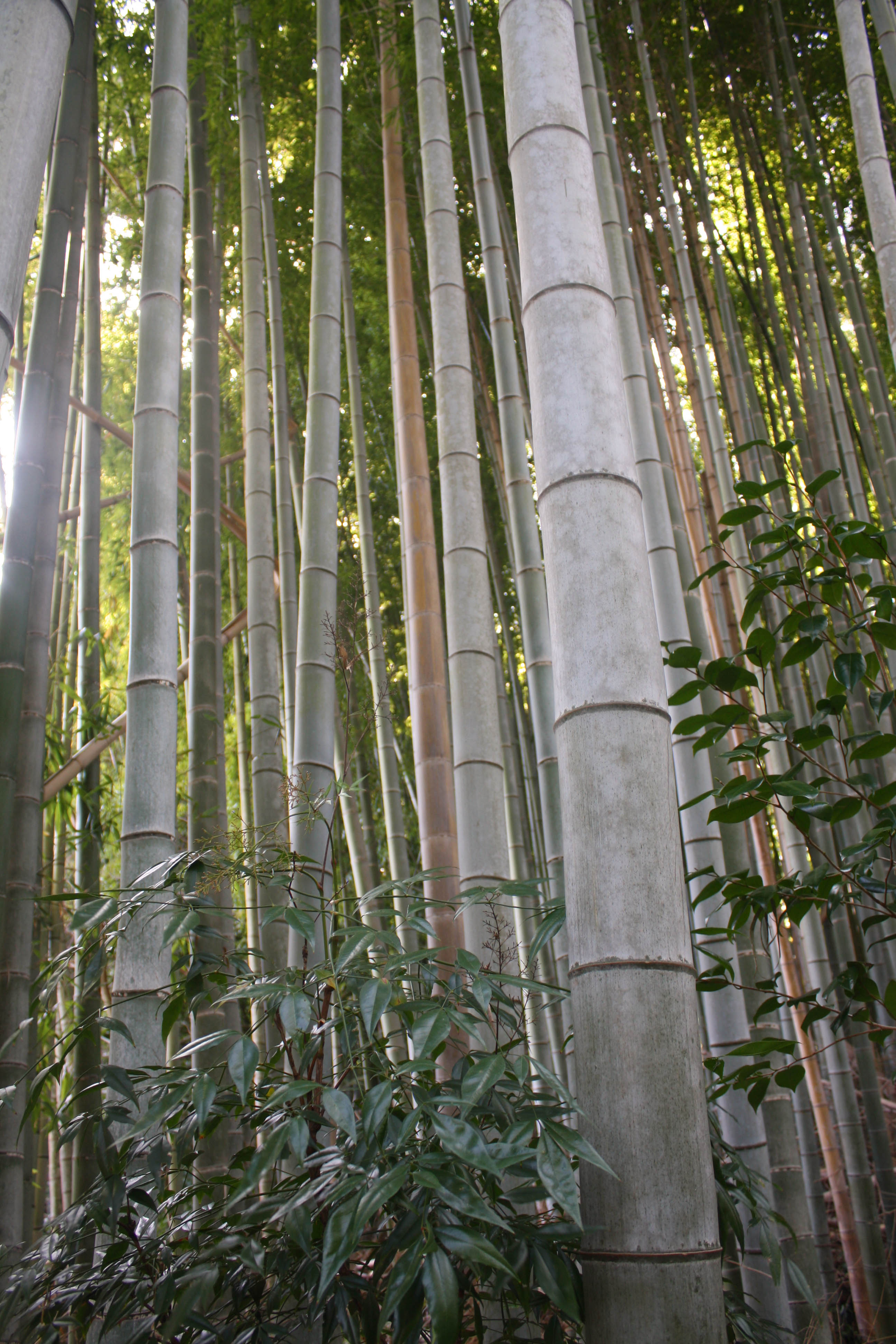



 For more on “ecology” and a good summary and description of environmental factors like aggressive symbiosis and other ecological relationships, read my book

 “Natural Selection”
 As for passing on one’s experience and acquisitions to others laterally, education in all its facets surely provides a mechanism. This may run the gamut from wise mentors, spiritual leaders, storytellers, courageous heroes to our kindergarten teacher. Who’s to say that these too are not irrevocable? This relies, after all, on how we learn, and how we “remember”.
 Each story in the
  “Natural Selection” also features the sprawling semi-underground AI-run city of Icaria (a post-industrial plague Toronto) that was first introduced in my novel
  Nina is a Canadian scientist and novelist. She worked for 25 years as an environmental consultant in the field of aquatic ecology and limnology, publishing papers and technical reports on water quality and impacts to aquatic systems. Nina has written over a dozen eco-fiction, science fiction and fantasy novels. An award-winning short story writer, and essayist, Nina currently lives in Toronto where she teaches writing at the University of Toronto and George Brown College. Her non-fiction book “Water Is…”—a scientific study and personal journey as limnologist, mother, teacher and environmentalist—was picked by Margaret Atwood in the New York Times as 2016 ‘The Year in Reading’. Nina’s most recent novel “A Diary in the Age of Water”— about four generations of women and their relationship to water in a rapidly changing world—will be released in 2020 by Inanna Publications.
 Nina Munteanu Writing Coach