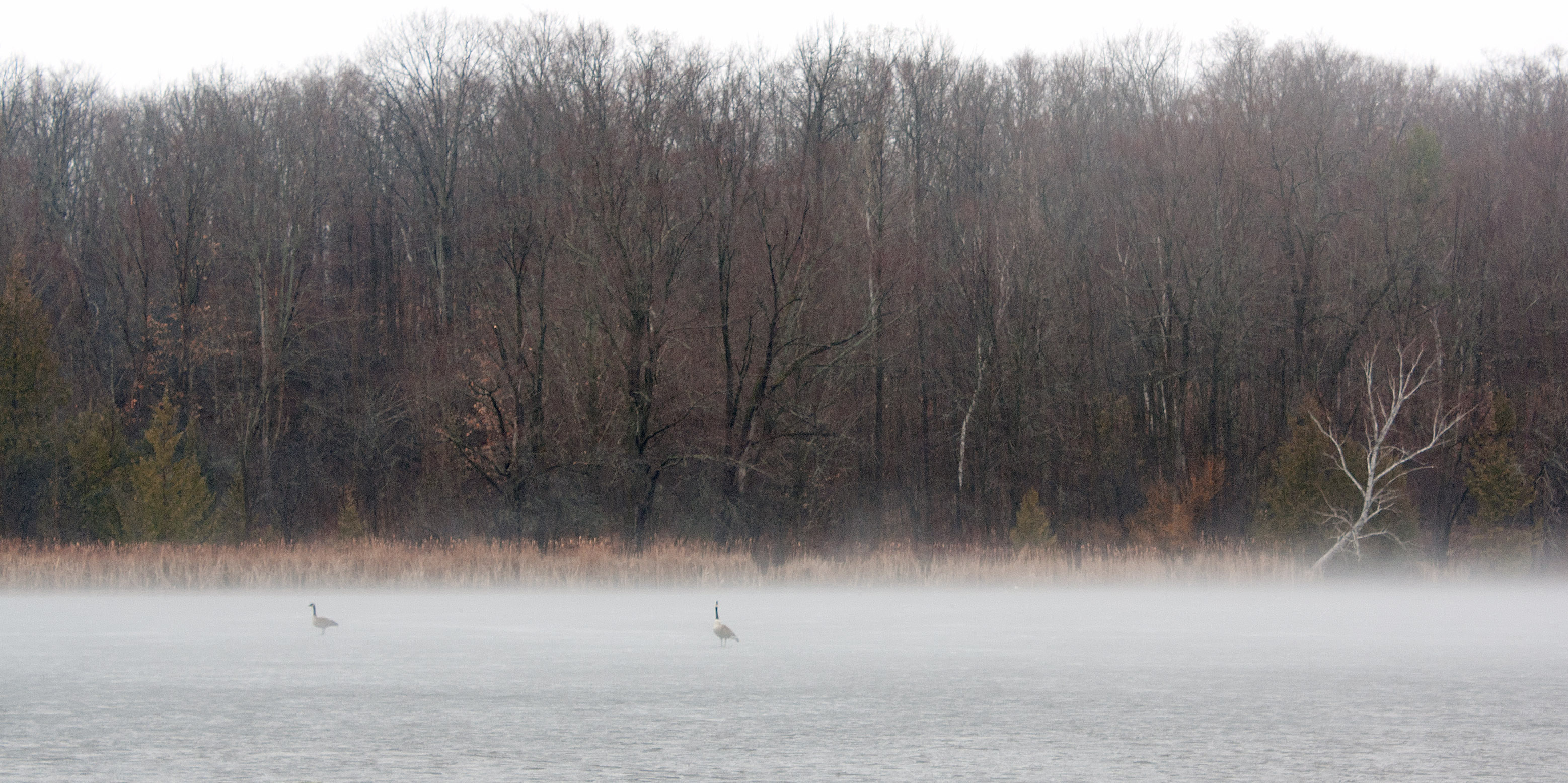
A November mist settles on Thompson Creek marsh, ON (photo by Nina Munteanu)
In January of this year, I posted a shot I’d taken in early winter of a marsh I often visit. That morning was cool and a thick mist lurked in the marsh like a shadow, giving it a mysterious timeless quality. A quiet stillness had settled like dew on everything, muting both colour and sound into a hush of anticipation. The stillness made me feel as though I’d entered a John Atkinson Grimshaw painting. A moody darkness pervaded the bare braided trees and the marsh oozed the scent of humus and wet vegetation. I inhaled it all deeply.
The image I posted caught the attention of colleague writer and publisher Lorina Stephens, who is also a superlative artist and painter. Inspired, she responded to my image with a painting.
The Painting:
Lorina Stephen’s ekphrastic painting entitled “Fog on West Grey Pond”
“I very much wanted to create that feeling of dreamscape that often happens in still waters, of there being something out there in the mist, of that sense of wonder and mystery. So, for this painting, it meant employing a gentle hand, allowing pigment to flow and pool, waiting until water had evaporated slightly, and then using a small, natural sponge to dab out areas to allow the white of the paper to shine through, then as the paper dried in an hour or so, or in some cases the next day, brushing in details little by little, from soft washes to hard lines, in order to create depth and definition.
It always amazes me when depth of field happens on the two dimensions of paper, that in this flat, thin sheet of paper I can take my viewer out and away into the distance, through a portal to another place, and in this case perhaps create that sense of the dampness and chill of a foggy day.”
Biography of Lorina Stephens
Lorina Stephens has been painting since the age of 14 when she studied under well-known, award-winning Ontario landscape artist, Dorothy Milne-Eplett. In those days it was oils and mostly copy-painting, although there were originals. Most of those paintings ended up in a collection under patreon, Oscar LaBerge, who was a construction worker in Newmarket, Ontario.
In the 1980s, Lorina rediscovered watercolours during an intensive 12 week Georgian College course, during which time the Tottenham Art Association was formed, and juried shows ensued, as well as solo exhibitions in galleries in Central Ontario.
.
Then the recession of the 1990s happened, and art became a way to stretch the family budget by way of hawking wares at the Orangeville Farmers Market, what Lorina came to call “painting pretty pictures for tourists”. These days Lorina paints simply as a way of expressing her love of the land, the ineffable communication that exists in the vast expanse of Canadian geography.
Lorina inherited from her mother a lifetime supply of watercolour paper. Among all those papers is a block of 7″ x 10″ Arches 140 lb hot pressed paper. That began a journey of studies.
Hot pressed paper has its own set of demands, having a very smooth finish and thus doesn’t absorb water the way of cold pressed, and the weight also means it tends to buckle and warp easily in larger sizes. Lorina addresses that by using a tempered glass painting desk, and creating a suction seal with water between the glass and paper, rather than the frustration of stretching paper onto a surface with masking tape. Using hot pressed paper also allows for some pretty interesting results by way of sponging and wiping out areas, and accepting precise detail work when the paper is dry. Her palette of colours is mostly transparent, with the addition of some pretty aggressively staining bullies added in.
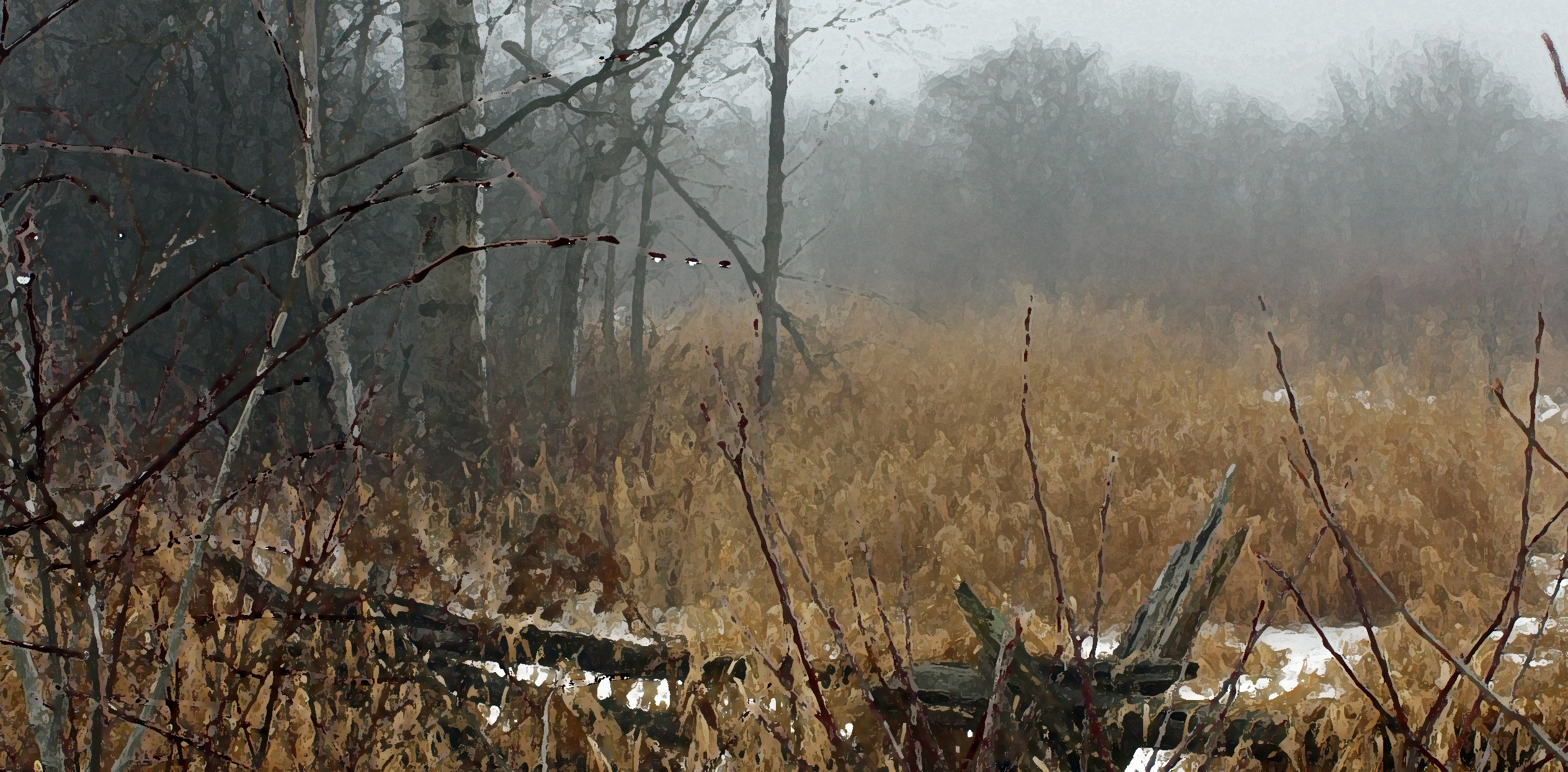
Thompson Creek marsh on a foggy November morning, ON (photo by Nina Munteanu)
.
Nina Munteanu is a Canadian ecologist / limnologist and novelist. She is co-editor of Europa SF and currently teaches writing courses at George Brown College and the University of Toronto. Visit www.ninamunteanu.ca for the latest on her books. Nina’s bilingual “La natura dell’acqua / The Way of Water” was published by Mincione Edizioni in Rome. Her non-fiction book “Water Is…” by Pixl Press (Vancouver) was selected by Margaret Atwood in the New York Times ‘Year in Reading’ and was chosen as the 2017 Summer Read by Water Canada. Her novel “A Diary in the Age of Water” was released by Inanna Publications (Toronto) in June 2020.
It started with a simple tweet of mine on X regarding doing research for one’s writing projects. I’d met Isabella Mori a few years ago, when we both contributed to an ekphrastic anthology of flash fiction, inspired by Group of Seven art. We met again when she submitted a story to an anthology I was editing for Exile Editions. After my tweet on research, Isabella and I traded brief stories about rewrites based on research findings and ‘mistakes’ and the arcane revelations in the creative process that may result. I was intrigued by her recounting and asked her to share it with you; so here it is:
“Synchronicities And The Sea”by Isabella Mori
(Trigger warning: Substance use and suicide)
This is about the magic that comes to pass when we let the Muse guide our work and consent to synchronicity. Here is what happened:
When I go away on vacation, I try to visit the local library, and always make sure to check out the community announcements. On one of those forays, I came across a notice of a project that teamed up visual artists with writers for a short story or poem. I love these types of collaborations and immediately jumped on it. Max was the artist I paired up with, and we hit it off right away. After a few conversations, we settled on the painting below, for which I was going to write a story. As you can see, it had a moody, dark feeling. I drafted this text as a response:
The memory of a map showed her the way as she wandered, blinded by the night, along the shore. Numb with cold, her bare feet dug into the wet sand. She could not see that she left no tracks. There was something in her searching; she felt it in the deep pit of her stomach but there was no image in her mind’s eye of what it was, no tinkling that alerted her, no smell, no taste. A sense of despair drained the blood from her heart and tugged at her from the right, where the forest rushed. Foot-dragging ennui invited her onto a soft-moss carpet to the left, and thoughts of numbers, cars and cash register receipts tried to wrangle her back to where she came from. She was near giving up. But at that precise moment there tracked the light only she of the searching could see—a light bigger more forceful than giants could ever imagine; all-embracing, all-revealing, all-nurturing just like the frothy ocean beneath it, just like the sand with its fierce sparkle, each grain a diamond just like the heart-bud that could not help but open under its rays, under those rays that only she of the searching could see.
However, for reasons we have both forgotten, Max decided to lighten the colours, and the dark mood of the first draft didn’t fit anymore. This is the version we ended up with:
Walk With The Angels
The ocean has known her share of angels over the eons. They come and go but the tide is older. When an angel appears in a cloud of glistening light, beats its wings and brings out the trumpets, little humans fall to their knees and beg for mercy and miracles.
But the water stays still.
Great mother ocean has seen it all.
She waits until the angel grows tired, then she takes the worn-out wings and heavenly body into her arms and carries them into her depths. Brings the apparition to visit kelp, salmon, starfish, barnacles, otters and crabs. Anemones. Killer whales. A visit one by one, under the summer sun, beneath the light of the Hunter’s moon, when the snow falls, with the Easter rains. The angel leaves a bit of themselves here, a bit there, a gift everywhere, until only the tiniest of diamonds are left.
And that’s the sand.
Walk with the angels.
There were a few tweaks before we arrived at this text, the major one being that in a previous version, I referred to ‘angel dust’ for the sand until the editor pointed out that that term refers to a street drug, PCP. In my enthusiasm I had forgotten that.
The change away from ‘angel dust’ was very important. When Max read the new version, they called me, their tone of voice both moved and perturbed.
“When I read this,” they said, “it feels like you channeled what happened with my cousin last year, not far from the place that inspired my painting. She had had problems with drugs all her life, and one day she just walked into the ocean. Her body was found a day later.”
Under those circumstances, we definitely did not want to refer to drugs.
That story stayed with me for months until one day when I was listening to one of my playlists of Latin music. I lived in Paraguay and Chile 1977-1980, and often enjoy the nostalgia of the music I listened to back then. The first song that came on was one of my all-time favourites, Alfonsina Y El Mar – Alfonsina And The Sea. Now I have to confess, I am terrible with lyrics, no matter what language, whether it be my native German, English, or the Spanish I was fluent in for quite a few years. For some reason, I really listened to the song last summer, and then looked up the lyrics. That’s when it hit me – was it possible that the lyrics of that song had subconsciously influenced me to write the second text? Or was it one of those Jungian collective conscious moments?
Alfonsina And The Sea
(Music: Ariel Ramirez. Lyrics: Felix Luna)
In the soft sand Licked by the sea Her small footprints Don’t return. Just one path Full of pain and silence Led to the water, Deep water, And one single path of unspoken pain Led to the foam.
God knows what sorrows accompanied you, What old suffering shut down your voice That made you lie down and nestle into the songs Of the sea snails, The song that sings in the deep dark of the sea, The sea snail.
There you go, Alfonsina, with your loneliness, What new poems did you go find? An old, old voice of wind and salt Sways your soul and carries it And you go there dreaming, Sleeping, Alfonsina, clothed in the sea
Five little sirens will carry you Through passages of algae and corals And glowing sea horses will dance Around you And all the creatures of the sea will soon Play at your side.
Turn down the light a little more, Nurse, let me sleep in peace. And when he calls tell him I’m not in, Tell him Alfonsina won’t come back. And when he calls don’t ever tell him I’m in, Tell him I’m gone.
There you go, Alfonsina, with your loneliness, What new poems did you go find? An old, old voice of wind and salt Sways your soul and carries it And you go there dreaming, Sleeping, Alfonsina, clothed in the sea.
(Used with permission, my translation.)
Alfonsina ended up in the ocean just like Max’s cousin did.
With some research, I found out that the story was about the Argentinian poet Alfonsina Storni who, after a difficult life that included poverty, questions she had about gender identity, and breast cancer, one night wrote a last poem to her son and then let herself fall into the ocean amid torrential rain. (An apocryphal version has her just walk into the ocean, and that’s the one the lyricist chose.) Some of that last poem was incorporated into Alfonsina Y El Mar – the nurse who is asked to lower the light, and told to tell ‘him’ that she won’t come back. Nobody seems to know who ‘he’ is.
The other research that had to happen was to find who the inheritors of Felix Luna’s estate were to obtain permission should I tell the story that you have before you. It turned out to be his daughters. Then I had to sleuth out their contact.
Felix Luna, the lyricist, imagined Alfonsina’s death not only as the terrible tragedy that it was but also as a mystical transformation into a sea creature that nestles into the songs of the sea snails. She finds new poems and sleeps clothed in the sea. She is embraced by sirens and wanders through algae and corals. She dances with sea horses and plays with all the other sea creatures.
I definitely cannot compare myself with a great poet like Felix Luna but notice with humility the similarities of my transformed angel who sinks into the embrace of mother ocean and also visits the more-than-humans of the sea.
I went pregnant with the idea of writing about the experience of Max’s and my collaboration for half a year when in February, I chanced upon a tweet by Nina about research for writing. I met Nina through submitting a story to an anthology she was editing. I told her about needing to tweak the angel story so that it does not talk about angel dust and ended up telling her the outline of what happened. She invited me to write a guest post about this, and here we are.
So many synchronicities. I could have not gone to that library. A different artist could have been paired up with me. Max could have wanted to stay with the original painting. Or they could have chosen a painting that would not have reminded them of their cousin. They could have opted not to share that sad story with me, or they could have been paired up with someone who doesn’t understand suicide as intimately as I do (I look back on a 30+ year career in social services.) I could have heard Alfonsina Y El Mar and still not really listened to the lyrics. There was no guarantee I could have managed to find out from whom to get permission to quote the song. I could not have submitted a story to one of Nina’s anthologies, and could not have followed her on Twitter. Coming across the particular tweet that prompted the publication of this story was like chancing upon a needle in a haystack. All this, and probably more, had to come together for this magical synchronicity to happen.
Thank you, Muse.
(Note: Since this is a sensitive topic, the artist’s name and some of the circumstances of my collaboration with them have been changed. However, the artist has consented to using their images.)
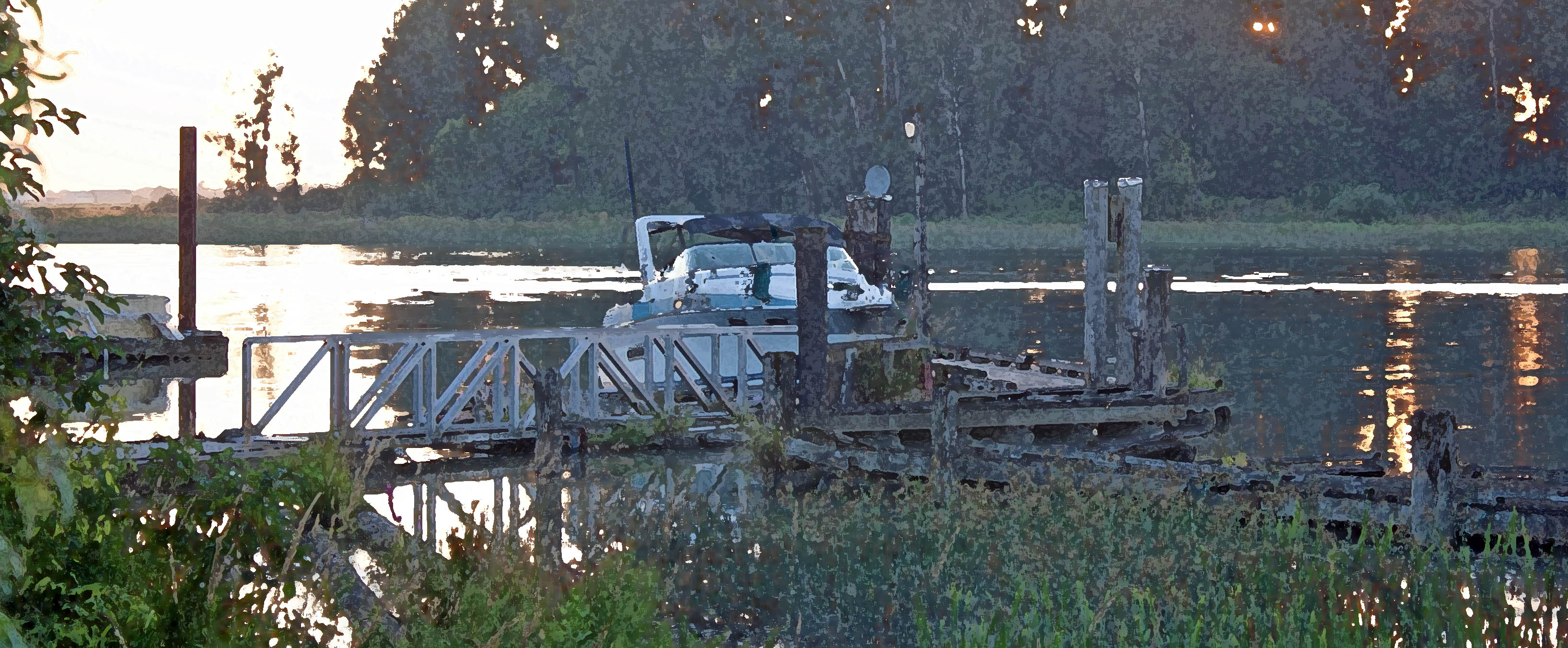
Boat wharf at sunset in Ladner Marsh, BC (photo and rendition by Nina Munteanu)
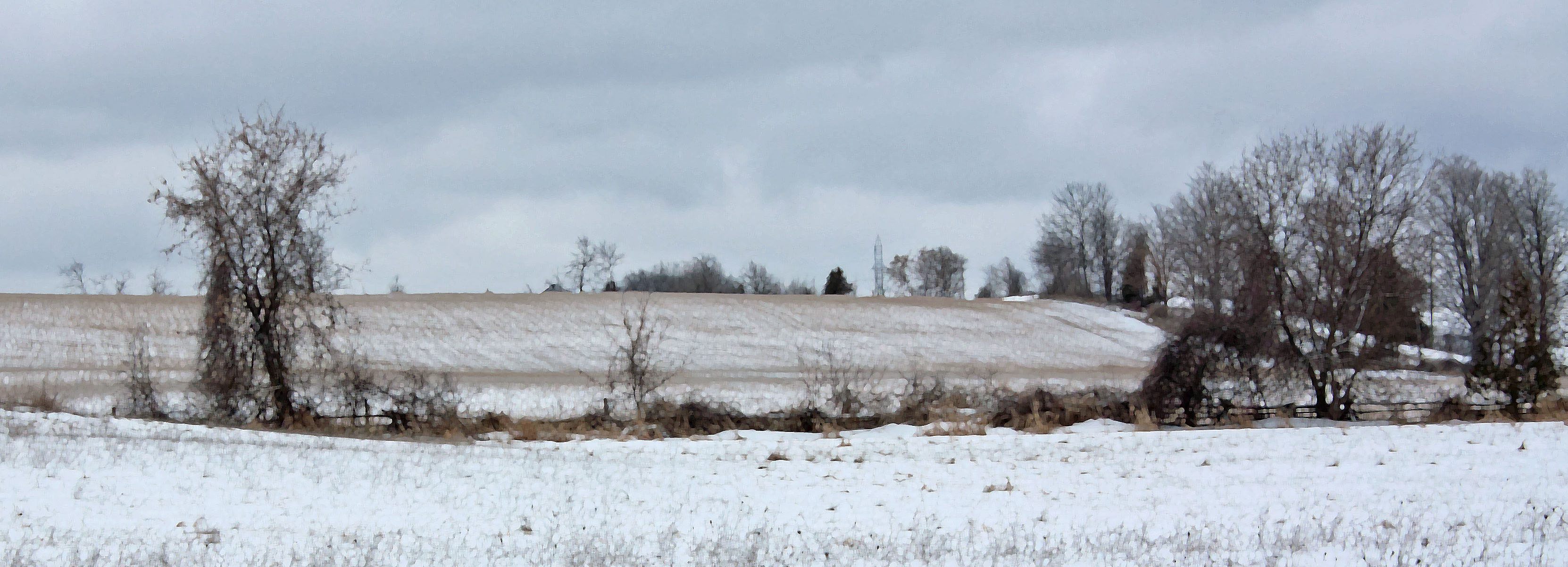
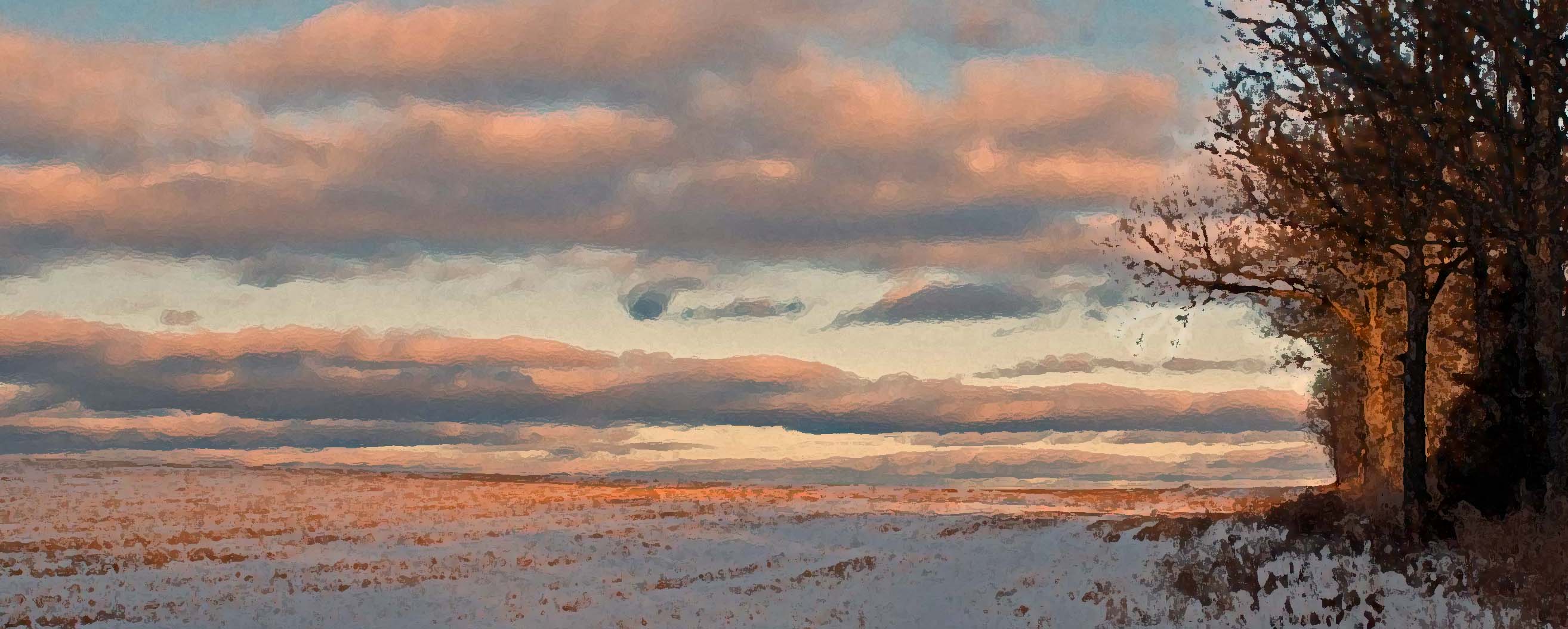
Snow covered farmer’s field at sunset, ON (photo and rendition by Nina Munteanu)
Ice clad prisms, snow covered fields of glittering fire… Winter days, the wondrous glow: ultramarine lights and turning shades The magic song: ice and gently underflow of meandering streams Singing waters on the tortuous pathway below… Clangor, bell sounds: the moving harmonies on icy slopes…
Jackson Creek in winter, ON (photo and rendition by Nina Munteanu)
Ice ‘islands’ touched by sunset light in Jackson Creek, ON (photo and rendition by Nina Munteanu)
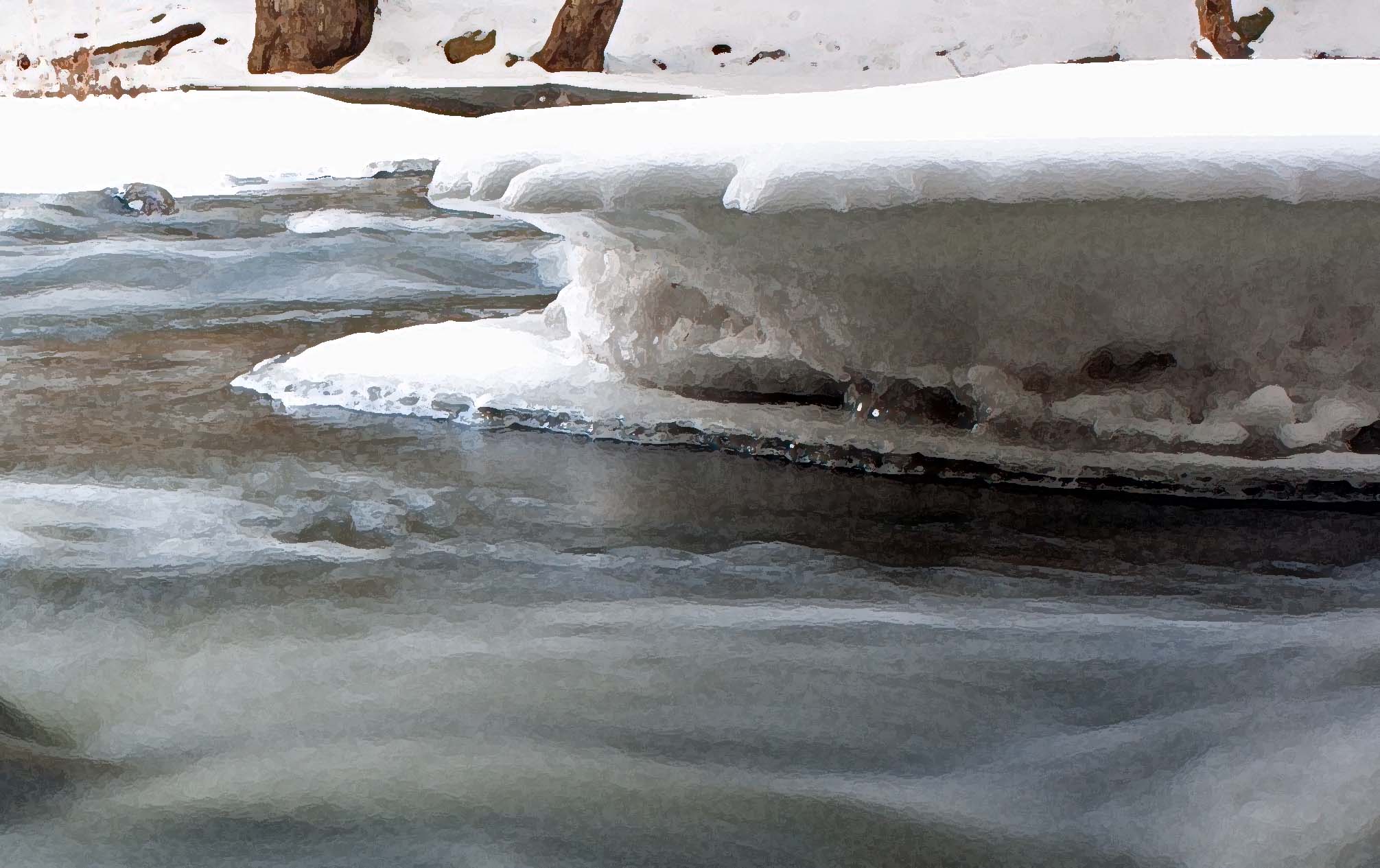
Ice block in Jackson Creek, ON (photo and rendition by Nina Munteanu)
Farmer’s field in Kawarthas, ON (photo and rendition by Nina Munteanu)
A bronze feathered hawk sails high above Into the bright sunlit skies, Hawk, swiftly carried in its flight above bended fir and aspen forests, A wild, fierce, freewheeling majesty…
Icy bay and shed in the trees, ON (photo and rendition by Nina Munteanu)
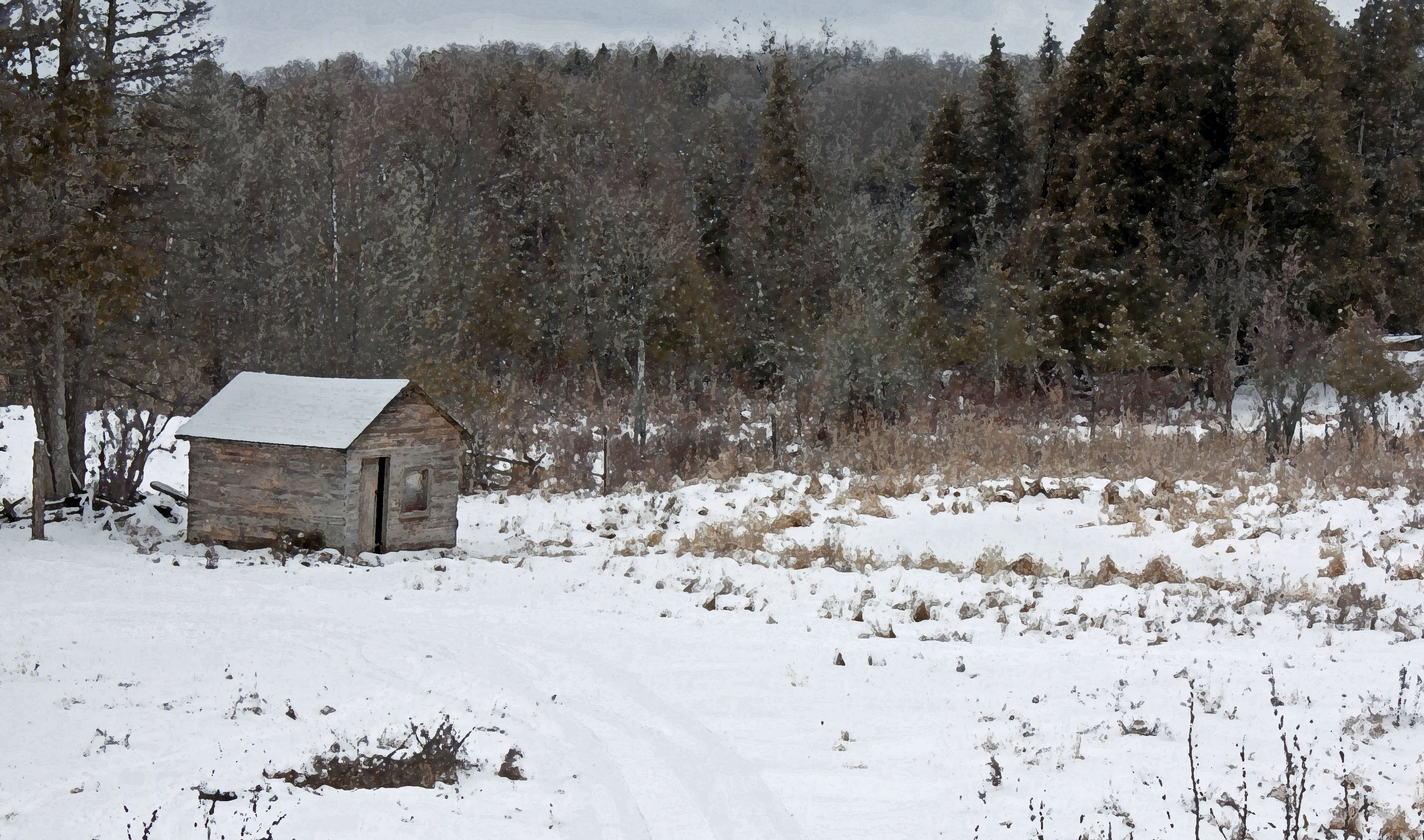
Small cabin in a meadow, ON (photo and rendition by Nina Munteanu)
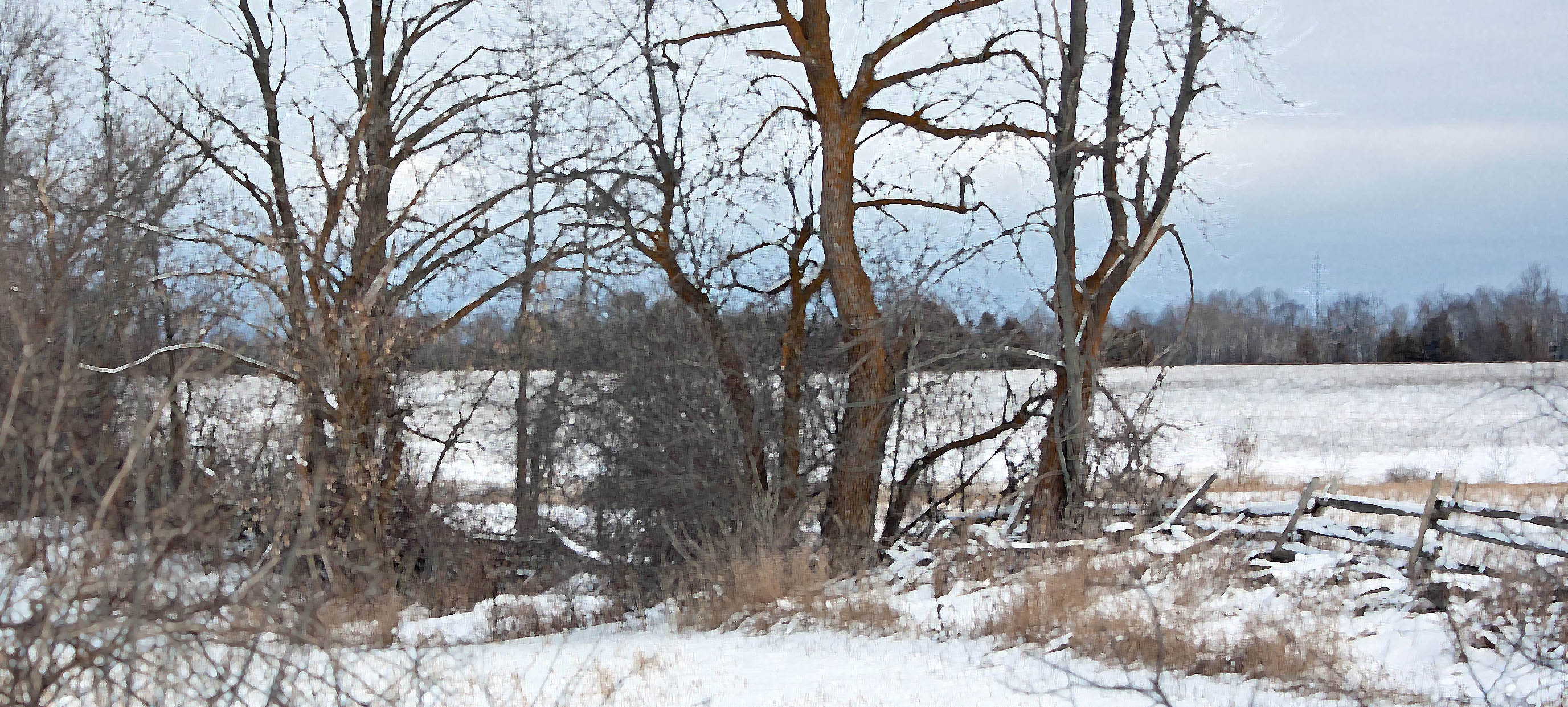
Trees by fence in farmer’s field, ON (photo and rendition by Nina Munteanu)
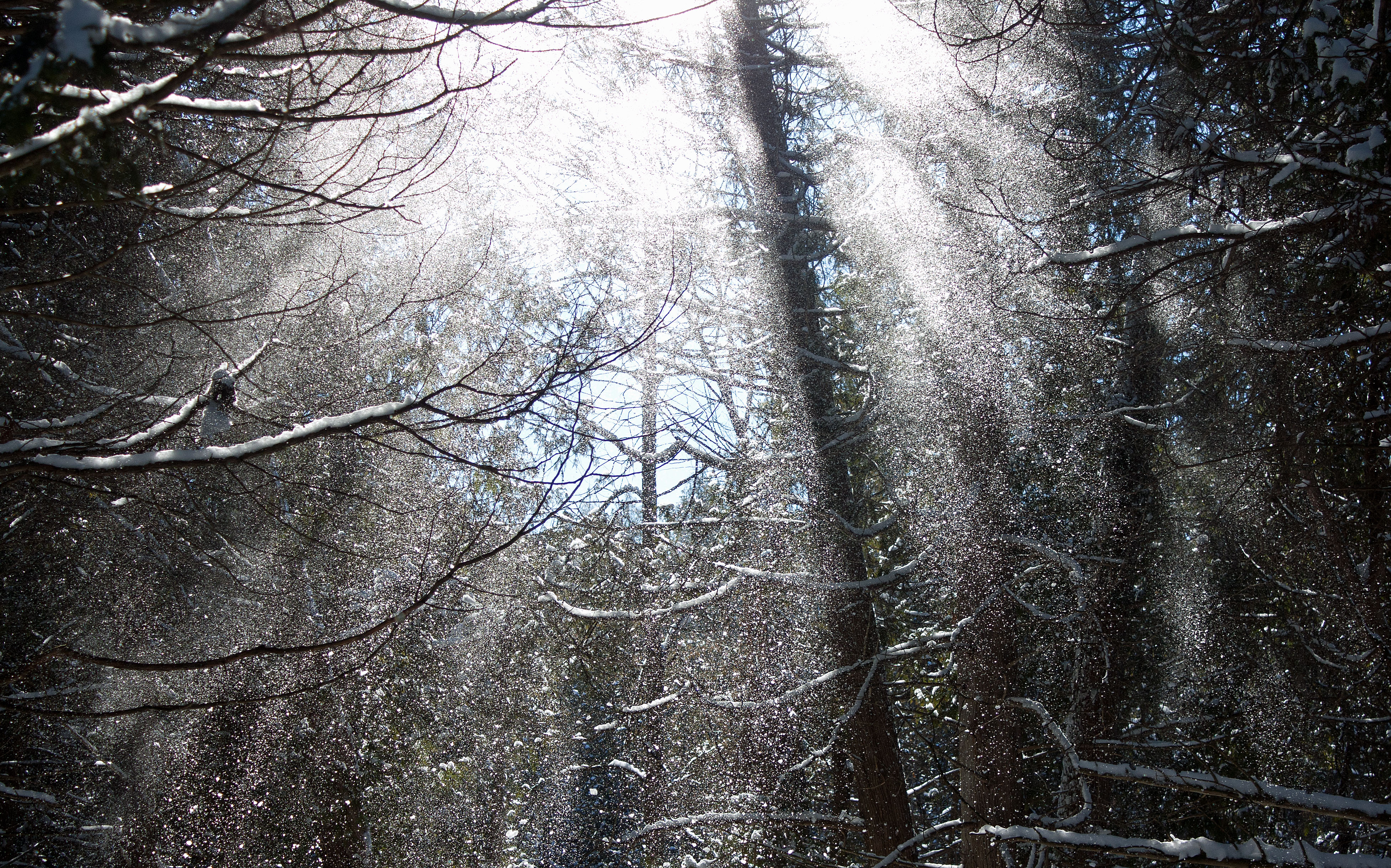
Snow from a cedar tree showers down glitter-dust in a light breeze in Jackson Creek Park, ON (photo by Nina Munteanu)
The many pristine snow reflected lights, glittering fires Above a snow clad world in a time of darkness: Nature’s magic universe everywhere extant: We are overwhelmed, confounded by the wonder of it all.
Skier checks his path on a slope at sunset, BC (photo by Lindsay)
Snow glistening in the sunset on a very cold day, ON (photo and rendition by Nina Munteanu)
Reflections in Thompson Creek outlet after a new snowfall, ON (photo and rendition by Nina Munteanu)
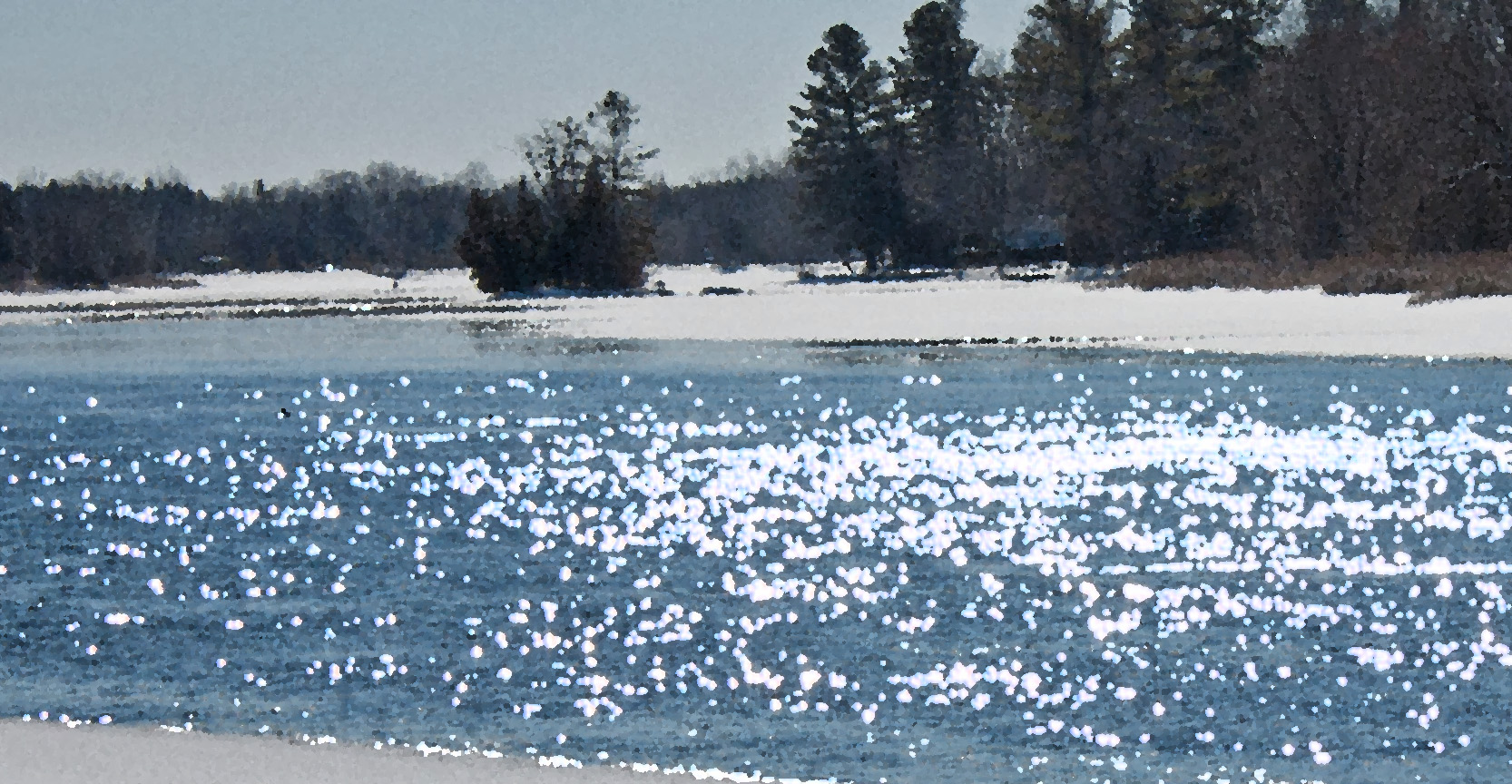
Otonabee River glittering in the sun, ON (photo and rendition by Nina Munteanu)
Bev Gorbet is a Toronto poet. She has published several poems with the Retired Teachers Organization and most recently in “Literary Connection IV: Then and Now” (In Our Words Inc., 2019), edited by Cheryl Antao Xavier.
Nina Munteanu is a Canadian ecologist / limnologist and novelist. She is co-editor of Europa SF and currently teaches writing courses at George Brown College and the University of Toronto. Visit www.ninamunteanu.ca for the latest on her books. Nina’s bilingual “La natura dell’acqua / The Way of Water” was published by Mincione Edizioni in Rome. Her non-fiction book “Water Is…” by Pixl Press(Vancouver) was selected by Margaret Atwood in the New York Times‘Year in Reading’ and was chosen as the 2017 Summer Read by Water Canada. Her novel “A Diary in the Age of Water” was released by Inanna Publications (Toronto) in June 2020.
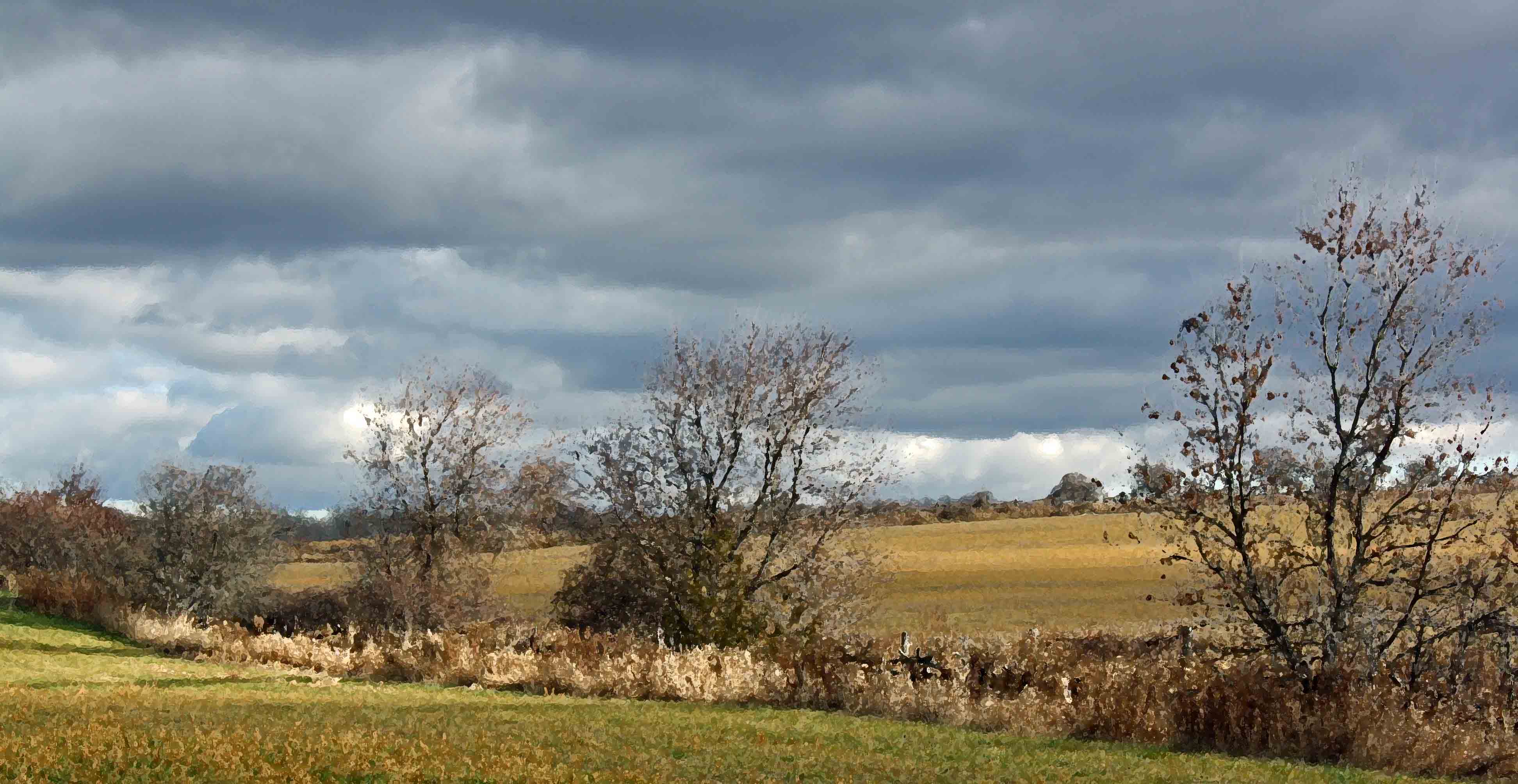
Farmer’s field at sunset in early winter, ON (photo and rendition by Nina Munteanu)
Oh! to wander the fields wild and free, To commune with wild nature, Her beauty everywhere extant.
Small country road in Ontario (photo and rendition by Nina Munteanu)
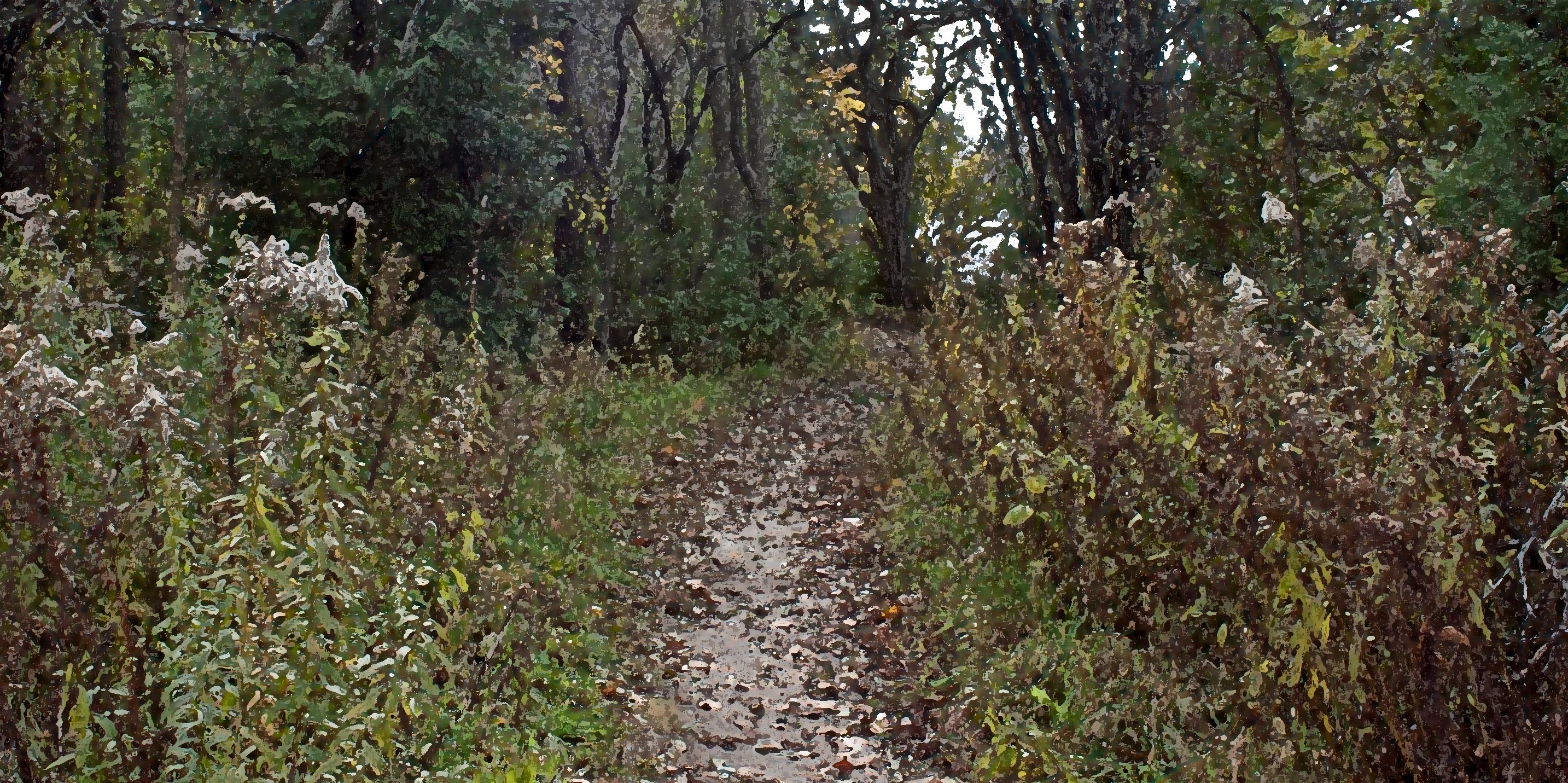
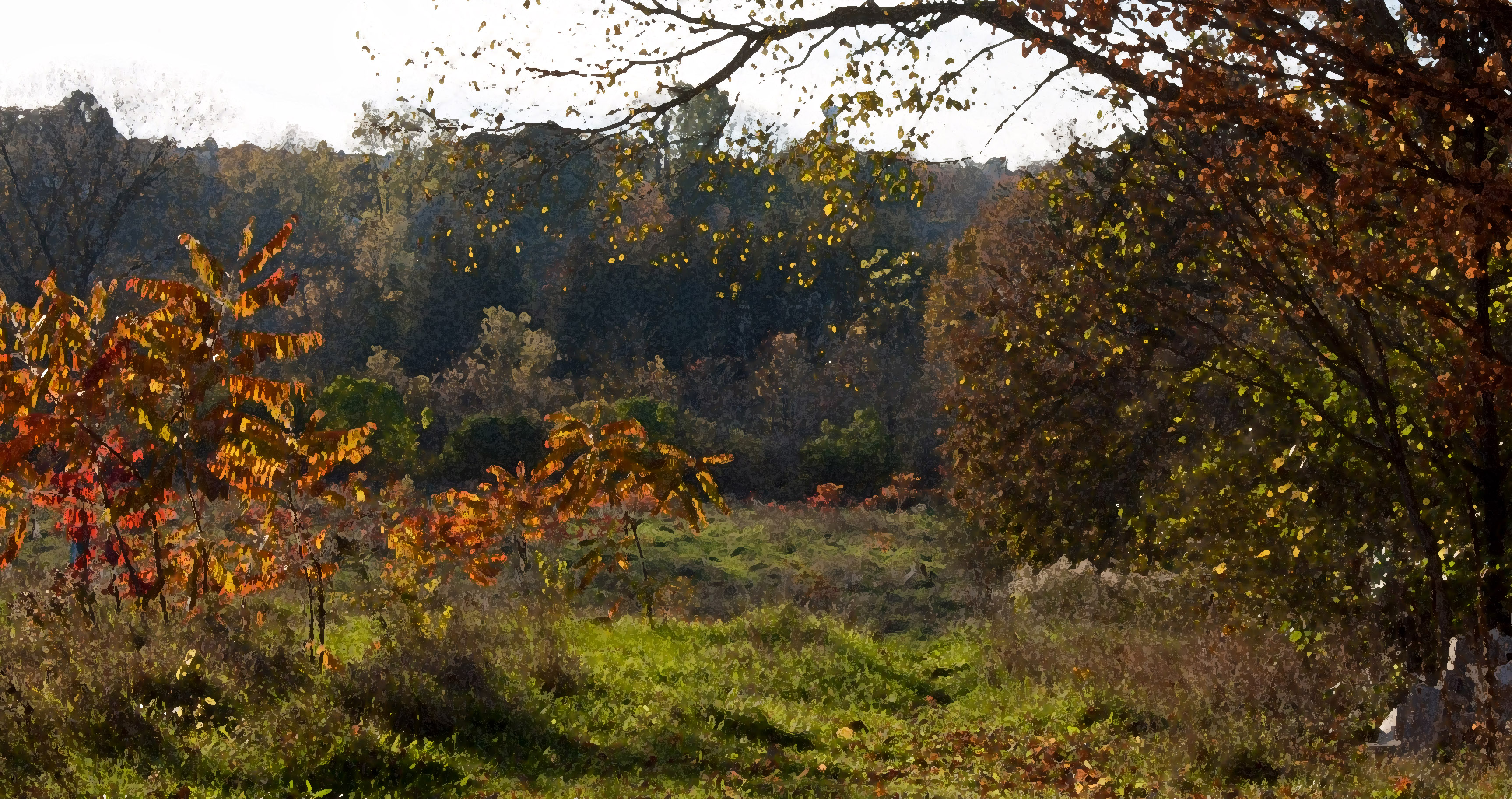
Path through meadow of goldenrod in fall, ON (photo and rendition by Nina Munteanu)
Tender lullabye and song in forested glade, A still peace this sacred moment: The profound silence: holy echo of dream, every hope; Melodies of heart and soul; Rhythms, memory and wonder in a windrift calm, Tree and bough, moment of a joyous uplift
Field in early spring fog in Ontario (photo and rendition by Nina Munteanu)
Meadow in fall in Peterborough, ON (photo and rendition by Nina Munteanu)
Forested cathedrals, great songs of heart and mind, All the majesty: a windstorm day in fierce call and cry Whisper and sigh midst far tossed leaf and bough… Promise and a grace filled endurance All the beauty flame interior universes: A captive soul set free.
Path through meadow alvar, ON (photo and rendition by Nina Munteanu)
Path through farm country, ON (photo and rendition by Nina Munteanu)
Fields in the Kawarthas, ON (photo and rendition by Nina Munteanu)
NINA MUNTEANU is a Canadian ecologist / limnologist and novelist. She is co-editor of Europa SF and currently teaches writing courses at George Brown College and the University of Toronto. Visit www.ninamunteanu.ca for the latest on her books. Nina’s bilingual “La natura dell’acqua / The Way of Water” was published by Mincione Edizioni in Rome. Her non-fiction book “Water Is…” by Pixl Press(Vancouver) was selected by Margaret Atwood in the New York Times ‘Year in Reading’ and was chosen as the 2017 Summer Read by Water Canada. Her novel “A Diary in the Age of Water” was released by Inanna Publications (Toronto) in June 2020.
Snow glitter rains down from cedar tree on a sunny day after a major snowfall, ON (photo by Nina Munteanu)
Bright lit: the great cedar forest, Cathedral dome skies bright sunlit above… All of a fulgent blue, all of an azure glow… Everywhere, the peace of a radiant sunlight
Pine tree with snow glitter behind in Jackson Creek Park, ON (photo and rendition by Nina Munteanu)
Worlds of magic and a most sacred light Bright sunlit day, bright shafts Through a portico of treetops high above The trees reaching so very high, Deep into the sheltering skies
Snow-covered Buckthorn with path through a snowy meadow, ON (photo and rendition by Nina Munteanu)
Snow decked branch and bough: gently swaying memory; Movement into the swaying winter winds The gentle whispers, the gentle sighs The treetops, Their song, their gentle touch, their toss, their glide
Snow dust falls in a cedar forest, ON (photo by Nina Munteanu)
A deepest silence, a most profound contemplation Midst snowdrift and snowlit mists as they shift Between icy branch and snow covered green bough
Dust of snow and cedar lights: All the ethereal wonders of a snowy day, The snow blessed, lost ephemeral lands In a full clothed beauty, snowy wonders: of sunlight, of shadow
Snow-covered shrub on a snowy day, ON (photo and rendition by Nina Munteanu)
Oh! sacred forest, this great beauty of place To overwhelm, to protect, to shelter… Here, a deepest meditation, a deepest circumspection… Snow and ice and all the wonder of a glorious sunlit day All the ephemeral beauty in a winter’s sunlight world.
Snow dust rains down from snow-laden cedar trees in Jackson Creek Park, ON (photo by Nina Munteanu)
Bev Gorbet is a Toronto poet and retired school teacher. She has published several poems with the Retired Teachers Organization and most recently in “Literary Connection IV: Then and Now” (In Our Words Inc., 2019), edited by Cheryl Antao Xavier.
Lady with parasol, reading, walks among lilac bushes, ON (photo and dry brush rendition by Nina Munteanu)
This is the time
When spring turns
All glory…
All golden tulip and lilac flower…
Early birdcall each hedgerow…
The perky robin bouncing along
Midst grassy expanse,
Head cocked, listening, listening…
Young robin rests on patio chair, ON (photo by Merridy Cox)
This is the time,
Nearer summer’s radiant entrance
Onto wild nature’s open stage…
Trillium will soon be here one supposes…
The green mosses resplendent
In the spring rains…
Soon all will be the beauty of roses, of lily
Of fully leaved branch and tree…
Aging White Trillium, ON (photo and dry brush rendition by Nina Munteanu)
This is the time
The world is in full bloom
Everywhere a glorious sunlit sky
Azure recall and dream…
And oh! so soon!
All the great beauty each full summer’s day…
Time of a greatest awe,
Time of a magnificent reflection,
All of joy, all of wonder…
Lilac bush at Joshua Creek, ON (photo and dry brush rendition by Nina Munteanu)
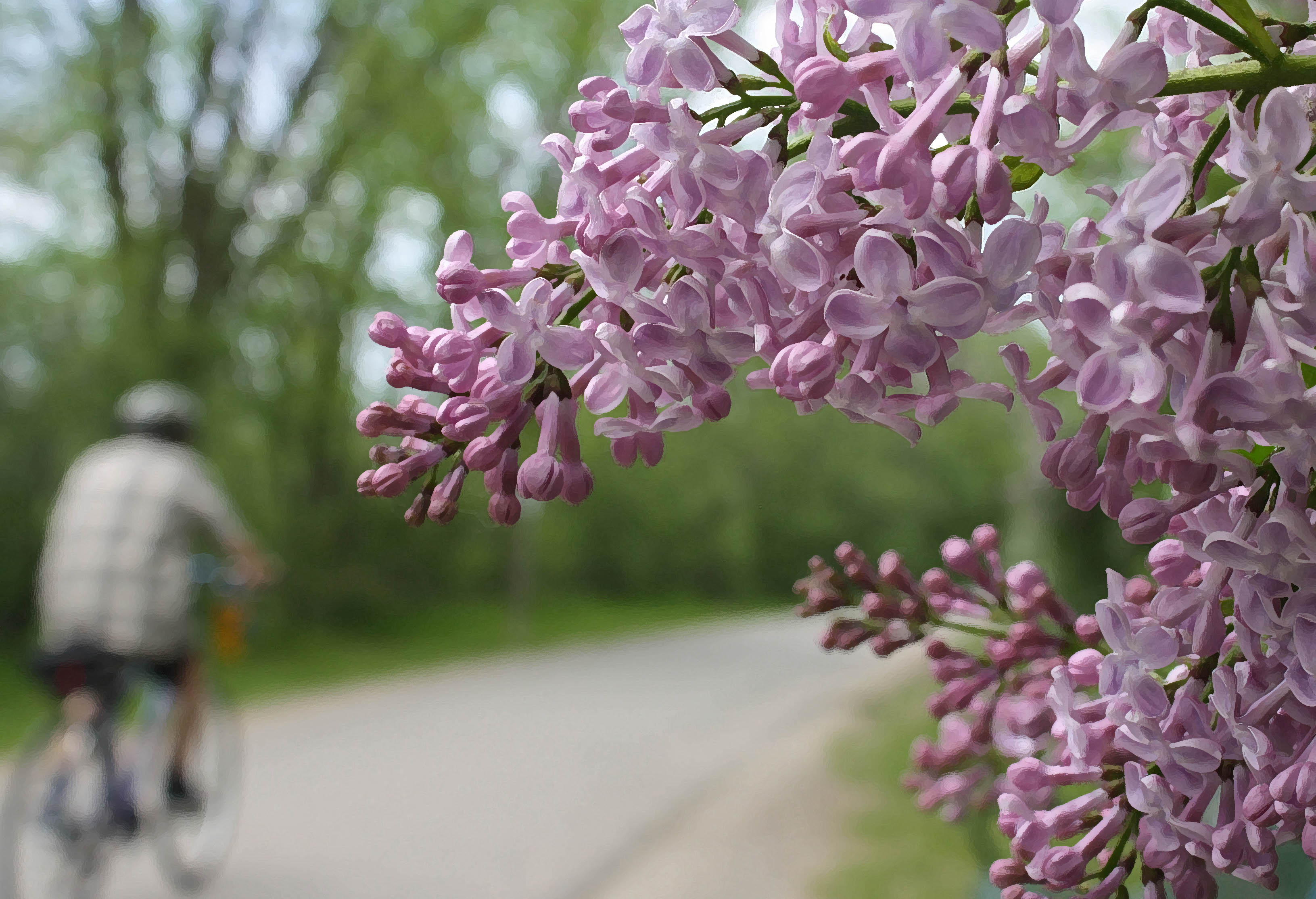
Lilac bushes line the Rotary Trail in Peterborough, ON (photo and dry brush rendition by Nina Munteanu)
Lilacs in a field in Ontario (photo and dry brush rendition by Nina Munteanu)
Bev Gorbet is a Toronto poet. She has published several poems with the Retired Teachers Organization and most recently in “Literary Connection IV: Then and Now” (In Our Words Inc., 2019), edited by Cheryl Antao Xavier.
Nina Munteanu is a Canadian ecologist / limnologist and novelist. She is co-editor of Europa SF and currently teaches writing courses at George Brown College and the University of Toronto. Visit www.ninamunteanu.ca for the latest on her books. Nina’s bilingual “La natura dell’acqua / The Way of Water” was published by Mincione Edizioni in Rome. Her non-fiction book “Water Is…” by Pixl Press(Vancouver) was selected by Margaret Atwood in the New York Times ‘Year in Reading’ and was chosen as the 2017 Summer Read by Water Canada. Her novel “A Diary in the Age of Water” was released by Inanna Publications (Toronto) in June 2020.
Stream runs through cedar poplar forest in the rain, Trent Nature Sanctuary, ON (photo and dry brush rendition by Nina Munteanu)
Oh! great mysterium: Great forested sanctuary into the heart of being Oh! to walk pensive, in solitude into the center Of a cedar forest, worlds all russet and green, Branch and bough, rain swept landscapes The high treetops, far whisper and echo… The great winds in high flight high above… Songs to pierce the sullen skies, Melodies of joy and of a deepest longing…
Cedars and poplars in a morning mist, Trent Nature Sanctuary, ON (photo by Nina Munteanu)
Songs of immortality, worlds full aflame, Mystic cathedrals and dawn memory, Haze and gray day, silver sky, silver cloud Rain downfall and mist… Leaf, branch and bough, the wind and the rain The bending and wind tossed land
Mist hangs over Trent Canal, Trent Forest Sanctuary, ON (photo by Nina Munteanu)
The spring scents, spring grasses and nearby stream; Rivulet and rhapsodic song, The holy silences, the rain, fall, hiss and far echo… Cedar forest cathedrals, branches overspread, Red winged blackbird, soaring alone high above, High into the receiving dome of haze and sky Free swoop and whispering forest airs
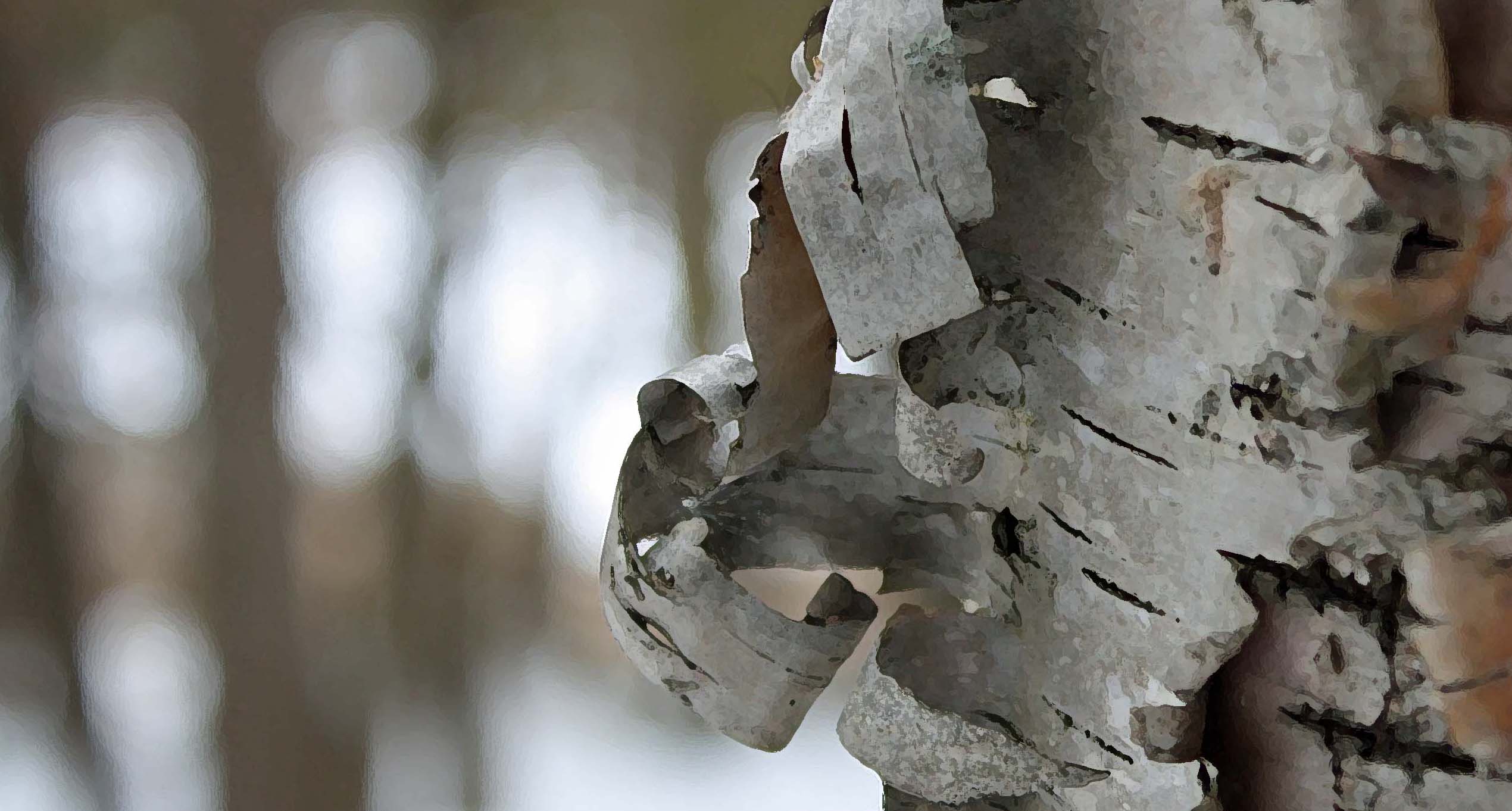
White birch in Trent Nature Sanctuary, ON (photo and dry brush rendition by Nina Munteanu)
The far meditation: Sacred journey into a holy wilderness: Forested worlds beyond time…
Cedar root among ferns and moss in a light mist, Trent Nature Sanctuary (photo by Nina Munteanu)
Forested worlds of an existential beauty, Great moss silences, tree root and bough… Great worlds of hope and the tenebrous shadow Of a rain swept day… Holy encounters: the great mysterium Sacred worlds beyond still time…
BEV GORBET
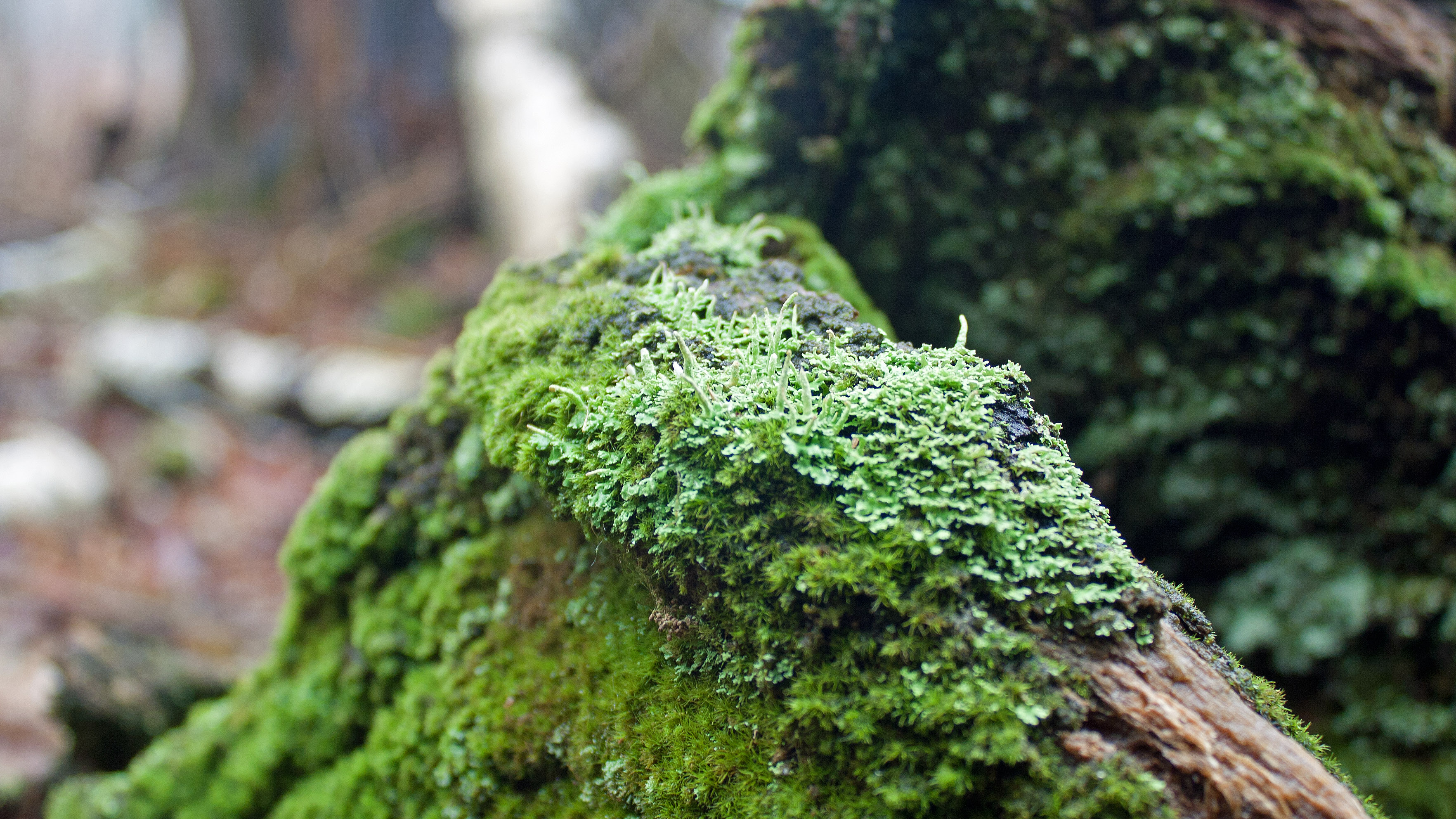
Moss and lichen cover an old cedar log, Trent Nature Sanctuary, ON (photo by Nina Munteanu)
Tinder polypore fungus on white birch, Trent Nature Sanctuary, ON (photo and dry brush rendition by Nina Munteanu)
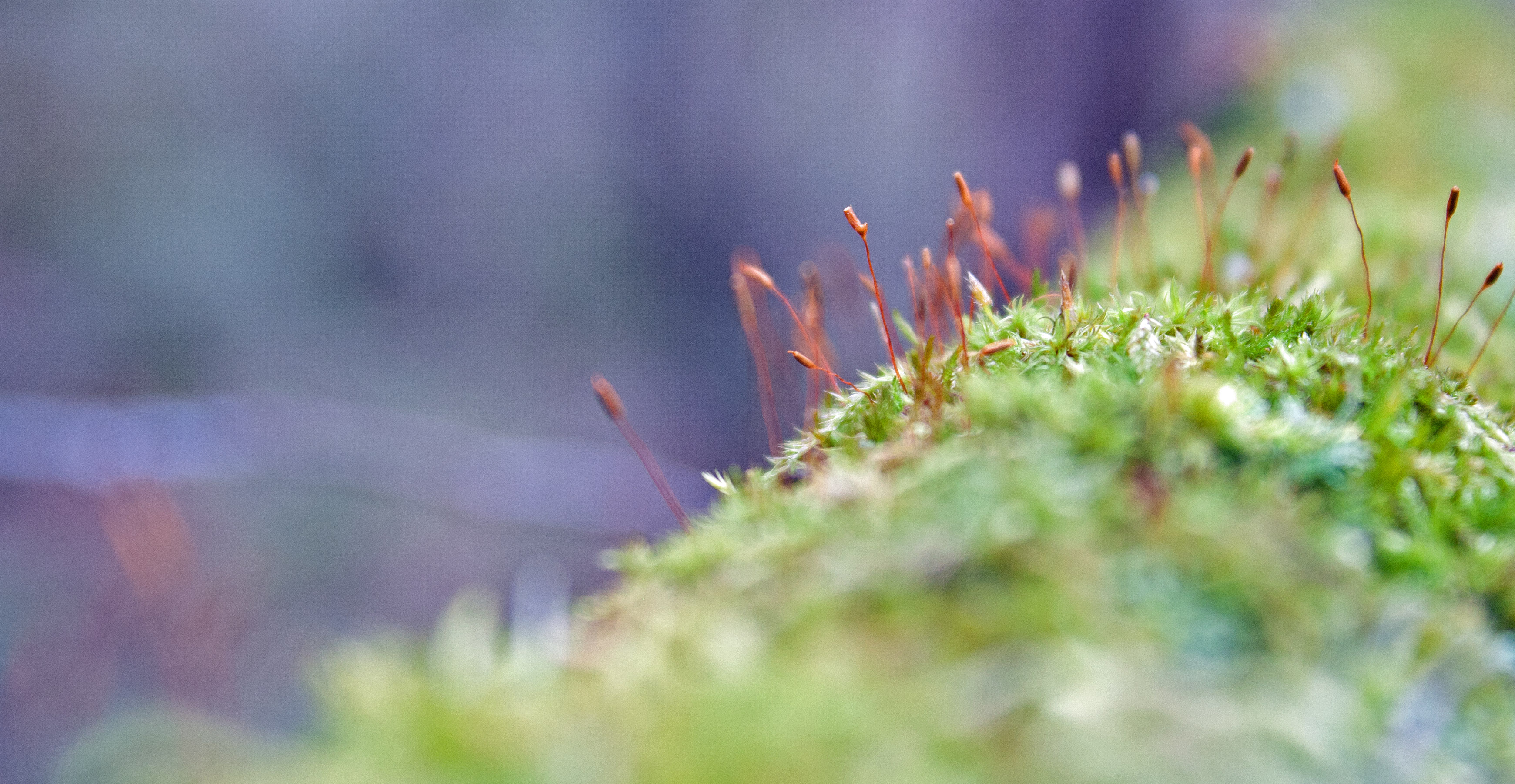
Moss on a log in Trent Nature Sanctuary, ON (photo by Nina Munteanu)
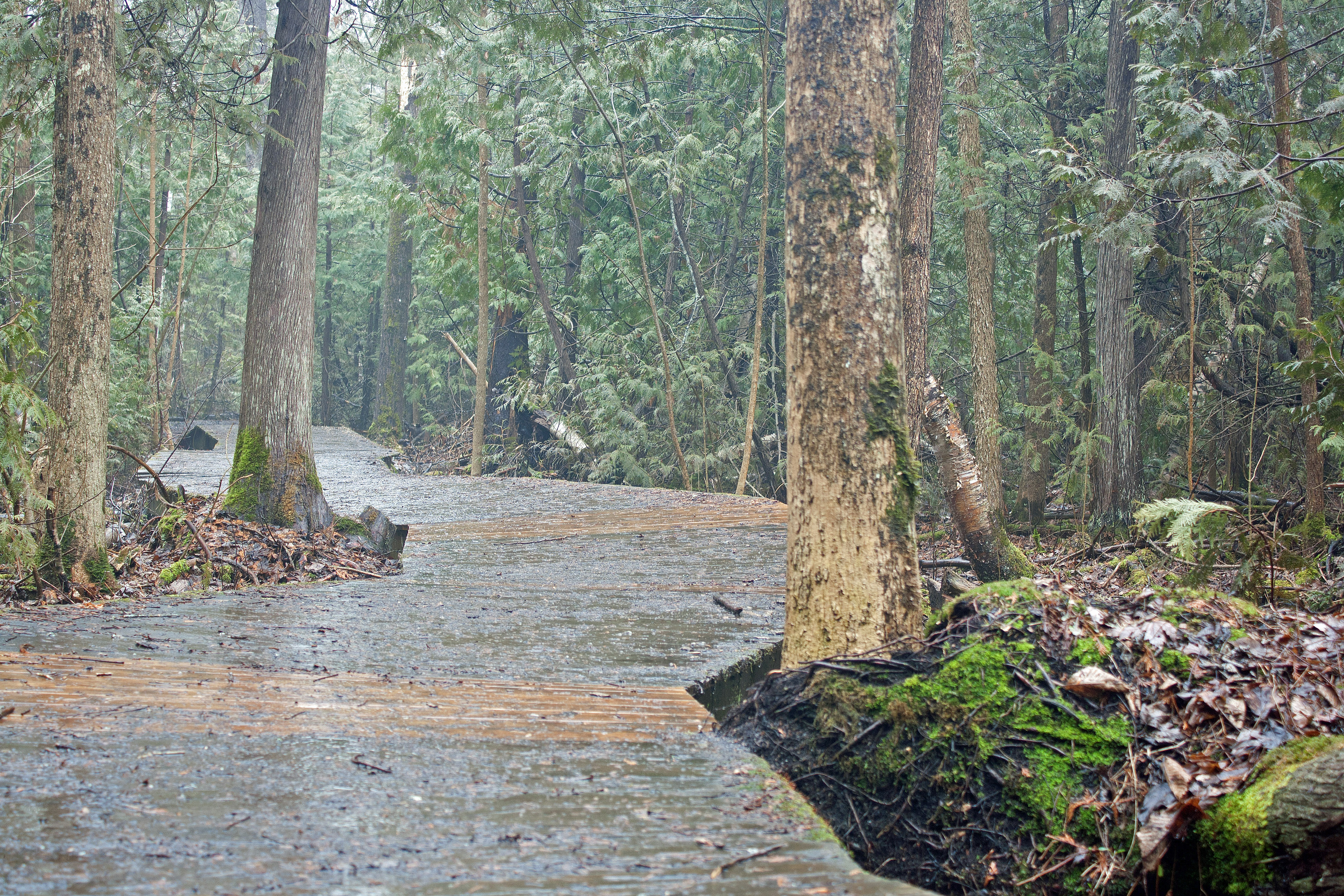
Cedar boardwalk in a misty rain, Trent Nature Sanctuary, ON (photo by Nina Munteanu)
Nina Munteanu is a Canadian ecologist / limnologist and novelist. She is co-editor of Europa SF and currently teaches writing courses at George Brown College and the University of Toronto. Visit www.ninamunteanu.ca for the latest on her books. Nina’s bilingual “La natura dell’acqua / The Way of Water” was published by Mincione Edizioni in Rome. Her non-fiction book “Water Is…” by Pixl Press(Vancouver) was selected by Margaret Atwood in the New York Times‘Year in Reading’ and was chosen as the 2017 Summer Read by Water Canada. Her novel “A Diary in the Age of Water” was released by Inanna Publications (Toronto) in June 2020.
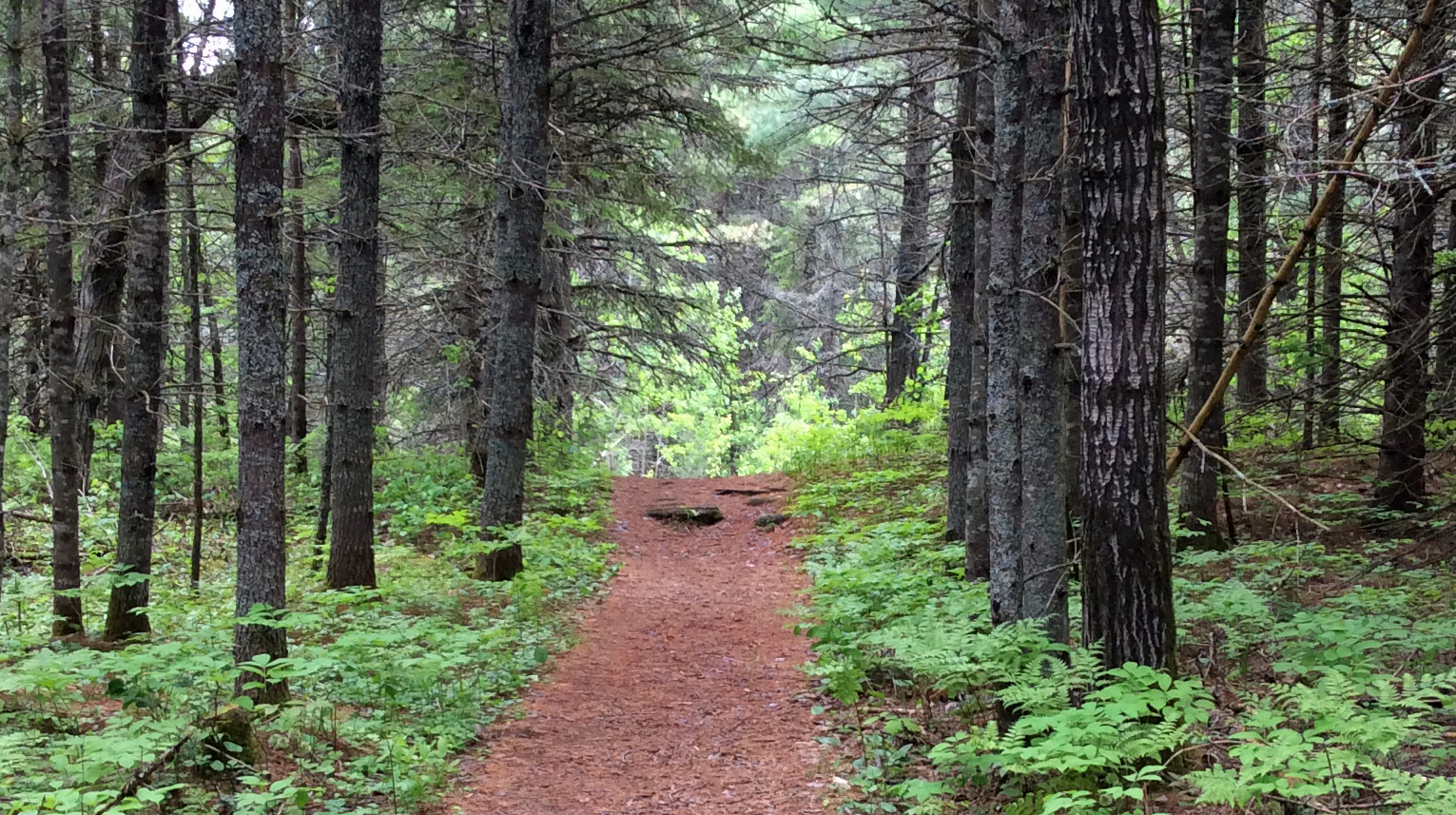
Trail through mixed birch-pine forest at Petroglyph Park, ON (photo by Nina Munteanu)
Since moving temporarily to Peterborough during COVID-19, I have been on an adventure with Nature in the Kawartha region, north of Toronto. The region contains a chain of lakes that form the upper watershed of the Trent River; the lakes are situated on the boundary between the Paleozoic limestone region of the Golden Horseshoe and the Precambrian granite Canadian Shield of northern and central Ontario.
I’ve explored several local parks and lakes with wonderful swamp cedar on the Otonabee River and Jackson Creek and uphill beech-maple forest in the Trent Nature Sanctuary.
Farther afield, I wandered through the pine forests of Petroglyph Park, north of Peterborough, with its intriguing meromictic McGinnis Lake.
When I shared some of my Petroglyph Park photos with Toronto poet and friend Bev Gorbet, she was inspired to write this poem. I am overjoyed to share her ekphrastic poem with you here:
Trail through pine forest, Petroglyph Park, ON (photo by Nina Munteanu)
To the Mystic Forest: Reflections on Natural Beauty
Forests of the mind, wild forests of the heart…
The ethereal sounds: windstorm and echo
On a spring day…
The wind’s fierce flight through bended bough,
Through swaying treetop
High high above, the windswept call, the cry,
All the beauty in a wilderness forest…
The whispering grasses, below,
Song all bend, all flow in a cathedral clearing…
Aging white trillium, Petroglyph Park, ON (photo by Nina Munteanu)
Radiant beams, sunlight and shadow peppering
The moving boughs overhead…
Azure and lavender, sky-swept cloud
And mystic glow…
Oh! great forests of the mind,
Great forest of the heart…
A deepest beauty along an existential meridian:
The heart passionately centred, deeply into reflection:
Haunted days and alone
Wind call and cry, whisper and sigh
Great wilderness lands, wide forested plains
All the wondrous beauty, all the holy mystery:
Windswept, wind-tossed skies, the great forests
Mystery glorious, mystic days beyond time.
Bev Gorbet, June 2020
Bev Gorbet is a Toronto poet and retired school teacher. She has published several poems with the Retired Teachers Organization and most recently in “Literary Connection IV: Then and Now” (In Our Words Inc., 2019), edited by Cheryl Antao Xavier.
Petroglyph Park pine forest trail (artwork by Nina Munteanu)
Nina Munteanu is a Canadian ecologist / limnologist and novelist. She is co-editor of Europa SF and currently teaches writing courses at George Brown College and the University of Toronto. Visit www.ninamunteanu.ca for the latest on her books. Nina’s bilingual “La natura dell’acqua / The Way of Water” was published by Mincione Edizioni in Rome. Her non-fiction book “Water Is…” by Pixl Press (Vancouver) was selected by Margaret Atwood in the New York Times ‘Year in Reading’ and was chosen as the 2017 Summer Read by Water Canada. Her novel “A Diary in the Age of Water” was released by Inanna Publications (Toronto) in June 2020.
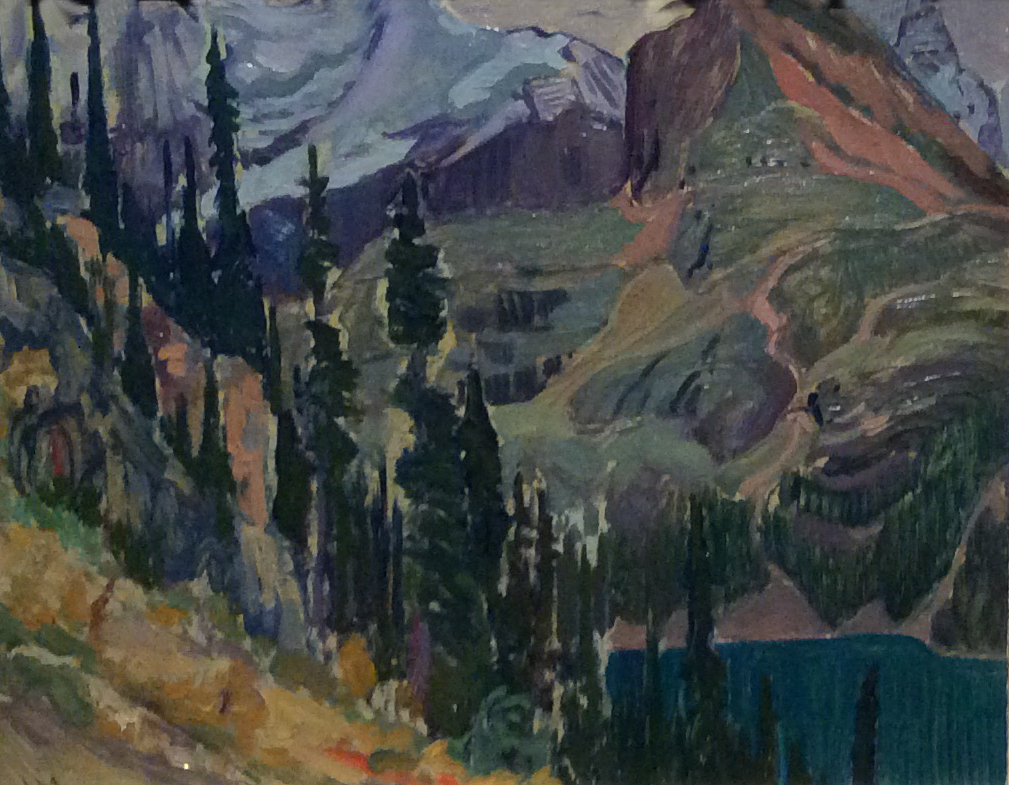
2020 marks the centenary of the formation of the Canadian iconic Group of Seven artists. The Group of Seven movement “dragged Canadian art into the modern age,” writes Christine Sismondo of The Toronto Star in her review of “The Group of Seven Reimagined,” an ekphrastic celebration of the Group of Seven by twenty-one flash fiction authors (including my own “Alien Landscape” inspired by J.E.H. MacDonald’s Lake O’Hara). Sismondo astutely identifies and encapsulates the resonant meaning of the Group of Seven, then and now:
“A hundred years ago, seven Canadian painters got together and decided to start a movement. It was born out of the horrors of war. Now, the potential horrors of climate change are giving the movement an unexpected new life and meaning.”
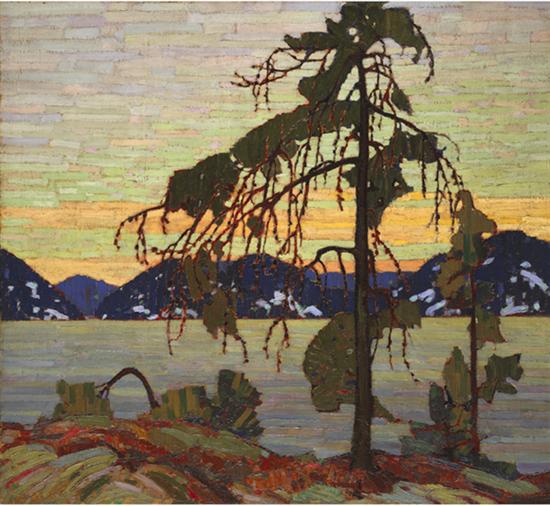
Jack Pine by Tom Thomson
Sismondo goes on to describe how the movement itself took form:
“At the time, people were trying to put the horrors and sacrifices of the Great War behind them and look to the future to reimagine and redefine Canada itself. It was a pivotal moment, given the role the country had recently played in international affairs and the challenges it faced in becoming an increasingly modern nation. These seven artists—friends and colleagues, many of whom worked together in a Toronto design firm—felt they could help shape this conversation with bold strokes and bright colours to bring out the beauty of the Canadian landscape.”
But in those early days—and more than thirty years after Van Gogh painted Starry Night, Canada still wasn’t ready for Impressionism, or any other art form whose roots came from that movement. Canadian critics disliked the Group of Seven. They were too modern, too experimental. The Group were dismissed as “the Hot Mush School” “a horrible bunch of junk” “the figments of a drunkard’s dream” and “daubing by immature children.”
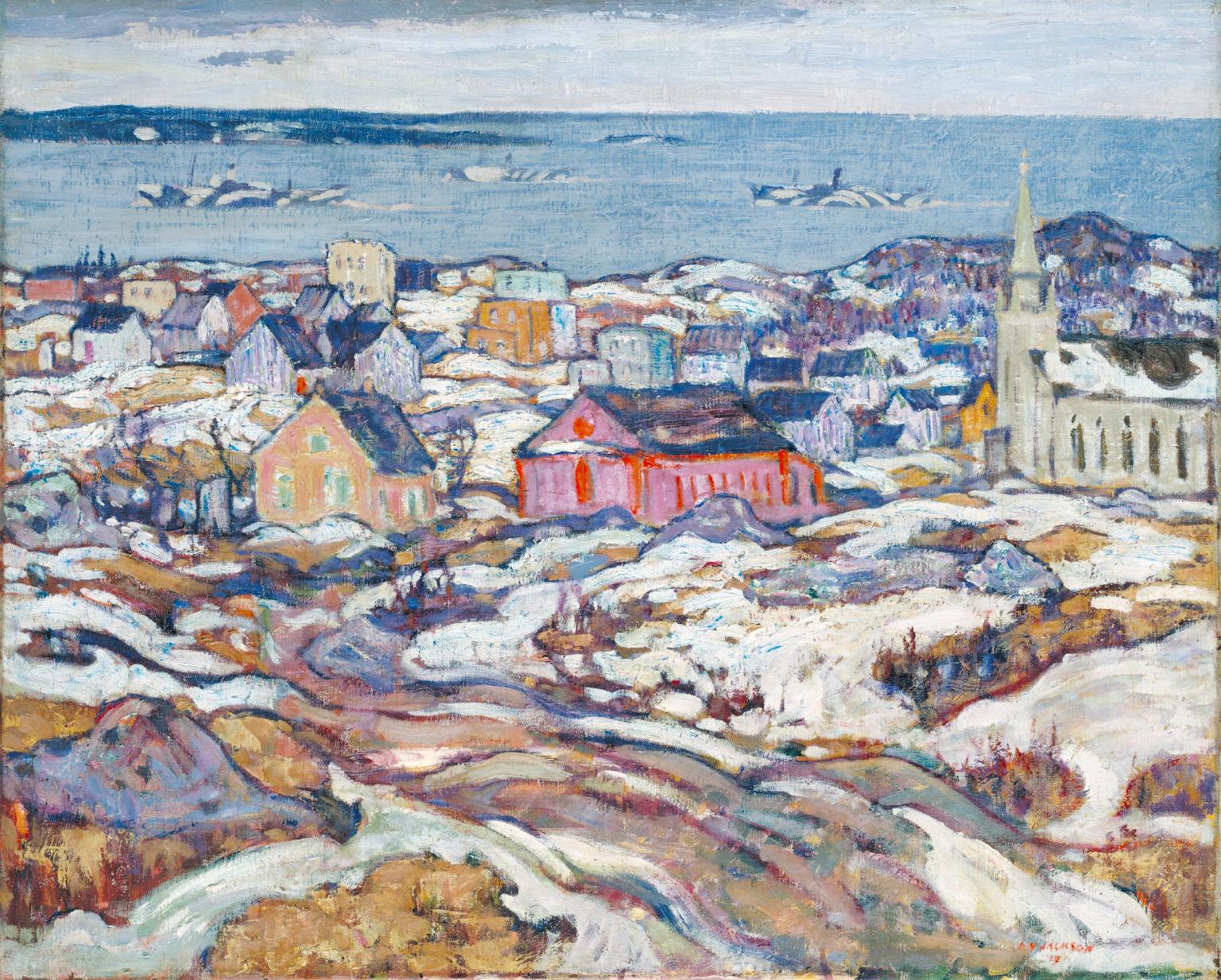
“The reviews by Canadian critics were harsh. The Toronto Daily Star compared Jackson’s work to “a spilt can of paint.” But the English critics loved it. The Morning Post called the Group of Seven “the foundation of what may become one of the greatest schools of landscape painting.” One piece of Canadian art was even sold during the British Empire Exhibition — and it was Jackson’s. Entrance To Halifax Harbour was bought by the Tate Gallery. It’s still part of their collection today.”
“And despite the poor Canadian reviews, the show in London helped to establish the Group of Seven’s reputation back home. Now that the British took the Group seriously, Canadian collectors started taking them seriously, too. The Group even used the bad press to promote their upcoming shows: they printed posters with the angry Canadian reviews side by side with the glowing English ones.”
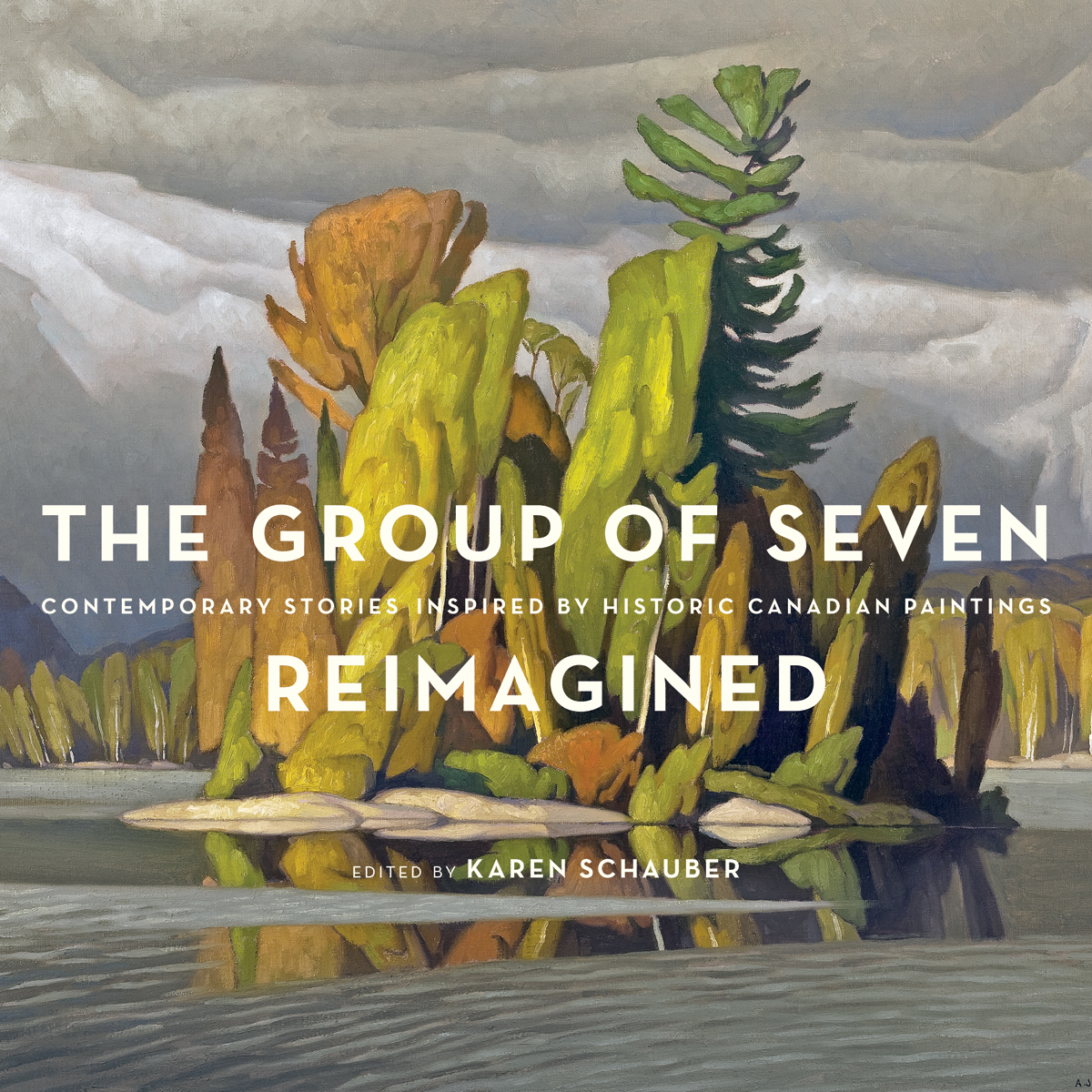
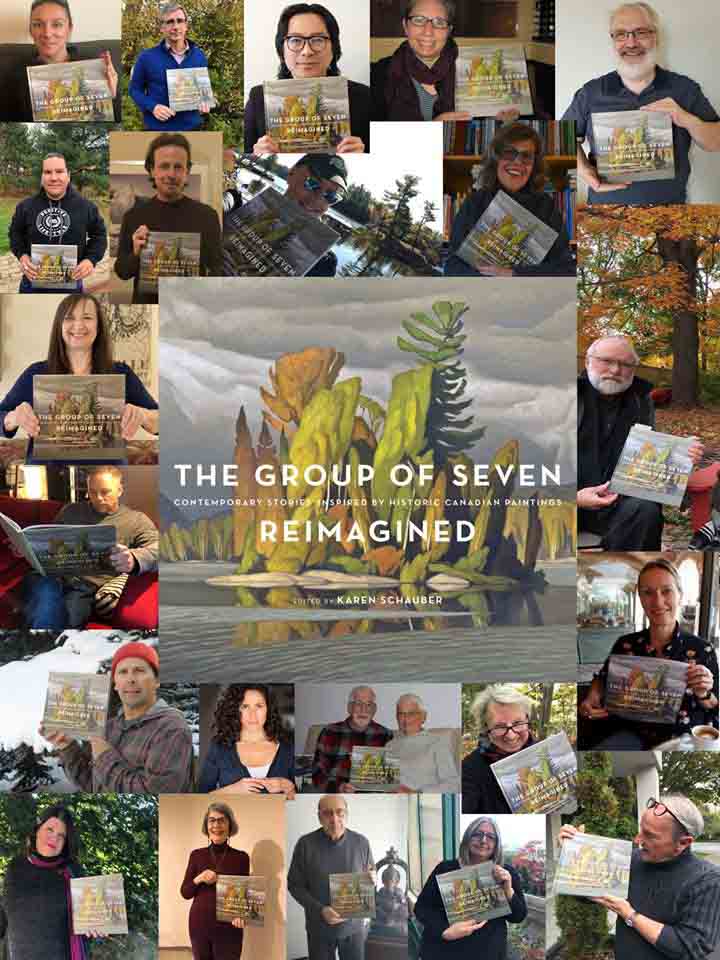
The Group of Seven Reimagined, published by Heritage House, was elegantly edited by flash fiction author Karen Schauber. Karen had invited me to contribute a piece of flash fiction (a piece of less than 500 words), inspired by a Group of Seven piece I would chose to inspire me. I took my time; this would be the first flash fiction piece I would write. It was an art form I was not familiar with, but was happy to experiment with. But I waited too long to decide and when I finally submitted my first choice for a painting, Karen informed me that it had already been selected by another writer. To my great frustration, this went on for a few pieces.
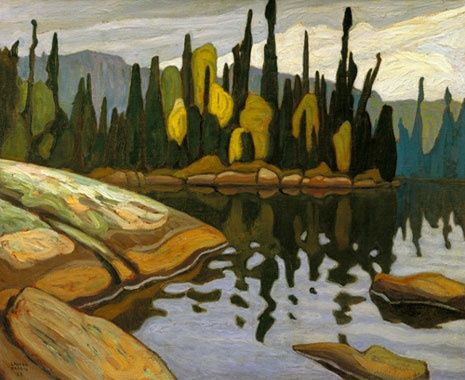
Shore Pattern by A.J. Casson
I finally took a short trip to the McMichael Gallery in Kleinburg to find my piece. In the main hall, I passed the pieces already claimed by my twenty colleagues; I sighed that I had waited so long. By chance, a large selection of artwork by J.E.H. MacDonald—one of the founders of the group—was currently on exhibit on the second floor. That was where I first saw the original oil sketch called Lake O’Hara by MacDonald. It was perfect! My story “Alien Landscape” emerged from the sketch like they had always belonged together.
Lake O’Hara by JEH MacDonald
The Star wrote: “while you might expect a lot of peaceful communing with nature on the page, a surprising number of the written pieces are actually dark tales of conflict and danger—forest fires, mining accidents, boat thieves and murderous plots in the woods. Nina Munteanu, a Canadian ecologist and science-fiction writer, takes J.E.H. MacDonald’s Lake O’Hara in a novel direction in ‘Alien Landscape’ by reimagining it as a refuge for a space heroine fleeing a world that had destroyed nature in pursuit of progress and ended in post-apocalyptic chaos.”
Gift shop at McMichael Gallery
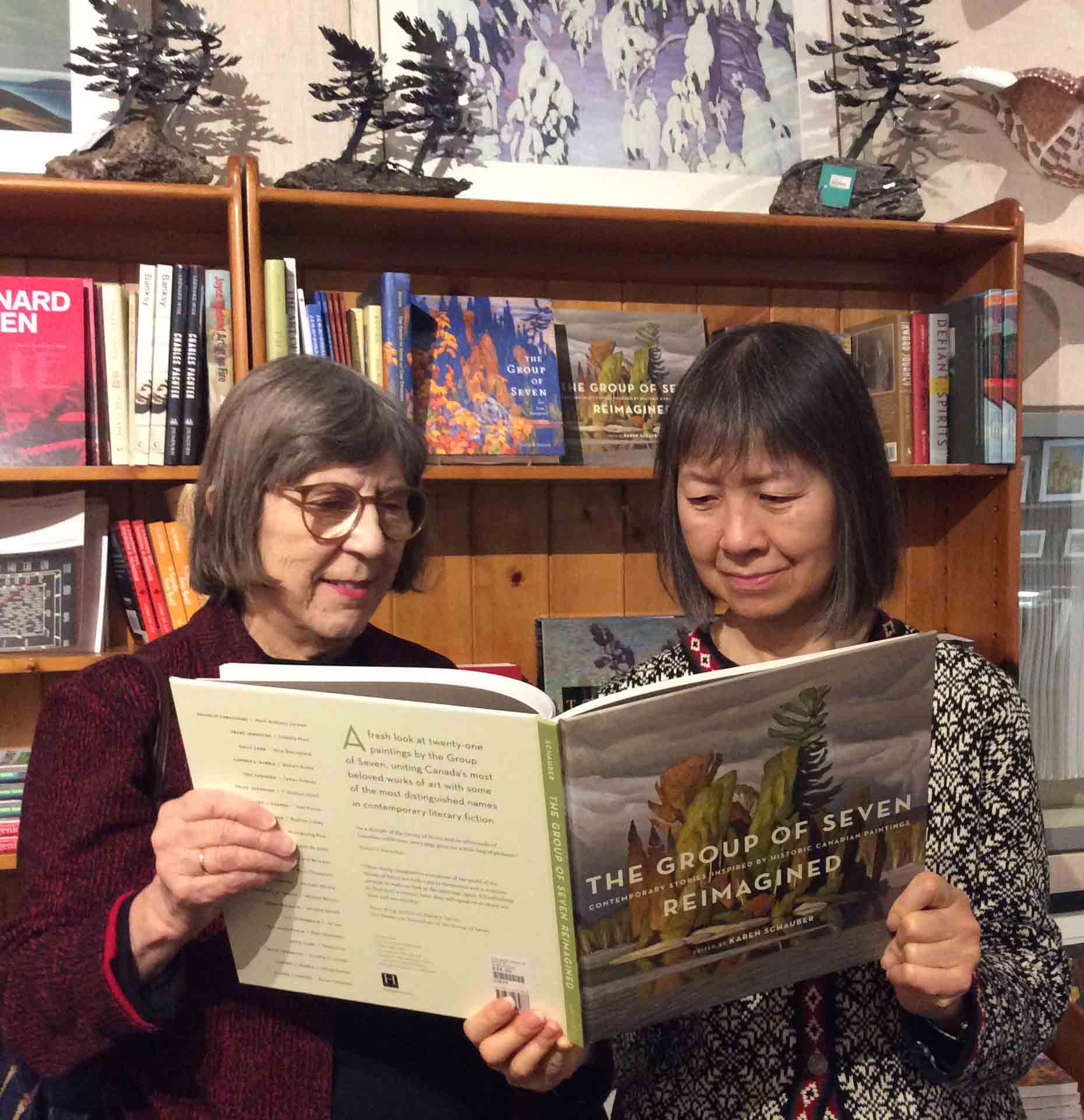
The anthology has found itself gracing the gift shop shelves of several art galleries and museums such as the Royal BC Museum in Victoria, BC, and the McMichael Gallery in Kleinburg. It has likewise received much praise and accolades and appears on several ‘best of’ lists for ekphrastic works, art books, and more.
The anthology was long-listed for The Miramichi Reader’s “The Very Best” Book Award for 2020. The Miramichi Reader writes:
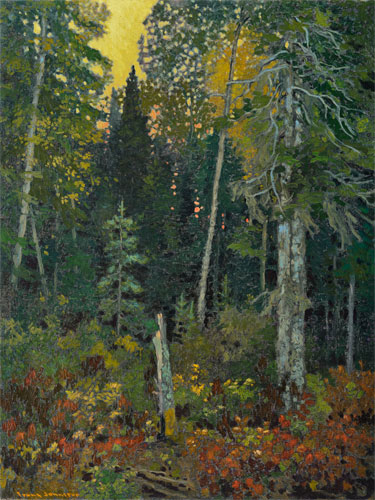
Sunset in the Bush by Frank Johnston
“There’s a very good reason that as I write this, The Group of Seven Reimagined, Contemporary Stories Inspired by Historic Canadian Paintings is sitting at, or near the top of bestseller lists in Canada (currently #3 on the Canadian Art bestseller list at Amazon.ca). The result is a most attractive book that any lover of art and literature would enjoy, even if they already have more than a passing familiarity with the iconic Group of Seven. All the stories that accompany each image are in the “flash fiction” style, just a page or two in length, a little story that the authors were inspired to write after choosing a particular G7 painting.”
Jules Torti of Cottage Life describd the book this way:
“Seeking equilibrium? This book is like a yoga session without the scheduling logistics and hustle to class. Balance is found in The Group of Seven Reimagined both as an intelligent coffee table book and tangible source of meditation.
Authors of the anthology
Twenty-five writers with notable street cred contributed “flash fiction” to colour iconic paintings by the Group of Seven (and their tagalongs). Flash fiction are stories categorized by length—they are 500 words or less which means they allow for one decent, undistracted cup of dark roast or whisky on ice. For writers or artists, the temptation to reimagine these works will be irresistible. And, what an intriguing resolution to make! Fiction and paintings both rely on interpretation and consideration. Fill in the gaps and colours with your chosen or perhaps newly discovered medium (watercolour?). As Jim and Sue Waddington suggest in the foreword, an art gallery visit becomes suspended in time. We keep returning to certain paintings that resonate and haunt and inadvertently, ‘Your mind sets off on a journey.’”
Author and reviewer Patricia Sandberg describes the anthology through metaphor: “Like a fine wine with dinner, some things cry out to be paired. In Reimagined, the nearly hundred-year-old brandy that was the Group of Seven is introduced to a fresh vibrant cuisine that is flash fiction, and both are the richer for it.”
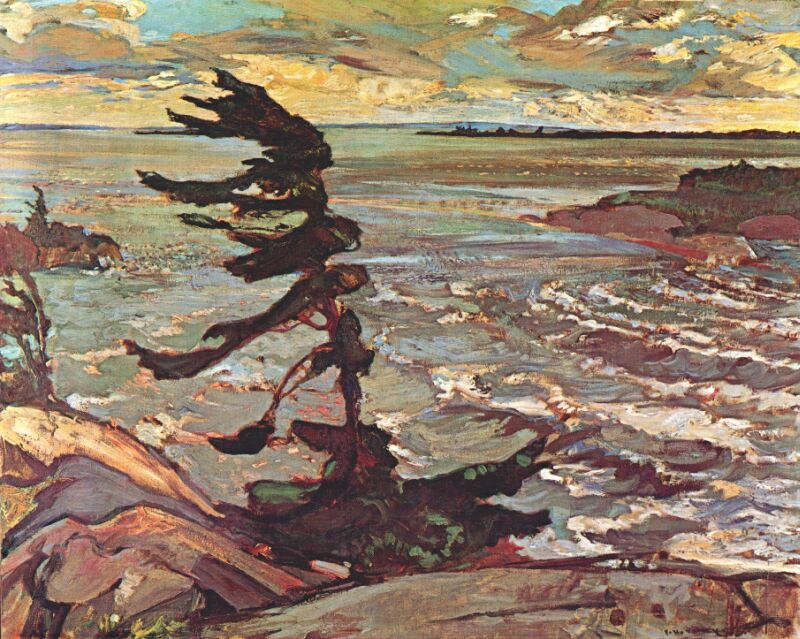
Stormy Weather by Frederick H. Varley
“As a disciple of the Group of Seven and an aficionado of Canadian wilderness, every page gives me a little leap of pleasure.”—Robert Bateman
“These sharp, imaginative evocations of the world of the Group of Seven are both a joy in themselves and a welcome prompt to make us look at the paintings again. It’s refreshing to find that, a century later, they still speak to us about our lives and our country.”—Ross King, author of Defiant Spirits: The Modernist Revolution of the Group of Seven
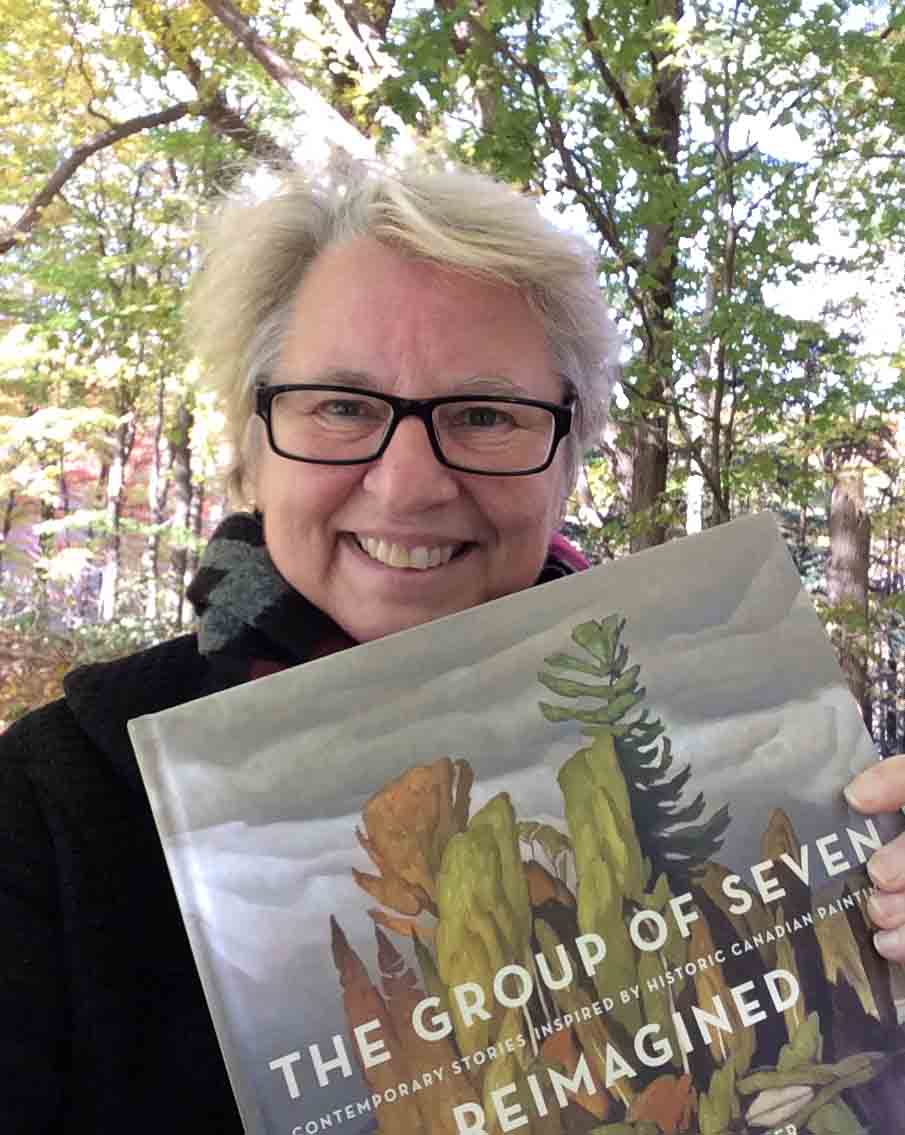
Nina Munteanu with the anthology
“Words, the writer’s paint, are artfully chosen and applied, not one wasted. The stories all compel the reader to dive beneath their surface and linger long after the reading is complete…In 1920 The Group of Seven introduced a new vision for the Canadian landscape. One hundred years later, twenty-one writers in the Group of Seven Reimagined offer a new lens for appreciating their art.”—Ottawa Review of Books
“From one region of Canada to another, a national identity is captured and shared with writers all over the world who, in turn, have crafted beautiful flash fiction pieces that accompany and extend the meaning of the art.”—Niles Reddick, Literary Heist
Nina Munteanu is a Canadian ecologist / limnologist and novelist. She is co-editor of Europa SF and currently teaches writing courses at George Brown College and the University of Toronto. Visit www.ninamunteanu.ca for the latest on her books. Nina’s bilingual “La natura dell’acqua / The Way of Water” was published by Mincione Edizioni in Rome. Her non-fiction book “Water Is…” by Pixl Press (Vancouver) was selected by Margaret Atwood in the New York Times ‘Year in Reading’ and was chosen as the 2017 Summer Read by Water Canada. Her novel “A Diary in the Age of Water” will be released by Inanna Publications (Toronto) in May 2020.




















 Bev Gorbet is a Toronto poet and retired school teacher. She has published several poems with the Retired Teachers Organization and most recently in “Literary Connection IV: Then and Now” (In Our Words Inc., 2019), edited by Cheryl Antao Xavier.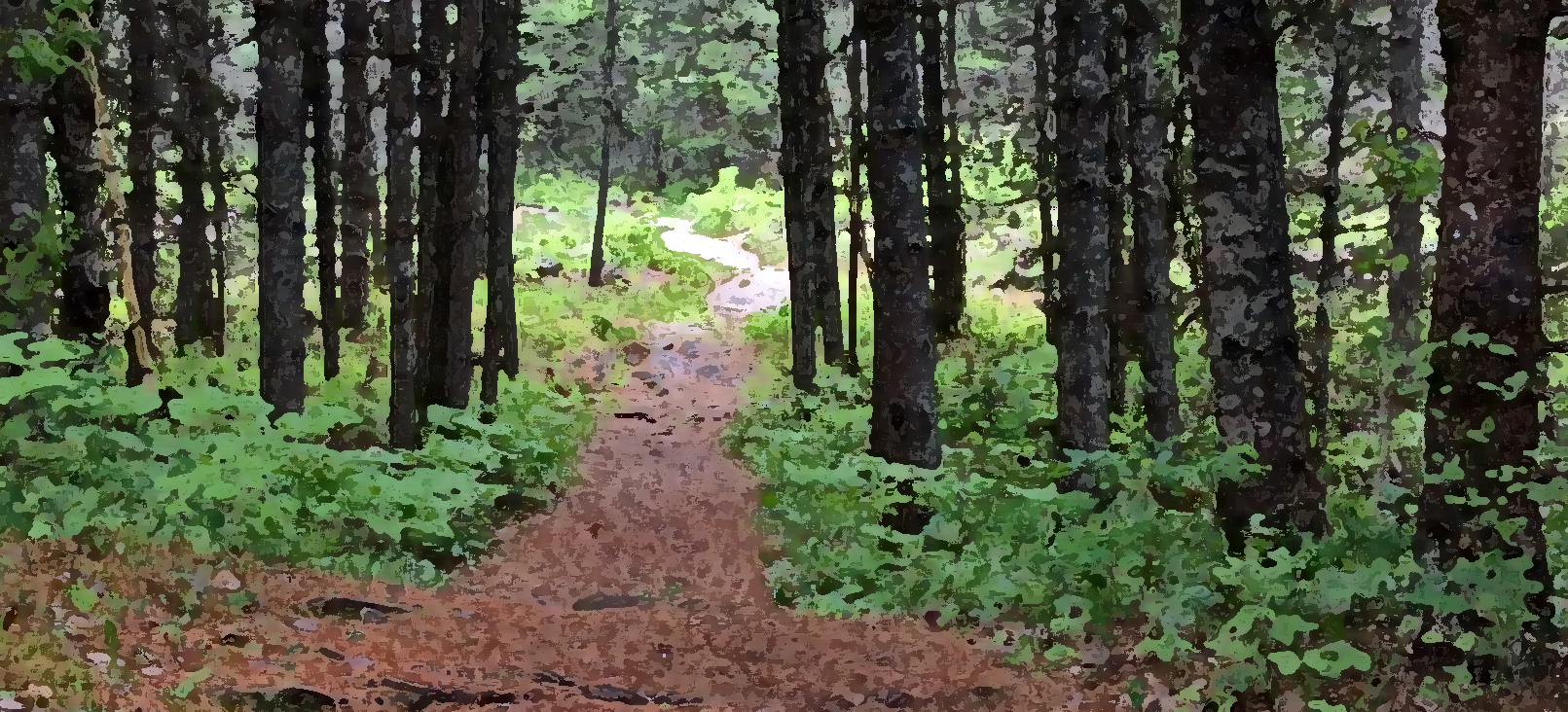



 Nina Munteanu Writing Coach