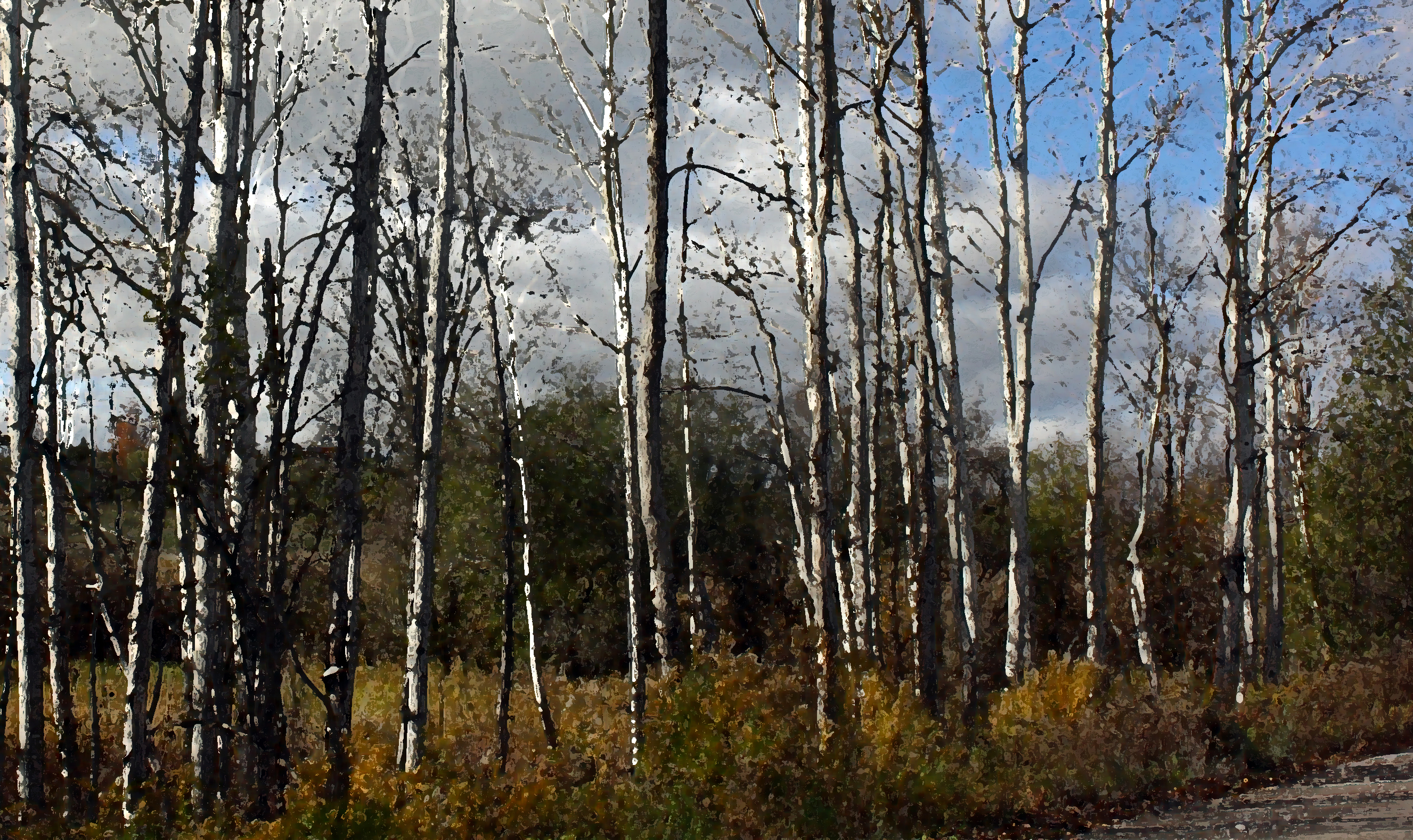
Poplar trees in fall, ON (photo and rendition by Nina Munteanu)
I just finished reading Ben Rawlence’s 2022 book The Treeline. It is a book that made me think. It made me cry. It made me despair. It also gave me hope.
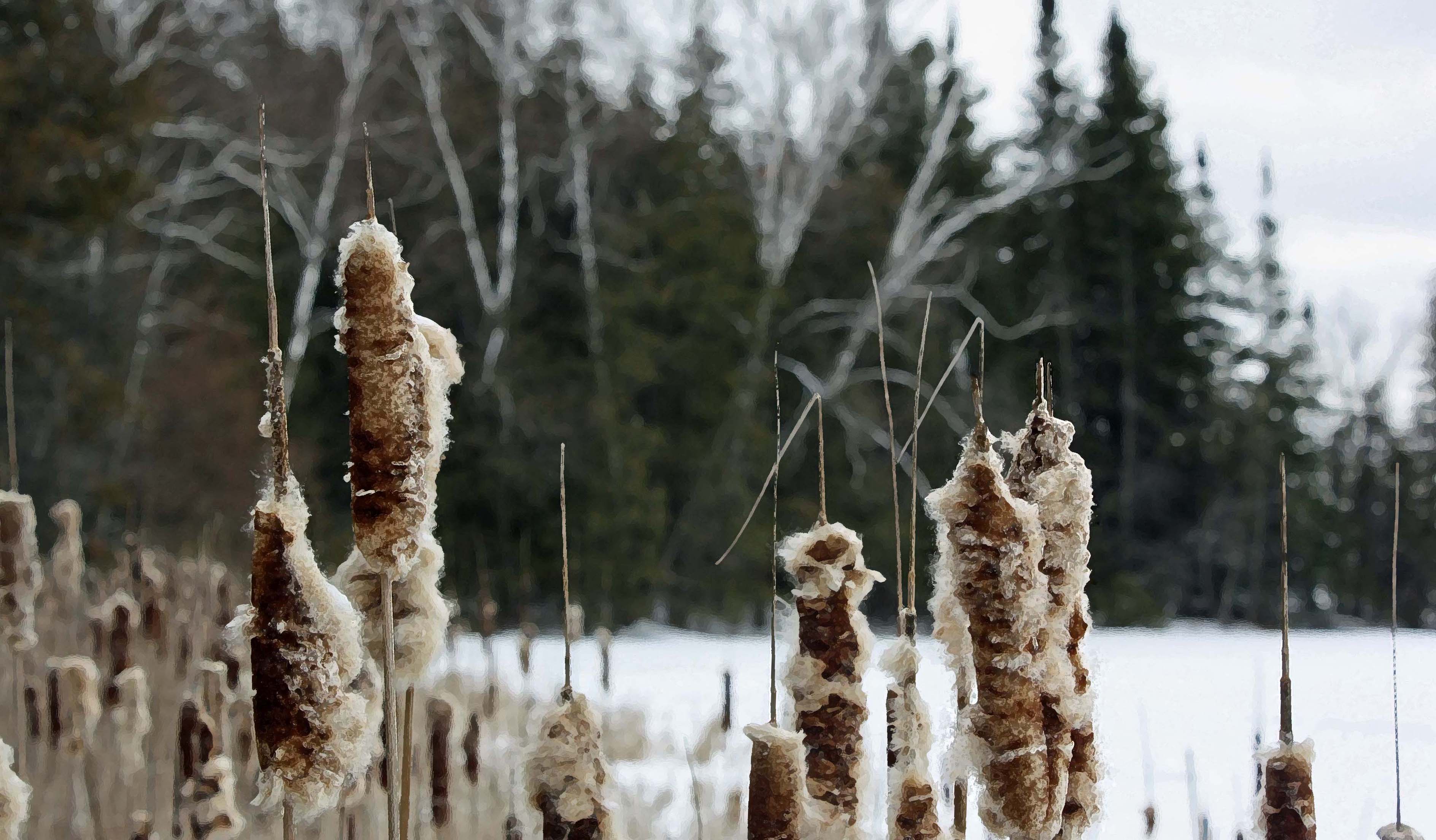
Cattails line a snow-covered marsh with spruce and fir behind, ON (photo and rendition by Nina Munteanu)
I was gripped by this honest and unflinching exploration on the moving treeline with climate change and what it will mean for humanity. Beautifully written and rigorously reported, Rawlence invited me on a journey of all major treelines over the globe from Scotland, Norway and Russia, to Alaska, Canada and Greenland. Throughout his description of a warming world and a vanishing way of life, Rawlence meditates on the many repercussions on how humans live.
Pine-cedar forest in Ontario (photo and rendition by Nina Munteanu)
He aptly describes the forests of the world as the ‘heartbeat of the planet,’ the cycles of breathing and the pulses of life from the spike of oxygen in the spring when trees put out their leaves to the peaks and troughs over day and night that regulate plant photosynthesis and respiration. The peaks and troughs are getting shallower, he writes. With more carbon dioxide in the air the trees work less; they inhale less and exhale less oxygen.
“The planet is a finely tuned system. A few degrees of change in its orbit can usher in an ice age; a few degrees of temperature change can transform the distribution of species, can melt glaciers and create oceans. In the future, when the ice is gone, there may be no such thing as a treeline at all. As the stable currents of air and water associated with the Gulf Stream, the polar front, polar vortex and Beaufort Gyre dissipate or fluctuate, the Arctic Ocean melts completely, and the Rossby waves in the upper atmosphere go haywire, the fine gradations of temperature, altitude and latitude first observed by Alexander von Humboldt will become decoupled and ecological transition zones scrambled. Instead of a majestic sweeping zone of forest around the planet, we might find discontinuous pockets of trees in odd places, refugees from soil and temperatures long gone, and crocodiles once again at the North Pole.”
Ben Rawlence, The Treeline
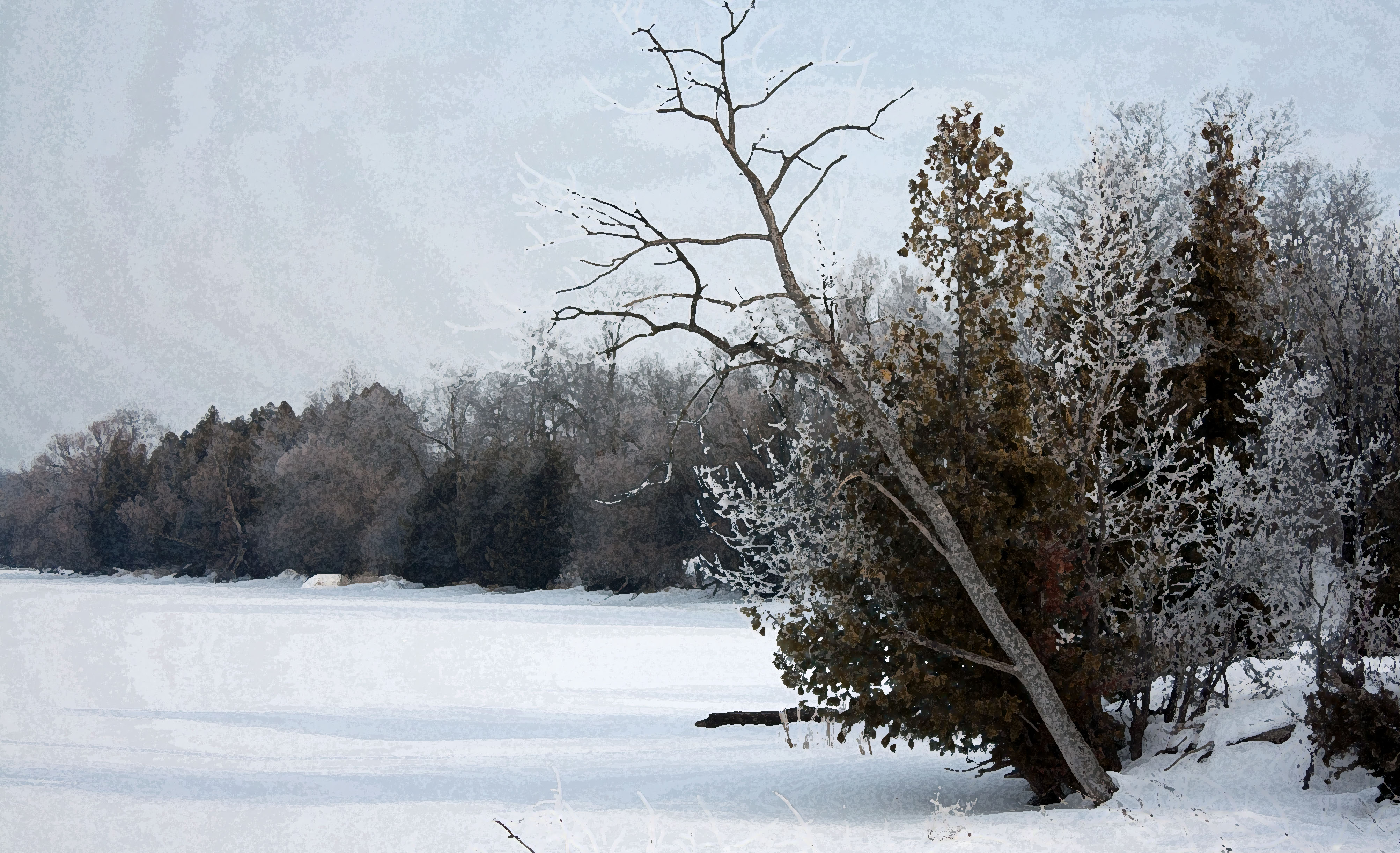
Snow-covered river shoreline with mixed forest, ON (photo and rendition by Nina Munteanu)
Rawlence brings this all into perspective to our present situation and the role science has played in our hubristic illusion of control:
“An unfortunate side effect of science is the illusion of human mastery: the idea that if we know what is happening then we can control. The irony is that we might have been able to. The tragedy is that it is too late. The chain reaction is under way. The curve only gets steeper from here…five metres of sea level rise is locked in; it’s just a question of how fast the ice melts. Once again, the models seem to underestimate the speed…”
Ben Rawlence, The Treeline
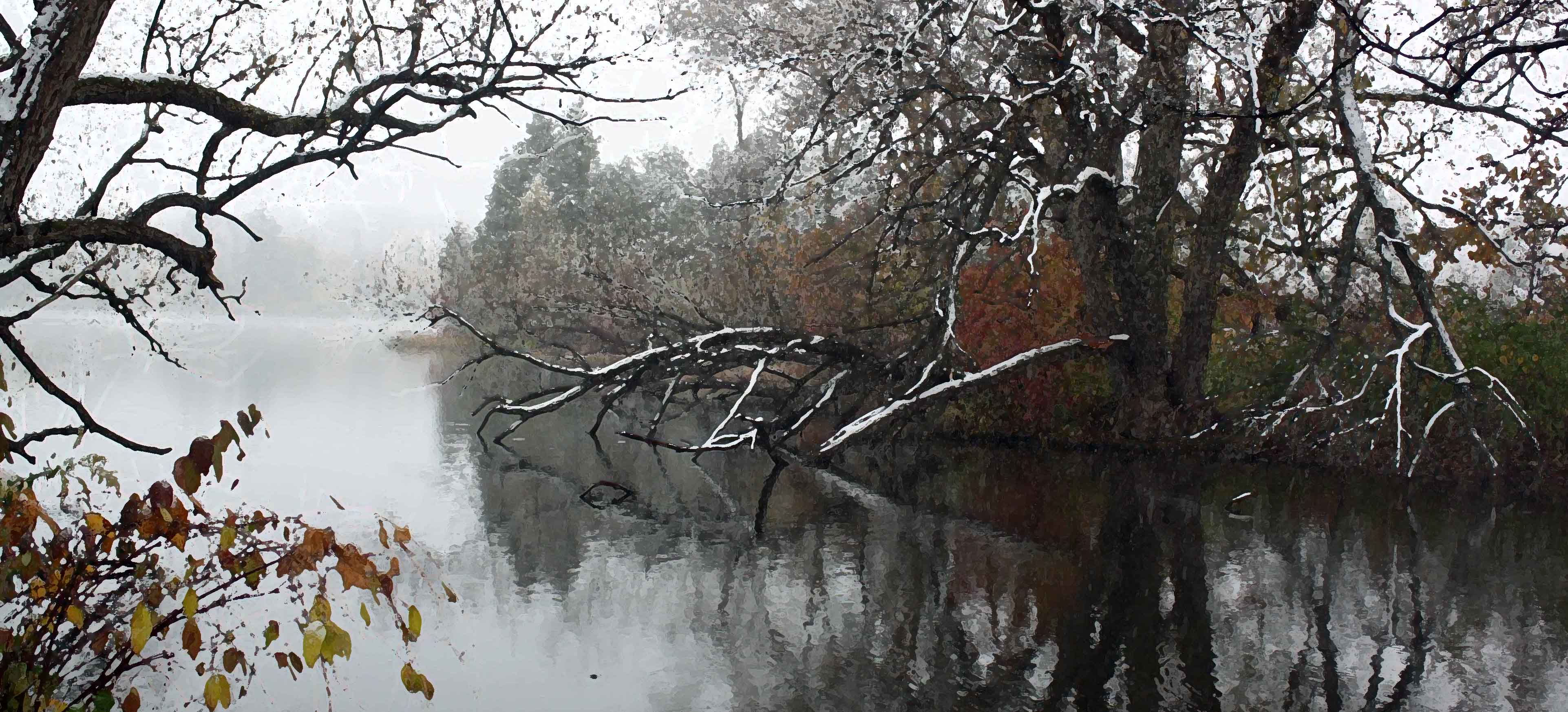
Willow by a river at first snow, ON (photo and rendition by Nina Munteanu)
What is most unfortunate for us, for humanity, is that we have known all this for some time. But we’ve done little. “Industrialist capitalism and its export colonialism” with its exploitive gaze that drives our needs and wants and actions has chosen to ignore the signs. That exploitive gaze ignored that we are not only embedded in but dependent upon the natural world and all the forests to live and flourish.
Tamarack and birch trees in the fall, ON (photo and rendition by Nina Munteanu)
What Rawlence does acknowledge is a way out of our self-created doom and accompanying solastalgia:
“Our present emergency is forcing us to remember what, until recently, we have always known: that there is a web of communication, meaning and significance beyond us, a world of life forms constantly chattering, shouting and flirting and hunting each other, indifferent to human affairs. And there is solace in such a vision. The way out of the depression and grief and guilt of the carbon cul-de-sac we have driven down is to contemplate the world without us. To know the earth, that life, will continue its evolutionary journey in all its mystery and wonder. To widen our idea of time, and of ourselves. If we see ourselves as part of a larger whole, then it is the complete picture that is beautiful, worthy of meaning and respect, worth perhaps dying for, safe in the knowledge that life is not the opposite of death but a circle, as the forest teaches us, a continuum.”
Ben Rawlence, The Treeline
Poplar trees line a road in the Ontario country (photo and rendition by Nina Munteanu)
The planet will be alright. Species will go and others will come. Earth has experienced five extinction events (we are currently experiencing the sixth extinction event now) and after each, life flourished again, albeit different life.
Is there still hope for humanity? Perhaps—if we set our hubris aside and embrace humility and kindness. And, if in that humility, we can adapt our way through the succession we’ve triggered. There might be hope for us still…
Rawlence devotes his epilogue called “Thinking Like a Forest” to the wisdom of the indigenous people who have for millennia co-existed sustainably with the natural ecosystems of the Earth. “The Koyukon, the Sámi, the Nganasan, the Anishinaabe are just a few of the countless indigenous peoples whose world view attests to our foundational reliance on the forest.”
Time to learn from them.
Trees at sunset in winter, ON (photo and rendition by Nina Munteanu)
Nina Munteanu is an ecologist and internationally published author of award-nominated speculative novels, short stories and non-fiction. She is co-editor of Europa SF and currently teaches writing courses at George Brown College and the University of Toronto. Visit www.ninamunteanu.ca for the latest on her books. Nina’s recent book is the bilingual “La natura dell’acqua / The Way of Water” (Mincione Edizioni, Rome). Her latest “Water Is…” is currently an Amazon Bestseller and NY Times ‘year in reading’ choice of Margaret Atwood.
In 2007, when I started my first blog, The Alien Next Door, I wrote an article that explored the term “Darwin’s Paradox”—it’s not just the title of my science fiction thriller Darwin’s Paradox released that year by Dragon Moon Press—but a term coined by scientists to describe the paradoxical phenomenon exhibited by coral reefs.
Defying The Laws of Thermodynamics
Darwin described coral reefs as oases in the desert of the ocean. Coral reefs comprise one of the richest ecosystems on Earth, in apparent violation of the laws of thermodynamics (high productivity in a low-productivity environment). Productivity ranges from 50 to 250 times more than the surrounding ocean. How do they thrive in crystal-clear water, largely devoid of nutrients? Part of the answer lies in the coral’s efficiency in recycling nutrients like nitrate and phosphate.
First, the rough coral surface amplifies water turbulence at a microscopic level, disrupting the boundary layer that usually settles on objects under water and lets the coral “hoover” up the sparse nutrients. I stumbled upon a similar phenomenon during my grad work on temperate streams and published my serendipitous discovery in the journal Hydrobiologia. I was researching how periphyton (attached “algae”) colonized submerged glass slides and observed that the community preferred the edges of the slides because the micro-turbulence there provided more opportunity for attachment and nutrition.
Second, lots of corals also function symbiotically with specialized algae (called zooxanthelae), which provide the coral with food (through photosynthesis) and, in turn, get food from the wastes created by the coral.
Can the science of symbiosis teach us something about another Darwin’s Paradox?
The Evolution of Compassion
In a September 2013 article in the Jewish World Review, Boston Globe reporter Jeff Jacobywrote:
“Charles Darwin struggled with a paradox: If evolution is a struggle for survival, how could generosity, compassion, and other altruistic virtues have spread through natural selection? Darwin could see the clear evolutionary benefit to groups that inculcated ethical values in their members. Imagine two competing primitive tribes, equally matched — except that ‘one tribe included a great number of courageous, sympathetic, and faithful members, who were always ready to warn each other of danger, [and] to aid and defend each other.’ (Darwin, “The Descent of Man”). There was little doubt that tribes highly endowed with such virtues ‘would spread and be victorious over other tribes.’”
“How did any tribe evolve such ethical qualities in the first place?” asks Jacoby. Brave individuals who risked their lives for others “would on average perish in larger numbers than other men.” It hardly seemed possible, Darwin conceded, that, “such virtues … could be increased through natural selection, that is, by the survival of the fittest.” So, how did it and why?
Jacoby quotes Sir Jonathan Sacks, Britain’s Orthodox chief rabbi, who pointed to “the central drama of civilization: Biological evolution favors individuals,” says Sacks. “But cultural evolution favors groups.… Selfishness benefits individuals [only in the short-term and only in a limited way—my comment], but it is [ultimately] disastrous to groups, and it is only as members of a group that individuals can survive at all.”
Jacoby describes the vast literature in evolutionary psychology and sociobiology that have demonstrated humanity’s hard-wired moral capacity. “We are born with an aptitude for empathy and fairness,” said Jacoby, citing recent neurological experiments that have demonstrated that an act of generosity triggers a pleasurable response in the brain.
Abraham Lincoln summarized it in seven words: “When I do good, I feel good.” Psychologists call it the “helper’s high”. Neuroscientists and behavioral scientists are demonstrating unequivocally the benefits of altruism to our health and happiness. Scientists have designed experiments that actually trace altruism—and the pleasure we gain from it—to specific regions and systems in the brain. Key studies now provide striking evidence that our brains are wired for altruism.
The Social Brain and the Seat of Compassion
In a study published in the Proceedings of the National Academy of Sciences (Moll et al, 2006), a team of neuroscientists lead by Dr. Jordan Grafman, reported that, “when people made the decision to donate to what they felt was a worthy organization, parts of the midbrain lit up—the same region that controls cravings for food and sex.” The brain experiences a pleasurable response when we engage in good deeds that benefit others.
Dr. Grafman found that the subgenual area in the frontal lobe near the midpoint of the brain was also strongly active when his study subjects made the decision to give to charity. The area houses many receptors for oxytocin, a hormone that promotes social bonding. “The finding suggests that altruism and social relationships are intimately connected—in part, it may be our reliance on the benefits of strong interpersonal connections that motivates us to behave unselfishly,” reports Elizabeth Svoboda in the WallStreet Journal. The team also found that the nucleus accumbens, which contains neurons that release the pleasure chemical dopamine, was triggered when a person chose to help another.
A 2007 study headed by neuroscientist Scott Huettel and reported in Nature Neuroscience(Tankersley, et al., 2007) connects altruism to the posterior superior temporal cortex (pSTC), an area in the upper rear of the brain that lets us perceive goal-directed actions by someone or something else. Results suggest that altruism depends on, and may have evolved from, the brain’s ability to perform the low-level perceptual task of attributing meaning and motive in the actions of others.
“Our findings are consistent with a theory that some aspects of altruism arose out of a system for perceiving the intentions and goals of others,” said Dr. Huettel. “To be altruistic, you need to see that the people you’re helping have goals, and that your actions will have consequences for them.”
Research led by Michael Platt reported in Nature Neurosciencein 2012, showed that the anterior cingulate gyrus(ACCg) is an important nexus for the computation of shared experience and social reward. That same year researchers at Mount Sinai School of Medicine in New York published research in the journal Brainthat suggested that the anterior insular cortexis the activity centre of human empathy.
I find it both interesting and exciting that these studies link different brain regions to altruistic and compassionate behavior. “There are certain to be multiple mechanism that contribute to altruism, both in individuals and over evolutionary time,” added Huettel. This is the nature of the brain, whether we look at intelligence, motivation or physical characteristics. And I am convinced that we will someday find that many other areas—if not the entire area—of the brain are involved. Moreover, researchers have shown that engaging—or even witnessing—generous acts can reduce stress, increase immunity (e.g., increased antibody levels), and longevity.
Emiliana Simon-Thomas, science director for the Greater Good Science Center at the University of California, Berkeley, explains the chemical activity that happens in our heads when we commit acts of altruism. “There are multiple reward systems that have been tied to pleasurable feelings when people help others or contribute to the well being of the people around them,” she notes. These reward systems are comprised of three main chemicals that are released when we commit an act of kindness and feel pleasure: Dopamine, Oxytocin and Serotonin. According to Simon-Thomas, Dopamine is most closely related to hedonic pleasure — or pleasure derived from self; oxytocin is tied to more social pleasure — especially with regard to physical contact; and serotonin is implicated in a more broad mood state. “All three of these, again, are sort of intersecting and interacting, and depending on the context that you’re in, represent feelings of pleasure in different context,” she explains. “All these systems are activating and parallel, and sort of influencing one another as you go through life.” So when I do a good deed, I am rewarding myself with a cocktail of wonder drugs that please me and make me smile.
So, what I’ve known since I was a child is now proven: doing good deeds is mutually beneficial to the giver and the receiver.
Path through winter forest in the fog, ON (photo by Nina Munteanu)
Altruism in All Beings
The notion that all aspects of life on this planet—not just humanity—have the capacity to act altruistically remains controversial—even among professional scientists and researchers. We are not unique in experiencing or practicing altruism, in acting altruistically and benefiting from our own altruistic acts. It is however a matter of perspective, bias and open-mindedness. Many examples of altruistic behavior and empathy exist in the rest of the living world on our planet.
Nature’s Heroes
Scientists have been demonstrating for years that cooperation among organisms and communities and the act of pure altruism (not reciprocal altruism or kin/group selection) is, in fact, more common in Nature than most of us realize. Valid examples of true altruism in the wild in many species exist. The key here is “in the wild”—not in captivity, where inherent behavior is often modified (see my Alien Next Door article “The SamaritanParadox Revisited: The Karma Ran Over the Dogma”).
Despite the overwhelming evidence for altruism in every aspect of our world, some researchers continue to design experiments and then draw sweeping conclusions based on animals in captivity to suggest that only humanity possesses the ability to behave altruistically—and then again only by social-instruction (aka “the Selfish Gene” of Richard Dawkins vs. the “Social Gene” of Lynn Margulis).
Examples of altruism abound and range among mammals, birds, invertebrates and even Protista. Some examples include: dogs, cats, ducks, squirrels, wolves, mongooses, Meer cats, baboons, chimpanzees, vampire bats, dolphins, walruses, lemurs, African buffalo—to name a few.
de Waal explained that “evolution favors animals that assist each other if by doing so they achieve long-term benefits of greater value than the benefits derived from going it alone and competing with others” (de Waal 2006). The prevalent phenomenon of altruism is Nature’s answer to the Prisoner’s Dilemma. “Empathy evolved in animals as the main … mechanism for [individually] directed altruism,” said deWaal. And it is empathy—not self-interest—that “causes altruism to be dispensed in accordance with predictions from kin selection and reciprocal altruism theory.” deWaal further proposed that the scientific community has become polarized between evolutionary biologists on the one side, and, on the other, a discrete group of economists and anthropologists that “has invested heavily in the idea of strong reciprocity,” which demands discontinuity between humans and all other animals.
“One of the most striking consequences of the study of animal behavior,” says anthropologist Robert Sapolsky, “is the rethinking … of what it is to be human.” He notes that, “a number of realms, traditionally thought to define our humanity, have now been shown to be shared, at least partially, with nonhuman species.” (Sapolsky 2006). This makes some of us uncomfortable. To some, it threatens to make us less special. The corollary is that this demonstrates that we possess intrinsic virtue, not something “painted” on through cultural teaching or diligent personal effort. Of course, it also means that all other beings possess intrinsic value too. In the final analysis, what we generally “know” is colored by what we believe and want to continue believing.
First big snow in Thompson Creek marsh, ON (photo and dry brush rendition by Nina Munteanu)
Universal Altruism and Gaia
What does all this mean? Does the very existence of altruism demonstrate the connectivity of all life on Earth? Let’s not stop there. Does the grace of altruism reflect a fractal cosmos imbued with meaning and intent? Was it the grace of altruism that allowed it all to happen in the first place? Don’t we all come from grace?
Despite struggles with acceptance for some of us, we are emerging enlightened to the fractal existence of grace and altruism embedded in the very nature and intentions of our universe.
I come full circle to my book Darwin’s Paradox, a tale of fractal intelligence and universal cooperation. A tale of emerging awareness of Self and Other as One…Evolution through cooperation… Creative DNA…Manifestation through thought and intent…Self-organization and synchronicity…A hero’s journey…and coming Home…
In this season of gratitude, we celebrate altruism in giving and in receiving graciously.
Merry Christmas!
First snow over Thompson Creek outlet, ON (photo by Nina Munteanu)
Bradley, Brenda. 1999. “Levels of Selection, Altruism, and Primate Behavior.” The Quarterly Review of Biology, 74(2):171-194.
De Waal, Frans, with Robert Wright, Christine Korsgaard, Philip Kitcher, and Peter Singer. 2006. “Primates and Philosophers: How Morality Evolved”. Princeton: Princeton University Press.
Goodall, Jane. 1990 Through A Window: My Thirty Years with the Chimpanzees of Gombe. Boston: Houghton Mifflin.
Moll, Jorge, Frank Krueger, Roland Zahn, Matteo Pardini, Ricardo de Oliveira-Souza, and Jordan Grafman. 2006. “Human fronto-mesolimbic networks guide decisions about charitable donation.” In: Proc. Natl. Acad. Sci., USA, 103(42): 15623-15628. http://www.pnas.org/content/103/42/15623.full
Sapolsky, Robert M. 2006. “Social Cultures Among Nonhuman Primates.” Current Anthropology, 47(4):641-656.
Svoboda, Elizabeth. 2013. “What Makes a Hero? The Surprising Science of Selfishness.” Current.
Tankersley D et al. 2007. “Altruism is Associated with an Increased Response to Agency.” Nature Neuroscience, February 2007, Vol. 10(2), pp. 150-151.
Warneken, F. & Tomasello, M. 2006. “Altruistic Helping In Human Infants and Young Chimpanzees.” Science, 311, 1301–1303.
Warneken, F., Hare, B., Melis, A. P., Hanus, D. & Tomasello, M. 2007. “Spontaneous Altruism By Chimpanzees and Young Children.” PloS Biology, 5(7), e184.
de Waal, F. B. M. 2008. “Putting the Altruism Back Into Altruism: The Evolution of Empathy.” Annu. Rev. Psychol., 59, 279–300.
de Waal, F. B. M., Leimgruber, K. & Greenberg, A. R. 2008. “Giving Is Self-rewarding for Monkeys.” Proc. Natl. Acad. Sci., USA, 105, 13685–13689.
Nina Munteanu is a Canadian ecologist / limnologist and novelist. She is co-editor of Europa SF and currently teaches writing courses at George Brown College and the University of Toronto. Visit www.ninamunteanu.ca for the latest on her books. Nina’s bilingual “La natura dell’acqua / The Way of Water” was published by Mincione Edizioni in Rome. Her non-fiction book “Water Is…” by Pixl Press(Vancouver) was selected by Margaret Atwood in the New York Times ‘Year in Reading’ and was chosen as the 2017 Summer Read by Water Canada. Her novel “A Diary in the Age of Water” was released by Inanna Publications (Toronto) in June 2020.
In my novel “A Diary in the Age of Water” (Inanna Publications) the diarist writes about the huge reservoir complex that was built in the late 2020s in the Rocky Mountain Trench to create an 800 km long reservoir system to rehydrate the United States. Of course, it’s science fiction, but it was based on real plans (NAWAPA) that went all the way to congress in the 1960s. That reservoir might have drowned the rainforest conservation corridor of Robson Valley—a conservation area that continues to experience existential risk due to development, resource harvest, and other disturbance.
Friend Anne walks the boardwalk of the ancient forest park
In Robson Valley—tucked between the Rocky and Cariboo Mountains of East-Central British Columbia, the Fraser River nourishes an ancient rainforest matched nowhere on Earth. Massive Western Redcedar (Thuja plicata)—some over 1200 years-old, 3.5 meters in diameter, and 45 meters high—thrive in this valley, nurtured by abundant groundwater flow and high humidity for healthy tree growth and reduced fire risk. “Unfortunately, this requirement for growth in wet toe-slope positions has had negative consequences for ancient cedar stands. Historically, roads and railroads were placed at the base of mountain slopes, where easy access on level roadside terrain meant that ancient cedar stands were often among the first sites chosen for logging. Ancient cedar stands now represent less than 5% of forested landscapes within the Upper Fraser River watershed.” (UNBC Plant Ecology)
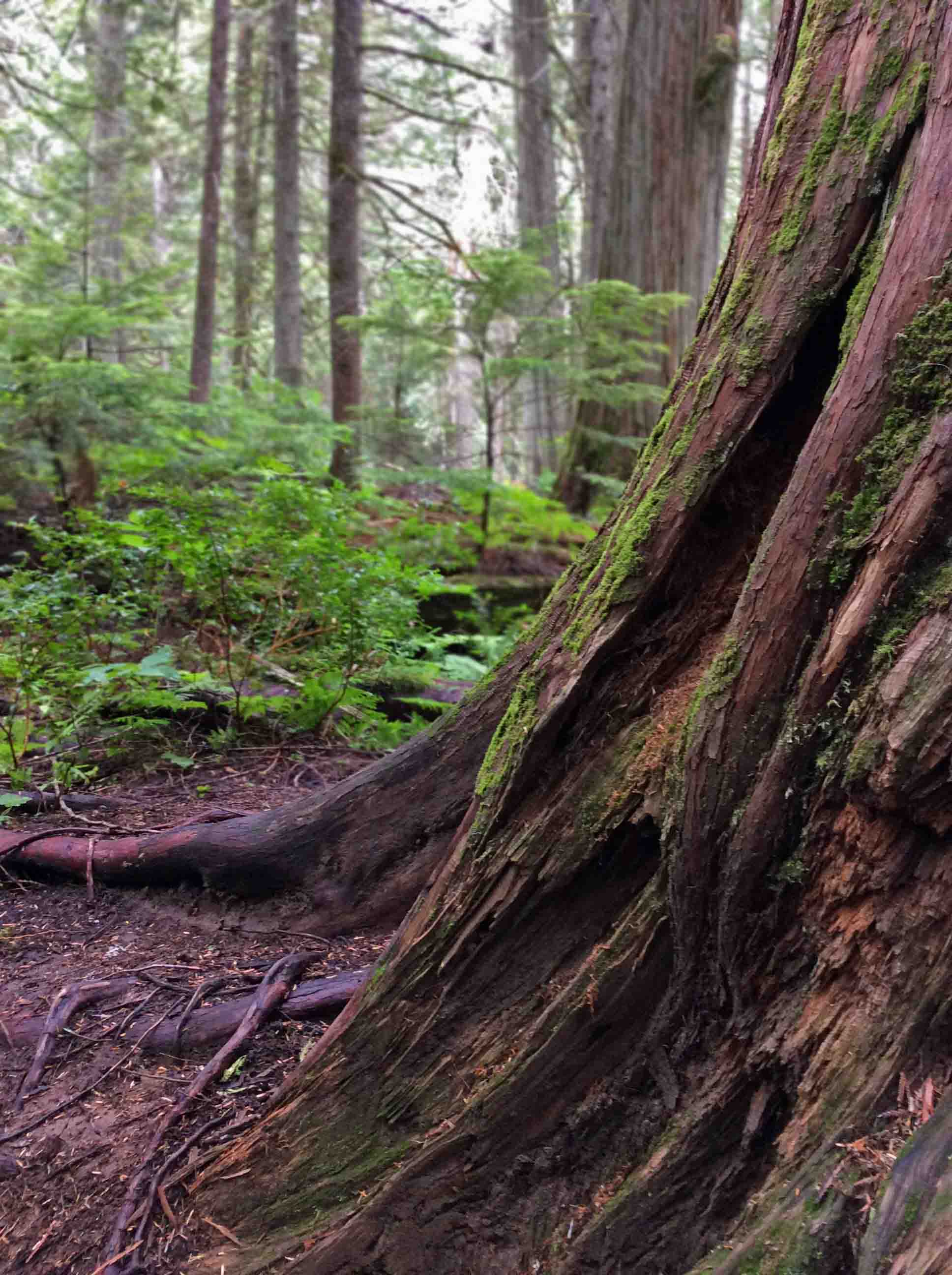
Moss-covered giant Redcedar in foreground to boardwalk
This valley contains the most extensive inland rainforest in the northern hemisphere and is the only valley in the Rocky Mountains where grizzly bears still feed on wild ocean-going salmon.
Western Redcedar with wide buttresses
The Save-The-Cedar League also tells us that the Robson Rainforest is oroboreal: mountain-caused with boreal biome characteristics—unlike typical rainforests which are temperate-coastal or tropical. “Antique Forest” is a term used for ancient cedar-hemlock stands that have endured for more than 1000 years. One stand in Primordial Grove can be seen via a well-constructed boardwalk in a small park off Highway 16.
When I entered the ancient forest of magnificent giants with wide buttressed bases, a deep reverence came over me. No other word comes close to describing what I experienced or felt. I was enthralled and humbled by these magnificent trees, silent giants that rose into the mist like sentinels, piercing the heavens. It had rained that morning and the forest dripped with living moisture. Greens of all shades created a living mosaic of hue and texture. Moss covered everything. Lichen dripped off branches and clothed trees in crenulated patterns. The fragrance was intoxicating, a fresh pungency that woke something inside me. The smell has been variously described as “lingering”, “fresh”, “sweet”, “like pineapple when crushed”, or “almost like fresh water.” Even the breeze took on a different voice inside this living cathedral. A kind of deep hush that whispered of sacred grandness.
Western Redcedar
I knew I was in a sacred place.
This ancient forest had been here at least a millennium; long before the arrival of Christopher Columbus to the Atlantic shores of North America. Long before us. Referred to as “the cornerstone of northwest coastal Indian culture,” the Western Redcedar is known as the “tree of life” and “life giver.” Groves of ancient cedars were symbols of power, and gathering places for ceremonies, retreat, and contemplation.
I kept to the boardwalk—to help prevent unwanted trampling and soil compression. The boardwalk snaked past giant buttressed trees that towered several stories high and formed a feathered canopy way above me. Whenever the boardwalk came close to a giant cedar, I had to stop and touch it. The reddish bark was smooth. I smiled; many others had done the same. In unavoidable reverence.
Breathing in the tree’s exquisite fragrance, I scanned my surroundings. A rich understory of red-berried Devil’s Club (Oplopanax horridus), huckleberry, fern, moss, liverworts and dense ground cover painted the forest floor in varying form and colour. I imagined the diversity of invertebrates, amphibians, reptiles, birds and mammals that flourished here. I’m told that scientists are still finding new species in this rainforest. UBC scientists tell us that arboreal lichen communities of the inland rainforest, especially the epiphytic cyanolichen assemblages on conifers, are among the richest in the world.
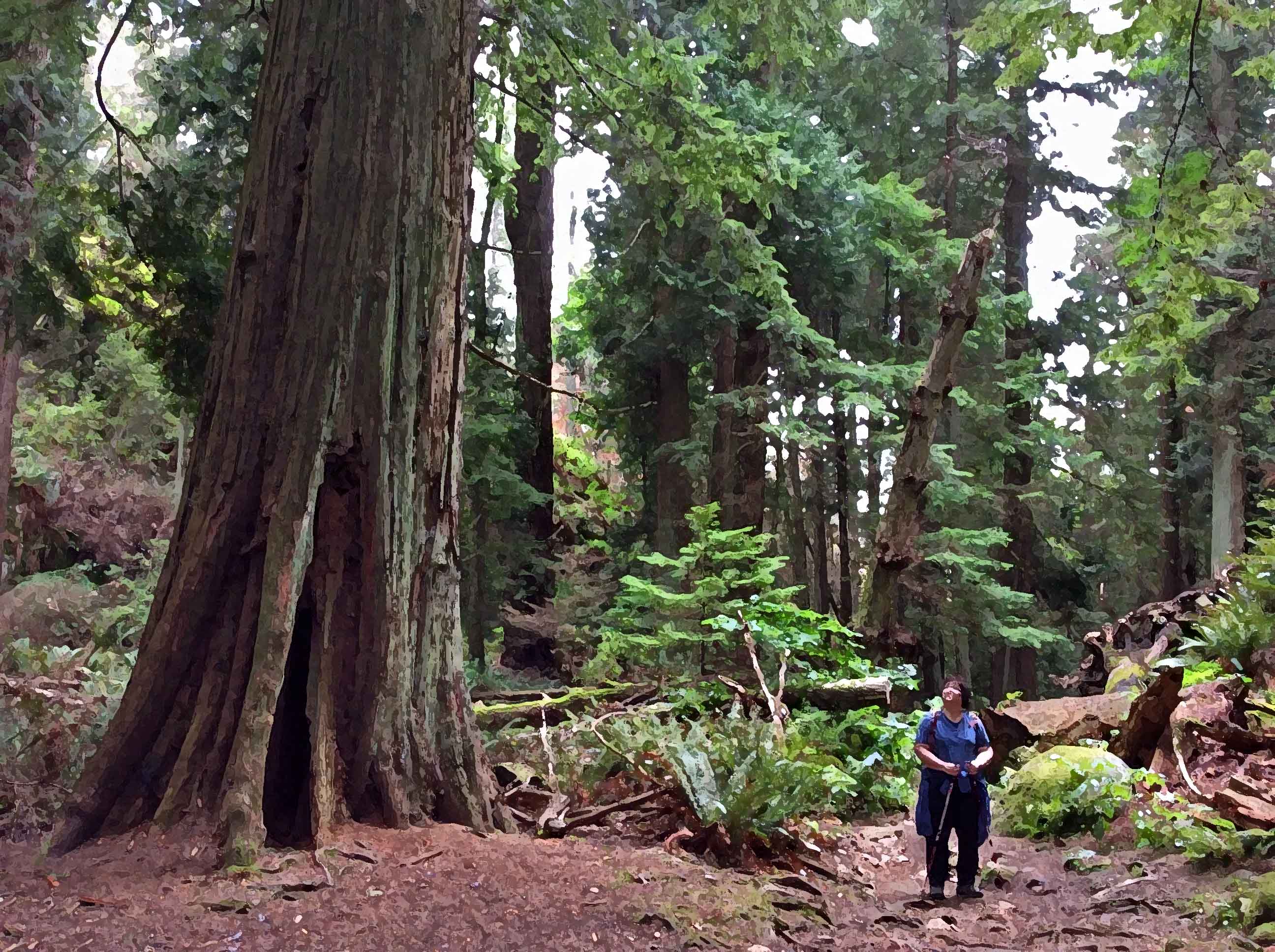
Nina Munteanu leans against a well-loved giant Western Redcedar
Gentle Giant of North Temporate Rainforest: Western Redcedar (Thuja plicata)
Western Redcedar
The Western Redcedar (Thuja plicata) is one of the most magnificent conifers in Pacific Northwest forests (both coastal and inland); it flourishes along the coastal fog belt from Alaska to northern California, and inland from the Pacific Ocean to Montana. The Western Redcedar is actually an arborvitae—not a true cedar; acknowledged by its name “redcedar”. True cedars only grow in the Mediterranean regions of the world. “Thuja,” is the latinism for the ancient Greek word for a now unknown, long-lost aromatic evergreen wood; “plicata,” means “folded into plaits,” which may refer to the tree’s characteristic foliage or its furrowed, stringy bark. The heartwood is pink- to red-brown to deep warm brown and highly resistant to moisture, decay and insect infestation due to the oils and acids (polyoxylphenols) it produces; it’s the phenols, in fact, that give the cedar its distinctive and pleasant aroma.
Given their extensive root system, cedars can remain standing long after they die. Western Redcedar snags (standing dead trees) can remain intact for up to 125 years. The large snags provide habitat for many cavity-nesting birds and mammals. Many species that require snags for habitats also prey on insects that use trees in a fine balance of a functional ecosystem. Examples include the pileated woodpecker, squirrels, weasels, martens, bats, owls and ducks. A fallen cedar can remain on the forest floor for over a century. “This durability is the result of a natural preservative that is toxic to decay-causing fungi. This ability does not decrease with age; in fact, it increases,” writes Jeri Chase, Oregon forester.
Devil’s Club
Several of these live ancient cedar trees grow out of the trunks of other live ancient cedars, following a 180 million-year-old pattern observed in the closely-related redwoods (Sequoia). Basal shoots of the trunk yield genetically-superior mature trees when compared to seeds, root sprouts, other shoots or other layering phenomena.
Western Redcedar reproduces from root or branch development on fallen trees—the classic “nurse logs” often seen in northwest forests that also nourish other forest species. The magnificent bark of the Redcedar ranges in color from grey to reddish brown, and is deeply furrowed, forming long flat fibrous plates that peel and shed easily. Wildlife use the cedar in many ways. The foliage is an important winter food for elk and is browsed year-long by deer and rodents. Black bears den in the hollowed-out trunks of old trees and the cedar-dominated old growth forests provide valuable habitat for spotted owls and Vaux swifts.
Functional Ecosystem & Symbiosis
Red-backed vole
The Robson Valley cedar-hemlock rainforest supports a diverse and efficient ecosystem from apex and keystone predator—the grizzly—to black bear, gray wolf, cougar, lynx, wolverine, coyote, and seven ungulate species (including the Mountain caribou); all feeding on a diversity of prey and primary producers. The Mountain caribou feeds on mountain boxwood shrubs which are sheltered by the cedar and hemlock canopy layer.
An example of the symbiotic nature of the old growth cedar-hemlock forest is the red-backed vole, which resembles a large plump mouse. This forest mammal eats truffles—a type of fungus that lives underground. After digesting the truffles, voles spread the fungus around the litter layer of the forest through their droppings. The truffles help tree roots absorb soil minerals and the trees produce sugars necessary for the truffles: a win-win symbiotic relationship. The cedar and the hemlock require this alliance with truffles and voles to grow so large in the nutrient-poor soil.
The Inland Sea of the Rocky Mountain Trench (NAWAPA)
Una stopped the car and we stared out across the longest reservoir in North America. What had once been a breathtaking view of the valley floor of the Rocky Mountain Trench was now a spectacular inland sea. It ran north-south over eight hundred kilometres and stretched several kilometres across to the foothills of the Cariboo Mountain Range. Una pointed to Mount Mica, Mount Pierre Elliot Trudeau and several other snow-covered peaks. They stood above the inland sea like sentinels of another time. Una then pointed down to what used to be Jackman Flats—mostly inundated along with McLellan River and the town of Valemont to the south. Hugging the shore of what was left of Jackman Flats was a tiny village. “That’s the new Tête Jaune Cache,” my mother told me.
If villages had karma this one was fated to drown over and over until it got it right. Once a bustling trading town on the Grand Trunk Pacific railway, Tête Jaune Cache drowned in the early 1900s when the Fraser naturally flooded. The village relocated to the junction of the original Yellowhead 16 and 5 Highways. Villagers settled close to where the Fraser, Tête Creek, and the McLellan River joined, all fed by the meltwater from the glaciers and icefields of the Premiere Range of the Cariboo Mountains. The village drowned again in 2025. I imagined the pool halls, restaurants, saloons and trading posts crushed by the flood.
“This area used to be a prime Chinook spawning ground,” Una said. “They swam over 1,200 km from the Pacific Ocean to lay their eggs right there.” She pointed to the cobalt blue water below us.
The reservoir sparkled in the sun like an ocean. Steep shores rose into majestic snow-capped mountains. The village lay in a kind of cruel paradise, I thought. It was surrounded by a multi-hued forest of Lodgepole pine, Western red cedar, Douglas fir, paper birch and trembling Aspen. Directly behind the village was Mount Terry Fox and across the Robson valley mouth, to the northeast, rose Mount Goslin. Behind it, Mount Robson cut a jagged pyramid against a stunning blue sky. Wispy clouds veiled its crown. I couldn’t help thinking it was the most beautiful place I’d seen. And yet, for all its beauty, the villagers had lost their principle livelihood and food. The reservoir had destroyed the wildlife habitats and the fishery. And its people with it.
Una pointed to where the giant reservoir snaked northwest and where towns like Dunster, McBride and Prince George lay submerged beneath a silent wall of water. Her eyes suddenly misted as she told me about Slim Creek Provincial Park, between what used to be Slim and Driscoll Creeks just northwest of what used to be the community of Urling. She told me about the Oroboreal rainforest, called an “Antique Rainforest”—ancient cedar-hemlock stands over a 1000 years old. She described how massive trunks the width of a small house once rose straight up toward a kinder sun. The Primordial Grove was once home to bears, the gray wolf, cougar, lynx, wolverine and ungulates. It was the last valley in North America where the grizzly bear once fished ocean-going salmon. Now even the salmon were no longer there, she said. Then she bent low beside me and pulled me close to her in a hug. She quietly said to me, “This is what killed Trudeau.”
I stared at her and firmly corrected, “but that was an accident.”
The original NAWAPA Plan was drawn up by the Pasadena-based firm of Ralph M. Parsons Co. in 1964, and had a favorable review by Congress for completion in the 1990s. The plan—thankfully never completed—was drafted by the US Army Corps of Engineers and entailed the southward diversion of a portion (if not all) of the Mackenzie and Yukon rivers in northern Canada and Alaska, now flowing into the Arctic Ocean as well as the Peace, Liard and other rivers flowing into the Pacific by creating massive dams in the north. This would cause the rivers to flow backwards into the mountains to form vast reservoirs that would flood one-tenth of British Columbia. The water would be channeled south through the 800-km Rocky Mountain Trench Reservoir into the Northern USA, and from there along various routes into the dry regions of the South, to California and reaching as far as Mexico.
Expanded NAWAPA XXI plan to hydrate the USA with Canadian water
NAWAPA was envisioned as the largest construction effort of all times, comprising some 369 separate projects of dams, canals, and tunnels, for water diversion. The water diversion would be accomplished through a series of connecting tunnels, canals, lakes, dams, and pump-lifts, as the trench itself is located at an elevation of 914 m (3,000 feet). To the east, a 9 m (thirty-foot) deep canal would be cut from the Peace River to Lake Superior. Its largest proposed dam would be 518 m (1,700 feet) tall, more than twice the height of Hoover Dam (at 221 m) and taller than any dam in the world today, including the Jinping-I Dam in China (at 305 m).
Conspiracy theorist and convicted fraudster Lyndon LaRouche was a principle proponent of the environmentally destructive NAWAPA plan. Although the plan was scrapped in the 1970s due to environmental concerns, it resurfaced in 1982 particularly by Parsons engineer Roland Kelley, who wrote a report called NAWAPA Plan Can Work. LaRouche and his movement revived interest more recently. In 2012 the LaRouche Political Action Committee released their NAWAPA XXI special report, which contained a detailed plan for the revival of an updated and expanded version of NAWAPA. The LaRouche movement continues to promote this outlandish plan today with support from various American politicians and industrialists.
In his book Cadillac Desert, environmental writer Marc Reisner described the plan as one of “brutal magnificence” and “unprecedented destructiveness.” Historian Ted Steinberg suggested that NAWAPA summed up “the sheer arrogance and imperial ambitions of the modern hydraulic West.”
Old growth Redcedar-Douglas fir forest near Vancouver, BC (photo and illustration by Nina Munteanu)
Nina Munteanu is a Canadian ecologist / limnologist and novelist. She is co-editor of Europa SF and currently teaches writing courses at George Brown College and the University of Toronto. Visit www.ninamunteanu.ca for the latest on her books. Nina’s bilingual “La natura dell’acqua / The Way of Water” was published by Mincione Edizioni in Rome. Her non-fiction book “Water Is…” by Pixl Press (Vancouver) was selected by Margaret Atwood in the New York Times ‘Year in Reading’ and was chosen as the 2017 Summer Read by Water Canada. Her novel “A Diary in the Age of Water” will be released by Inanna Publications (Toronto) in 2020.
Wir müssen uns immer verändern, erneuern, verjüngen; sonst verhärten wir.—Goethe
Nina reading “How to Read Water” on Algonquin Island, Ontario (photo by Nina Munteanu)
In his book, How to Read Water, Tristan Gooley describes a phenomenon called clapotis gaufre. Also known as “waffled clapotis”, the term comes from the French word (clapotis) for “lapping” and describes a standing wave phenomenon created by the troughs and crests of waves as they hit and reflect back from a barrier. The incoming and reflected outgoing waves, in passing each other, form a waffle-pattern that bobs up and down but otherwise appears stationary.
In fact, it is far from stationary.
But we like “stationary.” So much so that, despite the magnitude of planetary-scale change, everything appears stationary to us. People go on with their daily lives as they have for generations: driving cars; living profligately; wastefully consuming energy, disposables and water; bickering about fuel taxes and job security. But this is an illusion, a very dangerous one. Surface inertia hides a depth of motion. In a river, where high-velocity water roars over a steep river-bottom depression, a frothy stationary breaker forms; it is the most dangerous part of the river. What we can’t see, we think won’t hurt us. But what if we could see the ominous dark cloud of carbon dioxide and methane blotting more and more of our sky? What if we could see the fumes billowing out of our cars and the heat radiating from our homes? Or smell the toxins spilling into our rivers and lakes? Or the quiet extinctions happening by the minute in the wilderness?
Photographs of same Beijing location over a year showing smog days
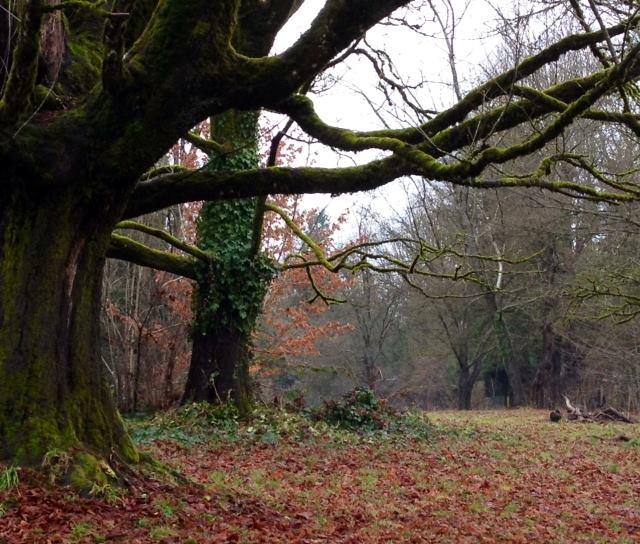
Old oak tree in Deer Lake Park, BC
What if we could see the fractal signs of change?
Nothing in nature stays the same. If it does, that’s because change has brought it back to what it once was. Trees move. They grow wider and taller; they just do it at a pace beyond our impatient lifestyle. Because their motion is invisible, they are invisible. We think of trees as stationary objects, not living beings. Like a standing wave of frozen time. We observe through the hurried lens of human impatience and self-preoccupation. A quick glance takes in a scene. We forget that we can “see” with other senses. Smell. Touch. Taste. Hearing. As hyposmia and disinterest dulls our senses, we grow less able to recognize the verisimilitudes of Nature’s trompe l’oeils. Trapped by our preordained notions, we no longer see the changes we’re not prepared to see. And that’s the change that kills us.
In witnessing the collapse of fish populations on the west coast in the ‘90s, UBC fisheries biologist Daniel Pauly noticed that people just went on fishing ever smaller fish. The collapse occurred through what he called “creeping disappearance.” Pauly named this impaired vision “shifting baseline syndrome,” a willing ignorance of consequence based on short-term gain.
One could argue that the inability to feel and connect beyond our immediate line of sight can be a good thing—a kind of selective memory that allows us to adapt to each “new normal.” Mothers of several children can testify to the benefits of “forgetting” their hours of labour to give birth. Hence the ability and willingness to repeat this very painful experience. Is this part of successful biological adaptation in all of us? The ability to reset?
Author and her son enjoy an outing
Or is it rather that our mother chooses not to forget but to relegate her memory of the previous birth behind something far more beautiful and wondrous to remember and something she is deeply connected to: the miraculous birth of her child—her investment in the future. Shifting baseline syndrome is part of a larger amnesia, one that encompasses many generations; a selective memory driven by short-sightedness that comes mostly from lack of connection. But to successfully invest in our future, that is precisely what we must do: connect.
If only we could see the fractal signs of change…
Bill McKibben wrote in The New Yorker, “Climate change isn’t just a threat. It’s an opportunity for us to live happier, more fulfilling lives.” True happiness comes with long-term fulfillment, not short-term material wealth and comfort. When we focus from ourselves to embrace the changing world—to connect—we discover a well-spring of altruistic happiness. When we embrace, we transcend. When we transcend, we become fluid with change. That is when we succeed.
quote by Goethe: “We must always change, renew, rejuvenate ourselves; otherwise we harden.”
Nina Munteanu is a Canadian ecologist / limnologist and novelist. She is co-editor of Europa SF and currently teaches writing courses at George Brown College and the University of Toronto. Visit www.ninamunteanu.ca for the latest on her books. Nina’s bilingual “La natura dell’acqua / The Way of Water” was published by Mincione Edizioni in Rome. Her non-fiction book “Water Is…” by Pixl Press (Vancouver) was selected by Margaret Atwood in the New York Times ‘Year in Reading’ and was chosen as the 2017 Summer Read by Water Canada. Her novel “A Diary in the Age of Water” will be released by Inanna Publications (Toronto) in 2020.








 Una stopped the car and we stared out across the longest reservoir in North America. What had once been a breathtaking view of the valley floor of the Rocky Mountain Trench was now a spectacular inland sea. It ran north-south over eight hundred kilometres and stretched several kilometres across to the foothills of the Cariboo Mountain Range. Una pointed to Mount Mica, Mount Pierre Elliot Trudeau and several other snow-covered peaks. They stood above the inland sea like sentinels of another time. Una then pointed down to what used to be Jackman Flats—mostly inundated along with McLellan River and the town of Valemont to the south. Hugging the shore of what was left of Jackman Flats was a tiny village. “That’s the new Tête Jaune Cache,” my mother told me.




 Nina Munteanu Writing Coach