Embracing the Paradox of Creative Destruction

Beech tree in snow-covered cedar forest, ON (photo and rendition by Nina Munteanu)

I understand something of paradox. As an ecologist, I deal with it all the time. Destruction in creation and creation in destruction lies ingrained in the life-cycles of everything on this planet. A forest fire can destroy life but in so doing creates a more vibrant, healthier forest. Nature reveals many such examples from its circular patterns and fractal self-organization to its infinite spirals.

The Ouroboros is an ancient symbol depicting a serpent or dragon swallowing its own tail to form a circle. It represents self-reflexivity or cyclicality, especially of something constantly re-creating itself. As the serpent devouring its own tail, the Ouroboros symbolizes the cyclic Nature of the Universe: creation out of destruction, Life out of Death. The ouroboros eats its own tail to sustain its life, in an eternal cycle of renewal. In Gnosticism, the ouroboros symbolizes eternity and the soul of the world.

Ecologist C.S. Holling recognized ecosystems as non-linearself-organizing and continually adapting through cycles of change from expansion and prosperity to creative destruction and reorganization. In his classic paper, entitled: “Simplifying the complex: the paradigms of ecological function and structure” (1987), Holling suggested that the experience of instability maintains the structure and general patterns of ecosystem behaviour; that Nature ‘learns’ and accommodates with time. 

In the final analysis, it is a matter of scale.

We can’t expect the natural world around us to run smoothly and safely for our benefit. New diseases, pollution, species extinction, and climate change are all results of unexpected impacts, whether human-caused or not. Though incredibly elegant, Nature is not simple. Scale is something you can’t see or easily measure and assess if you are in it. Scale is like hindsight.

The systems of Gaia are complex from the tiniest cell to the complex planet itself. Weather, for instance, is a “chaotic system” that displays a fractal structure and a range of chaotic behaviour on many scales. Temperature, air pressure, wind speed and humidity are all sensitive to initial conditions and interrelated in multi-scales.

Says Brian Arthur, professor at Stanford University: 

The complex approach is total Taoist. In Taoism there is no inherent order. “The world starts with one, and the one become two and the two become many, and the many lead to myriad things.” The universe in Taoism is perceived as vast, amorphous, and ever changing. You can never nail it down. The elements always stay the same, yet they are always arranging themselves. So, it’s like a kaleidoscope: the world is a matter of patterns that change, that partly repeat, but never quite repeat, that are always new and different.

BRIAN ARTHUR

Western scientists are just beginning to appreciate this through the application of complexity theory and chaos theory. This is something the eastern world has “known” since ancient times: humility before nature; respect for richness and diversity of life; generation of complexity from simplicity; the need to understand the whole to understand the part.

I wish you a safe and wealthy 2021: a year’s wealth of unexpected wonder, of genuine love, of unguarded honor, and dazzling bravery. There is no wonder without tolerance; no love without humility; no honor without sacrifice; and no bravery without fear. I wish you the gift of unbridled compassion. 

As Dante Sarpé (in my story, Arc of Time) said: Without compassion to fill it, knowledge is an empty house, casting its shadow on our courage to embrace the paradoxes in our lives: to feel love in the face of adversity; grace when confronted with betrayal.

Happy New Year!

Recommended Reading:

Holling, C.S. 1987. Simplifying the complex: the paradigms of ecological function and structure. Eur. J. Oper. Rel. 30: 139-146.

Holling, C.S. 1973. Resilience and stability of ecological systems. Annual Rev. Ecol. Syst. 4: 1-23.

Holling, C.S. 1977. Myths of ecology and energy. In: Proceedings Symposium on Future Strategies for Energy Development, Oak Ridge, Tenn., 20-21 October, 1976. Oxford University Press, New York, N.Y.

Beech tree in leaf amid cedars and moss-covered boulders in Jackson Creek Park, ON (photo by Nina Munteanu)

Nina Munteanu is a Canadian ecologist / limnologist and novelist. She is co-editor of Europa SF and currently teaches writing courses at George Brown College and the University of Toronto. Visit www.ninamunteanu.ca for the latest on her books. Nina’s bilingual “La natura dell’acqua / The Way of Water” was published by Mincione Edizioni in Rome. Her non-fiction book “Water Is…” by Pixl Press(Vancouver) was selected by Margaret Atwood in the New York Times ‘Year in Reading’ and was chosen as the 2017 Summer Read by Water Canada. Her novel “A Diary in the Age of Water” was released by Inanna Publications (Toronto) in June 2020.

Nina Munteanu Reads on “Sample Chapter Podcast”

I recently appeared on Episode #142 of award-winning “Sample Chapter Podcast” where I had a wonderful interview with Jason Meuschke and read a sample chapter from my recent eco-novel “A Diary in the Age of Water.” 

Jason and I talked about the writing process; what makes good and compelling fiction; creating realistic and interesting characters with flaws–like my flawed detective Rhea Hawke in The Splintered Universe Trilogy‘ writing eco-fiction in which environment can be a character; the “what ifs” in historical fiction and where we get our ideas (The Last Summoner came to me in a dream and later through a single image).

This is what Jason said about Episode 142 of The Sample Chapter Podcast with Nina Munteanu:

Episode 142 is here with a truly delightful author from Canada, Nina Munteanu. In the episode, Nina and Jason discuss character flaws, having the environment be a character in our prose, the “what ifs” in historical fiction, the writer’s “wavelengths”, and much more all before enjoying a magical chapter reading. Enjoy!

Here’s the podcast:

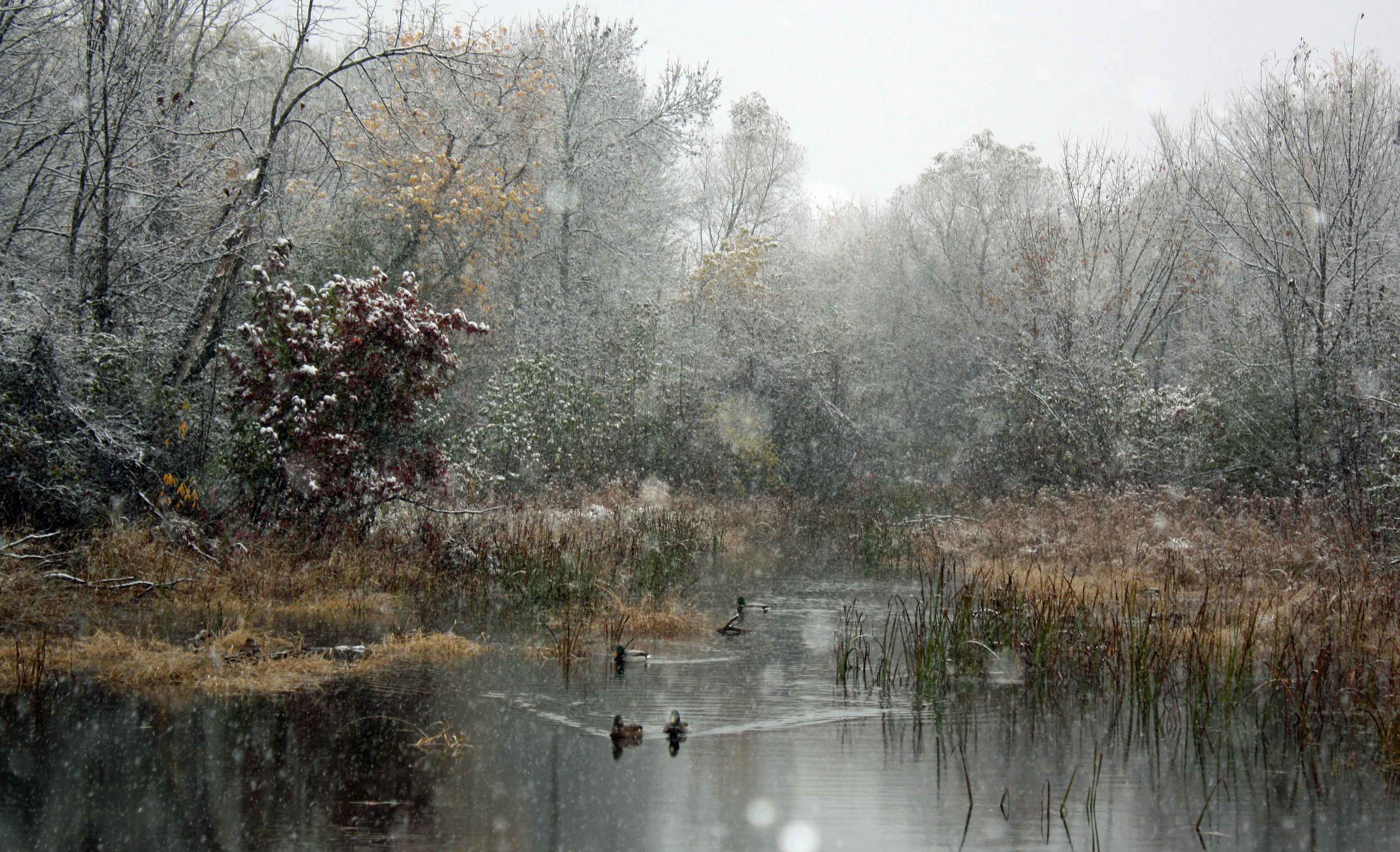
First snow in Thompson Creek marsh, ON (photo by Nina Munteanu)

Nina Munteanu is a Canadian ecologist / limnologist and novelist. She is co-editor of Europa SF and currently teaches writing courses at George Brown College and the University of Toronto. Visit www.ninamunteanu.ca for the latest on her books. Nina’s bilingual “La natura dell’acqua / The Way of Water” was published by Mincione Edizioni in Rome. Her non-fiction book “Water Is…” by Pixl Press(Vancouver) was selected by Margaret Atwood in the New York Times ‘Year in Reading’ and was chosen as the 2017 Summer Read by Water Canada. Her novel “A Diary in the Age of Water” was released by Inanna Publications (Toronto) in June 2020.

Twelve Books on Climate and Environment for the Holidays

Gift guide: 12 books on climate can environment for the holidays

“For this year’s holiday gift guide,” writes Dr. Michael Svoboda, “Yale Climate Connections has gathered celebrated anthologies, deep-dives into climate-related science and solutions, inspiring books from or about spiritual leaders, and visionary works of climate fiction.”

All were recently published, some within the month, writes Svoboda. These twelve books address decades of writing on climate change, reassess the challenges, offer hope and guidance for action, and envision very different climate-changed futures.

There is, for instance, the anthology The Fragile Earth: Writing from the New Yorker on Climate Change (Harper Collins),which includes Bill McKibben’s seminal essay “The End of Nature.” The anthology All We Can Save(Penguin Random House) edited by Ayana Elizabeth Johnson and Katharine K. Wilkinson is a collection of works dedicated to leadership “more characteristically feminine and more faithfully feminist, rooted in compassion, connection, creativity, and collaboration.”

Hope, guide to action and challenges are provided by Future Sea (University of Chicago Press) by Deborah Rowan Wright, The New Map (Penguin Random House) by Daniel Yergin, Solved:How the World’s Great Cities are Fixing the Climate Crisis (University of Toronto Press) by David Miller, Let Us Dream (Simon & Schuster) by Pope Francis. Tales of Two Planets (Penguin Random House) edited by John Freeman explores inequality and the impact of climate change.

Stand Up! Speak Up! (Penguin Random House) by Andrew Joyner celebrates the inspiration of youth in taking up action through hope, activism and community. Our Only Home: A Climate Appeal to the World (Hanover Square) by the Dalai Lama and Franz Alt is a manifesto that will empower us to take action and save the environment. 

The novel The 2084 Report (Simon & Schuster) by James Lawrence Powell provides an “oral history” through interviews of the devastating effects of the Great Warming, which are both fascinating and frightening. My own novel A Diary in the Age of Water (Inanna Publications) chronicles the journeys of four generations of women, each carrying a unique relationship with water over a time of catastrophic change. Told in the form of a diary by a limnologist, the story explores a Canada mined for its water by United States, which, in turn, is owned by China. The Ministry for the Future (Hachette Book Group—Orbit) a novel by Kim Stanley Robinson uses fictional eyewitness accounts to tell the story of how climate change will affect us all.

Yale Climate Connections:

Edited by veteran journalist and journalism educator Bud Ward, Yale Climate Connections provides content developed by a network of experienced independent freelance science journalists, researchers, and educators across the country.Yale Climate Connections is an initiative of the Yale Center for Environmental Communication (YCEC), directed by Dr. Anthony Leiserowitz of the Yale School of the Environment, Yale University.

Dr. Michael Svoboda, an expert on climate change, is a professor at George Washington University and frequent contributor to Yale Climate Connections.

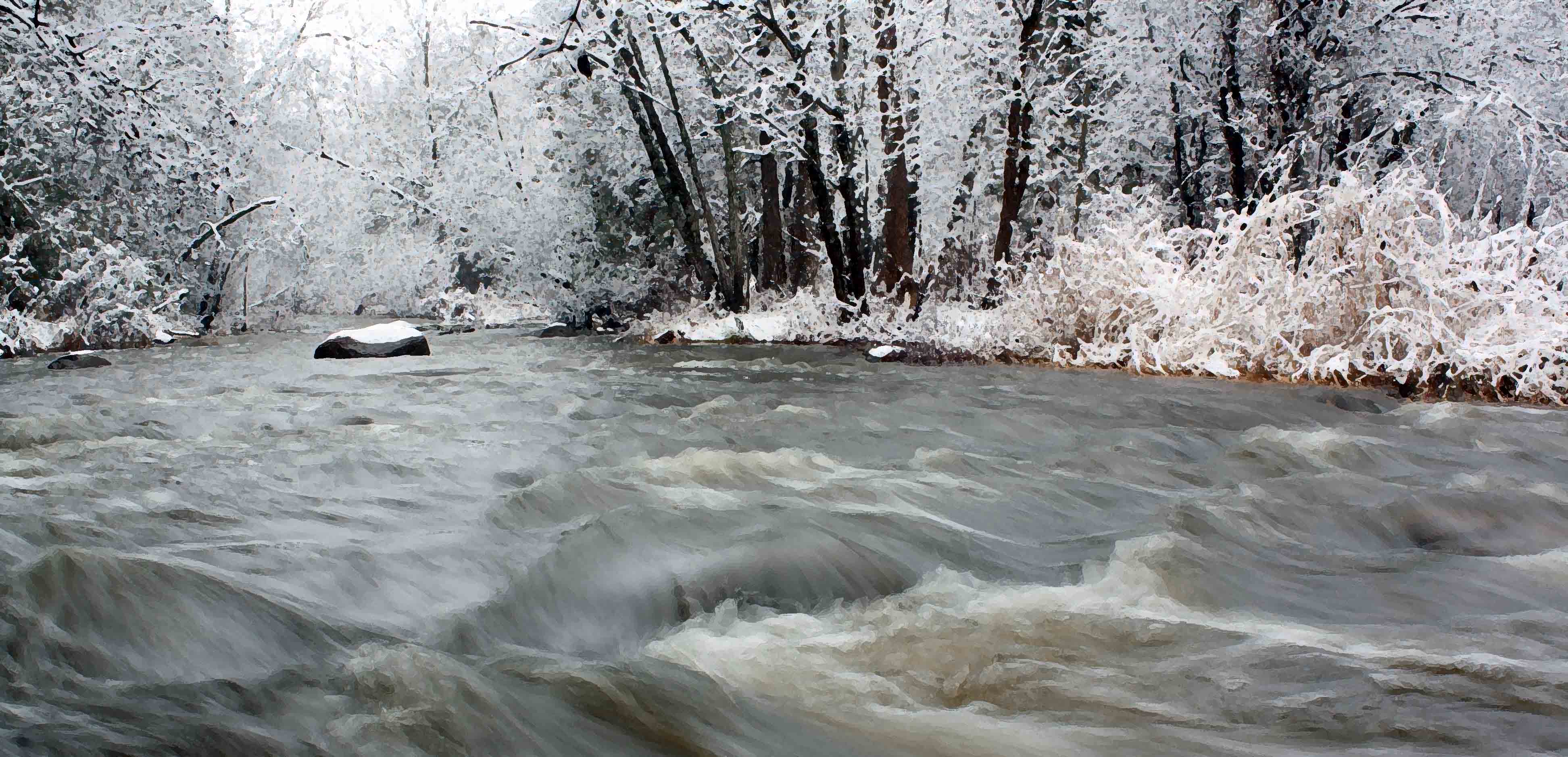
Jackson Creek in early winter, ON (photo and rendition by Nina Munteanu)

Nina Munteanu is a Canadian ecologist / limnologist and novelist. She is co-editor of Europa SF and currently teaches writing courses at George Brown College and the University of Toronto. Visit www.ninamunteanu.ca for the latest on her books. Nina’s bilingual “La natura dell’acqua / The Way of Water” was published by Mincione Edizioni in Rome. Her non-fiction book “Water Is…” by Pixl Press(Vancouver) was selected by Margaret Atwood in the New York Times ‘Year in Reading’ and was chosen as the 2017 Summer Read by Water Canada. Her novel “A Diary in the Age of Water” was released by Inanna Publications (Toronto) in June 2020.

How the Bdelloid Rotifer Lived for Millennia — Without Sex

As a child, I always wanted a microscope.

I would have collected slimy waters from the scum ponds and murky puddles near my house. I would have brought them home and exposed them to the light of my microscope. I would then have peered deep into a secret world, where shady characters and alien forms lurked and traded.

It would be many years, when I was in college, before I finally witnessed this world—so alien, it might have inspired the science fiction books I wrote later as an adult. As it turned out, I was led to pursue a Masters of Science degree, studying periphyton (microscopic aquatic communities attached and associated with surfaces like rocks and plants) in local streams in the Eastern Townships of Quebec.

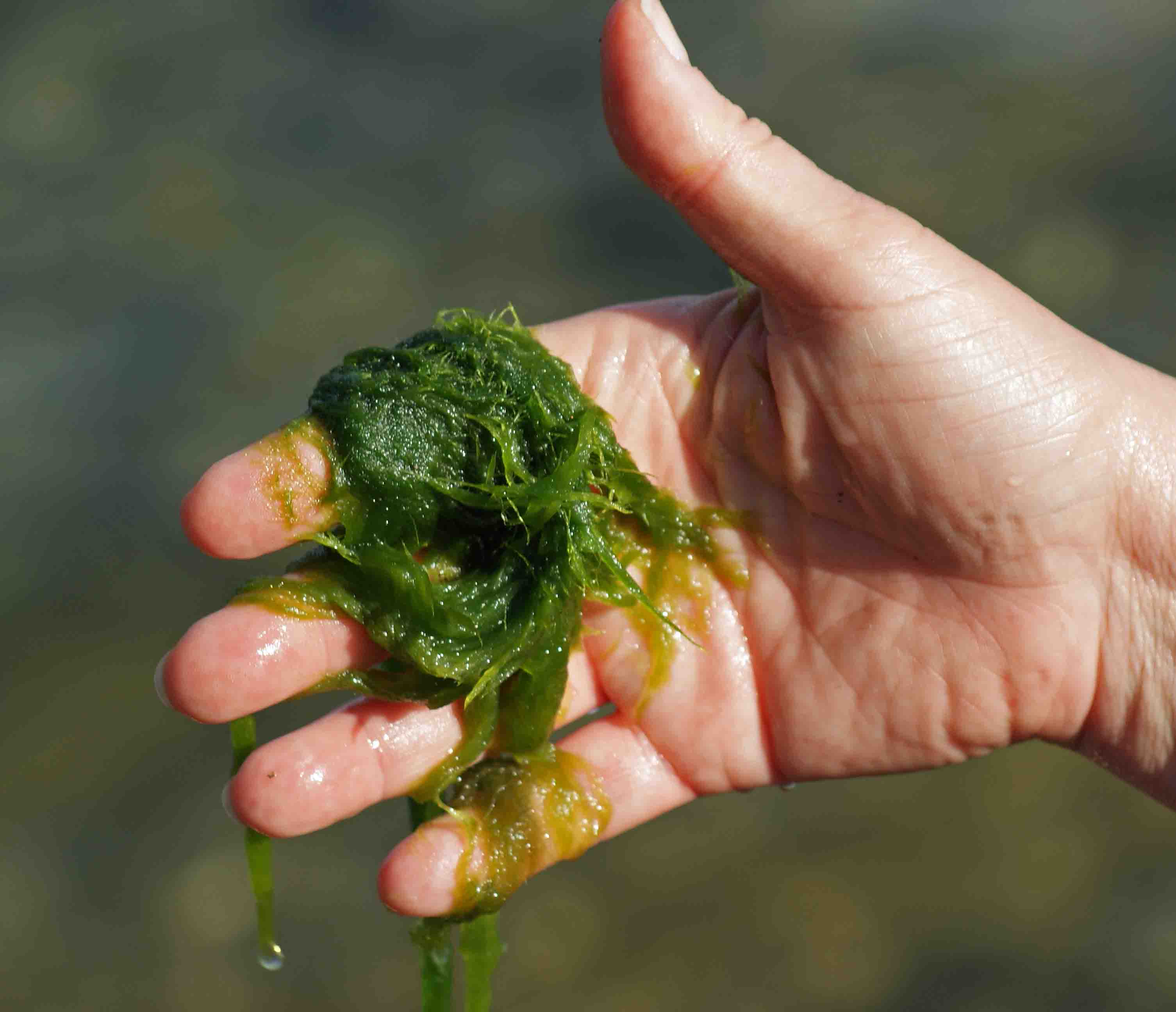
Filamentous algae collected in Lake Ontario, ON (photo by Nina Munteanu)

While my work focused on how diatoms (glass-walled algae) colonized surfaces, micro-invertebrates kept vying for my attention. Water fleas (cladocerans), copepods, rotifers, seed shrimps (ostracods) and water bears sang across my field of vision. They flitted, lumbered, wheeled and meandered their way like tourists lost in Paris. But this wasn’t Paris; I’d taken the blue pill and entered the rabbit hole into another world…

Sketch of common zooplankton and phytoplankton (illustration by Nina Munteanu)

The Secret—and Dangerous—World of Micro-Organisms

Small Freshwater habitats are home to a highly productive and diverse collection of micro-invertebrates—multicellular animals that can barely be seen with the naked eye. Many average from 0.5 to 1 mm in size and resemble little white blobs; however, a scholar can distinguish each invertebrate by its unique movement. For instance, when presented with a jar of pond water, I can usually distinguish among the wheel-like wandering of a gastrotrich, dirigible-like gliding of an ostracod (seed shrimp), the vertical goldfinch-style “hopping” of the cladoceran (water flea) as it beats its antennae, or the halting-jerking movements of copepods (oar-feet) as their antennae drive them along like a dingy propelled by an amateur oarsman.

Alas, puddles, ephemeral ponds and vernal pools pose sketchy habitats, given their tendency to appear and disappear in a wink. And like the thief in the night, they pose a harsh and uncertain home to many small organisms. These environments are ever-changing, unstable, chaotic and unpredictable. Yet, anyone who has studied these variable ecosystems understands that they team with life. 

When a puddle or ephemeral pond dries up then reappears with rain, how can these communities thrive? Or do they all die off and then somehow recruit when the pond reappears? Many of these invertebrates have evolved creative ways to survive in very unstable environments. Some form a resting stage—a spore, resting egg or ‘tun’—that goes dormant and rides out the bad weather.

Philodina, a bdelloid rotifer (microscope photo by Bob Blaylock)

Animalcules & the Bdelloid Rotifer

In 1701, Antonie van Leeuwenhoek observed that “animalcules” (likely the bdelloid rotifer Philodina roseaola) survived desiccation and were “resurrected” when water was added to them. He’d discovered a highly resistant dormant state of an aquatic invertebrate to desiccation.

Dormancy is a common strategy of organisms that live in harsh and unstable environments and has been documented in crustaceans, rotifers, tardigrades, phytoplankton and ciliates. “Dormant forms of some planktonic invertebrates are among the most highly resistant … stages in the whole animal kingdom,” writes Jacek Radzikowski in a 2013 review in the Journal of Plankton Research. Radzikowski describes two states of dormancy: diapause and quiescence. (on right: sketch of bdelloid rotifer by Nina Munteanu

Bdelloid rotifers can go into quiescent dormancy at practically any stage in their life cycle in response to unfavorable conditions. Early research noted that dormant animals could withstand freezing and thawing from −40°C to 100°C and storage under vacuum. They also tolerated high doses of UV and X radiation. Later work reported that some rotifers could survive extreme abiotic conditions, such as exposure to liquid nitrogen (−196°C) for several weeks or liquid helium (−269°C) for several hours. Desiccated adult bdelloid rotifers apparently survived minus 80°C conditions for more than 6 years. The dormant eggs of cladocerans and ostracods also survived below freezing temperatures for years.

Rotifers are cosmopolitan detrivores (they eat detritus) and contribute to the decomposition of organic matter. Rotifers create a vortex with ciliated tufts on their heads that resemble spinning wheels, sweeping food into their mouths. They often anchor to larger debris while they feed or inch, worm-like, along substrates. Some are sessile, living inside tubes or gelatinous holdfasts and may even be colonial. Rotifers reproduce by parthenogenesis (in the absence of mates), producing clones (like cladocerans). Resting eggs (sometimes called zygotes) survive when a pond dries up. Bdelloid rotifers don’t produce resting eggs; they survive desiccation through a process called anhydrobiosis, contracting into an inert form and losing most of their body water. Embryos, juveniles and adults can undergo this process. The bdelloid withdraws its head and foot and contracts its body into a compact shape called a tun; a generally unprotected dormant state that remains permeable to gases and liquids. Like Tardigrades, Bdelloid rotifers can resist ionizing radiation because they can repair DNA double-strand breaks.

The long-term survival and evolutionary success of bdelloid rotifers in the absence of sex arises from horizontal gene transfer via DNA repair.

In my eco-novel A Diary in the Age of Water the limnologist Lynna visits her technician Daniel as he peers through a microscope and makes the observation of why the bdelloid rotifer is well-suited to climate change:

I bent to peer through the eyepiece at what turned out to be a pond sample in a Petri dish. Attached to a pile of detritus shivering in the current, several microscopic metazoans—rotifers—swung like trees in a gale; they were feeding. Their ciliated disk-like mouths twirled madly, capturing plankton to eat. Watching them reminded me of my early research days as an honours undergrad at Concordia University in Montreal. Probably Philodina, I thought; I had seen many during my stream research in Quebec.

“They’re the future,” Daniel said, looking up at me with a smirk as I straightened.

I raised my eyebrows, inviting him to elaborate, which he cheerfully did.

“They’re the future because of their incredible evolutionary success and their ecological attraction to environmental disaster.” He knew he’d piqued my interest. “These little creatures have existed for over forty million years, Lynna. Without sex! And they’re everywhere. In temporary ponds, moss, even tree bark. Bdelloid mothers that go through desiccation produce daughters with increased fitness and longevity. In fact, if desiccation doesn’t occur over several generations, the rotifers lose their fitness. They need the unpredictable environment to keep robust.” They incorporate genes from their environment: they acquire DNA transposons—mobile DNA—through HGT.”

—A DIARY IN THE AGE OF WATER

The bdelloid all-female populations have thrived for millions of years by maintaining a robust and diverse population through epigenetics and DNA repair during dormancy…The dormancy of all-female bdelloids is an elegant technique to ride out harsh conditions. The bdelloids can go dormant quickly in any stage of their life cycle, and they’re capable of remaining dormant for decades. They can recover from their dormancy state within hours when the right conditions return and go on reproducing without the need to find a mate.

Highly variable environments tend to support rare species: organisms that are uniquely equipped for change. These are the explorers, misfits, and revolutionaries who do their work to usher in a new paradigm. They carry change inside them, through phenotypic plasticity, physiological stress response mechanisms, or life history adaptations. Like bdelloid rotifers going dormant through anhydrobiosis. Or blue-green algae forming dormant akinete spores. In tune with the vacillations of Nature, epigenetics-induced adaptation is the only option for keeping up with rapid and catastrophic environmental change, not to mention something as gigantic as climate change. That’s why the bdelloid rotifers survived for millennia and will continue for many more. They adapt by counting on change.

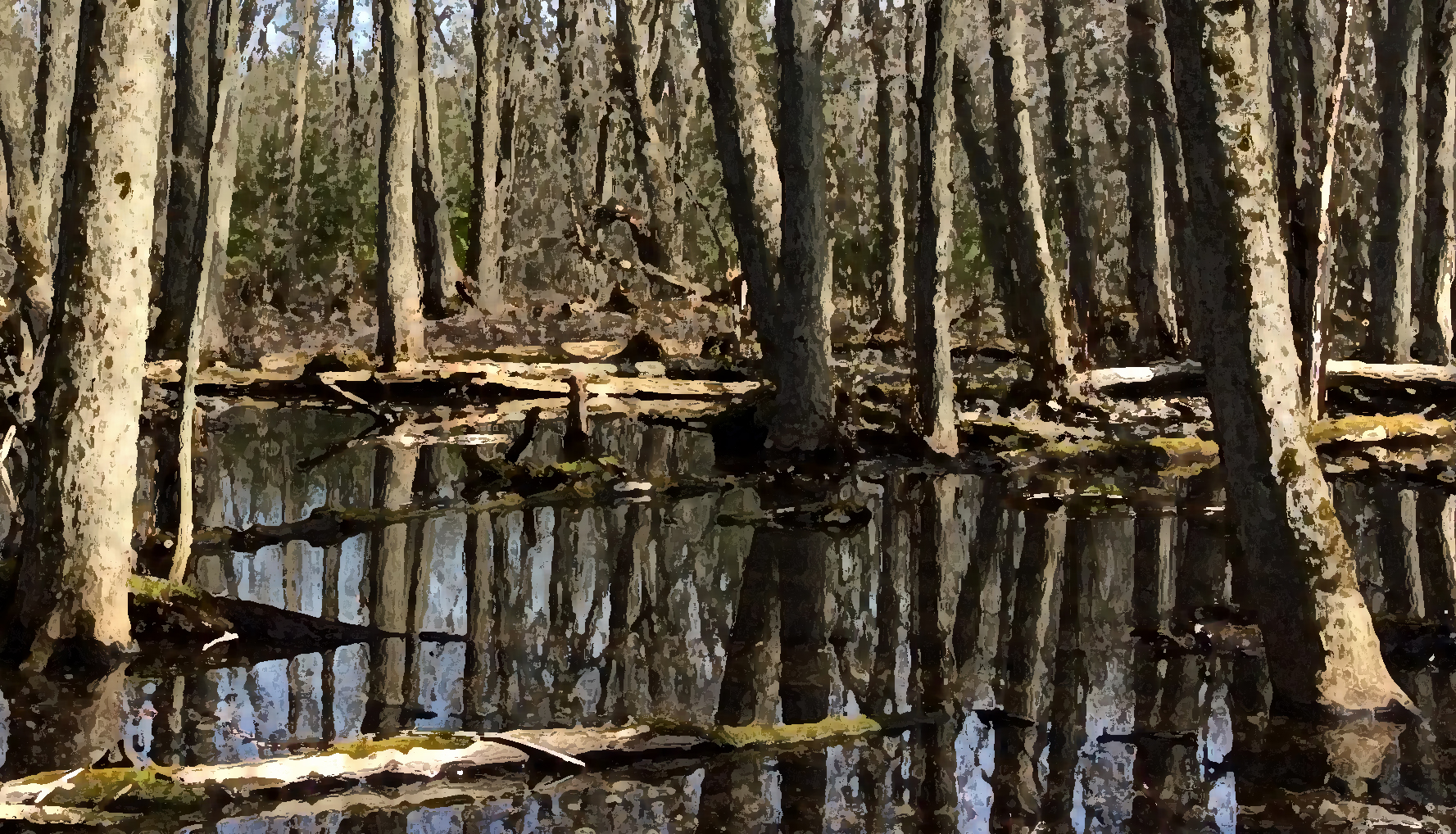
Maple swamp forest in Trent Nature Sanctuary, ON (photo and rendition by Nina Munteanu)

References:

Munteanu, Nina. 2020. “A Diary in the Age of Water.” Inanna Publications, Toronto. 300pp.

Munteanu, Nina. 2016. “Water Is…The Meaning of Water.” Pixl Press, Vancouver. 586pp.

O’Leary, Denise. 2015. “Horizontal gene transfer: Sorry, Darwin, it’s not your evolution anymore.” Evolution News, August 13, 2015. Online: https://www.evolutionnews.org/201508/horizontal_gene/

Ricci, C. And D. Fontaneto. 2017. “The importance of being a bdelloid: Ecological and evolutionary consequences of dormancy.” Italian Journal ofZoology, 76:3, 240-249.

Robinson, Kelly and Julie Dunning. 2016. “Bacteria and humans have been swapping DNA for millennia”. The Scientist Magazine, October 1, 2016. Online: https://www.the-scientist.com/?articles.view/articleNo/47125/title/Bacteria-and-Humans-Have-Been-Swapping-DNA-for-Millennia/

Weinhold, Bob. 2006. “Epigenetics: the science of change.” Environmental Health Perspectives, 114(3): A160-A167.

Williams, Sarah. 2015. “Humans may harbour more than 100 genes from other organisms”. Science, March 12, 2015. Online: http://www.sciencemag.org/news/2015/03/humans-may-harbor-more-100-genes-other-organisms

Nina Munteanu is a Canadian ecologist / limnologist and novelist. She is co-editor of Europa SF and currently teaches writing courses at George Brown College and the University of Toronto. Visit www.ninamunteanu.ca for the latest on her books. Nina’s bilingual “La natura dell’acqua / The Way of Water” was published by Mincione Edizioni in Rome. Her non-fiction book “Water Is…” by Pixl Press (Vancouver) was selected by Margaret Atwood in the New York Times ‘Year in Reading’ and was chosen as the 2017 Summer Read by Water Canada. Her novel “A Diary in the Age of Water” was released by Inanna Publications (Toronto) in June 2020.

“Adapt” by Susan Ksiezopolski

Crawford Lake Conservation Area (photo by Susan Ksiezopolski)
Sugar maple tree on Rotary Trail, Peterborough, ON (photo by Nina Munteanu)

Nina Munteanu is a Canadian ecologist / limnologist and novelist. She is co-editor of Europa SF and currently teaches writing courses at George Brown College and the University of Toronto. Visit www.ninamunteanu.ca for the latest on her books. Nina’s bilingual “La natura dell’acqua / The Way of Water” was published by Mincione Edizioni in Rome. Her non-fiction book “Water Is…” by Pixl Press(Vancouver) was selected by Margaret Atwood in the New York Times ‘Year in Reading’ and was chosen as the 2017 Summer Read by Water Canada. Her novel “A Diary in the Age of Water” was released by Inanna Publications (Toronto) in June 2020.

Eco-Fiction: What Readers Get From It and How to Prevent Polemic

Mary Woodbury on Dragonfly.eco recently shared a survey of over a hundred readers to determine the impact that eco-fiction had on them. What did environmental fiction mean to readers? What about it appealed to them? What were their favourite works? And did it incite them to action? The answers were both expected and surprising. Given the sample size and some study limitations on audience and diversity, the results are preliminary still. However, they remain interesting and enlightening.

theoverstorySome of the most impactful novels according to the readers surveyed include Barbara Kingsolver’s Flight Behavior, Richard Power’s The Overstory, Margaret Atwood’s MaddAddam trilogy, Cormac McCarthy’s The Road, Edward Abbey’s Monkey Wrench Gang, and Ursula K. Le Guin’s Hainish Cycle series.

Readers gave Woodbury several reasons why they enjoyed and found eco-novels impactful:

  • Realism or compelling account of or reflection of society, scary or not
  • Goes beyond readers’ culture–expands minds
  • Humorous
  • Story focused on characters versus an issue
  • Learned something new
  • Opened readers’ minds
  • Captured imagination
  • Positive endings
  • Good storytelling
  • Interesting characters
  • Suspense and/or psychological burn

One reader mentioned that what appealed to them about Emmi Itäranta’s Memory of Water was the style of writing. It provoked “feelings of utter beauty but also unease.”

One reader enjoyed Cormac Mccarthy’s The Road “for its spare post-apocalyptic world where even language seems to run out.”

Of Cherie Dimaline’s The Marrow Thieves a reader wrote that “The dystopic beginning felt so real, and then the positive ending was so good. I loved it and it made me think about how climate change can possibly have impacts beyond just our physical and mental health, but also our dreams!”

A reader of Frank Herbert’s Dune wrote that “it was the first time I’d seen a literary rendering of an ecosystem that felt real. The ideas of ecology are woven into this story in a way I didn’t think was possible for fiction. Interconnection is hard to think about, hard to grasp, and Dune showed me that fiction, done well, can really help with this.” The same reader acknowledged that in Annihilation Jeff VenderMeer “mastered the technique.”

FavTopics Eco-Fiction

Graph from Environmental Fiction Impact Survey by Mary Woodbury

When asked the question “Do you think that environmental themes in fiction can impact society, and if so, how?” 81% agreed and qualified their answers:

  • Fiction can encourage empathy and imagination. Stories can affect us more than dry facts. Fiction reaches us more deeply than academic understanding, moving us to action.
  • Fiction can trigger a sense of wonder about the natural world, and even a sense of loss and mourning. Stories can immerse readers into imagined worlds with environmental issues similar to ours.
  • Fiction raises awareness, encourages conversations and idea-sharing. Fiction is one way that helps to create a vision of our future. Cautionary tales can nudge people to action and encourage alternative futures. Novels can shift viewpoints without direct confrontation, avoid cognitive dissonance, and invite reframed human-nature relationships through enjoyment and voluntary participation.
  • Environmental themes can reorient our perspective from egocentrism to the greater-than-human world.
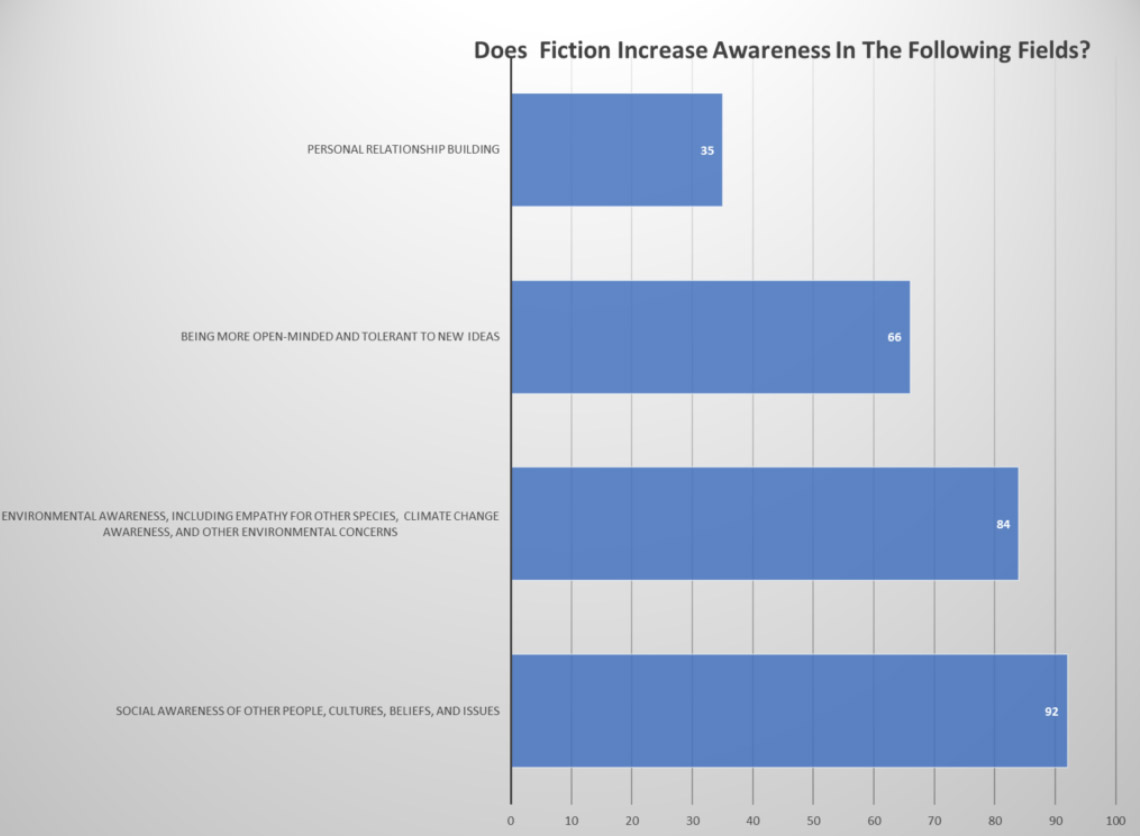
Awareness in Fields

Graph from Environmental Fiction Impact Survey by Mary Woodbury

In summary, Woodbury writes:

“The sample size (103) seems to be a good one for people who are mostly familiar with the idea of eco-fiction (and similar environmental/nature fiction genres and subgenres), though I was still hoping to get a larger, more diverse group of participants. The majority of respondents were highly educated middle-aged women. The majority of the group read from 1-29 novels a year. Favorite novels represented mostly North American or European authors (male and female about equally, with J.R.R. Tolkien, Barbara Kingsolver and Margaret Atwood consistently a favorite), with the majority of readers enjoying literary fiction the most, followed by dystopia/utopia and then science fiction.”

Woodbury notes that the genres of science fiction and fantasy were well represented in the survey, “both as favorite and most impactful novels, despite literary fiction being the favorite genre among the participants.” Of novels that respondents enjoyed, “readers were most impacted by good storytelling.” Polemic was not well regarded.


Achieving Impactful Eco-Fiction & Avoiding Polemic Through Use of Metaphor

The key to impact and enjoyment for a reader lies in good storytelling. The very best storytelling uses metaphor and oblique description to achieve a deeper meaning. The greatest art must be left to interpretation; not directly dispensed. Great art is felt and experienced viscerally; not just taken in intellectually. Great art shows; not tells.

EcologyOfStoryIn my writing guidebook The Ecology of Story: World as Character, I discuss the various ways that the use of metaphor achieves depth and meaning in story, particularly in eco-fiction. One impactful way is in the choice of setting. In the chapter on Place as Metaphor, I write:

Everything in story is metaphor, Ray Bradbury once told me. That is no more apparent than in setting and place, in which a story is embedded and through which characters move and interact.

Metaphor is the subtext that provides the subtleties in story, subtleties that evoke mood, anticipation, and memorable scenes. Richard Russo says, “to know the rhythms, the textures, the feel of a place is to know more deeply and truly its people.” When you choose your setting, remember that its primary role is to help depict theme. This is because place is destiny.

What would the book Dune be without Arrakis, the planet Dune? What would the Harry Potter books be without Hogwarts?

Metaphor provides similarity to two dissimilar things through meaning. In the metaphor “Love danced in her heart” or the simile “his love was like a slow dance”, love is equated with the joy of dance. By providing figurative rather than literal description to something, metaphor invites participation through interpretation.

When I write “John’s office was a prison,” I am efficiently and sparingly suggesting in five words—in what would normally take a paragraph—how John felt about his workplace. The reader would conjure imagery suggested by their knowledge of a prison cell: that John felt trapped, cramped, solitary, stifled, oppressed—even frightened and threatened. Metaphor relies on sub-text knowledge. This is why metaphor is so powerful and universally relevant: the reader fully participates—the reader brings in relevance through their personal knowledge and experience and this creates the memorable aspect to the scene.

Metaphor is woven into story through the use of devices and constructs such as depiction of the senses, personification, emotional connections, memories, symbols, archetypes, analogies and comparisons. Sense, and theme interweave in story to achieve layers of movement with characters on a journey. All through metaphor.

Symbols and Archetypes

In Emmi Itäranta’s Memory of Water—about a post-climate change world of sea level rise—water is a powerful archetype, whose secret tea masters guard with their lives. Water, with its life-giving properties and other strange qualities, has been used as a powerful metaphor and archetype in many stories: from vast oceans used as a powerful metaphor and archetype in many stories: from vast oceans of mystery, beauty and danger—to the relentless flow of an inland stream. Margaret Atwood’s The Penelopiad is one example:

Water does not resist. Water flows. When you plunge your hand into it, all you feel is a caress. Water is not a solid wall, it will not stop you. But water always goes where it wants to go, and nothing in the end can stand against it. Water is patient. Dripping water wears away a stone. Remember that, my child. Remember you are half water. If you can’t go through an obstacle, go around it. Water does.

In my short story The Way of Water (La natura dell’acqua), water’s connection with love flows throughout the story:

The Way of Water-COVERThey met in the lobby of a shabby downtown Toronto hotel. Hilda barely knew what she looked like but when Hanna entered the lobby through the front doors, Hilda knew every bit of her. Hanna swept in like a stray summer rainstorm, beaming with the self-conscious optimism of someone who recognized a twin sister. She reminded Hilda of her first boyfriend, clutching flowers in one hand and chocolate in the other. When their eyes met, Hilda knew. For an instant, she knew all of Hanna. For an instant, she’d glimpsed eternity. What she didn’t know then was that it was love. 

Love flowed like water, gliding into backwaters and lagoons with ease, filling every swale and mire. Connecting, looking for home. Easing from crystal to liquid to vapour then back, water recognized its hydrophilic likeness, and its complement. Before the inevitable decoherence, remnants of the entanglement lingered like a quantum vapour, infusing everything. Hilda always knew where and when to find Hanna on Oracle, as though water inhabited the machine and told her. Water even whispered to her when her wandering friend was about to return from the dark abyss and land unannounced on her doorstep. 

In a world of severe water scarcity through climate catastrophe and geopolitical oppression, the bond of these two girls—to each other through water and with water—is like the shifting covalent bond of a complex molecule, a bond that fuses a relationship of paradox linked to the paradoxical properties of water. Just as two water drops join, the two women find each other in the wasteland of intrigue. Hilda’s relationship with Hanna—as with water—is both complex and shifting according to the bonds they make and break.

Using the Senses 

Readers don’t just “watch” a character in a book; they enter the character’s body and “feel”.

How do writers satisfy the readers’ need to experience the senses fully? Description, yes. But how cold is cold? What does snow really smell like? What color is that sunset? How do you describe the taste of wine to a teetotaler?

Literal description is insufficient. To have the sense sink in and linger with the reader, it should be linked to the emotions and memories of the character experiencing it. By doing this, you are achieving several things at the same time: describing the sense as the character is experiencing it—emotionally; revealing additional information on the character through his/her reaction; and creating a more compelling link for the reader’s own experience of the sense.

Senses can be explored by writers through metaphor, linking the sense to memories, using synesthesia (cross-sensory metaphor), linking the sense psychologically to an emotion or attitude, and relating that sense in a different way (e.g., describing a visual scene from the point of view of a painter or photographer—painting with light). How a sense is interpreted by your protagonist relies on her emotional state, memories associated with that sense and her attitude.

Using Personification

TheWindupGirl Paolo BacigalupiEnvironmental forces—such as weather, climate, forests, mountains, water systems—convey the mood and tone of both story and character. These environmental forces are not just part of the scenery. To a writer, they are devices used in plot, theme and premise. They may also be a compelling character, particularly in eco-fiction, climate-fiction, and speculative fiction. Dystopian fiction often explores a violent world of contrast between the affluent and vulnerable poor that often portrays the aftermath of economic and environmental collapse (e.g., Maddaddam Trilogy, The Windup Girl, Snowpiercer, Interstellar, Mad Max). In any fiction genre it is important to get the science right. Readers of fiction with strong environmental components, however, expect to learn as much from the potential reality as from the real science upon which the premise depends.

In Memory of Water, Emmi Itäranta personifies this life-giving substance whose very nature is tightly interwoven with her main character. As companion and harbinger, water is portrayed simultaneously as friend and enemy. As giver and taker of life.
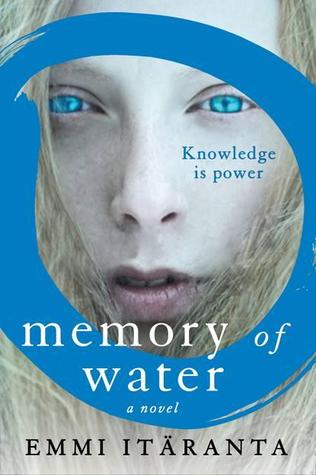
Memory of Water Emmi ItarantaWater is the most versatile of all elements … Water walks with the moon and embraces the earth, and it isn’t afraid to die in fire or live in air. When you step into it, it will be as close as your own skin, but if you hit it too hard, it will shatter you … Death is water’s close companion. The two cannot be separated, and neither can be separated from us, for they are what we are ultimately made of: the versatility of water, and the closeness of death. Water has no beginning and no end, but death has both. Death is both. Sometimes death travels hidden in water, and sometimes water will chase death away, but they go together always, in the world and in us. 

Personification of natural things provides the reader with an image they can clearly and emotionally relate to and care about. When a point-of-view character does the describing, we get a powerful and intimate indication of their thoughts and feelings—mainly in how they connect to place (often as symbol). When this happens, place and perception entwine in powerful force.

Donald Maass writes in Writing the Breakout Novel Workbook: “The beauty of seeing a locale through a particular perspective is that the point-of-view character cannot be separated from the place. The place comes alive, as does the observer of that place, in ways that would not be possible if described using objective point of view.” The POV character’s relationship to place helps identify the transformative elements of their journey. Such transformation is the theme of the story and ultimately portrays the story’s heart and soul.

Connecting Character with Environment

Strong relationships and linkages can be forged in story between a major character and an aspect of their environment (e.g., home/place, animal/pet, minor character as avatar/spokesperson for environment [e.g. often indigenous people]). In these examples the environmental aspect serves as symbol and metaphoric connection to theme. They can illuminate through the sub-text of metaphor a core aspect of the main character and their journey: the grounding nature of the land of Tara for Scarlet O’Hara in Gone With the Wind; the sacred white pine forests for the Mi’kmaq in Barkskins; The dear animals for Beatrix Potter of the Susan Wittig Albert series.

The immense sandworms of Frank Herbert’s Dune are strong archetypes of Nature—large and graceful creatures whose movements in the vast desert sands resemble the elegant whales of our oceans:

It came from their right with an uncaring majesty that could not be ignored. A twisting burrow-mound of sand cut through the dunes within their field of vision. The mound lifted in front, dusting away like a bow wave in water. 

Misunderstood, except by the indigenous Fremen, the giant sandworms are targeted as a dangerous nuisance by the colonists—when, in fact, they are closely tied to the ecological cycles of the desert planet through water and spice.
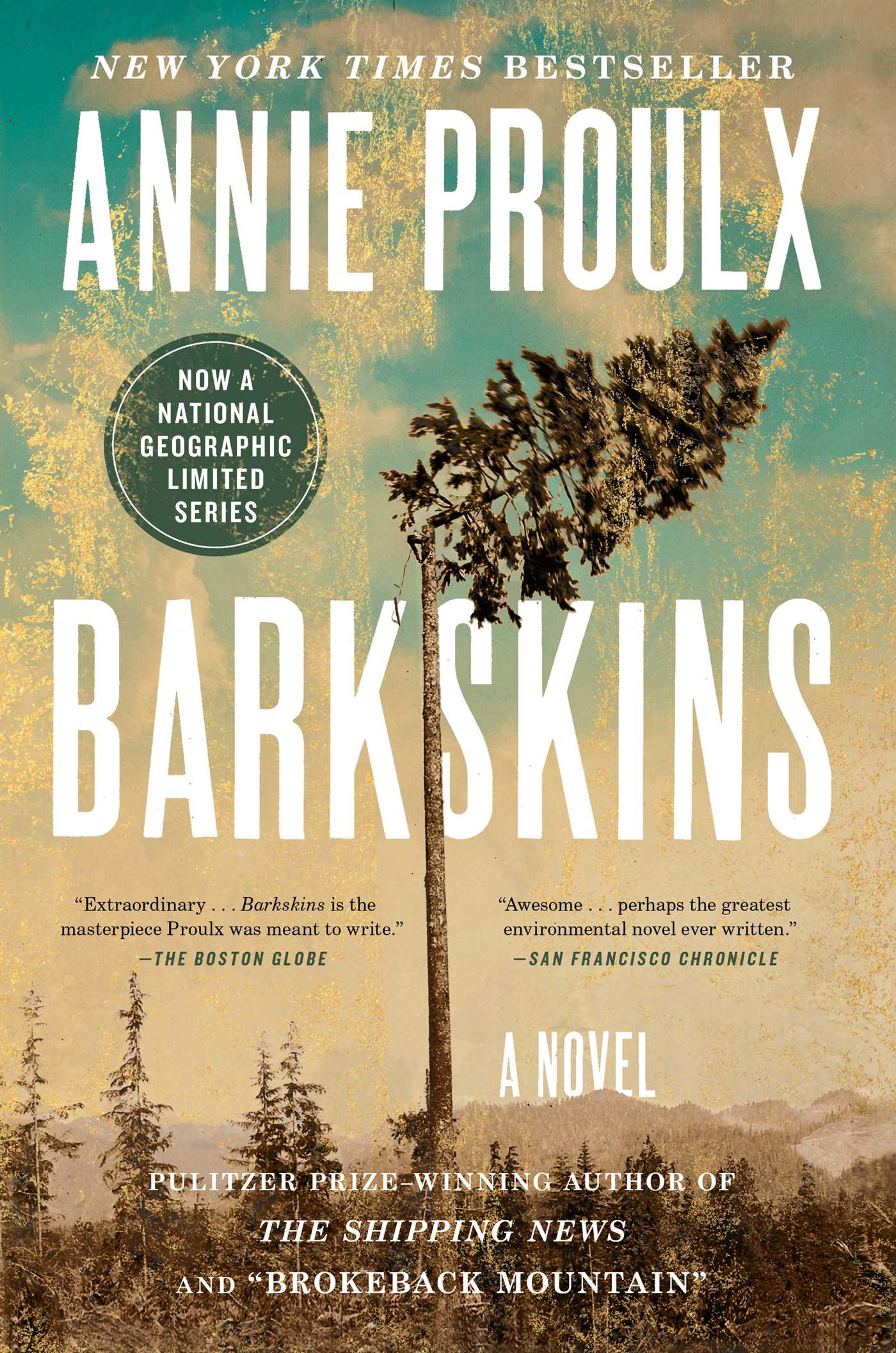
Barkskins Annie ProulxAnnie Proulx opens her novel Barkskins with a scene in which René Sel and fellow barkskins (woodcutters) arrive from France in the late seventeenth century to the still pristine wilderness of Canada to settle, trade and accumulate wealth:

In twilight they passed bloody Tadoossac, Kébec and Trois-Rivières and near dawn moored at a remote riverbank settlement … Mosquitoes covered their hands and necks like fur. A man with yellow eyebrows pointed them at a rain-dark house. Mud, rain, biting insects and the odor of willows made the first impression of New France. The second impression was of dark vast forest, inimical wilderness.

These bleak impressions of a harsh environment crawling with pests such as bébites and moustiques underlie the combative mindset of the settlers to conquer and seize what they can of a presumed infinite resource. By page seventeen, we know that mindset well. René asks why they must cut so much forest when it would be easier to use the many adequate clearings to build their houses and settlements. Trépagny fulminates: “Easier? Yes, easier, but we are here to clear the forest, to subdue this evil wilderness.” He further explains the concept of property ownership that is based on strips of surveyable land parcels—an application of the enclosure system. For them, the vast Canadian boreal forest was never-ending and for the taking: “It is the forest of the world. It is infinite. It twists around as a snake. swallows its own tail and has no end and no beginning,” Trépagny claims.
Leaves dead litter-long sh TNS

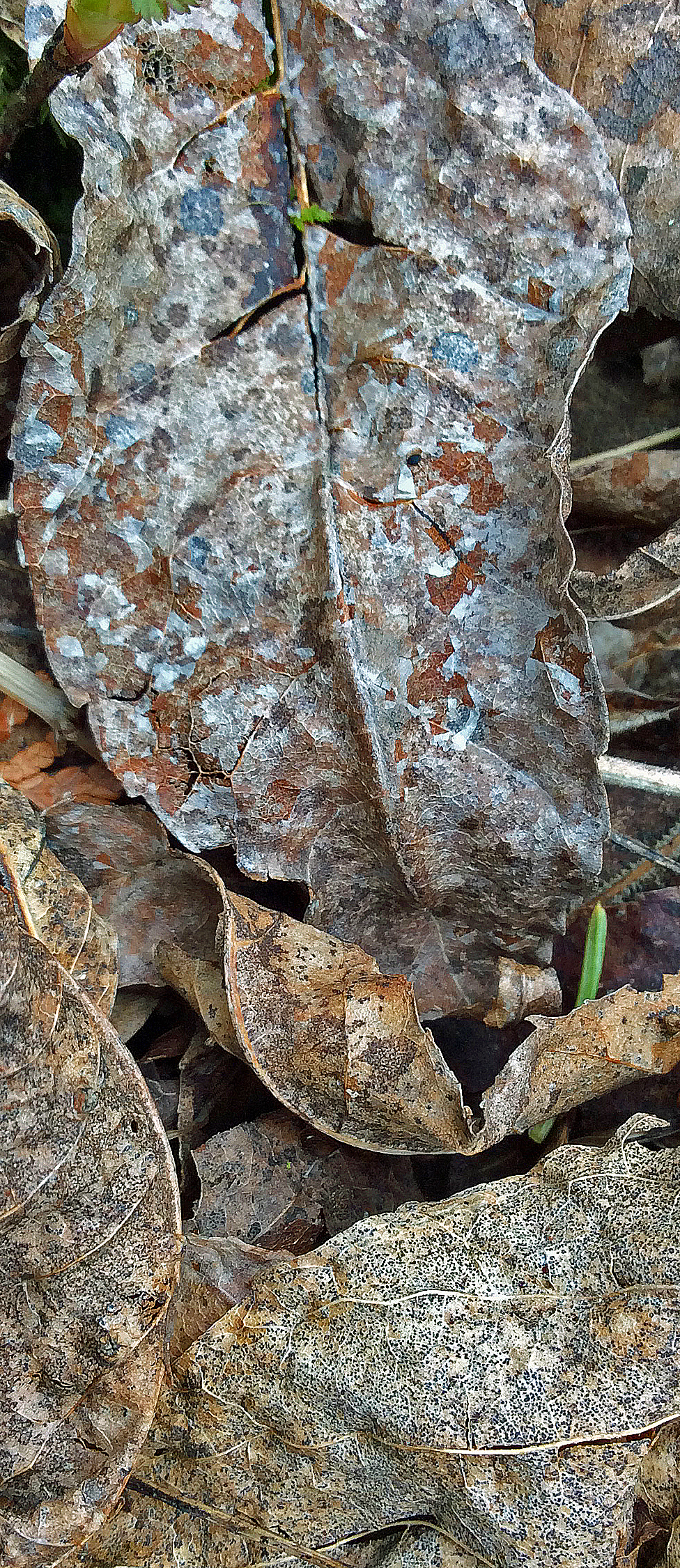
Leaf litter in Ontario forest (photo by Nina Munteanu)

Annie Proulx’s Barkskins chronicles two immigrants who arrive in Canada in 1693 (René Sel and Charles Duquet) and their descendants over 300 years of deforestation of North America; a saga that starts with the arrival of the Europeans in pristine forest and ends with a largely decimated forest under the veil of global warming. “Barkskins” (woodcutters) are, in fact indentured servants who were brought from the Paris slums to the wilds of New France to clear the land, build and settle. Sel is forced to marry a native woman and their descendants live trapped between two cultures; Duquet runs away to become a fur trader and builds a timber empire.

The Mi’kmaq are interwoven with the land and the forest. Missionary Pere Crème, who studies language makes this observation of the natives and the forest:

He saw they were so tightly knitted into the natural world that their language could only reflect the union and that neither could be separated from the other. They seemed to believe they had grown from this place as trees grow from the soil, as new stones emerge aboveground in spring. He thought the central word for this tenet, weji-sqalia’timk, deserved an entire dictionary to itself. 

The foreshadowing of doom for the magnificent forests is cast by the shadow of how settlers treat the Mi’kmaq people. The fate of the forests and the Mi’kmaq are inextricably linked through settler disrespect for anything indigenous and a fierce hunger for “more” of the forests and lands. Ensnared by settler greed, the Mi’kmaq lose their own culture and their links to the natural world erode with grave consequence. In a pivotal scene, Noë, a Mi’kmaw descendent of René Sel, grows enraged when she sees a telltale change in her brothers:

The offshore wind had shifted slightly but carried the fading clatter of boots on rock. They were wearing boots instead of moccasins. Noë knew what that meant but denied it … The men should be setting out to hunt moose, but because of the boots she knew they were going to work for the French logger.


Other Articles on Environmental Fiction, Eco-Fiction and Climate Fiction 

Can Dystopian Eco-Fiction Save the Planet?

Science Fiction on Water Justice & Climate Change

Windup Girl: When Monsanto Gets Its Way

Eco-Artist Roundtable with Frank Horvat on Green Majority Radio


Thanks to Mary Woodbury for the permission to share her survey results here. Much of the second part of this article is excerpted from the “Story” section of  The Ecology of Story: World as Character.
grape leaves in fall-halifax copy

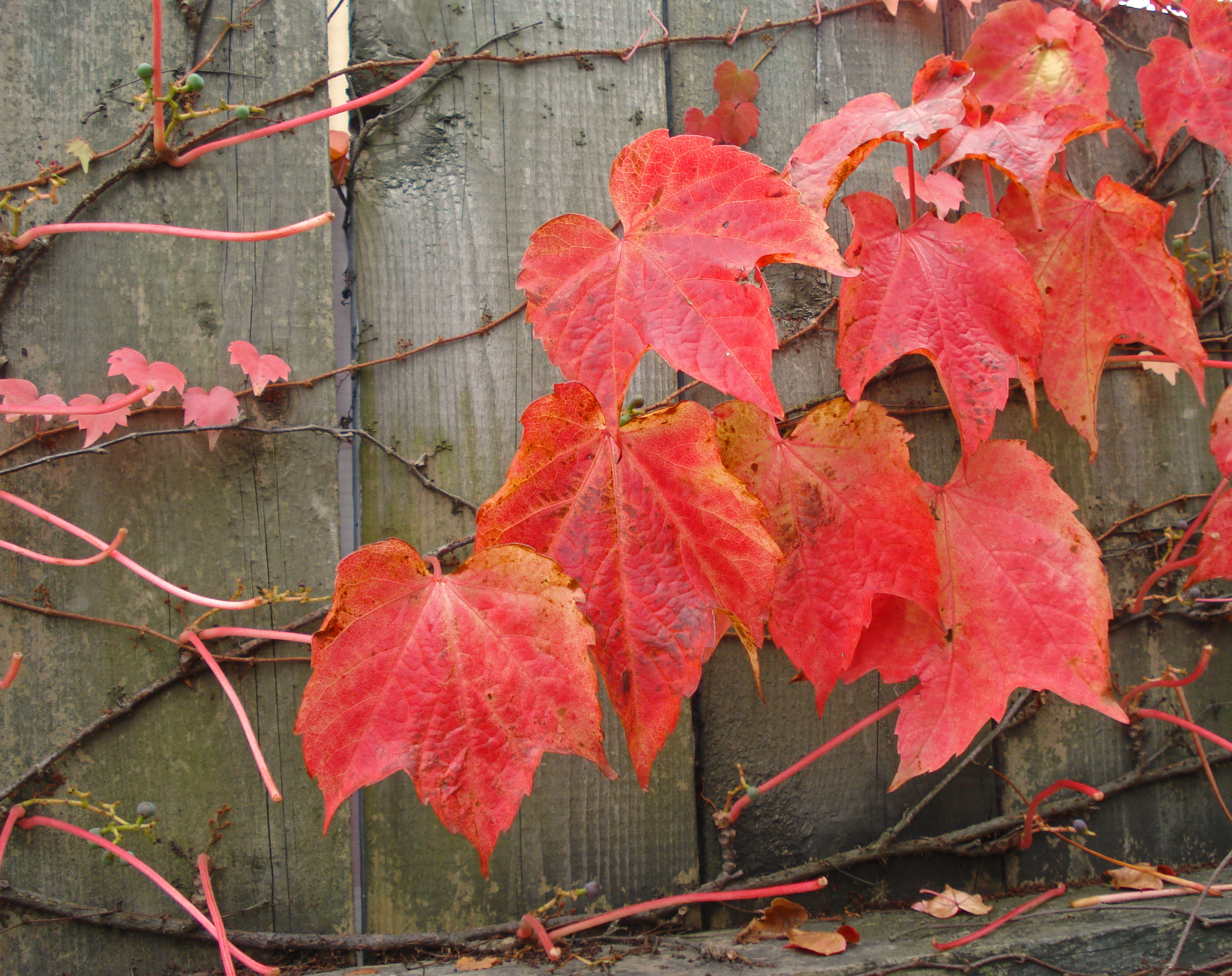
Grape leaves on fence in Toronto, ON (photo by Nina Munteanu)

nina-2014aaa

Nina Munteanu is a Canadian ecologist / limnologist and novelist. She is co-editor of Europa SF and currently teaches writing courses at George Brown College and the University of Toronto. Visit www.ninamunteanu.ca for the latest on her books. Nina’s bilingual “La natura dell’acqua / The Way of Water” was published by Mincione Edizioni in Rome. Her non-fiction book “Water Is…” by Pixl Press(Vancouver) was selected by Margaret Atwood in the New York Times ‘Year in Reading’ and was chosen as the 2017 Summer Read by Water Canada. Her novel “A Diary in the Age of Waterwas released by Inanna Publications (Toronto) in June 2020.

Nina Munteanu Talks “A Diary in the Age of Water” on W.O.W. Podcast

Microsoft Word - WOW-Nina.docx

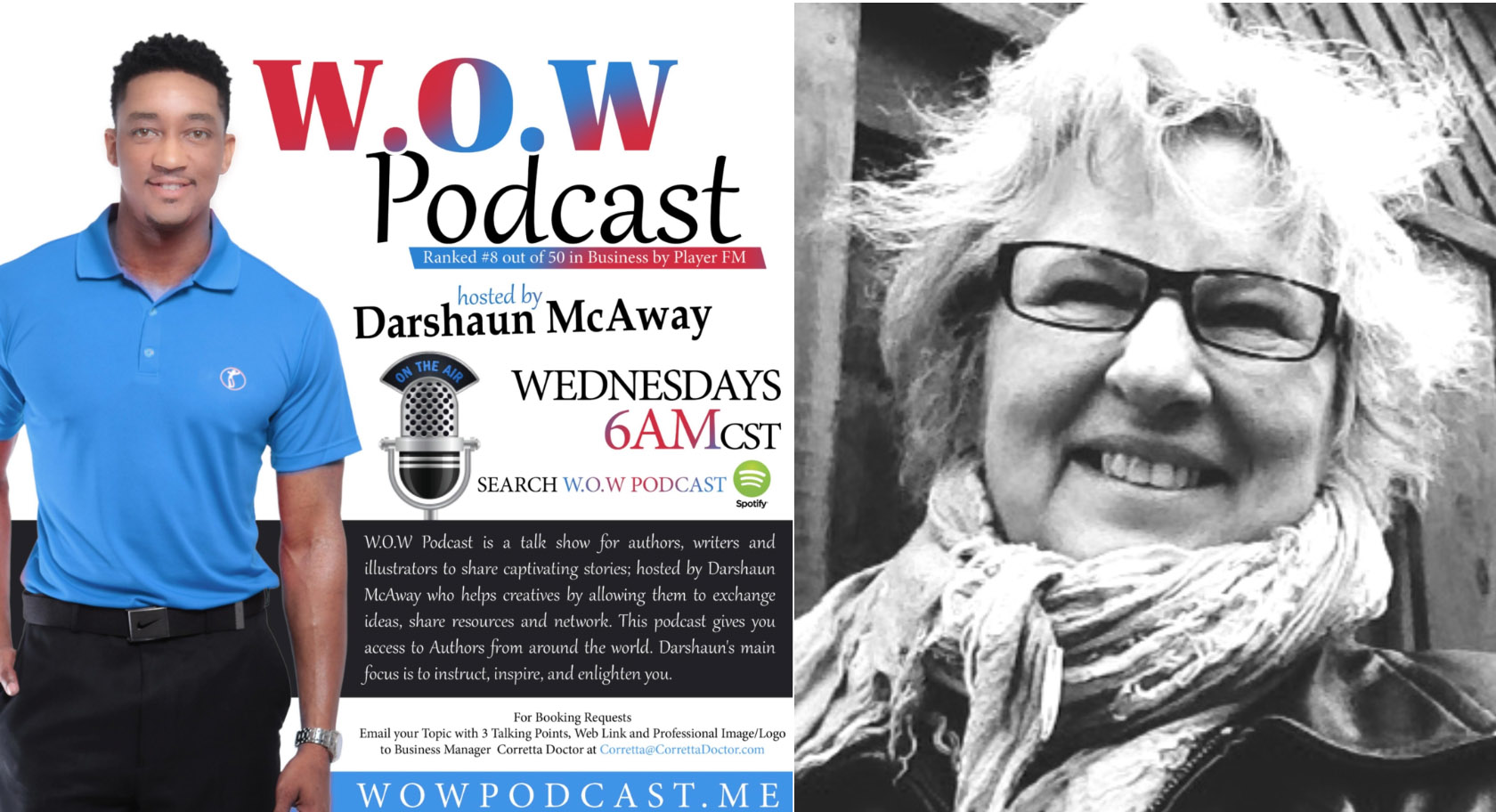
I recently chatted with Darshaun McWay on W.O.W. Podcast about my recent novel A Diary in the Age of Water.

We talked about the story, its main characters–including water as a character–and why I write about water. We also covered why the book is written partly as a diary. Margaret Atwood’s name came up too…

The interview will air on W.O.W. Podcast on October 15, 2020. Darshaun kindly provided the recording for my community. Here it is:

Darshaun McAwayDarshaun McAway has been hosting W.O.W. Podcast from Arkansas in the USA since 2017. With over a hundred episodes to date, Darshaun’s main focus is to instruct, inspire and enlighten through interviews with authors around the world. Other Canadian science fiction authors who have appeared on W.O.W include Cat Rambo and Edward Willett.

pebble shoreline drybr ThompsonCreek

Pebbled shoreline of Thompson Creek, ON (photo by Nina Munteanu)

nina-2014aaa

Nina Munteanu is a Canadian ecologist / limnologist and novelist. She is co-editor of Europa SF and currently teaches writing courses at George Brown College and the University of Toronto. Visit www.ninamunteanu.ca for the latest on her books. Nina’s bilingual “La natura dell’acqua / The Way of Water” was published by Mincione Edizioni in Rome. Her non-fiction book “Water Is…” by Pixl Press(Vancouver) was selected by Margaret Atwood in the New York Times ‘Year in Reading’ and was chosen as the 2017 Summer Read by Water Canada. Her novel “A Diary in the Age of Waterwas released by Inanna Publications (Toronto) in June 2020.
An Interview with a Bull Thistle

Story is place, and place is character—Nina Munteanu

Darwins Paradox-2nd edI write mostly eco-fiction. Even before it was known as eco-fiction, I was writing it. My first book—Darwin’s Paradox—published in 2007 by Dragon Moon Press as science fiction, was also eco-fiction. It takes place in 2075 after climate change has turned southern Ontario into a heathland and Toronto into a self-enclosed city. My latest eco-fiction—A Diary in the Age of Water published in 2020 by Inanna Publications—is set mostly in Toronto from the near-future to 2065 and beyond.

As a writer of eco-fiction and climate fiction, I’m keenly aware of the role environment plays in story. Setting and place are often subtle yet integral aspects of story. In eco-fiction, they can even be a “character,” serve as archetypes and present metaphoric connections to characters on a journey (see my guidebook The Ecology of Story: World as Character published by Pixl Press for more discussion on all aspects of nature’s symbols in writing).

EcologyOfStoryThings to consider about place as character begin with the POV character and how they interact with their environment and how they reflect their place. For instance, is that interaction obvious or subtle? Is that environment constant or changing, stable or unstable, predictable, or variable? Is the place controllable or not, understandable or not? Is the relationship emotional, connected to senses such as memory?

Place as character serves as an archetype that story characters connect with and navigate in ways that depend on the theme of the story. A story’s theme is essentially the “so what part” of the story. What is at stake for the character on their journey. Theme is the backbone—the heart—of the story, driving characters to journey through time and place toward some kind of fulfillment. There is no story without theme. And there is no theme without place.

Archetypes are ancient patterns of personality shared universally by humanity (e.g. the “mother” archetype is recognized by all cultures). When place or aspects of place act as an archetype or symbol in story—particularly when linked to theme—this provides a depth of meaning that resonates through many levels for the reader.

In Ray Bradbury’s The Martian Chronicles, Mars symbolizes a new Eden. Like Bradbury’s aboriginal Martians—who are mostly invisible—the planet is a mirror that reflects humanity’s best and worst. Who we are, what we are, what we bring with us and what we may become. What we inadvertently do—to others, and finally to ourselves—and how the irony of chance can change everything.

“Nature’s symbols are powerful archetypes that reveal compelling story,” writes Donald Maass in Write the Breakout Novel Workbook.

Diary Water cover finalWater has been used as a powerful archetype in many novels. In my latest novel, A Diary in the Age of Water, water plays an important role through its unique metaphoric connection with each of the four main characters; how they relate to it and understand it, and act on its behalf. Water in A Diary in the Age of Water is often personified; water reflects various symbolic and allegorical interpretations and embraces several archetypes including herald-catalyst, trickster, shapeshifter, and shadow.

Strong relationships and linkages can be forged in story between a major character and an aspect of their environment (e.g., home/place, animal/pet, minor character as avatar/spokesperson for environment).

FictionWriter-cover-2nd edIn these examples the environmental aspect serves as symbol and metaphoric connection to theme. They can illuminate through the sub-text of metaphor a core aspect of the main character and their journey: the grounding nature of the land of Tara for Scarlet O’Hara in Margaret Mitchel’s Gone With the Wind; the white pine forests for the Mi’kmaq in Annie Proulx’s Barkskins; The animals for Beatrix Potter of the Susan Wittig Albert series.

All characters—whether the main POV character, or a minor character or personified element of the environment—have a dramatic function in your story. In my writing courses at George Brown College and The University of Toronto and in my guidebook The Fiction Writer, I provide a list of questions you can ask your character to determine if they are functioning well in the story and if they should even stay in the story. I call it interviewing your character. You can interview any character in your story; it can provide incredible insight. And speaking of character…

I have of late been walking daily to a lovely meadow beside a stream and thicket where brilliant Bull thistles have burst into flower. I felt the need to research this beautiful yet dangerously prickly plant and why it peaked my interest…

Thistle group 2 Pb copy

Bull Thistle, ON (photo by Nina Munteanu)

 Interview With the Bull Thistle

Nina: Pardon my saying, but you seem to scream paradox. You’re dangerously beautiful. Alluring yet aloof. Standoffish, even threatening. For instance, how is it that you have such a beautiful single purple-pink flower at the top of such a nasty prickly stem and leaves?

Bull Thistle: First of all, it isn’t just a flower at the top; it’s a flower head of over two hundred flowers called florets. Each flower head is a tight community of tube disk bisexual florets arranged in Fibonacci spirals and protected by a collection of spiked bracts called an involucre. And inside the protective outer shell, embedded in a fleshy domed receptacle, are the tiny ovaries, waiting patiently to be fertilized and grown into a seed or achene.

Thistle honey bee 2 closer

Honey bee getting nectar from the thistle flower head (photo by Nina Munteanu)

Nina: Ah, I beg your pardon. But you still have all those sharp spikes everywhere. I’m guessing they are to protect your developing young, the ovaries. But doesn’t that isolate you? Keep you from integrating in your ecosystem?

Bull Thistle: The bristles are specifically aimed at predators who wish to harm us, eat us, bore into us, pull us out of the earth. We have many friends—the pollinators, the bees, wasps, and butterflies that help us cross-pollinate from plant to plant. And the birds—particularly the goldfinches—also help.

Nina: Wait. Don’t goldfinches eat your babies—eh, seeds?

Bull Thistle: They do. But they also help disperse our children. They land on our dried involucres—now opened to reveal the seeds and their pappus. The birds pull the seeds out by the thistle down that rides the wind. The birds eat the seeds and also use the thistle down to make their nests. But—like the squirrels who love oak acorns—the birds miss as many as they eat. By carrying the down to their nests, they also help the seeds travel great distances farther than the wind would have carried them. By dislodging the seeds in bunches, they help the seeds break away from the receptacle and meet the wind. The pappus, which is branched and light like a billowing sail, carries the seed on the wind to germinate elsewhere to help us colonize.

Thistle opened involucre scattering seeds

Opened involucre with achenes and pappus ready to disperse, ON (photo by Nina Munteanu)

Nina: So, your enemy is also your friend… The shadow character, who helps the hero on her journey by presenting a perilous aspect of enlightenment.

Bull Thistle: If you say so. What we understand is that Nature’s resilience derives from the balance of give and take over time. Prey and predator. Death, decay, transcendence. Destruction and creation. Ecological succession and change are a gestalt expression of Gaia wisdom as each individual fulfills its particular existential niche. Even if that is to die…for others to live.

Nina: Yes, the hero’s journeyBut you’re not originally from here, are you? You were brought to North America from Eurasia. Some consider you an interloper, a disturbance. You could serve the shadow or trickster archetype yourself—outcompeting the native thistle, creating havoc with pasture crops. You can tolerate adverse environmental conditions and adapt to different habitats, letting you spread to new areas. Your high seed production, variation in dormancy, and vigorous growth makes you a serious invader. You cause wool fault and physical injury to animals. Storytellers might identify you metaphorically with the European settler in the colonialism of North America; bullying your way in and destroying the natives’ way of life.

Bull Thistle: We’re unaware of these negative things. We don’t judge. We don’t bully; we simply proliferate. We ensure the survival of our species through adaptation. Perhaps we do it better than others. You’ve lately discovered something we’ve felt and acted on for a long time. Climate is changing. We must keep up with the times… But to address your original challenge, if you did more research, you would find that we serve as superior nectar sources for honey bees (Apis spp.), bumblebees (Bombus spp.) and sweat bees (Anastogapus spp.) who thoroughly enjoy our nectar.

Thistle head sweat bee Pb copy

Sweat bee draws the sweet nectar of the Bull Thistle, ON (photo by Nina Munteanu)

We’re considered a top producer of nectar sugar in Britain. Cirsium vulgare—our official name—has ranked in the top 10 for nectar production in a recent UK survey.  The goldfinch relies on our seed and down. And we’ve provided food, tinder, paper, and medicine to humans for millennia. As some of your indigenous people point out, it’s a matter of attitude. Change is opportunity.

Thistle group Pb copyNina: I guess that every weed was once a native somewhere. I also agree that times are changing—faster than many of us are ready for, humans included. If you were to identify with an archetype, which would you choose?

Bull Thistle: That would depend on the perceiver, we suppose. Some of us think of us as the hero, journeying through the change and struggling to survive; others see us as the herald, inciting movement and awareness by our very existence; some of us identify with the trickster, others with the shapeshifter—given how misunderstood we are. In the end, perhaps, we are the mentor, who provides direction through a shifting identity and pointing the way forward through the chaos of change toward enlightenment.

Nina: Yes, I suppose if someone stumbled into your nest of prickles, incredible awareness would result. Speaking of that very awareness, this brings me back to my original question: why are you so beautiful yet deadly?

Bull Thistle: We are the purest beauty—only attained through earnest and often painful awareness. We are the future and the beauty of things to come.

Thistle head on full of pollen close

Flower head of Bull Thistle, ON (photo by Nina Munteanu)

You can read more on this topic in Nina’s writing guidebook series, particularly The Fiction Writer: Get Published, Write Now! and The Ecology of Story: World as Character.

Relevant Articles:

The Ecology of Story: Revealing Hidden Characters of the Forest

Ecology of Story: World as Character” Workshop at When Words Collide

Ecology of Story: Place as Allegory

Ecology of Story: Place as Symbol

Ecology of Story: Place as Metaphor

Ecology of Story: Place as Character & Archetype

nina-2014aaa

Nina Munteanu is a Canadian ecologist / limnologist and novelist. She is co-editor of Europa SF and currently teaches writing courses at George Brown College and the University of Toronto. Visit www.ninamunteanu.ca for the latest on her books. Nina’s bilingual “La natura dell’acqua / The Way of Water” was published by Mincione Edizioni in Rome. Her non-fiction book “Water Is…” by Pixl Press(Vancouver) was selected by Margaret Atwood in the New York Times ‘Year in Reading’ and was chosen as the 2017 Summer Read by Water Canada. Her novel “A Diary in the Age of Waterwas released by Inanna Publications (Toronto) in June 2020.


Age of Water Podcast: Interview with The Water Brothers

WaterBrothers-banner

AoW Logo-smallWe are now living in the Age of Water. Water is the new “gold”, with individuals, corporations and countries positioning themselves around this precious resource. Water is changing everything. The Age of Water Podcast covers anything of interest from breaking environmental news to evergreen material. This also includes human interest stories, readings of eco-literature, discussion of film and other media productions of interest.

Join the discussion!

In Episode six of Age of Water, we join Canadian film educators The Water Brothers—Alex and Tyler Mifflin—in Toronto, Ontario, where they discuss their eco-adventure TV series and other documentary initiatives to educate, entertain and connect people with water and environmental issues. Alex and Tyler are two young eco-adventurer brothers who travel the world to explore our relationship with water. What are the problems and where will the solutions come from? The next generation takes us on the search.


WaterBrothers-camera

The Water Brothers

The Water Brothers is an eco-adventure documentary series that follows brothers, Alex and Tyler Mifflin, as they explore the world, uncover the planet’s most important and leading-edge water stories and interview top scientists and experts on solutions to help overcome the many and diverse environmental challenges we all face. There is nowhere they won’t go from high mountain peaks to the bottom of the ocean.


Alex and Tyler are passionate about the subject of water conservation and use their respective educations in film and environmental studies to create this award-winning series. Alex is the lead researcher, co-writer and co-host and Tyler is the co-host, director, videographer and co-producer. They share a love of travel and adventure, a passion for the subject and a powerful desire to communicate their passion to audiences, especially their own generation.

WaterBrothers diving

WaterBrothers-ice

Water Brothers

Age of Water talked to the Water Brothers about their adventures from the Kumbh Mela on the Ganges River—largest gathering of humans on earth—to diving into dead zones to sailing into the middle of the Great Pacific Garbage Patch or climbing Mount Kilimanjaro. The Water Brothers circle the globe to bring back stories that affect, inspire and educate viewers.

The Water Brothers airs in Canada on TVO, Knowledge Network, and Radio – Canada in Quebec, as well as in over 50 countries worldwide.


nina-2014aaa

Nina Munteanu is a Canadian ecologist / limnologist and novelist. She is co-editor of Europa SF and currently teaches writing courses at George Brown College and the University of Toronto. Visit www.ninamunteanu.ca for the latest on her books. Nina’s bilingual “La natura dell’acqua / The Way of Water” was published by Mincione Edizioni in Rome. Her non-fiction book “Water Is…” by Pixl Press (Vancouver) was selected by Margaret Atwood in the New York Times ‘Year in Reading’ and was chosen as the 2017 Summer Read by Water Canada. Her novel “A Diary in the Age of Waterwas released by Inanna Publications (Toronto) in May 2020.


Age Of Water Podcast: Nina Reads from “The Overstory”

AoW Logo-smallWe are now living in the Age of Water. Water is the new “gold”, with individuals, corporations and countries positioning themselves around this precious resource. Water is changing everything. The Age of Water Podcast covers anything of interest from breaking environmental news to evergreen material. This also includes human interest stories, readings of eco-literature, discussion of film and other media productions of interest.

In this episode of Age of Water, Nina reads from the eco-fiction book “Overstory” by Richard Powers, an exploration of the relationship of trees and humanity…


At the heart of Richard Powers’s The Overstory are the pivotal lives of two women, botanist Patricia Westerford and college student Olivia Vandergriff. Both will inspire a movement against the destruction of forests.

theoverstoryPatricia Westerford—whose work resembles that of Diana Beresford-Kroeger (author of The Global Forest) and UBC’s Suzanne Simard—is a shy introvert who discovers that trees communicate, learn, trade goods and services, and have intelligence. When she shares her discovery, she is ridiculed by her peers and loses her position.  But, just as with Lynn Margulis and her theory of endosymbiosis, Westerford is finally validated. She is the archetypal ‘mother tree’, the metaphoric Tachigali versicolor, who ultimately brings the tangle of narratives together through meaning. Westerford writes in her book The Secret Forest:

“There are no individuals in a forest, no separable events. The bird and the branch it sits on are a joint thing. A third or more of the food a big tree makes may go to feed other organisms. Even different kinds of trees form partnerships. Cut down a birch, and a nearby Douglas fir may suffer…Fungi mine stone to supply their trees with minerals. They hunt springtails, which they feed to their hosts. Trees, for their part, store extra sugar in their fungi’s synapses, to dole out to the sick and shaded and wounded. A forest takes care of itself, even as it builds the local climate it needs to survive…A tree is a wondrous thing that shelters, feeds, and protects all living things. It even offers shade to the axmen who destroy it.”

Olivia Vandergriff miraculously survives an electrocution to become an ecowarrior after she begins to hear the voices of the trees. She rallies others to embrace the urgency of activism in fighting the destruction of California’s redwoods and even camps in the canopy of one of the trees to deter the logging. When the ancient tree she has unsuccessfully protected is felled, the sound is “like an artillery shell hitting a cathedral.” Vandergriff weeps for this magnificent thousand-year old tree. So do I. Perhaps the real heroes of this novel are the ancient trees.

EcologyOfStoryIn his review of Overstory in The Guardian, Banjamin Markovits wrote, “ There is something exhilarating…in reading a novel whose context is wider than human life. Like Moby-DickThe Overstory leaves you with a slightly adjusted frame of reference… And I found, while reading, that some of what was happening to his characters passed into my conscience, like alcohol into the bloodstream, and left a feeling behind of grief or guilt, even after I put it down.”

I further explore the use of metaphor and other storytelling devices used by Richard Powers in his strongly symbolic novel in my writing guidebook “Ecology of Story: World as Character.”


nina-2014aaa

Nina Munteanu is a Canadian ecologist / limnologist and novelist. She is co-editor of Europa SF and currently teaches writing courses at George Brown College and the University of Toronto. Visit www.ninamunteanu.ca for the latest on her books. Nina’s bilingual “La natura dell’acqua / The Way of Water” was published by Mincione Edizioni in Rome. Her non-fiction book “Water Is…” by Pixl Press (Vancouver) was selected by Margaret Atwood in the New York Times ‘Year in Reading’ and was chosen as the 2017 Summer Read by Water Canada. Her novel “A Diary in the Age of Waterwas released by Inanna Publications (Toronto) in June 2020.