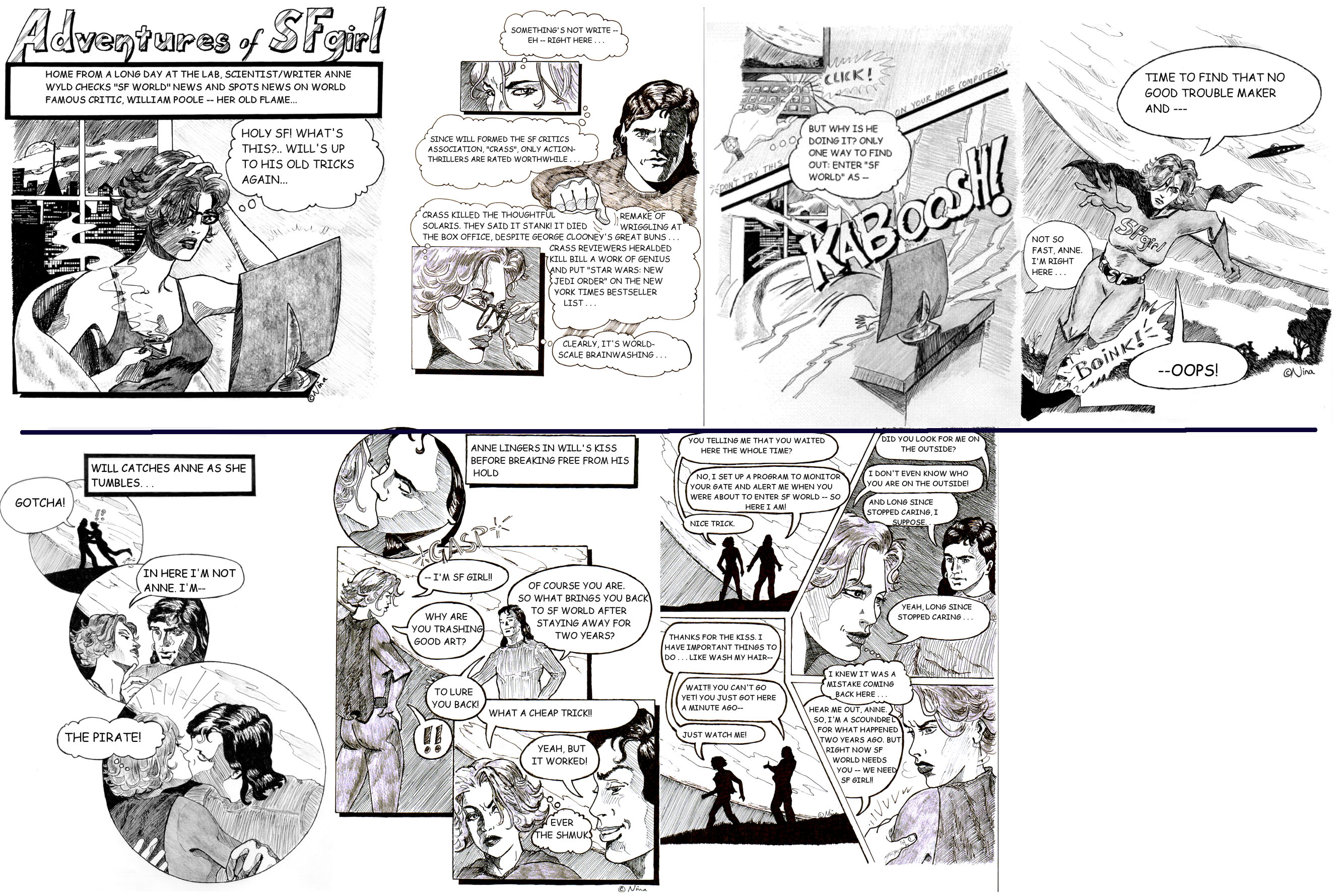
When I was little, I wanted to be a storyteller, a cartoonist specifically. I was reading graphic novels before I could read. That didn’t stop me from understanding what was going on. Being a virtual learner and an artist, I understood context: expressions, body language…
Nina, age three, pretending to read (photo by Martha Munteanu)
.
.
I wrote and drew wild adventure thriller detective stories and stories about exploring other planets. While my first love was telling stories, I was called by the needs of the environment. This percolated through me as I grew up and wouldn’t let go. When I could read and write, I still read graphic novels; I wrote and illustrated short stories about the environment, dystopian tales that focussed on how we were destroying our planet.
.
At school, I loitered in the hallways, pasting subversive posters on the walls. They were a call to action: Restrain … Reuse … Repurpose … Recycle … Remain true to the environment. I wrote in the school paper. I quoted global statistics, mentioned global warming (yes, people knew about it back in the ‘60s and ‘70s), and submitted cheesy emotional drawings of pollution and toxic waste.
By the time I was ready to go to university (I’d been accepted early into the fine arts program at Concordia University in Montreal), I switched my major on registration day. Like a horse bolting from a fire, I charged out of the arts and into the sciences. I’d heard environment’s call for help and had notions of becoming an environmental lawyer. I kept a few arts courses as electives but focused on a biology degree in the environmental sciences. I understood that the tools I needed to wield as an eco-warrior in law were rooted in science.
.
A twenty-some old Nina exploring the forest
.
I learned something about ecology, botany, animal, plant, and cell physiology, genetics and biochemistry, and limnology (the study of water systems). The sciences fascinated me and I became entranced in the study of how the natural world worked. I was particularly attracted by lichens, plant-like organisms called cryptogams that grow like miniature forests on substrates—trees,fence posts, rock, cement. My attraction was partly because these often overlooked organisms were actually more of a symbiotic community or mini-ecosystem: an intriguing community of fungi, algae, cyanobacteria, bacteria and yeast growing together. I felt that on some level, lichen had much to teach us on lifestyle and approach to living on this planet. They’d been around for millennia, a lot longer than we’ve been.
Having long abandoned law (I convinced myself that I wasn’t cut out for it; maybe I was but that’s another universe), I decided to pursue lichen ecology for my masters degree. But fate had another path in mind for me. The botany professor who I wished to study under was retiring and no one was taking her place. She referred me to the limnology professor and he got me interested in another microscopic community: periphyton (the algae and associated organisms that colonize plants, rock and cement in water).
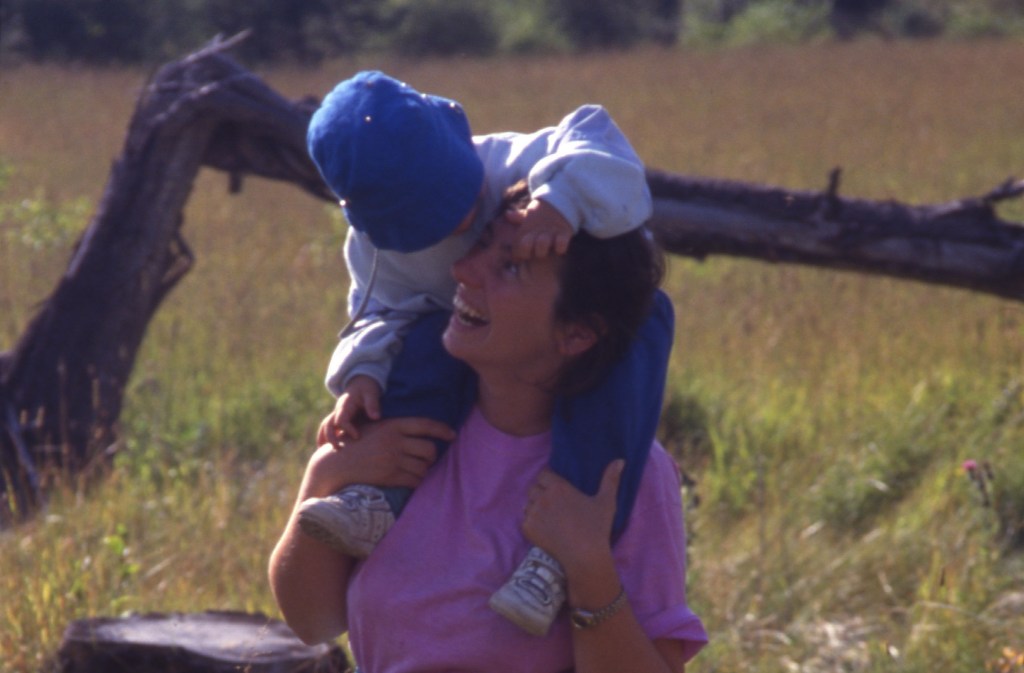
Nina and son Kevin explore nature (photo by Herb Klassen)
.
I’d come somewhat full circle to be an eco-warrior, pursuing environmental problems (and corporate mischief) through biology rather than law. I designed and conducted environmental impact assessments and recommended mitigation, restoration, and remediation procedures to various clients from lakefront communities and city planners to mining companies dealing with leaky tailings ponds and pulp mills discharging effluent into the ocean.
.
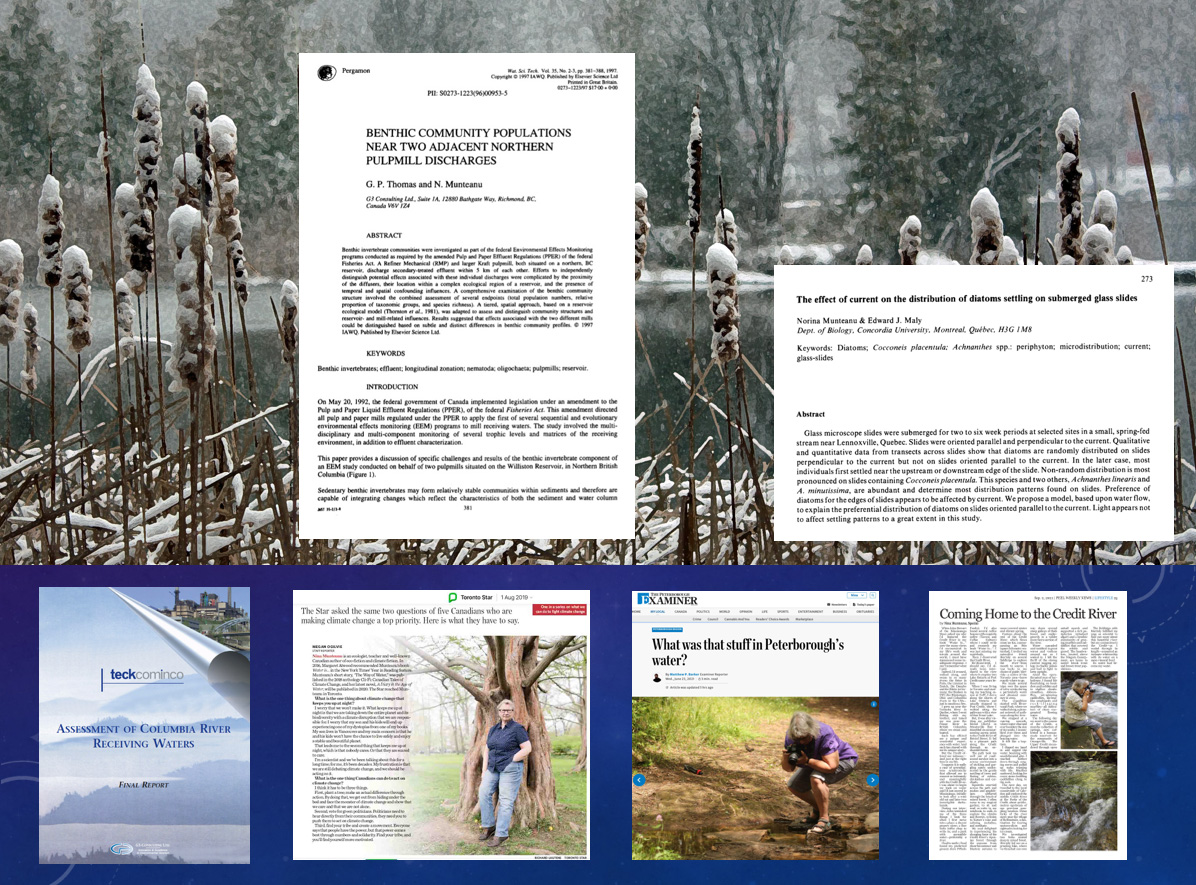
Various reports, scientific papers and articles I’ve written or been interviewed for
.
It worked for me. I consulted for twenty-some years. It was for the most part both satisfying and encouraging. I felt as though I was making a difference: mostly through educating my clients. But that became less and less the case as the consulting firms I worked for, and the corporations they worked for, seemed to have less and less integrity. They also seemed to care less about the environment and more about profit.
So, just as I’d done on the day of registration at university, I bolted like a horse in a fire and quit my job as a consultant. I never returned to consulting.
Nina photographing pollution of a small creek entering a drinking water source (photo by Matthew Barker, Peterborough Examiner)
My sights went back to storytelling, journalism, and reporting/interviews. Mostly eco-fiction. Creating narratives that would hopefully move people, nudge them to act for the environment. Change their worldview somewhat into eco-friendly territory. Make them care. I’m still an eco-warrior, but my pen and my storytelling is my tool.
The word is a powerful tool. And the stories that carry them are vehicles of change.
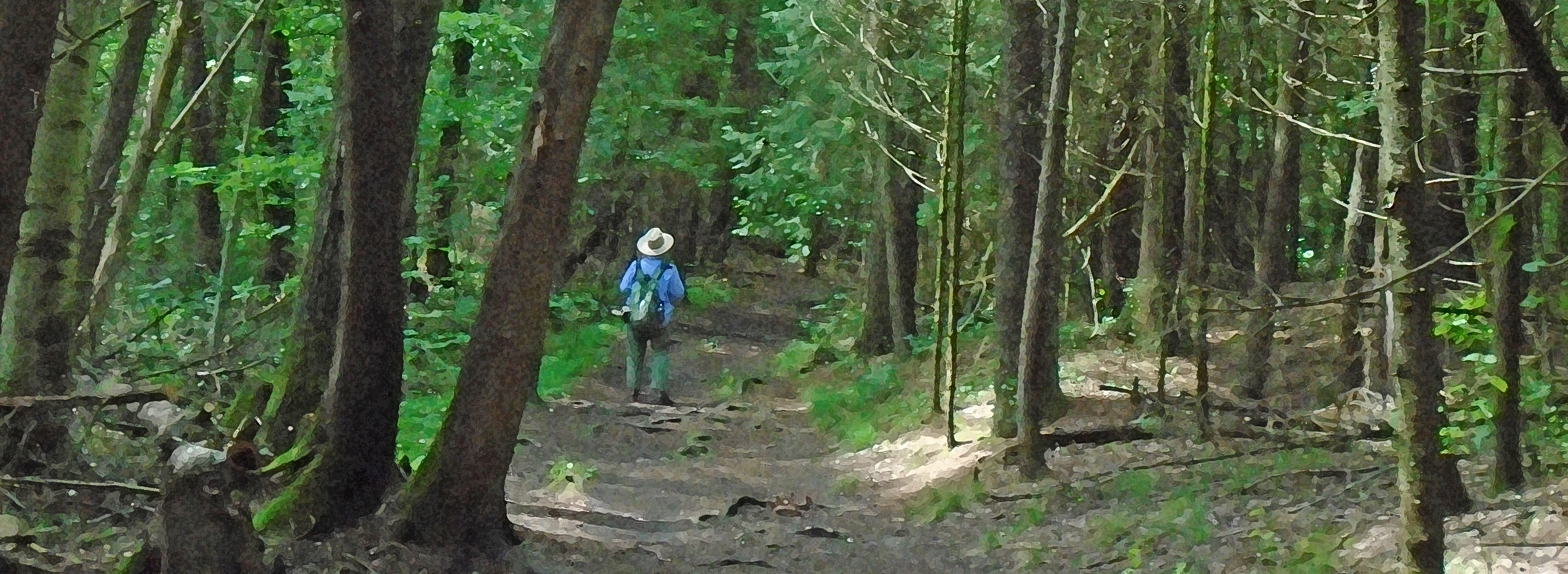
Nina Munteanu wandering the Emily Tract forest, ON (photo by Merridy Cox)
.
Nina Munteanu is a Canadian ecologist / limnologist and novelist. She is co-editor of Europa SF and currently teaches writing courses at George Brown College and the University of Toronto. Visit www.ninamunteanu.ca for the latest on her books. Nina’s bilingual “La natura dell’acqua / The Way of Water” was published by Mincione Edizioni in Rome. Her non-fiction book “Water Is…” by Pixl Press (Vancouver) was selected by Margaret Atwood in the New York Times ‘Year in Reading’ and was chosen as the 2017 Summer Read by Water Canada. Her novel “A Diary in the Age of Water” was released by Inanna Publications (Toronto) in June 2020.
Candidates have three minutes to make nine cubes out of a pile of blocks in the centre. Those who complete the puzzle in time will move on to the next test; those who don’t are eliminated and must return to the slums—their one chance at a better life dashed. Among the nine candidates in the room are Rafael (Rodolfo Valente), who steals a cube from another candidate to get his nine. Michele (Bianca Comparato), who initially out of kindness helps Fernando (Michel Gomes), who’s reach to the pile is limited, is in turn helped by him when she is shy one cube: at time-end, he cleverly piles her eight cubes into one large cube—the ninth—and she passes the test.
So begins Netflix’s 3%, a Brazilian dystopian thriller series created by Pedro Aguilera and directed by Cesar Charlone. In a kind of Hunger Games contest, candidates cheat in self-service; others violently impose Darwinian entitlement and survival of the fittest; yet others rely on reciprocal altruism.
.
3% is set in the near future after the planet has fallen into a divided haves and have-nots through some calamity. Three percent of the population live well on an island in the Atlantic Ocean, called Offshore (Mar Alto). The remaining 97% struggle Inland with poverty and scarcity. A selection process lies between them.
Every year the 97% send their 20-year olds to undergo The Process, a grueling Hunger Games-style contest run by the Offshore elite to replenish their numbers. Only 3% of the candidates will be considered worthy. They must pass psychological, emotional and physical tests to earn a place in Mar Alto.
3% test
By the time Season 1 is over, candidates will have committed a full range of desperate and unsavory acts to make the cut—the stakes are high, after all: secure a position in the 3% elite or die in squalor and poverty. After being eliminated during the interview process, one youth throws himself off a balcony of the testing centre.
Major players in Season 1 of 3%
“It’s not so far from our own world, where the competition to get into a good school and land a good job drives many to self harm,” writes Matthew Gault on Motherboard. “In the 3%, as in our own world, society looks down on those who don’t achieve and there’s a certain kind of person who believes that life’s losers earned their place at the bottom.”
Ezekial, who runs “the Process” speaks to the new contestants
.
Inland is valued by the elite only for its reserve of youth to recruit Offshore’s strictly controlled population (you only find out how in the last show of Season 1). As for what personality and fitness The Process tests for is also uncertain. “You each create your own merit,” says Ezequiel, who runs The Process, to the candidates. “No matter what happens … you deserve this.” The corollary is that if they don’t have merit—value, as determined by Ezequiel’s Process—they don’t deserve to move Offshore. There is, of course, a resistance to The Process, called The Cause. They cause stirrings of unrest and may even be responsible for the first murder in Offshore in over 100 years—which puts Ezequiel’s Process under question. Ezequiel dismisses The Cause by suggesting that it operates “in the name of a false or hypocritical equality.”
There is no inherent equality or fair entitlement in a land of scarcity; there is only proof of merit to a limited resource. This meritocratic notion—and the need to prove one’s worth to be accepted—is so ingrained in society that not even the poor question it. It was American writer John Steinbeck who argued that socialism would never take off in America because the poor see themselves as “temporarily embarrassed capitalists.”
Michele and Joana in the poor section of town
.
We find out in the first show that the first murder in 100 years has occurred Offshore—which puts Ezequiel’s Process under question. And there are stirrings of unrest—some likely instigated by The Cause.
“3% is a brutal commentary on the world’s rising income inequality and the lengths we’re all willing to go to improve our lot,” writes Gault. “It’s a world of extreme income inequality where techno-fascists rule with an iron fist…Brazil has some of the highest income disparity on the planet,” writes Gault. “São Paulo is a megacity where the ultra-rich travel the skies in rented helicopters and cruise the streets in bulletproof cars. It’s a city where the poor live in makeshift favelas that resemble something from William Gibson’s nightmares. It’s a city where plastic surgeons do a brisk trade in reconstructive ear surgery because kidnapping is common and the easiest way to prove you’ve got a mark is to send their ear.”
Ezekial confronts Fernando in 3%
With each episode, 3% examines the motivations and paradoxes of heroism and villainy, sometimes turning them on their sides until they touch with such intimacy you can’t tell them apart. At its deepest, 3% explores the nature of humanity—from its most glorious to its most heinous—under the stress of scarcity and uncertainty. How we behave under these polarizing challenges ultimately determines who we are.
3% joins the ranks of several other films and shows about near-future scarcity-driven societies, with two examples below:
Snowpiercer—a stylish post-climate change apocalypse allegory. The train’s self-contained closed ecosystem of scarcity is maintained by an ordered social system, imposed by a stony militia. Those at the front enjoy privileges and luxurious living conditions, though most drown in a debauched drug stupor; those at the back live on next to nothing and must resort to savage means to survive. Minister Mason, an imperious yet simpering figure who serves the ruling class without quite being part of it, reminds the lower class that: “We must each of us occupy our preordained particular position. Would you wear a shoe on your head? Of course you wouldn’t wear a shoe on your head. A shoe doesn’t belong on your head. A shoe belongs on your foot. A hat belongs on your head. I am a hat. You are a shoe. I belong on the head. You belong on the foot. Yes? So it is. In the beginning, order was prescribed by your ticket: First Class, Economy, and freeloaders like you…Now, as in the beginning, I belong to the front. You belong to the tail. When the foot seeks the place of the head, the sacred line is crossed. Know your place. Keep your place. Be a shoe.”
Advantageous—Jennifer Phang’s “pre-dystopia”, where jobs have become heavily automated and opportunities for education are cutthroat. Women have been generally forced out of the workplace and onto the streets: the logic being that they will be less violent while living on the street than men. Artificial intelligence has supplanted most people in middle management. “The people you do see are either impoverished and disenfranchised or are hidden in the upper floors, the protected places,” says director Jennifer Phang. Unemployment is close to 50% and there are no public schools. The only options for a young girl—if she is not to end up on the streets, either as a beggar or prostitute—is to attend a highly selective free magnet school or a very expensive private school.
In his book Four Futures: Life After Capitalism, author Peter Frase considered effects of climate change and automation in possible outcomes of a post-Trump election America. Frase envisioned four scenarios based on abundance and scarcity and whether a society operated by equality (e.g., communism or socialism) or hierarchy (rentism, exterminism).
With scarce resources, socialism (aka Ecotopia) may arise within an egalitarian society if driven by altruistic notions of self-limitation. Ecologists describe such a self-limiting system as K-selected (see my discussion of K-selection and r-selection in “Water Is…”). A K-selected population is at or near the carrying capacity of the environment, which is usually stable and favors individuals that successfully compete for resources and produce few young. The K-selected strategy runs on a successive gradient of maturity, from initially competitive to ultimately cooperative. Competition is a natural adaptive remnant of uncertainty and insecurity and forms the basis of a capitalist economy that encourages monopolization and hostile takeovers. Competition results from an initial antagonistic reaction to a perception of limited resources. It is a natural reaction based on distrust—of both the environment and of the “other”—both aspects of “self ” separated from “self.” The greed for more than is sustainable reflects a fear of failure and a sense of being separate, which ultimately perpetuates actions dominated by self-interest in a phenomenon known as “the Tragedy of the Commons.” Competition naturally gives way to creative cooperation as trust in both “self ” and the “other” develops and is encouraged through continued interaction.
Exterminism (aka Mad Max) may arise under a hierarchical model, driven by greed and exacerbated by uncertainty in the environment—not unlike what we are currently experiencing with the planet’s system and cyclical changes. In this scenario, in which resources are both limited and uncertain, those with access to them would guard or hide them away with desperate fervor. Frase writes:
“When mass labor has been rendered superfluous [through automation], a final solution* lurks: the genocidal war of the rich against the poor.”
Gault says it best: “3% hits so hard because it seems bizarre and distant, but as the show unwinds and reveals its mysteries, audiences will come to realize that we’re already part of The Process.”
*the Final Solution was originally used by Nazi Germany as “the Final Solution to the Jewish Question”; the Nazi plan to exterminate the Jews during World War II, formulated in 1942 by Nazi leadership at the Wannsee Conference near Berlin, culminated in the Holocaust, which murdered 90 percent of Polish Jews.
References:
Fisher, Mark. 2009. “Capitalist Realism: Is There No Alternative?” Zero Books. 92pp.
Frase, Peter. 2016. Four Futures: Life After Capitalism.” Verso. 160pp.
Munteanu, Nina. 2016. “Water Is…The Meaning of Water.” Pixl Press. 584pp.
Nina Munteanu is a Canadian ecologist / limnologist and novelist. She is co-editor of Europa SF and currently teaches writing courses at George Brown College and the University of Toronto. Visit www.ninamunteanu.ca for the latest on her books. Nina’s bilingual “La natura dell’acqua / The Way of Water” was published by Mincione Edizioni in Rome. Her non-fiction book “Water Is…” by Pixl Press (Vancouver) was selected by Margaret Atwood in the New York Times ‘Year in Reading’ and was chosen as the 2017 Summer Read by Water Canada. Her novel “A Diary in the Age of Water” was released by Inanna Publications (Toronto) in June 2020.
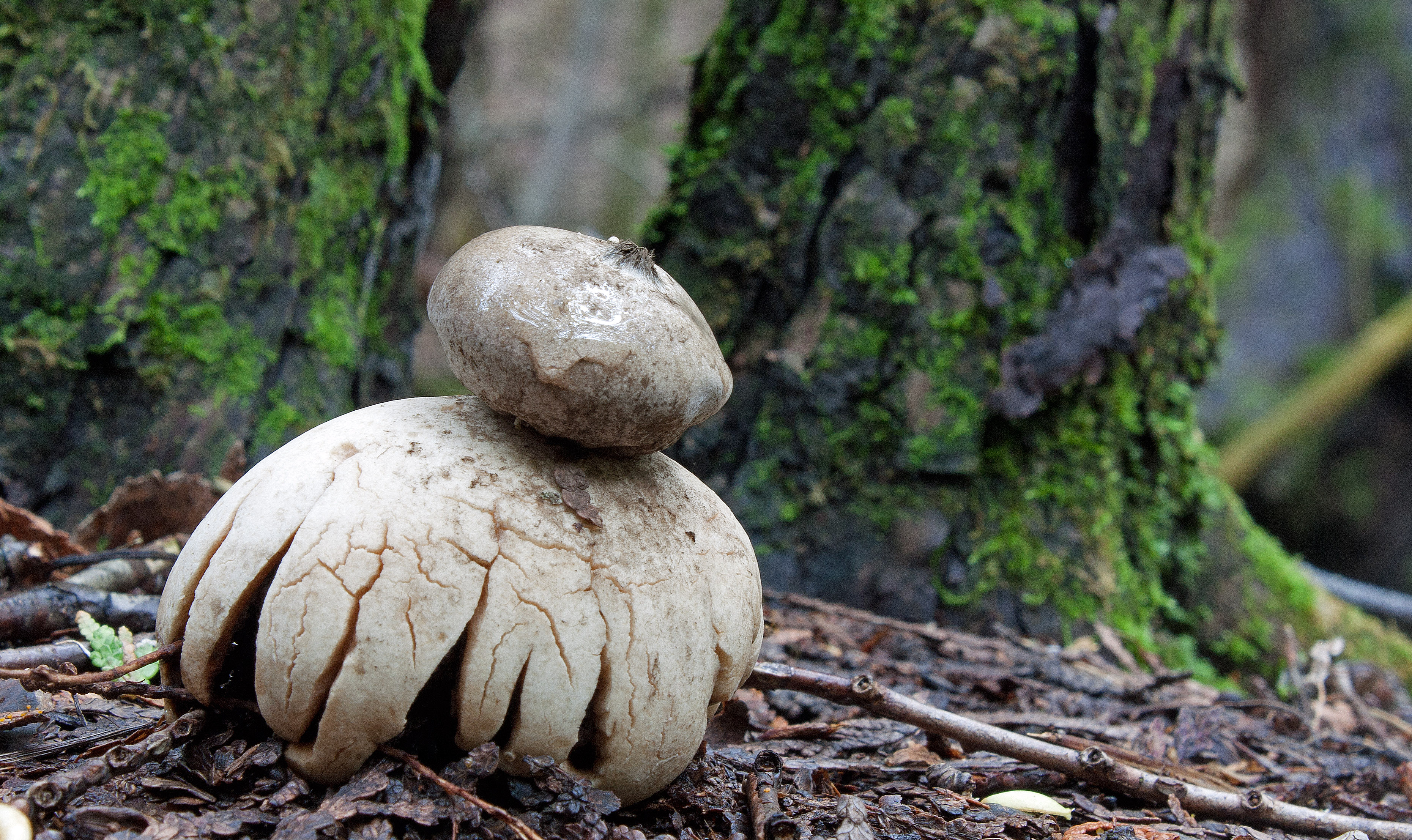
Collared Earthstar (Geastrum triplex) on mossy cedar growing on rotting cedar logs of Trent swamp forest, ON (photo by Nina Munteanu)
Earthstar lived in a verdant cedar forest, under a soft dappled light, where the fresh smell of moss and loam mixed with the pungency of cedar. It was a good life, thought Earthstar, gazing up at the tall canopy of green above her. She lived among many like her, scattered on and between old cedar logs that had piled on the ground and rotted into a rich woody ‘soil.’ It was just right for earthstars who grew deep in the warm, moist rot, covered in a carpet of moss and ferns. Cedar saplings had even sprouted on the rotting log piles, and grown into large mature trees. That was not surprising, given the number of caches the red squirrels left on the spongy rotting logs.
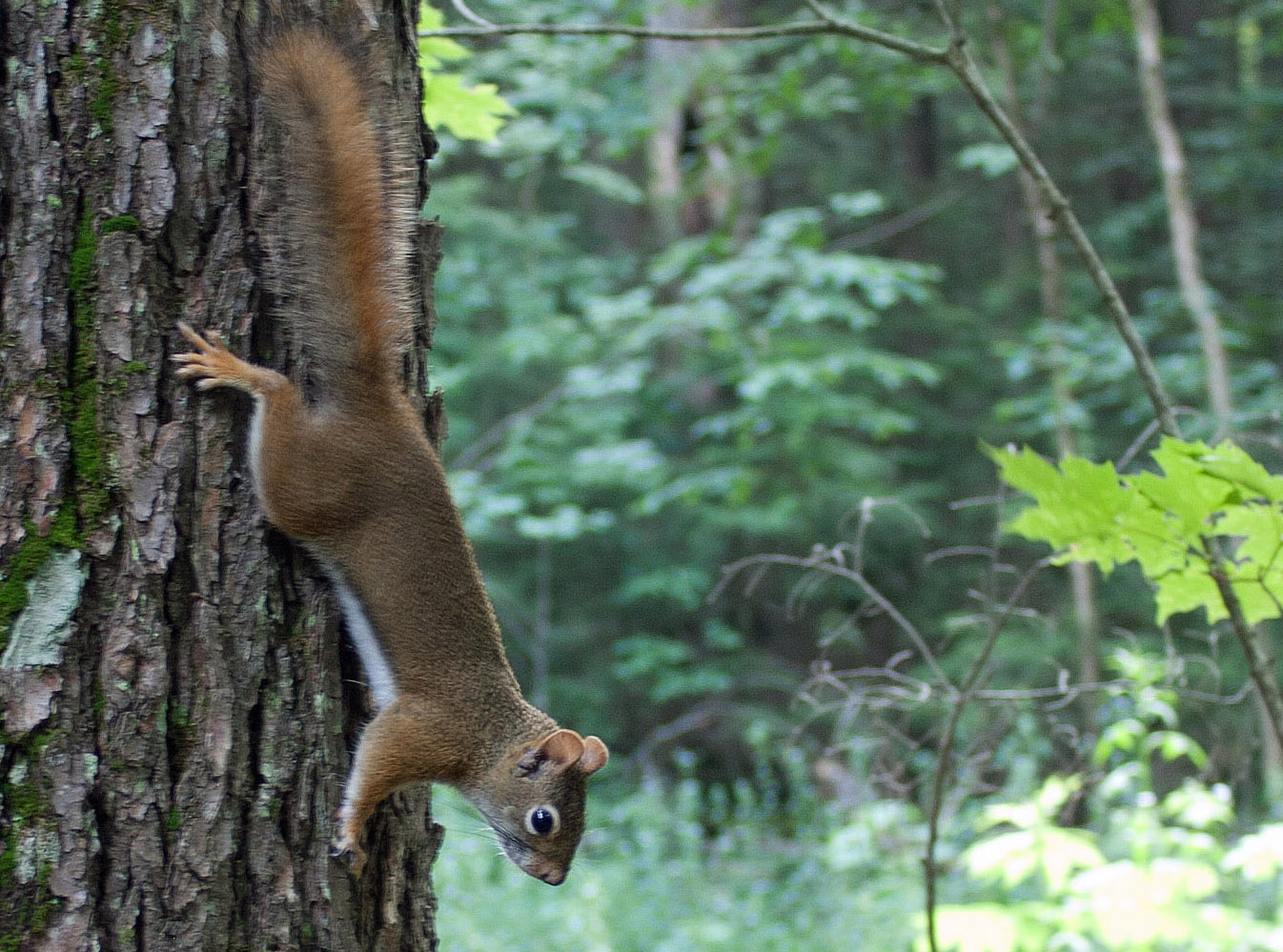
Red squirrel on a tree (photo by Nina Munteanu)
Fully opened Earthstar and sister buds in mossy humus of rotting cedar logs, Trent cedar forest, ON (photo by Nina Munteanu)
When she was just a young bud, Earthstar had pushed herself up from her parent mycelium through the woody humus then cracked open her outer shell to reveal her inner spore sac and beaked mouth. The outer shell formed arms of a ‘star’ that pushed back, raising her up to meet the world. When she surveyed her mossy terrain, she noticed that she was one of the earliest earthstars to emerge. Most of her sisters were still budding through the moss and duff. She was eager to fulfill her path. Soon she would be ready to deliver her precious spores to the world—
“Hey there!” a beaky voice called to her.
Earthstar recognized a Beaked Earthstar ambling along the rot pile using its outer skin ‘legs.’ She herself was a Collared Earthstar, and although she had long dislodged from the woody soil and become independent of the ground she sat on, she didn’t normally walk about like this Beaked Earthstar, known for its itinerant lifestyle. He was a rare and somewhat mysterious earthstar, not often seen, and somewhat of a legend. In fact, it was the first time she saw him and she felt tickled that he’d stopped in his wanderings to greet her.
Beaked earthstar, showing many arms that keep it upright, Trent cedar forest, ON (photo by Nina Munteanu)
“I’m on my way to town,” said Beaky cheerfully. “Want to come along? There’s so much more to see than this silly forest.”
“No thanks,” said Earthstar, overcoming the flush of excitement at being invited by this exotic drifter. She’d heard about ‘the town’ but knew nothing of it—and decided she didn’t want to. Besides, the forest wasn’t silly, she thought peevishly. It was her home. It nourished her. It was where her family was. Earthstar was content.
“Suit yourself,” said Beaky. “But you don’t know what you’re missing! There’s a river out there, and strange but wonderful creatures and moving things on wheels that carry them from place to place. And the fine ladies have something called ‘High Tea,’ which is quite splendid.”
“I think this forest is quite splendid enough,” she retorted a little rudely.
“Ah… But you won’t truly know your place until you’re out of place,” Beaky said. Then with a slight nod of his beaky head, he left her and soon disappeared along the forest path that wound its way into somewhere.
What did Beaky mean by his last comment? wondered Earthstar. How can one be out of place? And why would one wish to be? As time went by, Earthstar began to wonder about that ‘somewhere’ and those wonderful creatures and fine ladies and that thing called ‘High Tea.’ And before she realized it, she was no longer content. She became very curious about that ‘somewhere’ that lay beyond her forest home.
In a sudden thrilling act, Earthstar decided to leave the forest to see the world. And once she thought of it, she did it. That’s the way of earthstars. So, within moments, Earthstar was wandering along the same forest path that Beaky had earlier taken. She took Moss with her, tucked safely inside her ‘legs’ as companion.
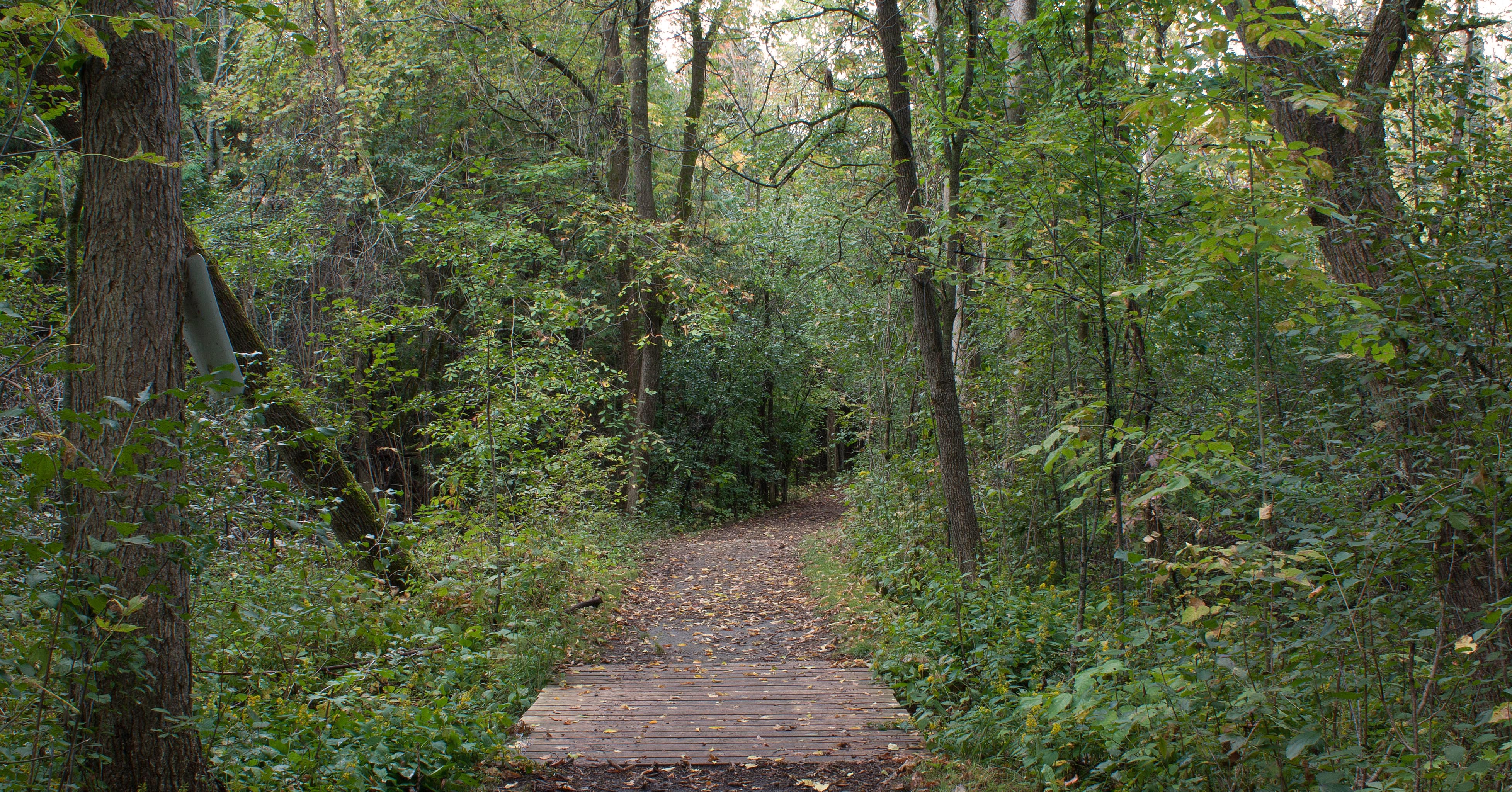
Path, damp from a morning rain, through cedar swamp forest in Trent Nature Sanctuary, ON (photo by Nina Munteanu)
Earthstar rests on small root snag on leaf-strewn trail through Trent cedar forest, ON (photo by Nina Munteanu)
Path through Trent cedar swamp forest with ash and poplar in early fall, ON (photo by Nina Munteanu)
The path wound through dense cedar forest, mixed with birch, ash, poplar and the occasional oak and maple tree. Earthstar passed many relatives. Flaming waxcaps dotted the rotting logs and ground, looking like dance partners. Graceful Fairy Fingers thrust up through the duff on either side of the path along with Ashen Coral fungi, whose delicate ‘fingers’ reached up like praying hands. By the feet of one poplar tree, Earthstar saw a party of Scaly Ink Caps loitering on one side and Striate Bird’s Nest fungi having a party on the other. Stalwart boletes towered majestic, anchored to a mossy slope. A single shield mushroom with its smart lilac cap had burst out of a cedar stump and leaned into the sun with joy.
Waxcaps on decaying cedar wood in Trent forest, ON (photo by Nina Munteanu)
Fairy Fingers in cedar duff in Trent forest, ON (photo by Nina Munteanu)
Ashen coral fungi on ground of Trent cedar forest, ON (photo by Nina Munteanu)
Scaly ink caps growing at the base of a poplar tree in Trent forest (photo by Nina Munteanu)
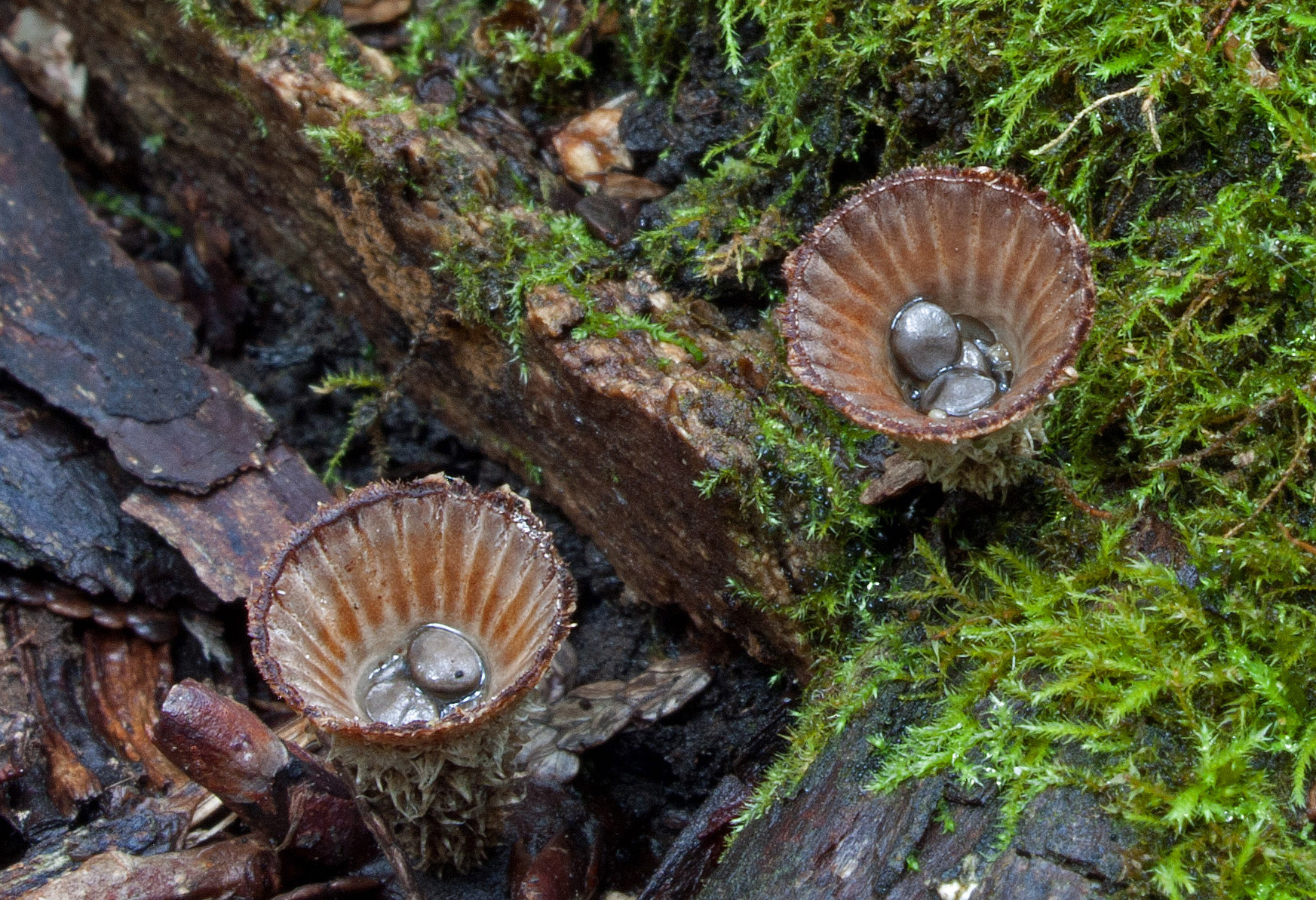
Striated Bird’s Nest fungi at the base of a poplar tree in Trent forest (photo by Nina Munteanu)
Bolete on mossy hill of Trent cedar forest, ON (photo by Nina Munteanu)
Shield fungus grows out of rotting cedar stump in Trent forest, ON (photo by Nina Munteanu)
A group of Scaly Pholiota graced an old maple tree and not much farther a gaggle of Wolf’s Milk spread orange fungus joy over a decaying log. Conifer Tufts created a fairy ring around an old ash tree. Witches hats stood at the feet of a huge cedar tree, bowing with shy wisdom to her. There was a cheerful family of brilliant Scarlet Fairy Helmets tucked in the mossy undergrowth of a buckthorn thicket. She even saw a crowd of her closest relatives, Lycoperdon puffballs clutching a rotting birch log, and waved to them.
Scaly Pholiota on an old maple tree in Trent mixed cedar forest, ON (photo by Nina Munteanu)
Wolf’s Milk slime mould on rotting log in Trent forest, ON (photo by Nina Munteanu)
Conifer Tufts form a fairy ring around an old ash tree in Trent cedar forest, ON (photo by Nina Munteanu)
Witches hats nestled at base of a cedar tree, ON (photo by Nina Munteanu)
Scarlet Fairy Helmets in mossy undergrowth of cedar forest, ON (photo by Nina Munteanu)
Lycoperdon puffballs on decaying birch log, Trent cedar forest, ON (photo by Nina Munteanu)
Eventually, the forest opened into fields and thickets and the path became rocky. The dense cool cedar-scented air of the deep forest gave way to a fragrant floral breeze and the warmth of the sun touched Earthstar with rays of good tidings.
Earthstar on rocky path out of Trent cedar forest into open area, ON (photo by Nina Munteanu)
Earthstar negotiates the rocky path on her way out of the Trent forest (photo by Nina Munteanu)
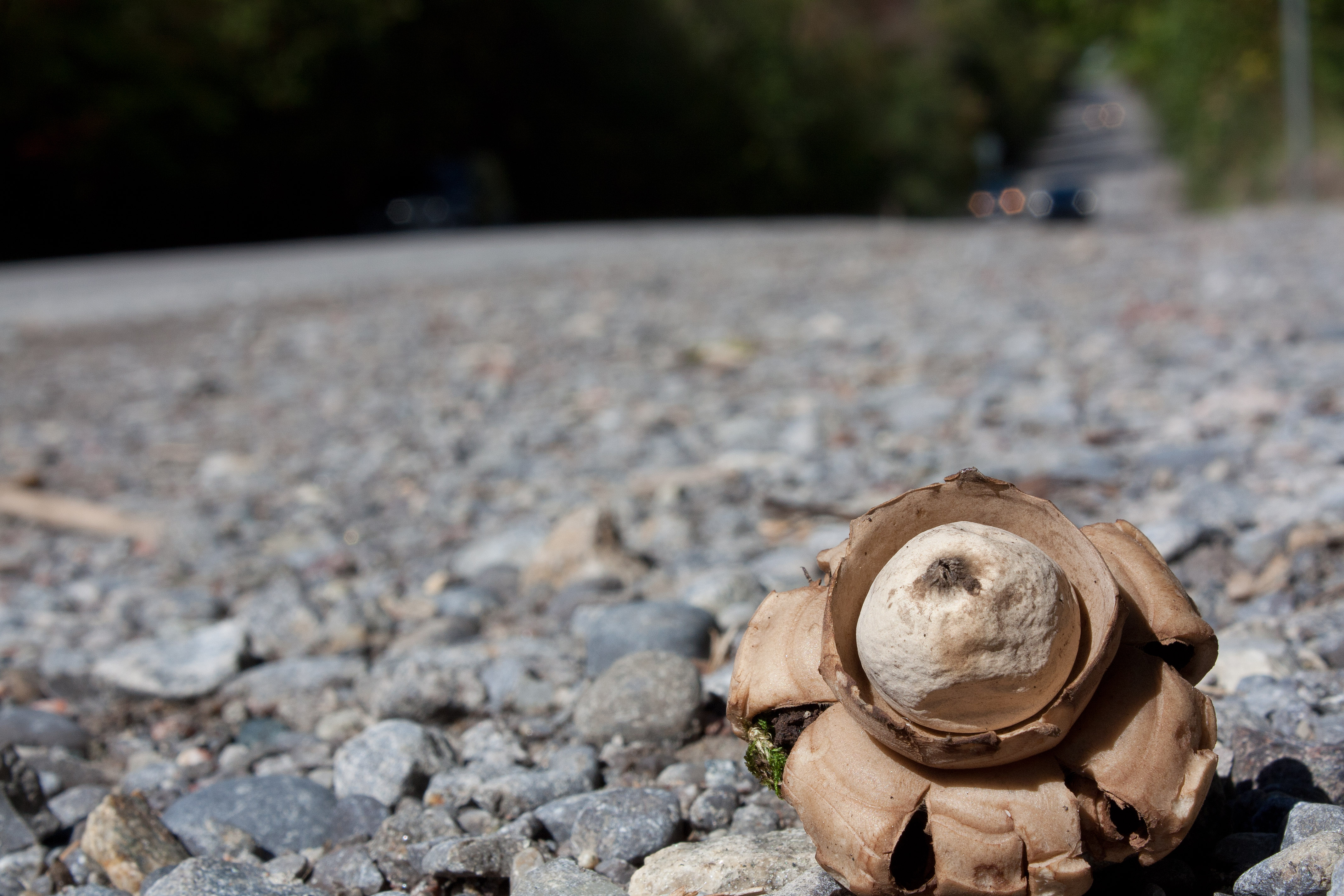
Soon Earthstar reached a road and thought to follow it to town. Within moments a huge thing on wheels barrelled toward her! She froze in terror. But the cheerful wind whisked her out from under the wheel in the nick of time.
Earthstar almost gets run over by a car!
Earthstar thanked the wind and continued down the road, certain that the thing on wheels was what Beaky had mentioned and that she’d soon find the town and the river and those wonderful beings at the end of the road. And perhaps there she would encounter this marvelous “High Tea.”
Earthstar keeps to the side of the road with busy traffic
Countryside near Otonabee River, ON (photo by Nina Munteanu)
The road took Earthstar through an open countryside of meadows, flowers and trees. Earthstar kept to the side of the road to avoid getting squashed and soon found the river Beaky had mentioned. The river was magnificent. Sparkling in the radiant sun, it danced and lapped against the shore with the gurgling rush of laughter around the rocks and reeds.
The shallows of the Otonabee River, showing diatom-froth, ON (photo by Nina Munteanu)
Earthstar on Rotary Trail as bicycles bear down on her(photo by Nina Munteanu)
Sensing the lateness of the day, Earthstar continued her journey in search of “High Tea.” She wasn’t quite sure where she’d find it and followed the river on a trail through a black walnut forest.
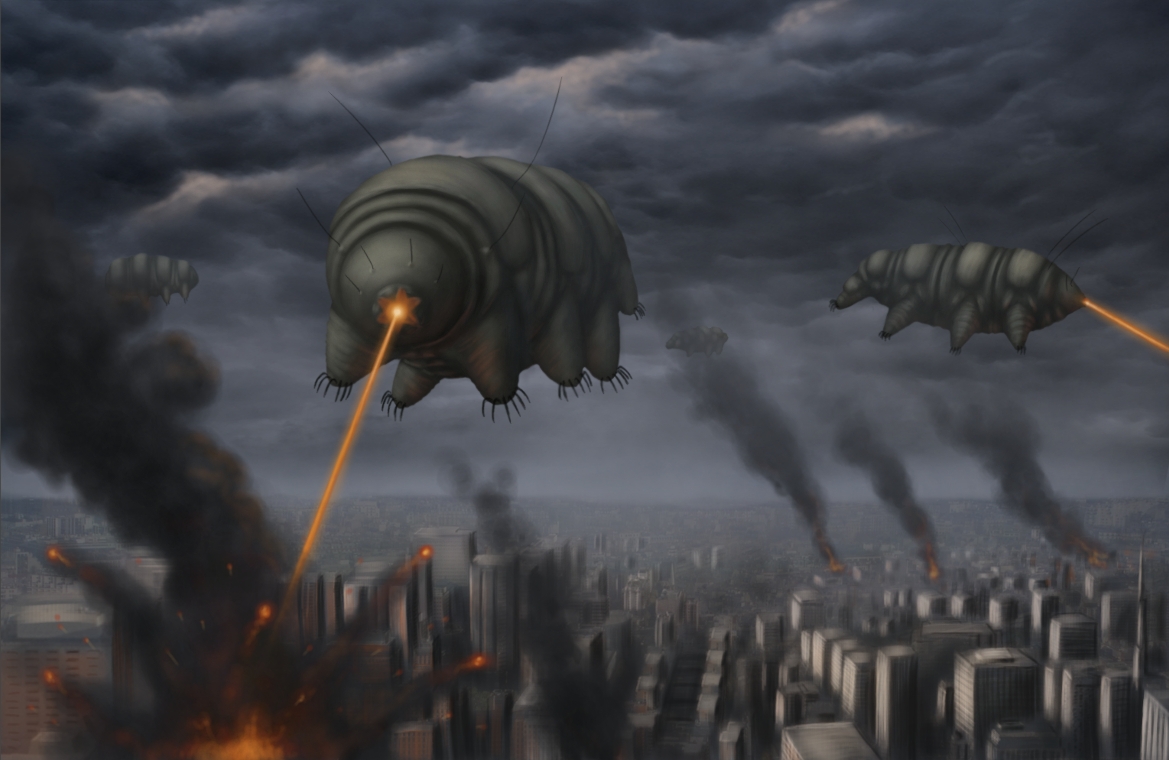
Earthstar passed a large building with an open lawn just as a loud bell sounded and large two-legged beings spilled out onto the trail. They chattered about their lit class and laughed as Lillie, one of the students, recounted her scifi story about flying giant tardigrades that terrorized human cities for destroying the planet with fossil fuel emissions.
Attack of the giant tardigrades (image by Ramul in Deviant Art)
“Tardigrades are the coolest creatures,” Lillie went on. “Some people think they’re from outer space and lived among the stars. They can handle extreme temperature, the vacuum of space, and radiation, after all. And water bears can even survive a bullet impact!”
The students didn’t notice Earthstar below them. She was so tiny after all!
Earthstar (and her moss companion) gets underfoot near the high school(photo by Nina Munteanu)
Just as the dark shadow of a giant foot loomed over her, someone shouted, “Wait, Marcus, STOP! Look!”
Earthstar was snatched off the ground before Marcus could step on her and gently cupped in the girl’s hand where the little fungus felt finally safe. “It’s an earthstar!” said the girl holding her. “How cute! See the bit of moss clutched in its arm? How adorable!”
“But, Emily, what d’you think it’s doing here on the trail by the school?” Marcus asked the girl holding Earthstar. “How did it get here?” Marcus suddenly grinned with inspiration and turned to Lillie, eyes sparkling. “Or did your giant space tardigrade drop it here? Which means we’re in your story–“
Lillie elbowed him and said something Earthstar didn’t understand.
Emily looked down at Earthstar, who sat quietly in her palm. “They’re the only mushrooms that move. Earthstars. I’ve read about them.” Emily then bent low and carefully set Earthstar on the grass by the trail, out of harm’s way.
“Maybe it’s on ‘walkabout,’” Lillie suggested, inspired by the thought of travel and thinking of the Australian term for a long walking journey of discovery.
“You mean floatabout!” Marcus laughed. “If it came all the way from Australia it’d have to float across the Pacific Ocean!”
The students giggled, visualizing little Earthstar floating on a leaf and braving the vast ocean then hitchhiking across the North American continent into the Kawarthas. Still discussing the earthstar’s epic journey, they went on their way, leaving Earthstar on the grass.
Earthstar continued her journey, wondering what ‘walkabout’ meant. She found another large building and thought this might be where she needed to go. When one of the giant beings walked out through a door, she slid inside.
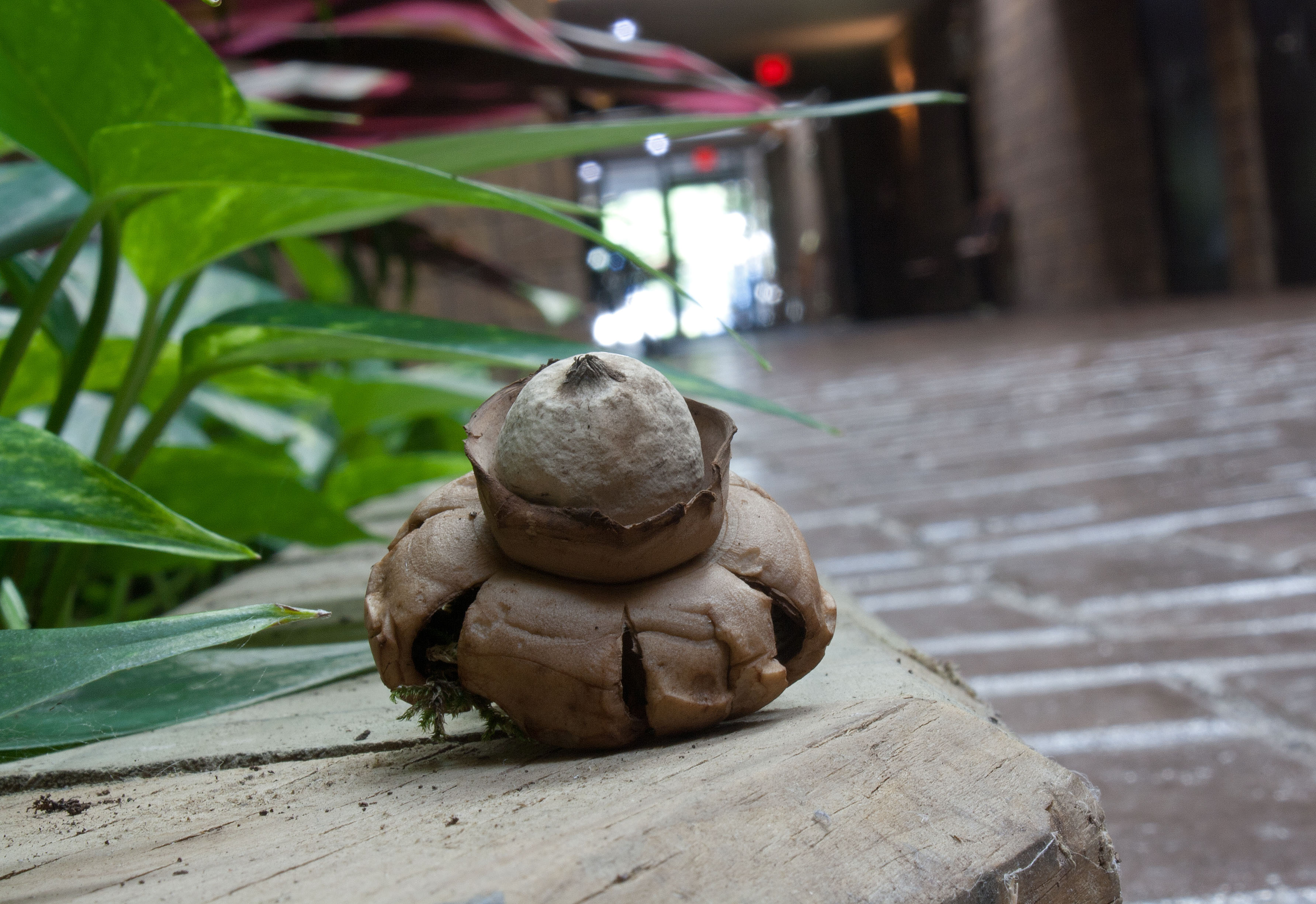
Earthstar and her Moss companion make it inside the condo complex(photo by Nina Munteanu)
She found herself in a wonderfully lit atrium with many more doors and lost herself among the indoor plants under large skylights. Within moments, as if sensing her presence, one of the large beings stepped out from a doorway and immediately saw Earthstar, perched by one of the indoor gardens.
“Well, well, what do we have here? A wandering earthstar and her little moss companion!” The being picked Earthstar up and gently cupped Earthstar in its hand. “Would you like to join me for tea?”
Earthstar in lady’s hand(photo by Nina Munteanu)
The magic word! Tea!
Earthstar jiggled on her ‘legs’ with joy. Was this being one of those fine ladies? As if sensing her excitement, the lady smiled and brought Earthstar inside her apartment.
The lady brought them outside to the patio for tea, where she had laid out tiny sandwiches, cheeses, crackers, scones with jam, and lovely pastries. Of course, Earthstar did not partake in these strange foods—being a saprophyte, she fed exclusively on decaying matter. But she enjoyed the ambience of this civilized celebration. And, of course, the tea!
Lady serving the tea (photo by Nina Munteanu)
When the lady went inside to replenish the tea, Earthstar explored the patio. Mistake! Moments after Earthstar dropped to the patio bricks with the help of a little breeze, a very large dog (well, a rather small dog for you and me) came bounding to her and gave her a lick. The dog might have eaten her but the lady returned and rescued Earthstar.
Poppy the dog licks Earthstar!(photo by Nina Munteanu)
“Oh, my! Don’t mind Poppy, the neighbour’s shiatzu,” the lady said to Earthstar. “Poppy is harmless and only eats dog treats. I don’t think you’re a dog treat, are you?”
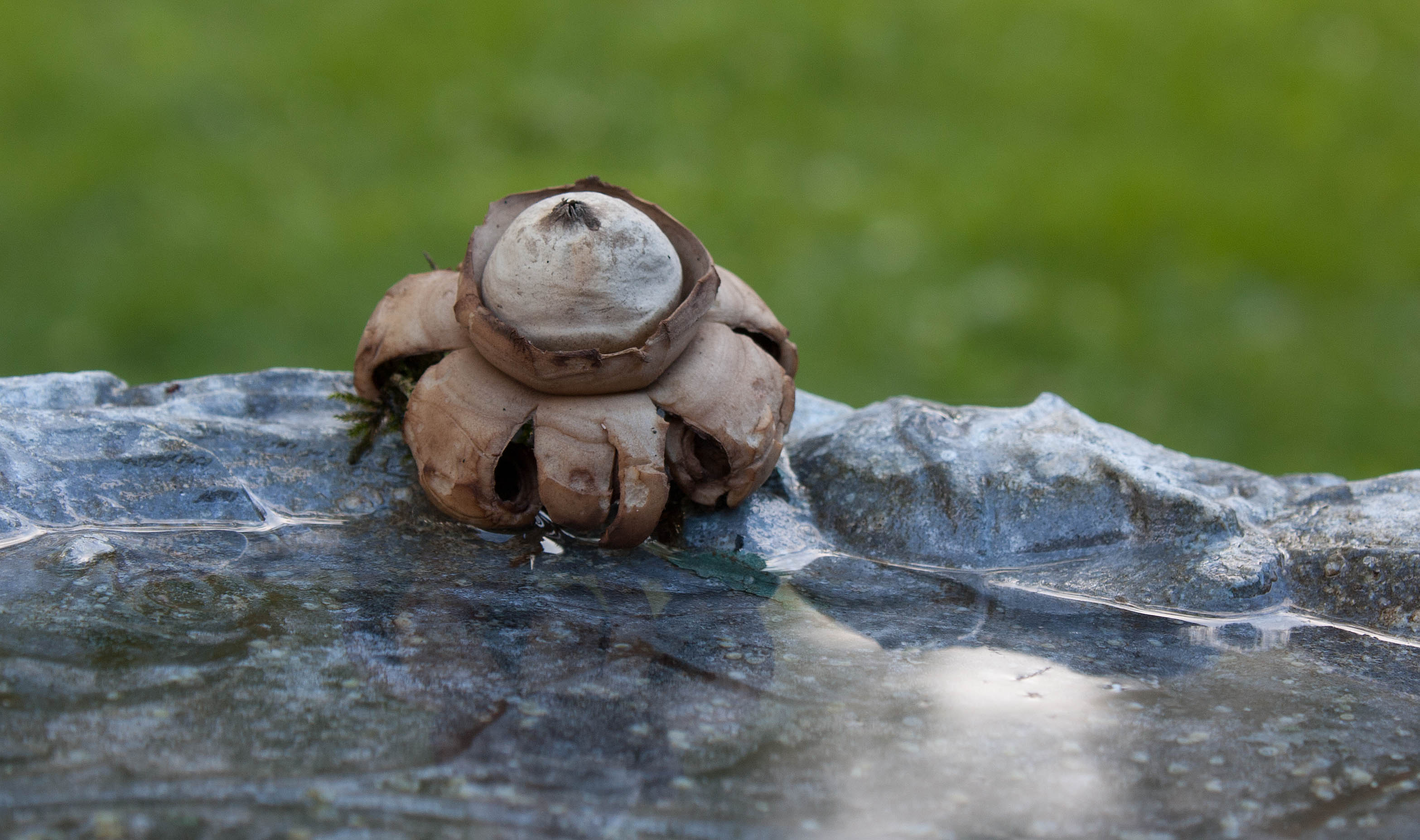
Earthstar dipping her feet into the water of the bird bath(photo by Nina Munteanu)
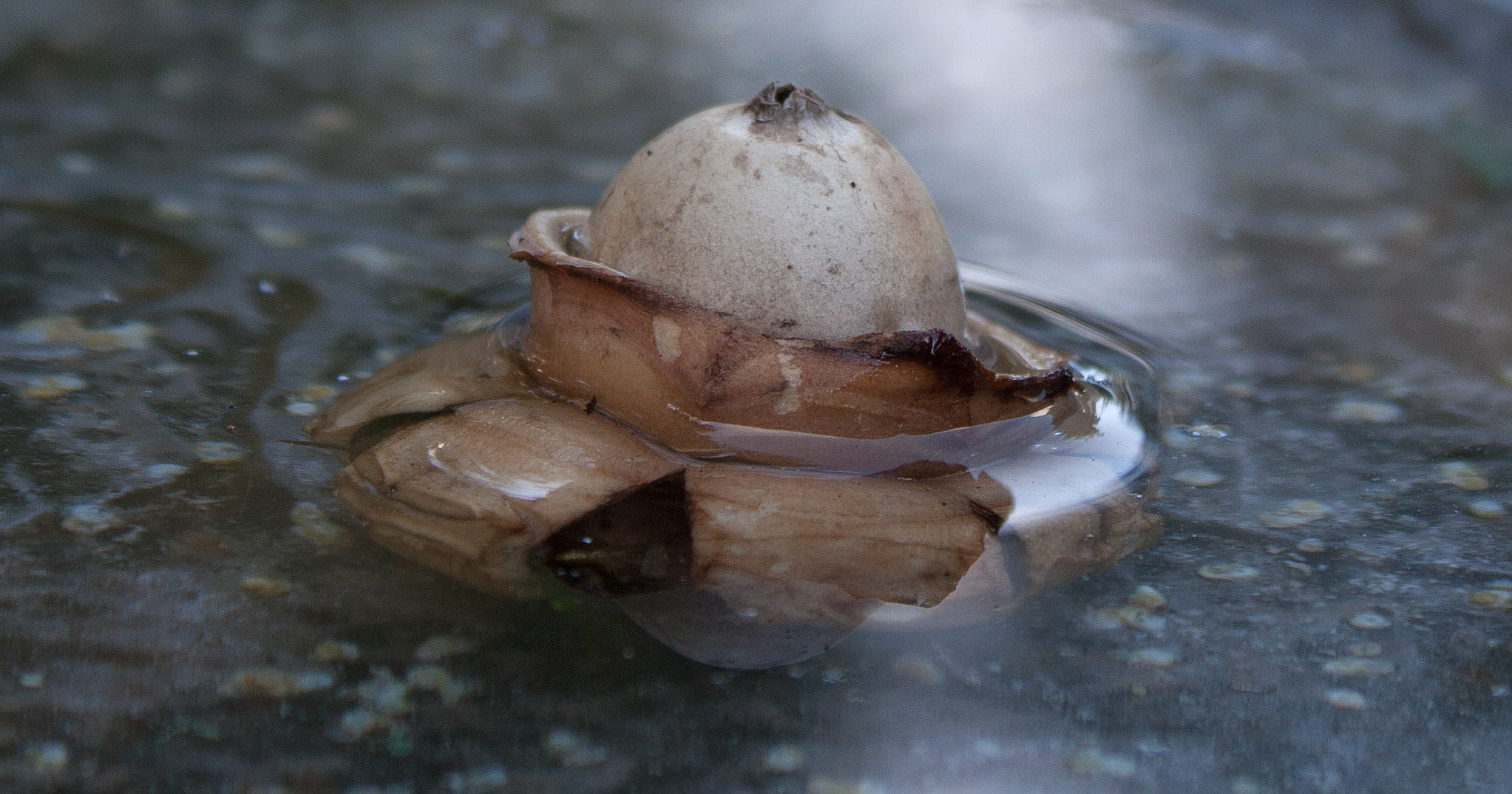
Thinking to get her to safety, the lady placed Earthstar on the edge of the birdbath where Earthstar dipped her tired feet. Within moments a mischievous wind pushed Earthstar into the water! Luckily, Earthstar floated. She was accustomed to deluges of water that filled her ‘collar’ and raised her spore sac to better deliver her spores. Water was an earthstar’s friend; earthstars counted on the beating drops of rain to help release their spores. After the initial shock, Earthstar rather enjoyed the swim.
Earthstar swims happily in the birdbath(photo by Nina Munteanu)
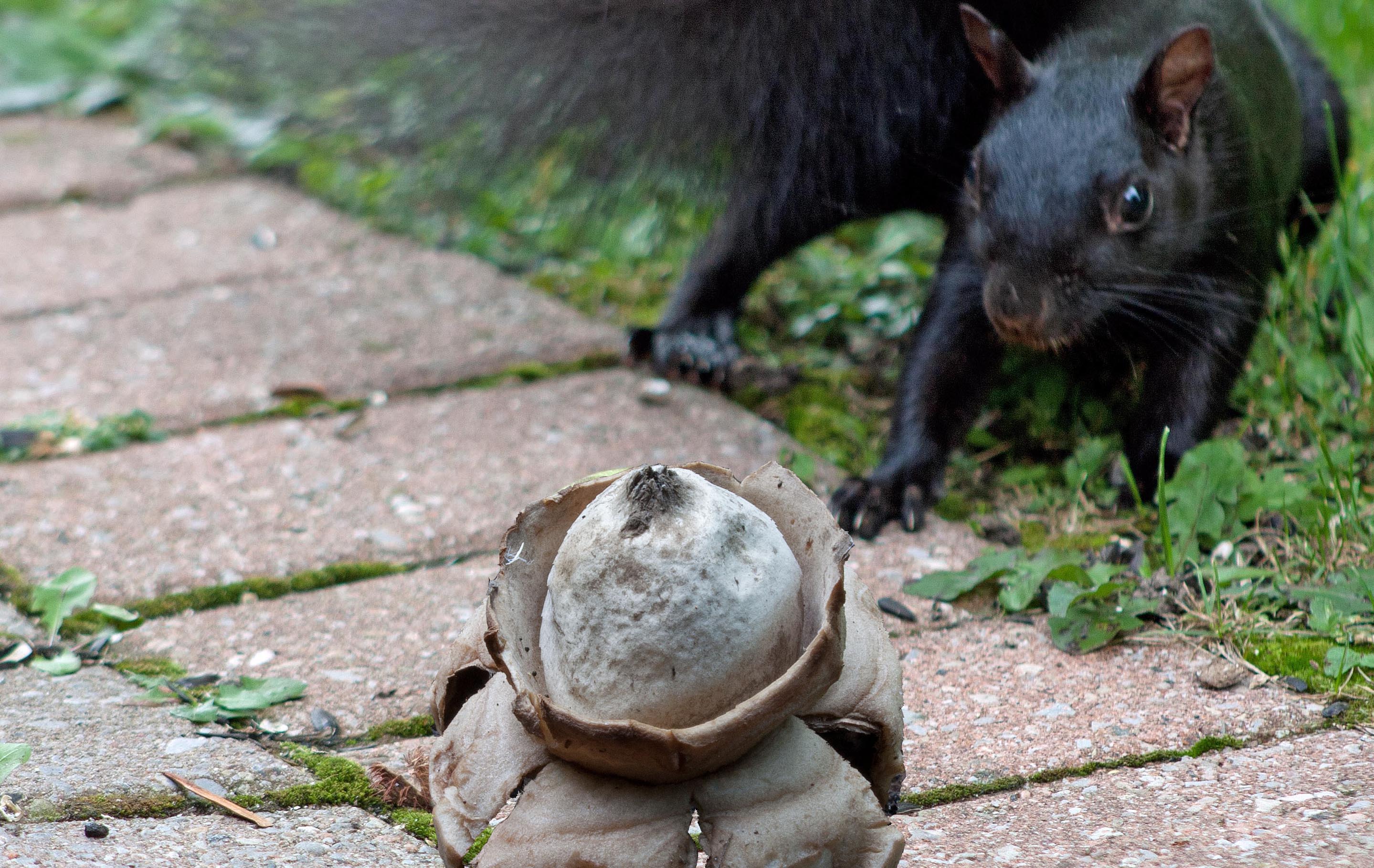
The lady thought she ought to rescue Earthstar again and put her back down on the patio. Then the whistle of the kettle inside drew the lady away to the house. In that short time, a clever black squirrel, who had been spying from the silver maple tree nearby, leaped forward and seized her!
Earthstar about to be snatched by the black squirrel (photo by Nina Munteanu)
“Mine!” he shouted to himself and bounded away with her clutched in his mouth. After waiting for an oncoming bicycle, he raced across the trail–just inches in front of the zooming bicycle (squirrels are daredevils at heart)–and entered the little wood by the river.
Earthstar screamed. But no one heard her, because it was a silent scream.
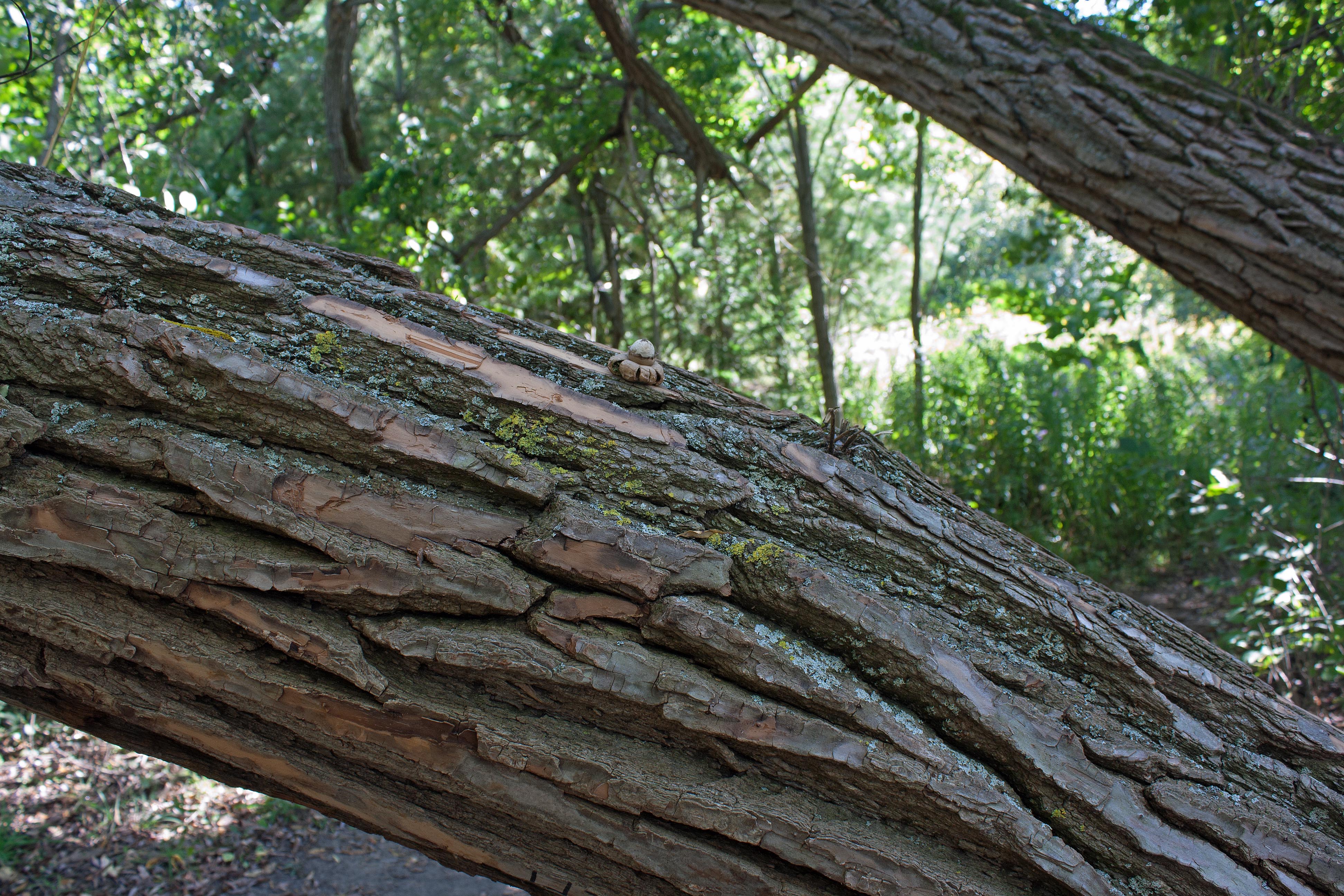
The black squirrel took his prize to a huge old willow tree by the river. The tree bowed over a small path as if reaching down to say hello. The squirrel left Earthstar on the bowing tree to dry like he would any mushroom for later caching. Then he scurried away to look for more food. What this city squirrel didn’t know was that—unlike most other mushrooms—earthstars can move!
Old willow of the riparian forest by the Otonabee River, ON (photo by Nina Munteanu)
Earthstar let the wind blow her off the branch to the ground where she used her six arms to carry her back to the trail and back to the lady’s place. “Where have you been?” asked the lady when Earthstar got there. Her eyes seemed to wink. “I suspect you were on a small adventure with squirrels.”
Driving Earthstar home to the forest (photo by Nina Munteanu)
They continued their tea and when it was finished, the lady took Earthstar in her car and drove Earthstar home to the forest. Earthstar didn’t wonder how the lady knew where Earthstar’s home was; there is only one place where earthstars grew in the region. And no doubt the lady—being a true lady—knew where that was and respected the earthstars place in the world.
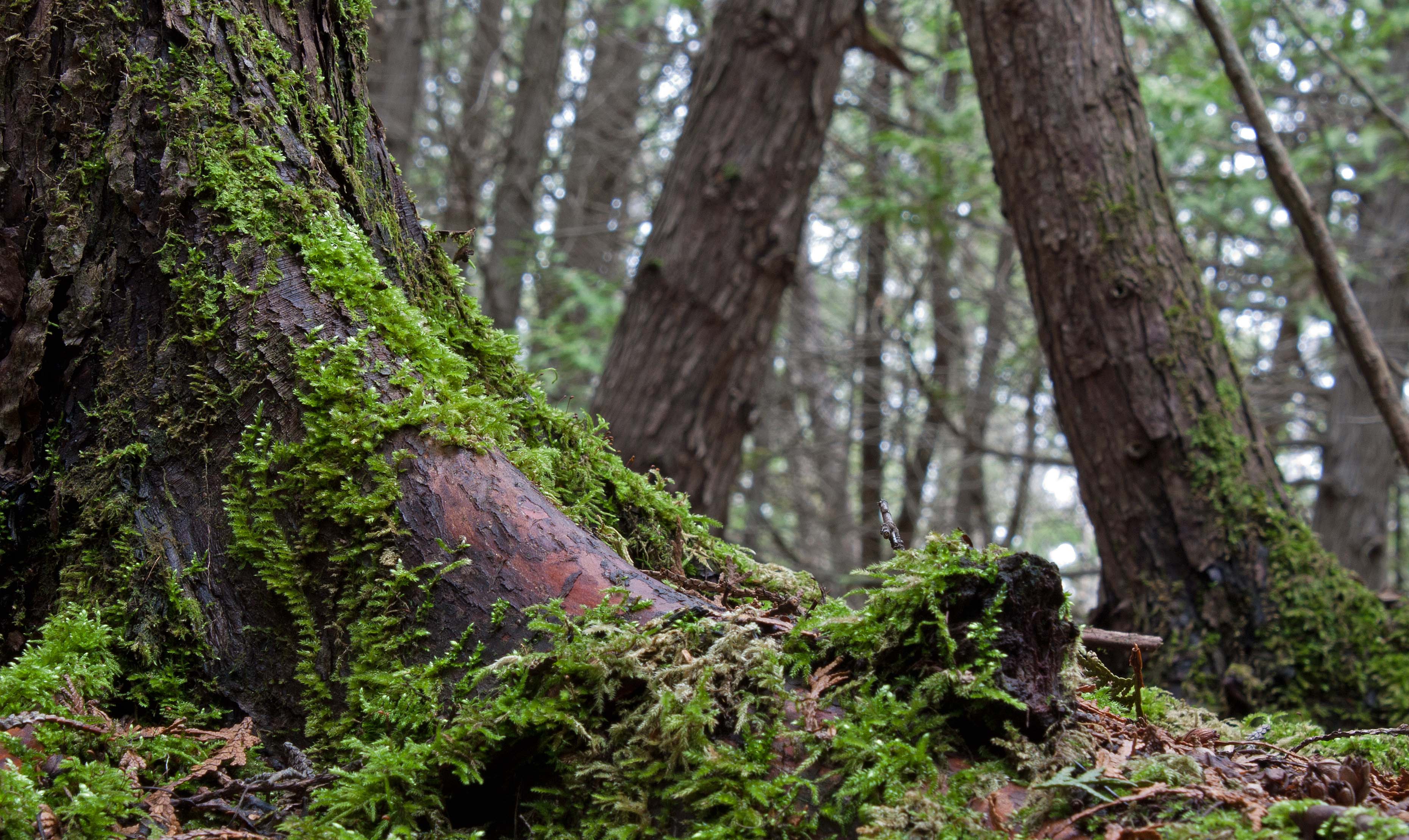
Cedar trees covered in moss, growing on ancient rotting cedar logs of the cedar swamp forest, ON (photo by Nina Munteanu)
Fern-like moss grows on cedar roots that dig into old decaying cedar logs of the forest, ON (photo by Nina Munteanu)
When they reached the deep forest where the tall cedars covered the sky with green and the air stirred with the breaths of cedar and birch, Earthstar felt the exhilaration of coming home. She did not need to rely on the vagaries of a capricious wind to deliver her safely home; the kind hand of the lady set her down on the soft downy surface of woody loam. The lady set Earthstar right beside her sisters, her tiny moss companion still with her, tucked under her arm.
Gently placing Earthstar back home by several earthstar buds in moss of decaying cedars, cedar forest, ON (photo by Nina Munteanu)
The forest was her home. It nourished her. It was where her family was. Earthstar was content. And this time she really was…
~~The End~~
Moss-covered red bark of cedar tree in the cedar swamp forest, ON (photo by Nina Munteanu)
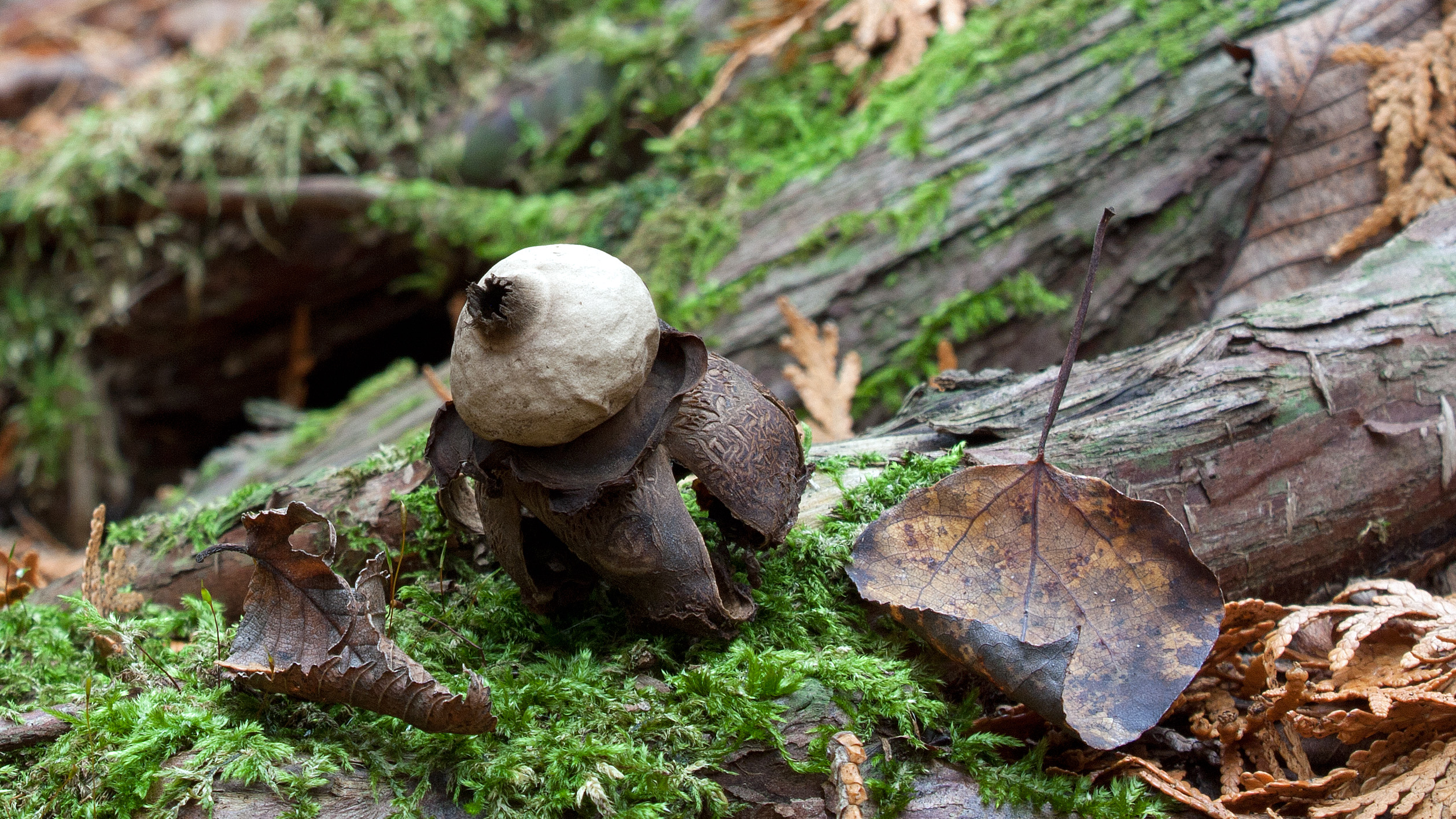
Earthstar, now matured; notice the fetching collar and splendid reticulated outer robes (photo by Nina Munteanu)
The Trent Nature Sanctuary
Located in the southeast corner of Symons Campus of Trent University, the Wildlife Sanctuary Nature Area includes many types of ecosystems and a network of trails. Wetlands of the area are deemed Provincially Significant by the Ontario Ministry of Natural Resources and Forestry. The cedar/maple swamps of the sanctuary support a rich diversity of fungi and lichen amid a rich ecosystem of plants and animals of the forest. It is within this area that I keep discovering interesting life each time I visit. Virtually all the images of the forest and fungi in this article come from this sanctuary, including the Collared Earthstar.
Mossy cedars in the cedar swamp forest of the Trent Nature Sanctuary, ON (photo by Nina Munteanu)
Information on the Collared Earthstar (Geastrum triplex)
Eight stages of the Collared Earthstar life cycle, Trent Nature Sanctuary, ON: 1) buds emerge in late summer; 2) the outer layer begins to crack in early fall; 3) the bud cracks open; 4) then spreads open; 5) forming a ‘flower’; 6) the outer layer cracks; 7) to form the ‘collar’ by early fall; 8) the outer layer shrivels by early winter and the earhstar persists in this form to the next spring (photo by Nina Munteanu)
Collared Earthstar Life Cycle
The Collared Earthstar (Geastrum triplex) is a Gasteromycete or stomach fungus, since it produces and releases its spores inside a saclike structure. The earthstar spends most of the year as a network of fungal cells (mycelia) that penetrate the soil and digest decaying organic material. When they are ready to reproduce, the mycelium develops the “earthstar” above ground. New earthstars emerge as ‘buds’ and develop in late summer and autumn through into winter. The matured fruiting bodies will survive the winter to be discovered the following spring by curious explorers like me.
Spore sacs of Collared Earthstar in the frosts of winter (photo by Nina Munteanu)
Geo means earth and astrum means star. The species name triplex, which means ‘having three layers,’ refers to the way the ‘star’ arms of the outer layer crack when they peel back, making it look like the spore-sac is sitting on a dish. The three layers allow the earthstar to do something no other fungus can do: move. When it rains, the two outer layers of the peridium split and peel back, forming a ‘star’ with 4-12 rays. The rays spread with enough force to push aside leaves, raising the spore-filled sac above the surrounding debris. The rays often lift the earthstar high enough to break the connection to the parent mycelium, releasing the earthstar from its sedentary position. Detached, the earthstar can move with wind or rain to better spread its spores.
Finger poking the spore sac helps release the spores (photo by Nina Munteanu)
Fruiting bodies are large, 5-10 cm in diameter. Spores escape from the apical pointed hole (peristome) as breezes blow across it. Much larger puffs are released when raindrops hit and compress the spore-sac—or an interfering finger depresses the sac. What escapes is a powdery gleba (which distributes the tiny spores). The sides of the peristome ‘beak’ are fibrous and appear slightly ragged.
Several stages of the Collared Earthstar in late summer, from buds to opening ‘flower’
Early budding stage of Collared Earthstar in late summer (photo by Nina Munteanu)
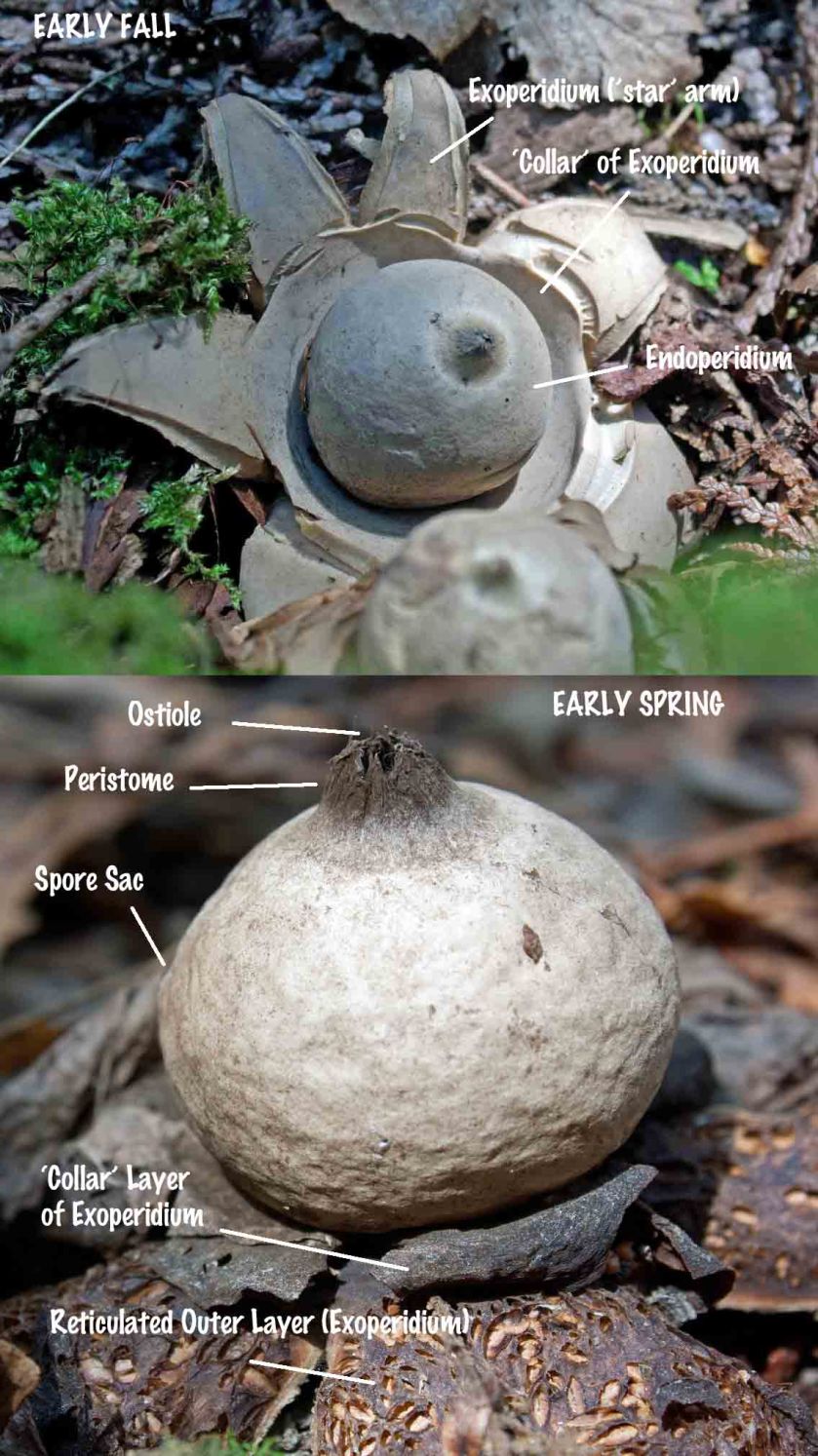
After a late summer / autumn rain, the collared earthstar emerges from the leaf litter looking like a Hershey’s kiss or a fancy bulb-shaped truffle dusted in fine cocoa. Only the outer layer (exoperidium) is visible, peeking out of the litter and loam. The outer layer eventually cracks open, looking like a coconut husk and splits into five to seven ‘arms’ to form a star. Inside is revealed a tan to grey-coloured spore-sac (endoperidium) with a fringed beak (peristome) and its opening (ostiole). The endoperidium, or spore sac, is more like an elastic membrane resembling rubber that holds the gleba (spore-bearing mass). The star arms peel back and down, eventually cracking to form the ‘saucer’ which the round fruiting body (spore sac) sits on. The spore sac contains a mass of spores and fertile mycelial tissue, called the gleba that is white, fibrous and firm when young, but turns brown and powdery as it ages. A network of cells (capillatum) help spores move to the pore when a raindrop strikes the endoperidium. The columella, a bulbous sterile base at the centre of the spore-producing gleba forms ‘columns’ that radiate out to help spore dispersal.
Over time, the outer layer of ‘stars’ (exoperidium) form a reticulated pattern of cracks and fissures that deepen into golden-brown colours as they decompose and curl downward to lift the spore-sac farther up. The sac also grows more pale and papery.
Parts of a Collared Earthstar from first ‘bloom’ in early fall to matured stage the next spring (photos by Nina Munteanu)
Just opened Collared Earthstar in late summer, not yet showing the ‘collar’ formed by cracking of exoperidium (photo by Nina Munteanu)
Good example of a more mature opened Collared Earthstar in early fall, showing the ‘collar’ formed by separation of exoperidium and extended curled back ‘arms’ (photo by Nina Munteanu)
Mature Collared Earthstar the following spring, showing papery spore sac sitting on disintegrating ‘collar’ and reticulated outer exoperidium (photo by Nina Munteanu)
However, in the rain, the sac reverts to a rubbery consistency and deepens to a dark shiny tan colour. I was surprised by its elasticity; this time when I poked it, the sac sprang back to its round sphere like a thick balloon.
Mature Collared Earthstar; left in rain, right in dry weather (photos by Nina Munteanu)
Collared Earthstar Habitat
I also learned that the collared earthstar prefers a habitat of leaf litter in deciduous woods, especially beech on chalky soils. However, researchers acknowledge that the collared earthstar is also found under coniferous trees, especially on sloping ground—which better describes where I found them, in this cedar-birch forest of the Kawarthas. Geastrum triplex is a saprophytic organism: it gets its nutrients from decomposing organic matter—such as well-rotted cedar trees, where humus has accumulated—by further breaking down the organic matter then, in turn, returns those nutrients to the soil to complete the cycle. It does this by releasing enzymes to break down and digest the lignin, cellulose or chitin in these materials, converting them to soluble compounds that can be absorbed by them, and by plants, as nutrients. Earthstars, like all fungi, play a vital role in reducing the accumulation of dead organic material and in recycling essential nutrients, particularly carbon and nitrogen. If not for fungi, forests would choke under a mountain of logs and leaves.
Mature earthstar, with prominent collar, in the moss-covered loam of a rotting cedar, ON (photo by Nina Munteanu)
References:
Ellis JB, Ellis MB. 1990. “Fungi without Gills (Hymenomycetes and Gasteromycetes): an Identification Handbook. ”Chapman and Hall. London. ISBN 0-412-36970-2.
Torpoco V, Garbarino JA (1998). “Studies on Chilean fungi. I. Metabolites from Geastrum triplex Jungh”. Boletin de la Sociedad Chilena de Quimica. 43 (2): 227–29.
Mature collared earthstar in early winter, ON (photo by Nina Munteanu)
Nina Munteanu is a Canadian ecologist / limnologist and novelist. She is co-editor of Europa SF and currently teaches writing courses at George Brown College and the University of Toronto. Visit www.ninamunteanu.ca for the latest on her books. Nina’s bilingual “La natura dell’acqua / The Way of Water” was published by Mincione Edizioni in Rome. Her non-fiction book “Water Is…” by Pixl Press(Vancouver) was selected by Margaret Atwood in the New York Times‘Year in Reading’ and was chosen as the 2017 Summer Read by Water Canada. Her novel “A Diary in the Age of Water” was released by Inanna Publications (Toronto) in June 2020.
Farmer’s field, ON (photo and rendition by Nina Munteanu)
Sometime in the future, Earth is recovering from a devastating 50-year plague that has destroyed most of its natural forests and grasslands and killed two out of every three people. Environmental technocrats now run the world under strict rule: while virgin ecosystems are re-created from original templates through genetic engineering, no human is permitted to set foot in these sanctuaries. As sanctuaries grow ever larger, humanity is pressed into over-crowded cities where boredom and strife dominate. The Emerald Coalition hires reclamation company EcoTech to “recreate the world their great, great grandparents lost.” But their ecosystems are morphing into “aberrations” (new species with surprising properties), which would shock the applied Ecology community—except EcoTech is keeping it a secret. So begins Danita Maslan’s eco-thriller Rogue Harvest by Red Deer Press. Published in 2005, this powerful environmental story is as relevant today as it was fifteen years ago. Perhaps more so.
In his Foreword to Maslan’s book, Hugo-winning author Robert J. Sawyer, shared a story from a 2004 presentation he gave at Mount Royal College in Calgary. In his presentation, Sawyer lamented that science fiction seemed to pull in opposite directions to such an extent that any message was cancelled by its opposition. The example he gave in the Foreword came from two bestselling authors: Kim Stanley Robinson whose Forty Signs of Rainwarned of rising temperatures due to climate change; and Michael Crichton, who denied global warming as fearmongering in State of Fear. According to Sawyer, Rogue Harvest provided a fresh story grounded in the balance of a third perspective—not a neutral middle-ground, but “one that shears away at right angles from the current polarized debate, taking our thinking in new directions by predicting both environmental collapse andenvironmental salvation.”
Told through the unruly character of Jasmine, Rogue Harvest explores a post-plague world in recovery. After radical environmentalists from Green Splinter assassinate her father, Jasmine enlists a street-smart mercenary to help her vindicate her father’s call to open the forbidden preservesto the public. This leads Jasmine into the depths of the genetically re-created South American rainforest, where political intrigue, corporate greed and violence collide in a combustible mix. This is where it gets messy—which biology certainly is. But it gets messy for other reasons. Human-reasons. Reasons of power-mongering and lack of compassion. The very reasons why the environmental technocrats established their hands-off edict in the first place. This is explored through great irony in Rogue Harvest. An irony that L.E. Modesitt, Jr. astutely notes, “[the environmental technocrats] prove that, given power, they’re just like everyone else.” Just as there remain uncompassionate exploiters and pillagers in the likes of harvester Gunther Vint, who heedlessly pollutes the rainforest as he harvests it.
buttressed strangler fig in Costa Maya jungle (photo by Nina Munteanu)
The South American rainforest provides some of the most vivid, colourful and memorable scenes in the book. Maslan traveled to the tropics and ensured accurate science of this incredibly rich ecosystem through Mark W. Moffett’s The High Frontierand Donald Perry’s Life Above the Jungle Floor, as well as Tropical Nature: Life and Death in the Rain Forests of Central and South America by Adrian Forsyth and Ken Miyata. It is in the South American recreated jungle that the key elements—and posed questions—of the story play out.
In his testimonial to Rogue Harvest, Hugo Award Finalist James Alan Gardner poses: “We see both sides of an ecological conundrum that resonates with the present day: how can we live in harmony with our environment, neither vandalizing it nor walling it off as too precious to touch?”
This is the tantamount question. Can our species achieve this balance? Rogue Harvest answers this clarion call with mixed optimism. While showcasing the propensity for greed and careless exploitation, the book also reveals a more altruistic and kinder side of humanity. One that promises hope and light to our darker side. But, is this realistic, given our current dominant worldview?
On page 149 in Rogue Harvest, Jasmine’s politician father Owen Lamberin defends his position of wishing to open up the protected Nature preserves to regular folk by proclaiming, “Do they want to keep us out forever? Then who are we reseeding the globe for if not for us?” This is later echoed by Jasmine to justify flouting the preservationist edicts of the Emerald Coalition. When I first read this passage, part of me rankled. Does not the natural world have an intrinsic value and right to simply be? Must we justify all things by our own presence and direct use of them? Surely functional ecosystems provide ecosystem services for planetary wellness that benefit ALL life, not just humans, and not all directly. For example, our terrestrial and marine forests provide necessary oxygen and climate balance (by removing excess carbon dioxide) that benefits all life on the planet. Ecologists—particularly Canadians—recognize the benefit of ‘preservation’ (wilderness that is not accessed by humans) over ‘conservation’ (areas where humans extract resources with some environmental risk) and the need for both to exist for the planet’s overall well-being. This is based on the simple fact that not all humans behave as they should. Those of us who follow a utilitarian neo-liberal worldview of consumption and “othering nature” are not acting as efficient partners in the natural world. Many see themselves as apart from Nature, above Her, even, and will act less than kindly. Current deforestation of the Amazon and the old-growth forests of British Columbia, are just two examples that reflect this destructive “Nature othering” force.
Ancient red cedar tree in Lighthouse Park, BC (photo by Nina Munteanu)
In contrast, indigenous peoples on the planet incorporate Nature in their beliefs, philosophies and way of life. They conduct themselves with humility and the utmost respect for the natural world of which they are a part. Knowing that they are part of Nature, they act accordingly, with respect. They are efficient partners, taking only what they need, thanking Nature for her gifts, and giving back in return in a process of reciprocal altruism and mutualism.
Robin Wall Kimmerer, author of “Gathering Moss” and “Braiding Sweetgrass” writes:
“In indigenous ways of knowing, it is understood that each living being has a particular role to play. Every being is endowed with certain gifts, its own intelligence, its own spirit, its own story. Our stories tell us that the Creator gave these to us, as original instructions. The foundation of education is to discover that gift within us and learn to use it well.
These gifts are also responsibilities, a way of caring for each other. Wood Thrush received the gift of song; it’s his responsibility to say the evening prayer. Maple received the gift of sweet sap and the coupled responsibility to share that gift in feeding the people at a hungry time of year. This is the web of reciprocity that the elders speak of, that which connects us all. I find no discord between this story of creation and my scientific training. This reciprocity is what I see all the time in studies of ecological communities. Sage has its duties, to draw up water to its leaves for the rabbits, to shelter the baby quail. Part of its responsibility is also to the people. Sage helps us clear our minds of ill thoughts, to carry our good thoughts upward. The roles of mosses are to clothe the rocks, purify the water, and soften the nests of birds … Traditional knowledge is rooted in intimacy with a local landscape where the land itself is the teacher.”
Robin wall kimmerer
Wall-Kimmerer is talking about a way of life through willing participation and an attitude of great respect and humility. But many non-indigenous people do not ascribe to this philosophy and way of life—with dire consequence to our environment and our own welfare. In Rogue Harvest Maslan rightfully demonstrated the continued presence of this destructive force in humanity even as a respectful and thankful attitude was shown by Jasmine and her harvesting team. The question is: How many does it take to spoil this balance?
It would be close to fifteen years after Rogue Harvest was published that I would finally read Maslan’s book—this year, in 2020, during an ongoing planetary-wide plague. Ironically, only two years after Danita’s debut novel, my own debut eco-thriller Darwin’s Paradox was released by Dragon Moon Press in 2007. And the theme was eerily similar: struggling with the devastation of an environmental plague (Darwin Disease), the Gaians—environmental technocrats who run the world—have isolated humanity from Earth’s treasured natural environment. One main difference between Rogue Harvest and Darwin’s Paradox is that in the latter book the technocrats have kept the public ignorant of how the environment has recovered, ensuring its safety from destructive human hands—except for the ‘enlightened’ Gaians, who secretly live out in the beauty of a recovered natural world and commute to the indoor world. However, as the environment recovers, humanity deteriorates in its cloistered indoor world. Darwin’s Disease—related to indoor living—sweeps across humanity with debilitating genetic deterioration, violent death and the promise of extinction. This is something the self-professed deep ecology Gaians—akin to Maslan’s Emerald Coalition—are content to see in—if it means preserving the natural world.
Both the Gaians and Maslan’s Emerald Coalition demonstrate a lack of faith in humanity and an unrealistic need to restore environments to their pristine pre-human levels; something that is highly unrealistic—and doomed to fail. “Aberrations” (as Maslan’s characters called them) are part of the natural process of adaptation and change inherent in the natural world. As a practicing ecological consultant, I was constantly running against an idealised and unrealizable notion to put everything back to what it used to be. For several decades ecologists were tasked to restore habitats to their pristine condition—when the notion of “pristine” was impossible to achieve, let along discern. It would have been like turning back the clock of history to prevent John F. Kennedy from being shot–with its own unknown consequences. Ecologists finally realized that in lieu of “restoration” and looking back, we needed to “rehabilitate” by looking forward. This is what Nature has always done. Nature adapts. So must we. Our management programs must incorporate Nature’s ever-changing processes of resilience and look forward—not backward—to achieve a sacred balance.
If there is a deeper message in Maslan’s book, it is this: that our salvation—and the salvation of the world—lies in not obsessing on returning to a past pristine state (with attempts at over-protection), but in looking forward to healing and nurturing a world in which we have a place. This would involve reimagining our niche (our job) as efficient partners in an ever-evolving and changing natural world, by casting off the parasitoid1 role we’ve all too often assumed and replacing with a role of mutualism2. But … and there is a huge BUT here. This will only work if we pursue this approach with integrity. With our eyes and hearts open to Gaia’s sacred plan of which we are a part. Robin Wall Kimmerer shows us the way through Traditional Ecological Knowledge:
“If each plant has a particular role and is interconnected with the lives of humans, how do we come to know what that role is? How do we use the plant in accordance to its gifts? The legacy of traditional ecological knowledge, the intellectual twin to science, has been handed down in the oral tradition for countless generations. It passes from grandmother to granddaughter gathering together in the meadow, from uncle to nephew fishing on the riverbank … How did they know which plant to use in childbirth, which plant to conceal the scent of a hunter? Like scientific information, traditional knowledge arises from careful systematic observation of nature, from the results of innumerable lived experiments. Traditional knowledge is rooted in intimacy with a local landscape where the land itself is the teacher. Plant knowledge comes from watching what the animals eat, how Bear harvests lilies and how Squirrel taps maple trees. Plant knowledge also comes from the plants themselves. To the attentive observer, plants reveal their gifts.”
Robin Wall Kimmerer, Gathering Moss
But is this possible? To return to Sawyer’s remark and Gardner’s question, can we achieve this sacred balance and harmony? For many of us, I think, yes. But for many more, I’m not sure. And that is what worries me. It is my firm belief that until our worldview embraces humility in partnership with the natural world—until we cast off our parasitoid archetype of self-serving, neo-liberal, capitalist ideologies—we will remain hampered in our journey forward towards a sacred balance. And time is running out for us. Time to rewrite our story.
In Maslan’s book, humanity is given a second chance to prove itself worthy of inclusion. Her book is a call to action. Can we do this before it’s too late for us? Time to listen and learn from our indigenous peoples. Time to learn about Traditional Ecological Knowledge. Time to slow down, set aside our egos, and use all our senses to learn from Birch, Bear, and Beaver…
Cedar pine forest in early winter, Jackson Creek Park, ON (photo by Nina Munteanu)
1.parasitoid is a term that describes a parasite that grows on the body of another organism from which they get nutrients and shelter. Unlike typical parasites, a parasitoid usually kills its host (Munteanu, 2019).
2.mutualism describes an ecological interaction between two or more species that increases fitness in both, through direct interaction and co-adaptation. Two examples include vascular plants and mycorrhizae, their fungal partners, and flowering plants and their pollinating insects. Even predators act in some form of mutualism when their role of culling weaker individuals from the prey gene pool is considered (Munteanu, 2019).
References:
Kimmerer, Robin Wall. 2003. “Gathering Moss.” Oregon State University Press, Corvalis. 168pp.
Munteanu, Nina. 2019. “The Ecology of Story: World as Character.” Pixl Press, Vancouver. 198pp.
White cedar tree and stump in early winter, Jackson Creek Park, ON (photo by Nina Munteanu)
Nina Munteanu is a Canadian ecologist / limnologist and novelist. She is co-editor of Europa SF and currently teaches writing courses at George Brown College and the University of Toronto. Visit www.ninamunteanu.ca for the latest on her books. Nina’s bilingual “La natura dell’acqua / The Way of Water” was published by Mincione Edizioni in Rome. Her non-fiction book “Water Is…” by Pixl Press(Vancouver) was selected by Margaret Atwood in the New York Times ‘Year in Reading’ and was chosen as the 2017 Summer Read by Water Canada. Her novel “A Diary in the Age of Water” was released by Inanna Publications (Toronto) in June 2020.


































 Nina Munteanu Writing Coach