“When you look at a deep pond, you don’t see the bottom. Instead, you see yourself reflected there. The calmer the pond, the more you see of you, the less of the pond.”
Lynna Dresden
A Diary in the Age of water is “delightfully unique … a story where there is a lot more underneath the gleaming surface.”
“As Nature tames a lake over time, one thing replaces another. As it undergoes a natural succession from oligotrophic to highly productive eutrophic, a lake’s beauty mellows and it surrenders to the complexities of destiny. Minimalism yields to a baroque richness that, in turn, heralds extinction. The lake shrinks to a swamp then buries itself under a meadow.”
Lynna Dresden
’A Diary’ is a brilliant story…Munteanu writes with fresh, stimulating style.”
CRAIG H. BOWLSBY, author of The Knights of Winter
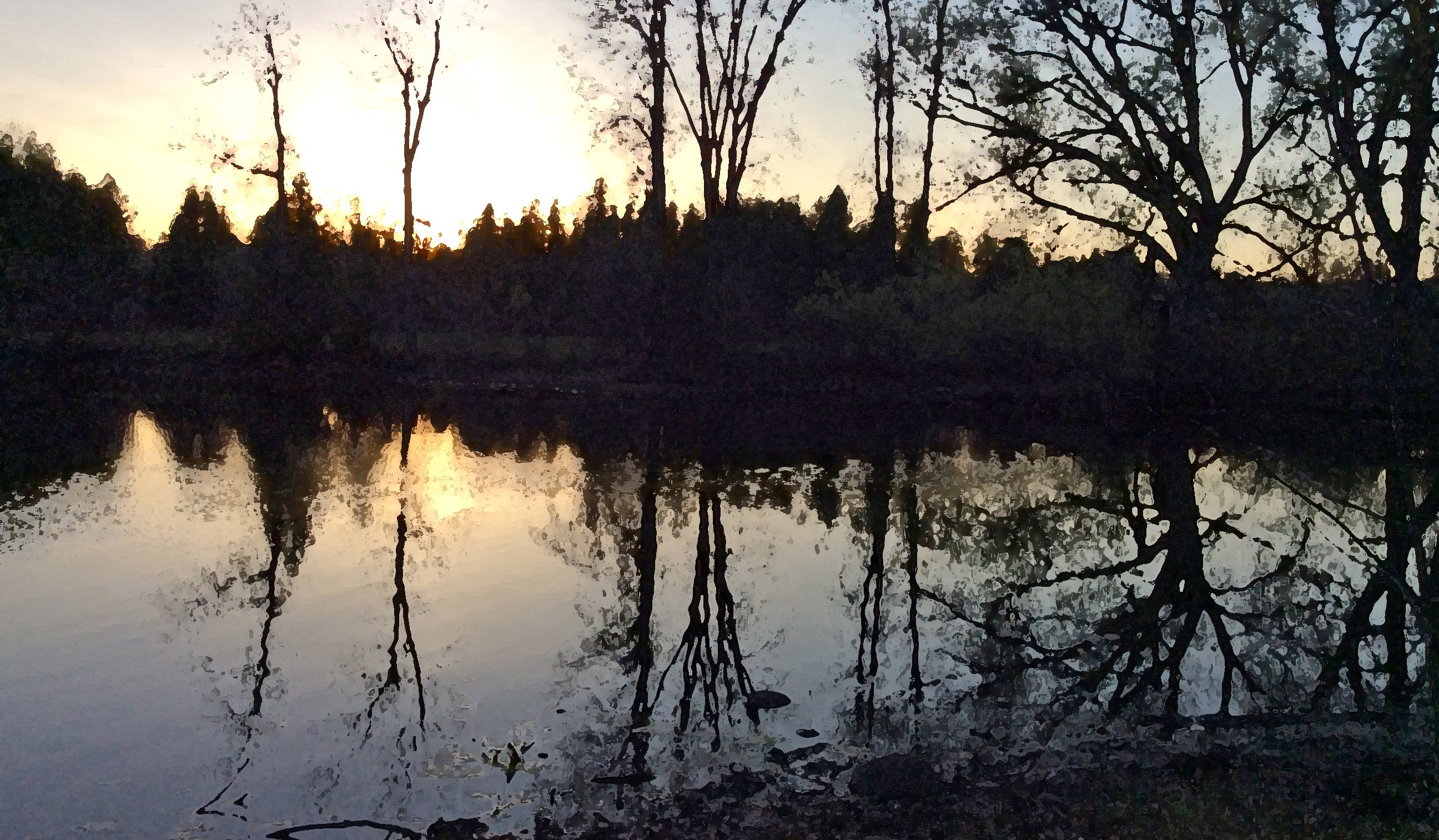
Outlet of Thompson Creek at sunset, ON (photo and rendition by Nina Munteanu)
“[My] paper on stream periphyton in Hydrobiologia could have been controversial and ultimately rejected by the scientific community; instead, it demurred to traditional science and was embraced as ground-breaking.”
Lynna Dresden
A Diary in the Age of Water is“A chilling but believable portrayal of what might happen as fresh water becomes more scarce.”
MIRAMICHI READER
“Evoking Ursula LeGuin’s unflinching humane and moral authority, Nina Munteanu takes us into the lives of four generations of women and their battles against a global giant that controls and manipulates Earth’s water. In a diary that entwines acute scientific observation with poignant personal reflection, Lynna’s story unfolds incrementally, like climate change itself. Particularly harrowing are the neighbourhood water betrayals, along with Lynna’s deliberately dehydrated appearance meant to deflect attention from her own clandestine water collection. Her estrangement from her beloved daughter, her “dark cascade” who embarks upon a deadly path of her own, is heart-wrenching. Munteanu elegantly transports us between Lynna’s exuberant youth and her tormented present, between microcosm and macrocosm, linking her story and struggles-and those of her mother, daughter, and granddaughter-to the life force manifest in water itself. In language both gritty and hauntingly poetic, Munteanu delivers an uncompromising warning of our future.”
LYNN HUTCHINSON LEE, multimedia artist, author, and playwright
Snow melt in marsh by country road, ON (photo and rendition by Nina Munteanu)
“During spring thaw or fall turnover, the thermocline erodes and the changing temperature forces a lake to mix, revealing her secrets.”
Lynna Dresden
“Munteanu’s experience in bridging the worlds of biology and writing makes A Diary in the Age of Water unique in being strong and focused from both the scientific and literary perspectives.”
STRANGE HORIZONS
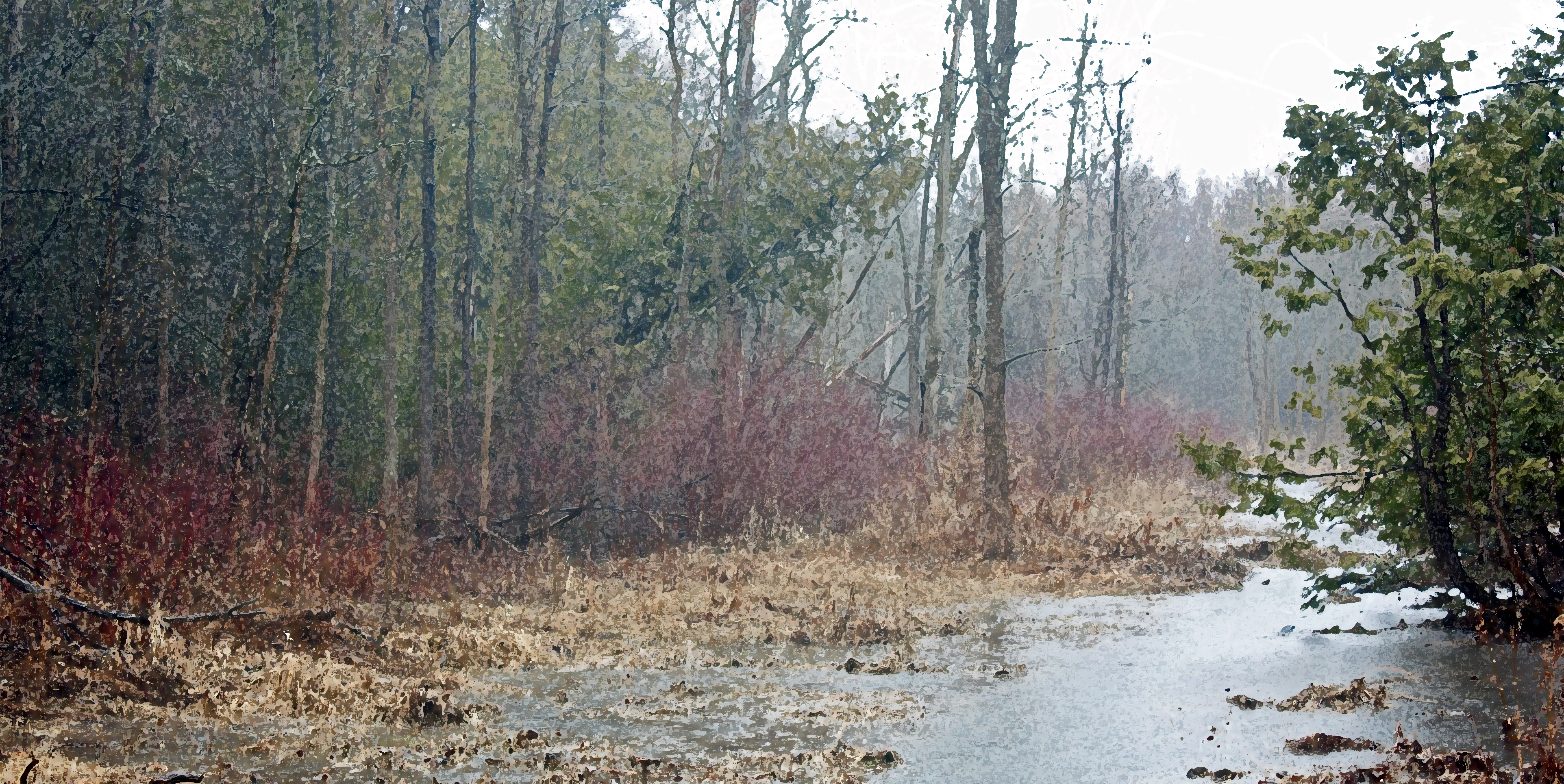
Overflowing marshy creek in Trent Nature Sanctuary in spring, ON (photo and rendition by Nina Munteanu)
The Darwin duology by Dragon Moon Press, depicting the late 21st Century, by Nina Munteanu
.
In my 2007 novel Darwin’s Paradox and its 2010 prequel Angel of Chaos—dystopian tales set in an unrecognizable post-climate change Canada at the end of the 21st Century—the father of the main character lectures his impressionable young daughter about how climate change helped create the heathland scrub that replaced the mixed woodlands of the old Carolinian and sub-Boreal environments:
“What’s over there?” She points to a far, dark hill.
“Woodland. This was all forest before the cities got built and the climate changed.”
“Climate changed?”
“Yes, honey.” He focuses on the distance. “Caused the revolution thirty years ago. Since then the Ecologists have virtually eliminated our greenhouse gas emissions. Of course, the planet will be feeling the effects of global warming for decades to come. Perhaps centuries.”
“They saved the planet, didn’t they?”
His brows knit. “Perhaps they did, perhaps they didn’t,” he says enigmatically.
I’d originally written the novel and its prequel in the seventies, before entering university. So, you might think that I was incredibly imaginative and prescient to come up with such climate devastation. But this simply isn’t so (well, not entirely, anyway). Just as with Margaret Atwood—who says: “When I wrote the Handmaid’s Tale, nothing went into it that had not happened in real-life somewhere at some time”—I was simply reading the signs.
Margaret Atwood demonstrating a fire-proof version of her book The Handmaid’s Tale
.
When it came to climate change, of course, I had some help. During my days at university, studying limnology, and in the 1980s and ‘90s when I worked as an environmental scientist and consultant, I encountered evidence of a changing environment and climate; people in the environmental sciences certainly knew the dangers of climate change long before it entered the common zeitgeist.
Science fiction dystopias aren’t so much predictive as realistically projecting possibilities based on current or past social patterns (these past social patterns, as Santayana notes, have a way of returning to us when we don’t pay attention to them). This notion lies at the root of the term cautionary tale and what makes one truly harrowing or terrifying; we sense to our very core how likely these scenarios are.
My near-future climate dystopia released by Inanna Publications in 2020
Response to my 2020 cautionary tale A Diary in the Age of Water reflects this visceral reaction by readers who shared that this blur of fiction with non-fiction and sense of realism—a “this could happen” quality—totally unbalanced them and engrossed them. Comments included “unique and captivating,” “unsettling and yet deliciously readable,” “strangely compelling” “scary and comforting at the same time,” “made my heart clench,” “a book of genuine power.”
Scene from Michael Radford’s film “Nineteen Eighty-Four” released in 1984, based on George Orwell’s 1949 novel
.
Indeed, many successful predictions have been made in speculative fiction. In 1961, Stanislaw Lem’s novel Return From the Stars predicted the invention of the touch pad, iPhone, iPad and Kindle. The telescreens that monitored the citizens of George Orwell’s Oceania in his dystopian 1949 novel Nineteen Eighty-Four was reflected, twenty years later, in the first CCTV installed in the United Kingdom. Philip K. Dick’s Minority Report accurately predicted personalized ads, voice-controlled homes, facial and optical recognition, and gesture-based computing. Self-driving cars were showcased in many speculative books and films such as Bladerunner, and Isaac Asimov’s I, Robot.
Scene from the film Minority Report with Tom Cruise
.
But many speculations have also not been realized. No flying cars—OK, some companies such as Toyota, Hyundai and Tesla are working on prototypes. While NASA plans to construct a surface habitat called Artemis Base Camp so that astronauts can remain on the moon’s surface for days or perhaps even weeks, it is far from happening soon. Also, no rotating space stations and space elevator—yet.
Many envisioned totalitarian/dystopian states in speculative fiction have also not been realized (e.g. We, Nineteen Eighty-Four, Brave New World, Fahrenheit 451, Handmaid’s Tale, Hunger Games, The Dispossessed, V for Vendetta )—though one could argue that aspects of each world envisioned by an author has occurred or is occurring in some form. One need only recall Edward Snowdon’s disclosures of NSA’s insidious surveillance to see parallels with Orwell’s Nineteen Eighty-Four. And as Margaret Atwood famously said in the quote above, nothing goes into her stories “that have not happened in real-life somewhere at some time.”
“The function of science fiction is not only to predict the future but to prevent it.”
Ray Bradbury
There are, in most cases, no technological impediments to the flying car, the jetpack, and moon-bases; only cultural ones. “These SF predictions ought to be viewed as visions of where we could be, as opposed to where we will be, or, keeping Bradbury in mind, visions of where we don’t want to go and, thankfully, have mostly managed to avoid to date,” says Steve Davidson of Grasping for the Wind. “Perhaps it’s all cultural,” he adds. Science fiction writer and futurist David Brin says that he is “more interested in exploring possibilities than likelihoods, because a great many more things might happen than do.”
In his book Four Futures: Life After Capitalism Peter Frase writes: “the importance of assessing possibility rather than likelihood is that it puts our collective action at the centre, while making confident predictions only encourages passivity.” In his 2010 essay, David Brin cites Orwell’s 1984 as a “self-preventing prophecy” that helped prevent the scenario (at least in its fullest).
George Orwell wrote his dystopian satire in 1949 about a mind-controlled society in response to the Cold War. The book was a metaphor “against totalitarianism and for democratic socialism,” said Orwell in his 1947 essay Why I Write, adding that, “Good prose is like a windowpane.” Was Orwell’s Nineteen Eighty-Four a failed novel because the real 1984 didn’t turn out quite like his 1984? Hardly. Hugo Award-winning novelist Robert J. Sawyer argues that we consider it a success, “because it helped us avoid that future. So just be happy that the damn dirty apes haven’t taken over yet.”
References:
Brin, David. 2010. “The Self-Preventing Prophecy: Or How a Dose of Nightmare Can Help Tame Tomorrow’s Path.” in Abbott Gleason et al. eds., On Nineteen Eighty-Four: Orwell and Our Future. Princeton University Press, Princeton, p.222.
Frase, Peter. 2016. “Four Futures: Life After Capitalism.” Verso Press, London. 150pp.
Country road in the Kawarthas during a foggy morning, ON (photo by Nina Munteanu)
Nina Munteanu is a Canadian ecologist / limnologist and novelist. She is co-editor of Europa SF and currently teaches writing courses at George Brown College and the University of Toronto. Visit www.ninamunteanu.ca for the latest on her books. Nina’s bilingual “La natura dell’acqua / The Way of Water” was published by Mincione Edizioni in Rome. Her non-fiction book “Water Is…” by Pixl Press(Vancouver) was selected by Margaret Atwood in the New York Times‘Year in Reading’ and was chosen as the 2017 Summer Read by Water Canada. Her novel “A Diary in the Age of Water” was released by Inanna Publications (Toronto) in June 2020.
In Costi Gurgu’s near-future political thriller Servitude (Kult Books, 2022), what is real and what is fiction blurs with terrible prescience and possibility. Gurgu has created a scenario based on a premise that stirs dangerously in the reality of today’s capitalist western world: what if corporations were allowed to take back with impunity what their debtors owed them—in whatever way they pleased?
In Gurgu’s near-future America, the fourth Republican president in a row will be elected with virtually 100% Republican representation in Congress and the Senate—ensuring a monopoly government and creating a potential dictatorship (something a certain Republican president was trying to achieve not too long ago—and came dangerously close).
The story begins in the UK, which has recently made corporate slavery law. Under the Freedom Act, corporations under the British Servitude Exchange (BSX) can lawfully capture and detain persons with significant debt to sell them and their services in exchange for what is owed.
Wishing to do the same, the American corpocracy pushes the Freedom Act bill through Congress, potentially making corporate slavery a lawful pursuit using the concept of servitude. The concept of unconditional restitution in a country of people living largely on credit becomes popular among wealthy corporations; (consider that over two thirds of Americans are currently in debt with an average of $96,000 owed by each American, which includes mortgage, student loans, auto and credit card, personal loans and home equity1).
Neoliberal idealogues and proponents of the Freedom Act suggest that citizens should learn to be responsible for their lifestyles and should not expect the government to bail them out of bankruptcy every time they overspend (ignoring the fact that the U.S. government’s current national debt is some 30 trillion dollars—to corporate investors, China, Japan, and intra-government agencies.2 However, given that corporate investors currently hold over a third of the national debt2, dominant corporate influence on government to create a slavery act as demonstrated in Servitude is not outlandish).
A fifth of the way into the book, a Texas governor proclaims: “Servitude is merely a form of adult education. If you have graduated from the American education system and proceeded to live your life as though there is no tomorrow and spent more money than you have earned, well beyond your fair share, then you must be re-educated with America’s modernized value system. Servitude is an educational tool for the people.”
Gurgu hints at key events that brought us to this point: from the shenanigans of Donald Trump to starving children in New York City and Chinese troops taking down the American flag at the Hawaii State Legislature. The European Union has been dismantled and the Eastern Block reborn. Climate change related resource wars were waged by the Second Ottoman Empire and others, leading to the collapse of the global market. All have led to the reintroduction of slavery and homo sacer, the disposable human. Foucault would attest that the biopolitical hegemony of Capitalism already enslaves human beings as disposable ‘human capital.’
In my upcoming eco-thriller Thalweg, character Daniel considers his 2050s world in which humanity is largely commodified, a world similar to Gurgu’s Servitude world:
It’s the end of the world…The beginning of the end of the world really came with the steam engine back in 1784 and the enslavement of water, when James Watt’s ‘universal machine’ coerced water to help usher in the industrial age of carbon extraction and the disposable human, homo sacer. By 1920, 97% of electricity in Canada came from hydropower. We were sure eager beavers. Enslaved water germinated a culture obsessed with defining itself through a ‘precession of simulacra’—the truth which conceals that there is none. Social media. Facebook. Twitter. Echo-chambers of denatured reality, signs reflecting other signs, saturated with ‘likes’ and emojis, where meaning becomes infinitely mutable to the point of being meaningless.
What’s left is a ‘desert of the real,’ a Kafkaesque menagerie of interminable, unresponsive fragments of experience in a fiction that no longer knows it’s fiction. One in which Huxley’s Soma rules in a kind of warped Foucauldian governmentality, where corporations like CanadaCorp use facial recognition and Pegasis spyware to manage plebian behaviour through quiet authoritarianism. Like bioelectricity subverting the neural pathway, it infects our fragile brains with subliminal notions of freedom when we’ve already surrendered our sovereignty to the omnioptic gaze of capitalism …
Why is it easier to imagine the end of the world than the end of capitalism? Half a century ago, Mark Fisher took up that concept first introduced by Fredric Jameson and Slavoj Žižek in his book Capitalist Realism3… Several things Fisher pointed out resonate, such as, “Capitalism is what is left when beliefs have collapsed at the level of ritual or symbolic elaboration, and all that is left is the consumer-spectator, trudging through the ruins and the relics.”3 This sad construct leaves us with a kind of ‘post-literate’ world in which the ruling ideology is cynicism or what Fisher calls ‘reflexive impotence.’4
Daniel Schindler in “Thalweg” by Nina Munteanu
.
.
How realizable is Gurgu’s Servitude?…
Since 1989, neoliberal ideologues have fed us the narrative that capitalism is the only realistic political-economic system. We cheerfully engage in this confabulation to feed our rapacious desires; and like an insatiable amoeba, capitalist realism consumes and digests our dreams and desires then feeds it back to us at a price. At what cost? Fisher astutely tells us that in our current world, “ultra-authoritarianism and Capital are by no means incompatible: internment camps and franchise coffee bars co-exist.”3 Gilles Deleuze tells us that “Control societies are based on debt rather than enclosure.”5
In Gurgu’s story, Detective Blake Frye—himself burdened with heavy debt—becomes ensnared in an inter-agency investigation into the for-now-still illegal slave trade in America that has already created secret slave camps and is actively kidnapping ‘nobodies’ off the streets. Connected somehow to UK’s BSX and several billionaire tycoons, the slave trade has become highly lucrative. Earlier, Frye’s wife, Isa—who is an investigative journalist and TV producer—embarks on an exposé of the illegal slave trade. Just before her show “Debt Hunters” is about to air, the material is confiscated by the NSA who consider it a breach of national security; her entire crew is detained and the NSA investigate her on suspicion of treason. Later, when slavers kidnap Isa and put her on the market, Frye must navigate through corrupt government officials and rogue agency operatives to find her before she’s sold and disappears forever.
Near the end of the book, Gurgu’s not-so-hidden message resonates loudly through Detective Frye’s lamentations:
“Hard-hitting investigative journalism appealed to an increasingly smaller pool of customers. People were always working, always checking their phones and other electronic devices, and they wanted their news to be just as easy to digest. Well documented and researched reportages took too many minutes to watch, and didn’t often line up with their social or political viewpoints. Truth had become debatable. Everyone had their own, personalized version of the facts, easy to access on targeted media outlets. They no longer questioned the facts they consumed. Doubt took too much effort. Everyone was entitled to their own opinions, and considered them the definition of a political truth. That philosophy had been in effect since 2017, the year that practically everything that mattered in the world deteriorated.”
Detective Frye’s analysis is relevant to today’s sybaritic North American society. Gurgu’s fiction is not about the future; it is about today. And his message is clear: we have become lazy and apathetic, seduced by a craving for comfort and pleasure at the expense of integrity and freedom. Freedom is not given; it is earned. Only through active responsible vigilance will we keep it.
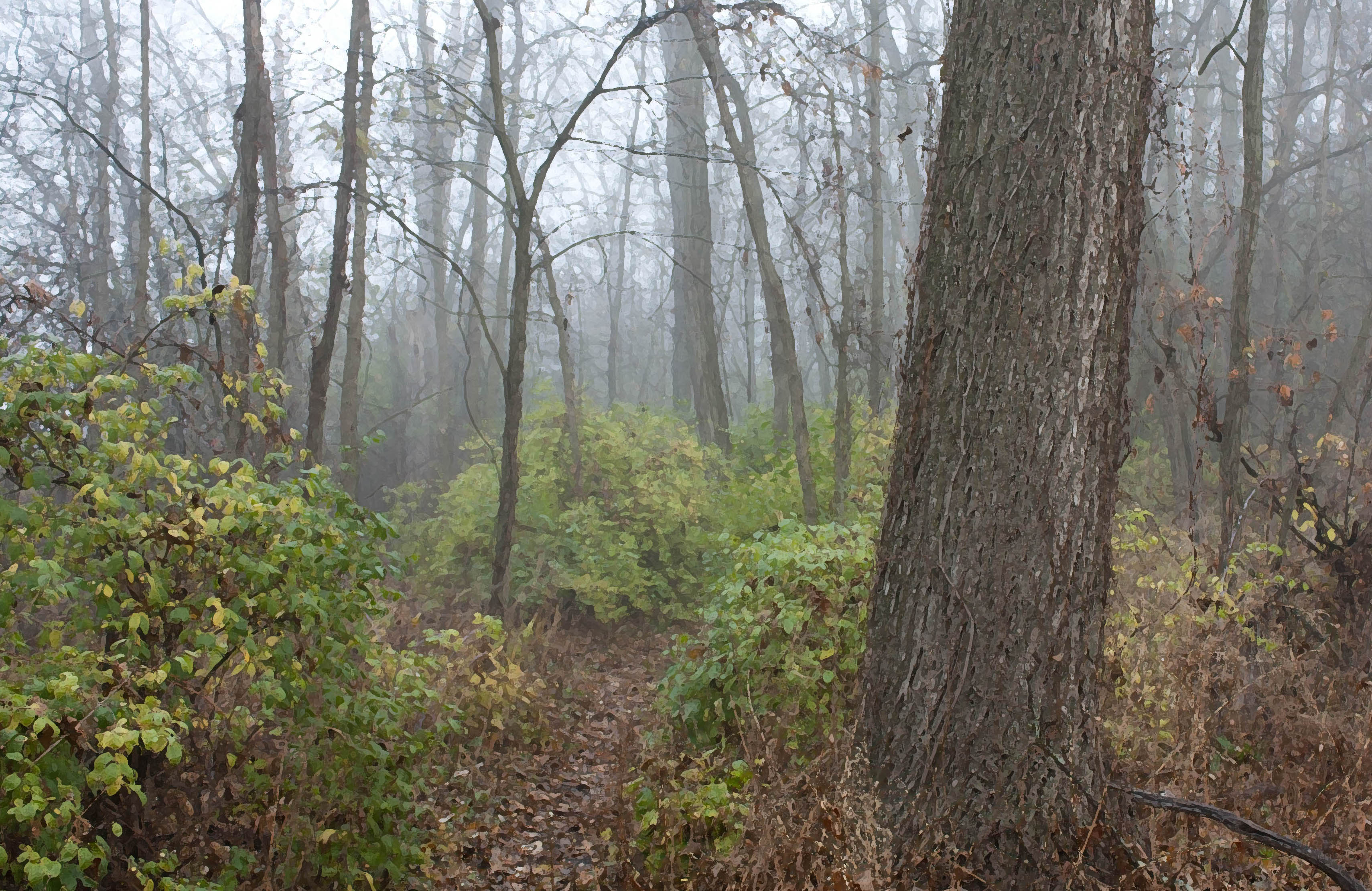
Path meanders through a black walnut forest in an early winter fog, ON (photo and rendition by Nina Munteanu)
References:
First Republic. 2022 “Average American Dept.” September 13, 2022. FirstRepublic.com
Porter, TJ. 2022. “Who Owns the US National Debt?” September 3, 2022. Finmasters
Fisher, Mark. 2009. “Capitalist Realism: Is There No Alternative?” Zero Books. 92pp.
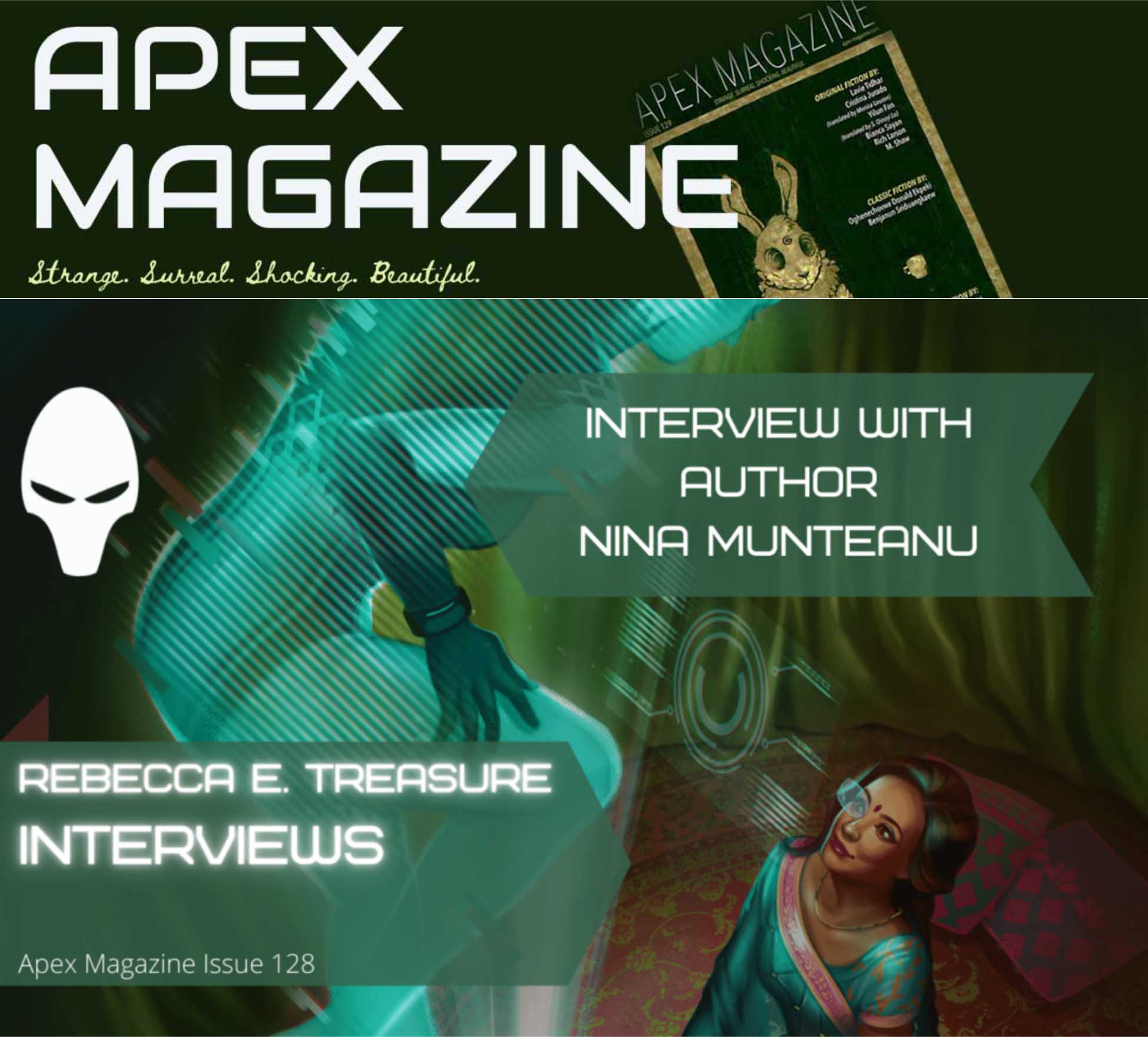
Issue #128 of Apex Magazine featured an interview that Rebecca E. Treasure did with me, posted on December 10, 2021. We discussed the power of story, the use of dystopian narrative, and the blur between fiction and non-fiction to create meaningful eco-fiction. Here’s part of the interview. For the complete interview go here:
INTERVIEW
Nina Munteanu, author of “Robin’s Last Song,” is a prolific creator with multiple books, podcasts, short stories, and nonfiction essays in publication. Her work spans genre, from eco-fiction to historical fantasy to thrillers, and of course, science fiction. Her work as an ecologist informs all of her writing, which circles around an essential exploration; the relationship between humanity and our environment.
At the top of Nina Munteanu’s website, there is a quote: “I live to write, I write to live.” This sentiment is reflected in her fiction, which is not just about characters in compelling situations solving their problems with compassion, but is about all of us, our planet, our environment, and our future.
Rebecca E. Treasure
Nina Munteanu sat down with Apex for a conversation about story, ecology, and the future.
∞
APEX MAGAZINE:“The Way of Water” in Little Blue Marble is such a powerful piece touching on water scarcity and friendship, a dry future and the potential for technology to overtake natural ecology. “Robin’s Last Song” explores extinction, human fallibility, friendship, and again, that conflict between technology and nature. Do you think we’re heading toward the kind of dystopia shown in these stories?
NINA MUNTEANU: The scenarios portrayed in these eco-fiction narratives are deeply grounded in current realities that involve a kind of dissonance between technology and natural processes—more specifically our myopic use of technological “fixes” to make nature more efficient for our use, whether it’s to mine water from the air (disrupting the water cycle) or gene-hack monocrops to increase yield (compromising the crop’s resilience and long-term productivity). It isn’t so much the technology, but the thought process driving its use that is undermining the environment we live in. Our unwillingness to think of ourselves as part of the very environment we’re manipulating for shortsighted purposes could certainly bring about some version of these dystopias.
While these narratives are based on the realistic premise of current and projected water use and food production, their trajectories are fluid and multi-faceted. We still have many directions we can go. Concrete precedents set by a changing climate and our several-century interference will ensure continued extinction of species, reduction of bio-diversity, the proliferation of unstable simple ecosystems prone to crashing, and an unruly water cycle. Despite these, planetary responses remain fluid and unpredictable; there is so much about the natural world we still don’t know. And that is what my story “Robin’s Last Song” touches on: even when it looks utterly bleak and nothing seems left, Nature surprises us with hidden gifts. If nothing else, we are humbled by it. And a little wiser, hopefully.
AM:Your stories show readers the kind of world we could be facing if nothing changes. Do you believe such disaster is preventable?
NM: Humanity can destroy habitats and ecosystems; but we can’t destroy the planet—well, not yet anyway. We can only change it. Earth will endure. The question is: as Nature changes will we endure? We are currently destroying and simplifying the ecosystems that best support our species, and heralding in those that may not. Ecologists use a term “natural succession” to describe when one species or group of species create better conditions for another group that will succeed them. We are in danger of doing this. And we’re taking down a lot with us. This planet has experienced four major extinction events in the past (wiping out up to 90% of its species) and each time life came back in full force; but each time, that life looked different from what had preceded it.
To ensure our own survival, we need to ensure the survival of our supporting network: forests that balance a climate best suited to us; a biodiversity that brings resilience; a clean healthy ocean that nurtures all life. But I am hopeful. We need creativity and joy and connection to do this right. We are creators at heart and are more joyful when creating. We are capable of creating so much beauty in our music, art, and science. When faced with insurmountable odds and terrible circumstance, our earnest hearts fill with kindness and compassion. Some countries have embraced the Happy Index—over the GDP—to measure their success. Bhutan has achieved carbon negativity and others are following its lead. We know what the solutions are. We have the technologies. We understand the science. We just need the will.
As Yuval Harari noted, we remain an insecure species; despite our curiosity and capacity for wonder, we are prone to fear, suspicion, and defensive action in the face of the unknown. Our preoccupation with “self” in all its iterations limits our ability to gain a more healthy perspective and to see ourselves as part of our environment, not apart from it. Our hubris and separation comes from that same insecurity. Like the hero in the hero’s journey, we’ve strayed from our “home” to find ourselves. The changes in the world that we’re largely responsible for creating (e.g., climate change, habitat destruction, and oversimplification) are also part of our journey to find ourselves. When we find our humility and our unique gifts to the world, we can prevent disaster. It won’t be the tool—technology—that does it. It will be the wisdom that comes with loss of ego, allowing us to forge a partnership with the rest of the world, human and non-human.
With the wisdom of feminine energy emerging from the shadows and lighting its voice with kindness, humility, compassion, unity, and wholeness, I’m ever hopeful. It’s time to grow up, forgive ourselves and each other, and become whole.
Birch trees and marsh on a foggy winter morning, ON (photo and rendition by Nina Munteanu)
Rebecca E. Treasure grew up reading science fiction and fantasy in the foothills of the Rocky Mountains. After grad school, she began writing fiction. Rebecca has lived many places, including the Gulf Coast of Mississippi and Tokyo, Japan. She currently resides in Texas Hill Country with her husband, where she juggles two children, two corgis, a violin studio, and writing. She only drops the children occasionally. To read more visit www.rebeccaetreasure.com.
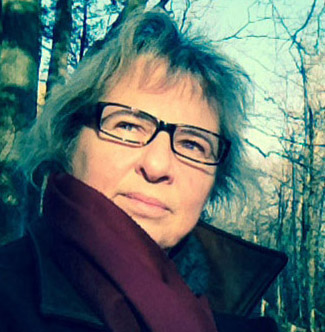
NINA MUNTEANU is a Canadian ecologist / limnologist and novelist. She is co-editor of Europa SF and currently teaches writing courses at George Brown College and the University of Toronto. Visit www.ninamunteanu.ca for the latest on her books. Nina’s bilingual “La natura dell’acqua / The Way of Water” was published by Mincione Edizioni in Rome. Her non-fiction book “Water Is…” by Pixl Press(Vancouver) was selected by Margaret Atwood in the New York Times ‘Year in Reading’ and was chosen as the 2017 Summer Read by Water Canada. Her novel “A Diary in the Age of Water” was released by Inanna Publications (Toronto) in June 2020.
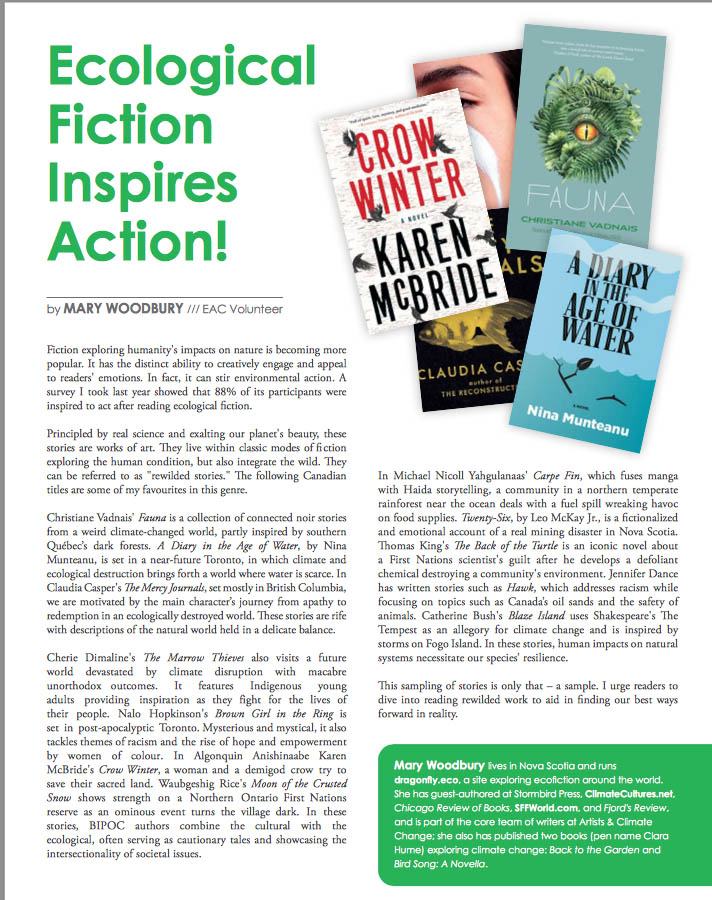
In the Spring 2021 Issue of Ecology & Action, author and Dragonfly.eco publisher Mary Woodbury lists some of her favourite eco-fiction that inspires action. Nina Munteanu’s clifi eco-novel “A Diary in the Age of Water” is among them:
“Fiction exploring humanity’s impacts on nature is becoming more popular. It has the distinct ability to creatively engage and appeal to readers’ emotions. In fact, it can stir environmental action. A survey I took last year showed that 88% of its participants were inspired to act after reading ecological fiction. Principled by real science and exalting our planet’s beauty, these stories are works of art. They live within classic modes of fiction exploring the human condition, but also integrate the wild. They can be referred to as “rewilded stories.” The following Canadian titles are some of my favourites in this genre.”
Mary Woodbury, Dragonfly.eco
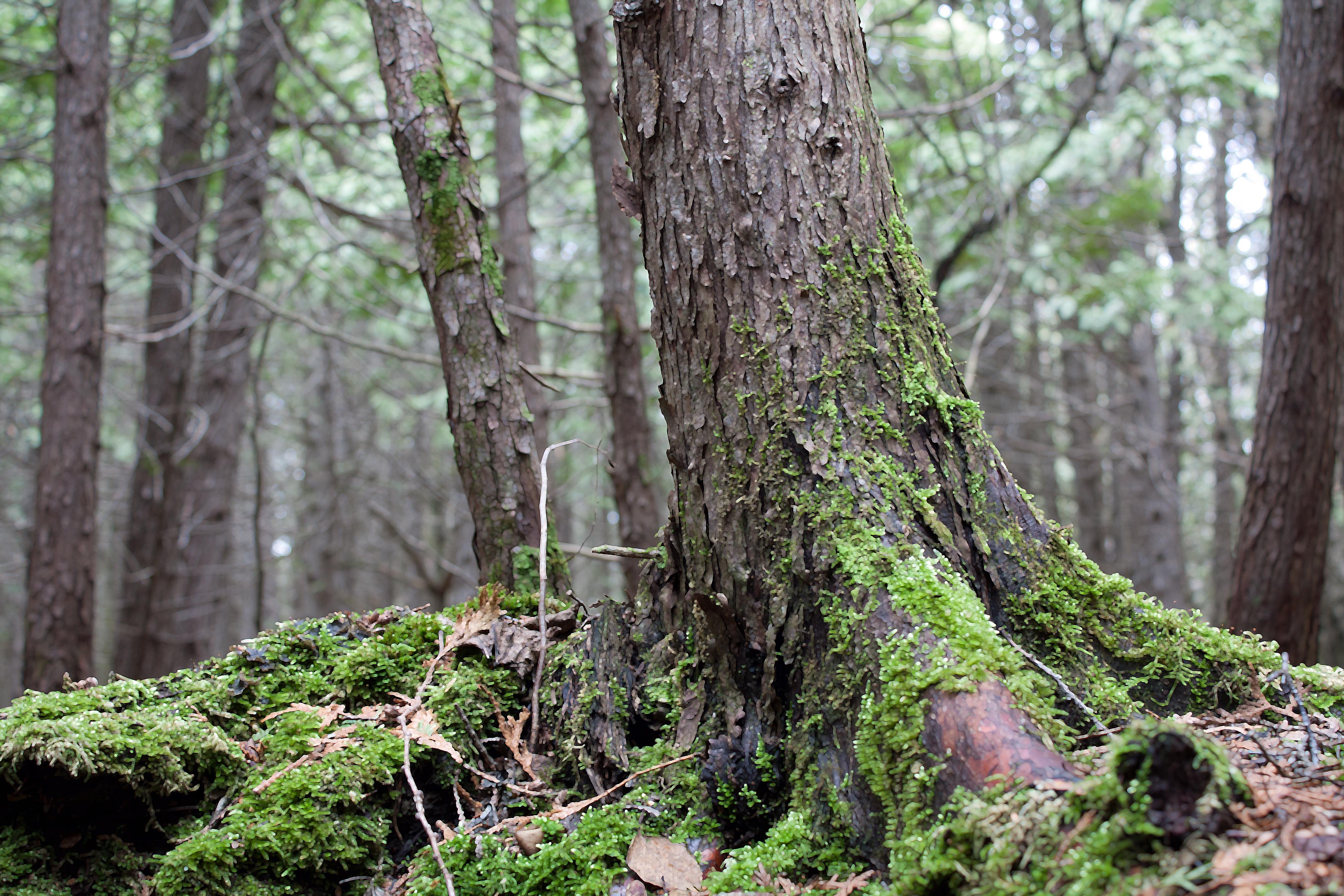
Mossy cedar tree in Trent Nature Sanctuary, ON (image and rendition by Nina Munteanu)
NINA MUNTEANU is a Canadian ecologist / limnologist and novelist. She is co-editor of Europa SF and currently teaches writing courses at George Brown College and the University of Toronto. Visit www.ninamunteanu.ca for the latest on her books. Nina’s bilingual “La natura dell’acqua / The Way of Water” was published by Mincione Edizioni in Rome. Her non-fiction book “Water Is…” by Pixl Press(Vancouver) was selected by Margaret Atwood in the New York Times ‘Year in Reading’ and was chosen as the 2017 Summer Read by Water Canada. Her novel “A Diary in the Age of Water” was released by Inanna Publications (Toronto) in June 2020.










 Nina Munteanu Writing Coach