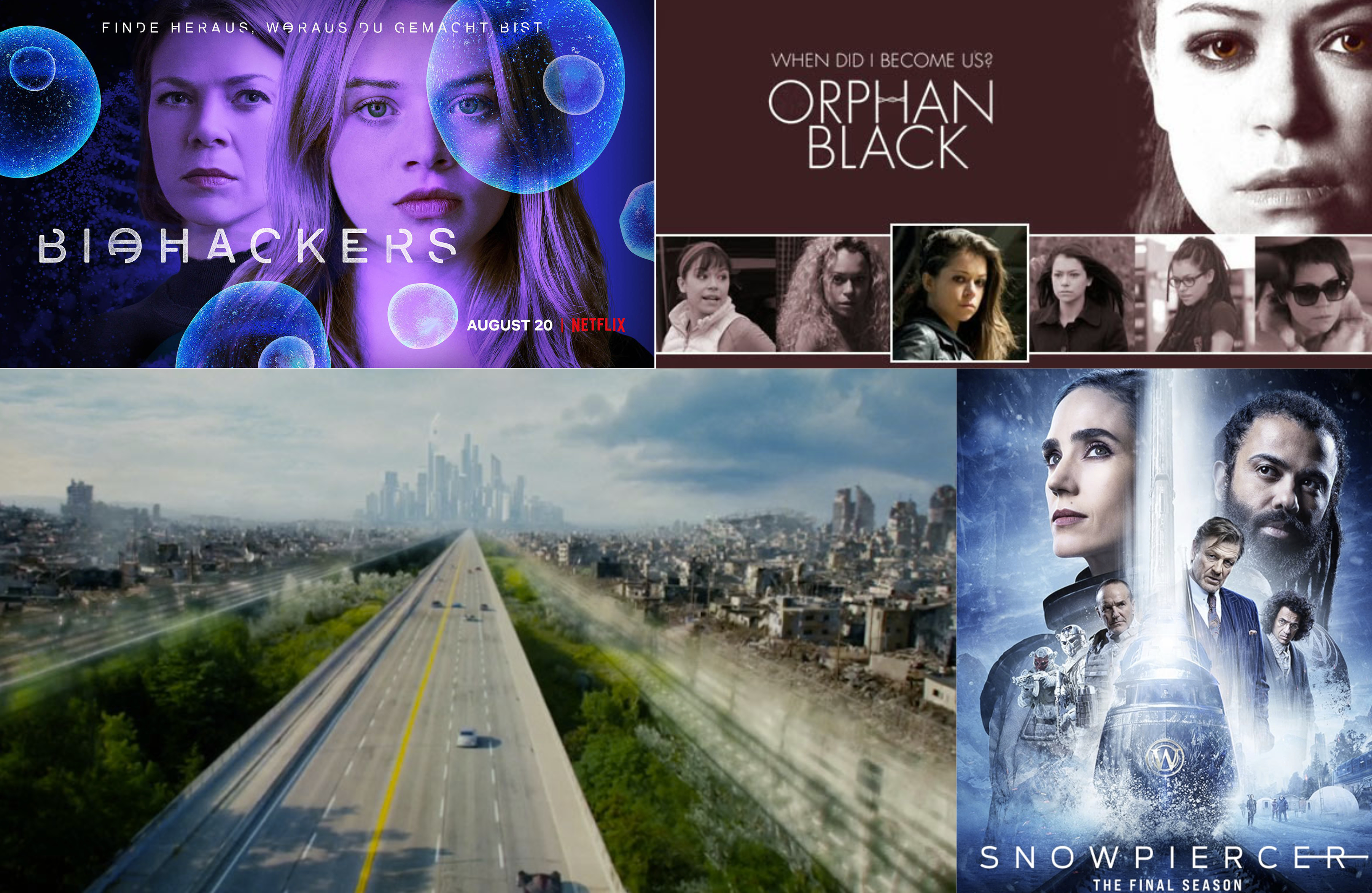

Significant Science Fiction TV Series—Part 1, Shows that Touch on Justice and Science & Technology: #2 — ORPHAN BLACK

I’ve selected ten TV series that have intrigued me, moved me, and stayed with me for various reasons that touch on: abuse of justice, including eco-justice and environmental abuse; technology use and abuse; and the effects and horrors of climate change.

Some are well known; others not so well known. All approach storytelling with a serious dedication to depth of character, important themes, realistic world building, and excellent portrayal by actors. The world-building is extremely well done—in some cases rivalling Ridley Scott’s best—with convincing portrayals of worlds that are at times uncanny in their realism. Worlds that reflect story from an expansive landscape to the mundane minutiae of daily life: like the cracked phone device of Detective Miller in The Expanse or the dirty fingernails of engineer Juliette Nichols in the Down Deep of Silo. Stories vary in their treatment of important themes from whimsical and often humorous ironies to dark and moody treatises on existential questions. In my opinion, these TV series rival the best movies out there, often reflecting large budgets (but not always) and a huge commitment by producers. The ten TV series I’ve selected here come from around the world: Brazil, Germany, France, Norway, Canada and the United States.

In Part 1, I look at five TV series that touch on ethical issues we are facing today; issues that reach far into existential questions of what it means to be human. These TV series explore synthetic biology, cloning and gene editing, and justice in space colonization and exploitation.

ORPHAN BLACK: Mingling Its Own Nature With It…

Shot in and around Toronto, Ontario, the series focuses on Sarah Manning, a fringe-dweller with questionable friends, who assumes the identity of her clone, cop Elizabeth (Beth) Childs, after witnessing her suicide and stealing her stuff. In Season 1 alone, seven clones are revealed. Those still alive include suburban housewife Alison Hendrix, university evolutionary biologist Cosima Niehaus, corporate mogul Rachel Duncan, and crazed sociopath Helena.

Toronto is filmed brilliantly in a vague every-city pastiche that combines the look of London’s eastside, NYC and northern Europe all in one. Like its characters, the show is both sparsely existentialist and baroque funk. Besides Sarah’s own diverse clones there is foster brother Felix and his various friends or cronies who add significant colour to this film-noir set. Unsavory antagonists not only add intrigue but provide significant texture from sophisticated and subtle to the banal and truly terrifying. And like biology itself—perhaps the true main character here—all the characters are shape-shifters, looking for balance in a shifting world where “normal” keeps chasing itself.

Sarah Manning at the train station where she meets her first clone (image by Orphan Black)

Orphan Black is a slick, sophisticated and edgy exploration of human evolution that raises issues about the moral and ethical implications of bio-engineering and genetic tampering—specifically human cloning (currently against the law), personal identity, and intellectual property. Manson and Fawcett enlist symbols and clever metaphor to enrich the story with layers of depth—no item is free of meaning: from the seemingly innocuous naming of a transit station (Huxley Station) in the show’s premiere, or Delphine’s passing reference to “a brave new world” to a terse discussion between a religious extremist and a restaurant proprietor over the merits of factory-farmed eggs: “They’re not normal,” the extremist complains. “They’ve been interfered with.” There is nothing normal about Orphan Black.

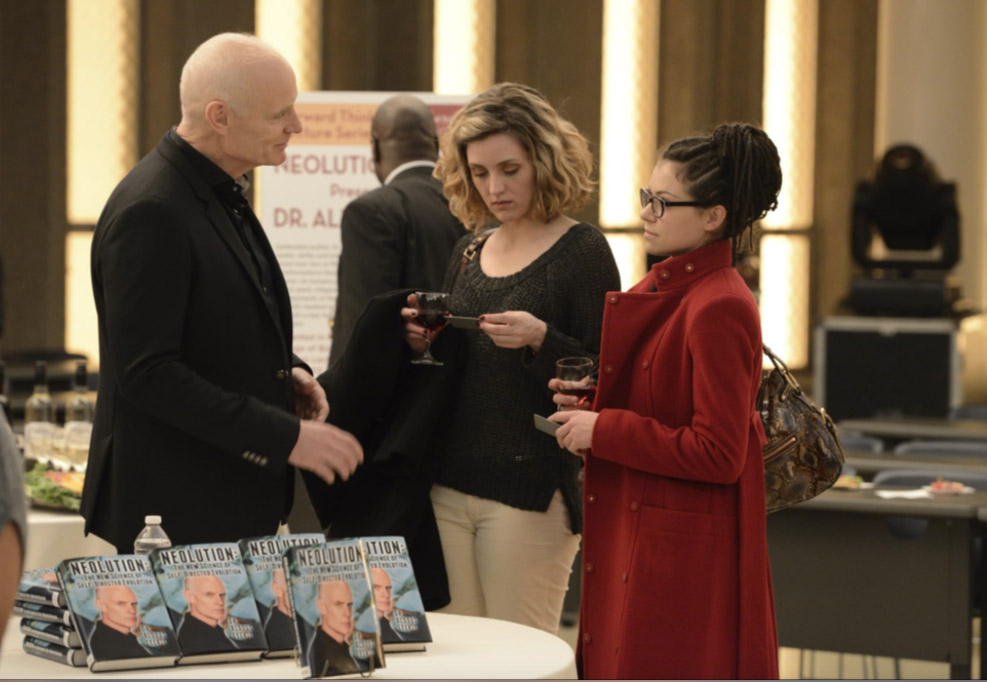
Cosiima meets Dr. Aldous Leaky of Neolution, a transhumanist organization about self-directed evolution

Episode titles in Season One quoted parts of Charles Darwin’s evolutionary text On The Origin of Species. Titles like “Natural Selection” (series premiere) and “Parts Developed in an Unusual Manner” elucidate concepts of evolution and survival of the fittest. Season 2 adopts the works of Sir Francis Bacon, reflecting the ethical and moral implications of scientific pursuit in a world of contrasting philosophies and values. 

In Orphan Black, The Dyad Institute, a biotech corporation with arcane connections to invisible powers and eugenics, patented the clones as theirs to do with as they please—which might be anything. The ownership of the clones’ genomes by The Dyad Institute would be lawful if all the clones’ DNA was entirely synthetically made. The company would also have exclusive rights to study the clones’ genome, effectively placing the clone Cosima under copyright infringement if she decided to study and apply her research (on herself) outside of the Dyad Institute. If the clones were synthetic, like the DNA created by scientist Dr. Craig Venter, then the Dyad Institute would be in a unique situation with regards to ethics and newly emerging considerations of human rights yet to be determined. For instance, how much of the clones really belong to the company that made them? What even constitutes a person?

Nina Munteanu is a Canadian ecologist / limnologist and novelist. She is co-editor of Europa SF and currently teaches writing courses at George Brown College and the University of Toronto. Visit www.ninamunteanu.ca for the latest on her books. Nina’s bilingual “La natura dell’acqua / The Way of Water” was published by Mincione Edizioni in Rome. Her non-fiction book “Water Is…” by Pixl Press (Vancouver) was selected by Margaret Atwood in the New York Times ‘Year in Reading’ and was chosen as the 2017 Summer Read by Water Canada. Her novel “A Diary in the Age of Water” was released by Inanna Publications (Toronto) in June 2020.

Movie Review: You Want to Go to “The Island”

Clones Jordan and Lincoln are chased as they seek their sponsors

From its metaphoric title to its powerful end, Director Michael Bay’s 2005 The Island had me fully engaged. Told in the genuine style of great science fiction commentary by screenwriters Caspian Tredwell-Owen, Alex Kurtzman and Roberto Orci (in 2005), The Island reflects the escape-from dystopia films of the 1960s and 70s such as Fahrenheit 451, THX 1138, and Logan’s Run. This elegant story examines a full range of human foibles—consumerist greed, racism, fascism and isolationism—through a premise that is as frightening as it is possible.

Announcer talks about ‘the Island’ lottery to the world of Lincoln and Jordan

In the near-future, Lincoln Six Echo (Ewan McGregor) and Jordan Two Delta (Scarlett Johansson) live in an isolated rather sterile community where behaviour is governed by a set of strict rules. This includes the avoidance of too close contact. Everything is the same; residents all wear the same white uniform and carry out simple duties. They’ve been told that the outside world is too contaminated for human life with the exception of one island. Everyone lives for the weekly lottery, where the winner gets to leave the compound to live on the island.

Jordan and Lincoln discuss the day over drinks in the facility’s lounge

It’s a simple and banal existence. We glimpse a scene of adults reading Dick and Jane out loud. When in the opening scene Lincoln Six Echo finds a shoe missing in his provided wardrobe, this becomes a major focus of his day (when greeted by a colleague with, “How are you doing?” he responds with, “I’m missing a shoe.”)

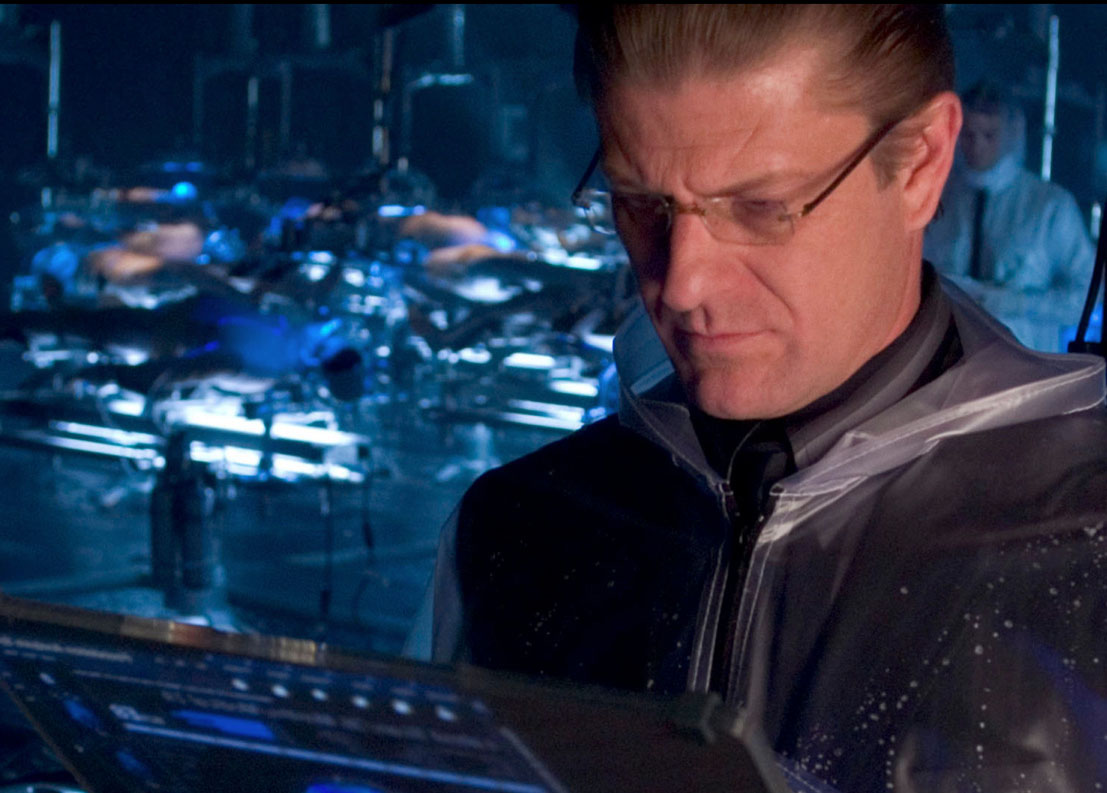
Lincoln can’t accept this mundane existence. In an interview with Dr. Merrick (Sean Bean), the scientist who runs the compound, Lincoln naively unleashes a tirade of items that frustrate him, like why everyone wears white, who determined tofu Tuesday, and then ends with: “I want to know answers and I wish there was more than just waiting to go to the island.” He also suffers from dreams about a life he doesn’t understand—they are, in fact, memories of his ‘sponsor’, the original man (Tom Lincoln) that he is a clone copy of.  When he discovers a moth and follows it, he stumbles into the hidden part of the compound. There he witnesses what really happens to “lottery winners”: they are killed and used for organ harvesting, surrogate motherhood, etc. for each one’s sponsor.

Lincoln finds a moth that he releases and follows into forbidden territory

Lincoln is just an insurance policy. An ‘agnate’ according to Dr. Merrick, who describes them as in a “persistent vegetative state that never achieves consciousness” to clients, willing to pay millions of dollars for a second chance at life—and blithely unaware that ‘agnates’ are alive and fully formed with thoughts and feelings like them.

Doctor Merrick oversees the indoctrination of the clones in the giant lab facility

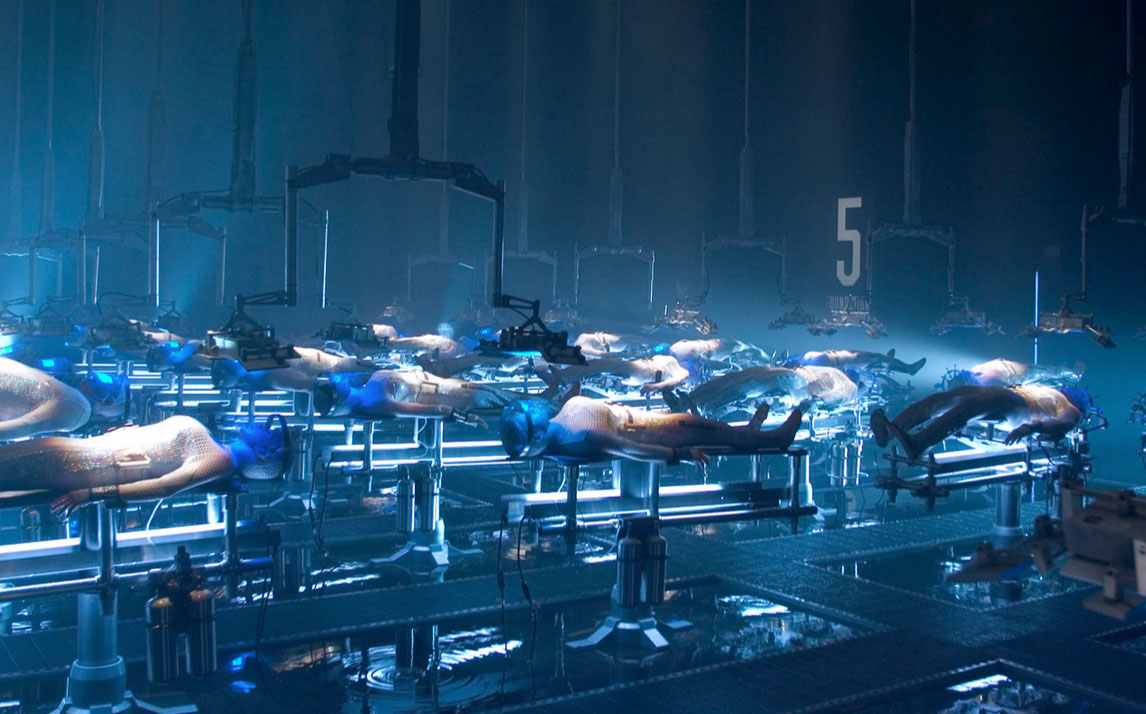
When Lincoln learns the truth, and knowing that Jordan just “won” the lottery, he convinces her to escape with him. During their escape through the bowels of the facility, they discover the atrocities of cloning in the giant labs and that the clones are living in a giant silo controlled by massive holograms to simulate the ‘contaminated’ outside.

Clone lab where newly created clones receive implanted memories and instructions to seek the island
Jordan and Lincoln watch the subliminally-fed imagery for clone indoctrination

Merrick hires Albert Laurent (Djimon Hounsou), a mercenary and former GIGN veteran, to find and dispatch Lincoln and Jordan. And so begins an incredible action-packed chase through the city of Los Angeles, where Lincoln and Jordan have traveled in search of his sponsor.

Mercenary Albert Laurent takes chase after the two clones escape the facility
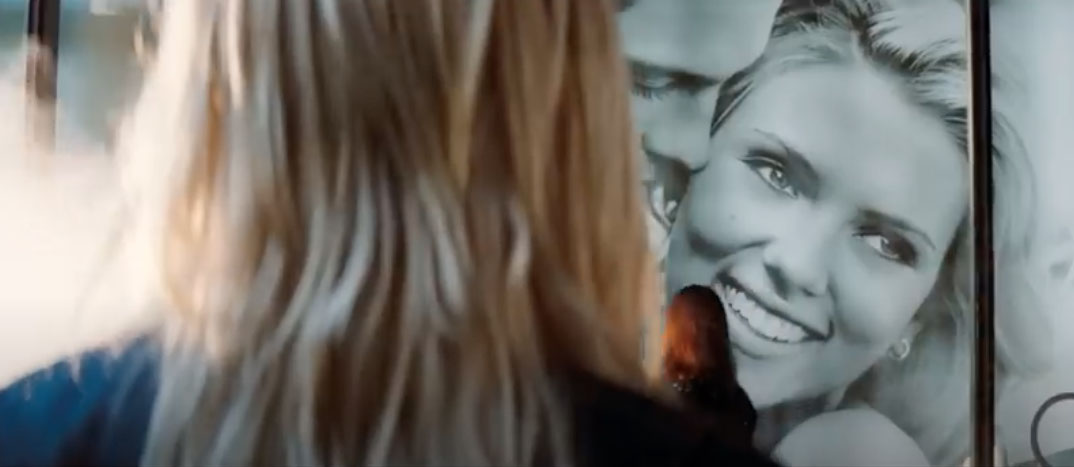
After escaping the facility, Jordan sees an ad that features her sponsor, now in critical condition after an accident and in need of organ donation
In an awkward moment, Lincoln meets his sponsor who is not too happy to discover of his existence

The Island received mixed reviews from critics, with a 40% “Rotten” rating, based on 185 reviews. Variety’s Justin Chang called the film an “exercise in sensory overkill.” Salon’s Stephanie Zacharek lamented that when the film got really interesting, Bay seemed to think he needed “to throw in a car crash or round of gunfire to keep our attention.” If these critics found fault with this elegant action-thriller, I hate to see what they make of 90% of the so-called SF movies out there today. Unlike them, The Island provides a refreshing meaningful face to action-adventure that elegantly and skillfully balances incredible action scenes with characterization and evolution of the two naive characters.

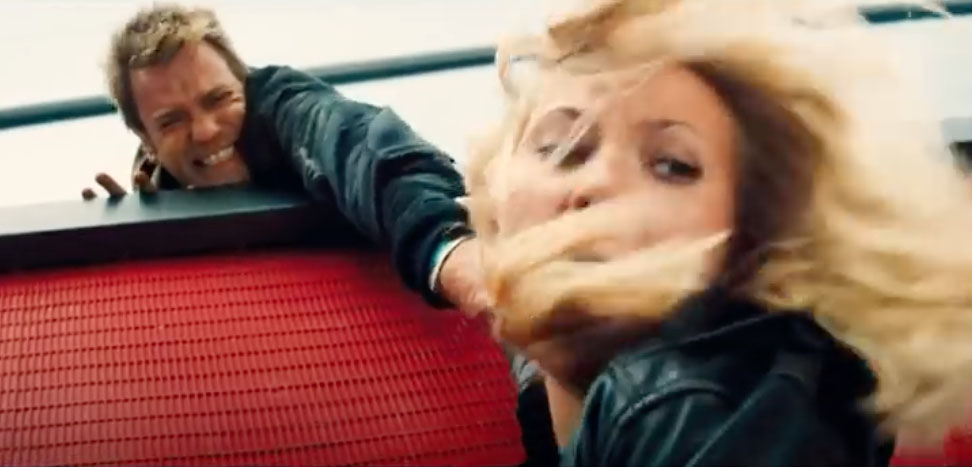
Jordan dangles precipitously from a huge building sign as the two clones are chased by Laurent

Roger Ebert suggested that The Island missed the opportunity “to do what the best science fiction does, and use the future as a way to critique the present.” Again, I disagree. The Island does what the best science fiction does well: it examines the nature of our humanity through the choices we make in adversity within a future world and premise that provides great opportunity for abuse.

The theme of this parable is carried evocatively by Steve Jablonsky’s score. Like a swelling tide it sweeps us on a journey to some distant shore. From the melodic strings and yearning chorus, the music builds to a powerful conclusion at the film’s end, when it lifts us to victory, resonating with our divine evolution.

Laurent stands among the hundreds of freed clones, smiling in triumph

I was particularly struck by the timing of the strings and chorus with the appearance of Albert Laurent, walking among those he had just liberated. It is a pivotal and powerful moment that escalates into a resonating vibration of liberty and victory as his eyes meet briefly with Lincoln and Jordan, reunited, and he smiles—for the first time. A beautiful smile of inner joy. It is the smile of a man who has “come home” and is finally free.

Laurent’s subplot is particularly compelling and carries one of the principle elements of the film. In some ways, Laurent represents you and me, caught up in our societal ‘duties’, seduced by self-serving entrapments only to awaken to a path of courageous compassion for all of humanity. Laurent’s journey from jaded mercenary to liberating hero begins when he notices Jordan’s skin branding and, recognizing a connection with her plight, helps her free the mass of ‘defective’ lottery winners about to be incinerated. We learn that his father had been killed as a rebel and Laurent was ‘branded’ as less than human. So, there he walks, brilliantly black among the white-clad ‘agnates’ who slide down the hill after emerging from the underground bunker in which they were incarcerated.

This motion picture is ultimately about finding dignity in the face of adversity and ridicule. It is about confronting the bully and gaining victory over one’s own barriers of fear and doubt toward compassion. It is about the power of love and connection with humanity. It is about retribution and finding one’s true path through the knowledge that we are all one.

I am you; you are me. You are the waves; I am the ocean. Know this and be free, be divine.” Sri Sathya Sai Baba

Nina Munteanu is a Canadian ecologist / limnologist and novelist. She is co-editor of Europa SF and currently teaches writing courses at George Brown College and the University of Toronto. Visit www.ninamunteanu.ca for the latest on her books. Nina’s bilingual “La natura dell’acqua / The Way of Water” was published by Mincione Edizioni in Rome. Her non-fiction book “Water Is…” by Pixl Press (Vancouver) was selected by Margaret Atwood in the New York Times ‘Year in Reading’ and was chosen as the 2017 Summer Read by Water Canada. Her novel “A Diary in the Age of Water” was released by Inanna Publications (Toronto) in June 2020.

The Invasion of Giant Crayfish Clones & A Diary in the Age of Water

OLYMPUS DIGITAL CAMERA

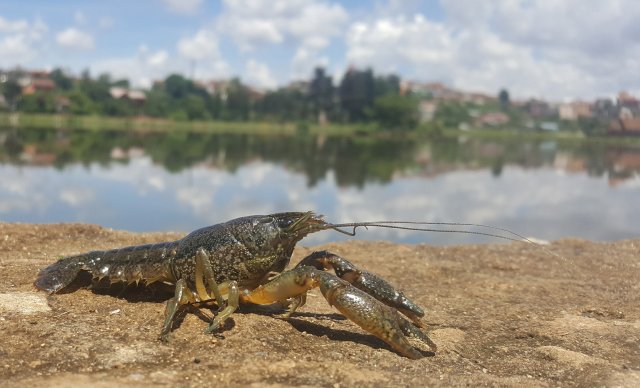
Marmorkrebs, giant marbled crayfish

In 2018, scientists reported that the giant marbled crayfish (Marmorkrebs [German]: Procambarus fallax f. virginalis) recently developed the strategy of being entirely female and cloning itself via parthenogenesis1; the female doesn’t require a male crayfish to fertilize its eggs. Despite the cloning procedure that makes them virtually identical genetically, the crayfish vary in size and pattern—no doubt due to epigenetics.2

First discovered by a German aquarium in the mid-1990s, these crayfish that developed from Florida-Native crayfish have migrated into the wild and are aggressively spreading in Europe, at the expense of the native European crayfish. The 8 to 12 cm long Marmorkrebs has been observed in Germany, Italy, Slovakia, Sweden, Japan, and Madagascar. The marbled crayfish prefers a warm and humid climate, suggesting that climate change may influence its distribution and success. The clones also thrive in a wide range of habitats—from abandoned coal fields in Germany to rice paddies in Madagascar, writes Carl Zimmer of the New York Times.

Given that every individual Marmorkrebs can reproduce (the advantage of parthenogenesis is that the female crayfish doesn’t need to find a mate—it just gives birth), one European scientist has dramatically suggested that, “we’re being invaded by an army of clones.” Zimmer shares the results of Dr Lyko and his team on how the all-female Marbokrebs came to be:

“Scientists concluded that the new species got its start when two slough crayfish mated. One of them had a mutation in a sex cell — whether it was an egg or sperm, the scientists can’t tell. Normal sex cells contain a single copy of each chromosome. But the mutant crayfish sex cell had two. Somehow the two sex cells fused and produced a female crayfish embryo with three copies of each chromosome instead of the normal two. Somehow, too, the new crayfish didn’t suffer any deformities as a result of all that extra DNA.” 

In its first couple decades, [Marmorkrebs] is doing extremely well, writes Zimmer. But sooner or later, the marbled crayfish’s fortunes may well turn, he adds. “Maybe they just survive for 100,000 years,” Dr. Lyko speculated. “That would be a long time for me personally, but in evolution it would just be a blip on the radar.”

marbled-crayfish2

Marmorkrebs

But what if this speculation isn’t the whole scenario? What if Marmorkrebs is just another example of climate change-induced adaptation and change through epigenetics? While climate forcing and habitat destruction is causing the extinction of many species; other species are, no doubt, adapting and exploiting the change. These generalists (born with change inside them) are poised to take over in Nature’s successional march.3

Bdelloid-rotifer-Philodina-gregaria

Bdelloid rotifer

Parthenogenesis and epigenetic change isn’t new. In fact, it’s very old … All-female bdelloid rotifers have been cloning a sisterhood for millions of years and using incorporated foreign genes through horizontal gene transfer4 (essentially stealing genetic material from their environment) to maintain a healthy diverse population. What’s new and weird is that this crayfish “suddenly” developed this ability—probably through epigenetic means (given this entire group is versatile in reproductive strategies in general). The real question none of the articles that covered this phenonemon ask is: WHY? Why is it happening NOW?

In my latest book A Diary in the Age of Water (due for release in May 2020 by Inanna Publications) I explore this “change” in a unique way:

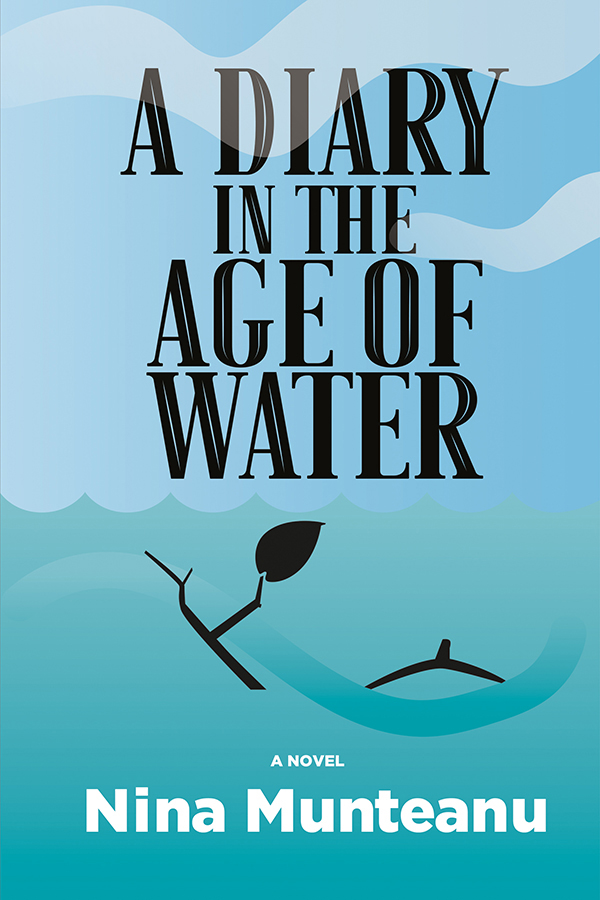
Diary Water cover finalKyo finds a copy of Robert Wetzel’s Limnology on a lower shelf of the “L” section. It stands tall with a thick green-coloured spine. This is the book that Hilda, one of the Water Twins, had saved from the book burnings of the Water Age. A present from her limnologist mother. Hilda kept it hidden under her mattress. When CanadaCorp police burst into their home and dragged her mother away, Hilda was left alone with Wetzel. The limnology textbook was forbidden reading because its facts were no longer facts. 

After some coaxing, Myo shared a most bizarre tale of that time which led to the catastrophic storms and flood. What the governments hadn’t told their citizens—but what each citizen felt and knew—was that humans had lost the ability to reproduce. Then a spate of “virgin births” throughout the world spawned what seemed a new race of girls—‘deformed’, blue and often with strange abilities. Many considered them abominations, a terrible sign of what was in store for humanity—a punishment for their evil ways. Then, as quickly as they’d populated the world, these strange blue girls all disappeared without a trace. They simply vanished and became the Disappeared. Myo told her that some people called it a Rapture, a portent of the end times. Others suggested that the girls had all been murdered—a genocide, organized by what was left of the world government. 

Then … the storms … changed the world.

–“A Diary in the Age of Water” 

  1. Spontaneous Parthenogenesis: From the Greek Parthenon “virgin” and genesis “creation”, parthenogenesis is a natural form of asexual reproduction in which growth and development of embryos occur without fertilization. In animals it involves development of an embryo from an unfertilized egg; in plants it proceeds through apomixis. The production of only female offspring by parthenogenesis (such as with bdelloid rotifers) is called thelytoky.
  2. Epigenetics is the study of changes in organisms caused by the modification of gene expression (such as environmental triggers) rather than alteration of the genetic code itself. If genetics represents the hardrive of a computer, epigenetics is its software.
  3. Niche (the role or job of an organism or population) can be broad (for generalists) or narrow (for specialists). A specialist has superior abilities to exploit the narrow environmental conditions it lives in and is splendidly adapted to a fixed stable environment; generalists, less successful at exploiting than the specialist but more widely adaptive, can thrive in less stable environments that present a wider range of conditions.
  4. Horizontal gene transfer is the movement of genetic material between organisms other than by the vertical transmission of DNA from parent to offspring through reproduction. HGT is an important factor in the evolution of many organisms.

A Diary in the Age of Water will be released in May 2020 by Inanna Publications, Toronto, Canada.


nina-2014aaa

Nina Munteanu is a Canadian ecologist / limnologist and novelist. She is co-editor of Europa SF and currently teaches writing courses at George Brown College and the University of Toronto. Visit www.ninamunteanu.ca for the latest on her books. Nina’s bilingual “La natura dell’acqua / The Way of Water” was published by Mincione Edizioni in Rome. Her non-fiction book “Water Is…” by Pixl Press (Vancouver) was selected by Margaret Atwood in the New York Times ‘Year in Reading’ and was chosen as the 2017 Summer Read by Water Canada. Her novel “A Diary in the Age of Waterwill be released by Inanna Publications (Toronto) in June 2020.