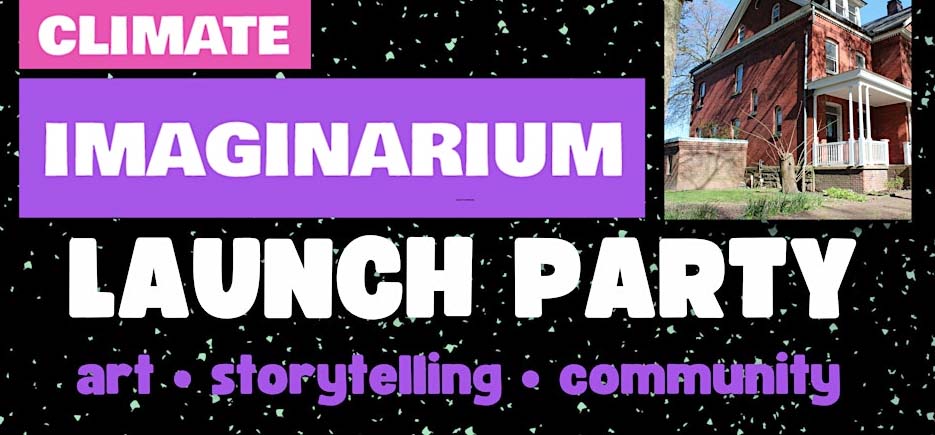
My short story Robin’s Last Song was selected by the NYC Climate Writers Collective as part of an exhibition in the Climate Imaginarium on Governors Island in New York. The exhibition, starting May 18, will run throughout the summer of 2024.
Robin’s Last Song
Robin’s Last Song first appeared in the #128 Issue of Apex Magazine in 2021. It tells the story of Robin, a blind elder whose digital app failed to warn the world of the sudden global loss of birds with disastrous ecological consequences. After years of living in self-exile and getting around poorly on sight-enhancing technology, a discovery gives her new hope in rekindling her talents in the field of Soundscape Ecology.
In a recent interview with writer Simon Rose, I described my thoughts in writing Robin’s Last Song:
I wanted to make “Robin’s Last Song” a realizable work of fiction in which science and technology play both instigator of disaster and purveyor of salvation. Our biogenetic technology comes to us as a double-edged sword in the form of gene-editing, proteomics, DNA origami, and CRISPR—just to name a few. These biotechnological innovations promise a cornucopia of enhancements: from increased longevity and health in humans to giant disease-resistant crops. But, for every ‘magic’ in technology, there is often unintended consequence. Unforeseen—or even ignored—casualties and risks. I suppose my ultimate question with this story is: will synthetic biology redesign Nature to suit hubris or serve evolution? Science doesn’t make those decisions. We do.
Anyone living in or visiting the NYC area is welcome to the Climate Imaginarium launch on May 18 on Governor’s Island. Check this Eventbrite link for details. The exhibition will continue throughout the summer of 2024 and will include: climate storytelling and poetry by Climate Café, the Sixth Festival, and the Climate Writers Collective; opening exhibition of “What is Environmental Art?” by Forest for Trees; artwork from the Climate Imaginarium community and Climate Writers exhibition; “Eye of Flora” virtual reality exhibition by Synphisica Collective; and more.
Here’s what they say:
Come to Governors Island for the grand opening of our Climate Imaginarium house! The Climate Imaginarium will serve as a community center for climate and culture, with galleries and spaces for exhibitions, performances, film screenings, and events that respond to the climate crisis with solutions and visions for hope and justice. Join us at Building 406A on Colonels Row for a lively celebration of climate art, storytelling, and community.
Exhibitions will be open to the public at noon, and the party will officially start at 2pm. All donations will support programming in our community space.
Nina Munteanu is a Canadian ecologist / limnologist and novelist. She is co-editor of Europa SF and currently teaches writing courses at George Brown College and the University of Toronto. Visit www.ninamunteanu.ca for the latest on her books. Nina’s bilingual “La natura dell’acqua / The Way of Water” was published by Mincione Edizioni in Rome. Her non-fiction book “Water Is…” by Pixl Press (Vancouver) was selected by Margaret Atwood in the New York Times ‘Year in Reading’ and was chosen as the 2017 Summer Read by Water Canada. Her novel “A Diary in the Age of Water” was released by Inanna Publications (Toronto) in June 2020.
Poplar trees in fall, ON (photo and rendition by Nina Munteanu)
I just finished reading Ben Rawlence’s 2022 book The Treeline. It is a book that made me think. It made me cry. It made me despair. It also gave me hope.
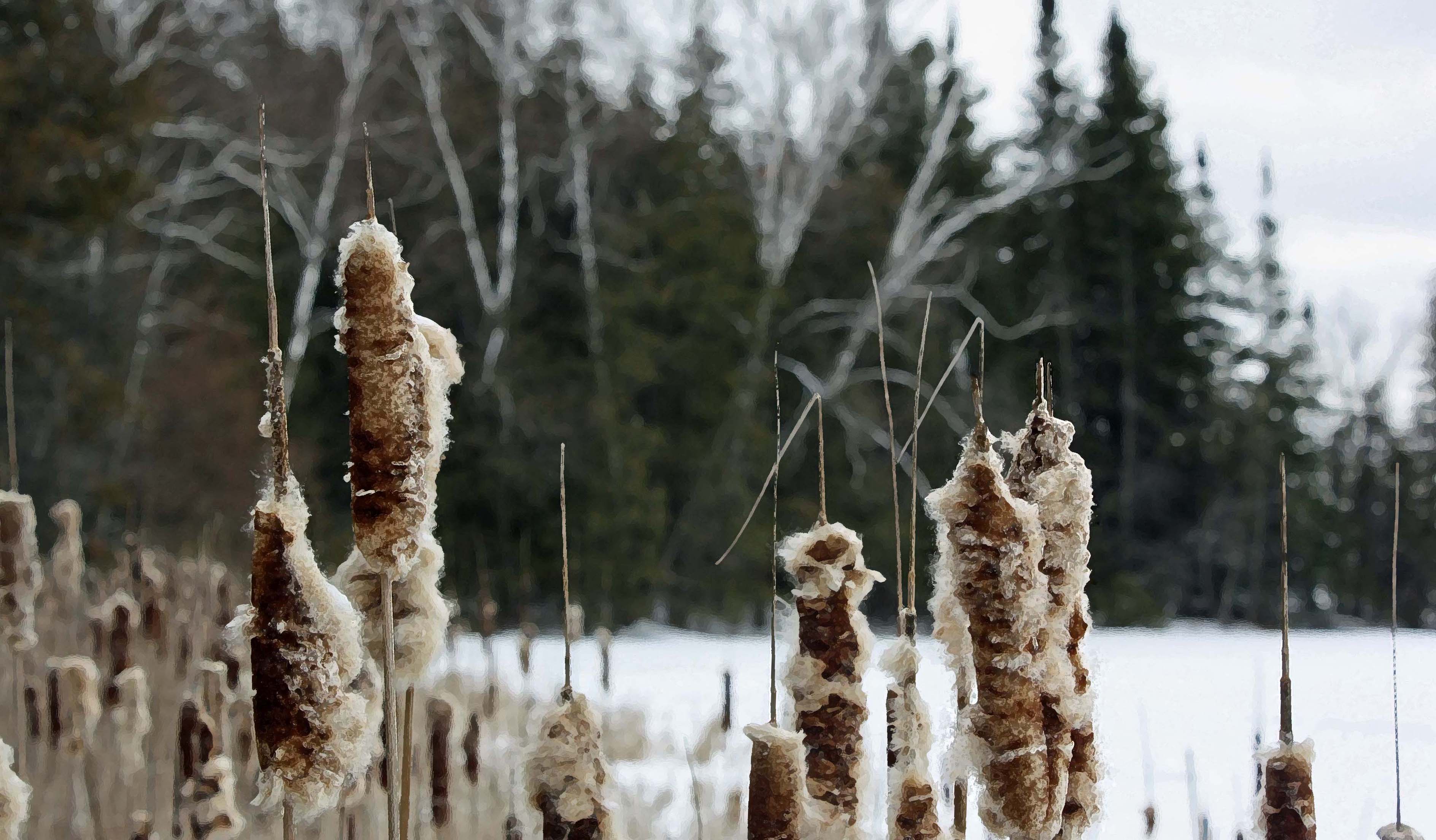
Cattails line a snow-covered marsh with spruce and fir behind, ON (photo and rendition by Nina Munteanu)
I was gripped by this honest and unflinching exploration on the moving treeline with climate change and what it will mean for humanity. Beautifully written and rigorously reported, Rawlence invited me on a journey of all major treelines over the globe from Scotland, Norway and Russia, to Alaska, Canada and Greenland. Throughout his description of a warming world and a vanishing way of life, Rawlence meditates on the many repercussions on how humans live.
Pine-cedar forest in Ontario (photo and rendition by Nina Munteanu)
He aptly describes the forests of the world as the ‘heartbeat of the planet,’ the cycles of breathing and the pulses of life from the spike of oxygen in the spring when trees put out their leaves to the peaks and troughs over day and night that regulate plant photosynthesis and respiration. The peaks and troughs are getting shallower, he writes. With more carbon dioxide in the air the trees work less; they inhale less and exhale less oxygen.
“The planet is a finely tuned system. A few degrees of change in its orbit can usher in an ice age; a few degrees of temperature change can transform the distribution of species, can melt glaciers and create oceans. In the future, when the ice is gone, there may be no such thing as a treeline at all. As the stable currents of air and water associated with the Gulf Stream, the polar front, polar vortex and Beaufort Gyre dissipate or fluctuate, the Arctic Ocean melts completely, and the Rossby waves in the upper atmosphere go haywire, the fine gradations of temperature, altitude and latitude first observed by Alexander von Humboldt will become decoupled and ecological transition zones scrambled. Instead of a majestic sweeping zone of forest around the planet, we might find discontinuous pockets of trees in odd places, refugees from soil and temperatures long gone, and crocodiles once again at the North Pole.”
Ben Rawlence, The Treeline
Snow-covered river shoreline with mixed forest, ON (photo and rendition by Nina Munteanu)
Rawlence brings this all into perspective to our present situation and the role science has played in our hubristic illusion of control:
“An unfortunate side effect of science is the illusion of human mastery: the idea that if we know what is happening then we can control. The irony is that we might have been able to. The tragedy is that it is too late. The chain reaction is under way. The curve only gets steeper from here…five metres of sea level rise is locked in; it’s just a question of how fast the ice melts. Once again, the models seem to underestimate the speed…”
Ben Rawlence, The Treeline
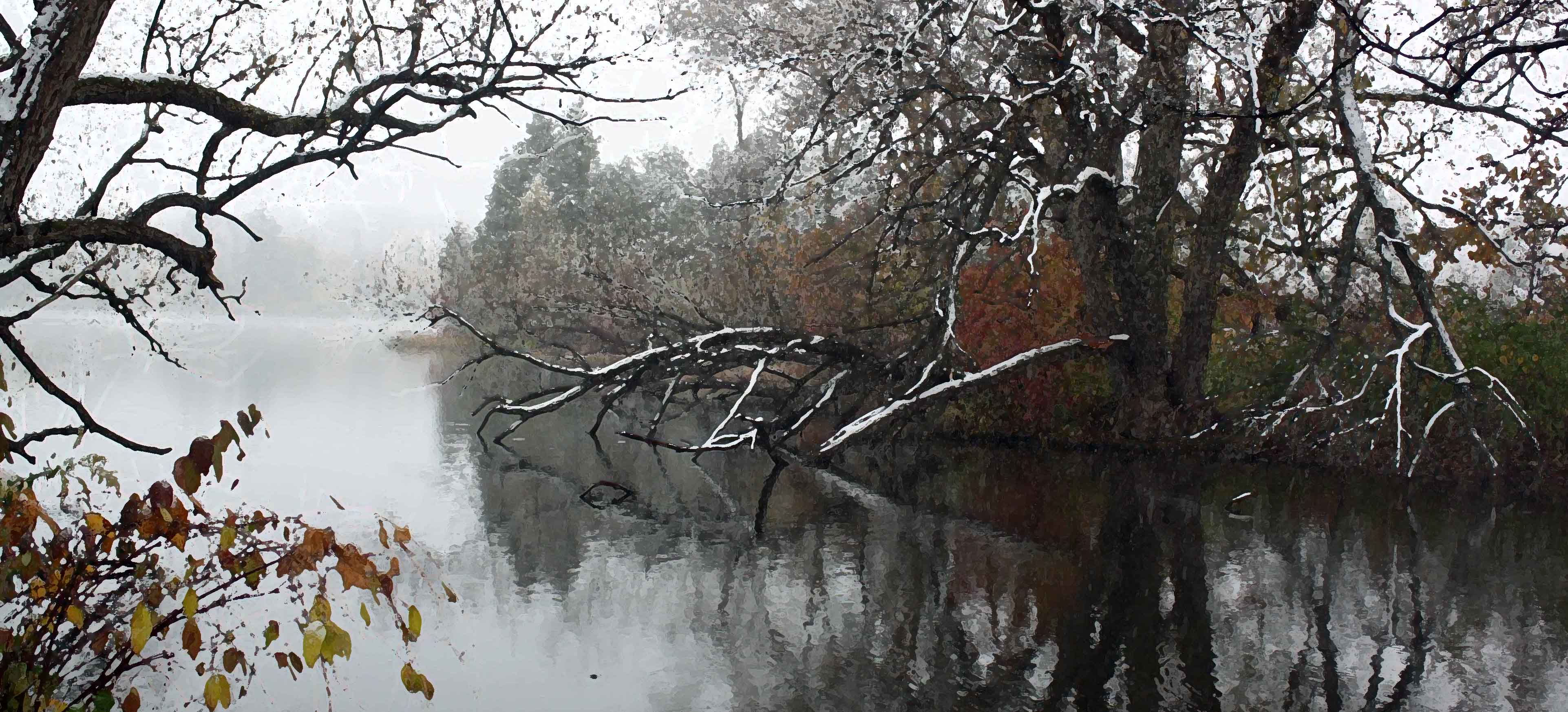
Willow by a river at first snow, ON (photo and rendition by Nina Munteanu)
What is most unfortunate for us, for humanity, is that we have known all this for some time. But we’ve done little. “Industrialist capitalism and its export colonialism” with its exploitive gaze that drives our needs and wants and actions has chosen to ignore the signs. That exploitive gaze ignored that we are not only embedded in but dependent upon the natural world and all the forests to live and flourish.
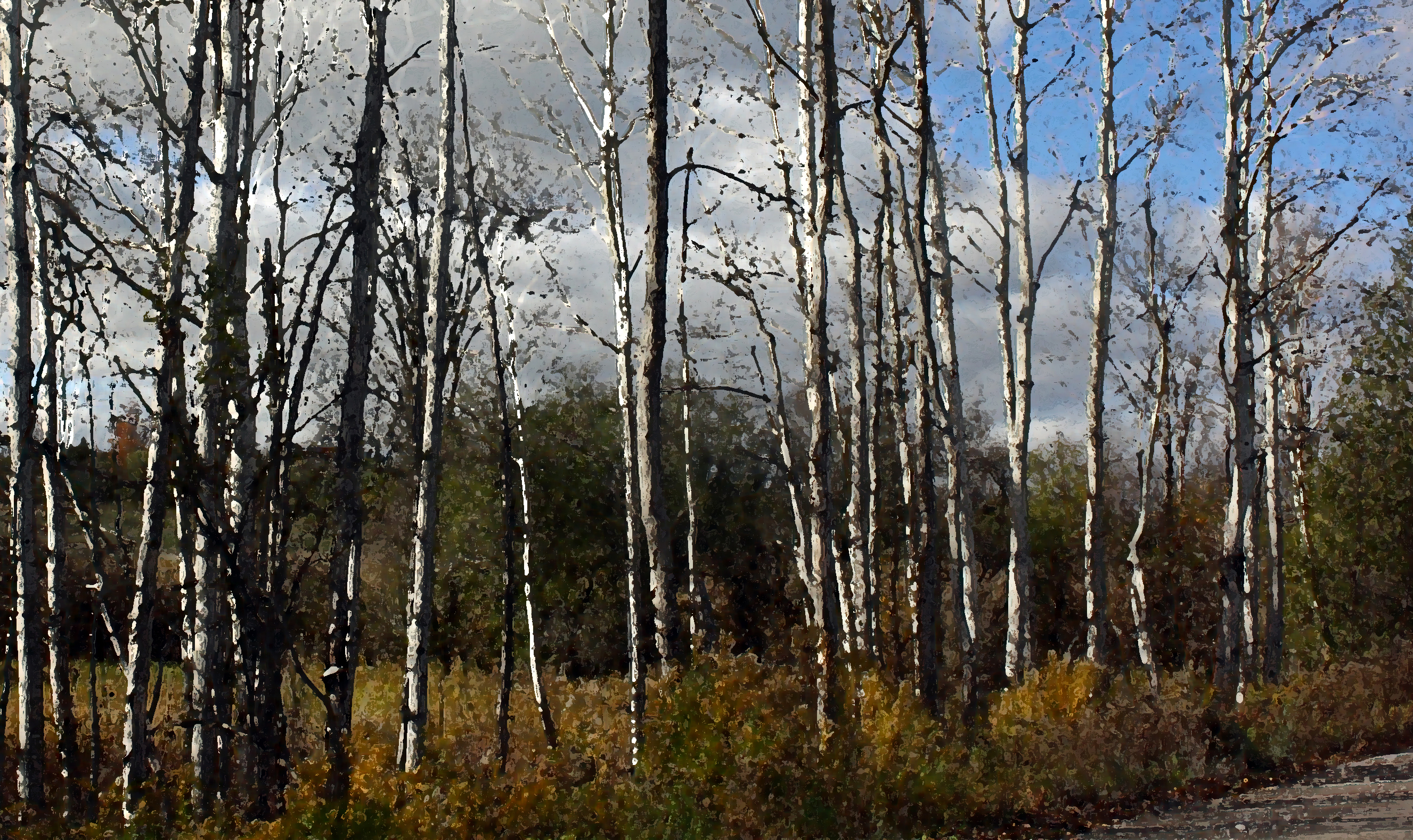
Tamarack and birch trees in the fall, ON (photo and rendition by Nina Munteanu)
What Rawlence does acknowledge is a way out of our self-created doom and accompanying solastalgia:
“Our present emergency is forcing us to remember what, until recently, we have always known: that there is a web of communication, meaning and significance beyond us, a world of life forms constantly chattering, shouting and flirting and hunting each other, indifferent to human affairs. And there is solace in such a vision. The way out of the depression and grief and guilt of the carbon cul-de-sac we have driven down is to contemplate the world without us. To know the earth, that life, will continue its evolutionary journey in all its mystery and wonder. To widen our idea of time, and of ourselves. If we see ourselves as part of a larger whole, then it is the complete picture that is beautiful, worthy of meaning and respect, worth perhaps dying for, safe in the knowledge that life is not the opposite of death but a circle, as the forest teaches us, a continuum.”
Ben Rawlence, The Treeline
Poplar trees line a road in the Ontario country (photo and rendition by Nina Munteanu)
The planet will be alright. Species will go and others will come. Earth has experienced five extinction events (we are currently experiencing the sixth extinction event now) and after each, life flourished again, albeit different life.
Is there still hope for humanity? Perhaps—if we set our hubris aside and embrace humility and kindness. And, if in that humility, we can adapt our way through the succession we’ve triggered. There might be hope for us still…
Rawlence devotes his epilogue called “Thinking Like a Forest” to the wisdom of the indigenous people who have for millennia co-existed sustainably with the natural ecosystems of the Earth. “The Koyukon, the Sámi, the Nganasan, the Anishinaabe are just a few of the countless indigenous peoples whose world view attests to our foundational reliance on the forest.”
Time to learn from them.
Trees at sunset in winter, ON (photo and rendition by Nina Munteanu)
Nina Munteanu is an ecologist and internationally published author of award-nominated speculative novels, short stories and non-fiction. She is co-editor of Europa SF and currently teaches writing courses at George Brown College and the University of Toronto. Visit www.ninamunteanu.ca for the latest on her books. Nina’s recent book is the bilingual “La natura dell’acqua / The Way of Water” (Mincione Edizioni, Rome). Her latest “Water Is…” is currently an Amazon Bestseller and NY Times ‘year in reading’ choice of Margaret Atwood.
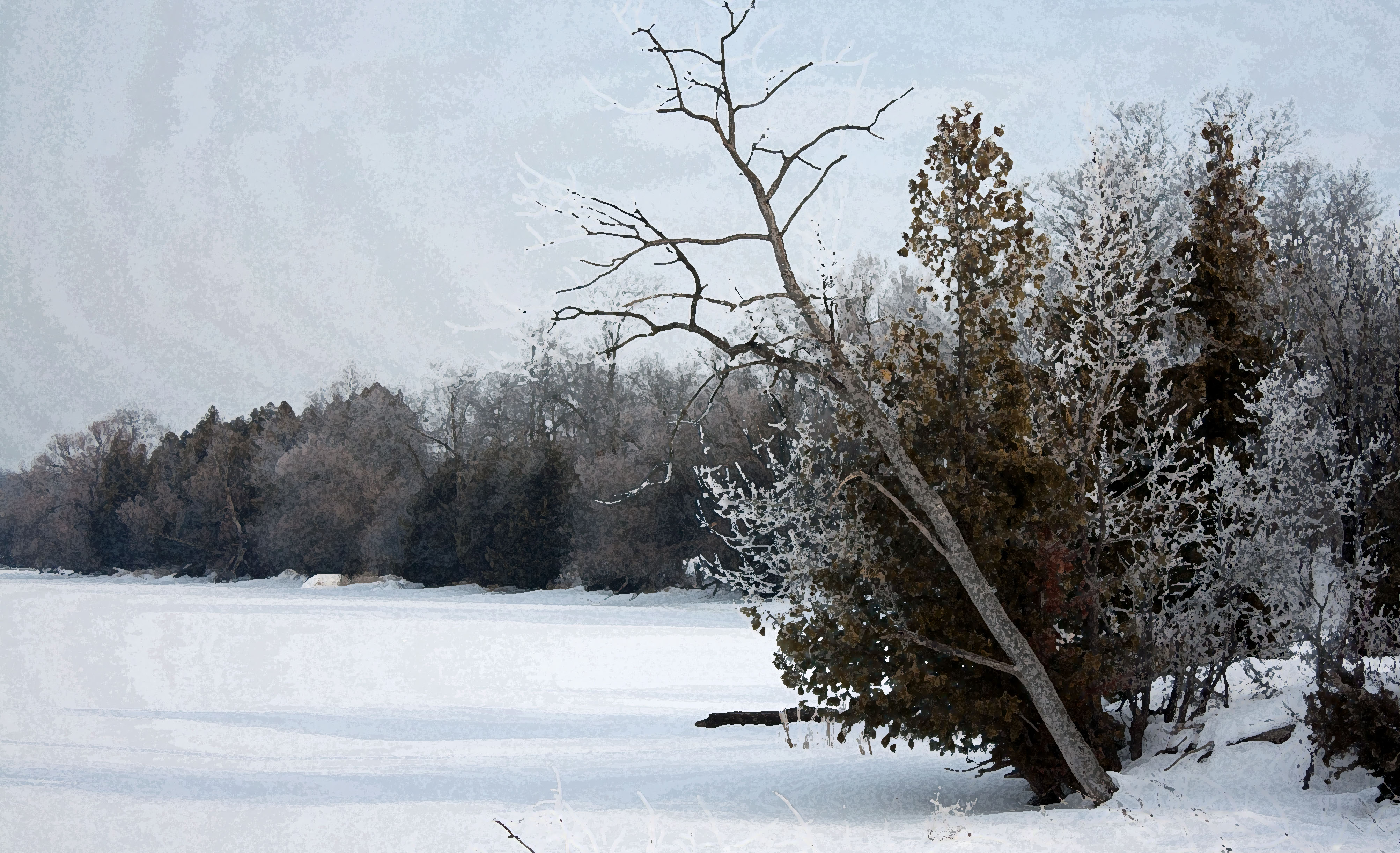
Ice and snow cover the Otonabee River in winter, ON (photo and rendition by Nina Munteanu)
In my upcoming novel “Gaia’s Revolution,” one of the protagonists, Damien Vogel, contemplates in 2022 a key event from 2020 that only a few seem to take seriously:
In Siberia in June 2020, record heat of thirty degrees Centigrade, over the average of 11 degrees, collapsed permafrost and caused oil tanks in Norilsk to rupture. Over twenty thousand tonnes of diesel spilled into the Pyasina lake and river system. Damien remembers looking at the veins of red on satellite images from space. That disaster is just the beginning of what the ‘sleeping bear’ of methane hydrates promise to unleash when the permafrost reaches a critical thaw and those hydrates awaken. Melting permafrost is a quiet sleeper in the climate change procession, he considers. At a microscopic level, in the chemistry of the water and in the change in the atmosphere, a time bomb is ticking.
A decade later, Damien’s twin brother, Eric, notes that:
“Back in the ‘20s scientists started noticing major permafrost melt on the Siberian Shelf,” Eric goes on. “The melting released hydrates, which set the oil and gas companies frothing at the mouth with joy and the climate scientists spinning in a panic because of what they knew it meant for the planet. It was the harbinger of the largest methane ‘burp’ ever.”
Eric then adds:
“Permafrost thaw kicked us into this devastating global warming, Dame, and everyone—even the climate modellers—ignored it, because they didn’t have enough data. Gottverdammt! They’re all still asleep, Dame!”
In his book The Treeline, Ben Rawlence writes about the ongoing extinction of indigenous peoples in the north as the treeline migrates northward into tundra and the permafrost and sea ice change and go extinct themselves.
Ice fragments on the Otonabee River, ON (photo by Nina Munteanu)
Because methane is present in much smaller concentrations many scientists have mistakenly deemed it as important as carbon dioxide in the climate change equation; however, it is becoming obvious that methane poses a real and largely unacknowledged danger. Methane is twenty times more efficient in trapping heat than carbon dioxide. Permafrost—which is currently melting rapidly in the north—contains almost twice as much carbon as is currently in the atmosphere. In the rapidly warming Arctic (warming twice as fast as the globe as a whole), the upper layers of this frozen soil are thawing, allowing deposited organic material to decompose and release methane.
.
The clathrate gun hypothesis is the notion that sea temperature rises (and/or drops in sea levels) may trigger a catastrophic positive feedback on climate: warming would cause a sudden release of methane from methane clathrate (hydrate) compounds buried in seabeds, in the permafrost, and under ice sheets.
Something of this nature has already occurred in Siberia in 2020. In his book The Treeline Ben Rawlence reports the following warning by Dutch scientist Dr. Ko van Huissteden, a leading authority on permafrost:
“It is hard to measure methane release … [but] some studies have suggested that an unstable seabed could release a methane ‘burp’ of 500-5000 gigatonnes, equivalent to decades of greenhouse gas emissions, contributing to an abrupt jump in temperature that humans will be powerless to arrest.” (Wadhams, 2015)
Creation of gas hydrates requires high pressure; water; gas—mainly methane—and low temperatures. Three environments considered suitable for this process to occur include: sub-seabed along the world’s continental margins; permafrost areas on land and off shore; and a process for storing methane hydrates: ice sheets. As long as the climate is cold and the ice sheet stable, the gas hydrate zone remains stable. As the ice sheets melt, the pressure on the ground decreases; hydrates destabilize and release methane into rising seawater and finally into the atmosphere.
A recent study in Science revealed that hundreds of massive, kilometer-wide craters on the ocean floor in the Arctic were formed by substantial methane expulsions. Because methane is a powerful greenhouse gas, temperatures would rise exponentially. Once started, this runaway process could be as irreversible as the firing of a gun—and on a time scale less than a human lifetime.
The sudden release of large amounts of natural warming gas from methane clathrate deposits in runaway climate change could be a cause of past, future, and present climate changes.
Latest research on the Greenland ice sheet and elsewhere throughout the Arctic has revealed major methane discharges in Arctic lakes in areas of permafrost thaw. Scientists are exploring areas where methane is bubbling to the surface and releasing to the atmosphere.
If human emissions continue at their current rate, rapidly changing ocean currents and retreating ice sheets may uncork methane from under ice caps, ocean sediments and Arctic permafrost, causing a jump in radiative forcing. Even if rapid ice sheet disintegration were to scatter large amounts of ice into the oceans, the net cooling effect would be strongly countered and likely overwhelmed. The areas that did cool would likely trigger severe weather outbreaks.
As I write, we are pumping out CO2 into the atmosphere at a rate 10 times faster than at any point in the past 66 m years, with the resulting sea level rises, extreme weather events, heat waves, droughts, unseasonal storms, and stress on biodiversity around the globe. Research published in the journal Nature Geoscience demonstrates that “the world has entered ‘uncharted territory’ and that the consequences for life on land and in the oceans may be more severe than at any time since the extinction of the dinosaurs,” writes Damian Carrington of The Guardian.
In an interview with Guardian reporter John Abraham, Woods Hole expert Robert Max Holmes, exhorted:
It’s essential that policymakers begin to seriously consider the possibility of a substantial permafrost carbon feedback to global warming. If they don’t, I suspect that down the road we’ll all be looking at the 2°C threshold in our rear-view mirror.
Ice break up on the Otonabee River in early spring, ON (photo by Nina Munteanu)
Wadhams, Peter. 2015. “A Farewell to Ice.” Penguin.
Flowing water in a river, ON (photo by Nina Munteanu)
Nina Munteanu is a Canadian ecologist / limnologist and novelist. She is co-editor of Europa SF and currently teaches writing courses at George Brown College and the University of Toronto. Visit www.ninamunteanu.ca for the latest on her books. Nina’s bilingual “La natura dell’acqua / The Way of Water” was published by Mincione Edizioni in Rome. Her non-fiction book “Water Is…” by Pixl Press (Vancouver) was selected by Margaret Atwood in the New York Times ‘Year in Reading’ and was chosen as the 2017 Summer Read by Water Canada. Her novel “A Diary in the Age of Water” was released by Inanna Publications (Toronto) in June 2020.









 Nina Munteanu Writing Coach