I’m an ecologist; I study environmental relationships. Something you’d think is easy to learn and very accessible; we’re surrounded by it, after all. We live, work and play in it. While I learned about environmental relationships with my eco-minded parents, I didn’t learn it or experience it in my school growing up. With the exception of some indigenous schools (which teach respect for the spirit of wildness), most of us certainly didn’t learn about environmental relationships in our schools.
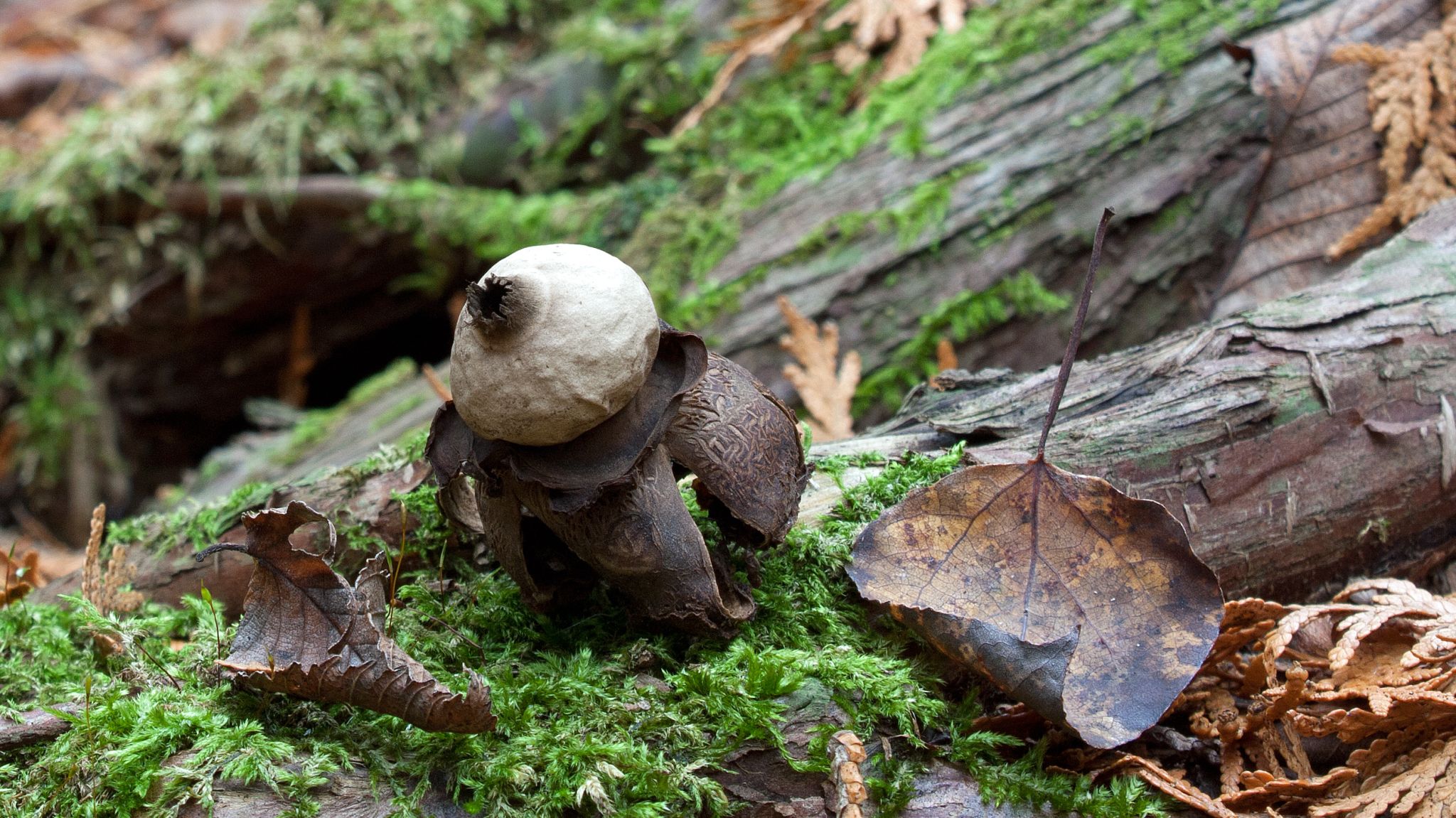
Earthstar sits on moss-covered rotting cedar log as new cedar roots take hold, ON (photo by Nina Munteanu)
Most Canadians live in a city; we don’t really understand what the natural environment is. Many of us have learned to ignore it, stop recognizing it, pocket it away as we go about our busy lives in the city. A park is a bit of greenery. A tree is a decoration that provides shade. Shrubs border a mall.
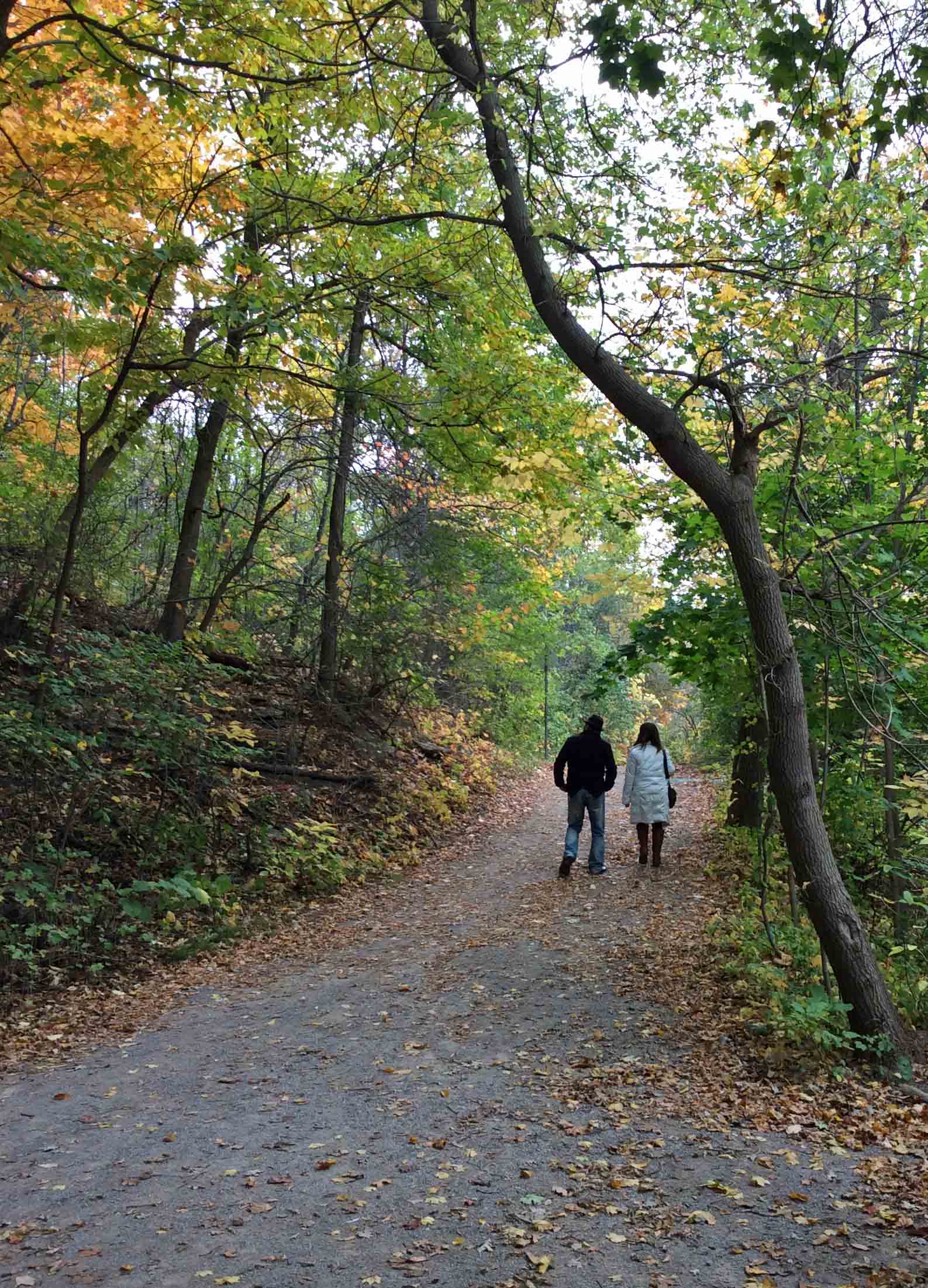
Walk through urban forest along the Credit River, ON (photo by Nina Munteanu)
But if we can’t even recognize the natural environment, how can we understand its functional role in the intricate well-being of this entire precious planet and ultimately ourselves?
It is no wonder then that most Canadians—though we may intellectually accept climate change and its effects on this planet (because we’re smarter than some)—likely do not viscerally understand or appreciate why and how it will drastically change our lives. For most of us, climate change—as with Nature—is something that is happening to someone else, somewhere else. From those far away calamities to the quiet struggles no one talks about. We hear and lament over the flooding in Bangladesh or the Maldives. Or the wildfires in northern British Columbia. Or the bomb cyclones of the eastern seaboard.
Meanwhile, the polar bear struggles quietly with disappearing sea ice in the Canadian arctic. The koala copes quietly with the disappearing eucalyptus. Coral reefs quietly disappear in an acidifying ocean. Antarctic penguins silently starve with disappearing krill due to ice retreat. And while jellyfish invade the Mediterranean, UK seas and northeast Atlantic, the humble Bramble Cay melomys slips quietly into extinction—the first mammal casualty of climate change.
Yellow Creek flows through an urban forest in the heart of Toronto, ON (photo by Nina Munteanu)
So, those of us who are enlightened speak of climate resilience and adaptation. We talk of arming our cities with words like green infrastructure, stormwater management, urban runoff control, flood mitigation. Ecological literacy. But what are these things to us? They are tools, yes. Good tools to combat and adapt to the effects of climate change. But will they create resilience? I think not.
I’m a limnologist and I’ve consulted for years as a scientist and an environmental consultant. I played a role in educating industry, in the use of mitigating tools, in changing the narrative even.
Trail through urban forest on a foggy winter day in Peterborough, ON (photo by Nina Munteanu)
But I’ve come to realize that resilience comes only from within and through a genuine connection with our environment. Tools, no matter how proficient, are only as good as how they are used based on intention from a deep understanding. It isn’t enough to achieve the HOW of things; we must embrace the WHY of things. And that comes from the heart. We must feel it in our hearts. Or it won’t work. And we quite simply won’t survive.
Various flowers and trees of Ontario (photos by Nina Munteanu)
Canadians celebrate our multi-cultural heritage. We pride ourselves in our tolerance and welcoming nature. Our national anthem speaks of our land. Our national symbols embrace nature with the maple, beaver, caribou and loon. Yet who of us knows the habitat of the loon—now at risk, by the way (climate change will impact much of its breeding grounds). Who knows what the boreal forest—which makes up over half of our country—is? How it functions to keep this entire planet healthy, and what that ecosystem needs, in turn, to keep doing it? How to help it from literally burning up?
Ecology isn’t rocket science. Ecology is mostly common sense. Ecology is about relationship and discovery. Ecology is a lifestyle choice, based on respect for all things on this planet and a willingness to understand how all things work together.
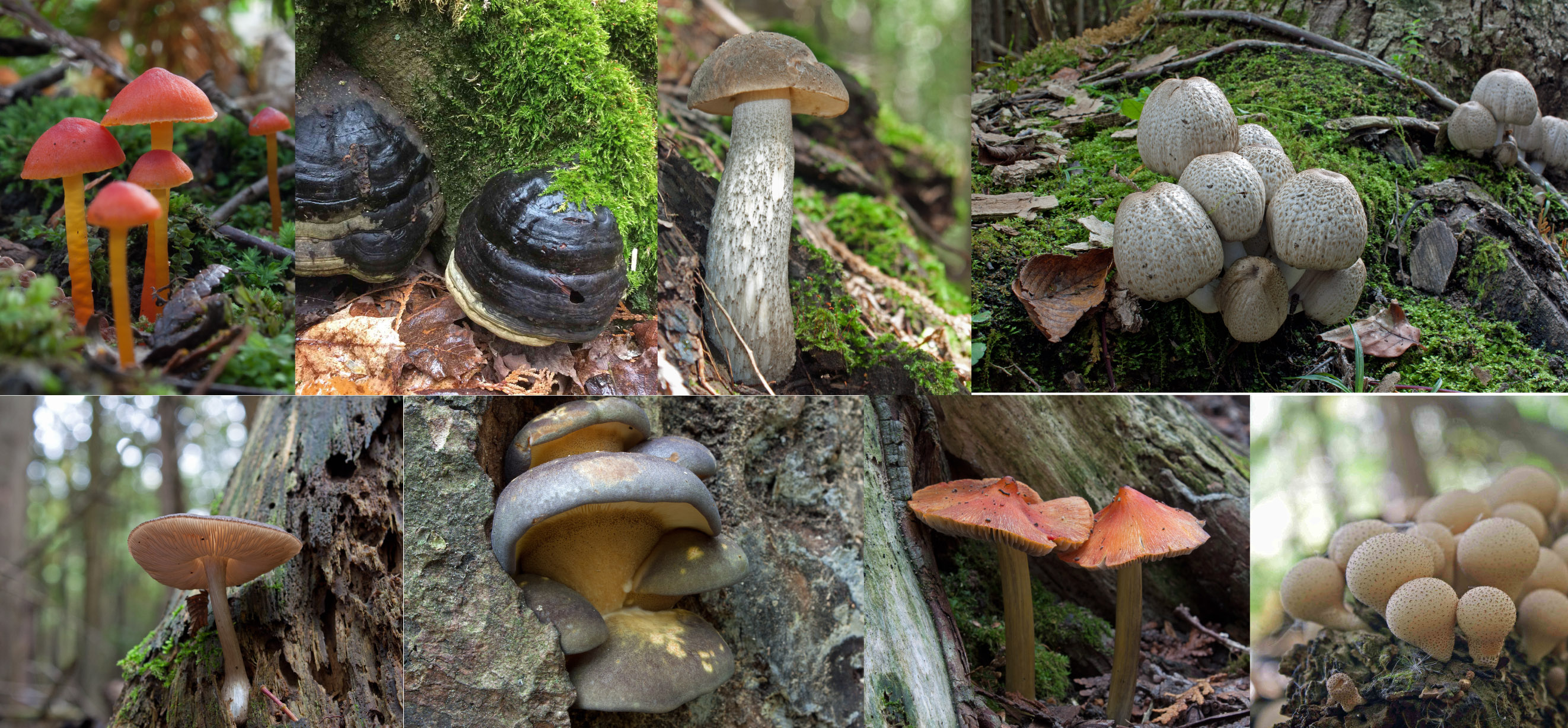
Various mushrooms in Ontario forests (photos by Nina Munteanu)
Here’s what I’ve learned to keep me caring and remain positive and not become apathetic or fall into despair:
I’ve learned to open myself to discovery. To find Nature, even if it is in the city. To connect with something natural and wild and to find and savour the wonder of it. All that matters will naturally come from that.
Become curious and find something to love.
When you do, you will find yourself. And that is where you will find resilience. What colour is it? It doesn’t need to be green…
Throughout this article I’ve shown you some of my colours…
Red fox skull emerges on a leaf-strewn icy bank of Jackson Creek, ON (photo by Nina Munteanu)
Here are the steps I taught myself toward healthy resilience (the first two steps are both the hardest and the easiest):
Step 1:Slow down, pay attention. Give yourself the time to relax and look around your local surroundings. Until you slow down to actually look, you will not really take in your surroundings. You need to be in the moment. Only then can you take the time to use all your senses to take in your environment. Try to look at it from a different perspective. Notice the light, the smells and sounds. What is different? What is the same?
Step 2:Lower your guard, open yourself to curiosity. Rely on as many senses as you can (sight, hearing, smell, texture, taste) to sample your environment and show some humility to ask questions. Whenever I go out, particularly in Nature, I make a point of coming home with three gifts, discoveries that make me smile or think and wonder. I’m hardly ever disappointed.
Step 3: Process what you’ve seen and discovered. Do some follow-up research to questions that may arise. Look at consequences. Share with others, discuss. From there it will be easy to ‘take responsibility’ for some section of nature that you really like; perhaps a particular tree in a park or a short path through an urban forest or stretch of urban stream. This can easily lead to good stewardship.
Step 4: Take responsibility for your chosen part of Nature. Get to know it well, how it works, what it needs, what’s right and what’s wrong. Do something about it and share with others.
Step 5: You’re there. You are resilient.
Barred owl hiding in plain sight in an urban forest near Peterborough, ON (photo by Nina Munteanu)
Nina Munteanu is a Canadian ecologist / limnologist and novelist. She is co-editor of Europa SF and currently teaches writing courses at George Brown College and the University of Toronto. Visit www.ninamunteanu.ca for the latest on her books. Nina’s bilingual “La natura dell’acqua / The Way of Water” was published by Mincione Edizioni in Rome. Her non-fiction book “Water Is…” by Pixl Press (Vancouver) was selected by Margaret Atwood in the New York Times ‘Year in Reading’ and was chosen as the 2017 Summer Read by Water Canada. Her novel “A Diary in the Age of Water” was released by Inanna Publications (Toronto) in June 2020.
Wir müssen uns immer verändern, erneuern, verjüngen; sonst verhärten wir.—Goethe
Nina reading “How to Read Water” on Algonquin Island, Ontario (photo by Nina Munteanu)
In his book, How to Read Water, Tristan Gooley describes a phenomenon called clapotis gaufre. Also known as “waffled clapotis”, the term comes from the French word (clapotis) for “lapping” and describes a standing wave phenomenon created by the troughs and crests of waves as they hit and reflect back from a barrier. The incoming and reflected outgoing waves, in passing each other, form a waffle-pattern that bobs up and down but otherwise appears stationary.
In fact, it is far from stationary.
But we like “stationary.” So much so that, despite the magnitude of planetary-scale change, everything appears stationary to us. People go on with their daily lives as they have for generations: driving cars; living profligately; wastefully consuming energy, disposables and water; bickering about fuel taxes and job security. But this is an illusion, a very dangerous one. Surface inertia hides a depth of motion. In a river, where high-velocity water roars over a steep river-bottom depression, a frothy stationary breaker forms; it is the most dangerous part of the river. What we can’t see, we think won’t hurt us. But what if we could see the ominous dark cloud of carbon dioxide and methane blotting more and more of our sky? What if we could see the fumes billowing out of our cars and the heat radiating from our homes? Or smell the toxins spilling into our rivers and lakes? Or the quiet extinctions happening by the minute in the wilderness?
Photographs of same Beijing location over a year showing smog days
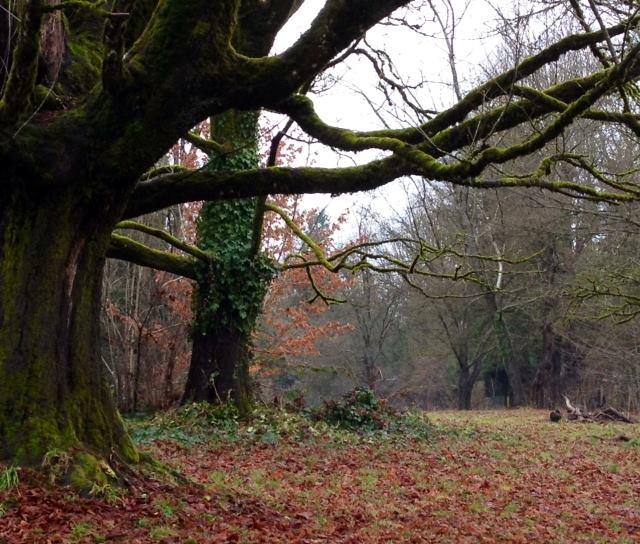
Old oak tree in Deer Lake Park, BC
What if we could see the fractal signs of change?
Nothing in nature stays the same. If it does, that’s because change has brought it back to what it once was. Trees move. They grow wider and taller; they just do it at a pace beyond our impatient lifestyle. Because their motion is invisible, they are invisible. We think of trees as stationary objects, not living beings. Like a standing wave of frozen time. We observe through the hurried lens of human impatience and self-preoccupation. A quick glance takes in a scene. We forget that we can “see” with other senses. Smell. Touch. Taste. Hearing. As hyposmia and disinterest dulls our senses, we grow less able to recognize the verisimilitudes of Nature’s trompe l’oeils. Trapped by our preordained notions, we no longer see the changes we’re not prepared to see. And that’s the change that kills us.
In witnessing the collapse of fish populations on the west coast in the ‘90s, UBC fisheries biologist Daniel Pauly noticed that people just went on fishing ever smaller fish. The collapse occurred through what he called “creeping disappearance.” Pauly named this impaired vision “shifting baseline syndrome,” a willing ignorance of consequence based on short-term gain.
One could argue that the inability to feel and connect beyond our immediate line of sight can be a good thing—a kind of selective memory that allows us to adapt to each “new normal.” Mothers of several children can testify to the benefits of “forgetting” their hours of labour to give birth. Hence the ability and willingness to repeat this very painful experience. Is this part of successful biological adaptation in all of us? The ability to reset?
Author and her son enjoy an outing
Or is it rather that our mother chooses not to forget but to relegate her memory of the previous birth behind something far more beautiful and wondrous to remember and something she is deeply connected to: the miraculous birth of her child—her investment in the future. Shifting baseline syndrome is part of a larger amnesia, one that encompasses many generations; a selective memory driven by short-sightedness that comes mostly from lack of connection. But to successfully invest in our future, that is precisely what we must do: connect.
If only we could see the fractal signs of change…
Bill McKibben wrote in The New Yorker, “Climate change isn’t just a threat. It’s an opportunity for us to live happier, more fulfilling lives.” True happiness comes with long-term fulfillment, not short-term material wealth and comfort. When we focus from ourselves to embrace the changing world—to connect—we discover a well-spring of altruistic happiness. When we embrace, we transcend. When we transcend, we become fluid with change. That is when we succeed.
quote by Goethe: “We must always change, renew, rejuvenate ourselves; otherwise we harden.”
Nina Munteanu is a Canadian ecologist / limnologist and novelist. She is co-editor of Europa SF and currently teaches writing courses at George Brown College and the University of Toronto. Visit www.ninamunteanu.ca for the latest on her books. Nina’s bilingual “La natura dell’acqua / The Way of Water” was published by Mincione Edizioni in Rome. Her non-fiction book “Water Is…” by Pixl Press (Vancouver) was selected by Margaret Atwood in the New York Times ‘Year in Reading’ and was chosen as the 2017 Summer Read by Water Canada. Her novel “A Diary in the Age of Water” will be released by Inanna Publications (Toronto) in 2020.






 Nina Munteanu Writing Coach