“Through the Portal” Anthology of Hopeful Dystopia Reviewed by Dragonfly.eco

Art is the oar that guides us through dystopian rivers

Mary Woodbury, dragonfly.eco

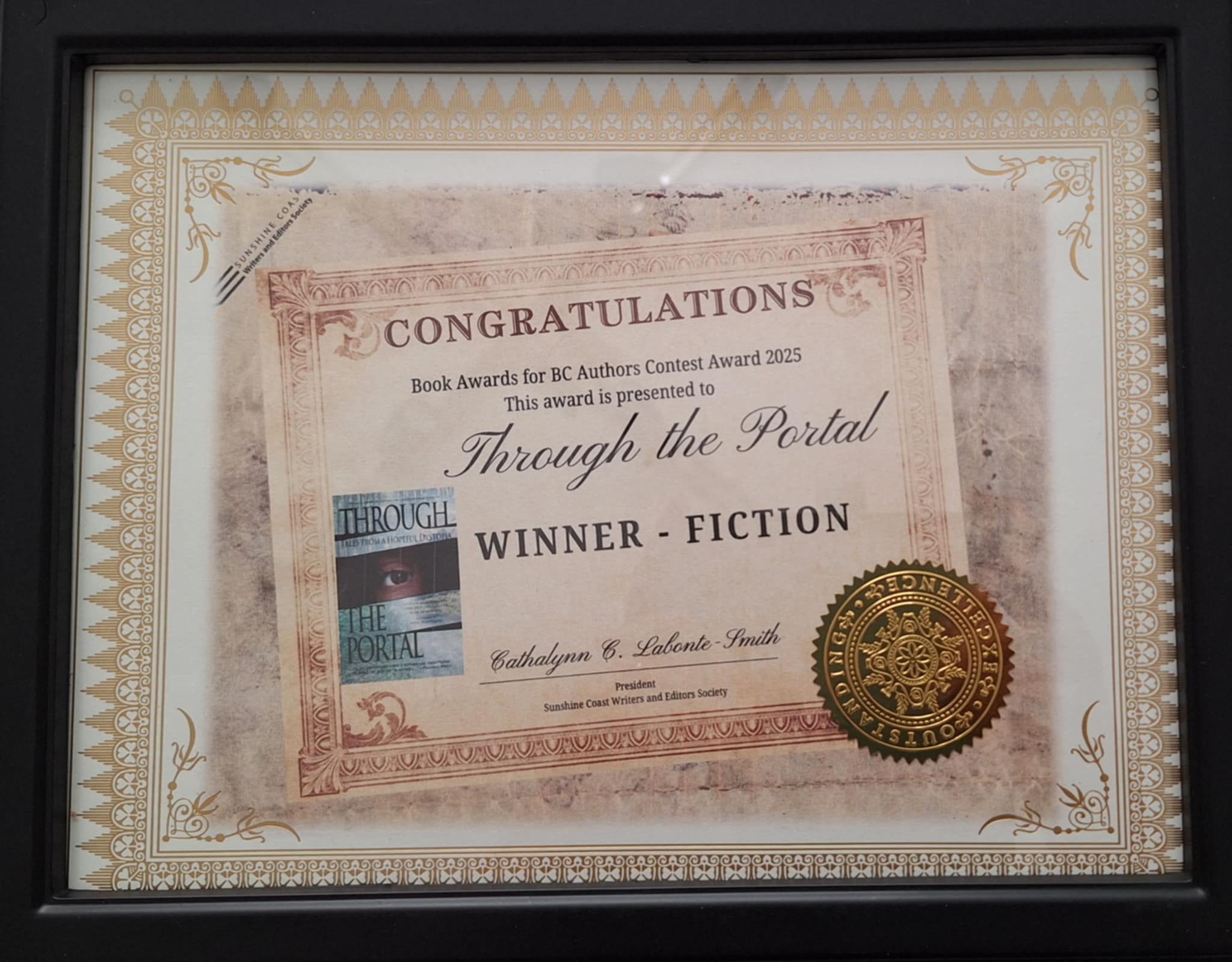
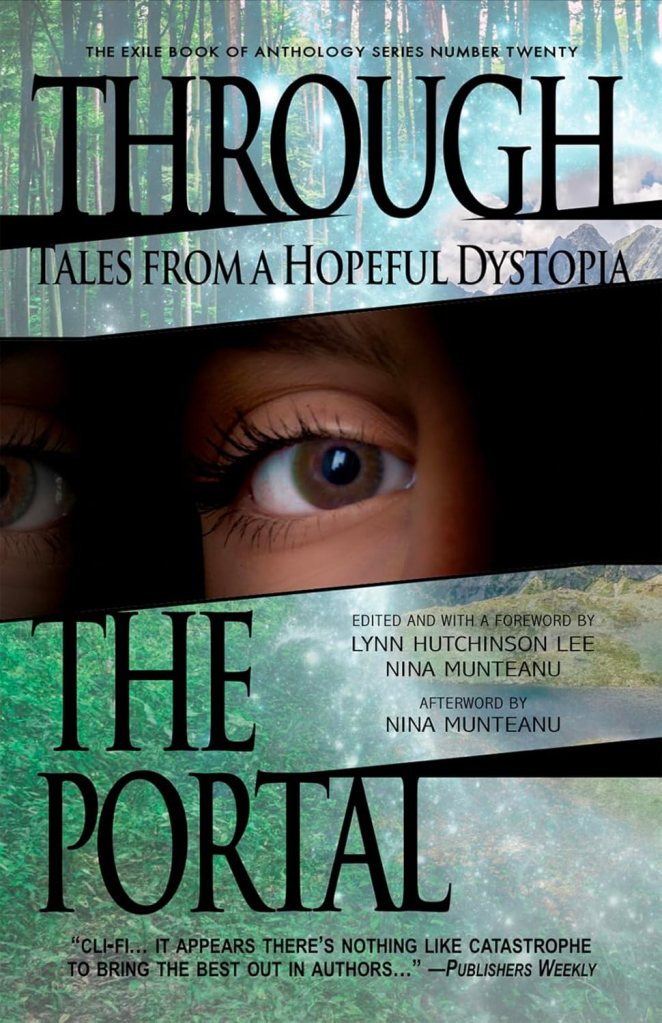
Through the Portal: Tales from a Hopeful Dystopia the ecofiction anthology edited by Lynn Hutchinson Lee and me and published December 2024 by Exile Editions, recently received another wonderful review from Mary Woodbury at  dragonfly.eco. Here is an excerpt:

As the world teeters on disaster, what saves us ranges from graceful failure to full-fledged resistance and opposition. Through the Portal, an anthology of eco-fiction, offers 35 artful, provoking stories to propel us forward. The book serves to reconnect us with Nature in diverse storytelling, from cautionary tales to fiction that brims with hope while also helping us grieve what we’ve lost—described as solastalgia.

The anthology is a stunning collection of short stories and poetry that address our most existential concerns through metaphysical, epic, solarpunk, mythological, and contemporary perspectives. From landscape and weather transformations to stars, fairy tales, parking lots, mermaids, whales, storms, bees, and much more, the reader is treated to a journey of colorful narratives woven into a chronology: imagination, after the fall, and Earth hour.

Mary Woodbury, dragonfly.eco February 2, 2025

For the full review go to dragonfly.eco.

Hopeful dystopias are so much more than an apparent oxymoron: they are in some fundamental way the spearhead of the future—and ironically often a celebration of human spirit by shining a light through the darkness of disaster. In Through the Portal: Tales from a Hopeful Dystopia, award-winning authors of speculative fiction Lynn Hutchinson Lee and Nina Munteanu present a collection that explores strange new terrains and startling social constructs, quiet morphing landscapes, dark and terrifying warnings, lush newly told folk and fairy tales.—Exile Editions

.
Nina Munteanu is a Canadian ecologist / limnologist and novelist. She is co-editor of Europa SF and currently teaches writing courses at George Brown College and the University of Toronto. Visit www.ninamunteanu.ca for the latest on her books. Nina’s bilingual “La natura dell’acqua / The Way of Water” was published by Mincione Edizioni in Rome. Her non-fiction book “Water Is…” by Pixl Press (Vancouver) was selected by Margaret Atwood in the New York Times ‘Year in Reading’ and was chosen as the 2017 Summer Read by Water Canada. Her novel “A Diary in the Age of Water” was released by Inanna Publications (Toronto) in June 2020.

Through the Portal Anthology Receives Remarkable Review

A recent favourable review of Through the Portal: Tales from a Hopeful Dystopia (edited by Lynn Hutchinson Lee and Nina Munteanu, released by Exile Editions) appeared in On Spec Magazine. The review by Lorina Stephens applauded the anthology for its genuine Canadian perspective, excellent writing, and “remarkable voice of many.”

Excerpts of the review follow below:

“What unfolds in these 35 stories is a quintessentially Canadian perspective on climate change, the probable dystopia of our own making, and how we as not only humans, but Canadians, may deal with the breakdown of environment and society, of how we construct mythology to interpret our experience.”

The stories, writes Stephens, “are filled with that remarkable pragmatism and resilience, little say a reverence for the land, which seems to be hardwired into a people who deal with constant change, and sometimes extremes, dictated by climate and geography.”

“…the quality of the writing from this enclave of writers is quite remarkable…I am steadfast in my praise of the skill of these writers, and the stories they’ve crafted, collected into this remarkable voice of many.”

“The stories manage that most adroit of transformations from genre fiction meant as escapism and consumable, to that other dimension which is provoking, illuminating, and exactly what good literary fiction should engender.”

For the entire review follow the link to On Spec Magazine.

Through the Portal has received other favourable reviews:

Through the Portal offers intriguing and imaginative glimpses into the future.” – The Seaboard Review

“A stunning collection of short stories and poetry that address our most existential concerns through metaphysical, epic, solarpunk, mythological, and contemporary perspectives.” – dragonfly.eco.

Nina Munteanu is a Canadian ecologist / limnologist and novelist. She is co-editor of Europa SF and currently teaches writing courses at George Brown College and the University of Toronto. Visit www.ninamunteanu.ca for the latest on her books. Nina’s bilingual “La natura dell’acqua / The Way of Water” was published by Mincione Edizioni in Rome. Her non-fiction book “Water Is…” by Pixl Press (Vancouver) was selected by Margaret Atwood in the New York Times ‘Year in Reading’ and was chosen as the 2017 Summer Read by Water Canada. Her novel “A Diary in the Age of Water” was released by Inanna Publications (Toronto) in June 2020.

Review of “A Diary in the Age of Water”: Women, Water, Numinosity, and the Transformation of the World

“It is a novel to learn from, and it is a novel to take forward into life as inspirational guide. Each of us is called upon to examine, not only our relationship with water, but with all Earth gifts.”

Jane Buchan, author & educator

Vermont author Jane Buchan recently wrote a review of my 2020 eco-fiction novel A Diary in the Age of Water. Here is an excerpt:

As climate, social, and political crises escalate, one source of guidance becomes essential to our continued optimism and activism: a Numinous Story… A Diary in the Age of Water by Nina Munteanu, is, for many of us alive in these terrifying times, a numinous story. It meanders through our consciousness with the enlightening science of fresh-water lakes and rivers and streams, sometimes heavy with sediment and toxicity, sometimes fast flowing and cleansing, sometimes terrifying with truths smacking us down with the force of a tidal bore. Its characters are story tellers and story receivers, and despite their diverse natures, all the stories they tell reveal the many threats to our source of life on Earth – our water.

Nina Munteanu’s novel structure is perfect for the weaving of human scientific and mystical relationships with water.  It’s initial and final sections create a frame for the inner story of bitterness, despair, self-serving behaviours, and corporate rapaciousness described by a professional scientist, a limnologist named Lynna. In the outer story we meet Kyo and Nam, Kyo’s mentor, as well as Ho, a librarian and keeper of a remnant of rare books. These characters exist on the other side of a mysterious cataclysm, the causes of which are the novel’s key themes.

Kyo, a small, four-armed blue being whose story begins and ends the novel, introduces us to the characters who form the larger diary section framed by the opening Library section and final Seed Ship section. Kyo makes glancing references to Una, mother of Lynna, and Lynna, mother of Hilde. Only Lynna is fully realized through her own perceptions and thoughts, these expressed in diary entries beginning in the spring of 2045 and ending in the late fall of 2066. Her diary, taking up 250 pages of this 303-page novel, provides the chronological spine connecting our past and present to a possible future that is not the one most humans want to think about, let alone welcome.

A Diary in the Age of Water is best sipped and savoured rather than gulped. Gulping will lead to choking for most non-scientist readers, and this book deserves to be experienced as it is written, in slow, undulating, revelatory waves… Like all complex stories, A Diary in the Age of Water requires patience, something our video-oriented age does not foster. The richest stories ask that we learn to hold many apparently divergent story threads at once. One of my fears as I read the diary was that the darkness of greed and short-sighted thinking and feeling would win out over that wondrous mystical relationship with the world that Una carried. While Una does her best to pass the experience of the sacred on to Lynna, Una’s spiritual influence is eclipsed by Lynna’s oppressive dependence on scientific knowledge to the exclusion of all else.

Through these characters, Nina Munteanu offers a warning for our times. Science is vitally important to our understanding of natural systems but science best serves us when it is balanced with an experience of the responsiveness of the natural world, a responsiveness that evokes our reverence and respect. Every culture honours the spiritual nature of the greater-than-human world, encoding its reverence in mythology, folktales, and wisdom traditions. – all keepers of numinous stories that transform our relationships with one another and the world. When we live honouring the sacred nature of all life, we become partners and co-creators. When we do not, we are highly dangerous parasites…

Lynna is called to hold the science of water firmly in her mind as her heart slowly opens to water’s responsiveness, water’s intelligence, water’s generosity, water’s love. It is a huge transformation for her, because science has been her safe place, her refuge. But knowing how something works is only the first part of the journey for those of us alive on this watery planet; we must all experience the why – the joy of unbreakable interconnections that make our lives meaningful… It is not Una’s daughter, Lynna, who carries this numinosity forward. It is Hilde, Una’s granddaughter, whose name means, significantly, Warrior Woman. How Kyo fits in to this lineage is one of the novel’s most unique speculations, one best discovered by reading the entire novel.

This novel is rich with information about water’s evolutionary journeys; it also describes the horrors of human greed that directly impact our relationships with water. It is not an easy book, but it is an important one, especially for people ready to engage, to advocate, to stand against the corporate insanity currently destroying Earth’s delicate balances. It is a novel to learn from, and it is a novel to take forward into life as inspirational guide. Each of us is called upon to examine, not only our relationship with water, but with all Earth gifts.

Go to Jane’s site Winterblooms to read the full review, worth reading in its entirety for its rich and poetic narrative.

Jane Buchan is a writer currently living in Vermont and originally from southwest Ontario. Her books include Under the Moon, Kinder Sadist and her latest, The Buttes. She is also an emotional Freedom Techniques (EFT) coach, Master Trainer and educator.

Jackson Creek flowing through ice formations (photo and rendition by Nina Munteanu)

Nina Munteanu is a Canadian ecologist / limnologist and novelist. She is co-editor of Europa SF and currently teaches writing courses at George Brown College and the University of Toronto. Visit www.ninamunteanu.ca for the latest on her books. Nina’s bilingual “La natura dell’acqua / The Way of Water” was published by Mincione Edizioni in Rome. Her non-fiction book “Water Is…” by Pixl Press (Vancouver) was selected by Margaret Atwood in the New York Times ‘Year in Reading’ and was chosen as the 2017 Summer Read by Water Canada. Her novel “A Diary in the Age of Water” was released by Inanna Publications (Toronto) in June 2020.

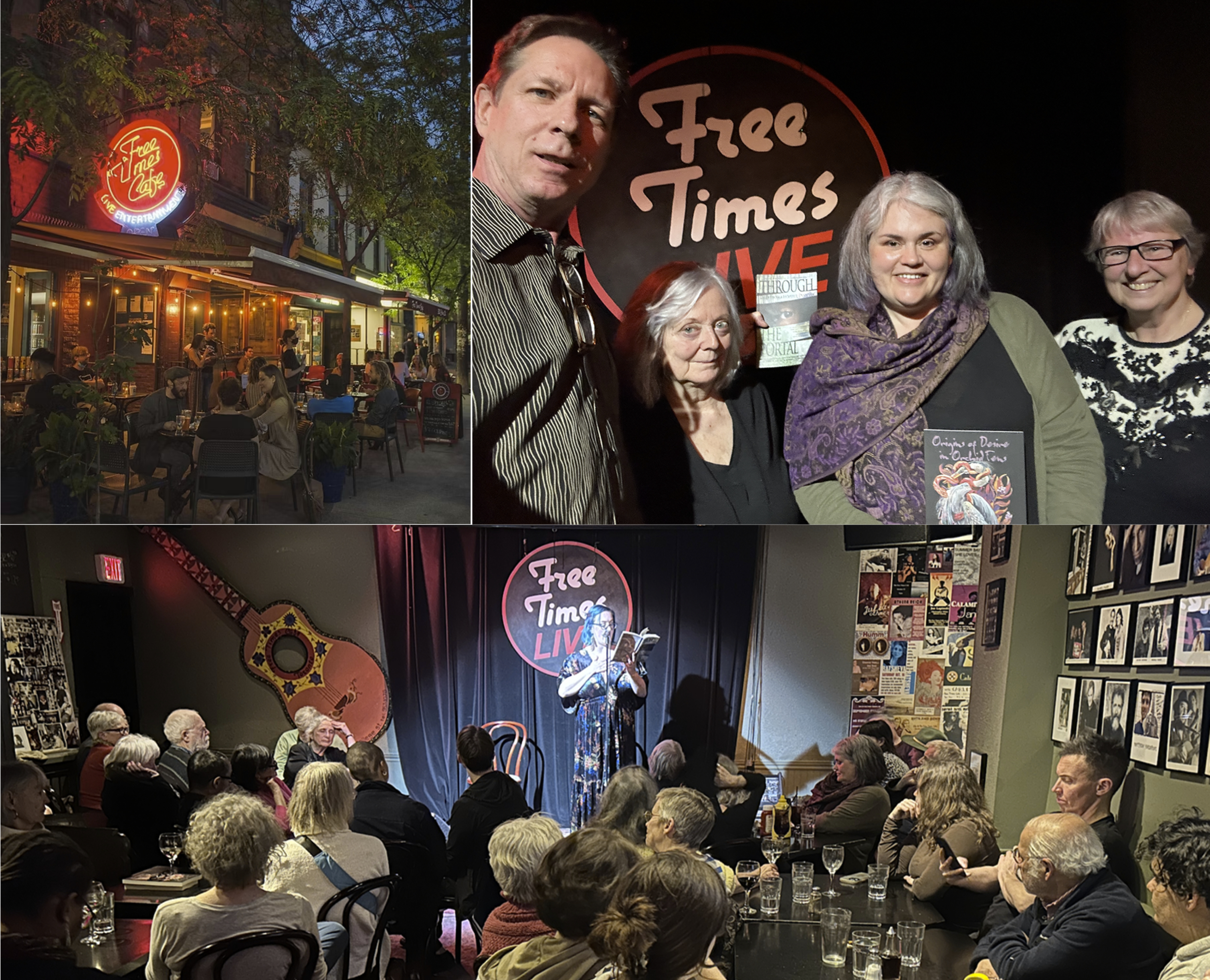
Authors Read from “Through the Portal: Tales from a Hopeful Dystopia”

I recently participated in author readings from the eco-fiction anthology “Through the Portal: Tales from a Hopeful Dystopia.” Co-editor Lynn Hutchinson Lee and I opened the session with some introductory remarks, followed by readings by four of the anthology writers: Annaliese Schultz, Jade Wallace, Isabella Mori, and Matt Freeman.

Co-editors Lynn Hutchinson Lee and Nina Munteanu introduce the anthology at the reading; authors and moderator pictured above

The readings generated a lot of discussion about the nature and role of eco-fiction and stories in general on how we view the world and how that, in turn, influences the choices we make in life. Below, I include a short story excerpt and audience reaction for each author who read.

Annaliese Schultz read from her story Water & Oil. “Bursting from months, maybe years, of inertia born of dismay (engendered by the unending disasters of the world), Zip is instantly galvanized and greater than himself and gone.” One audience member shared that her story “sounded horrifyingly too possible.”

Jade Wallace read from her story Pluck. “It was only after I started working at the florist a few months ago that I began to think of plants as things that move. I learned that algae may swim towards the light; sundew can catch insects in their stalks; the leaves of touch-me-nots will slouch when they feel rain.”  A member of the audience shared that “with what we now know about the way trees/plants communicate with each other, it was a neat story of crossing over to try to tell humans something.”

Jade Wallace reads from her story “Pluck”

Isabella Mori read from her story Shift. “Red Nelly, that’s what they called my grandmother; always looked a little dishevelled. So did her living room. Four book shelves were squeezed into the small room, sagging with dark tomes, oversized coffee-table books, Greenpeace brochures, and video cassettes that even her questionable looking TV couldn’t play anymore.” Someone in the audience mentioned that the author had woven a very human story. “Stories are sometimes better teachers than all other forms available to us. I felt moments of warmness and reflection.” Another audience member added, “The wisdom of animals and plants—there’s hope for the planet. I’m ordering this book from my local independent as soon as I close his meeting!”

Matt Freeman read from his story Birdseed: “Near the end I began to devote the bulk of my time to what I believed to be a gregarious individual of the species Corvus brachyrhynchos—the American Crow. By then a chemical scythe had begun to carve up the clouds hanging over the lands of ‘Vancouver’ in a psychedelic frenzy, and the shocked blue skyline often bled in shades of lime.”  One audience member shared, “I loved he way ‘birdish’ words kept appearing: perch, cage. This may be Matt’s first published story, but I’m sure it won’t be the last.” Another audience member shared, “I loved the connection with the wisdom and personification of your crow.”

Nina Munteanu commenting on one of the readings

The readings generated a lot of discussion about the nature and role of eco-fiction and stories in general on how we view the world and how that, in turn, influences the choices we make in life.

Audience members shared that they found the readings inspiring. One member shared, “I find stories and poems have a more transcendent or at least deeper connection when read aloud. I wasn’t sure what to expect. So glad to be a part of this reading. The book sounds amazing.” Another member shared, “Keep hope alive!”

For more about how this anthology came about go to my previous post on Through the Portal.

Hopeful dystopias are so much more than an apparent oxymoron: they are in some fundamental way the spearhead of the future – and ironically often a celebration of human spirit by shining a light through the darkness of disaster. In Through the Portal: Tales from a Hopeful Dystopia, award-winning authors of speculative fiction Lynn Hutchinson Lee and Nina Munteanu present a collection that explores strange new terrains and startling social constructs, quiet morphing landscapes, dark and terrifying warnings, lush newly-told folk and fairy tales.–Exile Editions

  “A stunning collection of short stories and poetry that address our most existential concerns.”

Dragonfly.eco

“Will ingenuity, love, and respect for the earth help us work through whatever changes might lie ahead? Through the Portal offers hope that these qualities, if not enough in and of themselves, will help us find our way.”

The Seaboard Review
Farmer’s field at sunset, winter in Ontario (photo and rendition by Nina Munteanu)

Nina Munteanu is a Canadian ecologist / limnologist and novelist. She is co-editor of Europa SF and currently teaches writing courses at George Brown College and the University of Toronto. Visit www.ninamunteanu.ca for the latest on her books. Nina’s bilingual “La natura dell’acqua / The Way of Water” was published by Mincione Edizioni in Rome. Her non-fiction book “Water Is…” by Pixl Press (Vancouver) was selected by Margaret Atwood in the New York Times ‘Year in Reading’ and was chosen as the 2017 Summer Read by Water Canada. Her novel “A Diary in the Age of Water” was released by Inanna Publications (Toronto) in June 2020.

Weaponizing Language: The U.S. Coast Guard Succumbs to TrumpSpeak by Censoring ‘Climate Change’ from its Curriculum

Language, the connective tissue of the body politic—that space where the collective “we” matters so much—is losing its ability to fulfill its most basic duty: to communicate. To correlate. To connect us to the world, and to one another

Megan Garber, The Atlantic
Scene of Winston Smith (John Hurt) in Nineteen Eighty-Four filmed in 1984 shown here with addition for currency

In his dystopian 1949 novel Nineteen Eighty-Four, George Orwell featured Newspeak, a fictional language of the totalitarian superstate Oceania. Created by the Party to meet requirements of Ingsoc (Englilsh Socialism), the Newspeak consisted of simplified grammar and limited vocabulary designed to limit a person’s ability to critically think. If you can’t find a word to articulate something, then it can’t be expressed and in some way no longer exists. Personal identity, self-expression and free speech become casualties of a simpler world.

Science fiction? Think again.

Today, Inside Climate News reported that the U.S. Coast Guard has eliminated the term “climate change” and related terminology from the curriculum of its training academy to conform to President Trump’s polices.

U.S. Coast Guard cutter Healy assists a NASA shipborne investigation into climate change in the Chukchi Sea in the Arctic Ocean (photo Kathryn Hansen NASA)

This comes at a time when scientists report that the effects of climate change and global warming are weakening the world’s most powerful ocean current, the ACC, with projected slowing by a third within decades. A study by international scientists published today in the journal Environmental Research Letters projects that the fresh water from melting Antarctic ice will weaken the Antarctic Circumpolar Currrent (ACC) by 20 percent in the next 30 years. The ACC is the only ocean current to flow around the entire planet unimpeded, carrying more than 100 times more water than all the world’s rivers combined. A paper in the journal Nature Climate Change recently documented how freshwater from melting ice has already weakened the overturning, or vertical circulation, of Antarctic shelf waters, which reduces oxygen in the deep ocean. Effects of the ACC slow down are projected to include more climate variability, with greater extremes in certain regions, and accelerated global warming.

Global warming is a fact.

Anyone negating its existence, let alone its existential threat, is quite simply a fool. But when a fool is in power and negates the bald truth of science—successfully eliminating the most important word to our existence on this planet—then who’s really the fool?

(image from The Atlantic)

In the 1940s, shortly after the end of World War Two, Orwell wrote an essay “Why I Write”; in it he lamented the growing decrepitude of the English language. Orwell argued that the decline of English went hand-in-hand with the decline of intellectualism in society and facilitated the manipulation of listeners, speakers and writers. Richard Weintraub noted in his 2021 article that Trump used ‘Newspeak’ to dismiss the Covid 19 virus, putting Americans at great risk.

Orwell created the term doublethink—a jargon of purposeful obfuscation—which is ability to simultaneously accept two mutually contradictory beliefs as right at the same time: “war is peace”; “freedom is slavery”; “ignorance is strength”. This oxymoron isn’t some wild gesture to the simultaneous wave / particle existence of particle physics or gestalt dualism of Schrödinger’s cat. Orwell’s brilliant fictional concept was predicated on the historical precedent of fascists around the world: the embodiment of “Big Brother”, who uses “doublethink” to confound, sway and control the minds of all people. The term “fake news” has settled in like a damp fog, a casual rejoinder to any truth one wishes to negate and ultimately erase.

On the weaponizing of language, Megan Garber in The Atlantic writes:

“Language, in 1984, is violence by another means, an adjunct of the totalitarian strategies inflicted by the regime. Orwell’s most famous novel, in that sense, is the fictionalized version of his most famous essay. “Politics and the English Language,” published in 1946, is a writing manual, primarily—a guide to making language that says what it means, and means what it says. It is also an argument. Clear language, Orwell suggests, is a semantic necessity as well as a moral one. Newspeak, in 1984, destroys with the same ferocious efficiency that tanks and bombs do. It is born of the essay’s most elemental insight: If thought corrupts language, language can also corrupt thought.”

The hard truths of science are at risk in a world gazing through the lens of confabulation… When the inveigling bits and bites of social media time and again trump scientific fact…

I end with Garber’s solemn call to awareness:

“Orwell published “Politics” at the end of a conflict that had, in its widespread use of propaganda, also been a war of words. In the essay, he wrestles with the fact that language—as a bomb with a near-limitless blast radius—could double as a weapon of mass destruction. This is why clarity matters. This is why words are ethical tools as well as semantic ones. The defense of language that Orwell offered in “Politics” was derived from his love of hard facts. “So long as I remain alive and well I shall continue to feel strongly about prose style, to love the surface of the earth, and to take a pleasure in solid objects and scraps of useless information,” he confessed in his 1946 essay “Why I Write.” His was an elegant dogma. Words matter because facts matter—because truth matters. Freedom, in 1984, is many things, but they all spring from the same source: the ability to say that 2 + 2 = 4.”

Nina Munteanu is a Canadian ecologist / limnologist and novelist. She is co-editor of Europa SF and currently teaches writing courses at George Brown College and the University of Toronto. Visit www.ninamunteanu.ca for the latest on her books. Nina’s bilingual “La natura dell’acqua / The Way of Water” was published by Mincione Edizioni in Rome. Her non-fiction book “Water Is…” by Pixl Press (Vancouver) was selected by Margaret Atwood in the New York Times ‘Year in Reading’ and was chosen as the 2017 Summer Read by Water Canada. Her novel “A Diary in the Age of Water” was released by Inanna Publications (Toronto) in June 2020.

Confessions of a Teenage Eco-Warrior

When I was little, I wanted to be a storyteller, a cartoonist specifically. I was reading graphic novels before I could read. That didn’t stop me from understanding what was going on. Being a virtual learner and an artist, I understood context: expressions, body language…

Nina, age three, pretending to read (photo by Martha Munteanu)

I wrote and drew wild adventure thriller detective stories and stories about exploring other planets. While my first love was telling stories, I was called by the needs of the environment. This percolated through me as I grew up and wouldn’t let go. When I could read and write, I still read graphic novels; I wrote and illustrated short stories about the environment, dystopian tales that focussed on how we were destroying our planet.

At school, I loitered in the hallways, pasting subversive posters on the walls. They were a call to action: Restrain … Reuse … Repurpose … Recycle … Remain true to the environment. I wrote in the school paper. I quoted global statistics, mentioned global warming (yes, people knew about it back in the ‘60s and ‘70s), and submitted cheesy emotional drawings of pollution and toxic waste.

I was a teenage eco-warrior.

By the time I was ready to go to university (I’d been accepted early into the fine arts program at Concordia University in Montreal), I switched my major on registration day. Like a horse bolting from a fire, I charged out of the arts and into the sciences. I’d heard environment’s call for help and had notions of becoming an environmental lawyer. I kept a few arts courses as electives but focused on a biology degree in the environmental sciences. I understood that the tools I needed to wield as an eco-warrior in law were rooted in science.

A twenty-some old Nina exploring the forest

I learned something about ecology, botany, animal, plant, and cell physiology, genetics and biochemistry, and limnology (the study of water systems). The sciences fascinated me and I became entranced in the study of how the natural world worked. I was particularly attracted by lichens, plant-like organisms called cryptogams that grow like miniature forests on substrates—trees, fence posts, rock, cement. My attraction was partly because these often overlooked organisms were actually more of a symbiotic community or mini-ecosystem: an intriguing community of fungi, algae, cyanobacteria, bacteria and yeast growing together. I felt that on some level, lichen had much to teach us on lifestyle and approach to living on this planet. They’d been around for millennia, a lot longer than we’ve been.

Having long abandoned law (I convinced myself that I wasn’t cut out for it; maybe I was but that’s another universe), I decided to pursue lichen ecology for my masters degree. But fate had another path in mind for me. The botany professor who I wished to study under was retiring and no one was taking her place. She referred me to the limnology professor and he got me interested in another microscopic community: periphyton (the algae and associated organisms that colonize plants, rock and cement in water).

I published some papers, moved out west and eventually got married and raised a beautiful son. My limnological expertise led me to a position at the local university and as a scientist with several environmental consulting firms, where I consulted with clients, did field research, wrote reports, and published and presented papers at conferences.

Nina and son Kevin explore nature (photo by Herb Klassen)

I’d come somewhat full circle to be an eco-warrior, pursuing environmental problems (and corporate mischief) through biology rather than law. I designed and conducted environmental impact assessments and recommended mitigation, restoration, and remediation procedures to various clients from lakefront communities and city planners to mining companies dealing with leaky tailings ponds and pulp mills discharging effluent into the ocean.

Various reports, scientific papers and articles I’ve written or been interviewed for

It worked for me. I consulted for twenty-some years. It was for the most part both satisfying and encouraging. I felt as though I was making a difference: mostly through educating my clients. But that became less and less the case as the consulting firms I worked for, and the corporations they worked for, seemed to have less and less integrity. They also seemed to care less about the environment and more about profit.

So, just as I’d done on the day of registration at university, I bolted like a horse in a fire and quit my job as a consultant. I never returned to consulting.

Nina photographing pollution of a small creek entering a drinking water source (photo by Matthew Barker, Peterborough Examiner)
My article in the Niverville Citizen on understanding watersheds

My sights went back to storytelling, journalism, and reporting/interviews. Mostly eco-fiction. Creating narratives that would hopefully move people, nudge them to act for the environment. Change their worldview somewhat into eco-friendly territory. Make them care. I’m still an eco-warrior, but my pen and my storytelling is my tool.

The word is a powerful tool. And the stories that carry them are vehicles of change.

Nina Munteanu wandering the Emily Tract forest, ON (photo by Merridy Cox)

Nina Munteanu is a Canadian ecologist / limnologist and novelist. She is co-editor of Europa SF and currently teaches writing courses at George Brown College and the University of Toronto. Visit www.ninamunteanu.ca for the latest on her books. Nina’s bilingual “La natura dell’acqua / The Way of Water” was published by Mincione Edizioni in Rome. Her non-fiction book “Water Is…” by Pixl Press (Vancouver) was selected by Margaret Atwood in the New York Times ‘Year in Reading’ and was chosen as the 2017 Summer Read by Water Canada. Her novel “A Diary in the Age of Water” was released by Inanna Publications (Toronto) in June 2020.

Through the Portal Anthology Bestseller in Edmonton

“Through the Portal” selling like hotcakes at Audrey’s Books in Edmonton (photo by Audrey’s Books)

Through the Portal: Tales from a Hopeful Dystopia recently made it to the number 2 position on the Edmonton Bestselling Books list ending February 2, 2025. The weekly list is compiled by Audreys Books and Magpie Books through the Book Publishers Association of Alberta.

Through the Portal anthology continues to garner attention and accolades by reviewers, booksellers, and readers throughout Canada. Released December 31, 2024 and launched in several locations in Canada, Portal is celebrated for its hopeful lens on an otherwise bleak future with thirty-five unique short stories, flash fiction, and poetry and an afterward.

There are many faces for hope; this anthology has thirty-six of them. Each story in the anthology features a unique hopeful lens that draws from a diversity of authors from around the world and throughout Canada. Stories that touch on nostalgia to respect, enlightenment to endurance. In these tales that range from compassion and healing to cautionary warnings of dark insight, hope may wear a human face or the face of a tree, black crow, or leaf.

Hopeful dystopias are so much more than an apparent oxymoron: they are in some fundamental way the spearhead of the future – and ironically often a celebration of human spirit by shining a light through the darkness of disaster. In Through the Portal: Tales from a Hopeful Dystopia, award-winning authors of speculative fiction Lynn Hutchinson Lee and Nina Munteanu present a collection that explores strange new terrains and startling social constructs, quiet morphing landscapes, dark and terrifying warnings, lush newly-told folk and fairy tales.—Exile Editions

  “A stunning collection of short stories and poetry that address our most existential concerns.”

Dragonfly.eco

“Will ingenuity, love, and respect for the earth help us work through whatever changes might lie ahead? Through the Portal offers hope that these qualities, if not enough in and of themselves, will help us find our way.”

The Seaboard Review

Nina Munteanu is a Canadian ecologist / limnologist and novelist. She is co-editor of Europa SF and currently teaches writing courses at George Brown College and the University of Toronto. Visit www.ninamunteanu.ca for the latest on her books. Nina’s bilingual “La natura dell’acqua / The Way of Water” was published by Mincione Edizioni in Rome. Her non-fiction book “Water Is…” by Pixl Press (Vancouver) was selected by Margaret Atwood in the New York Times ‘Year in Reading’ and was chosen as the 2017 Summer Read by Water Canada. Her novel “A Diary in the Age of Water” was released by Inanna Publications (Toronto) in June 2020.

Through the Portal Anthology Gets Stellar Review

The recently released Through the Portal ecofiction anthology that I co-edited with Lynn Hutchinson Lee and published by Exile Editions, received an in-depth review by author Lisa Timpf in The Seaboard Review. Here are some highlights of Timpf’s review of this anthology of hopeful dystopian short stories, flash fiction and poetry:

Mermaids, arborists, and pollinators are among the characters to be found in Through the Portal: Tales from a Hopeful Dystopia. Edited by Lynn Hutchinson Lee and Nina Munteanu, this eco-fiction collection gathers over thirty stories that fall under the general umbrella of hopeful dystopias…

Through the Portal offers intriguing and imaginative glimpses into the future. As [one of its short stories] “A Fence Made of Names” suggests, we often don’t appreciate what we have until we lose it. By showing us what we stand to lose, these stories offer a reason to increase our actions to preserve the planet…

While many of the tales hint at dark times ahead, it was refreshing to find so many that offered a ray of hope despite that. Whether it’s finding the will to live another day, returning to a better relationship with the land and the Earth, or taking steps to improve the world in even a small way, these stories affirm humanity’s potential for resilience in challenging times.

Will ingenuity, love, and respect for the earth help us work through whatever changes might lie ahead? Through the Portal offers hope that these qualities, if not enough in and of themselves, will help us find our way.

Lisa Timpf, The Seaboard Review, Jan 13, 2025

Go to The Seaboard Review for the full review of Through the Portal. The review is worth reading in its entirety.

Nina Munteanu is a Canadian ecologist / limnologist and novelist. She is co-editor of Europa SF and currently teaches writing courses at George Brown College and the University of Toronto. Visit www.ninamunteanu.ca for the latest on her books. Nina’s bilingual “La natura dell’acqua / The Way of Water” was published by Mincione Edizioni in Rome. Her non-fiction book “Water Is…” by Pixl Press (Vancouver) was selected by Margaret Atwood in the New York Times ‘Year in Reading’ and was chosen as the 2017 Summer Read by Water Canada. Her novel “A Diary in the Age of Water” was released by Inanna Publications (Toronto) in June 2020.

Writing in the Age of Artificial Intelligence: AI and Post-Plagiarism

AI entity performing a myriad of duties (image from Bernard Marr & Co.)

I teach academic writing to students at the University of Toronto Writing Centre. It’s wonderful and fulfilling work and I enjoy helping students in several disciplines (engineering, health sciences, social sciences) learn to write better. As with the rest of the academic world of writing, we are all making sense of the use of AI-generated tools by students, instructors and researchers: large language models (LLMs) such as ChatGPT, Claude, Copilot, and even Grammarly. Students have told me that they found AI helpful in brainstorming and outlining as well as organizing literature reviews and editing for grammar and such. A recent survey of universities and corporations around the world by the Digital Education Council revealed that a majority of students used AI tools. Of those surveyed, close to two thirds used AI as a search engine; a third used it to summarize documents; and a fifth used it to create first drafts. 

In her 2024 article “The Future Is Hybrid”, Beth McMurtrie suggested that genAI “may eventually take its place in the pantheon of game-changing technologies used every day in education—alongside calculators, search engines, and Excel.”

In my other pursuit as a professional fiction author, I see the artistic and communication industries embracing AI, particularly in the visual arts. I’m now told that several publishing houses and magazines have dedicated efforts to publish AI-generated work. Some magazines are entirely AI generated, Copy Magazine, for instance. Author futurist Bernard Marr writes that “Generative AI is already being adopted in journalism to automate the creation of content, brainstorm ideas for features, create personalized news stories, and produce accompanying video content.” Marr then goes on to provide 13 ways that all writers should embrace Generative AI that includes anything from drafting plot lines to world building. Sports Illustrated was recently found to publish AI generated stories. Even newspapers, such as the LA Times, the Miami Herald, and Us Weekly acknowledge AI-written content. And I recently learned that one of the top five online science fiction magazines, Metastellar, accepts AI-assisted stories with the proviso that “they better be good.” And Metastellar provides some convincing reasons. This has become a hot topic among my fellow professional writers at SF Canada.  One colleague informed me that a “new publisher Spines plans to disrupt industry by publishing 8000 AI books in 2025 alone.” On checking the news release, I discovered that Spines is, in fact, a tech firm trying to make its mark on publishing, primarily through the use of AI. The company offers the use of AI to proofread, produce, publish, and distribute books. They are, in fact, a vanity publishing platform (essentially a service for self-publishing), charging up to $5000 a book and often taking just three weeks to go from manuscript to a published title.

The emerging field of AI-assisted writing and communicating is a burgeoning field that promises to touch every person in some way—writers and readers alike. Tech companies are scrambling to use it to save time and effort. Others are involved in improving current and developing new models. Many are training LLMs for improved use. Even I was headhunted as a creative writer by one tech firm to help create more safe, accurate and reliable LLMs.

Generative AI applications (Image from Neebal Technologies)

Universities and Other Educational Institutions Use of AI

How universities and other educational institutions are dealing with the challenge and promise of these emerging tools in communication varies from out right forbidding AI use in the classroom to full on acceptance and obligatory use in some classroom projects. McMurtrie described how two instructors at Rollins College, Dan Myers and Anne Murdaugh, had students collaborating with AI on semester-long research projects. They were instructed to use Claude and Copilot to brainstorm paper topics, conduct literature reviews, develop a thesis, and outline, draft, and revise their papers. Myers and Murdaugh asserted that “the skills that students use to engage thoughtfully with AI are the same ones that colleges are good at teaching. Namely: knowing how to obtain and use information, thinking critically and analytically, and understanding what and how you’re trying to communicate.”

In fall of 2024, Stephanie Wheeler and others at the department of writing and rhetoric in the University of Central Florida, along with their philosophy department, set up an interdisciplinary certificate in AI. Their purpose was to develop conceptual knowledge about AI. Wheeler asserted that writing and rhetoric have long been concerned with how technology shapes these disciplines. Sharon L.R. Kardia, senior associate dean of education at the University of Michigan argued that AI could greatly benefit public health in its ability to aid in data analysis, research review, and the development of public-health campaigns. However, she cautioned that LLMs also absorb and reflect the social biases that lead to public-health inequities.

One of my Writing Centre colleagues at UofT recently shared some thoughts about a conference session he’d participated in, in which a student panel listed tasks that they thought genAI cannot do (yet). These included: generate music, offer interpersonal advice, and verify facts; I think AI can already help with two of these. Chad Hershock, executive director of the Eberly Centre for Teaching Excellence and Educational Innovation at Carnegie Mellon University shared that they are researching key questions about whether AI enables or impedes: does using AI while brainstorming generate more or fewer ideas? Can generative AI give less-experienced students a better chance to be successful in technical courses? To what extent does using AI help or hinder writing skills? Does having generative AI as a thought partner enhance students’ ability to make a claim and support it with evidence?

My own experience with a less-experienced student’s use of genAI was often abysmal. The student had used the tool as a crutch and had failed to learn from their use of the tool. This suggests that the most important limitations of the tool lie with the user’s own limitations and it points to the need for guidance by educators.

In her 2024 Axios article “Why AI is not substitute for human teachers” Megan Morrone described findings of the Wharton School on access to genAI: while genAI tutors improved student performance on practice math problems, students who used these tools performed significantly worse on exams (where they couldn’t use AI). The school concluded that the students used genAI to copy and paste answers, which led them to engage less with the material. Wharton School associate professor Hamsa Bastani argued that, “if you just give unrestricted access to generative AI, students end up using it as a crutch…[and] end up performing a lot worse.” This is partly because students—often stressed-out by heavy work loads—find that LLMs save time and can produce content close to what the user might produce themselves. Researchers have even come up with a term for this: Cognitive Miserliness of the User, which, according to writer Stephen Marche, “basically refers to people who just don’t want to take the time to think.”

Melanie M. Cooper, chemistry professor at Michigan State University cautioned that while “there’s a lot of ebullience in the AI field, it’s important to be wary.” She argued that it is easy  to misuse AI and override the system to get a quick answer or use it as a crutch.  McMurtrie shares that, while “AI evangelists promise that these tools will make learning easier, faster and more fun,” academics are quick to reject that rhetoric. McMurtrie ends her article with a cautionary statement by Jennifer Frederick of Yale: “Universities really need to be a counterpoint to the big tech companies and their development of AI. We need to be the ones who slow down and really think through all the implications for society and humanity and ethics.”

Considering the impact of artificial intelligence on writing, Dr. Sarah Elaine Eaton, professor at the University of Calgary, introduced the idea of life in a postplagiarism world. She expanded on her ideas to come up with six tenets that characterize the post-plagiarism age. These include:

  1. Hybrid human-AI writing will become normal
  2. Human creativity is enhanced
  3. Language Barriers disappear
  4. Humans can relinquish control, but not responsibility
  5. Attribution remains important
  6. Historical definitions of plagiarism no longer apply
6 tenets of Postplagiarism (image from Sarah Elaine Eaton)

Eaton’s fifth point (attribution remains important), I think becomes all that more important in the presence of AI use. Transparency in presentation, particularly in an academic setting, takes on a new level of importance when communicating with tools such as generative AI. Where things come from, which tool was used and how it was used are key to understanding and interpreting the nature of the writing itself. The path taken to the destination becomes all important when interpretation and comprehension (and replication) is required. To fully understand “where you are”; we need to know “how you got there.” It’s like solving math problem; if you don’t show your work and just provide the answer, I have no way of knowing that you actually understood the problem and really solved it.

I am certain that generative AI will continue to take on various forms that will continue to astonish. Its proper use and development will serve humanity and the planet well; but there will always be abusers and misusers and those who simply don’t care. We must be mindful of them all. We must remain vigilant and responsible. Because, just as with freedom, if we grow lazy and careless, we run the risk of losing so much more.    

Generative AI (image from techvify-software.com)

References:

Eaton, Sarah Elaine. 2021. “Plagiarism in Higher Education: Tackling tough Topics in Academic Integrity.” Bloomsbury Publishing, 252pp.

Marr, Bernard. 2024. “13 Ways Writers Should Embrace Generative AI.” Bernard Marr & Co. February 5, 2024.

Marche, Stephen. 2024. “AI Is a Language Microwave.” The Atlantic. September 27, 2024.

McMurtrie, Beth. 2024. “The Future Is Hybrid.” The Chronicle of Higher Education. October 3, 2024.

Morrone, Megan. 2024. “Why AI is no substitute for human teachers.” Axios, August 15, 2024.

Niloy, Ahnaf Chowdhury, et al. 2024. “Why do students use ChatGPT? Answering through a triangulation approach.” Computers and Education: Artificial Intelligence 6.

Nina Munteanu is a Canadian ecologist / limnologist and novelist. She is co-editor of Europa SF and currently teaches writing courses at George Brown College and the University of Toronto. Visit www.ninamunteanu.ca for the latest on her books. Nina’s bilingual “La natura dell’acqua / The Way of Water” was published by Mincione Edizioni in Rome. Her non-fiction book “Water Is…” by Pixl Press (Vancouver) was selected by Margaret Atwood in the New York Times ‘Year in Reading’ and was chosen as the 2017 Summer Read by Water Canada. Her novel “A Diary in the Age of Water” was released by Inanna Publications (Toronto) in June 2020.

Eco-Fiction Books that Make You Care and Give You Hope

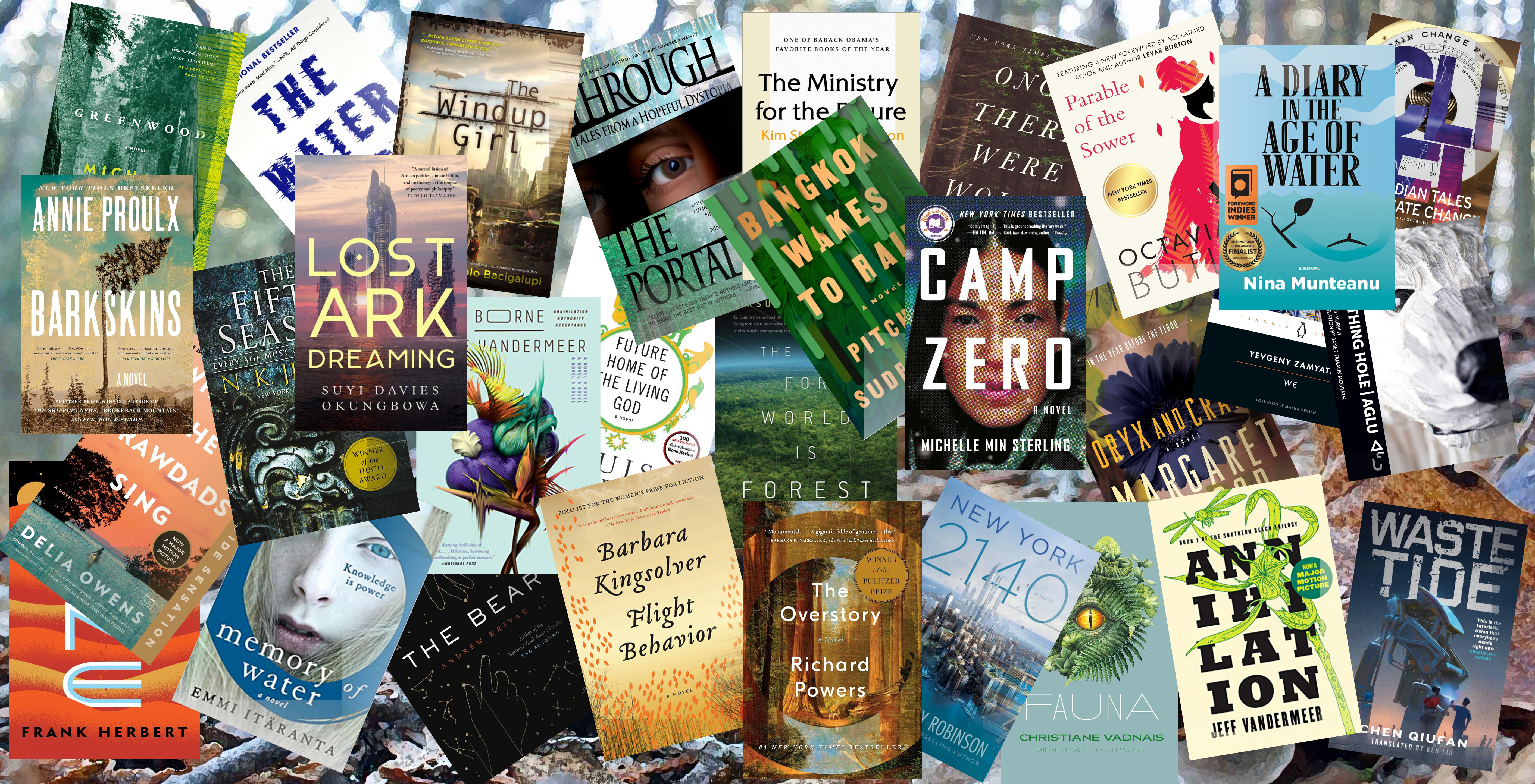
Some time ago, Shepherd invited me to share some of my favourite stories and why I picked them. I decided to feature novels that moved me greatly and inspired me to action. I chose five works of eco-fiction that made me care and gave me hope.

The environment and how we treat it has always been important to me since I was a child. My passion for storytelling morphed into writing, but the underlying spark came through environmental activism. I got a university degree in aquatic ecology, published numerous papers, and now write eco-fiction that is grounded in accurate science with a focus on human ingenuity and compassion. The most meaningful and satisfying eco-fiction is ultimately optimistic literature that explores serious issues with heroic triumph. Each of these five favourites intimately connects human to environment. Each novel moved me to think and deeply care.

The Books I Picked & Why

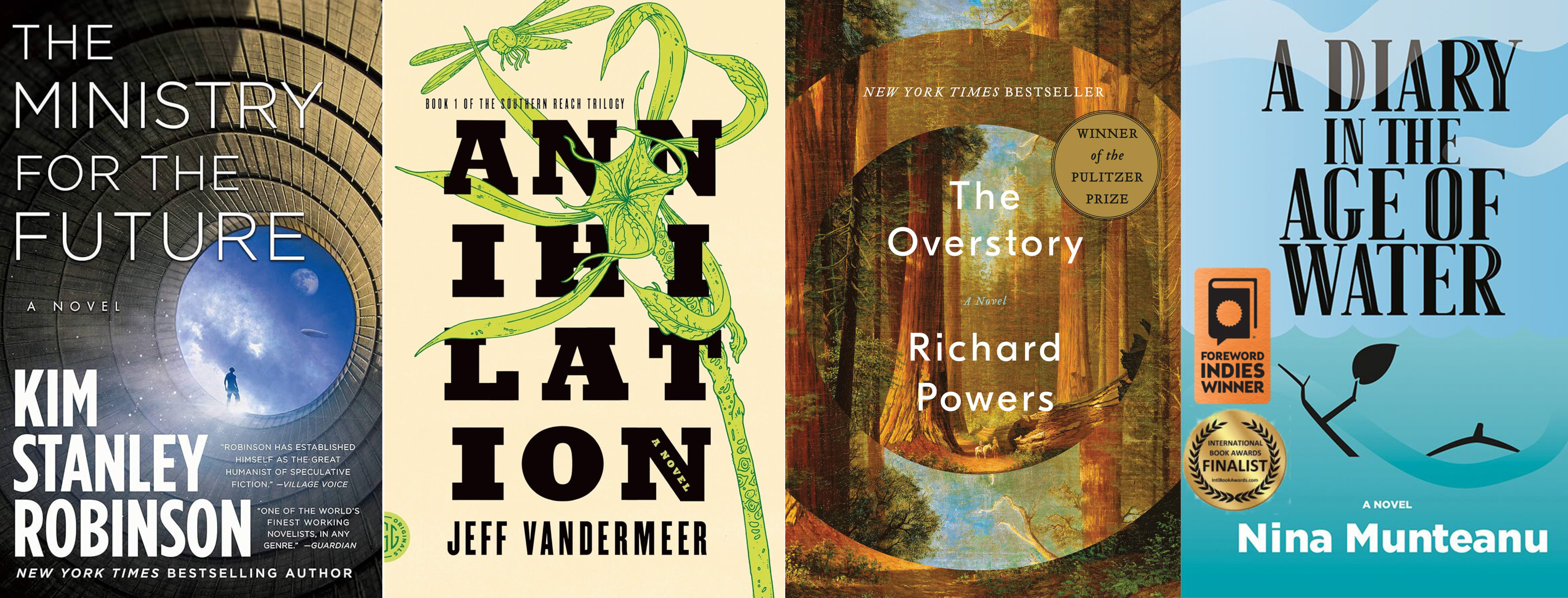
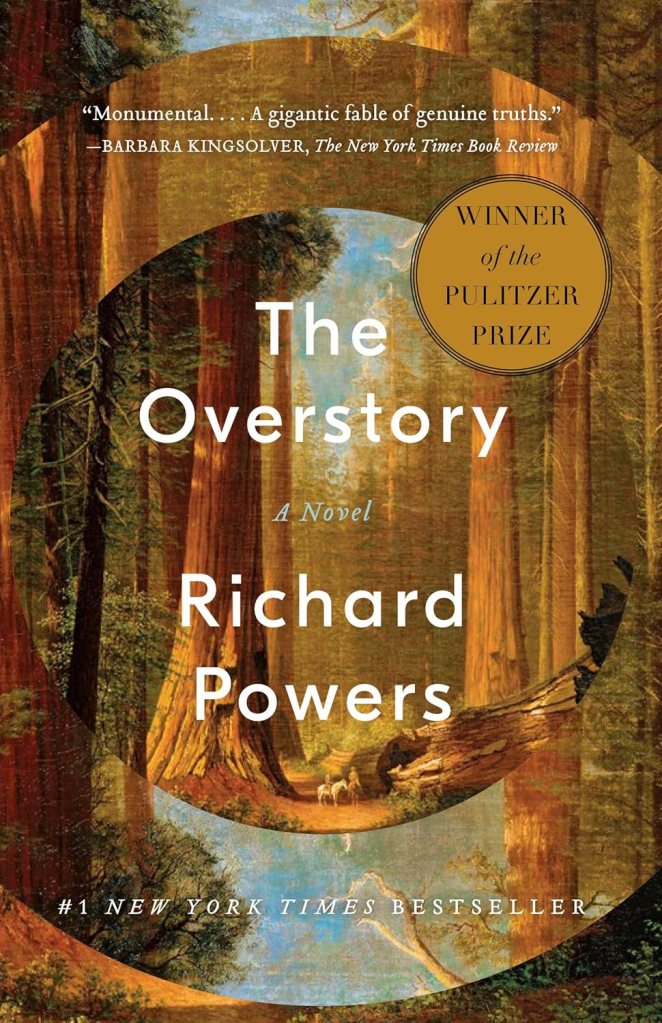
The Overstory

by Richard Powers

What resonated with me on so many levels was the author’s use of lyrical and beautiful language in describing trees and forests: as characters. I’m an ecologist and I felt a particular kinship with the botanist Patricia Westerford, a disabled introvert who must swim against the hegemonic tide with heretical ideas. When she argues that trees communicate, learn, trade goods and services, have intelligence and society, her scientific peers ridicule her and end her university career. This story is as much her triumph over overwhelming challenges as it is about the dwindling majestic forests that must quietly endure our careless apathy as they continue to offer their gift of life-giving oxygen and medicinal aerosols for hundreds of years. 

Barkskins

by Annie Proulx

This 600-year saga about human-environment interaction through the forest industry in Canada evoked emotional connections with my environment, the Canadian forests, and the plight of indigenous Canadians. From the arrival of the Europeans in pristine forest to its destruction under the veil of global warming, Proulx weaves generational stories of two settler families into a crucible of terrible greed and tragic irony. The bleak impressions by the immigrants of a harsh environment crawling with pests underlie their combative mindset of a presumed infinite resource. I was particularly moved by the linked fate between the Mi’kmaq and the majestic pine forests, how both were similarly mistreated and changed. This history is also my legacy. As the daughter of immigrants, I felt both educated and moved.  

The Breathing Hole

by Colleen Murphy, Siobhan Arnatsiaq-Murtphy and more

What struck me most was the use of simple language to portray powerful intimacy and connection between human and animal, and by extension, environment. Murphy’s humorous dialogue, together with sparing, often ironic, descriptions, struck deep into my heart. The play starts in 1535 on an ice shelf up north—when an Inuk widow risks her life to save a lost one-eared polar bear cub on an ice floe, and adopts him. In the last scene five hundred years later in the oily waters of the Northwest Passage, the same bear—starving and cruelly injured by eco-tourists on a cruise ship—struggles to keep from drowning. No one on the ship cares. No one weeps for him. But I did. I wept for him and for his world destroyed by apathy. 

The Windup Girl

by Paolo Bacigalupi

Paolo Bacigalupi’s biopunk science fiction novelexplores a 23rd-century post-food crash Thailand after global warming has raised sea levels and depleted carbon fuel sources. The main character, Emiko, is a ‘windup,’ a modified human who is vilified and abused by humanity, despite her abilities. I was struck by how well this work of ‘mundane science fiction’ used Emiko as an avatar for a trickster Nature after abuse by humanity through the disrespect of reckless gene-hacking, greedy corporate espionage, and arbitrary foreign takeovers. I cheered Emiko’s breakaway from her oppressors as she emerged from a cloak of obedience and embraced her survival in this changing world of unintended consequences—only realizing later that I was cheering for that changing world and the optimism it promised. 

Memory of Water

by Emmi Itäranta

This book features a passion of mine as an ecologist and mother: water and how we treat it. Life-giving symbols of water flow throughout this story, which explores a post-climate change world of sea level rise in which freshwater is severely rationed due to scarcity. Water’s very nature is tightly interwoven with the main character, Noria, a tea master who guards a secret spring in the fell by her house against cruel government agents who would kill her for water crimes. In prose both sensual and lyrical, this book explores honor, sacrifice, betrayal, and friendship, and how each can be victimized through commodification in a power play of ideology. I found myself pulled in by the intrigue even as I cherished and lingered in the beautiful metaphoric prose.

Explore my eco-fiction book:

A Diary in the Age of Water follows the climate-induced journey of Earth and humanity through four generations of women, each with a unique relationship to water.

Centuries from now, in a dying boreal forest in what used to be northern Canada, Kyo, a young acolyte called to service in the Exodus, yearns for Earth’s past—the Age of Water—before the “Water Twins” destroyed humanity. Looking for answers and plagued by vivid dreams of this holocaust, Kyo discovers the diary of Lynna, a limnologist from that time of severe water scarcity just prior to the destruction. In her work for a global giant that controls Earth’s water, Lynna witnesses and records in her diary the disturbing events that will soon lead to humanity’s demise.

Recently I felt honoured to have A Diary in the Age of Water included as one of several eco-fiction novels that inspired action.

The feminist book review site Liisbeth recently wrote about A Diary in the Age of Water: “If you believe Canada’s water will remain free forever (or that it’s truly free now) Munteanu asks you to think again. Readers have called A Diary in the Age of Water “terrifying,” “engrossing,” and “literary.” We call it wisdom.”

Marcescent beech leaves among evergreen hemlocks, ON (photo by Nina Munteanu)

Nina Munteanu is a Canadian ecologist / limnologist and novelist. She is co-editor of Europa SF and currently teaches writing courses at George Brown College and the University of Toronto. Visit www.ninamunteanu.ca for the latest on her books. Nina’s bilingual “La natura dell’acqua / The Way of Water” was published by Mincione Edizioni in Rome. Her non-fiction book “Water Is…” by Pixl Press (Vancouver) was selected by Margaret Atwood in the New York Times ‘Year in Reading’ and was chosen as the 2017 Summer Read by Water Canada. Her novel “A Diary in the Age of Water” was released by Inanna Publications (Toronto) in June 2020.