Book and Movie Review: Solaris by Stanislaw Lem and Steven Soderbergh

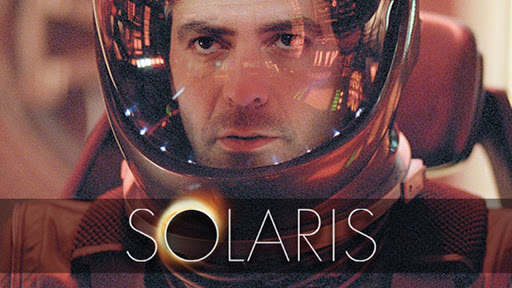
Steven Soderbergh’s stylish psychological thriller, released November 2002 in the United States by 20th Century Fox, eloquently captures the theme of Stanislaw Lem’s 1961 book. Written almost fifty years ago, Solaris is an intelligent, introspective drama of great depth and imagination that meditates on humanity’s place in the universe and the mystery of God. Soderbergh’s Solaris is a poem to Lem’s prose. Both explore the universe around us and the universe within. Not particularly palatable to North America’s multiplex crowd, eager for easily accessed answers, Solaris will appeal more to those with a more esoteric appreciation for art.

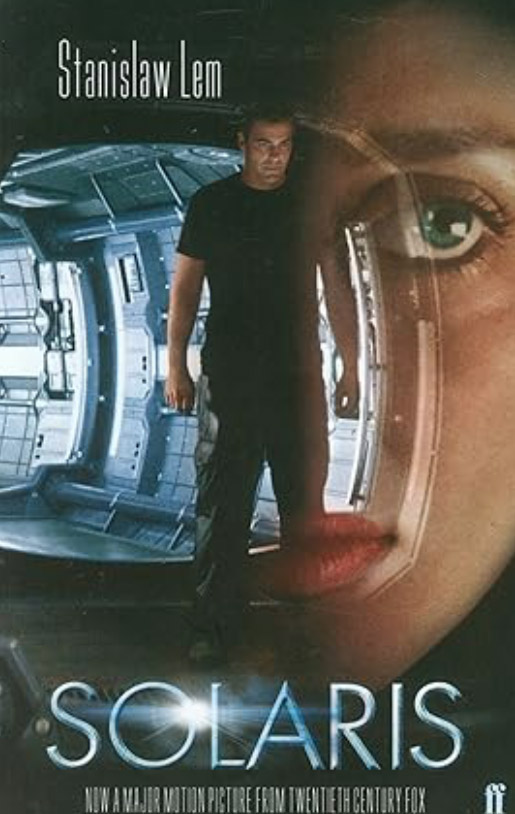
When I recently saw the 2002 20th Century Fox remake of Solaris, I was blissfully unaware of its legendary history. I say blissfully because I harbored no pre-conceived notions or expectations and therefore I was struck like a child viewing the Northern Lights for the first time. The stylish, evocative and dream-like imagery flowed to a surrealistic soundtrack by Cliff Martinez like the colors of a Salvador Dali painting. It was only later that I discovered that Russian experimental director, Andrei Tarkovsky, had previously filmed Solaris in 1972 based on Lem’s masterful 1961 book of the same name. Reprinted by Harcourt, Inc. with a new cover featuring a sensual image from the 2002 film, the original book was translated in 1970 from the French version by Joanna Kilmartin and Steve Cox for Faber and Faber Ltd.

Written almost fifty years ago, Solaris is a dark psychological drama. Soderbergh faithfully captures the intellectual yet sensual essence of Lem’s book by tempering the language and movements. Featuring a fluid and haunting soundtrack, his film flows like a choreographed ballet. There is a dream-like quality to it that is enhanced by creative use of camera angles, unusual lighting, tones and contrast, and sparse language. Solarisis not an action film (no one gets shot, at least not on stage), yet the tension surges and builds to its irrevocable conclusion from frame to frame like a slow motion Tai Chi form.

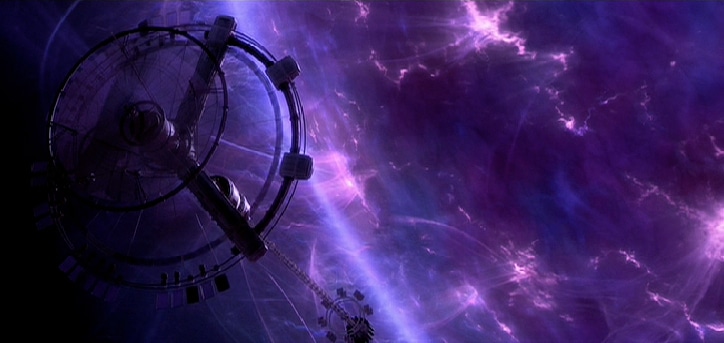
In response to his friend’s plea, a depressed psychologist with the ironic name of Kris Kelvin (played with quiet depth by George Clooney), sets out on a mission to bring home the dysfunctional crew of a research space station orbiting the distant planet, Solaris. Kelvin arrives at the space station, Prometheus, to find his friend, Gibarian, dead by suicide and a paranoid and disturbed crew obviously withholding a terrible secret from him. It is not long before he learns the secret first-hand: some unknown power (apparently the planet itself) taps into his mind and produces a solid corporeal version of his tortured longing: his beloved wife, Rheya (played sensitively by Natascha McElhone) who years ago had committed suicide herself. Faced with a solid reminder, Kelvin yearns to reconcile with his guilt in his wife’s death and struggles to understand the alien force manifested in the form of his wife. He learns that the other crew are equally influenced by Solaris and have been grappling, each in their own way, with their “demons,” psychologically trapping them there.

Ironically, our hero’s epic journey of great distance has only led him back to himself. The alien force defies Kelvin’s efforts to understand its motives; whether it is benign, hostile, or even sentient. Kelvin has no common frame of reference to judge and therefore to react. This leaves him with what he thinks he does understand: that Rheya is a product of his own mind, his memories of her, and therefore a mirror of his deepest guilt—but perhaps also an opportunity to redeem himself.

Lem packs each page of his slim 204 page book with a wealth of intellectual introspection. Through first person narrative, he intimately unveils the complicated influence of this arcane force on Kelvin. Lem explains it this way: “I wanted to create a vision of a human encounter with something that certainly exists, in a mighty manner perhaps, but cannot be reduced to human concepts, ideas or images.” (Author’s Website.) Such an incomprehensible entity would serve as a giant mirror for our own motives, yearnings and versions of reality. For me the contrast presented by such an arcane alien force emphatically—but also ironically—defines what it is to be human. It is only when faced with what we are not that we discover what we are. Later in the book, Kelvin cynically observes: “Man has gone out to explore other worlds and other civilizations without having explored his own labyrinth of dark passages and secret chambers, and without finding what lies behind doorways that he himself has sealed.” In the film Gibarian sadly proclaims of the Solaris mission: “We don’t want other worlds—we want mirrors.” In the book, Lem has Snow deliver a similar message, but neither Gibarian or Snow realize that these two desires may be one and the same.

Lem’s existentialist leaning is provided throughout the book and even alluded to in the name he chose for the space station: Prometheus. In Greek mythology, Prometheus stole fire from the gods and gave it to humankind for which Zeus chained him to a rock and sent an eagle to eat his liver (which grew back daily). It is interesting that Soderbergh chose to send Prometheus to a fiery crash and named Kelvin’s dead wife, Rheya, after the Greek goddess, mother of Zeus and all Olympian gods. In a late passage of Lem’s book, a devastated and sorrowful Kelvin formulates a personal theory of an imperfect god, “a god who has created clocks, but not the time they measure … a god whose passion is not a redemption, who saves nothing, fulfills no purpose—a god who simply is.”

Soderbergh addresses Lem’s existential vision with several brief but pivotal scenes. One occurs when Kelvin’s dead friend, Gibarian, returns to him in a dream on Prometheus and responds to Kelvin’s question, “What does Solaris want?” with: “Why do you think it has to want something?” Another scene occurs as a flashback to a dinner on Earth, when the real Rheya, prior to her suicide, argues with both Gibarian and her own husband about the existence of an all-knowing purposeful God, which both men argue is a myth made up by humankind: to Kelvin’s suggestion that “the whole idea of God was dreamed up by man,” Rheya insists that she’s “talking about a higher form of intelligence,” to which Gibarian cuts in with: “No, you’re talking about a man in a white beard again. You are ascribing human characteristics to something that isn’t.” Kelvin fuels it with: “We’re a mathematical probability,” which prompts Rheya’s challenge: “How do you explain that out of the billions of creatures on this planet we’re the only ones conscious of our immortality?” Neither man has an answer. Gibarian later commits suicide on Solaris rather than deal with the manifestation of his conscience. And I can’t help but wonder if the underlying reason for his inability to reconcile with his “demon” is because he was unequipped to, given his nihilistic beliefs.

Gibarian also tells Kelvin (and we must remember that all this is Kelvin really saying this to himself through his memory of the character): “There are no answers, only choices.” It is interesting then that the first pivotal choice in the story is made by the Doppelganger Rheya (also a manifestation of Solaris but a mirror of Kelvin’s own mind) and it is a choice made out of love: to be annihilated, rather then serve as an instrument of this unknown alien power to study the man she loves.

Some critics have called Soderbergh’s Solaris pretentious, boring and devoid of action and intimacy. I strongly disagree. It is simply that, as with Lem’s original story, Soderbergh’s Solaris does not surrender its messages easily. The viewer, as with the reader, must intuitively feel his or her way through the fluid poetry, free to interpret and ponder the questions. This is what I think good art should do. And I feel both the original book and Soderbergh’s movie do this with enthralling brilliance.

Where Soderbergh and Lem depart lies more in each artist’s personal vision and belief. Soderbergh seems to view the forces that drive our universe as the manifestation of an arcane motive more readily known through spirituality, perceived by the heart, and existing as a matter of belief. Lem, however, suggests that these forces are random and without purpose, defined by science, and perceived by the mind. Still, Lem is not proclaiming a nihilism of his own: he believes we are defined by the questions we ask and Lem asks a great deal of questions—leaving the reader to do the answering.

Reviewer Rick Kisonak asserted that Lem’s “novel is an icy meditation on man’s place in the universe and the mystery of God. It poses countless metaphysical questions and makes a point of answering none of them. In Soderbergh’s hands, however, Solaris becomes a celebration of romantic love, which culminates in the revelation of a caring, forgiving creator. At the end of his book, Lem writes [Kelvin ponders]: ‘the age-old faith of lovers and poets in the power of love, stronger than death, that finis vitae sed non amoris [life ends but not love] is a lie, useless and not even funny.’ The director ignores the author in favor of just such a poet” (Film Threat, [Online]). Kisonak is referring here to Rheya’s interest in Dylan Thomas and its reference throughout the movie. Another reviewer, Dennis Morton, goes so far as to suggest that the screenplay of Solaris is the first stanza of the poem, which ends with: “…though lovers be lost love shall not; And death shall have no dominion” (Santa Cruise Sentinel, [Archived online])

While I agree with some of Kisonak’s reasoning, I think he has missed the point of Lem’s book. If one continues to read from the passage Kisonak quoted above—as Kris Kelvin transcends from what he “thinks” in his intellect to what he feels and “knows” in his heart, to accept his (and humanity’s) destiny with humble fatalism—we learn that Lem ends his book in much the same way as Soderbergh’s movie: life ends but not love. The endings are physically different, in keeping with some radical alterations from the book in the movie’s setting (e.g., the original Solaris station is located on the planet and Lem assiduously describes Kelvin’s observations and interactions with the alien ocean; whereas Soderbergh’s crew virtually never leave orbit and the planet remains aloof in the background, reflecting Soderbergh’s focus). Yet, Kris makes the same choice in faith and love in both book and movie (although the choices play out differently). In matters of faith and love, here is what Kris has to say in the book: “Must I go on living here then, among the objects we both had touched, in the air she had breathed? … In the hope of her return? I hoped for nothing. And yet I lived in expectation … I did not know what achievements, what mockery, even what tortures still awaited me. I knew nothing, and I persisted in the faith that the time of cruel miracles was not past.” In the end of both movie and book, Kris Kelvin lets go of his fears and lets his spirit rise in wonder at what astonishing things Solaris (and the universe) will offer next.

In the final analysis, both book and movie are incredibly valuable but for different reasons. Soderbergh paints an impressionistic poem, using Kafkaesque brushstrokes on a simpler canvas, to Lem’s complex tapestry of multi-level prose. Lem challenges us far more by refusing to impose his personal views, where Soderbergh lets us glimpse his hopeful vision. I think that both, though, come to the same conclusion about the ethereal, mysterious and eternal nature of love. On the one hand, love may connect us within a fractal autopoietic network to the infinity of the inner and outer universe, uniting us with God and His purpose in a collaboration of faith. On the other hand, love may empower us to accept our place in a vast unknowable and amoral universe to form an island of hope in a purposeless sea of indifference. Whether love mends our souls to the fabric of our destiny; enslaves us on an impossible journey of desperate yearning; or seizes us in a strangling embrace of unspeakable terror at what lurks within—surely, then, love is God, in all its possible manifestations. This is unquestionably the message that unifies book and movie. And it is one worth proclaiming.

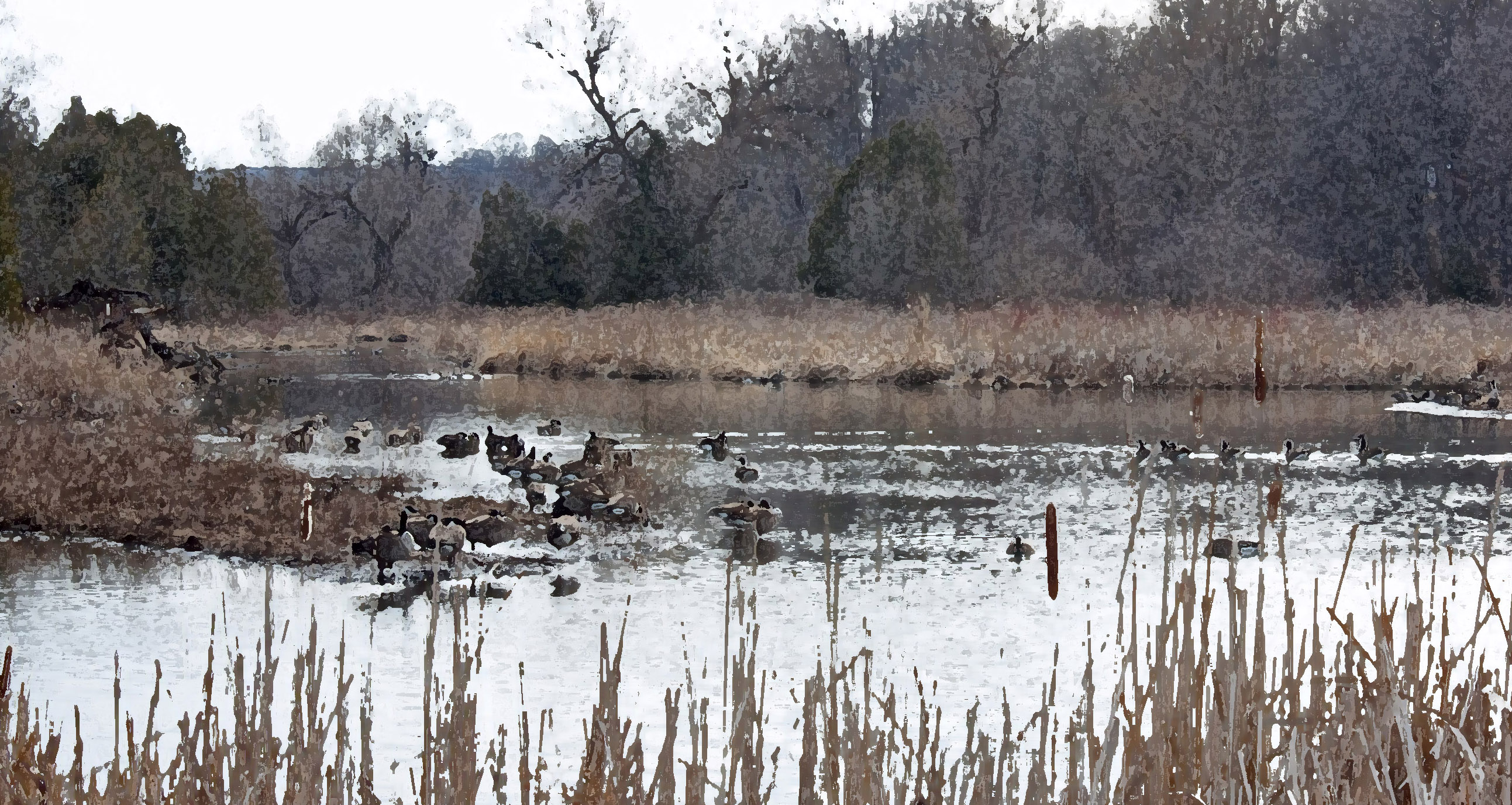
Indian River, ON (photo and dry brush rendition by Nina Munteanu)

Nina Munteanu is a Canadian ecologist / limnologist and novelist. She is co-editor of Europa SF and currently teaches writing courses at George Brown College and the University of Toronto. Visit www.ninamunteanu.ca for the latest on her books. Nina’s bilingual “La natura dell’acqua / The Way of Water” was published by Mincione Edizioni in Rome. Her non-fiction book “Water Is…” by Pixl Press(Vancouver) was selected by Margaret Atwood in the New York Times‘Year in Reading’ and was chosen as the 2017 Summer Read by Water Canada. Her novel “A Diary in the Age of Water” was released by Inanna Publications (Toronto) in June 2020.
To Boldly Go Where No Human Has Gone Before…

A while ago I was approached by Robert Gooding-Townsend, Science in Society editor for Science Borealis for my opinion on a persistent idea that post-Star Trek sci-fi is more pessimistic and less technologically imaginative. 

Whether this perception is true I can’t definitively say but there is a reason behind it, which I believe reflects a subtle shift in our cultural paradigm and worldview in the past decades since Star Trek. A shift involving a growing awareness of ecology and the emergence of the “feminine archetype” in storytelling.

I think two things are happening in concert: science fiction is maturing as a genre: 1) in its actual breadth; but also 2) in our perception of it.

I think this is partly: 1) a reflection of a more diverse, sophisticated and mature audience (what The Economist terms “mass intelligent”); and 2) the result of a wider acceptance of SF as literature by “non-genre” writers embracing what literary critic Ted Gioia calls “conceptual fiction” (e.g., Walker Percy’s Love in the Ruins; Thomas Pinchon’s Gravity’s Rainbow; Vladimir Nabokov’s Ada; John Barth’s Giles Goat-Boy; Margaret Atwood’s The Handmaid’s Tale, Emmi Itaranta’s The Memory of Water; David Mitchell’s Cloud Atlas, etc.).

Our shifting worldview, along with science fiction’s gradual blending with strong literary elements is reflected in a perception of higher pessimism with less focus on technological “wonders”. When asked to describe SF today, colleague Lynda Williams, author of the Okal Rel series, argued that, “SF is mainstream now … It has grown up, emotionally, from being about wish-fulfilling technologies … to embracing the social implications of change.”

Today, SF is recognized more as “real” literature rather than being dismissed as “escapism.” Williams shares that SF’s roots are as old as myth. “Like myths and bible stories, SF is an instructive literature, pointing out how things can go wrong (or right) and why. The growing up SF has done since the 1950s lies in an increasing recognition that [humanity is its] own worst enemy and a better understanding of human nature is crucial to the problems we face, not just the hard sciences.”

For the past few years I’ve been following a trend in the science fiction writing courses I teach at university: more and more students (male and female) are bringing in WIPs on ecological and global environmental issues. Many of the stories involve a premise of environmental calamity, but not in the same vain as previous environmental disasters that depict “man” against Nature. These works give the Earth, Nature or Water an actual voice (as a character). And a protagonist who learns to interact with it cooperatively. For me this represents a palpable and gestalt cultural awakening in the realm of the “feminine archetype”. One that is focused more on the sociological and ecological consequences of humanity’s evolution.

I believe that ecology—the science of relationships and consequence—best parallels the literature of science fiction, which studies the world and the consequences of our actions (advances in and impacts of science and technology) through metaphor. The literature of science fiction explores large issues faced by humankind and is foremost a literature of allegory and metaphor; one deeply embedded in culture.

Stories of doom and gloom have populated the science fiction genre since its inception. What appears to be changing is the increased sophistication of this assessment and humanity’s place—and technology’s place—in it. Editor and Publisher of On Spec MagazineDiane Walton shares that she is seeing a lot of Post-Apocalyptic submissions, “mainly because it’s interesting to put your characters in a setting where the rules don’t apply any more. They have to try to rebuild the life and security and order they used to have, or else revert to savagery, or else adapt to a whole new set of circumstances.”

Environmental fiction has been written for years. But I believe that now—partly with new awareness of climate change and with the genesis of the term eco-fiction—the “character” and significance of environment is being acknowledged beyond its metaphor, for its actual value. It may also be that the metaphoric symbols of environment in certain classics are being “retooled” through our current awareness, much in the same way that Aldous Huxley’s Brave New World or George Orwell’s Nineteen Eighty Four are being re-interpreted—and newly appreciated—in today’s world of pervasive surveillance and bio-engineering.

The stories I’m seeing more and more—whether by established writers or by my own students—reflect an emerging worldview of participation, responsibility and accountability. It is the worldview of Jung and synchronicity; of David Bohm and “implicate order”; of Rudolf Steiner and “cosmic intelligence”, of biochemist Mae-Wan Ho and “quantum entanglement”, of Frans de Waal and “empathy”, and of Matt Ridley and “altruism”.

Whether told through cautionary tale / political dystopia (e.g., Margaret Atwood’s MaddAddam trilogy; Bong Jung-Ho’s Snowpiercer), mundane science fiction (e.g. Paolo Bacigalupi’s The Windup Girl, my own A Diary in the Age of Water), or a retooled version of “alien invasion” (e.g., Cixin Liu’s 2015 Hugo Award-winningThe Three Body Problem), these stories all reflect a shift in focus from a technological-centred & human-centred story to a more eco- or world-centred story that explores wider and deeper existential questions. 

So, yes, science fiction today may appear less technologically imaginative; but it is certainly more sociologically astute, courageous, sophisticated, and relevant. As for the question of pessimism, I’d suggest that rather than being more pessimistic, current SF literature is more realistic and meaningful.

Swamp forest in Kawartha region, ON (photo and rendition by Nina Munteanu)

Nina Munteanu is a Canadian ecologist / limnologist and novelist. She is co-editor of Europa SF and currently teaches writing courses at George Brown College and the University of Toronto. Visit www.ninamunteanu.ca for the latest on her books. Nina’s bilingual “La natura dell’acqua / The Way of Water” was published by Mincione Edizioni in Rome. Her non-fiction book “Water Is…” by Pixl Press(Vancouver) was selected by Margaret Atwood in the New York Times ‘Year in Reading’ and was chosen as the 2017 Summer Read by Water Canada. Her novel “A Diary in the Age of Water” was released by Inanna Publications (Toronto) in June 2020.

“A Diary in the Age of Water” Reviewed in Alternatives Journal

Shanella Ramkissoon reviews my latest eco-fiction mundane science fiction novel “A Diary in the Age of Water” in Issue 46 of Alternatives Journal (Playbook for Progress):

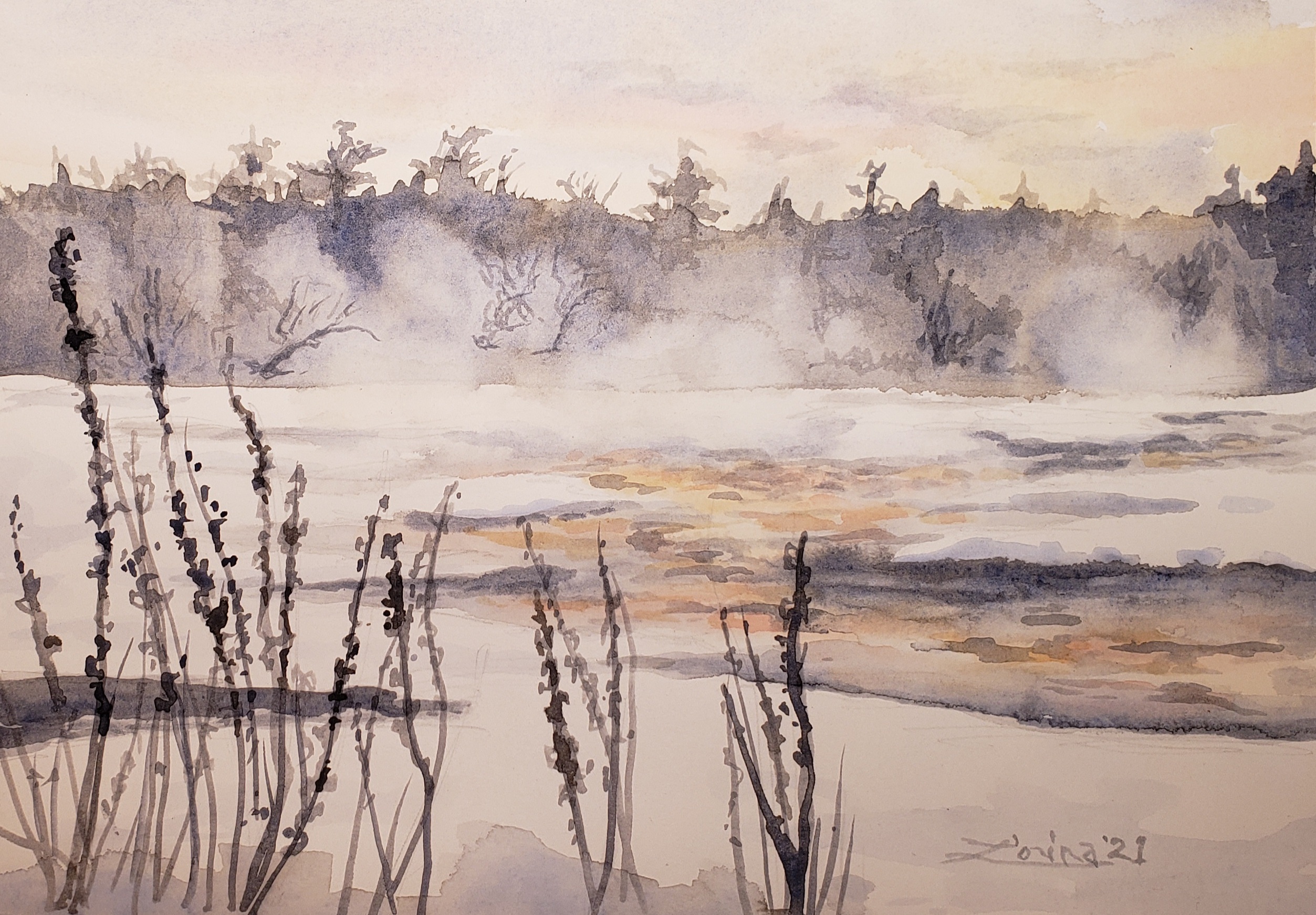
Rain falls on the Otonabee River, ON (photo and rendition by Nina Munteanu)

Nina Munteanu is a Canadian ecologist / limnologist and novelist. She is co-editor of Europa SF and currently teaches writing courses at George Brown College and the University of Toronto. Visit www.ninamunteanu.ca for the latest on her books. Nina’s bilingual “La natura dell’acqua / The Way of Water” was published by Mincione Edizioni in Rome. Her non-fiction book “Water Is…” by Pixl Press(Vancouver) was selected by Margaret Atwood in the New York Times ‘Year in Reading’ and was chosen as the 2017 Summer Read by Water Canada. Her novel “A Diary in the Age of Water” was released by Inanna Publications (Toronto) in June 2020.
Nina Munteanu Talks Books, Water and COVID on ConversationsLIVE

I recently had a wonderful discussion on Cyrus Webb’s show ConversationsLIVE on BlogTalkRadio and WYAD Radio in Mississippi.

We talked about curiosity in our world and how fiction connects us with relevance and meaning. We discussed writing eco-fiction, my latest eco-novel and work of mundane science fiction “A Diary in the Age of Water. We also discussed what was involved in combining art with science in mundane science fiction. Cyrus then asked me what it was like to get a book out during COVID. I enjoyed this interview for its refreshing questions. They made me think.

You can listen to the interview through the link below:

https://www.blogtalkradio.com/conversationslive/2021/06/22/author-nina-munteanu-talks-adiaryintheageofwater-on-conversationslive

Pond lilies in Thompson Creek marsh, ON (photo and rendition by Nina Munteanu)

Nina Munteanu Talks Water, Writing, and Weather on ‘All About Canadian Books’

I recently had the pleasure of chatting with Crystal Fletcher on “All About Canadian Books” about my recent clifi dystopian novel “A Diary in the Age of Water.” We covered a number of topics from water’s over 70 anomalous properties–virtually all of them life-giving–to how water seems to inform all aspects of my life, particularly my writing life. Crystal was particularly fascinated with the four generations of women in the book and we talked at length about how these characters were developed and the roles they played in the greater saga.

After bringing up the Toronto Star’s question of me (“What keeps you up at night about climate change”) in which I admitted that I lose sleep over the thought of how my son and his children will fair in this changing world, Crystal admitted that “Your book, Nina, is an eye opener…it freaked me out when I was reading it…and now I’m losing sleep!”

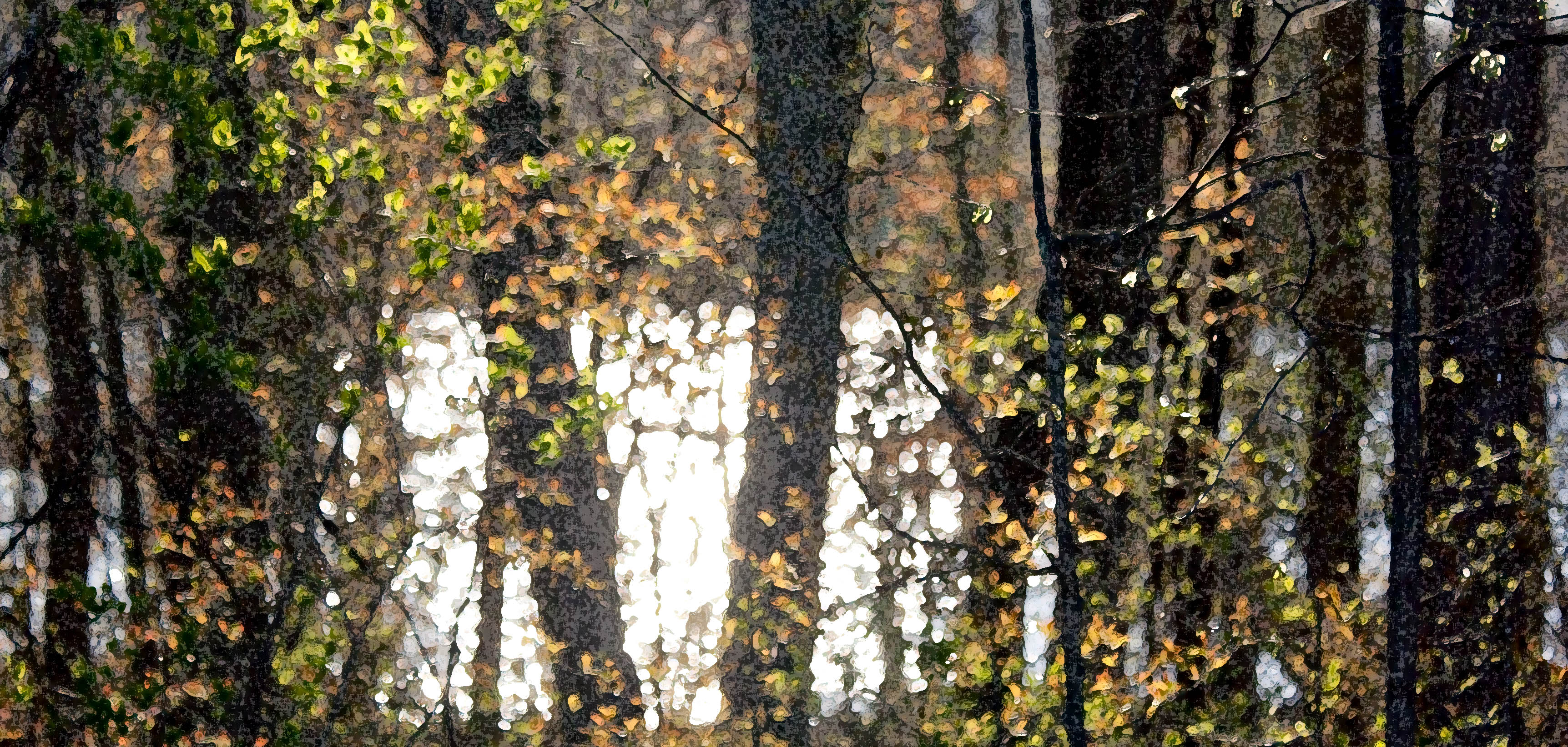
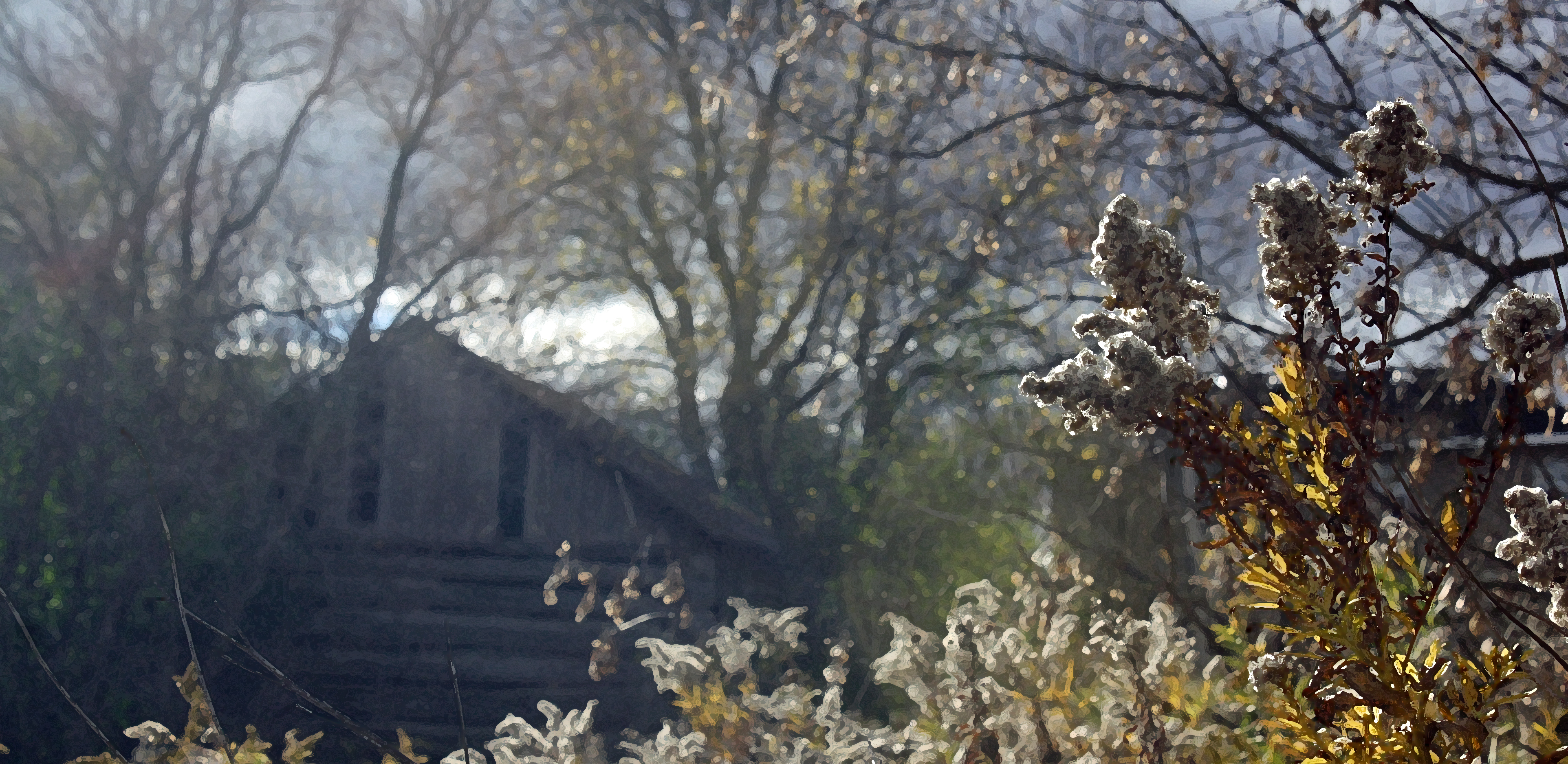
Hardwood forest back lit by glittering Otonabee River, ON (photo and rendition by Nina Munteanu)

Nina Munteanu Talks Water and Writing on Kentucky’s WMST-am Radio

Dan Manley interviews Nina Munteanu on Mid Morning on Main WMST-AM Radio

I was recently interviewed (on June 21) by Dan Manley on Kentucky’s Mid-Morning on Main show on WMST-AM Radio. I’ve visited Kentucky several times before, including the famous Bardstown Road in Louisville, but this time it was a virtual visit.

Dan and I talked about how I became a limnologist and ecologist, about my growing up in a small town and playing in the local forest with my older brother and sister and how we made ‘potions’ out of moss, soil, evening nightshade and water.

We talked about my recent eco-novel “A Diary in the Age of Water” and why I wrote it and its effect on people. We covered the difference between stereotypes and archetypes and how science informs me and my writing. We also explored how life changes us and our writing and how writing, in turn, changes us.

We covered a vast range of water-related topics from the movie “Water World” to the TV show “Bonanza.” We talked about water scarcity and water politics and what Canada was doing and what’s happening in America.

I really enjoyed this interview because Dan asked me some surprising and challenging questions that led us into interesting territory. My interview with him starts about 43 minutes into the show. Go have a listen!

Otonabee River sparkles behind a hardwood forest in spring, ON (photo and dry brush rendition by Nina Munteanu)

Nina Munteanu is a Canadian ecologist / limnologist and novelist. She is co-editor of Europa SF and currently teaches writing courses at George Brown College and the University of Toronto. Visit www.ninamunteanu.ca for the latest on her books. Nina’s bilingual “La natura dell’acqua / The Way of Water” was published by Mincione Edizioni in Rome. Her non-fiction book “Water Is…” by Pixl Press(Vancouver) was selected by Margaret Atwood in the New York Times‘Year in Reading’ and was chosen as the 2017 Summer Read by Water Canada. Her novel “A Diary in the Age of Water” was released by Inanna Publications (Toronto) in June 2020.

Squirrel Joy

Grey squirrel munching on a maple seed, ON (photo by Nina Munteanu)

Do you believe in serendipity or destiny? That all things are interconnected in a flowing web that responds like a super consciousness? 

Swiss psychiatrist Carl Jung called it “meaningful coincidence.” Bohm used the term “implicate order”; the Vedas call it “akasha; Goethe gave it the name “the ground of all being”; and Mae-Wan Ho described it as “quantum entanglement”: when puzzle pieces cooperatively arrange themselves into a symbiotic pattern of synchronicity to provide meaning. 

The universe provides…

I’ve come to rely on it in my writing: moments when key things of interest reveal themselves to me just when I need them. I call it writing in sync. Time and again, I’ve serendipitously discovered just what I needed for a plot point or something to complete a backstory: a news event, a conversation with a friend, or an image on the internet. Synchronicity occurs all around us. Birds flying in formation during migration. Electrons synchronizing by the billions and passing through impenetrable barriers. Fireflies flashing in harmony.

Rupert Sheldrake , British botanist and author of The Rebirth of Nature, suggests that “our minds are extended in both space and time with other people’s minds, and with the group mind or cultural mind by way of their connection to the collective unconscious.” Sheldrake posits that we tune into archetypal fields or patterns and “our minds are much broader than the ‘things’ inside our brains. He’s talking about Jungian archetypal gestalt synchronicity. The notion of consciousness as a global phenomenon that occurs everywhere in the body, not just our brains. “Consciousness, at its most basic, [is] coherent light,”writes science journalist Lynne McTaggart in her book The Field

young black squirrel lies on the branch of a silver maple tree (photo by Nina Munteanu)

It started when I was lunching with good friend Merridy and we were observing several young black and grey squirrels stretched out, lying down on the grass or a branch of the silver maple. They were obviously litter mates and had just finished a playful romp on the grass with sneak-ups, great leaps in the air, twirls and ‘attacks’ and rolls. Such fun! Merridy and I agreed that they looked satisfied and happy after their play, stretched out and languishing in the sun. We talked about how playful squirrels were and how science didn’t seem to acknowledge this. That led to a discussion on people’s perception being largely based on worldview. I shared how we see only what we’re prepared to see and we discussed how science, in its preoccupation with objectivity, can take the ‘soul’ out of life by not observing as much as it could by observing. The concept of anthropomorphism—ascribing exclusively human traits and behaviours to other animals—is based on our own limited definition of what is an exclusively human trait. Who unequivocally proved that only humans are capable of thought or feelings? This recalled a quote of Goethe that I used in the preface of my book Water Is…: “Whatever you cannot calculate, you do not think is real.” We are often blinded by our beliefs and hubris. 

Young grey squirrel climbs up the silver maple tree, ON (photo by Nina Munteanu)

During the 1600s in what is ironically called the “Age of Enlightenment,” the highly regarded philosopher René Descartes denied thought to animals; he claimed that animals could not process pain through thought and certainly not through emotions such as joy, sadness, or embarrassment. Only humans were conscious, had souls, and were capable of meaningful communication and language. What he failed to observe—in his own pet dog, even—was that animals other than humans are capable of these thoughts and emotions. One need only pay attention through an unrestricted lens to recognize their expressions and behaviours. 

In western exploitive society and religions particularly, this Cartesian view has persisted into the present day with those who still argue that animals are incapable of altruism or empathy, can’t reason or calculate, are bound by the “selfish gene”, and don’t have souls. These persist in the face of scientific evidence to the contrary and ironically serve an economic and social worldview of Nature exploitation.

Then, in a wonderfully serendipitous moment of synchronicity, Merridy announced the next day that she had just read the following passage by David George Haskell in his recent book The Forest Unseen. It was as though he had overheard our conversation about the squirrels:

Four grey squirrels loaf in the bright upper branches of a dead shagbark hickory tree fifty meters down the slope. I watch them for an hour, and mostly they loll in the sun, limbs sprawled. They seem companionable, sporadically nibbling the fur on one another’s hind legs or tails. Occasionally one will break from sunbathing and chew the fungus-encrusted dead branches, then return to sit silently with the other squirrels.

This scene of scoured tranquility makes me unaccountably delighted. Perhaps I so often see and hear squabbling among the squirrels that today’s ease seems particularly sweet. But something more is behind my delight; I feel freed from some burden carried by my over-trained mind. Wild animals enjoying one another and taking pleasure in their world is so immediate and so real, yet this reality is utterly absent from textbooks and academic papers about animals and ecology.

This insight is not that science is wrong or bad. On the contrary; science, done well, deepens our intimacy with the world. But there is a danger in an exclusively scientific way of thinking. The forest is turned into a diagram; animals become mere mechanism; nature’s workings become clever graphs. Today’s conviviality of squirrels seems a refutation of such narrowness. Nature is not a machine. These animals feel. They are alive; they are our cousins, with the shared experience that kinship implies.

And they appear to enjoy the sun, a phenomenon that occurs nowhere in the curriculum of modern biology.

Sadly, modern science is too often unable or unwilling to visualize or feel what others experience. Certainly science’s “objective” gambit can be helpful in understanding parts of nature and in freeing us from some cultural preconceptions. Our modern scientific taste for dispassion when analyzing animal behaviour formed in reaction to the Victorian naturalists and their predecessors who saw all nature as an allegory confirming their cultural values. But a gambit is just an opening move, not a coherent vision of the whole game. Science’s objectivity sheds some assumptions but takes on others that, dressed up in academic rigour, can produce hubris and callousness about the world. The danger comes when we confuse the limited scope of our scientific methods with the true scope of the world. It may be useful or expedient to describe nature as a flow diagram or an animal as a machine, but such utility should not be confused with a confirmation that our liming assumptions reflect the shape of the world.

Not coincidentally, the hubris of narrowly applied science serves the needs of the industrial economy. Machines are bought, sold, and discarded; joyful cousins are not.

David George Haskell, “The Forest Unseen”
Grey squirrel peers at the camera, ON (photo by Nina Munteanu)
A sugar maple tree flowers in early spring in Ontario (photo and dry brush rendition by Nina Munteanu)

Nina Munteanu is a Canadian ecologist / limnologist and novelist. She is co-editor of Europa SF and currently teaches writing courses at George Brown College and the University of Toronto. Visit www.ninamunteanu.ca for the latest on her books. Nina’s bilingual “La natura dell’acqua / The Way of Water” was published by Mincione Edizioni in Rome. Her non-fiction book “Water Is…” by Pixl Press(Vancouver) was selected by Margaret Atwood in the New York Times ‘Year in Reading’ and was chosen as the 2017 Summer Read by Water Canada. Her novel “A Diary in the Age of Water” was released by Inanna Publications (Toronto) in June 2020.

Delos Digital Publishes Nina Munteanu’s “l’Ultima Evocatrice”

I was recently commissioned by Andrea Franco at Delos Digitalin Milan to write a novelette for their Fantasy Tales Series. The resulting story was Summoning the Future’s Past a short adaptation of my alternative history novel The Last Summoner published by Starfire in 2012.

The novelette was translated by Chiara Beltrami then released by Delos Digital as the ebook l’Ultima Evocatrice, (Fantasy Tales 66), on April 13, 2021. 

Here is what Andrea Franco said about l’Ultima Evocatrice:

“Recentemente in Fantasy Tales-Delos Digital abbiamo pubblicato il primo testo ‘internatiozionale’, della bravissima scrittrice Canadese Nina Munteanu, tradotta per noi in modo eccellente da Chiara Beltrami. Un bellissimo racconto lungo che gli appassionati di fantasy non dovrebbero farsi scappare. Lo avete letto?”

As with The Last Summonerl’Ultima Evocatrice(Summoning the Future’s Past) is a fresh twist on chaos theory and observer-induced collapse of quantum entanglement. It’s June 14th, 1410, on the eve of the Battle of Grunwald, when history records that a ragtag peasant army will slaughter the arrogant monk knights of the imperialistic Teutonic Order … or will they? Because of an impetuous choice, 14-year old Vivianne Schoen, Baroness von Grunwald, makes the startling discovery that her mother is from the future and Vivianne herself can alter history—but not before she’s branded a witch and must make the most difficult choice of her life …

 “l’Ultima Evocatrice”was recently featured in Fantasy Magazine

Nina Munteanu is a Canadian ecologist / limnologist and novelist. She is co-editor of Europa SF and currently teaches writing courses at George Brown College and the University of Toronto.  Visit www.ninamunteanu.ca for the latest on her books. Nina’s bilingual “La natura dell’acqua / The Way of Water” was published by Mincione Edizioni in Rome. Her non-fiction book “Water Is…” by Pixl Press(Vancouver) was selected by Margaret Atwood in the New York Times‘Year in Reading’ and was chosen as the 2017 Summer Read by Water Canada. Her novel “A Diary in the Age of Water” was released by Inanna Publications (Toronto) in June 2020.
Nina Munteanu On The Age of Water: Interview on “Mysterious Goings On Podcast”

Alex Greenwood, host of The Mysterious Goings On Podcast recently interviewed me about my latest novel and work of climate fiction, the dystopia “A Diary in the Age of Water.”

Alex and I discussed water scarcity and climate change as a water phenomenon. I also shared my thoughts on water as a character in the novel, water’s many anomalous properties–all of which promote life and wellness, and why writing a dystopian cautionary tale is an act of optimism.

Listen to the podcast on: Anchor; Spotify; Stitcher; Apple Podcasts; iHeartRadio; YouTube; Podchaser; Listennotes; Audible

Boys exploring by the Otonabee River, ON (photo and dry brush rendition by Nina Munteanu)

Nina Munteanu is a Canadian ecologist / limnologist and novelist. She is co-editor of Europa SF and currently teaches writing courses at George Brown College and the University of Toronto. Visit www.ninamunteanu.ca for the latest on her books. Nina’s bilingual “La natura dell’acqua / The Way of Water” was published by Mincione Edizioni in Rome. Her non-fiction book “Water Is…” by Pixl Press(Vancouver) was selected by Margaret Atwood in the New York Times ‘Year in Reading’ and was chosen as the 2017 Summer Read by Water Canada. Her novel “A Diary in the Age of Water” was released by Inanna Publications (Toronto) in June 2020.
‘Buried in Print’ Reviews “A Diary in the Age of Water”

Nina Munteanu’s novel A Diary in the Age of Water (2020) will not suit every reader.” 

“It’s hard to resist identifying the author with Lynna, the most prominent character, who also works as a limnologist, although her employment is increasingly precarious, as her timeline hastens toward ecological devastation.
A predominantly female cast, a mythic forming narrative and, most saliently, the focus on water, all made this an interesting read for me.

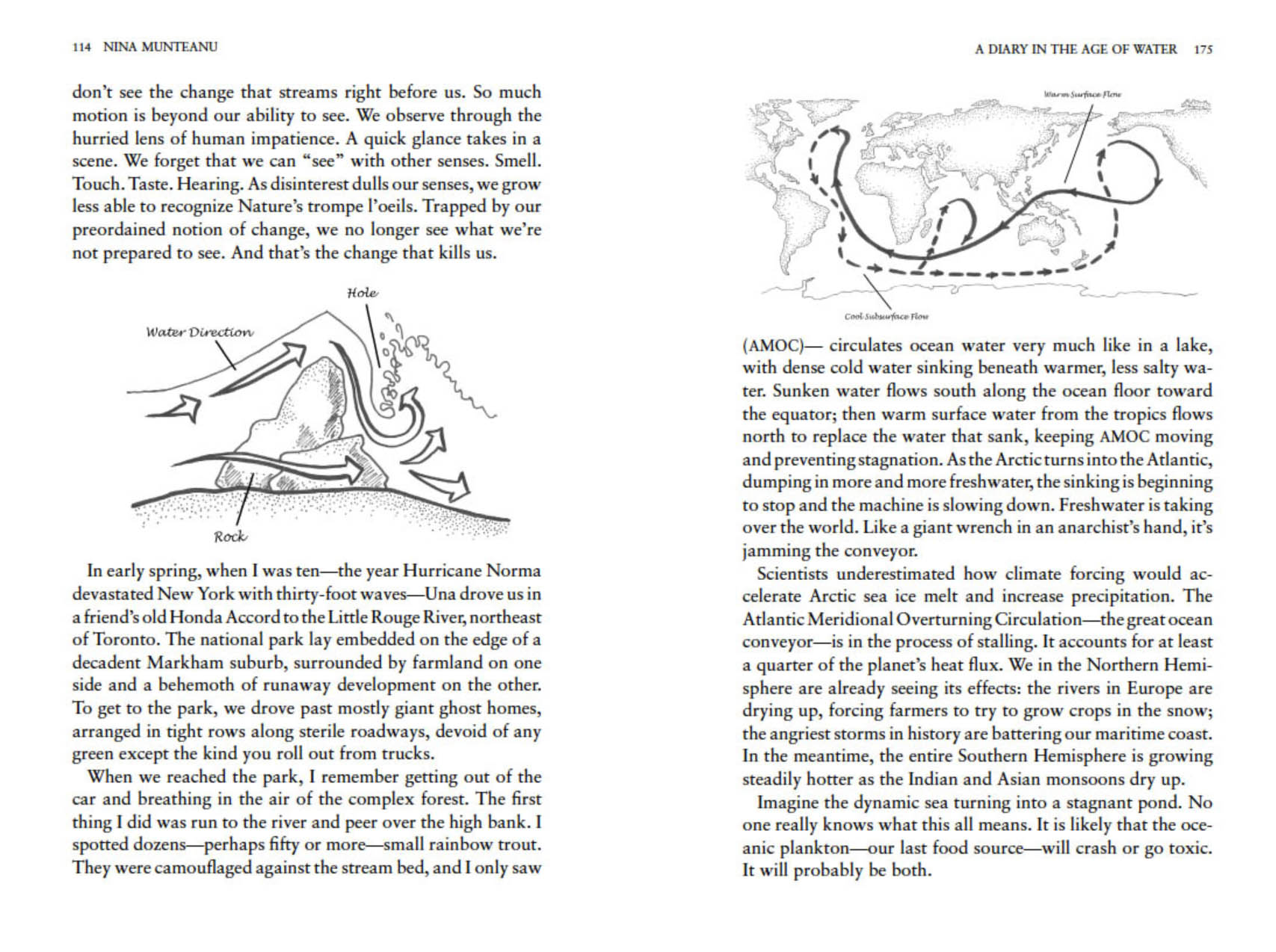
The book’s epigraphs are from Maude Barlow and the chapter’s epigraphs from textbook definitions (sometimes excerpts from limnology tests), and there are even cutaway diagrams that you’d expect in lecture hall.

Ultimately it exists in an in-between place, some mystical elements of the generational tale possibly alienating the dedicated science-y readers and the instructional elements possibly alienating fiction devotees. And, yet, I read on: strangely compelling.”

Buried in Print

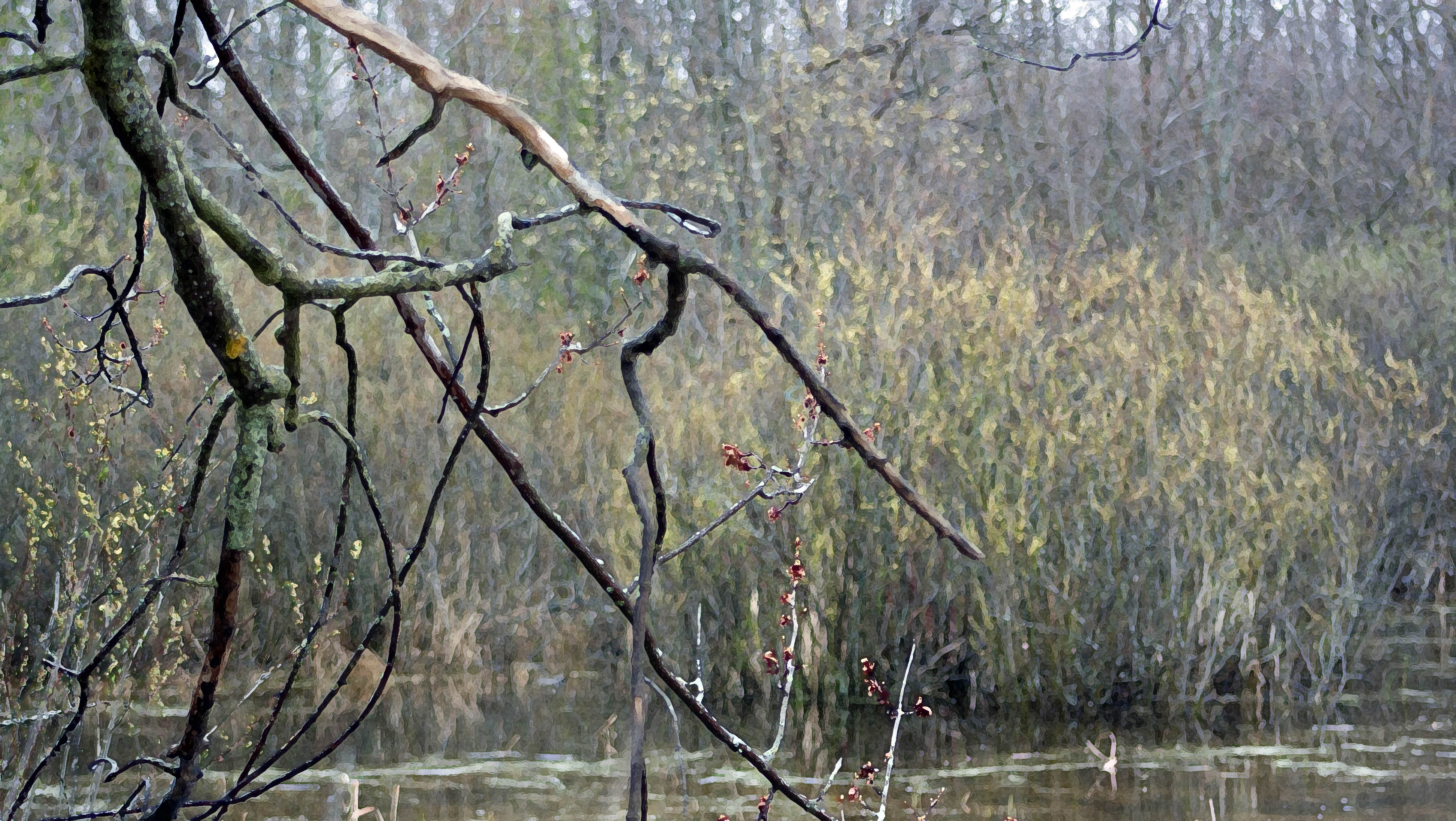
Forest swamp in Kawarthas in spring, ON (photo and dry brush rendition by Nina Munteanu)

Nina Munteanu is a Canadian ecologist / limnologist and novelist. She is co-editor of Europa SF and currently teaches writing courses at George Brown College and the University of Toronto. Visit www.ninamunteanu.ca for the latest on her books. Nina’s bilingual “La natura dell’acqua / The Way of Water” was published by Mincione Edizioni in Rome. Her non-fiction book “Water Is…” by Pixl Press(Vancouver) was selected by Margaret Atwood in the New York Times ‘Year in Reading’ and was chosen as the 2017 Summer Read by Water Canada. Her novel “A Diary in the Age of Water” was released by Inanna Publications (Toronto) in June 2020.