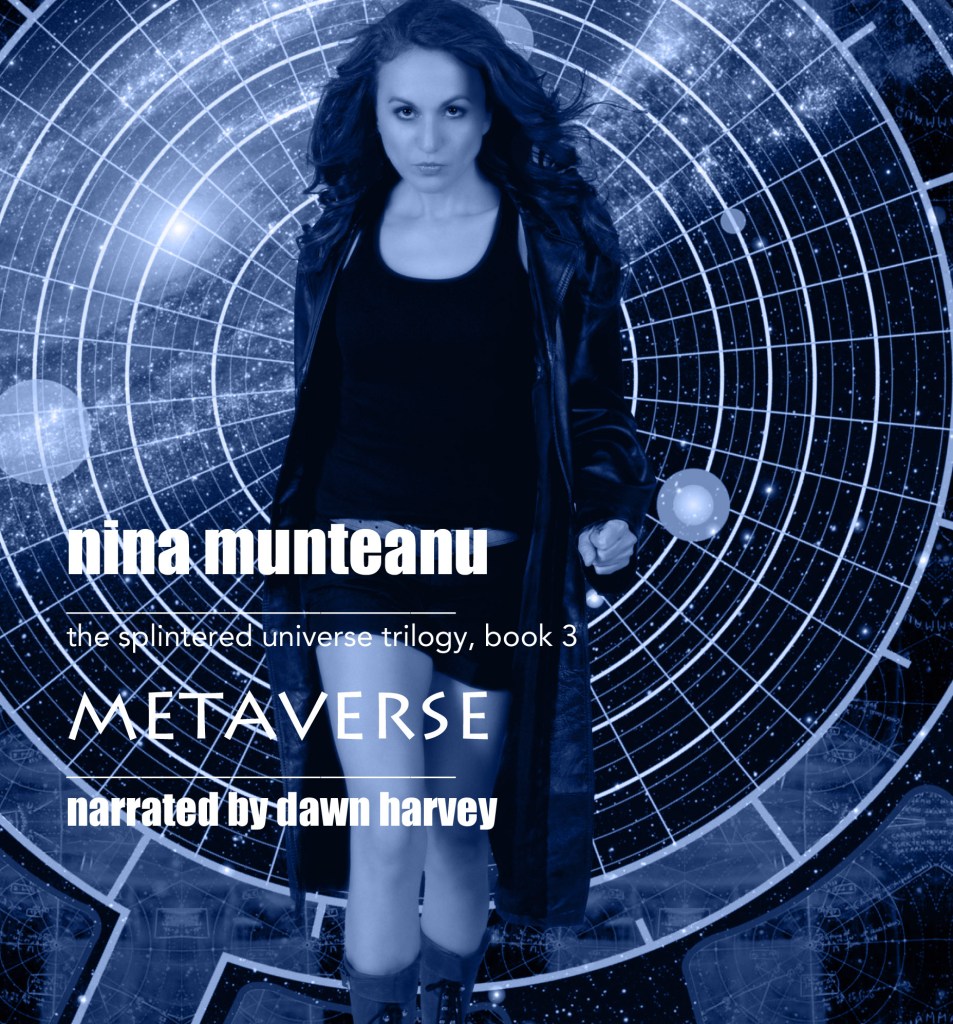
Nina Munteanu’s “The Splintered Universe Trilogy” Audiobooks on Audible

The Splintered Universe Trilogy audiobooks

My detective thriller trilogy “The Splintered Universe,” which came out in print and ebook format in 2012-2014 were made into audiobooks by Iambik in 2019 and narrated impeccably by voice artist Dawn Harvey. When Iambik closed its doors, Spoken Realms and Pixl Press picked up the trilogy and reissued them in 2022. They are now remastered and available for purchase. Canadian author Simon Rose recently interviewed me about the re-release of The Splintered Universe Audiobooks. Part of that interview appears below. For the entire interview find the link below.

 Interview with Nina Munteanu on New Audiobook Release of “The Splintered Universe” Trilogy

I had the pleasure recently of talking with Canadian author Nina Munteanu about the new release of her audiobook set The Splintered Universe Trilogy. Nina is a scientist (limnologist) who also writes science fiction and fantasy with a focus on eco-fiction and climate fiction. She has nine novels and five non-fiction books published, including “Water Is…” recommended by Margaret Atwood as her #1 choice in the New York Times ‘Year in Reading’ in 2016.

The Splintered Universe Trilogy follows the thrilling adventures of Galactic Guardian Rhea Hawke, human detective who must save a world she hardly understands. It’s full of exciting planets, space travel, tall secrets, intrigue and even some romance. I interviewed Nina in 2019 about the trilogy when the three formats first became available and we talked about her world building, Rhea Hawke’s cool arsenal of gadgets and weapons, and concepts of metaphysics, existentialism and identity. So, what’s happening with all that now?  

Simon: So, tell us about these new releases.

Nina: You’re right, Simon, the audiobooks of the trilogy did all come out in 2019, completing the three formats of print, ebook and audiobook. I was over the moon. What we’ve done recently is remaster the audiobooks and we’re now selling them as a package through the new publishers, Spoken Realms (first two audiobooks) and Pixl Press (third audiobook).

Briefly, the trilogy follows our intrepid (though slightly misguided) detective Rhea Hawke as she tries to solve the genocide of a spiritual sect on some backwater planet. She bungles her mission by killing her only lead and instead discovers a conspiracy to exterminate humanity by an alien race only she thinks exists. It goes downhill for her from there. She gets fired and her sentient ship—her only friend—is impounded. Her whole life comes apart. Her only chance to rebuild it is to prove that her discovery is true. That leads her down a rabbit hole into a dangerous world of intrigue, full of unsavory shape-shifting characters, dust smuggling, giant flying crustaceans, amorous toxic plants, and portals into mirror universes.  

Rhea’s inventiveness gets her into even more trouble. She gained some notoriety with her created weapon, the MEC (short for Magnetic-Electro-Concussion) pistol, a versatile wave-weapon that can target DNA signatures and do almost anything you want with a single sweep. Her proprietary MEC design—coveted by shady crime syndicates and her own Guardians alike—becomes the centre piece to a universal war.

“An addictive start to the trilogy”–BOOK ADDICT

Simon: What makes these new audiobooks so special?

Nina: What makes these audiobooks special lies ultimately in their narration. When the original audiobook publisher took on the books as audiobooks, they provided me with three voice artists to audition. I chose Dawn Harvey because I could visualize my main character through her voice. Given that the entire trilogy is told in the first person, the narrator’s voice had to be just right. Dawn’s voice is dark and sultry like coffee. It is sexy and irreverent with a hidden vulnerability and sensitivity that perfectly captured the main character, Detective Rhea Hawke. What I didn’t realize then was how well Harvey would represent the thirty-odd other characters, mostly aliens—one who spoke through several mouths.

“Rhea is a fascinating character from the start and she continues to grow throughout the tale.”–DAB OF DARKNESS 

Simon: Tell us about this narration process of the audiobooks.

Nina: Dawn is a dedicated professional. Working with her was an absolute pleasure. She created unique and consistent voices for the books many characters. She ensured that each character had the appropriate vernacular, tone, accent and cadence. She did proofs and confirmed them with me. She also tackled the “alien” vocabulary; many are made-up words. Dawn literally breathed life into Rhea Hawke and all the other characters. When I first listened to the Outer Diverse audiobook in the car on my way to Nova Scotia, I lost myself in her storytelling and forgot that I’d written it.

Here’s what one Amazon review said: “Dawn Harvey breathed incredible life into the lead character, Rhea Hawke—both sarcastic and vulnerable at the same time; a detective with a cynical edge, and sultry voice tinged with wiry sarcasm. The story unfolded through Rhea’s narrative like an old film noir as she unraveled mysteries that led to the greatest one: her own.”

Martha’s Bookshelf wrote: “Ms. Harvey manages to enthuse the personality of the characters into each voice. The wise, gentle Ka has a soft, strong sound that reminds you of a wise old bird. Shlsh She She, a slippery, slimy creature has a slurry, garbled voice like a mouthful of mushy, wet food. Dawn’s reading conveys the loneliness in Rhea, the sexiness of Serge, the frustrated friendliness of Bas, and the faithful coziness of Benny. She is able to bring emphasis to the action or romance, weariness or fear elements of the story. The narration never takes over the story; but rather enhances it.”
“An explosive ending … such a great series!”–LILLY’S BOOK WORLD

Simon: What has been the reception to the audiobooks so far?

Nina: the reception has been wonderful and overwhelming.

Dab of Darkness says: “There’s so much I have enjoyed about this series so far … There’s her AI ship, Benny, her sentient great coat, her special made gun, and her own hidden shapeshifting abilities. Then there’s a cast of interesting characters, good guys and bad guys. I love that I don’t know how things will turn out; the plot keeps me guessing.”

One Goodreads review wrote: “Rhea Hawke is a Galactic Guardian, and I love to say her name. Her name alone lets you know that there is a bad ass super hero of a woman on site. I can picture her boots, her great coat, and her side arms. I want to be her when I grow up.”

Simon: Where can people buy The Splintered Universe Trilogy?

Nina: The trilogy can be purchased at most of the usual places in print and ebook formats. These include Amazon all over the world, Kobo, iBooks, Barnes and Noble and other quality retailers.

The audiobooks of the trilogy are available through Audible. The links on Audible for the three audio books are as follows: Outer Diverse, Inner Diverse, Metaverse.

Nina Munteanu is a Canadian ecologist / limnologist and novelist. She is co-editor of Europa SF and currently teaches writing courses at George Brown College and the University of Toronto. Visit www.ninamunteanu.ca for the latest on her books. Nina’s bilingual “La natura dell’acqua / The Way of Water” was published by Mincione Edizioni in Rome. Her non-fiction book “Water Is…” by Pixl Press(Vancouver) was selected by Margaret Atwood in the New York Times ‘Year in Reading’ and was chosen as the 2017 Summer Read by Water Canada. Her novel “A Diary in the Age of Water” was released by Inanna Publications (Toronto) in June 2020.

The Journal Writer: Example Steps for Keeping  a Nature Journal

Forget not that the earth delights to feel your bare feet and the winds long to play with your hair

Kahlil Gibran
White birch tree in mixed cedar hemlock forest, ON (photo and rendition by Nina Munteanu)

According to naturalist John Muir Laws, “Keeping a journal of your observations, questions, and reflections will enrich your experiences and develop gratitude, reference, and the skills of a naturalist. The goal of nature journaling is not create a portfolio of pretty pictures but to develop a tool to help you see, wonder, and remember your experiences.”

Sketches from “The Laws Guide to Nature Drawing and Journaling” by John Muir Laws

Here are the steps for keeping a nature journal:

  1. Decide on the kind of nature journal you want to make: your decision should take into account whether you wish to include samples, pictures or only text. If you’re using a notebook (not a computer) size is important. Keep it large enough to include what you need but small enough to be portable. You may wish to create a journal only for a specific place, topic, issue or trip (e.g., the river behind your place; local birds; recycling in your community; your trip to Tanzania or the local zoo). There are different kinds of journal styles for different uses. For instance, Grinnell journals are field journals used by scientists and phenology journals are specific to making field observations. If you are really serious about journaling in nature — rain or shine— you can get one with waterproof paper, like Rite in the Rain, or DeckExpert. Butler Survey Supplies also makes waterproof loose leaf paper.
  2. Make or buy a suitable journal: most nature journals are compiled from notebooks or notepads of plain white paper. You can get some that have one side lined for writing and the opposite side unlined for drawing, sketches and pasting in pictures or samples. Make sure your journal is sturdy and protected against the elements. Some covers are waterproof. Otherwise, it might be a good idea to carry a plastic bag with you.
  3. Get the other equipment you need: if you plan to make sketches or paint with watercolor or collect specimens, ensure that you have the equipment: pencils, pencil crayons, paint kit, adhesive tape, camera, other collection material. A backpack would be useful to put your journal and materials into.
  4. Dedicate time and place to journaling: nature journals, like most themed journals, do not need to be kept daily or on a routine. Journal entries will depend on the specific topic or area you have chosen to follow. Keep your journal handy to your journal topic. You may wish to keep it and associated materials in a dedicated backpack, handy to grab when you go on your outings. If you keep lists of things to bring on various trips or outings, include the journal.
  5. Observe the world around you: nature journaling relies mostly on observing and reflecting. Cultivate your observational skills by learning to quiet your mind from distractions and focusing on the subject matter. Sketching and taking pictures can help provide the focus you need as well as giving you something to put into your journal. Slow down. Stop and watch and listen. Get close. Don’t be afraid to crouch and move in close. The wonders of nature are often right in front of your nose, just waiting for a new way to be seen.
  6. Write on location: your nature journal will be most valuable if you use it in the field to record what you see as you see it. If you rely on your memory to write in your journal later, it will be less accurate (though it might be more poetic). You are more likely to make an entry if you bring your journal with you; if you leave your journal at home and wait until later, you may not get to it and the magic of the moment may be lost. Once you get home and revisit your entry, you can confirm and elaborate on your observations in the field.
  7. Begin each entry with location, date, time:  “where” and “when” are important pieces of information to include in any journal entry. They are particularly important in a nature journal. Time and place relate to important natural cycles like season and diurnal cycle. If your nature journal is more scientific, you may wish to include other important descriptors like weather, temperature, wind, precipitation, etc. You may wish to leave the odd page blank as space to paste in additional information from later research related to your entry.
  8. Record observations in several ways: regardless of whether you consider yourself a good artist or not, sketches and drawings can provide a wealth of information (that you may not have thought to add in your writing) and add an element of interest to a journal entry.  Pictures are a great tool for adding accurate details to an observation. Don’t be afraid to get close. All too often we take a picture, thinking the camera sees what we see (and interpret) and when we look at the photo the object of your attention is too far away or surrounded by so much “noise” it’s hard to distinguish.
  9. Learn more about what you saw: it’s a good idea to confirm and elaborate your observations with research. When you go to the library or read online about what you saw, you will likely generate even more interest. This is where sketches or images or samples come in handy, particularly if you want to identify something you’ve seen.
  10. Revisit your past entries: you may wish to consult a previous entry to compare with something you’ve just observed or use it in an experiment you’re conducting. Either way, reading your nature journal can be a great learning experience and a lot of fun.
White birch tree, showing lenticels, ON (photo and rendition by Nina Munteanu)

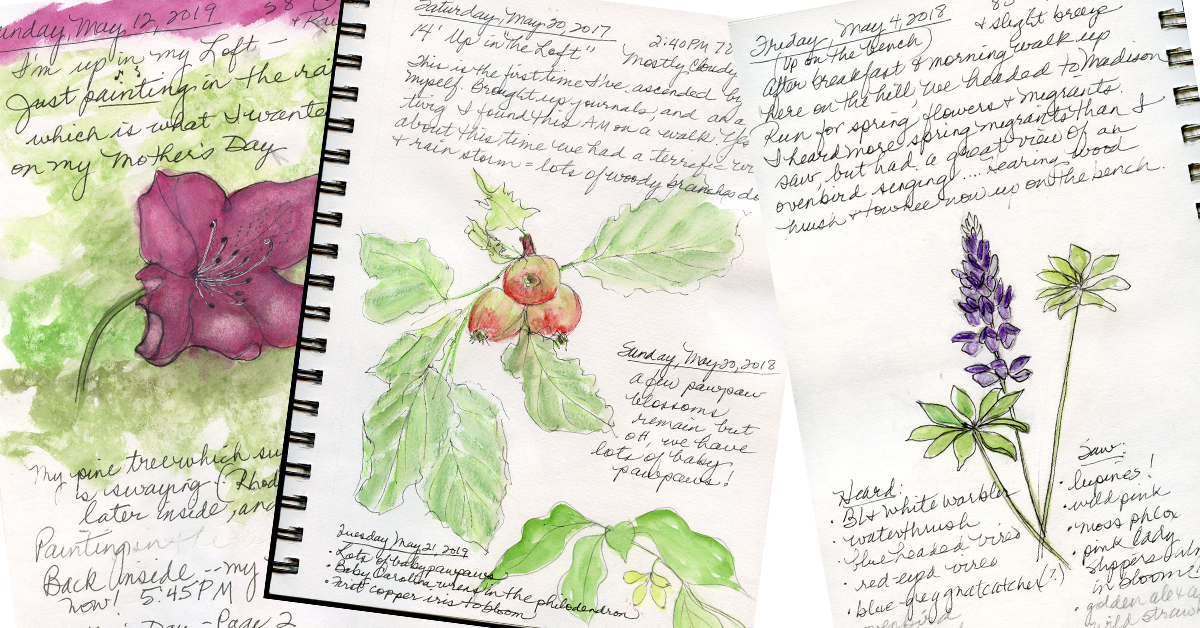
The American Museum of Natural History describes a field journal as being unique to the journalist. “There is no one way to keep a field journal,” they say. “Some scientists will sketch simple pencil drawings, and others will paint colorful, detailed images. You can use whatever tools work best for you. Try working with pens, pencils or watercolors to capture an image, whether it is a view of the Moon, the veins of a leaf, or the legs of a beetle.” You can record your observations with charts, list and labels, sketches, samples and photos. You can also write long, detailed descriptions.

Journal page (image by stowelandtrust.org)

Some questions they come up with to help prompt you include:

  • “What do I see?” Some things to include are: size, shape and color, what it is doing, how it relates to other things, why it is so interesting to you.
  • “Do I see anything that surprises me?”
  • “How have I traveled to this spot?” This is good information for possible later visits, especially if you wish to do a series of related observations.
  • “What tools do I have?” This is good to remember for later visits and to assess the appropriateness of the observation. In most scientific observations, the methods and techniques used are critical to the validity of the observation.
  • “Who is with me on this expedition?” Researchers always include who was there. This helps for later consultation.
  • “What time of day is it?” In the natural sciences time of day is critical because so much in nature is diurnal (e.g., responds and changes as the day changes)
White birch tree with polypore fungus, ON (photo and rendition by Nina Munteanu)

Lynda Richardson at Virginia Wildlife talks about keeping a nature journal, which includes plein air painting and what goes into a field kit.

Page from Lynda Richardson’s nature journal (image by L. Richardson)

Sixteen year old Fiona Gillogly tells the wonderful story of how she started journaling in the “The joy of curiosity in my nature journal.”

Page of Fiona Gillogly’s nature journal (image by F. Gillogly)

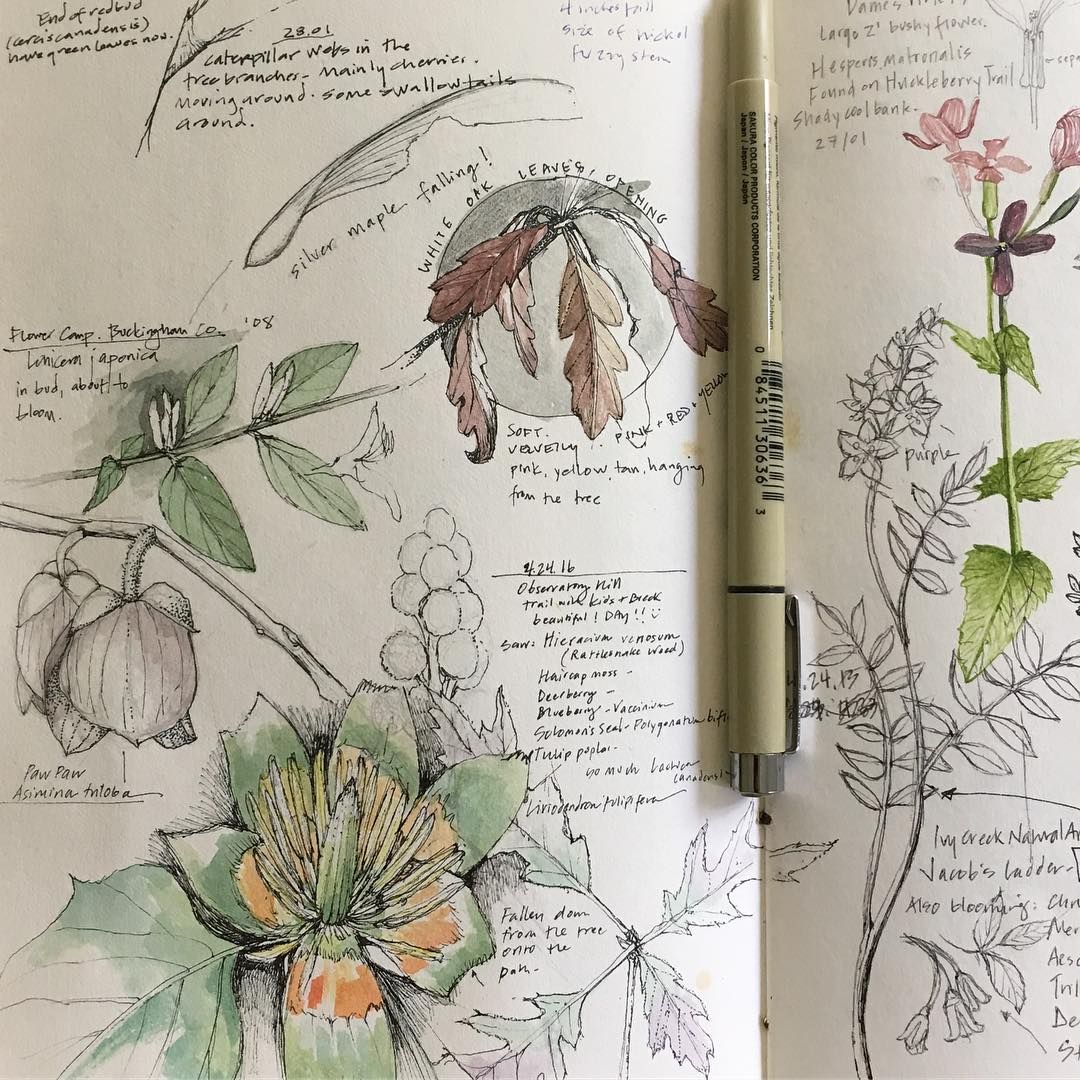
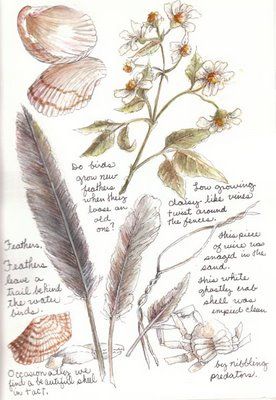
While recently browsing on the Internet, I ran across a very attractive yet simple nature blog. What made Judy Butler’s “Naturalist Journal: Down the Nature Trail” so appealing was her mixed use of regular text augmented with scanned handwritten pages containing color-pencil drawings and flower pressings. This charming “homespun” expression resembled a real three-dimensional journal.

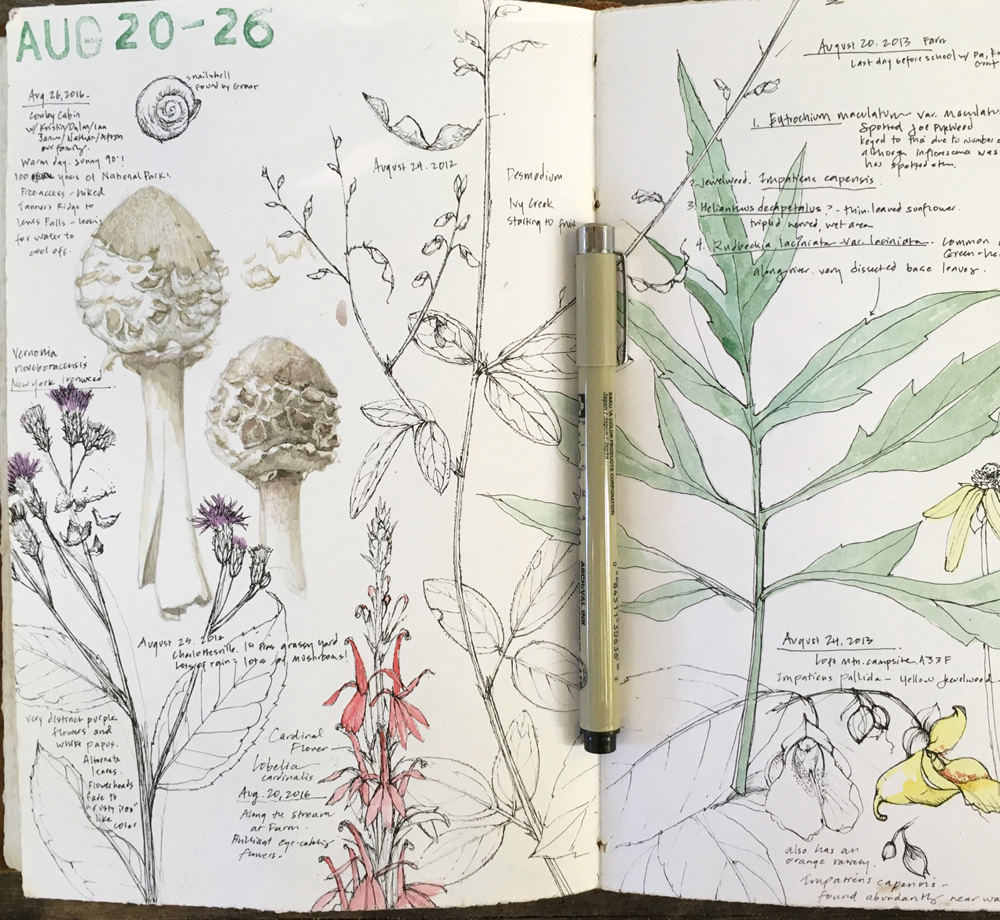
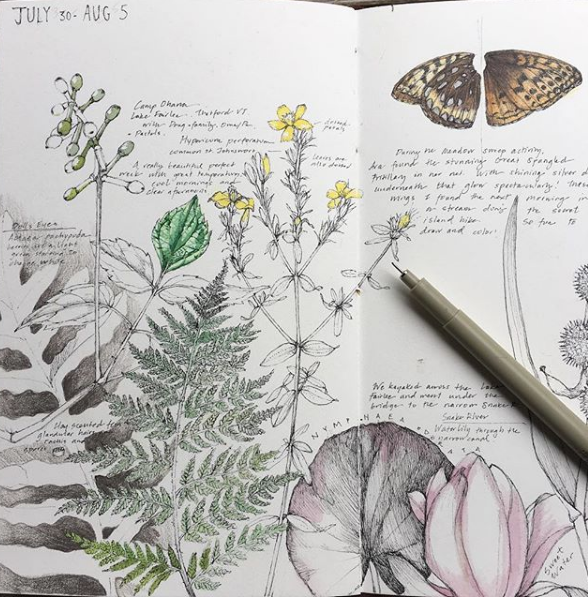
Botanical artist and illustrator Lara Call Gastinger teaches how to maintain a perpetual journal.

Nature Journal page by Lara Call Gastinger
Nature Journal page by Lara Gall Gastinger
Nature Journal page by Lara Call Gastinger

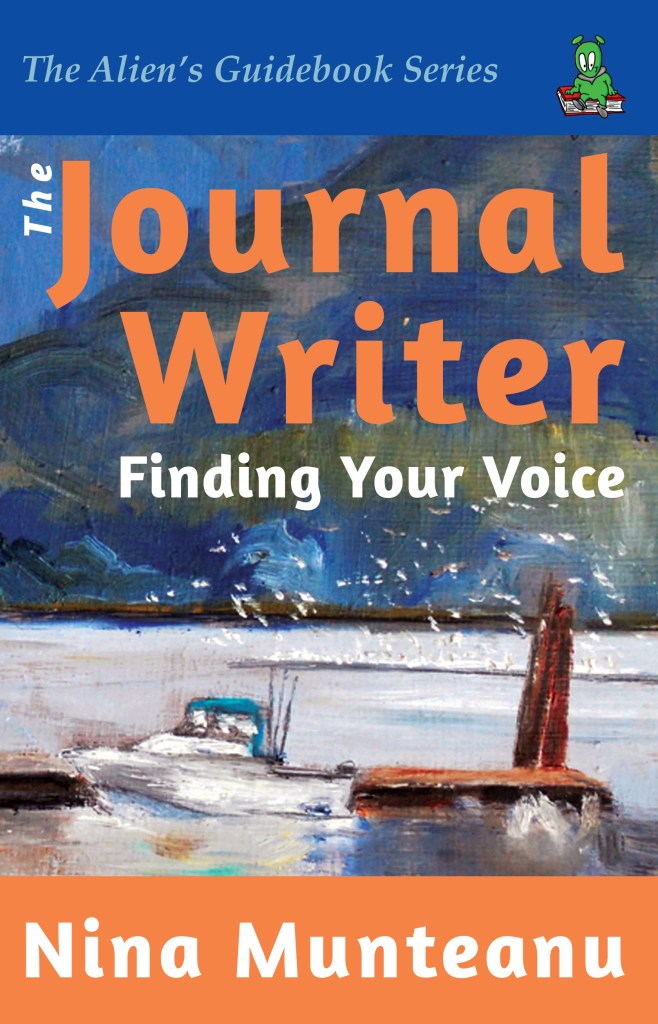
This article is an excerpt from The Journal Writer: Finding Your Voice (Pixl Press, 2013) by Nina Munteanu.

The Journal Writer is the second writing guide in the Alien Guidebook Series. This comprehensive guidebook will help you choose the best medium, style and platform for your expressive writing. The guide provides instruction on issues of safety, using the computer and electronic devices, social media and the internet.

Engaging, accessible, and easily applicable…Brava, Nina, brava.”—David Merchant, Instructor, Louisianna Tech University

Straight up, fact-filled, enriching, joyful and thorough…Nina is honest, she is human and she wants you to succeed.”—Cathi Urbonas, Halifax writer

.

References:

Munteanu, Nina. 2013. “The Journal Writer: Finding Your Voice.” Pixl Press, Vancouver. 170pp.

Nina Munteanu is a Canadian ecologist / limnologist and novelist. She is co-editor of Europa SF and currently teaches writing courses at George Brown College and the University of Toronto. Visit www.ninamunteanu.ca for the latest on her books. Nina’s bilingual “La natura dell’acqua / The Way of Water” was published by Mincione Edizioni in Rome. Her non-fiction book “Water Is…” by Pixl Press(Vancouver) was selected by Margaret Atwood in the New York Times ‘Year in Reading’ and was chosen as the 2017 Summer Read by Water Canada. Her novel “A Diary in the Age of Water” was released by Inanna Publications (Toronto) in June 2020.

How to Structure Your Short Writing—Fiction and Non-Fiction

I recently gave a webinar through the Immigrant Writers Association on how to structure an effective, compelling and meaningful short piece of writing, whether fiction or non-fiction article.

All good writing requires setting up a purposeful narrative that directs the reader seamlessly from the lead hook to the fulfilling conclusion. I went over the process and necessary steps from idea (premise) through introduction/set up (what’s at stake) and development (the journey/theme) toward a fulfilling end (message).

I used two examples (one that needed work and one that was superlative) to explore hooks, paragraphing, overall narrative structure and development, and tips on how language can enhance or detract from compelling story.

Heron in marsh of outlet stream, ON (photo and rendition by Nina Munteanu)

NINA MUNTEANU is a Canadian ecologist / limnologist and novelist. She is co-editor of Europa SF and currently teaches writing courses at George Brown College and the University of Toronto. Visit  www.ninamunteanu.ca for the latest on her books. Nina’s bilingual “La natura dell’acqua / The Way of Water” was published by Mincione Edizioni in Rome. Her non-fiction book “Water Is…” by Pixl Press(Vancouver) was selected by Margaret Atwood in the New York Times ‘Year in Reading’ and was chosen as the 2017 Summer Read by Water Canada. Her novel “A Diary in the Age of Water” was released by Inanna Publications (Toronto) in June 2020.

What is Eco-Fiction and Why Should We Care?

Sample of eco-fiction publications Nina contributed as author or editor
“What is Eco-Fiction and Why Should We Care?”

In 2019, at the When Words Collide writer’s conference in Alberta, I participated in a panel on eco-fiction. The panel, consisting of Alex Reissen, Merilyn Ruth Liddell, Claudiu Murgan, Nina Munteanu, and moderated by Canadian speculative author Candas Jane Dorsey, discussed what eco-fiction is, what it means to its writers and its readers and why it’s an important genre of literature. How, for instance can eco-fiction writers influence our audience to engage in helping the planet and humanity, in turn? How can we do it without turning to the polemic of non-fiction? We discussed the importance of “storytelling”, bringing in characters to care about, making the global experience (and issue) personal. Essentially dramatizing the premise.

Candas described fiction writers as “sneaky,” exploring the issue (and message) through context and setting with a focus on character journey. This includes use of sub-text and subtleties embodied by individuals. I mentioned treating the environment as a character—a character to care about.

We explored several areas in which writers could elucidate ways to engage readers for edification, connection and participation. We discussed optimism, new perspectives, and envisioning our future.

“Science doesn’t tell us what we should do,” Barbara Kingsolver wrote in Flight Behavior. “It only tells us what is.” Stories can never be a solution in themselves, but they have the capacity to inspire action.

Cedar pine forest during winter snow, Jackson Creek Park, ON (photo and rendition by Nina Munteanu)

“People need such stories, because however dark, a darkness with voices in it is better than a silent void.”

Margaret Atwood, Maddaddam

Nina Munteanu is a Canadian ecologist / limnologist and novelist. She is co-editor of Europa SF and currently teaches writing courses at George Brown College and the University of Toronto. Visit www.ninamunteanu.ca for the latest on her books. Nina’s bilingual “La natura dell’acqua / The Way of Water” was published by Mincione Edizioni in Rome. Her non-fiction book “Water Is…” by Pixl Press(Vancouver) was selected by Margaret Atwood in the New York Times ‘Year in Reading’ and was chosen as the 2017 Summer Read by Water Canada. Her novel “A Diary in the Age of Water” was released by Inanna Publications (Toronto) in June 2020.

Embracing Simplicity as an Interbeing

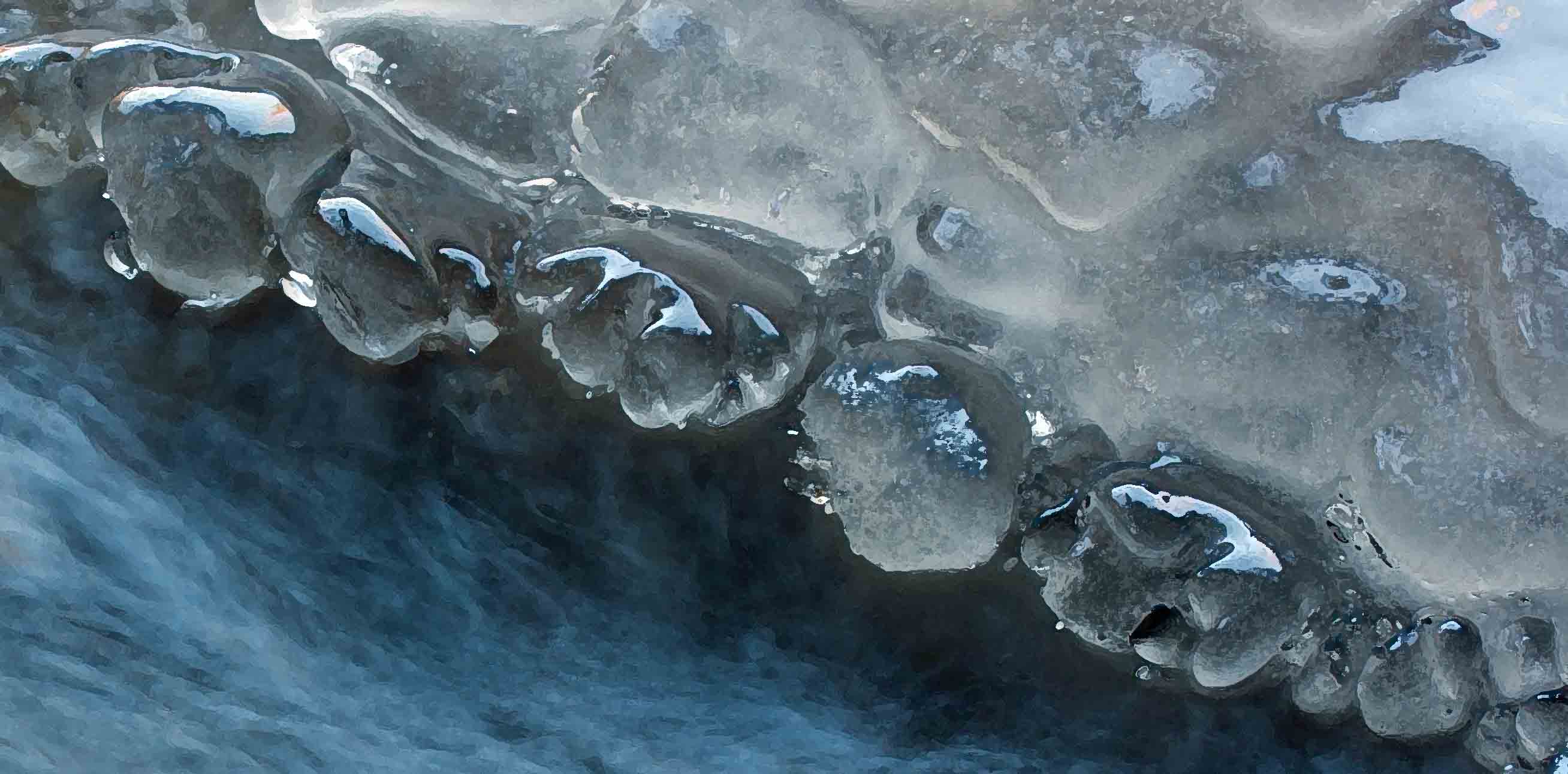
Ice ‘pearls’ forming in Jackson Creek, ON (photo and rendition by Nina Munteanu)

I’m a writer and aside from putting out the odd novel and short story, I teach writing for a living.

I teach online courses and tutor students at various writing centres at the University of Toronto on scientific and scholarly writing. I coach fiction writers of novels and short stories to publication. I help writers all over the world achieve clear, accurate, and compelling narrative, whether it’s fiction or non-fiction. I do this by focussing on the clarity and direction of narrative. The key to good narrative and good storytelling—whether it is a historical fantasy or a scholarly essay—is simplicity. Ernest Hemmingway knew that. His writing emulated simple and became profound.

The best writing can take something complex and express it simply. Just as with valid scientific theory (recall Einstein’s ‘simple’ and elegant theory of relativity, E=mc2), effective communication embraces complexity through simple expression and resonates with accuracy and power. Embracing complexity through simplicity is achieved through metaphor, key images and symbols that encompass an entire culture or thought.

If I were to write, “Jack’s office was a prison cell,” you’d have a good idea of what Jack’s office was like. In five simple words the concept and its emotional associations are clearly conveyed. This is because we all have a clear idea of what a prison cell is like. Yours may not be the same imagined prison cell as mine, but the metaphor works as effectively. It’s that simple.

Lately, I’ve taken the lesson of simplicity into my life decisions.

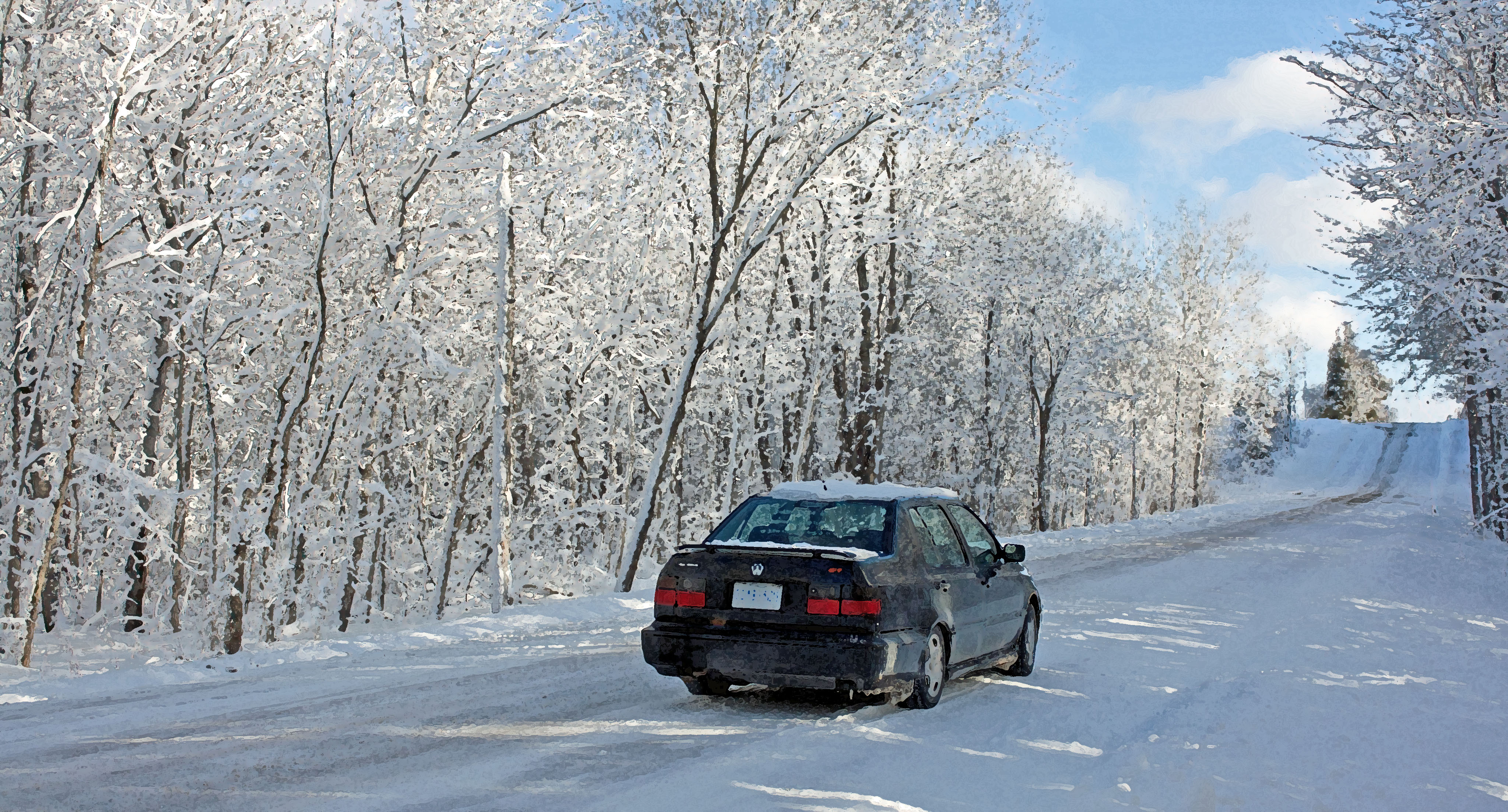
My car on a country road through a snow-covered forest, ON (photo and rendition by Nina Munteanu)

For the past ten years or so, I’ve become a bit of a nomad. After bringing up my family, I left my marriage nest in British Columbia, divested myself of virtually all my possessions (what I own fits in my car—a 1998 Jetta), and traveled across Canada from the west coast to the east coast and Nova Scotia. I lived in Lunenburg and Mahone Bay for several years, spent some time in Toronto, and am currently living in the Kawartha Region of Ontario. Before COVID-19, I travelled the world, through the United States, much of Europe, parts of Africa and Asia and Australia.

What I learned during my travels is that a person doesn’t need that much to live a full life. My health. A safe place to sleep. Food. Adventure for my curious mind. Purpose and meaning (something to live for): good people to love and share my adventures with and a way to feel that I am helping to make this a better world.

Living a simple life helps me find focus, meaning and joy.

In her article in YES! Magazine, Megan Sweas writes that “living simply can help us challenge society’s inequities, live in alignment with nature, and build community.” Sweas argues that a simple lifestyle is an ethical choice: “living simply so that others may simply live.” As the saying credited to Gandhi goes.

Vietnamese Zen Buddhist teacher and author of more than 100 books, Thich Nhat Hanh celebrates 94th birthday (Contributed by Don Farber)

Cultivating the Insight of Interbeing

Buddhist Zen master Thich Nhat Hanh coined the term “interbeing” to describe our interconnectedness. In a 2017 article entitled “The Insight of Interbeing,” Hanh described his experience:

“About thirty years ago I was looking for an English word to describe our deep interconnection with everything else. I liked the word “togetherness,” but I finally came up with the word interbeing. The verb “to be” can be misleading, because we cannot be by ourselves, alone. “To be” is always to “inter-be.” If we combine the prefix “inter” with the verb “to be,” we have a new verb, “inter-be.” To inter-be and the action of interbeing reflects reality more accurately. We inter-are with one another and with all life.

human bodies are ‘shared, rented, and occupied’ by countless other tiny organisms, without whom we couldn’t ‘move a muscle, drum a finger, or think a thought.’ Our body is a community, and the trillions of non-human cells in our body are even more numerous than the human cells. Without them, we could not be here in this moment. Without them, we wouldn’t be able to think, to feel, or to speak. There are, he says, no solitary beings. The whole planet is one giant, living, breathing cell, with all its working parts linked in symbiosis.”

Thich Nhat Hanh

Hanh drew the analogy of a piece of paper to make his point about interbeing:

“If you are a poet, you will see clearly that there is a cloud floating in this sheet of paper. Without a cloud, there will be no rain; without rain, the trees cannot grow; and without trees, we cannot make paper. The cloud is essential for the paper to exist. If the cloud is not here, the sheet of paper cannot be here either. So we can say that the cloud and the paper inter-are…If we look into this sheet of paper even more deeply, we can see the sunshine in it. If the sunshine is not there, the forest cannot grow. In fact, nothing can grow. Even we cannot grow without sunshine. And so, we know that the sunshine is also in this sheet of paper. The paper and the sunshine inter-are. And if we continue to look, we can see the logger who cut the tree and brought it to the mill to be transformed into paper. And we see the wheat. We know the logger cannot exist without his daily bread, and therefore the wheat that became his bread is also in this sheet of paper. And the logger’s father and mother are in it too.”

Thich Nhat Hanh

We inter-are. “Everything relies on everything else in the cosmos in order to manifest—whether a star, a cloud, a flower, a tree, or you and me,” said Hanh.

Hanh argued that this all starts with mindfulness. Mindfulness is rooted in Buddhist meditation. Practicing mindfulness helps us live a fuller and happier life; we become fully focused on the present moment, not absorbed in regrets, plans, worries or other thoughts. When we practice mindfulness we create more stillness which allows us to see more clearly what brings us happiness and what causes suffering. With this awareness, we can make positive choices in everyday life.

Those who practice mindfulness and contemplate interbeing seek “to protect life, practice generosity, love responsibly, speak lovingly, and listen deeply, as well as consume in a way that preserves peace, joy, and wellbeing in oneself, others, and the Earth,” said Hanh. He added that “understanding how their own consumption—of a burger, a glass of wine, Facebook, or gossip—causes harm is what spurs them to give up such ‘toxins’ and consume less.”

To live more simply is to live more lightly on this beautiful planet. And that’s a story worth reading…

The creek’s thalweg reveals itself as the creek ice melts, ON (photo and rendition by Nina Munteanu)

Nina Munteanu is a Canadian ecologist / limnologist and novelist. She is co-editor of Europa SF and currently teaches writing courses at George Brown College and the University of Toronto. Visit www.ninamunteanu.ca for the latest on her books. Nina’s bilingual “La natura dell’acqua / The Way of Water” was published by Mincione Edizioni in Rome. Her non-fiction book “Water Is…” by Pixl Press(Vancouver) was selected by Margaret Atwood in the New York Times ‘Year in Reading’ and was chosen as the 2017 Summer Read by Water Canada. Her novel “A Diary in the Age of Water” was released by Inanna Publications (Toronto) in June 2020.

Interview with Author Simon Rose on “The Stone of the Seer”

Calgary author Simon Rose has published eighteen novels for children and young adults, eight guides for writers, more than a hundred nonfiction books, and many articles on a wide variety of topics. Simon has agreed to talk to me about his latest release, The Stone of the Seer, the first novel in the Stone of the Seer series.

Here’s my interview with Simon:

Nina: What’s the new series all about?

Simon: The Stone of the Seer is an exciting historical fantasy series of adventure novels for young adults, primarily set in the turbulent period of the English Civil War.

The Stone of the Seer, book one in the series, features the Vikings, Leonardo da Vinci, and the political turmoil of the 1640s. At Habingdon House, Lady Elizabeth Usborne, Kate, and Tom encounter a magical black stone, mysterious ancient manuscripts, and the incredible time viewing device known as the tempus inpectoris, all while under constant threat from the murderous witchfinder, Daniel Tombes.

The other novels in the series are Royal Blood and Revenge of the Witchfinder, which will be published in the coming months. There will be a box set including all three novels at some point in the future as well.

Nina: What’s the story behind the story?

Simon: The story, main characters, and some of the settings in The Stone of the Seer are fictional but are based on true events and the story features real historical characters, such as King Charles I. The English Civil War was a series of conflicts in England, Scotland, and Ireland in the 1640s and early 1650s. The war originated in the struggle between Charles I and Parliament, regarding how the country should be governed.

The king’s defeat in the civil war led to his trial and execution in January 1649. The monarchy was abolished and replaced first by the Commonwealth of England and then the Protectorate, before the monarchy was restored in 1660. However, the defeat of Charles I confirmed that an English monarch could not rule the country without the consent of Parliament, although this wasn’t legally established until the Glorious Revolution in 1688.

Nina: You must have done quite a lot of historical research for this book.

Simon: Yes, it’s a time period I’ve always been interested in, but it still involved considerable research. I’ve included a glossary at the end of each of the three novels in the series where you can learn more about the historical events, settings, and leading characters from the English Civil War, locations that are mentioned in the text, life in the seventeenth century, and details from other historical periods that are featured in the story. There’s also a page on my website all about the historical background behind the books, with links to online sources about the time period.

Nina: What are you currently working on?

Simon: I always have a current project or two and right now I’m writing another historical fantasy novel series set in World War II. I’m also working on sequels to the Flashback series of paranormal novels, which includes Flashback, Twisted Fate, and Parallel Destiny, which you can learn more about on my website at simon-rose.com. In addition, I’m working on screenplay adaptations of the Shadowzone series and have also completed a number of picture books for younger readers, which I hope will be published soon.

Nina: You also work with other authors, don’t you?

Simon: Yes, I do quite a lot of that these days. I provide coaching, editing, consulting, and mentoring services for writers of novels, short stories, fiction, nonfiction, biographies, inspirational books, and in many other genres. I also work as a writing instructor at the University of Calgary and have served as the Writer-in-Residence with the Canadian Authors Association. You can find details of some of the projects I’ve worked on, along with some references and recommendations, on my website.

Nina: Where can people buy The Stone of the Seer?

Simon: The novel can be purchased at most of the usual places, as follows:

Ebook: Amazon CanadaAmazon USAKoboiBooksBarnes and NobleSmashwords 

Paperback: Amazon Canada, Amazon USA

Thanks Simon, for being my guest here today and the very best of luck with the Stone of the Seer series. I hope the first book sells thousands of copies in the coming weeks and months.

You can learn more about Simon and his work on his website at www.simon-rose.com, where you can also link to his social media sites and other locations online.

The Otonabee River glinting on a sunny winter day, ON (photo and rendition by Nina Munteanu)

My Story … And My Dream

Nina, age four, pretending to read, Granby, Quebec (photo by Maria Munteanu)

I started writing and drawing as soon as I could hold a pencil. Even before I could read, I wanted to become a “paperback writer” like in the old Beatles song.

It was an incredible moment of clarity for me and despite being challenged by my stern and unimaginative primary school teacher, who kept trying to corral me into being “normal”, I wasn’t going to let anyone stem my creativity and eccentric — if not wayward — approach to literature, language and writing. I was a little brat and I knew it. She and I didn’t exactly get along. But I did okay and, despite her acidic commentary, Miss House awarded me some A’s and B’s…

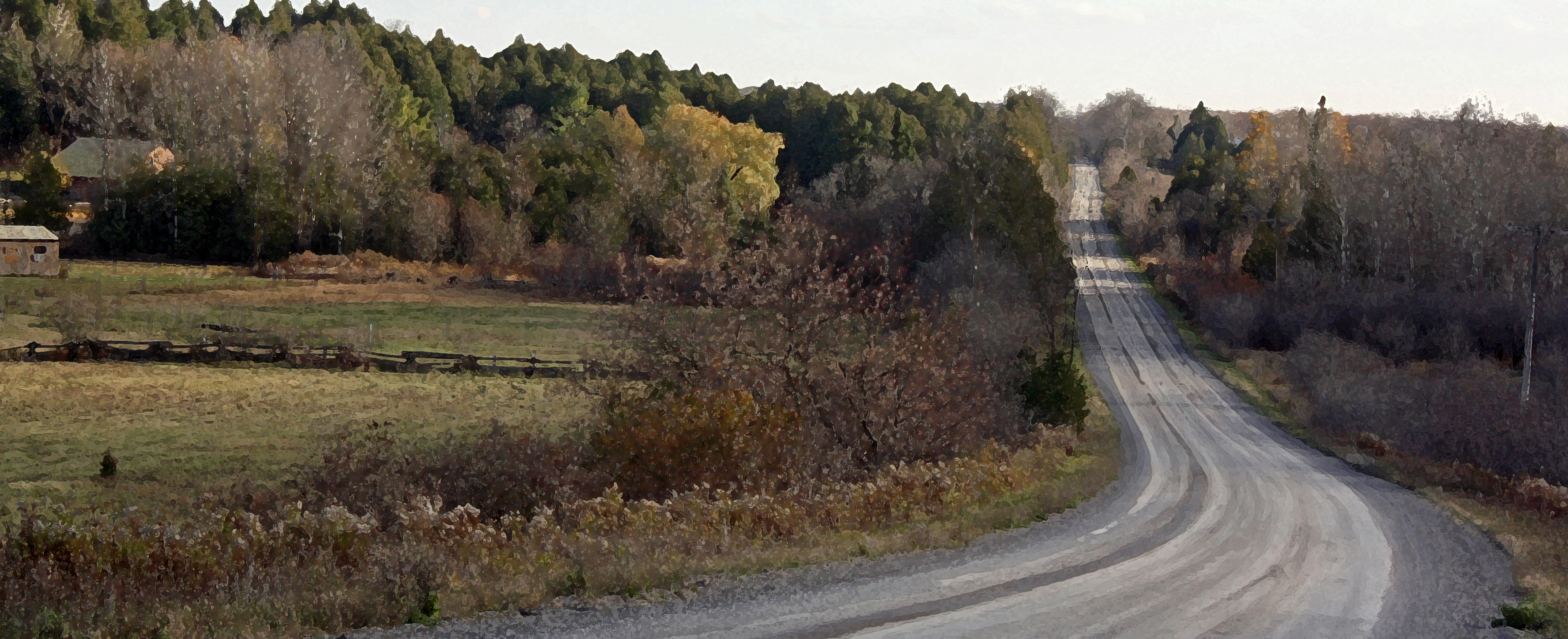
Country road in late fall, ON (photo and rendition by Nina Munteanu)

I wrote some fan fiction but quickly found my own creations far more interesting and less limiting.

As a teenager, I wrote, directed and recorded “radio plays” with my sister. When we weren’t bursting into riotous laughter, it was actually pretty good. She and I shared a bedroom in the back of the house and at bedtime we opened our doors of imagination to a cast of thousands. We fed each other wild stories of space travel, adventure and intrigue, whispering and giggling well into the dark night, long after our parents were snoring in their beds.

Those days scintillated with liberating originality, excitement and joy.

(Photo: Nina Munteanu and sister Doina Maria Munteanu at Grouse Mountain, BC)

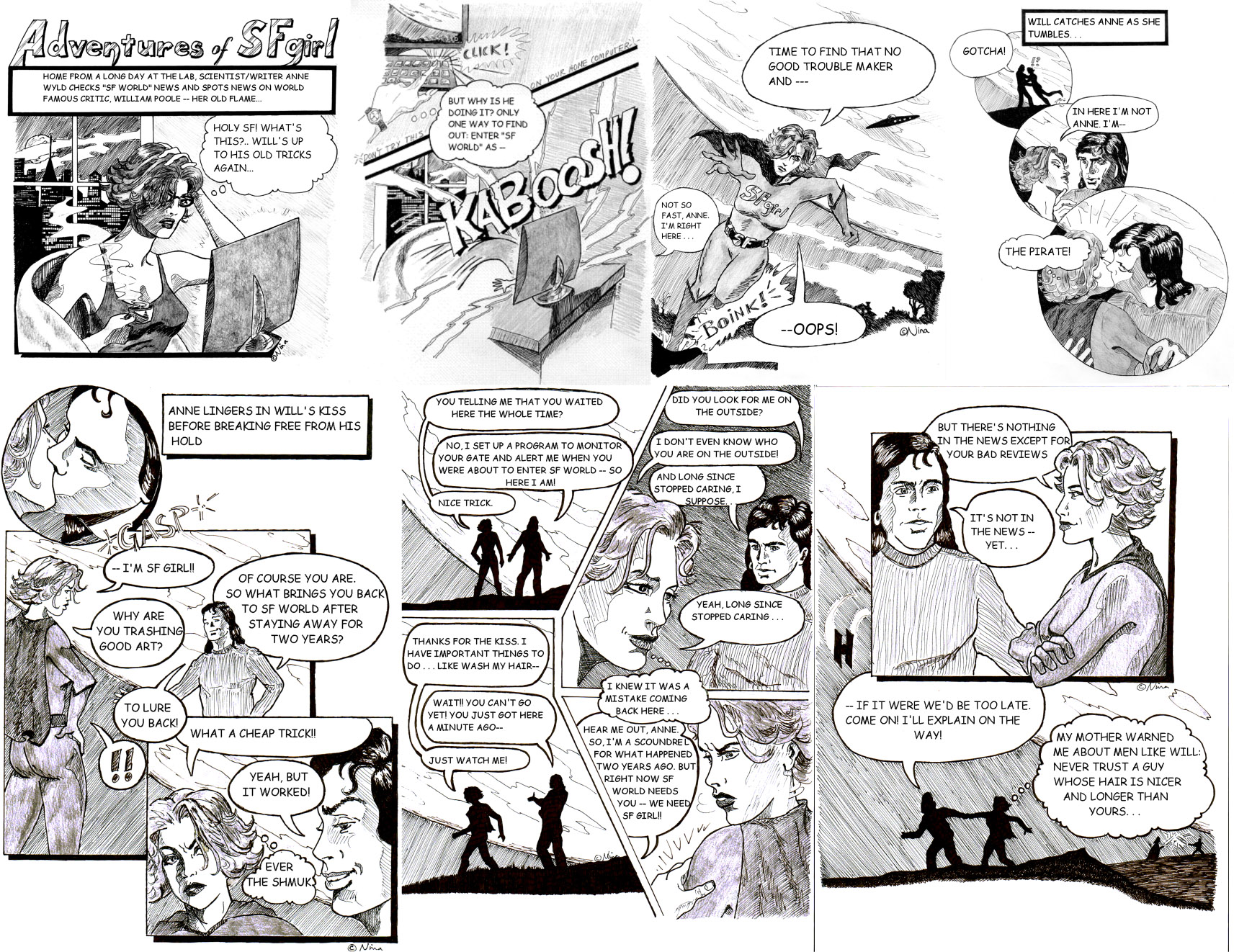
My first attempt at a graphic novel (pencil and ink drawings by a very young Nina)

I also enjoyed animation and drew several cartoon strips, peopled with crazy characters. I dreamt of writing graphic novels like Green Lantern and Spiderman. My hero was science fiction author and futurist, Ray Bradbury; I vowed to write profoundly stirring tales like he did.

I had found what excites me — my passion for telling stories—and I’d inadvertently stumbled upon an important piece of the secret formula for success: 1) having discovered my passion, I decided on a goal; 2) I found and wished to emulate a “hero” who’d achieved that goal and therefore had a “case study”; 3) I applied myself to the pursuit of my goal. Oops … the third one, well … it went downhill from there … Life got in the way.

The Beeches area of Toronto after a heavy snowstorm, ON (photo and rendition by Nina Munteanu)

I grew up.

Well, that, and the environment intervened. In several ways. It started with my parents. Recognizing my talent and interest in the fine arts (I was good in visual arts), they pushed me to get a fine arts degree in university and go into teaching or advertizing. They didn’t see fiction writing as a viable career or a strength of mine (I was lousy at spelling and, despite my ability to tell stories and my love for graphic novels, I didn’t read books much). I can still remember my father’s lecture to me about how perfect the teaching or nursing profession was for me. I wasn’t enamored by either. The second blow to my author-ego came in the form of a school “interest-ability” test, meant to prepare us for our career decisions. I remember the test consisting of an IQ portion (spatial, English and math), and a psychology portion (including problem-solving and scenarios meant to tease out our affinity for a particular career). Secretly harboring my paperback novelist dream, I filled out my forms with great excitement. I still remember the deflating results, which suggested that I was best suited to be a sergeant in the army. “Writing” as a career barely made it on the graph, and scored well below “computer programmer” and “mechanic”; none of which interested me. 

Country road in a heavy snow, ON (photo and rendition by Nina Munteanu)

I got involved in the environmental movement, while quietly holding my dream of being a paperback novelist close to my heart. I got several degrees in ecology and consulted for various companies to help protect the environment. I wrote a lot in those days, although it was more about the ecology of creeks and about industrial pollution. But my passion for writing fiction continued to simmer. Magazines started publishing my articles—my first sale was to Shared Vision Magazine in 1995 on environmental citizenship—and my published articles became my entrance into the world of fiction. Once I began publishing fiction stories—my first short fiction sale was “Arc of Time” to Armchair Aesthete in 2002—I never looked back.

Eventually, I was publishing a novel and several short stories every year. My fiction most often focused on environmental issues, humanity’s relationship with the natural world, and how we reconcile our reliance on technology with our respect for the natural world.

Publications of long or short eco-fiction that include my writing or editing

Throughout my writer’s journey, and particularly early in my journey, I weathered the threshold guardians, tricksters and shadows: friends and family who called what I did a hobby, something I did just to pass the time; people who didn’t believe in me, envied my drive or simply thought I was wasting my time; even industry scammers who preyed on my dreams and wanted my money for nothing in return; and ultimately my own fears and frustrations on query after query and rejection after rejection. Throughout it all, I never stopped dreaming.

Nina’s family hiking and boating in British Columbia over the years

I’ve travelled through Europe, Africa, parts of Asia, and Australia. I raised a family and lived all over Canada from the Pacific to the Atlantic coast. I worked as a barista, shopkeeper and science lab instructor, then as environmental consultant, writing instructor and writing coach.  During these wonderful life-adventures, I never stopped writing. 

Nina Munteanu in the castle at Gruyères, Switzerland (photo by Jane Raptor)

To date, I have written and sold over three dozen eco-fiction, science fiction and fantasy novels, non-fiction books, short stories and articles. I have sold short stories to magazines in Canada and the U.S. with translations and reprints in Israel, Poland, Greece, and Romania. My short fiction has appeared in Neo-Opsis Science Fiction Magazine, Chiaroscuro, subTerrain, Apex Magazine, Metastellar, and several anthologies. I’ve seen my short stories nominated for the Aurora Prix Award (Canada’s premier award for writing science fiction and fantasy) and the Foundation of Speculative Fiction Fountain Award. Recognition for my work includes the Midwest Book Review Reader’s Choice Award, finalist for Foreword Magazine’s Book of the Year Award, the SLF Fountain Award, and The Delta Optimist Reviewers Choice Award.  

Nina celebrates her adventures in Toronto (left) and Paris (right)

I’ve published nine novels so far with nominations for the Aurora Prix, Foreword Magazine Book of the Year (several times), and various Reader’s Choice awards.  My non-fiction book “Water Is…” (Pixl Press)—a scientific study and personal journey as limnologist, mother, and teacher—was Margaret Atwood’s pick in 2016 in the New York Times ‘The Year in Reading.’ My recent eco-novel released in 2020 by Inanna PublicationsA Diary in the Age of Water“—about four generations of women and their relationship to water in a rapidly changing world—was a silver medalist for the Literary Titan Award, the Bronze winner of Foreword Magazine’s Book of the Year in 2020, longlisted for the Miramichi Review’s ‘Very Best Book of the Year Award,’ and a finalist for the 2021 International Book Award. Reviewers have described it as “lyrical…thought-provoking…unique and captivating…insightful…profound and brilliant…unsettling and yet deliciously readable…” One reviewer described it as a “a bit of a hybrid” and the writer “a risk taker”—which I quite liked. Another reviewer acknowledged that this was not a book for everyone and yet she found it “strangely compelling.”—which I found delicious.

It’s been twenty-seven years since I seriously started my writing career with my first publication in 1995; my work is now recognized and translated throughout the world and I frequently get writing commissions from reputable magazines and publications. I am also frequently invited for speaking engagements and radio/podcast/TV interviews about my science and my writing. In short, I’ve come home; I’d taken a rather long detour but I’ve acquired some tools along the way. It’s been and continues to be a wonderful and exciting journey; and part of what made it so was that I never stopped dreaming and writing.

“…If you have nothing at all to create, then perhaps you create yourself…”

Carl Jung
A sampling of literary publications up to 2021-end that have included something of mine (short fiction, long fiction, non-fiction)
Two people walk through snowy path after a fresh heavy snowfall, ON (photo and rendition by Nina Munteanu)

Nina Munteanu is a Canadian ecologist / limnologist and novelist. She is co-editor of Europa SF and currently teaches writing courses at George Brown College and the University of Toronto. Visit www.ninamunteanu.ca for the latest on her books. Nina’s bilingual “La natura dell’acqua / The Way of Water” was published by Mincione Edizioni in Rome. Her non-fiction book “Water Is…” by Pixl Press(Vancouver) was selected by Margaret Atwood in the New York Times ‘Year in Reading’ and was chosen as the 2017 Summer Read by Water Canada. Her novel “A Diary in the Age of Water” was released by Inanna Publications (Toronto) in June 2020.
“Virtually Yours” Reprinted in Speculative North Issue #6

Nina Munteanu with her copy of Speculative North, Issue #6

My speculative short story “Virtually Yours” was published for the eighth time, most recently in December 2021 in Speculative North, Issue #6. Originally published in Issue #15 of Hadrosaur Tales in 2002, the story explores concepts of cyber-spying, virtual workspace, anonymity, and identity.

A short excerpt follows below.

You can find the short story’s publication history in the Publications page on this site. You can see some of the main publications below. The story was translated into Polish and published by Nowa Fantastyka in 2006.

A selection of publications in which “Virtually Yours” appears from 2002 to 2021
Illustration by Duncan Long for the Amazing Stories publication of “Virtually Yours”
Snow-covered shrub after new snow in mid-winter, ON (photo and rendition by Nina Munteanu)

Nina Munteanu is a Canadian ecologist / limnologist and novelist. She is co-editor of Europa SF and currently teaches writing courses at George Brown College and the University of Toronto. Visit www.ninamunteanu.ca for the latest on her books. Nina’s bilingual “La natura dell’acqua / The Way of Water” was published by Mincione Edizioni in Rome. Her non-fiction book “Water Is…” by Pixl Press(Vancouver) was selected by Margaret Atwood in the New York Times ‘Year in Reading’ and was chosen as the 2017 Summer Read by Water Canada. Her novel “A Diary in the Age of Water” was released by Inanna Publications (Toronto) in June 2020.

The Journal Writer: Benefits of Expressive Writing

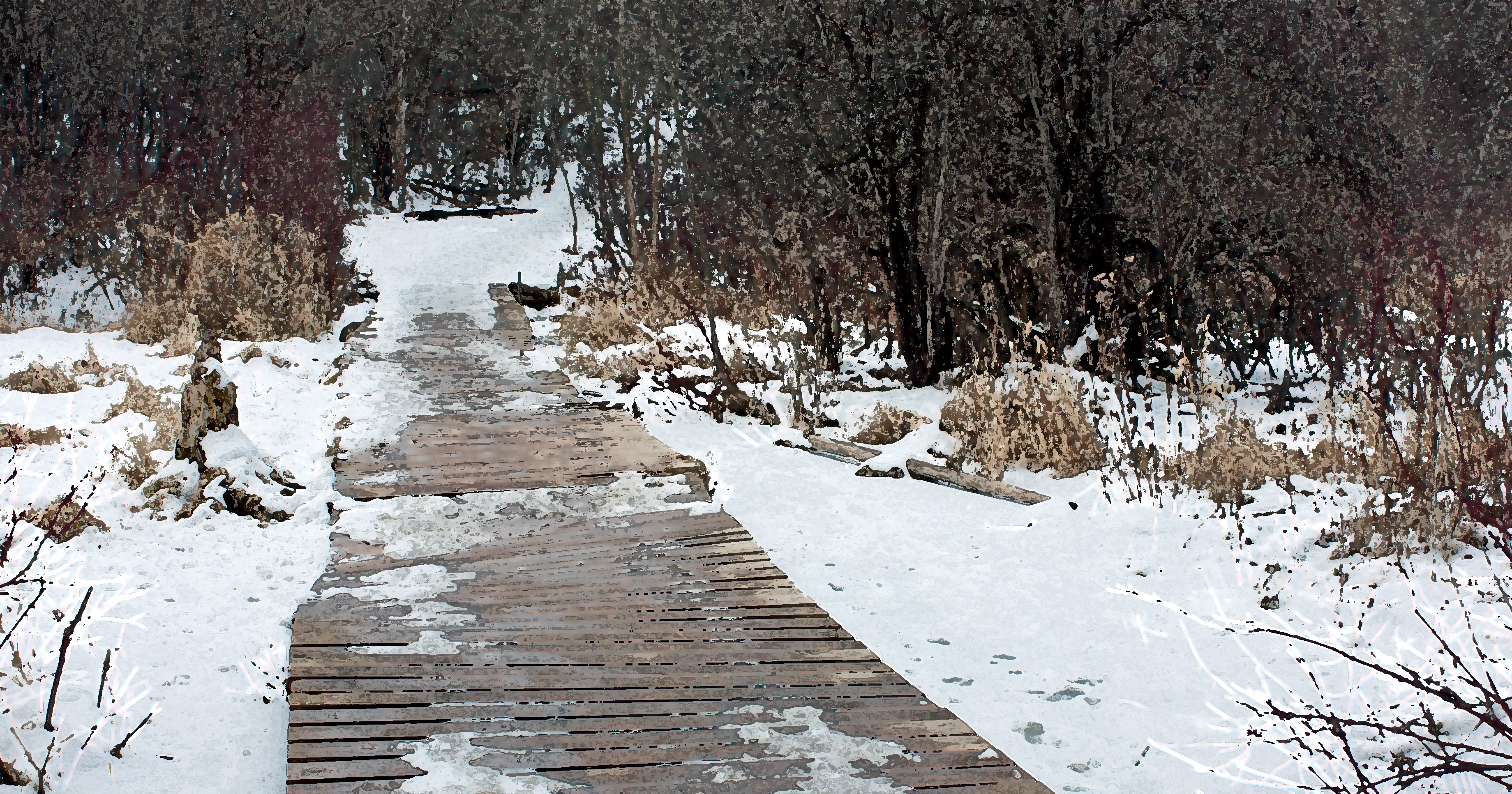
Boardwalk through marsh in a swamp forest, ON (photo and rendition by Nina Munteanu)

The creation of something new is not accomplished by the intellect but by the play instinct acting from inner necessity. The creative mind plays the objects it loves

Carl Jung

You don’t have to take my word for it or that of my writing colleagues either. Psychologists, neuroscientists and other researchers have revealed health and emotional benefits of expressive writing. The meditative action of handwriting alone has proven beneficial. Think of the poetry of laying down an intelligent pattern over a surface: the subtle “prayer” of pen to paper to the renewal of self-discovery.

Over the past 20 years, a growing body of literature has shown beneficial effects of writing about traumatic, emotional and stressful events on physical and emotional health. For instance, researchers have shown that college students writing about their deepest thoughts and feelings for only 15 minutes over 4 consecutive days experienced significant health benefits four months later (Pennebaker & Beall, 1986). Table 1 summarizes some of the long-term benefits of expressive writing.

TABLE 1: Long-Term Benefits of Expressive Writing
HealthSocial & Behavioral
Fewer stress-related visits to the doctorReduced absenteeism from work
Improved immune system functioningQuicker re-employment after job loss
Reduced blood pressureImproved working memory
Improved lung functionImproved sporting performance
Improved liver functionHigher student’s grade point average
Fewer days in hospitalAltered social and linguistic behavior
Greater psychological well-being 
Reduced depressive symptoms 
Fewer post-traumatic intrusion and avoidance symptoms 
Reference: Baikie & Wilhelm, 2005 

DeSalvo shares something a friend of hers confided to her: “Why is it that I always get sick after I finish a book, and not while I’m writing? Crazy as it sounds,” she concluded, “it must be that writing keeps me healthy.” Although writing can’t cure us, some studies suggest that it might prolong our lives, says DeSalvo. It can help us “to accomplish that shift in perspective marked by acceptance, authenticity, depth, serenity and wisdom that is the hallmark of genuine healing.”

Expressive writing produces significant benefits for people with a variety of medical problems. Some of the major ones appear in Table 2 below.

TABLE 2: Medical Conditions Benefiting from Expressive Writing
Lung functioning in ASTHMA
Disease severity (improvements in joint stiffness) in RHEUMATOID ARTHRITIS
Pain and physical health in CANCER
Immune response in HIV Infection
Hospitalisations for CYSTIC FIBROSIS
Pain intensity in women with CHRONIC PELVIC PAIN
Sleep-onset latency in POOR SLEEPERS
Post-operative course
Reference: Baikie & Wilhelm, 2005
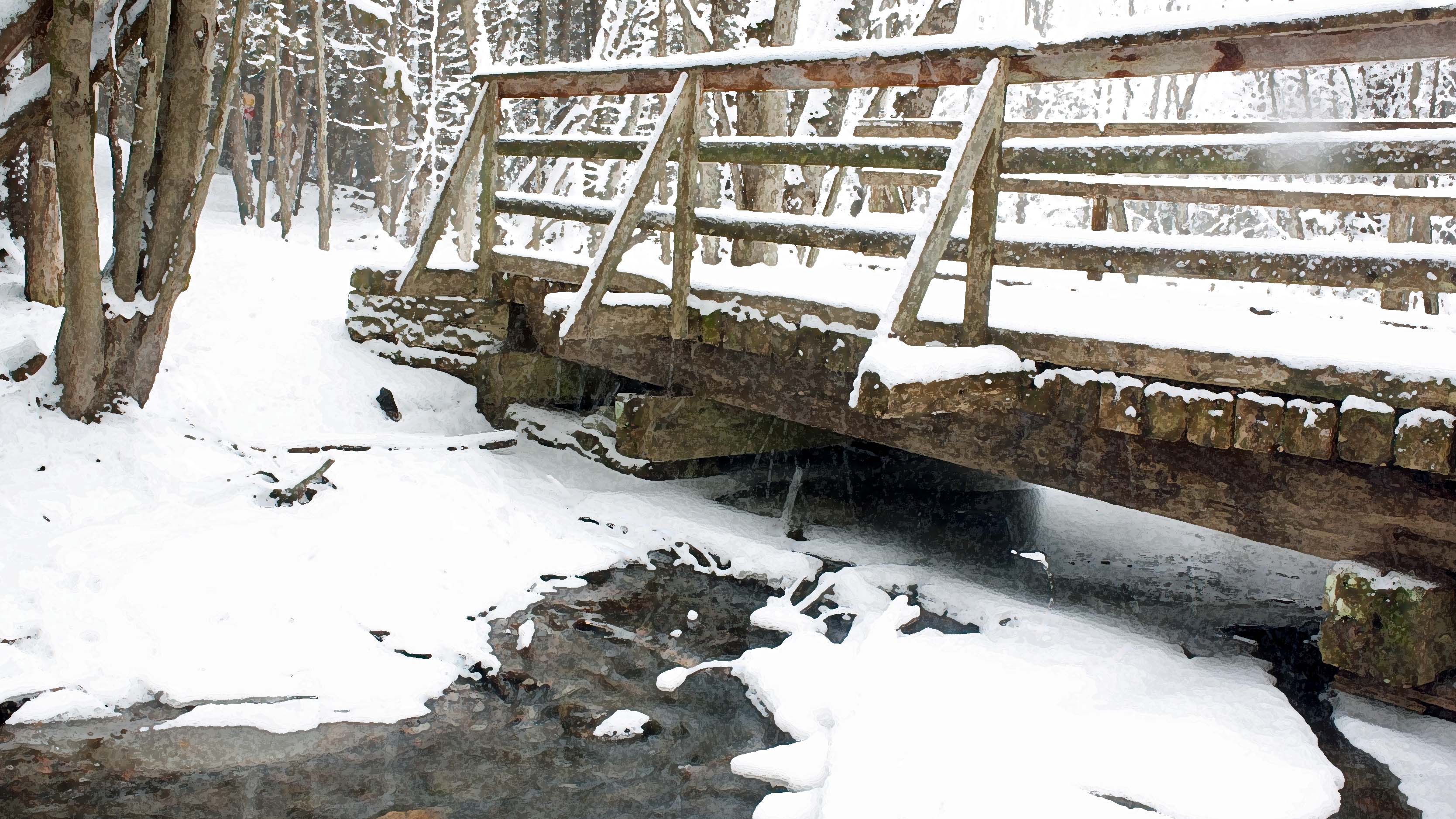
Wooden bridge over creek in a forest park, ON (photo and rendition by Nina Munteanu)

This article is an excerpt from The Journal Writer: Finding Your Voice (Pixl Press, 2013) by Nina Munteanu.

The Journal Writer is the second writing guide in the Alien Guidebook Series. This comprehensive guidebook will help you choose the best medium, style and platform for your expressive writing. The guide provides instruction on issues of safety, using the computer and electronic devices, social media and the internet.

Engaging, accessible, and easily applicable…Brava, Nina, brava.”—David Merchant, Instructor, Louisianna Tech University

Straight up, fact-filled, enriching, joyful and thorough…Nina is honest, she is human and she wants you to succeed.”—Cathi Urbonas, Halifax writer

1.7  References

Baikie, Karen & Kay Wilhelm. 2005. “Emotional and physical health benefits of expressive writing.” Advances in Psychiatric Treatment. 11: 338-346.

DeSalvo, Louise. 1999. “Writing as a Way of Healing: How Telling Our Stories Transforms Our Lives.” Beacon Press, Boston. 226pp.

Hieb, Marianne. 2005. “Inner Journeying Through Art-Journaling”. Jessica Kingsley Publishers, London, England. 176pp.

Holly, Mary Louise. 1989. “Writing to Grow. Keeping a personal-professional journal”. Heinemann. Portsmouth, New Hampshire.

Klug, Ron. 2002. “How to Keep a Spiritual Journal: a guide to journal keeping for inner growth and personal discovery.” Augsburg, Minneapolis, 4th ed.

Moon, Jennifer. 1999. “Learning Journals: A handbook for academics, students and professional development”. Kogan Page. London.

Pennebaker, James. W. 1990. “Opening Up: The Healing Power of Confiding in Others”. Morrow, New York, NY.

Pennebaker, James W., and Sandra Klihr Beall. 1986. “Confronting a Traumatic Event: Toward an Understanding of Inhibition and Disease”. Journal of Abnormal Psychology 95, no. 3: 274-81.

Munteanu, Nina. 2013. “The Journal Writer: Finding Your Voice.” Pixl Press, Vancouver. 170pp.

Nina Munteanu enjoys a snowstorm

NINA MUNTEANU is a Canadian ecologist / limnologist and novelist. She is co-editor of Europa SF and currently teaches writing courses at George Brown College and the University of Toronto. Visit  www.ninamunteanu.ca for the latest on her books. Nina’s bilingual “La natura dell’acqua / The Way of Water” was published by Mincione Edizioni in Rome. Her non-fiction book “Water Is…” by Pixl Press(Vancouver) was selected by Margaret Atwood in the New York Times ‘Year in Reading’ and was chosen as the 2017 Summer Read by Water Canada. Her novel “A Diary in the Age of Water” was released by Inanna Publications (Toronto) in June 2020.
When We Burn Books…

Dort, wo man Bücher verbrennt, verbrennt man am Ende auch Menschen


—Heinrich Heine
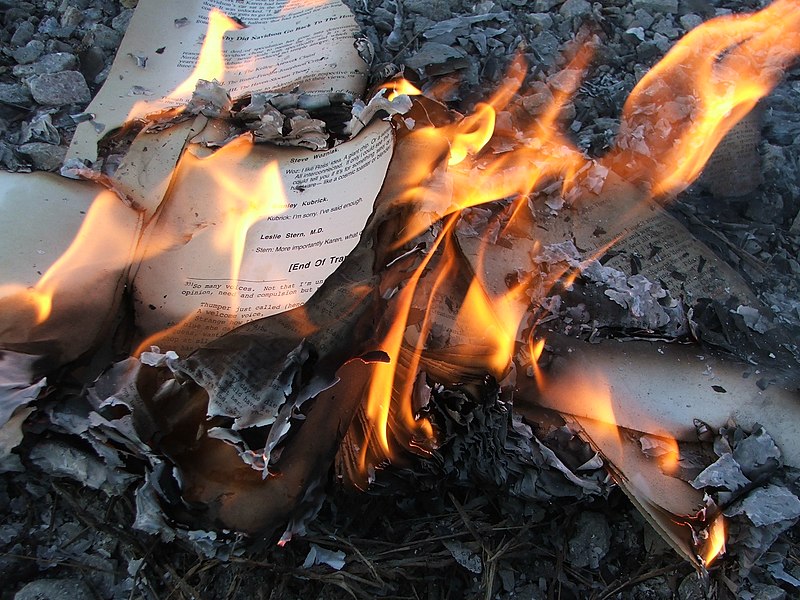
House of Leaves burning (photo by Learning Lark)

In her 2017 article A Brief History of Book Burning, from the Printing Press to Internet Archives Lorraine Boissoneault writes, “As long as there have been books, people have burned them.” Books were burned to silence a dissonant, threatening and potentially rousing voice; they were burned to wipe out a cultural presence; They were burned to control and curtail intellectual freedom; they were burned to simply ruin and pillage and destroy.

Books and libraries have been targeted by people of all backgrounds for thousands of years, sometimes intentionally and sometimes as a side-effect of war, Boissoneault tells us. “In 213 B.C., Chinese emperor Qin Shi Huang (more widely remembered for his terracotta army in Xian) ordered a bonfire of books as a way of consolidating power in his new empire.” According to historian Lois Mai Chan, “His basic objective was not so much to wipe out these schools of thought completely as to place them under governmental control.” 

Boissoneault adds, “When al-Qaida Islamists invaded Mali, and then Timbuktu in 2012, among their targets were priceless manuscripts—books that needed to be burned.” The damage might have been much worse if not for men like Abdel Kader Haidara, who risked their lives to protect the medieval works. He and others succeeded in smuggling out 350,000 manuscripts.”

“Qin was only one in a long line of ancient rulers who felt threatened enough by the ideas expressed in written form to advocate arson,” says Boissoneault. Qin and religious leaders like him are only a small part of the early book-burning equation. “A lot of ancient book burning was a function of conquest,” writes author Rebecca Knuth. The Library of Alexandria had its contents and structure burned during several periods of political upheaval as a casualty of brutal war and associated despoliation and pillaging.

When Johannes Gutenberg invented the printing press in 1440, there were suddenly far more books—and more accessible knowledge. Book burning continued, unfettered, perhaps taking on a more symbolic and insidious role, and no less violent.

In 1966, when Mao Zedong took power in China and implemented the Cultural Revolution, any book that did not conform to party propaganda, such as those that promoted capitalism or other dangerous ideas, were destroyed. In 1992, the Jaffna Public Library of Sri Lanka—repository of nearly 100,000 rare books of Tamil history and literature—was burned by Sinhalese Buddhists.

German writer/poet Heinrich Heine

Heinrich Heine’s Prediction

In his 1821 play, Almansor, the German writer/poet Heinrich Heine wrote: Dort, wo man Bücher verbrennt, verbrennt man am Ende auch Menschen, “Where they burn books, they will in the end burn human beings.” He was referring to the burning of the Muslim holy book, the Qoran as part of the eradication of the Moors from the Iberian Peninsula, during the Spanish Inquisition half a century before.

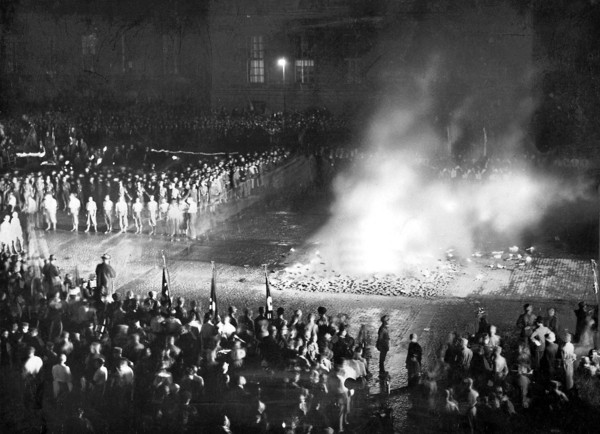
A century later, on May 6-10th, 1933, Heine’s books were among the thousands of volumes publicly hauled out and burned by Nazi brownshirts, SS and Hitler Youth groups in Berlin’s Opernplatz (Bebelplatz). A violent outburst that, in fact, did foreshadow the blazing ovens of the Holocaust. Some twenty thousand books were burned, including those by Heinrich Mann, Karl Marx, Albert Einstein.

Nazi book burning in Opernplatz, Berlin, 1933
Brownshirts and Hitlerjugend perform Nazi salut as books burn in Opernplatz, Berlin in 1933

Wikipedia defines ‘book burning’ as the “practice of ceremoniously destroying by fire one or more copies of a book or other written material.” The practice, usually carried out in public (like public hangings in Medieval times) is generally motivated by moral, religious or political objections to the material. Some notable and particularly destructive book burnings have included:

  • the destruction of the Library of Alexandria;
  • burning books and burying scholars (‘live burying’) under China’s Qin Dynasty (3rd Century);
  • Cathar texts in the Lanquedoc region of France in the 13th Century;
  • the Talmud in Paris by the French crown in 1242;
  • Arabic and Hebrew books at Andalucia, Spain, in 1499;
  • Servetus’s “heretical” writings along with the writer at Geneva;
  • Maya sacred books in Yucatan (1562);
  • Tyndale’s New Testament by the English authorities in 1525 and 1526;
  • Luthar’s Bible in Germany (1624) as ordered by the Pope;
  • Robespierre’s destruction of religious libraries in 1793;
  • anti-communist books by the Bolsheviks in 1917;
  • Jewish, anti-Nazi and “degenerate” books by the Nazis in the 1930s and 1940s;
  • Communist and “fellow traveller” books by Senator McCarthy in 1953;
  • The Satanic Verses by Muslims in the UK in 1988; and,
  • Harry Potter books at various American cities.
Hitler youth burning books at Opernplatz, Berlin, in 1933
Book-burning crowd at Opernplatz, Berlin, in 1933

“Even when the knowledge itself isn’t prevented from reaching the public, the symbolic weight of burning books is heavy,” writes Boissoneault.

“Books are not absolutely dead things, but do contain a potency of life in them as to be as active as that soul was whose progeny they are,” wrote John Milton, author of Paradise Lost, in his 1644 book Areopagitica. “Who kills a man kills a reasonable creature… but he who destroys a good book, kills reason itself.”

Ray Bradbury

Ray Bradbury on the Dummying Down of an Obedient Society

In the 1967 introduction of his novel, Fahrenheit 451, Ray Bradbury implied that the Nazi book burnings inspired his story. I found this statement both eloquent and powerful: “It follows then that when Hitler burned a book I felt it as keenly, please forgive me, as his killing a human, for in the long sum of history they are one in the same flesh.”

Addressing currently relevant themes of censorship, conformity and anti-intellectualism, Bradbury’s 1953 cautionary tale explores a fictional future society that has institutionalized book burning in an effort by authorities to maintain order and ‘happiness’. In this world, firemen don’t put out fires; they start them. The book gets its title from the temperature that paper catches fire and burns.

The book-burning fireman Guy Montag in Francois Truffaut’s 1966 film Fahrenheit 451

The story begins with Montag, an ordinary fireman, after a day’s work of burning:

It was a pleasure to burn. It was a special pleasure to see things eaten, to see things blackened and changed. With the brass nozzle in his fists, with this great python spitting its venomous kerosene upon the world, the blood pounded in his head, and his hands were the hands of some amazing conductor playing all the symphonies of blazing and burning to bring down the tatters and charcoal ruins of historyMontag grinned the fierce grin of all men singed and driven back by the flame. He knew that when he returned to the firehouse, he might wink at himself, a minstrel man, burnt-corked, in the mirror.”

–Fahrenheit 451
Firemen Beatty and Montag on their way to burn books (from Francois Truffaut’s 1966 film)

Soon after, Montag encounters an old lady who refuses to leave her house when the firemen come to burn her books. She dies alongside the stories she cherishes. Montag then meets the girl, Clarisse, who knows something of the past, when firemen used to put out fires, during a time when there were no informers and people were not afraid.

“A book is a loaded gun in the house next door,” Montag’s superior warns him, arguing for why they must be burned and their knowledge erased. “Who knows who might be the target of the well-read man?” A foreshadowing of what follows.

Fahrenheit 451 weaves a compelling political and social tale that follows one man’s journey in finding his soul and his ability to judge for himself—through his rediscovery of literature.

Book burning in Opernplatz, Berlin, 1933

“Books are the carriers of civilization. Without books, history is silent, literature dumb, science crippled, thought and speculation at a standstill. Without books, the development of civilization would have been impossible.”

Barbara Tuchman, 1980 address at Library of Congress
Burning German book (photo by Amnesty International)

Nina Munteanu is a Canadian ecologist / limnologist and novelist. She is co-editor of Europa SF and currently teaches writing courses at George Brown College and the University of Toronto. Visit www.ninamunteanu.ca for the latest on her books. Nina’s bilingual “La natura dell’acqua / The Way of Water” was published by Mincione Edizioni in Rome. Her non-fiction book “Water Is…” by Pixl Press(Vancouver) was selected by Margaret Atwood in the New York Times ‘Year in Reading’ and was chosen as the 2017 Summer Read by Water Canada. Her novel “A Diary in the Age of Water” was released by Inanna Publications (Toronto) in June 2020.