Susan M. Osborn explores the nature, influence—and importance—of coincidence, synchronicity and serendipitous discovery in our lives.
.
.
The book is laid out in ten chapters, each featuring some aspect of coincidence, synchronicity, and events of pure serendipity. Within each chapter, the narrative flows from biography to historic exposition or topical study, unraveling delicious facts, suppositions, dreams and fantasies coiled up in patterns and signs of potential significance.
.
Locked between the many entertaining and enlightening examples of synchronicity experienced by famous and not-so-famous people, are gems of interesting and notable facts and astute observations—from the origins and history of the term synchronicity with Jung’s early work in archetypes to the origins of “serendipity” with Horace Walpole to the foundations and influences of the ‘I Ching’.
The latter part of Osborn’s title, “and Other Spooky Connections”, riffs off Albert Einstein’s famous quote about “spooky actions at a distance”, a reference to quantum entanglement, which describes how two particles may remain connected regardless of the distance between them. Einstein asserted that quantum entanglement violated the principles of a realistic, deterministic universe. And, yet, experiments have repeatedly verified the reality of quantum entanglement. This speaks to the power of connection. All the “spooky connections” described in Osborn’s book ultimately address a common theme of all life: to make meaning of our world. I believe that this is essentially the purpose of all life. It even has a term: biosemiosis, which describes how all life is involved in meaning-making.
I agree with Osborn when she writes, “we can solve many of our problems if we have more than one way to look at them.” And this is how she has laid out her book, offering “a way to look at the world from a wider perspective” to gain insight from an otherwise chaotic and seemingly random pattern. When we learn from chaos, we are making meaning and fulfilling what all life is doing. This too is biosemiosis: the notion that all life embraces a process of signification and meaning-generation—from mammals to bacteria—that recognizes its Umwelt (species-specific environmental reality) through the production, action, and interpretation of non-linguistic signs and codes.
Ultimately, Osborn’s stories, disclosures and explorations challenge the reader to become more mindful and ‘present’ in our world, to exercise curiosity, integrate more aspects of our reality to arrive at meaning so we can forge connections—even spooky ones—that open doors of possibility and fulfill us with purpose and joy.
References:
Barbieri, Marcelo. 2008 (ed). “Introduction to Biosemiotics: The New Biological Synthesis” Springer, Netherlands. 525pp.
Hoffmeyer, Jesper. 2001. “Seeing virtuality in nature.” Semiotica 134.
Kull, K. 2016. “The biosemiotics concept of the species.” Biosemiotics 9:61-71.
Lowenhaupt Tsing, Anna. 2015. “The Mushroom at the End of the World: On the Possibility of Life in Capitalist Ruins” Princeton University Press, New Jersey. 331pp.
Trewavas, Anthony. 2003. “Aspects of Plant Intelligence.” Annals of Botany 92(1): 1-20.
Uexküll, Jakob von. 1931. “Die Rolle des Subjekts in der Biologie.” Die Naturwissenschaften 19: 385-391.
Uexküll, Jakob von. 1940 (1982). “The theory of meaning.” Semiotica 42(1): 25-82.
.
Nina Munteanu is a Canadian ecologist / limnologist and novelist. She is co-editor of Europa SF and currently teaches writing courses at George Brown College and the University of Toronto. Visit www.ninamunteanu.ca for the latest on her books. Nina’s bilingual “La natura dell’acqua / The Way of Water” was published by Mincione Edizioni in Rome. Her non-fiction book “Water Is…” by Pixl Press (Vancouver) was selected by Margaret Atwood in the New York Times ‘Year in Reading’ and was chosen as the 2017 Summer Read by Water Canada. Her novel “A Diary in the Age of Water” was released by Inanna Publications (Toronto) in June 2020.
Illustration depicting ‘Rocket Summer’ (image from The Black Cat Moan)
They came because they were afraid or unafraid, happy or unhappy. There was a reason for each man. They were coming to find something or get something, or to dig up something or bury something. They were coming with small dreams or big dreams or none at all
Ray Bradbury, The Martian Chronicles
When I was but a sprite, and before I became an avid reader of books (I preferred comic books), I read Ray Bradbury’s The Martian Chronicles. It changed me, what I thought of books and what I felt about the power of stories. It made me cry. And perhaps that was when I decided to become a writer. I wanted to move people as Bradbury had moved me.
The 1970 Bantam book jacket aptly describes The Martian Chronicles as, “a poetic fantasy about the colonization of Mars. The story of familiar people and familiar passions set against incredible beauties of a new world…A skillful blending of fancy and satire, terror and tenderness, wonder and contempt.”
.
Rockets land on Mars overlooking Bradbury Lane (illustration from Sutori)
.
The Martian Chronicles isn’t really about Mars. True to Bradbury’s master metaphoric storytelling, The Martian Chronicles is about humanity. Who we are, what we are and what we may become. What we inadvertently do—to others, and finally to ourselves—and how the irony of chance can change everything. Despite the knowledge of no detectable amounts of oxygen, Bradbury gave Mars a breathable atmosphere: “Mars is a mirror, not a crystal,” he said, using the planet for social commentary rather than to predict the future.
From “Rocket Summer” to “The Million-Year Picnic,” Ray Bradbury’s stories of the colonization of Mars form an eerie tapestry of past and future. Written in the 1940s, the chronicles long with the nostalgia of shady porches with pitchers of lemonade, ponderously ticking grandfather clocks, and comfortable sofas. Expedition after expedition leave Earth to investigate and colonize Mars. Though the Martians guard their mysteries well, they succumb to the diseases that come with the rocketeers and grow extinct—not unlike the quiet disappearance of the golden toad, the Pinta giant tortoise, or the Bramble Cay melomys. Humans, with ideas often no more lofty than starting a tourist hot-dog stand, bear no regret for the native alien culture they exploit and eventually displace.
It is a common theme of human colonialism and expansionism, armed with the entitlement of privilege. Mars is India to the imperialistic British Empire. It is Rwanda or Zaire to the colonial empire of the cruel jingoistic King Leopold II of Belgium. Mars is Europe to Nazi Germany’s sonderweg. We need look no further than our own Canadian soil for a reflection of this slow violence of disrespect and apathy by our settler ancestors on the indigenous peoples of Canada.
Mars was a distant shore, and the men spread upon it in waves… Each wave different, and each wave stronger.
The Martian Chronicles
Tyler Miller of The Black Cat Moan makes excellent commentary in their 2016 article entitled “How Ray Bradbury’s ‘The Martian Chronicles’ changed Science Fiction (and Literature).”The article begins with a quote from Argentinean author Jorge Luis Borges (in the introduction to the Spanish-language translation of The Martian Chronicles: “What has this man from Illinois done, I ask myself when closing the pages of this book, that episodes from the conquest of another planet fill me with horror and loneliness?”
.
Remember, this was the 1950s … halfway through a century dominated by scientific discovery, and expansion. The 1950s saw developments in technology, such as nuclear energy and space exploration. On the heels of the end of World War II, the 1950s was ignited by public imagination on conquering space, creating technological futures and robotics. The 1950s was considered by some as the real golden age for science fiction, still a kind of backwater genre read mostly by boys and young men, that told glimmering tales of adventure, exploration, and militarism, of promising technologies, and often-androcratic societies who used them in the distant future to conquer other worlds full of strange and disposable alien beings in the name of democracy and capitalism. (In some ways, this is still very much the same.Though, it is thankfully changing…)
(Bantam 1951 1st edition cover)
Many scientists deeply involved in the exploration of the solar system (myself among them) were first turned in that direction by science fiction. And the fact that some of that science fiction was not of the highest quality is irrelevant. Ten year‐olds do not read the scientific literature.
Carl Sagan, 1978
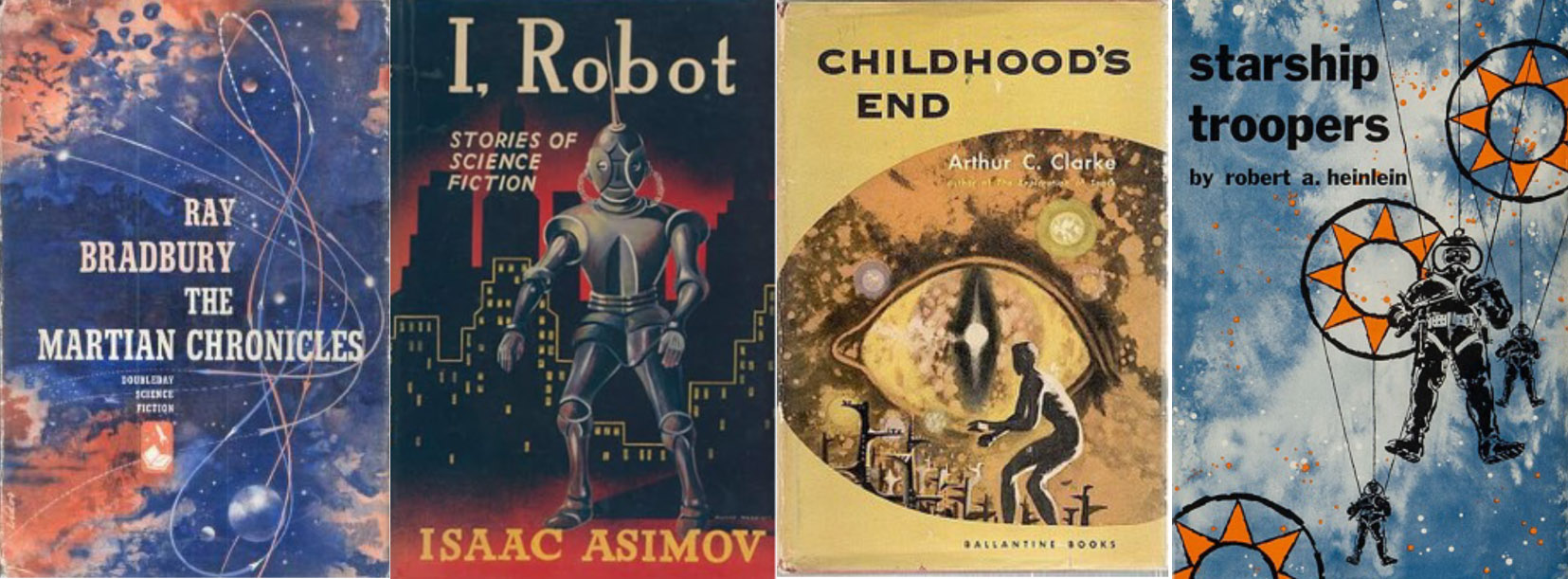
First edition book covers of Martian Chronicles (Doubleday, 1950); I, Robot (Grayson & Grayson, 1952); Childhood’s End (Ballantine Books, 1953); and Starship Troopers (G.P. Putnam’s Sons, 1959)
Large idea-driven SF works that typified this time period included Robert A. Heinlein’s Starship Troopers, Arthur C. Clarke’s Childhood’s End, Isaac Asimov’s I, Robot and his Foundation series.
It was at this time that Ray Bradbury published The Martian Chronicles. Though filled with the requisite rocket ships, gleaming Martian cities, ray guns, and interplanetary conquest, from the very start—as Borges noted—The Martian Chronicles departed radically from its SF counterparts of the time.
(Illustration on album cover of “Rocket Summer”, music by Chris Byman)
Instead of starting with inspiring technology or a stunning action sequence, or a challenging idea or discovery, Bradbury’s The Martian Chronicles opens with a domestic scene.
One minute it was Ohio winter, with doors closed, windows locked, the panes blind with frost, icicles fringing every roof, children skiing on the slopes, housewives lumbering like great black bears in their furs along the icy streets.
And then a long wave of warmth crossed the small town. A flooding sea of hot air; it seemed as if someone had left a bakery door open. The heat pulsed among the cottages and bushes and children. The icicles dropped, shattering, to melt. The doors flew open. The windows flew up. The children worked off their wool clothes. The housewives shed their bear disguises. The snow dissolved and showed last summer’s ancient green lawns.
Rocket summer. The words passed among the people in the open air, airing houses. Rocket summer. The warm desert air changing the frost patterns on the windows, erasing the art work. The skis and sleds suddenly useless. The snow, falling from the cold sky upon the town, turned to a hot rain before it touched the ground.
Rocket summer. People leaned from their dripping porches and watched the reddening sky.
The rocket lay on the launching field, lowing out pink clouds of fire and oven heat. The rocket stood in the cold winter morning, making summer with every breath of its mighty exhausts. The rocket made climates, and summer lay for brief moment upon the land…
Ray Bradbury, The Martian Chronicles, Rocket Summer
Bradbury’s focus was on the domestic. Housewives fighting off the ice and snow of Ohio. A Martian woman “cleaning the house with handfuls of magnetic dust which, taking all dirt with it, blew away on the hot wind.”
They had a house of crystal pillars on the planet Mars by the edge of the empty sea, and every morning you could see Mrs. K eating the golden fruits that grew from the crystal walls, or cleaning the house with handfuls of magnet dust which, taking all dirt with it, blew away on the hot wind. Afternoons, when the fossil sea was warm and motionless, and the wine trees stood stiff in the yard…you could see Mr. K in his room, reading from a metal book with raised hieroglyphs over which he brushed his hand, as one might play a harp. And from the book, as his fingers stroked, a voice sang, a soft ancient voice, which told tales of when the sea was red steam on the shore and ancient men had carried clouds of metal insects and electric spiders into battle…
This morning Mrs. K stood between the pillars, listening to the desert sands heat, melt into yellow wax, and seemingly run on the horizon.
Something was going to happen.
She waited.
Ray Bradbury, The Martian Chronicles, Ylla
Bradbury’s gift to literature—and to his SF genre—was his use of metaphor. Unlike the science fiction of his colleagues, Bradbury’s stories are a lens to study the past and the present. According to Miller, “The Earthmen’s exploration and desolation of Mars allowed Bradbury to look not forward but backward at exploration and desolation on Earth, namely the European arrival in the New World. Just as Europeans landed in North and Central America wholly unprepared for what they found there, Bradbury’s Earthmen are unprepared time and again for the wonder and the horror of Mars. And just as European diseases decimated native people in the Americas, it is chicken-pox which wipes out the Martians.”
.
.
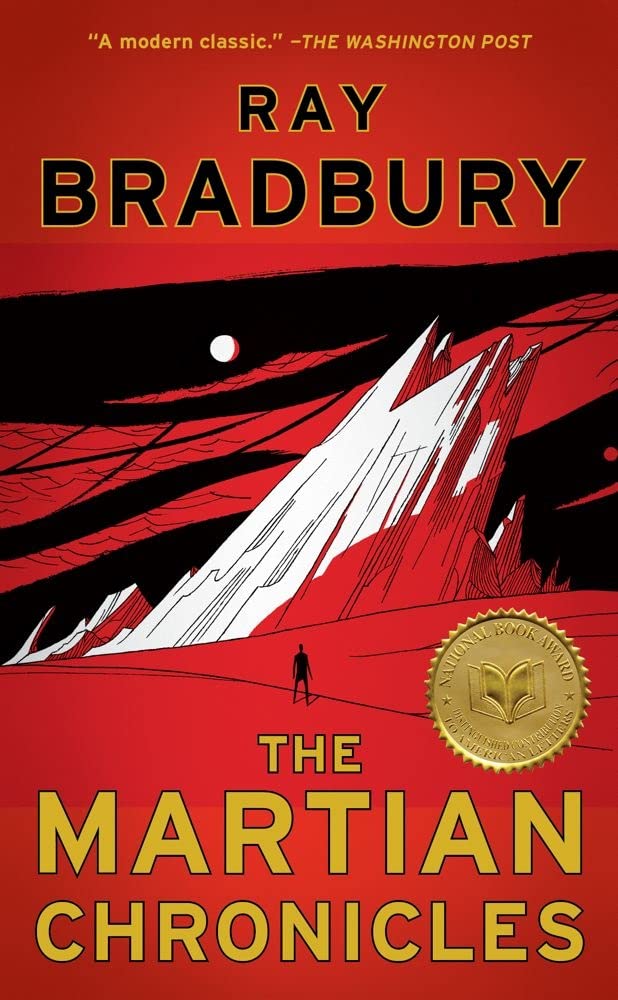
The back cover of the 2012 mass market paperback Simon & Schuster Reprint edition of The Martian Chronicles reads:
Bradbury’s Mars is a place of hope, dreams and metaphor—of crystal pillars and fossil seas—where a fine dust settles on the great, empty cities of a silently destroyed civilization. It is here the invaders have come to despoil and commercialize, to grow and to learn—first a trickle, then a torrent, rushing from a world with no future toward a promise of tomorrow. The Earthman conquers Mars … and then is conquered by it, lulled by dangerous lies of comfort and familiarity, and enchanted by the lingering glamour of an ancient, mysterious native race.
“Ask me then, if I believe in the spirit of the things as they were used, and I’ll say yes. They’re all here. All the things which had uses. All the mountains which had names. And we’ll never be able to use them without feeling uncomfortable. And somehow the mountains will never sound right to us; we’ll give them new names, but the old names are there, somewhere in time, and the mountains were shaped and seen under those names. The names we’ll give to the canals and the mountains and the cities will fall like so much water on the back of a mallard. No matter how we touch Mars, we’ll never touch it. And then we’ll get mad at it, and you know what we’ll do? We’ll rip it up, rip the skin off, and change it to fit ourselves.”
“We won’t ruin Mars,” said the captain. “It’s too big and too good.”
“You think not? We Earth Men have a talent for ruining big, beautiful things.”
Ray Bradbury, The Martian Chronicles, And the Moon be Still as Bright
Ray Bradbury’s The Martian Chronicles is a profound and tender analysis of the quiet power humanity can wield unawares and how we define and treat ‘the other.’ It is a tragic tale that reflects only too well current world events where the best intended interventions can go awry. From the meddling friend who gossips to “help” another (only to make things worse) to the righteous “edifications” of a religious group imposing its “order” on the “chaos” of a “savage” peoples … to the inadvertent tragedy of simply and ignorantly being in the wrong place at the wrong time (e.g., the introduction of weeds, disease, etc. by colonizing “aliens” to the detriment of the native population; e.g., smallpox, AIDs, etc.). Bradbury is my favourite author for this reason (yes, and because he makes me cry…)
.
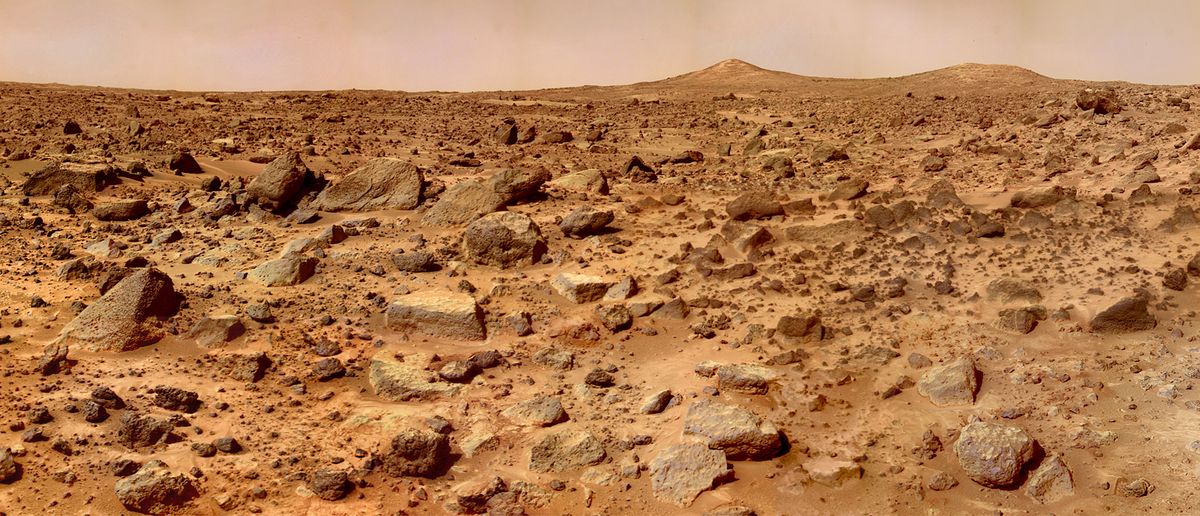
Mars terrain (photo by NASA)
Nina Munteanu is a Canadian ecologist / limnologist and novelist. She is co-editor of Europa SF and currently teaches writing courses at George Brown College and the University of Toronto. Visit www.ninamunteanu.ca for the latest on her books. Nina’s bilingual “La natura dell’acqua / The Way of Water” was published by Mincione Edizioni in Rome. Her non-fiction book “Water Is…” by Pixl Press (Vancouver) was selected by Margaret Atwood in the New York Times ‘Year in Reading’ and was chosen as the 2017 Summer Read by Water Canada. Her novel “A Diary in the Age of Water” was released by Inanna Publications (Toronto) in June 2020.
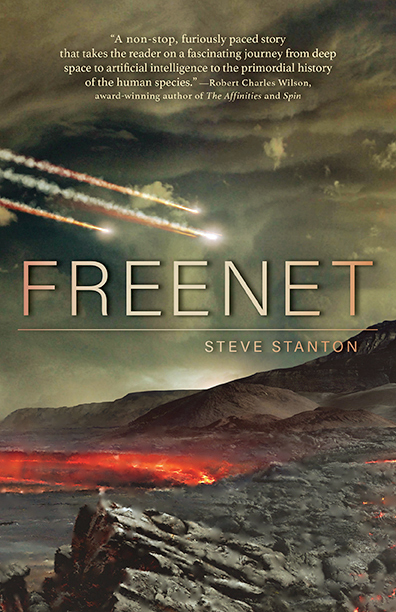
Steve Stanton’s 2016 science fiction book Freenet explores humanity in the far future after we have created the “Macpherson Doorway” through folded space-time, and vaulted ourselves with the blink of an eye into a galaxy far far away and 12 million years into the future. No traffic back through the doorway is permitted since a quarantine was placed some dozen years ago to prevent any unwanted DNA from sneaking through from Earth to “New Jerusalem”.
As the Canadian back book jacket reveals, Freenet is a novel about the “power of [free] information…in a post-digital age.” The book explores what digital immortality means, when “consciousness has been digitized and cybersouls uploaded to a near-omniscient data-matrix.” This is a world where information “is currency and the truth belongs to whoever has the greatest bandwidth.”
Stanton shared with me that he was inspired to write the novel “from the simple observation of watching a woman lose her cellphone. Young people today are so tied to technology that they freak out when the strings are cut. In the future when life experience is delivered directly to the brain by wi-fi, the personal loss will be catastrophic.”
Nina Munteanu reading her advanced copy of Freenet
Told in three parts, the book begins with Simara Ying—a plugged-in V-net jockey and spacer—about to crash-land on the desert planet Bali. Her rescuer, a naïve—almost too nice to be true—native, Zen Valda, introduces her to his cave-dwelling culture with no social network support. The persistent electromagnetic storms of Bali interfere with digital communication and wipe all data. Like a baby removed from her comfortable womb, Simara survives panic attacks and heavy withdrawal chiefly because she is bombarded so heavily with Bali experiences that demand her attention. Lost without the support of her V-net—a comforting web of infinite communication and information—Simara struggles with Bali’s foreign ways. At every turn, she stumbles across some custom or taboo, forced to rely on her own wits; making the kind of mistakes she’s not used to making. More than a simple communication/information tool, the V-net embraces Simara with confidence. Without it, she fears she may go insane.
Intrigue arrives on Bali and chases Simara with a bounty on her head for murder. Zen demonstrates a simple faith in her innocence and helps her escape. Zen accepts a cochlear installation to connect him to the V-net, thinking it will help him better communicate with Simara, who—already somewhat distant—is even more so now that she has reunited with the V-net. The V-net instead overwhelms him with a surging sea of irrelevant chatter and information, which threatens to drive him insane. Struggling with chaotic information overload, he remains with Simara, even after she estranges herself from him and is captured for murder. They escape and survive an arranged “accident” by literally jumping into space from an abandoned troopship about to crash.
Canadian book cover for Freenet
The story deepens into nuanced commentary in the last third of the book when Roni Hendrik, an energetic V-net anchorman of the Daily Buzz, pokes into the intrigue surrounding Simara Ying. He discovers that she is biogenic, an omnidroid—bioengineered from human DNA—and likely smuggled from Earth.
Omnidroids share a major cerebral augmentation that includes unlimited access to the V-net, higher intelligence and an unknown possibility of enhancements, including pre-cognition and telepathy across vast distances. Created as effective firewalls and filters, omnidroids streamline all V-net data for users across the galaxy. “Omnidroids [are] born into zero-day digital space and live in a fantasyland far beyond the mortal sphere of intelligence,” Henrik reflects, sensing a deeper story than a simple murder conspiracy. “Physical experience and bodily sensation [are] only tiny fragments of their transcendent existence, mundane accessories to digital infinity. In time,” Henrik concludes, “life itself might become a vestigial appendage.”
Hendrik, a humanist and closet idealist, pieces together connections with Neurozonics a New Jerusalem private corporation, responsible for the creation of biogenic humans. With holdings in a vast range of areas and an streaming amoeba of interests, Neurozonics is “a grinning spider on a translucent web of intrigue.” One discovery leads Henrik to more. He learns that the omnidroid community, to which Simara belongs, acts and communicates like a hive-mind, guided by a collective voice called “Mothership”. Other omnidroids have been targeted for elimination—and killed. Hell-bent on getting answers, Henrik confronts the owner of Neurozonics, Colin Macpherson—the same Macpherson who created the wormhole. Macpherson was uploaded earlier and runs his empire from digital space, part of the consortium of eternal intellect. Henrik’s meeting with Colin8 (the seventh clone of the original Colin Macpherson) runs like a “Neo-Architect” lecture in which the truth behind the omnidroids deaths is revealed. It’s not what you might think. Macpherson divulges his vision, which includes the reason for omnidroids’ communication abilities and the role of the Neurozonic brain. The ultimate meaning and use of the omnidroid freenet ties to a greater destiny that redefines what it is to be human and subverts the history of our primordial origins.
The story flows seamlessly from one perspective to another with crisp page-turning narrative, action and intrigue. Stanton trades some richness of character for a page-turning plot and clever dialogue. If there is a weakness in the narrative for me, it lies with Simara, the arcane omnidroid, who remains mysterious—from her introduction aboard her ship about to crash land, to the limited revelations of her character during her interactions with Zen, both in her POV and in his. Considering her unique characteristics and experiences as an omnidroid, I would have enjoyed more insight to her unique outlook and perspective, especially when faced with no social network—perhaps the most frightening experience for an omnidroid: to be disconnected from the hive. On the other hand, Zen Valda as the simple Bali boy on an insane rollercoaster ride is painted with a sensitive and graceful hand. Stanton also skillfully portrays his news team, Roni and Gladyz, with finesse and subtly clever notes. The dialogue and overall interactions between them is some of the most enjoyable of the novel.
Ultimately, Stanton’s Freenet flows like a fresh turbulent river, scouring and building up sediment then meandering like an oxbow into areas that surprise. He lulls you into expectation, based on your own vision of the digital world, then—like a bubble bursting—releases a quantum paradox of wormhole possibility.
“Ma, can you read the part where the cat omnidroid takes over the world?”
Nina Munteanu is a Canadian ecologist / limnologist and novelist. She is co-editor of Europa SF and currently teaches writing courses at George Brown College and the University of Toronto. Visit www.ninamunteanu.ca for the latest on her books. Nina’s bilingual “La natura dell’acqua / The Way of Water” was published by Mincione Edizioni in Rome. Her non-fiction book “Water Is…” by Pixl Press (Vancouver) was selected by Margaret Atwood in the New York Times ‘Year in Reading’ and was chosen as the 2017 Summer Read by Water Canada. Her novel “A Diary in the Age of Water” was released by Inanna Publications (Toronto) in June 2020.
I started out by reviewing what I had read in 2023. It looked like I’d read about thirty odd books, almost half and half non-fiction to fiction. That’s not many, but I’m a slow reader. I pore through each book at a snail’s pace, spending time making notes with some, particularly the non-fiction books, which I use to research my writing. With fiction, I dive in deep and thoroughly savor each word and sentence like a mouthful of an excellent meal made with loving hands. Books varied from non-fiction scholarly works on forest ecosystems (The Treeline by Ben Rawlence) and post-capitalism (Four Futures by Peter Frase) to literary fiction, political thrillers, speculative fiction, clifi, and eco-fiction.
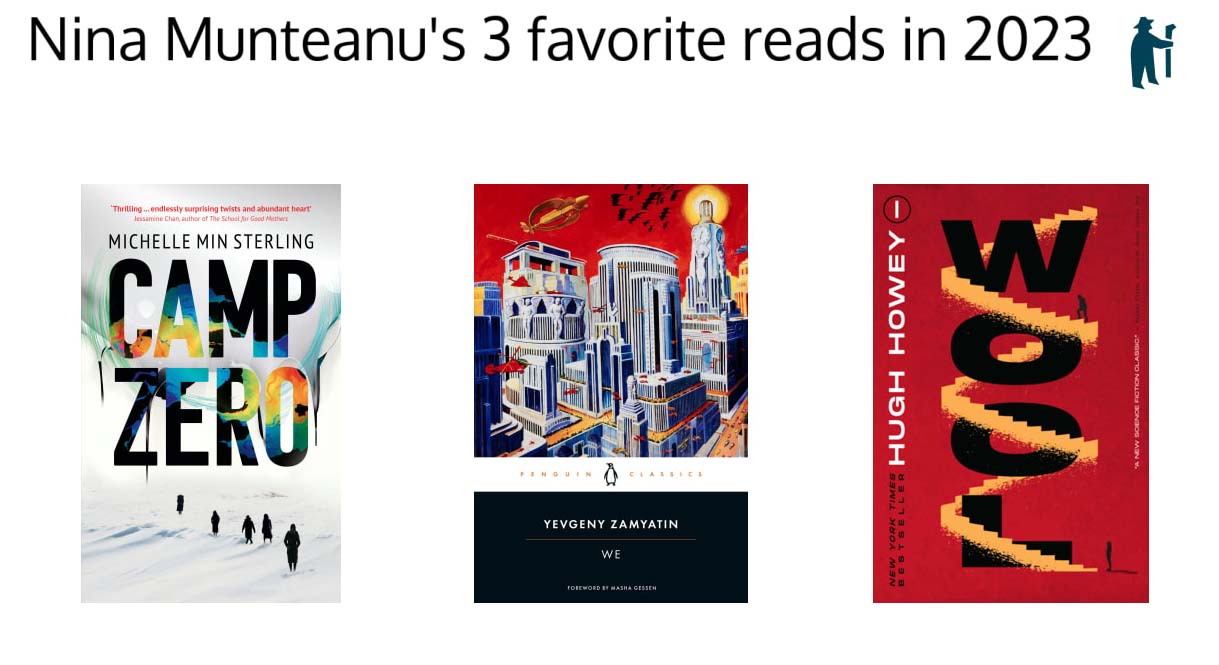
It was a tough choice, but I came up with three choices and a thematic rationale that resonated with me and made a deep kind of sense for that year: all three books were eco-fiction of sorts and featured hopeful stories of strong women, acting out of compassion and in solidarity with intelligence, kindness and courage. For me, 2023 was a year of strong feminine energy for the planet and my favourite books reflect that. Here they are (read the original article on Shepherd here):
The first of my favourite three books of 2023 is Michelle Min Sterling’s Camp Zero.
Set in the remote Canadian north—a place I love for its harsh beauty—this feminist climate fiction explores a warming climate through the perilous journeys of several female characters, each relating to her environment in different ways. Each woman exerts agency in surprising ways that include love, bravery and shared community. The strength of female power carried me through the pages like a braided river heading to a singular ocean. These very different women journey through the dark ruins of violent capitalism, colonialism and patriarchy—flowing past and through hubristic men pushing north with agendas and jingoistic visions—to triumph in an ocean of solidarity. I empathized with each woman as she found her strength and learned to wield true heroism—one based on collaboration and humble honesty.
My second favourite book of 2023 is Yevgeni Zamyatin’s We.
I enjoyed this 1920 hopeful dystopia for its courageous and unprecedented feminism. While the story centres on logical D-503, a man vacuously content as a number in the One State, it is I-330—Zamyatin’s unruly heroine—who stole my attention. Confident, powerful and heroic, the liberated I-330 embraces the Green Wind of change to influence D-503. A force of hope and resilience, she braves torture to successfully orchestrate a revolution that breaches the Green Wall—feats typically relegated to a male protagonist in novels of that era. When pregnant O-90 refuses to surrender her child to the State, I-330 helps her escape to the outside, where the Green Wind of freedom blows. I resonated with Zamyatin’s cautionary tale on the folly of logic without love and Nature.
My third favourite book of 2023 is Hugh Howie’s Wool (first of the SILO series).
Juliette—humble and gutsy, kind and relentlessly motivated in her journey for the truth—kept the pages turning for me. Juliette is a mechanic from the Down-Deep of the underground Silo, humanity’s last refuge to a toxic world. When Juliette inexplicably lands the job of sheriff, she treats her new position as a tool to seek the truth about her lover’s mysterious recent death. At her own peril, she pulls on threads that ultimately reveal a great conspiracy.
Juliette’s literal and metaphoric rise from the Down-Deep to the Up-Top is a feminist’s journey that transcends intersectional barriers as she battles small-minded men of power and maintains her integrity by refusing to abide by the inhumane Up-Top rules of order. By the end, I sensed a victory for humankind through womankind.
You might be interested in two of my own eco-fiction novels that feature several strong female protagonists:
Darwin’s Paradox follows the complex dynamic of a brave mother and her willful teenage daughter, both ‘gifted’ by a virus living inside them. Accused of murder and deliberately spreading the virus that killed many, Julie fled the enclosed city and settled in the climate wastelands with her husband and their child. Years later, when their harsh refuge is threatened by city forces seeking mother and daughter for experimentation, Julie leaves her family and gives herself up to the city, hoping they will abandon pursuing her daughter. Still psychically connected to the city’s AI community (now evolving into an autonomous entity with the intelligent virus), Julie entangles with political intrigue while her daughter, who followed her to the city, stumbles into her mother’s violent past.
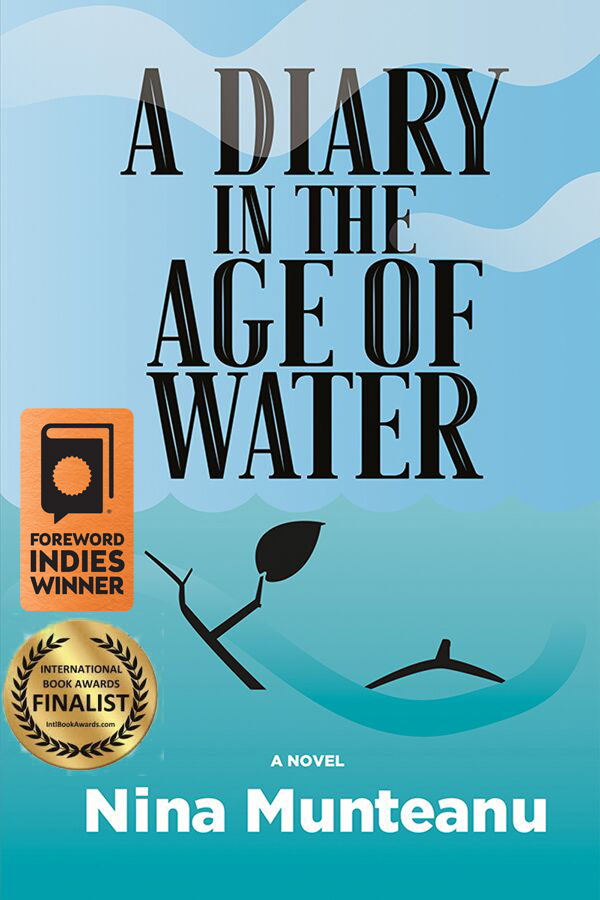
A Diary in the Age of Waterfollows the climate-induced journey of Earth and humanity through four generations of women, each with a unique relationship to water. Centuries from now, in a dying boreal forest in what used to be northern Canada, Kyo, a young acolyte called to service in the Exodus, yearns for Earth’s past—the Age of Water—before the “Water Twins” destroyed humanity. Looking for answers and plagued by vivid dreams of this holocaust, Kyo discovers the diary of Lynna, a limnologist from that time of severe water scarcity just prior to the destruction. In her work for a global giant that controls Earth’s water, Lynna witnesses and records in her diary the disturbing events that will soon lead to humanity’s demise.
.
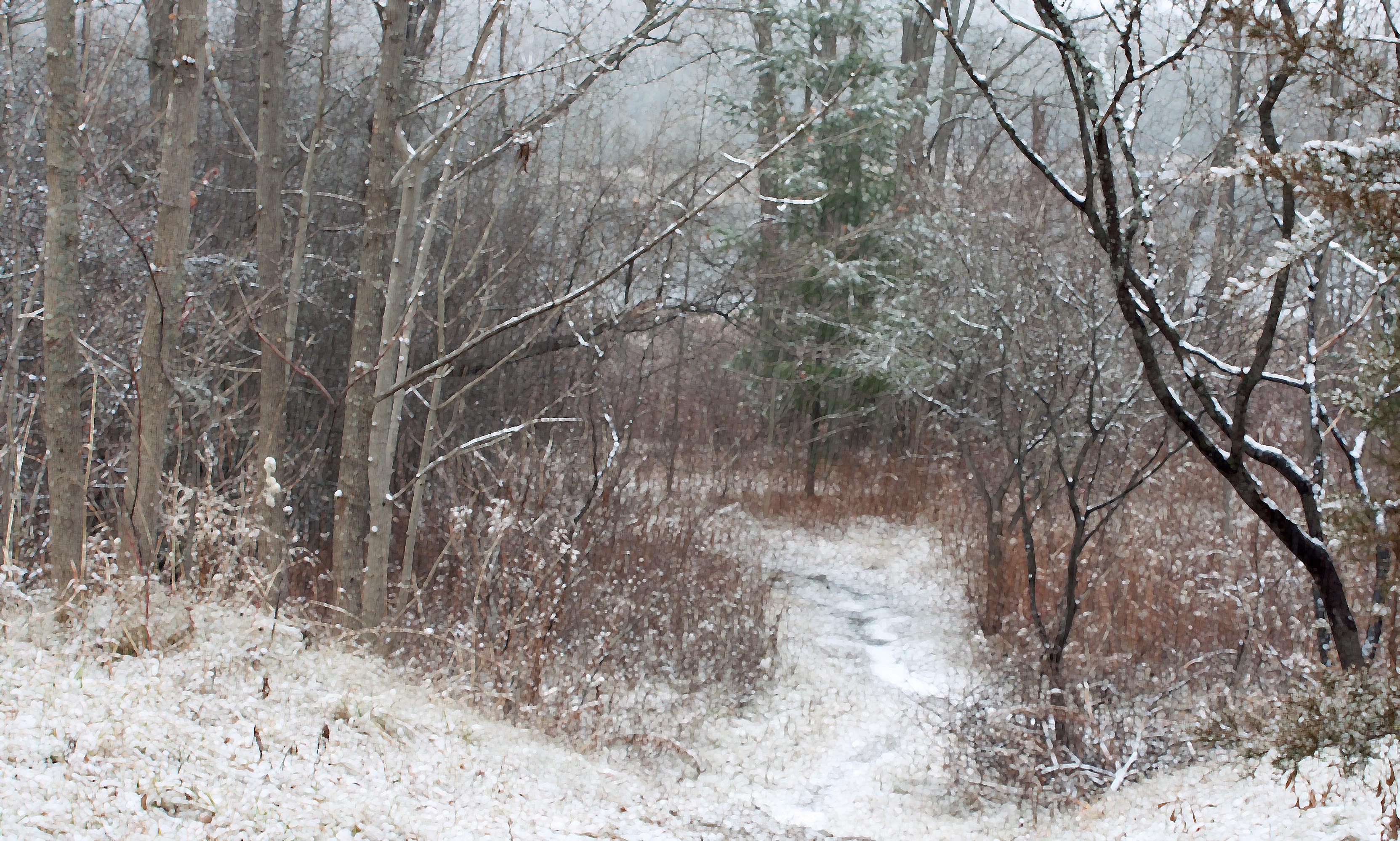
Path through a mixed forest in early winter, ON (photo and rendition by Nina Munteanu)
Nina Munteanu is a Canadian ecologist / limnologist and novelist. She is co-editor of Europa SF and currently teaches writing courses at George Brown College and the University of Toronto. Visit www.ninamunteanu.ca for the latest on her books. Nina’s bilingual “La natura dell’acqua / The Way of Water” was published by Mincione Edizioni in Rome. Her non-fiction book “Water Is…” by Pixl Press (Vancouver) was selected by Margaret Atwood in the New York Times ‘Year in Reading’ and was chosen as the 2017 Summer Read by Water Canada. Her novel “A Diary in the Age of Water” was released by Inanna Publications (Toronto) in June 2020.
“What if water doesn’t like being owned or ransomed? What if it doesn’t like being channelled into a harsh pipe system or into a smart cloud to go where it normally doesn’t want to go? What if those hurricanes and tornadoes and floods are water’s way of saying that it’s had enough?”
Hilde Dresden
“Thoroughly researched and cleverly executed, A Diary in the Age of Water is a must-read, especially for those who are longing for nature, and touch, while fearing both.”
CARA MOYNES, Amazon Review
“This novel made my heart clench…An extremely detailed and downright terrifying look into the future of our planet. A Diary in the Age of Water will appeal to lovers of eco-fiction and hard speculative fiction.”
GOODREADS REVIEW
Maple tree branches hover over shallows of Otonabee River, ON (photo and rendition by Nina Munteanu)
“The slow violence of free-market capitalism isn’t so much the deliberate and focused actions of a few evil men as the accumulated negligence of an undiscriminating collective of unimaginative humans.”
Lynna Dresden
“In her dystopian novel Canadian limnologist Nina Munteanu employs Solar Punk’s technique of using dystopic descriptions of present ecological catastrophe to predict the end of the world as we know it, and to indicate a utopian future.”
THE SONOMA INDEPENDENT
Reflections on a calm Otonabee River, showing old pumphouse, ON (photo and rendition by Nina Munteanu)
“A society that does not believe in the objective pursuit of truth—even if it challenges your worldview—is doomed to servitude.”
Lynna Dresden
“An insightful novel…A cautionary tale rummaging through the forgotten drawers of time in the lives of four generations…This whirling, holistic and evolving novel comes alive, like we imagine water does.”
Mary Woodbury, DRAGONFLY.ECO
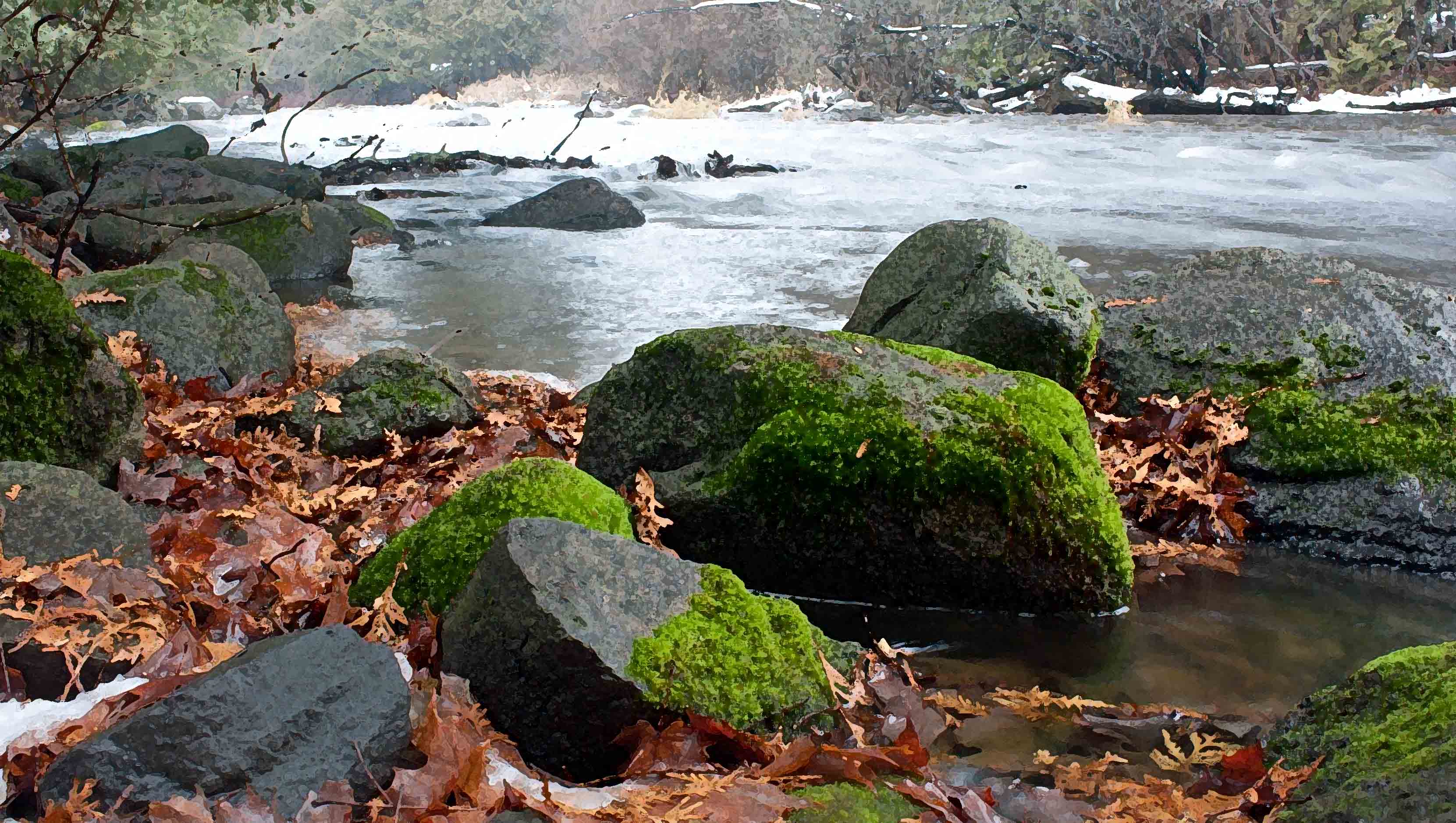
Jackson creek in late fall, ON (photo and rendition by Nina Munteanu)
“The truth isn’t about telling; no one just tells you the truth. It needs to be coaxed, even tricked, out. The truth is carefully hoarded—like water—and only flows among privileged acolytes who have proven themselves.”
Lynna Dresden
“Those of us who are captivated by fear, who despair in a dead zone—we need to consider new ways to tell familiar stories, to envision different endings. A book like this can change the way that you see the world at this moment, can allow formulae to take root in fiction and grow into a different kind of solution.”
Marcie McCauley, THE tEmz REVIEW
Jackson Creek in early fall, ON (photo and rendition by Nina Munteanu)














 Nina Munteanu Writing Coach