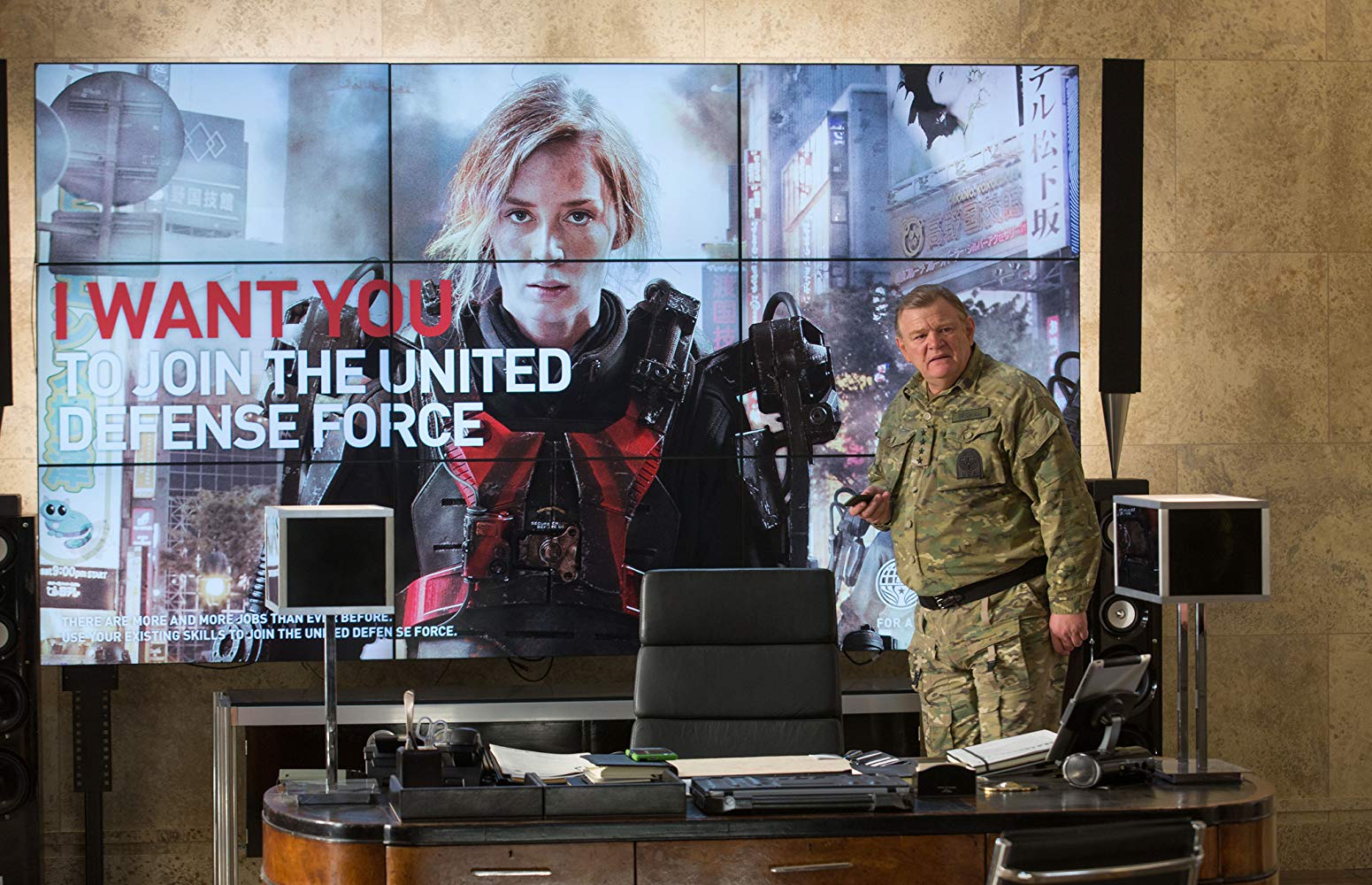
Recruiting poster by the United Defense Force featuring war hero Rita Vrataski, the Angel of Verdun
She’s called The Angel of Verdun. You also see another name scrawled in bright red over a London bus: Full Metal Bitch. When we first see her, angry and fierce in her battle gear (which resembles a modern-day knight’s armour) she’s heading out to battle, stomping out of the bunker, surrounded by an entourage, and summarily knocks an acolyte down who gets in her way. She’s badass. She’s the Full Metal Bitch.
Rita Vrataski is the face of the war; UDF General Brigham drafts our unwilling hero American William Cage (not pictured here) to the front
Her real name is Rita Vrataski. She wields a sharpened helicopter blade as her weapon of choice and serves as the poster girl for the United Defense Force to recruit more into the fight.
Rita (Emily Blunt) is a very different kind of poster girl for the war effort of the recent SF action movie Edge of Tomorrow, directed by Doug Liman and written by Christopher McQuarrie. There is an “edge of tomorrow” in this military SF story that explores how much we’ve changed since the time of World War I and II. And that change is most apparent in how women are seen and act.
World War I and II propaganda posters to recruit women in the war effort
Edge of Tomorrow makes subtle and not so subtle reference to both world wars: from its June 6th release (70th anniversary of D-Day and the massive and decisive Normandy landing) to its reference to the trenches of Verdun in WWI, the Nazi or German Empire forces as the original seat of the Omega entity and many more.
The premise is straight-forward science fiction stuff: Earth is under attack by an alien species, who have seeded themselves with a meteor shower. The aliens have conquered Russia and China and now threaten France and England. Evoking echoes of World War II’s Normandy invasion, the United States joins the fray in support of their allies.
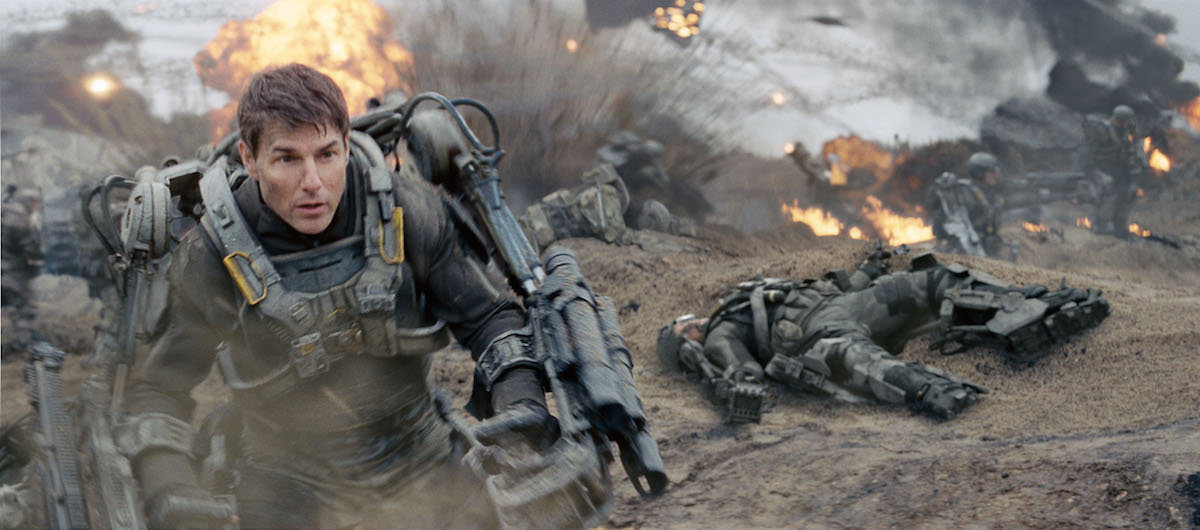
William Cage runs for his life after landing on a French beach, found to be a killing field of mimics
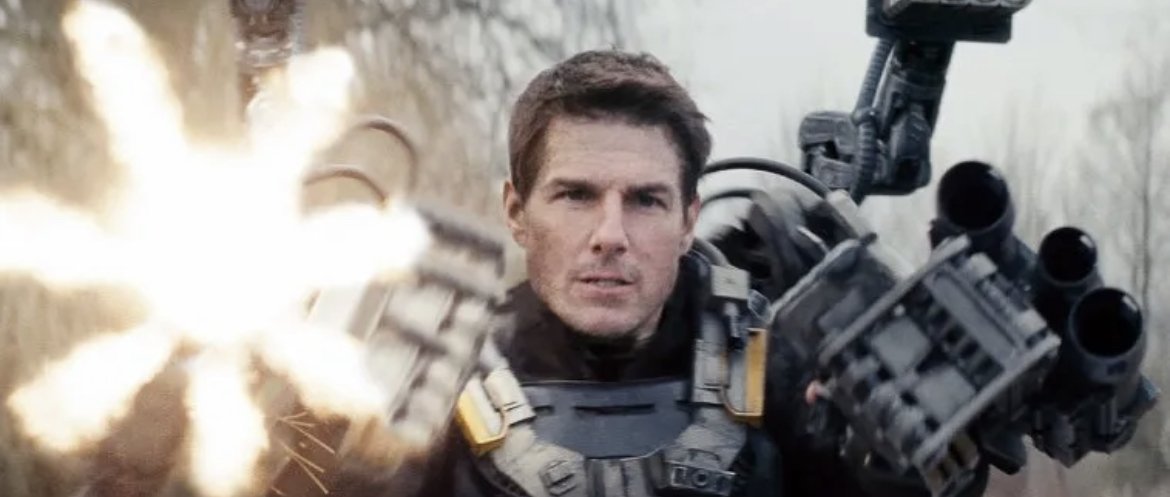
Cruise finally figures out how to use his weapon and kills a giant mimicbefore dying himself
American Major William Cage (Tom Cruise), who is with the PR staff of the war effort, gets unwillingly drafted to the front as a rookie private and dies in the first five minutes of landing on the shores of Normandy—but not before he kills an alpha alien, which covers him in blue blood. This sends him into a vicious time loop, where he must relive and die over and over in that horrendous bloodbath. Each time, he glimpses the Angel of Verdun repeatedly killed. On one occasion, Vrataski runs across him, lying injured in the mud. He can’t move, sure victim to the aliens. She snatches his battery pack and moves on, leaving him there to die. Astonished at the Angel’s apparent lack of compassion, Cage will later mimic her “let him die” attitude when he knowingly lets fellow soldier Kimmel get crushed.
Vrataski stands over wounded Cage, about to steal his battery pack and leave him to die
Cage finds Vrataski in her training room
In a later iteration he finally meets Vrataski on the battlefield, where she realizes (having gone through the time loop and lost it) that he is now in a time loop and therefore the key to their victory; she tells him to find her when he wakes up just seconds before she lets herself get blown up and they begin their looping journey together.
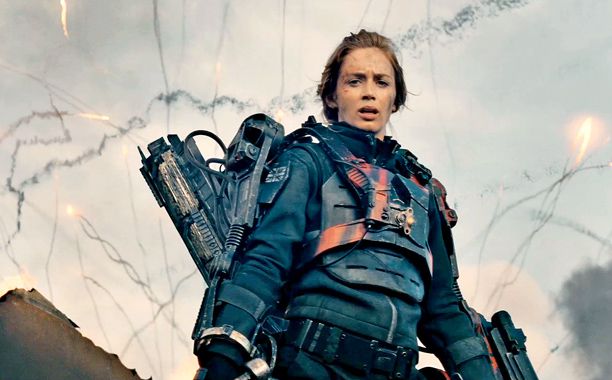
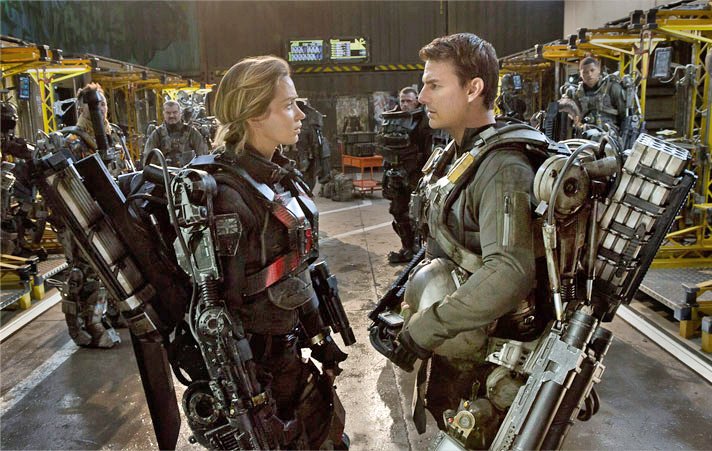
Vrataski and Cage, outfitted in intelligent body armour suits, discuss strategy
To his complaint, “I’m not a soldier,” Vrataski replies, “No, you’re a weapon.” That’s how she sees him. And to that end, she mentors him in the art and science of soldiering. When things go awry she time and again unflinchingly shoots him dead to reset the time. Cage tries to engage her in casual conversation and finds her taciturn. “You don’t talk much,” he observes, to which she quips, “Not a fan.” She’s all about the business of defeating the enemy before the human race is wiped out.
UK movie poster
Edge of Tomorrow provides a refreshing kind of woman hero; someone who is equal to her male protagonist in skill, intelligence and heroic stature. What I mean by heroic stature is that her heroic journey of transformation does not play subservient to her male counterpart’s journey. This almost happens on two occasions when Cage gives her an “out” to stay behind and let him take over. She declines. In fact, Cruise lets her character take the lead, even though this it truthfully Cage’s story of metaphoric transformation from “onlooker” to “participant”.
Rita Vrataski, the Angel of Verdun
William Cage, transformed soldier, trained by Vrataski
In so many androcentric storylines, the female—no matter how complex, interesting and tough she starts out being—must demure to the male lead; as if only by bowing down to his superior abilities can she help ensure his heroic stature. Returning us right back to the cliché role of the woman supporting the leading man to complete his hero’s journey. And this often means serving as the prize for his chivalry. We see this in so many action thrillers and action adventures today: Valka in How to Train Your Dragon, Wyldstyle in The Lego Movie, Neytiri in Avatar, Trinity in The Matrix, and so many more. There’s even a name for it: the Trinity Syndrome.
Various female heroes fallen prey to the Trinity Syndrome
Tasha Robinson writes in her excellent article entitled, We’re losing all our Strong Female Characters to Trinity Syndrome: “The idea of the Strong Female Character—someone with her own identity, agenda, and story purpose—has thoroughly pervaded the conversation about what’s wrong with the way women are often perceived and portrayed today, in comics, video-games, and film especially…it’s still rare to see films in the mainstream action/horror/science-fiction/fantasy realm introduce women with any kind of meaningful strength, or women who go past a few simple stereotypes.”
I give Cruise, Liman and McQuarrie full credit for not doing this. For example, after Cage makes his case to his Squadron to go find the Omega in Paris, they remain reluctant until Vrataski emerges. “I don’t expect you to follow me,” says Cage. “I do expect you to follow her.” The Angel of Verdun—or better yet, the badass Full Metal Bitch. And why not? Who wouldn’t follow her?
Is this one of the reasons that this movie didn’t do so well in the North American box office as it did overseas, whose audience may reflect a more mature, open and enlightened audience?
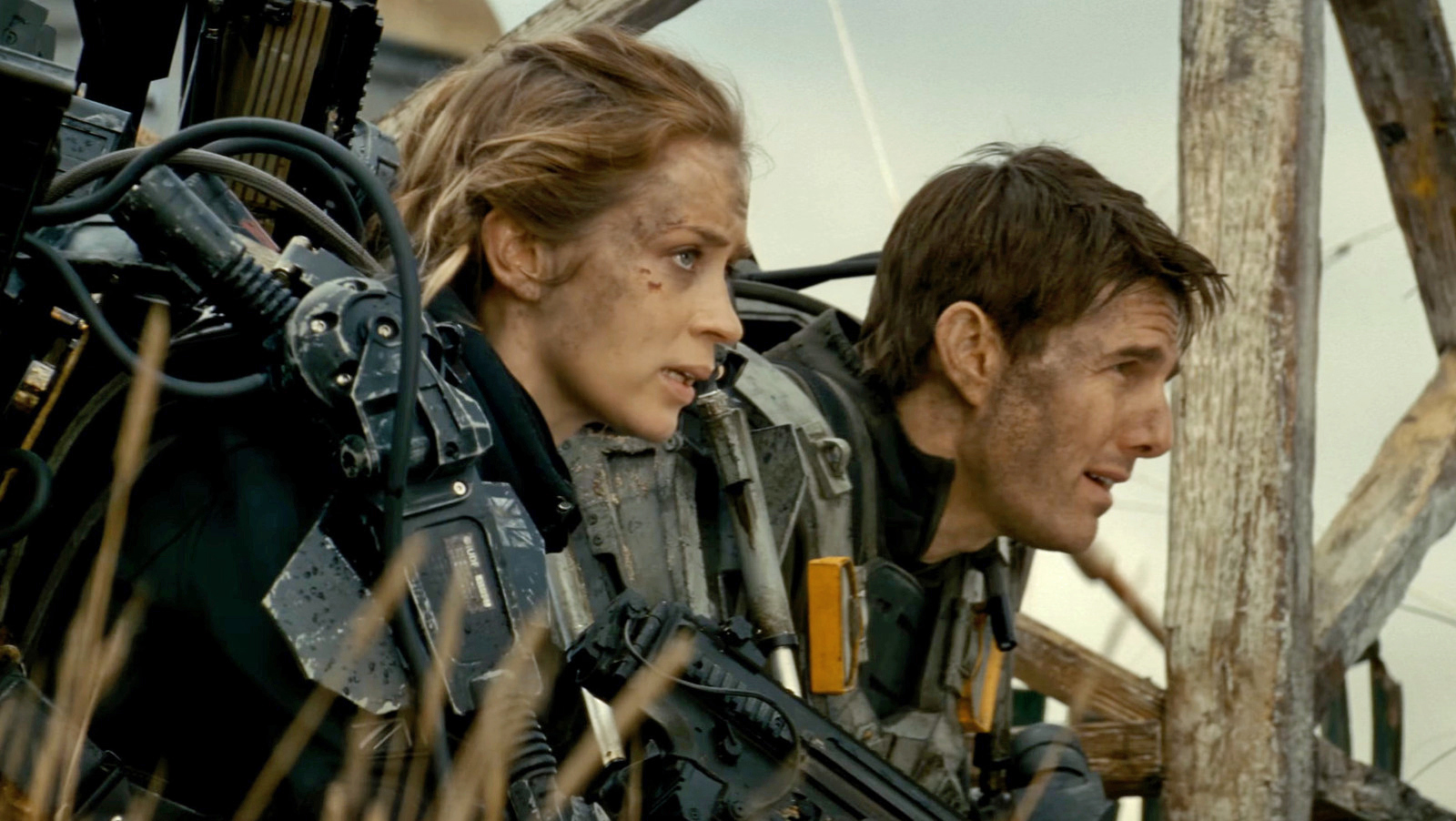
Vrataski and Cage trek across France in search of the mimic headquarters
When a female lead is stronger than the male protagonist, some reviewers (OK—male reviewers) treat and categorize that movie as a “woman’s story”. I’ve been told by some of my male friends that they couldn’t possibly empathize with such a character—mainly because she is a woman and she is stronger than the male lead “they want to be”. Invariably, in many of these, the male counterpart is so much “milk-toast” compared to that awesome female-warrior. And have you ever noticed that, while the male hero gets the girl, the female hero usually ends up alone? Great examples include: Buffy the Vampire Slayer; Xena: Warrior Princess; Sarah in The Terminator and of course Vasquez in Aliens. These women are amazons; they stand apart, goddess-like, unrelenting, unflinching—untouchable. It’s actually no wonder that my ex-husband dislikes Sigourney Weaver to this day—she could crush him underfoot and eat him for breakfast at a moment’s notice. And probably would!
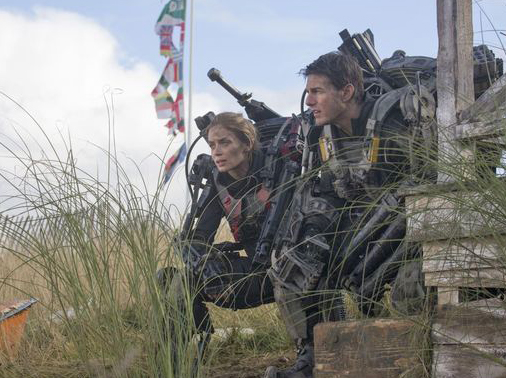
Cage and Vrataski comb the French landscape in search of a vehicle that will take them to the Mimic headquarters
“…I want to point out two things that Richard has, that Bond and Captain America and Batman also have, that Peggy (Carter of Captain America), however strong she is, cannot attain. They are very simple things, even more fundamental than “agency”.
1) Richard has the spotlight. However weak or distressed or passive he may be, he’s the main goddamn character.
2) Richard has huge range of other characters of his own gender around him, so that he never has to act as any kind of ambassador or representative for maleness. Even dethroned and imprisoned, he is free to be uniquely himself.
Promotional poster for the Marvel “The Avengers”
On the posters [women are] posed way in the back of the shot behind the men, in the trailers they may pout or smile or kick things, but they remain silent. Their strength lets them, briefly, dominate bystanders but never dominate the plot. It’s an anodyne, a sop, a Trojan Horse – it’s there to distract and confuse you, so you forget to ask for more.”
There is another type of female hero. She is equal to her male counterpart. Her story is not secondary to his story; her heroic status and hero’s journey is equal to his; in fact they may share the same journey. Examples include: The Expanse; Aeon Flux; Farscape; Battlestar Galactica, Hunger Games, The Beyond, Missions, Orphan Black, Advantageous…
Promotional poster for “edge of Tomorrow”
And now Edge of Tomorrow. As with the above examples, Vrataski and Cage form a team, in which together they are more than the sum of their parts. A marriage of independent autopoiesis, combining skills, abilities and vision. This is also why, in my opinion, the ending of Edge of Tomorrow is totally appropriate: not because it’s “the happy ending”; but because it carries the message of enduring collaboration of equals.
Nina Munteanu is a Canadian ecologist / limnologist and novelist. She is co-editor of Europa SF and currently teaches writing courses at George Brown College and the University of Toronto. Visit www.ninamunteanu.ca for the latest on her books. Nina’s bilingual “La natura dell’acqua / The Way of Water” was published by Mincione Edizioni in Rome. Her non-fiction book “Water Is…” by Pixl Press (Vancouver) was selected by Margaret Atwood in the New York Times ‘Year in Reading’ and was chosen as the 2017 Summer Read by Water Canada. Her novel “A Diary in the Age of Water” was released by Inanna Publications (Toronto) in June 2020.
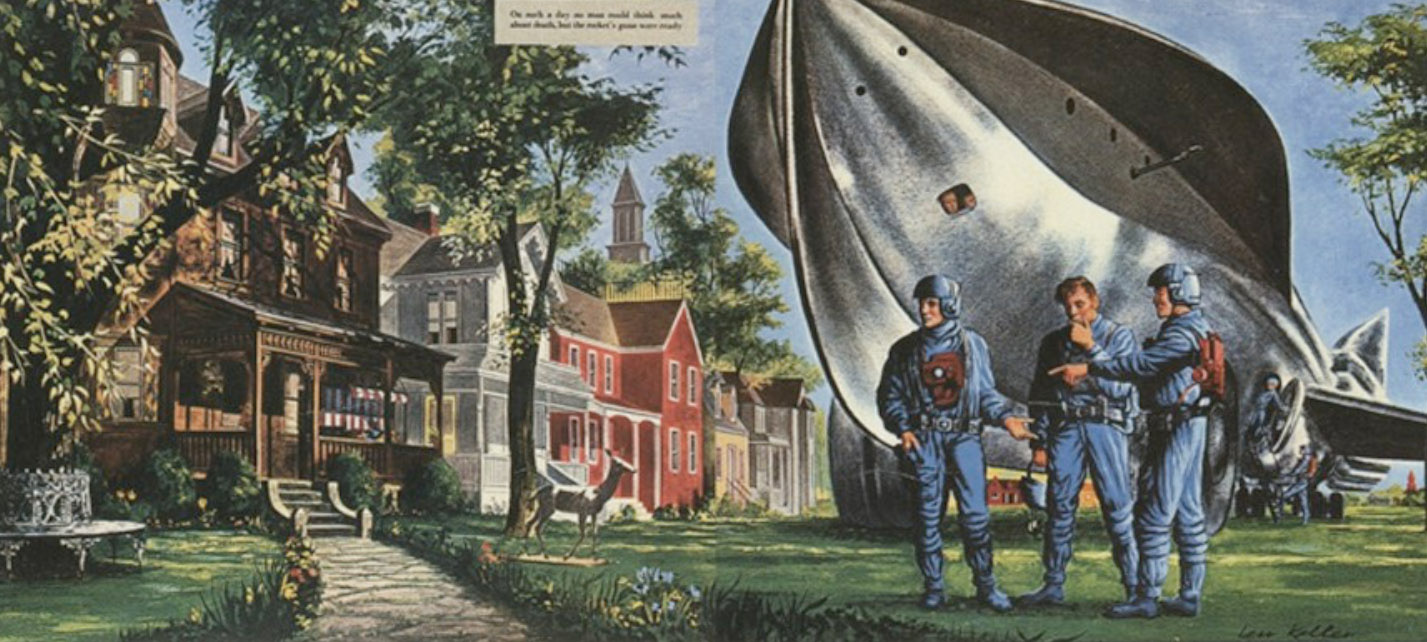
Illustration depicting ‘Rocket Summer’ (image from The Black Cat Moan)
They came because they were afraid or unafraid, happy or unhappy. There was a reason for each man. They were coming to find something or get something, or to dig up something or bury something. They were coming with small dreams or big dreams or none at all
Ray Bradbury, The Martian Chronicles
When I was but a sprite, and before I became an avid reader of books (I preferred comic books), I read Ray Bradbury’s The Martian Chronicles. It changed me, what I thought of books and what I felt about the power of stories. It made me cry. And perhaps that was when I decided to become a writer. I wanted to move people as Bradbury had moved me.
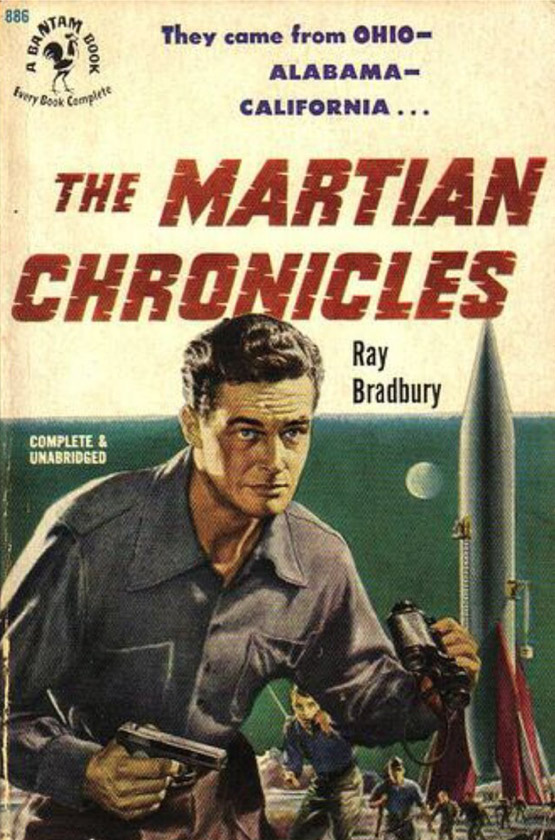
The 1970 Bantam book jacket aptly describes The Martian Chronicles as, “a poetic fantasy about the colonization of Mars. The story of familiar people and familiar passions set against incredible beauties of a new world…A skillful blending of fancy and satire, terror and tenderness, wonder and contempt.”
.
Rockets land on Mars overlooking Bradbury Lane (illustration from Sutori)
.
The Martian Chronicles isn’t really about Mars. True to Bradbury’s master metaphoric storytelling, The Martian Chronicles is about humanity. Who we are, what we are and what we may become. What we inadvertently do—to others, and finally to ourselves—and how the irony of chance can change everything. Despite the knowledge of no detectable amounts of oxygen, Bradbury gave Mars a breathable atmosphere: “Mars is a mirror, not a crystal,” he said, using the planet for social commentary rather than to predict the future.
From “Rocket Summer” to “The Million-Year Picnic,” Ray Bradbury’s stories of the colonization of Mars form an eerie tapestry of past and future. Written in the 1940s, the chronicles long with the nostalgia of shady porches with pitchers of lemonade, ponderously ticking grandfather clocks, and comfortable sofas. Expedition after expedition leave Earth to investigate and colonize Mars. Though the Martians guard their mysteries well, they succumb to the diseases that come with the rocketeers and grow extinct—not unlike the quiet disappearance of the golden toad, the Pinta giant tortoise, or the Bramble Cay melomys. Humans, with ideas often no more lofty than starting a tourist hot-dog stand, bear no regret for the native alien culture they exploit and eventually displace.
It is a common theme of human colonialism and expansionism, armed with the entitlement of privilege. Mars is India to the imperialistic British Empire. It is Rwanda or Zaire to the colonial empire of the cruel jingoistic King Leopold II of Belgium. Mars is Europe to Nazi Germany’s sonderweg. We need look no further than our own Canadian soil for a reflection of this slow violence of disrespect and apathy by our settler ancestors on the indigenous peoples of Canada.
Mars was a distant shore, and the men spread upon it in waves… Each wave different, and each wave stronger.
The Martian Chronicles
Tyler Miller of The Black Cat Moan makes excellent commentary in their 2016 article entitled “How Ray Bradbury’s ‘The Martian Chronicles’ changed Science Fiction (and Literature).”The article begins with a quote from Argentinean author Jorge Luis Borges (in the introduction to the Spanish-language translation of The Martian Chronicles: “What has this man from Illinois done, I ask myself when closing the pages of this book, that episodes from the conquest of another planet fill me with horror and loneliness?”
.
Remember, this was the 1950s … halfway through a century dominated by scientific discovery, and expansion. The 1950s saw developments in technology, such as nuclear energy and space exploration. On the heels of the end of World War II, the 1950s was ignited by public imagination on conquering space, creating technological futures and robotics. The 1950s was considered by some as the real golden age for science fiction, still a kind of backwater genre read mostly by boys and young men, that told glimmering tales of adventure, exploration, and militarism, of promising technologies, and often-androcratic societies who used them in the distant future to conquer other worlds full of strange and disposable alien beings in the name of democracy and capitalism. (In some ways, this is still very much the same.Though, it is thankfully changing…)
(Bantam 1951 1st edition cover)
Many scientists deeply involved in the exploration of the solar system (myself among them) were first turned in that direction by science fiction. And the fact that some of that science fiction was not of the highest quality is irrelevant. Ten year‐olds do not read the scientific literature.
Carl Sagan, 1978
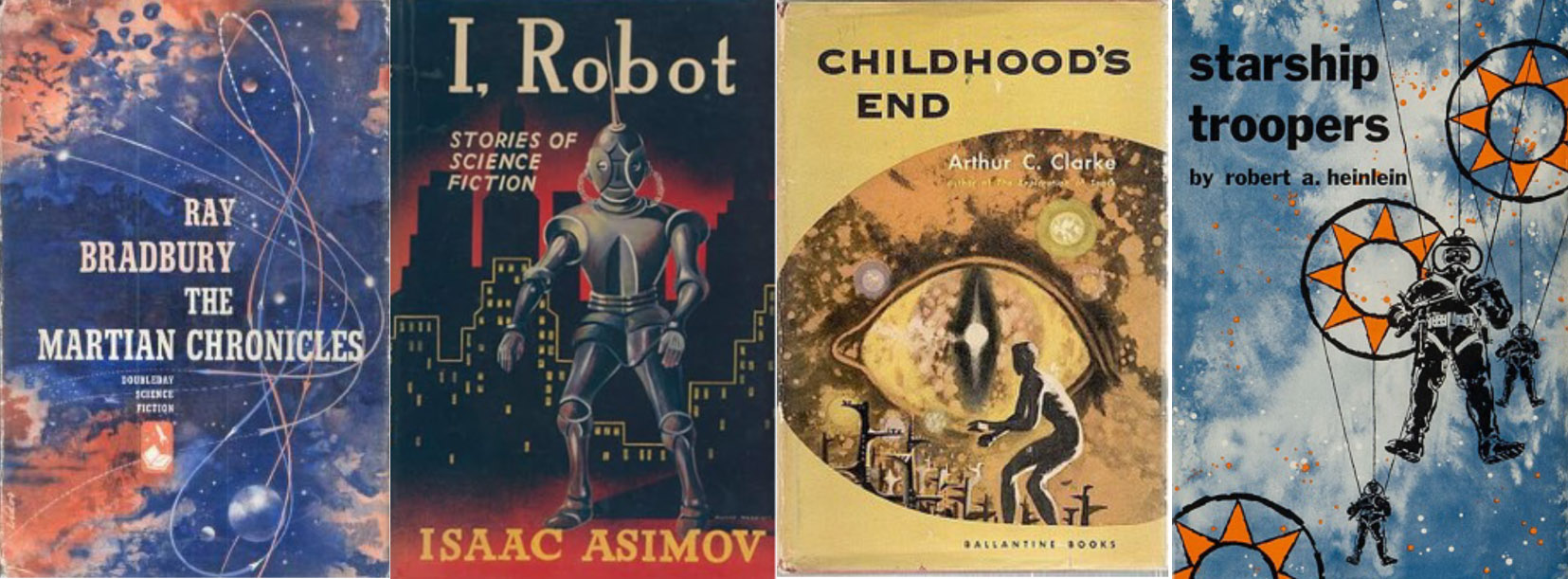
First edition book covers of Martian Chronicles (Doubleday, 1950); I, Robot (Grayson & Grayson, 1952); Childhood’s End (Ballantine Books, 1953); and Starship Troopers (G.P. Putnam’s Sons, 1959)
Large idea-driven SF works that typified this time period included Robert A. Heinlein’s Starship Troopers, Arthur C. Clarke’s Childhood’s End, Isaac Asimov’s I, Robot and his Foundation series.
It was at this time that Ray Bradbury published The Martian Chronicles. Though filled with the requisite rocket ships, gleaming Martian cities, ray guns, and interplanetary conquest, from the very start—as Borges noted—The Martian Chronicles departed radically from its SF counterparts of the time.
(Illustration on album cover of “Rocket Summer”, music by Chris Byman)
Instead of starting with inspiring technology or a stunning action sequence, or a challenging idea or discovery, Bradbury’s The Martian Chronicles opens with a domestic scene.
One minute it was Ohio winter, with doors closed, windows locked, the panes blind with frost, icicles fringing every roof, children skiing on the slopes, housewives lumbering like great black bears in their furs along the icy streets.
And then a long wave of warmth crossed the small town. A flooding sea of hot air; it seemed as if someone had left a bakery door open. The heat pulsed among the cottages and bushes and children. The icicles dropped, shattering, to melt. The doors flew open. The windows flew up. The children worked off their wool clothes. The housewives shed their bear disguises. The snow dissolved and showed last summer’s ancient green lawns.
Rocket summer. The words passed among the people in the open air, airing houses. Rocket summer. The warm desert air changing the frost patterns on the windows, erasing the art work. The skis and sleds suddenly useless. The snow, falling from the cold sky upon the town, turned to a hot rain before it touched the ground.
Rocket summer. People leaned from their dripping porches and watched the reddening sky.
The rocket lay on the launching field, lowing out pink clouds of fire and oven heat. The rocket stood in the cold winter morning, making summer with every breath of its mighty exhausts. The rocket made climates, and summer lay for brief moment upon the land…
Ray Bradbury, The Martian Chronicles, Rocket Summer
Bradbury’s focus was on the domestic. Housewives fighting off the ice and snow of Ohio. A Martian woman “cleaning the house with handfuls of magnetic dust which, taking all dirt with it, blew away on the hot wind.”
They had a house of crystal pillars on the planet Mars by the edge of the empty sea, and every morning you could see Mrs. K eating the golden fruits that grew from the crystal walls, or cleaning the house with handfuls of magnet dust which, taking all dirt with it, blew away on the hot wind. Afternoons, when the fossil sea was warm and motionless, and the wine trees stood stiff in the yard…you could see Mr. K in his room, reading from a metal book with raised hieroglyphs over which he brushed his hand, as one might play a harp. And from the book, as his fingers stroked, a voice sang, a soft ancient voice, which told tales of when the sea was red steam on the shore and ancient men had carried clouds of metal insects and electric spiders into battle…
This morning Mrs. K stood between the pillars, listening to the desert sands heat, melt into yellow wax, and seemingly run on the horizon.
Something was going to happen.
She waited.
Ray Bradbury, The Martian Chronicles, Ylla
Bradbury’s gift to literature—and to his SF genre—was his use of metaphor. Unlike the science fiction of his colleagues, Bradbury’s stories are a lens to study the past and the present. According to Miller, “The Earthmen’s exploration and desolation of Mars allowed Bradbury to look not forward but backward at exploration and desolation on Earth, namely the European arrival in the New World. Just as Europeans landed in North and Central America wholly unprepared for what they found there, Bradbury’s Earthmen are unprepared time and again for the wonder and the horror of Mars. And just as European diseases decimated native people in the Americas, it is chicken-pox which wipes out the Martians.”
.
.
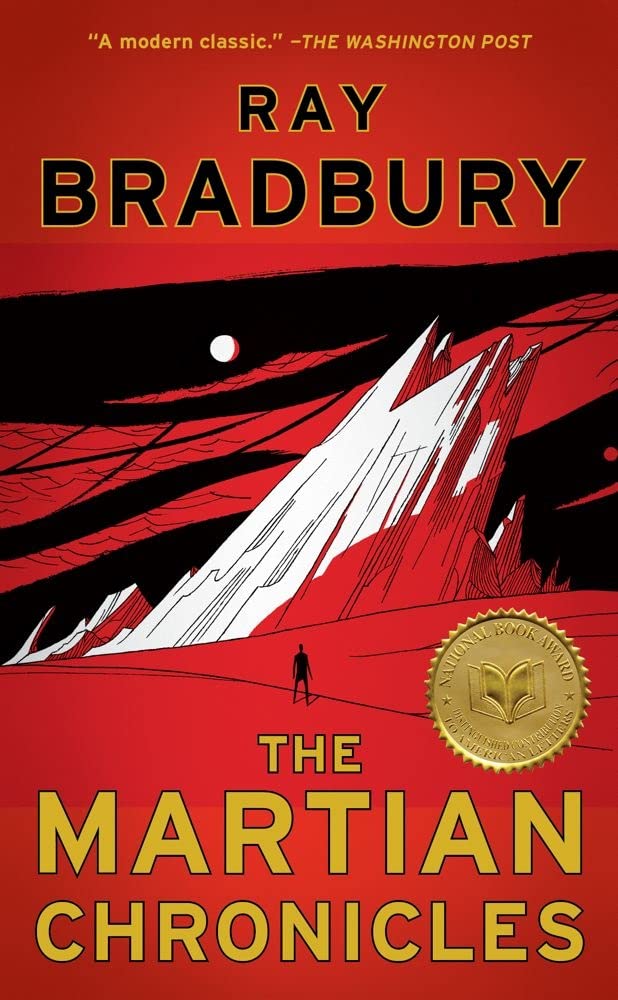
The back cover of the 2012 mass market paperback Simon & Schuster Reprint edition of The Martian Chronicles reads:
Bradbury’s Mars is a place of hope, dreams and metaphor—of crystal pillars and fossil seas—where a fine dust settles on the great, empty cities of a silently destroyed civilization. It is here the invaders have come to despoil and commercialize, to grow and to learn—first a trickle, then a torrent, rushing from a world with no future toward a promise of tomorrow. The Earthman conquers Mars … and then is conquered by it, lulled by dangerous lies of comfort and familiarity, and enchanted by the lingering glamour of an ancient, mysterious native race.
“Ask me then, if I believe in the spirit of the things as they were used, and I’ll say yes. They’re all here. All the things which had uses. All the mountains which had names. And we’ll never be able to use them without feeling uncomfortable. And somehow the mountains will never sound right to us; we’ll give them new names, but the old names are there, somewhere in time, and the mountains were shaped and seen under those names. The names we’ll give to the canals and the mountains and the cities will fall like so much water on the back of a mallard. No matter how we touch Mars, we’ll never touch it. And then we’ll get mad at it, and you know what we’ll do? We’ll rip it up, rip the skin off, and change it to fit ourselves.”
“We won’t ruin Mars,” said the captain. “It’s too big and too good.”
“You think not? We Earth Men have a talent for ruining big, beautiful things.”
Ray Bradbury, The Martian Chronicles, And the Moon be Still as Bright
Ray Bradbury’s The Martian Chronicles is a profound and tender analysis of the quiet power humanity can wield unawares and how we define and treat ‘the other.’ It is a tragic tale that reflects only too well current world events where the best intended interventions can go awry. From the meddling friend who gossips to “help” another (only to make things worse) to the righteous “edifications” of a religious group imposing its “order” on the “chaos” of a “savage” peoples … to the inadvertent tragedy of simply and ignorantly being in the wrong place at the wrong time (e.g., the introduction of weeds, disease, etc. by colonizing “aliens” to the detriment of the native population; e.g., smallpox, AIDs, etc.). Bradbury is my favourite author for this reason (yes, and because he makes me cry…)
.
Mars terrain (photo by NASA)
Nina Munteanu is a Canadian ecologist / limnologist and novelist. She is co-editor of Europa SF and currently teaches writing courses at George Brown College and the University of Toronto. Visit www.ninamunteanu.ca for the latest on her books. Nina’s bilingual “La natura dell’acqua / The Way of Water” was published by Mincione Edizioni in Rome. Her non-fiction book “Water Is…” by Pixl Press (Vancouver) was selected by Margaret Atwood in the New York Times ‘Year in Reading’ and was chosen as the 2017 Summer Read by Water Canada. Her novel “A Diary in the Age of Water” was released by Inanna Publications (Toronto) in June 2020.
In 2015, Syfy released Season 1 of The Expanse, a stylish and intelligent science fiction (SF) TV series set 200 years in the future when humanity has colonized the moon, Mars and the Asteroid Belt to mine minerals and water. The six-season series is based on the novel series by James S.A. Corey with first novel “Leviathan Wakes”.
New York City of the Expanse
Humanity has split three ways culturally, ethnically and even biologically: Earth is currently run by the United Nations; Mars is an independent state, devoted to terraforming with high technology; and the Belt contains a diverse mix of mining colonies, settlers, workers and entrepreneurs. Belters’ physiology differ from their Earth or Mars cousins, given their existence in low gravity.
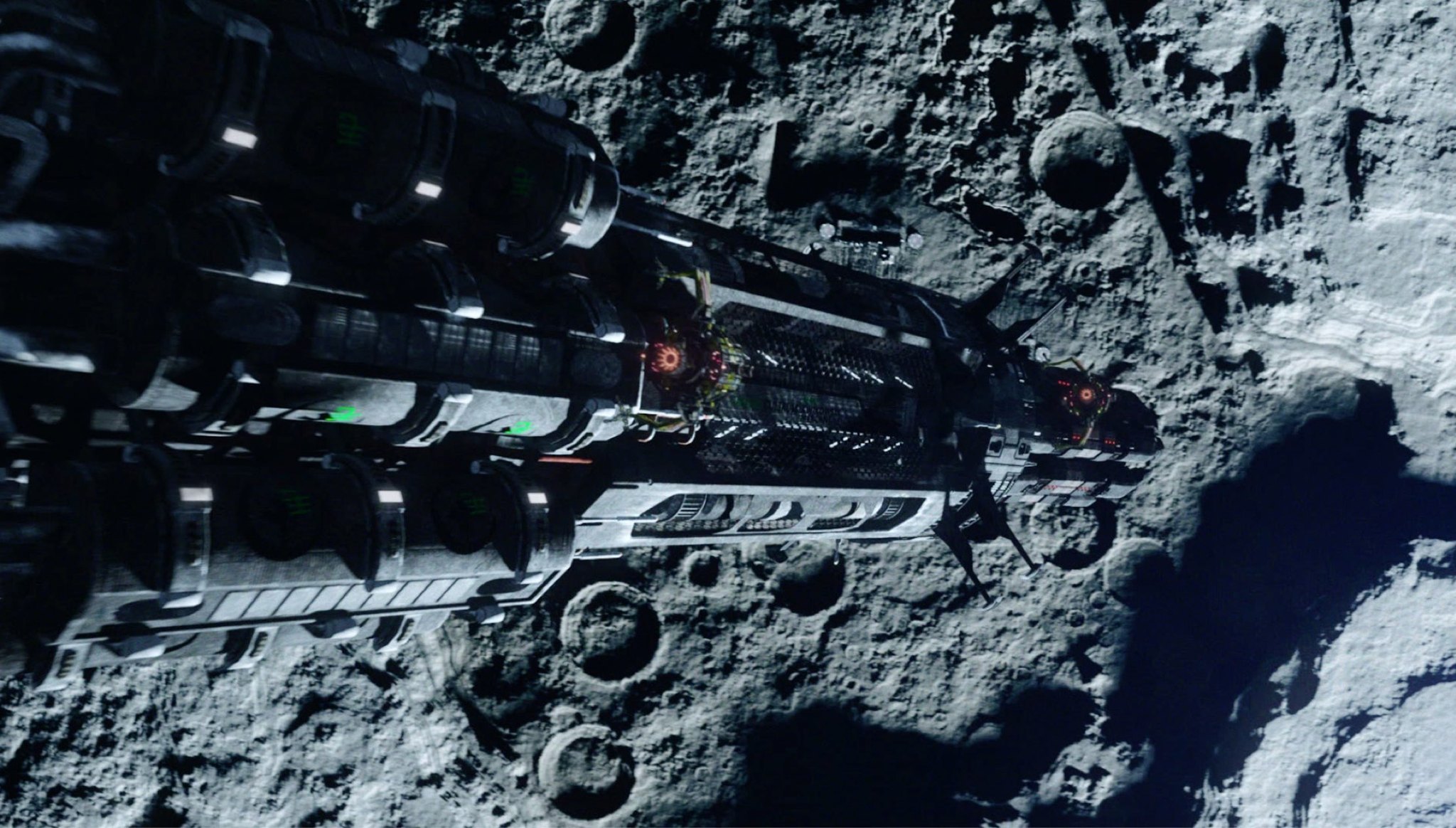
Ship heading to Ceres
One of the creators Mark Fergus explains the setting and premise of The Expanse: “We always felt that the great struggle of a lot of sci-fi we grew up on takes us into a story world where we’ve already jumped over the interesting part, which is the first fumbling steps of us pushing off this planet, getting out into the solar system, sorting ourselves out as a race. All the struggle and the pain and the glory of that, usually sci-fi … hops over it.” Fergus and his colleagues were attracted by what he called “the scaffolding,” how it all got built. “Here is who built it. Here is how humanity started looking at itself differently and getting rid of old forms of racism and creating new forms of racism.” This is the story of The Expanse.
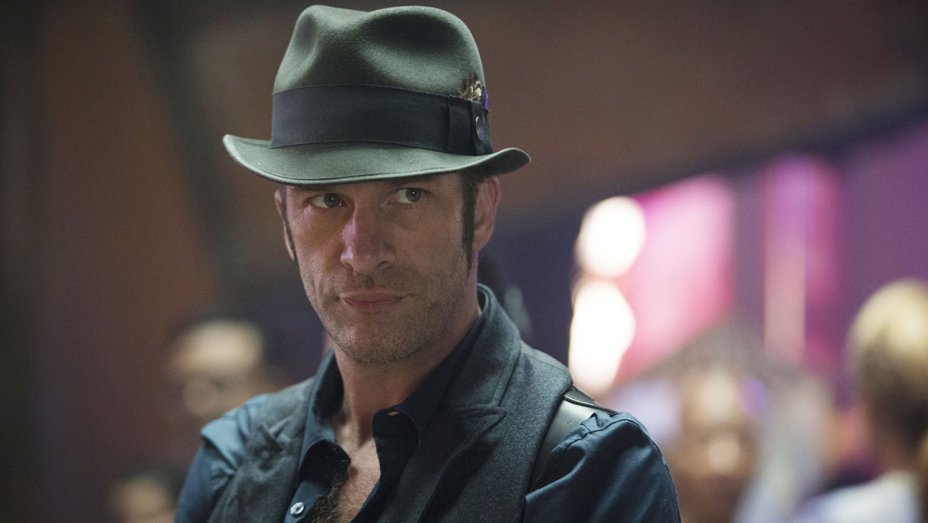
Josephus Miller, cynical detective on Ceres
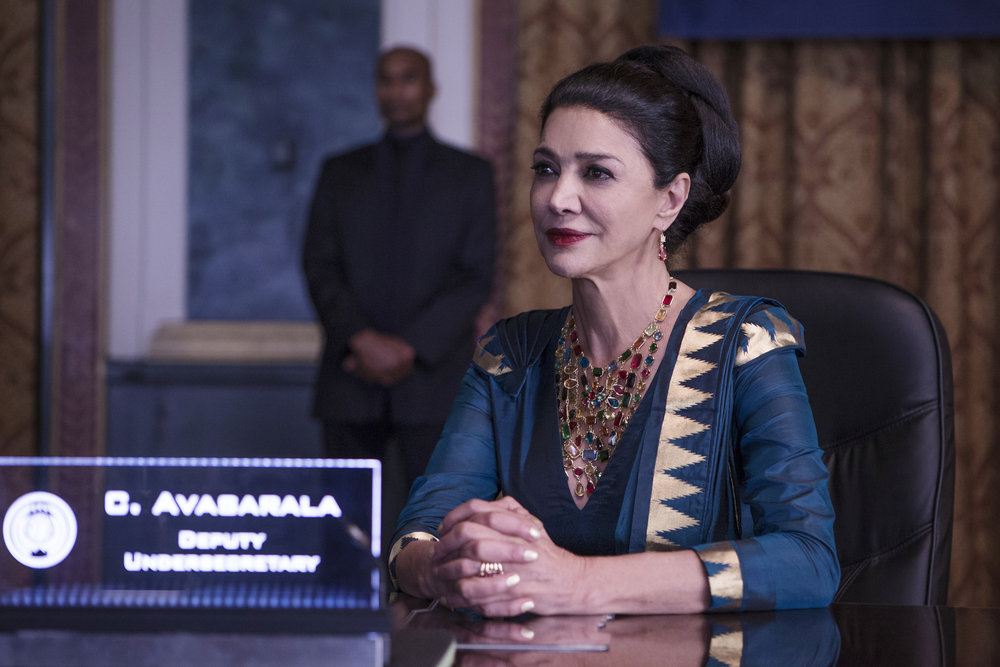
The series starts by following three main characters: U.N. Deputy Undersecretary Chrisjen Avasaraia (Shohreh Aghdashloo) on Earth; cynical police detective Josephus Miller (Thomas Jane), a native of Ceres (in the Belt); and ship’s officer Jim Holden (Steven Strait) and his crew as each unravels a piece of a conspiracy (related to an unknown extra-solar material discovered on a Saturn moon) that threatens a fragile peace in the solar system and the survival of humanity.
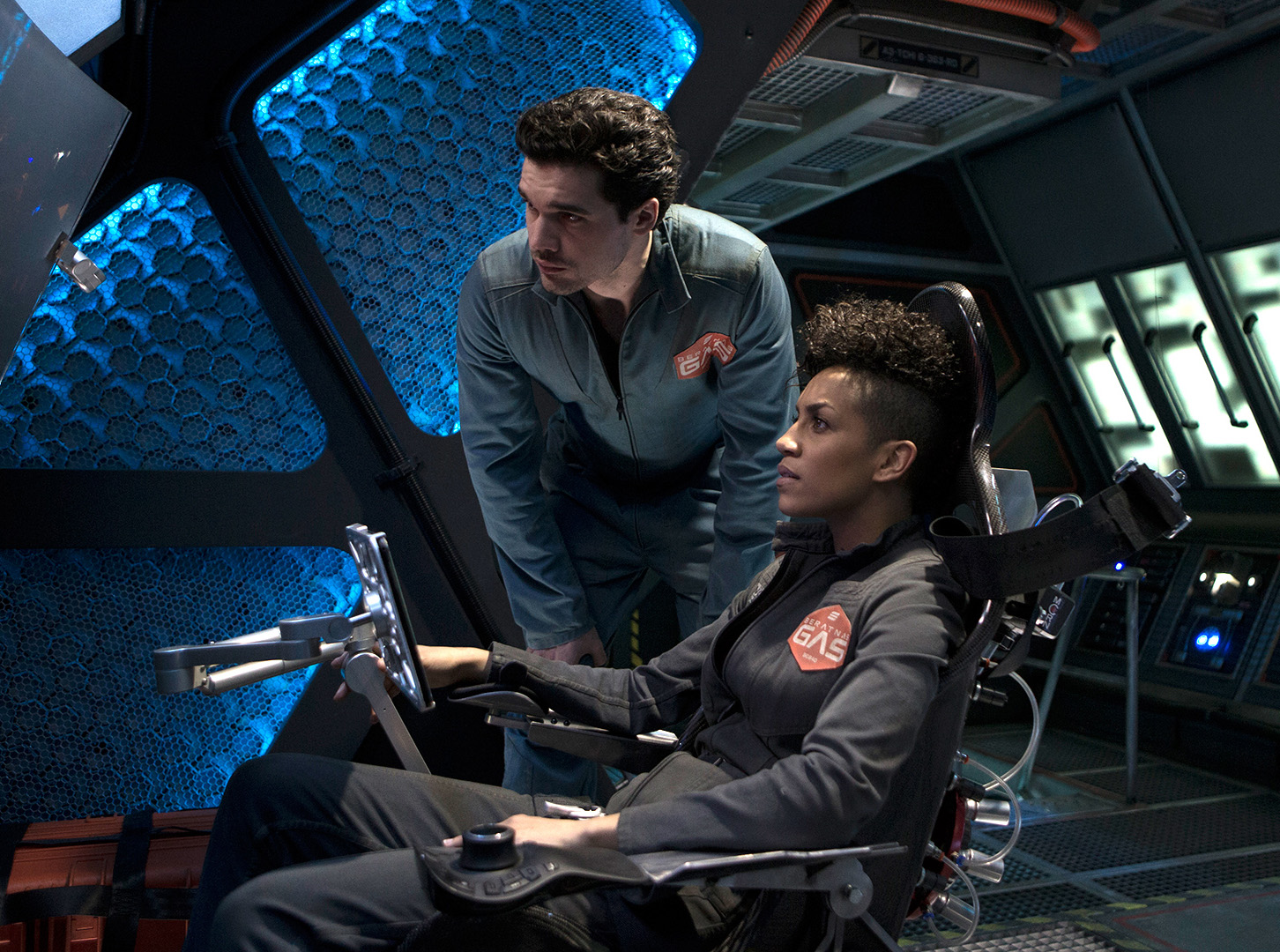
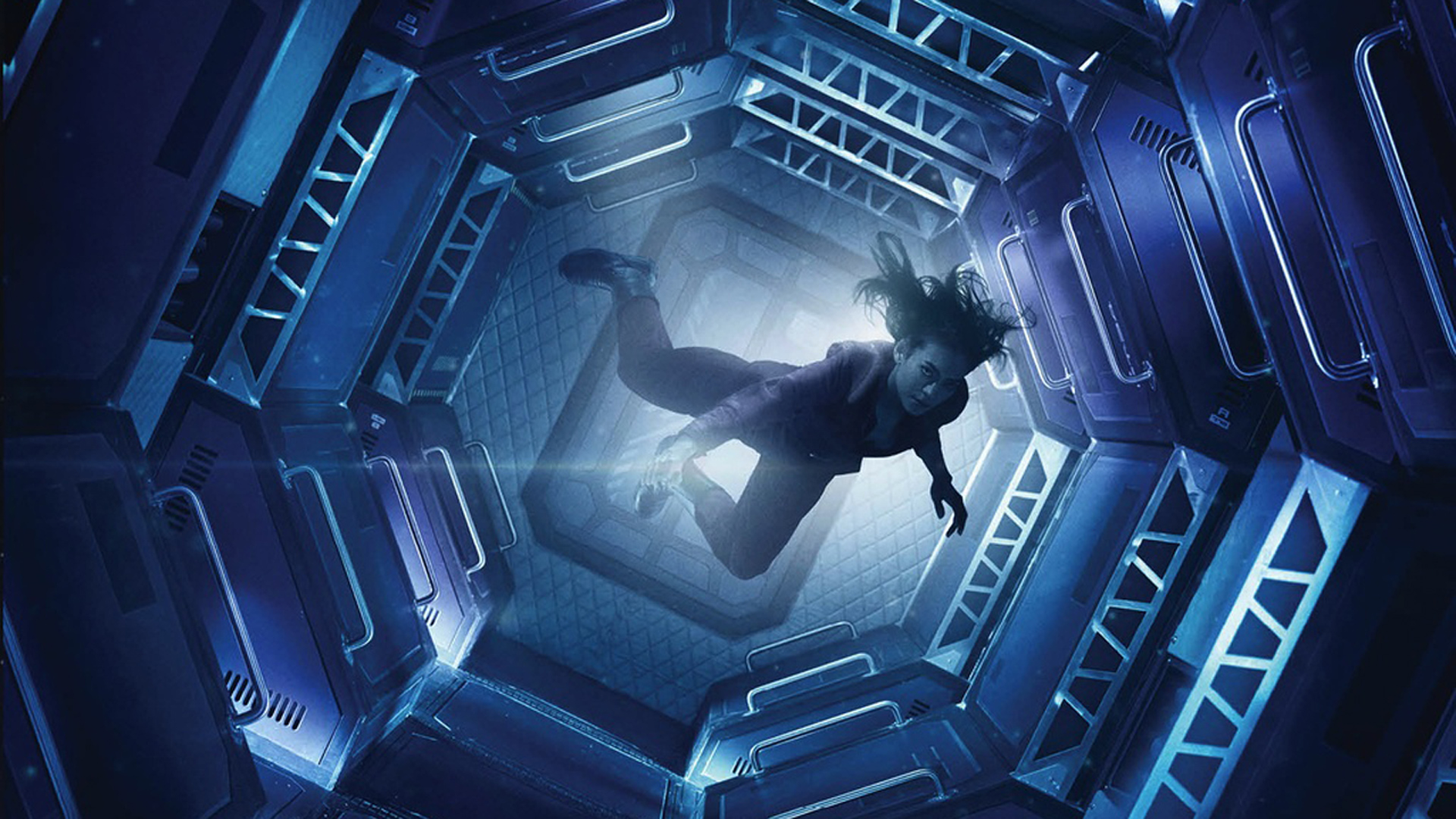
Holden and Naomi in their ship
First, Miller’s boss, Shaddid (Lola Glaudini) tosses him a missing person case: find Julie Mao (Florence Faivre), wayward daughter of a Luna-based shipping magnate (Mao-Kwikowski Mercantile); then Holden and four other crew members of the ice trawler Canterbury barely survive an attack that could spark a war between Earth and Mars. Miller and Holden eventually learn that the missing girl and the ice trawler’s fate are connected to a larger threat.
The only person who may stand a chance of figuring out the big picture is Chrisjen Avasarala, a brilliant 23rd-century Machiavelli, hoping to prevent simmering tensions between the United Nations, Mars and the Belt from erupting into all-out war. She will stop at nothing in her search for the truth, including gravity torturing a Belter or playing her friends and contacts like chess pieces to find answers.
Chrisjen speaking to Belter under gravity torture
What makes Chrisjen incredibly more interesting than, say a Circe or Claire Underwood, is that her scheming—as reprehensible as it may be at times—comes from a higher calling, not from lust for power or self-serving greed. She seeks the truth. And, like Miller, she struggles with a conscience. When her grandson asks if people are fighting again, Chrisjen says, “not yet; that’s why we [her contacts] need to talk and tell the truth; when people don’t tell the truth it always ends badly.” She may have been thinking of herself.
Chrisjen is a complex and paradoxical character. Her passionate search for the truth together with unscrupulous methods, makes her one of the most interesting characters in the growing intrigue of The Expanse. The Expanse further dignifies itself with subtle nuances of multi-layered social commentary—sewn into virtually every interaction.
After Chrisjen’s friend Franklin Degraaf (Kenneth Welsh), Earth ambassador to Mars, suffers as a casualty in one of her intel games, he quietly shares: “You know what I love about Mars?… They still dream; we gave up. They are an entire culture dedicated to a common goal: working together as one to turn a lifeless rock into a garden. We had a garden and we paved it.” Chrisjen offers consolation to the loss of his position (because of her): “we may have prevented a war.”
Chrisjen consoles Degraaf with a bottle of wine after causing his forced resignation as ambassador to Mars
The subtle details and rich set-pieces of The Expanse universe rival the best world building of Ridley Scott. In fact, I was reminded of the grit and immediacy of Bladerunner. The Expanse is SF without feeling like it’s SF; it just feels real. Powerful storytelling—from judicious use of slow motion, odd shot angles, haunting music and background sounds, to superlative acting—draws you into a complete and realizable world.
Ceres Station
Annalee Newitz of ARS Technica wrote, “the little details of this universe are so finely rendered that they become stories unto themselves, like the way interracial tensions developed on Ceres between humans who grew up gravity-deprived and spindly, versus those whose gravity-rich childhoods allow them to pass as Earthers.” Newitz adds that no clumsy Star Trek-style representation of exo-planetary civilizations occurs in The Expanse. It’s all humans. “Instead, there are political factions whose members stretch across worlds. And planets (or planetoids) whose populations are fragmented by class, race, and ideology. The politics here are nuanced, and we are always being asked to rethink who is right and who is wrong, because there are no easy answers.”
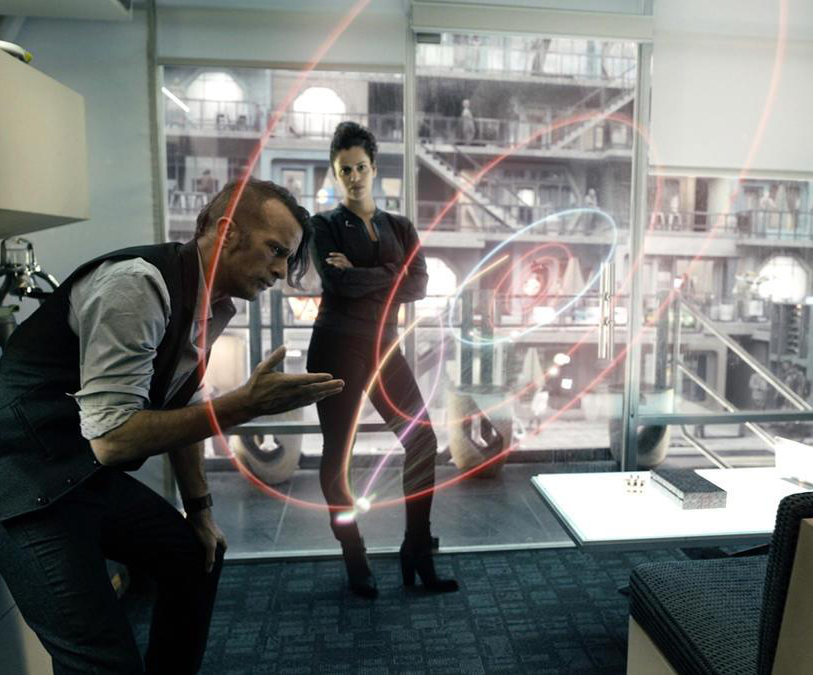
Miller and Tavi Muss, his former partner at Star Helix, discuss the recent strange events in the solar system while at his apartment in Ceres
Subtle but powerful differences between the Belter culture, Earthers and Martians (all human) includes language. Belters use a creole that’s a mix of several Earth languages that were spoken by the original human settlers in the Belt colonies. Resembling a Caribbean twang and cadence, words contain a mix of slang English, Chinese, French, Zulu, Arabic, Dutch, Russian, German, Spanish, Polish and others. For instance, “Inyalowda” means inner or non-belter. “Sa-sa” means to know. “Copin” means friend. An Expanse Wikia provides an in-depth list of Belter Creole used in the TV show.
Liz Shannon Miller of Indiewire.com shares: “In the 23rd century, the smart phones look fancier but their screens still crack. There are people in straight relationships and gay relationships and group marriages. There are still Mormons, who are preparing for a whole new level of mission. The rich live well. The poor struggle. It’s not “Star Trek” — there’s no grand glorious yet vague cause to which our heroes have devoted themselves. Survival is what matters.”
The Expanse is a sophisticated SF film noir thriller that elevates the space opera sub-genre with a meaningful metaphoric exploration of issues relevant in today’s world—issues of resource allocation, domination & power struggle, values, prejudice, and racism. These issues are explored particularly well through its diverse female protagonists with subtle nuances of multi-layered social commentary sewn into virtually every interaction.
Julie Mao trapped onboard a stealth ship
In Season 1 alone we are presented with Julie Mao (Florence Faivre), who is according to Detective Miller (tasked to find her) the “richest bachelorette in the system”, and an OPA collaborator; Naomi Nagata (Dominique Tipper), a highly-skilled Belter technologist and former OPA agent; Camina Drummer (Cara Gee), a no-nonsense calculating Belter who used to work with OPA leader Anderson Dawes but now helps run Tycho Station that is building a giant interstellar ship for the Mormons; and Chrisjen Avasarala (Shohreh Aghdashloo) a sharp-minded ruthless political strategist in search of the truth.
(Left: Naomi Nagata)
Drummer in a sticky situation during a coup on Tycho Station
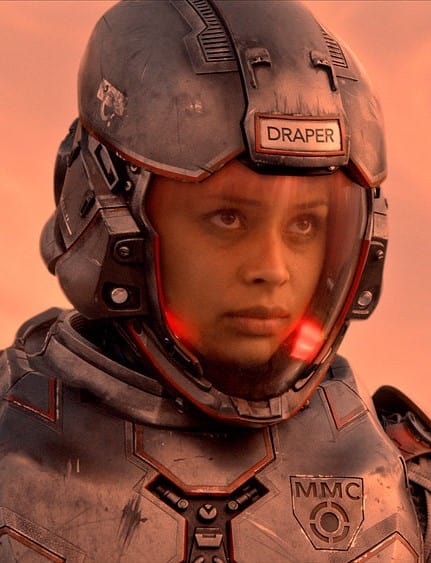
Season 2 and 3 introduce yet more powerful female characters with agency, such as Bobbie Draper, a staunch hard-fighting Martian marine who dreams of a terraformed Mars; and the Reverend Anna Volovodov (Elizabeth Mitchell), a gay Methodist doctor, who brings faith, hope, and inclusion to her acts of heroism.
(Left: Bobbie Draper)
Anna Volovodov dealing with a protest on Earth
I found the music by Clinton Shorter particularly appropriate: subtle, edgy, haunting, and deeply engaging: like its characters, the story, and world. The haunting title song, sung by Lisbeth Scott, lingers in each episode throughout the six seasons.
Amidst the unfolding intrigue of war, corruption and secrecy, a rich tapestry of characters take shape —with the added spice of an extra-solar alien entity (and a nod to panspermia). The alien entity is called the protomolecule based on its evolving nature (it eventually evolves into a ring-gate to other worlds). We eventually learn that the alien blue goo was sent by an alien civilization (directed panspermia) inside an interstellar asteroid (lithopanspermia) millennia ago; although it was captured by Saturn’s gravity to become one of its many moons (Phoebe), its target was Earth’s rich biology to bioengineer. Considered a bio-weapon, it is coveted by the politicians of Earth, Mars, and the Belt.
Miller, who was born on Ceres but received some cheap bone density implants—so he looks like an Earther—is a cynical detective (not above being bribed by merchants cutting corners) and trying hard to hide the fact that he has a big heart and is looking for meaning in his empty existence as a Star Helix cop (Miller: “No laws on Ceres; just cops.”) Belters call him a “well wala”, traitor to his own kind.
Miller and Dawes discuss the disappearance of Julie Mao
Ceres-born Anderson Dawes (Jared Harris), suave and ruthless leader of the separatist OPA (Outer Planet Alliance) challenges Miller: “I think that under that ridiculous hat there’s a Belter yearning to find his way home.” Except what is “home”? When asked by his new Star Helix partner, Dmitri Havelock (Jay Hernandez) about ‘why the hat?’, Miller quips, “to keep out the rain.” There is no rain on Ceres. Never was. Never will be.
The militant OPA is an activist organization that sells itself as a liberator for Belters but is really a terrorist revolutionary group, looking to shift the balance of power. Led by Dawes, the OPA’s ambitious agenda ranges from staging protests in the gritty Medina district of Ceres to stealing stealth technology and bio-weapons from Mars and Earth. Some of the best scenes occur between the intense Dawes and crusty Miller, as they banter over what it means to be a Belter in a solar system where they are clearly not players but sandwiched in a power struggle between Earth and Mars.
Dawes confides to Miller: “All we’ve ever known is low G and an atmosphere we can’t breathe. Earthers,” he continues, “get to walk outside into the light, breathe pure air, look up at a blue sky and see something that gives them hope. And what do they do? They look past that light, past that blue sky. They see the stars and they think ‘mine’… Earthers have a home; it’s time Belters had one too.”
Subtle. Not so subtle. The show takes a few opportunities to point out what we are doing to our planet. Cherish what you have. Cherish your home and take care of it. We’re reminded time and again, that we aren’t doing a good job of that.
Onboard the MCRN Donnager, Martian Lopez asks his prisoner Holden if he misses Earth and Holden grumbles, “If I did, I’d go back.” Lopez then dreamily relates stories his uncle told him about the “endless blue sky and free air everywhere. Open water all the way to the horizon.” Then he turns a cynical eye back on Holden. “I could never understand your people. Why, when the universe has bestowed so much upon you, you seem to care so little for it.” Holden admits, “Wrecking things is what Earthers do best…” Then he churlishly adds, “Martians too, by the look of your ship.” Lopez retorts, “We are nothing like you. The only thing Earthers care about is government handouts. Free food, free water. Free drugs to forget the aimless lives you lead. You’re shortsighted. Selfish. It will destroy you. Earth is over, Mr. Holden. My only hope is that we can bring Mars to life before you destroy that too.”
The underlying message in Expanse becomes clear in the last show of Season One. Near the end, Miller asks Holden what rain tastes like and Holden admits he never thought about it. Miller then asks, “How could you leave a place like Earth?…” Holden responds, “Everything I loved was dying.”
Critic Maureen Ryan of Variety says, “It’s to the show’s credit that it is openly political, and takes on issues of class, representation and exploitation.”
Bobbie and her Martian crew patrolling Ganymede
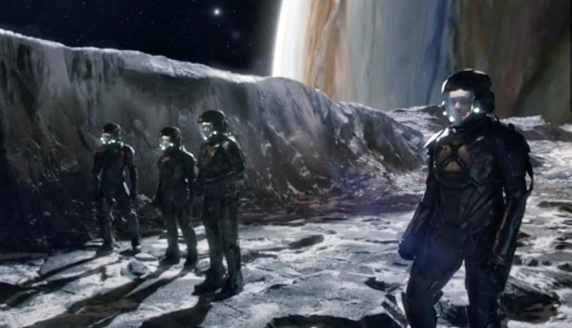
As the seasons progress (ending in Season 6), the plot doesn’t so much thicken as branch like a fractal tree or the braiding delta of a river into the sea, expanding as the galaxy itself into infinite space. Season 2 witnesses biological and political developments with the protomolecule, from the use of an entire station as a human laboratory to the testing of protomolecule-human hybrid weapons on Ganymede Station. Stationed there, Martian marine Bobbie Draper barely survives an encounter with a hybrid as it easily dispatches her entire crew and UNN soldiers alike. Events related to the secret war among powers to hold and control this alien weapon precipitate war between Earth and Mars.
Chrisjen Avasarala questions Bobbie at an Earth-Mars summit inquiry into the incident on Ganymede
The plot train goes into high gear in Season 3 with high stakes scenes of war, intrigue, and violent change. Through the various set-pieces of place, new characters are introduced and embed themselves in the larger story with amazing potency. One example of the various plot threads surrounding Ganymede Station introduces botanist Prax Meng (Terry Chen) and his 12-year old daughter Mei (Leah Jung), secretly taken from him by a Pierre Mao scientist to become a protomolecule hybrid. Introduced in Episode 8 (Pyre) of Season 2, Prax and kidnapped Mei immediately stir our hearts with their story. I was struck by how powerful a brief appearance by one character could be: Prax, who thinks he has lost Mei when the mirrors fell on Ganymede Station, finds himself on a refugee ship with Doris Bourne (Grace Lynn Kung), a botanist colleague from Mars. We are introduced to Doris and lose her within a single episode; yet we feel incredible pathos on her demise (thanks to their performances, and the circumstances that drive their short-lived story together).
Doris and Prax onboard the refuge ship after the Ganymede incident
The Expanse is filled with these potent vignettes, focused on one or two characters, that tug our heartstrings with personal drama. Several come immediately to mind: ‘Big Guy’s’ (Gugun Deep Singh) heartfelt sacrifice in Episode 12 (The Monster and the Rocket) of Season 2; the slaughter of all miners of Anderson Station, with particular focus on Marama Brown (Billy MacLellan) and his daughter Kiri (Raven Stewart), in Episode 5 (Back to the Butcher) of Season 1.
Throughout its expansive six seasons, The Expanse never loses sight of its strongest feature: its characters who each tell a heart-felt story and whose threads weave a greater story tapestry. This is a TV show that writes large through its many intimate stories; all smaller wholes entangled with the larger whole.
Variety’s Whitney Friedlander writes that The Expanse is Syfy’s most expensive series to date. It shows. And it shows well because it does not trade story for effects. Story comes first. The Expanse is a welcome breath of fresh air for high quality “space opera” science fiction on TV. It fills a gaping hole left by the conclusion of Battlestar Galactica in 2009.
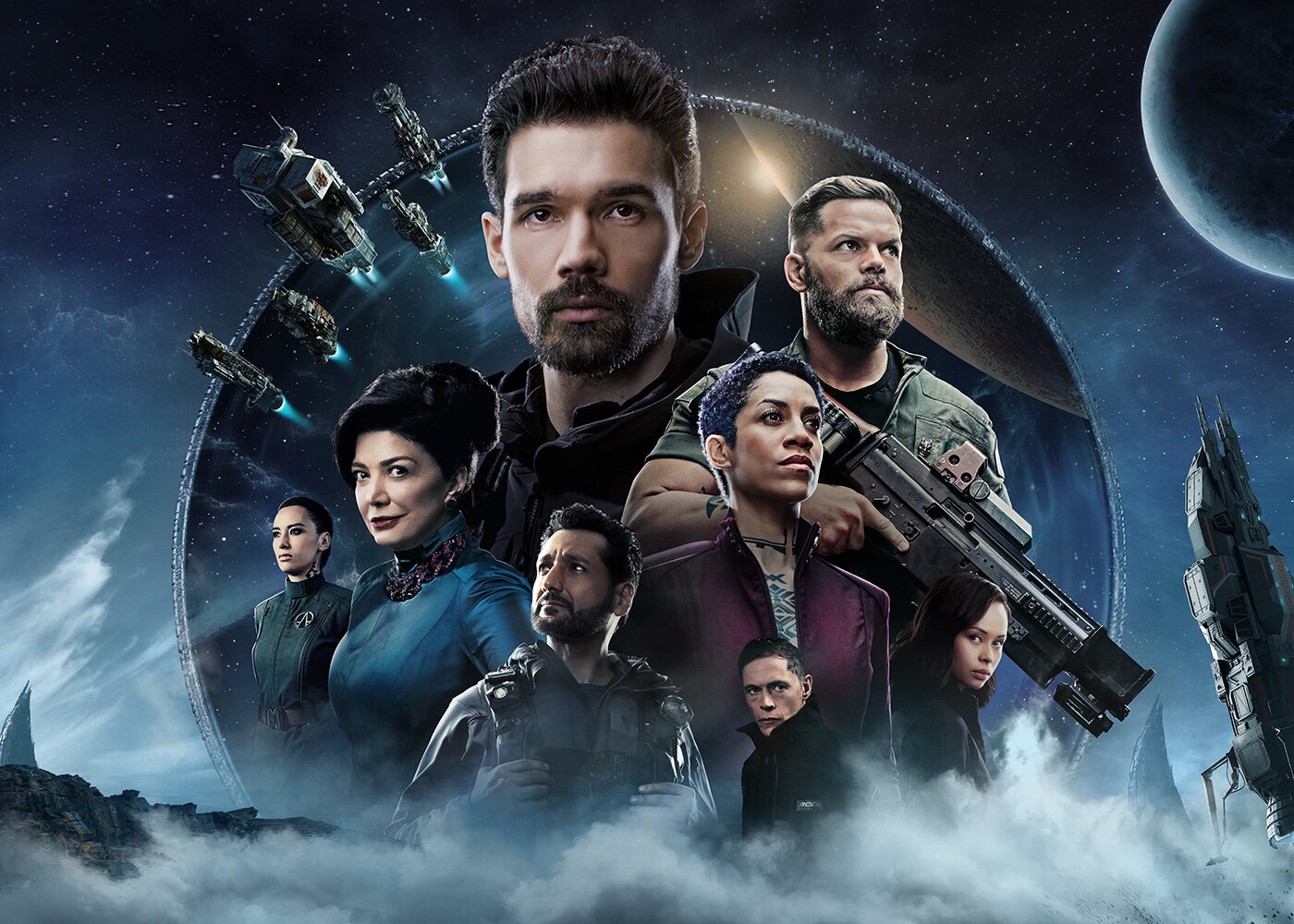
Poster for Season Five of The Expanse
p.s. Since my title includes a comparison of The Expanse with Game of Thrones, I feel compelled to state another important difference between these two highly successful TV shows, and ultimately why I disliked one as I loved the other: while both shows created fully-fleshed compelling characters that viewers quickly embraced and loved (or hated), GOT chose to wily-nily give them brutal (and often grotesque) deaths for no other apparent reason than to shock the viewer—creating a tension of suspicion and fear. Viewers became nervous for their favourite character. It was like a crap shoot and the viewer was the real victim. The death of virtually every character in the Expanse however—though also often a heart-wrenching surprise—could be explained and understood. This was because their demise filled the greater purpose of the overall story. That simple. I give ultimate credit to the writers of The Expanse. And shame on the Game of Thrones screenwriters and producers.
“Story must come first!”
Julie Mao escaping imprisonment in the stealth ship
Nina Munteanu is a Canadian ecologist / limnologist and novelist. She is co-editor of Europa SF and currently teaches writing courses at George Brown College and the University of Toronto. Visit www.ninamunteanu.ca for the latest on her books. Nina’s bilingual “La natura dell’acqua / The Way of Water” was published by Mincione Edizioni in Rome. Her non-fiction book “Water Is…” by Pixl Press (Vancouver) was selected by Margaret Atwood in the New York Times ‘Year in Reading’ and was chosen as the 2017 Summer Read by Water Canada. Her novel “A Diary in the Age of Water” was released by Inanna Publications (Toronto) in June 2020.
My mother had fantasized that one day she would see Eos. Her hero was Genevieve Dubois, the space explorer who’d flown the last of a series of ill-fated ZetaCorp flights to Eos some two hundred years ago when it took years to travel anywhere in the galaxy. Dubois was the first―and only―human to have set foot on the mythical planet of Eos, secluded in the giant blue nebula of the Pleiades. After apparently experiencing an epiphany of universal proportions, when she encountered one of the god-like Epoptes, Dubois returned, pregnant, to Florida with her Eosian lover, Azaes. They mysteriously disappeared after being taken into captivity by the American government and ZetaCorp for questioning. Rumors abounded that Azaes had unleashed a tremendous and fearful weapon out of his head on a human―the melting look, I figured―which condemned him as a dangerous monstrosity. Humans rallied to have him imprisoned or banished. Even killed.
The historical records suggested that Dubois and Azaes were murdered soon after. My mother, however, agreed with popular lore that they’d escaped to live a simple secluded life, and that Dubois’s baby by Azaes was born and its descendants were living to this day. The most popular story ― and therefore the least likely―was that only Dubois got away, travelled north to Canada and returned to her native Quebec where she stoically gave birth alone to her child in some abandoned barn in the country. The whole thing smelled of mythos.
Despite the rampant anti-alienism, many humans strongly believed that Dubois bore this child, making her the first human to give birth to a human-alien. A fanatical cult, L’Ordre de l’Arbre Sacré—Order of the Sacred Tree, sprang up in Quebec, and its mostly human members devoted themselves to the notion that Dubois’s child was a kind of messiah who walked secretly among humans and was linked to the tree of life and knowledge, the vishna. They regarded the vishna an ancient soul that carried infinite wisdom and the answer to achieving the ‘balance of all things’.
The Order of the Sacred Tree claimed that all the ills plaguing life in the galaxy were due to a misalignment of forces, an imbalance that the now-extinct Hopi Native Indians called koyaanisquatsi. They claimed that this messiah—Dubois’s child— would provide the balance needed to begin a new age of enlightenment and peace. They spread wild stories of how the child was consummated not through Dubois’s lover Azaes but somehow through Dubois’s interaction with an Eosian vishna tree, which had godly powers and came to be known as one of the sacred trees, along with the migratory trees of Horus, which were also thought to be ancient souls.
According to the Order, Genevieve Dubois had, in fact, perished in a giant igapo that flooded Eos’s great forest as she saved the natives from the evils of her mad crew. The legend claims that Dubois was swept up by the igapo, battered and dying, to the top of the highest vishna tree and there joined with an Epoptes. When she died, the Epoptes took her form, and it was she who returned to Earth with Azaes. Their child was the first Epoptes to live among humans … as a human, bringing the message of the ancient souls for achieving sacred balance and eternal existence.
Members of the Tree Cult swelled to the thousands, spreading the word of enlightenment through sacred trees, such as the native oak, the extraterrestrial vishna, and the mythical migratory trees of Horus. Yet their membership and much of their practices remained veiled in mystery. I couldn’t understand their popularity in a world of rampant anti-alien sentiment. Perhaps this was why the Tree Cult remained a secret society. The Tree Cult continued to petition for Earth to acquire the sacred vishna tree of enlightenment. Well, Earth had them now aplenty, I thought with a sour smile. Only there were hardly any humans left there to enjoy them… the Vancouver of my youth no longer existed; the Eosians had altered my world.
Rhea is referring to the fact Earth was now the home of Eosians, who claimed that Earth was their initial home, eons ago. In the bargain for their part in saving humanity from the Vos attacks of 186-191 SGT, Eosians claimed Earth as their ancient homeland and humanity was pushed into exodus.
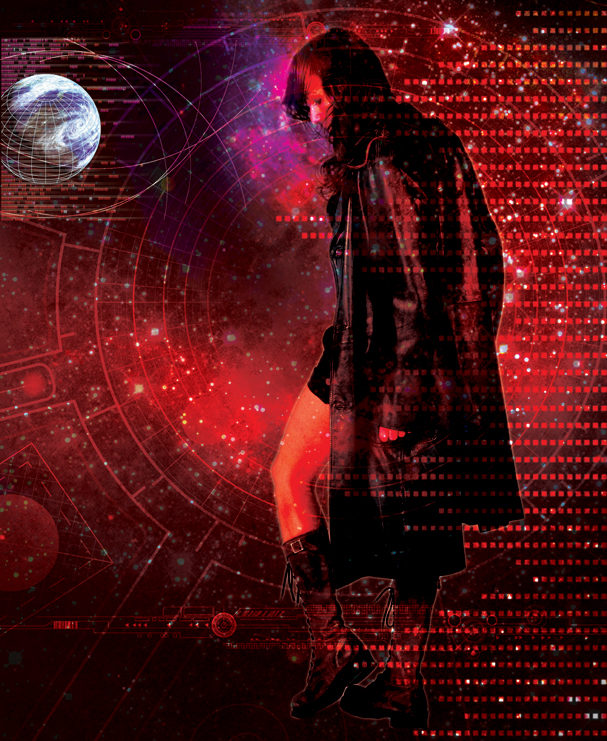
Rhea Hawke (Vali Gurgu)
“…the baldies had transformed my home planet into a lush jungle. I’d heard that they’d introduced their own trees, the vishna that supposedly made them immortal, and had coaxed Earth to revert to what it had been prior to the agricultural revolution thousands of Sol years ago. The Eosians had made Earth their home, living a symbiotic-organic life through their superior bio-technology.”
While some humans remained to live with the Eosians and adapt to their way, most took the offered package to leave: Eosians provided several bio-geo-engineered planets suitable for humans to colonize, one of which was Iota Hor-2, where Rhea lives and works.
The World—and its Myths—According to Rhea:
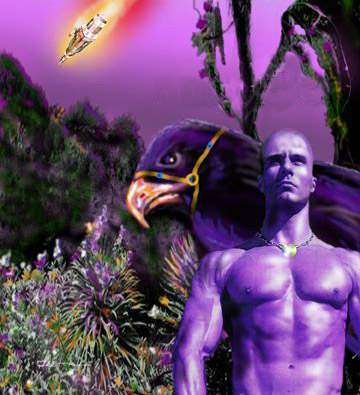
Azaes and his scree on Eos
Eosians: The whole Eosian race was supposedly the result of a foolish transgression by the overseeing ‘gods’ of ancient Earth, the Epoptes. The ‘watchers.’ Although they’d sworn not to, some Epoptes came down and fornicated with the primitive stone-age humans. My mother had quoted the lines in the Bible often enough: the sons of God saw the daughters of men that they were fair; and they took them wives of all which they chose. It was always males who did the ‘taking,’ I thought. Of course, the logic was obvious: only women gave birth. There was no point in female ‘gods’ coming down to frolic with the primitive human males. Not if the point of fornication was to produce a new species in the original community.
[The Epoptes] had created a hybrid giant race, the Eosians, who became the original inhabitants of Atlantis: the Nephilim (giants) were on the earth in those days … when the sons of God came in to the daughters of men, and they bore children to them. Those were the mighty men. So went the new myth, anyway … and when the Atlanteans plummeted into debauchery themselves, the matter-energy manipulating Epoptes unleashed their wrath in the form of a global disaster that was known throughout countless civilizations as the ‘great flood.’ Choosing a few still good Atlanteans to take on their ‘ark,’ the Epoptes found them a new home: Eos, an Earth-like jungle planet nested deep in the Pleiades. They left any original humans who’d managed to survive the wrath of the gods to their own devices. And now the Eosians were back on Earth, where they’d originated. And no sign of any Epoptes, I thought cynically. Of course, the logical cover-up story was that the Epoptes had learned their lesson and never made themselves known to others again. It was all pretty convenient.
Epoptes: Phantom ‘gods’ the Eosians supposedly consulted through their dreams to police the galaxy. According to the baldies, the Epoptes had commanded them a hundred years ago to end their reclusive existence to form the Galactic Guardians and to fight the Vos seventy years later. Luckily they did or Earth would have been destroyed and humanity rendered extinct… “It’s all myth. Gods are a myth. Vos. Epoptes. I don’t believe any of it.”
Vos: Rumors of what the Vos looked like and the treacherous things they did to their victims were just that: rumors. No one had ever lived to tell. I was familiar with most of the rumors: depending on who you talked to, the Vos were anything from giant god-like humanoids to massive reptilian-like creatures with glowing red eyes or huge fluorescent blobs of amoebic protoplasm. They also ate their victims. Of course, the obvious question was: if no one had ever survived a Vos encounter, how could anyone possibly know this? Galaxy News spread as much fantasy as it did real news, I thought with a cynical and humorless smile.
In Metaverse, the third and last book of The Splintered Universe Trilogy, Detective Rhea Hawke travels back to Earth—now all Vishna jungle—hoping to convince an eccentric mystic to help her defend humanity from an impending Vos attack. Instead, Rhea finds herself trapped in a deception that promises to change her and her two worlds forever.
Nina Munteanu is a Canadian ecologist / limnologist and novelist. She is co-editor of Europa SF and currently teaches writing courses at George Brown College and the University of Toronto. Visit www.ninamunteanu.ca for the latest on her books. Nina’s bilingual “La natura dell’acqua / The Way of Water” was published by Mincione Edizioni in Rome. Her non-fiction book “Water Is…” by Pixl Press (Vancouver) was selected by Margaret Atwood in the New York Times ‘Year in Reading’ and was chosen as the 2017 Summer Read by Water Canada. Her novel “A Diary in the Age of Water” will be released by Inanna Publications (Toronto) in 2020.





















 was: if no one had ever survived a Vos encounter, how could anyone possibly know this? Galaxy News spread as much fantasy as it did real news, I thought with a cynical and humorless smile.


 Nina Munteanu Writing Coach