Book Review: “The Martian Chronicles”

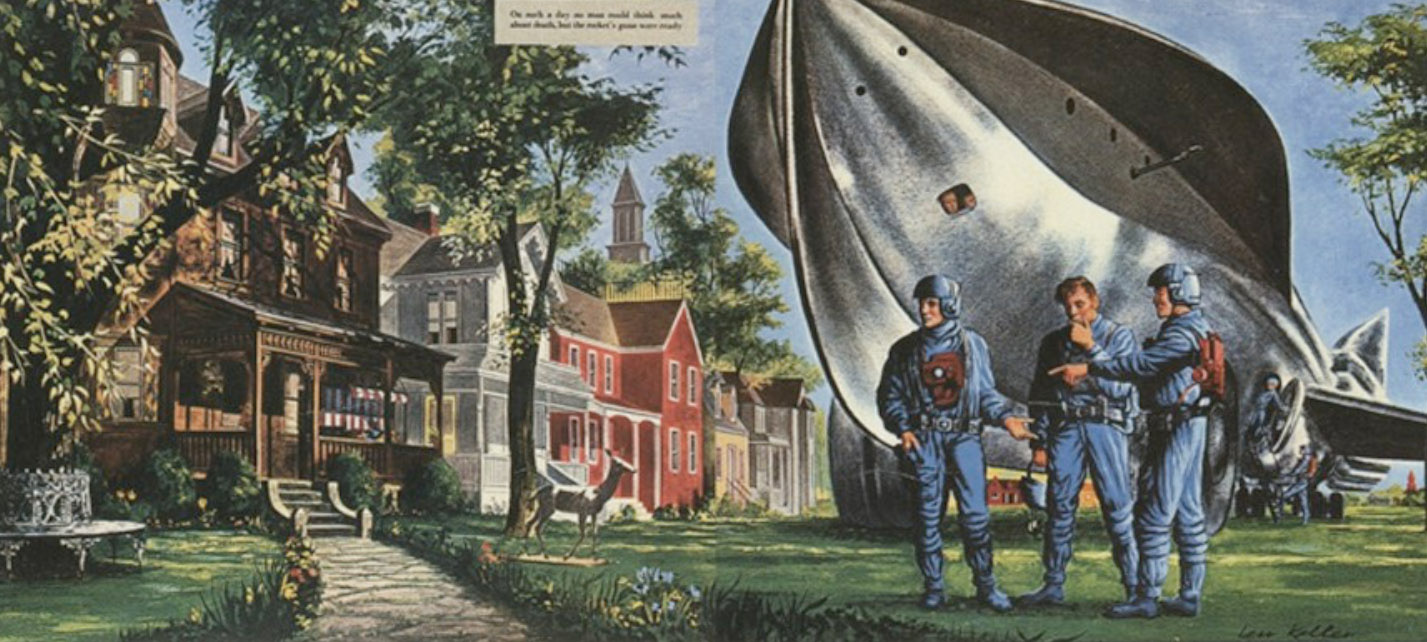
Illustration depicting ‘Rocket Summer’ (image from The Black Cat Moan)

They came because they were afraid or unafraid, happy or unhappy. There was a reason for each man. They were coming to find something or get something, or to dig up something or bury something. They were coming with small dreams or big dreams or none at all

Ray Bradbury, The Martian Chronicles

When I was but a sprite, and before I became an avid reader of books (I preferred comic books), I read Ray Bradbury’s The Martian Chronicles. It changed me, what I thought of books and what I felt about the power of stories. It made me cry. And perhaps that was when I decided to become a writer. I wanted to move people as Bradbury had moved me.

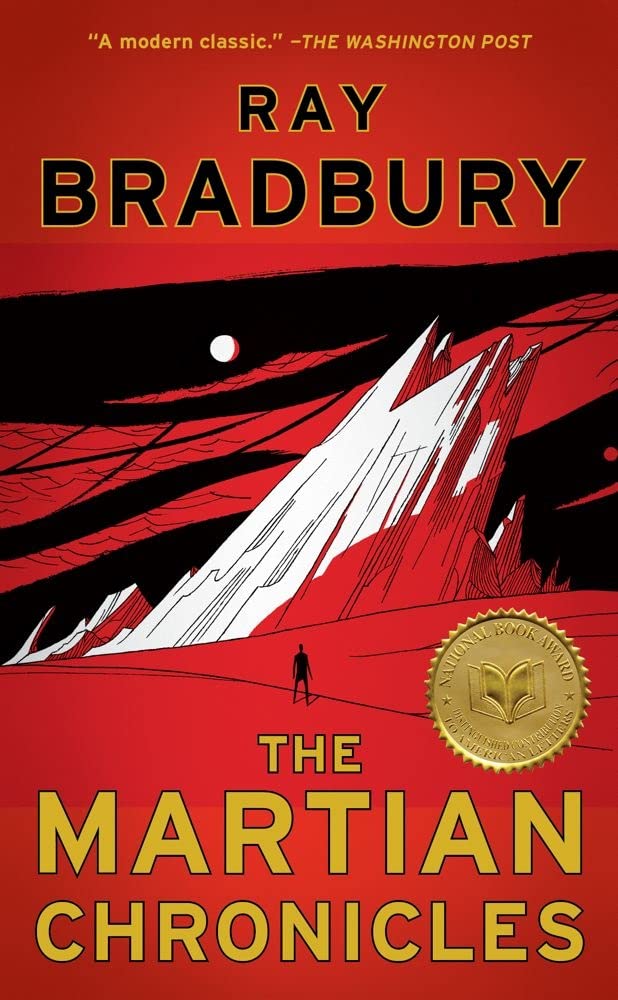
The 1970 Bantam book jacket aptly describes The Martian Chronicles as, “a poetic fantasy about the colonization of Mars. The story of familiar people and familiar passions set against incredible beauties of a new world…A skillful blending of fancy and satire, terror and tenderness, wonder and contempt.”

Rockets land on Mars overlooking Bradbury Lane (illustration from Sutori)

The Martian Chronicles isn’t really about Mars. True to Bradbury’s master metaphoric storytelling, The Martian Chronicles is about humanity. Who we are, what we are and what we may become. What we inadvertently do—to others, and finally to ourselves—and how the irony of chance can change everything. Despite the knowledge of no detectable amounts of oxygen, Bradbury gave Mars a breathable atmosphere: “Mars is a mirror, not a crystal,” he said, using the planet for social commentary rather than to predict the future.

From “Rocket Summer” to “The Million-Year Picnic,” Ray Bradbury’s stories of the colonization of Mars form an eerie tapestry of past and future. Written in the 1940s, the chronicles long with the nostalgia of shady porches with pitchers of lemonade, ponderously ticking grandfather clocks, and comfortable sofas. Expedition after expedition leave Earth to investigate and colonize Mars. Though the Martians guard their mysteries well, they succumb to the diseases that come with the rocketeers and grow extinct—not unlike the quiet disappearance of the golden toad, the Pinta giant tortoise, or the Bramble Cay melomys. Humans, with ideas often no more lofty than starting a tourist hot-dog stand, bear no regret for the native alien culture they exploit and eventually displace.

It is a common theme of human colonialism and expansionism, armed with the entitlement of privilege. Mars is India to the imperialistic British Empire. It is Rwanda or Zaire to the colonial empire of the cruel jingoistic King Leopold II of Belgium. Mars is Europe to Nazi Germany’s sonderweg. We need look no further than our own Canadian soil for a reflection of this slow violence of disrespect and apathy by our settler ancestors on the indigenous peoples of Canada.


Mars was a distant shore, and the men spread upon it in waves… Each wave different, and each wave stronger. 

The Martian Chronicles

Tyler Miller of The Black Cat Moan makes excellent commentary in their 2016 article entitled “How Ray Bradbury’s ‘The Martian Chronicles’ changed Science Fiction (and Literature).” The article begins with a quote from Argentinean author Jorge Luis Borges (in the introduction to the Spanish-language translation of The Martian Chronicles: “What has this man from Illinois done, I ask myself when closing the pages of this book, that episodes from the conquest of another planet fill me with horror and loneliness?”

Remember, this was the 1950s … halfway through a century dominated by scientific discovery, and expansion. The 1950s saw developments in technology, such as nuclear energy and space exploration. On the heels of the end of World War II, the 1950s was ignited by public imagination on conquering space, creating technological futures and robotics. The 1950s was considered by some as the real golden age for science fiction, still a kind of backwater genre read mostly by boys and young men, that told glimmering tales of adventure, exploration, and militarism, of promising technologies, and often-androcratic societies who used them in the distant future to conquer other worlds full of strange and disposable alien beings in the name of democracy and capitalism. (In some ways, this is still very much the same. Though, it is thankfully changing…)

(Bantam 1951 1st edition cover)

Many scientists deeply involved in the exploration of the solar system (myself among them) were first turned in that direction by science fiction. And the fact that some of that science fiction was not of the highest quality is irrelevant. Ten year‐olds do not read the scientific literature.

Carl Sagan, 1978
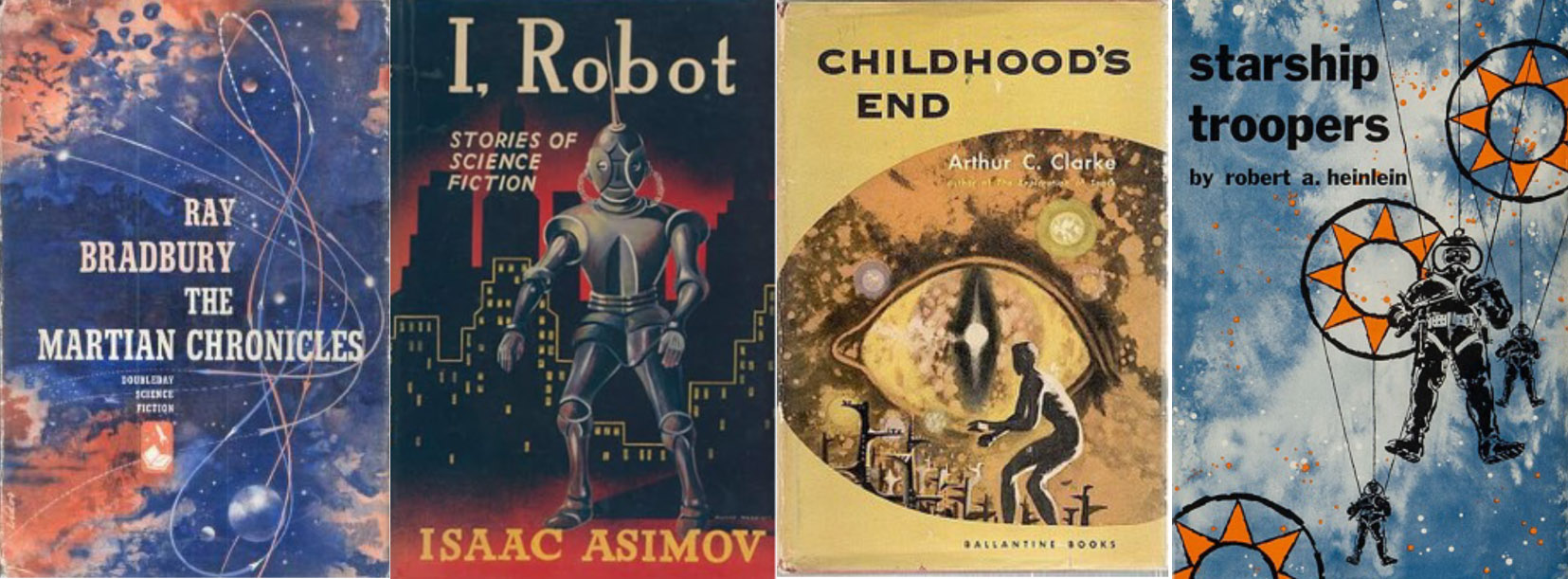
First edition book covers of Martian Chronicles (Doubleday, 1950); I, Robot (Grayson & Grayson, 1952); Childhood’s End (Ballantine Books, 1953); and Starship Troopers (G.P. Putnam’s Sons, 1959)

Large idea-driven SF works that typified this time period included Robert A. Heinlein’s Starship Troopers, Arthur C. Clarke’s Childhood’s End, Isaac Asimov’s I, Robot and his Foundation series.

It was at this time that Ray Bradbury published The Martian Chronicles. Though filled with the requisite rocket ships, gleaming Martian cities, ray guns, and interplanetary conquest, from the very start—as Borges noted—The Martian Chronicles departed radically from its SF counterparts of the time.

(Illustration on album cover of “Rocket Summer”, music by Chris Byman)

Instead of starting with inspiring technology or a stunning action sequence, or a challenging idea or discovery, Bradbury’s The Martian Chronicles opens with a domestic scene.

One minute it was Ohio winter, with doors closed, windows locked, the panes blind with frost, icicles fringing every roof, children skiing on the slopes, housewives lumbering like great black bears in their furs along the icy streets.

And then a long wave of warmth crossed the small town. A flooding sea of hot air; it seemed as if someone had left a bakery door open. The heat pulsed among the cottages and bushes and children. The icicles dropped, shattering, to melt. The doors flew open. The windows flew up. The children worked off their wool clothes. The housewives shed their bear disguises. The snow dissolved and showed last summer’s ancient green lawns.

Rocket summer. The words passed among the people in the open air, airing houses. Rocket summer. The warm desert air changing the frost patterns on the windows, erasing the art work. The skis and sleds suddenly useless. The snow, falling from the cold sky upon the town, turned to a hot rain before it touched the ground.

Rocket summer. People leaned from their dripping porches and watched the reddening sky.

The rocket lay on the launching field, lowing out pink clouds of fire and oven heat. The rocket stood in the cold winter morning, making summer with every breath of its mighty exhausts. The rocket made climates, and summer lay for brief moment upon the land…

Ray Bradbury, The Martian Chronicles, Rocket Summer

Bradbury’s focus was on the domestic. Housewives fighting off the ice and snow of Ohio. A Martian woman “cleaning the house with handfuls of magnetic dust which, taking all dirt with it, blew away on the hot wind.”

They had a house of crystal pillars on the planet Mars by the edge of the empty sea, and every morning you could see Mrs. K eating the golden fruits that grew from the crystal walls, or cleaning the house with handfuls of magnet dust which, taking all dirt with it, blew away on the hot wind. Afternoons, when the fossil sea was warm and motionless, and the wine trees stood stiff in the yard…you could see Mr. K in his room, reading from a metal book with raised hieroglyphs over which he brushed his hand, as one might play a harp. And from the book, as his fingers stroked, a voice sang, a soft ancient voice, which told tales of when the sea was red steam on the shore and ancient men had carried clouds of metal insects and electric spiders into battle…

This morning Mrs. K stood between the pillars, listening to the desert sands heat, melt into yellow wax, and seemingly run on the horizon.

Something was going to happen.

She waited.

Ray Bradbury, The Martian Chronicles, Ylla

Bradbury’s gift to literature—and to his SF genre—was his use of metaphor. Unlike the science fiction of his colleagues, Bradbury’s stories are a lens to study the past and the present. According to Miller, “The Earthmen’s exploration and desolation of Mars allowed Bradbury to look not forward but backward at exploration and desolation on Earth, namely the European arrival in the New World. Just as Europeans landed in North and Central America wholly unprepared for what they found there, Bradbury’s Earthmen are unprepared time and again for the wonder and the horror of Mars. And just as European diseases decimated native people in the Americas, it is chicken-pox which wipes out the Martians.”

The back cover of the 2012 mass market paperback Simon & Schuster Reprint edition of The Martian Chronicles reads:

Bradbury’s Mars is a place of hope, dreams and metaphor—of crystal pillars and fossil seas—where a fine dust settles on the great, empty cities of a silently destroyed civilization. It is here the invaders have come to despoil and commercialize, to grow and to learn—first a trickle, then a torrent, rushing from a world with no future toward a promise of tomorrow. The Earthman conquers Mars … and then is conquered by it, lulled by dangerous lies of comfort and familiarity, and enchanted by the lingering glamour of an ancient, mysterious native race.

 “Ask me then, if I believe in the spirit of the things as they were used, and I’ll say yes. They’re all here. All the things which had uses. All the mountains which had names. And we’ll never be able to use them without feeling uncomfortable. And somehow the mountains will never sound right to us; we’ll give them new names, but the old names are there, somewhere in time, and the mountains were shaped and seen under those names. The names we’ll give to the canals and the mountains and the cities will fall like so much water on the back of a mallard. No matter how we touch Mars, we’ll never touch it. And then we’ll get mad at it, and you know what we’ll do? We’ll rip it up, rip the skin off, and change it to fit ourselves.”

“We won’t ruin Mars,” said the captain. “It’s too big and too good.”

“You think not? We Earth Men have a talent for ruining big, beautiful things.”

Ray Bradbury, The Martian Chronicles, And the Moon be Still as Bright

Ray Bradbury’s The Martian Chronicles is a profound and tender analysis of the quiet power humanity can wield unawares and how we define and treat ‘the other.’ It is a tragic tale that reflects only too well current world events where the best intended interventions can go awry. From the meddling friend who gossips to “help” another (only to make things worse) to the righteous “edifications” of a religious group imposing its “order” on the “chaos” of a “savage” peoples … to the inadvertent tragedy of simply and ignorantly being in the wrong place at the wrong time (e.g., the introduction of weeds, disease, etc. by colonizing “aliens” to the detriment of the native population; e.g., smallpox, AIDs, etc.). Bradbury is my favourite author for this reason (yes, and because he makes me cry…)

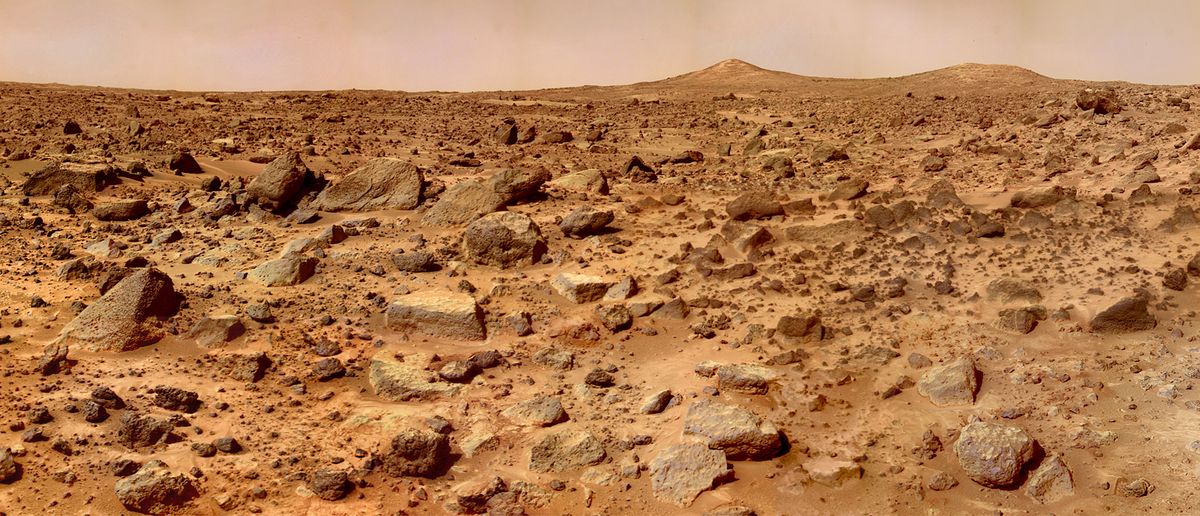
Mars terrain (photo by NASA)

Nina Munteanu is a Canadian ecologist / limnologist and novelist. She is co-editor of Europa SF and currently teaches writing courses at George Brown College and the University of Toronto. Visit www.ninamunteanu.ca for the latest on her books. Nina’s bilingual “La natura dell’acqua / The Way of Water” was published by Mincione Edizioni in Rome. Her non-fiction book “Water Is…” by Pixl Press (Vancouver) was selected by Margaret Atwood in the New York Times ‘Year in Reading’ and was chosen as the 2017 Summer Read by Water Canada. Her novel “A Diary in the Age of Water” was released by Inanna Publications (Toronto) in June 2020.
Movie Review: Venture to “The Beyond”

The Beyond is a 2018 science fiction thriller, set in the near-future, that explores the evolution of our humanity through “first contact.”

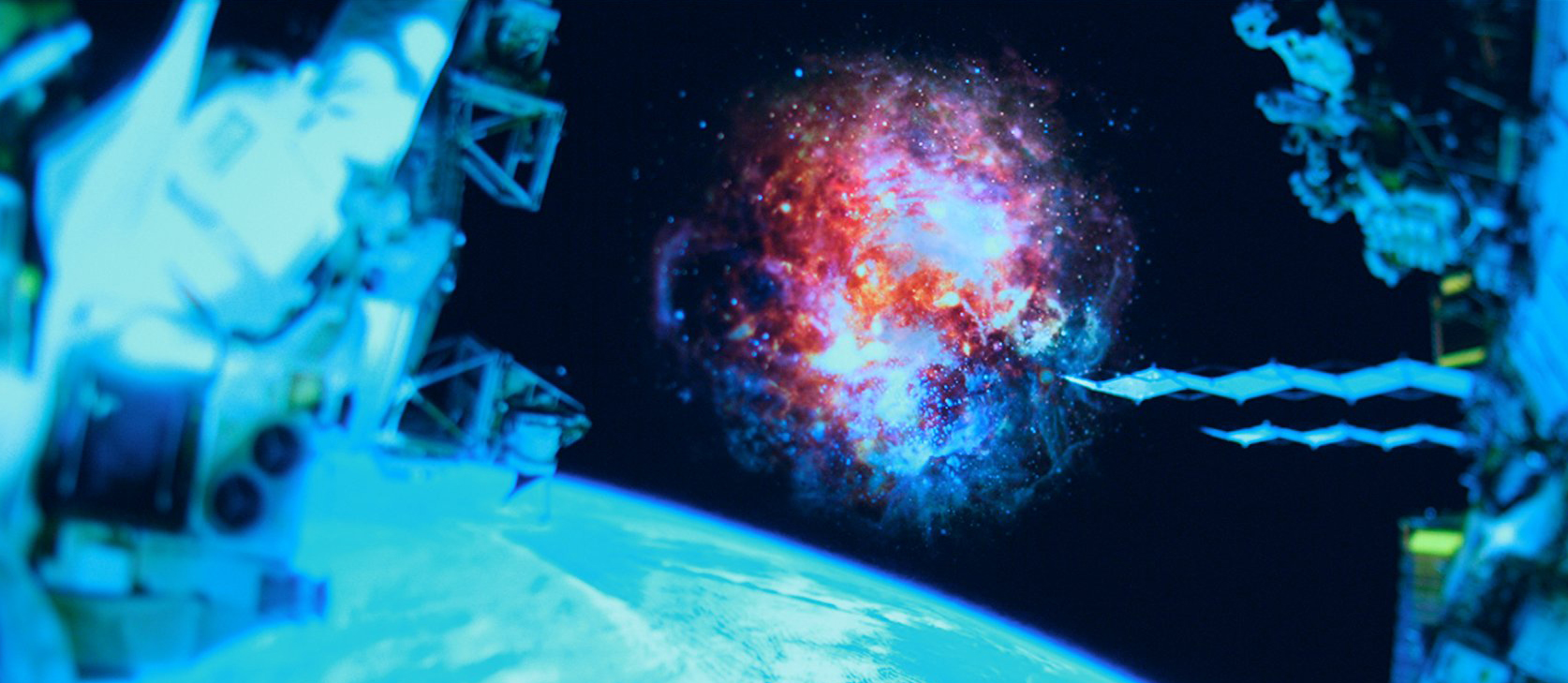
Wormhole suddenly appears

The sudden appearance of a wormhole causes the disappearance of astronaut Jim Marcell during EVA on the space station, followed by associated calamitous phenomena on Earth. Giant dark spherical clouds then appear and settle all over the Earth, disrupting the world’s population, and setting in motion a series of fearful and aggressive reactions by various sectors of humanity; as expected, the military of each nation mobilize, ready to attack. Some do attack, with no consequence.

Alien spheres appear over several cities

With the help of the military’s groundbreaking transhumanism technology, the international space agency sends two transhuman (Human 2.0) astronauts into the wormhole (called the Void) on an information-seeking (and peace-seeking) mission. The astronauts have been modified by advanced robotics to withstand the pressures of the “throat” of the wormhole as they embark on humanity’s first interstellar—possibly inter-dimensional—journey in search of extra-terrestrial sentient life and its intent. One of the astronauts is a soldier, armed with additional weapons built into his physiology. The other is the Space Agency’s chief cosmologist, Jessica Johnson (played by Kosha Engler). When the mission returns unexpectedly, and without the soldier, the space agency races to discover what happened on the “other side.” Of particular interest is evidence indicating that the ship had been away much longer than the days it was actually gone. Johnson later reveals that the soldier had suddenly disappeared from the cockpit and reappeared outside. She saw him stare at his arm, which then detonated like a nuclear bomb—no doubt because his arm was indeed something of that nature.

Jessica transformed into Human 2.0 for space travel

The tag line of the movie says: “to find our place in the universe, we must venture beyond our boundaries.” This imaginative indie film by Hasraf Dulull is all about breaking boundaries and transcending beliefs: such as mission director Gilian’s first lie to her daughter (to contain a bigger lie by the space agency); and chief cosmologist Jessica conquering ethical barriers to embark on a journey that will irrevocably change her.

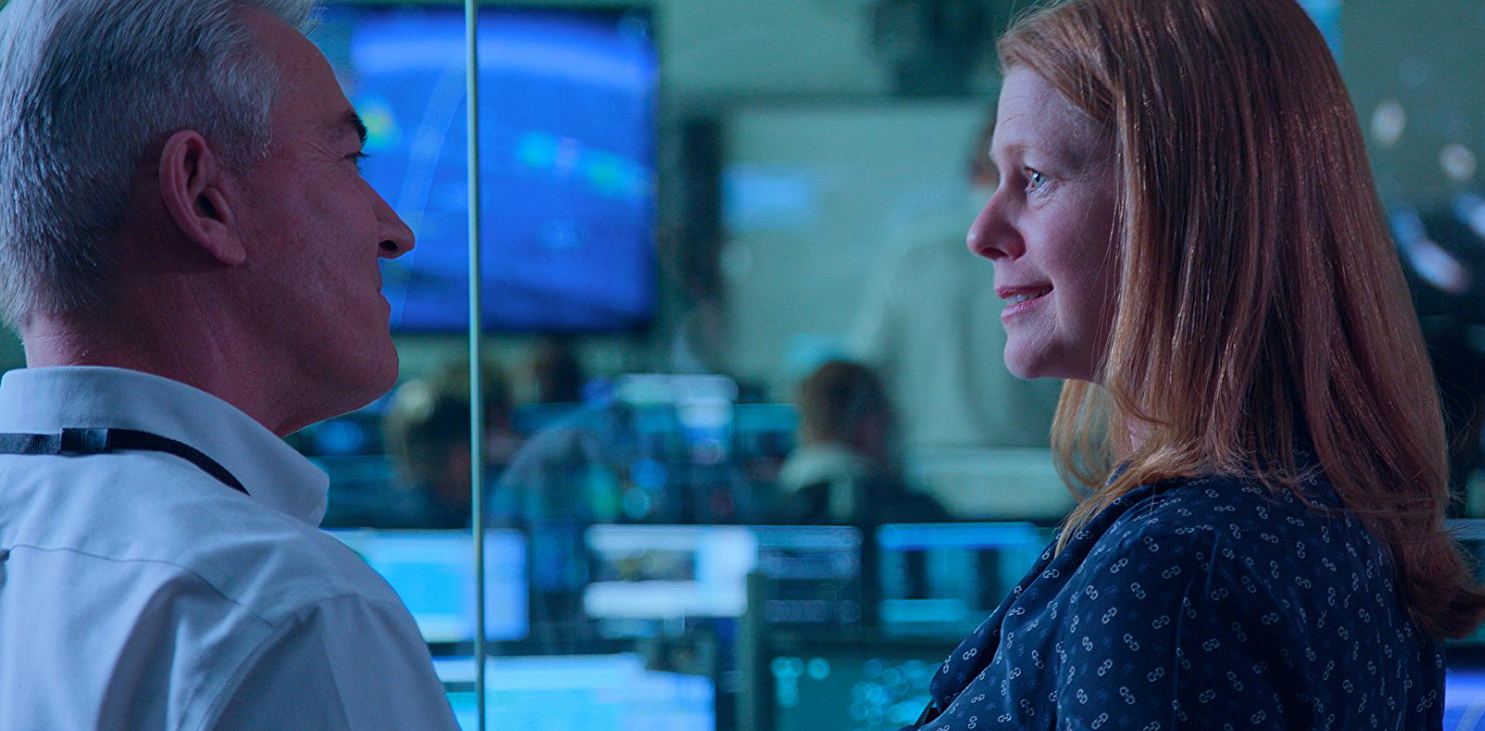
Canadian Gillian Laroux is mission commander

The story unfolds like a docu-drama, making use of interviews with key people and retrieved footage amidst dramatic narrative (similar to Blomkamp’s District 9). The mixed narrative creates an immediacy that grips us emotionally and deeply connects us to the characters in a real-life way. Characters are portrayed as ordinary people who find themselves in extra-ordinary circumstances and performed with genuine candor, particularly the mission commander Gillian Laroux (Jane Perry) who plays a Canadian.

The Beyond appeals to our senses and sensibilities, challenging our assumptions and definitions of what it is to be human through our values, hopes and fears. Told with an unassuming realism, The Beyond is really a simple, yet deeply meaningful story that asks the big questions—and leaves it for us to answer them.

The climax, discovery and resolution is really more of a question. I was somehow unprepared for the discovery and emotionally struck by its trajectory into the denouement. Some reviewers on the Internet were off-put by the shift following “the discovery” that preceded the denouement at the end. I found closure for the chief cosmologist, who had sacrificed her life to seek answers and find a solution for humanity; however, the question remained: what is that solution for humanity? What does that solution look like and how does it encompass more than us? The movie doesn’t have a tidy end; its solution is veiled with more questions.

The film ends with a cautious hope, implicitly asking that big question: are we (humanity) worth saving? When Jessica asks why humanity was offered a second chance by benevolent beings way beyond our comprehension, the returned Jim Marcell (currently a spokesman for the aliens) shows her the GAD (Golden Archive Drive with video images of Earth and humanity—basically our “hello” message to extra-solar life like the one placed onboard NASA’s Pioneer missions) that had accompanied the ship into the wormhole. The message displayed scenes of mothers and their children, people laughing in joy; it also showed scenes of other aspects of this beautiful planet worth saving: the ocean surf, the forests and wildlife. In our hubris, we have lost our perspective about this planet. Perhaps, it wasn’t so much humanity the alien beings intended to save but the Earth itself; we just come along with it. The Earth is, after all, a beautiful, vital and unique world, rich with life-giving water, trees, animals, creatures of all kinds in a diverse network of flowing and evolving beauty. A planet worth saving and that, frankly, functions better without us.

Jessica 2

So, the question remains: is humanity worth saving? For centuries we have hubristically and disrespectfully used, discarded and destroyed just about everything on this beautiful planet. According to the World Wildlife Federation, 10,000 species go extinct every year. That’s mostly on us. They are the casualty of our selfish actions. We’ve become estranged from our environment, lacking connection and compassion. That has translated into a lack of consideration—even for each other. In response to mass shootings of children in schools, the U.S. government does nothing to curb gun-related violence through gun-control measures; instead they suggest arming teachers. We light up our cigarettes in front of people who don’t smoke and blow deleterious second-hand smoke in each other’s faces. We litter our streets and we refuse to pick up after others even if it helps the environment. The garbage we thoughtlessly discard pollutes our oceans with plastic and junk, hurting sea creatures in unimaginable ways. We do not live lightly on this planet. We tread with incredibly heavy feet. We behave like bullies and, as The Beyond points out, our inclination to self-interest makes us far too prone to suspicion and distrust: when met with the unknown, we respond with fear and aggression rather than curiosity and hope. Something we need to work on if we are going to survive–and find our place in the universe.

The Beyond is a simple film made well; something not easy to accomplish. The film delved into existential questions with an emotional intelligence that was both sensitive and insightful. As Gillian Laroux says in the end: “I hope we won’t make the same mistakes of the past and prove that we are in fact worth saving.” Ultimately, I found The Beyond a refreshing change from the senseless soul-gutting violence, and sordid aimless or overly-complicated plots that currently populate most of our current science fiction TV and movies.

The Beyond marks the directorial debut of Dulull, a VFX wiz who spent a year shooting and working on this project (previously titled The Void). Changing the title from The Void to The Beyond is itself an interesting shift in what the film represents and suggests.

Let us tread more lightly on this planet, then…And perhaps we too will be worth saving. Perhaps our destiny won’t be a void but a transcendence beyond…

Nina Munteanu is a Canadian ecologist / limnologist and novelist. She is co-editor of Europa SF and currently teaches writing courses at George Brown College and the University of Toronto. Visit www.ninamunteanu.ca for the latest on her books. Nina’s bilingual “La natura dell’acqua / The Way of Water” was published by Mincione Edizioni in Rome. Her non-fiction book “Water Is…” by Pixl Press (Vancouver) was selected by Margaret Atwood in the New York Times ‘Year in Reading’ and was chosen as the 2017 Summer Read by Water Canada. Her novel “A Diary in the Age of Water” was released by Inanna Publications (Toronto) in June 2020.

Solaris: Planet as Alien Character in Science Fiction

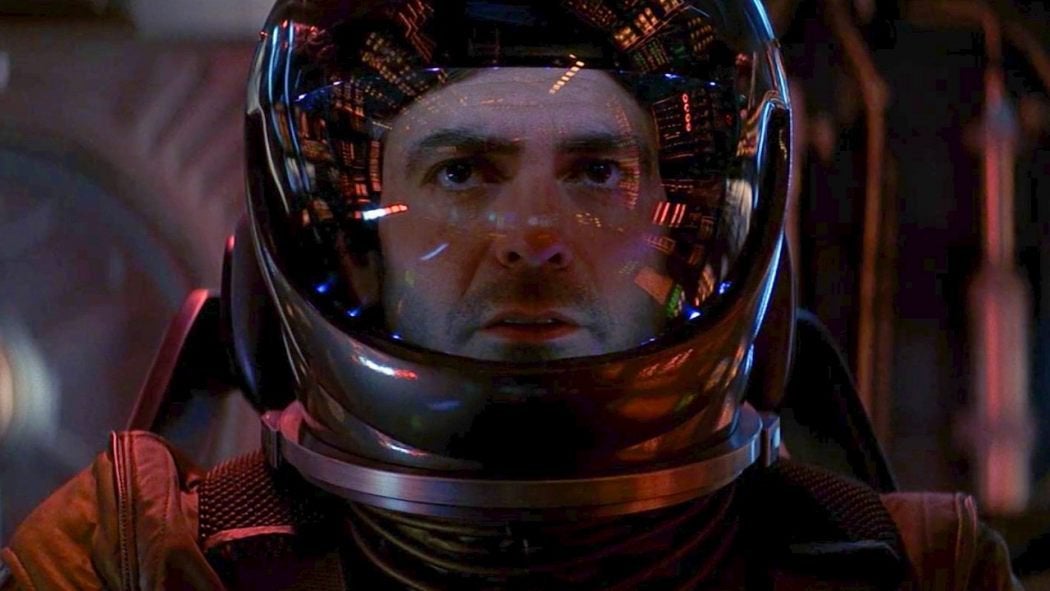
Kelvin (played by George Clooney) arrives on Solaris in Steven Soderberg’s 2002 film

Some time ago, I participated in an inquiry to name my choice of “Best Alien in Science Fiction,” posed by John DeNardo at SF Signal. “Aliens are a classic trope dating back to the earliest days of science fiction,” John said. They are the quintessential “other” archetype in science fiction.

From conquering warlords (War of the Worlds) to instructing sages (The Day the Earth Stood Still) to victimized pacifists (Martian Chronicles), how the “other” is portrayed and how humanity interacts with it, has been explored throughout science fiction since it began with Mary Shelley’s Frankenstein.

Of course, in science fiction—a metaphoric literature of grand scope—these ‘others’ / aliens make representation through archetype. So, the aliens of War of the Worlds represent a conquering nation; Klaatu of The Day the Earth Stood Still may represent a benevolent dictator; the Martians of Martian Chronicles represent our indigenous peoples under the yoke of settler colonialism and an exploitive resource-extraction mindset; and the monster of Frankenstein exemplifies the disabled/deformed unsavory departure from our ‘perfect’ self-image. Author Brian Ott tells us that “it is a profound mistake to interpret the genre [of science fiction] literally.” He reminds us that it is not what the aliens are but what they represent that matters (except when, in some cases, they are one in the same). Science fiction is both “the great modern literature of metaphor” and “pre-eminently the modern literature not of physics but of metaphysics,” adds Peter Nicholls, Australian scholar and critic.

Steven Spielberg’s 2005 film of H.G. Wells’s book “War of the Worlds”

In a previous article entitled “Dreams and Perceptions And ‘the Other” I described an experience with the unfamiliar. Have you ever done the same? Looked backward while driving through a familiar scene to gain a different perspective? And just felt different for a moment? Like you’d entered a different dimension and briefly glimpsed ‘the other.’

What is it like to meet ‘the other’?

In story, characters are defined through their experience and their approach to the unfamiliar. A new relationship. A stranger in town. A different culture. An alien encounter… How does the character react? Is it with fear? Wonder? Curiosity? A mixture of these? By describing “the other” science fiction writers describe “us”, given that it is through our own eyes that the other is viewed and described.

In his book Orientalism: Western Conceptions of the Orient Edward W. Said contended that for there to be an ‘us’, there has to be a ‘not-us.’ According to Patricia Kerslake of Central Queensland University, this arises from a postcolonial notion of ‘the Other’, through a mutual process of exclusion. This exclusion inspires the very idea of ‘alien’ by imposing expectation on perception. Kerslake argues that: “When one culture imposes its perceptions on another, in that it begins to see the Other not as they are but as, in Said’s words, ‘they ought to be’, then the process of representation becomes inevitable: a choice is made to see a ‘preferred’ real.”

Klaatu greets humanity in “The Day the Earth Stood Still”

In her 1975 article “American SF and the Other,” Ursula K. LeGuin unequivocally scolded the Western SF genre for representing and promoting colonialism and androcratic motives by “othering” or making inconsequential the poor, the uneducated, the marginalized and women.

…The question involved here is the question of The Other—the being who is different from yourself. This being can be different from you in its sex; or in its annual income; or in its way of speaking and dressing and doing things; or in the color of its skin; or the number of its legs and heads. In other words, there is the sexual Alien, and the social Alien, and the cultural Alien, and finally the racial Alien…

The people in SF are not people. They are masses, existing for one purpose to be led by their superiors…

If you deny any affinity with another person or kind of person, if you declare it to be wholly different from yourself–as men have done wo women, and class has done to class, and nation has done to nation–you may hate it, or deify it; but in either case you have denied its spiritual equality, and its human reality. You have made it into a thing, to which the only possible relationship is a power relationship. And thus you have fatally impoverished your own reality.

You have, in fact, alienated yourself.

Ursula K. LeGuin

Written 45 years ago, Le Guin’s scathing article may have accurately represented the North American science fiction community of writers of that time. Today, despite the remnants of a strong old guard that still promotes a patriarchal colonialist hegemony, the science fiction genre has matured and grown beyond this self-limiting view. This is partly because current authors—many who are women and many who are representatives of minority or marginalized groups—have given SF a new face and voice that promises to include equality, inclusion, and a fresh look at exploration and ‘the other.’ In most cases it is ‘the other’ whose voice—for so long missing—is now being expressed.

The genre of science fiction has diversified and matured to embrace “mundane science fiction,” literary fiction, speculative fiction, climate fiction, cli-fi, eco-fiction, indigenous futurisms and more. Each of these genres provide new opportunities that give voice to ‘the other’ from women (Octavia Butler’s Parable of the Sower and N.K. Jemison’s The Broken Earth series) to disabled people (Mishell Baker’s Borderline) to the indigenous human (Cherie Dimaline’s The Marrow Thieves) to the non-human (Costi Gurgu’s RecipeArium) and the environment such as water (Emmi Itäranta’s The Memory of Water and my own A Diary in the Age of Water).

My Choice for ‘Best’ Alien Character: Solaris

The most memorable aliens for me have been those that helped illuminate our history and our very humanity, whether they played the archetype of simple antagonist or misunderstood as “commentator” on human prejudice, insecurities, greed, heroism, compassion and honor. I can think of several aliens who have provided excellent examples of this: the victimized ” prawns” of Peter Jackson’s District 9 come to mind. Each provided a platform for the exploration and exposition of human’s strengths and weaknesses. How we handle or even recognize “the other” is very compelling and illuminating.

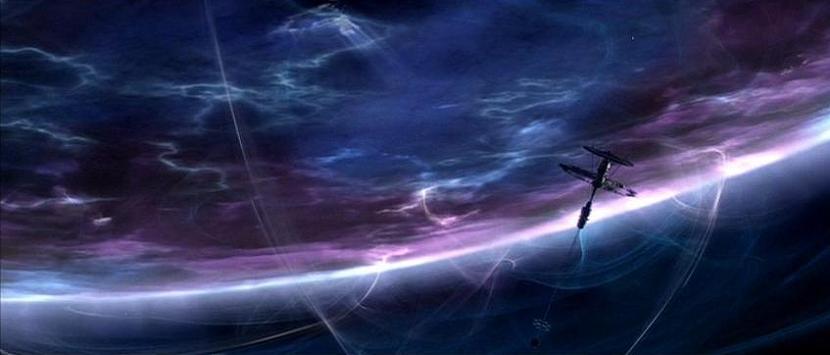
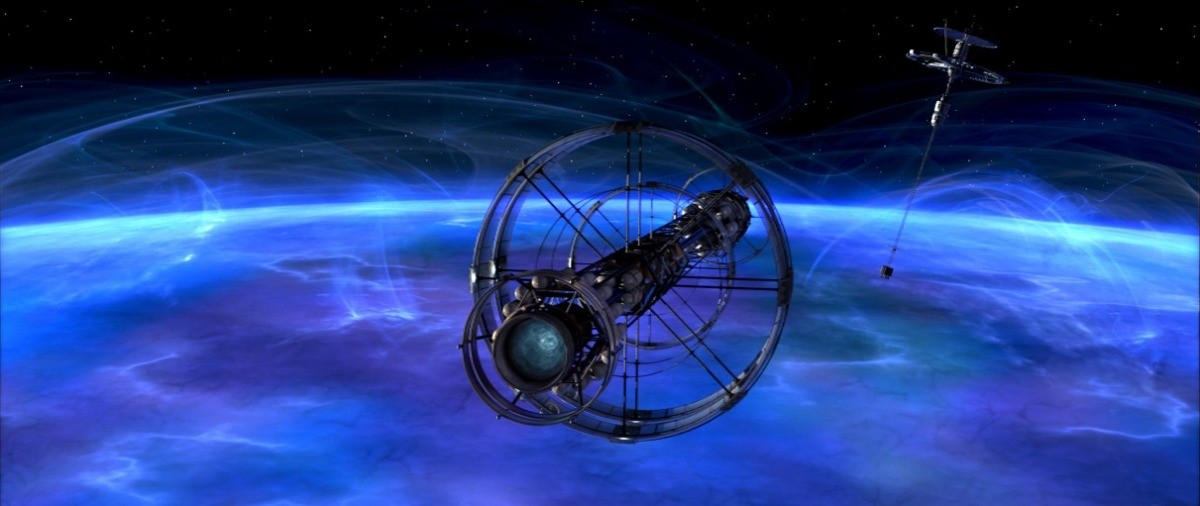
The planet Solaris

My choice for alien character is the ‘self-aware’ planet in Stanislaw Lem’s Solaris: see my film review of Steven Soderbergh’s film interpretation of Stanislaw Lem’s book Solaris in a previous article on this site. What follows is a brief summary:

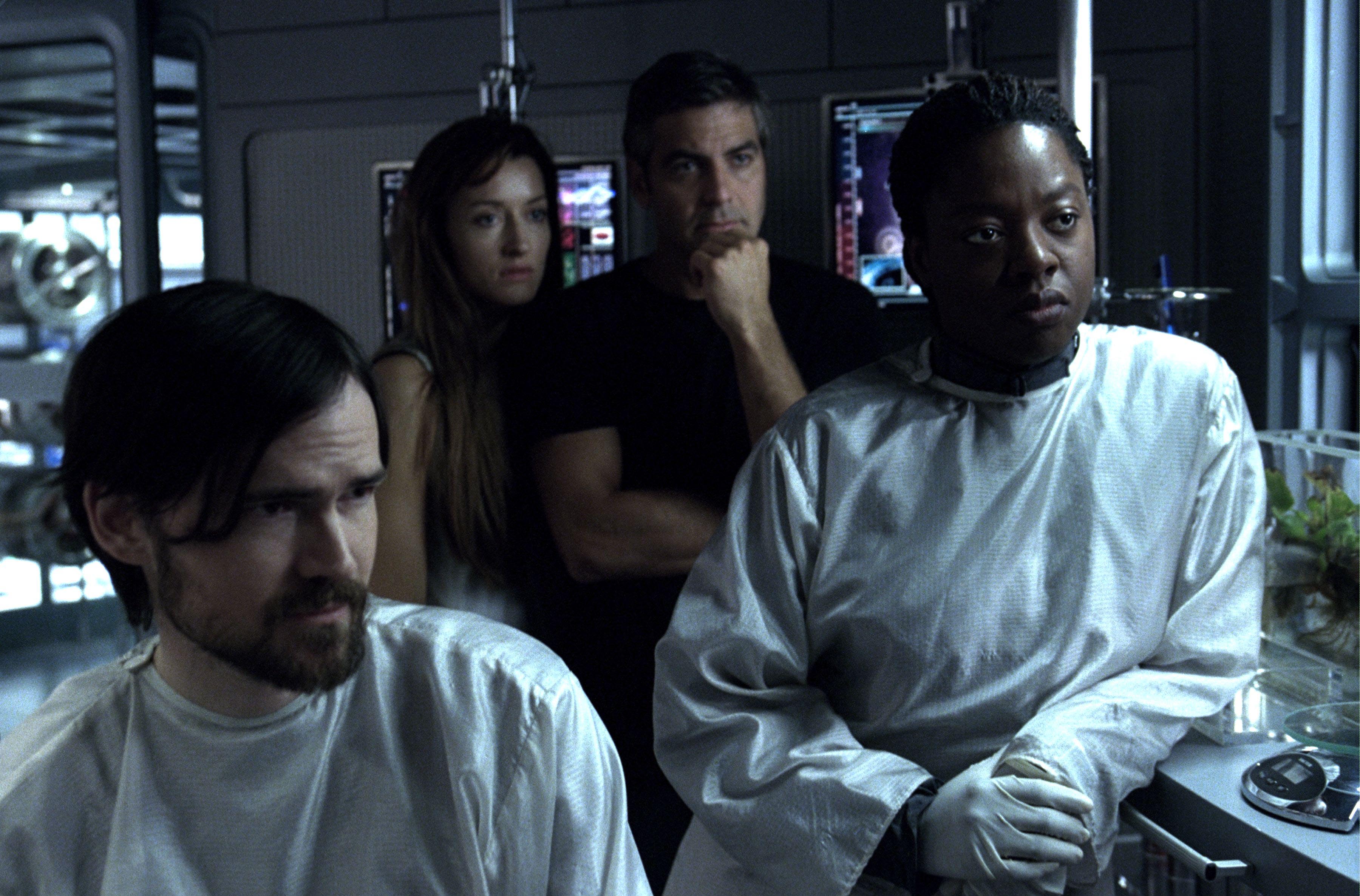
In response to his friend’s plea, a depressed psychologist with the ironic name of Kris Kelvin (George Clooney), sets out on a mission to bring home the dysfunctional crew of a research space station orbiting the distant planet, Solaris. Kelvin arrives at the space station, Prometheus, to find his friend, Gibarian, dead by suicide and a paranoid and disturbed crew obviously withholding a terrible secret from him. It is not long before he learns the secret first-hand: some unknown power (apparently the planet itself) taps into his mind and produces a solid corporeal version of his tortured longing: his beloved wife, Rheya (Natascha McElhone) who years ago had committed suicide herself. Faced with a solid reminder, Kelvin yearns to reconcile with his guilt in his wife’s death and struggles to understand the alien force manifested in the form of his wife. He learns that the other crew are equally influenced by Solaris and have been grappling, each in their own way, with their “demons,” psychologically trapping them there.

Crew onboard the Prometheus orbiting Solaris: Snow (Jeremy Davies), Rheya (Natascha McElhone), Kelvin (George Clooney) and Gordon (Viola Davis)

Ironically, our hero’s epic journey of great distance has only led him back to himself. The alien force defies Kelvin’s efforts to understand its motives; whether it is benign, hostile, or even sentient. Kelvin has no common frame of reference to judge and therefore to react. This leaves him with what he thinks he does understand: that Rheya is a product of his own mind, his memories of her, and therefore a mirror of his deepest guilt—but perhaps also an opportunity to redeem himself.

Kelvin and his ‘dead’ wife Rheya onboard the Prometheus orbiting Solaris

Solaris is the epitome of the “other”, a force and entity unrecognizable and unfathomable. Lem’s existentialist portrayal of “the other”—and by extension of humanity—serves as excellent commentary on what is important to us and our identity. Unlike the familiar human-like figures of a Spock, Zhaan or the fremen, Solaris accomplishes its ‘other’ role through arcane manipulation of the human characters’ dreams and yearnings. We never understand its motivations or intelligence, yet we are drawn to its force and reflective mirror of our souls. It is its very incomprehensibility that attracts us, as to an abstract artwork, and challenges our very identities. Solaris shows neither judgment nor morality. It exists through the lens of paradox. Both there and not there. Fluid but enduring. Fractured yet whole. Like water. 

All lead to the ultimate question asked of science fiction: who are we and why are we here?

Kelvin arrives at the space station orbiting Solaris

Nina Munteanu is a Canadian ecologist / limnologist and novelist. She is co-editor of Europa SF and currently teaches writing courses at George Brown College and the University of Toronto. Visit www.ninamunteanu.ca for the latest on her books. Nina’s bilingual “La natura dell’acqua / The Way of Water” was published by Mincione Edizioni in Rome. Her non-fiction book “Water Is…” by Pixl Press(Vancouver) was selected by Margaret Atwood in the New York Times ‘Year in Reading’ and was chosen as the 2017 Summer Read by Water Canada. Her novel “A Diary in the Age of Water” was released by Inanna Publications (Toronto) in June 2020.

Dreams and Perceptions…And ‘The Other’

Credit Riv path in snow

path along Credit River (photo by Nina Munteanu)

It was a while ago, as I was driving home from a friend’s place in the sultry dark of night that I noticed the change…

Perhaps it was the rain and the winding road that nudged my psyche to wander into that other realm. Or was it the surrealistic motion picture The Fountain that I’d seen the evening before? Or had it more to do with the fact that I’d been, for various reasons, without sleep for over forty hours that I glimpsed the ordinary in an extra-ordinary light?

Light had everything to do with it…Amber traffic lights at a construction site pulsed like living things. Smoky back-lit clouds billowed over an inky sky. A garish screen of trees, caught in the beams of my car lights as I turned a corner, flashed. Nature recast. A half-built apartment building loomed up like some dark tower in Lord of the Rings. I was reminded of a scene early on in The Fountain where the viewer is disoriented initially by a busy street at night because it was shot upside down. Ironically, the picture was filmed in my hometown of Montreal and I didn’t even recognize it.

Have you ever done that? Looked backward while driving through a familiar scene to gain a different perspective? And felt different for just a moment? Like you’d briefly entered a different dimension and glimpsed “the other”?

What is it like to meet “the other”?

What is it like to approach the unfamiliar? A new landscape. A stranger in town. A different culture. An “alien” encounter. How do we react? Is it with wonder? Curiosity? Fear? Hatred? A mixture of these?

The genre of science fiction vividly explores our humanity through our reactions to “the other.” It does this by looking at both perspectives. By describing “the other,” science fiction writers describe “us.” In his book Orientalism: Western Conceptions of the Orient Edward W. Said contended that for there to be an ‘us’, there has to be a ‘not-us.’ According to Patricia Kerslake of Central Queensland University, this arises from a postcolonial notion of ‘the Other’, through a mutual process of exclusion. This exclusion inspires the very idea of ‘alien’ by imposing expectation on perception. Kerslake argues that: “When one culture imposes its perceptions on another, in that it begins to see the Other not as they are but as, in Said’s words, ‘they ought to be’, then the process of representation becomes inevitable: a choice is made to see a ‘preferred’ real.”

Ursula K LeGuin

Ursula K. LeGuin

In her 1975 article “American SF and the Other,” Ursula K. LeGuin unequivocally scolded the Western SF genre for representing and promoting colonialism and androcratic motives.

One of the great early socialists said that the status of women in a society is a pretty reliable index of the degree of civilization of that society. If this is true, then the very low status of women in SF should make us ponder about whether SF is civilized at all.

The women’s movement has made most of us conscious of the fact that SF has either totally ignored women, or presented them as squeaking dolls subject to instant rape by monsters—or old-maid scientists de-sexed by hypertrophy of the intellectual organs—or, at best, loyal little wives or mistresses of accomplished heroes. Male elitism has run rampant in SF. But is it only male elitism? Isn’t the “subjection of women” in SF merely a symptom of a whole which is authoritarian, power-worshiping, and intensely parochial?

The question involved here is the question of The Other—the being who is different from yourself. This being can be different from you in its sex; or in its annual income; or in its way of speaking and dressing and doing things; or in the color of its skin, or the number of its legs and heads. In other words, there is the sexual Alien, and the social Alien, and the cultural Alien, and finally the racial Alien.

Well, how about the social Alien in SF? How about, in Marxist terms, “the proletariat”? Where are they in SF? Where are the poor, the people who work hard and go to bed hungry? Are they ever persons, in SF? No. They appear as vast anonymous masses fleeing from giant slime-globules from the Chicago sewers, or dying off by the billion from pollution or radiation, or as faceless armies being led to battle by generals and statesmen. In sword and sorcery they behave like the walk-on parts in a high school performance of The Chocolate Prince. Now and then there’s a busty lass amongst them who is honored by the attentions of the Captain of the Supreme Terran Command, or in a space-ship crew there’s a quaint old cook, with a Scots or Swedish accent, representing the Wisdom of the Common Folk.

The people, in SF, are not people. They are masses, existing for one purpose: to be led by their superiors…

…What about the cultural and the racial Other? This is the Alien everybody recognizes as alien, supposed to be the special concern of SF. Well, in the old pulp SF, it’s very simple. The only good alien is a dead alien—whether he is an Aldebaranian Mantis-Man, or a German dentist. And this tradition still flourishes: witness Larry Niven’s story “Inconstant Moon” (in All the Myriad Ways, 1941) which has a happy ending—consisting of the fact that America, including Los Angeles, was not hurt by a solar flare. Of course a few million Europeans and Asians were fried, but that doesn’t matter, it just makes the world a little safer for democracy, in fact. (It is interesting that the female character in the same story is quite brainless; her only function is to say Oh? and Ooooh! to the clever and resourceful hero.)

If you deny any affinity with another person or kind of person, if you declare it to be wholly different from yourself—as men have done to women, and class has done to class, and nation has done to nation—you may hate it, or deify it; but in either case you have denied its spiritual equality, and its human reality. You have made it into a thing, to which the only possible relationship is a power relationship. And thus you have fatally impoverished your own reality.

You have, in fact, alienated yourself.

Diary Water cover finalWritten 45 years ago, Le Guin’s scathing article may have accurately represented the North American science fiction community of writers of that time. Today, despite the remnants of a strong old guard that still promotes a patriarchal colonialist hegemony, the science fiction genre has matured and grown beyond this self-limiting view. This is partly because current authors—many who are women and many who are representatives of minority or marginalized groups—have given SF a new face and voice that promises to include equality, inclusion, and a fresh look at exploration and ‘the other.’

The genre of science fiction has matured by diversifying to embrace “mundane science fiction,” literary fiction, speculative fiction, climate fiction, cli-fi, eco-fiction, indigenous futurisms and more.

memoryofwaterScience fiction that leans toward “mundane”(everyday life) and literary fiction include the works of Paulo Bacigalupi (Windup Girl), Margaret Atwood (Year of the Flood), and Kim Stanley Robinson (New York 2140). Literary fiction overlaps with science fiction through eco-fiction and climate fiction which address oppression, jingoism and neoliberalism often through dystopian themes—and often through the voice of women writers—such as Octavia Butler’s Parable of the Sower, N.K. Jemisin’s The Broken Earth series, Emmi Itäranta’s The Memory of Water, Nina Munteanu’s A Diary in the Age of Water, Barbara Kingsolver’s Flight Behavior, Annie Proulx’s Barkskins, and Richard Power’s Overstory.

CliFi Tales of ClimateChangeIn 2017, several publications addressed different aspects of society through speculative fiction.  Laksa Media published Strangers Among Us: Tales of the Underdogs and Outcasts, which explores issues of mental health. Exile Editions published Cli-Fi: Tales of Climate Change with stories on personal experience with climate change. Reality Skimming Press published Water, for which I was editor, which explored optimism in the face of climate change.

In Ann Leckie’s 2014 Ancillary Justice, the main character is a space ship. The Gethenians in Ursula K. LeGuin’s The Left Hand of Darkness are humanoids with fluid gender, adapted to environment. In Kim Stanley Robinson’s 2312,  humans have abandoned the gender binary for an intersex existence based on proven longevity.

Borderline mishell bakerNovels and anthologies of short stories that feature disabled characters are also growing. Examples include Borderline by Mishell Baker, We Who Are About To… by Joanna Russ, Murderbot series by Martha Wells, and Uncanny: Disabled People Destroy Science Fiction (edited by Elsa Sjunneson-Henry, Dominik Parisien et al.) among many others.

Indigenous futurisms, speculative writings on issues of colonialism, identity, AI, and climate change include Trail of Lightning by Rebecca Roanhorse, Mongrels by Stephen Graham Jones, Robopocalypse by Daniel H. Wilson, Take Us to Your Chief, by Drew Hayden Taylor, The Marrow Thieves by Cherie Dimaline, Walking the Clouds Anthology edited by Grace L. Dillon, and Future Home of the Living God by Louise Erdrich.

Trail of LightningIn an introduction to seven Indigenous Futurism books, Barnes and Noble writes:

So many stories, well intentioned and not-so-well-intentioned, have fixated on the dark pasts of Indigenous people, assuming that colonization stole from them any future not involving slow decline and assimilation. Though there’s plenty of tragedy to be recounted, Indigenous history didn’t end there, and a wave of modern authors are exploring Indigenous cultures as living, vibrant, and firmly fixed in both the modern and furute worlds—sovereign nations with as much claim to an endless array of possible futures as any other culture. So much of what we call classic science fiction involves tropes that look very different to colonized peoples: the heroic space explorers who travel the stars visiting (and often conquering) alien worlds look very different to people whose histories are so strongly marked by the scars of colonization.

Of Indigenous Futurisms, the Seattle Public Library writes:

Indigenous Futurisms confront many of the norms of speculative fiction by challenging, subverting, or refusing to engage with colonial, racist, and otherwise oppressive genre tropes. Indigenous Futurism draws on the strength of Indigenous knowledge systems, worldviews, stories, languages, and traditions to reimagine the past, present, and future of this world and others. Yet it is not necessarily utopic or optimistic. Many authors writing within the Indigenous Futurisms genre engage with the realities of ongoing colonialism around the world, and the apocalyptic nature of the present for many Indigenous communities. However, characters struggle despite the circumstances for a better future.


Credit River first snow

First snow on the Credit River (photo by Nina Munteanu)

nina-2014aaa

Nina Munteanu is a Canadian ecologist / limnologist and novelist. She is co-editor of Europa SF and currently teaches writing courses at George Brown College and the University of Toronto. Visit www.ninamunteanu.ca for the latest on her books. Nina’s bilingual “La natura dell’acqua / The Way of Water” was published by Mincione Edizioni in Rome. Her non-fiction book “Water Is…” by Pixl Press (Vancouver) was selected by Margaret Atwood in the New York Times ‘Year in Reading’ and was chosen as the 2017 Summer Read by Water Canada. Her novel “A Diary in the Age of Waterwill be released by Inanna Publications (Toronto) in June 2020.
Review of “Outer Diverse” Audiobook by Martha’s Bookshelf

MarthasBookshelf-banner

OD-review-MarthasBookshelf

Review by Martha’s Bookshelf:

Rhea Hawke is some tough cookie… well – I guess you wouldn’t call a Galactic Guardian Enforcer, a “cookie”. Rhea has a strong sense of justice and is prepared to kill in the line of duty. The problem is that she killed an innocent man by accident when she was just a child and that still haunts her.  That event has shaped her life, leading her to become the only human law enforcement officer on the Eosian force. Now it is the reason she is on leave from her job and has enemies hunting her out of fear and for revenge.

Rhea has kickin’ weapons, including a Guardian Great Coat that is a shield, weapon cache and healing cover. But her most significant weapon is the ‘MEC” (Magnetic-Electro Concussion) pistol that she designed herself. The gun is technically outlawed but it is being sought by many because it is so powerful. She has created it so it can’t be dismantled and copied and the only design schematics are in her head.

Rhea is frustrated that her Eosian boss doesn’t believe her arguments that the Vos, a brutal alien race that attacked Earth, pose a real terrorist threat to the galaxy. She continues the investigation on her own and with the help of another Guardian, Basileus, she steals Benny, her beloved little ship, (saving him from the junk heap) and heads off to face more danger.

Whew- this one takes some concentration. I had a little confusion getting the characters, races, friends – well mostly foes – sorted out.  There is wonderful world building with fascinating aliens and planets, along with detailed weapons, missions, errors, and blunders. I was a bit frustrated about a third into the book when Rhea falls in lust with a stranger and begins a heavy romantic relationship. Although Serge seems loving and caring it puzzled me that Rhea totally failed to use her police smarts in getting involved with this handsome guy.  Is he safe or not; lover or the worst sort of enemy?

Rhea faces one perilous situation after another. Some she is led into and others she plunges head long into. There are ideological twists and parallel world theories at the root of the terrorist threat that Rhea seeks to thwart. As her investigation proceeds the issues become even more complex. This isn’t a light read but it sure kept my attention as I listened to see who was really a foe or a friend and what Rhea’s ultimate fate might be.  This is the first book of the Splintered Universe Trilogy. I hope the next book will be available soon so I can continue to follow Rhea and Bennie on their dangerous adventures.

Audio Notes:
Ms. Harvey did a superb job with the narration. She manages to enthuse the personality of the characters into each voice. The wise, gentle Ka has a soft, strong sound that reminds you of a wise old bird. Shlsh Shle She, a slippery, slimy creature has a slurry, garbled voice like a mouthful of mushy, wet food.  Dawn’s reading conveys the loneliness in Rhea, the sexiness of Serge, the frustrated, friendliness of Bas, and the faithful, coziness of Benny. She is able to bring emphasis to the action or romance, weariness or fear elements of the story. The narration never takes over the story but rather enhances it.

Thought words jotted while listening:   Harsh, lonely, intense, complex, naive, betrayal, secrets.  Some sexual content.

Listen to an excerpt of Outer Diverse:

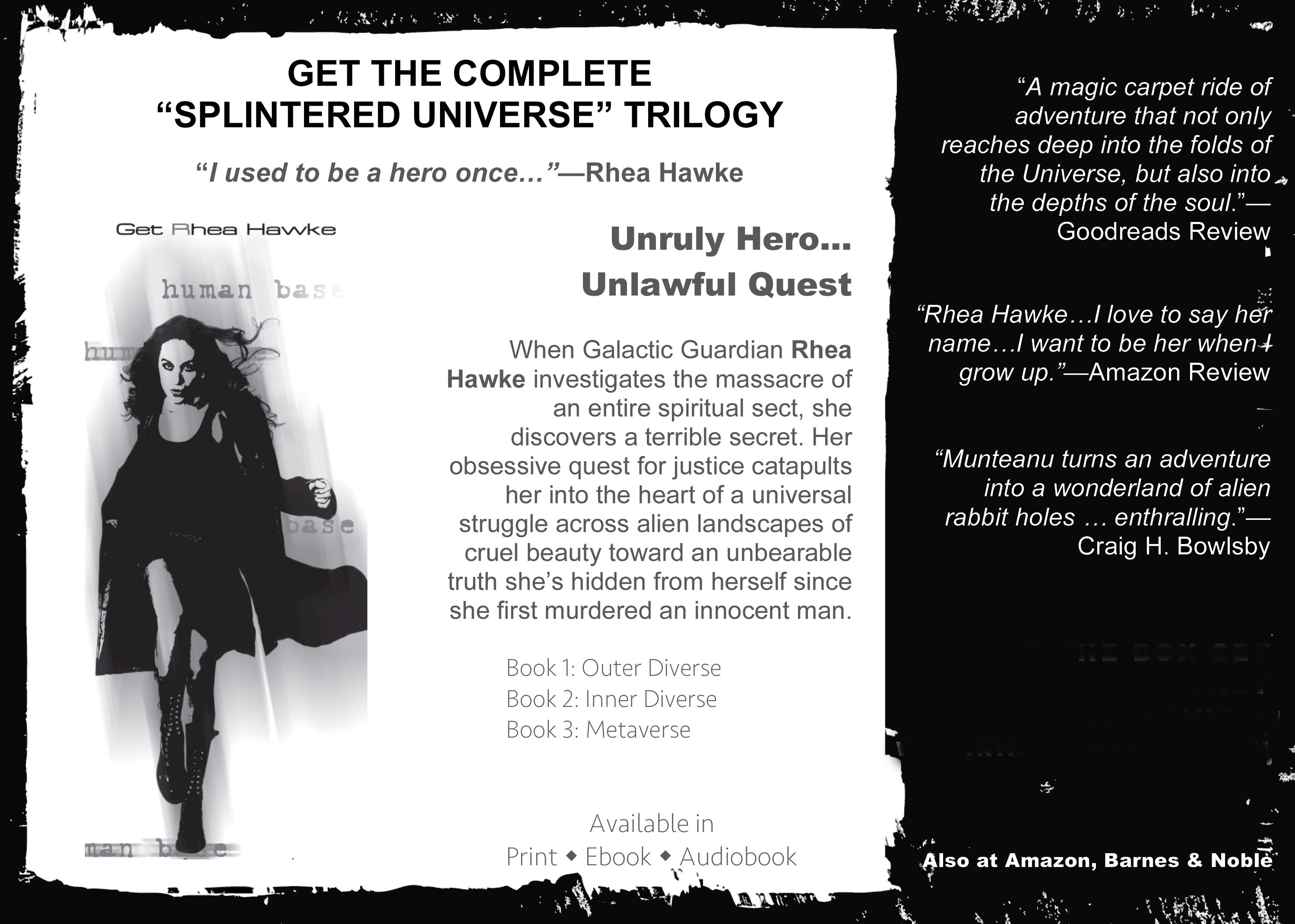
Get the complete Splintered Universe Trilogy. Available in ALL THREE FORMATS: print, ebook, and audiobook. Listen to a sample from the three audiobooks below on Audible. Read the Splintered Universe reviews on Goodreads.

audible listen

Microsoft Word - trilogy-poster03.docx

nina-2014aaa

Nina Munteanu is a Canadian ecologist / limnologist and novelist. She is co-editor of Europa SF and currently teaches writing courses at George Brown College and the University of Toronto. Visit www.ninamunteanu.ca for the latest on her books. Nina’s bilingual “La natura dell’acqua / The Way of Water” was published by Mincione Edizioni in Rome. Her non-fiction book “Water Is…” by Pixl Press (Vancouver) was selected by Margaret Atwood in the New York Times ‘Year in Reading’ and was chosen as the 2017 Summer Read by Water Canada. Her novel “A Diary in the Age of Water” will be released by Inanna Publications (Toronto) in 2020.

Why Ya Gotta Listen to The Splintered Universe Audiobook Trilogy

CoverI04

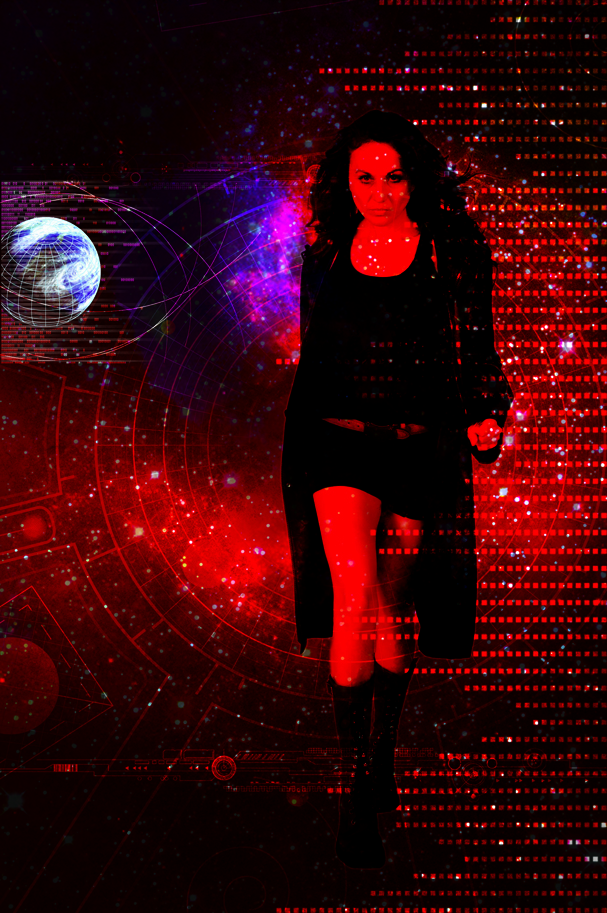
Rhea Hawke (Vali Gurgu)

Because of Dawn Harvey. It’s that simple.

If you haven’t listened to a book narration by voice actor Dawn Harvey before, you’re in for a treat. When I first embarked on this audiobook project, I had no idea what to expect. I give full credit to the original audiobook publisher, Iambik, who have since closed their doors (my books are currently carried and produced by Audible). Iambik introduced me to Dawn Harvey. She was one of three narrators they’d short-listed for me to audition. I had a short bio of each narrator along with a sample of their reading.

You can listen to samples from all three books on Audible:

audible listen

I knew nothing about the process of narration or turning my print book into an audiobook. But, I did know what I needed in the voice of my book:

  1. The story is told in the first person by Galactic Guardian Rhea Hawke, a cynical angry human in a world of aliens; Rhea hates the colleagues she works with. They consider her puny and incompetent and rash and they continually remind her of some of her earlier disastrous mistakes. Rhea’s voice had to reflect a gritty hardness and sarcasm, while betraying a hidden compassion and kindness. Dawn’s voice nailed it. Dark and rich like a good cup of coffee, Dawn captured Rhea completely. The grit. The hardness. The irony. The vulnerability lurking beneath it all.
  2. The story takes place throughout the galaxy and Rhea encounters over twenty different alien species—all of which needed a distinct voice when conversing with her. Dawn showed incredible versatility in capturing their voices according to the alien’s morphology and culture, which I provided. One of the aliens has five mouths and speaks in a multi-timbral voice; Dawn successfully portrayed it.

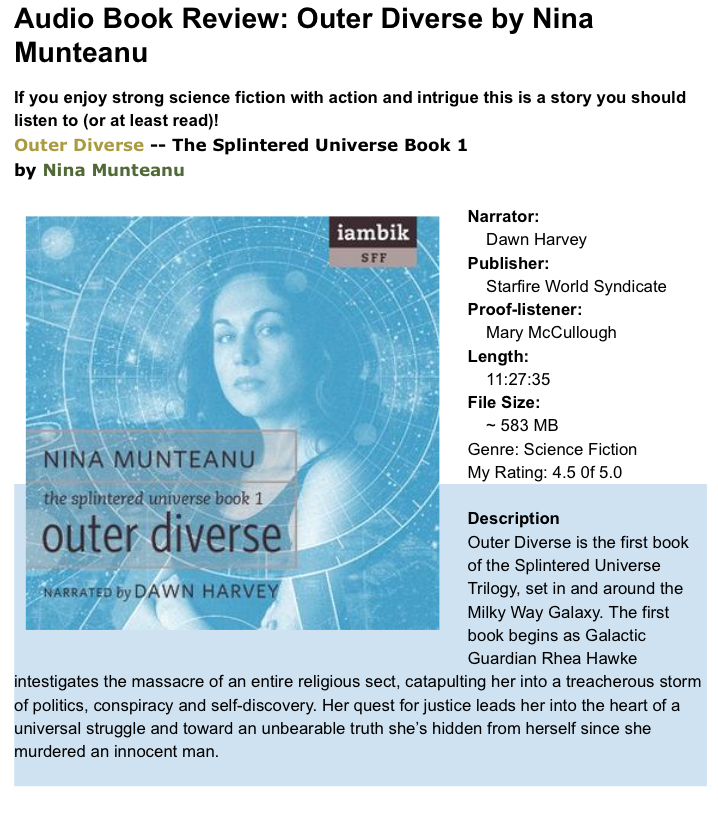
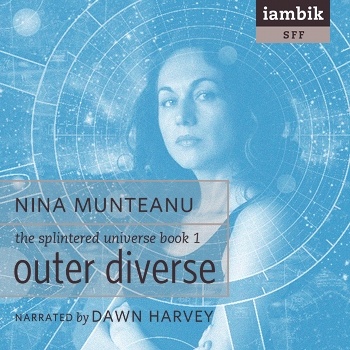
OuterDiverse-audiobook-IambikI was so impressed when I listened to the final recording of Outer Diverse (the first book in the trilogy). It was as though I was experiencing the story for the first time—as if I hadn’t written it myself—I was right there, exploring with Rhea Hawke, journeying to the outer planets of the galaxy. Dawn had breathed life into my character and my story. I was totally unprepared for my reaction. Voice artists would explain her techniques: her prepared pauses, tone, speed, inflections, etc. I knew they were there. But that didn’t seem to matter; what mattered was that she’d embraced both my main character and the story and it all came out in her voice.

So, give The Splintered Universe Audiobook trilogy a listen and treat yourself to the entertaining narration of Dawn Harvey. Check out the fawn-like Fauche, raptor-like Khonsus, Azorians, burly Badowins, the amoeba-like Ngu and chameleon-like Xhix. Tell me what you think.

Microsoft Word - Document1

The audiobook trilogy consists of Outer Diverse, Inner Diverse, and Metaverse. The Splintered Universe Trilogy is also available in ALL THREE FORMATS: print, ebook, and audiobook. You can listen to a sample recording of all three audiobooks through Audible.

audible listen

Microsoft Word - Trilogy-Vcon-AD-2.docx

An addictive start to the trilogy!Book Addict

A feast for the senses; glorious worlds with complex inhabitants hurtle towards our unprepared ears—QuirkyMezzo23

I want to grow up to be Rhea HawkeDabOfDarkness

Microsoft Word - SplinteredUniverseTrilogy Audiobooks.docx

Rhea courtyard03

Detective Rhea Hawke (Vali Gurgu)

nina-2014aaa

Nina Munteanu is a Canadian ecologist / limnologist and novelist. She is co-editor of Europa SF and currently teaches writing courses at George Brown College and the University of Toronto. Visit www.ninamunteanu.ca for the latest on her books. Nina’s bilingual “La natura dell’acqua / The Way of Water” was published by Mincione Edizioni in Rome. Her non-fiction book “Water Is…” by Pixl Press (Vancouver) was selected by Margaret Atwood in the New York Times ‘Year in Reading’ and was chosen as the 2017 Summer Read by Water Canada. Her novel “A Diary in the Age of Water” will be released by Inanna Publications (Toronto) in 2020.