My Books Are Feeding Meta’s AI Brat

On March 20, 2025, in an article in The Atlantic entitled “The Unbelievable Scale of AI’s Pirated-Books Problem”, Alex Reisner disclosed how META pirated millions of books and research papers to train their flagship AI model Llama 3 to be competitive with products like ChatGPT. Reasons for this illegal action is simply time; asking permission and licensing takes too much time and is too expensive.

On the same day, The Atlantic provided a link to LibGen (the pirated-books database that Meta used to train its AI) so authors could search its collection of millions of illegally captured books and scientific papers. I went there and searched my name for my novels, non-fiction books and scientific papers and discovered several of my works in their AI training collection.

Two of my many scientific papers appeared in LibGen under my scientific author name Norina Munteanu. The first scholarly article came from my post grad work at the University of Victoria on the effects of mine tailing effluent on an oligotrophic lake, published in 1984 in Environmental Pollution Series A, Ecological and Biological Volume 33, Issue 1. The second article on the effect of current on settling periphyton came from my M.Sc. ecology research published in 1981 in Hydrobiologia, Volume #78.

Three of my thirteen novels appeared in LibGen under my fiction author name Nina Munteanu. I found it interesting how their bots captured a good range of my works. These included two of my earliest works. Collision with Paradise (2005) is an ecological science fiction adventure and work of erotica; Darwin’s Paradox (2007) is a science fiction medical-eco thriller that features the domination of society by an intelligent AI community. The bots also found my latest novel, A Diary in the Age of Water (2020), a climate thriller and work of eco-fiction that follows four generations of women and their relationship to water.

Each of these works has been highly successful in sales and has received a fair bit of attention and recognition.

When Genevieve Dubois, Zeta Corp’s hot shot starship pilot, accepts a research mission aboard AI ship ZAC to the mysterious planet Eos, she not only collides with her guilty past but with her own ultimate fantasy. On a yearning quest for paradise, Genevieve thinks she’s found it in Eos and its people; only to discover that she has brought the seed of destruction that will destroy this verdant planet.

Recognition: Gaylactic Spectrum Award (nominee)

Collision with Paradise is ideal for readers who enjoy dark, introspective science fiction that explores complex moral dilemmas and psychological depth within a lush mythologically-rich setting.”The Storygraph

A devastating disease. A world on the brink of violent change. And one woman who can save it or destroy it all. Julie Crane must confront the will of the ambitious virus lurking inside her to fulfill her final destiny as Darwin’s Paradox, the key to the evolution of an entire civilization. Darwin’s Paradox is a novel about a woman s fierce love and her courageous journey toward forgiveness, trust, and letting go to the tide of her heart.

Recognition: Readers Choice Award (Midwest Book Review); Readers Choice (Delta Optimist); Aurora Award (nominee)

Darwin’s Paradox is a thrill ride that makes you think and tugs the heart.”Robert J. Sawyer, Hugo and Nebula Award winning author of Rollback

This gritty memoir describes a near-future Toronto in the grips of severe water scarcity during a time when China owns the USA and the USA owns Canada. A Diary in the Age of Water follows the climate-induced journey of Earth and humanity through four generations of women, each with a unique relationship to water. The diary spans a twenty-year period in the mid-twenty-first century of 33-year-old Lynna, a single mother and limnologist of international water utility CanadaCorp, and who witnesses disturbing events that she doesn’t realize will soon lead to humanity’s demise. 

Recognition: 2020 Foreword Indies Book of the Year Award (Bronze); 2020 Titan Literary Book Award (Silver); 2021 International Book Award (Finalist).

“If you believe Canada’s water will remain free forever (or that it’s truly free now) Munteanu asks you to think again. Readers have called ‘A Diary in the Age of Water’ “terrifying,” “engrossing,” and “literary.” We call it wisdom.”—LIISBETH

The April 3, 2025 article by Ella Creamer of The Guardian noted that a US court filing alleged that Meta CEO Mark Zuckerberg approved the company’s use of the notorious “shadow library”, LibGen, which contains more than 7.5 million books and 81 million research papers. According to Toby Walsh, leading AI researcher at the University of New South Wales: “As far as we know, there was an explicit instruction from Mark Zuckerberg to ignore copyright.”

This begs the question of the role and power of copyright law.

“Copyright law is not complicated at all,” said Richard Osman, author of The Thursday Murder Club series. “If you want to use an author’s work you need to ask for permission. If you use it without permission you’re breaking the law. It’s so simple.”

If it’s so simple then why is Meta and others getting away with it? For its defence, the tech giant is claiming “fair use”, relying on this term permitting the limited use of copyrighted material without the owner’s permission (my italics).

It would seem that just as Trump trumped the presidency, Zuckerberg and his AI minion bots have trumped the copyright law—by flagrantly violating it and getting away with it—so far (on both counts).

The actions of Meta were characterized by Society of Authors chair Vanessa Fox O’Louglin as “illegal, shocking, and utterly devastating for writers.” O’Louglin added that “a book can take a year or longer to write. Meta has stolen books so that their AI can reproduce creative content, potentially putting these same authors out of business.”

Three of my novels pirated for AI training

Reflecting many authors’ outrage throughout the world, Novelist AJ West remarked, “To have my beautiful books ripped off like this without my permission and without a penny of compensation then fed to the AI monster feels like I’ve been mugged.” Australian Author Sophie Cunningham said, “The average writer earns about $18,000 a year on their writing. It’s one thing to be underpaid. It’s another thing to find that [their] work is being used by a company that you don’t trust.” Bestselling author Hannah Kent said, “If feels a little like my body of work has been plundered.” She adds that this, “opens the door to others also feeling like this is an acceptable way to treat intellectual copyright and creatives who already…are expected to [contribute] so much for free or without due recompense.” Both Kent and Cunningham exhort governments to weigh in with more powerful regulation. And this is precisely what may occur. Nicola Heath of ABC.net.au writes, “the outcomes of the various AI copyright infringement cases currently underway in the US will shape how AI is trained in the future.”

According to The March 20, 2025 Authors Guild article “Meta’s Massive AI Training Book Heist: What Authors Need to Know,” legal action is underway against Meta, OpenAI, Microsoft, Anthopic, and other AI companies for using pirated books. The Authors Guild is a plaintiff in the class action lawsuit against OpenAI, along with John Grisham, Jodi Picoult, David Baldacci, George R.R. Martin, and 13 other authors, but the claims are made on behalf of all US authors whose works have been ingested into GPT. 

The Authors Guild suggests five things authors can do to defend their rights:

  1. Send a formal notice: If your books are in the LibGen dataset, send a letter to Meta and other AI companies stating they do not have the right to use your books.
  2. Join the Authors Guild: You should join the Guild and support our joint advocacy to ensure that the writing profession remains alive and vibrant in the age of AI. We give authors a voice, and there is power in numbers. We can also help you ensure that your contracts protect you against unwanted AI use of your work. 
  3. Protect your works: Add a “NO AI TRAINING” notice on the copyright page of your works. For online work, you can update your website’s robots.txt file to block AI bots.
  4. Get Human Authored certification: Distinguish your work in an increasingly AI-saturated market with the Authors Guild’s certification program. This visible mark verifies your book was created by a human, not generated by AI.
  5. Stay informed. The Authors Guild suggest signing up for the free Guild biweekly newsletter to keep updated on lawsuits and legislation that could impact you and your rights. The legal landscape is changing rapidly, and they are keeping close watch. 

How do I feel about all this? As a female Canadian author of climate fiction? As a thinking, feeling human being living in The Age of Water? Well, to tell the truth, it kinda makes me want a donut*…

 *as delivered by James Holden in Season 3, Episode 7 of “The Expanse”

Aspens in fall, ON (photo and rendition by Nina Munteanu)

Nina Munteanu is a Canadian ecologist / limnologist and novelist. She is co-editor of Europa SF and currently teaches writing courses at George Brown College and the University of Toronto. Visit  www.ninamunteanu.ca for the latest on her books. Nina’s bilingual “La natura dell’acqua / The Way of Water” was published by Mincione Edizioni in Rome. Her non-fiction book “Water Is…” by Pixl Press (Vancouver) was selected by Margaret Atwood in the New York Times ‘Year in Reading’ and was chosen as the 2017 Summer Read by Water Canada. Her novel “A Diary in the Age of Water” was released by Inanna Publications (Toronto) in June 2020.

On Writing: The Blank Page

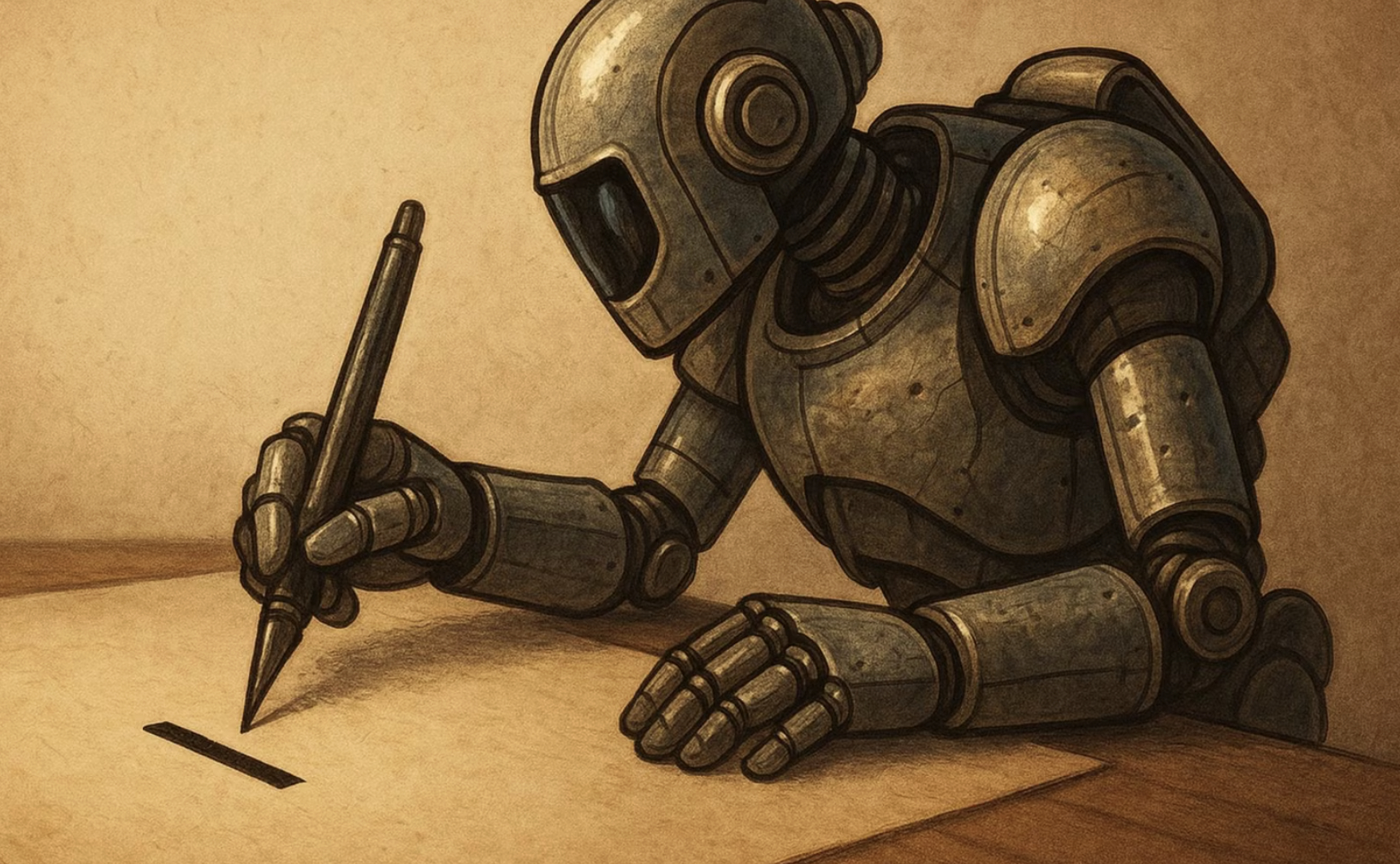
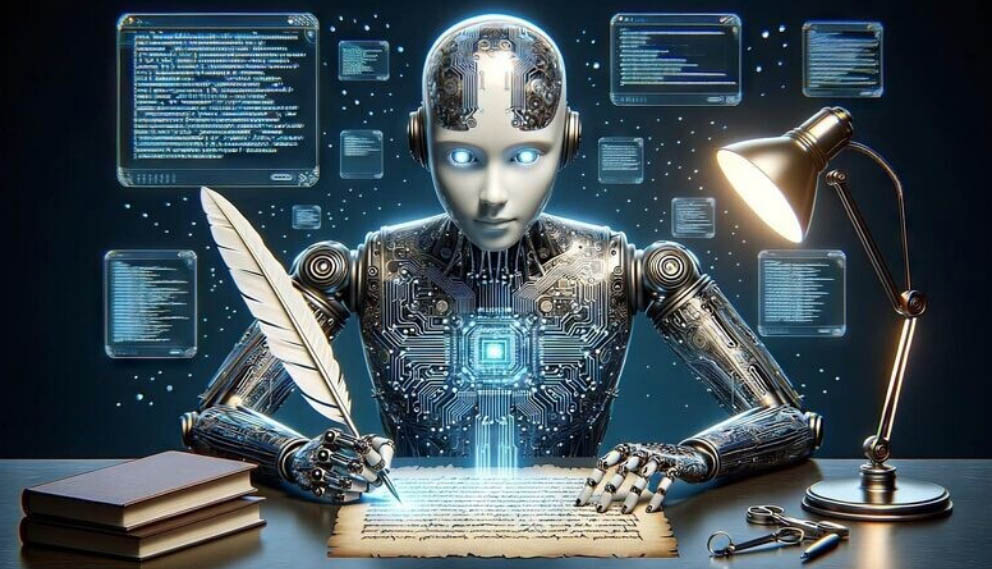
AI concept art by genaiTechvifySoftware.com

I teach scholarly writing at the University of Toronto through several writing centres; I’m helping students with their assignments in engineering, the health sciences and humanities. All are generating scholarly papers on various topics with various purposes; anything from a critical assessment, literature review, position paper, or reflection essay to a lessons learned document, research proposal, or thesis chapter. Everyone is using some kind of AI when generating, writing and editing their works. And there are plenty of AI tools to choose from. Some of the most common AI tools used by my students include: Grammarly for grammar; Perplexity as a research tool, text summarizer and conversational AI search engine; Paperpal for editing, Google Scholar as a search engine, ChatGPT to summarize works, brainstorm ideas, provide quiz questions, or even generate human-like text in a first draft.

All these assignments are purpose-built and students must successfully address their assignment requirements to succeed. In some ways, the idea, topic and handling of the topic are assigned; the student need only carefully and clearly address it.

But, when creating something new, like a piece of fiction or even a non-fiction article, professional writers are essentially walking into a new world, not restricted by “assignment guidelines or requirements”; they truly must face the blank page.

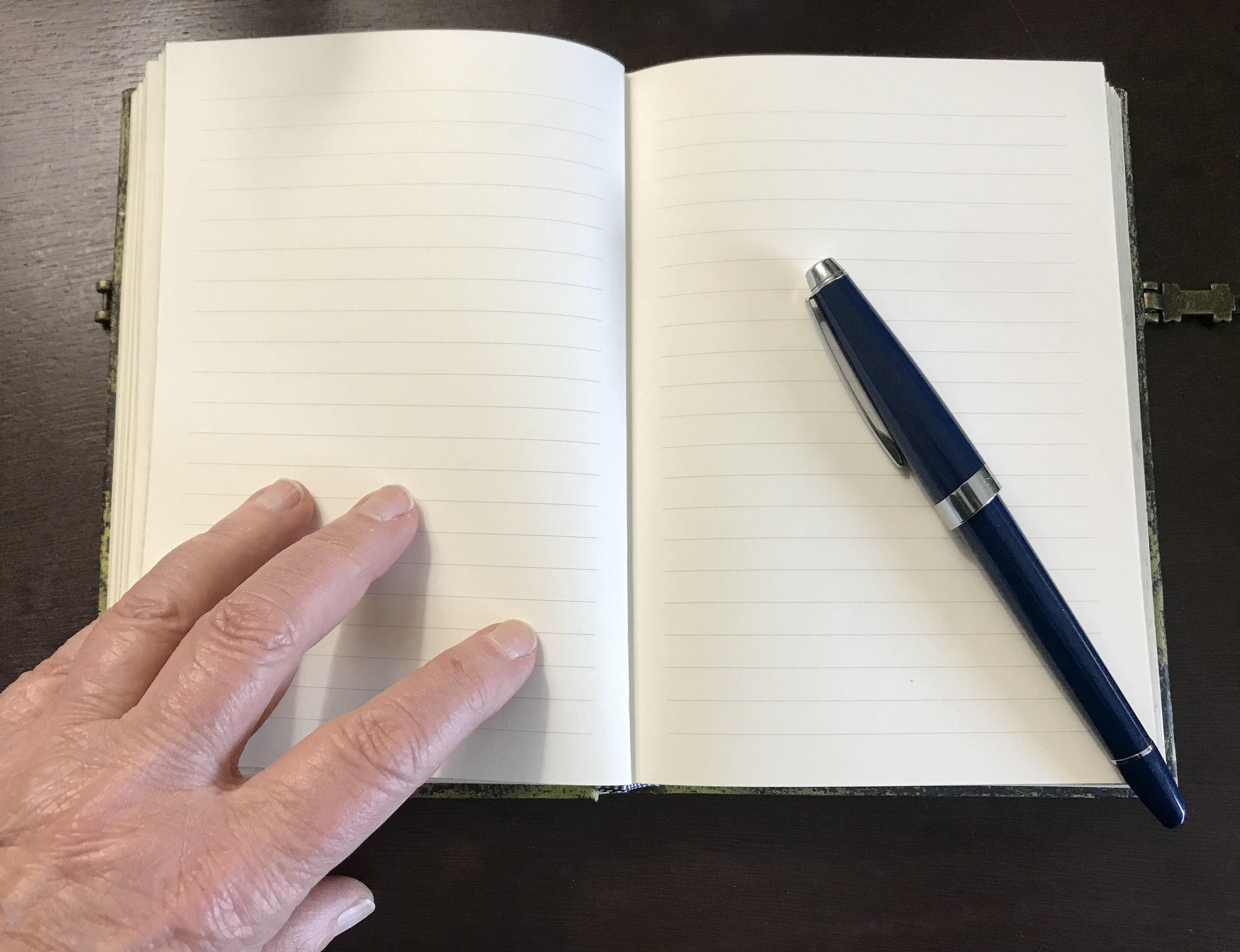
The blank pages of a notebook (photo by Nina Munteanu)

There’s no precedence for creating a piece of fiction. Yes, certainly inspiration is involved, but the work of something unique must start with a blank page. Professional writers often dread facing the blank page. It even has a name: blank page syndrome, or writer’s block, the feeling of being overwhelmed or even paralyzed by the prospect of starting. Alex Elkjær Vasegaard tells us that “it may come from the fear of not being good enough, of not knowing enough, or of the vastness of the potential ahead.”

I recently read a post on LinkedIn by writing colleague Erik Buchanan, which resonated with me. I asked his permission to quote it here and he gladly gave it:

Just got a recommended post from a marketing person claiming that using AI allows you to get past the hardest part of writing: “the blank page.”

I blocked them, and I’m putting what I was going to reply to them here instead, because they are not a person who will be open to this rant:

If you cannot get past the blank page, you are not a writer.

If you use AI to get past the blank page, you’re still not a writer, and now you’re a thief.

You’re using other writers’ words, fed into an information aggregator and splatted out like a drunk’s meal vomited onto the sidewalk. And you’re scooping it up and claiming it’s fresh food.

You want to write? Write something.

Speaking as one who has written 18 novels (more than half ghostwritten for money), 150 articles, short stories, instruction manuals, sales copy, website copy, commercial scripts, short films and now a feature film (currently being re-written) it’s not that hard.

Using AI means you’re too lazy to learn the craft.

Don’t do it.

A blank page is more than a simple page that is empty. It offers something new, without precedence to write, draw or create. Whether it’s a physical sheet of paper in a notebook or a white space in a digital document, the blank page represents a fresh beginning and wonderful potential for unique creation.

Erik’s point is so Germaine to the creative writing process. The blank page is an open door to possibility; it is a writer’s first step in creating something uniquely their own. Plot, character, setting and language—such as technique, style, words and phrases—certainly make a novel wonderful to read; but it is the unique idea, the spark, the premise and theme that carry that novel into greatness and keep it memorable.

Coming up with first words on a blank page (photo by Nina Munteanu)

Poet Alberto Blanco challenges our notion of the blank page being blank: From the tree it was made from, the rain and sun that allowed the tree to grow, and the people that created it, it soon becomes clear that a blank page contains the whole cosmos.

In “The Blank Page: A Meditation on the Creative Process and Life’s Journey” Alex ElkjærVasegaard describes the blank page as “an expanse of white, unsullied by ink or pixels. It’s the void that calls for creation. It’s the challenge that every artist, writer, and thinker faces. But isn’t that just a beautiful metaphor for life itself?”

Erik, I too would have blocked that marketer. I doubt they are a writer…

“Who then … tells a finer tale than any of us? Silence does. And where does one read a deeper tale than upon the most perfectly printed page of the most precious book? Upon the blank page. When a royal and gallant pen, in the moment of its highest inspiration, has written down its tale with the rarest ink of all — where, then, may one read a still deeper, sweeter, merrier and more cruel tale than that? Upon the blank page.”—Karen Blixen, Last Tales

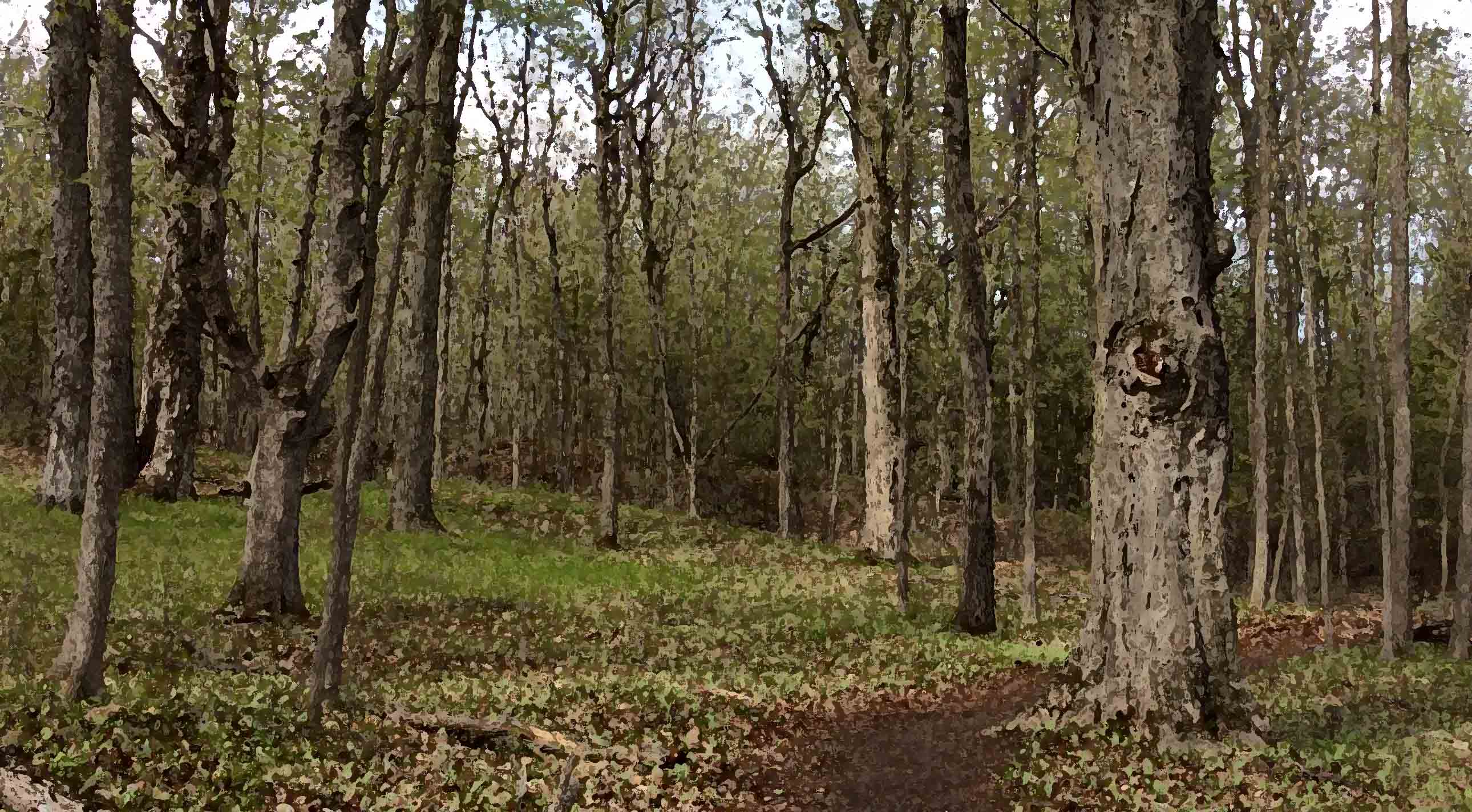
Maple beech forest in early spring, ON (photo and rendition by Nina Munteanu)

Nina Munteanu is a Canadian ecologist / limnologist and novelist. She is co-editor of Europa SF and currently teaches writing courses at George Brown College and the University of Toronto. 

Visit  www.ninamunteanu.ca for the latest on her books. Nina’s bilingual “La natura dell’acqua / The Way of Water” was published by Mincione Edizioni in Rome. Her non-fiction book “Water Is…” by Pixl Press (Vancouver) was selected by Margaret Atwood in the New York Times ‘Year in Reading’ and was chosen as the 2017 Summer Read by Water Canada. Her novel “A Diary in the Age of Water” was released by Inanna Publications (Toronto) in June 2020.

Writing in the Age of Artificial Intelligence: AI and Post-Plagiarism

AI entity performing a myriad of duties (image from Bernard Marr & Co.)

I teach academic writing to students at the University of Toronto Writing Centre. It’s wonderful and fulfilling work and I enjoy helping students in several disciplines (engineering, health sciences, social sciences) learn to write better. As with the rest of the academic world of writing, we are all making sense of the use of AI-generated tools by students, instructors and researchers: large language models (LLMs) such as ChatGPT, Claude, Copilot, and even Grammarly. Students have told me that they found AI helpful in brainstorming and outlining as well as organizing literature reviews and editing for grammar and such. A recent survey of universities and corporations around the world by the Digital Education Council revealed that a majority of students used AI tools. Of those surveyed, close to two thirds used AI as a search engine; a third used it to summarize documents; and a fifth used it to create first drafts. 

In her 2024 article “The Future Is Hybrid”, Beth McMurtrie suggested that genAI “may eventually take its place in the pantheon of game-changing technologies used every day in education—alongside calculators, search engines, and Excel.”

In my other pursuit as a professional fiction author, I see the artistic and communication industries embracing AI, particularly in the visual arts. I’m now told that several publishing houses and magazines have dedicated efforts to publish AI-generated work. Some magazines are entirely AI generated, Copy Magazine, for instance. Author futurist Bernard Marr writes that “Generative AI is already being adopted in journalism to automate the creation of content, brainstorm ideas for features, create personalized news stories, and produce accompanying video content.” Marr then goes on to provide 13 ways that all writers should embrace Generative AI that includes anything from drafting plot lines to world building. Sports Illustrated was recently found to publish AI generated stories. Even newspapers, such as the LA Times, the Miami Herald, and Us Weekly acknowledge AI-written content. And I recently learned that one of the top five online science fiction magazines, Metastellar, accepts AI-assisted stories with the proviso that “they better be good.” And Metastellar provides some convincing reasons. This has become a hot topic among my fellow professional writers at SF Canada.  One colleague informed me that a “new publisher Spines plans to disrupt industry by publishing 8000 AI books in 2025 alone.” On checking the news release, I discovered that Spines is, in fact, a tech firm trying to make its mark on publishing, primarily through the use of AI. The company offers the use of AI to proofread, produce, publish, and distribute books. They are, in fact, a vanity publishing platform (essentially a service for self-publishing), charging up to $5000 a book and often taking just three weeks to go from manuscript to a published title.

The emerging field of AI-assisted writing and communicating is a burgeoning field that promises to touch every person in some way—writers and readers alike. Tech companies are scrambling to use it to save time and effort. Others are involved in improving current and developing new models. Many are training LLMs for improved use. Even I was headhunted as a creative writer by one tech firm to help create more safe, accurate and reliable LLMs.

Generative AI applications (Image from Neebal Technologies)

Universities and Other Educational Institutions Use of AI

How universities and other educational institutions are dealing with the challenge and promise of these emerging tools in communication varies from out right forbidding AI use in the classroom to full on acceptance and obligatory use in some classroom projects. McMurtrie described how two instructors at Rollins College, Dan Myers and Anne Murdaugh, had students collaborating with AI on semester-long research projects. They were instructed to use Claude and Copilot to brainstorm paper topics, conduct literature reviews, develop a thesis, and outline, draft, and revise their papers. Myers and Murdaugh asserted that “the skills that students use to engage thoughtfully with AI are the same ones that colleges are good at teaching. Namely: knowing how to obtain and use information, thinking critically and analytically, and understanding what and how you’re trying to communicate.”

In fall of 2024, Stephanie Wheeler and others at the department of writing and rhetoric in the University of Central Florida, along with their philosophy department, set up an interdisciplinary certificate in AI. Their purpose was to develop conceptual knowledge about AI. Wheeler asserted that writing and rhetoric have long been concerned with how technology shapes these disciplines. Sharon L.R. Kardia, senior associate dean of education at the University of Michigan argued that AI could greatly benefit public health in its ability to aid in data analysis, research review, and the development of public-health campaigns. However, she cautioned that LLMs also absorb and reflect the social biases that lead to public-health inequities.

One of my Writing Centre colleagues at UofT recently shared some thoughts about a conference session he’d participated in, in which a student panel listed tasks that they thought genAI cannot do (yet). These included: generate music, offer interpersonal advice, and verify facts; I think AI can already help with two of these. Chad Hershock, executive director of the Eberly Centre for Teaching Excellence and Educational Innovation at Carnegie Mellon University shared that they are researching key questions about whether AI enables or impedes: does using AI while brainstorming generate more or fewer ideas? Can generative AI give less-experienced students a better chance to be successful in technical courses? To what extent does using AI help or hinder writing skills? Does having generative AI as a thought partner enhance students’ ability to make a claim and support it with evidence?

My own experience with a less-experienced student’s use of genAI was often abysmal. The student had used the tool as a crutch and had failed to learn from their use of the tool. This suggests that the most important limitations of the tool lie with the user’s own limitations and it points to the need for guidance by educators.

In her 2024 Axios article “Why AI is not substitute for human teachers” Megan Morrone described findings of the Wharton School on access to genAI: while genAI tutors improved student performance on practice math problems, students who used these tools performed significantly worse on exams (where they couldn’t use AI). The school concluded that the students used genAI to copy and paste answers, which led them to engage less with the material. Wharton School associate professor Hamsa Bastani argued that, “if you just give unrestricted access to generative AI, students end up using it as a crutch…[and] end up performing a lot worse.” This is partly because students—often stressed-out by heavy work loads—find that LLMs save time and can produce content close to what the user might produce themselves. Researchers have even come up with a term for this: Cognitive Miserliness of the User, which, according to writer Stephen Marche, “basically refers to people who just don’t want to take the time to think.”

Melanie M. Cooper, chemistry professor at Michigan State University cautioned that while “there’s a lot of ebullience in the AI field, it’s important to be wary.” She argued that it is easy  to misuse AI and override the system to get a quick answer or use it as a crutch.  McMurtrie shares that, while “AI evangelists promise that these tools will make learning easier, faster and more fun,” academics are quick to reject that rhetoric. McMurtrie ends her article with a cautionary statement by Jennifer Frederick of Yale: “Universities really need to be a counterpoint to the big tech companies and their development of AI. We need to be the ones who slow down and really think through all the implications for society and humanity and ethics.”

Considering the impact of artificial intelligence on writing, Dr. Sarah Elaine Eaton, professor at the University of Calgary, introduced the idea of life in a postplagiarism world. She expanded on her ideas to come up with six tenets that characterize the post-plagiarism age. These include:

  1. Hybrid human-AI writing will become normal
  2. Human creativity is enhanced
  3. Language Barriers disappear
  4. Humans can relinquish control, but not responsibility
  5. Attribution remains important
  6. Historical definitions of plagiarism no longer apply
6 tenets of Postplagiarism (image from Sarah Elaine Eaton)

Eaton’s fifth point (attribution remains important), I think becomes all that more important in the presence of AI use. Transparency in presentation, particularly in an academic setting, takes on a new level of importance when communicating with tools such as generative AI. Where things come from, which tool was used and how it was used are key to understanding and interpreting the nature of the writing itself. The path taken to the destination becomes all important when interpretation and comprehension (and replication) is required. To fully understand “where you are”; we need to know “how you got there.” It’s like solving math problem; if you don’t show your work and just provide the answer, I have no way of knowing that you actually understood the problem and really solved it.

I am certain that generative AI will continue to take on various forms that will continue to astonish. Its proper use and development will serve humanity and the planet well; but there will always be abusers and misusers and those who simply don’t care. We must be mindful of them all. We must remain vigilant and responsible. Because, just as with freedom, if we grow lazy and careless, we run the risk of losing so much more.    

Generative AI (image from techvify-software.com)

References:

Eaton, Sarah Elaine. 2021. “Plagiarism in Higher Education: Tackling tough Topics in Academic Integrity.” Bloomsbury Publishing, 252pp.

Marr, Bernard. 2024. “13 Ways Writers Should Embrace Generative AI.” Bernard Marr & Co. February 5, 2024.

Marche, Stephen. 2024. “AI Is a Language Microwave.” The Atlantic. September 27, 2024.

McMurtrie, Beth. 2024. “The Future Is Hybrid.” The Chronicle of Higher Education. October 3, 2024.

Morrone, Megan. 2024. “Why AI is no substitute for human teachers.” Axios, August 15, 2024.

Niloy, Ahnaf Chowdhury, et al. 2024. “Why do students use ChatGPT? Answering through a triangulation approach.” Computers and Education: Artificial Intelligence 6.

Nina Munteanu is a Canadian ecologist / limnologist and novelist. She is co-editor of Europa SF and currently teaches writing courses at George Brown College and the University of Toronto. Visit www.ninamunteanu.ca for the latest on her books. Nina’s bilingual “La natura dell’acqua / The Way of Water” was published by Mincione Edizioni in Rome. Her non-fiction book “Water Is…” by Pixl Press (Vancouver) was selected by Margaret Atwood in the New York Times ‘Year in Reading’ and was chosen as the 2017 Summer Read by Water Canada. Her novel “A Diary in the Age of Water” was released by Inanna Publications (Toronto) in June 2020.

Movie Review: The Creator

Nirmata: n.1 [Nepalese for ‘the Creator’] The mysterious unknown architect of advanced AI; 2 A being worshipped by Artificial Intelligence as their creator; savior; God.

I just re-watched The Creator, a visually stunning science fiction thriller by Gareth Edwards that explores our sense of humanity through our relationship with AI as ‘other.’

Shot in over sixty locations in Southeast Asia, including Cambodia, Indonesia, Japan, and Nepal, the film feels familiar and alien at the same time; it does this by seamlessly combining the gritty realism of a war-torn Vietnam documentary with the glossy pastiche of near-future constructs and vehicles—to the extent that one is convinced this was filmed in a world where all these things really exist together. The effect is stunning, evocative and surprising. I was reminded of the detailed set pieces and rich cinematography of Ridley Scott (The Duelists, Bladerunner, Alien).

At its core, The Creator is about a man who gives up everything to defend a child who is different (she is a simulant run by AI).

Artificial Intelligence (AI) is not a new concept in science fiction*; however, The Creator elegantly tells a story with a unique—and subversive—perspective on this topic.

The film opens with 1950s-esque advertising footage for robot helpmates including conventional robots and AI humanoid simulants who look and act human. Then disaster hits: LA is nuked and the AI are blamed for it. Now fearing them, the Western world has banned all AI; however New Asia has continued to develop the technology, achieving sophisticated simulants—posthumans in effect—who are fully integrated with the human culture and spirituality and live in harmony with them. Americans, bent on exterminating all AI, use guerrilla warfare techniques to infiltrate New Asia and destroy any AI using ground teams deployed and helped by a giant airborne surveillance / defence station called U.S.S. NOMAD. News of a sophisticated new AI superweapon created by an unidentified genius called Nirmata to take down NOMAD sends them on a new mission, which brings Joshua (John David Washington) back from PTSD ‘retirement’ to help locate and destroy both Nirmata and the superweapon.

Alphie (Madeleine Yuna Voyles) pacifies an enemy robot (image from “The Creator”)

Joshua finds the superweapon: a 6-year old child, Alphie (Madeleine Yuna Voyles), who is both innocent and quietly powerful. Although Joshua’s prime directive is to destroy the superweapon, he finds that he cannot kill this child whose human traits involuntarily tug at his heart’s compassion.

Joshua (John David Washington) defends the child-weapon (image from “The Creator”)

The story is in fact a simple one. Its genius lies in an immersive showing and telling at many levels. At the socio-political level, the film uses obvious metaphors of racism and imperialistic ableism to make commentary on America’s jingoistic air of entitlement. The film can easily be interpreted as an allegory for Western imperialism and America’s rationale for the invasion of Iraq (or Vietnam) with a conclusion of the futility of war. At the individual level, the question of identity and the reduction of some (e.g. immigrants or of another race) as “other” or “homo-sacer,” to gain power and wealth, are explored through the interactions, relationships, and prejudices of humans with the simulants and robots. It is at the individual story level that this film tugged my heartstrings as I followed the journey of Joshua and Alphie, how they as initial combatants having made a deal to survive, grow to care and love one another. Musanna Ahmed of The Upcoming shares that “this was expected from Edwards … [in achieving] beautiful character work and sense of intimacy against an epic backdrop.”  When an idea-driven story of large dimensions is told at the intimate personal level, pathos and understanding emerges.  

A robot defends the escape boat (image from “The Creator”)

Gareth Edwards shared that the film contained fairy tale aspects of the “Hero’s Journey” of two main characters, Joshua and Alphie, each on a journey: he to find redemption through love of the ‘other’; she to find her place in the world and to find freedom and peace for her kind and all others. She is the catalyst hero and he the main protagonist.

“A reluctant father figure must help a child through the metaphorical woods to find his wife [and her mother]. What he wants is love from his wife. But what he really needs is to love this child.” As for what Alphie both wants and needs, this is something she first shares in a humorous scene: when Kami asks her what she wants (from the kitchen), Alphie naively responds “for robots to be free.” She is stating the point of the movie: that everyone, no matter how different, is worthy of compassion.

Early on in the film, Joshua reassures a co-worker distressed by a robot’s desperate plea to save it from the crusher that “they’re not real…they don’t feel… it’s just programming.” When Joshua, who admits he’s bad, forces Alphie to help him find his wife, Alphie sums up both their scenarios with a child’s wisdom: “Then we’re the same; we can’t go to heaven because you’re not good and I’m not a person.”

Americans attack a village in New Asia (image from “The Creator”)

Several reviewers criticized how the film’s epic setting seemed to overshadow and compromise the heart of the story, the personal drama of man and child. While I would agree that many action thrillers do this, I did not feel this was the case with The Creator. This is because—as with Ridley Scott’s intricate immersive environment—The Creator integrates place with theme to create more than one-dimensional drama. In The Creator, place is also character, playing a key role in the telling of this very different story about AI as ‘other’ and how we treat the ‘other.’ This is also why film locations and scene choreography are so important. Each scene and place is diligently choreographed to further illuminate a story of multi-layered meaning, such as authentic scenes of village life where AI is seamlessly integrated with human existence.      

Colonel Howell (Alison Janney) gets captured by New Asia police (image from “The Creator”)

Several critics have accused the film of being derivative, of copying previous tropes or actual scenes from several well-known movies. Indeed, when I first watched it, I recognized tropes that seemed lifted in their entirety from another previous movie.

The scene, shot in Tokyo where Joshua and Alphie go to the city in search of Joshua’s friend, sounds and looks and feels just like Bladerunner with its whining oriental soundscape and dark futuristic yet gritty cityscape. And yet, its appropriateness to The Creator seems less like stealing than re-appropriation; as if to say, “this fits better here than where you’ve initially used it.”

Christy Lemire of RogerEbert.com proclaimed that the movie “ends up feeling empty as it recycles images and ideas from many influential predecessors … lumbers along and never delivers the emotional wallop it seeks because the characters and their connections are so flimsily drawn.” Jackson Weaver of CBC called The Creator “a voguish used-future action-thriller…a dull, simplistic fable with all the moral complexity of a fourth grader’s anti-bullying Instagram post…a story that has been done to death…boring.”

I couldn’t disagree more. I found these reviewers’ comparisons shallow and limited. While I recognized several familiar tropes, I believe they were meant to subvert and make commentary—sometimes on the trope itself. There is a strong immersive role in world building and backdrop, which creates its own sensual and many-layered narrative; a narrative that speaks more powerfully than dialogue: from a mere glance by Harun to a brief storytelling moment in a village to a child mourning the death of its cherished robot companion. Ridley Scott would appreciate its value.

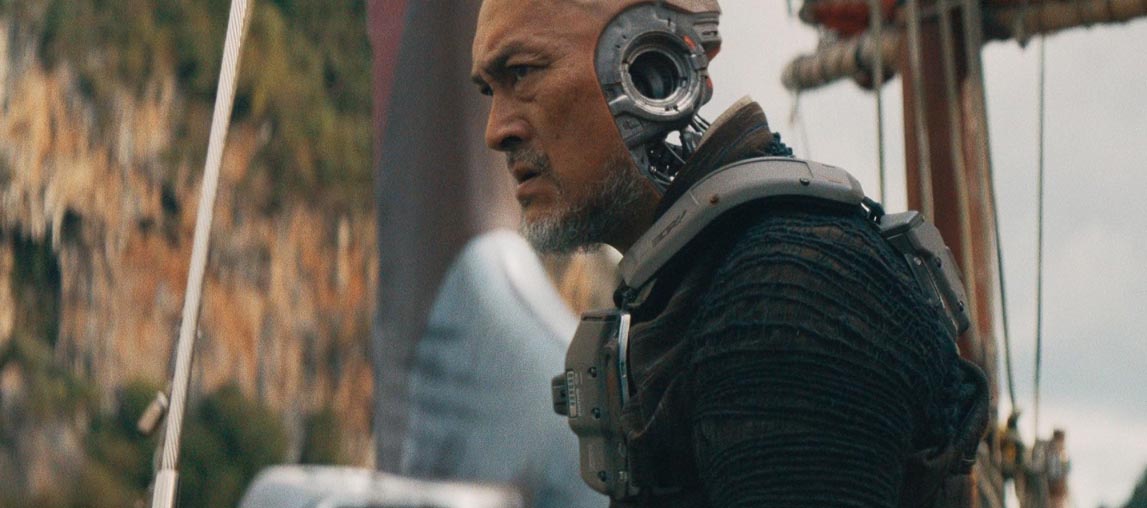
Harun (Ken Watanabe) on the escape boat, taking Alphie to safety (image from “The Creator”)

The Guardian’s Wendy Ide’s use of the word “original” for The Creator bares mentioning here; in declaring The Creator one of the finest original science-fiction films of recent years, Ide goes on to say: “It can be a little misleading, that word ‘original’, when it comes to science fiction. At its most basic, it just refers to any picture that isn’t part of an existing franchise or culled from a recognisable IP – be it a book, video game or television series. But very occasionally the word is fully earned, by a film so distinctive in its world-building, its aesthetic and its unexpected approach to well-worn themes that it becomes a definitive example of the genre. Films such as Neill Blomkamp’s District 9 (which shares an element of basic circuitry with this picture) or Alfonso Cuarón’s dystopian masterpiece Children of Men: both went on to become benchmarks by which subsequent science fiction was judged.”

In listing the various science-fiction standards The Creator riffs on, Alison Willmore of Vulture singles out one of the most poignant aspects of the film:

“The films The Creator turns out to have the strongest relationship with are ones about the Vietnam War, something made unmistakable by the early shots of futuristic hovercraft gliding over rice plants and the scenes of U.S. troops threatening weeping villagers at gunpoint. No longer able to buy into the message that they’re just doing what’s necessary for the salvation of humankind, Joshua finds himself adrift, fleeing through a war zone on impulse with a child destroyer in tow. The Creator may be an effective interrogation of American imperiousness and imperialism, but it also has a tender, anguished heart.”

NOMAD approaches a New Asia temple (image from “The Creator”)

Other notable TV shows and movies about artificial intelligence and robots include: A.I.; Ex Machina; I, Robot; Bladerunner; Better than Us; The Matrix; I am Mother; The Terminator; Transcendence; and Automata.

Nina Munteanu is a Canadian ecologist / limnologist and novelist. She is co-editor of Europa SF and currently teaches writing courses at George Brown College and the University of Toronto. Visit www.ninamunteanu.ca for the latest on her books. Nina’s bilingual “La natura dell’acqua / The Way of Water” was published by Mincione Edizioni in Rome. Her non-fiction book “Water Is…” by Pixl Press (Vancouver) was selected by Margaret Atwood in the New York Times ‘Year in Reading’ and was chosen as the 2017 Summer Read by Water Canada. Her novel “A Diary in the Age of Water” was released by Inanna Publications (Toronto) in June 2020.