“There simply aren’t enough Canadians to protect our wilderness; but if there were enough of us, there’d be no wilderness left to protect.”
Lynna Dresden
“Strangely compelling.”
BURIED IN PRINT
“A Diary in the Age of Water, is simply and beautifully told, profoundly true; a novel that invites us to embrace the wisdom of ages. The story stirs its readers, teaches them about the importance of water, and leaves an imprint on the canvas of the literary and scientific world.”
LUCIA MONICA GOREA, author of Journey Through My Soul
Boys explore the shore of the Otonabee River, ON (photo and rendition by Nina Munteanu)
“Nothing in nature stays the same. Or if it does, it’s because change has brought it back to what it once was.”
Lynna Dresden
“Munteanu excels at extrapolating today’s science into a stark vision of what we face in the next decades. Environmentalists, science fact enthusiasts, and science fiction fans will be shaken by this cautionary tale of climate change. Great for fans of James Lawrence Powell’s The 2084 Report, Kim Stanley Robinson’s The Ministry for the Future.”
PUBLISHERS WEEKLY
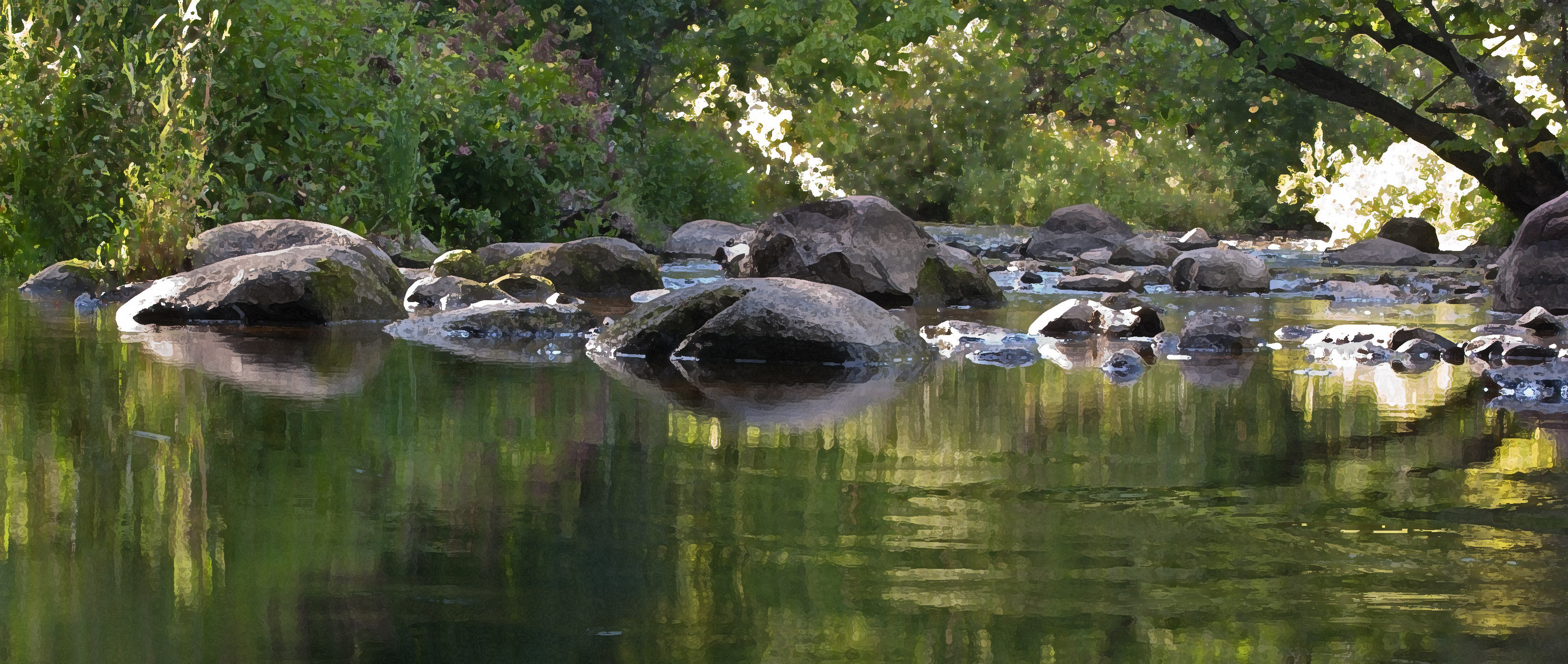
Thompson Creek, ON (photo and rendition by Nina Munteanu)
“We hold ourselves apart from our profligate nature. But we aren’t unique. We are more part of Nature than we admit. Using the thread of epigenetics and horizontal gene transfer, Nature stitches in us a moving tapestry of terrible irony. The irony lies in our conviction that we were made in the inimitable divine image of God. That we are special. Water flows endlessly through us, whether we are devout Catholics or empty vessels with no purpose. Water makes no distinction. It flows through us even after we bury ourselves.”
Lynna Dresden
A Diary in the Age of Water is “Unsettling and yet deliciously readable … Brilliant.”
THE PRAIRIE BOOK REVIEW
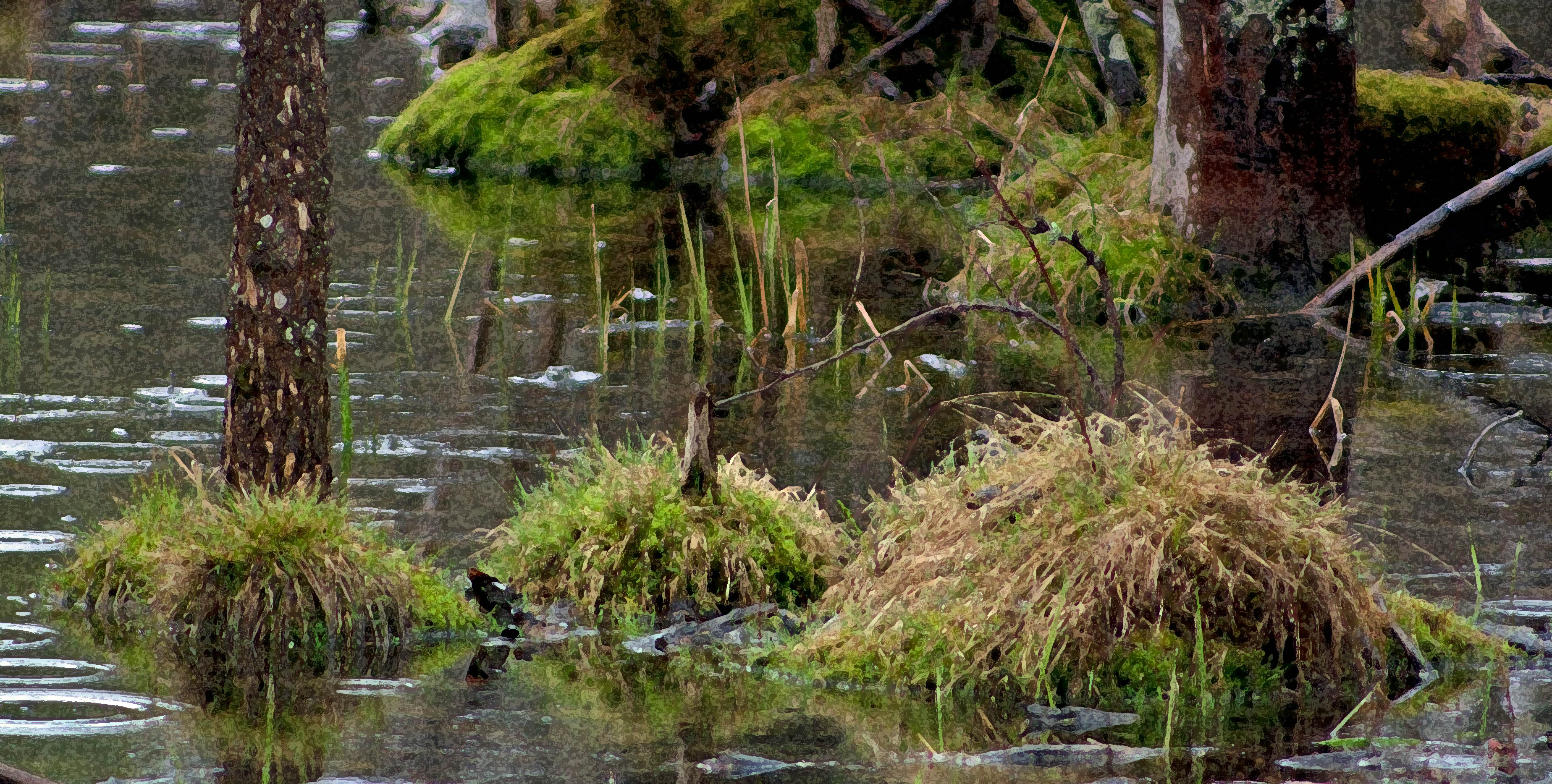
Swamp forest by country road, Kawarthas, ON (photo and rendition by Nina Munteanu)
“When you look at a deep pond, you don’t see the bottom. Instead, you see yourself reflected there. The calmer the pond, the more you see of you, the less of the pond.”
Lynna Dresden
A Diary in the Age of water is “delightfully unique … a story where there is a lot more underneath the gleaming surface.”
“As Nature tames a lake over time, one thing replaces another. As it undergoes a natural succession from oligotrophic to highly productive eutrophic, a lake’s beauty mellows and it surrenders to the complexities of destiny. Minimalism yields to a baroque richness that, in turn, heralds extinction. The lake shrinks to a swamp then buries itself under a meadow.”
Lynna Dresden
’A Diary’ is a brilliant story…Munteanu writes with fresh, stimulating style.”
CRAIG H. BOWLSBY, author of The Knights of Winter
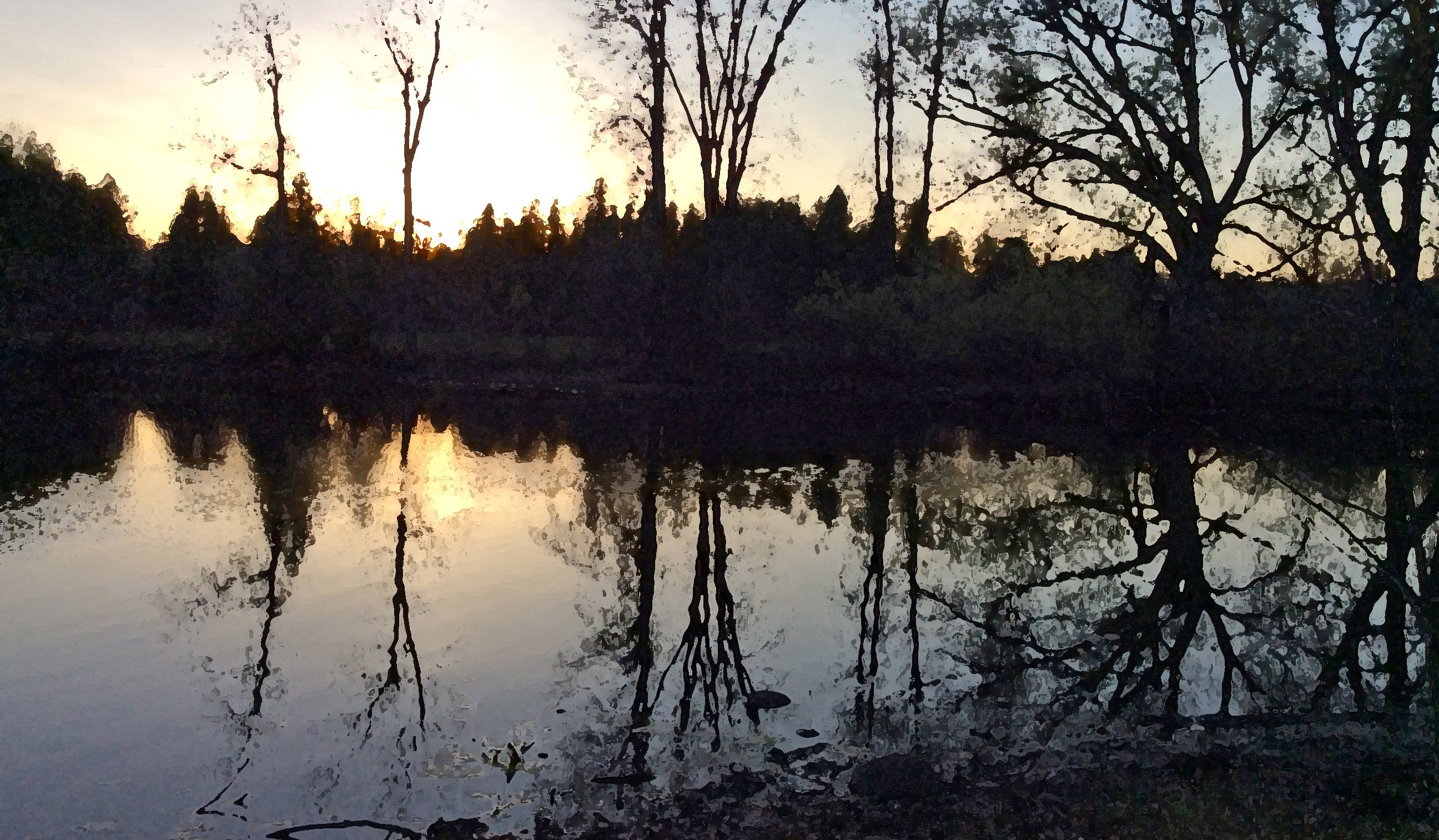
Outlet of Thompson Creek at sunset, ON (photo and rendition by Nina Munteanu)
“During spring thaw or fall turnover, the thermocline erodes and the changing temperature forces a lake to mix, revealing her secrets.”
Lynna Dresden
“Munteanu’s experience in bridging the worlds of biology and writing makes A Diary in the Age of Water unique in being strong and focused from both the scientific and literary perspectives.”
STRANGE HORIZONS
Overflowing marshy creek in Trent Nature Sanctuary in spring, ON (photo and rendition by Nina Munteanu)
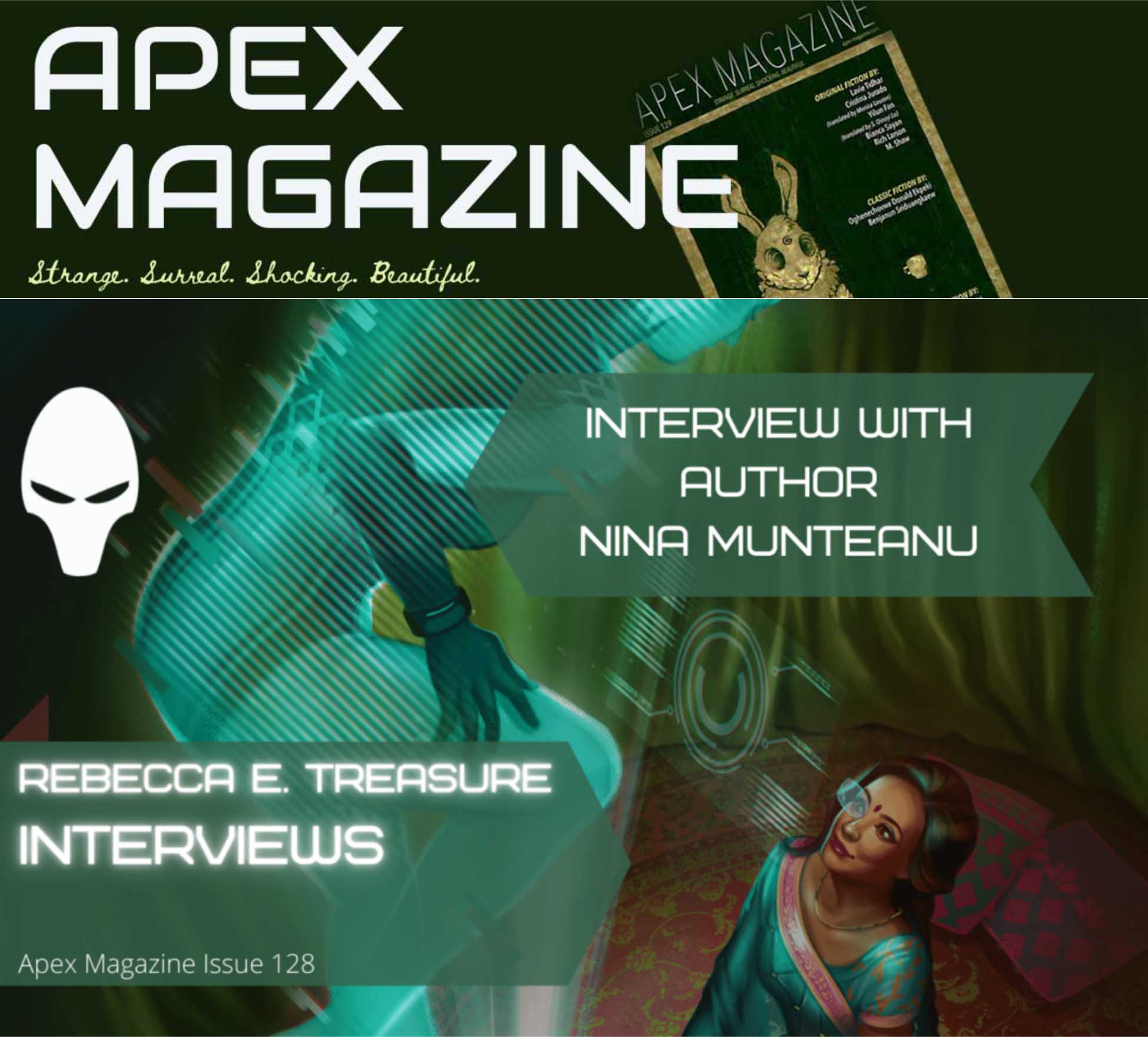
Issue #128 of Apex Magazine featured an interview that Rebecca E. Treasure did with me, posted on December 10, 2021. We discussed the power of story, the use of dystopian narrative, and the blur between fiction and non-fiction to create meaningful eco-fiction. Here’s part two of the interview. For the complete interview go here:
INTERVIEW
Nina Munteanu, author of “Robin’s Last Song,” is a prolific creator with multiple books, podcasts, short stories, and nonfiction essays in publication. Her work spans genre, from eco-fiction to historical fantasy to thrillers, and of course, science fiction. Her work as an ecologist informs all of her writing, which circles around an essential exploration; the relationship between humanity and our environment.
At the top of Nina Munteanu’s website, there is a quote: “I live to write, I write to live.” This sentiment is reflected in her fiction, which is not just about characters in compelling situations solving their problems with compassion, but is about all of us, our planet, our environment, and our future.
Nina Munteanu sat down with Apex for a conversation about story, ecology, and the future.
∞
APEX MAGAZINE:Your novels and short stories examine the role and evolution of humanity in the context of nature and technology. As an ecologist, what do you believe needs to happen—internationally, nationally, locally, and personally—to restore our planet and move forward in a sustainable way?
NINA MUNTEANU: All things animate and inanimate naturally oscillate toward equilibrium or balance in a kind of stable chaos of polarities. Goethe and Hegel told us this long ago. Our actions have exacerbated this oscillation through massive extraction, habitat destruction, and pollution with associated conflicts, take-over and subjugation. Everything is connected and all have contributed to climate change and habitat change. Our mission—given that we’re responsible for much of that imbalance—is to help the planet return itself to balance. That means ensuring that Nature’s natural checks can do their job to ensure functional forests and phytoplankton, a healthy ocean, a resilient biodiversity—all systems that we rely on for our own healthy existence. Restoring our denuded global forests, and the oceans will need the concerted and united efforts of all nations and individuals. We have the knowledge, the science, and technology; all that is needed is the will. And that can only change as our own narrative changes. That’s where storytelling plays a key part. Surveys have proven that fiction can be deeply persuasive through character journey that convinces at a deeper more emotional level (as opposed to a litany of facts that appeals only at an intellectual level).
AM:Do you believe industry and sustainability are compatible? What about colonialism and sustainability? Capitalism? In other words, is sustainability something we can achieve with our current systems, or is global systemic change required?
NM: Some people—mostly economists—would say definitely yes to the first question; we just need to be conservationist in our approach to doing business. But the very basis of capitalism is exploitation, not conservation. The driving force behind capitalism is fear and uncertainty and its main process is exploitation. From an ecologist’s perspective, this makes sense for a community during its early succession and growth stage … when it first colonizes a new area. Ecologists call this approach r-selected (for rate), based on the need to be profligate and fast-growing to successfully establish. But as we reach a climax community and our carrying capacity—where we are now—this r-selected approach no longer works. We need an economic model that better matches this new paradigm. NOT based on continued growth! A climax global economy, one based on cooperation not competition. Elisabet Sahtouris calls this ecological economy “ecosophy.” In his book Designing Regenerative Cultures, Daniel Christian Wahl talks about changing our evolutionary narrative from one based on fear defined by a perception of scarcity, competition, and separation to one based on love defined by a perception of abundance, a sense of belonging, collaboration, and inclusion. He promotes a regenerative economy based on true reciprocation.
And moving forward we can take a lesson from Robin Wall Kimmerer who promotes a gift economy—an economy of abundance—whose basis lies in recognizing the value of kindness, sharing, and gratitude in an impermanent world. This is what she says: “Climate change is a product of [our] extractive economy and is forcing us to confront the inevitable outcome of our consumptive lifestyle, genuine scarcity for which the market has no remedy. Indigenous story traditions are full of these cautionary teachings. When the gift is dishonored, the outcome is always material as well as spiritual. Disrespect the water and the springs dry up. Waste the corn and the garden grows barren. Regenerative economies which cherish and reciprocate the gift are the only path forward. To replenish the possibility of mutual flourishing, for birds and berries and people, we need an economy that shares the gifts of the Earth, following the lead of our oldest teachers, the plants.”
AM: The language in your stories is richly thematic, using strong description to weave the subtext into the piece. For example, “killing two squirrels with one stone.” Is that something that comes about organically as you compose a piece, or a more intentional part of editing?
NM: I use both processes to achieve a final narrative that is multi-layered with metaphor, symbols, and deep meaning. The first process is through intuition derived through intimacy; the second process is more deliberate and generated through objectivity. Insights from intimacy come about organically, during moments of true inspiration, when my muse connects me to the deeper truth of a character’s voice and actions. Given that the inner story runs many layers (some of which I, as writer, may not even be overtly aware) and links in a fractal relationship with the outer story, those moments of inner inspiration happen as if of their own accord. That’s what writers mean when they admit that their characters “talk” to them and instruct them on what to write. When a writer achieves that level of intimacy and understanding, they can let the muse guide them.
Much of the description that is woven into story is generated through the editing process when I read the manuscript as a reader. The process involves letting the story sit for a while so when I return to it, I am reading more objectively. During this process, I apply my knowledge in storytelling craft to showcase combustible moments in plot, and work in foreshadowing, subtext, and compelling metaphor. A writer can’t add metaphor without context related to story theme (otherwise this may result in what the industry calls “purple prose”). Metaphor—given its roots in the deeper psyche of a culture—must arise organically from a deep, sometimes intuitive, understanding—where the personal meets the universal.
AM:Your work takes complex topics that are nonetheless critical to humanity’s future and pulls stories with compelling characters out of them, making the science accessible, the warnings personal to the reader. This has always been one of the callings of science fiction. What is the role of stories in the climate action movement?
NM: Our capacity and need to tell stories is as old as our ancient beginnings. From the Paleolithic cave paintings of Lascaux to our blogs on the internet, humanity has always shared story. Story is powerful in how it helps us define who we are, what’s important to us, and where we are going. Stories compel with intrigue, stir our emotions, connect with our souls through symbols, archetypes and metaphor. Stories inspire action. We live by the stories we tell.
For too long, our stories have promoted a dominant worldview of exploitation and capitalism. We’ve been telling the patriarchal story of “othering” for too long; we need a new voice and a new worldview to replace our old stories of conquering and taming a “savage land” and “savage people.” When Copernicus proclaimed in 1543 that the sun did not revolve around the Earth, it took a long time for the world to accept and let go of its Ptolemaic Earth-centered view. But the world did come around eventually to the point now that this is common knowledge and lies embedded in our daily lives and language.
Storytelling about how the Earth takes care of us and how we can take care of Earth is urgently needed. This means shifting our stories from an exploitive capitalist narrative of separation toward an inclusive partnership narrative. This means embracing a more eco-centric worldview; a worldview in which humanity is not central, but lies embedded within greater planetary forces and phenomena. A worldview that sees humanity only as part of a greater entity, as participant in a greater existential celebration of life and the elements. A humanity that must learn to play along, not bully and take over. A humanity that must embrace compassion, respect and kindness; a humanity directed by humility—not hubris. It is my firm belief that until our worldview embraces humility in partnership with the natural world—until we cast off our self-serving, neo-liberal, capitalist ideologies—we will remain hampered in our journey forward. When we change our stories, we change our lives and we change the world along with it.
This is already happening with the emergence of a strong eco-voice by writers through the feminine voice, the gylanic voice, the voice of the marginalized, of ecology and the environment itself. Authors such as Barbara Kingsolver, Annie Proulx, Margaret Atwood, Richard Powers, Emmi Itäranta Cherie Demaline, Grace Dillon, and Cormac McCarthy give Nature a face and voice to care about. And caring is the first step.
AM:Your stories also bridge fiction with nonfiction, using speculative fiction as a lens to bring your subject into focus for the reader. How does that work? Why do you approach story in this way?
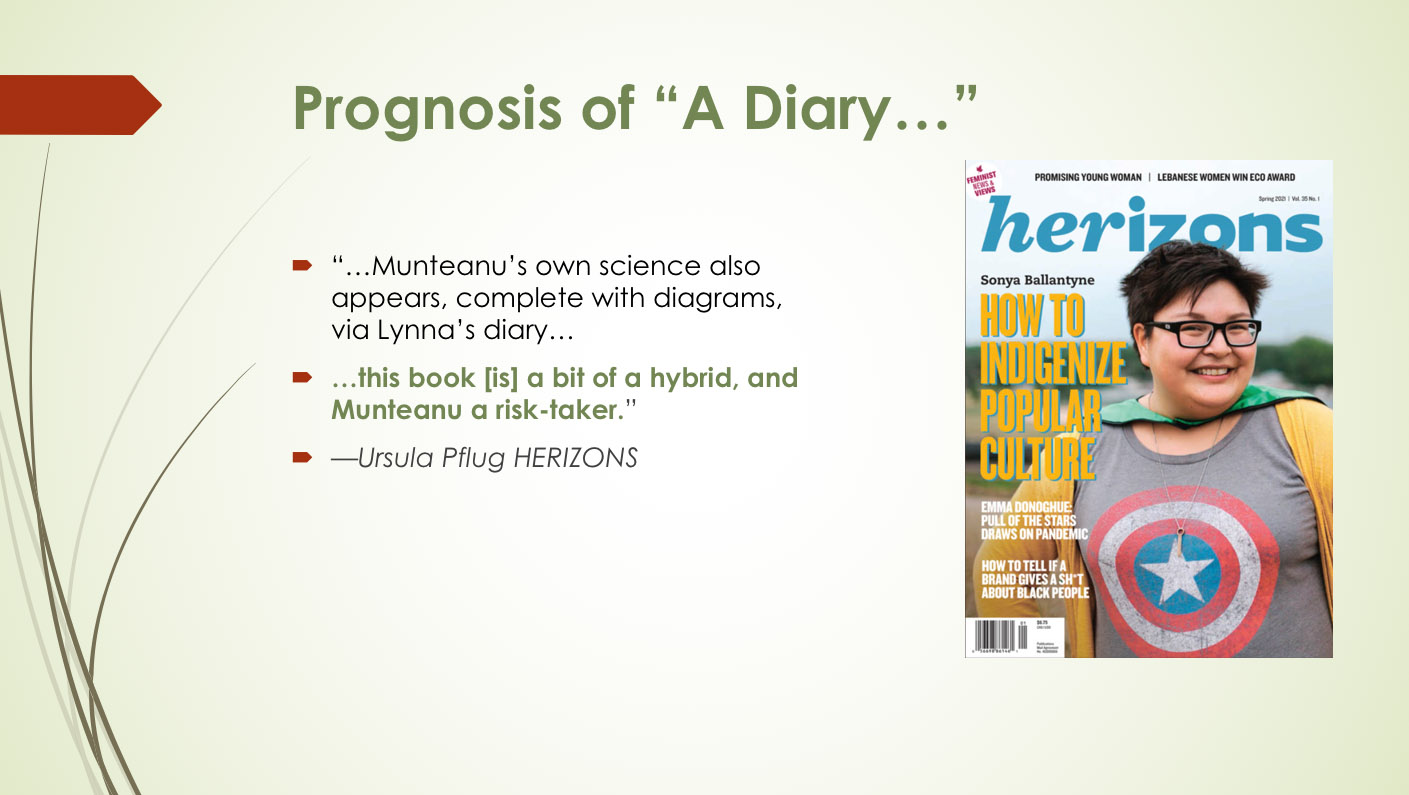
NM: Marcie McCauley with Temz Review observed that, “[Munteanu] does not appear to view fiction and non-fiction as separate territories; or, if she does, then this book [A Diary in the Age of Water] is a bridge between them.” In Herizons, Ursula Pflug called the book “a bit of a hybrid, and Munteanu a risk-taker.” Buried in Print wrote of the same book, “ultimately it exists in an in-between place, some mystical elements of the generational tale possibly alienating the dedicated science-y readers and the instructional elements possibly alienating fiction devotees. And, yet, I read on: strangely compelling.”
I find that I enjoy this in-between place that blurs fiction with nonfiction. It’s more edgy, gripping, and believable, albeit fantastical, even playfully challenging at times. For instance, I may subvert facts, creating semi-facts to tease the discerning reader (e.g. when the diarist in “A Diary in the Age of Water” observed that President Trump had gone blind from staring at the sun during an eclipse; while Trump did stare directly at the sun without eye protection during an eclipse in 2017, he did not go blind—yet). Readers have told me that the story was more impactful; they honestly didn’t know what was taken from fact and what was fictionalized. Such narrative reads like a true story and there is little more tantalizing than eavesdropping on another’s real experience and intrigue. The risk—that the blur will either confuse the reader or invalidate its truths and message—is hopefully addressed through compelling narrative that engages the reader. But this is also why I tend to include an extensive bibliography at the end of a novel or short story.
Readers have told me that my fiction/nonfiction storytelling trope, like “mundane science fiction,” grips my stories with a more keen sense of relevance. Given that I am writing mostly climate fiction and eco-fiction these days, that sense of relevance is exactly what I wish to achieve.
AM: A last question. Both “The Way of Water” and “Robin’s Last Song” showcase the relationships women have with each other, the importance of human connection, the damage that disconnecting from each other can do and, inversely, the power of connection. In your view, what is the role of individuals and local communities in the climate crisis?
NM: There are many things we can do as individuals and as part of a community. I was recently asked this question by the Toronto Star and I responded with three things:
● First, plant a tree; make an actual difference through action. By doing that, we get out from hiding under the bed and face the monster of climate change and show that we care and that we are not alone.
● Second, vote for green politicians. Politicians need to hear directly from their communities. They need you to push them to act on climate change.
● Third, find your tribe and create a movement. Everyone says that people have the power, but that power comes best through numbers and solidarity. Find your tribe and you’ll find yourself more motivated. So, start with you and your home: plant trees; put in a rain garden; put in permeable driveways and solar panels; lower meat intake, especially beef; don’t buy bottled water. Then connect with your physical community and social media community. Let them know what you’re doing and why. Work with your community. All members of a community can help change how your street looks and behaves by communicating with your local government, attending meetings, and having a voice. Initiate a tree-planting program in your parks and street greens. Do stream or lake cleanups. Let the leaders of your community know you care and are willing to do something about it. The wave of change starts local and ripples out into a global phenomenon. Change comes from the heart and heart is where the home is.
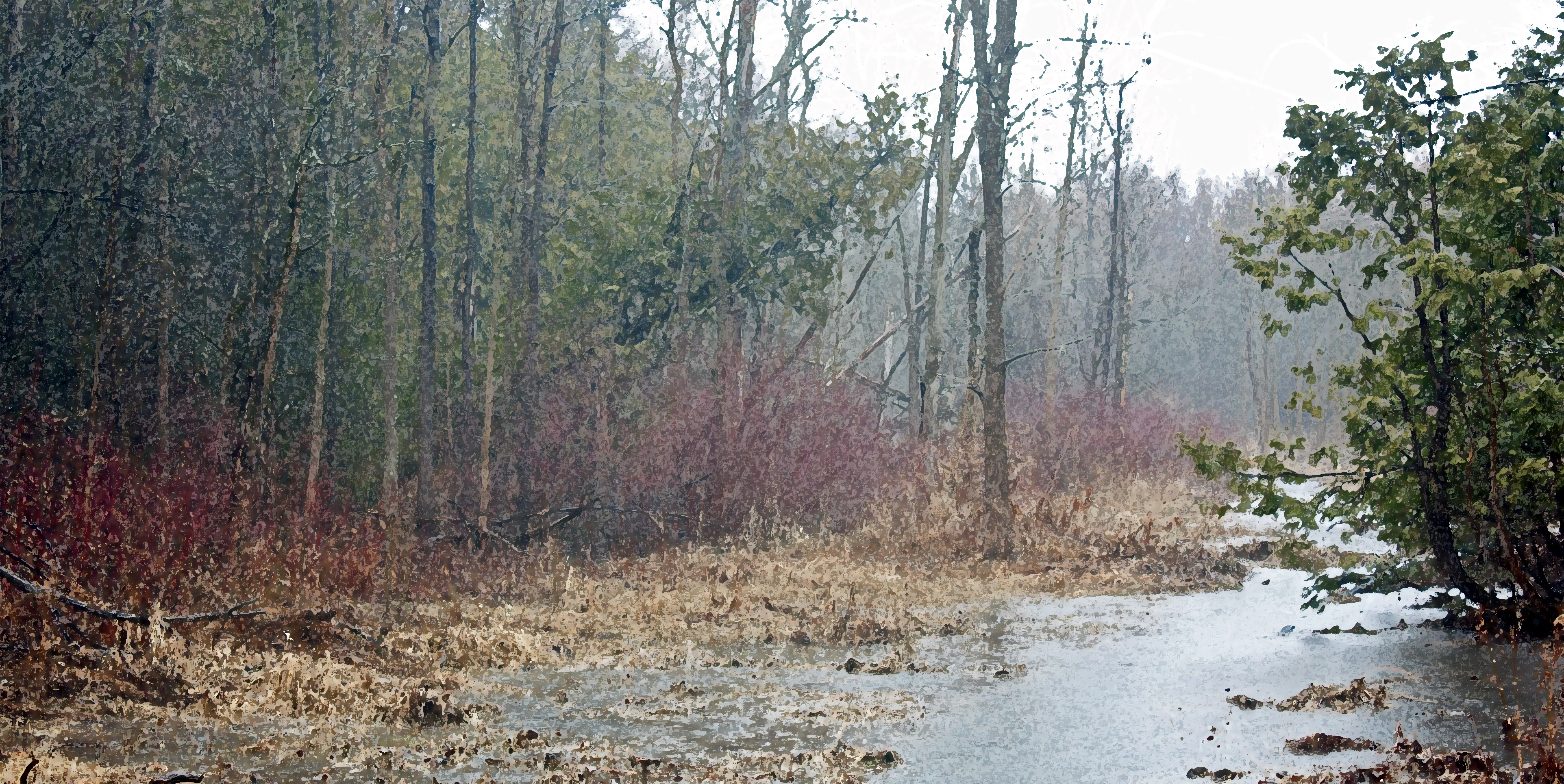
Birch trees and marsh on a foggy morning in winter, ON (photo and rendition by Nina Munteanu)
Rebecca E. Treasure grew up reading science fiction and fantasy in the foothills of the Rocky Mountains. After grad school, she began writing fiction. Rebecca has lived many places, including the Gulf Coast of Mississippi and Tokyo, Japan. She currently resides in Texas Hill Country with her husband, where she juggles two children, two corgis, a violin studio, and writing. She only drops the children occasionally. To read more visit www.rebeccaetreasure.com.
NINA MUNTEANU is a Canadian ecologist / limnologist and novelist. She is co-editor of Europa SF and currently teaches writing courses at George Brown College and the University of Toronto. Visit www.ninamunteanu.ca for the latest on her books. Nina’s bilingual “La natura dell’acqua / The Way of Water” was published by Mincione Edizioni in Rome. Her non-fiction book “Water Is…” by Pixl Press(Vancouver) was selected by Margaret Atwood in the New York Times ‘Year in Reading’ and was chosen as the 2017 Summer Read by Water Canada. Her novel “A Diary in the Age of Water” was released by Inanna Publications (Toronto) in June 2020.
Last August I was invited by the University of Saskatchewan to give a talk at 20/21 Vision, their conference on Speculating in Literature and Film in Canada. My presentation was entitled “The Power and Relevance of Diary in Near-Future Mundane Science Fiction.”
The use of mundane realism through setting and events—particularly through letters or diary—creates powerful narrative that uniquely engages the reader with metaphor, allegory, and archetypes through additional sensibilities and personal connections. Devices such as POV, tense, and voice help create this form of storytelling.
What Is a Diary?
Diaries are first person accounts of real events relevant and meaningful to that person’s life experience. They are written in casual conversational language, usually a chronological account of daily life over lifetime, have wide scope; and are autobiographical.
If the scope is more narrow and focused, we have a memoir. The memoir is often focused by theme (e.g., addiction, loss, parenting, war, etc.). Memoirs are usually written in scenes and may trade accuracy for dramatic effect (emotional truth over historical truth). Anne Frank’s diary is a mundane account of her tragic short life in Nazi Germany; Yoko Ono experienced Hiroshima during World War 2.
If the focus is by topic, we get a journal (e.g. nature journal, grief journal, travel journal). Henry Henry David Thoreau’s journal became a manifesto for living simply with Nature; Sister Gargi’s journal was an ode to a spiritual movement.
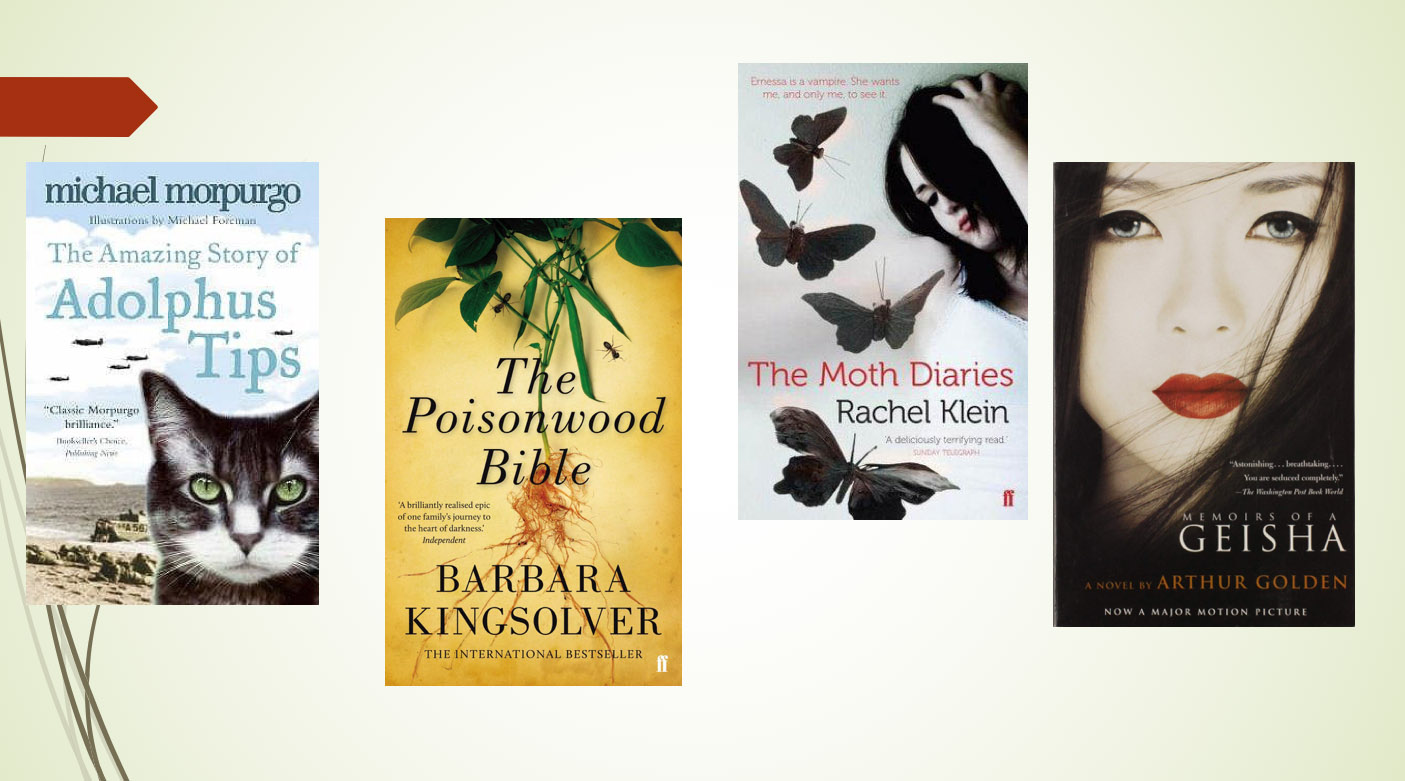
Examples of memoirs and journals
Non-Fiction in Fiction
The play of non-fiction in fiction is achieved through several tools. This includes:
use of point of view such as first person or second person; writing as an epistolary novel—or a series of letters—such as The Colour Purple
displaced narrative such as The Great Gatsby
detached autobiography such as To Kill a Mockingbird
interior monologue such as Finnegan’s Wake.
Examples of fictional diaries
Fictional diaries play on historical truth through emotional truth through narrator voice and use of metaphor. This provides authenticity, meaning, relevance, and impact to the story. Reality and fiction blur through realized premise that provides a gritty realism to the dramatization and intensifies the experience The diarist’s ability to introspect provides great insight for the reader to the protagonist’s inner voice, their eccentricities, and self-delusions. These provide great intimacy with the character.
Most fictional diaries are memoir-like because they are usually based on THEME which carries the meaning of the story. In The Poisonwood Bible, Barbara Kingsolver effectively uses several first person voices—of the mother and her four daughters—to provide more perspectives of the story.
Mundane Science Fiction
Mundane science fiction is a niche literary movement from 2004 focused on near-future realism—also called speculative fiction or literary SF. The focus is on already existing technology and plausible extensions—no ray guns, warp drives or time travel. The premise lies in existing circumstances and events. It has similarities with hard science fiction, cyberpunk, ecopunk, ecofiction and climate fiction. Mundane science fiction incorporates elements of literary fiction and mainstream fiction to achieve a strong sense of realism.
Examples of mundane science fiction
Mundane science fiction is the literature of near-future realism that explores how environmental and technological changes will change our lives. Christopher Cokinos calls mundane science fiction the “science fiction that functions more as compass than chimera.” Examples include cautionary tales and dystopias, all predicated on and launched from real events and phenomena—and including my own recent climate fiction “A Diary in the Age of Water.”
“A Diary in the Age of Water”: Mundane SF with Fictionalized Diary
“A Diary in the Age of Water” is the climate-induced journey of humanity through four generations of women, each with a unique relationship to water… Centuries from now, in a dying boreal forest in what used to be northern Canada, Kyo, a young acolyte called to service in the Exodus, yearns for Earth’s past—the Age of Water, before the “Water Twins” destroyed humanity. Looking for answers and plagued by vivid dreams of this holocaust, Kyo discovers the diary of Lynna, a limnologist from a time just prior to the destruction. The diary spans a 40-year period in the mid-21st century and describes a planet in the grips of severe water scarcity. Lynna in her work for the international utility that controls everything to do with water, witnesses and records in her diary the disturbing events that will soon lead to humanity’s demise.
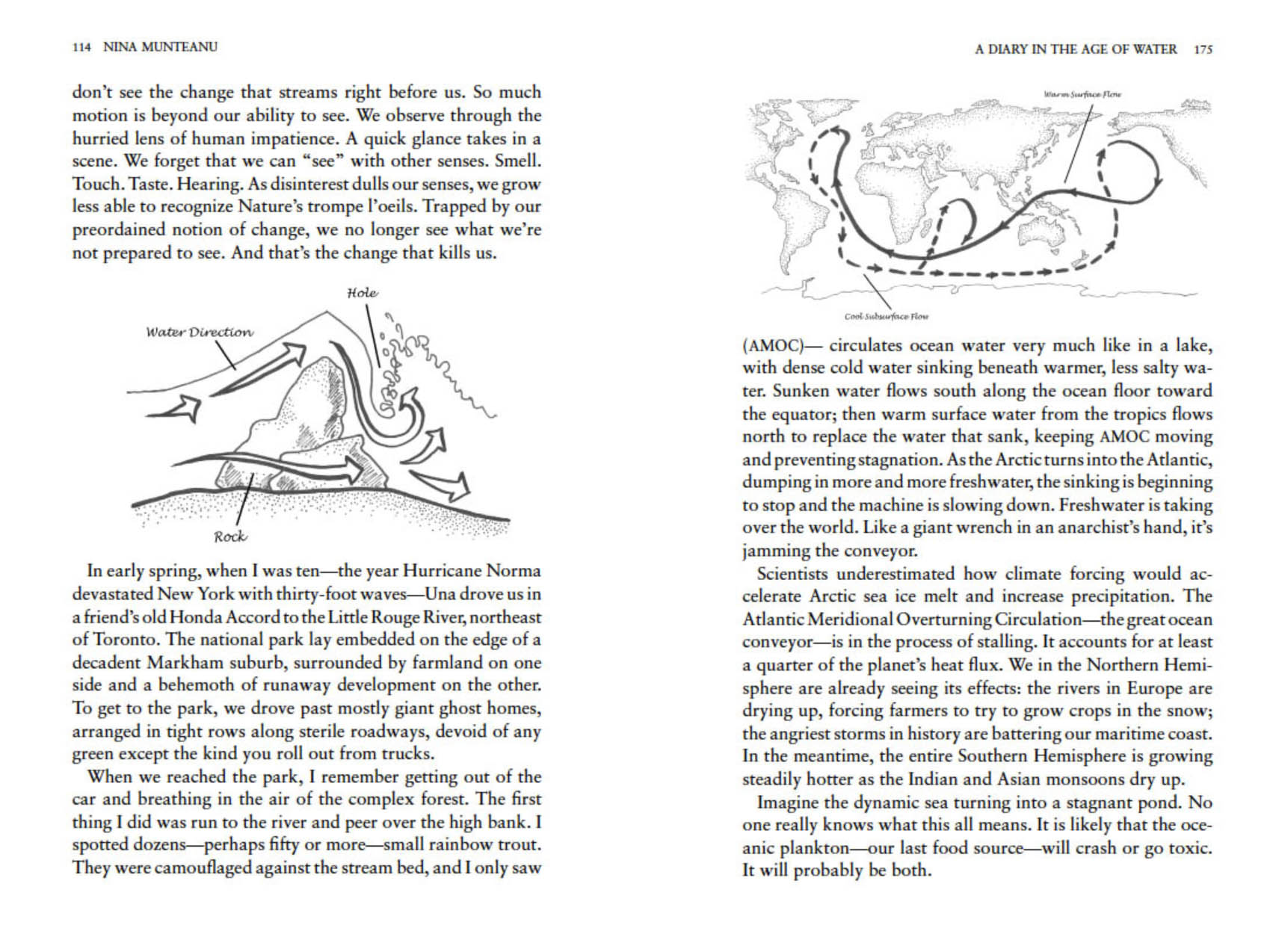
The story begins and ends in the far future with the blue being Kyo, who finds the diary of the limnologist, Lynna. The story is hard SF with a strong basis in science. This is obvious through the narrator, who is a scientist, and the form of the diary itself, in which each entry has an epigraph from a science textbook related to the experience in the entry. Lynna also includes sketches, formulas and other references to science and these appear in the entries.
The diary portion of the book is a first person narrative nested within the larger 3rd person narrative of Kyo in the far future. Its SETTING is based on many real events with dramatized fiction stitched in. This blurs what’s real and what’s fiction. VOICE and POV are used to achieve differing scope and time perspectives between the diarist’s world and that of the future being. We get insight into the inner voice of the diarist through 1st person voice; this is contrasted with the 3rd person voice of the future being—they remain on the outside, looking in. The PLOT is essentially that of a young future human “in discovery”, a metaphoric coming of age for humanity.
The diary format includes the use of:
short entries with epigraphs and quotes from fact
conversational voice of intimacy with introspection, opinion, and judgment
outer conflict with family and colleagues
inner conflict with motivations and truths
metaphoric connections with water
illustrations embedded in the diary entries
Two pages with illustrations in ‘A Diary in the Age of Water’
The diarist is a real and flawed protagonist—this makes her more like us and we are more likely to empathize with her despite her considerable flaws … Lynna makes mistakes and does some terrible things, but the diary allows the reader to find out more about why she does these things, what motivated her and how she feels, including remorse and regret. This allows the reader to forgive Lynna, even as her own daughter cannot, even as she cannot. This becomes key to the story, which is about forgiveness. The diary abruptly ends with pages torn out and Kyo is anxious to know what happened to both Lynna and her world. So is the reader.
Responses to “A Diary in the Age of Water”
Readers and reviewers had interesting responses, some paradoxical:
The blur of real events/history and fictional action brought the story into living colour. Several readers confided in me that they often did not know what was non-fiction and what was fiction and that this confusion made the book more gripping. Several reviewers, caught up in the blur of non-fiction with fiction, accused the book of being overtly polemic, when it was the fictional diarist who was proselytizing and being protective and narrow-minded; one need only look to the diarist’s daughter and her actions to see another voice).
In their analysis, reviewers gave the following visceral responses:
In her review of ‘A Diary in the Age of Water’ in The Temz Review, Marcie McCauley writes:
Munteanu “invites readers to recognize themselves in the ‘historical’ story and to project themselves into her imagined future…the diary…operates as a doorway…Munteanu combines methodologies, familiar literary motifs with text and images from non-fiction…She does not appear to view fiction and non-fiction as separate territories; or, if she does, then this book is a bridge between them.”
That blur with reality makes readers both love and hate the novel and it is precisely this that makes them read on. They are thoroughly invested. They need to know how it turns out, as though this is real lives at stake.
Red maple leaf sits on mossy log of old growth forest, ON (photo and rendition by Nina Munteanu)
NINA MUNTEANU is a Canadian ecologist / limnologist and novelist. She is co-editor of Europa SF and currently teaches writing courses at George Brown College and the University of Toronto. Visit www.ninamunteanu.ca for the latest on her books. Nina’s bilingual “La natura dell’acqua / The Way of Water” was published by Mincione Edizioni in Rome. Her non-fiction book “Water Is…” by Pixl Press(Vancouver) was selected by Margaret Atwood in the New York Times ‘Year in Reading’ and was chosen as the 2017 Summer Read by Water Canada. Her novel “A Diary in the Age of Water” was released by Inanna Publications (Toronto) in June 2020.











 Nina Munteanu Writing Coach