Why Writers Can’t Spell

scribeWhen I participated in those humiliating spelling bees in primary school, I was usually among the last chosen because I was a lousy speller. I grew up in an immigrant family where Romanian was the official language; I heard my parents speaking German in the house and lived in a French-Canadian neighbourhood. English was actually the fourth language I learned and only once I started going to school. It seemed that my facility with language came at some expense. My spelling sucked. It didn’t help that I was probably borderline ADD, dyslexic and allergic to reading.

Are you a lousy speller too? Well, take heart. You’re in excellent company. Samuel R. Delany is dyslexic. Thomas Jefferson, F. Scott Fitzgerald, Herman Melville, Woodrow Wilson and John Irving were all rotten spellers.

Grenadian SF/F writer, Tobias Buckell, author of Sly Mongoose, admitted that “homophones practically kill me, even the ones I know are wrong, b, d, g, and p are often swapped, as is, of course, 6 and 9.” He confesses that rewriting “is a painful, deliberate struggle” as he must pore over his work word by word.

So, why is it that some of us can just look at the word “preposterous” and spell it, while others can see it a thousand times and never get it right? Neuroscience has shown us that it’s in the brain. Recent studies using functional MRI analysis have not only begun to map the areas of the brain we use in reading and writing, they’ve shown how a neurological glitch in about 20 percent of people may make them chronically poor spellers. That’s me!

My particular weakness is the homonym. These are words that sound the same but are spelled differently (e.g., right and write). I’ve seen writers mix homonyms a lot in my workshops and manuscript critiques. Common ones include:


There, their, they’re Bare, bear
To, too, two Grate, great
Who’s, whose Here, hear
Reel, real Meet, meat
Deer, dear Heel, heal
Brake, break Council, counsel
Mantle, mantel Principle, principal
Which, witch Where, wear

Keep a dictionary by your side and consult it often. For those of you, like me, who spend most of your writing time in front of the computer with internet access, you may wish to bookmark the online Merriam-Webster dictionary, www.m-w.com.

If you are, like Tobias Buckell, particularly susceptible to self-correcting when you revise your work, then have someone you trust proofread for you.

And hope that they, unlike Tobias or me, are NOT susceptible to self-correcting!

References:

Munteanu, Nina. 2009. The Fiction Writer: Get Published, Write Now! Starfire World Syndicate. Louisville, KY. 266pp


Nina Munteanu is an ecologist and internationally published author of award-nominated speculative novels, short stories and non-fiction. She is co-editor of Europa SF and currently teaches writing courses at George Brown College and the University of Toronto. Visit www.ninamunteanu.ca for the latest on her books.


How to Hook Your Reader and Deliver

Beaches-snow03

Winter in The Beach (photo by Nina Munteanu)

A great story opening arouses, delays and rewards. Constructing a compelling beginning—often called a hook—is a common challenge for even established writers, and one of the most important parts of a story.

The opening should sweep the reader into the story like a tidal wave. It doesn’t need to be wild action. It just needs to compel the reader to want to know more. This is accomplished by engaging the reader with “intrigue”. In his article “Three Ways to Keep Your Readers Hooked” in the April 2001 issue of Writer’s Digest, Joe Cardillo suggested that the three elements of hooking a reader resemble the steps he uses to train his Samoyed puppy: 1) arouse interest; 2) delay, then 3) reward.

The writer arouses interest in the reader by providing enough detail to get the reader to ask questions. Now they want something. You tease them with the delay; that keeps them reading and turning the pages. It also gives them the chance to try to come up with the answers themselves. The reward comes in stages. Don’t answer all their questions at once. That’s what the book—the story—is for. The reward, parceled out in stages, lets the reader know that you can deliver and will ultimately provide them with a fulfilling story at the end. The beginning of your book sets up a covenant between you and the reader, a covenant for a journey you will take together toward resolution.

There is no beginning without an end. In her book The Sell Your Novel Tool Kit (Revised Edition, Perigee Trade, 2002) Elizabeth Lyon suggested that the beginning of a novel should “reflect the entire book. There should be a tie-in [between] the beginning and the end”. This is sometimes called “framing” a story, where the principal thematic problem is given in the beginning and then resolved in the end. In his book, A Story is a Promise (Blue Heron Publishing, 2000) Bill Johnson describes it as a promise to the reader.

Beaches-snow02

Toronto streetcar (photo by Nina Munteanu)

“Dramatic story-issues revolve around issues of human need,” says Johnson. “The need to be loved. To have control of one’s fate. To feel a sense of purpose. To be able to overcome obstacles. To be able to grow and heal from life’s wounds. To understand and make sense of the events of life.” He warns that “if you can’t name the issue at the heart of your story [the theme], it risks being unclear to your audience.” And this needs to be identified, at least intuitively for the reader, at the beginning of the story. You do this through intrigue in the beginning and pointing out through scene what is at stake or at issue in your story.

Additional things to consider in openings include:

  • Avoid starting your story at “the beginning”: instead, start mid-way, when something is already happening—preferably to someone important in your story and at the pivotal point when you provide the “story promise” pertinent to the theme.
  • Quell the urge to put in a lot of information about setting, character and situation: get things in motion first, then reveal here and there. Let the details unfold with the story like a flowing piece of artwork.
  • Trust your reader: novice writers have not yet gained the confidence to trust that they won’t lose the reader in the beginning if they don’t tell them everything right away. The key is to choose just enough to whet their appetite for more. And, yes, it is critical what you choose. What you choose should relate to your story’s theme and its story promise: the problem.

A great opening is a seductive tease, deliciously delivered; it promises an exotic ride that only you can fulfill.

This article is an excerpt from The Fiction Writer: Get Published, Write Now!

Recommended Reading:Beaches-snow01

  • Cardillo, Joe. 2001. “Three Ways to Keep Your Readers Hooked”. Writer’s Digest, April, 2001, volume 81, no. 4.
  • Johnson, Bill. 2000. A Story Is a Promise. Blue Heron Publishing. Portland, Oregon. 187pp.
  • Lyon, Elizabeth. 2002. The Sell Your Novel Took Kit. Revised Edition. Perigee Trade. 320pp.
  • Munteanu, Nina. 2009. The Fiction Writer: Get Published, Write Now! Starfire World Syndicate, Louisville, KY. 264pp.


Nina Munteanu is an ecologist and internationally published author of award-nominated speculative novels, short stories and non-fiction. She is co-editor of Europa SF and currently teaches writing courses at George Brown College and the University of Toronto. Visit www.ninamunteanu.ca for the latest on her books.

What Indie Authors Should Know…

zermatt-alps01-close

Zermatt, Switzerland (photo by Nina Munteanu)

As we enter a new year in writing and publishing, I thought I’d review some interesting statistics and observed trends over 2014 made by those poised well in the industry.

In July 2014, Publishers Weekly revealed some interesting statistics from various surveys and studies worth considering.

The article was based on two recent surveys: one by best selling indie author Hugh Howey; and the other by Mark Coker, founder of e-book distributor Smashwords.

Publishers Weekly cited Hugh Howey’s Author Earnings Report, in which he claimed that “the report comes to the conclusion that the indie movement in literature is not a blip and not a gold rush.” It is definitely here to stay, said Publishers Weekly. Here’s what they summarized:

  • The Big Five traditional publishers now account for only 16% of the e-books on Amazon’s bestseller lists.
  • Self-published books now represent 31% of e-book sales on Amazon’s Kindle Store.
  • Indie authors are earning nearly 40% of the e-book dollars going to authors.
  • Self-published authors are “dominating traditionally published authors” in sci-fi/fantasy, mystery/thriller, and romance genres but — and here is the surprise — they are also taking “significant market share in all genres.

Publishers Weekly contended that “what is clear is that strong indie sales will continue and indie books are now a significant and permanent part of the book publishing landscape.”

Coker’s survey revealed that the 99¢ ebook was no longer “the sweet spot” for e-book pricing. In his 2014 survey, Coker determined from aggregated retail and library sales data of Smashwords books, that:

  • $2.99 and $3.99 are currently the pricing sweet spots for most e-book bestsellers. In general, authors who price their books modestly earn more than those whose average price is higher, but 99¢ is “no longer the path to riches.”
  • Readers prefer longer e-books. In fact, bestselling books tend to be over 100,000 words.
  • Series books outsell stand alone books — but series books under 50,000 words are at a sales disadvantage.
  • “Free” still works as a marketing tool, especially when an author offers the first book in a series for free, but it is much less effective than before — primarily because so many authors are taking advantage of it.
  • Pre-orders give authors a sales advantage. “I think pre-orders today are where free was five years ago,” says Coker. “The first authors to effectively utilize pre-orders will gain the most advantage, just as the first authors to enter new distribution channels gain the most advantage,” he says.
  • Non-fiction earns more at higher prices. “Non-fiction buyers are less price sensitive,” says Coker. “It appears as if most non-fiction authors are underpricing their works, and they should experiment with higher prices,” he says.

Coker is quick to point out that this analysis is based on his own interpretation of the findings, and should only be used to provide authors with possible clues to help them make informed decisions about how to market their own unique books.

In an excellent article, summarizing 2014, award-winning author Kristine Kathryn Rusch summarizes what indie writers learned in 2014. She prefers to use the terms indie-writer and indie-publishing over self-publishing, “because so many writers who are not with traditional publishers have started their own presses. It’s not accurate to lump all writers who are not following the traditional route into the self-publishing basket any longer, if it ever was.” This is an interesting acknowledgement and considers a movement by established authors toward a different publishing model, including hybrid publishing.

Rusch’s rather pithy article suggests that writing and publishing “is hard”, no matter what model you use. She adds that if you don’t learn to love the business side of the industry, “self-publishing can be a soul-sucking experience.” Rusch is quick to add that business destroys the dreams of many writers. “If you don’t learn to love business, you’ll get destroyed in traditional publishing. It’ll just take ten years, where in self-publishing, it’ll take less time.”

Read her section entitled “Achieving Real Success is Hard” for an insightful and candid study of “success” in writing and publishing.

“We all measure success differently, and we should know what it is before we start publishing. But most writers don’t. Success is finishing a novel (check). Success is getting that novel published (check). Success is getting good reviews (check). Success is getting paid for that novel. (check) Success is making a living. (um, what?)”

Read Rusch’s section entitled “The Gold Rush is Over” for an excellent reality-check of the indie publishing industry.

“The days of slapping something up and making a lot of sales were gone by the end of 2010. But the rumors persisted and a lot of people got into indie publishing expecting to get rich…You are not entitled to fame and riches just because you published a book.”

In his blog post of November 2014, Mark Coker said:

“The gravy train of exponential sales growth is over. Indies have hit a brick wall and are scrambling to make sense of it. … Some authors are considering quitting. It’s heartbreaking to hear this, but I’m not surprised either. When authors hit hard times, sometimes the reasons to quit seem to outnumber the reasons to power on. Often these voices come from friends and family who admire our authorship but question the financial sensibility of it all.”

To Coker’s comment Rusch adds, “I’m pretty sure more writers quit than survived publishing in 2014, but that’s because more writers always quit than survive. As I said above, the entire profession is hard, and for those people who want to get by without working hard, this profession is not for them.”

Rusch sums up, again rather pithily, eight things indie writers learned (or should have learned) in 2014:

  1. Gaming the system is impossible: e.g., “every time we figure out how Amazon’s algorithm works, Amazon changes it”; “free doesn’t help me sell my books any more”; 99cents doesn’t help me sell my books any more”; “the tags are gone”; I can’t seem to get enough reviews”; “now when I post on social media, no one responds”—trying to milk the system doesn’t work for the writer because the system is geared for the customer, not the writer—and it’s always a step ahead of you…
  2. Amazon doesn’t love you: Kindle Unlimited? It isn’t about helping its writers; it is about helping its customers.
  3. No one loves you: writers are not entitled to have their books on a shelf, virtual or real.
  4. Your readers don’t even love you (all the time): “you don’t collect and hoard readers; readers can collect and hoard books. It doesn’t work the other way around,” says Rusch.
  5. Sales based on price no longer work: “even the most denial-filled indie writers are starting to figure out that just because their books are cheap, it doesn’t mean readers will pick up that book,” says Rusch.
  6. Running with the big dogs is hard: “Now that the last thing that differentiated traditional publishing from indie—price— has leveled out, indies discovered in 2014 that they’re no longer competing with each other. They’re competing with traditionally published books, including long-term bestsellers,” says Rusch. As Blake says, “Pro basketball players don’t tell themselves that they don’t have to be all that great because there are plenty of mediocre players.”
  7. There is no status quo: “Working in the arts means accepting constant change. Constant change… One of the stupidest gambits I’ve heard from writers in recent years comes from the indie world. Apparently, writers are now searching key words on Amazon bestseller lists—and writing books based on those key words. Oh, heavens, folks. The Amazon bestseller lists are a fraction of the market in the first place, and in the second, they only reflect what sells well now. What will sell well next Christmas is anyone’s guess—and generally speaking, anyone will be wrong… All these gamings and gambits and strategies are based on status-quo thinking,” says Rusch.
  8. There is such a thing as an Indie Midlist Career: many indie writers are finding that they can earn a living writing, essentially earning out what they earned working for someone else. Indie authors are indeed quitting their day jobs, understanding the financial value of the artistic freedom that indie writing gives us. This, Rusch shares, “is what the self-publishing revolution has brought us.” Not some get rich-quick thing; but the means to do what we love.

So, what’s the take home message here for established and particularly new budding indie authors and publishers?

Writing and publishing is a collaborative effort. Take pride in your work. Embrace your passion for writing. Treat everyone in the industry with professionalism and respect, and above all else, enjoy the journey. It’s worth it.

Oh, and last but not least: ensure you get your work edited by a professional!

Nina Munteanu is an ecologist and internationally published author of award-nominated speculative novels, short stories and non-fiction. She is co-editor of Europa SF and currently teaches writing courses at George Brown College and the University of Toronto. Visit www.ninamunteanu.ca for the latest on her books.

How Writers See Themselves…And How Others See Them…

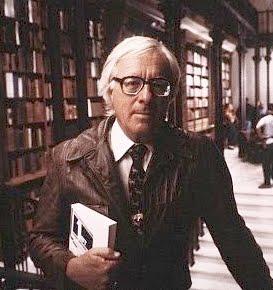
Let the world burn through you. Throw the prism light, white hot, on paper
—Ray Bradbury

SONY DSC

Birch trees (photo by Merridy Cox)

How many of you have, once you’ve told someone that you are a writer, received the blithe response, “Oh, yes, I’ll be a writer too someday. I’ll write that great Canadian bestseller—once I have time…” Implying that writing was a hobby and that time—not talent or discipline or vision or artistic spirit—was the only required ingredient.

When I was five years old I already knew that I wanted to be a writer. My sister and I didn’t just play dolls; we created worlds and spun epic tales of great scope, with a diverse cast of characters that spanned the far reaches of the universe. Stories of thrilling adventure, crazy irony, great intrigue and mystery. Stories of betrayal, love, loss, redemption and victory. I knew in my heart that I was always a writer—even when I wasn’t (writing, that is). As a child I knew that writing was in my soul and that I would write for the rest of my life. Still…it took me a while to admit it to the world. It took me longer still to publish. Make no mistake: writing and publishing is hard work. But NOT a chore, which I think many who don’t write fail to make a distinction, including my ex-husband.

Films often portray the writer as self-loathing and self-destructive, moody, unstable, and narcissistic. Think of the following films and how they portray the writer: Sunset Boulevard. The Shining. Misery. Sliding Doors. Secret Window. Sideways. My Brilliant Career. Stranger than Fiction. The Royal Tenenbaums. As Good As It Gets. Adaptation. Deconstructing Harry. Wonder Boys. Midnight in Paris. Barton Fink. Limitless. Ruby Sparks. The Words.

“Deplorable actions are almost expected from fictional writers in films,” says a recent Huffington Post article. “Novelists and poets are consistently portrayed as snobby, outlandish, mawkish, or untrustworthy. They lie, cry, brag and steal their way to fame.”

Joe Muscolino of Word & Film shares that:

“It’s become a visual cliché: The writer slouched in his chair, conflicted, chain-smoking, achingly alone, and oblivious to anything outside his cave of thoughts. He’s desperately waiting for that one savior of a sentence to rescue him from the shackles of banality. Opposite him sits a blank page. Watching him. Haunting him. It’s ideally nestled in a typewriter, despite the nearby objects suggesting that it’s most definitely the twenty-first century. The clock ticks. Nothing… Obviously, if you scratch the surface of any stereotype you’ll find a more nuanced layer of reality. Writers can just as easily be shining examples of happiness and sobriety. But nuanced realities don’t sound as fun as drug-addled depressives, and they don’t make for good stories.”

That’s the stereotype. What about the reality? For that I, of course, must take you to fiction (faint knowing smile):

CreditRiverWalk-oct2018

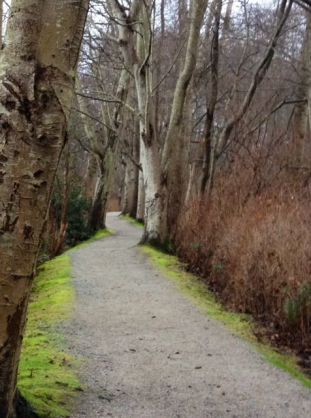
Walking the trail beside Credit River, ON (photo by Nina Munteanu)

In Dorothy L. Sayers’ 1939 mystery novel The Nine Tailors, the iconic dilettante and gentleman detective Lord Peter Wimsey has a most interesting exchange about writers and our perception of them with the young Miss Hilary Thorpe—herself an aspiring writer. It’s worth recounting here as it reflects one author’s thoughts, even if through a fictional character. In the scene, following her father’s death, Miss Thorpe shares how the act of “wondering” helps her through her grief:

“…it really makes things easier to do a little wondering, I mean, if you’re once interested in a thing it makes it seem leas real. That’s not the right word, though.”

“Less personal?”

‘Yes, that’s what I mean. You begin to imagine how it all happened, and gradually it gets to feel more like something you’ve made up.”

“Hmm!” said Wimsey. “If that’s the way your mind works, you’ll be a writer one day.”

“Do you think so? How funny! That’s what I want to be. But why?”

“Because you have creative imagination, which works outwards, till finally you will be able to stand outside your own experience and see it as something you have made, existing independently or yourself. You’re lucky.”

“Do you really think so?” Hilary looked excited.

“Yes—but your luck will come more at the end of life than at the beginning, because the other sort of people start by thinking you dreamy and romantic, and then they’ll be surprised to discover that you are really hard and heartless. They’ll be quite wrong both times—but they won’t ever know it, and you won’t know it at first, and it’ll worry you.”

“But that’s just what the girls say at school. How did you know?…Though they’re all idiots—mostly, that is.”

“Most people are,” said Wimsey, gravely, ‘but it isn’t kind to tell them so. I expect you do tell them so. Have a heart; they can’t help it…”

Thank you, Lord Peter. While we’re at it, another of Sayer’s fictional characters, Mr Edward Thorpe, shares that, “authorship is a good stick, but a bad crutch.”

writing2-PortMcNicoll

Pat and Joan, writers writing (photo by Nina Munteanu)

So, what is it to be a writer? Are we all in the end a bit crazy like the stereotype suggests? All I know is that I if I didn’t write, my soul would suffer. Isaac Asimov said, “I write for the same reason as I breathe—because if I didn’t, I would die.”

I write to live and live to write. I’ve known this all my life, from the tales I shared with my sister at age 7 to the novels I currently write and will continue to until I journey beyond the physical. There is, quite simply, nothing that matches the experience of capturing the beating heart of a story, resonating with its core emotional song, and embracing the thrill of sharing it with the world. Just as director Christopher Nolan said of musical genius Hans Zimmer, I embrace “the thrill and mess of reality’s disregard for abstract intentions—the making of the thing is the thing itself.”


Writers on Writing…

“Who wants to become a writer? And why? Because it’s the answer to everything. … It’s the streaming reason for living. To note, to pin down, to build up, to create, to be astonished at nothing, to cherish the oddities, to let nothing go down the drain, to make something, to make a great flower out of life, even if it’s a cactus.”
—Enid Bagnold

“If you really want to hurt your parents, and you don’t have the nerve to be a homosexual, the least you can do is go into the arts. But do not use semicolons. They are transvestite hermaphrodites, standing for absolutely nothing. All they do is show you’ve been to college.” ― Kurk Vonnegut

“Writing is not necessarily something to be ashamed of, but do it in private and wash your hands afterwards.”
—Robert A. Heinlein

“…Writers are a savage breed, Mr. Strike. If you want life-long friendship and selfless camaraderie, join the army and learn to kill. If you want a lifetime of temporary alliances with peers who will glory in your every failure, write novels.” ― Robert Galbraith,The Silkworm

“Do not hoard what seems good for a later place in the book, or for another book; give it, give it all, give it now.”
—Annie Dillard

“Making people believe the unbelievable is no trick; it’s work. … Belief and reader absorption come in the details: An overturned tricycle in the gutter of an abandoned neighborhood can stand for everything.”
—Stephen King

“Writing a book is a horrible, exhausting struggle, like a long bout of some painful illness. One would never undertake such a thing if one were not driven on by some demon whom one can neither resist nor understand.”
—George Orwell

“If you can tell stories, create characters, devise incidents, and have sincerity and passion, it doesn’t matter a damn how you write.”—Somerset Maugham

“When I sit down to write a book, I do not say to myself, ‘I am going to produce a work of art.’ I write it because there is some lie that I want to expose, some fact to which I want to draw attention, and my initial concern is to get a hearing.”
—George Orwell

“To produce a mighty book, you must choose a mighty theme.”—Herman Melville

“It is perfectly okay to write garbage–as long as you edit brilliantly.”—C. J. Cherryh

“Every secret of a writer’s soul, every experience of his life, every quality of his mind, is written large in his works.”
—Virginia Woolf

“I went for years not finishing anything. Because, of course, when you finish something you can be judged.”—Erica Jong

“There’s no such thing as writer’s block. That was invented by people in California who couldn’t write.”—Terry Pratchett

“Everybody walks past a thousand story ideas every day. The good writers are the ones who see five or six of them. Most people don’t see any.”—Orson Scott Card

“A wounded deer leaps the highest.”—Emily Dickinson

“Writing is its own reward.”—Henry Miller

“Writing a novel is like driving a car at night. You can only see as far as your headlights, but you can make the whole trip that way.”—E. L. Doctorow

“Don’t try to figure out what other people want to hear from you; figure out what you have to say. It’s the one and only thing you have to offer.”—Barbara Kingsolver

“I write for the same reason as I breathe—because if I didn’t, I would die.”—Isaac Asimov


Nina Munteanu is an ecologist and internationally published author of award-nominated speculative novels, short stories and non-fiction. She is co-editor of Europa SF and currently teaches writing courses at George Brown College and the University of Toronto. Visit www.ninamunteanu.ca for the latest on her books.

Ten Questions You Need to Ask Your Characters Before They Can Stay In Your Story

zermatt-matterhorn02

The Matterhorn, Zermatt, Switzerland (photo by Nina Munteanu)

Your story lives and breathes through your characters. Through them your premise, idea and your plot come alive. Characters give your story meaning; they draw in the reader who lives the journey through them. Without them you wouldn’t have a story—you’d have a treatise.

Here are some questions you need to ask each of your characters:

  1. Will the story fall apart or be significantly diminished if you disappear? If not, you don’t need to be there; you aren’t fulfilling a role in the book. Hugo award winning author Robert J. Sawyer reminds us that “story-people are made-to-order to do a specific job”: they tell a story. In real life, people may act through no apparent motivation, be confusing, incoherent and make pointless statements or actions. Story characters show more clear motivations, coherence, and consistency. They don’t clutter your story with muddle and confusion like real people do. They fit into your story like a major puzzle piece.
  2. What is your role? (e.g., protagonist, antagonist, mentor, catalyst, etc.). Each character fulfills a dramatic function in your story. You can’t just be there because you’re cute. Well, ok, maybe. But even being cute can and should provide a dramatic function in the story by exploring how that quality is viewed and treated by others. As with setting, which serves a similar purpose as character in story, every aspect of both minor and major characters interact with and illuminate story theme, premise and plot.
  3. What archetype do you fulfill? In the “hero’s journey” plot approach, each character fulfills one to several archetypes, which help define how they service the plot and theme of the story. The mentor archetype, for instance, generally believes in and enables the hero on his journey. The threshold guardian, on the other hand does not have faith in the hero and obstructs him on his journey. The hero archetype, usually on a quest (for truth, forgiveness, home, victory, faith, etc.), must negotiate her world of archetypes to reach her destination.
  4. How do you contribute to the major or minor theme of the book? This is particularly relevant for all major characters and their associated sub-plots. Sawyer stresses that “your main character should illuminate the fundamental conflict suggested by your premise.” All other characters, in turn, either help reflect the main character’s journey or the overall story premise and theme. If your book is about forgiveness, each character helps illuminate your exploration of this theme.
  5. Are you unique? If the reader can’t distinguish you from other characters, chances are you need to be eliminated because of point number 1 anyway. In order to contribute to story, characters must provide a sufficiently distinguishable feature, complete with sub-plot, on the story landscape. The more varied and rich the landscape is, the more interesting it will be. Fictional characters achieve distinction through individual traits that readers recognize and empathize with. Authors use vernacular and body language to achieve colorful fictional characters.
  6. Are you interesting? If you aren’t interesting to the reader, you won’t do your job. Readers need to notice you, distinguish you and find something about you that will keep their interest—even if it’s something annoying. Just remember to be consistent—unless inconsistency is part of your character.
  7. What is your story arc? Do you develop, change, and learn something by the end? If not, you will be two-dimensional and less interesting. This is just as true for minor characters as for main characters. The more characters the author imbues with the depth to develop, the more multi-layered the story will become. This is because each character and her associated arc provides her own perspective to the theme. This is what is truly meant by “richness” — not the richness of infinite detail, like a baroque painting, but of infinite meaning like an impressionist work. Choose your minor characters as you choose your major characters.
  8. What major obstacle(s) must you overcome? You need these to struggle and “grow” and change; otherwise there is no tension in the story, no development and movement and no story arc. Your character will be like a still-life with no movement, no direction and no interest. The more your character changes over a story, the more she will be noticed and remembered.
  9. What’s at stake for you (theme), and for the world (plot), and how do these tie together? If a writer is unable to tie these together in story, the story will fail to evoke emotional involvement and empathy. It will lack cohesiveness and will not give the reader a fulfilling conclusion with ultimate satisfaction through the character’s journey related to theme (the hero’s journey, essentially).
  10. Do you change from beginning to end? If you don’t develop throughout the story, then you aren’t growing as a result of the thematic elements and plot issues presented in the story. In other words, you haven’t learned your lesson. While it’s ok for some characters not to develop (e.g., to be one note or flat or plain old stubbornly the same) this is disastrous for any of your main characters. Just ensure that the changes you make your character go through are warranted and relevant to the theme.

JournalWritert FrontCover copy 2Characters help the writer achieve empathy and commitment from the reader. Characters are really why readers keep reading. If the reader doesn’t invest in the characters, she won’t really care what happens next. It is important to be mindful of the emotional and narrative weight of a character and achieve balance between characters. For instance, the foil of the protagonist should carry equal weight; otherwise the reader won’t believe the match-up. Equally, a large cast—often used in epic fantasies or historical pieces—can be used successfully, but only if each character is given a clearly distinguishable personality and role.

References:


Nina Munteanu is an ecologist and internationally published author of award-nominated speculative novels, short stories and non-fiction. She is co-editor of Europa SF and currently teaches writing courses at George Brown College and the University of Toronto. Visit www.ninamunteanu.ca for the latest on her books.


The Writer’s Way

Any time you identify a wasteland element in your life—illness, boredom, lethargy, alienation, emptiness, loss, addiction, failure, anger, or outrage—it is time to take a journey—Carol S. Pearson


Turkey Tail bracket fungus on tree

Turkey Tail mushroom on tree in Ontario (photo by Nina Munteanu)

Compelling stories resonate with the universal truths of metaphor within the consciousness of humanity. Good fiction—and non-fiction—reveals both personal and universal truths through metaphor. It is revealing, given that it reflects you.

All stories consist of common structural elements found universally in myths, fairy tales, dreams, and movies and known collectively as “The Hero’s Journey”. According to Joseph Campbell, good storytelling involves an open mind and a certain amount of humility; and giving oneself to the story. “Anyone writing a creative work knows that you yield yourself, and the book talks to you and builds itself….you become the carrier of something that is given to you from … the Muses or God…Since the inspiration comes from the unconscious, and since the unconscious minds of the people of any single small society have much in common, what the shaman or seer [or artist] brings forth is something that is waiting to be brought forth in everyone.” I call this tapping into the universal truth where metaphor lives. A story comes alive when these two resonate.

Carol Pearson tells us that, “if we do not risk, if we play prescribed social roles instead of taking our journeys, we may feel numb and experience a sense of alienation, a void, an emptiness inside. People who are discouraged from slaying dragons internalize the urge and ‘slay themselves’… they suppress their feelings in order to become successful performance machines… become chameleons, killing off their uniqueness to serve an image they think buys success or just will keep them safe. When we declare war on our true selves, we can end up feeling as though we have lost our souls…in shying away from the quest, we experience nonlife and… experience the wasteland.”

Writing is power. Writing is motion. Writing is story. From the moment you start scrawling words on paper, sketch, move paintbrush over canvas, or touch the computer keyboard, you are telling a story. Writing expressively such as a journal, memoir, letter or fiction is telling your story.

When we share our stories, when we write testimony, we are no longer allowing ourselves to be silenced or allowing others to speak for our experience. Writing to heal and making it public “is the most important emotional, psychological, artistic, and political project of our time,” says Louise DeSalvo, author of Writing As a Way of Healing and The Art of Slow Writing.

Happy New Year!

JournalWritert FrontCover copy 2This article contains excerpted material from The Journal Writer: Finding Your Voice (Pixl Press, 2013) by Nina Munteanu


References:

  • Louise DeSalvo: “Writing As a Way of Healing”, Beacon Press, Boston. 226pp; “The Art of Slow Writing”, St. Martin’s Griffin, 2014, 336pp
  • Nina Munteanu: “The Journal Writer: Finding Your Voice“, Pixl Press, 2013, 129pp
  • Carol Pearson: 1998. “The Hero Within: Six Archetypes We Live By”. Harper. San Francisco. 338pp.


nina-2014aaNina Munteanu is an ecologist and internationally published author of award-nominated speculative novels, short stories and non-fiction. She is co-editor of Europa SF and currently teaches writing courses at George Brown College and the University of Toronto. Visit www.ninamunteanu.ca for the latest on her books.

Walking Helps Me Think and Imagine

the beach-2013i

Boardwalk in The Beach (photo by Nina Munteanu)

I’ve written many articles and over a dozen books and readers often remark on my imagination with something akin to awe and incredulity. I often get asked where I get my ideas. Let me tell you a story first…

A Toronto friend—himself a prolific letter writer—shares that his ideas come to him during his daily walks (you’ll find his witty, humorous and somewhat pithy letters in the National Post, Globe and Mail or Toronto Star … almost weekly). David Honigsberg doesn’t use his car (that’s reserved for when his son is in town) and he walks every opportunity he gets, whether it’s a short jaunt to the coffee shop several blocks from his work place or a long trek to his home in Mount Pleasant after a lunch engagement near Bloor and Yonge. He tells me that he uses his phone to capture his “eureka” moments in what may now be considered unorthodox—he doesn’t make digital notes (it’s not that kind of phone!) but instead leaves a series of voice mails on his home phone. When he gets home, David replays his messages and writes out his letter to the editor.

What Dave does is not new to creative thinkers all over the world and throughout time. He shares great company with people who used walking as a venue toward creative thinking (and writing); people like Aristotle, Charles Darwin, Charles Dickens, Ludwig van Beethoven, Friedrich Nietzsche, William Wordsworth, Henry David Thoreau, Steve Jobs, and Soren Kierkegaard—just to name a few. All great walkers.

the beach-2013

The Beach, ON (photo by Nina Munteanu)

Aristotle conducted his lectures while walking the grounds of his school in Athens. His followers, who chased him as he walked, were known as the peripatelics (e.g., Greek for meandering). Darwin refined his ideas on natural selection and other topics during his frequent walks along his “thinking path”, a gravel road called Sandwalk Wood near his home in southeast England. Dickens walked for miles each day and once said, “If I could not walk far and fast, I think I should just explode and perish.” Beethoven often took solitary walks. He strolled the Viennese woods for hours, finding inspiration for his works and jotting them down on a notepad that he carried with him. Nietzsche loved his walks in the mountains. He wrote, “it is only ideas gained from walking that have any worth.” For Wordsworth, the act of walking was one in the same with the act of writing poetry. Both involved rhythm and meter. Henry David Thoreau was known for his great walkabouts. Walking through nature for Thoreau was a pilgrimage without a destination—more discovery and rapture. “Taking a long walk was [Steve Job’s] preferred way to have a serious conversation,” wrote Job’s biographer Walter Isaacson. Writer and avid walker, Soren Kierkegaard writes:

“Above all, do not lose your desire to walk. Everyday, I walk myself into a state of well-being and walk away from every illness. I have walked myself into my best thoughts, and I know of no thought so burdensome that one cannot walk away from it.”

In the April 2014 issue of the Journal of Experimental Pshychology: Learning, Memory and Cognition, Stanford researchers Marily Oppezzo and Daniel L. Schwartz demonstrated that walking boosts creative inspiration. Using the Guildford’s Alternative Uses Test they showed that the act of walking, whether inside or outside, significantly increased creativity for 81% of the participants. Oppezzo and Schwartz were able to demonstrate that the creative ideas generated while walking were not irrelevant or far-fetched, but innovative and practical.

Snowy Path scarborough

Snowy day on Scarborough path (photo by Nina Munteanu)

In the September 3 2014 issue of The New Yorker, journalist Ferris Jabr describes why this is the case:

“The answer begins with changes to our chemistry. When we go for a walk, the heart pumps faster, circulating more blood and oxygen not just to the muscles but to all the organs—including the brain. Many experiments have shown that after or during exercise, even very mild exertion, people perform better on tests of memory and attention. Walking on a regular basis also promotes new connections between brain cells, staves off the usual withering of brain tissue that comes with age, increases the volume of the hippocampus (a brain region crucial for memory), and elevates levels of molecules that both stimulate the growth of new neurons and transmit messages between them.”

It isn’t just strolling or sauntering that stimulates the creative mind to new heights.

Stoking the creative artist inside you may be as simple as giving your mind the chance to wander—and taking the time to pay attention. In her book The Artist’s Way Julia Cameron talks about how “rhythm” and regular, repetitive actions play a role in priming the artistic well. She lightheartedly describes how the “s” activities work so well for this: showering, swimming, scrubbing, shaving, strolling, steering a car. I can testify to the latter—how many great plot ideas have I cooked up while driving to work! Filmmaker Steven Spielberg claimed that his best ideas came to him while he was driving the freeway. Negotiating through the flow of traffic triggered the artist-brain with images, translated into ideas. “Why do I get my best ideas in the shower?” Einstein was known to have remarked. Scientists tell us that this is because showering is an artist-brain activity.

The magic part in this is to pay attention. Pay attention to your life experiences; don’t ignore them. Sit up in the bus and watch people, play with the images, sounds and smells. Get sensual and let your eyes, ears, nose and limbs delight in the world. It’s amazing how interesting the world becomes once you start paying attention.

So, to answer the question above about where I get my ideas: in one word, everywhere.

Of course, I find those “s” activities mentioned above very helpful in quieting my mind to “listen” to my creative spirit and see; they calm and focus me. I would add another “s” word–scrawling–to the list. While Dave sends a voice message home on his phone when he gets an idea, I carry a notebook with me to jot down my eureka moments. I find writing by hand additionally helps in the creative process.  What works best for me is a walk in Nature. Nothing beats that…having a dialogue with the wind, or the chiming birds and rustling trees, the gurgling brook or surging sea or tiny insect, the soothing sun…rough bark of a fir tree… The texture of the world…

“The texture of the world, its filigree and scrollwork, means that there is the possibility for beauty here, a beauty inexhaustible in its complexity, which opens to my knock, which answers in me a call I do not remember calling, and which trains me to the wild and extravagant nature of the spirit I seek.”—Annie Dillard, Pilgrim at Tinker Creek


References:

Cameron, Julia. 1992. “The Artist’s Way”. Penguin Putnam Inc., New York, NY. 222pp.

Dillard, Annie. 1974. Pilgrim at Tinker Creek. Harper Perennial. 304pp.

Downden, Craig. 2014. “Steve Jobs was Right About Walking” In: The National Post, December 23, 2014.

Munteanu, Nina. 2013. The Journal Writer: Finding Your Voice. Pixl Press, Vancouver, BC. 170pp.

Oppezzo, Marily and Daniel L. Schwartz. 2014. “Give Your Ideas Some Legs: The Positive Effect of Walking on Creative Thinking”, Journal of Experimental Psychology: Learning, Memory, and Cognition, Vol. 40, No. 4: 1142-1152.


Nina Munteanu is an ecologist and internationally published author of award-nominated speculative novels, short stories and non-fiction. She is co-editor of Europa SF and currently teaches writing courses at George Brown College and the University of Toronto. Visit www.ninamunteanu.ca for the latest on her books.

Beat the Christmas Frenzy and Find Your Focus

Beaches-snow01

Snow in The Beach (photo by Nina Munteanu)

How many of you are still running around preparing for the Christmas celebration or secular family festivity? Buying that last minute gift you’d forgotten or were chasing down since a bazillion days ago? Or making last minute changes to your travel plans, house-cleaning for guests, mailing of cards or parcels or meal preparations?

Well, you’re reading this blog post … That means you’re sitting down and taking a minute to relax and regroup. That’s good. Remember to breathe… while I tell you a story…

I’d just finished a three-day drive through snow and rain storms from Mahone Bay, Nova Scotia, to Toronto, Ontario, where I was staying for a few days before catching a flight to Vancouver to spend Christmas with my son and good friends on the west coast. Talk about fast living.

I move around a lot these days. It helps me to appreciate some of the most simple things in life and reminds me of what I love most about Christmas: how it focuses my heart and reconnects me. I don’t mean just with relatives and friends either, although the season certainly does that. I’m talking about my soul and the universe itself. Before I became an itinerant, Christmas bustled with my responsibilities as primary caregiver, social coordinator and hostess of major parties. After I’d said goodbye to our visiting friends and done the dishes and tidied the house; after my husband and son had gone to bed, I sat in the dark living room lit only with the Christmas Tree lights and the flickering candle, and listened to soft Christmas music, primed to write.

sammy-close02 copyMy male cat, smelling fresh from outside, found his rightful place on my lap and settled there, pinning me down with love. And there, as I breathed in the scent of wax and fir and cat I found myself again.

Most of us think of Christmas as a busy time, of getting together (often dutifully) with family and friends, exchanging presents and feasting. Christmas is certainly this, but that is only a shallow view of a far deeper event; and I don’t mean only for Christians.

Whether celebrating the holy light of Hannukah or the birth of Jesus, or the winter solstice, this season provides us with the opportunity to meditate on far more than the surficial nature of the symbols we have come to associate with the season: the Christmas tree, presents, turkey dinner, Santa Claus or Saint Nicholas—most of which originate from pagan tradition, by the way.

Says Lama Christie McNally (author of The Tibetan Book of Meditation), “once you dive below the surface, you will discover a beautiful clear place—like a diamond hidden beneath the rubble. It is your own mind, uncovered … Tibetans say we have only just begun the process of awakening—that we still have quite a way to go in our evolutionary process. And it has nothing to do with building spaceships or computers. The next step in our evolution takes place within.”

Christmas is, more than anything, a time of embracing paradox. It is an opportunity to still oneself amid the bustle; to find joy in duty; to give of one’s precious time when others have none, to embrace selflessness when surrounded by promoted selfishness, and to be genuine in a commercial and dishonest world. If one were to look beyond the rhetoric and imposed tradition, the Christmas season represents a time of focus, a time to reflect on one’s genuine nature and altruistic destiny. A time to reconnect with the harmony and balance in our lives.

A time to sit with our cat, pinned with love, and write our next novel.

Merry Christmas!


Nina Munteanu is an ecologist and internationally published author of award-nominated speculative novels, short stories and non-fiction. She is co-editor of Europa SF and currently teaches writing courses at George Brown College and the University of Toronto. Visit www.ninamunteanu.ca for the latest on her books.

Finding the Muse … and Keeping It

writing-Diary in Margaritas

Writing my novel in style (photo by Nina Munteanu)

I often get asked how and from where I draw my inspiration. How do I find my muse? And how do I keep it? What I’m really being asked is: how do I defeat “writer’s block”?


The Journeying Muse 

Many writers complain of experiencing writer’s block at some point in their career—that affliction of not accessing one’s creativity, when the muses have all fled to Tahiti or someplace far away and you are left with a blank page or more importantly—and alarmingly—a blank mind. No desperate search, hot shower, long walk or discussion with a friend will seduce those holidaying muses back. You’re still stuck on page 49.

Here’s my solution: don’t sweat it. Embrace the emptiness and something wonderful will fill it. I said something; not necessarily what you expect. I believe that when your muse “leaves” you, it is on a journey. More to the point you are on a journey. You’re living. More often than not, our directed muse leaves us because something has gotten in the way. What you probably need to do is pay attention to that something. It’s telling you something. Ironically, by doing this, you open yourself to something wonderful. Okay, enough of somethings!…

Writing is a lot like fishing. In order to write you need something to write about. So, when the world gets in your way, you should pay attention. This is what you’re here for. A writer is an artist who reports on her society. A good artist, at least an accessible one, needs to be both participant as well as observer. So, take a break and live. Chances are, you will have much more to write about after you do.


Invoking the Muse & Defeating Writer’s Block 

writing2-PortMcNicoll

Pat and Joan at a writing intensive (photo by Nina Munteanu)

In the over twenty years of writing both fiction and non-fiction I really hadn’t given much thought to writer’s block until recently, when I was challenged on it. This is not to say that I never experienced it. I did; I just kept on writing.

“What?” you say. “Then, you didn’t really have writer’s block!” Well, I did; but only for that particular project, and only for one aspect of that particular project. The key is to have multiple projects and to recognize that each, in turn, has multiple tasks associated with it (e.g., editing, research, discussion, etc.).

For instance, besides Novel A, whose plot had me stumped in the middle, I was working on two short stories and a non-fiction article. I was also actively posting science articles, essays and opinion pieces on my blog. In addition, I was writing news articles for an online magazine and doing my regular stint at the environmental consulting firm where I wrote interpretive environmental reports. I kept on writing.

I let the plot of Novel A sit for a while as I continued to write. That didn’t mean I couldn’t work on Novel A in other capacities: copy-editing or polishing language, for instance. The point I want to make is that it’s helpful to have other things on the go mainly because this will let you relax about the project that has you stumped. And you need to relax for it to resolve. It’s a little like looking for the watch you misplaced; it will “find you” when you stop looking.


Letting the Muse Return (on its own terms)

Each of you has felt it: that otherworldly, euphoric wave of “knowing”, of resonating with something that is more than the visible world: when the hairs on the back of your neck tingle as you write that significant scene … or tremble with giddy energy as you create that perfect line on a painting …or glow with a deep abiding warmth when you defend a principal … or the surging frisson you share with fellow musicians on that exquisite set piece …These are all what I call God moments. And they don’t happen by chasing after them; they sneak up on us when we’re not looking. They come to us when we focus outward and embrace our wonder for this world. When we quiet our minds and nurture our souls with beauty.

Merry Christmas!


Nina Munteanu is an ecologist and internationally published author of award-nominated speculative novels, short stories and non-fiction. She is co-editor of Europa SF and currently teaches writing courses at George Brown College and the University of Toronto. Visit www.ninamunteanu.ca for the latest on her books.

Writing in Your Own Hand

writing-notebook05

writing in a cafe (photo by Nina Munteanu)

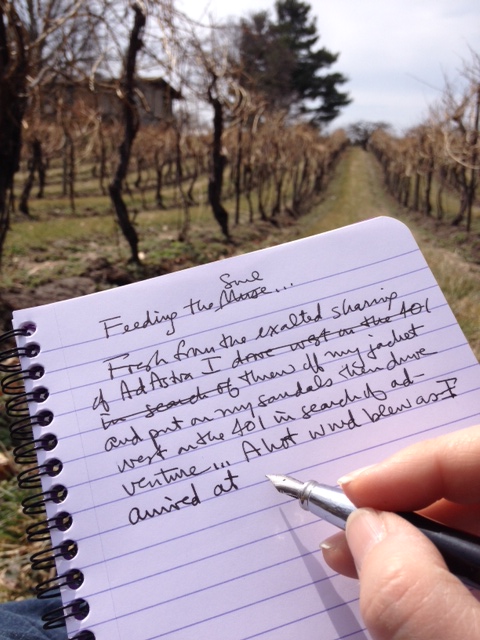
How many of you still handwrite? I don’t just mean a letter to a friend or relative (although handwritten letters are growing increasingly rare) or a reminder to do something or shopping list. I’m referring to writing prose, creative non-fiction, poetry or any kind of expression with a pen or pencil.

University student Cynthia Selfe shared, “I like the motion, pushing that lead across the page…filling up pages … I like flipping papers and the action of writing. It makes me feel close to what I’m saying.”

Handwriting is an art that many of us are losing.

A June 2014 New York Times article by Maria Konnikova shares neuro-scientific evidence that links handwriting with a broader educational development. “Children not only learn to read more quickly when they first learn to write by hand, but they also remain better able to generate ideas and retain information. In other words, it’s not just what we write that matters—but how.” Experiments done with young children showed that when they drew a letter freehand, they showed increased activity in three areas of the brain activated in adults when they read and write: the left fusiform gyrus, the inferior frontal gyrus and the posterior parietal cortex. Children who typed or traced the letter showed no such effect. Researchers at Indiana University attributed the differences to the messiness inherent in free-form handwriting: “not only must we first plan and execute the action in a way that is not required when we have a traceable outline, but we are also likely to produce a result that is highly variable,” reported Konnikova. That variability may itself be a learning tool. “When a kid produces a messy letter,” said Dr. Karin James, psychologist at Indiana University, “that might help him learn it.”

We learn best heuristically, through experience. It’s known that the more senses you engage in an experience, the more efficiently you will learn and more likely you will retain what you learned.

Handwriting slows us down. It is a sensual and intimate way for us to express ourselves. I love my handwriting, especially when I am using my favorite pen (my handwriting changes depending on the pen), a fine felt marker — usually black. When you use a pen or pencil to express yourself you have more ways to express your creativity. Think of the subtleties of handwriting alone: changing the quality and intensity of strokes; designing your script, using colors, symbols, arrows or lines, using spaces creatively, combining with drawing and sketches. In combination with the paper (which could be lined, textured, colored graphed, etc.), your handwritten expression varies as your many thoughts and moods.

writing-notebook01

Writing in Niagara on the Lake (photo by Nina Munteanu)

The very act of handwriting focuses you. Writing your words by hand connects you more tangibly to what you’re writing through the physical connection of pen to paper. Researchers have proven that just picking up a pencil and paper to write out your ideas improves your ability to think, process information and solve problems. The actual act of writing out the letters takes a little more work in your brain than just typing them on a keyboard, and that extra effort keeps your mind sharp. Researchers have also shown that writing something out by hand improves your ability to remember it. Handwriting improves memory, increases focus, and the ability to see relationships.

Handwriting fuses physical and intellectual processes. American novelist Nelson Algren wrote, “I always think of writing as a physical thing.” Hemmingway felt that his fingers did much of his thinking for him.

According to Dr. Daniel Chandler, semiotician at Aberystwith University, when you write by hand you are more likely to discover what you want to say. When you write on a computer, you write “cleanly” by editing as you go along and deleting words (along with your first thoughts). In handwriting, everything remains, including the words you crossed out. “Handwriting, both product and process,” says Chandler, “is important … in relation to [your] sense of self.” He describes how the resistance of materials in handwriting increases the sense of self in the act of creating something. There is a stamp of ownership in the handwritten words that enhances a sense of “personal experience.”

writing-notebook02

Niagara on the Lake (photo by Nina Munteanu)

I know this is true in my own writing experience. This is why, although I do much of my drafting of novel, article and short story on the computer, I find that some of my greatest creative moments come to me through the notebook, which I always keep with me. Writing in my own hand is private and resonates with informality and spontaneity (in contrast to the fixed, formal look and public nature of print). Handwriting in a notebook is, therefore, a very supportive medium of discovery and the initial expression of ideas.

“I am certainly no calligrapher,” admits novelist and poet Wendell Berry, “but my handwritten pages have a homemade, handmade look to them that both pleases me in itself and suggests the possibility of ready correction.” Writer John O’Neill calls handwriting “bodily art.” He suggests that, “the writer’s fingers and the page are a working ensemble, and alternation of intelligible space and spatialized intelligence.”

Berry goes on to share that: “Language is the most intimately physical of all the artistic means. We have it palpably in our mouths; it is our langue, our tongue. Writing it, we shape it with our hands. Reading aloud what we have written — as we do, if we are writing carefully — our language passes in at the eyes, out at the mouth, in at the ears the words are immersed and steeped in the senses of the body before they make sense in the mind. They cannot make sense in the mind until they have made sense in the body. Does shaping one’s words with one’s own hand impart character and quality to them, as does speaking them with one’s own tongue to the satisfaction of one’s own ear?… I believe that it does.”

Cursive Writing: Losing More Than an Art Form

writing-notebook03

Writing in Niagara on the Lake (photo by Nina Munteanu)

John Boone’s November 15th 2013 article on Eonline reads: “Cursive handwriting will no longer be taught in schools because it’s a big, old waste of time”. Besides the controversy at the time—it’s old news now—I was curious to read how seven states, namely California, Idaho, Indiana, Kansas, Massachusetts, North Carolina and Utah, fought to keep cursive in the curriculum, arguing that it helped distinguish the literate from the illiterate. “Joke’s on them because all kids are illiterate these days,” Boone scoffs. He cites computers as the reason. Of course. Let’s not forget texting on Smart phones and other communication devices that encourage the use of a bastardized form of English. Schools promote keyboarding as a productive alternative based on its direct application to career success. But what about the subtle, integrative, sociological, psychological and creative benefits of handwriting?

There is a spill-over benefit for thinking skills used in reading and writing. Research has shown that learning cursive writing is directly related to literacy, the ability to read well and to comprehension generally. Scientists discovered that learning cursive is an important tool for cognitive development. The brain develops functional specialization through cursive writing that integrates sensation, movement control, and thinking. Brain imaging studies reveal that multiple areas of brain become co-activated during the learning of cursive writing of pseudo-letters, as opposed to typing or just visual practice. To write legible cursive, fine motor control is needed over the fingers. You have to pay attention and think about what and how you are doing it. You have to practice. Brain imaging studies show that cursive activates areas of the brain that don’t participate in keyboarding. Psychologists at Princeton and the University of California reported that students learned better when they took notes by hand than when they typed on a keyboard. Handwriting, they reported, allowed the student to process a lecture’s contents and reframe it, to reflect and manipulate that can lead to better understanding and memory encoding.

writing-notebook04

Writing at Niagara Falls (photo by Nina Munteanu)

In an April 2013 New York Times article, Kate Gladstone contended that handwriting matters, but not cursive. She further shared that adults increasingly abandon cursive. A recent survey of handwriting teachers revealed that over half used a hybrid of cursive and print: some elements resembling print-writing, others resembling cursive. I myself have adopted this hybrid form of handwriting since grade five (despite the authoritative perambulations of my teacher). But, if I hadn’t learned cursive to begin with, I wouldn’t be in the position to hybridize it with print. Cursive remains a life-skill, whose subtle merits we have yet, and may never, fully discern. Instead of using Gladstone’s inappropriate metaphors of abacus or slide rule, learning cursive is better compared with learning notes for music or learning how to add, subtract and divide to do higher math.

We are poised to slide down an insidious and dangerous path. To willingly give up a basic ability and skill that will inevitably close doors in knowledge, particularly historical knowledge, is akin to handing over a piece of your freedom and heritage. It is actually more insidious than that: When your son Johnny can’t sign his own name on a document, he loses more than his ability to identify himself as a unique individual and citizen with inalienable rights; he has lost his very identity. Printing your name is akin to marking X. And that’s the situation some kids are finding themselves in today.

In another New York Times article, Morgan Polikoff recommends that educators and policymakers resist the urge to add more skills (referring to cursive, as if it hadn’t been there to begin with). “Doing so would simply result in a crowded, less-focused curriculum, undermining the strength of the standards,” Polikoff ended. I find this ironic; because the reality is that cursive writing as a taught skill goes hand in hand with active handwriting. If time is not devoted to cursive, it’s not devoted to handwriting. And THAT will have grave consequences. The truth is that going to exclusive print-writing will eventually lead to no handwriting at all. Students will opt to use keyboarding exclusively and handwriting will go the way of the slide rule and the abacus. How will the exclusive use of the keyboard affect the act of writing and expression, generally? It will be certainly at the expense of artistic expression and creativity itself.

“Many people now cannot form legible letterforms at all except by tapping on a keyboard. For those people, writing and the alphabet have, quite literally, ceased to be human. How do you expect to be able to cook good food or make good love when you write with prefabricated letters? How do you expect to have good music if you live on a typographic diet of bad Helvetica and even worse Times New Roman—never mind the parodies of letters that flash across your cellphone screens and the parodies of numbers marching over the screens of your pocket calculators and cash-dispensing machines? How can things so ill-formed have a meaning?”—Wendel Berry, The Typographic Mind (in Everywhere Being Is Dancing)

SONY DSC

Birch trees in Ontario (photo by Merridy Cox)

In medieval times only a small elite could read and write; they created the stories and recorded them in glorious illuminated manuscripts for future storytellers. They created history. The masses made do with handing down stories through oral storytelling, which, because it was not tangibly recorded, morphed and was eventually lost like water down a flowing river. The power lay in the script. What was handed down.

If we are not careful, the ability to read and write will become the sole pursuit of an elite, those few who will hold the key to interpreting the past. And ultimately controlling the future.


References:

Munteanu, Nina. 2013. The Journal Writer: Finding Your Voice. Pixl Press, Vancouver, British Columbia. 172pp.


Nina Munteanu is an ecologist and internationally published author of award-nominated speculative novels, short stories and non-fiction. She is co-editor of Europa SF and currently teaches writing courses at George Brown College and the University of Toronto. Visit www.ninamunteanu.ca for the latest on her books.