“There are women with voices and brains and power and intelligence that have been waiting for this moment.”—Director Jennifer Phang
Advantageous is a low budget indie film by Jennifer Phang that explores a near-future world—a kind of “pre-dystopia”, according to Katharine Trendacosta of io9—where jobs have become heavily automated and opportunities for education are cutthroat. Women have been generally forced out of the workplace and onto the streets: the logic being that they will be less violent while living on the street than men.
While the world vaguely resembles a vibrant City with flying ships and some bizarrely futuristic architecture (including a high rise that functions as a giant water feature), a sense of unease permeates most scenes, punctuated by occasional terrorist explosions and snippets of disturbing news reports. Artificial intelligence has supplanted most people in middle management, “The people you do see are either impoverished and disenfranchised or are hidden in the upper floors, the protected places,” says director Jennifer Phang. Unemployment is close to 50% and there are no public schools. The only options for a young girl—if she is not to end up on the streets, either as a beggar or prostitute—is to attend a highly selective free magnet school or a very expensive private school.
Gwen Koh (Jacgueline Kim) is the spokeswoman of the Center for Advanced Health and Living, a wellness corporation that offers health and beauty treatments to an elite who can afford it. When the Center informs her that she looks too old, Gwen—desperate to secure her bright daughter’s expensive education—submits to the experimental treatment she was initially hired to promote. Jules hadn’t made it into the free magnet school, leaving Gwen to come up with extensive funds to get her into a private school. The corporation has subtly backed Gwen into a corner by reminding her that her generation doesn’t have the skills to compete—all of education currently being STEM-based—and they fully understand that she is too old and too unconnected to do anything other than offer herself up to their new procedure to secure her position and a future for her daughter Jules. Constantly walking the edge of privilege, Gwen struggles to make the elite-connections necessary to place Jules. “Gwen is too old, too female, and too unconnected to do anything other than offer herself up as a sacrifice,” writes Trendacosta.
Gwen and here daughter Jules share a moment
The true nature of her sacrifice is not understood at first; it unravels slowly, like an internal wound, until we learn that the procedure—putting her memories into a younger person’s body—means that Gwen’s “mother-connection” awareness with her daughter will be lost when her original body dies in the procedure. This is particularly significant, given their close and loving relationship, which is evocatively conveyed throughout the film.
Advantageous “is riveting, emotionally gripping, and offers up a vision of the future that is disturbingly easy to picture, even as some of the technologies it imagines seem out of reach,” says Ariel Schwartz of Business Insider Magazine. While the trope of mind-upload into a younger, prettier body has been around for while in standard SF, how Phang presents it, in the muted notes and pace of “everyday” and “mundane” events, brings a kind of realism to it that both invigorates and chills. Like watching a building explode in person rather than on TV. The immediacy and reality of it is visceral. Phang does this through sparing use of sound, language and colour. And all presented in a pace that does not rush, but lingers and reflects. Long moments of quiet punctuate scenes of significance, giving us the chance to examine, resonate and reflect in “real-time” with the character. These, in themselves, provide some of the most poignant footage of the film as we are given the time to descend into deeper reflection. Each plays out, short vignettes of life that string together like pearls on a necklace. Life moments. Unflinchingly and confidently performed at the pace of life.
In one of many quietly powerful scenes, Gwen stumbles upon a street woman, huddled in a small grassy alcove under an old blanket. When Gwen asks her if she is okay, the woman instead responds, “Are you okay?” This is a natural response for a woman; we think of others, of their welfare. We carry the “mother” archetype within us, everywhere we go, no matter what befalls us. This natural sense of compassion and altruism runs through our blood.
And, yes, it makes us a different kind of hero.
Gwen’s heroics are not accompanied by percussive violence or gut-wrenching action; they are silent choices that percolate from deep within. They are choices that ultimately bleed into great consequence.
Gwen and Jules read something together
“The plot suggests a standard ‘body swap’ sci-fi storyline,” says Danielle Riendeau of Polygon. “But Advantageous is much more about motherhood, the sacrifices women make for their children, and to a large extent, the difficulties of being a non-white woman in an increasingly intolerant society. The writing, directing and performances are so strong that they elevate the film far beyond a simple twist on a classic trope. Advantageous is a potent, heartbreaking meditation on parental love and the sacrifices women make for their families. It has a lot to say, and it does so with clear-eyed, fearless intensity.”
Trendacosta writes, “People are going to judge Advantageous by the things it lacks. There are no battles, no mustache-twirling villains, and not even any giant science fiction spectacle sets. People are also going to judge it for what it has. There are some intense discussions of classism, racism, ageism, sexism, and elitism. But don’t judge this movie for either of those things—instead, it’s worth appreciating for all the things it does so incredibly well.”
What Advantageous does so incredibly well is portray a near-future vision worth pondering and discussing.
Nina Munteanu is a Canadian ecologist / limnologist and novelist. She is co-editor of Europa SF and currently teaches writing courses at George Brown College and the University of Toronto. Visit www.ninamunteanu.ca for the latest on her books. Nina’s bilingual “La natura dell’acqua / The Way of Water” was published by Mincione Edizioni in Rome. Her non-fiction book “Water Is…” by Pixl Press (Vancouver) was selected by Margaret Atwood in the New York Times ‘Year in Reading’ and was chosen as the 2017 Summer Read by Water Canada. Her novel “A Diary in the Age of Water” was released by Inanna Publications (Toronto) in June 2020.
This noir/ dystopian story, set in Vancouver B.C., finds Suki prematurely awoken from an induced suspension between being alive and dead. With her retinas deactivated and her Government persona suspended, it’s up to her long-time friend and private investigator, Gabe, to uncover why she was brought back early and the way forward to recover her identity. Through the gritty and flooded streets of East End Vancouver and the mega corporations who control their entire existence, Gabe and Suki scheme to claim what is rightfully Suki’s.
Crime Writers of Canada
The story is set in the near-future in a post climate change Vancouver when sea level rise has water lapping decrepit buildings north of The Oak Street Bridge on Oak and 77th, Amazon owns entire roadways, and people pay corporate credits as currency.
One of the aspects of this mystery story that I found particularly attractive and interesting was Bowlsby’s use of cross-genre (mystery with science fiction), which he indicated in his interview with Erik D’Souza with Crime Writers of Canada he has an affinity for. I was reminded of the eco-techno thriller style of Hayden Trenholm’s detective series The Steele Chronicles, also set in the near future in Alberta Canada where biotechnology strays into the hands of corporate moguls and fundamentalist cults.
Bowlsby manages to cram both rich and seamless world building in his story (a feat in any short story), addressing mundane aspects of life, including the nuances of language (e.g. swear words suited to the time and place). Deadland, for instance, is a slang word that describes a government program that allows people to temporarily commit suicide, allowing them to place their lives on hold to supposedly help them escape their problems and supposedly better cope later (Bowlsby tells us rather pithily that it doesn’t really work).
Characters were fully fleshed out and interesting and I found that I would very much like to see more stories set in this universe with Gabe and Suki.
Interview
NM:One of the first things I noticed and loved about the story is its title. How did you arrive at it? Is there a story behind the choice?
CHB: There’s usually more than one story behind my titles. It started with a very different title for a couple of years. Then I began to revise the story very seriously and that meant I had to reconsider the title too. I postulated hundreds of titles over three more years and ended up with a new one. But a friend pointed out a slight logic problem with that new title, related to the story. So, I had another reason to work on it. Normally if it doesn’t feel right, I always look for something that resonates better. Finally, this one resonated well, and wouldn’t be shaken off.
NM:What was the spark or inspiration for this story? Why did you set it where and when you did (post-climate-change Vancouver)?
CHB: Well, when Erik De Souza asked me about the social commentary of the story in his interview, I forgot that the germ of the first inkling of this story came from a discussion I had with a friend, twenty years ago, who felt that everything in our society should be available for sale. For him that represented a pure state that would fix all our problems. (Sorry Erik—I’ll explain this when I see you next.) I disagreed, but I wondered what it would be like if we started on that path. So as a social background, the characters are acting within a stage created for such a system—a system just starting to find its own steady legs. I don’t say it’s bad or good—I just give it free rein. The story itself came from other elements, but the characters’ difficulties are complicated by the hyper-capitalism. As for the climate change problem, and the flooding, that came naturally with the near-future time period; I’m afraid it’s going to happen no matter what we do. As for Suki, her main problem stems from an idea I had about how we might alleviate suicides. Even if it might not work very well.
NM:In your interview with Erik, you both discussed the use of language as a way to describe the world and create the gritty noir tone of the story. Can you describe some of the ways you derived them and other techniques you used?
CHB: That was hard. Or at least, it forced me to work my synapses hard for years. I don’t really know how I came up with the language changes except I set myself that task and used my brain like a sifter. I needed words for certain kinds of things, put myself into the future, and rattled hundreds of words through the filter. I kept lists of possibilities and used the best ones. I suppose that helps create the tone, but a lot of things do that: attitudes, social background, plot, etc.
NM:You mentioned in your interview with Erik that this story was “essentially a failure” and you’d been tirelessly working on it for five years, polishing, changing, revising—until finally someone liked it. Can you describe the process you went through in writing, preparing and getting out this story? Was this an exception for you or part of a typical process?
CHB: A typical process. Only a few of my stories have been published without being rejected by other publications. This story was first a short story, then a screenplay for a long time, then back to a short story, which meant at that point I had to cut out many scenes. Then it failed many more times in other publications. I just felt though that it generated so many sparks in my mind that it should catch fire somewhere, sometime. It was a surprise when it did. So, for some reason my stories need a lot of work. I’m guilty, therefore, I suppose, of not giving a story time enough time to mature, so in the future I should probably take more time to revise things before they see an editor. Generally, that’s a good approach, though, because you can come up with things that work better if you give them time to appear, which is what happened with this story.
NM:Your writing has covered non-fiction and many genres of fiction: science fiction, fantasy, space adventure, mystery, thrillers. How would you describe yourself as a writer?
CHB: An activationist. But I just made that up because of your question. I get an idea and I have to activate it, no matter the theme or genre. I don’t see myself restricted in any way to theme or subject. But I definitely feel an affinity for a plodding detective, no matter the time period or plot. (Or plod).
NM:What’s next for Craig H. Bowlsby?
CHB: I have several projects ready or pounding on my skull to get out. I have a series of three novels in the works about a Shanghai detective in 1917. Two in this series are complete. One takes place mostly in Shanghai; the next mostly in Vancouver; and the third will take place in Shanghai again.
NM: Now that you’re rich and famous, will you still talk to me? I’ll be in Vancouver soon and would gladly celebrate, starting with you buying me a beer!
CHB: I guess that sounds fair. Although I think I already owe you a six-pack. I enjoy our discussions, Nina. See you then!
You can read Craig’s story in the April 2022 Issue of Mystery Magazine. You can listen to Craig’s interview with Erik D’Souza here.
Glade in Jackson Creek, ON (photo and rendition by Nina Munteanu)
Nina Munteanu is a Canadian ecologist / limnologist and novelist. She is co-editor of Europa SF and currently teaches writing courses at George Brown College and the University of Toronto. Visit www.ninamunteanu.ca for the latest on her books. Nina’s bilingual “La natura dell’acqua / The Way of Water” was published by Mincione Edizioni in Rome. Her non-fiction book “Water Is…” by Pixl Press (Vancouver) was selected by Margaret Atwood in the New York Times ‘Year in Reading’ and was chosen as the 2017 Summer Read by Water Canada. Her novel “A Diary in the Age of Water” was released by Inanna Publications (Toronto) in June 2020.
Candidates have three minutes to make nine cubes out of a pile of blocks in the centre. Those who complete the puzzle in time will move on to the next test; those who don’t are eliminated and must return to the slums—their one chance at a better life dashed. Among the nine candidates in the room are Rafael (Rodolfo Valente), who steals a cube from another candidate to get his nine. Michele (Bianca Comparato), who initially out of kindness helps Fernando (Michel Gomes), who’s reach to the pile is limited, is in turn helped by him when she is shy one cube: at time-end, he cleverly piles her eight cubes into one large cube—the ninth—and she passes the test.
So begins Netflix’s 3%, a Brazilian dystopian thriller series created by Pedro Aguilera and directed by Cesar Charlone. In a kind of Hunger Games contest, candidates cheat in self-service; others violently impose Darwinian entitlement and survival of the fittest; yet others rely on reciprocal altruism.
.
3% is set in the near future after the planet has fallen into a divided haves and have-nots through some calamity. Three percent of the population live well on an island in the Atlantic Ocean, called Offshore (Mar Alto). The remaining 97% struggle Inland with poverty and scarcity. A selection process lies between them.
Every year the 97% send their 20-year olds to undergo The Process, a grueling Hunger Games-style contest run by the Offshore elite to replenish their numbers. Only 3% of the candidates will be considered worthy. They must pass psychological, emotional and physical tests to earn a place in Mar Alto.
3% test
By the time Season 1 is over, candidates will have committed a full range of desperate and unsavory acts to make the cut—the stakes are high, after all: secure a position in the 3% elite or die in squalor and poverty. After being eliminated during the interview process, one youth throws himself off a balcony of the testing centre.
Major players in Season 1 of 3%
“It’s not so far from our own world, where the competition to get into a good school and land a good job drives many to self harm,” writes Matthew Gault on Motherboard. “In the 3%, as in our own world, society looks down on those who don’t achieve and there’s a certain kind of person who believes that life’s losers earned their place at the bottom.”
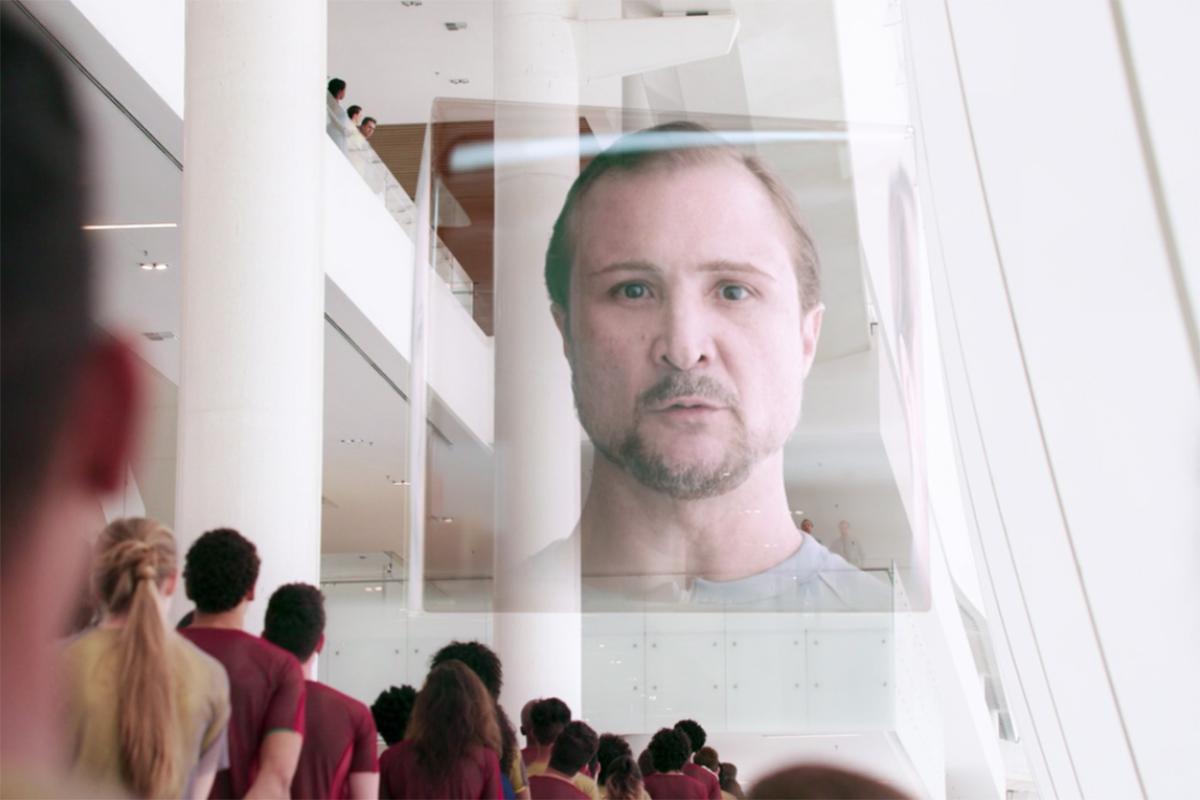
Ezekial, who runs “the Process” speaks to the new contestants
.
Inland is valued by the elite only for its reserve of youth to recruit Offshore’s strictly controlled population (you only find out how in the last show of Season 1). As for what personality and fitness The Process tests for is also uncertain. “You each create your own merit,” says Ezequiel, who runs The Process, to the candidates. “No matter what happens … you deserve this.” The corollary is that if they don’t have merit—value, as determined by Ezequiel’s Process—they don’t deserve to move Offshore. There is, of course, a resistance to The Process, called The Cause. They cause stirrings of unrest and may even be responsible for the first murder in Offshore in over 100 years—which puts Ezequiel’s Process under question. Ezequiel dismisses The Cause by suggesting that it operates “in the name of a false or hypocritical equality.”
There is no inherent equality or fair entitlement in a land of scarcity; there is only proof of merit to a limited resource. This meritocratic notion—and the need to prove one’s worth to be accepted—is so ingrained in society that not even the poor question it. It was American writer John Steinbeck who argued that socialism would never take off in America because the poor see themselves as “temporarily embarrassed capitalists.”
Michele and Joana in the poor section of town
.
We find out in the first show that the first murder in 100 years has occurred Offshore—which puts Ezequiel’s Process under question. And there are stirrings of unrest—some likely instigated by The Cause.
“3% is a brutal commentary on the world’s rising income inequality and the lengths we’re all willing to go to improve our lot,” writes Gault. “It’s a world of extreme income inequality where techno-fascists rule with an iron fist…Brazil has some of the highest income disparity on the planet,” writes Gault. “São Paulo is a megacity where the ultra-rich travel the skies in rented helicopters and cruise the streets in bulletproof cars. It’s a city where the poor live in makeshift favelas that resemble something from William Gibson’s nightmares. It’s a city where plastic surgeons do a brisk trade in reconstructive ear surgery because kidnapping is common and the easiest way to prove you’ve got a mark is to send their ear.”
Ezekial confronts Fernando in 3%
With each episode, 3% examines the motivations and paradoxes of heroism and villainy, sometimes turning them on their sides until they touch with such intimacy you can’t tell them apart. At its deepest, 3% explores the nature of humanity—from its most glorious to its most heinous—under the stress of scarcity and uncertainty. How we behave under these polarizing challenges ultimately determines who we are.
3% joins the ranks of several other films and shows about near-future scarcity-driven societies, with two examples below:
Snowpiercer—a stylish post-climate change apocalypse allegory. The train’s self-contained closed ecosystem of scarcity is maintained by an ordered social system, imposed by a stony militia. Those at the front enjoy privileges and luxurious living conditions, though most drown in a debauched drug stupor; those at the back live on next to nothing and must resort to savage means to survive. Minister Mason, an imperious yet simpering figure who serves the ruling class without quite being part of it, reminds the lower class that: “We must each of us occupy our preordained particular position. Would you wear a shoe on your head? Of course you wouldn’t wear a shoe on your head. A shoe doesn’t belong on your head. A shoe belongs on your foot. A hat belongs on your head. I am a hat. You are a shoe. I belong on the head. You belong on the foot. Yes? So it is. In the beginning, order was prescribed by your ticket: First Class, Economy, and freeloaders like you…Now, as in the beginning, I belong to the front. You belong to the tail. When the foot seeks the place of the head, the sacred line is crossed. Know your place. Keep your place. Be a shoe.”
Advantageous—Jennifer Phang’s “pre-dystopia”, where jobs have become heavily automated and opportunities for education are cutthroat. Women have been generally forced out of the workplace and onto the streets: the logic being that they will be less violent while living on the street than men. Artificial intelligence has supplanted most people in middle management. “The people you do see are either impoverished and disenfranchised or are hidden in the upper floors, the protected places,” says director Jennifer Phang. Unemployment is close to 50% and there are no public schools. The only options for a young girl—if she is not to end up on the streets, either as a beggar or prostitute—is to attend a highly selective free magnet school or a very expensive private school.
In his book Four Futures: Life After Capitalism, author Peter Frase considered effects of climate change and automation in possible outcomes of a post-Trump election America. Frase envisioned four scenarios based on abundance and scarcity and whether a society operated by equality (e.g., communism or socialism) or hierarchy (rentism, exterminism).
With scarce resources, socialism (aka Ecotopia) may arise within an egalitarian society if driven by altruistic notions of self-limitation. Ecologists describe such a self-limiting system as K-selected (see my discussion of K-selection and r-selection in “Water Is…”). A K-selected population is at or near the carrying capacity of the environment, which is usually stable and favors individuals that successfully compete for resources and produce few young. The K-selected strategy runs on a successive gradient of maturity, from initially competitive to ultimately cooperative. Competition is a natural adaptive remnant of uncertainty and insecurity and forms the basis of a capitalist economy that encourages monopolization and hostile takeovers. Competition results from an initial antagonistic reaction to a perception of limited resources. It is a natural reaction based on distrust—of both the environment and of the “other”—both aspects of “self ” separated from “self.” The greed for more than is sustainable reflects a fear of failure and a sense of being separate, which ultimately perpetuates actions dominated by self-interest in a phenomenon known as “the Tragedy of the Commons.” Competition naturally gives way to creative cooperation as trust in both “self ” and the “other” develops and is encouraged through continued interaction.
Exterminism (aka Mad Max) may arise under a hierarchical model, driven by greed and exacerbated by uncertainty in the environment—not unlike what we are currently experiencing with the planet’s system and cyclical changes. In this scenario, in which resources are both limited and uncertain, those with access to them would guard or hide them away with desperate fervor. Frase writes:
“When mass labor has been rendered superfluous [through automation], a final solution* lurks: the genocidal war of the rich against the poor.”
Gault says it best: “3% hits so hard because it seems bizarre and distant, but as the show unwinds and reveals its mysteries, audiences will come to realize that we’re already part of The Process.”
*the Final Solution was originally used by Nazi Germany as “the Final Solution to the Jewish Question”; the Nazi plan to exterminate the Jews during World War II, formulated in 1942 by Nazi leadership at the Wannsee Conference near Berlin, culminated in the Holocaust, which murdered 90 percent of Polish Jews.
References:
Fisher, Mark. 2009. “Capitalist Realism: Is There No Alternative?” Zero Books. 92pp.
Frase, Peter. 2016. Four Futures: Life After Capitalism.” Verso. 160pp.
Munteanu, Nina. 2016. “Water Is…The Meaning of Water.” Pixl Press. 584pp.
Nina Munteanu is a Canadian ecologist / limnologist and novelist. She is co-editor of Europa SF and currently teaches writing courses at George Brown College and the University of Toronto. Visit www.ninamunteanu.ca for the latest on her books. Nina’s bilingual “La natura dell’acqua / The Way of Water” was published by Mincione Edizioni in Rome. Her non-fiction book “Water Is…” by Pixl Press (Vancouver) was selected by Margaret Atwood in the New York Times ‘Year in Reading’ and was chosen as the 2017 Summer Read by Water Canada. Her novel “A Diary in the Age of Water” was released by Inanna Publications (Toronto) in June 2020.
“Nothing in nature stays the same. Or if it does, it’s because change has brought it back to what it once was.”
Lynna Dresden
“Munteanu excels at extrapolating today’s science into a stark vision of what we face in the next decades. Environmentalists, science fact enthusiasts, and science fiction fans will be shaken by this cautionary tale of climate change. Great for fans of James Lawrence Powell’s The 2084 Report, Kim Stanley Robinson’s The Ministry for the Future.”
PUBLISHERS WEEKLY
Thompson Creek, ON (photo and rendition by Nina Munteanu)
“We shall break down all walls—to let the green wind blow free from end to end—across the earth.”
I-330 in ‘We’
Just last week, I read for the first time Yevgeny Zamyatin’s masterpiece We. My first thought upon finishing it was: why have I waited until now to read it? I’m rather embarrassed to say that I’d only heard of its existence recently during some research I’d conducted on another article. The novel, written in 1920, decades before Brave New World and 1984 (two novels it is often compared to and which I read when I was a budding writer, long ago), was suppressed in Russia. It has remained in the shadows of these two works since. Mesmerized by Zamyatin’s fluid metaphoric prose, I read it in a few days.
I usually savour a good novel, but this one compelled me to take it in like an infusion.
The book jacket of the Harper Voyager edition provides the following tagline and description:
“Before Brave New World…before 1984…there was…We. In the One State of the great Benefactor, there are no individuals, only numbers. Life is an ongoing process of mathematical precision, a perfectly balanced equation. Primitive passions and instincts have been subdued. Even nature has been defeated, banished behind the Green Wall…”
Illustration of “We”masses marching during their personal hour
.
We is told through a series of entries by the main protagonist D-503, mathematician and chief engineer of the Integral (the ship that will take humanity to space). The novel takes place in a glass-enclosed Panopticon-like city of straight lines, and scientifically managed using Taylor’s principles of scientific management. No one knows or cares about the outside environment from which they have been separated. Citizens in the totalitarian society of One State are regulated hourly by the Table of Hours, and ruled by the ‘Benefactor’ who dispenses order through arcane methods such as The Machine (a modern ‘guillotine’ of sorts that literally liquidates its victim, reducing them to a puff of smoke and a pool of water), The Cube, The Gas Bell, and the ruthless precision and vigilance of the Bureau of Guardians. All this is “sublime, magnificent, noble, elevated, crystally pure,” writes D-503, because “it protects our unfreedom—that is, our happiness.” In the foreword to the Penguin edition of We, New Yorker journalist Masha Gessen reminds us that, “Zamyatin imagined [We] twenty years before Nazi Germany began sanitized, industrial mass murder of people who had been reduced to numbers.”
Citizens subsist on synthetic food and march in step in fours to the anthem of the One State played through loudspeakers. There is no marriage, and every week citizens are given a “sex hour” and provided a pink slip to let them draw down the shades of their glass apartment. Every year, on Unanimity Day, the Benefactor is re-elected by the entire population, through an open (not secret) vote that is naturally unanimous—given the singular “we” nature of the population.
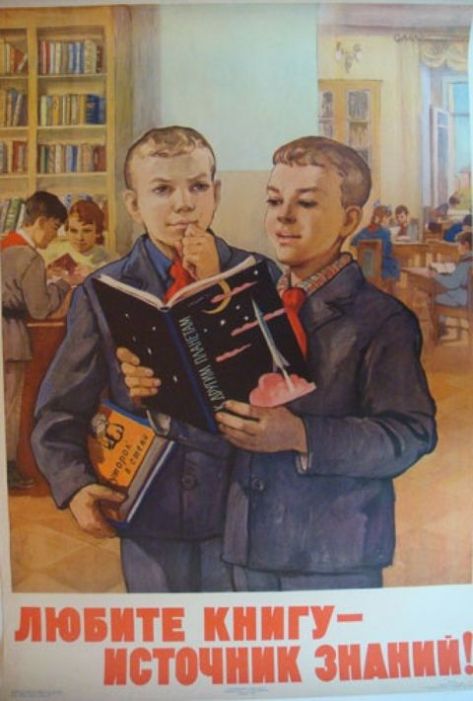
Kids in uniform from Russian poster
.
On Zamyatin’s novel, Michael Brendan Dougherty writes that, “Equality is enforced, to the point of disfiguring the physically beautiful. Beauty–as well as its companion, art–are a kind of heresy in the One State, because ‘to be original means to distinguish yourself from others. It follows that to be original is to violate the principle of equality.”
According to Mirra Ginsburg, who translated the book into English in 1972, Zamyatin and his book explores the oppression of two principles of human existence: eternal change and the individual’s freedom to choose, to want, to create according to his own need and his own will.
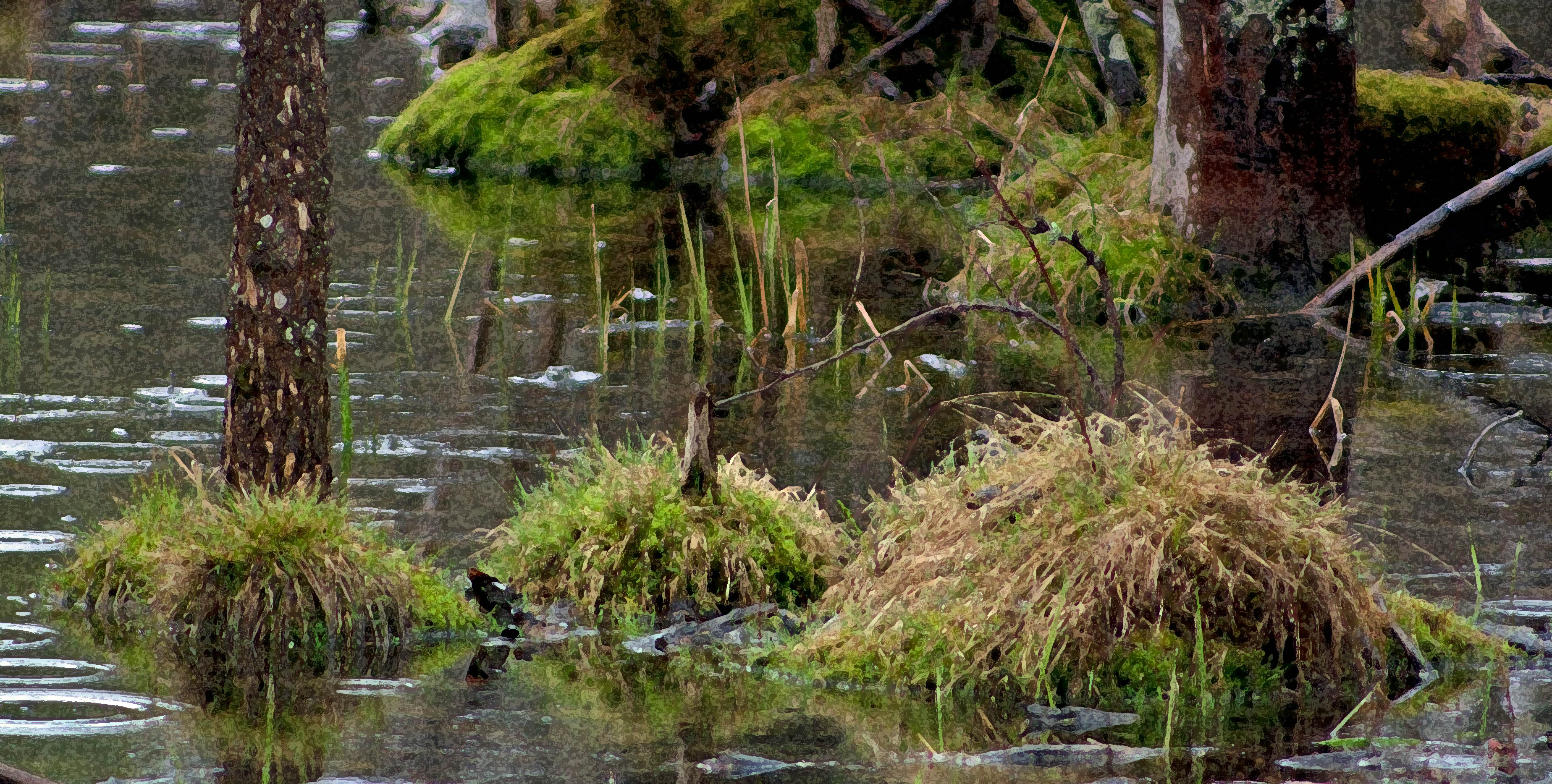
Quiet bay of the Otonabee River, ON (photo and rendition by Nina Munteanu)
In some ways, Zamyatin’s satire is as much about our separation from the chaos, ever-evolving and functional diversity of nature as it is about our separation from the unruly thoughts and emotions of the individual. Both are feared and must be defeated, controlled and commodified (I refer to Foucault’s concept of biopolitics).
D-503 writes in his journal: “we have extracted electricity from the amorous whisper of the waves; we have transformed the savage, foam-spitting beast into a domestic animal; and in the same way we have tamed and harnessed the once wild element of poetry. Today poetry is no longer the idle, impudent whistling of a nightingale; poetry is civic service, poetry is useful.”
D-503’s thirteenth entry takes place on a particularly foggy day. When new friend I-330 ‘innocently’ asks him if he likes the fog, he responds, “I hate the fog. I’m afraid of it.” To this, I-330 says, “That means you love it. You are afraid of it because it is stronger than you; you hate it because you are afraid of it; you love it because you cannot subdue it to your will. Only the unsubduable can be loved.”
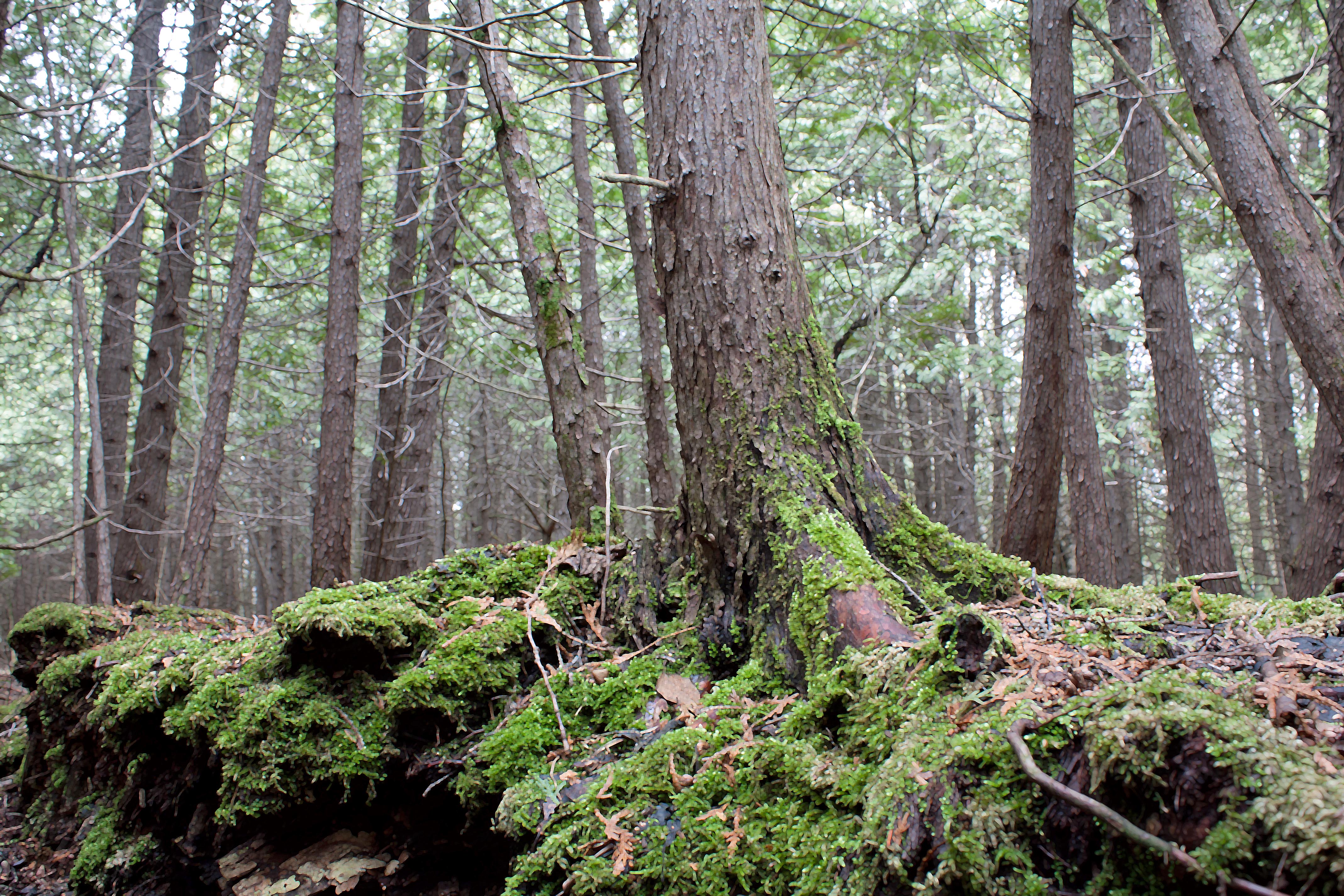
Cedar swamp forest, Trent Nature Sanctuary, ON (photo and rendition by Nina Munteanu)
.
D-503 appears content as a ‘number’ within a larger unity of regimentation and draws comfort from a universe of logic and rationality, represented by the predictive precision of mathematics. For example, he is disturbed by the concept of the square root of -1, the basis for imaginary numbers (imagination being reviled by the One State and which will eventually be lobotomized out of citizens through the mandatory Great Operation). The spaceship’s name Integral represents the integration of the grandiose cosmic equation following the Newtonian hegemony of a machine universe.
The human-machine working the great clock in Metropolis
.
In the following scene in which D-503 watches men work on the spacecraft Integral—itself likened to a giant slumbering machine-human—I am reminded of an iconic scene from Fritz Lang’s 1927 Metropolis:
“I watched the men below move in regular, rapid rhythm…bending, unbending, turning like the levers of a single huge machine. Tubes glittered in their hands; with fire they sliced the glass walls, angles, ribs, brackets. I saw transparent glass monster cranes rolling slowly along glass rails, turning and bending as obediently as the men, delivering their loads into the bowels of the Integral. And all of this was one: humanized machines, perfect men…Measured movements; firmly round, ruddy cheeks; mirror-smooth brows, untroubled by the madness of thought.”
Machine of Metropolis
.
All is indeed sublime … Until he meets I-330, Zamyatin’s unruly heroine who is determined to change D-503’s perspective—and his vacuous state of dutiful ‘happiness.’ She is, of course, a member of an underground resistance, Mephi, bent on overthrowing the One State. I-330 is the herald of change and wishes to use D-503’s connection to the Integral to incite a revolution. In a particularly pithy scene, I-330 challenges D-503’s complacent logic with mathematics to make her point:
“Do you realise that what you are suggesting is revolution?” [says D-503]
“Of course, it’s revolution. Why not?”
“Because there can’t be a revolution. Our revolution was the last and there can never be another. Everybody knows that.”
“My dear, you’re a mathematician: tell me, which is the last number?”
“But that’s absurd. Numbers are infinite. There can’t be a last one.”
“Then why do you talk about the last revolution? There is no final revolution. Revolutions are infinite.”
Confident, powerful and heroic, the liberated I-330 is clearly the driving force of change and the philosophical voice of Zamyatin’s central theme. Her competent manipulations within the system successfully orchestrates a revolution which includes interfering with the unanimous vote, breaching the Green Wall, and braving torture to the end–all the kind of feats usually relegated to a male protagonist in novels of that era. It all starts with a tiny crime and escalates from there. Early in the novel, I-330 lures D-503 to the Medical Office, where the Mephi doctor gives them a sick card so they can play hooky from work. D-503 doesn’t even realize how I-330 has so completely caught him. His description of the facility and the officer is telling:
“A glass room filled with golden fog. Glass ceilings, colored bottles, jars. Wires. Bluish sparks in tubes. And a tiny man, the thinnest I had ever seen. All of him seemed cut out of paper, and no matter which way he turned, there was nothing but a profile, sharply honed: the nose a sharp blade, lips like scissors.”
Biblical references appear throughout We, the One State likened to ‘Paradise’, D-503 to the naïve ‘Adam’, I-330 to the herald temptress ‘Eve’, and S-4711 to the clever snake, with his ‘double-curved body,’ who turns out to be a double-agent. The revolutionary organization named Mephi appears to be after Mephistopheles, who rebelled against Heaven and ‘paradise.’ While these similarities suggest a criticism of organized religion, the novel clearly embodies so much more. It is also so much more than a political statement. Journalist and translator Mirra Ginsburg calls We “a complex philosophical novel of endless subtlety and nuance, allusion and reflections. It is also a profoundly moving human tragedy and a study in the variety of human loves … And, though the people are nameless ‘numbers,’ they are never schematic figures; each is an individual, convincingly and movingly alive.”
Zamyatin wrote We years before the word “totalitarianism” appeared in political speech and he predicted its defining condition: the destruction of the individual. In TheOrigins of Totalitarianism, Hannah Arendt argued that totalitarianism was a novel oppression: previous tyrants demanded obedience; but obedience was not enough for the totalitarian regime, which sought to occupy the entire person and obliterate their very core. As the self disintegrates, humans—like worker bees—fuse into what Arendt called “one man of gigantic dimensions.” Zamyatin’s word for it was: “we.”
“In a world without personal boundaries, a world without deviation, serendipity, difference, a world without ‘I,’ there can be no ‘us.’ The ‘we’ of We is a mass rather than a community of people. Arendt wrote about loneliness as the defining condition of totalitarianism. She drew a distinction between loneliness—a sense of isolation—and solitude, a condition necessary for thinking. One could be lonely in a crowd. But in Zamyatin’s world of transparent houses and uniform lives, one could not have solitude.”
Masha Gessen on the ‘we’ of We
Winston Smith writing his diary out of the view of the ‘Big Brother’ screen
.
Comparison of We with Brave New World and 1984
As I was reading We, I could not help comparing it to George Orwell’s 1984, written over twenty-five years later. Similarities in plot and theme abound, right down to the inverted language of the government: the tyrant is the ‘Benefactor’ just as Orwell’s Ministry of Love is where dissidents are tortured or Oceana’s paradoxical ministry slogans–Freedom is Slavery … Ignorance is Strength … War is Peace. Three years before the publication of Nineteen Eighty-Four in 1949, Orwell reviewed We and compared it with Huxley’s Brave New World, published in 1932:
“The first thing anyone would notice about We is the fact—never pointed out, I believe—that Aldous Huxley’s Brave New World must be partly derived from it. Both books deal with the rebellion of the primitive human spirit against a rationalised, mechanised, painless world, and both stories are supposed to take place about six hundred years hence. The atmosphere of the two books is similar, and it is roughly speaking the same kind of society that is being described though Huxley’s book shows less political awareness and is more influenced by recent biological and psychological theories.”
George Orwell, 1946 review of “We”
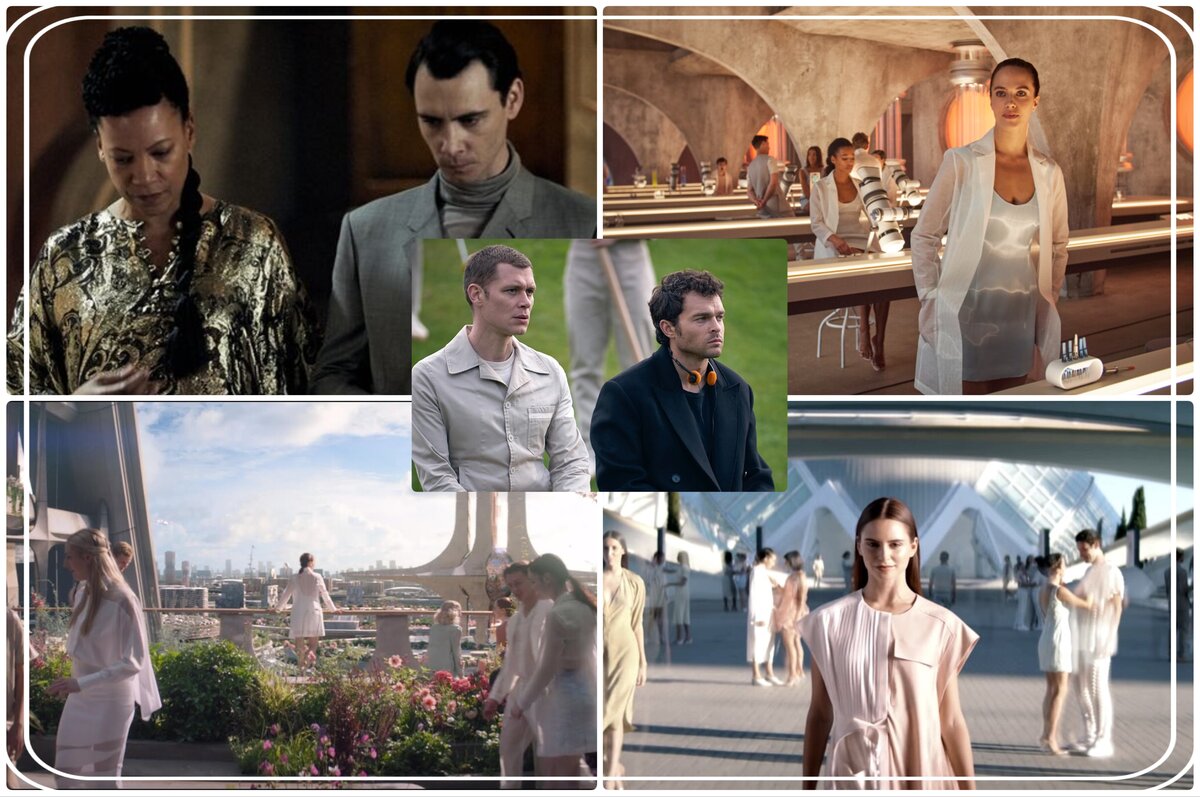
Montage of images from 2020 film of ‘Brave New World’
.
While Orwell criticizes Zamyatin’s book as being “less well put together—it has a rather weak and episodic plot which is too complex to summarize,” he praises it for making a political point that according to him Huxley’s book lacks (for the record, I disagree with Orwell on this; Huxley’s political point is just more subtle, just as his characters are). Orwell found Zamyatin’s We more convincing and relevant than Huxley’s Brave New World given that in the technocratic totalitarian state of We “many of the ancient human instincts are still there,” not eradicated by eugenics and medication (such as soma). Citing the many executions in Zamyatin’s Utopia, all taking place publicly in the presence of the Benefactor and accompanied by “triumphal odes recited by the official poets”, Orwell suggested that, “It is this intuitive grasp of the irrational side of totalitarianism—human sacrifice, cruelty as an end in itself, the worship of a Leader who is credited with divine attributes—that makes Zamyatin’s book superior to Huxley’s.”
1976 Penguin cover of ‘Brave New World’ cover; ‘1953 Signet cover of Nineteen Eighty Four’
.
Noam Chomsky considered We more perceptive than Brave New World or 1984, the latter which he called “wooden and obvious” despite clever and original nuances such as “newspeak,” which provided a medium for the world view and principles of Ingsoc and to make other forms of thought impossible (“it’s a beautiful thing, the destruction of words…” says Syme in 1984). I agree with Chomsky. Next to the bleak and hopeless polemic of Nineteen Eighty-Four, We is less dialectic, more visceral, it is full-bodied, ribald, tender, emotional and immediate. But above all, it is hopeful. Again, Mirra Ginsburg says it best:
“We is more multifaceted, less hopeless than Orwell’s 1984, written more than twenty-five years later and directly influenced by Zamyatin’s novel. Despite its tragic ending, We still carries a note of hope. Despite the rout of the rebellion, ‘there is still fighting in the western parts of the city.’ Many ‘numbers’ have escaped beyond the Wall. Those who died were not destroyed as human beings—they died fighting and unsubmissive. And though the hero is reduced to an obedient automaton, certain that “Reason” and static order will prevail, though the woman he loved briefly and was forced into betraying dies (as do the poets and rebels she led), the woman who loves him, who is gentle and tender, is safe beyond the Wall. She will bear his child in freedom. And the Wall has been proved vulnerable after all. It has been breached—and surely will be breached again.”
Mirra Ginsburg, on ‘We’
Image by Amazon media
.
It may seem like a tragic end, particularly for the two main protagonists: D-503 is lobotomized into an obedient drone of the sterile system and betrays his lover; I-330 is no doubt liquidated under The Machine, after refusing to submit and betray her comrades. To the end, she is the messenger of hope and resilience and the force for removal of barriers. The wall does come down–even if for just a moment towards the end of the book–and the Green Wind blows furiously through the land, bringing with it birds and other creatures previously unseen along with the scent of change.
Zamyatin’s We is ultimately a cautionary tale on the folly of logic without love and a profound call to connect to our natural world to nurture our souls. Before he is rendered inert by the Great Operation, D-503 gives O-90 a child. It is no mistake that O-90, who tenderly and selflessly loved and refused to surrender her child to the One State, makes it outside (with the help of I-330) into the natural world. Driven by love (not rationality), she represents the future.
Cedar swamp forest, Trent Nature Sanctuary, ON (photo and rendition by Nina Munteanu)
.
About the Author and His Work
Yevgeny Zamyatin was born in 1884 in Lebedyan, Russia, which according to Mirra Ginsburg was “one of the most colourful towns in the heart of the Russian black-earth belt, some two hundred miles southeast of Moscow—a region of fertile fields, of ancient churches and monasteries, of country fairs, gypsies and swindlers, nuns and innkeepers, buxom Russian beauties, and merchants who made and lost millions overnight.”
Showing influences by Jerome K. Jerome’s 1891 short story The New Utopia and H.G. Wells’ 1899 novel When the Sleeper Wakes and the Expressionist works of Kandinsky, Yevgeny Zamyatin created We in 1920. His political satire was denied publication in Russia but Zamyatin managed to smuggle the manuscript to New York, where it was published in English in 1924 by Dutton. Mirra Ginsburg writes of Zamyatin’s death in 1937: “[it] went unmentioned in the Soviet press. Like the rebellious poet in We, and like so many of the greatest Russian poets and writers of the twentieth century, he was literally ‘liquidated’—reduced to nonbeing. His name was deleted from literary histories and for decades he has been unknown in his homeland.” The first publication of We in Russia had to wait until 1988—after more than sixty years of suppression—when glasnost resulted in it appearing alongside Orwell’s 1984.
Zamyatin called We “my most jesting and most serious work.” His credo, written in 1921 in I am Afraid, proclaimed that “true literature can exist only where it is created, not by diligent and trustworthy officials, but by madmen, hermits, heretics, dreamers, rebels, and skeptics.”
We directly inspired the following literary works: Brave New World by Aldous Huxley, Invitation to a Beheading by Vladimir Nabokov, Anthem by Ayn Rand, Nineteen Eighty-Four by George Orwell, Player Piano by Kurt Vonnegut, Logan’s Run by William F. Nolan and George Clayton, This Perfect Day by Ira Levin, and The Dispossessed by Ursula K. Le Guin.
The Penguin classics edition describes We as “the archetype of the modern dystopia, or anti-Utopia: a great prose poem detailing the fate that might befall us all if we surrender our individual selves to some collective dream of technology and fail in the vigilance that is the price of freedom.”
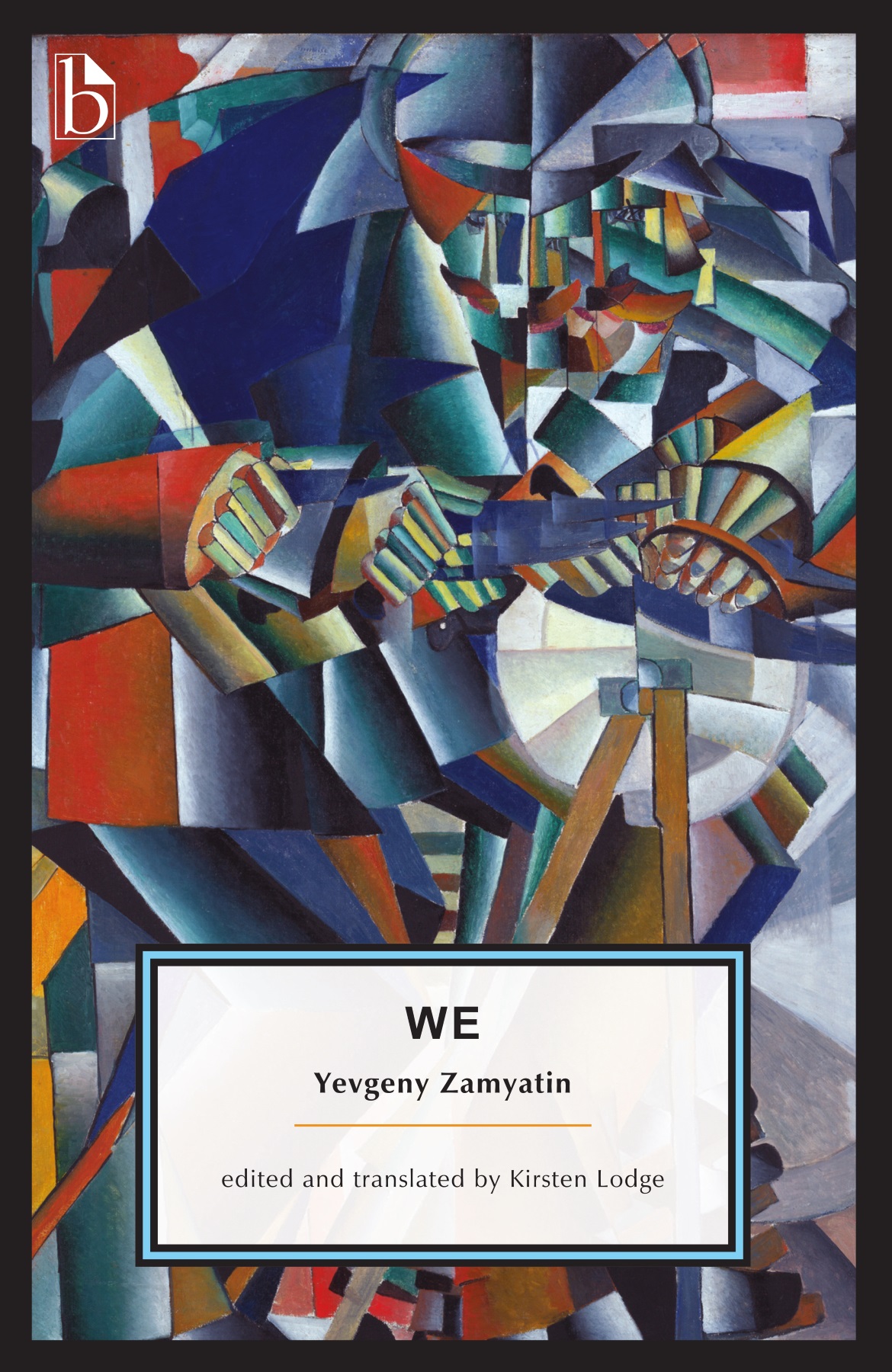
“We,” Broadview Press edition
Nina Munteanu is a Canadian ecologist / limnologist and novelist. She is co-editor of Europa SF and currently teaches writing courses at George Brown College and the University of Toronto. Visit www.ninamunteanu.ca for the latest on her books. Nina’s bilingual “La natura dell’acqua / The Way of Water” was published by Mincione Edizioni in Rome. Her non-fiction book “Water Is…” by Pixl Press (Vancouver) was selected by Margaret Atwood in the New York Times ‘Year in Reading’ and was chosen as the 2017 Summer Read by Water Canada. Her novel “A Diary in the Age of Water” was released by Inanna Publications (Toronto) in June 2020.
“We hold ourselves apart from our profligate nature. But we aren’t unique. We are more part of Nature than we admit. Using the thread of epigenetics and horizontal gene transfer, Nature stitches in us a moving tapestry of terrible irony. The irony lies in our conviction that we were made in the inimitable divine image of God. That we are special. Water flows endlessly through us, whether we are devout Catholics or empty vessels with no purpose. Water makes no distinction. It flows through us even after we bury ourselves.”
Lynna Dresden
A Diary in the Age of Water is “Unsettling and yet deliciously readable … Brilliant.”
THE PRAIRIE BOOK REVIEW
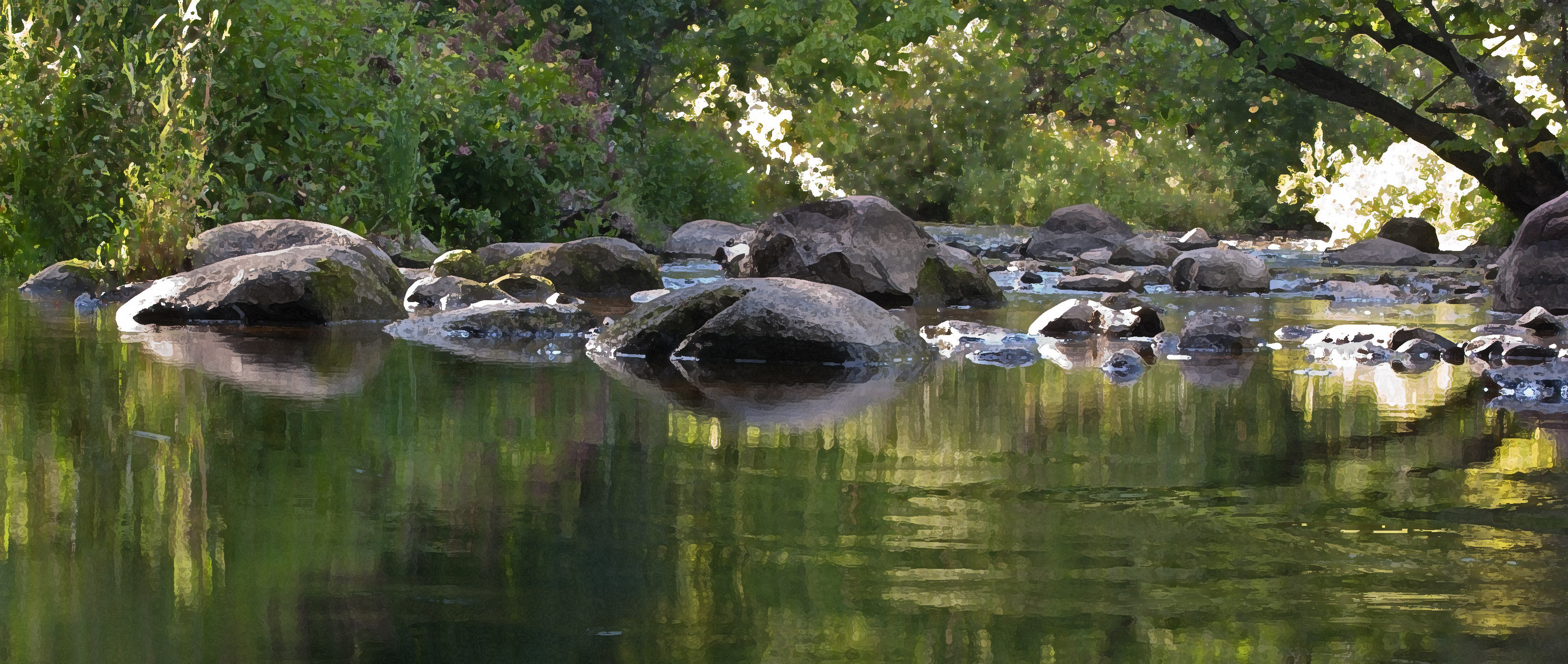
Swamp forest by country road, Kawarthas, ON (photo and rendition by Nina Munteanu)
In the “Hero’s Journey” myth, Elysium (or the Elysium Fields in Greek mythology) is the paradise that true heroes go to when they die (think of Frodo in Lord of the Rings and the hero in The Gladiator). To the ancient Greeks, Elysium was a place at the ends of the earth where heroes, favoured by the gods for their altruism, went. It is a state or place of perfect happiness; the equivalent of Heaven.
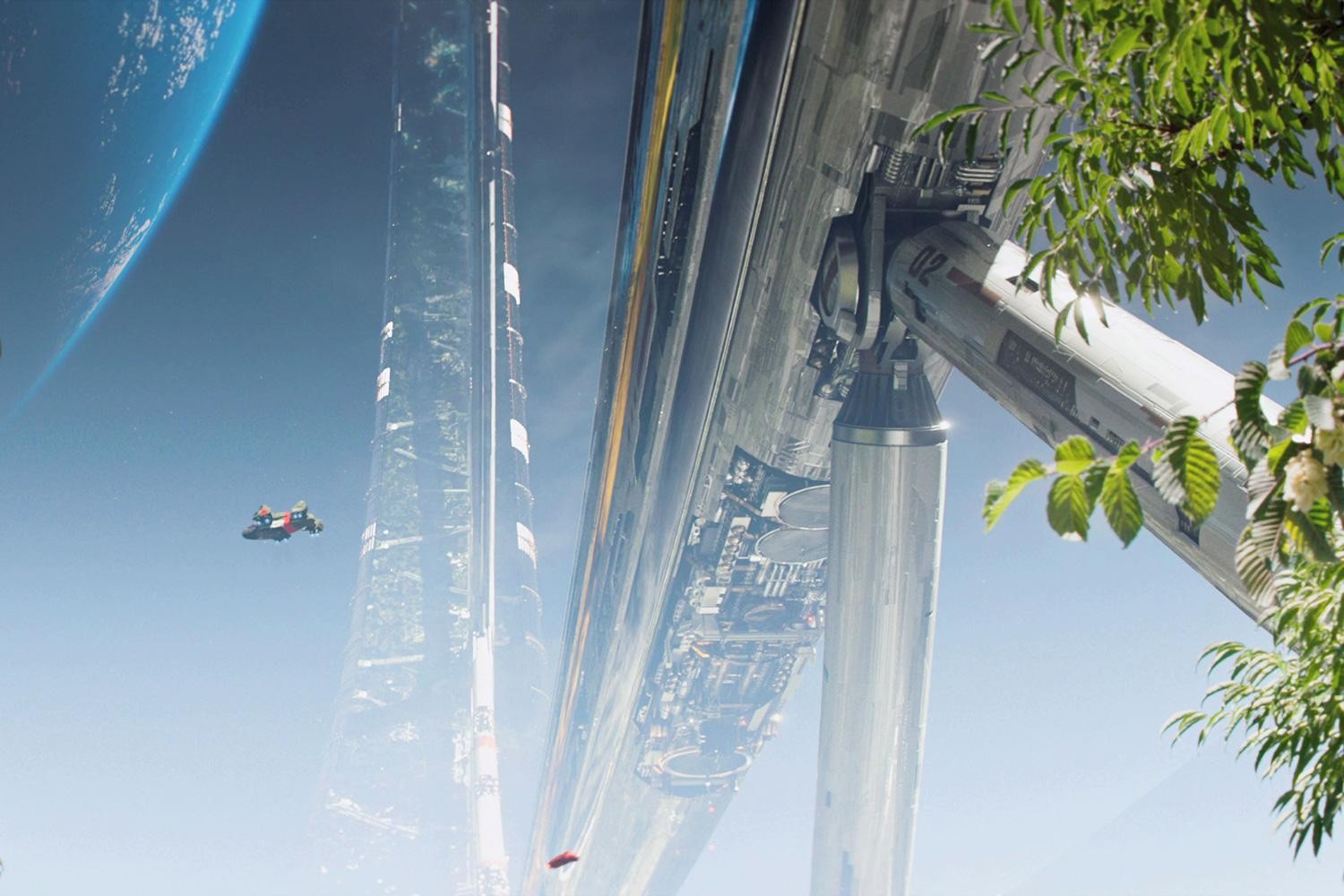
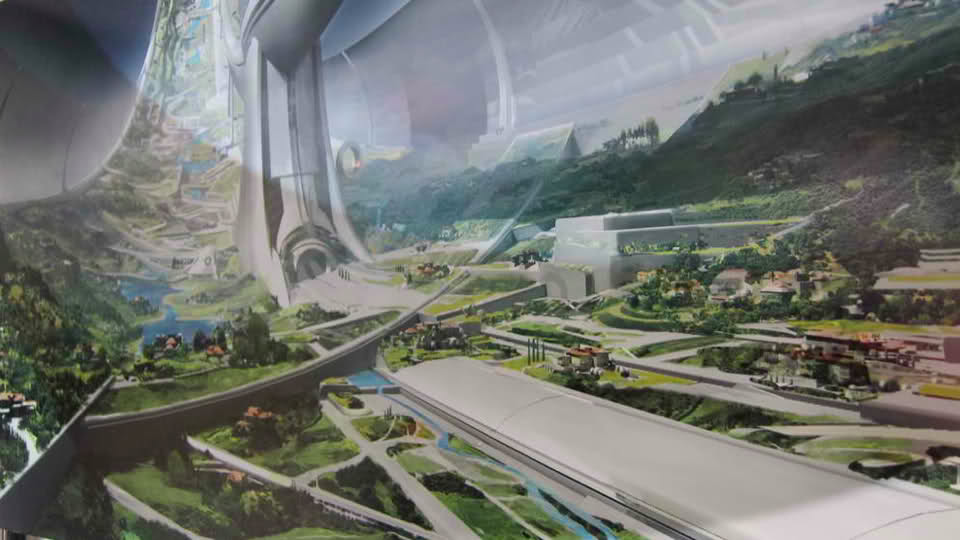
Elysium is also the name given to the Earth-orbiting space station of Neill Blomkamp’s (District 9) new science fiction political allegory of the same name. Elysium is where the privileged live in luxury and perfect health (thanks to health-pods) — after they abandoned Earth to the squalor they no doubt helped create. This is not made clear enough for me and is one of the film’s major weaknesses, in my opinion (more on that below).
Earth seen from Elysium
The year is 2154 in a Los Angeles that strangely resembles the slum shanties of Johannesburg, South Africa (where Blomkamp filmed District 9). We soon learn that Earth struggles in the mire of humanity’s waste in a state of general social strife. Abandoned by the wealthy elite (who have moved to Elysium), the rest of an overpopulated humanity lives in the squalor of abject poverty without food, healthcare, or the motivation to live. I, for one, would have liked to know a little of how humanity devolved so dramatically on a planetary scale.
A Different Hero’s Journey
From the time he was a young orphan, Max Da Costa (Matt Damon; Maxwell Perry Cotton) dreamed of going to Elysium, its impressive phantom form visible in the daytime sky. He promised his childhood love Frey (sympathetically played by Alice Braga and Valentina Giros) that he would take her there, to paradise. His mentor, a kind mother-figure nun at the orphanage, gives him the hero’s talisman (a locket with a picture of Earth inside), and prophesizes, “Es su destino hacer algo maravilla cuando tu es hombre” (“It is your destiny to do something great when you are a man”). She reminds him that when he gets to Elysium, he will see the most beautiful thing: planet Earth. “You see how beautiful it is,” she says to him as he gazes out at the ghost of Elysium in the sky. Then, as she hands him the locket with Earth inside, she adds, “look how beautiful we are from there. Never forget where you come from.” Seen from this perspective, the planet Earth is a beautiful thing to behold.
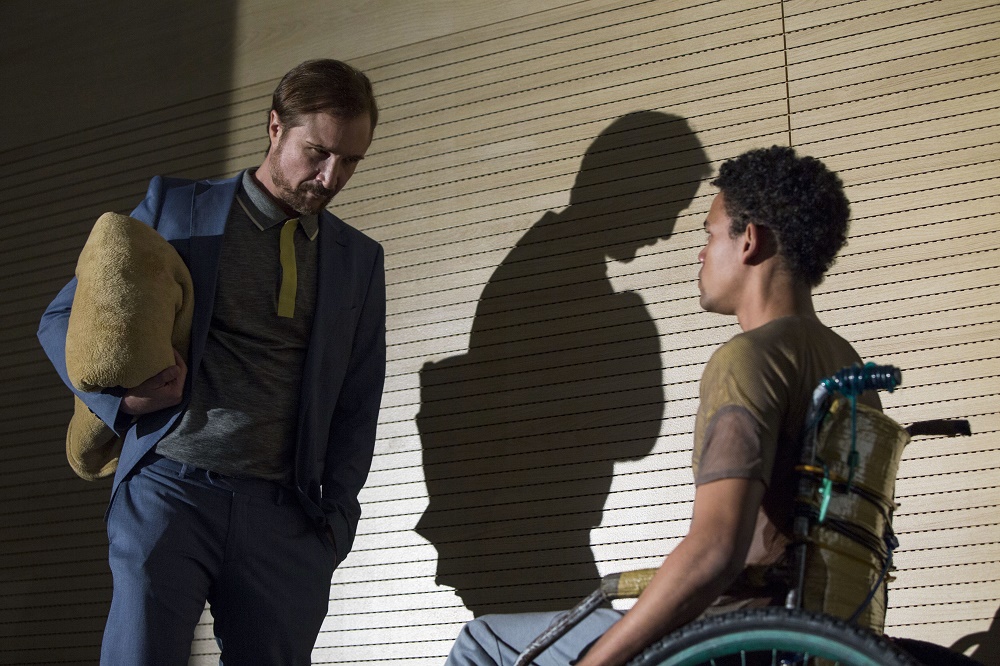
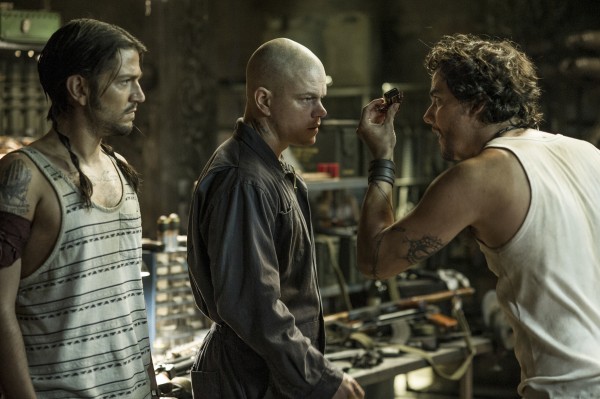
Max and Spider share a heated conversation
Max is a reformed criminal who, like Blomkamp’s “workaday” anti-hero in District 9 (Sharlto Copley), is not very hero-like until the last five minutes of the film, when he has his personal epiphany and decides to act altruistically rather than self-servingly. This is a pattern that Blomkamp has used before; the reluctant-hero (Wikus Van De Merwe) of District 9 was an unimpressive man with many obvious blemishes. A rather unlikeable man until he makes his heroic decision in the end. This is where Blomkamp’s heroes differ from most action movie heroes, who generally start their journey from higher positions on the evolutionary scale. Blomkamp’s heroes must journey farther to gain their hero-status; they are perhaps more realistic portrayals of ordinary men who finally shine under extra-ordinary circumstances. Men who we start out disliking—hating, even—but find ourselves cheering for, perhaps even crying for. Max’s behaviour defines that true hero: rising from his need to save himself to his quest to save humanity—at the cost of his own life. But, as with the ordinary man, it is only when he connects a personal quest to save the daughter of his first love to his global quest to save Earth that Max transforms into the altruistic mythic hero he is destined to become. Everything came together at the film’s end, in a montage of scenes that depict the locket of the planet Earth in his dying hand (Earth is Home; save the planet), the demise of a police state, the saviour of his love’s daughter, and med-pods landing on Earth to dispense aid to the dying masses.
Elysium orbiting the Earth
A Story About the Planet Earth
Ironically, it is to do with our beloved planet Earth that I felt in Elysium the most discord in plot/thematic story treatment and lack of resonance. Blomkamp begins with the planet and he ends his film with the planet. The symbolism is clear: in the stylish shots of Earth seen from Elysium (and vice versa); in the strategic scenes of Max and the image in his precious locket of not his childhood love Frey but of planet Earth; and his mentor’s advice to Max, delivered in one of the most powerful scenes of the movie. Yet, Blomkamp fails to follow through to give us that visceral connection. Why is the planet so important? How is Max connected to it or anyone else, for that matter. What is Spider’s story (Wagner Moura), a latter-day Che-Guevara, who fervently leads the proletarian rebellion of Earth? Who, why and how did the planet come to be so destroyed? There is not one ounce of suggestion, backstory or context. This is an important consideration; because without it, instead of feeling total resolution and redemption in the end, I felt a disconnect to those masses being helped and even some distrust in their fate and direction. Instead of feeling true victory, I felt ambivalence.
Called a “sci-fi socialist film” by P.J. Gladnick of Newsbusters.org, Elysium is clearly an attempt at examining and dramatizing the social segregation of humanity and economic fascism: a dystopia that promises commentary on social and economic issues in society today. However, I felt that its delivery was compromised by Blomkamp’s choice to focus more on action tech at the expense of good backstory, context and empathic character development. I’m not saying that it’s a bad story. It is a very good story; it’s just that it could have been a great story. The heart of the story—delivered through the main protagonist—lacks the global connection it could have had. This is not, as some reviewers suggest, due to any infirmity of the hero, his antagonists, or lack of symbolism (of which there is much), but the lack of context, backstory and richness of setting (I’m not talking about the visible setting, which was spectacular, elegant and stylish). It comes back to how each character relates to “home”, the planet, and to each other.
Matt Goldberg of Collider.com says that, “Elysium‘s message about economic inequality is couched in a finely-drawn sci-fi world, but the power of that message becomes diminished when we cease to care about the messenger.” Detroit News Tom Long added that, “Elysium is the sort of big, noisy sci-fi film that seems to want to say something but opts instead to concentrate on fight scenes involving gimmickry.” While I appreciated the depth and breadth of Blomkamp’s references to pop culture from an Armani-clad female Darth Vader to the Judeo-Christian references and symbolism, it just didn’t hold its promise.
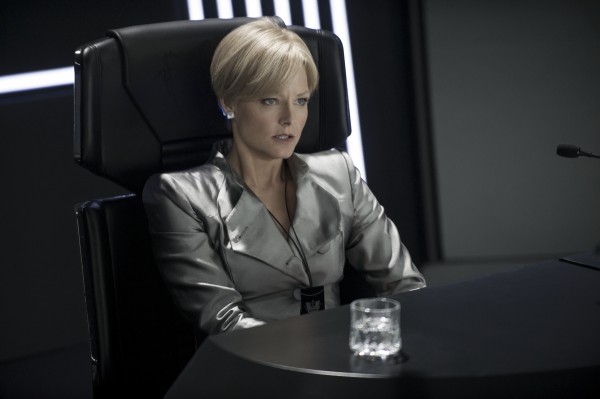
Jodi Foster plays Defence Secretary Delacourt, the threshold guardian of Elysium
What began as a promising exploration about an important social issue, devolved into a sequence of ever-escalating gratuitous gore and violence—clearly aimed for a different audience.
Elysium
Nina Munteanu is a Canadian ecologist / limnologist and novelist. She is co-editor of Europa SF and currently teaches writing courses at George Brown College and the University of Toronto. Visit www.ninamunteanu.ca for the latest on her books. Nina’s bilingual “La natura dell’acqua / The Way of Water” was published by Mincione Edizioni in Rome. Her non-fiction book “Water Is…” by Pixl Press (Vancouver) was selected by Margaret Atwood in the New York Times ‘Year in Reading’ and was chosen as the 2017 Summer Read by Water Canada. Her novel “A Diary in the Age of Water” was released by Inanna Publications (Toronto) in June 2020.
“When you look at a deep pond, you don’t see the bottom. Instead, you see yourself reflected there. The calmer the pond, the more you see of you, the less of the pond.”
Lynna Dresden
A Diary in the Age of water is “delightfully unique … a story where there is a lot more underneath the gleaming surface.”
The Otonabee River under rosy haze from northeastern wildfires, ON (photo and rendition by Nina Munteanu)
It was pleasantly cool yesterday evening during my walk along the Otonabee River. Over the day, the smell of ‘campfire’ smoke from the raging northern wildfires intensified and the sun became an eerie copper disk in the peach-coloured sky. The river had gone still, as if hushed and waiting beneath the cloud of haze. Houses along the shore had become fluid watercolour paintings, colours and textures blending in a soft fabric of grey and green. As I set my gaze on a favourite cottage by the river, its reflection caught in the still waters, I thought the scene beautiful…
My heart then reminded me that this wasn’t a mist rising off the river but the yellow-brown dust descending from the corpses of millions of burnt trees, sent here by a cruel northeast wind.
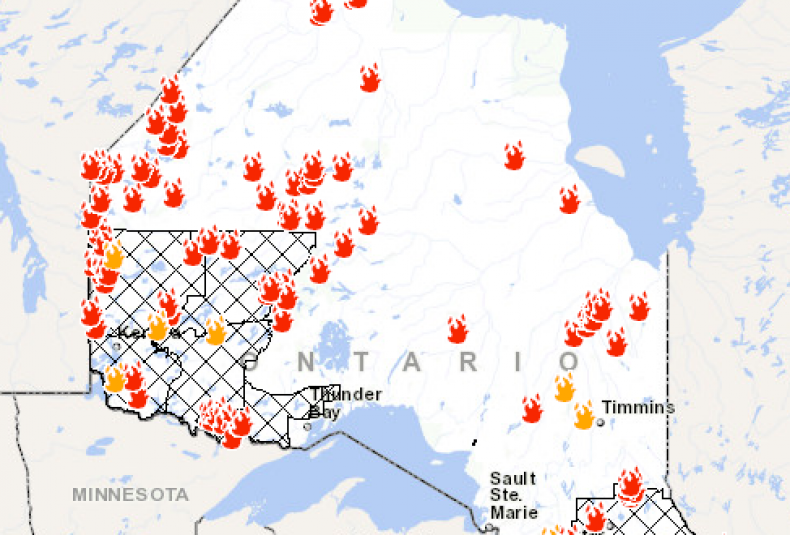
Map of Ontario wildfires June 5, 2023
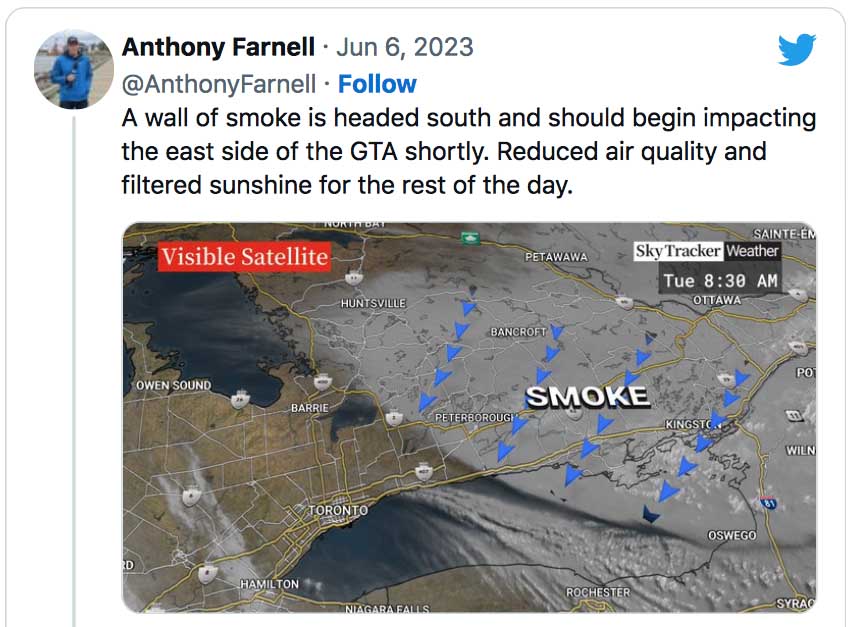
Today, the Ontario government reported heavy smoke conditions in the Northeast Region due to a large number of fires in eastern Ontario and Quebec—with fires worse than usual this year in Quebec. More than 160 fires are burning, most out of control, in Quebec. Smoke drift is travelling as far as just north of Timmins, down through Sudbury and past Parry Sound. Environment Canada issued Air quality warnings today for Peterborough, where I currently live.
Global News reported today that “relentless wildfires have devoured 3.3 million hectares of land across Canada so far this year—roughly 10 times the normal average for the season.” In the last 24 hours, 21 new fires were discovered across Ontario, amounting to 159 active fires provincially. According to Global News, “Searing hot, tinder-dry conditions, similar to what was seen in western Canada, has only worsened the situation in Ontario.” And Quebec.
Map of Quebec wildfires June 5, 2023
Sun setting over smoky Otonabee River, ON (photo by Nina Munteanu)
There is an old willow tree on the river bank by the path I walk daily. Its massive arms stretch out over the water and one arm leans low over the path so you must bend down to walk under it. The derecho last May had cracked the tree open. But the sturdy willow continues on, undaunted, as all Nature does, thrusting up suckers from its large limbs toward a future of many more willows. It’s a favourite tree of many a walker who like to sit on its generous arms and look out over the river. Each day I touch its bark and say hello.
Old willow on the path by the Otonabee River, the glow of smoke-sun on its generous arms (photo by Nina Munteanu)
New suckers burst out of the leaning willow limb (photo by Nina Munteanu)
I think of my old friend. How a fire would take it.
First its leaves would sizzle and take flight in a requiem dance. The trunk, a funnel of fire and smoke, would sway and groan then crack with a final death shout to the roaring hissing fire. Like flying kites, leaf corpses would join embers of curling bark and soar in a vortex of billowing coal black fury. The river would flow through a killing field, black stumps and burned debris flying with the vagaries of a mischievous wind. Covered in a film of thick and oily debris, the lonely river would grow dark and surly, smothering its own aquatic forest—the algae, benthic invertebrates and fish.
And I would weep…
Sun setting over hazy forest at mouth of Thompson Creek, ON (photo by Nina Munteanu)
Nina Munteanu is an ecologist and internationally published author of award-nominated speculative novels, short stories and non-fiction. She is co-editor of Europa SF and currently teaches writing courses at George Brown College and the University of Toronto. Visit www.ninamunteanu.ca for the latest on her books. Nina’s recent book is the bilingual “La natura dell’acqua / The Way of Water” (Mincione Edizioni, Rome). Her latest “Water Is…” is currently an Amazon Bestseller and NY Times ‘year in reading’ choice of Margaret Atwood.





















 Nina Munteanu Writing Coach