Place as Character in Literature

Place ultimately portrays what lies at the heart of a story. Place as character provides an archetype that story characters connect with and navigate in ways that depend on the story’s theme, particularly in allegories that rely strongly on metaphor. Theme is essentially the “so what part” of a story; what is at stake for the character on their journey. Theme is the backbone—the heart—of the story, driving characters to journey through time and place toward some kind of fulfillment. There is no story without theme. And there is no theme without place.

When place is the environment—a forest, meadow, swamp or heathland—the author has an opportunity to go beyond simple backdrop, even beyond deeper metaphor, to intimately portray the voice of ‘the Other.’ Eco-literature brings awareness to environment as ‘Other’; eco-literature intimately explores humanity’s role in defining ‘the Other’ by portraying environment on a journey as character with agency and sometimes with voice—often through character coupling. Nineteenth Century author Thomas Hardy recognized the tenuous position of wilderness during Victorian Britain with increasing industrialization and urbanization. Taming Nature to achieve ordered beauty had become an obsession; Hardy recognized this and mourned the loss of pre-industrial agrarian landscapes to human greed and modernization.

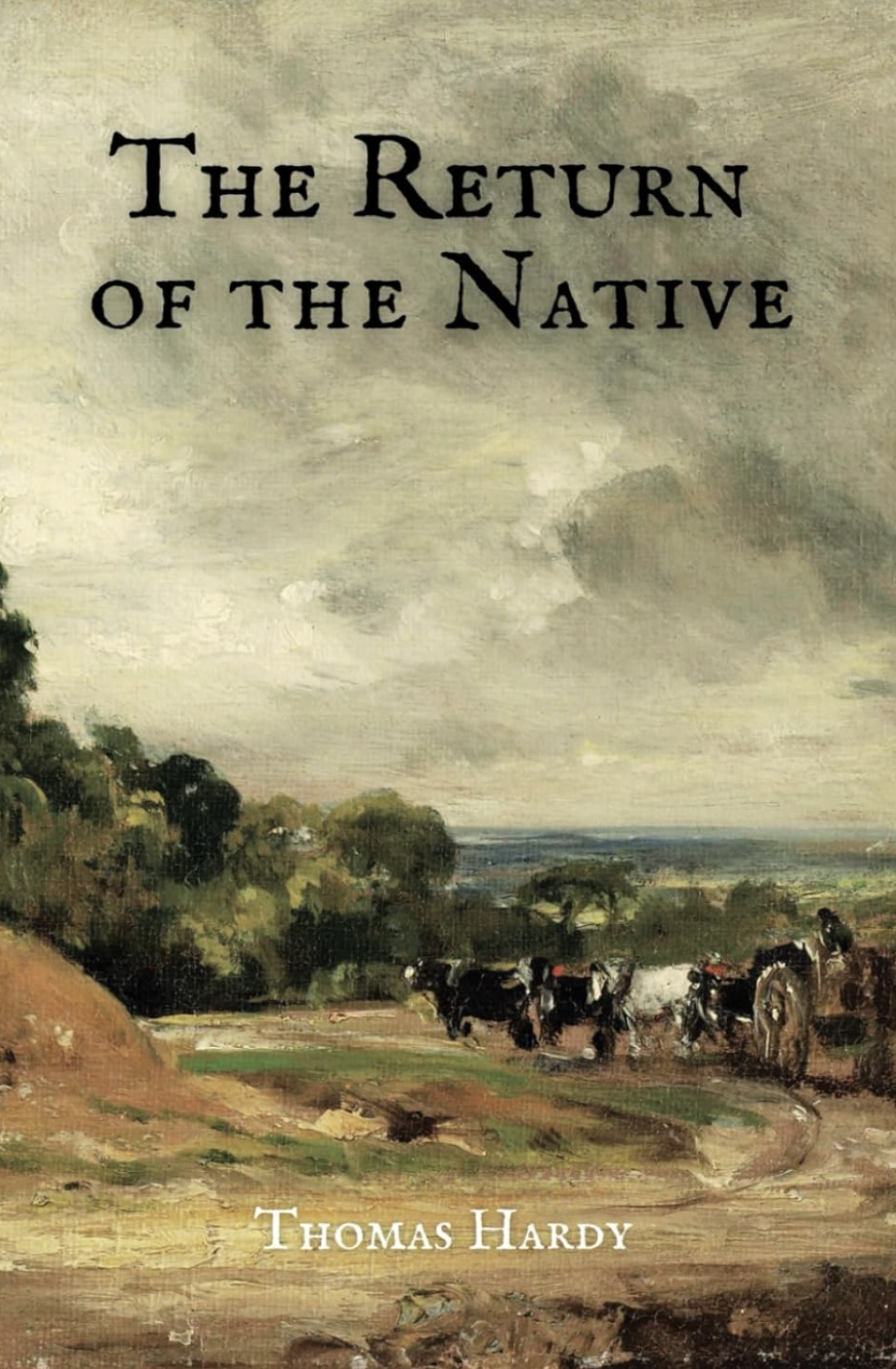
Thomas Hardy’s Heath: Return of the Native
For Victorian author Thomas Hardy, trees, meadows, winding brooks and country roads were far more than back-drop for his world and his stories. Elements of the natural world were characters that impacted other characters in a world dominated by nature.

Perhaps best known for his melancholic stories of fatalistic, ironic tyrannies, Thomas Hardy wrote with a tender and poetic sensibility about Nature, and particularly the heath where he grew up. All of Hardy’s writings embody a strong sense of place. Nature—like his omniscient narrative form—lies beyond the scope of humanity: vast, amoral, and unfathomed; and yet, inextricably linked to the feckless actions of its humans. Egdon Heath in Return of the Native remains one of Hardy’s most enduring characters and best examples of the power of place in story. 

Author D.H. Lawrence evocatively personified Hardy’s bleak heathland: “Egdon, whose dark soil was strong and crude and organic as the body of a beast.”

Egdon Heath is a metaphoric black hole from which no light escapes. None of Hardy’s characters escape the embrace of this behemoth. Dark, swarthy and associated with the night: “The face of the heath by its mere complexion added half an hour to evening; it could in like manner retard the dawn, sadden noon, anticipate the frowning storms scarcely generated, and intensify the opacity of a moonless midnight to a cause of shaking dread.” Each character is touched by the heath’s brooding grip and each feels its power differently: hapless Wildeve; idealist Clym; desperate Eustacia and suffering Thomasin. 

Cixin Liu’s Forests: The Three Body Problem
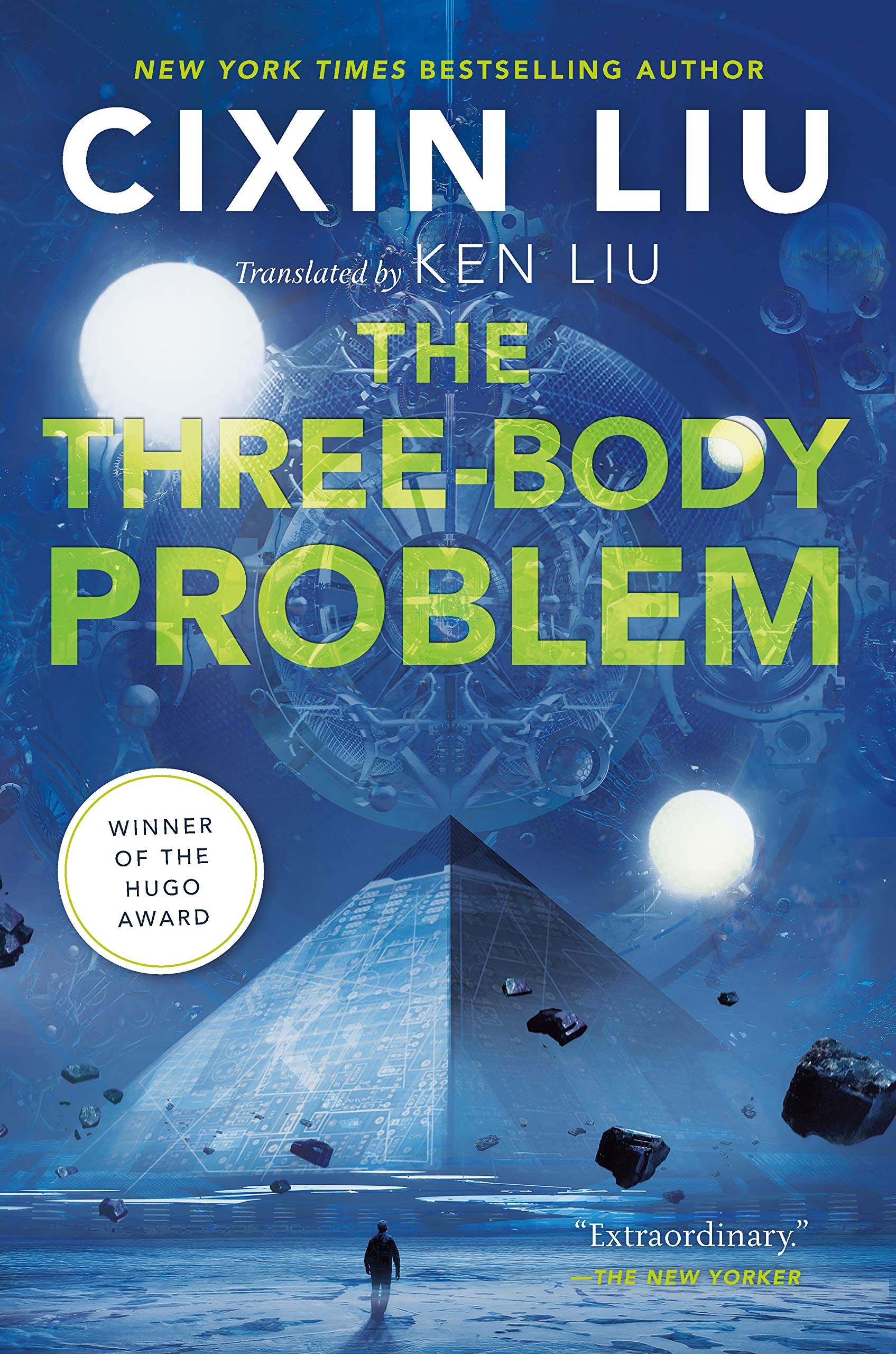
Cixin Liu’s The Three Body Problem—set against the backdrop of China’s Cultural Revolution—follows Wenji Ye, disillusioned by the massive environmental deforestation in the labour camps she is sent to work: 

Her company wielded hundreds of chain saws like a swarm of steel locusts, and after they passed, only stumps were left. The fallen Dahurian larch, now bereft of branches, was ready to be taken away by tractor. Ye gently caressed the freshly exposed cross section of the felled trunk. She did this often, as though such surfaces were giant wounds, as though she could feel the tree’s pain … The trunk was dragged away. Rocks and stumps in the ground broke the bark in more places, wounding the giant body further. In the spot where it once stood, the weight of the fallen tree being dragged left a deep channel in the layers of decomposing leaves that had accumulated over the years. Water quickly filled the ditch. The rotting leaves made the water appear crimson, like blood.

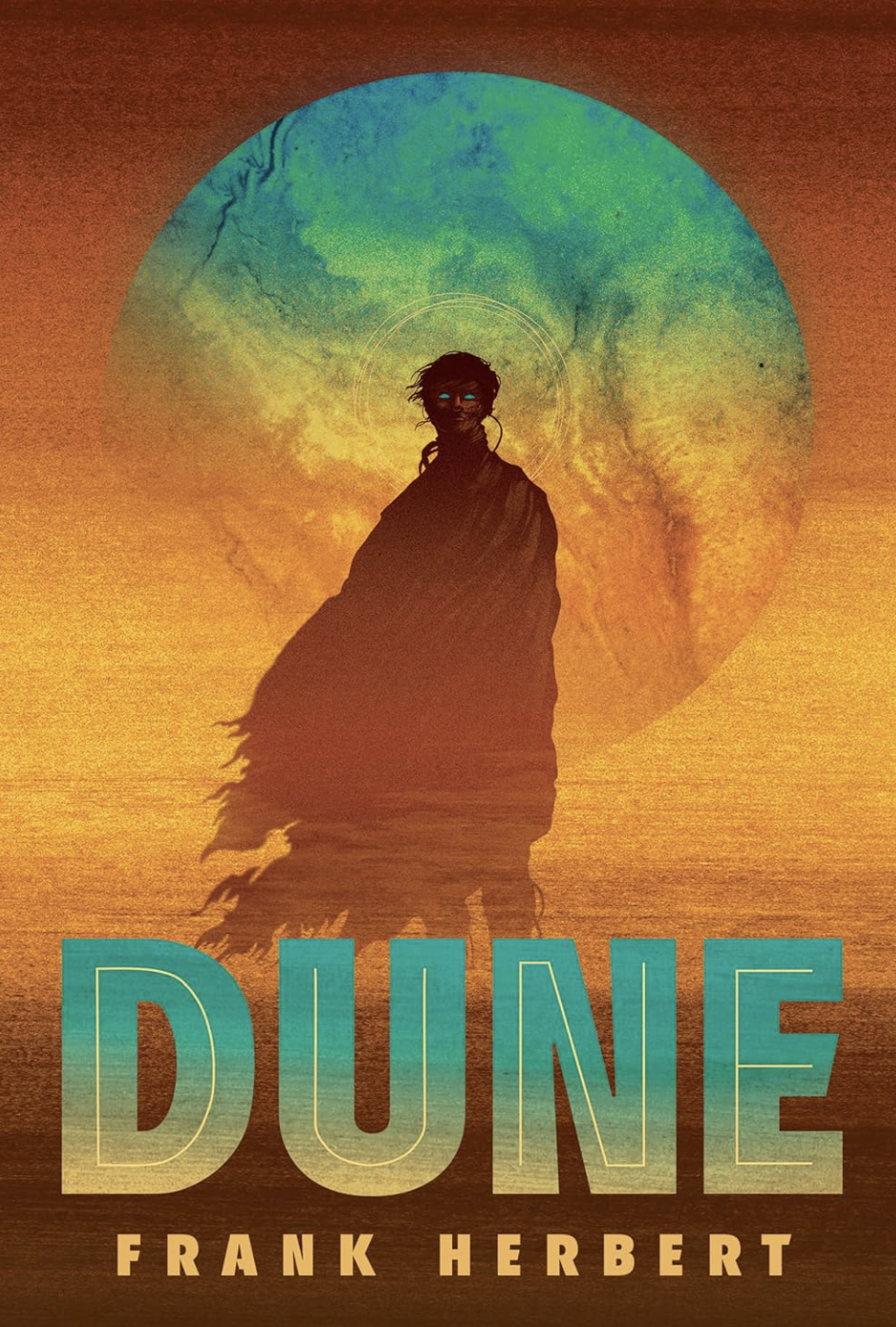
Frank Herbert’s Desert: Dune

Frank Herbert’s Dune chronicles the journey of young Paul Atreides, Duke Leto’s son, who according to the indigenous Fremen prophesy will eventually bring them freedom from their enslavement by the colonialists—The Harkonens—and allow them to live unfettered on the planet Arrakis, known as Dune. 

But, as the title of the book clearly reveals, this story is about place—a harsh desert planet whose 800 kph sandblasting winds could flay your flesh—and the power struggle between those who covet its arcane treasures and those who wish only to live free from slavery. Place—and its powerful symbols of desert, water and spice—lies at the heart of this epic story about taking, giving and sharing. When he thinks of Dune, the newly placed Duke Atreides uses water metaphors: “He sighed, glanced back at the dry landscape where the flowers were gone now—trampled by the dew gatherers, wilted under the early sun.”

“The desert stretched out like a static ocean. [It] lay there full of moon-silvered waves—shadows of angles that lapsed into curves and, in the distance, lifted to the misted gray blur of another escarpment.”

The immense sandworms of Frank Herbert’s Dune are strong archetypes of Nature—large and graceful creatures whose movements in the vast desert sands resemble the elegant whales of our oceans: 

It came from their right with an uncaring majesty that could not be ignored. A twisting burrow-mound of sand cut through the dunes within their field of vision. The mound lifted in front, dusting away like a bow wave in water.

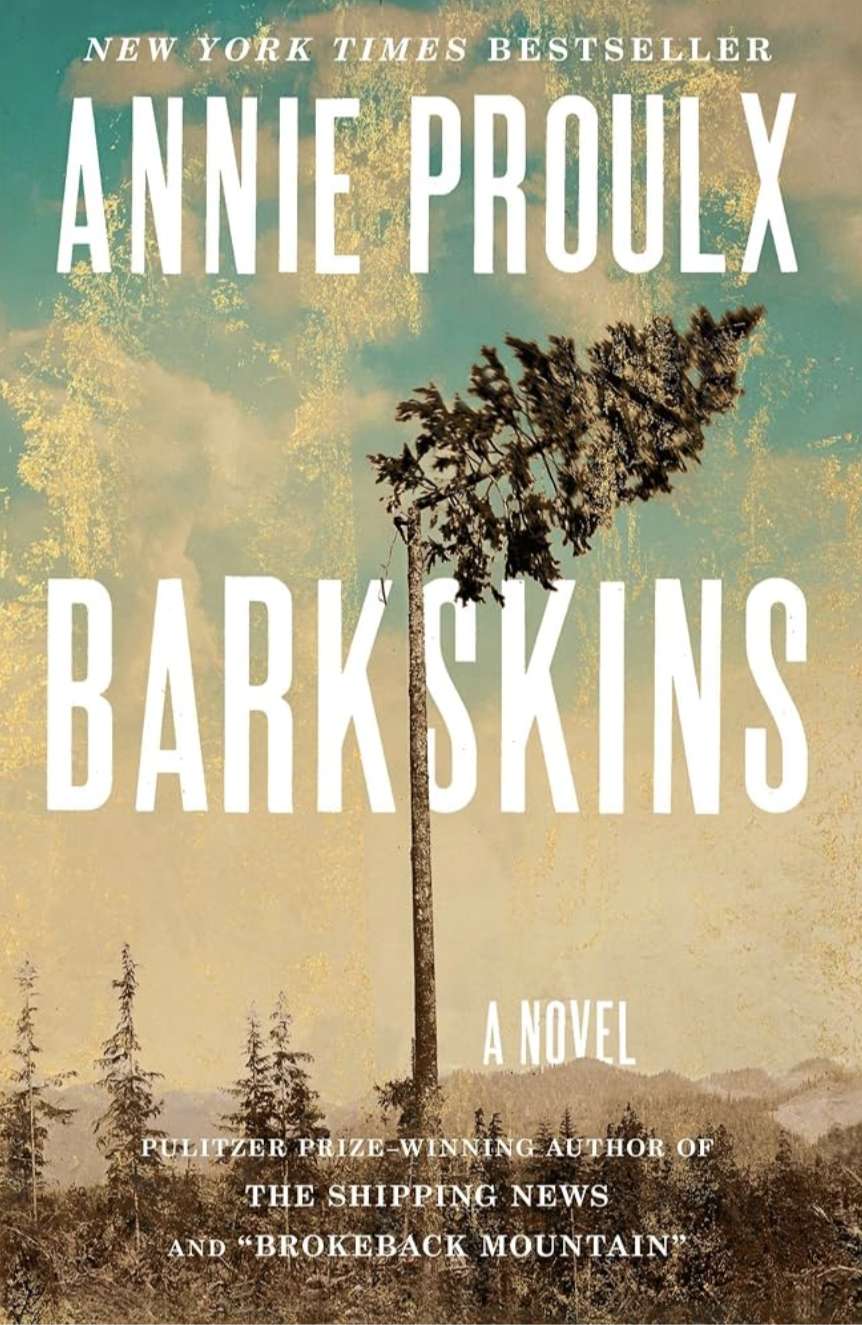
Annie Proulx’s Forest: Barkskins

The opening combines subtle to obvious images of an “unwelcoming” wilderness—as dark behemoth—and foreshadows the forest’s eventual destruction by settlers intent on conquering Nature. Proulx’s 300-year saga starts with the arrival of the Europeans in Canada’s pristine forest 

Within the first ten pages we gain a rich and potent collage of first impressions by the settlers of “the moody darkness” of the New France forest, previously only seen by the “sauvages.” The barkskins “tramped up the muddy path toward a line of black mist … In a few hours the sodden leaf mold gave way to pine duff. Fallen needles muted their passage, the interlaced branches absorbed their panting breaths … evergreens larger than cathedrals, cloud-piercing spruce and hemlock. The monstrous deciduous trees stood distant from each other, but overhead their leaf-choked branches merged into a false sky, dark and savage …They walked on through the dim woods, climbing over mossy humps, passing under branches drooping like funeral swags,” hearing pines hissing in the wind,” and crossing “snarling water,” and “swarms of mosquitoes in such millions that their shrill keening was the sound of the woods.” 

These bleak impressions of a harsh environment crawling with pests such as bébites and moustiques underlie the combative mindset of the settlers to conquer and seize what they can of a presumed infinite resource. By page seventeen, we know that mindset well. René asks why they must cut so much forest when it would be easier to use the many adequate clearings to build their houses and settlements. Trépagny fulminates: “Easier? Yes, easier, but we are here to clear the forest, to subdue this evil wilderness.” 

For them, the vast Canadian boreal forest was never-ending and for the taking: “It is the forest of the world. It is infinite. It twists around as a snake swallows its own tail and has no end and no beginning,” Trépagny claims. 

Richard Power’s Forest: The Overstory
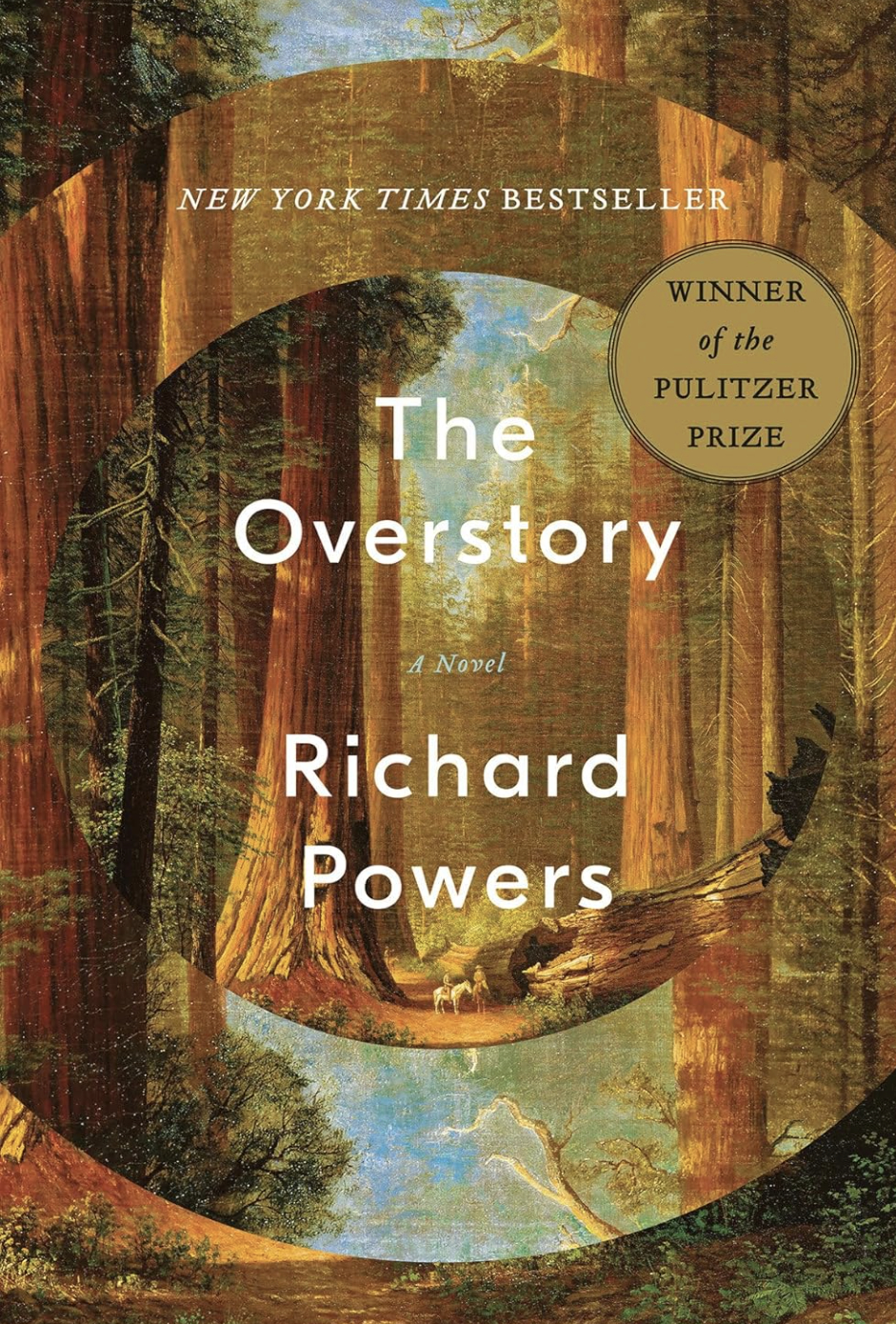
Richard Powers’s The Overstory follows the life-stories of nine characters and their journey with trees. At its heart is the pivotal life of botanist Patricia Westerford, whose work resembles that of UBC’s Suzanne Simard. Westerford is a shy introvert who discovers that trees communicate, learn, trade goods and services—and have intelligence. When she shares her discovery, she is ridiculed by her peers and eventually loses her position at the university.

Like the marcescent beech, Patricia finds herself asynchronous with the rest of the forestry department at Purdue, in fact with the entire forestry discipline in the country. She disagrees with their edict of needing to “clean the forest of snags and wind throw to improve forest health.” She disagrees with their use of terms like thrifty young forests and decadent old forests, mean annual increment and economic maturity—not ecological but economic terms based on exploitation and human utility.

Patricia’s early conviction that these silent trees are social creatures, sets her on a singular path that will push the boundaries of doctrine and a hegemony of human utility. She assiduously sets out to prove her premise of social trees and in so doing, becomes the forest. “She works all day in the woods, her back crawling with chiggers, her scalp with ticks, her mouth filled with leaf duff, her eyes with pollen, cobwebs like scarves around her face, bracelets of poison ivy, her knees gouged by cinders, her nose lined with spores, the backs of her thighs bitten Braille by wasps, and her heart as happy as the day is generous.” Like Ovid, she is becoming.  

Patricia writes in her book The Secret Forest

There are no individuals in a forest, no separable events. The bird and the branch it sits on are a joint thing. A third or more of the food a big tree makes may go to feed other organisms. Even different kinds of trees form partnerships. Cut down a birch, and a nearby Douglas fir may suffer … Fungi mine stone to supply their trees with minerals. They hunt springtails, which they feed to their hosts. Trees, for their part, store extra sugar in their fungi’s synapses, to dole out to the sick and shaded and wounded. A forest takes care of itself, even as it builds the local climate it needs to survive.

Delia Owens’s Swampland: Where the Crawdads Sing
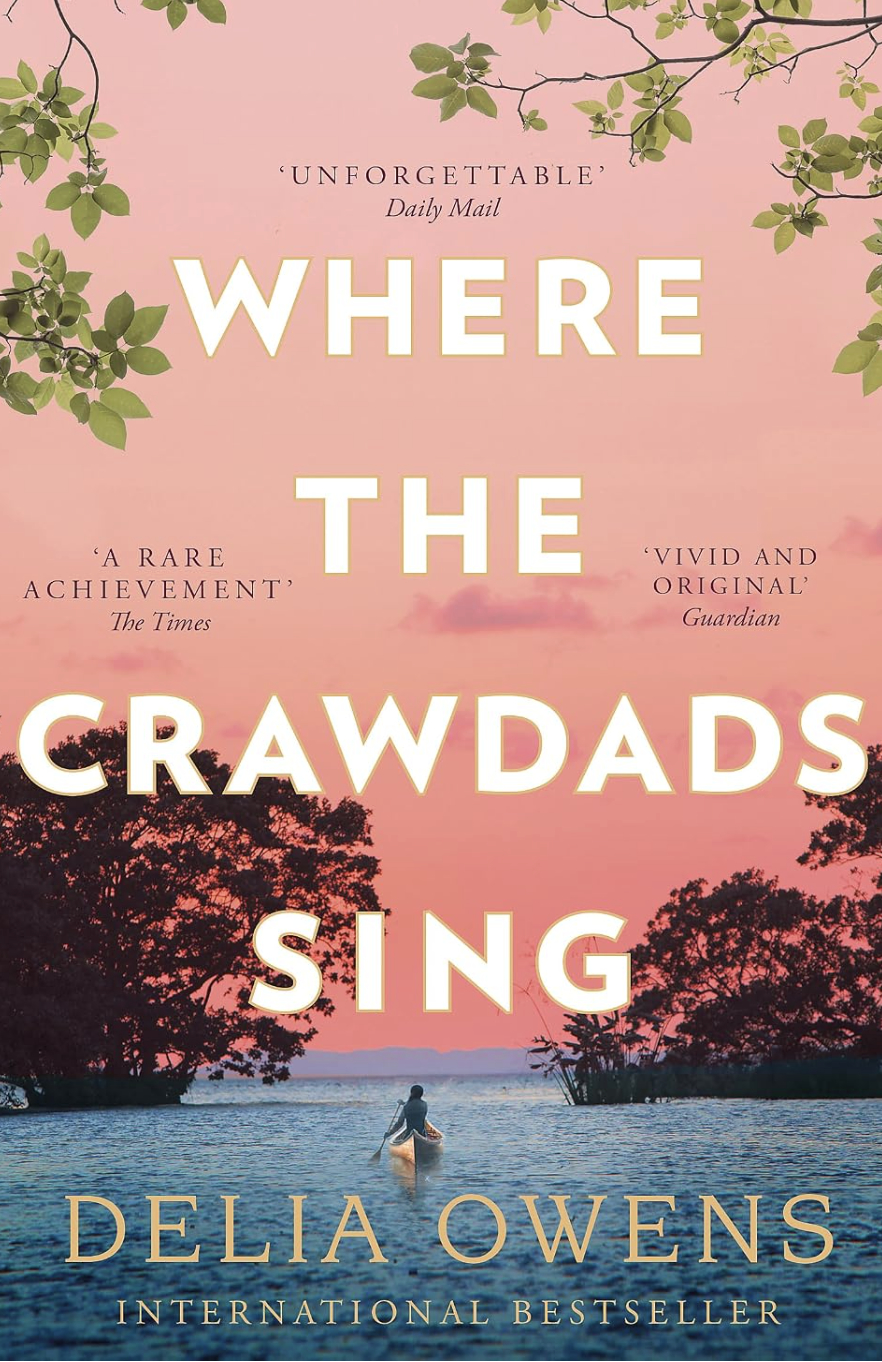
The swampland is beautifully and evocatively portrayed as a living character; its ‘journey’ is closely linked to the Kya, the main protagonist, as development encroaches both swamp and girl through commercial logging, and wetland drainage to build resort hotels. Kya lives with an unbiased understanding of a quiet biological life, surviving through natural instinct in a circle of life and death: a swamp knows all about death, and does not define it as a tragedy or a sin, thinks Kya who sees the swampland as her mother, teacher and sanctuary, embracing her with a protective mantle of natural beauty and wonder. Whenever she stumbled, it was the land who caught her. When the town marginalizes Kya, calling her “The Marsh Girl”, the swamp shields her from the prejudice and cruelty of the human world, providing an intimate protective barrier. In turn, Kya uses her book advance to buy several hundred acres of marsh as a protected wildlife refuge.

In her article on Great Ecology, Liz Clift writes, “During the period in which Where the Crawdads Sing is set, wetlands were typically seen as a nuisance—and that comes through in the story-telling, when developers want to drain the marsh for a development. Wetlands were also seen as mosquito-infested, buggy, smelly, or even an eyesore. A significant number of wetlands around the world, including in the US, have been lost due to land development and agriculture, which is unfortunate because wetlands are rich with biodiversity and play a key role in maintaining both freshwater and saltwater fisheries, support water quality, and protect against flooding.” This is not a phenomenon or attitude of the past; it unfortunately remains prevalent, particularly in North America.

What Delia Owens achieves in Where the Crawdads Sing is two-fold: 1) the reader knows more about the value of the marsh but also gains a sense of its beauty as seen through the eyes of Kya; and, 2) through the strong connection with the main character and use of evocative metaphor, Owens transforms the marsh into a real character.

Why Make Place a Character

Why is this important? Think of a place you know. I’ll use the house I grew up in. To any passerby, the house is just another two-storey cornflower-blue house with veranda on a quiet residential street, lined by trees. But for me, the house carries memories of my childhood, of running up and down the creaky foot-worn stairs, or sharing ghost stories with friends on the back porch as the waning twilight revealed the winking fireflies outside. Playing dolls with my sister in the stuffy attic. The sweet pungent aroma of my father’s pipe smoke in the livingroom and my mother’s thrush-like voice resonating from the kitchen as she baked German sugar cookies. I loved that house, with all its idiosyncratic groans and whistles in the wind and the echoes of cheerful laughter over the years. That house was a character.

Once this happens, once place becomes a character, we find ourselves caring for it.

In story, it is the characters we care about; it is the characters that we cheer for and follow on their journey of loss, redemption or victory.

This is why writers of eco-fiction depict environment as a character. We must first relate and connect before we care; we must first care before we act. Eco-fiction authors also use the device of character-coupling to help readers care. The examples above provide this method through their ‘othered’ characters, who, in turn, relate to the ‘othered’ environment. In another article, I provide more examples of character-coupling in the literature that enable readers to connect to otherwise arcane aspects of their environment through their connection to a character they can relate to.

Parts of this article are excerpted from The Ecology of Story: World as Character.
References:

Munteanu, Nina. 2013. “The Ecology of Story: World as Character.” Pixl Press, Vancouver. 200pp.

Munteanu, Nina. 2024. “The Use of Character-Coupling in Eco-Literature to Give Voice to the Other, Part 1: Introduction” February 18, 2024.

Munteanu, Nina. 2024. “The Use of Character-Coupling in Eco-Literature to Give Voice to the Other, Part 2: Types of Character-Coupling in Seven Examples of Eco-Literature” February 2024.

Beaver Pond just before a rainstorm, BC (photo by Nina Munteanu)

Nina Munteanu is a Canadian ecologist / limnologist and novelist. She is co-editor of Europa SF and currently teaches writing courses at George Brown College and the University of Toronto. For the lates on her books, visit www.ninamunteanu.ca. Nina’s bilingual “La natura dell’acqua / The Way of Water” was published by Mincione Edizioni in Rome. Her non-fiction book “Water Is…” by Pixl Press (Vancouver) was selected by Margaret Atwood in the New York Times ‘Year in Reading’ and was chosen as the 2017 Summer Read by Water Canada. Her novel “A Diary in the Age of Water” was released by Inanna Publications (Toronto) in June 2020. You can read her just released eco-fiction thriller Gaia’s Revolution by Dragon Moon Press.

When the Forest Reveals its Archetypes

It is early spring and I’m walking through one of my favourite woodlands in Ontario’s Carolinian forests. The river that had swollen with snow melt just a week before, now flows with more restraint. I can see the cobbles and clay of scoured banks under the water. Further on, part of the path along the river has collapsed from a major bank scour the previous week. The little river is rather big and capricious, I ponder; then I consider that the entire forest sways to similar vagaries of wind, season, precipitation and unforeseen events. Despite its steadfast appearance, the forest flows—like the river—in a constant state of flux and change, cycling irrevocably through life and death.

The forest is littered with snags and fallen trees in different stages of breakdown, decomposition and decay. I spot several large cedar, pine, oak and maple snags with woodpecker holes. The snags may remain for many decades before finally falling to the ground.

I walk slowly, eyes cast to the forest floor thick with dead leaves, and discover seeds and nuts—the promise of new life. I aim my gaze past trees and shrubs to the nearby snags and fallen logs. I’m looking for hidden gifts. One fallen cedar log reveals swirling impressionistic patterns of wood grain, dusted with moss and lichen. Nature’s death clothed in beauty.

A fallen maple snag decomposes with the help of several organisms, Little Rouge Woodland, ON (photo by Nina Munteanu)

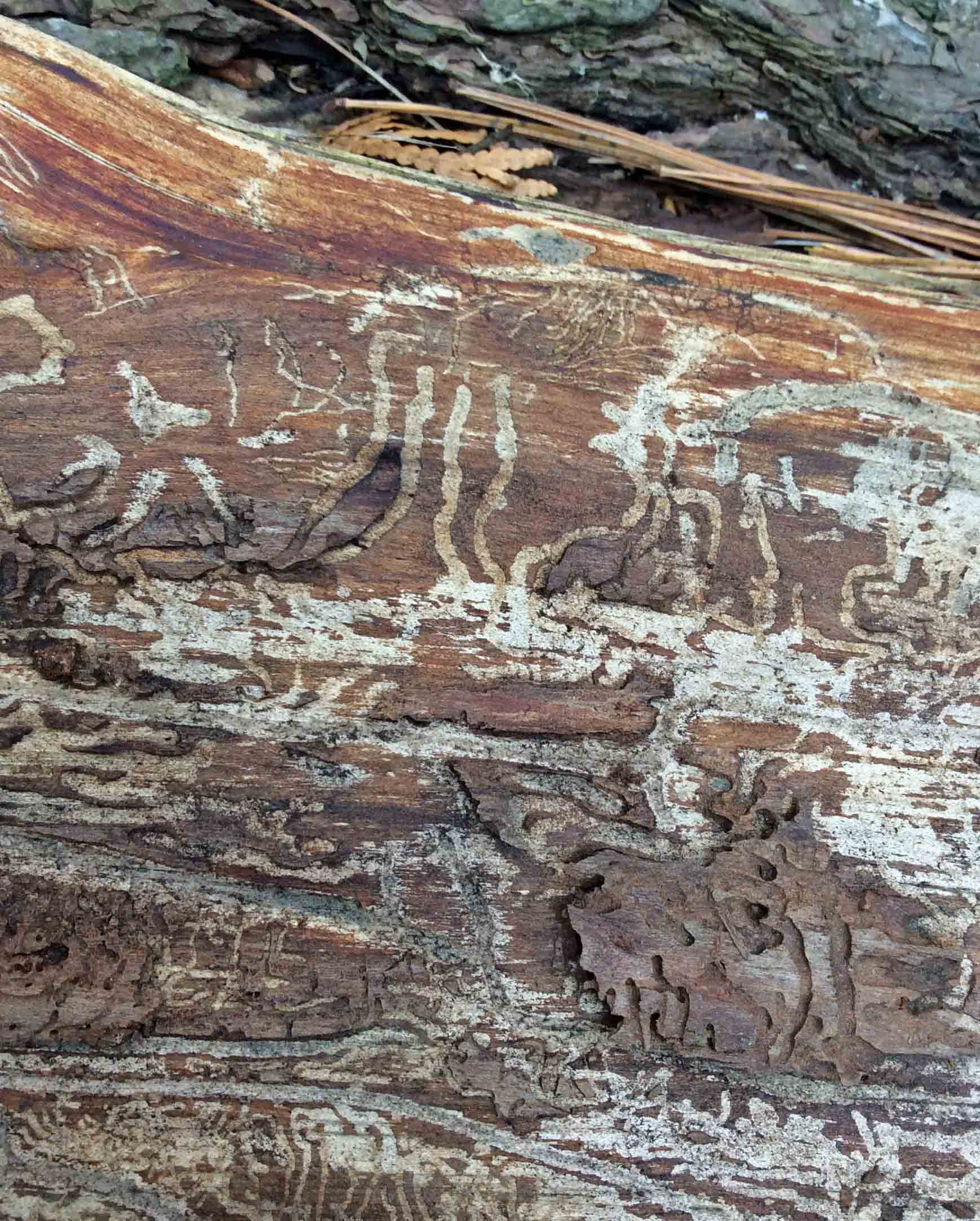
The bark of a large pine tree that has fallen is riddled with tiny beetle holes drilled into its bark. Where the bark has sloughed off, a gallery of larval tracks in the sapwood create a map of meandering texture and colour.

Decomposing pine log displays a gallery of larval tracks, Little Rouge Woodland, ON (photo by Nina Munteanu)

Fallen Heroes & Saprophyte Characters

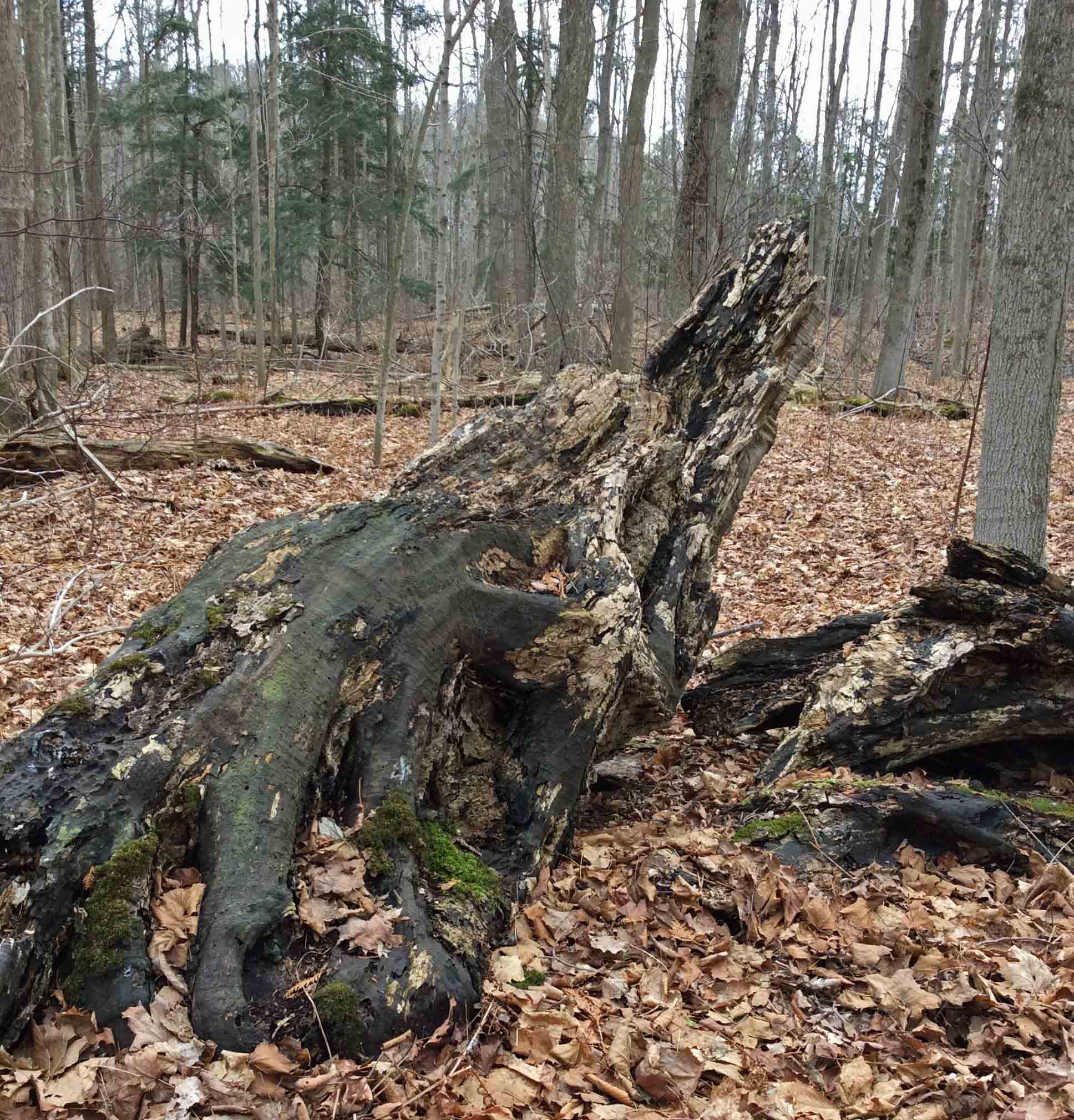
Rotting maple log, Little Rouge Woodland, ON (photo by Nina Munteanu)

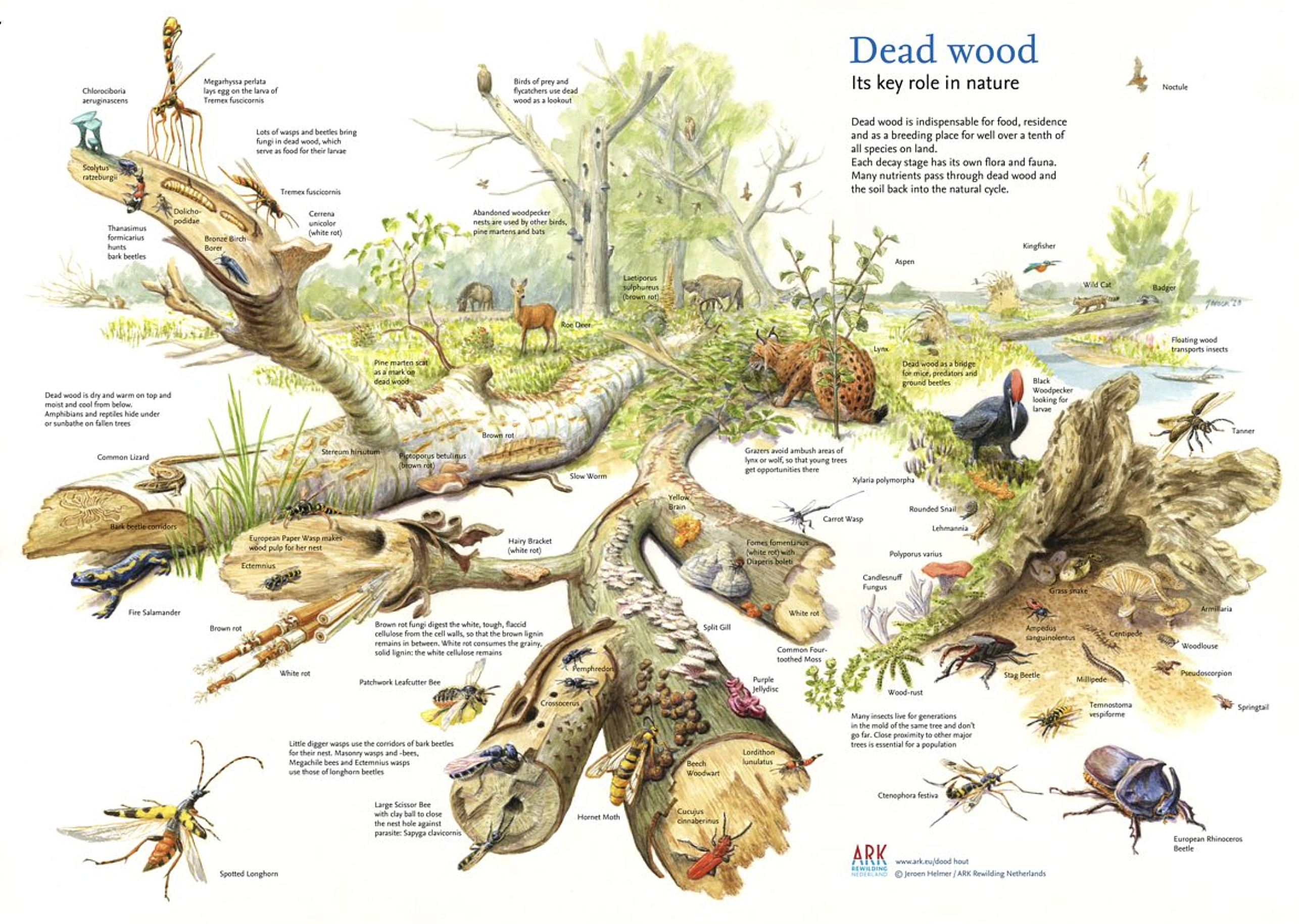
The forest ecosystem supports a diverse community of organisms in various stages of life and death and decay. Trees lie at the heart of this ecosystem, supporting a complex and dynamic cycle of evolving life. Even in death, the trees continue to support thriving detrivore and saprophytic communities that, in turn, provide nutrients and soil for the next generation of living trees. It’s a partnership.

Decomposition and decay are the yin to the yang of growth, writes Trees for Life; together, they form two halves of the whole that is the closed loop cycle of natural ecosystems.

A fallen tree decomposes with the help of a diversity of organisms

Snags and rotting logs on the forest floor provide damp shelter and food for many plants and animals. Most are decomposers, including earthworms, fungi, and bacteria. As the wood decays, nutrients in the log break down and recycle in the forest ecosystem. Insects, mosses, lichens, and ferns recycle the nutrients and put them back into the soil for other forest plants to use. Dead wood is an important reservoir of organic matter in forests and a source of soil formation. Decaying and dead wood host diverse communities of bacteria and fungi.

Mother Archetypes

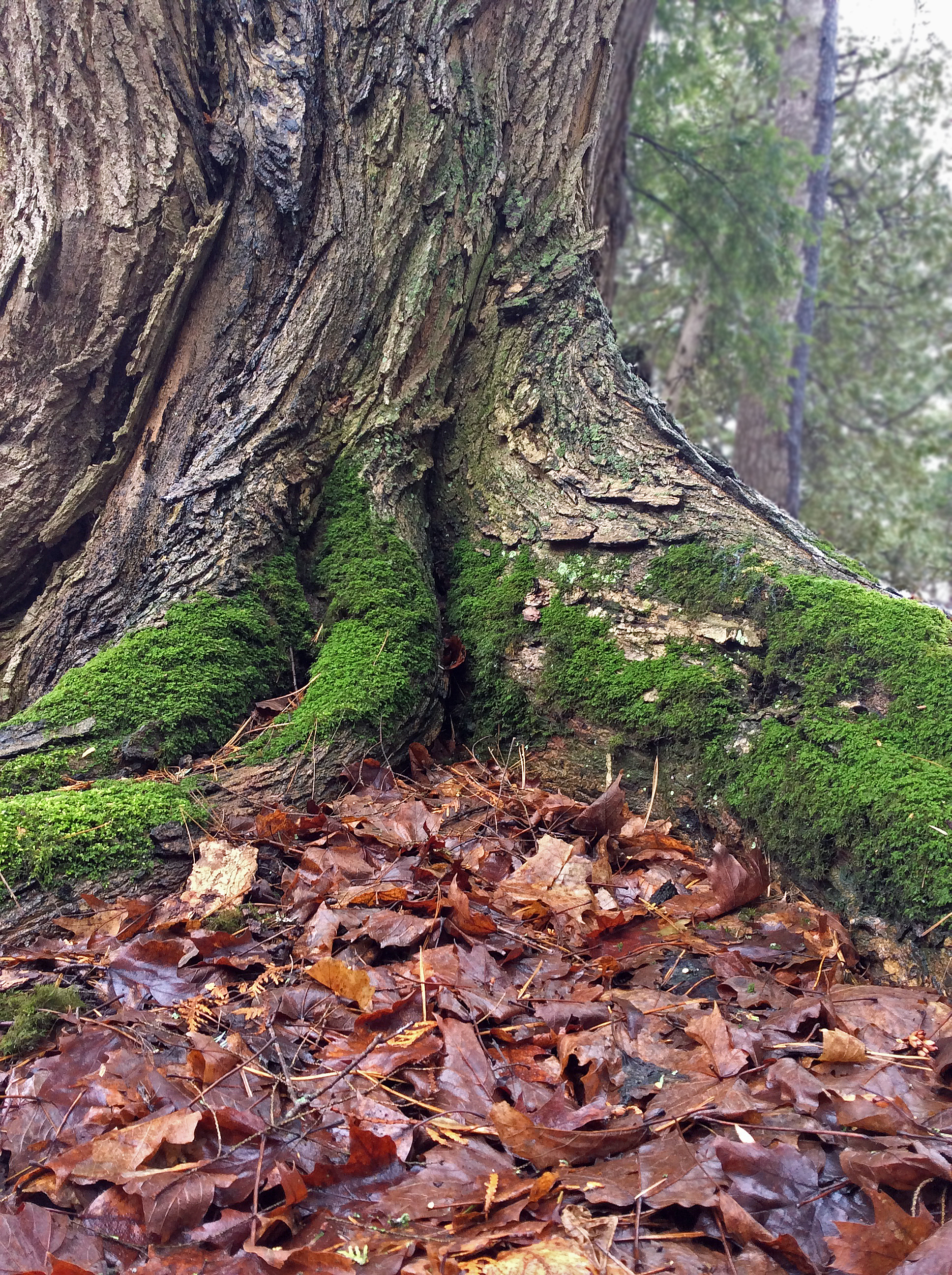
The feet of an old tree trunk reach out to embrace a collection of maple leaves, ON (photo by Nina Munteanu)

Wood tissues of tree stems include the outer bark, cork cambium, inner bark (phloem), vascular cambium, outer xylem (living sapwood), and the inner xylem (non-living heartwood). The outer bark provides a non-living barrier between the inner tree and harmful factors in the environment, such as fire, insects, and diseases. The cork cambium produces bark cells. The vascular cambium produces both the phloem cells (principal food-conducting tissue) and xylem cells of the sapwood (the main water storage and conducting tissue) and heartwood.

Forest ecologists defined five broad stages in tree decay, shown by the condition of the bark and wood and presence of insects and other animals. The first two stages evolve rapidly; much more time elapses in the later stages, when the tree sags to the ground. These latter stages can take decades for the tree to break down completely and surrender all of itself back to the forest. A fallen tree nurtures, much like a “mother” archetype; it provides food, shelter, and protection to a vast community—from bears and small mammals to salamanders, invertebrates, fungus, moss and lichens. This is why fallen trees are called “nursing logs.”

Heralds & Tricksters

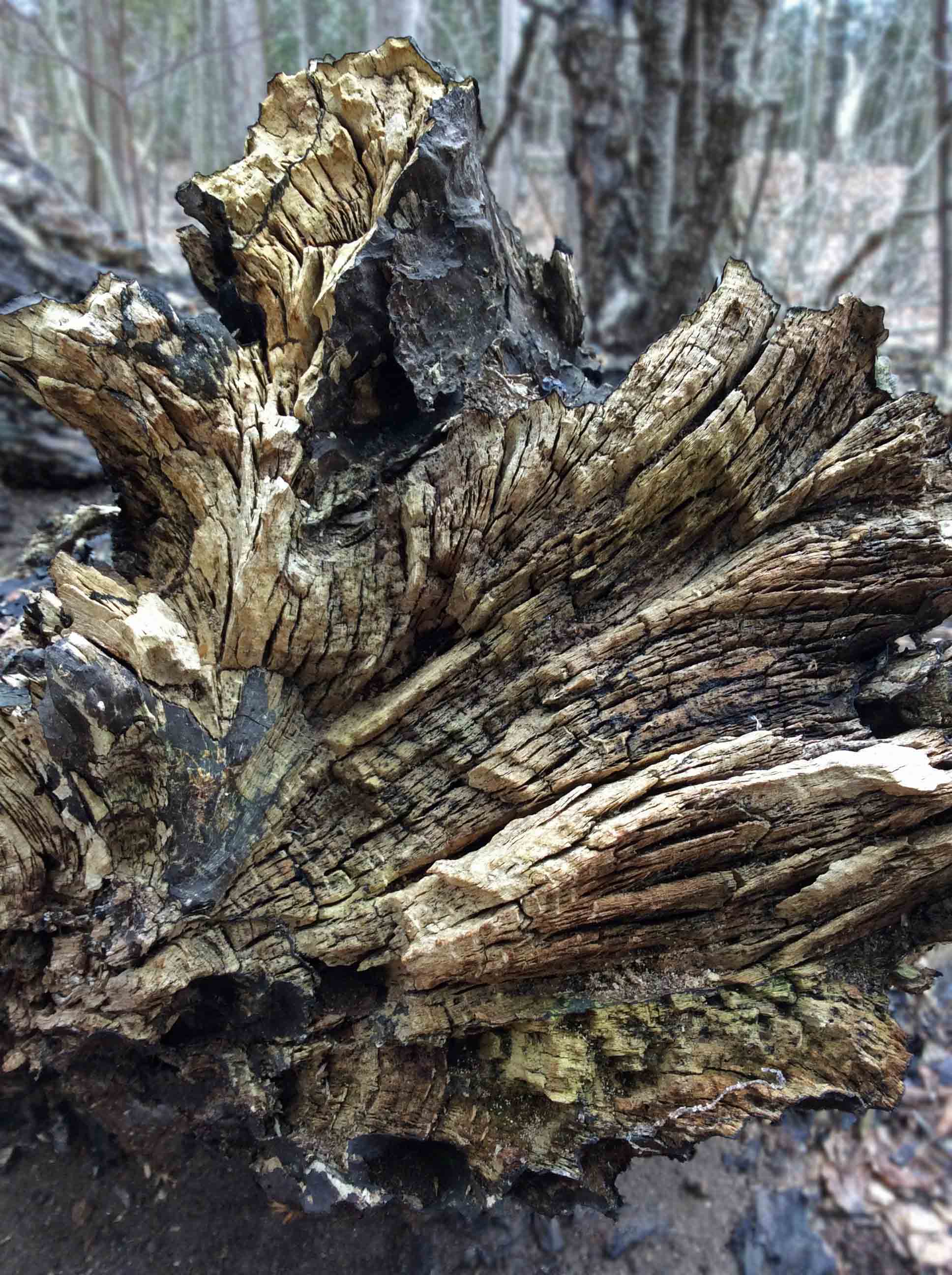
Uprooted stump colonized by carbon cushion fungi, Little Rouge Woodland, ON (photo by Nina Munteanu)

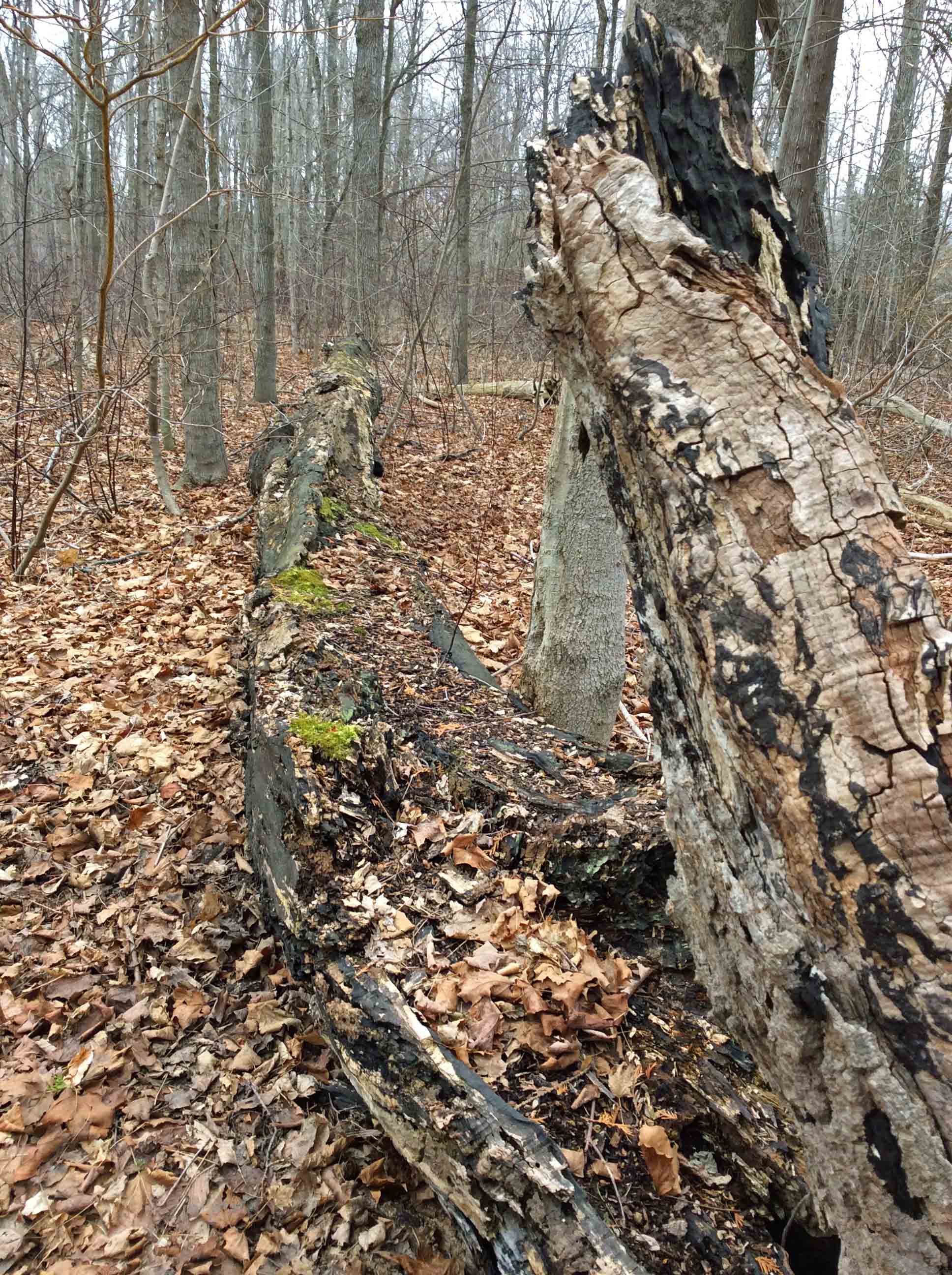
I stop to inspect another fallen tree lying on a bed of decaying maple, beech and oak leaves. When a fallen tree decomposes, unique new habitats are created within its body as the outer and inner bark, sapwood, and heartwood decompose at different rates, based in part on their characteristics for fine dining. For instance, the outer layers of the tree are rich in protein; inner layers are high in carbohydrates. This log—probably a sugar maple judging from what bark is left—has surrendered itself with the help of detrivores and saprophytes to decomposition and decay. The outer bark has mostly rotted and fallen away revealing an inner sapwood layer rich in varied colours, textures and incredible patterns—mostly from fungal infestations. In fact, this tree is a rich ecosystem for dozens of organisms. Wood-boring beetle larvae tunnel through the bark and wood, building their chambers and inoculating the tree with microbes. They open the tree to colonization by other microbes and small invertebrates. Slime molds, lichen, moss and fungi join in. The march of decay follows a succession of steps. Even fungi are followed by yet other fungi in the process as one form creates the right condition for another form.

Most hardwoods take several decades to decompose and surrender all of themselves back to the forest. In western Canada’s old growth forest, trees like Western redcedars can take over a hundred years to decay once they’re down. The maple log I’m studying in Ontario’s Carolinian forest looks like it’s been lying on the ground for a while, certainly several years. The bark has fragmented and mostly fallen away, revealing layers of sapwood in differing stages of infestation and decay. Some sapwood is fragmented and cracked into blocks and in places looks like stacked bones.

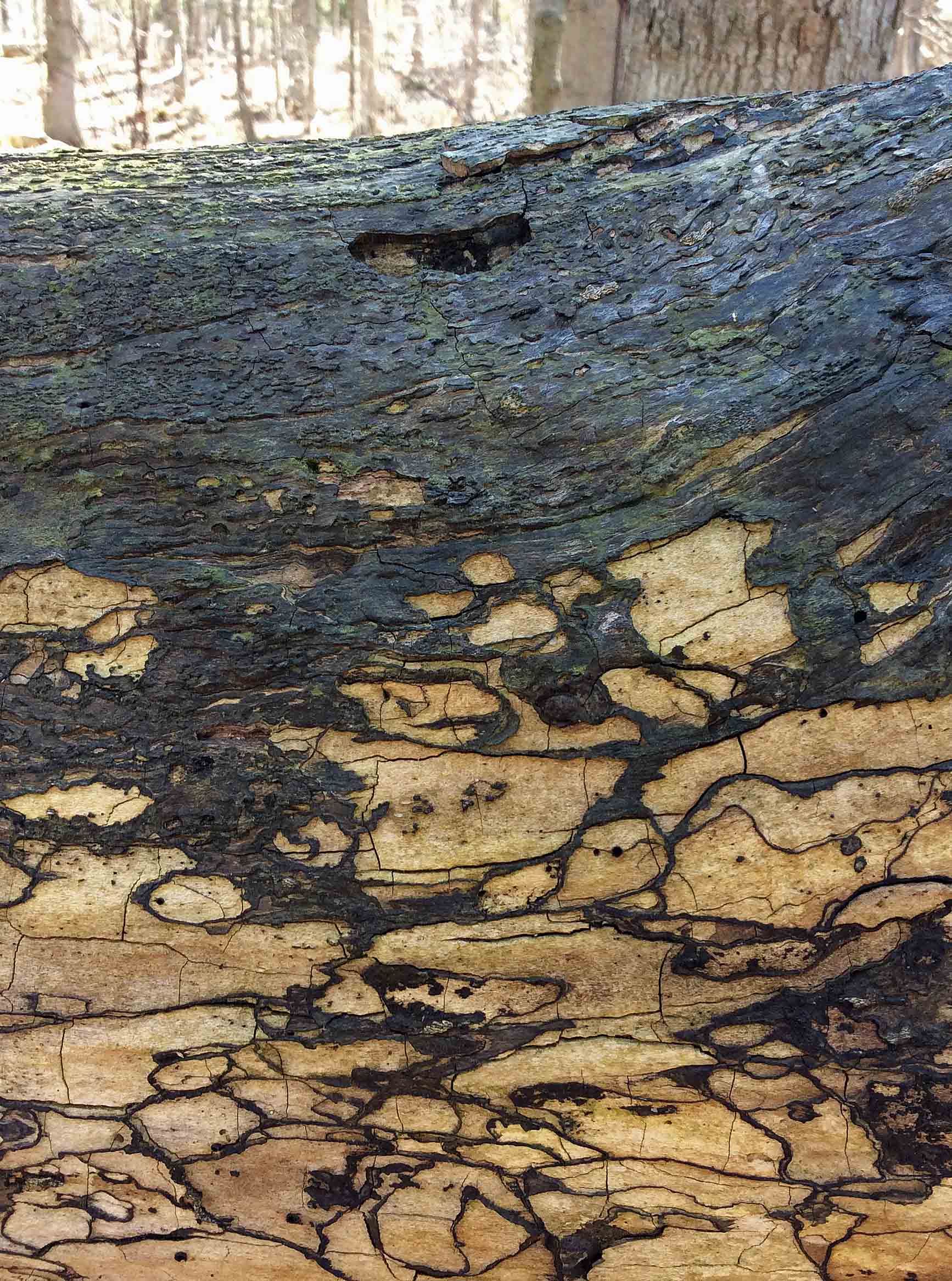
Black lines as though drawn by a child’s paintbrush flow through much of the sapwood; these winding thick streaks of black known as “zone lines” are in fact clumps of dark mycelia, which cause “spalting,” the colouration of wood by fungus. According to mycologist Jens Petersen, these zone lines prevent “a hostile takeover by mycelia” from any interloping fungi. Most common trees that experience spalting include birch, maple, and beech. Two common fungi that cause spalting have colonized my maple log. They’re both carbon cushion fungi.

Spalting on a decaying maple log, Little Rouge Woodland, ON (photo by Nina Munteanu)

Much of the exposed outer wood layer looks as though it has been spray painted with a green to blue-black layer. The “paint” is caused by the green-stain fungus (Chlorociboria) and blue-stain fungus (Ceratocystis). Spalting is common because of the way fungi colonize, in waves of primary and secondary colonizers. Primary colonizers initially capture and control the resource, change the pH and structure of the wood, then must defend against the secondary colonizers now able to colonize the changed wood.

Shapeshifting Characters

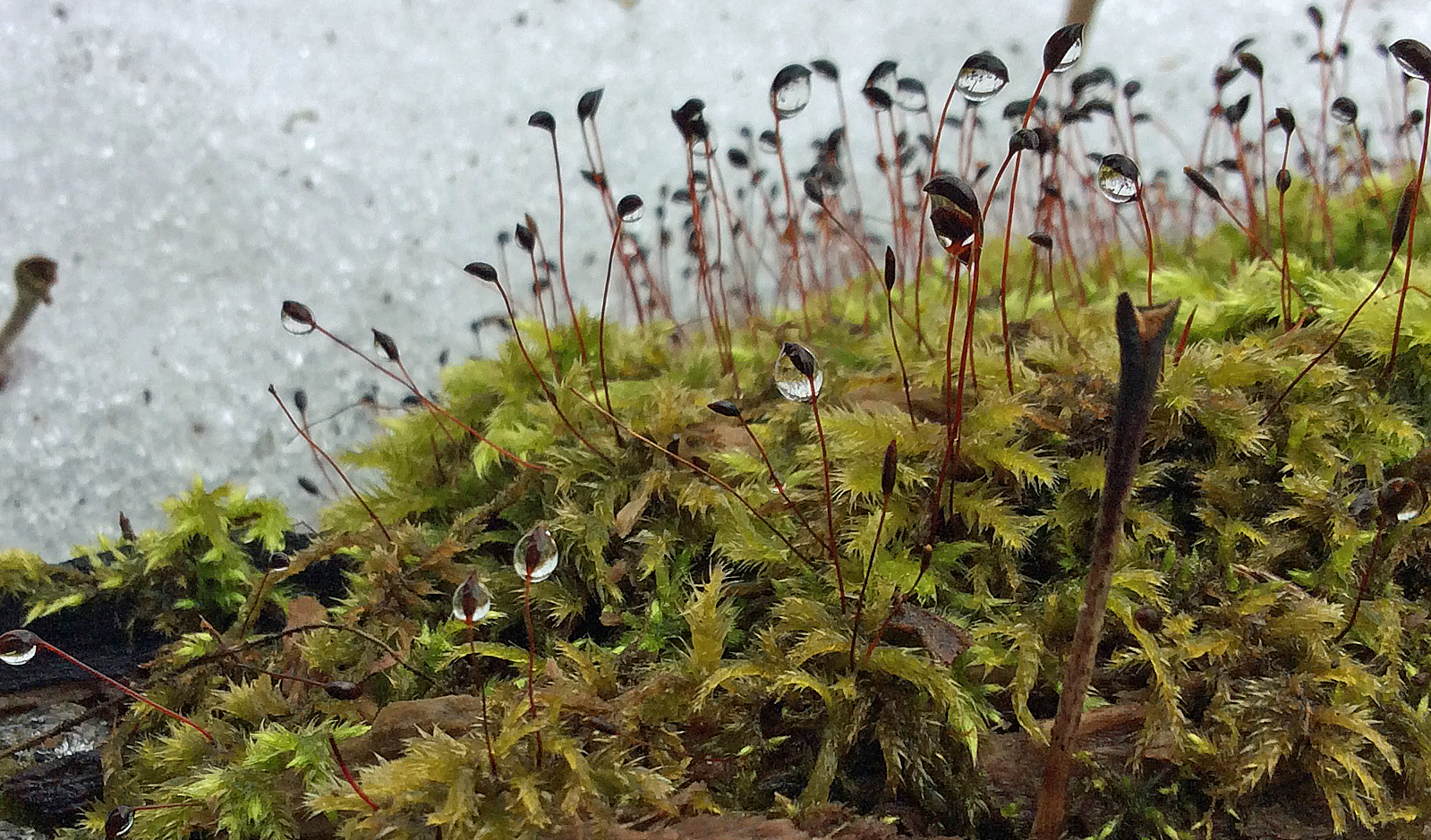
Moss with spores on a log, Little Rouge Woodland, ON (photo by Nina Munteanu)

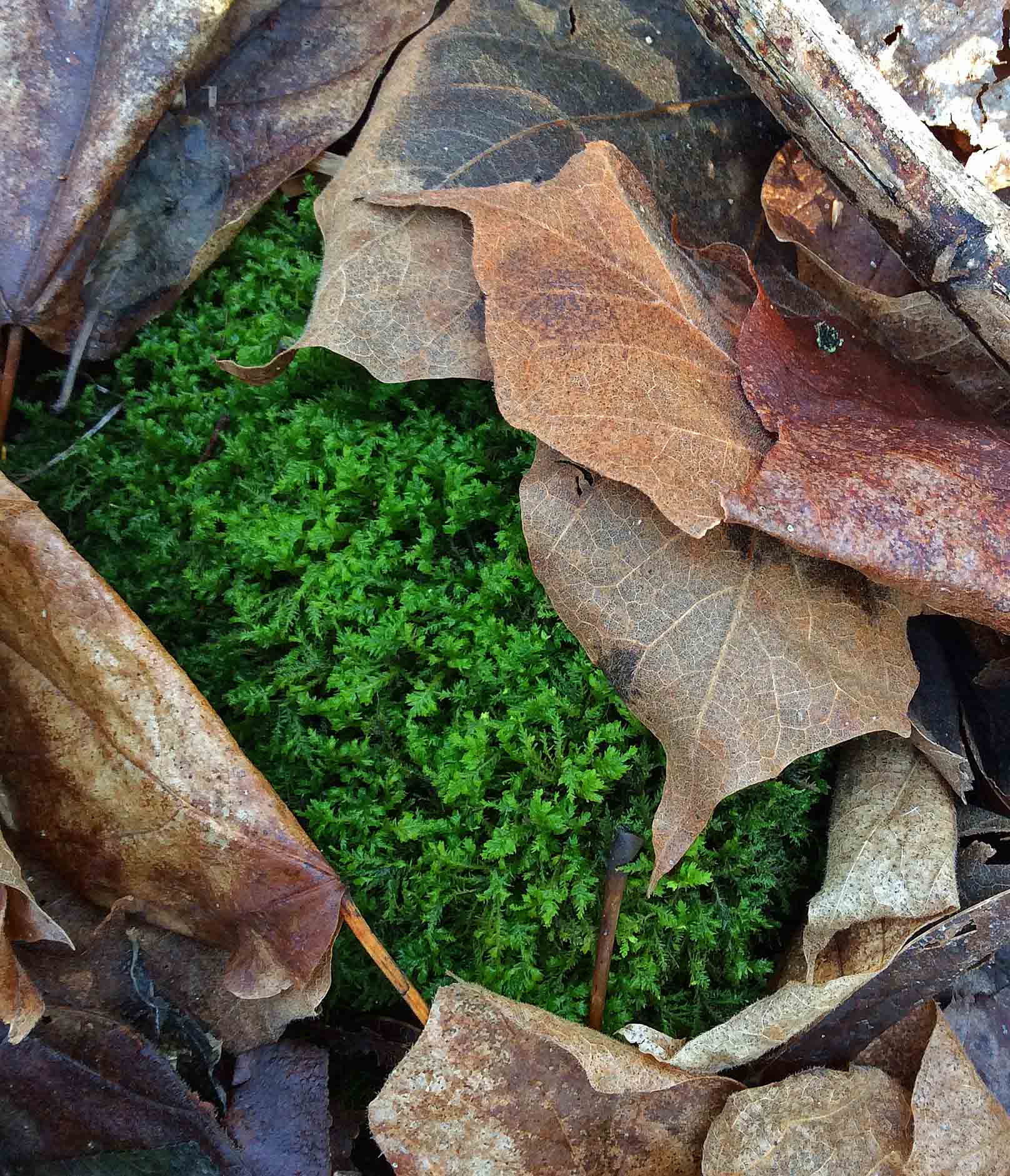
I find moss everywhere in the forest, including beneath the forest floor. Moss is a ubiquitous character, adapting itself to different situations and scenarios. Like a shapeshifter, moss is at once coy, hiding beneath rotting leaf litter, stealthy and curious as it creeps up the feet of huge cedars, and exuberant as it unabashedly drapes itself over every possible surface such as logs, twigs and rocks, and then proceeds to procreate for all to see.

Moss hides under dead leaf litter on the forest floor, Little Rouge Woodland, ON (photo by Nina Munteanu)

Mosses help with nutrient cycling because they can fix nitrogen from the air, making it available to other plants. Mosses thrive in the wet winter and spring, providing brilliant green to an otherwise brown-gray environment. Even when covered in snow (or a bed of leaves), moss continues its growth cycle, usually in the leafy gametophyte stage. In the spring the capsules release spores that can each create a new moss individual. Moss is quietly, gloriously profligate.

Team Players

Fruiting lichen on a tree (photo by Nina Munteanu)

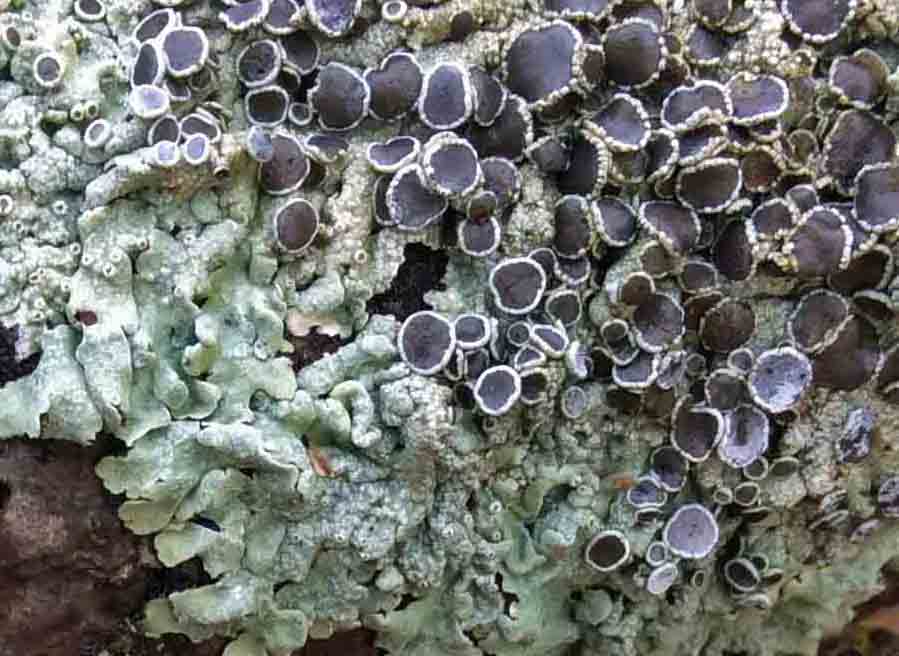
Lichens are a cooperative character; two characters in one, really. Lichens are a complex symbiotic association of two or more fungi and algae (some also partner up with a yeast). The algae in lichens (called phycobiont or photobiont) photosynthesize and the fungus (mycobiont) provides protection for the photobiont. Both the algae and fungus absorb water, minerals, and pollutants from the air, through rain and dust. In sexual reproduction, the mycobiont produces fruiting bodies, often cup-shaped, called apothecia that release ascospores. The spores must find a compatible photobiont to create a lichen. They depend on each other for resources—from food to shelter and protection.

The Ecology of Story: World as Character

Place ultimately portrays what lies at the heart of the story. Place as character serves as an archetype that story characters connect with and navigate in ways that depend on the theme of the story, particularly in allegories that rely strongly on metaphor. A story’s theme is essentially the “so what part” of the story. What is at stake for the character on their journey. Theme is the backbone—the heart—of the story, driving characters to journey through time and place toward some kind of fulfillment. There is no story without theme. And there is no theme without place.

–Excerpted from The Ecology of Story: World as Character

Nina Munteanu is a Canadian ecologist / limnologist and novelist. She is co-editor of Europa SF and currently teaches writing courses at George Brown College and the University of Toronto. For the lates on her books, visit www.ninamunteanu.ca. Nina’s bilingual “La natura dell’acqua / The Way of Water” was published by Mincione Edizioni in Rome. Her non-fiction book “Water Is…” by Pixl Press (Vancouver) was selected by Margaret Atwood in the New York Times ‘Year in Reading’ and was chosen as the 2017 Summer Read by Water Canada. Her novel “A Diary in the Age of Water” was released by Inanna Publications (Toronto) in June 2020. You can read her just released eco-fiction thriller Gaia’s Revolution by Dragon Moon Press.

Exploring “The Law of Attraction for Writers” Podcast with Suzanne Lieurance & Simon Rose

Today, I’m sitting down with authors and writing coaches Suzanne Lieurance and Simon Rose to talk about their brand-new YouTube series, The Law of Attraction for Writers Podcast, which you can find at: https://www.youtube.com/@LawofAttractionforWritersPodca.

The show blends mindset, creativity, and practical writing advice — a combination that’s resonating with writers who want to manifest success and write with more ease.

Nina: Welcome, both of you!

Suzanne: Thank you! We’re so excited to finally share this project.

Simon: Yes, it’s been in the works for a while, and we’re thrilled to see writers already responding so positively.

Simon Rose and Suzanne Lieurance

Nina: Let’s start with the big question. Why create a Law of Attraction for Writers podcast?

Suzanne: Well, over the years, I’ve coached so many writers who say things like, “I’ll feel successful when I get an agent,” or “I’ll write when I have more time.” But the Law of Attraction teaches us it works the other way around — you become the person who already feels successful, and the opportunities follow. I wanted to create a podcast that helps writers understand how their thoughts, emotions, and energy shape their writing lives.

Simon: Exactly. So much of writing is mental. You can have the best outline and still feel blocked if your energy is off. We wanted to show that aligning your mindset with your goals isn’t mystical — it’s practical. You’re essentially training your brain to focus on what you want instead of what you fear.

Nina: How would you describe the podcast to someone who hasn’t tuned in yet?

Simon: Each episode focuses on one key aspect of the Law of Attraction and how it connects to the writing process. We might explore a concept like visualization, vibration, or inspired action — and then show writers how to apply that directly to their writing routines.

Suzanne: We wanted to make it accessible. It’s not just theory or motivation. We give writers clear steps they can take right away — ways to shift their thinking, attract new ideas, or rekindle their excitement for a project.

Simon: We also share personal stories. Between the two of us, we’ve seen these principles in action — in publishing, in teaching, and even in everyday creative decisions.

Nina: I love that you connect mindset with the craft of writing. Can you say more about how that works?

Suzanne: Sure. A lot of writers separate the two — mindset on one side, writing craft on the other. But they’re intertwined. You might know every writing technique out there, but if you’re doubting yourself or constantly telling yourself you’re behind, you’ll block the creative flow.


Simon: That’s why the Law of Attraction is so powerful for writers. It’s not just about “thinking positive.” It’s about intentionally setting the tone for your writing sessions, deciding what kind of writer you believe yourself to be, and letting that belief guide your actions.

Suzanne: In one episode, we talk about “energetic alignment” — how your emotional state affects the words you put on the page. When you write from frustration, the writing feels heavy. But when you write from joy or curiosity, the story expands.

Nina: You’ve both been writing coaches for years. How has it been working together on this project?

Simon: It’s been wonderful. Suzanne brings a very intuitive approach to writing and mindset, while I tend to look at things through a more analytical lens. Together, we strike a balance between the spiritual and the practical.

Suzanne: Yes! We complement each other well. Simon often grounds the big ideas in real-world examples, and I love exploring how energy and focus shape results. It’s a true partnership — and we both learn from each other in every episode.

Nina: Without giving too much away, what are some of the themes or takeaways that keep coming up in your discussions?

Suzanne: One theme that runs through everything is trust — trusting yourself, your ideas, and the timing of your success. The Law of Attraction reminds us that everything unfolds when you’re ready to receive it.

Simon: Another recurring idea is momentum. Writers often stop when things get tough, but energy builds through consistent action. You don’t have to write for hours every day — just focus on showing up with intention. That small shift can open the door to much bigger results.

Suzanne: We also talk about how to handle resistance. Every writer faces doubt or creative slumps. The podcast offers ways to turn those moments into opportunities instead of roadblocks.

Nina: You’ve chosen YouTube as your main platform. Why that format?

Simon: We wanted to make it easy and engaging. YouTube allows us to connect visually and energetically with our audience. Writers can listen while they work, which adds a more personal connection.

Suzanne: And YouTube’s format fits how writers consume content today. Many of them already use it to learn about craft and publishing. This podcast adds another layer — the inner work behind writing success.

Nina: What’s ahead for the Law of Attraction for Writers Podcast?

Suzanne: We’ll keep releasing new episodes every Tuesday. Each one will build on the idea that your energy, focus, and beliefs create your writing experience.

Simon: We’re also exploring live Q&A sessions, where writers can ask questions and share how they’ve applied the principles we discuss. It’s exciting to see a community forming around these ideas.

Suzanne: Ultimately, we want every writer to realize they’re not powerless. They can create not only their stories but also their success.

Nina: That’s such an inspiring message. Any final thoughts for writers who might be hesitant to explore this side of writing?

Suzanne: Just start listening with an open mind. You don’t have to “believe” in anything right away — just try applying one idea and see what shifts.

Simon: Yes. Writing is already an act of creation — you’re manifesting something that didn’t exist before. This podcast helps you see that same creative power working in every area of your writing life.

Nina: Beautifully said. Thank you both.


Watch: New episodes of The Law of Attraction for Writers Podcast drop every Tuesday on YouTube at https://www.youtube.com/@LawofAttractionforWritersPodca

Follow Suzanne Lieurance and Simon Rose for practical, inspiring ways to align your mindset, energy, and creativity — and manifest the writing life you’ve always imagined.

Nina Munteanu is an award-winning novelist and short story writer of eco-fiction, science fiction and fantasy. She also has three writing guides out: The Fiction Writer; The Journal Writer; and The Ecology of Writing and teaches fiction writing and technical writing at university and online. Check the Publications page on this site for a summary of what she has out there. Nina teaches writing at the University of Toronto and has been coaching fiction and non-fiction authors for over 20 years. You can find Nina’s short podcasts on writing on YouTube. Check out this site for more author advice from how to write a synopsis to finding your muse and the art and science of writing.

Nina Munteanu Workshops “Hero’s Journey” with Writers in Newmarket

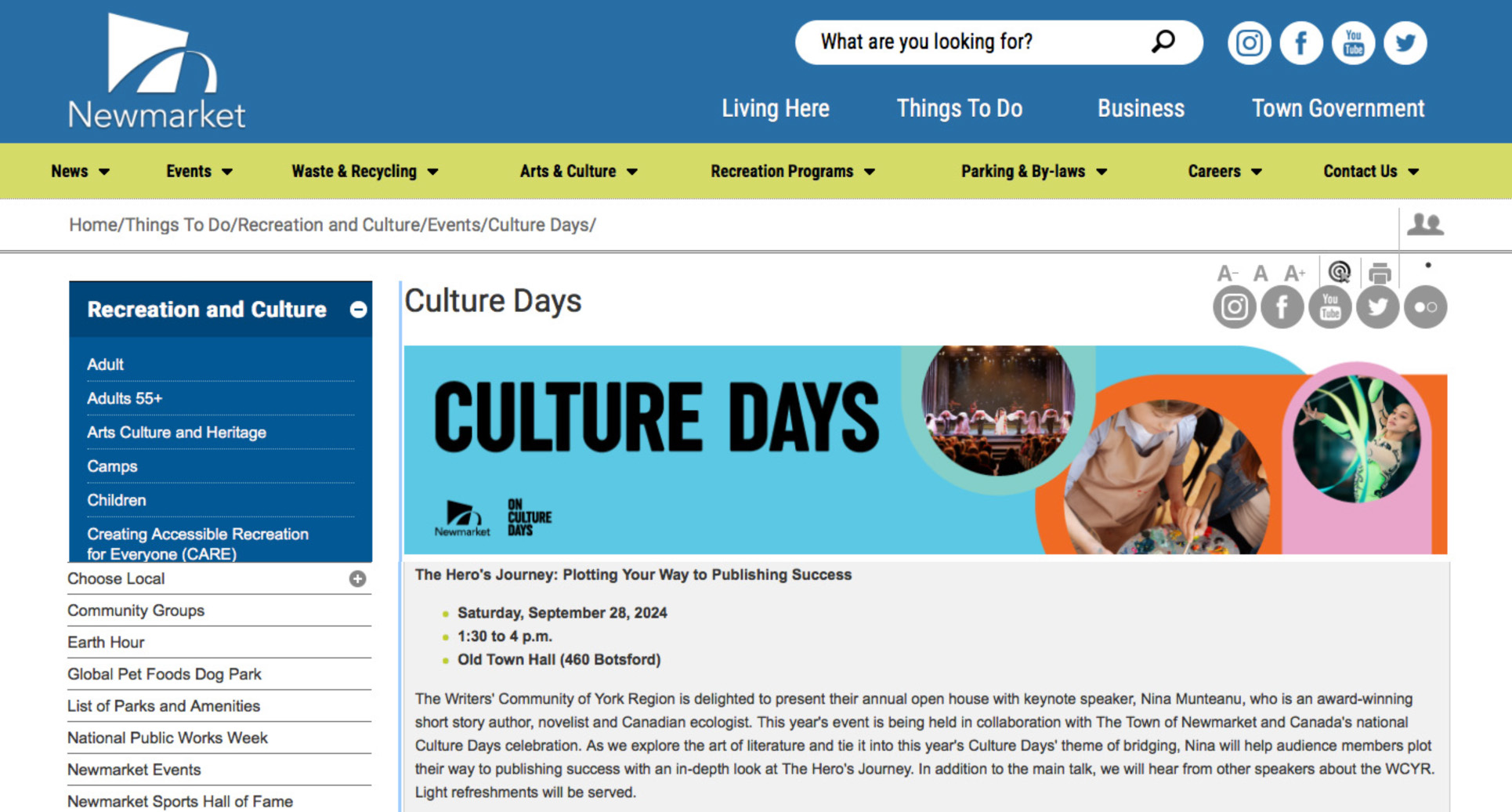
I recently gave my lecture / workshop on the Hero’s Journey plot approach to a group of writers for Culture Days in Newmarket, Ontario.

The event, organized by the WCYR (Writing Community of York Region), took place in the art gallery of the Old Town Hall, located in the old downtown part of the city—an attractive section of streets and lanes with eclectic shops, cafés, bistros and bookstores for curious amblers. 

Bustling Main Street near the Old Town Hall, Newmarket, ON

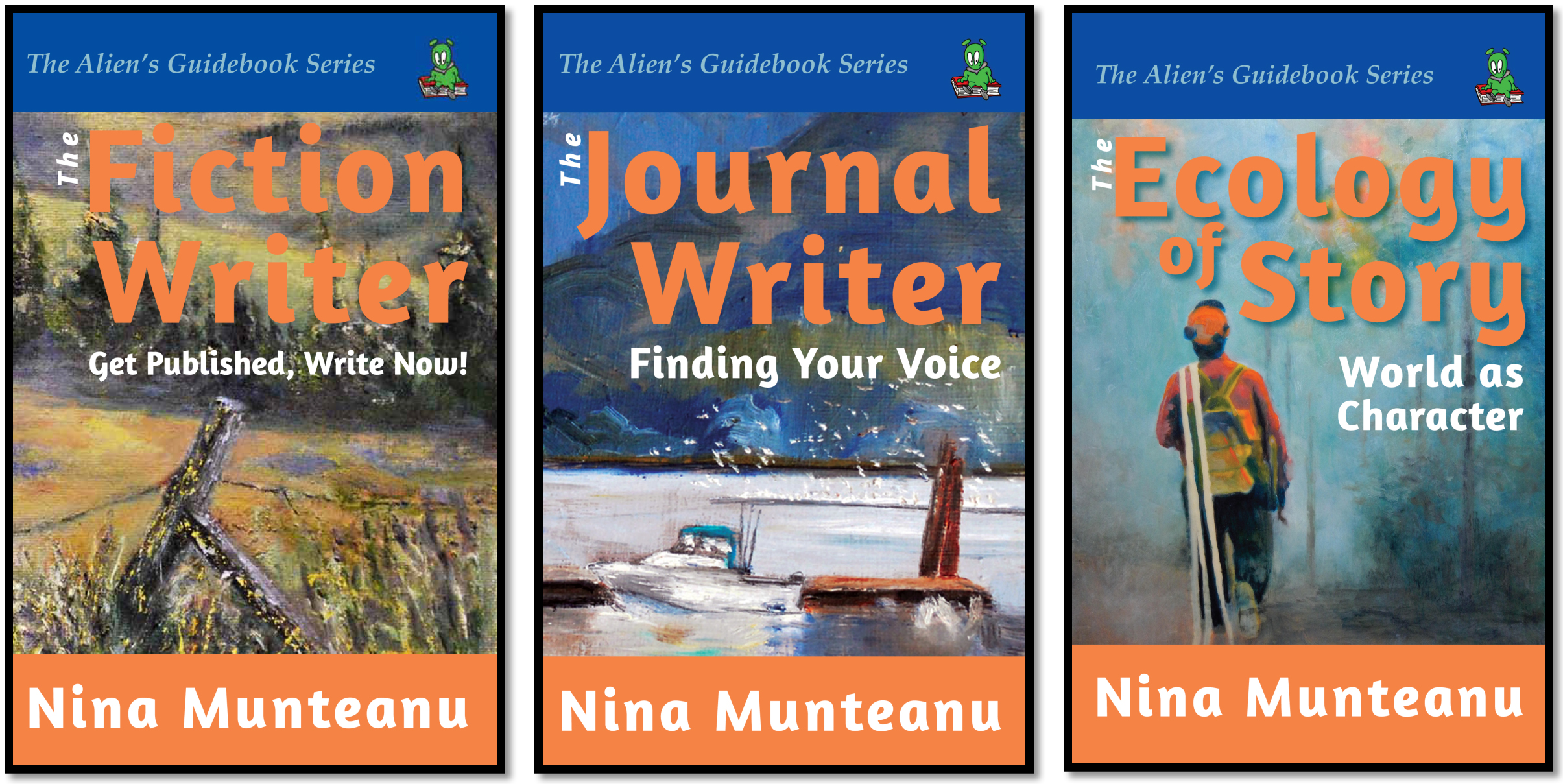
Three guidebooks of the Alien Guidebook series for writers

Cathy Miles, the program coordinator, encouraged me to brings books for sale, so I certainly included the three books of my Alien Guidebook Series on writing: The Fiction Writer, The Journal Writer, and The Ecology of Story, all also available at Amazon, Kobo, Barnes & Noble and other quality bookstores, which I sold for a workshop price. Cathy gave me a wonderful introduction to a room full of eager writers and I also had the pleasure of meeting Janice Luttrell, the Recreation Programmer with the City of Newmarket, who was hosting the event as part of Newmarket’s Culture Days.

Hero’s Journey Plot Structure (Ingrid Sundberg, 2013)

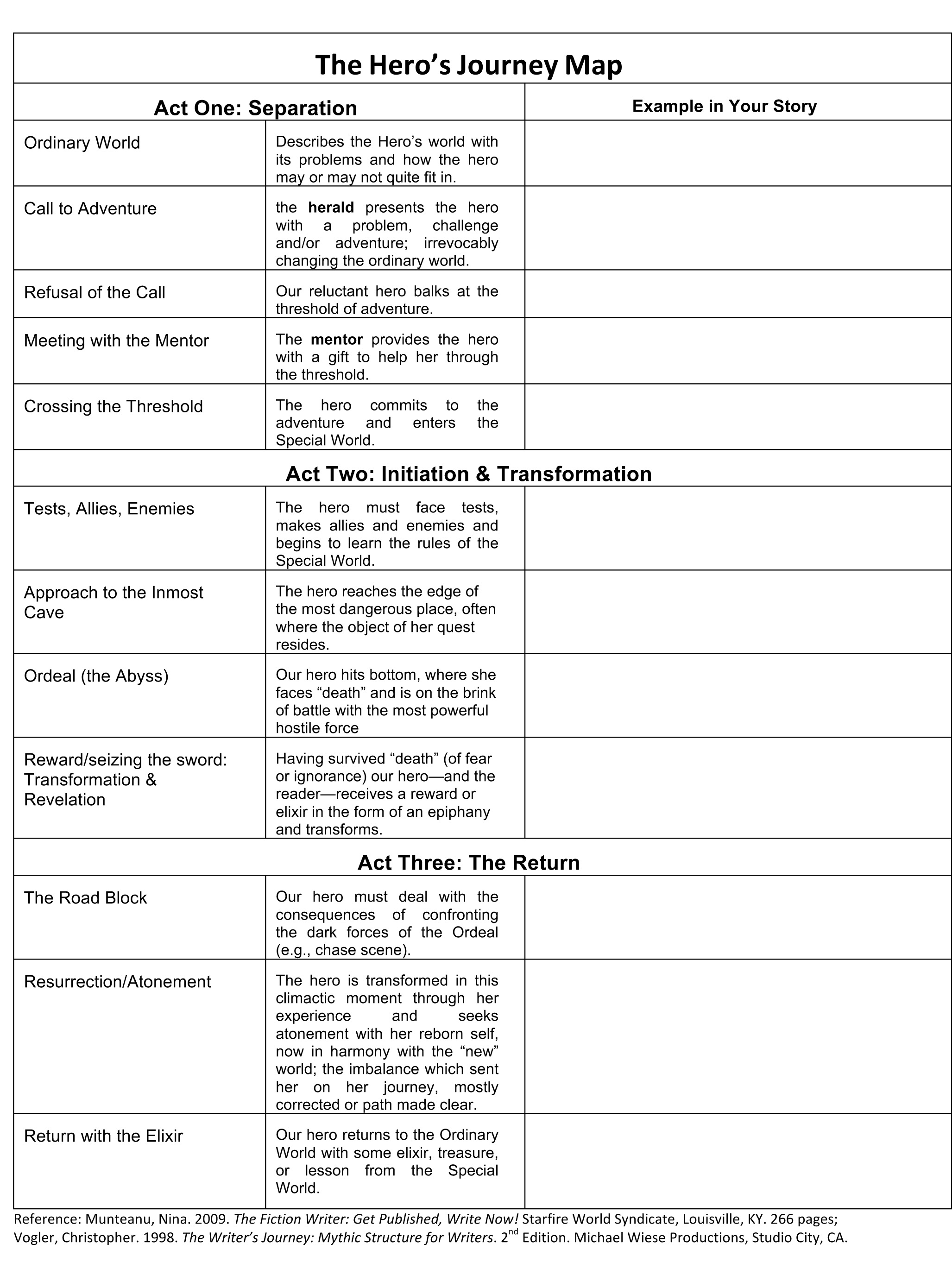
Drawing from several chapters in The Fiction Writer, I introduced the Hero’s Journey map structure, based on Ingrid Sundberg’s plot structure, and discussed the 12-step hero’s journey according to mythologist Joseph Campbell.

We also discussed the seven chief archetypes associated with the journey steps: hero, mentor, herald, threshold guardian, trickster, shapeshifter, and shadow.

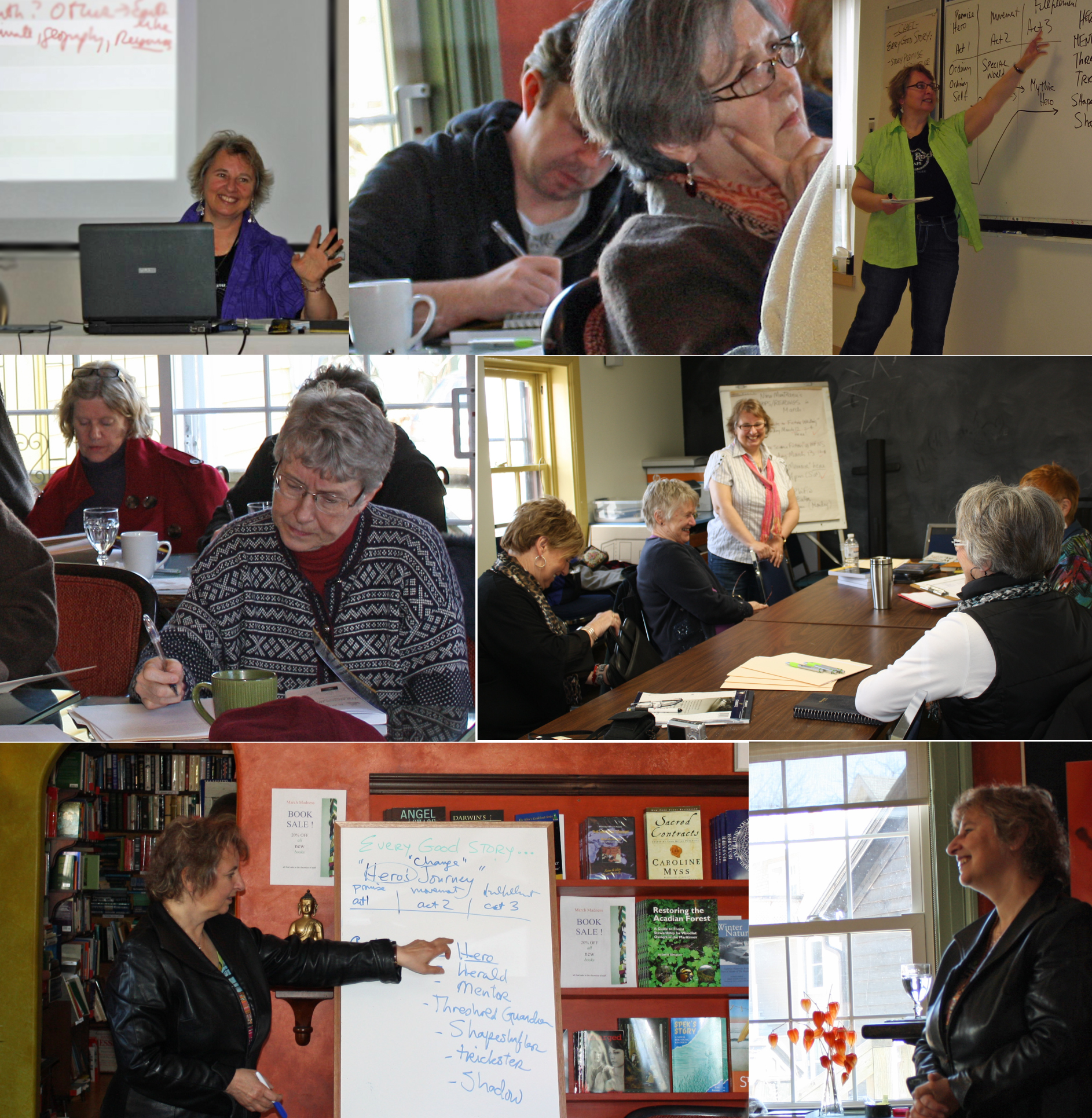
Nina teaching “The Hero’s Journey” plot approach over the years in Nova Scotia, BC and Ontario

I’ve given this workshop many times and always enjoyed the lights that came on in participants; this time was no different. My session was fun and very well received. I saw lots of interest and received many good questions—a sure sign. One participant was quoted as saying:

“What a great event! Your presentation was insightful. I really appreciated being able to follow along in the book while listening to your explanations. That is going to help me remember the concepts as I read the book and then apply them to my writing.” 

The WCYR book table at the event (photo by Nina Munteanu)

People bought every copy of my Fiction Writer, my Journal Writer and most of my Ecology of Story that sat on the book table. I also sold many of my fiction books, including my short story collection Natural Selection (also selling on Kobo) and my latest novel A Diary in the Age of Water. I sold-out of my non-fiction book Water Is…, which had received a wonderful testimonial from Margaret Atwood in the New York Times ‘Year in Reading.’

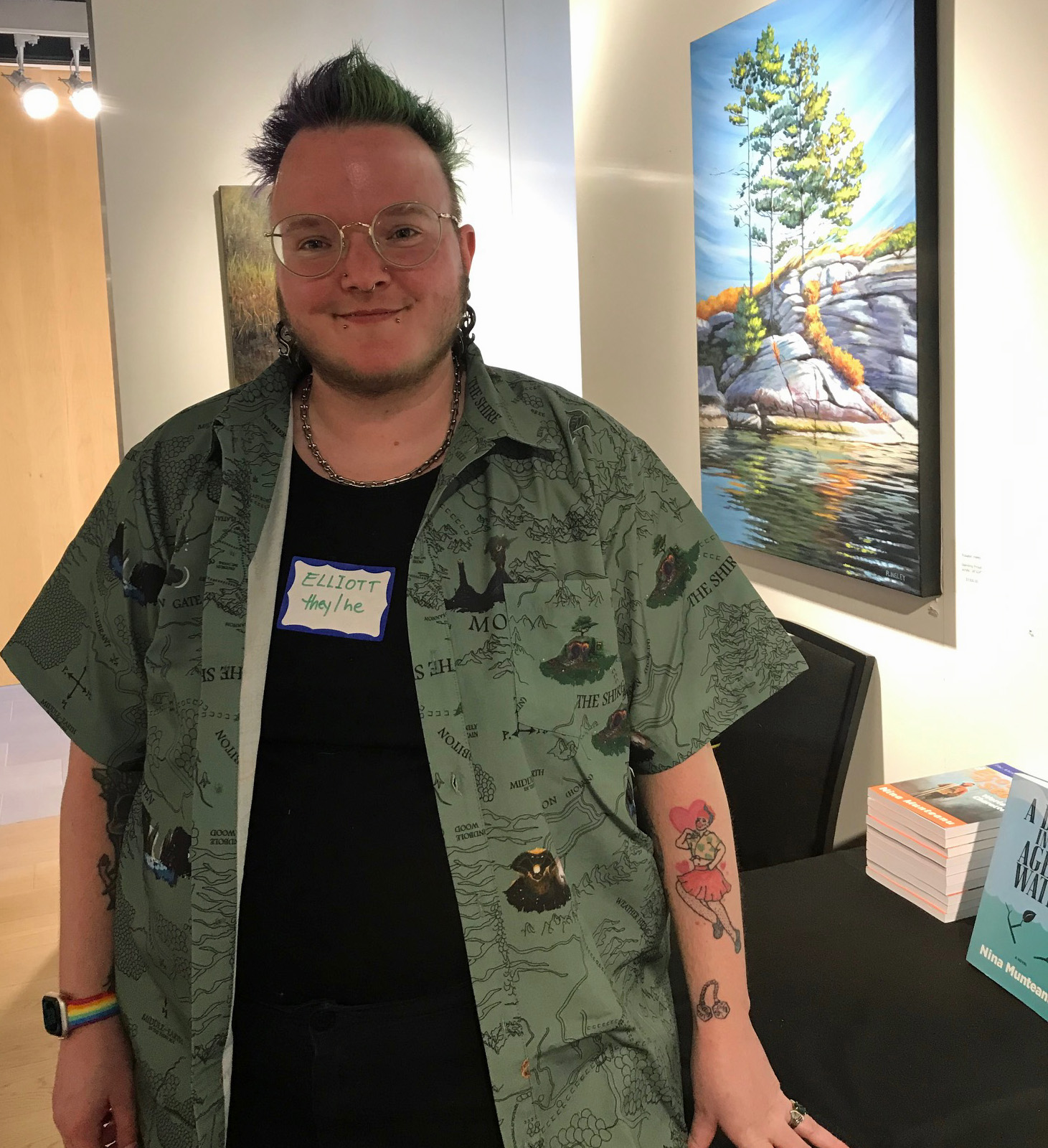
Elliott sells my books at the WCYR book table (photo by Nina Munteanu)

All in all, it was a good day…

Nina Munteanu is a Canadian ecologist / limnologist and novelist. She is co-editor of Europa SF and currently teaches writing courses at George Brown College and the University of Toronto. Visit www.ninamunteanu.ca for the latest on her books. Nina’s bilingual “La natura dell’acqua / The Way of Water” was published by Mincione Edizioni in Rome. Her non-fiction book “Water Is…” by Pixl Press (Vancouver) was selected by Margaret Atwood in the New York Times ‘Year in Reading’ and was chosen as the 2017 Summer Read by Water Canada. Her novel “A Diary in the Age of Water” was released by Inanna Publications (Toronto) in June 2020.

My Books at VPL Central Library, Vancouver

The Vancouver Central Library (photo by Nina Munteanu)

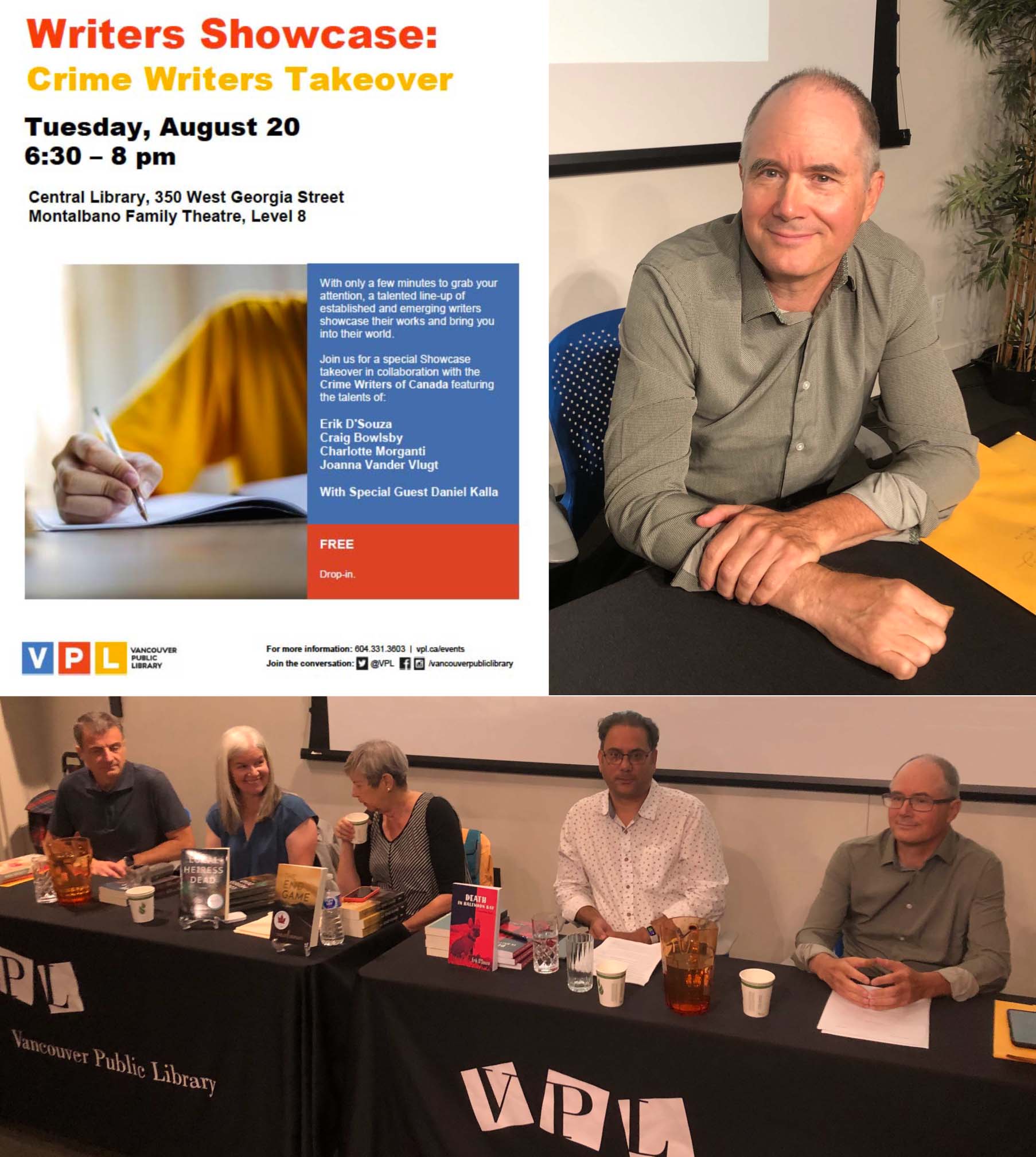
I was recently at Vancouver’s Central Library on Georgia Street to listen to my colleague Craig Bowlsby give a reading from his much anticipated novel Requiem for a Lotus. He was joined by four other crime writers who gave readings that evening, including Daniel Kalla who read from his 2024 book High Society.

Book reading at VPL Central Library

My Books

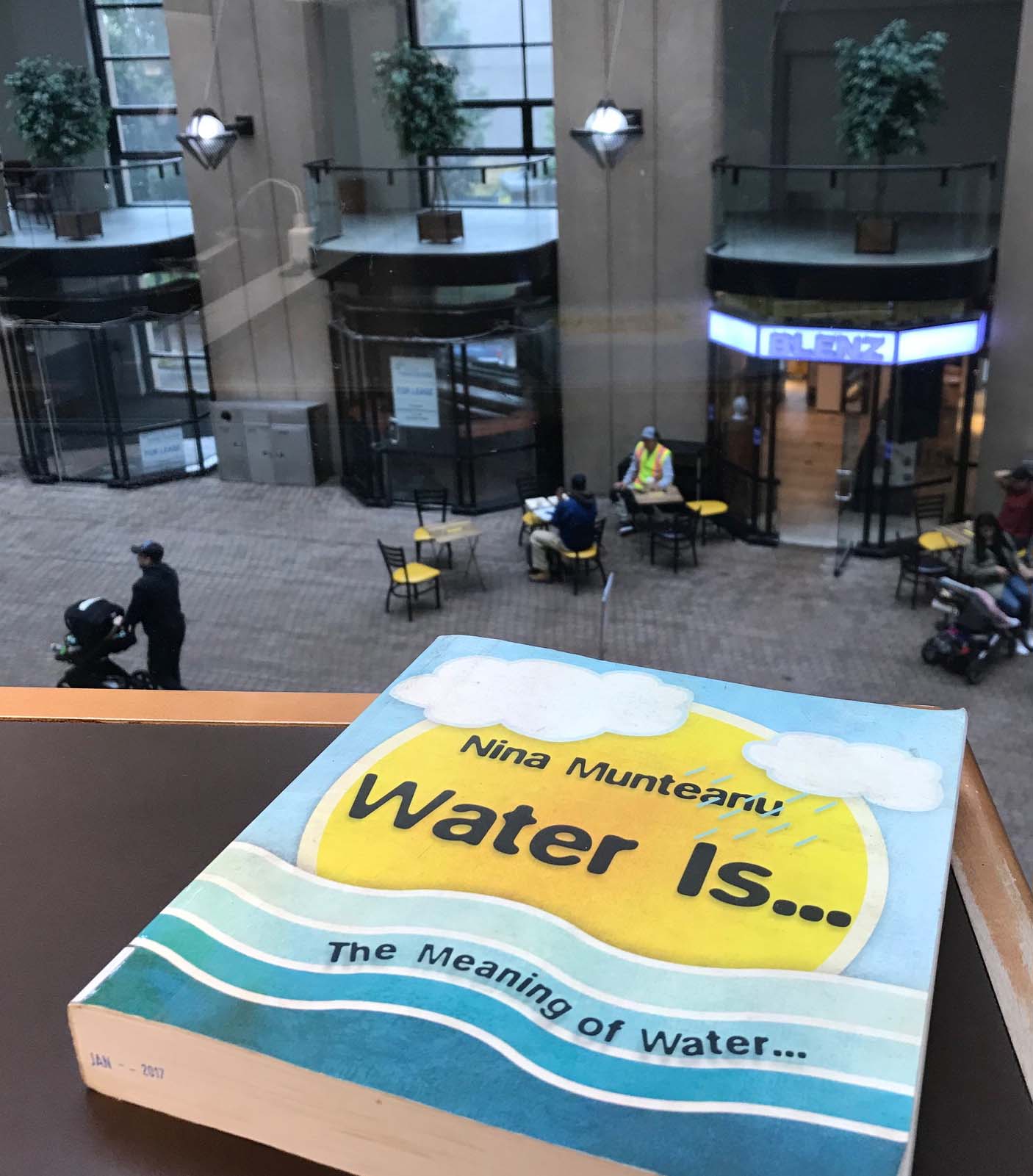
Feeling whimsical on my way out, I asked the librarian if the library carried any of Nina Munteanu’s books. They did, and plenty of them! Most of my science fiction books were on their shelves as well as my historical fantasy The Last Summoner, my writing guide The Fiction Writer, and my nonfiction book on water Water Is…The Meaning of Water.

I returned the next day to check out my books and to enjoy the wonderful setting of this large and iconic Coliseum-inspired library in downtown Vancouver. It was a typical Vancouver drizzly day; a good day to spend in a library, I thought.

My book “Water Is…” at the Vancouver Central Library; note how my book answers the question posed by the book next to it (photo by Nina Munteanu)

I found Water Is… on the ground floor among other books on water. My science fiction books were up on the fourth floor, clustered with my historical fantasy The Last Summoner. Books included Darwin’s Paradox and two books of my Splintered Universe Trilogy, Inner Diverse and Metaverse; Outer Diverse was out with a customer. They also had my short story collection Natural Selection

My science fiction and fantasy books at the Vancouver Central Library (photo by Nina Munteanu)
“Water Is…” sits at a desk overlooking the atrium, Vancouver Central Library (photo by Nina Munteanu)

The Library

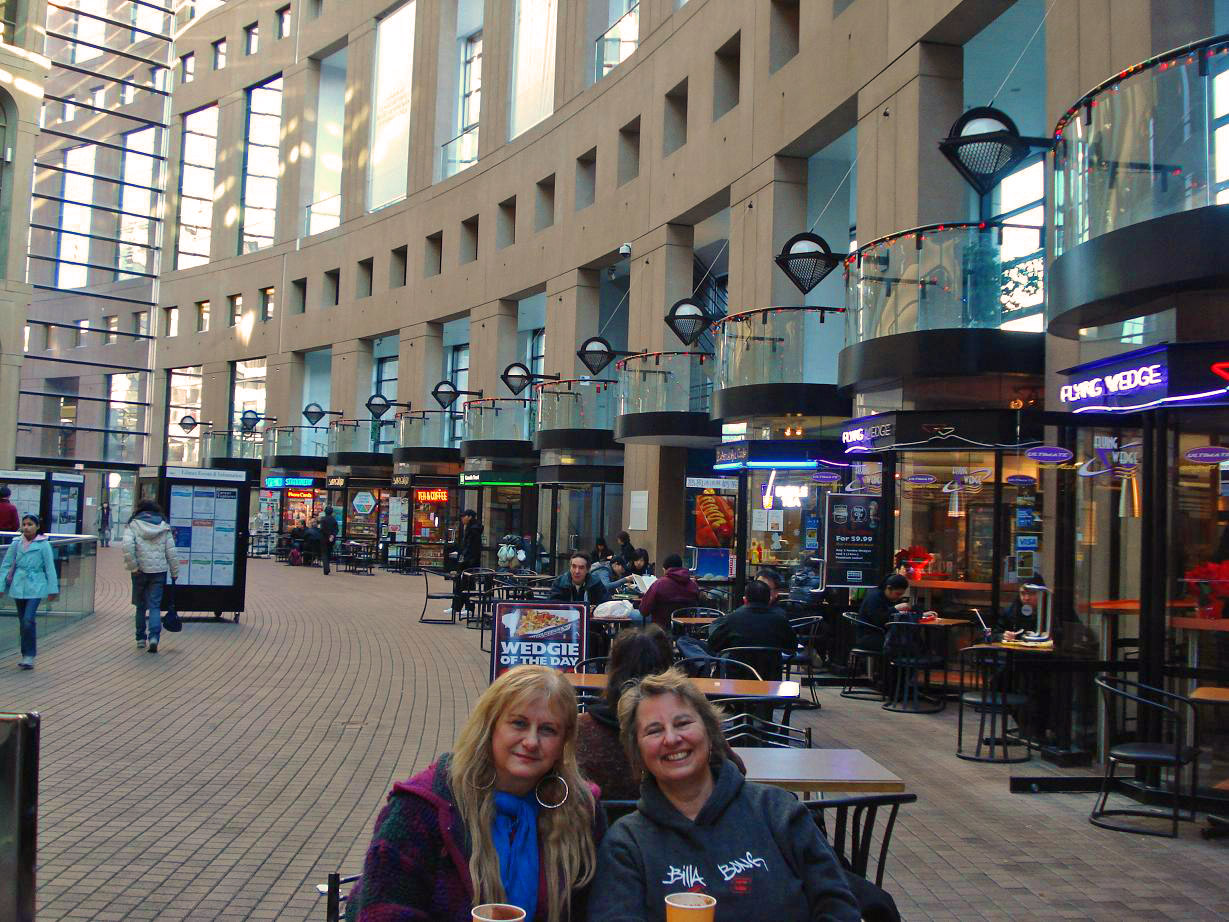
Nina Munteanu and Vancouver poet Lucia Gorea share a Blenz coffee in the atrium of the library complex, Vancouver (photo by

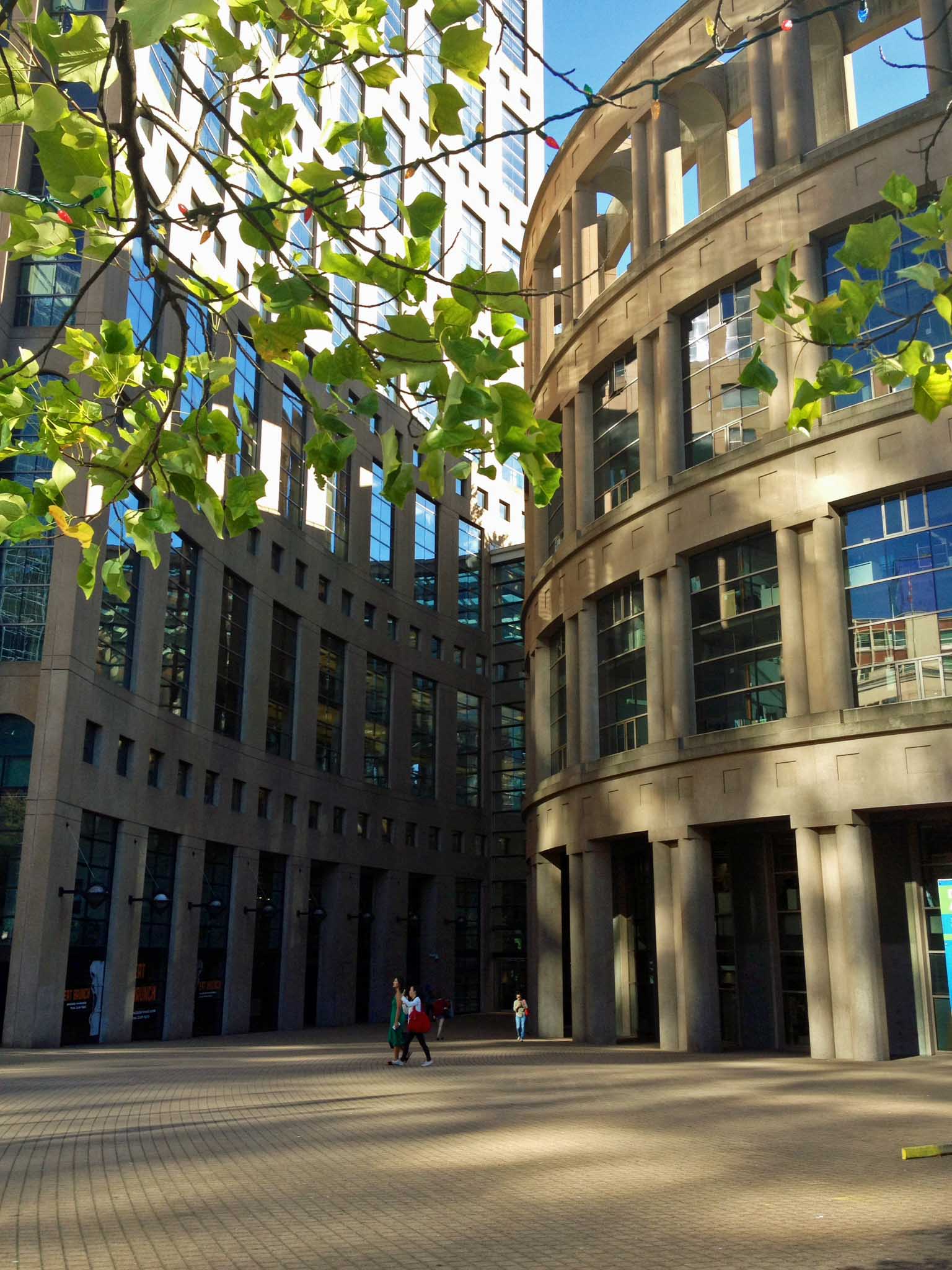
The Vancouver Central Library is an iconic feature of downtown Vancouver. Its Coliseum-style architecture lends a note of gravitas and traditional beauty to the nouveau chic revitalized downtown. Occupying an entire city block in the eastward expansion of Vancouver’s downtown core, the library complex along with federal office building tower is made of sandstone-coloured precast concrete. The building exterior is covered in granite quarried in Horsefly, BC and built to the highest seismic standards. In the words of Safdie Architects: “the heart of the Vancouver Public Library is a spiraling grand urban room that draws the public into Library Square as both a quiet place for study and contemplation and a vital community meeting place.”

Vancouver Central Library complex (photo by Nina Munteanu)

The library opened in May of 1995; then expansion of the upper floors began in June 2017.  As the lease came due on the upper two floors (levels 8 and 9), the library undertook planning to transform the area and offer much needed community spaces.  Rather than featuring traditional collections, the expansion now provides meeting rooms, a glass enclosed reading room, an 80-seat theatre (where I listened to Craig read his book), an exhibition space, as well as a long awaited public rooftop garden and outdoor terraces. Original architects (Moshe Safdie & Associates with local partners DA Architects) were retained to design the new expansion. Cornelia Hahn Oberlander, the landscape architect responsible for the green roof, designed the long-awaited rooftop gardens.

Rooftop gardens of the Vancouver Central Library in the fall

The Environs

I spent a drizzly morning and afternoon in the library with its spacious atrium along with bookstore and Blenz coffee bar, and other interesting places on Georgia Street nearby.

Glowbal, outside and inside (photos by Nina Munteanu)

Close by, at Glowbal, I treated myself to a wonderful lunch on their heated patio undercover. I then dashed through the rain to Telus Gardens next door that I found attractive, fresh and welcoming with its succulent jungle of plants, fragrant orchids and swimming koi ponds. I sipped my London Fog and ate a wonderful apple custard caramel croissant (from Café Bisou), while sitting in a flower-petal chair and enjoying the blissful serenade of a piano player.

Telus Gardens, Vancouver (photos by Nina Munteanu)

The day of sensual pleasures and intellectual satisfaction was complete!

Next time you find yourself in Vancouver’s downtown, check out my books at the Central Library and enjoy the vibrant downtown core.

Looking up at various floors of the Central Library from the atrium (photo by Nina Munteanu)

Nina Munteanu is a Canadian ecologist / limnologist and novelist. She is co-editor of Europa SF and currently teaches writing courses at George Brown College and the University of Toronto. Visit www.ninamunteanu.ca for the latest on her books. Nina’s bilingual “La natura dell’acqua / The Way of Water” was published by Mincione Edizioni in Rome. Her non-fiction book “Water Is…” by Pixl Press (Vancouver) was selected by Margaret Atwood in the New York Times ‘Year in Reading’ and was chosen as the 2017 Summer Read by Water Canada. Her novel “A Diary in the Age of Water” was released by Inanna Publications (Toronto) in June 2020.

The A to Z of Writing Fiction: X, Y, Z…

Snowy marsh in spring, ON (photo and rendition by Nina Munteanu)

In this series of articles, I draw from key excerpts of my textbook on how to write fiction The Fiction Writer: Get Published, Write Now! whose 26 chapters go from A to Z on the key aspects of writing good and meaningful fiction.

X is for Use eXceptional Language … but Don’t Overdo it

What makes some writing stunning and other writing lackluster? Mostly, it’s the language—the words—you use. And, it isn’t just what words you use; it’s how you use them. Here are a few things you need to consider when translating your work into something that sings:

  • Use active verbs and reduce modifiers: many writers, not just beginners, slide into the pattern of using passive and weak verbs (e.g., were, was, being, etc.). Then they add a modifier to strengthen it. It doesn’t. Actively look for strong, vivid verbs. This is a key to good writing. I can’t emphasize this enough.
  • Avoid using excessive prose: novice writers often use too many words to describe an event, action or scene. An overabundance of words slows down the story and obscures plot and action.
  • Use alliteration, metaphor, simile, personification (but don’t overuse): these devices bring lyricism and cadence and powerful imagery to your prose. However, as with anything powerful, you need to use these judiciously. Use them where you wish to convey a strong image and to punctuate your prose.
  • Be mindful of word-accuracy: more often than you might think, a writer inadvertently misuses a word to convey an idea or emotion.
  • Read your writing aloud & punctuate your pauses. Reading out loud helps define cadence, tone and pace of your prose and streamlines your writing. When you read aloud, pay attention to where you naturally pause. You may wish to put in a comma, semi-colon or period there.
  • Size your paragraphs: paragraphs are visual elements that help people read; they break up text on a page in logical places to provide white space for reader ease. This is one of the reasons some passages are harder to read than others; long paragraphs are more tiring to the eye. Find those logical breaks and put them in.
  • Size your sentences: as with paragraphs, overly long sentences can try a reader’s patience and you may lose them entirely. Too many short choppy sentences can also reduce your prose to a mundane level. Varying your sentence length in a paragraph creates the lyricism and cadence that makes prose enjoyable to read.

Y is for Yesterday, Today, and Tomorrow

Have you taken the time to consider tense in your story? While most stories are told in the past tense (e.g., Vinnie ran out of the house), I’ve seen many written in the present tense (e.g., Vinnie runs out of the house). You see the latter more in literary and esoteric works, where the immediacy and dream-like quality of present tense is in keeping with the kind of story being told. I write mostly genre fiction (e.g., science fiction, SF thrillers, historical fantasy, etc.) where the story-telling is normally fast-paced. These read better in the past tense. Stories which follow a more reflective tone can be quite powerful in the present tense.

In her series The Dragon Quartet, Marjorie B. Kellogg alternates from past tense to present tense as she hops from one protagonist’s point of view to the other’s. This deliberate shift in tense between sections works very well. The key is that she is consistent.

In the manuscripts that I read for novice writers I often find what I call uncontrolled shifting of tense within a sentence or paragraph. OWL provides these hints:

  • Use past tense to narrate events and to refer to ideas as historical entities.
  • Use present tense to state facts, to refer to perpetual or habitual actions, and to discuss your own ideas or those expressed by an author in a particular work; also to describe action in a literary work, movie, or other fictional narrative.
  • Future action may be expressed in a variety of ways, including the use of will, shall, is going to, are about to, tomorrow and other adverbs of time, and a wide range of contextual cues.

Z is for The Zen of Passionate Writing

Ralph Keyes, author of The Courage to Write, admits that “what makes writing so scary is the perpetual vulnerability of the writer. It’s not the writing as such that provokes our fear so much as other people’s reaction to our writing.” In fact, adds Keyes, “the most common disguise is fear of them, their opinion of us, when it’s actually our own opinion of ourselves that we’re worried about.” Keyes suggests that ultimately “mastering techniques [of style and craft] will do far less to improve writing than finding the will, the nerve, the guts to put on paper what you really want to say.”

Welcome to the threshold of your career as a writer. This is where many aspiring writers stop: in abject fear, not just of failure but of success. The only difference between those that don’t and those that do, is that the former come to terms with their fears, in fact learn to use them as a barometer to what is important. How do you get past the fear of being exposed, past the anticipated disappointment of peers, past the terror of success? The answer is passion. If you are writing about something you are passionate about, you will find the courage to see it through.

This is ultimately what drives a writer to not just write but to publish: the need to share one’s story, over and over again. Some of us only have one story we need to tell (Margaret Mitchell only needed to tell one, Gone With the Wind); others of us have many to tell. Either way, what is key here is that to prevail, persist, and ultimately succeed, a writer must have conviction and believe in his or her writing. You must believe that you have something to say that others want to read. Ask yourself why you are a writer. Your answer might surprise you.

The first step is to acknowledge your passion and own it. Flaunt it, even. Find your conviction, define what matters and explore it to the fullest. You will find that such an acknowledgement will give you the strength and fortitude to persist and persevere, particularly in the face of those fears. Use the fears to guide you into that journey of personal truths. Frederick Busch described it this way: “You go to dark places so that you can get there, steal the trophy and get out.”

Every writer, like her protagonist, is on a Hero’s Journey. Like the Hero of our epic, we too must acknowledge the call, pass the threshold guardian, experience the abyss and face the beast before we can return “home” with our prize.

The Fiction Writer: Get Published, Write Now! (Starfire World Syndicate) May 2009. Nominated for an Aurora Prix Award. Available through Chapters/IndigoAmazonThe Book Depository, and Barnes & Noble.

The Fiction Writer is a digest of how-to’s in writing fiction and creative non-fiction by masters of the craft from over the last century. Packaged into 26 chapters of well-researched and easy to read instruction, novelist and teacher Nina Munteanu brings in entertaining real-life examples and practical exercises. The Fiction Writer will help you learn the basic, tried and true lessons of a professional writer: 1) how to craft a compelling story; 2) how to give editors and agents what they want’ and 3) how to maintain a winning attitude.

“…Like the good Doctor’s Tardis, The Fiction Writer is larger than it appears… Get Get Published, Write Now! right now.”

David Merchant, Creative Writing Instructor
Otonabee River glistens under a spring sun, ON (photo and rendition by Nina Munteanu)

Click here for more about my other guidebooks on writing.

Nina Munteanu is a Canadian ecologist / limnologist and novelist. She is co-editor of Europa SF and currently teaches writing courses at George Brown College and the University of Toronto. Visit www.ninamunteanu.ca for the latest on her books. Nina’s bilingual “La natura dell’acqua / The Way of Water” was published by Mincione Edizioni in Rome. Her non-fiction book “Water Is…” by Pixl Press (Vancouver) was selected by Margaret Atwood in the New York Times ‘Year in Reading’ and was chosen as the 2017 Summer Read by Water Canada. Her novel “A Diary in the Age of Water” was released by Inanna Publications (Toronto) in June 2020.

The A to Z of Writing Fiction: W…

Snowy marsh in spring, ON (photo and rendition by Nina Munteanu)

In this series of articles, I draw from key excerpts of my textbook on how to write fiction The Fiction Writer: Get Published, Write Now! whose 26 chapters go from A to Z on the key aspects of writing good and meaningful fiction.

W is for Who, Where, When and Why of Doing Research

Research is something many writers dislike and find daunting or even intimidating. In truth, as a writer, you are doing research all the time: when you’re riding the bus or train to work, when you’re traveling on vacation, when you’re having a lively discussion—or better yet an argument— with a friend or colleague. Everything you experience and observe is research. This is what I call non-directed research. It’s also called living. Writers, like all artists, are reporters of life, actively participating and passively observing. A writer is an opportunist, gathering her data through her daily life experiences. Writing fiction draws on this but also on much more…

When writing about a realizable and believable world, whether it takes place in contemporary New York or far future planet Zero, you will need impeccable world building (which includes setting, circumstances, surrounding characters and events) and that will always ultimately require research. you will find very quickly that in order to build a consistent world (even if it’s mostly from your own imagination), you will need to draw upon something real to anchor your imaginary world upon. Whether this reflects a powerful myth or forms an alternative version of a real society, you will still need to apply some rules to follow, so you don’t lose your reader.

With so many useful internet sites and search engines, research has become far easier. But there is also more risk. Finding and confirming information as reliable is an important aspect of doing research. When doing research, particularly on the Internet (but anywhere), you should do several things:

• Use more than one source, particularly for important things; this will give you a wider range of material from which to discern accuracy and reliability.

• Verify your sources and preferably cross reference to measure out objective “truth” versus bias.

• Try to use primary sources (original) vs. secondary or tertiary sources (original cited and open to interpretation); the closer you are to the original source, the closer you are to getting the original story.

• When going to more than one source, try to get a range of different source-types (e.g., conservative newspaper versus blog versus special interest site, etc.) to gain a full range of insight into the issue you’re researching.

Don’t forget that highly valuable and satisfying research can take on the form of interview. You can gain incredible insight into the subject of your research by using a live expert. The advantages he or she has to a book or online database is that they interact with you and may give you something you didn’t even know you needed. Experts include people in your community, your neighbors and friends, professionals in business and in the universities and other educational facilities. Special interest forums and sites can be used to access people to interview.

I keep a journal or scrapbook for every novel I write. This permits me to do several things:

1. Organize relevant research material into one place for easy access (which makes up for my appalling note taking practices).

2. Satisfy my inclination for info dump and expository back-story by providing a place to house it—in my journal, where it belongs, instead of in the story.

By the time I was through with it, the journal I’d kept of my last book—a historical fantasy set in medieval Prussia and modern-day Paris—was its own rich compendium of interesting information, lovingly put together with photos of Paris, drawings and sketches of castles, armour, and long swords, maps of great battles, spreadsheets of timelines and family trees and, of course, commentary on all the great cafés and patisseries in Paris between Rue Princess and Boulevard Saint-Michel.

The Fiction Writer: Get Published, Write Now! (Starfire World Syndicate) May 2009. Nominated for an Aurora Prix Award. Available through Chapters/IndigoAmazonThe Book Depository, and Barnes & Noble.

The Fiction Writer is a digest of how-to’s in writing fiction and creative non-fiction by masters of the craft from over the last century. Packaged into 26 chapters of well-researched and easy to read instruction, novelist and teacher Nina Munteanu brings in entertaining real-life examples and practical exercises. The Fiction Writer will help you learn the basic, tried and true lessons of a professional writer: 1) how to craft a compelling story; 2) how to give editors and agents what they want’ and 3) how to maintain a winning attitude.

“…Like the good Doctor’s Tardis, The Fiction Writer is larger than it appears… Get Get Published, Write Now! right now.”

David Merchant, Creative Writing Instructor
Otonabee River glistens under a spring sun, ON (photo and rendition by Nina Munteanu)

Click here for more about my other guidebooks on writing.

Nina Munteanu is a Canadian ecologist / limnologist and novelist. She is co-editor of Europa SF and currently teaches writing courses at George Brown College and the University of Toronto. Visit www.ninamunteanu.ca for the latest on her books. Nina’s bilingual “La natura dell’acqua / The Way of Water” was published by Mincione Edizioni in Rome. Her non-fiction book “Water Is…” by Pixl Press (Vancouver) was selected by Margaret Atwood in the New York Times ‘Year in Reading’ and was chosen as the 2017 Summer Read by Water Canada. Her novel “A Diary in the Age of Water” was released by Inanna Publications (Toronto) in June 2020.

The A to Z of Writing Fiction: T, U, V…

Light snow falls by the river, ON (photo and rendition by Nina Munteanu)

In this series of articles, I draw from key excerpts of my textbook on how to write fiction The Fiction Writer: Get Published, Write Now! whose 26 chapters go from A to Z on the key aspects of writing good and meaningful fiction.

T is for Don’t Tell; Show

While telling may be more direct and economical in words, showing is more evocative, more vivid, more cinematic. And, ultimately, more engaging. This is what showing does; it engages the reader by luring them into the experience of the story. Telling simply imparts information to you without engaging your emotions. Showing, by its very nature, invites you to experience the event being described. Showing also reveals something about the narrator (usually the main POV character) through their observation.

Novice writers (and some professionals) often fall into the trap of info dumping instead of presenting information dramatically (i.e., showing it). Unless you’re Gabriel García Márquez, who can write superb exposition for pages, the best way is to dramatize your description. It takes courage and confidence to say less and let the reader figure it out. Exposition needs to be broken up and appear in the right place as part of the story. Story is paramount. Telling is one of the things beginning writers do most and editors will know you for one right away. Think of the story as a journey for both writer and reader. The writer makes a promise to the reader that s/he will provide a rip-roaring story and the reader comes onside, all excited. This is done through a confident tease in the beginning and slow revelation throughout the story to keep it compelling. Exposition needs to be very sparingly used, dealt out in small portions.

Telling has its place in narrative. Telling is very useful when you need to let the reader know about an event or action that you do not want to describe in vivid detail; for instance, a scene that isn’t critical. For example:

Sally raced to the airport to catch the plane.

Simple and succinct telling works effectively as transitional narrative. Instead of spending time with this rather mundane journey through city traffic, we can move forward in a sentence to where the action on the plane—the next critical scene—will occur. Telling sentences serve as bridges for critical showing scenes.

When you show your work to editors, agents and fellow writers and they describe it as “evocative”, “cinematic” or “vivid”, take heart—you are showing. If, on the other hand you receive a response that uses the word “padded”, you know you’ve been telling a bit more than you should.

U is for Unclutter Your Writing: Less is More

“Fiction by new writers often suffers from excessive length,” says author Maya Kaathryn Bohnhoff. “Inflated prose is frequently a contributing factor. Too many words are devoted to recounting basic events.” She’s talking about telling versus showing and info-dumping with description that slows action.

One of the best ways to unclutter your writing is to simplify it. This doesn’t necessarily mean that you have to be a Spartan and write sparingly like Hemingway. The model of achieving “simple” within “complex” is as hard to understand as chaos theory and autopoiesis. So, I won’t bother. But I will talk about various writing components that would benefit from simplification.

Fluid writing lies at the basis of uncluttered prose. Here are a few suggestions:

  1. Cut down extraneous words: when constructing a scene, it is wise to pay attention to cadence, rhythm, number of phrases or clauses and general length of sentences. Sentences in early works tend to be full of extra words (e.g., using “ing” verbs, add-ons like “he started to think” instead of simply “he thought”) that slow down narrative. Try reading your sentences out loud; this practice often helps you to find the clutter.
  2. Use active & powerful verbs. Active verbs are the key to vivid writing; and, ironically, to uncluttering your writing.
  3. Cut down the words in your paragraphs: pay particular attention to your intro chapters and cut down your words by at least 20%. Be merciless; you won’t miss them, believe me, and you will add others later in your second round of edits. Find the most efficient way to say what you mean. You are guaranteed to achieve this if you follow suggestion number 2.
  4. Reduce redundancy: a common phenomenon with many writers, including those who write nonfiction, is that the introductory sentence of a narrative paragraph is often paraphrased unnecessarily in the very next sentence; as though the writer didn’t trust the reader to get it the first time. Lack of confidence and experience is common with novice authors and is something that you must learn to combat. Say it once and say it right the first time.
  5. Show, don’t tell: Embracing this way of writing may be the single most effective way to reduce clutter and enhance the vividness of your writing at the same time. While showing may in fact add more words than simple telling, the way it is read (mostly in the form of action) makes up for the added words.

V is for Voices in Your Head

Your voice and story is expressed through tone, perspective, style, language and pace. All of these reflect your intent and are ultimately expressed in the story’s overarching theme. The overarching theme is ultimately the author’s theme, the “world view” of the story. The principal character and minor characters will carry variations on the main theme, each with his or her unique voice.

It’s important to give each character a distinctive “voice” (including use of distinct vernacular, use of specific expressions or phrases, etc.). This is one way a reader can identify a character and find them likeable — or not. In a manuscript I recently reviewed, I noticed that each character spoke in a mixture of formal and casual speech. This confuses the reader and bumps them out of the fictive dream. Most people’s speech is more consistent. Consistency is very important for readers; it helps them identify with a character. They will abandon a story whose writing—and voice—is not consistent. So, my advice to this beginning writer was to pick one style for each character and stick to it. Voice incorporates language (both speech and body movements), philosophy, and humor. How a character looks, walks, talks, laughs, is all part of this.

The story’s viewpoint can be told from several perspectives and which one you choose can be critical to how your story comes across. Different stories lend themselves to different narrative styles and points of view (POVs). David Morrell, author of First Blood, warns that some writers may “select a viewpoint merely because it feels natural, but if you…don’t consider the implications of your choice…your story might fight you until you abandon it, blaming the plot when actually the problem is how you’re telling it.” (Fiction Writer, April 2000). The choices are several:

• omniscient

• third person limited

• first person

• second person

When telling a story through the eyes of a single viewpoint character, it makes most sense to tell it through the main character, the protagonist, around whom the story usually revolves. She is the one who’s going to be chiefly affected by the events of the story.

The use of multiple viewpoints is common among writers and adds an element of richness and breadth to a story. With each added character’s POV, readers are more enlightened to the thoughts and motivations of characters in a story. When you have several characters telling the story, this is called a rotating viewpoint. A few points to follow include:

• Alternate or rotate your differing viewpoints clearly (scene by scene, chapter by chapter, or part by part)

• Don’t change viewpoints within a scene

• Separate different POV scenes within chapters with extra white space or some kind of graphic (e.g., ****)

The Fiction Writer: Get Published, Write Now! (Starfire World Syndicate) May 2009. Nominated for an Aurora Prix Award. Available through Chapters/IndigoAmazonThe Book Depository, and Barnes & Noble.

The Fiction Writer is a digest of how-to’s in writing fiction and creative non-fiction by masters of the craft from over the last century. Packaged into 26 chapters of well-researched and easy to read instruction, novelist and teacher Nina Munteanu brings in entertaining real-life examples and practical exercises. The Fiction Writer will help you learn the basic, tried and true lessons of a professional writer: 1) how to craft a compelling story; 2) how to give editors and agents what they want’ and 3) how to maintain a winning attitude.

“…Like the good Doctor’s Tardis, The Fiction Writer is larger than it appears… Get Get Published, Write Now! right now.”

David Merchant, Creative Writing Instructor
Snowy marsh in spring, ON (photo and rendition by Nina Munteanu)

Click here for more about my other guidebooks on writing.

Nina Munteanu is a Canadian ecologist / limnologist and novelist. She is co-editor of Europa SF and currently teaches writing courses at George Brown College and the University of Toronto. Visit www.ninamunteanu.ca for the latest on her books. Nina’s bilingual “La natura dell’acqua / The Way of Water” was published by Mincione Edizioni in Rome. Her non-fiction book “Water Is…” by Pixl Press (Vancouver) was selected by Margaret Atwood in the New York Times ‘Year in Reading’ and was chosen as the 2017 Summer Read by Water Canada. Her novel “A Diary in the Age of Water” was released by Inanna Publications (Toronto) in June 2020.

The A to Z of Writing Fiction: Q, R, S…

Light snow falls by the river, ON (photo and rendition by Nina Munteanu)

In this series of articles, I draw from key excerpts of my textbook on how to write fiction The Fiction Writer: Get Published, Write Now! whose 26 chapters go from A to Z on the key aspects of writing good and meaningful fiction.

Q is for Queries & Other Quests

A query letter is your letter of enquiry to a publisher/editor or agent regarding the possible publication or representation of your work. “It’s a writer’s introduction, our calling card and, hopefully, our foot in the door,” says Lynn Flewelling, author of Luck in the Shadows. “Some agents and editors glance at the letter but read the chapters first,” she adds. “Others read the query and reject the chapters unseen if the letter doesn’t sing. You never know, so write the letter like it’s the one thing standing between you and success. It just might be.”

In her book, The Sell Your Novel Toolkit, Elizabeth Lyon dissects the query into:

  • Lead: using a creative hook (direct immersion in the story; discussion of the period, setting or milieu; or presentation of the theme of the book) or business hook (with particulars about the book, comparisons with others, and author’s credentials and awards)
  • Body: short synopsis, either story- or characterization/theme-focused; brief biography with credentials, etc.
  • Conclusion: closing sentences; the “handshake”

Polish and be professional:

  • Ensure that there are no spelling or grammatical errors
  • Make sure your editor’s name is correct as well as the publication name and address
  • Use standard letter format and standard paper (keep it simple and professional) and stay away from fancy patterns or coloured paper
  • Keep the letter to one page if possible
  • Include a self-addressed stamped envelope (SASE) for mailed queries
  • Include your name, postal address, email address and phone number

John Hewitt provides a good list of what NOT to do in a query letter. Here are a few:

  • Don’t mention who has rejected the piece before
  • Don’t apologize for any weaknesses
  • Don’t ask for advice, comments or criticism/analysis
  • Don’t gush about how excited you are about being published
  • Don’t go on about this being your first
  • Don’t include a lot of personal information about yourself
  • Don’t provide several projects in the same query, unless they are related and part of a series
  • Don’t query the same editor twice
  • Don’t discuss copyright information, or payment
  • Don’t include inappropriate off-subject samples

R is for How to Reject Rejection Letters

In a 1999 article in Writer’s Journal, Dennis E. Hensley, associate professor of English at Taylor University Fort Wayne and author of Writing for Profit, told the story of when his writing teacher in college tried to console him after a short story of his had been rejected for the umpteenth time. “Listen,” she had said, “you weren’t rejected, your manuscript was.” He didn’t quite see it that way. “It was my title, my lead, my characters, my plot and my ending,” he’d responded. “No one else had anything to do with it. If the story was rejected, then let’s face it: as a writer, I was rejected.” Rejection is still rejection. Thirty years later, Hensley adds that he still gets rejection letters and he is still not overjoyed to receive them. As time goes on and you become a more seasoned writer, you develop a business-attitude and an objective way of viewing rejection letters. The irony is that it is the beginner writer who is more likely to get rejections.

Think of rejection as part of a road to success. The bottom line is that if you have never been rejected then you haven’t really tried, have you? Rejection really is the first step toward acceptance. With anything that is worth doing, there is risk and there is vulnerability. So too in writing. In order to publish, you have to risk being rejected. In fact, count on it. YOUR WORK WILL BE REJECTED. The good news is that at some point your work will also BE ACCEPTED; count on that too.

My Bus-Terminal Approach: One way to see your way through rejection is to find ways to distance yourself from your story once you’ve sent it off and to see the whole process of submission-rejection-acceptance as a business. The very best way to do this is to submit lots of stories and to keep submitting them. With novels, this is a little harder to do but you can certainly be working on the next one once you’ve submitted the first. When I was writing short stories, I kept a list of what and where I submitted, along with the most important item: where to submit NEXT. At any given time, I made sure that I had at least x-number of submissions out there and each story had a designated place to go if it returned. As soon as a story came back from magazine A, I simply re-packaged it and sent it to magazine B. The critical part of the list was to have a contingency for each story: the next place where I would send the story once it returned. I was planning on the story being rejected with the hope that it would be accepted; that way, a rejection became part of a story’s journey rather than a final comment. I ran my submissions like a bus terminal. A story was in and out so fast it never had a chance to cool off. And, since I had five other pieces out there, I could do this with little emotion. I was running a fast-paced “story depot”, after all. All my stories had to be out there as soon as possible; if they were sitting in the terminal, they were doing nothing for me. This approach really worked for me.

S is for Get Sensual  

Writers can provide readers with a rich spectrum of sensuality such as what a place smells like, the texture of an object, the taste of a food, as well as the nuances of light and sound. Readers don’t just “watch” a character in a book; they enter the character’s body and “feel”.

So, how do writers satisfy the readers’ need to experience the senses fully? Description, yes. But how cold is cold? What does snow really smell like? What colour is that sunset? How do you describe the taste of wine to a teetotaler? Ultimately, literal description doesn’t quite cut it. To have the sense really sink in and linger with the reader, it should be linked to the emotions and memories of the character experiencing it. By doing this, you are achieving several things at the same time:

• You’re describing the sense as the character is experiencing it—emotionally

• You’re revealing additional information on the character through his/her reaction

• You’re likely creating a more compelling link for the reader’s own experience of the sense

There are several tools a writer may use to achieve this. Here are a few:

• Use metaphor to describe the sense

• Link the sense to memories

• Use synesthesia (cross-sensory metaphor) to describe the sense

• Link the sense psychologically to an emotion or attitude

• Relate to the sense in a different way (e.g., a visual scene from the point of view of a painter)

The use of metaphor when used to describe an object or place through one or several senses adds a dimension of emotion, tone and direction. While all five of our senses can be linked to memories, two of them stand out. Smell and taste let us sample the chemicals around us for information.

 “Memory lies coiled within us like a magician’s trick handkerchief, and a simple smell or taste can pluck the tiniest corner and pull out the world,” says Fitch. “Smell is different from all the other senses in a very special way. A smell from your distant past can unleash a flood of memories that are so intense and striking that they seem real,” says Dr. Karl (Kruszelnicki), author of Great Moments in Science (1984). “This kind of memory, where an unexpected re-encounter with a scent from the distant past brings back a rush of memories, is called a ‘Proustian Memory’”.

Ironically, smell, along with taste, is often neglected in our own overt observations and in writing. By consciously attending to these two senses alone, the writer is assured of engaging the reader’s more deeply rooted sensuality.

The Fiction Writer: Get Published, Write Now! (Starfire World Syndicate) May 2009. Nominated for an Aurora Prix Award. Available through Chapters/IndigoAmazonThe Book Depository, and Barnes & Noble.

The Fiction Writer is a digest of how-to’s in writing fiction and creative non-fiction by masters of the craft from over the last century. Packaged into 26 chapters of well-researched and easy to read instruction, novelist and teacher Nina Munteanu brings in entertaining real-life examples and practical exercises. The Fiction Writer will help you learn the basic, tried and true lessons of a professional writer: 1) how to craft a compelling story; 2) how to give editors and agents what they want’ and 3) how to maintain a winning attitude.

“…Like the good Doctor’s Tardis, The Fiction Writer is larger than it appears… Get Get Published, Write Now! right now.”

David Merchant, Creative Writing Instructor
Snowy marsh in spring, ON (photo and rendition by Nina Munteanu)

Click here for more about my other guidebooks on writing.

Nina Munteanu is a Canadian ecologist / limnologist and novelist. She is co-editor of Europa SF and currently teaches writing courses at George Brown College and the University of Toronto. Visit www.ninamunteanu.ca for the latest on her books. Nina’s bilingual “La natura dell’acqua / The Way of Water” was published by Mincione Edizioni in Rome. Her non-fiction book “Water Is…” by Pixl Press (Vancouver) was selected by Margaret Atwood in the New York Times ‘Year in Reading’ and was chosen as the 2017 Summer Read by Water Canada. Her novel “A Diary in the Age of Water” was released by Inanna Publications (Toronto) in June 2020.

The A to Z of Writing Fiction: P…

Snowing in cedar forest, ON (photo and rendition by Nina Munteanu)

In this series of articles, I draw from key excerpts of my textbook on how to write fiction The Fiction Writer: Get Published, Write Now! whose 26 chapters go from A to Z on the key aspects of writing good and meaningful fiction.

P is for Plotting with Purpose

“Plot is the things characters do, feel, think, or say, that make a difference to what comes afterward,” says Ansen Dibel, author of Elements of Fiction Writing: Plot. I’ve also heard authors describe plot as all the nasty things they throw at their main character to stop them from getting where or what they want or need. Plot is motion. “Plot is a verb,” says Dibell. “For a reader to care about your story, there has to be something at stake—something of value to gain, something of value to be lost.”

Although plots will vary as much as individual stories, there are some basic elements and forms. Here are some:

• Cause and Effect: this is simply when one event leads to another. Many writers talk about scenes and sequels when constructing stories (see below).

• Thematic: this is where events are tied together by a thematic thread, a common relationship, a central event, place, character or theme.

• Lyric: this is when plot is organized like music, with a cyclical return to key images, events or themes that grow deeper each time (Finnegan’s Wake, by James Joyce, for example.)

• Hero’s Journey: this plot approach follows the mythic steps of the hero’s journey.

Plot structure generally follows a progression from scene (action) to sequel (reaction) and back to scene again. A scene has the three-part pattern of: goal, conflict, disaster. A sequel follows with this three-part pattern: reaction, dilemma, decision. Plot structure generally follows a thematic story arc. A seven-point plot structure goes like this: hoot, problem, backfill, complication, action, the dark moment, resolution. This step-wise plot approach reflects the three act elements of the “hero’s journey”.

Bill Johnson said that every story makes a promise at the beginning to the reader. Those promises, says Dibell, are mostly unspoken ones. And some are made indirectly through pattern. As the journey continues, problems build on the previous ones, always moving the main plot toward the final crisis. “The job of a middle,” says Dibell, “is to build toward and deliver crisis.”

“Detail on detail, incident on incident, character on character, the pattern(s) begin to form,” says Dibell. “…they’re what hold your story together, give it both diversity and unity.” Dibell describes plot as a tapestry of pattern, form, shape and color that share recognizable meanings. Which brings me to subplots, the threads that make up the story’s fabric.

Subplots are more common in long fiction, where they are used to deepen a story and add layers that make it more intriguing and tease out more depth to the story. Subplots may provide varying aspects of a theme, from community to individual as played out by different characters. Ultimately, subplots and how they are crafted, provide the writer with the means to transcend plot into what Dibell calls pattern.

Dibell describes “braided” plots, in which two or more subplots are woven together, and parallel plot lines, in which two plots share almost equal footing. This happens when strong protagonists carry each plot. Parallel plot lines often run counterpoint to each other in pace, tone and colour. Each plot becomes richer and stronger when contrasted with the other. And they are always connected in some way, in many ways. In Matrix Reloaded, Neo’s introspective and thoughtful plot with the architect of the matrix runs counterpoint with Trinity’s action plot as she sabotages the matrix and battles an agent. Both demonstrate conflict and tension but the tone and pace are opposite. This contrast only heightens each plot line. Notice also how the two plot lines are connected and eventually converge in the final scene where Neo saves Trinity’s life by restarting her heart. Earlier on, while Trinity is totally engrossed in her problems, Neo becomes aware of her struggle through the architect’s artful hint; this prompts Neo to choose his path to join her plot. His awareness is the bridge between the two plot lines. If you look carefully, you will find many other ways the two plot lines are connected, visually, mentally and viscerally and how they inevitably draw together in that riveting last scene; “how thoroughly,” Dibell says, “the story belongs to itself.”

Crawford Kilian, SF writer and author of Writing Science Fiction and Fantasy, set down these ten commandments:

  • Nothing should happen at random
  • Plot stems from character under adversity
  • Give each character an urgent personal agenda
  • The plot of a story is the synthesis of the plots of its individual characters
  • The plot “begins” long before the story
  • Foreshadow all important elements
  • Keep in mind the kind of story you’re telling
  • Ironic plots subvert their surface meanings
  • The hero must eventually take charge of events
  • Plot dramatizes character.

The Fiction Writer: Get Published, Write Now! (Starfire World Syndicate) May 2009. Nominated for an Aurora Prix Award. Available through Chapters/IndigoAmazonThe Book Depository, and Barnes & Noble.

The Fiction Writer is a digest of how-to’s in writing fiction and creative non-fiction by masters of the craft from over the last century. Packaged into 26 chapters of well-researched and easy to read instruction, novelist and teacher Nina Munteanu brings in entertaining real-life examples and practical exercises. The Fiction Writer will help you learn the basic, tried and true lessons of a professional writer: 1) how to craft a compelling story; 2) how to give editors and agents what they want’ and 3) how to maintain a winning attitude.

“…Like the good Doctor’s Tardis, The Fiction Writer is larger than it appears… Get Get Published, Write Now! right now.”

David Merchant, Creative Writing Instructor
Light snow by the river, ON (photo and rendition by Nina Munteanu)

Click here for more about my other guidebooks on writing.

Nina Munteanu is a Canadian ecologist / limnologist and novelist. She is co-editor of Europa SF and currently teaches writing courses at George Brown College and the University of Toronto. Visit www.ninamunteanu.ca for the latest on her books. Nina’s bilingual “La natura dell’acqua / The Way of Water” was published by Mincione Edizioni in Rome. Her non-fiction book “Water Is…” by Pixl Press (Vancouver) was selected by Margaret Atwood in the New York Times ‘Year in Reading’ and was chosen as the 2017 Summer Read by Water Canada. Her novel “A Diary in the Age of Water” was released by Inanna Publications (Toronto) in June 2020.