Exploring “The Law of Attraction for Writers” Podcast with Suzanne Lieurance & Simon Rose

Today, I’m sitting down with authors and writing coaches Suzanne Lieurance and Simon Rose to talk about their brand-new YouTube series, The Law of Attraction for Writers Podcast, which you can find at: https://www.youtube.com/@LawofAttractionforWritersPodca.
The show blends mindset, creativity, and practical writing advice — a combination that’s resonating with writers who want to manifest success and write with more ease.

Nina: Welcome, both of you!

Suzanne: Thank you! We’re so excited to finally share this project.

Simon: Yes, it’s been in the works for a while, and we’re thrilled to see writers already responding so positively.

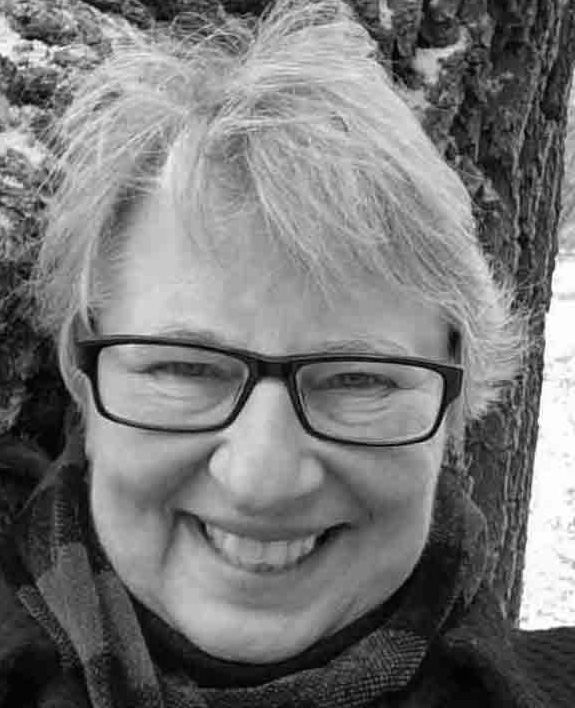
Simon Rose and Suzanne Lieurance

Nina: Let’s start with the big question. Why create a Law of Attraction for Writers podcast?

Suzanne: Well, over the years, I’ve coached so many writers who say things like, “I’ll feel successful when I get an agent,” or “I’ll write when I have more time.” But the Law of Attraction teaches us it works the other way around — you become the person who already feels successful, and the opportunities follow. I wanted to create a podcast that helps writers understand how their thoughts, emotions, and energy shape their writing lives.

Simon: Exactly. So much of writing is mental. You can have the best outline and still feel blocked if your energy is off. We wanted to show that aligning your mindset with your goals isn’t mystical — it’s practical. You’re essentially training your brain to focus on what you want instead of what you fear.

Nina: How would you describe the podcast to someone who hasn’t tuned in yet?

Simon: Each episode focuses on one key aspect of the Law of Attraction and how it connects to the writing process. We might explore a concept like visualization, vibration, or inspired action — and then show writers how to apply that directly to their writing routines.

Suzanne: We wanted to make it accessible. It’s not just theory or motivation. We give writers clear steps they can take right away — ways to shift their thinking, attract new ideas, or rekindle their excitement for a project.

Simon: We also share personal stories. Between the two of us, we’ve seen these principles in action — in publishing, in teaching, and even in everyday creative decisions.

Nina: I love that you connect mindset with the craft of writing. Can you say more about how that works?

Suzanne: Sure. A lot of writers separate the two — mindset on one side, writing craft on the other. But they’re intertwined. You might know every writing technique out there, but if you’re doubting yourself or constantly telling yourself you’re behind, you’ll block the creative flow.


Simon: That’s why the Law of Attraction is so powerful for writers. It’s not just about “thinking positive.” It’s about intentionally setting the tone for your writing sessions, deciding what kind of writer you believe yourself to be, and letting that belief guide your actions.

Suzanne: In one episode, we talk about “energetic alignment” — how your emotional state affects the words you put on the page. When you write from frustration, the writing feels heavy. But when you write from joy or curiosity, the story expands.

Nina: You’ve both been writing coaches for years. How has it been working together on this project?

Simon: It’s been wonderful. Suzanne brings a very intuitive approach to writing and mindset, while I tend to look at things through a more analytical lens. Together, we strike a balance between the spiritual and the practical.

Suzanne: Yes! We complement each other well. Simon often grounds the big ideas in real-world examples, and I love exploring how energy and focus shape results. It’s a true partnership — and we both learn from each other in every episode.

Nina: Without giving too much away, what are some of the themes or takeaways that keep coming up in your discussions?

Suzanne: One theme that runs through everything is trust — trusting yourself, your ideas, and the timing of your success. The Law of Attraction reminds us that everything unfolds when you’re ready to receive it.

Simon: Another recurring idea is momentum. Writers often stop when things get tough, but energy builds through consistent action. You don’t have to write for hours every day — just focus on showing up with intention. That small shift can open the door to much bigger results.

Suzanne: We also talk about how to handle resistance. Every writer faces doubt or creative slumps. The podcast offers ways to turn those moments into opportunities instead of roadblocks.

Nina: You’ve chosen YouTube as your main platform. Why that format?

Simon: We wanted to make it easy and engaging. YouTube allows us to connect visually and energetically with our audience. Writers can listen while they work, which adds a more personal connection.

Suzanne: And YouTube’s format fits how writers consume content today. Many of them already use it to learn about craft and publishing. This podcast adds another layer — the inner work behind writing success.

Nina: What’s ahead for the Law of Attraction for Writers Podcast?

Suzanne: We’ll keep releasing new episodes every Tuesday. Each one will build on the idea that your energy, focus, and beliefs create your writing experience.

Simon: We’re also exploring live Q&A sessions, where writers can ask questions and share how they’ve applied the principles we discuss. It’s exciting to see a community forming around these ideas.

Suzanne: Ultimately, we want every writer to realize they’re not powerless. They can create not only their stories but also their success.

Nina: That’s such an inspiring message. Any final thoughts for writers who might be hesitant to explore this side of writing?

Suzanne: Just start listening with an open mind. You don’t have to “believe” in anything right away — just try applying one idea and see what shifts.

Simon: Yes. Writing is already an act of creation — you’re manifesting something that didn’t exist before. This podcast helps you see that same creative power working in every area of your writing life.

Nina: Beautifully said. Thank you both.


Watch: New episodes of The Law of Attraction for Writers Podcast drop every Tuesday on YouTube at https://www.youtube.com/@LawofAttractionforWritersPodca

Follow Suzanne Lieurance and Simon Rose for practical, inspiring ways to align your mindset, energy, and creativity — and manifest the writing life you’ve always imagined.

Nina Munteanu is an award-winning novelist and short story writer of eco-fiction, science fiction and fantasy. She also has three writing guides out: The Fiction Writer; The Journal Writer; and The Ecology of Writing and teaches fiction writing and technical writing at university and online. Check the Publications page on this site for a summary of what she has out there. Nina teaches writing at the University of Toronto and has been coaching fiction and non-fiction authors for over 20 years. You can find Nina’s short podcasts on writing on YouTube. Check out this site for more author advice from how to write a synopsis to finding your muse and the art and science of writing.

On Writing: The Blank Page

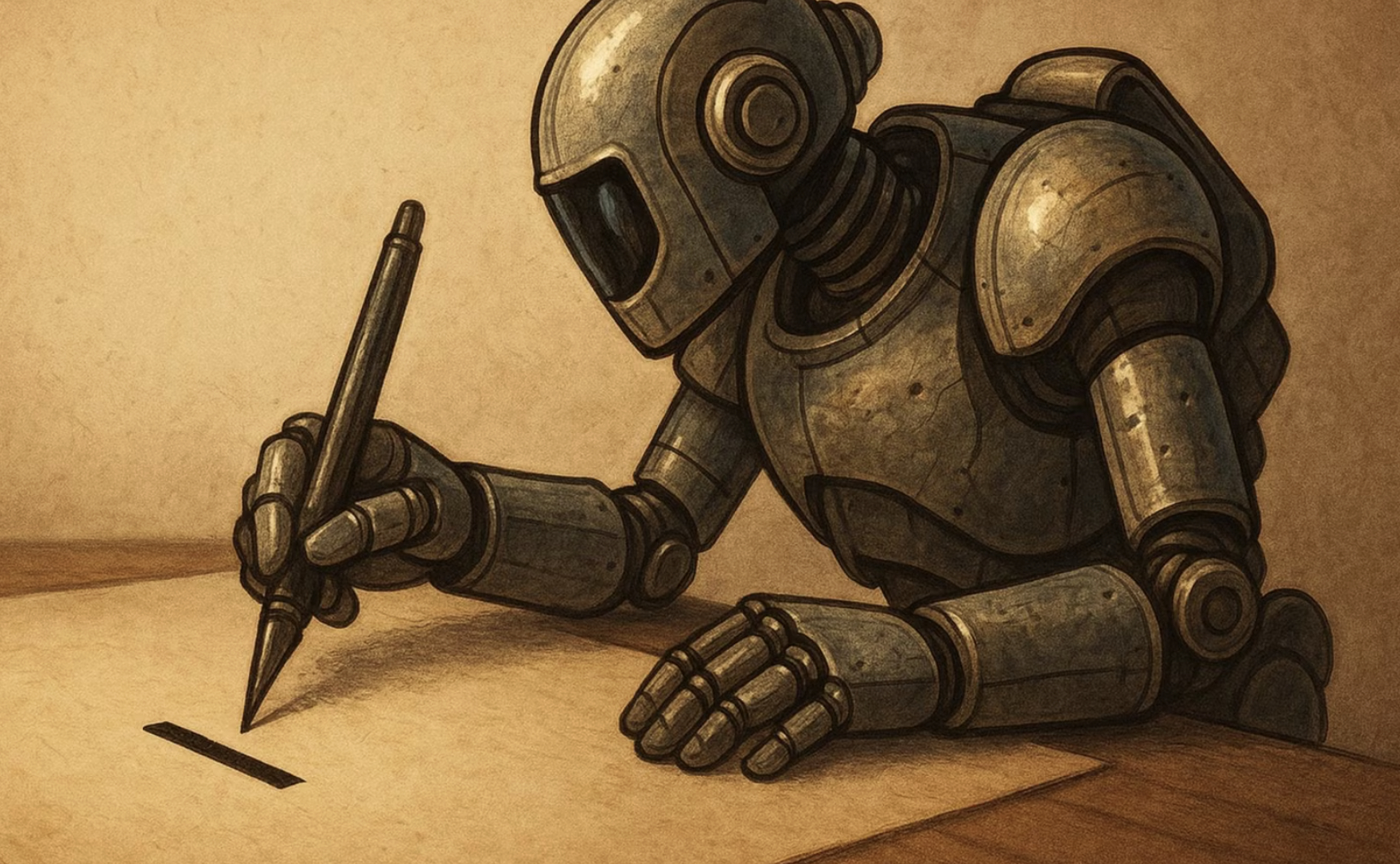
AI concept art by genaiTechvifySoftware.com

I teach scholarly writing at the University of Toronto through several writing centres; I’m helping students with their assignments in engineering, the health sciences and humanities. All are generating scholarly papers on various topics with various purposes; anything from a critical assessment, literature review, position paper, or reflection essay to a lessons learned document, research proposal, or thesis chapter. Everyone is using some kind of AI when generating, writing and editing their works. And there are plenty of AI tools to choose from. Some of the most common AI tools used by my students include: Grammarly for grammar; Perplexity as a research tool, text summarizer and conversational AI search engine; Paperpal for editing, Google Scholar as a search engine, ChatGPT to summarize works, brainstorm ideas, provide quiz questions, or even generate human-like text in a first draft.

All these assignments are purpose-built and students must successfully address their assignment requirements to succeed. In some ways, the idea, topic and handling of the topic are assigned; the student need only carefully and clearly address it.

But, when creating something new, like a piece of fiction or even a non-fiction article, professional writers are essentially walking into a new world, not restricted by “assignment guidelines or requirements”; they truly must face the blank page.

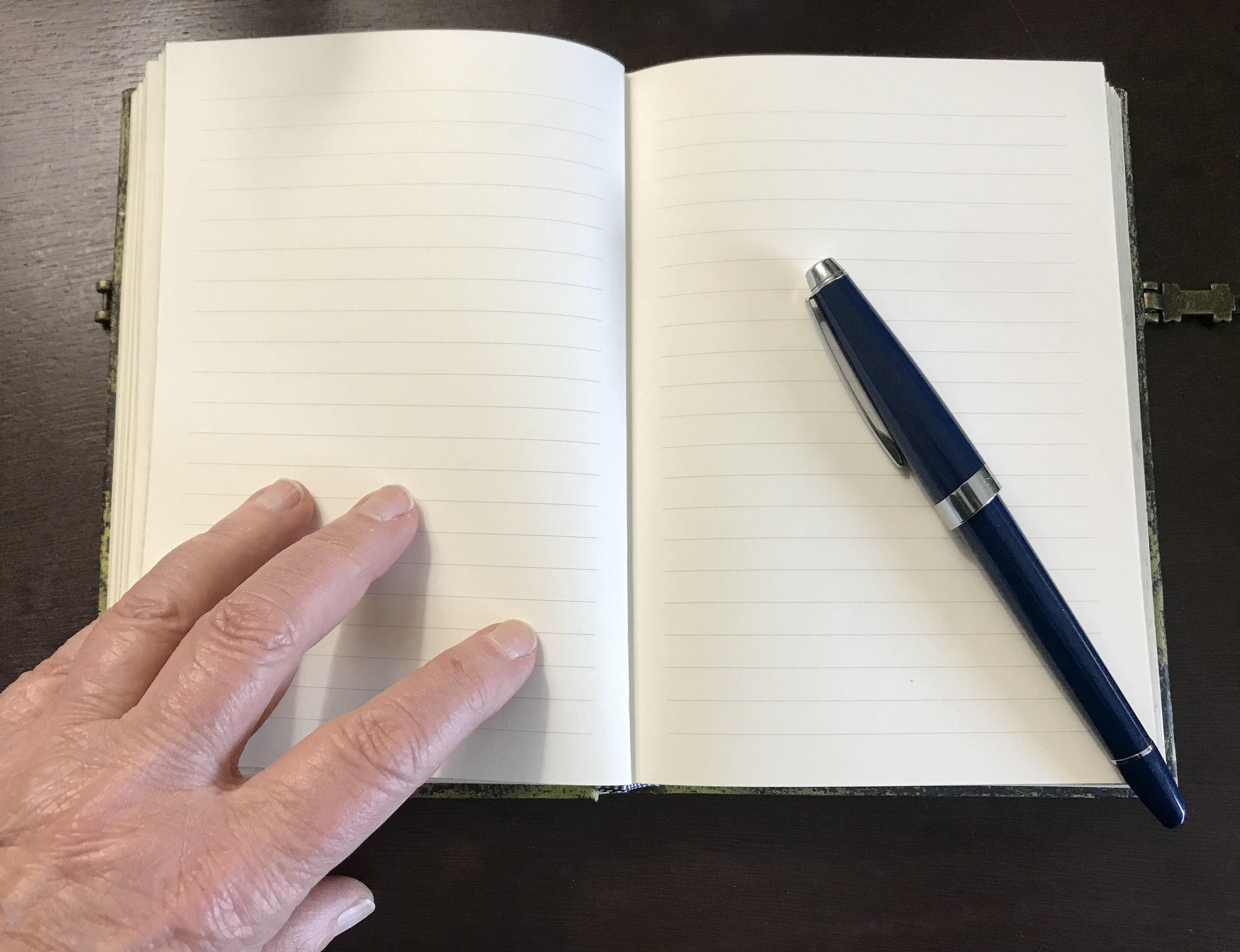
The blank pages of a notebook (photo by Nina Munteanu)

There’s no precedence for creating a piece of fiction. Yes, certainly inspiration is involved, but the work of something unique must start with a blank page. Professional writers often dread facing the blank page. It even has a name: blank page syndrome, or writer’s block, the feeling of being overwhelmed or even paralyzed by the prospect of starting. Alex Elkjær Vasegaard tells us that “it may come from the fear of not being good enough, of not knowing enough, or of the vastness of the potential ahead.”

I recently read a post on LinkedIn by writing colleague Erik Buchanan, which resonated with me. I asked his permission to quote it here and he gladly gave it:

Just got a recommended post from a marketing person claiming that using AI allows you to get past the hardest part of writing: “the blank page.”

I blocked them, and I’m putting what I was going to reply to them here instead, because they are not a person who will be open to this rant:

If you cannot get past the blank page, you are not a writer.

If you use AI to get past the blank page, you’re still not a writer, and now you’re a thief.

You’re using other writers’ words, fed into an information aggregator and splatted out like a drunk’s meal vomited onto the sidewalk. And you’re scooping it up and claiming it’s fresh food.

You want to write? Write something.

Speaking as one who has written 18 novels (more than half ghostwritten for money), 150 articles, short stories, instruction manuals, sales copy, website copy, commercial scripts, short films and now a feature film (currently being re-written) it’s not that hard.

Using AI means you’re too lazy to learn the craft.

Don’t do it.

A blank page is more than a simple page that is empty. It offers something new, without precedence to write, draw or create. Whether it’s a physical sheet of paper in a notebook or a white space in a digital document, the blank page represents a fresh beginning and wonderful potential for unique creation.

Erik’s point is so Germaine to the creative writing process. The blank page is an open door to possibility; it is a writer’s first step in creating something uniquely their own. Plot, character, setting and language—such as technique, style, words and phrases—certainly make a novel wonderful to read; but it is the unique idea, the spark, the premise and theme that carry that novel into greatness and keep it memorable.

Coming up with first words on a blank page (photo by Nina Munteanu)

Poet Alberto Blanco challenges our notion of the blank page being blank: From the tree it was made from, the rain and sun that allowed the tree to grow, and the people that created it, it soon becomes clear that a blank page contains the whole cosmos.

In “The Blank Page: A Meditation on the Creative Process and Life’s Journey” Alex ElkjærVasegaard describes the blank page as “an expanse of white, unsullied by ink or pixels. It’s the void that calls for creation. It’s the challenge that every artist, writer, and thinker faces. But isn’t that just a beautiful metaphor for life itself?”

Erik, I too would have blocked that marketer. I doubt they are a writer…

“Who then … tells a finer tale than any of us? Silence does. And where does one read a deeper tale than upon the most perfectly printed page of the most precious book? Upon the blank page. When a royal and gallant pen, in the moment of its highest inspiration, has written down its tale with the rarest ink of all — where, then, may one read a still deeper, sweeter, merrier and more cruel tale than that? Upon the blank page.”—Karen Blixen, Last Tales

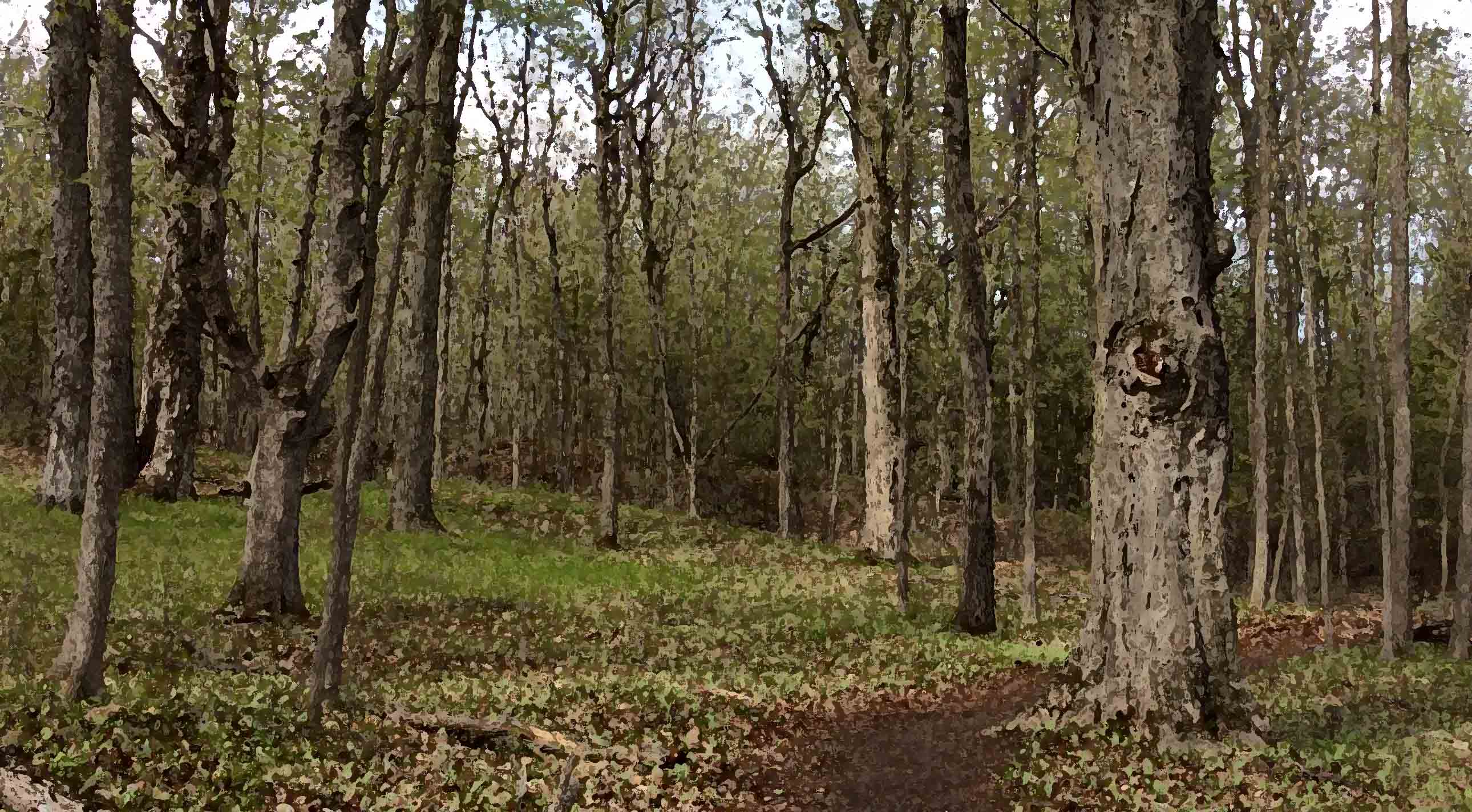
Maple beech forest in early spring, ON (photo and rendition by Nina Munteanu)

Nina Munteanu is a Canadian ecologist / limnologist and novelist. She is co-editor of Europa SF and currently teaches writing courses at George Brown College and the University of Toronto. 

Visit  www.ninamunteanu.ca for the latest on her books. Nina’s bilingual “La natura dell’acqua / The Way of Water” was published by Mincione Edizioni in Rome. Her non-fiction book “Water Is…” by Pixl Press (Vancouver) was selected by Margaret Atwood in the New York Times ‘Year in Reading’ and was chosen as the 2017 Summer Read by Water Canada. Her novel “A Diary in the Age of Water” was released by Inanna Publications (Toronto) in June 2020.

The AI Wave: To AI or not to AI … That is the Question…

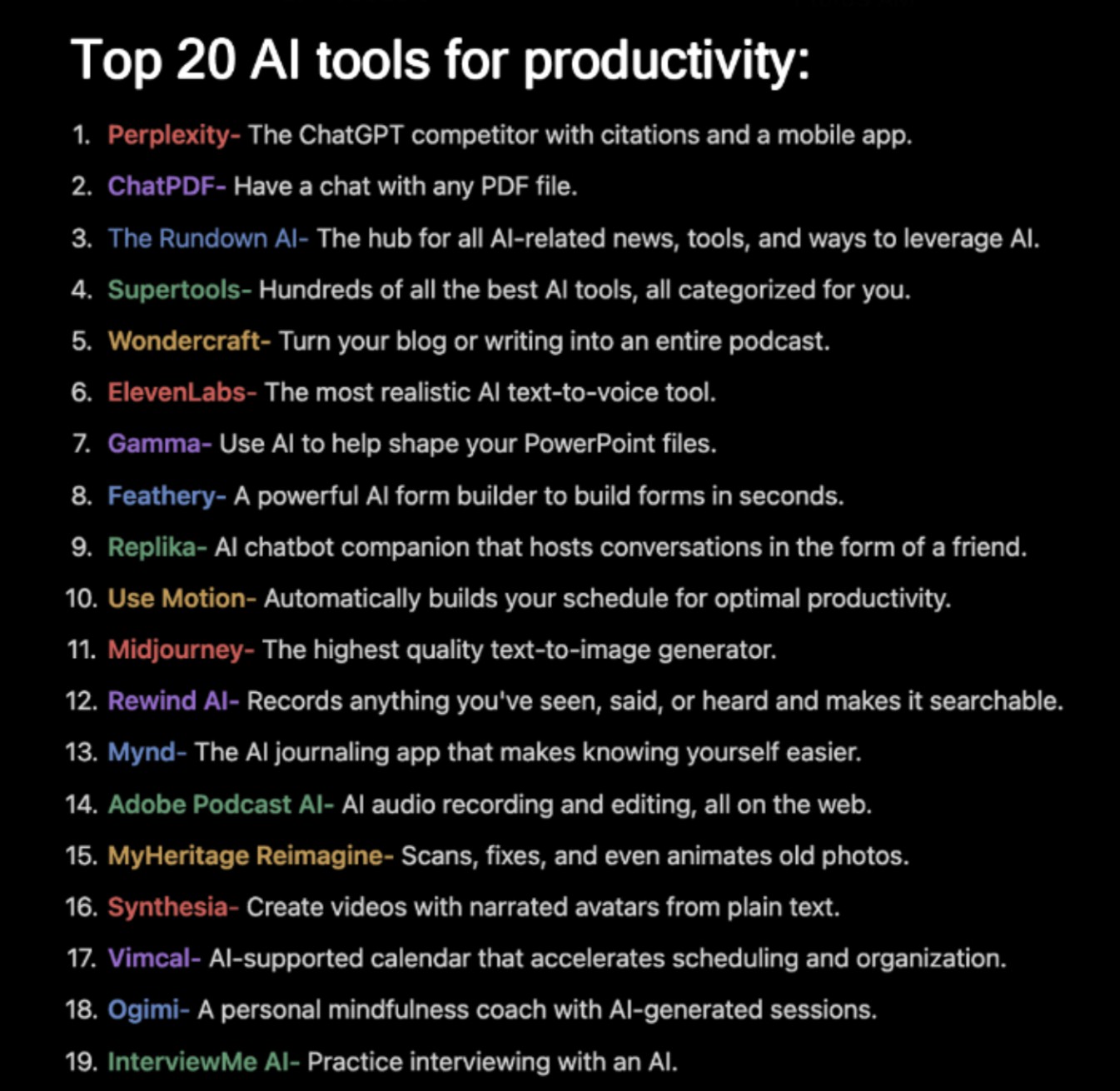
I recently ran across a list posted on social media of the 20 most popular AI tools for productivity in writing. I only knew two of them. This heightened my anxiety about what I know and am prepared for in the use of genAI, particularly in academic settings, where I teach writing at university. And it got me thinking why I was so anxious…

I shared the list with my colleagues at the university writing centre and one instructor who was actively following AI tools admitted that they knew only a few of the listed tools as well. They further shared that they were feeling increasingly apprehensive about genAI’s impact on higher education. “It’s hard not to feel overwhelmed,” they ended.

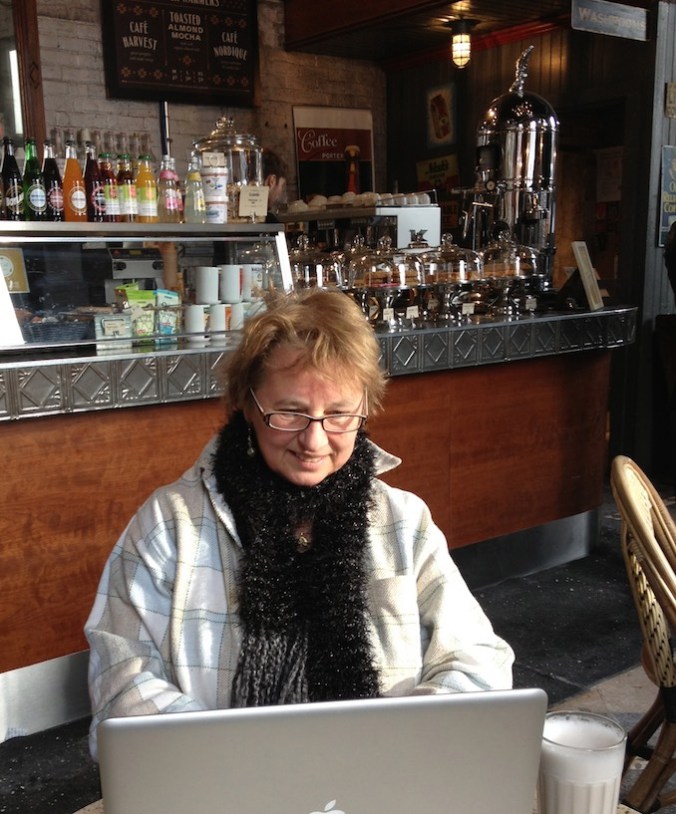
(Photo: Nina writing her novel at a cafe)

This was my exact sentiment: a kind of apprehensive excitement. An understanding that all communicators stand at the precipice of a major paradigm shift in tool use. The ramifications this will have on all aspects of effective and efficient communication will span from redefining plagiarism to reinventing creativity. As with all powerful tools—aside from the obvious threat of misuse—there is always something lost with the gain and I wonder what we are losing with all this. I have some ideas, and they do bother me from time to time.

Applications of Generative AI (image by Neebel Technologies)

I do think it important for me as a communicator and writing instructor to understand the trade offs and to work with them.

When the world adopted the portable calculator, rote knowledge of basic math suffered. I know; I tested it during a lab exam when I was teaching college biology many years back. I forbid the use of calculators in the test and many students, who had lost the ability to do long division or multiplication by hand, lost marks. For some reason, I’m still not sure of, it was important for me to insist on students doing math longhand (a basic skill fast becoming obsolete like cursive writing) and punish those who had lost the art. Perhaps I was drawing on Isaac Asimov’s possibly prescient 1957 short story satire The Feeling of Power, which explored the limitations of a future world that lost its basic skills to machines. The corollary, I suppose, is that more complex and conceptual math gained some ground through this handy and efficient tool. Machines have their advantages, certainly. And generative AI is just one sophisticated aspect of machine use.

Consequences to Creative Writing

In my world of professional fiction authors, there is a palpable fear of being replaced by AI as story creators: a version of the ultimate science fiction horror plot of being taken over by the machine world (I’ve even exploited that in my SF thrillers Angel of Chaos and Darwin’s Paradox).

Given our unique powers of imagination, I don’t think that will happen (very soon, if ever successfully). Though, as we dummy-down and simplify complex stories for fast-paced multiplex audiences addicted to fast-paced bite-sized and easy to digest entertainment, AI-generated narratives could get by. How is all this affecting the publishing industry now? I recently learned that one of the top five online science fiction magazines, Metastellar, accepts AI-assisted stories with the proviso that “they better be good.” And Metastellar provides some convincing reasons. This has become a hot topic among my fellow professional writers at SF Canada.  One colleague informed me that a “new publisher Spines plans to disrupt industry by publishing 8000 AI books in 2025 alone.” On checking the news release, I discovered that Spines is, in fact, a tech firm trying to make its mark on publishing, primarily through the use of AI. The company offers the use of AI to proofread, produce, publish, and distribute books. They are, in fact, a vanity publishing platform (essentially a service for self-publishing), charging up to $5000 a book and often taking just three weeks to go from manuscript to a published title. The quality of what they will produce is unclear—and questionable.

All to serve as metaphor for what I and my colleagues at university are striving to achieve with students in their academic writing: excellence in communication, particularly in conveying complex scenarios that require creative solutions where clear, concise, and convincing writing is requisite.

I still find myself reluctant to use AI in my writing and communication, though I’ve at times slid into using AI for research and initial summaries to save time. I do this rarely because I absolutely enjoy doing research. I enjoy challenging my brain to summarize key points and write a good line. I enjoy the thrill of unanticipated discoveries, which always happen on these forays. I also recognize that many people do not share my enthusiasm for these brain exercises.

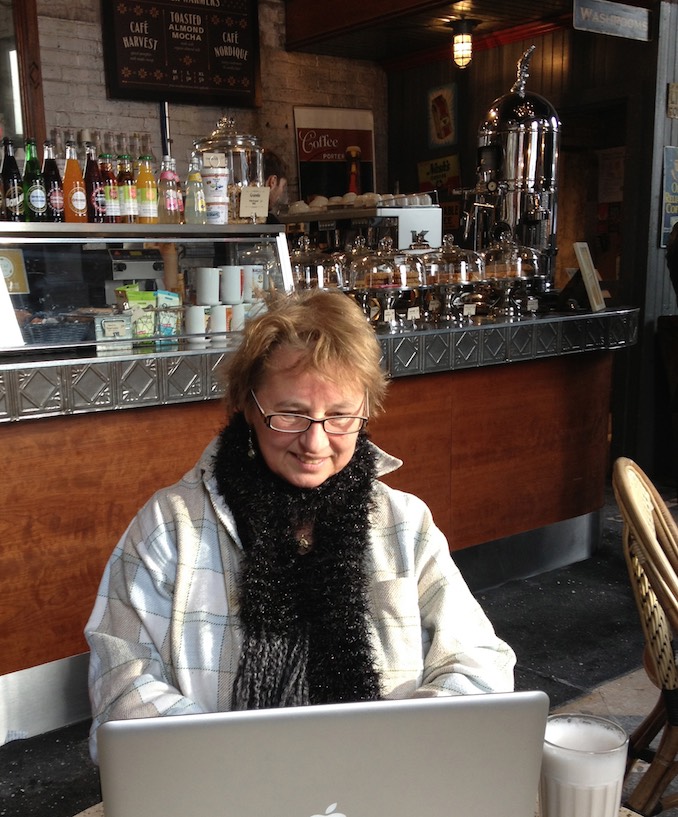
(Photo: Nina writing in another cafe)

I think that AI alone will not replace human mind for unique creativity. I didn’t say “can not.” It could; but it won’t. This is because even as genAI becomes infused in many aspects of life pursuit, there will remain those like that rare mathematician capable of doing math by hand in The Feeling of Power, valued not just because they are rare, but because in that rarity, they fulfill a critical role. When the machines stalled in their ability to move society forward in The Feeling of Power and all seemed lost, this archaic mathematician presented new innovation with basic math. I’m not suggesting that the technology will all break down, plunging the world into darkness (though this remains a possibility and is still a great plot for science fiction); but I submit that diversity rules over monopoly when it comes to survival.   

Five Mass Extinctions

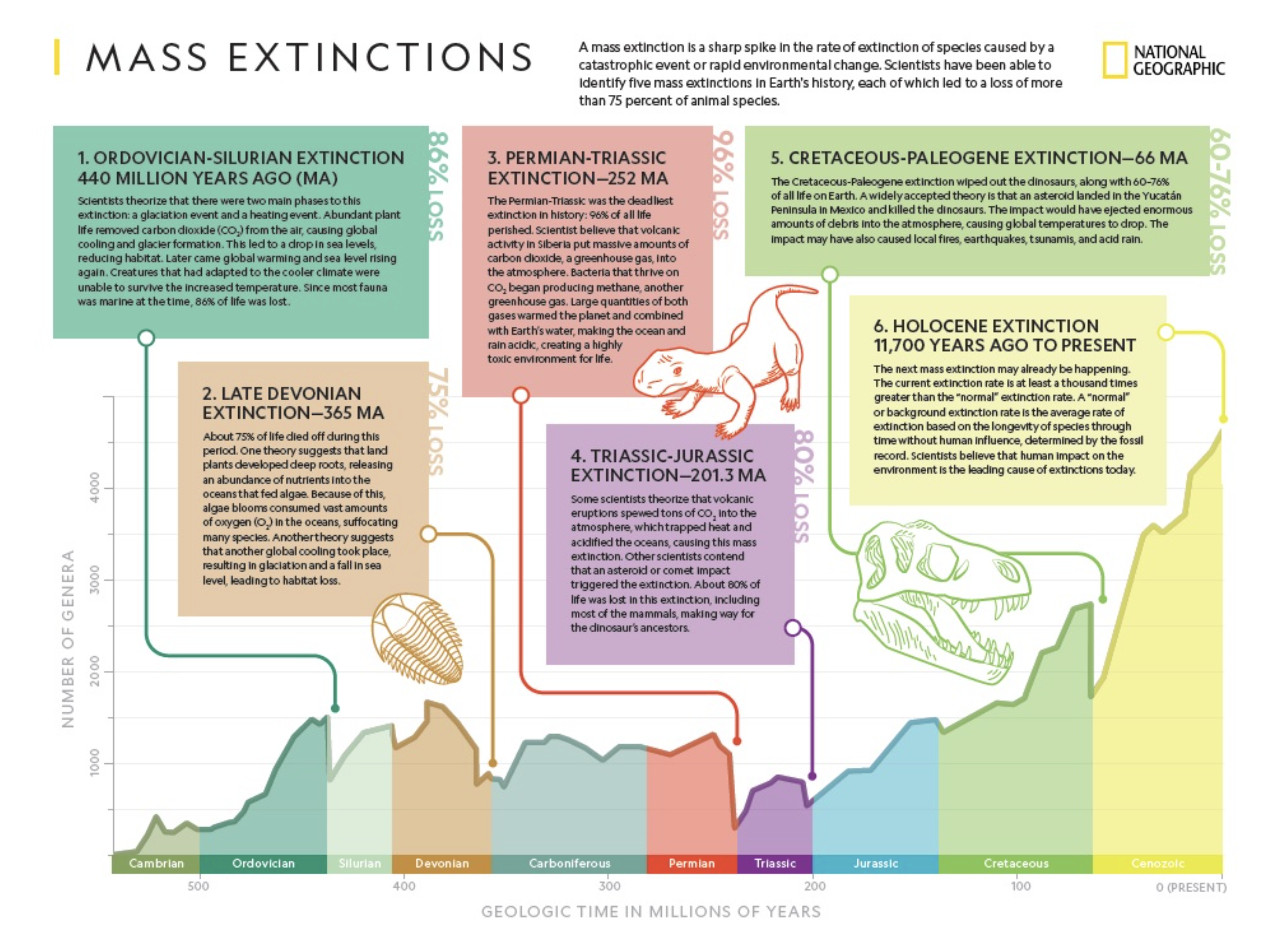
This may seem a rather dark projection of the future, but consider that over the millennia, after five mass extinctions and with the sixth mass extinction underway, diversity has always saved the world. Within that necessary diversity, it is the nurtured rarities, the outliers, the misfits and nonconformists that survived the destruction of the previous world. Each time, diversity made that possible. As though engrained in Nature’s world building.

Mass Extinctions (image by National Geographic)

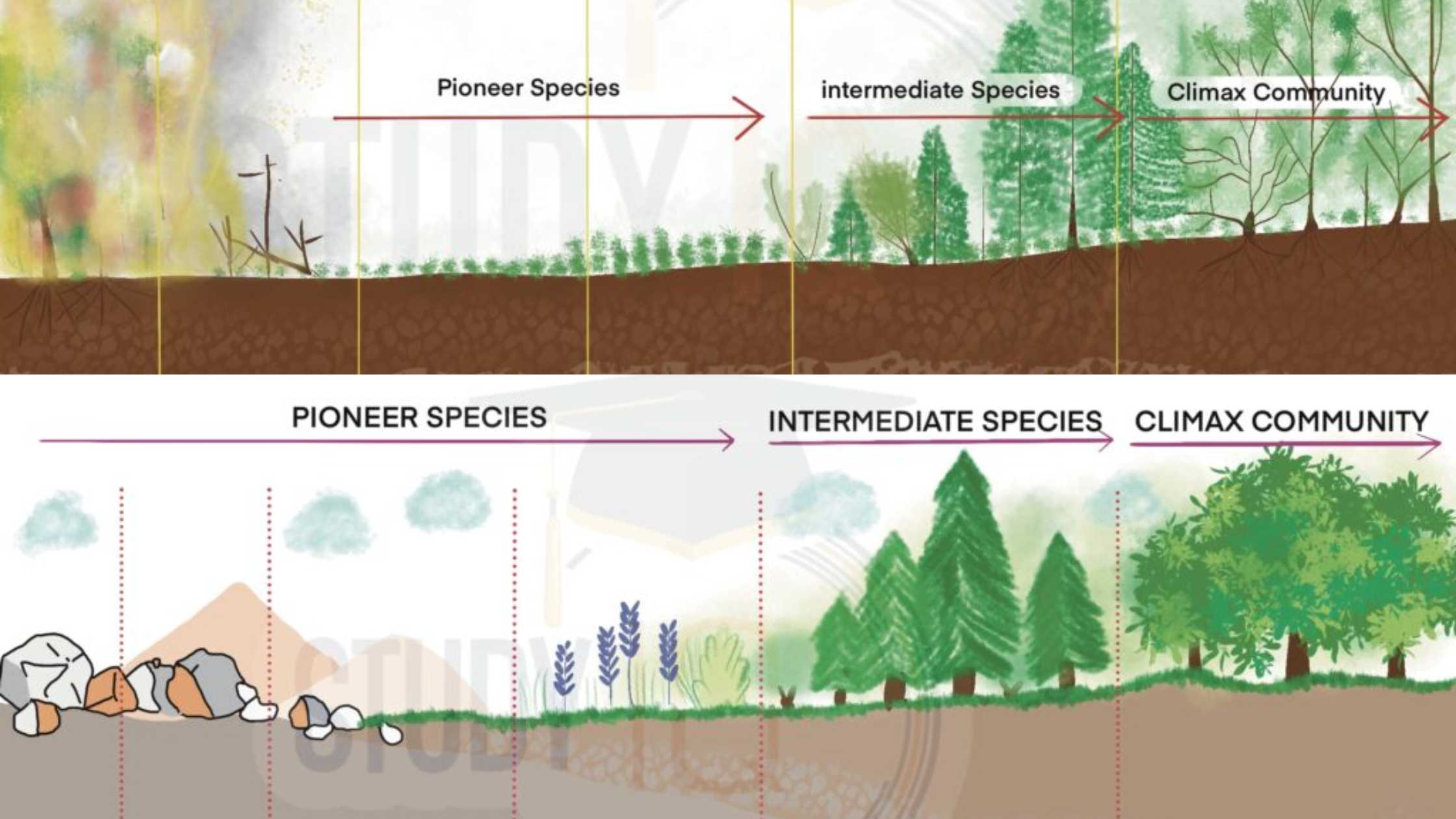
Ecologists call it ecological succession, others use the term “creative-destruction” to describe the recursive pattern of living and non-living things of the planet. Both describe how the oligarchs of an established climax ecosystem fail due to change or disturbance and are replaced by a previous rare misfit or immigrant better suited to the new environment. 

Primary and secondary succession in two different ecosystems

I think AI is part of our succession. Our use of AI in all its forms will represent a diversity of reaction and action that represent our own diversity and potential to survive in a changing world. All to say: relax and embrace the outliers.

Writing in nature (photo by Nina Munteanu)

As William Gibson so famously said in 1993: The Future is already here; it’s just not evenly distributed. And maybe that’s a good thing…

So…

…To AI, or not to AI, that is the question:
Whether ’tis nobler in the mind to suffer
The slings and arrows of terrible writing,
Or to take arms against a sea of scribbles
And by opposing end them. To think—to write,
No more; and by writing to say we end
The heart-ache and the thousand natural shocks
That tech is heir to: ’tis a consummation
Devoutly to be wish’d. To think, to write;
To write, perchance to create—ay, there’s the rub:
For in that creation of unique thoughts what others may come,
When we have shuffled off this genAI…

Writing in Nature (photo by Nina Munteanu)

Nina Munteanu is a Canadian ecologist / limnologist and novelist. She is co-editor of Europa SF and currently teaches writing courses at George Brown College and the University of Toronto. Visit www.ninamunteanu.ca for the latest on her books. Nina’s bilingual “La natura dell’acqua / The Way of Water” was published by Mincione Edizioni in Rome. Her non-fiction book “Water Is…” by Pixl Press (Vancouver) was selected by Margaret Atwood in the New York Times ‘Year in Reading’ and was chosen as the 2017 Summer Read by Water Canada. Her novel “A Diary in the Age of Water” was released by Inanna Publications (Toronto) in June 2020.

Nina Munteanu Workshops “Hero’s Journey” with Writers in Newmarket

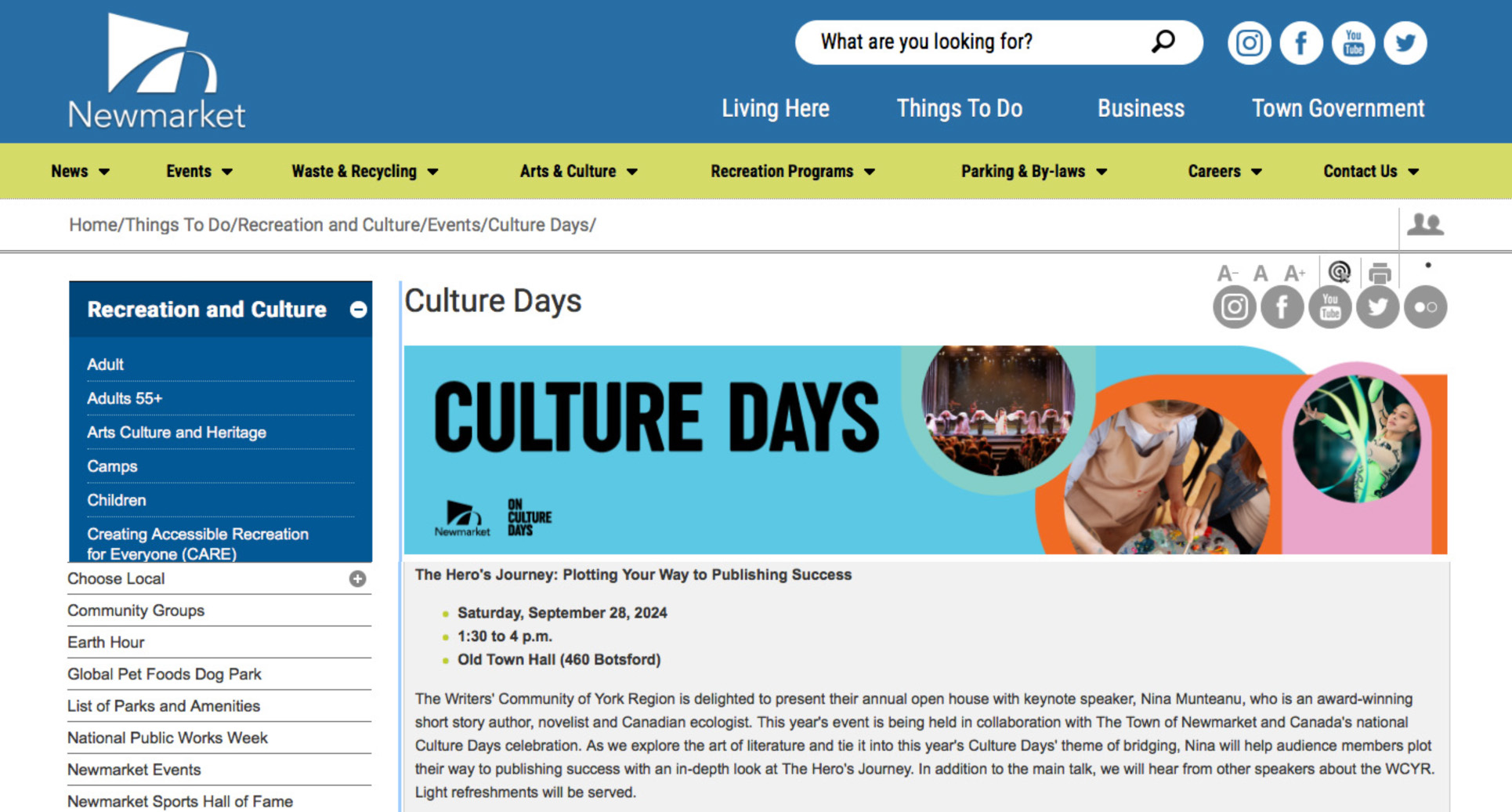
I recently gave my lecture / workshop on the Hero’s Journey plot approach to a group of writers for Culture Days in Newmarket, Ontario.

The event, organized by the WCYR (Writing Community of York Region), took place in the art gallery of the Old Town Hall, located in the old downtown part of the city—an attractive section of streets and lanes with eclectic shops, cafés, bistros and bookstores for curious amblers. 

Bustling Main Street near the Old Town Hall, Newmarket, ON

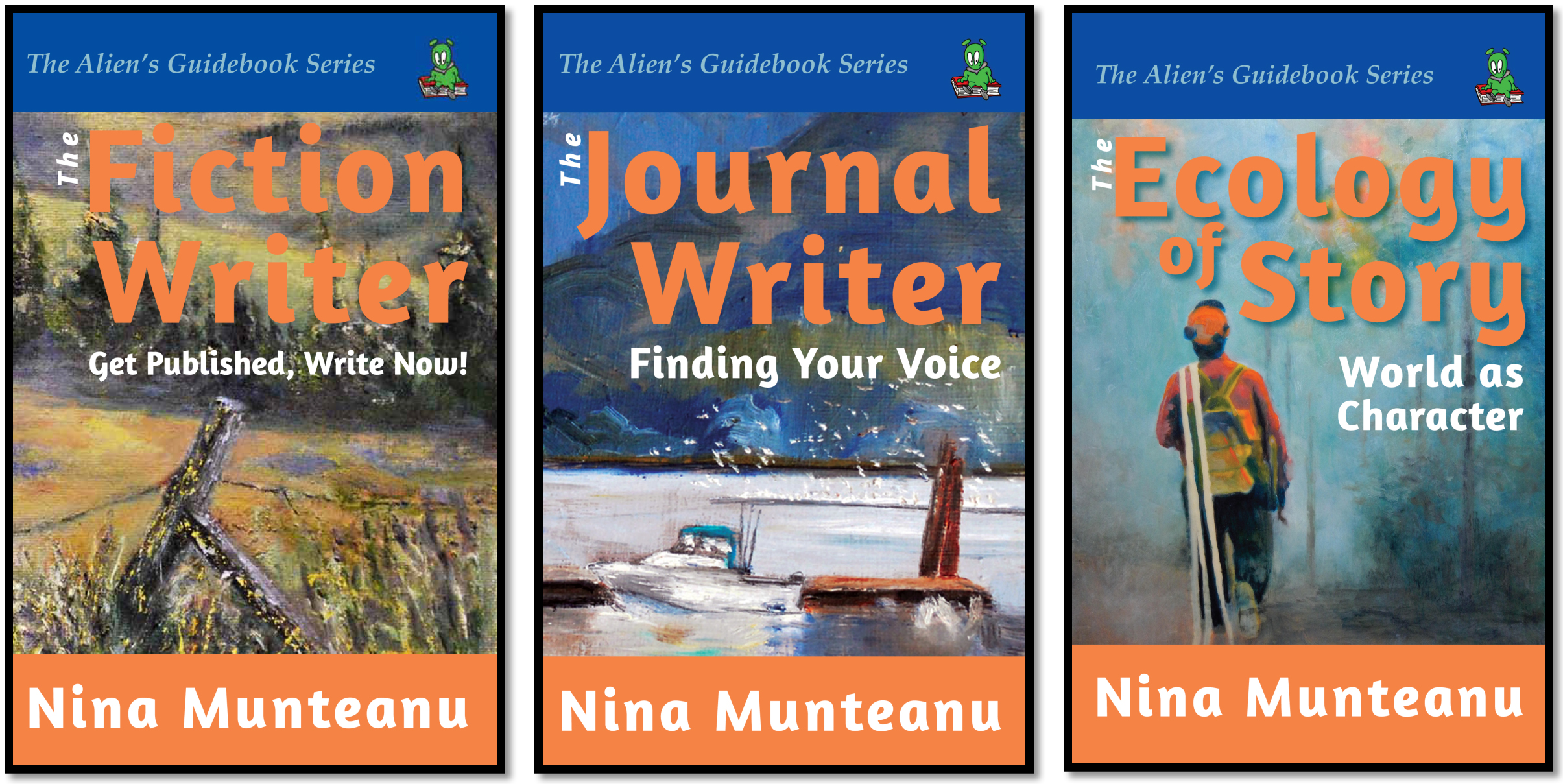
Three guidebooks of the Alien Guidebook series for writers

Cathy Miles, the program coordinator, encouraged me to brings books for sale, so I certainly included the three books of my Alien Guidebook Series on writing: The Fiction Writer, The Journal Writer, and The Ecology of Story, all also available at Amazon, Kobo, Barnes & Noble and other quality bookstores, which I sold for a workshop price. Cathy gave me a wonderful introduction to a room full of eager writers and I also had the pleasure of meeting Janice Luttrell, the Recreation Programmer with the City of Newmarket, who was hosting the event as part of Newmarket’s Culture Days.

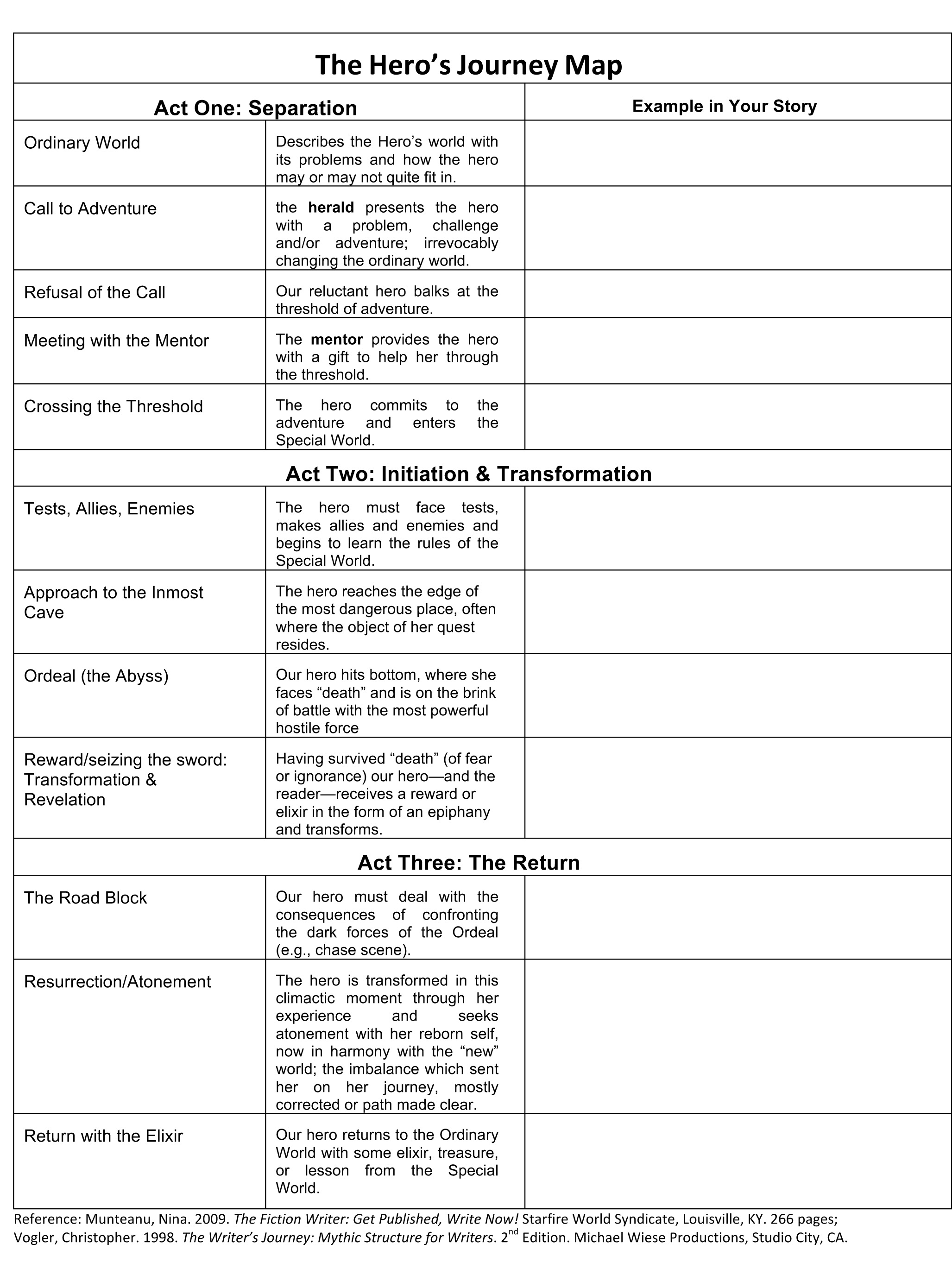
Hero’s Journey Plot Structure (Ingrid Sundberg, 2013)

Drawing from several chapters in The Fiction Writer, I introduced the Hero’s Journey map structure, based on Ingrid Sundberg’s plot structure, and discussed the 12-step hero’s journey according to mythologist Joseph Campbell.

We also discussed the seven chief archetypes associated with the journey steps: hero, mentor, herald, threshold guardian, trickster, shapeshifter, and shadow.

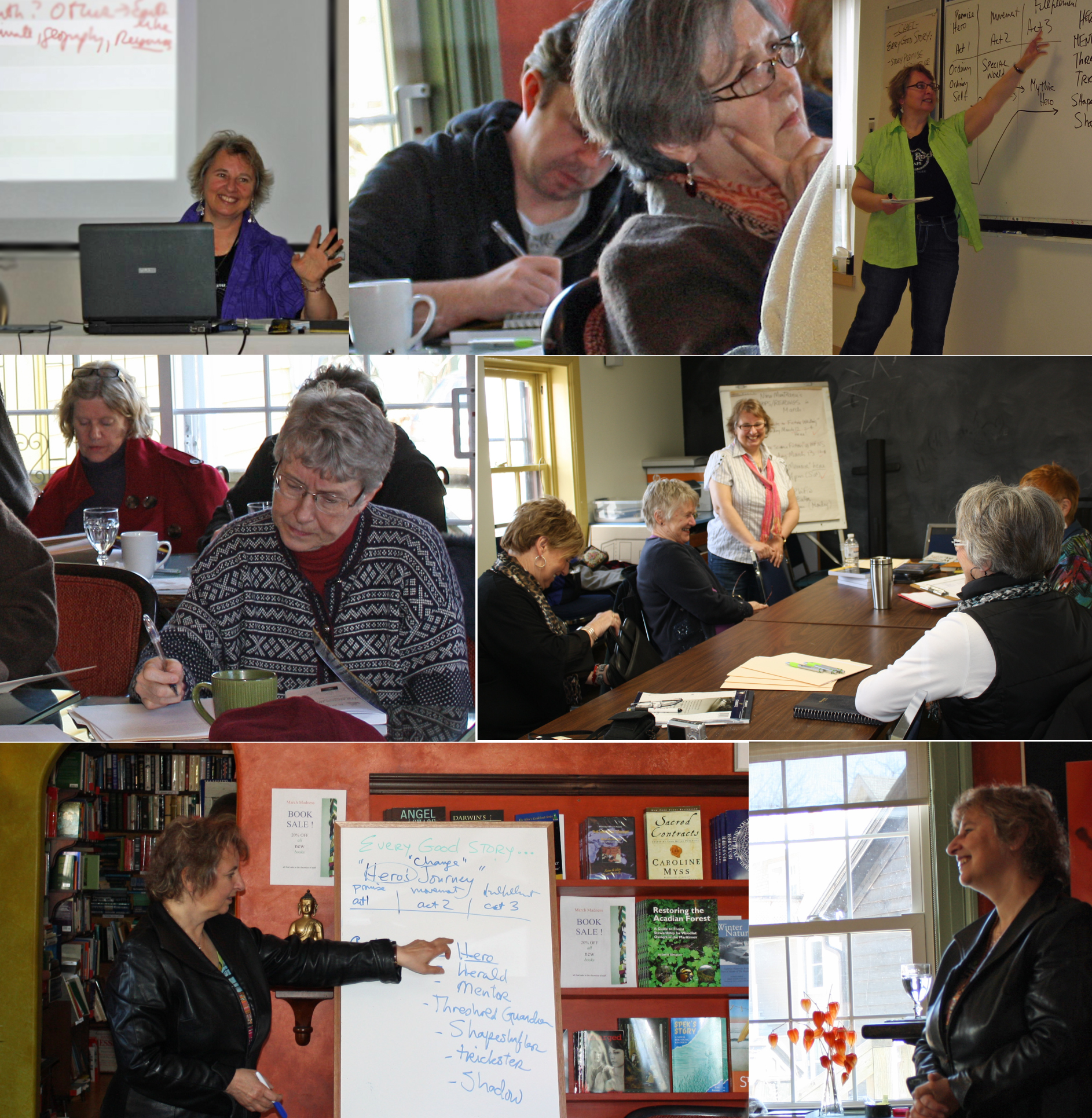
Nina teaching “The Hero’s Journey” plot approach over the years in Nova Scotia, BC and Ontario

I’ve given this workshop many times and always enjoyed the lights that came on in participants; this time was no different. My session was fun and very well received. I saw lots of interest and received many good questions—a sure sign. One participant was quoted as saying:

“What a great event! Your presentation was insightful. I really appreciated being able to follow along in the book while listening to your explanations. That is going to help me remember the concepts as I read the book and then apply them to my writing.” 

The WCYR book table at the event (photo by Nina Munteanu)

People bought every copy of my Fiction Writer, my Journal Writer and most of my Ecology of Story that sat on the book table. I also sold many of my fiction books, including my short story collection Natural Selection (also selling on Kobo) and my latest novel A Diary in the Age of Water. I sold-out of my non-fiction book Water Is…, which had received a wonderful testimonial from Margaret Atwood in the New York Times ‘Year in Reading.’

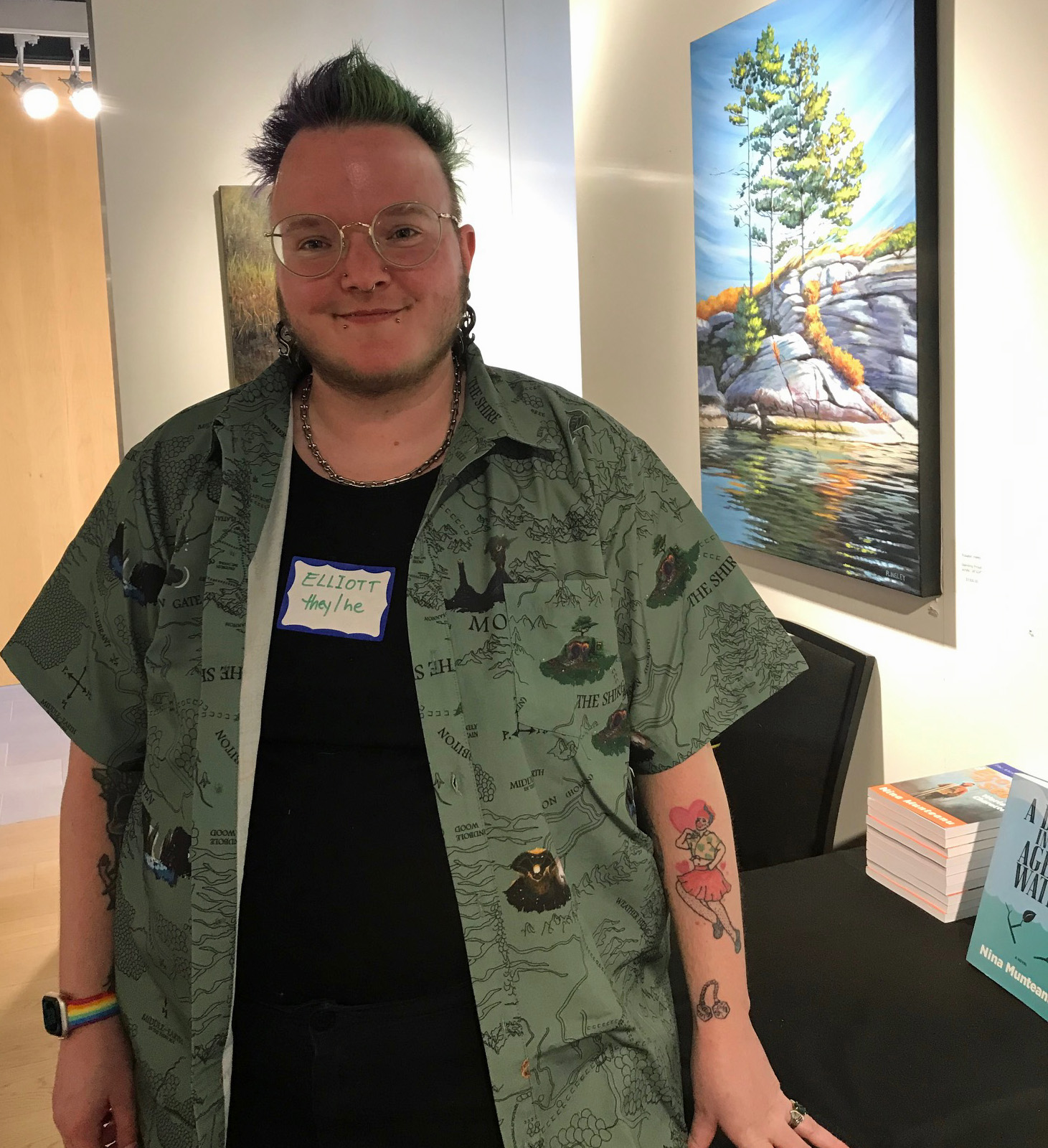
Elliott sells my books at the WCYR book table (photo by Nina Munteanu)

All in all, it was a good day…

Nina Munteanu is a Canadian ecologist / limnologist and novelist. She is co-editor of Europa SF and currently teaches writing courses at George Brown College and the University of Toronto. Visit www.ninamunteanu.ca for the latest on her books. Nina’s bilingual “La natura dell’acqua / The Way of Water” was published by Mincione Edizioni in Rome. Her non-fiction book “Water Is…” by Pixl Press (Vancouver) was selected by Margaret Atwood in the New York Times ‘Year in Reading’ and was chosen as the 2017 Summer Read by Water Canada. Her novel “A Diary in the Age of Water” was released by Inanna Publications (Toronto) in June 2020.

Why Writing and Reading Eco-Fiction Will Save the World—From CliFi to Solarpunk

Fence and post at marsh during a rain, ON (photo by Nina Munteanu)

The Universe is made of stories, not atoms—Muriel Rukeyser

Canadian writer Mary Woodbury tells us that: “Fiction exploring humanity’s impacts on nature is becoming more popular [and] has the distinct ability to creatively engage and appeal to readers’ emotions. In fact, it can stir environmental action.” A survey she took in 2020 showed that “88% of its participants were inspired to act after reading ecological fiction.”

Eco-Fiction (short for ecological fiction) is a kind of fiction in which the environment—or one aspect of the environment—plays a major role, either as premise or as character. “Principled by real science and exalting our planet’s beauty, these stories are works of art. They live within classic modes of fiction exploring the human condition, but also integrate the wild,” writes Woodbury. At the heart of eco-fiction are strong relationships forged between the major character on a journey and an aspect of their environment and place. Environment and place can illuminate through the sub-text of metaphor a core aspect of the main character and their journey. 

Green architecture design by Vincent Callebaut

All great literature distills its art form through the exploration of relationship: our relationship with technology, with science, Nature, God, our children, each other, our history. Science fiction illuminates our history and our very humanity by examining our interaction with “the other”—the unfamiliar, the feared, the often downtrodden, the invisible, the ignored. This is the hero’s journey. And it is through this journey relating to the “other” (whether it’s Earth or an alien planet, its water, environment and issues, and its varied peoples and cultures) that our hero discovers herself and her gift to the world. When will we stop portraying Nature as “other”?…

Green neighbourhood design by Vincent Callebaut

We currently live in a world in which climate change and associated water crisis pose a very real existential threat to most life currently on the planet. The new normal is change. And it is within this changing climate that eco-fiction is realizing itself as a literary pursuit worth engaging in. The emergence of the term eco-fiction as a brand of literature suggests that we are all awakening—novelists and readers of novels—to our changing environment. We are finally ready to see and portray environment as an interesting character with agency and to read this important and impactful literature.

Lavender farm and house design by Vincent Callebaut

Many readers are currently seeking fiction that describes environmental issues but also explores a successful paradigm shift: fiction that accurately addresses our current issues with intelligence and hope. This is reflected in the growing popularity of several emerging sub-genres of fiction such as solar punk, optimistic climate fiction, clifi, eco-lit, hope punk, and others. The power of envisioning a certain future is that the vision enables one to see it as possible. Eco-fiction—and all good science fiction—uses metaphor to study the world and the consequences of humanity’s actions through microcosmic dramatization. What makes this literature particularly exciting is: 1) its relevance to our current existential situation; and 2) that it often provides a way forward. 

Solarpunk world imagined (image by Imperial Boy)

The Way Forward with Solarpunk

In his 2014 article “Solarpunk: Notes toward a manifesto” in Hieroglyph Adam Flynn writes of under-30 futurists: “Many of us feel it’s unethical to bring children into a world like ours. We have grown up under a shadow, and if we sometimes resemble fungus it should be taken as a credit to our adaptability.”

“We’re solarpunks because the only other options are denial or despair.”

ADAM FLYNN

Solarpunk, says Flynn, “is about finding ways to make life more wonderful for us now, and more importantly for the generations that follow us—i.e., extending human life at the species level, rather than individually.” Our future, asserts Flynn, “must involve repurposing and creating new things from what we already have (instead of 20thcentury “destroy it all and build something completely different” modernism).” Solarpunk futurism “is not nihilistic like cyberpunk and it avoids steampunk’s potentially quasi-reactionary tendencies: it is about ingenuitygenerativityindependence, and community.”

“Hydrogenase” algae-powered airships by Vincent Callebaut

The ‘punk’ suffix comes from the oppositional quality of solarpunk; opposition that begins with infrastructure as a form of resistance. Flynn tells us that solarpunk draws on the ideal of Jefferson’s yeoman farmer, Ghandi’s ideal of swadeshi, and countless other traditions of innovative dissent

“Hyperion” eco-neighbourhood design by Vincent Callebaut

“Solarpunk is a future with a human face and dirt behind its ears.”

ADAM FLYNN

In response to Flynn’s article, Bob Vanderbob writes, “going solar is a deep mental shift: it will be the central metaphor of our future civilization.” 

Green Paris design by Vincent Callebaut

Musician photographer Jay Springett calls solarpunk, “a movement in speculative fiction, art, fashion, and activism that seeks to answer and embody the question ‘what does a sustainable civilization look like, and how can we get there?’… At once a vision of the future, a thoughtful provocation, and an achievable lifestyle.” Jennifer Hamilton observes in The Conversation that “as a category of fiction, solarpunk remains a fringe dweller…Nevertheless, the aesthetic sensibilities of the subculture are starting to emerge.” Hamilton asserts that “the focus on the cultural change that will necessarily accompany the full transition to renewable energy is the defining feature of solarpunk.” She adds, “we usually ask ‘can renewables replace fossil fuels?’ … solarpunks ask ‘what kind of world will emerge when we finally transition to renewables?’ and their [works] are generating an intriguing answer.”

Beach house design by Vincent Callebaut

How Eco-Fiction Inspires and Galvanizes

Readers responded to Mary Woodbury’s survey question “Do you think that environmental themes in fiction can impact society and if so, how?” with these observations:

  • Environmental fiction encourages empathy and imagination. Stories can affect us more than dry facts. Fiction reaches us more deeply than academic understanding, moving us to action.
  • Environmental fiction triggers a sense of wonder about the natural world, and even a sense of loss and mourning. Stories can immerse readers into imagined worlds with environmental issues similar to ours.
  • Environmental fiction raises awareness, encourages conversations and idea-sharing. Fiction is one way that helps to create a vision of our future. Cautionary tales can nudge people to action and encourage alternative futures. Novels can shift viewpoints without direct confrontation, avoid cognitive dissonance, and invite reframed human-nature relationships through enjoyment and voluntary participation.
  • Environmental themes can reorient our perspective from egocentrism to the greater-than-human world.
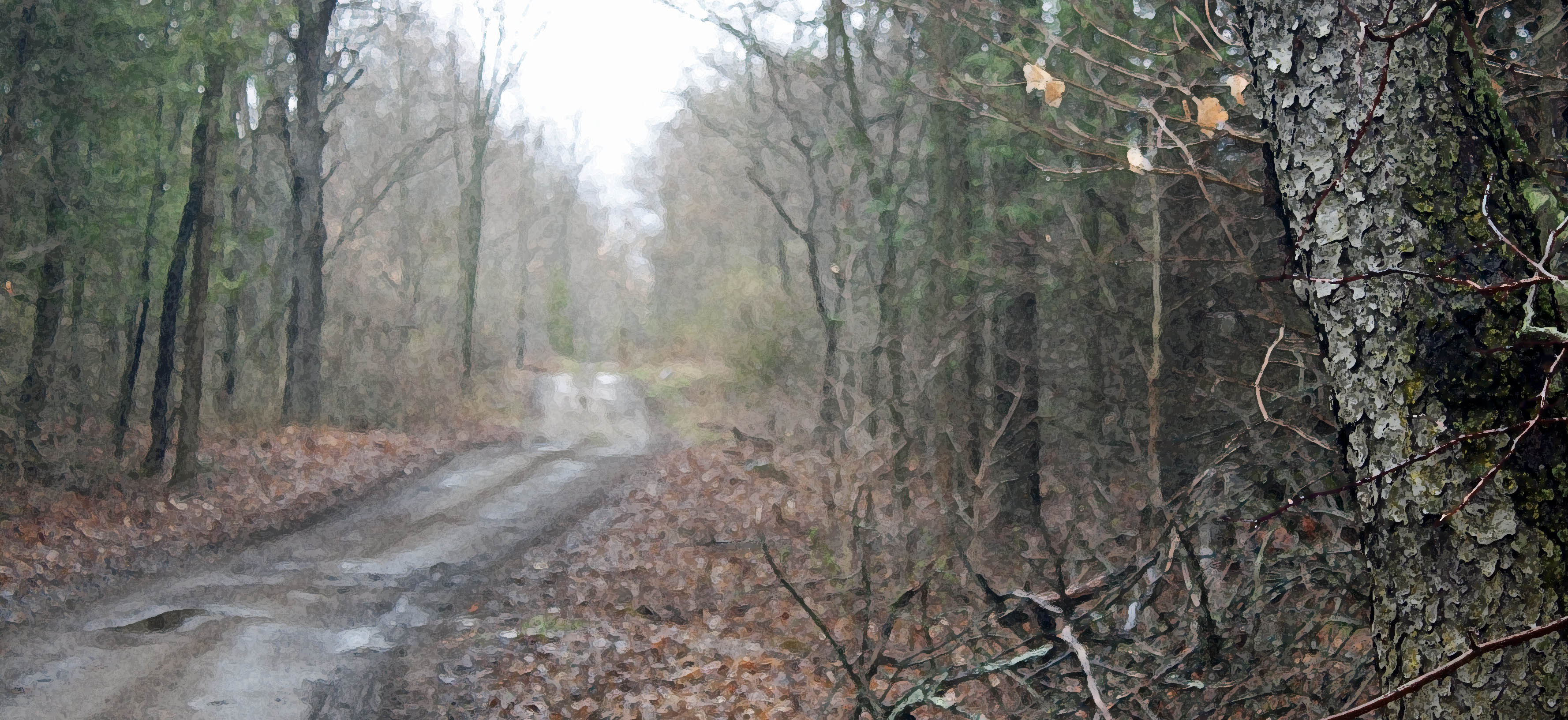
Dirt road in Kawarthas during a misting rain, ON (photo and rendition by Nina Munteanu)

Why Our Stories Are Important

We are all storytellers. We share our curiosity with great expression; our capacity and need to tell stories is as old as our ancient beginnings. From the Palaeolithic cave paintings of Lascaux to our blogs on the Internet, humanity has left a grand legacy of “story” sharing. Evolutionary biologist and futurist Elisabet Sahtouris tells us that, “whether we create our stories from the revelations of religions or the researches of science, or the inspirations of great artists and writers or the experiences of our own lives, we live by the stories we believe and tell to ourselves and others.”

Compelling stories resonate with the universal truths of metaphor that reside within the consciousness of humanity. According to Joseph Campbell, this involves an open mind and a certain amount of humility; and giving oneself to the story … not unlike the hero who gives her life to something larger than herself. Fiction becomes memorable by providing a depth of meaning. Stories move with direction, compel with intrigue and fulfil with awareness and, sometimes, with understanding. The stories that stir our hearts come from deep inside, where the personal meets the universal, through symbols or archetypes and metaphor.

Ultimately, we live by the narratives we share. “What you think, you become,” said Buddha.

In my writing guidebook The Ecology of Story: World as Character, I write: “When a writer is mindful of place in story and not only accurately portrays environment but treats it as a character, then her story will resonate with multilayers of meaning.”

Poplar stand in the Kawarthas, ON (photo and rendition by Nina Munteanu)

Changing the Narrative…

I was recently interviewed by Forrest Brown on Stories for Earth Podcast in which we discussed the need to change our narrative (particularly our colonial neoliberal capitalist narrative) and various ways to do this, taking into account the challenges posed by belief and language. Lessons from our indigenous wise elders will play a key role in our change toward genuine partnership with the Earth.

“We need to have a whole cultural shift, where it becomes our culture to take care of the Earth, and in order to make this shift, we need storytelling about how the Earth takes care of us and how we can take care of her.” ― Ayana Elizabeth Johnson, All We Can Save: Truth, Courage, and Solutions for the Climate Crisis

“This world, in which we are born and taken our being, is alive. It is not our supply house and sewer; it is our larger body. The intelligence that evolved us from stardust and interconnects us with all beings is sufficient for the healing of our Earth community, if we but align with that purpose. Our true nature is far more ancient and encompassing than the separate self defined by habit and society. We are as intrinsic to our living world as the rivers and trees, woven of the same intricate flows of matter/energy and mind. Having evolved us into self-reflexive consciousness, the world can now know itself through us, behold its own majesty, tell its own stories–and also respond to its own suffering.” 

JOANNA MACY and CHRIS JOHNSTONE, “Active Hope”
Swamp forest in Kawartha region, ON (photo and rendition by Nina Munteanu)

References:

Campbell, Joseph, Bill Moyers. 1991. “The Power of Myth.” Anchor. 293pp.

Munteanu, Nina. 2016. “Water Is… The Meaning of Water.” Pixl Press, Delta, B.C. 584pp.

Munteanu, Nina. 2019. “The Ecology of Story: World as Character.” Pixl Press, Delta, B.C. 200pp.

Sahtouris, Elisabet. 2014. “Ecosophy: Nature’s Guide to a Better World.” Kosmos, Spring/Summer 2014: 4-9pp. 

Nina Munteanu is a Canadian ecologist / limnologist and novelist. She is co-editor of Europa SF and currently teaches writing courses at George Brown College and the University of Toronto. Visit www.ninamunteanu.ca for the latest on her books. Nina’s bilingual “La natura dell’acqua / The Way of Water” was published by Mincione Edizioni in Rome. Her non-fiction book “Water Is…” by Pixl Press (Vancouver) was selected by Margaret Atwood in the New York Times ‘Year in Reading’ and was chosen as the 2017 Summer Read by Water Canada. Her novel “A Diary in the Age of Water” was released by Inanna Publications (Toronto) in June 2020.

The A to Z of Writing Fiction: X, Y, Z…

Snowy marsh in spring, ON (photo and rendition by Nina Munteanu)

In this series of articles, I draw from key excerpts of my textbook on how to write fiction The Fiction Writer: Get Published, Write Now! whose 26 chapters go from A to Z on the key aspects of writing good and meaningful fiction.

X is for Use eXceptional Language … but Don’t Overdo it

What makes some writing stunning and other writing lackluster? Mostly, it’s the language—the words—you use. And, it isn’t just what words you use; it’s how you use them. Here are a few things you need to consider when translating your work into something that sings:

  • Use active verbs and reduce modifiers: many writers, not just beginners, slide into the pattern of using passive and weak verbs (e.g., were, was, being, etc.). Then they add a modifier to strengthen it. It doesn’t. Actively look for strong, vivid verbs. This is a key to good writing. I can’t emphasize this enough.
  • Avoid using excessive prose: novice writers often use too many words to describe an event, action or scene. An overabundance of words slows down the story and obscures plot and action.
  • Use alliteration, metaphor, simile, personification (but don’t overuse): these devices bring lyricism and cadence and powerful imagery to your prose. However, as with anything powerful, you need to use these judiciously. Use them where you wish to convey a strong image and to punctuate your prose.
  • Be mindful of word-accuracy: more often than you might think, a writer inadvertently misuses a word to convey an idea or emotion.
  • Read your writing aloud & punctuate your pauses. Reading out loud helps define cadence, tone and pace of your prose and streamlines your writing. When you read aloud, pay attention to where you naturally pause. You may wish to put in a comma, semi-colon or period there.
  • Size your paragraphs: paragraphs are visual elements that help people read; they break up text on a page in logical places to provide white space for reader ease. This is one of the reasons some passages are harder to read than others; long paragraphs are more tiring to the eye. Find those logical breaks and put them in.
  • Size your sentences: as with paragraphs, overly long sentences can try a reader’s patience and you may lose them entirely. Too many short choppy sentences can also reduce your prose to a mundane level. Varying your sentence length in a paragraph creates the lyricism and cadence that makes prose enjoyable to read.

Y is for Yesterday, Today, and Tomorrow

Have you taken the time to consider tense in your story? While most stories are told in the past tense (e.g., Vinnie ran out of the house), I’ve seen many written in the present tense (e.g., Vinnie runs out of the house). You see the latter more in literary and esoteric works, where the immediacy and dream-like quality of present tense is in keeping with the kind of story being told. I write mostly genre fiction (e.g., science fiction, SF thrillers, historical fantasy, etc.) where the story-telling is normally fast-paced. These read better in the past tense. Stories which follow a more reflective tone can be quite powerful in the present tense.

In her series The Dragon Quartet, Marjorie B. Kellogg alternates from past tense to present tense as she hops from one protagonist’s point of view to the other’s. This deliberate shift in tense between sections works very well. The key is that she is consistent.

In the manuscripts that I read for novice writers I often find what I call uncontrolled shifting of tense within a sentence or paragraph. OWL provides these hints:

  • Use past tense to narrate events and to refer to ideas as historical entities.
  • Use present tense to state facts, to refer to perpetual or habitual actions, and to discuss your own ideas or those expressed by an author in a particular work; also to describe action in a literary work, movie, or other fictional narrative.
  • Future action may be expressed in a variety of ways, including the use of will, shall, is going to, are about to, tomorrow and other adverbs of time, and a wide range of contextual cues.

Z is for The Zen of Passionate Writing

Ralph Keyes, author of The Courage to Write, admits that “what makes writing so scary is the perpetual vulnerability of the writer. It’s not the writing as such that provokes our fear so much as other people’s reaction to our writing.” In fact, adds Keyes, “the most common disguise is fear of them, their opinion of us, when it’s actually our own opinion of ourselves that we’re worried about.” Keyes suggests that ultimately “mastering techniques [of style and craft] will do far less to improve writing than finding the will, the nerve, the guts to put on paper what you really want to say.”

Welcome to the threshold of your career as a writer. This is where many aspiring writers stop: in abject fear, not just of failure but of success. The only difference between those that don’t and those that do, is that the former come to terms with their fears, in fact learn to use them as a barometer to what is important. How do you get past the fear of being exposed, past the anticipated disappointment of peers, past the terror of success? The answer is passion. If you are writing about something you are passionate about, you will find the courage to see it through.

This is ultimately what drives a writer to not just write but to publish: the need to share one’s story, over and over again. Some of us only have one story we need to tell (Margaret Mitchell only needed to tell one, Gone With the Wind); others of us have many to tell. Either way, what is key here is that to prevail, persist, and ultimately succeed, a writer must have conviction and believe in his or her writing. You must believe that you have something to say that others want to read. Ask yourself why you are a writer. Your answer might surprise you.

The first step is to acknowledge your passion and own it. Flaunt it, even. Find your conviction, define what matters and explore it to the fullest. You will find that such an acknowledgement will give you the strength and fortitude to persist and persevere, particularly in the face of those fears. Use the fears to guide you into that journey of personal truths. Frederick Busch described it this way: “You go to dark places so that you can get there, steal the trophy and get out.”

Every writer, like her protagonist, is on a Hero’s Journey. Like the Hero of our epic, we too must acknowledge the call, pass the threshold guardian, experience the abyss and face the beast before we can return “home” with our prize.

The Fiction Writer: Get Published, Write Now! (Starfire World Syndicate) May 2009. Nominated for an Aurora Prix Award. Available through Chapters/IndigoAmazonThe Book Depository, and Barnes & Noble.

The Fiction Writer is a digest of how-to’s in writing fiction and creative non-fiction by masters of the craft from over the last century. Packaged into 26 chapters of well-researched and easy to read instruction, novelist and teacher Nina Munteanu brings in entertaining real-life examples and practical exercises. The Fiction Writer will help you learn the basic, tried and true lessons of a professional writer: 1) how to craft a compelling story; 2) how to give editors and agents what they want’ and 3) how to maintain a winning attitude.

“…Like the good Doctor’s Tardis, The Fiction Writer is larger than it appears… Get Get Published, Write Now! right now.”

David Merchant, Creative Writing Instructor
Otonabee River glistens under a spring sun, ON (photo and rendition by Nina Munteanu)

Click here for more about my other guidebooks on writing.

Nina Munteanu is a Canadian ecologist / limnologist and novelist. She is co-editor of Europa SF and currently teaches writing courses at George Brown College and the University of Toronto. Visit www.ninamunteanu.ca for the latest on her books. Nina’s bilingual “La natura dell’acqua / The Way of Water” was published by Mincione Edizioni in Rome. Her non-fiction book “Water Is…” by Pixl Press (Vancouver) was selected by Margaret Atwood in the New York Times ‘Year in Reading’ and was chosen as the 2017 Summer Read by Water Canada. Her novel “A Diary in the Age of Water” was released by Inanna Publications (Toronto) in June 2020.

The A to Z of Writing Fiction: W…

Snowy marsh in spring, ON (photo and rendition by Nina Munteanu)

In this series of articles, I draw from key excerpts of my textbook on how to write fiction The Fiction Writer: Get Published, Write Now! whose 26 chapters go from A to Z on the key aspects of writing good and meaningful fiction.

W is for Who, Where, When and Why of Doing Research

Research is something many writers dislike and find daunting or even intimidating. In truth, as a writer, you are doing research all the time: when you’re riding the bus or train to work, when you’re traveling on vacation, when you’re having a lively discussion—or better yet an argument— with a friend or colleague. Everything you experience and observe is research. This is what I call non-directed research. It’s also called living. Writers, like all artists, are reporters of life, actively participating and passively observing. A writer is an opportunist, gathering her data through her daily life experiences. Writing fiction draws on this but also on much more…

When writing about a realizable and believable world, whether it takes place in contemporary New York or far future planet Zero, you will need impeccable world building (which includes setting, circumstances, surrounding characters and events) and that will always ultimately require research. you will find very quickly that in order to build a consistent world (even if it’s mostly from your own imagination), you will need to draw upon something real to anchor your imaginary world upon. Whether this reflects a powerful myth or forms an alternative version of a real society, you will still need to apply some rules to follow, so you don’t lose your reader.

With so many useful internet sites and search engines, research has become far easier. But there is also more risk. Finding and confirming information as reliable is an important aspect of doing research. When doing research, particularly on the Internet (but anywhere), you should do several things:

• Use more than one source, particularly for important things; this will give you a wider range of material from which to discern accuracy and reliability.

• Verify your sources and preferably cross reference to measure out objective “truth” versus bias.

• Try to use primary sources (original) vs. secondary or tertiary sources (original cited and open to interpretation); the closer you are to the original source, the closer you are to getting the original story.

• When going to more than one source, try to get a range of different source-types (e.g., conservative newspaper versus blog versus special interest site, etc.) to gain a full range of insight into the issue you’re researching.

Don’t forget that highly valuable and satisfying research can take on the form of interview. You can gain incredible insight into the subject of your research by using a live expert. The advantages he or she has to a book or online database is that they interact with you and may give you something you didn’t even know you needed. Experts include people in your community, your neighbors and friends, professionals in business and in the universities and other educational facilities. Special interest forums and sites can be used to access people to interview.

I keep a journal or scrapbook for every novel I write. This permits me to do several things:

1. Organize relevant research material into one place for easy access (which makes up for my appalling note taking practices).

2. Satisfy my inclination for info dump and expository back-story by providing a place to house it—in my journal, where it belongs, instead of in the story.

By the time I was through with it, the journal I’d kept of my last book—a historical fantasy set in medieval Prussia and modern-day Paris—was its own rich compendium of interesting information, lovingly put together with photos of Paris, drawings and sketches of castles, armour, and long swords, maps of great battles, spreadsheets of timelines and family trees and, of course, commentary on all the great cafés and patisseries in Paris between Rue Princess and Boulevard Saint-Michel.

The Fiction Writer: Get Published, Write Now! (Starfire World Syndicate) May 2009. Nominated for an Aurora Prix Award. Available through Chapters/IndigoAmazonThe Book Depository, and Barnes & Noble.

The Fiction Writer is a digest of how-to’s in writing fiction and creative non-fiction by masters of the craft from over the last century. Packaged into 26 chapters of well-researched and easy to read instruction, novelist and teacher Nina Munteanu brings in entertaining real-life examples and practical exercises. The Fiction Writer will help you learn the basic, tried and true lessons of a professional writer: 1) how to craft a compelling story; 2) how to give editors and agents what they want’ and 3) how to maintain a winning attitude.

“…Like the good Doctor’s Tardis, The Fiction Writer is larger than it appears… Get Get Published, Write Now! right now.”

David Merchant, Creative Writing Instructor
Otonabee River glistens under a spring sun, ON (photo and rendition by Nina Munteanu)

Click here for more about my other guidebooks on writing.

Nina Munteanu is a Canadian ecologist / limnologist and novelist. She is co-editor of Europa SF and currently teaches writing courses at George Brown College and the University of Toronto. Visit www.ninamunteanu.ca for the latest on her books. Nina’s bilingual “La natura dell’acqua / The Way of Water” was published by Mincione Edizioni in Rome. Her non-fiction book “Water Is…” by Pixl Press (Vancouver) was selected by Margaret Atwood in the New York Times ‘Year in Reading’ and was chosen as the 2017 Summer Read by Water Canada. Her novel “A Diary in the Age of Water” was released by Inanna Publications (Toronto) in June 2020.

The A to Z of Writing Fiction: T, U, V…

Light snow falls by the river, ON (photo and rendition by Nina Munteanu)

In this series of articles, I draw from key excerpts of my textbook on how to write fiction The Fiction Writer: Get Published, Write Now! whose 26 chapters go from A to Z on the key aspects of writing good and meaningful fiction.

T is for Don’t Tell; Show

While telling may be more direct and economical in words, showing is more evocative, more vivid, more cinematic. And, ultimately, more engaging. This is what showing does; it engages the reader by luring them into the experience of the story. Telling simply imparts information to you without engaging your emotions. Showing, by its very nature, invites you to experience the event being described. Showing also reveals something about the narrator (usually the main POV character) through their observation.

Novice writers (and some professionals) often fall into the trap of info dumping instead of presenting information dramatically (i.e., showing it). Unless you’re Gabriel García Márquez, who can write superb exposition for pages, the best way is to dramatize your description. It takes courage and confidence to say less and let the reader figure it out. Exposition needs to be broken up and appear in the right place as part of the story. Story is paramount. Telling is one of the things beginning writers do most and editors will know you for one right away. Think of the story as a journey for both writer and reader. The writer makes a promise to the reader that s/he will provide a rip-roaring story and the reader comes onside, all excited. This is done through a confident tease in the beginning and slow revelation throughout the story to keep it compelling. Exposition needs to be very sparingly used, dealt out in small portions.

Telling has its place in narrative. Telling is very useful when you need to let the reader know about an event or action that you do not want to describe in vivid detail; for instance, a scene that isn’t critical. For example:

Sally raced to the airport to catch the plane.

Simple and succinct telling works effectively as transitional narrative. Instead of spending time with this rather mundane journey through city traffic, we can move forward in a sentence to where the action on the plane—the next critical scene—will occur. Telling sentences serve as bridges for critical showing scenes.

When you show your work to editors, agents and fellow writers and they describe it as “evocative”, “cinematic” or “vivid”, take heart—you are showing. If, on the other hand you receive a response that uses the word “padded”, you know you’ve been telling a bit more than you should.

U is for Unclutter Your Writing: Less is More

“Fiction by new writers often suffers from excessive length,” says author Maya Kaathryn Bohnhoff. “Inflated prose is frequently a contributing factor. Too many words are devoted to recounting basic events.” She’s talking about telling versus showing and info-dumping with description that slows action.

One of the best ways to unclutter your writing is to simplify it. This doesn’t necessarily mean that you have to be a Spartan and write sparingly like Hemingway. The model of achieving “simple” within “complex” is as hard to understand as chaos theory and autopoiesis. So, I won’t bother. But I will talk about various writing components that would benefit from simplification.

Fluid writing lies at the basis of uncluttered prose. Here are a few suggestions:

  1. Cut down extraneous words: when constructing a scene, it is wise to pay attention to cadence, rhythm, number of phrases or clauses and general length of sentences. Sentences in early works tend to be full of extra words (e.g., using “ing” verbs, add-ons like “he started to think” instead of simply “he thought”) that slow down narrative. Try reading your sentences out loud; this practice often helps you to find the clutter.
  2. Use active & powerful verbs. Active verbs are the key to vivid writing; and, ironically, to uncluttering your writing.
  3. Cut down the words in your paragraphs: pay particular attention to your intro chapters and cut down your words by at least 20%. Be merciless; you won’t miss them, believe me, and you will add others later in your second round of edits. Find the most efficient way to say what you mean. You are guaranteed to achieve this if you follow suggestion number 2.
  4. Reduce redundancy: a common phenomenon with many writers, including those who write nonfiction, is that the introductory sentence of a narrative paragraph is often paraphrased unnecessarily in the very next sentence; as though the writer didn’t trust the reader to get it the first time. Lack of confidence and experience is common with novice authors and is something that you must learn to combat. Say it once and say it right the first time.
  5. Show, don’t tell: Embracing this way of writing may be the single most effective way to reduce clutter and enhance the vividness of your writing at the same time. While showing may in fact add more words than simple telling, the way it is read (mostly in the form of action) makes up for the added words.

V is for Voices in Your Head

Your voice and story is expressed through tone, perspective, style, language and pace. All of these reflect your intent and are ultimately expressed in the story’s overarching theme. The overarching theme is ultimately the author’s theme, the “world view” of the story. The principal character and minor characters will carry variations on the main theme, each with his or her unique voice.

It’s important to give each character a distinctive “voice” (including use of distinct vernacular, use of specific expressions or phrases, etc.). This is one way a reader can identify a character and find them likeable — or not. In a manuscript I recently reviewed, I noticed that each character spoke in a mixture of formal and casual speech. This confuses the reader and bumps them out of the fictive dream. Most people’s speech is more consistent. Consistency is very important for readers; it helps them identify with a character. They will abandon a story whose writing—and voice—is not consistent. So, my advice to this beginning writer was to pick one style for each character and stick to it. Voice incorporates language (both speech and body movements), philosophy, and humor. How a character looks, walks, talks, laughs, is all part of this.

The story’s viewpoint can be told from several perspectives and which one you choose can be critical to how your story comes across. Different stories lend themselves to different narrative styles and points of view (POVs). David Morrell, author of First Blood, warns that some writers may “select a viewpoint merely because it feels natural, but if you…don’t consider the implications of your choice…your story might fight you until you abandon it, blaming the plot when actually the problem is how you’re telling it.” (Fiction Writer, April 2000). The choices are several:

• omniscient

• third person limited

• first person

• second person

When telling a story through the eyes of a single viewpoint character, it makes most sense to tell it through the main character, the protagonist, around whom the story usually revolves. She is the one who’s going to be chiefly affected by the events of the story.

The use of multiple viewpoints is common among writers and adds an element of richness and breadth to a story. With each added character’s POV, readers are more enlightened to the thoughts and motivations of characters in a story. When you have several characters telling the story, this is called a rotating viewpoint. A few points to follow include:

• Alternate or rotate your differing viewpoints clearly (scene by scene, chapter by chapter, or part by part)

• Don’t change viewpoints within a scene

• Separate different POV scenes within chapters with extra white space or some kind of graphic (e.g., ****)

The Fiction Writer: Get Published, Write Now! (Starfire World Syndicate) May 2009. Nominated for an Aurora Prix Award. Available through Chapters/IndigoAmazonThe Book Depository, and Barnes & Noble.

The Fiction Writer is a digest of how-to’s in writing fiction and creative non-fiction by masters of the craft from over the last century. Packaged into 26 chapters of well-researched and easy to read instruction, novelist and teacher Nina Munteanu brings in entertaining real-life examples and practical exercises. The Fiction Writer will help you learn the basic, tried and true lessons of a professional writer: 1) how to craft a compelling story; 2) how to give editors and agents what they want’ and 3) how to maintain a winning attitude.

“…Like the good Doctor’s Tardis, The Fiction Writer is larger than it appears… Get Get Published, Write Now! right now.”

David Merchant, Creative Writing Instructor
Snowy marsh in spring, ON (photo and rendition by Nina Munteanu)

Click here for more about my other guidebooks on writing.

Nina Munteanu is a Canadian ecologist / limnologist and novelist. She is co-editor of Europa SF and currently teaches writing courses at George Brown College and the University of Toronto. Visit www.ninamunteanu.ca for the latest on her books. Nina’s bilingual “La natura dell’acqua / The Way of Water” was published by Mincione Edizioni in Rome. Her non-fiction book “Water Is…” by Pixl Press (Vancouver) was selected by Margaret Atwood in the New York Times ‘Year in Reading’ and was chosen as the 2017 Summer Read by Water Canada. Her novel “A Diary in the Age of Water” was released by Inanna Publications (Toronto) in June 2020.

The A to Z of Writing Fiction: Q, R, S…

Light snow falls by the river, ON (photo and rendition by Nina Munteanu)

In this series of articles, I draw from key excerpts of my textbook on how to write fiction The Fiction Writer: Get Published, Write Now! whose 26 chapters go from A to Z on the key aspects of writing good and meaningful fiction.

Q is for Queries & Other Quests

A query letter is your letter of enquiry to a publisher/editor or agent regarding the possible publication or representation of your work. “It’s a writer’s introduction, our calling card and, hopefully, our foot in the door,” says Lynn Flewelling, author of Luck in the Shadows. “Some agents and editors glance at the letter but read the chapters first,” she adds. “Others read the query and reject the chapters unseen if the letter doesn’t sing. You never know, so write the letter like it’s the one thing standing between you and success. It just might be.”

In her book, The Sell Your Novel Toolkit, Elizabeth Lyon dissects the query into:

  • Lead: using a creative hook (direct immersion in the story; discussion of the period, setting or milieu; or presentation of the theme of the book) or business hook (with particulars about the book, comparisons with others, and author’s credentials and awards)
  • Body: short synopsis, either story- or characterization/theme-focused; brief biography with credentials, etc.
  • Conclusion: closing sentences; the “handshake”

Polish and be professional:

  • Ensure that there are no spelling or grammatical errors
  • Make sure your editor’s name is correct as well as the publication name and address
  • Use standard letter format and standard paper (keep it simple and professional) and stay away from fancy patterns or coloured paper
  • Keep the letter to one page if possible
  • Include a self-addressed stamped envelope (SASE) for mailed queries
  • Include your name, postal address, email address and phone number

John Hewitt provides a good list of what NOT to do in a query letter. Here are a few:

  • Don’t mention who has rejected the piece before
  • Don’t apologize for any weaknesses
  • Don’t ask for advice, comments or criticism/analysis
  • Don’t gush about how excited you are about being published
  • Don’t go on about this being your first
  • Don’t include a lot of personal information about yourself
  • Don’t provide several projects in the same query, unless they are related and part of a series
  • Don’t query the same editor twice
  • Don’t discuss copyright information, or payment
  • Don’t include inappropriate off-subject samples

R is for How to Reject Rejection Letters

In a 1999 article in Writer’s Journal, Dennis E. Hensley, associate professor of English at Taylor University Fort Wayne and author of Writing for Profit, told the story of when his writing teacher in college tried to console him after a short story of his had been rejected for the umpteenth time. “Listen,” she had said, “you weren’t rejected, your manuscript was.” He didn’t quite see it that way. “It was my title, my lead, my characters, my plot and my ending,” he’d responded. “No one else had anything to do with it. If the story was rejected, then let’s face it: as a writer, I was rejected.” Rejection is still rejection. Thirty years later, Hensley adds that he still gets rejection letters and he is still not overjoyed to receive them. As time goes on and you become a more seasoned writer, you develop a business-attitude and an objective way of viewing rejection letters. The irony is that it is the beginner writer who is more likely to get rejections.

Think of rejection as part of a road to success. The bottom line is that if you have never been rejected then you haven’t really tried, have you? Rejection really is the first step toward acceptance. With anything that is worth doing, there is risk and there is vulnerability. So too in writing. In order to publish, you have to risk being rejected. In fact, count on it. YOUR WORK WILL BE REJECTED. The good news is that at some point your work will also BE ACCEPTED; count on that too.

My Bus-Terminal Approach: One way to see your way through rejection is to find ways to distance yourself from your story once you’ve sent it off and to see the whole process of submission-rejection-acceptance as a business. The very best way to do this is to submit lots of stories and to keep submitting them. With novels, this is a little harder to do but you can certainly be working on the next one once you’ve submitted the first. When I was writing short stories, I kept a list of what and where I submitted, along with the most important item: where to submit NEXT. At any given time, I made sure that I had at least x-number of submissions out there and each story had a designated place to go if it returned. As soon as a story came back from magazine A, I simply re-packaged it and sent it to magazine B. The critical part of the list was to have a contingency for each story: the next place where I would send the story once it returned. I was planning on the story being rejected with the hope that it would be accepted; that way, a rejection became part of a story’s journey rather than a final comment. I ran my submissions like a bus terminal. A story was in and out so fast it never had a chance to cool off. And, since I had five other pieces out there, I could do this with little emotion. I was running a fast-paced “story depot”, after all. All my stories had to be out there as soon as possible; if they were sitting in the terminal, they were doing nothing for me. This approach really worked for me.

S is for Get Sensual  

Writers can provide readers with a rich spectrum of sensuality such as what a place smells like, the texture of an object, the taste of a food, as well as the nuances of light and sound. Readers don’t just “watch” a character in a book; they enter the character’s body and “feel”.

So, how do writers satisfy the readers’ need to experience the senses fully? Description, yes. But how cold is cold? What does snow really smell like? What colour is that sunset? How do you describe the taste of wine to a teetotaler? Ultimately, literal description doesn’t quite cut it. To have the sense really sink in and linger with the reader, it should be linked to the emotions and memories of the character experiencing it. By doing this, you are achieving several things at the same time:

• You’re describing the sense as the character is experiencing it—emotionally

• You’re revealing additional information on the character through his/her reaction

• You’re likely creating a more compelling link for the reader’s own experience of the sense

There are several tools a writer may use to achieve this. Here are a few:

• Use metaphor to describe the sense

• Link the sense to memories

• Use synesthesia (cross-sensory metaphor) to describe the sense

• Link the sense psychologically to an emotion or attitude

• Relate to the sense in a different way (e.g., a visual scene from the point of view of a painter)

The use of metaphor when used to describe an object or place through one or several senses adds a dimension of emotion, tone and direction. While all five of our senses can be linked to memories, two of them stand out. Smell and taste let us sample the chemicals around us for information.

 “Memory lies coiled within us like a magician’s trick handkerchief, and a simple smell or taste can pluck the tiniest corner and pull out the world,” says Fitch. “Smell is different from all the other senses in a very special way. A smell from your distant past can unleash a flood of memories that are so intense and striking that they seem real,” says Dr. Karl (Kruszelnicki), author of Great Moments in Science (1984). “This kind of memory, where an unexpected re-encounter with a scent from the distant past brings back a rush of memories, is called a ‘Proustian Memory’”.

Ironically, smell, along with taste, is often neglected in our own overt observations and in writing. By consciously attending to these two senses alone, the writer is assured of engaging the reader’s more deeply rooted sensuality.

The Fiction Writer: Get Published, Write Now! (Starfire World Syndicate) May 2009. Nominated for an Aurora Prix Award. Available through Chapters/IndigoAmazonThe Book Depository, and Barnes & Noble.

The Fiction Writer is a digest of how-to’s in writing fiction and creative non-fiction by masters of the craft from over the last century. Packaged into 26 chapters of well-researched and easy to read instruction, novelist and teacher Nina Munteanu brings in entertaining real-life examples and practical exercises. The Fiction Writer will help you learn the basic, tried and true lessons of a professional writer: 1) how to craft a compelling story; 2) how to give editors and agents what they want’ and 3) how to maintain a winning attitude.

“…Like the good Doctor’s Tardis, The Fiction Writer is larger than it appears… Get Get Published, Write Now! right now.”

David Merchant, Creative Writing Instructor
Snowy marsh in spring, ON (photo and rendition by Nina Munteanu)

Click here for more about my other guidebooks on writing.

Nina Munteanu is a Canadian ecologist / limnologist and novelist. She is co-editor of Europa SF and currently teaches writing courses at George Brown College and the University of Toronto. Visit www.ninamunteanu.ca for the latest on her books. Nina’s bilingual “La natura dell’acqua / The Way of Water” was published by Mincione Edizioni in Rome. Her non-fiction book “Water Is…” by Pixl Press (Vancouver) was selected by Margaret Atwood in the New York Times ‘Year in Reading’ and was chosen as the 2017 Summer Read by Water Canada. Her novel “A Diary in the Age of Water” was released by Inanna Publications (Toronto) in June 2020.

The A to Z of Writing Fiction: P…

Snowing in cedar forest, ON (photo and rendition by Nina Munteanu)

In this series of articles, I draw from key excerpts of my textbook on how to write fiction The Fiction Writer: Get Published, Write Now! whose 26 chapters go from A to Z on the key aspects of writing good and meaningful fiction.

P is for Plotting with Purpose

“Plot is the things characters do, feel, think, or say, that make a difference to what comes afterward,” says Ansen Dibel, author of Elements of Fiction Writing: Plot. I’ve also heard authors describe plot as all the nasty things they throw at their main character to stop them from getting where or what they want or need. Plot is motion. “Plot is a verb,” says Dibell. “For a reader to care about your story, there has to be something at stake—something of value to gain, something of value to be lost.”

Although plots will vary as much as individual stories, there are some basic elements and forms. Here are some:

• Cause and Effect: this is simply when one event leads to another. Many writers talk about scenes and sequels when constructing stories (see below).

• Thematic: this is where events are tied together by a thematic thread, a common relationship, a central event, place, character or theme.

• Lyric: this is when plot is organized like music, with a cyclical return to key images, events or themes that grow deeper each time (Finnegan’s Wake, by James Joyce, for example.)

• Hero’s Journey: this plot approach follows the mythic steps of the hero’s journey.

Plot structure generally follows a progression from scene (action) to sequel (reaction) and back to scene again. A scene has the three-part pattern of: goal, conflict, disaster. A sequel follows with this three-part pattern: reaction, dilemma, decision. Plot structure generally follows a thematic story arc. A seven-point plot structure goes like this: hoot, problem, backfill, complication, action, the dark moment, resolution. This step-wise plot approach reflects the three act elements of the “hero’s journey”.

Bill Johnson said that every story makes a promise at the beginning to the reader. Those promises, says Dibell, are mostly unspoken ones. And some are made indirectly through pattern. As the journey continues, problems build on the previous ones, always moving the main plot toward the final crisis. “The job of a middle,” says Dibell, “is to build toward and deliver crisis.”

“Detail on detail, incident on incident, character on character, the pattern(s) begin to form,” says Dibell. “…they’re what hold your story together, give it both diversity and unity.” Dibell describes plot as a tapestry of pattern, form, shape and color that share recognizable meanings. Which brings me to subplots, the threads that make up the story’s fabric.

Subplots are more common in long fiction, where they are used to deepen a story and add layers that make it more intriguing and tease out more depth to the story. Subplots may provide varying aspects of a theme, from community to individual as played out by different characters. Ultimately, subplots and how they are crafted, provide the writer with the means to transcend plot into what Dibell calls pattern.

Dibell describes “braided” plots, in which two or more subplots are woven together, and parallel plot lines, in which two plots share almost equal footing. This happens when strong protagonists carry each plot. Parallel plot lines often run counterpoint to each other in pace, tone and colour. Each plot becomes richer and stronger when contrasted with the other. And they are always connected in some way, in many ways. In Matrix Reloaded, Neo’s introspective and thoughtful plot with the architect of the matrix runs counterpoint with Trinity’s action plot as she sabotages the matrix and battles an agent. Both demonstrate conflict and tension but the tone and pace are opposite. This contrast only heightens each plot line. Notice also how the two plot lines are connected and eventually converge in the final scene where Neo saves Trinity’s life by restarting her heart. Earlier on, while Trinity is totally engrossed in her problems, Neo becomes aware of her struggle through the architect’s artful hint; this prompts Neo to choose his path to join her plot. His awareness is the bridge between the two plot lines. If you look carefully, you will find many other ways the two plot lines are connected, visually, mentally and viscerally and how they inevitably draw together in that riveting last scene; “how thoroughly,” Dibell says, “the story belongs to itself.”

Crawford Kilian, SF writer and author of Writing Science Fiction and Fantasy, set down these ten commandments:

  • Nothing should happen at random
  • Plot stems from character under adversity
  • Give each character an urgent personal agenda
  • The plot of a story is the synthesis of the plots of its individual characters
  • The plot “begins” long before the story
  • Foreshadow all important elements
  • Keep in mind the kind of story you’re telling
  • Ironic plots subvert their surface meanings
  • The hero must eventually take charge of events
  • Plot dramatizes character.

The Fiction Writer: Get Published, Write Now! (Starfire World Syndicate) May 2009. Nominated for an Aurora Prix Award. Available through Chapters/IndigoAmazonThe Book Depository, and Barnes & Noble.

The Fiction Writer is a digest of how-to’s in writing fiction and creative non-fiction by masters of the craft from over the last century. Packaged into 26 chapters of well-researched and easy to read instruction, novelist and teacher Nina Munteanu brings in entertaining real-life examples and practical exercises. The Fiction Writer will help you learn the basic, tried and true lessons of a professional writer: 1) how to craft a compelling story; 2) how to give editors and agents what they want’ and 3) how to maintain a winning attitude.

“…Like the good Doctor’s Tardis, The Fiction Writer is larger than it appears… Get Get Published, Write Now! right now.”

David Merchant, Creative Writing Instructor
Light snow by the river, ON (photo and rendition by Nina Munteanu)

Click here for more about my other guidebooks on writing.

Nina Munteanu is a Canadian ecologist / limnologist and novelist. She is co-editor of Europa SF and currently teaches writing courses at George Brown College and the University of Toronto. Visit www.ninamunteanu.ca for the latest on her books. Nina’s bilingual “La natura dell’acqua / The Way of Water” was published by Mincione Edizioni in Rome. Her non-fiction book “Water Is…” by Pixl Press (Vancouver) was selected by Margaret Atwood in the New York Times ‘Year in Reading’ and was chosen as the 2017 Summer Read by Water Canada. Her novel “A Diary in the Age of Water” was released by Inanna Publications (Toronto) in June 2020.