“It’s hard to resist identifying the author with Lynna, the most prominent character, who also works as a limnologist, although her employment is increasingly precarious, as her timeline hastens toward ecological devastation.
A predominantly female cast, a mythic forming narrative and, most saliently, the focus on water, all made this an interesting read for me.
The book’s epigraphs are from Maude Barlow and the chapter’s epigraphs from textbook definitions (sometimes excerpts from limnology tests), and there are even cutaway diagrams that you’d expect in lecture hall.
Ultimately it exists in an in-between place, some mystical elements of the generational tale possibly alienating the dedicated science-y readers and the instructional elements possibly alienating fiction devotees. And, yet, I read on: strangely compelling.”
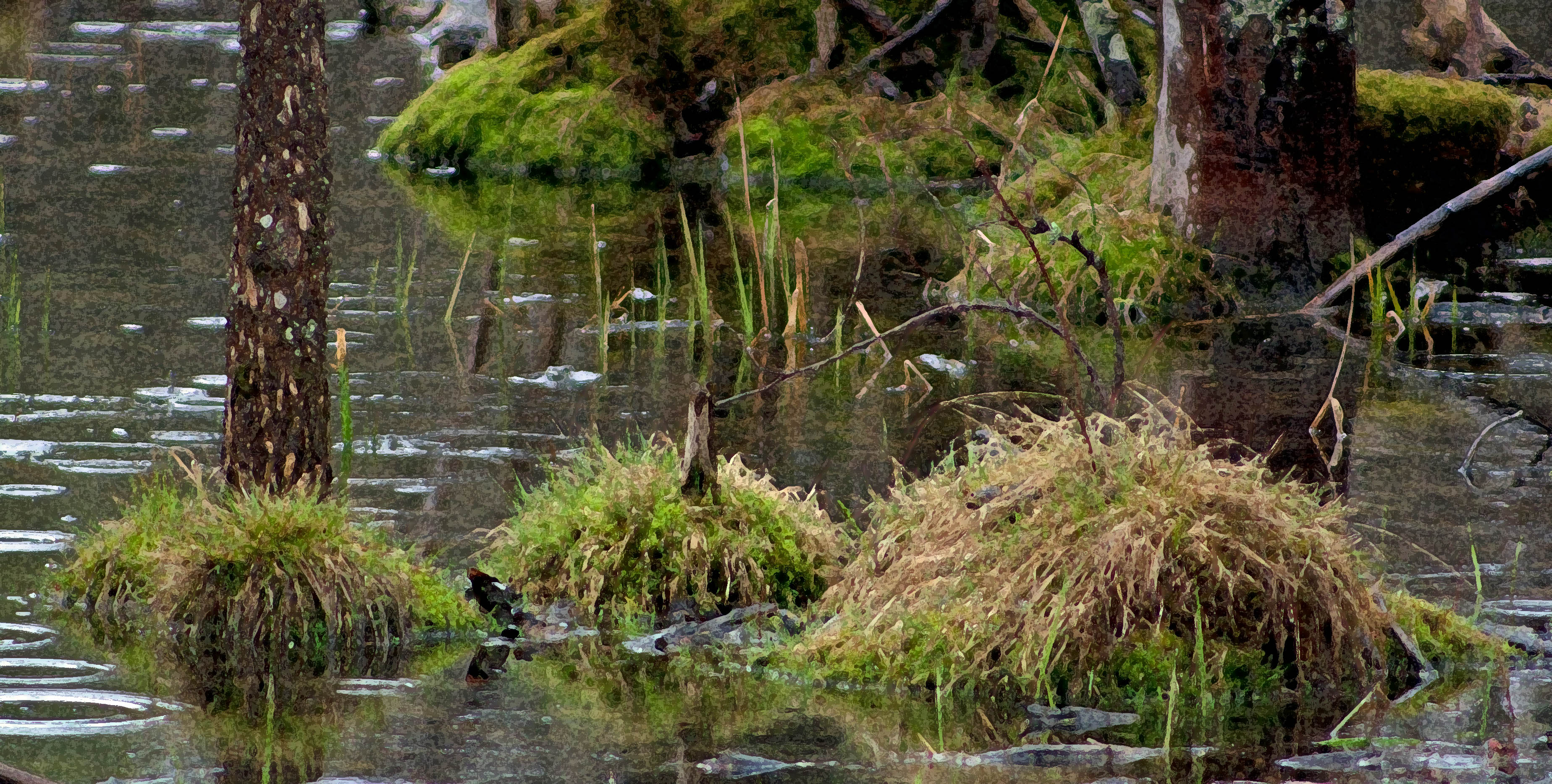
Forest swamp in Kawarthas in spring, ON (photo and dry brush rendition by Nina Munteanu)
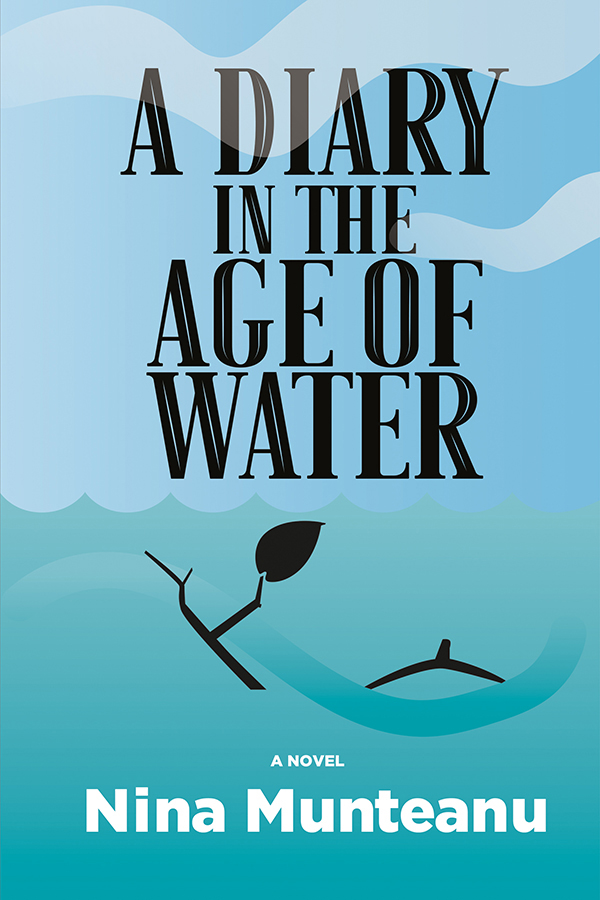
Nina Munteanu is a Canadian ecologist / limnologist and novelist. She is co-editor of Europa SF and currently teaches writing courses at George Brown College and the University of Toronto. Visit www.ninamunteanu.ca for the latest on her books. Nina’s bilingual “La natura dell’acqua / The Way of Water” was published by Mincione Edizioni in Rome. Her non-fiction book “Water Is…” by Pixl Press(Vancouver) was selected by Margaret Atwood in the New York Times ‘Year in Reading’ and was chosen as the 2017 Summer Read by Water Canada. Her novel “A Diary in the Age of Water” was released by Inanna Publications (Toronto) in June 2020.
From Anne in Monument Valley, Arizona, to George in Brighton Pier, UK … from Heather coasting on the Ohio River to Noah gliding in a BC Ferry and Jo-Anne basking in the Gulf Islands of BC Canada … from Honoka in Kyoto’s Higashiyama District and Mika in Kyoto’s Bamboo Forest to Rick in his cozy Alberta home and Viviann in a cozy café … from Anne with her favourite dog in Ladner Marsh and Margaret with a favourite ale in an outdoor pub to Carina beside her favourite Buddha and Cathy by her favourite pool …and Noah wearing his hat …
People are reading Darwin’s Paradox.
Nina Munteanu is a Canadian ecologist / limnologist and novelist. She is co-editor of Europa SF and currently teaches writing courses at George Brown College and the University of Toronto. Visit www.ninamunteanu.ca for the latest on her books. Nina’s bilingual “La natura dell’acqua / The Way of Water” was published by Mincione Edizioni in Rome. Her non-fiction book “Water Is…” by Pixl Press(Vancouver) was selected by Margaret Atwood in the New York Times‘Year in Reading’ and was chosen as the 2017 Summer Read by Water Canada. Her novel “A Diary in the Age of Water” was released by Inanna Publications (Toronto) in June 2020.
On Writing My First Speculative Fiction Novel: The Darwin-Angel Duology
The first novel I wrote at the tender age of fifteen was Caged in World, a hundred-page speculative story about a world that had moved “inside” to escape the ravages of a harsh post climate-change environment.
It was 1969, the year that humans first stepped on the moon and the first Concorde test flight was conducted in France. But I was concerned by the environment and what was happening on our planet. It was seven years since Rachel Carson had published Silent Spring, which warned of our declining bird and bee populations and impacts to human health from unregulated pesticide/herbicide use (such as carcinogens and hormone disruptors). It was just a year after Paul Erlich’s Population Bomb warned that attempts to stretch the Earth’s resources to support the ever-growing population would result in mass starvation, epidemics, and, ultimately, the breakdown of social order.
In the 1960s it was already apparent that environmental imbalance and destruction were global concerns and we were on the brink of an environmental crisis. Unchecked deforestation was destroying forests around the world, including the boreal and old-growth forests of my own country Canada. Brazil had already begun cutting down trees and burning forest at an alarming rate. Unregulated use of pesticides, herbicides and growth hormones created toxic contamination of our natural world and our food and water supply—despite Carson’s dire warning with Silent Spring. Our waterways were being contaminated by mining wastes and industrial effluents. Killer smog. Noxious algal blooms. Oil spills. Dead zones. The list was growing.
Bamboo Forest, Kyoto, Japan (photo by Nina Munteanu)
I joined S.T.O.P. (Society To Overcome Pollution) and marched in protests to call for responsible behaviour by governments and large corporations. I tried to raise awareness at my school about our deteriorating environment and likely consequences to human survival; my own teachers tried to silence me. I wrote my first dystopia, Caged in World. The eco-novel was about a subway train driver and a data analyst caught in the trap of a huge lie. The story later morphed into Escape from Utopia. My dad, who was impressed with my dedication and what I’d done, became my first agent; he brokered a meeting with a Doubleday editor he’d met and impressed (my dad was a character and very charming); I did my first book pitch at age sixteen. The editor read my book and, while he didn’t pick the book for Doubleday, he told me that the story was original and imaginative and that I should keep writing.
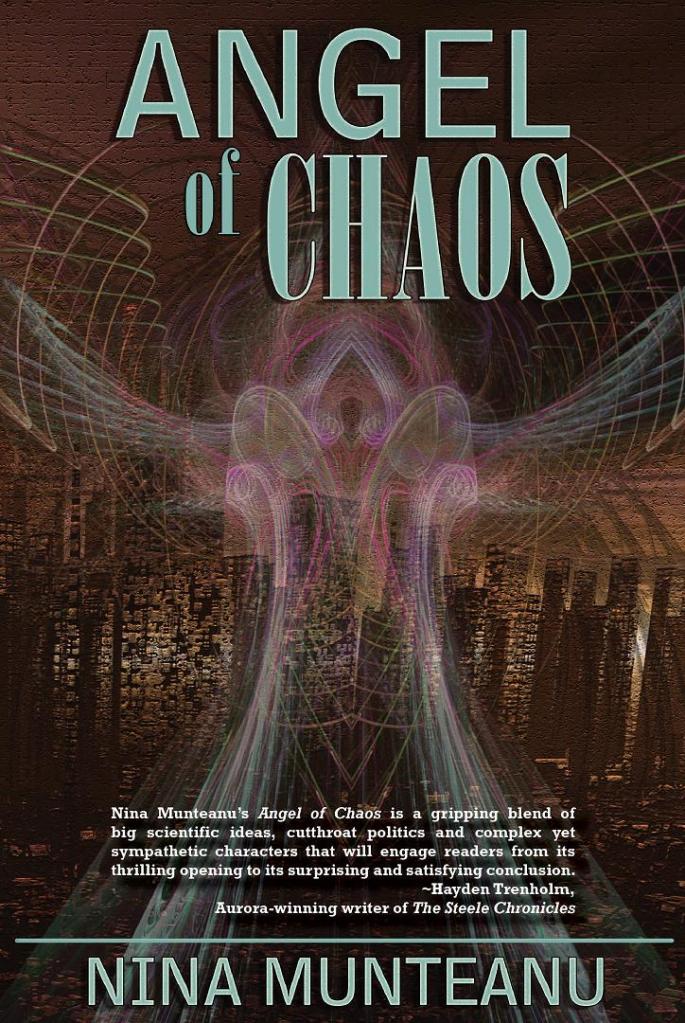
Several drafts—and years later—the novel became the eco-medical thriller Angel of Chaos, set in 2095 as humanity struggles with Darwin’s Disease—a mysterious neurological environmental pandemic. Icaria 5 is one of many enclosed cities within the slowly recoving toxic wasteland of North America, and where the protagonist Julie Crane works and lives. The city is run by technocrats, deep ecologists who call themselves Gaians, and consider themselves guardians of the planet.
The Gaians’ secret is that they are keeping humanity “inside” not to protect humanity from a toxic wasteland but to protect the environment from a toxic humanity.
Since she was a young child, Julie has been hearing voices in her head. She’s not a schizophrenic, but a gifted veemeld (someone who can tap into machine intelligence wavebands). Feeling an inexplicable “karmic” guilt and intent on making a contribution to her society, Julie searches for a cure to Darwin Disease; instead, she makes a horrifying discovery that incriminates her in a heinous conspiracy to recast humankind.
“This is a story with great scope … As Julie finds out the truth about her father, she discovers a truth that will tear her world apart.“
Bill Johnson, author of “a story is a promise”
By virtue of their gifted powers in communicating with the machine world, veemelds are considered a commodity, to be used, traded, hoarded and discarded by ruling technocrats all over North America.
I spent several years shopping the book to agents and publishing houses. Although I received many bites, all finally let go. In the meantime, I did several things: 1) I started writing short stories, some of which were cannibalized from the book, and several were published; 2) I wrote Angel’s prequel, The Great Revolution (never published, it sits in a drawer hibernating) and Angel’s sequel Darwin’s Paradox, (which was published). In fact, in 2007, Dragon Moon Press in Calgary made an offer to publish Darwin’s Paradox; the sequel became my debut novel. Dragon Moon Press later picked up Angel of Chaos and published it in 2010 as a prequel.
“Angel of Chaos is a gripping blend of big scientific ideas, cutthroat politics and complex yet sympathetic characters that will engage readers from its thrilling opening to its surprising and satisfying conclusion.”
Hayden Trenholm, Aurora-winning author of The Steele Chronicles
Darwin’s Paradox follows humanity in its cloistered indoor world as it deteriorates with the disease. Darwin’s Disease—related to indoor living—sweeps across humanity with debilitating genetic deterioration, violent death and the promise of extinction. This is something the self-professed deep ecology Gaians are content to see in—if it means preserving the natural world. Of course, the Gaians—being self-serving humans after all—have an exit plan.
In 2012, Derek Newman-Stille of Speculating Canada wrote an essay on Darwin’s Paradox entitled “Patient Zero and the Post Human”; the article provides an insightful description of the eco-novel and interesting historical context and irony to our current situation with the COVID-19 pandemic:
“In Darwin’s Paradox Nina Munteanu displays her awareness of scientific discourse: focussing on areas like chaos theory, biological theories of co-evolution, symbiosis and virology, and ecological theories. Her protagonist, Julie, is patient zero in a spreading epidemic that has infected most of modern civilisation. Munteanu creates a civilisation where human society is centred around a few urban locales, leaving large parts of the world unoccupied by human beings, and allowing for ecological development uninterrupted by human interference. Technology in this future world has fused with the viral epidemic, questioning the barriers of the human and the nature of human existence. The nature of humanity has changed with this introduction of other elements into the human biosystem, creating a post-human world in which the possibilities of the future of human existence are called into question, and in which several powers are vying for control of the next stage of humanity and the future of the human race.
Munteanu’s Darwin’s Paradox illustrates a collision of past and future as Julie is haunted by her past and ideas of home, while simultaneously representing a next stage in human evolution. The city Icaria 5 itself is a representation of past and present intersecting: buried under the city of Toronto and rising from the structures of the past. Munteanu’s plot is full of family secrets, the hidden past, and the resurfacing of guilt (particularly Julie’s guilt about being patient zero in the spreading viral apocalypse). She explores the draw of the past and home and the continual pull the past has upon one’s existence. Munteanu explores Julie’s simultaneous desire to return home and her realisation that home has forever changed – becoming a foreign place.
Munteanu explores society’s fear of epidemic and the role of medical technology as a mechanism for solving all of the world’s problems. She illustrates that medical technology has its limits and complicates the nature of technological methods of solving problems by allowing virus and technology to meld. Simultaneously Munteanu explores the continuation of society’s obsession with beauty and perfection by creating a society where one can restore one’s beauty through instant medical treatments: Nuyu and Nuergery, using nanites to restore one’s youth and change undesirable aspects of one’s form. Political groups fearing the over-use of technology and the complications to the idea of the human that these surgeries may cause begin using scarring to assert their difference and reluctance to submit to social controls.
Media plays an important role in Munteanu’s vision of the future, illustrating the continuance of the media hegemony for defining the nature of “truth” as media messages replace facts and political leaders manipulate the media system to enforce their own controls over society and further embed their interests into the developing social system. She illustrates the danger of the current system of using the politics of fear as a mechanism for controlling voters (particularly focussing on the use of fear by political groups to shift cultural ideas, sympathies, and ultimately gain control of the developing social system). In Munteanu’s vision of the future, it is impossible to trust anyone completely and layers within layers of plot are illustrated, leaving the reader distrusting of every message he or she receives.
Munteanu raises questions and challenges the development of society’s current systems, asking her readers to think critically about messages they are given and to question everything. She illustrates that the truth is socially constructed and that ideas of the truth serve social purposes and can be used to support hidden agendas.”—Derek Newman-Stille, Patient Zero and the Post-Human
In some ways, the Darwin duology shares a special place in my heart—not just because the duology became my first and second traditionally published novels, but because through them I found my writing voice. Since first writing Caged In World, I spent close to four decades honing my craft; I published short stories and two novellas (Collision with Paradise in 2005 andThe Cypol in 2006), and attended writing workshops and conventions, before publishing my first novel with a traditional publisher. It was a fulfilling heuristic path that taught me writing craft in all its facets.
Since publishing my first novel in 2007, I have published on average a book every year (alternating each year between fiction and non-fiction). I now have fourteen books published with various publishing houses. Most are in keeping with an environmental theme. My latest non-fiction book Water Is… was picked by Margaret Atwood in New York Time’s ‘Year in Reading’ in 2016. My latest eco-novel A Diary in the Age of Water was published by Inanna Publications in 2020 in the midst of the COVID-19 pandemic.
My journey as writer has been rich and varied. I’ve moved and lived from one end of Canada to the other. I raised a family and travelled the world. I worked as a field researcher and environmental consultant, investigating many water bodies in Canada and helping communities in watersheds. I taught limnology and phycology at the University of Victoria and currently teach writing at the University of Toronto. I continue my personal research in the natural world to satisfy my unending curiosity. I’ve changed. My writing has changed. But one thing will never change: my passion for the written word and the worlds of the imagination. That journey will never end (until the end, that is).
Readers have asked for a sequel to Darwin’s Paradox. I’ve also been approached by several writers to collaborate on a sequel. While many of their ideas were wonderfully original, I’ve not taken any of them on their offer. Others have said that both novels would make a great series or movie. I’m inclined to agree. If that were to come to pass, I might be persuaded to create a Darwin’s Paradox series and continue the story of Julie, Daniel, and Angel.
Bamboo Forest in Kyoto, Japan (photo by Nina Munteanu)
Nina Munteanu is a Canadian ecologist / limnologist and novelist. She is co-editor of Europa SF and currently teaches writing courses at George Brown College and the University of Toronto. Visit www.ninamunteanu.ca for the latest on her books. Nina’s bilingual “La natura dell’acqua / The Way of Water” was published by Mincione Edizioni in Rome. Her non-fiction book “Water Is…” by Pixl Press(Vancouver) was selected by Margaret Atwood in the New York Times‘Year in Reading’ and was chosen as the 2017 Summer Read by Water Canada. Her novel “A Diary in the Age of Water” was released by Inanna Publications (Toronto) in June 2020.
“A spindly middle-aged mathematician with a soaring mind, a sunken heart, and bad skin is being thrown about the back of a carriage in the bone-hollowing cold of a German January…He is now racing through the icy alabaster expanse of the countryside in the precarious hope of averting another: Four days after Christmas and two days after his forty-fourth birthday, a letter from his sister has informed him that their widowed mother is on trial for witchcraft — a fact for which he holds himself responsible.”
This is how Maria Popova of brainpickings starts her article entitled: “How Kepler Invented Science Fiction and Defended His Mother in a Witchcraft Trial While Revolutionizing Our Understanding of the Universe.”
It all started with Somnium (The Dream), Kepler’s work of science fiction.
Despite having sufficient mathematical evidence to confirm Copernicus’s heliocentric model of the universe, Kepler understood that the proof was overly complex and abstract to persuade his peers, much less the scientifically illiterate public. He realized that where data and evidence could not dismantle their “celestial parochialism,” storytelling could. Somnium resulted.
Somnium (The Dream), was a fictional account of a young astronomer who travels to the Moon. Rich in scientific ingenuity and symbolism, the allegory advanced the controversial Copernican model of the universe—that our planet revolves around the Sun, not the other way around. The young astronomer finds that lunar beings believe Earth revolves around them. Using the moon beings’ delusion as metaphor for our delusion about Earth’s central position in an immutable universe, Kepler hoped to awaken people to the truth of Copernicus’s heliocentric model of the universe. But we weren’t ready for the truth; instead Somniumresulted in Kepler’s elderly mother’s being accused of witchcraft.
Popova adds: “As Kepler is galloping through the German countryside to prevent his mother’s execution, the Inquisition in Rome is about to declare the claim of Earth’s motion heretical — a heresy punishable by death.” This was a dangerous time for anyone with a scientific mind.
This was a world, Popova reminds us, where the will of God supersedes the laws of nature. A world where the Devil is more real and powerful than gravity. A time when most people believed that the sun revolved around the Earth every day in a circular orbit. Kepler would disprove this belief by demonstrating that physical forces move the heavenly bodies in calculable ellipses. But he paid a price for his unconventionality. Kepler was a game-changer, a scientific seditionist who would spill the apple cart of conventional thought with ungodly science. He invented the word orbit and developed a scientific method to predict eclipses. He was the first astrophysicist. And yet…
“All of this he would accomplish while drawing horoscopes, espousing the spontaneous creation of new animal species rising from bogs and oozing from tree bark, and believing the Earth itself to be an ensouled body that has digestion, that suffers illness, that inhales and exhales like a living organism,” writes Popova. “Three centuries later, the marine biologist and writer Rachel Carson would reimagine a version of this view woven of science and stripped of mysticism as she makes ecology a household word.”
The superstitious villagers of Kepler’s hometown overlooked the metaphor and science of Somnium and focused instead on what they recognized as autobiographical: the young narrator (a young astronomer who apprenticed with Tycho Brahe like Kepler did) and a witch-like mother, who was a herb doctor (like Kepler’s own mother). Having recognized a likeness, they saw Kepler’s allegory as non-fiction. This meant that the narrator’s mother, who conjures up spirits to assist her son in his lunar voyage, and Kepler’s mother were one in the same. Katharina Kepler—a blunt, independent and outspoken woman—was soon called out as a witch. Villagers who had a bone to pick with her took advantage and rumors spread: a mother claimed that her daughter’s arm grew numb after Katharina brushed against it in the street; the butcher’s wife swore that pain pierced her husband’s thigh when Katharina walked by; the limping schoolmaster dated the onset of his disability to a night ten years earlier when he had taken a sip from a tin cup at Katharina’s house while reading her one of Kepler’s letters. She was accused of appearing magically through closed doors, of having caused the deaths of infants and animals.
The burning at the stake of Anne Drake (anonymous engraving)
“After years of exerting reason against superstition, Kepler ultimately succeeded in getting his mother acquitted,” writes Popova. “But the seventy-five-year-old woman never recovered from the trauma of the trial and the bitter German winter spent in the unheated prison.” She died shortly after she was released.
Thousands of people were tried for witchcraft during that time. Most of the accused were women, whose defense fell on their sons, brothers, and husbands. Most trials ended in execution. In Germany, some twenty-five thousand were killed. In Kepler’s small hometown, six women had been burned as witches just a few weeks before his mother was indicted.
Popova tells us that Katharina Kepler “first enchanted her son with astronomy when she took him to the top of a nearby hill and let the six-year-old boy gape in wonderment as the Great Comet of 1577 blazed across the sky.”
But Katharina’s fate was written by the world she lived in. Kepler understood that as a man, his privileges in education—and standing—provided him with additional social standing beyond his mother’s. “I was born a man, not a woman,” he wrote, “a difference in sex which the astrologers seek in vain in the heavens.”
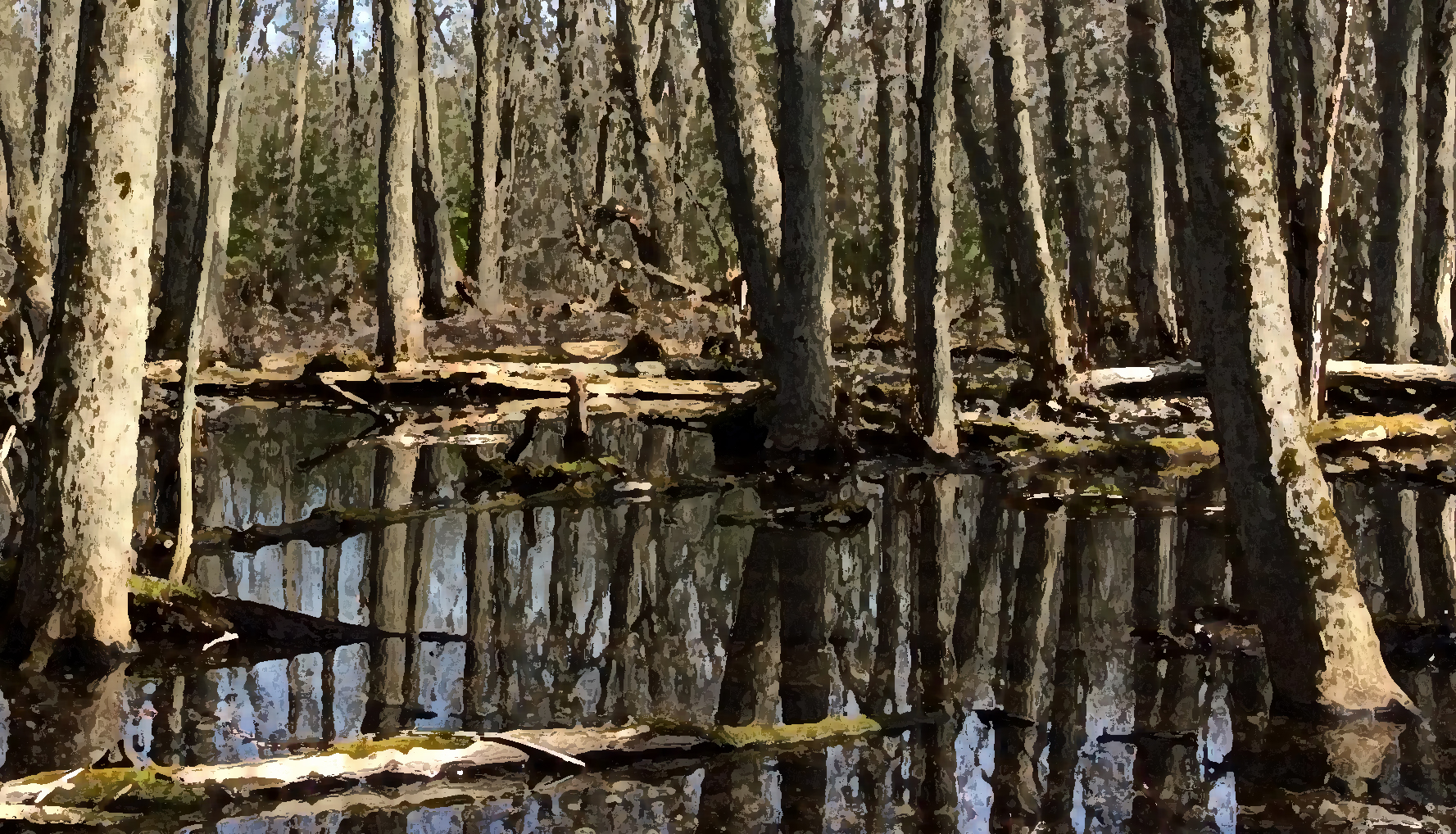
Maple-Oak swamp forest in spring, Trent Nature Sanctuary, ON (photo by Nina Munteanu)
Nina Munteanu is a Canadian ecologist / limnologist and novelist. She is co-editor of Europa SF and currently teaches writing courses at George Brown College and the University of Toronto. Visit www.ninamunteanu.ca for the latest on her books. Nina’s bilingual “La natura dell’acqua / The Way of Water” was published by Mincione Edizioni in Rome. Her non-fiction book “Water Is…” by Pixl Press(Vancouver) was selected by Margaret Atwood in the New York Times‘Year in Reading’ and was chosen as the 2017 Summer Read by Water Canada. Her novel “A Diary in the Age of Water” was released by Inanna Publications (Toronto) in June 2020.
In the Spring issue of Ecology & Action, Mary Woodbury, author and publisher of Dragonfly.eco, lists some of her favourite Eco-Fiction that Inspires Action. Among them is Nina Munteanu’s eco-novel “A Diary in the Age of Water.”
“Fiction exploring humanity’s impacts on nature is becoming more popular. It has the distinct ability to creatively engage and appeal to readers’ emotions. In fact, it can stir environmental action. A survey I took last year showed that 88% of its participants were inspired to act after reading ecological fiction.
Principled by real science and exalting our planet’s beauty, these stories are works of art. They live within classic modes of fiction exploring the human condition, but also integrate the wild. They can be referred to as “rewilded stories.” The following Canadian titles are some of my favourites in this genre.”
MARY WOODBURY
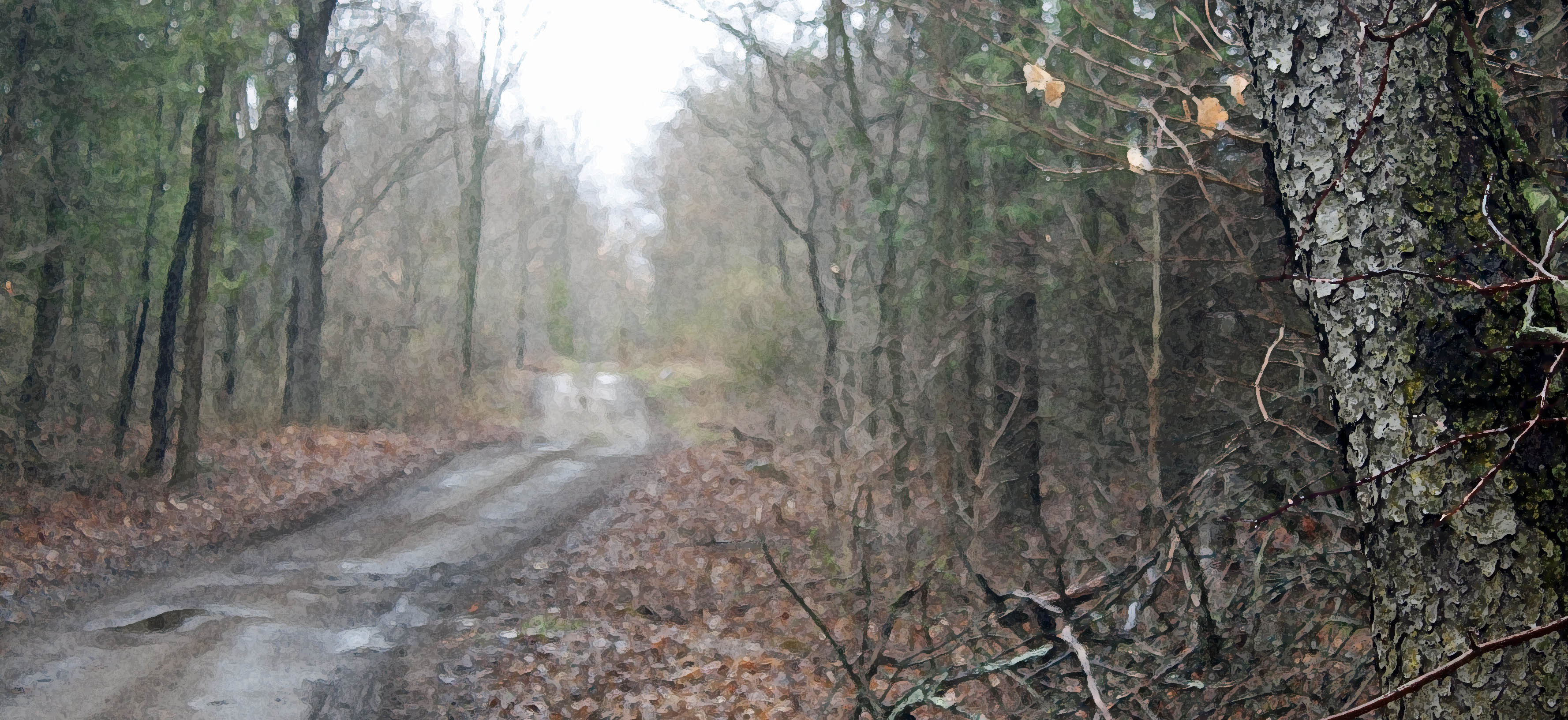
Dirt road to Long Lake in a misty light rain in early spring, ON (photo and dry brush rendition by Nina Munteanu)
Nina Munteanu is a Canadian ecologist / limnologist and novelist. She is co-editor of Europa SF and currently teaches writing courses at George Brown College and the University of Toronto. Visit www.ninamunteanu.ca for the latest on her books. Nina’s bilingual “La natura dell’acqua / The Way of Water” was published by Mincione Edizioni in Rome. Her non-fiction book “Water Is…” by Pixl Press(Vancouver) was selected by Margaret Atwood in the New York Times‘Year in Reading’ and was chosen as the 2017 Summer Read by Water Canada. Her novel “A Diary in the Age of Water” was released by Inanna Publications (Toronto) in June 2020.
The TVO and National Film Board of Canada film Borealis by Kevin McMahon opens with ‘tree song’ and Diana Beresford Kroeger’s voice: “The design of Nature is music. If you listen to the trees, you will hear their song. And some people actually hear an individual song for certain species.”
Early in the film, you see Edmund Metatawabin, a Fort Albany First Nation writer, walking ghost-like in the forest. His voice tells us that when the trees look at us, we would just be like “these little things flitting by.” This simple comment underscores the difference that time plays to a tree that may live to a thousand years in contrast to a human who—if they are lucky—may live to a hundred. Says Metatawabin:
“We have a certain relationship with the trees, their living essence. The tree has been here for a long time, standing in the same spot but watching…They’re our older relations. We’re very happy and secure that they’re there, still standing watching over us. Some of us have heard them sing.”
Edmund Metatawabin
Boreal forest after a natural fire (Borealis)
In a frank interview with Madeline Lines of POV Magazine about the making of Borealis, filmmaker Kevin McMahon talked about how the rugged beauty of the boreal forest belies a fragility poised on a precarious balance with humanity.
The film discusses some of the major relationships and mechanisms of this complex and unique ecosystem through the voices of scientists and naturalists who study and know the forest: botanists, population and aquatic ecologists, atmospheric scientists, forest entomologists and researchers and guides.
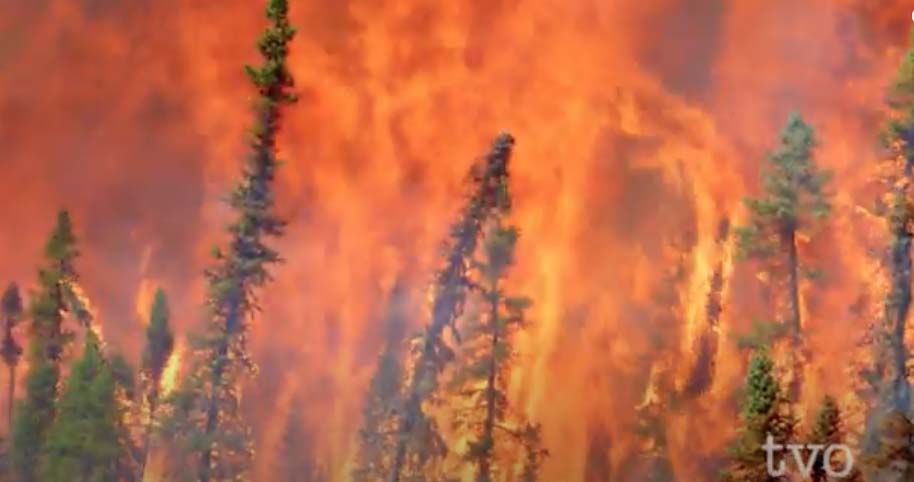
“The story of the boreal forest [is that] basically … it goes up, burns itself down and like a phoenix, goes up again,” says McMahon. “There’s a complexity—the trees influence the animals, the animals influence the trees, so a community grows up over at least two centuries, usually, and sometimes three, or four.”
Natural fire cycles through the boreal forest every hundred years to renew it (Borealis)
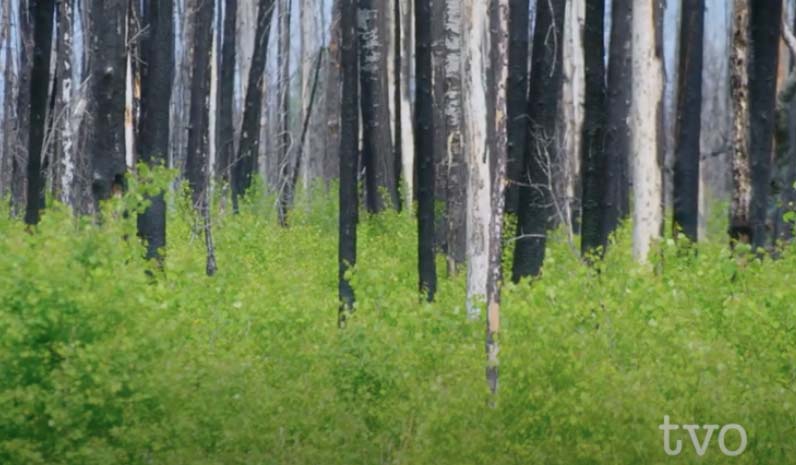
One of the narrators tells us that the boreal forest has “survived and thrived in this regime of semi-regular stand-renewing fire.” This natural cycle of creative destruction is common in most ecosystems where destruction engenders rebirth and renewal by a community of species well-adapted to these cyclical changes. Botanist Diana Beresford-Kroeger adds, “the jack pine cones will only open on fire. The resin needs to be melted off the cone and then they shed their seeds.” The cones of tall spruce trees aggregate at the top of the tree, where the fire provides enough heat to open them but not burn them. White birch saplings sprout—phoenix-like—from the burnt tree base and roots. Aspen roots also send up thousands of suckers to become new clone trees of a renewed forest. The dead trees provide substrate for mosses, lichens and fungi that bring in moisture and decompose the logs into nutrients used by the living forest.
Aspen clone saplings cover the forest floor after a fire (Borealis)
The movie showcases some of the most vivid details of tree function, including the microscopic view of opening and closing stomata (pores on a leaf). Stomata take in CO2 and release oxygen during photosynthesis. They also release water vapour as part of transpiration and other chemicals such as metabolic aerosols.
Stomata on the underside of leaf release aerosols, carbon dioxide and water (Borealis)
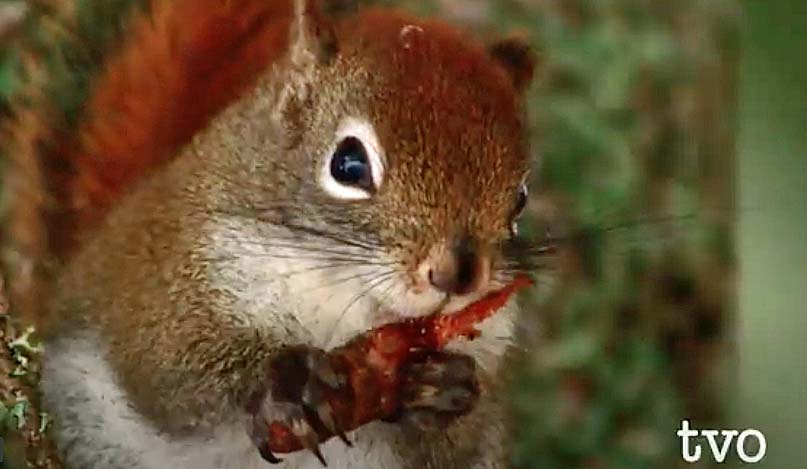
The devastation of climate change strongly features in the film as does our own mismanagement of the forests. A particularly telling scene was shot in the Yukon by Joshua See where squirrels have co-evolved with spruce trees in a relationship they’ve developed over 1000 years. The squirrels have timed their reproduction with the spruce production of cones and release of seeds; but climate change has knocked the trees out of sync with the squirrels, which is threatening the survival of the squirrel.
Red squirrel eating spruce seeds from cone (Borealis)
“I think that’s probably the first time any human being has seen such a vivid example of the rhythms of nature being thrown out of sync by climate change. And the funny thing is, if you listen to the climate change debate, as I obviously do fairly closely, that is something that has not really sunk in with the general public,” said McMahon. “People know about storms, and because of Australia and California they’re starting to learn about the impact it has on fires. But the reality that the rhythms of the world are all screwed up has not really sunk in, and Borealis has two really powerful examples of this. One is what happens to the squirrels, and the other is what’s happening to the trees, with what’s happening with the pine beetles.”
Aerial shot of river and boreal forest (Borealis)
Fern fiddleheads in boreal forest (Borealis)
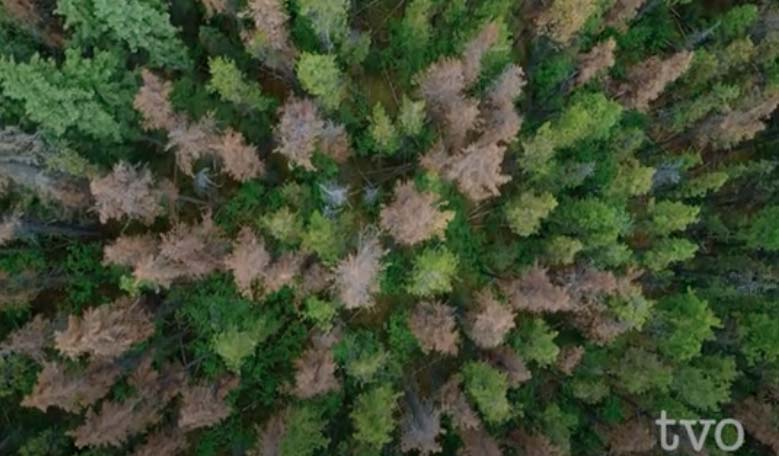
McMahon then adds soberly, “That last big dramatic drone shot [in the film] where you see that, basically, the boreal forest is dying – that’s Jasper National Park. This iconic forest that Canadians have sort of hung their identity on – you know, the snow-capped pine trees, and whatever – that forest is dying. It’s in a death spiral.”
McMahon admits: “I didn’t know when I started this project 10 years ago about the state of the forest. I was intending to make a film about how the forest worked. I did not realize until I started really talking to scientists that it is dying…The boreal forest is dying, and we are doing a super shitty job of taking care of it.”
This resonated particularly with me; I’d just published my latest eco-novel A Diary in the Age of Water with Inanna Publications. The novel—about four generations of women and their unique relationship with water—begins with a blue being in the unknown future as she runs through a dying forest of the north, the last boreal forest in the world…
Clearcut logging the boreal forest (Borealis)
Pest-ridden boreal forest (Borealis)
McMahon adds a sober note about Canadian awareness:
“I think that in Canada – and this has been a theme of mine for decades – we pat ourselves on the back for being fresh faced boy scout-types, and we have this sense of ourselves as being green because we have so much green. The best thing about my career is I’ve been able to travel so much around this country. And it is a huge, huge country, and we do have just incredible, astonishing wilderness here–and we are wrecking it. We’re wrecking it in an extremely heedless, pointless, stupid kind of way. So I want that to sink in with people.
All those people at the end of the film that talk about the fact that the forest is collapsing, and we’re going to end up with a shrubland, and the forest emits more carbon than it sequesters–those are all Canadian government scientists. They’re not environmentalists. There’s no environmentalist voice in this film, in fact. I didn’t go to Greenpeace or any of those kinds of people, I went only to people who have a direct, material day-to-day interaction with the forest. Those people at the end of the film are on your payroll, and their job is to figure out what’s going. That’s what they’ve figured out, and I don’t think hardly anybody in this country knows that.”
Kevin McMahon
But McMahon remains hopeful. He cites Ursula Franklin, a scientist and peace activist who said, “Despair is a luxury we cannot afford.” McMahon responds with, “That’s the model that I live by really, because if I didn’t have hope I wouldn’t bother making these films, I’d just retire.”
Tree planter Isabella plants spruce and pine in a clearcut (Borealis)
Near the end of the film, tree planter Isabella reminds us that, “We have the ability to make whatever it is that we imagine, so let’s just start imagining a new path, let’s start imagining a new way. We are so tied to this experience and whatever happens to that forest is going to be a reflection of what happens to us.”
The film ends with the powerful wisdom of indigenous writer Edmund Metatawabin:
“We are here to make sure that the world, that the species, that humanity continues. The trees are the support, guidance, encouragement, and faith that things are just the way they’re supposed to be. That’s support from something that’s inanimate it looks like; but you’re getting it because it’s connected to the ground and its aiming for the sky. It’s a conduit between the earth and the sun. To see the tree as a living light … When you see that light you’ve gotten a gift; you’re going to be very humbled.”
Edmund Metatawabin
Nina Munteanu is a Canadian ecologist / limnologist and novelist. She is co-editor of Europa SF and currently teaches writing courses at George Brown College and the University of Toronto. Visit www.ninamunteanu.ca for the latest on her books. Nina’s bilingual “La natura dell’acqua / The Way of Water” was published by Mincione Edizioni in Rome. Her non-fiction book “Water Is…” by Pixl Press(Vancouver) was selected by Margaret Atwood in the New York Times ‘Year in Reading’ and was chosen as the 2017 Summer Read by Water Canada. Her novel “A Diary in the Age of Water” was released by Inanna Publications (Toronto) in June 2020.
You walk toward English Bay to the nearest Hydrogenase Hub, where you are meeting with your team to discuss the presentation.
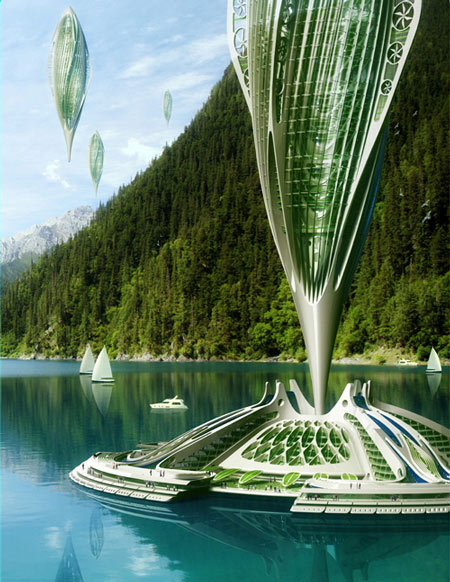
The hub is a floating algal farm. The farm and the elongated seed-shaped airship docked at its centre both produce biofuel—essentially hydrogen—from the microorganism Chlamydomonas reinhardtii. Your mom, a former environmental consultant and algal scientist—now she writes science fiction—explained to you that this unicellular organism has both plant and animal properties; it carries out photosynthesis but is also heterotrophic (able to use organic carbon to grow) and will in the absence of oxygen produce gaseous hydrogen and metabolites such as formate and ethanol through hydrogenase enzymes. Chlamydomonas reinhardtii was first discovered as a clean source of hydrogen back in 1939 by German scientist Hans Gaffron at the University of Chicago (ironically the same year Germany invaded Poland). Gaffron called it “photosynthetic hydrogen production by algae”; and today it is a process that produces electricity and biofuel with zero emissions.
The algae farm recycles CO2for the bio-hydrogen airship you will be boarding after your meeting in the hub. You enter the airy station, whose honeycomb circular design resembles a stylized lily pad and glance up through the high nano-glass ceiling toward the elongated seed-shaped transport rising ten stories above you. The sun glances off the diaphanous double helix frame that resembles a freshwater spirogyra. The hub you’re standing in is a floating algae farm with solar cells on top and hydro-turbines below to capture tidal energy. The algae farm recycles CO2 for the bio-hydrogen airship you will be boarding after your meeting in the hub. You enter the airy station, whose honeycomb circular design resembles a stylized lily pad and glance up through the high nano-glass ceiling toward the elongated seed-shaped transport rising ten stories above you.
The sun glances off the diaphanous double helix frame that resembles a freshwater spirogyra. The hub you’re standing in is a floating algae farm with solar cells on top and hydro-turbines below to capture tidal energy.
The concept is the “subversive architecture” of Belgian architect Vincent Callebaut and inspired by the principles of biomimicry, coined by Janine Benyus in 2002 in her book “Biomimicry: Innovation Inspired by Nature”. Callebaut conceived Hydrogenase in 2010 as a 100% self-sufficient and zero-emission transport system using algae. He claimed that a hectare of seaweeds could produce 120 times more biofuel than a hectare of colza, soya or sunflower without consuming land needed for crops or forests. He called Hydrogenase a true miniature biochemical power station. Able to absorb CO2 as the main nutrient through photosynthesis the algae, under anaerobic conditions, produce hydrogen in vitro or in bioreactors.
You swipe your PAL over the ticket booth sensor and the optional ticket-brochure pops out. You take it and read the specs between glances at the tall vessel loading in the dock of the hub. It’s really like a vertical dirigible, you think, studying the seed-shaped airship with self-cleaning “intelligent” nanostructured glass—inspired by the lotus leaf that doesn’t get wet. The semi-rigid unpressurised airship stretches vertically around an arborescent spine that twists like chloroplast ribbons 400 meters high and 180 meters in diameter.
You read that each Hydrogenase airship is covered with flexible inflatable photovoltaic cells and twenty wind turbines to maneuver and collect energy. The interior spaces provide room for housing, offices, scientific laboratories, and entertainment, and a series of vegetable gardens that provide a source of food while recycling waste.
You read that this self-sufficient organic transport flies about 2000 meters high at about 175 km/hr (twice the speed of a conventional ship). Given its ease in negotiating airspace and its ability to land and take off from virtually any location, the Hydrogenase is used by many groups in various capacities. Your friend Michael who teaches at the University of Victoria uses one as a mobile research station in his studies along the coast of northern British Columbia.
The vessel is made of “intelligent layers” and “self-separable ceramics”. Its bionic coating draws inspiration from sharkskin that is self-cleaning and flow-efficient.
Hydrogenase concept with algal farm pods and air ships
You head down the spiral staircase to the third subsea level toward the meeting room you booked earlier on your PAL. The view is spectacular from here through the nano-glass panes. Rays of shimmering light stream through a gently swaying forest of kelp. You glimpse the sun-glinted flickering of hundreds of anchovies as they school through the kelp. This floating farm is an organic purifying station of four carbon wells where the algae recycle the carbonated waste brought by the airships and, in turn, feed the airship with biohydrogen. It’s the new “gas station”, you reflect with a smile.
After your meeting with staff, you and three others of your team board the airship and settle in one of the skyview chambers. The journey is relaxing, like the BC Ferry used to be, but without the pungent smell and pollution of conventional motorized sea vessels. It’s a quiet and relaxing trip with a spectacular view of the Gulf Islands. Your team strategizes your presentation over a light lunch and Matcha lattes.
Vincent Callebaut’s Hydrogenase
The PA system sounds and a woman’s voice informs you that the ship will be making an emergency landing on Saturna Island to rescue two hikers injured at East Point. This will only add twenty minutes to the trip, the woman assures you. You don’t mind and recall the disclaimer at the bottom of the ticket. Given the ability of this airship to take off and accurately land virtually anywhere, all Hydrogenases are by law mandated to be on standby for rescue missions in rough terrain.
You pull out the ticket and read again: The Hydrogenase is affiliated with the International Red Cross and BC Coastguard. The Hydrogenase must by law respond to any distress call at sea or rough terrain associated with coastal waters. Because of this service, we cannot guarantee a timely schedule.
You recall how Hydrogenases were deployed in the last hurricane disaster off the coast of Florida last year, saving countless people trapped in the flooding that accompanied the storm. The International Red Cross uses them as flying hospitals.
Bernard frets over the time delay. He is concerned about the lack of preparation and set up time once you get into Victoria. You assuage him gently. The best preparation is sincerity, you tell him. The landscape architect Thomas Woltz, whose work you highly respect, saw himself as someone who embraces the complexity of modern life while seeking meaning and narrative in both natural and human-made environments.
“We’re storytellers,” you tell Andre. Invoking metaphor through design. “They know we’re coming and they know we’re helping someone; they’ll wait for our story. And it’s all about harmony.”
The lines of Henry David Thoreau come to you: Man’s life must be of equal simplicity and sincerity with nature, and his actions harmonize with her grandeur and beauty.
Then you point your PAL at the ServiceBot and order three more lattes. You lean back in your bamboo fabric chair and cross your legs over the leg rest.
It’s a brave new world.
Pine forest in Jackson Creek Park, ON (photo and dry brush rendition by Nina Munteanu)
Nina Munteanu is a Canadian ecologist / limnologist and novelist. She is co-editor of Europa SF and currently teaches writing courses at George Brown College and the University of Toronto. Visit www.ninamunteanu.ca for the latest on her books. Nina’s bilingual “La natura dell’acqua / The Way of Water” was published by Mincione Edizioni in Rome. Her non-fiction book “Water Is…” by Pixl Press(Vancouver) was selected by Margaret Atwood in the New York Times‘Year in Reading’ and was chosen as the 2017 Summer Read by Water Canada. Her novel “A Diary in the Age of Water” was released by Inanna Publications (Toronto) in June 2020.
Stream runs through cedar poplar forest in the rain, Trent Nature Sanctuary, ON (photo and dry brush rendition by Nina Munteanu)
Oh! great mysterium: Great forested sanctuary into the heart of being Oh! to walk pensive, in solitude into the center Of a cedar forest, worlds all russet and green, Branch and bough, rain swept landscapes The high treetops, far whisper and echo… The great winds in high flight high above… Songs to pierce the sullen skies, Melodies of joy and of a deepest longing…
Cedars and poplars in a morning mist, Trent Nature Sanctuary, ON (photo by Nina Munteanu)
Songs of immortality, worlds full aflame, Mystic cathedrals and dawn memory, Haze and gray day, silver sky, silver cloud Rain downfall and mist… Leaf, branch and bough, the wind and the rain The bending and wind tossed land
Mist hangs over Trent Canal, Trent Forest Sanctuary, ON (photo by Nina Munteanu)
The spring scents, spring grasses and nearby stream; Rivulet and rhapsodic song, The holy silences, the rain, fall, hiss and far echo… Cedar forest cathedrals, branches overspread, Red winged blackbird, soaring alone high above, High into the receiving dome of haze and sky Free swoop and whispering forest airs
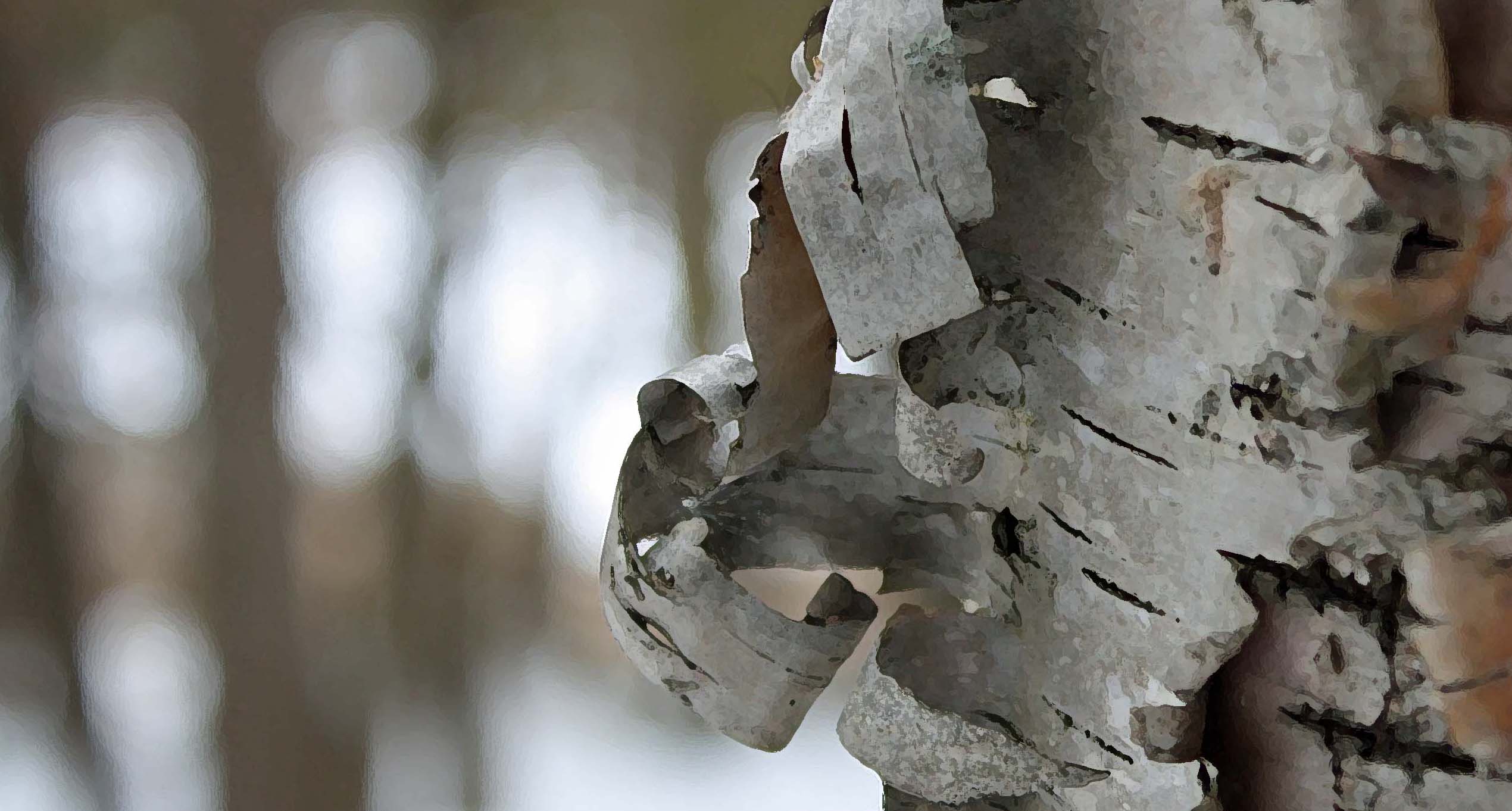
White birch in Trent Nature Sanctuary, ON (photo and dry brush rendition by Nina Munteanu)
The far meditation: Sacred journey into a holy wilderness: Forested worlds beyond time…
Cedar root among ferns and moss in a light mist, Trent Nature Sanctuary (photo by Nina Munteanu)
Forested worlds of an existential beauty, Great moss silences, tree root and bough… Great worlds of hope and the tenebrous shadow Of a rain swept day… Holy encounters: the great mysterium Sacred worlds beyond still time…
BEV GORBET
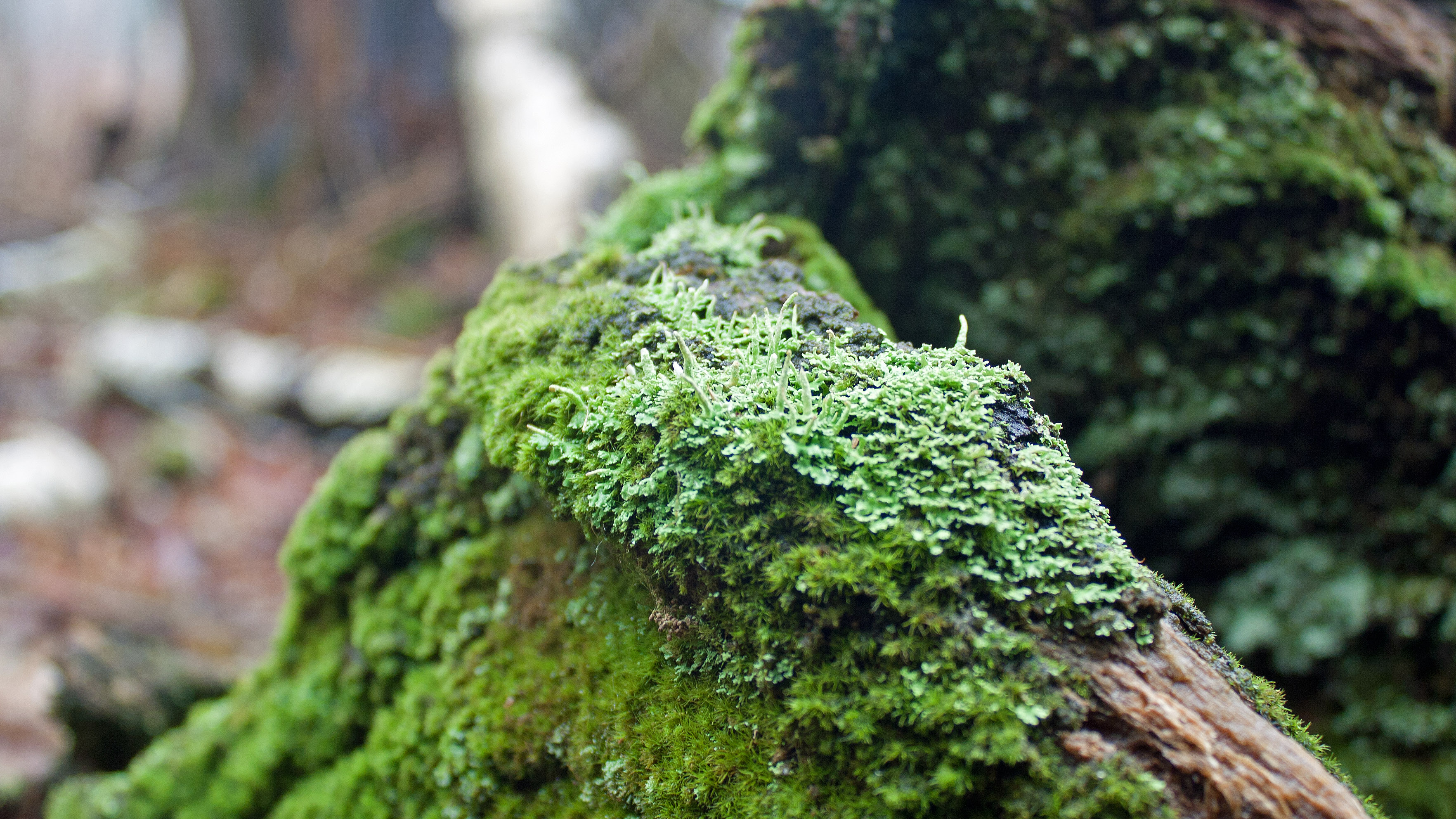
Moss and lichen cover an old cedar log, Trent Nature Sanctuary, ON (photo by Nina Munteanu)
Tinder polypore fungus on white birch, Trent Nature Sanctuary, ON (photo and dry brush rendition by Nina Munteanu)
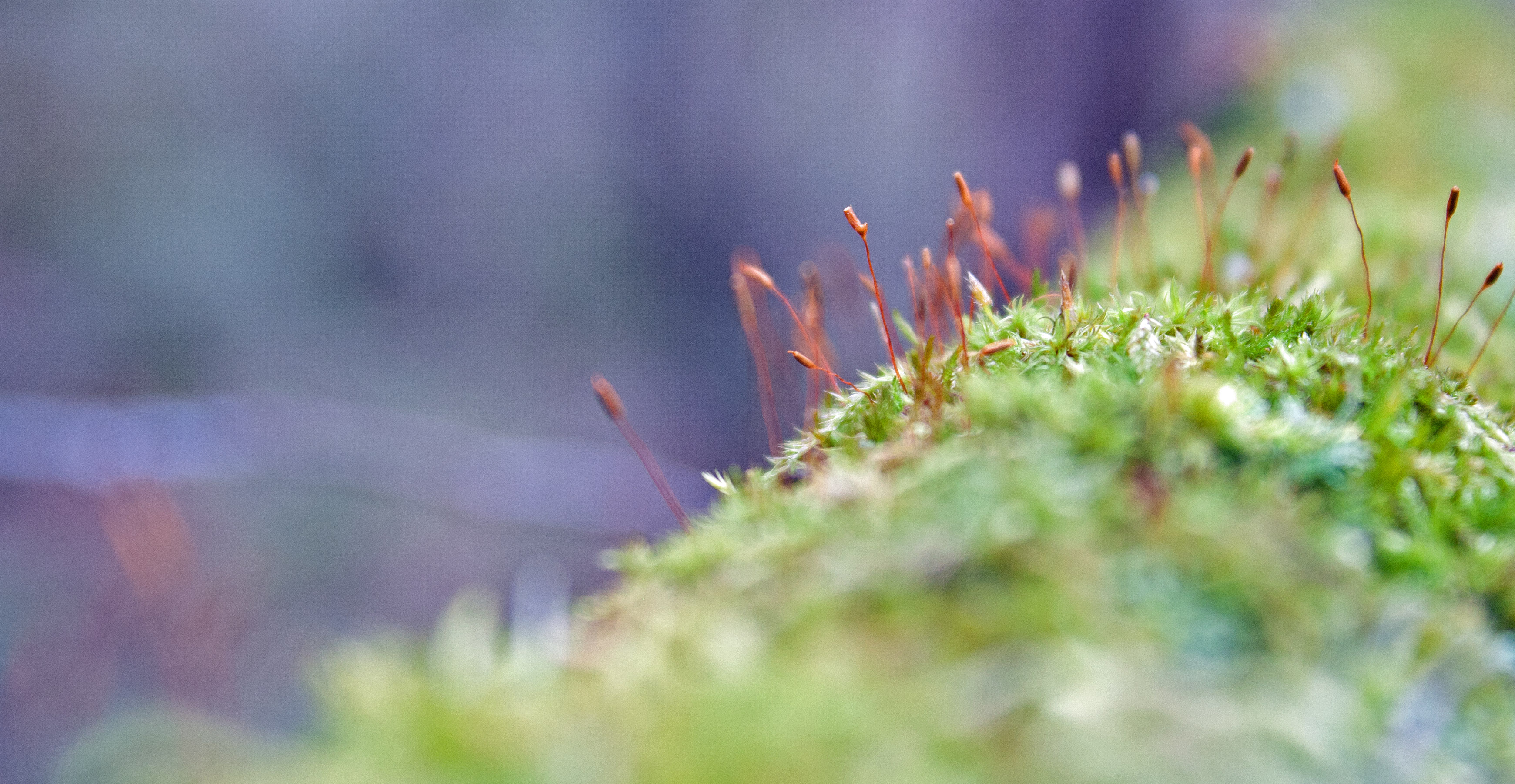
Moss on a log in Trent Nature Sanctuary, ON (photo by Nina Munteanu)
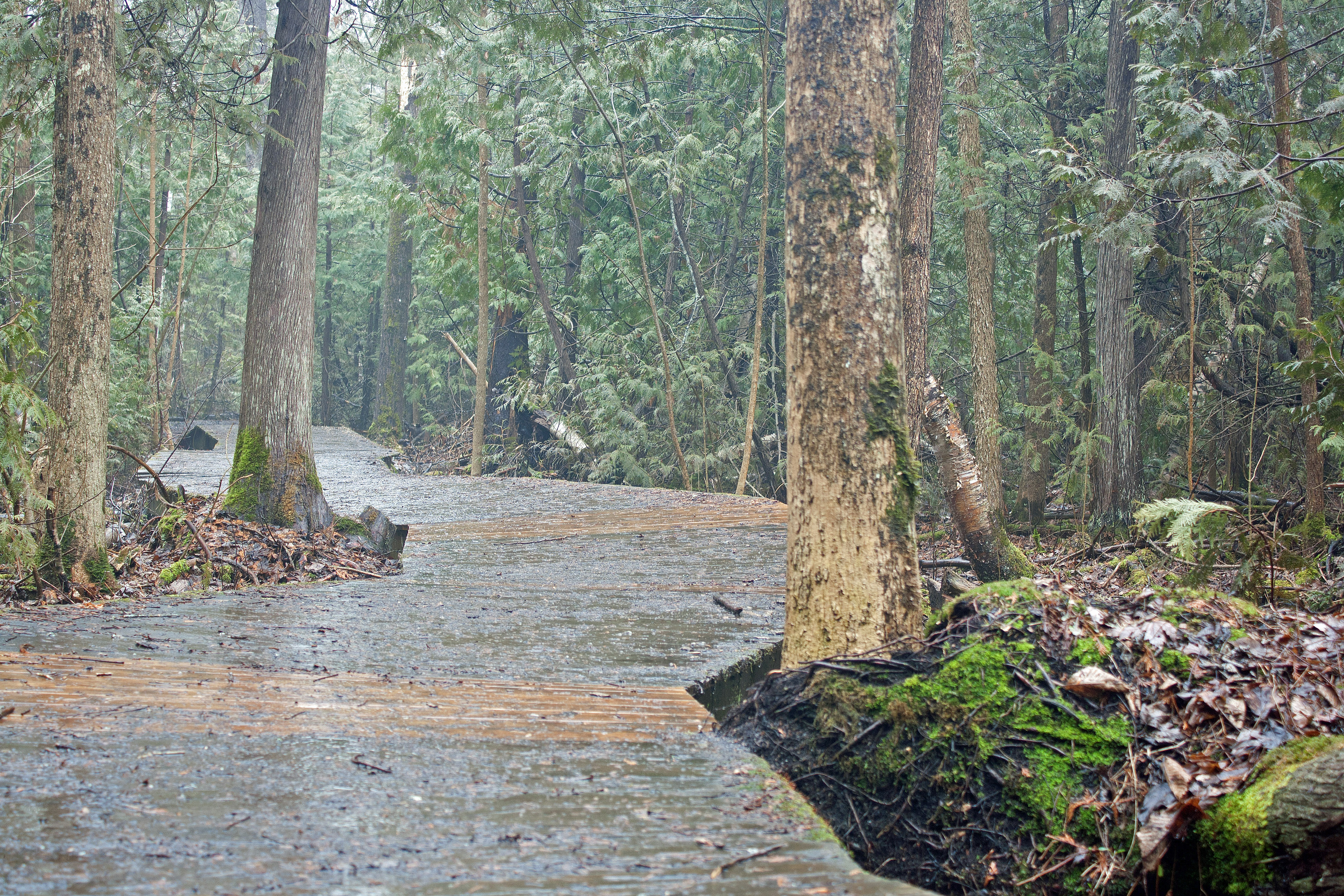
Cedar boardwalk in a misty rain, Trent Nature Sanctuary, ON (photo by Nina Munteanu)
Nina Munteanu is a Canadian ecologist / limnologist and novelist. She is co-editor of Europa SF and currently teaches writing courses at George Brown College and the University of Toronto. Visit www.ninamunteanu.ca for the latest on her books. Nina’s bilingual “La natura dell’acqua / The Way of Water” was published by Mincione Edizioni in Rome. Her non-fiction book “Water Is…” by Pixl Press(Vancouver) was selected by Margaret Atwood in the New York Times‘Year in Reading’ and was chosen as the 2017 Summer Read by Water Canada. Her novel “A Diary in the Age of Water” was released by Inanna Publications (Toronto) in June 2020.
“Every story is a story of water,” says Mojave American poet Natalie Diaz.
In her article on Diaz, Maria Popova reiterates, “we ourselves are a story of water—biologically and culturally, in our most elemental materiality and our mightiest metaphors.”
There is a reason that women are recognized worldwide as water keepers. Women are intimately connected with flowing water; everything about us is flowing: from our menstrual and birthing waters to the waters of our nurturing milk and the tears we shed for our lost ones. We flow with life and it flows out of us.
The water walk with Grandmother Josephine along Lake Ontario in 2019 (photo by Nina Munteanu)
So, when Lake Erie became a person with rights in February 2019, this landmark designation came with both triumph and some irony to womankind and water keepers around the world.
Based on that quote, it would seem that only men did the trammelling (given that women are not included or the more correct term would be “human”). It was only a hundred years ago, in 1920, that the 19thAmendment granted women legal personhood in the United States; and in that amendment Native American women were not included—until years after. In her poem Lake-loop, Mojave poet Natalie Diaz explored “how that nesting doll of exclusions breaks open into the living reality of this Earth”:
“Part of the San Andreas fault runs along the Mojave Desert. We see and feel the fault, it has always been a part of Mojave stories and geography. We have always existed with it–in rift–part land. We are land’s action, maybe. I am always wondering and wandering around what it means to be part of this condition, in shift. What it means to embrace discontinuity, to need it and even to need to cause it in order to be–depression but also moving energy. The necessary fracturing of what is broken. The idea of being made anything or nothing in this country–“to be ruined before becoming”–the idea that this country tried to give us no space to exist, yet we made that space, and make it still–in stress, in friction, glide and flow, slip and heave. We are tectonic, and ready.”
NATALIE DIAZ
The Earth is indeed shifting. As are we. If we are to survive, that is. This will come with a connection with Earth’s natural rhythms. We haven’t been doing that very well, particularly under an “othering” capitalist, exploitive, hubristic dogma. It’s time to ride the swells and turbulence of a Nature evolving. And co-evolve; or get left behind. We can learn much from the stories of our Indigenous relatives. We can learn much from the stories of our non-human relatives too.
That’s what climate change is: a new story. And that story is all about water.
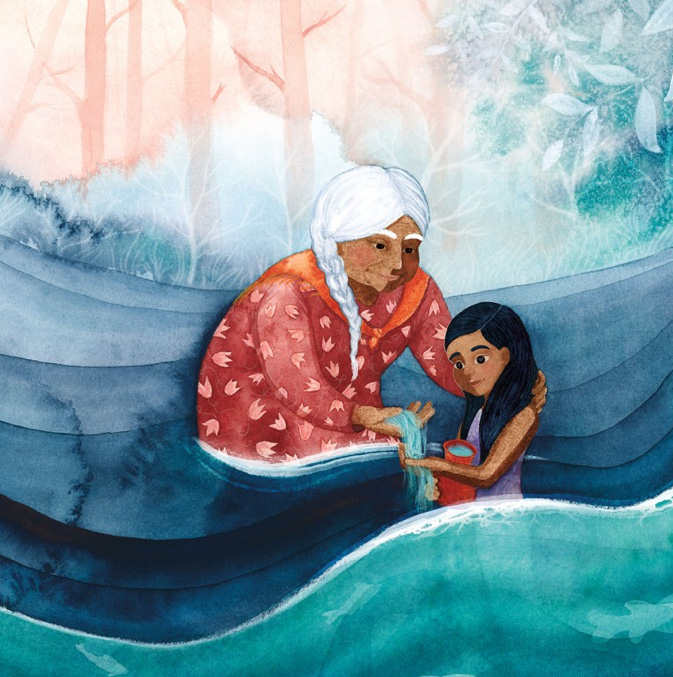
Grandmother with young water keeper (illustration by Michaela Goade)
For this World Water Day, I share with you a wonderful story of water keepers and the water we keep safe. Author Carole Lindstrom, member of the Turtle Mountain Band of Ojibwe, and artist Michaela Goade, member of the Central Council of the Tlingit Haida Tribe of Alaska. have produced “We Are Water Protectors”, a lyrical illustrated celebration of cultural heritage and the courage to stand up for nature.
“Yours is a grave and sobering responsibility, but it is also a shining opportunity. You go out into a world where [human]kind is challenged, as it has never been challenged before, to prove its maturity and its mastery–not of nature but of itself. Therein lies our hope and our destiny.”
RACHEL CARSON
Today is World Water Day…
I exhort you to do something for water today. Plant a tree (they love water and water loves them). Clean up a local stream or lakeshore. Write a letter to a government official about protecting your watershed. Research something about water and share with someone. Share your watermark on the WatermarkProject.ca site. Buy We Are Water Protectors and share it with someone or give it away. Or buy Silent Spring and share it with someone who hasn’t read it yet.
Keep it flowing…
Nina Munteanu is a Canadian ecologist / limnologist and novelist. She is co-editor of Europa SF and currently teaches writing courses at George Brown College and the University of Toronto. Visit www.ninamunteanu.ca for the latest on her books. Nina’s bilingual “La natura dell’acqua / The Way of Water” was published by Mincione Edizioni in Rome. Her non-fiction book “Water Is…” by Pixl Press(Vancouver) was selected by Margaret Atwood in the New York Times‘Year in Reading’ and was chosen as the 2017 Summer Read by Water Canada. Her novel “A Diary in the Age of Water” was released by Inanna Publications (Toronto) in June 2020.
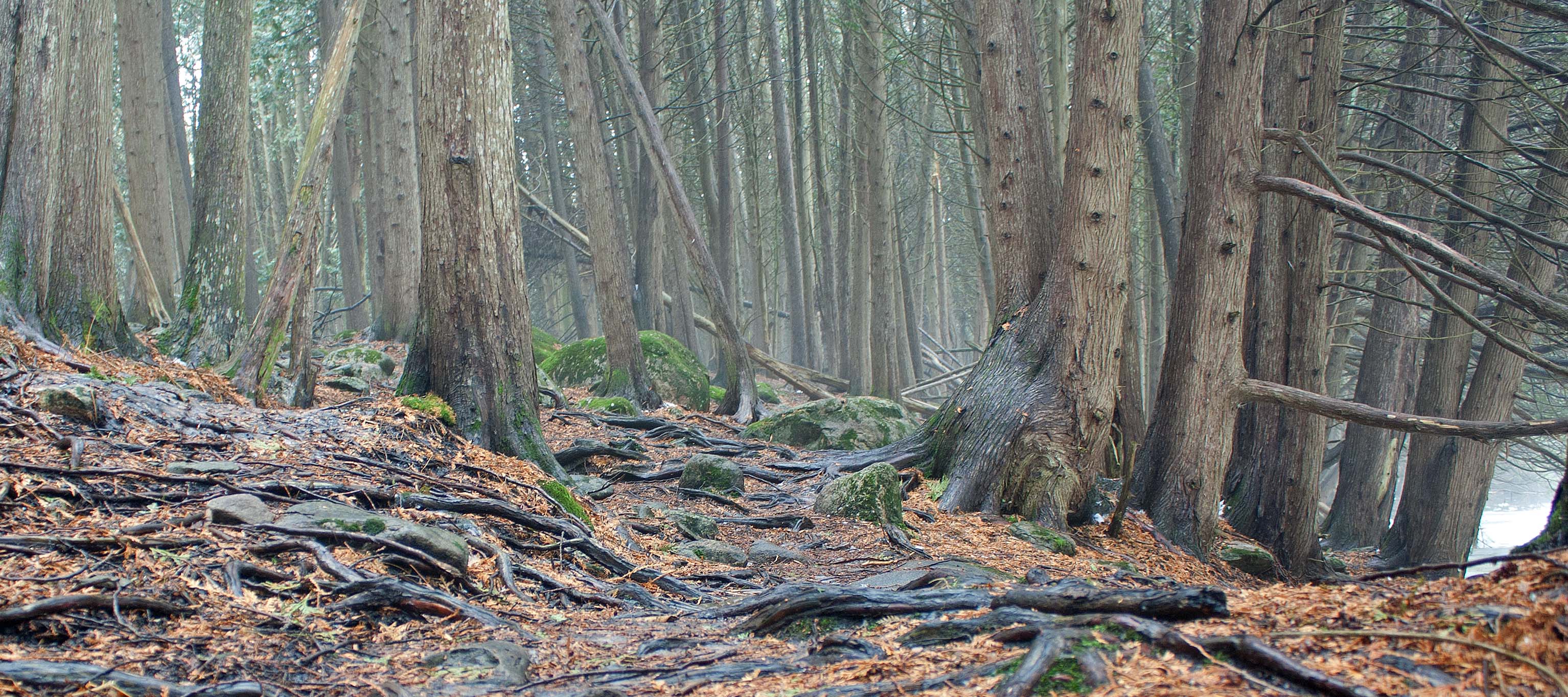
Cedar forest and extensive roots amid glacial erratics flank Jackson Creek on the right, ON (photo by Nina Munteanu)
.
It was a cold November day, after a light snow, as I wandered the Jackson Creek old-growth forest. Centuries-old cedar, pine and hemlock towered above me, giving off the fresh scent of forest. The trees creaked and cracked, swaying in a mischievous wind. I left the main path and descended the leaf-strewn slope toward the river. My boots pressed through a frosty crust into the spongy ground of dead leaves and organic soil. I stopped and breathed in the fresh coolness of the air. A damp mist huddled among the trees, adding wisps of mystery to the ancient forest. It was as though I’d entered an enchanted forest in some fanciful fairy tale.
Cedar forest on slope of Jackson Creek Park in early winter, ON (photo by Nina Munteanu)
.
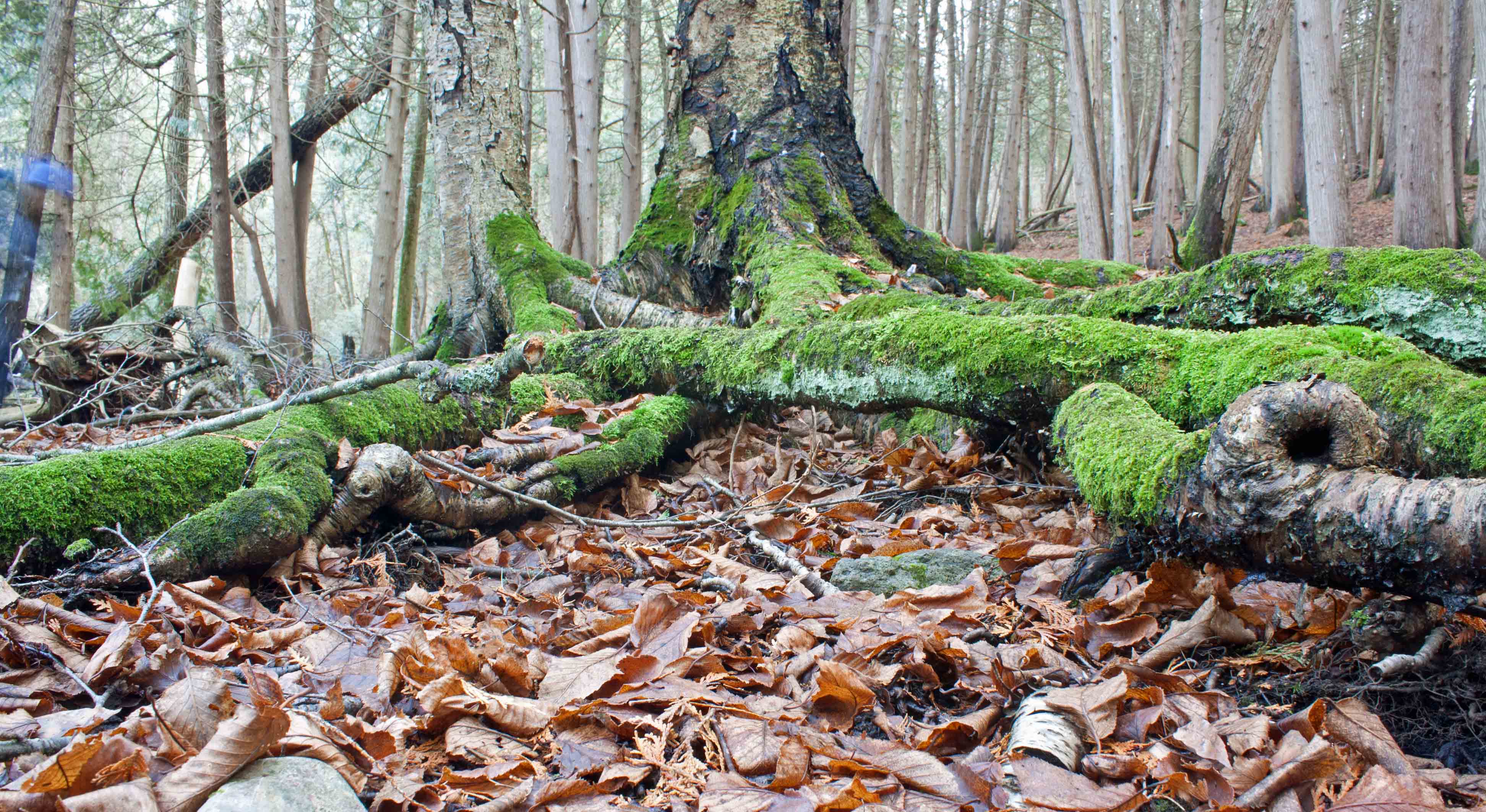
Not far from the river, I approached an old yellow birch tree, large trunk rising as tall as some of the cedars and pines around it. Golden flakes of bark curled and formed craggy patterns around the girth of the old tree. Radiating out from the tree, moss-covered roots snaked out like tangled ropes in a profusion of brilliant green. This was fairy country, I suddenly thought.
I dropped to my knees, crouching down, and set up my tripod and camera to capture this magical tree from the perspective of the forest floor. Head almost touching the ground, I inhaled the scent of loam and decaying leaves. The fresh pungency of cedar, pine, and humid moss hung in the air. Nearby, the river chortled and bubbled in a content symphony of motion. A curious red squirrel parked itself on a log nearby to watch me. It didn’t scold me like they normally did when I entered the forest; like it understood… It then occurred to me, as I set up my equipment under the squirrel’s careful stare, that I was in the presence of an enchantment. Like I was peering into a secret dance of feral celebration. But being there and appreciating it, I had now become part of it; I was Alice going down the rabbit hole into a true wonderland…
It was then that I glimpsed it as I carefully took my timed pictures. A blur of blue. What had I witnessed? A motion? A colour? Then it was gone. But in that moment, I’d felt the spark of an elation that comes with a glimpse into a secret world.
Old yellow birch tree and moss-covered roots with approaching blue sprite from left (photo by Nina Munteanu)
.
When I returned home to look at the images I saw that my camera had captured a wispy blue entity that flowed into its view and peered around the old birch at me with a kind of curious though mischievous grin.
Had I just captured a blue sprite? Something was unmistakably there!
Forest sprite peers around a yellow birch tree, Jackson Creek Park, ON (photo by Nina Munteanu)
.
I read up on sprites. According to European lore, a sprite is a supernatural entity. They are often depicted as fairy-like creatures or as an ethereal entity. The word sprite comes from the Latin spiritus (“spirit”), via the French esprit.
Given that the sprite I’d observed was blue and we were close to the river, I wondered if it was not a forest or wood sprite, but a water sprite. According to alchemist Paracelsus, the term ‘water sprite’ is used for any elemental spirit associated with water. They can breathe water or air and sometimes can fly. They also possess the power of hydrokinesis, which is the ability to create and manipulate water at will. Also known as ‘water nymphs’ and naiads (or nyads), these divine entities tend to be fixed in one place. Slavic mythology calls them vilas. Sprites are not corporeal beings (like selkies, mermaids and sirens) given that they are not purely physical; they are more like local deities than animals. This explained the wispy nature of the being I’d seen peering at me from the tree.
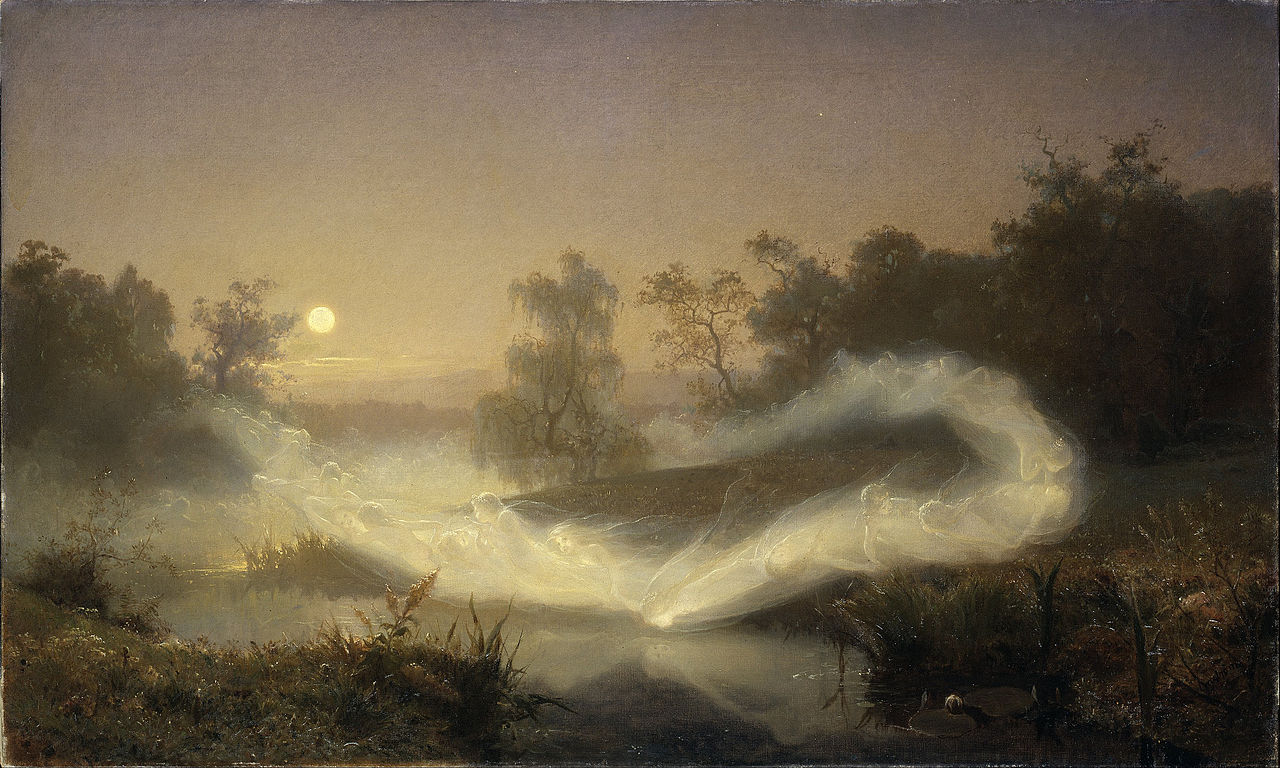
“Dancing Fairies” by August Malmström
.
After consulting with several friends—some who purported to know much more about sprites than I did—I concluded that this sprite was, in fact, a forest sprite and it was blue because it was near the water. Friend Merridy suggested that “forest sprites, normally green, may turn blue if a nearby brook calls to them.” She added that “water sprites can be distinguished by their chatty nature. They rarely go beyond the banks of a river or brook. Forest sprites are mostly silent.” Which this one certainly was. Friend Craig then pondered, “Are digital sprites in our world or in an electro-magnetic world? Or something else?” He was referring to them showing up on my camera without me even noticing they were there. When I told him I would return in search of them he observed, “if you’re looking for them that might be when they hide. Or maybe not. Any type of sprite is probably good, mischievous or friendly.” Thanks, Craig! That was helpful…
Glacial erratic boulders in Jackson Creek, ON (photo by Nina Munteanu)
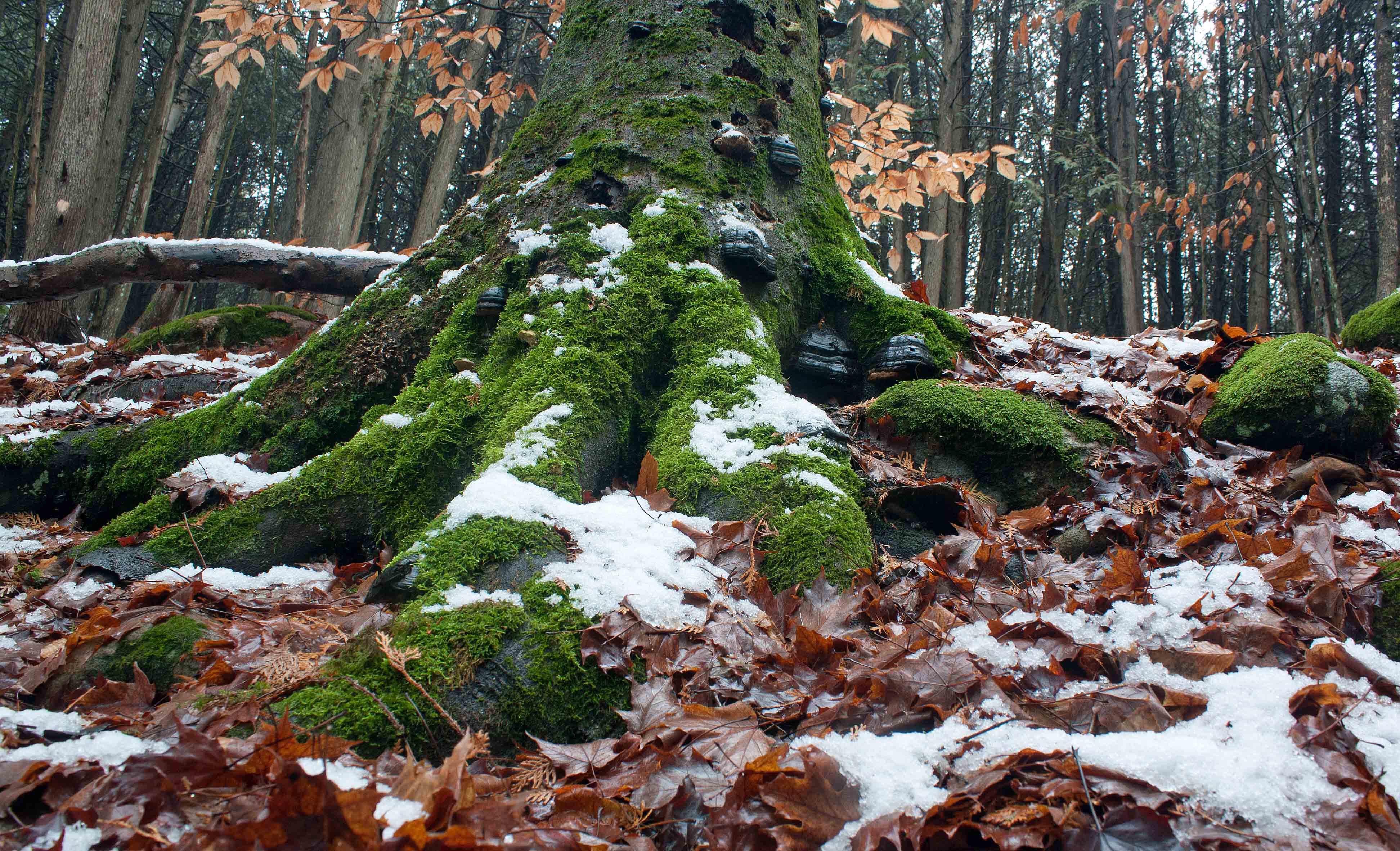
Century-old beech tree, decaying and moss-covered in early winter, Jackson Creek Park, ON (photo by Nina Munteanu)
Ancient cedar tree stands next to an ice sheet on the path beside Jackson Creek, ON (photo by Nina Munteanu)
.
I visited the forest many times after but saw no sign of any sprites. Perhaps Craig was right; they were hiding from me.
Then, on a foggy late December day, after a light dusting of snow, I returned to document the ice forming in the river. Islands and columns of ice had created a new topography for the flowing waters of Jackson Creek. Ice sheets also covered the forest path in places—making the walk somewhat treacherous. At times, I had to scramble and seize hold of branches to haul my way up precipitous banks from where I’d captured sculptures of ice ‘pearls,’ ‘platforms,’ and ‘columns’ on the river.
Ice forming on Jackson Creek in early winter, ON (photo by Nina Munteanu)
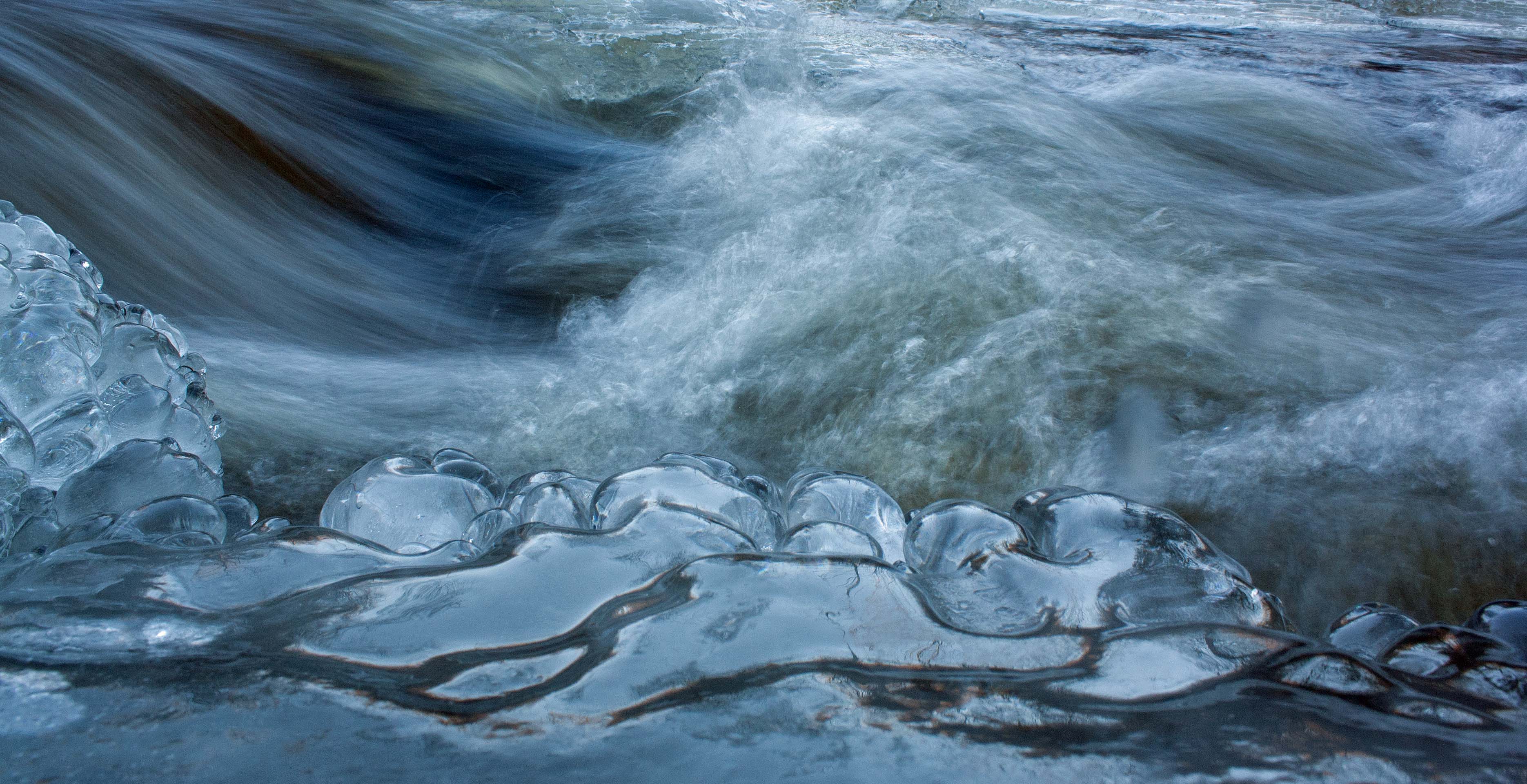
Ice ‘pearls’ forming on shore by rushing river, Jackson Creek, ON (photo by Nina Munteanu)
.
The fog grew thick as my walk eventually led me into an area of eccentric lopsided cedars in a ‘drunken’ stand by the river bank. The cedars sent out a tangled tapestry of gnarly roots I had to negotiate. I could feel the earth-magic. I dropped to my knees again and set my camera and tripod to the level of the roots. That is when I saw the blue sprite again! This time the sprite wasn’t playful; it appeared startled and disoriented. But, I managed to capture it as it fled the scene in wisps of blue smoke. As I left the forest, my thoughts returned to this serendipitous moment. Had I interrupted the wood /earth sprite in its work in the forest? These sprites are known to have the power of chlorokinesis, the ability to grow and control plants at will. When I checked my images at home, the sprite appeared to float near one of the cedars.
Blue forest sprite floats by cedar tree, Jackson Creek Park, ON (photo by Nina Munteanu)
.
When she saw the image, friend Merridy asked, “was the sprite entering the tree?” Thinking of incantations, friend Dyana asked if I’d had my recording feature on, which I’d never thought to do. On second thought, she decided that it might be dangerous. Not a good idea to anger a sprite. Friend Gabriela then challenged me: “did you ask what message they have for you, Nina? They keep showing up in your way, they might have a message for you or to be delivered through you to…” whoever… I hadn’t thought of that either. How would I hear their message when they were silent and so fleeting, I challenged back. She wisely responded, “Just ask yourself the question; you might be surprised when your next thought brings the answer. Since everything is energy, and you saw them at least twice, you’re probably connected with them.”
Sprite vaporizes behind tree, Jackson Creek Park, ON (photo by Nina Munteanu)
.
I didn’t tell her that the question that came to mind after seeing the sprite was: I wonder what’s for dinner!
I must ponder this more, however.
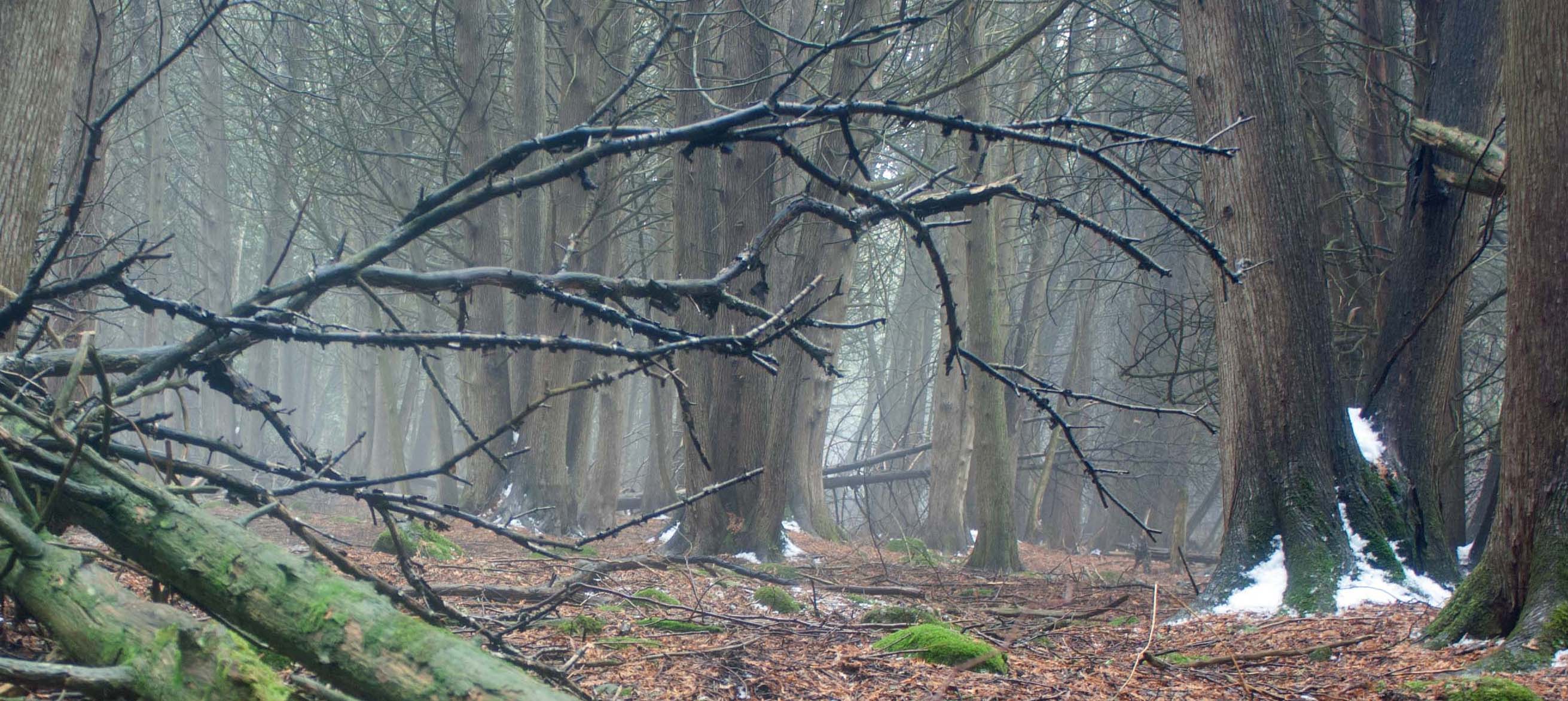
Cedar forest on a misty winter day, Jackson Creek Park, ON (photo by Nina Munteanu)
Thinking of Gabriela’s interesting remark, I am reminded of a rather sad but evocative tale by Vladimir Nabokov entitled “The Wood Sprite.” Told in the first person, it recounts the narrator’s experience when he was visited at his desk by an old wood sprite, “powdered with the pollen of the frosty, starry night.” The creature tells of his exile from a country wood in Russia, all cut down and burned amid the treachery of war.
Now that I think of it, I know the blue sprite’s message. And now you know it too.
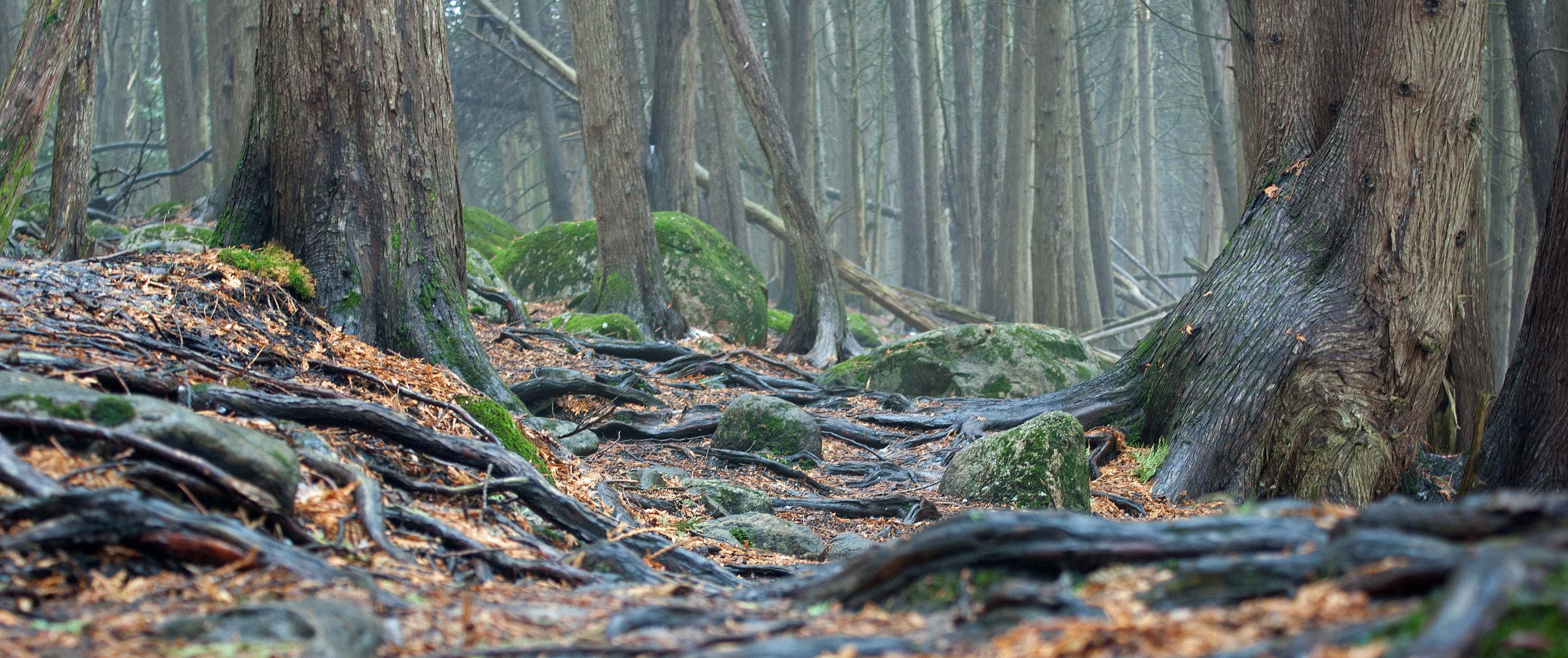
Cedar forest and roots amid glacial erratics in Jackson Creek Park, ON (photo by Nina Munteanu)
Nina Munteanu is a Canadian ecologist / limnologist and novelist. She is co-editor of Europa SF and currently teaches writing courses at George Brown College and the University of Toronto. Visit www.ninamunteanu.ca for the latest on her books. Nina’s bilingual “La natura dell’acqua / The Way of Water” was published by Mincione Edizioni in Rome. Her non-fiction book “Water Is…” by Pixl Press(Vancouver) was selected by Margaret Atwood in the New York Times‘Year in Reading’ and was chosen as the 2017 Summer Read by Water Canada. Her novel “A Diary in the Age of Water” was released by Inanna Publications (Toronto) in June 2020.
































 Nina Munteanu Writing Coach