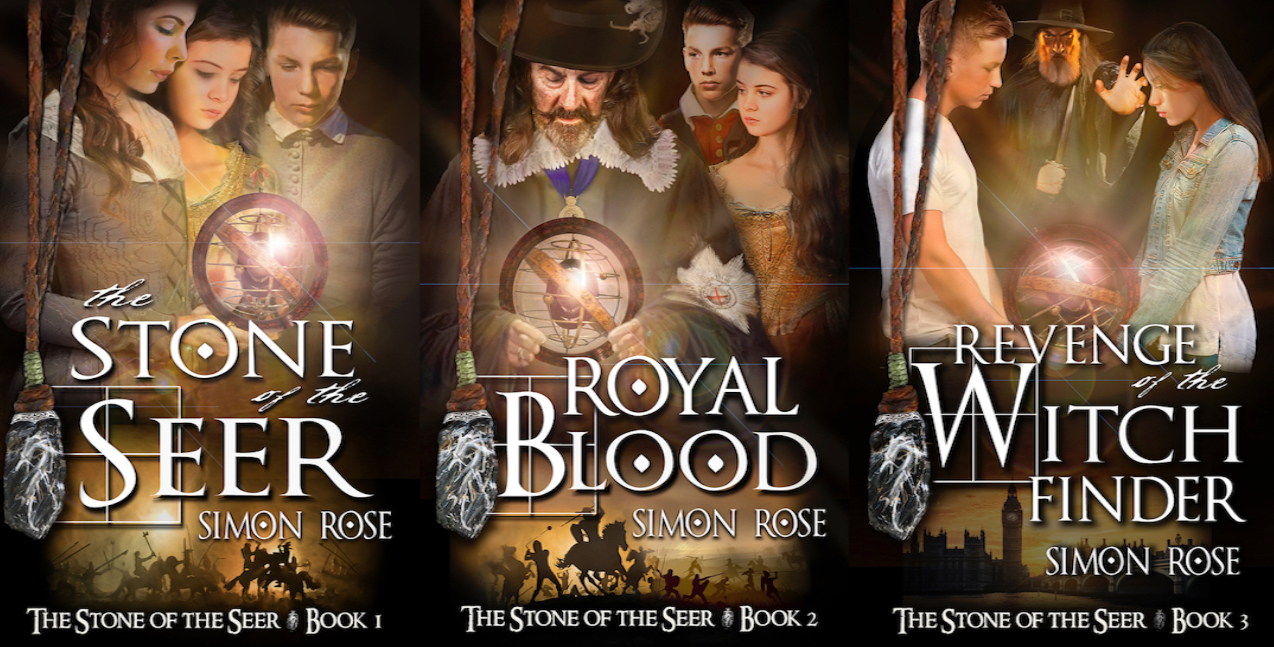
My guest today is author Simon Rose, who has published twenty-one novels for children and young adults, eight guides for writers, more than a hundred nonfiction books, and many articles on a wide variety of topics. Today, we’re looking at his historical fantasy series, The Stone of the Seer.
Nina: What’s the series all about?
Simon: The Stone of the Seer is an exciting historical fantasy series of adventure novels for young adults, primarily set in the turbulent period of the English Civil War.
The Stone of the Seer, book one in the series, features the Vikings, Leonardo da Vinci, and the political turmoil of the 1640s. At Habingdon House, Lady Elizabeth Usborne, Kate, and Tom encounter a magical black stone, mysterious ancient manuscripts, and the incredible time viewing device known as the tempus inpectoris, all while under constant threat from the murderous witchfinder, Daniel Tombes.
In Royal Blood, book two in the series, Lady Elizabeth, Kate, and Tom, along with the tempus inspectoris and the mysterious black Viking stone, are in the heart of London in early 1649, as King Charles prepares to face his accusers at his trial in Westminster Hall, while Elizabeth, Kate, and Tom desperately attempt to evade capture by Daniel Tombes, the witchfinder.
Much of the story in Revenge of the Witchfinder, book three in the series, takes place in the present day, featuring weird dreams, disturbing visions, parallel lives, and a bewildering identity crisis, as Thomas and Katie discover to their horror that not even the passage of centuries can prevent a bloodthirsty witchfinder from the 1640s from seeking his deadly revenge.
Nina: What’s the story behind the story?
Simon: The story, main characters, and some of the settings in the series are fictional but are based on true events and the story features real historical characters, such as King Charles I. The English Civil War was a series of conflicts in England, Scotland, and Ireland in the 1640s and early 1650s. The war originated in the struggle between Charles I and Parliament regarding how the country should be governed.
The king’s defeat in the civil war led to his trial and execution in January 1649. The monarchy was abolished and replaced first by the Commonwealth of England and then the Protectorate, before the monarchy was restored in 1660. However, the defeat of Charles I confirmed that an English monarch could not rule the country without the consent of Parliament, although this wasn’t legally established until the Glorious Revolution in 1688.
Nina: You must have done quite a lot of historical research for this series.
Simon: I did. These are links on my website at www.simon-rose.com to online sources where you can learn more about the historical events, settings, and leading characters from the English Civil War, some of the leading characters during the conflict, historical locations that are mentioned in the text, life in the seventeenth century, and details from other historical periods that are featured in the stories.
Nina:What are you currently working on?
Simon: I always have a few current projects and right now I’m working more books in the same genre as my previously published paranormal Flashback series, as well as a fantasy series, and a historical fiction novel. I also continue to work on the adaptations of my Shadowzone series into screenplays for movies and TV shows, some other scripts, as well as teaching writing courses at the University of Calgary.
Anyone interested in keeping up to date with the projects that I’m working on is always welcome to subscribe to my monthly newsletter, which you can do at www.simon-rose.com.
Nina:You work with other authors as well as on a variety of projects related to writing and publishing, don’t you?
Simon: Yes, I offer coaching, editing, consulting, and mentoring services for writers of novels, short stories, fiction, nonfiction, biographies, and in many other genres, plus do work with writers of scripts and screenplays. I’m also a writing instructor and mentor at the University of Calgary and served as the Writer-in-Residence with the Canadian Authors Association. You can find details of some of the projects I’ve worked on with other authors, along with some references and recommendations, at www.simon-rose.com.
Nina:Where can people buy The Stone of the Seer series?
Simon: The books can be purchased at most of the usual places and there are details on my website at www.simon-rose.com
.
Thanks Simon, for being my guest here today and the very best of luck with The Stone of the Seer series.
You can learn more about Simon and his work on his website at www.simon-rose.com, where you can also link to him on social media and at other locations online.
.
Nina Munteanu is a Canadian ecologist / limnologist and novelist. She is co-editor of Europa SF and currently teaches writing courses at George Brown College and the University of Toronto. Visit www.ninamunteanu.ca for the latest on her books. Nina’s bilingual “La natura dell’acqua / The Way of Water” was published by Mincione Edizioni in Rome. Her non-fiction book “Water Is…” by Pixl Press (Vancouver) was selected by Margaret Atwood in the New York Times ‘Year in Reading’ and was chosen as the 2017 Summer Read by Water Canada. Her novel “A Diary in the Age of Water” was released by Inanna Publications (Toronto) in June 2020.
Twin brothers—a brilliant scientist and a gifted engineer—escape the growing racial violence of Berlin, to ‘peaceful’ Canada in a rivalry to control the evolution of the human race.
.
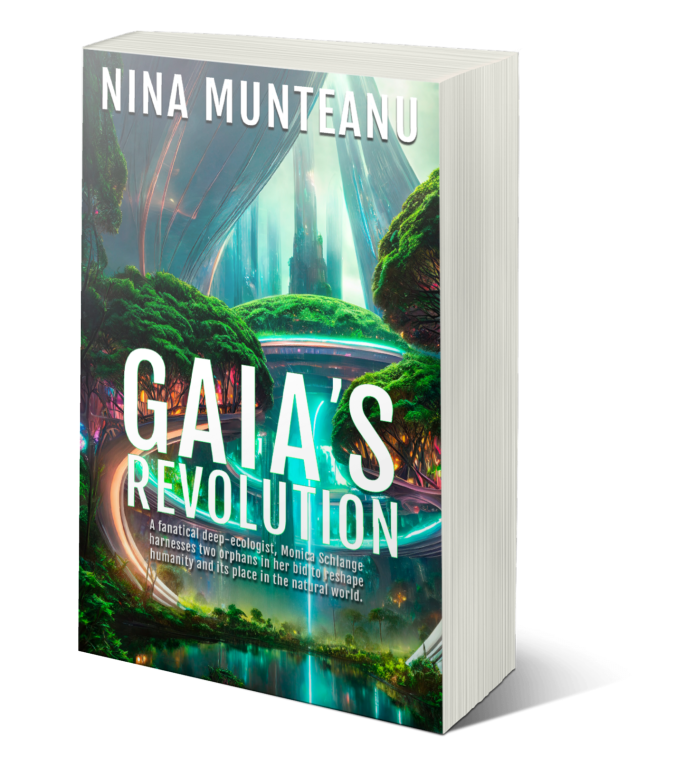
My novel Gaia’s Revolution, the first of The Icaria Trilogy—releasing March 10, 2026, by Dragon Moon Press—explores a collapsing capitalist society in Canada through ravages of climate change, water shortages, plague, and a failing technology. The story is told through the lives of ambitious twin brothers Eric and Damien Vogel, and the woman who plays them like chess pieces in her gambit to rule the world.
.
The novel starts on December 13th, 2022, in Berlin, the day several members of the climate activist group Letzte Generation* to which Damien belongs, are raided by police who seize their computers and phones. Damien is a quiet scholar, an introvert and deep ecologist*, devoted to the teachings of Arne Næss and George Sessions, who promoted an environmental philosophy of eight basic principles of deep ecology. Næss and Sessions advocated that all living beings have intrinsic value, independent of their utility to human needs. Their philosophy has become a movement that promotes a holistic, eco-centric worldview demanding radical, structural changes to human society to prioritize nature’s flourishing.
.
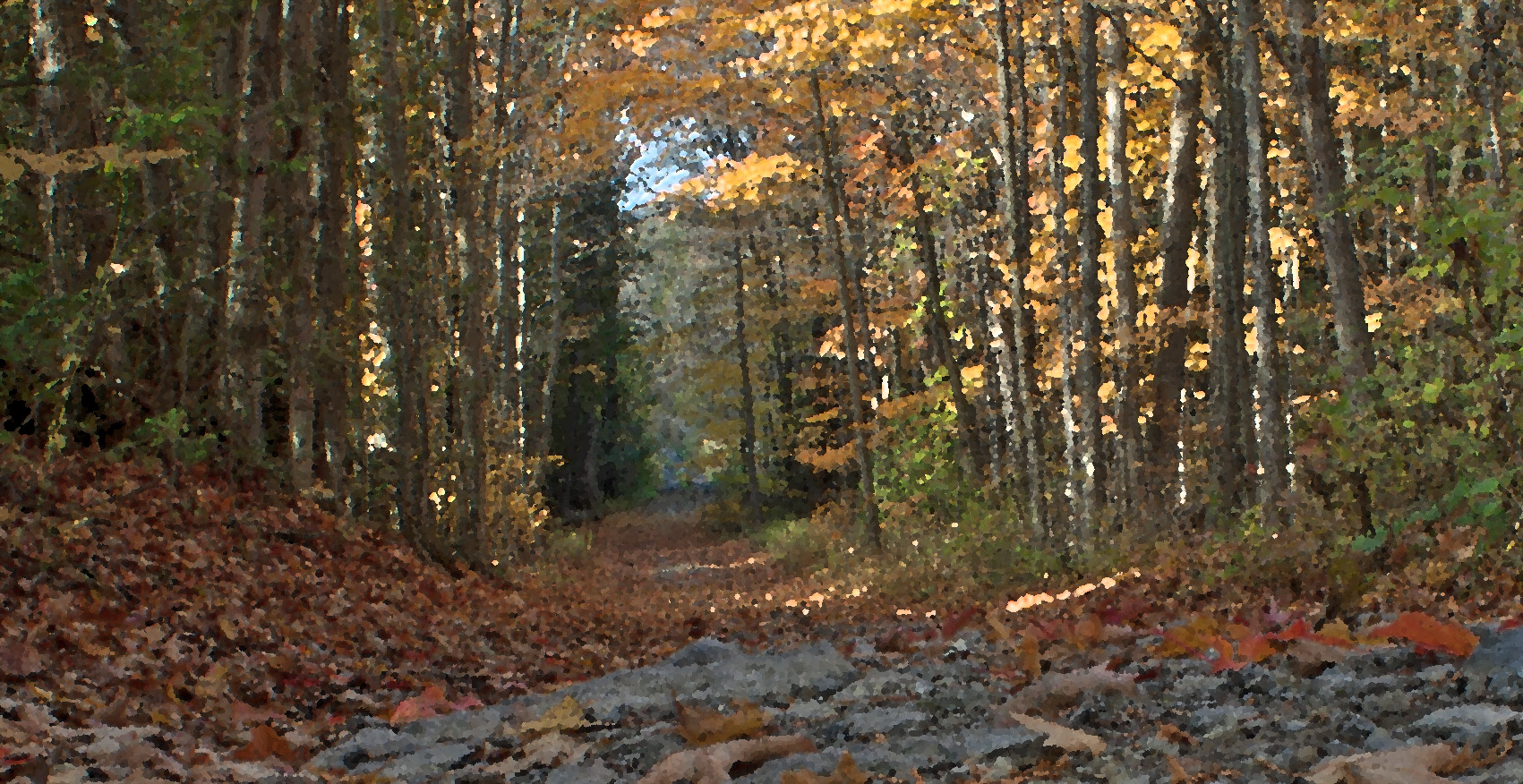
Road through a beech tree forest, ON (photo and rendition by Nina Munteanu)
.
Damien later meets with his extrovert anarchist brother in Treffpunkt, near the university campus, and they argue ideology and revolution. Eric contends that the only way humanity will survive is to adapt to climate change by somehow overthrowing the bourgeois plutocrats through violent revolution: preventing the small ruling class carving out a comfortable life for itself while the rest of the world suffers terrible deprivation. Eric pulls out the worn copy of B.F. Skinner’s Walden Two from his jacket pocket, slaps it on the table and pushes it toward Damien. “That’s the answer, Dame.”
Each brother plans to create a new humanity: Eric’s plan is to control humanity through gene manipulation and behaviour engineering (aka Walden Two); Damien’s plan is to draw on deep ecology and use environmental triggers with biotechnologies to empower humanity with physical/chemical abilities to adapt to climate and its changing environment via transhumanist AI.
Neither addresses the elephant in the room: population. Only a much-reduced population will ensure success for either plan.
To this point, Eric, who is far more cynical and ruthless, thinks Damien naïve and feckless in his deep ecological view:
Damien too easily prescribes to the old leftist shibboleth of Nature being the answer to everything and Market being evil. His deep ecology utopia would spring from an atavistic rejection of modern life, a return to ‘the ancient farm.’ But how that fantasy could be achieved without a drastic population reduction is beyond his brother’s imagination. Damien fetishizes the natural world. Just like he does their mother. The naïve fool is a blind romantic, refusing to see reality right in front of him: that Nature is ultimately cruel, cold, and preoccupied with its own survival. Just like their mother.–Eric Vogel, Gaia’s Revolution
.
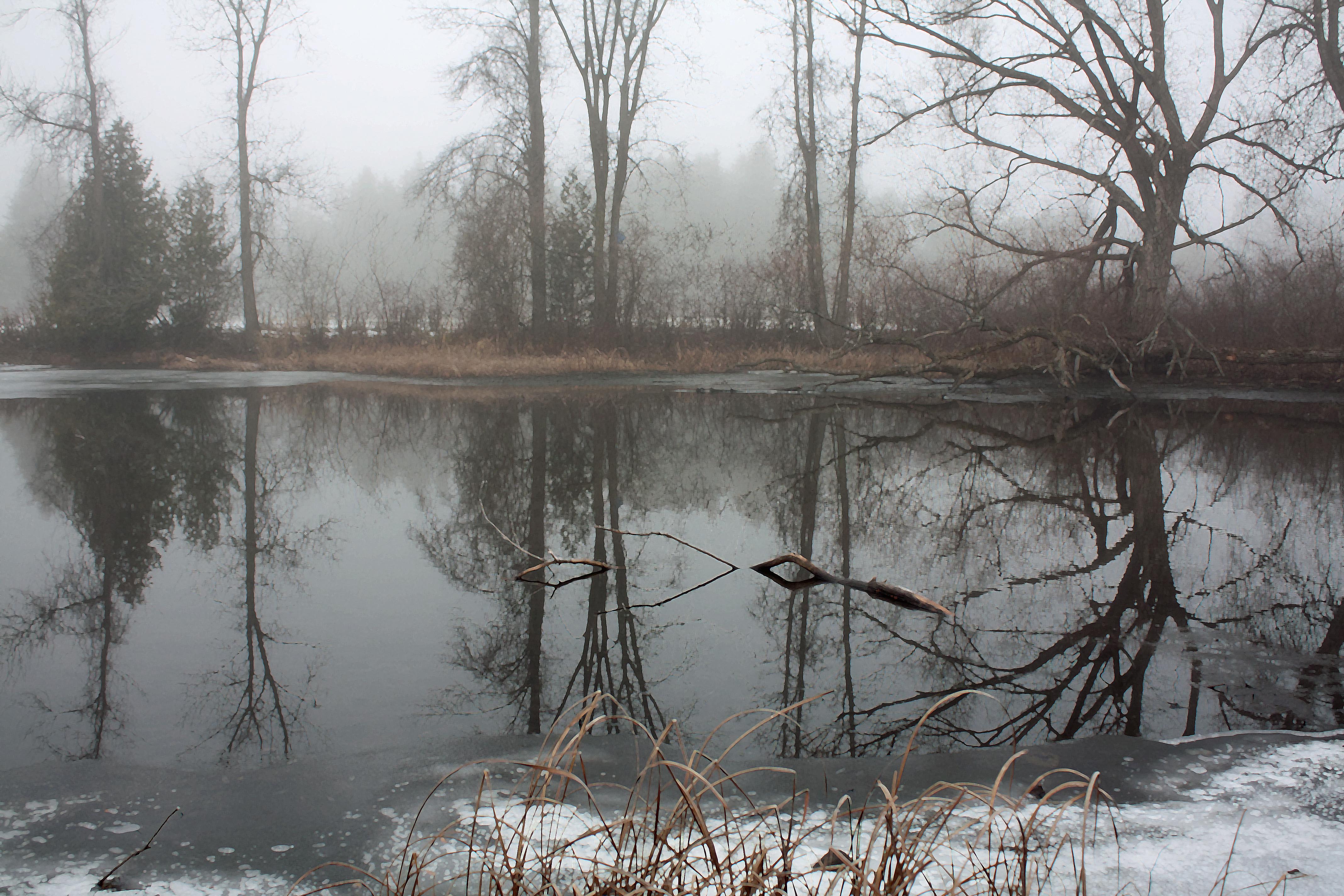
Foggy morning on an Ontario marsh in winter (photo and rendition by Nina Munteanu)
The well-being and flourishing of human and nonhuman Life on Earth have value in themselves (synonyms: intrinsic value, inherent value). These values are independent of the usefulness of the non-human world for human purposes.
Richness and diversity of life forms contribute to the realization of these values and are also values in themselves.
Humans have no right to reduce this richness and diversity except to satisfy vital needs.
The flourishing of human life and cultures is compatible with a substantial decrease of the human population. The flourishing of nonhuman life requires such a decrease.
Present human interference with the nonhuman world is excessive, and the situation is rapidly worsening.
Policies must therefore be changed. These policies affect basic economic, technological, and ideological structures. The resulting state of affairs will be deeply different from the present.
The ideological change is mainly that of appreciating life quality (dwelling in situations of inherent value) rather than adhering to an increasingly higher standard of living. There will be a profound awareness of the difference between big and great.
Those who subscribe to the foregoing points have an obligation directly or indirectly to try to implement the necessary changes.
.
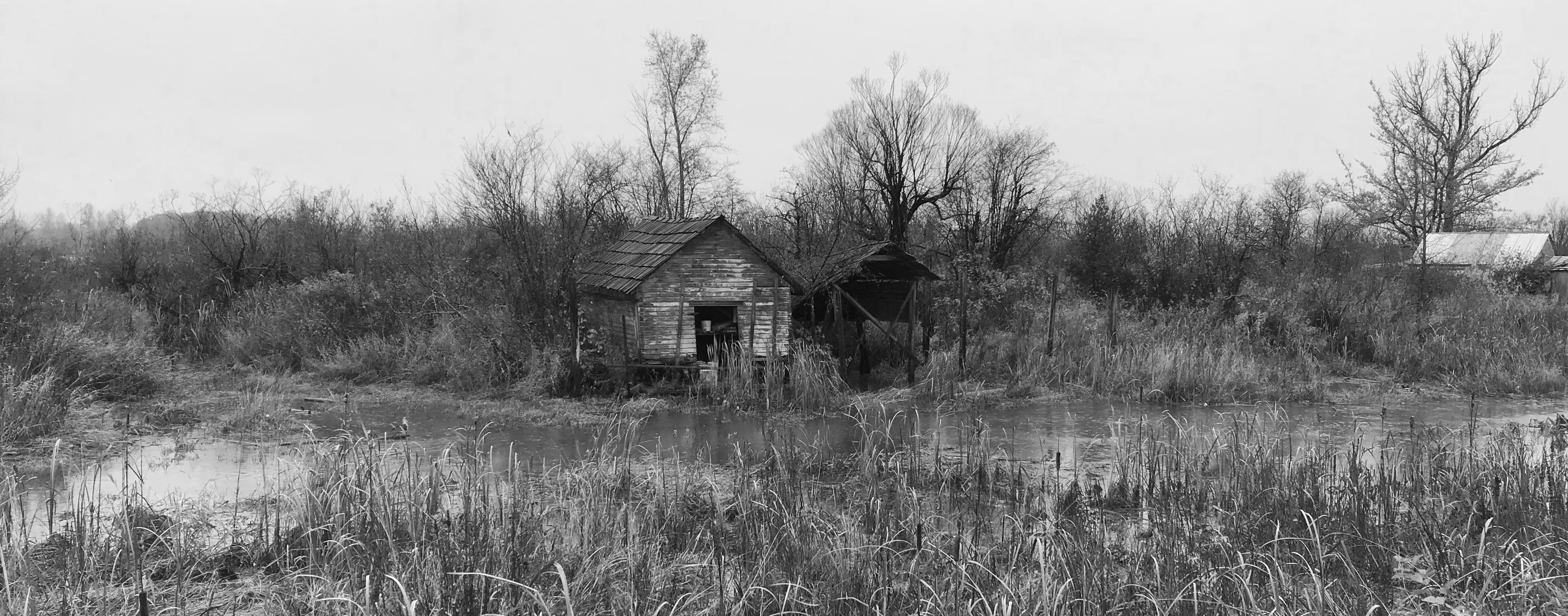
Finn Slough old shed, BC (photo by Nina Munteanu)
.
Eric plans to address the 5th Basic Principle of Deep Ecology—present human interference with the nonhuman world is excessive and the situation is rapidly worsening— by using nefarious means to meet the 4th Basic Principle of Deep Ecology: the flourishing of human life and cultures is compatible with a substantial decrease of the human population and the flourishing of nonhuman life requires such a decrease. With a reduced population, he plans to make the remaining principles (e.g. 6th and 7th) realizable through his behaviour engineering.
But Eric hasn’t accounted for fanatical deep ecologist / eco-terrorist Monica Schlange in his plan… (More on this shapeshifting character in Part 2).
.
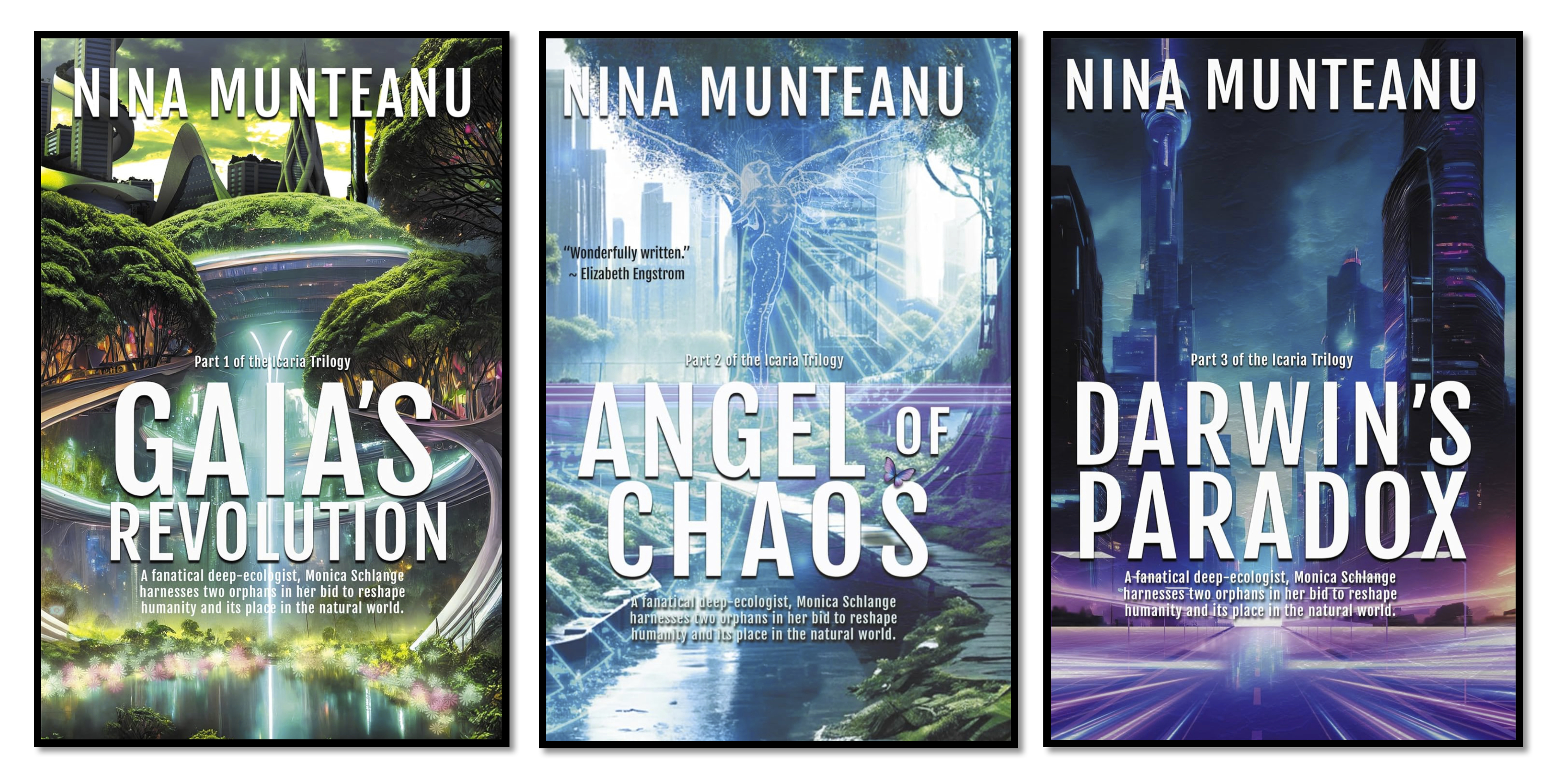
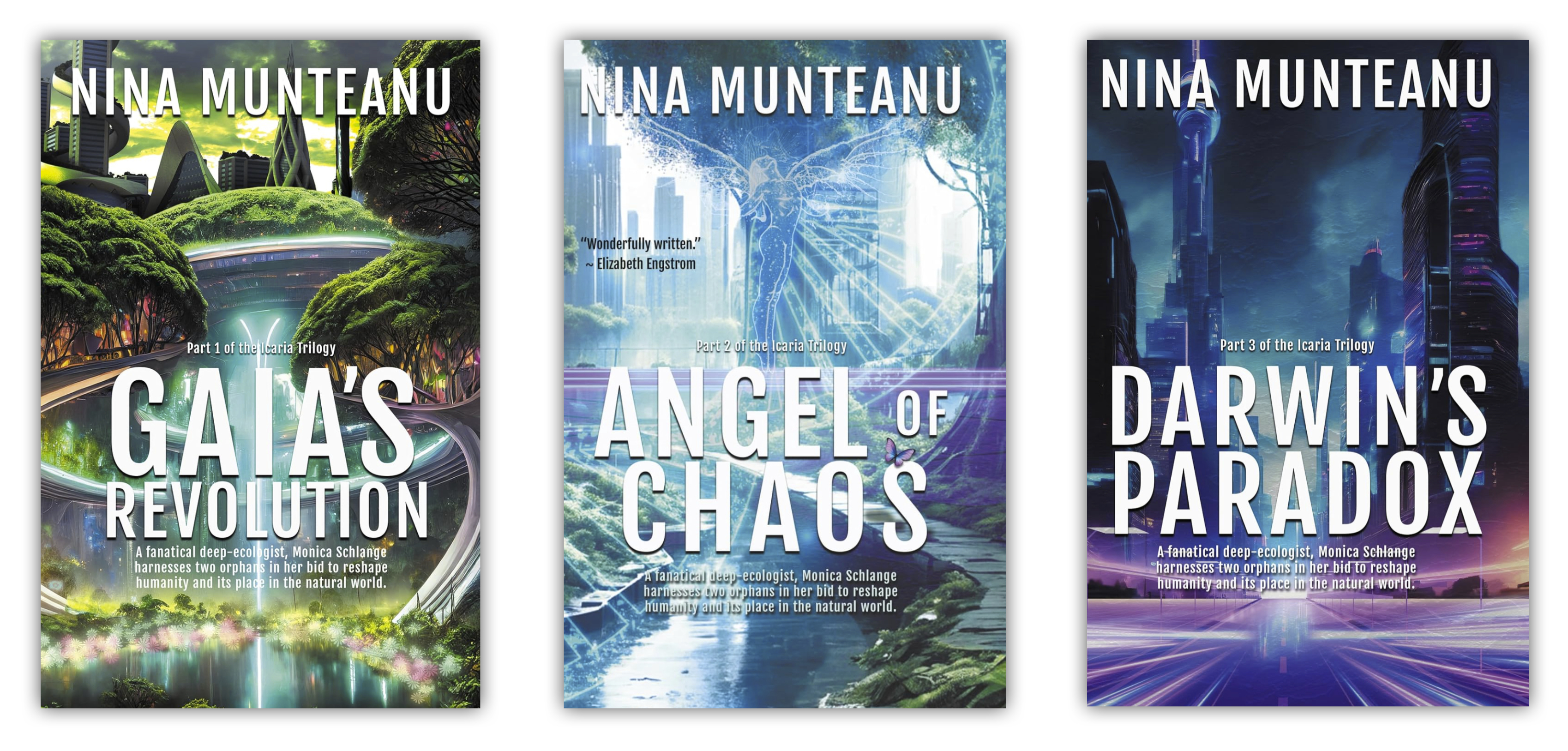
The Icaria Trilogy by Dragon Moon Press
.
You can pre-order the ebook of Gaia’s Revolution by Dragon Moon Press on Amazon. Release date is March 10, 2026. The print version will release soon after. Book 2 (Angel of Chaos) and Book 3 (Darwin’s Paradox) of theThe Icaria Trilogy are already available in both ebook and print form.
.
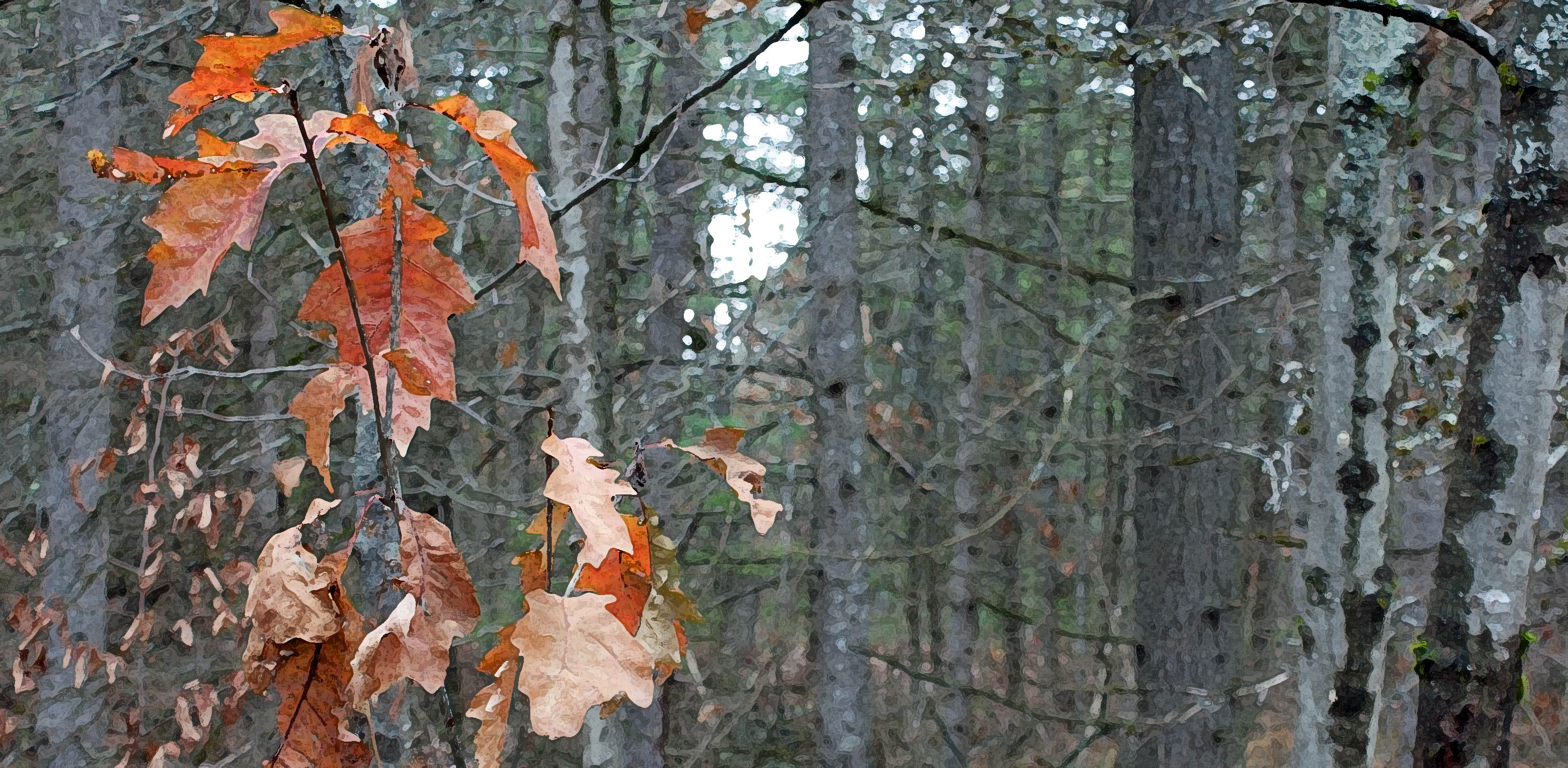
Oak leaves light up a dark pine forest in fall, ON (photo by Nina Munteanu)
.
References:
Munteanu, Nina. 2026. “Gaia’s Revolution, Part 1 of Icaria Trilogy.” Dragon Moon Press, Calgary, AB. 369 pp.
Munteanu, Nina. 2010. “Angel of Chaos, Part 2 of Icaria Trilogy.” Dragon Moon Press, Calgary, AB. 518 pp.
Munteanu, Nina. 2007. “Darwin’s Paradox, Part 3 of Icaria Trilogy.” Dragon Moon Press, Calgary, AB. 294 pp.
Sessions, George, Bill Devall. 2000. “Deep Ecology: Living as if Nature Mattered.” Gibbs Smith. 267pp.
Skinner, B.F. 1948. “Walden Two” The Macmillan Company, New York. 301pp.
.
Terminology:
*Deep Ecology: An environmental philosophy and social movement advocating that all living beings have intrinsic value, independent of their utility to human needs. Coined by Arne Næss in 1972, it promotes a holistic, ecocentric worldview—often termed “ecosophy”—that demands radical, structural changes to human society to prioritize nature’s flourishing.
*Letzte Generation: a prominent European climate activist group, founded in 2021, known for its acts of civil disobedience—such as roadblocks, defacing art, and vandalizing structures—to pressure governments on climate action. The term was chosen because they considered themselves to be the last generation before tipping points in the earth’s climate system would be reached. They are mostly active in Germany, Italy, Poland and Canada. In Germany, they have faced accusations of forming a criminal organization, leading to police raids.
.
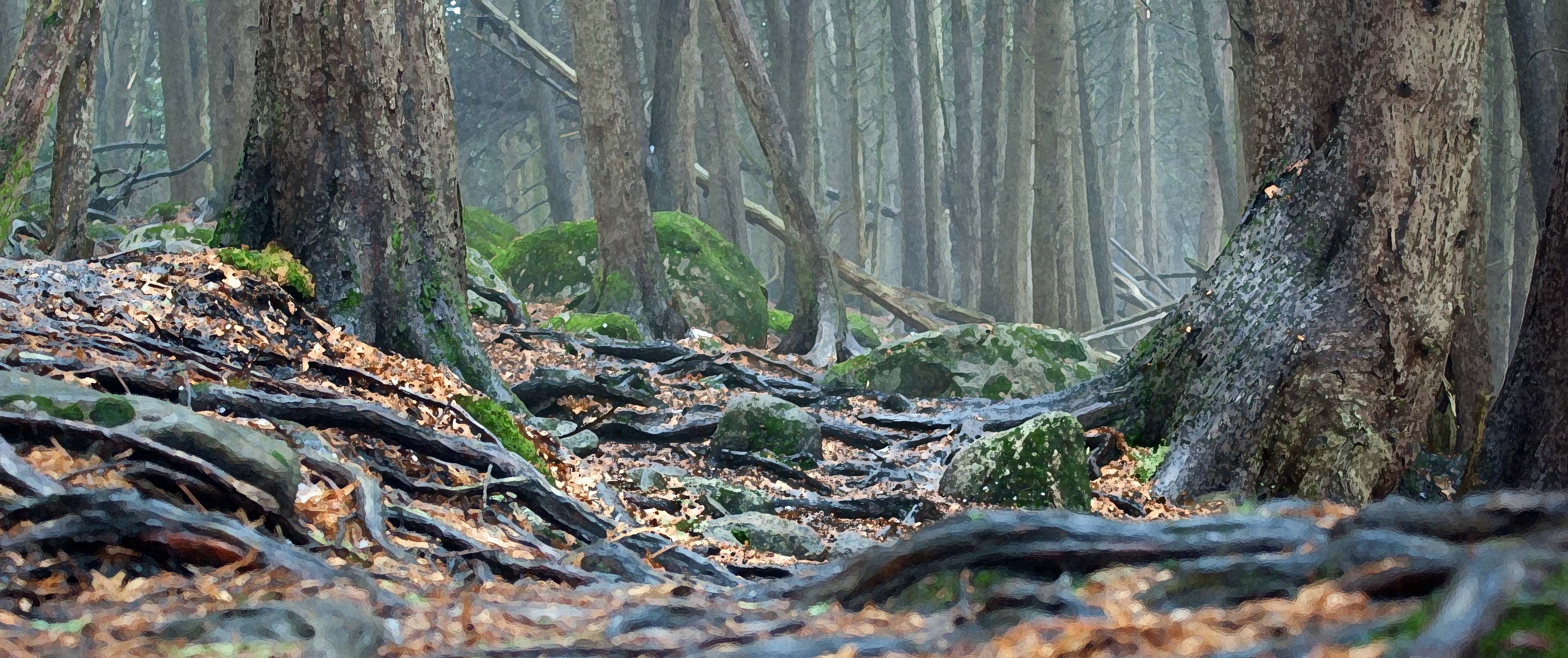
Root-covered cedar-pine forest in early winter, ON (photo and rendition by Nina Munteanu)
.
Nina Munteanu is a Canadian ecologist / limnologist and novelist. She is co-editor of Europa SF and currently teaches writing courses at George Brown College and the University of Toronto. For the latest on her books, visit www.ninamunteanu.ca. Nina’s bilingual “La natura dell’acqua / The Way of Water” was published by Mincione Edizioni in Rome. Her non-fiction book “Water Is…” by Pixl Press (Vancouver) was selected by Margaret Atwood in the New York Times ‘Year in Reading’ and was chosen as the 2017 Summer Read by Water Canada. Her novel “A Diary in the Age of Water” was released by Inanna Publications (Toronto) in June 2020.
“Bourgeois society stands at the crossroads, either transition to socialism or regression into barbarism.”—Rosa Luxemburg, 1915
.
I wrote my first novel in 1969 when I was fifteen. Caged in World was a hundred-page speculative story about a world that had moved “inside” to escape the ravages of a post climate-change environment. It would later become Book 2 of The Icaria Trilogy. I was already disillusioned with my world. I saw how corporations and governments and society in general—individuals around me—‘othered’ the environment by either treating it with disrespect and apathy or outright ignoring it in a kind of torpor of obliviousness. As though it didn’t exist.
.
I remember being chastised by a school teacher for thinking globally about what was happening to the planet at our hands: worldwide deforestation (e.g., clearcutting the old-growth forests of Canada), infilling saltwater and freshwater marshes, massive use of pesticides and fertilizers, contamination of lakes, unregulated mining and toxic pollution, and ultimately climate change. Stick to local concerns, he advised me; recycling and such.
I remember wondering if I was just being weird. That my odd sensibility for the planet-entire was just a nina-thing. I prayed that I was not alone and it wasn’t just a nina-thing.
.
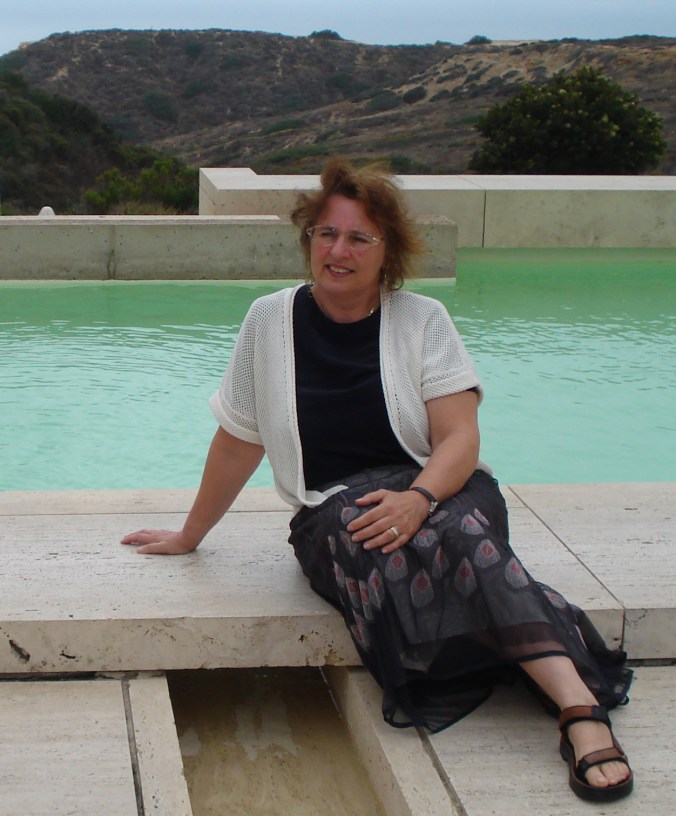
(Photo: Nina Munteanu, Salk Institute, California)
Throughout high school and university, I read scientific papers, news articles and books on revolution. I became a student of climate change long before the term entered the zeitgeist. I studied industrial capitalism and its roots in neoliberalism and colonialism. I noted how the post-war expansion of capitalism shifted from Fordist mass production to flexible automation, technology and AI. I saw the rise of multinational corporations, income inequality, and the commodification of everything—from water to human beings (Foucault’s homo economicus).
.
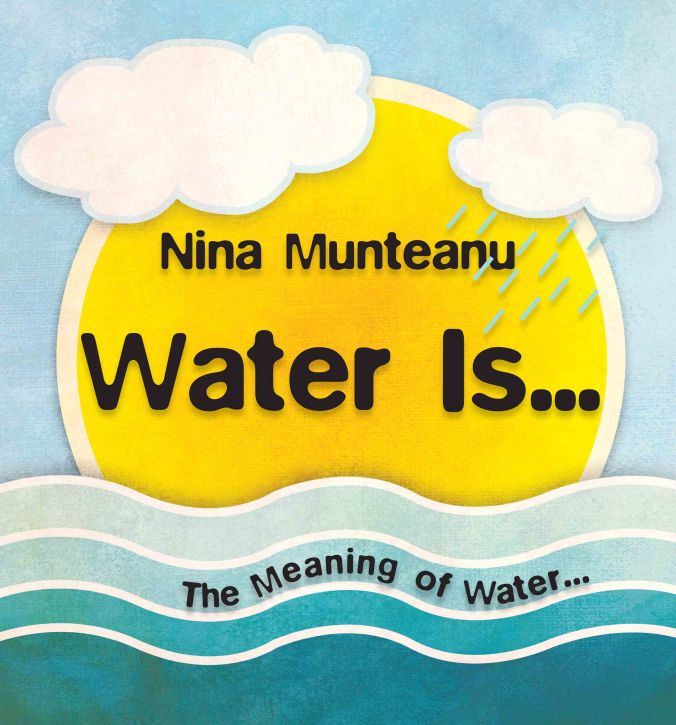
I pursued a university degree in ecology and limnology to study and help protect the environment and educate industry and their governments in the process. I became an expert on water. See my book Water Is…The Meaning of Water, which celebrates water from twelve perspectives (and got a shout out from Margaret Atwood!).
.
I soon concluded that a hegemony that follows the economic system of late capitalism inevitably commodifies and ‘others’ with ruthless purpose. Once something (or someone) is commodified, they are given a finite value and purpose outside their own existence. They become an object, a symbol to use and trade. They become a resource to manipulate, exchange, and dispose of with impunity. And through this surrender to utility, they become ‘othered.’ The consumer. The trees of the forest. Water. Homo sacer*. Each has a role to play in the late capitalist narrative of digital abundance and physical scarcity.
Capitalism hasn’t been kind to the environment. Economic pundits and sociologists insist that Capitalism is devolving. But what will replace it? Cloud capital? Technofeudalism? Something else?
.
Deep Ecology* & Gaia’s Revolution
The Icaria Trilogy (Dragon Moon Press)
.
My three Icaria novels—starting with Gaia’s Revolution, (the first of The Icaria Trilogy, releasing March 10, 2026, by Dragon Moon Press)—chronicle the collapse of a capitalist society in Canada as climate change, water shortages, habitat destruction, plague and a failing technology devastate the Canadian population.
.
Gaia’s Revolution (Book 1 of The Icaria Trilogy) explores a transition in Canada from semi-socialized capitalist system to a technocratic* meritocracy of technologists and scientists. Triggered by catastrophic environmental and sociological tipping points and following violent revolution, a dictatorship of deep ecologists* called Gaians seize power. By the end of the book, enclosed cities called Icarias* now populate North America. Separated from their environment, humans now live inside domes protecting them from a hostile and toxic environment.
.
In truth, the deep ecologists are keeping people “inside” not to protect humanity from a toxic wasteland but to protect the environment from a toxic humanity.
.
How realistic is this vision? Well, it is science fiction, after all, and though it takes liberties with its narrative, it is science-based and ultimately draws on precedent. As Margaret Atwood so astutely attested of her cautionary SF book The Handmaid’s Tale: “I didn’t put in anything that we haven’t already done, we’re not already doing, we’re seriously trying to do, coupled with trends that are already in progress.”
Science fiction is itself powerful metaphor; it is the fiction of political and social allegory or satire and makes astute social commentary about a world and civilization: how it has come to be, how it works—or doesn’t—and how it may evolve.
So, it is visionary and predictive? I prefer to think as Ray Bradbury:
.
“The function of science fiction is not only to predict the future, but to prevent it.”–Ray Bradbury
.
Jackson Creek in winter, ON (photo and rendition by Nina Munteanu)
.
References:
Angus, Ian. 1012. “The Spectre of 21st Century Barbarism.” Climate & Capitalism, August 20, 2012.
Atwood, Margaret. 2004. “The Handmaid’s Tale and Oryx and Crake ‘In Context'”. PMLA. 119 (3): 513–517.
Bradbury, Ray. 1991. “Yestermorrow: Obvious Answers to Impossible Futures” and “Beyond 1984: The People Machines” by Ray Bradbury, dated 1982, Page 155, Joshua Odell Editions: Capra Press, Santa Barbara, California.
Foucault, Michel. 2010. “The Birth of Biopolitics (Naissance de la biopolitique): Lectures at the Collège de France, 1978-1979.” Picador. 368pp.
Luxemburg, Rosa. 1915. “The Junius Pamphlet: The Crisis in the German Democracy”, Marxist.org.
Munteanu, Nina. 2026. “Gaia’s Revolution, Part 1 of Icaria Trilogy.” Dragon Moon Press, Calgary, AB. 369 pp.
Munteanu, Nina. 2010. “Angel of Chaos, Part 2 of Icaria Trilogy.” Dragon Moon Press, Calgary, AB. 518 pp.
Munteanu, Nina. 2007. “Darwin’s Paradox, Part 3 of Icaria Trilogy.” Dragon Moon Press, Calgary, AB. 294 pp.
Neuman, Sally. 2006. “‘Just a Backlash’: Margaret Atwood, Feminism, and The Handmaid’s Tale“. University of Toronto Quarterly. 75 (3): 857–868.
Sessions, George, Bill Devall. 2000. “Deep Ecology: Living as if Nature Mattered.” Gibbs Smith. 267pp.
Skinner, B.F. 1948. “Walden Two” The Macmillan Company, New York. 301pp.
Streeck, Wolfgang. 2014. “How Will Capitalism End?” New Left Review 2 (87): 47p.
.
Terminology:
*Deep Ecology: An environmental philosophy and social movement advocating that all living beings have intrinsic value, independent of their utility to human needs. Coined by Arne Næss in 1972, it promotes a holistic, ecocentric worldview—often termed “ecosophy”—that demands radical, structural changes to human society to prioritize nature’s flourishing.
*Homo sacer: a figure from Roman law denoting a person excluded from society who is outside human law (can be killed) and divine law (cannot be sacrificed). The term represents “bare life”: stripped of political rights, legal protection, and social value. Philosopher Giorgo Agamben popularized the term to describe individuals excluded from the political community, such as refugees, stateless persons, or camp detainees. The term illustrates the power of a sovereign in deciding which lives are worthy of protection and which are not.
*Icaria: the name of Étienne Cabet’s utopia. Cabet was a French lawyer in Dijon, who published his novel Voyage en Icarie in 1839. The novel was a sort of manifesto-blueprint of utopian socialism, with elements of communism (abolished private property and individual enterprise), influenced by Fourierist and Owenite thinking. Key elements, such as the four-hour work day, are reflected in B.F. Skinner’s Walden Two. Cabet’s novel explores a society in which capitalist production is replaced by workers’ cooperatives with a focus on small communities.
*Letzte Generation: a prominent European climate activist group, founded in 2021, known for its acts of civil disobedience—such as roadblocks, defacing art, and vandalizing structures—to pressure governments on climate action. The term was chosen because they considered themselves to be the last generation before tipping points in the earth’s climate system would be reached. They are mostly active in Germany, Italy, Poland and Canada. In Germany, they have faced accusations of forming a criminal organization, leading to police raids.
*Technocracy: A form of government in which the decision-maker(s) are selected based on their expertise in a given area; any portion of a bureaucracy run by technologists. Technocracies control society or industry through an elite of technical experts. The term was initially used to signify the application of the scientific method to solving social problems.
.
Nina Munteanu is an award-winning novelist and short story writer of eco-fiction, science fiction and fantasy. She also has three writing guides out: The Fiction Writer; The Journal Writer; and The Ecology of Writing and teaches fiction writing and technical writing at university and online. Check the Publications page on this site for a summary of what she has out there. Nina teaches writing at the University of Toronto and has been coaching fiction and non-fiction authors for over 20 years. You can find Nina’s short podcasts on writing on YouTube. Check out this site for more author advice from how to write a synopsis to finding your muse and the art and science of writing.
In two excellent articles in Climate Cultures entitled “A History of Eco-fiction, Part 1 and 2”, eco-fiction author and critic Mary Woodbury starts out with several rather long definitions of eco-fiction—one provided by Jim Dwyer in his 2010 book Where the Wild Books Are: A Field Guide to Eco-Fiction.
She also includes simpler descriptions. For instance, Ashland Creek Press calls it “fiction with a conscience,” and co-founder John Yunker insightfully labelled it a super-genre.
Woodbury then muses: “I think of eco-fiction as not so much a genre than as a way to intersect natural landscape, environmental issues, and wilderness—and human connection to these things—into any genre and make it come alive.” Not a fan of labels, she argues that eco-fiction is broad and has a rich history (of existence long before its label was coined in 1971 in the preface to an anthology by Washington Square Press) and brings up examples such as The Stolen Child by Victorian author and poet WB Yeats. “Eco-fiction has no boundaries in time or space,” argues Woodbury. “It can be set in the past, present, or future. It can be set in other worlds…I think of eco-fiction as a way to bring alive the wild in any genre, whether romance, adventure, mystery, you name it.”
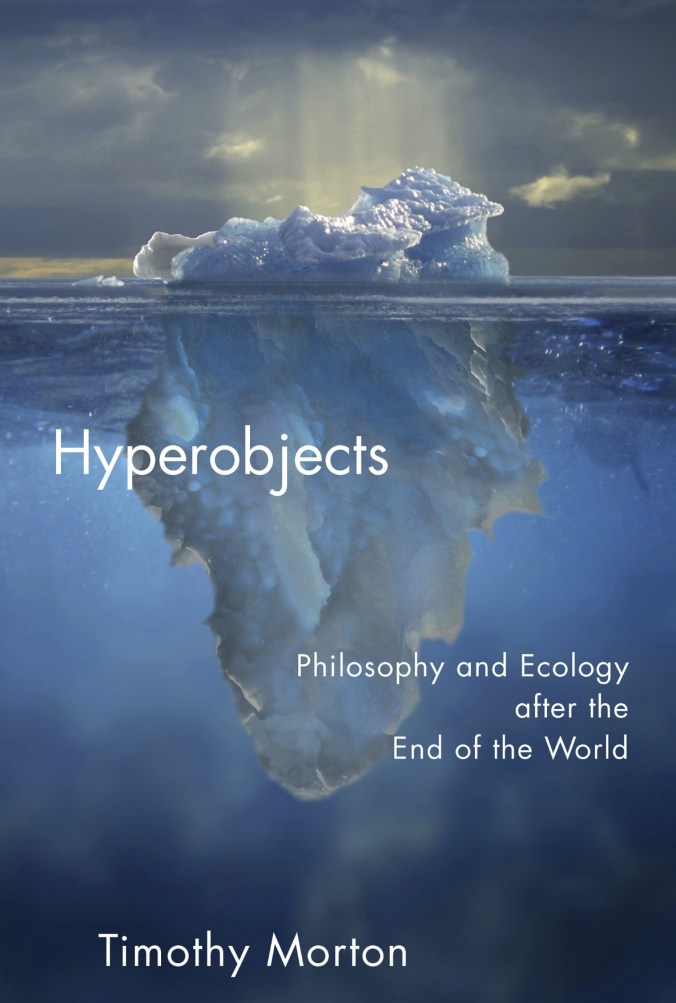
Eco-fiction—like climate change—is a hyperobject. In his 2014 book Hyperobjects, Timothy Morton explains that hyperobjects are immense, non-local entities that challenge our traditional understanding of objects; things so massively distributed in time and space that they defy human perception, given they exist beyond our immediate sensory grasp yet affecting us profoundly. Examples include anthropogenic global warming / climate change, but also pervasive phenomena, like plastic and oil, that have far reaching impacts beyond their simple physical presence.
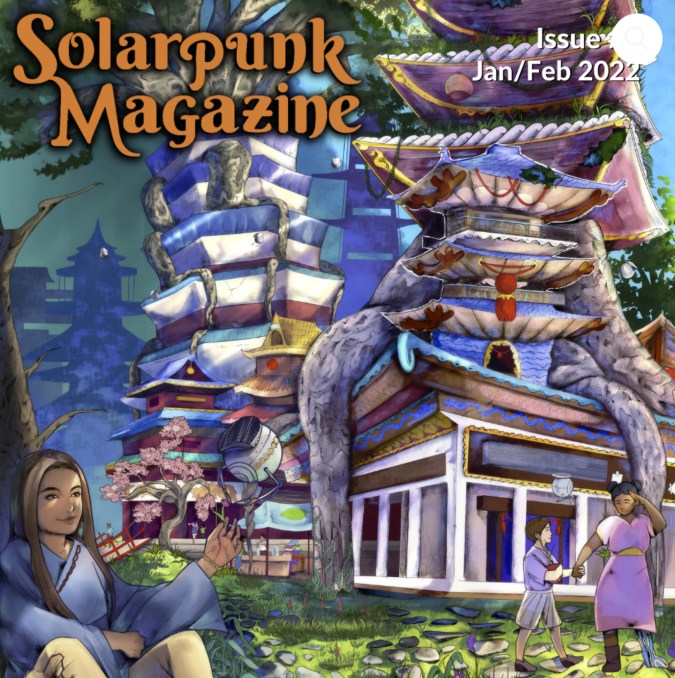
My own definition (from a previous article in Solarpunk Magazine) embraces the hyperobject nature of eco-fiction: eco-fiction (short for ecological fiction) is a kind of fiction in which the environment—or one aspect of the environment—plays a major role in story, either as premise or as character. For instance, several of my eco-fiction stories give Water a voice as character. In my latest novel, A Diary in the Age of Water, each of the four women characters reflects on her relationship with water and, in turn, her view of and journey in a changing world.
Through its vision of our future, eco-fiction encourages conversations and an outward perspective. Eco-fiction can trigger a sense of wonder about the natural world; it may connect with our sense of loss or mourning—our solastalgia—for our changing home. Cautionary tales may nudge people to action and encourage alternative futures. By encouraging empathy and imagination, eco-fiction reaches deep into our souls, where we care. It is only when we care that we act.
A recent survey conducted by Woodbury revealed that, “Fiction exploring humanity’s impacts on nature is becoming more popular [and] has the distinct ability to creatively engage and appeal to readers’ emotions.” Woodbury’s 2020 survey showed that “88% of its participants were inspired to act after reading ecological fiction.”
A few years ago, I wrote an article entitled “Why Ecofiction Will Save the World” which appeared in Issue #1 of Solarpunk Magazine. In it, I mentioned how I’d noticed in my university science fiction course that more and more students were bringing in WIPs on ecological and global environmental issues. Many of the stories involved a premise of environmental calamity, but not in the same vein as previous environmental disasters that depict “man” against Nature. Instead, these works gave the Earth or Nature (or an aspect of Nature) an actual voice—as a character—and had a protagonist who learns to interact with the Earth/Nature character, often cooperatively. This represents a palpable and gestalt cultural awakening of what eco-feminists have called the “feminine archetype” by providing a voice for “the other” in story.
.
This shift reflects what lies at the heart of eco-fiction.
Eco-fiction explores the world and the consequences of humanity’s actions on the environment and ourselves (by inference) through dramatization. The stories that stir our hearts come from deep inside, through symbols, archetypes and metaphor, where the personal meets the universal. In my short story “The Way of Water”(“La natura dell’acqua”), water’s connection with love flows throughout the story:
They met in the lobby of a shabby downtown Toronto hotel. Hilda barely knew what she looked like but when Hanna entered the lobby through the front doors Hilda knew every bit of her. Hanna swept in like a stray summer rainstorm, beaming with the self-conscious optimism of someone who recognized a twin sister. She reminded Hilda of her first boyfriend, clutching flowers in one hand and chocolate in the other. When their eyes met, Hilda knew. For an instant, she knew all of Hanna. For an instant, she’d glimpsed eternity. What she didn’t know then was that it was love.
In a world of severe water scarcity through climate catastrophe and geopolitical oppression, the bond of these two girls—to each other through water and with water—is like the shifting covalent bond of a complex molecule, a bond that fuses a relationship of paradox linked to the paradoxical properties of water. Just as two water drops join, the two women find each other in the wasteland of environmental intrigue. Hilda’s relationship with Hanna—as with water—is both complex and shifting according to the bonds they make and break. Hilda navigates her dystopia by learning meaningful lessons—lessons that pertain directly to our reader in their current world. This is because the premise of a dystopia lies squarely in the present world. Good dystopias enlighten and suggest possibilities; they can warn and herald. At the very least, they incite the necessary conversation.
Our capacity—and need—to share stories is as old as our ancient beginnings. From the Paleolithic cave paintings of Lascaux to our blogs on the Internet, humanity has left a grand legacy of ‘story’ sharing. By providing context to knowledge, story moves us to care, to cherish, and, in turn, to act. What we cherish, we protect. It’s really that simple.
.
“Morton’s book is a queasily vertiginous quest to synthesize the still divergent fields of quantum theory (the weirdness of small objects) and relativity (the weirdness of big objects) and insert them into philosophy and art, which he notes are far behind ontologically speaking (page 150). Morton’s wager is that for the first time, we in the Anthropocene are able to see snapshots of hyperobjects, and that these intimations more or less will force us to undergo a radical reboot of our ontological toolkit and (finally) incorporate the weirdness of physics”—Cara Daggett
.
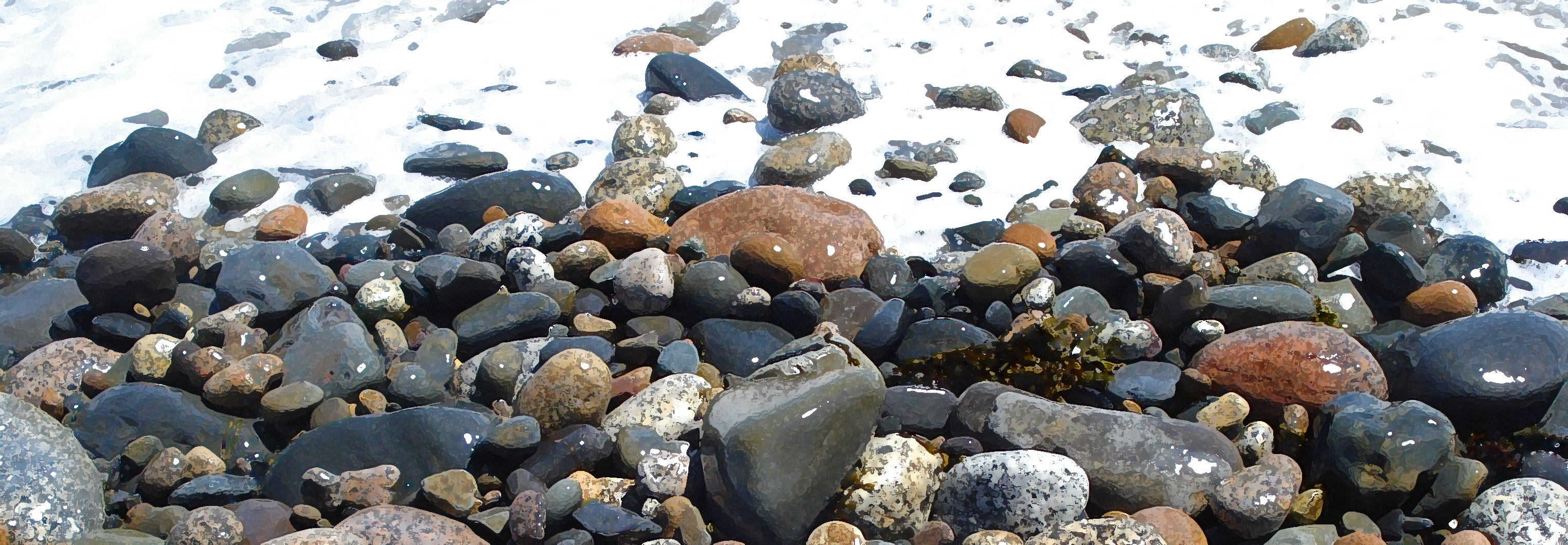
Hirtle Beach, Nova Scotia (photo and rendition by Nina Munteanu)
.
Nina Munteanu is an award-winning novelist and short story writer of eco-fiction, science fiction and fantasy. She also has three writing guides out: The Fiction Writer; The Journal Writer; and The Ecology of Writing and teaches fiction writing and technical writing at university and online. Check the Publications page on this site for a summary of what she has out there. Nina teaches writing at the University of Toronto and has been coaching fiction and non-fiction authors for over 20 years. You can find Nina’s short podcasts on writing on YouTube. Check out this site for more author advice from how to write a synopsis to finding your muse and the art and science of writing.
In her masters thesis published in November 2025 at the University of Graz, Austria, Şeyma Yonar uses my short story The Way of Water, along with several others to explore and discuss the importance of eco-literature in establishing ecological awareness and ultimately ecological and sustainable action.
.
Ice-covered bay, Otonabee River, ON (photo and rendition by Nina Munteanu)
.
.
Yonar draws on the work of Maria Löschnigg to argue that “as the environmental crisis encompasses not just physical challenges but also a crisis of imagination, posing questions about life in severely degraded environments, it becomes crucial to examine how literature can inspire interest in ecological issues and foster a deeper environmental awareness.” Yonar further draws on the works of Serpil Oppermann and Susan O’Brian to note that ecocriticism tends to neglect less conventional but equally meaningful speculative or experimental fiction in its critical gaze of relevant eco-literature and to question whether realism should be the dominant mode for ecological discourse.
.
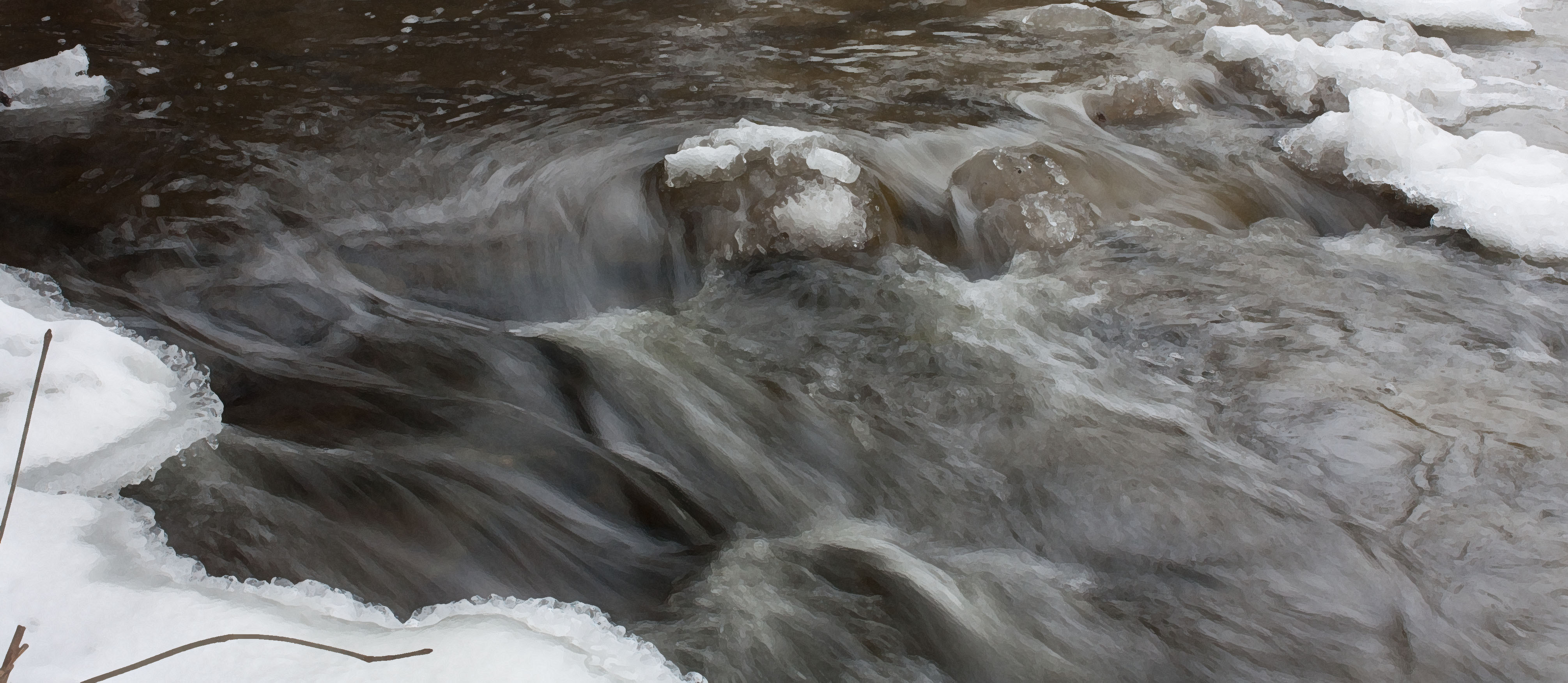
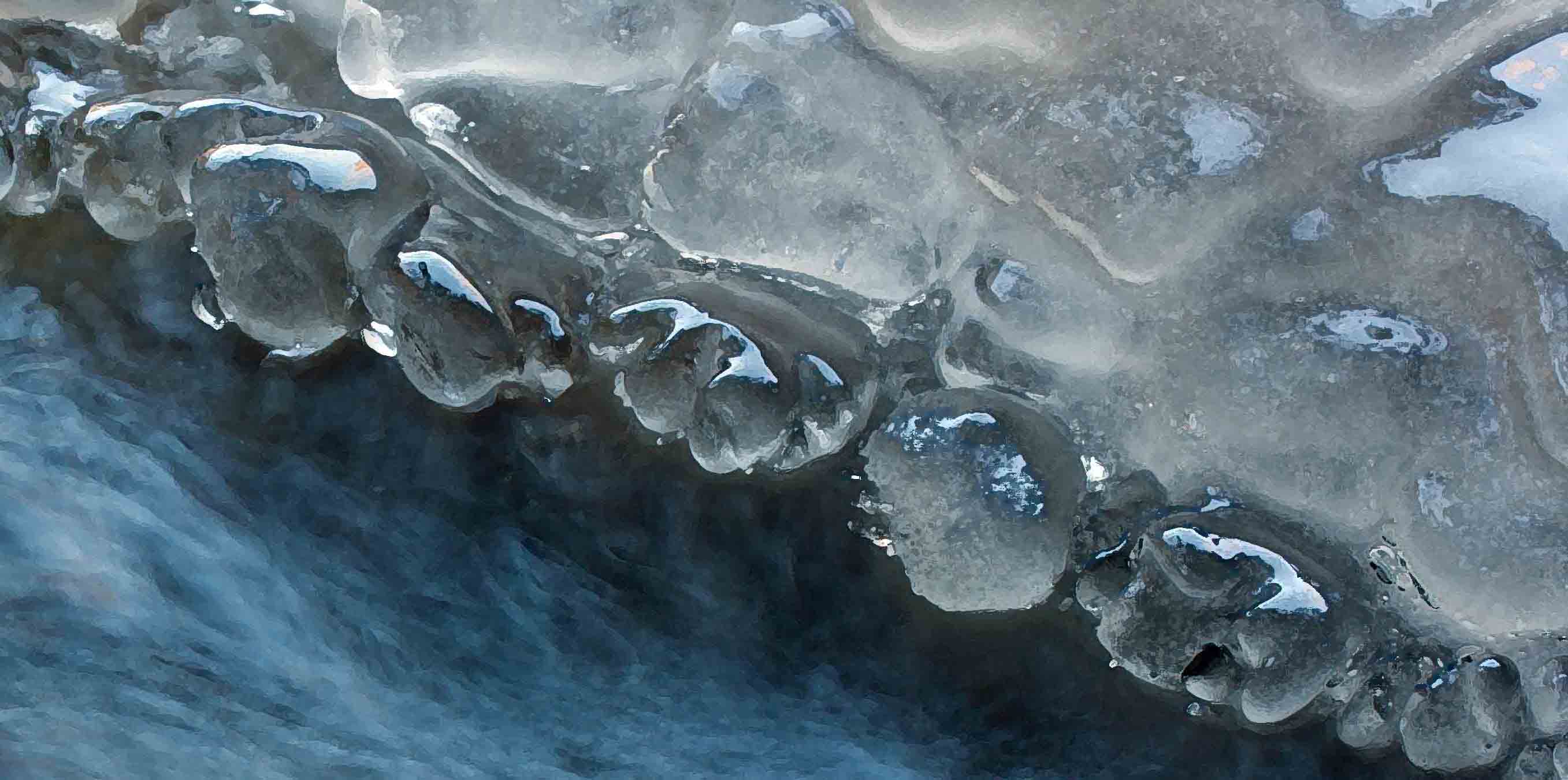
Ice-bubbles in a stream, Jackson Creek, ON (photo by Nina Munteanu)
.
“The Way of Water is a strong eco-story that possesses many layers and elements that strengthen its narrative while encouraging readers to engage with its world…The notion what water constitutes the essence of life is the central theme of the story … Munteanu’s knowledge as a scientist enables her to create a convincing scientist protagonist whom she embeds into a powerful fictional story. Water, particularly in this eco-story acts not only as a symbolic entity but also as a body of force…the agency of water is presented as a dynamic, living entity, central to the narrative’s ecological themes.”
“Munteanu’s impactful storytelling highlights her significant contribution to Canadian literature, particularly through her engagement with pressing environmental issues and her commitment to fostering ecological awareness through fiction.”
.
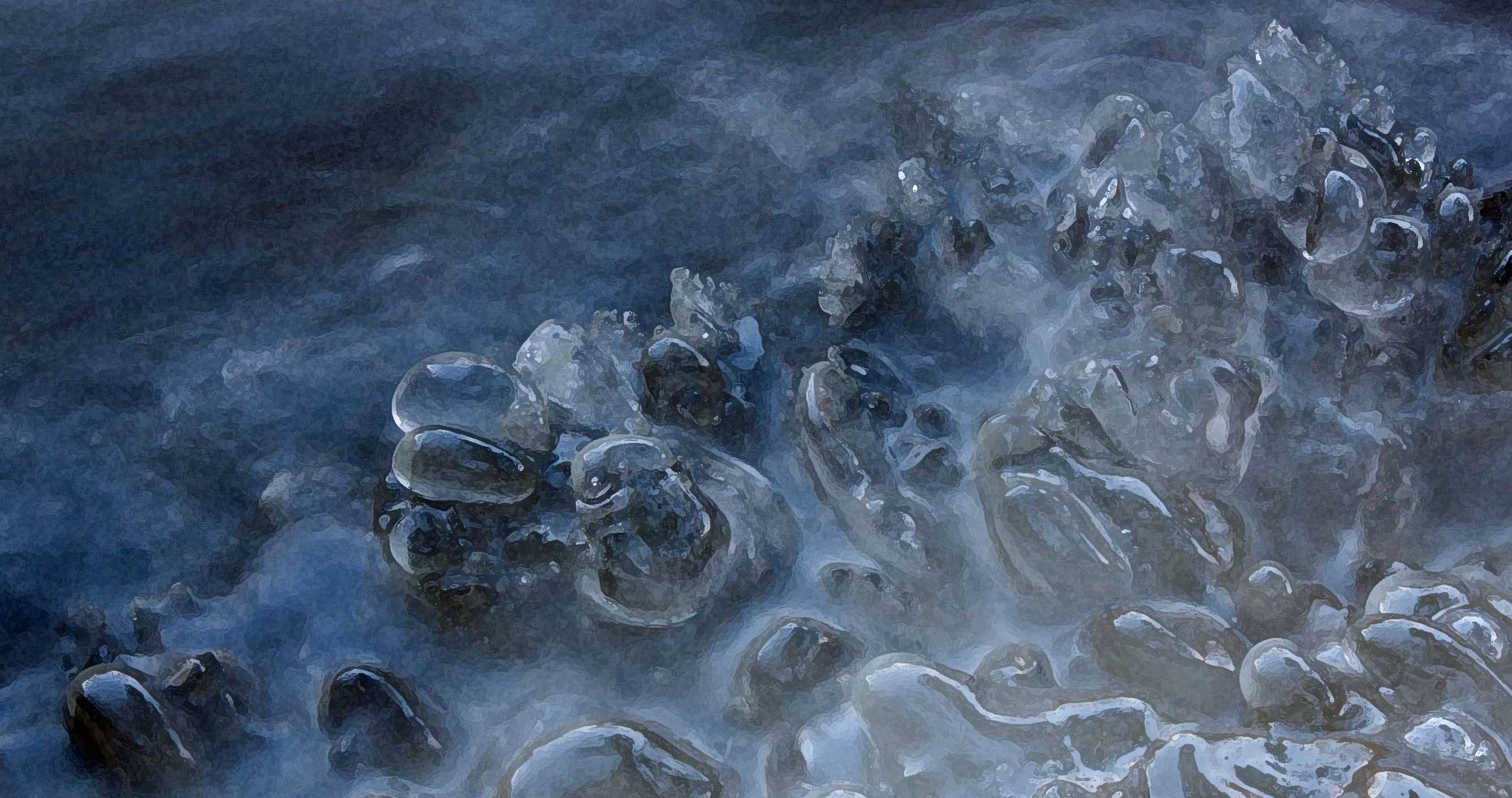
Ice ‘pearls’ in Jackson Creek in winter, ON (photo and rendition by Nina Munteanu)
.
Yonar draws on the work of Serpil Oppermann, who points out in her book Blue Humanities, that water is deeply connected to social and cultural realities, and stories that highlight its narrative role are both essential and impactful. “Non-human-centred narratives reveal the dynamic and active nature of water, making its agency understandable and natural to the reader.”
Yonar quotes beginning lines of the short story to demonstrate how a powerful metaphor can become surprisingly literal: In this passage the main character Hilda thinks: water is a shape-shifter. It changes yet stays the same, shifting its face with the climate. It wanders the earth like a gypsy, stealing from where it is needed and giving whimsically where it isn’t wanted: “A statement,” Yonar writes, “that initially appears to be metaphorical rather than literal description of water. However, as the story expands, it becomes evident that this ‘shape-shifting’ feature is not an unrealistic trait, but rather a reflection of water’s dynamic and transformative nature.” She adds that, “this characterization of water points out its agency, suggesting its ability to adapt and influence the narrative in ways that transcend traditional understandings.”
.
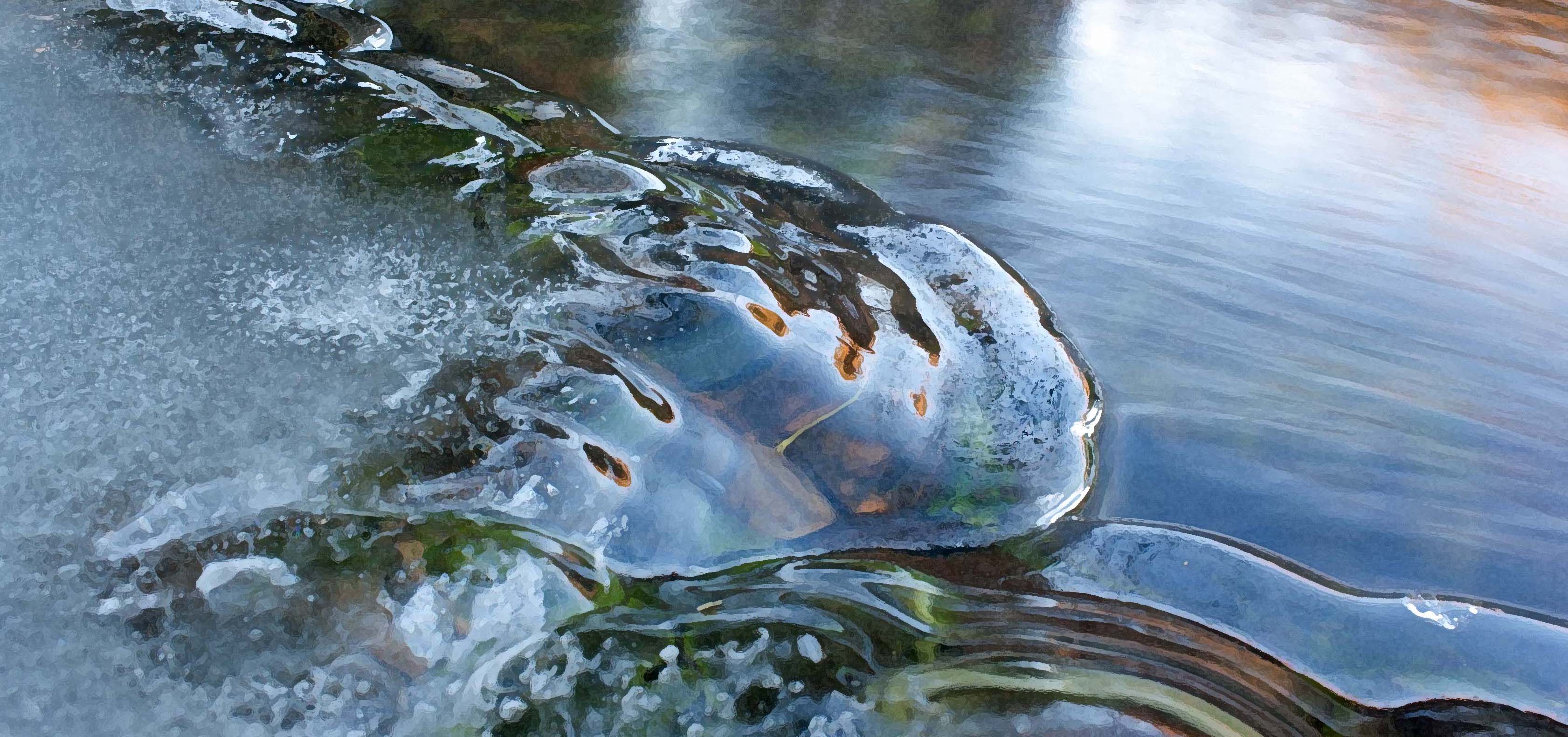
Icy bay, Jackson Creek, ON (photo and rendition by Nina Munteanu)
.
Yonar notes that intertextuality used in The Way of Water—such as wCard, iTap and Schrödinger’s Water is a useful way to “foreground notions of relationality, interconnectedness and interdependence in modern cultural life” (Graham Allen). Intertextuality in The Way of Water reflects capitalist industrialism: the monetization, commodification and control of water by national utilities represented by CanadaCorp: the “corporate dominance, digital dependence, and pervasive nature of technology.” Yonar adds pithily, “In a manner analogous to how Apple products have become indispensable instruments in contemporary existence, the iTap within Munteanu’s narrative operates as an emblem of hyper-connectivity and authority, thereby amplifying the novel’s critique of technological dependency in modern society.” Yonar ponders that the thought experiment of Schrödinger’s Cat, reimagined through the element of water as Schrödinger’s Water, “reframes the original paradox within an ecological and environmental context, emphasizing the fluidity and uncertainty of water’s role in shaping human and non-human existence.”
Yonar shares with Meyer and Oppermann “a unified perspective on the collaborative role of writers and scientists in addressing the shared challenge of climate change.” Yonar concludes that The Way of Water introduces a powerful human-made cooperation that is at the same time political, suppresses people, and takes advantage of the scarcity of water. Even “the rain belonged to CanadaCorp,” she quotes from The Way of Water.
.
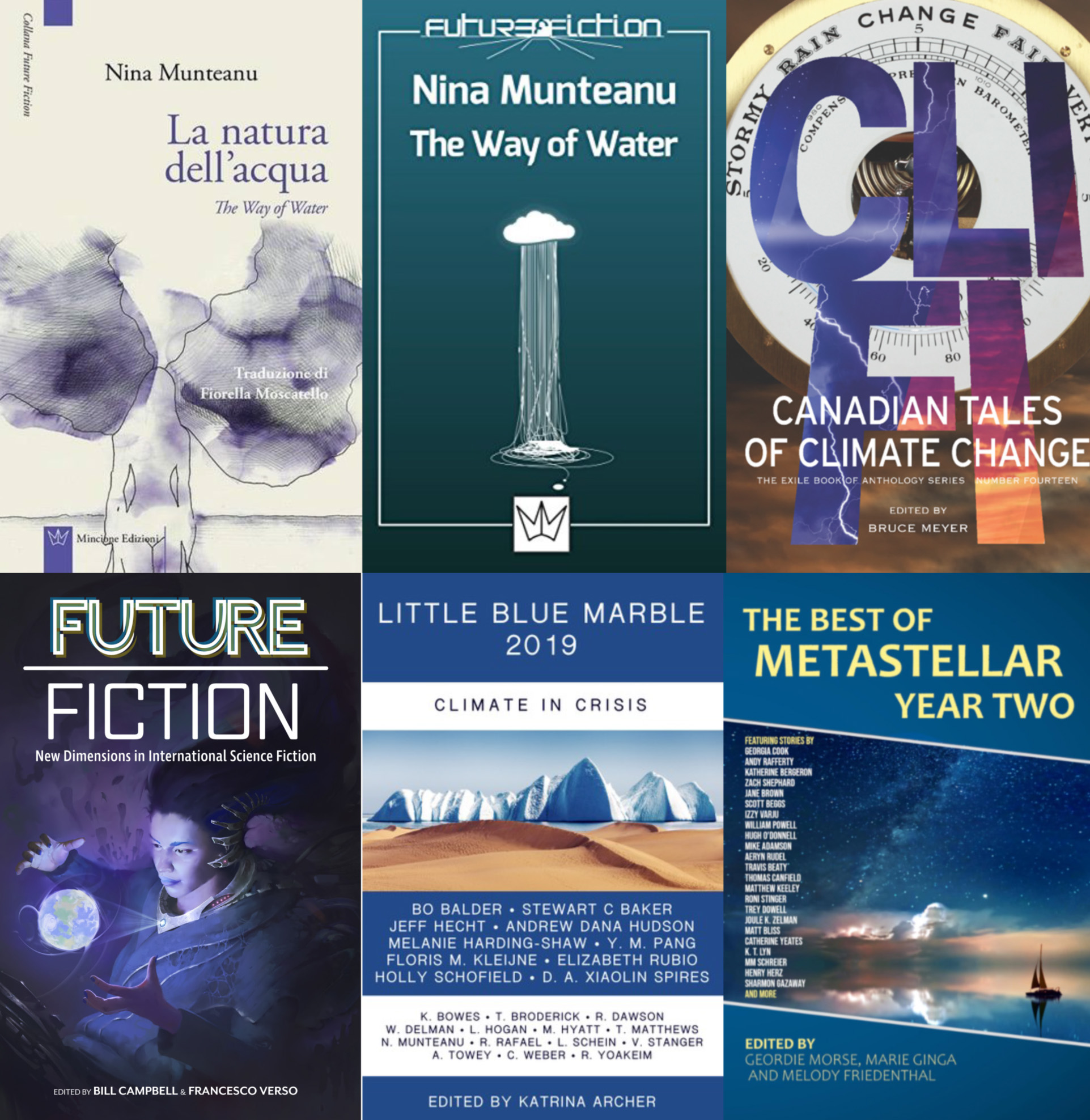
Various publications in which The Way of Water appeared
.
The Way of Water was first published as a bilingual print book by Mincione Edizioni(Rome) in Italian (La natura dell’acqua, translated by Fiorella Moscatello), and English along with a recounting of what inspired it: The Story of Water (La storia dell’acqua) in 2016. To date, The Way of Water has been published and republished eight times throughout the world and translated into Italian and German. I think this success is less a reflection of my writing than the immediacy and importance of the topic covered: growing water scarcity, its commodification, and its politicization.
.
I’ve written several articles on how The Way of Water came about. Briefly, it all started with an invitation in 2015 by my publisher in Rome to write about water and politics in Canada. I had long been thinking of potential ironies in Canada’s water-rich heritage. The premise I wanted to explore was the irony of people in a water-rich nation experiencing water scarcity: living under a government-imposed daily water quota of 5 litres as water bottling and utility companies took it all.
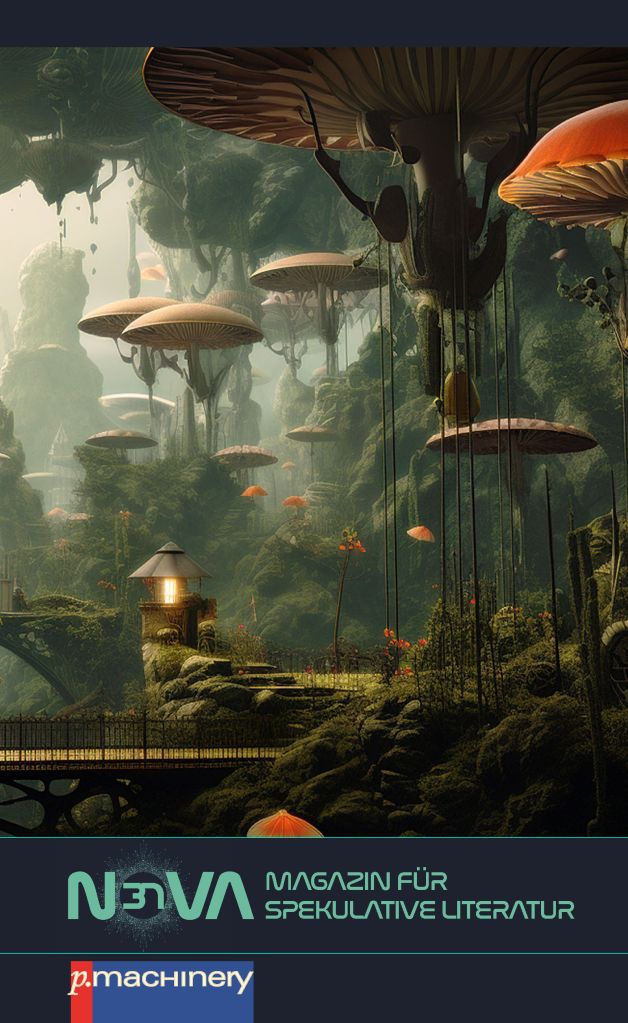
Latest publication of The Way of Water in Nova 37, translated into German as Der Weg des Wassers
.
.
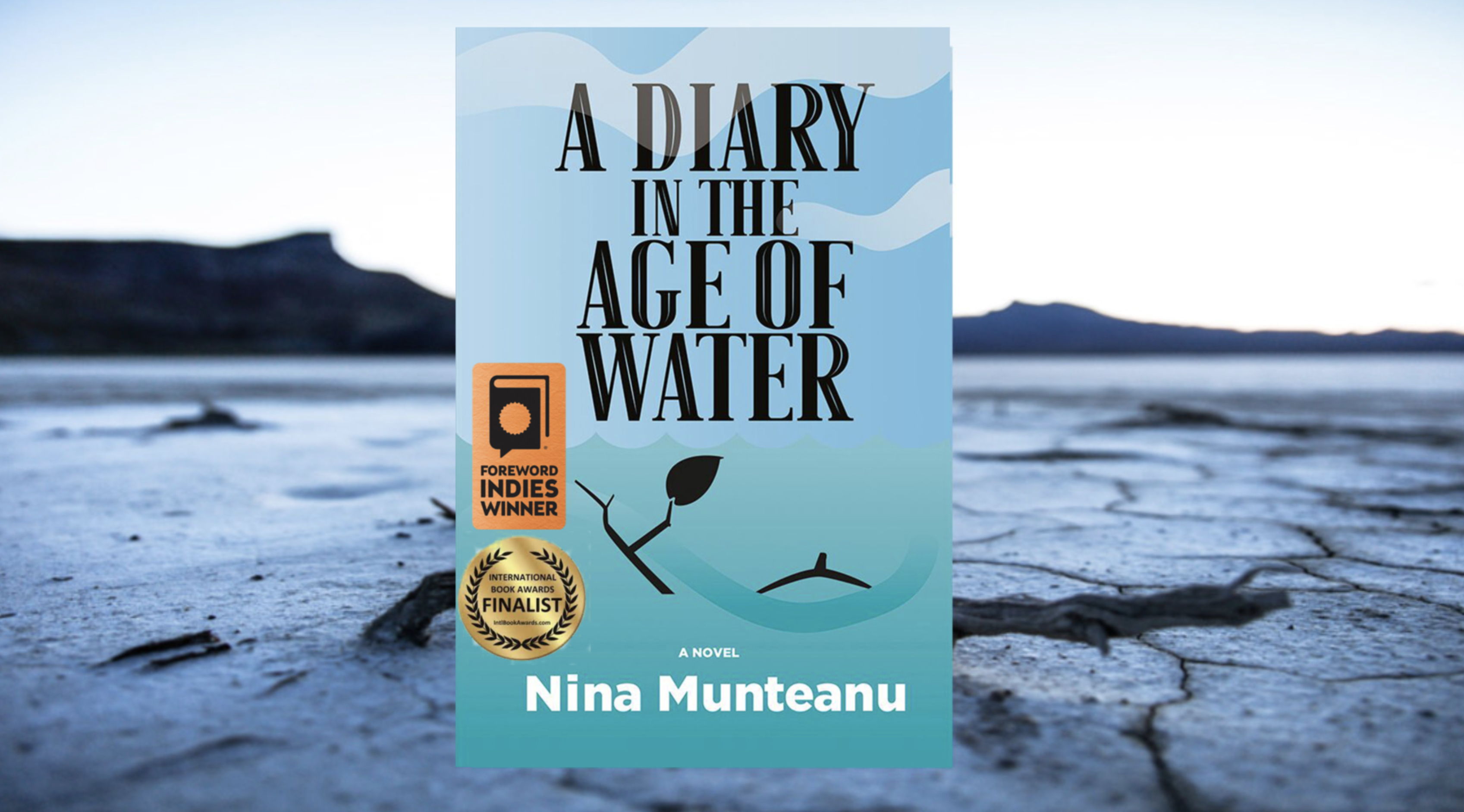
The Way of Water, in turn, inspired my dystopian novel A Diary in the Age of Water(Inanna Publications, 2020), which chronicles the lives of four generations of women and their relationship to water during a time of severe water restriction and calamitous climate change. The novel features the main character Hilda from The Way of Water and her limnologist mother; A Diary in the Age of Water is essentially the mother’s diary embedded in a larger story. Through a series of entries, the diarist reflects on the subtle though catastrophic occurrences that will eventually lead to humanity’s demise.
.
Jackson Creek in the fall, ON (photo and rendition by Nina Munteanu)
.
References:
Löschnigg, Maria. 2014. “The Contemporary Canadian Short Story in English: Continuity and Change.” Cultures in America in Transition, vol. 7, WVT.
Munteanu, Nina. “The Way of Water” Mincione Edizioni, Rome. 113pp.
Munteanu, Nina. “A Diary in the Age of Water.” Inanna Publications, Toronto, ON. 328pp.
Fi: Anthology #14. Edited by Bruce Meyer. Exile Editions, Toronto.304pp.
O’Brian, Susan. 2001. “Articulating a World of Difference: Ecocriticism, Post colonialism and Globalization.” Canadian Literature vol. 170-171: 140-158.
Oppermann, Serpil. 2023. “Blue Humanities.” Cambridge University Press.
Yonar, Şeyma. 2025. “Short Texts—Long Term Effects: The Canadian Eco-Story.” Masters Thesis, University of Graz, Austria. 70pp.
.
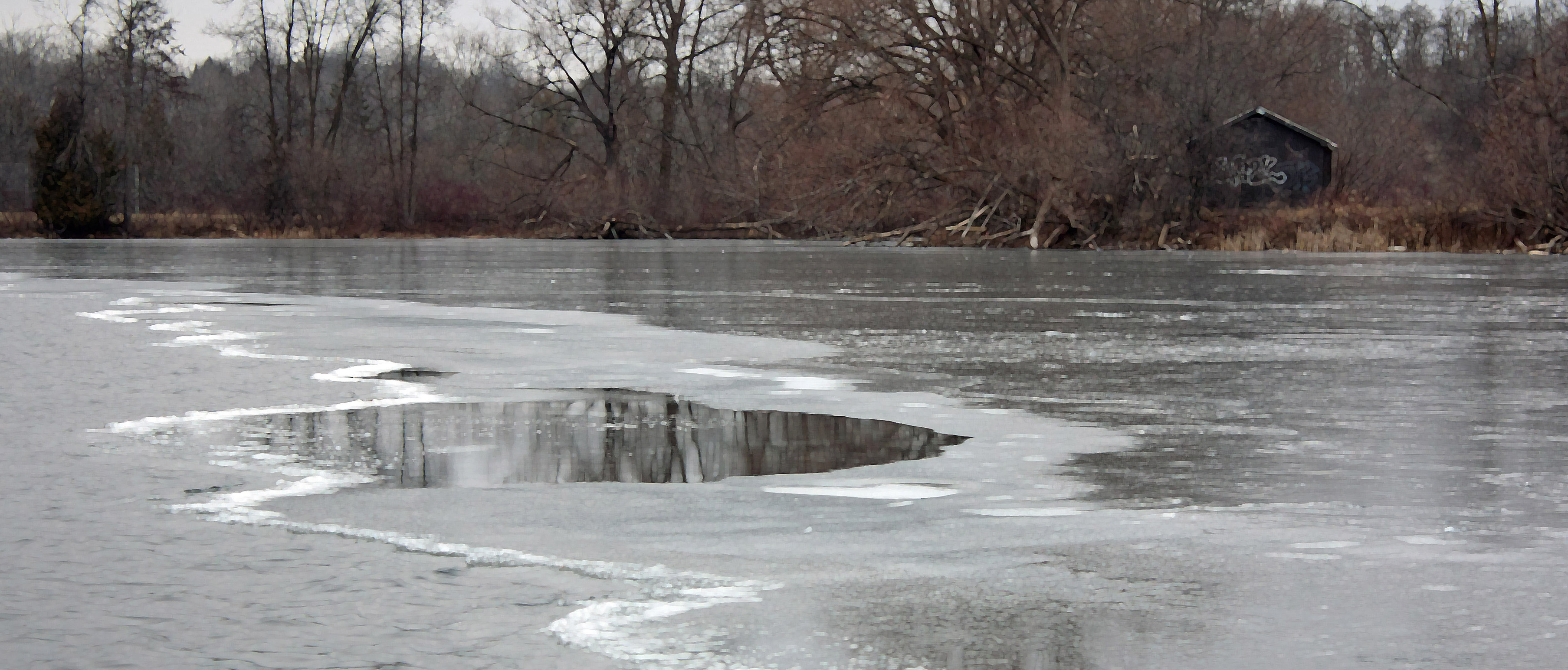
Jackson Creek partially iced in winter, ON (photo and rendition by Nina Munteanu)
.
Nina Munteanu is an award-winning novelist and short story writer of eco-fiction, science fiction and fantasy. She also has three writing guides out: The Fiction Writer; The Journal Writer; and The Ecology of Writing and teaches fiction writing and technical writing at university and online. Check the Publications page on this site for a summary of what she has out there. Nina teaches writing at the University of Toronto and has been coaching fiction and non-fiction authors for over 20 years. You can find Nina’s short podcasts on writing on YouTube. Check out this site for more author advice from how to write a synopsis to finding your muse and the art and science of writing. For more on her work as a limnologist and ecologist, see The Meaning of Water.
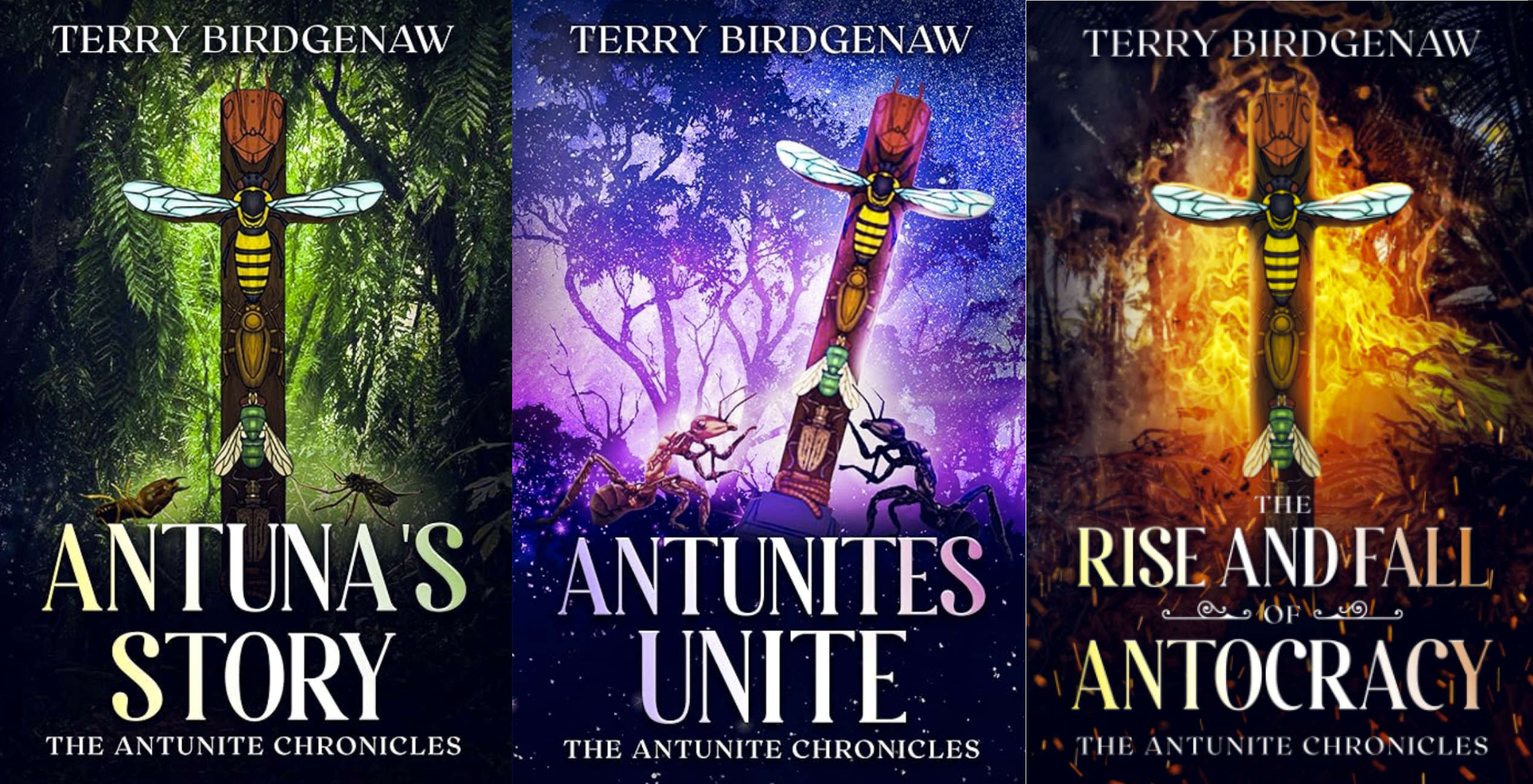
It was several years ago, in 2020, that Terry Birdgenaw approached me as a writing coach to look at his first novel. When he described its premise, I was hooked right away and agreed to give it an editorial review. It was the beginning of a wonderful and rich experience with Terry’s books, now a series entitled The Antunite Chronicles. From the start, I was impressed and fascinated with his imagination and accurate use of science to produce a diverting allegorical CliFi series about cyborg insects on a far-away planet that serves as metaphor to developing autocracies on Earth.
Terry has three books out, with a fourth upcoming. The three books in this YA series take place on a far-away planet and moon, serving as a political and environmental allegory of an evolving technological society and failed democracy. They include: Antuna’s Story; The Rise and Fall of Antocracy; and Antunites Unite. The theme of induced climate change and environmental destruction runs deeply through the first three books. The fourth book, soon to release, is Cyborg Contact, which returns us to Earth. I’ll let Terry describe the series in the following interview I conducted with him on November 26:
.
Nina: Your background and expertise is in neuroscience and psychology with over 150 scientific publications. You are Harold Griffith Professor of Anesthesia Research at McGill University in Montreal and your main research focus is on the mechanisms underlying neuroplasticity and its influence on the perception of pain. What got you started writing this incredible series, an adventure story that embraces ecology and entomology? What gave you the idea to create this imaginative modern allegory on the evolution of a technological society using insects as your main characters?
Terry: Oddly enough, I was not originally planning to write fiction. My inspiration came from my school librarian wife, Ann Birdgenaw, when she began writing the second book of her children’s chapter book series, Black Hole Radio. Her series features fifth-grade kids who travel through a wormhole to different planets, aiding the inhabitants they discover. She was considering what kind of planet and civilization her explorers would encounter, and I gave her some ideas about a giant cyborg-insect world that she ran with. Having some skin in the game, I participated beyond my welcome, offering plotlines that were far too advanced for her 7- to 11-year-old readers. Graciously, Ann suggested I take my ideas and write the backstory for her book, Black Hole Radio – Bilaluna, but target my book at young adults and adults. Thus began my fiction writing adventure. It was a rough start, but with the help of a tolerant book coach, my planned novella rapidly expanded to a trilogy. Perhaps a quick study because of years of scientific writing, I still credit Nina with opening in me an imaginative creativity I never knew I possessed.
.
Nina: The narrative of your stories is from the POV of various insects and in some way, the stories are dramatizations of real and accurate ecological relationships of insects with their environment and each other. How did you prepare for this—both in relaying accurate ecologies and in realizable dramatization and characterization of your main characters—all insects? How did you avoid what I would call the Disney-effect: anthropomorphising insect characters into human archetypes to achieve reader engagement? How did you create that balance between realistic representation and empathic portrayal?
Terry: Although my books are parodies with characters who face political and ecological problems and anthropomorphise human dilemmas, I did not want them to be simply furry or slimy stand-ins for the humans they satirize. Thus, I drew on my long-standing expertise as a scientific researcher to delve deeply into entomology, ecology and environmental science. Fascinated by the richness of insect activities and interactions and the similarity between insect and human behaviour, I endeavoured to exploit my newly acquired knowledge within the pages of my story. I was inspired both by Orwellian dystopias and works such as Bernard Werber’s Empire of the Ants and Laline Paull’s The Bees. But more than that, I learned to let myself be taken into the world my insects lived in, experiencing both their instinctive realities and the human predicaments I intended to lampoon in equal measure.
.
Nina: I noticed some fun metaphoric descriptions and expressions that incorporated insect terms to represent human counterparts. Did these come to you easily or were they a lot of work over time? Can you describe the process you used? For instance, did you spend a lot of time watching ants on the sidewalk?
Terry: Some phrases like ‘she shook her antenna to tune her attention’, ‘I took that as a back-clawed compliment’, or ‘he is such a hindgut hole’ came easily to me as differences in insect and human anatomy necessitated them. Others, like the expressions explained in my dictionary of pheromonal insect emotions, took much more reflection. This literary technique was inspired by your writing guide, The Fiction Writer, when you described how to add colour to one’s writing by using word pairings that mix up the senses, like the well-known one ‘biting cold’. This excellent advice led me to develop an extensive lexicon of insect emotions/non-verbal speech, including word combinations such as abrasive aroma, bitter bouquet, frosty fragrance, and vacillating vapour. They were not all alliterations, but some, like ‘she emitted an effervescent essence, were clearly intended to be. I didn’t watch ants walking, but I thought a lot about how they might communicate their emotions pheromonally.
.
Nina: One of the things I enjoyed throughout your series is how you seamlessly imparted interesting facts about insects on our planet in the storytelling. I learned a lot about various insects! Tell us a little about the process you used to achieve this so effectively.
Terry: As a long-time researcher, I have learned how to find and use facts from scientific literature and reliable web-based information on many subjects within and outside my scientific field. Insect behaviour is little known, but often fascinating, and I enjoyed both discovering many details and incorporating them into fiction scenes. Sometimes I was required to dig even deeper than I initially expected to make my stories scientifically accurate. One of these cases had a very significant impact on a critical component of my book’s key plot. In Antunites Unite, ants are separated into a hierarchy of castes based on exoskeleton colour. Although clearly an anti-racism story, I originally wrote it with black ants as oppressors of both brown and red ants. Perhaps influenced by previous literature and movies, where the bad guys are often dressed in black, I had a feeling that some readers might interpret my choice as having a racist underpinning. I convinced myself that readers would not take the colour choice as representative of human ethnicity. However, the last beta reader to comment on the book made such an interpretation and confirmed my fear that some readers might see it as the opposite of my intention. So, while I debated altering the colour schemes, I dug deeper into the entomological discovery of a phenomenon my story paralleled, involving what entomologists call slave-maker ants. When my extensive research confirmed that red ants are more often the ants using raids to steal the eggs of other ants to be raised as slave-like workers for the dominant reds, I knew I had to reverse the colours. And this was no easy task, because all the characters in each caste took names that reflected their colour, like Ruby and Obsidiant. There were also many humorous references to colour, such as black widow spiders and lava fields, that needed to be reworked. It was an editing nightmare: Rose became Raven, and Raven – Rose, while Cole gave way to Clay, and Jett morphed to Jasper, etc., etc., etc. But in the end, it was true to nature and avoided any unwanted racial interpretations.
.
Nina: In your first three books—a political modern satire on developing autocracies and human-induced climate change—you explore the technological and biological evolution of an insect exo-community in which certain species—ants for instance—acquire the ability to become cyborgs, ANTs, growing in size and abilities to navigate their world more effectively with related achievements—and consequences. As an ecologist, I was fascinated by how you portrayed the changing relationship of these beings to their environment as they evolved. Do you see a parallel with human society? Can you elaborate on this?
Terry: Yes, on a macro level. That is, technology can benefit society immensely, but it can also cause significant harm when coupled with greed, wilful ignorance of scientific warnings, and leaders misleading the public. I highlight one line of poetry written by my narrator in The Rise and Fall of Antocracy: “Like Peter and the crows, tis science, truth and reality denied ere climate is crucified.” Cyborg insects were created to enhance the production of honey, which was their currency. Cyborg ants, who most craved both power and honey, deceived the public to the detriment of the environment and ignored the science that provided evidence of environmental changes, which most insectoids on the planet denied. Perhaps an obvious cataclysmic message to those in our world, but many on this Earth apparently need to be hit over the head to see where this all may lead.
.
Nina: Tell us about your latest book, the fourth in the series, Cyborg Contact, in which one of the cyborg ANTs returns to Earth through a wormhole with an important mission. I found that, while the first three books served as satirical allegory to a developing technological society through the evolving insect communities, the fourth book—being a first contact—shifts into more of an exploration of ‘the other,’ its perception and treatment by humans and their civilizations. Can you expand on this? How does humanity’s perception and treatment of the ‘other’ factor into our treatment of our environment and the growing phenomenon of climate change?
Terry: I might disagree and point out that ‘exclusion of the other’ is a dominant theme in all four books. The difference is that in Cyborg Contact, the main character embodies ‘the other’, so it hits home more strongly. What could be more ‘otherly’ than an alien (from another planet) who is treated like an illegal alien and hunted by ICE agents? And, too, aside from being hunted, many other dangers the alien experiences on Earth, including hurricanes, droughts, mudslides, and forest fires, are all caused by climate change, which has accelerated in the near-future North America our hero traverses. It seems that for some world leaders, a lack of empathy for others is paired with a disregard for the environment.
.
Nina: Who is reading your books? And who should be who isn’t?
Terry: They are read by both young adults and adults; sometimes by parents reading to their pre-teens. They are not New York Times best sellers, but are highly celebrated by those who have read them. They should be read by all sci-fi and fantasy readers aged 13 and up who enjoy a thought-provoking read, except those who support fascism.
.
Nina: How have your books been generally received? I understand that your trilogy has won the Firebird Book Award. Congratulations! What are people saying about your books?
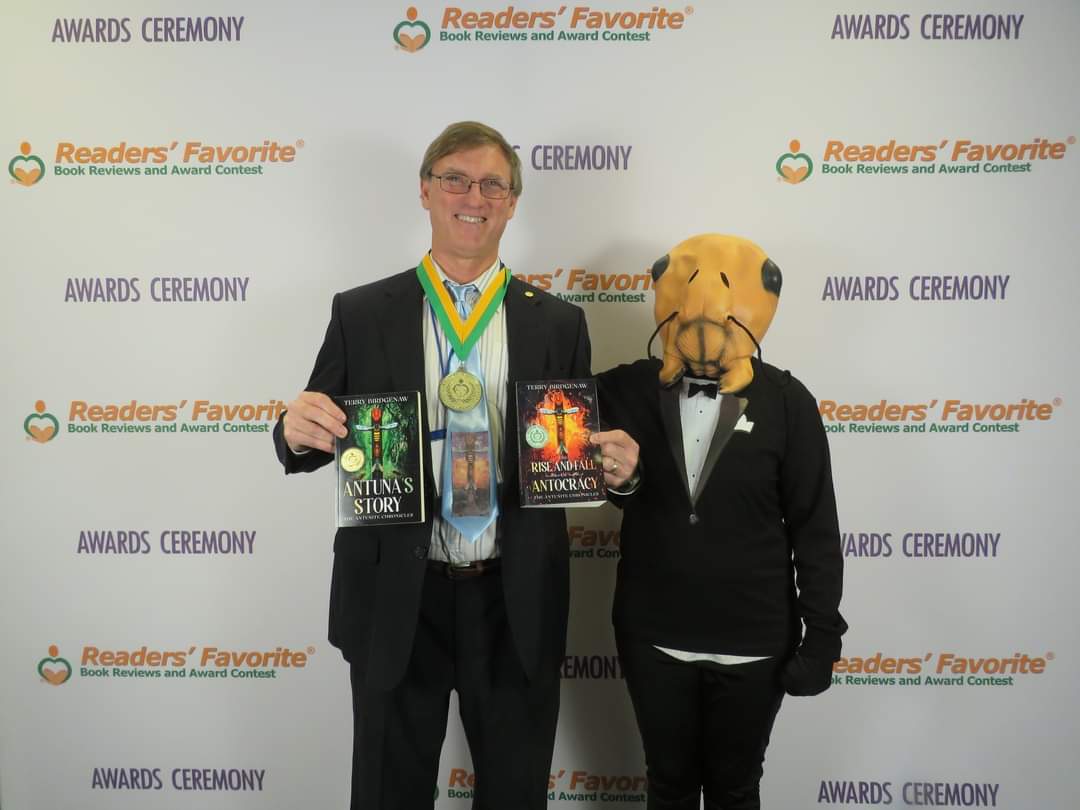
Terry: Editorial reviews have been stellar, and the books have received awards from most of the contests to which they have been entered. Awards for all three books include Gold Medal/Badge (Readers’ Favourite, Literary Titan), First Place Prize (Firebird, Entrada Incipere), Silver & Bronze Medal (Firebird, Bookfest), Honourable Mention (Readers’ Favourite), and Finalist (American Writing Awards, Chanticleer, The Wishing Shelf). Most notable review comments describe the books as: “soon-to-be a bestseller”, “takes speculative fiction to a new level”, “fantastical to a degree not seen elsewhere in any Sci-Fi dystopian fiction”, “as big in spirit as any literary giant in the genre” and “holds its ground next to Brave New World, Dune, Animal Farm, and 1984”. These reviews have “blown me away”, like an enthusiastic reader’s comment on Antuna’s Story.
.
Nina: What’s next for Terry Birdgenaw?
Terry: Finish editing Book 4 and writing a dystopian novel featuring humans for a change.
.
Nina: That sounds very intriguing! Thanks for coming out for the interview, Terry.
Terry: My pleasure, Nina.
.
The first three books of the Antunite Chronicles series by Terry Birdgenaw
.
You can find Terry’s books all over the place, including Amazon. Find out more about Terry on his website and check out Terry’s interview on SF Canada in which he talks more about his heritage and interests.
Terry Birdgenaw and one of his fans
.
Terry Birdgenaw with Narrant at award ceremonies
.
Nina Munteanu is a Canadian ecologist / limnologist and novelist. She is co-editor of Europa SF and currently teaches writing courses at George Brown College and the University of Toronto. Visit www.ninamunteanu.ca for the latest on her books. Nina’s bilingual “La natura dell’acqua / The Way of Water” was published by Mincione Edizioni in Rome. Her non-fiction book “Water Is…” by Pixl Press (Vancouver) was selected by Margaret Atwood in the New York Times ‘Year in Reading’ and was chosen as the 2017 Summer Read by Water Canada. Her novel “A Diary in the Age of Water” was released by Inanna Publications (Toronto) in June 2020.
Today, I’m sitting down with authors and writing coaches Suzanne Lieurance and Simon Rose to talk about their brand-new YouTube series, The Law of Attraction for Writers Podcast, which you can find at: https://www.youtube.com/@LawofAttractionforWritersPodca.
The show blends mindset, creativity, and practical writing advice — a combination that’s resonating with writers who want to manifest success and write with more ease.
.
Nina: Welcome, both of you!
Suzanne: Thank you! We’re so excited to finally share this project.
Simon: Yes, it’s been in the works for a while, and we’re thrilled to see writers already responding so positively.
Simon Rose and Suzanne Lieurance
Nina: Let’s start with the big question. Why create a Law of Attraction for Writers podcast?
Suzanne: Well, over the years, I’ve coached so many writers who say things like, “I’ll feel successful when I get an agent,” or “I’ll write when I have more time.” But the Law of Attraction teaches us it works the other way around — you become the person who already feels successful, and the opportunities follow. I wanted to create a podcast that helps writers understand how their thoughts, emotions, and energy shape their writing lives.
Simon: Exactly. So much of writing is mental. You can have the best outline and still feel blocked if your energy is off. We wanted to show that aligning your mindset with your goals isn’t mystical — it’s practical. You’re essentially training your brain to focus on what you want instead of what you fear.
Nina: How would you describe the podcast to someone who hasn’t tuned in yet?
Simon: Each episode focuses on one key aspect of the Law of Attraction and how it connects to the writing process. We might explore a concept like visualization, vibration, or inspired action — and then show writers how to apply that directly to their writing routines.
Suzanne: We wanted to make it accessible. It’s not just theory or motivation. We give writers clear steps they can take right away — ways to shift their thinking, attract new ideas, or rekindle their excitement for a project.
Simon: We also share personal stories. Between the two of us, we’ve seen these principles in action — in publishing, in teaching, and even in everyday creative decisions.
Nina: I love that you connect mindset with the craft of writing. Can you say more about how that works?
Suzanne: Sure. A lot of writers separate the two — mindset on one side, writing craft on the other. But they’re intertwined. You might know every writing technique out there, but if you’re doubting yourself or constantly telling yourself you’re behind, you’ll block the creative flow.
Simon: That’s why the Law of Attraction is so powerful for writers. It’s not just about “thinking positive.” It’s about intentionally setting the tone for your writing sessions, deciding what kind of writer you believe yourself to be, and letting that belief guide your actions.
Suzanne: In one episode, we talk about “energetic alignment” — how your emotional state affects the words you put on the page. When you write from frustration, the writing feels heavy. But when you write from joy or curiosity, the story expands.
Nina: You’ve both been writing coaches for years. How has it been working together on this project?
Simon: It’s been wonderful. Suzanne brings a very intuitive approach to writing and mindset, while I tend to look at things through a more analytical lens. Together, we strike a balance between the spiritual and the practical.
Suzanne: Yes! We complement each other well. Simon often grounds the big ideas in real-world examples, and I love exploring how energy and focus shape results. It’s a true partnership — and we both learn from each other in every episode.
Nina: Without giving too much away, what are some of the themes or takeaways that keep coming up in your discussions?
Suzanne: One theme that runs through everything is trust — trusting yourself, your ideas, and the timing of your success. The Law of Attraction reminds us that everything unfolds when you’re ready to receive it.
Simon: Another recurring idea is momentum. Writers often stop when things get tough, but energy builds through consistent action. You don’t have to write for hours every day — just focus on showing up with intention. That small shift can open the door to much bigger results.
Suzanne: We also talk about how to handle resistance. Every writer faces doubt or creative slumps. The podcast offers ways to turn those moments into opportunities instead of roadblocks.
Nina: You’ve chosen YouTube as your main platform. Why that format?
Simon: We wanted to make it easy and engaging. YouTube allows us to connect visually and energetically with our audience. Writers can listen while they work, which adds a more personal connection.
Suzanne: And YouTube’s format fits how writers consume content today. Many of them already use it to learn about craft and publishing. This podcast adds another layer — the inner work behind writing success.
Nina: What’s ahead for the Law of Attraction for Writers Podcast?
Suzanne: We’ll keep releasing new episodes every Tuesday. Each one will build on the idea that your energy, focus, and beliefs create your writing experience.
Simon: We’re also exploring live Q&A sessions, where writers can ask questions and share how they’ve applied the principles we discuss. It’s exciting to see a community forming around these ideas.
Suzanne: Ultimately, we want every writer to realize they’re not powerless. They can create not only their stories but also their success.
Nina: That’s such an inspiring message. Any final thoughts for writers who might be hesitant to explore this side of writing?
Suzanne: Just start listening with an open mind. You don’t have to “believe” in anything right away — just try applying one idea and see what shifts.
Simon: Yes. Writing is already an act of creation — you’re manifesting something that didn’t exist before. This podcast helps you see that same creative power working in every area of your writing life.
Follow Suzanne Lieurance and Simon Rose for practical, inspiring ways to align your mindset, energy, and creativity — and manifest the writing life you’ve always imagined.
.
Nina Munteanu is an award-winning novelist and short story writer of eco-fiction, science fiction and fantasy. She also has three writing guides out: The Fiction Writer; The Journal Writer; and The Ecology of Writing and teaches fiction writing and technical writing at university and online. Check the Publications page on this site for a summary of what she has out there. Nina teaches writing at the University of Toronto and has been coaching fiction and non-fiction authors for over 20 years. You can find Nina’s short podcasts on writing on YouTube. Check out this site for more author advice from how to write a synopsis to finding your muse and the art and science of writing.
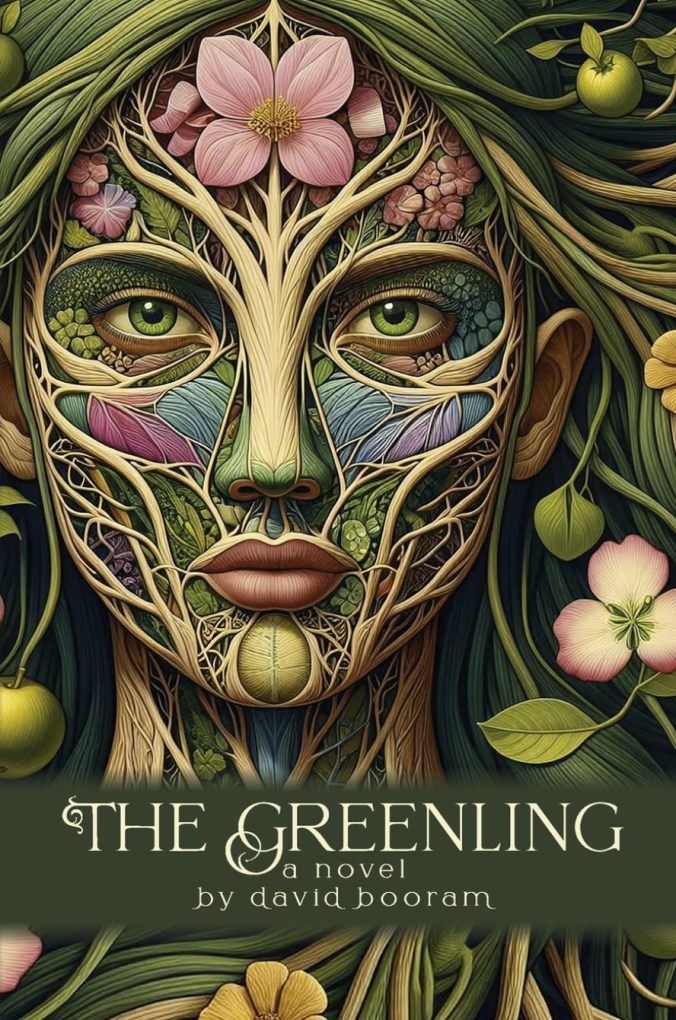
The Greenling by David Booram is an exploration of an intriguing ‘Nature evolving’ premise, told through a coming-of-age narrative.
Responding to continued human tampering, a growing sentient Nature calls a young environmental activist to action in a planetary reset. The main character is Noah, ostracized by her peers due to her unique perspective on the world and her activism for Nature. This makes her a candidate for Nature’s planetary reset.
.
While I felt that the story used over-simplified fantasm and eco-terrorism in a way not to my liking, I found most intriguing Booram’s use of biosemiosis, the notion that all life finds meaning.
Coincidently, I had agreed to read Booram’s eco-fiction novel (without knowing much about it) after a social media conversation we’d had during a time when I was working on my most recent novel, tentatively called (Re)Genesis. My novel relied heavily on the concept of biosemiosis. Its premise of dark karma—when Nature learns to reflect back what we send out—made use of real examples of learning, pattern recognition, anticipation and adaptation in non-human life. (Another coincidence at this same time occurred when another author approached me to read their work on coincidence, which I am currently reading).
In the 1930s, Jakob von Uexküll coined the term Umwelt (species-specific reality or subjective environment) to define a life process that involved semiotic interactions. He argued that an organism’s behaviour results from activity that attributes meaning to the world around it, rather than merely mechanically reacting to stimuli. Building on this notion, Friedrich S. Rothschild coined the term “biosemiosis” in 1962 to postulate that life has its subjective interpretation of the world around it (its Umwelt), a segment of the world that has significance and meaning based on that life’s biology and needs. Developing biosemiosis further, Thomas Sebeok later contended that all organisms are enveloped in a cloud of messages about themselves and their situation, which they constantly transmit, receive, and interpret. Life itself is a process of signification and meaning-making, from bacteria and plants to mammals and birds. Biosemiosis involves pattern recognition, anticipation, flexibility, goal-directed movement, memory, and learning.
Perhaps most intriguing is how The Greenling touches on humanity’s growing zeitgeist of not just planetary awareness but of sensibility, a sense that we are interlinked with all other life and nonlife, that we are all more than the sum of our parts. And only then—when we make meaning of our Umwelt—can we transcend from our toxic insecurities and bullying ways.
The Greenling is worth reading for how it weaves climate facts into compelling personal story. I also find refreshing that Booram gives full agency to the environment, Nature, and its nonhuman representatives.
I have been writing, reading, and studying eco-fiction for several decades and what I found noteworthy is how agency of the environment, as character, has changed over the years and how Nature’s portrayal has evolved from ‘other’ with little agency to ‘not other’ with much agency. For more on this concept and change, I urge you to read my two essays on this evolution:
David Booram is the cofounder and director of Fall Creek Abbey, an urban retreat center in Indianapolis, where he and his wife Beth lead The School of Spiritual Direction and offer individual and group spiritual direction. He is the founder of Direction 4 Life Work, through which he is a career counselor.
.
Nina Munteanu is a Canadian ecologist / limnologist and novelist. She is co-editor of Europa SF and currently teaches writing courses at George Brown College and the University of Toronto. Visit www.ninamunteanu.ca for the latest on her books. Nina’s bilingual “La natura dell’acqua / The Way of Water” was published by Mincione Edizioni in Rome. Her non-fiction book “Water Is…” by Pixl Press (Vancouver) was selected by Margaret Atwood in the New York Times ‘Year in Reading’ and was chosen as the 2017 Summer Read by Water Canada. Her novel “A Diary in the Age of Water” was released by Inanna Publications (Toronto) in June 2020.
A short while ago I was contacted by fellow SF Canada member Lisa Timpf to provide information on an article she was writing about editing anthologies. Lisa’s article, entitled “Anthology Editing: Advice and Insights from Those Who’ve Been There”recently appeared on the Jane Friedman site.
Lisa interviewed two publishers and several editors, including me, on what’s involved in putting out an anthology. The article was thorough and well written and provided useful insight and advice to would be anthology editors. Aspects included: what the job entails, what skills are needed (e.g. storytelling, organization, communication and negotiation, flexibility, the ability to deal with difficult situations, and the willingness to go outside your comfort zone), and the payoffs, of course.
The article covered all stages of producing the anthology, from pitching to a publisher to the process of acquisition and production. She ends her article with “Final Words” of her own reflection and great advice. Lisa draws on Christine Lowther’s advice to be patient and to be “honest about your priorities.” Given how long and involved the process can be (it took three years from call for submissions to final release for the latest anthology I edited), she rightly suggests strongly considering whether you “can dedicate the time and effort to editing without resenting the impact on [your] own writing.”
Lisa then ends with:
“If you, too, are on the fence, consider Nina Munteanu’s reflection on the anthology editing process. As she explains it, ‘Watching the anthology emerge through the slow collection of many outside sources of individual creativity, style and message is akin to watching the birth of a galaxy full of stars—gathered and orchestrated by you but so much more than the sum of its parts—comprising many singular notes of a symphony that together create something wondrous and beautiful.’
Lisa Timpf served as guest editor for Eye to the Telescope 32: Sports and Games. Her book reviews, poems, and short stories have appeared in a variety of venues, and her speculative poetry collection, Cats and Dogs in Space, is available from Hiraeth Publishing. You can find out more about Lisa’s writing and artwork at lisatimpf.blogspot.com, and also find her on Bluesky.
.
Go to this link to read my review of Lisa’s speculative poetry collection, Cats and Dogs in Space.
.
Nina Munteanu is a Canadian ecologist / limnologist and novelist. She is co-editor of Europa SF and currently teaches writing courses at George Brown College and the University of Toronto. For the latest on her books, visit www.ninamunteanu.ca. Nina’s bilingual “La natura dell’acqua / The Way of Water” was published by Mincione Edizioni in Rome. Her non-fiction book “Water Is…” by Pixl Press (Vancouver) was selected by Margaret Atwood in the New York Times ‘Year in Reading’ and was chosen as the 2017 Summer Read by Water Canada. Her novel “A Diary in the Age of Water” was released by Inanna Publications (Toronto) in June 2020.
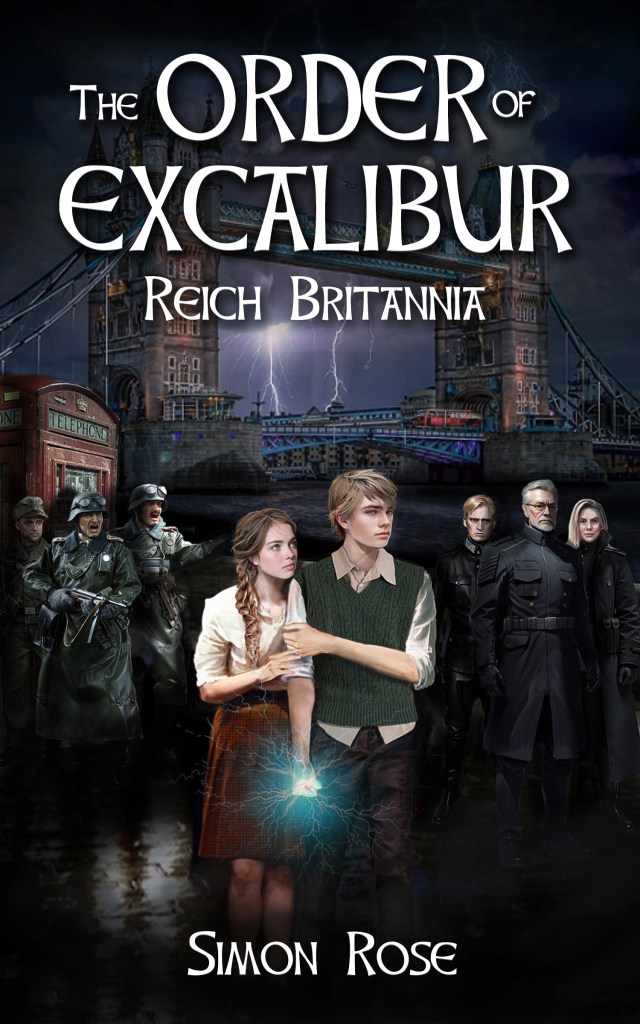
My guest today is Calgary author Simon Rose who has published twenty-one novels for children and young adults, eight guides for writers, more than a hundred nonfiction books, and many articles on a wide variety of topics. Today, we’re looking at his latest novels for young adults, The Order of Excalibur – The Ring of Fate, and The Order of Excalibur – Reich Britannia.
.
Nina: What are the books all about?
Simon: The Order of Excalibur – The Ring of Fate is a fantasy novel for young adults set in England early in World War II. At the height of the Blitz and the Battle of Britain, young Canadian wizards Nick and Ginny are recruited by the mysterious Order of Excalibur as the country faces the threat of invasion.
The Order of Excalibur – Reich Britannia is a fantasy novel for young adults set in a parallel universe in the early 1940s, where Germany has invaded and occupied Great Britain. In a deadly nightmare world, Canadian teen wizards Nick and Ginny must risk their lives to alter the course of events and put history back on track.
Nina: And what’s the story behind the story?
Simon: The Order of Excalibur – The Ring of Fate is a fantasy novel for young adults set in Britain early in World War II. At the height of the Blitz and the Battle of Britain, young Canadian wizards Nick and Ginny are recruited by the mysterious Order of Excalibur as the country faces the threat of invasion.
.
Nick and Ginny’s father, Robert Jennings, is the world’s leading scholar on the magic and folklore of the Arthurian period, based at Cambridge University, while The Order of Excalibur has kept the secrets of Merlin since the early Middle Ages. The Order also has possession of a ring that Merlin supposedly used to materialize a stone circle similar to Stonehenge known as the Ring of Fate in the centre of his workshop. The spaces between the stones in the circle would reveal how events might occur if certain decisions were made. However, Merlin’s ring hasn’t been used since he died, and the stone circle hasn’t been seen since that time. The Order made attempts to materialize the Ring of Fate when Britain was under threat from the Spanish Armada in 1588 and from Napoleon in 1805 without success and when the situation in 1940 is even more desperate the British government is willing to try anything.
.
Robert and the children begin working in an underground facility in the heart of London during the Blitz and the Battle of Britain. Using their magical powers, Nick and Ginny are able to get the Ring of Fate to appear. While they view potential scenarios showing that all will be well and that there won’t be a German invasion, they also see other possible outcomes revealing a successful German invasion and subsequent occupation of Britain.
When a massive explosion almost destroys the underground facility, Robert, Nick, and Ginny are shocked when reaching the surface that London is now under German occupation. Robert, Nick, and Ginny attempt to escape from the German soldiers but soon begin to forget the other timeline and their own identities, as they go on the run in a nightmare world.
The Order of Excalibur – Reich Britannia is a fantasy novel for young adults set in a parallel universe in the early 1940s, where Germany has invaded and occupied Great Britain. This was one of the possible futures shown between the standing stones of Merlin’s Ring of Fate that has now become reality, once the stones were materialized by Canadian teen wizards Nick and Ginny.
.
Nick and Ginny are initially separated in a deadly nightmare world before being recruited by the British Resistance and learning of the previous reality, risking their lives to alter the course of events. They are also opposed by powerful German wizards in the Paranormal Division.
Following an assassination attempt on the life of the German governor, security is tightened, and many Resistance members are killed. With time running out before the reality of German victory becomes permanent, Nick and Ginny must find a way to bring back the Ring of Fate and put history back on track, before it’s too late.
.
Nina: You must have done quite a lot of historical research for the novels.
Simon: Yes, the story, main characters, and some of the settings in this novel are fictional but are based on true events that took place in World War II. I did lots of research into the early stages of the conflict. Following the story, the glossary has links to online sources where readers can learn more about the historical events, military campaigns, settings, and leading characters from World War II that are featured in the story. On my website, there’s a page dedicated to the book, along with links to separate pages featuring information regarding the book’s historical background and links to many online sources.
Nina: What are you currently working on?
Simon: I always have a few current projects and right now I’m working on more books in the same genre as my previously published paranormal Flashback series, a fantasy series, a historical fiction novel, and some picture books. I also continue to work on the adaptations of my Shadowzone series into screenplays for movies and TV shows, some other scripts, as well as teaching writing courses at the University of Calgary.
Anyone interested in keeping up to date with the projects that I’m working on is always welcome to subscribe to my monthly newsletter, which you can do at www.simon-rose.com.
Nina: You work with other authors, as well as on a variety of projects related to writing and publishing, don’t you?
Simon: Yes, I offer coaching, editing, consulting, and mentoring services for writers of novels, short stories, fiction, nonfiction, biographies, and in many other genres, plus do work with writers of scripts and screenplays. You can find details of some of the projects I’ve worked on with other authors, along with some references and recommendations, at www.simon-rose.com.
Nina: Where can people buyThe Order of Excalibur – The Ring of Fate and The Order of Excalibur – Reich Britannia?
Simon: The books can be purchased at most of the usual placesas follows:
Nina: Thanks Simon, for being my guest here today and the very best of luck with the The Order of Excalibur novels. I hope that the books sell thousands and thousands of copies in the coming months.
You can learn more about Simon and his work on his website at www.simon-rose.com, where you can also link to him at other locations online.








 Nina Munteanu Writing Coach