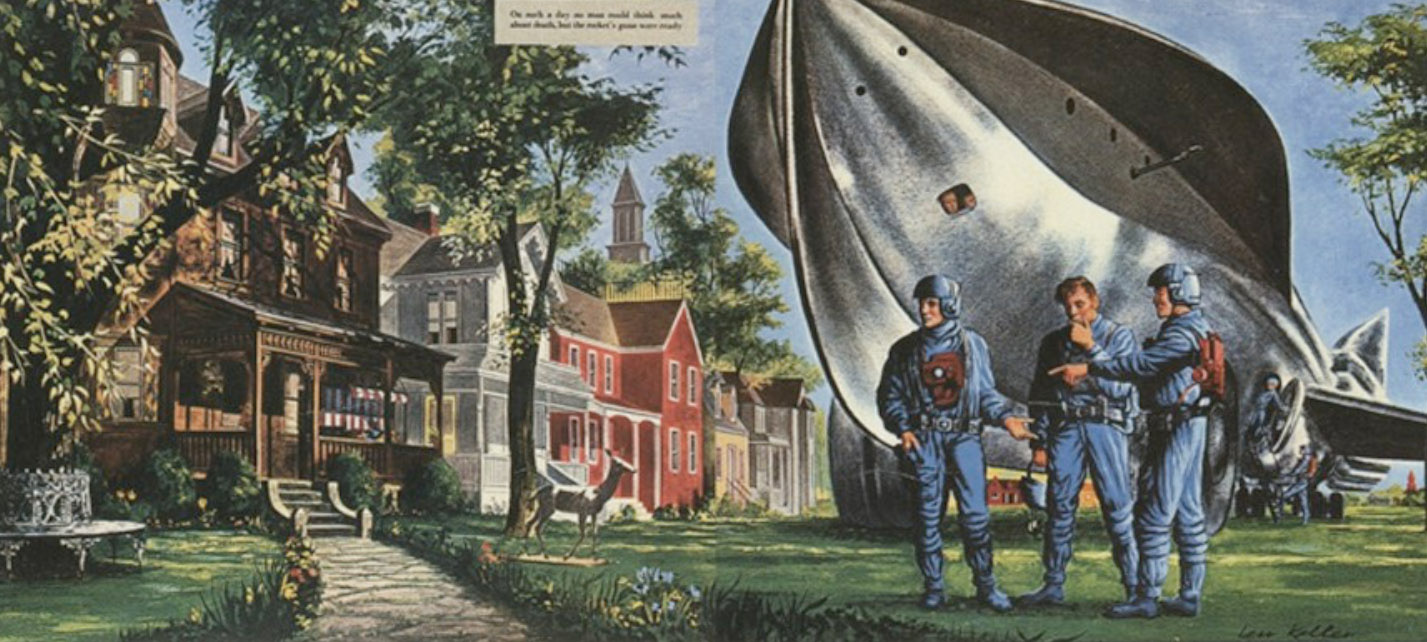
Illustration depicting ‘Rocket Summer’ (image from The Black Cat Moan)
They came because they were afraid or unafraid, happy or unhappy. There was a reason for each man. They were coming to find something or get something, or to dig up something or bury something. They were coming with small dreams or big dreams or none at all
Ray Bradbury, The Martian Chronicles
When I was but a sprite, and before I became an avid reader of books (I preferred comic books), I read Ray Bradbury’s The Martian Chronicles. It changed me, what I thought of books and what I felt about the power of stories. It made me cry. And perhaps that was when I decided to become a writer. I wanted to move people as Bradbury had moved me.
The 1970 Bantam book jacket aptly describes The Martian Chronicles as, “a poetic fantasy about the colonization of Mars. The story of familiar people and familiar passions set against incredible beauties of a new world…A skillful blending of fancy and satire, terror and tenderness, wonder and contempt.”
Rockets land on Mars overlooking Bradbury Lane (illustration from Sutori)
The Martian Chronicles isn’t really about Mars. True to Bradbury’s master metaphoric storytelling, The Martian Chronicles is about humanity. Who we are, what we are and what we may become. What we inadvertently do—to others, and finally to ourselves—and how the irony of chance can change everything. Despite the knowledge of no detectable amounts of oxygen, Bradbury gave Mars a breathable atmosphere: “Mars is a mirror, not a crystal,” he said, using the planet for social commentary rather than to predict the future.
From “Rocket Summer” to “The Million-Year Picnic,” Ray Bradbury’s stories of the colonization of Mars form an eerie tapestry of past and future. Written in the 1940s, the chronicles long with the nostalgia of shady porches with pitchers of lemonade, ponderously ticking grandfather clocks, and comfortable sofas. Expedition after expedition leave Earth to investigate and colonize Mars. Though the Martians guard their mysteries well, they succumb to the diseases that come with the rocketeers and grow extinct—not unlike the quiet disappearance of the golden toad, the Pinta giant tortoise, or the Bramble Cay melomys. Humans, with ideas often no more lofty than starting a tourist hot-dog stand, bear no regret for the native alien culture they exploit and eventually displace.
It is a common theme of human colonialism and expansionism, armed with the entitlement of privilege. Mars is India to the imperialistic British Empire. It is Rwanda or Zaire to the colonial empire of the cruel jingoistic King Leopold II of Belgium. Mars is Europe to Nazi Germany’s sonderweg. We need look no further than our own Canadian soil for a reflection of this slow violence of disrespect and apathy by our settler ancestors on the indigenous peoples of Canada.
Mars was a distant shore, and the men spread upon it in waves… Each wave different, and each wave stronger.
The Martian Chronicles
Tyler Miller of The Black Cat Moan makes excellent commentary in their 2016 article entitled “How Ray Bradbury’s ‘The Martian Chronicles’ changed Science Fiction (and Literature).”The article begins with a quote from Argentinean author Jorge Luis Borges (in the introduction to the Spanish-language translation of The Martian Chronicles: “What has this man from Illinois done, I ask myself when closing the pages of this book, that episodes from the conquest of another planet fill me with horror and loneliness?”
Remember, this was the 1950s … halfway through a century dominated by scientific discovery, and expansion. The 1950s saw developments in technology, such as nuclear energy and space exploration. On the heels of the end of World War II, the 1950s was ignited by public imagination on conquering space, creating technological futures and robotics. The 1950s was considered by some as the real golden age for science fiction, still a kind of backwater genre read mostly by boys and young men, that told glimmering tales of adventure, exploration, and militarism, of promising technologies, and often-androcratic societies who used them in the distant future to conquer other worlds full of strange and disposable alien beings in the name of democracy and capitalism. (In some ways, this is still very much the same.Though, it is thankfully changing…)
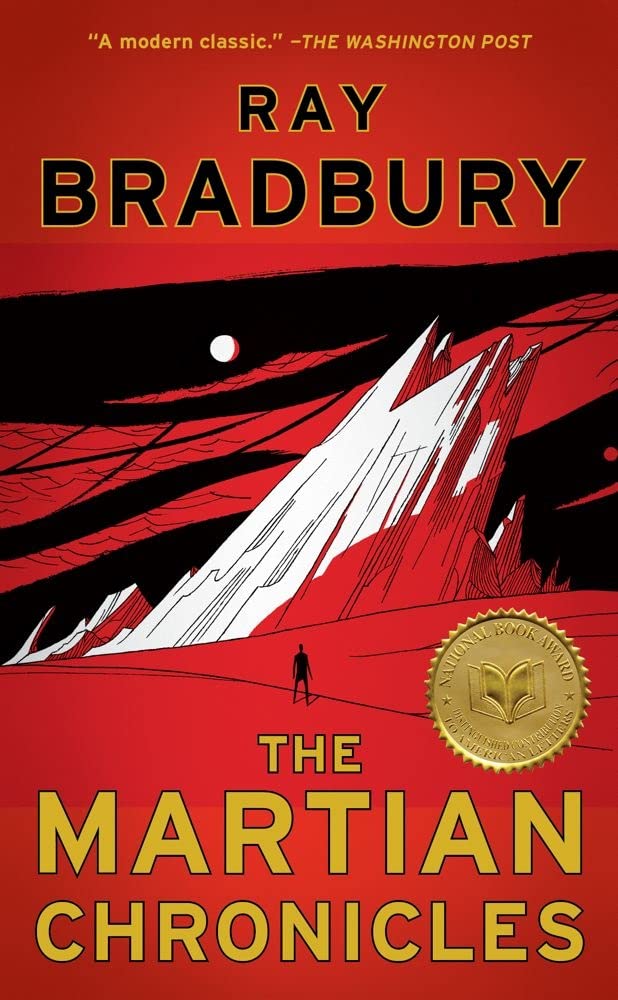
(Bantam 1951 1st edition cover)
Many scientists deeply involved in the exploration of the solar system (myself among them) were first turned in that direction by science fiction. And the fact that some of that science fiction was not of the highest quality is irrelevant. Ten year‐olds do not read the scientific literature.
Carl Sagan, 1978
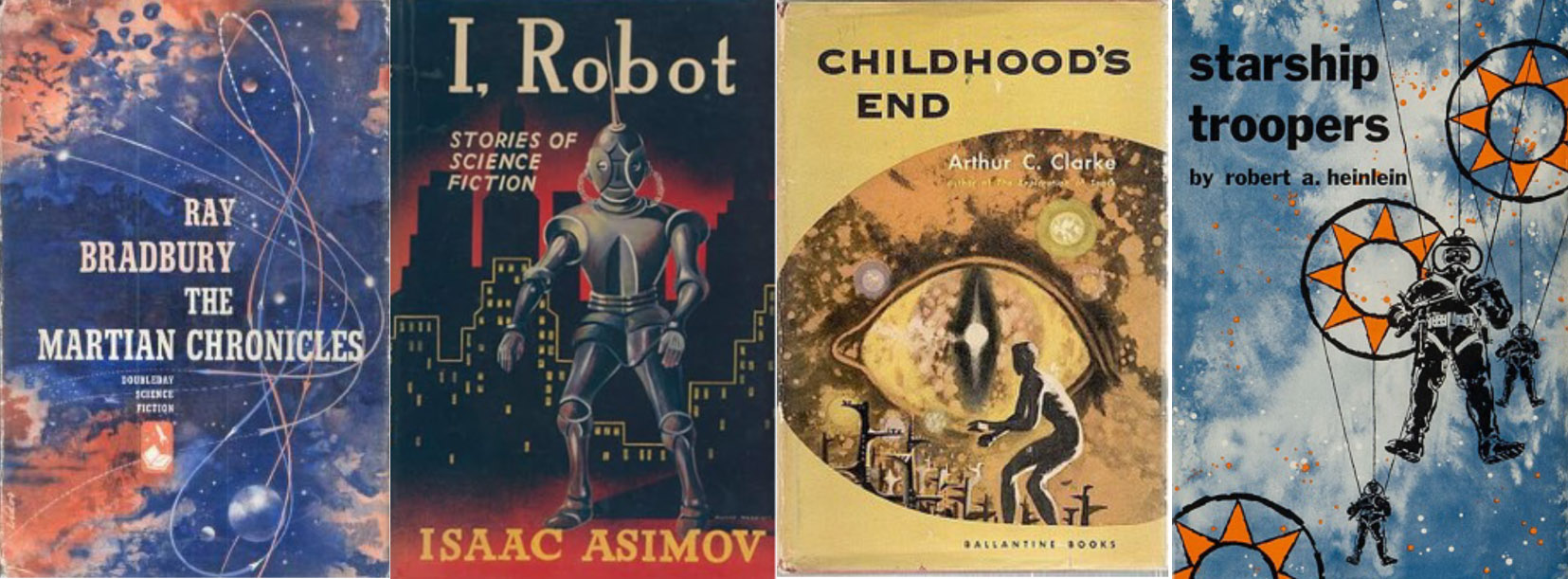
First edition book covers of Martian Chronicles (Doubleday, 1950); I, Robot (Grayson & Grayson, 1952); Childhood’s End (Ballantine Books, 1953); and Starship Troopers (G.P. Putnam’s Sons, 1959)
Large idea-driven SF works that typified this time period included Robert A. Heinlein’s Starship Troopers, Arthur C. Clarke’s Childhood’s End, Isaac Asimov’s I, Robot and his Foundation series.
It was at this time that Ray Bradbury published The Martian Chronicles. Though filled with the requisite rocket ships, gleaming Martian cities, ray guns, and interplanetary conquest, from the very start—as Borges noted—The Martian Chronicles departed radically from its SF counterparts of the time.
(Illustration on album cover of “Rocket Summer”, music by Chris Byman)
Instead of starting with inspiring technology or a stunning action sequence, or a challenging idea or discovery, Bradbury’s The Martian Chronicles opens with a domestic scene.
One minute it was Ohio winter, with doors closed, windows locked, the panes blind with frost, icicles fringing every roof, children skiing on the slopes, housewives lumbering like great black bears in their furs along the icy streets.
And then a long wave of warmth crossed the small town. A flooding sea of hot air; it seemed as if someone had left a bakery door open. The heat pulsed among the cottages and bushes and children. The icicles dropped, shattering, to melt. The doors flew open. The windows flew up. The children worked off their wool clothes. The housewives shed their bear disguises. The snow dissolved and showed last summer’s ancient green lawns.
Rocket summer. The words passed among the people in the open air, airing houses. Rocket summer. The warm desert air changing the frost patterns on the windows, erasing the art work. The skis and sleds suddenly useless. The snow, falling from the cold sky upon the town, turned to a hot rain before it touched the ground.
Rocket summer. People leaned from their dripping porches and watched the reddening sky.
The rocket lay on the launching field, lowing out pink clouds of fire and oven heat. The rocket stood in the cold winter morning, making summer with every breath of its mighty exhausts. The rocket made climates, and summer lay for brief moment upon the land…
Ray Bradbury, The Martian Chronicles, Rocket Summer
Bradbury’s focus was on the domestic. Housewives fighting off the ice and snow of Ohio. A Martian woman “cleaning the house with handfuls of magnetic dust which, taking all dirt with it, blew away on the hot wind.”
They had a house of crystal pillars on the planet Mars by the edge of the empty sea, and every morning you could see Mrs. K eating the golden fruits that grew from the crystal walls, or cleaning the house with handfuls of magnet dust which, taking all dirt with it, blew away on the hot wind. Afternoons, when the fossil sea was warm and motionless, and the wine trees stood stiff in the yard…you could see Mr. K in his room, reading from a metal book with raised hieroglyphs over which he brushed his hand, as one might play a harp. And from the book, as his fingers stroked, a voice sang, a soft ancient voice, which told tales of when the sea was red steam on the shore and ancient men had carried clouds of metal insects and electric spiders into battle…
This morning Mrs. K stood between the pillars, listening to the desert sands heat, melt into yellow wax, and seemingly run on the horizon.
Something was going to happen.
She waited.
Ray Bradbury, The Martian Chronicles, Ylla
Bradbury’s gift to literature—and to his SF genre—was his use of metaphor. Unlike the science fiction of his colleagues, Bradbury’s stories are a lens to study the past and the present. According to Miller, “The Earthmen’s exploration and desolation of Mars allowed Bradbury to look not forward but backward at exploration and desolation on Earth, namely the European arrival in the New World. Just as Europeans landed in North and Central America wholly unprepared for what they found there, Bradbury’s Earthmen are unprepared time and again for the wonder and the horror of Mars. And just as European diseases decimated native people in the Americas, it is chicken-pox which wipes out the Martians.”
The back cover of the 2012 mass market paperback Simon & Schuster Reprint edition of The Martian Chronicles reads:
Bradbury’s Mars is a place of hope, dreams and metaphor—of crystal pillars and fossil seas—where a fine dust settles on the great, empty cities of a silently destroyed civilization. It is here the invaders have come to despoil and commercialize, to grow and to learn—first a trickle, then a torrent, rushing from a world with no future toward a promise of tomorrow. The Earthman conquers Mars … and then is conquered by it, lulled by dangerous lies of comfort and familiarity, and enchanted by the lingering glamour of an ancient, mysterious native race.
“Ask me then, if I believe in the spirit of the things as they were used, and I’ll say yes. They’re all here. All the things which had uses. All the mountains which had names. And we’ll never be able to use them without feeling uncomfortable. And somehow the mountains will never sound right to us; we’ll give them new names, but the old names are there, somewhere in time, and the mountains were shaped and seen under those names. The names we’ll give to the canals and the mountains and the cities will fall like so much water on the back of a mallard. No matter how we touch Mars, we’ll never touch it. And then we’ll get mad at it, and you know what we’ll do? We’ll rip it up, rip the skin off, and change it to fit ourselves.”
“We won’t ruin Mars,” said the captain. “It’s too big and too good.”
“You think not? We Earth Men have a talent for ruining big, beautiful things.”
Ray Bradbury, The Martian Chronicles, And the Moon be Still as Bright
Ray Bradbury’s The Martian Chronicles is a profound and tender analysis of the quiet power humanity can wield unawares and how we define and treat ‘the other.’ It is a tragic tale that reflects only too well current world events where the best intended interventions can go awry. From the meddling friend who gossips to “help” another (only to make things worse) to the righteous “edifications” of a religious group imposing its “order” on the “chaos” of a “savage” peoples … to the inadvertent tragedy of simply and ignorantly being in the wrong place at the wrong time (e.g., the introduction of weeds, disease, etc. by colonizing “aliens” to the detriment of the native population; e.g., smallpox, AIDs, etc.). Bradbury is my favourite author for this reason (yes, and because he makes me cry…)
Mars terrain (photo by NASA)
Nina Munteanu is a Canadian ecologist / limnologist and novelist. She is co-editor of Europa SF and currently teaches writing courses at George Brown College and the University of Toronto. Visit www.ninamunteanu.ca for the latest on her books. Nina’s bilingual “La natura dell’acqua / The Way of Water” was published by Mincione Edizioni in Rome. Her non-fiction book “Water Is…” by Pixl Press (Vancouver) was selected by Margaret Atwood in the New York Times ‘Year in Reading’ and was chosen as the 2017 Summer Read by Water Canada. Her novel “A Diary in the Age of Water” was released by Inanna Publications (Toronto) in June 2020.
My eco-fiction book A Diary in the Age of Water was recently cited along with Paolo Bacigalupi’s book The Water Knife, in an article on conflict risk in international transboundary water bodies.
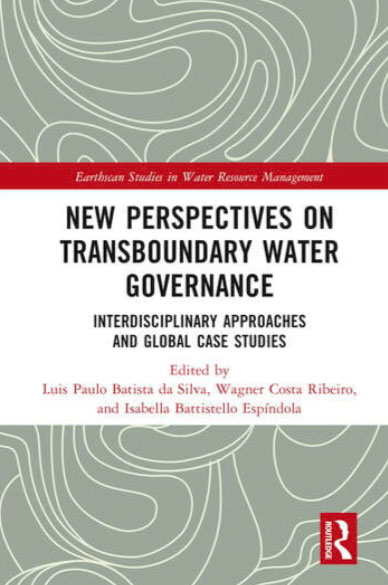
The citation was made in Ken Conca’s article (Chapter 1: “Climate change, adaptation, and the risk of conflict in international river basins: Beyond the conventional wisdom”) of the 2024 Routledge book “New Perspectives on Transboundary Water Governance:Interdisciplinary Approaches and Global Case Studies” (edited by Luis Paulo Batista da Silva, Wagner Costa Ribeiro, and Isabela Battistello Espíndola).
Conca begins his chapter with a statistic—an estimated 310 rivers in the world cross national borders, form borders, or both—and goes on to discuss the risk of conflict that naturally arises in such situations. Conca traces a rich history of disputes, with one of the oldest occurring between Lagash and Umma (present-day southern Iraq) in 2500 BCE. Conca explores the early warning indicators explored by the World Resources Institute that imply “a future in which our bordered politics, combined with hydrologic interdependencies, could yield a combustible mix of tension and grievances” and adds that several rivers flagged in the WRI study lie in regions of crhonic tension and political instability. He then includes a 2013 quote by former UN Secretary-General Ban Ki-moon:
“Our experiences tell us that environmental stress, due to lack of water, may lead to conflict, and would be greater in poor nations … population growth will make the problem worse. So will climate change. As the global economy grows, so will its thirst. Many more conflicts lie just over the horizon.” Ban also stated that climate change promised “an unholy brew that can create dangerous security vacuums” in which “mega-crises may well become the new normal.”
Conca makes his point by quoting the U.S. Center for Strategic and International Studies: “the real wild card for political and social unrest in the Middle East over the next 20 years is not war, terrorism, or revolution—it is water.”
Conca makes the connection with narratives of fiction:
“This framing of scarcity-induced conflict risk has even crept into the world of fiction. Paulo Bacigalupi’s dystopian novel The Water Knife (2016) portrays a parched southwestern United States of the near future. He foresees American states militarizing both their water relations (with corporate militias destroying infrastructure meant to divert water) and their borders (with the water-rich states seeking to keep thirsty migrant out, and the water poor states seeking to keep them in). Nina Munteanu’s A Diary in the Age of Water (2020) envisions Canada as a wholly-owned colony of the United States (itself owned by China). She describes a world in which Niagara Falls has been turned off and pet ownership is outlawed as an unacceptable water burden.”
Conca unpacks various misconceptions on sources of conflict and conflict resolution to do with transboundary water bodies. The chapter is very enlightening, as is the entire book!
The 2024 Routledge book “New Perspectives on Transboundary Water Governance:Interdisciplinary Approaches and Global Case Studies” (edited by Luis Paulo Batista da Silva, Wagner Costa Ribeiro, and Isabela Battistello Espíndola) is described by the publisher below:
This book presents a novel examination of transboundary water governance, drawing on global case studies and applying new theoretical approaches.
Excessive consumption and degradation of natural resources can either heighten the risks of conflicts or encourage cooperation within and among countries, and this is particularly pertinent to the governance of water. This book fills a lacuna by providing an interdisciplinary examination of transboundary water governance, presenting a range of novel and emerging theoretical approaches. Acknowledging that issues vary across different regions, the book provides a global view from South and Central America, Africa, Asia, and the Middle East, with the case studies offering civil society and public managers concrete situations that indicate difficulties and successes in water sharing between bordering countries. The volume highlights the links between natural resources, political geography, international politics, and development, with chapters delving into the role of paradiplomacy, the challenges of climate change adaptation, and the interconnections between aquifers and international development. With rising demand for water in the face of climate change, this book aims to stimulate further theoretical, conceptual, and methodological debate in the field of transboundary water governance to ensure peaceful and fair access to shared water resources.
This book will be of interest to students and scholars of water resource governance from a wide variety of disciplines, including geography, international relations, global development, and law. It will also be of interest to professionals and policymakers working on natural resource governance and international cooperation.
Nina Munteanu is a Canadian ecologist / limnologist and novelist. She is co-editor of Europa SF and currently teaches writing courses at George Brown College and the University of Toronto. Visit www.ninamunteanu.ca for the latest on her books. Nina’s bilingual “La natura dell’acqua / The Way of Water” was published by Mincione Edizioni in Rome. Her non-fiction book “Water Is…” by Pixl Press (Vancouver) was selected by Margaret Atwood in the New York Times ‘Year in Reading’ and was chosen as the 2017 Summer Read by Water Canada. Her novel “A Diary in the Age of Water” was released by Inanna Publications (Toronto) in June 2020.
Fence and post at marsh during a rain, ON (photo by Nina Munteanu)
The Universe is made of stories, not atoms—Muriel Rukeyser
Canadian writer Mary Woodbury tells us that: “Fiction exploring humanity’s impacts on nature is becoming more popular [and] has the distinct ability to creatively engage and appeal to readers’ emotions. In fact, it can stir environmental action.” A survey she took in 2020 showed that “88% of its participants were inspired to act after reading ecological fiction.”
Eco-Fiction (short for ecological fiction) is a kind of fiction in which the environment—or one aspect of the environment—plays a major role, either as premise or as character. “Principled by real science and exalting our planet’s beauty, these stories are works of art. They live within classic modes of fiction exploring the human condition, but also integrate the wild,” writes Woodbury. At the heart of eco-fiction are strong relationships forged between the major character on a journey and an aspect of their environment and place. Environment and place can illuminate through the sub-text of metaphor a core aspect of the main character and their journey.
Green architecture design by Vincent Callebaut
All great literature distills its art form through the exploration of relationship: our relationship with technology, with science, Nature, God, our children, each other, our history. Science fiction illuminates our history and our very humanity by examining our interaction with “the other”—the unfamiliar, the feared, the often downtrodden, the invisible, the ignored. This is the hero’s journey. And it is through this journey relating to the “other” (whether it’s Earth or an alien planet, its water, environment and issues, and its varied peoples and cultures) that our hero discovers herself and her gift to the world. When will we stop portraying Nature as “other”?…
Green neighbourhood design by Vincent Callebaut
We currently live in a world in which climate change and associated water crisis pose a very real existential threat to most life currently on the planet. The new normal is change. And it is within this changing climate that eco-fiction is realizing itself as a literary pursuit worth engaging in. The emergence of the term eco-fiction as a brand of literature suggests that we are all awakening—novelists and readers of novels—to our changing environment. We are finally ready to see and portray environment as an interesting character with agency and to read this important and impactful literature.
Lavender farm and house design by Vincent Callebaut
Many readers are currently seeking fiction that describes environmental issues but also explores a successful paradigm shift: fiction that accurately addresses our current issues with intelligence and hope. This is reflected in the growing popularity of several emerging sub-genres of fiction such as solar punk, optimistic climate fiction, clifi, eco-lit, hope punk, and others. The power of envisioning a certain future is that the vision enables one to see it as possible. Eco-fiction—and all good science fiction—uses metaphor to study the world and the consequences of humanity’s actions through microcosmic dramatization. What makes this literature particularly exciting is: 1) its relevance to our current existential situation; and 2) that it often provides a way forward.
Solarpunk world imagined (image by Imperial Boy)
The Way Forward with Solarpunk
In his 2014 article “Solarpunk: Notes toward a manifesto” in Hieroglyph Adam Flynn writes of under-30 futurists: “Many of us feel it’s unethical to bring children into a world like ours. We have grown up under a shadow, and if we sometimes resemble fungus it should be taken as a credit to our adaptability.”
“We’re solarpunks because the only other options are denial or despair.”
ADAM FLYNN
Solarpunk, says Flynn, “is about finding ways to make life more wonderful for us now, and more importantly for the generations that follow us—i.e., extending human life at the species level, rather than individually.” Our future, asserts Flynn, “must involve repurposing and creating new things from what we already have (instead of 20thcentury “destroy it all and build something completely different” modernism).” Solarpunk futurism “is not nihilistic like cyberpunk and it avoids steampunk’s potentially quasi-reactionary tendencies: it is about ingenuity, generativity, independence, and community.”
“Hydrogenase” algae-powered airships by Vincent Callebaut
The ‘punk’ suffix comes from the oppositional quality of solarpunk; opposition that begins with infrastructure as a form of resistance. Flynn tells us that solarpunk draws on the ideal of Jefferson’s yeoman farmer, Ghandi’s ideal of swadeshi, and countless other traditions of innovative dissent.
“Hyperion” eco-neighbourhood design by Vincent Callebaut
“Solarpunk is a future with a human face and dirt behind its ears.”
ADAM FLYNN
In response to Flynn’s article, Bob Vanderbob writes, “going solar is a deep mental shift: it will be the central metaphor of our future civilization.”
Green Paris design by Vincent Callebaut
Musician photographer Jay Springett calls solarpunk, “a movement in speculative fiction, art, fashion, and activism that seeks to answer and embody the question ‘what does a sustainable civilization look like, and how can we get there?’… At once a vision of the future, a thoughtful provocation, and an achievable lifestyle.” Jennifer Hamilton observes in The Conversation that “as a category of fiction, solarpunk remains a fringe dweller…Nevertheless, the aesthetic sensibilities of the subculture are starting to emerge.” Hamilton asserts that “the focus on the cultural change that will necessarily accompany the full transition to renewable energy is the defining feature of solarpunk.” She adds, “we usually ask ‘can renewables replace fossil fuels?’ … solarpunks ask ‘what kind of world will emerge when we finally transition to renewables?’ and their [works] are generating an intriguing answer.”
Beach house design by Vincent Callebaut
How Eco-Fiction Inspires and Galvanizes
Readers responded to Mary Woodbury’s survey question “Do you think that environmental themes in fiction can impact society and if so, how?” with these observations:
Environmental fiction encourages empathy and imagination. Stories can affect us more than dry facts. Fiction reaches us more deeply than academic understanding, moving us to action.
Environmental fiction triggers a sense of wonder about the natural world, and even a sense of loss and mourning. Stories can immerse readers into imagined worlds with environmental issues similar to ours.
Environmental fiction raises awareness, encourages conversations and idea-sharing. Fiction is one way that helps to create a vision of our future. Cautionary tales can nudge people to action and encourage alternative futures. Novels can shift viewpoints without direct confrontation, avoid cognitive dissonance, and invite reframed human-nature relationships through enjoyment and voluntary participation.
Environmental themes can reorient our perspective from egocentrism to the greater-than-human world.
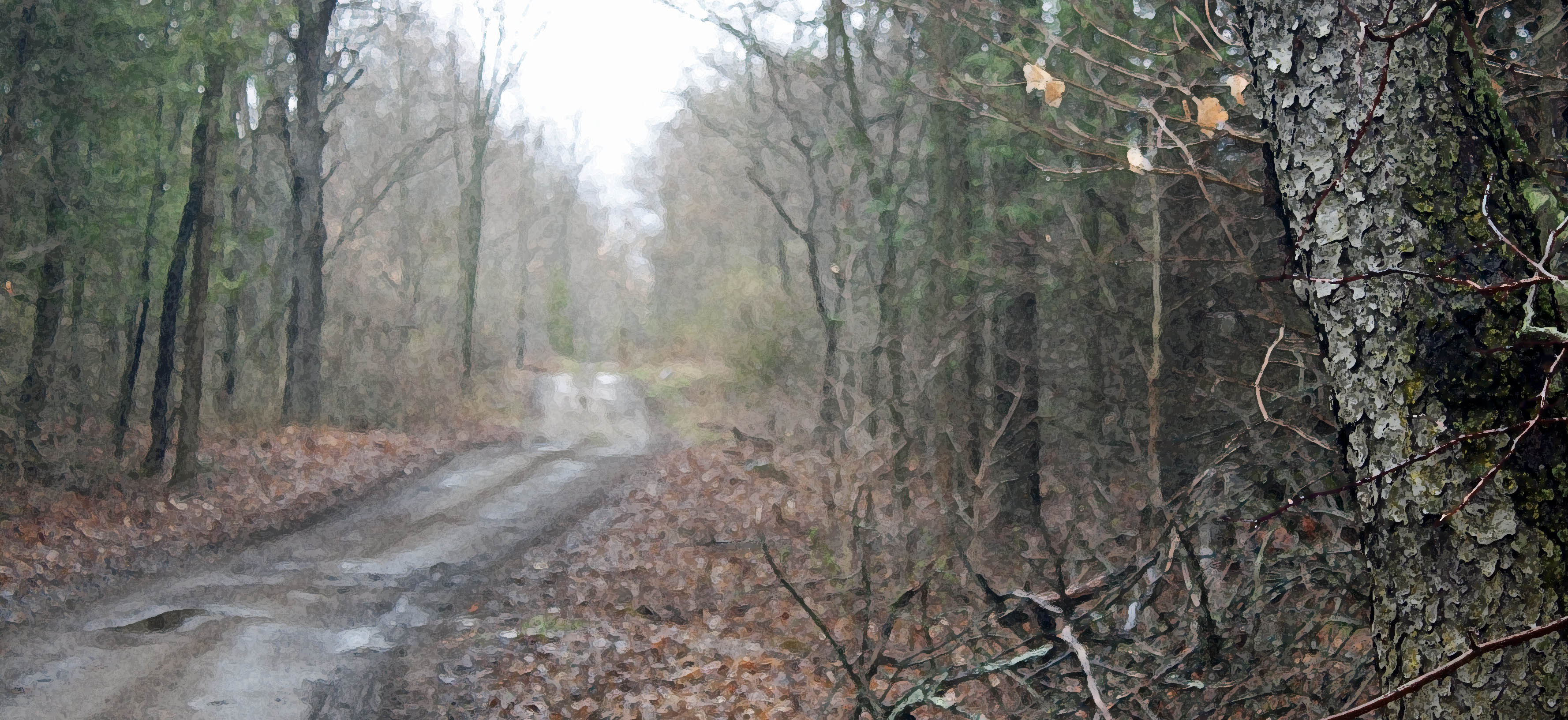
Dirt road in Kawarthas during a misting rain, ON (photo and rendition by Nina Munteanu)
Why Our Stories Are Important
We are all storytellers. We share our curiosity with great expression; our capacity and need to tell stories is as old as our ancient beginnings. From the Palaeolithic cave paintings of Lascaux to our blogs on the Internet, humanity has left a grand legacy of “story” sharing. Evolutionary biologist and futurist Elisabet Sahtouris tells us that, “whether we create our stories from the revelations of religions or the researches of science, or the inspirations of great artists and writers or the experiences of our own lives, we live by the stories we believe and tell to ourselves and others.”
Compelling stories resonate with the universal truths of metaphor that reside within the consciousness of humanity. According to Joseph Campbell, this involves an open mind and a certain amount of humility; and giving oneself to the story … not unlike the hero who gives her life to something larger than herself. Fiction becomes memorable by providing a depth of meaning. Stories move with direction, compel with intrigue and fulfil with awareness and, sometimes, with understanding. The stories that stir our hearts come from deep inside, where the personal meets the universal, through symbols or archetypes and metaphor.
Ultimately, we live by the narratives we share. “What you think, you become,” said Buddha.
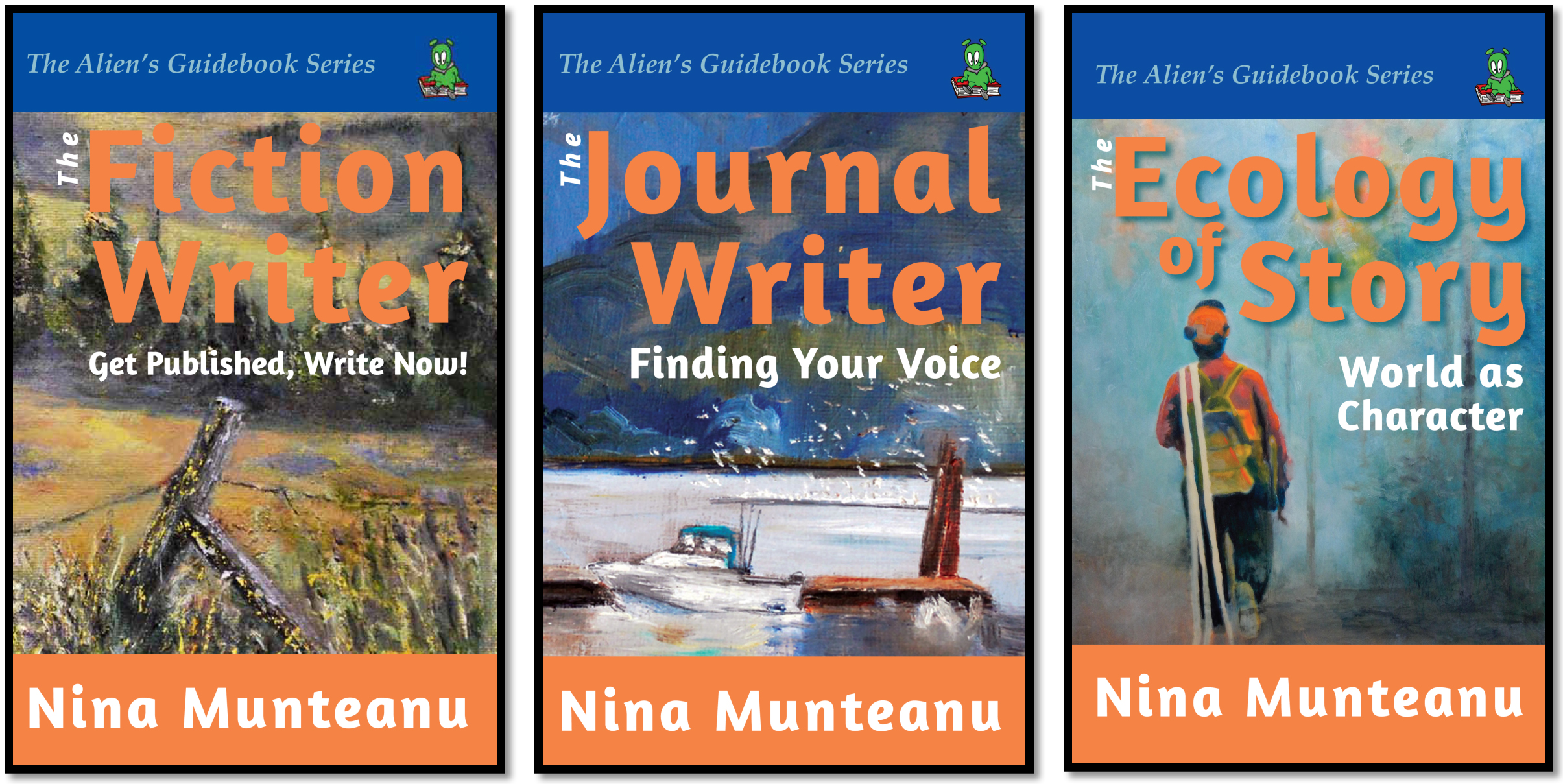
In my writing guidebook The Ecology of Story: World as Character, I write: “When a writer is mindful of place in story and not only accurately portrays environment but treats it as a character, then her story will resonate with multilayers of meaning.”
Poplar stand in the Kawarthas, ON (photo and rendition by Nina Munteanu)
Changing the Narrative…
I was recently interviewed by Forrest Brown on Stories for Earth Podcast in which we discussed the need to change our narrative (particularly our colonial neoliberal capitalist narrative) and various ways to do this, taking into account the challenges posed by belief and language. Lessons from our indigenous wise elders will play a key role in our change toward genuine partnership with the Earth.
“We need to have a whole cultural shift, where it becomes our culture to take care of the Earth, and in order to make this shift, we need storytelling about how the Earth takes care of us and how we can take care of her.” ― Ayana Elizabeth Johnson,All We Can Save: Truth, Courage, and Solutions for the Climate Crisis
“This world, in which we are born and taken our being, is alive. It is not our supply house and sewer; it is our larger body. The intelligence that evolved us from stardust and interconnects us with all beings is sufficient for the healing of our Earth community, if we but align with that purpose. Our true nature is far more ancient and encompassing than the separate self defined by habit and society. We are as intrinsic to our living world as the rivers and trees, woven of the same intricate flows of matter/energy and mind. Having evolved us into self-reflexive consciousness, the world can now know itself through us, behold its own majesty, tell its own stories–and also respond to its own suffering.”
JOANNA MACY and CHRIS JOHNSTONE, “Active Hope”
Swamp forest in Kawartha region, ON (photo and rendition by Nina Munteanu)
References:
Campbell, Joseph, Bill Moyers. 1991. “The Power of Myth.” Anchor. 293pp.
Sahtouris, Elisabet. 2014. “Ecosophy: Nature’s Guide to a Better World.” Kosmos, Spring/Summer 2014: 4-9pp.
Nina Munteanu is a Canadian ecologist / limnologist and novelist. She is co-editor of Europa SF and currently teaches writing courses at George Brown College and the University of Toronto. Visit www.ninamunteanu.ca for the latest on her books. Nina’s bilingual “La natura dell’acqua / The Way of Water” was published by Mincione Edizioni in Rome. Her non-fiction book “Water Is…” by Pixl Press (Vancouver) was selected by Margaret Atwood in the New York Times ‘Year in Reading’ and was chosen as the 2017 Summer Read by Water Canada. Her novel “A Diary in the Age of Water” was released by Inanna Publications (Toronto) in June 2020.
A man tries to survive In the ruins of a bloody war between Gaians and Technocrats where Techno-clones rule.
Here’s an excerpt:
The ruins of the city rippled in the heat like a bad movie. Gunther raked his fingers through his hair and paced the exposed second floor of the dilapidated building. His gaze panned the city. Haze the color of rust lingered over phantom pools on the horizon.
“It’s hot as hell,” he complained, shrugging his Computerized Automatic Rifle over his shoulder. His camouflage fatigues clung to his body like something he needed to shed. “I’m dying in this heat.” Several flies buzzed around his head and he flapped his gangly arm madly in the air. “Damn flies.”
Slouched against some rubble, Rick ignored him and ran diagnostics on the CARifle stretched out on his lap, verifying the output data on his eye-com. Rick’s sullen face was barely visible under the V-set strapped to his head. Gunther pulled out a stick of gum, unraveled the wrapper and pushed the wad into his mouth. Smacking his lips, he savored the mint flavor and tossed the wrapper.
“Ass hole!” Rick snapped. “Pick that up.”
Gunther snatched the wrapper. The rifle slipped off his shoulder and clattered to the ground. Forcing on a nervous grin he scrambled to pick up the weapon then stepped on the vee-set he’d yanked off earlier.
“We’re Gaians.” Rick’s finger stabbed the green band on his arm. “Protectors of the Earth, ass hole.” He turned back to his CARifle and muttered, “Just like a filthy Techno. . . no idea why you’re doing anything.”
Gunther replaced the V-set on his head and slung the CARifle over his shoulder. He sagged under its weight and let his gaze stray to where the roof had been blasted away. The air smelled of smoke and burning metal. He blinked away the sweat that ran into his eyes and squinted at the sun, suspended in a yellow dust cloud. “Those lousy Technos caused this heat wave. We’re turning into a desert!”
Rick ignored him and kept tinkering with his weapon.
“Hell, if it weren’t for this revolution,” Gunther continued, “the planet would be toast already . . .” he trailed, lost for a moment in a terrifying place. More flies buzzed furiously around his head. “Get off!” he shouted and shook his head violently. He frowned and muttered, “We better see some action soon.” Gunther poked the rubble with his rifle. “When I took this post I was glad I’d be toasting any coward Technos trying to escape the city.” He raised his rifle, aimed at an imaginary target and made clicking sounds with his tongue. “When I asked the Gaian committee for this post—”
“Ass hole!” Rick spat. “You didn’t ask for it; they assigned you.”
Gunther half-grinned, exposing dirty teeth, and shrugged.
Rick spit on the ground. “I know your story, turd. You hid in some hole during the whole clone siege. Waiting to find out who won so you could take their side.”
Gunther inhaled the gum and coughed.
Rick sneered. “I figure they put you with me to keep an eye on you. Make sure you don’t run away like them other Technos.” He rubbed the graying stubble on his creased face and his eyes narrowed to slits. “Hell, you were probably a Techno before we found you. Come to mind, you look like one of them. . . .”
You can read the complete story of “The Spectator” in the Teoria Omicron ezine. An earlier version of this story was published under the title “Frames” in my short story collection Natural Selectionpublished by Pixl Press.
Nina Munteanu is a Canadian ecologist / limnologist and novelist. She is co-editor of Europa SF and currently teaches writing courses at George Brown College and the University of Toronto. Visit www.ninamunteanu.ca for the latest on her books. Nina’s bilingual “La natura dell’acqua / The Way of Water” was published by Mincione Edizioni in Rome. Her non-fiction book “Water Is…” by Pixl Press (Vancouver) was selected by Margaret Atwood in the New York Times ‘Year in Reading’ and was chosen as the 2017 Summer Read by Water Canada. Her novel “A Diary in the Age of Water” was released by Inanna Publications (Toronto) in June 2020.
Steve Stanton’s 2016 science fiction book Freenet explores humanity in the far future after we have created the “Macpherson Doorway” through folded space-time, and vaulted ourselves with the blink of an eye into a galaxy far far away and 12 million years into the future. No traffic back through the doorway is permitted since a quarantine was placed some dozen years ago to prevent any unwanted DNA from sneaking through from Earth to “New Jerusalem”.
As the Canadian back book jacket reveals, Freenet is a novel about the “power of [free] information…in a post-digital age.” The book explores what digital immortality means, when “consciousness has been digitized and cybersouls uploaded to a near-omniscient data-matrix.” This is a world where information “is currency and the truth belongs to whoever has the greatest bandwidth.”
Stanton shared with me that he was inspired to write the novel “from the simple observation of watching a woman lose her cellphone. Young people today are so tied to technology that they freak out when the strings are cut. In the future when life experience is delivered directly to the brain by wi-fi, the personal loss will be catastrophic.”
Nina Munteanu reading her advanced copy of Freenet
Told in three parts, the book begins with Simara Ying—a plugged-in V-net jockey and spacer—about to crash-land on the desert planet Bali. Her rescuer, a naïve—almost too nice to be true—native, Zen Valda, introduces her to his cave-dwelling culture with no social network support. The persistent electromagnetic storms of Bali interfere with digital communication and wipe all data. Like a baby removed from her comfortable womb, Simara survives panic attacks and heavy withdrawal chiefly because she is bombarded so heavily with Bali experiences that demand her attention. Lost without the support of her V-net—a comforting web of infinite communication and information—Simara struggles with Bali’s foreign ways. At every turn, she stumbles across some custom or taboo, forced to rely on her own wits; making the kind of mistakes she’s not used to making. More than a simple communication/information tool, the V-net embraces Simara with confidence. Without it, she fears she may go insane.
Intrigue arrives on Bali and chases Simara with a bounty on her head for murder. Zen demonstrates a simple faith in her innocence and helps her escape. Zen accepts a cochlear installation to connect him to the V-net, thinking it will help him better communicate with Simara, who—already somewhat distant—is even more so now that she has reunited with the V-net. The V-net instead overwhelms him with a surging sea of irrelevant chatter and information, which threatens to drive him insane. Struggling with chaotic information overload, he remains with Simara, even after she estranges herself from him and is captured for murder. They escape and survive an arranged “accident” by literally jumping into space from an abandoned troopship about to crash.
Canadian book cover for Freenet
The story deepens into nuanced commentary in the last third of the book when Roni Hendrik, an energetic V-net anchorman of the Daily Buzz, pokes into the intrigue surrounding Simara Ying. He discovers that she is biogenic, an omnidroid—bioengineered from human DNA—and likely smuggled from Earth.
Omnidroids share a major cerebral augmentation that includes unlimited access to the V-net, higher intelligence and an unknown possibility of enhancements, including pre-cognition and telepathy across vast distances. Created as effective firewalls and filters, omnidroids streamline all V-net data for users across the galaxy. “Omnidroids [are] born into zero-day digital space and live in a fantasyland far beyond the mortal sphere of intelligence,” Henrik reflects, sensing a deeper story than a simple murder conspiracy. “Physical experience and bodily sensation [are] only tiny fragments of their transcendent existence, mundane accessories to digital infinity. In time,” Henrik concludes, “life itself might become a vestigial appendage.”
Hendrik, a humanist and closet idealist, pieces together connections with Neurozonics a New Jerusalem private corporation, responsible for the creation of biogenic humans. With holdings in a vast range of areas and an streaming amoeba of interests, Neurozonics is “a grinning spider on a translucent web of intrigue.” One discovery leads Henrik to more. He learns that the omnidroid community, to which Simara belongs, acts and communicates like a hive-mind, guided by a collective voice called “Mothership”. Other omnidroids have been targeted for elimination—and killed. Hell-bent on getting answers, Henrik confronts the owner of Neurozonics, Colin Macpherson—the same Macpherson who created the wormhole. Macpherson was uploaded earlier and runs his empire from digital space, part of the consortium of eternal intellect. Henrik’s meeting with Colin8 (the seventh clone of the original Colin Macpherson) runs like a “Neo-Architect” lecture in which the truth behind the omnidroids deaths is revealed. It’s not what you might think. Macpherson divulges his vision, which includes the reason for omnidroids’ communication abilities and the role of the Neurozonic brain. The ultimate meaning and use of the omnidroid freenet ties to a greater destiny that redefines what it is to be human and subverts the history of our primordial origins.
The story flows seamlessly from one perspective to another with crisp page-turning narrative, action and intrigue. Stanton trades some richness of character for a page-turning plot and clever dialogue. If there is a weakness in the narrative for me, it lies with Simara, the arcane omnidroid, who remains mysterious—from her introduction aboard her ship about to crash land, to the limited revelations of her character during her interactions with Zen, both in her POV and in his. Considering her unique characteristics and experiences as an omnidroid, I would have enjoyed more insight to her unique outlook and perspective, especially when faced with no social network—perhaps the most frightening experience for an omnidroid: to be disconnected from the hive. On the other hand, Zen Valda as the simple Bali boy on an insane rollercoaster ride is painted with a sensitive and graceful hand. Stanton also skillfully portrays his news team, Roni and Gladyz, with finesse and subtly clever notes. The dialogue and overall interactions between them is some of the most enjoyable of the novel.
Ultimately, Stanton’s Freenet flows like a fresh turbulent river, scouring and building up sediment then meandering like an oxbow into areas that surprise. He lulls you into expectation, based on your own vision of the digital world, then—like a bubble bursting—releases a quantum paradox of wormhole possibility.
“Ma, can you read the part where the cat omnidroid takes over the world?”
Nina Munteanu is a Canadian ecologist / limnologist and novelist. She is co-editor of Europa SF and currently teaches writing courses at George Brown College and the University of Toronto. Visit www.ninamunteanu.ca for the latest on her books. Nina’s bilingual “La natura dell’acqua / The Way of Water” was published by Mincione Edizioni in Rome. Her non-fiction book “Water Is…” by Pixl Press (Vancouver) was selected by Margaret Atwood in the New York Times ‘Year in Reading’ and was chosen as the 2017 Summer Read by Water Canada. Her novel “A Diary in the Age of Water” was released by Inanna Publications (Toronto) in June 2020.
Requiem for a Lotus takes place in 1917 Shanghai, where police detective Harmon Fletcher must solve the murder of a Chinese sing-song girl he’d failed to protect. Adding his Canadian prairie hunting experience to modern forensic techniques, Fletcher scours Shanghai’s dangerous jig-saw underworld for answers. But while he brings one killer to justice, another escapes, and Fletcher must sacrifice more than he expected before he’s done.
Here’s the opening to Requiem for a Lotus:
“When a man named Hong Song Lin shot his neighbour five times for blowing roasted pig smoke onto his second floor balcony, it wasn’t a hard case to figure out. There was two angry men, a gun, and a hot Shanghai summer.”
The judges selected Craig’s novel for its excellent writing and storytelling, a tense and compelling plot and pace, and intriguing characters:
“… What enjoyable reading! The author quickly pulls the reader into 1917 Shanghai and pins them there with its smells, sights, customs and politics … A very engaging crime novel.”
“… Loved the historical setting of Shanghai and it kept me fascinated … Inspector Fletcher is a solid and clever character, a somewhat rougher Sherlock Holmes.”
Requiem for a Lotus is the first novel of a trilogy. I’m confident that this exciting crime novel and series will be snapped up by a publisher soon. And when it is, I’ll be buying a copy.
Here’s Craig’s podcast interview with CWC interviewer Erik D’Souza when the manuscript was a finalist before it won top prize:
Nina Munteanu is a Canadian ecologist / limnologist and novelist. She is co-editor of Europa SF and currently teaches writing courses at George Brown College and the University of Toronto. Visit www.ninamunteanu.ca for the latest on her books. Nina’s bilingual “La natura dell’acqua / The Way of Water” was published by Mincione Edizioni in Rome. Her non-fiction book “Water Is…” by Pixl Press (Vancouver) was selected by Margaret Atwood in the New York Times ‘Year in Reading’ and was chosen as the 2017 Summer Read by Water Canada. Her novel “A Diary in the Age of Water” was released by Inanna Publications (Toronto) in June 2020.
It started with a simple tweet of mine on X regarding doing research for one’s writing projects. I’d met Isabella Mori a few years ago, when we both contributed to an ekphrastic anthology of flash fiction, inspired by Group of Seven art. We met again when she submitted a story to an anthology I was editing for Exile Editions. After my tweet on research, Isabella and I traded brief stories about rewrites based on research findings and ‘mistakes’ and the arcane revelations in the creative process that may result. I was intrigued by her recounting and asked her to share it with you; so here it is:
“Synchronicities And The Sea”by Isabella Mori
(Trigger warning: Substance use and suicide)
This is about the magic that comes to pass when we let the Muse guide our work and consent to synchronicity. Here is what happened:
When I go away on vacation, I try to visit the local library, and always make sure to check out the community announcements. On one of those forays, I came across a notice of a project that teamed up visual artists with writers for a short story or poem. I love these types of collaborations and immediately jumped on it. Max was the artist I paired up with, and we hit it off right away. After a few conversations, we settled on the painting below, for which I was going to write a story. As you can see, it had a moody, dark feeling. I drafted this text as a response:
The memory of a map showed her the way as she wandered, blinded by the night, along the shore. Numb with cold, her bare feet dug into the wet sand. She could not see that she left no tracks. There was something in her searching; she felt it in the deep pit of her stomach but there was no image in her mind’s eye of what it was, no tinkling that alerted her, no smell, no taste. A sense of despair drained the blood from her heart and tugged at her from the right, where the forest rushed. Foot-dragging ennui invited her onto a soft-moss carpet to the left, and thoughts of numbers, cars and cash register receipts tried to wrangle her back to where she came from. She was near giving up. But at that precise moment there tracked the light only she of the searching could see—a light bigger more forceful than giants could ever imagine; all-embracing, all-revealing, all-nurturing just like the frothy ocean beneath it, just like the sand with its fierce sparkle, each grain a diamond just like the heart-bud that could not help but open under its rays, under those rays that only she of the searching could see.
However, for reasons we have both forgotten, Max decided to lighten the colours, and the dark mood of the first draft didn’t fit anymore. This is the version we ended up with:
Walk With The Angels
The ocean has known her share of angels over the eons. They come and go but the tide is older. When an angel appears in a cloud of glistening light, beats its wings and brings out the trumpets, little humans fall to their knees and beg for mercy and miracles.
But the water stays still.
Great mother ocean has seen it all.
She waits until the angel grows tired, then she takes the worn-out wings and heavenly body into her arms and carries them into her depths. Brings the apparition to visit kelp, salmon, starfish, barnacles, otters and crabs. Anemones. Killer whales. A visit one by one, under the summer sun, beneath the light of the Hunter’s moon, when the snow falls, with the Easter rains. The angel leaves a bit of themselves here, a bit there, a gift everywhere, until only the tiniest of diamonds are left.
And that’s the sand.
Walk with the angels.
There were a few tweaks before we arrived at this text, the major one being that in a previous version, I referred to ‘angel dust’ for the sand until the editor pointed out that that term refers to a street drug, PCP. In my enthusiasm I had forgotten that.
The change away from ‘angel dust’ was very important. When Max read the new version, they called me, their tone of voice both moved and perturbed.
“When I read this,” they said, “it feels like you channeled what happened with my cousin last year, not far from the place that inspired my painting. She had had problems with drugs all her life, and one day she just walked into the ocean. Her body was found a day later.”
Under those circumstances, we definitely did not want to refer to drugs.
That story stayed with me for months until one day when I was listening to one of my playlists of Latin music. I lived in Paraguay and Chile 1977-1980, and often enjoy the nostalgia of the music I listened to back then. The first song that came on was one of my all-time favourites, Alfonsina Y El Mar – Alfonsina And The Sea. Now I have to confess, I am terrible with lyrics, no matter what language, whether it be my native German, English, or the Spanish I was fluent in for quite a few years. For some reason, I really listened to the song last summer, and then looked up the lyrics. That’s when it hit me – was it possible that the lyrics of that song had subconsciously influenced me to write the second text? Or was it one of those Jungian collective conscious moments?
Alfonsina And The Sea
(Music: Ariel Ramirez. Lyrics: Felix Luna)
In the soft sand Licked by the sea Her small footprints Don’t return. Just one path Full of pain and silence Led to the water, Deep water, And one single path of unspoken pain Led to the foam.
God knows what sorrows accompanied you, What old suffering shut down your voice That made you lie down and nestle into the songs Of the sea snails, The song that sings in the deep dark of the sea, The sea snail.
There you go, Alfonsina, with your loneliness, What new poems did you go find? An old, old voice of wind and salt Sways your soul and carries it And you go there dreaming, Sleeping, Alfonsina, clothed in the sea
Five little sirens will carry you Through passages of algae and corals And glowing sea horses will dance Around you And all the creatures of the sea will soon Play at your side.
Turn down the light a little more, Nurse, let me sleep in peace. And when he calls tell him I’m not in, Tell him Alfonsina won’t come back. And when he calls don’t ever tell him I’m in, Tell him I’m gone.
There you go, Alfonsina, with your loneliness, What new poems did you go find? An old, old voice of wind and salt Sways your soul and carries it And you go there dreaming, Sleeping, Alfonsina, clothed in the sea.
(Used with permission, my translation.)
Alfonsina ended up in the ocean just like Max’s cousin did.
With some research, I found out that the story was about the Argentinian poet Alfonsina Storni who, after a difficult life that included poverty, questions she had about gender identity, and breast cancer, one night wrote a last poem to her son and then let herself fall into the ocean amid torrential rain. (An apocryphal version has her just walk into the ocean, and that’s the one the lyricist chose.) Some of that last poem was incorporated into Alfonsina Y El Mar – the nurse who is asked to lower the light, and told to tell ‘him’ that she won’t come back. Nobody seems to know who ‘he’ is.
The other research that had to happen was to find who the inheritors of Felix Luna’s estate were to obtain permission should I tell the story that you have before you. It turned out to be his daughters. Then I had to sleuth out their contact.
Felix Luna, the lyricist, imagined Alfonsina’s death not only as the terrible tragedy that it was but also as a mystical transformation into a sea creature that nestles into the songs of the sea snails. She finds new poems and sleeps clothed in the sea. She is embraced by sirens and wanders through algae and corals. She dances with sea horses and plays with all the other sea creatures.
I definitely cannot compare myself with a great poet like Felix Luna but notice with humility the similarities of my transformed angel who sinks into the embrace of mother ocean and also visits the more-than-humans of the sea.
I went pregnant with the idea of writing about the experience of Max’s and my collaboration for half a year when in February, I chanced upon a tweet by Nina about research for writing. I met Nina through submitting a story to an anthology she was editing. I told her about needing to tweak the angel story so that it does not talk about angel dust and ended up telling her the outline of what happened. She invited me to write a guest post about this, and here we are.
So many synchronicities. I could have not gone to that library. A different artist could have been paired up with me. Max could have wanted to stay with the original painting. Or they could have chosen a painting that would not have reminded them of their cousin. They could have opted not to share that sad story with me, or they could have been paired up with someone who doesn’t understand suicide as intimately as I do (I look back on a 30+ year career in social services.) I could have heard Alfonsina Y El Mar and still not really listened to the lyrics. There was no guarantee I could have managed to find out from whom to get permission to quote the song. I could not have submitted a story to one of Nina’s anthologies, and could not have followed her on Twitter. Coming across the particular tweet that prompted the publication of this story was like chancing upon a needle in a haystack. All this, and probably more, had to come together for this magical synchronicity to happen.
Thank you, Muse.
(Note: Since this is a sensitive topic, the artist’s name and some of the circumstances of my collaboration with them have been changed. However, the artist has consented to using their images.)
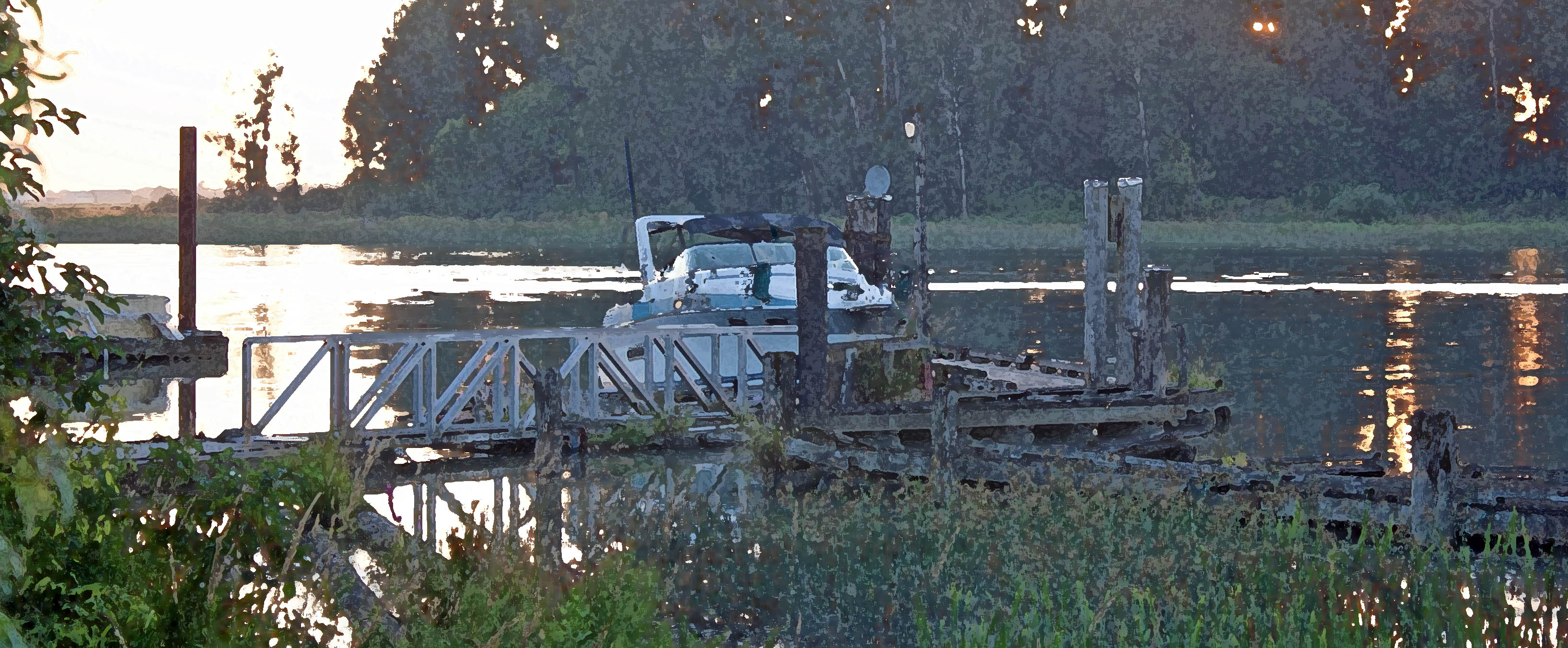
Boat wharf at sunset in Ladner Marsh, BC (photo and rendition by Nina Munteanu)
My short story Robin’s Last Song was selected by the NYC Climate Writers Collective as part of an exhibition in the Climate Imaginarium on Governors Island in New York. The exhibition, starting May 18, will run throughout the summer of 2024.
Robin’s Last Song
Robin’s Last Song first appeared in the #128 Issue of Apex Magazine in 2021. It tells the story of Robin, a blind elder whose digital app failed to warn the world of the sudden global loss of birds with disastrous ecological consequences. After years of living in self-exile and getting around poorly on sight-enhancing technology, a discovery gives her new hope in rekindling her talents in the field of Soundscape Ecology.
In a recent interview with writer Simon Rose, I described my thoughts in writing Robin’s Last Song:
I wanted to make “Robin’s Last Song” a realizable work of fiction in which science and technology play both instigator of disaster and purveyor of salvation. Our biogenetic technology comes to us as a double-edged sword in the form of gene-editing, proteomics, DNA origami, and CRISPR—just to name a few. These biotechnological innovations promise a cornucopia of enhancements: from increased longevity and health in humans to giant disease-resistant crops. But, for every ‘magic’ in technology, there is often unintended consequence. Unforeseen—or even ignored—casualties and risks. I suppose my ultimate question with this story is: will synthetic biology redesign Nature to suit hubris or serve evolution? Science doesn’t make those decisions. We do.
Anyone living in or visiting the NYC area is welcome to the Climate Imaginarium launch on May 18 on Governor’s Island. Check this Eventbrite link for details. The exhibition will continue throughout the summer of 2024 and will include: climate storytelling and poetry by Climate Café, the Sixth Festival, and the Climate Writers Collective; opening exhibition of “What is Environmental Art?” by Forest for Trees; artwork from the Climate Imaginarium community and Climate Writers exhibition; “Eye of Flora” virtual reality exhibition by Synphisica Collective; and more.
Here’s what they say:
Come to Governors Island for the grand opening of our Climate Imaginarium house! The Climate Imaginarium will serve as a community center for climate and culture, with galleries and spaces for exhibitions, performances, film screenings, and events that respond to the climate crisis with solutions and visions for hope and justice. Join us at Building 406A on Colonels Row for a lively celebration of climate art, storytelling, and community.
Exhibitions will be open to the public at noon, and the party will officially start at 2pm. All donations will support programming in our community space.
Nina Munteanu is a Canadian ecologist / limnologist and novelist. She is co-editor of Europa SF and currently teaches writing courses at George Brown College and the University of Toronto. Visit www.ninamunteanu.ca for the latest on her books. Nina’s bilingual “La natura dell’acqua / The Way of Water” was published by Mincione Edizioni in Rome. Her non-fiction book “Water Is…” by Pixl Press (Vancouver) was selected by Margaret Atwood in the New York Times ‘Year in Reading’ and was chosen as the 2017 Summer Read by Water Canada. Her novel “A Diary in the Age of Water” was released by Inanna Publications (Toronto) in June 2020.
Snowing in a cedar forest, ON (photo and rendition by Nina Munteanu)
In this series of articles, I draw from key excerpts of my textbook on how to write fiction The Fiction Writer: Get Published, Write Now! whose 26 chapters go from A to Z on the key aspects of writing good and meaningful fiction.
M is for Master the Metaphor & Other Things
During a brainstorming session, my business partner quizzed me on the major problems that writers face: “What are their Waterloos?” She was using metaphor to make a point. You don’t have to look very far to find examples; everyday speech is full of them: like “raining cats and dogs; “table leg”; and “old flame”.
Metaphor directly compares seemingly unrelated subjects. It is, therefore, considered more powerful than an analogy, which may acknowledge differences. Other rhetorical devices in the ‘metaphor family’ that involve comparison include metonymy, synecdoche, personification, simile, allegory and parable. While these share common attributes with metaphor, each compares in a different way.
The term synecdoche substitutes a part for a whole or a whole for a part (e.g., the expression “all hands on deck” refers to the men; or the expression “use your head” refers to your brain). Synecdoche is a common way to emphasize an important aspect of a character.
Metonymy uses one word to describe and represent another (e.g. the suits from Wall Street). Metonymy works by association whereas metaphor works through similarity.
Personification gives an idea, object or animal the qualities of a person (e.g., the darkness embraced her; the creek babbled over the rocks).
Similes can imply comparison (e.g., His mind is like a sword) or be explicit (e.g., His mind is sharp like a sword). This is what makes the simile such a useful tool to the writer: you can choose to be vague, letting the reader infer the relationship, or be direct.
Simile: His love was like a slow dance
Metaphor: Love danced in her heart
Allegory is an extended metaphor in which an object, person or action is equated with the meaning that lies outside the narrative. In other words, allegory has both a literal and a representative meaning.
The kinds of metaphor you use (extended metaphors particularly) rely a great deal on your narrative voice, the type of story you’re telling, and the language you’re using. Here are two from Raymond Chandler’s The Long Goodbye:
His hair was bone white.
I got the drunk up [the stairs] somehow. He was eager to help but his legs were rubber.
The metaphor is often tied in to the overall theme or plot line of the story, providing tone to the story and sometimes foreshadowing.
N is for Now It’s Time for Revision
Ten things you should consider when revising your first (and subsequent) draft(s).
1. Let your work breathe: once you’ve completed your draft, set it aside for a while. This lets you make objective observations about your writing when you return.
2. Dig deep: now that you have the whole story before you, you can restructure plotlines, subplots, events and characters to best reflect your overall story. Don’t be afraid to remove large sections; you will likely add others. You may also merge two characters into one or add a character or change a character’s gender or age.
3. Take Inventory: it’s good to take stock of how each chapter contributes to plotline and theme; root out the inconsistencies as you relate the minutiae to the whole.
4. Highlight the Surges: some passages will stand out as being particularly stunning; pay attention to them in each chapter and apply their energy to the rest of your writing.
5. Purge & Unclutter: make a point of shortening everything; this forces you to use more succinct language, replacing adjectives and adverbs with power-verbs. Liken it to writing for a magazine with only so much space (check out Chapter U for more ideas). Doing this will tighten prose and make it more clear. Reading aloud, particularly dialogue, can help streamline your prose.
6. Point of view: this is the time to take stock of whether you’ve chosen the best point of view for the story. You may wish to experiment with different points of view at this stage and the results may surprise you.
7. Make a plot promise: given that you are essentially making a promise to your readers, it is advisable that you revisit that promise. Tie up your plot points; don’t leave any hanging unless you’re intentionally doing this, but be aware that readers don’t generally like it. Similarly, if you’ve written a scene that is lyrical, beautiful and compelling but doesn’t contribute to your plotline, nix it. But keep it for another story; chances are, it will work elsewhere. The trick is to file it where you can later find it.
8. Deepen your characters: the revision process is an ideal time to add subtle detail to your main characters. A nervous scratch of his beard, an absent twisting of the ring on her finger, the frequent use of a particular expression: all these can be worked in throughout the story, in your later drafts. Even minor characters can shine and be unique. When you paint your minor characters with more detail, you create a more three-dimensional tapestry for your main characters to walk through. This heightens realism in your story and involvement of your reader.
9. Write scenes: use the revision process to convert flat narrative into “scene” through dramatization. Narrative summaries read like lecture or polemic. They tend to be passive, slow, and less engaging. Scenes include action, tension and conflict, dialogue and physical movement.
10. Be concrete: Rosenfeld describes your novel as a world in which your reader enters and wants to stay in for a while. You make it easy for her by adding concrete details for her to envision and relate to. Ground your characters in vivid setting, rich but unobtrusive detail. Don’t abandon them to a generic and prosaic setting, drinking “beverages” and driving “vehicles” on “roads”; instead brighten up their lives by having them speeding along Highway 66 in a Mini Cooper, while sipping a Pinot Noir.
O is for Outline or Synopsis?
A synopsis is NOT an outline. Both are useful to the writer, yet each serves a very different purpose. An outline is a tool (usually just for the writer) that sketches plot items of a book. It provides a skeleton or framework of plot, people, places and their relationships to the storyline. It permits the writer to ultimately gauge scene, setting, and character depth or even determine whether a character is required (every character must have a reason to be in the book, usually to move the plot). To put it basically, the outline describes what happens when and to whom, while the synopsis includes why.
Elizabeth Lyon, author of The Sell Your Novel Toolkit, suggests that a synopsis should usually include these seven items:
• Theme
• Setting and Period
• Plot summary
• Character sketches
• Dialogue
• Emotional turning points
• Subplots
The theme, explains Lyons, “provides a rudder for an entire novel.” She suggests condensing it into one sentence or phrase: to have a friend you must be a friend; cooperation lies at the heart of evolution; love is the true source of human wealth; there’s no place like home. You can also portray your theme in a single word (e.g., forgiveness, revenge, trust, prejudice, evolution).
Lyon suggests that the plot summary is like a skeleton upon which to flesh out character and theme. Two things you need to consider are that 1) you must summarize the complete novel (beginning, middle and end) and 2) you should not confuse a plot summary (essentially an outline) with a synopsis, which incorporates more than plot. “The best-written and most impressive synopses,” says Lyon, “are those that make it clear that a story is character driven.” Lyon recommends that you limit your sketches to the main characters that drive principle theme in the story.
The first sentence of my synopsis of Collision with Paradise focuses on the main character:
When Genevieve Dubois, Zeta Corp’s hot shot starship pilot accepts a research mission aboard ZAC I to the mysterious planet Eos, she not only collides with her guilty past but with her own ultimate fantasy.
While the sentence conveys information about the plot, it is given from the viewpoint of a character’s motivations and feelings. The reader is informed at the outset that character development is at the heart of the story.
The emotional turning points are the focal events that are directly linked to the theme of the story. These are the “so what” parts of the story plot—where the character reaches an epiphany and, as a result, changes—and are ultimately linked to the climax of the story.
The Fiction Writer is a digest of how-to’s in writing fiction and creative non-fiction by masters of the craft from over the last century. Packaged into 26 chapters of well-researched and easy to read instruction, novelist and teacher Nina Munteanu brings in entertaining real-life examples and practical exercises. The Fiction Writer will help you learn the basic, tried and true lessons of a professional writer: 1) how to craft a compelling story; 2) how to give editors and agents what they want’ and 3) how to maintain a winning attitude.
“…Like the good Doctor’s Tardis, The Fiction Writer is larger than it appears… Get Get Published, Write Now! right now.”
David Merchant, Creative Writing Instructor
Light snow falling by the river, ON (photo and rendition by Nina Munteanu)
Nina Munteanu is a Canadian ecologist / limnologist and novelist. She is co-editor of Europa SF and currently teaches writing courses at George Brown College and the University of Toronto. Visit www.ninamunteanu.ca for the latest on her books. Nina’s bilingual “La natura dell’acqua / The Way of Water” was published by Mincione Edizioni in Rome. Her non-fiction book “Water Is…” by Pixl Press (Vancouver) was selected by Margaret Atwood in the New York Times ‘Year in Reading’ and was chosen as the 2017 Summer Read by Water Canada. Her novel “A Diary in the Age of Water” was released by Inanna Publications (Toronto) in June 2020.
Trickster wind kicks up clouds of snow, ghosting trees (photo and rendition by Nina Munteanu)
In Part 1, I introduced and described the concept of giving voice to the Other in eco-literature through the literary device of character-coupling. Character-couplings manifest in story through theme, plot approach, narrative form, and ultimately the writer’s own intentions. Particular techniques used by writers of eco-literature include the use of time, language, POV, narrative style, the senses, archetype, symbolism and metaphor, such as personification, synesthesia, and synecdoche.
In the seven examples provided below, nature’s avatars coupled to a protagonist represent the greater natural world; it is often the greater natural world that is ultimately Othered, and achieves a voice through its avatar (e.g. the quiet ‘voice’ of the polar bear in Colleen Murphy’s The Breathing Hole represents the quiet ‘voice’ of the Arctic, itself Othered by the loud voice of the greater human world).
1. Use of Language, Time and Displaced Narrative in Cli-Fi Allegory: Inuk Woman and Polar Bear
Coleen Murphy’s The Breathing Hole uses simple language, and displaced narrative linked to silent action to convey an immediacy of moment and character and to create empathy. Murphy’s spare and focused narrative achieves a timeless, dreamlike quality that plays strongly on the emotional connections of the reader; it elicits immense empathy for the Other in a deeply moving saga on the tragic dance of colonialism and climate change.
The story begins in 1535, when the Inuk widow Hummiktuq risks her life to save a lost one-eared polar bear cub on an ice floe and adopts him. She names him Angu’ruaq. We soon learn that Angu’ruaq is timeless when we encounter him in scenes over the centuries from the Franklin Expedition in 1845 (who he helps by bringing them food) to 2031 when Angu’ruaq—old, hungry, his fur yellowing—returns to the breathing hole where long-dead Hummiktuq rescued him. By then the glaciers have receded and the ground is slush. The constant thumping of the Circumpolar Oil platform can be heard in the distance. There is no mistaking Angu’ruaq’s archetype as Other. When someone says to wildlife biologist Qi’ingaqtuq (who is tracking Angu’ruaq), “I hope you find your bear,” she responds, “It’s not my bear—bears belong to everyone and to no one”; Angu’ruaq is the quintessential homo sacer. Under Agamben’s biopolitics he is both sacred and cursed, both beneath the law and outside the law, a meaningless bare life that may be killed by anyone but not sacrificed (Agamben, 1998).
Told sparingly, often through humorous dialogue, the tale of the young polar bear—and by extension the warming Arctic—plays out through the point of view of various characters. Murphy’s effective use of displaced narrative (e.g., protagonist’s ‘story’ told by other characters) provides varied perspectives of how others view the Other. Some are disparaging and all are akin to gossip. This ironically achieves incredible reader empathy. Throughout the play, the bear does not speak; yet it wields tremendous impact through its silent actions. The bear has no POV and no voice—except in the very last scene five hundred years later in the oily waters of the Northwest Passage. Angu’ruaq—skeletal, desperate with hunger and covered in oil—boards an eco-tourist cruise ship and is fatally injured by cruel actions of eco-tourists aboard. As he struggles from drowning, “gasping for breath, gasping as he tries to stay afloat in the black, oily water,” Angu’ruaq thinks he hears Hummiktuq and “cocks his one ear, hoping to hear Hummiktuq’s voice on the wind … then he raises his foreleg as if reaching for help…but there is no help”. No one sees him. No one on the cruise ship (except for one little girl) cares as he slips under the dark waters—possibly the last polar bear in the world; even as—in terrible irony—cruise ship patrons cheerfully watch a fake mother and her cubs on a fake ice floe, like some fake ‘reality’ show.
No one weeps for the bear. But the reader weeps. We weep for him and we weep for his world destroyed by apathy.
2. Use of POV, Senses and Symbolism in Cli-Fi Allegory / Fable: Girl and Bear
The Bear by Andrew Krivak is a fable of a post-anthropocene Earth told through the point of view of a young girl—possibly the only remaining human in the world—and the bear that guides her. Unlike the polar bear of The Breathing Hole, who remains silent and is clearly victimized by humanity’s actions, the black bear of The Bear lives with agency in a post-anthropocene world; he proselytizes and tells stories to instruct the girl on living harmoniously with Nature. His actions and elegant use of speech reflect his archetype as mentor in this story. This is foreshadowed in the fairytale the girl’s father recounts to her of a bear that saved a village from a cruel despot through cleverness and a sense of community.
This fable about humanity’s deliverance to nature’s dominion flows like a river under ice, revealing profound depth beneath spare yet sensual prose. Krivak does not name the girl, father or bear; allowing each to clearly symbolize ‘what we are, what we could be, and the natural world.’ Krivak gives the bear the power of direct voice through its ability to speak with the girl. Soon after the girl meets the bear she asks him how it is that he can speak. He tells her that long ago all animals could make the sounds she and her father made to communicate, but humans stopped listening and the skill was lost. He suggests the real question is how she can understand him. He then tells her that if she is patient enough, she too will hear the trees.
As the story progresses, the girl transcends from lonely last human in a post-human world to one of Nature’s beings, living as part of the natural world. In this way, the girl embraces the society of the Other and casts aside her previous identity with the Othering society.
The transition begins with her found ability to understand the bear. Near the end of the story, she is an old woman who communicates with all of Nature; “they came to her without fear of dominion and ate with her the plants and seeds and fruits she grew and picked.” The woman rejects her human trappings—the old house and its books, her parent’s grave, rising each morning with the sun and laying to sleep with the setting sun.
A descendant of the bear returns to bury her on the mountain, a place “where end and beginning were the same … the sky beginning to pale behind him like the world itself being born.” This fable celebrates humanity’s potential to participate humbly with the natural world and to embrace the Other by engaging with it and respecting it.
3.Use of Fractal Association & Archetype in Dystopian (mundane) Cautionary Tale: The Windup Girl and the Cheshires
Paolo Bacigalupi’s biopunk science fiction novel The Windup Girl makes effective use of trickster archetypes in character-couplings of Windup girl and Cheshire cats to illustrate Nature’s silent power to herald change. The fractal associations of gene-manipulated Windup girl with manufactured-come-wild cats illustrate how Nature—when pushed—navigates the predatory world of a 23rd century post-food crash Thailand. By then global warming has raised sea levels, depleted carbon fuel sources, and destroyed the wilderness through genetic manipulations. Thailand struggles under the tyrannical boot of ag-biotech multinational giants—predatory companies who have fomented corruption and political strife through their plague-inducing and sterilizing genetic manipulations.
Anderson Lake is a farang (of white race) who owns a factory trying to mass-produce kink-springs—successors to the internal combustion engine) to store energy. The factory covers for his real mission: to find and exploit the secret Thai seed bank with its wealth of genetic material. Emiko is an illegal Japanese “windup” (genetically modified human), owned by a Thai sex club owner, and treated as a sub-human slave; gene rippers built her sensual and obedient—even when abused.
When Emiko meets Lake, he cavalierly shares that a refuge in the remnant forests of northern Thailand exists for New People like her; Emiko embarks on a quest to escape her bonds and find her own people in the north. Like Bangkok itself, both protected and trapped by the wall against a sea poised to claim it—Emiko cannot escape who and what she is: a gifted modified human and herald of a sustainable future—vilified and feared by a humanity obsessed with the road set before it. Just as with the unintended consequence of cheshires (modified cats that wiped out regular cats), Emiko heralds in a post-modified world created through reckless greed and lax environmental protection. When she meets an old generipper after the floods have destroyed Bangkok, he admits, “Someday perhaps all people will be New People and you will look back on us as we now look at the poor Neanderthals.”
Bangkok’s cheshires are genetically created “cats” (made by an agri-giant as a fun “toy”) that wiped out the regular cat Felis domesicus. As with Alice in Wonderland’s Cheshire Cat, these crafty creatures have adapted to Bangkok’s unstable environment. The shapeshifting cheshires exemplify the subversion of good intentions gone wrong, when Nature plays the trickster.
Emiko and the cheshires serve both trickster and herald archetype; genetically created by the very people who despise them. Humanity understands that on some level those like Emiko and the cheshires are the future and they the past. As Bangkok drowns, Emiko meets an old generipper, dying from the gene-hacked casualties of cibiscosis and blister rust; he claims god-status to her and she responds, “If you were my God, you would have made New People first…We would have beaten you. Just like the cheshires.”
Toward the end, policewoman Kanya is instructed to take the greedy corporate farang to the vault and hand over Bangkok’s precious seedbank to them. In a sudden moment of clarity Kanya singlehandedly creates her own coup by executing the farang and instructing the monks to safely dispatch Thailand’s precious seedbank to the jungle wilderness. Husked of its precious treasure, the city implodes as pumps and locks fail. Then the monsoons arrive. The City of Angels gives in to the sea that chases refugees into the gene-hack-destroyed outer forests. While Kanya triumphs in her own personal battle, she remains less agent of change than feckless witness to Nature’s powerful force as it unfurls like a giant cheshire and claws back what humans have taken from it.
From the beginning, the cheshires embrace their difference and fate as Other; It is only near the end of the book, signaled by nature’s own rebellion, that Emiko breaks out of her oppression—including the one built into her—and embraces her survival in this changing world. Both she and the cheshires are the change. The epilogue to Bacigalupi’s cautionary tale belongs to the Other—Emiko and the cheshires—and an uncertain future with promise of change.
4.Use of Personification, Archetype & Symbol in Post-Apocalyptic Cautionary Tale: The Tea master and Water
In the post-climate change drought-affected world of Memory of Water, Emmi Itäranta personifies water and couples to main character Tea Master Noria, to explore consequences of commodification and exploitation. Symbols of water as shapeshifter archetype and its omnipotent life- and death-giving associations flow throughout the story, from the ‘fishfires’ in the northern skies to the painted blue circles on the doors of water criminals about to die.
The government considers water a resource to strictly control and water crimes are punishable by death. When her dying tea master father reveals that he used a secret spring in a cave by their house in his ceremonies, Noria is conflicted whether to continue guarding it as secret for use in her ceremonies or risk exposure by sharing it with those she loves in the village who struggle with poor water rations. “Secrets carve us like water carves stone.” Noria convinces herself to keep the hidden well a secret based on the Tea Master’s rhetoric of ceremony and notions of water’s sovereign nature: “Tea masters believe there are times when water doesn’t wish to be found because it knows it will be chained in ways that are against its nature.”
This works for a while until she discovers her friend trying to illegally tap a water main to draw off water for her sick baby sister. Fearing for her friend’s safety, Noria shares her secret well with her. Soon after, the town discovers its existence, and Noria quietly feeds the thirsty townsfolk, avoiding the realization that she too has now commodified water by serving as reluctant threshold guardian to water’s own journey.
Of course, she is eventually caught by police for her ‘water crime’ and sentenced to death. She may be a Tea Master but she is not a Water Master. “Water walks with the moon and embraces the earth, and it isn’t afraid to die in fire or live in air.”
In choosing to control water, the tea master becomes victim in a power play of ideology that fails to recognize the hidden power of this sovereign and arcane substance. As companion and harbinger, shape-shifting water is portrayed simultaneously as friend and enemy. As giver and taker of life. “When you step into it, it will be as close as your own skin, but if you hit it too hard, it will shatter you … Sometimes death travels hidden in water, and sometimes water will chase death away, but they go together always, in the world and in us.”
Ironically, the wisdom Noria quoted at the beginning of the story comes back to her too late. “The story tells that water has a consciousness, that it carries in its memory everything that’s ever happened in this world, from the time before humans until this moment, which draws itself in its memory even as it passes. Water understands the movements of the world; it knows when it is sought and where it is needed. Sometimes a spring or a well dries for no reason, without explanation. It’s as if the water escapes of its own will, withdrawing into the cover of the earth to look for another channel.”
5.Use of Symbolic World and Archetype: The Fremen and the Sand Worms
Frank Herbert’s Dune uses powerful world building and symbols of desert, water and spice coupled to the indigenous Fremen, to address exploitation and oppression by colonial greed.
The novel chronicles the journeys of new colonists and indigenous peoples of the desert planet Arrakis, enslaved by its previous colonists. The planet known as Dune lies at the heart of an epic story about taking, giving and sharing. The planet also serves as symbol to any new area colonized by settlers and already inhabited by Othered indigenous. It is the Mars of Martian Chronicles, the Bangkok of The Windup Girl, the North America of Barkskins.
The immense sandworms of Dune are strong archetypes of Nature—large and graceful creatures whose movements in the vast desert sands resemble the elegant whales of our oceans: “It came from their right with an uncaring majesty that could not be ignored. A twisting burrow-mound of sand cut through the dunes within their field of vision. The mound lifted in front, dusting away like a bow wave in water.”
Misunderstood, except by the indigenous Fremen, the giant sandworms are targeted as a dangerous nuisance by the colonists who are mining the desert for spice—when, in fact, the sandworms are closely tied to both spice and water through the ecological cycles of the desert planet.
In their oppression of the native Fremen, the colonists reflect an oppression of the desert and its very ecology—and a misunderstanding of Dune’s intricate connections to well-being and to spice. The main character quickly intuits the intimate connection of the native Fremen with the huge 400-metre long sandworms that roam the desert, attracted by vibration and sound and upon which the Fremen ride like dragons; he also makes the connection of the giant worms to the cinnamon-scented spice mélange, recognizing that the worms are “guarding” the spice deposits from interlopers as they look for prey. Mélange is, in fact, a byproduct of the life cycle of the giant sandworms, which created and maintain the desert and require the arid climate for their survival.
Fremen respect the giant worms that dominate the dunes. The Fremen embrace their environment. This is reflected in how they view themselves—as a single “organism” bound by water. Kynes, an ecologist and spokesman for the Fremen, argues that “a man’s water, ultimately, belongs to his people—to his tribe”. This proclamation represents a humble participation with the Other.
6.Use of Symbolism in a Historic or Contemporary World: the Mi’kmaq and the White Pine Forest
Annie Proulx’s Barkskins uses strong metaphor-based character-coupling of indigenous peoples with the native forests to illuminate their oppression and exploitation.
Barkskins chronicles two immigrants who arrive in Canada in 1693 (René Sel and Charles Duquet) and their descendants over 300 years of deforestation of North America; a saga that starts with the arrival of the Europeans in pristine forest and ends with a largely decimated forest under the veil of global warming. Barkskins (woodcutters) are indentured servants who were brought from the Paris slums to the wilds of New France to clear the land, build and settle. Sel is forced to marry a native Mi’kmaw woman and their descendants live trapped between two cultures.
Missionary Pere Crème is dumbfounded by how the Mi’kmaq treat aspects of nature as their equals. “To them Trees are Persons. In vain I tell them that Trees are for the uses of Men to build Houses and Ships.”
The fate of the magnificent pine forests is cast by the shadow of nature’s exploitation and mistreatment of the Mi’kmaq by settlers with a fierce hunger for more. The Mi’kmaq lose their culture and their links to the natural world—even as that natural world slowly erodes. In a pivotal scene, Noë, a Mi’kmaw descendent of René Sel and a métis, grows enraged when she sees a telltale change in her brothers. That morning, she heard the men leaving and knew what it meant: they were wearing boots, not moccasins: “The men should be setting out to hunt moose, but because of the boots she knew they were going to work for the French logger.”
Proulx’s bleak impressions of a harsh environment crawling with pests such as bébites and moustiques underlie the combative mindset of the settlers to conquer and seize what they can of a presumed infinite resource—and foreshadows the forest’s eventual destruction by settlers intent on conquering Nature. The natives are called sauvage just as Nature is considered an “evil wilderness.” Both are Othered, used by the white settlers as resource or tool, subdued and controlled.
The great pines of the Gatineau forest are raped and destroyed just as the Mi’kmaq. They cut indiscriminately, leaving what they don’t need to rot on the ground.
7.Use of Archetype & Identity in a Historic or Contemporary World: the Botanist and the Douglas Fir
The Overstory by Richard Powers explores powerful archetypes through the coupling of several characters to avatar trees to illuminate individual aspects of nature, the wonder of forest cycles, and of its destructive and reckless exploitation.
The novel follows the life-stories of nine characters and their journey with trees. At its heart is the pivotal life of botanist-ecologist Patricia Westerford, a hearing- and speech-impaired introvert who discovers that trees communicate. Patricia Westerford is the archetypal ‘mother tree,’ who ultimately brings the tangle of narratives together through meaning. Westerford writes in her book The Secret Forest: “There are no individuals in a forest, no separable events. The bird and the branch it sits on are a joint thing.” Hers is a journey of becoming.
When the scientific community destroys her career, she travels to the giant trees of the west coast, where she is overwhelmed by their massive size, dense biomass and profligate nature: “The air is so twilight-green she feels like she’s underwater … Death is everywhere, oppressive and beautiful.”
Patricia identifies with the Douglas-fir trees. Tall and straight, they tower a hundred feet before the first branch. Yet these independent behemoths tell a different story beneath, in their roots. Just as Patricia secretly yearns for humanity, these trees seek community. Before a five hundred year old Douglas-fir dies, it will send its storehouse of chemicals to its roots and out through its fungal partners, donating its wealth to the community: “We might well call these ancient benefactors giving trees.” Patricia remembers the Buddha’s words: “A tree is a wondrous thing that shelters, feeds, and protects all living things. It even offers shade to the axmen who destroy it.” And with those last words, she seals her fate of becoming.
“No one sees trees. We see fruit, we see nuts, we see wood, we see shade. We see ornaments or pretty fall foliage. Obstacles blocking the road or wrecking the ski slope. Dark, threatening places that must be cleared. We see branches about to crush our roof. We see a cash crop. But trees—trees are invisible.” Like she is.
In her final moments—as she stands at the podium in the Stanford auditorium to deliver her first and last keynote—Patricia opens with a sacrificial eulogy to trees that will strike at the very heart of who and what she has become. “When the world was ending the first time,” she begins, “Noah took all the animals, two by two, and loaded them aboard his escape craft for evacuation. But it’s a funny thing: he left the plants to die. He failed to take the one thing he needed to rebuild life on land, and concentrated on saving the freeloaders.” The crowd laughs, not fully understanding where she’s going with this. Then she gets to the point and mentions how, when asked by a reporter how much is enough, Rockefeller responded with ‘just a little bit more.’
The audience begins to stir restlessly, not clear on her progression. “Just a little more timber. A few more jobs.” Now the shifting in the seats, nervous coughs and whispers, as she nears her closing. “Link enough trees together and a forest grows aware,” she says. “The dying mother [tree] opens a hole in the canopy, and its rotting trunk enriches the soil for new seedlings.” At which point Patricia, too, ends her life to a startled audience.
It is the ultimate parental sacrifice. Through archetype and identity, we realize that Patricia has not only fully embraced the Other; she is the Giving Tree: the ancient tree that in its last act gives all its secondary metabolites—her wisdom—back to the community. Like her stunned audience, we are moved and our perspective changed.
Heavy snowfall on the Otonabee River, ON (photo and rendition by Nina Munteanu)
The Power of Changing Perspective Through Character-Coupling
A good story explores a character’s journey through their relationships—to their environment, to other characters, and ultimately to themselves—who they were, are, and will be. In story, characters are defined through their experience and their approach to the unfamiliar, the Other. By describing the Other, writers describe “us”, given that it is through our own eyes that the Other is viewed and described.
Scholars Ganz and Lin argue that convincing narrative can translate values into sources of motivation and build relationships committed to a common purpose. In her 2015 PhD Thesis, Shirley Roburn writes that, “Well chosen stories, which activate positive feelings such as hope, solidarity, and a sense of connection and purpose, can help listeners connect to their core values and approach challenges with a confident, action-oriented outlook.” Such reactions are elicited and heightened through effective use of character-coupling, particularly by giving voice to the Other.
Roburn shares a good example of character-coupling that gives voice to the Other through the re-branding of a mid-coast timber supply area into the compelling narrative of the Great Bear Rainforest, home of the rare Spirit Bear. The Gitga’at Nation tells the story that “the raven left one in ten bears white to remind them of the Ice Age when things were clean and pristine.” Following the revelation of this special bear’s existence and its compelling story, public pressure spawned the creation of a 21-million acre park to protect its home.
This example of character-coupling not only heightened engagement, increased empathy, and connected readers to their core values; it moved them to action.
Old shed on the Otonabee River during a snow and fog, ON (photo and rendition by Nina Munteanu)
References:
Agamben, Giorgo. Homo Sacer: Sovereign Power and Bare Life. Stanford University Press. 1998. 228pp.
Bacigalupi, Paolo. The Windup Girl. Night Shade Books, New York. 2015. 466pp.
de Beauvoir, Simone. “The Second Sex.” Modern Library, Random House, New York. 1968. p.144 In: King, Ynestra. “The Ecology of Feminism and the Feminism of Ecology.” Chapter 2. Healing the Wounds: The Promise of Ecofeminism, edited by Judith Plant. New Society Pub, 1989, pp. 18-28.
Dwyer, Jim. Where the Wild Books are: A Field Guide to Ecofiction. University of Nevada Press, Reno, Nevada. 2010. 264pp.
Ganz, Marshall and Emily S. Lin. “Learning to Lead: a Pedagogy of Practice.” The Handbook for Teaching Leadership: Knowing, Doing, and Being, edited byIn Scott A. Sook, Nitin Nohria, and Rakesh Khurana. Thousand Oaks: SAGE Publications, 2012. 354p.
Herbert, Frank. Dune. Ace, New York. 1965. 884pp.
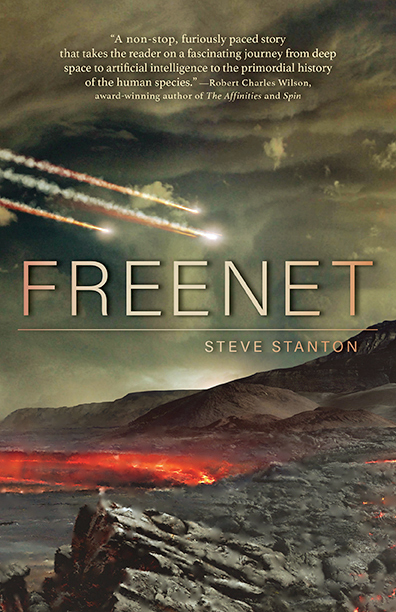
Itäranta, Emmi. Memory of Water. Harper Voyager. New York. 2014. 266pp.
Kerslake, Patricia. “The Self and Representations of the Other in Science Fiction.” Chapter 1. Science Fiction and Empire, Liverpool University Press, 2007, pp. 8-24.
King, Ynestra. “The Ecology of Feminism and the Feminism of Ecology.” Chapter 2. Healing the Wounds: The Promise of Ecofeminism, edited by Judith Plant. New Society Pub, 1989, pp. 18-28.
Krivak, Andrew. The Bear. Bellevue Literary Press, New York, NY. 2020. 221pp.
Miles, Kathryn. “Ecofeminism: sociology and environmentalism.” Britannica, britannica.com/topic/ecofeminism.
Walking the Rotary Trail during aheavy snowfall, ON(photo and rendition by Nina Munteanu)
Nina Munteanu is a Canadian ecologist / limnologist and novelist. She is co-editor of Europa SF and currently teaches writing courses at George Brown College and the University of Toronto. Visit www.ninamunteanu.ca for the latest on her books. Nina’s bilingual “La natura dell’acqua / The Way of Water” was published by Mincione Edizioni in Rome. Her non-fiction book “Water Is…” by Pixl Press (Vancouver) was selected by Margaret Atwood in the New York Times ‘Year in Reading’ and was chosen as the 2017 Summer Read by Water Canada. Her novel “A Diary in the Age of Water” was released by Inanna Publications (Toronto) in June 2020.