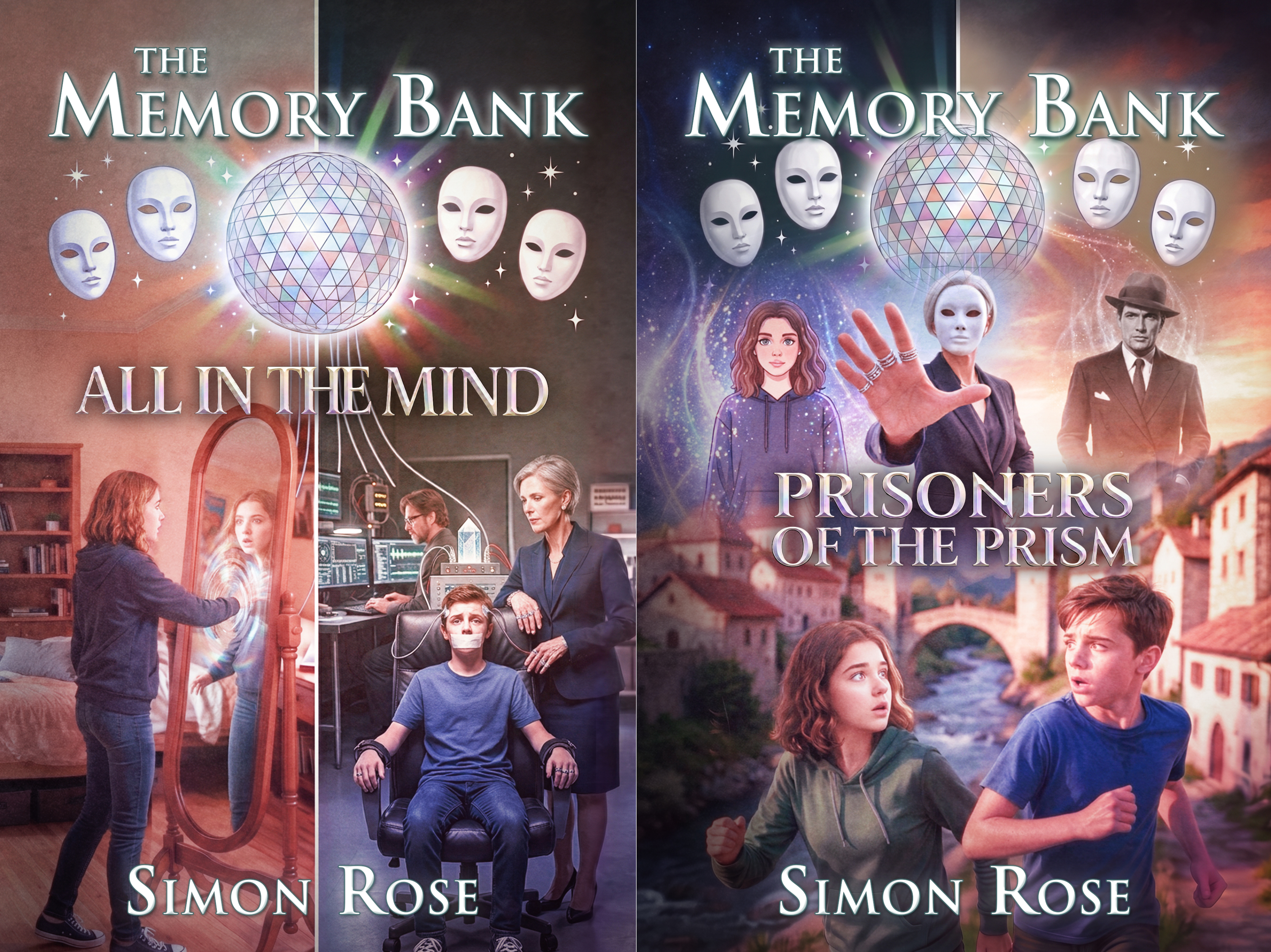
My guest today is author Simon Rose, who has published twenty-one novels for children and young adults, eight guides for writers, more than a hundred nonfiction books, and many articles on a wide variety of topics. Today he’s here to tell us more about his two latest novels, The Memory Bank – All in the Mind and The Memory Bank – Prisoners of the Prism.
Nina:Welcome, Simon!
Simon: Thank you, it’s a pleasure to be here.
.
Nina:Where did you get the idea from to create The Memory Bank novels?
Simon: For these books, I was first inspired by how people often have casts made of a beloved pet’s paw made when their faithful friend passes away. It’s certainly something I’ve done over the years. I then remembered how death masks have been created of notable people throughout history, well before the invention of photography, so that we know what some of these people actually looked like and in some cases the mask closely resembles the person’s face as portrayed in a painting. The ideas began to converge.
.
Nina:There are some quite well known people of which death masks were made, aren’t there?
Simon: Yes, there are masks that were made of the faces of Martin Luther, Oliver Cromwell, Mary Queen of Scots, Marie Antoinette, Isaac Newton, Horatio Nelson, John Keats, Ludwig van Beethoven, and a number of others. Perhaps the most notable one for me is Napoleon Bonaparte. Some people dispute whether it’s really him, but the mask does bear an uncanny resemblance to his many portraits. There are links included in both books and here on my website in the Sources of Inspiration page if you’re interested in learning more about this topic.
.
Nina:I know that you’ve always been fascinated with different historical eras. We can see that from many of your previous novels. Were the masks something that you’ve always been interested in?
Simon: Yes, I’ve always wondered about them, but I wasn’t sure how I’d ever be able to include them in a story. I was also aware of masks worn at carnivals in Venice, which seemed to be a natural fit as I was putting the story idea together for The Memory Bank.
.
Nina:How did the pet souvenirs serve as inspiration for the story?
Simon: Without giving away too much of the story, for the two novels I speculated how in the modern era masks could be made of a person’s face. This would then preserve their memories, as seen through their eyes, for their family members to see on a screen after the person’s death. This would be just like viewing photographs or watching home movies.
.
Nina:Sounds incredible. You certainly have a wonderful imagination.Tell me a little bit about your next project.
Simon: I currently have a couple of fantasy projects that I’m working on, so they’ll probably be taking up most of my creative time for the next little while. I’ll also be out there promoting The Memory Bank novels whenever I can. For regular updates, people can subscribe to my newsletter, which goes out on the first day of the month. They can do that on my website at www.simon-rose.com where they can also learn all about my other books.
.
Nina Munteanu is a Canadian ecologist / limnologist and novelist. She is co-editor of Europa SF and currently teaches writing courses at George Brown College and the University of Toronto. For the lates on her books, visit www.ninamunteanu.ca. Nina’s bilingual “La natura dell’acqua / The Way of Water” was published by Mincione Edizioni in Rome. Her non-fiction book “Water Is…” by Pixl Press (Vancouver) was selected by Margaret Atwood in the New York Times ‘Year in Reading’ and was chosen as the 2017 Summer Read by Water Canada. Her novel “A Diary in the Age of Water” was released by Inanna Publications (Toronto) in June 2020.You can read her just released eco-fiction thriller Gaia’s Revolution by Dragon Moon Press.
Minerva in Shakespeare’s The Tempest and John Savage in Aldous Huxley’s Brave New World
In today’s world of gene editing, plant and animal cloning, DYI biohacking, and artificial intelligence, the transhumanist movement merits careful thought. Simply put, transhumanism is a philosophical and intellectual movement that advocates for enhancing the human condition and expanding human capabilities through advanced technology.
But when does a Transhumanist’s individual expression of “transcendence” become a movement toward the Singularity? The political ambitions that wish to use science to “enhance” humanity, based on someone’s idea of “perfect” carry dangerous social implications. The transhumanist notion of “self-directed evolution” to recast humanity in the image of “perfection” evokes social Darwinism and the Übermensch. It brings to mind the early American eugenics programs that inspired the fascist sonderweg and Hitler’s aggressive “race hygiene” by application of eugenics in the Holocaust.
.
Eugenics: Designing A ‘Perfect Society’ from a ‘Perfect Human’
The eugenics tree (American Philosophical Society)
.
Put simply, eugenics is the scientifically erroneous and immoral belief and practice of “racial genetic improvement’ and “selective breeding” (or more currently through genetic manipulation), which gained particular popularity during the early 20th century with key scientific misappropriation (scientific racism).
Eugenics and scientific racism are concepts as old as Plato and have haunted humanity since the biblical portrayal of Adam and Eve. The philosophy and associated practice became increasingly common in the 1870s and 1880s as leaders and intellectuals worldwide argued for policies based on racist and xenophobic attitudes—justifying actions of antisemitism, sexism, colonialism, slavery, and imperialism. Discussions of ‘human improvement’ and the ideology of scientific racism became increasingly common. In 1883, Francis Galton, English statistician and ethnologist (and cousin of Charles Darwin), gave the practice a name. He called it eugenics, which comes from a Greek term meaning “good” or “noble” birth.
.
In 1938, German Dr. Bruno Beger measures a Tibetan woman’s head to demonstrate ‘inferior’ characteristics of her race; Beger later works for the Nazi SS to help identify Jews (Wikimedia Commons))
.
Eugenics was based on ‘scientific racism’, an ideology that appropriated the legitimate methods of science to argue for the superiority of white Europeans. Misappropriation of advances in medicine, anatomy and statistics during the 18th and 19th centuries (including Charles Darwin’s 1859 theory of evolution and Gregor Mendel’s laws of inheritance) added a false sense of validity to these racist claims.
.
The practice of eugenics is based on the notion that not only physical traits but mental and behavioral attributes—like mental capacity, musical ability, insanity, sexual licentiousness and criminality—are inheritable and therefore can be directed through breeding, sterilization and now through genetic manipulation.
(A child’s head is measured to determine his personality and predict his future, Schleswig-Holstein, Germany, 1932)
.
Historically the ideology of ‘scientific racism’ and practice of eugenics took on two forms: 1) positive eugenics—encouraging people deemed ‘superior’ or ‘fit’ (based on wealth, race or intelligence) to have more children; and 2) negative eugenics—discouraging or preventing people deemed ‘unfit’ (e.g. ethnic minorities, poor or disabled) from having children (most commonly through forced sterilization or murder).
.
1926 poster warning that breeding among the unfit creates an unwanted burden on society, Philadelphia, Pensylvania (Wikipedia Commons)
For instance, Work conducted at the Eugenics Record Office (ERO) in Cold Spring Harbor, under the direction of Charles Benedict Davenport from 1910 to 1939, directly led to the forced sterilization of thousands of American citizens and the passage of anti-immigration laws.
.
Coldspring Harbor Laboratory in 1920s where American eugenicists used state fairs as a venue for popular education, and judged “human stock” to select the most eugenically fit family in contests such as this one. (American Philosophical Society.
.
By the 1920s, eugenics was a global phenomenon, popular with the elite, particularly in countries such as Germany, the United States, Great Britain, Italy, Mexico, and Canada. In the United States, involuntary sterilization, forced institutionalization, social ostracization and stigma have continued well into the 1970s. Concerned over “race suicide” (based on differential birthrates of races), American eugenicists promoted involuntary sterilization of mostly native Americans, African Americans, poor whites and people with disabilities; declaring certain individuals “feebleminded” or anti-social. Over 60,000 people were sterilized against their will by the 1970s.
.
Ultimately, these same beliefs inspired the Nazis to exterminate people with disabilities and “lessor” ethnic or philosophical backgrounds. At least 400,000 victims were sterilized and over 70,000 adults and 5,000 children euthanized.
Nazi propaganda poster
.
“Perhaps more than any other science, biology has consistently been employed as an accomplice to moral claims because it has tremendous social utility in translating scientific findings into political imperatives,” says Cosima Herter, science consultant for the TV show Orphan Black (which covers the topic of eugenics well.) “Deeply embedded in the public consciousness is the hope that social problems can be solved with ‘scientific panaceas’,” Herter adds. “…Science can as easily act as an ally to existing institutions and justify pernicious prejudices – racism, sexism, homophobia, and class disparity to name a few – as it can produce wondrous, beautiful, and beneficial fruits in the service of a better world.”
.
Eugenics remains alive and well in North America. Much of it lies buried under beneath medical well-being, gene manipulation research or detainment, incarceration of illegal immigrants, or even the “metaeugenics” of AI. In her 2024 book Menace to the Future: A Disability and Queer History of Carceral Eugenics, Jess Whatcott introduces the term “carceral eugenics” which she defines as: “a concept that analyzes how state confinement functions to control the reproduction and life choices of groups of people who have been deemed biologically undesirable.”
.
Eugenics & Transhumanism
In 1929, Cambridge crystallographer J.D. Bernal, speculated on radical changes to human bodies and intelligence through bionic implants and cognitive enhancement. Two years before that, Fritz Lang’s expressionist SF film Metropolis introduced the first robot depicted in cinema: the Maschinenmensch, the machine-human.
.
Aldous Huxley’s 1932 dystopian novel Brave New World describes a ‘utopia’ based on eugenic principles. It is a stratified genetic caste society where the lower orders are deliberately stunted both mentally and physically. The destiny of its five main strata is determined from an early age. The strata consist of Alphas, destined for leadership positions; Betas, who hold less exalted but still intellectually demanding jobs; Gammas and Deltas, who occupy roles needing some intelligence; and finally Epsilons, happy and easily-controlled morons capable of only the most menial and unskilled tasks.
.
Biologist Julian Huxley, brother of author Aldous Huxley, first used the word Transhumanism in a 1957 article, where he presented the concept of the technological singularity, or the ultra-rapid advent of superhuman intelligence. Julian Huxley defined Transhumanism as “man remaining man, but transcending himself, by realizing new possibilities of and for his human nature.”
The founders of Transhumanism were educated wealthy individuals of mostly British and European descent. They were an elite ruling class, who considered themselves the forward-thinking intelligentsia. Transhumanismis an intellectual and cultural movement that promotes eugenic principles through science & technology to improve human mental and physical characteristics and capacities. Transhumanists seek to expand technological opportunities for people to live longer and healthier lives and enhance their intellectual, physical, and emotional capacities through the use of synthetic biology: genetic, cybernetic and nanotechnologies. From the transhuman perspective, “in time the line between machines and living beings will blur and eventually vanish, making us part of a bionic ecology.”
While early Transhumanists advocated the elitest pseudoscience of eugenics or “racial hygiene”, many of today’s Transhumanistsargue that market dynamics and individual choice will drive twenty-first century eugenics. However, this argument contradicts the movement’s own dialectic: that of achieving the Singularity. The Transhuman quest for the Singularity of the Übermenschconsists of the ability to upload the minds of all individuals to a Hive Mind, a symbiotic collective consciousness, in which all peoples can link to an artificial “brain” or global hard drive, to achieve super-intelligence. The Mind Upload Research Group (MURG) is currently researching this possibility.
.
Futurist Ray Kurzweil, author of The Age of Spiritual Machines and co-founder of the Singularity University, predicts that humans will be uploading their minds to computers by 2045 and that bodies will be replaced by machines—essentially achieving “immortality”—before the end of the century. “We’re going to become increasingly non-biological to the point where the non-biological part dominates and the biological part is not important any more,” says Kurzweil. “In fact the non-biological part – the machine part – will be so powerful it can completely model and understand the biological part. So even if that biological part went away it wouldn’t make any difference.”
.
If such an existence were even desirable—which it isn’t to me—such a utopia would not be available to everyone; it would remain the domain of a wealthy aristocracy, creating yet another class system. I’m reminded of William Gibson’s pithy proclamation: “The future is already here—it’s just not evenly distributed.”
Kurzweil admits: “Humans who resist the pressure to alter their bodies by becoming part-cyborg or are unable to afford such procedures will be ostracized from society. Humans who do not utilize such implants are unable to meaningfully participate in dialogues with those who do.”
In Kurzweil’s brave new world of biological and non-biological intelligence, immortal software-based humans, and ultra-high levels of intelligence will expand outward in the universe at the speed of light. Will such an elite see the mass of humanity as worthless parasites and either prevent them from reproducing via mass sterilization programs or simply slaughter them outright?
The smell of eugenics remains ever-present.
Its oppressive aroma lingers in the biocapital frontier. In the neo-eugenic ‘marketplace of genetics’ encouraged by current advances in genetic screening and gene editing. In the continued confabulations of “designer babies” for the wealthy. In the neoliberal commodification of “human capital,” and rebranding of the “unfit.” In the biopolitics of disabled populations. In the persistence of white-supremacist movements throughout the world.
A class studies the Bertilon method of criiminal identification, based on measuring body parts, Paris, France, 1910-15
In the introduction to their 2000 paper in Nature Reviews Genetics entitled “Engineering American society: the lesson of eugenics”, researchers David Micklos and Elof Carlson write: “We stand at the threshold of a new century, with the whole human genome stretched out before us. Messages from science, the popular media, and the stock market suggest a world of seemingly limitless opportunities to improve human health and productivity. But at the turn of the last century, science and society faced a similar rush to exploit human genetics. The story of eugenics—humankind’s first venture into a ‘gene age’—holds a cautionary lesson for our current preoccupation with genes.”
A phrenologist demonstrates how to measure a person’s head for their mental energy, UK, 1937
What is perfect and how do we measure it? What is the risk of even suggesting a recipe for such a thing? A perfect society? Isn’t a Utopia an oxymoron of unresolvable paradox? Science fiction literature has given us many visions of where so-called utopias may descend (e.g., Brave New World, 1984, Fahrenheit 451, A Stranger in a Strange Land, The Handmaid’s Tale, The Matrix, The Hunger Games, Elysium, Divergent, Clockwork Orange, Delirium, and so many more). The very act of being an individual provides complexity and diversity that promotes stability in change.
Stable chaos.
.
Perhaps, one day, when we are done hubristically tampering with things we shouldn’t be, we may find that the mess that is humanity fits rather nicely in this wonderfully messy world—and we’ll leave it all well alone.
More likely, that will be done for us by a world no longer patient with us.
.
Nazi propaganda poster
.
Glossary:
Der Übermensch (‘superman’): a philosophical concept introduced by Friedrich Nietzsche in his 1883 book Also sprach Zarathustra in which his character Zarathustra posits as a goal for humanity the Übermensch: a higher, self-mastering individual who creates their own values, affirms earthly life, and transcends the limitations of traditional morality and religion.
Transhumanism: a philosophical and intellectual movement that advocates for enhancing the human condition and expanding human capabilities through advanced technology.
Sonderweg: “special/unique path”; historically the term refers to the German/Teutonic belief that Germans were entitled to a distinct, separate historical development from the rest of Western Europe, ultimately leading to the rise of Nazism and the events of World War II. Historically, some German thinkers proudly viewed their special path as superior. They argued that Germany possessed a uniquely deep culture, strong statehood, and efficient bureaucracy that stood above “superficial” Western liberalism and parliamentary democracy
.
References:
Micklos, David and Elof Carlson. 2000. “Engineering American society: the lesson of eugenics.” Nature Reviews Genetics 1: 153-158.
Rutherford, Adam. 2022. “Control: The Dark History and Troubling Present of Eugenics.” WW Norton. 384pp.
Torres, Mark. 2025. “Long Island and the Legacy of Eugenics: Station of Intolerance.” The History Press. 240pp.
Whatcott, Jess. 2024. “Menace to the Future: A Disability and Queer History of Carceral Eugenics.” Durham & London, Duke University Press. 248pp.
.
Nina Munteanu is a Canadian ecologist / limnologist and novelist. She is co-editor of Europa SF and currently teaches writing courses at George Brown College and the University of Toronto. For the latest on her books, visit www.ninamunteanu.ca. Nina’s bilingual “La natura dell’acqua / The Way of Water” was published by Mincione Edizioni in Rome. Her non-fiction book “Water Is…” by Pixl Press (Vancouver) was selected by Margaret Atwood in the New York Times ‘Year in Reading’ and was chosen as the 2017 Summer Read by Water Canada. Her novel “A Diary in the Age of Water” was released by Inanna Publications (Toronto) in June 2020.You can read her just released eco-fiction thriller Gaia’s Revolution by Dragon Moon Press.
There’s a New Wave out there in science fiction. It’s growing. It’s green. And, yes, I’m on it.
In her 2023 PhD thesis out of Liverpool John Moores University, Victoria Crozier explores the metamorphosis of science fiction from stories primarily focused on human adventure and heroism to ‘New Wave’ stories of green science fiction. Far from celebrating the achievements of a super-capable humanity, these ‘New Wave’ eco-conscious narratives, which began with the environmental movement of the 1960s, reveal humankind as an environmentally destructive force.
.
Pre-1960s: Anthropocentric Androcracy
Pre-1960s science fiction largely featured scientific and technological developments and associated impacts on humans; stories that evoked a sense of wonder and involved heroic adventures of humans in unfamiliar worlds. Stories focused on the need to overcome harsh environments and conquer treacherous alien elements as humans prevailed through various androcratic strengths. I read many of them, mostly written by men. Despite generating excitement and inspiration, these narratives advanced a patriarchal and imperialistic conceit that drew from anthropocentric androcracy.
.
.
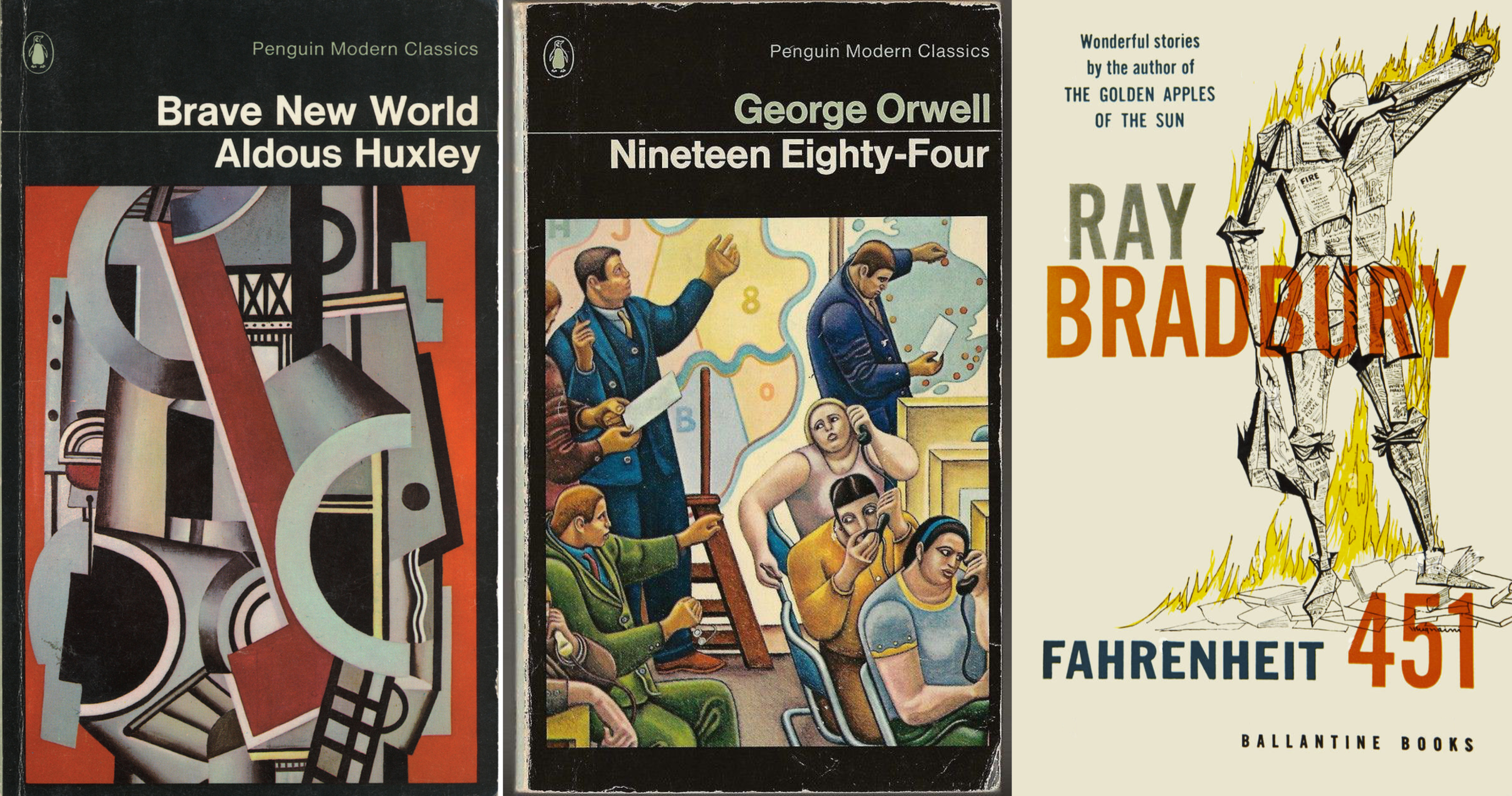
The 1930s and 1940s spawned narratives focused on social justice—responses to both world wars. Aldous Huxley’s Brave New World (1932) and George Orwell’s Nineteen Eighty-Four (1949) and Animal Farm (1945) represented the height of this exploration with a focus on totalitarian rule, surveillance technology, and genetic modification. Ray Bradbury’s Fahrenheit 451 (1953) explored censorship as an important aspect of mind-control by an oppressive rule.
Drawing on a Cartesian directive, science fiction remained largely anthropocentric, typically ‘othering’ Nature and objectifying it. Writers treated the non-human world with fear or disdain; Nature was a device that challenged brave human explorers to exert their superiority through subjugation or annihilation. The environment was seldom portrayed as a character with agency and sensibility. Never something to be admired. Something to love.
.
The 1960s: Rachel Carson’s Revolution
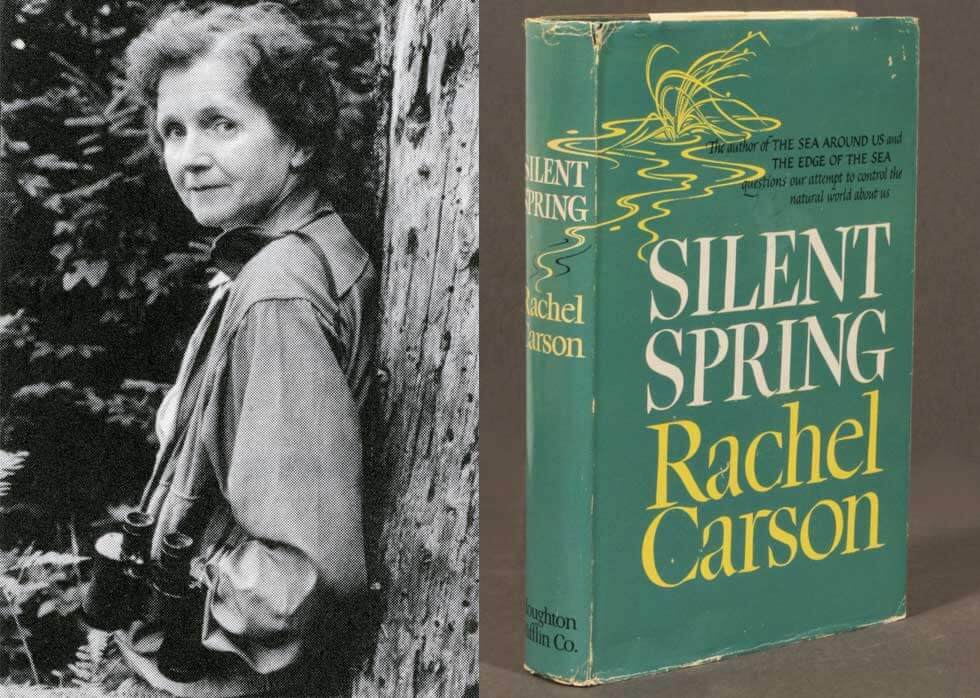
Rachel Carson and her seminal book Silent Spring
.
In 1962, Rachel Carson published her book Silent Spring, regarded by some as the single most important contributor to the environmental movement of the 1960s. Her book warned of our declining bird and bee populations and impacts to human health from unregulated pesticide/herbicide use (such as carcinogens and hormone disruptors).
I was just a kid when Carson’s book came out. But it was already apparent to me that environmental imbalance and destruction were global concerns and we were on the brink of an environmental crisis. Unchecked deforestation was destroying forests around the world, including the boreal and old-growth forests of my own country Canada. Brazil had already begun cutting down trees and burning forest at an alarming rate. Unregulated use of pesticides, herbicides and growth hormones created toxic contamination of our natural world and our food and water supply—despite Carson’s dire warning with Silent Spring. Our waterways were being contaminated by mining wastes and industrial effluents. Killer smog. Noxious algal blooms. Oil spills. Dead zones. The list kept growing.
By the time I was in college, I’d concluded that a hegemony that follows the economic system of late capitalism inevitably commodifies and ‘others’ with ruthless purpose. Once something (or someone) is commodified, they are given a finite value and purpose outside their own existence. They become an object, a symbol to use and trade. They become a resource to manipulate, exchange, and dispose of with impunity. And through this surrender to utility, they become ‘othered.’ The consumer. The trees of the forest. Water. Homo sacer*. Each has a role to play in the late capitalist narrative of digital abundance and physical scarcity.
.
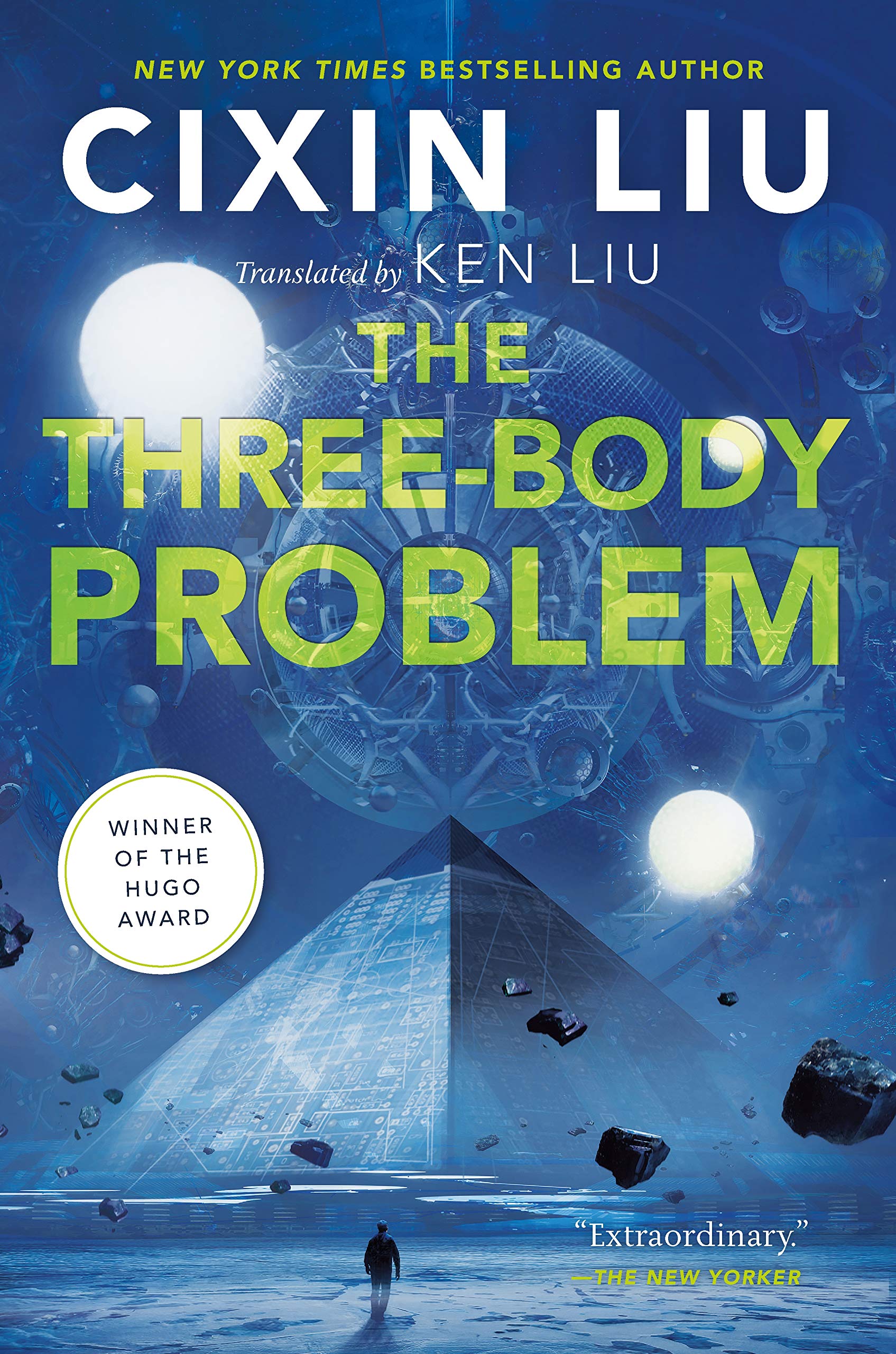
Liu Cixin begins his 2006 science fiction novel The Three Body Problem in the 1960s, during China’s Cultural Revolution. The novel follows astrophysicist Ye Wenji, disillusioned by the massive environmental deforestation in the labour camps she is initially sent to work after witnessing the execution of her scientist father in a brutal cleansing at the height of the revolution. Already cynical about humanity’s failed culture and science—Wenjie acquires a contraband copy of Rachel Carson’s Silent Spring. The book and revelation she experiences from it sets in motion a frightening notion linking the mindset behind the Cultural Revolution and destruction of the environment.
.
Post-1960s: Ecocentric Gylany
On the heels of the environmental movement of the 1960s, the New Wave of eco-science fiction, or what Crozier calls ‘green science fiction’, took hold with science fiction authors and literary fiction authors. Ursula K. LeGuin helped pioneer feminist science fiction as well as eco-fiction and climate fiction. Left Hand of Darkness (1969) introduced ambisexuality, no fixed sex, and The Word for World is Forest (1972) critiqued extractivism by human colonists. The Mars Trilogy by Kim Stanley Robinson (1992-1996) debated the rights of humans to alter a pristine planet, overlooking the intrinsic rights of an alien environment. N.K. Jemison’s The Fifth Season (2015) portrayed the physical Earth as active and angry about its abuse by humanity.
Subtle changes in the portrayal of non-humans and Nature have emerged.
In his 2025 PhD thesis, Steven L. Ogden (University of Albany, State University of New York) explored the concept of “Heterogenous Being”1 linking the sciences with humanities to address the precarious realities of Earth’s ecological and environmental conditions. Entitled, “Heterogenous Being: The Inhumanities and the Creative-Scientific Aesthetic.” Ogden’s thesis acknowledges the influences and agented potentialities of nonhuman subjects in narrative, both in fiction and nonfiction. Including my own portrayal of water as character in my eco-fiction novel A Diary in the Age of Water, Ogden writes,“… these inhuman2 examinations not only provide the nonhuman with a comparable or more profound existence alongside our own; they also illustrate the immense and consequential scope of our collective realities.”
Othering in Science Fiction & Other Genres of Literature
The rhetoric of ‘Otherness’ in most fiction is typically portrayed through the singular point of view (POV) and discourse of a protagonist on a journey.3 In most forms of literature the POV ‘voice’ represents the Self, the inclusive ‘us’ (worldview) in its encounter with the Other, which in turn is the ‘not us.’ In his book Orientalism: Western Conceptions of the Orient Edward W. Said contended that for there to even be an ‘us’, there has to be a ‘not-us’. The resulting power dynamic of “them and us,” of Other and Self, is created and controlled by perceptions of the singular POV voice.
In most genres of literature—and certainly in science fiction—the Other is often relegated to this dichotomous portrayal. In post-apocalyptic and metaphoric journey stories the Other may be the harsh environment or a calamity through which the protagonist must find their own strength to survive; in military stories it is clearly the enemy, seldom portrayed with compassion or understanding but there to test our hero; in coming-of-age stories it may be the oppressive rule or established world the hero must overcome; in some science fiction it is the hostile or unknowable aliens who must be defeated.
Ogden clarifies the irony of this way of thinking: “like René Descartes, many today still consider the mind or “rational soul” of humanity to be entirely exceptional to and independent of animality, and believe no part of Man (as master and possessor of nature) could derive from the “potentiality of [nonhuman] matter.”
Crozier argues that, “Eco-science fiction is an essential cultural instrument with which to understand and respond to our planet in an epoch of environmental crises.”
Eco-science fiction is poised to make meaningful character-couplings between mostly human protagonist and environmental characters or representatives. This is because the protagonist provides relatable qualities for easy reader empathy, while the Othered character is often less relatable—often an arcane aspect of the environment, such as water (Memory of Water or A Diary in the Age of Water) or a forest (The Overstory).
The protagonist’s link to the Other—often as avatar—provides a readable map for the reader to follow and make their own connection.4 In Character Coupling Part 2, I provide examples from several works of eco-science fiction and general eco-fiction, such as The Overstory, Barkskins, The Breathing Hole, The Windup Girl, The Bear, Memory of Water, Dune and my own A Diary in the Age of Water.
Through these linkages, environmental abuse of jingoistic hubris can be felt on a profound and personal level. Eco-science fiction can raise issues of human intersectionality, misogyny, marginalization, oppression of class, privilege, sexuality and race, and misuse of power. Violent acts perpetrated on environment—when environment is personified as ‘character’ and/or coupled directly to a character—elicit powerful emotion and clearly demonstrate how social/human injustice reflects environmental injustice.
.
The ‘New Wave’: A Changing Narrative
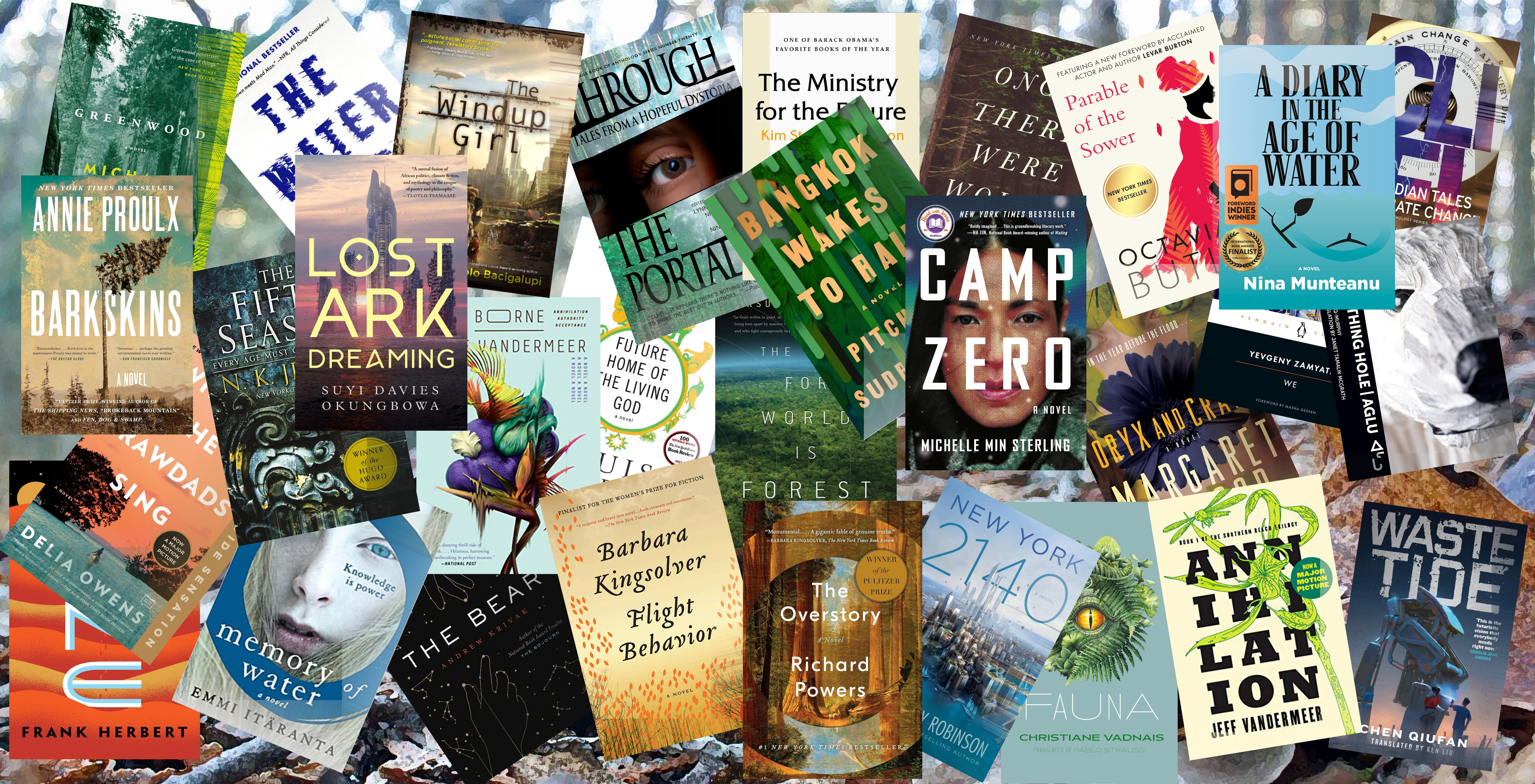
Various green-science fiction and general eco-fiction novels worth reading
.
New Wave green science fiction took shape in the 1960s with J.G. Ballard and Ursula K. LeGuin who spearheaded a transformation toward ecocentric views. New Wave science fiction has burgeoned in the last several decades with highly pertinent narratives to the environmental and climate concerns of our current world. These narratives clearly challenge our political, religious and social worldviews, and patriarchies.
.
Three non-fiction books that celebrate nonhuman life
.
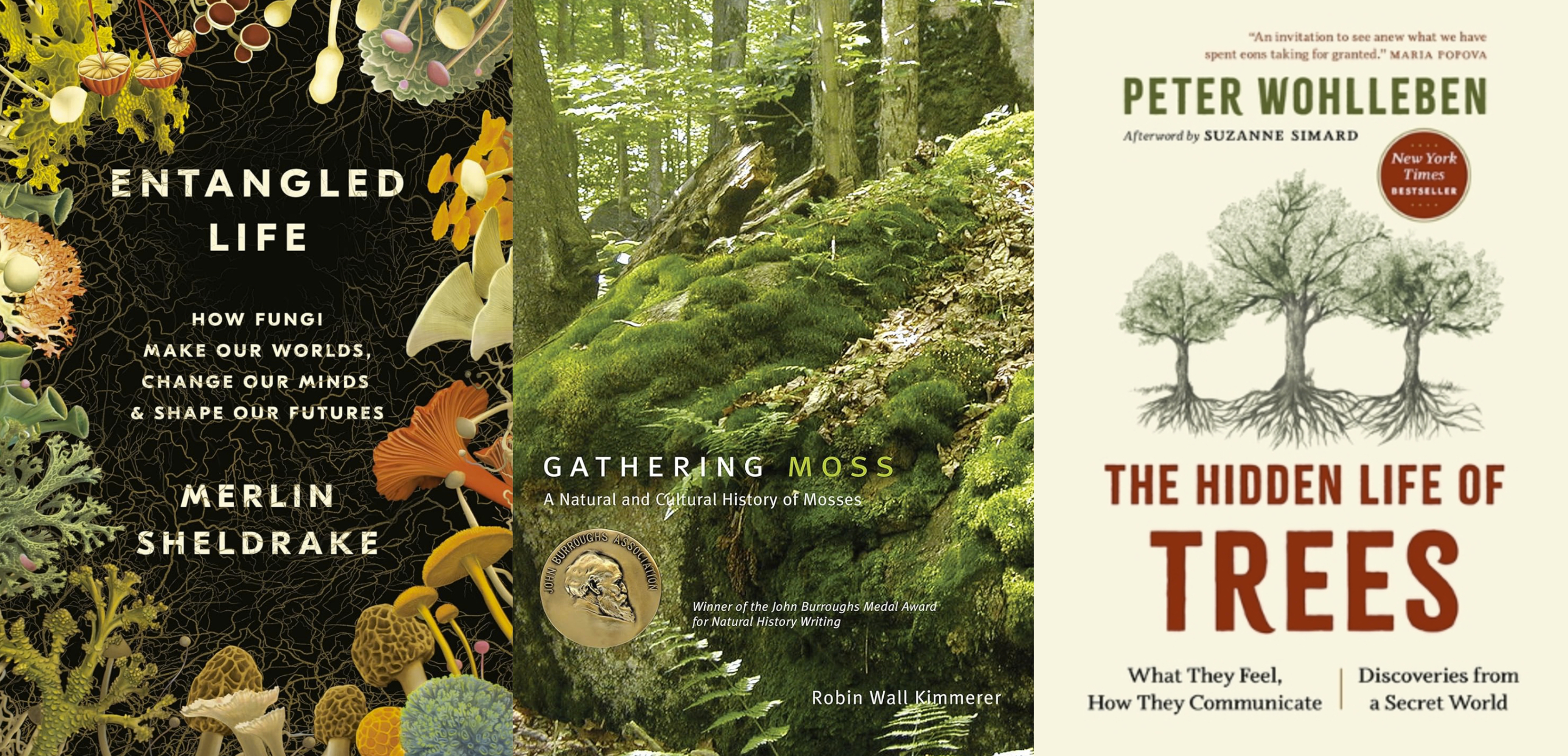
Acknowledging the early influences of animal studies rooted in biocentricity, Ogden notes that non-fiction representation of nonhuman life has also increased exponentially in the last ten years. Ogden includes the following notable examples: Merlin Sheldrake’s Entangled Life: How Fungi Make Our Worlds; Robin Wall Kimmerer’s Gathering Moss, and Peter Wohlleben’s The Hidden Life of Trees.
.
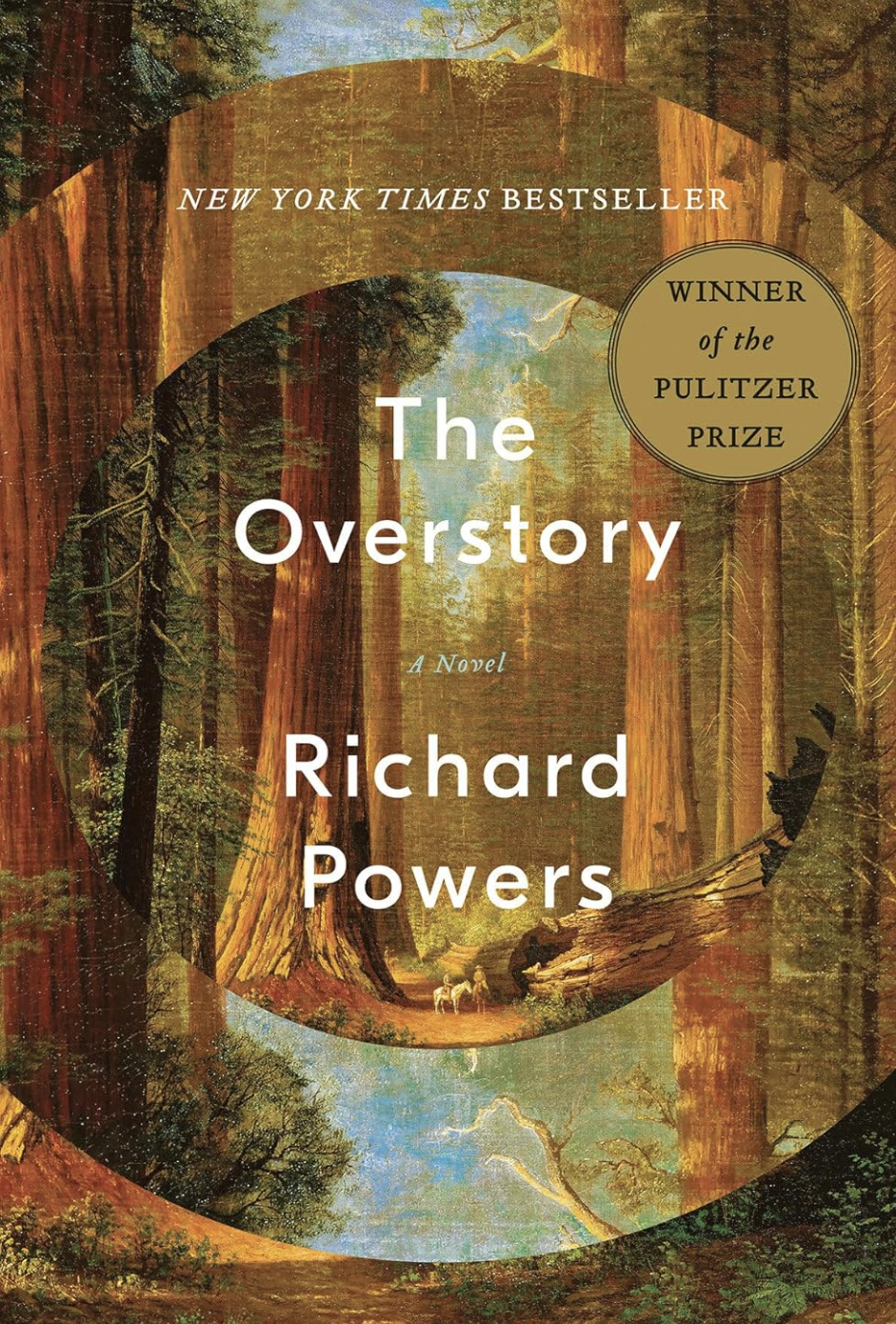
Ogden argues that “Westerford (a scientist in Richard Powers’s The Overstory) understands that climate and biodiversity are ‘failing precisely because no [story] can make the contest for the world seem as compelling as the struggles between a few lost people.’” Westerford realizes that her peers believe that plants live an inanimate existence, whose rooted immobility points to a kind of “unfreedom” that represents an “archetype of inert matter.” According to poet David Hinton, this devaluation of plant life relates to the human-nonhuman duality, “a Western dichotomy that relegates the vegetal world to a space of ‘linguistic silence.’”
Crozier, Victoria. 2023. “The Brave New Worlds of Green Science Fiction: Ecocritical Discourse in The Three-Body Problem and The Long Earth Series.” Doctoral Thesis, Liverpool John Moores University, UK. April, 2023. 265pp.
Descartes, Rene, et. al. 1998. “Discourse on the Method; and Meditations on First Philosophy.” Hacket Pub.
Ogden, Steven L. 2025. “Heterogenous Being: The inhumanities and the Creative-Scientific Aesthetic.” Doctoral Thesis, University at Albany, State University of New York. Spring, 2025. 220 pp.
Powers, Richard. 2018. “The Overstory.” W.W. Norton & Company, New York. 502pp.
Said, Edward W. 1978. “Orientalism: Western Conceptions of the Orient.” Vintage, London. 432pp.
.
Footnotes:
Ogden describes “Heterogenous Being” as a way of being that recognizes and incorporates humanity’s pluralized configurations with the nonhuman world by uniting the studies of science and humanities into an interdisciplinary hybrid creative-scientific aesthetic.
Ogden explains the use of “inhuman” here by referring to Jeffrey Jerome Cohen’s notes in Stone: An Ecology of the Inhuman, which uses inhuman to “emphasize both difference (‘in-‘ as negative prefix) and intimacy (‘in-‘ as indicator of estranged interiority).” This is akin to the practice of “othering”.
The Other has often been metaphorically portrayed in SF by aliens that lack a distinct voice or viewpoint; some portrayal has reflected a fearful imperialistic colonialism by representing Other as adversary such as an invading monster with no regard for humans (e.g. Robert Heinlein’s The Number of the Beast; H.G. Wells’s War of the Worlds). Kerslake argues that the traits of the Other “fall characteristically—and conveniently—into those spaces we choose not to recognize in ourselves, the ‘half-imagined, half-known: monsters, devils, heroes, terrors, pleasures, desires’ of Said’s ‘Orient’”. The Martians of Ray Bradbury’s Martian Chronicles—who also have no voice—reflect our indigenous peoples under the yoke of settler colonialism and an exploitive resource-extraction mindset. The monster of Mary Shelley’s Frankenstein —also with no voice—exemplifies the disabled/deformed unsavory departure from our ‘perfect’ self-image; to be chased, destroyed and nullified.
In some stories the protagonist is Othered in some way, providing a more direct link to the experience of being the Other or being Othered. For instance, in Mishell Baker’s Borderline, disabled protagonist Millie provides the connection to the greater theme of Othering “lesser beings.” In Costi Gurgu’s Recipearium, the protagonists are not human; they are alien creatures that dwell inside the dead carcass of a monster, representing Other as main character.
.
Glossary:
Androcracy: a form of governing system in which rulers are male.
Gylany: a social system based on equality of men and women.
Homo sacer: a figure from Roman law denoting a person excluded from society who is outside human law (can be killed) and divine law (cannot be sacrificed). The term represents “bare life”: stripped of political rights, legal protection, and social value. Philosopher Giorgo Agamben popularized the term to describe individuals excluded from the political community, such as refugees, stateless persons, or camp detainees. The term illustrates the power of a sovereign in deciding which lives are worthy of protection and which are not.
.
Nina Munteanu is a Canadian ecologist / limnologist and novelist. She is co-editor of Europa SF and currently teaches writing courses at George Brown College and the University of Toronto. For the latest on her books, visit www.ninamunteanu.ca. Nina’s bilingual “La natura dell’acqua / The Way of Water” was published by Mincione Edizioni in Rome. Her non-fiction book “Water Is…” by Pixl Press (Vancouver) was selected by Margaret Atwood in the New York Times ‘Year in Reading’ and was chosen as the 2017 Summer Read by Water Canada. Her novel “A Diary in the Age of Water” was released by Inanna Publications (Toronto) in June 2020.You can read her just released eco-fiction thriller Gaia’s Revolution by Dragon Moon Press.
A short while ago, I was approached by a CBC reporter to discuss Solarpunk and the solarpunk movement in Toronto, specifically.
Given that my writing has significant solarpunk elements in it and I teach at the University of Toronto, in Toronto where I participated in several solarpunk initiatives, I was happy to discuss the subject with Louna Marchet.
The interview, which will air in French on CBC Radio, covered a wide range of a very interesting discussion on solarpunk generally and below, I’ve highlighted a few parts.
What is Solarpunk? Solarpunk is basically an optimistic, action-oriented subgenre of speculative fiction or art that has evolved into a social movement. The movement imagines a sustainable, post-capitalist future where humanity lives sustainably relying on renewable energy, DIY ethics, community resilience and a decentralized technology. It’s a radical hope alternative to dystopian narratives of gloom and doom.
On Eco-Fiction: I mentioned that I write mostly eco-fiction and hopeful dystopias (dystopias with solarpunk elements to them). Through its vision of our future, eco-fiction encourages conversations and an outward perspective. Eco-fiction can trigger a sense of wonder about the natural world; it may connect with our sense of loss or mourning—our solastalgia—for our changing home. Cautionary tales may nudge people to action and encourage alternative futures. Eco-fiction—whether told as dystopia, post-apocalypse, cautionary tale or hopeful solarpunk—can help us co-create a new narrative, one about how the Earth gifts us with life and how we can give in return. By encouraging empathy and imagination, eco-fiction reaches deep into our souls, where we care. It is only when we care that we act. I write more about this in my article “Why Writing and Reading Eco-Fiction Will Save the World—From Clifi to Solarpunk.”
On Changing the Narrative: I offered that we need to change our (North American society’s) current (capitalist) narrative of separation, “othering”, and exploitation toward one of participation, inclusion, and a nurturing spirit. Storytelling forms a key part of that overall narrative. That shift is happening in the emergence of a strong eco-voice by marginalized groups, those who would be most affected by things like habitat destruction and climate change. Centering the voice of the ecological other as a sympathetic character is a main feature of eco-fiction.
What we cherish, we protect.
I write more about this in two articles that discuss character coupling to provide voice to the ‘other’, from excluded minority to the silent environment.
On the Emerging Solarpunk Movement in Toronto: When asked about whether there is a solarpunk movement in Toronto, I said absolutely! Solarpunk Toronto is an emerging movement focused on building a sustainable, equitable future through community action, green architecture, and renewable energy, specifically tailored for the city’s urban environment. It includes initiatives like sustainable fashion shows, community meetings, and innovative storytelling, aimed at merging environmental activism with optimistic technology. The mantra is to achieve a regenerative sustainable urban future.
I mentioned Lindsay Jane of the Solarpunk Scene (Youtube videos on Solarpunk projects in Toronto) and Ariel of Solarpunk Presents with podcast interviews on solarpunk efforts. People can find community on the Solarpunk Facegroup group. I also talked about the Toronto Solarpunk Meetup at the Centre for Social Innovation, where they practice “prefigurative life’: living as if the sustainable future already exists. Which it does, though not everywhere.
This reminds me of cyberpunk science fiction author William Gibson’s famous quote: The future is already here; it’s just not evenly distributed.
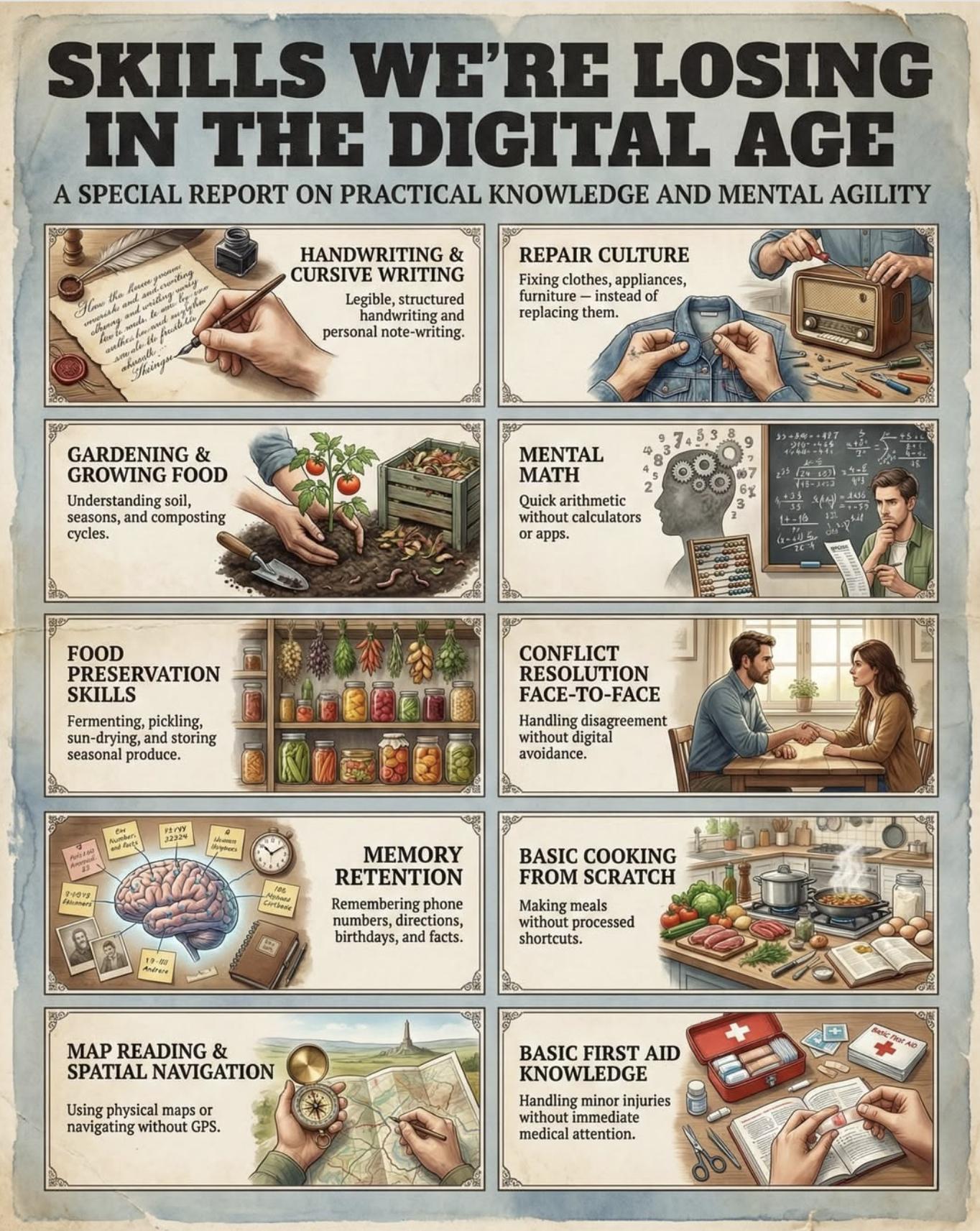
Examples of solarpunk initiatives practiced by individuals and small communities include the use of community gardens, setting up and looking after rooftop gardens or raingardens. Tenants can have a pollinator garden on their patio and set up a balcony solar panel (now very affordable). People are going electric; some are setting up solar rooftops or balconies. Groups and individuals are engaging in clothing swaps and sustainable fashion runways. Community-led trusts are involved in repairing items for reuse instead of adding to the throw-away culture. In my book A Diary in the Age of Water the diarist’s mother Una rides her bike all over the community, repairing all kinds of things for a community that has lost its ability to do so; something we’re losing in this digital age.
.
.
On a Solarpunk Future: We discussed the feasibility of a city like Toronto becoming 100% solarpunk. My response was a wary yes. Of course it was possible. But, in my opinion, two things have to happen for this to succeed: 1) the willingness of individuals in a community to give up a consumer-led capitalist lifestyle and adopt a lighter gentler footprint; and 2) community and city leaders to be on board with it. The enthusiastic cooperation of leaders cannot be overstressed for a paradigm shift toward a solarpunk future to succeed.
.
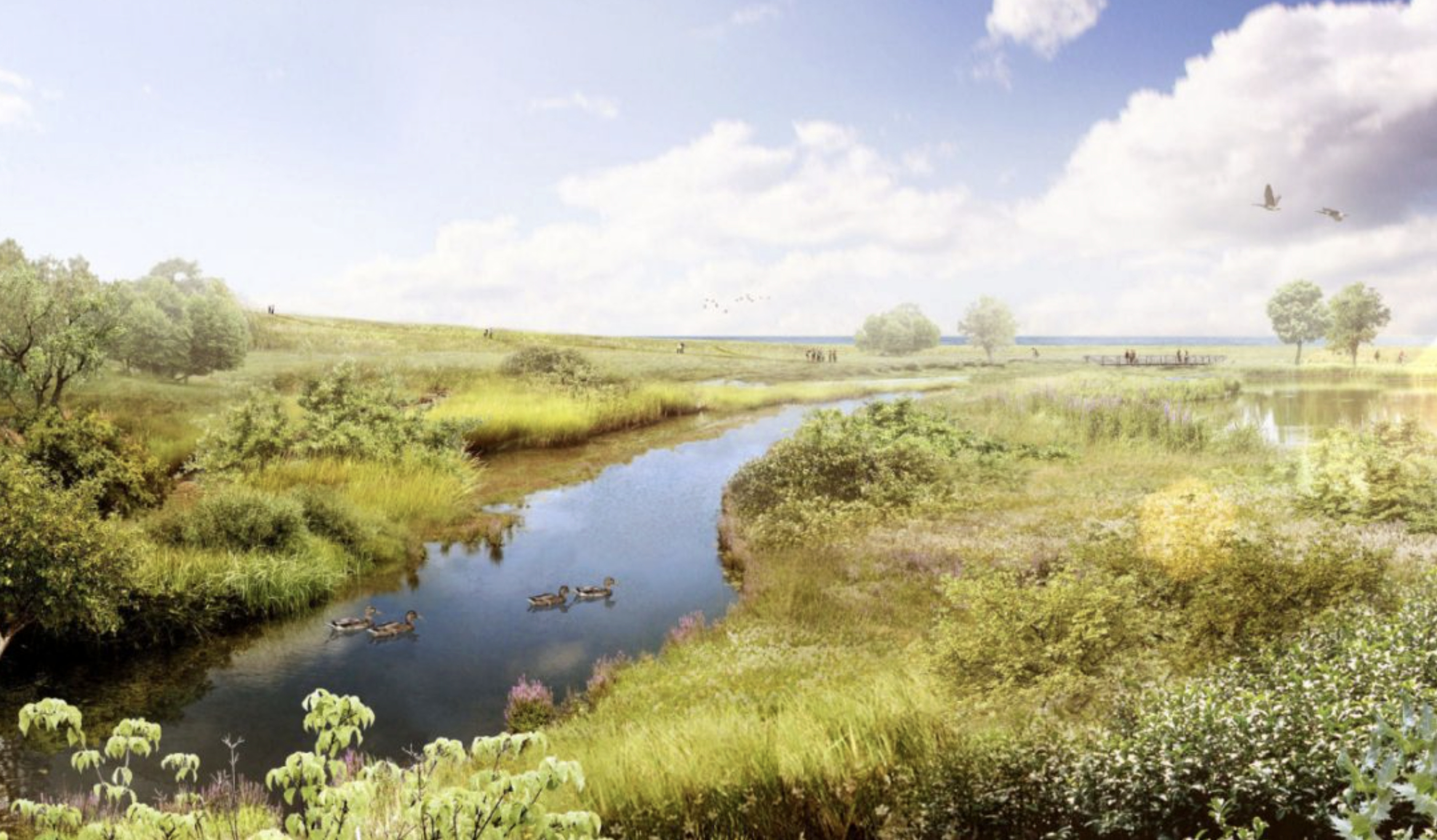
Artist’s concept of the marsh of the Jim Tovey Lakeview Conservation Area
.
I gave two examples of small projects that succeeded because a community and its leaders cooperated to make it happen. One was the adoption of several climate solutions in Paul Hawken’s Drawdown by the Richmond Hill community, led by Liz Couture. The second example is Mississauga’s Morphology Project of 2017 to build a 26 hectare park and marsh creation (naturalization of shoreline and extensive marsh environment), inspired by Councilor Jim Tovey.
.
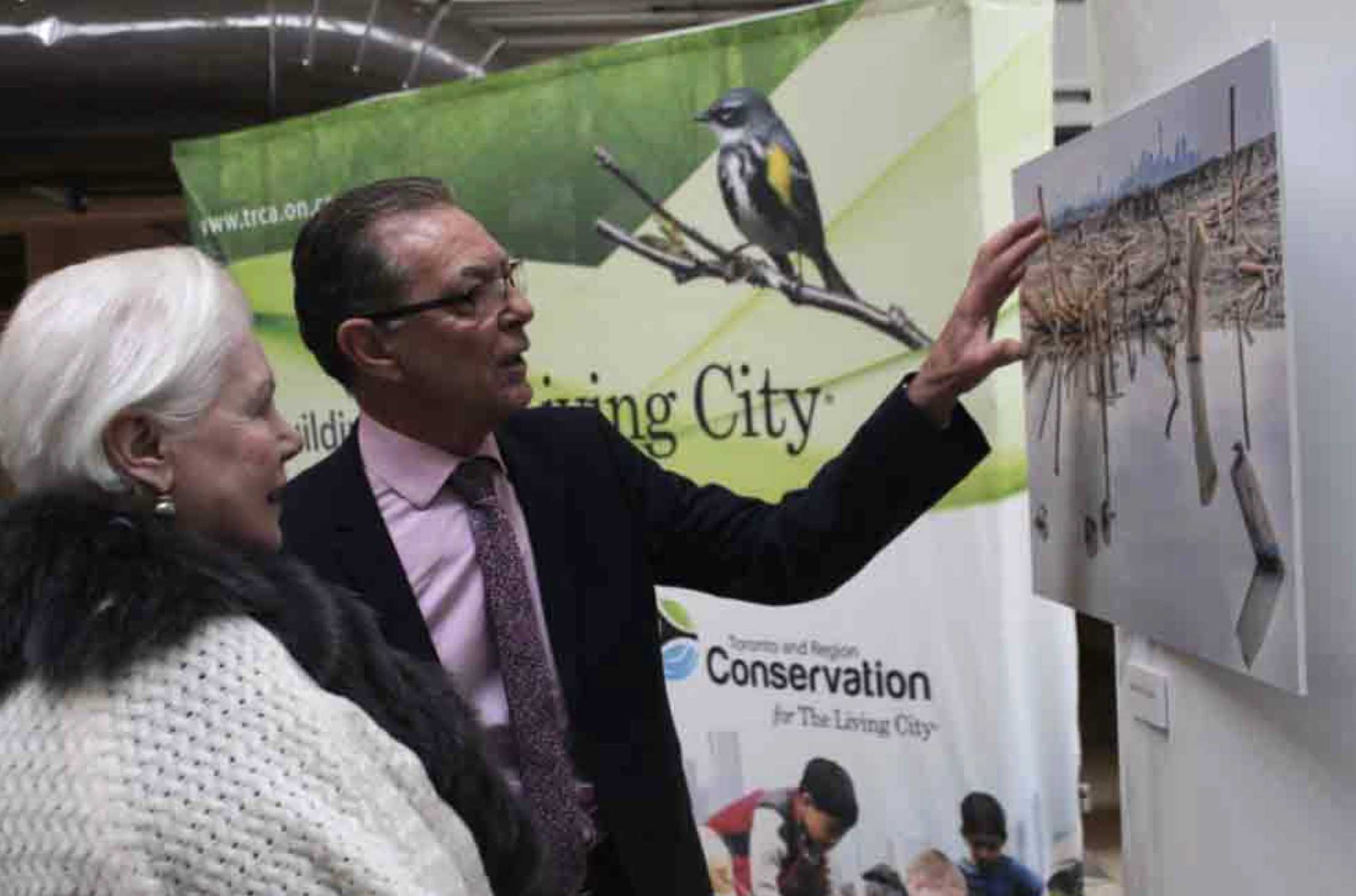
Councillor Jim Tovey and Lieutenant Governor Elizabeth Dowdeswell (photo by John Stewart)
.
A true visionary, Tovey ensured the project’s success and potential spread to other jurisdictions by documenting the stages of the marsh creation and changes to the waterfront. Aside from regular press releases and interviews, etc. he invited eleven professional photographers to photograph and exhibit how the marsh evolved over the years.
.
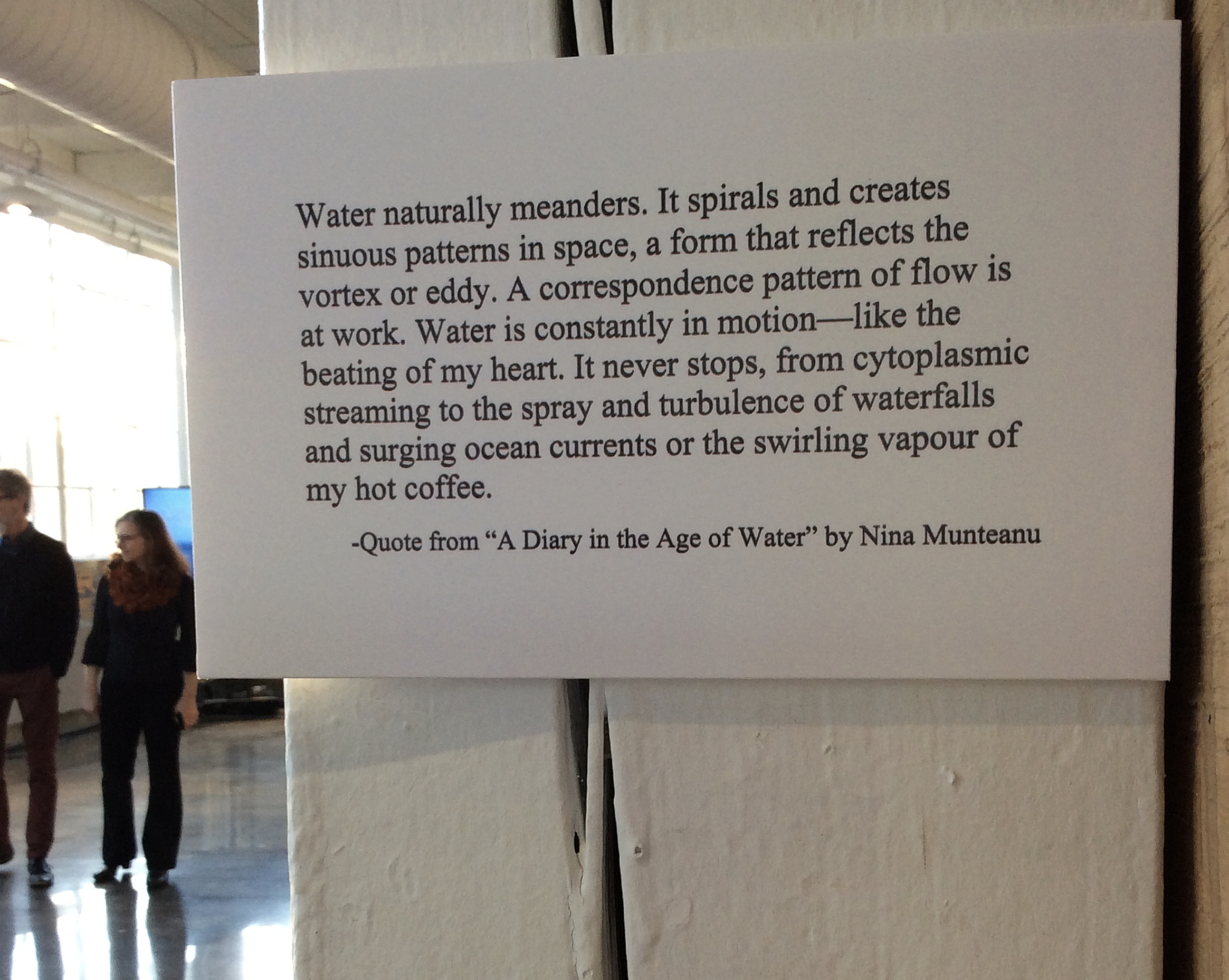
Tovey invited me to contribute quotes from my book Water Is…The Meaning of Water and A Diary in the Age of Water to accompany the photos in each exhibit. The Jim Tovey Lakeview Conservation Area project was a huge success, largely because—apart from the obvious ecological benefit—it captured the imagination and interest of several communities and showed how the blending of environmental benefit and good-living can co-exist and flourish.
.
Tovey invited me to contribute quotes from my book Water Is…The Meaning of Water and A Diary in the Age of Water to accompany the photos in each exhibit. The Jim Tovey Lakeview Conservation Area project was a huge success, largely because—apart from the obvious ecological benefit—it captured the imagination and interest of several communities and showed how the blending of environmental benefit and good-living can co-exist and flourish.
.
Quote from “A Diary in the Age of Water” at the photography exhibit
Nina Munteanu is a Canadian ecologist / limnologist and novelist. She is co-editor of Europa SF and currently teaches writing courses at George Brown College and the University of Toronto. Visit www.ninamunteanu.ca for the latest on her books. Nina’s bilingual “La natura dell’acqua / The Way of Water” was published by Mincione Edizioni in Rome. Her non-fiction book “Water Is…” by Pixl Press (Vancouver) was selected by Margaret Atwood in the New York Times ‘Year in Reading’ and was chosen as the 2017 Summer Read by Water Canada. Her novel “A Diary in the Age of Water” was released by Inanna Publications (Toronto) in June 2020.Her most recent novel “Gaia’s Revolution” was released in March 2026 by Dragon Moon Press (Calgary).
My eco-fiction novel A Diary in the Age of Water was recently discussed in a 2025 PhD thesis by Steven L. Ogden out of the University of Albany, State University of New York entitled: “Heterogenous Being: The Inhumanities and the Creative-Scientific Aesthetic.” I was fascinated by his stirring, well-researched dissertation that explored the dichotomous narrative separating human with non-human. A narrative that is changing—though very slowly.
Ogden’s PhD thesis advances a hybrid form of inquiry on “Heterogenous Being”1 that links the sciences with humanities to address the precarious realities of Earth’s ecological and environmental conditions; he does this by acknowledging the influences and agented potentialities of nonhuman subjects in narrative, both in fiction and nonfiction. “… these inhuman2 examinations not only provide the nonhuman with a comparable or more profound existence alongside our own; they also illustrate the immense and consequential scope of our collective realities,” writes Ogden.
The rhetoric of ‘Otherness’ in most fiction is typically portrayed through the singular point of view (POV) and discourse of a protagonist on a journey.3 In most forms of literature the POV ‘voice’ represents the Self, the inclusive ‘us’ (worldview) in its encounter with the Other, which in turn is the ‘not us.’ In his book Orientalism: Western Conceptions of the Orient Edward W. Said contended that for there to even be an ‘us’, there has to be a ‘not-us’. The resulting power dynamic of “them and us,” of Other and Self, is created and controlled by perceptions of the singular POV voice.
In most genres of literature, the Other is often relegated to this dichotomous portrayal. In post-apocalyptic and metaphoric journey stories the Other may be the harsh environment or a calamity through which the protagonist must find their own strength to survive; in military stories it is clearly the enemy, seldom portrayed with compassion or understanding but there to test our hero; in coming-of-age stories it may be the oppressive rule or established world the hero must overcome; in science fiction it may be the hostile or unknowable aliens who must be defeated.
The irony of this way of thinking is made clear in Ogden’s introduction. Ogden writes that “like René Descartes, many today still consider the mind or “rational soul” of humanity to be entirely exceptional to and independent of animality, and believe no part of Man (as master and possessor of nature) could derive from the “potentiality of [nonhuman] matter.” He quotes Donna Haraway (author of When Species Meet) who said that “to exist as an individual is always to become with many.” She is talking about the thousands of species living symbiotically inside us and around us that keep us alive. This is what philosopher Levi Bryant refers to as a democracy of objects in which “humans are no longer monarchs of being, but are instead among beings … and implicated in other beings.” We are entangled in beings. We are implicated in other beings.
Through this new paradigm and approach, Ogden contends that “no longer can anthropogenic issues of climate change, trash vortices, deforestation, synthetic pollution, effluence, nuclear waste isolation, or species extinction be concealed from the majority of literary imaginings. Because as the trajectory of once passive, ancillary things and forces find an arena of greater articulation, the Anthropocene becomes an epoch whose hazards affect more than its namesake. Readers are afforded a larger moral and literary connectedness to a greater variety of relatable nonhuman subjects in the throes of this crisis, with that inhuman accordance likewise enlarging the terrains of their own ontological and epistemological perspectives as an ecomimetic strategy furthers the understanding of the nonhuman with each varied literary elaboration.” He adds that the “massive temporal and spatial persistence/distribution of anthropogenic nonhuman ‘hyperobjects’ like plastics, polychlorinated biphenyls (PCBs), per- and polyfluoroalkyl substances (PFAS), or nuclear waste expands the probable aesthetic and political/ethical dimensions of the creative arts.”
Ogden concludes that in such a space of consideration (an allied creative-scientific aesthetic), an intermediacy is established between the literary arts and sciences in which “principal methods, qualities, and philosophies are openly exchanged, and a multimodal expression links the realms of simplified rationalism with pure allegory into a compounded composition of metaphor and description, myth and science, characterization and cause-and-effect, and poetic reveries and empirical rationalism.” This greater perspective expand dynamic probabilities for the inhuman world to experience agency and greater and more meaningful presence, what Ogden calls “a necessary heterogenous representation of both humans and nonhumans within the collective scientific and literary imagination…towards a more meaningful and affective realization.”
.
How Eco-Fiction Empowers & Animates Nonhuman Subjects
While eco-literature overlaps with many genres, it appears to differ from SF and other genres portrayal of Other through its unique intention to give voice to otherwise voiceless characters, and it often does this through masterful use of character-coupling. Mary Woodbury defines eco-literature or eco-fiction as literature “made up of fictional tales that reflect important connections, dependencies, and interactions between people and their natural environments.” The environment—or an aspect of the environment—plays a major role in eco-literature, either as premise or as itself a character on a journey.
Eco-literature may go beyond raising awareness to link environmental abuse with concepts of jingoistic hubris; it may raise issues of human intersectionality, misogyny, marginalization, oppression of class, privilege, sexuality and race, and misuse of power. Violent acts perpetrated on environment—when environment is personified as ‘character’ and/or coupled directly to a character—elicit powerful emotion and clearly demonstrate how social/human injustice reflects environmental injustice.
Eco-literature is particularly poised to make meaningful character-couplings between mostly human protagonist and environmental characters or representatives. This is because the protagonist provides relatable qualities for easy reader empathy, while the Othered character is often less relatable—often an arcane aspect of the environment, such as water (Memory of Water) or a forest (The Overstory). The protagonist’s link to the Other—often as avatar—provides a readable map for the reader to follow and make their own connection.4 In Character Coupling Part 2, I provide examples from several works of eco-fiction, such as The Overstory, Barkskins, The Breathing Hole, The Wiindup Girl, The Bear, Memory of Water, and Dune.
.
A Changing Narrative
Acknowledging the early influences of animal studies rooted in biocentricity (e.g. Carl Safina, Ogden notes that non-fiction representation of nonhuman life has increased exponentially in the last ten years. Ogden includes the following notable examples: Merlin Sheldrake’s Entangled Life: How Fungi Make Our Worlds; Robin Wall Kimmerer’s Gathering Moss, and Peter Wohlleben’s The Hidden Life of Trees.
In fiction, Ogden focuses primarily on the narrative of Overstory by Richard Powers but touches on other works such as Jeff VanderMeer’s writing. Says Ogden: “What moves The Overstory’s utilization of personification (of trees) … beyond some simple allegorical misconception of dendrological and botanical being is that the provided anecdote of a tree’s agency in the development of soil, weather, and atmosphere is entirely factual.”
Ogden notes that “Nina Munteanu’s A Diary in the Age of Water brings the seemingly mundane and inconsequential (what Emanuele Coccia refers to as “residual” objects) to the imaginary forefront within creative-scientific writing…In Munteanu’s limnological characterization of freshwater bodies…[this] creative-scientific work of literature enlarges and redevelops the hierarchy of the taxaonomic ranks originally set out by animal studies. [It] increases the principal tenet of the discipline’s genealogy to include the greater part of all biological (and even inorganic) life in its inhuman narrative.”
.
Giving Voice to Plants ‘Othered’ to Silence
On looking more closely to the multiform agencies of plants, Ogden returns to Powers’ reference of a “gospel of new forestry”, and asserts that “whether it’s the writings of Suzanne Simard, Robin Wall Kimmerer, Emanuele Coccia, Michael Pollan, or Peter Wohlleben, the assumed contemporary bibliographic references in Powers’ novel alone illustrate the author’s appropriation of this gospel of new forestry. Ogden then adds: “These are creative-scientific hybrid forms and metamorphic figurations that have allowed the agency, narrative, and story of the plant world to become more meaningfully articulated, recognized, and appreciated in the modern moment. They are the informed meldings/hybridities (the issuances of comparative figurations, temporalities, and subjectivities of nonhuman agency) that stand as the antecedents of new and emergent metamorphic texts like The Overstory, and which “shift the terms of representation away from human subjectivity” by embedding new species into the storytelling process.”
Ogden argues that “Like Richard Powers and other creative-scientific writers, Westerford (Powers’s own character in The Overstory) understands climate and biodiversity are ‘failing precisely because no [story] can make the contest for the world seem as compelling as the struggles between a few lost people.’” She realizes that her peers believe plants live an inanimate existence, whose rooted immobility points to a kind of “unfreedom” that represents an “archetype of inert matter.” According to poet David Hinton, this devaluation of plant life relates to the human-nonhuman duality, “a Western dichotomy that relegates the vegetal world to a space of ‘linguistic silence.’”
I further explore this specific narrative (of non-human agency, particularly of birds, plants, bryophytes and algae) in my upcoming novel (Re)Genesis. You’ll hear more about that book in later posts.
.
Footnotes:
Ogden describes “Heterogenous Being” as a way of being that recognizes and incorporates humanity’s pluralized configurations with the nonhuman world by uniting the studies of science and humanities into an interdisciplinary hybrid creative-scientific aesthetic.
Ogden explains the use of “inhuman” here by referring to Jeffrey Jerome Cohen’s notes in Stone: An Ecology of the Inhuman, which uses inhuman to “emphasize both difference (‘in-‘ as negative prefix) and intimacy (‘in-‘ as indicator of estranged interiority).” This is akin to the practice of “othering”.
The Other has often been metaphorically portrayed in SF by aliens that lack a distinct voice or viewpoint; some portrayal has reflected a fearful imperialistic colonialism by representing Other as adversary such as an invading monster with no regard for humans (e.g. Robert Heinlein’s The Number of the Beast; H.G. Wells’s War of the Worlds). Kerslake argues that the traits of the Other “fall characteristically—and conveniently—into those spaces we choose not to recognize in ourselves, the ‘half-imagined, half-known: monsters, devils, heroes, terrors, pleasures, desires’ of Said’s ‘Orient’”. The Martians of Ray Bradbury’s Martian Chronicles—who also have no voice—reflect our indigenous peoples under the yoke of settler colonialism and an exploitive resource-extraction mindset. The monster of Mary Shelley’s Frankenstein —also with no voice—exemplifies the disabled/deformed unsavory departure from our ‘perfect’ self-image; to be chased, destroyed and nullified.
In some stories the protagonist is Othered in some way, providing a more direct link to the experience of being the Other or being Othered. For instance, in Mishell Baker’s Borderline, disabled protagonist Millie provides the connection to the greater theme of Othering “lesser beings.” In Costi Gurgu’s Recipearium, the protagonists are not human; they are alien creatures that dwell inside the dead carcass of a monster, representing Other as main character.
.
References:
Descartes, Rene, et. al. 1998. “Discourse on the Method; and Meditations on First Philosophy.” Hacket Pub.
Haraway, Donna Jeanne. 2008. “When Species Meet.” University of Minnesota Press.
Ogden, Steven L. 2025. “Heterogenous Being: The Inhumanities and the Creative-Scientific Aesthetic.” A Dissertation submitted to the University at Albany, State University of New York in partial fulfillment of the requirements for the Degree of Doctor of Philosophy. 207pp.
Powers, Richard. “The Overstory.” W.W. Norton & Company, New York. 2018. 502pp.
Said, Edward W. “Orientalism: Western Conceptions of the Orient.” Vintage, London, 1978. 432pp.
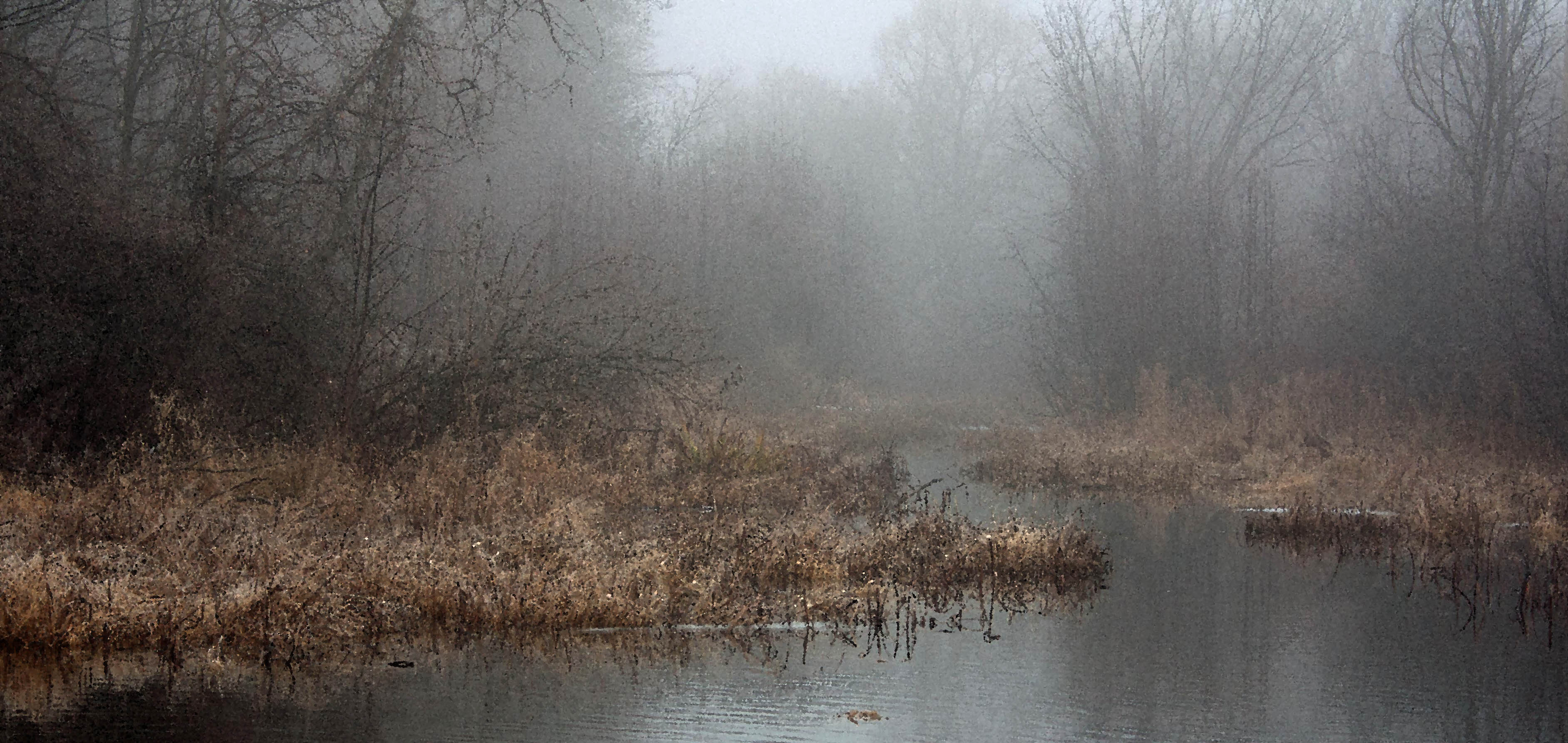
Mist over swelling spring stream, ON (photo and rendition by Nina Munteanu)
.
Nina Munteanu is a Canadian ecologist / limnologist and novelist. She is co-editor of Europa SF and currently teaches writing courses at George Brown College and the University of Toronto. For the lates on her books, visit www.ninamunteanu.ca. Nina’s bilingual “La natura dell’acqua / The Way of Water” was published by Mincione Edizioni in Rome. Her non-fiction book “Water Is…” by Pixl Press (Vancouver) was selected by Margaret Atwood in the New York Times ‘Year in Reading’ and was chosen as the 2017 Summer Read by Water Canada. Her novel “A Diary in the Age of Water” was released by Inanna Publications (Toronto) in June 2020.You can read her just released eco-fiction thriller Gaia’s Revolution by Dragon Moon Press.
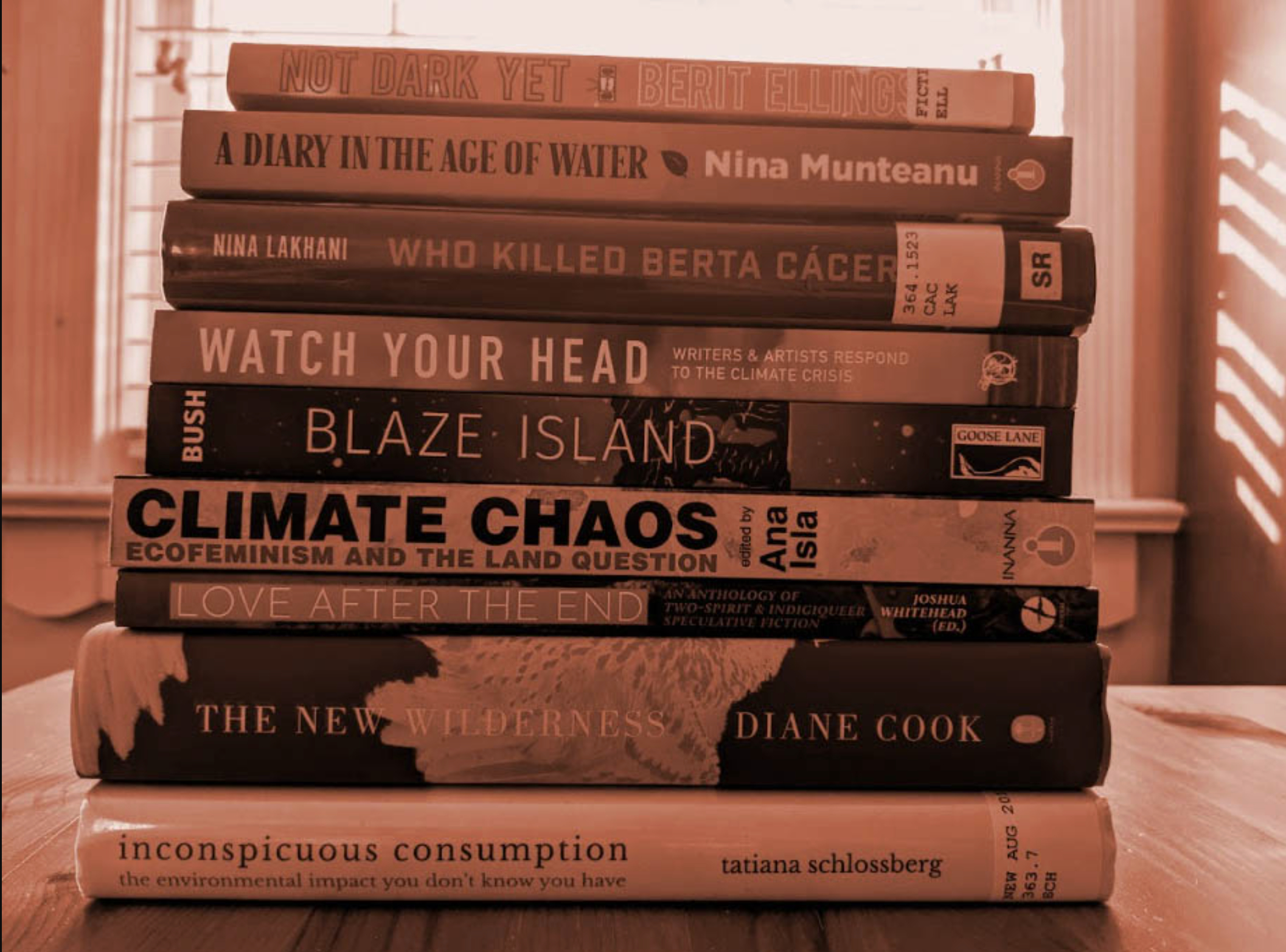
Buried in Print recently posted their list of recommended books on their page: Read the Change (You Want to See in the World). My eco-fiction novel A Diary in the Age of Water was listed under Water.
Buried in Print book pile under “Earth Changes, Habit Changes” (BIP)
.
Nina Munteanu is a Canadian ecologist / limnologist and novelist. She is co-editor of Europa SF and currently teaches writing courses at George Brown College and the University of Toronto. Visit www.ninamunteanu.ca for the latest on her books. Nina’s bilingual “La natura dell’acqua / The Way of Water” was published by Mincione Edizioni in Rome. Her non-fiction book “Water Is…” by Pixl Press(Vancouver) was selected by Margaret Atwood in the New York Times ‘Year in Reading’ and was chosen as the 2017 Summer Read by Water Canada. Her eco-fiction clifi novel “A Diary in the Age of Water” was released by Inanna Publications (Toronto) in June 2020.Her most recent novel Gaia’s Revolution, an eco-fiction political thriller, was released in March 2026 by Dragon Moon Press.
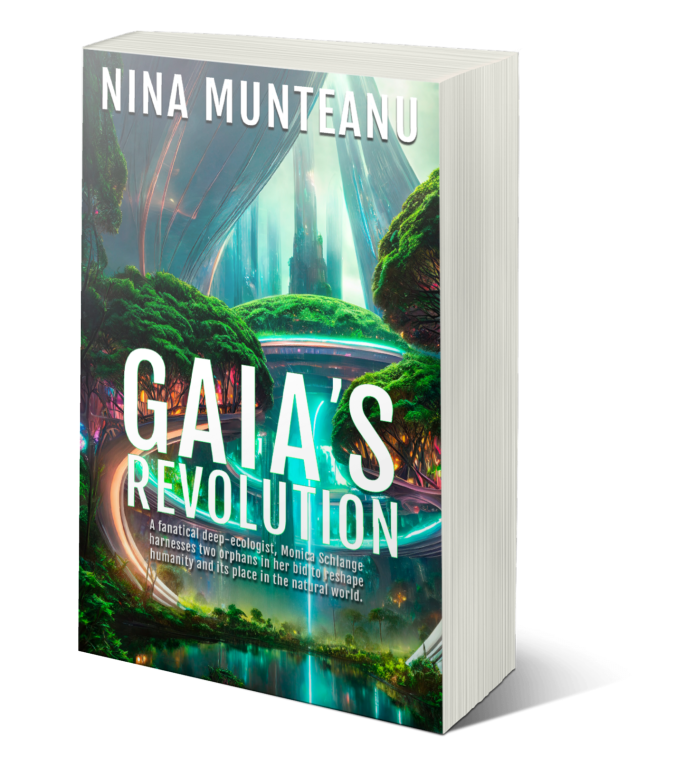
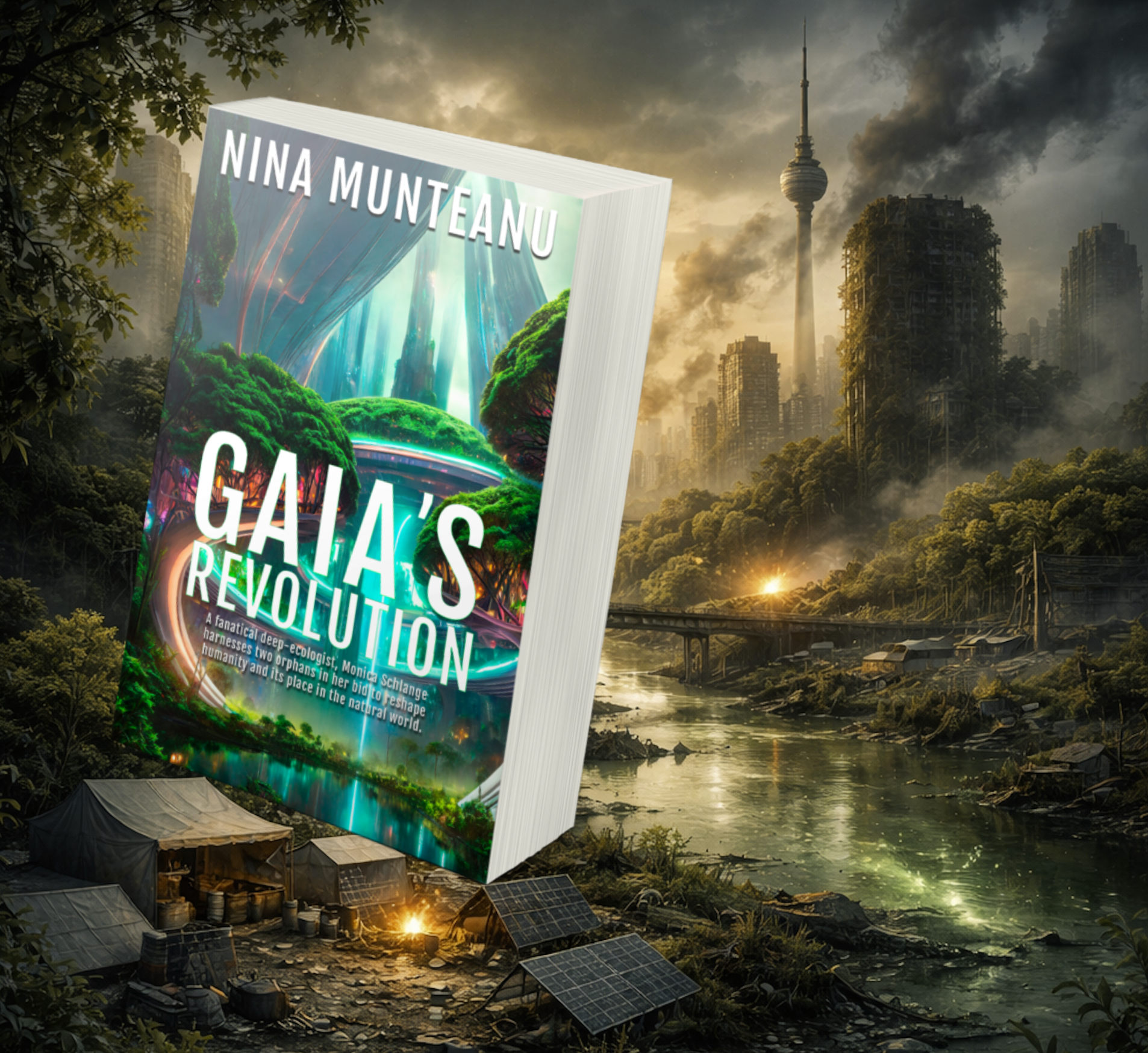
A fanatical deep-ecologist, Monica Schlange, harnesses two orphans in her bid to reshape humanity and its place in the natural world.
.
My novel Gaia’s Revolution, Book 1 of The Icaria Trilogy—which released March 10, 2026, by Dragon Moon Press—explores a collapsing capitalist society in Canada through ravages of climate change, water shortages, plague, and a failing technology.
.
The story begins in Berlin in 2022, with maverick scholar Damien Vogel, a deep ecologist and environmentalist who joined the climate activist group Letzte Generation* to do acts of civil disobedience to bring public awareness to climate offenders. The novel progresses from acts of civil disobedience to genuine eco-terrorism as Damien follows his revolutionary anarchist twin brother Eric to Canada and forms the Gaians, a radical eco-activist group, recruiting fanatic Monica Schlange—herself a sly eco-terrorist. Monica is an unscrupulous deep ecologist, proficient in using sabotage and internet tampering to disrupt and hurt climate offenders. The twin brothers end up on opposite sides of a violent revolution as Monica—guided by her own agenda as an extremist planetary guardian—plays them both.
.
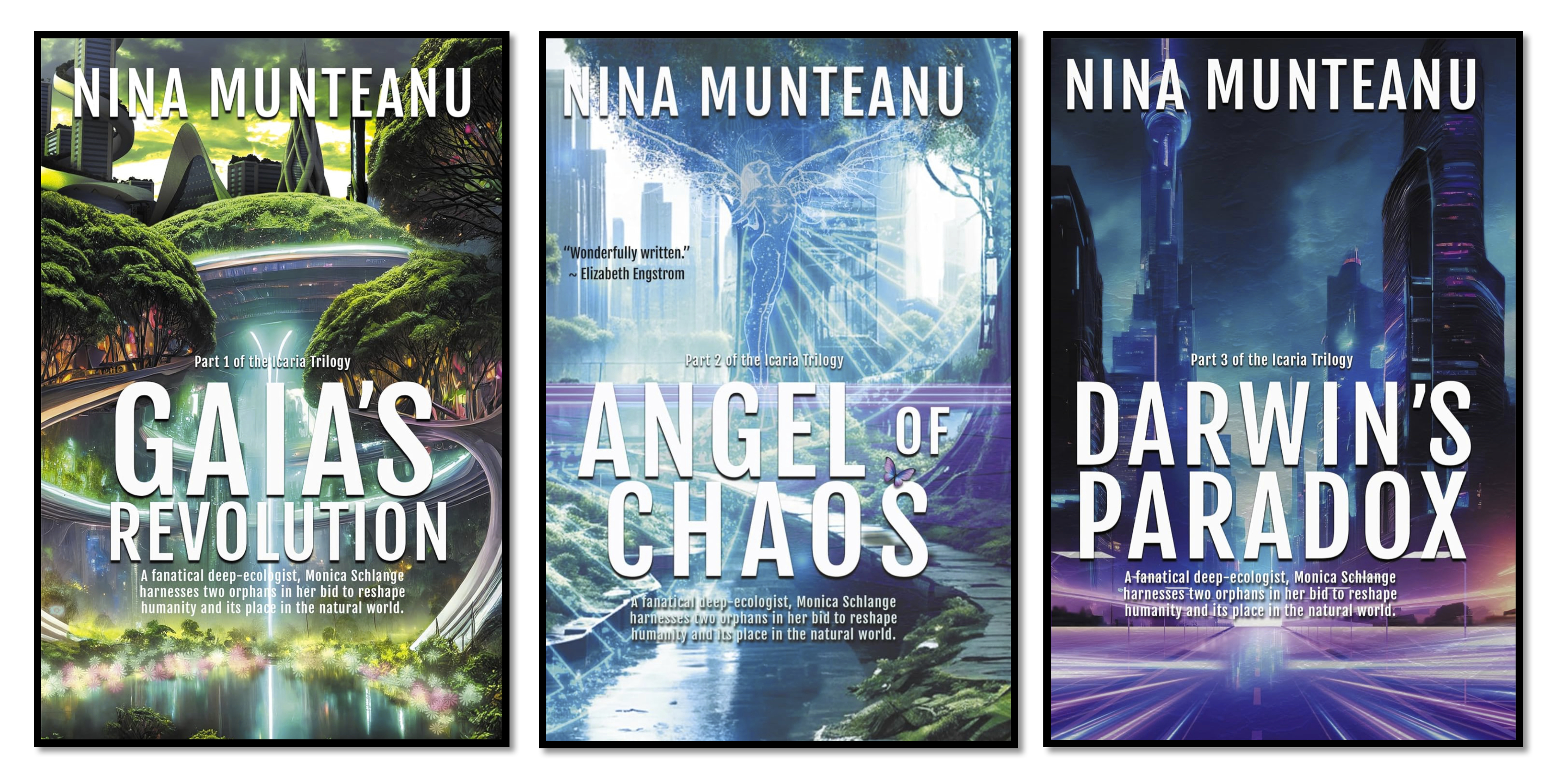
The Icaria Trilogy by Dragon Moon Press
.
By 2095 (Book 2Angel of Chaos and Book 3Darwin’s Paradox), humanity has fled inside environmental dome cities called Icarias*, chased inside by an unruly environment. Icarians struggle with Darwin’s Disease—a mysterious neurological environmental pandemic. Icaria 5 is one of many enclosed cities within the slowly recovering toxic wasteland of North America, and where the protagonist Julie Crane (daughter of one of the orphans in Gaia’s Revolution) lives and works. Icarias are run by The Circle, a governing body of deep ecologists who call themselves Gaians. The Gaians’ secret is that they are keeping humanity “inside” not to protect humanity from a toxic wasteland but to protect the environment from a toxic humanity.
.
Ecology vs. Deep Ecology vs. Eco-Terrorism
Snow falls on a Scots Pine forest, ON (photo and rendition by Nina Munteanu)
.
Ecology: Ecology is the science of relationships. Ecologists study ecosystems (aquatic and terrestrial), how they form, their structure and function, and how they relate to one another within the biosphere. Ecologists look at the relationship of all biota and non-biota, at individuals and communities, how all evolve (succession), at community richness, perturbations and recoveries, and natural enrichment. Ecologists model the flow of energy and cycling of matter over time and space.
Deep Ecology: Deep ecologists are usually ecologists themselves, who have adopted
An environmental philosophy and social movement advocating that all living beings have intrinsic value, independent of their utility to human needs. The philosophy promotes a holistic, ecocentric worldview—often termed “ecosophy”—that demands radical, structural changes to human society to prioritize nature’s flourishing. See the Eight Basic Principles of Deep Ecology.
Eco-Terrorism: Both ecologists and deep ecologists may grow cynical, seeing humanity as an existential threat, a virus that impacts the rest of life on Earth and exacerbates hyperobjects like climate change, loss of biodiversity and habitat destruction. This may lead to activism which some with a fanatical and destructive warrior spirit may move toward eco-terrorism such as criminal actions to halt development, and various acts of violence (e.g. arson, destruction of research facilities, threats against individuals).
.
Ecologists, Deep Ecologists & Eco-Terrorists in The Icaria Trilogy
In Gaia’s Revolution deep ecologist / scholar Damien Vogel and his nihilist revolutionary twin brother Eric Vogel trigger a violent revolution and eventual migration of humanity into the enclosed worlds of Icaria. While Damien follows deep ecology as an intellectual and scholar, believing in the eight basic principles of deep ecology, Eric uses the principles to enact merciless ‘solutions’ through brutal acts of eco-terrorism. Deep ecologist / eco-terrorist Monica Schlange insinuates herself into both brother’s plans to orchestrate her own unique vision of the world. Monica differs from Eric in her sense of humanity; a consummate and ruthless eco-terrorist and subversive, she is bent on entirely destroying the capitalist-technocratic machinery of which Eric is a part—to save the planet at the expense of human domination.
.
Damien and Christian Isabo meet to discuss recruiting her into their radical group:
Christian says, leaning forward, “She’s a bit of a wild card and possibly a genuine eco-terrorist. For instance, I discovered that she was behind the viral social media fiasco that embarrassed Prime Minister Robinson last year and almost cost him his seat. You know the one—those pictures of him fooling around with the German Chancellor, Magda Zimmermann, who’s married with two kids… Damien. I think that she’s extremely resourceful, stealthy, good at subterfuge and covers her tracks impeccably. Of course, there are definitely anger issues there. But, I also think we can count on her because her motives to help the environment lie on a deep visceral level, tied to her childhood experience and love of Nature.”
Damien studies her image on his phone with a thoughtful frown. He looks up at Christian. “What do we know about her?”
“Well, to begin with, she’s an only child and grew up on one of the last independent dairy farms in Ontario, near Guelph. Her father was strict and encouraged a strong work ethic and love for the natural world. He doted on her but died of a heart attack when she was only thirteen, the year their farm was seized by the Technocrats and converted into a Corporation Farm using scientific agriculture. In fact, their seizure may have precipitated the father’s heart attack. Her mother was assigned as a scullery maid in the farm kitchen; she took to drink then ran off with some truck driver travelling across Canada from Surrey, BC. He didn’t treat the girl well and she ran away before they reached Halifax. She ended up living with her aunt—her father’s sister—in the Beaches. The aunt worked as a librarian at York University and was a fervent member of Extinction Rebellion before it dissolved. She was a real bohemian, a deep ecologist herself, and encouraged the girl.”
While Monica shows the same level of dedication, she betrays a lack of integrity in her less than altruistic motivations and means, thinks Damien. The fact that she’s with Eric [his twin brother and nemesis] proves this. But even that—especially that—can work in their favour. It would seem that, without knowing it, she is already working as an undercover spy for their revolution. He can work with that, Damien thinks. Yes, he can certainly do that. And more. It’s my turn now, brother…
“OK. Set up a meeting,” Damien says. “Let’s get her into the fold.”
.
Mist over swelling spring stream, ON (photo and rendition by Nina Munteanu)
.
Leonard Crane—one of the three orphans impacted by the revolution and both rescued and tormented by Monica Schlange—studies ecology under new Gaian rule and is eventually inducted into the prestigious Department of Industrial Ecology (DIE) where he works on subversive ecological theories about Icaria’s inevitable demise and is eventually ostracised from the scientific community for his unpopular work. His legacy echoes throughout Books 2 and 3 of the trilogy.
.
Books 2 and 3 follow Julie Crane (Leonard’s daughter), a self-taught ecologist. In Angel of Chaos and Darwin’s Paradox, her skills as an amateur ecologist (in a world where ecology is not taught) are tested by the ruthless deep ecologist Gaia, head of The Circle. Gaia denigrates Julie’s ecological pursuits as shallow and ineffectual. When a subordinate of hers asks her if Julie would make a good candidate for The Circle (the governing body of Icaria), Gaia scoffs:
.
“You mistake a good scientific ecologist with someone who possesses a genuine empathy for deep ecology,” she said. Her eyes sparkled like sapphires. “No one enters our elite cadre without having impeccable qualifications and submitting to many more initiations than she is capable of passing. She may be an ecologist but she is not a deep ecologist. The science of ecology does not ask what kind of society would be the best suited to maintain a particular ecosystem. Our greater concern is with questions aimed at the level of organic wholeness and ‘Earth wisdom’. She knows nothing of these things.”—Gaia, Angel of Chaos
.
Fog enshrouded marsh in early winter, ON (photo and rendition by Nina Munteanu)
Munteanu, Nina. 2026. “Gaia’s Revolution, Part 1 of Icaria Trilogy.” Dragon Moon Press, Calgary, AB. 369 pp.
Munteanu, Nina. 2010. “Angel of Chaos, Part 2 of Icaria Trilogy.” Dragon Moon Press, Calgary, AB. 518 pp.
Munteanu, Nina. 2007. “Darwin’s Paradox, Part 3 of Icaria Trilogy.” Dragon Moon Press, Calgary, AB. 294 pp.
Sessions, George, Bill Devall. 2000. “Deep Ecology: Living as if Nature Mattered.” Gibbs Smith. 267pp.
Skinner, B.F. 1948. “Walden Two” The Macmillan Company, New York. 301pp.
.
Terminology:
*Deep Ecology: An environmental philosophy and social movement advocating that all living beings have intrinsic value, independent of their utility to human needs. Coined by Arne Næss in 1972, it promotes a holistic, ecocentric worldview—often termed “ecosophy”—that demands radical, structural changes to human society to prioritize nature’s flourishing.
*Icaria: the name of Étienne Cabet’s utopia. Cabet was a French lawyer in Dijon, who published his novel Voyage en Icarie in 1839. The novel was a sort of manifesto-blueprint of utopian socialism, with elements of communism (abolished private property and individual enterprise), influenced by Fourierist and Owenite thinking. Key elements, such as the four-hour work day, are reflected in B.F. Skinner’s Walden Two. Cabet’s novel explores a society in which capitalist production is replaced by workers’ cooperatives with a focus on small communities.
*Letzte Generation: a prominent European climate activist group, founded in 2021, known for its acts of civil disobedience—such as roadblocks, defacing art, and vandalizing structures—to pressure governments on climate action. The term was chosen because they considered themselves to be the last generation before tipping points in the earth’s climate system would be reached. They are mostly active in Germany, Italy, Poland and Canada. In Germany, they have faced accusations of forming a criminal organization, leading to police raids.
.
Nina Munteanu is an award-winning novelist and short story writer of eco-fiction, science fiction and fantasy. She also has three writing guides out: The Fiction Writer; The Journal Writer; and The Ecology of Writing and teaches fiction writing and technical writing at university and online. Check the Publications page on this site for a summary of what she has out there. Nina teaches writing at the University of Toronto and has been coaching fiction and non-fiction authors for over 20 years. You can find Nina’s short podcasts on writing on YouTube. Check out this site for more author advice from how to write a synopsis to finding your muse and the art and science of writing.
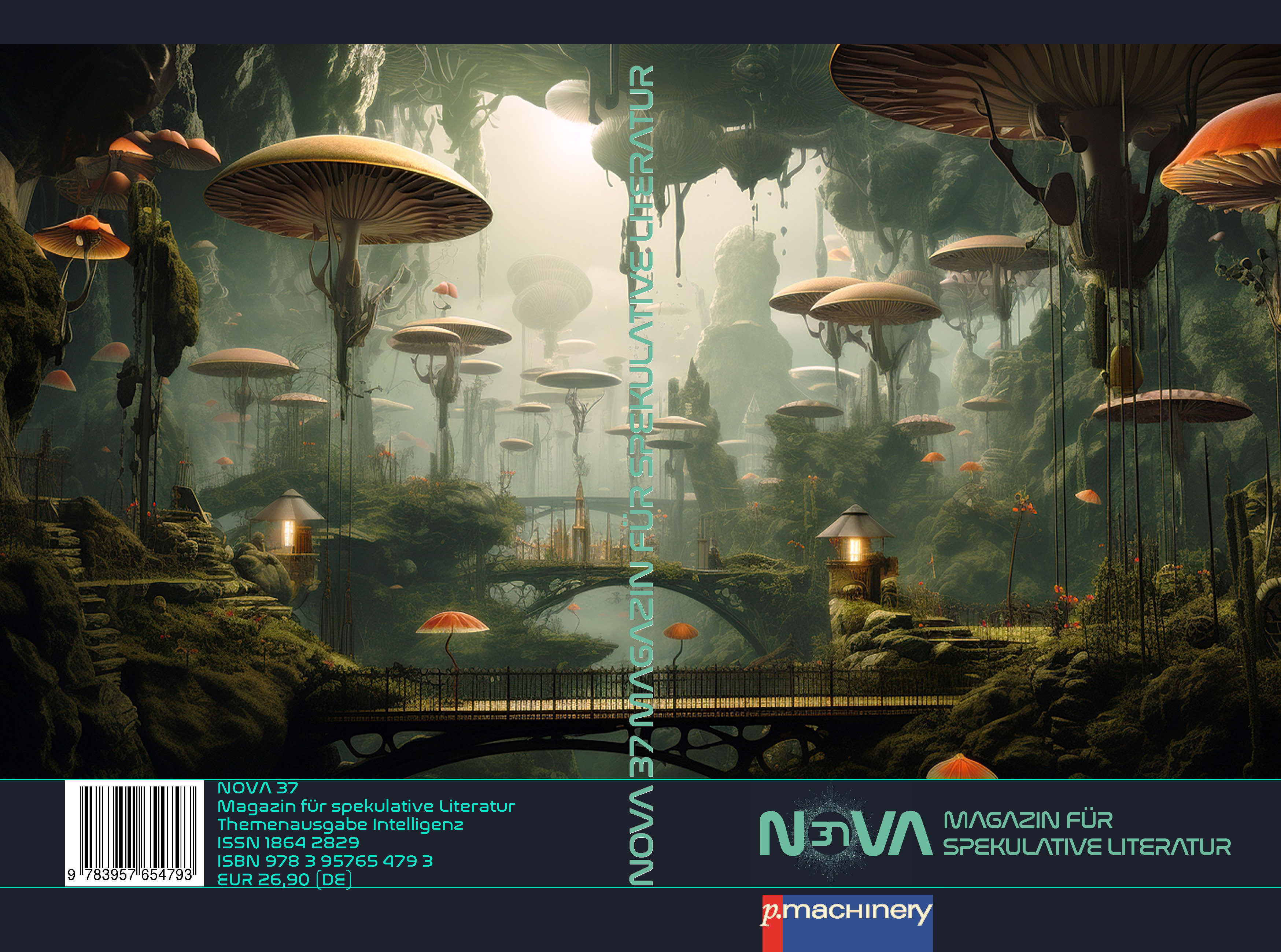
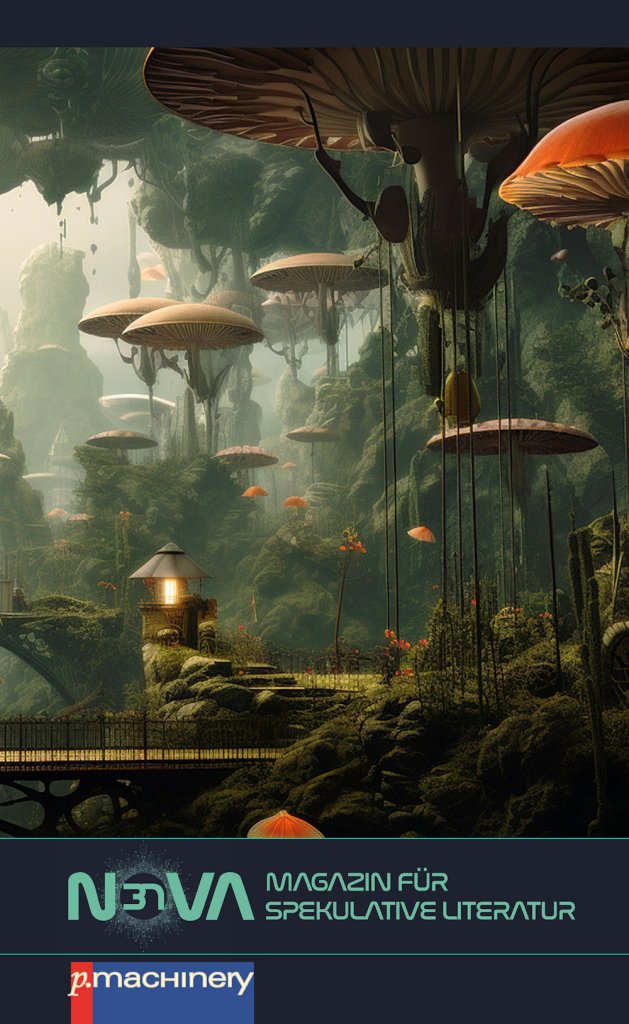
My short story “The Way of Water” was recently translated into German (“Der Weg des Wassers”) and published in Nova 37. The issue has illustrations for each story and a beautiful cover. When I got my author’s copy in the mail, I was blown away! It was as though they had tapped my love for mushrooms. Bright orange and floating in a sea of green vegetation, the aerial fungi that hovered over a jungle village resembled giant Micenas.
“The Way of Water” follows a young woman (Hilda) in near-future Toronto who has run out of water credits for the public iTap; by this time houses no longer have potable water and their water taps have been cemented shut (as was done in Detroit in 2014); the only way to get water is through the public iTaps—at great cost. She’s standing two metres from water—in a line of people waiting to use the tap—and dying of thirst.
“The Way of Water” captures a vision that explores the nuances of corporate and government corruption and deceit together with global resource warfare. In this near-future, Canada is mined of all its water by thirsty Chinese and US multinationals—leaving nothing for the Canadians. Rain has not fallen on Canadian soil in years due to advances in geoengineering and weather manipulation that prevent rain clouds from going anywhere north of the Canada-US border. If you’re wondering if this is possible, it’s already happening in China and surrounding countries.
I’ve written several articles on how The Way of Water came about. Briefly, it all started with an invitation in 2015 by my publisher in Rome to write about water and politics in Canada. I had long been thinking of potential ironies in Canada’s water-rich heritage. The premise I wanted to explore was the irony of people in a water-rich nation experiencing water scarcity: living under a government-imposed daily water quota of 5 litres as water bottling and utility companies took it all.
.
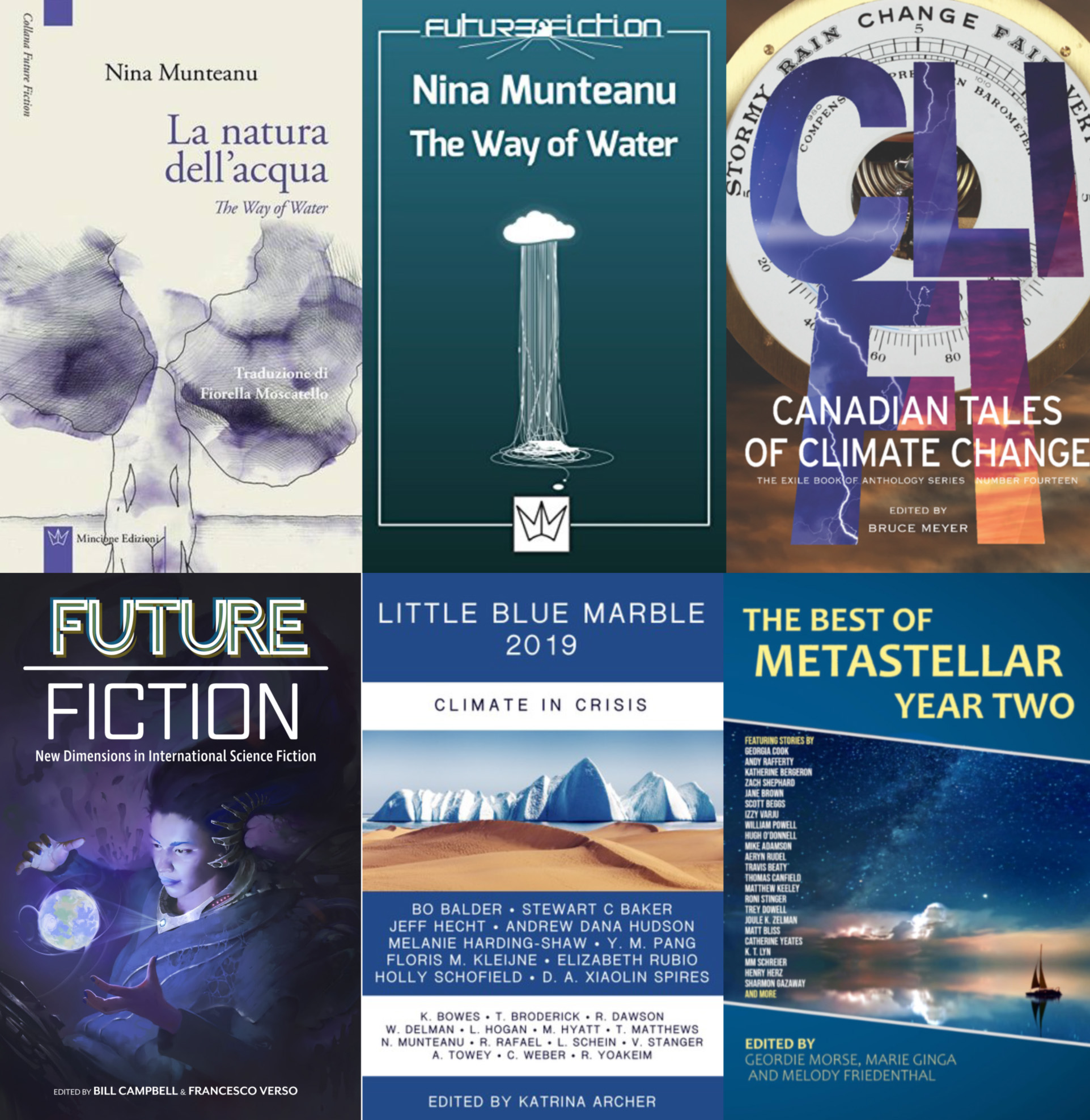
Various publications in which my short story “The Way of Water” has appeared
.
The Way of Waterwas first published in 2016 as a bilingual print book by Mincione Edizioni(Rome) in Italian (La natura dell’acqua, translated by Fiorella Moscatello), and English along with a recounting of what inspired it: The Story of Water (La storia dell’acqua). To date, The Way of Waterhas been published and republished eight times throughout the world and translated into Italian and German. Anthologies include, among others, Metastellar something, “Canadian Tales of Climate Change” (Exile Editions) edited by Bruce Meyer, “Future Fiction” Anthology (publisher), and “Climate in Crisis” (Little Blue Marble). I think this success is less a reflection of my writing than the immediacy and importance of the topic covered: growing water scarcity, its commodification, and its politicization.
.
This latest publication of The Way of Water (Der Weg des Wassers) in Nova 37 represents its eighth publication. Nova Magazin für spekulative Literatur is one of the most respected short story and essay magazines for science fiction in the German-speaking world. Most recently it was called “NOVA Science-Fiction,” and since issue 31 it has been “NOVA – Magazine for Speculative Literature”; the name change reflects the desire to broaden the readership and interest beyond the pure science fiction scene. The magazine’s website is now part of the larger pmachinery.de news feed.
.
“In a short story in which every word has its weight, Nina Munteanu manages to describe a dystopia with ecological, political, social and economic elements and Hilda’s reactions to her situation with a great intensity. To avoid thirst, Hilda ends up embracing an extreme idea, a last hope linked to water. The Way of Water is a story of the kind you hope is science fiction but you fear is not.”—Massimo Luciani
“In the Way to Water, Nina Munteanu pens her love letter to water, exulting it as a liquid that has semi-magical properties… The Way of Water evokes a sense of awareness about issues of access to water and about the dangers of imbalances in that access.”—Derek Newman-Stille, Speculating Canada
.
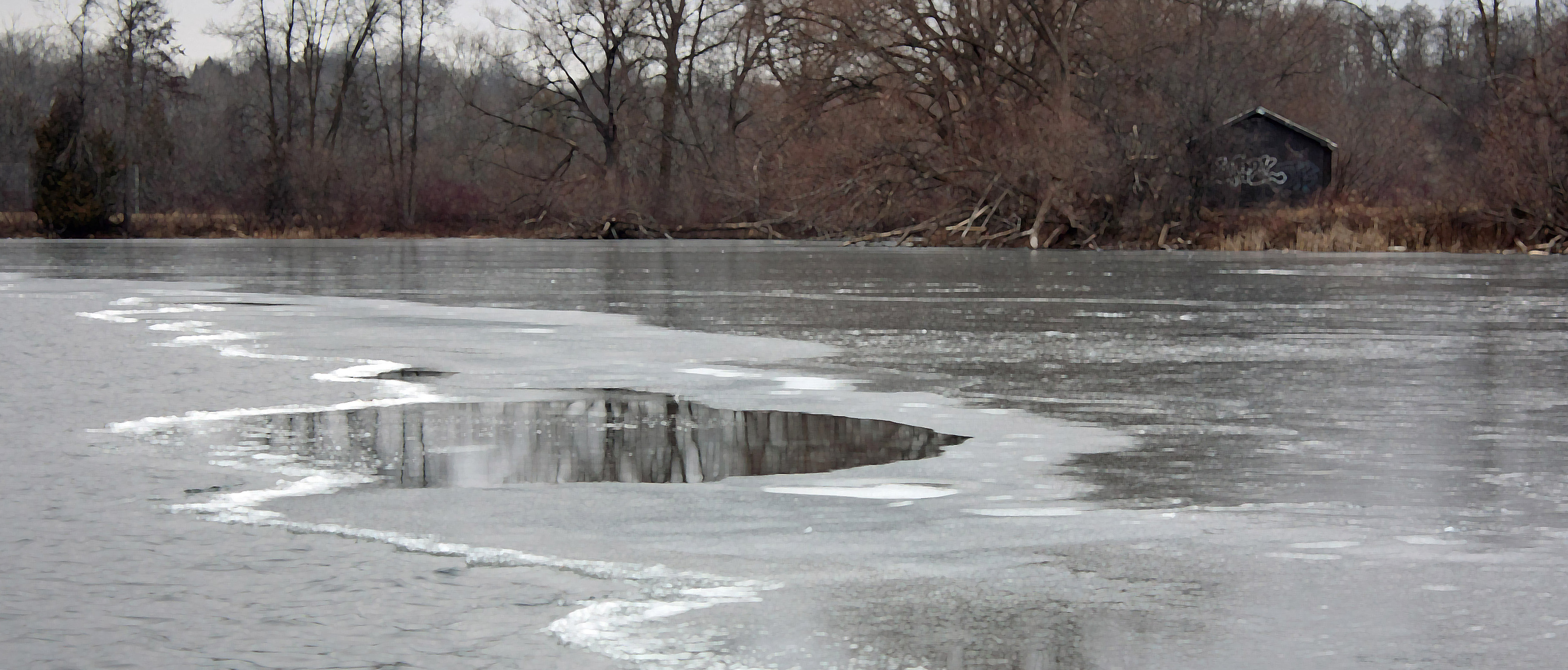
Ice edge on the Otonabee River, ON (photo and rendition by Nina Munteanu)
.
In her masters thesis published in November 2025 at the University of Graz, Austria, Seyma Yonaruses my short story The Way of Water, along with several others to explore and discuss the importance of eco-literature in establishing ecological awareness and ultimately ecological and sustainable action.
“The Way of Water is a strong eco-story that possesses many layers and elements that strengthen its narrative while encouraging readers to engage with its world…The notion what water constitutes the essence of life is the central theme of the story … Munteanu’s knowledge as a scientist enables her to create a convincing scientist protagonist whom she embeds into a powerful fictional story. Water, particularly in this eco-story acts not only as a symbolic entity but also as a body of force…the agency of water is presented as a dynamic, living entity, central to the narrative’s ecological themes.”
“Munteanu’s impactful storytelling highlights her significant contribution to Canadian literature, particularly through her engagement with pressing environmental issues and her commitment to fostering ecological awareness through fiction.”
.
.
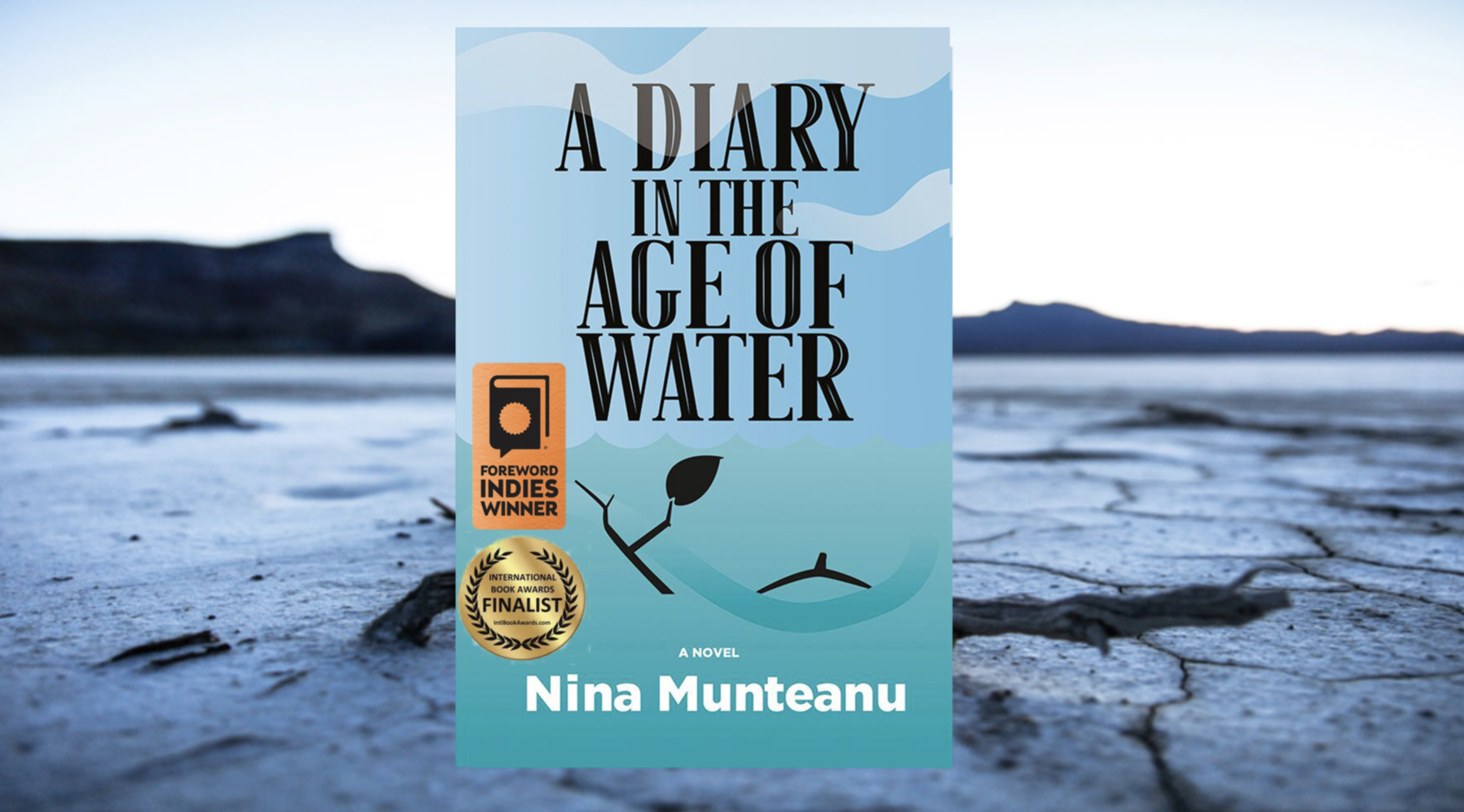
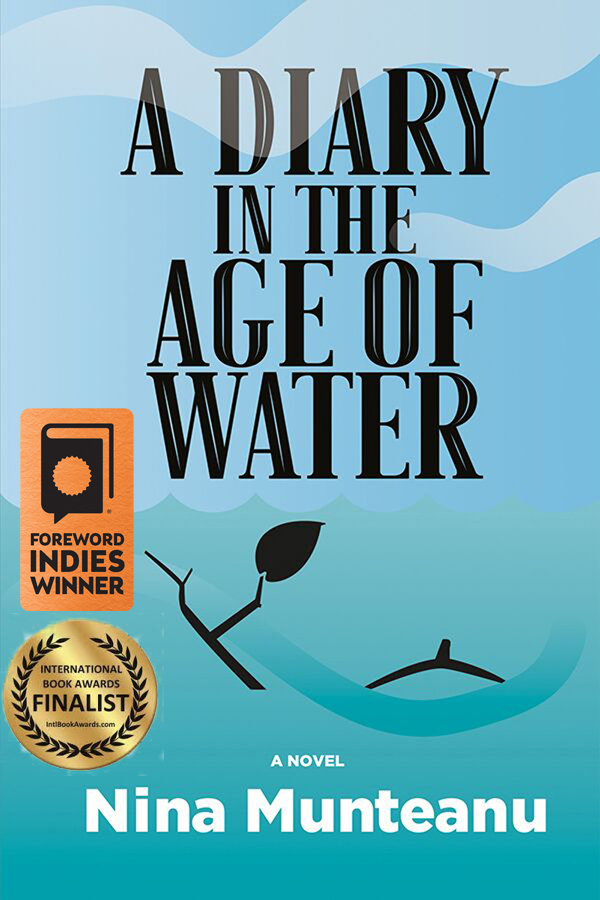
The Way of Water, in turn, inspired my dystopian novel A Diary in the Age of Water(Inanna Publications, 2020), which chronicles the lives of four generations of women and their relationship to water during a time of severe water restriction and calamitous climate change. The novel features the main character Hilda from The Way of Water and her limnologist mother; A Diary in the Age of Water is essentially the mother’s diary embedded in a larger story. Through a series of entries, the diarist reflects on the subtle though catastrophic occurrences that will eventually lead to humanity’s demise.
.
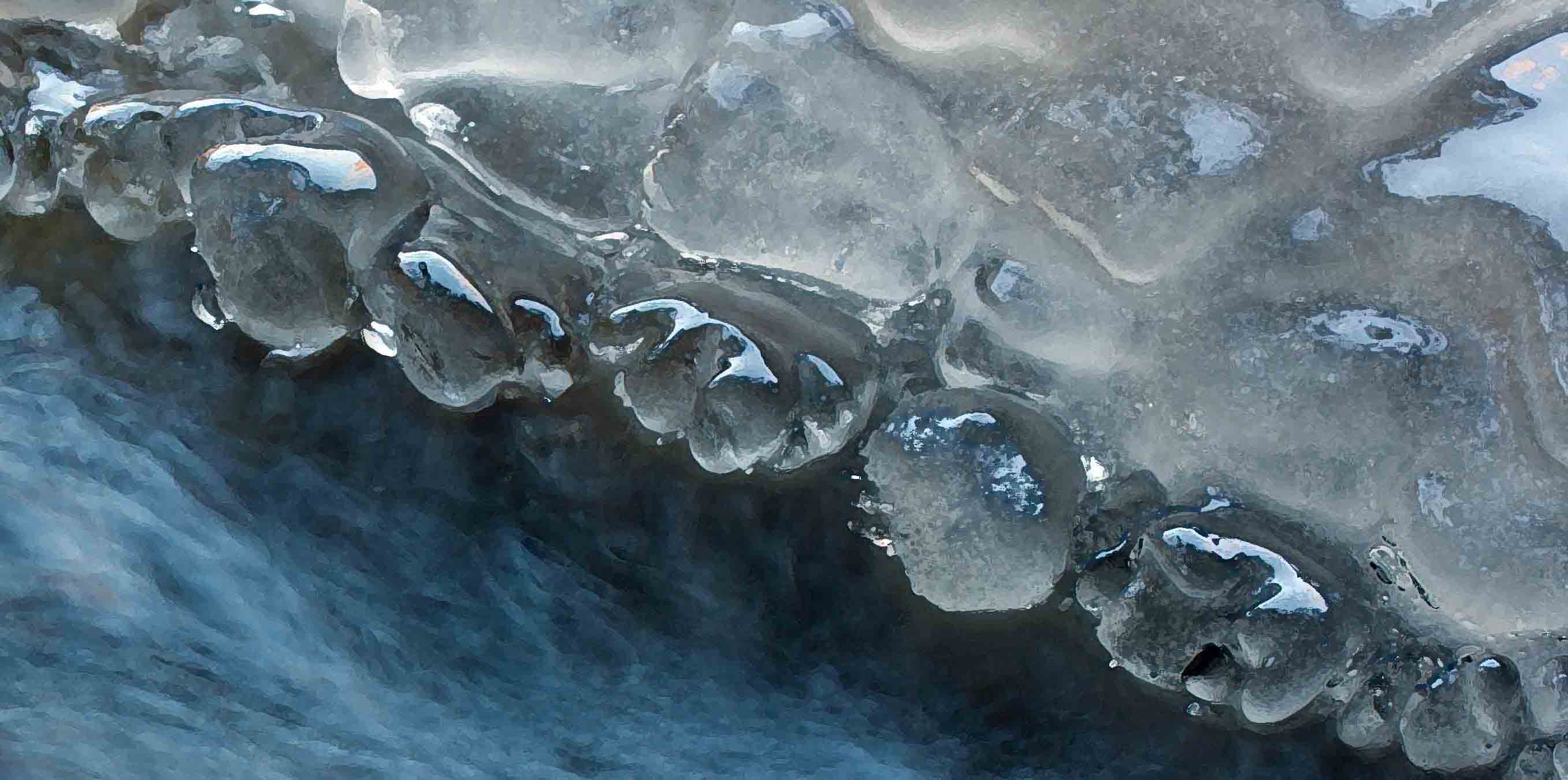
Ice pearls forming in Jackson Creek, ON (photo and rendition by Nina Munteanu)
.
References:
Munteanu, Nina. “The Way of Water” Mincione Edizioni, Rome. 113pp.
Munteanu, Nina. “A Diary in the Age of Water.” Inanna Publications, Toronto, ON. 328pp.
Fi: Anthology #14. Edited by Bruce Meyer. Exile Editions, Toronto.304pp.
Yonar, Seyma. 2025. “Short Texts—Long Term Effects: The Canadian Eco-Story.” Masters Thesis, University of Graz, Austria. 70pp.
.
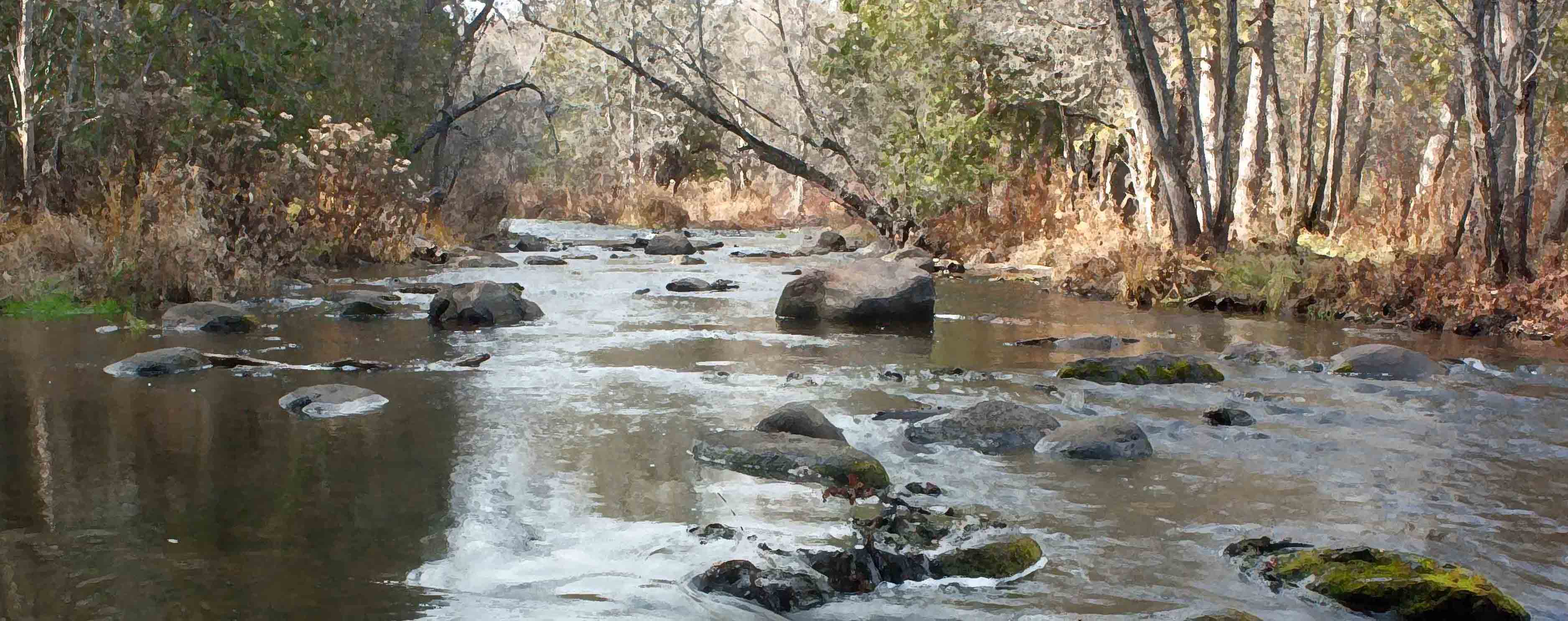
Jackson Creek in the fall, ON (photo and rendition by Nina Munteanu)
.
Nina Munteanu is an award-winning novelist and short story writer of eco-fiction, science fiction and fantasy. She also has three writing guides out: The Fiction Writer; The Journal Writer; and The Ecology of Writing and teaches fiction writing and technical writing at university and online. Check the Publications page on this site for a summary of what she has out there. Nina teaches writing at the University of Toronto and has been coaching fiction and non-fiction authors for over 20 years. You can find Nina’s short podcasts on writing on YouTube. Check out this site for more author advice from how to write a synopsis to finding your muse and the art and science of writing. For more on her work as a limnologist and ecologist, see The Meaning of Water.
My flash fiction story “Alien Landscape” was recently accepted by the online magazine Sudden Flash and released on December 30, 2025—making it my last story published that year. The story follows Blika who crash lands in potential hostile territory of an alien planet after responding to a distress call. What Blika discovers is not what she expected…
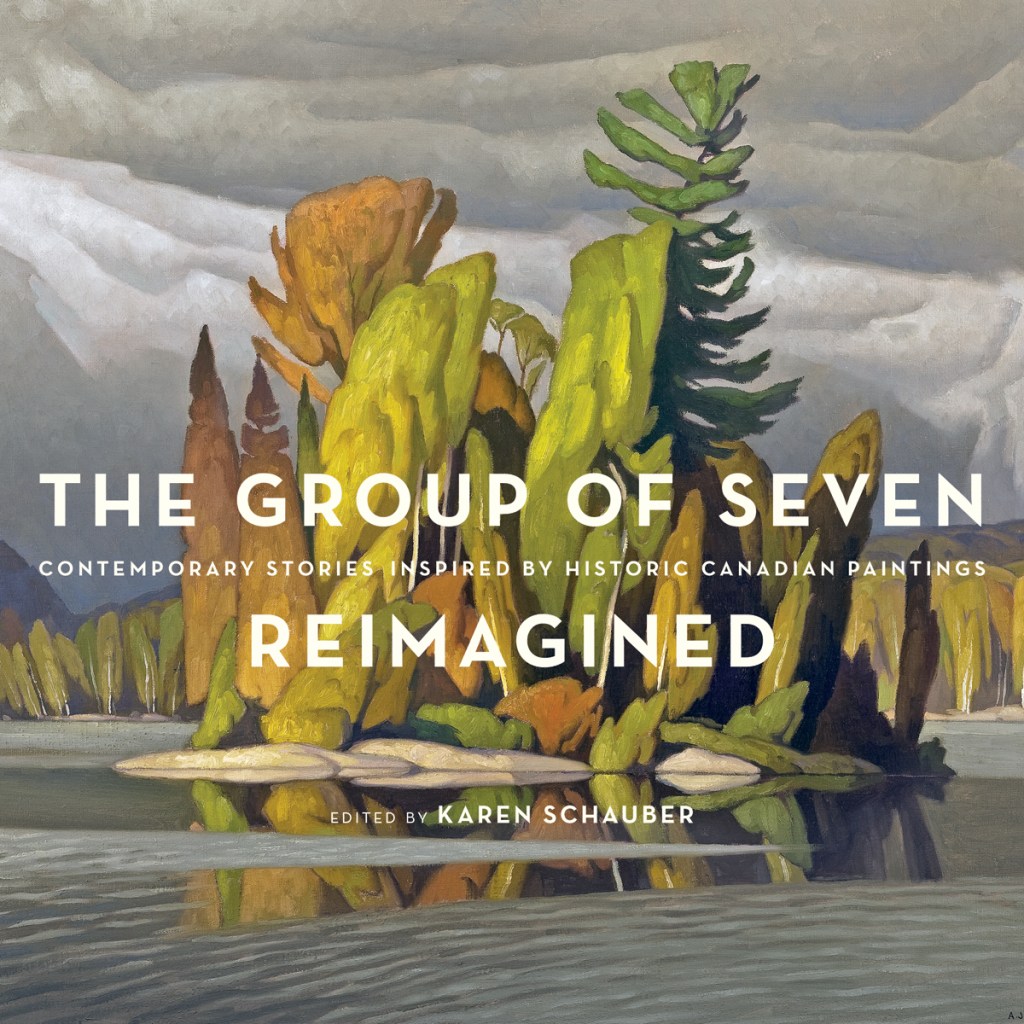
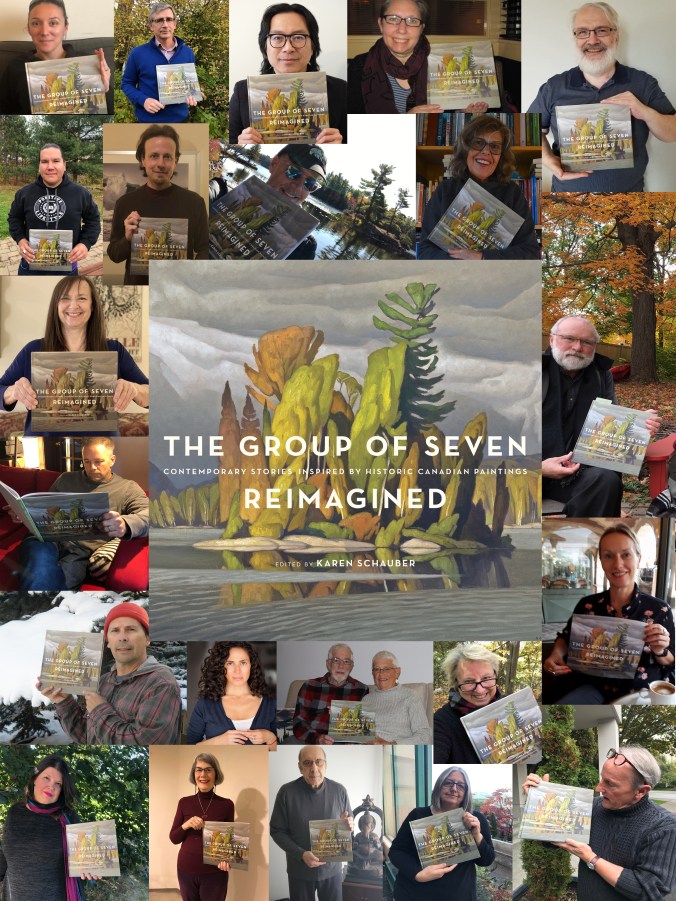
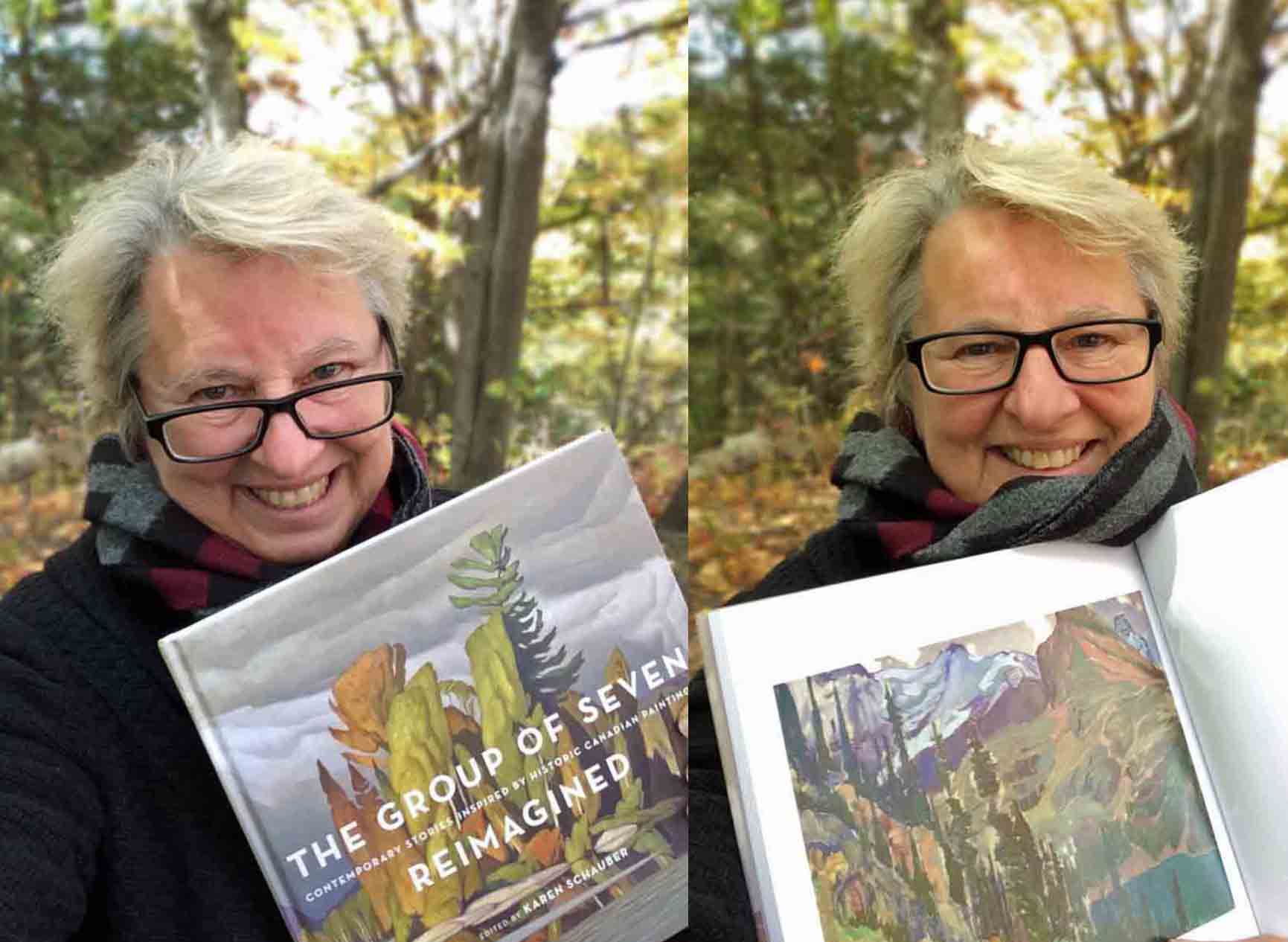
“Alien Landscape” first appeared in the 2019 celebratory ekphrastic anthology, edited by Karen Schauber and published by Heritage House: “The Group of Seven Reimagined.” The anthology celebrated the centenary of the formation of the Canadian iconic Group of Seven artists. Check my article which describes more about the Group of Seven movement. The Group of Seven movement “dragged Canadian art into the modern age,” writes Christine Sismondo of The Toronto Star in her review of “The Group of Seven Reimagined.” Sismondo astutely identifies and encapsulates the resonant meaning of the Group of Seven, then and now:
.
“A hundred years ago, seven Canadian painters got together and decided to start a movement. It was born out of the horrors of war. Now, the potential horrors of climate change are giving the movement an unexpected new life and meaning.”
.
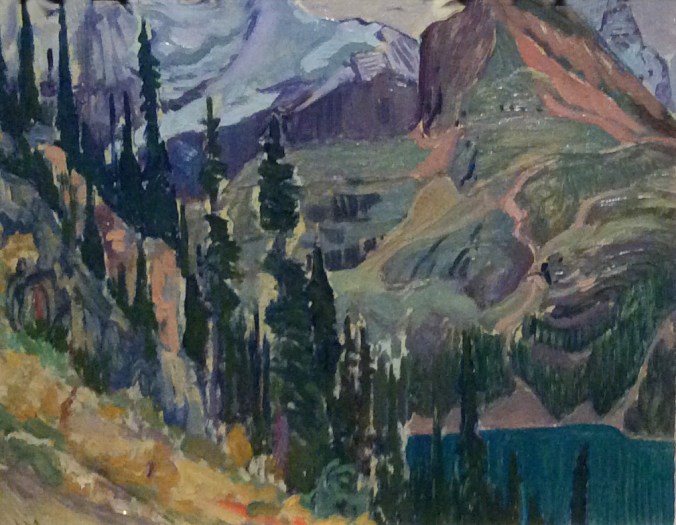
I joined twenty other flash fiction authors who linked our flash fiction to one the Group of Seven’s works. My “Alien Landscape” was inspired by J.E.H. MacDonald’s Lake O’Hara.
Lake O’Hara by J.E.H. MacDonald
.
Karen had invited me to contribute a piece of flash fiction (a piece of less than 500 words), inspired by a Group of Seven piece I would choose to inspire me. I took my time; this would be the first flash fiction piece I would write. It was an art form I was not familiar with, but was happy to experiment with. But I waited too long to decide and when I finally submitted my first choice for a painting, Karen informed me that it had already been selected by another writer. To my great frustration, this went on for a few pieces.
I finally took a short trip to the McMichael Gallery in Kleinburg to find my piece. In the main hall, I passed the pieces already claimed by my twenty colleagues; I sighed that I had waited so long. By chance, a large selection of artwork by J.E.H. MacDonald—one of the founders of the group—was currently on exhibit on the second floor. That was where I first saw the original oil sketch called Lake O’Hara by MacDonald. It was perfect! My story “Alien Landscape” emerged from the sketch like they had always belonged together.
.
Christine Sismondo of The Toronto Star wrote: “while you might expect a lot of peaceful communing with nature on the page, a surprising number of the written pieces are actually dark tales of conflict and danger—forest fires, mining accidents, boat thieves and murderous plots in the woods.
Nina Munteanu, a Canadian ecologist and science-fiction writer, takes J.E.H. MacDonald’s Lake O’Hara in a novel direction in ‘Alien Landscape’ by reimagining it as a refuge for a space heroine fleeing a world that had destroyed nature in pursuit of progress and ended in post-apocalyptic chaos.”
.
Nina Munteanu with cover and selected Group of Seven art to write about
.
Nina Munteanu is an award-winning novelist and short story writer of eco-fiction, science fiction and fantasy. She also has three writing guides out: The Fiction Writer; The Journal Writer; and The Ecology of Writing and teaches fiction writing and technical writing at university and online. Check the Publications page on this site for a summary of what she has out there. Nina teaches writing at the University of Toronto and has been coaching fiction and non-fiction authors for over 20 years. You can find Nina’s short podcasts on writing on YouTube. Check out this site for more author advice from how to write a synopsis to finding your muse and the art and science of writing.